93 questions available to read. Bina signup padho; timed practice ke liye free sign in karo.
Archive coverageThis saved paper contains 99 of 100 expected questions. 6 stored records are excluded from this study page while their source or wording is checked. Missing original questions: 1. Local question numbers follow the saved archive; match the wording and choices when comparing another response sheet.
Archived marked answers and available solution notes are preserved. These are not claimed to be fully checked final SSC keys. How questions are checked.
Reasoning
Q1 · Series
What is the next number in the series?
100, 50, 25, ___
- 10
- 12.5
- 13.5
- 14
Answer aur solution dekho
Archived marked answer: B
Given Series
100, 50, 25, ___
Observe the pattern
50 = 100 ÷ 2
25 = 50 ÷ 2
Each number is divided by 2.
Find the next number
25 ÷ 2 = 12.5
Hence, the correct answer is Option 2.
Q2 · Series
Complete the series. 2, 4, 7, 11, 16, ?
- 22
- 20
- 24
- 21
Answer aur solution dekho
Archived marked answer: A
The logic followed here
4 − 2 = 2
7 − 4 = 3
11 − 7 = 4
16 − 11 = 5
The differences are increasing consecutively:
+2, +3, +4, +5
Next difference
Next increase = +6
16 + 6 = 22
Hence, the correct answer is Option 1.
Q3 · Analogy
Solve: DF : GI :: KM : ?
- MN
- NP
- OP
- QR
Answer aur solution dekho
Archived marked answer: B
Given: DF : GI :: KM : ?
Find the pattern
D → G ( +3 )
F → I ( +3 )
Each letter is moved 3 positions forward in the alphabet.
Apply the same rule to KM
K → N ( +3 )
M → P ( +3 )
NP
Hence the correct option is Option 2.
Q4 · Analogy
What comes next in the series? A, C, F, J, ?
- J
- I
- H
- O
Answer aur solution dekho
Archived marked answer: D
The logic followed here:
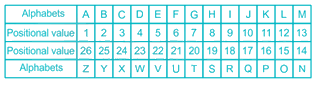 Convert letters to positions
A = 1
C = 3
F = 6
J = 10
Find the pattern
3 − 1 = 2
6 − 3 = 3
10 − 6 = 4
The pattern is increasing by +2, +3, +4
Next increase = +5
10 + 5 = 15
15th letter = O
Hence, the correct answer is Option 4.
Q5 · Analogy
Choose the number that fits the analogy: 3 : 24 :: 5 : ?
- 123
- 120
- 122
- 124
Answer aur solution dekho
Archived marked answer: B
Given:
3 : 24 :: 5 : ?
3² = 9, 3(9-1), 3(8)= 24
Applying the same rule
5² = 25, 5(25-1), 5(24)= 120
Hence, the correct answer is Option 2.
Q6 · Analogy
Find the missing number: 100 : 1000 :: 64 : ?
- 416
- 524
- 512
- 729
Answer aur solution dekho
Archived marked answer: C
Given
Find the relation
100 → 1000
100 = 10²
1000 = 10³
So, the pattern is:
If a number is a perfect square (n²), it is converted to n³.
Apply same logic to 64
64 = 8²
So, 64 → 8³
= 512
Hence, the correct option is Option 3.
Q7 · Puzzle Subtypes Not To Miss
A man is 4 times as old as his daughter. In 20 years, he will be twice as old as she will be then. How old is the daughter now?
- 10
- 8
- 12
- 9
Answer aur solution dekho
Archived marked answer: A
Shortcut Trick
Current ratio (Man:Daughter) = 4 : 1 (Difference = 3 units)
Ratio after 20 years = 2 : 1. Make differences equal: multiply by 3 → 6 : 3
Increase in units = 6 − 4 = 2 units. These 2 units = 20 years.
1 unit = 10 years. Daughter's current age (1 unit) = 10 years.
∴ The correct answer is 10 years.
Alternate Method
Given: Present age ratio = 4:1. Ratio after 20 years = 2:1.
Formula Used: Ratio & Proportion linear equations.
- Now After 20 years Daughter: x Man: 4x Daughter: x+20 Man: 4x+20
+20 years
⇒ Let Daughter's age = x and Man's age = 4x.
⇒ After 20 years: (4x + 20) = 2 × (x + 20)
⇒ 4x + 20 = 2x + 40
⇒ 4x − 2x = 40 − 20
⇒ 2x = 20
⇒ x = 10
∴ The correct answer is 10 years.
Additional Information
Concept of Age Difference
The age difference between two people always remains constant throughout their lives. This is a key tool in solving ratio-based age problems.
Ratio Balancing
To solve age ratios quickly, multiply the ratios so that the difference between the parts (Man − Daughter) is identical in both current and future ratios.
Linear Equations in Ages
If "n" years ago is mentioned, subtract n from current age; if "n" years hence/later is mentioned, add n to the current age.
Q8 · Puzzle Subtypes Not To Miss
If A & B = A × B - A, what is 7 & 5?
- 28
- 35
- 30
- 25
Answer aur solution dekho
Archived marked answer: A
Given:
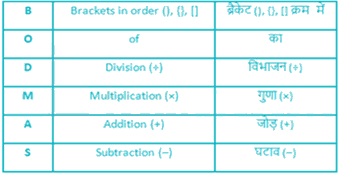 A & B = A × B − A
To find: 7 & 5
Substitute the values:
7 & 5 = 7 × 5 − 7
= 35 − 7
= 28
Hence, the correct answer is Option 1.
Q9 · Puzzle Subtypes Not To Miss
If 2 # 3 = 13, 3 # 4 = 25, then 4 # 5 = ?
- 37
- 41
- 39
- 36
Answer aur solution dekho
Archived marked answer: B
Given:
2 # 3 = 13
3 # 4 = 25
2 # 3 = (2² + 3²)
= 4 + 9 = 13
3 # 4 = (3² + 4²)
= 9 + 16 = 25
Applying the same logic:
4 # 5 = (4² + 5²)
= 16 + 25
= 41
Hence, the correct answer is Option 2.
Q10 · Puzzle Subtypes Not To Miss
Which two signs should be swapped to correct this equation? 20 ÷ 5 + 6 × 2 - 4 = 18
- ÷ and ×
- + and -
- ÷ and -
- + and ×
Answer aur solution dekho
Archived marked answer: C
Given Equation:
20 ÷ 5 + 6 × 2 − 4 = 18
Solve using BODMAS:
Option 1: Swap ÷ and ×
20 × 5 + 6 ÷ 2 − 4
= 100 + 3 − 4
= 99 (Not correct)
Option 2: Swap + and − Q11 · Puzzle Subtypes Not To Miss
In the following examples, a number is coded as three digits — representing the remainders when the number is divided by 3, 7, and 11, respectively.
Examples:Example 1:53 → (53 ÷ 3 = 17 R2, 53 ÷ 7 = 7 R4, 53 ÷ 11 = 4 R9) → Code: 2, 4, 9
Example 2:68 → (68 ÷ 3 = 22 R2, 68 ÷ 7 = 9 R5, 68 ÷ 11 = 6 R2) → Code: 2, 5, 2
By following this method, which is the least number which would have the code - 2,2,2 ?
- 223
- 323
- 233
- 243
Answer aur solution dekho
Archived marked answer: C
Given:
A number is coded as three digits representing the remainders when divided by 3, 7 and 11 respectively.
We need a number whose code is: 2, 2, 2
That means:
Number ÷ 3 → Remainder 2
Number ÷ 7 → Remainder 2
Number ÷ 11 → Remainder 2
Check Options
Q12 · Coding Decoding
If in a code, MANGO is written as NZOHQ, then how is APPLE written?
- BOQMG
- BQQLF
- BRQLF
- BQQME
Answer aur solution dekho
Archived marked answer: A
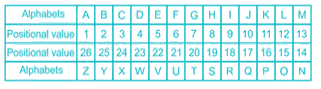 The logic followed here is:
MANGO is written as NZOHQ
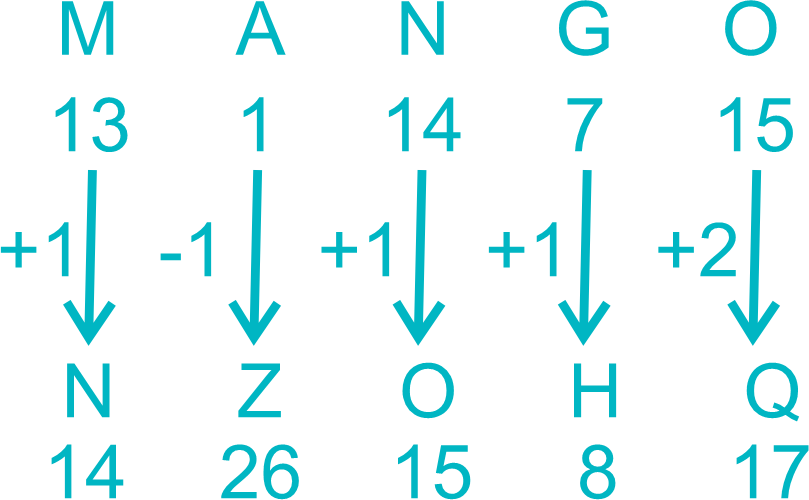 Similarly,
APPLE is written as
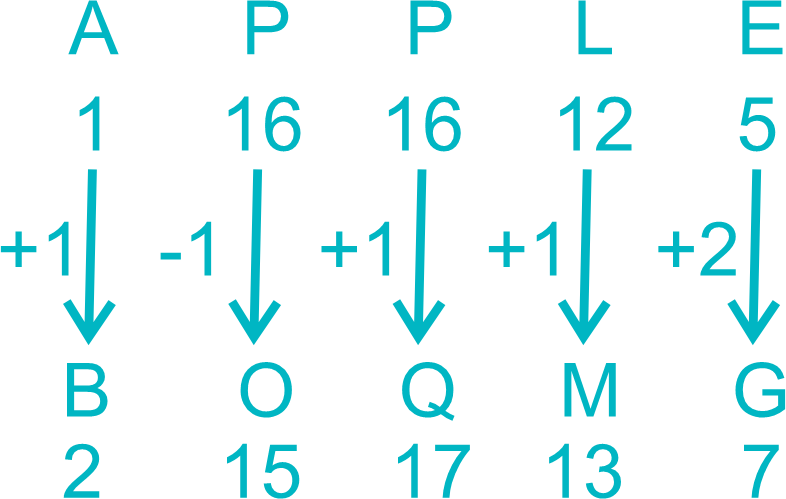 Hence, the correct answer is "Option 1".
Q13 · Classification Odd One Out
If we increase each even digit by '1' and decrease each odd digit by '1' in the number '7846921453' and then arrange all the number in descending order, then what is the sum of the first five digits from the left end after the rearrangement?
- 35
- 32
- 38
- 34
Answer aur solution dekho
Archived marked answer: A
Given Number:
7846921453
Modify the digits
Rule:
Increase each even digit by 1.
Decrease each odd digit by 1.
7 → 6,8 → 9,4 → 5,6 → 7,9 → 8,2 → 3,1 → 0,4 → 5,5 → 4,3 → 2
New numbers: 6, 9, 5, 7, 8, 3, 0, 5, 4, 2
Arrange in descending order
9, 8, 7, 6, 5, 5, 4, 3, 2, 0
Take the first five digits from the left end
9, 8, 7, 6, 5
sum = 9 + 8 + 7 + 6 + 5 = 35
Hence, the correct answer is "Option 1".
Q14 · Classification Odd One Out
Find the ODD one out.
- 4321
- 5432
- 6543
- 1234
Answer aur solution dekho
Archived marked answer: D
Given Options:
1) 4321
2) 5432
3) 6543
4) 1234
4321 → digits in descending order
5432 → digits in descending order
6543 → digits in descending order
1234 → digits in ascending order
First three numbers follow descending order pattern, while 1234 follows ascending order.
Hence, the correct answer is Option 4.
Q15 · Logical Reasoning
A doctor is treating a patient who refuses to take life-saving medication due to personal beliefs. What should the doctor do?
- Respect the patient's choice without intervention.
- Attempt to counsel the patient and document refusal.
- Force medication for patient safety.
- Ignore the patient and proceed with another case.
Answer aur solution dekho
Archived marked answer: B
Given Situation
Option 1: Respecting the choice without intervention is incomplete because the doctor must first ensure informed understanding.
Option 2: The doctor should counsel the patient, clearly explain the risks and benefits, attempt to address concerns, and properly document the refusal. This follows ethical and legal guidelines.
Option 3: Forcing medication violates patient autonomy (unless the patient lacks decision-making capacity or there is a legal mandate).
Option 4: Ignoring the patient is unprofessional and unethical.
Hence, the correct answer is Option 2.
Q16 · Logical Reasoning
Read the following statement carefully and identify the conclusion that follows.
Statement:
No apple is blue. All oranges are apples.
Conclusions:
I. No orange is blue.
II. Some apples are oranges.
- Only I follows
- Only II follows
- Both I and II follow
- Neither I nor II follows
Answer aur solution dekho
Archived marked answer: C
The least possible Venn diagram for the given statements is as shown below
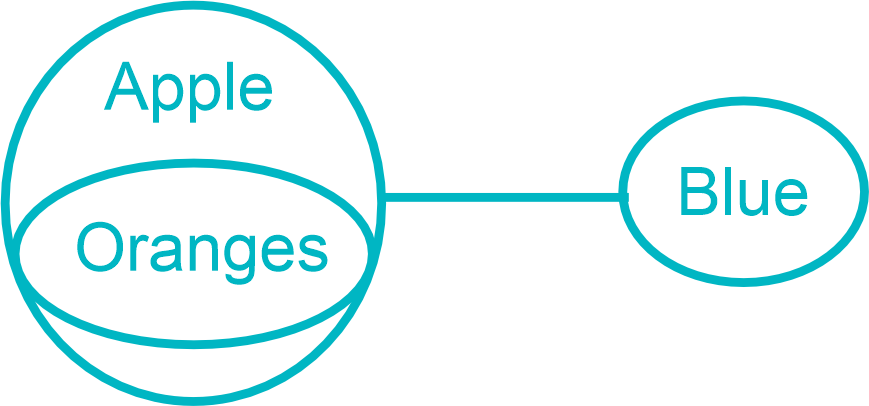 Conclusions:
I. No orange is blue. &
Q17 · Logical Reasoning
Read the following statement carefully and identify the conclusion that follows.
Statement:
All bags are pens. Some pens are not pencils. No pencil is a scale.
Conclusions:
I. Some bags are not scales.
II. All scales are pencils.
- Only I follows
- Only II follows
- Both I and II follow
- Neither I nor II follows
Answer aur solution dekho
Archived marked answer: D
The least possible Venn diagram for the given statements is as shown below
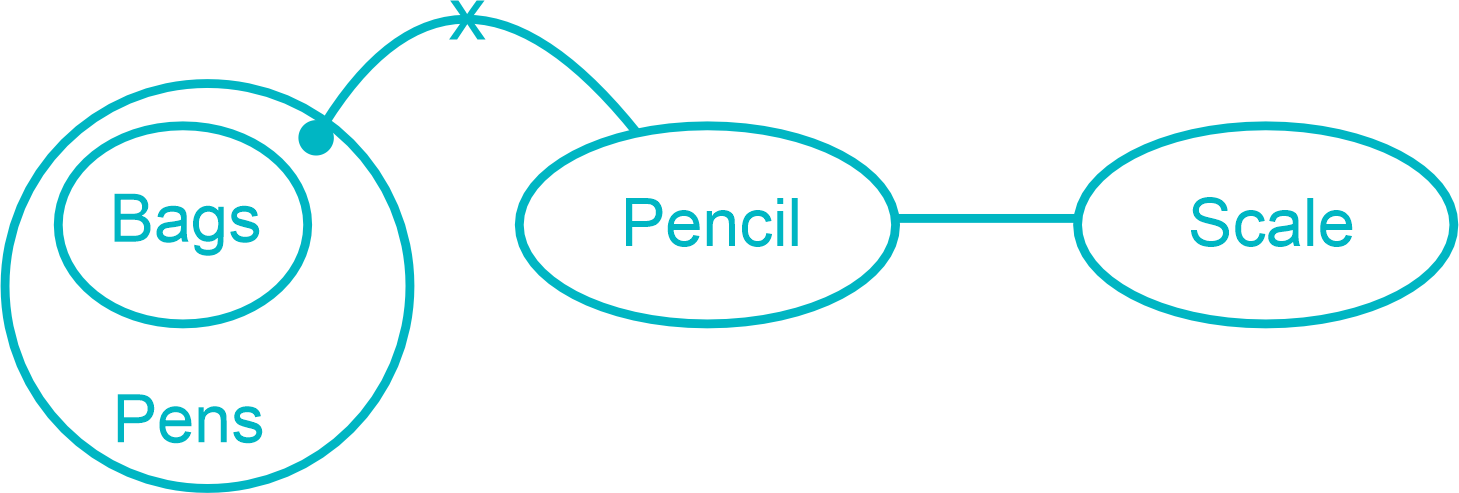 Conclusions:
I. Some bags are not scales → Does not follow (As all bags are pens, some pens
Q18 · Alphabet Test
Identify the odd city.
- Thiruvananthapuram
- Imphal
- Guwahati
- Ranchi
Answer aur solution dekho
Archived marked answer: C
Given Options:
1) Thiruvananthapuram
2) Imphal
3) Guwahati
4) Ranchi
Observation:
Thiruvananthapuram, Imphal and Ranchi are capital cities of their respective states (Kerala, Manipur and Jharkhand).
Guwahati is not the capital of Assam (the capital is Dispur).
Hence, the correct option is Option 3.
Q19 · Alphabet Test
Find the odd one out: Paris, Rome, Berlin, Madrid, Vienna, Brussels, Alexandria, Amsterdam
- Rome
- Vienna
- Alexandria
- Amsterdam
Answer aur solution dekho
Archived marked answer: C
Given Cities
Paris
Rome
Berlin
Madrid
Vienna
Brussels
Alexandria
Amsterdam
Observation:
Paris → Capital of France
Rome → Capital of Italy
Berlin →
Q20 · Similarity and Differences
Choose the address that is the same as the one given below.
Room 405, PG Block, NIT Trichy, Thuvakudi,Tamil Nadu - 620015
- Room 405, PG Block, NIT Trichy, Thuvakudi, Tamil Nadu - 620015
- Room 405, PG Block, NIT Trichy, Thuvakudi, Tamil Nadu - 620016
- Room 405, PG Block, NIT Trichy, Thuvakudi, Tamil Nadu - 620017
- Room 405, PG Block, NIT Trichy, Thuvakudi, Tamil Nadu - 620018
Answer aur solution dekho
Archived marked answer: A
Given Address:
Room 405, PG Block, NIT Trichy, Thuvakudi, Tamil Nadu - 620015
Checking Options
1) Room 405, PG Block, NIT Trichy, Thuvakudi, Tamil Nadu - 620015
Exact match with the given address.
2) Room 405, PG Block, NIT Trichy, Thuvakudi, Tamil Nadu - 620016
PIN code is different.
3) Room 405, PG Block, NIT Trichy, Thuvakudi, Tamil Nadu - 620017
PIN code is different.
4) Room 405, PG Block, NIT Trichy, Thuvakudi, Tamil Nadu - 620018
PIN code is different.
Hence, the correct answer is Option 1.
Q21 · Similarity and Differences
What comes next? c3, X24, D4, W23, ?
- V22
- E5
- F6
- U21
Answer aur solution dekho
Archived marked answer: B
The logic followed here
Forward (+1): 3 → 4 → 5
Backward (−1): 24 → 23 → 22
next letter position = 5 → E
Observe the number pattern
3, 24, 4, 23
Forward series: 3 → 4 → 5
Backward series: 24 → 23 → 22
Next number = 5
Hence, the correct answer is Option 2. Q22 · Similarity and Differences
In a certain code, "CLEAN" is written as "BKDZM". What is the code for GLASS?
- FKZRR
- FKYRR
- FJYRR
- FKZQS
Answer aur solution dekho
Archived marked answer: A
Given
CLEAN → BKDZM
Observe the pattern
C
L
E
A
N
B (−1)
K(−1)
D (−1)
Z (−1, cyclic)
M (−1)
Each letter is shifted one step backward in the alphabet.
GLASS
G
L
A
S
S
F(−1)
K(−1)
Z (−1, cyclic)
R (−1)
R(−1)
So, GLASS → FKZRR
Hence, the correct answer is Option 1. Q23 · Logical Statement Questions
Read the following statement carefully and identify the action that follows.
Statement: A recent study shows rising childhood obesity.
Course of Action:
1. Ban all junk food advertisements.
2. Make physical activity mandatory in schools.
- Only 2 follows
- Only 1 follows
- Neither follows
- Both follow
Answer aur solution dekho
Archived marked answer: D
Course of Action Analysis:
1) Ban all junk food advertisements.
→ Junk food consumption is a major reason for obesity.
→ Controlling advertisements can reduce its attraction among children.
2) Make physical activity mandatory in schools.
→ Lack of physical activity is another key reason for obesity.
→ Making exercise compulsory can help reduce obesity.
Both follow.
Hence, the correct answer is Option 4.
Q24 · Clock and Calendar
An entrepreneurship summit in Ahmedabad was on 10th January. Kolkata hosted it five days later. When was the Kolkata event?
- 5th Jan
- 15th Jan
- 12th Jan
- 20th Jan
Answer aur solution dekho
Archived marked answer: B
Given
The summit in Ahmedabad was on 10th January.
Kolkata hosted it five days later.
Calculation:
10th January + 5 days = 15th January
Hence, the correct answer is Option 2.
General Awareness
Q1 · Art and Culture
Which of the following is performed by women during the Sikkim weddings?
- Maruni
- Chhau
- Giddha
- Lavani
Answer aur solution dekho
Archived marked answer: A
The correct answer is Maruni.
Key Points
- Maruni Dance: Maruni is one of the oldest traditional dances performed during festivals and weddings in Sikkim.
- It is primarily performed by women, though men occasionally join in, adorned in colorful costumes and elaborate jewelry.
- This dance is accompanied by traditional Nepali music, showcasing the rich cultural heritage of the Nepali-speaking community in Sikkim.
- The performers often wear bright and vibrant attire, including long skirts, blouses, and decorative accessories, representing the joy and celebration of weddings.
- The dan
Q2 · Art and Culture
The architectural style of ancient temples in Uttarakhand is primarily influenced by:
- North Indian Nagara style
- Indo-Gothic style
- Vesara style
- Chalukyan style
Answer aur solution dekho
Archived marked answer: A
The correct answer is North Indian Nagara style.
Key Points
- The ancient temples in Uttarakhand primarily follow the Nagara style of architecture, which is a prominent temple architecture style in North India.
- In Nagara architecture, the temples have a curvilinear tower (Shikhara) over the sanctum (Garbhagriha). This distinguishes it from other architectural styles.
- The temples in Uttarakhand, such as the Kedarnath, Badrinath, and Jageshwar temples, are renowned for their adherence to the Nagara style with regional adaptations to suit the Himalayan environment.
- These temples are constructed using locally available stone, ensuring they can withstand the harsh weather conditions of the region.
- The Kumaon and Garhwal regions of Uttarakhand are dotted with such temples, showcasing intricate carvings, ornamentation, and a focus on verticality as seen in traditional Nagara architecture.
Additional Information
- Nagara Style of Architecture:
- The Nagara style is one of the three main temple architectural styles in India, along with the Dravidian and Vesara styles.
- It is prevalent in North India and is characterized by a prominent Shikhara (tower) that curves inward and upward in a vertical direction.
- The temples generally have a square base, with intricate carvings on walls and elaborate ornamentation.
- Examples: Khajuraho Temples, Konark Sun Temple, and the temples of Uttarakhand.
- Other Architectural Styles:
- Indo-Gothic style: This is a fusion of Indian and Gothic architectural elements, often seen in colonial-era structures like the Victoria Memorial (Kolkata). It is not related to temple architecture.
- Vesara Style: A mix of Nagara and Dravidian styles, prevalent in the Deccan region, especially in Karnataka. Examples: Chalukyan temples.
- Chalukyan Style: Associated with the Chalukya dynasty, this style is famous for intricate sculptures and pillared halls. It is predominantly seen in Karnataka and Andhra Pradesh.
- Temples in Uttarakhand:
- Kedarnath Temple: A prime example of Nagara architecture, dedicated to Lord Shiva.
- Badrinath Temple: Dedicated to Lord Vishnu, showcasing the Nagara style with local Himalayan influences.
- Jageshwar Temple: A complex of over 100 small temples built in the Nagara style in the Kumaon region.
- Key Features of Uttarakhand Temples:
- Use of stone masonry to withstand harsh weather.
- Simple yet elegant designs, with a focus on spiritual symbolism.
- Integration with natural surroundings, such as rivers and mountains, reflecting the religious significance of the Himalayas.
Important Points
- Historical Significance: The temples in Uttarakhand are believed to have been built between the 7th and 12th centuries, during the Katyuri and Chand dynasties.
- Religious Importance: Many of these temples are part of the Char Dham Yatra, a significant pilgrimage in Hinduism.
- Construction Material: Locally available granite and other stones were used to ensure durability and harmony with the natural environment.
- Tourism: These temples attract millions of pilgrims and tourists annually, contributing to the economy of the region. </ul
Q3 · Indian Polity and Constitution
Under which Article of the Indian Constitution is President's Rule in a State proclaimed?
- 352
- 356
- 360
- 371
Answer aur solution dekho
Archived marked answer: B
The correct answer is Article 356.
Key Points
- Article 356 of the Indian Constitution deals with the provision of imposing President's Rule in a state.
- President's Rule can be proclaimed if the Governor of a state reports to the President that the governance in the state cannot be carried on as per the provisions of the Constitution.
- Under President's Rule, the state government is suspended, and the central government takes direct control of the state.
- The President's Rule is subject to Parliamentary approval and can initially last for six months. It can be extended for a maximum period of three years with repeated parliamentary approva
Q4 · Indian Polity and Constitution
What does Article 356 empower the President to do, and what are its constitutional safeguards?
- Dissolve Parliament; no further approval required
- Dismiss State government; needs approval within two months
- Declare Financial Emergency; approval by Rajya Sabha
- Suspend Fundamental Rights; needs Supreme Court approval
Answer aur solution dekho
Archived marked answer: B
The correct answer is Dismiss State government; needs approval within two months.
Key Points
- Article 356 of the Indian Constitution, also known as the "President's Rule," empowers the President of India to dismiss a state government and assume direct control over a state's administration.
- This provision is invoked when there is a failure of constitutional machinery in a state, i.e., when a state government is unable to function according to the Constitution.
- The President can issue a proclamation of President's Rule based on a report from the state’s Governor or otherwise.
- Safeguards: The proclamation issued under Article 356 must be approved by both Houses of Parliament within two months. Without such approval, the proclamation ceases to operate.
- Once approved, the President's
Q5 · Indian Polity and Constitution
What makes the Goa Civil Code distinct from other personal laws in India?
- It applies only to the Hindu community in Goa.
- It is a uniform civil code that applies to all communities regardless of religion.
- It is based on British common law.
- It allows separate personal laws for different religions.
Answer aur solution dekho
Archived marked answer: B
The correct answer is It is a uniform civil code that applies to all communities regardless of religion..
Key Points
- The Goa Civil Code, often referred to as the Uniform Civil Code (UCC) of Goa, is a set of civil laws that governs all residents of Goa, irrespective of their religion, ethnicity, or caste.
- Unlike other states in India, Goa implements a single civil law for matters such as marriage, divorce, inheritance, and adoption, which applies uniformly to all communities.
- This distinct code was derived from the Portuguese Civil Code of 1867 and was retained even after Goa's integration into India in 1961.
- The Goa Civil Code is considered a practical example of the Uniform Civil Code, as envisaged under Article 44 of the Indian Constitution, which encourages the state to secure a uniform civil law for all citizens.
- This code ensures gender equality by granting equal property rights to both sons and daughters and provides provisions for community property and fair distribution of assets in case of divorce.
Additional Information
- Portuguese Civil Code Legacy:
- The Goa Civil Code is based on the Portuguese Civil Code of 1867, which was implemented during the Portuguese rule in Goa.
- After Goa's liberation and integration into India in 1961, the code was retained to preserve its unique identity.
- Unlike other Indian states, Goa did not adopt separate personal laws for different religious communities.
- Key Features of the Goa Civil Code:
- Universal Application: It applies uniformly to all residents of Goa, irrespective of religion or caste.
- Marriage and Divorce: Couples must register their marriage, and the code provides equal grounds for divorce for both men and women.
- Inheritance: The code ensures equal inheritance rights for sons and daughters, promoting gender equality.
- Community Property: Property acquired during the marriage is treated as community property and is divided equally upon divorce.
- Uniform Civil Code in India:
- Article 44: It is a Directive Principle of State Policy in the Indian Constitution, which calls for the state to secure a Uniform Civil Code for all citizens.
- At present, personal laws in most states vary based on religion, covering marriage, divorce, inheritance, and adoption.
- The Goa Civil Code serves as a model for the implementation of a UCC in the rest of India.
- Comparison with Other States:
- In other states, personal laws are governed by religious codes such as the Hindu Marriage Act, Muslim Personal Law (Shariat) Application Act, and Christian Marriage Act.
- These laws vary widely, and there is no uniformity in civil matters across communities.
- In contrast, Goa’s Civil Code ensures uniformity and equality for all its residents.
Important Points
- Debates on UCC:
- The implementation of a Uniform Civil Code across India has been a subject of debate due to its potential to replace personal laws with a common set of laws for all citizens.
- Opponents argue that it might infringe upon religious freedom, as guaranteed under Article 25 of the Constitution.
- Proponents believe it would promote equality and simplify legal processes.
- Goa as a Model State:
- Goa’s Civil Code is often cited as an example of how a UCC can function effectively in a pluralistic society.
- It demonstrates how uniform laws can coexist with diverse cultural and religious practices.
- Challenges in Implementing UCC:
- Diverse religious practices and customs pose significant challenges to achieving consensus on a single set of laws.
- There is a need for extensive consultations with stakeholders to ensure cultural and religious sensitivities are respected.
```
74
Q6 · Indian Economy
Expansionary fiscal policy is NOT characterised by:
- Decrease in personal taxes
- Increase in government spending
- Decrease in government spending
- Decrease in business taxes
Answer aur solution dekho
Archived marked answer: C
The correct answer is Decrease in government spending.
Key Points
- Expansionary fiscal policy is used by governments to stimulate economic growth, especially during periods of economic slowdown or recession.
- It typically involves an increase in government spending on infrastructure, public services, or other sectors to boost aggregate demand. *Hence, option 2 is incorrect.*
- Another key characteristic of expansionary fiscal policy is a decrease in personal taxes, which increases disposable income for households, thereby encouraging higher consumer spending. *Hence, option 1 is incorrect.*
- Similarly, a decrease in business taxes is often implemented to incentivize businesses to invest more, thereby promoting economic activity. *Hence, option 4 is incorrect.*
Q7 · Indian Economy
Economic reforms in India were introduced in which year?
- 1991
- 1984
- 2001
- 1977
Answer aur solution dekho
Archived marked answer: A
The correct answer is 1991.
Key Points
- Economic Reforms in India were introduced in 1991, marking a significant shift in the country's economic policies.
- The reforms were spearheaded by the then Prime Minister P.V. Narasimha Rao and the Finance Minister Dr. Manmohan Singh.
- The primary motive behind the reforms was to address the economic crisis of 1991, characterized by high inflation, fiscal deficit, and a balance of payments crisis.
- The government initiated the Liberalization, Privatization, and Globalization (LPG) model to open up the economy to foreign investments and reduce state control over industries.
- The reforms led to deregulation of industries, reduction in import tariffs, and removal of license raj, facilitating economic growth and modernization.
Additional Information
- Background of 1991 Crisis:
- The 1991 economic crisis was triggered by rising oil prices due to the Gulf War, dwindling foreign reserves, and unsustainable fiscal policies.
- India's foreign exchange reserves had depleted to a mere $1.2 billion, barely sufficient to cover two weeks of imports.
- The government had to pledge 67 tons of gold to the International Monetary Fund (IMF) to secure a bailout.
- Key Features of Economic Reforms:
- Liberalization: Reduction of bureaucratic controls, easing of restrictions on domestic businesses, and opening up of the economy.
- Privatization: Transfer of ownership of state-owned enterprises to private entities for better efficiency.
- Globalization: Integration of India's economy with the global economy through increased trade and foreign investments.
- Impact of Reforms:
- India's GDP growth rate improved significantly, reaching over 6% annually in the subsequent years.
- Increased foreign direct investment (FDI) inflow and expansion of the private sector.
- Development of sectors like IT and services contributed to India's global economic presence.
- Criticism of Reforms:
- The reforms were criticized for increasing income inequality and neglecting the rural and agricultural sectors.
- Concerns about dependency on foreign capital and vulnerability to global market fluctuations were raised.
Important Points
- Finance Minister Dr. Manmohan Singh:
- He played a crucial role in designing and implementing the LPG reforms.
- His famous budget speech of 1991 outlined the roadmap for India's economic transformation.
- License Raj:
- Before 1991, India followed a system of excessive regulatory controls known as the License Raj.
- The reforms dismantled the license raj, promoting a freer business environment.
- IMF Bailout:
- India received a bailout package from the International Monetary Fund (IMF) in exchange for implementing structural reforms.
- The bailout ensured financial stability but demanded strict economic measures.
- Sectoral Growth:
- The IT industry emerged as a major contributor to India's economy post-reforms.
- Growth in sectors like telecom, manufacturing, and services fueled economic progress. </ul
Q8 · Sports Static GK
Consider the following statements about Pranav Soorma's performance at the Khelo India Para Games 2023:
1. He broke his own previous club throw record of 30.01m.
2. He set a new Asian record with a throw of 33.54m.
Which of the above statements is/are correct?
- Only Statement 1 is correct
- Only Statement 2 is correct
- Both 1 and 2 are correct
- Neither 1 nor 2 is correct
Answer aur solution dekho
Archived marked answer: C
The correct answer is Both Statement 1 and Statement 2 are correct.
Key Points
- Statement 1: Pranav Soorma broke his own previous club throw record of 30.01m. This achievement highlights his exceptional performance and ability to surpass his earlier milestones. *Hence, Statement 1 is correct.*
- Statement 2: Pranav Soorma set a new Asian record with a throw of 33.54m. This record emphasizes his prowess at the regional level, showcasing his dominance in the sport. *Hence, Statement 2 is correct.*
- The Khelo India Para Games is a platform to encourage and recognize athletes with disabilities, providing them opportunities to showcase their talent.
- Pranav Soorma's performance not only brought him individual recognition but also contributed to India's growing reputation in para-sports.
- Breaking persona
Q9 · Sports Static GK
Which high jump technique involves bending the back, crossing the bar backwards, and landing on the shoulders?
- Scissor Jump
- Straddle Technique
- Western Roll
- Fosbury Flop
Answer aur solution dekho
Archived marked answer: D
The correct answer is Fosbury Flop.
Key Points
- The Fosbury Flop is a high jump technique where the athlete approaches the bar in a curved run-up, bends their back, and clears the bar backwards. This motion allows for efficient use of body mechanics and gravity.
- It was first introduced by Dick Fosbury, an American athlete, during the 1968 Mexico City Olympics, where he won a gold medal and revolutionized the high jump event.
- In the Fosbury Flop, the jumper's head and shoulders clear the bar first, followed by the rest of the body, which minimizes the center of gravity's height relative to the bar and optimizes energy use.
- This technique relies on landing on a soft, cushioned surface, which became standard in the 1960s, allowing athletes to safely land on their backs and shoulders.
- The technique became dominant in the sport as it allows athletes to achieve greater heights compared to older methods like the Scissor Jump or Straddle Technique.
Additional Information
- Scissor Jump:
- The Scissor Jump was one of the earliest high jump techniques, used before the introduction of softer landing surfaces.
- The athlete clears the bar by crossing their legs in a scissor-like motion, landing on their feet.
- This method is less efficient and limits the achievable height due to the higher position of the center of gravity.
- Straddle Technique:
- The Straddle Technique involves the jumper approaching the bar diagonally and clearing it face down.
- This method was popular before the Fosbury Flop and was used by many successful jumpers in the mid-20th century.
- The technique requires significant flexibility and strength but has largely been replaced by the Fosbury Flop.
- Western Roll:
- The Western Roll was another older technique where the jumper clears the bar by rolling their body over it sideways.
- It was effective for its time but is now considered less efficient compared to modern techniques.
- Revolution of High Jump Techniques:
- Before the Fosbury Flop, techniques like the Scissor Jump, Western Roll, and Straddle Technique dominated high jump events.
- The introduction of foam landing pits in the 1960s allowed for the adoption of the Fosbury Flop, which requires a backward landing.
- The Fosbury Flop is now universally used in competitive high jump events due to its biomechanical efficiency.
Important Points
- Historical Significance: The Fosbury Flop's introduction at the 1968 Olympics marked a turning point in high jump history, showcasing the importance of innovation in sports.
- Biomechanics: The Fosbury Flop leverages the principles of physics, specifically the center of gravity, to achieve greater heights with minimal energy expenditure.
- Modern High Jump: Today, nearly all professional high jumpers use the Fosbury Flop, making it the standard technique in the sport. </ul
Q10 · Indian Geography
Consider the following statements regarding the development of railways in India.
1. The first railway line was started in 1853 from Bombay to Pune.
2. The broad gauge covers the highest proportion of tracks of Indian railways.
Which of the statement(s) given is/are INCORRECT?
- 1 only
- 2 only
- Both 1 and 2
- Neither 1 nor 2
Answer aur solution dekho
Archived marked answer: A
The correct answer is Option 1.
Key Points
- Statement 1: The first railway line in India was started in 1853, but it ran from Bombay (Mumbai) to Thane, not Bombay to Pune. Therefore, this statement is incorrect.
- Statement 2: The broad gauge75-80% of Indian Railways' total track network operates on broad gauge. Hence, this statement is correct.
- Since the question asks for the incorrect statement(s), and only Statement 1 is incorrect, the correct answer is Option 1.
Additional Information
- Indian Railways Overview:
- Indian Railways is one of the largest rail networks in the world, established in 1853.
- The first passenger train ran on 16 April 1853, covering a distance of 34 kilometers from Bombay to Thane.
- It operates under the Ministry of Railways, Government of India, and has multiple gauges including broad gauge, meter gauge, and narrow gauge.
- Broad Gauge:
- The broad gauge has a track width of 1,676 mm, making it the standard and most widely used gauge in India.
- It is used for long-distance passenger and freight trains due to its stability and capacity.
- Approximately 75% of the railway tracks in India utilize broad gauge.
- Historical Development of Railways:
- The British introduced railways in India primarily for transporting goods and raw materials to ports for export.
- Post-independence, railways were nationalized and expanded to connect remote areas for socio-economic development.
- Other Railway Gauges:
- Meter Gauge: Track width is 1,000 mm, primarily used in some older and regional rail networks.
- Narrow Gauge: Track width is 762 mm or 610 mm, used in hilly terrains for specific rail lines like the Darjeeling Himalayan Railway.
Important Points
- First Railway Line: The first railway line in India was constructed by the Great Indian Peninsula Railway (GIPR).
- Railway Zones: Indian Railways is divided into 18 zones, each with its own headquarters.
- Significance of Broad Gauge: Broad gauge allows for higher speed trains and greater load capacity, making it ideal for India’s heavy traffic requirements.
- UNESCO World Heritage Sites: Indian Railways has UNESCO World Heritage Sites, including the Darjeeling Himalayan Railway, Nilgiri Mountain Railway, and Kalka-Shimla Railway.
Q11 · Indian Geography
Temperature and precipitation play an important role in determining the climate of a region. In this regard, consider the following statements regarding temperature variation in southern India:
1. Due to the presence of southern India in the tropical zone, the diurnal range of temperature is high.
2. Due to the continental influence, the annual mean range of temperature is greater in the coastal regions.
Which of the statements given above is/are CORRECT?
- 1 only
- 2 only
- Both 1 and 2
- Neither 1 nor 2
Answer aur solution dekho
Archived marked answer: D
The correct answer is Option 4: Neither 1 nor 2.
Key Points
- Statement 1: Southern India is located in the tropical zone, but the diurnal range of temperature is not high. The tropical regions generally experience moderate variations in day-night temperature due to maritime influence and high humidity levels. Hence, this statement is incorrect.
- Statement 2: Coastal regions of southern India experience a maritime climate with minimal temperature variations throughout the year. The annual mean range of temperature is not greater in coastal regions due to the stabilizing influence of nearby water bodies. Hence, this statement is incorrect.
- Southern India’s climate is predominantly influenced by its geographical proximity to the oceans and its tropical location. This results in stable and moderate temperature variati
Q12 · Modern Indian History
Why did the British Parliament and Company authorities initially avoid abolishing Sati in India?
- They supported the practice as part of Indian tradition
- They feared religious backlash and wanted local judgment
- They lacked legal authority to pass social legislation
- They believed only Hindu priests should make such decisions
Answer aur solution dekho
Archived marked answer: B
The correct answer is They feared religious backlash and wanted local judgment.
Key Points
- The British Parliament and the East India Company were cautious about interfering in Indian social and religious practices during the early phases of their rule. They believed that interference could alienate the local population and create political unrest.
- Sati, the practice of a widow immolating herself on her husband's funeral pyre, was deeply rooted in religious traditions and societal norms in certain parts of India. Any move to abolish it was seen as an infringement on religious beliefs.
- The British feared that abolishing Sati might provoke a
Q13 · Modern Indian History
What was a key equity-based goal of land reforms implemented after independence?
- Import substitution
- Expansion of credit to industries
- Abolition of intermediaries and land ceiling laws
- Encouragement to zamindars
Answer aur solution dekho
Archived marked answer: C
The correct answer is Abolition of intermediaries and land ceiling laws.
Key Points
- The land reforms after independence in India were primarily aimed at reducing social inequality in rural areas. The two key measures introduced were the abolition of intermediaries and the implementation of land ceiling laws.
- Abolition of intermediaries: This reform sought to eliminate the zamindari system, which acted as a major barrier between the state and the actual tillers of the soil. It ensured that the ownership of land was directly vested in the cultivators.
- Land ceiling laws: These laws were introduced to prevent the concentration of land in the hands of a few wealthy individuals. A ceiling was set on the amount of land an individual or family could own, and the surplus land was redistributed among landless or marginal farmers.
- T
Q14 · Modern Indian History
Why is Matangini Hazra remembered in Indian history?
- For writing a famous book
- For being a queen
- For her bravery in the freedom struggle
- For winning a legal case
Answer aur solution dekho
Archived marked answer: C
The correct answer is For her bravery in the freedom struggle.
Key Points
- Matangini Hazra was a remarkable freedom fighter and social activist from West Bengal, India, known for her unwavering commitment to India's independence struggle.
- She participated in the Quit India Movement in 1942, a mass protest demanding an end to British colonial rule in India.
- Matangini Hazra is remembered for her heroic sacrifice during a protest march. At the age of 73, she led a procession of freedom fighters in Tamluk, Bengal, holding the Indian National Flag and chanting slogans like "Vande Mataram."
- As the march was fired upon by British police, she refused to back down and continued advancing with the flag until she succumbed to the bullets. Her ultimate sacrifice made her a symbol of courage and patriotism.
- She is often referred to as "Gandhi Buri" (
Q15 · General Science Biology
Which of the following statements is INCORRECT regarding plants?
- Roots take water from the soil
- Phloem tubes of cells specialized for water transport
- Chlorophyll, the green pigment in the leaves, absorbs light
- Stomata are the little pores in the leaves required for gaseous exchange
Answer aur solution dekho
Archived marked answer: B
The correct answer is Phloem tubes of cells specialized for water transport.
Key Points
- Roots take water from the soil: This statement is correct. Roots are specialized structures in plants that absorb water and nutrients from the soil. The water is then transported upward through the xylem tissue to other parts of the plant.
- Phloem tubes of cells specialized for water transport: This statement is incorrect. Phloem is responsible for transporting food (mainly sugar) produced during photosynthesis from leaves to other parts of the plant. Water transport is carried out by the xylem tissue, not phloem. Hence, this option is incorrect.
- Chlorophyll, the green pigment in the leaves, absorbs light: This statement is correct. Chlorophyll is a vital pigment found in chloroplasts of plant cells. It absorbs light, primarily in the blue and red wavelengths, to carry out photosynthesis by converting light energy into chemical energy.
- Stomata are the little pores in the leaves required for gaseous exchange: This statement is correct. Stomata are tiny openings present on the surface of leaves that facilitate gaseous exchange, allowing oxygen to exit and carbon dioxide to enter for photosynthesis. They also play a role in transpiration.
- *Hence, the correct answer is Phloem tubes of cells specialized for water transport.*
Additional Information
- Xylem vs. Phloem:
- Xylem: Responsible for transporting water and dissolved minerals from roots to other parts of the plant. It consists of vessels and tracheids, which are specialized cells for water conduction.
- Phloem: Transports organic nutrients, especially sucrose, from leaves (where photosynthesis occurs) to other parts of the plant. It consists of sieve tubes and companion cells.
- Water transport mechanism:
- Water is absorbed by roots through osmosis and transported upward via capillary action in the xylem.
- The transpiration process creates a suction force, pulling water upward through the plant.
- Photosynthesis:
- Chlorophyll absorbs light energy and uses it to convert carbon dioxide and water into glucose and oxygen.
- This process occurs in the chloroplasts, primarily in leaf cells.
- Stomata and transpiration:
- Stomata regulate the exchange of gases (CO₂ and O₂) and water vapor through the process of transpiration.
- They are controlled by guard cells, which open and close the stomatal pores depending on environmental conditions.
Important Points
- Functions of Xylem and Phloem:
- Xylem: One-way transport system for water and minerals from roots to leaves.
- Phloem: Bidirectional transport system for nutrients between leaves and other parts of the plant.
- Role of chlorophyll:
- Chlorophyll absorbs light most efficiently in the blue and red wavelengths, making leaves appear green due to the reflection of green light.
- It is essential for converting light energy into glucose during photosynthesis.
- Stomatal regulation:
- Stomata play a key role in maintaining plant water balance and enabling photosynthesis.
- Environmental factors like humidity, temperature, and light intensity affect stomatal opening and closing.
</ul
Q16 · Awards Static
How many gold medals did India win in 2022 Commonwealth Games?
- 15
- 22
- 26
- 20
Answer aur solution dekho
Archived marked answer: B
The correct answer is 22.
Key Points
- The 2022 Commonwealth Games were held in Birmingham, United Kingdom, from 28 July to 8 August 2022.
- India won a total of 61 medals at the event, including 22 Gold, 16 Silver, and 23 Bronze.
- India's gold medal tally of 22 placed it fourth in the overall medal standings, following Australia, England, and Canada.
- The gold medal wins were achieved in various sports, including weightlifting, wrestling, badminton, table tennis, and lawn bowls. Notably, India achieved its first-ever gold medal in lawn bowls during these games.
- India’s performance showcased the country's growing competitiveness in multi-sport events, particularly in disciplines like wrestling and weightlifting where Indian athletes excelled.
Q17 · Medieval Indian History
Marco Polo, during his return from China, described the pepper trade in which region of India?
- Konkan
- Bengal
- Malabar
- Odisha
Answer aur solution dekho
Archived marked answer: C
The correct answer is Malabar.
Key Points
- Marco Polo, the famous Venetian traveler, visited India during his return from China in the late 13th century. He extensively described the pepper trade in the Malabar region.
- The Malabar Coast, located in the southwestern part of India (modern-day Kerala), was historically renowned as a major hub for the trade of spices, especially black pepper, which was called the "King of Spices."
- Malabar was a key part of the spice trade route, connecting India with various parts of the world, including Europe, the Middle East, and Southeast Asia.
- During Marco Polo's era, the pepper trade was highly lucrative, and Malabar's geographical location along the Arabian Sea facilitated trade with Arab and European merchants.
Q18 · Ancient Indian History
Which of the following options is the correct order of the prehistoric periods?
- Mesolithic, Paleolithic, Neolithic, Metal Age.
- Paleolithic, Mesolithic, Neolithic, Metal Age.
- Paleolithic, Neolithic, Mesolithic, Metal Age.
- Neolithic, Mesolithic, Paleolithic, Metal Age.
Answer aur solution dekho
Archived marked answer: B
The correct answer is Paleolithic, Mesolithic, Neolithic, Metal Age.
Key Points
- Paleolithic Age: The earliest period of human history, also known as the Old Stone Age. It began approximately 2.5 million years ago and lasted until around 10,000 BCE. Humans relied on hunting, gathering, and used simple stone tools. They lived in caves and were primarily nomadic.
- Mesolithic Age: The Middle Stone Age, spanning roughly between 10,000 BCE to 8,000 BCE. This period acted as a transition between the Paleolithic and Neolithic ages. Humans began domesticating animals and using improved stone tools. It marked the gradual shift towards settled life.
- Neolithic Age: Known as the New Stone Age, it began around 8,000 BCE and lasted until approximately 3,000 BCE. Humans practiced agriculture, built permanent settlements, and used polished stone tools. This age witnessed significant advancements, including pottery and weaving.
- Metal Age: The period that followed the Neolithic Age, starting around 3,000 BCE. Humans discovered and began using metals like copper, bronze, and iron. This age marked the beginning of civilizations, trade, and written history.
- The prehistoric periods represent the evolution of human history, technology, and lifestyle, with the correct chronological order being Paleolithic → Mesolithic → Neolithic → Metal Age.
Additional Information
- Paleolithic Age:
- Humans used rudimentary tools made of stone, wood, and bone.
- Art forms such as cave paintings were developed, particularly in regions like Lascaux (France) and Altamira (Spain).
- Hunting and gathering were the primary means of survival.
- Fire was discovered and used for cooking and protection.
- Mesolithic Age:
- Humans began taming animals like dogs and started fishing.
- Microlith tools, small and sharp, were developed.
- The bow and arrow were invented for hunting and defense.
- Evidence of semi-permanent settlements emerged during this age.
- Neolithic Age:
- Marked by the invention of agriculture, leading to food surplus and settled communities.
- Domestication of animals like sheep, goats, and cattle became prevalent.
- Advanced tools and technologies, such as plows, were introduced.
- Pottery and weaving became prominent cultural practices.
- Metal Age:
- The discovery and use of metals like bronze and iron transformed human civilization.
- Metallurgy led to the creation of stronger tools and weapons.
- The rise of urban centers, trade networks, and writing systems marked this period.
- Examples include the Bronze Age civilizations like Mesopotamia, Egypt, and the Indus Valley.
Important Points
- Prehistoric Chronology:
- The term "prehistoric" refers to the time before written records were kept.
- Each prehistoric age reflects significant changes in technology, culture, and society.
- Archaeological Evidence:
- Artifacts such as tools, pottery, and cave paintings provide insights into prehistoric life.
- Important archaeological sites include Stonehenge, Harappa, and Chatal Huyuk.
- Impact on Civilization:
- Advancements during these periods laid the foundation for modern human societies.
- Trade, governance, and cultural development emerged strongly during the Metal Age.
76:T
Q19 · Ancient Indian History
Temporary human settlements are usually built in which of the following regions?
- Cold desert regions
- Deep forested areas
- Rugged mountain slopes
- All of these
Answer aur solution dekho
Archived marked answer: D
The correct answer is All of these.
Key Points
- Temporary human settlements are primarily established in regions where permanent habitation is difficult due to environmental or geographical factors. These include cold deserts, deep forests, and rugged mountain slopes.
- In cold desert regions, such as those in Ladakh or Antarctica, temporary settlements are set up for scientific research, military purposes, or seasonal activities like grazing. These regions experience extreme cold and arid conditions, making permanent habitation challenging.
- Deep forested areas often host temporary settlements for activities like logging, collection of forest produce, or tribal practices. These areas are usually dense, remote, and not conducive to permanent infrastructure development.
- Rugged mountain slopes are used for temporary settlements during trekking, mountaineering, or seasonal farming. The steep terrain and unstable conditions often prevent the establishment of permanent settlements.
- All these regions share common traits such as harsh climates, limited access to resources, and the need for temporary human presence for specific purposes. Therefore, the correct answer is All of these.
Additional Information
- Cold Desert Regions:
- Examples include Ladakh in India, Gobi Desert in China, and Antarctica.
- These regions are characterized by extreme cold, minimal vegetation, and sparse population.
- Activities like scientific research, defense operations, and seasonal grazing are common reasons for temporary settlements here.
- Deep Forested Areas:
- Commonly found in tropical regions such as the Amazon Rainforest, Congo Basin, and Western Ghats in India.
- Temporary shelters are created for logging, hunting, gathering forest produce, or tribal rituals.
- Challenges include dense vegetation, wildlife, and lack of basic amenities.
- Rugged Mountain Slopes:
- Mountain ranges like the Himalayas, Andes, and Rockies often see temporary camps for trekkers, climbers, and nomadic tribes.
- These areas are prone to landslides, avalanches, and extreme weather, which limit permanent habitation.
- Seasonal farming, such as terrace cultivation, is another key reason for temporary settlements here.
- Temporary Settlements:
- Examples include military camps, refugee camps, research stations, and nomadic shelters.
- These are built using lightweight, portable materials for easy dismantling and relocation.
- Temporary settlements are crucial for human activities in inhospitable environments.
Important Points
- Nomadic Tribes: Nomads such as the Changpa in Ladakh and the Maasai in Africa often establish temporary settlements while herding livestock.
- Scientific Research: Temporary research stations in Antarctica, like McMurdo Station, support scientists studying climate, geology, and ecosystems.
- Seasonal Activities: Migrant workers and seasonal farmers establish temporary homes during peak agricultural or industrial seasons.
- Disaster Relief Camps: Post-disaster scenarios often require temporary settlements for displaced populations. </ul
Q20 · Government Schemes and Welfare Static Semi Static
Which government initiative aims to empower women through skill development and providing support for entrepreneurship?
- Betí Bachao Betí Padhao
- Mahila Shakti Kendra Scheme
- Pradhan Mantri Mudra Yojana (PMMY)
- National Mission for Empowerment of Women
Answer aur solution dekho
Archived marked answer: B
The correct answer is Mahila Shakti Kendra Scheme.
Key Points
- The Mahila Shakti Kendra Scheme was launched by the Government of India in 2017-18 to empower rural women through community engagement and capacity building. It aims to promote skill development, entrepreneurship, and awareness generation.
- The scheme functions through a three-tier structure at the national, state, and district levels to provide support for women’s empowerment initiatives.
- Under this scheme, District Level Centers for Women (DLCWs) are established to help women access government schemes, skill development programs, and entrepreneurship opportunities.
- The program focuses on creating an enabling environment for women by strengthening existing institutional mechanisms for their welfare and empowerment.
- The scheme specifically targets marginalized and rural women to ensure inclusive development and sustainable livelihoods.
- It is implemented by the Ministry of Women and Child Development, ensuring coordinated efforts for women’s w
Q21 · General Science Physics
Two resistors, one with a resistance of 2 ohms and the other with a resistance of 4 ohms, are connected in parallel to a 6-volt battery.
What is the total current flowing through the circuit?
- 1 Ampere
- 2 Amperes
- 3 Amperes
- 4.5 Amperes
Answer aur solution dekho
Archived marked answer: D
The correct answer is 4.5 Amperes.
Key Points
- The two resistors of 2 ohms and 4 ohms are connected in parallel. In a parallel circuit, the total resistance is calculated using the formula:
1/Rₜₒₜₐₗ = 1/R₁ + 1/R₂.
- Substituting the values:
1/Rₜₒₜₐₗ = 1/2 + 1/4 = 2/4 + 1/4 = 3/4.
Thus, Rₜₒₜₐₗ = 4/3 ohms.
- The circuit is powered by a 6-volt battery. Using Ohm’s Law (V = IR), the total current can be calculated:
Iₜₒₜₐₗ = V/Rₜₒₜₐₗ.
Substitute the values:
Iₜₒₜₐₗ = 6 / (4/3) = 6 × 3/4 = 4.5 Amperes.
- Hence, the total current flowing through the circuit is 4.5 Amperes.
- Each resistor shares the current based on its resistance. The current through the 2-ohm resistor is:
I = V/R = 6/2 = 3 Amperes.
The current through the 4-ohm resistor is:
I = V/R = 6/4 = 1.5 Amperes.
Adding these gives 4.5 Amperes, verifying the calculation.
Additional Information
- Ohm’s Law:
- Ohm’s Law states that the current flowing through a conductor between two points is directly proportional to the voltage across the two points, provided the temperature remains constant.
- The formula is: V = IR, where V is voltage, I is current, and R is resistance.
- Parallel Circuit Properties:
- In a parallel circuit, the voltage across all components remains the same.
- The total resistance in a parallel circuit is always less than the smallest individual resistance.
- The total current is the sum of the currents through each parallel branch.
- Resistor Applications:
- Resistors are widely used in electrical circuits for current regulation, voltage division, and protection against overcurrent.
- They are categorized as fixed resistors (constant resistance) or variable resistors (adjustable resistance).
- Battery Characteristics:
- A battery is a device that converts chemical energy into electrical energy. The voltage rating of a battery determines the electric potential difference it can provide.
- Common batteries include AA, AAA, lithium-ion, and lead-acid batteries, used in various applications like household electronics, vehicles, and industrial equipment.
Important Points
- Series vs. Parallel Circuits:
- Series Circuit: The current remains constant throughout the circuit, and the total resistance is the sum of individual resistances (Rₜₒₜₐₗ = R₁ + R₂ + …).
- Parallel Circuit: The voltage remains constant across all branches, and the total resistance is calculated using 1/Rₜₒₜₐₗ = 1/R₁ + 1/R₂ + ….
- Electrical Safety:
- To prevent electrical hazards, circuits are often equipped with fuses, circuit breakers, and insulation materials.
- Proper resistance calculations are critical to ensure safe operation and avoid overheating.
- Practical Examples:
- Parallel circuits are commonly found in home electrical systems, ensuring that individual appliances function independently.
- Series circuits are used in applications like string lights, where the current flows through all components sequentially.
Q22 · Books and Authors Static
The Inheritance of Loss' won the Booker Prize for which author?
- Anita Desai
- Kiran Desai
- Jhumpa Lahiri
- Chitra Banerjee
Answer aur solution dekho
Archived marked answer: B
The correct answer is Kiran Desai.
Key Points
- Kiran Desai, an Indian author, won the prestigious Man Booker Prize in 2006 for her novel "The Inheritance of Loss."
- The book is set in the northeastern Himalayan town of Kalimpong and touches on themes of globalization, multiculturalism, and loss of identity.
- "The Inheritance of Loss" was praised for its literary depth, emotional resonance, and its exploration of the effects of colonialism.
- Kiran Desai is the daughter of the acclaimed author Anita Desai, who herself has been shortlisted for the Booker Prize multiple times.
- Her win marked a significant moment for Indian literature on the global stage and highlighted the nuanced storytelling emerging from the region.
Additional Information
- Kiran Desai:
- Kiran Desai was born on September 3, 1971, in New Delhi, India, and later moved to the United States.
- She pursued her education at Bennington College, Hollins University, and Columbia University, where she honed her craft as a writer.
- Her debut novel, "Hullabaloo in the Guava Orchard" (1998), also received critical acclaim and won the Betty Trask Award.
- The Inheritance of Loss:
- This award-winning novel explores the lives of characters caught in the turmoil of colonial legacy, migration, and cultural dissonance.
- The book addresses themes like economic disparity, racial inequality, and the immigrant experience.
- It draws inspiration from Kiran Desai’s personal experiences and observations of diaspora communities.
- Man Booker Prize:
- Established in 1969, the Man Booker Prize is one of the most prestigious literary awards in the world.
- It recognizes the best original novel written in the English language and published in the UK.
- Winners receive international acclaim and a monetary award of £50,000.
- Other Indian authors who have won the prize include Arundhati Roy (1997, "The God of Small Things") and Salman Rushdie (1981, "Midnight's Children").
- Other nominees (options in the question):
- Anita Desai: Renowned Indian author and Kiran Desai’s mother, shortlisted three times for the Booker Prize but did not win.
- Jhumpa Lahiri: Pulitzer Prize-winning author known for works like "Interpreter of Maladies" and "The Namesake", but has not won the Booker Prize.
- Chitra Banerjee Divakaruni: Famous for novels like "The Mistress of Spices", but has not been awarded the Booker Prize.
Important Points
- The Man Booker Prize plays a critical role in promoting literary excellence globally and has a significant impact on an author's career.
- Kiran Desai's win emphasized the growing prominence of Indian authors in the international literary arena.
- The novel's exploration of cultural and historical themes resonates universally, making it a landmark in modern literature.
- The prize underscores the importance of addressing topics like identity, migration, and globalization in contemporary storytelling.
Q23 · General Science
Which of the following is a main goal of the proposed Shukrayaan-1 mission by ISRO?
- Investigate Venus' surface and atmosphere
- Observe asteroids near Earth
- Explore the rings of Saturn
- Study Mars' atmosphere
Answer aur solution dekho
Archived marked answer: A
The correct answer is Investigate Venus' surface and atmosphere.
Key Points
- Shukrayaan-1 is a proposed mission by the Indian Space Research Organisation (ISRO) aimed at studying Venus, often referred to as Earth’s twin due to its similar size and composition.
- The primary objectives of the mission include investigating Venus' atmosphere, its surface features, and its interaction with solar radiation and solar wind.
- Venus has a dense atmosphere composed mostly of carbon dioxide, with clouds of sulfuric acid, making it crucial to understand the planet’s atmospheric dynamics and greenhouse effect.
- The mission will also focus on studying the planet's surface composition and geological processes, which remain largely unexplored due to the thick atmospheric cover.
- ISRO aims to deploy advanced instruments such as synthetic aperture radar and spectrometers to penetrate the clouds and gather detailed data about Venus’ surface and atmosphere.
Q24 · General Science
Which payload on the Mars Orbiter Mission (MOM) captured full-disk colour images of Mars?
- LAM
- M3
- TMC
- MCC
Answer aur solution dekho
Archived marked answer: D
The correct answer is Mars Colour Camera (MCC).
Key Points
- The Mars Colour Camera (MCC) is one of the key payloads onboard the Mars Orbiter Mission (MOM), also known as Mangalyaan, launched by the Indian Space Research Organisation (ISRO) on November 5, 2013.
- MCC is designed to capture high-resolution, full-disk colour images of Mars and its surroundings, providing crucial data for studying the planet's surface features and atmospheric dynamics.
- The camera operates in the visible spectrum and is capable of imaging the entire planet in a single frame, making it uniquely suited for
Q25 · Other Edge Cases Possible SSC GK GS Questions
____ was commissioned into the Indian Navy in July 1985 and was Vice Chief of Naval Staff and Flag Officer Commanding-in-Chief of the Western Naval Command.
- Admiral Karambir Singh
- Admiral Sunil Lanba
- Admiral R. Hari Kumar
- Admiral Dinesh K. Tripathi
Answer aur solution dekho
Archived marked answer: D
The correct answer is Admiral Dinesh K. Tripathi.
Key Points
- Admiral Dinesh K. Tripathi was commissioned into the Indian Navy in July 1985, marking the beginning of his illustrious naval career.
- He has held several key positions, including serving as the Vice Chief of Naval Staff, which is the second-highest-ranking officer in the Indian Navy.
- Admiral Tripathi has also served as the Flag Officer Commanding-in-Chief of the Western Naval Command, one of the most significant operational commands in the Indian Navy.
- The Western Naval Command is responsible for naval operations on the western seaboard of India, including key strategic areas in the Arabian Sea.
- His appointment and leadership showcase his exceptional service and dedication to the Indian Navy, cont
Mathematics
Q1 · Geometry
In a right triangle, one of the acute angles is 30°. What is the measure of the exterior angle at the right-angled vertex?
- 30°
- 60°
- 120°
- 90°
Answer aur solution dekho
Archived marked answer: D
Shortcut Trick
In any triangle, the interior and exterior angles at a single vertex form a linear pair, meaning they add up to 180°.
At the right-angled vertex, the interior angle is always exactly 90°.
Therefore, Exterior Angle = 180° − Interior Angle = 180° − 90° = 90°.
The given acute angle of 30° is distractor information and is not required for the calculation.
∴ The correct answer is 90°.
Alternate Method
- A
B
C
90°
90°
30°
60°
Exterior angle = 90°
Given:
A right-angled ΔABC with the right angle at vertex B (∠B = 90°).
One acute angle, say ∠C = 30°.
Formula Used:
Sum of interior angles of a triangle = 180°
Exterior angle = Sum of two opposite interior angles
Calculations:
⇒ In ΔABC, ∠A + ∠B + ∠C = 180°
⇒ ∠A + 90° + 30° = 180°
⇒ ∠A = 180° − 120° = 60°
⇒ The exterior angle at vertex B is equal to the sum of the opposite interior angles (∠A and ∠C).
⇒ Exterior ∠B = ∠A + ∠C
⇒ Exterior ∠B = 60° + 30° = 90°
∴ The correct answer is 90°.
Additional Information
Exterior Angle Property
The exterior angle of a triangle is equal to the sum of the two opposite interior angles. Formula: Exterior ∠ = Interior ∠₁ + Interior ∠₂.
Linear Pair Axiom
When a straight line is intersected by a ray, the adjacent angles form a linear pair and sum up to 180°. Thus, Interior ∠ + Exterior ∠ = 180°.
Angle Sum Property
The sum of all three interior angles of a triangle is exactly 180°. In a right-angled triangle, the two non-right angles are always complementary (their sum is exactly 90°).
</p
Q2 · Geometry
If the angle subtended by arc AB at the center is 140°, what is the reflex angle made by this arc at the center?
- 220°
- 140°
- 240°
- 280°
Answer aur solution dekho
Archived marked answer: A
Shortcut Trick
The total angle at the center of a full circle is 360°.
Reflex angle = Total angle − Given angle at center
Reflex angle = 360° − 140° = 220°
∴ The correct answer is 220°.
Alternate Method
Given:
Angle subtended by minor arc AB at the center = 140°
- - O
A
B
140°
220°
Formula Used:
Reflex Angle = 360° − Angle Subtended at Center
Calculations:
⇒ Reflex Angle = 360° − 140°
⇒ Reflex Angle = 220°
∴ The correct answer is 220°.
Additional Information
Reflex Angle
A reflex angle is strictly greater than 180° and strictly less than 360°. It represents the larger outer angle between two lines extending from a central point.
Complete Angle
The total angle swept around a single point or the center of a circle forms a complete angle, which is always equal to exactly 360°.
Angle Subtended by Arc Property
The angle subtended by an arc at the center is exactly double the angle subtended by it at any remaining part of the circle's circumference.
</p
Q3 · Geometry
In triangle ABC, DE is drawn parallel to BC, intersecting AB and AC at D and E respectively. If AD=3, DB=6, and AE=4, find EC.
- 4
- 6
- 8
- 2
Answer aur solution dekho
Archived marked answer: C
Shortcut Trick
According to the Basic Proportionality Theorem, a line parallel to one side of a triangle divides the other two sides proportionally.
AD / DB = AE / EC
3 / 6 = 4 / EC
1 / 2 = 4 / EC ⇒ EC = 8
∴ The correct answer is 8.
Alternate Method
- A
B
C
D
E
3
6
4
EC = ?
Given:
In ΔABC, DE is parallel to BC (DE || BC).
Lengths of the segments are given as AD = 3, DB = 6, and AE = 4.
Formula Used:
Basic Proportionality Theorem (Thales Theorem): If a line intersects two sides of a triangle and is parallel to the third side, then it divides the two sides in the same ratio.
Formula: AD / DB = AE / EC
Calculations:
⇒ AD / DB = AE / EC
⇒ 3 / 6 = 4 / EC
⇒ 1 / 2 = 4 / EC
⇒ EC = 4 × 2
⇒ EC = 8
∴ The correct answer is 8.
Additional Information
Basic Proportionality Theorem (BPT)
If a line is drawn parallel to one side of a triangle intersecting the other two sides, it divides them in the same ratio. This implies AD / DB = AE / EC.
Similar Triangles Property
When a line DE is parallel to the base BC, ΔADE becomes similar to ΔABC. The ratio of all corresponding sides is strictly equal: AD / AB = AE / AC = DE / BC.
Midpoint Theorem
A specific scenario of BPT: If a line segment connects the exact midpoints of two sides of a triangle, it is parallel to the third side and its length is exactly half of the third side.
</p
Q4 · Geometry
A triangle with all its angles less than 90° has its Orthocenter located where?
- Inside the triangle.
- Outside the triangle.
- On one of the sides of the triangle.
- On one of the vertices of the triangle.
Answer aur solution dekho
Archived marked answer: A
Shortcut Trick
A triangle with all its angles less than 90° is called an acute-angled triangle.
By standard geometric properties, the altitudes of an acute-angled triangle always lie entirely within the boundary of the shape.
Since the orthocenter is the intersection point of these three altitudes, it is always located strictly inside the triangle.
∴ The correct answer is Inside the triangle.
Alternate Method
Q5 · Geometry
In a circle of radius r, a chord subtends an angle θ (in radians) at the center. Which expression represents the length of the minor arc?
- rθ
- 1/(2r2θ)
- 2rsinθ2
- 2πr
Answer aur solution dekho
Archived marked answer: A
Shortcut Trick
By the fundamental definition, an angle measured in radians is the ratio of the subtended arc length to the radius of the circle.
⇒ Angle in radians (θ) = Arc Length ÷ Radius (r)
⇒ Arc Length = r × θ = rθ
∴ The correct answer is rθ.
Alternate Method
Given:
Radius of the circle = r
Angle subtended at the center = θ radians
Formula Used:
Arc length = (Angle subtended at center ÷ Total angle) × Circumference
O
r
r
θ
Arc length = rθ
A
B
Calculations:
⇒ Total angle of a circle = 360° = 2π radians
⇒ Circumference of the circle = 2πr
⇒ Arc length = (θ ÷ 2π) × 2πr
⇒ Arc length = rθ
∴ The correct answer is rθ.
Additional Information
Length of Chord
The length of the chord subtending an angle θ at the center is given by 2r × sin(θ ÷ 2).
Area of a Sector
If the central angle θ is in radians, the area of the sector formed by the arc is ½ × r²θ.
Area of a Minor Segment
The area of the minor segment enclosed by the chord and the arc is Area of sector − Area of triangle = ½ × r²(θ − sinθ).
</p
Q6 · Trigonometry
If tan A + sec A = 3, find tan A.
- 3/2
- 4/3
- 5/4
- 2/3
Answer aur solution dekho
Archived marked answer: B
Shortcut Trick
If sec A + tan A = x, then sec A − tan A = 1 / x.
Subtracting the two equations, we get: 2 tan A = x − (1 / x).
Given sec A + tan A = 3, so x = 3.
⇒ 2 tan A = 3 − (1 / 3) = 8 / 3
⇒ tan A = 4 / 3
∴ The correct answer is 4/3.
Alternate Method
Given:
⇒ sec A + tan A = 3
Formula Used:
⇒ sec A = 1 / cos A
⇒ tan A = sin A / cos A
⇒ sin² A + cos² A = 1
Calculations:
⇒ (1 / cos A) + (sin A / cos A) = 3
⇒ (1 + sin A) / cos A = 3
Squaring both sides:
⇒ (1 + sin A)² / cos² A = 9
⇒ (1 + sin A)² / (1 − sin² A) = 9
⇒ (1 + sin A)² / [(1 − sin A) × (1 + sin A)] = 9
⇒ (1 + sin A) / (1 − sin A) = 9
⇒ 1 + sin A = 9 − 9 sin A
⇒ 10 sin A = 8
⇒ sin A = 8 / 10 = 4 / 5
A
Adjacent = 3
Opposite = 4
Hypotenuse = 5
⇒ In a right-angled triangle, sin A = Opposite / Hypotenuse = 4 / 5
⇒ Opposite = 4, Hypotenuse = 5
⇒ Adjacent = √(5² − 4²) = √(25 − 16) = √9 = 3
⇒ tan A = Opposite / Adjacent = 4 / 3
∴ The correct answer is 4/3.
Additional Information
Standard Trigonometric Identities
⇒ sin² θ + cos² θ = 1 | sec² θ − tan² θ = 1 | cosec² θ − cot² θ = 1
Reciprocal Pair Logic
Since sec² θ − tan² θ = 1, the expressions (sec θ + tan θ) and (sec θ − tan θ) are always reciprocals of each other.
Cosecant and Cotangent Property
Similarly, if cosec θ + cot θ = x, then cosec θ − cot θ = 1 / x.
Common Pythagorean Triplets
Sets of integers satisfying a² + b² = c² commonly used in trigonometry include (3, 4, 5), (5, 12, 13), (7, 24, 25), and (8, 15, 17).
</p
Q7 · Trigonometry
If 3 cot A = 4, then find the value of (3 sin A - 4 cos A).
- -7/5
- -2/5
- 2/5
- 7/5
Answer aur solution dekho
Archived marked answer: A
Shortcut Trick
Given 3 cot A = 4 ⇒ cot A = 4/3 (Base / Perpendicular).
Hypotenuse = √(4² + 3²) = √(16 + 9) = 5.
∴ sin A = 3/5 and cos A = 4/5.
Substitute in (3 sin A − 4 cos A) ⇒ 3 × (3/5) − 4 × (4/5).
⇒ 9/5 − 16/5 = −7/5.
∴ The correct answer is −7/5.
Alternate Method
Given:
3 cot A = 4 ⇒ cot A = 4/3
A
A
B
C
Base = 4k
Perp = 3k
Hypotenuse = 5k
Formula Used:
sin A = Perpendicular / Hypotenuse
cos A = Base / Hypotenuse
Hypotenuse² = Base² + Perpendicular²
Calculations:
⇒ Let Base = 4k and Perpendicular = 3k.
⇒ Hypotenuse = √((4k)² + (3k)²)
⇒ Hypotenuse = √(16k² + 9k²) = √(25k²) = 5k
⇒ sin A = 3k / 5k = 3/5
⇒ cos A = 4k / 5k = 4/5
Substituting the values in the expression (3 sin A − 4 cos A):
⇒ 3 × (3/5) − 4 × (4/5)
⇒ 9/5 − 16/5
⇒ −7/5
∴ The correct answer is −7/5.
Additional Information
Trigonometric Ratios in a Right Triangle
sin θ = Perpendicular / Hypotenuse | cos θ = Base / Hypotenuse | tan θ = Perpendicular / Base.
Pythagorean Theorem
In any right-angled triangle, the square of the hypotenuse is equal to the sum of the squares of the base and perpendicular (H² = P² + B²).
Important Pythagorean Triplets
Commonly used triplets are (3, 4, 5), (5, 12, 13), (8, 15, 17), and (7, 24, 25) which help bypass repetitive calculations.
</p
Q8 · Trigonometry
If sinx = cos(3x - 20°), what is the value of x?
- 25°
- 27.5°
- 30°
- 35.8°
Answer aur solution dekho
Archived marked answer: B
Shortcut Trick
For any two acute angles, if sin A = cos B, then the sum of the angles is always 90°.
⇒ x + (3x − 20°) = 90°
⇒ 4x = 110°
⇒ x = 27.5°
∴ The correct answer is 27.5°.
Alternate Method
Given:
sin x = cos (3x − 20°)
Formula Used:
sin θ = cos (90° − θ)
3x − 20°
x
Complementary Angles in a Right Triangle
sin(x) = cos(3x − 20°) ⇒ x + 3x − 20° = 90°
Calculation:
⇒ cos (90° − x) = cos (3x − 20°)
Comparing the angles on both sides:
⇒ 90° − x = 3x − 20°
⇒ 90° + 20° = 3x + x
⇒ 110° = 4x
⇒ x = 110° ÷ 4
⇒ x = 27.5°
∴ The correct answer is 27.5°.
Additional Information
Complementary Angles
Two angles are complementary if their sum is 90°. Key trigonometric pairs that follow this rule are: sin θ = cos (90° − θ), tan θ = cot (90° − θ), and sec θ = cosec (90° − θ).
Supplementary Angles
Two angles are supplementary if their sum is exactly 180°. The corresponding trigonometric rules are sin (180° − θ) = sin θ and cos (180° − θ) = −cos θ.
Basic Pythagorean Identities
The most commonly used identity is sin²θ + cos²θ = 1. Others include sec²θ − tan²θ = 1 and cosec²θ − cot²θ = 1.
</p
Q9 · Trigonometry
Convert 1.5 radians to degrees.
- 90.56°
- 120°
- 85.94°
- 180°
Answer aur solution dekho
Archived marked answer: C
Shortcut Trick
To convert an angle from radians to degrees, simply multiply by 180 / π.
Value in degrees = 1.5 × (180 / π)
⇒ 270 / 3.14159
⇒ 85.943°
∴ The correct answer is 85.94°.
Alternate Method
Given:
Angle = 1.5 radians
Formula Used:
Angle in Degrees = Angle in Radians × (180 / π)
1.5 rad
≈ 85.94°
O
Calculations:
⇒ Angle in Degrees = 1.5 × (180 / π)
⇒ Angle in Degrees = 270 / π
Using π ≈ 3.14159:
⇒ Angle in Degrees = 270 ÷ 3.14159
⇒ Angle in Degrees = 85.9436° ≈ 85.94°
∴ The correct answer is 85.94°.
Additional Information
Radians to Degrees Conversion
To convert an angle from radians to degrees, multiply the radian measure by 180 / π. Exactly 1 radian is approximately equal to 57.2958°.
Degrees to Radians Conversion
To convert an angle from degrees to radians, multiply the degree measure by π / 180. A straight angle (180°) is exactly π radians.
Standard Angle Values
Common conversions include 90° = π/2 rad, 60° = π/3 rad, 45° = π/4 rad, and 30° = π/6 rad.
</p
Q10 · Mensuration 2D
A sector of radius 14 cm has an area of 154 cm². Find the angle of the sector.
- 90°
- 120°
- 45°
- 75°
Answer aur solution dekho
Archived marked answer: A
Shortcut Trick
Area of a full circle = πr² = (22 ÷ 7) × 14 × 14 = 616 cm².
The given area of the sector is 154 cm².
Ratio of the sector area to the full circle area = 154 ÷ 616 = 1 ÷ 4.
Since the area is proportional to the central angle, the angle must be 1/4 of a full circle (360°).
⇒ Sector angle = 360° × (1 ÷ 4) = 90°.
∴ The correct answer is 90°.
Alternate Method
θ
r = 14 cm
r = 14 cm
Area = 154 sq cm
Given:
Radius of the sector (r) = 14 cm
Area of the sector = 154 cm²
Formula Used:
Area of sector = (θ ÷ 360°) × πr²
Calculations:
⇒ 154 = (θ ÷ 360°) × (22 ÷ 7) × 14 × 14
⇒ 154 = (θ ÷ 360°) × 22 × 2 × 14
⇒ 154 = (θ ÷ 360°) × 616
⇒ θ ÷ 360° = 154 ÷ 616
⇒ θ ÷ 360° = 1 ÷ 4
⇒ θ = 360° × (1 ÷ 4)
⇒ θ = 90°
∴ The correct answer is 90°.
Additional Information
Area of a Sector
The area of a sector of a circle with radius r and central angle θ is given by the formula: Area = (θ ÷ 360°) × πr².
Length of an Arc
The length of the boundary arc of the sector is proportional to the central angle and is calculated as: Arc Length (l) = (θ ÷ 360°) × 2πr.
Perimeter of a Sector
The total perimeter of a sector includes the curved arc length and the two straight radii. Formula: Perimeter = l + 2r.
Q11 · Mensuration 2D
If the radius of a cylinder is halved, what happens to its volume (assuming height remains constant)?
- Volume is halved
- Volume is doubled
- Volume becomes one-fourth
- Volume remains the same
Answer aur solution dekho
Archived marked answer: C
Shortcut Trick
The volume of a cylinder is directly proportional to the square of its radius: V ∝ r² × h.
Since the height (h) remains constant, the volume depends only on the radius squared: V ∝ r².
If the radius is halved (1/2), the new volume becomes (1/2)² = 1/4 of the original volume.
∴ The correct answer is one-fourth.
Alternate Method
Given:
Radius is halved, so new radius (r') = r / 2.
Height remains constant, so new height (h') = h.
Formula Used:
Volume of a cylinder = π × r² × h
- r
- - - h
Original Cylinder
V = πr²h
- r/2
- - - h
New Cylinder
V = 1/4 πr²h
Calculations:
⇒ Original Volume (V₁) = π × r² × h
⇒ New Volume (V₂) = π × (r')² × h'
⇒ V₂ = π × (r / 2)² × h
⇒ V₂ = π × (r² / 4) × h
⇒ V₂ = 1/4 × (π × r² × h)
⇒ V₂ = 1/4 × V₁
∴ The correct answer is one-fourth.
Additional Information
Volume of a Cone
A cone with the same base radius and height as a cylinder has exactly one-third of its volume: V = 1/3 × πr²h.
Surface Area of a Cylinder
Curved Surface Area (CSA) = 2πrh. Total Surface Area (TSA) = 2πr(r + h).
Volume vs. Surface Area Dimensional Changes
If all dimensions (radius and height) of a 3D shape are scaled by a factor of *k*, the surface area scales by *k²* and the overall volume scales by *k³*.
</p
Q12 · Mensuration 2D
A triangular prism has base side lengths 5 cm, 6 cm, and 7 cm and height 10 cm. What is its lateral surface area?
- 180 cm²
- 160 cm²
- 150 cm²
- 140 cm²
Answer aur solution dekho
Archived marked answer: A
Shortcut Trick
For any prism, the Lateral Surface Area (LSA) is given by the perimeter of its base multiplied by its height.
⇒ Base Perimeter = 5 + 6 + 7 = 18 cm
⇒ Lateral Surface Area = 18 × 10 = 180 cm²
∴ The correct answer is 180 cm².
Alternate Method
Given:
Side lengths of the triangular base = 5 cm, 6 cm, and 7 cm
Height of the prism (h) = 10 cm
- - - h = 10 cm
6 cm
5 cm
7 cm
Lateral Surface Area
= Base Perimeter × h
Formula Used:
Lateral Surface Area of a Prism = Perimeter of Base × Height
Calculation:
⇒ Perimeter of the triangular base = 5 + 6 + 7 = 18 cm
⇒ Lateral Surface Area = 18 × 10
⇒ Lateral Surface Area = 180 cm²
∴ The correct answer is 180 cm².
Additional Information
Total Surface Area of a Prism
The Total Surface Area is the sum of the Lateral Surface Area and the area of the two bases: TSA = LSA + 2 × Base Area.
Volume of a Prism
The volume of any prism is equal to the area of its base multiplied by its height: Volume = Base Area × Height.
Euler's Formula for Polyhedrons
For any convex polyhedron (like a prism), the number of faces (F), vertices (V), and edges (E) are related by: F + V = E + 2.
</p
Q13 · Mensuration 2D
A cone of radius 9 cm and height 12 cm is cut into two parts by a plane parallel to its base, at a height of 4 cm from the vertex. Find the volume of the frustum formed.
- 432π cm³
- 576π cm³
- 648π cm³
- 312π cm³
Answer aur solution dekho
Archived marked answer: D
Shortcut Trick
Ratio of heights of the small cone to the large cone = 4 : 12 = 1 : 3.
Since the cones are similar, their volume ratio ∝ (height)³ = 1³ : 3³ = 1 : 27.
This means the volume of the frustum represents (27 − 1) = 26 parts out of 27.
Volume of the large cone = (1/3) × π × 9² × 12 = 324π cm³.
Volume of the frustum = 324π × (26 / 27) = 312π cm³.
∴ The correct answer is 312π cm³.
Alternate Method
Given:
Radius of large cone (R) = 9 cm
Height of large cone (H) = 12 cm
Height of small cut cone (h) = 4 cm
Let the radius of the small cone be r.
Q14 · Profit and Loss
A buyer gets two successive discounts of 20% and 10% on a Rs. 1000 item. What is the price paid?
- Rs. 700
- Rs. 720
- Rs. 740
- Rs. 750
Answer aur solution dekho
Archived marked answer: B
Shortcut Trick
Effective single discount for 20% and 10% = 20 + 10 − (20 × 10)/100 = 28%.
Final Selling Price = 100% − 28% = 72% of Marked Price.
Final Price = (72/100) × 1000 = 720.
∴ The correct answer is ₹720.
Alternate Method
Given:
Marked Price (MP) = ₹1000
First discount = 20%
Second discount = 10%
Formula Used:
Selling Price (SP) = MP × (1 − D₁/100) × (1 − D₂/100)
Q15 · Time and Work
The efficiency of A, B and C is 2 : 3 : 5. A alone can complete the work in 40 days. They all worked together for 5 days and then C left the work. In how many days can A and B together complete the remaining work?
- 12 days
- 10 days
- 8 days
- 6 days
Answer aur solution dekho
Archived marked answer: D
Shortcut Trick
Total Work = Efficiency of A × Days taken by A = 2 × 40 = 80 units.
Work done by A, B, and C together in 5 days = (2 + 3 + 5) × 5 = 50 units.
Remaining work = 80 − 50 = 30 units.
Time taken by A and B to complete remaining work = 30 ÷ (2 + 3) = 6 days.
∴ The correct answer is 6 days.
Alternate Method
Given:
Efficiency ratio of A : B : C = 2 : 3 : 5
A alone can complete the work in 40 days.
Formula Used:</strong
Q16 · Time and Work
A, B, and C together can complete a task in 6 days. If A alone takes 12 days and B alone takes 18 days, how long will C alone take?
- 19 days
- 30 days
- 12 days
- 36 days
Answer aur solution dekho
Archived marked answer: D
Shortcut Trick
Total Work = LCM of 6, 12, 18 = 36 units.
Combined efficiency of A, B and C = 36 ÷ 6 = 6 units/day.
Efficiency of A = 36 ÷ 12 = 3 units/day, Efficiency of B = 36 ÷ 18 = 2 units/day.
Efficiency of C = Total efficiency − (A + B) = 6 − (3 + 2) = 1 unit/day.
Time taken by C alone = Total Work ÷ Efficiency of C = 36 ÷ 1 = 36 days.
∴ The correct answer is 36 days.
Alternate Method
Given:
Time taken by A, B, and C together = 6 days
Time taken by A alone = 12 days
Time taken by B alone = 18 days
Person
Days
Total Work
Efficiency
A + B + C
6
36
36 ÷ 6 = 6
A
12
36 ÷ 12 = 3
B
18
36 ÷ 18 = 2
Calculations:
⇒ Efficiency of C = (Combined efficiency of A, B, C) − (Efficiency of A + Efficiency of B)
⇒ Efficiency of C = 6 − (3 + 2) = 1 unit/day
⇒ Time required by C alone = Total Work ÷ Efficiency of C
⇒ Time required by C alone = 36 ÷ 1 = 36 days
∴ The correct answer is 36 days.
Additional Information
Pipes and Cisterns
Follows the exact same LCM logic as Time & Work. Inlet pipes have positive efficiency, and outlet pipes (leaks) have negative efficiency.
Work and Wages
Wages are distributed strictly in the ratio of the total work done by each person. If all work together for the same number of days, wages are distributed in the ratio of their efficiencies.
Alternate Day Work
When people work on alternate days, find the total work done in a full cycle (e.g., 2 days for 2 people) and multiply it to reach close to the total work, then add the remaining days individually.
</p
Q17 · Number System
What is the least square number that is divisible by 8, 12, and 20?
- 3600
- 4000
- 1000
- 5600
Answer aur solution dekho
Archived marked answer: A
Shortcut Trick
LCM of 8, 12, and 20 = 120 (Prime factors: 2³ × 3¹ × 5¹)
For a perfect square, all prime factors must have even powers.
Multiply by missing factors (2¹ × 3¹ × 5¹ = 30) to make powers even.
Least square number = 120 × 30 = 3600
∴ The correct answer is 3600.
Alternate Method
Given:
Numbers: 8, 12, and 20
Concept Used:
The least perfect square divisible by a set of numbers is found by computing their LCM and multiplying it by the minimum prime factors required to make all prime powers even.
Calculations:
⇒ Prime factorization of 8 = 2³
⇒ Prime factorization of 12 = 2² × 3¹
⇒ Prime factorization of 20 = 2² × 5¹
⇒ LCM (8, 12, 20) = 2³ × 3¹ × 5¹ = 120
⇒ In the prime factorization of 120, the powers of primes 2, 3, and 5 are 3, 1, and 1 respectively.
⇒ To form a perfect square, every prime factor needs to have an even power (i.e., 2⁴, 3², and 5²).
⇒ We must multiply the LCM by the missing factors: 2¹ × 3¹ × 5¹ = 30.
⇒ Required perfect square = 120 × 30 = 3600
∴ The correct answer is 3600.
Additional Information
Least Common Multiple (LCM)
The smallest positive integer that is uniformly divisible by all given numbers. It contains the highest power of all prime factors present in the individual numbers.
Perfect Square Properties
A number is a perfect square if and only if all the prime factors in its prime factorization have even exponents (e.g., n², n⁴).
Co-prime Numbers
Two numbers are co-prime if their Highest Common Factor (HCF) is 1. The LCM of two co-prime numbers is simply their product.
</p
Q18 · Number System
Rationalize:
√2+√3√2-√3
- 5 + 2√6
- -5 - 2√6
- 5 - 2√6
- -5 + 2√6
Answer aur solution dekho
Archived marked answer: B
Shortcut Trick
For an expression of the form (√a + √b) ÷ (√a − √b), the result is directly [(a + b + 2√ab) ÷ (a − b)].
Here, a = 2 and b = 3.
Result = (2 + 3 + 2√6) ÷ (2 − 3)
Result = (5 + 2√6) ÷ (−1) = −5 − 2√6
∴ The correct answer is −5 − 2√6.
Alternate Method
Given:
Expression = (√2 + √3) ÷ (√2 − √3)
Formula Used:
(a + b)² = a² + b² + 2ab
(a − b) × (a + b) = a² − b²
Calculation:
⇒ To rationalize the denominator, multiply the numerator and denominator by the conjugate of the denominator, i.e., (√2 + √3).
⇒ [(√2 + √3) × (√2 + √3)] ÷ [(√2 − √3) × (√2 + √3)]
⇒ (√2 + √3)² ÷ [(√2)² − (√3)²]
⇒ [(√2)² + (√3)² + 2 × √2 × √3] ÷ (2 − 3)
⇒ (2 + 3 + 2√6) ÷ (−1)
⇒ (5 + 2√6) ÷ (−1)
⇒ −5 − 2√6
∴ The correct answer is −5 − 2√6.
Additional Information
Rationalization Factor
The rationalizing factor of (√a − √b) is its conjugate (√a + √b). Multiplying them removes the root terms from the denominator.
Surd Multiplication Rule
When multiplying two square roots, the numbers inside the roots are multiplied together: √a × √b = √(ab).
Difference of Squares
The core identity used in rationalization is (a − b)(a + b) = a² − b². For surds, this directly eliminates the square root signs.
</p
Q19 · Time and Distance
A person crosses a 700 m long street in 5 minutes. What is his speed in km per hour?
- 8.3 km/h
- 8.4 km/h
- 8 km/h
- 5.4 km/h
Answer aur solution dekho
Archived marked answer: B
Shortcut Trick
Time in seconds = 5 × 60 = 300 s
Speed = Distance ÷ Time = 700 ÷ 300 = 7/3 m/s
To convert m/s into km/h directly multiply by 18/5.
Speed in km/h = (7/3) × (18/5) = 42/5 = 8.4 km/h
∴ The correct answer is 8.4 km/h.
Alternate Method
Given:
Distance = 700 m
Time = 5 minutes
- Distance = 700 m (0.7 km)
Time = 5 min (1/12 hr)
Speed = Distance ÷ Time
Formula Used:
Speed = Distance ÷ Time
Calculation:
⇒ First, convert distance into kilometres (km):
⇒ Distance = 700 m = 700 ÷ 1000 = 0.7 km
⇒ Next, convert time into hours (hr):
⇒ Time = 5 mins = 5 ÷ 60 = 1/12 hours
⇒ Now substitute the values into the formula:
⇒ Speed = 0.7 ÷ (1/12)
⇒ Speed = 0.7 × 12
⇒ Speed = 8.4 km/h
∴ The correct answer is 8.4 km/h.
Additional Information
Conversion Factor for Speed
To convert km/h to m/s, multiply the speed by 5/18. To convert m/s to km/h, multiply the speed by 18/5.
Average Speed
Average speed is the ratio of the total distance travelled to the total time taken (Average Speed = Total Distance ÷ Total Time).
Relative Speed
When two objects move in the same direction, their relative speed is the difference of their individual speeds (S₁ − S₂). In opposite directions, it is the sum of their individual speeds (S₁ + S₂).
</p
Q20 · Percentage
The difference between 20% of a number and 10% of the same number is 120. What is the number?
- 1000
- 1100
- 1200
- 1400
Answer aur solution dekho
Archived marked answer: C
Shortcut Trick
Let the required original number be 100%.
Difference in percentage = 20% − 10% = 10%
Given the difference is 120, we can say:
10% → 120
100% → 120 × 10 = 1200
∴ The correct answer is 1200.
Alternate Method
Given:
The difference between 20% of a number and 10% of the same number is 120.
Formula Used:
Value = Base Number × (Percentage ÷ 100)
- - 10%
10%
Remaining 80%
Diff = 120
Total (100%) = 1200
Calculation:
Let the required number be x.
⇒ 20% of x − 10% of x = 120
⇒ (20 − 10)% of x = 120
⇒ 10% of x = 120
⇒ (10 ÷ 100) × x = 120
⇒ x = 120 × (100 ÷ 10)
⇒ x = 120 × 10
⇒ x = 1200
∴ The correct answer is 1200.
Additional Information
Percentage Base Reference
When solving percentage differences or sums, ensure that the percentages are being applied to the exact same base number before combining them mathematically.
Base Percentage Conversion
To rapidly convert a percentage into a fraction for simplified calculation, simply divide by 100 (for example, 10% is equal to 1/10 and 20% is equal to 1/5).
Finding the Original Amount
If p% of a number is given as y, the original whole number can be instantly deduced using the unitary approach format: Number = (y × 100) ÷ p.
</p
Q21 · Average
The average age of 10 students in a class increases by 1 year when a 30-year-old teacher joins them. What was the original average age of the students?
- 18
- 19
- 20
- 21
Answer aur solution dekho
Archived marked answer: B
Shortcut Trick
Using the deviation method for averages:
New person's age = Old average + (Total members × Change in average)
⇒ 30 = Old average + (11 × 1)
⇒ Old average = 30 − 11 = 19
∴ The correct answer is 19 years.
Alternate Method
Q22 · Simple Interest
If P = Rs. 1,500, R = 8.5%, and T = 2.5 years, find the simple interest.
- Rs. 315
- Rs. 310
- Rs. 318.75
- Rs. 320
Answer aur solution dekho
Archived marked answer: C
Shortcut Trick
Total Effective Interest Rate = R × T = 8.5% × 2.5 = 21.25%
Simple Interest = 21.25% of Principal
SI = (21.25 ÷ 100) × 1500 = 21.25 × 15
SI = 318.75
∴ The correct answer is Rs. 318.75.
Alternate Method
Given:
Principal (P) = Rs. 1500
Rate (R) = 8.5% per annum
Time (T) = 2.5 years
Formula Used:
Simple Interest (SI) = (P × R × T) ÷ 100
- Year 0
Year 1
Year 2
Year 2.5
₹1500
+₹127.5
+₹127.5
+₹63.75
Simple Interest at 8.5% p.a.
Total Simple Interest = ₹318.75
Calculations:
⇒ SI = (1500 × 8.5 × 2.5) ÷ 100
⇒ SI = 15 × (17 ÷ 2) × (5 ÷ 2)
⇒ SI = (15 × 85) ÷ 4
⇒ SI = 1275 ÷ 4
⇒ SI = 318.75
∴ The correct answer is Rs. 318.75.
Additional Information
Effective Rate Method for Simple Interest
For simple interest, the total percentage interest earned is simply the product of Rate and Time. Effective Rate = R × T.
Compound Interest (CI)
Unlike SI, CI is calculated on the principal plus the accumulated interest. Formula: A = P(1 + R/100)T.
Difference Between SI and CI
For the first year, SI and CI are identical when compounded annually. From the second year onwards, CI becomes progressively larger than SI due to interest earned on accumulated interest.
9e:T16f7
Q23 · Compound Interest
If the amount is Rs. 600 and the Principal is Rs. 450, which is compounded yearly for 1 year, calculate the rate of interest.
- 40%
- 45%
- 33.33%
- 35%
Answer aur solution dekho
Archived marked answer: C
Shortcut Trick
For 1 year, Compound Interest is equal to Simple Interest.
Interest = Amount − Principal = 600 − 450 = Rs. 150
Rate % = (Interest ÷ Principal) × 100
⇒ Rate % = (150 ÷ 450) × 100 = 1/3 × 100 = 33.33%
∴ The correct answer is 33.33%.
Alternate Method
- 0 Year
P = Rs. 450
1 Year
A = Rs. 600
+ Rs. 150 (Interest)
Rate (R) = ?
Given:
Amount (A) = Rs. 600
Principal (P) = Rs. 450
Time (t) = 1 year
Formula Used:
A = P(1 + R/100)t
Calculation:
⇒ 600 = 450 × (1 + R/100)¹
⇒ 600 ÷ 450 = 1 + R/100
⇒ 4/3 = 1 + R/100
⇒ R/100 = 4/3 − 1
⇒ R/100 = 1/3
⇒ R = 100/3
⇒ R = 33.33%
∴ The correct answer is 33.33%.
Additional Information
First Year Interest Property
For the first year, when compounding is done annually, Compound Interest (CI) and Simple Interest (SI) are perfectly equal since the interest is calculated only on the initial principal.
Compound Interest Formula
Amount = P(1 + R/100)ⁿ, where P = Principal, R = Rate of interest, and n = Time period.
Simple Interest Formula
SI = (P × R × T) ÷ 100, where T is the given time period in years.
</p
Q24 · Mixture and Alligation
A container has 60 litres of a mixture of acid and water in the ratio 7:3. 20% of the mixture is taken out and replaced with water. This operation is repeated once more. What is the final percentage of acid in the mixture?
- 44.8%
- 51.2%
- 53.7%
- 56.8%
Answer aur solution dekho
Archived marked answer: A
Shortcut Trick
Initial acid percentage = (7 ÷ 10) × 100% = 70%
Removing 20% of the mixture and replacing it with water leaves 80% (or 0.8) of the acid behind each time.
Since the replacement operation is performed 2 times successively:
Final Acid Percentage = 70% × 0.8 × 0.8 = 44.8%
∴ The correct answer is 44.8%.
Alternate Method
Given:
Total quantity of mixture = 60 L
Ratio of acid to water = 7 : 3
Volume of mixture removed and replaced = 20% of 60 L = 12 L
Number of operations (n) = 2
Formula Used:
Final Quantity = Initial Quantity × [1 − (Replacement Volume ÷ Total Volume)]ⁿ
Initial Mix
Acid: 42 L
Water: 18 L
- −20%
+20%
Step 1
Acid: 33.6 L
Water: 26.4 L
- −20%
+20%
Step 2
Acid: 26.88 L
Water: 33.12 L
Replacement Process Timeline
Final Acid = 26.88 L (44.8% of 60 L)
Calculations:
⇒ Initial quantity of acid = (7 ÷ 10) × 60 = 42 L
⇒ Final quantity of acid = 42 × [1 − (12 ÷ 60)]²
⇒ Final quantity of acid = 42 × [1 − 1/5]²
⇒ Final quantity of acid = 42 × (4 / 5)² = 42 × (16 ÷ 25)
⇒ Final quantity of acid = 672 ÷ 25 = 26.88 L
⇒ Final percentage of acid = (Final quantity of acid ÷ Total volume) × 100
⇒ Final percentage of acid = (26.88 ÷ 60) × 100 = 268.8 ÷ 6 = 44.8%
∴ The correct answer is 44.8%.
Additional Information
Repeated Replacement Formula
When a volume y is repeatedly taken out from a total mixture x and replaced by another liquid for n times, the remaining quantity of the original liquid = Initial Quantity × (1 − y/x)ⁿ.
Successive Percentage Method
Removing a fixed percentage repeatedly applies the successive percentage formula: Net Change = a + b − (a × b)/100. For example, two successive 20% decreases yield a net decrease of 20 + 20 − (20 × 20)/100 = 36%.
Alligation Rule
This rule helps find the ratio in which two ingredients at different concentrations are mixed to achieve a desired average concentration. Formula: Ratio = (Dearer − Mean) : (Mean − Cheaper).
</p
Q25 · Mensuration 3D
A hollow rectangular parallelepiped has external dimensions 12 cm × 10 cm × 8 cm and a thickness of 1 cm. Find its volume.
- 672 cm³
- 720 cm³
- 480 cm³
- 832 cm³
Answer aur solution dekho
Archived marked answer: C
Shortcut Trick
The volume of the material of a hollow shape is the difference between its external and internal volumes.
To find internal dimensions, subtract twice the thickness from each external dimension: (12 − 2), (10 − 2), (8 − 2).
Internal dimensions = 10 cm, 8 cm, and 6 cm.
Volume = External Volume − Internal Volume
Volume = (12 × 10 × 8) − (10 × 8 × 6) = 960 − 480 = 480 cm³.
∴ The correct answer is 480 cm³.
Alternate Method
- - - 1 cm
- t = 1 cm
External Volume = 12 × 10 × 8
Internal Volume
10 × 8 × 6
Volume of material = 960 − 480 = 480 cm³
Given:
External length (L) = 12 cm
External breadth (B) = 10 cm
External height (H) = 8 cm
Thickness (t) = 1 cm
Formula Used:
Volume of material = External Volume − Internal Volume
Internal dimensions = (L − 2t) × (B − 2t) × (H − 2t)
Calculations:
⇒ Internal length = 12 − 2(1) = 10 cm
⇒ Internal breadth = 10 − 2(1) = 8 cm
⇒ Internal height = 8 − 2(1) = 6 cm
⇒ External Volume = 12 × 10 × 8 = 960 cm³
⇒ Internal Volume = 10 × 8 × 6 = 480 cm³
⇒ Volume of the parallelepiped = 960 − 480 = 480 cm³
∴ The correct answer is 480 cm³.
Additional Information
Total Surface Area of a Cuboid
The total surface area of a solid rectangular parallelepiped is calculated as 2(lb + bh + hl) where l, b, and h are the length, breadth, and height respectively.
Body Diagonal of a Cuboid
The length of the longest possible rod that can be placed perfectly inside a cubical room is its body diagonal given by √(l² + b² + h²).
Volume of a Hollow Cylinder
Applying the same fundamental logic, the volume of material in a hollow pipe or cylinder is given by πh(R² − r²), where R is the outer radius and r is the inner radius.
</p
English
Q1 · Vocabulary
Select the most appropriate antonym of the given word. Munificent
- Lavish
- Generous
- Stingy
- Benevolent
Answer aur solution dekho
Archived marked answer: C
The correct answer is: Stingy.
Key Points
- The word "Munificent" means extremely generous or liberal in giving; lavish.
- Example: The billionaire was munificent in his donations to charity, funding hospitals and schools.
- "Stingy" refers to someone who is unwilling to spend or give; miserly.
- Example: Despite his wealth, he was stingy and refused to contribute to any charitable cause.
- Hence, we can infer that the opposite of 'Munificen
Q3 · Vocabulary
What does the phrase "back to the drawing board" mean?
- To start over after a failure
- To complete a task successfully
- To take a short break from work
- To finalize a project
Answer aur solution dekho
Archived marked answer: A
The correct answer is: Option 1 i.e. "To start over after a failure".
Key Points
- The phrase "back to the drawing board" means to start over or return to the planning stage after a failure or an unsuccessful attempt.
- Example: After the prototype failed during testing, the engineers went back to the drawing board to redesign it.
- It signifies a fresh approach or rethinking a plan to achieve success.
Therefore, the correct answer is: Option 1.
Additional Information
Here are the other options explained along with their Hindi meanings and example sentences:
- Option 2: To complete a task successfully: This refers to finishing a task or project with positive results.
- Example: She completed the assignment successfully and received praise from her teacher.
- Option 3: To take a short break from work: This means pausing work momentarily to rest or refresh oneself.
- Example: After hours of studying, he decided to take a short break to relax.
- Option 4: To finalize a project: This means completing the final steps of a project to make it ready.
- Example: The team worked late into the night to finalize the project before the deadline.
- Option 5: (None provided): No explanation is available for this option.
Q4 · Vocabulary
Choose the correct meaning of idiom: In the bud
- In the early or developing stage
- On the verge of destruction
- During a time of celebration
- In the final phase of execution
Answer aur solution dekho
Archived marked answer: A
The correct answer is: Option 1 i.e. "In the early or developing stage".
Key Points
- The idiom "In the bud" means something that is in its early or developing stage. It refers to the initial phase where something is just starting to grow or emerge.
- Example: The company decided to address the problem in the bud before it became a bigger issue.
- "In the early or developing stage" emphasizes a process or phenomenon that is at its beginning and has the potential to grow or evolve further.
- Example: The artist's talent was evident even in the bud, showcasing great potential for future growth.
- Hence, we can conclude that the correct meaning of the idiom "In the bud" is "In the early or developing stage".
Therefore, the correct answer is: Option 1.
Additional Information
Here are the other options explained along with their Hindi meanings and example sentences:
- Option 2: On the verge of destruction : This indicates something that is about to collapse or be ruined completely.
- Example: The ancient building was on the verge of destruction due to years of neglect.
- Option 3: During a time of celebration : This refers to a joyful or festive occasion.
- Example: During a time of celebration, families gather to share happiness and cherish moments together.
- Option 4: In the final phase of execution : This means something that is in its last stage of completion or implementation.
- Example: The project was in the final phase of execution, with only minor adjustments remaining.
The correct answer is option 1.
Q5 · Vocabulary
Choose the correct one-word substitute for: 'A large group of people moving together'.
- Convoy
- Crowd
- Swarm
- Horde
Answer aur solution dekho
Archived marked answer: D
The correct answer is: Horde.
Key Points
- The word "Horde" refers to a large group of people or individuals, often moving together. It can also imply a crowd or a group with a chaotic or unruly nature.
- Example: A horde of tourists rushed into the museum as soon as it opened.
- The word "Swarm" refers specifically to a large group, often of insects, moving together. It emphasizes the idea of a multitude of entities but is generally associated with bees or similar creatures.
- Example: A swarm of bees chased after the picnic-goers.
- Hence, the correct word in the context of "a large group of people moving together" is "Horde."
Therefore, the correct answer is: Horde.
Additional Information
Here are the other options explained along with their Hindi meanings and example sentences:
- Convoy: Refers to a group of vehicles or ships traveling together, often for protection or organization.
- Example: The military convoy crossed the border at dawn.
- Crowd: Refers to a large number of people gathered in one place, typically in an unorganized manner.
- Example: A crowd gathered to watch the street performance.
- Swarm: Refers to a large group of insects or creatures, typically moving or flying together.
- Example: The swarm of locusts devastated the farmer’s crops.
Q6 · Vocabulary
Choose the correct one-word substitute for: 'A person who talks in sleep.'
- Somniloquist
- Hypochondriac
- Somnambulist
- Insomniac
Answer aur solution dekho
Archived marked answer: A
The correct answer is: Somniloquist.
Key Points
- The word "Somniloquist" refers to a person who talks in their sleep.
- Example: As a somniloquist, John often mumbles random phrases while he sleeps, much to his roommate’s amusement.
- Explanation of the correct word: The term "somniloquist" is derived from the Latin roots "somnus" meaning sleep and "loqui" meaning to speak. It specifically describes individuals who unconsciously talk while they are asleep.
- Example: The somniloquist startled his family when he began reciting poetry in his sleep.
Therefore, the correct answer is: Somniloquist.
Additional Information
Here are the other options explained along with their Hindi meanings and example sentences:
- Hypochondriac: A person who is excessively worried about their health and often believes they are ill without real medical evidence.
- Example: Being a hypochondriac, Sarah visits the doctor frequently for minor aches and pains.
- Somnambulist: A person who walks in their sleep, also known as a sleepwalker.
- Example: The somnambulist was found wandering the hallway in the middle of the night.
- Insomniac: A person who suffers from insomnia, meaning they have difficulty falling or staying asleep.
- Example: As an insomniac, she often spends hours reading books late at night.
The least possible Venn diagram for the given statements is as shown below
Q7 · Vocabulary
Fill in the blank with the correctly spelt word.
The leader's ____ behavior eventually alienated even his staunchest supporters.
- imperrious
- imparious
- imperious
- impirious
Answer aur solution dekho
Archived marked answer: C
The correct answer is option 3.
Key Points
The correctly spelt word is 'imperious'.
- The word 'imperious' is an adjective which means 'assuming power or authority without justification; arrogant and domineering' .
- For Example -
- His imperious tone made it hard for others to work with him.
Therefore, the correct answer is 'imperious'.
Additional Information
Let's understand why the other options are incorrect -
- Imperrious - This is a misspelling of the word 'imperious.'
- Imparious - This is also a misspelling of 'imperious.'
- Impirious - This is another incorrect spelling of 'imperious.'
Given Equa
Q8 · Vocabulary
Select the correct spelling of a word meaning 'to make less severe or intense'.
- Mitigate
- Mittigate
- Mitagagate
- Mittagete
Answer aur solution dekho
Archived marked answer: A
The correct answer is option 1.
Key Points
The misspelled words are:
- Mittigate
- Mitagagate
- Mittagete
The correct spelling is 'Mitigate'.
- The word 'Mitigate' is a verb that means *'to make less severe, serious, or painful.'*
- For Example -
- The doctor gave her medicine to mitigate the pain.
- Efforts were made to mitigate the effects of climate change.
Additional Information
Let’s understand the meanings of the incorrect options:
- Mittigate: This is a misspelling of the correct word 'Mitigate.'
- Mitagagate: This is an incorrect and non-existent word.
- Mittagete: This is also a misspelling and a non-existent word.
Q9 · Vocabulary
Spot the correct spelling of "a person who collects or studies coins and medals".
- Numismatist
- Numesmatist
- Numismatisht
- Numismitist
Answer aur solution dekho
Archived marked answer: A
The correct answer is option 1.
Key Points
The correct spelling is ‘Numismatist’.
- ‘Numismatist’ refers to a person who collects or studies coins and medals.
- The word ‘Numismatist’ is derived from the Latin word ‘numisma’, which means coin.
- It is a noun used to describe a specialist or enthusiast in the field of numismatics (the study of currency, including coins, tokens, paper money, and related objects).
- For Example - He is an avid numismatist and has a rare collection of ancient coins.
Therefore, the correct answer is ‘Numismatist’.
Additional Information
Let’s analyze the incorrect options -
- Numesmatist - This is a misspelling of ‘Numismatist’.
- Numismatisht - This is another incorrect spelling of the word.
- Numismitist - This is also an incorrect spelling.
The correct
Q10 · Vocabulary
Select the most appropriate synonym of the given word: CAVIL
- Praise
- Quibble
- Approve
- Ignore
Answer aur solution dekho
Archived marked answer: B
The correct answer is: Quibble.
Key Points
- The word "Cavil" means to make petty or unnecessary objections, often over trivial matters.
- Example: The lawyer began to cavil over minor details in the contract.
- "Quibble" refers to raising objections or complaints about trivial matters, which aligns perfectly with the meaning of "Cavil."
- Example: Instead of addressing the main issue, he quibbled over the wording of the report.
- Hence, "Quibble" is the synonym of "Cavil."
Therefore, the correct answer is: Quibble.
Additional Information
Here are the other options explained along with their Hindi meanings and example sentences:
- Praise : To express approval or admiration for someone or something.
- Example: She praised her team for their hard work and dedication.
- Approve : To officially agree to or accept something.
- Example: The committee approved the new budget proposal without any objections.
- Ignore : To pay no attention to or disregard something intentionally.
- Example: He decided to ignore the negative comments and focus on his goals.
Q11 · Vocabulary
Fill in the blank with the most appropriate phrasal verb: The department was asked to ____ the outdated protocol.
- phase out
- hand off
- come across
- play down
Answer aur solution dekho
Archived marked answer: A
The correct answer is: Option 1 (phase out).
Key Points
- The phrasal verb "phase out" means to gradually stop using or doing something, especially in a systematic or planned way.
- Example: The company decided to phase out the production of its older models to focus on new technology.
- The word "phase out" is appropriate for situations where something outdated or no longer useful is being removed step by step. Therefore, the correct answer is: Option 1 (phase out).
Additional Information
Here are the other options explained along with their Hindi meanings and example sentences:
- Hand off: To give responsibility or control of something to someone else.
- Example: The manager decided to hand off the project to a more experienced team.
- Come across: To find or meet something or someone by chance.
- Example: While cleaning the attic, I came across my grandmother’s old letters.
- Play down: To minimize the importance of something.
- Example: She tried to play down the significance of her achievements, but everyone knew how hard she worked.
The correct answer is: Somniloquist.
Q12 · Grammar
Find the part of the sentence that contains an error: Had the analysts been given (1)/ access to the longitudinal data sooner, (2)/ they could have refined their projections (3)/ with greater accurateness. (4)/
- 1
- 2
- 3
- 4
Answer aur solution dekho
Archived marked answer: D
The correct answer is Option 4.
Key Points
- The primary issue in the sentence is the use of the awkward and non-standard noun form "accurateness."
- The correct abstract noun derived from the adjective "accurate" is "accuracy."
- The correct phrase should be "with greater accuracy," ensuring grammatical correctness and proper vocabulary usage.
- Thus, the error is located in part 4 of the sentence.
Therefore, the correct answer is 4.
Correct Sentence: *"Had the analysts been given access to the longitudinal data sooner, they could have refined their projections with greater accuracy."*
Additional Information
- 1: "Had the analysts been given" – This part of the sentence correctly uses an inverted third conditional structure (meaning "If the analysts had been given") and is grammatically sound.
- 2: "access to the longitudinal data sooner," – This part correctly sets up the condition and does not require any changes.
- 3: "they could have refined their projections" – This part correctly forms the main clause of the third conditional using "could have" followed by the past participle "refined."
Q13 · Grammar
A sentence is provided in direct speech. From the four given options, choose the one that most accurately conveys the sentence in its corresponding indirect speech.
John said, "I shall return soon."
- John said he will return soon.
- John said he would return soon.
- John said he shall return soon.
- John said he returns soon.
Answer aur solution dekho
Archived marked answer: B
The correct answer is Option 2.
Key Points
- Direct Speech: John said, "I shall return soon."
- Key Conversions:
- "I" becomes "he"
- The first-person pronoun "I" in the direct speech changes to the third-person pronoun "he" to match the speaker (John) in the indirect speech.
- "shall" becomes "would"
- Because the reporting verb ("said") is in the past tense, the future tense auxiliary must change to its past equivalent.
- While the past of "shall" is "should," we use "would" here. In direct speech, "shall" is used with the first person ("I") for the simple future. When the pronoun changes to the third person ("he"), the corresponding simple future auxiliary is "will," which then changes to "would" in the past tense.
- Reporting verb and conjunction:
- The reporting verb "said" remains unchanged.
- The conjunction "that" can be used to connect the clauses (e.g., "John said that he..."), but it is often omitted in standard English without changing the meaning or grammatical correctness.
- Punctuation and Format:
- The quotation marks and the comma after the reporting verb are removed in indirect speech.
Therefore, the correct answer is Option 2.
Correct Sentence: *John said he would return soon.*
Additional Information
- Option 1: "John said he will return soon."
- Incorrect because it fails to change "will" to the past tense ("would") to agree with the past tense reporting verb "said."
- Option 3: "John said he shall return soon."
- Incorrect because it fails to change the tense. Furthermore, using "shall" with a third-person pronoun ("he") generally implies a command, promise, or determination rather than a simple future intention.
- Option 4: "John said he returns soon."
- Incorrect because it changes the verb to the simple present tense ("returns"), which completely alters the meaning and timeframe of the original future-focused statement.
Q14 · Grammar
A sentence is provided in indirect speech. From the four given options, choose the one that most accurately conveys the sentence in its corresponding direct speech. The botanist sighed that the rare orchid had germinated, only to succumb to a latent fungal blight.
- The botanist sighed, "The rare orchid did germinate, only to succumb to a latent fungal blight."
- The botanist sighed, "A rare orchid had germinated only to succumb to a latent fungal blight."
- The botanist sighed, "The rare orchid germinated, only to succumb to a latent fungal blight."
- The botanist sighed, "Rare orchid germinates but succumbs to fungus."
Answer aur solution dekho
Archived marked answer: C
The correct answer is Option 3.
Key Points
- Indirect Speech: The botanist sighed that the rare orchid had germinated, only to succumb to a latent fungal blight.
- Key Conversions:
- "had germinated" becomes "germinated"
- When the reporting verb is in the past tense ("sighed"), the Past Perfect in indirect speech usually reverts to the Simple Past<
Q17 · Voice Change
Convert the sentence provided below from its passive voice structure to an active voice structure: The candidates were found to have been submitting forged documents during verification.
- The verification process found the candidates had submitted forged documents.
- It was found that forged documents had been submitted by candidates.
- The candidates were found submitting forgeries, as verified.
- Officials found that the candidates had been submitting forged documents.
Answer aur solution dekho
Archived marked answer: D
The correct answer is Option 4.
Key Points
- Passive voice structure: The subject of the passive voice sentence becomes the object in the active voice sentence.
- In the passive voice, the sentence is: "The candidates were found to have been submitting forged documents during verification."
- To convert to active voice: The subject "Officials" is introduced as the doer of the action.
- Change the passive verb form "were found to have been subm
Q18 · Voice Change
Change the following from active to passive:
They don't allow smoking here.
- Smoking hasn't been allowed here.
- Smoking isn't allowed here.
- Smoking wasn't allowed here.
- Smoking shouldn't be allowed here.
Answer aur solution dekho
Archived marked answer: B
The correct answer is Option 2.
Key Points
- Passive voice structure: The object of the active voice sentence becomes the subject of the passive voice sentence.
- In the active voice, the sentence is: "They don't allow smoking here."
- To convert to passive voice: Place the object "smoking" at the beginning.
- Change the active verb form "don't allow" to "isn't allowed" (present simple passive).
- Ensure the phrase "here" remains at the end of the sentence for clarity.
Therefore, the correct answer is Option 2.
Correct Sentence: *"Smoking isn't allowed here."*
Additional Information
- Option 1: "Smoking hasn't been allowed here." – Incorrect tense (present perfect passive).
- Option 3: "Smoking wasn't allowed here." – Incorrect tense (past simple passive).
- Option 4: "Smoking shouldn't be allowed here." – Incorrect modality (suggestion rather than fact).
Q19 · Para Jumble
Rearrange the following sentences to form a meaningful passage:
1. The blueprint is finalized after approval from stakeholders.
2. First, a basic framework is proposed.
3. Then revisions are made after discussions.
4. Finally, execution begins as per plan.
- 2-1-3-4
- 1-3-2-4
- 2-3-1-4
- 3-2-1-4
Answer aur solution dekho
Archived marked answer: C
The correct answer is Option 3.
Key Points
- To form a meaningful passage, the sentences need to be logically ordered.
- Sentence 2 is the first as it introduces the process by proposing a basic framework:
- "First, a basic framework is proposed."
- Sentence 3 follows as it describes the next step in the process, where revisions are made:
- "Then revisions are made after discussions."
- Sentence 1 comes next, describing the step where the blueprint is finalized:
- "The blueprint is finalized after approval from stakeholders."
- Sentence 4 is the last as it concludes the process with execution:
- "Finally, execution begins as per plan."
- The correct sequence is 2-3-1-4.
Coherent paragraph after rearrangement:
"First, a basic framework is proposed. Then revisions are made after discussions. The blueprint is finalized after approval from stakeholders. Finally, execution begins as per plan."</÷
Q20 · Verbal Ability
Rearrange the following sentences in correct order to make a logical passage:
1. The project team reviewed the proposal.
2. Adjustments were made to improve its feasibility.
3. A budget was created based on the revised proposal.
4. The proposal was then submitted for approval.
- 1-2-4-3
- 3-2-4-1
- 4-3-2-1
- 1-2-3-4
Answer aur solution dekho
Archived marked answer: D
The correct answer is Option 4.
Key Points
- The logical sequence follows the natural flow of project work: review → adjustment → budgeting → submission.
- Sentence 1 is the first sentence as it begins with the review of the proposal:
- "The project team reviewed the proposal."
- Sentence 2 follows because adjustments logically come after review:
- "Adjustments were made to improve its feasibility."
- Sentence 3 is the third sentence since budgeting is based on the revised proposal:
- "A budget was created based on the revised proposal."
- Sentence 4 is the final step as submission comes after all preparations:
- "The proposal was then submitted for approval."
- The correct sequence is 1-2-3-4.
Coherent paragraph after rearrangement:
"The project team reviewed the proposal. Adjustments were made to improve its feasibility. A budget was created based on the revised proposal. The proposal was then submitted for approval."
Q24 · Comprehension
In the sentence
"Far beyond the superficial glitz of viral videos, contemporary content creators must navigate a labyrinthine ecosystem encompassing algorithmic unpredictability..." What is the function of the introductory phrase "Far beyond the superficial glitz of viral videos"?
- Appositive phrase
- Adverbial phrase modifying "navigate"
- Prepositional phrase functioning as a noun
- Absolute phrase with implied verb
Answer aur solution dekho
Archived marked answer: B
The correct answer is 'Option 2'.
Key Points
- *1) The phrase "Far beyond the superficial glitz of viral videos" describes the extent or situation in which content creators must navigate the ecosystem.*
- This phrase functions as an adverbial phrase modifying the verb "navigate."
- *2) An adverbial phrase explains how, when, where, or to what extent an action occurs. In this sentence, it explains "how far" or "to what extent" content creators must navigate.*
- Thus, it modifies the verb "navigate," providing additional context.
- *3) An appositive phrase renames or further identifies a noun or noun phrase, which is not the function here.*
- Therefore, it cannot be an appositive phrase in this context.
Therefore, the correct answer is Option 2.
Additional Information
- Option 1 (Appositive phrase): Incorrect because the phrase does not rename or identify a noun.
- Option 3 (Prepositional phrase functioning as a noun): Incorrect because the phrase is not acting as a noun in the sentence.
- Option 4 (Absolute phrase with implied verb): Incorrect because the phrase is not an absolute phrase with an implied verb.
Q25 · Narration
Identify the grammatical function of the phrase "offering a direct conduit between creator and audience" in the sentence:
"The platform enables unparalleled autonomy, offering a direct conduit between creator and audience, unmediated by corporate gatekeepers."
- Adjective Phrase
- Present participial phrase functioning as an adverb
- Noun phrase acting as an object
- Absolute phrase modifying the subject
Answer aur solution dekho
Archived marked answer: B
The correct answer is 'Option 2'.
Key Points
- *1) The phrase "offering a direct conduit between creator and audience" is adding information about how the platform enables unparalleled autonomy.*
- This phrase functions as an adverbial phrase explaining the manner in which the platform provides autonomy.
- *2) A present participial phrase typically acts as an adjective or adverb.*
- In this case, it acts as an adverb modifying the verb "enables." It describes how the platform enables autonomy.
- *3) An adjective phrase would directly modify a noun, which is not the function here.*
- Therefore, it cannot be an adjective phrase in this context.
Therefore, the correct answer is Option 2.
Additional Information
- Option 1 (Adjective Phrase): Incorrect because the phrase does not directly modify a noun.
- Option 3 (Noun phrase acting as an object): Incorrect because the phrase does not function as a noun or object in the sentence.
- Option 4 (Absolute phrase modifying the subject): Incorrect because the phrase is not an absolute phrase; it is modifying the verb "enables".