97 questions available to read. Bina signup padho; timed practice ke liye free sign in karo.
Reasoning
Q1 · Series
What should come at the place of question mark? : 13, 16, 32, 35, 70, ?
- 73
- 139
- 142
- 145
Answer aur solution dekho
Archived marked answer: A
Given Series
13 + 3 = 16
16 × 2 = 32
32 + 3 = 35
35 × 2 = 70
The pattern is:
+3, ×2, +3, ×2 ...
Continuing the pattern
70 + 3 = 73
Hence, the correct option is Option 1.
Q2 · Series
Complete the series. 1, 8, 27, ?
- 64
- 48
- 54
- 60
Answer aur solution dekho
Archived marked answer: A
Given Series:
1, 8, 27, ?
Observing the pattern:
1 = 1³
8 = 2³
27 = 3³
The pattern is cubes of natural numbers.
Next term = 4³ = 64
Hence, the missing number is 64.
Q3 · Series
Find the missing number: 5 : 100 :: 6 : ?
- 170
- 175
- 180
- 185
Answer aur solution dekho
Archived marked answer: C
Given:
100 = (5 × 5) + (5 × 15)
= 25 + 75
= 100
Now applying:
6 × 6 + 6 × 24
= 36 + 144
= 180
Hence, the correct option is Option 3.
Q4 · Series
11, 13, 17, 19, 23, ?
- 27
- 29
- 31
- 33
Answer aur solution dekho
Archived marked answer: B
Given Series:
11, 13, 17, 19, 23, ?
Observing the pattern:
11 → Prime number
13 → Prime number
17 → Prime number
19 → Prime number
23 → Prime number
All numbers are consecutive prime numbers.
The next prime number after 23 is 29.
Hence, the correct option is Option 2.
Q5 · Analogy
In the word "FUNDAMENTAL", if we assign even numbers to vowels (A=2, E=4, I=6, O=8, U=10), what is the sum of all vowel values?
- 24
- 26a
- 18
- 30
Answer aur solution dekho
Archived marked answer: C
The logic followed here is:
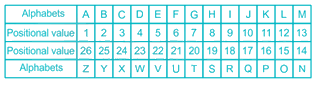 Vowels are assigned even numbers as:
A = 2, E = 4, I = 6, O = 8, U = 10
Word: FUNDAMENTAL
Vowels in the word:
U, A, E, A
U = 10
A = 2
E = 4
A = 2
Sum of vowel values:
10 + 2 + 4 + 2 = 18
Hence, the correct option is Option 3.
Q6 · Analogy
If "WORLD" is coded as 23-15-18-12-4, how will "DORLW" be coded?
- 4-15-18-12-23
- 23-12-18-15-4
- 12-4-15-23-18
- 18-4-23-15-12
Answer aur solution dekho
Archived marked answer: A
Given:
WORLD = 23-15-18-12-4
Finding the logic:
W = 23
O = 15
R = 18
L = 12
D = 4
Each letter is coded according to its position in the English alphabet.
Applying the same logic to DORLW:
D = 4
O = 15
R = 18
L = 12
W = 23
DORLW = 4-15-18-12-23
Hence, the correct answer is Option 1. Q7 · Analogy
If "BHABHA" = "AGZAGZ", then "RAMAN" = ?
- QZLZM
- QZLAM
- RZMBM
- QYILZM
Answer aur solution dekho
Archived marked answer: A
Given:
BHABHA = AGZAGZ
Finding the logic:
B → A (−1)
H → G (−1)
A → Z (−1, cyclic)
B → A (−1)
H → G (−1)
A → Z (−1, cyclic)
Each letter is replaced by the previous letter in the English alphabet.
Applying the same logic to RAMAN:
R → Q
A → Z
M → L
A → Z
N → M
RAMAN = QZLZM
Hence, the correct answer is Option 1. Q8 · Analogy
What comes next? AZ, CY, EX, GW, ?
- IU
- HU
- FV
- IV
Answer aur solution dekho
Archived marked answer: D
Given Series:
AZ, CY, EX, GW, ?
Observing the pattern:
First letters:
A, C, E, G → Each increases by 2 positions.
Next letter after G = I
Second letters:
Z, Y, X, W → Each decreases by 1 position.
Next letter after W = V
So, the next term = IV
Hence, the correct answer is Option 4.
Q9 · Analogy
If FIGHT is coded as EJHIS, how is BRAVE coded?
- BCQSZ
- CQSZD
- ASBWD
- DQIRZC
Answer aur solution dekho
Archived marked answer: C
Given:
FIGHT = EJHIS
Finding the pattern:
F → E (−1)
I → J (+1)
G → H (+1)
H → I (+1)
T → S (−1)
First and last letters −1, middle letters +1.
Applying the same logic to BRAVE:
B → A (−1)
R → S (+1)
A → B (+1)
V → W (+1)
E → D (−1)
BRAVE = ASBWD
Hence, the correct answer is Option 3.
Q10 · Analogy
If MARKET is coded as NBSLFU, how is NBSLFU coded?
- OCTMGV
- NCTLGU
- OCTLGU
- OCTLGV
Answer aur solution dekho
Archived marked answer: A
Given:
MARKET = NBSLFU
Finding the pattern:
M → N (+1)
A → B (+1)
R → S (+1)
K → L (+1)
E → F (+1)
T → U (+1)
Each letter is replaced by the next letter in the English alphabet.
Applying the same logic to NBSLFU:
N → O
B → C
S → T
L → M
F → G
U → V
Hence, the correct answer is Option 1. Q11 · Puzzle Subtypes Not To Miss
If 3 @ 5 = 14, then 4 @ 100 = ?
- 256
- 116
- 126
- 144
Answer aur solution dekho
Archived marked answer: B
Given:
3 @ 5 = 14
Finding the logic:
3 @ 5 = (3 × 3) + 5
= 9 + 5
= 14
Applying the same logic:
4 @ 100 = (4 × 4) + 100
= 16 + 100
= 116
Hence, the correct option is Option 2.
Q12 · Puzzle Subtypes Not To Miss
Which of the mathematical signs should be come in place of A and B in the below equation to make it mathematically CORRECT? 72 ÷ 6 A 2 × 216 B 24 = 420
- - and +
- + and x
- + and -
- - and x
Answer aur solution dekho
Archived marked answer: C
Given Equation:
72 ÷ 6 A 2 × 216 B 24 = 420
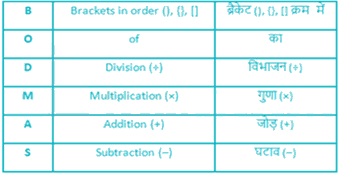 Solve the known operations first (BODMAS rule)
Now check the options:
A = − and B = +
12 − 432 + 24
= -420 + 24
= -396 (Not equal to 420)
A = + and B = ×
12 + 432 × 24
= 12 + 10368
= 10380 (Not equal to 420)
A = + and B = −
12 + 432 − 24
= 444 − 24
= 420
A = − and B = ×
12 − 432 × 24
= 12 − 10368
= -10356 (Not equal to 420)
Hence, the correct option is Option 3.
Q13 · Puzzle Subtypes Not To Miss
The population of a village increased by 10% in the first year and 20% in the second year. What is the total percent increase after 2 years?
- 30%
- 32%
- 28%
- 22%
Answer aur solution dekho
Archived marked answer: B
Given:
Increase in 1st year = 10%
Increase in 2nd year = 20%
Explanation:
Let the initial population be 100.
After 1st year:
100 + 10% of 100 = 100 + 10 = 110
After 2nd year:
110 + 20% of 110 = 110 + 22 = 132
Total increase = 132 − 100 = 32
Percentage increase = 32%
Hence, the correct answer is Option 2.
Q14 · Puzzle Subtypes Not To Miss
A number is divisible by both 5 and 9. Which of the following could it be?
- 35
- 90
- 47
- 60
Answer aur solution dekho
Archived marked answer: B
Given:
A number is divisible by both 5 and 9.
Checking options:
35 → Not a multiple of 9
90 → multiple of both 5, 9
47 → Not a multiple of 9
60 → Not a multiple of 9
Hence, the correct answer is Option 2.
Q15 · Puzzle Subtypes Not To Miss
An amount of ₹10,000 is invested at a compound interest rate of 8% per annum for a period of 2 years. What will be the total amount (principal + interest) received at the end of the 2-year period?
- ₹11,664
- ₹11,726
- ₹11,800
- ₹12,000
Answer aur solution dekho
Archived marked answer: A
Given:
Principal (P) = ₹10,000
Rate of Interest (R) = 8% per annum
Time (T) = 2 years
Formula for Compound Interest:
Amount = P (1 + R/100)T
Calculation:
Amount = 10000 (1 + 8/100)²
= 10000 (1.08)²
= 10000 × 1.1664
= 11,664
Hence, the correct answer is Option 1.
Q16 · Classification Odd One Out
If 987 → 24, 654 → 15, then 321 → ?
- 6
- 12
- 9
- 18
Answer aur solution dekho
Archived marked answer: A
Given:
987 → 24
654 → 15
Finding the logic:
987 → 9 + 8 + 7 = 24
654 → 6 + 5 + 4 = 15
Applying the same logic:
321 → 3 + 2 + 1 = 6
Hence, the correct option is Option 1.
Q17 · Logical Reasoning
Read the following statement carefully and identify the conclusion that follows.
Statement:
All engineers are skilled. No unskilled person is allowed.
Conclusions:
I. All engineers are allowed.
II. No skilled person is unskilled.
- Only I follows
- Only II follows
- Both I and II follow
- Neither I nor II follows
Answer aur solution dekho
Archived marked answer: C
The least possible Venn diagram for the given statements is as shown below
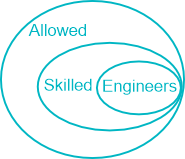 Conclusions:
I. All engineers are allowed → Follow (As all engineers are skilled and only skilled person is allowed. so, all engineers are allowed).
II. No skilled person is unskilled → Follow (A person cannot be both skilled and unskilled at the same time. Hence skilled and unskilled are mutually exclusive categories).
Thus, both I and II follow.
Hence, the correct answer is “Option 3”.
Q18 · Logical Reasoning
Read the following statement carefully and identify the conclusion that follows.
Statement:
All boxes are bags. Some bags are blue. No blue is a plastic.
Conclusions:
I. Some boxes are not plastic.
II. All plastics are bags.
- Only I follows
- Only II follows
- Both I and II follow
- Neither I nor II follows
Answer aur solution dekho
Archived marked answer: D
Statement:
All boxes are bags.
Some bags are blue.
No blue is a plastic
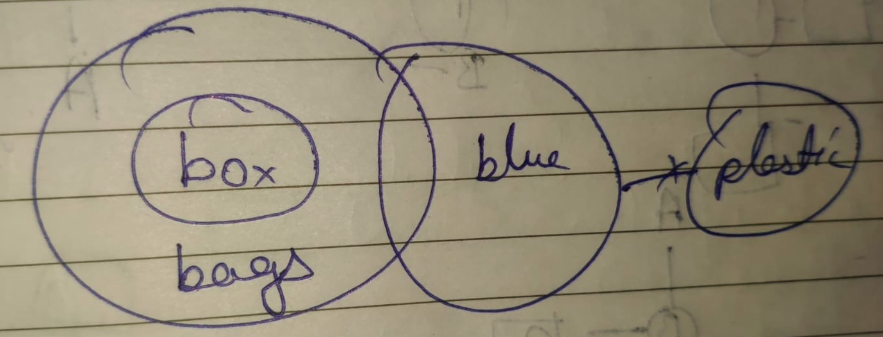 Conclusion I: Some boxes are not plastic.
Some bags are blue and no blue is plastic, but it is not given that those blue bags are boxes. Hence, we cannot definitely conclude that some boxes are not plastic.
Conclusion II: All plastics are bags.
There is no information that plastics are bags. So, this conclusion does not follow.
Hence, the correct answer is Option 4.
Q19 · Blood Relations
A is the son of C. C is the wife of D. How is D related to A?
- Uncle
- Father
- Brother
- Mother
Answer aur solution dekho
Archived marked answer: B
Given:
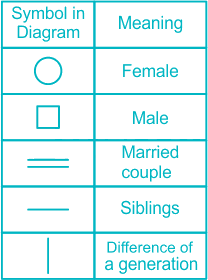 A is the son of C.
C is the wife of D.
Explanation
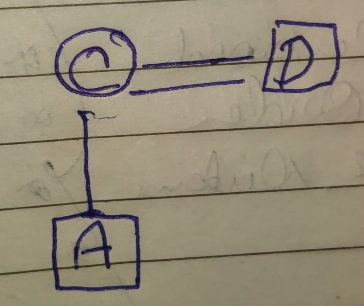 D is the father of A.
Hence, the correct answer is Option 2.
Q20 · Blood Relations
Pointing to a photograph, Rohan said, "He is the only son of my father's only daughter." How is the person in the photograph related to Rohan?
- Brother
- Nephew
- Cousin
- Rohan himself
Answer aur solution dekho
Archived marked answer: B
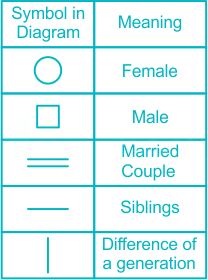 Given statement: Pointing to a photograph, Rohan said, "He is the only son of my father's only daughter.
Case 1) If Rohan is a male member
Q21 · Alphabet Test
Identify the odd one out.
- Kolkata
- Darjeeling
- Siliguri
- Pune
Answer aur solution dekho
Archived marked answer: D
Given,
Kolkata, Darjeeling and Siliguri are cities in West Bengal, whereas Pune is in Maharashtra.
Pune is the odd one out.
Hence, the correct option is Option 4.
Q22 · Alphabet Test
Find the ODD one out. Ganga, Brahmaputra, Amazon, Yamuna, Godavari
- Ganga
- Brahmaputra
- Amazon
- Yamuna
Answer aur solution dekho
Archived marked answer: C
Given
Ganga, Brahmaputra and Yamuna are rivers of India, whereas Amazon is a river in South America.
Hence the correct option is Option 3.
Q23 · Similarity and Differences
Choose the address that is the same as the one given below.
Flat No. 101, Maple Residency,Koregaon Park, Pune,Maharashtra - 411001
- Flat No. 101, Maple Residency, Koregaon Park, Pune, Maharashtra - 411002
- Flat No. 101, Maple Residency, Koregaon Park, Pune, Maharashtra - 411001
- Flat No. 101, Maple Residency, Koregaon Park, Pune, Maharashtra - 411011
- Flat No. 101, Maple Residency, Koregaon Park, Pune, Maharashtra - 410001
Answer aur solution dekho
Archived marked answer: B
Given Address:
Flat No. 101, Maple Residency, Koregaon Park, Pune, Maharashtra - 411001
Checking each option:
1) Flat No. 101, Maple Residency, Koregaon Park, Pune, Maharashtra - 411002 (Incorrect PIN Code)
2) Flat No. 101, Maple Residency, Koregaon Park, Pune, Maharashtra - 411001 (Exact Match)
3) Flat No. 101, Maple Residency, Koregaon Park, Pune, Maharashtra - 411011 (Incorrect PIN Code)
4) Flat No. 101, Maple Residency, Koregaon Park, Pune, Maharashtra - 410001 (Incorrect PIN Code)
Hence, the correct option is "Option 2".
Q24 · Similarity and Differences
Which pair does NOT belong to the following sequence? B7, D9, F11, H13, J17
- B7
- D9
- F11
- J17
Answer aur solution dekho
Archived marked answer: D
Given Sequence:
B7, D9, F11, H13, J17
Observing the pattern:
Letters:
B, D, F, H, J → Each letter increases by 2 positions in the alphabet.
Numbers:
7, 9, 11, 13, 17
7 → 9 (+2)
9 → 11 (+2)
11 → 13 (+2)
13 → 15 (+2) should come, but given 17.
So, the number with J should be 15, not 17.
Hence, the pair that does NOT belong to the sequence is Option 4.
Q25 · Clock and Calendar
In a series of seminars held daily from 11th to 18th Feb, Calicut - 18th Feb 2022, Patna - 12th Feb 2022, Tiruchirappalli - 17th Feb 2022,
Raipur - 11th Feb 2022, Rourkela - 14th Feb 2022 Jamshedpur - 13th Feb 2022, Durgapur - 15th Feb 2022, Warangal - 16th Feb 2022
If the seminar in Jamshedpur was held on a Sunday, which day of the week was the seminar in Calicut?
- Tuesday
- Wednesday
- Friday
- Sunday
Answer aur solution dekho
Archived marked answer: C
Given:
Seminars were held daily from 11th Feb to 18th Feb 2022.
Raipur – 11th Feb 2022
Patna – 12th Feb 2022
Jamshedpur – 13th Feb 2022
Rourkela – 14th Feb 2022
Durgapur – 15th Feb 2022
Warangal – 16th Feb 2022
Tiruchirappalli – 17th Feb 2022
Calicut – 18th Feb 2022
Given that the seminar in Jamshedpur (13th Feb 2022) was held on Sunday.
So, 13th Feb 2022 = Sunday
Now counting forward:
14th Feb – Monday
15th Feb – Tuesday
16th Feb – Wednesday
17th Feb – Thursday
18th Feb – Friday
Hence, the correct option is Option 3.
General Awareness
Q1 · Art and Culture
Which two basic postures form the foundation of Odissi dance?
- Tandava and Lasya
- Chowk and Tribhanga
- Chakkar and Mudra
- Natya and Nritya
Answer aur solution dekho
Archived marked answer: B
The correct answer is Chowk and Tribhanga.
Key Points
- Chowk:
- The "Chowk" posture is a square-like stance that symbolizes stability and strength. It is a fundamental posture in Odissi dance and represents the masculine aspect of the dance, often associated with the depiction of Lord Jagannath.
- It is performed with bent knees and thighs turned out, creating a symmetrical and grounded form. This symbolizes the earth and conveys strength and sturdiness.
- The Chowk posture forms the basis for many movements and is integral to the dance's rhythmic patterns and footwork.
- Tribhanga:
- The "Tribhanga" posture is a characteristic pose in Odissi dance that involves the division of the body into three bends: at the neck, torso, and knee.
- It represents the feminine grace and elegance of the dance form, contrasting with the masculine Chowk posture.
- The Tribhanga posture is often used to depict the sensuality and fluidity of the dance, symbolizing beauty and divinity, especially in depictions of female deities like Goddess Radha.
- It is highly intricate and requires precise control over the body to maintain the three bends while executing fluid movements.
- These two postures, Chowk and Tribhanga, form the foundation of Odissi dance and are used extensively throughout its performance to convey a wide range of emotions and stories.
- Odissi is one of the eight classical dance forms of India, originating in Odisha, and is known for its lyrical and graceful movements. The interplay between Chowk (masculine) and Tribhanga (feminine) postures gives the dance its unique identity.
Additional Information
- Importance of Postures in Odissi Dance:
- The postures in Odissi dance are inspired by the sculptures of temples like the Sun Temple at Konark. These postures are not only aesthetic but also have spiritual significance, often representing divine figures and cosmic energies.
- While Chowk represents the grounded, earthly nature, Tribhanga symbolizes the celestial and graceful aspects of the dance form.
- Other Classical Dance Forms of India:
- Bharatanatyam: Originates from Tamil Nadu, characterized by fixed upper torso, bent legs, and intricate footwork.
- Kathak: Originates from North India, known for its intricate foot movements, spins, and emotive expressions.
- Kathakali: Originates from Kerala, noted for its elaborate costumes, makeup, and storytelling.
- Kuchipudi: Originates from Andhra Pradesh, combines fast rhythms with fluid movements and includes theatrical elements like dialogue delivery.
- Manipuri: Originates from Manipur, characterized by its focus on graceful, flowing movements.
- Mohiniyattam: Originates from Kerala, known for its feminine grace and storytelling.
- Sattriya: Originates from Assam, introduced by the Vaishnavite saint Shankaradeva, and performed in monasteries.
- Specific Characteristics of the Options:
- Tandava and Lasya: These are foundational concepts in Indian classical dance that represent the masculine and feminine aspects of dance. Tandava depicts vigor and strength, while Lasya represents grace and beauty. However, these are not specific to Odissi dance but are overarching themes in Indian classical dances.
- Chakkar and Mudra: Chakkar refers to spins or circular movements, while Mudra denotes hand gestures used in storytelling. These are elements of various Indian dance forms but not foundational postures in Odissi.
- Natya and Nritya: These are Sanskrit terms where Natya refers to dramatic art (dance-drama), and Nritya refers to expressional dance. While these are components of Odissi, they are not postures.
- Odissi's Historical and Cultural Significance:
- Odissi has its roots in the temples of Odisha and was originally performed as a form of devotional offering to deities.
- It is one of the oldest classical dance forms in India, with references dating back to the Natyashastra, an ancient treatise on performing arts attributed to Bharata Muni.
- The dance form was revived during the 20th century after facing decline during the colonial period. </ul
Q2 · Art and Culture
Which Indian city is known for its abundance of buildings featuring French colonial architecture?
- Goa
- Puducherry (Pondicherry)
- Hyderabad
- Kolkata
Answer aur solution dekho
Archived marked answer: B
The correct answer is Puducherry (Pondicherry).
Key Points
- Puducherry is renowned for its French colonial architecture, reflecting its history as a former French colony.
- The city features quaint streets with French names, lined with colonial-style villas, beautiful churches, and vibrant cultural buildings.
- Puducherry's architecture is influenced by the French design style, characterized by symmetrical layouts, pastel-colored facades, and ornate doorways.
- The French Quarter, also known as the "White Town," is a prominent area where colonial heritage is most evident. It contains numerous heritage buildings that are well-preserved and reflect French aesthetics.
- Puducherry is famous for landmarks like the Notre Dame des Anges Church, the French War Memorial, and Aurobindo Ashram, which display the city's unique blend of Indian and French cultural influences.
Additional Information
- Historical Background:
- Puducherry was under French rule from 1674 until 1954 when it was formally transferred to India.
- During their rule, the French developed Puducherry as a trading post and established urban planning that adhered to French architectural standards.
- The city is divided into French and Tamil quarters, showcasing a blend of cultural styles.
- Key Architectural Features:
- The French colonial villas in Puducherry are characterized by high ceilings, large windows, and spacious courtyards.
- The use of colorful facades and intricate ironwork highlights the artistic influence of French architecture.
- The streets of the French Quarter are laid out in a grid pattern, a hallmark of colonial urban planning.
- Tourism and Preservation:
- Puducherry attracts visitors from around the world due to its unique cultural and architectural heritage.
- The Indian government and local authorities have taken steps to preserve heritage buildings, ensuring the legacy of French architecture endures.
- Several buildings in Puducherry have been converted into heritage hotels and museums, allowing tourists to experience the colonial charm.
- Comparison to Other Indian Cities:
- Unlike cities like Goa, which reflects Portuguese colonial influences, Puducherry is distinctly influenced by French culture and architecture.
- Hyderabad and Kolkata, while rich in history, exhibit architectural styles rooted in Mughal and British colonial designs, respectively.
Important Points
- UNESCO World Heritage Status:
- Puducherry's French Quarter has been proposed for inclusion in the UNESCO World Heritage Site list due to its cultural and architectural significance.
- Efforts are underway to ensure the conservation of its unique heritage.
- Notable Events:
- The annual Bastille Day celebrations in Puducherry reflect its French connection, with locals and visitors participating in cultural events.
- The city also hosts the International Yoga Festival, showcasing its spiritual heritage alongside its colonial charm.
</ul
Q3 · Art and Culture
Wangala Festival is associated with which of the following tribe of India?
- Garo tribe of Meghalaya
- Bhotia tribes of Uttarakhand
- Balti tribes of Jammu and Kashmir
- Nyishi tribes of Arunachal pradesh
Answer aur solution dekho
Archived marked answer: A
The correct answer is Garo tribe of Meghalaya.
Key Points
- The Wangala Festival is a major harvest festival celebrated by the Garo tribe, predominantly residing in the state of Meghalaya in northeast India.
- This festival is also referred to as the Festival of 100 Drums, symbolizing the culmination of the agricultural season and the offering of gratitude to their deity Misi Saljong, the Sun God.
- The Wangala Festival typically takes place in the months of October and November, coinciding with the harvest season.
- During the festival, traditional dances are performed to the rhythm of drums, accompanied by folk songs, marking the cultural heritage and vibrancy of the Garo community.
- The festival fosters community bonding and promotes the preservation of the traditional practices of the Garo tribe.
Additional Information
- Garo Tribe:
- The Garo tribe is one of the three major matrilineal tribes of Meghalaya, alongside the Khasi and Jaintia tribes.
- The Garos predominantly inhabit the Garo Hills region of Meghalaya, with smaller populations in Assam and Bangladesh.
- They practice shifting cultivation and rely heavily on agriculture for their livelihood, growing crops like rice, maize, and millet.
- Their language belongs to the Tibeto-Burman family, and their culture is deeply rooted in traditional beliefs and practices.
- Harvest Festivals in India:
- India celebrates various harvest festivals across its diverse regions, such as Pongal in Tamil Nadu, Baisakhi in Punjab, and Onam in Kerala.
- These festivals mark the end of the agricultural season and express gratitude to nature and deities for a bountiful harvest.
- Other Tribes:
- Bhotia tribes of Uttarakhand: They are semi-nomadic and primarily inhabit the Himalayan region of Uttarakhand, practicing transhumance and trading activities.
- Balti tribes of Jammu and Kashmir: Known for their rich cultural heritage, they reside in the Ladakh region, practicing agriculture and livestock rearing.
- Nyishi tribes of Arunachal Pradesh: They are primarily agriculturalists and are known for their unique headgear made of cane and feathers.
Important Points
- Significance of Wangala Festival:
- The Wangala Festival is an expression of gratitude to Misi Saljong, considered the provider of prosperity and blessings.
- It is a vibrant celebration that showcases the traditional attire, dances, and music of the Garo tribe.
- This festival plays a crucial role in preserving the cultural identity and heritage of the Garo community.
- Role of Traditional Festivals:
- Traditional festivals act as a medium to preserve indigenous practices and pass them on to future generations.
- They promote community bonding, cultural exchange, and awareness of the rich diversity of India's heritage. </ul
Q4 · Art and Culture
Which of the following statements is/are true?
Statement 1: The Shore Temple at Mahabalipuram exemplifies Dravidian architecture built of carved granite blocks.
Statement 2: This temple showcases architectural continuity from the Pallava-era rock-cut cave temples to fully structural stone constructions.
- Both statements are true, and Statement 2 is the correct explanation of Statement 1.
- Both statements are correct, but Statement 2 is not the correct explanation of Statement 1.
- Statement 1 is correct, Statement 2 is false.
- Neither 1 nor 2
Answer aur solution dekho
Archived marked answer: A
The correct answer is 1) Both statements are true, and Statement 2 is the correct explanation of Statement 1..
Key Points
- Statement 1: The Shore Temple at Mahabalipuram exemplifies Dravidian architecture built of carved granite blocks.
- The Shore Temple is located in Mahabalipuram, Tamil Nadu, a UNESCO World Heritage Site.
- It was constructed during the reign of the Pallava king Narasimhavarman II (Rajasimha) in the 8th century CE.
- The temple is made of granite blocks, showcasing the brilliance of Pallava-era craftsmanship.
- It is one of the earliest examples of structural stone temples in South India, representing the transition from rock-cut to structural architecture. *Hence, Statement 1 is correct.*
- Statement 2: This temple showcases architectural continuity from the Pallava-era rock-cut cave temples to fully structural stone constructions.
- The Pallava dynasty is renowned for its contributions to early South Indian temple architecture.
- The Shore Temple illustrates the evolution of temple design, transitioning from rock-cut cave temples like those at Mahabalipuram to fully structural temples.
- The carvings and sculptures reflect the artistic and architectural continuity from earlier Pallava creations.
- The temple's aesthetic and construction techniques influenced subsequent Dravidian temple architecture. *Hence, Statement 2 is correct.*
- Explanation: Statement 2 correctly explains Statement 1 because it provides the historical and architectural context for the Shore Temple's design and construction.
- *Therefore, the correct answer is Option 1.*
Additional Information
- Shore Temple:
- The Shore Temple complex consists of three shrines dedicated to Lord Shiva and Lord Vishnu.
- The temple faces the Bay of Bengal and served as a landmark for sailors, hence the name "Shore Temple."
- The intricate carvings depict mythological stories, including scenes from the Mahabharata and Ramayana.
- Pallava Dynasty’s Contribution to Architecture:
- The Pallavas pioneered rock-cut architecture, as seen in the Mandapas (cave temples) and monolithic Rathas (chariots) at Mahabalipuram.
- Examples include Arjuna's Penance, the Pancha Rathas, and the Mahishasuramardini Cave.
- The Shore Temple marked the beginning of structural temple construction, which became a hallmark of later South Indian dynasties like the Cholas.
- Dravidian Architecture:
- Dravidian temple architecture is characterized by pyramidal towers (Vimanas), pillared halls (Mandapas), and enclosed courtyards.
- Intricate carvings and sculptures depicting deities, animals, and mythological scenes are common features.
- Later examples of Dravidian architecture include the Brihadeshwara Temple (Chola dynasty) and the Meenakshi Temple (Nayaka dynasty).
- UNESCO World Heritage Status:
- The Shore Temple is part of the Group of Monuments at Mahabalipuram, designated as a UNESCO World Heritage Site in 1984.
- This recognition highlights its cultural and historical significance.
Important Points
- Other Notable Pallava Monuments:
- Pancha Rathas: Five monolithic temples, each carved from a single granite block, named after the Pandavas from the Mahabharata.
- Arjuna’s Penance: A massive open-air rock relief depicting scenes of devotion and mythology.
- Mahishasuramardini Cave: A cave temple featuring carvings of Goddess Durga slaying the demon Mahishasura.
- Architectural Influence:
- The Shore Temple and other Pallava structures laid the foundation for later South Indian dynasties' architectural styles, particularly the Cholas and Vijayanagara rulers.
- The use of granite and intricate carvings became defining features of Dravidian temples.
```
63
Q5 · Indian Polity and Constitution
Which Constitutional Amendment made it mandatory for States to establish Panchayati Raj Institutions as units of local self-governance?
- 42nd Amendment
- 74th Amendment
- 73rd Amendment
- 44th Amendment
Answer aur solution dekho
Archived marked answer: C
The correct answer is 73rd Amendment.
Key Points
- The 73rd Amendment Act of the Constitution, passed in 1992, made it mandatory for states to establish Panchayati Raj Institutions as units of local self-governance.
- It added Part IX to the Indian Constitution, titled "The Panchayats," and introduced Articles 243 to 243-O, laying down the framework for the functioning of Panchayati Raj Institutions.
- The Amendment also provided for the creation of a three-tier system of Panchayati Raj, consisting of the Gram Panchayat at the village level, the Panchayat Samiti at the block level, and the Zila Parishad at the district level.
- This Amendment made it mandatory to conduct regular elections every five years for Panchayati Raj Institutions and reserved seats for Scheduled Castes (SCs), Scheduled Tribes (STs), and women.
- It empowered the Pan
Q6 · Indian Polity and Constitution
One of the key technological shifts in the Bharatiya Nagarik Suraksha Sanhita (BNSS) includes the introduction of which of the following systems?
- AI-based trial judgment generator
- Drone-based crime scene scanning
- Virtual trial-only courts for all offenses
- e-FIR, e-summons and e-warrants
Answer aur solution dekho
Archived marked answer: D
The correct answer is e-FIR, e-summons and e-warrants.
Key Points
- Bharatiya Nagarik Suraksha Sanhita (BNSS) is a proposed legislation aimed at overhauling India’s criminal justice system, bringing in significant technological advancements to improve efficiency and transparency.
- One of the primary technological shifts under BNSS is the introduction of e-FIR, e-summons, and e-warrants, ensuring faster and more efficient processing of cases and reducing delays in legal procedures.
- An e-FIR enables citizens to lodge First Information Reports (FIRs) online, eliminating the need to visit police stations physically, thus increasing accessibility and reducing inconvenience.
- e-summons and e-warrants allow for the electronic issuance and transmission of legal do
Q7 · Indian Polity and Constitution
The practice in the Parliament where the demands for grants are put to a vote after the passage of the time limit for discussion is called_______.
- guillotine
- cut motions
- motions
- point of order
Answer aur solution dekho
Archived marked answer: A
The correct answer is Guillotine.
Key Points
- The term Guillotine is used in parliamentary procedures to refer to the process where the discussion on demands for grants is curtailed or bypassed, and the demands are put to vote after the stipulated time limit has been reached.
- This practice ensures that the Parliament can meet its deadlines for financial legislation without unnecessary delays.
- It is primarily applied during the budget session of the Parliament when the discussion on the budget has to be completed within a specific timeframe.
- The Speaker or Chairperson of the House applies the guillotine to speed up the process of voting on the remaining demands for grants without detailed discussions.
- Once the guillotine is invoked, all remaining demands are voted upon in a single motion, saving valuable legislative time. This practice is essential for maintaining the fiscal schedule of the government.
Additional Information
- Cut Motions:
- A cut motion is a parliamentary procedure allowing members of the opposition to question specific allocations in the budget.
- There are three types of cut motions: Policy Cut, Economy Cut, and Token Cut.
- For example, a Policy Cut motion seeks to express disapproval of the policy underlying the budget, while an Economy Cut motion focuses on reducing expenditure by a specific amount.
- Motions:
- Motions are formal proposals made by members of Parliament to discuss, approve, or disapprove policies, issues, or specific matters.
- Examples include adjournment motions, no-confidence motions, and censure motions.
- Point of Order:
- A point of order is raised when a member believes that parliamentary rules or procedures are being violated during a debate.
- The Speaker or Chairperson decides whether the point of order is admissible or not, ensuring that the proceedings remain in order.
- Budget Process in India:
- The Union Budget is presented by the Finance Minister in Parliament, detailing the government’s revenue and expenditure for the fiscal year.
- The budget process includes stages such as the presentation of the budget, general discussion, scrutiny by departmental standing committees, and voting on demands for grants.
- The application of the guillotine marks the end of the voting process in the Lok Sabha.
Important Points
- Purpose of Guillotine:
- The guillotine ensures that the financial business of the government is not delayed, allowing funds to be released for government activities and programs.
- It is a time management tool for the legislature to handle its workload efficiently.
- Historical Context:
- The term "guillotine" originates from the French Revolution, where it was used for a swift and decisive execution process. In parliamentary terms, it symbolizes the swift closure of discussions.
- Constitutional Provisions:
- The budget process in India is governed by Articles 112 to 117 of the Constitution.
- Article 112 refers to the annual financial statement, while Article 113 deals with demands for grants.
```
Q8 · Indian Economy
Which of the following statements correctly describes modern currency systems?
- Currencies are fully backed by gold
- Currencies are not readily convertible into gold
- Currencies can always be exchanged for barrels of oil
- Currencies are backed by silver
Answer aur solution dekho
Archived marked answer: B
The correct answer is Currencies are not readily convertible into gold.
Key Points
- Modern currencies are fiat currencies: Modern currency systems are based on fiat money, which means that the currency is not backed by a physical commodity like gold or silver. Instead, it derives its value from the trust and confidence of the people using it.
- Non-convertibility into gold: Unlike in the past under the gold standard, modern currencies are not readily convertible into gold or any other commodity. This shift occurred after the abandonment of the gold standard, particularly with the collapse of the Bretton Woods system in 1971.
- Trust in central authorities: The value of modern currencies is maintained by the
Q9 · Indian Economy
The Green Revolution in India was introduced during which plan?
- Second
- Third
- Fourth
- Fifth
Answer aur solution dekho
Archived marked answer: B
The correct answer is Third Plan.
Key Points
- The Green Revolution in India was introduced during the Third Five-Year Plan (1961-1966). This plan emphasized agriculture and aimed to make India self-sufficient in food production.
- The Green Revolution involved the adoption of new agricultural practices, including the use of high-yield variety (HYV) seeds, chemical fertilizers, pesticides, and improved irrigation methods.
- The revolution was spearheaded by the efforts of M.S. Swaminathan, known as the "Father of the Green Revolution in India," and supported by the government under Prime Minister Lal Bahadur Shastri.
- It primarily targeted regions like Punjab, Haryana, and Western Uttar Pradesh, which had favorable conditions for intensive agric
Q10 · Indian Economy
Which sector suffered due to reduction in fertilizer subsidies post-1991?
- Industrial
- Banking
- Agriculture
- Service
Answer aur solution dekho
Archived marked answer: C
The correct answer is Agriculture.
Key Points
- Reduction in fertilizer subsidies post-1991: During the economic reforms of 1991, the Government of India reduced subsidies on fertilizers to address fiscal imbalances. This move significantly impacted the Agriculture sector, as farmers had to bear higher costs for fertilizers.
- Impact on farmers: Fertilizers are essential for enhancing soil fertility and crop yield. The reduction in subsidies increased the cost of agricultural inputs, directly affecting the financial burden on small and marginal farmers.
- Decline in agricultural productivity: Many farmers reduced fertilizer usage due to higher costs, leading to a decline in agricultural productivity in several regions, especially those dependent on fertilizer-intensive farming methods.
- Economic challenges for the agricultural workforce: The agriculture sector employs a significant portion of India's workforce, particularly in rural ar
Q11 · Indian Economy
Under which Five Year Plan was the Green Revolution introduced in India?
- First Plan
- Second Plan
- Third Plan
- Fourth Plan
Answer aur solution dekho
Archived marked answer: C
The correct answer is Third Plan.
Key Points
- The Green Revolution in India was introduced during the Third Five-Year Plan, which spanned from 1961 to 1966.
- The Green Revolution focused on increasing agricultural productivity through the adoption of new technologies, including the use of high-yielding variety (HYV) seeds, enhanced irrigation methods, and the application of chemical fertilizers and pesticides.
- This initiative was spearheaded by renowned agricultural scientist Dr. M.S. Swaminathan, who is often referred to as the "Father of the Green Revolution in India."
- The Green Revolution primarily targeted staple crops such as wheat and rice, leading to a significant increase in food grain production, especially in states like Punjab, Haryana, and Uttar Pradesh.
- The success of the Green Revolution reduced India's dependency on food imports and helped achieve self-sufficiency in food production, addressing the issue of food scarcity prevalent during that era.
Additional Information
- High-Yielding Variety Seeds:
- HYV seeds were introduced as part of the Green Revolution and were specifically designed to produce more output per hectare.
- These seeds required intensive irrigation, fertilizers, and pesticides for optimal results.
- Examples include Sonora 64 and Lerma Rojo varieties of wheat.
- Impact of Green Revolution:
- India's food grain production increased from 82 million tonnes in 1960-61 to over 100 million tonnes by 1970.
- The Green Revolution contributed to rural prosperity, especially in agriculturally rich states like Punjab and Haryana.
- It also led to the modernization of farming practices and the development of agro-industries.
- Challenges of the Green Revolution:
- While the Green Revolution boosted food production, it also resulted in environmental degradation due to excessive use of fertilizers and pesticides.
- It led to regional disparities, as benefits were concentrated in select states with better irrigation infrastructure.
- Small and marginal farmers faced difficulties due to the high cost of inputs required for HYV seeds.
- Role of Five-Year Plans:
- The Third Five-Year Plan (1961-1966) emphasized agriculture and rural development as key components of India's economic strategy.
- The plan aimed to achieve self-sufficiency in food production and laid the groundwork for the Green Revolution.
- It also introduced policies for the development of irrigation projects and agricultural research centers.
Important Points
- Key Figures:
- Norman Borlaug, an American agricultural scientist, is credited with pioneering the Green Revolution globally.
- In India, Dr. M.S. Swaminathan played a crucial role in the implementation of Green Revolution technologies.
- Geographical Focus:
- The Green Revolution primarily benefited regions with adequate irrigation facilities, such as Punjab, Haryana, and western Uttar Pradesh.
- Other parts of India, especially rain-fed areas, remained largely unaffected.
- Economic Effects:
- The Green Revolution contributed to the growth of agricultural exports and reduced India's reliance on food imports.
- It also fostered the development of agro-based industries, such as fertilizer and pesticide manufacturing.
- Social Impact:
- While the Green Revolution increased agricultural productivity, it also led to socio-economic disparities between large landowners and small farmers.
- It prompted the migration of rural laborers to urban areas due to mechanization and reduced labor demand in agriculture. </ul
Q12 · Sports Static GK
Consider the following statements about Khelo India Winter Games 2024:
1.) Indian Army topped the medal tally with 10 golds.
2.) Jammu & Kashmir, former champions, finished second in 2024 with nine gold medals. Which of the following Statement is/are Correct?
- Only 1 is correct
- Only 2 is correct
- Both 1 and 2 are correct
- Neither 1 nor 2 are correct
Answer aur solution dekho
Archived marked answer: C
The correct answer is Option 3 (Both 1 and 2 are correct).
Key Points
- Statement 1: Indian Army topped the medal tally with 10 golds
- This statement is correct. The Indian Army emerged as the top-performing team in the Khelo India Winter Games 2024, securing the highest number of gold medals, which was 10 golds in the overall tally.
- The Indian Army has consistently participated in various sports initiatives and its dominance in the Winter Games is a reflection of its focus on physical fitness, discipline, and sports excellence.
- Statement 2: Jammu & Kashmir, former champions, finished second in 2024 with nine gold medals
- This statement is also correct. The region of Jammu & Kashmir, which had won the overall championship in previous editions of the Winter Games, secured the second position in 2024 with nine gold medals.
- Jammu & Kashmir has been a prominent participant in winter sports, given its geographical advantage of snow-capped mountains and infrastructure for activities like skiing, ice skating, and snowboarding.
- The Khelo India Winter Games 2024 was organized to promote winter sports in India and nurture young talent in disciplines like skiing, snowboarding, ice hockey, and other snow-based activities.
- The event fosters a competitive spirit among athletes from different parts of the country and serves as a platform for identifying talent for international competitions such as the Winter Olympics.
Additional Information
- Khelo India Winter Games Overview:
- The Khelo India Winter Games is an initiative under the Government of India’s Khelo India programme to promote sports culture and identify talent in various sports disciplines.
- The winter edition of the games focuses on snow-based sports and is typically held in regions like Jammu & Kashmir and Himachal Pradesh.
- The games have been instrumental in encouraging participation from athletes in high-altitude regions and creating awareness about winter sports in India.
- Notable Sports in Khelo India Winter Games:
- Skiing: Events include slalom and giant slalom, requiring athletes to navigate a downhill course marked by gates.
- Snowboarding: A popular winter sport that involves descending a snow-covered slope while standing on a board.
- Ice Hockey: This team sport is played on ice and has gained traction in regions like Ladakh and Himachal Pradesh.
- Figure Skating: A sport where individuals or teams perform spins, jumps, and dance moves on ice.
- Khelo India Programme:
- The Khelo India programme was launched by the Ministry of Youth Affairs and Sports in 2018 to revive India’s sports culture at the grassroots level.
- It aims to identify and nurture young talent by providing scholarships, world-class training facilities, and exposure to international competitions.
- The programme includes sports infrastructure development, coaching support, and organizing national-level competitions.
- Jammu & Kashmir’s Contribution to Winter Sports:
- Jammu & Kashmir is home to popular tourist destinations like Gulmarg, which has become a hub for skiing and snowboarding in India.
- The region hosts training camps and competitions for athletes aspiring to represent India in international winter sports events.
- Infrastructure development and government support have significantly enhanced the participation of local athletes in national and international games.
Important Points
- Medal Tally in Khelo India Winter Games 2024:
- Indian Army: 10 gold medals, topped the tally.
- Jammu & Kashmir: 9 gold medals, secured second position.
- Significance of Winter Sports:
- Winter sports are gaining popularity in India, particularly in the Himalayan regions.
- These sports help in promoting tourism and creating job opportunities in high-altitude areas.
- Future Prospects:
- The Khelo India Winter Games serve as a platform for identifying talent for international events like the Winter Olympics.
- Continued investment in infrastructure and training is essential for India’s success in winter sports on the global stage.
Q13 · Sports Static GK
Consider the following statements regarding athlete responsibilities in anti-doping procedures:
1) Athletes must provide accurate whereabouts information and comply with all sample collection procedures.
2) Athletes are allowed to delegate the sample collection process to a team official if they have a valid reason. Which of the statements is/are correct?
- Only 1 is Correct
- Only 2 is Correct
- 1 and 2 are Correct
- Neither 1 nor 2 are Correct
Answer aur solution dekho
Archived marked answer: A
The correct answer is Only 1 is Correct.
Key Points
- Statement 1: Athletes must provide accurate whereabouts information and comply with all sample collection procedures.
- This statement is correct. Anti-doping regulations require athletes to provide accurate and up-to-date information about their locations (also referred to as "whereabouts").
- Compliance with sample collection procedures is mandatory to ensure fairness and transparency in sports.
- Failure to provide accurate whereabouts or refusal to comply with sample collection can result in sanctions, including disqualification or suspension.
- Statement 2: Athletes are allowed to delegate the sample collection process to a team official if they have a valid reason.
- This statement is incorrect. Athletes cannot delegate the sample collection process to anyone else under any circumstances.
- The anti-doping process is an individual responsibility, and the integrity of the sample collection process depends on the direct involvement of the athlete.
- Allowing delegation would compromise the reliability and credibility of anti-doping tests.
Additional Information
- Whereabouts Requirements:
- Athletes in the registered testing pool must provide detailed information about their location for each day, including times and places where they can be available for testing.
- Whereabouts information is critical for out-of-competition testing, which can occur without prior notice.
- Sample Collection Process:
- The sample collection process is conducted by trained doping control officers (DCOs) under the supervision of anti-doping organizations.
- Athletes are notified in person of their selection for testing and must report to the designated testing area promptly.
- The process includes the collection of urine and/or blood samples under strict protocols to prevent contamination or manipulation.
- WADA (World Anti-Doping Agency):
- WADA oversees global anti-doping efforts and ensures compliance with the World Anti-Doping Code.
- The code outlines the roles and responsibilities of athletes, support personnel, and anti-doping organizations.
- Consequences of Non-Compliance:
- Failure to comply with anti-doping regulations can lead to penalties such as ineligibility, fines, or a ban from competition.
- Three missed whereabouts filings within 12 months can result in sanctions similar to a positive doping test.
Important Points
- Strict Liability Principle:
- Under the strict liability principle, athletes are responsible for any prohibited substance found in their system, regardless of intent.
- This emphasizes the need for vigilance in ensuring compliance with anti-doping rules.
- Therapeutic Use Exemptions (TUEs):
- Athletes with legitimate medical conditions can apply for a TUE to use a prohibited substance or method.
- The application process is overseen by an independent TUE committee to ensure fair adjudication.
- Global Anti-Doping Code:
- The code is a set of universal standards aimed at harmonizing anti-doping efforts worldwide.
- It applies to all sports and countries, ensuring consistency in anti-doping practices.
``
Q14 · Sports Static GK
How many of the following statements about Kho-Kho rules is/are correct?
1) Pole height is 1.20-1.25 m with a fixed 9 cm diameter.
2) Total match duration, including intervals, is 48 minutes.
3) Sub-junior chasers' block distance is the same as juniors: 2.30 m.
- Only 1 is Correct
- Only 2 is Correct
- Only 3 is correct
- 1, 2 and 3 all are Correct
Answer aur solution dekho
Archived marked answer: A
The correct answer is Only 1 is Correct.
Key Points
- Statement 1: Pole height is 1.20–1.25 m with a fixed 9 cm diameter. Correct.
- According to standard Kho-Kho Federation specifications, each pole is installed at the end of the central lane.
- The height of the pole is maintained between 120 cm and 125 cm.
- The pole diameter is approximately 9 cm, ensuring uniformity in official competitions.
*Hence, Statement 1 is correct.*
- Statement 2: Total match duration, including intervals, is 48 minutes. Incorrect.
- A standard Kho-Kho match consists of four turns of 9 minutes each, making the total playing time 36 minutes.
- There is generally a 5-minute interval between innings and 2-minute breaks between turns.
- The total duration is therefore not exactly 48 minutes.
*Hence, Statement 2 is incorrect.*
- Statement 3: Sub-junior chasers' block distance is the same as juniors: 2.30 m. Incorrect.
- The dimensions of the Kho-Kho field vary according to the age category.
- The 2.30 m block distance is applicable to Junior and Senior categories.
- The Sub-Junior category uses modified dimensions and does not have the same block distance as Juniors.
*Hence, Statement 3 is incorrect.*
- *Therefore, only Statement 1 is correct.*
Additional Information
- Kho-Kho is one of India's oldest traditional outdoor sports and is governed internationally by the International Kho Kho Federation (IKKF).
- The game is played between two teams of 12 players, out of which 9 players take the field at a time for chasing.
- A standard Kho-Kho match consists of two innings, and each inning contains two turns for chasing and defending.
- The game emphasizes speed, agility, reflexes, teamwork, and strategic movement, making it one of the fastest tag sports in the world.
- The first edition of the Kho Kho World Cup was hosted by India, reflecting the growing international popularity of the sport.
Important Points
- The playing area of Kho-Kho consists of a central lane, cross lanes, and two poles placed at opposite ends.
- A chaser can obtain a directional advantage by touching the pole and changing direction, a technique known as pole diving or pole turning.
- The term "Kho" is used by a chaser to pass the chasing turn to a seated teammate.
- Kho-Kho is included in several national-level competitions such as the National Games of India and Khelo India Games.
Q15 · Modern Indian History
The introduction of the Permanent Settlement in Bengal by Lord Cornwallis in 1793 primarily aimed to:
- Ensure the welfare of the peasant farmers.
- Create a class of loyal zamindars who would ensure regular land revenue collection.
- Promote the cultivation of cash crops like indigo and cotton.
- Abolish the zamindari system altogether.
Answer aur solution dekho
Archived marked answer: B
The correct answer is Create a class of loyal zamindars who would ensure regular land revenue collection..
Key Points
- The Permanent Settlement was introduced in 1793 by Lord Cornwallis during British rule in India, specifically in the provinces of Bengal, Bihar, and Odisha.
- The primary objective of the settlement was to create a class of loyal zamindars (landlords) who would act as intermediaries between the British administration and the peasants and ensure the regular collection of land revenue.
- Zamindars were made the hereditary owners of the land under their control and were required to pay a fixed amount of revenue to the British government, irrespective of the agricultural output or economic conditions.
- This system ensured a steady and predictable income for the British administration while transferring the risk of agricultural failur
Q16 · Modern Indian History
Which significant political move by Lokpriya Gopinath Bordoloi ensured that Assam remained a part of India and not East Pakistan during the Cabinet Mission Plan's proposal in 1946?
- Opposing the grouping of Assam with Bengal
- Launching the Quit India Movement in Assam
- Signing the Assam Accord
- Rejecting the Instrument of Accession
Answer aur solution dekho
Archived marked answer: A
The correct answer is Opposing the grouping of Assam with Bengal.
Key Points
- Lokpriya Gopinath Bordoloi, the first Chief Minister of Assam, played a pivotal role in ensuring that Assam remained a part of India during the turbulent period of the Cabinet Mission Plan's proposal in 1946.
- He opposed the British plan to group Assam with Bengal in a single administrative unit. This grouping was seen as a precursor to Assam potentially being included in East Pakistan during Partition.
- Bordoloi’s opposition was based on the belief that Assam had a distinct cultural identity and should remain independent of Bengal's influence. This move safeguarded Assam’s territorial and cultural integrity.
- His efforts included lobbying at the national level and engaging with Congress leaders like Jawaharlal Nehru and Vallabhbhai Patel to ensure Assam’s interests were protected.
- Ultimately, Bordoloi’s firm stance and negotiations resulted in Assam being excluded from the proposed grouping, ensuring its integration into India and avoiding its annexation into East Pakistan.
Additional Information
- Cabinet Mission Plan (1946):
- The Cabinet Mission Plan was proposed by the British government to discuss and plan the transfer of power to Indian leadership.
- It suggested a grouping of provinces into three sections, with Assam and Bengal forming Group C. This grouping was opposed by many as it diluted Assam's autonomy.
- The plan also laid the groundwork for India’s partition, with the creation of Pakistan becoming increasingly likely.
- Gopinath Bordoloi’s Leadership:
- As the leader of Assam, Bordoloi championed the cause of Assamese culture and opposed any attempt to merge Assam with Bengal or Pakistan.
- He mobilized public opinion and worked with both local and national leaders to safeguard Assam’s interests.
- Assam’s Strategic Importance:
- Assam, rich in natural resources and with a unique cultural heritage, was considered a vital region in India’s northeastern frontier.
- Its inclusion in East Pakistan would have significantly altered the political and geographical landscape of the region.
- Outcome:
- Due to Bordoloi’s efforts, Assam was kept out of the grouping with Bengal, ensuring its integration into India post-Independence.
- He was later awarded the Bharat Ratna posthumously in 1999 for his contributions to the nation.
Important Points
- Other Options Analysis:
- Launching the Quit India Movement in Assam: While the Quit India Movement was significant, it was not directly related to Assam’s exclusion from East Pakistan. Hence, this is incorrect.
- Signing the Assam Accord: The Assam Accord was signed in 1985, much after Independence, and was unrelated to the events of 1946. Hence, this is incorrect.
- Rejecting the Instrument of Accession: The Instrument of Accession was related to princely states joining India or Pakistan post-Independence, not the grouping under the Cabinet Mission Plan. Hence, this is incorrect.
Q17 · Modern Indian History
Tana Bhagat led a unique tribal movement in the early 20th century, emphasizing reforms and non-violence against the British and local landlords among the Oraon community in which modern-day state?
- Chhattisgarh
- Madhya Pradesh
- Jharkhand
- West Bengal
Answer aur solution dekho
Archived marked answer: C
The correct answer is Jharkhand.
Key Points
- Tana Bhagat Movement was a tribal uprising led by Tana Bhagat in the early 20th century among the Oraon community residing in what is now the state of Jharkhand.
- The movement began as a response to the oppression faced by the Oraon community under the British colonial rule and the local landlords (zamindars).
- The movement was unique as it emphasized non-violence and sought reforms in the tribal society, such as abstinence from alcohol, adopting cleanliness, and rejecting superstitions.
- The Tana Bhagat movement also had a religious dimension, as followers adopted practices inspired by Hindu rituals and Mahatma Gandhi’s ideals, including wearing khadi and boycotting British goods.
- The movement gained momentum in the region that is today known as Jharkhand, which became a separate state in 2000 after being carved out of Bihar.
Additional Information
- Oraon Community:
- The Oraons are one of the major tribal communities in India, primarily inhabiting the Chotanagpur Plateau region, which includes present-day Jharkhand, Chhattisgarh, and Odisha.
- Their traditional livelihood is based on agriculture, and they have a rich cultural heritage with unique dance, music, and festivals.
- The Oraon community faced exploitation under the British revenue system and local zamindars, which led to several tribal uprisings, including the Tana Bhagat movement.
- Significance of the Tana Bhagat Movement:
- The movement was inspired by Mahatma Gandhi's philosophy of non-violence and self-reliance, making it one of the few peaceful tribal uprisings during British rule.
- It sought to bring social and religious reform within the tribal community, emphasizing cleanliness, sobriety, and a rejection of traditional practices considered regressive.
- The movement also had a political dimension, as it opposed the oppression of the British and their policies affecting the tribal population.
- Other Tribal Movements in Jharkhand:
- Santhal Rebellion (1855-56): The Santhals revolted against the British and zamindars due to economic exploitation and land alienation.
- Birsa Munda Uprising (1899-1900): Led by Birsa Munda, this movement aimed at establishing Munda Raj and resisting British policies that disrupted the tribal way of life.
- Kol Rebellion (1831-1832): The Kols revolted against the British and local landlords for their exploitative practices.
- Formation of Jharkhand:
- The state of Jharkhand was formed on 15th November 2000, coinciding with the birth anniversary of tribal leader Birsa Munda.
- It was carved out of southern Bihar and was primarily created to address the socio-economic and political aspirations of the tribal population in the region.
Important Points
- The Tana Bhagat movement was a significant chapter in India’s tribal history, showcasing the unique blend of tribal traditions and Gandhian ideals.
- It highlights the role of tribal communities in India’s freedom struggle, often overlooked in mainstream narratives.
- The movement also reflects the socio-economic challenges faced by tribal communities under colonial rule, including land alienation, economic exploitation, and cultural suppression.
- Understanding such movements is crucial for appreciating the diversity of India’s freedom struggle and the contributions of various marginalized communities.
81:T26
Q18 · Awards Static
Which French author was awarded the Nobel Prize in Literature in 2022 for her courage and clinical acuity in uncovering personal memory?
- Annie Ernaux
- Leila Slimani
- Marie NDiaye
- Delphine de Vigan
Answer aur solution dekho
Archived marked answer: A
The correct answer is Annie Ernaux.
Key Points
- Annie Ernaux, a renowned French author, was awarded the Nobel Prize in Literature in 2022 for her exceptional contribution to literature.
- The Nobel Committee recognized her for her courage and clinical acuity in uncovering the roots, estrangements, and collective restraints of personal memory.
- Ernaux's works often explore the themes of memory, identity, and socio-political dynamics, making her one of the most influential voices in contemporary literature.
- Her autobiographical writings, such as "The Years" (2008), have been lauded for their innovative narrative style, blending personal and collective history.
- She is widely celebrated for her ability to transform personal experiences into universal narratives, which resonate with a global audience.
Additional Information
- Annie Ernaux:
- Born on 1 September 1940, in Lillebonne, France, she grew up in a working-class environment.
- Her writings reflect themes of class struggle, feminism, and personal identity.
- She has authored several acclaimed books, including "Simple Passion" (1992) and "Happening" (2000), which delve into personal and societal issues.
- The Nobel Prize in Literature:
- This prestigious award is presented annually by the Swedish Academy to authors who have produced outstanding work in the field of literature.
- It was established in 1901 as per the will of Alfred Nobel, the inventor of dynamite.
- Winners receive a medal, a diploma, and a monetary award.
- Other Nominees:
- Leila Slimani: A Moroccan-French author known for "The Perfect Nanny" (2016).
- Marie NDiaye: A French novelist awarded the Goncourt Prize in 2009.
- Delphine de Vigan: A celebrated French writer, known for her psychological novels like "No and Me" (2007).
-
Important Points
:
- "The Years", one of Ernaux's most celebrated works, is considered a masterpiece of modern literature.
- Her writings often challenge societal norms and explore feminist and existentialist themes.
- The Nobel Prize in Literature has been awarded to 16 women, including Ernaux, as of 2022. </ul
Q19 · Awards Static
The David Dixon Award is presented at the Commonwealth Games to whom?
- The overall winning nation
- The best athlete
- The team with the best sportsmanship
- The host city
Answer aur solution dekho
Archived marked answer: B
The correct answer is The best athlete.
Key Points
- The David Dixon Award is presented at the Commonwealth Games to recognize the most outstanding athlete of the Games. This award is not given to teams, host cities, or nations, but rather to an individual athlete who has exhibited exceptional performance and sportsmanship.
- The award was first introduced in the 2002 Commonwealth Games held in Manchester, UK, and has since been a significant honor at every edition of the Games.
- Winners of the David Dixon Award are chosen based on their sporting excellence, adherence to the values of the Commonwealth Games, and demonstration of good sportsmanship throughout the competition.
- This prestigious award is named after David Dixon, the former honorary secretary of the Commonw
Q20 · Medieval Indian History
What does the term "Kunbis" refer to in the context of Maratha society?
- A warrior caste of the Rajput clans
- A class of temple priests
- A group of peasant-pastoralists
- A community of merchant bankers
Answer aur solution dekho
Archived marked answer: C
The correct answer is A group of peasant-pastoralists.
Key Points
- The term Kunbis refers to a significant community in the Maratha society, primarily classified as peasant-pastoralists. They were traditionally engaged in agriculture and cattle rearing.
- Kunbis formed the backbone of the agricultural economy in the Deccan region of India and were closely associated with the rural agrarian structure.
- The Kunbis were considered a part of the Shudra varna in the traditional caste hierarchy. However, they played a vital role in the Maratha Empire's socio-economic and political framework.
- During the rise of the Maratha Empire under leaders like Shivaji Maharaj, Kunbis often joined the army and became an integral part of the Maratha warrior class. Over time, they were assimilated into the broader Maratha identity.
- Their contributions to agriculture and their service as soldiers in the Maratha army underline their dual role as both economic producers and defenders of their territories.
- In modern India, Kunbis are recognized as an Other Backward Class (OBC) in several states, which provides them with reservations and welfare benefits.
Additional Information
- Historical Significance of Kunbis:
- The Kunbis were primarily farmers in the Deccan plateau, which includes regions of present-day Maharashtra, Karnataka, and Madhya Pradesh. Their agricultural practices supported the regional economy.
- They were one of the communities that contributed to the success of the Maratha Confederacy, as they provided both agrarian resources and military manpower.
- With the rise of the Maratha power under Shivaji Maharaj, many Kunbis were integrated into the military structure, eventually forming a significant portion of the Maratha warrior class.
- Kunbis and the Maratha Identity:
- Over time, the distinction between Kunbis and Marathas blurred as many Kunbis adopted the Maratha identity, particularly those who gained prominence in the military and administration.
- Historical records suggest that the Maratha rulers encouraged this assimilation to strengthen their support base among the agrarian communities.
- The social mobility experienced by Kunbis during the Maratha rule allowed them to rise in social status, although they retained their agricultural roots.
- Cultural Practices:
- Kunbis follow a mix of agrarian and pastoral traditions, often celebrating festivals related to harvests such as Makar Sankranti and Ganesh Chaturthi.
- They have a rich cultural heritage, including folk songs and dances that reflect their agrarian lifestyle and community values.
- Other Caste Groups in the Context of the Question:
- Warrior caste of Rajput clans: Refers to the Rajputs, known for their martial traditions and ruling dynasties in northern and western India. Not related to the Kunbis.
- Class of temple priests: Generally refers to the Brahmins, who are traditionally associated with priesthood and religious duties.
- Community of merchant bankers: Refers to communities like the Banias or Vaishyas, known for their roles in trade and finance.
Important Points
- Kunbis in Modern India:
- In present-day Maharashtra, Kunbis are classified as OBCs and benefit from affirmative action policies in education, employment, and political representation.
- They continue to be an important agricultural community, contributing significantly to the rural economy of the state.
- Role in the Maratha Empire:
- Kunbis were instrumental in the military campaigns of the Marathas, serving as foot soldiers and cavalrymen.
- Their contribution to the agrarian economy ensured the sustenance of the Maratha state during periods of conflict and expansion.
``
Q21 · Ancient Indian History
How is the Rigveda best described in the context of ancient Indian literature?
- A compilation of Upanishads
- A Collection of classical music
- A collection of royal chronicles
- A collection of hymns across ages
Answer aur solution dekho
Archived marked answer: D
The correct answer is A collection of hymns across ages.
Key Points
- The Rigveda is one of the oldest religious texts in the world and is a significant part of ancient Indian literature. It is the earliest of the four Vedas, which are the foundational texts of Hinduism.
- The Rigveda is primarily a collection of hymns (Sanskrit: "Riks") that praise various deities like Agni (fire), Indra (war and rain), and Soma (ritual drink). These hymns are composed in Vedic Sanskrit and arranged into 10 books known as Mandalas.
- It was composed over a long period, estimated to be between 1500 BCE and 1200 BCE, during the early Vedic period of Indian history. The hymns were transmitted orally for generations before being written down.
- The Rigveda reflects the socio-religious, political, and economic conditions of early Vedic society. It is not just a religious text but also a historical document that provides insight into the culture and worldview of the ancient Indo-Aryans.
- The Rigveda is divided into 1,028 hymns and 10 Mandalas, each of which contains hymns dedicated to specific deities or purposes. For example, Mandala 10 contains the famous Purusha Sukta, which describes the creation of the universe.
Additional Information
- Other Vedas and their Significance:
- The four Vedas are: Rigveda, Samaveda, Yajurveda, and Atharvaveda. While the Rigveda is primarily a collection of hymns, the others focus on rituals, chants, and spells.
- The Samaveda contains melodies and chants derived from the Rigveda and is associated with musical traditions.
- The Yajurveda focuses on rituals and sacrifices, providing instructions for priests performing yajnas (ritual offerings).
- The Atharvaveda includes hymns, spells, and incantations related to everyday life, such as healing and protection from evils.
- Structure of the Rigveda:
- The Rigveda is divided into 10 Mandalas, which are further subdivided into hymns (suktas) and verses (mantras).
- Each Mandala serves different purposes, and the hymns vary in length. For example, the second Mandala is the shortest, while the seventh Mandala is dedicated to the god Indra.
- Philosophical and Cultural Insights:
- The Rigveda provides glimpses into the early Vedic religion, which was polytheistic and centered around natural forces like fire, wind, and the sun.
- It contains philosophical hymns such as the Nasadiya Sukta, which questions the origin of the universe and reflects early metaphysical thought.
- The text also describes the concept of Rita (cosmic order), which later evolved into the idea of Dharma in Hindu philosophy.
- Historical Importance:
- The Rigveda provides valuable information about the early Indo-Aryan society, including its social structure, economy, and political organization.
- It mentions rivers like the Saraswati and Sindhu, highlighting the geographical knowledge of the time.
- The hymns reveal a pastoral and agricultural society that relied on cattle, horses, and barley cultivation.
- Key Features of Other Options:
- Compilation of Upanishads: The Upanishads are philosophical texts that explore the nature of reality, Brahman, and Atman. They are later additions to Vedic literature and are not part of the Rigveda.
- Collection of Classical Music: While the Samaveda is linked to music, the Rigveda is not primarily a musical text.
- Collection of Royal Chronicles: The Rigveda contains hymns about gods and nature but does not serve as a historical chronicle of kings or royal events. </ul
Q22 · Ancient Indian History
The life-size standing image of Yakshini holding a chauri (flywhisk) is an example of the sculptural tradition of which period?
- Mauryan Period
- Gupta Period
- Kushan Period
- Sunga Period
Answer aur solution dekho
Archived marked answer: A
The correct answer is Mauryan Period.
Key Points
- The life-size standing image of Yakshini holding a chauri (flywhisk) is an example of the sculptural excellence of the Mauryan Period.
- It is believed to have been created during the reign of Emperor Ashoka (268–232 BCE), a period known for its promotion of art and architecture.
- The Yakshini sculptures are noted for their voluptuous forms, intricate detailing, and lively expressions, reflecting the Mauryan emphasis on naturalism in art.
- The Chaitya halls, stupas, and pillars of the Mauryan Empire were other prominent examples of their artistic achievements.
- The Yakshini figure, often associated with fertility and abundance, was a part of the religious and cultural motifs of the time, blending animistic traditions with early Buddhist art.
Additional Information
- Characteristics of Mauryan Art:
- The Mauryan art is primarily characterized by its polished stone sculptures, which were often monumental in size.
- The famous Ashokan Pillars with inscriptions and animal capitals (e.g., the Lion Capital at Sarnath) are iconic examples of Mauryan craftsmanship.
- The art form blended local traditions with influences from the Achaemenid and Hellenistic styles.
- Figures like Yakshas and Yakshinis were sculpted to represent fertility, abundance, and protection in early Indian religious contexts.
- Comparison with Other Periods:
- Gupta Period: Known for its classical refinement, the Gupta art emphasized religious themes, particularly Buddhist and Hindu iconography, and was more focused on temples and cave murals than on standalone sculptures.
- Kushan Period: This period saw the rise of Gandhara and Mathura schools of art, which combined Indian and Greco-Roman styles. It was more focused on Buddhist iconography, especially images of Buddha.
- Sunga Period: This era was marked by the continuation of Mauryan traditions but with a greater emphasis on terracotta and stone carvings, often depicting scenes from everyday life and Jataka tales.
- Religious Significance:
- The Yakshinis were considered guardian deities and were often placed near stupas and other religious monuments.
- They are associated with nature worship, which was prevalent in pre-Buddhist and early Buddhist traditions in India.
-
Important Points
:
- The Yakshini holding a chauri is housed in museums like the Patna Museum, showcasing the rich heritage of Mauryan art.
- This sculpture is an important example of how art during the Mauryan period served both religious and aesthetic purposes.
- The Mauryan period laid the foundation for future developments in Indian art and architecture.
```
Q23 · General Science Physics
A person needs spectacles with a power of -2.5 D. This indicates that the person is suffering from:
- Hypermetropia (farsightedness) and needs a converging lens.
- Myopia (nearsightedness) and needs a diverging lens.
- Presbyopia and needs a bifocal lens.
- Astigmatism and needs a cylindrical lens.
Answer aur solution dekho
Archived marked answer: B
The correct answer is Myopia (nearsightedness) and needs a diverging lens.
Key Points
- Myopia (Nearsightedness) is a vision condition in which a person can see nearby objects clearly but struggles to see distant objects clearly. This is caused by the excessive elongation of the eyeball or excessive curvature of the cornea.
- The power of the lens in spectacles is denoted by diopters (D). A negative lens power (-2.5 D in this case) indicates the use of a diverging (concave) lens, which is used to correct myopia.
- The diverging lens functions by spreading out light rays before they enter the eye so that the focus point shifts backward onto the retina, correcting the blurred vision for distant objects.
- The spectacle prescription (-2.5 D) signifies the degree of myopia, and the higher the negative value, the more severe the condition.
- Myopia can occur due to hereditary factors, excessive screen time, or prolonged near work, and it is commonly diagnosed in childhood or adolescence.
Additional Information
- Hypermetropia (Farsightedness):
- In this condition, a person can see distant objects clearly but struggles to see nearby objects clearly.
- It is corrected using a converging (convex) lens, which helps in focusing light rays onto the retina.
- This condition is often caused by a shorter-than-normal eyeball or a less curved cornea.
- Presbyopia:
- This is an age-related condition where the eye's lens loses flexibility, causing difficulty in focusing on nearby objects.
- It commonly occurs after the age of 40 years and is corrected using bifocal or progressive lenses.
- Astigmatism:
- Astigmatism is caused by an irregularly shaped cornea or lens, leading to distorted or blurred vision at all distances.
- This condition is corrected using a cylindrical lens, which compensates for the uneven curvature of the cornea or lens.
-
Important Points
:
- Corrective lenses (like concave or convex lenses) are prescribed after an eye examination by an optometrist or ophthalmologist.
- Regular eye check-ups are crucial to detect and manage vision-related issues early.
- Uncorrected refractive errors, such as myopia or hypermetropia, can lead to complications like eye strain, headaches, or progressive worsening of vision. </ul
Q24 · Books and Authors Static
Why Nations Fail' is co-authored by Daron Acemoglu and _____.
- Fareed Zakaria
- Abhijit Banerjee
- James Robinson
- Raghuram Rajan
Answer aur solution dekho
Archived marked answer: C
The correct answer is James Robinson.
Key Points
- Why Nations Fail is a widely acclaimed book co-authored by Daron Acemoglu, an economist, and James Robinson, a political scientist.
- The book was published in 2012 and explores the fundamental reasons behind the economic success or failure of nations.
- The central argument revolves around the importance of inclusive political and economic institutions in fostering prosperity, while extractive institutions lead to stagnation and poverty.
- James Robinson, the co-author, is known for his work on development economics and political theory. He has held prestigious academic positions and collaborated extensively with Acemoglu on various research projects.
- The book is based on extensive historical examples
Q25 · Static GK
A higher ranking in the World Press Freedom Index indicates:
- More government control over media
- Greater journalistic freedom
- Increased media censorship
- Lower public trust in media
Answer aur solution dekho
Archived marked answer: B
The correct answer is Greater journalistic freedom.
Key Points
- The World Press Freedom Index is published annually by Reporters Without Borders (RSF), an independent international organization.
- A higher ranking in this index signifies a country with greater press freedom, where journalists can operate freely without significant interference or control by the government, corporations, or other entities.
- The ranking is determined based on factors such as media independence, legislative framework, safety of journalists, and the level of pluralism in media.
- Countries with low rankings often experience issues such as media censorship, government control, harassment of journalists, and restrictions on free speech.
- Hence, a higher ranking reflects a country’s commitment to democratic principles, transparency, and the protection of journalistic rights.
Additional Information
- Factors influencing rankings in the World Press Freedom Index:
- The pluralism score assesses the diversity of opinions represented in the media.
- The media independence score evaluates the degree of editorial independence from political, governmental, or corporate pressures.
- The legislative framework score examines laws and regulations that impact press freedom, including those that may restrict or enable it.
- The transparency score measures the openness of institutions toward journalists and the public.
- The abuse score accounts for attacks, harassment, or imprisonment of journalists.
- Top-ranked countries in recent years:
- Countries like Norway, Finland, and Sweden consistently rank at the top due to their strong legislative protections, independent journalism, and minimal restrictions on media.
- These nations demonstrate high levels of transparency, press pluralism, and safety for journalists.
- Countries with low rankings:
- Countries such as North Korea, China, and Turkmenistan often rank at the bottom of the index due to strict censorship, suppression of dissent, and state-controlled media.
- Journalists in these nations face harsh penalties, surveillance, and limited freedom to report.
- Importance of press freedom:
- A free press serves as a watchdog for democracy, holding governments and corporations accountable.
- It facilitates the free flow of information, which is essential for informed decision-making by the public.
- Press freedom also supports human rights, transparency, and anti-corruption efforts.
Important Points
- Reporters Without Borders (RSF):
- Founded in 1985 and headquartered in Paris, France, RSF is an organization dedicated to promoting and protecting freedom of information worldwide.
- It monitors violations of press freedom, assists journalists in danger, and advocates for the free flow of information globally.
- India’s performance in the index:
- India has faced challenges in recent years due to increasing threats to journalists, internet shutdowns, and restrictive policies.
- Efforts are being made by civil society and media organizations to improve the safety and independence of journalists in India.
- Global trends:
- While some countries have shown progress, others have seen a decline in press freedom due to increased censorship, propaganda, and the suppression of dissent.
- Technological advancements, such as the rise of social media, have created both opportunities and challenges for press freedom.
```
79
Mathematics
Q1 · Geometry
In a circle, points P, Q, R, and S lie on the circumference such that chords PR and QS intersect at the center, and both ∠RPQ and ∠RSQ are subtended by the same arc RQ. If ∠RPQ = 50°, what is the measure of ∠RSQ?
- 40°
- 50°
- 100°
- 130°
Answer aur solution dekho
Archived marked answer: B
Shortcut Trick
Angles subtended by the same arc at any point on the circumference of a circle are always equal.
Here, both ∠RPQ and ∠RSQ are angles at the circumference subtended by the same arc RQ.
Therefore, we can directly conclude that ∠RSQ = ∠RPQ.
Given that ∠RPQ = 50°, it must be true that ∠RSQ is also 50°.
∴ The correct answer is 50°.
Alternate Method
Given:
Chords PR and QS intersect at the center O, meaning they are both diameters.
∠RPQ = 50°
Q2 · Geometry
Two circles of radii 6 cm and 2 cm are such that the distance between their centers is 8 cm. How many common tangents can be drawn?
- 0
- 1
- 2
- 3
Answer aur solution dekho
Archived marked answer: D
Shortcut Trick
The total distance between the centers is d = 8 cm.
The sum of the radii of the two circles is r₁ + r₂ = 6 cm + 2 cm = 8 cm.
Since d = r₁ + r₂, the two circles touch each other externally.
Whenever two circles touch externally, exactly 3 common tangents can be drawn (2 direct and 1 transverse).
∴ The correct answer is 3 tangents.
Alternate Method
Given:
⇒ Radius of the first circle, r₁ = 6 cm
⇒ Radius of the second circle, r₂ = 2 cm
⇒ Distance between the centers, d = 8 cm
Concept Used:
⇒ If d > r₁ + r₂, the circles do not touch → 4 common tangents
⇒ If d = r₁ + r₂, the circles touch externally → 3 common tangents
⇒ If r₁ − r₂ 1<
Q3 · Geometry
A circle with radius r has a tangent line at a point P on the circle. The distance of the tangent from point P to the external point Q is 10 cm. The distance from the center of the circle to point Q is 13 cm. Find the radius of the circle.
- √69
- √24
- √39
- √59
Answer aur solution dekho
Archived marked answer: A
Shortcut Trick
The radius to the point of tangency, the tangent segment, and the line to the center form a right-angled triangle.
Radius = √(Distance to Center² − Tangent Length²)
Radius = √(13² − 10²) = √(169 − 100) = √69
∴ The correct answer is √69 cm.
Alternate Method
- - - - O
P
Q
r
10 cm
13 cm
Given:
Length of the tangent PQ = 10 cm
Distance from the center O to external point Q = 13 cm
Radius of the circle = OP = r
Formula Used:
Since the radius is perpendicular to the tangent at the point of tangency, ΔOPQ is a right-angled triangle at P.
By Pythagoras Theorem:
OP² + PQ² = OQ²
Calculations:
⇒ r² + 10² = 13²
⇒ r² + 100 = 169
⇒ r² = 169 − 100
⇒ r² = 69
⇒ r = √69 cm
∴ The correct answer is √69 cm.
Additional Information
Tangent Theorem
A tangent to a circle is always perpendicular to the radius drawn to the point of tangency. This angle is always exactly 90°.
Pythagorean Theorem
In any right-angled triangle, the square of the hypotenuse is equal to the sum of the squares of the other two legs (h² = p² + b²).
Equal Tangent Lengths
The lengths of the two tangents drawn from a single external point to a circle are perfectly equal to each other.
</p
Q4 · Trigonometry
Ifsin θ = 8/17, and θ lies in the 2nd quadrant, find cos θ.
- $2e
- 12/17
- 14/17
- -12/17
Answer aur solution dekho
Archived marked answer: A
Shortcut Trick
The numbers 8, 15, and 17 form a standard Pythagorean triplet.
Given sin θ = Perpendicular / Hypotenuse = 8 / 17.
This directly implies that the Base is 15.
In the 2nd quadrant, the cosine ratio (Base / Hypotenuse) is always negative.
Therefore, cos θ = −15 / 17.
∴ The correct answer is −15/17.
Alternate Method
Given:
sin θ = 8 / 17
θ lies in the 2nd quadrant.
Formula Used:
sin²θ + cos²θ = 1
- - X
Y
θ
r = 17
y = 8
x = −15
Calculations:
⇒ cos²θ = 1 − (8 / 17)²
⇒ cos²θ = 1 − 64 / 289
⇒ cos²θ = (289 − 64) / 289
⇒ cos²θ = 225 / 289
⇒ cos θ = ±√(225 / 289)
⇒ cos θ = ±15 / 17
Since θ lies in the 2nd quadrant, the value of cos θ must be negative.
⇒ cos θ = −15 / 17
∴ The correct answer is −15/17.
Additional Information
ASTC Rule (Quadrant Signs)
Quadrant I: All positive | Quadrant II: sin & cosec positive | Quadrant III: tan & cot positive | Quadrant IV: cos & sec positive.
Pythagorean Triplets
Common triplets like (3, 4, 5), (5, 12, 13), and (8, 15, 17) help find missing sides of a right-angled triangle directly without manual calculations.
Trigonometric Identities
The three core Pythagorean identities are sin²θ + cos²θ = 1, sec²θ − tan²θ = 1, and cosec²θ − cot²θ = 1.
</p
Q5 · Trigonometry
If sin A = 3/5 and A is acute, then find the value of tan A × cot(90° – A).
- 1
- 9/16
- 16/25
- 25/16
Answer aur solution dekho
Archived marked answer: B
Shortcut Trick
By complementary angle properties, cot(90° − A) = tan A.
The given expression simplifies to: tan A × tan A = tan² A.
Given sin A = 3 / 5, using the standard 3-4-5 Pythagorean triplet, the base is 4.
Thus, tan A = Perpendicular / Base = 3 / 4.
Value of expression = (3 / 4)² = 9 / 16.
∴ The correct answer is 9/16.
Alternate Method
Given:
sin A = 3 / 5
A is an acute angle.
Formula Used:
cot(90° − θ) = tan θ
tan θ = Perpendicular / Base
sin θ = Perpendicular / Hypotenuse
Pythagoras Theorem: Hypotenuse² = Perpendicular² + Base²
A
Base = 4k
Perpendicular = 3k
Hypotenuse = 5k
Calculations:
⇒ sin A = 3 / 5 = Perpendicular / Hypotenuse
⇒ Let Perpendicular = 3k and Hypotenuse = 5k.
⇒ Base² = Hypotenuse² − Perpendicular²
⇒ Base² = (5k)² − (3k)²
⇒ Base² = 25k² − 9k² = 16k²
⇒ Base = √(16k²) = 4k
⇒ tan A = Perpendicular / Base = 3k / 4k = 3 / 4
⇒ Expression to find: tan A × cot(90° − A)
⇒ Since cot(90° − A) = tan A, substitute this back into the expression.
⇒ Expression = tan A × tan A = tan² A
⇒ tan² A = (3 / 4)² = 9 / 16
∴ The correct answer is 9/16.
Additional Information
Complementary Angles
Trigonometric ratios of complementary angles are related as: sin(90° − θ) = cos θ, tan(90° − θ) = cot θ, and sec(90° − θ) = cosec θ.
Pythagorean Triplets
Sets of three positive integers a, b, and c that satisfy a² + b² = c². Common triplets include (3, 4, 5), (5, 12, 13), and (8, 15, 17).
Basic Trigonometric Identities
The fundamental mathematical identities are: sin² θ + cos² θ = 1, 1 + tan² θ = sec² θ, and 1 + cot² θ = cosec² θ.
</p
Q6 · Trigonometry
If cosecA-sinA = 2, then find the value of sinA.
- -1 + √2
- 3 + √2
- √3 + 2
- No real value
Answer aur solution dekho
Archived marked answer: A
Shortcut Trick
Let sinA = x, meaning cosecA = 1 ÷ x.
The given equation becomes: (1 ÷ x) − x = 2 ⇒ x² + 2x − 1 = 0
Using the quadratic formula, the roots are: x = [−2 ± √(4 + 4)] ÷ 2 = −1 ± √2
Since the value of sinA must strictly lie within [−1, 1], we reject −1 − √2.
∴ The correct answer is −1 + √2.
Alternate Method
Given:
cosecA − sinA = 2
Formula Used:
cosecA = 1 ÷ sinA
Roots of ax² + bx + c = 0 are x = [−b ± √(b² − 4ac)] ÷ 2a
Calculations:
⇒ (1 ÷ sinA) − sinA = 2
⇒ 1 − sin²A = 2sinA
⇒ sin²A + 2sinA − 1 = 0
⇒ sinA = [−2 ± √(2² − 4 × 1 × (−1))] ÷ (2 × 1)
⇒ sinA = [−2 ± √(4 + 4)] ÷ 2
⇒ sinA = [−2 ± √8] ÷ 2
⇒ sinA = [−2 ± 2√2] ÷ 2
⇒ sinA = −1 ± √2
The range of sinA is strictly bounded such that −1 ≤ sinA ≤ 1.
⇒ −1 − √2 ≈ −2.414, which falls outside the valid trigonometric range.
⇒ −1 + √2 ≈ 0.414, which falls within the valid trigonometric range.
∴ The correct answer is −1 + √2.
Additional Information
Reciprocal Trigonometric Identities
cosecA = 1 ÷ sinA, secA = 1 ÷ cosA, cotA = 1 ÷ tanA
Range of Trigonometric Functions
The value of sinθ and cosθ always lies in the closed interval [−1, 1], meaning −1 ≤ sinθ ≤ 1 for all real numbers.
Nature of Roots in Quadratic Equation
For a standard quadratic equation ax² + bx + c = 0, if the Discriminant D = b² − 4ac > 0, the roots are real and distinct.
</p
Q7 · Trigonometry
If an angle θ=2 radians, what percentage of the full circle does it represent?
- 25.54%
- 35.7%
- 50.8%
- 31.83%
Answer aur solution dekho
Archived marked answer: D
Shortcut Trick
A full circle is equal to 2π radians.
Required Percentage = (Given angle ÷ Total angle) × 100
⇒ % = (2 ÷ 2π) × 100
⇒ % = 100 ÷ π
⇒ % ≈ 100 ÷ 3.1416 ≈ 31.83%
∴ The correct answer is 31.83%.
Alternate Method
Given:
Angle θ = 2 radians
2 rad
2π − 2 rad
Total Circle = 2π radians
% = ?
- Formula Used:
Percentage of a full circle = (θ in radians ÷ 2π) × 100
Calculations:
⇒ Total radians in a complete circle = 2π
⇒ Fraction represented by the angle = 2 ÷ 2π
⇒ Simplifying the fraction = 1 ÷ π
⇒ Percentage = (1 ÷ π) × 100
⇒ We know that the value of π ≈ 3.14159
⇒ Percentage = 100 ÷ 3.14159
⇒ Percentage ≈ 31.83%
∴ The correct answer is 31.83%.
Additional Information
Degrees vs Radians
1 radian is the angle subtended by an arc equal in length to the radius of the circle. 1 radian ≈ 57.296°. To convert an angle from radians to degrees, multiply by 180 ÷ π.
Arc Length Formula
The length of an arc *s* of a circle with radius *r* subtending an angle *θ* (in radians) at the center is given by *s = r × θ*.
Area of a Sector
The area of a circle sector with a central angle *θ* (in radians) is given by the formula Area = 0.5 × r² × θ.
</p
Q8 · Mensuration 2D
Three points P, Q, R, and S are located on the circumference of a circle. If ∠RPS = 30° and ∠PQS = 40°, what is the measure of ∠PRS?
- 30°
- 40°
- 50°
- 70°
Answer aur solution dekho
Archived marked answer: B
Shortcut Trick
Angles subtended by the same arc at any point on the remaining part of the circle are always equal.
Here, the arc PS subtends ∠PQS and ∠PRS at the circumference.
∴ ∠PRS = ∠PQS.
Given ∠PQS = 40°, we directly get ∠PRS = 40° (The given ∠RPS = 30° is redundant information).
∴ The correct answer is 40°.
Alternate Method
Given:
∠RPS = 30°
∠PQS = 40°
Concept Used:
Angles in the same segment of a circle
Q9 · Mensuration 2D
A kitchen wall, measuring 4.5 m in length and 2.8 m in height, needs to be tiled. The tiles are rectangular, 30 cm × 20 cm. If an additional 8% of tiles are required to account for errors and cuts, how many tiles should be purchased?
- 210
- 220
- 227
- 230
Answer aur solution dekho
Archived marked answer: C
Shortcut Trick
Convert dimensions to cm to match the tiles: 4.5 m = 450 cm and 2.8 m = 280 cm.
Base number of tiles = (Wall Area) ÷ (Tile Area) = (450 × 280) ÷ (30 × 20) = 126000 ÷ 600 = 210 tiles.
Tiles required including 8% wastage = 210 × 1.08 = 226.8 tiles.
Since tiles must be purchased in whole numbers, we round up to the nearest integer, which is 227.
∴ The correct answer is 227 tiles.
Alternate Method
Given:
Length of the wall (L) = 4.5 m = 450 cm
Height of the wall (H) = 2.8 m = 280 cm
Dimensions of one tile = 30 cm × 20 cm
Extra tiles required for cuts and wastage = 8%
Formula Used:
Total Base Tiles = Total Area of Wall ÷ Area of One Tile
Area of Rectangle = Length × Width
Wall Area
450 cm × 280 cm
L = 4.5 m (450 cm)
H = 2.8 m
- Tile Area
30 × 20
Base Tiles = 126000 ÷ 600 = 210 tiles
Calculation:
⇒ Area of the wall = 450 × 280 = 126,000 cm²
⇒ Area of one tile = 30 × 20 = 600 cm²
⇒ Base number of tiles = 126,000 ÷ 600
⇒ Base number of tiles = 210
⇒ Extra tiles required for wastage = 8% of 210
⇒ Extra tiles = (8 ÷ 100) × 210 = 16.8 tiles
⇒ Total tiles required = 210 + 16.8 = 226.8 tiles
⇒ Since you cannot purchase a fraction of a tile, you must round up to the next integer to ensure you have enough.
⇒ Total tiles to be purchased = 227
∴ The correct answer is 227 tiles.
Additional Information
Unit Conversions for Area
Since 1 m = 100 cm, the conversion for area is 1 m² = 10,000 cm². Always ensure both the surface area and item area are in the same units before dividing.
Tiling Problems Concept
When covering a larger 2D region with smaller identical rectangular shapes, Total Items = Total Area ÷ Area of 1 Item. This assumes optimal fitting without edge-case limitations.
Accounting for Wastage
Wastage or cuts signify a relative percentage increase in the requirement. Final amount = Base amount × (1 + Rate ÷ 100). For physical, indivisible items like tiles or bricks, the final calculated amount must always be rounded up (ceiling value).
</p
Q10 · Mensuration 2D
A square and a rectangle have equal areas. The square's side is 20 cm, and the rectangle's length is 25 cm. Find its breadth.
- 15 cm
- 16 cm
- 14 cm
- 12 cm
Answer aur solution dekho
Archived marked answer: B
Shortcut Trick
Area of the square = 20 × 20 = 400 cm²
Since the areas are equal, Area of the rectangle = 400 cm²
Breadth = Area ÷ Length = 400 ÷ 25
Breadth = 16 cm
∴ The correct answer is 16 cm.
Alternate Method
Q11 · Mensuration 2D
A composite wall consists of a rectangle 12 m by 9 m with a triangular window of base 4 m and height 3 m cut out. If the wall needs to be painted at ₹120 per m², find the painting cost after deducting the window area.
- ₹12, 528
- ₹11, 880
- ₹12, 240
- ₹11, 520
Answer aur solution dekho
Archived marked answer: C
Shortcut Trick
Net Area = Area of Rectangle − Area of Triangle
⇒ Net Area = (12 × 9) − (1/2 × 4 × 3) = 108 − 6 = 102 m²
⇒ Total Cost = 102 × 120 = ₹12,240
∴ The correct answer is ₹12,240.
Alternate Method
Given:
Length of the wall = 12 m
Breadth of the wall = 9 m
Base of the window = 4 m
Height of the window = 3 m
Painting rate = ₹120 per m²
Formula Used:
Area of Rectangle = length × breadth
Area of Triangle = 1/2 × base × height
- 12 m
9 m
4 m
3 m
Calculations:
⇒ Area of the rectangular wall = 12 × 9 = 108 m²
⇒ Area of the triangular window = 1/2 × 4 × 3 = 6 m²
⇒ Area to be painted = 108 − 6 = 102 m²
⇒ Total cost of painting = 102 × 120 = ₹12,240
∴ The correct answer is ₹12,240.
Additional Information
Area of Composite Shapes
The total area of a composite figure is calculated by adding or subtracting the areas of the basic geometric shapes that constitute it.
Area of a Triangle
The area is given by the formula: Area = 1/2 × base × height, where the height is the perpendicular distance from the base to the opposite vertex.
Cost Calculation
Total Cost = Total Area × Rate per unit square. Both the area and the rate must have matching unit dimensions before multiplication.
97:T14ca
Q12 · Mensuration 2D
A large storage box in the shape of a right prism with square base is 2 m tall. If the box holds 500 L of water, what is the side of the base (in cm)?
- 40 cm
- 45 cm
- 60 cm
- 50 cm
Answer aur solution dekho
Archived marked answer: D
Shortcut Trick
Volume in m³ = 500 L ÷ 1000 = 0.5 m³
Volume of right prism = Area of base × Height
Area of square base = 0.5 m³ ÷ 2 m = 0.25 m²
Side of base = √0.25 = 0.5 m = 50 cm
∴ The correct answer is 50 cm.
Alternate Method
Given:
Volume of the storage box (V) = 500 L
Height of the prism (h) = 2 m
Formula Used:
Volume of a prism = Base Area × Height
Volume (in m³) = Volume (in L) ÷ 1000
Base Area of a square = a² (where a is the side of the square)
a
a
h = 2 m
Volume = 500 L
V = 0.5 m³
Calculations:
⇒ Volume V = 500 ÷ 1000 = 0.5 m³
⇒ a² × 2 = 0.5
⇒ a² = 0.5 ÷ 2
⇒ a² = 0.25 m²
⇒ a = √0.25 = 0.5 m
⇒ a = 0.5 × 100 = 50 cm
∴ The correct answer is 50 cm.
Additional Information
Volume Unit Conversion
1 cubic meter (m³) is equivalent to 1000 liters (L). To accurately convert liters to m³, always divide the given value by 1000.
Right Prism Property
A right prism is a 3D geometric solid where the top and bottom bases are identical polygons, and the lateral faces are vertical rectangles. Its total volume equals Base Area × Height.
Square Base Area
For a right prism having a square base, the formula for the base area simplifies directly to a², where 'a' represents the uniform side length of the given square base.
</p
Q13 · Mensuration 2D
A regular hexagonal mirror has a side of 18 cm. If 12% of the mirror area is covered by the frame, what is the visible glass area?
- 690.2 cm²
- 710.5 cm²
- 740.7 cm²
- 758.6 cm²
Answer aur solution dekho
Archived marked answer: C
Shortcut Trick
Area of a regular hexagon = 6 × (√3 ÷ 4) × (side)²
Total Area = 6 × (√3 ÷ 4) × 18² = 486√3 cm² ≈ 486 × 1.732 = 841.75 cm².
Since 12% is covered by the frame, visible glass area is 100% − 12% = 88% of the total area.
Visible Area = 0.88 × 841.75 = 740.74 cm².
∴ The correct answer is 740.7 cm².
Alternate Method
Given:
Si
Q14 · Mensuration 2D
If the surface area of a sphere increases by 21%, by what percentage does its volume increase?
- 21.23%
- 11.89%
- 33.1%
- 42.5%
Answer aur solution dekho
Archived marked answer: C
Shortcut Trick
Surface Area ∝ r² and Volume ∝ r³
Ratio of Surface Area = 100 : 121
Ratio of Radius = √100 : √121 = 10 : 11
Ratio of Volume = 10³ : 11³ = 1000 : 1331
Percentage increase in volume = (1331 − 1000) ÷ 1000 × 100 = 33.1%
∴ The correct answer is 33.1%.
Alternate Method
Given:
Increase in surface area = 21%
Formula Used:
Surface Area of a sphere = 4πr²
Volume of a sphere = (4/3)πr³
Q15 · Mensuration 2D
A circle with a radius of 10 cm, and a chord makes a 60° angle at the center. What is the length of that chord?
- 5 cm
- 10 cm
- 10√3 cm
- 10√2 cm
Answer aur solution dekho
Archived marked answer: B
Shortcut Trick
In a circle, a chord subtending 60° at the center forms an isosceles triangle with the two equal radii.
Since the central angle is 60°, the remaining two angles are also (180° − 60°) ÷ 2 = 60° each.
This forms an equilateral triangle where all three sides are perfectly equal.
∴ Length of chord = Radius of the circle = 10 cm.
∴ The correct answer is 10 cm.
Alternate Method
Given:
Radius of the circle (r
Q16 · Profit and Loss
An investment is made in a business. In the first year, it gains 25%, in the second year, it loses 20%, and in the third year, it gains 10%. What is the overall gain or loss percentage?
- 10% gain
- 5% loss
- 12% gain
- 8% loss
Answer aur solution dekho
Archived marked answer: A
Shortcut Trick
Let the initial investment be 100 units.
Multiplying factors for +25%, −20%, and +10% are 5/4, 4/5, and 11/10 respectively.
Final Value = 100 × (5/4) × (4/5) × (11/10) = 110 units.
Overall Change = 110 − 100 = +10 units (10% gain on base 100).
∴ The correct answer is 10% gain.
Alternate Method
Given:
First year change = +25%
Second year change = −20%
Third year change = +10%
Formula Used:
Final Value = Initial Value × (100 ± R₁)/100 × (100 ± R₂)/100 × (100 ± R₃)/100
Percentage Change = [(Final Value − Initial Value) ÷ Initial Value] × 100%
Calculations:
Let the initial investment be 100.
⇒ Value after 1st year = 100 + (25% of 100) = 100 + 25 = 125
⇒ Value after 2nd year = 125 − (20% of 125) = 125 − 25 = 100<
Q17 · Profit and Loss
A man buys 8 shirts for Rs. 4,000 and sells 6 of them for Rs. 3,900. If he discards the remaining 2 shirts, what is his overall gain or loss?
- Rs. 100 loss
- Rs. 50 loss
- Rs. 100 profit
- Rs. 50 profit
Answer aur solution dekho
Archived marked answer: A
Shortcut Trick
Total Cost Price of 8 shirts = Rs. 4000
Total Selling Price = SP of 6 shirts + SP of 2 discarded shirts
Total Selling Price = 3900 + 0 = Rs. 3900
Loss = Total CP − Total SP = 4000 − 3900 = Rs. 100
∴ The correct answer is Rs. 100 loss.
Alternate Method
Total CP of 8 shirts = Rs. 4000
SP of 6 shirts = Rs. 3900
2 Discarded
- - - Loss = Rs. 100
- - Overall Loss = Rs. 4000 − Rs. 3900 = Rs. 100
Given:
Total Cost Price (CP) of 8 shirts = Rs. 4000
Selling Price (SP) of 6 shirts = Rs. 3900
Number of shirts discarded = 2
Formula Used:
Loss = Total Cost Price − Total Selling Price
Calculations:
⇒ Selling Price of the 2 discarded shirts = Rs. 0
⇒ Total Selling Price of all 8 shirts = Rs. 3900 + Rs. 0 = Rs. 3900
⇒ Since Total Cost Price is greater than Total Selling Price (4000 > 3900), the man incurs a loss.
⇒ Overall Loss = 4000 − 3900 = Rs. 100
∴ The correct answer is Rs. 100 loss.
Additional Information
Profit and Loss Basics
Profit occurs when Selling Price (SP) > Cost Price (CP), calculated as Profit = SP − CP. Loss occurs when CP > SP, calculated as Loss = CP − SP.
Impact of Discarded Goods
When items are damaged, lost, or discarded, their individual selling price effectively becomes zero. This directly reduces the total revenue, often resulting in an overall loss unless the remaining items are sold at a sufficiently high premium.
Profit/Loss Percentage
The percentage of profit or loss is always calculated on the initial total Cost Price using the formula: Loss % = (Loss ÷ CP) × 100.
</p
Q18 · Profit and Loss
Due to an error, a shopkeeper increases the selling price of a Rs 500 item by 10% instead of decreasing it by 10%. What is the percentage increase in the price due to this error?
- 20.22%
- 22.22%
- 25.22%
- 28.22%
Answer aur solution dekho
Archived marked answer: B
Shortcut Trick
The base price of ₹500 is not needed to find the percentage error; use 100% directly.
Intended SP = 100% − 10% = 90%
Erroneous SP = 100% + 10% = 110%
Percentage Error = [(Erroneous SP − Intended SP) ÷ Intended SP] × 100
= [(110 − 90) ÷ 90] × 100 = 200 ÷ 9 = 22.22%
∴ The correct answer is 22.22%.
Alternate Method
Given:
Original Price = ₹500
Intended price change = Decrease by 10%
Erroneous price change = Increase by 10%
Formula Used:
Percentage Increase = (Increase in Value ÷ Original Correct Value) × 100
Price Error Comparison
Original
₹500
Intended SP
₹450 (−10%)
Erroneous SP
₹550 (+10%)
- - Gap = ₹100
Error % = (100 ÷ 450) × 100 = 22.22%
Calculations:
⇒ Intended correct price = 500 − (10% of 500) = 500 − 50 = ₹450
⇒ Erroneous actual price = 500 + (10% of 500) = 500 + 50 = ₹550
⇒ Price increase due to error = 550 − 450 = ₹100
⇒ Percentage increase = (100 ÷ 450) × 100
⇒ Percentage increase = 1000 ÷ 45 = 200 ÷ 9 ≈ 22.22%
∴ The correct answer is 22.22%.
Additional Information
Percentage Error Base Requirement
Percentage error must always be calculated with respect to the true (intended) value acting as the base denominator. Formula: (|True Value − Actual Value| ÷ True Value) × 100.
Base Independence Trick
When both the intended change and the erroneous change are provided as percentages, the final error percentage is entirely independent of the original numerical value (like ₹500). Solving logically with an assumed base of 100 prevents unnecessary calculations.
Percentage Increase / Decrease Concept
A numerical value increased by x% effectively becomes Value × (1 + x/100). Similarly, a value decreased by x% mathematically becomes Value × (1 − x/100).
Q19 · Profit and Loss
A departmental store marked up the price of an electronic gadget by 60% above its cost price. During a clearance sale, it offered two successive discounts of 25% and 10%. If the final selling price was Rs. 2,430, what was the cost price of the gadget?
- Rs. 2,000
- Rs. 2,250
- Rs. 2,180
- Rs. 2,400
Answer aur solution dekho
Archived marked answer: B
Shortcut Trick
Let Cost Price (CP) = 100 units ⇒ Marked Price (MP) = 100 + 60% = 160 units.
SP after 25% and 10% successive discounts = 160 × (75/100) × (90/100) = 108 units.
Given final SP = Rs. 2,430 ⇒ 108 units = 2430 ⇒ 1 unit = 22.5.
Cost Price = 100 units = 100 × 22.5 = Rs. 2,250.
∴ The correct answer is Rs. 2,250.
Alternate Method
Given:
Markup = 60%
Successive discounts = 25% and 10%
Final Selling Price (SP) = Rs. 2,430
Formula Used:
SP = CP × (1 + Markup/100) × (1 − D₁/100) × (1 − D₂/100)
CP = 100x
MP = 160x
SP = 108x
- +60% Markup
- Successive Disc.
-25% & -10%
- 108x = Rs. 2430
x = 22.5
- 100x = ?
Rs. 2250
Calculations:
⇒ Let the Cost Price (CP) be Rs. x.
⇒ Marked Price (MP) = x × (1 + 60/100) = 1.6x
⇒ Selling Price (SP) = 1.6x × (1 − 25/100) × (1 − 10/100)
⇒ SP = 1.6x × (75/100) × (90/100)
⇒ SP = 1.6x × (3/4) × (9/10) = 1.08x
⇒ Since SP is given as Rs. 2,430:
⇒ 1.08x = 2430
⇒ x = 2430 ÷ 1.08 = 2250
∴ The correct answer is Rs. 2,250.
Additional Information
Successive Discounts
When two discounts a% and b% are applied successively, the effective single discount percentage is given by (a + b − ab ÷ 100)%.
Marked Price and Cost Price Relationship
The direct relation between CP and MP is given by: CP × (100 + Profit%) = MP × (100 − Discount%). If there is a loss, use (100 − Loss%).
Markup Percentage
Markup% is always calculated with respect to the Cost Price. MP = CP + (CP × Markup% ÷ 100).
</p
Q20 · Profit and Loss
Three partners, A, B, and C started a firm with investments in the ratio 3:2:4. After 6 months, A doubled his capital, B halved his, and C maintained his investment. If the total profit after one year was Rs. 1,80,000, what was B's share of profit?
- Rs. 24,000
- Rs. 28,000
- Rs. 27,000
- Rs. 30,000
Answer aur solution dekho
Archived marked answer: C
Shortcut Trick
Profit ratio = Sum of (Capital × Time)
A : B : C = (3 × 6 + 6 × 6) : (2 × 6 + 1 × 6) : (4 × 12)
A : B : C = 54 : 18 : 48 = 9 : 3 : 8
Total profit ratio parts = 9 + 3 + 8 = 20
B's share = (3 ÷ 20) × 1,80,000 = Rs. 27,000
∴ The correct answer is Rs. 27,000.
Alternate Method
A's Effective Capital:
3 × 6m
6 × 6m
= 54
B's Effective Capital:
2×6
1×6
= 18
C's Effective Capital:
4 × 12m
= 48
Profit Ratio A : B : C = 54 : 18 : 48 = 9 : 3 : 8
Given:
Initial investment ratio of A : B : C = 3 : 2 : 4
Total profit after 1 year = Rs. 1,80,000
Formula Used:
Profit Share ∝ Effective Capital
Effective Capital = Investment × Time Period
Calculations:
⇒ Let the initial investments of A, B, and C be 3x, 2x, and 4x respectively.
⇒ A invests 3x for 6 months, then doubles it to 6x for the remaining 6 months.
⇒ A's effective capital = (3x × 6) + (6x × 6) = 18x + 36x = 54x
⇒ B invests 2x for 6 months, then halves it to 1x for the remaining 6 months.
⇒ B's effective capital = (2x × 6) + (1x × 6) = 12x + 6x = 18x
⇒ C maintains his investment of 4x for the entire 12 months.
⇒ C's effective capital = 4x × 12 = 48x
⇒ Ratio of profit sharing A : B : C = 54x : 18x : 48x
⇒ Dividing by 6x, we get A : B : C = 9 : 3 : 8
⇒ Total profit ratio parts = 9 + 3 + 8 = 20 parts
⇒ 20 parts = Rs. 1,80,000
⇒ 1 part = 1,80,000 ÷ 20 = Rs. 9,000
⇒ B's profit share = 3 parts = 3 × 9,000 = Rs. 27,000
∴ The correct answer is Rs. 27,000.
Additional Information
Compound Partnership
When partners invest their capital for different durations, the partnership is called a compound partnership. The profits are divided proportionally based on the product of capital and the time period.
Working (Active) Partner
A partner who actively manages the business is called a working partner. They usually receive a fixed salary or a specific percentage of the total profit for their management, after which the remaining profit is distributed among all partners based on their effective investments.
Sleeping Partner
A partner who only invests money and does not partake in the day-to-day business operations is known as a sleeping partner. Their share of the profit solely depends on their financial investment and duration.
</p
Q21 · Number System
Which set does NOT contain negative numbers?
- Integers
- Natural Numbers
- Rational Numbers
- Real Numbers
Answer aur solution dekho
Archived marked answer: B
Shortcut Trick
Natural numbers are strictly counting numbers starting from 1 (1, 2, 3, 4...).
Because we do not count in negatives, this set contains only positive values.
Integers, rational numbers, and real numbers all include negative values by their standard definition.
∴ The correct answer is Natural Numbers.
Alternate Method
Let's evaluate each given set mathematically:
⇒ Integers (Z): The set containing negative integers, zero, and positive integers. Example: {..., −3, −2, −1, 0, 1, 2, ...}
⇒ Natural Numbers (N): The set of positive integers used for counting. Example: {1, 2, 3, 4, ...}
⇒ Rational Numbers (Q): Any number expressed as a fraction p/q where q ≠ 0. Example: −1/2, −5, 3/4
⇒ Real Numbers (R): The overarching set containing all rational and irrational numbers. Example: −10.5, −√3, π
⇒ Comparing the sets, it is clearly evident that only Natural Numbers do not have any negative elements.
∴ The correct answer is Natural Numbers.
Additional Information
Whole Numbers
Whole numbers are simply natural numbers including zero: {0, 1, 2, 3, ...}. Like natural numbers, they also do not contain negative numbers.
Irrational Numbers
These are real numbers that cannot be written as a simple fraction, meaning their decimal expansions are non-terminating and non-repeating (e.g., √2, π).
Number System Hierarchy
The relationship between the primary number sets is defined as: Natural Numbers ⊂ Whole Numbers ⊂ Integers ⊂ Rational Numbers ⊂ Real Numbers.
</p
Q22 · Time and Distance
Suman and Sujata travel the same distance at speeds of 10 km/hr and 12 km/hr respectively. If Suman takes 36 minutes more than Sujata, the distance traveled by each is:
- 42 km
- 45 km
- 40 km
- 36 km
Answer aur solution dekho
Archived marked answer: D
Shortcut Trick
When distance is constant, Distance = (S₁ × S₂) ÷ (S₁ − S₂) × Δt
⇒ Time difference Δt = 36 minutes = 36 ÷ 60 hours = 3 ÷ 5 hours
⇒ Distance = (10 × 12) ÷ (12 − 10) × (3 ÷ 5)
⇒ Distance = (120 ÷ 2) × (3 ÷ 5) = 60 × 0.6
∴ The correct answer is 36 km.
Alternate Method
Given:
Speed of Suman = 10 km/hr
Speed of Sujata = 12 km/hr
Difference in time = 36 minutes = 36 ÷ 60 = 3 ÷ 5 hours
- Start
End
- - - Distance = D km
Suman: 10 km/hr (T + 36 min)
Sujata: 12 km/hr (T min)
Formula Used:
Time = Distance ÷ Speed
Calculation:
Let the distance traveled by each be 'D' km.
⇒ Time taken by Suman − Time taken by Sujata = 3 ÷ 5 hours
⇒ (D ÷ 10) − (D ÷ 12) = 3 ÷ 5
⇒ (6D − 5D) ÷ 60 = 3 ÷ 5
⇒ D ÷ 60 = 3 ÷ 5
⇒ D = (3 × 60) ÷ 5
⇒ D = 36
∴ The correct answer is 36 km.
Additional Information
Inverse Relation of Speed and Time
When the distance is constant, Speed and Time are inversely proportional. A ratio of speeds = a : b means the ratio of time taken will be = b : a.
Average Speed (Same Distance)
If equal distances are covered at two different speeds S₁ and S₂, then the Average Speed = (2 × S₁ × S₂) ÷ (S₁ + S₂).
Relative Speed
If two bodies move in the same direction, Relative Speed = S₁ − S₂. In opposite directions, Relative Speed = S₁ + S₂.
</p
Q23 · Average
The average of 8 numbers is 56. If two of them are removed and the new average becomes 54, what is the average of the two removed numbers?
- 60
- 61
- 62
- 63
Answer aur solution dekho
Archived marked answer: C
Shortcut Trick
Initial average of 8 numbers is 56.
When 2 numbers are removed, the average of the remaining 6 numbers decreases by 2 (from 56 to 54).
The total decrease in the sum of the remaining 6 numbers = 6 × 2 = 12.
This excess value was originally carried by the removed 2 numbers.
Average of the removed numbers = Original Average + (Total Decrease ÷ 2) = 56 + (12 ÷ 2) = 62.
∴ The correct answer is 62.
Alternate Method
Given:
Total numbers = 8, Initial average = 56
Remaining numbers = 6, New average = 54
Formula Used:
Total Sum = Average × Count
Total 8 numbers → Overall Avg = 56
Remaining 6 numbers
Avg = 54
Removed 2
Avg = X
Total Sum = (6 × 54) + (2 × X) = 8 × 56
X = 62
Calculations:
⇒ Total sum of all 8 numbers = 8 × 56 = 448
⇒ Total sum of remaining 6 numbers = 6 × 54 = 324
⇒ Sum of the 2 removed numbers = 448 − 324 = 124
⇒ Average of the 2 removed numbers = 124 ÷ 2 = 62
∴ The correct answer is 62.
Additional Information
Weighted Average Concept
When combining multiple groups with individual averages, the overall combined average is calculated using the formula: (n₁A₁ + n₂A₂) ÷ (n₁ + n₂).
Deviation Method in Averages
If removing items causes the remaining group's average to decrease, it indicates that the removed items had a value significantly greater than the original average.
Constant Addition/Subtraction Rule
If a constant value 'k' is added to or subtracted from every element in a dataset, the overall average of the entire dataset changes by exactly that same value 'k'.
</p
Q24 · Average
A class of 60 students has an average score of 75. If 5 new students are added and the class average increases by 1, what is the average score of the 5 new students?
- 90
- 85
- 80
- 88
Answer aur solution dekho
Archived marked answer: D
Shortcut Trick
Average of new entrants = Old Average + [(Total Final Students × Increase in Average) ÷ Number of New Students]
⇒ Average = 75 + [(65 × 1) ÷ 5]
⇒ Average = 75 + (65 ÷ 5)
⇒ Average = 75 + 13 = 88
∴ The correct answer is 88 marks.
Alternate Method
Given:
Initial number of students = 60
Initial average score = 75
New students added = 5
Increase in average = 1
Formula Used:
Total Sum = Average × Number of items
Q25 · Compound Interest
Albert invested an amount of Rs. 6000 in a fixed deposit scheme for 3 years at a compound interest rate of 5% p.a. How much will Albert get on maturity of the fixed deposit?
- 6955.75
- 6445.75
- 6345.75
- 6945.75
Answer aur solution dekho
Archived marked answer: D
Shortcut Trick
Effective rate for 3 years at 5% p.a. = 3R . 3R² | R³ = 15.7625%.
Total amount at maturity = Principal (100%) + CI (15.7625%) = 115.7625%.
Amount = 115.7625% of 6000
Amount = 1.157625 × 6000 = 6945.75
∴ The correct answer is Rs. 6945.75.
Alternate Method
Given:
Principal (P) = Rs. 6000
Rate (R) = 5% p.a.
Time (n) = 3 years
Formula Used:
Amount (A) = P(1 + R/100)ⁿ
English
Q1 · Vocabulary
Select the most appropriate antonym of the given word. Palliate
- Worsen
- Alleviate
- Mitigate
- Ease
Answer aur solution dekho
Archived marked answer: A
The correct answer is '1' i.e. Worsen .
Key Points
- The word 'Palliate' means to reduce the severity or seriousness of something, often pain or a problem.
- The antonym of 'Palliate' would be a word that conveys the opposite meaning, i.e., to increase or worsen the severity of something.
- Option 1: 'Worsen' is the correct antonym as it means to make something worse or more severe.
- Option 2: 'Alleviate' is synonymous with 'Palliate' as it also means to reduce or ease pain or a problem.
- Option 3: 'Mitigate' is another synonym for 'Palliate', meaning to make less severe or serious.
- Option 4: 'Ease' is again similar in meaning to 'Palliate', as it refers to making something less difficult or painful.
Correct sentence: *The correct antonym of 'Palliate' is 'Worsen'.*
Additional Information
- Synonyms of 'Palliate': Alleviate, Mitigate, Ease, Relieve.
- Antonyms of 'Palliate': Worsen, Aggravate, Exacerbate.
- Example Sentence (Synonym): The doctor prescribed medication to palliate the patient's pain.
- Example Sentence (Antonym): Ignoring the problem will only worsen the situation.
</ul
Q3 · Vocabulary
Choose the correct meaning of idiom: Throw one's cap over the windmill
- Act recklessly, ignoring consequences
- Solve a puzzle methodically
- Celebrate victory modestly
- Seek unnecessary advice
Answer aur solution dekho
Archived marked answer: A
The correct answer is '1' i.e. Act recklessly, ignoring consequences .
Key Points
- The idiom "Throw one's cap over the windmill" means to act recklessly or take a bold action without worrying about the consequences.
- It is often used to describe a situation where someone is determined to pursue an idealistic or seemingly impossible goal, disregarding the risks involved.
- In this context, the correct meaning aligns with Option 1: Act recklessly, ignoring consequences.
Correct sentence: *The activist decided to throw her cap over the windmill and protest despite the potential consequences.*
Additional Information
- Origins of the idiom:
- The phrase is often associated with the novel "Don Quixote" by Miguel de Cervantes, where the protagonist fights windmills, mistaking them for giants. It symbolizes pursuing lofty or impractical ideals.
- Usage in modern context:
- The idiom is used metaphorically to highlight someone's bold or impractical actions, often in a positive but risky sense.
</ul
Q4 · Vocabulary
Choose the correct one-word substitute for: 'A government by the few, typically for corrupt or selfish purposes'.
- Democracy
- Oligarchy
- Theocracy
- Autocracy
Answer aur solution dekho
Archived marked answer: B
The correct answer is '2' i.e. Oligarchy .
Key Points
- The given question asks for a one-word substitute for a government by the few, typically for corrupt or selfish purposes.
- Let us analyze the options:
- Democracy: Refers to a government by the people, where citizens elect their leaders.
- Oligarchy: Refers to a government by a small group of individuals, often for selfish or corrupt reasons.
- Theocracy: Refers to a government led by religious authorities or based on religious principles.
- Autocracy: Refers to a government where one person holds absolute power.
- From the above analysis, it is evident that the correct answer is Oligarchy.
Correct sentence: *The one-word substitute for "A government by the few, typically for corrupt or selfish purposes" is Oligarchy.*
Additional Information
- Democracy:
- Definition: A system of government by the whole population or all eligible members of a state.
- Example: India is the largest democracy in the world.
- Theocracy:
- Definition: A government system in which priests rule in the name of God or a deity.
- Example: Iran is an example of a theocracy.
- Autocracy:
- Definition: A government system where one person has absolute power.
- Example: North Korea is governed under an autocracy.
</ul
Q5 · Vocabulary
Choose the correct one-word substitute for: 'A person who offers unsolicited and unwanted advice.'
- Pundit
- Meddler
- Interloper
- Counselor
Answer aur solution dekho
Archived marked answer: B
The correct answer is '2' i.e. Meddler .
Key Points
- The term "Meddler" is used to describe a person who interferes in others' affairs without being asked or wanted.
- It perfectly matches the description of someone who offers unsolicited and unwanted advice.
- Other options:
- Pundit: Refers to an expert or authority in a specific field, not someone who offers unwanted advice.
- Interloper: Refers to a person who intrudes into a place or situation where they are not wanted or do not belong.
- Counselor: Refers to a person who provides guidance or advice, typically in a professional capacity, and their advice is usually solicited.
Correct sentence: *A person who offers unsolicited and unwanted advice is called a meddler.*
Additional Information
- While the term meddler has a negative connotation, it is widely used to describe someone who intrudes into matters where their input is not needed or appreciated.
- In contrast, a pundit is respected for their expertise, and their advice is typically sought after.
</ul
Q6 · Vocabulary
Fill in the blank with the correctly spelt word. The study examined the _______ bias in eyewitness testimony.
- reconstrutive
- reconstractive
- reconstructive
- reconsturctive
Answer aur solution dekho
Archived marked answer: C
The correct answer is '3' i.e. reconstructive .
Key Points
- The question requires identifying the correctly spelt word to fill in the blank.
- The sentence talks about bias in eyewitness testimony, which relates to memory reconstruction, making the term "reconstructive" appropriate.
- Among the options, the correct spelling of the word is "reconstructive", which is listed as option 3.
- Other options contain misspellings such as "reconstrutive" or "reconsturctive," which are incorrect.
Correct sentence: *The study examined the reconstructive bias in eyewitness testimony*.
Additional Information
- Reconstructive memory: Refers to the process where memories are not exact replicas of events but are reconstructed based on various factors, including perception and bias.
- Common misspellings: Words like "reconstrutive" or "reconsturctive" are common errors due to typographical mistakes or phonetic misunderstandings.
Q7 · Vocabulary
Choose the correct spelling of a word meaning 'formal disapproval'.
- Censure
- Censhur
- Senssure
- Senshure
Answer aur solution dekho
Archived marked answer: A
The correct answer is '1' i.e. Censure .
Key Points
- The word 'Censure' is a noun meaning 'formal disapproval'.
- The other options are misspellings or incorrect forms:
- Option 2: 'Censhur' is an incorrect spelling.
- Option 3: 'Senssure' is also misspelled and incorrect.
- Option 4: 'Senshure' is an incorrect spelling as well.
- The correct spelling is 'Censure', which aligns with the meaning provided in the question.
Correct sentence: *The council issued a formal censure against the official for misconduct.*
Additional Information
- The term 'censure' should not be confused with 'censor', which means to suppress or block objectionable material.
- Example of 'censure': The board decided to censure the manager for inappropriate behavior.
- Example of 'censor': The movie was censored to remove violent scenes.
</ul
Q8 · Vocabulary
Select the most appropriate synonym of the given word: EXHILARATION
- Boredom
- Laziness
- Confusion
- Excitement
Answer aur solution dekho
Archived marked answer: D
The correct answer is '4' i.e. Excitement .
Key Points
- The word "Exhilaration" re
Q9 · Grammar
Find the part of the sentence that contains an error: The committee debated (1)/ whether the proposed measures (2)/ were adequate enough (3)/ to meet long-term energy goals. (4)/
- 1
- 2
- 3
- 4
Answer aur solution dekho
Archived marked answer: C
The correct answer is '3' i.e. were adequate enough .
Key Points
- The phrase “were adequate enough” is redundant because the word “adequate” already conveys the meaning of being sufficient or enough.
- The correct usage should omit “enough” and simply be “were adequate.”
- Redundant words should be avoided to ensure concise and clear communication.
Correct sentence: *The committee debated whether the proposed measures were adequate to meet long-term energy goals*.
Additional Information
- Common Redundancies:
- Example: “return back” — Correct usage: “return.”
- Example: “join together” — Correct usage: “join.”
- Example: “advance forward” — Correct usage: “advance.”
- How to identify redundancy: Look for words or phrases that repeat the same meaning unnecessarily.
The correct answer is&n
Q10 · Grammar
Find the part of the sentence that contains an error: Had the memorandum been clearer, (1)/ the committee might have postponed (2)/ or even cancel (3)/ the meeting for further deliberation. (4)
- 1
- 2
- 3
- 4
Answer aur solution dekho
Archived marked answer: C
The correct answer is '3' i.e. or even cancel .
Key Points
- The sentence presents a hypothetical situation using the structure of a conditional sentence.
- Since the clause begins with "Had the memorandum been clearer," it indicates an unreal past situation.
- In such cases, the verb forms should be consistent. The phrase "might have postponed" is correct because it aligns with the conditional mood.
- However, the verb "cancel" is incorrect because it should match the structure of the other verb, "might have postponed." The correct form should be "might have canceled."
Correct sentence: *Had the memorandum been clearer, the committee might have postponed or even canceled the meeting for further deliberation.*
Additional Information
- Mixed Conditional Sentences:
- Mixed conditionals combine two different time frames (e.g., past cause with present result).
- Example: If I had studied harder, I would be more confident now.
- Parallel Verb Forms:
- When using multiple verbs in a sentence, they should follow the same grammatical structure.
- In this case, "might have postponed" and "might have canceled" both use the correct conditional perfect form.
</ul
Q11 · Grammar
Select the correct phrasal verb: He finally ____ to the pressure and resigned.
- gave in
- gave up
- gave out
- gave over
Answer aur solution dekho
Archived marked answer: A
The correct answer is '1' i.e. gave in .
Key Points
- The phrasal verb "gave in" means to yield or surrender to pressure, force, or persuasion. It fits the context of the sentence where the individual succumbs to pressure and resigns.
- The other options do not convey the correct meaning in this context:
- "gave up": Means to stop trying or to quit, but it does not fit this context of yielding to pressure.
- "gave out": Refers to distributing or exhausting, which is unrelated to the sentence.
- "gave over": Means to transfer responsibility or stop doing something, but it is incorrect for this context.
- Thus, "gave in" is the correct choice for the blank.
Correct sentence: *He finally gave in to the pressure and resigned*.
Additional Information
- Phrasal Verbs: Phrasal verbs are multi-word expressions that combine a verb with a preposition or adverb to create a meaning different from the individual words.
- Examples of Common Phrasal Verbs:
- Break down: To stop working (e.g., "The car broke down").
- Carry on: To continue (e.g., "Please carry on with your work").
- Run out of: To exhaust a supply (e.g., "We ran out of milk").
</ul
Q12 · Grammar
Select the correct option: No sooner had the verdict been announced ____ the gallery erupted in applause.
- when
- than
- once
- but
Answer aur solution dekho
Archived marked answer: B
The correct answer is '2' i.e. than .
Key Points
- The phrase "No sooner... than" is a common correlative conjunction used to indicate that one event happens immediately after another.
- It is grammatically incorrect to use "when," "once," or "but" as replacements for "than" in this construction.
- The structure of the sentence is:
*No sooner + auxiliary verb + subject + verb + than + the rest of the sentence.*
Correct sentence: *No sooner had the verdict been announced than the gallery erupted in applause*.
Additional Information
- Usage of "No sooner... than":
- It is used to emphasize that one action happened immediately after another.
- Example: No sooner had I reached the station than the train departed.
- Common Errors:
- Using "when" instead of "than" in this structure.
- Placing the auxiliary verb incorrectly in the sentence.
</ul
Q13 · Grammar
A sentence is provided in indirect speech. From the four given options, choose the one that most accurately conveys the sentence in its corresponding direct speech.
She said that the seminar had been postponed indefinitely.
- She said, "The seminar has been postponed indefinitely."
- She said, "The seminar is postponed."
- She said, "The seminar postponed indefinitely."
- She said, "The seminar had been postponed indefinitely."
Answer aur solution dekho
Archived marked answer: A
The correct answer is '1' i.e. She said, "The seminar has been postponed indefinitely." .
Key Points
- The given sentence is in indirect speech where the reporting verb is in the past tense (*She said*).
- In indirect speech, when the verb in the reporting clause is in the past tense, the verb in the reported clause typically shifts back in time.
- The phrase “had been postponed” in the indirect sentence indicates a past perfect tense, which commonly originates from the present perfect tense (*has been postponed*) in direct speech.
Correct sentence: *She said, "The seminar has been postponed indefinitely."*
Additional Information
- Incorrect options explained:
- Option 4: *“She said, "The seminar had been postponed indefinitely."”* - Incorrect because, in transformation exercises, the Past Perfect in indirect speech is used to reflect the back-shift from Present Perfect.
- Option 2: *“She said, "The seminar is postponed."”* - Incorrect because “is postponed” is in the present tense, which changes the meaning of the sentence.
- Option 3: *“She said, "The seminar postponed indefinitely."”* - While past simple can shift to past perfect, Option 1 is the primary grammatical transformation tested.
- In direct speech, the tense shift must be reversed when converting from indirect speech.
Q14 · Grammar
A sentence is provided in direct speech. From the four given options, choose the one that most accurately conveys the sentence in its corresponding indirect speech. She said to me, "Have you completed the assignment?"
- She asked me if I completed the assignment.
- She asked me whether I have completed the assignment.
- She asked me whether I had completed the assignment.
- She said me had I completed the assignment.
Answer aur solution dekho
Archived marked answer: C
The correct answer is '3' i.e. She asked me whether I had completed the assignment.
Key Points
- The given sentence is in direct speech and is a question in the present perfect tense ("Have you completed the assignment?").
- When converting direct speech to indirect speech, the following rules are applied:
- The reporting verb changes to "asked" since it is a question.
- The question word "whether" or "if" is used to introduce the indirect question.
- The verb tense changes from present perfect ("have completed") to past perfect ("had completed") due to the rule of backshifting in reported speech.
- The pronouns and possessive adjectives are adjusted according to the context ("you" changes to "I").
- Thus, the correct indirect speech form of the sentence is: She asked me whether I had completed the assignment.
Correct sentence: *She asked me whether I had completed the assignment.*
Additional Information
- Direct and Indirect Speech Conversion Rules:
- Present Perfect → Past Perfect: When reporting a question in the present perfect tense, the verb tense changes to past perfect.
- Use of 'whether' or 'if': These are used to introduce a yes/no question in indirect speech.
- Pronoun Adjustment: Adjust the pronouns to match the perspective of the reporting verb (e.g., "you" changes to "I").
Q17 · Voice Change
Change the following from active to passive: Has anyone ever challenged this constitutional clause?
- Has this constitutional clause ever challenged?
- Has this constitutional clause ever been challenged?
- Has this constitutional clause ever be challenged?
- Has this constitutional clause ever had been challenged?
Answer aur solution dekho
Archived marked answer: B
The correct answer is '2' i.e. Has this constitutional clause ever been challenged? .
Key Points
- The given sentence is in the active voice: "Has anyone ever challenged this constitutional clause?".
- To convert it into the passive voice:
- The object of the active sentence ("this constitutional clause") becomes the subject of the passive sentence.
- The structure of the passive voice for a present perfect tense is: Has/Have + been + past participle.
- Following this structure, the sentence becomes: "Has this constitutional clause ever been challenged?".
- Among the given options:
- Option 1: Incorrect as it omits "been."
- Option 2: Correct as it follows the proper structure.
- Option 3: Incorrect as "be challenged" is grammatically wrong.
- Option 4: Incorrect as "had been" is not appropriate in the present perfect tense.
Correct sentence: *Has this constitutional clause ever been challenged?*.
Additional Information
- Active Voice: The subject performs the action. Example: *"The teacher wrote the report."*
- Passive Voice: The subject receives the action. Example: *"The report was written by the teacher."*
- Key Rule for Passive Voice Conversion:
- Identify the tense in the active sentence.
- Use the correct form of be (is, are, was, were, been, etc.) with the past participle of the verb.
</ul
Q18 · Voice Change
Convert the sentence provided below from its passive voice structure to an active voice structure: Not a single tree has been cut in this area by the workers so far.
- The workers did not cut a single tree in this area so far.
- The workers had not cut any tree in this area so far.
- The workers have not cut a single tree in this area so far.
- No workers were cutting trees in this area so far.
Answer aur solution dekho
Archived marked answer: C
The correct answer is '3' i.e. The workers have not cut a single tree in this area so far. .
Key Points
- The given sentence is in passive voice: "Not a single tree has been cut in this area by the workers so far."
- To convert it into active voice, the subject (the workers) must be placed at the beginning of the sentence, followed by the verb in the appropriate active voice form.
- The correct transformation requires the present perfect tense, as indicated by "has been cut" in the passive form.
- Thus, the active voice equivalent is: "The workers have not cut a single tree in this area so far."
Correct sentence: *The workers have not cut a single tree in this area so far.*
Additional Information
- Active Voice: In active voice, the subject performs the action expressed by the verb. Example: "The workers cut the tree."
- Passive Voice: In passive voice, the subject receives the action expressed by the verb. Example: "The tree was cut by the workers."
- To convert from passive to active:
- Identify the subject performing the action in the passive sentence (e.g., "the workers").
- Place the subject at the beginning of the sentence.
- Adjust the verb to match the tense and voice appropriately.
</ul
Q19 · Para Jumble
Rearrange the following sentences in correct order to make a logical passage.
1. This allows scientists to study distant galaxies.
2. The Hubble Space Telescope revolutionized astronomy.
3. It provides unprecedented clear images of the universe.
4. Its data has led to numerous groundbreaking discoveries.
- 2-1-3-4
- 2-4-1-3
- 3-4-2-1
- 2-3-1-4
Answer aur solution dekho
Archived marked answer: D
The correct answer is '4' i.e. 2-3-1-4.
Key Points
- The correct order should form a logical passage where sentences flow naturally.
Q20 · Para Jumble
Rearrange the following sentences to form a meaningful passage: 1. Marine ecosystems are sensitive to temperature shifts.2. Coral bleaching is one visible consequence.3. Rising ocean temperatures disrupt symbiotic algae.4. This affects reef biodiversity and fisheries.
- 3-2-1-4
- 1-3-2-4
- 2-3-1-4
- 1-2-3-4
Answer aur solution dekho
Archived marked answer: B
The correct answer is '2' i.e. 1-3-2-4 .
Key Points
- The sentences need to be arranged logically to form a meaningful passage.
- The first sentence introduces the topic: "Marine ecosystems are sensitive to temperature shifts" (1). This is the general statement that provides context for what follows.
- The second sentence should explain the cause of the problem: "Rising ocean temperatures disrupt symbiotic algae" (3). This directly identifies the issue caused by temperature shifts.
- The third sentence should describe one visible consequence: "Coral bleaching is one visible consequence" (2). This logically follows the cause and highlights the effect.
- The fourth sentence concludes with the broader impact: "This affects reef biodiversity and fisheries" (4). This explains the cascading effects on ecosystems and human industries.
Correct arrangement: *1-3-2-4*.
Additional Information
- This type of question tests your ability to logically organize information.
- Look for sentences that introduce a topic, explain causes, describe effects, and conclude with broader implications.
- Pay attention to transitions like "this," which often refer to an earlier statement and help determine the sequence.
</ul
Q21 · Cloze Test
Choose correct verb form.(1)
- is beginning to
- are beginning to
- had begun to
- was beginning to
Answer aur solution dekho
Archived marked answer: B
The correct answer is 'are beginning to'.
Key Points
- The subject of the clause is "virtual realms." The noun "realms" is plural.
- According to the rules of Subject-Verb Agreement, a plural subject must be followed by a plural verb. Therefore, "are beginning to" is the correct choice.
- "Is beginning to" (Option 1) is singular and does not match the plural subject "realms."
- "Had begun to" (Option 3) and "Was beginning to" (Option 4) use the past tense. However, the passage is written in the present tense ("accelerates," "stands," "engenders") to discuss the current technological state of humanity.
- The sentence describes an ongoing process occurring at an "inflection point," making the present continuous plural form the most appropriate fit.
Therefore, the correct answer is 'Option 2'.
Complete Passage Segment: *As technological ingenuity accelerates exponentially, humanity stands poised at an inflection point, wherein virtual realms (1) are beginning to rival the tangible world in complexity and significance. Virtual reality (VR), once relegated to the domain of speculative fiction, now engenders immersive ecosystems capable of simulating emotional, sensory, and cognitive experiences with bewildering verisimilitude.
Nevertheless, despite its sophistication, VR often lacks the existential gravitas intrinsic to corporeal existence, the ontological authenticity that roots human consciousness in materiality.
While proponents of VR herald it as the progenitor of a post-physical civilization, skeptics caution that overreliance on synthetic environments (2) ____ human agency and fragment collective identity. A crucial determinant in this dialectic will be how societies negotiate the (3) liminality between augmentation and escapism.
Actual reality, laden with imperfections, demands resilience, compromise, and ethical engagement — qualities often attenuated in consequence-free virtual spaces.
Conversely, VR offers avenues for radical creativity, democratization of experiences, and transcendence of biological constraints. Thus, whichever modality predominates in shaping the next civilization, the imperative to cultivate critical consciousness (4) ____ paramount. Moreover, if virtual domains evolve without regulatory frameworks imbued with philosophical rigor, humanity may inadvertently engender a hyper-fragmented reality devoid of epistemic cohesion.
Within such a milieu, distinguishing truth from fabrication becomes not merely challenging but (5) Sisyphean.
Thus, the onus falls upon contemporary thinkers, technologists, and policymakers to steer civilization toward a future where both virtual and actual realities coalesce, enhancing rather than diminishing the human condition.*
Additional Information
- Inflection Point: A time of significant change in a situation; a turning point.
- Verisimilitude: The appearance of being true or real. In VR, this refers to how closely the simulation mimics the real world.
- Subject Recognition: In competitive exams, identifying whether a noun like "realms" or "data" is singular or plural is a frequent testing point for error spotting.
Q22 · Cloze Test
Choose best structure for the sentence.(2)
- erode
- erodes
- eroded
- eroding
Answer aur solution dekho
Archived marked answer: B
The correct answer is 'erodes'.
Key Points
- The subject for this blank is "overreliance on synthetic environments."
- The headword of the subject is "overreliance," which is an uncountable/singular noun.
- According to the rules of Subject-Verb Agreement, a singular subject requires a singular verb. In the simple present tense, the singular form of the verb "erode" is "erodes."
- Furthermore, the sentence features a compound predicate: "erodes human agency and fragments collective identity" (implied parallel structure). Even though the blank comes before the first verb, it must match the singular nature of the second verb's logic.
- "Erode" (Option 1) is the plural form, which would be incorrect for the singular headword "overreliance."
- "Eroded" (Option 3) is the past tense. The passage uses the present tense ("herald," "caution," "demands") to discuss ongoing philosophical and technological concerns.
- "Eroding" (Option 4) is a present participle and cannot function as the main finite verb of the clause without an auxiliary verb.
Therefore, the correct answer is 'Option 2'.
Complete Passage Segment: *As technological ingenuity accelerates exponentially, humanity stands poised at an inflection point, wherein virtual realms (1) are beginning to rival the tangible world in complexity and significance. Virtual reality (VR), once relegated to the domain of speculative fiction, now engenders immersive ecosystems capable of simulating emotional, sensory, and cognitive experiences with bewildering verisimilitude.
Nevertheless, despite its sophistication, VR often lacks the existential gravitas intrinsic to corporeal existence, the ontological authenticity that roots human consciousness in materiality.
While proponents of VR herald it as the progenitor of a post-physical civilization, skeptics caution that overreliance on synthetic environments (2) erodes human agency and fragment collective identity. A crucial determinant in this dialectic will be how societies negotiate the (3) liminality between augmentation and escapism.
Actual reality, laden with imperfections, demands resilience, compromise, and ethical engagement — qualities often attenuated in consequence-free virtual spaces.
Conversely, VR offers avenues for radical creativity, democratization of experiences, and transcendence of biological constraints. Thus, whichever modality predominates in shaping the next civilization, the imperative to cultivate critical consciousness (4) ____ paramount. Moreover, if virtual domains evolve without regulatory frameworks imbued with philosophical rigor, humanity may inadvertently engender a hyper-fragmented reality devoid of epistemic cohesion.
Within such a milieu, distinguishing truth from fabrication becomes not merely challenging but (5) Sisyphean.
Thus, the onus falls upon contemporary thinkers, technologists, and policymakers to steer civilization toward a future where both virtual and actual realities coalesce, enhancing rather than diminishing the human condition.*
Additional Information
- Human Agency: The capacity of individuals to act independently and to make their own free choices. The passage suggests that overreliance on VR might weaken this capacity.
- Synthetic Environments: Computer-generated worlds or simulations (VR).
- Parallelism: In competitive exams, when a subject performs two actions (erodes... and fragments...), both verbs must agree with that same subject in form and tense.
Q23 · Cloze Test
Choose appropriate tense.(4)
- remain
- remains
- remained
- remaining
Answer aur solution dekho
Archived marked answer: B
The correct answer is 'remains'.
Key Points
- The subject of this clause is "the imperative to cultivate critical consciousness."
- The headword of this subject is "imperative," which is a singular noun. The phrase "to cultivate critical consciousness" acts as a modifier and does not change the number of the subject.
- According to the rules of Subject-Verb Agreement, a singular subject requires a singular verb. In the simple present tense, singular verbs end in '-s'. Therefore, "remains" is the correct form.
- "Remain" (Option 1) is a plural verb form and is grammatically incorrect for the singular "imperative."
- "Remained" (Option 3) is the pas
Q24 · Cloze Test
The word 'liminality' most nearly refers to: (3)
- a state of fixed certainty
- a transitional or threshold state
- a complete loss of boundaries
- an ultimate destination
Answer aur solution dekho
Archived marked answer: B
The correct answer is 'a transitional or threshold state'.
Key Points
- In the passage, "liminality" is used to describe the space "between augmentation and escapism."
- "Liminality" / is derived from the Latin word *limen*, meaning "threshold." It refers to a state of being in-between two different states, stages, or spaces. It is a transitional phase where one is neither fully here nor fully there.
- A state of fixed certainty (Option 1) is the opposite of liminality, which is characterized by ambiguity and lack of fixed status.
- A complete loss of boundaries (Option 3) is too extreme; liminality acknowledges the boundaries of the two states it sits between, even if it exists in the tension betwe
Q25 · Cloze Test
The word 'Sisyphean' most nearly means: (5)
- futile and endless
- triumphant and rewarding
- spontaneous and accidental
- structured and linear
Answer aur solution dekho
Archived marked answer: A
The correct answer is 'futile and endless'.
Key Points
- In the passage, the word "Sisyphean" describes the task of distinguishing truth from fabrication in a hyper-fragmented reality.
- The term is a mythological allusion to Sisyphus, a figure in Greek mythology condemned to roll a heavy boulder up a hill, only for it to roll back down every time it reached the top, for all eternity.
- Therefore, a "Sisyphean" / task is one that is laborious, futile, and endless—an activity that takes a great deal of effort but yields no permanent result.
- Triumphant and rewarding (Option 2) is the exact opposite, as a Sisyphean task never concludes with a victory.
- Spontaneous and accidental (Option 3) does not capture the repetitive and difficult nature of the task.
- Structured and linear (Option 4) implies progress from a beginning to an end, whereas a Sisyphean task is cyclical and stagnant.
Therefore, the correct answer is 'Option 1'.
Complete Passage Segment: *As technological ingenuity accelerates exponentially, humanity stands poised at an inflection point, wherein virtual realms (1) are beginning to rival the tangible world in complexity and significance. Virtual reality (VR), once relegated to the domain of speculative fiction, now engenders immersive ecosystems capable of simulating emotional, sensory, and cognitive experiences with bewildering verisimilitude.
Nevertheless, despite its sophistication, VR often lacks the existential gravitas intrinsic to corporeal existence, the ontological authenticity that roots human consciousness in materiality.
While proponents of VR herald it as the progenitor of a post-physical civilization, skeptics caution that overreliance on synthetic environments (2) erodes human agency and fragment collective identity. A crucial determinant in this dialectic will be how societies negotiate the (3) liminality between augmentation and escapism.
Actual reality, laden with imperfections, demands resilience, compromise, and ethical engagement — qualities often attenuated in consequence-free virtual spaces.
Conversely, VR offers avenues for radical creativity, democratization of experiences, and transcendence of biological constraints. Thus, whichever modality predominates in shaping the next civilization, the imperative to cultivate critical consciousness (4) remains paramount. Moreover, if virtual domains evolve without regulatory frameworks imbued with philosophical rigor, humanity may inadvertently engender a hyper-fragmented reality devoid of epistemic cohesion.
Within such a milieu, distinguishing truth from fabrication becomes not merely challenging but (5) Sisyphean.
Thus, the onus falls upon contemporary thinkers, technologists, and policymakers to steer civilization toward a future where both virtual and actual realities coalesce, enhancing rather than diminishing the human condition.*
Additional Information
- Epistemic Cohesion: A state where members of a society share a common understanding of what constitutes truth and how knowledge is verified.
- Milieu: A person's social environment or the general context in which something occurs.
- Onus: Used in the final paragraph to mean "burden" or "responsibility."
The correct answer is '4'