94 questions available to read. Bina signup padho; timed practice ke liye free sign in karo.
Reasoning
Q1 · Series
What comes next in the series? Z, W, S, N, ?
- H
- I
- J
- K
Answer aur solution dekho
Archived marked answer: A
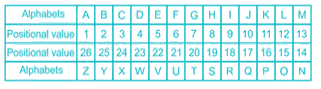 The logic followed here is:
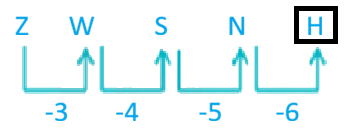 So, 'H' will replace the question mark in the given series.
Hence, the correct answer is "Option 1"
Q2 · Series
What comes next? KJ, LI, MH, ?
- QD
- PE
- NG
- OF
Answer aur solution dekho
Archived marked answer: C
The logic followed here is:
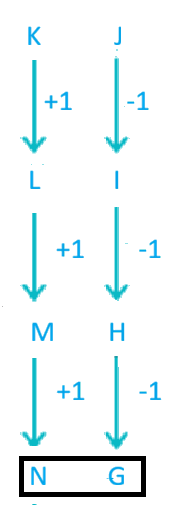 So, 'NG' will replace the question mark in the given series.
Hence, the correct answer is "Option 3"
Q3 · Series
Find the number that can replace question mark (?) in the series given below. 20, 62, 189, 571, 1718, ?
- 5160
- 5168
- 4660
- 4659
Answer aur solution dekho
Archived marked answer: A
The logic followed here is:
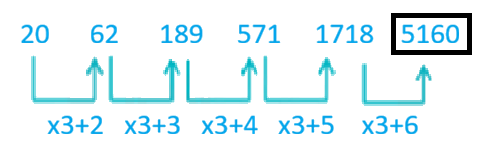 thus, "5160" will replace the question mark in the given series.
Hence, the correct option is "Option 1".
Q4 · Series
Find the next number. 1, 1, 2, 3, 5, ?
- 6
- 7
- 8
- 9
Answer aur solution dekho
Archived marked answer: C
The logic followed here is:
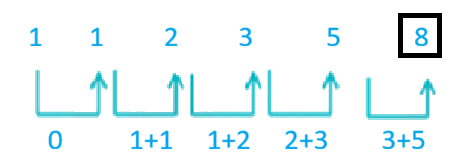 thus, "8" will replace the question mark in the given series.
Hence, the correct option is "Option 3".
Q5 · Series
Find the missing number. 24, 35, 46, 57, ?, 79
- 67
- 69
- 68
- 70
Answer aur solution dekho
Archived marked answer: C
The logic followed here is:
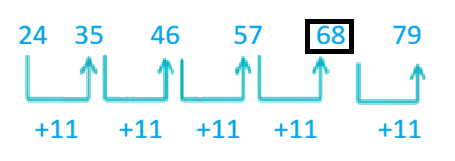 thus, "68" will replace the question mark in the given series.
Hence, the correct option is "Option 3".
Q6 · Series
Which number does not belong? 2, 6, 18, 54, 162, 325
- 18
- 162
- 54
- 325
Answer aur solution dekho
Archived marked answer: D
The logic followed here is:
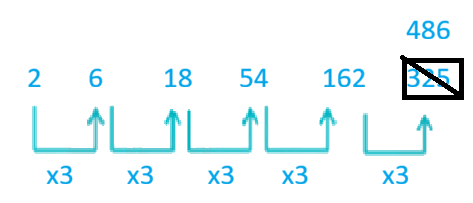 thus, "325" will replace the question mark in the given series.
Hence, the correct option is "Option 4".
Q7 · Analogy
Find the missing number: 196 : 256 :: 324 : ?
- 400
- 380
- 441
- 341
Answer aur solution dekho
Archived marked answer: A
The logic followed here is:
Logic: Each number is a perfect square, and the second number in the pair is the square of the next even number after the square root of the first number.
Now,
For 196 : 256
⇒ √196 = 14, next even number = 16, 16² = 256
Similarly, for 324 : ?
⇒ √324 = 18, next even number = 20, 20² = 400
Hence, the correct answer is "Option 1".
Q8 · Analogy
Select the different one.
- VLC Media Player
- Firefox
- Edge
- Chrome
Answer aur solution dekho
Archived marked answer: A
The logic followed here is:
Logic: Identify the item that belongs to a different category
Given:
VLC Media Player → Media player software
Firefox → Web browser
Edge → Web browser
Chrome → Web browser
So, three are web browsers, while one is a media player
Therefore, VLC Media Player is different
Hence, the correct answer is Option 1.
Q9 · Puzzle Subtypes Not To Miss
In a series of seminars held daily from 11th to 18th Feb, Calicut - 18th Feb 2022,
Patna - 12th Feb 2022, Tiruchirappalli - 17th Feb 2022, Raipur - 11th Feb 2022, Rourkela - 14th Feb 2022 Jamshedpur - 13th Feb 2022, Durgapur - 15th Feb 2022, Warangal - 16th Feb 2022
Arrange the following cities in order of their seminar dates (earliest to latest):Warangal, Raipur, Jamshedpur, Patna
- Raipur, Jamshedpur, Patna, Warangal
- Raipur, Patna, Jamshedpur, Warangal
- Jamshedpur, Patna, Raipur, Warangal
- Raipur, Warangal, Patna, Jamshedpur
Answer aur solution dekho
Archived marked answer: B
Given:
City
Seminar Date
Raipur
11th Feb 2022
Patna
12th Feb 2022
Jamshedpur
13th Feb 2022
Rourkela
14th Feb 2022
Durgapur
15th Feb 2022
Warangal
16th Feb 2022
Tiruchirappalli
17th Feb 2022
Calicut
18th Feb 2022
Now, arranging the required cities in order of their seminar dates (earliest to latest):
City
Seminar Date
Raipur
11th Feb
Patna
12th Feb
Jamshedpur
13th Feb
Warangal
16th Feb
Day-wise table:
City
Date
Raipur
11th Feb
Patna
12th Feb
Jamshedpur
13th Feb
Warangal
16th Feb
Hence, the correct order is: Raipur, Patna, Jamshedpur, Warangal.
Hence, the correct answer is Option 2.
Q10 · Puzzle Subtypes Not To Miss
Find the smallest number which, when divided by 6, 8, and 10, leaves a remainder of 5 in each case.
- 75
- 125
- 865
- 475
Answer aur solution dekho
Archived marked answer: B
Given:
A number when divided by 6, 8 and 10 leaves a remainder 5 in each case.
Logic:
Required number − 5 must be divisible by 6, 8 and 10.
Find LCM of 6, 8 and 10:
6 = 2 × 3
8 = 2³
10 = 2 × 5
LCM = 2³ × 3 × 5 = 120
So, Required number = 120 + 5 = 125
Hence, the correct answer is Option 2.
Q11 · Puzzle Subtypes Not To Miss
Find the value of 25% of 640 + 30% of 800
- 320
- 340
- 360
- 400
Answer aur solution dekho
Archived marked answer: D
Given:
Find the value of 25% of 640 + 30% of 800
25% of 640 = (25/100) × 640
= 0.25 × 640
= 160
Now,
30% of 800 = (30/100) × 800
= 0.30 × 800
= 240
Thus, 160 + 240 = 400
Hence, the correct answer is Option 4.
Q12 · Puzzle Subtypes Not To Miss
How many of these roll numbers are palindromes? List: 123321, 654456, 112211, 123456
- 1
- 2
- 3
- 4
Answer aur solution dekho
Archived marked answer: C
Given roll numbers: 123321, 654456, 112211, 123456
Rule: A palindrome number reads the same forward and backward.
Checking each number:
123321 → Same forward and backward
654456 → Same forward and backward
112211 → Same forward and backward
123456 → Not the same when reversed
Total palindrome numbers = 3
Hence, the correct answer is Option 3.
Q13 · Puzzle Subtypes Not To Miss
The length of a rectangle is increased by 10%, and its width is decreased by 10%. What is the net percentage change in the area of the rectangle?
- -1%
- 0%
- 1%
- -2%
Answer aur solution dekho
Archived marked answer: A
Given:
Length of a rectangle is increased by 10%.
Width of the rectangle is decreased by 10%.
Let the original length = 100 and width = 100.
Original area = 100 × 100 = 10000
New length = 100 + 10% of 100 = 110
New width = 100 − 10% of 100 = 90
New area = 110 × 90 = 9900
Change in area = 9900 − 10000 = −100
Percentage change = (−100 / 10000) × 100 = −1%
Hence, the correct answer is Option 1.
Q14 · Puzzle Subtypes Not To Miss
A train 150 m long is running at 54 km/h. How long will it take to cross a pole?
- 10 sec
- 12 sec
- 15 sec
- 5 sec
Answer aur solution dekho
Archived marked answer: A
Given:
Length of the train = 150 m
Speed of the train = 54 km/h
Convert speed into m/s:
54 × (5/18) = 15 m/s
To cross a pole, the train must travel its own length.
Time = Distance ÷ Speed
= 150 ÷ 15
= 10 seconds
Hence, the correct answer is Option 1.
Q15 · Coding Decoding
If 3 → 12, 4 → 20, then 5 → ?
- 25
- 30
- 28
- 32
Answer aur solution dekho
Archived marked answer: B
The logic followed here is:
Logic: Number × (Number + 1) = Result
Given:
3 → 12
3 × (3 + 1) = 3 × 4 = 12
4 → 20
4 × (4 + 1) = 4 × 5 = 20
Now,
5 → ?
5 × (5 + 1) = 5 × 6 = 30
Hence, the correct answer is Option 2.
Q16 · Coding Decoding
In a certain code language, 'stop cool cream brick' is coded as 'at bt ct mt', 'through truck cool' is coded as 'vt kt at' and 'brick clear truck' is coded as 'ct ot kt'.
How will 'stop clear cream' be coded in the same language?
- at, ct, mt
- bt, ot, mt
- vt, ot, mt
- ct, ot, kt
Answer aur solution dekho
Archived marked answer: B
Given codes:
'stop cool cream brick' → at, bt, ct, mt
'through truck cool' → vt, kt, at
'brick clear truck' → ct, ot, kt
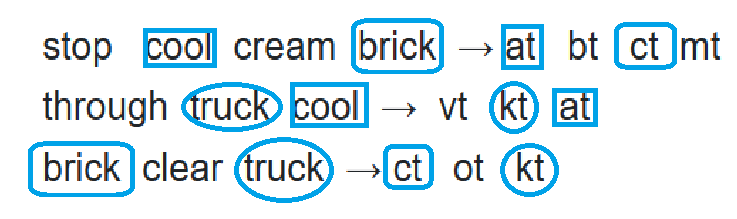 Therefore,
'stop clear cream' → bt, ot, mt
Hence, the correct answer is Option 2.
Q17 · Coding Decoding
Let a% b = a + b + ab Then 2 % 3 = ?
- 11
- 10
- 9
- 12
Answer aur solution dekho
Archived marked answer: A
The logic followed here is:
Given:
a % b = a + b + ab
Now,
2 % 3 = 2 + 3 + (2 × 3)
= 2 + 3 + 6
= 11
Hence, the correct answer is Option 1.
Q18 · Coding Decoding
If "LINCOLN" is written as "JGLAMJL", how will "OBAMA" be written?
- MZYKY
- NZXJZ
- MBZJY
- NZXLZ
Answer aur solution dekho
Archived marked answer: A
The logic followed here is:
Logic: Each letter is shifted −2 in the English alphabetical order
Given: LINCOLN → JGLAMJL
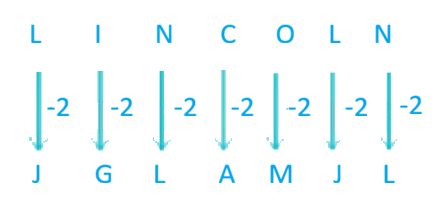 Now, OBAMA → ?
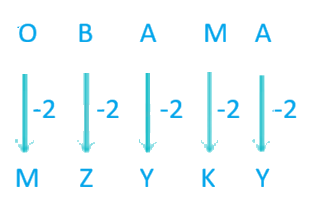 So, OBAMA → MZYKY
Hence, the correct answer is Option 1.
Q19 · Coding Decoding
If 'COLD' is coded as 'DPME', how is 'HEAT' coded?
- IFBU
- GZBU
- HGZU
- IDBU
Answer aur solution dekho
Archived marked answer: A
The logic followed here is:
Logic: Each letter is shifted +1 in the English alphabetical order
Given: COLD → DPME
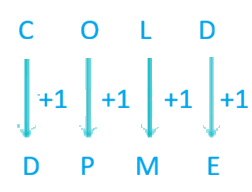 Now, HEAT → ?
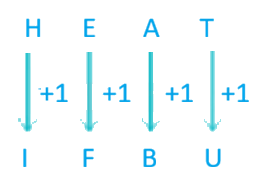 So, HEAT → IFBU
Hence, the correct answer is Option 1.
Q20 · Coding Decoding
If MONEY is coded as NPOFZ, how is NPOFZ coded?
- QQPGZ
- OQPGA
- QQPGC
- NPQGZ
Answer aur solution dekho
Archived marked answer: B
The logic followed here is:
Logic: Each letter is shifted +1 in the English alphabetical order
Given: MONEY → NPOFZ
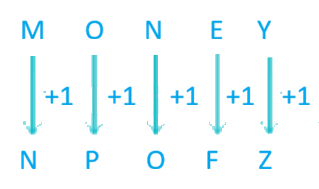 Now, NPOFZ → ?
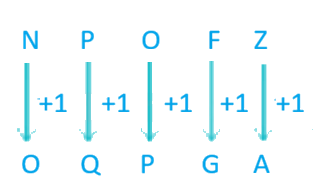 So, NPOFZ → OQPGA
Hence, the correct answer is Option 2.
Q21 · Coding Decoding
In a certain code, BEAR is written as YVZI. How is LION written in that code?
- ORLM
- KJOL
- MJOL
- NJOL
Answer aur solution dekho
Archived marked answer: A
The logic followed here is:
Logic: Each letter is converted to its opposite letter (Atbash pattern: A ↔ Z, B ↔ Y, C ↔ X, …)
Given: BEAR → YVZI
Letter
Code
B
Y
E
V
A
Z
R
I
Now, LION → ?
Letter
Code
L
O
I
R
O
L
N
M
So, LION → ORLM
Hence, the correct answer is Option 1. Q22 · Logical Reasoning
Read the following statement carefully and identify the conclusion that follows.
Statement: All games are entertainment. All entertainment is fun.
Conclusions:
I. All games are fun
II. Some fun is entertainment.
- Only I follows
- Only II follows
- Both I and II follow
- Neither I nor II follows
Answer aur solution dekho
Archived marked answer: C
Given Statements:
All games are entertainment.
All entertainment is fun.
From statements:
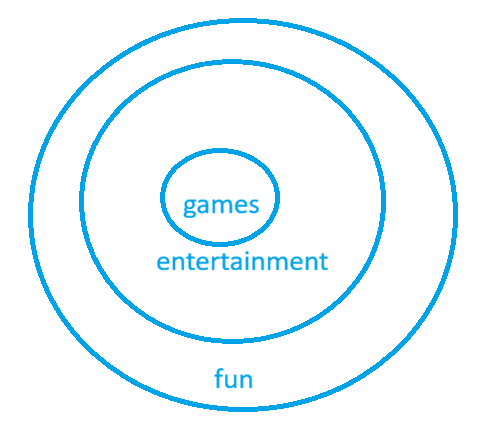 Conclusions:
I. All games are fun → True (since games are part of fun)
II. Some fun is entertainment → True (since all entertainment is part of fun, so at least some fun is entertainment)
Hence, the correct answer is Option 3.
Q23 · Logical Reasoning
Read the following statement carefully and identify the conclusion that follows.
Statement:
All lions are wild. Some wild are dangerous. No dangerous is tame.
Conclusions:
I. Some wild are not tame.
II. Some lions are not tame.
- Only I follows
- Only II follows
- Both I and II follow
- Neither I nor II follows
Answer aur solution dekho
Archived marked answer: A
Given Statements:
All lions are wild.
Some wild are dangerous.
No dangerous is tame.
From statements:
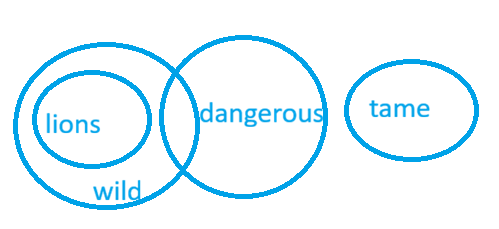 Conclusions:
I. Some wild are not tame → True (since some wild are dangerous and no dangerous is tame)
II. Some lions are not tame → False (no direct link that lions are dangerous)
Hence, the correct answer is Option 1.
Q24 · Alphabet Test
The letters given below, when they are arranged, form an appropriate (Meaningful) word.
AVSEBORINTO
What is the position of letter R in the word formed from the left?
- 7
- 6
- 5
- 8
Answer aur solution dekho
Archived marked answer: C
Given letters: AVSEBORINTO
Rule: Arrange the letters to form a meaningful word.
Step-by-step table:
Letters in scrambled form
Rearranged Word
Position from left
A
O
1
V
B
2
S
S
3
E
E
4
B
R
5
O
V
6
R
A
7
I
T
8
N
I
9
T
O
10
O
N
11
The letter R is at position 5 from the left.
Hence, the correct answer is Option 3.
Q25 · Similarity and Differences
Choose the address that is the same as the one given below.
House No. 71, Rose Villa,Mallital, Nainital,Uttarakhand - 263002
- House No. 71, Rose Villa,Mallital, Nainital,Uttarakhand - 263002
- House No. 71, Rose Villa, Mallital, Nainital, Punjab - 263002
- House No. 71, Rose Villa, Mallital, Nainital, Jammu & Kashmir - 263002
- House No. 71, Rose Villa, Mallital, Nainital, Himachal Pradesh - 263002
Answer aur solution dekho
Archived marked answer: A
The address given in the problem is,
House No. 71, Rose Villa, Mallital, Nainital, Uttarakhand - 263002
Let's match this address with the given options one by one to figure out which one is exactly the same.
Option
Address in Option
Given Address
Comment
(1)
House No. 71, Rose Villa, Mallital, Nainital, Uttarakhand - 263002
House No. 71, Rose Villa, Mallital, Nainital, Uttarakhand - 263002
The address is exactly the same as the given address.
(2)
House No. 71, Rose Villa, Mallital, Nainital, Punjab - 263002
House No. 71, Rose Villa, Mallital, Nainital, Uttarakhand - 263002
The state mentioned is 'Punjab' instead of 'Uttarakhand'.
(3)
House No. 71, Rose Villa, Mallital, Nainital, Jammu & Kashmir - 263002
House No. 71, Rose Villa, Mallital, Nainital, Uttarakhand - 263002
The state mentioned is 'Jammu & Kashmir' instead of 'Uttarakhand'.
(4)
House No. 71, Rose Villa, Mallital, Nainital, Himachal Pradesh - 263002
House No. 71, Rose Villa, Mallital, Nainital, Uttarakhand - 263002
The state mentioned is 'Himachal Pradesh' instead of 'Uttarakhand'.
So, the address that is exactly the same as the given address is in option (1).
Hence, the correct option is "option (1)".
General Awareness
Q1 · Art and Culture
The famous Meenakshi Temple in Madurai is known for which architectural feature?
- White marble walls
- Hidden underground shrines
- Shikhara covered in gold
- Gigantic Gopurams (gateway towers)
Answer aur solution dekho
Archived marked answer: D
The correct answer is Gigantic Gopurams (gateway towers).
Key Points
- The Meenakshi Temple, located in Madurai, Tamil Nadu, is one of the most prominent examples of Dravidian architecture in India.
- The most striking feature of the temple is its Gigantic Gopurams (gateway towers), which are highly decorated and serve as entrances to the temple complex.
- The temple has a total of 14 Gopurams, with the tallest one reaching a height of approximately 170 feet. These towers are adorned with intricate carvings of gods, goddesses, and mythical creatures.
- The Gopurams are not just architectural marvels but also serve as a visual representation of the Hindu cosmology, showcasing the universe's layers and divine realms through their ascending tiers.
- The temple is dedicated to Meenakshi (a form of Goddess Parvati) and her consort, Sundareswarar (Lord Shiva), making it a significant pilgrimage si
Q2 · Art and Culture
Which of the following statements is/are correct?
Statement 1: British colonial Indian architecture has prominently adopted the utilization of lime mortar as well as extensive foundation platforms.
Statement 2: These design methods enabled the incorporation of arches, domes, and large colonnaded verandas in public structures.
- Both statements are correct, and Statement 2 correctly explains Statement 1.
- Both statements are correct, but Statement 2 does not correctly explains Statement 1.
- Statement 1 is true, Statement 2 is incorrect.
- Both statements 1 and 2 are incorrect.
Answer aur solution dekho
Archived marked answer: B
The correct answer is 2) Both statements are correct, but Statement 2 does not correctly explain Statement 1.
Key Points
- Statement 1: British colonial Indian architecture prominently adopted the utilization of lime mortar and extensive foundation platforms.
- Lime mortar was commonly used as it provided durability and strength to the structures, especially in tropical climates.
- Extensive foundation platforms were essential to accommodate large-scale public structures, often designed to withstand the test of time. *Hence, Statement 1 is correct.*
- Statement 2: These design methods enabled the incorporation of arches, domes, and large colonnaded verandas in public structures.
- Arches and domes were integral to British colonial architecture, but their inclusion was more influenced by aesthetic and functional preferences rather than being directly dependent on lime mortar or foundation platforms.
- Large colonnaded verandas were designed to provide shade and ventilation in India's hot and humid climate, a feature independent of the construction materials.* Hence, Statement 2 is correct but does not explain Statement 1.*
- Explanation of the Option:
- While both statements are factually correct, the second statement does not directly explain or justify the first statement.
- The use of lime mortar and foundation platforms were more related to structural durability, while the inclusion of arches and domes had a stylistic and climatic rationale. *Thus, option 2 is correct.*
Additional Information
- British Colonial Architecture in India:
- British architecture in India was a blend of European styles and Indian traditional designs, often termed as Indo-Saracenic or Indo-Gothic architecture.
- The use of lime mortar was prevalent due to its availability and cost-effectiveness in India.
- Prominent buildings include the Victoria Memorial (Kolkata) and the Gateway of India (Mumbai).
- Structural Features of British Architecture:
- Inclusion of arches and domes for aesthetic appeal and to reflect grandiosity.
- Colonnaded verandas provided ventilation and reduced heat, making buildings suitable for India's climate.
- Buildings often had large foundation platforms to provide stability and longevity.
- Materials Used:
- The use of lime mortar, stone, and brick was widespread in constructing colonial structures.
- These materials ensured the durability of public buildings such as railway stations, government offices, and educational institutions.
- Purpose of British Colonial Architecture:
- To symbolize British power and authority in India through monumental public buildings.
- To cater to administrative, residential, and recreational needs of the colonial government.
Important Points
- Architectural Styles:
- Indo-Saracenic Style: A blend of Indian and Gothic architectural styles, often including domes, minarets, and arches.
- Gothic Revival Style: Characterized by pointed arches, ribbed vaults, and flying buttresses, used in churches and educational institutions.
- Examples of British Architecture:
- Rashtrapati Bhavan (New Delhi): Formerly the Viceroy's House, designed by Edwin Lutyens.
- Howrah Bridge (Kolkata): An engineering marvel and a symbol of British innovation in India.
- Legacy:
- British colonial architecture continues to influence modern Indian architecture and urban planning.
- It represents a significant part of India's cultural and architectural heritage.
</ul
Q3 · Art and Culture
Which musical form is described as having a 'sombre atmosphere' and emphasizing rhythm?
- Khyal
- Dhrupad
- Thumri
- Tappa
Answer aur solution dekho
Archived marked answer: B
The correct answer is Dhrupad.
Key Points
- Dhrupad is one of the oldest forms of Hindustani classical music and is known for its sombre, meditative atmosphere, emphasizing rhythm and devotion.
- It is characterized by its serious, austere, and spiritual nature, often associated with a sense of solemnity and depth.
- The compositions in Dhrupad are performed in a very slow and structured manner, reflecting the unique balance between melody (raga) and rhythm (tala).
- Dhrupad places a strong emphasis on the intonation of notes and the purity of the raga being performed, making it highly disciplined.
- This form of music has its roots in ancient Vedic chants and was historically performed in temples before evolving into a court trad
Q4 · Art and Culture
Fill in the Blank: Panthi dancers wear ____ during performance.
- Kurta
- Dhoti
- Saree
- Lungi
Answer aur solution dekho
Archived marked answer: B
The correct answer is Dhoti.
Key Points
- Panthi Dance is a traditional folk dance from the state of Chhattisgarh, India. It is performed by the Satnami community to honor their religious beliefs and values.
- It is primarily performed during festivals, religious occasions, and celebrations that commemorate the teachings of Guru Ghasidas, the spiritual leader of the Satnami sect.
- Dhoti is the traditional attire worn by Panthi dancers during performances. This clothing is considered sacred and symbolizes simplicity, humility, and devotion.
- The dhoti is typically paired with minimal accessories, ensuring the focus remains on the dance and its spiritual essence rather than materialistic embellishments.
- Through their attire and performance, Panthi dancers convey messages of equality, devotion, and the teachings of their spiritual leader.
Additional Information
- Panthi Dance Origin:
- Panthi dance originated from Chhattisgarh, a central Indian state known for its rich cultural heritage.
- The dance is deeply connected to the Satnami movement, which advocates social equality and spiritual growth.
- It is performed to traditional songs that highlight the teachings and philosophies of Guru Ghasidas.
- Traditional Attire in Indian Folk Dances:
- Different folk dances across India have unique attire that reflects the cultural and regional identity of the performers.
- For instance, dancers in Bharatanatyam wear sarees, while performers of Bihu in Assam use traditional Mekhela Chadors.
- Panthi dancers wear dhoti, a garment commonly associated with simplicity and devotion.
- Significance of Dhoti:
- The dhoti is a rectangular piece of cloth, usually made of cotton, that is wrapped around the waist.
- It is considered a traditional Indian attire and is often worn in religious ceremonies and cultural performances.
- Its simplicity aligns with the spiritual and devotional themes of Panthi dance.
- Guru Ghasidas and the Satnami Sect:
- Guru Ghasidas was a prominent spiritual leader who founded the Satnami sect in Chhattisgarh.
- His teachings emphasized social equality, non-violence, and devotion to God.
- Panthi dance performances are a tribute to his teachings and legacy.
Important Points
- Chhattisgarh's Cultural Heritage:
- Chhattisgarh is home to a diverse range of folk dances, such as Raut Nacha, Sua Nacha, and Panthi Dance.
- These dances reflect the state's rich traditions, beliefs, and celebrations of its tribal and rural communities.
- Panthi Dance Performance:
- Panthi dance is characterized by rhythmic movements, synchronized steps, and devotional songs sung by the performers.
- The dance communicates spiritual and social messages, making it an important cultural expression of the Satnami community.
</ul
Q5 · Indian Polity and Constitution
What does the term "Zero FIR" imply under the new law?
- FIR can be filed at any police station, regardless of jurisdiction
- FIR can be withdrawn at zero cost
- FIR can be digitally deleted if not verified
- FIR can be filed without police verification
Answer aur solution dekho
Archived marked answer: A
The correct answer is FIR can be filed at any police station, regardless of jurisdiction.
Key Points
- Zero FIR refers to an FIR (First Information Report) that can be filed at any police station, irrespective of the location or jurisdiction where the incident occurred. This is intended to ensure quick reporting of crimes without jurisdictional delays.
- Once a Zero FIR is filed, it is the responsibility of the police station to transfer the FIR to the appropriate police station under whose jurisdiction the crime falls.
- The concept of Zero FIR is particularly important in cases of serious crimes like rape, murder, or sexual harassment, where immediate action and investigation are critical.
- The provision for Zero FIR is mentioned in the Criminal Law (Amendment) Act, 2013, which was enacted following the Nirbhaya case in 2012 to make the justice system more responsive to victims of crime.
- This system ensures that victims are not turned away by police stations citing jurisdictional issues and that their complaints are registered without delay.
Additional Information
- Importance of Zero FIR:
- Empowers victims to register complaints immediately without worrying about jurisdictional boundaries.
- Ensures that no crime goes unreported due to bureaucratic hurdles.
- Strengthens the legal framework for victims, especially in cases of gender-based violence.
- Legal Basis:
- The provision for Zero FIR was formalized through the Criminal Law (Amendment) Act, 2013.
- While the Indian Penal Code (IPC) and Code of Criminal Procedure (CrPC) do not explicitly define "Zero FIR," the concept stems from the duty of police officers to register complaints under Section 154 of the CrPC.
- Distinction Between Regular FIR and Zero FIR:
- Regular FIR: Filed at the police station that has jurisdiction over the area where the crime occurred.
- Zero FIR: Can be filed at any police station, and it will be transferred to the concerned jurisdictional police station for further investigation.
- Challenges in Implementation:
- Lack of awareness among the public about their right to file a Zero FIR.
- Reluctance or refusal by some police officers to register Zero FIRs, despite legal provisions.
- Need for training and sensitization of police personnel to handle such cases effectively.
Important Points
- Key Differences Between FIR and Zero FIR:
- In a Regular FIR, the jurisdiction of the police station is important, whereas in a Zero FIR, jurisdiction is not a constraint.
- A Zero FIR is numbered as "0" until it is transferred to the appropriate police station, where it is assigned a regular FIR number.
- Criminal Law (Amendment) Act, 2013:
- Introduced several provisions to enhance the safety and security of women, including the concept of Zero FIR.
- Added stringent penalties for crimes like rape, acid attacks, and stalking.
- Real-Life Examples:
- The Nirbhaya case in 2012 highlighted the need for immediate registration of complaints without jurisdictional delays.
- The Zero FIR provision ensures that such cases are promptly acted upon. </ul
Q6 · Indian Economy
What was the main focus of the First Five-Year Plan?
- Heavy industries
- Agriculture
- Urbanization
- Information Technology
Answer aur solution dekho
Archived marked answer: B
The correct answer is Agriculture.
Key Points
- The First Five-Year Plan (1951-1956) in India primarily focused on Agriculture due to the urgent need to address food shortages and improve agricultural productivity post-independence.
- This plan was based on the Harrod-Domar model, emphasizing the importance of increasing agricultural output to ensure food security and support economic development.
- Key initiatives under the plan included the establishment of irrigation projects, such as Bhakra Nangal Dam and Hirakud Dam, to provide water for agriculture and enhance productivity.
- The plan aimed to reduce dependence on food imports by increasing domestic production and achieving self-sufficiency in food grains.
- During this period, significant investments were made in community development programs and the National Extension Service to promote rural development and improve agricultural practices.
Additional Information
- First Five-Year Plan Objectives:
- The plan aimed to address the immediate challenges of poverty, unemployment, and food scarcity in the newly independent India.
- The focus was on boosting agricultural production while allocating resources to irrigation, energy, and transport infrastructure.
- Key Features:
- The allocation of 31% of the total plan outlay for agriculture and irrigation demonstrated the priority given to this sector.
- Industrial development was given relatively lesser focus, as the immediate need was to ensure food security and stabilize the economy.
- Heavy industries and urbanization were considered for future plans after foundational agricultural reforms.
- Relevant Facts:
- The plan was drafted under the leadership of Jawaharlal Nehru, India's first Prime Minister, and guided by economist K.N. Raj.
- The plan targeted an annual growth rate of 2.1%, but India achieved a growth rate of 3.6%, exceeding expectations.
- Several large-scale irrigation projects were initiated during this time, laying the groundwork for agricultural self-sufficiency.
- Global Context:
- The First Five-Year Plan was implemented during a period when India was recovering from colonial exploitation and had limited industrial infrastructure and resources.
- In comparison, other nations focused on industrialization, but India prioritized agriculture due to its agrarian economy.
Important Points
- Bhakra Nangal Dam:
- One of the largest multipurpose projects in India, aimed at irrigation, power generation, and flood control.
- Significantly contributed to agricultural productivity during the First Five-Year Plan.
- Community Development Program:
- Launched in 1952 to improve rural living standards and agricultural practices.
- Focused on education, health, sanitation, and infrastructure development in villages.
- National Extension Service:
- Introduced in 1953 to provide technical support and training to farmers.
- Aimed at enhancing productivity and spreading knowledge about modern farming techniques.
- Impact:
- The First Five-Year Plan laid the foundation for India's agricultural and economic development.
- It successfully addressed food shortages and stabilized the agrarian economy, paving the way for subsequent industrialization plans. </ul
Q7 · Indian Economy
Consider the following statements about the impact of foreign trade on aggregate demand in India:
Statement 1: Imports by Indian consumers act as a leakage from the circular flow of income hence reducing aggregate demand.
Statement 2: Exports from India to foreign markets act as an injection into the circular flow, increasing aggregate demand.
- Only Statement 1 is correct
- Only Statement 2 is correct
- Both Statement 1 and Statement 2 are correct
- Neither Statement 1 nor Statement 2 is correct
Answer aur solution dekho
Archived marked answer: C
The correct answer is Both Statement 1 and Statement 2 are correct.
Key Points
- Statement 1: Imports by Indian consumers act as a leakage from the circular flow of income, hence reducing aggregate demand.
- In the circular flow of income model, imports represent money spent by domestic consumers on foreign goods and services. This money leaves the domestic economy and does not contribute to the production or income within the country.
- This creates a leakage in the circular flow, reducing the overall aggregate demand within India as domestic producers are not benefiting from this expenditure. *Hence, Statement 1 is correct.*
- Statement 2: Exports from India to foreign markets act as an injection into the circular flow, increasing aggregate demand.
- Exports bring money into the domestic economy from foreign buyers purchasing Indian goods and services. This injection increases the income of domestic producers and workers, thereby boosting aggregate de
Q8 · Indian Economy
Read the following statements carefully and choose the correct option regarding Assertion (A) and Reason (R).
Assertion (A): WTO encourages free and fair trade across nations.
Reason (R): It allows countries to impose arbitrary restrictions to protect domestic industries.
- Both A and R are true and R is the correct explanation of A.
- Both A and R are true but R is not the correct explanation of A.
- A is true but R is false.
- A is false but R is true.
Answer aur solution dekho
Archived marked answer: C
The correct answer is A is true but R is false.
Key Points
- Assertion (A): TRUE
- World Trade Organization promotes free and fair trade
- Reduces trade barriers (tariffs, quotas)
- Follows rules-based system
- Ensures non-discrimination (MFN principle)
- Reason (R): FALSE
- WTO does not allow arbitrary restrictions
- Restrictions allowed only under specific conditions
- Must be justified and regulated
- Arbitrary protection = against WTO rules
Q9 · Sports Static GK
In which Asian Games did India first win a gold medal in athletics?
- 1951
- 1962
- 1970
- 1982
Answer aur solution dekho
Archived marked answer: A
The correct answer is 1951.
Key Points
- The first Asian Games were held in 1951 in New Delhi, India. These games marked the beginning of India's participation in the continental multi-sport event.
- India's first gold medal in athletics was won during these games. It was an important milestone for the country in international sports.
- The gold medal was secured by Sohan Singh Dhanoa in the men's 1500 meters race, earning him a place in history as the first Indian to win a gold medal in athletics at the Asian Games.
- The 1951 Asian Games were significant as they symbolized the unity and sporting spirit of newly independent Asian countries, with India playing a prominent role as the
Q10 · Sports Static GK
Consider the following statements about Boxing techniques and training:
1) Offensive boxing actions include "Straight Left to the Body" and "Right Uppercut to the Head".
2) Methods like "Shadow Boxing" and "Mirror Boxing" are used for developing boxing techniques.
3) The four boxing distances or ranges are Long Distance, Medium Distance, Close Distance, and Infighting.
Which of the above statements is/are correct?
- Only 1 and 2 are Correct
- Only 2 and 3 are Correct
- Only 1 and 3 are correct
- 1, 2 and 3 are Correct
Answer aur solution dekho
Archived marked answer: D
The correct answer is 1, 2 and 3 are Correct.
Key Points
- Statement 1: Offensive boxing actions like "Straight Left to the Body" and "Right Uppercut to the Head" are widely recognized techniques in boxing. These are crucial in attacking strategies and are used to target specific areas of the opponent's body or head. *Hence, statement 1 is correct.*
- Statement 2: Training methods such as "Shadow Boxing" and "Mirror Boxing" are essential in developing boxing techniques. Shadow boxing involves practicing punches and movements without an opponent to improve precision, while mirror boxing allows boxers to analyze and correct their form by observing their reflection. *Hence, statement 2 is correct.*
- Statement 3: The four boxing distances or ranges—Long Distance, Medium Distance, Close Distance, and Infighting—are fundamental concepts in boxing. These ranges dictate how a boxer positions themselves relative to the opponent and chooses appropriate techniques. Hence, statement 3 is correct.</e
Q11 · Sports Static GK
How many sports disciplines are included in the 2nd edition of the Khelo India Para Games 2025?
- 4
- 5
- 6
- 7
Answer aur solution dekho
Archived marked answer: C
The correct answer is 6.
Key Points
- The 2nd edition of the Khelo India Para Games is scheduled to take place in 2025, as part of the Government of India's initiative to promote sports among para-athletes.
- This edition will include a total of 6 sports disciplines, making it more inclusive and competitive compared to its previous edition.
- The aim of the event is to provide a platform to para-athletes to showcase their talent and prepare for national and international competitions, including the Paralympic Games.
- The six sports disciplines included are likely to cover a range of physical and strategic capabilities, ensuring representation across a diverse set of para-sports categories.
- The Khelo India initiative itself is a flagship program to promote grassroots sports in India, and this para games edition extends the vision to athletes with disabilities.
- The initiative is spearheaded by the Ministry of Youth Affairs and Sports, Government of India, to foster inclusivity
Q12 · Indian Geography
The dispersed rural settlements can be found predominantly in which of the following areas of India?
1. In the Bundelkhand region of central India
2. In the state of Chhattisgarh
3. In the lower plains of the River Ganga
4. In the hilly states of Uttarakhand and Himachal Pradesh
Select the CORRECT answer using the code given below:
- 1, 2 and 3 only
- 1 and 4 only
- 1, 2, 3 and 4
- 4 only
Answer aur solution dekho
Archived marked answer: D
The correct answer is 4 only.
Key Points
- Dispersed rural settlements are characterized by scattered and isolated dwellings that are located far apart from one another. These settlements are commonly found in areas with hilly terrain, dense forests, and harsh climatic conditions.
- Statement 1: The Bundelkhand region of central India typically has clustered settlements due to its historical agricultural practices and limited availability of water, which necessitates closer habitation. *Hence, statement 1 is incorrect.*
- Statement 2: Chhattisgarh is known for its tribal population and has a mix of settlement patterns. However, dispersed settlements are not predominant. *Hence, statement 2 is incorrect.*
- Statement 3: The lower plains of the River Ganga are highly fertile and support intensive agriculture, leading to compact rural settlements. *Hence, statement 3 is incorrect.*
- Statement 4: The hilly states of Uttarakhand and Himachal Pradesh have predominantly dispersed rural settlements due to the rugged terrain, steep slopes, and scattered agricultural plots. These factors prevent the formation of compact settlements. *Hence, statement 4 is correct.*
- Conclusion: The dispersed rural settlements are found predominantly in the hilly states of Uttarakhand and Himachal Pradesh.
Additional Information
- Characteristics of Dispersed Settlements:
- Houses are located far apart, often separated by fields, forests, or natural barriers.
- These settlements are common in hilly areas, forested regions, and desert landscapes.
- They are typically associated with subsistence agriculture, where each household manages its own land.
- Examples of dispersed settlements can be found in parts of Uttarakhand, Himachal Pradesh, Scotland, and Scandinavia.
- Factors Influencing Settlement Patterns:
- Topography: Rugged terrains like hills and plateaus favor dispersed settlements due to difficulty in clustering houses.
- Climate: Harsh climatic conditions such as extreme cold or heat often lead to isolated dwellings.
- Economic Activities: Areas with subsistence farming or pastoral activities usually have dispersed settlements.
- Accessibility: Poor transportation networks in remote regions encourage isolated settlements.
- Compact vs. Dispersed Settlements:
- Compact settlements: Found in fertile plains and river valleys where agriculture is intensive, e.g., the Indo-Gangetic Plains.
- Dispersed settlements: Found in areas with difficult terrain and low population density, e.g., the Himalayan region.
- Examples in India:
- Dispersed settlements: Uttarakhand, Himachal Pradesh, parts of the Western Ghats.
- Compact settlements: Punjab, Haryana, Uttar Pradesh, Bihar.
Important Points
- Hilly settlements: The topography in hilly regions often prevents the formation of roads and transport systems, leading to isolated settlements.
- Forest influence: Dense forests, like those in the Western Ghats or Northeastern India, contribute to dispersed rural habitation.
- Population Density: Areas with low population density, such as Arunachal Pradesh, also exhibit dispersed settlement patterns.
- Livelihood dependency: In dispersed settlements, people typically depend on pastoralism, forestry, or shifting cultivation.
</ul
Q13 · Indian Geography
Consider the following statements regarding the production of bauxite in India.
1. In India, the largest deposits of bauxite occur in the Dharwar rock systems.
2. Jharkhand is the largest producer of bauxite in India.
3. Most of the bauxite is found in the laterite rocks on the plateau or hill ranges of the peninsula.
Which of the statement(s) given above is/are INCORRECT?
- 1 only
- 2 only
- Both 1 and 2
- 3 only
Answer aur solution dekho
Archived marked answer: C
The correct answer is 3) Both 1 and 2.
Key Points
- Statement 1: The claim that the largest deposits of bauxite in India occur in the Dharwar rock systems is incorrect. Bauxite deposits in India are primarily found in laterite and lateritic rocks, which are formed through the leaching process. The major bauxite-producing regions are associated with the Eastern Ghats and are not limited to the Dharwar rock systems. *Hence, this statement is incorrect.*
- Statement 2: The assertion that Jharkhand is the largest producer of bauxite in India is incorrect. The state of Odisha is the largest producer of bauxite in India, contributing to over 50% of the country's total production. Major deposits in Odisha are found in areas like Koraput, Kalahandi, and Rayagada. Jharkhand, while significant, is not the largest producer. *Thus, this statement is also incorrect.*
- Statement 3: It is correct that most of the bauxite in India is found in laterite rocks located on the plateaus and hill ranges of the peninsular region. This includes states like Odisha, Chhattisgarh, Maharashtra, and Andhra Pradesh. These regions are highly suitable for the formation of bauxite due to the tropical climate and weathering processes. *Hence, this statement is correct.*
- The question asks for the INCORRECT statements, which are Statement 1 and Statement 2. *Therefore, the correct answer is 3) Both 1 and 2.*
Additional Information
- Bauxite:
- Bauxite is the principal ore of aluminium. It is composed mainly of aluminium hydroxide minerals like gibbsite, boehmite, and diaspore, along with iron oxides and silica.
- It is a result of intense chemical weathering in tropical and subtropical regions, forming lateritic soils rich in aluminium content.
- Bauxite is used for the production of alumina (Al2O3), which is further refined to produce aluminium metal.
- India is the fifth-largest producer of bauxite globally, with significant reserves located in states like Odisha, Andhra Pradesh, Chhattisgarh, Maharashtra, and Gujarat.
- Major Bauxite Reserves in India:
- Odisha: Contains the largest reserves, especially in areas like Panchpatmali and Baphlimali hills.
- Chhattisgarh: Known for bauxite deposits in the Maikal hills and surrounding districts.
- Maharashtra: Important deposits are found in the Kolhapur district.
- Jharkhand: Deposits are located in areas like Ranchi and Gumla.
- Andhra Pradesh: Bauxite deposits are found in the Eastern Ghats, particularly in the Visakhapatnam region.
- Uses of Bauxite:
- Primary raw material for the production of aluminium.
- Used in the manufacture of refractory materials, abrasives, cement, and chemicals.
- Bauxite is also used in industries like metallurgy, construction, and electronics.
- Important Geological Characteristics:
- Bauxite deposits are generally found in plateau regions and are associated with tropical weathering processes.
- They occur in lateritic terrain and are often found in association with iron and manganese ores.
- India's bauxite reserves are estimated to be around 3.9 billion tonnes, making it a crucial resource for the country’s industrial development.
Important Points
- Global Bauxite Production: India ranks behind countries like Australia, Guinea, China, and Brazil in bauxite production. Australia is the largest producer globally.
- Aluminium Industry in India: Major aluminium producers in India include National Aluminium Company (NALCO), Hindalco Industries, and Vedanta Resources.
- Environmental Concerns: Bauxite mining often results in land degradation, deforestation, and pollution. Sustainable mining practices are essential to mitigate these impacts.
- Government Policies: The Indian government has introduced policies to encourage mineral exploration and improve mining efficiency, including the National Mineral Policy 2019.
Q14 · Modern Indian History
The Simon Commission, appointed in 1927, was boycotted by the Indian National Congress because:
- It recommended the immediate granting of full independence to India.
- It proposed the complete abolition of separate electorates.
- It did not include any Indian members.
- It advocated for the continuation of dyarchy in the province
Answer aur solution dekho
Archived marked answer: C
The correct answer is 3) It did not include any Indian members..
Key Points
- The Simon Commission was appointed by the British Government in 1927 to review the working of the Government of India Act, 1919, and to suggest reforms in the Indian administration.
- The Commission had seven British members, but it did not include a single Indian representative. This exclusion was considered an insult to the Indian population and its leaders.
- The Indian National Congress and several other political organizations opposed the Commission, as they believed that Indians should have been included to represent their own interests in the review process.
- The Commission was boycotted across India, and protests were organized by prominent leaders like Lala Lajpat Rai, who led a protest in Lahore and was injured in police action during the demonstration.
- One of the slogans raised during the protests against the Simon Commission was "Simon Go Back." The exclusion of Indians from the Commission demonstrated the British Government's unwillingness to grant Indians a meaningful role in governance.
- *Hence, the correct answer is 3) It did not include any Indian members.*
Additional Information
- Simon Commission:
- It was formally known as the Indian Statutory Commission and was chaired by Sir John Simon.
- The Commission arrived in India in 1928 and faced widespread opposition due to the absence of Indian members.
- The Commission suggested reforms in provincial governance but upheld the concept of separate electorates, which were already criticized for dividing Indian society.
- The final report of the Simon Commission led to the Government of India Act, 1935, which introduced provincial autonomy but was seen as inadequate by Indian leaders.
- Lala Lajpat Rai:
- He played a key role in opposing the Simon Commission by organizing protests in Lahore.
- During one such protest, he was severely injured in a police lathi charge and later succumbed to his injuries. His death became a rallying point for the freedom struggle.
- Historical Context:
- The exclusion of Indians from the Simon Commission highlighted the British Government's lack of commitment to granting Indians a genuine role in self-governance.
- This led to increased calls for complete independence, culminating in the Purna Swaraj Resolution adopted by the Indian National Congress in 1930.
- Key Outcomes:
- The Simon Commission and its exclusionary policies intensified the Indian struggle for independence.
- The protests against the Commission marked a significant phase in India's freedom movement, strengthening the demand for self-governance and representation.
- The Commission's report ultimately led to the Government of India Act, 1935, but it failed to address the aspirations of the Indian population fully.
Important Points
- Government of India Act, 1919:
- It introduced dyarchy (dual governance) in provinces, dividing subjects into reserved and transferred categories.
- The Act was criticized for providing limited autonomy to Indians and retaining significant powers with the British authorities.
- Separate Electorates:
- The concept of separate electorates was introduced by the British to divide Indian society along religious and communal lines.
- It allowed specific communities to elect their representatives, which led to divisions and weakened national unity.
- Purna Swaraj Resolution:
- Adopted by the Indian National Congress in 1930, it marked the demand for complete independence from British rule.
- The resolution was passed under the leadership of Jawaharlal Nehru during the Lahore Session of the Congress.
- Protests Against Simon Commission:
- Protests were widespread and included leaders from different political ideologies, uniting Indians against British policies.
- These protests strengthened the Indian independence movement and highlighted the need for self-representation in governance. </ul
Q15 · Modern Indian History
Rani Gaidinliu, a prominent freedom fighter, is best known for her leadership in which movement during British India?
- Joined the Heraka movement, mobilizing Naga tribes against British missionaries
- Peasant uprising in Bengal against zamindari oppression.
- Armed revolt in Punjab supporting the Ghadar Party's cause
- Non-cooperation movement led by Mahatma Gandhi in Andhra Pradesh
Answer aur solution dekho
Archived marked answer: A
The correct answer is Joined the Heraka movement, mobilizing Naga tribes against British missionaries.
Key Points
- Rani Gaidinliu was a prominent freedom fighter from the state of Manipur in northeastern India.
- She joined the Heraka movement, a socio-religious movement, which aimed to revive the traditional Naga religion and culture while opposing the influence of British missionaries.
- The Heraka movement, under the leadership of Jadonang (her cousin), became a platform for rebellion against the British colonial rule in the Naga Hills.
- After Jadonang's execution by the British in 1931, Rani Gaidinliu took over the leadership of the movement and expanded its reach to mobilize the Naga tribes for armed resistance.
- Her efforts earned her the title of "Rani" from Pandit Jawaharlal Nehru, as a mark of respect for her courage and leadership in the fight against British rule.
Additional Information
- Heraka Movement:
- The Heraka movement was a religious reform movement that originated among the Zeliangrong tribes of Manipur, Nagaland, and Assam.
- It sought to revive the traditional Naga religion, which was under threat from British missionary activities promoting Christianity.
- The movement gradually turned into a political struggle against British oppression and became a significant part of India's freedom struggle.
- Rani Gaidinliu's Role:
- She was only 16 years old when she assumed leadership of the Heraka movement after Jadonang's execution.
- Under her leadership, the movement adopted a more militant approach, organizing armed resistance and guerrilla warfare against British authorities.
- She was captured by the British in 1932 and sentenced to life imprisonment. She was released in 1947 after India's independence.
- Honors and Legacy:
- Rani Gaidinliu is remembered as a symbol of resistance and empowerment in northeastern India.
- The Government of India issued a commemorative stamp in her honor and established a museum dedicated to her life and contributions.
- The Rani Gaidinliu Tribal Freedom Fighters Museum was inaugurated in Manipur to showcase her contributions to India's freedom struggle.
- Other Options Explained:
- Peasant uprising in Bengal: This refers to movements like the Indigo Rebellion or Tebhaga Movement, which were not associated with Rani Gaidinliu.
- Armed revolt in Punjab: This relates to the Ghadar Party and their activities, which were centered in Punjab and had no connection to the Naga Hills or Rani Gaidinliu.
- Non-cooperation movement in Andhra Pradesh: This was part of Mahatma Gandhi's national movement and unrelated to Rani Gaidinliu's localized struggle in the Naga region.
Important Points
- Jadonang: Known as a precursor to Rani Gaidinliu, he envisioned a Naga kingdom free from British rule and laid the foundation of the Heraka movement.
- British Repression: The colonial authorities were alarmed by the Heraka movement's growth and arrested Rani Gaidinliu, viewing her as a threat to their control in the region.
- Post-Independence: After her release in 1947, Rani Gaidinliu continued to advocate for tribal rights and preservation of indigenous culture.
- Recognition: She was awarded the Padma Bhushan by the Government of India in recognition of her immense contribution to the nation.
</ul
Q16 · Modern Indian History
The trio of Binoy, Badal, and Dinesh are remembered for their daring armed attack on which building, a symbol of British administration in Calcutta?
- Victoria Memorial
- Fort William
- Writers' Building
- Howrah Station
Answer aur solution dekho
Archived marked answer: C
The correct answer is Writers' Building.
Key Points
- The trio of Binoy, Badal, and Dinesh is remembered for their daring armed attack on the Writers' Building in Kolkata (formerly Calcutta), which was then a symbol of British administration in the city.
- The attack took place on December 8, 1930, as part of the Indian independence struggle against British colonial rule.
- The Writers' Building was targeted because it housed key British administrative offices, making it a significant symbol of colonial power.
- During the attack, the trio entered the building disguised as civilians and assassinated Colonel N.S. Simpson, the Inspector General of Prisons, known for his oppressive measures against political prisoners.
- After the assassination, a gunfight ensued between the revolutionaries and the police. Badal consumed cyanide to avoid capture, while Binoy and Dinesh were injured. Binoy later succumbed to his injuries, and Dinesh was captured and subsequently hanged.
Additional Information
- Writers' Building:
- Located in the heart of Kolkata, the Writers' Building was originally built in 1777 to house junior clerks, or "writers," of the British East India Company.
- It later became the secretariat building of the Government of West Bengal and is an iconic structure in the city.
- The architecture of the building reflects a blend of Georgian and Greco-Roman styles, making it a historical and architectural landmark.
- Significance of the Attack:
- The assassination of Colonel Simpson was seen as a direct attack on the oppressive policies of the British colonial administration.
- It marked a significant moment in the revolutionary movement in Bengal, inspiring countless others to join the fight for independence.
- The courage and sacrifice of Binoy, Badal, and Dinesh are celebrated as a symbol of resistance against colonial oppression.
- Other Options:
- Victoria Memorial: An iconic marble building in Kolkata, it was built to honor Queen Victoria and is now a museum. It was not a site of revolutionary activity.
- Fort William: A fort in Kolkata that served as a British military base. While significant, it was not attacked by Binoy, Badal, and Dinesh.
- Howrah Station: One of the busiest railway stations in India, it served as a vital transportation hub but was not linked to this specific revolutionary act.
Important Points
- The trio is often referred to as Binoy-Badal-Dinesh, and their actions are commemorated in Kolkata, including a statue in the B.B.D. Bagh area (formerly Dalhousie Square), which was named in their honor.
- Their sacrifice is a part of the larger movement of revolutionary activities in Bengal, which included leaders like Subhas Chandra Bose, Jatin Das, and Aurobindo Ghosh.
- The incident at the Writers' Building is often studied as an example of the courage and determination of Indian revolutionaries during the freedom struggle. </ul
Q17 · Current Affairs
When was the concept of QUAD first proposed?
- 2004
- 2007
- 2017
- 2020
Answer aur solution dekho
Archived marked answer: B
The correct answer is 2007.
Key Points
- The concept of the Quadrilateral Security Dialogue (QUAD) was first proposed in 2007 by the then Prime Minister of Japan, Shinzo Abe.
- The QUAD is a strategic dialogue between India, the United States, Japan, and Australia, aimed at promoting a free, open, and inclusive Indo-Pacific region.
- The idea was initially discussed in the context of the 2004 Indian Ocean tsunami, where these four nations coordinated disaster relief efforts, but it formally took shape in 2007.
- This initiative was driven by concerns over the rise of China's influence in the Indo-Pacific region and the need for collaborative efforts to ensure regional security and stability.
- Although the QUAD lost momentum after its initial proposal in 2007, it was revived in 2017 due to growing geopolitical tensions and shared concerns about regional challenges.
Additional Information
- Structure and Objectives of QUAD:
- The QUAD is not a formal military alliance but a strategic forum that focuses on dialogue and cooperation in areas such as maritime security, counter-terrorism, climate change, and infrastructure development.
- It aims to promote a rules-based international order in the Indo-Pacific region.
- Key Events in QUAD's History:
- The first formal meeting of the QUAD took place in 2007 on the sidelines of the ASEAN Regional Forum in Manila.
- The group was revived in 2017 during the East Asia Summit in the Philippines, reflecting renewed interest in countering regional challenges.
- China's Response to QUAD:
- China has often criticized the QUAD, viewing it as an attempt to contain its influence in the Indo-Pacific region.
- Chinese officials have referred to the grouping as an "Asian NATO," though QUAD members have clarified that the forum is not a military alliance.
- Recent Developments:
- In 2021, the QUAD held its first-ever summit, attended virtually by the leaders of the four member nations, focusing on vaccine distribution, climate change, and emerging technologies.
- The QUAD has also emphasized maritime security and freedom of navigation in the South China Sea.
Important Points
- 2004 Indian Ocean Tsunami:
- The collaboration between India, the US, Japan, and Australia during the 2004 tsunami relief efforts laid the foundation for future discussions on multilateral cooperation in the Indo-Pacific region.
- Shinzo Abe's Vision:
- In 2007, Japanese Prime Minister Shinzo Abe articulated the concept of a "confluence of the two seas," emphasizing the need for cooperation between the Pacific and Indian Oceans.
- Key Challenges:
- Despite its strategic importance, the QUAD faces challenges such as differing national interests among its members and China's growing assertiveness.
Q18 · Current Affairs
Who was appointed as the Chief Executive Officer (CEO) of the Government e-Marketplace (GeM) in March 2025?
- Ajay Bhadoo
- Rajneet Kohli
- Dr. Ajit Ratnakar Joshi
- Anju Rathi Rana
Answer aur solution dekho
Archived marked answer: A
The correct answer is Ajay Bhadoo.
Key Points
- Ajay Bhadoo was appointed as the Chief Executive Officer (CEO) of the Government e-Marketplace (GeM) in March 2025.
- The Government e-Marketplace (GeM) is an online platform developed to facilitate the procurement of goods and services by government departments, organizations, and Public Sector Undertakings (PSUs).
- Ajay Bhadoo is a senior Indian Administrative Service (IAS) officer known for his contributions to public administration and governance.
- His appointment to this significant role aligns with the government’s aim to enhance the efficiency and transparency of public procurement through the GeM platform.
- GeM is a flagship initiative under the Ministry of Commerce and Industry and plays a critical role in streamlining government procurement processes.
Q19 · Current Affairs
The Corruption Perception Index (CPI) 2024 is released by which global civil society organization?
- World Bank
- Transparency International
- UNODC
- OECD
Answer aur solution dekho
Archived marked answer: B
The correct answer is Transparency International.
Key Points
- Transparency International is a global civil society organization established in 1993 to combat corruption worldwide and promote transparency, accountability, and integrity at all levels of government and society.
- The Corruption Perceptions Index (CPI), released annually by Transparency International, measures the perceived levels of public sector corruption in different countries and territories worldwide.
- The CPI uses a scale from 0 to 100, where 0 indicates a highly corrupt country and 100 indicates a very clean country. It is widely regarded as a key indicator for understanding global corruption trends.
- The index is compiled using data from 13 independent surveys and expert assessments conducted by reputable institutions globally. These sources assess factors like bribery, misuse of public office, and the effectiveness of anti-corruption policies.
- The CPI 2024 provides insights into corruption perception rankings for nearly 180 countries and territories, highlighting areas requiring attention for anti-corruption reforms and good governance.
Additional Information
- Transparency International:
- Headquartered in Berlin, Germany, Transparency International operates globally to fight corruption and promote transparency.
- It works closely with governments, businesses, and civil society to implement reforms aimed at reducing corruption risks.
- The organization is known for its advocacy, research, and public campaigns to promote integrity and ethical governance.
- Corruption Perceptions Index (CPI):
- The CPI is based on a composite of expert opinions and surveys from organizations such as the World Bank, World Economic Forum, and Economist Intelligence Unit.
- Countries with higher scores generally have stronger institutions, better governance, and more robust anti-corruption frameworks.
- Examples of countries consistently scoring high on the CPI include Denmark, Finland, and New Zealand, while countries like Somalia, Syria, and South Sudan often rank lower.
- Other Organizations Related to Global Governance:
- World Bank: Focuses on economic development and poverty alleviation globally. It does not specifically release indices like the CPI.
- UNODC (United Nations Office on Drugs and Crime): Primarily tackles issues like drug trafficking, transnational organized crime, and corruption through its programs.
- OECD (Organisation for Economic Co-operation and Development): Promotes policies to improve economic and social well-being. It publishes reports on anti-corruption practices but does not release the CPI.
-
Important Points
About Corruption:
- Corruption undermines economic growth, democracy, and social justice, leading to inefficiencies and inequalities.
- Effective anti-corruption strategies include strengthening institutions, enforcing laws, and promoting transparency in public and private sectors.
- International conventions such as the United Nations Convention Against Corruption (UNCAC) provide a framework for countries to combat corruption collectively. </ul
Q20 · Medieval Indian History
In historical texts, Baji Rao I is popularly referred to as:
- Peshwa Vishwajeet
- Balaji Rao
- Baji Rao Ballal
- Shahu's Commander
Answer aur solution dekho
Archived marked answer: C
The correct answer is Baji Rao Ballal.
Key Points
- Baji Rao I, also known as Baji Rao Ballal, was a prominent figure in Indian history and a celebrated general of the Maratha Empire.
- Baji Rao I served as the Peshwa (Prime Minister) to Chhatrapati Shahu Maharaj from 1720 to 1740. His tenure marked the expansion of the Maratha Empire to its zenith.
- He is often referred to as “Baji Rao Ballal” in historical texts and folklore, emphasizing his valiant military campaigns and leadership skills.
- Under his leadership, the Marathas achieved remarkable victories against the Mughals and other adversaries, establishing dominance across most of India.
- He is renowned for his swift and innovative military strategies, earning him the title of the "Napoleon of India" by later historians.
Additional Information
- About Baji Rao I:
- Baji Rao I was born on 18 August 1700 in Chhatrapati Shivaji's lineage and became the Peshwa at the young age of 20.
- He was instrumental in expanding the Maratha Empire beyond the Deccan plateau, reaching as far as Delhi and the Gangetic plains.
- His political and military strategies were visionary and aimed at creating a unified Hindu empire.
- Military Achievements:
- Baji Rao I never lost a battle in his 20-year career as a military leader, showcasing his exceptional skills on the battlefield.
- Key victories include the Battle of Palkhed (1728), where he defeated the Nizam of Hyderabad, and other significant campaigns against the Mughals and the Portuguese.
- Personal Life:
- Baji Rao was married to Kashibai and later to Mastani, a relationship that has been immortalized in Indian folklore and cinema.
- He passed away on 28 April 1740, at the age of 39, in Raverkhedi (present-day Madhya Pradesh).
- Legacy:
- Baji Rao I is remembered as one of the greatest warriors in Indian history, whose leadership solidified the Maratha Empire's dominance.
- Numerous monuments and cultural depictions, including movies and literature, have been dedicated to his memory.
Important Points
- Other Options Explained:
- Peshwa Vishwajeet: This title is not historically associated with Baji Rao I.
- Balaji Rao: Balaji Baji Rao (commonly known as Nana Saheb) was Baji Rao I's son and not the same person.
- Shahu's Commander: While Baji Rao I served under Chhatrapati Shahu, this is not the title by which he is popularly referred to in historical texts.
- Significance in Indian History:
- Baji Rao I played a crucial role in establishing the Marathas as a dominant power after the decline of the Mughal Empire.
- His campaigns and governance laid the foundation for future Maratha leaders to build upon.
74
Q21 · Ancient Indian History
Who among the following is NOT a disciple of Buddha?
- Ananda
- Upali
- Sariputta
- Susima
Answer aur solution dekho
Archived marked answer: D
The correct answer is Susima.
Key Points
- Ananda: He was one of the principal disciples of Lord Buddha and served as his personal attendant. Ananda is notable for his exceptional memory and was instrumental in preserving Buddha’s teachings. *Hence, statement is correct.*
- Upali: A prominent disciple of Buddha, Upali was known for his expertise in monastic discipline. He played a vital role in compiling the Vinaya Pitaka, the Buddhist text on monastic rules. *Hence, statement is correct.*
- Sariputta: One of Buddha's closest disciples, Sariputta was renowned for his wisdom and deep understanding of the Dharma. He is regarded as one of the two chief disciples of Buddha. *Hence, statement is correct.*
- Susima: Susima was not a disciple of Buddha; instead, he was a rival ascetic who opposed Buddha's teachings. He is often mentioned in Buddhist texts as someone who engaged in debates with Buddha and tried to disprove his doctrines. *Hence, statement is incorrect.*
Additional Information
- The Teachings of Buddha:
- Four Noble Truths: Buddha taught the Four Noble Truths, which are the foundation of his teachings – suffering, the cause of suffering, the cessation of suffering, and the path leading to the cessation of suffering (the Eightfold Path).
- Eightfold Path: It consists of eight principles: Right View, Right Intention, Right Speech, Right Action, Right Livelihood, Right Effort, Right Mindfulness, and Right Concentration.
- Middle Way: Buddha advocated the Middle Way, a balanced approach to life that avoids extremes of self-indulgence and self-mortification.
- Prominent Disciples of Buddha:
- Ananda: As Buddha's cousin and attendant, he ensured the preservation of Buddha's teachings after his passing.
- Sariputta: Known for his wisdom, he played a key role in spreading Buddha's teachings.
- Moggallana: Another chief disciple, Moggallana was known for his supernatural abilities and deep meditative states.
- Kassapa: He was instrumental in convening the First Buddhist Council after Buddha’s death to compile his teachings.
- Buddhist Texts:
- Vinaya Pitaka: Contains rules for monastic discipline.
- Sutta Pitaka: Includes Buddha's discourses on various topics.
- Abhidhamma Pitaka: Focuses on philosophical and psychological aspects of Buddhist teachings.
- Historical Context:
- Buddha, also known as Siddhartha Gautama, lived in the 5th-4th century BCE in ancient India.
- He attained enlightenment under the Bodhi tree in Bodh Gaya and spent the rest of his life teaching the path to liberation.
Important Points
- Buddha's First Sermon: Known as the "Dhammacakkappavattana Sutta," Buddha delivered his first sermon at Sarnath, explaining the Four Noble Truths and the Eightfold Path.
- Spread of Buddhism: Buddhism spread across Asia, including regions like Sri Lanka, Tibet, China, Japan, and Southeast Asia.
- Key Buddhist Councils: Several councils were held to preserve and interpret Buddha's teachings, starting with the First Council at Rajgir shortly after his death.
- Significance of Buddha's Teachings: Buddha’s teachings emphasize ethical conduct, mental discipline, and wisdom as the path to liberation from suffering and the cycle of rebirth.
6a:T25
Q22 · Government Schemes and Welfare Static Semi Static
The "Production Linked Incentive (PLI) scheme" has been introduced for various sectors in India. What is the primary goal behind the implementation of this scheme?
- To reduce the fiscal deficit of the government.
- To boost domestic manufacturing and attract investments.
- To promote exports of agricultural commodities.
- To improve the skill development of the workforce.
Answer aur solution dekho
Archived marked answer: B
The correct answer is To boost domestic manufacturing and attract investments.
Key Points
- The Production Linked Incentive (PLI) Scheme was launched by the Government of India to enhance the country’s manufacturing capabilities and increase the competitiveness of Indian industries in the global market.
- The primary goal of this scheme is to boost domestic manufacturing by providing financial incentives to companies for incremental production in specified sectors.
- The scheme aims to attract both domestic and foreign investments to build a robust manufacturing ecosystem in India, particularly in sectors like electronics, pharmaceuticals, textiles, automobiles, and more.
- The PLI scheme is designed to reduce import dependency, promote export growth, and make India a global manufacturing hub.
- By focusing on sectors with high growth potential, the scheme also contributes to the generation of employment opportunities and the development of cutting-edge technologies within the country.
Additional Information
- Key Features of the PLI Scheme:
- The PLI scheme provides financial incentives in the form of subsidies or cash benefits based on incremental sales or production of goods in specific sectors.
- It is targeted at key sectors that are critical for India’s economic growth, such as mobile and electronic components, medical devices, pharmaceuticals, textiles, and more.
- The scheme is implemented with a budgetary allocation from the government and has a time-bound framework to achieve its objectives.
- Benefits of the Scheme:
- Encourages the development of a self-reliant India (Aatmanirbhar Bharat) by reducing reliance on imports.
- Supports the creation of a globally competitive manufacturing base in India, promoting export growth.
- Helps in the development of advanced manufacturing technologies and innovation.
- Leads to large-scale employment generation across various sectors, benefiting both skilled and unskilled workers.
- Examples of Sectors Covered Under PLI:
- Electronics Manufacturing: The scheme covers mobile phones, semiconductor components, and other electronics to make India a global manufacturing hub for these products.
- Pharmaceuticals: PLI incentives support the production of active pharmaceutical ingredients (APIs) and key starting materials (KSMs) to strengthen the healthcare sector.
- Automobile and Auto Components: Focuses on the production of advanced automotive technologies to promote green mobility and electric vehicles.
- Textiles: Includes incentives for the production of technical textiles and man-made fiber-based products.
- Global Context:
- Many countries use similar schemes to promote domestic manufacturing, such as China’s Made in China 2025 initiative.
- India’s PLI scheme is a strategic step to compete with such global initiatives and improve its share in the global manufacturing supply chain.
Important Points
- Launch Year: The PLI scheme was first introduced in the Union Budget 2020-21 and later expanded to cover multiple sectors.
- Budget Allocation: The government has allocated INR 1.97 lakh crore over five years for the implementation of the scheme.
- Targeted Outcomes: The scheme aims to increase India’s manufacturing GDP contribution to 25% by 2025 from the current 16-17%.
- Monitoring and Implementation: The scheme is monitored by respective ministries and involves collaboration with industries to achieve its targets.
- Global Recognition: The PLI scheme has been acknowledged as a transformative initiative to position India as a global manufacturing leader.
5e:T2aae
Q23 · General Science Physics
Which type of radioactive decay results in an increase in the atomic number of the parent nucleus by one, while keeping the mass number unchanged?
- Alpha decay
- Beta-minus decay
- Beta-plus decay
- Gamma decay
Answer aur solution dekho
Archived marked answer: B
The correct answer is Beta-minus decay.
Key Points
- Beta-minus decay occurs when a neutron in the nucleus of an atom is transformed into a proton, an electron (beta particle), and an antineutrino.
- As a result of this process, the atomic number of the nucleus increases by one since a neutron is converted into a proton. However, the mass number remains unchanged because the total number of nucleons (protons + neutrons) stays the same.
- This type of decay is characteristic of nuclei that are neutron-rich, meaning they have an excess of neutrons compared to protons.
- Beta-minus decay is represented by the equation: n → p + e⁻ + ν̅, where "n" is a neutron, "p" is a proton, "e⁻" is the emitted beta particle (electro
Q24 · Books and Authors Static
Which American author received the Pulitzer Prize for "Beloved" and was later awarded the Nobel Prize in Literature in 1993?
- Toni Morrison
- Alice Walker
- Maya Angelou
- Zora Neale Hurston
Answer aur solution dekho
Archived marked answer: A
The correct answer is Toni Morrison.
Key Points
- Toni Morrison is a renowned American author who received the Pulitzer Prize in 1988 for her novel *Beloved*. The book is considered one of her masterpieces, exploring themes of slavery, motherhood, and memory.
- She was awarded the prestigious Nobel Prize in Literature in 1993, becoming the first African-American woman to achieve this honor. The Nobel Committee recognized her for her visionary force and the poetic nature of her work.
- *Beloved*, published in 1987, is a critically acclaimed novel that tells the haunting story of a woman named Sethe, a former slave, who is haunted by the ghost of her deceased child. The novel is based on real historical events and explores the psychological scars of slavery.
- Toni Morrison’s works often focus on African-American experiences, history, and identity, with a strong emphasis on the struggles and resilience of Black women.
- In addition to *Beloved*, Morrison authored several other impactful novels, including *Sula*, *The Bluest Eye*, *Song of Solomon*, and *Jazz*, all of which have cemented her legacy as one of the most influential writers in American literature.
Additional Information
- Toni Morrison’s Early Life:
- Toni Morrison was born as Chloe Anthony Wofford on February 18, 1931, in Lorain, Ohio, USA.
- She attended Howard University and Cornell University, where she studied English, and later became an editor at Random House, promoting African-American authors.
- The Pulitzer Prize:
- The Pulitzer Prize is an annual award for achievements in newspaper, magazine, online journalism, literature, and musical composition in the United States.
- Toni Morrison received this award for *Beloved* in 1988, which further solidified her reputation as a literary giant.
- The Nobel Prize in Literature:
- Toni Morrison was awarded the Nobel Prize in Literature in 1993, with the committee praising her for novels characterized by visionary force and poetic import.
- This recognition marked an important milestone for African-American literature on the global stage.
- Other Prominent Works:
- *The Bluest Eye* (1970): A novel about a young African-American girl who yearns for blue eyes and struggles with societal beauty standards.
- *Song of Solomon* (1977): A richly textured novel about African-American culture, history, and identity, which won the National Book Critics Circle Award.
- *Sula* (1973): A story of friendship and betrayal set in a Black community in Ohio.
- Legacy:
- Toni Morrison passed away on August 5, 2019, at the age of 88, leaving behind a profound legacy in literature and a lasting impact on readers worldwide.
- Her works continue to be studied in academic institutions and cherished by readers for their deep exploration of race, identity, and humanity.
Important Points
- Other Options Explained:
- Alice Walker: Best known for her novel *The Color Purple*, which won the Pulitzer Prize for Fiction in 1983. She did not win the Nobel Prize.
- Maya Angelou: Celebrated poet and author, known for her autobiographical series beginning with *I Know Why the Caged Bird Sings*. She was not a Nobel laureate.
- Zora Neale Hurston: Known for her novel *Their Eyes Were Watching God*, she was a prominent figure in the Harlem Renaissance but did not receive the Pulitzer or Nobel Prize.
62
Q25 · General Science
What makes the SSLV (Small Satellite Launch Vehicle) distinct from PSLV and GSLV?
- It uses a hybrid liquid-solid engine
- It is designed for on-demand, low-cost launches
- It operates from a sea-based platform
- It can only launch foreign satellites
Answer aur solution dekho
Archived marked answer: B
The correct answer is It is designed for on-demand, low-cost launches.
Key Points
- Small Satellite Launch Vehicle (SSLV) is specifically designed by the Indian Space Research Organisation (ISRO) for on-demand, low-cost launches of small satellites.
- SSLV is tailored to cater to the growing demand for launching small satellites into low Earth orbit (LEO) on short notice, making it a cost-effective and efficient solution.
- Unlike PSLV (Polar Satellite Launch Vehicle) and GSLV (Geosynchronous Satellite Launch Vehicle), which are designed for larger payloads and
Mathematics
Q1 · Geometry
Two similar hexagons have their perimeters in the ratio 5:7. If the smaller hexagon has an area of 75 cm², what is the area of the larger hexagon?
- 147 cm²
- 125 cm²
- 130 cm²
- 159 cm²
Answer aur solution dekho
Archived marked answer: A
Shortcut Trick
For similar figures, ratio of areas = (Ratio of perimeters)²
⇒ Area Ratio = (5 ÷ 7)² = 25 : 49
⇒ 25 ratio units = 75 cm²
⇒ 1 ratio unit = 3 cm²
⇒ Area of larger hexagon = 49 × 3 = 147 cm²
∴ The correct answer is 147 cm².
Alternate Method
Given:
Ratio of perimeters of two similar hexagons = 5 : 7
Area of the smaller hexagon = 75 cm²
Formula Used:
If two polygons are similar, the ratio of their areas is equal to the square of the ratio of their perimeters.
⇒ (Area₁ ÷ Area₂) = (Perimeter₁ ÷ Perimeter₂)²
Perimeter ratio = 5
Area = 75 cm²
Perimeter ratio = 7
Area = ?
- Similar
Calculations:
⇒ Let Area₁ be the area of the smaller hexagon and Area₂ be the area of the larger hexagon.
⇒ Area₁ ÷ Area₂ = (5 ÷ 7)²
⇒ 75 ÷ Area₂ = 25 ÷ 49
⇒ 25 × Area₂ = 75 × 49
⇒ Area₂ = (75 × 49) ÷ 25
⇒ Area₂ = 3 × 49
⇒ Area₂ = 147 cm²
∴ The correct answer is 147 cm².
Additional Information
Properties of Similar Polygons
For any two similar polygons, the ratio of their corresponding sides, diagonals, and perimeters are all equal. The ratio of their areas strictly equals the square of the ratio of their corresponding linear dimensions.
Area of a Regular Hexagon
A regular hexagon is composed of 6 distinct equilateral triangles sharing a common center. Its area is calculated using Area = (3√3 ÷ 2)a², where a is the side length.
Ratio of Volumes for Similar 3D Shapes
Extending the property to 3D geometry, for two similar 3-dimensional figures (like similar cones or spheres), the ratio of their volumes is the cube of the ratio of their corresponding linear dimensions: V₁ ÷ V₂ = (S₁ ÷ S₂)³.
</p
Q2 · Geometry
If the interior angle of a regular polygon is k times its exterior angle, express the number of sides (n) of the polygon in terms of k.
- 2k + 4
- 2k - 4
- 2k + 2
- 4k - 3
Answer aur solution dekho
Archived marked answer: C
Shortcut Trick
Interior angle + Exterior angle = 180°
Given Interior angle = k × Exterior angle
∴ (k + 1) × Exterior angle = 180° ⇒ Exterior angle = 180° ÷ (k + 1)
Number of sides (n) = 360° ÷ Exterior angle
n = 360° ÷ [180° ÷ (k + 1)] = 2k + 2
∴ The correct answer is 2k + 2.
Alternate Method</stro
Q3 · Geometry
If a triangle has an obtuse angle, where is its Circumcenter located?
- On the longest side of the triangle.
- On the vertex of the obtuse angle.
- Inside the triangle.
- Outside the triangle.
Answer aur solution dekho
Archived marked answer: D
Shortcut Trick
The circumcenter of a triangle is the intersection of the perpendicular bisectors of its sides.
For an acute-angled triangle, it lies completely inside the triangle.
For a right-angled triangle, it lies exactly on the midpoint of the hypotenuse.
For an obtuse-angled triangle, it lies completely outside the triangle, opposite the longest side.
∴ The correct answer is Outside the triangle.
Alternate Method
Given: A triangle containing an obtuse angle (angle > 90°).
Concept Used: The circumcenter is equidistant from all three vertices and is found by the intersection of the perpendicular bisectors of the sides.
Q4 · Geometry
A circle that has a diameter of 10 centimeters... A line is tangent to the circle. What is the angle between the tangent and the diameter at the point of contact?
- 30°
- 45°
- 90°
- 180°
Answer aur solution dekho
Archived marked answer: C
Shortcut Trick
By the fundamental properties of circles, the radius drawn to the point of tangency is always perpendicular to the tangent line.
Since the diameter is a straight line that contains the radius, it is also perpendicular to the tangent at the point of contact.
The length of the diameter (10 cm) is given only to distract from this universal geometric truth.
∴ The correct answer is 90°.
Alternate Method
Given:
Diameter of the circle = 10 cm
A straight line is tangent to the circle.
Q5 · Trigonometry
If sin(x) = cos(3x - 30°), what is the value of x?
- 30°
- 25°
- 18°
- 20°
Answer aur solution dekho
Archived marked answer: A
Shortcut Trick
For trigonometric ratios, if sin(A) = cos(B), then their angles are complementary, meaning A + B = 90°.
⇒ x + (3x − 30°) = 90°
⇒ 4x = 120°
⇒ x = 30°
∴ The correct answer is 30°.
Alternate Method
Q6 · Trigonometry
Two ships positioned on opposite sides of a lighthouse observe the angles of elevation to the top of the lighthouse, which are 30° and 45° respectively. Given that the height of the lighthouse is 100 meters, determine the distance between the two ships.
- 100(√3 - 1) m
- 100√3 m
- 100(1/√3 + 1) m
- 100(√3 + 1) m
Answer aur solution dekho
Archived marked answer: D
Shortcut Trick
For two objects positioned on opposite sides of a central tower of height h, the total distance between them is given by: D = h × (cot θ₁ + cot θ₂)
Here, the height of the lighthouse h = 100 m
The angles of elevation are θ₁ = 30° and θ₂ = 45°
⇒ Total distance = 100 × (cot 30° + cot 45°)
⇒ Total distance = 100 × (√3 + 1)
∴ The correct answer is 100(√3 + 1) m.
Alternate Method
- 30°
45°
100 m
- - x = 100√3 m
y = 100 m
Ship A
Ship B
Lighthouse
Total Distance = 100(√3 + 1) m
Given:
Height of the lighthouse (h) = 100 m
Angle of elevation from Ship A = 30°
Angle of elevation from Ship B = 45°
Formula Used:
tan θ = Perpendicular ÷ Base
Calculations:
Let the lighthouse be represented by the central vertical line of height 100 m.
Let the distance of Ship A from the base of the lighthouse be x.
⇒ In the right-angled triangle on the left side:
⇒ tan 30° = 100 ÷ x
⇒ 1 ÷ √3 = 100 ÷ x
⇒ x = 100√3 m
Let the distance of Ship B from the base of the lighthouse be y.
⇒ In the right-angled triangle on the right side:
⇒ tan 45° = 100 ÷ y
⇒ 1 = 100 ÷ y
⇒ y = 100 m
Since the ships are exactly on opposite sides, the total distance between them is the sum of their individual distances from the lighthouse base.
⇒ Total Distance = x + y
⇒ Total Distance = 100√3 + 100
⇒ Total Distance = 100(√3 + 1) m
∴ The correct answer is 100(√3 + 1) m.
Additional Information
Same Side vs Opposite Sides Trick
For objects on opposite sides of a vertical tower, total distance = h × (cot θ₁ + cot θ₂). If both objects are on the same side, the distance between them is the difference: h × (cot θ₁ − cot θ₂).
Angles of Elevation and Depression
Angle of elevation is measured looking upwards from the horizontal plane, while depression is measured downwards. By the property of parallel lines, the angle of depression from the top of an object equals the angle of elevation from the ground.
Standard Trigonometric Ratios
tan 30° = 1 ÷ √3, tan 45° = 1, tan 60° = √3. Cotangent is the exact reciprocal of tangent: cot 30° = √3, cot 45° = 1, cot 60° = 1 ÷ √3.
</p
Q7 · Trigonometry
If secA-tanA = 1/3, then what is the value of secA + tanA?
- 9
- 3
- 4
- 1
Answer aur solution dekho
Archived marked answer: B
Shortcut Trick
The standard trigonometric identity is sec²A − tan²A = 1.
Expanding the difference of squares gives: (secA − tanA) × (secA + tanA) = 1.
This means secA + tanA and secA − tanA are always reciprocals of each other.
Given that secA − tanA = 1/3, we can directly invert this to find secA + tanA = 3.
∴ The correct answer is 3.
Alternate Method
Given:
secA − tanA = 1/3
Formula Used:
sec²A − tan²A = 1
a² − b² = (a − b)(a + b)
Calculations:
⇒ sec²A − tan²A = 1
⇒ (secA − tanA) × (secA + tanA) = 1
Substitute the given value of secA − tanA into the equation:
⇒ (1/3) × (secA + tanA) = 1
⇒ secA + tanA = 1 × 3
⇒ secA + tanA = 3
∴ The correct answer is 3.
Additional Information
Pythagorean Trigonometric Identities
There are three foundational identities in trigonometry: sin²θ + cos²θ = 1, sec²θ − tan²θ = 1, and cosec²θ − cot²θ = 1.
Reciprocal Property
Derived directly from the identity sec²θ − tan²θ = 1, the terms (secθ − tanθ) and (secθ + tanθ) will always behave as multiplicative inverses or reciprocals. The exact same logic applies to cosecθ and cotθ.
Algebraic Difference of Squares
The expression a² − b² = (a − b)(a + b) is universally applicable and frequently used to simplify higher power trigonometric equations without solving for individual angles.
</p
Q8 · Trigonometry
What is 3π/4 radians in degrees?
- 45°
- 60°
- 90°
- 135°
Answer aur solution dekho
Archived marked answer: D
Shortcut Trick
To convert an angle from radians to degrees directly, substitute π = 180°.
⇒ Given angle = 3π/4
⇒ Angle = (3 × 180°) / 4
⇒ Angle = 3 × 45°
⇒ Angle = 135°
∴ The correct answer is 135°.
Alternate Method
Given:
Angle in radians = 3π/4
Formula Used:
Angle in degrees = Angle in radians × (180° / π)
- - - - 135°
0°
90° (π/2)
180° (π)
Calculations:
⇒ Angle in degrees = (3π/4) × (180° / π)
⇒ Angle in degrees = (3 / 4) × 180°
⇒ Angle in degrees = 3 × (180° / 4)
⇒ Angle in degrees = 3 × 45°
⇒ Angle in degrees = 135°
∴ The correct answer is 135°.
Additional Information
Degrees to Radians Conversion
To convert an angle from degrees to radians, multiply the given angle by (π / 180°).
Common Angles
Important conversions: 30° = π/6, 45° = π/4, 60° = π/3, 90° = π/2, 180° = π, and 360° = 2π.
Relationship between Arc Length and Angle
Length of an arc (s) is given by the formula s = r × θ, where r is the radius and θ is the central angle measured strictly in radians.
</p
Q9 · Mensuration 2D
In a circle with center O, chords AB and CD are equal in length. If the distance from O to AB is 8 cm, what is the distance from O to CD?
- 4 cm
- 8 cm
- 16 cm
- 12 cm
Answer aur solution dekho
Archived marked answer: B
Shortcut Trick
According to the fundamental properties of a circle, equal chords are always equidistant from the center.
Given that chord AB = chord CD.
The perpendicular distance of AB from the center O is 8 cm.
Therefore, the distance of CD from the center O will directly be equal to 8 cm.
∴ The correct answer is 8 cm.
Alternate Method
- - - - O
A
B
C
D
P
Q
8 cm
?
AB = CD
OQ = OP = 8 cm
Given:
⇒ Chords AB and CD are equal in length (AB = CD).
⇒ The perpendicular distance from center O to chord AB is OP = 8 cm.
Concept Used:
⇒ In a circle, if two chords are exactly equal in length, then they are situated at an equal perpendicular distance from the center.
Calculations:
⇒ Let the perpendicular distance from center O to chord CD be OQ.
⇒ Since AB = CD, their respective distances from the center O must be identical.
⇒ Distance OQ = Distance OP
⇒ OQ = 8 cm
∴ The correct answer is 8 cm.
Additional Information
Perpendicular from Center
The perpendicular drawn from the center of a circle to any chord bisects the chord into two exactly equal halves.
Chord Distance Property
Chords of a circle that are equal in length are equidistant from the center. Conversely, chords that are equidistant from the center are always equal in length.
Chord Size and Distance
The larger the chord, the closer it lies to the center of the circle. The diameter is the longest possible chord and its distance from the center is 0.
Intersecting Chords Theorem
If two chords AB and CD intersect internally at a point P, the product of their segments is equal: AP × PB = CP × PD.
</p
Q10 · Mensuration 2D
A bathroom floor measures 3.5 m in length and 2 m in width. One of its walls, which is to be tiled fully, measures 2 m in length and 2.5 m in height. If square tiles of side 25 cm are used, and an extra 12% of tiles are purchased to cover cuts and wastage, how many tiles are needed in total?
- 90
- 85
- 75
- 80
Answer aur solution dekho
Archived marked answer: A
Shortcut Trick
Area of the wall to be tiled = 2 m × 2.5 m = 5 m² = 50000 cm².
Area of 1 square tile = 25 cm × 25 cm = 625 cm².
Base number of tiles needed = 50000 ÷ 625 = 80 tiles.
Total tiles including 12% extra wastage = 80 × 1.12 = 89.6 tiles.
Since tiles can only be purchased in whole numbers, round up to 90.
∴ The correct answer is 90 tiles.
Alternate Method
Given:
Dimensions of the wall = 2 m (Length) and 2.5 m (Height)
Side length of one square tile = 25 cm
Extra allowance for cuts and wastage = 12%
(Note: The bathroom floor dimensions are distractor data,
Q11 · Mensuration 2D
A square tile of area 225 cm² is cut into two equal rectangular tiles. What will be the perimeter of each new tile?
- 38 cm
- 42 cm
- 44 cm
- 45 cm
Answer aur solution dekho
Archived marked answer: D
Shortcut Trick
Side of the square = √225 = 15 cm.
When cut into two equal halves, the sides of each new rectangle are 15 cm and 7.5 cm.
Perimeter = 2 × (15 + 7.5) = 2 × 22.5 = 45 cm.
∴ The correct answer is 45 cm.
Alternate Method
Given:
Area of the square tile = 225 cm²
The square is cut into two equal rectangular tiles.
Formula Used:
Area of Square = (Side)²
Perimeter of Rectangle = 2 × (Length + Breadth)
Q12 · Mensuration 2D
What is the length of a diagonal of a rectangle with length 24 cm and width 10 cm?
- 32 cm
- 28 cm
- 26 cm
- 24 cm
Answer aur solution dekho
Archived marked answer: C
Shortcut Trick
The length and width of a rectangle form a right-angled triangle with the diagonal.
The given sides 10 cm and 24 cm can be simplified by dividing by 2, yielding 5 and 12.
These values match the standard Pythagorean triple (5, 12, 13).
By multiplying the hypotenuse value back by 2, we directly get the diagonal: 13 × 2 = 26 cm.
∴ The correct answer is 26 cm.
Alternate Method
Q13 · Profit and Loss
A seller gives a 20% discount and charges 18% GST on the discounted price. On a Rs. 2000 item, how much is payable?
- Rs. 1888
- Rs. 1892
- Rs. 1896
- Rs. 1900
Answer aur solution dekho
Archived marked answer: A
Shortcut Trick
You can find the final payable amount directly using successive multipliers.
Final Price = Marked Price × (100 − Discount%) / 100 × (100 + GST%) / 100
Final Price = 2000 × (80 / 100) × (118 / 100)
Final Price = 2000 × 0.80 × 1.18 = 1888
∴ The correct answer is Rs. 1888.
Alternate Method
Given:
Marked Price of the item = Rs. 2000
Discount = 20%
GST = 18% (charged on the discounted price)
Marked Price
₹2000
- −20%
Discounted
₹1600
- +18%
Final Price
₹1888
Calculations:
⇒ Discount Amount = 20% of 2000
⇒ Discount Amount = (20 ÷ 100) × 2000 = Rs. 400
⇒ Discounted Price = Marked Price − Discount Amount
⇒ Discounted Price = 2000 − 400 = Rs. 1600
⇒ GST Amount = 18% of Discounted Price
⇒ GST Amount = (18 ÷ 100) × 1600
⇒ GST Amount = 18 × 16 = Rs. 288
⇒ Final Payable Amount = Discounted Price + GST Amount
⇒ Final Payable Amount = 1600 + 288 = Rs. 1888
∴ The correct answer is Rs. 1888.
Additional Information
Effective Percentage Change
When a value undergoes two successive percentage changes x% and y%, the net effective change is given by: x + y + (x × y) ÷ 100. Decreases are taken as negative, while increases are taken as positive.
Successive Discounts
If two successive discounts of d₁% and d₂% are given, the single equivalent discount is: d₁ + d₂ − (d₁ × d₂) ÷ 100.
Taxes and Discounts Application Rule
Discounts are always calculated on the Marked Price (MP), and taxes like GST are always calculated on the final Discounted Price or Selling Price (SP) before tax, not on the original Marked Price.
a2:T
Q14 · Profit and Loss
A shopkeeper offers a festival deal, "Flat Rs. 150 off on every purchase above Rs. 1000." What is the effective discount percentage if a buyer purchases an item marked Rs. 1200?
- 12.5%
- 15.5%
- 10.25%
- 11.25%
Answer aur solution dekho
Archived marked answer: A
Shortcut Trick
Purchase value = ₹1200, which is > ₹1000, so the flat ₹150 discount is applicable.
Discount % = (Discount Amount ÷ Marked Price) × 100
Discount % = (150 ÷ 1200) × 100
Discount % = (1 ÷ 8) × 100 = 12.5%
∴ The correct answer is 12.5%.
Alternate Method
Marked Price (MP) = ₹1200
Selling Price = ₹1050
Discount = ₹150
Paid Amount
Off
Given:
Marked Price (MP) of the item = ₹1200
Condition for discount: Purchase value > ₹1000
Flat discount amount = ₹150
Formula Used:
Discount Percentage = (Discount Amount ÷ Marked Price) × 100
Calculations:
⇒ Here, the MP (₹1200) is greater than ₹1000, so the flat discount of ₹150 is valid.
⇒ Discount % = (150 ÷ 1200) × 100
⇒ Discount % = (15 ÷ 120) × 100
⇒ Discount % = (1 ÷ 8) × 100
⇒ Discount % = 12.5%
∴ The correct answer is 12.5%.
Additional Information
Marked Price & Discount
Discount is always calculated on the Marked Price (MP) of an article, not on the Cost Price (CP).
Successive Discount
If two successive discounts of a% and b% are given, the equivalent single discount % = [a + b − (a × b) ÷ 100]%.
Selling Price Formula
Selling Price (SP) = Marked Price × (100 − Discount %) ÷ 100.
Q15 · Profit and Loss
A shopkeeper bought 100 pens at Rs 10 each. He sold 60 pens at 20% profit and the rest at 10% loss. What is the overall profit or loss percentage?
- 2% profit
- 1% loss
- 3% loss
- 8% profit
Answer aur solution dekho
Archived marked answer: D
Shortcut Trick
Ratio of pens sold at profit to pens sold at loss = 60 : 40 = 3 : 2.
Using the weighted average method:
⇒ Net profit/loss % = (n₁ × p₁ + n₂ × p₂) ÷ (n₁ + n₂)
⇒ Net profit % = (3 × 20% − 2 × 10%) ÷ (3 + 2)
⇒ Net profit % = (60% − 20%) ÷ 5 = 40% ÷ 5 = 8%
∴ The correct answer is 8% profit.
Alternate Method
Given:
Total number of pens = 100
Cost price of each pen = ₹10
60 pens sold at 20% profit, and the rest (100 − 60 = 40) sold at 10% loss.
Q16 · Profit and Loss
If two partners invest for the same period but share profits in 2:3, and the total profit is Rs. 15,000, what is the capital of the second partner if the first invested Rs. 10,000?
- Rs. 15,000
- Rs. 20,000
- Rs. 25,000
- Rs. 18,000
Answer aur solution dekho
Archived marked answer: A
Shortcut Trick
When the investment time is constant, the Capital Ratio is exactly the same as the Profit Ratio.
Profit Ratio = 2 : 3
2 units of capital → Rs. 10,000
1 unit of capital → Rs. 5,000
3 units of capital → 3 × 5,000 = Rs. 15,000
∴ The correct answer is Rs. 15,000.
Alternate Method
Given:
Profit sharing ratio of the 1st and 2nd partner = 2 : 3
Capital of the 1st partner = Rs. 10,000
Total profit = Rs. 15,000 (Redundant data, not needed for calculation)
Formula Used:
When the time period is the same for both partners: Ratio of Capitals = Ratio of
Q17 · Time and Work
Sudarshan can copy 50 pages in 10 hours; Sudarshan and Prakash together can copy 300 pages in 40 hours. In how much time can Prakash copy 25 pages?
- 10 hours
- 12 hours
- 15 hours
- 8 hours
Answer aur solution dekho
Archived marked answer: A
Shortcut Trick
Efficiency of Sudarshan = 50 ÷ 10 = 5 pages/hour.
Combined efficiency of Sudarshan & Prakash = 300 ÷ 40 = 7.5 pages/hour.
Efficiency of Prakash = 7.5 − 5 = 2.5 pages/hour.
Time required for Prakash to copy 25 pages = 25 ÷ 2.5 = 10 hours.
∴ The correct answer is 10 hours.
Alternate Method
Given:
Sudarshan copies 50 pages in 10 hours.
Sudarshan and Prakash together copy 300 pages in 40 hours.
Formula Used:
Efficiency = Total Work ÷ Time
Time = Total Work ÷ Efficiency
Person
Hours
Total Work (Pages)
Efficiency
Sudarshan
60
300
300 ÷ 60 = 5
Sudarshan + Prakash
40
300 ÷ 40 = 7.5
Calculations:
⇒ Time taken by Sudarshan to complete 300 pages = (300 ÷ 50) × 10 = 60 hours.
⇒ From the table, Efficiency of Sudarshan = 5 pages/hour.
⇒ Combined Efficiency = 7.5 pages/hour.
⇒ Efficiency of Prakash = Combined Efficiency − Sudarshan's Efficiency
⇒ Efficiency of Prakash = 7.5 − 5 = 2.5 pages/hour.
⇒ Time required by Prakash for 25 pages = 25 ÷ 2.5 = 10 hours.
∴ The correct answer is 10 hours.
Additional Information
Efficiency and Time
Time taken to complete a job is inversely proportional to the efficiency. Time = Total Work ÷ Efficiency.
Combined Work Rule
When two or more individuals work together, their combined rate of work (efficiency) is the sum of their individual rates.
Unitary Method
It involves finding the value of one unit (like pages per hour) and then using it to calculate the required value for a specific quantity.
</p
Q18 · Time and Distance
A train covers 216 km in 3 hours. What is its average speed in meters per second?
- 29 m/s
- 30 m/s
- 20 m/sec
- 25 m/s
Answer aur solution dekho
Archived marked answer: C
Shortcut Trick
Speed = Distance ÷ Time = 216 ÷ 3 = 72 km/h
To convert from km/h to m/s, multiply directly by 5/18.
Speed in m/s = 72 × (5/18) = 20 m/s
∴ The correct answer is 20 m/s.
Alternate Method
- Train
- - - Distance = 216 km
Time = 3 hours
Speed = ? m/s
Given:
⇒ Distance covered by the train = 216 km
⇒ Time taken = 3 hours
Formula Used:
⇒ Speed = Distance ÷ Time
⇒ Speed in m/s = Speed in km/h × (5/18)
Calculation:
⇒ Speed = 216 ÷ 3
⇒ Speed = 72 km/h
⇒ Convert km/h into m/s by multiplying with 5/18
⇒ Speed = 72 × (5/18) m/s
⇒ Speed = 4 × 5 = 20 m/s
∴ The correct answer is 20 m/s.
Additional Information
Unit Conversion
To convert km/h to m/s, multiply the value by 5/18. To convert m/s to km/h, multiply by 18/5.
Average Speed
Average speed is defined as the ratio of total distance traveled to total time taken. Formula: Average Speed = Total Distance ÷ Total Time.
Relative Speed
If two bodies move in the same direction at speeds S₁ and S₂, their relative speed is |S₁ − S₂|. In opposite directions, it is S₁ + S₂.
Train Crossing an Object
When a train of length L crosses a stationary object of length x (like a platform or bridge), the total distance covered is L + x.
</p
Q19 · Simplification
What will take the place of "?" in the given equation: (?)/(√(81)) = √121/(10+1)
- 7
- 8
- 9
- 4
Answer aur solution dekho
Archived marked answer: C
Shortcut Trick
Evaluate square roots and solve directly:
⇒ ? ÷ 9 = 11 ÷ 11
⇒ ? ÷ 9 = 1
⇒ ? = 9
∴ The correct answer is 9.
Alternate Method
Given:
? ÷ √81 = √121 ÷ (10 + 1)
Formula Used:
Apply BODMAS and simplify standard perfect square roots.
√81 = 9
√121 = 11
Calculation:
Let the missing value (?) be x.
⇒ x ÷ √81 = √121 ÷ (10 + 1)
⇒ x ÷ 9 = 11 ÷ (11)
⇒ x ÷ 9 = 11 ÷ 11
⇒ x ÷ 9 = 1
⇒ x = 1 × 9
⇒ x = 9
∴ The correct answer is 9.
Additional Information
BODMAS Rule
Mathematical order of operations: Brackets, Orders (powers/roots), Division, Multiplication, Addition, and Subtraction.
Perfect Squares
A number made by squaring a whole number. Knowing squares up to 30 helps in faster calculation (e.g., 9² = 81, 11² = 121).
Square Roots
The inverse operation of squaring. For example, √121 is 11 because 11 × 11 = 121.
</p
Q20 · Proportion
A box has 120 pencils in red, blue, and black in the ratio 2:3:5. If 10 red and 20 black pencils are removed, what is the new ratio of red to black pencils?
- 1:2
- 3:5
- 13:15
- 7:20
Answer aur solution dekho
Archived marked answer: D
Shortcut Trick
Value of 1 ratio part = 120 ÷ (2 + 3 + 5) = 120 ÷ 10 = 12 pencils.
Initial Red pencils = 2 × 12 = 24 and Initial Black pencils = 5 × 12 = 60.
After removal: New Red pencils = 24 − 10 = 14 and New Black pencils = 60 − 20 = 40.
New ratio (Red : Black) = 14 : 40 = 7 : 20.
∴ The correct answer is 7:20.
Alternate Method
Initial Total = 120 Pencils (Ratio 2 : 3 : 5)
Red: 24
Blue: 36
Black: 60
- −10
- −20
New Red: 14
New Blk: 40
New Ratio (Red : Black) = 14 : 40 = 7 : 20
Given:
Total number of pencils = 120
Initial ratio of Red, Blue, and Black pencils = 2 : 3 : 5
Red pencils removed = 10
Black pencils removed = 20
Calculations:
⇒ Sum of ratio parts = 2 + 3 + 5 = 10 parts
⇒ 10 parts = 120 pencils ⇒ 1 part = 12 pencils
⇒ Initial number of Red pencils = 2 × 12 = 24
⇒ Initial number of Black pencils = 5 × 12 = 60
⇒ New number of Red pencils = 24 − 10 = 14
⇒ New number of Black pencils = 60 − 20 = 40
⇒ New ratio of Red to Black pencils = 14 : 40
⇒ Dividing both sides by their highest common factor (2):
⇒ Simplified new ratio = 7 : 20
∴ The correct answer is 7:20.
Additional Information
Simplest Form of Ratio
A ratio a : b is considered to be in its simplest form when the Highest Common Factor (HCF) of a and b is exactly 1. It is simplified by dividing both parts by their HCF.
Properties of Proportions
When four quantities a, b, c, and d are in proportion (a:b = c:d), they satisfy the relation a × d = b × c. This states that the product of the extremes equals the product of the means.
Compound Ratio
When two or more ratios are given, their compound ratio is found by multiplying the first terms together and the second terms together. For ratios a : b and c : d, the compound ratio is ac : bd.
</p
Q21 · Percentage
A man spends 75% of his income. Due to inflation, his expenses increase by 20%, and his income increases by 10%. What is the percentage change in his savings?
- 30% decrease
- 40% decrease
- 10% decrease
- 20% decrease
Answer aur solution dekho
Archived marked answer: D
Shortcut Trick
Let initial Income = 100.
Expense = 75% of 100 = 75, so Savings = 100 − 75 = 25.
New Income = 100 + 10% = 110.
New Expense = 75 × 1.20 = 90.
New Savings = 110 − 90 = 20.
% Change in Savings = [(20 − 25) ÷ 25] × 100 = −20%.
∴ The correct answer is 20% decrease.
Alternate Method
Given:
Initial expenditure = 75% of income
Increase in income = 10%
Increase in expenses = 20%
Formula Used:
Income = Expenditure + Savings
Percentage Change = [(New Value − Old Value) ÷ Old Value] × 100
Initial:
Income: 100
Expense: 75
Sav: 25
- Final:
Income: 110 (+10%)
Expense: 90 (+20%)
Sav: 20
Savings reduced from 25 to 20 → 20% Decrease
Calculations:
⇒ Let the initial income be 100 units.
⇒ Initial expenditure = 75% of 100 = 75 units
⇒ Initial savings = Income − Expenditure = 100 − 75 = 25 units
⇒ New income = 100 + (10% of 100) = 110 units
⇒ New expenditure = 75 + (20% of 75) = 75 + 15 = 90 units
⇒ New savings = New income − New expenditure = 110 − 90 = 20 units
⇒ Change in savings = New savings − Initial savings = 20 − 25 = −5 units
⇒ Percentage change in savings = (−5 ÷ 25) × 100
⇒ Percentage change = −1 ÷ 5 × 100 = −20%
⇒ The negative sign indicates a decrease.
∴ The correct answer is 20% decrease.
Additional Information
Percentage Change
Percentage change is always calculated with respect to the initial base value. Formula: % Change = (Final Value − Initial Value) ÷ Initial Value × 100.
Successive Percentage Change
When a value is sequentially changed by a% and then b%, the net percentage change can be calculated directly using the formula: Net Change = a + b + (a × b) ÷ 100.
Income, Expense and Savings
The fundamental equation of personal finance is: Income = Expenditure + Savings. Any absolute change in total income must perfectly equal the sum of absolute changes in expenditure and savings.
</p
Q22 · Average
The average of 12 results is 75. If the top two results are excluded, the average becomes 72. What is the average of the top two results?
- 90
- 84
- 96
- 99
Answer aur solution dekho
Archived marked answer: A
Shortcut Trick
Net change in total due to the removal = Remaining results × Drop in Average
Net change = 10 × (75 − 72) = 10 × 3 = 30
Sum of the 2 removed results = (2 × Old Average) + Net change = (2 × 75) + 30 = 180
Average of these top 2 results = 180 ÷ 2 = 90
∴ The correct answer is 90.
Alternate Method
Given:
Average of all 12 results = 75
Average of remaining 10 results (excluding top 2) = 72
Total of 12 Results: 12 × 75 = 900
Total of 10 Results: 10 × 72 = 720
Top 2 Results
- Sum = 180
Formula Used:
Total Sum = Average × Number of results
Calculations:
⇒ Total sum of all 12 results = 12 × 75 = 900
⇒ Total sum of the 10 remaining results = 10 × 72 = 720
⇒ Sum of the top 2 results = Total sum of 12 results − Total sum of 10 results
⇒ Sum of the top 2 results = 900 − 720 = 180
⇒ Average of the top 2 results = 180 ÷ 2 = 90
∴ The correct answer is 90.
Additional Information
Net Deviation Method for Averages
When items are removed and the group's average decreases, it means the removed items were larger than the original average. The total sum of removed items is calculated as: (Number of removed items × Old Average) + (Number of remaining items × Drop in Average).
Combined Average Formula
If two distinct groups have sizes n₁ and n₂ with averages A₁ and A₂ respectively, their combined weighted average is given by: A = (n₁A₁ + n₂A₂) ÷ (n₁ + n₂).
Properties of Averages
If every observation in a dataset is systematically increased, decreased, multiplied, or divided by a constant number 'k', the average of the dataset will undergo the exact same mathematical operation with 'k'.
</p
Q23 · Average
The average of three numbers is 35. The first number is 20% more than the second, and the third is 20% less than the second. What is the second number?
- 35
- 36
- 37.5
- 40
Answer aur solution dekho
Archived marked answer: A
Shortcut Trick
Let the second number be 100 units.
The first number is 20% more = 120 units, and the third is 20% less = 80 units.
Average = (120 + 100 + 80) ÷ 3 = 300 ÷ 3 = 100 units.
Since the given average is 35, we get 100 units = 35.
The second number is exactly 100 units, which equals 35.
∴ The correct answer is 35.
Alternate Method
Given:
The average of three numbers = 35
The first number is 20% more than the second number.
The third number is 20% less than the second number.
Formula Used:
Average = Sum of all observations ÷ Total number of observations
First No. (1.2x)
+20%
Second No. (x)
Base
Third No. (0.8x)
−20%
- Average (x)
- Average = (1.2x + x + 0.8x) ÷ 3 = x
Calculations:
⇒ Let the second number be x.
⇒ First number = x + (20% of x) = 1.2x
⇒ Third number = x − (20% of x) = 0.8x
⇒ Sum of all three numbers = 1.2x + x + 0.8x = 3x
⇒ Average = Sum of numbers ÷ 3
⇒ Average = 3x ÷ 3 = x
⇒ Since the given average is 35, we have x = 35.
∴ The correct answer is 35.
Additional Information
Average of Symmetric Values
When values are symmetrically distributed around a central base value (such as x − k, x, and x + k), their arithmetic mean directly equals the central value x without requiring complex calculations.
Percentage Increase and Decrease
If a given quantity increases by R%, its new value becomes (100 + R)% of itself. Conversely, if it decreases by R%, it becomes (100 − R)% of the original value.
Combined Average Formula
The overall or combined average of two groups is calculated using the weighted sum of their elements: A = (n₁A₁ + n₂A₂) ÷ (n₁ + n₂), where n represents the number of elements and A represents the group average.
</p
Q24 · Simple Interest
What will the ratio be of the simple interest earned on a given amount at the same interest rate over 6 years compared to that earned over 9 years?
- 1:3
- 1:4
- 2:3
- None of these
Answer aur solution dekho
Archived marked answer: C
Shortcut Trick
For a fixed principal and interest rate, Simple Interest (SI) is directly proportional to the time period.
⇒ SI ∝ Time
⇒ SI₁ : SI₂ = Time₁ : Time₂
⇒ SI₁ : SI₂ = 6 : 9 = 2 : 3
∴ The correct answer is 2:3.
Alternate Method
Given:
Time period 1 (T₁) = 6 years
Time period 2 (T₂) = 9 years
Principal (P) and Rate of Interest (R) are constant for both cases.
Formula Used:
Simple Interest (SI) = (P × R × T) ÷ 100
6 Yrs
SI = 6PR ÷ 100
9 Yrs
SI = 9PR ÷ 100
- Ratio → 6 : 9 → 2 : 3
Calculations:
⇒ SI for 6 years (SI₁) = (P × R × 6) ÷ 100
⇒ SI for 9 years (SI₂) = (P × R × 9) ÷ 100
⇒ Ratio = SI₁ : SI₂
⇒ Ratio = [(P × R × 6) ÷ 100] : [(P × R × 9) ÷ 100]
⇒ Cancelling common terms (P, R, and 100) from both sides:
⇒ Ratio = 6 : 9
⇒ Ratio = 2 : 3
∴ The correct answer is 2:3.
Additional Information
Proportionality in Simple Interest
When Principal and Time are constant, Simple Interest is directly proportional to the Rate of Interest (SI ∝ R). When Rate and Time are constant, SI is directly proportional to the Principal (SI ∝ P).
Total Amount Formula
Total Amount (A) = Principal (P) + Simple Interest (SI) = P × [1 + (R × T) ÷ 100].
SI vs CI Difference
The difference between Compound Interest and Simple Interest for exactly 2 years is calculated directly by the formula: D = P × (R ÷ 100)².
</p
Q25 · Mixture and Alligation
A 30-litre mixture of oil and kerosene contains oil and kerosene in the ratio 2:1. Some quantity of kerosene is added, changing the ratio to 1:2. What is the quantity of kerosene added?
- 30 L
- 40 L
- 35 L
- 45 L
Answer aur solution dekho
Archived marked answer: A
Shortcut Trick
Initial ratio of Oil : Kerosene = 2 : 1 (Total = 3 units → 30 L)
Final ratio of Oil : Kerosene = 1 : 2
Since the quantity of oil remains unchanged, multiply the final ratio by 2 to equalise the oil parts → 2 : 4
Increase in kerosene parts = 4 − 1 = 3 units.
Since 3 units initially correspond to the total mixture of 30 L, the added kerosene is also 30 L.
∴ The correct answer is 30 L.
Alternate Method
Given:
Total initial mixture = 30 L
Initial ratio of Oil : Kerosene = 2 : 1
Final ratio of Oil : Kerosene = 1 : 2
Method Used:
When a pure component (kerosene) is added, the quantity of the other component (oil) remains completely unaffected. We equate the oil amount in both states to solve for the added quantity.
English
Q1 · Vocabulary
Select the most appropriate antonym of the given word. Recalcitrance
- Defiance
- Compliance
- Resistance
- Rebellion
Answer aur solution dekho
Archived marked answer: B
The correct answer is '2' i.e. Compliance .
Key Points
- The word Recalcitrance refers to defiance, resistance, or a rebellious attitude towards authority.
- The antonym of Recalcitrance is a word that signifies submission, obedience, or agreement.
- Among the given options:
- Defiance (Option 1) is synonymous with Recalcitrance.
- Compliance (Option 2) means agreeing or conforming to rules or authority, which is the opposite of Recalcitrance.
- Resistance (Option 3) is similar to Recalcitrance as it implies opposition.
- Rebellion (Option 4) also aligns with Recalcitrance as it suggests opposition to authority.
Correct explanation: The word Compliance (Option 2) is the most appropriate antonym for Recalcitrance.
Additional Information
- Synonyms of Recalcitrance:
- Defiance
- Resistance
- Rebellion
- Antonyms of Recalcitrance:
- Compliance
- Obedience
- Submission
</ul
Q3 · Vocabulary
Choose the correct meaning of idiom: Jump the shark
- To take unnecessary risk
- To betray someone close
- To reach a peak and begin to decline
- To grow rapidly
Answer aur solution dekho
Archived marked answer: C
The correct answer is '3' i.e. To reach a peak and begin to decline .
Key Points
- The idiom “Jump the shark” is used to describe a situation where something that wa
Q4 · Vocabulary
Choose the correct meaning of idiom: Not in my line
- Beyond my authority
- Not related to my area of expertise
- Not aligned with my values
- Below my status
Answer aur solution dekho
Archived marked answer: B
The correct answer is '2' i.e. Not related to my area of expertise .
Key Points
- The idiom "Not in my line" refers to something that is outside of an individual’s professional or personal expertise or area of knowledge.
- In the context of the given options:
- Option 1: Beyond my authority – This indicates a limitation of power or control but is unrelated to expertise.
- Option 2: Not related to my area of expertise – This correctly captures the meaning of the idiom.
- Option 3: Not aligned with my values – This refers to personal beliefs, not professional expertise.
- Option 4: Below my status – This implies a judgment of social or professional rank, which is unrelated to the idiom.
- Hence, the correct answer is Option 2.
Correct Interpretation: *When someone says "It’s not in my line," they mean that the task or topic is not within their knowledge or skills area.*
Additional Information
- Other Idioms Related to Expertise:
- "In my wheelhouse": Refers to something that is within one’s area of expertise or comfort.
- "Out of my depth": Indicates a situation where someone lacks the necessary knowledge or skills.
Q5 · Vocabulary
Choose the correct one-word substitute for: 'A person who hates marriage'.
- Misogamist
- Misogynist
- Philanderer
- Celibate
Answer aur solution dekho
Archived marked answer: A
The correct answer is '1' i.e. Misogamist .
Key Points
- A Misogamist is a person who hates the institution of marriage or avoids it entirely.
- Let us
Q6 · Vocabulary
Choose the correct one-word substitute for: Something mysterious or difficult to understand
- Myth
- Paradox
- Enigma
- Anomaly
Answer aur solution dekho
Archived marked answer: C
The correct answer is '3' i.e. Enigma .
Key Points
- The question asks for a one-word substitute for "something mysterious or difficult to understand."
- Among the given options:
- Myth: Refers to a traditional story or widely held but false belief, which does not fit the definition.
- Paradox: Refers to a self-contradictory statement or situation, which is different from the given context.
- Enigma: Perfectly fits the description of something mysterious or difficult to understand.
- Anomaly: Refers to something that deviates from the norm, which is not synonymous with mystery.
- Therefore, the correct answer is Enigma, which is synonymous with the given definition.
Correct sentence: *An enigma is something mysterious or difficult to understand.*
Additional Information
- Enigma: Often used to describe a person or thing that is puzzling or difficult to interpret.
- Example Sentence: The disappearance of the ship in the Bermuda Triangle remains an enigma to scientists.
</ul
Q7 · Vocabulary
Fill in the blank with the correctly spelt word.
His ______ remarks showed a blatant disregard for professional courtesy.
- caustic
- causstic
- caustick
- causticc
Answer aur solution dekho
Archived marked answer: A
The correct answer is '1' i.e. caustic .
Key Points
- The word "ca
Q8 · Vocabulary
Find the correct spelling for a word that means calm under pressure.
- Equanimitie
- Equanemmity
- Equanimity
- Equanemity
Answer aur solution dekho
Archived marked answer: C
The correct answer is '3' i.e. Equanimity .
Key Points
- The word that means calm under pressure is "Equanimity".
- Equanimity refers to mental or emotional stability and composure, especially in difficult situations.
- Option 1 (Equanimitie) and Option 2 (Equanemmity) are incorrect spellings.
- Option 4 (Equanemity) is also incorrect as it is missing the correct structure of the word.
Correct usage: *She handled the crisis with remarkable equanimity, staying calm and composed throughout.*
Additional Information
- The word equanimity originates from the Latin word *aequanimitas*, meaning "evenness of mind."
- It is often used in contexts that emphasize the importance of staying balanced and composed under stress.
- Synonyms for equanimity include composure, tranquility, and serenity.
</ul
Q9 · Vocabulary
Spot the correct spelling of a rare literary term.
- Palimsest
- Palimpsast
- Palimpsest
- Palimpsist
Answer aur solution dekho
Archived marked answer: C
The correct answer is '3' i.e. Palimpsest .
Key Points
- The word "Palimpsest" refers to a manuscript or document that has been erased and written over, but still ret
Q10 · Vocabulary
Select the most appropriate synonym of the given word: FESTIVITY
- Silence
- Argument
- Disappointment
- Celebration
Answer aur solution dekho
Archived marked answer: D
The correct answer is '4' i.e. Celebration.
Key Points
- The word Festivity refers to a joyous celebration or event.
Q11 · Grammar
Find the part of the sentence that contains an error: Being largely ignored in the early discussions, (1)/ the revised charter was again subjected (2)/ to reviews by external experts (3)/ who had earlier flagged similar inconsistencies. (4)
- 1
- 2
- 3
- 4
Answer aur solution dekho
Archived marked answer: A
The correct answer is '1' i.e. Being largely ignored in the early discussions .
Key Points
- The sentence begins with a participle phrase, "Being largely ignored in the early discussions," which is the source of the error.
- The participle phrase incorrectly modifies the "revised charter". Logically, it should modify the subject performing the action, not the object.
- To correct the error, a subject such as "It" or "The committee" should be introduced to clarify who was ignored in the discussions.
Correct sentence: *Since it was largely ignored in the early discussions, the revised charter was again subjected to reviews by external experts who had earlier flagged similar inconsistencies.*
Additional Information
- Participle Phrase:
- Acts as a modifier in a sentence.
- Should clearly refer to the correct subject to avoid ambiguity.
- Common Errors:
- Misplaced modifiers can create confusion or illogical meanings.
- Correct placement ensures clarity and proper interpretation.
</ul
Q12 · Grammar
Fill in the blanks with the appropriate article.
While __ notion of progress remains central to modern discourse, __ definition of what constitutes true advancement varies significantly across cultures.
- a, the
- the, a
- a, a
- the, the
Answer aur solution dekho
Archived marked answer: A
The correct answer is '1' i.e. a, the .
Key Points
- The sentence begins with "While ____ notion of progress...", where the blank requires an indefinite article ('a') because it refers to a general concept of "notion of progress" rather than something specific.
- In the second part of the sentence, "____ definition of what constitutes true advancement...", the definite article 'the' is used because it refers to a specific "definition" that follows.
- Thus, the correct combination of articles to complete the sentence is "a, the."
Correct sentence: *While a notion of progress remains central to modern discourse, the definition of what constitutes true advancement varies significantly across cultures.*
Additional Information
- Usage of Articles:
- 'A' or 'An': Used before singular, countable nouns when referring to something non-specific or general. Example: "a dog, an apple."
- 'The': Used to refer to something specific or previously mentioned. Example: "the book on the table."
- Key Grammar Rule: Articles are determined by whether the noun is specific or general, singular or plural, and countable or uncountable.
</ul
Q13 · Grammar
Select the correct option for the Direct Speech conversion of the sentence below. The curator noted that the pigments were deteriorating faster than the varnish could protect them.
- The curator noted, "The pigments are deteriorating faster than the varnish can protect them."
- The curator noted, "The pigments were deteriorating faster than the varnish can be protected by them."
- The curator noted, "Pigments deteriorate faster than varnish protects."
- The curator noted, "Pigment deterioration faster than varnish can protect."
Answer aur solution dekho
Archived marked answer: A
The correct answer is '1' i.e. The curator noted, "The pigments are deteriorating faster than the varnish can protect them.".
Key Points
- The given sentence is in indirect speech: *"The curator noted that the pigments were deteriorating faster than the varnish could protect them."*
- When converting to direct speech, the reporting verb "noted" does not affect the tense of the actual spoken words.
- The original spoken sentence would use the present continuous tense "are deteriorating" and "can protect" since the curator is likely describing an ongoing situation.
- Option 1 correctly reflects this with: "The pigments are deteriorating faster than the varnish can protect them."
Correct sentence: *The curator noted, "The pigments are deteriorating faster than the varnish can protect them."*
Additional Information
- Rules for Direct Speech Conversion:
- Maintain the tense of the original spoken words unless there is a specific reason to change it (e.g., a shift in time frame).
- Use quotation marks to enclose the exact words spoken.
- The reporting verb (e.g., "noted," "said," etc.) typically comes before the quoted speech.
- Incorrect Options Analysis:
- Option 2: Incorrect because it changes the structure to "were deteriorating" and "can be protected," which does not align with the original meaning.
- Option 3: Incorrect because it simplifies the sentence to "Pigments deteriorate faster than varnish protects," which alters the tense and meaning.
- Option 4: Incorrect due to grammatical errors and incomplete structure: "Pigment deterioration faster than varnish can protect."
</ul
Q14 · Grammar
A sentence is provided in direct speech. From the four given options, choose the one that most accurately conveys the sentence in its corresponding indirect speech. She said, "I can play the piano."
- She said she could play the piano.
- She said she can play piano.
- She told she could played piano.
- She said she might play piano.
Answer aur solution dekho
Archived marked answer: A
The correct answer is '1' i.e. She said she could play the piano. .
Key Points
- The original sentence is in direct speech, and the task is to convert it into indirect speech.
- When converting direct speech to indirect speech, the modal verb "can" typically changes to "could", as the reporting verb ("said") is in the past tense.
- The correct sentence in indirect speech should be: *She said she could play the piano*.
- Option 2 (*She said she can play piano*) is incorrect because the verb "can" remains in the present tense, which does not align with the past reporting verb.
- Option 3 (*She told she could played piano*) is incorrect due to grammatical errors ("told" should be followed by an object, and "could played" is incorrect).
- Option 4 (*She said she might play piano*) is incorrect because "might" introduces a different meaning, implying possibility rather than ability.
Correct sentence: *She said she could play the piano.*
Additional Information
- Rules for Changing Modal Verbs in Indirect Speech:
- "Can" changes to "could".
- "May" changes to "might".
- "Will" changes to "would".
- Reporting Verbs:
- Common reporting verbs include "said," "told," and "asked."
- When using "told," always include an object (e.g., She told me).
</ul
Q16 · Voice Change
Change the following from active to passive: They had not been considering alternative scenarios sufficiently.
- Alternative scenarios had not had been considered sufficiently.
- Alternative scenarios were not being considered sufficiently.
- Alternative scenarios had not considered sufficiently.
- Alternative scenarios had not been being considered sufficiently.
Answer aur solution dekho
Archived marked answer: D
The correct answer is '4' i.e. Alternative scenarios had not been being considered sufficiently .
Key Points
- The original sentence is in the past perfect continuous tense in the active voice: "They had not been considering alternative scenarios sufficiently."
- When converting from active to passive voice in the past perfect continuous tense, the structure becomes: Subject + had + not + been + being + past participle + rest of the sentence.
- In the passive form, the object of the active voice ("alternative scenarios") becomes the subject of the passive voice.
Correct sentence: *Alternative scenarios had not been being considered sufficiently*.
Additional Information
- Active Voice: The subject performs the action (e.g., "They had not been considering alternative scenarios").
- Passive Voice: The subject receives the action (e.g., "Alternative scenarios had not been being considered").
- Passive Transformation of Tenses: The tense remains the same, but the focus shifts from the doer (subject) to the receiver (object).
- Past Perfect Continuous Passive: Rarely used but grammatically valid for situations involving long, ongoing actions in the past where the focus is on the object.
</ul
Q17 · Voice Change
Convert the sentence provided below from its passive voice structure to an active voice structure: The fact that the rule had been amended after the voting was not communicated to the council.
- The amended rule was not communicated after voting.
- The rule was communicated after amendment, not before.
- The council wasn't informed that the rule had been amended after voting.
- Someone amended the rule and avoided communication.
Answer aur solution dekho
Archived marked answer: C
The correct answer is '3' i.e. The council wasn't informed that the rule had been amended after voting.
Key Points
- The given sentence is in passive voice, and the task is to convert it to active voice.
- In passive voice, the focus is on the action or the receiver of the action, while in active voice, the focus is on the doer of the action.
- The original sentence is: *The fact that the rule had been amended after the voting was not communicated to the council.*
- To convert it to active voice, the subject (the doer of the action) must be clear and the sentence must specify who did the action. However, since the doer is not explicitly mentioned, the most logical active form is: *The council wasn't informed that the rule had been amended after voting.*
Correct sentence: *The council wasn't informed that the rule had been amended after voting.*
Additional Information
- Active Voice vs. Passive Voice:
- Active Voice: The subject performs the action (e.g., "John completed the report").
- Passive Voice: The action is performed on the subject (e.g., "The report was completed by John").
- Common Conversions:
- Passive: The cake was eaten by the children. → Active: The children ate the cake.
- Passive: The letter was written by Sarah. → Active: Sarah wrote the letter.
41
Q18 · Para Jumble
Rearrange the following sentences to form a coherent paragraph:
1. Consequently, these organisms are considered the primary producers in the food chain.
2. Autotrophs are organisms that can produce their own food from inorganic substances using light or chemical energy.
3. They form the foundation of most ecosystems, providing the energy that is consumed by herbivores and, in turn, by carnivores.
4. Plants, algae, and certain bacteria are the most common examples of this type of organism.
- 2, 4, 1, 3
- 4, 2, 1, 3
- 1, 3, 2, 4
- 2, 1, 3, 4
Answer aur solution dekho
Archived marked answer: D
The correct answer is '4' i.e. 2, 1, 3, 4 .
Key Points
- The paragraph explains the concept of autotrophs, their role in ecosystems, and examples of such organisms in a logical order.
- Option 4, i.e., the sequence 2, 1, 3, 4, provides a coherent flow of ideas.
- Sentence 2 introduces autotrophs and defines them, forming the natural starting point.
- Sentence 1 follows logically, explaining their importance as primary producers.
- Sentence 3 builds on this by describing their role in ecosystems.
- Sentence 4 concludes by giving examples of autotrophs, providing closure to the paragraph.
Correct sequence of the paragraph: *2, 1, 3, 4*.
Additional Information
- While rearranging sentences for a coherent paragraph:
- Identify the introductory sentence, which usually defines or introduces the topic.
- Check for logical connectors such as "consequently," "thus," or "therefore" to identify the flow of ideas.
- Conclude with sentences that provide closure or examples.
</ul
Q19 · Para Jumble
Rearrange the following sentences to form a meaningful passage:
1. Virtual reality simulates immersive environments.2. It is used in therapy, training, and gaming.3. VR headsets track motion and adjust visual output.4. Rapid tech advancement is reducing hardware costs
- 3-1-2-4
- 1-3-2-4
- 4-2-1-3
- 1-2-3-4
Answer aur solution dekho
Archived marked answer: B
The correct answer is '2' i.e. 1-3-2-4 .
Key Points
- The given question asks us to rearrange the sentences to form a meaningful passage.
- Let us analyze the sentences logically:
- Sentence 1: "Virtual reality simulates immersive environments." - This introduces the concept of virtual reality (VR) and should come first.
- Sentence 3: "VR headsets track motion and adjust visual output." - This elaborates on the working of VR, making it a good continuation after the introduction.
- Sentence 2: "It is used in therapy, training, and gaming." - This explains the applications of VR and logically follows the explanation of its functionality.
- Sentence 4: "Rapid tech advancement is reducing hardware costs." - This talks about the advancements in VR technology and should logically conclude the passage.
- The correct sequence is therefore: 1-3-2-4.
Correct sentence: *Virtual reality simulates immersive environments. VR headsets track motion and adjust visual output. It is used in therapy, training, and gaming. Rapid tech advancement is reducing hardware costs.*
Additional Information
- Logical sequence: Always begin with the introduction, follow with explanation and details, and conclude with advancements or implications.
- In such sentence rearrangement questions, identifying the introductory and concluding sentences is a useful strategy.
</ul
Q20 · Para Jumble
Rearrange the following sentences in correct order to make a logical passage.
1. Their unique features appeal to different consumer segments.
2. Mobile phone companies constantly innovate.
3. This intense competition drives technological advancements.
4. New models are released frequently with enhanced capabilities.
- 2-1-3-4
- 3-1-2-4
- 4-3-1-2
- 2-4-1-3
Answer aur solution dekho
Archived marked answer: D
The correct answer is '4' i.e. 2-4-1-3 .
Key Points
- The sentences must be arranged logically to form a coherent passage.
- The correct sequence is:
- 2: Mobile phone companies constantly innovate. (This introduces the main topic.)
- 4: New models are released frequently with enhanced capabilities. (This explains how companies innovate.)
- 1: Their unique features appeal to different consumer segments. (This highlights the results of innovation.)
- 3: This intense competition drives technological advancements. (This concludes the passage by emphasizing competition.)
Correct sentence: *Mobile phone companies constantly innovate. New models are released frequently with enhanced capabilities. Their unique features appeal to different consumer segments. This intense competition drives technological advancements.*
Additional Information
- When arranging sentences, always identify:
- Introduction: The topic or subject being discussed.
- Details: Supporting points or explanations that follow logically.
- Conclusion: A statement that sums up or reinforces the ideas presented.
- Use logical connectors (e.g., "constantly," "frequently," "this") to identify relationships between sentences.
</ul
Q22 · Verbal Ability
What is the main benefit of focusing on process goals over outcome goals?
- They are easier to forget
- They reduce competitive spirit
- They promote consistency and sustainability
- They guarantee faster success
Answer aur solution dekho
Archived marked answer: C
The correct answer is 'They promote consistency and sustainability'.
Key Points
- The passage distinguishes between outcome goals (final results) and process goals (daily habits and behavioral consistency).
- It states that process adherence is what ironically leads to long-term accomplishment and sustainability in personal growth.
- Focusing on the process helps avoid burnout, which often happens to those who "overfixate on results," especially when success is delayed.
- Therefore, the core benefit is the maintenance of behavioral consistency and the prevention of exhaustion.
Therefore, the correct answer is 'Option 3'.
Complete Passage: *"While the former focuses on the final result, the latter [process goals] centers on daily habits and behavioral consistency. Ironically, it is often process adherence—not obsession with outcomes—that leads to long-term accomplishment."*
Additional Information
- Goal Flexibility: The author notes that "rigid goal adherence" can be harmful in a dynamic environment, suggesting that being adaptive is better than being fixed on a single result.
- Reflection: This is described as a tool to ensure goals stay "context-sensitive," supporting the idea that the journey (process) is an evolving cycle.
- SMART Framework: Although the passage mentions this for structure, the emphasis on process goals serves as the behavioral engine that makes the structure work.