95 questions available to read. Bina signup padho; timed practice ke liye free sign in karo.
Archive coverageThis saved paper contains 99 of 100 expected questions. 4 stored records are excluded from this study page while their source or wording is checked. Missing original questions: 1. Local question numbers follow the saved archive; match the wording and choices when comparing another response sheet.
Archived marked answers and available solution notes are preserved. These are not claimed to be fully checked final SSC keys. How questions are checked.
Reasoning
Q1 · Series
What comes next in the series? Z, W, T, Q, ?
- M
- N
- O
- P
Answer aur solution dekho
Archived marked answer: B
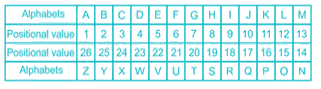 The logic followed here is:
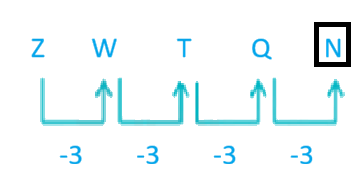 So, 'N' will replace the question mark in the given series.
Hence, the correct answer is "Option 2".
Q2 · Series
What is the next number in the series? 10, 30, 90, ____
- 180
- 200
- 270
- 300
Answer aur solution dekho
Archived marked answer: C
The logic followed here is:
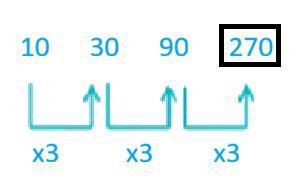 thus, "270" will replace the question mark in the given series.
Hence, the correct option is "Option 3".
Q3 · Series
7, 14, 28, 35, 70, ?
- 77
- 80
- 85
- 90
Answer aur solution dekho
Archived marked answer: A
The logic followed here is:
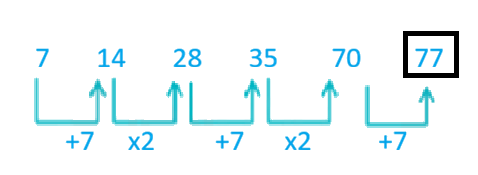 thus, "77" will replace the question mark in the given series.
Hence, the correct option is "Option 1".
Q4 · Series
What should come in place of the question mark '?' in the following number series? 61, 60, 63, 58, 65, ?
- 60
- 56
- 62
- 54
Answer aur solution dekho
Archived marked answer: B
The logic followed here is:
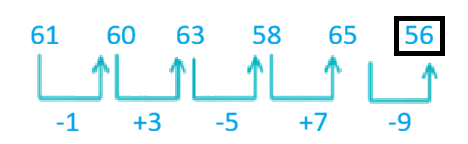 thus, "56" will replace the question mark in the given series.
Hence, the correct option is "Option 2".
Q5 · Series
Find the missing number: 34 : 25 :: 53 : ?
- 32
- 34
- 36
- 42
Answer aur solution dekho
Archived marked answer: B
The logic followed here is:
Logic: Sum of squares of the digits
34 : 25
3² + 4² = 9 + 16 = 25
53 : ?
5² + 3² = 25 + 9 = 34
Missing number = 34
Hence, the correct answer is Option 2.
Q6 · Series
What comes next? AJ, BL, CN, ?
- FS
- GT
- ER
- DP
Answer aur solution dekho
Archived marked answer: D
The logic followed here is:
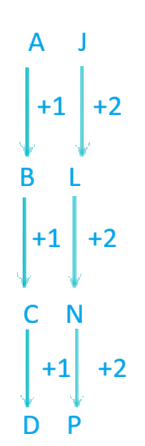 So, 'DP' will replace the question mark in the given series.
Hence, the correct answer is "Option 4".
Q7 · Series
2, 3, 5, 8, 12, 17, ?
- 22
- 23
- 24
- 25
Answer aur solution dekho
Archived marked answer: B
The logic followed here is:
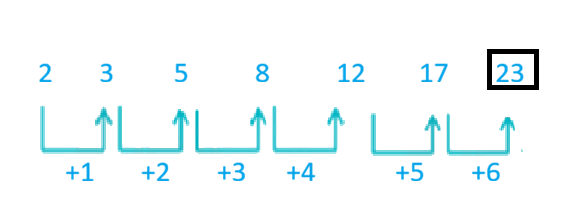 thus, "23" will replace the question mark in the given series.
Hence, the correct option is "Option 2".
Q8 · Series
Complete the series. 1, 27, 125, ?
- 216
- 343
- 512
- 729
Answer aur solution dekho
Archived marked answer: B
The logic followed here is:
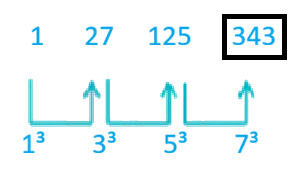 thus, "343" will replace the question mark in the given series.
Hence, the correct option is "Option 2".
Q9 · Series
Find the WRONG term in the given series. 12, 34, 100, 298, 894, 2674
- 298
- 894
- 34
- 100
Answer aur solution dekho
Archived marked answer: B
The logic followed here is:
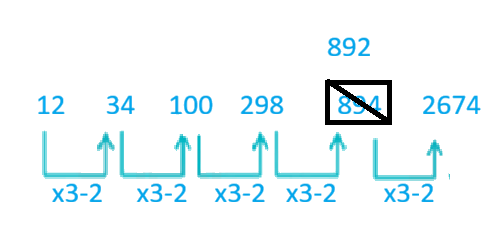 Thus, 894 is the incorrect term in the series.
Hence, the correct option is "Option 2".
Q10 · Analogy
Find the ODD one out from the given options. (Note: Operations should be performed on the whole numbers, without breaking down the numbers into their constituent digits. E.g. 13 - operation on 13 such as adding/subtracting/multiplying etc. to 13 can be performed. Breaking down 13 into 1 and 3 and then performing mathematical operations on 1 and 3 is not allowed.)
- 306
- 324
- 204
- 255
Answer aur solution dekho
Archived marked answer: B
Logic: Divisible by 17.
Option 1: 306
306 ÷ 17 = 18 (Divisible)
Option 2: 324
324 ÷ 17 = 19.05 (Not divisible)
Option 3: 204
204 ÷ 17 = 12 (Divisible)
Option 4: 256
255 ÷ 17 = 15 (Divisible)
306, 204 and 255 are multiples of 17. while 324 is not a multiple of 17.
Hence, the odd one out is Option 2.
Q11 · Analogy
Select the one that is different.
- Motherboard
- RAM
- Operating System
- Monitor
Answer aur solution dekho
Archived marked answer: C
The logic is based on types of computer components.
Option 1: Motherboard – Hardware component of a computer.
Option 2: RAM – Hardware memory component of a computer.
Option 3: Operating System – Software that manages computer operations.
Option 4: Monitor – Hardware output device of a computer.
Among these, Operating System is the only software, while the others are hardware components.
Hence, the odd one out is Option 3.
Q12 · Puzzle Subtypes Not To Miss
A sum of money becomes Rs. 6720 after 2 years and Rs. 7392 after 3 years at compound interest. What is the rate of interest per annum?
- 8%
- 10%
- 12%
- 15%
Answer aur solution dekho
Archived marked answer: B
The logic followed here is:
Logic: In compound interest, Amount for n+1 year ÷ Amount for n year = 1 + (R/100)
Given: Amount after 2 years = 6720, Amount after 3 years = 7392
Rate calculation:
7392 ÷ 6720 = 1 + (R/100)
1.1 = 1 + (R/100)
R/100 = 0.1
R = 10%
Hence, the correct answer is Option 2.
Q13 · Puzzle Subtypes Not To Miss
Replace special characters with mathematical signs as given in options to make it meaningful equation. 8 & 2 $ 3 = 14
- x, +
- +, x
- -, x
- ÷, +
Answer aur solution dekho
Archived marked answer: B
BODMAS Table:
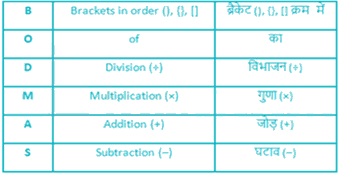 Given equation: 8 & 2 $ 3 = 14
Now, if & stands for '+' and $ stands for '×', then:
⇒ 8 + 2 × 3 = 14
⇒ 8 + 6 = 14
⇒ 14
Hence, the correct answer is "Option 2".
Q14 · Puzzle Subtypes Not To Miss
A number is increased by 20% and then decreased by 20%. What is the net change in the number?
- 4% increase
- 4% decrease
- No change
- 1% decrease
Answer aur solution dekho
Archived marked answer: B
The logic followed here is:
Logic: When a number is increased by x% and then decreased by the same x%, the net change = (x² / 100)% decrease.
Calculation:
Let the original number = 100
After 20% increase → 100 + 20 = 120
After 20% decrease → 120 − 24 = 96
Net change = 100 − 96 = 4% decrease
Hence, the correct answer is Option 2.
Q15 · Puzzle Subtypes Not To Miss
Rs. 640 shared among 8 people. 2 back out. What's new share per person?
- Rs. 106.67
- Rs. 237.89
- Rs. 85
- Rs. 100
Answer aur solution dekho
Archived marked answer: A
The logic followed here is:
Logic: Total amount ÷ Number of people = Share per person
Given: Total = Rs. 640, originally 8 people, now 2 back out → 6 people remain
New share per person = 640 ÷ 6 = 106.67
Hence, the correct answer is Option 1.
Q16 · Coding Decoding
If 7 → 50, 8 → 65, then 9 → ?
- 80
- 81
- 82
- 83
Answer aur solution dekho
Archived marked answer: C
The logic followed here is:
Logic: 2nd number = (1st number)² + 1
Given: 7 → 50
7² + 1 = 49 + 1 = 50
8 → 65
8² + 1 = 64 + 1 = 65
So, 9 → ?
? = 9² + 1 = 81 + 1 = 82
Hence, the correct answer is "Option 3".
Q17 · Coding Decoding
In a certain code language, 'trick on him twice' is coded as 'wl, dl, kl, sl', 'him slow twice' is coded as 'kl, jl, sl', 'case on him' is coded as 'pl, dl, kl'. How will 'on slow trick' be coded in the same language?
- dl, kl, wl
- dl, jl, wl
- pl, jl, wl
- dl, sl, wl
Answer aur solution dekho
Archived marked answer: B
The logic followed here is:
Logic: Same words have the same code in all sentences.
Given codes:
'trick on him twice' → wl, dl, kl, sl
'him slow twice' → kl, jl, sl
'case on him' → pl, dl, kl
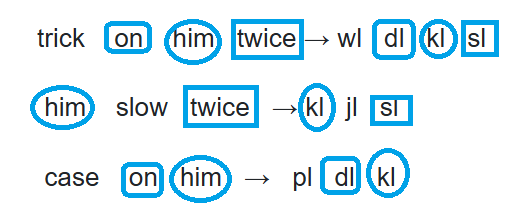 Therefore, 'on slow trick' → dl, jl, wl
Hence, the correct answer is "Option 2".
Q18 · Coding Decoding
If "MODI" is written as "OQFK", how will "BAPU" be written?
- DCQW
- CBRU
- DCRV
- DCRW
Answer aur solution dekho
Archived marked answer: D
The logic followed here is:
Given: MODI → OQFK:
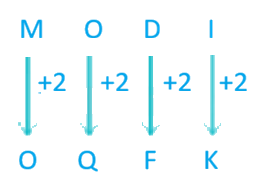 So, each letter is shifted +2.
Similarly, For BAPU:
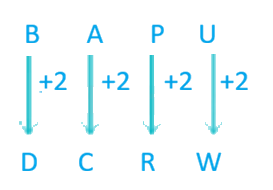 So, BAPU → DCRW
Hence, the correct answer is "Option 4".
Q19 · Coding Decoding
If COMPUTER is coded as DPNQVUFS, how is LAPTOP coded in the same code?
- MBQQPQ
- MBQQOR
- MAPPQ
- MBQUPQ
Answer aur solution dekho
Archived marked answer: D
Every letter advances one place: COMPUTER→DPNQVUFS. Thus L→M, A→B, P→Q, T→U, O→P and P→Q. LAPTOP becomes MBQUPQ.
Q20 · Coding Decoding
If A:B = 2:3 and B:C = 4:5, find A:C.
- 8:15
- 2:5
- 4:7
- 8:25
Answer aur solution dekho
Archived marked answer: A
The logic followed here is:
Logic: To find A:C, make the common term B equal in both ratios and then compare A and C.
Given: A:B = 2:3 and B:C = 4:5
Here, Make B equal → LCM of 3 and 4 = 12
A:B = 2:3 → multiply both by 4 → 8:12
B:C = 4:5 → multiply both by 3 → 12:15
Now A:C = 8:15
Hence, the correct answer is "Option 1".
Q22 · Logical Reasoning
Read the following statement carefully and identify the conclusion that follows.
Statement: All men are intelligent. No intelligent person is poor. Some poor are hardworking.
Conclusions:
I. Some men are hardworking.
II. No man is poor.
- Only I follows
- Only II follows
- Both I and II follow
- Neither I nor II follows
Answer aur solution dekho
Archived marked answer: B
Given Statements:
All men are intelligent.
No intelligent person is poor.
Some poor are hardworking.
The least possible Venn diagram for the given statements is:
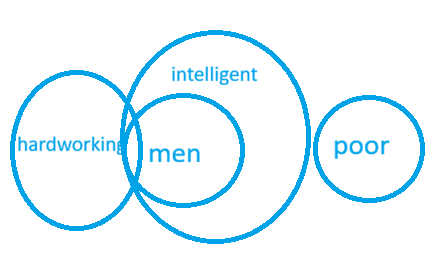 Conclusions:
I. Some men are hardworking – False (There is no information connecting Men with Hardworking.)
II. No man is poor – True (All men are intelligent, and no intelligent person is poor.)
Hence, only conclusion II follows.
The correct answer is "Option 2".
Q23 · Alphabet Test
From the given alternatives, find the word which can be formed from the letters used in the given word.
ACCUSATION
- Acuse
- Curse
- Cure
- Caution
Answer aur solution dekho
Archived marked answer: D
Given word: ACCUSATION
Rule:
The word must be formed using the letters available in ACCUSATION, and each letter can be used only as many times as it appears in the given word.
Step-by-step table:
Letter
Frequency in ACCUSATION
A
2
C
2
U
1
S
1
T
1
I
1
O
1
N
1
Checking the options:
Option
Word
Possible/Not
1
Acuse
(Letter E not present)
2
Curse
(Letter R and E not present)
3
Cure
(Letter R and E not present)
4
Caution
(All letters present in ACCUSATION)
Thus, CAUTION can be formed from the letters of ACCUSATION.
Hence, the correct answer is Option 4. Q24 · Similarity and Differences
Choose the address that is the same as the one given below.
House No. 87, Sector 9, Chandigarh - 160009
- House No. 87, Sector 9, Delhi - 160009
- House No. 87, Sector 9, Punjab - 160009
- House No. 87, Sector 9, Chandigarh - 160009
- House No. 87, Sector 9, Haryana - 160009
Answer aur solution dekho
Archived marked answer: C
The address given is:
House No. 87, Sector 9,Chandigarh - 160009
Let's match this address with the given options one by one to figure out which one is exactly the same.
Option
Address in Option
Given Address
Comment
(1)
House No. 87, Sector 9,Chandigarh - 160009
House No. 87, Sector 9,Chandigarh - 160009
The address in this option has 'Delhi' while the given address has 'Chandigarh'.
(2)
House No. 87, Sector 9, Punjab - 160009
House No. 87, Sector 9,Chandigarh - 160009
The address in this option has 'Punjab' while the given address has 'Chandigarh'.
(3)
House No. 87, Sector 9, Chandigarh - 160009
House No. 87, Sector 9,Chandigarh - 160009
The address matches the given address exactly same.
(4)
House No. 87, Sector 9, Haryana - 160009
House No. 87, Sector 9,Chandigarh - 160009
The address in this option has 'Haryana' while the given address has 'Chandigarh'.
So, the address that is exactly the same as the given address is in option (3).
Hence, the correct option is "option (3)".
Q25 · Clock and Calendar
The seminar in Ranchi happened 3 days before Patna. The seminar in Bhubaneswar happened 2 days after Patna. If Ranchi's seminar was on 11th August, when was Bhubaneswar's?
- 13th August
- 14th August
- 15th August
- 16th August
Answer aur solution dekho
Archived marked answer: D
Given:
The seminar in Ranchi happened 3 days before Patna.
The seminar in Bhubaneswar happened 2 days after Patna.
Ranchi's seminar was on 11th August.
Now,
Ranchi = 11th August
Patna = 11 + 3 days = 14th August
Bhubaneswar = 14 + 2 days = 16th August
Therefore, Bhubaneswar's seminar was on 16th August.
Hence, the correct answer is Option 4.
General Awareness
Q1 · Art and Culture
The rock-cut Kailasa temple at Ellora was carved out of how many rocks?
- One single rock
- Cement blocks
- Three adjoining rocks
- A cluster of stones
Answer aur solution dekho
Archived marked answer: A
The correct answer is One single rock.
Key Points
- The Kailasa Temple at Ellora, located in the Aurangabad district of Maharashtra, India, is a remarkable example of ancient Indian rock-cut architecture.
- This temple is unique as it was carved out of a single monolithic rock, making it one of the largest monolithic structures in the world.
- It was constructed during the reign of the Rashtrakuta dynasty under the rule of King Krishna I in the 8th century CE.
- The temple is dedicated to Lord Shiva and is designed to resemble Mount Kailash, the mythical abode of Lord Shiva in Hindu mythology.
- The excavation and carving process involved the removal of approximately 200,000 tons of rock, showcasing the advanced engineering and artistic skills of the time.
Additional Information
- Architectural Features:
- The Kailasa Temple features intricate carvings, including sculptures of deities, mythical creatures, and scenes from Hindu epics like the Ramayana and Mahabharata.
- The temple has a multi-tiered structure with a central shrine, a Nandi pavilion, and a series of mandapas (halls).
- The intricate details of the carvings reflect the Dravidian style of architecture.
- Historical Significance:
- The Kailasa Temple represents the culmination of centuries of rock-cut architecture in India.
- It is believed to have taken nearly 20 years to complete, involving thousands of laborers and artisans.
- The temple stands as a testament to the technological and artistic prowess of ancient India.
- Other Notable Rock-Cut Structures at Ellora:
- Ellora is home to 34 rock-cut caves, which include Hindu, Buddhist, and Jain temples and monasteries.
- The site is a UNESCO World Heritage Site and attracts tourists and scholars from around the globe.
- Comparison with Other Rock-Cut Temples:
- The Kailasa Temple is often compared to the rock-cut temples of Mahabalipuram and Ajanta, showcasing the evolution of rock-cut techniques.
- Unlike the Ajanta caves, which are primarily Buddhist, the Kailasa Temple is distinctly Hindu in theme and symbolism.
Important Points
- The construction of the Kailasa Temple involved a unique top-down excavation method, starting from the top of the rock and working downward, which prevented structural collapse.
- The temple aligns with the principles of Vastu Shastra, an ancient Indian architectural science.
- The site of Ellora demonstrates the religious harmony of ancient India, as it includes structures representing Hinduism, Buddhism, and Jainism.
- The Kailasa Temple is often regarded as one of the seven wonders of India due to its architectural brilliance and historical significance. </ul
Q2 · Art and Culture
Which of the following is NOT a type of raga-based performance?
- Thumri
- Dhrupad
- Prabandha
- Sonata
Answer aur solution dekho
Archived marked answer: D
The correct answer is Sonata.
Key Points
- Raga-based performances are integral to Indian classical music, where compositions are structured around specific melodic frameworks called ragas.
- Thumri: A semi-classical vocal form in Indian music, known for its romantic or devotional themes and expressive melodic improvisation. *It is a type of raga-based performance.*
- Dhrupad: The oldest form of Indian classical vocal music, characterized by its meditative and austere style. *It is also a type of raga-based performance.*
- Prabandha: An ancient form of Indian classical composition that predates Dhrupad and involves fixed lyrics and melodies. *It is raga-based as well.*
- Sonata: A Western classical music composition, usually written for solo instruments or small ensembles, structured in movements and not based on ragas. Hence, it is NOT a type of raga-based performance.
Additional Information
- Thumri:
- Originated in the courts of North India during the 18th century.
- Emphasizes emotion (bhava) and features a romantic or devotional theme.
- Instruments like the tabla, harmonium, and sarangi often accompany Thumri performances.
- It is closely associated with dance forms like Kathak.
- Dhrupad:
- Dates back to the medieval period and is considered the oldest surviving form of Indian classical music.
- Performed in a slow and meditative style, focusing on purity of raga.
- Often accompanied by the pakhawaj and tanpura.
- It is traditionally sung in praise of deities or royal patrons.
- Prabandha:
- An ancient compositional form that predates Dhrupad.
- Involves a fixed structure of lyrics and melody.
- It was a precursor to later forms like Dhrupad and Khayal.
- Sonata:
- A form of Western classical music composition.
- Typically consists of three or four movements with contrasting tempos and moods.
- Developed in Europe during the Classical period (18th century).
- Prominent composers of sonatas include Beethoven, Mozart, and Haydn.
Important Points
- Raga:
- A raga is a melodic framework in Indian classical music used to express specific emotions.
- Each raga is associated with a particular time of day, season, or mood (rasa).
- It serves as the foundation for composition and improvisation in both Hindustani and Carnatic music traditions.
- Comparison with Western Classical Music:
- Western music relies on harmonic structures and fixed compositions, while Indian music emphasizes melody and improvisation.
- Forms like the sonata, symphony, and concerto dominate Western classical music.
- Indian music uses instruments such as sitar, tabla, and veena, whereas Western music uses piano, violin, and flute. </ul
Q3 · Art and Culture
Which of the following statements most accurately describes a key difference between the Mathura and Gandhara schools of art, as broadly understood in Indian architectural history?
- Mathura art primarily used green phyllite, while Gandhara art used spotted red sandstone.
- Gandhara art developed on purely indigenous lines, whereas Mathura art showed foreign influences
- Mathura art predominantly focused on Buddhist themes, while Gandhara focused on Hindu deities
- Mathura art depicted Buddha in an indigenous Yaksha-like style, whereas Gandhara art reflected Hellenistic (Greco-Roman) features.
Answer aur solution dekho
Archived marked answer: D
The correct answer is Mathura art depicted Buddha in an indigenous Yaksha-like style, whereas Gandhara art reflected Hellenistic (Greco-Roman) features..
Key Points
- Mathura School of Art developed during the Kushan Period (1st to 3rd century CE) in and around Mathura, Uttar Pradesh. It is characterized by its indigenous style of sculpting, which evolved from earlier Yaksha and Yakshi imagery.
- The Buddha images in Mathura art have a more iconic Indian appearance, depicting him with a smiling face, wide eyes, and a robust physique resembling Yaksha figures. The drapery is closely clinging and transparent.
- Gandhara School of Art flourished in the northwestern region of the Indian subcontinent (modern-day Pakistan and Afghanistan), particularly during the Kushan and Indo-Greek periods. It is heavily influenced by Hellenistic (Greco-Roman) artistic traditions.
- The Buddha images in Gandhara art are marked by Greco-Roman features
Q4 · Art and Culture
Fill in the Blank: Thoda combines martial art with ______ in Himachal Pradesh.
- Archery
- Swordplay
- Stick-fighting
- Wrestling
Answer aur solution dekho
Archived marked answer: A
The correct answer is Archery.
Key Points
- Thoda is a traditional martial art form originating from the state of Himachal Pradesh, India. It is believed to have roots in ancient warfare techniques practiced in the region.
- Thoda uniquely combines elements of martial arts with Archery techniques. Participants use wooden sticks to simulate combat in a stylized and controlled manner.
- The practice of Thoda involves precision, agility, and coordination. Fighters aim to showcase their skills by hitting specific targets on their opponent's body while avoiding being hit themselves.
- This martial art is performed as a part of cultural celebrations and festivals in Himachal Pradesh, highlighting the region's rich heritage and history.
- Thoda also reflects the traditional warrior spirit of the local communities and has evolved into a sport that emphasizes discipline, respect, and teamwork.
Additional Information
- Other Options in the Context:
- Archery: While archery is another traditional activity practiced in several regions of India, it is not a component of Thoda. Archery in Himachal Pradesh is often seen in separate cultural or recreational contexts.
- Swordplay: Sword-fighting is a prominent martial art in other cultures and regions, such as Kalaripayattu in Kerala. However, it is not a part of Thoda's traditional practice.
- Wrestling: Wrestling has a rich history in India and is practiced in forms like Kushti. However, wrestling is not associated with Thoda, as Thoda strictly involves stick-fighting techniques.
- Origin and History of Thoda:
- Thoda has its origins in the Mahabharata, where archery and combat skills were prominent among warriors. Over time, it evolved into its current form as a cultural martial art.
- It is primarily practiced in the districts of Himachal Pradesh, such as Shimla, Sirmaur, and Solan.
- Rules and Gameplay:
- Participants are divided into two teams: Pashi (defenders) and Sathi (attackers).
- Each player uses a stick and aims to strike specific target points on their opponent's body while protecting themselves from counterattacks.
- The game emphasizes accuracy and control, as strikes are required to be precise and within designated zones.
- Cultural Significance:
- Thoda is performed during local festivals and fairs, reflecting the cultural identity and heritage of Himachal Pradesh.
- It serves as a medium to preserve ancient martial traditions and instill a sense of pride and community among locals.
Important Points
- Thoda's Modern Relevance:
- Efforts are being made to promote Thoda as a sport and cultural event on national and international platforms to preserve its legacy.
- Local governments and cultural organizations in Himachal Pradesh play an active role in supporting Thoda practitioners and organizing competitions.
- Traditional Attire and Equipment:
- Participants wear traditional clothing that reflects the region's cultural identity, often paired with protective gear for safety during matches.
- The wooden sticks used in Thoda are crafted with precision and are considered sacred, symbolizing the warrior spirit.
Q5 · Art and Culture
Which among the following is NOT a Vedanga, or the limbs of the Veda?
- Kalpa
- Vaisheshika
- Vyakarana
- Jyotisha
Answer aur solution dekho
Archived marked answer: B
The correct answer is Vaisheshika.
Key Points
- The Vedangas are six auxiliary disciplines associated with the study and understanding of the Vedas. They are intended to help in the proper recitation, interpretation, and application of the Vedic texts.
- The six Vedangas are Shiksha (phonetics), Kalpa (rituals), Vyakarana (grammar), Nirukta (etymology), Chandas (meter), and Jyotisha (astronomy).
- Vaisheshika is a school of Indian philosophy that deals with metaphysics and natural philosophy, focusing on the categories of reality such as substance, quality, activity, and universals. It is not considered one of the Vedangas, as it is a separate philosophical system unrelated to the Vedic auxiliary disciplines.
- Kalpa pertains to rituals and procedures mentioned in the Vedas, covering topics like sacrifices, rites, and
Q6 · Indian Polity and Constitution
Which of the following is a cybercrime related to identity theft under the Bharatiya Nyaya Sanhita, 2023?
- Using public Wi-Fi to access online accounts
- Stealing personal details to create fake identities and commit fraud
- Downloading free music from unofficial websites
- Posting harmless pictures on a social media profile
Answer aur solution dekho
Archived marked answer: B
The correct answer is Stealing personal details to create fake identities and commit fraud.
Key Points
- Identity theft is a cybercrime where someone steals another individual's personal information, such as their name, date of birth, Aadhaar number, or financial details, to impersonate them for fraudulent purposes. This is explicitly covered under the Bharatiya Nyaya Sanhita, 2023.
- The act of stealing personal details to create fake identities is used to commit crimes such as financial fraud, obtaining unauthorized access to services, or engaging in illegal activities, making it a punishable offense under the new legal framework.
- Under the Bharatiya Nyaya Sanhita, 2023, identity theft is categorized as a serious offense. It is dealt with under provisions that aim to safeguard individuals' personal and digital information.
- Cybercriminals often exploit stolen identities to commit crimes like phishing, applying for loans fraudulently, or making unauthorized transactions. Such activities have a high impact on victims, both financially and emotionally.
- Other options such as using public Wi-Fi, downloading free music from unofficial websites, or posting harmless pictures on social media do not constitute identity theft or fall under serious cybercrime categories unless they involve illegal intent or misuse. *Hence, these statements are incorrect.*
Additional Information
- Bharatiya Nyaya Sanhita, 2023:
- This act has been introduced to modernize India's criminal laws, replacing outdated provisions of the Indian Penal Code (IPC), 1860.
- The act emphasizes the protection of citizens' rights in the digital era by addressing new-age crimes like cyber fraud, identity theft, and other digital offenses.
- Stringent penalties and punishments have been outlined for crimes involving data breaches and identity misuse.
- Key Characteristics of Identity Theft:
- Age Group: Anyone can be a victim of identity theft, but individuals with a high online presence are at greater risk.
- Methods Used: Phishing emails, social engineering tactics, hacking, and data breaches are common techniques used by cybercriminals.
- Impact: Victims may face financial losses, damage to their credit score, and legal issues if their identity is used in illegal activities.
- Prevention: Using strong passwords, avoiding public Wi-Fi for sensitive transactions, and being cautious about sharing personal information online are effective preventive measures.
- Other Cybercrimes Addressed Under Bharatiya Nyaya Sanhita, 2023:
- Phishing: Deceptive attempts to acquire sensitive information like usernames, passwords, or credit card details.
- Hacking: Unauthorized access to computer systems to steal or manipulate data.
- Cyberstalking: Persistent harassment of an individual through digital platforms.
- Data breaches: Unauthorized access to and exposure of sensitive data stored in digital systems.
- Implications of Identity Theft:
- Victims may take years to recover from the financial and reputational damage caused by identity theft.
- Law enforcement agencies face challenges in tracking cybercriminals due to their use of advanced technologies and anonymity tools.
Important Points
- Public Awareness: Educating people about the risks of sharing personal information online and how to identify phishing attempts is crucial in preventing identity theft.
- Legal Recourse: Victims can approach the cybercrime cell or file a complaint under the provisions of the Bharatiya Nyaya Sanhita, 2023, for swift action.
- Technological Safeguards: Implementation of two-factor authentication (2FA), encryption, and other digital security measures can significantly reduce the risk of identity theft. </ul
Q7 · Indian Polity and Constitution
Who is the 20th governor of Uttar Pradesh since 2019?
- Anandiben Patel
- Satya Pal Malik
- Ram Naresh Yadav
- Rajendra Vishwanath Arlekar
Answer aur solution dekho
Archived marked answer: A
The correct answer is Anandiben Patel.
Key Points
- Anandiben Patel became the 20th Governor of Uttar Pradesh in 2019. She assumed office on July 29, 2019, succeeding Ram Naik.
- She is the first woman to serve as the Governor of Uttar Pradesh, the most populous state in India.
- Before her appointment as Governor of Uttar Pradesh, Anandiben Patel served as the Governor of Madhya Pradesh (January 2018 - July 2019) and held additional charge of Chhattisgarh for a brief period.
- Anandiben Patel is a member of the Bharatiya Janata Party (BJP) and was previously the Chief Minister of Gujarat from May 2014 to August 2016.
- She has been recognized for her contributions to women's empowerment, education, and rural development during her political career.
Additional Information
- Governorship in India:
- The Governor is the constitutional head of a state in India, appointed by the President of India under Article 155 of the Indian Constitution.
- The Governor serves a term of five years, but they hold office at the pleasure of the President.
- The primary duties of a Governor include administering the oath of office to the Chief Minister and other state ministers, approving bills passed by the state legislature, and overseeing the state's administration.
- Anandiben Patel's Career:
- Anandiben Patel was born on November 21, 1941, in Gujarat, India.
- She has been a prominent leader in the BJP and began her political career in 1987.
- She is known for her work in the fields of education, women's empowerment, and rural development.
- As Chief Minister of Gujarat, she focused on initiatives like Gatisheel Gujarat and improving maternal health through Chiranjeevi Yojana.
- Other Governors of Uttar Pradesh:
- Notable Governors of Uttar Pradesh include Ram Naik (2014–2019), Banwari Lal Joshi (2009–2014), and Motilal Vora (1993–1996).
- Each Governor played a significant role in the administration and governance of the state.
- Functions of the Governor:
- Acts as the constitutional head of the state and ensures compliance with the Constitution of India.
- Appoints the Chief Minister and other members of the Council of Ministers.
- Has the power to dissolve the Legislative Assembly and recommend President's Rule in case of administrative failure.
- Gives assent to bills, withholds assent, or reserves bills for the President's consideration.
Important Points
- Significance of Women Governors:
- Anandiben Patel's appointment as the first female Governor of Uttar Pradesh symbolizes progress toward gender equality in Indian politics.
- Other prominent women Governors in India include Sarojini Naidu, the first woman Governor of an Indian state (Uttar Pradesh, 1947), and Margaret Alva (Governor of Uttarakhand, Rajasthan, Goa, and Gujarat).
- Governance in Uttar Pradesh:
- Uttar Pradesh is the most populous state in India, with a population of over 200 million, making the role of the Governor particularly significant.
- The state plays a crucial role in Indian politics, with the highest number of seats in the Lok Sabha (80) and Rajya Sabha (31).
66:T
Q8 · Indian Economy
Which of the following statements about output markets in an open economy is correct?
- A country can only produce what it consumes
- Consumers are restricted to domestically produced goods
- Trade in goods and services allows wider consumer and producer choice
- Only producers benefit from international trade
Answer aur solution dekho
Archived marked answer: C
The correct answer is Trade in goods and services allows wider consumer and producer choice.
Key Points
- Statement 1: "A country can only produce what it consumes" is incorrect. An open economy allows for trade, enabling countries to specialize in producing goods and services they are most efficient at while importing others, thus not restricting production to domestic consumption alone.
- Statement 2: "Consumers are restricted to domestically produced goods" is incorrect. In an open economy, consumers have access to a wide variety of goods and services from international markets, expanding their choices beyond domestic products.
- Statement 3: "Trade in goods and services allows wider consumer and producer choice" is correct. Open economies facilitate international trade, allowing consumers access to diverse products and enabling producers to reach global markets, thereby increasing efficiency and competition.
- Statement 4: "Only producers benefit from international trade" is incorrect. Both producers and consumers benefit from trade. Consumers gain access to quality goods at competitive prices, while producers expand their markets and achieve economies of scale.
Additional Information
- Open Economy:
- An open economy engages in international trade, allowing the free movement of goods, services, and investments across borders.
- Examples of open economies include nations like the United States, Germany, and Japan, which rely heavily on trade for economic growth.
- Benefits of Trade:
- Promotes specialization where countries focus on producing goods they are most efficient at.
- Encourages innovation and competition, leading to better-quality products and services.
- Enables access to a broader range of goods and services for consumers.
- Consumer Benefits in an Open Economy:
- Access to imported goods that may not be available domestically.
- Competitive pricing due to global competition among producers.
- Higher quality and varied products, benefiting from international expertise and innovation.
- Producer Benefits in an Open Economy:
- Opportunity to access global markets and expand their customer base.
- Economies of scale due to increased production for international demand.
- Access to better inputs and advanced technologies through imports.
Important Points
- Comparative Advantage:
- A key principle in international trade where countries produce goods in which they have a relative efficiency advantage.
- Example: India specializes in IT services, while Saudi Arabia focuses on oil production.
- Global Trade Organizations:
- Institutions like the World Trade Organization (WTO) facilitate and regulate international trade agreements to promote free trade.
- Other entities like regional trade agreements (e.g., NAFTA, EU) also enhance economic integration among member nations.
- Examples of Trade Benefits:
- Consumers in developing countries gain access to advanced technology products from developed nations.
- Producers in developed countries benefit from lower production costs by outsourcing to countries with cheaper labor. </ul
Q9 · Indian Economy
The Planning Commission was established in which year?
- 1947
- 1949
- 1950
- 1952
Answer aur solution dekho
Archived marked answer: C
The correct answer is 1950.
Key Points
- The Planning Commission of India was established in the year 1950, specifically on 15th March, by a resolution of the Government of India.
- It was created to promote a rapid and balanced economic development of the country, with a focus on efficient resource utilization and addressing socio-economic challenges.
- The Commission was tasked with formulating Five-Year Plans, which were comprehensive strategies for national growth and development.
- The first Chairman of the Planning Commission was India's first Prime Minister, Pandit Jawaharlal Nehru. He played a central role in shaping its policies and direction.
Q10 · Indian Economy
Read the following statements carefully and choose the correct option regarding Assertion (A) and Reason (R).
Assertion (A): The 1991 reforms led to the opening of the Indian economy to foreign investors.
Reason (R): The government wanted to increase domestic savings rate rapidly.
- Both A and R are true and R is the correct explanation of A.
- Both A and R are true but R is not the correct explanation of A.
- A is true but R is false.
- A is false but R is true.
Answer aur solution dekho
Archived marked answer: C
The correct answer is 3) A is true but R is false..
Key Points
- Assertion (A): The 1991 reforms led to the opening of the Indian economy to foreign investors:
- In 1991, India implemented a series of economic reforms under the leadership of then Prime Minister P.V. Narasimha Rao and Finance Minister Dr. Manmohan Singh.
- These reforms were aimed at liberalizing the economy, reducing government control, and encouraging private and foreign investment.
- The reforms included measures like deregulation, privatization of public sector enterprises, and opening up industries like banking, insurance, and telecom to foreign investors.
- This was done to overcome the balance of payments crisis and integrate India with the global economy. *Hence, Assertion (A) is correct.*
-
Q11 · Sports Static GK
Fill in the blank: The final match of the 133rd Durand Cup, held between 26 July and 31 August 2024, featured Northeast United FC competing against _______.
- Bengaluru FC
- East Bengal FC
- Mohun Bagan SG
- FC Goa
Answer aur solution dekho
Archived marked answer: C
The correct answer is 3) Mohun Bagan SG.
Key Points
- The 133rd Durand Cup is one of the oldest and most prestigious football tournaments in India, held annually to showcase the nation's top football clubs.
- The final match of the 2024 Durand Cup was played between Northeast United FC and Mohun Bagan SG, two highly competitive teams in Indian football.
- Mohun Bagan SG is one of India's oldest and most successful football clubs, known for its rich legacy and passionate fanbase.
- The tournament was held from 26 July to 31 August 2024, featuring several high-intensity matches and drawing large crowds.
- The Durand Cup serves as a platform for clubs to prepare for major domestic and international tournaments, fostering competitive spirit and showcasing emerging talent.
Additional Information
- Durand Cup History:
- The Durand Cup was first held in 1888, making it one of the oldest football tournaments in the world.
- It is named after Mortimer Durand, the then Foreign Secretary of British India, who initiated the tournament as a recreational activity for British troops in India.
- Over the years, the tournament has evolved to include professional football clubs, becoming a cornerstone of Indian football history.
- Mohun Bagan SG:
- Founded in 1889, Mohun Bagan SG is one of Asia's oldest football clubs.
- The club has won numerous domestic and international titles, including the IFA Shield, Federation Cup, and Indian Super League.
- It is celebrated for its historic victory over the East Yorkshire Regiment in the 1911 IFA Shield final, a moment considered a milestone in Indian sports history.
- Northeast United FC:
- Established in 2014, Northeast United FC is a professional football club representing the northeastern region of India in the Indian Super League (ISL).
- The club is known for its focus on promoting young talent from the region and fostering grassroots football development.
- Despite being a relatively new club, it has made its mark in Indian football with competitive performances.
- Significance of the Durand Cup:
- The tournament acts as a curtain-raiser for the Indian football season, providing clubs an opportunity to test their squads and strategies.
- It serves as a platform to identify and promote emerging talent, contributing to the growth of football in India.
- The Durand Cup is also a symbol of India's football heritage, connecting modern football with its historical roots.
Important Points
- Key Records:
- Mohun Bagan SG has won the Durand Cup multiple times, solidifying its legacy as one of the most successful clubs in the tournament's history.
- The tournament has seen participation from top Indian clubs, including East Bengal FC, Bengaluru FC, and FC Goa, making it highly competitive.
- Future Prospects:
- The Durand Cup is expected to grow further in stature with increased sponsorships, media coverage, and participation from international clubs.
- Efforts are being made to align the tournament with global standards, ensuring its relevance in the modern football landscape.
``
Q12 · Sports Static GK
Which sport is the term "zugzwang" associated with?
- Kabaddi
- Chess
- Shooting
- Table Tennis
Answer aur solution dekho
Archived marked answer: B
The correct answer is Chess.
Key Points
- Zugzwang is a term specifically associated with the game of Chess.
- The term originates from the German language, where "zug" means "move" and "zwang" means "compulsion," translating to "compulsion to move."
- In Chess, Zugzwang refers to a situation where a player is forced to make a move, but any move they make will worsen their position.
- It often occurs in endgames and is used as a strategic tool to pressurize the opponent into making unfavorable moves.
- Examples of Zugzwang often involve pawn moves or king positioning that limit the options available to the opponent.
Additional Information
- Origin of the Term:
- The term Zugzwang was first documented in Chess literature in the 19th century.
- It became popular in Chess theory due to its pivotal role in high-level games and studies.
- Applications in Chess:
- It is commonly seen in endgame scenarios where limited moves are available.
- Players often aim to create Zugzwang situations to gain a decisive advantage.
- Examples in Chess History:
- Famous Chess players such as Paul Morphy and Jose Raul Capablanca have used Zugzwang in their games.
- Notable Zugzwang positions are documented in historical matches and Chess problem compositions.
- Importance:
- Understanding Zugzwang helps players improve their endgame strategy and foresee potential threats.
- It is a critical concept taught in Chess coaching and is analyzed in tournaments worldwide.
Important Points
- Chess Terminologies:
- Other key terms in Chess include checkmate, stalemate, pin, fork, and skewer.
- These terminologies are essential for understanding the intricacies of Chess strategy and gameplay.
- Global Impact:
- Chess is a globally recognized sport and has been included in events like the World Chess Championship and Olympiad Chess tournaments.
- Famous Chess players include Magnus Carlsen, Viswanathan Anand, and Garry Kasparov. </ul
Q13 · Sports Static GK
Which of the following statements about India's National and Institutional Sports Competitions is/are correct?
1) National Games began in 1924 at Lahore and were renamed from the IX Games in Bombay.
2) SGFI holds nationals only for boys under 17 in contact sports like Wrestling and Kabaddi.
3) Inter-University tournaments use knockout or league formats and allow one team per university.
- Only 1 and 2 are Correct
- Only 1 and 3 are Correct
- Only 2 and 3 are correct
- 1, 2 and 3 are Correct
Answer aur solution dekho
Archived marked answer: B
The correct answer is Only 1 and 3 are Correct.
Key Points
- Statement 1: The National Games began in 1924 at Lahore (then in British India) and were later renamed from the IX Games in Bombay (Mumbai). This statement is correct as the National Games were initially known as the Indian Olympic Games before being renamed in 1940.
- Statement 2: The School Games Federation of India (SGFI) organizes national-level school sports for boys and girls under various age groups, including under 17. However, it does not restrict itself to boys only or exclusively to contact sports like Wrestling and Kabaddi. This statement is incorrect.
- Statement 3: Inter-University tournaments in India follow either a knockout or league format, and they allow one team per university to participate. This organizational structure ensures fair competition and representation. This statement is correct.
- *Hence, the correct answer is Only 1 and 3 are Correct.*
Additional Information
- National Games of India:
- The National Games are a prestigious multi-sport event held periodically in India.
- It was initially called the Indian Olympic Games and was modeled after the Olympics.
- The event aims to promote sports culture, identify talent, and provide a platform for athletes to compete at the national level.
- The modern format of the National Games involves participation from states and union territories across various sports.
- School Games Federation of India (SGFI):
- SGFI is responsible for organizing sports competitions at the school level in India.
- It conducts tournaments across multiple disciplines and age categories, including under 14, under 17, and under 19.
- Both boys and girls participate in a wide range of sports like athletics, hockey, basketball, kabaddi, and more.
- SGFI aims to promote grassroots-level sports and develop young athletes for national and international competitions.
- Inter-University Sports Tournaments:
- The Association of Indian Universities (AIU) oversees inter-university sports in India.
- Tournaments are conducted in a knockout or league format to ensure fair play and competitiveness.
- Each university is allowed to send one team per discipline, ensuring equal representation.
- These events serve as a platform for university-level athletes to showcase their skills and secure opportunities for higher-level competitions.
- Key Objectives of National and Institutional Sports Competitions:
- To promote sports and physical fitness across all age groups.
- To identify and nurture talent at the grassroots level.
- To provide platforms for athletes to compete and gain exposure.
- To foster a sense of unity and sportsmanship among participants.
Important Points
- Historical Background:
- The first edition of the Indian Olympic Games was held in 1924 in Lahore.
- The event was renamed the National Games in 1940 to reflect its broader scope.
- Modern National Games:
- The event is now organized by the Indian Olympic Association (IOA).
- It features participation from all Indian states, union territories, and sports boards.
- Role of SGFI:
- SGFI is recognized by the Ministry of Youth Affairs and Sports and works to promote school-level sports.
- Its tournaments are a stepping stone for young athletes aiming to represent India in international sports.
- Inter-University Sports:
- AIU ensures the smooth conduct of inter-university sports events.
- These tournaments are a critical part of India's sports ecosystem, bridging the gap between school and professional sports.
</ul
Q14 · Indian Geography
Which of the given statements is/are CORRECT regarding solar power production?
1. Solar power is a renewable energy source with low operational costs and minimal environmental impact.
2. Kamuthi Solar Power Project is one of the largest single-location solar power plants in India, with a capacity of 648 MW.
- Both 1 and 2
- 1 only
- 2 only
- Neither 1 nor 2
Answer aur solution dekho
Archived marked answer: A
The correct answer is Both 1 and 2.
Key Points
- Statement 1: Solar power is a renewable energy source with low operational costs and minimal environmental impact.
- Correct: Solar power is considered a renewable energy source because it harnesses the energy of the sun, which is inexhaustible.
- It has low operational costs as it does not require fuel and involves minimal maintenance after installation.
- Solar energy has a minimal environmental footprint, producing no emissions during electricity generation, unlike fossil fuels.
- Statement 2: Kamuthi Solar Power Project is one of the largest single-location solar power plants in India, with a capacity of 648 MW.
- Correct: The Kamuthi Solar Power Project, located in Tamil Nadu, India, is one of the largest single-location solar power plants in the country.
- It boasts a capacity of 648 MW and covers an area of approximately 2,500 acres.
- It was commissioned by Adani Green Energy and contributes significantly to India's renewable energy targets.
Additional Information
- Solar Power in India:
- India ranks among the top countries in the world for solar energy production, owing to its geographical location and abundant sunlight.
- The government has set ambitious targets under the National Solar Mission, aiming for 100 GW of solar energy capacity by 2022.
- Advantages of Solar Power:
- It is a clean energy source, reducing greenhouse gas emissions and combating climate change.
- Solar panels can be installed on rooftops, reducing the need for large-scale infrastructure.
- Solar energy contributes to energy independence by reducing reliance on imported fuels.
- Kamuthi Solar Power Project - Key Details:
- Location: Kamuthi, Ramanathapuram district, Tamil Nadu, India.
- Area covered: Approximately 2,500 acres.
- It was completed in 2016, with the ability to power approximately 150,000 homes.
- The plant is equipped with advanced robotic cleaning technology to maintain efficiency.
- India's Renewable Energy Initiatives:
- India has made significant progress in renewable energy, ranking among the top five nations globally.
- The government has launched schemes like KUSUM (for solar pumps) and PM KUSUM to promote solar energy adoption.
Important Points
- Global Solar Power Leader: India is one of the largest producers of solar power in the world, with its solar capacity growing exponentially in recent years.
- International Commitments: India is a founding member of the International Solar Alliance (ISA), which promotes solar energy adoption globally.
- Environmental Impact: Solar energy contributes significantly to reducing carbon footprints and ensures sustainable development.
- Future Prospects: With government initiatives and private investments, India is expected to achieve greater milestones in solar energy production.
</ul
Q15 · Modern Indian History
The Government of India Act of 1935 primarily aimed to:
- Grant complete independence to India.
- Establish a Dominion status for India.
- Provide for a federal structure with provincial autonomy.
- Introduce universal adult suffrage.
Answer aur solution dekho
Archived marked answer: C
The correct answer is Provide for a federal structure with provincial autonomy.
Key Points
- The Government of India Act, 1935 was a significant step towards the establishment of a federal structure in India by providing for a federation of Indian provinces and princely states.
- It introduced provincial autonomy, making provinces largely autonomous in their internal administration. This was a major shift from the earlier system of governance under the Government of India Act, 1919.
- Under this Act, the Governor's role in provinces was largely ceremonial, while elected provincial legislatures and ministries held significant powers. Hence, provincial autonomy was a key feature.
- This Act also proposed a bicameral legislature at the Centre, consisting of the Federal Assembly and the Council of States.
- It did not grant complete independence to India but laid the groundwork for a more decentralized and representative government. *Hence, statement 1 is incorrect.*
- It did not establish Dominion status for India, as the British government retained control over defense and foreign affairs. *Hence, statement 2 is incorrect.*
- The Act did not introduce universal adult suffrage. Voting rights were still limited to a small proportion of the population based on property, tax, or education qualifications. *Hence, statement 4 is incorrect.*
Additional Information
- Federal Structure:
- The Government of India Act, 1935, was the first attempt to introduce a federal structure in India. While the federation was never fully implemented due to the lack of agreement among princely states, it laid the foundation for the federal system in the Constitution of India (1950).
- The Act divided powers between the Centre and the provinces into three lists: Federal List, Provincial List, and Concurrent List. This division of powers influenced the Indian Constitution.
- Provincial Autonomy:
- Provincial autonomy allowed elected representatives in provinces to take charge of their respective ministries and administrative functions without interference from the Centre.
- This autonomy was a step towards self-governance and gave Indians some experience in running their own government.
- Key Features of the Act:
- The Act abolished the diarchy introduced by the Government of India Act, 1919, at the provincial level, but introduced it at the Centre.
- It extended the system of communal representation by providing separate electorates for Scheduled Castes, women, and laborers.
- Limitations of the Act:
- The Act did not grant India independence or Dominion status, as ultimate power still rested with the British Crown.
- The Governor-General retained control over defense, foreign affairs, and certain reserved subjects, limiting the autonomy of the federal government.
Important Points
- Background:
- The Act was a result of deliberations at the Round Table Conferences held in London (1930-32), where Indian leaders demanded greater autonomy.
- It was the longest and most detailed legislation enacted by the British Parliament for India, consisting of 321 sections and 10 schedules.
- Influence on Indian Constitution:
- Many features of the Government of India Act, 1935, were adopted in the Indian Constitution, including the federal structure, division of powers, and the concept of a bicameral legislature.
- The Concurrent List and the provision for emergency powers were also inspired by this Act.
- Impact:
- The Act was criticized for not granting full independence but was significant in providing Indians with experience in governance, which played a crucial role in preparing for independence.
- It marked a shift in British policy, indicating a gradual transfer of power to Indians, even though it was limited in scope.
</ul
Q16 · Modern Indian History
The revolutionary Bagha Jatin (Jatindranath Mukherjee) was known for his valiant fight and for inspiring revolutionaries in which Indian state?
- Punjab
- Uttar Pradesh
- Bengal
- Bihar
Answer aur solution dekho
Archived marked answer: C
The correct answer is Bengal.
Key Points
- Bagha Jatin, also known as Jatindranath Mukherjee, was a prominent revolutionary leader during the Indian freedom struggle.
- He hailed from the state of Bengal, which played a pivotal role in the revolutionary activities against British rule.
- Bagha Jatin earned his moniker "Bagha" (meaning tiger) after he killed a tiger single-handedly in 1906, showcasing his unparalleled bravery.
- He was a key figure in organizing revolutionary groups in Bengal, including the Jugantar Party, which actively worked against British imperialism.
- Bagha Jatin's valiant fight against the British forces in 1915 at Balasore, Odisha, remains one of the most heroic episodes of India's struggle for independence.
Additional Information
- Bengal's Role in Revolutionary Activities:
- Bengal emerged as a hub for revolutionary activities during the early 20th century due to widespread dissatisfaction with British policies like the Partition of Bengal in 1905.
- Several revolutionary organizations such as the Jugantar and Anushilan Samiti were established in Bengal to challenge British authority.
- Prominent revolutionaries like Bagha Jatin, Surya Sen, Khudiram Bose, and Prafulla Chaki hailed from Bengal and contributed significantly to India's independence movement.
- Life and Legacy of Bagha Jatin:
- Born: Jatin was born on 7 December 1879 in Kushtia, Bengal Presidency (now in Bangladesh).
- He was deeply influenced by Swami Vivekananda, who inspired him to dedicate his life to the service of the nation.
- Jatin played a crucial role in procuring arms and organizing revolutionary activities aimed at overthrowing British rule.
- His famous last words, "Amra morbo, jagat jagbe" (We shall die so that the world may awaken), reflect his selfless sacrifice for the nation.
- Other States in the Context of Revolutionaries:
- Punjab: Punjab was known for revolutionaries like Bhagat Singh, Lala Lajpat Rai, and Udham Singh, who played pivotal roles in India's struggle for freedom.
- Uttar Pradesh: Uttar Pradesh was home to leaders like Chandrashekhar Azad and served as a significant center for revolutionary activities, including the Kakori Train Robbery.
- Bihar: Bihar contributed leaders like Jayaprakash Narayan and revolutionary activities during the Quit India Movement.
Important Points
- Jugantar Party: Founded in 1906, this revolutionary group aimed to overthrow British rule through armed resistance.
- Partition of Bengal (1905): A British policy aimed at dividing Bengal along religious lines, which led to widespread protests and the rise of revolutionary movements.
- Balasore Battle (1915): Bagha Jatin and his associates fought valiantly against British forces but were ultimately outnumbered and defeated, leading to Jatin's martyrdom.
- Legacy: Jatin's life continues to inspire generations of Indians, symbolizing courage and patriotism in the face of oppression.
</ul
Q17 · Current Affairs
The primary focus of the Quad is in which region?
- Europe
- Africa
- Indo-Pacific
- South America
Answer aur solution dekho
Archived marked answer: C
The correct answer is Indo-Pacific.
Key Points
- The Quad, or the Quadrilateral Security Dialogue, is a strategic partnership between four countries: India, the United States, Japan, and Australia.
- The Quad's primary focus is on the Indo-Pacific region, emphasizing a free, open, and inclusive Indo-Pacific that is rules-based and respects sovereignty.
- The Quad seeks to address challenges such as maritime security, freedom of navigation, and countering coercive tactics in the Indo-Pacific, particularly in response to the growing influence of China in the region.
- Key initiatives under the Quad include infrastructure development, climate change mitigation, cybersecurity, and vaccine distribution to strengthen regional cooperation.
- The Indo-Pacific is a vital region as it hosts some of the world's busiest shipping lanes, facilitating a significant portion of global trade and energy supplies.
Q18 · Current Affairs
The Index of Economic Freedom 2025 is published by which conservative think tank?
- Cato Institute
- Heritage Foundation
- American Enterprise Institute
- Brookings Institution
Answer aur solution dekho
Archived marked answer: B
The correct answer is Heritage Foundation.
Key Points
- The Index of Economic Freedom is an annual index and ranking created to measure the degree of economic freedom in the world's nations.
- The Index of Economic Freedom is published by the Heritage Foundation, a prominent conservative think tank based in Washington, D.C., USA.
- The index was first introduced in 1995 and is designed to track the progress of economic policies and practices worldwide.
- It evaluates countries based on 12 quantitative and qualitative factors, grouped into four broad categories of economic freedom: Rule of Law, Government Size, Regulatory Efficiency, and Open Markets.
- The data for this index is primarily sourced from institutions such as the World Bank, International Monetary Fund (IMF), and World Economic Forum.
Additional Information
- Heritage Foundation:
- The Heritage Foundation was founded in 1973 and is one of the most influential conservative think tanks in the United States.
- It focuses on research and advocacy in areas such as economy, foreign policy, and social issues.
- Its mission is to formulate and promote conservative public policies based on principles of free enterprise, limited government, individual freedom, traditional American values, and a strong national defense.
- Key Features of the Index of Economic Freedom:
- Countries are scored on a scale of 0 to 100, with higher scores indicating greater levels of economic freedom.
- The 12 indicators include property rights, fiscal health, trade freedom, investment freedom, and financial freedom.
- Each indicator is weighted equally, and the overall score is an average of these indicators.
- Other Think Tanks Mentioned:
- Cato Institute: A libertarian think tank based in Washington, D.C., focusing on individual liberty, limited government, and free markets.
- American Enterprise Institute (AEI): A public policy think tank conducting research on government, politics, economics, and social welfare.
- Brookings Institution: A liberal-leaning think tank based in Washington, D.C., focusing on economic and social policy issues.
- Importance of the Index:
- It helps governments, businesses, and policymakers assess the economic environment of different nations.
- The index is often used to identify strengths and weaknesses in economic policies and to recommend reforms.
- It acts as a guide for foreign investors to understand the economic climate of a country.
``
Q19 · Awards Static
Which Nigerian author received the 2021 PEN Pinter Prize for their "unflinching" exploration of identity, gender, and migration?
- Teju Cole
- Chimamanda Ngozi Adichie
- Ben Okri
- Tsitsi Dangarembga
Answer aur solution dekho
Archived marked answer: B
The correct answer is Chimamanda Ngozi Adichie.
Key Points
- Chimamanda Ngozi Adichie, a renowned Nigerian author, was awarded the 2021 PEN Pinter Prize for her exceptional literary contributions.
- The PEN Pinter Prize is presented annually by English PEN in memory of Nobel laureate Harold Pinter, recognizing writers who show a "fierce intellectual determination to define the real truth of our lives and our societies."
- Adichie was recognized for her "unflinching" exploration of themes such as identity, gender, and migration in her literary works, which have earned international acclaim.
- Some of her most celebrated works include "Half of a Yellow Sun," "Purple Hibiscus," "Americanah," and the essay "We Should All Be Feminists." These works delve deeply into issues like Nigerian history, feminism, and the immigrant experience.
- The judges of the prize highlighted Adichie’s ability to address complex societal issues with a profound and evocative literary style, making her a voice of global relevance.
Additional Information
- About Chimamanda Ngozi Adichie:
- Born on September 15, 1977, in Enugu, Nigeria, Adichie grew up in Nsukka, where the University of Nigeria is located.
- She has received numerous accolades, including the Orange Prize for Fiction in 2007 for "Half of a Yellow Sun."
- Adichie's TED Talk "We Should All Be Feminists" became a global phenomenon and was later adapted into a book.
- Her works often draw on her personal experiences as a Nigerian and explore the intersections of culture, identity, and history.
- The PEN Pinter Prize:
- Established in 2009, the PEN Pinter Prize is awarded annually to a writer of outstanding literary merit.
- It honors the memory of Harold Pinter, a Nobel Prize-winning British playwright and poet known for his outspoken activism and distinct literary style.
- The award also emphasizes the role of literature in shedding light on social injustices and advocating for human rights.
- Previous winners include notable literary figures such as Margaret Atwood, Salman Rushdie, and Linton Kwesi Johnson.
- Other Options:
- Teju Cole: A Nigerian-American writer, art historian, and photographer, best known for his novel "Open City." He has not received the PEN Pinter Prize.
- Ben Okri: A Nigerian poet and novelist who won the Booker Prize in 1991 for his novel "The Famished Road." While a celebrated writer, he is not the recipient of the 2021 PEN Pinter Prize.
- Tsitsi Dangarembga: A Zimbabwean author and filmmaker, known for her novel "Nervous Conditions." She was shortlisted for the 2020 Booker Prize but did not receive the 2021 PEN Pinter Prize.
Important Points
- Relevance of Chimamanda Ngozi Adichie's Work:
- Adichie’s novels and essays provide a critical lens on global issues, especially from the perspective of an African woman.
- Her exploration of colonial history, gender inequalities, and cultural identity has made her a prominent advocate for social change.
- Her writings serve as a bridge between African experiences and global audiences, fostering cross-cultural understanding.
- Significance of the PEN Pinter Prize:
- The award underscores the importance of literature in addressing pressing societal challenges.
- It highlights writers who use their platform to advocate for truth, justice, and human rights.
- The prize serves as a reminder of the power of words in shaping public discourse and inspiring positive change.
60
Q20 · Medieval Indian History
Which of the following works was composed by the Vijayanagara ruler Krishnadevaraya and is renowned for its poetic richness and devotion to Lord Vishnu?
- Ramacharitam
- Amuktamalyada
- Gita Govinda
- Manimekalai
Answer aur solution dekho
Archived marked answer: B
The correct answer is Amuktamalyada.
Key Points
- Amuktamalyada was composed by the Vijayanagara ruler Krishnadevaraya, one of the most celebrated monarchs of the Vijayanagara Empire.
- Written in the Telugu language, the work is renowned for its poetic richness and deep devotional themes dedicated to Lord Vishnu.
- The title Amuktamalyada translates to "The Giver of the Worn Garland" and narrates the story of the devotee Andal, who offered garlands to Lord Vishnu after wearing them herself.
- The work reflects Krishnadevaraya's literary genius and devotion to Hindu deities, particularly Lord Vishnu, and is considered one of the greatest Telugu literary works.
- Krishnadevaraya, apart from being a great rul
Q21 · Government Schemes and Welfare Static Semi Static
The "Pradhan Mantri Kisan Urja Suraksha evam Utthan Mahabhiyan (PM-KUSUM)" scheme has a focus on the energy sector within agriculture. What is the primary objective of this scheme?
- To provide free electricity to all agricultural consumers.
- To promote the use of chemical fertilizers and pesticides for higher yields.
- To encourage the installation of solar pumps and grid-connected solar power plants in rural areas.
- To improve the rural electricity grid infrastructure for better power supply.
Answer aur solution dekho
Archived marked answer: C
The correct answer is To encourage the installation of solar pumps and grid-connected solar power plants in rural areas.
Key Points
- The Pradhan Mantri Kisan Urja Suraksha evam Utthan Mahabhiyan (PM-KUSUM) scheme was launched by the Government of India to promote the use of renewable energy in the agricultural sector.
- The primary focus of the scheme is to encourage the installation of solar-powered pumps and grid-connected solar power plants in rural areas.
- It aims to provide energy security to farmers by reducing their dependence on expensive diesel or unreliable electricity grids.
- Under this scheme, farmers can install solar irrigation pumps and even sell surplus electricity generated from solar plants to the grid, thus generating additional income.
- The scheme is divided into three components:
- Component A: Setting up 10,000 MW of decentralized grid-connected renewable energy plants.
- Component B: Installation of 20 lakh standalone solar pumps.
- Component C: Solarization of 15 lakh existing grid-connected agricultural pumps.
- The scheme also aligns with the government’s vision of achieving 175 GW of renewable energy capacity by 2022.
Additional Information
- Benefits of PM-KUSUM Scheme:
- Reduces dependency on fossil fuels and promotes the use of clean energy.
- Provides an alternative source of income for farmers by enabling them to sell surplus power to the grid.
- Improves access to reliable energy for irrigation, boosting agricultural productivity.
- Helps in achieving the government’s climate goals by reducing greenhouse gas emissions.
- Key Features of Solar Pumps:
- Solar pumps are powered by energy from the sun, which is a renewable and sustainable energy source.
- Standalone solar pumps eliminate the need for grid electricity or diesel, reducing operational costs.
- They are ideal for remote areas where electricity supply is unreliable or unavailable.
- Implementation and Funding:
- The scheme is implemented by the Ministry of New and Renewable Energy (MNRE).
- It provides a combination of Central Financial Assistance (CFA), state government subsidies, and farmer contributions.
- The central government provides up to 30% subsidy, while the state government contributes another 30%, and the farmer bears the remaining cost.
- Global Perspective:
- Globally, solar-powered irrigation systems are gaining popularity as a sustainable solution to water and energy challenges in agriculture.
- Countries like India, Kenya, and Bangladesh have embraced solar irrigation to support smallholder farmers and reduce reliance on traditional energy sources.
Important Points
- The PM-KUSUM scheme contributes significantly to the government’s goal of doubling farmers’ income by 2022.
- It also supports the National Solar Mission, which aims to increase the share of solar energy in India’s energy mix.
- By replacing diesel pumps with solar pumps, the scheme can save approximately 1.2 billion liters of diesel annually, reducing the import burden and foreign exchange expenditure.
- The scheme has a potential to generate employment opportunities in the renewable energy sector, particularly in rural areas.
54:T245f
Q22 · World Geography
Consider the following about population growth in India:
Statement-I: The population pyramid in India is broad at the base and top and narrow in the middle.
Statement-II: India has a large proportion of young population due to high birth rates and declining death rates.
Which one of the following is CORRECT in respect of the above statements?
- Both Statement-I and Statement-II are correct and Statement -II is the correct explanation for Statement-I
- Both Statement-I and Statement-II are correct and Statement-II is not the correct explanation for Statement-I
- Statement-I is correct but Statement-II incorrect
- Statement-I incorrect but Statement-II is correct
Answer aur solution dekho
Archived marked answer: D
The correct answer is Statement-I incorrect but Statement-II is correct.
Key Points
- Statement-I: "The population pyramid in India is broad at the base and top and narrow in the middle."
- This statement is incorrect. The population pyramid in India is typically characterized by a broad base, which reflects a large proportion of young people due to high birth rates. However, the top of the pyramid is narrow, indicating a smaller proportion of elderly individuals. The middle of the pyramid is wider, not narrow, as it represents the working-age population.
- Statement-II: "India has a large proportion of young population due to high birth rates and declining death rates."
- This statement is correct. India has historically experienced high birth rates and declining death rates due to improvements in healthcare, sanitation, and living conditions. This has resulted in a significant proportion of the population being young.
- The correct explanation of India's pop
Q23 · General Science Physics
The color order in a secondary rainbow is:
- Same as primary rainbow
- Reversed compared to primary rainbow
- Random and variable
- Depends on humidity
Answer aur solution dekho
Archived marked answer: B
The correct answer is Reversed compared to primary rainbow.
Key Points
- A secondary rainbow occurs due to double reflection of sunlight inside water droplets, unlike the primary rainbow, which happens due to a single reflection.
- The color order in the secondary rainbow is reversed compared to the primary rainbow. In the primary rainbow, the sequence is red on the outer edge and violet on the inner edge, while the secondary rainbow has violet on the outer edge and red on the inner edge.
- The reversing of colors in the secondary rainbow is caused by the additional internal reflection within the raindrop, which changes the direction of light rays and flips the color sequence.
- Secondary rainbows are generally fainter than primary rainbows because of the double reflection, which results in more light being lost during the process.
- The secondary rainbow appears higher in the sky than the primary rainbow and forms at an angle of approximately 50–53 degrees from the direction opposite to the sun.
Additional Information
- Primary Rainbow:
- Formed due to single internal reflection of sunlight within raindrops.
- The color sequence is red (outer edge) to violet (inner edge).
- The angle of formation is typically 40–42 degrees from the direction opposite to the sun.
- Secondary Rainbow Characteristics:
- Formed due to two internal reflections of sunlight within raindrops.
- Color sequence is reversed, with violet on the outer edge and red on the inner edge.
- Appears fainter than the primary rainbow due to additional light dispersion.
- Light Dispersion and Reflection:
- Rainbows are created due to dispersion of light, where white sunlight splits into its component colors when passing through water droplets.
- Reflection and refraction within the raindrops lead to the bending and focusing of light to form the rainbow.
- Supernumerary Rainbow:
- In rare cases, supernumerary rainbows may form as additional faint and closely spaced bands inside the primary rainbow.
- These are caused by wave interference of light rather than simple refraction and reflection.
- Important Facts:
- Rainbows only appear when the sun is low in the sky, typically early morning or late afternoon.
- Rainbows are always seen in the direction opposite to the sun.
- Rainbows are circular, but only the upper portion is visible due to the horizon; a full circle can be seen from higher altitudes, such as in an airplane.
Important Points
- Scientific Explanation:
- The reversal of colors in the secondary rainbow is explained by Snell’s law, which governs refraction of light.
- The additional internal reflection leads to more light scattering, causing the secondary rainbow to appear dimmer.
- Historical Observations:
- The phenomenon of rainbows has been studied since ancient times by scientists like René Descartes and Isaac Newton, who explained the principles of light dispersion.
- Newton’s prism experiments demonstrated how light splits into its constituent colors.
- Applications:
- Rainbows are used in teaching concepts of optics and light behavior, including refraction, reflection, and dispersion.
- The study of rainbows helps understand weather patterns and the formation of raindrops in the atmosphere.
76:T25e
Q24 · Static GK
Which of the following statements about Sir M. Visvesvaraya is correct?
- He was the first recipient of the Bharat Ratna.
- He was known for his role in India's hydroelectric projects.
- He designed the first Indian Rail budget model.
- He was a noted industrialist from pre-Independence India.
Answer aur solution dekho
Archived marked answer: B
The correct answer is He was known for his role in India's hydroelectric projects.
Key Points
- Sir M. Visvesvaraya was a pioneering engineer and statesman known for his significant contributions to India's water resource management and hydroelectric projects.
- He was instrumental in the design and construction of the Krishna Raja Sagar (KRS) dam in Karnataka, which is one of the largest dams in India and a vital source of water for irrigation and drinking purposes.
- He conceptualized and implemented several innovative irrigation techniques and flood control mechanisms, showcasing his expertise in civil engineering and water management.
- His work in India's hydroelectric projects earned him the title of "Father of Modern Mysore State."
- T
Q25 · General Science
What distinguishes ISRO's Aditya-L1 mission from other solar observatories?
- It uses radar waves to study the Sun
- It orbits the Sun directly
- It will study the solar corona from Lagrange Point 1
- It is placed in a lunar orbit
Answer aur solution dekho
Archived marked answer: C
The correct answer is It will study the solar corona from Lagrange Point 1.
Key Points
- Aditya-L1 Mission: The Indian Space Research Organisation (ISRO) launched the Aditya-L1 mission as India's first dedicated solar observatory. It is designed to study the Sun's atmosphere, including its corona, chromosphere, and photosphere.
- Lagrange Point 1 (L1): The spacecraft is positioned at Lagrange Point 1, which is located approximately 1.5 million kilometers from Earth. This unique location provides an uninterrupted view of the Sun without being affected by Earth's shadow.
- Study of Solar Corona: The Aditya-L1 mission focuses on studying the solar corona, the outermost layer of the Sun. The corona plays a critical role in understanding solar activities such as solar flares and coronal mass ejections, which can impact Earth's climate and satellite communications.
- Scientific Instruments: The mission carries a suite of seven payloads designed to observe various layers of the Sun and analyze its magnetic field, solar wind, and particle behavior. These instruments aim to provide comprehensive data for solar physics research.
- Significance of L1 Point: Lagrange Point 1 is strategically chosen for its ability to provide a stable vantage point to continuously monitor the Sun, making Aditya-L1 unique compared to other solar observatories that either orbit Earth or study the Sun from different perspectives.
Additional Information
- Lagrange Points:
- Lagrange Points are positions in space where the gravitational forces of two large celestial bodies, such as the Earth and the Sun, balance the centripetal force felt by a smaller object.
- There are five Lagrange points (L1, L2, L3, L4, L5). Aditya-L1 is placed at L1, offering a stable location for continuous solar observations.
- Spacecraft positioned at L1 can maintain their position with minimal fuel consumption, making it ideal for long-term missions.
- Solar Corona:
- The solar corona is the outermost layer of the Sun's atmosphere, extending millions of kilometers into space.
- It is characterized by extremely high temperatures, reaching up to 1-3 million Kelvin, much hotter than the surface of the Sun.
- Studying the corona is crucial for understanding space weather phenomena that affect satellites, power grids, and communication systems on Earth.
- Payloads on Aditya-L1:
- The mission includes instruments such as Visible Emission Line Coronagraph (VELC), Solar Ultraviolet Imaging Telescope (SUIT), and Plasma Analyser Package for Aditya (PAPA).
- These payloads are designed to measure the Sun's magnetic fields, study solar winds, and capture high-resolution images of the solar atmosphere.
- Impact of Solar Studies:
- Understanding solar activities helps scientists predict geomagnetic storms and their effects on Earth's environment.
- Solar research contributes to advancements in space exploration, satellite technology, and the protection of communication networks.
- Global Solar Observatories:
- Aditya-L1 joins the ranks of other solar observatories like NASA's Parker Solar Probe and the European Space Agency's Solar Orbiter.
- While Parker Solar Probe approaches closer to the Sun, Aditya-L1's focus on the corona from L1 adds a unique dimension to global solar research.
Important Points
- India's First Solar Mission: Aditya-L1 marks India's entry into solar exploration, showcasing ISRO's capabilities in space science.
- Launch Details: The mission was launched aboard the PSLV-C57 rocket from Sriharikota, Andhra Pradesh.
- Collaborations: The mission benefits from collaborations with scientific institutions like the Indian Institute of Astrophysics (IIA) and the Inter-University Centre for Astronomy and Astrophysics (IUCAA).
- Long-Term Goals: Data from Aditya-L1 will aid in developing predictive models for solar activities and their impact on space weather, benefiting both scientific research and practical applications. </ul
Mathematics
Q1 · Geometry
In a right-angled triangle, the Orthocenter lies at which of the following points?
- The midpoint of the hypotenuse.
- The vertex of the right angle.
- A point on the hypotenuse but not the midpoint.
- The midpoint of one of the legs.
Answer aur solution dekho
Archived marked answer: B
Shortcut Trick
The orthocenter is the point of intersection of the three altitudes of a triangle.
In a right-angled triangle, the two perpendicular legs containing the right angle act as altitudes for each other.
Since these two legs naturally intersect at the vertex where the right angle is formed, the orthocenter must be exactly at this vertex.
∴ The correct answer is the vertex of the right angle.
Alternate Method
Given:
A right-angled triangle.
Concept Used:
The Orthocenter is the common intersection point of the three altitudes of a triangle. An altitude is a perpendicular line segment drawn from a vertex to the line containing the opposite side.
- A B (Orthocenter) C D Altitude BD
Calculations:
⇒ Consider a right-angled triangle ABC, with the right angle at vertex B (90°).
⇒ The altitude drawn from vertex A to the opposite side BC is the side AB itself, because AB ⊥ BC.
⇒ The altitude drawn from vertex C to the opposite side AB is the side CB itself, because CB ⊥ AB.
⇒ The altitude drawn from vertex B to the hypotenuse AC is the line segment BD.
⇒ We can observe that all three altitudes (AB, CB, and BD) intersect precisely at a single point, which is vertex B.
⇒ Therefore, the orthocenter of the right-angled triangle lies exactly at the vertex containing the right angle.
∴ The correct answer is the vertex of the right angle.
Additional Information
Orthocenter Position by Triangle Type
In an acute triangle, the orthocenter lies strictly inside the triangle. In an obtuse triangle, it lies completely outside the triangle. In a right-angled triangle, it lies exactly at the vertex with the 90° angle.
Circumcenter Position
The circumcenter (intersection of perpendicular bisectors) of a right-angled triangle always lies exactly at the midpoint of the hypotenuse.
Centroid & Incenter
The centroid (intersection of medians) and the incenter (intersection of angle bisectors) always lie strictly inside the triangle, regardless of whether it is acute, obtuse, or right-angled.
Euler Line Property
In any triangle, the Orthocenter, Centroid, and Circumcenter are collinear. The straight line passing through these points is called the Euler line. The centroid divides the distance from the orthocenter to the circumcenter internally in a 2:1 ratio.
Q2 · Geometry
A tangent is drawn from a point 17 cm from the center of a circle of radius 8 cm. Find the length of the tangent.
- 12 cm
- 15 cm
- 13 cm
- 10 cm
Answer aur solution dekho
Archived marked answer: B
Shortcut Trick
The radius, tangent, and the distance from the center form a right-angled triangle.
In this triangle, the distance from the center is the hypotenuse.
We know the standard Pythagorean triplet (8, 15, 17).
Since the radius is 8 cm and the hypotenuse is 17 cm, the tangent must be 15 cm.
∴ The correct answer is 15 cm.
Alternate Method
Given:
Radius of the circle (OT) = 8 cm
Distance from the center to external point P (OP) = 17 cm
Formula Used:
In a circle, the tangent is always perpendicular to the radius at the point of tangency.
Using Pythagoras theorem in right-angled ΔOTP: OP² = OT² + PT²
O P T 17 cm 8 cm ? (Tangent)
Calculations:
⇒ In right-angled ΔOTP, OP is the hypotenuse.
⇒ 17² = 8² + PT²
⇒ 289 = 64 + PT²
⇒ PT² = 289 − 64
⇒ PT² = 225
⇒ PT = √225 = 15 cm
∴ The correct answer is 15 cm.
Additional Information
Tangent Perpendicularity Property
The radius of a circle drawn to the point of tangency is always perpendicular (90°) to the tangent line.
Equal Tangents Theorem
If two tangent segments are drawn to a single circle from an external point, then those segments are strictly equal in length.
Secant-Tangent Theorem
If a tangent segment (PT) and a secant segment (PAB) are drawn to a circle from an exterior point, then PT² = PA × PB.
Important Pythagorean Triplets
Memorizing common triplets speeds up geometry calculations: (3, 4, 5), (5, 12, 13), (7, 24, 25), (8, 15, 17), and (9, 40, 41).
Q3 · Geometry
A circle has a radius of 13 cm. A chord is drawn at a distance of 5 cm from the center. What is the length of the chord?
- 12 cm
- 13 cm
- 24 cm
- 26 cm
Answer aur solution dekho
Archived marked answer: C
Shortcut Trick
In a circle, the radius, the perpendicular distance to the chord, and half the chord always form a right-angled triangle.
We can directly use the standard Pythagorean triplet (5, 12, 13).
Since the hypotenuse (radius) is 13 cm and one side is 5 cm, the other side (half the chord) must be 12 cm.
Length of the full chord = 2 × 12 cm = 24 cm.
∴ The correct answer is 24 cm.
Alternate Method
Given:
Radius of the circle (OA) = 13 cm
Perpendicular distance from the center to the chord (OM) = 5 cm
Formula Used:
According to Pythagoras theorem: Hypotenuse² = Base² + Perpendicular²
The perpendicular drawn from the center of a circle to a chord bisects the chord.
- - - O A B M 13 cm 5 cm x Chord AB = 2 × AM = 24 cm
Calculations:
In right-angled triangle OMA:
⇒ OA² = OM² + AM²
⇒ 13² = 5² + AM²
⇒ 169 = 25 + AM²
⇒ AM² = 169 − 25
⇒ AM² = 144
⇒ AM = √144 = 12 cm
Since the perpendicular from the center bisects the chord, full chord AB = 2 × AM
⇒ Length of chord AB = 2 × 12 = 24 cm
∴ The correct answer is 24 cm.
Additional Information
Perpendicular from Center to Chord
A perpendicular drawn from the center of a circle to any chord bisects the chord into two equal halves.
Common Pythagorean Triplets
Memorizing integer sets that satisfy a² + b² = c² saves critical calculation time. Important triplets include (3, 4, 5), (5, 12, 13), (8, 15, 17), and (7, 24, 25) along with their multiples.
Intersecting Chords Theorem
If two chords AB and CD intersect internally at point P, then the products of their segments are always equal: PA × PB = PC × PD.
Angle in a Semicircle
The angle subtended by a diameter at any point on the circumference of a circle is exactly 90°.
Q4 · Geometry
What is the ratio of the interior angle of a regular hexagon to the interior angle of a regular 12-sided polygon (dodecagon)?
- 4 : 7
- 3 : 7
- 4 : 5
- 3 : 5
Answer aur solution dekho
Archived marked answer: C
Shortcut Trick
Each interior angle of a regular polygon is given by 180° − (360° ÷ n), where n is the number of sides.
Interior angle of a regular hexagon (n = 6) = 180° − 60° = 120°.
Interior angle of a regular 12-sided polygon (n = 12) = 180° − 30° = 150°.
Required Ratio = 120° : 150° = 4 : 5.
∴ The correct answer is 4 : 5.
Alternate Method
Given:
Number of sides of regular hexagon (n₁) = 6
Number of sides of regular dodecagon (n₂) = 12
Formula Used:
Interior angle of a regular n-sided polygon = [(n − 2) × 180°] ÷ n
Hexagon 120°
Dodecagon 150° Interior Angle Ratio = 120° : 150° = 4 : 5
Calculations:
⇒ Interior angle of a regular hexagon = [(6 − 2) × 180°] ÷ 6
⇒ Interior angle of a regular hexagon = [4 × 180°] ÷ 6 = 120°
⇒ Interior angle of a regular 12-sided polygon = [(12 − 2) × 180°] ÷ 12
⇒ Interior angle of a regular 12-sided polygon = [10 × 180°] ÷ 12 = 150°
⇒ Ratio of their interior angles = 120° : 150°
⇒ Ratio = 12 : 15 = 4 : 5
∴ The correct answer is 4 : 5.
Additional Information
Sum of Interior Angles
The sum of all interior angles of an n-sided polygon is given by (n − 2) × 180°.
Exterior Angle of Regular Polygon
Each exterior angle of a regular n-sided polygon is given by 360° ÷ n. The sum of all exterior angles is always 360°.
Number of Diagonals
The total number of diagonals in an n-sided polygon can be calculated using the formula [n × (n − 3)] ÷ 2.
Q5 · Geometry
In a quadrilateral ABCD, angles A,B,C are in the ratio 1:2:3. If angle D=120°, what is angle A?
- 60°
- 64°
- 40°
- 50°
Answer aur solution dekho
Archived marked answer: C
Shortcut Trick
The sum of all 4 interior angles of a quadrilateral is 360°.
Sum of the remaining angles A, B, and C = 360° − 120° = 240°.
The angles A, B, and C are divided in the ratio 1 : 2 : 3 (Total = 6 parts).
Value of 1 part = 240° ÷ 6 = 40°.
Angle A corresponds to 1 part, which is 40°.
∴ The correct answer is 40°.
Alternate Method
Given:
Ratio of ∠A : ∠B : ∠C = 1 : 2 : 3
∠D = 120°
Formula Used:
Sum of interior angles of a quadrilateral = 360°
Q6 · Trigonometry
If secA = 13/12 and A is acute, find sinA.
- 5/13
- 12/13
- 5/12
- 13/5
Answer aur solution dekho
Archived marked answer: A
Shortcut Trick
In a right-angled triangle, a standard Pythagorean triplet is (5, 12, 13).
Given secA = Hypotenuse ÷ Base = 13 / 12.
So, the Perpendicular side must be 5.
We know sinA = Perpendicular ÷ Hypotenuse.
sinA = 5 / 13.
∴ The correct answer is 5/13.
Alternate Method
Given:
secA = 13 / 12
Angle A is an acute angle.
Formula Used:
secθ = Hypotenuse ÷ Base
sinθ = Perpendicular ÷ Hypotenuse
Perpendicular² + Base² = Hypotenuse²
Q7 · Trigonometry
If A + B = 90° and tan A = 2, determine the value of tan A × tan B.
- 2
- 1
- 4
- 1/2
Answer aur solution dekho
Archived marked answer: B
Shortcut Trick
Given A + B = 90°, this means A and B are complementary angles.
For any two complementary angles, tan B = cot A.
We need to find the value of tan A × tan B.
Substitute tan B with cot A: tan A × cot A.
Since tangent and cotangent are reciprocals, their product is always exactly 1, regardless of the value of tan A.
∴ The correct answer is 1.
Alternate Method
Given:
A + B = 90°
tan A = 2
Q8 · Trigonometry
A man observes the top of a pole with an angle of elevation of 45°.He walks 15 m towards the pole, and the angle of elevation becomes 60°. What is the height of the pole?
- 15(√3-1)m
- 15(3-√3)m
- (15(√3+1))/2 m
- (15(3+√3))/2 m
Answer aur solution dekho
Archived marked answer: D
Shortcut Trick
When the angle of elevation of an object of height 'h' changes from θ₁ to θ₂ upon moving distance 'd' towards it, the relation is:
d = h(cot θ₁ − cot θ₂)
⇒ 15 = h(cot 45° − cot 60°) = h(1 − 1/√3)
⇒ h = (15√3) / (√3 − 1)
⇒ Rationalising the denominator: h = 15(3 + √3) / 2
∴ The correct answer is 15(3+√3)/2 m.
Alternate Method
Q9 · Trigonometry
Convert 2π/3 radians to degrees.
- 120°
- 90°
- 180°
- 60°
Answer aur solution dekho
Archived marked answer: A
Shortcut Trick
The fastest way to convert radians to degrees is to substitute π with 180°.
⇒ Angle = 2 × 180° / 3
⇒ Angle = 360° / 3 = 120°
∴ The correct answer is 120°.
Alternate Method
Given:&l
Q10 · Mensuration 2D
A man walks a square plot of area 121 m². If he walks once around its boundary, how far does he walk?
- 44 m
- 46 m
- 48 m
- 52 m
Answer aur solution dekho
Archived marked answer: A
Shortcut Trick
Side of the square = √Area = √121 = 11 m.
Distance walked in one round = Perimeter of the square.
Perimeter = 4 × Side = 4 × 11 = 44 m.
∴ The correct answer is 44 m.
Alternate Method
Given:
Area of the square plot = 121 m²
Formula Used:
Area of a square = (Side)²
Perimeter of a square = 4 × Side
Area = 121 m2 Side = 11 m 11 m 11 m 11 m 11 m Distance Walked = Perimeter
Calculations:
⇒ (Side)² = 121
⇒ Side = √121
⇒ Side = 11 m
The man walks once around the boundary, which is exactly equal to the perimeter of the square plot.
⇒ Perimeter = 4 × Side
⇒ Perimeter = 4 × 11
⇒ Perimeter = 44 m
∴ The correct answer is 44 m.
Additional Information
Area of a Square
The region enclosed by the boundaries of a square is its area. It is given by the square of its side: Area = a², or by using the diagonal length (d): Area = d² ÷ 2.
Perimeter of a Square
The total length of the outer boundary of the square is its perimeter. It is calculated by adding all four equal sides together: Perimeter = 4a.
Diagonal of a Square
The straight line segment connecting two opposite corners of a square. Its length is calculated using the Pythagorean theorem as: Diagonal = a√2.
Q11 · Mensuration 2D
A rectangular tank measures 12 cm long, 10 cm wide, and 6 cm high. If a spherical ball of the largest possible size is placed inside this tank, what is the volume of the space not occupied by the ball?
- (720-27π)cm³
- (720-36π)cm³
- (600-36π)cm³
- (720-288π)cm³
Answer aur solution dekho
Archived marked answer: B
Shortcut Trick
The diameter of the largest possible sphere equals the smallest dimension of the rectangular tank.
⇒ Diameter = 6 cm ⇒ Radius = 3 cm
⇒ Unoccupied Space = Volume of Tank − Volume of Sphere
⇒ Unoccupied Space = (12 × 10 × 6) − (4/3 × π × 3³)
⇒ Unoccupied Space = (720 − 36π) cm³
∴ The correct answer is (720-36π) cm³.
Alternate Method
Given:
Length of the rectangular tank (L) = 12 cm
Width of the rectangular tank (W) = 10 cm
Height of the rectangular tank (H) = 6 cm
Formula Used:
Volume of a Cuboid = L × W × H
Volume of a Sphere = 4/3 × π × r³
- Length = 12 cm
- Height = 6 cm
- r = 3 cm Front View of Tank and Sphere
Calculations:
⇒ The largest spherical ball that can fit entirely inside the tank must have a diameter equal to the smallest dimension of the tank to avoid overlapping the boundaries.
⇒ Smallest dimension among 12 cm, 10 cm, and 6 cm is 6 cm.
⇒ Diameter of the sphere = 6 cm
⇒ Radius of the sphere (r) = 6 ÷ 2 = 3 cm
⇒ Volume of the rectangular tank = L × W × H
⇒ Volume of the rectangular tank = 12 × 10 × 6 = 720 cm³
⇒ Volume of the spherical ball = 4/3 × π × r³
⇒ Volume of the spherical ball = 4/3 × π × (3)³ = 4/3 × π × 27 = 36π cm³
⇒ Volume of the space not occupied = Volume of the tank − Volume of the spherical ball
⇒ Unoccupied volume = (720 − 36π) cm³
∴ The correct answer is (720-36π) cm³.
Additional Information
Volume of a Cone
The volume of a cone with base radius r and vertical height h is given by V = 1/3 × π × r² × h.
Volume of a Cylinder
The volume of a right circular cylinder with base radius r and height h is given by V = π × r² × h.
Surface Area of a Sphere
The total surface area of a sphere with radius r is given by A = 4 × π × r².
Largest Sphere inside a Cube
For a cube of side a, the largest sphere that can be placed inside it has a diameter exactly equal to the side length a, meaning its radius = a/2.
Q12 · Profit and Loss
A combo offer says, "Buy 2 shirts at Rs. 1200 each, get a third shirt free." What is the effective price per shirt?
- Rs. 850
- Rs. 800
- Rs. 1000
- Rs. 900
Answer aur solution dekho
Archived marked answer: B
Shortcut Trick
Total amount paid for 2 shirts = 2 × 1200 = Rs. 2400
Total shirts received = 2 + 1 = 3
Effective price per shirt = 2400 ÷ 3 = Rs. 800
∴ The correct answer is Rs. 800.
Alternate Method
Given:
Price of a single shirt = Rs. 1200
Combo offer = Buy 2 shirts, get a third shirt free
Q13 · Profit and Loss
A trader gave a 20% discount on the market price but still earned a 10% profit. What percentage was the market price above the cost price?
- 25.5%
- 35%
- 37.5%
- 40%
Answer aur solution dekho
Archived marked answer: C
Shortcut Trick
The direct relation between Cost Price (CP) and Marked Price (MP) is:
CP / MP = (100 − Discount%) / (100 + Profit%)
⇒ CP / MP = (100 − 20) / (100 + 10) = 80 / 110 = 8 / 11
⇒ Markup % = [(MP − CP) / CP] × 100 = [(11 − 8) / 8] × 100
⇒ Markup % = (3 / 8) × 100 = 37.5%
∴ The correct answer is 37.5%.
Alternate Method
Given:
Discount on Marked Price = 20%
Profit on Cost Price = 10%
Formula Used:
Selling Price (SP) = CP × (100 + Profit%) / 100
Selling Price (SP) = MP × (100 − Discount%) / 100
Markup % = [(MP − CP) / CP] × 100
CP 100 SP 110 MP 137.5
Markup = +37.5% +10% Profit −20% Discount
Calculations:
Let the Cost Price (CP) be 100 units.
⇒ Selling Price (SP) = 100 × (100 + 10) / 100 = 110 units
⇒ 110 = MP × (100 − 20) / 100
⇒ 110 = MP × 80 / 100
⇒ MP = (110 × 100) / 80 = 137.5 units
Now, finding the percentage by which the Marked Price is above Cost Price:
⇒ Markup = MP − CP = 137.5 − 100 = 37.5 units
⇒ Markup % = (37.5 / 100) × 100 = 37.5%
∴ The correct answer is 37.5%.
Additional Information
Marked Price & Discount
Discount is always calculated on the Marked Price (MP) given by the retailer. The reduced value is the Selling Price (SP) = MP − Discount.
Successive Discounts
For two successive discounts of a% and b%, the effective net discount is equivalent to (a + b − ab/100)%.
Dishonest Dealer
When a dealer sells goods at CP but uses a false weight, Profit % = [Error ÷ (True Value − Error)] × 100.
Q14 · Time and Work
Two taps can fill a tub in 6 minutes and 4 minutes, respectively. A pipe can empty it in 3 minutes. If all the three are kept open simultaneously, when will the tub be full?
- 10 min
- 12 min
- 7 min
- 15 min
Answer aur solution dekho
Archived marked answer: B
Shortcut Trick
Total capacity of the tub = LCM(6, 4, 3) = 12 units.
Efficiency of Tap 1 (fill) = +2 units/min.
Efficiency of Tap 2 (fill) = +3 units/min.
Efficiency of Pipe (empty) = −4 units/min.
Net efficiency = 2 + 3 − 4 = +1 unit/min.
Time to fill the tub = Total capacity ÷ Net efficiency = 12 ÷ 1 = 12 min.
∴ The correct answer is 12 min.
Alternate Method
Given:
Tap 1 can fill the tub in 6 minutes.
Tap 2 can fill the tub in 4 minutes.
Pipe 3 can empty the tub in 3 minutes.
Tap/Pipe
Time (min)
Total Capacity
Efficiency
Tap 1
6
12
+2
Tap 2
4
+3
Pipe 3
−3
−4
Calculations:
⇒ Net efficiency of all three operating together = (+2) + (+3) + (−4)
⇒ Net efficiency = 5 − 4 = +1 unit/min.
⇒ Time taken to fill the tub = Total Capacity ÷ Net efficiency
⇒ Time taken = 12 ÷ 1 = 12 minutes.
∴ The correct answer is 12 min.
Additional Information
Inlet vs Outlet Pipe
An inlet pipe fills the tank, hence its work or efficiency is taken as positive. An outlet pipe empties the tank, so its work or efficiency is taken as negative.
Fraction Method for Pipes
If a pipe fills a tank in x minutes, part filled in 1 minute is 1/x. If another pipe empties it in y minutes, part emptied in 1 minute is 1/y. Net part filled in 1 minute = (1/x) − (1/y).
Net Rate & State Reversal
If the net efficiency turns out to be negative when all pipes are open, it implies the system will eventually be completely emptied instead of being filled.
Q15 · Time and Distance
Jayesh covers one-fourth of his journey at 20 km/h, another one-fourth at 10 km/h, and the rest at 70 km/h. What is his average speed?
- 18.25 km/h
- 22.4 km/h
- 16.35 km/h
- 15.55 km/h
Answer aur solution dekho
Archived marked answer: B
Shortcut Trick
Let the total distance be the LCM of (4 × 20), (4 × 10), and (2 × 70) = LCM(80, 40, 140) = 560 km.
The distances for the three parts are 140 km, 140 km, and 280 km respectively.
Total time taken = (140 ÷ 20) + (140 ÷ 10) + (280 ÷ 70) = 7 + 14 + 4 = 25 hours.
Average speed = Total Distance ÷ Total Time = 560 ÷ 25 = 22.4 km/h.
∴ The correct answer is 22.4 km/h.
Alternate Method
Given:
First part of the journey = D/4 at a speed of 20 km/h.
Second part of the journey = D/4 at a speed of 10 km/h.
Remaining distance = D − D/4 − D/4 = D/2 at a speed of 70 km/h.
Formula Used:
Average Speed = Total Distance ÷ Total Time
Time = Distance ÷ Speed
- - - - - 1/4 of D 1/4 of D 1/2 of D 20 km/h 10 km/h 70 km/h
Total Distance = D
Calculations:
⇒ Total Time (T) = t₁ + t₂ + t₃
⇒ T = (D/4 ÷ 20) + (D/4 ÷ 10) + (D/2 ÷ 70)
⇒ T = D/80 + D/40 + D/140
⇒ Taking LCM of 80, 40, and 140, which is 560:
⇒ T = (7D + 14D + 4D) ÷ 560
⇒ T = 25D ÷ 560
⇒ Average Speed = Total Distance ÷ Total Time
⇒ Average Speed = D ÷ (25D ÷ 560)
⇒ Average Speed = 560 ÷ 25
⇒ Average Speed = 22.4 km/h
∴ The correct answer is 22.4 km/h.
Additional Information
Average Speed for Two Equal Distances
When a person travels two equal halves of a journey at speeds x and y, Average Speed = (2 × x × y) ÷ (x + y).
Average Speed for Three Equal Distances
When travelling three equal parts of a journey at speeds x, y, and z, Average Speed = (3 × x × y × z) ÷ (xy + yz + zx).
Average Speed vs Average of Speeds
Average speed must always be calculated as Total Distance ÷ Total Time. It is never the simple arithmetic mean of the individual speeds.
Q16 · Simplification
Simplify:√((7 + 4√3))
- √3 + 2
- 2 + √7
- √3 + √2
- 5 + √3
Answer aur solution dekho
Archived marked answer: A
Shortcut Trick
We need to convert 7 + 4√3 into a perfect square of the form (a + b)².
Compare the irrational part with 2ab: 2ab = 4√3 ⇒ ab = 2√3.
Assume a = 2 and b = √3. Checking the rational part: a² + b² = 2² + (√3)² = 4 + 3 = 7.
Since the sum matches the first term, 7 + 4√3 = (2 + √3)².
So, √(7 + 4√3) = √((2 + √3)²) = 2 + √3 = √3 + 2.
∴ The correct answer is √3 + 2.
Q17 · Proportion
Two numbers are in the ratio 5:7. If 9 is added to each, the new ratio becomes 8:11. What are the original numbers?
- 135 and 189
- 150 and 210
- 120 and 168
- 180 and 252
Answer aur solution dekho
Archived marked answer: A
Shortcut Trick
Equalize the gap between the ratio parts of the two numbers.
Initial ratio difference = 7 − 5 = 2. Final ratio difference = 11 − 8 = 3.
Multiply initial ratio by 3 ⇒ 15 : 21
Multiply final ratio by 2 ⇒ 16 : 22
Increase in ratio parts = 16 − 15 = 1 unit. Given increase = 9.
∴ The correct answer is 135 and 189.
Alternate Method
Given:
Initial ratio of the two numbers = 5 : 7
Number added to each = 9
Final ratio becomes = 8 : 11
Initial Ratio Final Ratio 5 : 7 Gap = 2 8 : 11 Gap = 3
- - × 3 × 2 15 : 21 16 : 22
+1 unit = 9 Numbers: 15 × 9 = 135 | 21 × 9 = 189
Calculations:
⇒ Let the original numbers be 5x and 7x.
⇒ According to the question conditions:
⇒ (5x + 9) / (7x + 9) = 8 / 11
⇒ 11 × (5x + 9) = 8 × (7x + 9)
⇒ 55x + 99 = 56x + 72
⇒ 56x − 55x = 99 − 72
⇒ x = 27
⇒ First number = 5x = 5 × 27 = 135
⇒ Second number = 7x = 7 × 27 = 189
∴ The correct answer is 135 and 189.
Additional Information
Equating Ratios / Equalizing Gaps
When a constant number is added or subtracted from two terms in a ratio, you can equate the horizontal differences of the ratios. Multiply each ratio by the other's difference to standardize the unit value without variables.
Cross Multiplication Method
If the initial ratio is a:b, final ratio is c:d, and the changes are x and y respectively, then 1 ratio part = (cx − ay) ÷ (ad − bc). This acts as a direct algebraic shortcut.
Proportion Fundamentals
Four numbers a, b, c, d are in proportion if a : b = c : d, meaning ad = bc. The outer terms a and d are called extremes, while the inner terms b and c are called means.
Compound Ratio
The compound ratio of two sets of ratios a : b and c : d is defined as ac : bd. It is found by multiplying the corresponding antecedent and consequent terms together.
Q18 · Proportion
A and B share profit in 7:5. If B gets Rs. 15,000, how much did A receive?
- Rs. 21,000
- Rs. 17,500
- Rs. 19,000
- Rs. 20,000
Answer aur solution dekho
Archived marked answer: A
Shortcut Trick
Ratio of profit of A to B = 7 : 5
5 units = Rs. 15,000
1 unit = Rs. 3,000
A's profit = 7 units = 7 × 3,000 = Rs. 21,000
∴ The correct answer is Rs. 21,000.
Alternate Method
Given:
Profit ratio of A and B = 7 : 5
B's share of profit = Rs. 15,000
Q19 · Proportion
A:B = 3:4, B:C = 6:7, C:D = 14:15. What is the ratio A:D?
- 3:5
- 9:16
- 7:20
- 9:25
Answer aur solution dekho
Archived marked answer: A
Shortcut Trick
To find the ratio of the first and last terms directly, multiply all intermediate ratios.
A/D = (A/B) × (B/C) × (C/D)
A/D = (3/4) × (6/7) × (14/15)
A/D = 252 / 420 = 3 / 5
∴ The correct answer is 3:5.
Alternate Method
Given:
A:B = 3:4
B:C = 6:7
C:D = 14:15
Formula Used:
Equalizing the common terms or using the adjacent filling method to find the combined ratio.
A
Q20 · Percentage
A bag contains 20% red balls, 30% green balls and the rest blue balls. If there are 80 blue balls, what is the total number of balls?
- 100
- 160
- 200
- 240
Answer aur solution dekho
Archived marked answer: B
Shortcut Trick
Let the total number of balls in the bag be 100%.
Percentage of blue balls = 100% − (20% + 30%) = 50%
We are given that 50% represents 80 balls.
Total balls (100%) = 80 × (100 ÷ 50) = 160
∴ The correct answer is 160 balls.
Alternate Method
Given:
Percentage of red balls = 20%
Percentage of green balls = 30%
Number of blue balls = 80
Q21 · Percentage
A candidate attempted 75% of the questions in an exam. He got 80% of the attempted ones correct, and 10% of the unattempted ones were also awarded marks due to grace. If the total number of questions is 200, how many did he get right?
- 130
- 135
- 120
- 125
Answer aur solution dekho
Archived marked answer: D
Shortcut Trick
Total right = Correct from attempted + Grace from unattempted
⇒ Total right = (80% of 75% of 200) + (10% of 25% of 200)
⇒ Total right = (0.8 × 150) + (0.1 × 50)
⇒ Total right = 120 + 5 = 125
∴ The correct answer is 125 questions.
Alternate Method
Given:
Total number of questions = 200
Percentage of attempted questions = 75%
Percentage of correct attempted questions = 80%
Percentage of unattempted questions awarded grace marks = 10%
Total: 200
- - Attempted: 150 Unattempted: 50
- - Correct: 120 Grace Marks: 5 Total Right = 120 + 5 = 125
Calculations:
⇒ Number of attempted questions = 75% of 200 = 150
⇒ Number of unattempted questions = 200 − 150 = 50
⇒ Number of correct attempted questions = 80% of 150 = 120
⇒ Number of unattempted questions awarded grace marks = 10% of 50 = 5
⇒ Total questions he got right = 120 + 5 = 125
∴ The correct answer is 125 questions.
Additional Information
Percentage Change
Percentage Change = (New Value − Old Value) ÷ Old Value × 100.
Successive Percentage
If a value is successively changed by a% and b%, the effective percentage change is given by (a + b + a×b ÷ 100)%.
Base Multiplication Rule
To find x% of y% of a quantity Z, use the direct calculation: (x ÷ 100) × (y ÷ 100) × Z.
Q22 · Average
In a company, the average salary of 5 junior employees is Rs. 30,000, and that of 4 senior employees is Rs. 60,000. What is the combined average salary?
- Rs. 30,333.33
- Rs. 33,000.33
- Rs. 33,333.33
- Rs. 43,333.33
Answer aur solution dekho
Archived marked answer: D
Shortcut Trick
Using the assumed average (net deviation) method:
Assume base average = Rs. 30,000.
Excess salary of 4 seniors = 4 × (60,000 − 30,000) = Rs. 120,000.
Net increment per employee = 120,000 ÷ 9 ≈ Rs. 13,333.33.
Combined Average = 30,000 + 13,333.33 = Rs. 43,333.33.
∴ The correct answer is Rs. 43,333.33.
Alternate Method
Given:
Average salary of 5 junior employees = Rs. 30,000
Average salary of 4 senior employees = Rs. 60,000
Formula Used:
Combined Average = (N₁ × A₁ + N₂ × A₂) ÷ (N₁ + N₂)
- Rs. 30,000 Rs. 60,000 Combined Avg 5 Juniors 4 Seniors
Distance: 4 parts
Distance: 5 parts
Calculations:
⇒ Total salary of juniors = 5 × 30,000 = Rs. 150,000
⇒ Total salary of seniors = 4 × 60,000 = Rs. 240,000
⇒ Combined total salary = 150,000 + 240,000 = Rs. 390,000
⇒ Total number of employees = 5 + 4 = 9
⇒ Combined Average = 390,000 ÷ 9
⇒ Combined Average = 130,000 ÷ 3 = 43,333.33
∴ The correct answer is Rs. 43,333.33.
Additional Information
Combined Average
It represents the overall average of two or more groups combined. Formula: A = (n₁a₁ + n₂a₂) ÷ (n₁ + n₂).
Weighted Average Method (Net Deviation)
Assume a base average (usually the smaller value), then calculate the total excess deviation for the other groups and distribute it equally among the total count of all entities.
Alligation Method
Often used as an alternate ratio technique to mix groups with different averages. The ratio of the quantities is universally calculated as: Ratio = (A₂ − Combined Avg) : (Combined Avg − A₁).
Q23 · Average
A cricketer has played 8 innings with an average score of 40. In the next inning, he scores 80. What will be the new average?
- 40.44
- 46.44
- 44.44
- 48.44
Answer aur solution dekho
Archived marked answer: C
Shortcut Trick
The score in the 9th inning is 80, which is 40 more than the previous average of 40.
These extra 40 runs will be distributed equally among all the 9 innings.
Increase in average = 40 ÷ 9 ≈ 4.44
New average = Old average + Increase = 40 + 4.44 = 44.44
∴ The correct answer is 44.44.
Alternate Method
-
Q24 · Simple Interest
A sum of ₹8000 is lent out in two parts, one at 5% simple interest and the other at 7% simple interest. If the annual interest is ₹500, the sum lent at 7% is:
- ₹3000
- ₹4000
- ₹4500
- ₹5000
Answer aur solution dekho
Archived marked answer: D
Shortcut Trick
If the entire ₹8000 was lent at the lower rate of 5%, the interest would be 5% of 8000 = ₹400.
The extra interest generated = ₹500 − ₹400 = ₹100.
This extra ₹100 is solely due to the additional 2% (7% − 5%) interest on the second part.
⇒ 2% of the sum lent at 7% = ₹100
⇒ Sum lent at 7% = ₹100 × (100 ÷ 2) = ₹5000.
∴ The correct answer is ₹5000.
Alternate Method
Given:
Total Principal = ₹8000
Rate 1 = 5% | Rate 2 = 7%
Total Simple Interest = ₹500 | Time = 1 year
Formula Used:
Overall Rate of Interest = (Total Interest ÷ Total Principal) × 100
Calculations:
⇒ Overall Rate = (500 ÷ 8000) × 100 = 6.25%
Applying the rule of alligation to find the ratio of the invested amounts:
- - Part 1 5% Part 2 7% Overall Rate 6.25% 0.75 1.25 Ratio = 3 : 5 Total Parts = 8 units → ₹8000
⇒ Ratio of Sum at 5% to Sum at 7% = (7 − 6.25) : (6.25 − 5)
⇒ Ratio = 0.75 : 1.25 = 3 : 5
⇒ Total units = 3 + 5 = 8 units
⇒ 8 units = ₹8000 ⇒ 1 unit = ₹1000
⇒ Sum lent at 7% = 5 units = 5 × 1000 = ₹5000
∴ The correct answer is ₹5000.
Additional Information
Alligation in Interest Problems
When a principal is divided into two parts given at different rates, the alligation method quickly yields the ratio of the principal amounts using the overall effective interest rate.
Shift Method Concept
By assuming the entire amount is lent at the lower interest rate, you calculate a base interest. The difference between the actual interest and this base interest is entirely produced by the extra percentage rate on the second part.
Simple Interest Rule
Unlike Compound Interest, Simple Interest remains constant for every year. It is calculated solely on the original principal using the formula I = (P × R × T) ÷ 100.
Q25 · Mixture and Alligation
A container has a 100-litre mixture of acid and water in the ratio 4:1. 20 litres is removed and replaced with water. Then 20 litres is removed again and replaced with pure acid. What is the final percentage of acid?
- 76.8%
- 78.4%
- 81.6%
- 71.2%
Answer aur solution dekho
Archived marked answer: D
Shortcut Trick
Initial quantity of acid = 100 × (4/5) = 80 L.
First step: 20 L mixture replaced by water. Acid left = 80 × (1 − 20/100) = 64 L.
Second step: 20 L mixture replaced by pure acid. Acid left = 64 × (1 − 20/100) + 20 = 71.2 L.
Since the total volume remains 100 L, the final percentage of acid is 71.2%.
∴ The correct answer is 71.2%.
Alternate Method
Initial Acid: 80 L Water: 20 L
-20L Mix +20L Water Step 1 Acid: 64 L Water: 36 L
-20L Mix +20L Acid Step 2 Acid: 71.2 L Water: 28.8 L Final Acid Percentage = 71.2%
Given:
Total mixture = 100 L
Initial ratio of acid to water = 4 : 1
Calculations:
⇒ Initial Acid = 100 × (4/5) = 80 L
⇒ Initial Water = 100 × (1/5) = 20 L
Step 1: 20 L of mixture is removed and replaced with water.
⇒ Fraction of mixture removed = 20 / 100 = 1/5
⇒ Acid removed = 80 × (1/5) = 16 L
⇒ Remaining Acid = 80 − 16 = 64 L
⇒ Since total volume is maintained at 100 L, New Water = 100 − 64 = 36 L
Step 2: 20 L of mixture is removed and replaced with pure acid.
⇒ Acid removed = 64 × (1/5) = 12.8 L
⇒ Remaining Acid = 64 − 12.8 = 51.2 L
⇒ Pure acid added = 20 L
⇒ Final Acid = 51.2 + 20 = 71.2 L
⇒ Final percentage of acid = (71.2 / 100) × 100 = 71.2%
∴ The correct answer is 71.2%.
Additional Information
Standard Replacement Formula
When a quantity y is removed and replaced n times, Final Quantity = Initial Quantity × (1 − y / Total Volume)ⁿ.
Fractional Change in Mixtures
When removing a fraction of a mixture, all components of the mixture are removed in exactly the same fraction. It's best to track the component that is not being externally added in that step.
Successive Replacement
If the replaced liquid is different in each step, calculate the remaining amount step-by-step. Just multiply the previous remaining amount by the fraction left over and add any pure substance poured back in.
English
Q1 · Vocabulary
Select the most appropriate antonym of the given word. Incipient
- Nascent
- Developing
- Advanced
- Budding
Answer aur solution dekho
Archived marked answer: C
The correct answer is: Advanced.
Key Points
- The word "Incipient" means something that is in its initial stage, beginning to develop or emerge.
- Example: The incipient signs of the disease were noticed by the doctor during the early check-up.
- "Advanced" refers to something that is far along in development, progress, or maturity.
- Example: The advanced technology used in the spacecraft is a testament to human innovation.
- Hence, we can infer that the opposite of "incipient" is "advanced".
Therefore, the correct answer is: Advanced.
Additional Information
Here are the other options explained along with their Hindi meanings and example sentences:
- Nascent : Something that is just beginning or emerging.
- Example: The nascent industry has great potential for growth in the coming years.
- Developing : Something that is growing or advancing but is not yet mature.
- Example: The developing nation is making strides in education and healthcare.
- Budding : Something that is beginning to show promise or potential.
- Example: She is a budding artist with remarkable talent in painting.
Q3 · Vocabulary
Choose the correct meaning of idiom: Cut the Gordian knot
- To tie up loose ends
- To delay resolution
- To create a new problem
- To solve a complex problem decisively
Answer aur solution dekho
Archived marked answer: D
The correct answer is: Option 4 i.e. To solve a complex problem decisively.
Key Points
- The idiom "Cut the Gordian knot" means to solve a very complicated or intricate problem in a bold and decisive manner.
- Example: The CEO decided to cut the Gordian knot by restructuring the entire company to address its financial problems.
Therefore, the correct answer is: Option 4.
Additional Information
Here are the other options explained along with their Hindi meanings and example sentences:
- Option 1: To tie up loose ends: To finish small, unresolved tasks or details.
- Example: Before we launch the project, we need to tie up all the loose ends.
- Option 2: To delay resolution: To postpone or procrastinate in addressing a problem.
- Example: The committee decided to delay resolution on the controversial issue until the next meeting.
- Option 3: To create a new problem: To cause additional complications or difficulties.
- Example: By ignoring the root cause, they created a new problem that was even harder to solve.
- Option 5: (No explanation provided in question): This option is irrelevant to the idiom.
The correct answer is: Option 4 i.e. Feeling confused or perplexed.
Q4 · Vocabulary
Choose the correct meaning of idiom: At sea
- Experiencing luck
- Travelling abroad
- Gaining sudden wealth
- Feeling confused or perplexed
Answer aur solution dekho
Archived marked answer: D
The correct answer is: Option 4 i.e. Feeling confused or perplexed.
Key Points
- The idiom "At sea" means feeling confused, perplexed, or unsure about something. It is often used to describe a state of uncertainty or being lost.
- Example: When she started her new job, she felt completely at sea with all the unfamiliar tasks.
- The correct meaning of this idiom is "Feeling confused or perplexed".
- Example: The student was at sea during the complex math lecture.
- Hence, we can conclude that the correct answer is Option 4.
Therefore, the correct answer is: Option 4.
Additional Information
Here are the other options explained along with their Hindi meanings and example sentences:
- Option 1: Experiencing luck: Refers to being fortunate or having good luck.
- Example: She was experiencing luck when she won the lottery.
- Option 2: Travelling abroad: Refers to going to another country for travel or other purposes.
- Example: He is travelling abroad for a business conference.
- Option 3: Gaining sudden wealth: Refers to becoming rich unexpectedly or in a short period of time.
- Example: Winning the jackpot meant gaining sudden wealth for the family.
The correct answer is: Option 4.
Q5 · Vocabulary
Choose the correct meaning of idiom: Harp on the same string
- To play a strategic game
- To be fickle in opinion
- To remain emotionally distant
- To repeat a single idea endlessly
Answer aur solution dekho
Archived marked answer: D
The correct answer is: Option 4.
Key Points
- The idiom "Harp on the same string" means to repeatedly emphasize or dwell on a single idea or topic, often to the point of annoyance.
- Example: She kept harping on the same string about the importance of punctuality, even though everyone had already understood it.
- The correct meaning of the idiom is: "To repeat a single idea endlessly."
- Example: Instead of offering constructive feedback, he just kept harping on the same string about the team's previous mistakes.
Therefore, the correct answer is: Option 4.
Additional Information
Here are the other options explained along with their Hindi meanings and example sentences:
- Option 1: To play a strategic game: Refers to engaging in activities that involve planning and tactics.
- Example: Chess is a game where players need to play a strategic game to outsmart their opponent.
- Option 2: To be fickle in opinion: Refers to frequently changing one's opinions or decisions.
- Example: His fickle opinions made it difficult for the team to make a final decision.
- Option 3: To remain emotionally distant: Refers to not showing or sharing emotions with others.
- Example: She remained emotionally distant from her colleagues, preferring to keep her personal life private.
The correct answer is: Perfidy.
Q6 · Vocabulary
Choose the correct one-word substitute for:
'Deliberate breach of faith or betrayal of trust'.
- Perfidy
- Apostasy
- Heresy
- Duplicity
Answer aur solution dekho
Archived marked answer: A
The correct answer is: Perfidy.
Key Points
- The word "Perfidy" means deliberate breach of faith or betrayal of trust. It signifies an act of disloyalty or treachery.
- Example: The spy’s perfidy was revealed when he disclosed national secrets to the enemy.
- Explanation: Perfidy refers to a calculated betrayal of someone's trust, often involving deceit or treachery.
- Example: His perfidy in abandoning his closest allies during the crisis shocked everyone.
Therefore, the correct answer is: Perfidy.
Additional Information
Here are the other options explained along with their Hindi meanings and example sentences:
- Apostasy: The act of renouncing a religious or political belief.
- Example: His apostasy from his original faith caused a significant rift in his family.
- Heresy: A belief or opinion that is contrary to the established religious doctrine.
- Example: The scientist faced accusations of heresy for challenging the church’s views on astronomy.
- Duplicity: Deceptiveness or double-dealing in speech or behavior.
- Example: She was shocked by his duplicity when she discovered he was secretly working against her interests.
The logic followed here is:
Q7 · Vocabulary
Choose the correct one-word substitute for:
A person who insists on strict adherence to rules
- Martinet
- Maverick
- Iconoclast
- Bohemian
Answer aur solution dekho
Archived marked answer: A
The correct answer is: Martinet.
Key Points
- The word "Martinet" refers to a person who demands strict adherence to rules and regulations, often with a disciplined and authoritarian approach.
- Example: The new manager was a martinet, ensuring that everyone followed the office rules to the letter.
- "Maverick" refers to someone who is independent-minded and does not conform to the accepted norms or rules.
- Example: The scientist was a maverick, challenging conventional theories with his innovative ideas.
- Hence, we can conclude that a person who insists on strict adherence to rules is best described by the term "Martinet."
Therefore, the correct answer is: Martinet.
Additional Information
Here are the other options explained along with their Hindi meanings and example sentences:
- Maverick : An unorthodox or independent-minded person.
- Example: Steve Jobs was considered a maverick in the tech industry due to his innovative ideas.
- Iconoclast : A person who attacks or criticizes cherished beliefs or institutions.
- Example: The artist was labeled an iconoclast for challenging traditional art forms.
- Bohemian: A socially unconventional person, especially one involved in the arts.
- Example: The poet lived a bohemian lifestyle, traveling from city to city and creating art.
Q8 · Vocabulary
Fill in the blank with the correctly spelt word.
The scholar's interpretation was based on a _____ understanding of the philosophy.
- superficial
- supperficial
- supurficial
- supperficiall
Answer aur solution dekho
Archived marked answer: A
The correct answer is option 1.
Key Points
The misspelled word in the options is 'supperficial'.
- The correct spelling would be 'superficial'.
- The word 'superficial' is an adjective which means 'existing or occurring at or on the surface, or appearing to
Q9 · Vocabulary
Spot the correct spelling of a sound-imitative word class.
- Onomatopoeia
- Onomatopoiea
- Onomotopeia
- Onomatopaeia
Answer aur solution dekho
Archived marked answer: A
The correct answer is option 1.
Key Points
The correct spelling of the sound-imitative word class is 'Onomatopoeia'.
- Onomatopoeia refers to a word that phonetically imitates, resembles, or suggests the sound that it describes.
Q10 · Vocabulary
Choose the correctly spelt word meaning of the theory that all knowledge comes from sensory experience.
- Empiricisim
- Empiricalism
- Empiricism
- Empiricicm
Answer aur solution dekho
Archived marked answer: C
The correct answer is option 3.
Key Points
The correctly spelt word is 'Empiricism'.
- The word 'Empiricism' refers to the theory that all knowledge comes from sensory experience.
- It is derived from the Greek word 'empeiria' which means 'experience'.
- This concept plays a significant role in the philosophy of science and epistemology.
- For Example -
- Empiricism emphasizes the importance of evidence gathered from the senses in the formation of ideas.
Therefore, the correct answer is 'Empiricism'.
Additional Information
Let's analyze the other options -
- Empiricisim - This is a misspelled version of 'Empiricism'.
- Empiricalism - This is not a standard English word.
- Empiricicm - Another misspelled version of 'Empiricism'.
</ul
Q11 · Grammar
Find the part of the sentence that contains an error:
What he regretted the most (1)/ was not the outcome of the negotiation, (2)/ but that he had failed communicating (3)/ his intent clearly at the outset. (4)
- 1
- 2
- 3
- 4
Answer aur solution dekho
Archived marked answer: C
The correct answer is Option 3.
Key Points
- The error is located in part (3) of the sentence due to the incorrect verb form following the verb "failed."
- In English, the verb "fail" is followed by a to-infinitive (to + base verb), not a gerund (verb + ing).
- The phrase "failed communicating" is grammatically incorrect. It should be changed to "failed to communicate."
- The infinitive form is required here to express the lack of success in performing a specific action.
Therefore, the correct answer is (3).
Correct Sentence: *"What he regretted the most was not the outcome of the negotiation, but that he had failed to communicate his intent clearly at the outset."*
Additional Information
- (1): "What he regretted the most" – This is a correct noun clause acting as the subject of the sentence.
- (2): "was not the outcome..." – This part is grammatically correct and sets up the "not X, but Y" parallel structure.
- (4): "his intent clearly at the outset." – This part is correct. "At the outset" is a standard idiom meaning "at the beginning."
- Verbs followed by Infinitives: Similar to "fail," other verbs like *decide, hope, promise,* and *refuse* also require a to-infinitive rather than a gerund.
Q12 · Grammar
Fill in the blank with the appropriate article.
____ famous poem 'Ode to a Nightingale' by ____ Romantic poet John Keats.
- The, the
- An, the
- A, the
- A, a
Answer aur solution dekho
Archived marked answer: A
The correct answer is 'Option 1'.
Key Points
- The article "The" is used with specific or well-known nouns. In this context, "The famous poem" refers to a specific, well-recognized poem.
- The article "the" is also used before "Romantic poet John Keats" because it specifies a particular poet within the Romantic era.
-
Q13 · Grammar
A sentence is provided in direct speech. From the four given options, choose the one that most accurately conveys the sentence in its corresponding indirect speech.
He said to her, "Do you know the answer?"
- He asked her did she know the answer.
- He asked her whether she knows the answer.
- He asked her whether she knew the answer.
- He said her that she knew the answer.
Answer aur solution dekho
Archived marked answer: C
The correct answer is Option 3.
Key Points
- Indirect Speech: He asked her whether she knew the answer.
- Key Conversions:
- "Do you know" becomes "whether she knew"
- Direct question "Do you" is converted to "whether she" for indirect speech.
- Verb "know" is changed to "knew" to match the past tense of indirect speech.
- Pronoun "you" is changed to "she" to reflect the subject of the sentence in indirect speech.
- Reporting verb:
- Direct: "said to"
- Converted to: "asked" because it is a question.
- Punctuation and Format:
- Direct speech is enclosed in quotation marks.
- In indirect speech, quotation marks are omitted.
- The reporting clause is followed by the conjunction "whether" or "if" for yes/no questions.
Therefore, the correct answer is Option 3.
Correct Sentence: *He asked her whether she knew the answer.*
Additional Information
- Option 1: "He asked her did she know the answer."
- Incorrect structure: "did she know" is not used in indirect speech.
- Option 2: "He asked her whether she knows the answer."
- Incorrect tense: "knows" (present tense) should be "knew" (past tense) in indirect speech.
- Option 4: "He said her that she knew the answer."
- Incorrect reporting verb: "said" is not suitable for a question.
- Incorrect conjunction: "that" is not used for questions.
</ul
Q14 · Grammar
Select the correct option for the Direct Speech conversion of the sentence below.
The physicist remarked that time-reversal invariance could be violated under non-unitary evolution.
- The physicist said, "Time-reversal invariance can be violated under non-unitary evolution."
- He remarked, "If evolution is non-unitary, time-reversal invariance will be violated."
- The physicist said, "Time-reversal invariance could be violated under non-unitary evolution."
- He said, "Time reversal violates when evolution non-unitary."
Answer aur solution dekho
Archived marked answer: A
The correct answer is Option 1.
Key Points
- Indirect Speech: The physicist remarked that time-reversal invariance could be violated under non-unitary evolution.
- Key Conversions:
- "could be violated" becomes "can be violated"
- When the reporting verb is in the past tense (remarked), the modal "can" in direct speech back-shifts to "could" in indirect speech.
- "under non-unitary evolution" remains "under non-unitary evolution"
- No structural or pronoun change is needed as the phrase is consistent in both direct and indirect speech.
- Reporting verb:
- Indirect: "remarked"
- Converted to: "said" for direct speech.
- In direct speech, the comma separates the reporting verb from the quoted text.
- Punctuation and Format:
- Direct speech is enclosed in quotation marks.
- The first word inside the quotes "Time-reversal" starts with a capital letter.
Therefore, the correct answer is Option 1.
Correct Sentence: *The physicist said, "Time-reversal invariance can be violated under non-unitary evolution."*
Additional Information
- Option 3: The physicist said, "Time-reversal invariance could be violated under non-unitary evolution."
- Incorrect: This option fails to reverse the back-shift of the modal verb; 'could' in indirect speech should revert to 'can' in direct speech.
- Option 2: He remarked, "If evolution is non-unitary, time-reversal invariance will be violated."
- Incorrect: Adding a conditional "if" and changing the modal to "will" alters the original sentence structure and meaning.
- Option 4: He said, "Time reversal violates when evolution non-unitary."
- Incorrect: The sentence structure and grammar are incorrect and do not match the original statement.
Q16 · Grammar
Which of the following is the correct tense used in the sentence: "Left unchecked, prolonged exposure to high-stress environments can precipitate a range of deleterious outcomes...?"
- Past Perfect
- Present Simple
- Future Perfect
- Present Conditional
Answer aur solution dekho
Archived marked answer: B
The correct answer is 'Option 2'.
Key Points
- *A) Past Perfect*
- This is incorrect. Past Perfect tense would use “had precipitated,” which is not the case here.
- *B) Present Simple*
- This is correct. The verb “can precipitate” is in the Present Simple tense with a modal verb “can,” indicating a general truth or possibility in the present.
- *C) Future Perfect*
- This is incorrect. Future Perfect would use “will have precipitated,” which is not used in the passage.
- *D) Present Conditional*
- This is incorrect. Present Conditional would use “would precipitate,” but the passage uses “can precipitate.”
Therefore, the correct answer is Option 2: Present Simple.
Additional Information
- Option 1: Incorrect because Past Perfect requires “had + past participle.”
- Option 3: Incorrect because Future Perfect requires “will have + past participle.”
- Option 4: Incorrect because Present Conditional requires “would + base verb.”
Q17 · Voice Change
Change the following from active to passive:
They may have been undervaluing the intellectual property portfolio.
- The intellectual property portfolio may have be being undervalued.
- The intellectual property portfolio may have undervalued.
- The intellectual property portfolio may have been being undervalued.
- The intellectual property portfolio may have had been undervalued.
Answer aur solution dekho
Archived marked answer: C
The correct answer is Option 3.
Key Points
- Passive voice structure: The object of the active voice sentence becomes the subject of the passive voice sentence.
- In the active voice, the sentence is: "They may have been undervaluing the intellectual property portfolio."
- To convert to passive voice: Place the object "the intellectual property portfolio" at the beginning.
- Change the active verb form "may have been undervaluing" to "may have been being undervalued" (appropriate tense for passive voice).
- Ensure the meaning of the sentence remains the same and follows proper grammatical rules.
Therefore, the correct answer is Option 3.
Correct Sentence: *"The intellectual property portfolio may have been being undervalued."*
Additional Information
- Option 1: "The intellectual property portfolio may have be being undervalued." – Incorrect grammar ("be being" is incorrect usage).
- Option 2: "The intellectual property portfolio may have undervalued." – Missing the passive structure ("been" is required).
- Option 4: "The intellectual property portfolio may have had been undervalued." – Incorrect tense ("had been" does not fit here).
</ul
Q18 · Voice Change
Convert the sentence provided below from its passive voice structure to an active voice structure:
The claim that the system had been tempered with was dismissed as baseless.
- The system tempered the claim, which was dismissed.
- The dismissal of the system tempering was claimed.
- It was dismissed as baseless that the system was tempered with.
- Authorities dismissed the claim that someone had tempered with the system.
Answer aur solution dekho
Archived marked answer: D
The correct answer is Option 4.
Key Points
- Passive voice structure: The object of the active voice sentence becomes the subject of the passive voice sentence.
- In the given passive sentence: "The claim that the system had been tempered with was dismissed as baseless.", the subject is "The claim that the system had been tempered with."
- To convert this to the active voice, we need to identify the implied subject (authorities) and rewrite the sentence to emphasize that they performed the action.
- Thus, the active voice version becomes: "Authorities dismissed the claim that someone had tempered with the system."
- This aligns with Option 4, which is the correct choice.
Therefore, the correct answer is Option 4.
Correct Sentence: *"Authorities dismissed the claim that someone had tempered with the system."*
Additional Information
- Option 1: "The system tempered the claim, which was dismissed." – This incorrectly changes the meaning of the sentence.
- Option 2: "The dismissal of the system tempering was claimed." – This is grammatically incorrect and doesn't match the original meaning.
- Option 3: "It was dismissed as baseless that the system was tempered with." – This is still in passive voice and does not fully match the active voice requirements.
- Option 4: "Authorities dismissed the claim that someone had tempered with the system." – This is the correct active voice conversion.
</ul
Q19 · Para Jumble
Rearrange the following sentences in correct order to make a logical passage.
1. The first step involves setting clear, achievable objectives.
2. Project management is a complex but vital process.
3. Subsequent phases include resource allocation and risk assessment.
4. Effective communication is essential throughout all stages.
- 2-3-1-4
- 2-4-1-3
- 4-1-2-3
- 2-1-3-4
Answer aur solution dekho
Archived marked answer: D
The correct answer is Option 4.
Key Points
- The passage is about project management, a multi-step process that must follow a logical sequence.
- Sentence 2 is the first sentence as it introduces the topic of project management:
- "Project management is a complex but vital process."
Q20 · Para Jumble
Rearrange the following sentences to form a coherent paragraph:
1. This, in turn, can increase economic activity and contribute to overall development.
2. The construction of new roads and bridges is a critical component of a nation's infrastructure development.
3. An efficient transportation network reduces travel time and lowers logistical costs for both businesses and consumers.
4. Such projects connect different regions, allowing for the faster movement of goods and people.
- 2, 4, 3, 1
- 4, 3, 1, 2
- 3, 1, 2, 4
- 1, 2, 4, 3
Answer aur solution dekho
Archived marked answer: A
The correct answer is Option 1.
Key Points
- The construction of new roads and bridges is a critical component of a nation's infrastructure development.
- Sentence 2 is the first sentence as it introduces the main topic, which is infrastructure development.
- Sentence
Q21 · Para Jumble
Rearrange the following sentences to form a meaningful passage:
1. Encryption scrambles information to prevent unauthorized access.
2. Modern cybersecurity relies heavily on cryptographic methods.
3. Algorithms like RSA and AES secure digital communications.
4. These ensure data integrity and privacy.
- 2-1-3-4
- 3-2-1-4
- 1-3-2-4
- 1-2-4-3
Answer aur solution dekho
Archived marked answer: A
The correct answer is Option 1.
Key Points
- The passage discusses encryption and cryptographic methods used in modern cybersecurity.
- Sentence 2 is the first sentence as it introduces the topic of modern cybersecurity's reliance on cryptographic methods:
- "Modern cybersecurity relies heavily on cryptographic methods."
- Sentence 1 follows as it explains encryption, which is a part of cryptographic methods:
- "Encryption scrambles information to prevent unauthorized access."
- Sentence 3 is next as it provides examples of algorithms used in cryptography:
- "Algorithms like RSA and AES secure digital communications."
- Sentence 4 concludes the passage by summarizing the purpose of these methods:
- "These ensure data integrity and privacy."
- The correct sequence is 2-1-3-4.
Coherent paragraph after rearrangement:
"Modern cybersecurity relies heavily on cryptographic methods. Encryption scrambles information to prevent unauthorized access. Algorithms like RSA and AES secure digital communications. These ensure data integrity and privacy."</÷
Q23 · Verbal Ability
The word "deleterious" most nearly means:
- Advantageous
- Harmful
- Temporary
- Curious
Answer aur solution dekho
Archived marked answer: B
The correct answer is 'Option 2'.
Key Points
- *A) Advantageous*
- This is incorrect. “Deleterious” means harmful, not beneficial or advantageous.
- *B) Harmful*
- This is correct. “Deleterious” refers to something damaging or injurious. In the passage, it describes the negative outcomes of workplace stress such as burnout and health issues.
- *C) Temporary*
- This is incorrect. “Deleterious” does not mean short-lived; it emphasizes harmful effects, often long-term.
- *D) Curious*
- This is incorrect. “Deleterious” has no connection to curiosity or interest.
Therefore, the correct answer is Option 2: Harmful.
Additional Information
- Option 1: Incorrect because “deleterious” is the opposite of advantageous.
- Option 3: Incorrect because it does not mean temporary.
- Option 4: Incorrect because it does not mean curious.
Q24 · Narration
Identify the grammatical function of the phrase "Far from being a mere by product of demanding schedules" in the first paragraph.
- It is the main subject of the sentence.
- It is an introductory phrase modifying the main clause.
- It is a dependent clause providing a condition.
- It is a direct object of the verb.
Answer aur solution dekho
Archived marked answer: B
The correct answer is 'Option 2'.
Key Points
- *A) It is the main subject of the sentence*
- This is incorrect. The phrase is not the subject; the sentence continues with “chronic occupational stress is frequently rooted…” which contains the actual subject.
- *B) It is an introductory phrase modifying the main clause*
- This is correct. The phrase “Far from being a mere by product of demanding schedules” functions as an introductory modifier, setting the context before the main clause begins.
- *C) It is a dependent clause providing a condition*
- This is incorrect. The phrase is not a full clause with a subject and verb; it is a participial phrase, not a conditional clause.
- *D) It is a direct object of the verb*
- This is incorrect. The phrase does not act as the object of any verb in the sentence.
Therefore, the correct answer is Option 2: It is an introductory phrase modifying the main clause.
Additional Information
- Option 1: Incorrect because the phrase is not the subject of the sentence.
- Option 3: Incorrect because it is not a dependent clause but a participial phrase.
- Option 4: Incorrect because it does not function as a direct object.