92 questions available to read. Bina signup padho; timed practice ke liye free sign in karo.
Archive coverageThis saved paper contains 100 of 100 expected questions. 8 stored records are excluded from this study page while their source or wording is checked. Missing original questions: 0. Local question numbers follow the saved archive; match the wording and choices when comparing another response sheet.
Archived marked answers and available solution notes are preserved. These are not claimed to be fully checked final SSC keys. How questions are checked.
Reasoning
Q1 · Series
What should come in place of the question mark '?' in the following number series?
9, 14, 24, 39, 59, ?, 114
- 69
- 70
- 89
- 84
Answer aur solution dekho
Archived marked answer: D
Given:
Series: 9, 14, 24, 39, 59, ?, 114
Formula used:
Pattern: Increasing by +5, +10, +15, +20, +25, +30
Calculation:
14 − 9 = 5
24 − 14 = 10
39 − 24 = 15
59 − 39 = 20
Next increase = 25
⇒ ? = 59 + 25 = 84
Check:
114 − 84 = 30 ✔
∴ Missing number = 84
Q2 · Series
What comes next? 2, 4, 3, 6, 4, 8, ?
- 5
- 6
- 9
- 10
Answer aur solution dekho
Archived marked answer: A
Given:
Series: 2, 4, 3, 6, 4, 8, ?
Formula used:
Alternate pattern: +1 and ×2
Calculation:
2 → 4 (×2)
4 → 3 (−1)
3 → 6 (×2)
6 → 4 (−2?) ✘
Observe properly:
2, 3, 4 → increasing by +1
4, 6, 8 → increasing by +2
Arrange in pairs:
(2, 4), (3, 6), (4, 8)
⇒ Pattern: n, 2n
Next pair starts with 5
⇒ Missing number = 5
Q3 · Series
What comes next?
CG, EI, GK, ?
- KO
- MP
- IM
- NQ
Answer aur solution dekho
Archived marked answer: C
Given:
CG, EI, GK, ?
Formula used:
Alphabet position pattern (+2, +2)
Calculation:
C(3) → E(5) → G(7) → I(9) (+2)
G(7) → I(9) → K(11) → M(13) (+2)
Pairs:
CG
EI
GK
⇒ Next = IM
∴ Missing pair = IM
Q4 · Series
Find the missing number: 6 : 42 :: 9 : ?
- 92
- 88
- 86
- 90
Answer aur solution dekho
Archived marked answer: D
Given:
6 : 42 :: 9 : ?
Formula used:
n × (n + 1)
Calculation:
6 × (6 + 1) = 6 × 7 = 42
⇒ Pattern = n × (n + 1)
9 × (9 + 1) = 9 × 10
⇒ 90
∴ Missing number = 90.
Q5 · Series
What should come at the place of question mark? : 101, 94, 87, 80, 73, ?
- 66
- 65
- 64
- 67
Answer aur solution dekho
Archived marked answer: A
Given:
Series: 101, 94, 87, 80, 73, ?
Formula used:
Constant difference (−7)
Calculation:
94 − 101 = −7
87 − 94 = −7
80 − 87 = −7
73 − 80 = −7
⇒ Next = 73 − 7
⇒ 66
∴ Missing number = 66.
Q6 · Series
Which letter trio does NOT follow the ascending order?
ABC, BCD, CDE, DFE, EFG
- DFE
- CDE
- BCD
- ABC
Answer aur solution dekho
Archived marked answer: A
Given:
ABC, BCD, CDE, DFE, EFG
Formula used:
Ascending alphabetical order (A E ✘ (not ascending)
EFG → E < F < G ✔
∴ DFE does NOT follow ascending order.
Q7 · Analogy
If 5 $ 2 = 27 and 7 $ 3 = 64, what is 6 $ 4?
- 10
- 12
- 8
- 14
Answer aur solution dekho
Archived marked answer: C
Given:
5 $ 2 = 27
7 $ 3 = 64
Find 6 $ 4
Formula used:
(a + b)²
Calculation:
5 + 2 = 7
7² = 49 ✘
Q8 · Puzzle Subtypes Not To Miss
Read the given statement and conclusions carefully. Decide which of the given conclusions is/are definitely TRUE from the statement.
Statement: P > Q T = R ≥ U > V
Conclusion I: V T
- Only Conclusion II is True
- Both Conclusion I and Conclusion II are True
- Only Conclusion I is True
- Neither Conclusion I nor Conclusion II is True
Answer aur solution dekho
Archived marked answer: C
Given:
Statement: P > Q T = R ≥ U > V
Formula used:
Basic inequality chain comparison
Calculation:
P > Q
S > Q
S > T
T = R
R ≥ U
U > V
⇒ S > T = R ≥ U > V
⇒ S > V
⇒ V Q and S > T
No direct relation between P and T
⇒ P > T cannot be determined ✘
Conclusion II is NOT definitely TRUE.
∴ Only Conclusion I is TRUE.
43:T
Q9 · Coding Decoding
If "EUROPE" is coded as "AQNKLA", how is "RUSSIA" coded?
- NOWOEU
- NUUMHX
- OVTTEV
- NQOOEW
Answer aur solution dekho
Archived marked answer: D
Given:
EUROPE → AQNKLA
Find code for RUSSIA
Formula used:
Each letter − 4 positions (Backward shift)
Calculation:
E − 4 = A
U − 4 = Q
R − 4 = N
O − 4 = K
P − 4 = L
E − 4 = A
⇒ Pattern = −4 shift
R − 4 = N
U − 4 = Q
S − 4 = O
S − 4 = O
I − 4 = E
A − 4 = W
∴ RUSSIA = NQOOEW
Q10 · Coding Decoding
In a certain code, MOBILE is written as NQCKNG. How will TABLET be written?
- UDCMFU
- UECMDS
- UCCNGV
- UFCMGV
Answer aur solution dekho
Archived marked answer: C
Given:
MOBILE → NQCKNG
Find code for TABLET
Formula used:
Alternate pattern: +1, +2, +1, +2, +1, +2
Calculation:
M +1 = N
O +2 = Q
B +1 = C
I +2 = K
L +1 = M
E +2 = G
⇒ Pattern confirmed
T +1 = U
A +2 = C
B +1 = C
L +2 = N
E +1 = F
T +2 = V
∴ TABLET = UCCNGV
Q11 · Coding Decoding
In a certain code If 'FISH' is coded as '6-9-19-8', how will 'HSIF' be coded?
- 8-19-9-6
- 15-22-18-3
- 8-8-19-10
- 4-12-5-7
Answer aur solution dekho
Archived marked answer: A
Given:
FISH → 6-9-19-8
Find code for HSIF
Formula used:
Letter position in English alphabet
Calculation:
F = 6
I = 9
S = 19
H = 8
⇒ Code is alphabetical position
H = 8
S = 19
I = 9
F = 6
∴ HSIF = 8-19-9-6
Q12 · Coding Decoding
If THRIVE is coded as UISJWF, how is UISJWF coded?
- VJTKXG
- VJTLXG
- VKTKXG
- VJTKXH
Answer aur solution dekho
Archived marked answer: A
Given:
THRIVE → UISJWF
Find code for UISJWF
Formula used:
Each letter +1 (Forward shift)
Calculation:
T +1 = U
H +1 = I
R +1 = S
I +1 = J
V +1 = W
E +1 = F
⇒ Pattern = +1 shift
U +1 = V
I +1 = J
S +1 = T
J +1 = K
W +1 = X
F +1 = G
∴ UISJWF = VJTKXG
Q13 · Coding Decoding
If MONKEY is written as XDJMNL, then how is TIGER written in that code?
- ZMHDR
- QDFHS
- ZMHFS
- ZMHDS
Answer aur solution dekho
Archived marked answer: B
Given:
MONKEY = XDJMNL
Formula used:
Reverse coding: Pattern = (Last letter – 1), (Second last – 1) ... (First letter – 1)
Calculation:
For MONKEY:
⇒ Y – 1 = X
Q14 · Classification Odd One Out
Identify the different island.
- Sicily
- Corsica
- Sardinia
- Iceland
Answer aur solution dekho
Archived marked answer: D
Given:
Islands: Sicily, Corsica, Sardinia, Iceland
Calculation:
Sicily → Mediterranean Sea
Corsica → Mediterranean Sea
Sardinia → Mediterranean Sea
Iceland → North Atlantic Ocean
⇒ 3 islands in Mediterranean
⇒ 1 island in Atlantic
∴ Iceland is the different island.
Q15 · Logical Reasoning
Read the following statement carefully and identify the conclusion that follows.
Statement:
Some cats are dogs.All dogs are animals.
Conclusions:
I. Some cats are animals.
II. All cats are animals.
- Only I follows
- Only II follows
- Both I and II follow
- Neither I nor II follows
Answer aur solution dekho
Archived marked answer: A
Given:
Some cats are dogs
All dogs are animals
Formula used:
Some A are B + All B are C ⇒ Some A are C
Calculation:
Some cats are dogs
All dogs ⊂ animals
⇒ Some cats are animals ✔
But no statement says All cats are dogs
⇒ All cats are animals ✘
∴ Only Conclusion I follows.
Q16 · Logical Reasoning
The seminar in Nashik was held 2 days after the one in Surat. Indore's seminar was 3 days before the one in Surat. If the seminar in Indore was on 8th April, when did the seminar in Nashik happen?
- 12th April
- 13th April
- 14th April
- 15th April
Answer aur solution dekho
Archived marked answer: B
Given:
Indore seminar = 8 April
Indore = 3 days before Surat
Nashik = 2 days after Surat
Formula used:
Surat Date = Indore Date + 3 days
Nashik Date = Surat Date + 2 days
Calculation:
Surat Date
⇒ 8 April + 3 days = 11 April
Nashik Date
⇒ 11 April + 2 days = 13 April
∴ Seminar in Nashik was held on 13 April.
Q17 · Blood Relations
A is the brother of B. B is the son of C. How is A related to C?
- Son
- Nephew
- Uncle
- Cousin
Answer aur solution dekho
Archived marked answer: A
Given:
A is brother of B
B is son of C
Formula used:
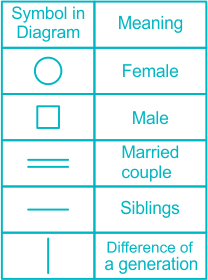 <
Q18 · Alphabet Test
Which letter lies exactly between H and P in the English alphabet?
- K
- N
- L
- M
Answer aur solution dekho
Archived marked answer: C
Given:
First letter = H
Last letter = P
Calculation:
Position of H = 8
Position of P = 16
⇒ Middle position = (8 + 16)
24/2 = 12
12th letter = L
∴ L lies exactly between H and P.
Q19 · Similarity and Differences
Choose the address that is the same as the one given below.
Villa No. 5, Green Meadows,Bannerghatta Road, Bengaluru,Karnataka - 560076
- Villa No. 5, Green Meadows,Bannerghatta Road, Bengaluru,Karnataka - 560076
- Villa No. 5, Green Meadows,Bannerghatta Road, Bengaluru, Andhra Pradesh - 560076
- Villa No. 5, Green Meadows,Bannerghatta Road, Bengaluru, Tamil Nadu - 560076
- Villa No. 5, Green Meadows,Bannerghatta Road, Bengaluru, Kerala - 560076
Answer aur solution dekho
Archived marked answer: A
Given:
Original Address:
Villa No. 5, Green Meadows, Bannerghatta Road, Bengaluru, Karnataka - 560076
Formula used:
Match all details exactly:
⇒ House No.
⇒ Area Name
⇒ Road Name
⇒ City
⇒ State
⇒ PIN Code
Calculation:
Option 1: Karnataka - 560076 ✔
Option 2: Andhra Pradesh - 560076 ✘
Option 3: Tamil Nadu - 560076 ✘
Option 4: Kerala - 560076 ✘
∴ Correct answer is Option 1.
Q20 · Similarity and Differences
Find the ODD one out.
K2, Kangchenjunga, Nanda Devi, Doddabetta, Nanga Parbat
- K2
- Nanda Devi
- Kangchenjunga
- Doddabetta
Answer aur solution dekho
Archived marked answer: D
Given:
K2, Nanda Devi, Kangchenjunga, Doddabetta
Formula used:
Classification by mountain range
Calculation:
K2 → Himalayas
Nanda Devi → Himalayas
Kangchenjunga → Himalayas
Doddabetta → Nilgiri Hills
⇒ 3 belong to Himalayas
⇒ 1 belongs to Nilgiri Hills
∴ Doddabetta is the odd one out.
Q21 · Mathematical Operations
If @ = -, % = x, # = +; then 10 % 2 @ 4 # 3 = ?
- 19
- 12
- 9
- 23
Answer aur solution dekho
Archived marked answer: A
Given:
@ = −
% = ×
# = +
Expression: 10 % 2 @ 4 # 3
Formula used:
BODMAS rule
Calculation:
10 % 2 @ 4 # 3
⇒ 10 × 2 − 4 + 3
⇒ 20 − 4 + 3
⇒ 16 + 3
⇒ 19
∴ Answer = 19
Q22 · Mathematical Operations
The price of an item first increases by 20% and then decreases by 20% from the new price. What is the net percentage change in the original price of the item?
- 0.04%
- -0.04%
- -4%
- 0%
Answer aur solution dekho
Archived marked answer: C
Given:
Increase = 20%
Decrease = 20%
Formula used:
Net % change = a − b − a × b100
Calculation:
a = 20, b = 20
⇒ Net % = 20 − 20 − 20 × 20100
⇒ Net % = 0 − 4
⇒ −4%
∴ Net change = 4% decrease.
Q23 · Number Digit Operations
What is the product of all digits from 0 to 9?
- 326.592
- 0
- 4.536
- 5040
Answer aur solution dekho
Archived marked answer: B
Given:
Digits: 0, 1, 2, 3, 4, 5, 6, 7, 8, 9
Formula used:
Product of numbers
Calculation:
0 × 1 × 2 × 3 × 4 × 5 × 6 × 7 × 8 × 9
⇒ Any number × 0 = 0
⇒ Product = 0
∴ Answer = 0
Q24 · Number Digit Operations
What is the sum of all digits in the telephone dial (0 to 9)?
- 45
- 55
- 50
- 40
Answer aur solution dekho
Archived marked answer: A
Given:
Digits: 0, 1, 2, 3, 4, 5, 6, 7, 8, 9
Formula used:
Sum of first 9 natural numbers = n(n + 1) / 2
Calculation:
Sum = 0 + 1 + 2 + 3 + 4 + 5 + 6 + 7 + 8 + 9
⇒ 1 + 2 + 3 + 4 + 5 + 6 + 7 + 8 + 9
⇒ 9 × 10²
⇒ 45
∴ Answer = 45
Q25 · Syllogism
Statements: Some stars are planets. Some planets are moons. Conclusions: I. Some moons are stars. II. All planets being stars is a possibility.
- Only Conclusion II follows
- Only Conclusion I follows
- Both I and II follow
- Neither I nor II follows
Answer aur solution dekho
Archived marked answer: A
Given:
Statements: Some stars are planets. Some planets are moons.
Conclusions: I. Some moons are stars. II. All planets being stars is a possibility.
Formula used:
Syllogism Rules (Venn Diagram Method)
Calculation:
For Conclusion I:
⇒ Stars and Moons have no direct connection in the basic diagram.
⇒ Conclusion I is "False" (Not a definite follow).
For Conclusion II:
⇒ Statement says "Some stars are planets".
⇒ In a possible case, the set of Planets can be entirely inside the set of Stars.
⇒ This does not contradict the given statements.
⇒ Conclusion II is "True" (Possibility exists).
∴ Only conclusion II follows.
General Awareness
Q1 · Art and Culture
What is a key architectural feature of the Sun Temple at Modhera?
- Gopuram
- Garuda pillar
- Stepped tank
- Vimana
Answer aur solution dekho
Archived marked answer: C
The correct answer is Stepped tank.
Key Points
- The Sun Temple at Modhera, located in Gujarat, India, is a remarkable example of ancient Indian temple architecture built during the reign of the Chalukya dynasty under King Bhima I in 1026-27 CE.
- A defining feature of this temple is its massive and intricately designed stepped tank (Surya Kund), which served as a sacred water reservoir for devotees to perform ablutions before entering the temple.
- The stepped tank is geometrically designed with terraces, symmetrical steps, and numerous small shrines carved into the steps, showcasing exceptional craftsmanship and symmetry.
- The tank is divided into multiple rectangular and square tiers, with steps descending in a pyramid-like fashion, creating a visually stunning layout that enhances the temple's aesthetic appeal.
- The stepped tank not only had religious significance but also served as a water conservation system, demonstrating the advanced engineering and ecological awareness of the time.
Additional Information
- Other Architectural Features of the Sun Temple:
- The temple is designed in the Māru-Gurjara architectural style, characterized by intricate carvings, ornate pillars, and detailed sculptures.
- The main sanctum (Garbhagriha) was constructed in such a way that the first rays of the sun would illuminate the deity, symbolizing the temple's dedication to the Sun God.
- The Sabha Mandapa (assembly hall) is a pillared hall with exquisitely carved pillars and arches, showcasing stories from Hindu mythology.
- The temple is divided into three main components: Garbhagriha (sanctum), Gudha Mandapa (main hall), and Kunda (stepped tank).
- Significance of Stepped Tanks in Indian Architecture:
- Stepped tanks, also known as Kunds or Pushkarnis, were a common feature of ancient Indian temples and served both religious and utilitarian purposes.
- They were used for ritual purification, community gatherings, and water conservation.
- These tanks often contained small shrines dedicated to deities, adding to their religious significance.
- Famous examples of stepped tanks include the Rani ki Vav in Patan and the Chand Baori in Rajasthan.
- Details about Incorrect Options:
- Gopuram: This is a monumental entrance tower commonly found in South Indian temples, especially in Tamil Nadu. It is not a feature of the Sun Temple at Modhera.
- Garuda Pillar: A tall pillar often dedicated to Garuda, the mount of Lord Vishnu, is typically found in Vaishnavite temples but is not a key feature of this temple.
- Vimana: This refers to the tower above the sanctum in South Indian temple architecture. The Sun Temple at Modhera does not have a Vimana as it is built in the Māru-Gurjara style.
Important Points
- The Sun Temple at Modhera is a UNESCO World Heritage Site and a popular tourist attraction.
- The temple is aligned in such a way that during equinoxes, the first rays of the sun illuminate the idol in the sanctum.
- The site is an excellent example of water management systems in ancient India, combining aesthetics and functionality.
- The Modhera Dance Festival is held annually near the temple, celebrating the region's rich cultural heritage.
Q2 · Art and Culture
Which of the following sculptures does not originate from the Mathura region's Kushana-period artistic production?
- Katra Keshav Dev fragment
- Govind Nagar Yaksha
- Bala Buddha of Sultanganj
- Standing Buddha from Govindnagar
Answer aur solution dekho
Archived marked answer: C
The correct answer is Bala Buddha of Sultanganj.
Key Points
- The Bala Buddha of Sultanganj is a sculpture that does not originate from the Mathura region's Kushana-period artistic production.
- It is a famous bronze sculpture from the Gupta period (5th–6th century CE) and was discovered in Sultanganj, Bihar, not Mathura.
- The other sculptures mentioned in the options, such as the Katra Keshav Dev fragment, Govind Nagar Yaksha, and the Standing Buddha from Govindnagar, are directly linked to the Mathura school of art during the Kushana period.
- The Mathura school of art during the Kushana period (1st–3rd century CE) was known for its production of red sandstone sculptures and its unique style of depicting Buddha and other deities.
- The Bala Buddha of Sultanganj, being a Gupta-period artifact, showcases a different artistic style and geographical origin, which differentiates it from the Mathura Kushana-period sculptures.
Additional Information
- Mathura School of Art:
- It flourished during the Kushana period (1st–3rd century CE) and was centered in Mathura, Uttar Pradesh.
- Known for its production of sculptures in red sandstone, it depicted Buddhist, Jain, and Hindu deities.
- Key features include the depiction of Buddha with a distinctive smile, spiritual calmness, and ornamentation.
- Examples include the Standing Buddha from Govindnagar and the Govind Nagar Yaksha.
- Bala Buddha of Sultanganj:
- A famous bronze statue from the Gupta period (5th–6th century CE), discovered in Sultanganj, Bihar.
- It is about 2.3 meters tall and is one of the largest surviving bronze sculptures from ancient India.
- The statue is currently housed in the Birmingham Museum and Art Gallery in the United Kingdom.
- It represents the Gupta style of art, which is known for its refined and graceful depictions of religious figures.
- Kushana Art Characteristics:
- The Kushana period saw the emergence of two major schools of art: the Mathura school and the Gandhara school.
- The Mathura school focused on native Indian art traditions, while the Gandhara school incorporated Greco-Roman influences.
- Sculptures from this period are known for their iconographic innovations and the introduction of the anthropomorphic form of Buddha.
- Comparison of Styles:
- The Mathura school is characterized by red sandstone sculptures with an emphasis on spirituality and indigenous elements.
- The Gupta period art, including the Bala Buddha of Sultanganj, is known for its refinement, grace, and emphasis on idealized human forms.
- The Gupta art style marked the culmination of artistic development in ancient India, often referred to as the Golden Age of Indian Art.
Important Points
- Katra Keshav Dev Fragment: Belongs to the Mathura school of art and represents the indigenous style of the Kushana period.
- Govind Nagar Yaksha: A prominent example of Mathura art that reflects early Kushana-period artistry.
- Standing Buddha from Govindnagar: A red sandstone sculpture that embodies the Mathura style's anthropomorphic depiction of Buddha.
- Bala Buddha of Sultanganj: A Gupta-period bronze sculpture discovered in Bihar, showcasing advanced metallurgical and artistic techniques.
5c:T24
Q3 · Art and Culture
The traditional folk festival 'Phuldei', marked by floral offerings and cultural rituals, is primarily observed in which Indian state?
- Himachal Pradesh
- Jammu and Kashmir
- Uttarakhand
- Assam
Answer aur solution dekho
Archived marked answer: C
The correct answer is Uttarakhand.
Key Points
- Phuldei is a traditional folk festival celebrated in the Indian state of Uttarakhand, primarily observed during the month of March to mark the arrival of spring.
- It is a festival where young children visit houses in their villages and offer flowers, grains, and rice to the house's threshold, wishing prosperity and happiness for the inhabitants.
- The festival is deeply rooted in the cultural and religious traditions of Uttarakhand and reflects the close bond between the people and nature.
- Phuldei is celebrated with various rituals and songs. Children sing folk songs while offering floral tributes, and families prepare traditional dishes such as ‘Puri’ and ‘Singal’.
- This festival symbolizes community harmony, gratitude, and the celebration of nature, which are integral to the culture of Uttarakhand.
Additional Information
- Uttarakhand:
- Uttarakhand, also known as the "Devbhoomi" (Land of Gods), is a northern state in India, famous for its natural beauty, religious heritage, and vibrant folk traditions.
- The state is rich in flora and fauna, and its traditions often revolve around the celebration of nature.
- Other notable festivals celebrated in Uttarakhand include Harela, Bikhauti, and Khatarua.
- Uttarakhand is divided into two regions: Kumaon and Garhwal, each having its own unique cultural practices and festivals.
- The state offers picturesque landscapes, such as the Himalayas, rivers (like Ganga and Yamuna), and forests, making it a significant tourist destination.
- Other Indian States:
- Himachal Pradesh: Known for its snow-clad mountains and vibrant festivals like Losar, Kullu Dussehra, and Minjar.
- Jammu and Kashmir: Famous for its festivals such as Navroz, Eid, and Tulip Festival, and its cultural diversity.
- Assam: Celebrates festivals like Bihu, Ambubachi Mela, and Durga Puja, reflecting its rich tradition and agricultural significance.
- Punjab: Known for its energetic festivals like Lohri, Baisakhi, and Gurpurab, showcasing the vibrancy of Punjabi culture.
-
Important Points
:
- Festivals like Phuldei highlight the importance of preserving cultural heritage and environmental conservation.
- They provide a unique opportunity for communities to come together and celebrate their traditions, fostering social unity.
- Traditional festivals often incorporate seasonal changes, agricultural practices, and gratitude towards nature, making them both culturally and ecologically significant.
60:T1d
Q4 · Indian Polity and Constitution
Read the below statements marked as Assertion (A) and Reason (R). Mark the correct options:
Assertion (A): The Bharatiya Sakshya Adhiniyam recognizes electronic records as primary evidence.
Reason (R): Section 62 states that electronic records are secondary unless accompanied by a printed certificate.
- Both A and R are true, and R is the correct explanation of A.
- Both A and R are true, but R is not the correct explanation of A.
- A is true, R is false.
- A is false, R is true.
Answer aur solution dekho
Archived marked answer: C
The correct answer is 3) A is true, R is false.
Key Points
- Assertion (A): The Bharatiya Sakshya Adhiniyam (Indian Evidence Act) recognizes electronic records as primary evidence. This is correct as per the provisions of the Indian Evidence Act, 1872, specifically Section 65B, which deals with the admissibility of electronic records.
- Reason (R): Section 62 does not state that electronic records are secondary unless accompanied by a printed certificate. Instead, Section 62 of the Indian Evidence Act defines primary evidence as the original document produced for inspection. Thus, this statement is incorrect as it misrepresents the law.
- The admissibility of electronic records is governed under Section 65B, not Section 62. Section 65B provides special provisions for electronic records to be treated as evidence under certain conditions.
- Electronic records, when accompanied by a valid certificate under Section 65B(4), are
Q5 · Indian Economy
Read the below statements marked as Assertion (A) and Reason (R). Mark the correct option:
Assertion (A): CRR (Cash Reserve Ratio) and SLR requirements increase the lending capacity of banks.
Reason (R): These requirements reduce the amount of money banks can lend to the public.
- Both A and R are true, and R is the correct explanation of A.
- Both A and R are true, but R is not the correct explanation of A.
- A is true, but R is false.
- A is false, but R is true.
Answer aur solution dekho
Archived marked answer: D
The correct answer is 4) A is false, but R is true..
Key Points
- Assertion (A): CRR (Cash Reserve Ratio) and SLR requirements increase the lending capacity of banks. - This statement is false. CRR and SLR requirements, instead of increasing the lending capacity, reduce the amount of money that banks can lend to the public. Banks are mandated to keep a certain percentage of their deposits as reserves, thereby limiting the funds available for lending.
- Reason (R): These requirements reduce the amount of money banks can lend to the public. - This statement is true. Both CRR and SLR are regulatory mechanisms aimed at ensuring liquidity and financial stability. By mandating banks to maintain reserves, they restrict the banks' ability to lend excessively, thus reducing the lending capacity.
- CRR (Cash Reserve Ratio): - It is the percentage of total deposits that banks are required to keep with the Reserve Bank of India (RBI) as reserves. This is done to ensure liquidity in the banking system and control inflation.
- SLR (Statutory Liquidity Ratio): - It is the percentage of net demand and time liabilities (NDTL) that banks must maintain in the form of liquid assets like cash, gold, or government-approved securities. SLR ensures financial stability and liquidity.
- Correct Explanation: - The Reason (R) correctly explains the impact of CRR and SLR requirements on banks' lending capacity, as these requirements directly reduce the funds available for lending by the banks.
Additional Information
- CRR (Cash Reserve Ratio):
- CRR is set by the Reserve Bank of India (RBI) and currently ranges between 3% to 5%, depending on the economic situation.
- Higher CRR helps control inflation by reducing liquidity, while lower CRR boosts economic growth by increasing liquidity.
- Banks do not earn any interest on the funds kept as CRR with the RBI.
- SLR (Statutory Liquidity Ratio):
- SLR is also regulated by the RBI and is generally maintained between 18% to 23% of NDTL.
- Unlike CRR, banks earn returns on the assets maintained under SLR, such as government securities.
- SLR serves as a tool for regulating inflation and ensuring the financial stability of banks.
- Key Objectives of CRR and SLR:
- Control liquidity in the economy.
- Ensure financial stability and prevent excessive lending by banks.
- Help the government in borrowing funds by mandating banks to invest in government securities.
- Impact on the Economy:
- Both CRR and SLR play a crucial role in monetary policy implementation.
- Higher reserves reduce inflationary pressures but may slow down economic growth.
- Lower reserves increase liquidity and boost lending but may lead to inflation.
Important Points
- Difference Between CRR and SLR:
- CRR: Funds are kept with the RBI; banks earn no interest.
- SLR: Funds are invested in liquid assets like government securities; banks earn returns.
- Impact on Lending:
- Higher CRR and SLR reduce banks' ability to lend, curbing liquidity in the economy.
- Lower CRR and SLR increase lending capacity, promoting economic growth.
- Examples of Application:
- During inflationary periods, CRR and SLR are increased to reduce liquidity.
- During economic slowdown, CRR and SLR are reduced to enhance liquidity and boost lending.
</ul
Q6 · Indian Economy
Which of the following accurately reflects the constitutional provisions and historical application of Financial Emergency under Article 360?
- No Financial Emergency has ever been declared, but it allows salary cuts of SC judges.
- A Financial Emergency was declared during the 1991 economic crisis.
- Article 360 allows states to withhold salaries of central employees.
- During a Financial Emergency, only the President can dismiss the Union Cabinet.
Answer aur solution dekho
Archived marked answer: A
The correct answer is No Financial Emergency has ever been declared, but it allows salary cuts of SC judges..
Key Points
- Article 360 of the Indian Constitution provides the framework for declaring a Financial Emergency when the financial stability or credit of India or any part of its territory is threatened.
- No Financial Emergency has ever been declared in India since the adoption of the Constitution in 1950. *(Statement 1 is correct)*
- Under a Financial Emergency, the President of India can direct the reduction of salaries and allowances of all or any class of persons serving the Union or a State, including the judges of the Supreme Court and High Courts. *(Statement 1 is correct)*
- The claim that a Financial Emergency was declared during the 1991 economic crisis is incorrect, as no such emergency was formally invoked during that period. *(Statement 2 is incorrect)*
- Article 360 does not empower states to withhold the salaries of central employees. Such an interpretation is incorrect. *(Statement 3 is incorrect)*
- While the Financial Emergency grants the President extensive powers, it does not include the authority to dismiss the Union Cabinet. *(Statement 4 is incorrect)*
Additional Information
- What happens during a Financial Emergency:
- The President can direct the reduction of salaries and allowances of Union and State government employees.
- All money bills and financial bills passed by the State Legislature can be reserved for the President's consideration.
- The President can direct the State to observe financial propriety measures.
- Proclamation of Financial Emergency:
- A Financial Emergency can be proclaimed under Article 360 by the President if satisfied that the financial stability or credit of India or its territory is threatened.
- The proclamation must be approved by both Houses of Parliament within two months.
- Comparison with other emergencies:
- National Emergency (Article 352): Deals with threats to the security of India due to war, external aggression, or armed rebellion.
- President’s Rule (Article 356): Deals with the failure of constitutional machinery in a state.
- Key Facts:
- The provision for Financial Emergency has never been used in India.
- The 1991 economic crisis was managed through economic reforms and IMF support, not through a Financial Emergency.
Important Points
- The Constitution of India envisions three types of emergencies: National, State, and Financial.
- Financial Emergency provisions are meant to safeguard economic stability and ensure fiscal discipline during severe financial crises.
- The power to reduce the salaries of Supreme Court and High Court judges during a Financial Emergency is a significant authority granted to the President under this article.
- India has dealt with economic crises in the past, such as in 1991, through policy measures rather than invoking constitutional emergencies.
Q7 · Indian Economy
Why are grants for asset creation still considered Revenue Expenditure?
- They are spent through government loans
- They are used only by private sector units
- They do not create direct central assets
- They are not included in any budget head
Answer aur solution dekho
Archived marked answer: C
The correct answer is They do not create direct central assets.
Key Points
- Revenue Expenditure refers to the expenses incurred by the government for its day-to-day functioning, such as salaries, subsidies, interest payments, and grants.
- Grants for asset creation, although they might lead to the creation of assets, are considered revenue expenditure because these assets are not owned by the central government but by other entities like state governments, local bodies, or private organizations.
- The grants are used to support projects or schemes implemented by other entities, and the central government does not directly derive ownership or control over the created assets.
- Such expenditures are categorized under revenue expenditure as they do not contribute to the direct creation of tangible central assets but rather facilitate broader developmental goals through financial assistance.
- This classification aligns with accounting principles and government budgetary norms, where the ownership and control of the resultant asset determine whether an expenditure is capital or revenue.
Additional Information
- Revenue Expenditure:
- It includes expenses incurred for operational purposes, such as administrative costs, subsidies, pensions, and interest payments.
- Expenditure is recurring in nature and does not result in the creation of physical assets.
- Examples: Salaries of government employees, maintenance of infrastructure, and grants to state governments or NGOs.
- Capital Expenditure:
- Capital expenditure involves investment in assets or projects that provide benefits over a long period.
- Examples include building infrastructure like roads, bridges, and power plants.
- It is considered an investment in the economic capacity of the nation and is reflected in the government’s asset accounts.
- Grants for Asset Creation:
- Such grants are provided by the central government to state governments, local bodies, or private organizations to assist in the creation of specific assets or projects.
- The ownership of these assets does not remain with the central government, and thus the grants are recorded as revenue expenditure.
- Examples: Grants for rural infrastructure, urban development projects, or welfare schemes.
- Budgetary Classification:
- Government budgets classify expenditures into revenue and capital to ensure transparency and proper monitoring of public finances.
- Revenue expenditure affects the government’s revenue deficit, while capital expenditure impacts the fiscal deficit.
- Key Differences:
- Revenue expenditure: Short-term benefits, recurring, no asset creation.
- Capital expenditure: Long-term benefits, non-recurring, leads to asset creation.
Important Points
- Accounting Standards: Government accounting guidelines distinguish between revenue and capital expenditure based on asset ownership and the duration of benefits.
- Examples of Revenue Expenditure: Grants for rural employment schemes (e.g., MGNREGA), subsidies for fertilizers, and interest payments on loans.
- Impact on Budget: High revenue expenditure can lead to a higher revenue deficit, indicating a need for better fiscal management.
- Policy Implications: Classifying grants for asset creation as revenue expenditure emphasizes the importance of ownership in determining the nature of government spending.
7e
Q8 · Indian Economy
What was the central theme of the Industrial Policy Resolution of 1956?
- Full privatisation of industry
- Import-led growth strategy
- State control of commanding heights of the economy
- Promoting consumer goods industry
Answer aur solution dekho
Archived marked answer: C
The correct answer is State control of commanding heights of the economy.
Key Points
- The Industrial Policy Resolution of 1956 emphasized the concept of "commanding heights" of the economy, wherein core industries and key sectors were to be under the control of the state to ensure economic growth and equitable distribution of resources.
- This policy classified industries into three categories: Schedule A (exclusively under state control), Schedule B (mixed state and private sector control), and Schedule C (open to private investment).
- The resolution aimed to implement a socialistic pattern of society, focusing on reducing income inequalities and ensuring social justice by promoting state ownership in key sectors like steel, coal, and heavy machinery.
- The public sector was envisioned to play a pivotal role in industrial development, while the private sector was expected to complement the efforts of the state in less critical sectors.
- This policy laid the foundation for planned economic development in India, with the state playing a significant role in areas crucial for national security, infrastructure, and technological advancement.
Additional Information
- Key Features of the Industrial Policy Resolution of 1956:
- The resolution introduced the concept of planned industrial development under the purview of the state to achieve economic self-reliance.
- It declared 17 industries (such as iron and steel, atomic energy, heavy machinery, and defense production) exclusively reserved for the public sector under Schedule A.
- 12 industries were included in Schedule B, where both the state and private sectors could operate, with the state taking the lead in establishing new units.
- All remaining industries were included in Schedule C, which were left open for private investment and initiatives.
- Emphasis was placed on small-scale industries (SSI) to promote regional development and employment generation in rural areas.
- Objectives of the Policy:
- To accelerate the pace of industrialization and achieve economic self-reliance.
- To reduce regional imbalances by ensuring equitable distribution of industries across the country.
- To create employment opportunities and improve the standard of living for the masses.
- To promote the socialistic pattern of society by reducing income inequalities and ensuring public ownership of key industries.
- Impact of the Industrial Policy Resolution of 1956:
- It laid the foundation for the public sector-led industrial development in India.
- Key industries like steel, coal, and heavy engineering were established under state control, leading to the development of core infrastructure and capabilities.
- The policy also promoted the growth of small-scale industries, which played a critical role in rural development and employment generation.
- However, over time, the dominance of the public sector led to inefficiencies and stagnation, necessitating economic reforms in the 1990s.
- Comparison of Other Options:
- Option 1: Full privatization of industry - This was not the theme of the 1956 policy, as it focused on public sector dominance and state control of key industries.
- Option 2: Import-led growth strategy - The policy emphasized self-reliance and indigenous development, not an import-led strategy.
- Option 4: Promoting consumer goods industry - While important, this was not the primary focus; heavy industries and infrastructure were prioritized.
Important Points
- The Industrial Policy Resolution of 1956 is often considered the economic constitution of India, as it defined the role of the state and private sectors in industrial development.
- It was aligned with the broader goals of the Second Five-Year Plan, which focused on industrialization and building the economic infrastructure of the nation.
- The policy was instrumental in shaping India's mixed economy model, blending state-led planning with private sector participation in non-core industries. </ul
Q9 · Indian Economy
The rolling plan concept was introduced during which Prime Minister's tenure?
- Jawaharlal Nehru
- Indira Gandhi
- Morarji Desai
- Rajiv Gandhi
Answer aur solution dekho
Archived marked answer: C
The correct answer is Morarji Desai.
Key Points
- The concept of a Rolling Plan was introduced during the tenure of Morarji Desai, who served as the Prime Minister of India from 1977 to 1979.
- A Rolling Plan implies that the plan would be dynamic and could be revised annually based on the country's economic performance and changing needs.
- This approach was introduced as an alternative to the traditional Five-Year Plans, emphasizing flexibility in planning.
- During Morarji Desai's tenure, the Janata Party government discarded the Fifth Five-Year Plan (1974–79) introduced by the previous government under Indira Gandhi.
- The Rolling Plan was implemented for the years 1978–1980, but it was discontinued after Indira Gandhi returned to power in 1980 and resumed the Five-Year Planning model.
- The Rolling Plan was considered innovative as it focused on short-term adjustments rather than rigid long-term strategies, ensuring better responsiveness to economic fluctuations.
Additional Information
- Five-Year Plans in India:
- The concept of Five-Year Plans was introduced by the Planning Commission of India in 1951, inspired by the Soviet model.
- India's first Five-Year Plan (1951–56) focused on agriculture, irrigation, and community development.
- Subsequent Five-Year Plans addressed various sectors, including industry, infrastructure, education, and health.
- The Planning Commission was replaced by NITI Aayog in 2015 under the Narendra Modi government, ending the era of Five-Year Plans.
- Morarji Desai:
- Morarji Desai was India’s fourth Prime Minister and the first non-Congress leader to hold the position.
- He served as Prime Minister from March 1977 to July 1979 during the Janata Party government.
- His tenure emphasized transparency, anti-corruption, and economic reforms.
- He was awarded the Bharat Ratna in 1991 for his service to the nation.
- Concept of Rolling Plan:
- A Rolling Plan is a continuous plan that is updated annually or periodically to reflect changes in economic conditions and priorities.
- It provides flexibility and adaptability, allowing policymakers to revise objectives and allocations in response to current developments.
- This approach contrasts with fixed long-term plans, which may become outdated if circumstances change.
- Indira Gandhi’s Return to Five-Year Plans:
- When Indira Gandhi returned to power in 1980, she reinstated the Five-Year Plan model, starting with the Sixth Five-Year Plan (1980–85).
- Her approach focused on long-term planning to achieve sustained economic growth and development.
Important Points
- Advantages of Rolling Plans:
- Provides flexibility to adjust to unforeseen economic changes.
- Allows for more accurate forecasting and resource allocation.
- Focuses on short-term goals while maintaining long-term objectives.
- Disadvantages of Rolling Plans:
- Frequent revisions can lead to administrative complications.
- Lack of long-term vision may hinder sustained development.
- Uncertainty in planning could impact investor confidence.
- The Rolling Plan concept was eventually abandoned due to its challenges and inefficiencies compared to structured Five-Year Plans.
Q10 · Indian Economy
What was the major short-term objective of the stabilization measures in the 1991 reforms?
- Increase agricultural production
- Enhance social sector spending
- Control inflation and restore balance of payments
- Privatize public sector units
Answer aur solution dekho
Archived marked answer: C
The correct answer is Control inflation and restore balance of payments.
Key Points
- The primary short-term objective of the 1991 economic reforms in India was to control inflation and address the crisis in the balance of payments (BoP). During this period, India was facing a severe economic crisis, with foreign exchange reserves falling to alarmingly low levels.
- By the early 1990s, India's fiscal deficit had ballooned to unsustainable levels, and the country was on the verge of defaulting on its external payments. The balance of payments crisis necessitated immediate corrective measures.
- The stabilization measures aimed to introduce macroeconomic stability by reducing fiscal deficits, controlling runaway inflation, and encouraging foreign investments to stabilize the economy.
- A key step in addressing the BoP crisis was to secure a loan from the International Monetary Fund (IMF) by pledging gold reserves and implementing structural adjustment reforms, including liberalization and deregulation of the economy.
- These stabilization measures were part of a broader set of economic reforms, including the liberalization of trade and industries, aimed at transitioning India toward a more open and market-driven economy.
Additional Information
- Economic Background in 1991:
- India faced a severe fiscal and BoP crisis in 1991, with foreign exchange reserves sufficient for less than three weeks of imports.
- The fiscal deficit was approximately 8.4% of GDP, while inflation peaked at 17% in August 1991.
- The Gulf War in 1990-91 further worsened the situation by increasing oil prices, leading to a sharp rise in import costs.
- Key Components of Stabilization Measures:
- Devaluation of the Rupee (July 1991): The Indian Rupee was devalued to encourage exports and reduce the trade deficit.
- Reduction in fiscal deficit: Government spending was curtailed, subsidies were reduced, and tax reforms were introduced to increase revenue.
- Monetary tightening: The Reserve Bank of India (RBI) adopted policies to control inflation by increasing interest rates and reducing money supply.
- Trade liberalization: Import restrictions were eased, and tariffs were lowered to promote competitiveness and attract foreign investments.
- International Monetary Fund (IMF) Role:
- India sought assistance from the IMF, which provided a loan of $2.2 billion under its structural adjustment program.
- The loan was conditional upon the implementation of economic reforms, including liberalization, privatization, and globalization (LPG).
- Long-term Implications of the 1991 Reforms:
- The reforms laid the foundation for India's transition to a market-oriented economy.
- India's GDP growth rate improved significantly, and foreign exchange reserves increased over time.
- The liberalization of industries and foreign trade paved the way for foreign direct investment (FDI) and technological advancements.
Important Points
- Other Objectives of the 1991 Reforms:
- Privatization: Reducing the role of public sector enterprises and encouraging private sector participation in the economy.
- Liberalization: Removing barriers to trade, such as reducing import tariffs and allowing foreign investments in various sectors.
- Globalization: Integrating the Indian economy with the global economy by promoting exports and foreign trade.
- Key Agencies and Policies Introduced:
- The establishment of the SEBI (Securities and Exchange Board of India) to regulate the stock market and promote transparency.
- Introduction of the New Industrial Policy of 1991, which abolished the License Raj and reduced the number of industries reserved for the public sector.
- Reforms in the banking and financial sector to improve efficiency and encourage competition.
</ul
Q11 · Sports Static GK
Statements about Indian Athletics:
1. Milkha Singh was the first Indian athlete to win an individual Commonwealth Games gold medal.
2. At Moscow 1980 Olympics PT Usha miss a bronze in 400m hurdles by one hundredth of a second at age 20.
3. The National Institute of Sports is located in Pune.
Which of these statements are correct?
- Only 1 is Correct
- Only 2 and 3 are Correct
- Only 2 is Correct
- Only 3 is Correct
Answer aur solution dekho
Archived marked answer: A
The correct answer is Option 1: Only 1 is Correct.
Key Points
- Statement 1: Milkha Singh was the first Indian athlete to win an individual Commonwealth Games gold medal. This statement is correct. Milkha Singh achieved this historic feat in the 1958 Commonwealth Games held in Cardiff, Wales, by winning the gold medal in the 440 yards race. He remains a legendary figure in Indian athletics.
- Statement 2: PT Usha missed a bronze medal in 400m hurdles at Moscow Olympics 1980 by one hundredth of a second at age 20. This statement is incorrect. PT Usha missed a bronze medal in the 1984 Los Angeles Olympics, not the Moscow Olympics. Additionally, the event was the 400m hurdles, but she was 2
Q12 · Sports Static GK
Match the Water Polo terms with their correct definitions:
Terms
<
- A-1, B-3, C-2, D-4
- A-3, B-2, C-1, D-4
- A-2, B-4, C-3, D-1
- A-4, B-1, C-2, D-3
Answer aur solution dekho
Archived marked answer: B
The correct answer is A - 3, B - 2, C - 1, D - 4.
Key Points
- Center forward: This term refers to the main attacking player positioned near the opponent's goal between the 2-meter and 4-meter lines. This player is typically responsible for creating goal-scoring opportunities. *Hence, A is correctly matched with 3.*
- Driver: A driver is a player who swims quickly into goal-scoring position without the ball, aiming to receive a pass for an attack or goal. They are known for their agility and ability to create space for scoring. *Hence, B is correctly matched with 2.*
- Center back: This defensive player counters the opposition's main attacker, often the center forward. Their role is crucial in preventing goals and ma
Q13 · Sports Static GK
In a Grand Slam men's singles match, when is a fifth set tiebreak played under current rules?
- Only after 12-12 games in the fifth set
- At 6-6 in the fifth set
- No tiebreak is allowed in the fifth set
- After 10-10 in the fifth set
Answer aur solution dekho
Archived marked answer: A
The correct answer is Only after 12-12 games in the fifth set.
Key Points
- Grand Slam Men's Singles Matches: In Grand Slam tournaments like Wimbledon, US Open, Australian Open, and French Open, specific rules govern the fifth set of men's singles matches.
- Introduction of the Fifth Set Tiebreak Rule: The rule of a tiebreak being played after 12-12 in the fifth set was introduced to prevent matches from dragging indefinitely, ensuring fair competition while managing time constraints.
- Application of the Rule: Under the current rules, a tiebreak is played only after both players reach 12-12 games in the fifth set. This ensures that players still have a chance to win through extended play but avoids excessively long matches.
- Notable Example: This rule was famously applied in the 2019 Wimbledon final between Novak Djokovic and Roger Federer, where the fifth set tiebreak was played after a 12-12
Q14 · Sports Static GK
Where was the Katakkar Trophy's All India Inter-Club Winter Water Polo League (2024-25) held?
- Shivaji Park Swimming Complex, Mumbai
- Tilak Tank, Deccan Gymkhana, Pune
- Balewadi Sports Complex, Pune
- Shiv Nadar Aquatics Centre, Hyderabad
Answer aur solution dekho
Archived marked answer: B
The correct answer is Tilak Tank, Deccan Gymkhana, Pune.
Key Points
- The Katakkar Trophy's All India Inter-Club Winter Water Polo League for the year 2024-25 was held at the Tilak Tank, Deccan Gymkhana, Pune, a venue known for hosting various water sports events.
- Tilak Tank is located at the Deccan Gymkhana Club in Pune, Maharashtra, which is a renowned center for sports and recreational activities.
- The event witnessed participation from numerous water polo clubs across India, showcasing talent and competitive spirit in the field of water polo.
- The Deccan Gymkhana Club is historically significant and has hosted several state and national-level sports events, making it a perfect venue for such a prestigious tournament.
- Water polo leagues like the Katakkar Trophy play a crucial role in promoting the sport and encouraging young athletes to participate in aquatic sports.
Additional Information
- Tilak Tank, Pune:
- Located within the premises of the Deccan Gymkhana Club, Tilak Tank is a well-maintained swimming and water sports facility.
- It is named after Bal Gangadhar Tilak, a prominent freedom fighter and social reformer from Maharashtra.
- The facility is equipped with a standard-sized pool suitable for hosting professional water polo tournaments.
- Over the years, it has become a hub for swimming, water polo, and other aquatic sports in the region.
- Importance of Water Polo in India:
- Water polo is a growing sport in India, with a rich history and a dedicated following.
- Events like the Katakkar Trophy encourage participation at the grassroots level, helping to nurture talent.
- It is governed by the Swimming Federation of India (SFI), which oversees water polo events and promotes the sport nationwide.
- India has had notable performances in water polo at the Asian Games and other international competitions in the past.
- Deccan Gymkhana Club:
- Established in 1906, the Deccan Gymkhana Club is one of the oldest sports clubs in Pune.
- It offers facilities for a range of sports, including swimming, cricket, tennis, badminton, and athletics.
- It has been a breeding ground for numerous national and international athletes over the years.
- Other Venues Considered:
- Shivaji Park Swimming Complex, Mumbai: A popular venue for swimming and water polo events in Mumbai, but not the host for the 2024-25 Katakkar Trophy.
- Balewadi Sports Complex, Pune: Known for hosting large-scale sports events, but this specific league was held at Tilak Tank.
- Shiv Nadar Aquatics Centre, Hyderabad: A premier aquatic facility in Hyderabad, but it was not selected as the venue for this tournament.
- Significance of Katakkar Trophy:
- The Katakkar Trophy is a highly regarded water polo league in India, aimed at promoting inter-club competition and enhancing the sport's visibility.
- It helps in identifying emerging talent and providing players with a platform to showcase their skills. </ul
Q15 · Modern Indian History
Fill in the blank:
Pitt's India Act 1784 created a six-member body called the _______ to supervise Company politics.
- Board of Control
- Council of India
- Privy Council
- Bureau of Revenue
Answer aur solution dekho
Archived marked answer: A
The correct answer is Board of Control.
Key Points
- The Pitt's India Act of 1784 was introduced to address the weaknesses of the Regulating Act of 1773 by creating a dual system of control for the British East India Company.
- The Act established a six-member body known as the Board of Control, which was empowered to oversee and manage the political and military affairs of the company in India.
- This Board of Control consisted of members of the British government, including the Chancellor of the Exchequer and the Secretary of State. They acted on behalf of the Crown to ensure better governance in India.
- While the Board of Control managed political and military aspects, the Court of Directors of the East India Company was allowed to retain control over trade and administrative matters.
- The creation of the Board of Control marked the beginning of increased British Crown intervention in the administration of India, laying the foundation for the eventual transfer of power from the Company to the Crown in 1858.
Additional Information
- Pitt's India Act of 1784:
- The Act was introduced by British Prime Minister William Pitt the Younger to rectify the shortcomings of the Regulating Act of 1773.
- It divided the Company’s functions into commercial and political spheres, with political activities coming under the control of the Board of Control.
- The Act also strengthened parliamentary oversight of the Company’s affairs in India.
- Dual System of Control:
- The governance of India was divided between the Board of Control (representing the British Crown) and the Court of Directors (representing the East India Company).
- This system ensured that the Crown had ultimate authority over political decisions, while the Company retained control over trade and finance.
- Impact of Pitt's India Act:
- The Act paved the way for the gradual centralization of authority in British India.
- It highlighted the growing importance of India to the British Empire and the need for better administrative control.
- This Act was one of the first steps towards the eventual abolition of the East India Company's rule in India in 1858.
- Other Important Provisions of the Act:
- The Governor-General's Council in India was restructured to ensure better governance.
- The Act also allowed for the impeachment of Company officials in case of corruption or maladministration.
Important Points
- Council of India: This was established later under the Government of India Act of 1858 when the control of India was transferred from the East India Company to the British Crown.
- Privy Council: This was a body of advisors to the British monarch and had no direct role in the administration of India.
- Bureau of Revenue: This was not an entity created under Pitt's India Act. Revenue administration in India was managed by Company officials under the supervision of the Governor-General.
```
68
Q16 · Modern Indian History
The Chapekar Brothers (Damodar, Balkrishna, and Vasudeo) are remembered for assassinating a British official in response to injustices during the plague epidemic in which Indian city?
- Mumbai
- Delhi
- Pune
- Chennai
Answer aur solution dekho
Archived marked answer: C
The correct answer is Pune.
Key Points
- The Chapekar Brothers—Damodar, Balkrishna, and Vasudeo—were Indian freedom fighters who are remembered for their revolutionary activities against British rule.
- They assassinated W.C. Rand, the British Plague Commissioner, on 22 June 1897, in Pune, Maharashtra.
- This act was carried out in response to the oppressive measures and atrocities committed by British officials during the bubonic plague epidemic in Pune.
- The British administration’s handling of the plague outbreak involved invasive house inspections, forced evacuations, and harassment of Indian women, which angered the local population and the Chapekar Brothers.
- The assassination of Rand and his military escort Lt. Ayerst marked one of the early revolutionary actions against British rule in India, inspi
Q17 · Modern Indian History
Read the following statements and mark the correct option:
Assertion (A): Rani Gaidinliu continued the Heraka movement after the death of Jadonang.
Reason (R): She aimed to convert the movement into a mass literacy campaign among Nagas.
- Both A and R are true, and R is the correct explanation of A.
- Both A and R are true, but R is not the correct explanation of A.
- A is true, but R is false.
- A is false, but R is true.
Answer aur solution dekho
Archived marked answer: C
The correct answer is Option 3.
Key Points
- Assertion (A): Rani Gaidinliu continued the Heraka movement after the death of Jadonang. This statement is correct.
- Rani Gaidinliu was a Naga spiritual leader and freedom fighter who assumed leadership of the Heraka movement following the execution of Jadonang by the British in 1931.
- The Heraka movement, initiated by Jadonang, was a socio-religious reform movement aimed at promoting cultural and spiritual unity among the Nagas.
- Reason (R): She aimed to convert the movement into a mass literacy campaign among Nagas. This statement is incorrect.
- While Rani Gaidinliu significantly contributed to the preservation of Naga traditions and resistance against British colonialism, her focus was primarily on spiritual and political liberation rather than literacy campaigns.
- The movement under her leadership evolved into a struggle against British rule and later became associated with Indian independence.
- Since the assertion is true but the reason is false, Option 3 is the correct answer.
Additional Information
- Rani Gaidinliu:
- Born on 26 January 1915 in the Tamenglong district of Manipur, she is often referred to as the "Rani of Nagas."
- She was a follower of Jadonang and continued his efforts to revive the Heraka faith after his death.
- She led an armed rebellion against British colonial rule and fought to preserve Naga culture and independence.
- She was arrested in 1932 and imprisoned for 14 years, earning recognition as a freedom fighter.
- After India's independence, she was awarded the Padma Bhushan in 1982 for her contributions.
- Heraka Movement:
- Heraka means "pure religion" and was a spiritual reform movement among the Zeliangrong Nagas.
- It advocated monotheism, the rejection of superstitions, and cultural unity among the Nagas.
- The movement later became a symbol of resistance against British colonial oppression.
- Jadonang:
- Jadonang was a Naga leader who founded the Heraka movement in the 1920s.
- He envisioned a Naga Raj (Naga Kingdom) and resisted British colonial rule.
- He was executed by the British in 1931, prompting Rani Gaidinliu to take over the leadership.
- Freedom Struggles in Northeast India:
- The freedom movement in Northeast India was marked by socio-religious reforms and resistance against British colonial policies.
- Leaders like Rani Gaidinliu and Jadonang played key roles in preserving indigenous cultures while fighting for independence.
- The region's unique identity and challenges made its contribution to India's freedom struggle distinct.
Important Points
- Key Legal and Historical Developments:
- Rani Gaidinliu's leadership of the Heraka movement symbolized the combination of cultural preservation and political resistance.
- Her imprisonment by the British and subsequent recognition as a freedom fighter highlight her importance in India's independence history.
- Her efforts have inspired movements for cultural preservation and socio-political unity in Northeast India.
- Recognition of Contributions:
- Rani Gaidinliu's contributions are celebrated through monuments, awards, and government initiatives in India.
- The Indian government issued a commemorative stamp in 1996 in her honor.
``
Q18 · General Science Biology
What is the audible frequency range for the human ear?
- 0-10000 Hz
- 20-20,000 Hz
- 2 kHz-20 kHz
- 100-1000 Hz
Answer aur solution dekho
Archived marked answer: B
The correct answer is 20-20,000 Hz.
Key Points
- The audible frequency range for the human ear typically spans from 20 Hz to 20,000 Hz. This range is considered the standard for human hearing across different age groups and conditions.
- Frequencies below 20 Hz are referred to as infrasound, and frequencies above 20,000 Hz are called ultrasound. These are outside the range of human hearing.
- The sensitivity of human hearing varies with frequency. Humans are most sensitive to sounds in the range of approximately 2 kHz to 5 kHz, which corresponds to everyday sounds like speech.
- As humans age, the ability to hear higher frequencies diminishes. For instance, older individuals may lose sensitivity to sounds above 15,000 Hz.
- The audible range is crucial for various applications such as speech communication, music, and acoustic engineering, ensuring devices like headphones and speakers cater to this range.
Additional Information
- Characteristics of Human Hearing:
- Humans can perceive both pitch (frequency) and intensity (loudness) of sound waves within the audible range.
- The threshold of hearing (minimum audible sound) is around 0 dB, while the threshold of pain is approximately 120-130 dB.
- Hearing ability is influenced by factors such as age, environment, and health conditions.
- Infrasound:
- Frequencies below 20 Hz are known as infrasound. These are produced by natural phenomena like earthquakes, volcanic eruptions, and ocean waves.
- Though humans cannot hear infrasound, it can be felt as vibrations and has applications in seismic monitoring.
- Ultrasound:
- Frequencies above 20,000 Hz are termed ultrasound. It is widely used in medical imaging, industrial applications, and cleaning.
- Animals such as bats and dolphins can hear ultrasound and utilize it for navigation and communication.
- Applications of Audible Range Knowledge:
- Design of audio equipment like microphones, speakers, and headphones is based on the human audible range.
- Technological advancements in fields like telecommunications, music production, and hearing aids rely on understanding the auditory spectrum.
- Important Facts:
- The human auditory system includes the outer ear, middle ear, and inner ear, working together to process sound waves.
- The study of human hearing is essential in disciplines such as audiology, acoustics, and psychoacoustics.
- Hearing tests, such as pure tone audiometry, are used to determine the audible frequency range of individuals.
``
Q19 · Medieval Indian History
Which fourteenth-century traveller described how Indian chieftains fortified themselves using bamboo groves and rugged terrains for defence?
- Al-Biruni
- Ibn Battuta
- Marco Polo
- Megasthenes
Answer aur solution dekho
Archived marked answer: B
The correct answer is Ibn Battuta.
Key Points
- Ibn Battuta, a Moroccan traveller, visited India during the reign of Mohammad bin Tughlaq in the 14th century.
- He documented his experiences in his travelogue called "Rihla" (The Journey), which provides detailed insights into the social, political, and cultural aspects of regions he visited.
- In his accounts, Ibn Battuta described how Indian chieftains used bamboo groves and rugged terrains for fortifications as part of their defence strategies.
- Bamboo was a plentiful resource in India and was ingeniously used for creating barriers and fortifications to protect villages and settlements.
- His observations provide a valuable understanding of medieval Indian warfare tactics and the ingenuity of local rulers in utilizing natural resources.
Additional Information
- Ibn Battuta:
- Born in 1304 in Tangier, Morocco, he was one of the greatest travellers of the medieval period.
- He travelled extensively across North Africa, the Middle East, Central Asia, South Asia, and China, covering approximately 75,000 miles.
- His travelogue, "Rihla," is considered one of the most comprehensive records of medieval geography and culture.
- Mohammad bin Tughlaq:
- He was a ruler of the Tughlaq dynasty who reigned from 1325 to 1351.
- Known for his ambitious but often impractical ideas, he invited scholars and travellers like Ibn Battuta to his court.
- Ibn Battuta served as the Qadi (judge) in Mohammad bin Tughlaq's court.
- Use of Bamboo in Fortifications:
- Bamboo was widely used in medieval India due to its abundance, flexibility, and durability.
- It was employed in constructing barriers, defensive structures, and even in traps for invading armies.
- Such fortifications were effective in protecting settlements from external threats, especially in regions with dense forests and rugged terrains.
- Other Notable Travellers:
- Al-Biruni: A Persian scholar who visited India in the 11th century and authored "Kitab al-Hind", detailing the socio-cultural aspects of India.
- Marco Polo: A Venetian traveller who visited southern India in the late 13th century, documenting the region's trade and culture.
- Megasthenes: A Greek ambassador to the Mauryan court of Chandragupta, who wrote "Indica", describing India's geography and administration.
Important Points
- Travelogues like Ibn Battuta's "Rihla" serve as crucial historical records, offering firsthand accounts of the societies, economies, and cultures of the regions visited.
- Bamboo fortifications highlight the ingenuity and resourcefulness of medieval Indian rulers in utilizing locally available materials for defence.
- The reign of Mohammad bin Tughlaq is notable for its interactions with foreign scholars and travellers, which enriched India's historical narrative.
- Comparisons of travel accounts from different travellers like Al-Biruni, Marco Polo, and Megasthenes help historians understand the evolution of Indian society over centuries. </ul
Q20 · Ancient Indian History
In the context of Gupta dynasty's urban administration, which of the following statements about the Adhishthanadhikarana is correct?
- It was a military council composed entirely of royal generals.
- It was a court of law dealing exclusively with religious matters.
- It was a Board of Advisors representing guilds, artisans, and scribes.
- It was a temple committee managing offerings and rituals.
Answer aur solution dekho
Archived marked answer: C
The correct answer is It was a Board of Advisors representing guilds, artisans, and scribes.
Key Points
- The Adhishthanadhikarana was a key administrative body during the Gupta dynasty, focusing on urban governance and decision-making processes.
- It served as a Board of Advisors, representing various sectors of urban society such as guilds, artisans, and scribes, ensuring the inclusion of different economic and professional groups in local administration.
- The members of this body played a crucial role in managing and regulating urban activities like trade, taxation, and public works, thereby contributing to the efficient functioning of cities during the Gupta period.
- This council was instrumental in addressing the needs of the urban population, ensuring that the voices of skilled workers and traders were heard in the administration.
- Its establishment highlights the Gupta dynasty's emphasis on decentralization and the importance they placed on the role of
Q21 · Ancient Indian History
Which type of weapons were commonly used by Mesolithic people for hunting?
- Swords
- Barbed spears
- Cannons
- Catapults
Answer aur solution dekho
Archived marked answer: B
The correct answer is Barbed Spears.
Key Points
- Mesolithic Age (approximately 10,000 BCE to 8,000 BCE) is characterized by the use of advanced stone tools and hunting techniques compared to the earlier Paleolithic period.
- Barbed Spears were one of the most commonly used weapons for hunting during this period. They were made by attaching barbs (sharp, pointed projections) to a wooden or stone shaft, increasing their efficiency in capturing prey.
- These spears were particularly effective for hunting as the barbs helped to anchor the spear into the animal, preventing it from escaping once struck.
- The Mesolithic people were primarily hunter-gatherers and relied on such tools to
Q22 · Government Schemes and Welfare Static Semi Static
Consider the statements about Dumhal:
1. Exclusively Wattal men plant a banner before dancing.
2. It celebrates apple harvests in southern Kashmir.
Which is/are correct?
- Only 1 correct
- Only 2 correct
- Both 1 & 2 correct
- Neither 1 nor 2 correct
Answer aur solution dekho
Archived marked answer: A
The correct answer is Only 1 correct.
Key Points
- Dumhal is a traditional folk dance performed by the Wattal tribe of Kashmir.
- The dance is exclusively performed by the men of the Wattal tribe, who plant a ceremonial banner or flag into the ground before starting the dance. *Hence, statement 1 is correct.*
- The dance does not have any specific connection with the celebration of the apple harvest in southern Kashmir. It is a ritualistic dance performed on certain occasions and does not commemorate specific agricultural events. *Hence, statement 2 is incorrect.*
- The performers wear colorful costumes and move in a circular motion around the planted flag while singing and dancing to rhythmic music.
- The Dumhal is regarded as one of the most unique and vibrant dance forms of Jammu and Kashmir, showcasing the rich cultural heritage of the region.
Additional Information
- Wattal Tribe:
- The Wattal tribe is a small community in Jammu and Kashmir known for its unique cultural traditions and practices.
- The tribe is primarily involved in performing arts and holds a significant place in Kashmiri folklore.
- Costumes and Musical Instruments:
- The performers of Dumhal wear long, flowing, and colorful robes, often adorned with beads and ornaments.
- Musical instruments such as drums and traditional Kashmiri flutes are used to accompany the dance.
- Purpose of Dumhal:
- Dumhal is performed on special occasions, including religious ceremonies and cultural celebrations.
- It is considered a sacred dance and is often associated with invoking blessings and honoring traditions.
- Other Folk Dances of Jammu and Kashmir:
- Rouf: A popular dance performed by Kashmiri women during festivals and celebrations.
- Bacha Nagma: Performed by young boys dressed as women, this dance is a significant part of Kashmiri weddings.
- Hikat: A traditional dance where performers hold hands and move in a circular motion.
Important Points
- Geographical Context:
- Kashmir is known for its rich and diverse cultural heritage, with dance and music playing a crucial role in its traditions.
- The region’s unique topography and climate have influenced its cultural practices, including the attire and themes of folk dances.
- Significance of Folk Dances:
- Folk dances like Dumhal serve as a medium for storytelling and preserving the community's history and heritage.
- They also play a role in fostering social cohesion and identity within the tribal and rural communities of Kashmir.
- Preservation Efforts:
- Various cultural organizations and government initiatives are working to preserve traditional art forms like Dumhal.
- Efforts include organizing cultural festivals and providing platforms for tribal communities to showcase their heritage.
```
Q23 · Books and Authors Static
What is the central theme of the book 'The Tatas' by Giriśa Kubera and Vikrant Pande?
- The Tata family's growth in early modern India
- The influence of Tata family on India's industrial policies
- The Tata family's role in building Indian industry and society
- A fictional narrative about Tata family's business empire's moral conflicts
Answer aur solution dekho
Archived marked answer: C
The correct answer is The Tata family's role in building Indian industry and society.
Key Points
- The book 'The Tatas' by Girish Kubera and Vikrant Pande emphasizes the contribution of the Tata family to the industrial and social development of India.
- It explores the pioneering role of the Tata group in establishing key industries such as steel, energy, aviation, and hospitality, which laid the foundation for modern India's economic growth.
- The authors delve into how the Tata family also played a major part in shaping Indian society through their philanthropic initiatives, including funding education, healthcare, and scientific research.
- The book highlights Jamshedji Tata's vision of industrialization and the subsequent efforts of leaders like Dorabji Tata and Ratan Tata to realize and expand that vision.
- It provides an account of how the Tatas not only built businesses but also contributed to the creation of an industrial culture in India, fostering innovation and ethical business practices.
Additional Information
- Jamshedji Tata:
- Known as the Father of Indian Industry, Jamshedji Tata founded the Tata Group in 1868.
- He established the Tata Iron and Steel Company (TISCO) in 1907, which later became Tata Steel, one of the largest steel producers in the world.
- Jamshedji's vision included setting up industries in steel, hydroelectric power, and technical education.
- Philanthropic Contributions:
- The Tata family has significantly contributed to society through the Tata Trusts, which fund initiatives in education, healthcare, and rural development.
- Examples include the establishment of the Indian Institute of Science (IISc) in Bengaluru and the Tata Memorial Hospital for cancer treatment in Mumbai.
- Industries Established by the Tatas:
- Tata Steel: One of the first integrated steel plants in Asia.
- Tata Motors: A key player in the automotive industry, known for producing commercial and passenger vehicles.
- Tata Power: India's largest integrated power company.
- Indian Hotels Company: Operators of the Taj Group of Hotels, which redefined the hospitality industry in India.
- Ratan Tata's Leadership:
- Ratan Tata, during his tenure as chairman, expanded the Tata Group globally with acquisitions such as Jaguar Land Rover and Tetley Tea.
- He also led the creation of the Tata Nano, a revolutionary affordable car for the Indian middle class.
- Legacy of Ethical Business:
- The Tata Group is known for its principles of integrity, social responsibility, and innovation, which have set benchmarks in corporate governance.
- It has been recognized globally for its ethical business practices and sustainable development efforts.
Important Points
- Jamshedpur:
- The city of Jamshedpur, named after Jamshedji Tata, is India's first planned industrial city and a testament to the Tata family's vision of industrial and social development.
- It is home to Tata Steel and other industries, serving as a model for industrial townships in India.
- Tata's Role in Nation-Building:
- The Tata Group has been instrumental in India's independence-era industrialization and post-independence economic reforms.
- It has contributed to sectors like IT (via TCS), chemicals, and consumer goods, boosting India's self-reliance.
- Global Impact:
- The Tata Group operates in over 100 countries, with more than 700,000 employees, making it one of the largest and most respected conglomerates globally.
- It has been a pioneer in promoting India's industrial image on the global stage.
``
Q24 · Books and Authors Static
Who is the author of the book 'The Elephant Paradigm'?
- Nandan Nilekani
- Raghuram Rajan
- Gurcharan Das
- Shashi Tharoor
Answer aur solution dekho
Archived marked answer: C
The correct answer is Gurcharan Das.
Key Points
- 'The Elephant Paradigm' is a book authored by Gurcharan Das, a noted Indian author, commentator, and public intellectual.
- It focuses on the changing landscape of India's economy and society during its transition from a controlled economy to a liberalized one.
- The book delves into the philosophical, cultural, and economic aspects of India's growth and development.
- Gurcharan Das, through this book, explores India's potential to become a global power despite its unique challenges, likening India's progress to the slow yet steady movement of an elephant.
- The author emphasizes the importance of liberalization, governance, and cultural adaptation in ensuring sustainable growth in India.
Additional Information
- About Gurcharan Das:
- Gurcharan Das is an Indian author and commentator, known for his insights on India's economy, history, and culture.
- He was the CEO of Procter & Gamble India and later became a full-time writer.
- His other notable works include 'India Unbound', which discusses India's economic history and liberalization.
- The Elephant Paradigm:
- The book addresses topics like economic reforms, governance, and India's cultural evolution.
- It highlights India's challenges, including bureaucratic inefficiencies, poverty, and inequality, while showcasing its strengths such as democracy, resilience, and innovation.
- Das uses the metaphor of an elephant to describe India's gradual yet steady progress towards modernization.
- Other Options:
- Nandan Nilekani: Co-founder of Infosys and author of 'Imagining India', focusing on India's technological and demographic opportunities.
- Raghuram Rajan: Former Governor of the Reserve Bank of India, author of 'Fault Lines', which explores global economic challenges.
- Shashi Tharoor: Renowned Indian politician and author of books like 'The Great Indian Novel' and 'Why I Am a Hindu', focusing on India's history and culture.
- India's Economic Liberalization:
- India began its economic liberalization in 1991, marking a shift from a controlled economy to a market-driven one.
- It involved deregulation, reduced trade barriers, and privatization of state-owned enterprises.
- These reforms have significantly contributed to India's economic growth and global integration.
Important Points
- India's Journey Post-Liberalization:
- India's GDP growth rate increased significantly after the 1991 reforms.
- The IT sector became a major contributor to India's economy, creating millions of jobs.
- Despite economic progress, challenges like income inequality, unemployment, and regional disparities persist.
- Metaphor of the Elephant:
- The elephant symbolizes India's massive size, cultural depth, and slow yet steady progress.
- It reflects the duality of India's growth—balancing tradition with modernization.
Q25 · Environment and Ecology
The UN Sustainable Development Report 2024 primarily tracks progress towards which global goals?
- Millennium Development Goals
- Sustainable Development Goals
- Environmental Protection Goals
- Human Rights Goals
Answer aur solution dekho
Archived marked answer: B
The correct answer is Sustainable Development Goals.
Key Points
- Sustainable Development Goals (SDGs) were adopted by the United Nations Member States in 2015 as a universal call to action to end poverty, protect the planet, and ensure peace and prosperity for all by 2030.
- The SDGs consist of 17 goals and 169 targets, aimed at addressing a wide range of global challenges, including poverty, inequality, climate change, environmental degradation, and justice.
- The UN Sustainable Development Report 2024 primarily tracks progress made towards achieving these goals by analyzing data from countries and presenting an annual assessment of efforts and outcomes.
- Each goal under the SDGs is interconnected, emphasizing the need for coordinated actions across sectors such as health, education, energy, and environmental sustainability.
- The report utilizes tools like the Sustainable Development Goals Index to rank countries based on their performance towards achieving the SDGs, encouraging international collaboration and accountability.
Additional Information
- Millennium Development Goals (MDGs):
- The MDGs were a precursor to the SDGs and focused on eight goals to combat poverty, hunger, disease, illiteracy, environmental degradation, and discrimination by 2015.
- While significant progress was made under the MDGs, they were criticized for their limited scope, which led to the broader and more inclusive framework of the SDGs.
- Environmental Protection Goals:
- These goals are often part of larger frameworks like the SDGs, focusing on issues such as climate action, biodiversity conservation, and sustainable resource management.
- While they are critical, they are not the primary focus of the UN Sustainable Development Report 2024, which tracks the SDGs comprehensively.
- Human Rights Goals:
- The SDGs incorporate elements of human rights, such as gender equality, reduced inequality, and justice, making them a universal framework that aligns closely with human rights principles.
- However, human rights goals as a standalone category are not directly tracked by the UN Sustainable Development Report.
- Sustainable Development Goals Index:
- The SDG Index ranks countries annually based on their progress toward achieving the 17 SDGs.
- It uses metrics such as healthcare access, education quality, renewable energy use, and environmental conservation to evaluate performance.
- This index is a central feature of the UN Sustainable Development Report.
Important Points
- Key Features of the SDGs:
- The SDGs apply to all countries, emphasizing universal goals rather than being limited to developing nations.
- They integrate social, economic, and environmental dimensions of sustainable development.
- Each goal has specific indicators and targets to measure progress.
- Global Partnerships:
- The SDGs highlight the importance of collaborative efforts across governments, NGOs, private sector, and academia.
- Goal 17 specifically emphasizes Partnerships for the Goals to mobilize resources for achieving the targets.
- Challenges in Implementation:
- Challenges include data availability, financing gaps, political will, and global inequalities.
- The UN Sustainable Development Report provides insights and recommendations to address these challenges.
Mathematics
Q1 · Geometry
The angle of a sector is π/4 radians, and the radius of the circle is 8 cm. What is the area of the sector?
- 16π cm²
- 12π cm²
- 32π cm²
- 8π cm²
Answer aur solution dekho
Archived marked answer: D
Shortcut Trick
Direct formula for sector area (when angle is in radians):
Area = ½ × r² × θ
⇒ Area = ½ × 8² × (π ÷ 4)
⇒ Area = 8π cm²
∴ The correct answer is 8π cm².
Alternate Method
Given:
Radius of the circle (r) = 8 cm
Angle of the sector (θ) = π/4 radians
O π/4 r = 8 cm r = 8 cm
Formula Used:
Area of a sector = (θ in degrees ÷ 360°) × πr²
Since π radians = 180°
⇒ θ = π/4 = 180° ÷ 4 = 45°
Calculations:
⇒ Area = (45° ÷ 360°) × π × (8)²
⇒ Area = (1 ÷ 8) × π × 64
⇒ Area = 8π cm²
∴ The correct answer is 8π cm².
Additional Information
Area of a Sector
The area of a sector of a circle with radius r and central angle θ (in degrees) is given by: Area = (θ ÷ 360) × πr².
Length of an Arc
The length of an arc that subtends an angle θ (in radians) at the center is given by: L = r × θ. If θ is in degrees, L = (θ ÷ 360) × 2πr.
Area using Arc Length
If the arc length (L) and radius (r) are known, the area of the sector can be calculated directly as: Area = ½ × L × r.
Perimeter of a Sector
The perimeter of a sector includes the arc length and the two straight radii. Perimeter = L + 2r.
Q2 · Geometry
Two circles have radii of 8 cm and 3 cm. The distance between their centers is 15 cm. What is the length of a direct common tangent?
- 10 cm
- 12 cm
- 10√2 cm
- 12√2 cm
Answer aur solution dekho
Archived marked answer: C
Shortcut Trick
Direct Common Tangent (DCT) = √(d² − (r₁ − r₂)²)
Substitute the given values: d = 15, r₁ = 8, and r₂ = 3 directly.
DCT = √(15² − 5²) = √(225 − 25)
DCT = √200 = 10√2 cm.
∴ The correct answer is 10√2 cm.
Alternate Method
Given:
Radius of first circle (r₁) = 8 cm
Radius of second circle (r₂) = 3 cm
Distance between centers (d) = 15 cm
C1 C2
- d = 15 cm
- - - 8 cm 3 cm DCT = ?
Formula Used:
Length of Direct Common Tangent (DCT) = √(d² − (r₁ − r₂)²)
Calculations:
⇒ DCT = √[15² − (8 − 3)²]
⇒ DCT = √[225 − 5²]
⇒ DCT = √[225 − 25]
⇒ DCT = √200
⇒ DCT = √(100 × 2)
⇒ DCT = 10√2 cm
∴ The correct answer is 10√2 cm.
Additional Information
Transverse Common Tangent (TCT)
The formula for the length of a transverse common tangent is TCT = √(d² − (r₁ + r₂)²).
Number of Common Tangents
If d > r₁ + r₂, the circles do not intersect or touch each other, resulting in a total of 4 common tangents (2 direct, 2 transverse).
When Circles Touch Externally
If d = r₁ + r₂, the circles touch externally at exactly one point. There are 3 common tangents in this case, and the Direct Common Tangent formula directly simplifies to DCT = 2√(r₁ × r₂).
Q3 · Geometry
A chord divides a circle into two arcs. The angle subtended by the major arc at the circumference is 110°. What is the central angle subtended by the major arc?
- 55°
- 110°
- 220°
- 270°
Answer aur solution dekho
Archived marked answer: C
Shortcut Trick
By the central angle theorem, the angle subtended by an arc at the center is exactly double the angle subtended by it at any point on the remaining part of the circle.
The major arc subtends an angle of 110° at the circumference (minor arc).
Central angle = 2 × Angle at circumference
Central angle = 2 × 110° = 220°
∴ The correct answer is 220°.
Alternate Method
- - - - - 220° 110° O P A B Major Arc AB Minor Arc AB
Given:
Angle subtended by the major arc at the circumference = 110°.
Formula Used:
The angle subtended by an arc at the center is double the angle subtended by it at any point on the remaining part of the circle.
Calculation:
⇒ Let the circle have center O and chord AB.
⇒ The chord divides the circle into a major arc and a minor arc.
⇒ Let P be a point on the minor arc. The angle subtended by the major arc at point P is ∠APB = 110°.
⇒ The central angle subtended by the major arc is the reflex angle ∠AOB.
⇒ Reflex ∠AOB = 2 × ∠APB
⇒ Reflex ∠AOB = 2 × 110° = 220°
⇒ Thus, the central angle subtended by the major arc is 220°.
∴ The correct answer is 220°.
Additional Information
Central Angle Theorem
The angle subtended by an arc at the center is double the angle subtended by it at any remaining part of the circle.
Cyclic Quadrilateral Property
If we take another point Q on the major arc, quadrilateral PAQB is cyclic. The sum of opposite angles is 180° (∠APB + ∠AQB = 180°).
Major vs Minor Arc
A minor arc subtends an acute or obtuse angle ( 180°) at the center.
Q4 · Geometry
A line from the center of a circle bisects a chord. What is the angle between this line and the chord?
- 30°
- 45°
- 90°
- 60°
Answer aur solution dekho
Archived marked answer: C
Shortcut Trick
According to the standard circle theorem, a line drawn through the center of a circle to bisect a chord is always perpendicular to that chord.
Therefore, the angle formed between the bisecting line and the chord is exactly a right angle.
∴ The correct answer is 90°.
Alternate Method
- - - - - O A B M
Given:
A circle with center O and chord AB.
A line OM drawn from the center bisects the chord AB, meaning AM = MB.
Concept Used:
Congruency of triangles using the SSS (Side-Side-Side) criterion.
Calculations:
⇒ In ΔOMA and ΔOMB:
⇒ OA = OB (Radii of the same circle)
⇒ AM = MB (Given that OM bisects the chord)
⇒ OM = OM (Common side)
⇒ By SSS congruence criterion, ΔOMA ≅ ΔOMB.
⇒ Therefore, their corresponding angles are equal: ∠OMA = ∠OMB.
⇒ Since AMB is a straight line, the sum of angles on the line is 180°.
⇒ ∠OMA + ∠OMB = 180°
⇒ 2 × ∠OMA = 180°
⇒ ∠OMA = 90°
∴ The correct answer is 90°.
Additional Information
Perpendicular from Center Theorem
The converse is also universally true: A perpendicular dropped from the center of a circle to a chord will always bisect the chord into two equal halves.
Equal Chords and Distance
Equal chords of a circle are always equidistant from the center. Conversely, chords that are equidistant from the center are equal in length.
Angle at the Center
The angle subtended by an arc at the center of a circle is double the angle subtended by it at any remaining part of the circle's circumference.
Q5 · Geometry
In a circle, chord AB subtends an angle of 50° at a point C on the circle. What is the angle subtended by the same chord AB at another point D on the same arc as C?
- 55°
- 50°
- 45°
- 40°
Answer aur solution dekho
Archived marked answer: B
Shortcut Trick
According to the circle theorem, angles subtended by the same chord in the same segment of a circle are always equal.
Since points C and D lie on the same arc, they form angles in the same segment relative to chord AB.
Therefore, the angle at point D must be exactly equal to the angle at point C.
Given the angle at C is 50°, the angle at D is also 50°.
∴ The correct answer is 50°.
Alternate Method
Given:
Angle subtended by chord AB at point C, ∠ACB = 50°
Point D is located on the same arc as point C.
Concept Used:
Angles subtended by the same arc (or chord) at any point on the remaining part of the circle (i.e., in the same segment) are equal.
- - - - - A
B
C
D
O
50°
50°
Angles in the same segment are equal
Calculations:
⇒ Both points C and D lie in the major segment of the circle formed by the chord AB.
⇒ By the fundamental property of circles, any angle subtended by a chord in the same segment will measure exactly the same.
⇒ ∠ADB = ∠ACB
⇒ ∠ADB = 50°
∴ The correct answer is 50°.
Additional Information
Angle at Center Theorem
The angle subtended by an arc at the center is exactly double the angle subtended by it at any point on the remaining part of the circle. (Center Angle = 2 × Inscribed Angle)
Cyclic Quadrilateral Property
If all four vertices of a quadrilateral lie on the circumference of a circle, it forms a cyclic quadrilateral. The sum of opposite angles in a cyclic quadrilateral is always supplementary (180°).
Angle in a Semicircle
The angle subtended by the diameter of a circle at any point on the circumference is always a right angle (90°).
Q6 · Geometry
From an outside point P, two tangents, PA and PB, are drawn to a circle.A third tangent to the circle at a point Q intersects PA and PB at R and S respectively. If PA=10 cm, what is the perimeter of △PRS?
- 10 cm
- 15 cm
- 20 cm
- 30 cm
Answer aur solution dekho
Archived marked answer: C
Shortcut Trick
For a triangle formed by two tangents from an external point and a third intersecting tangent, a direct property applies:
Perimeter of ▵PRS = 2 × Length of the tangent from the external point
Perimeter = 2 × PA
Perimeter = 2 × 10 = 20 cm.
∴ The correct answer is 20 cm.
Alternate Method
Given:
PA = 10 cm
PA and PB are tangents to the circle from point P.
RS is a tangent at point Q intersecting PA at R and PB at S.
Q7 · Geometry
A banner is shaped like a trapezium with bases 5 m and 3 m, and height 4 m. If printing costs ₹250/m², what is the total cost?
- ₹4,000
- ₹5,000
- ₹6,000
- ₹8,000
Answer aur solution dekho
Archived marked answer: A
Shortcut Trick
Average of parallel bases = (5 + 3) ÷ 2 = 4 m
Area = Average base × height = 4 × 4 = 16 m²
Total cost = Area × Rate = 16 × 250 = ₹4,000
∴ The correct answer is ₹4,000.
Alternate Method
Given:
Parallel bases of the trapezium, a = 5 m and b = 3 m
Height of the trapezium, h = 4 m
Printing cost rate = ₹250/
Q8 · Geometry
The ratio of areas of two regular polygons with same number of sides is 4:9. What is the ratio of their side lengths?
- 2:3
- 4:5
- 1 : √2
- 2 : √5
Answer aur solution dekho
Archived marked answer: A
Shortcut Trick
For any two regular polygons with the same number of sides, they are geometrically similar.
The ratio of their corresponding sides is exactly the square root of the ratio of their areas.
Side ratio = √(Area ratio)
⇒ Side ratio = √(4 / 9) = 2 / 3
∴ The correct answer is 2:3.
Alternate Method
Given:
Ratio of areas of two regular polygons = 4 : 9
Both polygons have an equal number of sides, say 'n'.
Formula Used:
Area of a regular polygon with 'n' sides = (n × a²) ÷ [4 × tan(180°/n)], where 'a' is the side length.
Area = 4
- Side 1
Area = 9
- Side 2
- Ratio
Calculation:
⇒ Let the sides of the two polygons be a₁ and a₂.
⇒ Let their areas be A₁ and A₂ respectively.
⇒ Since the number of sides 'n' is equal, the constant terms n and [4 × tan(180°/n)] will cancel out when calculating the ratio.
⇒ A₁ / A₂ = a₁² / a₂²
⇒ 4 / 9 = (a₁ / a₂)²
⇒ a₁ / a₂ = √(4 / 9)
⇒ a₁ / a₂ = 2 / 3
∴ The correct answer is 2:3.
Additional Information
Similarity of Regular Polygons
All regular polygons with the same number of sides are geometrically similar. The ratio of their areas is strictly the square of the ratio of their corresponding side lengths.
Perimeter Ratio
For any two similar figures, the ratio of their perimeters is precisely equal to the linear scale factor, which is the direct ratio of their corresponding side lengths.
Volume of Similar 3D Solids
If two 3D solids are similar, the ratio of their volumes is identical to the cube of the ratio of their corresponding linear dimensions (V₁ / V₂ = (a₁ / a₂)³).
Q9 · Trigonometry
If sin A = 3/5 and A lies in the 2nd quadrant, what is the value of tan A?
- -3/4
- -2/5
- 2/5
- 7/5
Answer aur solution dekho
Archived marked answer: A
Shortcut Trick
For a right-angled triangle, the Pythagorean triplet (3, 4, 5) gives Perpendicular = 3, Hypotenuse = 5, and Base = 4.
The magnitude of tan A = Perpendicular ÷ Base = 3/4.
Since angle A lies in the 2nd quadrant, the tangent function must be negative.
⇒ tan A = −3/4
∴ The correct answer is −3/4.
Alternate Method
Given:
sin A = 3/5
Angle A lies in the 2nd quadrant.
Formula Used:
sin²A + cos²A = 1
tan A = sin A ÷ cos A
Q10 · Trigonometry
If sin x = cos(2x - 10°), find the value of x.
- 25.52°
- 33.33°
- 40°
- 50°
Answer aur solution dekho
Archived marked answer: B
Shortcut Trick
For sin A = cos B, the sum of angles A and B is always equal to 90°.
Sum of given angles = x + 2x − 10° = 3x − 10°
Equating the sum to 90°, we directly get 3x = 100°.
x = 100° ÷ 3 = 33.33°
∴ The correct answer is 33.33°.
Alternate Method
Given:
sin x = cos(2x − 10°)
Formula Used:
cos θ = sin(90° − θ)
Calculations:
⇒ sin x = sin(90° − (2x − 10°))
Comparing the angles on both sides:
⇒ x = 90° − 2x + 10°
⇒ x + 2x = 100°
⇒ 3x = 100°
⇒ x = 100° ÷ 3
⇒ x = 33.33°
∴ The correct answer is 33.33°.
Additional Information
Complementary Angles Rule
For any acute angle θ, sin(90° − θ) = cos θ and cos(90° − θ) = sin θ.
Other Complementary Pairs
tan(90° − θ) = cot θ and sec(90° − θ) = cosec θ.
Pythagorean Identities
sin²θ + cos²θ = 1 | sec²θ − tan²θ = 1 | cosec²θ − cot²θ = 1.
Q11 · Trigonometry
If sinA = x, then what is the value of tanA in terms of x?
- x/(√((1-x²)))
- (√((1-x²)))/x
- 1/x
- x²
Answer aur solution dekho
Archived marked answer: A
Shortcut Trick
We know the direct trigonometric relation: tanA = sinA ÷ cosA
Using the fundamental identity: cosA = √(1 − sin²A)
Substitute sinA = x into the relation:
⇒ tanA = x ÷ √(1 − x²)
∴ The correct answer is x / √(1 − x²).
Alternate Method
Given:
sinA = x
Formula Used:
sinθ = Perpendicular ÷ Hypotenuse
tanθ = Perpendicular ÷ Base
Pythagoras Theorem: (Hypotenuse)² = (Perpendicular)² + (Base)²
A x √(1 − x2) 1
Calculations:
⇒ Let Perpendicular = x and Hypotenuse = 1
⇒ Then, sinA = Perpendicular ÷ Hypotenuse = x ÷ 1 = x
⇒ Using Pythagoras Theorem: (Hypotenuse)² = (Perpendicular)² + (Base)²
⇒ Base² = 1² − x²
⇒ Base = √(1 − x²)
⇒ tanA = Perpendicular ÷ Base
⇒ tanA = x ÷ √(1 − x²)
∴ The correct answer is x / √(1 − x²).
Additional Information
Trigonometric Identities
The fundamental identities are: sin²θ + cos²θ = 1, 1 + tan²θ = sec²θ, and 1 + cot²θ = cosec²θ.
Trigonometric Ratios
In a right-angled triangle, sinθ = Perpendicular ÷ Hypotenuse, cosθ = Base ÷ Hypotenuse, and tanθ = Perpendicular ÷ Base.
Relation Between Ratios
Tangent is the ratio of sine and cosine: tanθ = sinθ ÷ cosθ.
Q12 · Mensuration 2D
A spherical tank is filled with water. The radius of the sphere is 6 meters. The tank is used to fill cylindrical containers, each with a radius of 1 meter and a height of 12 meters. How many containers can be filled?
- 14
- 18
- 24
- 30
Answer aur solution dekho
Archived marked answer: C
Shortcut Trick
Number of containers = Volume of the Spherical Tank ÷ Volume of 1 Cylindrical Container
⇒ N = [(4/3) × π × R³] ÷ [π × r² × h]
⇒ N = [(4/3) × 6 × 6 × 6] ÷ [1 × 1 × 12]
⇒ N = 288 ÷ 12 = 24
∴ The correct answer is 24 containers.
Alternate Method
</ellipse&g
Q13 · Mensuration 2D
A prism with a parallelogram base has base area 80 cm² and height 12 cm. If its lateral surface area is 384 cm², what is the perimeter of the base?
- 24 cm
- 32 cm
- 36 cm
- 40 cm
Answer aur solution dekho
Archived marked answer: B
Shortcut Trick
For any right prism, the direct relation is: Lateral Surface Area = Base Perimeter × Height.
The given Base Area (80 cm²) is extraneous data deliberately provided to cause confusion.
Base Perimeter = 384 ÷ 12
Base Perimeter = 32 cm
∴ The correct answer is 32 cm.
Alternate Method
Given:
Base Area = 80 cm²
Height (h) = 12 cm
Lateral Surface Area = 384 cm²
Formula Used:
Lateral Surface Area of a right prism = Perimeter of Base × Height
- - - - - - h = 12 cm Base Area = 80 cm² Lateral Surface Area = 384 cm²
Calculations:
⇒ LSA = Perimeter × Height
⇒ 384 = Perimeter × 12
⇒ Perimeter = 384 ÷ 12
⇒ Perimeter = 32 cm
∴ The correct answer is 32 cm.
Additional Information
Properties of a Right Prism
A prism is a 3D solid with two identical and parallel polygonal bases. In a right prism, the lateral faces are always flat rectangles.
Volume of a Prism
The volume strictly relies on the area of the base. The formula is: Volume = Base Area × Height. For this particular shape, it would be 80 × 12 = 960 cm³.
Total Surface Area (TSA)
TSA = Lateral Surface Area + 2 × Base Area. For the given measurements, TSA = 384 + (2 × 80) = 544 cm².
Extraneous Data in Examinations
Competitive tests often inject extra numerical data to observe if candidates can identify the specific, required formula parameter. The base area was provided purely as a distraction from the straightforward relation.
Q14 · Mensuration 2D
A perfect cube with a side length of 8 cm has the largest possible sphere fitted inside it. What is the volume of the empty space within the cube?
- 512 - 256π/3 cm³
- 512 - 64π/3 cm³
- 64 - 256π/3cm³
- 256π/3cm³
Answer aur solution dekho
Archived marked answer: A
Shortcut Trick
For the largest sphere inscribed in a cube of side a, the radius is r = a ÷ 2.
Volume of empty space = Volume of cube − Volume of sphere
⇒ Volume = a³ − (4/3) × π × (a/2)³
⇒ Volume = 8³ − (4/3) × π × 4³
⇒ Volume = 512 − 256π/3 cm³
∴ The correct answer is 512 − 256π/3 cm³.
Alternate Method
- r = 4 cm
- - - side a = 8 cm Cross Section of Sphere inside a Cube
Given:
⇒ Side of the cube (a) = 8 cm
Formula Used:
⇒ Volume of a cube = a³
⇒ Volume of a sphere = (4/3) × π × r³
Calculations:
⇒ The largest sphere inscribed in a cube will have its diameter equal to the edge length of the cube.
⇒ Diameter of the sphere (d) = 8 cm
⇒ Radius of the sphere (r) = 8 ÷ 2 = 4 cm
⇒ Volume of the cube = 8³ = 512 cm³
⇒ Volume of the sphere = (4/3) × π × 4³
⇒ Volume of the sphere = (4/3) × π × 64 = 256π/3 cm³
⇒ Empty space volume = Volume of cube − Volume of sphere
⇒ Empty space volume = 512 − 256π/3 cm³
∴ The correct answer is 512 − 256π/3 cm³.
Additional Information
Largest Sphere in a Cube
When a sphere is inscribed within a perfect cube, the sphere touches all six inner faces, meaning its diameter equals the side length of the cube (d = a).
Volume Formulas
Volume of Cube = a³ | Volume of Sphere = (4/3) × π × r³
Total Surface Area Formulas
TSA of Cube = 6 × a² | TSA of Sphere = 4 × π × r²
Largest Cube in a Sphere
Conversely, if a cube is inscribed inside a sphere, the body diagonal of the cube acts as the diameter of the sphere (a√3 = 2r).
Q15 · Mensuration 2D
A farmer's land is two adjoining trapezoids: T1 with bases 70 m & 50 m, height 20 m; T2 with bases 50 m & 30 m, height 15 m. Land costs ₹60/m². What is the total land cost?
- ₹1,58,000
- ₹1,08,000
- ₹98,000
- ₹1,26,000
Answer aur solution dekho
Archived marked answer: B
Shortcut Trick
Total Area = Area(T1) + Area(T2)
⇒ [0.5 × (70 + 50) × 20] + [0.5 × (50 + 30) × 15]
⇒ (0.5 × 120 × 20) + (0.5 × 80 × 15)
⇒ 1200 + 600 = 1800 m²
Total Cost = 1800 × 60 = ₹1,08,000
∴ The correct answer is ₹1,08,000.
Alternate Method
Given:
Trapezoid 1 (T1) bases = 70 m and 50 m, height = 20 m
Trapezoid 2 (T2) bases = 50 m and 30 m, height = 15 m
Land cost = ₹60 / m²
Formula Used:
Area of Trapezoid = 0.5 × (Sum of parallel sides) × Height
Q16 · Profit and Loss
A seller offers a combo deal: "Buy 3 shirts for the price of 2". If each shirt costs him Rs. 300, what is the effective loss percentage?
- 25.33%
- 33.33%
- 30%
- 20%
Answer aur solution dekho
Archived marked answer: B
Shortcut Trick
For a 'Buy X for the price of Y' offer, the number of free items is X − Y.
Loss % = (Free Items ÷ Total Items) × 100
Here, Free items = 3 − 2 = 1
Loss % = (1 ÷ 3) × 100 = 33.33%
∴ The correct answer is 33.33%.
Alternate Method
Given:
Offer: Buy 3 shirts for the price of 2.
Cost Price (CP) of 1 shirt = Rs. 300
Formula Used:
Loss = Total CP − Total SP
Loss % = (Loss ÷ Total CP) × 100
Shirt 1 SP: ₹300 Shirt 2 SP: ₹300 Shirt 3 Free (SP: ₹0) + + Total CP = ₹900 | Total SP = ₹600 Effective Loss = ₹300
Calculations:
⇒ Total Cost Price (CP) for 3 shirts = 3 × 300 = Rs. 900
⇒ Total Selling Price (SP) for 2 shirts = 2 × 300 = Rs. 600
⇒ Loss incurred by the seller = Total CP − Total SP
⇒ Loss = 900 − 600 = Rs. 300
⇒ Loss % = (Loss ÷ Total CP) × 100
⇒ Loss % = (300 ÷ 900) × 100
⇒ Loss % = (1 ÷ 3) × 100 = 33.33%
∴ The correct answer is 33.33%.
Additional Information
Buy X Get Y Free Offers
Discount or Loss percentage is always calculated on the total number of items leaving the seller. Formula: (Free Items ÷ Total Items) × 100.
Successive Offers
If multiple promotional offers are applied, calculate the successive change using the net percentage formula: Net % = a + b − (a × b ÷ 100).
Marked Price vs Cost Price
If the seller sets a Marked Price (MP) higher than the Cost Price (CP) before offering free items, their actual profit or loss will depend entirely on the markup percentage ratio.
Q17 · Profit and Loss
A wholesaler offers a bulk order deal where a 10% discount is applied to orders above Rs. 15,000, and a 5% additional seasonal discount is available. What is the effective price paid for an order worth Rs. 20,000?
- Rs. 17,100
- Rs. 17,500
- Rs. 17,000
- Rs. 16,800
Answer aur solution dekho
Archived marked answer: A
Shortcut Trick
Successive discount multiplying factor method:
Effective Price = Original Price × (1 − D₁%) × (1 − D₂%)
⇒ Final Price = 20000 × 0.90 × 0.95
⇒ Final Price = 17100
∴ The correct answer is Rs. 17,100.
Alternate Method
Given:
Original order value = Rs. 20,000
Since the order is above Rs. 15,000, the bulk discount of 10% applies.
Additional seasonal discount = 5%
Formula Used:
Selling Price (SP) = Marked Price × (1 − D₁/100) × (1 − D₂/100)
- - −10% Discount −5% Discount 20k 18k 17.1k Original Price Intermediate Final Price Rs. 20000 Rs. 18000 Rs. 17100
Calculations:
⇒ Step 1: Apply the 10% bulk discount on Rs. 20,000
⇒ Price after 1st discount = 20000 − (10 ÷ 100 × 20000)
⇒ Price after 1st discount = 20000 − 2000 = Rs. 18,000
⇒ Step 2: Apply the 5% additional seasonal discount on the new intermediate price
⇒ Final Price = 18000 − (5 ÷ 100 × 18000)
⇒ Final Price = 18000 − 900 = Rs. 17,100
∴ The correct answer is Rs. 17,100.
Additional Information
Successive Discounts Formula
When two discounts D₁% and D₂% are applied consecutively, the single equivalent effective discount is given by: D = D₁ + D₂ − (D₁ × D₂ ÷ 100)%.
Marked Price vs Selling Price
Discount is always calculated on the Marked Price (MP). The final amount paid by the customer is the Selling Price (SP), where SP = MP − Total Discount.
Q18 · Profit and Loss
A' and 'B' entered a joint venture. 'A' brought Rs. 1,50,000 and 'B' Rs. 2,00,000. 'A' also contributed skilled labor equivalent to Rs. 50,000. At the end of the year, they earned Rs. 1,20,000 in profit. If they agreed to divide the profit in proportion to their effective contributions, what was A's share?
- Rs. 55,000
- Rs. 60,000
- Rs. 62,500
- Rs. 65,000
Answer aur solution dekho
Archived marked answer: B
Shortcut Trick
Effective contribution of A = Rs. 1,50,000 (Capital) + Rs. 50,000 (Labor) = Rs. 2,00,000
Effective contribution of B = Rs. 2,00,000 (Capital)
Profit sharing ratio = A : B = 2,00,000 : 2,00,000 = 1 : 1
A's share = (1 ÷ 2) × Total Profit = (1 ÷ 2) × Rs. 1,20,000 = Rs. 60,000
∴ The correct answer is Rs. 60,000.
Alternate Method
Given:
Capital brought by A = Rs. 1,50,000
Equivalent labor value contributed by A = Rs. 50,000
Capital brought by B = Rs. 2,00,000
Total profit earned = Rs. 1,20,000
Formula Used:
Total Effective Contribution = Capital Contribution + Equivalent Labor Value
Profit Share Ratio = Ratio of Total Effective Contributions
Capital: 1.5L Labor: 0.5L Partner A (2.0L) Capital: 2.0L Partner B (2.0L) Effective Contribution Ratio = 1 : 1 Total Profit = Rs. 1,20,000
Calculations:
⇒ Total effective contribution of A = Rs. 1,50,000 + Rs. 50,000 = Rs. 2,00,000
⇒ Total effective contribution of B = Rs. 2,00,000
⇒ Ratio of effective contributions (A : B) = 2,00,000 : 2,00,000 = 1 : 1
⇒ Sum of the ratio parts = 1 + 1 = 2
⇒ A's share in the profit = (1 ÷ 2) × Rs. 1,20,000
⇒ A's share = Rs. 60,000
∴ The correct answer is Rs. 60,000.
Additional Information
Simple Partnership
When investments of all partners are for the same time period, the profit or loss is distributed in the exact ratio of their original initial investments.
Compound Partnership
When investments are for different durations, the profit ratio is calculated as: Profit Ratio = (C₁ × T₁) : (C₂ × T₂), where C is capital and T is time.
Working/Active Partner
A partner who acts as the manager of a business usually receives a certain percentage of the profit as salary for their labor, after which the remaining profit is distributed in proportion to capital. In this question, the labor value was directly capitalized.
Q19 · Number System
Which of these numbers is neither Rational nor Integer?
- -4
- 1.5
- √2
- 7
Answer aur solution dekho
Archived marked answer: C
Shortcut Trick
Integers are whole numbers without any fractional or decimal parts.
Rational numbers are any numbers that can be written exactly in the form p/q.
Non-perfect square roots (like √2) cannot be expressed as exact fractions, making them irrational.
Therefore, √2 is neither an integer nor a rational number.
∴ The correct answer is √2.
Alternate Method
Given:
Numbers to verify: -4, 1.5, √2, 7
Definitions Used:
⇒ Integer: A whole number that can be positive, negative, or zero (e.g., -2, 0, 5).
⇒ Rational Number: A number that can be expressed as a fraction p/q, where p and q are integers and q is not zero.
⇒ Irrational Number: A number that cannot be written as a simple fraction, meaning its decimal expands forever without repeating.
Calculations:
⇒ -4 is a negative integer and can be written as -4/1 (which makes it Rational).
⇒ 1.5 is a terminating decimal and can be written as 15/10 or 3/2 (which makes it Rational).
⇒ √2 is approximately 1.41421... with non-terminating and non-repeating decimals. It cannot be written as p/q, so it is an Irrational number.
⇒ 7 is a positive integer and can be written as 7/1 (which makes it Rational).
⇒ Therefore, √2 is the only number among the options that is neither an Integer nor a Rational number.
∴ The correct answer is √2.
Additional Information
Rational Numbers
Numbers that can be represented as a ratio of two integers p/q where q is not equal to 0. Example: 1/2, 4, 0.75.
Irrational Numbers
Real numbers that cannot be represented as a simple fraction. Their decimal expansions are non-terminating and non-repeating. Example: π, √2, √3.
Integers
The set of whole numbers and their opposites, including zero. They do not have decimal or fractional parts. Example: -3, 0, 42.
Real Numbers
Any continuous quantity that can represent a distance along a line. The set of real numbers encompasses both rational and irrational numbers.
Q20 · Time and Distance
A train starts from a place Mumbai at 6 a.m. and arrives at Kolhapur at 2.30 p.m. on the same day. If the speed of the train is 60 km per hour, find the distance traveled by the train.
- 450 km
- 490 km
- 510 km
- 500 km
Answer aur solution dekho
Archived marked answer: C
Shortcut Trick
Total time of journey = 6:00 a.m. to 2:30 p.m. = 8.5 hours.
Distance = Speed × Time
Distance = 60 × 8.5 = 510 km.
∴ The correct answer is 510 km.
Alternate Method
-
Q21 · Percentage
A student scored 80% in one subject and 60% in another. Both subjects have equal maximum marks. What is the overall percentage?
- 70%
- 72%
- 68%
- 75%
Answer aur solution dekho
Archived marked answer: A
Shortcut Trick
Since the maximum marks for both subjects are equal, the overall percentage is simply the arithmetic average of the individual percentages.
Overall Percentage = (80% + 60%) ÷ 2
⇒ Overall Percentage = 140% ÷ 2 = 70%
∴ The correct answer is 70%.
Alternate Method
Given:
Percentage scored in Subject 1 = 80%
Percentage scored in Subject 2 = 60%
Maximum marks for both subjects are equal.
Subject 1: 80 / 100 Subject 2: 60 / 100 +
- Total Marks: 140 / 200 → Overall: 70%
Formula Used:
Overall Percentage = (Total Marks Obtained ÷ Total Maximum Marks) × 100
Calculations:
⇒ Let the maximum marks for each subject be 100.
⇒ Marks obtained in Subject 1 = 80% of 100 = 80
⇒ Marks obtained in Subject 2 = 60% of 100 = 60
⇒ Total marks obtained by the student = 80 + 60 = 140
⇒ Total maximum marks = 100 + 100 = 200
⇒ Overall Percentage = (140 ÷ 200) × 100
⇒ Overall Percentage = 70%
∴ The correct answer is 70%.
Additional Information
Average of Percentages
When the base values (maximum possible marks) are strictly equal, the overall percentage simplifies precisely to the arithmetic mean of the given percentages.
Weighted Average of Percentages
When the base values are unequal (e.g., weights w₁ and w₂), the overall percentage must be found using: Overall % = (P₁ × w₁ + P₂ × w₂) ÷ (w₁ + w₂).
Core Percentage Concept
Percentage is fundamentally a fraction out of 100. It can be interpreted directly as a standard ratio: Percentage = (Part ÷ Whole) × 100.
Q22 · Percentage
The price of a product is decreased by x% and then increased by x%. The final price becomes 10% less than the original. What is the value of x (approximately)?
- 31.6
- 33.6
- 30.6
- 39.6
Answer aur solution dekho
Archived marked answer: A
Shortcut Trick
When a value is first decreased by x% and then increased by x%, there is always a net decrease of (x² ÷ 100)%.
Given the overall net decrease is 10%.
⇒ x² ÷ 100 = 10
⇒ x² = 1000
⇒ x = √1000 ≈ 31.62
∴ The correct answer is 31.6.
Alternate Method
Given:
Initial price is decreased by x% and then increased by x%.
Final price is 10% less than the original price.
100 100 − x 90
- −x%
- +x%
Net Decrease = 10%
Formula Used:
Effective Percentage Change = a + b + (a × b) ÷ 100
Calculations:
Let the original price be 100.
⇒ Price after x% decrease = 100 − x
⇒ Price after subsequent x% increase = (100 − x) × (100 + x) ÷ 100
⇒ Final price = (10000 − x²) ÷ 100 = 100 − x² ÷ 100
Given that the final price becomes 10% less than the original.
⇒ Final expected price = 100 − 10 = 90
Equating both values:
⇒ 100 − x² ÷ 100 = 90
⇒ x² ÷ 100 = 10
⇒ x² = 1000
⇒ x = √1000 = 10√10
Using √10 ≈ 3.162:
⇒ x ≈ 10 × 3.162 = 31.62
∴ The correct answer is 31.6.
Additional Information
Successive Percentage Change
If a quantity is changed by a% and then by b%, the net percentage change is given by the formula: Net Change = a + b + (a × b) ÷ 100. Use positive sign for increase and negative for decrease.
Equal Percentage Increase and Decrease
When a value is first increased by x% and then decreased by x% (or vice versa), there is always an overall net decrease. The net decrease percentage is calculated directly as (x² ÷ 100)%.
Useful Approximations
Memorising basic square roots is very helpful for estimation questions in competitive exams: √2 ≈ 1.414, √3 ≈ 1.732, √5 ≈ 2.236, and √10 ≈ 3.162.
Q23 · Average
The average score of 25 students in a test is 68. The top 5 scorers had an average of 80, and the lowest 5 had an average of 50. What is the average of the remaining 15 students?
- 70
- 68
- 72
- 66
Answer aur solution dekho
Archived marked answer: A
Shortcut Trick
Net deviation of top 5 students from overall average = 5 × (80 − 68) = +60
Net deviation of lowest 5 students from overall average = 5 × (50 − 68) = −90
Total deviation of these 10 students combined = +60 − 90 = −30
To balance the sum, the remaining 15 students must provide a positive deviation of +30.
Average of remaining 15 students = 68 + (30 ÷ 15) = 68 + 2 = 70
∴ The correct answer is 70 marks.
Alternate Method
Given:
Total number of students = 25
Average score of all 25 students = 68
Average score of top 5 students = 80
Average score of lowest 5 students = 50
Formula Used:
Total Sum = Average × Number of observations
Top 5
Avg: 80
Remaining 15
Avg: x
Low 5
Avg: 50
Total 25 Students → Overall Avg: 68
Calculations:
⇒ Total score of all 25 students = 25 × 68 = 1700
⇒ Total score of the top 5 students = 5 × 80 = 400
⇒ Total score of the lowest 5 students = 5 × 50 = 250
⇒ Total score of the remaining 15 students = Total score − (Top 5 score + Lowest 5 score)
⇒ Score of the remaining 15 students = 1700 − (400 + 250)
⇒ Score of the remaining 15 students = 1700 − 650 = 1050
⇒ Average of the remaining 15 students = 1050 ÷ 15 = 70
∴ The correct answer is 70 marks.
Additional Information
Weighted Average
When combining multiple groups, the overall combined average is calculated as (n₁A₁ + n₂A₂ + ...) ÷ (n₁ + n₂ + ...).
Net Deviation Method
The sum of all deviations from the overall average is always zero. This is a highly effective shortcut to find a missing group's average without calculating large sums.
Combined Average
If group A has an average X and group B has an average Y, the combined average will invariably lie between X and Y based strictly on the ratio of their observation counts.
Q24 · Average
The average of 5 different numbers is 24. If the smallest number is 15, what is the average of the remaining four numbers?
- 27.25
- 26.25
- 25.5
- 24.5
Answer aur solution dekho
Archived marked answer: B
Shortcut Trick
Using the net deviation method for averages:
The removed smallest number (15) is 9 less than the initial average (24 − 15 = 9).
This deficit of 9 must be compensated by the remaining 4 numbers.
Increase in average for the remaining numbers = 9 ÷ 4 = 2.25
New average = 24 + 2.25 = 26.25
∴ The correct answer is 26.25.
Alternate Method
Given:
Average of 5 numbers = 24
Smallest number = 15
Formula Used:
Sum of observations = Average × Number of observations
Q25 · Compound Interest
A sum of money doubles itself at compound interest in 15 years. In how many years will it become eight times?
- 45
- 40
- 42
- 35
Answer aur solution dekho
Archived marked answer: A
Shortcut Trick
In compound interest, if a sum becomes n times in T years, it becomes nm times in m × T years.
Given, the sum doubles (n = 2) in 15 years (T = 15).
To become 8 times, we write 8 as 2³, so the multiplier power m = 3.
Required time = 15 × 3 = 45 years.
∴ The correct answer is 45 years.
Alternate Method
Given:
Amount becomes 2P in T = 15 years.
We need the time for the amount to become 8P.
Formula Used:
A = P(1 + r/100)T
English
Q1 · Vocabulary
Select the most appropriate antonym of the given word. Redolent
- Fragrant
- Evocative
- Odorous
- Unscented
Answer aur solution dekho
Archived marked answer: D
The correct answer is: Unscented.
Key Points
- The word "Redolent" means having a strong, pleasant, or particular smell; it can also mean strongly reminiscent or suggestive of something.
- Example: The kitchen was redolent with the aroma of freshly baked bread.
- "Unscented" refers to something that has no smell or fragrance.
- Example: I prefer unscented candles because they don’t interfere with the natural ambiance of
Q3 · Vocabulary
Choose the correct meaning of idiom:
Play gooseberry
- Act as mediator in a dispute
- Be an unwanted third person with a courting couple
- Tell jokes badly
- Refuse commitment
Answer aur solution dekho
Archived marked answer: B
The correct answer is: Option 2 i.e. "Be an unwanted third person with a courting couple".
Key Points
- The idiom "Play gooseberry" is used to describe a situation where someone acts as an unwanted third person, often unintentionally, with a romantic couple.
- Example: I felt like I was playing gooseberry when I went out to dinner with my friend and her boyfriend.
- In English, it refers to being in an awkward or unnecessary position in a social situation, especially when a couple is involved. In Hindi, it is comparable to " "
Therefore, the correct answer is: Option 2.
Additional Information
Here are the other options explained along with their Hindi meanings and example sentences:
- Option 1: Act as mediator in a dispute : To intervene or mediate between two parties to resolve their conflict.
- Example: The teacher acted as a mediator to resolve the argument between two students.
- Option 3: Tell jokes badly : To narrate jokes or humorous stories in a way that fails to amuse others.
- Example: He always tells jokes badly, and no one laughs at his punchlines.
- Option 4: Refuse commitment : To avoid agreeing to or taking responsibility for something.
- Example: She refused commitment when asked about her long-term plans.
The correct answer is: Autocracy.
Q4 · Vocabulary
Choose the correct one-word substitute for: 'A government ruled by a single person with absolute power'.
- Oligarchy
- Democracy
- Autocracy
- Anarchy
Answer aur solution dekho
Archived marked answer: C
The correct answer is: Autocracy.
Key Points
- The word "Autocracy" refers to a system of government in which one person holds absolute power and authority, often without any checks or balances.
- Example: Historically, monarchies with absolute power, like those of Tsarist Russia, were examples of autocracy.
- The word "Government ruled by a single person with absolute power" is best described as "Autocracy" as it signifies a system where the ruler has no limitations on their power.
- Example: In an autocracy, the ruler's decisions are final and not subject to approval by any legislative or judicial body.
Therefore, the correct answer is: Autocracy.
Additional Information
Here are the other options explained along with their Hindi meanings and example sentences:
- Oligarchy: A form of government in which a small group of people have control.
- Example: Ancient Sparta is often cited as an example of an oligarchy, where power was concentrated in the hands of a few elites.
- Democracy: A system of government where the people have the authority to choose their governing legislators.
- Example: India is the largest democracy in the world, where leaders are elected by the people.
- Anarchy: A state of society without government or law.
- Example: The collapse of the central government led to widespread anarchy in the region.
The correct answer is 'preeminence
Q5 · Vocabulary
Choose the correct one-word substitute for: 'A person who doubts the sincerity or goodness of others'.
- Optimist
- Cynic
- Realist
- Pessimist
Answer aur solution dekho
Archived marked answer: B
The correct answer is: Cynic.
Key Points
- The word "Cynic" refers to a person who believes that people are motivated purely by self-interest rather than acting for honorable or unselfish reasons. /
- Example: A cynic might argue that charity is often driven by a desire for public recognition rather than genuine concern for others.
- "Doubt" means to feel uncertain about something or to question the sincerity, truth, or goodness of something.
- Example: She doubted his intentions because of his past behavior.
- Hence, a person who doubts the sincerity or goodness of others is called a cynic.
Therefore, the correct answer is: Cynic.
Additional Information
Here are the other options explained along with their Hindi meanings and example sentences:
- Optimist: A person who tends to be hopeful and confident about the future or the success of something.
- Example: An optimist always sees the glass as half full rather than half empty.
- Realist: A person who accepts a situation as it is and is prepared to deal with it accordingly.
- Example: The realist in him recognized the challenges they would face in achieving their goals.
- Pessimist: A person who tends to see the worst aspect of things or believes that the worst will happen.
- Example: A pessimist might assume that every effort is doomed to fail before it even begins.
::
Q6 · Vocabulary
Fill in the blank with the correctly spelt word.
The phenomenon could be explained by _____ fluctuations.
- thermodinamick
- thermadyamic
- thermodynnamic
- thermodynamic
Answer aur solution dekho
Archived marked answer: D
The correct answer is option 4.
Key Points
The misspelled word is 'thermodinamick', 'thermadyamic', and 'thermodynnamic'.
- The correct spelling is 'thermodynamic'.
- The word 'thermodynamic' is an adjective which refers to 'the branch of physics that deals with heat and temperature and their relation to energy and work'.
- For Example -
- The laws of thermodynamics govern the behavior of energy in physical systems.
Therefore, the correct answer would be 'thermodynamic'.
Additional Information
Let's understand the meanings of the other marked options -
- Thermodinamick - Incorrect spelling of thermodynamic.
- Thermadyamic - Incorrect spelling of thermodynamic.
- Thermodynnamic - Incorrect spelling of thermodynamic.
Th
Q7 · Vocabulary
Select the correct spelling for a word meaning 'an internal split or division'.
- Shism
- Schism
- Scism
- Shcism
Answer aur solution dekho
Archived marked answer: B
The correct answer is option 2.
Key Points
The correct spelling for the word meaning 'an internal split or division' is 'Schism'.
- Schism is a noun that refers to a split or division between strongly opposed sections or parties, caused by differences in opinion or belief.
- For Example -
- The schism in the political party caused a major disruption in their campaigns.
Therefore, the correct answer is 'Schism'.
Additional Information
Here are the meanings of the incorrect options:
- Shism - Incorrect spelling for 'Schism.'
- Scism - Incorrect spelling for 'Schism.'
- Shcism - Incorrect spelling for 'Schism.'
<
Q8 · Vocabulary
Select the most appropriate synonym of the given word: IRREPRESSIBLE
- Uncontrollable
- Forgettable
- Unbearable
- Avoidable
Answer aur solution dekho
Archived marked answer: A
The correct answer is: Uncontrollable.
Key Points
- The word "Irrepressible" means something or someone that cannot be controlled or restrained; it refers to an overwhelming energy or feeling that is impossible to suppress. /
- Example: Her irrepressible laughter filled the room with joy.
- "Uncontrollable" refers to something that cannot be managed, restrained, or regulated. It is often used to describe emotions, behaviors, or forces that are beyond one's control. /
- Example: The child's uncontrollable excitement made it difficult for him to sit still.
- Hence, we can conclude that the synonym of 'Irrepressible' is 'Uncontrollable'.
Therefore, the correct answer is: Uncontrollable.
Additional Information
Here are the other options explained along with their Hindi meanings and example sentences:
- Forgettable: Something that is easily forgotten or not worth remembering.
- Example: The movie was so dull and forgettable that I couldn't recall its plot the next day.
- Unbearable: Something that cannot be endured or tolerated.
- Example: The unbearable heat of the desert made it impossible to continue the journey.
- Avoidable: Something that can be prevented or evaded.
- Example: Many traffic accidents are avoidable if drivers follow the rules.
The correct answer is: Unscented.
Q9 · Grammar
Find the part of the sentence that contains an error:
Had he not deferred the proposal for weeks, (1)/ the board would have had a better (2)/ chance to evaluating the project's long-term viability (3)/ before the deadline lapsed. (4)
- (1)
- (2)
- (3)
- (4)
Answer aur solution dekho
Archived marked answer: C
The correct answer is Option 3.
Key Points
- The error is in part (3) of the sentence because of the incorrect use of the gerund "evaluating" after the infinitive marker "to."
- The word "chance," when used to mean an opportunity to do something, is typically followed by a to-infinitive (to + base form of the verb).
- The construction "chance to evaluating" is grammatically incorrect. It should be "chance to evaluate."
- While you can say "chance of evaluating" (preposition + gerund) in some contexts, the infinitive "to evaluate" is the standard idiomatic choice here.
Therefore, the correct answer is (3).
Correct Sentence: *"Had he not deferred the proposal for weeks, the board would have had a better chance to evaluate the project's long-term viability before the deadline lapsed."*
Additional Information
- (1): "Had he not deferred..." – This is a Third Conditional inversion. It is a formal way of saying "If he had not deferred." It is grammatically correct.
- (2): "the board would have had" – This is the correct main clause structure for a Third Conditional sentence (would + have + past participle).
- (4): "before the deadline lapsed" – "Lapsed" is the correct verb here, meaning the deadline expired or passed.
- Infinitives vs. Gerunds: Remember that "to" can be a preposition (followed by -ing, like "looking forward to meeting") or part of an infinitive (followed by base verb, like "chance to meet").
Q10 · Grammar
Find the part of the sentence that contains an error:
The new encryption protocol is capable for thwarting (1)/ sophisticated cyber-intrusions that were previously considered (2)/ impervious to defensive measures (3)/ according to recent white-paper findings. (4)/
- (1)
- (2)
- (3)
- (4)
Answer aur solution dekho
Archived marked answer: A
The correct answer is Option 1.
Key Points
- The error is in part (1) of the sentence due to the incorrect use of the preposition "for."
- The adjective "capable" is a fixed idiom that must always be followed by the preposition "of" and a gerund (verb + ing).
- The phrase "capable for thwarting" is grammatically incorrect. It must be replaced with "capable of thwarting."
- Alternatively, if one wished to use the word "able," the structure would change to "able to thwart," but within this specific sentence structure, the correction to "of" is required.
Therefore, the correct answer is (1).
Correct Sentence: *"The new encryption protocol is capable of thwarting sophisticated cyber-intrusions that were previously considered impervious to defensive measures according to recent white-paper findings."*
Additional Information
- (2): "sophisticated cyber-intrusions..." – This part is correct. "Intrusions" is the correct plural noun for the context of multiple hacking attempts.
- (3): "impervious to defensive measures" – This is grammatically perfect. The adjective "impervious" correctly takes the preposition "to."
- (4): "according to recent white-paper findings" – This phrase is used correctly to cite a source of information.
- Prepositional Pairs: Mastery of "fixed prepositions" is essential. Examples include *interested in, afraid of, similar to,* and *different from.*
Q11 · Grammar
Fill the correct degree of comparison:
Of all the solutions proposed, this one is by far the ____.
- more cost-effective
- most cost-effective
- cost-effectiver
- much cost-effective
Answer aur solution dekho
Archived marked answer: B
The correct answer is 'most cost-effective'.
Key Points
- The sentence uses the superlative degree of comparison, indicated by the phrase "Of all the solutions proposed."
- The superlative form of "cost-effective" is "most cost-effective."
- Option 1 (more cost-effective) is incorrect because it is the co
Q12 · Grammar
Select the correct option:
Their approach proved ____ effective that competitors quickly emulated it.
- so
- too
- as
- very
Answer aur solution dekho
Archived marked answer: A
The correct answer is 'so'.
Key Points
- The word "so" is used here as an intensifier to emphasize the degree of effectiveness in the sentence.
- The structure "so + adjective + that" is a common grammatical construction to indicate cause and effect.
- Options 2, 3, and 4 do not fit grammatically or contextually in this sentence.
Therefore, the correct answer is Option 1.
Complete Sentence: *"Their approach proved so effective that competitors quickly emulated it."*
Additional Information
- Option 2: "too" is incorrect as it implies excessiveness, which does not fit the intended meaning of the sentence.
- Option 3: "as" is incorrect because it does not convey the intended cause-effect relationship.
- Option 4: "very" is incorrect because it cannot be followed by "that" to form a grammatical sentence.
</ul
Q13 · Grammar
A sentence is provided in indirect speech. From the four given options, choose the one that most accurately conveys the sentence in its corresponding direct speech.
He wondered why the lights had been left on all night.
- He said, "Why were the lights left on all night?"
- He said, "Why are the lights left on all night?"
- He said, "Why have the lights been left on all night?"
- He said, "Why had the lights been left on all night?"
Answer aur solution dekho
Archived marked answer: C
The correct answer is Option 3.
Key Points
- Indirect Speech: He wondered why the lights had been left on all night.
- Key Conversions:
- "why the lights had been left on" becomes "
Q14 · Grammar
A sentence is provided in direct speech. From the four given options, choose the one that most accurately conveys the sentence in its corresponding indirect speech.
I said, "Why are you crying?"
- I asked why he was crying.
- I said why are you crying.
- I told why you cried.
- I asked why he cried.
Answer aur solution dekho
Archived marked answer: A
The correct answer is Option 1.
Key Points
- Indirect Speech: I asked why he was crying.
- Key Conversions:
- Direct Question: "Why are you crying?" becomes Indirect Question: "why he was crying."
- Pronoun "you" is changed to "he" to match the indirect speech context.
- Verb "are" is changed to "was" to align with the past tense of the reporting verb "said."
- Reporting Verb: "I said" is converted to "I asked" to accurately convey the interrogative tone of the original sentence.
- Punctuation and Format:
- Direct speech is enclosed in quotation marks.
- In indirect speech, quotation marks are omitted, and the sentence is presented as a statement.
Therefore, the correct answer is Option 1.
Correct Sentence: *"I asked why he was crying."*
Additional Information
- Option 2: "I said why are you crying."
- Fails to convert the direct question into indirect speech.
- Option 3: "I told why you cried."
- Incorrect reporting verb "told" is used instead of "asked."
- Tense "cried" is incorrect as it does not correspond to the context of the original sentence.
- Option 4: "I asked why he cried."
- The verb "cried" incorrectly shifts the context to the past, which changes the meaning of the original sentence.
</ul
Q17 · Voice Change
Change the following from active to passive:
Do the experts regard this compound as hazardous?
- Has this compound been regarded as hazardous by the experts?
- Is this compound being regarded as hazardous by the experts?
- Was this compound regarded as hazardous by the experts?
- Is this compound regarded as hazardous by the experts?
Answer aur solution dekho
Archived marked answer: D
The correct answer is Option 4.
Key Points
- Passive voice structure: The object of the active voice sentence becomes the subject of the passive voice sentence.
- In the active voice, the sentence is: "Do the experts regard this compound as hazardous?"
- To convert to passive voice: Place the object "this compound" at the beginning.
- Change the active verb form "do regard" to "is regarded" (present simp
Q18 · Voice Change
Convert the sentence provided below from its passive voice structure to an active voice structure:
The guests must have been informed about the delay by the coordinator.
- The coordinator might inform the guests about the delay.
- The coordinator had informed the guests about the delay.
- The coordinator must have informed the guests about the delay.
- The coordinator must be informing the guests about the delay.
Answer aur solution dekho
Archived marked answer: C
The correct answer is Option 3.
Key Points
- Passive voice structure: The object of the active voice sentence becomes the subject of the passive voice sentence.
- In the passive voice, the sentence is: "The guests must have been informed about the delay by the coordinator."
- To convert to active voice: Identify the doer of the action (the coordinator) and place it as the subject of the sentence.
- The verb "must have been informed" is changed to its active equivalent "must have informed."
- The object "the guests" remains in its position after the verb.
Therefore, the correct answer is Option 3.
Correct Sentence: *"The coordinator must have informed the guests about the delay."*
Additional Information
- Option 1: "The coordinator might inform the guests about the delay." – Incorrect as it changes the modality of the sentence (from "must" to "might").
- Option 2: "The coordinator had informed the guests about the delay." – Incorrect as it changes the tense (from "must have" to past perfect).
- Option 4: "The coordinator must be informing the guests about the delay." – Incorrect as it changes the aspect (from perfect to continuous).
</ul
Q19 · Para Jumble
Rearrange the following sentences to form a meaningful passage:
1. International space law governs satellite placement and liability.
2. Treaties emerged during the Cold War to prevent militarization.
3. New challenges include space debris and commercial mining.
4. Regulation needs adaptation to current realities.
- 2-1-3-4
- 1-3-4-2
- 1-2-3-4
- 3-2-1-4
Answer aur solution dekho
Archived marked answer: C
The correct answer is Option 3.
Key Points
- The paragraph begins by introducing the concept of international space law and then moves chronologically from its historical origins to modern challenges and future needs.
- Sentence 1 is the first sentence as it defines the main subject and explains its primary function:
- "International space law governs satellite placement and liability."
- Sentence 2 follows as it provides the historical background and context for these legal frameworks:
- "Treaties emerged during the Cold War to prevent militarization."
- Sentence 3 is the third sentence because it shifts the timeline from the past to the present, introducing modern issues that have arisen since those early treaties:
- "New challenges include space debris and commercial mining."
- Sentence 4 is the fourth as it serves as the logical conclusion, stating the ultimate takeaway based on the new challenges presented:
- "Regulation needs adaptation to current realities."
- The correct sequence is 1-2-3-4.
Coherent paragraph after rearrangement:
"International space law governs satellite placement and liability. Treaties emerged during the Cold War to prevent militarization. New challenges include space debris and commercial mining. Regulation needs adaptation to current realities."
Q20 · Para Jumble
Rearrange the following sentences in correct order to make a logical passage.
1. This allows for greater efficiency and collaboration.
2. Cloud computing has revolutionized data storage and access.
3. It eliminates the need for extensive on-premise infrastructure.
4. Businesses worldwide are rapidly adopting this technology.
- 2-1-3-4
- 2-4-1-3
- 3-4-2-1
- 2-3-1-4
Answer aur solution dekho
Archived marked answer: D
The correct answer is Option 4.
Key Points
- The paragraph begins by introducing the transformative impact of cloud computing on data storage and access.
- Sentence 2 is the first sentence as it highlights the revolution brought by cloud computing:
- "Cloud computing has revolutionized data storage and access."
</l