94 questions available to read. Bina signup padho; timed practice ke liye free sign in karo.
Archive coverageThis saved paper contains 99 of 100 expected questions. 5 stored records are excluded from this study page while their source or wording is checked. Missing original questions: 1. Local question numbers follow the saved archive; match the wording and choices when comparing another response sheet.
Archived marked answers and available solution notes are preserved. These are not claimed to be fully checked final SSC keys. How questions are checked.
Reasoning
Q1 · Series
What comes next in the series?
D, H, L, P, ?
- U
- T
- R
- S
Answer aur solution dekho
Archived marked answer: B
Given:
Series: D, H, L, P, ?
Logic used here:
Alphabet position increases by +4 each step
⇒ P + 4 = T
∴ The correct answer is option (2).
Q2 · Series
Complete the series.
5, 11, 23, 47, ?
- 94
- 96
- 97
- 95
Answer aur solution dekho
Archived marked answer: D
Given:
Series = 5, 11, 23, 47, ?
Logic use here:
Pattern: Multiply by 2 and add 1
Calculation:
5 × 2 + 1 = 11
11 × 2 + 1 = 23
23 × 2 + 1 = 47
⇒ 47 × 2 + 1
⇒ 94 + 1
⇒ 95
∴ The corrct answer is option (4).
Q3 · Series
What should come at the place of question mark? : 31, 63, 127, 255, 511, ?
- 1023
- 2095
- 1189
- 1267
Answer aur solution dekho
Archived marked answer: A
Given:
Series = 31, 63, 127, 255, 511, ?
Logic used here:
Pattern: Multiply by 2 and add 1
Calculation:
31 × 2 + 1 = 63
63 × 2 + 1 = 127
127 × 2 + 1 = 255
255 × 2 + 1 = 511
⇒ 511 × 2 + 1
⇒ 1022 + 1
⇒ 1023
∴ The correct answer is option (1).
Q4 · Series
What comes next?
AF, CH, EJ, ?
- KN
- IM
- LO
- GL
Answer aur solution dekho
Archived marked answer: D
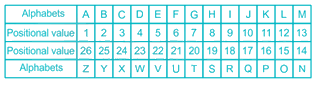 The logic followed here is:
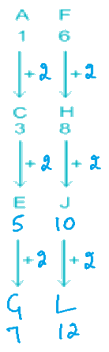 Hence, the correct answer is "Option 4".
Q5 · Series
1, 3, 6, 10, 15, ?
- 20
- 21
- 22
- 23
Answer aur solution dekho
Archived marked answer: B
Given:
Series = 1, 3, 6, 10, 15, ?
Logic used here:
Difference of between numbers 2,3,4,5,6.
1 + 2 = 3
3 + 3 = 6
6 + 4 = 10
10 + 5 = 15
⇒ 15 + 6 = 21
∴ The corrct answer is option (2).
Q6 · Series
Find the missing number: 256 : 4096 :: 225 : ?
- 3375
- 3125
- 4225
- 4096
Answer aur solution dekho
Archived marked answer: A
Given:
256 : 4096 :: 225 : ?
Logic used here:
⇒ Pattern: n2 → n3
256 = 16²
4096 = 16³
225 = 15²
⇒ 15³ = 15 × 15 × 15
⇒ 3375
∴ The corrct answer is option (1).
Q7 · Analogy
Find the missing number: 21 : 3 :: 574 : ?
- 76
- 80
- 82
- 84
Answer aur solution dekho
Archived marked answer: C
logic used here:
Number ÷ 7
Calculation:
21
⇒ 21 ÷ 7 = 3
574
⇒ 574 ÷ 7 = 82
∴ Missing number is 82.
Q8 · Puzzle Subtypes Not To Miss
Which roll number has a digital root equal to 9? Digital root = sum of digits until one digit remains.
- 987654
- 888888
- 765431
- 999999
Answer aur solution dekho
Archived marked answer: D
Given:
Digital root = Sum of digits repeatedly until one digit remains
Number = 999999
Formula used:
Digital Root = Repeated sum of digits
Calculation:
999999
⇒ 9 + 9 + 9 + 9 + 9 + 9 = 54
⇒ 5 + 4 = 9
Digital root = 9
∴ Roll number with digital root 9 = 999999.
Q9 · Coding Decoding
If 2 × 3 = 8, 3 × 4 = 15, then 4 × 5 = ?
- 22
- 20
- 24
- 23
Answer aur solution dekho
Archived marked answer: C
Given:
2 × 3 = 8
3 × 4 = 15
Pattern Used:
a × b = a × (a + 2) (when b = a + 1)
Calculation:
4 × 5 = 4 × (4 + 2)
⇒ 4 × 6
⇒ 24
∴The correct answer is option (3).
Q10 · Coding Decoding
If 1 × 2 = 3, 2 × 3 = 8, 3 × 4 = 15, then 4 × 5 = ?
- 24
- 20
- 27
- 19
Answer aur solution dekho
Archived marked answer: A
logic use here:
a × b = (a × b) + a
Calculation:
1 × 2
⇒ (1 × 2) + 1
⇒ 2 + 1 = 3
2 × 3
⇒ (2 × 3) + 2
⇒ 6 + 2 = 8
3 × 4
⇒ (3 × 4) + 3
⇒ 12 + 3 = 15
4 × 5
⇒ (4 × 5) + 4
⇒ 20 + 4 = 24
∴ The correct answer is option (1).
Q11 · Coding Decoding
If "GANDHI" is written as "HBOEIJ", how will "NEHRU" be written?
- PGITV
- OFISV
- OFHRU
- OEGRV
Answer aur solution dekho
Archived marked answer: B
Given:
GANDHI → HBOEIJ
Logic used here:
Each letter shifts +1 forward in the English alphabet.
Similarly for NEHRU:
N → O , E → F , H → I , R → S , U → V
⇒ NEHRU → OFISV
∴ The correct answer is option (2).
Q12 · Coding Decoding
Instruction: In a code language:
'apple banana orange' is coded as 'abc, def, ghi'
'orange grapes apple' is coded as 'ghi, jkl, abc'
'grapes banana mango' is coded as 'jkl, def, mno'
Question: What is the code for 'apple grapes banana'?
- aec, jim, def
- adu, joy, def
- abc, jkl, def
- auy, jkl, der
Answer aur solution dekho
Archived marked answer: C
According to the question:
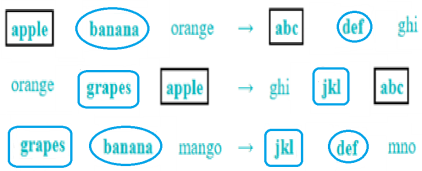 Thus, 'apple grapes banana' is coded as 'abc, jkl, def'.
Hence, "Option 3" is the correct answer.
Q13 · Coding Decoding
If COLD is coded as DPME, then HEAT will be coded as?
- IFBU
- GFBT
- IFAT
- HFAT
Answer aur solution dekho
Archived marked answer: A
Logic used here:
Each letter is replaced by the next letter in the English alphabet.
Calculation:
COLD
⇒ COLD → DPME
HEAT
⇒ HEAT → IFBU
∴ HEAT will be coded as IFBU.
Q14 · Logical Reasoning
Read the following statement carefully and identify the conclusion that follows.
Statement: Some humans are artists. All artists are creators.
Conclusions:
I. Some humans are creators.
II. All creators are artists.
- Only I follows
- Only II follows
- Both I and II follow
- Neither I nor II follows
Answer aur solution dekho
Archived marked answer: A
The least possible Venn diagram for the given statements is as shown below :
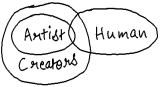 Conclusions:
I. Some humans are creators → Follow (As some humans are artists and all artists are creators. As some part of human is common with artist which whole comes in creators, therefore it is true.)
II. All creators are artists → Does not follow (As all artists are creators. So it is possible but not definite.)
∴ Here, Only I follows.
Hence, the correct answer is "Option 1".
Q15 · Logical Reasoning
Read the following statement carefully and identify the conclusion that follows.
Statement: Some A are B. All B are C. No C is D.
Conclusions:
I. No A is D.
II. Some B are not D.
- Only I follows
- Only II follows
- Both I and II follow
- Neither I nor II follows
Answer aur solution dekho
Archived marked answer: B
The least possible Venn diagram for the given statements is as shown below :
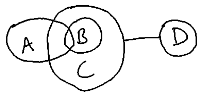 Conclusions:
I. No A is D → Does not follow (As some A are B, all B are C and no C is D. As no direct relation is given between A and D, therefore it is false.)
II. Some B are not D → Follow (As all B are C and no C is D. As whole B comes in C which cannot be D, therefore it is true.)
∴ Here, Only II follows.
Hence, the correct answer is "Option 2".
Q16 · Alphabet Test
Choose the different one.
- Linux
- Intel
- Windows
- macOS
Answer aur solution dekho
Archived marked answer: B
Identify the category of each item:
Linux ⇒ Operating System
Windows ⇒ Operating System
macOS ⇒ Operating System
Intel ⇒ Processor / Hardware company
⇒ All the given options are Operating system except 'Intel', which is a hardware.
∴ The different one is Intel (Option 2).
Q17 · Alphabet Test
From the given alternatives, find the word which can be formed from the letters used in the given word.
INTELLIGENCE
- Gene
- Told
- Can
- Come
Answer aur solution dekho
Archived marked answer: A
Given:
Word = INTELLIGENCE
A word can be formed only if its letters exist in the given word with equal or fewer frequency.
Calculation:
INTELLIGENCE
Check Gene
⇒ All letters available
⇒ O not present ❌
Check Can
⇒ A not present ❌
Check Come
⇒ O not present ❌
∴ The word formed Gene (Option 1).
Q18 · Similarity and Differences
Choose the address that is the same as the one given below.
Sample Address: Flat No. 401, Lotus Enclave,JP Nagar, Bangalore, Karnataka - 560078
- Flat 401, Lotus Enclave, JP Nagar, Bengaluru, Karnataka - 560078
- Flat No. 401, Lotus Enclave, JP Nagar, Bangalore, Karnataka - 560078
- Flat No. 401, Lotus Enclave, J.P. Nagar, Bangalore, Karnataka - 560087
- Flat No. 410, Lotus Enclave, JP Nagar, Bangalore, Karnataka - 560078
Answer aur solution dekho
Archived marked answer: B
Given: Flat No. 401, Lotus Enclave,JP Nagar, Bangalore, Karnataka - 560078
Option 1) Flat 401, Lotus Enclave, JP Nagar, Bengaluru, Karnataka - 560078 → Incorrect
Option 2) Flat No. 401, Lotus Enclave, JP Nagar, Bangalore, Karnataka - 560078 → Correct
Option 3) Flat No. 401, Lotus Enclave, J.P. Nagar, Bangalore, Karnataka - 560087 → Incorrect
Option 4) Flat No. 410, Lotus Enclave, JP Nagar, Bangalore, Karnataka - 560078 → Incorrect
Hence, "Option 2" is the correct answer.
Q19 · Similarity and Differences
From the list of roll numbers provided below, which pair belongs to the same examination centre (i.e., has the same centre code represented by the first three digits)?
Column A
Column B
<td style="animation: 0s ease 0s 1 normal none running none; appearance: none; background: none 0% 0% / auto repeat scroll padding-box border-box rgb(239, 239, 239); border-color: initial; border-image: initial; inset: auto; clear: none; clip: auto; columns: auto; contain: none; container: none; content: normal; cx: 0px; cy: 0px; d: none; direction: ltr; fill: rgb(0, 0, 0); filter: none; flex: 0 1 auto; float: none; gap: normal; hyphens: manual; interactivity: auto; isolation: auto; margin-right: 0px; margin-bottom: 0px; margin-left: 0px; marker: none; mask: none; offset: normal; opacity: 1; order: 0; outline: rgb(27, 28, 29) none 0px; overlay: none; padding: 8px 12px; page: auto; perspective: none; position: static; quotes: auto; r: 0px; resize: none; rotate: none; rx: auto; ry: auto; scale: none;
- 908325 and 908187
- 332896 and 333782
- 814752 and 812783
- 184843 and 189901
Answer aur solution dekho
Archived marked answer: A
Logic used here:
Centre code = First three digits of roll number
Calculation:
817129 ⇒ 817
817131 ⇒ 817
⇒ Same centre code
184843 ⇒ 184
184320 ⇒ 184
⇒ Same centre code
908325 ⇒ 908
908187 ⇒ 908
⇒ Same centre code
Thus pairs with same examination centre:
817129 & 817131
184843 & 184320
908325 & 908187
∴ The correct answer is option (1).
Q20 · Miscellaneous Other Possibilities
A train takes 45 minutes to travel 60 km. What is its speed in km/h?
- 72 km/h
- 75 km/h
- 80 km/h
- 90 km/h
Answer aur solution dekho
Archived marked answer: C
Given:
Distance = 60 km
Time = 45 minutes
Formula used:
Speed = Distance ÷ Time
Calculation:
45 minutes = hours
⇒ Time = hour
⇒ Speed = 60 ÷
⇒ Speed = 60 ×
⇒ Speed = 80 km/h
∴ The speed of the train = 80 km/h.
Q21 · Miscellaneous Other Possibilities
A shopkeeper buys an item for ₹80. If the shopkeeper wants to make a profit of 20% on the cost price, what should be the selling price of the item?
- ₹96
- ₹100
- ₹98
- ₹102
Answer aur solution dekho
Archived marked answer: A
Given:
Cost Price (CP) = ₹80
Profit = 20%
Formula used:
Selling Price = CP × (100 + Profit%) / 100
Calculation:
SP = 80 × (100 + 20) / 100
⇒ 80 × 120 / 100
⇒ 96
∴ The correct answer is option (1).
Q22 · Clock and Calendar
In a series of seminars held daily from 11th to 18th Feb, Calicut - 18th Feb 2022, Patna - 12th Feb 2022, Tiruchirappalli - 17th Feb 2022,
Raipur - 11th Feb 2022, Rourkela - 14th Feb 2022 Jamshedpur - 13th Feb 2022, Durgapur - 15th Feb 2022, Warangal - 16th Feb 2022
How many days after the seminar in Raipur did the seminar in Tiruchirappalli occur?
- 6 days
- 5 days
- 4 days
- 7 days
Answer aur solution dekho
Archived marked answer: A
According to the question:
Seminar in city
date
Raipur
11th Feb 2022
Patna
12th Feb 2022
Jamshedpur
13th Feb 2022
Rourkela
14th Feb 2022
Durgapur
15th Feb 2022
Warangal
16th Feb 2022
Tiruchirappalli
17th Feb 2022
Calicut
18th Feb 2022
Thus, 6 days after the seminar in Raipur did the seminar in Tiruchirappalli occur.
Hence, "Option 1" is the correct answer.
Q23 · Mathematical Operations
If X + Y = 2Z and Z + W = 2X, then:
- X + Z = Y + W
- X + Z = 2W
- X + W = Y + Z
- X + Z = 2Y
Answer aur solution dekho
Archived marked answer: A
Given:
X + Y = 2Z
Z + W = 2X
Formula used:
Use substitution and addition of equations
Calculation:
X + Y = 2Z
⇒ Y = 2Z − X
Z + W = 2X
⇒ W = 2X − Z
Add Y and W
⇒ Y + W = (2Z − X) + (2X − Z)
⇒ Y + W = Z + X
⇒ X + Z = Y + W
∴ The correct answer is option (1).
Q24 · Number Digit Operations
The product of two numbers is 2025, and their HCF is 15. What is their LCM?
- 135
- 225
- 105
- 1350
Answer aur solution dekho
Archived marked answer: A
Given:
Product of two numbers = 2025
HCF = 15
Formula used:
Product of two numbers = HCF × LCM
Calculation:
⇒ 2025 = 15 × LCM
⇒ LCM = 2025 ÷ 15
⇒ LCM = 135
∴ The LCM of the two numbers = 135.
Q25 · Number Digit Operations
9 people contribute Rs. 45 each. 3 leave. What amount must each pay now to keep total same?
- Rs. 60
- Rs. 67.5
- Rs. 55.78
- Rs. 70
Answer aur solution dekho
Archived marked answer: B
Given:
Initial people = 9
Contribution per person = ₹45
People left = 3
Remaining people = 9 − 3 = 6
Formula used:
Total amount = Number of people × Contribution
Calculation:
Total amount collected initially
⇒ 9 × 45
⇒ 405
Remaining people = 6
Required contribution per person
⇒ 405 ÷ 6
⇒ 67.5
∴ Each person must now pay ₹67.5
General Awareness
Q1 · Art and Culture
Which of the following is true about the Deogarh temple built in the early 6th century CE?
- It follows a panchayatana layout and is an early example of Nagara style.
- It was built by Chandela rulers and faces east like most Hindu temples.
- Its main deity is Shiva in the form of Mahadeo.
- It is entirely rock-cut with vaulted interiors.
Answer aur solution dekho
Archived marked answer: A
The correct answer is It follows a panchayatana layout and is an early example of Nagara style..
Key Points
- The Deogarh temple, also known as the Dashavatara Temple, was constructed in the early 6th century CE. It is one of the earliest surviving examples of Hindu temple architecture.
- The temple follows a panchayatana layout, a style where the main shrine is surrounded by four subsidiary shrines. This layout is a hallmark of early Hindu temple design.
- The architectural style of the temple is classified as Nagara style, which is characterized by its curvilinear shikhara (tower) and intricate carvings.
- The temple is dedicated to Lord Vishnu, as evidenced by the presence of sculptures depicting Vishnu's incarnations (Dashavatara).
- The temple's ornamentation and sculptural reliefs are considered masterpieces of ancient Indian art and provide insights into the religious themes and artistic conventions of the time.
Additional Information
- Deogarh Temple's Panchayatana Layout:
- The term panchayatana refers to a layout where a central shrine is surrounded by four subsidiary shrines, symbolizing the presence of other deities alongside the main deity.
- This architectural design reflects the syncretic nature of Hinduism, accommodating multiple deities within a single sacred complex.
- Nagara Style Architecture:
- The Nagara style is predominantly found in northern India and is marked by its beehive-shaped shikhara (tower) rising over the sanctum sanctorum.
- The style emphasizes verticality and intricate carvings, often depicting mythological and religious motifs.
- The Deogarh temple is an early example of this style and showcases its formative features.
- Historical Context:
- The temple was likely constructed during the reign of the Gupta Empire, a period renowned for cultural and artistic achievements.
- The Gupta period is often referred to as the "Golden Age of India", and the Deogarh temple reflects the sophisticated architectural and artistic norms of the era.
- Other Options Explained:
- Option 2: The temple was not built by the Chandela rulers, as they came much later (9th-13th century CE). Incorrect.
- Option 3: Its main deity is Vishnu, not Shiva as Mahadeo. Incorrect.
- Option 4: The temple is not entirely rock-cut; it is constructed using stone blocks. Incorrect.
Important Points
- Gupta Period Art and Architecture:
- Known for its refinement and sophistication, the Gupta era marked significant advancements in temple construction, sculpture, and painting.
- Religious themes, particularly those associated with Hinduism, Buddhism, and Jainism, dominated artistic expressions.
- Significance of the Deogarh Temple:
- The temple provides valuable insights into the development of Hindu temple architecture and early iconography.
- It is a key resource for understanding the transition from wooden structures to stone temples in ancient India.
``
Q2 · Art and Culture
In Carnatic music, which type of composition is most commonly performed during a concert, focusing on a fixed melody and rhythm?
- Varnam
- Kriti
- Raga Alapana
- Tillana
Answer aur solution dekho
Archived marked answer: B
The correct answer is Kriti.
Key Points
- Kriti is the most commonly performed composition in Carnatic music concerts. It is a structured musical form that focuses on both melody and rhythm, making it a centerpiece of the performance.
- Kriti compositions often showcase the composer's creativity and express devotion, philosophy, or emotions. They are known for their lyrical richness and intricate musical details.
- The structure of a Kriti typically includes three sections: Pallavi (opening), Anupallavi (middle section), and Charanam (concluding section), allowing for thematic development and elaboration.
- Renowned composers like Thyagaraja, Muthuswami Dikshitar, and Shyama Sastri have created timeless Kriti compositions, which are centra
Q3 · Art and Culture
Fill in the Blank:
Dumhal dancers wear ______ during the performance.
- colorful robes
- Masks
- Veils
- Bells
Answer aur solution dekho
Archived marked answer: A
The correct answer is colorful robes.
Key Points
- Dumhal dance is a traditional folk dance performed by the Rauf tribe in Jammu and Kashmir, India.
- During the performance, Dumhal dancers wear colorful robes which are intricately designed to reflect the cultural heritage of the region.
- The colorful robes serve as a visual representation of the tribe’s tradition and add vibrancy to the performance, making it more engaging.
- The dance is performed to the accompaniment of drums and singing, and the attire complements the overall aesthetic of the event.
- These robes are designed specifically to accommodate the energetic movements and ceremonial nature of the Dumhal dance.
Additional Information
- Origin of Dumhal Dance:
- The Dumhal dance is believed to have originated centuries ago and is deeply rooted in the traditions of the Rauf tribe.
- It is performed on special occasions, such as celebrations or festivals, and is considered a sacred ritual by the tribe.
- Features of Dumhal Performance:
- The dancers form a group and perform in a circular motion, symbolizing unity and harmony within the tribe.
- A ceremonial banner is planted into the ground at the beginning of the performance, marking the sacredness of the event.
- The dance movements are synchronized, and the performers' attire plays a significant role in enhancing the visual appeal.
- Other Cultural Aspects of Jammu and Kashmir:
- Jammu and Kashmir are known for their rich cultural heritage, including various folk dances, music, and handicrafts.
- Other prominent dances from the region include the Rouf dance and Bhand Pather, which are also performed during festivals and celebrations.
- The region’s art and culture reflect the influence of various dynasties and traditions over centuries.
- Significance of Dumhal Dance:
- The Dumhal dance is not just a form of entertainment but also a way to preserve the tribal traditions and history of the Rauf people.
- It serves as a medium to pass down stories, rituals, and customs from one generation to the next.
- Efforts are being made to promote and preserve such folk dances through cultural festivals and initiatives by the government.
Important Points
- Option Analysis:
- Masks: Masks are not typically worn during Dumhal performances. They are more commonly associated with other cultural dances or theatrical performances.
- Veils: Veils are often used in some Indian classical or folk dances but are not a part of the Dumhal dance attire.
- Bells: Bells are used in dances like Kathak to enhance rhythmic sound, but they are not part of Dumhal dancers’ attire.
- Preservation Efforts:
- Various cultural preservation programs are being conducted to keep traditional folk dances like Dumhal alive.
- Government initiatives in Jammu and Kashmir include organizing state-sponsored festivals and promoting local art forms.
8e:T
Q4 · Art and Culture
The Jagannath Temple in Puri is an example of which style of architecture?
- Dravidian
- Maratha
- Nagana (Kalinga)
- Vesara
Answer aur solution dekho
Archived marked answer: C
The correct answer is Nagara (Kalinga).
Key Points
- The Jagannath Temple in Puri is an example of the Nagara style of architecture, specifically the Kalinga sub-style, which is prevalent in Odisha.
- The Nagara style is characterized by its curvilinear tower (Shikhara), often adorned with intricate carvings and sculptures, commonly found in northern and eastern India.
- The Kalinga sub-style is a distinct variation of Nagara architecture, featuring a rekha deula (curvilinear tower), pidha deula (pyramidal roof), and khakhara deula (wagon-shaped roof).
- The Jagannath Temple was built in the 12th century by King Anantavarman Chodaganga Deva of the Eastern Ganga Dynasty.
- The temple complex includes structures such as the Main Shrine (Vimana), Jagamohana (Audience Hall), Natamandapa (Dance Hall), and Bhoga Mandapa (Offering Hall), showcasing the distinct elements of Kalinga architecture.
Q5 · Art and Culture
Which tribal leader from Jharkhand led the 'Ulgulan' (Great Rebellion) movement against British exploitation of tribal lands?
- Sidhu Murmu
- Kanhu Murmu
- Birsa Munda
- Tilka Manjhi
Answer aur solution dekho
Archived marked answer: C
The correct answer is Birsa Munda.
Key Points
- Birsa Munda was a prominent tribal leader from the Munda tribe in Jharkhand, renowned for his leadership during the 'Ulgulan' (Great Rebellion), which occurred during the late 19th century.
- He led the rebellion against British colonial exploitation and the oppressive feudal system imposed on tribal lands. His movement aimed to protect the indigenous identity and rights of the tribal people.
- The rebellion focused on resisting the British policies of land revenue and the exploitation of tribal communities by landlords, moneylenders, and British officials.
- Birsa Munda is considered a hero and a symbol of tribal resistance, and his efforts brought significant attention to the plight of tribal communities under British rule.
- He passed away at the young age of 25 yea
Q6 · Indian Polity and Constitution
Under the BSA, 2023, oral evidence must be:
- Direct and related to what the witness saw or heard
- Based on assumptions
- Only admissible if in English
- Hearsay only
Answer aur solution dekho
Archived marked answer: A
The correct answer is Direct and related to what the witness saw or heard.
Key Points
- Under the BSA, 2023, oral evidence must be direct, meaning it should pertain to what the witness personally observed or heard, rather than relying on assumptions or hearsay.
- Oral evidence plays a crucial role in the judicial process, as it provides firsthand accounts that can help establish the facts of the case.
- Evidence based on assumptions or speculation is inadmissible under the law, as it lacks reliability and factual accuracy. *Hence, statement 2 is incorrect.*
- Language is not a criterion for admissibility of oral evidence under the BSA, 2023. Evidence can be recorded in any language, provided it is accurately translated if necessary. *Hence, statement 3 is incorrect.*
- Hearsay evidence, or evidence not based on direct observation, is typically inadmissible except under certain exceptions outlined in the law. *Hence, statement 4 is incorrect.*
- Direct evidence is considered more reliable and credible in legal proceedings compared to indirect or hearsay evidence, as it is firsthand and less prone to distortion or misinterpretation.
Additional Information
- Direct Evidence:
- Direct evidence is testimony or information provided by a witness who has personally experienced the event in question.
- It is considered highly credible and is admissible in court without requiring further corroboration.
- Example: A witness testifying that they saw a person commit a crime.
- Hearsay Evidence:
- Hearsay evidence refers to information that a witness heard from someone else, rather than directly observing the event.
- It is generally inadmissible under the legal framework, except in specific exceptions such as dying declarations or admissions.
- Example: A witness stating that they were told by another person about the crime.
- Exceptions to Hearsay Rule:
- Certain exceptions allow hearsay evidence to be admitted, such as statements made under imminent fear of death (dying declaration).
- Other exceptions include business records, statements against interest, or declarations made during the course of business.
- Importance of Oral Evidence:
- Oral evidence is a key element in trials, as it provides the court with a direct account of events.
- It must be scrutinized for reliability, consistency, and credibility during cross-examination.
Important Points
- Admissibility Criteria:
- Oral evidence must be relevant, material, and directly related to the facts of the case.
- It is subject to cross-examination to test the witness's credibility and the accuracy of their testimony.
- Legal Basis:
- The Indian Evidence Act, 1872 governs admissibility and relevance of oral evidence in India.
- Similar provisions exist globally, ensuring that direct evidence is prioritized for reliability. </ul
Q7 · Indian Economy
Consider the following statements:
Statement I: The city of Chennai is popularly known as the Detroit of India.
Statement II: The city is a hub of the petrochemical industry and a leader in petrochemical product manufacturing in India.
Which of the following Statements is/are CORRECT?
- Both Statements are correct, and Statement II is the correct explanation for Statement I.
- Both Statements are correct, and Statement II is not the correct explanation of Statement I.
- Statement I is correct, but Statement II is incorrect.
- Statement I is incorrect, and Statement II is correct.
Answer aur solution dekho
Archived marked answer: C
The correct answer is Statement I is correct, but Statement II is incorrect..
Key Points
- Statement I: The city of Chennai is popularly known as the Detroit of India.
- Chennai is referred to as the "Detroit of India" due to its thriving automobile industry.
- It is home to major automobile manufacturers such as Hyundai, Ford, BMW, and Renault Nissan, alongside numerous auto component industries.
- The city has emerged as a prominent hub for automobile production, with its factories contributing significantly to both domestic and export markets. *This statement is correct.*
- Statement II: The city is a hub of the petrochemical industry and a leader in petrochemical product manufacturing in India.
- While Chennai has industries dealing with chemicals, it is not predominantly known for being a hub for the petrochemical industry.
- Petrochemical hubs in India are more prominently located in regions such as Gujarat (Jamnagar) and Maharashtra (Mumbai), owing to the proximity to oil refineries and ports.
- Hence, attributing Chennai as a leader in petrochemical product manufacturing is incorrect. *This statement is incorrect.*
Additional Information
- Chennai as the "Detroit of India":
- Chennai contributes over 40% of India’s automobile exports due to its well-established automobile ecosystem.
- The city hosts production facilities for international automobile brands and auto-component industries, making it a central hub for vehicle manufacturing.
- It is also home to institutions focused on automobile engineering and innovation, further strengthening its position in the industry.
- Examples of automobile companies include Hyundai Motor India, Ford India, Mitsubishi Motors, and Ashok Leyland.
- Petrochemical hubs in India:
- Gujarat: The Jamnagar refinery, owned by Reliance Industries, is the world’s largest refining hub, contributing significantly to petrochemical production.
- Maharashtra: Mumbai and surrounding areas host several petrochemical industries due to proximity to ports.
- Odisha: Paradip hosts a major refinery by Indian Oil Corporation, contributing to petrochemical output.
- Automobile Industry in India:
- India is one of the largest producers of automobiles globally, with major hubs located in Chennai, Pune, Gurugram, and Gujarat.
- Chennai's focus on automobiles stems from its strategic location and infrastructure designed to support the industry.
- The automobile industry in India contributes over 7.1% of the GDP and is a major source of employment.
Important Points
- Significance of Chennai’s automobile industry:
- Chennai’s industrial ecosystem supports vehicle production with facilities for design, assembly, and export.
- The city benefits from its port facilities, which ease the export of vehicles and components.
- Chennai’s automobile sector is supported by numerous small and medium enterprises (SMEs) specializing in auto components.
- Petrochemical Industry Overview:
- India’s petrochemical sector is driven by refinery products, with major hubs located in coastal regions for ease of import/export.
- Petrochemical products include polymers, synthetic fibers, and elastomers, which serve industries such as textiles and packaging.
- Government initiatives like Petroleum, Chemicals, and Petrochemicals Investment Regions (PCPIR) promote growth in the sector.
Q8 · Indian Economy
Why is revenue deficit a concern for the economy?
- It increases productive investment
- It improves trade surplus
- It indicates borrowing for current spending
- It boosts capital creation
Answer aur solution dekho
Archived marked answer: C
The correct answer is It indicates borrowing for current spending.
Key Points
- Revenue deficit refers to the shortfall in revenue receipts compared to revenue expenditure, indicating that the government is unable to meet its routine expenses from its revenue income.
- This deficit signifies that the government is borrowing funds not for productive purposes like capital creation but for current consumption, such as paying salaries, subsidies, and interest payments.
- Borrowing for current spending leads to a burden of interest payments, which increases fiscal pressure and reduces funds available for developmental activities.
- A high revenue deficit is a concern as it reflects poor financial management and indicates the need for structural reforms to reduce non-productive expenses.
- It may also result in inflationary pressures due to increased borrowing and reduced public sector savings, further weakening economic stability.
Additional Information
- Revenue Deficit vs. Fiscal Deficit:
- Revenue Deficit: The excess of revenue expenditure over revenue receipts. It highlights the government's inability to finance its day-to-day operations.
- Fiscal Deficit: The total borrowing requirement of the government, including revenue deficit and capital expenditure.
- Impact of Revenue Deficit:
- Reduces the government's ability to fund long-term projects and infrastructure development.
- Increases dependency on borrowing, raising public debt levels.
- Can lead to higher inflation if the government resorts to monetizing the deficit.
- Measures to Reduce Revenue Deficit:
- Enhancing tax compliance and broadening the tax base to increase revenue receipts.
- Reducing non-essential subsidies and controlling unproductive expenditures.
- Encouraging public-private partnerships for infrastructure projects to reduce fiscal burden.
- Global Perspective:
- Countries with high revenue deficits often experience economic instability and lower credit ratings, impacting foreign investments.
- Governments worldwide aim to maintain a balanced budget to promote fiscal discipline and economic growth.
Important Points
- Examples of Revenue Deficit:
- India's revenue deficit has been a significant concern in recent years, driven by subsidies and interest payments.
- During the COVID-19 pandemic, revenue deficits increased globally as governments spent heavily on healthcare and economic stimulus while revenue collection fell.
- Government Guidelines:
- The Fiscal Responsibility and Budget Management (FRBM) Act in India mandates reducing revenue deficits to ensure fiscal health.
- Periodic audits and reviews of government expenditures are recommended to identify and reduce non-productive spending.
- Significance of Balanced Budgets:
- A balanced budget ensures economic stability, promotes growth, and boosts investor confidence.
- It helps reduce dependency on borrowing, lowering interest obligations and public debt. </ul
Q9 · Indian Economy
What was a key feature of the Industrial Policy Resolution of 1956?
- Full privatization
- Abolition of licensing
- Emphasis on small-scale industry
- Expansion of public sector
Answer aur solution dekho
Archived marked answer: D
The correct answer is Expansion of public sector.
Key Points
- The Industrial Policy Resolution of 1956 was a landmark policy document that aimed to shape India's industrial development post-independence. It emphasized the need for state intervention and planning in industrial growth.
- The resolution advocated for the expansion of the public sector, giving the government a pivotal role in owning and managing key industries such as iron and steel, heavy engineering, coal, and power.
- It divided industries into three categories: Schedule A (exclusively under state control), Schedule B (joint control by the state and private entities), and Schedule C (industries left open for private sector participation).
- The focus on the public sector was intended to achieve self-reliance, reduce foreign dependence, and ensure equitable distribution of wealth.
- The policy highlighted the importance of creating an industrial base for economic development while promoting socialistic patterns of society, which were key goals during that era.
Additional Information
- Industrial Policy Resolution of 1956:
- This policy was an extension of the earlier Industrial Policy of 1948, but with more emphasis on state ownership and control of key industries.
- It aimed to establish a mixed economy, combining the strengths of both the public and private sectors.
- The policy was guided by the vision of creating a socialist pattern of society, as envisioned by leaders like Jawaharlal Nehru.
- Categories of Industries:
- Schedule A: Industries exclusively reserved for the state, including defense, atomic energy, and railways.
- Schedule B: Industries where the state would set up new enterprises but private entities could also participate.
- Schedule C: Industries left open for private sector participation, subject to government regulation.
- Impact of the Resolution:
- It laid the foundation for India's industrial development and fostered the growth of industries like steel, energy, and infrastructure.
- It helped establish institutions like the Steel Authority of India (SAIL) and BHEL, which became critical for India's economic progress.
- The emphasis on the public sector was criticized later for inefficiencies and lack of competitiveness but played a major role in early industrialization.
- Other Key Features:
- The policy promoted equitable regional development by encouraging industries to set up in less-developed regions.
- It aimed to reduce income disparities through state control over key resources and industries.
- The policy also encouraged foreign collaboration and technical assistance to strengthen India's industrial base.
Important Points
- Historical Context:
- The resolution was adopted during the Second Five-Year Plan (1956–1961), which focused on rapid industrialization.
- This period marked a shift from agrarian to industrial economy, with emphasis on heavy industries.
- Challenges and Criticism:
- The over-reliance on the public sector led to inefficiencies, corruption, and lack of innovation in some industries.
- Critics argued that the policy restricted private sector participation, which could have accelerated industrial growth.
- Long-Term Impact:
- The resolution influenced subsequent industrial policies and laid the groundwork for India's mixed economy model.
- Many public sector enterprises established during this era continue to play a vital role in India's economy.
Q10 · Indian Economy
Read the following statements carefully and choose the correct option regarding Assertion (A) and Reason (R).
Assertion (A): One objective of liberalisation was to remove barriers to entry and growth of firms.
Reason (R): The license raj restricted entrepreneurial freedom and market competition.
- Both A and R are true and R is the correct explanation of A.
- Both A and R are true but R is not the correct explanation of A.
- A is true but R is false.
- A is false but R is true.
Answer aur solution dekho
Archived marked answer: A
The correct answer is 1) Both A and R are true and R is the correct explanation of A..
Key Points
- Assertion (A): One objective of liberalisation was to remove barriers to entry and growth of firms.
- The policy of liberalisation was introduced in 1991 in India to promote economic reforms and reduce bureaucratic constraints that restricted the growth of firms.
- Liberalisation aimed at reducing restrictions such as licensing requirements, quotas, and other regulations that acted as barriers to entry and expansion for businesses. Hence, the assertion is correct.
- Reason (R): The license raj restricted entrepreneurial freedom and market competition.
- License raj refers to the system of excessive regulations and requirements for businesses to obtain licenses and approvals for various operations, which prevailed in India until the 1991 reforms.
- This system hindered entrepreneurial activity, stifled competition, and discouraged innovation due to bureaucratic delays and corruption. Hence, the reason is correct.
- Explanation:
- The assertion and reason are interlinked, as liberalisation sought to address the negative effects of license raj by removing barriers and fostering a competitive environment.
- The reason (R) correctly explains the objective mentioned in the assertion (A) since the removal of the license raj directly aligns with promoting entry and growth of firms. Hence, option 1 is correct.
Additional Information
- Liberalisation:
- Liberalisation refers to the relaxation of government restrictions and regulations in economic policies to allow private sector participation and foreign investments.
- It played a crucial role in India's economic reforms initiated in 1991 under the leadership of Prime Minister P.V. Narasimha Rao and Finance Minister Dr. Manmohan Singh.
- The reforms included measures such as the abolition of industrial licensing, reduction in tariffs, and promotion of foreign direct investment (FDI).
- License Raj:
- The term "license raj" refers to the system of excessive regulatory controls and licensing requirements that governed businesses in India before the 1991 economic reforms.
- Businesses had to obtain multiple licenses and approvals, leading to bureaucratic inefficiencies and corruption.
- This system was replaced with liberalisation reforms to encourage free-market principles and entrepreneurial activity.
- Impact of Liberalisation:
- Liberalisation led to increased competition, innovation, and efficiency in the market.
- It attracted foreign investments, boosted economic growth, and improved consumer choices.
- However, it also posed challenges such as unequal distribution of wealth and increased dependence on foreign markets.
- Key Government Initiatives:
- Industrial Policy of 1991: Focused on reducing government intervention and promoting private sector participation.
- FDI Policy: Allowed foreign investments in various sectors to boost economic growth and technology transfer.
- Disinvestment Policy: Encouraged privatisation of public sector enterprises to improve their efficiency and profitability.
Important Points
- Historical Context:
- India's economic policies post-independence were focused on self-reliance and protectionism, leading to the establishment of the license raj.
- The Balance of Payments (BoP) crisis in 1991 necessitated the adoption of liberalisation measures to stabilise the economy.
- Key Features of Liberalisation:
- Removal of industrial licensing and quotas.
- Reduction in import tariffs and promotion of exports.
- Encouragement of private and foreign investments in various sectors.
- Privatisation of public sector enterprises to improve efficiency. </ul
Q11 · Sports Static GK
Where was the 2nd Para Table Tennis National Ranking Championships 2024-25 held?
- Jaipur, Rajasthan
- Vadodara, Gujarat
- Pune, Maharashtra
- Indore, Madhya Pradesh
Answer aur solution dekho
Archived marked answer: B
The correct answer is Vadodara, Gujarat.
Key Points
- The 2nd Para Table Tennis National Ranking Championships for 2024-25 was held in Vadodara, Gujarat, a city known for its vibrant sports culture and facilities.
- This championship is an essential event in the Indian para table tennis circuit, aimed at promoting inclusivity and providing a competitive platform for athletes with disabilities.
- Vadodara, Gujarat, has hosted several national and international sports events due to its well-developed sports infrastructure and accessibility for athletes.
- The event witnessed participation from para table tennis players across India, showcasing their talent and determination in the sport.
- Gujarat has been a progressive state in supporting s
Q12 · Indian Geography
Which of these statements is/ are correct regarding the Census of India, 2011?
1. Muslims outnumber all other minorities in India, but they do not from a majority in any of the Indian states.
2. Christian population is distributed mostly in urban areas of India.
3. Jains have a major concentration in the urban areas of Rajasthan, Gujarat and Maharashtra, while the Buddhists are concentrated mostly in Maharashtra.
- 1, and 3 only
- 3 only
- 2 and 3 only
- 1 and 2 only
Answer aur solution dekho
Archived marked answer: B
The correct answer is 3 only.
Key Points
- Statement 1: Muslims outnumber all other minorities in India, but they do not form a majority in any of the Indian states.
- The Census of India 2011 highlights that the Muslim population is the largest minority group in India, accounting for approximately 14.2% of the total population.
- Although they have a significant presence in several states like Jammu & Kashmir, Kerala, and Uttar Pradesh, they do not constitute a majority in any state except Jammu & Kashmir (where Muslims are the majority). Hence, this statement is incorrect.
- Statement 2: Christian population is distributed mostly in urban areas of India.
- The Christian population in India is spread across both urban and rural areas, with a significant concentration in northeastern states like Nagaland, Mizoram, and Meghalaya and southern states like Kerala and Tamil Nadu.
- This statement is incorrect as Christians are predominantly found in rural regions of the northeastern and southern states.
- Statement 3: Jains have a major concentration in the urban areas of Rajasthan, Gujarat, and Maharashtra, while the Buddhists are concentrated mostly in Maharashtra.
- Jains are primarily concentrated in urban areas, particularly in states like Rajasthan, Gujarat, and Maharashtra. This community is known for its business-oriented population, largely residing in metropolitan areas.
- Buddhists, on the other hand, have a significant presence in Maharashtra, especially among Scheduled Castes, due to the influence of Dr. B.R. Ambedkar's Dalit Buddhist Movement. Hence, this statement is correct.
- *Hence, the correct answer is 3 only.*
Additional Information
- Religious Demographics in India (Census 2011):
- Hindus: Constitute approximately 79.8% of the population, making them the majority religious group in India.
- Muslims: Represent 14.2%, the largest minority group in the country.
- Christians: Account for 2.3%, with significant representation in the northeastern states and Kerala.
- Sikhs: Constitute 1.7%, predominantly found in Punjab.
- Buddhists: Represent 0.7%, primarily concentrated in Maharashtra due to the Dalit Buddhist movement.
- Jains: Comprise 0.4%, mostly found in urban centers of western India.
- Significance of Census Data:
- The Census of India provides critical data on demographics, including religion, language, literacy, and other socio-economic factors.
- This data is essential for policy formulation and allocation of resources by the government.
- Urban and Rural Distribution:
- Religious communities like Jains are concentrated in urban areas due to their business-oriented lifestyle.
- Others, like Christians and Buddhists, have significant populations in rural areas, particularly in northeastern states and Maharashtra.
- Historical Influence:
- The religious distribution in India is influenced by historical factors such as migrations, colonial rule, and social reform movements like the Dalit Buddhist Movement.
- For instance, the conversion of Dalits to Buddhism under Dr. B.R. Ambedkar significantly impacted the demographics in Maharashtra.
Important Points
- Jainism: Known for its emphasis on non-violence (Ahimsa), Jainism originated in India and has a rich tradition of philosophy and ethics.
- Buddhism: Founded by Gautama Buddha, Buddhism focuses on the teachings of the Four Noble Truths and the Eightfold Path.
- Dalit Buddhist Movement: Initiated by Dr. B.R. Ambedkar, this movement encouraged Dalits to convert to Buddhism to escape caste-based discrimination.
- Religious Diversity: India is known for its unique blend of religious pluralism, housing multiple faiths coexisting harmoniously.
- Census Importance: The 2011 Census remains a critical source for understanding India's demographic trends and planning welfare schemes accordingly.
Q13 · Modern Indian History
The Ilbert Bill controversy of 1883-84 was related to:
- The imposition of new taxes on agricultural produce.
- The issue of allowing Indian judges to try European offenders in criminal cases.
- The introduction of English as the medium of instruction in all schools.
- The demarcation of boundaries between British India and princely states.
Answer aur solution dekho
Archived marked answer: B
The correct answer is The issue of allowing Indian judges to try European offenders in criminal cases.
Key Points
- The Ilbert Bill, introduced in 1883 by the then Viceroy of India, Lord Ripon, sought to allow Indian judges to preside over cases involving European offenders in criminal matters.
- During the colonial period, European residents in India were subject to a separate legal framework, which barred Indian judges from trying them. The Ilbert Bill aimed to remove this racial distinction in the judiciary system.
- The bill faced severe opposition, especially from the European community in India, who viewed it as a threat to their perceived racial superiority. This led to widespread protests and debates.
- The controversy highlighted the deep-seated racial tensions in colonial India and revealed the discriminatory practices prevalent in the British administration.
- The opposition forced the British government to amend the bill by introducing a compromise, where European offenders could opt to be tried by a jury consisting of at least 50% Europeans. This diluted the original intent of the bill.
Additional Information
- Historical Context:
- The Ilbert Bill was part of a series of reforms introduced by Lord Ripon, who is often referred to as the "Father of Local Self-Government in India."
- It was introduced at a time when Indians were increasingly demanding equality and justice under British rule.
- Impact on Indian Society:
- The Ilbert Bill controversy brought Indians together, as they saw this as an opportunity to demand equality in the judiciary system.
- It helped to strengthen the nascent Indian National Movement, as leaders like Surendranath Banerjee and others used this issue to mobilize public opinion against colonial injustice.
- Racial Discrimination in Colonial India:
- The opposition to the Ilbert Bill revealed the inherent racial biases of the British administration, where Europeans were placed above Indian citizens in matters of law and governance.
- It emphasized the need for a fair and impartial judiciary that treated all citizens equally, irrespective of their race.
- Outcome of the Controversy:
- Although the bill was amended and diluted, the controversy surrounding it became a significant milestone in India's struggle for independence.
- The Ilbert Bill controversy also demonstrated the power of collective action, as both Indians and Europeans organized protests to voice their opinions.
Important Points
- Lord Ripon's Reforms:
- Lord Ripon is known for introducing the Local Self-Government Act in 1882, which empowered local bodies such as municipalities and district boards.
- His tenure was marked by progressive policies aimed at involving Indians in administrative roles and promoting education.
- European Opposition:
- The European community in India argued that Indian judges were not competent to try Europeans due to cultural and racial differences.
- This opposition was rooted in the belief in the racial superiority of Europeans over Indians.
- Legacy of the Ilbert Bill:
- The controversy set the stage for future debates on equality and justice in colonial India.
- It also exposed the limitations of British liberalism, which claimed to promote equality but often failed to apply it in practice.
``
Q14 · Current Affairs
Which country helped develop Chabahar Port?
- China
- India
- Russia
- United States
Answer aur solution dekho
Archived marked answer: B
The correct answer is India.
Key Points
- Chabahar Port is located in Iran, and its development has been significantly supported by India.
- The port holds strategic importance for India as it provides a direct trade route to Afghanistan and Central Asia, bypassing Pakistan.
- India signed an agreement with Iran in May 2016 for the development of the port. The collaboration includes investment of $500 million from India.
- The operational control of the port was handed over to India in December 2018, making it India's first overseas port project.
- Chabahar Port is considered a key element in India's International North-South Transport Corridor (INSTC), which aims to enhan
Q15 · Current Affairs
Who joined as the CEO of NITI Aayog in February 2023?
- Parameswaran Iyer
- V.K. Paul
- B.V.R. Subrahmanyam
- Amitabh Kant
Answer aur solution dekho
Archived marked answer: C
The correct answer is B.V.R. Subrahmanyam.
Key Points
- B.V.R. Subrahmanyam was appointed as the CEO of NITI Aayog in February 2023, succeeding Parameswaran Iyer.
- He is a 1987 batch Indian Administrative Service (IAS) officer of the Chhattisgarh cadre.
- Prior to his appointment, B.V.R. Subrahmanyam served as Chairman and Managing Director of the India Trade Promotion Organisation (ITPO), which is responsible for managing India’s largest exhibition complex, Pragati Maidan.
- He has held several key positions in the Indian government, including serving as the Chief Secretary of Jammu and Kashmir, where he played a crucial role in the region's administrative and developmental changes post its reorganization in 2019.
- His ap
Q16 · Current Affairs
The World Competitiveness Index primarily assesses a country's ability to:
- Attract tourists
- Create and maintain an environment for enterprises to compete
- Innovation in cultural heritage
- Conserve natural resources
Answer aur solution dekho
Archived marked answer: B
The correct answer is Create and maintain an environment for enterprises to compete.
Key Points
- The World Competitiveness Index, published annually by the International Institute for Management Development (IMD), evaluates how well countries manage their resources and competencies to enable enterprises to achieve sustainable growth, innovation, and overall competitiveness.
- It primarily assesses a country's ability to create and maintain an environment for enterprises to compete effectively on a global scale, fostering economic growth and stability.
- The index considers various aspects such as economic performance, government efficiency, business efficiency, and infrastructure to determine competitiveness.
- Countries are ranked based on how they support businesses in terms of policy frameworks, regulatory environments, innovation capabilities, and human capital development.
- The goal of the index is to provide insights that help governments and organizations enhance their competitiveness by addressing identified weaknesses and leveraging strengths.
Additional Information
- Key Features of the World Competitiveness Index:
- The index is published by the IMD World Competitiveness Center, based in Switzerland, and has been released annually since 1989.
- It evaluates 64 economies worldwide, providing a comprehensive view of global competitiveness.
- The rankings are based on 333 criteria categorized into four major factors: economic performance, government efficiency, business efficiency, and infrastructure.
- Data is collected from national statistics, international organizations, and surveys conducted among business executives.
- Example: In the 2023 rankings, Denmark, Switzerland, and Singapore were the top-performing countries, showcasing their strong business environments and innovative capabilities.
- Factors Influencing Competitiveness:
- Economic Performance: Includes macroeconomic indicators like GDP growth, trade performance, and employment rates.
- Government Efficiency: Evaluates policies, regulations, and institutional frameworks that support businesses.
- Business Efficiency: Measures productivity, labor market conditions, and financial systems.
- Infrastructure: Focuses on physical infrastructure, scientific innovation, education, and healthcare systems.
- Other Global Indices Related to Competitiveness:
- Global Innovation Index: Ranks countries based on their innovation capabilities.
- Ease of Doing Business Index: Published by the World Bank, evaluates how easy it is to start and operate a business in a country.
- Global Competitiveness Report: Released by the World Economic Forum, examines the set of institutions, policies, and factors that determine productivity levels.
- Importance of Competitiveness:
- Promotes economic growth by enabling businesses to thrive.
- Encourages innovation and development in industries.
- Improves living standards by creating more job opportunities and increasing income levels.
- Helps countries adapt to global challenges and compete effectively in international markets.
Important Points
- Incorrect Options:
- Option 1: Attracting tourists is not the primary focus of the World Competitiveness Index, though tourism may indirectly contribute to competitiveness.
- Option 3: Innovation in cultural heritage is significant but does not form the core criteria of this index.
- Option 4: Conservation of natural resources is an important aspect of sustainability but is not the primary focus of the index.
- Option 5: This is left blank and does not contribute to the question or answer.
- The World Competitiveness Index provides actionable insights for policymakers to improve their country's economic and business environments, ensuring long-term sustainability and growth. </ul
Q17 · General Science Biology
Which of the following statements accurately reflects the biomechanical coordination during the throwing phase of discus throw?
- The shoulders and trunk continue rotating till 1 minute after the discus is released to maintain momentum.
- The left foot remains fixed while the right foot rotates and stays straight throughout the motion.
- Both knees stay straight during rotation, but the right knee bends after forward extension for balance.
- The body's weight shifts entirely to the left foot while the right leg stabilizes the upper body lean.
Answer aur solution dekho
Archived marked answer: C
The correct answer is Option 3.
Key Points
- The biomechanical coordination during the throwing phase in discus throw involves the bending of the right knee after forward extension for balance, which stabilizes the body and enhances the accuracy of the throw. Hence, statement 3 is correct.
- The shoulders and trunk do not continue rotating for 1 minute after the discus is released. The rotation stops immediately after the release to prevent unnecessary loss of energy. Hence, statement 1 is incorrect.
- The left foot does not remain fixed during the throwing phase. Both feet contribute to rotational force, and the movement of the feet is crucial for generating momentum. Hence, statement 2 is incorrect.
- The body’s weight does not shift entirely to the left foot while the right leg stabilizes the upper body lean. The weight distribution varies throughout the phases, ensuring proper momentum and balance during the throw. Hence, statement 4 is incorrect.
- The correct biomechanical technique involves bending the right knee after forward extension to maintain balance and maximize the throw’s efficiency. This technique is crucial for proper stabilization. Hence, statement 3 is correct.
Additional Information
- Biomechanics in Discus Throw:
- The discus throw involves coordinated movements of the lower limbs, trunk, and upper limbs to generate rotational force and release the discus at an optimal angle.
- The right knee bending after forward extension is crucial for maintaining balance and stabilizing the body during the critical release phase.
- The shoulders and trunk rotation play a significant role in generating angular momentum, but the rotation stops immediately after the throw.
- Phases of Discus Throw:
- It includes the wind-up phase, where the thrower builds initial momentum by rotating the trunk and arms.
- The transition phase involves shifting the weight between the feet to prepare for rotational acceleration.
- The delivery phase is where the discus is released, requiring precise coordination and balance.
- The follow-through phase ensures that the thrower maintains balance and avoids injury.
- Key Techniques in Discus Throw:
- The thrower should focus on maintaining a low center of gravity for stability during rotational movements.
- The discus is released at an optimal angle, typically between 35-45 degrees, for maximum distance.
- Proper foot placement and rotation are essential for generating torque and transferring energy to the discus.
- Applications in Sports Science:
- Understanding biomechanics in discus throw helps athletes improve their performance and minimize the risk of injuries.
- It allows coaches to analyze movements and suggest corrective measures for better technique.
- Sports scientists use motion capture technology to study the kinematics and dynamics of the throw.
Important Points
- Historical Context:
- The discus throw has its origins in ancient Greece and was part of the Olympic Games as early as 708 BC.
- Modern techniques were developed in the 19th century, with emphasis on rotational movements.
- Physics in Discus Throw:
- The throw involves concepts such as angular momentum, torque, and projectile motion.
- The distance covered by the discus depends on the release velocity, angle, and height.
- Training Essentials:
- Athletes undergo strength training to develop core stability and rotational power.
- They practice drills to enhance footwork and improve timing during the throw.
7c
Q18 · General Science Biology
Which describes the "bunch start" position in sprinting?
- Blocks 25-30 inches from line, feet parallel
- Blocks 16-19 inches from line, rear toe and front heel aligned
- Hips below shoulders, arms bent
- Toes ahead of starting line
Answer aur solution dekho
Archived marked answer: B
The correct answer is Blocks 16-19 inches from line, rear toe and front heel aligned.
Key Points
- The "bunch start" position in sprinting is a common starting stance used by sprinters to optimize their launch speed. It is characterized by having the starting blocks placed 16-19 inches from the starting line. This measurement ensures that the sprinter can generate maximum force during the initial push-off.
- In this position, the rear toe aligns with the front heel. This alignment is crucial as it allows the sprinter to maintain balance while simultaneously optimizing forward thrust power.
- The design of the "bunch start" position focuses on creating the shortest reaction time and explosive movement off the blocks, which is essential for short-distance sprints such as the 100m and 200m races.
- Unlike other starting techniques, the "bunch start" ensures that the sprinter's body is positioned closer to the starting line, enabling a quicker transition into the acceleration phase.
- This technique is especially suitable for athletes who possess strong legs and explosive power, as it requires a rapid and forceful push-off to propel the body forward efficiently.
Additional Information
- Other Starting Positions in Sprinting:
- Medium Start: In this position, the starting blocks are set further back from the starting line compared to the "bunch start." The rear knee is aligned with the front heel. It provides a balanced compromise between power and control, suitable for athletes with moderate explosive strength.
- Elongated Start: The starting blocks are positioned farthest from the starting line. The rear knee is positioned behind the front foot. This start focuses more on gradual acceleration rather than immediate explosive speed, making it suitable for longer sprint races.
- Importance of Starting Position in Sprinting:
- The starting position significantly impacts a sprinter's performance as it dictates the efficiency of the initial push-off and transition into the acceleration phase.
- A proper start minimizes reaction time and ensures optimal utilization of muscle groups, especially the quadriceps and hamstrings, for a powerful launch.
- Starting techniques are often tailored to an individual sprinter's physical attributes, such as leg strength, flexibility, and body proportion.
- Key Characteristics of Sprinting:
- Sprinting involves high-intensity, short-distance running events, typically ranging from 60m to 400m.
- The primary focus is on generating maximum speed and maintaining it for the duration of the race.
- Key muscle groups used in sprinting include the quadriceps, hamstrings, glutes, and calves.
- Training for sprinting includes a combination of explosive drills, strength training, and technique improvement for optimal performance.
- Equipment Used in Sprinting:
- Starting Blocks: These are crucial for providing a stable base for the sprinter to push off at the start. They are adjustable to accommodate different starting styles.
- Spikes: Special sprinting shoes with spikes enhance grip and traction on the track, allowing for better acceleration and speed.
- Track Surface: Modern sprinting tracks are made from synthetic materials like polyurethane, which provide a balance of grip and shock absorption.
- Famous Sprinters:
- Usain Bolt: Holds the world record for the 100m (9.58 seconds) and 200m (19.19 seconds) sprints.
- Carl Lewis: A legendary sprinter and long jumper who dominated the Olympics during the 1980s and 1990s.
- Florence Griffith-Joyner: Known for her record-breaking performances in the 100m and 200m events, which still stand today. </ul
Q19 · Medieval Indian History
In the traditional accounts of Vijayanagara, who were referred to to as narapati or "lord of men"?
- Mughals
- Deccan Sultans
- Cholas
- Rayas
Answer aur solution dekho
Archived marked answer: D
The correct answer is Rayas.
Key Points
- In the context of the Vijayanagara Empire, the term "narapati", which translates to "lord of men," was used to refer to the Rayas, the rulers of the empire.
- The Vijayanagara Empire, established in 1336, was primarily ruled by dynasties like the Sangama, Saluva, Tuluva, and Aravidu. The kings of these dynasties were referred to as Rayas.
- The Rayas were considered the supreme authority in the empire, holding political, military, and religious leadership.
- Prominent rulers such as Krishnadevaraya, a Tuluva dynasty king, were known for their administrative acumen, milita
Q20 · Ancient Indian History
Which of the following scholars wrote the Ashtanga Sangraha?
- Charaka
- Sushrota
- Bhaskaracharya
- Vagbhata
Answer aur solution dekho
Archived marked answer: D
The correct answer is Vagbhata.
Key Points
- Vagbhata was an ancient Indian scholar and physician, known as one of the principal contributors to Ayurveda, the traditional system of medicine in India.
- He authored two renowned texts on Ayurveda: the Ashtanga Hridaya and the Ashtanga Sangraha.
- The Ashtanga Sangraha is a comprehensive guide to the eight limbs (ashtanga) of Ayurveda and provides detailed insights into clinical diagnosis and treatment protocols.
- This text is written in a prose style and includes extensive information on therapeutic procedures, herbal formulations, and surgical interventions.
- Vagbhata's works are considered foundational in the field of Ayurveda, alongside Charaka's and Sushruta's contributions.
Additional Information
- Charaka:
- Charaka was an ancient Indian physician who authored the Charaka Samhita, one of the foundational texts of Ayurveda.
- The Charaka Samhita focuses primarily on internal medicine and emphasizes preventive healthcare, lifestyle, and diet.
- He is often regarded as the father of Indian medicine for his contributions to understanding human anatomy and physiology.
- Sushruta:
- Sushruta is known as the father of surgery and wrote the Sushruta Samhita, which is a key treatise in Ayurveda.
- This text contains detailed descriptions of surgical techniques, instruments, and procedures, including rhinoplasty and cataract surgery.
- Sushruta's work has influenced both Indian and global surgical practices.
- Bhaskaracharya:
- Bhaskaracharya, also known as Bhaskara II, was a 12th-century Indian mathematician and astronomer.
- He is renowned for his work on calculus and algebra and authored the book “Siddhanta Shiromani.”
- His contributions were primarily in the field of mathematics and not related to medicine or Ayurveda.
- Vagbhata:
- Vagbhata was a later contributor to Ayurveda, following in the footsteps of Charaka and Sushruta.
- He emphasized the integration of theory and practice in Ayurvedic medicine, with a focus on holistic healing and lifestyle modifications.
- The Ashtanga Sangraha and Ashtanga Hridaya continue to be widely studied in Ayurvedic medical education today.
Important Points
- Ayurveda:
- Ayurveda is a traditional system of medicine originating in India over 5,000 years ago. It focuses on balancing the body, mind, and spirit to maintain health.
- The term "Ayurveda" is derived from the Sanskrit words "Ayur" (life) and "Veda" (science or knowledge), meaning the "science of life."
- It comprises eight branches (Ashtanga), including surgery (Shalya Tantra), pediatrics (Kaumarabhritya), and toxicology (Agada Tantra).
- Legacy of Vagbhata:
- Vagbhata's works are still relevant in contemporary Ayurveda for clinical practice and research.
- His texts serve as a bridge between ancient and modern medical practices, highlighting the importance of diet, exercise, and mental well-being.
- Modern Relevance:
- Ayurveda is recognized by the World Health Organization (WHO) as a traditional medicine system and is practiced globally today.
- Institutions in India, such as the All India Institute of Ayurveda (AIIA), promote the integration of Ayurvedic principles into modern healthcare.
74
Q21 · Government Schemes and Welfare Static Semi Static
The "Pradhan Mantri Awas Yojana - Urban (PMAY-U)" aims to address the housing shortage in urban areas. Which of the following approaches is a key component of this scheme to achieve its objectives?
- Primarily focusing on providing rental housing for migrant workers.
- Providing financial assistance to beneficiaries for the construction, purchase, or enhancement of affordable housing.
- Mandating the use of only indigenous building materials in all PMAY-U projects.
- Concentrating housing development efforts in Tier-1 and Tier-2 cities.
Answer aur solution dekho
Archived marked answer: B
The correct answer is Providing financial assistance to beneficiaries for the construction, purchase, or enhancement of affordable housing.
Key Points
- The Pradhan Mantri Awas Yojana - Urban (PMAY-U) was launched in 2015 by the Government of India to address the urban housing shortage, especially among the economically weaker sections (EWS), low-income groups (LIG), and middle-income groups (MIG).
- The scheme includes a component of providing financial assistance to eligible beneficiaries for constructing, purchasing, or enhancing affordable housing units. This is a key approach to achieving the scheme's objectives.
- The financial assistance is provided through a Credit Linked Subsidy Scheme (CLSS), under which beneficiaries can avail of interest subsidies on housing loans based on their income
Q22 · General Science Physics
Which nuclear decay alters atomic number but not mass?
- Alpha Decay
- Beta Decay
- Gamma Decay
- Fission
Answer aur solution dekho
Archived marked answer: B
The correct answer is Beta Decay.
Key Points
- Beta Decay is a type of nuclear decay in which a beta particle (electron or positron) is emitted from the nucleus.
- During beta decay, a neutron in the nucleus is converted into a proton (or vice versa), leading to a change in the atomic number but not the mass number.
- The mass number remains unchanged because the total number of nucleons (protons + neutrons) stays the same.
- Beta decay increases or decreases the atomic number by 1, thus transforming the atom into a different element.
- This process helps unstable nuclei achieve a more stable configuration by adjusting the proton-to-neutron ratio.
Additional Information
- Alpha Decay:
- Alpha decay involves the emission of an alpha particle (2 protons and 2 neutrons) from the nucleus.
- This reduces the atomic number by 2 and the mass number by 4.
- It occurs in heavy nuclei, such as uranium or radium, to achieve stability.
- Gamma Decay:
- Gamma decay involves the emission of gamma rays (high-energy photons) from an excited nucleus.
- It does not change the atomic number or mass number but releases excess energy from the nucleus.
- This often accompanies alpha or beta decay.
- Fission:
- Nuclear fission is the splitting of a heavy nucleus into two lighter nuclei, accompanied by the release of energy and neutrons.
- It significantly changes both the atomic and mass numbers of the original nucleus.
- Fission is commonly used in nuclear reactors and weapons.
- Key Characteristics of Beta Decay:
- There are two types: Beta-minus (β⁻) and Beta-plus (β⁺) decay.
- In β⁻ decay, a neutron is converted into a proton, emitting an electron and an antineutrino.
- In β⁺ decay, a proton is converted into a neutron, emitting a positron and a neutrino.
- Beta decay plays a critical role in processes like radioactive decay chains and nuclear reactions in stars.
Important Points
- Applications of Beta Decay:
- Used in medical imaging and treatment, such as in PET scans (Positron Emission Tomography).
- Helps in carbon dating to determine the age of archaeological artifacts (e.g., Carbon-14 decay).
- Used in studying nuclear reactions and understanding stellar processes.
- Examples of Beta Decay:
- Carbon-14 (C-14): Undergoes β⁻ decay to form Nitrogen-14 (N-14).
- Potassium-40 (K-40): Undergoes β⁺ decay to form Argon-40 (Ar-40).
```
Q23 · Books and Authors Static
Consider the following statements about 'The Golden Gate' by Vikram Seth:
1) The novel, written entirely in verse, was shortlisted for the Whitbread Book Award, showcasing its innovative poetic form.
2) It won the Booker Prize for its expansive narrative on Indian society and culture.
3) The book was honored with the Sahitya Akademi Award for its significant impact on Indian English poetry.
Which of the above statements is/are correct?
- Only statement 1 is correct
- Only statement 2 is correct
- Statements 1 and 3 are correct
- 1, 2 and 3 all are correct
Answer aur solution dekho
Archived marked answer: A
The correct answer is Option 1.
Key Points
- Statement 1: The novel 'The Golden Gate' by Vikram Seth is written entirely in verse and was shortlisted for the Whitbread Book Award. This showcases the innovative poetic form of the book and its literary significance. *Hence, this statement is correct.*
- Statement 2: The claim that the book won the Booker Prize is incorrect. 'The Golden Gate' did not win the Booker Prize, as the book primarily reflects themes of contemporary life in California rather than Indian society and culture. *Hence, this statement is incorrect.*
- Statement 3: The book was not honored with the Sahitya Akademi Award. While Vikram Seth's work is widely recognized in Indian English literature, this specific award does not apply to 'The Golden Gate.' *Hence, this statement is incorrect.*
- *Therefore, only Statement 1 is correct, and the correct answer is Option 1.*
Additional Information
- 'The Golden Gate' by Vikram Seth:
- Published: The novel was published in 1986.
- Form: The entire book is written in verse, specifically in the format of sonnets, inspired by Alexander Pushkin's "Eugene Onegin."
- Theme: It explores themes such as love, friendship, politics, and loneliness, set in the backdrop of modern-day California.
- Recognition: It received critical acclaim for its inventive style but was not awarded the Booker Prize or Sahitya Akademi Award.
- Vikram Seth:
- Vikram Seth is a renowned Indian author and poet, widely recognized for his works like 'A Suitable Boy' and 'An Equal Music.'
- His contributions to English literature have earned him numerous accolades, including the Padma Shri in 2001.
- Whitbread Book Awards:
- These awards, now known as the Costa Book Awards, recognize outstanding literary works from the UK and Ireland.
- 'The Golden Gate' was shortlisted, highlighting its global recognition despite being authored by an Indian writer.
- Booker Prize:
- One of the most prestigious literary awards, given annually for the best original novel written in English.
- Vikram Seth's 'A Suitable Boy' was longlisted for the award but 'The Golden Gate' did not win this prize.
- Sahitya Akademi Award:
- This is a literary honor presented by India's National Academy of Letters, recognizing works in Indian languages.
- 'The Golden Gate' is not an awardee of the Sahitya Akademi, as it is primarily a work about life in the US, written in English verse.
Important Points
- Vikram Seth's Writing Style:
- Seth is celebrated for his versatility, writing across genres including poetry, novels, and essays.
- His ability to craft narratives in verse, as demonstrated in 'The Golden Gate', sets him apart in contemporary literature.
- Significance of 'The Golden Gate':
- It is considered a groundbreaking work for its use of sonnet form in a modern novel.
- The novel remains relevant for its exploration of universal human emotions and societal dynamics. </ul
Q24 · Static GK
Dr. Tessy Thomas is also known as the 'Missile Woman of India'. She is best associated with which of the following achievements?
- Led Agni-V project; began career at LRDE
- Was Chairperson of ISRO
- Founded a private satellite company
- Headed HAL's aeronautics division
Answer aur solution dekho
Archived marked answer: A
The correct answer is Led Agni-V project; began career at LRDE.
Key Points
- Dr. Tessy Thomas is popularly referred to as the 'Missile Woman of India' due to her significant contributions to India's missile development programs, particularly the Agni series of missiles.
- She played a pivotal role in leading the Agni-V project, one of India's most advanced intercontinental ballistic missiles (ICBMs) with a range of over 5,000 km. This missile added strategic deterrence capabilities to India's defense arsenal.
- Dr. Tessy began her career at the Electronics and Radar Development Establishment (LRDE), a lab of the Defense Research and Development Organization (DRDO), where she worked on the design and development of various radar systems.
- She has been associated with the DRDO for over three decades, specializing in missile guidance, control, and system integration. Her expertise and leadership have earned her national and international recognition.
- Dr. Tessy Thomas is the first woman to head a missile project in India, breaking stereotypes and inspiring women across the country to pursue careers in science and technology.
Additional Information
- Agni-V Missile:
- The Agni-V missile is an advanced nuclear-capable intercontinental ballistic missile developed by India under the Integrated Guided Missile Development Program (IGMDP).
- It has a range of 5,000 to 8,000 km, making it capable of striking targets far beyond India's immediate neighborhood, including regions in Asia, Europe, and Africa.
- The missile features a three-stage solid propulsion system and advanced technologies for precision targeting and survivability.
- The successful development of Agni-V enhances India's strategic deterrence capabilities and positions the country as a global power in missile technology.
- The project represents India's commitment to maintaining a credible minimum deterrent and strengthening its national security.
- Dr. Tessy Thomas's Early Life and Education:
- Dr. Tessy Thomas was born in April 1963 in Alappuzha, Kerala, India. She exhibited a keen interest in science and mathematics during her school years.
- She earned a B.Tech in Electrical Engineering from the Government Engineering College, Thrissur, and later pursued an M.Tech in Guided Missile Technology at the Institute of Armament Technology, Pune.
- Her academic excellence and passion for research led her to join the DRDO, where she contributed significantly to India's defense sector.
- Role in DRDO:
- Dr. Tessy Thomas joined the DRDO in 1988 and has been instrumental in the design, development, and deployment of strategic missile systems.
- She has worked on several projects, including the Agni-I, Agni-II, Agni-III, and Agni-IV missiles, before leading the Agni-V program.
- Her contributions have earned her numerous awards, including the DRDO Scientist of the Year Award and the prestigious Lal Bahadur Shastri National Award for Excellence in Public Administration.
- Notable Achievements:
- Dr. Tessy Thomas has been honored as a role model for women in STEM (Science, Technology, Engineering, and Mathematics) fields.
- She is widely recognized for her leadership and innovation in missile technology, contributing to India's self-reliance in defense systems.
- Her work has inspired many aspiring scientists and engineers, particularly women, to pursue careers in defense and technology.
Important Points
- LRDE: The Electronics and Radar Development Establishment specializes in the design and development of radar and electronic systems. It plays a crucial role in India's defense infrastructure.
- DRDO: The Defense Research and Development Organization is India's premier agency for research and development in military technology. It operates under the Ministry of Defense.
- Gender Representation: Dr. Tessy Thomas's leadership in a male-dominated field underscores the importance of increasing gender diversity in science and technology.
- Strategic Importance: The development of missile systems like Agni-V reinforces India's defense capabilities and diplomatic leverage in international relations.
- Recognition: Her contributions have elevated India's global standing in missile technology and defense innovation. </ul
Q25 · General Science
Why "Space Situational Awareness (SSA)" program by ISRO important?
- Racks' energy usage in orbit
- Monitors space debris and protects Indian space assets
- Observes black holes in the deep sky
- Provides satellite TV services across Asia
Answer aur solution dekho
Archived marked answer: B
The correct answer is Monitors space debris and protects Indian space assets.
Key Points
- Space Situational Awareness (SSA) is essential for tracking and monitoring space debris, which poses a threat to operational satellites and other space assets.
- SSA helps in collision avoidance by predicting potential impacts between operational satellites and debris, ensuring safe operations.
- It plays a critical role in protecting India's space assets, including satellites used for communication, navigation, weather forecasting, and defense purposes.
- ISRO's SSA program includes efforts to map space debris and provide real-time updates to mitigate risks associated with space operations.
- The program contributes to global efforts in maintaining space sustainability, ensuring long-term usability of the space environment.
Additional Information
- Space Debris:
- Space debris includes defunct satellites, spent rocket stages, and fragments from collisions or explosions in orbit.
- As of 2023, there are over 34,000 pieces of debris larger than 10 cm and millions of smaller fragments orbiting Earth.
- Debris travels at high speeds, making even small fragments capable of causing significant damage.
- ISRO's SSA Program:
- Launched as part of ISRO's Directorate of Space Situational Awareness and Management (DSSAM).
- Includes initiatives like Netra (Network for Space Object Tracking and Analysis), which monitors objects in low-Earth orbit and geostationary orbit.
- Netra uses ground-based radar and optical telescopes to track space objects and debris.
- Global Context:
- SSA programs are part of international efforts to ensure space sustainability.
- Organizations like NASA, ESA (European Space Agency), and JAXA (Japan Aerospace Exploration Agency) also have active SSA programs.
- The United Nations Office for Outer Space Affairs (UNOOSA) promotes guidelines to reduce space debris.
- Challenges in Space Debris Management:
- Identifying and tracking millions of debris fragments is technically challenging.
- Developing cost-effective methods for debris removal remains a major hurdle.
- International collaboration is required to ensure debris mitigation standards are followed universally.
Important Points
- India's Space Assets:
- India has a growing number of satellites in orbit, including GSAT series for communication, NavIC satellites for navigation, and IRS series for Earth observation.
- Protecting these assets is crucial for national security, economic development, and scientific progress.
- Collision Avoidance Strategies:
- Satellites can be maneuvered to avoid collisions using propulsion systems.
- Real-time tracking and prediction are critical for timely decision-making.
- International Agreements:
- India is a signatory to treaties like the Outer Space Treaty (1967), which promotes peaceful use of space.
- Global cooperation is key to addressing space debris and ensuring sustainable exploration.
Mathematics
Q1 · Geometry
For a triangle with one interior angle greater than 90°, where is its Orthocenter located?
- On one of the sides of the triangle.
- Outside the triangle.
- Inside the triangle.
- At one of the vertices of the triangle.
Answer aur solution dekho
Archived marked answer: B
Shortcut Trick
The orthocenter is the point where all three altitudes of a triangle intersect.
For an acute-angled triangle, the orthocenter lies inside the triangle.
For a right-angled triangle, it lies exactly on the right-angled vertex.
For an obtuse-angled triangle (one interior angle > 90°), the orthocenter always lies outside the triangle.
∴ The correct answer is Outside the triangle.
Alternate Method
Given:
A triangle having one interior angle greater than 90°.
Formula / Concept Used:
⇒ Orthocenter: The exact point of intersection of the three altitudes of a triangle.
⇒ Altitude: A perpendicular line segment dropped from a vertex to the opposite side (or its extension).
- - - - - - - - A
B
C (>90°)
Orthocenter
Outside Triangle
Calculations:
⇒ Let ΔABC be an obtuse-angled triangle where the interior angle at vertex C is greater than 90°.
⇒ Due to the obtuse angle, the altitude drawn from vertex A must fall on the extended side BC, meeting it at a point entirely outside the bounded region.
⇒ Similarly, the altitude drawn from vertex B falls on the extended side AC, also meeting it at an external point.
⇒ When these two external altitudes are extended further downward, they intersect with the extended altitude from vertex C at a common point.
⇒ Because two of the altitudes lie completely outside the area of the triangle, their intersection point (the Orthocenter) must also lie completely outside the triangle.
∴ The correct answer is Outside the triangle.
Additional Information
Orthocenter of an Acute Triangle
For any acute-angled triangle (where all interior angles are < 90°), all three altitudes fall inside the boundaries, placing the orthocenter permanently inside the triangle.
Orthocenter of a Right-Angled Triangle
For a right-angled triangle, the two perpendicular legs forming the 90° angle naturally act as altitudes. Hence, the orthocenter rests exactly on the right-angled vertex.
Circumcenter Shift Rule
The circumcenter (intersection of perpendicular bisectors) follows a similar rule: Inside for acute triangles, at the midpoint of the hypotenuse for right triangles, and entirely outside for obtuse triangles.
Centroid and Incenter
Regardless of the triangle classification (acute, right, or obtuse), both the centroid (intersection of medians) and the incenter (intersection of angle bisectors) consistently remain safely inside the triangle.
</p
Q2 · Geometry
If the difference between the interior and exterior angles of a regular polygon is 100°, find the number of sides of the polygon.
- 9
- 10
- 11
- 12
Answer aur solution dekho
Archived marked answer: A
Shortcut Trick
The sum of interior and exterior angles of any regular polygon is always 180°.
Exterior angle = (180° − 100°) ÷ 2 = 40°.
Number of sides (n) = 360° ÷ Exterior angle = 360° ÷ 40° = 9.
∴ The correct answer is 9.
Alternate Method
Given:
Difference between interior and exterior angles = 100°
Formula Used:
Interior Angle (I) + Exterior Angle (E
Q3 · Geometry
A point P is outside a circle. The length of the tangent from P is 10 cm, and the distance from P to the center is √125 cm. What is the radius of the circle?
- 5 cm
- 10 cm
- √5 cm
- √15 cm
Answer aur solution dekho
Archived marked answer: A
Shortcut Trick
The radius, tangent length, and distance from the center form a right-angled triangle.
We can apply the direct formula: r = √(d² − t²)
⇒ r = √((√125)² − 10²)
⇒ r = √(125 − 100)
⇒ r = √25 = 5 cm
∴ The correct answer is 5 cm.
Alternate Method
Given:
Distance from point P to the center (OP) = √125 cm
Length of the tangent from point P (PT) = 10 cm
- - - O
P
T
√125 cm
10 cm
r
Formula Used:
By applying Pythagoras Theorem in right-angled ΔOTP:
OP² = OT² + PT²
Calculation:
A tangent to a circle is always perpendicular to the radius at the point of tangency, so ∠OTP = 90°.
⇒ (√125)² = r² + 10²
⇒ 125 = r² + 100
⇒ r² = 125 − 100
⇒ r² = 25
⇒ r = 5 cm
∴ The correct answer is 5 cm.
Additional Information
Secant-Tangent Theorem
If a tangent segment and a secant segment are drawn to a circle from an exterior point, the square of the tangent length equals the product of the lengths of the external secant segment and the entire secant segment.
Properties of Tangents
1. Only two tangents can be drawn from an external point to a circle, and their lengths are always equal.
2. A tangent to a circle is always perpendicular to the radius drawn to the point of tangency.
Direct Common Tangent (DCT)
For two circles with distance between centers d and radii r₁, r₂, Length = √(d² − (r₁ − r₂)²).
</p
Q4 · Trigonometry
If sinA = 4/5 and A lies in 2nd quadrant, find the value of (1 + tanA)(1 – tanA).
- -9/25
- 16/25
- 1/9
- -7/9
Answer aur solution dekho
Archived marked answer: D
Shortcut Trick
Given sinA = 4/5, we know Perpendicular = 4 and Hypotenuse = 5.
Base = √(5² − 4²) = 3.
Since A is in the 2nd quadrant, tanA is negative, so tanA = −4/3.
Expression: (1 + tanA)(1 − tanA) = 1 − tan²A
⇒ 1 − (−4/3)² = 1 − 16/9 = −7/9.
∴ The correct answer is −7/9.
Alternate Method
Given:
sinA = 4/5
Angle A lies in the 2nd quadrant.
Formula Used:
sinA = Perpendicular / Hypotenuse
tanA = Perpendicular / Base
Pythagoras Theorem: (Hypotenuse)² = (Perpendicular)² + (Base)²
(a + b)(a − b) = a² − b²
A
Base = 3
Perpendicular = 4
Hypotenuse = 5
Calculations:
⇒ Let Perpendicular (P) = 4 and Hypotenuse (H) = 5.
⇒ (Base)² = H² − P²
⇒ Base = √(5² − 4²) = √(25 − 16) = √9 = 3
⇒ tanA = P / Base = 4 / 3 (magnitude)
⇒ Since A lies in the 2nd quadrant, only sine and cosecant are positive. Thus, tangent is negative.
⇒ tanA = −4/3
⇒ We need to find the value of (1 + tanA)(1 − tanA).
⇒ Using algebraic identity: (1 + tanA)(1 − tanA) = 1 − tan²A
⇒ 1 − (−4/3)²
⇒ 1 − (16/9)
⇒ (9 − 16) / 9 = −7/9
∴ The correct answer is −7/9.
Additional Information
ASTC Rule (Quadrant Signs)
1st Quad: All positive | 2nd Quad: sin, cosec positive | 3rd Quad: tan, cot positive | 4th Quad: cos, sec positive.
Pythagorean Triplets
Sets of integers satisfying a² + b² = c², such as (3, 4, 5), (5, 12, 13), and (8, 15, 17).
Algebraic Identities in Trigonometry
Using standard formulas like (a + b)(a − b) = a² − b² simplifies complex trigonometric expressions significantly.
</p
Q5 · Trigonometry
If sin x = cos(x + 20°), then what is the value of x?
- 35°
- 25°
- 18°
- 20°
Answer aur solution dekho
Archived marked answer: A
Shortcut Trick
When sin A = cos B, the sum of angles A and B is always 90°.
Given: A = x and B = (x + 20°)
⇒ x + (x + 20°) = 90°
⇒ 2x = 70°
⇒ x = 35°
∴ The correct answer is 35°.
Alternate Method
Given:
sin x = cos(x + 20°)
x
x + 20°
A
B
C
In right triangle: sin(C) = cos(A) = AB / AC
Formula Used:
cos θ = sin(90° − θ)
Calculations:
⇒ sin x = sin(90° − (x + 20°))
Comparing the angles on both sides:
⇒ x = 90° − x − 20°
⇒ x + x = 70°
⇒ 2x = 70°
⇒ x = 35°
∴ The correct answer is 35°.
Additional Information
Complementary Angles
Two angles are complementary if their sum is 90°. Trigonometric ratios of complementary angles are related as: sin(90° − θ) = cos θ, tan(90° − θ) = cot θ, sec(90° − θ) = cosec θ.
Basic Trigonometric Identities
1) sin²θ + cos²θ = 1
2) sec²θ − tan²θ = 1
3) cosec²θ − cot²θ = 1
Specific Angle Values
The values at common angles are frequently tested: sin 30° = cos 60° = 1/2, sin 45° = cos 45° = 1/√2, sin 60° = cos 30° = √3/2.
Q6 · Trigonometry
A kite is soaring at an altitude of 75 meters above the ground, with its string temporarily secured to a point on the ground. The angle of elevation of the string relative to the ground is 30 degrees. Given that the string remains taut, what is the length of the string?
- 75 m
- 75√3 m
- 150 m
- 150√3 m
Answer aur solution dekho
Archived marked answer: C
Shortcut Trick
In a 30°-60°-90° right-angled triangle, the sides opposite to the angles are always in the ratio 1 : √3 : 2.
The altitude is opposite to the 30° angle, which corresponds to 1 unit = 75 m.
The string acts as the hypotenuse (opposite to 90°), which corresponds to 2 units.
Length of string = 2 × 75 m = 150 m.
∴ The correct answer is 150 m.
Alternate Method
30°
75 m
String (L)
P
G
K (Kite)
- Given:
Altitude of the kite from the ground (Perpendicular, KG) = 75 m
Angle of elevation of the string (θ) = 30°
Let the length of the string (Hypotenuse, KP) be L.
Formula Used:
sin(θ) = Perpendicular ÷ Hypotenuse
Calculation:
⇒ sin(30°) = KG ÷ KP
⇒ 1/2 = 75 ÷ L
⇒ L = 75 × 2
⇒ L = 150 m
∴ The correct answer is 150 m.
Additional Information
Standard Trigonometric Ratios Trick
In any right-angled triangle with angles measuring 30°, 60°, and 90°, the lengths of the sides opposite to these respective angles are strictly in the ratio 1 : √3 : 2.
Angle of Elevation
The angle formed by the line of sight with the horizontal when an observer looks at an object situated above the horizontal line of sight.
Pythagoras Theorem
In any right-angled triangle, the square of the hypotenuse length is equal to the sum of the squares of the lengths of the base and perpendicular. H² = P² + B².
</p
Q7 · Trigonometry
Convert 0.5 radians to degrees.
- 25.7°
- 28.65°
- 45.24°
- 57.3°
Answer aur solution dekho
Archived marked answer: B
Shortcut Trick
The standard conversion value of 1 radian is approximately 57.3°.
To convert an angle from radians to degrees, multiply the given value by 57.3°.
Angle in degrees = 0.5 × 57.3°
⇒ Angle = 28.65°
∴ The correct answer is 28.65°.
Alternate Method
Given:
Angle in radians = 0.5 rad
Formula Used:
Angle in degrees = Angle in radians × (180° / π)
0.5 rad
r
Arc = 0.5r
Conversion Formula
1 rad = 180° / π
Calculations:
⇒ Angle in degrees = 0.5 × (180° / π)
⇒ Angle in degrees = 90° / π
Substituting the approximate value of π ≈ 3.1416:
⇒ Angle in degrees = 90° / 3.1416
⇒ Angle in degrees ≈ 28.6478°
⇒ Rounding off to two decimal places, we get 28.65°.
∴ The correct answer is 28.65°.
Additional Information
Degrees to Radians Conversion
To convert an angle from degrees to radians, multiply it by (π / 180°). For example, 90° = 90 × (π / 180) = π/2 radians.
Definition of Radian
1 radian is the angle subtended at the center of a circle by an arc whose length is exactly equal to the radius of the circle.
Common Angles
Key angular relationships frequently used: 180° = π radians, 360° = 2π radians, 60° = π/3 radians, and 45° = π/4 radians.
</p
Q8 · Mensuration 2D
A chord is drawn in a circle with a radius of 15 cm. If the distance of the chord from the center is 9 cm, what is the length of the chord?
- 12 cm
- 15 cm
- 24 cm
- 30 cm
Answer aur solution dekho
Archived marked answer: C
Shortcut Trick
The radius, distance from the center, and half of the chord form a right-angled triangle.
We can use the standard Pythagorean triplet (3, 4, 5) scaled by 3 → (9, 12, 15).
Since the hypotenuse (radius) is 15 cm and the perpendicular (distance) is 9 cm, the base (half-chord) must be 12 cm.
Total length of the chord = 2 × 12 = 24 cm.
∴ The correct answer is 24 cm.
Alternate Method
Given:
Radius (r) = 15 cm
Distance of chord from center (d) = 9 cm
Formula Used:
The perpendicular drawn from the center of a circle to a chord bisects the chord.
Using Pythagoras Theorem: Hypotenuse² = Perpendicular² + Base²
O
- A
B
- M
9 cm
- 15 cm
x
Calculations:
⇒ Let the half-length of the chord be x.
⇒ r² = d² + x²
⇒ 15² = 9² + x²
⇒ 225 = 81 + x²
⇒ x² = 225 − 81
⇒ x² = 144
⇒ x = √144 = 12 cm
⇒ Full length of the chord = 2 × x
⇒ Length = 2 × 12 = 24 cm
∴ The correct answer is 24 cm.
Additional Information
Perpendicular Bisector Theorem
The perpendicular drawn from the center of a circle to a chord bisects the chord into two equal halves.
Properties of Chords
Chords of equal length in a circle are equidistant from the center. Conversely, chords equidistant from the center are equal in length.
Diameter
The longest chord of a circle passes through the center and is known as the diameter (Length = 2 × Radius).
</p
Q9 · Mensuration 2D
A square field has a diagonal of √98 m. What is its area?
- 48 m²
- 49 m²
- 50 m²
- 52 m²
Answer aur solution dekho
Archived marked answer: B
Shortcut Trick
The area of a square can be directly calculated using its diagonal (d) with the formula: Area = d² ÷ 2
Given the diagonal, d = √98 m
Area = (√98)² ÷ 2
Area = 98 ÷ 2 = 49
∴ The correct answer is 49 m².
Alternate Method
- d = √98 m
Side = a
Side = a
Given:
Diagonal of the square field (d) = √98 m
Formula Used:
Diagonal of a square = √2 × a (where a is the side of the square)
Area of a square = a²
Calculations:
⇒ √2 × a = √98
⇒ a = √(98 ÷ 2)
⇒ a = √49 = 7 m
⇒ Area = a²
⇒ Area = 7 × 7 = 49 m²
∴ The correct answer is 49 m².
Additional Information
Perimeter of a Square
The total length of the boundary of a square is its perimeter. It is calculated using the formula P = 4 × a.
Area of a Rhombus Property
Since every square is a special type of rhombus with equal diagonals, its area can also be derived from the rhombus formula: Area = (d₁ × d₂) ÷ 2.
Incircle and Circumcircle
For a square of side 'a', the radius of its inscribed circle is a ÷ 2, and the radius of its circumscribed circle is a ÷ √2.
</p
Q10 · Mensuration 2D
A square has a perimeter of 100 cm. What is the area of the square?
- 652 cm²
- 892 cm²
- 625 cm²
- 825 cm²
Answer aur solution dekho
Archived marked answer: C
Shortcut Trick
Side of the square = Perimeter ÷ 4
⇒ Side = 100 ÷ 4 = 25 cm
Area of square = (Side)²
⇒ Area = 25 × 25 = 625 cm²
∴ The correct answer is 625 cm².
Alternate Method
Given:
Perimeter of the square = 100 cm
Formula Used:
Perimeter of a square = 4 × a (where a is the side length)
Area of a square = a²
Side (a) = 25 cm
Area = 625 sq cm
Perimeter = 100 cm
- - - a = 25 cm
Calculations:
⇒ 4 × a = 100
⇒ a = 100 ÷ 4
⇒ a = 25 cm
⇒ Area = 25 × 25
⇒ Area = 625 cm²
∴ The correct answer is 625 cm².
Additional Information
Diagonal of a Square
The length of the diagonal (d) of a square is given by d = a√2, where a is the side length of the square.
Area using Diagonal
The area can also be calculated directly from the diagonal length using the formula: Area = d² ÷ 2.
Incircle and Circumcircle
The radius of a circle inscribed within a square is a ÷ 2, and the radius of the circumscribed circle passing through its vertices is a ÷ √2.
</p
Q11 · Mensuration 2D
A rectangular fish tank with a base of 100 cm × 50 cm contains water up to a height of 20 cm. If 5 identical spherical stones, each with a radius of 5 cm, are dropped into the tank and fully submerged, what is the rise in the water level?
- π/10 cm
- π/6 cm
- π/5 cm
- π/3 cm
Answer aur solution dekho
Archived marked answer: B
Shortcut Trick
Rise in water level = Total volume of submerged objects ÷ Base area of tank
⇒ Rise = [5 × (4/3) × π × 5³] ÷ [100 × 50]
⇒ Rise = (2500π / 3) ÷ 5000
⇒ Rise = π/6 cm
∴ The correct answer is π/6 cm.
Alternate Method
Given:
Length of the tank (L) = 100 cm
Breadth of the tank (B) = 50 cm
Initial height of water = 20 cm
Radius of each spherical stone (r) = 5 cm
Number of stones = 5
Formula Used:
Volume of a sphere = 4/3 × π × r³
Volume of a cuboid = L × B × h
Q12 · Profit and Loss
If the selling price of an item is increased by 25% and the profit also increases from 20% to 30%, what is the percentage increase in the cost price?
- 4.5%
- 5.6%
- 10.28%
- 15.38%
Answer aur solution dekho
Archived marked answer: D
Shortcut Trick
Let the initial cost price be CP₁ and the new cost price be CP₂.
The new selling price is increased by 25%, so SP₂ = 125% of (120% of CP₁) = 1.5 × CP₁.
Since the new profit is 30%, the new selling price also equals 130% of CP₂ = 1.3 × CP₂.
∴ 1.3 × CP₂ = 1.5 × CP₁ ⇒ CP₂ / CP₁ = 15 / 13.
Percentage increase in CP = (2 / 13) × 100% = 15.38%.
∴ The correct answer is 15.38%.
Alternate Method
Given:
Initial profit percentage = 20%
Increase in selling price = 25%
New profit percentage = 30%
CP₁ = 100
SP₁ = 120
SP₂ = 150
CP₂ = 115.38
SP₂ = 150
- +20%
- +25%
- +30% Profit
- +15.38%
Calculations:
⇒ Let the initial cost price (CP₁) be 100 units.
⇒ Initial selling price (SP₁) = 100 + 20% of 100 = 120 units.
⇒ New selling price (SP₂) increases by 25%, so SP₂ = 120 + (25 / 100) × 120 = 150 units.
⇒ The new profit is given as 30%, which means SP₂ is 130% of the new cost price (CP₂).
⇒ 1.30 × CP₂ = 150 units
⇒ CP₂ = 150 ÷ 1.30 = 1500 / 13 ≈ 115.38 units.
⇒ Increase in CP = (1500 / 13) − 100 = 200 / 13 units.
⇒ Percentage increase in CP = [(200 / 13) ÷ 100] × 100 = 200 / 13 % = 15.38%.
∴ The correct answer is 15.38%.
Additional Information
Profit and Loss Essentials
Profit is always calculated on the base Cost Price. The fundamental relation is: SP = CP × (1 + Profit% ÷ 100).
Successive Changes
When a value is changed multiple times sequentially, the net percentage change for two successive changes a% and b% is found using: (a + b + ab ÷ 100)%.
</p
Q13 · Profit and Loss
A computer is sold at Rs. 7650 after applying a 15% discount. What was its market price?
- Rs. 8500
- Rs. 8800
- Rs. 9000
- Rs. 9500
Answer aur solution dekho
Archived marked answer: C
Shortcut Trick
Let the Market Price (MP) be 100%.
Selling Price after 15% discount = 100% − 15% = 85%.
According to the question, 85% = Rs. 7650
100% (Market Price) = (7650 ÷ 85) × 100 = 90 × 100 = 9000
∴ The correct answer is Rs. 9000.
Alternate Method
MP = ?
SP = 7650
-15% Discount
MP × 85% = SP
Given:
Selling Price (SP) = Rs. 7650
Discount = 15%
Formula Used:
SP = MP × (100 − Discount%) ÷ 100
Calculations:
⇒ 7650 = MP × (100 − 15) ÷ 100
⇒ 7650 = MP × 85 ÷ 100
⇒ MP = (7650 × 100) ÷ 85
⇒ MP = 90 × 100
⇒ MP = 9000
∴ The correct answer is Rs. 9000.
Additional Information
Marked Price and Discount
Discount is always offered on the Marked Price (or List Price) of an article. The relationship is simple: Selling Price = Marked Price − Discount.
Successive Discounts
The single equivalent discount for two successive discounts of x% and y% is given by the formula (x + y − xy ÷ 100)%.
CP to MP Ratio
The direct relationship between Cost Price and Marked Price is: CP ÷ MP = (100 − Discount%) ÷ (100 + Profit%).
</p
Q14 · Profit and Loss
A store announces a festive deal: "Get 30% off on purchases above Rs. 10,000, and an additional Rs. 1,000 off if the total after discount exceeds Rs. 15,000." A customer buys items worth Rs. 25,000. How much does the customer finally pay?
- Rs. 16,500
- Rs. 17,500
- Rs. 16,000
- Rs. 17,000
Answer aur solution dekho
Archived marked answer: A
Shortcut Trick
The purchase amount of Rs. 25,000 exceeds the Rs. 10,000 threshold, so a flat 30% discount is applied.
Amount after 30% discount = 70% of 25,000 = Rs. 17,500.
Since Rs. 17,500 is greater than Rs. 15,000, an extra Rs. 1,000 discount is triggered.
Final amount to be paid = 17,500 − 1,000 = Rs. 16,500.
∴ The correct answer is Rs. 16,500.
Alternate Method
Given:
Total Purchase Amount = Rs. 25,000
Condition 1: 30% discount if the total purchase is above Rs. 10,000
Condition 2: Additional Rs. 1,000 off if the total after the first discount is above Rs. 15,000
Q15 · Profit and Loss
Partners X and Y invest Rs. 60,000 and Rs. 90,000 respectively. X works for 6 months, Y for 4 months. Profit is divided based on capital * time. Find their profit ratio.
- 2:3
- 1:1
- 3:2
- 4:5
Answer aur solution dekho
Archived marked answer: B
Shortcut Trick
Profit ratio = Ratio of investments × Ratio of time periods
Investment Ratio = 60,000 : 90,000 = 2 : 3
Time Ratio = 6 : 4 = 3 : 2
Profit Ratio = (2 × 3) : (3 × 2) = 6 : 6 = 1 : 1
∴ The correct answer is 1:1.
Alternate Method
Given:
Investment of partner X = Rs. 60,000
Investment of partner Y = Rs. 90,000
Time period of partner X = 6 months
Time period of partner Y = 4 months
Formula Used:
Profit Ratio = (
Q16 · Time and Work
If 10 men or 15 women can complete a work in 170 days, how long will 20 men and 20 women take for completing the same work?
- 52 days
- 50 days
- 51 days
- 53 days
Answer aur solution dekho
Archived marked answer: C
Shortcut Trick
For a Men OR b Women completing a work in D days, the time taken by c Men AND d Women is given by:
⇒ Required Days = D ÷ (c/a + d/b)
⇒ Required Days = 170 ÷ (20/10 + 20/15)
⇒ Required Days = 170 ÷ (2 + 4/3) = 170 ÷ (10/3)
⇒ Required Days = 170 × 3 ÷ 10 = 51 days
∴ The correct answer is 51 days.
Alternate Method
Given:
Time taken by 10 Men = 170 days
Time taken by 15 Women = 170 days
Let total work be the LCM of the given days (170 and 170) = 170 units.
Person
Days
Total Work
Efficiency
10 Men
170
170
1
15 Women
170
1
⇒ Efficiency of 10 Men = 1 unit/day
⇒ Efficiency of 1 Man = 1/10 units/day
⇒ Efficiency of 15 Women = 1 unit/day
⇒ Efficiency of 1 Woman = 1/15 units/day
⇒ Combined efficiency of 20 Men and 20 Women = (20 × 1/10) + (20 × 1/15)
⇒ Combined efficiency = 2 + 4/3 = 10/3 units/day
⇒ Required Days = Total Work ÷ Combined Efficiency
⇒ Required Days = 170 ÷ (10/3)
⇒ Required Days = 170 × 3 ÷ 10 = 51 days
∴ The correct answer is 51 days.
Additional Information
MDH Rule (Chain Rule)
Formula: (M₁ × D₁ × H₁) ÷ W₁ = (M₂ × D₂ × H₂) ÷ W₂, where M is Men, D is Days, H is Hours, and W is Work done.
Total Work using Efficiency
Total Work = Efficiency × Number of Days. The ratio of efficiencies is inversely proportional to the ratio of days taken to complete the work.
Work and Wages
Wages are always distributed in direct proportion to the amount of work done by each person, or in the ratio of their efficiencies if they work for the same number of days.
</p
Q17 · Time and Distance
A man reduces his speed from 20 kmph to 18 kmph. So, he takes 8 minutes more than the normal time. What is the distance traveled by him?
- 20 km
- 21 km
- 22 km
- 24 km
Answer aur solution dekho
Archived marked answer: D
Shortcut Trick
Speed ratio = 20 : 18 = 10 : 9
Time ratio = 9 : 10 (since Distance is constant)
Difference in time ratio = 1 unit = 8 minutes.
Normal time (9 units) = 9 × 8 = 72 minutes = 72 / 60 hours.
Distance = Normal Speed × Normal Time = 20 × (72 / 60) = 24 km.
∴ The correct answer is 24 km.
Alternate Method
Given:
Normal Speed (S₁) = 20 kmph
Reduced Speed (S₂) = 18 kmph
Difference in time (ΔT) = 8 minutes = 8 / 60 hours = 2 / 15 hours
Formula Used:
Distance (D) = (S₁ × S₂) / (S₁ − S₂) × ΔT
- Start
End
Distance (D) = ?
Speed: 20 kmph | Time: T
Speed: 18 kmph | Time: T + 8 min
Calculations:
⇒ Let the required distance be D km.
⇒ Time taken at 18 kmph = D / 18 hours
⇒ Time taken at 20 kmph = D / 20 hours
⇒ According to the question, the difference in time is 8 minutes.
⇒ D / 18 − D / 20 = 2 / 15
⇒ (10D − 9D) / 180 = 2 / 15
⇒ D / 180 = 2 / 15
⇒ D = (2 × 180) / 15
⇒ D = 360 / 15
⇒ D = 24 km
∴ The correct answer is 24 km.
Additional Information
Relative Speed
When two objects move in the same direction, Relative Speed = S₁ − S₂. When they move in opposite directions, Relative Speed = S₁ + S₂.
Average Speed
If equal distances are covered at speeds S₁ and S₂, Average Speed = (2 × S₁ × S₂) / (S₁ + S₂).
Distance Formula with Time Difference
If a person travels a distance at speed S₁ and S₂ with a time difference ΔT, the distance can be calculated directly using: Distance = (S₁ × S₂) / (S₁ − S₂) × ΔT.
</p
Q18 · Simplification
Solve: √((5 × 196 ÷ 14 + 25-4))
- √91
- √81
- √71
- √41
Answer aur solution dekho
Archived marked answer: A
Shortcut Trick
Apply BODMAS directly to evaluate the expression inside the root.
⇒ √(5 × 196 ÷ 14 + 25 − 4)
⇒ √(5 × 14 + 21)
⇒ √(70 + 21)
⇒ √91
∴ The correct answer is √91.
Alternate Method
Given:
√(5 × 196 ÷ 14 + 25 − 4)
Concept Used:
BODMAS Rule (Brackets, Orders, Division, Multiplication, Addition, Subtraction)
Calculation:
⇒ Step 1: Perform division inside the bracket.
⇒ 196 ÷ 14 = 14
⇒ The expression becomes: √(5 × 14 + 25 − 4)
⇒ Step 2: Perform multiplication.
⇒ 5 × 14 = 70
⇒ The expression becomes: √(70 + 25 − 4)
⇒ Step 3: Perform addition and subtraction from left to right.
⇒ 70 + 25 = 95
⇒ 95 − 4 = 91
⇒ The final value is √91
∴ The correct answer is √91.
Additional Information
BODMAS Rule
It sets the order of mathematical operations: Brackets, Orders (roots/powers), Division, Multiplication, Addition, and Subtraction. Division is always calculated before multiplication.
Perfect Squares
Memorizing squares up to 30 helps in faster calculation. Recognizing that 196 is 14² allows immediate division without using rough work.
Simplification Strategy
When solving complex terms under a square root, always resolve the entire expression down to a single number before determining the square root.
</p
Q19 · Percentage
A value is increased by 30% and then decreased by an unknown percentage to return to the original value. What is the percentage decrease required?
- 23.08%
- 26.92%
- 30.26%
- 20.22%
Answer aur solution dekho
Archived marked answer: A
Shortcut Trick
To find the required percentage decrease after an increase of R%:
Decrease % = [R ÷ (100 + R)] × 100%
⇒ Decrease % = [30 ÷ (100 + 30)] × 100%
⇒ Decrease % = (30 ÷ 130) × 100% = 300 ÷ 13% ≈ 23.08%
∴ The correct answer is 23.08%.
Alternate Method
Given:
A value is initially increased by 30%.
Calculations:
Let the original value be 100.
⇒ Value after 30% increase = 100 + (30% of 100) = 130
- 100
130
+30% Increase
? % Decrease
To return to the original value, the new value (130) must be decreased back to 100.
⇒ Required decrease amount = 130 − 100 = 30
⇒ Percentage decrease required = (Decrease amount ÷ New base value) × 100
⇒ Percentage decrease required = (30 ÷ 130) × 100
⇒ Percentage decrease required = 300 ÷ 13
⇒ Percentage decrease required ≈ 23.08%
∴ The correct answer is 23.08%.
Additional Information
Base Value Concept
When calculating percentage change, the base value is always the initial value before the change. While reversing a percentage change, the new base is the updated value.
Reverse Percentage Formula
If value A is x% more than value B, then B is strictly less than A by a percentage of [x ÷ (100 + x)] × 100.
Successive Percentage Change
If an amount undergoes successive changes of a% and b%, the net percentage change is given by the formula: a + b + (a × b ÷ 100).
</p
Q20 · Average
A student took 7 tests and had an average of 72. If his average after 8 tests increased to 73, what was his score on the 8th test?
- 79
- 78
- 80
- 81
Answer aur solution dekho
Archived marked answer: C
Shortcut Trick
To find the value of an included observation, use the direct deviation shortcut:
New Score = Old Average + (Total New Observations × Change in Average)
⇒ Score on 8th test = 72 + (8 × 1)
⇒ Score = 72 + 8 = 80
∴ The correct answer is 80 marks.
Alternate Method
Given:
⇒ Average score of 7 tests = 72
⇒ Average score after 8 tests = 73
Formula Used:
⇒ Total Score = Average × Number of tests
Q21 · Average
A group of 6 students went on a trip and spent Rs. 1200 in total. If one of them spent Rs. 300 while the rest spent equally, what was the average spending of the other 5 students?
- Rs. 180
- Rs. 200
- Rs. 220
- Rs. 240
Answer aur solution dekho
Archived marked answer: A
Shortcut Trick
Total expenditure of the group = Rs. 1200
Amount spent by the remaining 5 students = 1200 − 300 = Rs. 900
Average spending of the 5 students = 900 ÷ 5 = Rs. 180
∴ The correct answer is Rs. 180.
Alternate Method
Given:
Total spending of 6 students = Rs. 1200
Amount spent by 1 student = Rs. 300
Formula Used:
Average = Sum of all observations ÷ Total number of observations
Total Spending of 6 Students = Rs. 1200
1 Student: Rs. 300
5 Students: Rs. 900
Average = 900 ÷ 5 = Rs. 180
Calculation:
⇒ Amount spent by the other 5 students = Total spending − Amount spent by 1 student
⇒ Amount spent by the other 5 students = 1200 − 300 = Rs. 900
⇒ Since the remaining 5 students spent equally, their average spending is the total spent divided by 5.
⇒ Average spending = 900 ÷ 5 = Rs. 180
∴ The correct answer is Rs. 180.
Additional Information
Basic Average Formula
The average (or arithmetic mean) is calculated by adding all values and dividing by the count: Average = Sum of observations ÷ Total number of observations.
Combined Average
If two sets of sizes n₁ and n₂ have averages A₁ and A₂ respectively, Combined Average = (n₁ × A₁ + n₂ × A₂) ÷ (n₁ + n₂).
Change in Average
If a value is added or removed and the new average changes by a specific amount, the impact can be seen directly on the total sum: New value = Old average ± (Total numbers × Change in average).
</p
Q22 · Simple Interest
A sum amounts to ₹6,600 in 2 years and ₹7,200 in 4 years at simple interest. What is the rate of interest per annum?
- 6%
- 8%
- 5%
- 95
Answer aur solution dekho
Archived marked answer: C
Shortcut Trick
Simple interest for 2 years = Amount in 4 years − Amount in 2 years = ₹7,200 − ₹6,600 = ₹600
Simple interest for 1 year = ₹600 ÷ 2 = ₹300
Principal = Amount in 2 years − Interest for 2 years = ₹6,600 − ₹600 = ₹6,000
Rate = (Interest for 1 year ÷ Principal) × 100 = (300 ÷ 6000) × 100 = 5%
∴ The correct answer is 5%.
Alternate Method
Given:
Amount after 2 years (A₁) = ₹6,600
Amount after 4 years (A₂) = ₹7,200
Time gap = 4 &mi
Q23 · Mixture and Alligation
A 50-liter solution contains acid and water in the ratio 3:2. How much water must be added to make the ratio 1:1?
- 5 L
- 10 L
- 15 L
- 20 L
Answer aur solution dekho
Archived marked answer: B
Shortcut Trick
Initial mixture ratio of Acid : Water = 3 : 2 (Total = 5 parts).
Since 5 parts = 50 L, we get 1 part = 10 L.
To make the new ratio 1 : 1, the amount of water must equal the amount of acid.
Acid remains constant at 3 parts, so water must increase from 2 parts to 3 parts.
Increase in water = 3 − 2 = 1 part = 10 L.
∴ The correct answer is 10 L.
Alternate Method
Q24 · Mixture and Alligation
A solution of 100 litres has a 60% salt concentration. How many litres of water must be added to reduce the concentration to 40%, and then how much pure salt must be added to bring the concentration back to 50%?
- Add 50 L of water, then 30 L of salt
- Add 90 L of water, then 70 L of salt
- Add 70 L of water, then 30 L of salt
- Add 50 L of water, then 10 L of salt
Answer aur solution dekho
Archived marked answer: A
Shortcut Trick
Initial salt = 60% of 100 L = 60 L. When water is added, the salt quantity remains constant.
To reduce concentration to 40%, the new total volume must be = 60 × (100 ÷ 40) = 150 L.
Water added = 150 − 100 = 50 L. The mixture now has 90 L water and 60 L salt.
To increase concentration back to 50%, the amount of salt must equal the amount of water.
Since water is 90 L, salt must also become 90 L. Pure salt to add = 90 − 60 = 30 L.
∴ The correct answer is 50 L of water, then 30 L of salt.
Alternate Method
Given:
Initial solution = 100 L
Initial salt concentration = 60%
Concept Used:
When water is added, the amount of salt remains constant. When pure salt is added, the amount of water remains constant.
English
Q1 · Vocabulary
Select the most appropriate antonym of the given word. Lugubrious
- Joyous
- Mournful
- Gloomy
- Sorrowful
Answer aur solution dekho
Archived marked answer: A
The correct answer is: Joyous.
Key Points
- The word "Lugubrious" means looking or sounding sad and dismal. It is used to describe a feeling of sorrow or gloom.
- Example: The movie had a lugubrious tone, making the audience feel the weight of the protagonist's despair.
- The word "Joyous" refers to feeling, showing, or causing great happiness or joy. It is the direct opposite of lugubrious, indicating a state of cheerfulness.
- Example: The joyous celebration of the festival brought smiles to everyone's faces.
- Hence, we can infer that the opposite of 'Lugubrious' is 'Joyous'.
Therefore, the correct answer is: Joyous.
Additional Information
Here are the other options explained along with their Hindi meanings and example sentences:
- Mournful: Feeling or expressing sorrow or grief.
- Example: She had a mournful expression after hearing the bad news.
- Gloomy: Dark or poorly lit, especially in a way that causes a feeling of sadness or depression.
- Example: The gloomy weather made everyone feel lethargic.
- Sorrowful: Feeling or showing grief.
- Example: The sorrowful melody of the violin moved the audience to tears.
The correct answer is: Askew.
Q3 · Vocabulary
Choose the correct meaning of idiom:
Break one's duck
- Abandon a hobby
- Spoil a good start
- Achieve a first success after previous failures
- Undergo bankruptcy
Answer aur solution dekho
Archived marked answer: C
The correct answer is: Option 3 i.e., Achieve a first success after previous failures.
Key Points
- The idiom "Break one's duck" means to achieve a first success after previous failures or to accomplish something for the first time, often after a streak of unsuccessful attempts.
- Example: After struggling for weeks, the batsman finally broke his duck by scoring his first run in the match.
- "Duck" in cricket terminology refers to scoring zero runs. Breaking one's duck metaphorically means overcoming that streak of zero.
- Example: After several failed attempts, she broke her duck and finally won her first chess match.
Therefore, the correct answer is: Option 3.
Additional Information
Here are the other options explained along with their Hindi meanings and example sentences:
- Option 1 - Abandon a hobby: To give up or stop pursuing a pastime or activity you previously enjoyed.
- Example: He decided to abandon his hobby of painting after moving to a new city.
- Option 2 - Spoil a good start: To ruin a promising beginning or initial progress.
- Example: The team spoiled a good start by making several mistakes in the second half.
- Option 4 - Undergo bankruptcy: To experience financial failure or insolvency, where one is unable to pay debts.
- Example: The company underwent bankruptcy after years of financial mismanagement.
Given: Flat No. 401, Lotus Enclave,JP
Q4 · Vocabulary
Choose the correct meaning of idiom:
Cut me dead
- Ignored me deliberately
- Insulted me openly
- Misunderstood me accidentally
- Praised me sarcastically
Answer aur solution dekho
Archived marked answer: A
The correct answer is: Option 1 i.e. Ignored me deliberately.
Key Points
- The idiom "Cut me dead" means to deliberately ignore someone or pretend not to see them.
- Example: Even though we crossed paths, she cut me dead as if I didn’t exist.
- Ignored me deliberately implies an intentional act of disregard or avoidance, which aligns with the meaning of the idiom "Cut me dead."
- Example: After our argument, he ignored me deliberately at the party.
Therefore, the correct answer is: Option 1 i.e. Ignored me deliberately.
Additional Information
Here are the other options explained along with their Hindi meanings and example sentences:
- Option 2: Insulted me openly – Refers to making offensive or disparaging remarks in public.
- Example: He insulted me openly during the meeting by criticizing my ideas harshly.
- Option 3: Misunderstood me accidentally – Indicates unintentionally interpreting something incorrectly.
- Example: She misunderstood me accidentally when I said I couldn’t attend the event.
- Option 4: Praised me sarcastically – Means using irony to mock or convey contempt while pretending to compliment.
- Example: He praised me sarcastically by saying, “Great job on missing the deadline!”
The correct answer is option 1.
Q5 · Vocabulary
Choose the correct one-word substitute for: 'A short-lived or fleeting phenomenon.'
- Ephemeral
- Eternal
- Archetype
- Chronicle
Answer aur solution dekho
Archived marked answer: A
The correct answer is: Ephemeral.
Key Points
- The word "Ephemeral" refers to something that is short-lived or lasting for a very brief time.
- Example: The beauty of a sunset is ephemeral, disappearing within minutes as night falls.
- "Eternal" refers to something that lasts forever and is not fleeting.
- Example: The concept of love is often considered eternal in literature and poetry.
- Hence, the correct substitute for "a short-lived or fleeting phenomenon" is "Ephemeral".
Therefore, the correct answer is: Ephemeral.
Additional Information
Here are the other options explained along with their Hindi meanings and example sentences:
- Eternal: Something that lasts forever and does not have an end.
- Example: The eternal flame burns as a tribute to fallen soldiers.
- Archetype: A perfect or typical example of something.
- Example: The hero in mythology is often considered an archetype of bravery and selflessness.
- Chronicle: A detailed and factual written account of events in chronological order.
- Example: The book chronicles the history of the ancient civilization.
Given:
Q6 · Vocabulary
Choose the correct one-word substitute for: 'An inoffensive word used in place of a blunt one'.
- Allusion
- Euphemism
- Analogy
- Allegory
Answer aur solution dekho
Archived marked answer: B
The correct answer is: Euphemism.
Key Points
- The word "Euphemism" means a mild or inoffensive word or expression used in place of one that may be considered harsh, blunt, or unpleasant.
- Example: Instead of saying "He died," people often use the euphemism "He passed away."
- "Euphemism" is used to soften the impact of harsh or unpleasant realities and make communication more polite and socially acceptable.
- Example: Calling someone "economically disadvantaged" instead of "poor" is a euphemism.
Therefore, the correct answer is: Euphemism.
Additional Information
Here are the other options explained along with their Hindi meanings and example sentences:
- Allusion: An indirect reference to a person, place, thing, or idea of historical, cultural, literary, or political significance.
- Example: The novel's title is an allusion to a Shakespearean play.
- Analogy: A comparison between two things, typically for the purpose of explanation or clarification.
- Example: Just as a sword is the weapon of a warrior, a pen is the weapon of a writer.
- Allegory: A story, poem, or picture that can be interpreted to reveal a hidden meaning, typically a moral or political one.
- Example: George Orwell's "Animal Farm" is an allegory about the Russian Revolution.
Q7 · Vocabulary
Fill in the blank with the correctly spelt word.
The professor emphasized the _____ nature of literary interpretation.
- subjectif
- subgecetive
- subjective
- subjucive
Answer aur solution dekho
Archived marked answer: C
The correct answer is option 3.
Key Points
The misspelled options are:
- Option 1: 'subjectif' - Incorrect spelling.
- Option 2: 'subgecetive' - Incorrect spelling.
- Option 4: 'subjucive' - Incorrect spelling.
The correct spelling is 'subjective' (Option 3).
- The word 'sub
Q8 · Vocabulary
Which of these is the correct spelling of a critique of metaphysical assumptions?
- Phenomenalogical
- Phenomenonlogical
- Phenomenollolgical
- Phenomenonological
Answer aur solution dekho
Archived marked answer: B
The correct answer is option 2.
Key Points
The correct spelling is 'Phenomenonlogical'.
- 'Phenomenonlogical' is derived from the word 'phenomenology', which refers to the philosophical study of the structures of experience and consciousness.
- It critiques metaphysical assumptions by focusing on how phenomena appear in human experience.
- Note: The other options are misspelled variations of the word.
Therefore, the correct answer is 'Phenomenonlogical'.
Additional Information
Let us understand why the other options are incorrect -
- Phenomenalogical: Incorrect spelling as it alters the sequence of letters.
- Phenomenollolgical: Incorrect spelling due to the repetition of letters.
- Phenomenonological: Although close, it adds an unnecessary extra syllable.
</ul
Q9 · Vocabulary
Spot the correct spelling of verbose roundabout speech.
- Circumlocution
- Circumloction
- Circumlocuotion
- Circumlucution
Answer aur solution dekho
Archived marked answer: A
The correct answer is option 1.
Key Points
The correct spelling is 'Circumlocution'.
- The word 'Circumlocution' refers to verbose and roundabout speech.
- It is derived from Latin, where 'circum' means 'around' and 'loqui' means 'to speak'.
- For Example -
- The politician's speech was filled with circumlocution, making it difficult to understand the main point.
Therefore, the correct answer is 'Circumlocution'.
Additional Information
Let's analyze the other options:
- Option 2: Circumloction - This is an incorrect spelling due to the omission of the letter 'u'.
- Option 3: Circumlocuotion - Incorrect spelling due to the addition of an extra 'o'.
- Option 4: Circumlucution - Incorrect spelling due to the incorrect placement of 'u' and omission of 'o'.
</ul
Q10 · Vocabulary
Select the most appropriate synonym of the given word: AWRY
- Straight
- Correct
- Askew
- Proper
Answer aur solution dekho
Archived marked answer: C
The correct answer is: Askew.
Key Points
- The word "Awry" means something that is not in its expected or correct position; off the right course or twisted.
- Example: The picture frame hung awry after the earthquake.
- "Askew" refers to being tilted, twisted, or not in a straight line.
- Example: She noticed that her hat was askew after the strong wind blew it off.
- Hence, the synonym of "awry" is "askew".
Therefore, the correct answer is: Askew.
Additional Information
Here are the other options explained along with their Hindi meanings and example sentences:
- Straight: Something that is in a straight or linear position.
- Example: The roads in the countryside are straight and easy to navigate.
- Correct: Something that is accurate or free from error.
- Example: Please ensure that the answers on your exam are correct.
- Proper: Something that is appropriate or suitable in a given situation.
- Example: Wearing formal attire is proper for the business meeting.
Q11 · Grammar
Find the part of the sentence that contains an error:
Most of the feedbacks received from senior scholars were (1)/ overwhelmingly in favour (2)/ of increasing emphasis on interdisciplinary research (3)/ as opposed to segmented evaluation models. (4)
- (1)
- (2)
- (3)
- (4)
Answer aur solution dekho
Archived marked answer: A
The correct answer is Option 1.
Key Points
- The error is in part (1) of the sentence because of the pluralized noun "feedbacks."
- In English, "feedback" is an uncountable noun (mass noun). Uncountable nouns do not have a plural form and cannot be used with an "s" at the end.
- To fix the error, "feedbacks" must be changed to the singular "feedback."
- Grammatically, once the noun is corrected to "feedback," the verb in part (2) should also technically change from "were" to "was" to maintain subject-verb agreement.
Therefore, the correct answer is (1).
Correct Sentence: *"Most of the feedback received from senior scholars was overwhelmingly in favour of increasing emphasis on interdisciplinary research as opposed to segmented evaluation models."*
Additional Information
- (2): "overwhelmingly in favour" – This part is grammatically correct as an adverbial phrase, though it relies on the correction in part (1) for perfect agreement.
- (3): "of increasing emphasis on..." – This is correct. "Emphasis" is properly paired with the preposition "on."
- (4): "as opposed to..." – This is a standard prepositional phrase used correctly to show a comparison or contrast.
- Common Uncountable Nouns: Other words that are often mistakenly pluralized include *advice, information, furniture, luggage,* and *equipment.*
Q12 · Grammar
Fill in the blanks with the appropriate article.
In __ absence of comprehensive data and __ presence of conflicting anecdotal evidence, policy decisions often rest on precarious assumptions.
- an, a
- the, the
- an, the
- a, a
Answer aur solution dekho
Archived marked answer: B
The correct answer is 'the, the'.
Key Points
- The definite article "the" is used before a noun when it is made specific by a following 'of' phrase, such as "absence of comprehensive data".
- Similarly, "the" is used before "presence" as it is also made specific by the phrase "of conflicting anecdotal evidence".
- The sentence requires the definite article ("the") in both blanks to convey the correct meaning.
- Options 1, 3, and 4 do not use the articles correctly in this context. Therefore, the correct answer is Option 2. Complete Sentence: *"In the absence of comprehensive data and the presence of conflicting anecdotal evidence, policy decisions often rest on precarious assumptions."*
Additional Information
- Option 1: "an, a" is incorrect because both nouns are specific and require the definite article.
- Option 3: "an, the" is incorrect because "absence" is followed by a qualifying phrase, making it specific.
- Option 4: "a, a" is incorrect because indefinite articles are used for non-specific, countable nouns. </ul
Q13 · Grammar
Select the correct option for the Direct Speech conversion of the sentence below.
She noted that, had the literary trope not been overused, the metaphor might still have resonated with the audience.
- She said, "If the literary trope was not overused, the metaphor may still resonate with the audience."
- She said, "Had the literary trope not been overused, the metaphor might still have resonated with the audience."
- She said, "Had the literary trope not been overused, the metaphor must still resonate with the audience."
- She said, "If the literary trope had not been overused, the metaphor will still resonate with the audience."
Answer aur solution dekho
Archived marked answer: B
The correct answer is Option 2.
Key Points
- Indirect Speech: She noted that, had the literary trope not been overused, the metaphor might still have resonated with the audience.
- Key Conversions:
- "Had the literary trope not been overused" remains "Had the literary trope not been overused"
- The conditional sentence structure in the past perfect ("had... not been") is retained in direct speech.
-
Q14 · Grammar
A sentence is provided in direct speech. From the four given options, choose the one that most accurately conveys the sentence in its corresponding indirect speech.
The teacher said to the students, "Work hard to pass the exam."
- The teacher said the students work hard.
- The teacher told the students to worked hard.
- The teacher advised the students to work hard to pass the exam.
- The teacher asked the students that they must work hard.
Answer aur solution dekho
Archived marked answer: C
The correct answer is Option 3.
Key Points
- Indirect Speech: The teacher advised the students to work hard to pass the exam.
- Key Conversions:
- "Work hard to pass the exam" becomes "advised the students to work hard to pass the exam"
- The reporting verb "said to" is converted to "advised" as the sentence implies advice.
- The imperative verb "work" is changed to "to work" to suit the indirect speech format.
- The clause "to pass the exam" remains unchanged as it accurately conveys the purpose of the advice.
- Punctuation and Format:
- Direct speech is enclosed in quotation marks.
- Indirect speech removes quotation marks and adjusts the structure of the sentence accordingly.
Therefore, the correct answer is Option 3.
Correct Sentence: *The teacher advised the students to work hard to pass the exam.*
Additional Information
- Option 1: "The teacher said the students work hard."
- Incorrect as it fails to convert the imperative mood and misses the purpose of the sentence (to pass the exam).
- Option 2: "The teacher told the students to worked hard."
- Grammatically incorrect as "to worked" is an invalid construction (infinitive "to" must be followed by the base form of the verb).
- Option 4: "The teacher asked the students that they must work hard."
- Incorrect as "asked" suggests a question, which is not the case here. The sentence is an imperative statement, not a question.
</ul
Q16 · Voice Change
Change the following from active to passive:
They will not have finalized the merger documents by midnight.
- The merger documents will not be finalized by them by midnight.
- The merger documents will not have been finalized by them by midnight.
- The merger documents have not been finalized by them by midnight.
- The merger documents would not have been finalized by them by midnight.
Answer aur solution dekho
Archived marked answer: B
The correct answer is Option 2.
Key Points
- Passive voice structure: The object of the active voice sentence becomes the subject of the passive voice sentence.
- In the active voice, the sentence is: "They will not have finalized the merger documents by midnight."
- To convert to passive voice: Place the object "the merger documents" at the beginning.
- Change the active verb form "will not have finalized" to "will not have been finalized" (future perfect passive).
- Add the preposition "by" followed by the original subject "them."
- Ensure the time phrase "by midnight" remains at the end of the sentence for clarity.
Therefore, the correct answer is Option 2.
Correct Sentence: *"The merger documents will not have been finalized by them by midnight."*
Additional Information
- Option 1: "The merger documents will not be finalized by them by midnight." – Incorrect tense (future simple passive).
- Option 3: "The merger documents have not been finalized by them by midnight." – Incorrect tense (present perfect passive).
- Option 4: "The merger documents would not have been finalized by them by midnight." – Incorrect mood (conditional passive).
</ul
Q17 · Voice Change
Convert the sentence provided below from its passive voice structure to an active voice structure:
No efforts were seen to have been made by the officials to resolve the crisis.
- It was seen that officials resolved the crisis.
- Officials were seen resolving the crisis effortlessly.
- The officials seemed to have resolved the crisis.
- It was seen that the officials had made no efforts to resolve the crisis.
Answer aur solution dekho
Archived marked answer: D
The correct answer is Option 4.
Key Points
- Passive voice structure: The object of the active voice sentence becomes the subject of the passive voice sentence.
- In the given sentence, the passive voice is: "No efforts were seen to have been made by the officials to resolve the crisis."
- To convert to active voice: Place the original subject ("the officials") at the beginning of the sentence.
- The verb form "were seen to have been made" should be changed to "had made no efforts" in active voice.
- Ensure the meaning of the sentence remains unchanged while restructuring.
Therefore, the correct answer is Option 4.
Correct Sentence: *"It was seen that the officials had made no efforts to resolve the crisis."*
Additional Information
- Option 1: "It was seen that officials resolved the crisis." – This changes the meaning of the sentence, implying that efforts were made and the crisis was resolved.
- Option 2: "Officials were seen resolving the crisis effortlessly." – This adds the word "effortlessly" and changes the meaning of the original sentence.
- Option 3: "The officials seemed to have resolved the crisis." – This changes the meaning, implying resolution of the crisis.
- Option 4: "It was seen that the officials had made no efforts to resolve the crisis." – Correct conversion from passive to active voice while retaining the original meaning.
</ul
Q18 · Para Jumble
Rearrange the following sentences in correct order to make a logical passage.
1. The first step involves identifying suitable candidates.
2. The recruitment process is vital for any organization.
3. Subsequent steps include interviews and background checks.
4. The goal is to find the best fit for the company culture.
- 2-3-1-4
- 2-4-1-3
- 3-4-2-1
- 2-1-3-4
Answer aur solution dekho
Archived marked answer: D
The correct answer is Option 4.
Key Points
- The paragraph begins by highlighting the importance of the recruitment process for any organization.
- Sentence 2 is the first sentence as it introduces the topic:
- "The recruitment process is vital for any organization."
- Sentence 1 follows as it outlines the first step in the process:
- "The first step involves identifying suitable candidates."
- Sentence 3 is the third sentence as it discusses subsequent steps:
- "Subsequent steps include interviews and background checks."
- Sentence 4 is the fourth as it concludes the process by describing the ultimate goal:
- "The goal is to find the best fit for the company culture."
- The correct sequence is 2-1-3-4.
Coherent paragraph after rearrangement:
"The recruitment process is vital for any organization. The first step involves identifying suitable candidates. Subsequent steps include interviews and background checks. The goal is to find the best fit for the company culture."</÷
Q19 · Para Jumble
Rearrange the following sentences to form a coherent paragraph:
1. The most prevalent of these is the peer review process, where a manuscript is evaluated by other experts in the same field.
2. The integrity of scientific publications is upheld by a series of rigorous checks and balances.
3. The goal of this process is to validate the methodology, findings, and conclusions of the research before it is made public.
4. This external scrutiny helps to ensure that only high-quality, credible research is disseminated to the scientific community.
- 2, 1, 3, 4
- 1, 2, 3, 4
- 3, 4, 1, 2
- 4, 3, 2, 1
Answer aur solution dekho
Archived marked answer: A
The correct answer is Option 1.
Key Points
- The paragraph discusses the process of maintaining the integrity of scientific publications through a series of checks and balances.
- Sentence 2 is the first sentence because it introduces the central idea:
- "The integrity of scientific publications is upheld by a series of rigorous checks and balances."
- Sentence 1 follows as it elaborates on one of the most prevalent methods used in this process:
- "The most prevalent of these is the peer review process, where a manuscript is evaluated by other experts in the same field."
- Sentence 3 comes next as it explains the goal of the peer review process:
- "The goal of this process is to validate the methodology, findings, and conclusions of the research before it is made public."
- Sentence 4 is the last as it concludes by emphasizing the importance of external scrutiny:
- "This external scrutiny helps to ensure that only high-quality, credible research is disseminated to the scientific community."
- The correct sequence is 2, 1, 3, 4.
Coherent paragraph after rearrangement:
"The integrity of scientific publications is upheld by a series of rigorous checks and balances. The most prevalent of these is the peer review process, where a manuscript is evaluated by other experts in the same field. The goal of this process is to validate the methodology, findings, and conclusions of the research before it is made public. This external scrutiny helps to ensure that only high-quality, credible research is disseminated to the scientific community."</÷
Q20 · Para Jumble
Rearrange the following sentences to form a coherent paragraph:
1. This requires a strong understanding of both hardware and software, as well as an appreciation for human-centered design.
2. Robotics is an interdisciplinary field of engineering and computer science that deals with the design, construction, and operation of robots.
3. The ultimate goal is to create machines that can assist humans by automating tasks that are either repetitive, hazardous, or require a level of accuracy beyond human capability.
4. The field is continuously evolving, driven by advancements in artificial intelligence and sensor technology.
- 2, 3, 1, 4
- 1, 3, 2, 4
- 4, 1, 2, 3
- 3, 1, 2, 4
Answer aur solution dekho
Archived marked answer: A
The correct answer is Option 1.
Key Points
- The paragraph begins by introducing the interdisciplinary nature of robotics and its foundational definition.
- Sentence 2 is the first sentence as it defines robotics as an interdisciplinary field:
- "Robotics is an interdisciplinary field of engineering and computer science that deals with the design, construction, and operation of robots."
- Sentence 3 follows as it explains the ultimate goal of robotics:
- "The ultimate goal is to create machines that can assist humans by automating tasks that are either repetitive, hazardous, or require a level of accuracy beyond human capability."
- Sentence 1 is the third sentence as it elaborates on the skills and understanding required in the field:
- "This requires a strong understanding of both hardware and software, as well as an appreciation for human-centered design."
- Sentence 4 is the fourth as it discusses how the field is evolving due to advancements in technology:
- "The field is continuously evolving, driven by advancements in artificial intelligence and sensor technology."
- The correct sequence is 2, 3, 1, 4.
Coherent paragraph after rearrangement:
"Robotics is an interdisciplinary field of engineering and computer science that deals with the design, construction, and operation of robots. The ultimate goal is to create machines that can assist humans by automating tasks that are either repetitive, hazardous, or require a level of accuracy beyond human capability. This requires a strong understanding of both hardware and software, as well as an appreciation for human-centered design. The field is continuously evolving, driven by advancements in artificial intelligence and sensor technology."</÷
Q23 · Verbal Ability
Which of the following is NOT mentioned as a challenge for lunar habitation?
- Lack of breathable air
- High lunar taxes
- Radiation exposure
- Temperature extremes
Answer aur solution dekho
Archived marked answer: B
The correct answer is 'Option 2'.
Key Points
- *A) Lack of breathable air*
- This is correct as a challenge mentioned in the passage. The Moon has no breathable atmosphere, making habitation difficult.
- *B) High lunar taxes*
- This is incorrect. The passage does not mention taxes as a challenge for lunar habitation.
- *C) Radiation exposure*
- This is correct. The passage highlights exposure to cosmic radiation as a major obstacle for sustaining life on the Moon.
- *D) Temperature extremes*
- This is correct. The passage mentions the Moon’s extreme temperatures as a significant challenge.
Therefore, the correct answer is Option 2: High lunar taxes.
Additional Information
- Option 1: Mentioned as a challenge due to lack of breathable atmosphere.
- Option 3: Mentioned as a challenge due to radiation exposure.
- Option 4: Mentioned as a challenge due to extreme temperatures.
- Option 2: Not mentioned in the passage, making it the correct answer.
Q24 · Verbal Ability
Which space program is associated with setting up a lunar base camp?
- Chang'e
- Artemis
- Chandrayaan
- LunarX
Answer aur solution dekho
Archived marked answer: B
The correct answer is 'Option 2'.
Key Points
- *A) Chang'e*
- This is incorrect. Chang’e is China’s lunar exploration program, but the passage does not associate it with setting up a lunar base camp.
- *B) Artemis*
- This is correct. The passage states that NASA’s Artemis program envisions a lunar base camp by the early 2030s, serving as a staging post for Mars-bound voyages.
- *C) Chandrayaan*
- This is incorrect. Chandrayaan is India’s lunar mission program focused on exploration, not establishing a base camp.
- *D) LunarX*
- This is incorrect. LunarX is not mentioned in the passage as a recognized program for lunar habitation.
Therefore, the correct answer is Option 2: Artemis.
Additional Information
- Option 1: Incorrect because Chang’e focuses on exploration, not a base camp.
- Option 3: Incorrect because Chandrayaan is India’s exploration mission, not for permanent settlement.
- Option 4: Incorrect because LunarX is not mentioned in the passage.