92 questions available to read. Bina signup padho; timed practice ke liye free sign in karo.
Archive coverageThis saved paper contains 100 of 100 expected questions. 8 stored records are excluded from this study page while their source or wording is checked. Missing original questions: 0. Local question numbers follow the saved archive; match the wording and choices when comparing another response sheet.
Archived marked answers and available solution notes are preserved. These are not claimed to be fully checked final SSC keys. How questions are checked.
Reasoning
Q1 · Series
What comes next?
A, C, F, J, O, ?
- U
- T
- V
- S
Answer aur solution dekho
Archived marked answer: A
Given Series:
A, C, F, J, O, ?
Alphabet Positions:
A = 1
C = 3
F = 6
J = 10
O = 15
Pattern:
A(1) →C(3) →F(6) →J(10) →O(15)
Differences:
+2, +3, +4, +5
Next difference = +6
15 + 6 = 21
21st letter = U
∴ The correct answer is "Option 1".
Q2 · Series
What comes next in the series?
Z, X, V, T, ?
- S
- U
- R
- Q
Answer aur solution dekho
Archived marked answer: C
Given Series:
Z, X, V, T, ?
Alphabet Positions:
Z = 26
X = 24
V = 22
T = 20
Pattern:
26 → 24 → 22 → 20
Difference = −2 each time
Next = 20 − 2 = 18
18th letter = R
∴ The correct answer is "Option 3".
Q3 · Series
What should come at the place of question mark?
3, 7, 14, 24, 37, ?
- 53
- 50
- 55
- 52
Answer aur solution dekho
Archived marked answer: A
Given Series: 3, 7, 14, 24, 37, ?
Differences:
7 − 3 = 4
14 − 7 = 7
24 − 14 = 10
37 − 24 = 13
Pattern: +4, +7, +10, +13 (increase by 3)
Next difference = 16
37 + 16 = 53
∴ The correct answer is "Option 1"
Q4 · Series
The series given below contains a sequence of numbers. Accordingly identify the incorrect combination 4, 5, 12, 39, 163
- 5
- 163
- 39
- 12
Answer aur solution dekho
Archived marked answer: B
Given Series: 4, 5, 12, 39, 163
Check pattern:
4 × 1 + 1 = 5
5 × 2 + 2 = 12
12 × 3 + 3 = 39
Next should follow:
39 × 4 + 4 = 160
But the series has 163 instead of 160.
Hence, the incorrect number is 163.
Q5 · Series
If STRONG is written as HOPSUT, how is MIGHTY written?
- ZUIHJN
- ZUGHIM
- YTHGMI
- YTHGMJ
Answer aur solution dekho
Archived marked answer: A
Given:
STRONG → HOPSUT
Observe the Pattern:
STRONG
Reverse it → GNORTS
Now shift each letter +1:
G → H
N → O
O → P
R → S
T
Q6 · Puzzle Subtypes Not To Miss
The given statements are followed by two conclusions. Find out which conclusion is TRUE based on the given statements.
Statements:
J > K = L, M ≥ N R
II. M = R
- Neither conclusion I nor II is true
- Both conclusion I and II are true
- Either conclusion I or II is true
- Only conclusion II is true
Answer aur solution dekho
Archived marked answer: C
Given statements:
J > K = L
M ≥ N K = L ⇒ J > K and K = L
From M ≥ N < K ⇒ M ≥ N and N < K
From O < J < P ⇒ O < J and J < P
From N = Q ≥ R ⇒ N = Q and Q ≥ R
Now,</p
Q7 · Puzzle Subtypes Not To Miss
Which two signs should be interchanged to make the equation correct?
25 × 2 - 10 ÷ 5 + 3 = 49
- × and -
- - and ÷
- ÷ and +
- + and -
Answer aur solution dekho
Archived marked answer: D
1) × and −
Given statement: 25 × 2 − 10 ÷ 5 + 3 = 49
On interchanging the above signs,
25 − 2 × 10 ÷ 5 + 3
= 25 − 20 ÷ 5 + 3
= 25 − 4 + 3
= 24 ≠ 49
2) − and ÷
On interchanging,
25 &time
Q8 · Puzzle Subtypes Not To Miss
Which interchanges of numbers and signs will make the equation correct?
7 + 3 × 4 = 19
- + and ×, 3 and 4
- + and ×, 7 and 4
- + and ×, 7 and 3
- + and ×, 4 and 3
Answer aur solution dekho
Archived marked answer: B
Given equation:
7 + 3 × 4 = 19
Option 1) Interchange + and ×, 3 and 4
After interchange numbers: 7 + 4 × 3
After interchange signs: 7 × 4 + 3
= 28 + 3
= 31 ≠ 19
Hence, incorrect.
Option 2) Interchange + and ×, 7 and 4
After interchange numbers: 4 + 3 × 7
After interchange signs: 4 × 3 + 7
= 12 + 7
= 19
Hence, correct.
Option 3) Interchange + and ×, 7 and 3
After interchange numbers: 3 + 7 × 4
After interchange signs: 3 × 7 + 4
= 21 + 4
= 25 ≠ 19
Hence, incorrect.
Option 4) Interchange + and ×, 4 and 3
After interchange numbers: 7 + 4 × 3
After interchange signs: 7 × 4 + 3
= 28 + 3
= 31 ≠ 19
Hence, incorrect.
∴ The correct answer is Option 2.
Q9 · Puzzle Subtypes Not To Miss
If 'A' denotes '+', 'B' denotes '-', 'C' denotes 'x', and 'D' denotes '÷' what is the value of the following expression?
12 A 6 C 2 B 4=?
- 26
- 20
- 22
- 18
Answer aur solution dekho
Archived marked answer: B
Given: 12 A 6 C 2 B 4
A = +, B = −, C = ×, D = ÷
Replace symbols:
12 + 6 × 2 − 4
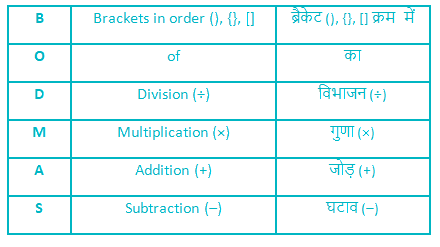
Apply BODMAS:
→ 12 + 6 × 2 - 4
→ 12 + 12 - 4
→ 24 - 4 = 20
∴ The correct answer is "Option 2".
Q10 · Puzzle Subtypes Not To Miss
If + = × , - = ÷, × = +, ÷ = -, then 64 - 4 + 2 x 6 = ?
- 38
- 14
- 20
- 22
Answer aur solution dekho
Archived marked answer: A
 Given:
+ = ×, − = ÷, × = +, ÷ = −
64 − 4 + 2 × 6
Replace the signs:
64 ÷ 4 × 2 + 6
Calculations:
⇒ 64 ÷ 4 × 2 + 6
⇒ 16 × 2 + 6
⇒ 32 + 6 = 38
∴ The correct answer is "Option 1"
Q11 · Coding Decoding
If 'HAT' is coded as '8-1-20', how will 'TAH' be coded?
- 20-1-8
- 8-20-1
- 1-20-8
- 20-8-1
Answer aur solution dekho
Archived marked answer: A
Given: HAT → 8-1-20
Logic: Each letter is replaced by its alphabetical position.
H = 8
A = 1
T = 20
Now for TAH:
T = 20
A = 1
H = 8
Code = 20-1-8
∴ The correct answer is "Option 1".
Q12 · Coding Decoding
If BRAVE is coded as CSBWF, how is CSBWF coded?
- DTCXG
- DSBWG
- DTBWF
- CSBXF
Answer aur solution dekho
Archived marked answer: A
Given:
BRAVE → CSBWF
Pattern: Each letter is shifted +1 in the alphabet.
B → C
R → S
A → B
V → W
E → F
Apply the same rule to CSBWF:
C → D
S → T
B → C
W → X
F → G
Code = DTCXG
∴ The correct answer is "Option 1"
Q13 · Classification Odd One Out
Identify the number which is different from the other options:
- 3
- 5
- 7
- 9
Answer aur solution dekho
Archived marked answer: D
Given Numbers:
3, 5, 7, 9
Analysis:
3 → Prime
5 → Prime
7 → Prime
9 → 3 × 3 (Not Prime)
Hence, 9 is different from the others.
∴ The correct answer is "Option 4".
Q14 · Logical Reasoning
You are a government clerk and receive an incomplete application from a poor villager who doesn't understand the procedure. What should you do?
- Reject the application immediately
- Return it without explanation
- Guide him properly and help him complete the form
- Ignore it as not your responsibility
Answer aur solution dekho
Archived marked answer: C
The correct answer is Guide him properly and help him complete the form.
Key Points
- As a government clerk, it is your duty to assist citizens, especially those who are unaware of procedures.
- A poor villager may lack education or awareness, so providing guidance ensures fairness and accessibility.
- Helping him complete the form promotes transparency, empathy, and responsible public service.
Additional Information
Most Appropriate
Guide him properly and help him complete the form.
This reflects responsibility, compassion, and ensures the citizen receives proper assistance without unnecessary rejection or delay.
Less Appropriate
Return it without explanation.
This may delay the process and does not help the villager understand the correct procedure.
Less Considerable
Reject the application immediately.
This shows lack of empathy and denies the villager a fair opportunity to correct mistakes.
Least Appropriate
Ignore it as not your responsibility.
This reflects negligence and is against the duties of a public servant.
Q15 · Logical Reasoning
Read the following statement carefully and identify the conclusion that follows.
Statement:
No cats are dogs. Some dogs are pets. All pets are friendly.
Conclusions:
I. Some pets are not cats.
II. All dogs are friendly.
- Only I follows
- Only II follows
- Both I and II follow
- Neither I nor II follows
Answer aur solution dekho
Archived marked answer: A
Given Statements:
No cats are dogs.
Some dogs are pets.
All pets are friendly.
Analysis:
From “Some dogs are pets” and “No cats are dogs”
⇒ Those dogs (who are pets) cannot be cats
⇒ Theref
Q16 · Logical Reasoning
Statements: Some roads are highways. All highways are streets. Conclusions: I. All roads are streets. II. Some streets are highways.
- Only Conclusion II follows
- Only Conclusion I follows
- If neither conclusion I nor II follows
- Both I and II follow
Answer aur solution dekho
Archived marked answer: A
The least possible Venn diagram is as:
 Conclusions:
I. All roads are streets → False (Only some roads are highways and highways are streets, but all roads are not necessarily streets).
II. Some streets are highways → True (Since all highways are streets, therefore some streets are highways).
Hence, Only Conclusion II follows.
Q17 · Blood Relations
P is the daughter of Q. Q is the son of R. How is P related to R?
- Niece
- Granddaughter
- Aunt
- Sister
Answer aur solution dekho
Archived marked answer: B
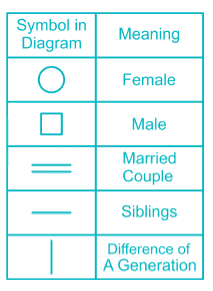 According to the given question,
1) P is the daughter of Q
 2) Q is the son of R
 Family Structure:
 Since P is daughter of Q
And Q is son of R
Therefore, P is child of R’s son.
Thus, P is the Granddaughter of R.
Hence, "Option 2" is the correct answer.
Q18 · Blood Relations
A, B, C, D, E, and F are the six members of a family.
A is the male member of a married pair, A and B. C is A's brother, and D is his only son. D has a sister named E. F's husband has passed away, and B is her daughter-in-law. What connection does E have to C?
- Sister
- Daughter
- Cousin
- Mother-inlaw
Answer aur solution dekho
Archived marked answer: B
Given:
A and B are a married pair (A is male).
C is A’s brother.
D is the only son.
D has a sister E.
F’s husband has passed away and B is her daughter-in-law.
Step-by-step relations:
A is married to B.
C is A’s brother.
D and E are the children of C.
B is the daughter-in-law of F → therefore F is the mother of A.
Family Structure:
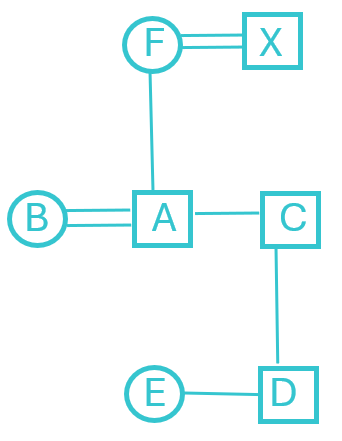 Relation asked:
C is the father of E.
∴ E is the daughter of C.
Q19 · Alphabet Test
Which meaningful word can be formed from the letters "COLYON"?
- CYCLONE
- COYOLN
- COLONY
- LOCNOY
Answer aur solution dekho
Archived marked answer: C
Given Letters:
C, O, L, Y, O, N
Check Options:
1) CYCLONE → Requires extra C and E (Not possible)
2) COYOLN → Not a meaningful word
3) COLONY → C, O, L, O, N, Y (All letters used correctly)
4) LOCNOY → Not a meaningful word
∴ The correct answer is "Option 3".
Q20 · Alphabet Test
Find the odd one out from the given alternatives
- AND
- OR
- NAND
- SQL
Answer aur solution dekho
Archived marked answer: D
Given Options:
1) AND
2) OR
3) NAND
4) SQL
Analysis:
AND → Logical operator
OR → Logical operator
NAND → Logical operator
SQL → Programming/Database language (not a logical operator)
Hence, SQL is the odd one out.
∴ The correct answer is "Option 4".
Q21 · Alphabet Test
In the following question, from the given alternative words, select the word which can be formed using the letters of the given word.
Awesome
- come
- Seat
- Some
- came
Answer aur solution dekho
Archived marked answer: C
Given word: Awesome
Letters available: A, W, E, S, O, M, E
Check options:
1) come → C not available
2) Seat → T not available
3) Some → S, O, M, E available
4) came → C not available
∴ The correct answer is "Option 3".
Q22 · Similarity and Differences
Choose the address that is the same as the one given below.
Apartment 2B, Blue Towers,Nungambakkam, Chennai,Tamil Nadu - 600034
- Apartment 2B, Blue Tower, Nungambakkam, Chennai, Tamil Nadu - 600034
- Apt 2B, Blue Towers, Nungambakkam, Chennai, Tamil Nadu - 600034
- Apartment 2B, Blue Towers,Nungambakkam, Chennai, Tamil Nadu - 600034
- Apartment 2B, Blue Tower, Nungambakam, Chennai, Tamil Nadu - 600034
Answer aur solution dekho
Archived marked answer: C
The address given in the problem is,
Apartment 2B, Blue Towers,Nungambakkam
Chennai, Tamil Nadu - 600034
Option
Address in Option
Matching
(1)
Apartment 2B, Blue Tower, Nungambakkam, Chennai, Tamil Nadu - 600034
Blue Towers is written as Blue Tower.
(2)
Apt 2B, Blue Towers, Nungambakkam, Chennai, Tamil Nadu - 600034
Apartment is shortened to Apt.
(3)
Apartment 2B, Blue Towers,Nungambakkam, Chennai, Tamil Nadu - 600034
The address matches exactly with the given address.
(4)
Apartment 2B, Blue Tower, Nungambakam, Chennai, Tamil Nadu - 600034
Both Blue Towers is written as Blue Tower and Nungambakkam is written as Nungambakam.
So, the address that is exactly the same as the given address is in option (3).
Hence, the correct option is "Option (3)".
Q23 · Logical Statement Questions
Read the following statement carefully and identify the action that follows.
A manager finds data manipulation in quarterly reports.
Course of Action:
1. Conduct an internal audit.
2. Take strict action against guilty staff.
- Only 1
- Only 2
- Both follow
- Neither follows
Answer aur solution dekho
Archived marked answer: C
Course of Action Analysis:
1) Conduct an internal audit.
→ Data manipulation indicates possible irregularities.
→ An internal audit will verify facts and identify discrepancies.
2) Take strict action against guilty staff.
→ If manipulation is confirmed, disciplinary action is necessary.
→ It helps maintain transparency and prevent future misconduct.
Both follow.
Hence, the correct answer is "Option 3".
Q24 · Miscellaneous Other Possibilities
You're working in a legal aid clinic and someone reports domestic violence. What should you do?
- Help them file a report and provide support
- Ignore as it's personal
- Tell them to wait
- Send them to court
Answer aur solution dekho
Archived marked answer: A
Correct Answer: Help them file a report and provide support.
Reason:
- As a legal aid worker, your duty is to assist victims in accessing justice.
- Domestic violence is a serious legal and social issue that requires immediate support.
- Providing guidance, helping file a report, and offering emotional/legal support is the most responsible action.
Hence, Option 1 is correct.
Q25 · Miscellaneous Other Possibilities
A tank can be filled by an inlet pipe in 8 hours. Another outlet pipe can empty the same tank in 12 hours. If both pipes are opened simultaneously, how long will it take to fill the empty tank completely?
- 24 h
- 16 h
- 20 h
- 48 h
Answer aur solution dekho
Archived marked answer: A
Given:
Inlet pipe fills tank in 8 hours
Outlet pipe empties tank in 12 hours
Work per hour:
Inlet = 1/8
Outlet = 1/12
Time taken to fill the tank simultaneously:
= 1/8 − 1/12
LCM = 24
= 3/24 − 2/24
= 1/24
Time required = 24 hours
∴ The correct answer is "Option 1".
General Awareness
Q1 · Art and Culture
The festival of "Phool Dei" is unique to which of the following Indian regions?
- Deccan Plateau
- Malwa Plateau
- Kumaon Hills
- Western Ghats
Answer aur solution dekho
Archived marked answer: C
The correct answer is Kumaon Hills.
Key Points
- The festival of "Phool Dei" is celebrated in the Kumaon Hills, which are part of the Indian state of Uttarakhand.
- Phool Dei is a spring festival observed to celebrate the arrival of the blossoming season and is marked by auspicious rituals and traditional songs.
- During this festival, young children visit houses in their villages, offering flowers, rice, jaggery, and coconut as a mark of prosperity and well-being.
- The celebrations are deeply rooted in the local culture and traditions of the Kumaon region, symbolizing harmony and the connection between humans and nature.
- The festival is considered to bring good fortune and prosperity to households and is celebrated with joy and enthusiasm across the region.
Additional Information
- Kumaon Hills:
- The Kumaon Hills are located in the state of Uttarakhand, in northern India.
- This region is known for its picturesque landscapes, dense forests, and rich cultural heritage.
- The Kumaon region consists of districts such as Almora, Nainital, Pithoragarh, and Bageshwar.
- The area is home to unique festivals like Phool Dei, which reflect the deep connection between the people and their environment.
- Spring Festivals in India:
- Spring festivals across India often celebrate the change of seasons and the abundance of nature.
- Other examples include Holi, which marks the arrival of spring and is celebrated nationwide, and Bihu in Assam.
- These festivals often involve rituals, dances, songs, and offerings to deities, expressing gratitude for nature's bounty.
- Traditional Practices in Kumaon:
- Many festivals in the Kumaon region are based on agricultural cycles and natural phenomena.
- Local traditions emphasize community bonding, with villagers participating together in rituals and festivities.
- Folk songs and dances performed during festivals often narrate the history and mythology of the region.
- Other Regions in Context:
- The Deccan Plateau, Malwa Plateau, and Western Ghats have distinct cultural practices and festivals, but they do not celebrate Phool Dei.
- For example, the Western Ghats are known for festivals like Onam in Kerala, while the Malwa Plateau celebrates Ganesh Chaturthi and other regional traditions.
Important Points
- Significance of Phool Dei:
- The festival promotes environmental awareness and emphasizes the importance of preserving nature.
- It is an opportunity for villagers to express gratitude for nature's gifts and seek blessings for a prosperous year.
- Role of Children:
- Children play a central role in the festival, symbolizing innocence and purity.
- Their participation in rituals highlights the importance of passing cultural traditions to the younger generation.
- Connection with Nature:
- The festival highlights the deep-rooted bond between the Kumaoni people and their natural surroundings.
- It serves as a reminder of the cultural and ecological significance of preserving the environment. </ul
Q2 · Indian Polity and Constitution
Which of the following changes has been introduced to ensure faster trials under the Bharatiya Nagarik Suraksha Sanhita?
- Video recording of statements
- Ban on legal representation
- Removal of judges
- Delay in filing chargesheets
Answer aur solution dekho
Archived marked answer: A
The correct answer is Video recording of statements.
Key Points
- The Bharatiya Nagarik Suraksha Sanhita is a legislative measure aimed at reforming criminal justice procedures in India to ensure faster and more transparent trials.
- The inclusion of video recording of statements is a significant reform aimed at enhancing accuracy and accountability during judicial proceedings.
- Recording statements on video reduces the chances of manipulation, coercion, or misrepresentation of evidence, making trials more efficient and reliable.
- This provision aligns with modern technological advancements and ensures compliance with international standards of just
Q3 · Indian Polity and Constitution
Fill in the blanks:
Even after a Bill is passed by the State Legislature, the Governor may forward it to the _____ for consideration.
- Chief Minister
- Speaker
- President
- Prime Minister
Answer aur solution dekho
Archived marked answer: C
The correct answer is President.
Key Points
- As per the Indian Constitution, even after a Bill is passed by the State Legislature, the Governor has the discretion to forward the Bill to the President of India for consideration.
- This power is conferred under Article 200 of the Constitution, which outlines the Governor's powers concerning legislative assent.
- The Governor may reserve a Bill for the President if it:
- Conflicts with the Constitution
- Affects the Centre-State relationship
- Is of national importance
- When a Bill is reserved for the President, the President can:
- Give assent to the Bill, making it a law
- Withhold assent, effectively rejecting the Bill
- Return the Bill to the State Legislature for reconsideration (except in the case of Money Bills)
- This mechanism ensures checks and balances, especially in cases where state-level legislation might have wider implications.
Additional Information
- Article 200 of the Indian Constitution:
- Empowers the Governor to reserve Bills for the President's consideration under specific circumstances.
- Aims to ensure that state laws do not conflict with Union laws, the Constitution, or national interests.
- Governor's Powers Regarding State Bills:
- The Governor can:
- Give assent to the Bill
- Reserve the Bill for the President's consideration
- Return the Bill (except Money Bills) for reconsideration by the State Legislature
- Withhold assent to the Bill
- The Governor acts as a link between the State and the Centre in legislative matters.
- President's Role in State Legislation:
- The President has the authority to:
- Give assent to the Bill
- Return the Bill to the State Legislature for reconsideration
- Withhold assent, effectively rejecting the Bill
- The President's decision is final and binding in such cases.
- Examples of Bills Referred to the President:
- The West Bengal Housing Industry Regulation Bill, 2017 was referred to the President as it conflicted with the Real Estate (Regulation and Development) Act, 2016.
- The Tamil Nadu Prohibition of Online Gambling Bill, 2022 was reserved for the President's consideration due to its implications on Union subjects.
Important Points
- Governor's Discretion: The Governor's decision to reserve a Bill for the President is discretionary and cannot be questioned in court.
- Money Bills: The Governor cannot return a Money Bill to the State Legislature, and such Bills cannot be reserved for the President.
- President's Assent: If the President gives assent to the Bill, it becomes law, overriding any conflict with Union legislation.
- Checks and Balances: This system ensures constitutional harmony between State and Union laws while safeguarding national interests.
Q4 · Indian Economy
Which of the following is an example of a capital receipt?
- Income Tax collected
- Dividend from PSUs
- Loan taken from RBI
- Sale proceeds of public services
Answer aur solution dekho
Archived marked answer: C
The correct answer is Loan taken from RBI.
Key Points
- Capital receipts refer to those receipts that either create a liability (such as borrowing) or lead to a reduction in assets (such as the sale of government assets).
- A loan taken from the Reserve Bank of India (RBI) is an example of a capital receipt as it creates a liability for the government. The government is obligated to repay the borrowed amount with interest.
- Income Tax collected is not a capital receipt but a revenue receipt, as it does not create a liability or reduce assets. It is a regular income for the government.
- Dividend from PSUs is also a revenue receipt because it is a recurring income earned by the government from its investments in Public Sector Undertakings (PSUs).
- Sale proceeds of public services belong to the category of revenue receipts as they are part of the regular operational income of the government and do not affect liabilities or assets.
Additional Information
- Capital Receipts:
- Capital receipts are non-recurring in nature and include items like borrowings, disinvestment proceeds, and recovery of loans.
- They are used for financing long-term needs, such as infrastructure development or repayment of past loans.
- Revenue Receipts:
- Revenue receipts are recurring and include tax revenues (like income tax, GST) and non-tax revenues (like interest, dividends).
- They are used for meeting the day-to-day operational expenses of the government, such as salaries, subsidies, and maintenance.
- Borrowings from RBI:
- The government borrows from the RBI through instruments like treasury bills and bonds to bridge the fiscal deficit.
- These borrowings are considered liabilities and classified as capital receipts.
- Examples of Capital Receipts:
- Disinvestment proceeds, such as selling shares of PSUs.
- Loans raised from foreign governments or financial institutions.
- Recovery of loans given to states or other entities.
Important Points
- Difference Between Capital and Revenue Receipts:
- Capital receipts either increase liabilities (like loans) or reduce assets (like disinvestment), while revenue receipts are regular income without affecting liabilities or assets.
- Capital receipts are mainly used for long-term investments, whereas revenue receipts fund current expenses.
- Fiscal Responsibility:
- The government aims to balance its borrowings and revenue collections to maintain fiscal discipline under laws like the Fiscal Responsibility and Budget Management (FRBM) Act.
- Role of RBI:
- The RBI acts as a banker to the government and provides loans to meet temporary mismatches in receipts and expenditures.
- It also manages the government's borrowing program through instruments like bonds and treasury bills.
</ul
Q5 · Indian Economy
Consider the following statements:
1. Article 246A grants exclusive power to Parliament to make laws on GST.
2. States have no legislative power over intra-state GST.
3. GST Council is a constitutional body under Article 279A.
Which of the above statements is/are correct?
- 2 only
- 1 only
- 3 only
- 1, 2 and 3
Answer aur solution dekho
Archived marked answer: C
The correct answer is 3 only.
Key Points
- Article 246A of the Constitution provides simultaneous power to both Parliament and State Legislatures to make laws on GST (Goods and Services Tax). However, Parliament has exclusive powers to legislate on inter-state supply of goods and services. *Hence, Statement 1 is incorrect.*
- States do hold legislative power over intra-state GST under Article 246A, which means they can legislate on GST within their own state boundaries. *Hence, Statement 2 is incorrect.*
- The GST Council is a constitutional body created under Article 279A of the Indian Constitution. It is responsible for making recommendations on GST-related policies, rates, and laws. *Hence, Statement 3 is correct.*
Additional Information
- Article 246A:
- Inserted by the 101st Constitutional Amendment Act, 2016, it grants concurrent powers to both Parliament and State Legislatures to make laws on GST.
- However, in the case of inter-state trade or commerce, Parliament has exclusive power to legislate.
- GST Council:
- Constituted under Article 279A of the Constitution.
- Chaired by the Union Finance Minister, and its members include the Finance Ministers of all states.
- Responsible for making recommendations on tax rates, exemptions, and model GST laws.
- Intra-state GST:
- For intra-state supplies of goods and services, both Central GST (CGST) and State GST (SGST) are levied and collected by the respective central and state governments.
- GST and Federalism:
- GST promotes cooperative federalism as both the Centre and the States work together in policy formulation through the GST Council.
- It ensures a unified tax structure across the country.
Important Points
- 101st Constitutional Amendment Act, 2016:
- This amendment introduced GST in India.
- It subsumed multiple indirect taxes like VAT, Service Tax, Excise Duty, etc., to create a unified tax system.
- GST Council's Role:
- It ensures uniformity in GST laws and rates across the country.
- The Council meets periodically to address issues and update policies as required.
``
Q6 · Indian Economy
Which government initiative aims to provide a unified platform for citizens to access various government services online?
- DigiLocker
- UMANG (Unified Mobile Application for New-age Governance)
- MyGov
- National e-Governance Plan (NeGP)
Answer aur solution dekho
Archived marked answer: B
The correct answer is UMANG (Unified Mobile Application for New-age Governance).
Key Points
- UMANG (Unified Mobile Application for New-age Governance) is a flagship initiative by the Government of India to provide a single platform for accessing numerous government services digitally.
- It was launched on 23rd November 2017 by Prime Minister Narendra Modi to promote digital governance and enhance service delivery mechanisms.
- The platform integrates 200+ government services across central and state departments, including Aadhaar, DigiLocker, EPFO, PAN services, and more, into one accessible mobile application.
- UMANG supports services in multiple Indian languages, ensuring inclusivity and accessibility for citizens across the country.
- The app is available across multiple platforms, including Android, iOS, and web, and is designed to provide services related to education, healthcare, finance, agriculture, and others.
- It serves as a significant step towards achieving the vision of Digital India, ensuring that citizens can access services conveniently without visiting government offices physically.
Additional Information
- DigiLocker:
- Launched in 2015 under the Digital India initiative, DigiLocker provides a platform for digital storage of important documents like Aadhaar, PAN, driving license, and education certificates.
- It allows users to access their documents securely and share them electronically with government agencies and other entities.
- Unlike UMANG, DigiLocker focuses solely on document storage and verification rather than offering a wide range of services.
- MyGov:
- Introduced in 2014, MyGov is an online platform enabling citizens to engage directly with the government by participating in discussions, tasks, and policy-making processes.
- It focuses on citizen engagement and crowdsourcing ideas rather than service delivery.
- National e-Governance Plan (NeGP):
- Launched in 2006, NeGP aims to make all government services accessible to citizens through electronic means.
- It provides the framework for implementing e-governance initiatives, under which projects like UMANG have been developed.
- While NeGP is a policy framework, UMANG is a practical implementation of such policies.
- Features of UMANG:
- Integration with Aadhaar and other government systems for seamless service delivery.
- Availability of services related to EPFO, tax payment, utility bill payments, health schemes, and more.
- Support for voice-based navigation and multi-language access to make it user-friendly for diverse groups of people.
- Secure payment gateway integrated for financial transactions.
Important Points
- Digital India Initiative:
- Digital India was launched in 2015 with the vision to transform India into a digitally empowered society and knowledge economy.
- Key pillars include providing digital infrastructure, enhancing digital literacy, and delivering services digitally.
- UMANG is a key component of this initiative, ensuring streamlined delivery of government services.
- UMANG Awards:
- UMANG has received several accolades, including the Best m-Government Service Award at the World Government Summit 2018 held in Dubai.
- It is recognized globally as an exemplary model for digital governance.
</ul
Q7 · Indian Economy
How does Indian planning demonstrate responsiveness to feedback?
- By finalizing plans before public opinion is known
- By discarding public suggestions entirely
- By modifying drafts based on criticism and recommendations
- By consulting only foreign agencies for planning
Answer aur solution dekho
Archived marked answer: C
The correct answer is By modifying drafts based on criticism and recommendations.
Key Points
- Responsiveness in Indian Planning: Indian planning demonstrates a dynamic and inclusive approach by integrating feedback from diverse stakeholders. Plans are not finalized without considering public opinion and expert recommendations, signifying the responsiveness of the system.
- Criticism and Recommendations: A hallmark of the Indian planning process is its adaptability. Drafts of plans are often circulated among various interest groups, experts, and the public, allowing for criticism and suggestions. These inputs are then considered to modify and improve the drafts. *Hence, the statement is correct.*
- Role of Public Participation: Public participation is a cornerstone of democratic planning in India. Authorities actively seek feedback from citizens, ensuring that plans align with the needs and aspirations of the population.
- Expert Consu
Q8 · Indian Economy
Consider the statements about Ghoomar :
1. Its earliest performers were Bhil women; Rajputs later adopted it.
2. Ghoomar was inscribed on UNESCO ICH list in 2015.
Which is/are correct?
- Only 1 correct
- Only 2 correct
- Both 1 & 2 correct
- Neither 1 nor 2 correct
Answer aur solution dekho
Archived marked answer: A
The correct answer is Only 1 correct.
Key Points
- Statement 1: Ghoomar's earliest performers were Bhil women, and it was later adopted by Rajputs. This is correct.
- The Bhil community is an indigenous tribal group in Rajasthan, and the Ghoomar dance was part of their cultural heritage. Later, the Rajput community embraced this dance form as a part of their royal traditions.
- Statement 2: Ghoomar was inscribed on the UNESCO Intangible Cultural Heritage (ICH) list in 2015. This is incorrect.
- The Ghoomar dance, though widely recognized as a significant cultural tradition of Rajasthan, has not been inscribed on the UNESCO ICH list as of 2023. UNESCO inscribes cultural elements on the list only after strict evaluation and nomination by member states.
- *Hence, only Statement 1 is correct.*
Additional Information
- About Ghoomar Dance:
- Ghoomar is a traditional folk dance of Rajasthan, performed by women wearing colorful Ghagras (long skirts).
- The dance is characterized by its graceful twirling movements, which showcase the vibrant colors of the traditional attire.
- It is generally performed on auspicious occasions such as weddings, festivals, and religious ceremonies.
- Bhil Community:
- The Bhils are one of the largest tribal groups in India, primarily residing in Rajasthan, Madhya Pradesh, Gujarat, and Maharashtra.
- They have a rich cultural heritage, and their traditional practices, including Ghoomar, have influenced other communities.
- UNESCO Intangible Cultural Heritage (ICH) List:
- The UNESCO ICH list aims to recognize and preserve cultural practices, traditions, and expressions that are important to the identity of communities.
- Examples from India include Kathak, Yoga, Kumbh Mela, and Chhau Dance.
- Other Traditional Dances of Rajasthan:
- Kalbeliya: Performed by the Kalbeliya community, known for its snake-like dance movements.
- Chari Dance: Involves balancing brass pots with lit lamps on the head.
- Bhavai: A balancing act performed by women with multiple pots on their heads.
Important Points
- Inscription on UNESCO ICH List:
- Cultural elements are nominated by member states and assessed based on their historical significance, community involvement, and preservation efforts.
- India has several elements inscribed on the list, but Ghoomar is not yet inscribed.
- Significance of Ghoomar:
- Recognized as a symbol of Rajasthani culture and hospitality.
- Often performed as a welcoming gesture for dignitaries and during celebrations.
``
Q9 · Sports Static GK
Which sport is linked to the term "Grand Slam"?
- Cricket
- Golf
- Tennis
- Badminton
Answer aur solution dekho
Archived marked answer: C
The correct answer is Tennis.
Key Points
- The term "Grand Slam" is primarily associated with the sport of Tennis.
- The Grand Slam in tennis refers to winning all four major championships in a single calendar year: the Australian Open, French Open, Wimbledon, and US Open.
- These four tournaments are also known as the Majors and represent the most prestigious events in the tennis calendar.
- Winning all four tournaments in a single year is a rare feat and is referred to as a "Calendar Grand Slam". Players achieving this include legends like Rod Laver and Steffi Graf.
- The Grand Slam tournaments are played on different surfaces: hard court (Australian Open and US Open), clay court (French Open), and grass court (Wimbledon), testing a player's versatility and skill.
Q10 · Sports Static GK
The inaugural edition of the Indian Women's League (IWL) football final in 2017 was hosted in which city?
- New Delhi
- Shillong
- Kolkata
- Mumbai
Answer aur solution dekho
Archived marked answer: A
The correct answer is New Delhi.
Key Points
- The inaugural edition of the Indian Women's League (IWL) football final in 2017 was hosted in New Delhi.
- The IWL is a premier women's football league organized by the All India Football Federation (AIFF) to promote women's participation in football in India.
- The 2017 season of the IWL featured teams from across the country, emphasizing the growth and development of women's football.
- The final match was held at the Ambedkar Stadium in New Delhi, a historic venue known for hosting football events.
- The league aims to provide a platform for women footballers to showcase their talent and
Q11 · Sports Static GK
Fill in the blanks:
The Summer Olympics held in _______ in August 2004 featured India's first Olympic shooting medal won by Rajyavardhan Singh Rathore.
- Beijing, China
- Sydney, Australia
- Athens, Greece
- Atlanta, USA
Answer aur solution dekho
Archived marked answer: C
The correct answer is Athens, Greece.
Key Points
- The 2004 Summer Olympics, also known as the Games of the XXVIII Olympiad, were held in Athens, Greece from 13 August to 29 August 2004.
- This Olympics marked the return of the Games to their birthplace, as Athens hosted the inaugural modern Olympics in 1896.
- Rajyavardhan Singh Rathore, an Indian Army officer, won India's first-ever individual silver medal in shooting at the 2004 Olympics in the Men's Double Trap event.
- Rathore's achievement was a historic moment for India, inspiring a new generation of shooters and athletes.
- The 2004 Olympics featured around 10,625 athletes from 201 countries, competing in 301 events across 28 sports.
Additional Information
- Rajyavardhan Singh Rathore:
- He was born on 29 January 1970, in Jaisalmer, Rajasthan, India.
- He is a retired Colonel of the Indian Army and one of India's most celebrated shooters.
- His silver medal at the 2004 Athens Olympics was the first-ever individual silver medal in India's Olympic history.
- Rathore later entered politics and served as the Minister of Youth Affairs and Sports in the Indian government.
- 2004 Athens Olympics:
- The motto of the 2004 Olympics was "Welcome Home" to signify the return of the Games to their original birthplace.
- The event saw the participation of 201 National Olympic Committees (NOCs), the highest at that time.
- Major venues included the Olympic Stadium, Panathenaic Stadium, and the Athens Olympic Sports Complex.
- India at the 2004 Olympics:
- India sent a contingent of 73 athletes competing in 14 sports.
- Rajyavardhan Singh Rathore’s silver medal was the only medal India won at the event.
- This performance highlighted the need for better infrastructure and support for Indian athletes, leading to initiatives like Target Olympic Podium Scheme (TOPS) in later years.
- Other Significant Highlights of the 2004 Olympics:
- Michael Phelps emerged as a swimming sensation, winning 6 gold medals and 2 bronze medals.
- The United States topped the medal tally with 101 medals, including 36 golds.
- Greece, the host country, won a total of 16 medals, including 6 golds.
Q12 · Indian Geography
Why does the Tamil Nadu coast remain dry during the southwest monsoon?
- Due to the presence of extra-tropical cyclonic situations during the winters.
- It receives most of the rainfall from tropical cyclones originating over the Arabian Sea.
- It is situated parallel to the Bay of Bengal branch of the southwest monsoon.
- The inter-tropical convergence zone is located below the Tropic of Capricorn during the winter.
Answer aur solution dekho
Archived marked answer: C
The correct answer is It is situated parallel to the Bay of Bengal branch of the southwest monsoon..
Key Points
- The Tamil Nadu coast remains dry during the southwest monsoon because it lies parallel to the Bay of Bengal branch of the southwest monsoon winds.
- When monsoon winds blow parallel to a region's coastline, they do not bring significant rainfall as they fail to converge or rise to form clouds. This is the case with the Tamil Nadu coast.
- The southwest monsoon primarily affects the western coast of India, bringing heavy rainfall to the Western Ghats, while the eastern coast, including Tamil Nadu, remains relatively dry during this period.
- The Tamil Nadu region instead receives most of its rainfall during the northeast monsoon (October-December) due to the retreating monsoon winds and cyclonic activity in the Bay of Bengal.
- The southwest monsoon winds are deflected by the Western Ghats, causing reduced rainfall on the eastern side, including Tamil Nadu. This phenomenon is known as the rain shadow effect.
Additional Information
- Southwest Monsoon:
- The southwest monsoon is the primary rainy season in India, occurring from June to September.
- The monsoon winds originate over the Indian Ocean and the Arabian Sea, bringing heavy rains to the western coast, including Kerala, Karnataka, Goa, and Maharashtra.
- The Bay of Bengal branch of the monsoon brings rainfall to northeastern states, parts of West Bengal, and Odisha.
- Northeast Monsoon:
- The northeast monsoon occurs from October to December and is responsible for most of the rainfall in Tamil Nadu and parts of Andhra Pradesh.
- It is caused by the retreating monsoon winds, which pick up moisture from the Bay of Bengal and bring rainfall to the eastern coast of India.
- Rain Shadow Effect:
- The rain shadow effect occurs when a mountain range blocks the passage of rain-bearing winds, causing dry conditions on the leeward side.
- The Western Ghats create a rain shadow region on their eastern side, which affects Tamil Nadu during the southwest monsoon.
- Geographical Position of Tamil Nadu:
- Tamil Nadu is located on the southeastern coast of India and lies close to the Bay of Bengal.
- Its geographical position makes it less prone to receiving rainfall from the southwest monsoon but highly dependent on the northeast monsoon.
Important Points
- Option 1: "Due to the presence of extra-tropical cyclonic situations during the winters" – This is incorrect because extra-tropical cyclones occur in higher latitudes and are unrelated to the dryness of Tamil Nadu during the southwest monsoon.
- Option 2: "It receives most of the rainfall from tropical cyclones originating over the Arabian Sea" – This is incorrect because Tamil Nadu receives rainfall from cyclones in the Bay of Bengal, not the Arabian Sea.
- Option 4: "The inter-tropical convergence zone is located below the Tropic of Capricorn during the winter" – This is incorrect as the ITCZ's location does not explain the dryness of Tamil Nadu during the southwest monsoon.
```
89:T
Q13 · Modern Indian History
The Governor General's Council, as established by the Regulating Act, consisted of how many members?
- Three
- Four
- Five
- Six
Answer aur solution dekho
Archived marked answer: B
The correct answer is Four.
Key Points
- The Regulating Act of 1773 was the first step taken by the British Parliament to control and regulate the affairs of the East India Company in India.
- Under the Regulating Act, the Governor-General's Council was established, which consisted of four members, including the Governor-General.
- The first Governor-General of Bengal was Warren Hastings, who served as the head of this council.
- The council was created to ensure better governance and decision-making in India, as the British Crown began exercising control over the East India Company.
- Decisions in the council were made by majority vote, and the Governor-General had the casting vote in case of a tie.
Additional Information
- Key Features of the Regulating Act of 1773:
- The Act designated the Governor of Bengal as the Governor-General of Bengal, with supervisory authority over Bombay and Madras presidencies.
- A Supreme Court was established at Calcutta in 1774 to resolve disputes and administer justice.
- The Act prohibited the servants of the East India Company from engaging in private trade or accepting bribes.
- It marked the beginning of parliamentary control over the East India Company’s administration in India.
- Composition of the Governor-General's Council:
- The council consisted of four members: the Governor-General and three other councillors appointed by the British Crown.
- The Governor-General could exercise a casting vote in case of disagreements among council members.
- This council structure was later modified by subsequent acts, such as the Pitt’s India Act of 1784.
- Limitations of the Regulating Act:
- The Act failed to address the corruption and inefficiency of the East India Company completely.
- The Governor-General’s authority was often undermined by disagreements within the council.
- Further reforms were introduced through the Pitt’s India Act of 1784 to address these shortcomings.
- Subsequent Developments:
- The Pitt’s India Act of 1784 established a dual system of control between the British Parliament and the East India Company.
- The Charter Acts (such as the Charter Act of 1833) further centralized the administration in India and expanded the powers of the Governor-General.
- By the mid-19th century, the British Crown took full control of India after the Government of India Act of 1858.
97:T19a0
Q14 · Modern Indian History
V.O. Chidambaram Pillai, also known as 'Kappalottiya Thamizhan', was a pioneer of the Swadeshi movement who started which enterprise?
- Swadeshi Cotton Mills
- Swadeshi Steam Navigation Company
- Swadeshi Bank
- Swadeshi Textile Mills
Answer aur solution dekho
Archived marked answer: B
The correct answer is Swadeshi Steam Navigation Company.
Key Points
- V.O. Chidambaram Pillai, also known as 'Kappalottiya Thamizhan', was a renowned freedom fighter and a significant figure in the Indian Swadeshi Movement.
- He founded the Swadeshi Steam Navigation Company (SSNC) in 1906 to challenge the monopoly of the British-owned British India Steam Navigation Company (BISNC).
- The company was established to provide shipping services between Tuticorin and Colombo and to promote indigenous enterprise and self-reliance in the shipping industry.
- SSNC was the first shipping company in India to be owned and operated entirely by Indians, symbolizing economic independence and resistance against British colonial rule.
- V.O. Chidambaram Pillai mortgaged his personal property to acquire ships for the company, demonstrating his commitment to the Swadeshi cause.
- The company faced severe opposition from the British, and V.O.C. was eventually arrested and sentenced to rigorous imprisonment, marking him as a martyr of economic freedom.
Additional Information
- Swadeshi Movement:
- The Swadeshi Movement was part of the larger Indian independence movement and promoted the use of indigenous goods and boycotting British products.
- It was initiated during the partition of Bengal in 1905 as a method to protest against the British policies and strengthen India's economic backbone.
- The movement involved promoting Indian industries, including textiles, handlooms, and other cottage industries.
- V.O. Chidambaram Pillai's Contribution:
- He was a lawyer by profession and also a leader of the Indian National Congress.
- He is remembered for his efforts to promote industrial and economic self-reliance among Indians through initiatives like the Swadeshi Steam Navigation Company.
- He was jailed for his nationalist activities, during which he endured harsh conditions and later became a symbol of resistance.
- British India Steam Navigation Company (BISNC):
- The BISNC was a British-owned shipping company that held a monopoly over shipping services in colonial India.
- It symbolized British economic dominance and exploitation of Indian resources and trade routes.
- Impact of the Swadeshi Steam Navigation Company:
- The establishment of SSNC inspired other Indian entrepreneurs to start indigenous enterprises in various sectors.
- It highlighted the importance of economic independence as a key aspect of the freedom struggle.
- Despite its short-lived operation due to British sabotage, it left a lasting legacy in India's industrial history.
Important Points
- V.O.C.'s Ships: The two ships acquired by the Swadeshi Steam Navigation Company were named SS Gallia and SS Lawoe.
- Arrest and Imprisonment: V.O. Chidambaram Pillai was arrested in 1908 under sedition charges and sentenced to 40 years of imprisonment, later reduced to 6 years.
- Legacy: He is commemorated as a symbol of India's fight for economic freedom, with several institutions and places named after him in Tamil Nadu.
- Swadeshi Enterprises: Similar enterprises inspired by the Swadeshi Movement included textile mills, banks, and educational institutions aiming to reduce dependence on British resources.
</ul
Q15 · Current Affairs
Who was appointed as the Union Law Secretary in March 2025, becoming the first woman to hold this position?
- Shelly Oberoi
- Atishi Marlena
- Anju Rathi Rana
- Rekha Gupta
Answer aur solution dekho
Archived marked answer: C
The correct answer is Anju Rathi Rana.
Key Points
- Anju Rathi Rana was appointed as the Union Law Secretary in March 2025, marking a historic milestone as the first woman to hold this position.
- Her appointment reflects the ongoing efforts of the Indian government to promote gender inclusivity and empower women in key administrative and legal roles.
- The Union Law Secretary serves as a senior officer in the Ministry of Law and Justice and is responsible for providing legal advice and overseeing legislative matters in the country.
- Previously, Anju Rathi Rana held significant roles in the legal domain, showcasing her expertise and leadership in matters pertaining to constitutional law, legal reforms, and public policy.
- This appointment is expected to bring a fresh perspective and innovative approaches to India's legal framework, strengthening its core values of justice and equality.
Additional Information
- Union Law Secretary Role:
- The Union Law Secretary is responsible for managing the legal affairs of the government, including the drafting, vetting, and implementation of laws.
- This position plays a pivotal role in ensuring the smooth functioning of India's legal and judicial systems.
- The Secretary works in coordination with the Attorney General, Solicitor General, and other legal entities to uphold constitutional values.
- Gender Inclusivity in Governance:
- The appointment of Anju Rathi Rana as the first woman Union Law Secretary is a step toward breaking gender barriers in governance.
- It aligns with India's broader vision of women empowerment and equal representation in administrative roles.
- Legal Reforms in India:
- India has witnessed significant legal reforms under the Ministry of Law and Justice, including amendments to laws like GST Acts, Criminal Laws, and Consumer Protection Acts.
- The Union Law Secretary plays a critical role in shaping these reforms to address societal and economic challenges.
- Important Precedents:
- Several women have successfully held leadership positions in India's judiciary, such as Leila Seth, the first woman Chief Justice of a High Court (Himachal Pradesh).
- The appointment of Anju Rathi Rana builds upon this legacy, demonstrating India's commitment to gender equality in critical institutions.
Important Points
- Union Law Secretary Appointment Process:
- The appointment process involves a careful selection of candidates with exceptional credentials in legal expertise, administrative capability, and policy-making experience.
- The final decision is made by the government, often with the recommendation of the Ministry of Law and Justice.
- Milestone for Women:
- Anju Rathi Rana's appointment as the first female Union Law Secretary is a landmark achievement in India's legal history.
- Her success inspires women across India to aspire for leadership roles in legal and governance domains.
</ul
Q16 · Current Affairs
According to the World Economic Forum's 2025 Energy Transition Index (ETI), which trend best reflects the current state of global energy systems?
- Security up, sustainability down
- Demand up due to electrification and cooling
- AI cut demand, stabilized grid
- Investment and readiness above average
Answer aur solution dekho
Archived marked answer: B
The correct answer is Demand up due to electrification and cooling.
Key Points
- World Economic Forum’s 2025 Energy Transition Index (ETI): The ETI tracks the progress of energy systems globally and evaluates their readiness for the transition to sustainable energy practices.
- Global energy demand trends: The report highlights that electrification of industries and the rising usage of cooling systems have significantly increased energy demand in recent years.
- Electrification impact: Electrification involves replacing traditional fossil-fuel-based systems with electric-powered systems, such as electric vehicles and industrial equipment, contributing to higher electricity consumption.
- Cooling systems growth: Rapid urbanization, increased temperatures due to climate change, and economic development have led to a surge in demand for cooling systems, such as air conditioners, further driving energy consumption.
- Energy systems' adaptation: While energy systems are adapting to meet growing demand, the transition to renewable sources and energy efficiency measures remains critical to achieve sustainability goals.
- Global readiness: Countries are investing in renewable energy, smart grids, and energy storage to align with growing demands and reduce dependence on fossil fuels.
Additional Information
- Electrification:
- Electrification refers to the process of replacing traditional energy sources, such as coal and oil, with electricity, often generated from renewable sources.
- It plays a crucial role in reducing greenhouse gas emissions by transitioning away from fossil fuels.
- Examples include electric vehicles, smart home appliances, and industrial automation powered by electricity.
- Countries like Norway and Sweden are leading in electrification efforts, with high adoption rates of electric vehicles.
- Cooling Systems:
- Cooling systems, such as air conditioners and refrigeration units, are witnessing a surge in demand due to rising global temperatures and urbanization.
- India and China are among the largest markets for cooling systems, driven by economic growth and increased living standards.
- Efforts are underway to make cooling technologies energy-efficient and environmentally friendly, with innovations like solar-powered cooling systems.
- Energy Transition Challenges:
- Despite advancements in renewable energy, challenges persist in terms of technology adoption, cost of infrastructure, and policy implementation.
- Storage solutions, such as battery technologies like lithium-ion and solid-state batteries, are essential for balancing energy supply and demand.
- Countries are investing in smart grids to optimize energy distribution and integrate renewable sources seamlessly.
- Investment in Renewables:
- Renewable energy investments are critical to meeting the growing energy demand sustainably.
- In 2022, global investments in renewable energy crossed $500 billion, with solar and wind energy being the leading sectors.
- Countries like the United States, China, and Germany are focusing on expanding their renewable energy capacity.
Important Points
- Energy Transition Index (ETI):
- The ETI is an annual report published by the World Economic Forum that ranks countries based on their energy system performance and readiness for transition.
- It evaluates factors such as energy security, environmental sustainability, and economic growth.
- Countries like Sweden, Switzerland, and Norway consistently rank high on the ETI due to their strong renewable energy policies and infrastructure.
- Climate Impacts on Energy Demand:
- Climate change has intensified energy demand, particularly for cooling systems, as global temperatures continue to rise.
- Efforts to minimize emissions from cooling technologies include adopting low-global-warming-potential refrigerants and enhancing energy efficiency standards.
Q17 · Medieval Indian History
Arrange the following historical events in their correct chronological order, from the earliest to the latest:
1. Construction of the Grand Trunk Road
2. Akbar begins his reign
3. Death of Humayun
- 3 - 2 - 1
- 1 - 3 - 2
- 2 - 1 - 3
- 1 - 2 - 3
Answer aur solution dekho
Archived marked answer: B
The correct answer is 1 - 3 - 2.
Key Points
- Construction of the Grand Trunk Road: The Grand Trunk Road is one of Asia's oldest and longest major roads. It was originally built by the Mauryan Empire during the reign of Chandragupta Maurya but was reconstructed and extended by Sher Shah Suri in the 16th century (1540-1545). It connected regions across modern-day Afghanistan, Pakistan, India, and Bangladesh. This event occurred first chronologically.
- Death of Humayun: Humayun, the second Mughal Emperor of India, died on 27 January 1556 after falling from the stairs of his library in Delhi. His death led to the ascension of his son Akbar to the throne. This event occurred after the construction of the Grand Trunk Road.
- Akbar begins his reign: Akbar, the third Mughal Emperor, ascended the throne at the age of 13 after the death of his father, Humayun, in 1556. He is known for consolidating the Mughal Empire in India and implementing significant administrative reforms. This event occurred last chronologically.
Additional Information
- Sher Shah Suri and the Grand Trunk Road:
- Sher Shah Suri, the founder of the Suri Dynasty, is credited with modernizing and extending the Grand Trunk Road, which became a crucial trade route connecting various parts of the Indian subcontinent.
- The road not only facilitated trade but also improved communication and administration across the empire.
- It stretches from Kabul in Afghanistan to Chittagong in Bangladesh, passing through major Indian cities like Delhi and Kolkata.
- Humayun's Death:
- Humayun's untimely death was a pivotal moment in Mughal history, as it led to the early accession of Akbar.
- Humayun is also known for his interest in art and architecture, which influenced Mughal culture during Akbar's reign.
- Akbar's Reign:
- Akbar's reign, starting in 1556, marked the consolidation of the Mughal Empire. His policies of religious tolerance and administrative reforms strengthened the empire.
- Akbar is known for establishing a centralized system of administration and for promoting cultural integration through the Din-i-Ilahi philosophy.
- Chronological Significance:
- The reconstruction of the Grand Trunk Road by Sher Shah Suri (1540-1545) laid the groundwork for efficient administration and trade in the region.
- Humayun's death in 1556 and Akbar's subsequent ascension to the throne were critical in shaping the Mughal Empire's future.
Important Points
- Sher Shah Suri's Administration:
- Besides the Grand Trunk Road, Sher Shah Suri introduced a uniform currency and efficient revenue systems.
- He is also credited with creating several rest houses (sarais) along the road for travelers.
- Humayun's Legacy:
- Despite his struggles, Humayun laid the foundation for the Mughal cultural and architectural renaissance, which flourished under Akbar.
- Akbar's Administrative Reforms:
- Akbar introduced the Mansabdari system, which organized the military and civil administrations.
- He also implemented land revenue reforms, which became the backbone of Mughal administration.
Q18 · Ancient Indian History
Which title used by Gupta rulers reflected their Vaishnavite affiliation?
- Lokadhama-deva
- Parameshvara
- Paramabhagavata
- Paramatman
Answer aur solution dekho
Archived marked answer: C
The correct answer is Paramabhagavata.
Key Points
- The title Paramabhagavata was used by the Gupta rulers to signify their devotion to Lord Vishnu. The term "Bhagavata" refers to a devotee of Bhagavan (Lord Vishnu), and "Paramabhagavata" indicates the supreme devotee.
- This title reflects the Vaishnavite affiliation of the Gupta dynasty, which strongly promoted Hinduism, particularly the worship of Vishnu, during their reign.
- The Gupta rulers were known for their patronage of art, religion, and culture, and their rule marked the golden age of Hinduism in India.
- Many Gupta inscriptions and coins carry symbols associated with Vishnu, such as the Garuda emblem (Vishnu's vehicle)
Q19 · Ancient Indian History
Which foreign element, stemming from Achaemenid Persia, influenced Mauryan sculpture?
- Use of terracotta
- Bold and massive realism
- Employment of specific deities
- Intricate filigree work
Answer aur solution dekho
Archived marked answer: B
Among the listed descriptions, bold and massive realism best matches Mauryan monumental sculpture. Mauryan court art developed through contacts that included Achaemenid and other West Asian traditions. This does not mean that every Mauryan artistic feature, or all stone-polishing technique, can simply be attributed to Persia. Terracotta use, particular deities and filigree are not the stylistic description tested here.
दिए गए विकल्पों में भव्य, विशाल और यथार्थपरक शैली मौर्यकालीन स्मारकीय मूर्तिकला से सबसे अधिक मेल खाती है। मौर्य दरबारी कला पर अखामनी तथा अन्य पश्चिम एशियाई परंपराओं के संपर्क का प्रभाव था। इसका अर्थ यह नहीं कि उसकी हर विशेषता केवल फारस से आई थी।
Q20 · World Geography
Urban Heat Island (UHI) effect is primarily caused by which of the following urban factors?
- Increased humidity in peri-urban regions
- Dense vegetation and water bodies
- Concrete structures, low vegetation, and vehicular heat
- High-altitude rural zones and river valleys
Answer aur solution dekho
Archived marked answer: C
The correct answer is Concrete structures, low vegetation, and vehicular heat.
Key Points
- Urban Heat Island (UHI) effect refers to the phenomenon where urban areas experience higher temperatures than their rural surroundings due to human activities and alterations in land use.
- The primary contributors to the UHI effect include concrete structures, low vegetation, and vehicular heat, which trap and radiate heat, especially during nighttime.
- Concrete and asphalt surfaces, commonly used in urban construction, absorb and retain heat during the day, releasing it slowly at night, thereby increasing temperatures.
- Lack of vegetation in urban areas reduces natural cooling processes like transpiration and evaporation, further intensifying the heat.
- Heat generated by vehicular emissions, i
Q21 · General Science Physics
What happens during beta-plus (β⁺) decay in a nucleus?
- Proton number decreases by 1, mass number remains unchanged
- Proton number increases by 1, mass number remains unchanged
- Both proton number and mass number decrease
- Proton number decreases by 2, mass number decreases by 4
Answer aur solution dekho
Archived marked answer: A
The correct answer is Proton number decreases by 1, mass number remains unchanged.
Key Points
- Beta-plus (β⁺) decay occurs when a proton in a nucleus transforms into a neutron, emitting a positron (β⁺) and a neutrino. This process is mediated by the weak nuclear force.
- As a result of β⁺ decay, the proton number decreases by 1, while the mass number remains unchanged. This is because a proton is converted to a neutron, and both particles have nearly equal masses.
- The emitted positron is the antimatter counterpart of an electron, carrying a positive charge.
- The process leads to the formation of a new element with an atomic number lower by 1 than the original element, but the total number of nucleons (mass number) in the nucleus remains the same.
- For example, during the β⁺ decay of carbon-11:
- Carbon-11 (6 protons, 5 neutrons) transforms into Boron-11 (5 protons, 6 neutrons), with the emission of a positron and a neutrino.
Additional Information
- Other Types of Radioactive Decay:
- Beta-minus (β⁻) decay: A neutron transforms into a proton, emitting an electron and an antineutrino. In this case, the proton number increases by 1, and the mass number remains unchanged.
- Alpha (α) decay: The nucleus emits an alpha particle (2 protons and 2 neutrons), leading to a decrease in both the mass number (by 4) and the atomic number (by 2).
- Gamma (γ) decay: The nucleus releases excess energy in the form of gamma radiation without changing its composition (proton and neutron numbers remain the same).
- Applications of β⁺ Decay:
- β⁺ decay is utilized in positron emission tomography (PET), a medical imaging technique used to study metabolic processes in the human body.
- It plays a role in the synthesis of certain isotopes used in medical diagnostics.
- Characteristics of Positron:
- A positron is the antiparticle of an electron, having the same mass but carrying a positive charge.
- When a positron encounters an electron, they annihilate each other, producing gamma rays.
- Important Facts:
- β⁺ decay typically occurs in proton-rich nuclei, where the proton-to-neutron ratio is too high for stability.
- The weak nuclear force is responsible for β⁺ decay, as it governs the transformation of quarks within protons and neutrons.
Important Points
- Mass Number: The total number of protons and neutrons in a nucleus. It remains constant during β⁺ decay as no nucleons are lost.
- Proton Number (Atomic Number): The number of protons in the nucleus, which decreases by 1 during β⁺ decay.
- Weak Nuclear Force: One of the four fundamental forces in nature, responsible for processes like β⁺ decay and β⁻ decay.
- Neutrino: A nearly massless, electrically neutral particle emitted during β⁺ decay, which carries away energy and momentum.
Q22 · Books and Authors Static
What is the central theme of the book 'Friend of My Youth' by Amit Chaudhuri?
- A collection of interconnected stories exploring Indian family and identity
- A historical account of India's independence struggle
- A travelogue about India's diverse landscapes
- A biography of a famous Indian politician
Answer aur solution dekho
Archived marked answer: A
The correct answer is A collection of interconnected stories exploring Indian family and identity.
Key Points
- 'Friend of My Youth' by Amit Chaudhuri is a novel that revolves around themes of family relationships, identity, and nostalgia.
- The book is set against the backdrop of modern-day Mumbai, exploring the protagonist's reflections on his youth and the evolution of his relationships with family and friends.
- It is written in a style that merges elements of fiction and memoir, offering a unique perspective on Indian family dynamics and the cultural shifts over time.
- The novel captures the essence of Indian urban life, focusing on deeply personal experiences and connections, making the narrative both poignant and relatable.
Q23 · Static GK
Which BIMSTEC member state leads the priority area of "Energy"?
- India
- Thailand
- Sri Lanka
- Bangladesh
Answer aur solution dekho
Archived marked answer: A
The correct answer is India.
Key Points
- BIMSTEC (Bay of Bengal Initiative for Multi-Sectoral Technical and Economic Cooperation) is a regional organization comprising seven member states from South Asia and Southeast Asia: Bangladesh, Bhutan, India, Nepal, Sri Lanka, Myanmar, and Thailand.
- India leads the priority area of "Energy" within BIMSTEC. This includes initiatives for cooperation in energy trade, renewable energy projects, and energy security among member states.
- The focus on energy is crucial due to the region's growing energy demands, reliance on fossil fuels, and the need for sustainable energy solutions.
- India has taken significant steps to promote regional energy connectivity, such as cross-border electricity trade, renewable energy collaborations, and other energy projects within BIMSTEC.
- India’s leadership in this area aligns with its role as a major energy producer and consumer in the region, coupled wi
Q24 · Static GK
Which of the following statements about Verghese Kurien is correct?
- He initiated the White Revolution in India's IT sector.
- He pioneered Operation Flood to transform dairy farming.
- He invented the milk pasteurization method used in Amul.
- He was the first Chairman of the Indian Dairy Association.
Answer aur solution dekho
Archived marked answer: B
The correct answer is He pioneered Operation Flood to transform dairy farming..
Key Points
- Verghese Kurien is famously known as the Father of the White Revolution in India. His contributions revolutionized the dairy industry, making India the largest producer of milk in the world.
- He spearheaded Operation Flood, launched in 1970, which was one of the largest agricultural movements in the world aimed at increasing milk production and establishing a nationwide milk grid.
- Under Operation Flood, Kurien helped establish the National Dairy Development Board (NDDB), which played a pivotal role in ensuring the efficient management of milk production and distribution.
- Amul, the cooperative dairy company, became the face of this revolution. Kurien was instrumental in transforming it into a global success story, using innovative marketing and technology.
- His efforts helped millions of farmers, especially in rural India, gain sustainable livelihoods and improve their socio-economic conditions.
Additional Information
- Operation Flood:
- Launched by the National Dairy Development Board in 1970, the program was funded by the sales of donated powdered milk and butter oil from the European Economic Community.
- The aim was to create a nationwide milk grid to reduce dependence on imports and increase rural income.
- Operation Flood was implemented in three phases, leading to India becoming the largest producer of milk by the 1990s.
- Amul's Role:
- Amul was established in 1946 in Gujarat and became the model for dairy cooperatives across the country.
- Kurien's innovative marketing strategies, such as the iconic "Amul Girl" advertising campaign, helped establish Amul as a household name.
- Amul's success demonstrated the power of cooperative models in empowering farmers.
- White Revolution:
- The White Revolution, led by Kurien, transformed India from a milk-deficient country to the largest producer of milk and dairy products.
- It significantly contributed to improving the nutritional standards of the country.
- The revolution also showcased how agriculture-based industries can drive economic growth.
- Verghese Kurien's Legacy:
- Kurien received numerous accolades, including the Ramon Magsaysay Award in 1963 and the Padma Vibhushan in 1999.
- He served as the Chairman of the NDDB and Gujarat Cooperative Milk Marketing Federation (GCMMF).
- His autobiography, "I Too Had a Dream", highlights his journey and vision for India's dairy industry.
Important Points
- Incorrect Statement 1: Verghese Kurien did not initiate the White Revolution in India's IT sector; it was focused on dairy farming.
- Incorrect Statement 3: Kurien did not invent the milk pasteurization method used in Amul; pasteurization is a globally recognized process.
- Incorrect Statement 4: He was not the first Chairman of the Indian Dairy Association; his primary contributions were towards NDDB and Amul.
</ul
Q25 · General Science
What does the "PSLV" rocket stand for?
- Polar Satellite Launch Vehicle
- Public Space Launch Vehicle
- Planetary Satellite Launch Vehicle
- Private Satellite Launch Vehicle
Answer aur solution dekho
Archived marked answer: A
The correct answer is Polar Satellite Launch Vehicle.
Key Points
- Polar Satellite Launch Vehicle (PSLV) is an expendable launch vehicle developed and operated by the Indian Space Research Organisation (ISRO).
- It was first launched on 20 September 1993 and has since become one of the most reliable launch vehicles in the world.
- PSLV is designed to place satellites into polar orbits, which are used extensively for applications like earth observation, remote sensing, and disaster management.
- The vehicle is capable of delivering payloads to low Earth orbit (LEO), geostationary orbit (GEO), and sun-synchronous orbit (SSO), making it a versatile option for launching satellites.
- PSLV earned the nickname "Workhorse of ISRO" because of its consistent performance, completing over 50 successful missions as of recent years.
Additional Information
- Key Features of PSLV:
- PSLV uses a four-stage configuration with alternating solid and liquid propulsion systems, ensuring flexibility and high precision during launches.
- The payload capacity of PSLV varies depending on the configuration, with a maximum capacity of around 1,750 kg to sun-synchronous orbit.
- It can carry multiple satellites in a single launch, demonstrating its ability to cater to global satellite deployment needs.
- Notable missions include the launch of 104 satellites in a single mission (PSLV-C37) in 2017, a world record for satellite launches in one go.
- Applications of PSLV:
- PSLV has been used to launch satellites for purposes such as earth observation, navigation, communication, scientific exploration, and interplanetary missions.
- It played a key role in launching India's prominent missions like Chandrayaan-1 (2008), Mars Orbiter Mission (Mangalyaan) in 2013, and the RISAT series of satellites for radar imaging.
- PSLV is also used for commercial satellite launches globally, making India a significant player in the international space launch market.
- ISRO Overview:
- The Indian Space Research Organisation (ISRO) is India's national space agency, headquartered in Bengaluru, Karnataka.
- ISRO is known for its cost-effective and efficient space missions, cementing India's position in the global space industry.
- PSLV is one of ISRO’s most successful projects, contributing to India's reputation as a reliable satellite launch provider.
- Other Indian Launch Vehicles:
- ISRO operates other launch vehicles such as the Geosynchronous Satellite Launch Vehicle (GSLV) and GSLV Mk III, which are designed for heavier payloads and higher orbits.
- Small Satellite Launch Vehicle (SSLV) is ISRO's newest development, aimed at launching small payloads at lower costs.
Important Points
- Global Recognition: PSLV's reliability and cost-effectiveness have attracted several countries to use its services for satellite launches.
- Historical Achievements: PSLV contributed to India's first interplanetary mission, Mangalyaan, which successfully reached Mars in 2014.
- Versatility: PSLV’s capability to launch satellites into different orbits makes it suitable for diverse missions, including scientific research and disaster monitoring.
- Future Plans: ISRO continues to enhance PSLV’s capabilities, integrating advanced technologies to ensure greater precision and efficiency.
71:T
Mathematics
Q1 · Geometry
A chord subtends an angle of 70° at the center of a circle. What is the measure of the angle subtended by the same chord at any point on the remaining part of the circle?
- 35°
- 70°
- 140°
- 105°
Answer aur solution dekho
Archived marked answer: A
Shortcut Trick
The angle subtended by a chord at the center of a circle is exactly double the angle subtended by it at any point on the remaining part of the circle.
Required Angle = Angle at center ÷ 2
Required Angle = 70° ÷ 2 = 35°
∴ The correct answer is 35°.
Alternate Method
Given:
The angle subtended by the chord at the center = 70°
Formula Used:
Angle at the circumference = Angle at the center ÷ 2
- 70°
35°
O
A
B
C
Angle subtended by chord AB
Calculations:
⇒ Let the chord be AB and the center of the circle be O.
⇒ The angle subtended by chord AB at the center is ∠AOB = 70°.
⇒ Let C be any point on the major arc (remaining part) of the circle.
⇒ According to the central angle theorem, ∠ACB = ∠AOB ÷ 2
⇒ ∠ACB = 70° ÷ 2
⇒ ∠ACB = 35°
∴ The correct answer is 35°.
Additional Information
Angle in a Semicircle
The angle subtended by a diameter at any point on the circumference of the circle is always a right angle (90°).
Angles in the Same Segment
Angles subtended by the same arc (or chord) at any point on the remaining part of the circle are always equal.
Cyclic Quadrilateral
A quadrilateral inscribed in a circle is called a cyclic quadrilateral. The sum of its opposite interior angles is always 180°.
Alternate Segment Theorem
The angle between a tangent and a chord through the point of contact is equal to the angle in the alternate segment.
Q2 · Geometry
A circle is inscribed in a regular pentagon. What is the angle subtended by one side of the pentagon at the center of the circle?
- 36°
- 54°
- 72°
- 108°
Answer aur solution dekho
Archived marked answer: C
Shortcut Trick
For any regular polygon, the angle subtended by one side at the center is given directly by dividing the full circular angle by the number of sides:
⇒ Central Angle = 360° ÷ n
Here, a regular pentagon has n = 5 sides.
⇒ Central Angle = 360° ÷ 5 = 72°
∴ The correct answer is 72°.
Alternate Method
Given:
A circle is inscribed in a regular pentagon.
Number of sides in a pentagon (n) = 5
Formula Used:
Angle subtended by one side at the center = Total angle around the center ÷ Number of sides
Q3 · Geometry
Two triangles, △PQR and △STU, have PQ=ST, PR=SU, and ∠QPR=∠TSU. By what rule are they congruent?
- SSS
- SAS
- ASA
- AAS
Answer aur solution dekho
Archived marked answer: B
Shortcut Trick
Identify the given corresponding parts between △PQR and △STU directly:
1. PQ = ST (Side)
2. ∠QPR = ∠TSU (Included Angle)
3. PR = SU (Side)
Since the equal angle is formed strictly between the two corresponding equal sides, it satisfies the Side-Angle-Side property.
∴ The correct answer is SAS.
Alternate Method
P
Q
R
S
T
U
S
S
A
S
S
A
△PQR
△STU
Given:
⇒ In △PQR and △STU,
⇒ PQ = ST (Given Side)
⇒ ∠QPR = ∠TSU (Given Angle)
⇒ PR = SU (Given Side)
Concept Used:
⇒ Two triangles are defined as congruent if two sides and the included angle of one triangle are respectively equal to the corresponding two sides and the included angle of the other.
⇒ In △PQR, ∠QPR is directly between sides PQ and PR. Similarly, in △STU, ∠TSU is directly between sides ST and SU.
⇒ Thus, the Side-Angle-Side criteria is perfectly satisfied.
⇒ By SAS Congruence, △PQR ≅ △STU.
∴ The correct answer is SAS.
Additional Information
SSS (Side-Side-Side) Congruence
If three sides of one triangle are respectively equal to the corresponding three sides of another triangle, they are congruent.
ASA (Angle-Side-Angle) Congruence
If two angles and the included side of one triangle are equal to two angles and the included side of another triangle, they are congruent.
AAS (Angle-Angle-Side) Congruence
If two angles and a non-included side of one triangle are respectively equal to the corresponding angles and non-included side of another triangle, they are congruent.
RHS (Right angle-Hypotenuse-Side) Congruence
If in two right-angled triangles, the hypotenuse and one standard side are respectively equal, the triangles are congruent.
Q4 · Geometry
A triangle has vertices at A(2,3), B(7,1), and C(4,6). What is its area?
- 11 square units
- 9.5 square units
- 15.5 square units
- 13 square units
Answer aur solution dekho
Archived marked answer: B
Shortcut Trick
Using the Shoelace method: write coordinates vertically and cross-multiply.
Area = 1/2 × |(x₁y₂ + x₂y₃ + x₃y₁) − (y₁x₂ + y₂x₃ + y₃x₁)|
⇒ Area = 1/2 × |(2×1 + 7×6 + 4×3) − (3×7 + 1×4 + 6×2)|
⇒ Area = 1/2 × |(2 + 42 + 12) − (21 + 4 + 12)|
⇒ Area = 1/2 × |56 − 37| = 1/2 × 19 = 9.5
∴ The correct answer is 9.5 square units.
Alternate Method
Given:
Vertices of the triangle are A(2, 3), B(7, 1), and C(4, 6).
- - A(2, 3)
B(7, 1)
C(4, 6)
Area of Triangle = ?
Formula Used:
Area of a triangle = 1/2 × |x₁(y₂ − y₃) + x₂(y₃ − y₁) + x₃(y₁ − y₂)|
Calculation:
⇒ Let (x₁, y₁) = (2, 3)
⇒ Let (x₂, y₂) = (7, 1)
⇒ Let (x₃, y₃) = (4, 6)
⇒ Area = 1/2 × |2(1 − 6) + 7(6 − 3) + 4(3 − 1)|
⇒ Area = 1/2 × |2(−5) + 7(3) + 4(2)|
⇒ Area = 1/2 × |−10 + 21 + 8|
⇒ Area = 1/2 × |19|
⇒ Area = 9.5
∴ The correct answer is 9.5 square units.
Additional Information
Centroid of a Triangle
The centroid is the point where the three medians of a triangle intersect. Its coordinates can be found using the formula: ((x₁+x₂+x₃)÷3, (y₁+y₂+y₃)÷3).
Collinear Points Condition
Three points are considered collinear if they lie exactly on the same straight line. In coordinate geometry, the area of the triangle formed by three collinear points will always be zero.
Area via Base and Height
When the length of the base and its corresponding perpendicular height (altitude) are known, the area can be easily calculated using: Area = 1/2 × base × height.
</p
Q5 · Geometry
Find the point where y = 5x - 10 crosses x-axis.
- (2, 0)
- (0, -10)
- (-2, 0)
- (2, 10)
Answer aur solution dekho
Archived marked answer: A
Shortcut Trick
The point where a line crosses the x-axis always has a y-coordinate of 0.
Substitute y = 0 into the given equation: y = 5x − 10
⇒ 0 = 5x − 10
⇒ 5x = 10 ⇒ x = 2
∴ The correct answer is (2, 0).
Alternate Method
Given:
Equation of the line: y = 5x − 10
Concept Used:
The x-axis is the horizontal line representing the equation y = 0.
Any point lying perfectly on the x-axis will always have coordinates in the form (x, 0).
- - x y
- (2, 0) (0, -10) O y = 5x − 10
Calculations:
⇒ To find the x-intercept, put y = 0 into the given linear equation.
⇒ 0 = 5x − 10
⇒ 5x = 10
⇒ x = 10 ÷ 5
⇒ x = 2
⇒ Thus, the x-coordinate is 2 and the y-coordinate is 0.
⇒ The point of intersection on the x-axis is (2, 0).
∴ The correct answer is (2, 0).
Additional Information
x-intercept
The x-intercept is the point where a graph crosses the x-axis. At this point, the y-value is always exactly 0. Substitute y = 0 to directly solve for the x-coordinate.
y-intercept
The y-intercept is the point where a graph crosses the y-axis. At this point, the x-value is always exactly 0. Substitute x = 0 to directly solve for the y-coordinate.
Slope-Intercept Form
The standard equation of a straight line is commonly written as y = mx + c, where m represents the slope of the line and c is the point of the y-intercept.
Equation of the Axes
The mathematical equation representing the entire x-axis is y = 0, and the equation representing the entire y-axis is x = 0.
Q6 · Geometry
The sum of the measures of 7 interior angles of an 8-sided polygon is 1,000°. What is the measure of the 8th exterior angle?
- 1080°
- 108°
- 100°
- 80°
Answer aur solution dekho
Archived marked answer: C
Shortcut Trick
Total sum of 8 interior angles = (8 − 2) × 180° = 1080°.
Measure of the 8th interior angle = 1080° − 1000° = 80°.
Exterior angle = 180° − Interior angle.
8th exterior angle = 180° − 80° = 100°.
∴ The correct answer is 100°.
Alternate Method
Given:
Number of sides of the polygon (n) = 8
Sum of 7 interior angles = 1000°
Formula Used:
Sum of all interior angles = (n − 2) × 180°
Interior angle + Exterior angle = 180°
- - - 80°
100°
Interior
Exterior
Interior + Exterior = 180°
Calculation:
⇒ Sum of all 8 interior angles = (8 − 2) × 180°
⇒ Sum of all 8 interior angles = 6 × 180° = 1080°
⇒ 8th interior angle = Total sum − Sum of 7 given angles
⇒ 8th interior angle = 1080° − 1000° = 80°
⇒ 8th exterior angle = 180° − 80°
⇒ 8th exterior angle = 100°
∴ The correct answer is 100°.
Additional Information
Sum of Exterior Angles
The sum of the exterior angles of any convex polygon is always 360°, regardless of the number of sides.
Regular Polygon Angles
For a regular polygon with n sides, each interior angle = ((n − 2) × 180°) ÷ n, and each exterior angle = 360° ÷ n.
Number of Diagonals
The total number of unique diagonals in an n-sided polygon is given by the formula: n(n − 3) ÷ 2.
</p
Q7 · Trigonometry
If sin x = 1/(√(10)), then find sec x in simplest form.
- √10
- 1/(√(10))
- √10/3
- 3/(√(10))
Answer aur solution dekho
Archived marked answer: C
Shortcut Trick
Given, sin x = Perpendicular / Hypotenuse = 1 / √10
Base = √(H² − P²) = √(10 − 1) = √9 = 3
We know, sec x = Hypotenuse / Base
⇒ sec x = √10 / 3
∴ The correct answer is √10/3.
Alternate Method
Given:
sin x = 1 / √10
Formula Used:
sin x = Perpendicular (P) / Hypotenuse (H)
sec x = Hypotenuse (H) / Base (B)
H² = P² + B²
x Base (B) = 3 Perpendicular (P) = 1 Hypotenuse (H) = √10
Calculations:
⇒ By comparing, Perpendicular (P) = 1 and Hypotenuse (H) = √10
⇒ According to Pythagoras theorem: (√10)² = 1² + B²
⇒ 10 = 1 + B²
⇒ B² = 9
⇒ Base (B) = 3
Now, substitute the values into the formula for sec x:
⇒ sec x = H / B
⇒ sec x = √10 / 3
∴ The correct answer is √10/3.
Additional Information
Trigonometric Ratios
For a right-angled triangle, sin θ = Perpendicular / Hypotenuse, cos θ = Base / Hypotenuse, and tan θ = Perpendicular / Base.
Pythagorean Identities
The primary Pythagorean identity is sin² θ + cos² θ = 1. Other forms include 1 + tan² θ = sec² θ and 1 + cot² θ = cosec² θ.
Reciprocal Identities
The reciprocal of cos θ is sec θ (sec θ = 1 / cos θ). Similarly, cosec θ = 1 / sin θ and cot θ = 1 / tan θ.
Q8 · Trigonometry
If sinA + cosA = √2/2, find the value of sin²A + cos²A + 2sinAcosA.
- 1
- √2
- 3/4
- 1/2
Answer aur solution dekho
Archived marked answer: D
Shortcut Trick
The expression sin²A + cos²A + 2sinAcosA is the exact algebraic expansion of (sinA + cosA)².
Substitute the given value sinA + cosA = √2 / 2 directly into the perfect square.
⇒ Result = (√2 / 2)²
⇒ Result = 2 / 4 = 1/2
∴ The correct answer is 1/2.
Alternate Method
Given:
sinA + cosA = √2 / 2
Formula Used:
(a + b)² = a² + b² + 2ab
Calculations:
⇒ We need to evaluate the given trigonometric expression: sin²A + cos²A + 2sinAcosA
⇒ By comparing the expression with the algebraic identity, we substitute a = sinA and b = cosA.
⇒ sin²A + cos²A + 2sinAcosA = (sinA + cosA)²
⇒ Now, substitute the given value of (sinA + cosA):
⇒ (sinA + cosA)² = (√2 / 2)²
⇒ (√2 / 2)² = 2 / 4
⇒ 2 / 4 = 1/2
∴ The correct answer is 1/2.
Additional Information
Algebraic Expansion Identity
(a + b)² = a² + b² + 2ab. This standard algebraic formula is used frequently to simplify both trigonometric and polynomial equations.
Pythagorean Trigonometric Identity
sin²A + cos²A = 1 is the fundamental Pythagorean identity. Using this rule, the expression can also be simplified and written as 1 + 2sinAcosA.
Double Angle Identity
2sinAcosA = sin(2A). Substituting this into the simplified expression gives the alternative form 1 + sin(2A).
Q9 · Mensuration 2D
A rectangular plot has a length of 12.75 m and a width of 6.2 m. What is its area?
- 79.05 m²
- 78.9 m²
- 80.2 m²
- 81.5 m²
Answer aur solution dekho
Archived marked answer: A
Shortcut Trick
Convert the decimal values into fractions for faster multiplication:
Length = 12.75 = 51/4 m
Width = 6.2 = 31/5 m
Area = (51/4) × (31/5) = 1581/20
⇒ Area = 158.1 ÷ 2 = 79.05 m²
∴ The correct answer is 79.05 m².
Alternate Method
Q10 · Mensuration 2D
The base of a prism is a rectangle whose length is twice its width. The perimeter of the base is 30 cm. The prism's height decreases in an arithmetic progression from 15 cm in the first layer to 9 cm in the fourth layer. What is the total volume of the prism?
- 1800 cm³
- 2100 cm³
- 2400 cm³
- 2700 cm³
Answer aur solution dekho
Archived marked answer: C
Shortcut Trick
Given L = 2W. Base perimeter = 2 × (2W + W) = 6W = 30 ⇒ W = 5 cm, L = 10 cm.
Base Area = L × W = 10 × 5 = 50 cm².
Heights form an AP for 4 layers: 15 cm to 9 cm.
Total Height = Sum of AP = (4 ÷ 2) × (15 + 9) = 2 × 24 = 48 cm.
Total Volume = Base Area × Total Height = 50 × 48 = 2400 cm³.
∴ The correct answer is 2400 cm³.
Alternate Method
Given:
⇒ Base perimeter = 30 cm
⇒ Length (L) = 2 × Width (W)
⇒ Heights of 4 layers are in AP with 1st term = 15 cm and 4th term = 9 cm
Formula Used:
⇒ Perimeter of rectangle = 2 × (L + W)
⇒ Area of rectangle = L × W
⇒ Sum of AP = n ÷ 2 × (First term + Last term)
⇒ Total Volume = Base Area × Total Height
- - - Total Height 48 cm Prism Layers Layer 4: 9 cm Layer 3: 11 cm Layer 2: 13 cm Layer 1: 15 cm Base of Prism L = 10 cm W = 5 cm Base Area 50 cm² Perimeter = 30 cm
Calculations:
⇒ 2 × (2W + W) = 30
⇒ 6W = 30 ⇒ W = 5 cm
⇒ L = 2 × 5 = 10 cm
⇒ Base Area = 10 × 5 = 50 cm²
⇒ The heights of the 4 layers form an AP where n = 4, first term a = 15, last term l = 9.
⇒ Total Height = 4 ÷ 2 × (15 + 9) = 2 × 24 = 48 cm
⇒ Total Volume = Base Area × Total Height
⇒ Total Volume = 50 × 48 = 2400 cm³
∴ The correct answer is 2400 cm³.
Additional Information
Volume of a General Prism
The volume of any uniform prism is calculated as the product of its base area and total vertical height: V = Base Area × Height.
Arithmetic Progression (AP) Sum Formula
When the first term (a) and last term (l) of an AP are known, the sum of n terms is derived using the formula: Sₙ = n ÷ 2 × (a + l).
Composite Solids Concept
For a solid structure generated by stacking individual uniformly based layers on top of each other, the total aggregate volume is essentially the continuous base area multiplied by the net sum of all vertical layer heights.
Q11 · Mensuration 2D
The volume of a sphere is 144π cm³. If the radius of the sphere is doubled, by what percentage does the volume increase?
- 700%
- 300%
- 400%
- 500%
Answer aur solution dekho
Archived marked answer: A
Shortcut Trick
If the radius or linear dimension of a 3D figure is multiplied by a factor of n, its volume gets multiplied by n³.
Here, the radius is doubled (n = 2), so the new volume becomes 2³ = 8 times the original volume.
Increase in volume = 8 − 1 = 7 times.
Percentage increase = 7 × 100% = 700%.
*(Note: The given initial volume 144π cm³ is not needed to find the percentage increase.)*
∴ The correct answer is 700%.
Alternate Method
Given:
Original volume of the sphere (V₁) = 144π cm³
Formula Used:
Volume of a sphere = (4/3)πr³
Q12 · Profit and Loss
A person bought a cycle at a discount of 20% on the marked price. He spent Rs. 400 on repairs and sold it for Rs. 4,800, gaining 25%. What was the marked price?
- Rs. 5,500
- Rs. 6,000
- Rs. 5,600
- Rs. 4,300
Answer aur solution dekho
Archived marked answer: D
Shortcut Trick
Working backwards from SP to MP:
Total CP = SP × 100 ÷ (100 + Gain%) = 4800 × 100 ÷ 125 = ₹3840
Initial CP (before repairs) = Total CP − Repairs = 3840 − 400 = ₹3440
MP = Initial CP × 100 ÷ (100 − Discount%) = 3440 × 100 ÷ 80 = ₹4300
∴ The correct answer is ₹4300.
Alternate Method
Given:
Discount = 20%
Repairs = ₹400
Selling Price (SP) = ₹4800
Gain = 25%
Formula Used:
Total CP = Initial CP + Overhead charges
SP = Total CP × (100 + Gain%) ÷ 100
Initial CP = MP × (100 − Discount%) ÷ 100
MP
₹4300
- −20%
Initial CP
₹3440
- +₹400
Total CP
₹3840
- +25%
SP
₹4800
Reverse Calculation to find Marked Price
Calculation:
⇒ Let Marked Price be x.
⇒ Initial CP = x − 20% of x = 0.8x
⇒ Total CP = Initial CP + Repairs = 0.8x + 400
⇒ SP = Total CP × 1.25
⇒ 4800 = (0.8x + 400) × 1.25
⇒ 0.8x + 400 = 4800 ÷ 1.25
⇒ 0.8x + 400 = 3840
⇒ 0.8x = 3840 − 400 = 3440
⇒ x = 3440 ÷ 0.8
⇒ x = 4300
∴ The correct answer is ₹4300.
Additional Information
Marked Price and Discount
Marked Price (MP) is the list price or printed price. Discount is always calculated on the MP. Formula: SP = MP × (100 − Discount%) ÷ 100.
Overhead Charges
Extra expenses like repairs or transportation are added to the initial buying price to get the Total Cost Price (CP). Profit or loss is always calculated on the Total CP.
Successive Discounts
If two discounts of a% and b% are offered consecutively, the equivalent discount % = a + b − (a × b) ÷ 100.
Q13 · Profit and Loss
D and E start a business with equal investments. After 4 months, D adds Rs. 10,000 more. At the end of 1 year, if the total profit is Rs. 33,000, and E's share is Rs. 15,000, what was their initial investment?
- Rs. 66,333.33
- Rs. 43,333.33
- Rs. 33,333.33
- Rs. 73,333.33
Answer aur solution dekho
Archived marked answer: C
Shortcut Trick
D's Profit : E's Profit = (33000 − 15000) : 15000 = 18000 : 15000 = 6 : 5.
The extra 1 unit of profit ratio is due to D's extra capital investment.
Effective extra capital of D = 10000 × 8 months = 80000.
Effective capital ratio = (12x + 80000) / 12x = 6 / 5 ⇒ 1 + (80000 / 12x) = 6 / 5.
80000 / 12x = 1 / 5 ⇒ 12x = 400000 ⇒ x = 33333.33.
∴ The correct answer is Rs. 33,333.33.
Alternate Method
Given:
Initial investment for both D and E = Rs. x
After 4 months, D added Rs. 10000.
Total profit at the end of 1 year = Rs. 33,000
E's share of profit = Rs. 15,000
Formula Used:
Profit Ratio = (Capital of A × Time of A) : (Capital of B × Time of B)
D's Capital E's Capital x × 4 (x + 10000) × 8 x × 12 Profit Ratio (D : E) = 18000 : 15000 = 6 : 5
Calculations:
⇒ D's profit = Total Profit − E's Profit
⇒ D's profit = 33000 − 15000 = Rs. 18,000
⇒ Profit Ratio of D to E = 18000 : 15000 = 6 : 5
⇒ Effective capital of D for 12 months = (x × 4) + ((x + 10000) × 8)
⇒ D's effective capital = 4x + 8x + 80000 = 12x + 80000
⇒ Effective capital of E for 12 months = x × 12 = 12x
⇒ Ratio of effective capitals = Profit Ratio
⇒ (12x + 80000) / 12x = 6 / 5
⇒ 5 × (12x + 80000) = 6 × 12x
⇒ 60x + 400000 = 72x
⇒ 72x − 60x = 400000
⇒ 12x = 400000
⇒ x = 400000 / 12
⇒ x = 33333.33
∴ The correct answer is Rs. 33,333.33.
Additional Information
Simple Partnership
When all partners invest their capitals for the exact same duration, the profit or loss generated is distributed purely in the ratio of their original investments.
Compound Partnership
When capitals are invested for varying time periods, the equivalent capital is computed as Capital × Time. The final profit distribution follows the ratio of these calculated equivalent capitals.
Working vs Sleeping Partner
A working partner actively manages the operations and typically receives a salary or fixed percentage of the profit, while a sleeping partner only supplies capital. The residual profit is divided according to effective investment ratios.
Q14 · Time and Work
20 men can do a piece of work in 45 days. Find the percentage amount of work done by 60 men in 6 days.
- 35.32%
- 31.21%
- 40%
- 33.33%
Answer aur solution dekho
Archived marked answer: C
Shortcut Trick
Using the basic Man-Days concept for Time and Work:
Total Work = M₁ × D₁ = 20 × 45 = 900 man-days.
Work completed by 60 men in 6 days = 60 × 6 = 360 man-days.
Percentage of work done = (Work completed ÷ Total Work) × 100.
Percentage = (360 ÷ 900) × 100 = 40%.
∴ The correct answer is 40%.
Alternate Meth
Q15 · Time and Work
If 15 boys can build a house in 20 days, in how many days can 20 boys complete the same work.
- 11
- 13
- 20
- 15
Answer aur solution dekho
Archived marked answer: D
Shortcut Trick
According to the chain rule, M₁ × D₁ = M₂ × D₂
15 × 20 = 20 × D₂
D₂ = 15
∴ The correct answer is 15 days.
Alternate Method
Given:
Initial number of boys (M₁) = 15
Initial days required (D₁) = 20
New number of boys (M₂) = 20
Formula Used:
M₁ × D₁ = M₂ × D₂
Calculation:
⇒ Total work = M₁ × D₁
⇒ Total work = 15 × 20 = 300 boy-days
⇒ Now, the same work is done by 20 boys in D₂ days.
⇒ 300 = 20 × D₂
⇒ D₂ = 300 ÷ 20
⇒ D₂ = 15
∴ The correct answer is 15 days.
Additional Information
Chain Rule (MDH Concept)
If M₁ persons can do W₁ work in D₁ days working H₁ hours, and M₂ persons do W₂ work in D₂ days working H₂ hours, then (M₁ × D₁ × H₁) ÷ W₁ = (M₂ × D₂ × H₂) ÷ W₂.
Total Work Concept
Total work is considered constant. It is typically the product of the number of workers and the time taken to complete the job.
Work and Efficiency
Efficiency is inversely proportional to the time taken. If the number of workers increases, the time required to complete the same work decreases proportionally.
</p
Q16 · Number System
Which of the following numbers is both a Rational Number and a Terminating Decimal?
- 1/3
- 4/5
- √3
- π
Answer aur solution dekho
Archived marked answer: B
Shortcut Trick
A fraction in its simplest form p/q is a terminating decimal only if the prime factorization of its denominator (q) contains exclusively 2, 5, or both.
1/3 → Denominator is 3, hence non-terminating.
4/5 → Denominator is 5, hence terminating.
√3 and π are standard irrational numbers (non-terminating and non-repeating).
∴ The correct answer is 4/5.
Alternate Method
Given:
The numbers provided in the options are 1/3, 4/5, √3, and π.
Method Used:
Convert each value to its decimal equivalent to identify which one is both rational and terminating.
Calculations:
⇒ Option 1: 1/3 = 0.3333... (This is a rational number but a non-terminating repeating decimal)
⇒ Option 2: 4/5 = 0.8 (This decimal stops at 8, so it is a rational and terminating decimal)
⇒ Option 3: √3 ≈ 1.73205... (The square root of a prime number is irrational, non-terminating, and non-repeating)
⇒ Option 4: π ≈ 3.14159... (Pi is an irrational number, non-terminating, and non-repeating)
∴ The correct answer is 4/5.
Additional Information
Rational Numbers
Numbers that can be expressed in the form p/q, where p and q are integers and q is not equal to 0. They either terminate or repeat in their decimal form.
Irrational Numbers
Numbers that cannot be written as a simple fraction. Their decimal expansions are non-terminating and non-repeating (e.g., √2, √5, π).
Terminating Decimals
Decimals that have an end. A fraction p/q is terminating if the prime factors of q are limited strictly to 2 and/or 5.
</p
Q17 · Number System
A number is such that if you square it and then subtract twice the number, the result is 80. What is the number?
- 10
- 15
- 20
- 25
Answer aur solution dekho
Archived marked answer: A
Shortcut Trick
We can solve this directly by verifying the given options.
Let's test Option 1: 10.
Square of the number = 10² = 100.
Twice the number = 2 × 10 = 20.
Difference = 100 − 20 = 80. (This matches the given condition perfectly)
∴ The correct answer is 10.
Alternate Method
Given:
If you square a number and then subtract twice the number, the result is 80.
Calculation:
Let the unknown number be x.
⇒ x² − 2x = 80
⇒ x² − 2x − 80 = 0
⇒ x² − 10x + 8x − 80 = 0
⇒ x(x − 10) + 8(x − 10) = 0
⇒ (x − 10)(x + 8) = 0
⇒ x = 10 or x = −8
Since 10 is available in our given options, the required number is 10.
∴ The correct answer is 10.
Additional Information
Standard Form of a Quadratic Equation
Any equation of the form ax² + bx + c = 0, where a, b, and c are constants and a ≠ 0, is a quadratic equation.
Sum and Product of Roots
For a quadratic equation ax² + bx + c = 0, the sum of its roots is −b ÷ a and the product of its roots is c ÷ a.
Nature of Roots (Discriminant)
The nature of roots is determined by the discriminant D = b² − 4ac. If D > 0, the roots are real and distinct. If D = 0, roots are real and equal. If D < 0, roots are imaginary.
Q18 · Number System
A recipe requires 0.625 liters of milk for 5 servings. How many servings can be made with 3.75 liters of milk?
- 28
- 30
- 32
- 34
Answer aur solution dekho
Archived marked answer: B
Shortcut Trick
Since the amount of milk and servings are directly proportional:
⇒ Multiplying factor = Total milk ÷ Milk for 5 servings
⇒ Multiplying factor = 3.75 ÷ 0.625 = 6
⇒ Total servings = 5 × 6 = 30
∴ The correct answer is 30 servings.
Alternate Method
Given:
Milk for 5 servings = 0.625 liters
Total milk available = 3.75 liters
Concept Used:
Unitary Method: Find the requirement for 1 serving and multiply or divide accordingly.
Proportional Mapping 0.625 Liters 3.75 Liters
× 6 5 Servings 30 Servings
× 6
Calculations:
⇒ Milk required for 1 serving = 0.625 ÷ 5 = 0.125 liters
⇒ Number of servings possible = Total milk ÷ Milk per serving
⇒ Number of servings possible = 3.75 ÷ 0.125
⇒ Multiply the numerator and denominator by 1000 to eliminate decimals.
⇒ Number of servings possible = 3750 ÷ 125 = 30
∴ The correct answer is 30 servings.
Additional Information
Unitary Method
It is a technique for solving a problem by first finding the value of a single unit, and then calculating the desired quantity by multiplying the single unit value accordingly.
Direct Proportion
When two variables scale by the same exact factor, they are in direct proportion. If x increases, y also increases linearly. Example: x₁ ÷ y₁ = x₂ ÷ y₂.
Inverse Proportion
When an increase in one variable leads to a proportional decrease in another variable (like more workers requiring fewer days). Example: x₁ × y₁ = x₂ × y₂.
Q19 · Time and Distance
Ramesh walks at 5 km/h for 6 km and 6 km/h for 8 km. What is his average speed?
- 4.7 km/h
- 6 km/h
- 5 km/h
- 5.53 km/h
Answer aur solution dekho
Archived marked answer: D
Shortcut Trick
Average Speed = Total Distance ÷ Total Time
Total Distance = 6 km + 8 km = 14 km
Total Time = (6 ÷ 5) + (8 ÷ 6) = 1.2 + 1.333 = 2.533 hours
Average Speed = 14 ÷ 2.533 = 5.526 km/h ≈ 5.53 km/h
∴ The correct answer is 5.53 km/h.
Alternate Method
Given:
Distance 1 (D₁) = 6 km, Speed 1 (S₁) = 5 km/h
Distance 2 (D₂) = 8 km, Speed 2 (S₂) = 6 km/h
Formula Used:
Average Speed = Total Distance ÷ Total Time
Time = Distance ÷ Speed
- - D1 = 6 km
S1 = 5 km/h
D2 = 8 km
S2 = 6 km/h
Total Distance = 14 km
Total Time = T1 + T2 = 1.2 h + 1.33 h = 2.53 h
Average Speed = 14 ÷ 2.53 ≈ 5.53 km/h
Calculations:
⇒ Time for the first part = 6 ÷ 5 = 1.2 hours = 6/5 hours
⇒ Time for the second part = 8 ÷ 6 = 4/3 hours
⇒ Total Time = 6/5 + 4/3 = (18 + 20) ÷ 15 = 38/15 hours
⇒ Total Distance = 6 + 8 = 14 km
⇒ Average Speed = 14 ÷ (38/15)
⇒ Average Speed = (14 × 15) ÷ 38 = 210 ÷ 38
⇒ Average Speed = 105 ÷ 19 = 5.526 km/h
⇒ Rounding to two decimal places, we get 5.53 km/h.
∴ The correct answer is 5.53 km/h.
Additional Information
Average Speed (Equal Distances)
If a person covers two equal consecutive distances at speeds x and y respectively, the average speed for the entire journey is given by 2xy ÷ (x + y).
Average Speed (Equal Time Intervals)
If a person travels at varying speeds x and y for equal time periods, the average speed over the total duration is simply the arithmetic mean: (x + y) ÷ 2.
Relative Speed
For two bodies moving in the same direction at speeds x and y (where x > y), relative speed = x − y. When moving in opposite directions towards each other, relative speed = x + y.
</p
Q20 · Simplification
Simplify: (√(5+2√6)+√(5-2√6))/√2
- 2√3
- √6
- 3√2
- √5
Answer aur solution dekho
Archived marked answer: B
Shortcut Trick
Express the terms inside the square root as perfect squares by finding factors of 6 that add up to 5 (which are 3 and 2).
5 + 2√6 = (√3 + √2)² and 5 − 2√6 = (√3 − √2)²
Numerator = √(√3 + √2)² + √(√3 − √2)² = (√3 + √2) + (√3 − √2) = 2√3
Given expression = 2√3 ÷ √2 = √2 × √3 = √6
∴ The correct answer is √6.
<
Q21 · Proportion
If x:y = 2:5, then what is (2x + 3y):(x + y)?
- 19:7
- 7:19
- 16:7
- 7:16
Answer aur solution dekho
Archived marked answer: A
Shortcut Trick
For homogeneous ratio expressions, we can directly substitute the given ratio values into the equation.
Given x:y = 2:5, directly assume x = 2 and y = 5.
Substitute these into the expression (2x + 3y) : (x + y).
Numerator = 2(2) + 3(5) = 4 + 15 = 19
Denominator = 2 + 5 = 7
∴ The correct answer is 19:7.
Alternate Method
Given:
x:y = 2:5
Formula Used:
If x:y = a:b, then x = ak and y = bk (where k is a common constant multiplier).
Q22 · Average
The average marks of 30 students in a class is 62. If the marks of one student were wrongly entered as 82 instead of 62, what is the CORRECT average?
- 61.33
- 61.67
- 61
- 60.35
Answer aur solution dekho
Archived marked answer: A
Shortcut Trick
Net change in marks = Correct Marks − Wrong Marks = 62 − 82 = −20
Change in average = Net change ÷ Total students = −20 ÷ 30 = −0.67
Correct Average = Old Average + Change in average
Correct Average = 62 − 0.67 = 61.33
∴ The correct answer is 61.33 marks.
Alternate Method
Given:
Total students (n) = 30
Wrong average = 62
Correct marks = 62
Wrong marks entered = 82
Formula Used:
Correct Sum = (Wrong Average × n) − Wrong Value + Correct Value
Correct Average = Correct Sum ÷ n
Old Average 62
Correction −20 ÷ 30 −0.67
New Avg 61.33 Average Deviation Shift
Calculations:
⇒ Total sum before correction = 30 × 62 = 1860
⇒ Correct sum = 1860 − 82 + 62
⇒ Correct sum = 1860 − 20 = 1840
⇒ Correct average = 1840 ÷ 30
⇒ Correct average = 61.333...
∴ The correct answer is 61.33 marks.
Additional Information
1. Deviation Method for Errors
When an item is misread, New Average = Old Average + (Correct Value − Incorrect Value) ÷ Total Items.
2. Combined Average
If two groups of sizes n₁ and n₂ have averages A₁ and A₂, then Combined Average = (n₁ × A₁ + n₂ × A₂) ÷ (n₁ + n₂).
3. Inclusion/Exclusion Principle
If a new item is added and the average increases, New Item Value = Old Average + Total Items × Increase in Average.
Q23 · Compound Interest
What will be the amount to be paid at the end of 5 years on Rs. 4500 at 10% per annum compounded annually?
- 7265.3
- 7545.3
- 7247.3
- 7145.3
Answer aur solution dekho
Archived marked answer: C
Shortcut Trick
The effective compound interest rate for 10% per annum over 5 years can be directly derived from the multiplying factor 1.1
We know that 1.1⁵ = 1.61051, meaning the total amount becomes 161.051% of the principal.
Amount = 1.61051 × 4500
⇒ Amount = 7247.295
⇒ Rounding to one decimal place, we get 7247.3
∴ The correct answer is ₹7247.3.
Alternate Method
Given:
Principal (P) = ₹4500
Rate of Interest (R) = 10% per annum
Time (n) = 5 years
Formula Used:
Amount (A) = P × (1 + R/100)ⁿ
- Year 0
Year 1
Year 2
Year 3
Year 4
Year 5
4500
4950
5445
5989.5
6588.5
7247.3
Each step × 1.1 (+10%)
Calculations:
⇒ A = 4500 × (1 + 10/100)⁵
⇒ A = 4500 × (11/10)⁵
⇒ A = 4500 × 1.61051
⇒ A = 7247.295
⇒ Amount ≈ ₹7247.3
∴ The correct answer is ₹7247.3.
Additional Information
Effective Compound Interest Rates
For a 10% interest rate, the effective CI is 21% for 2 years, 33.1% for 3 years, and 46.41% for 4 years. Remembering these saves significant calculation time in exams.
Difference Between CI and SI
For 2 years, the difference between Compound Interest and Simple Interest on the same principal is computed as Diff = P × (R/100)².
Rule of 72
The approximate time required to double your principal amount at a given compound interest rate can be found directly using 72 ÷ R.
ad:T19
Q24 · Mixture and Alligation
A mixture contains 60% milk. If 20 liters of water is added to the 80-liter mixture, what is the new percentage of milk?
- 50%
- 48%
- 45%
- 60%
Answer aur solution dekho
Archived marked answer: B
Shortcut Trick
Since only water is added, the amount of milk remains constant.
Initial Milk Quantity = Final Milk Quantity
80 × 60% = (80 + 20) × New Milk %
48 = 100 × New Milk %
New Milk % = 48%
∴ The correct answer is 48%.
Alternate Method
Given:
Initial quantity of the mixture = 80 liters
Percentage of milk in the mixture = 60%
Quantity of water added = 20 liters
Formula Used:
Quantity of Milk = (Percentage of Milk ÷ 100) × Total Mixture
New Percentage = (Quantity of Milk ÷ New Total Mixture) × 100
Initial
80 L
60% Milk
+
Added
20 L
Water
=
Final
100 L
? % Milk
Result: 48%
Calculations:
⇒ Quantity of milk in the initial mixture = (60 ÷ 100) × 80
⇒ Quantity of milk = 48 liters
⇒ New total quantity of the mixture = 80 + 20 = 100 liters
⇒ Since only water is added, the quantity of milk remains unchanged at 48 liters.
⇒ New percentage of milk = (48 ÷ 100) × 100
⇒ New percentage of milk = 48%
∴ The correct answer is 48%.
Additional Information
Constant Quantity Principle
When one component is added to or evaporated from a mixture, the total quantity of the other component remains unchanged. By equating its quantity before and after the change, you can easily solve the problem.
Alligation Rule
Alligation is used to quickly find the ratio in which two ingredients at given concentrations must be mixed to produce a desired final concentration. The ratio is found crosswise: (Cheaper − Mean) : (Mean − Dearer).
Replacement Formula
If an initial volume 'V' contains pure liquid, and 'x' volume is removed and replaced by water 'n' times successively, the final amount of pure liquid is given by V × (1 − x/V)ⁿ.
</p
Q25 · Mixture and Alligation
A merchant wants to mix two types of tea priced at Rs. 300/kg and Rs. 240/kg. In what ratio should they be mixed to sell the mixture at Rs. 270/kg without profit or loss?
- 1:1
- 2:1
- 3:2
- 1:2
Answer aur solution dekho
Archived marked answer: A
Shortcut Trick
Using the rule of alligation directly for the given prices:
Ratio = (Mean Price − Price of Tea 2) : (Price of Tea 1 − Mean Price)
Ratio = (270 − 240) : (300 − 270)
Ratio = 30 : 30 = 1 : 1
∴ The correct answer is 1:1.
Alternate Method
Given:
Price of Type 1 tea = ₹300/kg
Price of Type 2 tea = ₹240/kg
Since the mixture is sold without profit or loss, Cost Price (Mean Price) = Selling Price = ₹270/kg
Method Used:
We use the Alligation Cross Method to find the required ratio.
Type 1 ₹300/kg Type 2 ₹240/kg
- - - - Mean ₹270/kg 30 270 − 240 30 300 − 270 Ratio = 30 : 30 = 1 : 1
Calculations:
Let the quantities of Type 1 and Type 2 tea be x and y respectively.
⇒ Total Cost Price = 300 × x + 240 × y
⇒ Total Selling Price = 270 × (x + y)
Equating Cost Price and Selling Price:
⇒ 300x + 240y = 270x + 270y
⇒ 300x − 270x = 270y − 240y
⇒ 30x = 30y
⇒ x / y = 30 / 30
⇒ x : y = 1 : 1
∴ The correct answer is 1:1.
Additional Information
Rule of Alligation
It is a method used to find the ratio in which two or more ingredients at given prices must be mixed to produce a mixture of a desired price. Formula: Quantity of Cheaper ÷ Quantity of Dearer = (CP of Dearer − Mean Price) ÷ (Mean Price − CP of Cheaper).
Mean Price
The cost price of a unit quantity of the mixture is called the mean price. Always ensure that the Mean Price represents Cost Price before applying alligation.
No Profit No Loss Condition
When a mixture is sold without any profit or loss (0% profit), the Selling Price (SP) of the mixture is exactly equal to its Cost Price (CP).
English
Q1 · Vocabulary
Select the most appropriate antonym of the given word. Impecunious
- Insolvent
- Wealthy
- Indigent
- Penniless
Answer aur solution dekho
Archived marked answer: B
The correct answer is: Option 2 i.e. Wealthy.
Key Points
- The word "Impecunious" means having little or no money; being poor.
- Example: After losing his job, he found himself in an impecunious situation, struggling to pay his bills.
- "Wealthy" refers to someone who is rich, affluent, and has an abundance of money or valuable possessions.
- Example: The wealthy businessman donated generously to the charity, helping thousands of people.
- Hence, the opposite of 'Impecunious' is 'Wealthy'.
Therefore, the correct answer is: Option 2: Wealthy.
Additional Information
Here are the other options explained along with their Hindi meanings and example sentences:
- Insolvent : Unable to pay debts owed by a person or company.
- Example: The company declared itself insolvent after years of financial struggles.
- Indigent : Extremely poor and lacking the basic necessities of life.
- Example: The indigent community received aid from the local government to improve their living conditions.
- Penniless: Having no money at all; completely broke.
- Example: After spending recklessly, he was left penniless and unable to afford even basic needs.
1) × and −</strong&
Q3 · Vocabulary
Choose the correct meaning of idiom:
Hang fire
- Delay taking action or making a decision
- Create urgency
- Withdraw support
- Complete a task early
Answer aur solution dekho
Archived marked answer: A
The correct answer is: Option 1 i.e. "Delay taking action or making a decision".
Key Points
- The idiom "Hang fire" means to delay taking action or postponing making a decision.
- Example: The company decided to hang fire on launching the new product until the market research was complete.
- Explanation: "Hang fire" originally referred to a misfire in firearms where the gunpowder ignited but the bullet took time to fire. Over time, it evolved into meaning a delay in action or decision-making.: " " Therefore, the correct answer is: Option 1.
Additional Information
Here are the other options explained along with their Hindi meanings and example sentences:
- Option 2: Create urgency: Refers to making something more pressing or important to act upon immediately.
- Example: The sudden deadline created urgency among the team to finish the project.
- Option 3: Withdraw support: Refers to stopping or removing help or backing from someone or something.
- Example: The investor decided to withdraw support from the startup due to poor performance.
- Option 4: Complete a task early: Refers to finishing a given task or project before the expected time.
- Example: She completed the assignment early and had time to review it thoroughly.
Q4 · Vocabulary
Choose the correct meaning of idiom:
To play the second fiddle
- To pretend submission in order to dominate
- To support another while accepting inferior status
- To refuse recognition despite achievement
- To operate without being named
Answer aur solution dekho
Archived marked answer: B
The correct answer is: Option 2 i.e. "To support another while accepting inferior status".
Key Points
- The idiom "To play the second fiddle" means to take a subordinate or less important role in relation to someone else.
- Example: She was content to play the second fiddle to her husband, supporting him in his career while she managed the home.
- The correct meaning of the idiom is to "support another while accepting inferior status."
- Example: In the band, John was happy to play the second fiddle to his more talented brother, letting him shine in the spotlight.
Therefore, the correct answer is: Option 2.
Additional Information
Here are the other options explained along with their Hindi meanings and example sentences:
- Option 1: To pretend submission in order to dominate
- Example: He pretended to agree with the manager’s decisions, but it was just a strategy to take control later.
- Option 3: To refuse recognition despite achievement
- Example: Despite his great contribution to the project, he refused recognition because he believed it was a team effort.
- Option 4: To operate without being named
- Example: The anonymous donor preferred to operate without being named, helping the needy without any recognition.
Given statements:
J > K = L
M ≥ N < K
O < J < P
N = Q ≥ R
On combining:</p&
Q5 · Vocabulary
Choose the correct one-word substitute for: 'A speech delivered without any previous preparation'.
- Extempore
- Dialogue
- Soliloquy
- Prologue
Answer aur solution dekho
Archived marked answer: A
The correct answer is: Extempore.
Key Points
- The word "Extempore" refers to a speech or performance made without any prior preparation or planning.
- Example: The professor delivered an extempore lecture when the scheduled speaker failed to arrive.
- "Extempore" is often used to describe impromptu speeches, debates, or performances where there is no script.
- Example: She won the competition with her extempore speech on environmental conservation.
Therefor
Q6 · Vocabulary
Choose the correct one-word substitute for: 'The art of effective or persuasive speaking or writing'.
- Logic
- Grammer
- Rhetoric
- Semantics
Answer aur solution dekho
Archived marked answer: C
The correct answer is: Rhetoric.
Key Points
- The word "Rhetoric" refers to the art of effective or persuasive speaking or writing, especially using figures of speech and other compositional techniques. /
- Example: The politician's rhetoric was carefully crafted to win over the audience.
- It involves the strategic use of language to influence or persuade others, making it a crucial skill in communication and public speaking.
- Example: His speech was a masterclass in rhetoric, leaving the audience inspired and motivated.
Therefore, the correct answer is: Rhetoric.
Additional Information
Here are the other options explained along with their Hindi meanings and example sentences:
- Logic: The science of reasoning and forming valid conclusions.
- Example: The detective used logic to solve the complex mystery.
- Grammar: The set of rules that govern the structure of sentences in a language.
- Example: Proper grammar is essential for clear communication.
- Semantics: The branch of linguistics concerned with meaning in language.
- Example: The debate on semantics made the discussion more detailed and precise.
Given Statements:
Q7 · Vocabulary
Which spelling is correct for a word meaning 'relating to the countryside'?
- Rurall
- Rurel
- Rural
- Rurral
Answer aur solution dekho
Archived marked answer: C
The correct answer is option 3.
Key Points
The correct spelling for the word meaning 'relating to the countryside' is 'Rural'.
- 'Rural' is an adjective that describes things related to, characteristic of, or situated in the countryside rather than the town.
- For Example -
- She enjoys the peace and simplicity of rural life.
- The rural landscape was breathtakingly beautiful.
Therefore, the correct answer is 'Rural'.
Additional Information
Explanation of Incorrect Options:
- Rurall - This is an incorrect spelling. The word contains an extra 'l'.
- Rurel - This is an incorrect spelling. The letters 'e' and 'a' are misplaced.
- Rurral - This is an incorrect spelling. It has an additional 'r'.
Q8 · Vocabulary
Select the correct spelling of a word meaning 'cell division of cytoplasm'.
- Cytokenesis
- Cytokynesis
- Cytokinesis
- Cytokineses
Answer aur solution dekho
Archived marked answer: C
The correct answer is option 3.
Key Points
The correct spelling of the word meaning 'cell division of cytoplasm' is 'cytokinesis'.
- Cytokinesis refers to the process during cell division where the cytoplasm of a single eukaryotic cell is divided to form two daughter cells.
- This process typically occurs after the completion of mitosis or meiosis.
Explanation of Options:
- Option 1 - Cytokenesis: Incorrect spelling.
- Option 2 - Cytokynesis: Incorrect spelling.
- Option 3 - Cytokinesis: Correct spelling.
- Option 4 - Cytokineses: Incorrect spelling (plural form, not appropriate for the given context).
Therefore, the correct answer is option 3 - Cytokinesis.
Additional Information
Key Terminology:
- Mitosis: The process of cell division that results in two genetically identical daughter cells.
- Meiosis: A type of cell division that reduces the chromosome number by half, producing four gamete cells.
</ul
Q9 · Vocabulary
Select the most appropriate synonym of the given word: UPBRAID
- Flatter
- Reprimand
- Praise
- Compliment
Answer aur solution dekho
Archived marked answer: B
The correct answer is: Reprimand.
Key Points
- The word "Upbraid" means to criticize or scold someone severely for their actions or behavior.
- Example: The teacher upbraided the students for not submitting their homework on time.
- "Reprimand" refers to a formal expression of disapproval or criticism, often in a stern manner.
- Example: The manager reprimanded the employee for repeatedly missing deadlines.
- Hence, we can conclude that the most appropriate synonym for 'Upbraid' is 'Reprimand'.
Therefore, the correct answer is: Reprimand.
Additional Information
Here are the other options explained along with their Hindi meanings and example sentences:
- Flatter: To praise excessively or insincerely, often for personal gain.
- Example: He tried to flatter his boss to get a promotion.
- Praise: To express admiration or approval for someone’s achievements or qualities.
- Example: The coach praised the team for their hard work and dedication.
- Compliment: A polite expression of admiration or approval.
- Example: She received a lovely compliment on her beautiful dress.
The correct answer is: Option 2 i.e. Wealthy.
Q10 · Grammar
Find the part of the sentence that contains an error:
The decision to delay the launch (1)/ was made so quickly that (2)/ it surprised not only the staff (3)/ but also to the stakeholders. (4)/
- -1
- -2
- -3
- -4
Answer aur solution dekho
Archived marked answer: D
The correct answer is Option 4.
Key Points
- The error lies in part 4 of the sentence due to a violation of parallel structure.
- When using correlative conjunctions like "not only... but also," the grammatical structures following both parts must be identical (parallel).
- In part 3, "not only" is followed by a noun phrase ("the staff"). Therefore, "but also" should also be followed directly by a noun phrase ("the stakeholders").
- The preposition "to" in part 4 is redundant and breaks this parallelism. Removing it makes the sentence grammatically correct.
Therefore, the correct answer is 4.
Correct Sentence: *"The decision to delay the launch was made so quickly that it surprised not only the staff but also the stakeholders."*
Additional Information
- 1: "The decision to delay the launch" – This is the correct subject phrase using a legitimate infinitive ("to delay").
- 2: "was made so quickly that" – This uses the correct passive voice and the "so... that" construction to show result.
- 3: "it surprised not only the staff" – This part is correct as it introduces the first element of the comparison.
- Parallelism ensures that the reader can process the relationship between the two balanced ideas more easily.
Q11 · Grammar
Select the correct option:
___ honesty is valued, transparency is indispensable.
- While
- Whereas
- Where
- When
Answer aur solution dekho
Archived marked answer: C
The correct answer is 'Where'.
Key Points
- The conjunction "Where" is used to indicate a condition or context in which the second part of the sentence applies.
- The sentence structure implies a context where honesty is valued, and in that same context, transparency is considered indispensable.
-
Q12 · Grammar
Select the correct option:
The physician spoke ___, avoiding technical jargon so patients could understand.
- perspicuously
- perspicaciously
- perspicuity
- perspiringly
Answer aur solution dekho
Archived marked answer: A
The correct answer is 'perspicuously'.
Key Points
- The word "perspicuously" means "clearly and understandably," which fits the context of a physician speaking in a way that avoids technical jargon.
- Perspicaciously (Option 2) refers to being insightful or having a keen understanding, which does not match the context of the sentence.
-
Q13 · Grammar
A sentence is provided in indirect speech. From the four given options, choose the one that most accurately conveys the sentence in its corresponding direct speech.
He wondered whether he could ever master quantum theory.
- He asked, "Could I master quantum theory?"
- He said, "Will I ever master quantum theory?"
- He wondered, "Can I ever master quantum theory?"
- He wondered, "Could I ever master quantum theory?"
Answer aur solution dekho
Archived marked answer: C
The correct answer is Option 3.
Key Points
- Indirect Speech: He wondered whether he could ever master quantum theory.
- Key Conversions:
- "whether he could" becomes "Can I"
- The conjunction "whether" indicates an indirect question, which is converted to a direct question format.
- The pronoun "he" (referring to the subject) changes to "I" in direct speech.
- The modal verb "could" is the past form of "can" used in indirect speech; it reverts to the present tense "can" in direct speech.
- "ever master quantum theory" remains the same
- The adverb "ever" and the base verb "master" are maintained to preserve the original meaning of the doubt/possibility.
- Reporting verb:
- The verb "wondered" is retained as it perfectly captures the self-reflective nature of the question.
- Punctuation and Format:
- The direct speech is enclosed in quotation marks.
- The sentence inside the quotes starts with a capital letter and ends with a question mark.
- A comma is used to separate the reporting verb from the quoted speech.
Therefore, the correct answer is Option 3.
Correct Sentence: *He wondered, "Can I ever master quantum theory?"*
Additional Information
- Option 1: "He asked, 'Could I master quantum theory?'"
- Missing the word "ever," which was in the original sentence.
- "Asked" is less precise than "wondered" for a self-reflective thought.
- Option 2: "He said, 'Will I ever master quantum theory?'"
- The use of "will" in direct speech would require "would" in indirect speech (He wondered if he would ever...).
- Option 4: "He wondered, 'Could I ever master quantum theory?'"
- While "could" is used in the original indirect sentence, standard grammar rules dictate a back-shift from "can" to "could" when moving to indirect speech. Therefore, direct speech should use "can."
Q14 · Grammar
A sentence is provided in direct speech. From the four given options, choose the one that most accurately conveys the sentence in its corresponding indirect speech.
Rohit said, "I had completed the project."
- Rohit said he has completed the project.
- Rohit said he completed the project.
- Rohit said that he had completed the project.
- Rohit said that he was completing the project.
Answer aur solution dekho
Archived marked answer: C
The correct answer is Option 3.
Key Points
- Direct Speech: Rohit said, "I had completed the project."
- Key Conversions:
- Tense (Past Perfect):
- The verb in direct speech is "had completed" (Past Perfect tense).</li
Q17 · Voice Change
Change the following from active to passive:
They should have had the matter re-examined before escalation.
- The matter should have had to be re-examined before escalation.
- The matter should have been re-examined before escalation.
- The matter should have been had re-examined.
- The matter should have been made to be re-examined.
Answer aur solution dekho
Archived marked answer: B
The correct answer is Option 2.
Key Points
- The original sentence is in the active voice using a modal perfect causative structure: Subject + should + have + had + object + past participle.
- In this structure, "had" acts as a causative verb, meaning the subject arranged for the action to be done.
- To convert this to passive voice, the object "the matter" becomes the subject.
- The modal perfect causative "should have had [something] re-examined" simplifies in the passive to the modal perfect passive: should + have + been + past participle.
- The phrase "before escalation" remains unchanged as it is a prepositional phrase providing context.
Therefore, the correct answer is Option 2.
Correct Sentence: *"The matter should have been re-examined before escalation."*
Additional Information
- Option 1: "The matter should have had to be re-examined..." – Incorrect because "had to" introduces a sense of compulsory obligation that is not present in the original sentence.
- Option 3: "The matter should have been had re-examined." – Grammatically incorrect; you cannot use "been" and "had" consecutively in this manner.
- Option 4: "The matter should have been made to be re-examined." – Incorrect as it changes the causative "had" to "made," which implies force or coercion rather than a simple arrangement.
Q18 · Voice Change
Convert the sentence provided below from its passive voice structure to an active voice structure:
The CEO is known to have been influenced by external advisors.
- External advisors are known to influence the CEO.
- Someone knew the CEO was influenced by external advisors.
- People know that the CEO was influenced by external advisors.
- External advisors are said to have influenced the CEO.
Answer aur solution dekho
Archived marked answer: C
The correct answer is Option 3.
Key Points
- The original sentence "The CEO is known to have been influenced..." uses a passive reporting verb ("is known") followed by a perfect passive infinitive ("to have been influenced").
- To convert this to active voice, we must introduce a generic subject like "People" or "They" to perform the act of "knowing."
- The phrase "is known" (present tense) becomes "People know" or "They know."
- The perfect infinitive "to have been influenced" indicates an action that happened in the past. In an active "that-clause," this becomes "that the CEO was influenced" or "has been influenced."
- "People know that the CEO was influenced by external advisors" correctly maintains the present state of knowledge about a past influence.
Therefore, the correct answer is Option 3.
Correct Sentence: *"People know that the CEO was influenced by external advisors."*
Additional Information
- Option 1: "External advisors are known to influence..." changes the tense of the influence to the general present, losing the "have been" (past/completed) aspect.
- Option 2: "Someone knew..." changes the reporting verb to the past tense, which contradicts the original "is known" (present).
- Option 4: "External advisors are said to..." changes the meaning of the verb from "known" to "said," and remains in a passive-style construction.
Q19 · Para Jumble
Rearrange the following sentences in correct order to make a logical passage.
1. Consequently, many species face extinction.
2. Climate change poses a severe threat to global biodiversity.
3. Rising temperatures and extreme weather disrupt ecosystems.
4. Urgent action is needed to mitigate its devastating effects.
- 2-4-1-3
- 2-3-1-4
- 4-3-2-1
- 2-1-3-4
Answer aur solution dekho
Archived marked answer: B
The correct answer is Option 2.
Key Points
- The paragraph follows a cause-and-effect logical structure, starting with a broad problem and ending with a call to action.
- Sentence 2 is the first sentence as it introduces the primary topic (climate change) and the specific concern (biodiversity):
- "Climate change poses a severe threat to global biodiversity."
- Sentence 3 follows by explaining the mechanism of that threat—how the climate change actually affects nature:
- "Rising temperatures and extreme weather disrupt ecosystems."
- - Sentence 1 is the third sentence because it shows the direct consequence of the disruption mentioned in the previous sentence:
- "Consequently, many species face extinction."
- Sentence 4 is the fourth as it provides the concluding summary or solution based on the gravity of the situation described:
- "Urgent action is needed to mitigate its devastating effects."
- The correct sequence is 2-3-1-4.
Coherent paragraph after rearrangement:
"Climate change poses a severe threat to global biodiversity. Rising temperatures and extreme weather disrupt ecosystems. Consequently, many species face extinction. Urgent action is needed to mitigate its devastating effects."
Q20 · Para Jumble
Rearrange the following sentences to form a meaningful passage:
1. Carbon nanotubes exhibit exceptional strength and conductivity.
2. Their nanoscale diameter allows structural flexibility.
3. Applications span electronics, medicine, and materials.
4. They're synthesized using chemical vapor deposition.
- 4-1-2-3
- 1-2-4-3
- 1-2-3-4.
- 4-1-2-3.
Answer aur solution dekho
Archived marked answer: B
The correct answer is Option 2.
Key Points
- The paragraph follows a logical progression from the general properties of the subject to its structural details, manufacturing, and finally its real-world utility.
- Sentence 1 is the first sentence as it introduces the subject and its primary characteristics:
- "Carbon nanotubes exhibit exceptional strength and conductivity."
- - Sentence 2 follows as it provides the structural explanation for the properties mentioned in the first sentence:
- "Their nanoscale diameter allows structural flexibility."
- Sentence 4 is the third sentence because it transitions from what the tubes are to how they are produced:
- "They're synthesized using chemical vapor deposition."
- Sentence 3 is the fourth as it concludes the passage by listing the diverse fields where these tubes are applied:
- "Applications span electronics, medicine, and materials."
- The correct sequence is 1-2-4-3.
Coherent paragraph after rearrangement:
"Carbon nanotubes exhibit exceptional strength and conductivity. Their nanoscale diameter allows structural flexibility. They're synthesized using chemical vapor deposition. Applications span electronics, medicine, and materials."