95 questions available to read. Bina signup padho; timed practice ke liye free sign in karo.
Archive coverageThis saved paper contains 98 of 100 expected questions. 3 stored records are excluded from this study page while their source or wording is checked. Missing original questions: 2. Local question numbers follow the saved archive; match the wording and choices when comparing another response sheet.
Archived marked answers and available solution notes are preserved. These are not claimed to be fully checked final SSC keys. How questions are checked.
Reasoning
Q1 · Series
In the sequence B, D, F, H..., which letter comes 6th?
- J
- N
- L
- M
Answer aur solution dekho
Archived marked answer: C
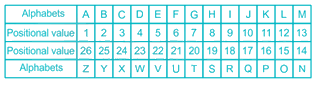 The logic followed here is:
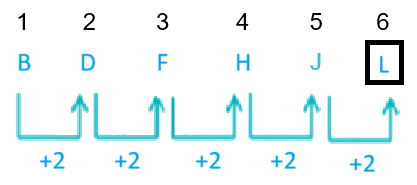 So, 'L' will be the 6th letter of this series.
Hence, the correct answer is "Option 3".
Q2 · Series
What comes next in the series?
A, C, F, J, O, ?
- U
- V
- W
- T
Answer aur solution dekho
Archived marked answer: A
The logic followed here is:
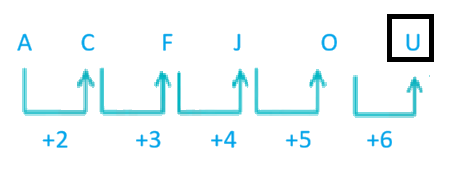 So, 'U' will replace the question mark in the given series.
Hence, the correct answer is "Option 1".
Q3 · Series
What should come at the place of question mark? :
11, 22, 20, 40, 38, ?
- 76
- 74
- 78
- 80
Answer aur solution dekho
Archived marked answer: A
The logic followed here is:
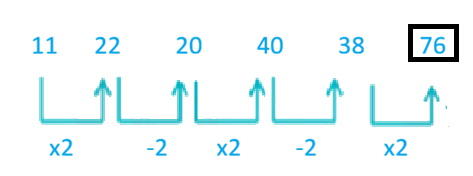 thus, "76" will replace the question mark in the given series.
Hence, the correct option is "Option 1".
Q4 · Series
What should come at the place of question mark?
2, 3, 5, 9, 17, 33, ?
- 57
- 65
- 49
- 61
Answer aur solution dekho
Archived marked answer: B
The logic followed here is:
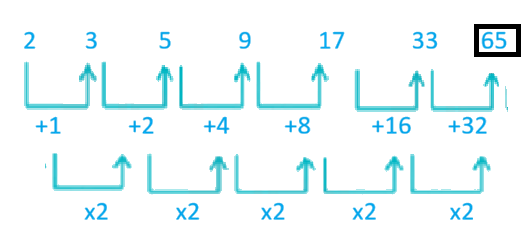 thus, "65" will replace the question mark in the given series.
Hence, the correct option is "Option 2".
Q5 · Series
What comes next?
LM, KN, JO, IP, ?
- HQ
- GR
- FR
- GQ
Answer aur solution dekho
Archived marked answer: A
The logic followed here is:
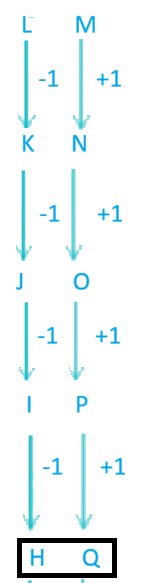 So, 'HQ' will replace the question mark in the given series.
Hence, the correct answer is "Option 1".
Q6 · Analogy
Which group has letters with a position sum = 29?
- P, Q, R
- C, D, Y
- A, B, Z
- M, N, O
Answer aur solution dekho
Archived marked answer: C
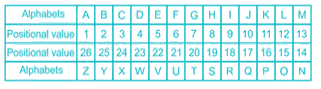 The logic followed here is:
We calculate the position sum of each group of letters (A = 1, B = 2, … Z = 26).
Option 1) P, Q, R → 16 + 17 + 18 = 51
Option 2) C, D, Y → 3 + 4 + 25 = 32
Option 3) A, B, Z → 1 + 2 + 26 = 29
Option 4) M, N, O → 13 + 14 + 15 = 42
Hence, the correct answer is "Option 3".
Q7 · Analogy
Which three-letter combination is different from the rest?
ACD, BDF, CEH, DFI, EGK
- ACD
- BDF
- DFI
- CEH
Answer aur solution dekho
Archived marked answer: C
The logic followed here is:
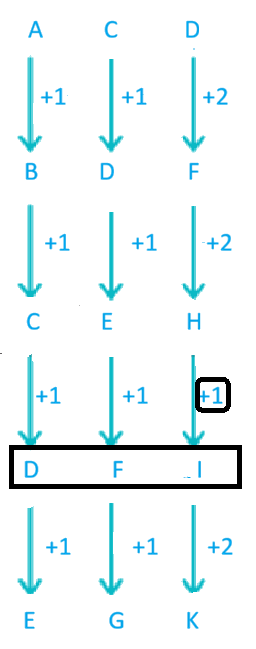 So, 'DFI' is different from the rest in the given series.
Hence, the correct answer is "Option 3".
Q8 · Analogy
Which country does not belong to the group?
- India
- China
- Nepal
- Brazil
Answer aur solution dekho
Archived marked answer: D
The logic followed here is:
Option 1) India → Located in Asia.
Option 2) China → Located in Asia.
Option 3) Nepal → Located in Asia.
Option 4) Brazil → Located in South America.
Hence, the correct answer is "Option 4".
Q9 · Analogy
Find the odd one out. Narendra Modi, Rahul Gandhi, Amit Shah, Mahendra Singh Dhoni
- Narendra Modi
- Rahul Gandhi
- Amit Shah
- Mahendra Singh Dhoni
Answer aur solution dekho
Archived marked answer: D
The logic followed here is:
Option 1) Narendra Modi → Politician
Option 2) Rahul Gandhi → Politician
Option 3) Amit Shah → Politician
Option 4) Mahendra Singh Dhoni → Cricketer / Sports personality
Hence, the correct answer is "Option 4".
Q10 · Puzzle Subtypes Not To Miss
A statement is given followed by two conclusions. Find which conclusion is TRUE based on the given statement.
Statement:
P ≥ T; Q = R ≥ U; V ≥ R T
- Either I or II
- Neither I nor II
- Only II
- Only I
Answer aur solution dekho
Archived marked answer: D
Given Statement: P ≥ T; Q = R ≥ U; V ≥ R T → False (V ≥ R and T ≥ R, but no definite relation between V and T. So it cannot be concluded.)
Here, Only conclusion I is true.
Hence, the correct answer is "Option 4".
Q11 · Puzzle Subtypes Not To Miss
Find the smallest number which when divided by 8, 9, and 12 leaves a remainder of 5 in each case.
- 77
- 173
- 869
- 874
Answer aur solution dekho
Archived marked answer: A
Given:
A number when divided by 8, 9, and 12 leaves a remainder of 5 in each case.
According to Question:
If a number leaves remainder 5, then (Number − 5) is divisible by 8, 9, and 12.
So, find LCM of 8, 9, and 12.
8 = 2³
9 = 3²
12 = 2² × 3
LCM = 2³ × 3²
= 8 × 9
= 72
So, required number = 72 + 5
= 77
Hence, the correct answer is Option 1.
Q12 · Puzzle Subtypes Not To Miss
What mathematical symbol should replace A and B respectively to make it mathematically CORRECT?
14 - 96 ÷ 24 A 16 B 4 = 74
- x and +
- + and x
- + and -
- x and -
Answer aur solution dekho
Archived marked answer: B
BODMAS Table:
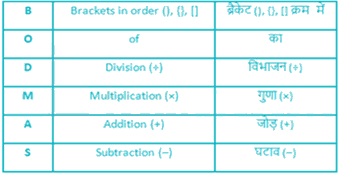 Given equation: 14 − 96 ÷ 24 A 16 B 4 = 74
96 ÷ 24 = 4
⇒ 14 − 4 A 16 B 4 = 74
Option 1: A = ×, B = +
14 − 4 × 16 + 4 = ?
→ 4 × 16 = 64
→ 14 − 64 + 4 = −46 Not 74
Option 2: A = +, B = ×
14 − 4 + 16 × 4 = ?
→ 16 × 4 = 64
→14 − 4 + 64 = 74 Correct
Option 3: A = +, B = −
14 − 4 + 16 − 4 = ?
→ 10 + 16 − 4 = 22 Not 74
Option 4: A = ×, B = −
14 − 4 × 16 − 4 = ?
→ 14 − 64 − 4 = −54 Not 74
So, the correct symbols are A = + and B = ×.
Hence, the correct answer is "Option 2".
Q13 · Puzzle Subtypes Not To Miss
If the cost price of 15 articles is equal to the selling price of 12 articles, what is the profit percent?
- 25%
- 20%
- 30%
- 10%
Answer aur solution dekho
Archived marked answer: A
Given:
Cost Price (CP) of 15 articles = Selling Price (SP) of 12 articles
According to Question:
Let CP of 1 article = ₹1
So, CP of 15 articles = ₹15
Therefore, SP of 12 articles = ₹15
SP of 1 article = 15 / 12
= ₹1.25
Profit per article = SP − CP
= 1.25 − 1
= ₹0.25
Profit % = (Profit / CP) × 100
= (0.25 / 1) × 100
= 25%
Hence, the correct answer is Option 1.
Q14 · Puzzle Subtypes Not To Miss
Which number is NOT a multiple of 3?
- 369
- 372
- 375
- 377
Answer aur solution dekho
Archived marked answer: D
Given:
We need to find which number is NOT a multiple of 3.
Now, A number is divisible by 3 if the sum of its digits is divisible by 3.
Now check each option:
369 → 3 + 6 + 9 = 18 (Divisible by 3)
372 → 3 + 7 + 2 = 12 (Divisible by 3)
375 → 3 + 7 + 5 = 15 (Divisible by 3)
377 → 3 + 7 + 7 = 17 (Not divisible by 3)
Hence, the correct answer is Option 4.
Q15 · Coding Decoding
In a certain code, BRAIN is written as AQZHM, how is HEART written?
- GDZQS
- GDZQR
- GDYQR
- GCZQS
Answer aur solution dekho
Archived marked answer: A
The logic followed here is:
Logic: Each letter is shifted one position backward in the English alphabet.
Given, BRAIN → A Q Z H M
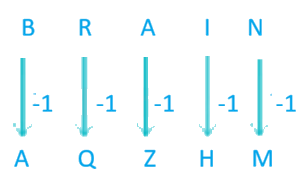 Now, H E A R T:
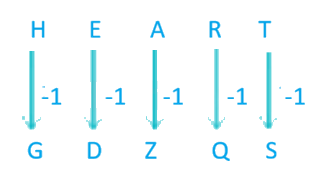 So, HEART → G D Z Q S
Hence, the correct answer is "Option 1".
Q16 · Coding Decoding
If 2 & 2 = 12 and 3 & 3 = 27, what is 4 & 4?
- 64
- 72
- 81
- 48
Answer aur solution dekho
Archived marked answer: D
The supplied equal-operand pattern is three times the square of the operand: 3×2² = 12 and 3×3² = 27. Applying the same rule gives 3×4² = 48.
Q17 · Coding Decoding
If GARDEN is coded as HBSFOO, how is HBSFOO coded?
- ICTHYP
- ICUGPP
- IBUGPP
- ICTGPO
Answer aur solution dekho
Archived marked answer: A
The logic followed here is:
Given, GARDEN → H B S F O O
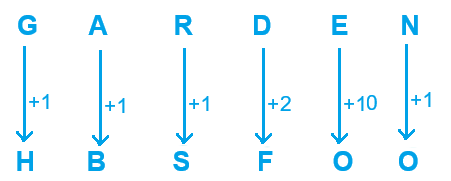 Now, H B S F O O:
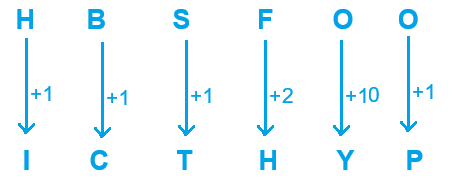 So, HBSFOO → ICTHYP
Hence, the correct answer is "Option 1".
Q18 · Logical Reasoning
Read the following statement carefully and identify the conclusion that follows.
Statement:
All pens are blue things. Some blue things are plastic. No plastic is recyclable.
Conclusions:
I. Some pens are plastic.
II. Some blue things are not recyclable.
- Only I follows
- Only II follows
- Both I and II follow
- Neither I nor II follows
Answer aur solution dekho
Archived marked answer: B
Given Statements:
All pens are blue things.
Some blue things are plastic.
No plastic is recyclable.
The least possible Venn diagram for the given statement is:
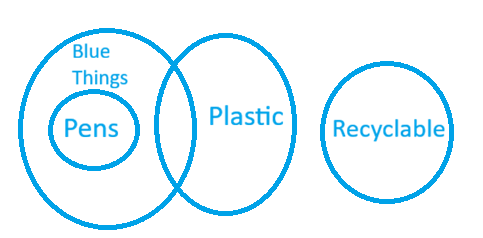 Conclusions:
Q19 · Blood Relations
M is the sister of N. N is the father of R. T is the mother of M. How is T related to R?
- Aunt
- Grandmother
- Mother
- Cousin
Answer aur solution dekho
Archived marked answer: B
Family Chart:
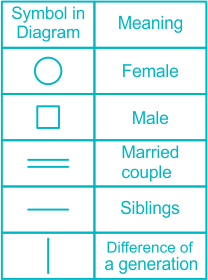 Given:
M is the sister of N.
N is t
Q20 · Blood Relations
T is the brother of R. R is the son of M. How is T related to M?
- Brother
- Son
- Father
- Cousin
Answer aur solution dekho
Archived marked answer: B
Family Chart:
Given:
T is the brother of R.
R is the son of M.
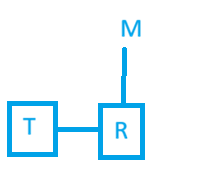 So, T is the Son of M.
Hence, the correct answer is "Option 2".
Q21 · Alphabet Test
In the following question, from the given alternative words, select the word which can be formed using the letters of the given word.
ANAESTHETIZED
- Atomize
- Anemia
- Dentist
- Anzio
Answer aur solution dekho
Archived marked answer: C
Given word: ANAESTHETIZED
Gemini sai
Let's check all the options:
(1) Atomize ⇒ It can't be formed as it requires O and M.
(2) Anemia ⇒ It can't be formed as it requires M.
(3) Dentist ⇒ It can be formed. It uses D, E, N, T, I, S, T which are all present in ANAESTHETIZED.
(4) Anzio ⇒ It can't be formed as it requires O.
So, the answer is "Dentist".
Hence, the correct answer is Option 3.
Q22 · Similarity and Differences
Choose the address that is the same as the one given below.
Sample Address:HIG-12, Sector 3,Indrapuri, Bhopal,Madhya Pradesh - 462021
- HIG 12, Sector-3, Indrapuri, Bhopal, Madhya Pradesh - 462021
- HIG-12, Sector 3, Indrapuri, Bhopal, Madhya Pradesh - 462021
- HIG-12, Sector III, Indrapuri, Bhopal, Madhya Pradesh - 462021
- HIG-21, Sector 3, Indrapuri, Bhopal, Madhya Pradesh - 462021
Answer aur solution dekho
Archived marked answer: B
The address given in the problem is,
HIG-12, Sector 3, Indrapuri, Bhopal, Madhya Pradesh - 462021
Let's match this address with the given options one by one to figure out which one is exactly the same.
Option
Address in Option
Given Address
Comment
(1)
HIG 12, Sector-3, Indrapuri, Bhopal, Madhya Pradesh - 462021
HIG-12, Sector 3, Indrapuri, Bhopal, Madhya Pradesh - 462021
This option has formatting differences: missing hyphen in "HIG-12" and extra hyphen in "Sector-3".
(2)
HIG-12, Sector 3, Indrapuri, Bhopal, Madhya Pradesh - 462021
HIG-12, Sector 3, Indrapuri, Bhopal, Madhya Pradesh - 462021
The address is exactly the same as the given address.
(3)
HIG-12, Sector III, Indrapuri, Bhopal, Madhya Pradesh - 462021
HIG-12, Sector 3, Indrapuri, Bhopal, Madhya Pradesh - 462021
This option has "Sector III" instead of "Sector 3".
(4)
HIG-21, Sector 3, Indrapuri, Bhopal, Madhya Pradesh - 462021
HIG-12, Sector 3, Indrapuri, Bhopal, Madhya Pradesh - 462021
This option has "HIG-21" instead of "HIG-12".
So, the address that is exactly the same as the given address is in option (2).
Hence, the correct option is "option (2)".
Q23 · Ranking Order
In a class, Ramesh receives higher grades than Suresh but lower grades than Mahesh. Which of these statements is true if Suresh had a score of 70?
- Ramesh's marks are 65, Mahesh's marks are 70.
- Ramesh's marks are 75, Mahesh's marks are 80.
- Ramesh's marks are 60, Mahesh's marks are 70.
- Ramesh's marks are 85, Mahesh's marks are 75.
Answer aur solution dekho
Archived marked answer: B
Given:
Statement:
Ramesh receives higher grades than Suresh but lower grades than Mahesh.
Suresh’s marks = 70
This means: Mahesh > Ramesh > Suresh (70)
Now, check the options:
Option 1) Ramesh's marks are 65, Mahesh's marks are 70 – Does not follow (Because, Ramesh must have more than 70, but here he has 65.)
Option 2) Ramesh's marks are 75, Mahesh's marks are 80 – Follows (Because, 80 > 75 > 70, which satisfies Mahesh > Ramesh > Suresh.)
Option 3) Ramesh's marks are 60, Mahesh's marks are 70 – Does not follow (Because, Ramesh must score more than 70, but here he has 60.)
Option 4) Ramesh's marks are 85, Mahesh's marks are 75 – Does not follow (Because, Ramesh must score less than Mahesh, but here 85 > 75.)
So, Only option 2 satisfies the condition.
Hence, the correct answer is "Option 2".
General Awareness
Q1 · Art and Culture
Which of the following temple architectural features is characteristic of the Nagara style, especially found in central and northern India?
- Vimana
- Shikhara
- Mandapa with barrel vaults
- Gopuram
Answer aur solution dekho
Archived marked answer: B
The correct answer is Shikhara.
Key Points
- The Nagara style of temple architecture, prominent in northern and central India, is distinguished by its Shikhara, which is a towering, curvilinear superstructure constructed above the sanctum sanctorum (garbhagriha).
- The Shikhara is a defining feature of Nagara temples, characterized by its vertical emphasis and intricate carvings. It often has multiple tiers or storeys, enhancing its majestic appearance.
- Shikhara typically culminates in a decorative element known as the amalaka, a circular or disc-like structure symbolizing the link between the earthly and celestial realms.
- The Nagara style lacks the elaborate gateways (Gopuram) found in the Dravidian style of southern India, making the Shikhara its most prominent architectural component.
- The temples in Khajuraho, Konark, and Rajarani Temple in Odisha are exemplary representations of the Nagara style, with their intricate Shikhara structures.
Additional Information
- Vimana:
- It is a feature of Dravidian temple architecture, primarily found in southern India.
- Unlike the curvilinear Shikhara, the Vimana is pyramidal and consists of progressively smaller storeys.
- The temples in Tamil Nadu, such as the Brihadeeswarar Temple, showcase the Vimana.
- Mandapa with Barrel Vaults:
- Mandapas are pillared halls in Indian temple architecture, serving as a space for congregational activities.
- The barrel vault feature is more common in Buddhist and Jain architectural styles rather than the Nagara style.
- Gopuram:
- Gopuram is a towering gateway primarily associated with Dravidian temples, such as those in Tamil Nadu.
- These gateways are adorned with intricate sculptures and serve as entrances to temple complexes.
- Examples include the Meenakshi Temple and Sri Ranganathaswamy Temple.
- Nagara Style Characteristics:
- The Nagara style of architecture flourished between the 6th and 13th centuries.
- It is primarily found in regions such as Madhya Pradesh, Rajasthan, Odisha, and Uttar Pradesh.
- The temples often have multiple Shikharas, intricate carvings, and lack boundary walls.
- Prominent examples include the Sun Temple in Konark and the Kandariya Mahadeva Temple in Khajuraho.
Important Points
- Shikhara Variants:
- In the Nagara style, there are three main types of Shikharas: Rekha-Prasad (curvilinear), Phamsana (rectangular), and Valabhi (barrel-shaped).
- The Rekha-Prasad is the most prominent and recognizable form of Shikhara.
- Symbolism:
- The Shikhara symbolizes Mount Meru, believed to be the axis of the universe in Hindu cosmology.
- The decorative amalaka on top further represents cosmic harmony and spiritual transcendence.
- Historical Development:
- The Nagara style evolved during the Gupta period and reached its zenith during the Chandela dynasty in the 10th-11th centuries.
- Its architectural innovations influenced subsequent styles across northern and central India.
- Regional Variations:
- While the Nagara style is unified by the Shikhara, regional variations include distinct ornamentation and structural designs.
- For instance, Odisha temples often have intricately carved exteriors, while Rajasthan temples showcase bold and dynamic forms. </ul
Q2 · Art and Culture
Which of the following ritual dances is performed during the Mopin Festival?
- Bihu
- Popir
- Sangpangtu
- Ponung
Answer aur solution dekho
Archived marked answer: B
The correct answer is Popir.
Key Points
- The Mopin Festival is a famous agricultural festival celebrated by the Galo tribe of Arunachal Pradesh.
- The dance performed during the Mopin Festival is known as Popir, which is a traditional folk dance characterized by rhythmic movements and group performance.
- Popir dance is performed by young women dressed in traditional attire, including white skirts and headgear, while holding rice powder and bamboo sticks as part of the ritual.
- The festival is celebrated to invoke blessings for a good harvest, prosperity, and to drive away evil spirits. The dance is integral to the rituals and symbolizes joy and communal harmony.
- Rice beer (Apong) and rice powder are key offerings during the festival, and Popir dance is performed alongside prayers and rituals.
Additional Information
- Mopin Festival:
- The Mopin Festival is celebrated annually in the month of April by the Galo people, one of the major tribes of Arunachal Pradesh.
- It is dedicated to the goddess Ankani, who is believed to bless the land with fertility, good harvests, and prosperity.
- The rituals include smearing rice powder on each other’s faces, which is considered auspicious and a gesture of goodwill.
- The festival is marked by traditional songs, dances, and feasts that bring the community together.
- Other Traditional Dances:
- Bihu: Associated with the Bihu Festival in Assam, it is performed to celebrate the Assamese New Year and the harvest season.
- Sangpangtu: This dance is performed during tribal festivals in Nagaland, symbolizing tribal identity and unity.
- Ponung: A traditional dance of Arunachal Pradesh performed during various festivals, but not specifically related to the Mopin Festival.
- Significance of Tribal Dances:
- Tribal dances like Popir and Bihu reflect the cultural heritage and traditions of the respective communities.
- These dances are not just performances but are deeply connected to rituals, beliefs, and the agricultural lifestyle.
- They are often performed in groups to symbolize unity and harmony within the community.
Important Points
- The Mopin Festival is unique to the Galo tribe and has gained recognition as a significant cultural event in Arunachal Pradesh.
- While Popir dance is exclusive to the Mopin Festival, other dances like Bihu and Ponung are associated with different regions and cultural contexts.
- Understanding traditional dances is crucial for preserving the rich cultural diversity of India and fostering awareness about tribal communities.
- Efforts to promote these festivals and dances are supported by cultural organizations and state tourism boards.
Q3 · Art and Culture
The Wancho tribe of Arunachal Pradesh performs a war dance during which festival?
- Hornbill
- Chalo Loku
- Oriah
- Ojiyelle
Answer aur solution dekho
Archived marked answer: C
The correct answer is Oriah.
Key Points
- The Wancho tribe is an indigenous community residing in the state of Arunachal Pradesh, India, and they celebrate the Oriah festival with great enthusiasm.
- Oriah is the primary festival of the Wancho tribe, marking the onset of spring and symbolizing prosperity, happiness, and the strengthening of communal bonds.
- During the festival, the Wancho people perform their traditional war dance as a tribute to their ancestors and as a representation of their rich cultural heritage.
- The war dance performed during the Oriah festival is characterized by the use of traditional costumes, weapons, and rhythmic drum beats that depict the tribe’s valor and warrior spirit.
- The festival also includes various rituals such as animal sacrifices, community feasts, and the sharing of rice beer, which are integral to the Wancho culture.
- Oriah serves as a platform for preserving and showcasing the Wancho tribe's traditions
Q4 · Indian Polity and Constitution
Fill in the blanks:
The collective responsibility clause for State CoMs appears in Article ___.
- 164
- 163
- 154
- 169
Answer aur solution dekho
Archived marked answer: A
The correct answer is Article 164.
Key Points
- Article 164 of the Constitution of India deals with the appointment of the Chief Minister and other Ministers for the states. It also provides for the principle of collective responsibility of the Council of Ministers (CoM) to the Legislative Assembly of the state.
- The clause states that the Council of Ministers (CoM) shall be collectively responsible to the Legislative Assembly of the state. This means that if any minister loses the confidence of the assembly, the entire CoM must resign.
- This collective responsibility ensures accountability of the executive to the legislature and strengthens the principles of democracy.
- The Governor of the state appoints the Chief Minister and, based on the Chief Minister's advice, appoints other ministers.
- The tenure of the CoM is not fixed but is subject to the majority support in the Legislative Assembly. If a vote of no-confidence is passed, the CoM must resign.
Additional Information
- Collective Responsibility:
- The principle of collective responsibility is a cornerstone of the parliamentary system of governance in India. It ensures that the CoM works as a cohesive unit, and all decisions are taken collectively, with no individual minister acting independently.
- If any policy or action of the CoM is not approved by the legislature, the entire CoM must take responsibility and resign.
- Role of the Governor:
- The Governor acts as the constitutional head of the state, appointing the Chief Minister and other ministers based on the majority party or coalition in the Legislative Assembly.
- The Governor has the power to dismiss the CoM if they lose the confidence of the Legislative Assembly.
- Difference Between Individual and Collective Responsibility:
- Individual Responsibility: Ministers are individually responsible for their respective departments and can be asked to resign for their personal failures.
- Collective Responsibility: The CoM as a whole is responsible for its policies and decisions. If the legislature rejects any policy or action, the entire CoM must resign.
- Examples of Collective Responsibility in India:
- During the Emergency (1975-77), the principle of collective responsibility was questioned due to the centralization of power with the Prime Minister.
- In various instances, if a minister is involved in a controversy or scandal, the entire CoM may face the consequences if the Legislative Assembly loses confidence in them.
Important Points
- Article 163 vs. Article 164:
- Article 163: Deals with the discretionary powers of the Governor in certain situations.
- Article 164: Focuses on the composition, tenure, and collective responsibility of the CoM to the Legislative Assembly.
- Comparison with Union Council of Ministers:
- The principle of collective responsibility is also applicable to the Union CoM under Article 75 of the Constitution.
- The Union CoM is collectively responsible to the Lok Sabha, whereas the State CoM is responsible to the Legislative Assembly. </ul
Q5 · Indian Polity and Constitution
Under Article 352, what legislative consequence follows a Proclamation of National Emergency in India?
- States retain exclusive control over the State List
- Parliament can legislate on any matter in the State List
- Rajya Sabha's approval is required for all State Bills
- President dissolves all State Legislative Assemblies
Answer aur solution dekho
Archived marked answer: B
The correct answer is Parliament can legislate on any matter in the State List.
Key Points
- Article 352 of the Indian Constitution provides the President with the power to declare a National Emergency in the event of war, external aggression, or armed rebellion.
- Once a National Emergency is declared, the division of powers between the Union and State Governments undergoes significant changes.
- During such an emergency, the Parliament is empowered to legislate on subjects mentioned in the State List, which are generally under the exclusive legislative domain of the States.
- This allows the Union Government to assume a greater role in governance, ensuring uniformity and coordinated action across the country in emergencies. *Hence, the correct option is "Parliament can legislate on any matter in the State List."*
- Other provisions such as dissolving state assemblies or requiring Rajya Sabha’s approval for state bills are not mentioned under Article 352. These are incorrect interpretations of legislative consequences under this article.
Additional Information
- Proclamation of National Emergency:
- Declared under Article 352, it can be issued in cases of war, external aggression, or armed rebellion.
- Such a proclamation must be approved by both houses of Parliament within one month and is subject to renewal every six months.
- It grants the Union Government sweeping powers, including the ability to legislate on State List subjects and alter the distribution of financial resources between the Union and States.
- State List and Union Authority:
- Under normal circumstances, subjects in the State List (e.g., police, public health) are exclusively legislated by State Governments.
- However, during a National Emergency, the Parliament gains authority to legislate on these subjects for the duration of the emergency.
- Impact on Fundamental Rights:
- Under Article 358, fundamental rights under Article 19 are automatically suspended during a National Emergency caused by war or external aggression.
- Under Article 359, the President can suspend the right to move courts for enforcement of other fundamental rights, except those under Articles 20 and 21.
- Differences Between Emergency Types:
- National Emergency (Article 352): Deals with war, external aggression, or armed rebellion.
- State Emergency (Article 356): Declared when a state government fails to function according to the Constitution.
- Financial Emergency (Article 360): Declared if India's financial stability is threatened.
Important Points
- State Assemblies: Contrary to the incorrect options, state assemblies are not automatically dissolved during a National Emergency. They continue to function unless the President’s Rule under Article 356 is imposed separately.
- Rajya Sabha’s Role: The approval of the Rajya Sabha is not required for all state bills during a National Emergency. This is an incorrect interpretation of the legislative changes under Article 352.
- Historical Instances:
- India has witnessed three National Emergencies: in 1962 (China war), 1971 (Pakistan war), and 1975 (internal disturbances).
- The 1975 Emergency under Indira Gandhi was the most controversial due to its impact on civil liberties and democratic institutions.
89:T
Q6 · Indian Economy
Consider the following statements and choose the correct option:
Statement 1: Unlimited convertibility and fixed price conversion affect the credibility of a currency system.
Statement 2: The international monetary system was established to regulate internal fiscal policies of countries.
- Only Statement 1 is correct
- Only Statement 2 is correct
- Both Statement 1 and Statement 2 are correct
- Neither Statement 1 nor Statement 2 is correct
Answer aur solution dekho
Archived marked answer: A
The correct answer is Only Statement 1 is correct.
Key Points
- Statement 1: Unlimited convertibility and fixed price conversion affect the credibility of a currency system.
- Unlimited convertibility refers to the ability to exchange a currency freely for other currencies without restrictions. While this enhances ease of trade and investment, it can also lead to instability if the currency is overvalued or undervalued.
- Fixed price conversion, as in pegged exchange rate systems, can impact the credibility of a currency system when economic fundamentals do not support the fixed rate. Governments may struggle to maintain the peg, leading to devaluation or crises.
- Such practices can lead to speculative attacks on the currency, depletion of foreign exchange reserves, and loss of confidence in the currency. This statement is correct.
- Statement 2: The international monetary system was established to regulate internal fiscal policies of countries.
- The international monetary system is designed to facilitate international trade, investment, and monetary cooperation among nations. It aims to ensure exchange rate stability, provide financial resources to countries facing balance of payment crises, and promote economic growth globally.
- However, it does not regulate the internal fiscal policies of countries. Fiscal policies, such as government spending and taxation, remain the sovereign domain of individual nations and are not directly controlled by the international monetary system.
- This statement is incorrect.
- Based on the above explanation, only Statement 1 is correct.
Additional Information
- Currency Convertibility:
- Current Account Convertibility: This refers to the freedom to convert domestic currency into foreign currency for transactions related to trade, services, and remittances. India achieved current account convertibility in 1994.
- Capital Account Convertibility: This refers to the freedom to convert currency for capital transactions like investments and loans. It is more restricted in many countries, including India, to prevent economic instability.
- Fixed vs. Floating Exchange Rates:
- Fixed Exchange Rate: The currency value is pegged to another major currency or basket of currencies. Example: Bretton Woods system (1944-1971).
- Floating Exchange Rate: The currency value is determined by market forces without direct government or central bank intervention. Example: The current system in most developed nations.
- International Monetary System:
- The current international monetary system is based on a mix of floating exchange rates, managed exchange rates, and regional arrangements like the Eurozone.
- Institutions like the International Monetary Fund (IMF) and World Bank play a crucial role in maintaining global monetary stability and providing financial assistance to countries in need.
- Fiscal Policy vs. Monetary Policy:
- Fiscal Policy: Involves government decisions on taxation, public spending, and borrowing to influence economic growth and stability.
- Monetary Policy: Managed by the central bank to control money supply, interest rates, and inflation.
- The international monetary system focuses more on exchange rates and balance of payments, not on domestic fiscal policies.
Important Points
- Examples of Currency Crises:
- 1997 Asian Financial Crisis: Triggered by the collapse of the Thai baht, leading to currency devaluations and economic turmoil across Southeast Asia.
- 1998 Russian Financial Crisis: Caused by low oil prices, high debt, and a fixed exchange rate system that became unsustainable.
- IMF's Role:
- Provides financial assistance to countries facing balance of payment issues.
- Monitors global economic trends and offers policy advice to member nations.
- History of International Monetary Systems:
- Gold Standard: Used until World War I, currencies were backed by gold reserves.
- Bretton Woods System: Post-World War II system with fixed exchange rates pegged to the US dollar, which was convertible to gold.
- Post-Bretton Woods: Floating exchange rate system adopted after 1971. </ul
Q7 · Indian Economy
How did licensing policy under the planning era affect the emergence of large industrial conglomerates?
- It increased FDI inflow
- It prevented market dominance
- It allowed firms to block competitors by hoarding licenses
- It enhanced rural employment
Answer aur solution dekho
Archived marked answer: C
The correct answer is It allowed firms to block competitors by hoarding licenses.
Key Points
- Licensing Policy under the Planning Era: During India's planning era, particularly after independence, the government introduced an extensive licensing system to regulate industrial growth.
- Objective: The primary aim of the licensing system was to ensure balanced regional development, prevent monopolies, and encourage equitable resource allocation. However, it had unintended consequences.
- Blocking Competitors: Large industrial conglomerates often misused the licensing system by hoarding licenses. By acquiring more licenses than they could effectively utilize, they blocked potential competitors from entering the market or expanding their operations. *Hence, the statement in the question is correct.*
- Market Control: This practice allowed these conglomerates to establish market dominance and control critical industries, leading to reduced c
Q8 · Indian Economy
Privatization in India through disinvestment refers to:
- Complete closure of public enterprises
- Issuing bonds to private investors
- Selling part of government equity to public or private entities
- Merging public and private sectors
Answer aur solution dekho
Archived marked answer: C
The correct answer is Selling part of government equity to public or private entities.
Key Points
- Disinvestment in India refers to the process of selling or liquidating a part of the government's equity in public sector enterprises (PSEs) to private entities or the public.
- It is primarily aimed at reducing the government's financial burden and improving the efficiency of public enterprises by involving private participation.
- The government retains a majority stake in most cases (typically above 51%) to maintain control over the enterprise, ensuring it remains a public sector entity.
- Partial disinvestment is used to generate revenue for the government while enabling public or private entities to invest in the enterprise.
- Disinvestment has been widely practiced in India since the 1991 economic liberalization, where it was introduced as a measure to reform the economy and reduce fiscal deficits.
Additional Information
- Privatization in India:
- Privatization refers to transferring ownership or control of a public sector enterprise to private entities.
- It involves a complete or partial sale of government equity, giving private entities a significant stake in decision-making.
- Examples include privatization of Air India and Bharat Aluminium Company (BALCO).
- Disinvestment Policy:
- The government of India has implemented a strategic disinvestment policy to focus on non-core sectors while retaining control over critical sectors.
- Strategic disinvestment involves selling a majority stake in an enterprise to private entities.
- Recent examples include the disinvestment of public sector companies like BPCL and IDBI Bank.
- Objectives of Disinvestment:
- To reduce the financial burden on the government and channel resources for social and developmental programs.
- To improve the efficiency and competitiveness of public sector enterprises.
- To attract private investment and promote economic growth.
- Key Examples:
- Maruti Udyog Limited: The government divested its equity in Maruti Suzuki, transitioning it into a fully private entity.
- Air India: In 2021, the government sold its entire stake in Air India to Tata Group.
- VSNL: The government sold its majority stake in VSNL (now Tata Communications) in 2002.
Important Points
- Key Characteristics of Disinvestment:
- It differs from privatization as the government can still retain control over the enterprise.
- Disinvestment can be partial or complete, depending on the government's policy decisions.
- It is a tool to promote competition and reduce monopoly in certain sectors.
- Reports and Indices:
- The Economic Survey of India often highlights the performance and impact of disinvestment on the economy.
- Disinvestment proceeds are tracked annually in the Union Budget of India.
- The Disinvestment Commission, established in 1996, played a pivotal role in developing policies for disinvestment.
</ul
Q9 · Indian Economy
Read the below statements marked as Assertion (A) and Reason (R). Mark the correct options:
Assertion (A): Ease of Doing Business (EoDB) report by World Bank was discontinued in 2021.
Reason (R): Allegations of data manipulation prompted the suspension.
- Both A and R are true, and R is the correct explanation of A.
- Both A and R are true, but R is not the correct explanation of A.
- A is true, but R is false.
- A is false, but R is true.
Answer aur solution dekho
Archived marked answer: A
The correct answer is Both A and R are true, and R is the correct explanation of A.
Key Points
- Assertion (A): Ease of Doing Business (EoDB) report by the World Bank was discontinued in 2021.
- The Ease of Doing Business (EoDB) report was an annual flagship publication by the World Bank, ranking countries based on their business regulations and environment.
- In September 2021, the World Bank announced the discontinuation of the report following allegations of irregularities in data and rankings manipulation. *Hence, the assertion is correct.*
- Reason (R): Allegations of data manipulation prompted the suspension.
- In 2020, the World Bank initiated an investigation into data irregularities in the 2018 and 2020 reports following concerns raised about the rankings of certain countries.
- The investigation revealed that data manipulation was done to benefit certain countries like China, raising questions about the integrity of the report.
- This led to the permanent discontinuation of the report by the World Bank in 2021. *Hence, the reason is correct and explains the assertion.*
- Correct Option: Both A and R are true, and R is the correct explanation of A.
Additional Information
- Ease of Doing Business Report:
- The Ease of Doing Business report ranked countries based on 10 indicators, including starting a business, dealing with construction permits, getting electricity, registering property, and paying taxes.
- It was first published in 2003 and became a key tool for policymakers and investors to assess business environments worldwide.
- The rankings were influential in shaping economic reforms in several countries.
- Reason for Data Manipulation:
- The investigation revealed undue pressure on World Bank staff to alter data in favor of certain countries like China, Saudi Arabia, and Azerbaijan.
- This manipulation undermined the credibility of the rankings and prompted calls for greater transparency.
- Impact of Discontinuation:
- Countries now lack a global benchmark for assessing their business environments.
- The World Bank is exploring alternative methods to measure business climates, focusing on broader economic and social indicators.
- Recent Developments:
- Post-discontinuation, the World Bank introduced a new initiative called Business Enabling Environment (BEE) to assess policies supporting private sector development.
- BEE aims to provide a more holistic view of economic and regulatory environments.
Important Points
- Countries Influenced:
- China’s ranking was allegedly altered in the 2018 report, increasing its position from 85th to 78th.
- Other countries like Saudi Arabia and Azerbaijan were also reportedly favored in the rankings.
- Data Integrity Concerns:
- The manipulation of data highlighted the need for stronger governance frameworks in international organizations.
- It also underscored the importance of ethical practices in producing global indices.
- Lessons Learned:
- Transparency and accountability are crucial for maintaining the credibility of global reports.
- Future initiatives like BEE aim to mitigate risks associated with data manipulation.
Q10 · Sports Static GK
Which of the following statements about India's performance at the 2012 London Olympics is correct?
1) India won a total of 6 medals, doubling its previous Olympic medal tally.
2) Indian female athletes won two Olympic medals for the first time in history.
- Only 1 is Correct
- Only 2 is Correct
- 1 and 2 are Correct
- Neither 1 nor 2 is Correct
Answer aur solution dekho
Archived marked answer: C
The correct answer is 3) 1 and 2 are Correct.
Key Points
- Statement 1: India won a total of 6 medals at the 2012 London Olympics, which indeed doubled its previous tally of 3 medals from the 2008 Beijing Olympics. *Hence, this statement is correct.*
- Statement 2: For the first time in history, Indian female athletes won two Olympic medals in a single edition of the Olympics. Mary Kom won a bronze medal in boxing (women’s flyweight category), and Saina Nehwal secured a bronze medal in badminton (women's singles). Hence, this statement is correct.
Q11 · Sports Static GK
Which of the following about the Hero Hockey India League 2024-25 (Women's) is/are correct?
1.) Held in Ranchi & Rourkela (12-26 Jan).
2.) Odisha Warriors beat JSW Soorma in the final.
- Only 1
- Only 2
- Both 1 and 2 are correct
- Neither 1 nor 2 is correct
Answer aur solution dekho
Archived marked answer: C
The correct answer is Option 3 (Both 1 and 2 are correct).
Key Points
- Statement 1: The Hero Hockey India League 2024-25 (Women's) was held in Ranchi and Rourkela from 12th to 26th January. This fact is accurate and reflects the official schedule of the tournament. *Hence, statement 1 is correct.*
- Statement 2: The Odisha Warriors defeated the JSW Soorma team in the final match of the tournament, making them the champions for the 2024-25 season. This outcome is officially recorded. *Hence, statement 2 is correct.*
- The Hero Hockey India League (Women's) is an important platform for promoting women's hockey in India and provides opportunities for players to showcase their talent on a national level.
- The tournament is known for being hosted in locations with significant hockey infrastructure, such as Rourkela, home to the Birsa Munda International Hockey Stadium, one of the largest hockey stadiums in the world.
- Both statements 1 and 2 are correct based on the official records of the league. *Thus, Option 3 is the correct answer.*
Additional Information
- Hero Hockey India League (HIL):
- The Hero Hockey India League was established in 2013 and is recognized by the International Hockey Federation (FIH).
- The league aims to promote hockey in India by providing a professional platform for both men's and women's teams.
- It features top domestic and international players, enhancing the competitiveness and visibility of the sport.
- Birsa Munda International Hockey Stadium:
- Located in Rourkela, Odisha, this stadium is among the largest hockey venues globally.
- It has a seating capacity of approximately 20,000 and was inaugurated in 2023.
- The stadium played a pivotal role in hosting matches for the 2023 Men's FIH Hockey World Cup.
- Odisha's Role in Indian Hockey:
- Odisha is often referred to as the "Cradle of Indian Hockey" due to its rich hockey culture and infrastructure.
- The state government has been a consistent supporter of hockey, sponsoring both men's and women's national teams since 2018.
- Impact of Women's Hockey League:
- The Hero Hockey India League (Women's) has encouraged greater participation in hockey among women and inspired young athletes.
- It serves as a feeder system for the Indian national women's hockey team, which has achieved significant success on the international stage in recent years.
Important Points
- Odisha Warriors:
- The Odisha Warriors' victory in the 2024-25 season highlights the growing dominance of teams from Odisha in Indian hockey.
- The team showcased outstanding performances throughout the tournament, with notable contributions from both domestic and international players.
- JSW Soorma:
- JSW Soorma is another prominent team in the league, known for its consistent performances in previous seasons.
- Despite finishing as runners-up, the team demonstrated exceptional skill and sportsmanship in the final match.
- Women's Hockey in India:
- The Indian women's hockey team has made significant progress in recent years, highlighted by their performance at the Tokyo 2020 Olympics, where they reached the semifinals.
- Initiatives like the Hero Hockey India League (Women's) contribute to the development of grassroots talent and the overall growth of the sport.
``
Q12 · Sports Static GK
Which of the following is considered a fault in badminton?
- Shuttle hits net and lands in service box
- Server steps on boundary line while serving
- Shuttle lands inside opponent's court
- Receiver returns the shuttle over the net
Answer aur solution dekho
Archived marked answer: B
The correct answer is Server steps on boundary line while serving.
Key Points
- Fault in Badminton: A player commits a fault if they step on or over the service boundary line while serving. According to the Badminton World Federation (BWF) rules, the server must stand inside the service court without stepping on the lines when delivering the serve. *This makes Option 2 correct.*
- Shuttle hits net but lands in service box: If the shuttle hits the net during service but still lands within the correct service box, it is considered a legal serve and play continues. *Hence, Option 1 is incorrect.*
- Shuttle lands inside opponent's court: When the shuttle lands inside the opponent's court during play, it is a valid point for the player hitting the shuttle. *Hence, Option 3 is incorrect.*
- Receiver returns the shuttle over the net: Returning the shuttle over the net is a normal action in the game of badminton. It is not considered a fault. *Hence, Option 4 is incorrect.*
- No other options provided beyond Option 4, so Option 5 is not applicable.
Additional Information
- Service Rules in Badminton:
- Both the server and the receiver must stand inside their respective service courts until the serve is made.
- The shuttle must be hit below the server’s waist level, and the racket shaft must point downward during the serve.
- The server's feet must remain stationary and not touch the boundary lines of the service box.
- The shuttlecock must travel diagonally across the net and land within the opponent's service box.
- Common Faults in Badminton:
- Hitting the shuttle outside the court boundaries.
- Shuttle failing to cross the net during play or serve.
- Touching the net with the racket or any part of the body.
- Double hits, where the shuttle is hit twice in succession by the same player.
- Dimensions of a Badminton Court:
- The full length of a standard badminton court is 13.4 meters (44 feet).
- The width is 6.1 meters (20 feet) for doubles and 5.18 meters (17 feet) for singles matches.
- The service courts are divided by a center line, with a short service line and a long service line defining the front and back boundaries.
- Badminton World Federation (BWF) Regulations:
- The BWF is the international governing body for the sport of badminton.
- Its rules and regulations are followed globally in official tournaments and matches.
- Faults, scoring, and other technicalities are clearly defined under the BWF’s Laws of Badminton.
Important Points
- Fault during Service:
- Stepping on the boundary line while serving is a clear violation of the rules and is considered a fault.
- This ensures fair play and prevents the server from gaining an undue advantage by stepping closer to the net.
- Net Faults:
- Touching the net with the racket, body, or clothing during play is also a fault.
- Players must avoid obstructing their opponent’s play by crossing over or under the net.
- Scoring System:
- Badminton matches are played in a best-of-three games format, with each game played to 21 points.
- The winner of a rally scores a point, and the first player or pair to reach 21 points wins the game, provided there is at least a 2-point lead.
```
7b:T
Q13 · Indian Geography
In which region of India is the 'BWhw,' type of climate found?
- Punjab
- Madhya Pradesh
- Gujarat
- Rajasthan
Answer aur solution dekho
Archived marked answer: D
The correct answer is Rajasthan.
Key Points
- The 'BWhw' type of climate refers to the hot desert climate. This is characterized by arid conditions, extremely low rainfall, and high temperatures.
- In India, the 'BWhw' climate is primarily found in the Thar Desert region, which lies in the state of Rajasthan.
- The Thar Desert, also known as the Great Indian Desert, is one of the most arid regions in India. It spans a large portion of western Rajasthan.
- The climate here is marked by extremely hot summers, with temperatures often exceeding 50°C, and mild winters. Rainfall is scant, averaging less than 250 mm annually.
- The arid conditions are a result of the region's geographical location, which is far from any significant water body, coupled with the influence of th
Q14 · Modern Indian History
Which administrative bodies were abolished after the enactment of the Government of India Act, 1858?
- Home Department and Military Board
- Parliament and Crown's Council
- Board of Control and Court of Directors
- Governor General's Council and Privy Council
Answer aur solution dekho
Archived marked answer: C
The correct answer is Board of Control and Court of Directors.
Key Points
- The Government of India Act, 1858 marked the end of the East India Company's rule in India and transferred control directly to the British Crown. This was a pivotal moment in Indian administrative history.
- The Board of Control and Court of Directors, which were administrative bodies of the East India Company, were abolished under this Act. These bodies had previously overseen the administration of British territories in India.
- The Board of Control was responsible for supervising and directing the civil, military, and revenue affairs of the East India Company's territories, while the Court of Directors managed the commercial activities and appointments.
- The Act introduced a new governance structure, replacing the dual control system of the Company and Crown with direct control by the British government. A Secretary of
Q15 · Current Affairs
Who inaugurated the Pran Pratishtha ceremony at the Ram Mandir in Ayodhya in January 2024?
- Mohan Bhagwat
- Amit Shah
- Yogi Adityanath
- Narendra Modi
Answer aur solution dekho
Archived marked answer: D
The correct answer is Narendra Modi.
Key Points
- Narendra Modi, the current Prime Minister of India, inaugurated the Pran Pratishtha ceremony at the Ram Mandir in Ayodhya in January 2024.
- The Ram Mandir in Ayodhya has been a significant project for the Indian government and the Hindu community worldwide, symbolizing cultural and religious heritage.
- The Pran Pratishtha ceremony is a religious ritual where the idol of Lord Ram was consecrated in the temple, marking an important milestone in the construction and dedication of the temple.
- The construction of the Ram Mandir began after the Supreme Court of India delivered its historic verdict in November 2019, allowing the temple to be built on the disputed land in Ayodhya.
- This event is part of the broader efforts to honor the cultural heritage and religious sentiments of millions of devotees across India and the globe.
Additional Information
- Ram Mandir:
- The Ram Mandir is located in Ayodhya, Uttar Pradesh, which is considered the birthplace of Lord Ram as per Hindu beliefs.
- The temple is being constructed by the Shri Ram Janmabhoomi Teerth Kshetra Trust, which was formed in 2020 to oversee the temple's construction.
- The temple follows the Nagara style of Indian temple architecture, known for its intricate carvings and grandeur.
- The foundation stone for the temple was laid by Prime Minister Narendra Modi on 5th August 2020.
- Pran Pratishtha Ceremony:
- The term Pran Pratishtha translates to "infusion of life" and involves sanctifying the idol by invoking the deity's presence.
- This ceremony is a crucial religious process in Hinduism, marking the formal dedication of a temple or a sacred idol.
- The ritual is typically performed by priests who chant Vedic mantras and perform various offerings to sanctify the idol.
- Significance of Ayodhya:
- Ayodhya is one of the seven sacred cities in Hinduism, known as Sapta Puri.
- It is believed to be the birthplace of Lord Ram, the seventh avatar of Lord Vishnu, and holds immense religious importance.
- The city has been a center of pilgrimage for centuries and is mentioned in ancient Hindu scriptures like the Ramayana and the Puranas.
- Supreme Court Verdict on Ayodhya Dispute:
- The Supreme Court of India, in its unanimous verdict on 9th November 2019, ruled in favor of the construction of the Ram Mandir on the disputed land in Ayodhya.
- The court also allocated a separate 5-acre plot of land for the construction of a mosque to resolve the long-standing dispute.
- This judgment was widely regarded as a landmark decision in Indian history, emphasizing the importance of maintaining communal harmony and respecting constitutional principles.
Important Points
- About Narendra Modi:
- Narendra Modi is the 14th Prime Minister of India, serving since May 2014.
- He has been instrumental in initiating and supporting projects of national importance, including the Ram Mandir construction.
- Modi's leadership emphasizes cultural revival, economic development, and global diplomacy.
- Religious and Cultural Importance:
- The Ram Mandir is seen as a symbol of cultural pride and religious devotion for Hindus worldwide.
- The temple is expected to attract millions of devotees and tourists annually, boosting religious tourism in India.
- The inauguration of the temple is a significant milestone in realizing a long-standing aspiration of the Hindu community.
</ul
Q16 · Current Affairs
What is one of the major reforms introduced in BNSS, 2023 with respect to FIRs?
- FIRs must be filed by a judge
- E-FIRs are permitted for certain offenses
- FIRs are no longer required for non-cognizable offenses
- FIRs can only be filed physically at police stations
Answer aur solution dekho
Archived marked answer: B
The correct answer is E-FIRs are permitted for certain offenses.
Key Points
- BNSS 2023 introduced the provision for filing E-FIRs (Electronic First Information Reports) for specific offenses, making it more convenient for citizens to report crimes without visiting a police station.
- E-FIRs are primarily applicable for non-cognizable offenses (such as property theft up to a certain value or lost documents), reducing the burden on physical police infrastructure.
- This reform is aimed at increasing the accessibility and efficiency of the justice system, enabling quicker responses and reducing procedural delays.
- The online portal for filing E-FIRs is integrated with state and central crime databases, ensuring better coordination between law enforcement agencies.
- Strict protocols have been established to verify the authenticity of E-FIRs and to prevent misuse, such as requiring identity proof and OTP-based verification during the filing process.
Additional Information
- First Information Report (FIR):
- An FIR is a document prepared by the police when they receive information about the commission of a cognizable offense.
- Under Section 154 of the Criminal Procedure Code (CrPC), the police are mandated to register an FIR for cognizable offenses such as murder, theft, or kidnapping.
- The FIR acts as a formal complaint and serves as the basis for initiating an investigation.
- E-FIR System:
- E-FIR is a digital initiative to allow the public to report minor offenses online, without visiting a police station.
- It is part of the government's broader push for e-governance and the use of technology to enhance public service delivery.
- E-FIR services are currently available in many states in India, like Delhi, Maharashtra, and Karnataka, through designated portals.
- Cognizable vs. Non-Cognizable Offenses:
- Cognizable offenses are more severe crimes (e.g., murder, rape) where police can register an FIR and start an investigation without prior approval from a magistrate.
- Non-cognizable offenses are minor crimes (e.g., public nuisance, verbal abuse) where police need permission from a magistrate to investigate.
- Advantages of E-FIR:
- Convenience for citizens, especially in urban and remote areas.
- Reduction in paperwork and faster processing of complaints.
- Enhances transparency and accountability in the registration of complaints.
- Challenges of E-FIR:
- Risk of misuse or filing false complaints due to the lack of in-person verification.
- Dependence on digital literacy and access to technology, which may exclude certain sections of the population.
- Need for robust cybersecurity measures to protect sensitive data and prevent breaches.
Important Points
- Procedure for Filing an E-FIR:
- Log in to the state police department's official portal or mobile application.
- Fill out the required details, such as personal information and a description of the incident.
- Upload supporting documents or evidence, such as scanned copies of lost items or crime scenes.
- Complete the identity verification process via OTP or Aadhaar-based authentication.
- Once submitted, the E-FIR is reviewed by the concerned police department, and further action is initiated.
- Relevant Legal Provisions:
- Section 154 of the CrPC governs the registration of FIRs in India.
- E-FIRs do not replace traditional FIRs; they are an additional mechanism to simplify the process for specific offenses.
``
Q17 · Medieval Indian History
Akbar's policy of Sulh-i-Kul was fundamentally based on the principle of:
- Military conquest
- Religious exclusivity
- Universal tolerance
- Islamic orthodoxy
Answer aur solution dekho
Archived marked answer: C
The correct answer is Universal tolerance.
Key Points
- Meaning of Sulh-i-Kul:
- Literally translates to “peace with all.”
- It was a policy of non-discrimination and religious inclusivity.
- Implementation under Akbar:
- Akbar abolished the jizya (tax on non-Muslims) in 1564.
- He appointed people from different religions to high administrative and military positions.
- Promoted dialogue between scholars of different religions through institutions like Ibadat Khana in Fatehpur Sikri.
- Philosophical Basis:
- Focused on tolerance rather than exclusivity.
- Encouraged mutual respect and understanding among Hindus, Muslims, Jains, Christians, and others.
- Contrasted with rigid Islamic orthodoxy or religious exclusivity.
- Legacy:
- Sulh-i-Kul became a model for pluralistic governance in the Mughal Empire.
- Laid the groundwork for Akbar’s vision of a unified, multi-religious state.
Additional Information
- Akbar’s Religious Experiments:
- Introduced Din-i Ilahi, a syncretic religion blending elements from Hinduism, Islam, Jainism, and Christianity, emphasizing ethical living and tolerance.
- Contrast with Earlier Mughal Policies:
- Unlike some earlier rulers, Akbar did not enforce Islamic orthodoxy on his subjects.
- Impact on Society:
- Reduced religious conflicts and promoted loyalty among diverse communities, strengthening the Mughal state.
Q18 · Ancient Indian History
What significant agricultural evidence was discovered at the Harappan site of Kalibangan?
- Water reservoirs with step-wells
- Remains of terraced rice fields
- Criss-cross plough marks in fields
- Stone granaries used for seed storage
Answer aur solution dekho
Archived marked answer: C
The correct answer is Criss-cross plough marks in fields.
Key Points
- The Harappan site of Kalibangan, located in present-day Rajasthan, India, revealed significant evidence of agriculture, including criss-cross plough marks in fields.
- These plough marks are believed to be the earliest evidence of field ploughing in the Indian subcontinent. They provide insights into the agricultural practices of the Harappan civilization.
- The fields were found to be divided into smaller sections, suggesting a system of crop rotation and mixed cropping. This indicates that the Harappans had advan
Q19 · Government Schemes and Welfare Static Semi Static
Which government initiative focuses on improving urban infrastructure, including water supply, sewerage, and urban transport, in cities across India?
- Smart Cities Mission
- Atal Mission for Rejuvenation and Urban Transformation (AMRUT)
- Swachh Bharat Mission (Urban)
- Housing for All by 2022
Answer aur solution dekho
Archived marked answer: B
The correct answer is Atal Mission for Rejuvenation and Urban Transformation (AMRUT).
Key Points
- The Atal Mission for Rejuvenation and Urban Transformation (AMRUT) was launched by the Government of India in June 2015 with the aim of improving urban infrastructure.
- AMRUT focuses on providing basic services such as water supply, sewerage, urban transport, and development of green spaces to improve the quality of life in urban areas.
- This mission covers 500 cities with a population of over 1 lakh and is designed to ensure that every household has access to a water tap and a sewer connection.
- The implementation of AMRUT is guided by the principle of water sustainability, energy conservation, and efficient urban planning.
- The mission is funded through a combination of central assistance, state government contributions, and user charges, ensuring financial sustainability.
Additional Information
- Smart Cities Mission:
- Launched in 2015, it focuses on creating cities that provide core infrastructure, quality of life, and a clean and sustainable environment through smart solutions.
- It aims to promote cities that are sustainable and inclusive, using technology and data-driven approaches.
- 100 cities have been selected under this mission, and it includes projects like integrated transport systems, digital governance, and smart water management.
- Swachh Bharat Mission (Urban):
- Launched on 2nd October 2014, this mission aims to achieve sanitation and eliminate open defecation in India by constructing toilets and promoting behavioral change.
- It focuses on solid waste management and urban cleanliness, ensuring hygiene in cities and towns.
- The mission is implemented by the Ministry of Housing and Urban Affairs.
- Housing for All by 2022:
- Also known as the Pradhan Mantri Awas Yojana (PMAY), it was launched in 2015 to provide affordable housing to urban poor by 2022.
- The scheme targets urban areas to ensure a pucca house with water, sanitation, and electricity facilities.
- PMAY is divided into two parts: Urban and Gramin, catering to urban and rural housing needs respectively.
- Funding and Implementation:
- AMRUT is funded by the central government, state governments, and urban local bodies to ensure efficient implementation.
- The mission promotes public-private partnerships to leverage additional resources and ensure sustainability.
Important Points
- Eligibility Criteria: AMRUT is applicable to cities with a population of over 1 lakh, including state capitals and towns of cultural and tourism importance.
- Components: The mission includes projects related to water supply augmentation, sewerage treatment, non-motorized urban transport, and creating green spaces in urban areas.
- Monitoring and Evaluation: The implementation of AMRUT is closely monitored by the central government to ensure adherence to its objectives.
- Impact: The mission has significantly contributed to enhancing urban infrastructure, improving living standards, and promoting sustainable urban development. </ul
Q20 · World Geography
Which Indian Ocean island nation is the smallest by area?
- Seychelles
- Maldives
- Sri Lanka
- Mauritius
Answer aur solution dekho
Archived marked answer: B
The correct answer is Maldives.
Key Points
- Maldives is the smallest country by area in the Indian Ocean and is also the smallest country in Asia, covering an area of approximately 298 square kilometers.
- The Maldives is an archipelago consisting of around 1,190 coral islands grouped into 26 atolls, situated in the Indian Ocean, south of India and Sri Lanka.
- It has a unique geographical feature as 80% of its land area lies less than 1 meter above sea level, making it highly vulnerable to climate change and rising sea levels.
- The Maldives is renowned for its tourism industry, with over 160 luxury resort islands attracting millions of visitors annually due to its pristine beaches and marine biodiversity.
- Its capital is Malé, which is one of the most densely populated cities in the world.
Additional Information
- Seychelles:
- Seychelles is located in the western Indian Ocean and comprises 115 islands. Its total area is 459 square kilometers, making it larger than the Maldives.
- It is famous for its unique biodiversity, including endemic species such as the Seychelles giant tortoise.
- The capital of Seychelles is Victoria, situated on the island of Mahé.
- Mauritius:
- Mauritius is an island nation located in the Indian Ocean east of Madagascar, with an area of approximately 2,040 square kilometers.
- It is known for its multicultural society and strong economic performance driven by tourism, textiles, sugar, and financial services.
- The capital city is Port Louis.
- Sri Lanka:
- Sri Lanka is a large island nation in the Indian Ocean covering an area of approximately 65,610 square kilometers.
- It is famous for its rich history, ancient ruins, and biodiversity, including elephants and leopards.
- The capital city is Colombo, and its administrative capital is Sri Jayawardenepura Kotte.
- Geographical Importance of the Indian Ocean:
- The Indian Ocean serves as a crucial trade route connecting Asia, Africa, and Australia.
- It is rich in marine resources and hosts strategic chokepoints like the Strait of Malacca and the Bab-el-Mandeb.
- Several island nations in the Indian Ocean, including the Maldives, Seychelles, and Mauritius, rely on tourism and fishing as economic drivers.
Q21 · General Science Physics
A key characteristic of nuclear fission is that the total mass of the products is:
- Greater than the mass of the reactants
- Equal to the mass of the reactants
- Less than the mass of the reactants
- Dependent on the temperature of the reaction
Answer aur solution dekho
Archived marked answer: C
The correct answer is Less than the mass of the reactants.
Key Points
- Nuclear fission is a process in which the nucleus of a heavy atom, such as uranium-235 or plutonium-239, splits into two smaller nuclei, along with the release of energy and free neutrons.
- During nuclear fission, a small amount of the mass of the reactants (original atom and neutron) is converted into energy according to Einstein's mass-energy equivalence formula: E = mc², where E is energy, m is the mass lost, and c is the speed of light.
- As a result, the total mass of the products (the resulting smaller nuclei and neutrons) is less than the mass of the reactants.
- This difference in mass, referred to as the mass defect, is the source of the immense energy released during nuclear fission.
- The energy released in nuclear fission is utilized in nuclear reactors and nuclear weapons.
Additional Information
- Energy Release in Nuclear Fission:
- When a nucleus such as uranium-235 absorbs a neutron, it becomes unstable and splits into two smaller nuclei (fission fragments) like krypton-92 and barium-141, along with the release of 2-3 neutrons and energy.
- The energy released is approximately 200 MeV per fission reaction, which is significantly higher than energy released in chemical reactions.
- This energy is primarily in the form of kinetic energy of the fission fragments and is later converted into thermal energy in reactors.
- Mass-Energy Equivalence:
- The principle of mass-energy equivalence, given by Albert Einstein in 1905, states that mass can be converted into energy and vice versa.
- The formula E = mc² explains how even a small mass defect results in a large amount of energy due to the large value of the speed of light (c ≈ 3 × 10⁸ m/s).
- Chain Reaction in Fission:
- The neutrons released in fission can trigger further fission reactions in nearby uranium or plutonium nuclei, leading to a self-sustaining process known as a chain reaction.
- In nuclear reactors, this chain reaction is controlled using materials like control rods (made of boron or cadmium) to regulate the number of neutrons.
- Applications of Nuclear Fission:
- Fission is used in nuclear power plants to generate electricity by converting the thermal energy produced into electrical energy.
- It is also used in nuclear weapons, where uncontrolled chain reactions lead to massive explosions.
- Fission vs. Fusion:
- While fission involves splitting a heavy nucleus, nuclear fusion involves combining two light nuclei (e.g., hydrogen isotopes) to form a heavier nucleus with the release of energy.
- Fusion reactions power the Sun and stars, but achieving controlled fusion on Earth remains a challenge due to the extremely high temperatures and pressures required.
Important Points
- Fissionable Materials: The most commonly used fissionable materials are uranium-235 and plutonium-239.
- Neutron Moderators: Materials like graphite or heavy water are used in reactors to slow down neutrons, making them more effective in causing fission.
- Waste Management: Nuclear fission produces radioactive waste, which requires careful handling and long-term storage to prevent environmental contamination.
- Global Usage: As of 2023, nuclear power contributes about 10% of the world's electricity production.
8b:T2
Q22 · Books and Authors Static
What is the primary focus of the book India for Indians by Chitta Ranjan Das?
- Advocacy for Indian self-rule during the freedom struggle
- A detailed history of India's ancient empires
- A study of India's economic reforms post-independence
- A biography of Mahatma Gandhi
Answer aur solution dekho
Archived marked answer: A
The correct answer is Advocacy for Indian self-rule during the freedom struggle.
Key Points
- India for Indians is a book authored by Chitta Ranjan Das (C.R. Das), a prominent Indian freedom fighter, lawyer, and politician during the Indian independence movement.
- The book primarily emphasizes the idea of Indian self-rule or "Swaraj". It reflects the demand for self-governance and the liberation of India from British colonial rule.
- C.R. Das advocated for the need for Indians to take control of their own political, social, and economic affairs, emphasizing the importance of self-reliance and national unity.
- The book was written during a critical phase of India's freedom struggle, and it aligned with the broader objectives of leaders like Mahatma Gandhi, who also championed the cause of Swaraj.
- Chitta Ranjan Das, also known as Deshbandhu (Friend of the Nation), played a significant role in the Non-Cooperation Movement and was a key leader of the Indian National Congress.
Additional Information
- Chitta Ranjan Das:
- Born on 5 November 1870 in Bikrampur, Bengal (now in Bangladesh).
- He was a noted lawyer who defended several freedom fighters, including Aurobindo Ghosh, in the Alipore Bomb Case of 1908.
- Das was the founder of the Swaraj Party in 1923 along with Motilal Nehru, which advocated for legislative reforms and dominion status for India.
- He served as the Mayor of Calcutta and was instrumental in mobilizing public opinion against British rule in India.
- Non-Cooperation Movement:
- Launched in 1920 under the leadership of Mahatma Gandhi to resist British rule through non-violent means.
- Chitta Ranjan Das was one of the prominent leaders advocating for Swaraj and mobilizing masses to participate in the movement.
- The movement aimed at boycotting British goods, institutions, and services and adopting Swadeshi (indigenous) products.
- Other Contributions of Chitta Ranjan Das:
- Das strongly supported Hindu-Muslim unity during the freedom struggle and worked to bridge communal divides.
- He also focused on social and educational reforms in Bengal, promoting women's education and rural upliftment.
- He passed away on 16 June 1925, leaving behind a legacy of selflessness and dedication to the Indian cause.
- Significance of Swaraj:
- The concept of Swaraj was central to the Indian freedom struggle, symbolizing self-rule, self-reliance, and freedom from British dominance.
- Key leaders like Mahatma Gandhi, Bal Gangadhar Tilak, and C.R. Das popularized this idea and linked it to the economic, social, and cultural revival of India.
Important Points
- Option 2: "A detailed history of India's ancient empires" is incorrect because India for Indians is not a historical account but a political manifesto advocating for self-rule.
- Option 3: "A study of India's economic reforms post-independence" is incorrect as C.R. Das’s book predates India's independence and focuses on colonial rule, not post-independence reforms.
- Option 4: "A biography of Mahatma Gandhi" is incorrect because the book is not about Gandhi but about India's independence movement and self-rule.
Q23 · Environment and Ecology
Consider the following statements on the International Big Cat Alliance:
1. India is the initiator and lead coordinator of the alliance.
2. It focuses on the conservation of 6 species of big cats.
3. The alliance promotes scientific data sharing among member nations.
- Only 1 and 2 are correct
- Only 1 and 3 are correct
- Only 2 and 3 are correct
- All 1, 2 and 3 are correct
Answer aur solution dekho
Archived marked answer: B
The correct answer is Option 2.
Key Points
- Statement 1: India is the initiator and lead coordinator of the International Big Cat Alliance. *This statement is correct as India has spearheaded the establishment of the alliance to enhance conservation efforts for big cats globally.*
- Statement 2: The alliance focuses on the conservation of 6 species of big cats. *This statement is incorrect as the alliance focuses on the conservation of 7 species of big cats: namely, tiger, lion, leopard, snow leopard, cheetah, jaguar, and puma.*
- Statement 3: The alliance promotes scientific data sharing among member nations. *This statement is correct as the alliance aims to foster collaboration and exchange of scientific data, best practices, and resources for big cat conservation.*
- *Based on the analysis, only statements 1 and 3 are correct, making Option 2 the correct answer.*
Additional Information
- International Big Cat Alliance (IBCA):
- Launched in 2023 during the G20 presidency held by India.
- Focuses on the conservation of big cats across the globe, including fostering cooperation among member nations.
- Member nations include countries that are home to big cats as well as those interested in their conservation.
- Big Cats:
- The term "big cats" refers to 7 species: tiger, lion, leopard, snow leopard, cheetah, jaguar, and puma.
- They are apex predators and play a crucial role in maintaining ecological balance.
- India hosts populations of tigers, lions, leopards, and snow leopards, and recently reintroduced cheetahs from Namibia.
- Scientific Collaboration in Conservation:
- IBCA emphasizes sharing scientific data to enhance knowledge about big cat populations, habitats, and threats.
- Promotes the use of advanced technologies like camera traps, satellite tracking, and genetic studies for conservation efforts.
- India’s Role in Conservation:
- India has been a global leader in big cat conservation with initiatives like Project Tiger (1973) and Project Snow Leopard (2009).
- India also successfully reintroduced cheetahs in Madhya Pradesh under its conservation efforts.
Important Points
- Global Big Cat Threats:
- Big cats face threats like habitat loss, poaching, human-wildlife conflict, and climate change.
- Conservation efforts are essential to prevent their extinction.
- Conservation Funding:
- IBCA aims to mobilize resources and funding for conservation projects globally.
- Promotes partnerships with NGOs, governments, and private stakeholders.
Q24 · General Science
Read the following statements marked as Assertion (A) and Reason (R). Choose the correct option:
Assertion (A): The Satish Dhawan Space Centre (SDSC-SHAR) is ISRO's main spaceport for launching satellites and rockets.
Reason (R): SDSC-SHAR currently houses multiple operational launch pads and extensive facilities for the integration and final preparation of launch vehicles and spacecraft before liftoff.
- Both A and R are true, and R is the correct explanation of A
- Both A and R are true, but R is not the correct explanation of A
- A is true, but R is false
- A is false, but R is true
Answer aur solution dekho
Archived marked answer: A
The correct answer is 1) Both A and R are true, and R is the correct explanation of A..
Key Points
- Assertion (A): The Satish Dhawan Space Centre (SDSC-SHAR) is the main spaceport of the Indian Space Research Organisation (ISRO) for launching satellites and rockets. *Correct.*
- SDSC-SHAR is located at Sriharikota, Andhra Pradesh, and serves as the primary launch site for all ISRO missions.
- It has been operational since 1971 and is named after Dr. Satish Dhawan, a pioneer in Indian space research.
- Reason (R): SDSC-SHAR houses multiple operational launch pads and extensive facilities for integration and final preparation of launch vehicles and spacecraft before liftoff. *Correct.*
- SDSC-SHAR is equipped with two operational launch pads, accommodating a variety of launch vehicles such as the PSLV (Polar Satellite Launch Vehicle), GSLV (Geosynchronous Satellite Launch Vehicle), and GSLV Mk III.
- The center includes state-of-the-art facilities for vehicle assembly, testing, and integration of launch vehicles
Q25 · Indian Rivers
Choose the CORRECT statements about the Kaleshwaram Irrigation Project.
1. This project was inaugurated recently in Telangana.
2. It is the world's largest multi-stage, multi-purpose lift irrigation.
3. It is being built across the Krishna River.
Which of the statements given above is/are CORRECT?
- 1 and 3 only
- 1 only
- 1 and 2 only
- 3 only
Answer aur solution dekho
Archived marked answer: C
The correct answer is 1 and 2 only.
Key Points
- Kaleshwaram Irrigation Project is a flagship irrigation project of the state of Telangana, India. It was inaugurated on 21 June 2019, making statement 1 *correct*.
- This project is regarded as the world's largest multi-stage lift irrigation project, designed to provide water to arid regions and benefit agriculture, drinking water, and industries. Thus, statement 2 is also *correct*.
- The project is constructed across the Godavari River, not the Krishna River, making statement 3 *incorrect*.
- It aims to lift water from the Godavari River and distribute it across the drought-prone regions of Telangana, covering 13 districts.
- The project involves a complex system of b
Mathematics
Q1 · Geometry
Are these lines y = 2x + 3 and y = -1/2x - 1 perpendicular?
- Yes
- No
- Only if they intersect at origin
- Cannot be determined
Answer aur solution dekho
Archived marked answer: A
Shortcut Trick
Compare the given line equations with the standard slope-intercept form y = mx + c.
Slope of the first line (m₁) = 2
Slope of the second line (m₂) = −1/2
Product of slopes = 2 × (−1/2) = −1
Two lines are perpendicular if the product of their slopes is −1, which is exactly the case here.
∴ The correct answer is Yes.
Alternate Method
Given:
Equation of first line: y = 2x + 3
Equation of second line: y = −1/2x − 1
Formula Used:
Condition for two intersecting lines to be perpendicular: m₁ × m₂ = −1 (where m represents the slope).
Q2 · Geometry
A rectangular field has an area of 600 square meters. If its length were increased by 10 meters and its width decreased by 2 meters, the area of the field would remain the same. Find the original dimensions (length and width) of the field.
- Length = 60 m, Width = 10 m
- Length = 40 m, Width = 15 m
- Length = 50 m, Width = 12 m
- Length = 75 m, Width = 8 m
Answer aur solution dekho
Archived marked answer: C
Shortcut Trick
For such questions, the fastest method is to verify the given options.
Condition 1: L × W = 600 | Condition 2: (L + 10) × (W − 2) = 600
Check Option 3: L = 50, W = 12 ⇒ Area = 50 × 12 = 600.
New length = 50 + 10 = 60, New width = 12 − 2 = 10 ⇒ Area = 60 × 10 = 600.
Both conditions are completely satisfied by Option 3.
∴ The correct answer is Length = 50 m, Width = 12 m.
Alternate Method
Given:
Let the original length of the rectangle be L meters and width be W meters.
Original Area = L × W = 600 ⇒ W = 600 ÷ L
New length = L + 10, New width = W − 2
Original Field L W Area = 600
New Field L + 10 W − 2 Area = 600 L × W = (L + 10) × (W − 2)
Formula Used:
Area of a rectangle = Length × Width
Calculations:
⇒ (L + 10) × (W − 2) = 600
⇒ LW − 2L + 10W − 20 = 600
Substitute LW = 600:
⇒ 600 − 2L + 10W − 20 = 600
⇒ −2L + 10W − 20 = 0
Dividing the equation by −2:
⇒ L − 5W + 10 = 0
Substitute W = 600 ÷ L into the equation:
⇒ L − 5 × (600 ÷ L) + 10 = 0
⇒ L − (3000 ÷ L) + 10 = 0
Multiplying the entire equation by L:
⇒ L² + 10L − 3000 = 0
Factorizing the quadratic equation:
⇒ L² + 60L − 50L − 3000 = 0
⇒ L(L + 60) − 50(L + 60) = 0
⇒ (L − 50)(L + 60) = 0
⇒ L = 50 or L = −60
Since the length cannot be negative, L = 50 m.
⇒ W = 600 ÷ 50 = 12 m.
∴ The correct answer is Length = 50 m, Width = 12 m.
Additional Information
Area and Perimeter of Rectangle
The Area is the product of its length and width (A = L × W). The Perimeter is the total length of its boundary (P = 2 × (L + W)).
Quadratic Equations
A quadratic equation is of the form ax² + bx + c = 0. The roots can be found using factorisation or the standard formula x = (−b ± √(b² − 4ac)) ÷ 2a.
Solving Two Variables
When dealing with two unknown variables, you need exactly two independent linear or non-linear equations to determine their unique values.
Q3 · Geometry
A triangular field has side lengths in the ratio 2:3:4 and perimeter 72 m. What is the area?
- 216 m²
- 186 m²
- 432 m²
- 360 m²
Answer aur solution dekho
Archived marked answer: B
Shortcut Trick
Sides = 16 m, 24 m, and 32 m (distributed from 2:3:4 ratio and 72 m total perimeter).
Semi-perimeter (s) = 72 ÷ 2 = 36 m.
Area = √(36 × (36−16) × (36−24) × (36−32)) = √(36 × 20 × 12 × 4)
Area = √34560 ≈ 185.9 m² ≈ 186 m².
∴ The correct answer is 186 m².
Alternate Method
Given:
Ratio of sides = 2 : 3 : 4
Perimeter = 72 m
24 m 16 m 32 m
Formula Used:
Heron's Formula: Area = √(s(s − a)(s − b)(s − c))
where s is the semi-perimeter: s = (a + b + c) ÷ 2
Calculations:
⇒ Let the sides of the triangle be 2x, 3x, and 4x.
⇒ Perimeter = 2x + 3x + 4x = 72
⇒ 9x = 72 ⇒ x = 8
⇒ The sides are: a = 2 × 8 = 16 m, b = 3 × 8 = 24 m, and c = 4 × 8 = 32 m.
⇒ Semi-perimeter (s) = 72 ÷ 2 = 36 m.
⇒ Area = √(36 × (36 − 16) × (36 − 24) × (36 − 32))
⇒ Area = √(36 × 20 × 12 × 4)
⇒ Area = √34560 ≈ 185.9 m²
⇒ Rounding to the nearest integer, Area ≈ 186 m².
∴ The correct answer is 186 m².
Additional Information
Right Angled Triangle
The area is calculated as ½ × base × perpendicular height.
Equilateral Triangle
All three sides are equal. Area = (√3 ÷ 4) × a², where 'a' is the side length.
Isosceles Triangle
Two sides are equal. Area = (b ÷ 4) × √(4a² − b²), where 'a' is the equal side and 'b' is the base.
Q4 · Geometry
In a triangle ABC, if the angle bisectors of ∠B and ∠C intersect at point I, and ∠BIC=110°, what is the measure of ∠A?
- 20°
- 40°
- 50°
- 60°
Answer aur solution dekho
Archived marked answer: B
Shortcut Trick
For any triangle where the internal angle bisectors meet at incenter I:
∠BIC = 90° + ∠A ÷ 2
⇒ 110° = 90° + ∠A ÷ 2
⇒ ∠A ÷ 2 = 20° ⇒ ∠A = 40°
∴ The correct answer is 40°.
Alternate Method
- - A B C I
110°
?
Given:
In ΔABC, angle bisectors of ∠B and ∠C intersect at point I.
∠BIC = 110°
Formula Used:
When the internal angle bisectors of two base angles of a triangle meet, the angle formed is:
∠BIC = 90° + ∠A ÷ 2
Calculations:
⇒ ∠BIC = 90° + ∠A ÷ 2
⇒ 110° = 90° + ∠A ÷ 2
⇒ ∠A ÷ 2 = 110° − 90°
⇒ ∠A ÷ 2 = 20°
⇒ ∠A = 20° × 2
⇒ ∠A = 40°
∴ The correct answer is 40°.
Additional Information
Incenter Properties
Formed by the intersection of internal angle bisectors. Subtended angle ∠BIC = 90° + ∠A ÷ 2.
Excenter Properties
Formed by the intersection of external angle bisectors. Subtended angle ∠BEC = 90° − ∠A ÷ 2.
Circumcenter Properties
Formed by the intersection of perpendicular bisectors. Central angle ∠BOC = 2 × ∠A.
Orthocenter Properties
Formed by the intersection of altitudes. Subtended angle ∠BHC = 180° − ∠A.
Q5 · Geometry
Two angles are complementary. The measure of one angle is 10 degrees more than three times the measure of the other angle. What is the measure of the smaller angle?
- 20°
- 25°
- 70°
- 80°
Answer aur solution dekho
Archived marked answer: A
Shortcut Trick
Complementary angles always sum up to 90°.
We can check the given options for the smaller angle directly.
If the smaller angle is 20°, the larger angle must be 90° − 20° = 70°.
Now verify the given condition: 3 × 20° + 10° = 60° + 10° = 70°.
Since this perfectly matches the larger angle, our assumption is correct.
∴ The correct answer is 20°.
Alternate Method
Given:
The two angles are complementary (their sum is 90°).
The measure of one angle is 10° more than three times the other angle.
- - - 90° x 3x + 10° Complementary Angles: Sum = 90°
Calculation:
Let the measure of the smaller angle be x.
Then, the measure of the larger angle = 3x + 10°
Since the angles are complementary, their sum must be equal to 90°.
⇒ x + (3x + 10°) = 90°
⇒ 4x + 10° = 90°
⇒ 4x = 90° − 10°
⇒ 4x = 80°
⇒ x = 80° ÷ 4
⇒ x = 20°
∴ The correct answer is 20°.
Additional Information
Supplementary Angles
Two angles are considered supplementary if the sum of their measures is exactly 180°.
Adjacent Angles
Two angles are adjacent when they have a common side and a common vertex (corner point), and do not overlap.
Linear Pair of Angles
A linear pair is a pair of adjacent angles formed by intersecting lines. The sum of a linear pair is always equal to 180°.
Vertically Opposite Angles
These are the angles opposite each other when two straight lines cross. Vertically opposite angles are always equal to each other.
Q6 · Geometry
In triangle PQR, ST is parallel to QR. If PS=5cm, SQ=10cm , and PT=6cm , find TR.
- 10 cm
- 8 cm
- 12 cm
- 6 cm
Answer aur solution dekho
Archived marked answer: C
Shortcut Trick
According to the Basic Proportionality Theorem (BPT), since ST is parallel to QR, the sides are divided in the same ratio.
⇒ PS / SQ = PT / TR
⇒ 5 / 10 = 6 / TR
⇒ 1 / 2 = 6 / TR
⇒ TR = 12 cm
∴ The correct answer is 12 cm.
Alternate Method
Given:
In triangle PQR, line ST is parallel to the base QR.
Length of PS = 5 cm
Length of SQ = 10 cm
Length of PT = 6 cm
Q7 · Trigonometry
If sin x = cos(5x - 60°), then what is the value of x?
- 30°
- 25°
- 18°
- 20°
Answer aur solution dekho
Archived marked answer: B
Shortcut Trick
When sin A = cos B, their angles are complementary, meaning A + B = 90°.
⇒ x + 5x − 60° = 90°
⇒ 6x = 150°
⇒ x = 25°
∴ The correct answer is 25°.
Alternate Method
Given:
sin x = cos(5x − 60°)
Formula Used:
sin θ = cos(90° − θ)
Calculations:
⇒ cos(90° − x) = cos(5x − 60°)
Equating the angles on both sides:
⇒ 90° − x = 5x − 60°
⇒ 5x + x = 90° + 60°
⇒ 6x = 150°
⇒ x = 150° ÷ 6
⇒ x = 25°
∴ The correct answer is 25°.
Additional Information
Complementary Angle Identities
For any angle θ, sin(90° − θ) = cos θ, tan(90° − θ) = cot θ, and sec(90° − θ) = csc θ.
Supplementary Angle Identities
For any angle θ, sin(180° − θ) = sin θ, cos(180° − θ) = −cos θ, and tan(180° − θ) = −tan θ.
Important Trigonometric Values
sin 30° = cos 60° = 1 ÷ 2 | sin 45° = cos 45° = 1 ÷ √2 | sin 60° = cos 30° = √3 ÷ 2.
Q8 · Trigonometry
If sin A = 2/3, find the value of (3sinA-4cosA)² + (4sinA + 3cosA)²
- 25
- 18
- 13
- 34
Answer aur solution dekho
Archived marked answer: A
Shortcut Trick
For any angle A, the expression (a×sinA − b×cosA)² + (b×sinA + a×cosA)² simplifies to a² + b².
In the given expression, a = 3 and b = 4.
Required value = 3² + 4² = 9 + 16 = 25.
The given value sinA = 2/3 is extra information and is not needed.
∴ The correct answer is 25.
Alternate Method
Given:
sin A = 2/3 (Extran
Q9 · Trigonometry
If sin A + cos A = √2 , then find sin³ A + cos³ A.
- √2/2
- √2/5
- √3/2
- √5/2
Answer aur solution dekho
Archived marked answer: A
Shortcut Trick
If sin A + cos A = √2, then A = 45° is the only valid angle in the primary interval.
Substitute A = 45° into sin³ A + cos³ A.
sin³ 45° + cos³ 45° = (1/√2)³ + (1/√2)³
⇒ 1/(2√2) + 1/(2√2) = 2/(2√2)
⇒ 1/√2 = √2 / 2
∴ The correct answer is √2 / 2.
Alternate Method
Given:
sin A + cos A = √2
Formula Used:
(a + b)² = a² + b² + 2ab
a³ + b³ = (a + b)(a² + b² − ab)
sin² A + cos² A = 1
Calculations:
⇒ Squaring both sides of the given equation:
⇒ (sin A + cos A)² = (√2)²
⇒ sin² A + cos² A + 2 sin A cos A = 2
⇒ 1 + 2 sin A cos A = 2
⇒ 2 sin A cos A = 1
⇒ sin A cos A = 1/2
⇒ Now, we need to find the value of sin³ A + cos³ A
⇒ Using the algebraic identity for the sum of cubes:
⇒ sin³ A + cos³ A = (sin A + cos A)(sin² A + cos² A − sin A cos A)
⇒ Substitute the known values into the identity:
⇒ sin³ A + cos³ A = (√2) × (1 − 1/2)
⇒ sin³ A + cos³ A = √2 × (1/2)
⇒ sin³ A + cos³ A = √2 / 2
∴ The correct answer is √2 / 2.
Additional Information
Pythagorean Trigonometric Identities
The primary foundational identity is sin² A + cos² A = 1. Other related identities include 1 + tan² A = sec² A and 1 + cot² A = cosec² A.
Algebraic Identities for Cubes
The formula for the sum of two cubes is a³ + b³ = (a + b)(a² + b² − ab). The difference of two cubes is given by a³ − b³ = (a − b)(a² + b² + ab).
Maximum Value of Sine and Cosine Expressions
For any general trigonometric expression of the form a sin x + b cos x, the maximum value it can attain is √(a² + b²). In this specific case, 1 sin A + 1 cos A has a theoretical maximum of √(1² + 1²) = √2, which perfectly matches the given equation and confirms A = 45°.
Q10 · Mensuration 2D
A garden is in the shape of a regular hexagon, each side 20 m. If 5% of it is occupied by a circular fountain, find the remaining area.
- 987.24 m²
- 786.56 m²
- 1,078.6 m²
- 1,092.4 m²
Answer aur solution dekho
Archived marked answer: A
Shortcut Trick
Total area of regular hexagon = 6 × (√3 / 4) × (side)²
⇒ Area = 1.5 × 1.732 × 20² = 1.5 × 1.732 × 400 = 1039.2 m²
The circular fountain occupies 5% of the garden, leaving 95% empty space.
⇒ Remaining area = 0.95 × 1039.2 = 987.24 m²
∴ The correct answer is 987.24 m².
Alternate Method
Given:
Side of the regular hexagonal garden (a) = 20 m
Area occupied by the circular fountain = 5%
Standard value of √3 ≈ 1.732
Formula Used:
Area of a regular hexagon = (3√3 / 2) × a²
Remaining Area = Total Area − Occupied Area
5% 95% Remaining Garden
- - - 20 m
Calculations:
⇒ Total Area of Hexagon = (3√3 / 2) × 20²
⇒ Total Area = (3 × 1.732 / 2) × 400
⇒ Total Area = 1.732 × 600 = 1039.2 m²
⇒ The remaining area will be (100% − 5%) = 95% of the total garden space.
⇒ Remaining Area = (95 / 100) × 1039.2
⇒ Remaining Area = 0.95 × 1039.2 = 987.24 m²
∴ The correct answer is 987.24 m².
Additional Information
Properties of Regular Hexagon
A regular hexagon is naturally composed of 6 congruent equilateral triangles. Its total area can be computed as 6 × (√3 / 4)a², where 'a' is the uniform side length.
Inradius and Circumradius
For any regular hexagon with side 'a', the circumradius (R) exactly equals the side length (R = a), while its inscribed circle radius (r) is (√3 / 2)a.
Sum of Interior Angles
The sum of all interior angles for a regular hexagon is given by (n − 2) × 180° = (6 − 2) × 180° = 720°. This makes each individual interior angle exactly 120°.
Q11 · Mensuration 2D
A pyramid is inscribed inside a cube with edge 12 cm, sharing the base and apex at center of top. Find volume of pyramid.
- 476 cm²
- 576 cm²
- 500 cm²
- 400 cm²
Answer aur solution dekho
Archived marked answer: B
Shortcut Trick
When a pyramid is inscribed in a cube sharing the same base and maximum height, its volume is exactly one-third of the cube's volume.
Volume of the inscribed pyramid = (1/3) × (Volume of cube)
⇒ V = (1/3) × a³ = (1/3) × 12³
⇒ V = (1/3) × 1728 = 576 cm³
∴ The correct answer is 576 cm³.
Alternate Method
Given:
Edge length of the cube (a) = 12 cm
The pyramid and the cube share the same base, meaning the base of the pyramid is a square of side 12 cm.
The apex of the pyramid is at the center of the top face of the cube, so the height of the pyramid (h) equals the edge length of the cube = 12 cm.
- - - - - - 12 cm (Base Edge) h = 12 cm Apex
Formula Used:
Volume of a pyramid = (1/3) × Area of base × Height
Calculations:
⇒ Area of base = Side × Side
⇒ Area of base = 12 × 12 = 144 cm²
⇒ Volume of pyramid = (1/3) × 144 × 12
⇒ Volume of pyramid = 144 × 4
⇒ Volume of pyramid = 576 cm³
*(Note: The unit specified in the options contains a typographical error by stating cm². Volume is always measured in cubic units, cm³.)*
∴ The correct answer is 576 cm³.
Additional Information
Volume of a Prism vs Pyramid
A pyramid's volume is exactly one-third the volume of a prism (like a cube or cuboid) that possesses the exact same base area and height.
Slant Height of Pyramid
The slant height (l) of a square pyramid can be deduced using the right-angled triangle formed by the height, half the base edge, and the slant height itself: l = √(h² + (a/2)²).
Surface Area of Pyramid
Total Surface Area = Base Area + Lateral Surface Area. For a square-based pyramid, the Lateral Surface Area (LSA) equals 2 × a × l.
Q12 · Mensuration 2D
A storage box is in the shape of a right rectangular prism with internal dimensions 50 cm × 40 cm × 30 cm. How many liters can it hold?
- 50
- 60
- 40
- 70
Answer aur solution dekho
Archived marked answer: B
Shortcut Trick
Volume of the rectangular prism = Length × Breadth × Height
⇒ Volume = 50 × 40 × 30 = 60000 cm³
Since 1000 cm³ = 1 liter, the capacity is calculated by dividing the volume by 1000.
⇒ Capacity = 60000 ÷ 1000 = 60 liters
∴ The correct answer is 60 liters.
Alternate Method
Given:
Length (l) = 50 cm
Breadth (b) = 40 cm
Height (h) = 30 cm
Formula Used:
Volume of a rectangular prism = l × b × h
1 liter = 1000 cm³
- - - 50 cm 30 cm 40 cm Storage Box (Internal Dimensions)
Calculations:
⇒ Volume = 50 × 40 × 30
⇒ Volume = 60000 cm³
⇒ Capacity in liters = 60000 ÷ 1000
⇒ Capacity = 60 liters
∴ The correct answer is 60 liters.
Additional Information
Total Surface Area of Cuboid
The total surface area is the sum of the areas of its six faces, given by the formula: TSA = 2(lb + bh + hl).
Diagonal of a Cuboid
The longest rod that can be placed inside a cuboidal box is its diagonal. Length of diagonal = √(l² + b² + h²).
Important Capacity Conversions
1 m³ = 1000 liters and 1 liter = 1000 cm³.
Q13 · Profit and Loss
An electronics dealer marks an item 60% above cost and offers a festival discount of 25%, plus a cashback of Rs. 300 on the final selling price. If he still makes a 10% profit, what is the cost price?
- Rs. 3300
- Rs. 3000
- Rs. 3100
- Rs. 3200
Answer aur solution dekho
Archived marked answer: B
Shortcut Trick
Let the Cost Price (CP) be 100%.
Marked Price (MP) = 100% + 60% = 160%.
Selling Price (SP) after 25% discount = 160% × 0.75 = 120%.
Given the overall profit is 10%, Final SP = 100% + 10% = 110%.
Difference (Cashback) = 120% − 110% = 10% = Rs. 300.
Since 10% = Rs. 300 ⇒ Cost Price (100%) = Rs. 3000.
∴ The correct answer is Rs. 3000.
Alternate Method
Given:
Markup = 60% above CP
Discount = 25%
Cashback = Rs. 300
Overall Profit = 10%
Formula Used:
MP = CP × (1 + Markup% ÷ 100)
SP = MP × (1 − Discount% ÷ 100) − Cashback
+60% Markup
−25% Discount
−Rs. 300 Cashback
+10% Overall Profit CP 100% MP 160% SP 120% Final SP 110%
Calculations:
⇒ Let the Cost Price (CP) be x.
⇒ Marked Price (MP) = x × (1 + 60 ÷ 100) = 1.6x
⇒ SP before cashback = 1.6x × (1 − 25 ÷ 100) = 1.6x × 0.75 = 1.2x
⇒ Final SP = 1.2x − 300
⇒ We also know that Final SP = CP × (1 + 10 ÷ 100) = 1.1x
⇒ Equating the two Final SP expressions:
⇒ 1.2x − 300 = 1.1x
⇒ 1.2x − 1.1x = 300
⇒ 0.1x = 300
⇒ x = 300 ÷ 0.1 = 3000
∴ The correct answer is Rs. 3000.
Additional Information
Direct Formula for MP and CP Ratio
When profit and discount percentages are given (without any fixed monetary adjustments), MP ÷ CP = (100 + Profit%) ÷ (100 − Discount%).
Successive Discount
When two consecutive discounts of x% and y% are given on an item, the equivalent single net discount percentage is (x + y − x × y ÷ 100)%.
Dishonest Dealer Concept
If a shopkeeper claims to sell goods at Cost Price but uses a false weight, his profit percentage is given by (True Weight − False Weight) ÷ False Weight × 100%.
Q14 · Profit and Loss
A, B, and C invest in the ratio 4:5:6. The time ratio is 3:2:1. What is the ratio of their profits?
- 10:12:6
- 6:5:3
- 4:5:6
- 2:3:1
Answer aur solution dekho
Archived marked answer: B
Shortcut Trick
In a partnership, Profit Ratio = Investment Ratio × Time Ratio.
Directly multiply the respective values for A, B, and C to find their profit shares.
Profit Ratio = (4 × 3) : (5 × 2) : (6 × 1)
Profit Ratio = 12 : 10 : 6 = 6 : 5 : 3
∴ The correct answer is 6:5:3.
Alternate Method
Given:
Investment ratio of A, B, and C = 4 : 5 : 6
Time ratio of A, B, and C = 3 : 2 : 1
Formula Used:
Profit = Investment × Time
Partner A
Q15 · Time and Work
Athar can do a certain work in the same time in which Baban and Chetan together can do it. If Athar and Baban together could do it in 10 days and Chetan alone in 50 days, then Baban alone could do it in:
- 20 days
- 25 days
- 30 days
- 27 days
Answer aur solution dekho
Archived marked answer: B
Shortcut Trick
Total Work = LCM(10, 50) = 50 units.
Efficiency of (Athar + Baban) = 5 units/day, Chetan = 1 unit/day.
Since Athar = Baban + Chetan, replacing Athar gives: 2 × Baban + Chetan = 5.
2 × Baban + 1 = 5 ⇒ Baban's efficiency = 2 units/day.
Time taken by Baban alone = 50 ÷ 2 = 25 days.
∴ The correct answer is 25 days.
Alternate Method
Given:
⇒ Athar takes the same time as Baban and Chetan together.
⇒ Efficiency of Athar (A) = Efficiency of Baban (B) + Efficiency of Chetan (C)
Person
Days
Total Work
Efficiency
A + B
10
50
50 ÷ 10 = 5
C
50
50 ÷ 50 = 1
Calculations:
⇒ A = B + C
⇒ Combined efficiency: A + B = 5
⇒ Substituting A = B + C in the combined efficiency equation:
⇒ (B + C) + B = 5
⇒ 2B + C = 5
⇒ Since C's efficiency is 1:
⇒ 2B + 1 = 5 ⇒ 2B = 4
⇒ B = 2 units/day
⇒ Time taken by Baban alone = Total Work ÷ B's Efficiency = 50 ÷ 2 = 25 days
∴ The correct answer is 25 days.
Additional Information
Total Work using LCM
Total work is generally assumed as the LCM of all the given time periods. This makes the one-day work (efficiency) an integer value, making calculation easier.
Work & Wages
Wages are distributed in the direct proportion of the amount of work done by each individual. If they work for the same duration, wages are split in the ratio of their efficiencies.
Pipes & Cisterns
The core concept remains exactly the same as Time & Work, with the only difference being that a leak or emptying pipe has negative efficiency.
</p
Q16 · Number System
The decimal 0.875 is best classified as:
- Whole Number
- Irrational Number
- Integer
- Rational Number
Answer aur solution dekho
Archived marked answer: D
Shortcut Trick
Any decimal number that terminates (has an end) is always a rational number.
0.875 terminates after three decimal places, meaning it can be written exactly as 875 ÷ 1000.
Since it can be expressed in p/q form where both are integers, it is directly classified as a rational number.
∴ The correct answer is Rational Number.
Alternate Method
Given:
The decimal number 0.875.
Method Used:
Let us verify the definitions of the options provided:
⇒ Whole Number: Non-negative basic counting numbers (0, 1, 2, 3, ...).
⇒ Integer: Whole numbers and their negative counterparts (..., −2, −1, 0, 1, 2, ...).
⇒ Irrational Number: A number that cannot be written as a simple fraction (non-terminating and non-repeating).
⇒ Rational Number: A number that can be written in the form p/q, where p and q are integers and q ≠ 0.
Calculations:
⇒ Clearly, 0.875 is neither a whole number nor an integer because it has a fractional part.
⇒ Convert 0.875 to a fraction.
⇒ 0.875 = 875 / 1000
⇒ Simplify the fraction by dividing both numerator and denominator by their highest common factor, 125.
⇒ 0.875 = 7 / 8
⇒ Here, p = 7 and q = 8. Both are integers and the denominator q is not equal to zero.
⇒ Therefore, it perfectly fits the definition of a rational number.
∴ The correct answer is Rational Number.
Additional Information
Real Numbers
Real numbers consist of both rational and irrational numbers. Every valid point on the standard number line represents a real number.
Repeating Decimals
Decimals that are non-terminating but repeating (like 0.333...) can also be expressed as fractions (1/3). They are strictly classified as Rational Numbers.
Irrational Numbers Example
Famous irrational numbers include π (≈ 3.14159...) and √2 (≈ 1.414...). Their decimal expansions never terminate and never repeat their patterns.
Q17 · Time and Distance
An athlete runs a 300-meter race in 25 seconds. His speed in km/h is:
- 43.2 km/hr
- 32 km/h
- 40 km/h
- 38 km/hr
Answer aur solution dekho
Archived marked answer: A
Shortcut Trick
Speed = Distance ÷ Time
Speed = 300 ÷ 25 = 12 m/s
To convert from m/s to km/h, directly multiply by 18 ÷ 5.
Speed in km/h = 12 × (18 ÷ 5) = 216 ÷ 5 = 43.2
∴ The correct answer is 43.2 km/hr.
Alternate Method
Given:
Distance of the race (d) = 300 m
Time taken (t) = 25 seconds
Q18 · Simplification
What will come in place of ? to satisfy the equation : (√5-1)² = ?-2√5
- 7
- 6
- 5
- 4
Answer aur solution dekho
Archived marked answer: B
Shortcut Trick
Expand the left side mentally using the formula (a − b)² = a² + b² − 2ab.
(√5 − 1)² = 5 + 1 − 2√5 = 6 − 2√5
Comparing 6 − 2√5 with ? − 2√5 directly gives ? = 6.
∴ The correct answer is 6.
Alternate Method
Given:
(√5 − 1)² = ? − 2√5
Formula Used:
(a − b)² = a² − 2ab + b²
Calculations:
⇒ (√5)² − 2 × √5 × 1 + 1² = ? − 2√5
⇒ 5 − 2√5 + 1 = ? − 2√5
⇒ 6 − 2√5 = ? − 2√5
⇒ ? = 6
∴ The correct answer is 6.
Additional Information
Algebraic Identity (a + b)²
The square of a sum is given by (a + b)² = a² + 2ab + b².
Difference of Squares
The product of the sum and difference of two terms is given by (a + b)(a − b) = a² − b².
Properties of Surds
When a square root is squared, it results in the original number: (√a)² = a. Multiplication of surds follows √a × √b = √(ab).
Q19 · Simplification
Simplify: (√3+√2)²
- 5 + 2√6
- 5 – 2√6
- 1 + 2√6
- 1 – 2√6
Answer aur solution dekho
Archived marked answer: A
Shortcut Trick
For an algebraic expression of the form (√a + √b)², the direct result is (a + b) + 2√(ab).
Here, a = 3 and b = 2.
⇒ (3 + 2) + 2√(3 × 2)
⇒ 5 + 2√6
∴ The correct answer is 5 + 2√6.
Alternate Method
Given:
(√3 + √2)²
Formula Used:
(a + b)² = a² + 2ab + b²
Calculations:
⇒ (√3 + √2)² = (√3)² + 2 × √3 × √2 + (√2)²
⇒ (√3)² = 3
⇒ (√2)² = 2
⇒ 2 × √3 × √2 = 2√6
⇒ 3 + 2√6 + 2
⇒ 5 + 2√6
∴ The correct answer is 5 + 2√6.
Additional Information
Square of a Difference
(a − b)² = a² − 2ab + b². This rule is used for expanding terms like (√3 − √2)².
Difference of Squares
(a + b)(a − b) = a² − b². This identity is most often used to rationalize denominators involving square roots.
Product of Square Roots
√a × √b = √(ab), provided both a and b are non-negative numbers.
Q20 · Proportion
The weights of three friends are in the ratio 7:8:9. If each gains 5 kg, the new ratio becomes 12:13:14. What is the original weight of the heaviest friend?
- 5 kg
- 7 kg
- 9 kg
- 11 kg
Answer aur solution dekho
Archived marked answer: C
Shortcut Trick
The original weight ratio is 7 : 8 : 9 and the new weight ratio is 12 : 13 : 14.
Notice that each individual part has increased uniformly by exactly 5 units (12 − 7 = 5, 13 − 8 = 5, 14 − 9 = 5).
This 5 unit increase directly corresponds to the actual weight gain of 5 kg.
∴ 5 units = 5 kg ⇒ 1 unit = 1 kg.
The original weight of the heaviest friend = 9 units = 9 × 1 = 9 kg.
∴ The correct answer is 9 kg.
Alternate Method
Given:
Initial weight ratio = 7 : 8 : 9
Weight gained by each friend = 5 kg
New weight ratio = 12 : 13 : 14
Friend 1 Friend 2
Q21 · Percentage
The value of a machine depreciates 10% in the first year, 20% in the second year, and 30% in the third year. If the initial value was Rs. 10,000, what is its value at the end of 3 years?
- Rs. 5040
- Rs. 5600
- Rs. 5800
- Rs. 6200
Answer aur solution dekho
Archived marked answer: A
Shortcut Trick
Final Value = Initial Value × (100 − D₁)% × (100 − D₂)% × (100 − D₃)%
Final Value = 10000 × 90% × 80% × 70%
Final Value = 10000 × (9/10) × (8/10) × (7/10)
Final Value = 10 × 504 = 5040
∴ The correct answer is Rs. 5040.
Alternate Method
Given:
Initial Value of the machine = Rs. 10000
Rate of depreciation for 1st year (R₁) = 10%
Rate of depreciation for 2nd year (R₂) = 20%
Rate of depreciation for 3rd year (R₃) = 30%
Formula Used:
Final Value = Initial Value × (1 − R₁/100) × (1 − R₂/100) × (1 − R₃/100)
- - - 10000 9000 7200 5040 −10% −20% −30% Initial Year 1 Year 2 Year 3
Calculations:
⇒ Value after 1st year = 10000 − (10% of 10000) = 10000 − 1000 = 9000
⇒ Value after 2nd year = 9000 − (20% of 9000) = 9000 − 1800 = 7200
⇒ Value after 3rd year = 7200 − (30% of 7200) = 7200 − 2160 = 5040
∴ The correct answer is Rs. 5040.
Additional Information
Successive Percentage Change
When a value undergoes successive percentage changes of a% and b%, the net percentage change is given by (a + b + a×b/100)%. For depreciation, the values of a and b are taken as negative.
Constant Depreciation Formula
If the rate of depreciation is constant at R% per annum, the value after n years is calculated as Value = P × (1 − R/100)ⁿ.
Compound Growth vs Depreciation
The same successive multiplication principle applies to population growth or compound interest, where rates are added instead of subtracted: Final Value = P × (1 + R/100)ⁿ.
Q22 · Average
A trader bought 5 varieties of rice whose weights are in the ratio 2:3:4:5:6. Their respective prices per kg are Rs. 40, Rs. 42, Rs. 45, Rs. 48, and Rs. 50. What is the average cost per kg of the mixture?
- Rs. 46.8
- Rs. 44.1
- Rs. 44.8
- Rs. 46.3
Answer aur solution dekho
Archived marked answer: D
Shortcut Trick
Using the deviation method, assume an arbitrary average of Rs. 45.
Sum of deviations = (−5 × 2) + (−3 × 3) + (0 × 4) + (+3 × 5) + (+5 × 6) = −10 − 9 + 0 + 15 + 30 = +26.
Total weight ratio parts = 2 + 3 + 4 + 5 + 6 = 20.
Average deviation = +26 ÷ 20 = +1.3.
Actual average = 45 + 1.3 = 46.3.
∴ The correct answer is Rs. 46.3.
Alternate Method
Given:
Ratio of weights = 2 : 3 : 4 : 5 : 6
Prices per kg = Rs. 40, Rs. 42, Rs. 45, Rs. 48, Rs. 50
Weighted Average of Mixture
Q23 · Simple Interest
If the simple interest on a certain sum of money for 3 years at 6% per annum is ₹360, what would be the simple interest on the same sum for 5 years at 8% per annum?
- ₹720
- ₹800
- ₹840
- ₹960
Answer aur solution dekho
Archived marked answer: B
Shortcut Trick
Effective interest rate for case 1 = 3 × 6% = 18%
Effective interest rate for case 2 = 5 × 8% = 40%
Given 18% of Principal = ₹360
⇒ 1% of Principal = 360 ÷ 18 = ₹20
⇒ 40% of Principal = 20 × 40 = ₹800
∴ The correct answer is ₹800.
Alternate Method
Given:
Simple Interest (SI₁) = ₹360
Time (T₁) = 3 years, Rate (R₁) = 6% per annum
Time (T₂) = 5 years, Rate (R₂) = 8% per annum
Formula Used:
Simple Interest (SI) = (P × R × T) ÷ 100
Case 1
3 years @ 6%
SI = ₹360
18% of Principal
Case 2
5 years @ 8%
SI = ?
40% of Principal
Calculations:
From Case 1, we can find the Principal (P):
⇒ 360 = (P × 6 × 3) ÷ 100
⇒ 360 = (18 × P) ÷ 100
⇒ P = (360 × 100) ÷ 18
⇒ P = ₹2000
Now, we will calculate Simple Interest for Case 2 using the same Principal:
⇒ SI₂ = (2000 × 8 × 5) ÷ 100
⇒ SI₂ = (2000 × 40) ÷ 100
⇒ SI₂ = 80000 ÷ 100 = ₹800
∴ The correct answer is ₹800.
Additional Information
Direct Ratio Method
Since the principal is constant, Simple Interest is directly proportional to the product of Rate and Time. SI₁ ÷ SI₂ = (R₁ × T₁) ÷ (R₂ × T₂).
Amount in Simple Interest
Amount = Principal + Simple Interest. The formula becomes Amount = P(1 + RT ÷ 100).
Compound vs Simple Interest
For the first year, SI and CI are equal if calculated annually. From the second year onwards, CI will always be greater than SI for a given rate and principal.
Q24 · Compound Interest
What will be the compound interest on a sum of Rs. 25,000 after 3 years at the rate of 10% p.a.?
- 8,275
- 8,175
- 8,270
- 8,205
Answer aur solution dekho
Archived marked answer: A
Shortcut Trick
The effective compound interest rate for 3 years at 10% p.a. is directly known to be 33.1%.
CI = 33.1% of Principal
CI = (33.1 / 100) × 25000
CI = 33.1 × 250 = 8275
∴ The correct answer is ₹8,275.
Alternate Method
Given:
Principal (P) = ₹25,000
Rate (R) = 10% p.a.
Time (T) = 3 years
Formula Used:
Amount (A) = P(1 + R/100)T
Compound Interest (CI) = A − P
Compound Interest Progression 25,000 Year 0 27,500 Year 1 30,250 Year 2 33,275 Year 3
+ ₹2,500 (10%)
+ ₹2,750 (10%)
+ ₹3,025 (10%) Total Compound Interest = 33275 − 25000 = ₹8,275
Calculations:
⇒ Amount (A) = 25000 × (1 + 10/100)³
⇒ A = 25000 × (11/10)³
⇒ A = 25000 × (1331/1000)
⇒ A = 25 × 1331 = 33275
⇒ CI = 33275 − 25000 = 8275
∴ The correct answer is ₹8,275.
Additional Information
CI vs SI Difference
For 2 years: Difference = P(R/100)²
For 3 years: Difference = P(R/100)²(3 + R/100)
Half-Yearly Compounding
If interest is compounded half-yearly, the Rate becomes R/2 and the Time period becomes 2T.
Rule of 72
A quick rule of thumb: the time taken to double an investment at compound interest is approximately 72 / R years.
Q25 · Mixture and Alligation
An alloy contains tin and copper in the ratio 5:3. A second alloy contains tin and copper in the ratio 3:1. What quantity of the first alloy must be mixed with 20 kg of the second alloy to produce a new alloy with tin and copper in the ratio 4:2?
- 10 kg
- 30 kg
- 40 kg
- 60 kg
Answer aur solution dekho
Archived marked answer: C
Shortcut Trick
Using the Alligation rule directly on the fraction of Tin in the alloys:
Fraction of Tin: Alloy 1 = 5/8, Alloy 2 = 3/4, Mixture = 4/6 = 2/3
Ratio of quantities = (3/4 − 2/3) : (2/3 − 5/8) = 1/12 : 1/24 = 2 : 1
Given 1 part (Alloy 2) corresponds to 20 kg.
So, 2 parts (Alloy 1) = 2 × 20 = 40 kg.
∴ The correct answer is 40 kg.
Alternate Method
Given:
Ratio of Tin to Copper in Alloy 1 = 5 : 3
Ratio of Tin to Copper in Alloy 2 = 3 : 1
Target Ratio of Tin to Copper in New Alloy = 4 : 2 = 2 : 1
Quantity of Alloy 2 = 20 kg
Formula Used:
Alligation method applied to fractions of a single component (Tin) in the mixtures.
- - - - Alloy 1 (5/8) Alloy 2 (3/4) Mix (2/3) 1/12 1/24 Ratio = 1/12 : 1/24 = 2 : 1
Calculations:
⇒ Fraction of Tin in Alloy 1 = 5 ÷ (5 + 3) = 5/8
⇒ Fraction of Tin in Alloy 2 = 3 ÷ (3 + 1) = 3/4
⇒ Fraction of Tin in New Alloy = 4 ÷ (4 + 2) = 4/6 = 2/3
Applying the rule of alligation to find the required ratio of quantities:
⇒ Ratio of Alloy 1 to Alloy 2 = (3/4 − 2/3) : (2/3 − 5/8)
⇒ Ratio = (9/12 − 8/12) : (16/24 − 15/24)
⇒ Ratio = 1/12 : 1/24
⇒ Required Ratio = 2 : 1
We are given that the quantity of Alloy 2 used is 20 kg (which represents 1 unit in the ratio):
⇒ Quantity of Alloy 1 = 2 × 20 kg
⇒ Quantity of Alloy 1 = 40 kg
∴ The correct answer is 40 kg.
Additional Information
Alligation Method
It is a rule used to quickly find the ratio in which two or more ingredients must be mixed to produce a specific desired average or concentration. It can be applied on percentages, prices, and component fractions.
Replacement Method
If a container holds x units of pure liquid and y units are taken out and replaced by water n times, the remaining quantity of pure liquid is given by x × (1 − y/x)ⁿ.
Multiple Mixtures
When combining multiple mixtures containing differing ratios of the same components, always evaluate the quantities by converting the component ratios into absolute fractional parts out of the whole before combining them.
English
Q1 · Vocabulary
Select the most appropriate antonym of the given word. Ostentatious
- Modest
- Showy
- Flashy
- Pretentious
Answer aur solution dekho
Archived marked answer: A
The correct answer is '1' i.e. Modest .
Key Points
- The word "ostentatious" means characterized by vulgar or pretentious display, designed to impress or attract notice.
Q3 · Vocabulary
Choose the correct meaning of idiom:
On tenterhooks
- In a state of painful suspense
- Physically restrained
- Emotionally numb
- Confused by contradictions
Answer aur solution dekho
Archived marked answer: A
The correct answer is '1' i.e. In a state of painful suspense .
Key Points
- The idiom "On tenterhooks" means being in a state of anxious or painful suspense, waiting for something to happen or for some information to be revealed.
- The origin of the idiom comes from the process of stretching cloth on a frame (called a tenter) to dry it without shrinking. The hooks used to hold the fabric in place were called tenterhooks, symbolizing tension or suspense.
- The correct meaning matches Option 1: In a state of painful suspense, as this describes the emotional state implied by the idiom.
Correct usage: *She was on tenterhooks waiting for the results of her job interview.*
Additional Information
- Incorrect Options:
- Option 2: Physically restrained: This does not match the meaning of the idiom, which is about emotional suspense rather than physical restraint.
- Option 3: Emotionally numb: The idiom implies heightened emotional tension, not numbness.
- Option 4: Confused by contradictions: This does not reflect the meaning of the idiom, as it is about suspense and not confusion.
</ul
Q4 · Vocabulary
Choose the correct meaning of idiom:
Sail close to the wind
- Operate at the very edge of legality or propriety
- Travel rapidly
- Avoid any risk
- Seek isolation
Answer aur solution dekho
Archived marked answer: A
The correct answer is '1' i.e. Operate at the very edge of legality or propriety .
Key Points
- The idiom "Sail close to the wind" means to operate or act very close to the limits of legality or propriety, often taking risks.
- It originates from the practice of sailing very near the direction of the wind, which requires great skill and involves risk of losing control.
- Here, Option 1 correctly explains the meaning of this idiom, as it denotes acting in a way that is almost illegal or improper.
Correct Sentence: *The politician's actions often sail close to the wind, raising questions about his ethics.*
Additional Information
- Other options explained:
- Option 2 - Travel rapidly: Incorrect, as the idiom does not refer to speed.
- Option 3 - Avoid any risk: Incorrect, as the idiom implies taking risks, not avoiding them.
- Option 4 - Seek isolation: Incorrect, as the idiom does not involve isolation or seclusion.
- Understanding idioms is crucial as they often convey meanings different from their literal interpretations.
</ul
Q5 · Vocabulary
Choose the correct one-word substitution for the italicized phrase below.
After his passing, the family had beautiful words inscribed on his tomb to honor his memory.
- Autograph
- Epitaph
- Manuscript
- Memoir
Answer aur solution dekho
Archived marked answer: B
The correct answer is '2' i.e. Epitaph .
Key Points
- The italicized phrase in the sentence refers to "beautiful words inscribed on his tomb to honor his memory." Thi
Q6 · Vocabulary
Choose the correct one-word substitute for: 'A person who attacks cherished beliefs or institutions'.
- Iconoclast
- Martyr
- Monarchist
- Idealist
Answer aur solution dekho
Archived marked answer: A
The correct answer is '1' i.e. Iconoclast .
Key Points
- The term "Iconoclast" refers to a person who attacks or criticizes cherished beliefs or established institutions.
- Martyr refers to someone who sacrifices their life or suffers greatly for a cause or belief, which does not fit the context.
- Monarchist is someone who supports a monarchy or royal system of government, which is unrelated to the given definition.
- Idealist refers to someone guided by ideals, often unrealistically, which is not synonymous with the provided definition.
Correct sentence: *A person who attacks cherished beliefs or institutions is called an Iconoclast.*
Additional Information
- An Iconoclast challenges societal norms or traditions and often advocates for change or reform.
- The term originates from the Greek words *"eikon" (image) *and *"klastes" (breaker)*, literally meaning a person who destroys religious icons or images.
- Modern usage of the term extends to anyone who opposes traditional values or beliefs in any context, not just religion.
</ul
Q7 · Vocabulary
Fill in the blank with the correctly spelt word.
The essay was ________ with references to obscure literary movements.
- repllete
- replete
- repleat
- replite
Answer aur solution dekho
Archived marked answer: B
The correct answer is '2' i.e. replete.
Key Points
- The sentence is describing an essay that is full of references to obscure literary movements.
- Among the given options, the correct spelling of the word that means "full or well-supplied" is "replete."
- The other options (repllete, repleat, replite) are misspelled and do not convey the intended meaning.
Correct sentence: *The essay was replete with references to obscure literary movements*.
Additional Information
- Definition of "Replete": Fully or abundantly provided or filled.
- Example Usage: "The garden was replete with blooming flowers and buzzing bees."
- It is often used to describe situations or things that are abundant or overflowing with content.
</ul
Q8 · Vocabulary
Select the correct spelling of a word meaning 'formal release from a criminal charge'.
- Acquittal
- Acquitall
- Acquital
- Aquittal
Answer aur solution dekho
Archived marked answer: A
The correct answer is '1' i.e. Acquittal .
Key Points
- The word "Acquittal" refers to a formal release from a criminal charge due to a verdict of not guilty.
- The correct spelling of the word is "Acquittal", which contains two "t" letters.
- Options 2, 3, and 4 are incorrect because they do not spell the word accurately.
Correct sentence: *The judge announced the acquittal of the defendant due to lack of evidence.*.
Additional Information
- Definition: Acquittal is a legal term indicating the formal decision by a court that a person is not guilty of the crime they were charged with.
- Usage: The word is commonly used in legal contexts.
- Example: The jury's decision resulted in the acquittal of the accused.
</ul
Q9 · Vocabulary
Find the correct spelling of a word meaning inappropriate or unsuitable.
- Incongruous
- Incongreous
- Incongrus
- Inkongruous
Answer aur solution dekho
Archived marked answer: A
The correct answer is '1' i.e. Incongruous .
Key Points
Q10 · Vocabulary
Select the most appropriate synonym of the given word: EPHEMERAL
- Short-lived
- Eternal
- Constant
- Everlasting
Answer aur solution dekho
Archived marked answer: A
The correct answer is '1' i.e. Short-lived .
Key Points
- The word ephemeral refers to something that lasts for a very short period of time.
- Among the given options:
- Short-lived is the most appropriate synonym, as it directly conveys the meaning of something transient or fleeting.
- Eternal, Constant, and Everlasting all imply permanence or continuity, which is the opposite of ephemeral.
Correct word choice: *Short-lived*.
Additional Information
- Usage of Ephemeral:
- Example: The beauty of a sunset is often ephemeral, lasting only a few minutes.
- Synonyms: Fleeting, transitory, momentary, short-lived.
- Antonyms: Eternal, everlasting, permanent, enduring.
</ul
Q11 · Grammar
Identify the error in the sentence.
We'll go through on the documents before signing them.
- through
- on
- documents
- before
Answer aur solution dekho
Archived marked answer: B
The correct answer is '2' i.e. on .
Key Points
- The sentence contains an error in the usage of the preposition "on".
- The correct preposition to use with "go through" is not "on", but simply "through."
- The phrase "go through" means to carefully examine or review something, and it does not require an additional preposition like "on."
Correct sentence: *We'll go through the documents before signing them*.
Additional Information
- Common Errors with Prepositions:
- Using incorrect prepositions can change the meaning of a sentence or make it grammatically incorrect.
- Always check the verb-preposition combinations (e.g., "go through" does not require "on").
- Examples of Correct Usage:
- Let's go through the plan one more time.
- She will go through the proposal in detail.
</ul
Q12 · Grammar
Find the part of the sentence that contains an error:
The HR head made the assistant resubmitting (1)/ all the documentation after discovering (2)/ a discrepancy in the date of joining (3)/ for three contractual employees. (4)
- (1)
- (2)
- (3)
- (4)
Answer aur solution dekho
Archived marked answer: A
The correct answer is '1' i.e. made the assistant resubmitting is incorrect.
Key Points
- The verb "made" is followed by the bare infinitive (base form of the verb) without the word “to.”
- Therefore, the phrase "made the assistant resubmitting" is grammatically incorrect.
- The correct phrase should be "made the assistant resubmit".
Correct sentence: *The HR head made the assistant resubmit all the documentation after discovering a discrepancy in the date of joining for three contractual employees*.
Additional Information
- In English grammar, certain causative verbs like make, let, have, etc., are followed by the bare infinitive (the base form of the verb without “to”).
- For example:
- Correct: She made him apologize.
- Incorrect: She made him apologizing.
4c:T8a
Q13 · Grammar
Select the correct option:
His explanation was neither accurate ____ exhaustive, leaving many gaps.
- or
- nor
- and
- but
Answer aur solution dekho
Archived marked answer: B
The correct answer is '2' i.e. nor.
Key Points
- The sentence uses the correlative conjunction "neither...nor" to connect two negative ideas, emphasizing that the explanation was neither accurate nor exhaustive.
- In English grammar, "neither" is always paired with "nor" to express a negative relationship between two elements.
- Other options like "or," "and," or "but" do not fit the sentence structure or meaning correctly.
Correct sentence: *His explanation was neither accurate nor exhaustive, leaving many gaps*.
Additional Information
- Usage of "neither...nor":
- Used to join two negative ideas.
- Example: She is neither interested in sports nor in music.
- Common Errors:
- Do not mix "neither" with "or" or "and." For example, "neither...or" is incorrect.
- Ensure parallelism in the sentence: the elements joined by "neither...nor" should be grammatically similar.
</ul
Q14 · Grammar
Select the correct option for the Direct Speech conversion of the sentence below.
The ethicist argued that, absent informed consent, the study's methodology was fundamentally untenable.
- The ethicist argued, "Absent informed consent, the study's methodology is fundamentally untenable."
- The ethicist argued, "If the study lacked informed consent, its methodology had been fundamentally untenable."
- The ethicist argued, "Without informed consent, the study's methodology would have been fundamentally untenable."
- The ethicist argued, "The study's methodology must have been untenable since it lacked informed consent."
Answer aur solution dekho
Archived marked answer: A
The correct answer is '1' i.e. The ethicist argued, "Absent informed consent, the study's methodology is fundamentally untenable." .
Key Points
- The original sentence is in indirect speech and uses the phrase "absent informed consent" to describe a hypothetical or general situation.
- When converting the sentence to direct speech, the tense and structure should remain consistent with the original meaning.
- Option 1 correctly translates the statement into direct speech while maintaining the present tense "is" to reflect the generality of the argument.
Correct sentence: *The ethicist argued, "Absent informed consent, the study's methodology is fundamentally untenable."*
Additional Information
- Option 2: Incorrect because it uses the past perfect "had been," which alters the meaning of the original argument by suggesting a completed action in the past.
- Option 3: Incorrect because it uses "would have been," implying a hypothetical outcome that does not align with the original sentence's general assertion.
- Option 4: Incorrect because it introduces the phrase "must have been," which changes the tone and certainty of the statement.
</ul
Q15 · Grammar
A sentence is provided in direct speech. From the four given options, choose the one that most accurately conveys the sentence in its corresponding indirect speech.
She said, "I am feeling cold."
- She said she is feeling cold.
- She said she was feeling cold.
- She said she felt cold.
- She said she had felt cold.
Answer aur solution dekho
Archived marked answer: B
The correct answer is '2' i.e. She said she was feeling cold.
Key Points
- The given sentence is in direct speech: "I am feeling cold."
- When converting direct speech to indirect speech, the tense of the verb changes depending on the reporting verb.
- Here, the reporting verb is in the past tense ("She said"), so the present continuous tense ("am feeling") in the direct speech changes to the past continuous tense ("was feeling") in the indirect speech.
- Thus, the correct transformation is: *"She said she was feeling cold."*
Correct sentence: *She said she was feeling cold.*
Additional Information
- Rules for changing direct to indirect speech:
- Present Continuous → Past Continuous: "I am feeling" → "She was feeling."
- Present Simple → Past Simple: "I feel" → "She felt."
- Present Perfect → Past Perfect: "I have felt" → "She had felt."
- Example:
- Direct Speech: "I am working on a project."
- Indirect Speech: She said she was working on a project.
Q16 · Grammar
Choose the most suitable option to replace the highlighted part of the sentence:
The speaker had been hardly audible due to disturbance.
- barely heard due to the noise
- barely audible due to the disturbance
- hard to hear because of disturbance
- hardly hearing for the noise
Answer aur solution dekho
Archived marked answer: B
The correct answer is '2' i.e. barely audible due to the disturbance.
Key Points
- The phrase "had been hardly audible" in the sentence is grammatically incorrect as "hardly" is typically used in negative or restrictive contexts but not for describing clarity of sound.
- Option 2, "barely audible due to the disturbance," is the most suitable replacement as it aligns with proper grammar and conveys the intended meaning accurately.
- Other options are incorrect:
- Option 1: "Barely heard due to the noise" changes the word "disturbance" to "noise," altering the original meaning.
- Option 3: "Hard to hear because of disturbance" is informal and lacks precision.
- Option 4: "Hardly hearing for the noise" is grammatically incorrect and awkward in construction.
Correct sentence: *The speaker had been barely audible due to the disturbance*.
Additional Information
- Usage of "barely":
- "Barely" is an adverb that means "only just" or "almost not."
- It is appropriate for describing situations where something is minimal or nearly absent, such as sound or visibility.
- Usage of "hardly":
- "Hardly" is also an adverb but is more restrictive in its application, often used to emphasize insufficiency or impossibility (e.g., "He could hardly move").
- It is not suitable for replacing "barely" in this context.
</ul
Q17 · Voice Change
Convert the sentence provided below from its passive voice structure to an active voice structure:
The culprit is believed to have been hiding in the abandoned warehouse for weeks.
- People believe the warehouse hid the culprit.
- It is believed that someone hid the culprit in the warehouse.
- The culprit is believed to have hidden himself in the warehouse.
- It is believed that the culprit has been hiding in the warehouse for weeks.
Answer aur solution dekho
Archived marked answer: D
The correct answer is '4' i.e. It is believed that the culprit has been hiding in the warehouse for weeks.
Key Points
- The given sentence is in the passive voice structure: *"The culprit is believed to have been hiding in the abandoned warehouse for weeks."*
- To convert a passive voice sentence into active voice, the subject of the passive sentence (here, "it" or "people") becomes explicit in the active sentence, and the verb structure is adjusted accordingly.
- Among the given options, Option 4 correctly expresses the active voice equivalent of the passive sentence.
- Option 4: *"It is believed that the culprit has been hiding in the warehouse for weeks."* retains the intended meaning of the original sentence and makes it active.
Correct sentence: *It is believed that the culprit has been hiding in the warehouse for weeks.*
Additional Information
- Passive Voice Structure: Subject + is/are + past participle + rest of the sentence.
- Active Voice Structure: Subject + verb + object + rest of the sentence.
- Examples of Voice Conversion:
- Passive: The cake was eaten by John. → Active: John ate the cake.
- Passive: A letter is being written by her. → Active: She is writing a letter.
52
Q18 · Voice Change
Change the following from active to passive:
We are going to start the project soon.
- The project is going to be started soon.
- The project was going to be started soon.
- The project is being going to be started soon.
- The project has been going to be started soon.
Answer aur solution dekho
Archived marked answer: A
The correct answer is '1' i.e. The project is going to be started soon .
Key Points
- The sentence provided is in the active voice, where the subject "We" is performing the action.
- To change it to the passive voice, the focus shifts to the object "the project," and the action is expressed as being done to the object.
- The correct passive construction follows the structure: Object + form of 'be' + past participle.
- In this case, the verb "start" becomes "is going to be started."
Correct sentence: *The project is going to be started soon*.
Additional Information
- Active Voice: The subject performs the action (e.g., "We are going to start the project").
- Passive Voice: The action is performed on the object (e.g., "The project is going to be started").
- In passive voice, the auxiliary verb changes according to the tense in the active voice.
</ul
Q19 · Para Jumble
Rearrange the following sentences in correct order to make a logical passage.
1. Therefore, maintaining digital privacy is crucial.
2. The internet has become an indispensable part of our lives.
3. However, it also brings significant risks to personal data.
4. Users must be aware of potential threats and take precautions.
- 2-1-3-4
- 2-4-1-3
- 3-4-2-1
- 2-3-1-4
Answer aur solution dekho
Archived marked answer: D
The correct answer is '4' i.e. 2-3-1-4 .
Key Points
- The logical sequence of the sentences must establish a clear progression of ideas.
- Sentence 2 introduces the topic by highlighting the importance of the internet in our lives.
- Sentence 3 follows by pointing out the risks associated with the internet.
- Sentence 1 emphasizes the importance of maintaining digital privacy as a response to these risks.
- Sentence 4 concludes by suggesting that users must take precautions against these risks.
Correct arrangement: *The internet has become an indispensable part of our lives. However, it also brings significant risks to personal data. Therefore, maintaining digital privacy is crucial. Users must be aware of potential threats and take precautions.*
Additional Information
- This type of question tests your ability to analyze and logically sequence statements in order to form a coherent and meaningful paragraph.
- Always identify the introductory statement first as it sets the context of the passage.
- Look for clues such as transition words (e.g., "However," "Therefore") to determine the flow of ideas.
</ul
Q20 · Para Jumble
Rearrange the following sentences to form a coherent paragraph:
1. These factors include the amount of sunlight received, the composition of the atmosphere, and the Earth's orbit.
2. The long-term variations in Earth's climate are influenced by a complex interplay of natural and anthropogenic factors.
3. The most significant anthropogenic factor is the emission of greenhouse gases from industrial activities.
4. Together, these elements determine the planet's overall energy balance and, consequently, its average temperature.
- 2, 1, 4, 3
- 1, 2, 3, 4
- 3, 4, 1, 2
- 4, 2, 3, 1
Answer aur solution dekho
Archived marked answer: A
Among the offered orders, 2, 1, 4, 3 gives the clearest progression. Sentence 2 introduces the factors affecting climate. These factors in 1 refers to that introduction. Sentence 4 summarises their combined effect on energy balance and temperature. Sentence 3 then adds a specific anthropogenic factor. The other offered orders begin with a reference or detail before its introduction.
दिए गए विकल्पों में क्रम 2, 1, 4, 3 उपयुक्त है। वाक्य 2 जलवायु को प्रभावित करने वाले कारकों का परिचय देता है। वाक्य 1 का These factors उसी से जुड़ता है। वाक्य 4 उनका संयुक्त प्रभाव बताता है और वाक्य 3 मानवजनित कारक का विशेष उदाहरण जोड़ता है।
Q23 · Verbal Ability
Identify the sentence that contains a relative clause:
- The deep sea, far from being an inert wasteland, plays a vital role in carbon sequestration.
- Once disturbed, these ecosystems may never return to their original state.
- The mechanical extraction of minerals may cause irreversible damage to species uniquely adapted to these environments.
- Mining operations disrupt the seabed, releasing plumes of sediment.
Answer aur solution dekho
Archived marked answer: C
The correct answer is Option 3.
Key Points
- A relative clause (also known as an adjective clause) is a dependent clause that modifies a noun or pronoun. It usually begins with a relative pronoun like who, which, that, whom, or whose.
- In Option 3: "The mechanical extraction of minerals may cause irreversible damage to species uniquely adapted to these environments," the highlighted portion is a reduced relative clause. In its full form, it would be "...species which are uniquely adapted to these environments."
- In English grammar, when the relative pronoun ("which") and the verb "to be" are omitted, it is still functionally categorized as a relative clause (specifically, a participial phrase acting as a relative clause).
- Let's analyze the other options:
- Option 1: Contains an appositive phrase ("far from being an inert wasteland") which provides extra information but lacks the relative pronoun/verb structure.
- Option 2: Starts with an adverbial participial phrase ("Once disturbed") indicating time/condition.
- Option 4: A compound sentence using a present participle phrase ("releasing plumes...") to show a simultaneous action.
Therefore, the correct answer is 3.
Analytical Insight: *For exams, you must be able to spot "Reduced Relative Clauses." This occurs when the relative pronoun and the 'be' verb are dropped, leaving behind a past participle (like "adapted") or a present participle. For example, "The man [who is] sitting there" becomes "The man sitting there."*
Additional Information
- Carbon Sequestration: Mentioned in Option 1, this is the process by which carbon dioxide is removed from the atmosphere and held in solid or liquid form (in this case, by the deep sea).
- Diuretics: From the main passage, these are substances that increase urine production.
- Hyponatremia: The dangerous dilution of blood sodium levels due to excessive water intake.
Q24 · Verbal Ability
Which word is a suitable substitute for the word "Extraordinarily". "Deep-sea ecosystems, largely unexplored and poorly understood, are extraordinarily delicate."
- Ordinary
- Incredibly
- Negligible
- Enchanting
Answer aur solution dekho
Archived marked answer: B
The correct answer is Option 2.
Key Points
- The word "extraordinarily" is an adverb used to emphasize that something is very unusual, remarkable, or to a very high degree.
- In the sentence provided: *"Deep-sea ecosystems... are extraordinarily delicate,"* the word functions as an intensifier for the adjective "delicate."
- Incredibly (Option 2) is a suitable substitute because it also serves as an intensifier meaning "to a great degree" or "extremely."
- Let's look at why other options are unsuitable:
- Option 1: "Ordinary" – This is the antonym (opposite) of extraordinary.
- Option 3: "Negligible" – This means so small or unimportant that it can be ignored, which contradicts the emphasis intended by "extraordinarily."
- Option 4: "Enchanting" – This means charming or delightful. While deep-sea ecosystems might be enchanting, it is an adjective, not an adverb, and does not match the meaning of "very" or "highly."
Therefore, the correct answer is 2.
Analytical Insight: *In competitive exams, vocabulary substitution questions often focus on "intensifiers." Words like "extraordinarily," "remarkably," "exceptionally," and "incredibly" are often interchangeable in a descriptive context to highlight an extreme quality.*
Additional Information
- Diuretics: Mentioned in the primary passage, these are substances (like caffeine) that increase fluid loss.
- Hyponatremia: A condition where sodium levels in the blood are too low, often due to overhydration.
- Exacerbating: To make a problem or a bad situation even worse.
Q25 · Comprehension
In the sentence "The mechanical extraction of minerals may cause irreversible damage to species uniquely adapted to these high-pressure, low-light environments — many of which remain undiscovered,"
The clause "many of which5 remain undiscovered" is an example of which type of clause?
- Adverbial clause
- Noun clause
- Relative clause
- Conditional clause
Answer aur solution dekho
Archived marked answer: C
The correct answer is Option 3.
Key Points
- A relative clause (or adjective clause) provides additional information about a noun that precedes it. It typically begins with a relative pronoun like *who, whom, whose, that,* or which.
- In the provided sentence, the clause "many of which remain undiscovered" uses the relative pronoun &