97 questions available to read. Bina signup padho; timed practice ke liye free sign in karo.
Archive coverageThis saved paper contains 99 of 100 expected questions. 2 stored records are excluded from this study page while their source or wording is checked. Missing original questions: 1. Local question numbers follow the saved archive; match the wording and choices when comparing another response sheet.
Archived marked answers and available solution notes are preserved. These are not claimed to be fully checked final SSC keys. How questions are checked.
Reasoning
Q1 · Series
In the sequence A, C, F, J..., which letter is the 5th?
- O
- P
- N
- M
Answer aur solution dekho
Archived marked answer: A
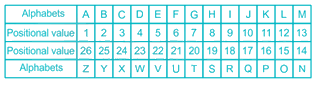 The logic followed here is:
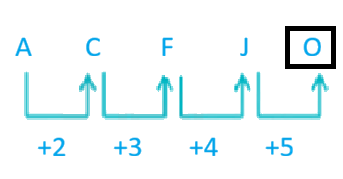 So, 'O' will replace the question mark in the given series.
Hence, the correct answer is "Option 1".
Q2 · Series
What comes next in the series? D, I, N, S, ?
- Z
- W
- Y
- X
Answer aur solution dekho
Archived marked answer: D
The logic followed here is:
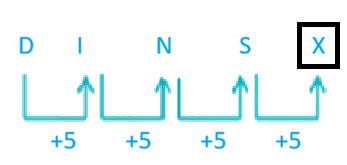
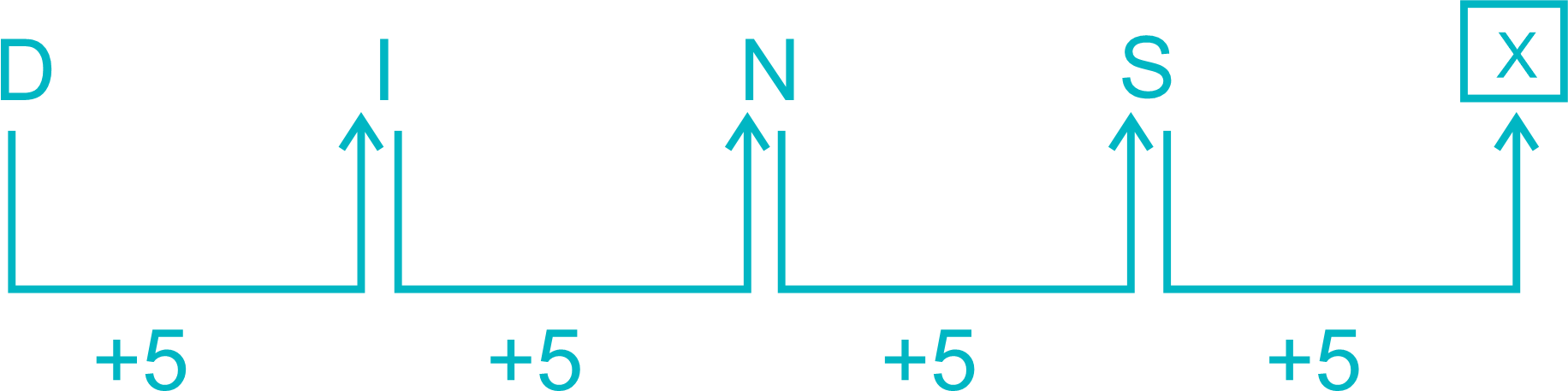 So, 'X' will replace the question mark in the given series.
Hence, the correct answer is "Option 4".
Q3 · Series
What comes next: 10, 17, 26, 37, 50, ?
- 45
- 54
- 76
- 65
Answer aur solution dekho
Archived marked answer: D
The logic followed here is:
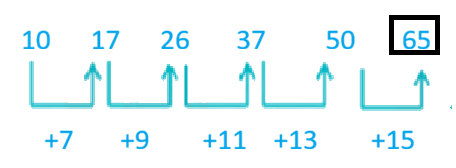 thus, "65" will replace the question mark in the given series.
Hence, the correct option is "Option 4".
Q4 · Series
What should come at the place of question mark?
2, 5, 10, 17, 26, ?
- 35
- 36
- 37
- 32
Answer aur solution dekho
Archived marked answer: C
The logic followed here is:
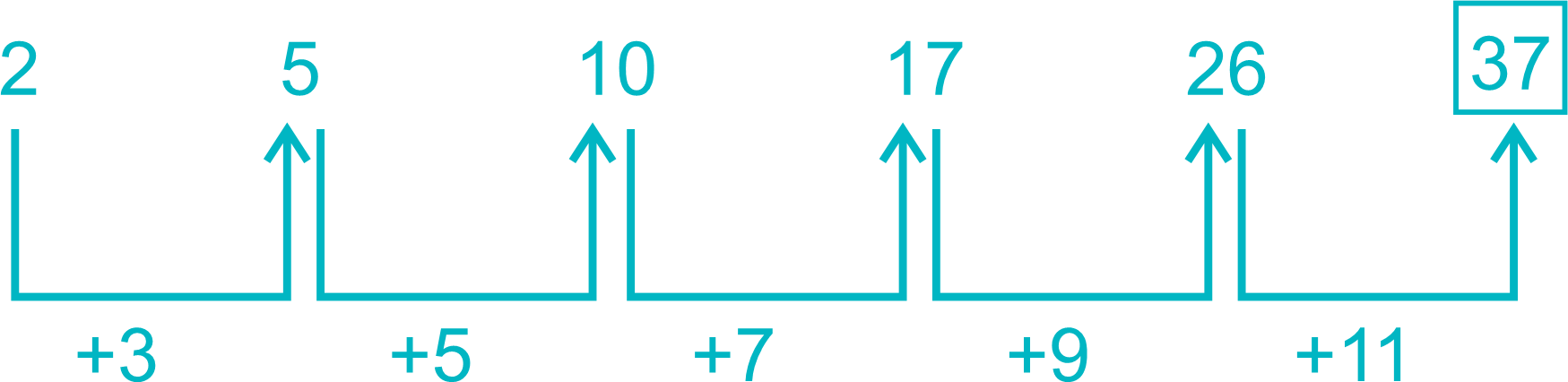 thus, "37" will replace the question mark in the given series.
Hence, the correct option is "Option 3".
Q5 · Series
Select the letter-cluster from among the given options that can replace the question mark (?) in the following series:
M C K J H N G M Q D R T ?
- AES
- IJS
- AWW
- RDS
Answer aur solution dekho
Archived marked answer: C
The logic followed here is:
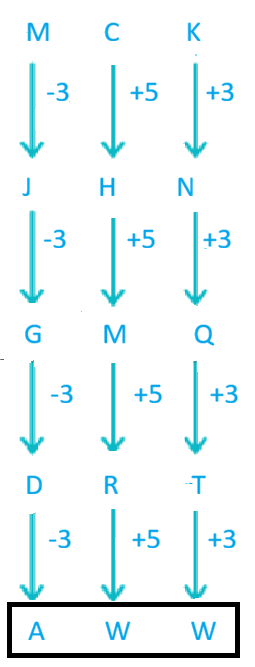 So, 'AWW' will replace the question mark in the given series.
Hence, the correct answer is "Option 3".
Q6 · Series
Complete the series:0, 7, 26, 63, ?
- 100
- 125
- 216
- 124
Answer aur solution dekho
Archived marked answer: D
The logic followed here is:
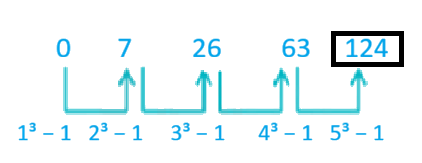 thus, "124" will replace the question mark in the given series.
Hence, the correct option is "Option 4".
Q7 · Series
Find the WRONG number in the given series.
5040, 720, 120, 24, 4, 2
- 720
- 24
- 4
- 130
Answer aur solution dekho
Archived marked answer: C
The logic followed here is:
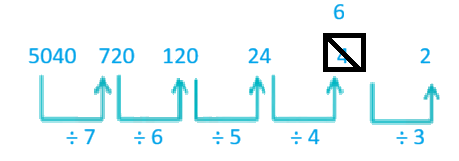 thus, "4" is the wrong number in the given series.
Hence, the correct option is "Option 3".
Q8 · Analogy
Choose the odd one out.
- Lily
- Lotus
- Grapes
- Jasmine
Answer aur solution dekho
Archived marked answer: C
The logic followed here is:
Option 1) (Lily) → It is a flower.
Option 2) (Lotus) → It is a flower.
Option 3) (Grapes) → It is a fruit.
Option 4) (Jasmine) → It is a flower.
Here, Lily, Lotus and Jasmine are flowers, whereas Grapes is a fruit.
Hence, the correct answer is "Option 3".
Q9 · Analogy
Identify the odd crop.
Maize, Sugarcane, Cotton, Barley
- Maize
- Sugarcane
- Cotton
- Barley
Answer aur solution dekho
Archived marked answer: C
The logic followed here is:
Option 1) (Maize) → It is a food grain crop.
Option 2) (Sugarcane) → It is a cash crop.
Option 3) (Cotton) → It is a fibre (cash) crop.
Option 4) (Barley) → It is a food grain crop.
Here, Maize and Barley are food grains, and Sugarcane is also cultivated mainly for consumption purposes, whereas Cotton is grown for fibre, not for food.
Hence, the correct answer is "Option 3".
Q10 · Analogy
You're assigned a task you don't know how to do. What's your best course of action?
- Make excuses
- Do it wrongly
- Seek help or guidance
- Delay it
Answer aur solution dekho
Archived marked answer: C
The logic followed here is:
Option 1) (Make excuses)
→ This avoids responsibility and does not solve the problem.
Option 2) (Do it wrongly)
→ Completing the task incorrectly can create bigger issues.
Option 3) (Seek help or guidance)
→ This shows responsibility, willingness to learn, and ensures the task is done correctly.
Option 4) (Delay it)
→ Postponing the task may cause inefficiency and affect deadlines.
Here, the most appropriate and professional action is to seek help or guidance.
Hence, the correct answer is "Option 3".
Q11 · Puzzle Subtypes Not To Miss
Select the CORRECT sequence of mathematical signs to sequentially replace the A and B to balance the given equation.
15 A 5 B 4 = 35
- x, -
- ÷, -
- +, x
- ÷, x
Answer aur solution dekho
Archived marked answer: C
BODMAS Table:
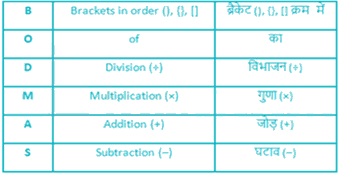 Given equation: 15 A 5 B 4 = 35
Now, check each option one by one using BODMAS rule.
Option 1) × , −
⇒ 15 × 5 − 4
⇒ 75 − 4
⇒ 71 ≠ 35
Option 2) ÷ , −
⇒ 15 ÷ 5 − 4
⇒ 3 − 4
⇒ −1 ≠ 35
Option 3) + , ×
⇒ 15 + 5 × 4
⇒ 15 + 20
⇒ 35
Option 4) ÷ , ×
⇒ 15 ÷ 5 × 4
⇒ 3 × 4
⇒ 12 ≠ 35
Hence, the correct answer is "Option 3".
Q12 · Puzzle Subtypes Not To Miss
A statement is given followed by two conclusions. Find which conclusion is TRUE based on the given statement.
Statement:
C < A ≤ T = D ≤ O; G ≤ D < S; T ≥ A
Conclusions:
I: T ≤ O
II: D < T
- Both I and II
- Neither I nor II
- Only I
- Only II
Answer aur solution dekho
Archived marked answer: C
Given Statement: C < A ≤ T = D ≤ O; G ≤ D < S; T ≥ A
Now,
From C < A ≤ T = D ≤ O
We get:
A ≤ T
T = D
D ≤ O
So, T = D and D ≤ O ⇒ T ≤ O
Also, since T = D,
D < T is not possible
Conclusions:
(i) T ≤ O → True
(ii) D < T → False
Here, Only conclusion I is true.
Hence, the correct answer is "Option 3".
Q13 · Puzzle Subtypes Not To Miss
Identify the roll number that doesn't fit this rule.
Last 3 digits = First 3 digits + 100
- 200K300
- 150K250
- 250K350
- 100K250
Answer aur solution dekho
Archived marked answer: D
The logic followed here is:
Logic: Last 3 digits = First 3 digits + 100
Option 1) 200K300
200 + 100 = 300
Option 2) 150K250
150 + 100 = 250
Option 3) 250K350
250 + 100 = 350
Option 4) 100K250
100 + 100 = 200 ≠ 250
Hence, the roll number that does not fit the rule is Option 4.
Q14 · Puzzle Subtypes Not To Miss
A train 120 meters long takes 6 seconds to cross a man. What is the speed of the train in km/h?
- 36
- 72
- 60
- 75
Answer aur solution dekho
Archived marked answer: B
Given:
Length of train = 120 meters
Time taken to cross a man = 6 seconds
According to Question:
When a train crosses a man, distance covered = Length of the train
So, Speed = Distance / Time
Speed = 120 / 6
= 20 m/s
Now, convert m/s into km/h
1 m/s = 18/5 km/h
So, 20 × (18/5)
= 4 × 18
= 72 km/h
Hence, the correct answer is Option 2.
Q15 · Coding Decoding
If 3 $ 4 = 37 and 4 $ 5 = 61, what is 5 $ 6?
- 85
- 91
- 96
- 89
Answer aur solution dekho
Archived marked answer: B
The logic followed here is:
Logic: (First number²) + (Second number²) + (First number × Second number)
Given,
3 $ 4
⇒ (3²) + (4²) + (3 × 4)
⇒ 9 + 16 + 12 = 37
And, 4 $ 5
⇒ (4²) + (5²) + (4 × 5)
⇒ 16 + 25 + 20 = 61
Now, 5 $ 6:
⇒ (5²) + (6²) + (5 × 6)
⇒ 25 + 36 + 30 = 91
Hence, the correct answer is "Option 2".
Q16 · Logical Reasoning
If SNAKE is written as RMZJD, how is ZEBRA written.
- YDAQZ
- YDAQY
- YCBQZ
- YDAQX
Answer aur solution dekho
Archived marked answer: A
The logic followed here is:
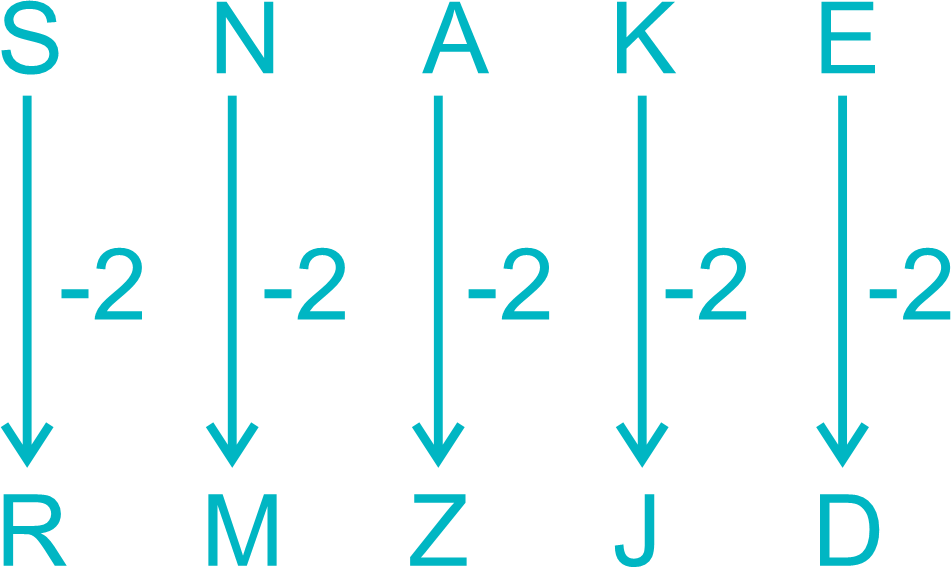
Logic: Each letter is shifted two positions backward in the English alphabet.
Given, SNAKE → R M Z J D
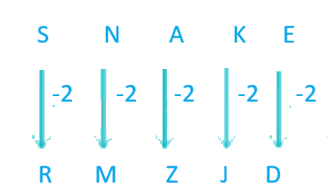
 Now, Z E B R A :
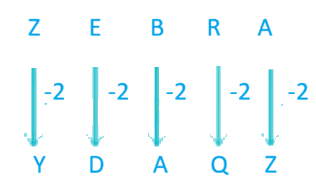
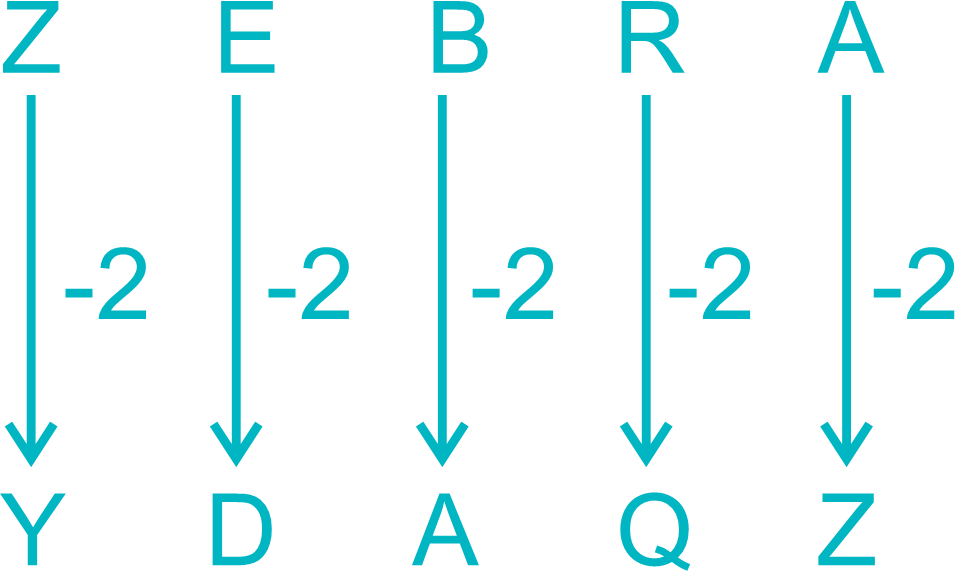 So, ZEBRA → Y D A Q Z
Hence, the correct answer is "Option 1".
Q17 · Logical Reasoning
If "CRANE" is coded as "DSBOF", how is "DSBOF" coded?
- ETCPG
- DTCOP
- ESCPF
- DTCPF
Answer aur solution dekho
Archived marked answer: A
The logic followed here is:
Logic: Each letter is shifted one position forward in the English alphabet.
Given, CRANE → D S B O F
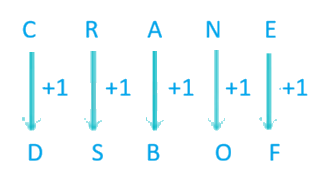 Now, D S B O F :
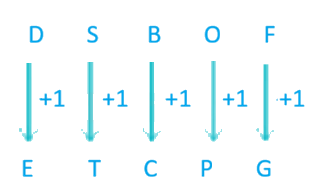 So, DSBOF → E T C P G
Hence, the correct answer is "Option 1".
Q18 · Logical Reasoning
Consider the following statement and choose the option that follows.
Statement: The company has decided to switch to renewable energy sources for its operations.
Inferences:
I. The company aims to reduce its carbon footprint.
II. The company's current energy sources are expensive.
- Only I follows
- Only II follows
- Both follows
- Neither follows
Answer aur solution dekho
Archived marked answer: A
Given:
The given statement mentions that the company has decided to switch to renewable energy sources for its operations. This indicates a change toward cleaner and more sustainable energy.
Now, let's evaluate the given inferences:
I. The company aims to reduce its carbon footprint:
This inference is true.
Switching to renewable energy generally helps in reducing carbon emissions, so it is reasonable to infer that the company aims to reduce its carbon footprint.
II. The company's current energy sources are expensive: This inference is not necessarily true.
The statement does not mention anything about the cost of the current energy sources, so we cannot conclude that they are expensive.
Hence, only inference I follows from the given statement.
Hence, the correct answer is "Option 1".
Q19 · Logical Reasoning
Read the following statement carefully and identify the conclusion that follows.
Statement: All kids are students. Some students are athletes. No athlete is a scholar.
Conclusions:
I. Some kids may be athletes.
II. No kid is a scholar.
- Only I follows
- Only II follows
- Both I and II follow
- Neither I nor II follows
Answer aur solution dekho
Archived marked answer: A
Given Statements:
All kids are students.
Some students are athletes.
No athlete is a scholar.
The least possible Venn diagram for the given statement is:
Q20 · Blood Relations
A is the son of B. C is the wife of B. D is the son of C. How is A related to D?
- Uncle
- Brother
- Cousin
- Son
Answer aur solution dekho
Archived marked answer: B
Family Chart:
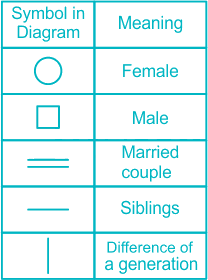 Given:
A is the son of B.
C is the wife of B.
D is the son of C.
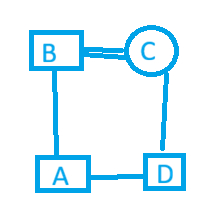 So, A is Brother of D.
Hence, the correct answer is "Option 2".
Q21 · Blood Relations
A is the father of B. B is the brother of C. How is A related to C?
- Uncle
- Father
- Brother
- Grandfather
Answer aur solution dekho
Archived marked answer: B
Family Chart:
Given:
A is the father of B.
B is the brother of C.
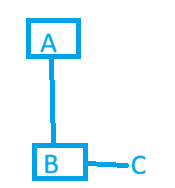 So, A is Father of C.
Hence, the correct answer is "Option 2".
Q22 · Blood Relations
Directions: These questions are based on the following information:
'P@Q' means 'Q is the mother of P'.
'P$Q' means 'Q is the husband of P'.
'P#Q' means 'Q is the sister of P'.
'P&Q' means 'Q is the son of P'.
If 'A & B @ C & D # E' then how is A related with E?
- Father
- Son
- Daughter
- Mother
Answer aur solution dekho
Archived marked answer: A
Family Chart:
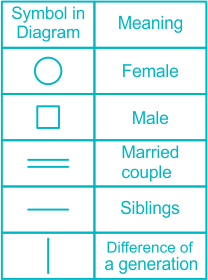 Decoding the Symbols:
Symbol
@
$
#
Meaning
Mother
Husband
Sister
Son
Given:' A & B @ C & D # E'
It means: “B is the son of A, C is the mother of B, D is the son of C, and E is the sister of D.”
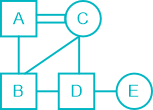 So, A is the 'Father' of E.
Hence, the correct answer is "Option 1".
Q23 · Alphabet Test
Which word cannot be formed from the letters of the word ADMINISTRATION using each letter only once?
- SITUATION
- TRADITION
- RATION
- STRAIN
Answer aur solution dekho
Archived marked answer: A
Given word: ADMINISTRATION
Let’s check all the options:
(1) SITUATION
⇒ It can be formed as all required letters (S, I, T, U, A, O, N) are present in sufficient quantity.
(2) TRADITION
⇒ It can’t be formed as it requires two D’s, but ADMINISTRATION has only one D.
(3) RATION
⇒ It can be formed as all required letters are available.
(4) STRAIN
⇒ It can be formed as all required letters are available.
So, the answer is "TRADITION".
Hence, the correct answer is Option 1.
Q24 · Similarity and Differences
Choose the address that is the same as the one given below.
Plot No. 19, Shivaji Park, Dadar West, Mumbai, Maharashtra 400028
- Plot No. 19, Shivaji Park, Dadar W, Mumbai, Maharashtra - 400028
- Plot No. 91, Shivaji Park, Dadar West, Mumbai, Maharashtra - 400028
- Plot No. 19, Shivaji Pk, Dadar West, Mumbai, Maharashtra 400028
- Plot No. 19, Shivaji Park, Dadar West, Mumbai, Maharashtra 400028
Answer aur solution dekho
Archived marked answer: D
The address given in the problem is,
Plot No. 19, Shivaji Park
Dadar West, Mumbai
Maharashtra 400028
Let's match this address with the given options one by one to figure out which one is exactly the same.
Option
Address in Option
Matching
(1)
Plot No. 19, Shivaji Park, Dadar W, Mumbai, Maharashtra - 400028
Dadar West is written as Dadar W and extra hyphen is added before PIN code.
(2)
Plot No. 91, Shivaji Park, Dadar West, Mumbai, Maharashtra - 400028
Plot number 19 is written as 91.
(3)
Plot No. 19, Shivaji Pk, Dadar West, Mumbai, Maharashtra 400028
Park is shortened to Pk.
(4)
Plot No. 19, Shivaji Park, Dadar West, Mumbai, Maharashtra 400028
The address matches exactly with the given address.
So, the address that is exactly the same as the given address is in option (4).
Hence, the correct option is "Option 4".
General Awareness
Q1 · Art and Culture
Fill in the Blank:
Thoda is performed mostly by ____ community.
- Rajputs
- Brahmins
- Jats
- Ahirs
Answer aur solution dekho
Archived marked answer: A
The correct answer is Rajputs.
Key Points
- Thoda is a traditional martial art practiced in Himachal Pradesh, India, primarily by the Rajput community.
- It combines elements of archery and martial arts, and is deeply rooted in the cultural and historical traditions of the region.
- The sport involves using wooden bows and arrows, and participants aim to hit the opponent's leg as part of the competitive gameplay.
- Thoda is typically performed during local festivals and celebrations, showcasing the rich heritage of the Rajput community.
- The martial art traces its origin to the Mahabharata, symbolizing valor and warrior skills, which have been preserved by generations of Rajputs.
Additional Information
- Location: Thoda is primarily performed in the Himachal Pradesh region, particularly in areas like Shimla and Kullu. The mountainous terrain adds to the challenging nature of the sport.
- Features: Participants use blunt arrows and wear protective gear to avoid injuries. The sport emphasizes skill, strategy, and precision rather than aggression.
- Cultural Significance: Thoda is not just a martial art but also a way to preserve the Rajput warrior traditions and their historical connection to bravery and combat expertise.
- Festivals: Thoda is often performed during Baisakhi and other local festivals, making it a key attraction for tourists and locals alike.
- Historical Context: The martial art is believed to have originated from the Mahabharata, where archery played a significant role in warfare. It reflects the warrior ethos of ancient Indian culture.
Important Points
- Other Communities: While Thoda is primarily associated with the Rajputs, individuals from other communities may occasionally participate in the sport for recreational purposes.
- Preservation: Efforts are being made by the Himachal Pradesh government to preserve and promote Thoda as part of the state's intangible cultural heritage.
- Training: Thoda requires rigorous physical training and mastery of archery techniques, reflecting the disciplined lifestyle of the Rajputs.
- Modern Adaptations: Although traditional in nature, Thoda has been adapted for modern audiences with organized tournaments and safety measures.
- Tourism: Thoda performances attract domestic and international tourists, contributing to the cultural tourism of Himachal Pradesh. </ul
Q2 · Art and Culture
Fill in the blank:
The ceremonial procession of Lord Dharnath in Dhar district of Madhya Pradesh is locally referred to as a _____
- Jhankí
- Chhabina
- Rath
- Sawari
Answer aur solution dekho
Archived marked answer: B
The correct answer is Chhabina.
Key Points
- The ceremonial procession of Lord Dharnath in Dhar district of Madhya Pradesh is locally referred to as Chhabina.
- A Chhabina is a traditional and culturally significant form of procession, often carried out during religious festivities in the region.
- These processions involve the use of decorated vehicles, music, and participation of devotees who accompany the deities in a celebratory manner.
- This tradition highlights the rich cultural heritage of Madhya Pradesh and the religious fervor of the local community.
- The term Chhabina specifically dis
Q3 · Indian Polity and Constitution
What technological advancement is explicitly incorporated in the Bharatiya Nagarik Suraksha Sanhita, 2023 for faster justice delivery?
- Use of blockchain in contracts
- Electronic recording of witness testimony
- Live broadcast of trials
- Use of drones for crime scene inspection
Answer aur solution dekho
Archived marked answer: B
The correct answer is Electronic recording of witness testimony.
Key Points
- The Bharatiya Nagarik Suraksha Sanhita, 2023 introduces modern technological advancements to streamline judicial processes and ensure faster delivery of justice.
- The incorporation of electronic recording of witness testimony is a critical feature aimed at reducing delays caused by manual procedures and ensuring accurate documentation of testimonies.
- Electronic recording minimizes the possibility of tampering, loss, or misinterpretation of witness statements, thereby enhancing the transparency and reliability of judicial proceedings.
- The use of technology ensures that the testimony remains accessible for future reference and provides a standardized method of recording across courts.
- This advancement aligns with the government’s vision to digitize and modernize the judicial infrastructure under initiatives like Digital India.
Additional Information
- Importance of Witness Testimony:
- Witness testimony serves as a crucial component of judicial trials, often being the deciding factor in criminal and civil cases.
- Ensuring the accuracy and security of witness statements is vital for maintaining the integrity of the judicial process.
- Benefits of Electronic Recording:
- Improves efficiency by eliminating manual transcription processes.
- Reduces the scope for human error during documentation.
- Enables secure storage and retrieval of recorded testimonies for future proceedings.
- Global Practices:
- Countries like the United States and United Kingdom have adopted electronic recording systems in courts to facilitate faster and more accurate documentation of proceedings.
- Such practices are considered benchmarks for judicial reforms worldwide.
- Challenges in Implementation:
- Initial infrastructure costs for setting up electronic recording systems in courts.
- Training judicial staff and ensuring their adaptability to new technologies.
- Addressing concerns related to data privacy and cybersecurity.
Important Points
- Bharatiya Nagarik Suraksha Sanhita, 2023:
- Aimed at reforming India’s judicial and law enforcement systems to make them more effective and citizen-centric.
- Emphasizes the use of technology to address long-pending issues such as delayed trials and outdated procedures.
- Digital India Initiative:
- Launched in 2015 by the Government of India, this initiative focuses on digitizing all aspects of governance.
- The judicial reforms under this initiative aim to modernize courtrooms and enhance public access to judicial services.
- Other Technological Advancements:
- Use of video conferencing for remote hearings, reducing the need for physical presence in courts.
- Development of e-Courts to digitize case filings and streamline judicial processes.
- Implementation of Artificial Intelligence (AI) for legal research and case analysis.
79
Q4 · Indian Polity and Constitution
Fill in the blanks:
During a Financial Emergency, the salaries of judges can be reduced by the ______.
- President
- PM
- Chief Justice
- Finance Commission
Answer aur solution dekho
Archived marked answer: A
The correct answer is President.
Key Points
- Financial Emergency: The term "Financial Emergency" is defined under Article 360 of the Indian Constitution. It allows the President of India to take specific measures to safeguard the financial stability of the country.
- During a Financial Emergency, the President has the power to reduce the salaries and allowances of all government employees, including judges of the Supreme Court and High Courts.
- Such measures are implemented to ensure the proper allocation and management of financial resources during the crisis. *Hence, the correct answer is "President."*
- The proclamation of a Financial Emergency requires the approval of both Houses of Parliament within two months of its issuance.
- Once approved, the President<
Q5 · Indian Economy
Which of the following statements is/are correct regarding the borrowing powers of States in India?
1) A State requires the Centre's consent for internal borrowing if it owes any debt to the Centre.
2) No State can raise loans from foreign sources without prior approval of the Union Government.
- Statement 1 is Correct
- Statement 2 is Correct
- Statement 1 and 2 are Correct
- Neither 1 nor 2 are Correct
Answer aur solution dekho
Archived marked answer: C
The correct answer is 3) Statement 1 and 2 are Correct.
Key Points
- Statement 1: A State requires the Centre's consent for internal borrowing if it owes any debt to the Centre.
- This is correct as per Article 293(3) of the Constitution of India. A State that owes loans to the Centre must seek prior approval before borrowing further.
- Statement 2: No State can raise loans from foreign sources without prior approval of the Union Government.
- This is correct as the borrowing of funds from foreign sources by States is regulated by the Union Government to ensure compliance with international agreements and the country’s financial stability.
- The borrowing powers of States are governed by Article 293 of the Constitution, which imposes restrictions to prevent financial instability or unsanctioned debts.
- The Union Government oversees borrowing activities of States to maintain fiscal discipline and ensure coordination between States and the Centre.
- Thus, both statements are correct, and the correct answer is 3) Statement 1 and 2 are Correct.
Additional Information
- Article 293 of the Constitution:
- Clause (1): A State can borrow within the territory of India upon the security of its Consolidated Fund.
- Clause (3): If a State owes any loans to the Union Government, it must seek prior approval for further borrowing.
- Clause (4): The Union Government can impose conditions on borrowing to ensure compliance with financial stability norms.
- Foreign Borrowing:
- States cannot independently negotiate loans with foreign entities without Union Government approval.
- This ensures that external borrowings align with national interests and international agreements.
- Fiscal Federalism in India:
- The financial relationship between the Centre and States is governed by Constitutional provisions to maintain fiscal discipline.
- The Finance Commission periodically reviews the allocation of resources and borrowing limits.
- Borrowing Limits:
- The Union Government sets borrowing limits for States based on economic conditions and fiscal parameters.
- This is done to prevent excessive debt accumulation and ensure financial sustainability.
Important Points
- Union Control Over Borrowing: The Union Government ensures that borrowing by States does not conflict with national financial policies and international obligations.
- Finance Commission: The Finance Commission recommends measures to manage State borrowing and allocates funds to ensure equitable distribution.
- Fiscal Responsibility and Budget Management (FRBM) Act: This Act promotes financial discipline by prescribing fiscal targets for both the Centre and States.
Q6 · Indian Economy
The term 'Navratnas' in public sector reform refers to:
- Public enterprises given full privatization
- Public enterprises granted autonomy for better performance
- Subsidy-driven rural firms
- Firms eligible for WTO support
Answer aur solution dekho
Archived marked answer: B
The correct answer is Public enterprises granted autonomy for better performance.
Key Points
- The term ‘Navratnas’ refers to select public sector enterprises in India that have been granted autonomy to improve their operational performance.
- This autonomy allows these enterprises to operate independently without significant interference from the government in decision-making processes, enabling them to compete in the global market.
- Navratnas are part of a larger classification system within India’s public sector units (PSUs), which includes Maharatnas, Navratnas, and Miniratnas, based on their financial performance and operational capabilities.
- The status of Navratna is granted to PSUs that meet certain financial criteria, such as earning a net profit, maintaining a good net worth, and achieving specific annual turnover thresholds.
- Navratna PSUs are empowered to make strategic investments, form joint ventures, and undertake mergers and acquisitions without requiring prior approval from the government.
Additional Information
- Criteria for Navratna Status:
- PSUs must achieve a score of 60 out of 100 in six performance parameters: net profit, net worth, total manpower cost, productivity of capital and assets, and earnings per share.
- They must also maintain a minimum annual turnover of Rs. 2,000 crore and a net profit of Rs. 30 crore.
- Features of Navratna Companies:
- Navratna PSUs can invest up to Rs. 1,000 crore or 15% of their net worth in a single project without government approval.
- They are allowed to enter into joint ventures and form alliances with foreign companies to enhance their operational efficiency.
- Examples of Navratna PSUs:
- Companies such as Bharat Electronics Limited (BEL), Hindustan Aeronautics Limited (HAL), and National Aluminium Company Limited (NALCO) have been granted Navratna status.
- These companies operate in diverse sectors, including defense, aerospace, energy, and minerals.
- Difference Between Navratna and Maharatna:
- Maharatna companies have even greater autonomy than Navratna companies. For instance, Maharatnas can invest up to Rs. 5,000 crore in a single project without government approval.
- Navratna status is often a stepping stone for PSUs to achieve Maharatna status based on their sustained financial and operational performance.
Important Points
- Historical Context:
- The Navratna status was introduced in 1997 as part of India’s economic reforms to enhance the efficiency of PSUs.
- This initiative was aimed at encouraging PSUs to operate more competitively and contribute to national economic growth.
- Impact of Autonomy:
- Navratna PSUs have played a crucial role in driving industrial growth, creating employment opportunities, and earning significant foreign exchange for India.
- They are often considered benchmarks for operational excellence within the public sector.
- Global Competitiveness:
- By granting autonomy, Navratna companies have been able to expand their operations internationally, competing with private and multinational corporations.
- For example, ONGC Videsh Ltd., a subsidiary of ONGC (a Navratna company), has successfully acquired oil and gas assets abroad.
a9:T24
Q7 · Indian Economy
Read the below statements marked as Assertion (A) and Reason (R). Mark the correct option:
Assertion (A): GDP doesn't really tell the whole story when it comes to how well people in a country are actually doing.
Reason (R): That's mainly because it doesn't take into account stuff like wear and tear of machines, pollution, or even how the money is divided among people.
- Both A and R are true, and R is the correct explanation of A.
- Both A and R are true, but R is not the correct explanation of A.
- A is true, but R is false.
- A is false, but R is true.
Answer aur solution dekho
Archived marked answer: A
The correct answer is 1) Both A and R are true, and R is the correct explanation of A..
Key Points
- Assertion (A): GDP doesn't really tell the whole story when it comes to how well people in a country are actually doing.
- Gross Domestic Product (GDP) measures the total economic output of a country but does not reflect the overall well-being of citizens.
- It does not account for factors such as income inequality, environmental degradation, or the quality of life. *Hence, the assertion is correct.*
- Reason (R): That's mainly because it doesn't take into account stuff like wear and tear of machines, pollution, or even how the money is divided among people.
- GDP primarily measures economic activity and ignores externalities like pollution, resource depletion, or income distribution.
- It also excludes factors such as the depreciation of capital goods (wear and tear of machines) and how wealth is distributed among individuals. *Hence, the reason is correct.*
- The reason directly explains why GDP fails to fully capture the well-being of citizens. *Thus, it is the correct explanation of the assertion.*
- *Therefore, both A and R are true, and R is the correct explanation of A.*
Additional Information
- Limitations of GDP as an Indicator:
- Environmental Costs: GDP does not consider the negative effects of economic activities, such as pollution or depletion of natural resources.
- Income Inequality: GDP measures total output but does not show how income is distributed across the population. High GDP can coexist with widespread poverty.
- Non-Market Activities: Informal sector activities, household labor, and volunteer work are excluded from GDP calculations, despite their contribution to society.
- Depreciation: GDP does not account for the wear and tear of capital goods (known as depreciation), which can affect future productivity.
- Quality of Life: GDP focuses on quantity rather than quality. Factors like healthcare, education, or happiness are not directly measured.
- Alternative Measures of Well-Being:
- Human Development Index (HDI): Combines measures of health, education, and income to provide a broader perspective on well-being.
- Gross National Happiness (GNH): Used by countries like Bhutan to prioritize happiness and quality of life over economic output.
- Genuine Progress Indicator (GPI): Adjusts GDP by considering factors such as environmental costs, social costs, and income inequality.
- Green GDP: Accounts for environmental degradation and resource depletion alongside economic growth.
-
Important Points
:
- Economists and policymakers often use GDP as a benchmark but recognize the need for supplementary indicators to assess a country’s overall progress.
- In recent years, global organizations like the United Nations and World Bank have emphasized the importance of inclusive growth and sustainable development.
- Countries are increasingly adopting multidimensional indices to address the limitations of GDP and focus on long-term well-being.
Q8 · Sports Static GK
What critical factor distinguished Vijay Kumar's performance in the men's 25m rapid pistol event at the London 2012 Olympics?
- He set a new world record in the qualification round.
- He won gold by defeating Cuba's Leuris Pupo in the final round.
- He was the first Indian shooter to qualify for the finals.
- He outshot a tied competitor in the sixth round to reach the final round.
Answer aur solution dekho
Archived marked answer: D
The correct answer is He outshot a tied competitor in the sixth round to reach the final round..
Key Points
- Vijay Kumar, an Indian shooter, performed exceptionally in the men's 25m rapid pistol event at the London 2012 Olympics.
- He faced a critical situation during the competition, where he was tied with another competitor in the sixth round. His ability to outshoot the tied competitor allowed him to secure a spot in the final round. *Hence, this was the distinguishing factor in his performance.*
- Vijay Kumar eventually won the silver medal, marking a significant achievement for India in shooting sports.
- Contrary to the other options, he did not set a new world record, nor did he win gold. Additionally, he was not the first Indian sh
Q9 · Sports Static GK
A personal foul in basketball primarily involves:
- Arguing with the referee
- Illegal physical contact during active play
- Delay of game violations
- Unsportsmanlike conduct on the bench
Answer aur solution dekho
Archived marked answer: B
The correct answer is Illegal physical contact during active play.
Key Points
- A personal foul in basketball primarily involves illegal physical contact between players during active gameplay. Examples include pushing, holding, tripping, or physically impeding an opponent's movement.
- The purpose of the personal foul rule is to ensure that the game remains safe, fair, and competitive, avoiding unnecessary injuries or unfair advantages.
- Personal fouls can occur during actions like blocking (illegally impeding the progress of an opponent) or charging (running into a stationary defender).
- When a personal foul is committed, penalties such as free throws or possession of the ball are awarded to the opposing team, depending on the si
Q10 · Sports Static GK
Which of the following statements is/are correct regarding the Indian football season 2024-25 as per the AIFF calendar?
1.)The Durand Cup 2024, Asia's oldest football tournament, is scheduled between July 26 and August 31.
2.) The I-League 3 and the Junior Girls National Football Championship (Tier 1 & 2) will both run during the same calendar month.
- Only 1
- Only 2
- Both 1 and 2 are correct
- Neither 1 nor 2
Answer aur solution dekho
Archived marked answer: A
The correct answer is Option 1.
Key Points
- Statement 1: The Durand Cup 2024, Asia's oldest football tournament, is scheduled between July 26 and August 31, 2024. This statement is *correct* as the All India Football Federation (AIFF) has officially announced the tournament's schedule in its calendar for the 2024-25 football season. The Durand Cup is one of India's most prestigious football tournaments.
- Statement 2: The I-League 3 and the Junior Girls National Football Championship (Tier 1 & 2) will both run during the same calendar month. This statement is *incorrect* as per the AIFF calendar for the 2024-25 season. These tournaments are scheduled in different months to avoid overlap and ensure smooth organization.
- The AIFF's calendar for the 2024-25 season is designed to avoid scheduling conflicts between major tournaments and championships, ensuring maximum participation and viewership.
- The Durand Cup is considered a curtain-raiser for the Indian football season, showcasing top teams and players from across the country.
- *Hence, the correct answer is Option 1.*
Additional Information
- Durand Cup:
- The Durand Cup is the oldest football tournament in Asia, established in 1888. It is also the third oldest football competition in the world.
- It is organized by the Indian Armed Forces and the AIFF, with participation from top teams in the Indian Super League (ISL), I-League, and Services teams.
- The tournament serves as a platform for young and emerging players to showcase their talent ahead of the domestic football season.
- I-League 3:
- The I-League 3 is a newly introduced league by the AIFF aimed at grassroots development and providing opportunities for young footballers and clubs across India.
- It is the third tier of the Indian football league system, below the ISL and I-League.
- Clubs participating in I-League 3 are required to meet licensing and infrastructure criteria set by the AIFF.
- Junior Girls National Football Championship:
- This championship is part of AIFF's initiatives to promote women's football in India at the grassroots and junior levels.
- The tournament is divided into two tiers to ensure competitive balance and encourage participation from all states and union territories.
- The top teams from Tier 2 have the opportunity to qualify for Tier 1 in subsequent seasons.
- All India Football Federation (AIFF):
- The AIFF is the governing body for football in India, affiliated with FIFA and the Asian Football Confederation (AFC).
- It is responsible for organizing domestic football leagues, tournaments, and national team activities.
- The AIFF's vision includes grassroots development, women's football promotion, and improving India's global football ranking.
Important Points
- AIFF Calendar: The calendar for the 2024-25 season has been meticulously planned to avoid overlap between major tournaments, ensuring better organization and participation.
- Development Initiatives: AIFF has introduced multiple leagues and championships to nurture young talent and promote football across all age groups and genders.
- Historical Significance: The Durand Cup holds a special place in Indian football history, attracting fans and players alike with its rich legacy and competitive spirit. </ul
Q11 · Indian Geography
In India, which of these geological formations hosts the most significant groundwater reservoirs for large-scale and extensive development?
- Unconsolidated Formation
- Semi-Consolidated Formation
- Fissured Formations
- Consolidated Formations
Answer aur solution dekho
Archived marked answer: A
The correct answer is Unconsolidated Formation.
Key Points
- Unconsolidated formations are loose, soft deposits made up of sand, silt, gravel, and clay, which are highly porous and permeable, making them the most significant geological formations for groundwater storage and extraction.
- These formations act as aquifers, which are underground layers of water-bearing permeable materials capable of storing and transmitting water in large quantities.
- In India, the major groundwater reservoirs are located in the Indo-Gangetic Plain, which is primarily composed of unconsolidated sediments deposited by rivers over millions of years.
- Owing to their high porosity and permeability, unconsolidated formations allow easy movement and storage of water, making them ideal for large-scale groundwater development, including irrigation, industrial use, and domestic water supply.
- Regions with unconsolidated formations, such as the Ganga-Brahmaputra basin and the coastal areas of India, are known to support extensive agricultural and urban water demands.
Additional Information
- Characteristics of Unconsolidated Formations:
- These consist of loose sediments such as sand, gravel, silt, and clay, which are not cemented together.
- Due to their granular structure, they have high porosity (ability to store water) and high permeability (ease of water movement).
- Examples of areas with unconsolidated formations in India include the Indo-Gangetic Plains and the deltaic regions of rivers like the Ganga and Brahmaputra.
- Importance of Groundwater Reservoirs:
- Groundwater is a vital resource for irrigation, accounting for over 60% of agricultural water usage in India.
- It also provides drinking water to approximately 85% of rural households and supports urban areas.
- Groundwater reservoirs in unconsolidated formations are particularly critical in regions with seasonal rainfall, such as India, where water storage is essential during dry periods.
- Comparison with Other Formations:
- Semi-consolidated formations have moderate porosity and permeability, making them less suitable for large-scale groundwater development.
- Fissured and consolidated formations, such as hard rock areas, have limited water storage capacity due to low porosity and rely on fractures and joints for water flow.
- Unconsolidated formations, by contrast, are more productive and reliable for meeting extensive groundwater needs.
- Challenges in Groundwater Management:
- Over-extraction of groundwater in unconsolidated formations can lead to issues like aquifer depletion, land subsidence, and water quality degradation.
- Effective management strategies, such as artificial recharge and sustainable water use practices, are crucial for preserving these vital resources.
Important Points
- Geological Formations in India:
- Unconsolidated formations: Found mainly in alluvial regions like the Indo-Gangetic Plains. These are best suited for large-scale groundwater development.
- Semi-consolidated formations: Found in regions with sedimentary rocks like sandstones and limestones. Examples include parts of central India.
- Fissured and consolidated formations: Found in hard rock areas such as the Deccan Plateau, with limited groundwater storage potential.
- Government Initiatives:
- Programs like Atal Bhujal Yojana aim to ensure sustainable management of groundwater resources in India.
- Efforts to promote rainwater harvesting and artificial recharge are being implemented to replenish groundwater in unconsolidated formations.
``
Q12 · Indian Geography
Talcher, a thermal power station in India, is in:
- Jharkhand
- Tamil Nadu
- Andhra Pradesh
- Odisha
Answer aur solution dekho
Archived marked answer: D
The correct answer is Odisha.
Key Points
- Talcher is a major industrial hub located in the Angul district of the state of Odisha, India.
- The Talcher Thermal Power Station is a significant coal-based power plant that contributes substantially to the power generation capacity of India.
- This power station is owned and operated by NTPC Limited (National Thermal Power Corporation Limited), one of India's largest energy conglomerates.
- Talcher is often referred to as the "Coal City of Odisha" due to its rich coal reserves and extensive mining activities. It is part of the Mahanadi Coalfields Limited (MCL) region.
- Odisha is one of the top coal-producing states in India, and Talcher plays a pivotal role in this sector by contributing significantly to the state's and the nation's energy requirements.
Additional Information
- Talcher's Industrial Significance:
- Talcher hosts a variety of industries, including coal mining, power generation, and fertilizer production, making it an industrially rich region.
- The Talcher Super Thermal Power Station, also located in this region, has a power generation capacity of over 3,000 MW, making it one of the largest power plants in India.
- Coal Mining in Talcher:
- Talcher is part of the Mahanadi Coalfields Limited (MCL), a subsidiary of Coal India Limited (CIL), which is responsible for coal mining operations in the area.
- The coal mined here is primarily used for power generation and industrial purposes, catering to both domestic and industrial consumers across the country.
- Location and Connectivity:
- Talcher is well-connected by rail and road to major cities in Odisha and neighboring states, facilitating the transport of coal and other industrial goods.
- The nearest airport to Talcher is the Biju Patnaik International Airport in Bhubaneswar, located approximately 140 km away.
- Power Generation in Odisha:
- Odisha is a key contributor to India's energy sector, with several thermal, hydro, and renewable energy projects spread across the state.
- The state's energy production not only fulfills its own needs but also supplies electricity to other parts of India.
Important Points
- NTPC Limited:
- NTPC Limited, previously known as National Thermal Power Corporation, is a central public sector undertaking under the Ministry of Power, Government of India.
- It is India's largest power utility and contributes significantly to the country's electricity production.
- Mahanadi Coalfields Limited (MCL):
- MCL is one of the major subsidiaries of Coal India Limited (CIL) and plays a crucial role in coal extraction in Odisha.
- The coalfields in and around Talcher are some of the most productive in the country.
- Odisha's Energy Sector:
- Odisha is among the leading states in India in terms of installed power generation capacity, with a mix of thermal, hydro, and renewable energy projects.
- The state's rich natural resources, including coal, bauxite, and iron ore, contribute to its industrial and energy production capabilities.
``
Q13 · Modern Indian History
Fill in the blank: The Government of India Act 1919 created a bicameral central legislature with the Council of State and the _______.
- Central Legislative Assembly
- Imperial Council
- Council of Princes
- Chamber of Deputies
Answer aur solution dekho
Archived marked answer: A
The correct answer is Central Legislative Assembly.
Key Points
- The Government of India Act, 1919, also known as the Montagu-Chelmsford Reforms, introduced significant changes in the administrative structure of India under British rule.
- This act created a bicameral central legislature for the first time in India, consisting of two houses: the Council of State (Upper House) and the Central Legislative Assembly (Lower House).
- The Central Legislative Assembly acted as the Lower House with a mix of elected and nominated members. Some members were elected by provincial legislative councils, while others were nominated by the Governor-General.
- The primary aim of the Central Legislative Assembly was to allow limited Indian representation in governance, though its powers were restricted to legislative matters and subject to the Governor-General's veto.
- The introduction of this bicameral legislature was an essential step toward the gradual inclusion of Indians in decision-making processes, although the reforms did not provide full autonomy.
- The act
Q14 · Current Affairs
Who among the following was the Chief Guest at India's Republic Day celebrations in 2025?
- Joe Biden
- H.E. Prabowo Subianto
- Emmanuel Macron
- Fumio Kishida
Answer aur solution dekho
Archived marked answer: B
The correct answer is H.E. Prabowo Subianto.
Key Points
- H.E. Prabowo Subianto, the Defense Minister of Indonesia, was the Chief Guest at India's Republic Day celebrations in 2025.
- The tradition of inviting a foreign dignitary as the Chief Guest for Republic Day began in 1950, with the Indonesian President Sukarno being the first Chief Guest.
- Indonesia shares strong bilateral relations with India, especially in areas such as defense, trade, culture, and strategic cooperation in the Indo-Pacific region.
- The visit of H.E. Prabowo Subianto as Chief Guest symbolizes the strengthening of ties between India and Indonesia, particularly in the context of defense cooperation and maritime security.
- The Republic Day parade is a significant event showcasing India's military strength, cultural heritage, and national achievements, providing an excellent platform to deepen diplomatic ties with the Chief Guest's country.
Additional Information
- India-Indonesia Relations:
- India and Indonesia are both members of key regional and global organizations such as ASEAN, G20, and Non-Aligned Movement (NAM).
- They share a strong historical connection, particularly through the spread of Hinduism and Buddhism and cultural exchanges over centuries.
- Economic ties are significant, with bilateral trade valued at over USD 20 billion in recent years, focusing on commodities like crude oil, coal, and palm oil.
- Defense collaborations include joint naval exercises such as Samudra Shakti and cooperation in counterterrorism and regional security initiatives.
- Significance of the Chief Guest at Republic Day:
- The Chief Guest for Republic Day is typically a prominent leader or dignitary from a country with which India shares strategic, cultural, or economic ties.
- This tradition helps bolster bilateral relations and provides an opportunity to showcase India's military and cultural prowess to the international community.
- In recent years, notable Chief Guests have included Barack Obama (2015), Mohammed bin Salman (2019), and Jair Bolsonaro (2020).
- Republic Day Parade:
- The parade is held annually on January 26th at Rajpath (now Kartavya Path) in New Delhi to commemorate the adoption of India's Constitution in 1950.
- It showcases India's military might, cultural diversity, and achievements in science and technology.
- The parade includes tableaus representing various Indian states, cultural performances, and military displays such as missile systems and fighter jets.
- H.E. Prabowo Subianto:
- Prabowo Subianto is a prominent Indonesian politician and a retired army general, currently serving as Indonesia's Defense Minister since 2019.
- He has been a key figure in enhancing Indonesia's defense capabilities and strengthening ties with global powers, including India.
- His visit to India as the Chief Guest highlights the strategic importance of India-Indonesia defense cooperation and the shared interest in maintaining stability in the Indo-Pacific region.
Important Points
- Historical Background:
- The first Republic Day parade in 1950 had President Sukarno of Indonesia as the Chief Guest, emphasizing the longstanding ties between the two nations.
- Indonesia, as the largest Muslim-majority country, holds a unique position in fostering interfaith dialogue and cultural exchange with India, a secular and diverse democracy.
- Indo-Pacific Strategic Cooperation:
- India and Indonesia play a crucial role in maintaining maritime security in the Indo-Pacific, a region critical for global trade and economic stability.
- Both countries are committed to upholding a free, open, and inclusive Indo-Pacific, ensuring the security of sea lanes and countering regional threats.
- Defense Collaboration:
- The two nations conduct joint military exercises, such as Garuda Shakti (army) and Samudra Shakti (navy), to enhance interoperability and mutual trust.
- India has also extended defense equipment and technical support to Indonesia, fostering a strong defense partnership.
</ul
Q15 · General Science Biology
Read the below statements marked as Assertion (A) and Reason (R). Mark the correct options:
Assertion (A): AQI value above 400 is classified as 'Severe'.
Reason (R): Such levels cause respiratory effects even on healthy individuals.
- Both A and R are true, and R is the correct explanation of A.
- Both A and R are true, but R is not the correct explanation of A.
- A is true, but R is false.
- A is false, but R is true.
Answer aur solution dekho
Archived marked answer: A
The correct answer is Both A and R are true, and R is the correct explanation of A..
Key Points
- Assertion (A): AQI value above 400 is classified as 'Severe'.
- The Air Quality Index (AQI) is a numerical scale used to measure air pollution levels.
- An AQI above 400 falls in the 'Severe' category, indicating hazardous levels of air pollution.
- This classification is based on guidelines provided by agencies like the Central Pollution Control Board (CPCB) in India.
- *Hence, the assertion is correct.*
- Reason (R): Such levels cause respiratory effects even on healthy individuals.
- The 'Severe' category of AQI represents extremely high concentrations of pollutants such as PM2.5, PM10, nitrogen dioxide, sulfur dioxide, and carbon monoxide.
- Exposure to such levels can lead to severe health effects, including respiratory distress, reduced lung function, and cardiovascular issues, even in healthy individuals.
- Studies conducted by organizations like the World Health Organization (WHO) and CPCB validate that prolon
Q16 · Medieval Indian History
Neither the Chola nor the Chera dynasty was directly responsible for the establishment of:
- Naval expeditions to Southeast Asia
- Tamil literary renaissance
- Devadasi temple system
- Bahmani kingdom
Answer aur solution dekho
Archived marked answer: D
The correct answer is Bahmani kingdom.
Key Points
- The Bahmani kingdom was established in 1347 CE by Ala-ud-din Bahman Shah after revolting against the Delhi Sultanate's Tughlaq dynasty. It was the first independent Islamic kingdom in southern India.
- Neither the Chola dynasty nor the Chera dynasty played any role in the establishment of the Bahmani kingdom, as their reigns predated the formation of this kingdom by several centuries.
- The Bahmani kingdom was located in the Deccan region and was known for its distinct Indo-Islamic culture, architecture, and administrative systems.
- The establishment of the Bahmani kingdom marked the beginning of an era of Islamic dominance in the Deccan region, which later saw the rise of other prominent kingdoms like the Bijapur Sultanate and the Golconda Sultanate.
- The Chola and Chera dynasties were primarily associated with the Tamil region and were recognized for their contributions to Tamil literature, naval expeditions, and temple architecture, which were distinct from the Bahmani kingdom's focus on Islamic culture and governance.
Additional Information
- Chola dynasty:
- The Chola dynasty was one of the longest-ruling dynasties in Indian history, spanning from the late 9th century to the 13th century CE.
- They are renowned for their contributions to Tamil literature, the construction of grand temples like the Brihadeeswarar Temple in Thanjavur, and their extensive naval expeditions to Southeast Asia.
- The Cholas played a significant role in the promotion of Hindu culture and the establishment of a sophisticated administrative system.
- Chera dynasty:
- The Chera dynasty was one of the ancient Tamil dynasties that ruled parts of present-day Kerala and Tamil Nadu.
- Their contributions included fostering Tamil literary renaissance and trade relations with the Romans, Greeks, and Arabs.
- They were known for their involvement in the spice trade and the development of maritime commerce.
- Bahmani kingdom:
- The Bahmani kingdom lasted for nearly two centuries, from 1347 CE to 1527 CE, before breaking into five successor states known as the Deccan Sultanates.
- The kingdom's capital was initially Gulbarga and later moved to Bidar.
- The Bahmani rulers were known for their patronage of Persian culture, art, and architecture, including the construction of notable monuments like the Gol Gumbaz.
- Devadasi temple system:
- The Devadasi system was prominent during the Chola and Chera reigns, where women dedicated themselves to temple services, including dance and music.
- It was deeply rooted in Hindu culture and had no connection to the Islamic Bahmani kingdom.
Important Points
- Geographical distinction: The Chola and Chera dynasties were centered in the Tamil region, whereas the Bahmani kingdom was established in the Deccan region of southern India.
- Chronological difference: The Chola and Chera dynasties flourished several centuries before the Bahmani kingdom emerged.
- Religious and cultural contrast: The Cholas and Cheras were deeply rooted in Hindu traditions, whereas the Bahmani kingdom represented Islamic governance and culture.
- Architectural legacy: The Cholas and Cheras are celebrated for their temple architecture, while the Bahmani kingdom is known for its Indo-Islamic architectural styles. </ul
Q17 · Medieval Indian History
Which Mughal Emperor is known for popularising pietra dura, or stone inlay technique, and the double dome in Indian architecture?
- Babur
- Akbar
- Shah Jahan
- Aurangzeb
Answer aur solution dekho
Archived marked answer: C
The correct answer is Shah Jahan.
Key Points
- Shah Jahan, the fifth Mughal Emperor of India (reigned from 1628 to 1658), is renowned for his patronage of architecture and his significant contributions to Indian art and culture.
- He is credited with popularizing the pietra dura technique, an intricate decorative art form where semi-precious stones are inlaid into marble or other stones to create floral designs, motifs, or images. This technique was extensively used in the construction of the Taj Mahal.
- Shah Jahan also introduced and perfected the concept of the double dome in Mughal architecture. The double dome not only added grandeur to structures but also improved their acoustics and provided better insulation.
- His architectural masterpieces include the Taj Mahal in Agra, the Jama Masjid in Delhi, and the Red Fort in Delhi, showcasing a blend of Persian, Indian, and Central Asian architectural styles.
- Shah Jahan's reign is often referred to as the Golden Age of Mughal Architecture due to the sheer magnificence and artistic advancement of the monuments built during his time.
Additional Information
- Pietra Dura Technique:
- The term pietra dura originates from the Italian language, meaning "hard stone."
- It involves cutting and fitting stones like lapis lazuli, onyx, jasper, and jade into marble to create intricate patterns and designs.
- This technique was prominently used in the Taj Mahal, particularly on the cenotaphs and walls, adding to its elegance and artistic appeal.
- Double Dome Architecture:
- A double dome consists of two layers: an inner dome visible from the interior and an outer dome visible from the exterior.
- This innovation allowed for greater height and grandeur without making the interiors disproportionately large.
- Examples of double domes include the Taj Mahal and the Humayun's Tomb (the latter being a precursor to Shah Jahan's works).
- Other Mughal Emperors:
- Babur: The founder of the Mughal Empire, Babur focused more on military conquests than architecture, though he did establish Mughal garden traditions.
- Akbar: Known for his innovations in architecture, Akbar built the Fatehpur Sikri and promoted a blend of Indian and Persian styles, but he did not popularize pietra dura or double domes.
- Aurangzeb: The last major Mughal emperor, Aurangzeb's reign was marked by austerity, and he did not focus much on architectural advancements.
- Significance of Shah Jahan's Contributions:
- Shah Jahan's architectural marvels reflect the peak of Mughal art and aesthetics, blending Persian, Islamic, and Indian influences.
- His projects, especially the Taj Mahal, are globally recognized as symbols of love and artistic brilliance.
- The innovations like pietra dura and double domes had a lasting influence on Indian architecture and inspired future generations of artisans and builders.
Important Points
- Taj Mahal:
- Built between 1632 and 1653, this mausoleum was constructed in memory of Shah Jahan's wife, Mumtaz Mahal.
- It is one of the Seven Wonders of the World and a UNESCO World Heritage Site.
- The Taj Mahal's pietra dura work and symmetrical design remain unparalleled in architectural history.
- Jama Masjid:
- Located in Old Delhi, the Jama Masjid was built between 1650 and 1656 and is one of the largest mosques in India.
- The mosque showcases Shah Jahan's preference for red sandstone and marble in architectural designs.
- Red Fort:
- The Red Fort, or Lal Qila, was constructed between 1638 and 1648 and served as the main residence of the Mughal emperors.
- It is an iconic symbol of Indian history and is where the Prime Minister hoists the national flag on Independence Day every year.
</ul
Q18 · Ancient Indian History
In the context of the Rigveda, what does the term 'RIK' signify?
- Ritual sacrifice
- Divine law
- Sacred hymn
- Ancient melody
Answer aur solution dekho
Archived marked answer: C
The correct answer is Sacred hymn.
Key Points
- The term 'RIK' is derived from the Rigveda, which is one of the four Vedas in the Vedic tradition of ancient India.
- 'RIK' signifies a sacred hymn or verse that is chanted or sung during rituals and ceremonies in the Vedic tradition.
- The Rigveda is composed of around 10,600 hymns, organized into ten mandalas or books, and is considered the oldest known text in the Indo-European languages.
- These hymns, including the 'RIK', are dedicated to various deities such as Agni (fire), Indra (rain and thunder), and Soma (a sacred drink), reflecting the spiritual and religious beliefs of the Vedic people.
- The Rigveda’s hymns are primarily composed in Sanskrit, the ancient language of India, and they are considered both poetic and philosophical in nature.
Additional Information
- Rigveda:
- The Rigveda is the first and most important of the four Vedas, the others being Yajurveda, Samaveda, and Atharvaveda.
- It is believed to have been composed during the 1500–1200 BCE period, making it one of the oldest religious texts in the world.
- The Rigveda is primarily focused on hymns praising the gods and contains insights into the social, political, and spiritual life of the Vedic people.
- Structure of the Rigveda:
- The hymns in the Rigveda are divided into ten mandalas or books.
- Each hymn typically consists of metrical verses, and they are chanted during rituals to invoke blessings from the gods.
- Other Vedic Texts:
- The Yajurveda focuses on prose mantras and rituals.
- The Samaveda emphasizes melodies and chants, often derived from the Rigveda hymns.
- The Atharvaveda contains knowledge about spells, charms, and practical wisdom.
- Importance of Hymns:
- Hymns like the 'RIK' play a crucial role in ancient Indian rituals, where they are chanted to ensure harmony between humans and divine forces.
- The hymns also reflect philosophical concepts like the nature of existence, creation, and the relationship between the cosmos and human life.
Important Points
- Other Options:
- Option 1 - Ritual sacrifice: While the Vedic tradition includes rituals and sacrifices, the term 'RIK' specifically refers to hymns, not sacrifices.
- Option 2 - Divine law: The concept of divine laws is found in the Vedas, but 'RIK' does not signify laws; it refers to hymns.
- Option 4 - Ancient melody: Although the Rigveda includes chants and melodies, the term 'RIK' denotes hymns, not melodies.
- Language: The Rigveda hymns are composed in Vedic Sanskrit, which is an early form of Sanskrit.
- Historical Significance: The Rigveda provides valuable insight into the cultural, social, and spiritual practices of ancient India.
83
Q19 · Government Schemes and Welfare Static Semi Static
Which government scheme aims to provide financial support to senior citizens who may have lost their means of sustenance?
- Indira Gandhi National Old Age Pension Scheme (IGNOAPS)
- Atal Pension Yojana (APY)
- Pradhan Mantri Vaya Vandana Yojana (PMVVY)
- National Social Assistance Programme (NSAP)
Answer aur solution dekho
Archived marked answer: A
The correct answer is Indira Gandhi National Old Age Pension Scheme (IGNOAPS).
Key Points
- The Indira Gandhi National Old Age Pension Scheme (IGNOAPS) is a component of the National Social Assistance Programme (NSAP), launched by the Government of India.
- It was introduced in 1995 and revised in 2007 under the Ministry of Rural Development.
- The scheme provides a monthly pension to senior citizens aged 60 years and above who belong to families living below the poverty line (BPL).
- The amount of pension varies depending on the beneficiary's age:
- 60–79 years: ₹200 per month from the central government (states can top up).
- 80 years and above: ₹500 per month from the central government.
- IGNOAPS aims to provide social security and ensure the financial well-being of economically weaker sections of senior citizens.
Additional Information
- Atal Pension Yojana (APY):
- Launched in 2015, it is focused on providing a guaranteed monthly pension to workers in the unorganized sector.
- The entry age is 18–40 years, and the pension amount ranges from ₹1,000 to ₹5,000, depending on contributions.
- It is co-contributory, with the government adding 50% of the contribution or ₹1,000 per year (whichever is lower) for eligible subscribers.
- Pradhan Mantri Vaya Vandana Yojana (PMVVY):
- Implemented by the LIC of India, this scheme aims to provide pension security to senior citizens aged 60 years and above.
- It guarantees a fixed interest rate of 7.4% per annum for 10 years, payable monthly, quarterly, half-yearly, or yearly.
- The maximum purchase price under the scheme is ₹15 lakh.
- National Social Assistance Programme (NSAP):
- Launched in 1995, it is an umbrella scheme aimed at providing social security to the poor, including old age pension, widow pension, and disability pension.
- IGNOAPS is one of its key components, specifically targeted at senior citizens.
- Key Differences:
- IGNOAPS: Focuses on senior citizens in BPL families, providing small pensions.
- APY: Caters to unorganized workers, offering a range of pensions based on contributions.
- PMVVY: A fixed-income scheme for senior citizens with higher financial security.
Important Points
- IGNOAPS Implementation:
- The scheme is implemented through state governments and union territories.
- Each state can add additional funds to the pension amount to enhance benefits.
- Eligibility Verification:
- BPL status is verified through the Socio-Economic Caste Census (SECC).
- Beneficiaries need to provide proof of age and BPL status to avail of the benefits.
- Challenges:
- Low pension amounts under IGNOAPS remain a concern for ensuring adequate financial support.
- Coverage gaps and beneficiary identification issues persist in certain regions.
```
Q20 · Government Schemes and Welfare Static Semi Static
Consider the following statements on the Green Hydrogen Mission:
1. It aims to make India a global hub for production and export of green hydrogen.
2. The mission targets production of 10 MMT by 2030.
3. Green hydrogen is produced by electrolysis using renewable energy.
- Only 1 and 2 are correct
- Only 2 and 3 are correct
- Only 1 and 3 are correct
- All 1, 2 and 3 are correct
Answer aur solution dekho
Archived marked answer: C
The correct answer is Only 1 and 3 are correct.
Key Points
- Statement 1: It aims to make India a global hub for production and export of green hydrogen.
- This statement is correct. The National Green Hydrogen Mission was introduced to position India as a key player in the global green hydrogen market, encouraging both domestic production and export opportunities.
- The initiative aligns with India’s commitment to reducing greenhouse gas emissions and achieving net-zero carbon emissions by 2070.
- Statement 2: The mission targets production of 10 MMT by 2030.
- This statement is incorrect. While the mission has ambitious production targets, the actual target for green hydrogen production by 2030 is 5 MMT (Million Metric Tonnes) as per the official framework of the National Green Hydrogen Mission.
- The focus is to enhance domestic production and reduce reliance on fossil fuels.
- Statement 3: Green hydrogen is produced by electrolysis using renewable energy.
- This statement is correct. Green hydrogen is generated through the process of electrolysis, where water is split into hydrogen and oxygen using electricity sourced from renewable energy like solar or wind power.
- This makes green hydrogen a sustainable and clean alternative to conventional hydrogen production methods, which rely on fossil fuels.
Additional Information
- National Green Hydrogen Mission:
- Launched by the Government of India in 2022, the mission aims to make India a leader in the production and use of green hydrogen.
- The mission will help in reducing India’s dependency on imported energy and contribute significantly to its energy transition efforts.
- It is expected to attract investments worth Rs. 8 lakh crore and create over 6 lakh jobs.
- The mission is part of India’s strategy to meet its Nationally Determined Contributions (NDCs) under the Paris Agreement.
- Green Hydrogen:
- It is hydrogen produced through electrolysis using electricity generated from renewable energy sources.
- This hydrogen has a variety of applications, including in industries like steel, cement, and chemicals, as well as in transportation and energy storage.
- It is considered a key fuel for the future due to its potential to decarbonize sectors that are difficult to electrify directly.
- Key Environmental Benefits:
- Green hydrogen reduces carbon emissions significantly compared to grey hydrogen, which is derived from natural gas.
- It supports the global transition to clean energy and helps combat climate change.
- Current Global Scenario:
- Countries like Germany, Japan, and Australia are investing heavily in green hydrogen technologies.
- India’s mission places it among the leading nations aiming to scale up green hydrogen production.
Important Points
- Green Hydrogen Production Technologies:
- Electrolysis: The most common method for producing green hydrogen using water and renewable electricity.
- Photoelectrochemical Water Splitting: Uses sunlight to split water into hydrogen and oxygen.
- Research is ongoing to improve the efficiency of these technologies and reduce production costs.
- Challenges in Green Hydrogen Adoption:
- The high cost of production and lack of infrastructure for storage and distribution are key barriers.
- Scaling up requires significant investments and technological advancements.
- Future Prospects:
- With global emphasis on achieving net-zero emissions, green hydrogen is expected to play a pivotal role in transforming the energy landscape.
- India’s proactive initiatives under the Green Hydrogen Mission aim to position the country as a major player in this emerging sector.
```
a1:T2a8f
Q21 · Government Schemes and Welfare Static Semi Static
Why were fertilizer subsidies a double-edged policy instrument during 1960-1990?
- They promoted global trade
- They reduced rural employment
- They supported productivity but often benefited richer farmers
- They discouraged use of HYV seeds
Answer aur solution dekho
Archived marked answer: C
The correct answer is They supported productivity but often benefited richer farmers.
Key Points
- Fertilizer subsidies were introduced as part of India’s agricultural policy during the Green Revolution (1960-1990) to boost agricultural productivity.
- These subsidies helped increase the use of fertilizers, particularly in areas where High-Yield Variety (HYV) seeds were introduced, leading to higher yields and food security.
- However, the benefits were often skewed towards richer farmers who owned larger landholdings, as they were better positioned to purchase fertilizers and had access to irrigation and other agricultural inputs.
- Small and marginal farmers, who lacked financial resources and access to irrigation, often could not take fu
Q22 · General Science Physics
Why is nichrome commonly used as the heating element in electric heaters?
- It has low resistivity and a high melting point
- It has high resistivity and a low melting point
- It offers high resistivity and a high melting point
- It offers low resistivity and a low melting point
Answer aur solution dekho
Archived marked answer: C
The correct answer is It offers high resistivity and a high melting point..
Key Points
- High Resistivity: Nichrome has a high resistivity, which makes it ideal for use as a heating element. High resistivity ensures more heat generation for a given current, making it efficient for heating applications.
- High Melting Point: Nichrome offers a high melting point (approximately 1400°C), ensuring that it can withstand high temperatures without melting or deforming. This property is crucial for electric heaters that operate at elevated temperatures.
- Oxidation Resistance: Nichrome forms a protective layer of chromium oxide on its s
Q23 · Books and Authors Static
Consider the following statements about the book 'One Hundred Years of Solitude' by Gabriel Garcia Marquez:
1) The novel employs magical realism to narrate the rise and fall of the Buendía family in the fictional town of Macondo.
2) It presents a linear historical account focused solely on Colombia's political events in the 20th century.
Which of the above statements is/are correct?
- Only statement 1 is correct
- Only statement 2 is correct
- Both statements 1 and 2 are correct
- Neither statement 1 nor 2 is correct
Answer aur solution dekho
Archived marked answer: A
The correct answer is Only statement 1 is correct.
Key Points
- Statement 1: The novel *One Hundred Years of Solitude* by Gabriel Garcia Marquez employs the literary technique of magical realism. Magical realism blends magical or fantastical elements with realistic settings and events. The story narrates the rise and fall of the Buendía family in the fictional town of Macondo. This statement is correct.
- Statement 2: The novel does not present a linear historical account focused solely on Colombia's political events in the 20th century. Instead, it intertwines personal, familial, and mythical narratives with broader political and social commentary, often using non-linear storytelling. This statement is incorrect.
- The book is a landmark work in Latin American literature, widely celebrated for its depiction of history, culture, and politics through a blend of realism and fantasy.
- Gabriel Garcia Marquez won the Nobel Prize in Literature in 1982, largely due to the impact of *One Hundred Years of Solitude*, which is considered his magnum opus.
Additional Information
- Magical Realism:
- Magical realism is a literary genre where magical elements are presented as a natural part of an otherwise realistic environment.
- In *One Hundred Years of Solitude*, events like ascensions to heaven, ghosts, and extraordinary weather phenomena are presented as everyday occurrences in Macondo.
- This style allows Marquez to explore the complexities of Latin American history and culture in a symbolic and imaginative manner.
- Macondo:
- Macondo is a fictional town that serves as the primary setting for the novel.
- It is inspired by Marquez's hometown of Aracataca, Colombia.
- The town becomes a microcosm of Latin American society, reflecting its struggles with colonialism, political turmoil, and modernization.
- The Buendía Family:
- The narrative spans seven generations of the Buendía family, chronicling their triumphs, tragedies, and eventual decline.
- The family members often repeat the same mistakes, symbolizing the cyclical nature of history and human behavior.
- Political and Social Commentary:
- While the novel is not a direct historical account, it draws heavily on the political and social history of Colombia and Latin America.
- Events such as civil wars, the banana massacre, and the exploitation of workers by foreign companies are allegorically depicted in the story.
- Significance of the Novel:
- *One Hundred Years of Solitude* is considered one of the greatest literary works of the 20th century.
- It played a crucial role in the rise of the Latin American Boom, a literary movement that brought global attention to Latin American authors.
- The novel has been translated into more than 40 languages and has sold over 50 million copies worldwide.
8
Q24 · Static GK
Which of these countries is known as the "Land of the Thunder Dragon"?
- Nepal
- Bhutan
- Sri Lanka
- Maldives
Answer aur solution dekho
Archived marked answer: B
The correct answer is Bhutan.
Key Points
- Bhutan is famously known as the "Land of the Thunder Dragon" due to its association with the mythical dragon, "Druk," which appears on its national flag and symbolizes thunder.
- The term "Thunder Dragon" originates from the local name for Bhutan, "Druk Yul," which translates to "Land of the Thunder Dragon."
- The national flag of Bhutan features a dragon, which represents the country's identity and connection to its mythology. The dragon holds jewels, symbolizing protection and wealth.
- Bhutan is a small, landlocked country situated in the eastern Himalayas, bordered by India to the south and China to the north.
- Bhutan's culture is deeply rooted in Buddhist traditions, and the dragon plays a significant role in its religious beliefs and folklore.
Additional Information
- Geographical Location:
- Bhutan is located in the eastern Himalayas and is known for its mountainous terrain, forests, and diverse ecosystems.
- The capital city of Bhutan is Thimphu, which serves as the political and cultural hub of the country.
- Cultural and Religious Influence:
- Bhutan is predominantly Buddhist, and its cultural heritage revolves around Buddhist practices, monasteries, and festivals.
- The dragon symbol, "Druk," is deeply intertwined with Bhutan's Dzongkha language and religious texts.
- Economy:
- Bhutan's economy is largely dependent on agriculture, forestry, and hydropower exports.
- Tourism is another significant contributor to Bhutan's economy, but it is regulated to preserve the country's cultural integrity.
- Environmental Conservation:
- Bhutan is renowned for its commitment to sustainability and environmental conservation.
- It is the only carbon-negative country in the world, meaning it absorbs more carbon dioxide than it emits.
Important Points
- Flag Symbolism:
- The dragon depicted on Bhutan's flag holds jewels in its claws, representing national wealth and security.
- The yellow and orange colors of the flag symbolize the secular and spiritual traditions of Bhutan.
- Gross National Happiness (GNH):
- Bhutan follows the concept of Gross National Happiness instead of GDP to measure the country's progress and well-being.
- GNH emphasizes sustainable development, cultural preservation, environmental conservation, and good governance.
- Tourism Policy:
- Bhutan practices a "high-value, low-volume" tourism policy to ensure the preservation of its natural and cultural heritage.
- Visitors are required to pay a daily fee, which includes accommodation, meals, and guides.
Q25 · General Science
Read the following statements marked as Assertion (A) and Reason (R). Choose the correct option.
Assertion (A):Generative Design Software is increasingly used by ISRO for optimizing structure and weight distribution in aerospace components.
Reason (R):Generative design tools are specifically developed for modeling cryogenic fuel tanks used in PSLV variants.
- Both A and R are true, and R is the correct explanation of A
- Both A and R are true, but R is not the correct explanation of A
- A is true, but R is false
- A is false, but R is true
Answer aur solution dekho
Archived marked answer: C
The correct answer is 3) A is true, but R is false.
Key Points
- Assertion (A): Generative Design Software is increasingly used by ISRO for optimizing structure and weight distribution in aerospace components.
- This statement is correct. ISRO (Indian Space Research Organisation) employs advanced technologies like Generative Design Software to optimize the structural integrity and weight distribution of aerospace components.
- Generative design uses algorithms and AI to explore potential design solutions, improving efficiency and performance in aerospace applications.
- It plays a significant role in reducing the weight of components, which is critical in space exploration to enhance payload capacity and minimize costs.
- Reason (R): Generative design tools are specifically developed for modeling cryogenic fuel tanks used in PSLV variants.
- This statement is false. While generative design tools can be applied to a variety of engineering problems, they are not specifically developed for modeling cryogenic fuel tanks used in PSLV (Polar Satellite Launch Vehicle) variants.
- Cryogenic fuel tanks are designed using specialized engineering techniques focusing on mate
Mathematics
Q1 · Geometry
Point P is at an equal distance from the three vertices of a triangle with coordinates A(0, 0), B(4, 0), and C(0, 3). What are the coordinates of point P?
- (2, 1.5)
- (2, 2)
- (1.5, 2)
- (2.5, 2.5)
Answer aur solution dekho
Archived marked answer: A
Shortcut Trick
The given points A(0, 0), B(4, 0), and C(0, 3) lie on the axes, forming a right-angled triangle with the right angle at the origin A(0, 0).
A point equidistant from all three vertices of a triangle is known as its circumcenter.
For any right-angled triangle, the circumcenter always lies exactly at the midpoint of its hypotenuse.
The hypotenuse connects the points B(4, 0) and C(0, 3).
Coordinates of P = ((4 + 0) ÷ 2, (0 + 3) ÷ 2) = (2, 1.5).
∴ The correct answer is (2, 1.5).
Alternate Method
Given:
Vertices of the triangle are A(0, 0), B(4, 0), and C(0, 3).
Let the coordinates of point P be (x, y).
Point P is equidistant from all three vertices, meaning PA = PB = PC.
Formula Used:
Distance formula d = √((x₂ − x₁)² + (y₂ − y₁)²)
- - - - - A(0, 0) B(4, 0) C(0, 3) P(2, 1.5)
Calculation:
⇒ Equating PA² = PB²
⇒ (x − 0)² + (y − 0)² = (x − 4)² + (y − 0)²
⇒ x² + y² = x² − 8x + 16 + y²
⇒ 8x = 16
⇒ x = 2
⇒ Similarly, evaluating PA² = PC²
⇒ (x − 0)² + (y − 0)² = (x − 0)² + (y − 3)²
⇒ x² + y² = x² + y² − 6y + 9
⇒ 6y = 9
⇒ y = 1.5
⇒ The coordinates of point P are (2, 1.5).
∴ The correct answer is (2, 1.5).
Additional Information
Circumcenter of a Right-Angled Triangle
In any right-angled triangle, the circumcenter is precisely the midpoint of its hypotenuse. The length of the circumradius is equal to half the length of the hypotenuse.
Centroid of a Triangle
The centroid is the point of intersection of the three medians. For vertices (x₁, y₁), (x₂, y₂), and (x₃, y₃), the coordinates are derived as ((x₁ + x₂ + x₃) ÷ 3, (y₁ + y₂ + y₃) ÷ 3).
Circumcenter Position based on Triangle Type
The location of the circumcenter varies distinctively: it lies strictly inside an acute triangle, exactly on the midpoint of the hypotenuse for a right-angled triangle, and entirely outside an obtuse triangle.
Q2 · Geometry
A regular hexagon is inscribed inside a circle of radius 14 cm. Find the area of the hexagon.
- 438.54 cm²
- 509.21 cm²
- 598.45 cm²
- 638.76 cm²
Answer aur solution dekho
Archived marked answer: B
Shortcut Trick
A regular hexagon inscribed in a circle is made up of 6 equilateral triangles with sides equal to the circle's radius.
Side of the hexagon (a) = Radius (r) = 14 cm
Area = 6 × (√3 ÷ 4) × r²
Area = 6 × (√3 ÷ 4) × 196 = 294√3
Area ≈ 294 × 1.732 ≈ 509.21 cm²
∴ The correct answer is 509.21 cm².
Alternate Method
- - - - - - O r = 14 cm a = 14 cm Regular Hexagon Inside A Circle
Given:
Radius of the circumscribed circle (r) = 14 cm
Formula Used:
Area of a regular hexagon = (3√3 ÷ 2) × a²
Where 'a' is the side length of the regular hexagon.
Calculations:
⇒ For a regular hexagon inscribed in a circle, the side length 'a' is equal to the radius 'r' of the circle.
⇒ Side length (a) = 14 cm
⇒ Area = (3√3 ÷ 2) × (14)²
⇒ Area = (3√3 ÷ 2) × 196
⇒ Area = 3 × 98 × √3
⇒ Area = 294√3 cm²
⇒ Substituting the value of √3 ≈ 1.732:
⇒ Area ≈ 294 × 1.732
⇒ Area ≈ 509.208 cm²
⇒ Rounding off to two decimal places gives 509.21 cm².
∴ The correct answer is 509.21 cm².
Additional Information
Circumradius of a Regular Hexagon
When a regular hexagon is inscribed inside a circle, the radius of the circle (circumradius) is exactly equal to the side length of the hexagon: R = a.
Inradius of a Regular Hexagon
When a circle is inscribed inside a regular hexagon, the radius of the circle (inradius) is equal to the altitude of the equilateral triangles forming the hexagon: r = (√3 ÷ 2) × a.
Composition of a Hexagon
A regular hexagon is formed by 6 identical equilateral triangles. Thus, its total area is exactly 6 times the area of one equilateral triangle: Area = 6 × [(√3 ÷ 4) × a²].
Inscribed vs Circumscribed Areas
For any given circle, the area of the regular hexagon circumscribed around it is exactly 4/3 times the area of the regular hexagon inscribed within it.
Q3 · Geometry
The sum of all interior angles of a 20-sided polygon is:
- 3240°
- 3600°
- 3060°
- 3420°
Answer aur solution dekho
Archived marked answer: A
Shortcut Trick
For any polygon with n sides, the sum of its interior angles is simply calculated as (n − 2) × 180°.
Here, the polygon has 20 sides, so n = 20.
⇒ Sum = (20 − 2) × 180° = 18 × 180° = 3240°.
∴ The correct answer is 3240°.
Alternate Method
Given:
Number of sides of the polygon, n = 20
Formula Used:
Sum of all interior angles of an n-sided polygon = (n − 2) × 180°
- - - Generic Polygon (Triangles = n − 2) Sum of Interior Angles = (n − 2) × 180° For 20-sided: n = 20
Calculations:
⇒ Sum of interior angles = (20 − 2) × 180°
⇒ Sum of interior angles = 18 × 180°
⇒ Sum of interior angles = 3240°
∴ The correct answer is 3240°.
Additional Information
Sum of Exterior Angles
The sum of all exterior angles of any convex polygon is always exactly 360°, regardless of how many sides the polygon has.
Each Interior Angle
If the polygon is regular (all sides and angles are equal), each interior angle can be found by dividing the total sum by n: [(n − 2) × 180°] ÷ n.
Number of Diagonals
The total number of diagonals that can be drawn in an n-sided polygon is given by the direct formula: n × (n − 3) ÷ 2.
Q4 · Geometry
A right-angled triangle ABC has legs AB=6 cm and BC=8 cm. An altitude BD is drawn from the vertex B to the hypotenuse AC. What is the length of the altitude BD?
- 4.8 cm
- 5.6 cm
- 6.4 cm
- 7.2 cm
Answer aur solution dekho
Archived marked answer: A
Shortcut Trick
In a right-angled triangle, the altitude drawn to the hypotenuse is given by the direct formula: Altitude = (Perpendicular × Base) ÷ Hypotenuse.
Hypotenuse AC = √(6² + 8²) = √(36 + 64) = √100 = 10 cm.
Altitude BD = (AB × BC) ÷ AC = (6 × 8) ÷ 10 = 4.8 cm.
∴ The correct answer is 4.8 cm.
Alternate Method
Given:
Legs of right-angled triangle AB = 6 cm and BC = 8 cm.
- A B C D 6 cm 8 cm h = ?
- - - 10 cm
Formula Used:
Area of a triangle = 1/2 × Base × Height
Pythagoras Theorem: Hypotenuse² = Perpendicular² + Base²
Calculations:
⇒ By Pythagoras theorem, AC² = AB² + BC²
⇒ AC = √(6² + 8²) = √(36 + 64) = √100 = 10 cm
⇒ Area of ∆ABC using legs as base and height = 1/2 × AB × BC
⇒ Area = 1/2 × 6 × 8 = 24 cm²
⇒ We can also express Area of ∆ABC using the hypotenuse as the base: Area = 1/2 × AC × BD
⇒ 24 = 1/2 × 10 × BD
⇒ 24 = 5 × BD
⇒ BD = 24 ÷ 5 = 4.8 cm
∴ The correct answer is 4.8 cm.
Additional Information
Altitude to Hypotenuse Area Rule
The product of the legs of a right triangle is always equal to the product of the hypotenuse and the altitude drawn to it (Leg₁ × Leg₂ = Hypotenuse × Altitude).
Similar Triangles Theorem
Drawing an altitude to the hypotenuse of a right triangle divides it into two smaller triangles that are mathematically similar to each other and to the original parent triangle.
Geometric Mean Theorem
The altitude drawn to the hypotenuse acts as the geometric mean of the lengths of the two smaller segments it divides the hypotenuse into: h² = Segment₁ × Segment₂.
d7
Q5 · Geometry
Find the x-intercept of 5x + 2y = 10
- 2
- 4
- 5
- 7
Answer aur solution dekho
Archived marked answer: A
Shortcut Trick
To find the x-intercept of any linear equation, simply set y = 0.
⇒ 5x + 2(0) = 10
⇒ 5x = 10
⇒ x = 2
∴ The correct answer is 2.
Alternate Method
- X
- Y O
- - - y-intercept (0, 5) x-intercept (2, 0) 5x + 2y = 10
- 1
- - 3
- 4
- 5
Given:
Equation of the line: 5x + 2y = 10
Formula Used:
The standard intercept form of a linear equation is x/a + y/b = 1, where 'a' represents the x-intercept and 'b' represents the y-intercept.
Calculations:
Divide the entire equation by 10 to make the Right Hand Side (RHS) equal to 1:
⇒ (5x / 10) + (2y / 10) = 10 / 10
⇒ x / 2 + y / 5 = 1
Comparing this with the standard intercept form (x/a + y/b = 1):
⇒ a = 2
⇒ b = 5
The x-intercept 'a' is 2.
∴ The correct answer is 2.
Additional Information
General Form Conversion
For a linear equation in the general form ax + by + c = 0, the x-intercept is given by −c/a and the y-intercept is −c/b.
Slope-Intercept Form
The equation can also be expressed as y = mx + c, where 'm' is the slope (gradient) of the line and 'c' directly represents the y-intercept.
Intercept Properties
The x-intercept is specifically the absolute point where the line crosses the horizontal x-axis (meaning y = 0). Conversely, the y-intercept is where it crosses the vertical y-axis (meaning x = 0).
Q6 · Trigonometry
If sinA = 1/(√(10)) then find the value of tanA + secA.
- ((1+√10))/3
- ((5+√10))/5
- ((6+√10))/3
- ((1+√10))/5
Answer aur solution dekho
Archived marked answer: A
Shortcut Trick
Given sinA = P/H = 1/√10, so Perpendicular (P) = 1 and Hypotenuse (H) = √10.
Using Pythagorean theorem, Base B = √(H² − P²) = √(10 − 1) = 3.
We need to find: tanA + secA = (P/B) + (H/B) = (P + H)/B.
Directly substitute the values: (1 + √10)/3.
∴ The correct answer is (1+√10)/3.
Alternate Method
Given:
sinA = 1/√10
Let Perpendicular (P) = 1 and Hypotenuse (H) = √10
Formula Used:
Pythagoras Theorem: H² = P²
Q7 · Trigonometry
If sin(A) = cos(B), cos(A) = sin(C), and A + B + C = 90°, then what is the value of angle A?
- 90°
- 60°
- 30°
- 15°
Answer aur solution dekho
Archived marked answer: A
Shortcut Trick
If sin(A) = cos(B), it directly implies A + B = 90°.
If cos(A) = sin(C), it directly implies A + C = 90°.
Adding both equations gives: 2A + B + C = 180°.
We are already given that A + B + C = 90°.
Subtracting the given equation from our sum gives: A = 180° − 90° = 90°.
∴ The correct answer is 90°.
Alternate Method
Given:
sin(A) = cos(B)
cos(A) = sin(C)
A + B + C = 90°
Concept Used:
Trigonometric complementary angle identities:
cos(θ) = sin(90° − θ)
sin(θ) = cos(90° − θ)
Calculations:
⇒ sin(A) = cos(B)
⇒ sin(A) = sin(90° − B)
⇒ A = 90° − B
⇒ A + B = 90° --- (1)
⇒ cos(A) = sin(C)
⇒ cos(A) = cos(90° − C)
⇒ A = 90° − C
⇒ A + C = 90° --- (2)
Adding equations (1) and (2):
⇒ (A + B) + (A + C) = 90° + 90°
⇒ 2A + B + C = 180°
⇒ A + (A + B + C) = 180°
Substitute the given value of A + B + C = 90°:
⇒ A + 90° = 180°
⇒ A = 180° − 90°
⇒ A = 90°
∴ The correct answer is 90°.
Additional Information
Complementary Angles
Two angles are complementary if their sum is exactly 90°. In right-angled triangles, the two acute angles are always complementary.
Trigonometric Co-functions
Sine and cosine are co-functions, meaning sin(θ) = cos(90° − θ) and cos(θ) = sin(90° − θ).
Tangent and Cotangent
Similarly, tangent and cotangent are co-functions where tan(θ) = cot(90° − θ) and cot(θ) = tan(90° − θ).
Q8 · Trigonometry
Find the value of sin²90° + cos²60°.
- 5/4
- 11/5
- 6/5
- 7/4
Answer aur solution dekho
Archived marked answer: A
Shortcut Trick
Value of sin 90° = 1
Value of cos 60° = 1/2
Substitute these values into the expression:
⇒ (1)² + (1/2)²
⇒ 1 + 1/4 = 5/4
∴ The correct answer is 5/4.
Alternate Method
Given:
Expression: sin²90° + cos²60°
Formula Used:
sin 90° = 1
cos 60° = 1/2
Calculations:
⇒ sin²90° + cos²60°
⇒ (1)² + (1/2)²
⇒ 1 + 1/4
⇒ (4 + 1) ÷ 4
⇒ 5/4
∴ The correct answer is 5/4.
Additional Information
Standard Trigonometric Values
sin 30° = 1/2, sin 45° = 1/√2, sin 60° = √3/2
cos 30° = √3/2, cos 45° = 1/√2, cos 60° = 1/2
Trigonometric Identities
sin²θ + cos²θ = 1
1 + tan²θ = sec²θ
1 + cot²θ = cosec²θ
Complementary Angles
sin(90° − θ) = cosθ
cos(90° − θ) = sinθ
Q9 · Mensuration 2D
In a right prism with a square base, volume = 1024 cm³ and height = 16 cm. What is the side of the square base?
- 8 cm
- 6 cm
- 10 cm
- 12 cm
Answer aur solution dekho
Archived marked answer: A
Shortcut Trick
For a regular right prism, Base Area = Volume ÷ Height.
Base Area = 1024 ÷ 16 = 64 cm².
Since the base is a square, Side = √Base Area.
Side = √64 = 8 cm.
∴ The correct answer is 8 cm.
Alternate Method
Given:
Volume of the prism (V) = 1024 cm³
Height of the prism (h) = 16 cm
The base of the prism is a square.
Formula Used:
Volume of a prism = Base Area × Height
Area of a square = Side²
- - - - h = 16 cm
- Side = a a V = 1024 cm³
Calculations:
Let the side of the square base be a cm.
⇒ Base Area = a²
⇒ Volume = Base Area × Height
⇒ 1024 = a² × 16
⇒ a² = 1024 ÷ 16
⇒ a² = 64
⇒ a = √64
⇒ a = 8 cm
∴ The correct answer is 8 cm.
Additional Information
Right Prism
A prism is a 3D solid with two identical, parallel bases. Volume = Base Area × Height. Lateral Surface Area = Base Perimeter × Height.
Right Circular Cylinder
A cylinder is a special prism with circular bases. Volume = πr²h, where r is the base radius and h is the height.
Pyramid
A pyramid has a polygon base and triangular faces that meet at a common apex. Volume = (1 ÷ 3) × Base Area × Height.
Total Surface Area of Prism
Total Surface Area (TSA) = Lateral Surface Area + 2 × Base Area.
Q10 · Mensuration 2D
A triangular field with base 40 m and height 30 m shares a side with a rectangle of length 40 m and breadth 25 m. Find the combined area and percentage of the triangle's area in the total.
- 1, 450 m² and 24.5%
- 2, 450 m² and 25.5%
- 1, 600 m² and 37.5%
- 2, 500 m² and 25%
Answer aur solution dekho
Archived marked answer: C
Shortcut Trick
Area of triangle = 1/2 × Base × Height = 1/2 × 40 × 30 = 600 m².
Area of rectangle = Length × Breadth = 40 × 25 = 1000 m².
Combined Area = 600 + 1000 = 1600 m².
Percentage = (600 ÷ 1600) × 100 = (3 ÷ 8) × 100 = 37.5%.
∴ The correct answer is 1600 m² and 37.5%.
Alternate Method
Given:
Base of the triangle = 40 m
Height of the triangle = 30 m
Length of the rectangle = 40 m
Breadth of the rectangle = 25 m
Formulas Used:
Area of a Triangle = 1/2 × Base × Height
Area of a Rectangle = Length × Breadth
Percentage = (Part Value ÷ Total Value) × 100
- 40 m 25 m 30 m Area = 600 sq m Area = 1000 sq m
Calculations:
⇒ Area of the triangle = 1/2 × 40 × 30
⇒ Area of the triangle = 20 × 30 = 600 m²
⇒ Area of the rectangle = 40 × 25 = 1000 m²
⇒ Total combined area = 600 + 1000 = 1600 m²
⇒ Percentage of the triangle's area in total area = (600 ÷ 1600) × 100
⇒ Percentage = (3 ÷ 8) × 100 = 37.5%
∴ The correct answer is 1600 m² and 37.5%.
Additional Information
Area of 2D Shapes
The area of a planar figure refers to the total space enclosed within its boundary. For standard polygons like triangles and rectangles, direct mathematical formulas are applied based on their distinct dimensions.
Types of Triangles Based on Area
For an equilateral triangle, area = (√3 ÷ 4) × side². For scalene triangles, Heron's formula is widely utilized: Area = √[s(s − a)(s − b)(s − c)], where s represents the semi-perimeter.
Percentages in Geometry
Comparing the region of two interlinked figures as a percentage effectively establishes proportional spatial distribution. It is calculated continuously by dividing the targeted subset area by the overall total area multiplied by 100.
Q11 · Mensuration 2D
A pyramid with an equilateral triangular base of side 10 cm and height 14 cm is placed on top of a cube with side length 10 cm. Find the total volume of the composite solid.
- 2102.57 cm³
- 1202.07 cm³
- 4202.07 cm³
- 6202.57 cm³
Answer aur solution dekho
Archived marked answer: B
Shortcut Trick
Total Volume = Volume of Cube + Volume of Pyramid
⇒ Total Volume = (side)³ + (1/3) × (√3 / 4 × base²) × height
⇒ Total Volume = 10³ + (1/3) × (√3 / 4 × 100) × 14
⇒ Total Volume = 1000 + (350√3 / 3) ≈ 1000 + 202.07
⇒ Total Volume = 1202.07 cm³
∴ The correct answer is 1202.07 cm³.
Alternate Method
Given:
Side of the cube (a) = 10 cm
Side of the equilateral triangular base of the pyramid (b) = 10 cm
Height of the pyramid (h) = 14 cm
Formula Used:
Volume of a cube = a³
Area of an equilateral triangle = (√3 / 4) × b²
Volume of a pyramid = (1/3) × Base Area × height
- 10 cm 10 cm h = 14 cm Equilateral Base = 10 cm Composite Solid: Cube + Pyramid
Calculations:
⇒ Volume of the cube = 10 × 10 × 10 = 1000 cm³
⇒ Area of the pyramid's base = (√3 / 4) × 10² = 25√3 cm²
⇒ Volume of the pyramid = (1/3) × 25√3 × 14 = (350√3) / 3 cm³
⇒ Substituting the approximate value of √3 ≈ 1.732:
⇒ Volume of the pyramid ≈ (350 × 1.732) / 3
⇒ Volume of the pyramid ≈ 606.2 / 3 ≈ 202.07 cm³
⇒ Total Volume = Volume of the cube + Volume of the pyramid
⇒ Total Volume = 1000 + 202.07 = 1202.07 cm³
∴ The correct answer is 1202.07 cm³.
Additional Information
Volume of a Pyramid
Volume = (1/3) × Base Area × Height. This formula is universally applicable to any pyramid, regardless of the 2D shape of its base (square, triangle, hexagon, etc.).
Area of an Equilateral Triangle
Area = (√3 ÷ 4) × a², where a is the length of the side. In an equilateral triangle, all three sides are equal in length, and each internal angle measures 60°.
Volume of a Cube
Volume = a³, where a is the side length. A cube is a special type of right prism where all six faces are identical squares.
Q12 · Mensuration 2D
A steel plate is in the shape of a right triangle. The lengths of the legs are in the ratio 5:12. If the hypotenuse is 13 m, what is the area?
- 30 m²
- 60 m²
- 78 m²
- 50 m²
Answer aur solution dekho
Archived marked answer: A
Shortcut Trick
The given ratio of the legs of the right triangle is 5:12.
This corresponds to the standard Pythagorean triplet (5, 12, 13).
Since the corresponding ratio hypotenuse (13) matches the actual hypotenuse (13 m), the lengths of the legs are exactly 5 m and 12 m.
Area = 1/2 × base × height = 1/2 × 12 × 5 = 30 m².
∴ The correct answer is 30 m².
Alternate Method
Given:
The lengths of the legs of a right triangle are in the ratio 5:12.
The hypotenuse of the right triangle = 13 m.
Formula Used:
Area of a right-angled triangle = 1/2 × base × height
Pythagoras Theorem: Hypotenuse² = Base² + Perpendicular²
5x 12x 13 m A B C
⇒ Let the base and perpendicular of the right triangle be 12x and 5x respectively.
⇒ According to Pythagoras theorem:
⇒ (13)² = (12x)² + (5x)²
⇒ 169 = 144x² + 25x²
⇒ 169 = 169x²
⇒ x² = 1
⇒ x = 1
⇒ The base of the triangle = 12 × 1 = 12 m.
⇒ The height of the triangle = 5 × 1 = 5 m.
⇒ Area of the right triangle = 1/2 × 12 × 5
⇒ Area = 6 × 5 = 30 m²
∴ The correct answer is 30 m².
Additional Information
Pythagorean Triplets
A set of three positive integers a, b, and c that satisfy the condition a² + b² = c² is known as a Pythagorean triplet. Common and frequently tested triplets include (3, 4, 5), (5, 12, 13), (7, 24, 25), and (8, 15, 17).
Heron's Formula
For any given triangle with side lengths a, b, and c, the area can be calculated using Heron's formula: Area = √(s(s−a)(s−b)(s−c)), where s is the semi-perimeter calculated as s = (a+b+c) ÷ 2.
Equilateral Triangle Area
For an equilateral triangle where all three sides are equal, the area can be directly calculated using the formula: Area = (√3 ÷ 4) × side².
Q13 · Profit and Loss
A seller mixes two varieties of rice costing Rs. 40/kg and Rs. 60/kg in a certain ratio and sells the mixture at Rs. 55/kg, gaining 10%. What is the ratio in which the two types are mixed?
- 1:1
- 2:3
- 3:2
- 4:1
Answer aur solution dekho
Archived marked answer: A
Shortcut Trick
Cost Price (CP) of the mixture = SP ÷ 1.1 = 55 ÷ 1.1 = ₹50/kg.
Apply Alligation on CP: (60 − 50) : (50 − 40)
Ratio = 10 : 10 = 1 : 1.
∴ The correct answer is 1:1.
Alternate Method
Given:
Cost price of Variety 1 = ₹40/kg
Cost price of Variety 2 = ₹60/kg
Selling price of the mixture = ₹55/kg
Profit = 10%
Formula Used:
CP = [100 ÷ (100 + Profit%)] × SP
Calculation:
⇒ Mean CP of the mixture = [100 ÷ (100 + 10)] × 55
⇒ Mean CP = (100 ÷ 110) × 55 = ₹50/kg
- - ₹40 Variety 1 ₹60 Variety 2 ₹50 Mean CP 10 60 − 50 10 50 − 40 Ratio = 1 : 1
⇒ By the rule of alligation, the ratio of their quantities is:
⇒ Quantity of Variety 1 : Quantity of Variety 2 = (60 − 50) : (50 − 40)
⇒ Ratio = 10 : 10 = 1 : 1
∴ The correct answer is 1:1.
Additional Information
Rule of Alligation
It states that: Quantity of Cheaper ÷ Quantity of Dearer = (CP of Dearer − Mean Price) ÷ (Mean Price − CP of Cheaper).
Weighted Average Method
The mean price can also be verified using weights: Mean Price = (w₁ × x₁ + w₂ × x₂) ÷ (w₁ + w₂).
Cost Price from Selling Price
When profit percentage is given, always calculate the Cost Price before applying alligation, as the components being mixed are at their cost prices.
<
Q14 · Profit and Loss
A wholesaler sells a packet of tea to a retailer at a profit of 20%. The retailer then marks up the price by 50% and offers a discount of 20% to the customer. If the customer pays Rs. 480, find the cost price of the packet for the wholesaler.
- Rs. 300.33
- Rs. 320.26
- Rs. 333.33
- Rs. 340.26
Answer aur solution dekho
Archived marked answer: C
Shortcut Trick
Let the cost price for the wholesaler be CP.
Effective price multiplier = 1.20 (profit) × 1.50 (markup) × 0.80 (discount) = 1.44
Customer SP = CP × 1.44 = 480 ⇒ CP = 480 ÷ 1.44 = 333.33
∴ The correct answer is Rs. 333.33.
Alternate Method
Given:
Profit% = 20%, Markup% = 50%, Discount% = 20%
Final customer selling price = Rs. 480
100u 120u 180u 144u Wholesaler CP Retailer CP Marked Price Customer = Rs. 480
- +20%
- +50%
- −20% 144u = Rs. 480 ⇒ 100u = Rs. 333.33
Calculations:
⇒ Let the cost price for the wholesaler be 100u.
⇒ Retailer's CP = 100u + 20% of 100u = 120u
⇒ Marked Price = 120u + 50% of 120u = 120u + 60u = 180u
⇒ Customer's SP = 180u − 20% of 180u = 180u − 36u = 144u
⇒ According to the given data, 144u = 480
⇒ 1u = 480 ÷ 144 = 10 ÷ 3
⇒ Wholesaler CP (100u) = 100 × (10 ÷ 3) = 1000 ÷ 3 = 333.33
∴ The correct answer is Rs. 333.33.
Additional Information
Marked Price and Discount
Discount is always computed on the Marked Price (MP), not the Cost Price (CP). The final selling price is given by SP = MP − Discount.
Successive Percentage Changes
If an initial value experiences consecutive changes of a% and b%, the combined net percentage change is calculated using: Net Change = (a + b + a×b ÷ 100)%.
Chain Sale Rule
When an item passes consecutively through multiple sellers (A to B to C) at corresponding markups or profit percentages p% and q%, the final price equals Initial CP × [(100 + p) ÷ 100] × [(100 + q) ÷ 100].
Q15 · Profit and Loss
A and B invested Rs. 60,000 and Rs. 40,000 respectively for 12 months. A take 10% of the profit for managing. The remaining profit of Rs. 90,000 is divided based on capital. What is B's share?
- Rs. 36,000
- Rs. 30,000
- Rs. 40,000
- Rs. 35,000
Answer aur solution dekho
Archived marked answer: A
Shortcut Trick
Profit ratio is directly proportional to Capital × Time.
Since the time period is equal (12 months), Profit Ratio = 60,000 : 40,000 = 3 : 2
Remaining profit to be divided = Rs. 90,000
B's share = (2 ÷ 5) × 90,000 = Rs. 36,000
∴ The correct answer is Rs. 36,000.
Alternate Method
Given:
A's investment = Rs. 60,000
B's investment = Rs. 40,000
Time period for both = 12 months
Remaining profit to be distributed based on capital = Rs. 90,000
Partner A Inv: Rs. 60,000 Time: 12 months Ratio = 3 Partner B Inv: Rs. 40,000 Time: 12 months Ratio = 2
- Remaining Profit for Distribution = Rs. 90,000
Formula Used:
Profit Ratio = (Capital of A × Time of A) : (Capital of B × Time of B)
Calculations:
⇒ Profit Ratio (A : B) = (60000 × 12) : (40000 × 12)
⇒ Profit Ratio (A : B) = 60000 : 40000
⇒ Profit Ratio (A : B) = 3 : 2
⇒ Total ratio parts = 3 + 2 = 5
⇒ B's share of the remaining profit = (2 ÷ 5) × Total Remaining Profit
⇒ B's share = (2 ÷ 5) × 90,000
⇒ B's share = 2 × 18,000 = Rs. 36,000
∴ The correct answer is Rs. 36,000.
Additional Information
Profit Sharing Ratio
Profit is divided among partners in the ratio of the product of their Capital and Time period. (Profit Ratio = C₁×T₁ : C₂×T₂).
Working Partner
A partner who manages the business is called an active or working partner. They generally receive a fixed salary or a certain percentage of the overall profit before the remaining profit is distributed.
Sleeping Partner
A partner who only invests capital and does not take part in managing the business is called a sleeping partner. They only receive a share of the remaining profit proportional to their investment.
Q16 · Time and Work
A tap can fill an oil tank in 14 hours. After half the tank is filled, 7 more similar taps are opened. What is the total time taken to fill the oil tank completely?
- 6 hr 55 min
- 6 hr 52 min 20 sec
- 7 hr
- 7 hr 52 min 30 sec
Answer aur solution dekho
Archived marked answer: D
Shortcut Trick
Time required for 1 tap to fill half the tank = 14 ÷ 2 = 7 hours.
Total taps working on the remaining half = 1 (initial) + 7 (new) = 8 taps.
Time for 8 taps to fill the remaining half = 7 ÷ 8 hours = 52.5 minutes = 52 minutes 30 seconds.
Total time = 7 hours + 52 minutes 30 seconds = 7 hr 52 min 30 sec.
∴ The correct answer is 7 hr 52 min 30 sec.
Alternate Method
Given:
Time taken by 1 tap to fill the complete tank = 14 hours.
After half the tank is filled, 7 more similar taps are opened.
Tap
Time (hours)
Total Work
Efficiency
1 Tap
14
14 units
1 unit/hour
8 Taps
14/8
8 units/hour
Calculations:
⇒ Total capacity of the tank = 14 units.
⇒ Time taken by 1 tap to fill half the tank (7 units) = 7 units ÷ 1 unit/hour = 7 hours.
⇒ Remaining tank capacity to be filled = 14 − 7 = 7 units.
⇒ Total number of taps working now = 1 + 7 = 8 taps.
⇒ Combined efficiency of 8 taps = 8 × 1 = 8 units/hour.
⇒ Time taken to fill the remaining 7 units = 7 units ÷ 8 units/hour = 7/8 hours.
⇒ Convert 7/8 hours to minutes: (7 ÷ 8) × 60 = 105 ÷ 2 = 52.5 minutes.
⇒ 52.5 minutes is exactly 52 minutes and 30 seconds.
⇒ Total time taken to completely fill the tank = 7 hours + 52 minutes 30 seconds = 7 hr 52 min 30 sec.
∴ The correct answer is 7 hr 52 min 30 sec.
Additional Information
Pipes & Cisterns Concept
If a pipe can fill a tank in *x* hours, then the part filled in 1 hour is 1/*x*. Efficiency is inversely proportional to the time taken to complete the total work.
Combined Work Rule
When *n* identical entities work together, their combined efficiency becomes *n* times the individual efficiency, and the total time taken to do the same work reduces to 1/*n* of the individual time.
Time Conversion
To convert a fraction of an hour into minutes, simply multiply the fractional value by 60. To further convert a fraction of a minute into seconds, multiply that decimal or fraction by 60 again.
Q17 · Number System
Which of these is a number that is real but NOT rational?
- 3/4
- 5
- Square root of 7
- -2
Answer aur solution dekho
Archived marked answer: C
Shortcut Trick
A real number that is not rational is called an irrational number.
Square roots of non-perfect squares are always irrational.
Since 7 is not a perfect square, its square root cannot be written as a simple fraction.
The numbers 3/4, 5, and −2 are clearly rational as they can easily be expressed in the form p/q.
∴ The correct answer is √7.
Q18 · Time and Distance
Manoj crosses a 500 m long street in 5 minutes. What is his speed in km per hour?
- 5.5 km/h.
- 5 km/h.
- 6 km/h.
- 7 km/h.
Answer aur solution dekho
Archived marked answer: C
Shortcut Trick
Speed = Distance ÷ Time
Speed in m/s = 500 ÷ (5 × 60) = 500 ÷ 300 = 5/3 m/s
To convert speed from m/s to km/h, multiply directly by 18/5.
Speed in km/h = (5/3) × (18/5) = 18 ÷ 3 = 6 km/h
∴ The correct answer is 6 km/h.
Alternate Method
Given:
D
Q19 · Simplification
Simplify: (√(5+2√6))/(√(5-2√6))
- 5-2√6
- 5+2√6
- 3+2√3
- 3-2√3
Answer aur solution dekho
Archived marked answer: B
Shortcut Trick
Combine the numerator and denominator under a single square root: √( (5 + 2√6) / (5 − 2√6) )
Rationalize the fraction inside the root by multiplying both numerator and denominator by the conjugate (5 + 2√6).
The denominator becomes 5² − (2√6)² = 25 − 24 = 1.
The numerator becomes (5 + 2√6)².
The expression directly simplifies to √( (5 + 2√6)² / 1 ) = 5 + 2√6.
∴ The correct answer is 5 + 2√6.
Alternate Method
Given:
Expression: √(5 + 2√6) / √(5 − 2√6)
Formula Used:
(a + b)² = a² + b² + 2ab
(a − b)² = a² + b² − 2ab
(a + b)(a − b) = a² − b²
Calculations:
⇒ First, express the terms inside the square roots as perfect squares.
⇒ 5 + 2√6 = 3 + 2 + 2√(3 × 2) = (√3)² + (√2)² + 2(√3)(√2) = (√3 + √2)²
⇒ 5 − 2√6 = 3 + 2 − 2√(3 × 2) = (√3)² + (√2)² − 2(√3)(√2) = (√3 − √2)²
⇒ Substitute these back into the original expression:
⇒ √(√3 + √2)² / √(√3 − √2)²
⇒ Simplify the square roots:
⇒ (√3 + √2) / (√3 − √2)
⇒ Rationalize the denominator by multiplying the numerator and denominator by the conjugate (√3 + √2):
⇒ [(√3 + √2) × (√3 + √2)] / [(√3 − √2) × (√3 + √2)]
⇒ Numerator: (√3 + √2)² = (√3)² + (√2)² + 2(√3)(√2) = 3 + 2 + 2√6 = 5 + 2√6
⇒ Denominator: (√3)² − (√2)² = 3 − 2 = 1
⇒ Final value = (5 + 2√6) / 1 = 5 + 2√6
∴ The correct answer is 5 + 2√6.
Additional Information
Rationalization of Surds
Rationalization is the process of removing surds from a denominator by multiplying both the numerator and denominator by its conjugate. The conjugate of a + √b is a − √b.
Perfect Squares Involving Surds
Expressions of the form a + 2√b can frequently be rewritten as a perfect square (√x + √y)² if two numbers x and y can be found such that x + y = a and xy = b.
Quotient Property of Radicals
The quotient property states that √x ÷ √y = √(x/y). This allows combining separate roots in a fraction into a single root for easier algebraic simplification.
Q20 · Simplification
What will come in place of ? to satisfy the equation : (√6-1)² =?-2√6
- 7
- 6
- 5
- 4
Answer aur solution dekho
Archived marked answer: A
Shortcut Trick
Square the term (√6 − 1) directly using the identity (a − b)² = a² − 2ab + b².
LHS = (√6)² − 2(√6)(1) + 1² = 6 − 2√6 + 1 = 7 − 2√6
Equate this to the RHS:
7 − 2√6 = ? − 2√6
? = 7
∴ The correct answer is 7.
<
Q21 · Percentage
Three numbers are such that the second is 150% of the first, and the third is 80% of the second. What is the ratio of the first to the third?
- 5:6
- 2:3
- 5:4
- 5:8
Answer aur solution dekho
Archived marked answer: A
Shortcut Trick
Let the first number be 100.
Second number = 150% of 100 = 150.
Third number = 80% of 150 = 120.
Required Ratio = First number : Third number = 100 : 120 = 5 : 6.
∴ The correct answer is 5:6.
Alternate Method
Given:
The second number is 150% of the first number.
The third number is 80% of the second number.
Formula Used:
Value = (Percentage ÷ 100) × Base Value
Q22 · Percentage
A number was mistakenly increased by 25% instead of decreased by 20%. By what percent is the final result more than the CORRECT value?
- 56.25%
- 50.5%
- 45%
- 60.25%
Answer aur solution dekho
Archived marked answer: A
Shortcut Trick
Let the original number be 100.
Mistaken value (increased by 25%) = 125.
Correct value (decreased by 20%) = 80.
Required percentage = [(125 − 80) ÷ 80] × 100%
Required percentage = (45 ÷ 80) × 100% = 56.25%
∴ The correct answer is 56.25%.
Alternate Method
Given:
A number is mistakenly increased by 25% instead of being decreased by 20%.
- Correct (80) Original (100) Mistaken (125)
−20%
+25%
Difference = +45 Percentage Change Visualization
Calculations:
⇒ Let the original number be 100.
⇒ Correct value = 100 − (20% of 100) = 100 − 20 = 80
⇒ Mistaken value = 100 + (25% of 100) = 100 + 25 = 125
⇒ Difference between mistaken value and correct value = 125 − 80 = 45
⇒ Required percentage = (Difference ÷ Correct value) × 100%
⇒ Required percentage = (45 ÷ 80) × 100%
⇒ Required percentage = (9 ÷ 16) × 100%
⇒ Required percentage = 900 ÷ 16 = 56.25%
∴ The correct answer is 56.25%.
Additional Information
Percentage Error
Percentage Error = (|Mistaken Value − Correct Value| ÷ Correct Value) × 100%. It measures the deviation of an incorrect operation from the true or expected value.
Base of Percentage
When asked 'by what percent is A more or less than B', the value B is considered the base. The formula used is: [(A − B) ÷ B] × 100%.
Successive Percentage Change
When a number is changed successively by x% and y%, the net percentage change is given by: Net Change = x + y + (x × y) ÷ 100.
Q23 · Average
The average of x and y is 30. The average of x, y, and z is 40. What is the average of x, y, and 2z?
- 50
- 55
- 60
- 65
Answer aur solution dekho
Archived marked answer: C
Shortcut Trick
Sum of x and y = 30 × 2 = 60
Sum of x, y and z = 40 × 3 = 120
Value of z = Sum of (x, y, z) − Sum of (x, y) = 120 − 60 = 60
Sum of x, y and 2z = (x + y) + 2z = 60 + (2 × 60) = 180
New Average of these 3 terms = 180 ÷ 3 = 60
∴ The correct answer is 60.
Alternate Method
Given:
⇒ Average of x and y = 30
⇒ (x + y) ÷ 2 = 30
⇒ x + y = 60
⇒ Average of x, y and z = 40
⇒ (x + y + z) ÷ 3 = 40
⇒ x + y + z = 120
x + y = 60 Sum of x, y (2 × 30) x + y = 60 z = 60 Sum of x, y, z (3 × 40) x + y = 60 z = 60 z = 60 Sum of x, y, 2z = 180 New Average = 180 ÷ 3 = 60
Calculations:
⇒ Substituting x + y = 60 into the second sum equation:
⇒ 60 + z = 120
⇒ z = 60
⇒ We are required to find the average of x, y and 2z. The terms are 3 in number.
⇒ Sum = x + y + 2z
⇒ Sum = (x + y) + 2 × z
⇒ Sum = 60 + 2 × 60
⇒ Sum = 60 + 120 = 180
⇒ Required Average = Sum ÷ 3
⇒ Required Average = 180 ÷ 3 = 60
∴ The correct answer is 60.
Additional Information
Average Basic Formula
Average = Sum of all observations ÷ Total number of observations. To find the total sum when the average is known, simply multiply the average by the number of observations.
Combined Average
If a group A has n₁ items with average A₁ and group B has n₂ items with average A₂, the Combined Average is calculated as (n₁ × A₁ + n₂ × A₂) ÷ (n₁ + n₂).
Effect of Arithmetic Operations on Average
If a constant k is added, subtracted, multiplied, or divided to each individual term in a dataset, the new average of the dataset will correspondingly increase, decrease, be multiplied, or be divided by k.
Q24 · Simple Interest
If the simple interest on a sum of Rs. A at 6% per annum for 2 years is equal to the simple interest on Rs. B at 4% per annum for 3 years, then what is the ratio of A to B?
- 1:1
- 2:3
- 2:1
- 1:2
Answer aur solution dekho
Archived marked answer: A
Shortcut Trick
When Simple Interests are equal for two different sums:
P₁ : P₂ = (R₂ × T₂) : (R₁ × T₁)
Ratio of A to B = (4 × 3) : (6 × 2)
Ratio of A to B = 12 : 12 = 1:1
∴ The correct answer is 1:1.
Alternate Method
Given:
For Principal A: Rate (R₁) = 6% p.a., Time (T₁) = 2 years
For Principal B: Rate (R₂) = 4% p.a., Time (T₂) = 3 years
Simple interest generated from A and B are equal.
Formula Used:
Simple Interest (SI) = (P × R × T) ÷ 100
Case 1 Principal = A R = 6%, T = 2 yr SI = 12% of A Case 2 Principal = B R = 4%, T = 3 yr SI = 12% of B = 12% of A = 12% of B → A : B = 1 : 1
Calculations:
⇒ SI on A = (A × 6 × 2) ÷ 100
⇒ SI on B = (B × 4 × 3) ÷ 100
Since the simple interest is equal in both cases:
⇒ (A × 12) ÷ 100 = (B × 12) ÷ 100
⇒ 12A = 12B
⇒ A ÷ B = 1 ÷ 1
⇒ A : B = 1:1
∴ The correct answer is 1:1.
Additional Information
Equal Simple Interest Distribution
When a sum is divided into parts such that their simple interests are equal, the ratio of their principals is P₁ : P₂ = (1 ÷ R₁T₁) : (1 ÷ R₂T₂).
Equal Amount Distribution
When a sum is divided into parts such that their final amounts are equal, the ratio of principals is P₁ : P₂ = 1 ÷ (100 + R₁T₁) : 1 ÷ (100 + R₂T₂).
Compound Ratio
When evaluating multiplicative factors in equations like 12A = 12B, solving for proportional components is simplified using the inverse ratio property A : B = B's coefficient : A's coefficient.
Q25 · Compound Interest
A vendor lends 74,000 rupees at a rate of 12% compound interest per annum, compounded annually. Find the interest for the 3rd year.
- 10000.9
- 11000.5
- 11139.07
- 12000
Answer aur solution dekho
Archived marked answer: C
Shortcut Trick
The interest for the nth year in compound interest follows a geometric progression.
Interest for the 1st year = 12% of 74000 = ₹8880
Interest for the 3rd year = (1st year Interest) × (1 + R/100)ⁿ−¹
⇒ Interest for 3rd year = 8880 × (1 + 12/100)²
⇒ 8880 × (1.12)² = 8880 × 1.2544 = 11139.072 ≈ ₹11139.07
∴ The correct answer is ₹11139.07.
Alternate Method
Given:
Principal (P) = ₹74,000
Rate of Interest (R) = 12% per annum
Formula Used:
Amount after n years = P × (1 + R/100)ⁿ
Interest for the nth year = Amount after (n−1) years × (R/100)
English
Q1 · Vocabulary
Select the most appropriate antonym of the given word. Vindicate
- Justify
- Carefree
- Forgive
- Accuse
Answer aur solution dekho
Archived marked answer: D
The correct answer is '4' i.e. Accuse .
Key Points
- The word "Vindicate" means to clear someone of blame or suspicion or to justify something.
- An antonym is a word that has an opposite meaning.
- Among the given options:
- Option 1: Justify - This is a synonym of "Vindicate," not an antonym.
- Option 2: Carefree - This word is unrelated to the meaning of "Vindicate."
- Option 3: Forgive - This is not the opposite of "Vindicate" but rather a related concept.
- Option 4: Accuse - This is the direct opposite of "Vindicate," as it means to charge someone with wrongdoing rather than clearing them of blame.
Correct answer: The most appropriate antonym of "Vindicate" is Accuse.
Additional Information
- Synonyms of Vindicate: Justify, Defend, Exonerate.
- Antonyms of Vindicate: Accuse, Blame, Condemn.
- Usage in a Sentence:
- Vindicate: She was vindicated by the court's decision.
- Accuse: He was accused of stealing money from the office.
</ul
Q2 · Vocabulary
Select the sentence containing the homonym of the highlighted word:
The director gave a stern warning to the cast.
- The sailor stood at the stern of the ship.
- Her face showed a stern expression.
- The teacher's tone was stern and serious.
- His discipline was known to be stern.
Answer aur solution dekho
Archived marked answer: A
The correct answer is '1' i.e. The sailor stood at the stern of the ship .
Key Points
- The word "stern" in the sentence "The director gave a stern warning to the cast" refers to being strict or severe.
- A homonym is a word that has the same spelling or pronunciation as another word but differs in meaning.
- The word "stern" in Option 1, "The sailor stood at the stern of the ship," refers to the rear part of a ship, which is a completely different meaning from the highlighted word in the original sentence.
Correct sentence: *The sailor stood at the stern of the ship*.
Additional Information
- Homonyms:
- Homonyms are words that are either spelled the same (homographs) or sound the same (homophones) but have different meanings.
- Example of Homographs: Lead (to guide) and Lead (a metal).
- Example of Homophones: Flour (powder) and Flower (a plant part).
- Usage of Context:
- Always consider the sentence's context to determine the meaning of a homonym correctly.
- In this case, the context of Option 1 clearly indicates the use of the word "stern" referring to the rear of a ship.
Q3 · Vocabulary
Choose the correct meaning of idiom:
Throw one's hat into the ring
- Resign from a position
- Announce one's candidacy or challenge
- Declare outright defeat
- Bet recklessly
Answer aur solution dekho
Archived marked answer: B
The correct answer is '2' i.e. Announce one's candidacy or challenge.
Key Points
- The idiom "Throw one's hat into the ring" originates from boxing, where a challenger would throw their hat into the ring to signify their intention to compete.
- In modern usage, this idiom means to announce one's candidacy or intention to participate in a challenge, competition, or election.
- It does not imply resigning, declaring defeat, or reckless betting, as suggested by the other options.
Correct sentence: *She decided to throw her hat into the ring and run for mayor of the city.*
Additional Information
- Other examples of idioms related to participation or competition:
- "Step up to the plate": To take responsibility or take action when required.
- "Enter the fray": To join a heated debate, fight, or competition.
- Idiomatic phrases often originate from specific cultural or historical contexts, such as sports, politics, or traditional practices.
</ul
Q4 · Vocabulary
Choose the correct meaning of idiom:
To be in high dudgeon
- To be in a state of moral superiority
- To be offended with exaggerated dignity
- To be excited without restraint
- To be lost in self-delusion
Answer aur solution dekho
Archived marked answer: B
The correct answer is '2' i.e. To be offended with exaggerated dignity .
Key Points
- The idiom "to be in high dudgeon" refers to a state of being greatly offended or upset, often with an air of exaggerated self-importance or dignity.
- This idiom is commonly used to describe someone who reacts strongly to a perceived insult or slight.
- Option '2', i.e., "To be offended with exaggerated dignity," matches the correct meaning of the idiom.
Correct sentence: *She left the meeting in high dudgeon after hearing the criticism.*
Additional Information
- Usage of idioms:
- Idioms are expressions that have figurative meanings different from their literal meanings.
- They are often used in informal communication to add flair or humor.
- Examples of similar idioms:
- To throw a tantrum: To react angrily, often in an unreasonable or exaggerated manner.
- To take umbrage: To feel offended or resentful.
</ul
Q5 · Vocabulary
Choose the correct one-word substitution for the phrase in italics.
"A person who is indifferent to or distrustful of human integrity or morality."
- Idealist
- Cynic
- Optimist
- Humanitarian
Answer aur solution dekho
Archived marked answer: B
The correct answer is '2' i.e. Cynic .
Key Points
- The phrase given in italics, "A person who is indifferent to or distrustful of human integrity or morality", describes someone who has a negative or skeptical view of human nature and motives.
- Among the provided options:
- Option 1: Idealist refers to someone who has high moral and noble ideals, which is the opposite of the given description.
- Option 2: Cynic is the correct match, as it accurately describes someone distrustful of human sincerity or motives.
- Option 3: Optimist refers to someone who looks at the bright side of things, which doesn’t fit the description.
- Option 4: Humanitarian refers to someone who promotes human welfare and compassion, which is unrelated to the given description.
Correct sentence: *A person who is indifferent to or distrustful of human integrity or morality is called a Cynic.*
Additional Information
- Cynicism: The belief that people are motivated purely by self-interest and are not sincere or trustworthy.
- Idealism: The belief in high principles and noble purposes, often disregarding practical realities.
- Optimism: The tendency to see the positive side of things and expect the best outcomes.
- Humanitarianism: The promotion of human welfare and social reforms.
Q6 · Vocabulary
Choose the correct one-word substitute for: 'One who eats human flesh'.
- Cannibal
- Herbivore
- Carnivore
- Omnivore
Answer aur solution dekho
Archived marked answer: A
The correct answer is '1' i.e. Cannibal .
Key Points
- The term "Cannibal" refers to an individual, either human or animal, that eats the flesh of its own species.
- The question specifically asks for a one-word substitute for "one who eats human flesh," which is accurately described by the word "Cannibal".
- The other options provided are incorrect because:
- Herbivore: An organism that eats only plants.
- Carnivore: An organism that eats only meat, but not necessarily its own species.
- Omnivore: An organism that eats both plants and meat.
Correct word: *Cannibal*.
Additional Information
- Herbivore: Examples include cows, deer, and elephants.
- Carnivore: Examples include lions, tigers, and wolves.
- Omnivore: Examples include humans, bears, and pigs.
- Cannibalism: The act of eating the flesh of one's own species is rare in nature but observed in some animals, including certain insects and reptiles.
</ul
Q7 · Vocabulary
Fill in the blank with the correctly spelt word.
His _________ disregard for protocol annoyed his superiors.
- blatant
- blaetant
- blatennnt
- blattant
Answer aur solution dekho
Archived marked answer: A
The correct answer is '1' i.e. blatant .
Key Points
- The sentence indicates that the blank should be filled with a word describing a clear and obvious disregard for protocol.
- Among the given options, "blatant" is the correctly spelt word that fits the context of the sentence.
- The other options (2: blaetant, 3: blatennnt, 4: blattant) are incorrectly spelt.
Correct sentence: *His blatant disregard for protocol annoyed his superiors*.
Additional Information
- Blatant: Means something that is done openly and unashamedly, often in a way that is offensive or shocking.
- Example: The student's blatant disrespect during the lecture upset the teacher.
</ul
Q8 · Vocabulary
Which of these is the correct spelling of a logic term for contradictions?
- Paraconsistent
- Paraconssistent
- Paraconsistint
- Paraconsestent
Answer aur solution dekho
Archived marked answer: A
The correct answer is '1' i.e. Paraconsistent .
Key Points
- The term paraconsistent refers to a type of logic that allows for contradictions to exist without leading to logical explosion (where any statement can be proven true).
- In this question, the correct spelling of the term is provided as Option 1: Paraconsistent.
- The other options (2, 3, and 4) contain spelling errors, such as extra or missing letters, and are therefore incorrect.
Correct sentence: *Which of these is the correct spelling of a logic term for contradictions? The correct answer is Option 1: Paraconsistent.*
Additional Information
- Paraconsistent logic is a branch of non-classical logic that challenges the principle of explosion, which states that a contradiction in a formal system allows any statement to be derived as true.
- This logic is often used in fields like philosophy, artificial intelligence, and linguistics to handle inconsistencies in a controlled manner.
</ul
Q9 · Vocabulary
Which is the correct spelling for a word meaning 'to erase or wipe out'?
- Exponge
- Expung
- Expunge
- Expouge
Answer aur solution dekho
Archived marked answer: C
The correct answer is '3' i.e. Expunge .
Key Points
- The word "Expunge" means "to erase or wipe out," and it is the correct spelling in English.
- Option 1 ("Exponge") is incorrect because it is a misspelling of the word.
- Option 2 ("Expung") is incorrect because it is incomplete and missing the final "e."
- Option 4 ("Expouge") is incorrect because it is a misrepresentation of the word.
Correct sentence: *The correct spelling for a word meaning "to erase or wipe out" is Expunge.*
Additional Information
- The word "Expunge" is often used in legal or formal contexts to describe the act of removing or deleting records, statements, or information.
- Example: "The court agreed to expunge the charges from his record."
</ul
Q10 · Vocabulary
Select the most appropriate synonym of the given word: CONDEMN
- Praise
- Criticize
- Protect
- Applaud
Answer aur solution dekho
Archived marked answer: B
The correct answer is '2' i.e. Criticize.
Key Points
- The word 'Condemn' means to express strong disapproval of something or someone, often in a formal context.
- Among the given options:
- Option 1 - Praise: This is the opposite of 'Condemn' and is not a synonym.
- Option 2 - Criticize: This is the correct synonym as it means to point out faults or express disapproval.
- Option 3 - Protect: This is unrelated to the meaning of 'Condemn'.
- Option 4 - Applaud: This is also the opposite of 'Condemn' and not a synonym.
Correct sentence: *The most appropriate synonym of 'Condemn' is Criticize.*
Additional Information
- Synonyms: Synonyms are words that have similar meanings. For example, 'Condemn' has synonyms like 'Criticize', 'Denounce', or 'Blame'.
- Antonyms: Words with opposite meanings. For 'Condemn', antonyms include 'Praise', 'Applaud', or 'Approve'.
- Usage: 'Condemn' is often used in formal contexts, such as speeches or legal settings, to express disapproval of actions, policies, or behavior.
</ul
Q11 · Grammar
Find the part of the sentence that contains an error:
The assumption that all data must be normalized (1)/ before processing it using machine learning algorithms (2)/ has been a common practice (3)/ in this domain for decades. (4)
- (1)
- (2)
- (3)
- (4)
Answer aur solution dekho
Archived marked answer: B
The correct answer is '2' i.e. before processing it using machine learning algorithms .
Key Points
- The error lies in part '2', which states: *"before processing it using machine learning algorithms."*
- The pronoun "it" is used incorrectly because it refers to "all data," which is plural. The correct pronoun to use is "them."
- The corrected sentence should read: *"before processing them using machine learning algorithms."*
Correct sentence: *The assumption that all data must be normalized before processing them using machine learning algorithms has been a common practice in this domain for decades*.
Additional Information
- Common Pronoun Errors:
- Ensure that pronouns agree in number with their antecedents.
- Example: Incorrect: "The team lost their match." Correct: "The team lost its match."
- Tips for Error Identification:
- Look for subject-verb or pronoun-antecedent agreement issues.
- Check for misplaced or incorrect pronouns in complex sentences.
</ul
Q12 · Grammar
Find the part of the sentence that contains an error:
Those most affected by the decision (1)/ appears to be those (2)/ who were never consulted (3)/ during the drafting of the policy. (4)
- (1)
- (2)
- (3)
- (4)
Answer aur solution dekho
Archived marked answer: B
The correct answer is '2' i.e. appears to be those .
Key Points
- The verb "appears" in part (2) does not agree with the subject "th
Q13 · Grammar
Select the correct option:
He devoted himself to the cause ____ body and soul.
- with
- by
- in
- heart
Answer aur solution dekho
Archived marked answer: A
The correct answer is '1' i.e. with .
Key Points
- The sentence requires a preposition to complete the idiomatic expression "with body and soul."
- Body and soul: This is an idiom meaning with all of one's energy, effort, and enthusiasm; completely or entirely.
- The preposition 'with' is used here to indicate the manner in which the action (devoting himself) was performed.
- While "heart and soul" is another very common variation of this idiom, the question provides "body and soul," which specifically pairs with 'with' to function as an adverbial phrase of manner.
Additional Information
- Usage of other options:
- By: Usually indicates the means or agent (e.g., "by force"), but is not used with "body and soul."
- In: Often used for states of being (e.g., "in good spirits"), but doesn't fit the idiomatic structure here.
- Heart: While "heart and soul" is a phrase, "heart body and soul" is redundant and grammatically incorrect in this blank without a conjunction.
- Synonyms for "with body and soul": Wholeheartedly, completely, unreservedly, tooth and nail.
Q14 · Grammar
Select the correct option for the Direct Speech conversion of the sentence below.
She posited that the narrative would have achieved greater cohesion had the author maintained a single focalisation.
- She said, "If the author maintains a single focalisation, the narrative will achieve greater cohesion."
- She said, "The narrative would have achieved greater cohesion had the author maintained a single focalisation."
- She said, "The narrative will achieve greater cohesion if a single focalisation was maintained by the author."
- She said, "Had the author maintained a single focalisation, the narrative must achieve greater cohesion."
Answer aur solution dekho
Archived marked answer: B
The correct answer is '2' i.e. She said, "The narrative would have achieved greater cohesion had the author maintained a single focalisation." .
Key Points
- The given sentence is an example of the third conditional, which refers to unreal or hypothetical situations in the past.
- The third conditional structure is if + past perfect, would have + past participle.
- The sentence in direct speech maintains this structure and accurately reflects the hypothetical nature of the situation.
Correct sentence: *She posited, "The narrative would have achieved greater cohesion had the author maintained a single focalisation."*
Additional Information
- 1st Conditional Sentence:
- Structure: If + Present Simple, will + base verb.
- Example: If it rains, we will cancel the picnic.
- Usage: Describes real or possible situations in the future with likely outcomes.
- 2nd Conditional Sentence:
- Structure: If + Past Simple, would + base verb.
- Example: If I were an astronaut, I would look at the stars all the time.
- Usage: Describes hypothetical or unlikely situations in the present or future.
- 3rd Conditional Sentence:
- Structure: If + Past Perfect, would have + past participle.
- Example: If she had studied harder, she would have passed the exam.
- Usage: Refers to unreal past situations and their imagined outcomes.
</ul
Q15 · Grammar
A sentence is provided in direct speech. From the four given options, choose the one that most accurately conveys the sentence in its corresponding indirect speech.
He said, "You must work hard."
- He said I must work hard.
- He said that I had to work hard.
- He said that you must work hard.
- He said that I have to work hard.
Answer aur solution dekho
Archived marked answer: B
The correct answer is '2' i.e. He said that I had to work hard .
Key Points
- The given sentence is in direct speech and uses the modal verb "must", which expresses obligation.
- When converting direct speech to indirect speech, the modal verb "must" is generally replaced with "had to" to indicate past obligation.
- The correct transformation of the sentence should include the conjunction "that", which is used in indirect speech.
- Option 2 correctly conveys the meaning of the sentence in indirect speech: "He said that I had to work hard."
Correct sentence: *He said that I had to work hard.*
Additional Information
- Rules for converting modal verbs in indirect speech:
- "Must" is generally replaced with "had to" when referring to a past obligation.
- However, if the obligation is still relevant, "must" may remain unchanged.
- Other incorrect options explained:
- Option 1: He said I must work hard. (Incorrect, as it doesn't use "that" and doesn't reflect past obligation.)
- Option 3: He said that you must work hard. (Incorrect, as the pronoun "you" doesn't match the context.)
- Option 4: He said that I have to work hard. (Incorrect, as it doesn't convey past obligation.)
</ul
Q16 · Grammar
Which word could best replace "immutable" in the phrase
"...the immutable majesty of the mountains..."
without significantly changing the meaning?
- Transient
- Unchanging
- Diminishing
- Fragile
Answer aur solution dekho
Archived marked answer: B
The correct answer is Option 2.
Key Points
- The word "immutable" is derived from the Latin root *mutare* (to change) combined with the prefix *im-* (not). Therefore, it literally means unchanging or unable to be changed.
- In the con
Q18 · Voice Change
Change the following from active to passive:
Where will they hold the conference?
- Where the conference will be held?
- Where will the conference be held?
- Where is the conference held?
- Where has the conference been held?
Answer aur solution dekho
Archived marked answer: B
The correct answer is '2' i.e. Where will the conference be held? .
Key Points
- To convert a sentence from active to passive voice, the object in the active sentence becomes the subject in the passive sentence.
- The given active sentence is: "Where will they hold the conference?"
- In the passive voice, the subject is "the conference," and the sentence structure changes to focus on the action being performed on the subject.
- The correct passive construction is: "Where will the conference be held?"
- Option 2 correctly reflects this passive construction.
Correct sentence: *Where will the conference be held?*
Additional Information
- Active Voice: The subject performs the action. Example: "They will hold the conference."
- Passive Voice: The subject receives the action. Example: "The conference will be held."
- When forming the passive voice, use the following structure:
- Form: Subject + will + be + past participle (verb 3).
- Example: "The book will be read by her."
</ul
Q19 · Voice Change
Convert the sentence provided below from its passive voice structure to an active voice structure:
The decision was expected to be made by the council after further review.
- The council expected making a decision after review.
- It was expected that the council would make the decision after review.
- The council made the decision as was expected.
- The council was expected to have made the decision.
Answer aur solution dekho
Archived marked answer: B
The correct answer is '2' i.e. It was expected that the council would make the decision after review .
Key Points
- The given sentence is written in passive voice: *"The decision was expected to be made by the council after further review."*
- To convert this into the active voice, the subject of the sentence (the council) becomes the doer of the action.
- The correct active voice structure would be: *"It was expected that the council would make the decision after review."*
- Option 2 accurately reflects this conversion and maintains the intended meaning of the original sentence.
- Other options fail due to inaccuracies in grammar or meaning:
- Option 1: *"The council expected making a decision after review."* – Incorrect grammar; "expected making" is not standard usage.
- Option 3: *"The council made the decision as was expected."* – Changes the tense and meaning of the original sentence.
- Option 4: *"The council was expected to have made the decision."* – Alters the tense and context of the original sentence.
Correct sentence: *It was expected that the council would make the decision after review*.
Additional Information
- Active vs. Passive Voice:
- In the passive voice, the subject receives the action (e.g., "The decision was expected to be made").
- In the active voice, the subject performs the action (e.g., "It was expected that the council would make the decision").
- Maintaining Meaning:
- When converting from passive to active voice, ensure the meaning and tense of the original sentence remain intact.
5b:T
Q20 · Para Jumble
Rearrange the following sentences in correct order to make a logical passage.
1. Consequently, new forms of entertainment emerged.
2. The advent of television transformed leisure activities.
3. People spent more time at home, watching programs.
4. It significantly impacted social interaction patterns.
- 2-1-3-4
- 2-4-1-3
- 3-4-2-1
- 2-3-4-1
Answer aur solution dekho
Archived marked answer: D
The correct answer is '4' i.e. 2-3-4-1 .
Key Points
- To arrange the sentences logically, identify the sentence that introduces the main topic first and link the rest in a sequence that builds upon it.
- Sentence 2 introduces the main idea: *"The advent of television transformed leisure activities."* This serves as the starting point for the passage.
- Sentence 3 elaborates on the impact of television by stating: *"People spent more time at home, watching programs."*
- Sentence 4 continues the explanation by discussing its effect on social interactions: *"It significantly impacted social interaction patterns."*
- Sentence 1 concludes the passage by describing the consequence: *"Consequently, new forms of entertainment emerged."*
Correct order: *2-3-4-1*
Additional Information
- Chronological order: When arranging sentences, ensure they follow a logical progression, from introducing the topic, elaborating on it, to concluding with results or consequences.
- Topic sentences: Look for sentences that introduce the main idea first before moving on to supporting details.
- Transitions: Words like "consequently" or "therefore" often indicate concluding or summarizing points.
</ul
Q21 · Para Jumble
Rearrange the following sentences to form a coherent paragraph:
1. This process, a crucial part of the plant's life cycle, is vital for the continued existence of many plant species.
2. Pollination is the transfer of pollen from the male part of a flower to the female part.
3. The transfer can be carried out by various agents, including insects, birds, and wind.
4. Successful pollination leads to fertilization and the subsequent production of seeds and fruits.
- 2, 3, 4, 1
- 3, 4, 1, 2
- 1, 2, 3, 4
- 4, 1, 2, 3
Answer aur solution dekho
Archived marked answer: A
The correct answer is '1' i.e. 2, 3, 4, 1 .
Key Points
- The sentences describe the process of pollination in a logical sequence.
- Sentence 2: Introduces the concept of pollination, defining it as the transfer of pollen from the male part to the female part of a flower.
- Sentence 3: Explains how the transfer is carried out using various agents like insects, birds, and wind.
- Sentence 4: Describes the result of successful pollination, leading to fertilization and the production of seeds and fruits.
- Sentence 1: Concludes the paragraph by emphasizing the importance of pollination as a vital process for the survival of many plant species.
Correct arrangement: *2, 3, 4, 1*.
Additional Information
- When arranging sentences to form a coherent paragraph, start with the sentence that introduces the topic, followed by sentences that add details, and conclude with a sentence that emphasizes the importance or summarizes the topic.
- Pollination is an essential biological process that supports ecosystems and agriculture by enabling plants to reproduce.
- Understanding the logical flow of information helps in determining the correct sequence of sentences.
</ul
Q22 · Verbal Ability
What is the meaning of the word "epochal" in the context:
"Tenzing Norgay and Sir Edmund Hillary's epochal 1953 Everest ascent..."
- Trivial
- Highly significant and historic
- Ordinary and recurrent
- Disastrous
Answer aur solution dekho
Archived marked answer: B
The correct answer is Option 2.
Key Points
- In the context of the passage, the word "epochal" refers to the 1953 Everest ascent by Norgay and Hillary. An "epoch" is a particular period of time in history or a person's life, typically one marked by notable events.
- The adjective epochal describes something that is so important that it marks the beginning of a new period or "epoch." The first successful summit of the world's highest peak was a highly significant and historic milestone that changed mountaineering forever.
- Let's evaluate the other options:
- Option 1: "Trivial" – This means unimportant or insignificant, which is the opposite of how the passage portrays the 1953 climb.
- Option 3: "Ordinary and recurrent" – This implies the event was common and happened often, whereas the text calls it an "immortalized" feat.
- Option 4: "Disastrous" – This means causing great damage or being a total failure; the passage describes the ascent as a triumph of "perseverance."
Therefore, the correct answer is 2.
Analytical Insight: *In competitive exams, vocabulary questions often use "context clues." Even if you didn't know the word, the phrase "immortalized human perseverance" following "epochal" tells you the author views the event as monumental and positive, leading you directly to "highly significant."*
Additional Information
- Synonyms for Epochal: Momentous, ground-breaking, historic, consequential.
- Dialectic: A term used in the conclusion meaning a tension or dialogue between two opposing forces (human fragility vs. mountain majesty).
- Immutable: An adjective meaning unchanging over time or unable to be changed.
Q24 · Verbal Ability
What does the word "dialectic" most nearly imply in the phrase:
"...each ascent a dialectic between human fragility and the immutable majesty of the mountains"?
- A silent observation
- A hostile confrontation
- A dialogue or interplay between opposing forces
- A scientific measurement
Answer aur solution dekho
Archived marked answer: C
The correct answer is Option 3.
Key Points
- In philosophy and literature, a dialectic refers to the relationship or tension between two contrasting or opposing ideas that interact to create a deeper meaning.
- In the context of the passage, the author uses "dialectic" to describe the interaction between "human fragility" (our physical limits and vulnerability) and the "immutable majesty of the mountains" (their unchanging, overwhelming power).
- The ascent is not just a climb; it is an interplay or a dialogue where these two opposing forces meet and define one another.
- Other options are incorrect because:
- Option 1: "Observation" is too passive for the active struggle of climbing.
- Option 2: "Hostile confrontation" implies only conflict, whereas the passage mentions "reverence" and "philosophical quests," suggesting a more complex relationship.
- Option 4: "Scientific measurement" is too literal and ignores the philosophical tone of the passage.
Therefore, the correct answer is 3.
Analytical Insight: *For understanding "Tone and Style" is essential. The passage uses high-level, philosophical vocabulary ("transcendence," "ethos," "immutable"). When you see the word "dialectic" in such a text, look for an answer that suggests complexity, interaction, or balance between two elements.*
Additional Information
- Immutable: Unchanging over time or unable to be changed (used here to describe the mountains).
- Sovereignty/Stewardship: The passage mentions indigenous climbers as "stewards," implying a role of protection and responsibility rather than just conquest.
- Temporal Assumptions: Refers to beliefs about how much time a task should take; Nirmal Purja "shattered" these by climbing peaks faster than ever thought possible.
Q25 · Comprehension
In the sentence: "The annals of mountaineering history are adorned with figures whose daring transcended mere athleticism..."? What is the grammatical role of the clause "whose daring transcended mere athleticism"
- Adjective clause modifying "figures"
- Adverbial clause modifying "history"
- Noun clause acting as the subject
- Adjective phrase modifying "mountaineering"
Answer aur solution dekho
Archived marked answer: A
The correct answer is Option 1.
Key Points
- An adjective clause (also known as a relative clause) is a dependent clause that modifies a noun or pronoun. It provides extra information about the person or thing mentioned.
- In the sentence provided, the clause "whose daring transcended mere athleticism" starts with the relative pronoun "whose" and directly describes the noun "figures".
- Because it tells us which "figures" the author is referring to (those with transcending daring), it performs the role of an adjective.
- Let's analyze why other options are incorrect:
- Option 2: Adverbial clauses modify verbs, adjectives, or other adverbs (usually answering "when," "where," or "how"), not nouns like "history."
- Option 3: A noun clause replaces a noun as a subject or object; here, "The annals... are adorned" already has its subject and verb.
- Option 4: An adjective *phrase* lacks a subject-verb combination; because this has a subject ("daring") and a verb ("transcended"), it is a clause, not a phrase.
Therefore, the correct answer is 1.
Analytical Insight: *For distinguishing between phrases and clauses is a foundational skill. Always check for a finite verb. If a group of words has a subject and a verb but starts with a relative pronoun like "whose," "who," or "which," it's almost certainly a relative (adjective) clause.*
Additional Information
- Annals: A historical record of events, year by year.
- Epochal: Forming or characterizing an epoch; extremely significant or influential.
- Dialectic: A discourse between two opposing points of view (in this context, the struggle between human limits and the mountain's power).