92 questions available to read. Bina signup padho; timed practice ke liye free sign in karo.
Archive coverageThis saved paper contains 98 of 100 expected questions. 6 stored records are excluded from this study page while their source or wording is checked. Missing original questions: 2. Local question numbers follow the saved archive; match the wording and choices when comparing another response sheet.
Archived marked answers and available solution notes are preserved. These are not claimed to be fully checked final SSC keys. How questions are checked.
Reasoning
Q1 · Series
Select the letter-cluster from among the given options that can replace the question mark (?) in the following series: BEY BIU BMQ BQM ?
- BCA
- BVA
- BUI
- BHA
Answer aur solution dekho
Archived marked answer: C
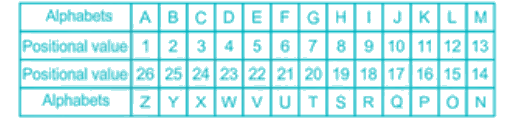 The logic followed here is:
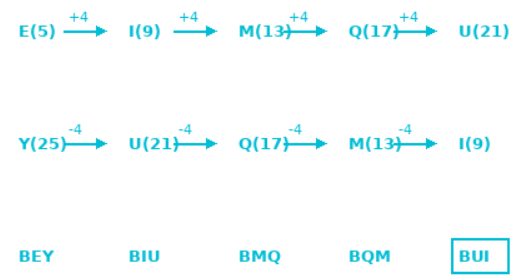 So, BUI will replace the question mark in given series.
Hence, The correct answer is "Option 3".
Q2 · Series
Identify the pattern. 111x222, 222x333, 333x444, ______. Which fits next?
- 444x555
- 432x321
- 345x654
- 555x666
Answer aur solution dekho
Archived marked answer: A
The logic followed here is:
FIRST number → 111, 222, 333, 444 → increases by +111 each time
SECOND number → 222, 333, 444, 555 → increases by +111 each time
Pattern: Each term's
Q3 · Series
What comes next in the series? A, D, G, J, ?
- M
- N
- O
- P
Answer aur solution dekho
Archived marked answer: A
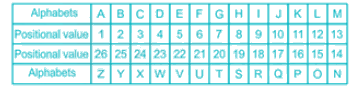 The logic followed here is:
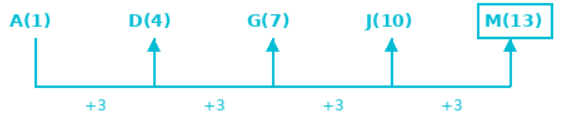 So, 'M' is the missing term in the given series.
Hence, the correct answer is "Option 1".
Q4 · Series
What comes next? CE, EG, GI, ?
- KN
- KM
- JL
- IK
Answer aur solution dekho
Archived marked answer: D
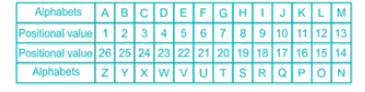 The logic followed here is :
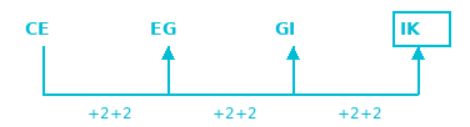 So, " IK " is the missing term in the given series.
Hence, the correct answer is " Option 4 ".
Q5 · Series
Find the next number in the series: 3, 9, 27, 81, ?, 729
- 243
- 218
- 270
- 261
Answer aur solution dekho
Archived marked answer: A
The logic followed here is:
⇒each number is multiplied by ×3
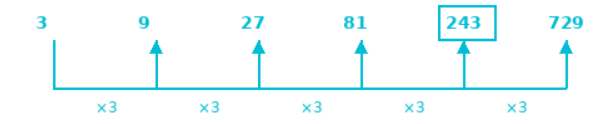 So, '243' is the missing number in the given series.
Hence, the correct answer is "Option 1".
Q6 · Series
What should come at the place of question mark? 2, 5, 11, 23, 47, ?
- 95
- 97
- 93
- 99
Answer aur solution dekho
Archived marked answer: A
The logic followed here is:
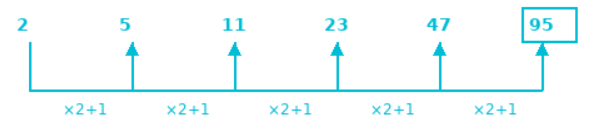 So, ' 95 ' is the missing number in the given series.
Hence, the correct answer is " Option 1 ".
Q7 · Series
If 2 = 12 3 = 36 4=80 5=150 6=252 7=392 Then 8 = ?
- 576
- 625
- 484
- 925
Answer aur solution dekho
Archived marked answer: A
Given series: 2=12, 3=36, 4=80, 5=150, 6=252, 7=392, 8=?
Let's check the pattern:
Input (n)
Output
Pattern
2
12
2 × 2 × 3 = 12
3
36
3 × 3 × 4 = 36
4
80
4 × 4 × 5 = 80
5
Q8 · Puzzle Subtypes Not To Miss
Replace special characters with mathematical signs as given in options to make it meaningful equation. 12 $ 4 & 2 = 50
- x, +
- +, x
- –, x
- ÷, +
Answer aur solution dekho
Archived marked answer: A
Given equation: 12 $ 4 & 2 = 50
Let's check each option one by one.
Option 1) $ = ×, & = +
⇒ 12 × 4 + 2 = 50
⇒ 48 + 2 = 50
⇒ 50 = 50
⇒ LHS = RHS
Option 2) $ = +, & = ×
⇒ 12 + 4 × 2 = 50
⇒ 12 + 8 = 50
⇒ 20 ≠ 50
⇒ LHS ≠ RHS
Option 3) $ = –, & = ×
⇒ 12 – 4 × 2 = 50
⇒ 12 – 8 = 50
⇒ 4 ≠ 50
⇒ LHS ≠ RHS
Option 4) $ = ÷, & = +
⇒ 12 ÷ 4 + 2 = 50
⇒ 3 + 2 = 50
⇒ 5 ≠ 50
⇒ LHS ≠ RHS
Hence, the correct answer is "Option 1".
Q9 · Puzzle Subtypes Not To Miss
Identify the correct pair of signs to interchange. 12 × 2 + 6 ÷ 3 - 8 = 8
- + and -
- × and ÷
- ÷ and -
- × and +
Answer aur solution dekho
Archived marked answer: D
Given equation: 12 × 2 + 6 ÷ 3 - 8 = 8
BODMAS Table:
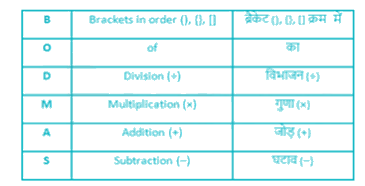 Let's check each option one by one:
Option 1) + and -
Given: 12 × 2 + 6 ÷ 3 - 8 = 8
After interchanging the signs we get:
⇒ 12 × 2 - 6 ÷ 3 + 8 = 8
⇒ 24 - 6 ÷ 3 + 8 = 8
⇒ 24 - 2 + 8 = 8
⇒ 22 + 8 = 8
⇒ 30 ≠ 8
⇒ LHS ≠ RHS
Option 2) × and ÷
Given: 12 × 2 + 6 ÷ 3 - 8 = 8
After interchanging the signs we get:
⇒ 12 ÷ 2 + 6 × 3 - 8 = 8
⇒ 6 + 6 × 3 - 8 = 8
⇒ 6 + 18 - 8 = 8
⇒ 24 - 8 = 8 ⇒
16 ≠ 8
⇒ LHS ≠ RHS
Option 3) ÷ and -
Given: 12 × 2 + 6 ÷ 3 - 8 = 8
After interchanging the signs we get:
⇒ 12 × 2 + 6 - 3 ÷ 8 = 8
⇒ 24 + 6 - 3 ÷ 8 = 8
⇒ 24 + 6 - 0.375 = 8
⇒ 29.625 ≠ 8
⇒ LHS ≠ RHS
Option 4) × and +
Given: 12 × 2 + 6 ÷ 3 - 8 = 8
After interchanging the signs we get:
⇒ 12 + 2 × 6 ÷ 3 - 8 = 8
⇒ 12 + 2 × 6 ÷ 3 - 8 = 8
⇒ 12 + 12 ÷ 3 - 8 = 8
⇒ 12 + 4 - 8 = 8
⇒ 16 - 8 = 8 ⇒ 8 = 8
⇒ LHS = RHS
Hence, the correct answer is "Option 4".
Q10 · Puzzle Subtypes Not To Miss
If 'x' = '+', '+' = '-', '-' = 'x', and '/' = '÷', then which equation is correct?
- 10 × 2 + 4 – 1 = 21
- 8 – 2 × 3 + 1 = 15
- 12 + 6 – 2 × 2 = 28
- 14 – 3 + 5 × 2 = 39
Answer aur solution dekho
Archived marked answer: D
Given: × = + , + = − , − = × , / = ÷
Let's check each option one by one.
Option 1) 10 × 2 + 4 – 1 = 21
After replacing signs:
⇒ 10 + 2 − 4 × 1 = 21
⇒ 10 + 2 − 4 = 21
⇒ 12 − 4 = 21
⇒ 8 ≠ 21
⇒ LHS ≠ RHS
Option 2) 8 – 2 × 3 + 1 = 15
After replacing signs:
⇒ 8 × 2 + 3 − 1 = 15
⇒ 16 + 3 − 1 = 15
⇒ 19 − 1 = 15
⇒ 18 ≠ 15
⇒ LHS ≠ RHS
Option 3) 12 + 6 – 2 × 2 = 28
After replacing signs:
⇒ 12 − 6 × 2 + 2 = 28
⇒ 12 − 12 + 2 = 28
⇒ 12 − 10 = 28
⇒ 2 ≠ 28
⇒ LHS ≠ RHS
Option 4) 14 – 3 + 5 × 2 = 39
After replacing signs:
⇒ 14 × 3 − 5 + 2 = 39
⇒ 42 − 5 + 2 = 39
⇒ 42 − 3 = 39
⇒ 39 = 39
⇒ LHS = RHS
Hence, the correct answer is "Option 4".
Q11 · Coding Decoding
If BRICK is coded as CSJDL, how is CSJDL coded?
- DTKEM
- DSKEL
- DTKFL
- CSKDL
Answer aur solution dekho
Archived marked answer: A
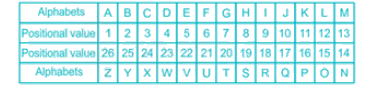 The logic followed here is:
For, 'BRICK is coded as CSJDL'
Q12 · Classification Odd One Out
Choose the odd one out.
- Feathers
- Claw
- Ear
- Lung
Answer aur solution dekho
Archived marked answer: D
The logic followed here is:
(Body parts found exclusively in Birds)
Feathers → Found only in Birds
Claw → Found only in Birds
Ear → Found only in Birds
Lung → Found in all animals including mammals, reptiles — not exclusive to birds
Three (Feathers, Claw, Ear) are body parts found specifically in birds, while Lung is an organ found in almost all animals.
Thus, Lung is different from the others.
Hence, the correct answer is "Option 4".
Q13 · Classification Odd One Out
Identify the word that is different.
- Hooghly
- Tapti
- Indian Ocean
- Mahanadi
Answer aur solution dekho
Archived marked answer: C
The logic followed here is:
(Bodies of water — Rivers vs Ocean)
Hooghly → A river in West Bengal, India
Tapti → A river in central India
Indian Ocean → An ocean — the largest body of water among the options
Mahanadi → A river in eastern India
Three (Hooghly, Tapti, Mahanadi) are all rivers in India, while Indian Ocean is an ocean — an entirely different category of water body.
Thus, Indian Ocean is different from the others.
Hence, the correct answer is "Option 3".
Q14 · Logical Reasoning
In a room of 6 people, how many different handshakes are possible if each person shakes hands once with every other?
- 10
- 12
- 15
- 20
Answer aur solution dekho
Archived marked answer: C
Given: Total people = 6
The logic followed here is:
Each handshake involves 2 people, so using the combination formula:
Total Handshakes = ⁿC₂ = n(n-1) / 2
Where n = total number of people
⇒ Total Handshakes = 6 × (6-1) / 2
⇒ Total Handshakes = 6 × 5 / 2
⇒ Total Handshakes = 30 / 2
⇒ Total Handshakes = 15
67
Q15 · Blood Relations
A is B's father. C is B's sister. D is A's wife. How is D related to C?
- Mother
- Grandmother
- Aunt
- Cousin
Answer aur solution dekho
Archived marked answer: A
Family chart :
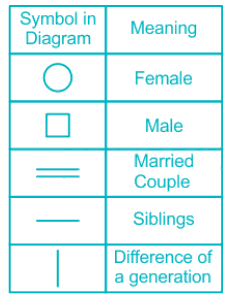 Given: A is B's father. C is B's sister. D is A's wife
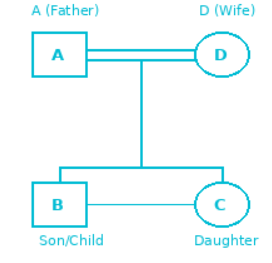 So, D is the Mother of C.
Hence, the correct answer is " Option 1 ".
Q16 · Blood Relations
If A is the father of B, but B is not the son of A, then how is B related to A?
- Sister
- Mother
- Cousin
- Daughter
Answer aur solution dekho
Archived marked answer: D
Given: A is the father of B, but B is not the son of A
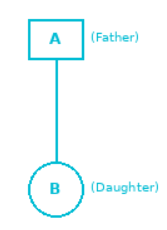 So, B is the Daughter of A.
Hence, the correct answer is "Option 4".
Q17 · Blood Relations
Directions: These questions are based on the following information.
There are 7 family members: P, Q, R, S, T, U and V going to a party. There are three generations in which only two are married couples. P is the grandfather of U who is a male. R is the son in law of S.V is the son of Q.S has only two children, both of the same gender. T is the sister in law of R.
How many males are there?
- 4
- 5
- 3
- 2
Answer aur solution dekho
Archived marked answer: A
Decoding symbols for Family Tree:
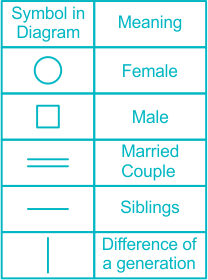 Given:
P is the grandfather of U (Male). Since there are three generations, P is in the 1st generation and U is in the 3rd.
R is the son-in-law of S. This implies S is in the 1st generation and R is in the 2nd generation, married to a child of S.
S has only two children, both of the same gender. Since R is a son-in-law, S must have two daughters.
T is the sister-in-law of R. This means T is the other daughter of S (sister of R's wife).
V is the son of Q. (V is Male).
There are only two married couples. One is (P and S) in the 1st generation. The other must be (R and Q) in the 2nd generation, as Q would be the daughter of S and mother of V and U.
Family Structure:
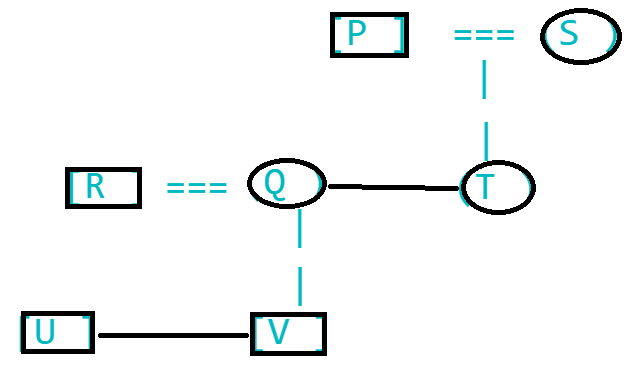 Thus, there are 4 male members: P, R, U, V.
Hence, the correct answer is "Option 1".
Q18 · Alphabet Test
If in the word ELECTRIC, all vowels are removed, which letter will be the 3rd from the left?
- L
- C
- T
- R
Answer aur solution dekho
Archived marked answer: C
Given word: E L E C T R I C
Vowels removed: E, E, I
Letter
Vowel/Consonant
Status
E
Vowel
Removed
L
Consonant
Kept
E
Vowel
Removed
C
Consonant
Kept</t
Q19 · Alphabet Test
The letters given below, when are arranged, form an appropriate (Meaningful) word:
AVSEBORINTO
What is the position of letter A in the word formed from the left?
- 5
- 7
- 8
- 9
Answer aur solution dekho
Archived marked answer: B
Given letters: A V S E B O R I N T O
Let's arrange the letters to form a meaningful word:
AVSEBORINTO → OBSERVATION
Now find position of A from the left:
Position
1
2
3
4
5
Q20 · Similarity and Differences
Choose the address that is the same as the one given below.
Sample Address:Flat 3C, White Lily Tower,Rajendra Nagar, Patna,Bihar - 800016
- Flat 3C, White Lily Towers, Rajendra Nagar, Patna, Bihar - 800016
- Flat 3C, White Lilly Tower, Rajendra Nagar, Patna, Bihar - 800016
- Flat 3C, White Lily Tower, Rajendra Nagar, Patna, Bihar - 800016
- Flat 3B, White Lily Tower, Rajendra Nagar, Patna, Bihar - 800016
Answer aur solution dekho
Archived marked answer: C
Sample Address: Flat 3C, White Lily Tower, Rajendra Nagar, Patna, Bihar - 800016
Compare each option with the given Address:
Option
Address
Matching
(1)
Flat 3C, White Lily Towers, Rajendra Nagar, Patna, Bihar - 800016
Tower is written as Towers.
(2)
Flat 3C, White Lilly Tower, Rajendra Nagar, Patna, Bihar - 800016
Lily is written as Lilly.
(3)
Flat 3C, White Lily Tower, Rajendra Nagar, Patna, Bihar - 800016
The address matches exactly with the Given Address.
(4)
Flat 3B, White Lily Tower, Rajendra Nagar, Patna, Bihar - 800016
Flat number is 3B instead of 3C.
So, the address that exactly matches the Given Address is option 3.
Hence, the correct answer is "Option 3".
Q21 · Logical Statement Questions
Consider the following statement and choose the option that follows.
Statement: The interest rates on fixed deposits have been lowered.
Inferences:
I. Investors may shift to alternative investment options.
II. Fixed deposits are no longer considered safe.
- Only I follows
- Only II follows
- Both follows
- Neither follows
Answer aur solution dekho
Archived marked answer: A
Statement: The interest rates on fixed deposits have been lowered.
Now, let's evaluate the given inferences:
I. Investors may shift to alternative investment options: This inference is true. When returns from fixed deposits reduce, investors
Q22 · Miscellaneous Other Possibilities
Your team misses a major deadline. What do you do as team lead?
- Quit the project
- Stay silent
- Analyze reasons and communicate next steps
- Blame someone
Answer aur solution dekho
Archived marked answer: C
Given: Team misses a major deadline. You are the team lead.
Let's check all the options:
(1) Quit the project ⇒ Quitting shows lack of responsibility and leaves the team without leadership at a critical time. ⇒ It is not appropriate.
(2) Stay silent ⇒ Staying silent means hiding the issue from stakeholders which makes the situation far worse. ⇒ It is not appropriate.
(3) Analyze reasons and communicate next steps ⇒ This is the most responsible action. A good team lead identifies the root cause, owns the failure and communicates a clear recovery plan to stakeholders. ⇒ It is the most appropriate action.
(4) Blame someone ⇒ Blaming others destroys team trust and morale and does not solve the problem. A leader takes responsibility. ⇒ It is not appropriate.
Hence, the correct answer is "Option 3".
Q23 · Number Digit Operations
What is the remainder when 987654321 is divided by 9?
- 1
- 3
- 0
- 9
Answer aur solution dekho
Archived marked answer: C
Given number: 987654321
The logic followed here is:
Rule: To find remainder when divided by 9, add all digits of the number.
Sum of digits: 9 + 8 + 7 + 6 + 5 + 4 + 3 + 2 + 1 =45
Now 45 is divisible by 9:
⇒ 45 ÷ 9 = 5
⇒ Remainder = 0
So, the remainder when 987654321 is divided by 9 is 0.
Hence, the correct answer is "Option 3".
Q24 · Syllogism
Read the following statement carefully and identify the conclusion that follows.
Statement: All musicians are artists. Some artists are dancers. No dancer is blind.
Conclusions:
I. Some artists are not blind.
II. All blind are not dancers.
- Only I follows
- Only II follows
- Both I and II follow
- Neither I nor II follows
Answer aur solution dekho
Archived marked answer: C
Given Statements: All musicians are artists.
Some artists are dancers.
No dancer is blind.
The least possible Venn diagram for the given statement is:
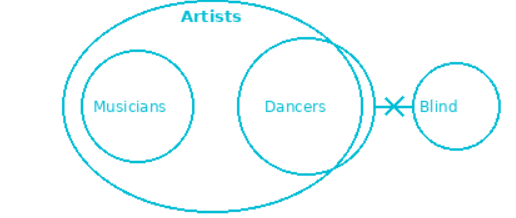 Conclusions:
I. Some artists are not blind — True (Because, Dancers are part of Artists and No dancer is blind, so those artists who are dancers are definitely not blind).
II. All blind are not dancers — True (Because, No dancer is blind directly means no blind person can be a dancer, so All blind are not dancers).
So, Both conclusions I and II follow.
Hence, the correct answer is "Option 3 ".
General Awareness
Q1 · Art and Culture
Consider the following statements about Chittorgarh Fort:
1. The fort features iconic structures like the Vijay Stambha and Kirti Stambha.
2. The fort complex includes nineteen main temples.
3. Its main entrance was established in the 5th century. Which of the statements given above is/are correct?
- 1 and 2 only
- 2 and 3 only
- 1 and 3 only
- 1, 2 and 3
Answer aur solution dekho
Archived marked answer: D
The correct answer is 1, 2, and 3.
Key Points
- Chittorgarh Fort, located in Rajasthan, is one of the largest forts in India and is a UNESCO World Heritage Site.
- The fort features iconic structures like the Vijay Stambha (Tower of Victory) and the Kirti Stambha (Tower of Fame). These architectural marvels represent the cultural and historical significance of the fort. *Hence, statement 1 is correct.*
- The fort complex includes nineteen main temples, such as the Meera Temple and Kumbha Shyam Temple. These temples highlight the religious and architectural heritage of the region. *Hence, statement 2 is correct.*
- The main entrance to the fort, known as the Ram Pol, and other gates like the Padal Pol and Hanuman Pol, were established during the fort's early construction phase, which dates back to the 5th century. Hence, statement 3 i
Q2 · Art and Culture
Lavani is a rhythmic and sensual folk dance form from Maharashtra. What is the traditional percussion instrument used to accompany it?
- Mridangam
- Tabla
- Dholki
- Nagada
Answer aur solution dekho
Archived marked answer: C
The correct answer is Dholki.
Key Points
- Lavani is a traditional folk dance and music form that originated in the state of Maharashtra, India, and is known for its rhythmic and sensual performances.
- The primary instrument used to accompany Lavani is the Dholki, a double-headed hand drum that provides a vibrant and rhythmic beat to the performance.
- The Dholki is crucial in setting the tempo for Lavani performances and is played with both hands, producing a mix of bass and treble sounds.
- Lavani performances are characterized by their energetic beats, fast-paced rhythms, and expressive lyrics, which the Dholki enhances effectively.
- Other instruments like the Manjeera (cymbals) and harmonium may also be used during Lavani performances, but the Dholki remains the central percussion instrument.
Additional Information
- Dholki:
- The Dholki is a smaller version of the Dholak and is often used in various Indian folk music traditions, including Lavani.
- It is made of wood and features two drum heads, one for producing bass sounds and the other for treble sounds.
- The drum is played with both hands, and its portability makes it ideal for folk performances.
- Lavani:
- Lavani combines traditional dance with music and is performed by women wearing Nauvari sarees (nine-yard sarees).
- The themes of Lavani songs often focus on social issues, romance, and political satire, making it both entertaining and thought-provoking.
- It gained popularity during the Peshwa era in the 18th century and continues to be a vital part of Maharashtra's cultural heritage.
- Other Instruments in Lavani:
- Manjeera: Small cymbals used to add rhythm and accentuate beats.
- Harmonium: A keyboard instrument used to provide melodic accompaniment.
- Lezim: A traditional percussion instrument often used in Maharashtrian folk dances.
- Significance of Lavani:
- Lavani has played a significant role in preserving Maharashtra's folk traditions and continues to be a popular form of entertainment in rural and urban areas.
- It is performed during festivals and cultural events and is an integral part of Maharashtra's identity.
Important Points
- Regional Impact: Lavani is not only popular in Maharashtra but also in parts of Madhya Pradesh and Karnataka.
- Performance Style: The dance is known for its expressive gestures, quick footwork, and synchronized movements with the beats of the Dholki.
- Modern Adaptations: Lavani has been adapted into Bollywood films and contemporary stage performances, increasing its global recognition.
Q3 · Art and Culture
The first recorded origin of Bonalu festival is traced back to which disease outbreak in Hyderabad?
- Smallpox
- Cholera
- Plague
- Malaria
Answer aur solution dekho
Archived marked answer: C
The correct answer is Plague.
Key Points
- The Bonalu festival is a traditional Hindu festival celebrated annually in Telangana, particularly in Hyderabad and Secunderabad.
- The origins of the festival are traced back to the outbreak of the plague epidemic in the twin cities of Hyderabad and Secunderabad in the late 19th century.
- People believed that the epidemic was a result of the anger of the deity Goddess Mahakali. As a result, they started offering prayers, sacrifices, and special rituals to appease her.
- The festival involves offering food, which is usually rice cooked with milk and jaggery, placed in a decorated brass or earthen pot, to the goddess as a thanksgiving gesture.
- The outbreak of the plague and subsequent prayers to Goddess Mahakali created a tradition that evolved into what is now celebrated as the Bonalu festival. Hence, the correct answer is Plague.
Additional Information
- Historical Context of the Plague:
- The plague was a deadly epidemic that caused widespread panic and loss of life in Hyderabad during the late 1800s.
- The epidemic led to the belief that the city needed divine intervention to stop the spread of the disease.
- Goddess Mahakali, a form of Goddess Durga, was believed to be the protector against diseases and calamities.
- Significance of Bonalu Festival:
- Bonalu is derived from the word "Bhojanalu," meaning meal or feast, symbolizing the food offering to the goddess.
- The festival typically falls during the Ashada Masam (July-August) according to the Hindu calendar.
- The celebrations include vibrant processions, traditional dances like Potharaju and the adornment of temples.
- Rituals and Practices:
- Women carry decorated pots containing cooked rice, jaggery, milk, and curd, often adorned with neem leaves and turmeric.
- These offerings are made to the goddess in temples, especially the famous Mahakali temples in the region.
- Modern Celebrations:
- Today, Bonalu is an integral part of Telangana's culture and heritage, celebrated with pomp and grandeur.
- The government of Telangana has recognized it as a state festival to promote the region's rich traditions.
Important Points
- Key Temples:
- The most notable temples where Bonalu is celebrated are Ujjaini Mahakali Temple in Secunderabad and Simhavahini Mahakali Temple in Lal Darwaza, Hyderabad.
- Other significant temples include Akkanna Madanna Temple and Muthyalamma Temple.
- Potharaju Role:
- Potharaju is a mythological figure and the brother of the goddess, represented by men dressed in traditional attire.
- He leads the procession, dancing and wielding a whip to ward off evil spirits.
- Government Support:
- The Telangana government provides financial assistance and logistical support for the festival.
- The festival attracts tourists, contributing to the promotion of Telangana's cultural tourism.
Q4 · Indian Polity and Constitution
Fill in the blanks: The Rajya Sabha's special power under Art 249 allows it to authorise Parliament to legislate on a ____ List subject.
- State
- Union
- Concurrent
- Residuary
Answer aur solution dekho
Archived marked answer: A
The correct answer is State.
Key Points
- Article 249 of the Indian Constitution provides a special power to the Rajya Sabha, enabling it to authorise the Parliament to legislate on a subject enumerated in the State List. This is done in the interest of the nation as a whole. *Hence, the correct answer is State.*
- This provision comes into play when the Rajya Sabha passes a resolution by a majority of not less than two-thirds of the members present and voting, declaring that it is necessary in the national interest for Parliament to legislate on a matter in the State List.
- Once such a resolution is passed, Parliament can make laws on the subject, and such laws remain in force for as long as the resolution is effective, which is a maximum of one year, extendable by one year through another resolution.
- The resolution passed by the Rajya Sabha does not transfer the subject permanently to the Union List but only allows Parl
Q5 · Indian Polity and Constitution
Which of the following statements about the Inter-State Council (ISC) is/are correct?
A) The Inter-State Council is headed by the Prime Minister of India.
B) It functions as a recommendatory body rather than a tribunal for dispute resolution.
- Only 1
- Only 2
- Both 1 and 2
- Neither 1 nor 2
Answer aur solution dekho
Archived marked answer: C
The correct answer is Both 1 and 2.
Key Points
- The Inter-State Council (ISC) is headed by the Prime Minister of India. This council was established under Article 263 of the Indian Constitution to promote coordination and cooperation between the Union and State governments. *Hence, statement A is correct.*
- The primary function of the ISC is to serve as a recommendatory body. It provides suggestions for better coordination of policy and action between the Centre and the states and discusses subjects of common interest. However, it does not act as a tribunal or adjudicatory body for resolving disputes. *Hence, statement B is correct.*
- The ISC was constituted in 1990 by a presidential order based on the recommendation of the Sarkaria Commission, which was formed to review Centre-State relations.
- The council comprises the Prime Minister as the chairman, Chief Ministers of all states, Chief Ministers of Union Territories with legislatures, and administrators of Union Territories without legislatures. Other Union ministers and state cabinet ministers can also be invited as members when required.
- The ISC is instrumental in resolving issues related to the distribution of legislative powers, economic planning, and administrative coordination between the Union and the States.
Additional Information
- Article 263 of the Constitution:
- Article 263 provides for the establishment of an Inter-State Council if it seems necessary for better coordination between states and the Union.
- The article specifies three duties for such a council: (1) inquiring into and advising upon disputes between states, (2) investigating and discussing subjects of common interest, and (3) making recommendations for better policy coordination.
- Sarkaria Commission Recommendations:
- The Sarkaria Commission, set up in 1983, recommended the establishment of the Inter-State Council to address Centre-State and inter-state issues.
- It emphasized the need for a permanent body to strengthen cooperative federalism in India.
- Role of the ISC in Cooperative Federalism:
- The ISC fosters dialogue and cooperation between the Union and State governments on crucial issues affecting both.
- It works as a forum to address matters like economic development, national integration, and inter-governmental disputes.
- Other Bodies for Centre-State Relations:
- The Zonal Councils, established under the States Reorganisation Act, 1956, are another mechanism to facilitate cooperation between states and the Centre.
- The National Development Council (NDC) also plays a role in coordinating policies and plans for economic development between different levels of government.
Important Points
- The ISC is not a judicial body and cannot resolve disputes between states in a binding manner. Its recommendations are not enforceable.
- It meets as and when necessary, unlike the Zonal Councils, which hold regular meetings.
- The ISC strengthens collaborative governance by creating a platform for dialogue among key stakeholders at the national and state levels.
- Recent discussions in the ISC have focused on issues like GST implementation, water resource management, and disaster management coordination.
Q6 · Indian Economy
Read the below statements marked as Assertion (A) and Reason (R). Mark the correct options:
Assertion (A): The Global Ease of Doing Business (EoDB) rankings gave maximum weightage to starting a business.
Reason (R): Starting a business was one of the 10 indicators considered.
- Both A and R are true, and R is the correct explanation of A.
- Both A and R are true, but R is not the correct explanation of A.
- A is true, but R is false.
- A is false, but R is true.
Answer aur solution dekho
Archived marked answer: D
The correct answer is 4. A is false, but R is true.
Key Points
- Assertion (A): The statement that the Global Ease of Doing Business (EoDB) rankings gave maximum weightage to starting a business is false. The EoDB rankings by the World Bank considered 10 indicators, but starting a business was not the indicator with the maximum weightage. Other indicators, such as resolving insolvency and getting credit, held significant weightage. *Hence, Assertion (A) is false.*
- Reason (R): The statement that starting a business was one of the 10 indicators considered in the rankings is true. The Ease of Doing Business report included 10 key indicators, and starting a business was indeed one of them. *Hence, Reason (R) is true.*
- The 10 indicators used in the EoDB rankings included: starting a business, dealing with construction permits, getting electricity, registering property, getting credit, protecting minority investors, paying taxes, trading across borders, enforcing contracts, and resolving insolvency.
- The rankings reflected the ease of
Q7 · Indian Economy
Which type of sale allows partial transfer of PSU ownership to private hands?
- Minority sale
- Complete sale
- Auction
- Leasing
Answer aur solution dekho
Archived marked answer: A
The correct answer is Minority Sale.
Key Points
- Minority Sale refers to the partial transfer of ownership of a Public Sector Undertaking (PSU) to private entities, where the government retains the majority stake.
- It is a form of disinvestment where a smaller portion (less than 50%) of equity is sold to private investors, ensuring that the PSU remains under government control.
- This method of sale is often pursued to raise funds for the government, improve efficiency, and infuse private sector expertise into the PSU while maintaining public sector objectives.
- The government retains the decision-making authority in the company, as it holds the majority ownership, ensuring the company continues to serve its public purpose.
- Examples of minority sales include partial disinvestment in companies like Coal India Limited and National Thermal Power Corporation (NTPC).
Q8 · Indian Economy
What led to regional disparity despite the overall success of the Green Revolution?
- Uneven price controls
- Unequal land ownership
- HYV seed access restricted to well-irrigated regions
- Neglect of fertilizers
Answer aur solution dekho
Archived marked answer: C
The correct answer is HYV seed access restricted to well-irrigated regions.
Key Points
- High-Yielding Variety (HYV) seeds introduced during the Green Revolution required sufficient irrigation facilities for optimal results.
- Regions with well-irrigated areas, such as Punjab, Haryana, and parts of Uttar Pradesh, benefited significantly, while others with limited irrigation infrastructure lagged behind.
- Inadequate irrigation facilities in many regions restricted the adoption of these seeds, leading to regional disparities in agricultural productivity.
- The Green Revolution primarily focused on wheat and rice, which were grown in areas already equipped with robust irrigation systems, further widening the gap between irrigated and rain-fed regions.
- Socio-economic conditions also played a role, as wealthier farmers in irrigated
Q9 · Indian Economy
Read the below statements marked as Assertion (A) and Reason (R). Mark the correct option:
Assertion (A): Increase in autonomous investment leads to a multiplied rise in national income.
Reason (R): This happens because of the marginal propensity to save being less than one.
- Both A and R are true, and R is the correct explanation of A.
- Both A and R are true, but R is not the correct explanation of A.
- A is true, but R is false.
- A is false, but R is true.
Answer aur solution dekho
Archived marked answer: A
The correct answer is Both A and R are true, and R is the correct explanation of A.
Key Points
- Assertion (A): Increase in autonomous investment leads to a multiplied rise in national income:
- This is correct because when there is an increase in autonomous investment, it triggers additional economic activities in various sectors.
- Autonomous investments are those that are not influenced by income levels, such as government spending on infrastructure or private investments in innovation.
- These investments increase demand for goods and services, leading to higher production and, consequently, a rise in national income.
- Reason (R): This happens because of the marginal propensity to save (MPS) being less than one:
- This is also correct. The marginal propensity to save (MPS) refers to the fraction of additional income that is saved rather than spent.
- If MPS is less than one, it means that a portion of the income is spent on consumption, which generates further economic activity through the multiplier effect.
- The multiplier effect ensures that an initial increase in investment leads to a larger overall increase in national income.
- The relationship between A and R:
- The reason (R) is the correct explanation for the assertion (A) because the concept of the multiplier effect is directly tied to the marginal propensity to save being less than one.
- The larger the marginal propensity to consume (MPC), which is the complement of MPS, the greater the multiplier effect on national income.
Additional Information
- Autonomous Investment:
- Autonomous investments are those that are made irrespective of the current level of income or economic activity, such as investments in infrastructure, education, or healthcare.
- They are often initiated by governments or large organizations to stimulate economic growth.
- These investments are crucial for kick-starting economic activity, especially in stagnant economies.
- Marginal Propensity to Save (MPS):
- MPS is the fraction of additional income that a household saves. It is calculated as MPS = ΔSavings/ΔIncome.
- If MPS is less than one, it implies that the remaining portion of additional income is spent on consumption.
- For example, if MPS is 0.2, it means that 20% of additional income is saved, and 80% is spent on consumption.
- Multiplier Effect:
- The multiplier effect explains how an initial increase in investment leads to a larger increase in national income.
- It is calculated as Multiplier = 1/(1 - MPC) or 1/MPS.
- For example, if MPC is 0.8, the multiplier is 1/(1 - 0.8) = 5. This means that every unit of investment leads to a 5-unit increase in national income.
- Relationship Between MPS and MPC:
- MPS and MPC are complementary, i.e., MPS + MPC = 1.
- A higher MPC (lower MPS) leads to a stronger multiplier effect, amplifying the impact of autonomous investments on national income.
Important Points
- Key Formula: The multiplier is inversely related to MPS. A smaller MPS leads to a larger multiplier effect, emphasizing the importance of consumption in driving economic growth.
- Real-World Examples: During economic downturns, governments often increase autonomous investments (e.g., stimulus packages) to boost national income through the multiplier effect.
- Consumption-Driven Growth: Economies with high marginal propensities to consume tend to experience faster growth due to the enhanced impact of investment on income levels.
Q10 · Sports Static GK
Elite long jumpers typically use how many strides in their approach run?
- 10-14
- 14-18
- 18-22
- 22-26
Answer aur solution dekho
Archived marked answer: C
The correct answer is 18-22.
Key Points
- Elite long jumpers typically take around 18 to 22 strides during their approach run. The number of strides varies depending on the athlete's height, speed, and technique.
- The approach run is a critical phase in the long jump, as it provides the necessary speed and momentum required for an optimal jump.
- Long jumpers aim to achieve their maximum controlled speed during the approach to ensure a powerful take-off at the board.
- The number of strides is carefully determined and practiced to ensure that the jumper can accurately hit the take-off board without overstepping or fouling.
- While 18-22 strides is the typical range, the exact number of strides may vary based on the athlete's training, biomechanics, and personal preferences.
Additional Information
- Phases of Long Jump:
- The long jump consists of four main phases: approach run, take-off, flight, and landing.
- The approach run generates the momentum needed for a successful jump.
- The take-off involves converting horizontal speed into vertical lift.
- The flight phase requires the jumper to maintain balance and maximize the forward motion.
- The landing phase focuses on extending the body forward to maximize the distance covered.
- Importance of Approach Run:
- The approach run is the most important phase in the long jump as it determines the jumper's speed, rhythm, and accuracy.
- Successful long jumpers practice their approach runs extensively to ensure consistency in hitting the take-off board.
- The optimum speed during the approach ensures a balance between horizontal distance and vertical height during the jump.
- Factors Affecting Number of Strides:
- Athlete's height: Taller athletes might require fewer strides due to their longer stride length.
- Strength and speed: Faster and stronger athletes can achieve the desired velocity with fewer strides.
- Experience and technique: Experienced jumpers optimize their stride patterns to hit the take-off board consistently.
- Examples of Elite Long Jumpers:
- Famous long jumpers like Mike Powell and Carl Lewis utilized efficient approach runs with approximately 20 strides to achieve their record-breaking jumps.
- Mike Powell's world record jump of 8.95 meters in 1991 is considered a benchmark in long jump history.
Important Points
- Training for Approach Run:
- Long jumpers focus on improving their sprinting ability, stride length, and take-off accuracy during training.
- Drills like bounding, sprint starts, and plyometric exercises are commonly used to enhance approach run efficiency.
- Regular video analysis helps athletes refine their stride patterns and maintain consistency.
- Key Metrics:
- The average approach run speed for elite male long jumpers is approximately 10.5 m/s, while for female athletes, it is around 9.5 m/s.
- The take-off angle is typically between 18-22 degrees for optimal performance.
- Rules for Long Jump:
- A valid jump requires the athlete to take off from the take-off board without overstepping its edge.
- The jump distance is measured from the edge of the take-off board nearest to the landing pit to the nearest mark made in the sand by any part of the athlete's body.
- Wind assistance must not exceed 2 m/s for a record to be valid.
</ul
Q11 · Sports Static GK
Read the statements below and choose the correct option regarding the 38th National Games:
Statement 1: The 38th National Games were held in Uttarakhand.
Statement 2: It was the first edition of the National Games held across multiple cities in the state.
- Only Statement 1 is correct
- Only Statement 2 is correct
- Both Statement 1 and Statement 2 are correct
- Neither Statement 1 nor Statement 2 is correct
Answer aur solution dekho
Archived marked answer: C
The correct answer is Both Statement 1 and Statement 2 are correct.
Key Points
- Statement 1: The 38th National Games were indeed held in Uttarakhand. This prestigious sporting event showcased the state's ability to host major national-level competitions. *Hence, Statement 1 is correct.*
- Statement 2: The event marked a significant milestone as it was the first edition of the National Games held across multiple cities within the state of Uttarakhand. This decentralized approach was aimed at enhancing participation and exposure for various regions. *Hence, Statement 2 is correct.*
- The 38th National Games provided a platform for athletes from across the country to compete in a variety of sports, promoting the spirit of sportsmanship and national integration.
- Uttarakhand's hosting of the games also highlighted its infrastructure development and organizational capabilities in conducting large-scale events.
- The National Games are considered one of the most significant multi-sport events in India, held every few years to identify and nurture talent for international competitions.
Additional Information
- National Games of India:
- The National Games are a multi-disciplinary sporting event conducted in India, similar to the Olympics, at the national level.
- The games are organized under the aegis of the Indian Olympic Association (IOA) and held in various states across the country.
- The first edition of the National Games was held in 1924 in Lahore (now in Pakistan) and was then known as the Indian Olympic Games.
- Uttarakhand as a Host State:
- Uttarakhand was chosen as the venue for the 38th National Games due to its emerging capabilities in infrastructure and its scenic beauty, which also boosted tourism.
- Hosting the games provided an opportunity for the state to promote local athletes and showcase its sports infrastructure.
- Multi-City Format:
- The decision to hold the games across multiple cities in Uttarakhand was a unique approach to promote regional engagement and provide equal access to the excitement of the games.
- This format also helped in distributing the event's economic and social benefits to multiple regions within the state.
- Significance of the National Games:
- The National Games serve as a platform for athletes to showcase their talent and prepare for international competitions like the Olympics and Asian Games.
- These games also play a key role in promoting national unity and developing a sports culture across India.
Important Points
- Previous Hosts:
- The 36th National Games were held in Gujarat in 2022, delayed due to the COVID-19 pandemic.
- The 37th National Games were scheduled to take place in Goa.
- Selection of Host State:
- States are chosen based on their ability to provide adequate infrastructure for a wide range of sports and their readiness to host a large-scale event.
- Hosting the games is often seen as a catalyst for infrastructure development and economic growth in the state.
- Key Sports:
- The National Games feature a variety of sports, including athletics, swimming, wrestling, boxing, football, hockey, and shooting.
- These events are crucial for identifying and nurturing talent at the grassroots level.
Q12 · Sports Static GK
Which of the following statements about India's participation in the 2008 Beijing Olympics is correct?
1) India won medals in Shooting, Boxing, and Wrestling, including its first-ever individual Olympic Gold.
2) Saina Nehwal participated in the women's singles badminton event representing India.
Which of the above statements are correct?
- Only 1 is Correct
- Only 2 is Correct
- 1 and 2 are Correct
- Neither 1 nor 2 are Correct
Answer aur solution dekho
Archived marked answer: C
The correct answer is 1 and 2 are Correct.
Key Points
- India's first-ever individual Olympic Gold: Abhinav Bindra won the gold medal in the 10m Air Rifle event at the 2008 Beijing Olympics, marking a historic moment as India’s first individual Olympic gold medal. *Hence, statement 1 is correct.*
- Medals in Boxing and Wrestling: Vijender Singh secured a bronze medal in boxing, while Sushil Kumar won a bronze medal in wrestling, making the 2008 Olympics a remarkable achievement for India across multiple sports. *Hence, statement 1 is correct.*
- Saina Nehwal's participation: Saina Nehwal represented India in the women’s singles badminton event at the 2008 Beijing Olympics. She reached the quarterfinals, becoming the first Indian woman to do so in badminton at the Olympics. *Hence, statement 2 is correct.*
- Overall performance: India won a total of three medals at the 2008 Beijing Olympics: one gold and two bronzes, marking a significant improvement in its Olympic performance.
- The 2008 Beijing Olympics saw India’s athletes excel in diverse disciplines, highlighting the country’s growing presence on the global sports stage.
Additional Information
- Abhinav Bindra:
- Abhinav Bindra’s historic gold in the 10m Air Rifle event made him the first Indian to win an individual gold medal in the Olympics.
- He scored a total of 700.5 points in the final, showcasing exceptional precision and composure under pressure.
- This achievement placed India prominently in international shooting sports.
- Vijender Singh:
- Vijender Singh became India’s first-ever Olympic medalist in boxing by winning the bronze medal in the 75 kg middleweight category.
- His achievement inspired a new generation of Indian boxers to pursue the sport professionally.
- Sushil Kumar:
- Sushil Kumar won a bronze medal in the 66 kg freestyle wrestling category.
- He defeated Leonid Spiridonov of Kazakhstan in the repechage round to secure the medal.
- This achievement helped revive wrestling as a popular sport in India.
- Saina Nehwal:
- Saina Nehwal’s quarterfinal finish at the 2008 Beijing Olympics was a landmark moment for Indian badminton.
- It paved the way for her future successes, including her bronze medal win at the 2012 London Olympics.
- India’s Medal Tally at 2008 Beijing Olympics:
- Gold: Abhinav Bindra (10m Air Rifle).
- Bronze: Vijender Singh (Boxing, 75kg Middleweight).
- Bronze: Sushil Kumar (Wrestling, 66kg Freestyle).
Important Points
- Beijing Olympics 2008:
- The Summer Olympics were held in Beijing, China, from August 8 to August 24, 2008.
- The official motto of the games was "One World, One Dream."
- It was the first time China hosted the Olympics, making it a landmark event for the country.
- The games were notable for their spectacular opening and closing ceremonies, which showcased Chinese culture and history.
- India’s Best Performance:
- India's three-medal haul at the Beijing Olympics was its best performance at the time, showcasing a significant improvement in its sporting capabilities on the global stage.
- This performance set the stage for India’s better achievements in subsequent Olympic Games, including the 2012 London Olympics, where India won six medals.
- Women in Indian Sports:
- Saina Nehwal’s performance at the 2008 Olympics marked the beginning of a new era for Indian women in sports.
- She inspired future generations of female athletes, including P.V. Sindhu, who later won silver and bronze medals in the Olympics.
Q13 · Indian Geography
Chambal Ravines are found in which Indian states?
- Rajasthan, Gujarat, Madhya Pradesh
- Rajasthan, Madhya Pradesh, Uttar Pradesh
- Madhya Pradesh, Uttar Pradesh, Gujarat
- Punjab, Haryana, Madhya Pradesh
Answer aur solution dekho
Archived marked answer: B
The correct answer is Rajasthan, Madhya Pradesh, Uttar Pradesh.
Key Points
- The Chambal Ravines are found primarily along the Chambal River Basin, which flows through the Indian states of Rajasthan, Madhya Pradesh, and Uttar Pradesh.
- These ravines are a result of severe soil erosion caused by the continuous flow of water over the centuries, creating deep and rugged gullies.
- The Chambal River originates from the Vindhya Range near Mhow in Madhya Pradesh and flows northwards across Rajasthan and Uttar Pradesh.
- The ravines are most prominently found in the districts of Kota, Bundi, and Sawai Madhopur (Rajasthan); Morena, Sheopur, and Bhind (Madhya Pradesh); and Etawah and Agra (Uttar Pradesh).
- The Chambal Ravines are infamous for their association with banditry in the past, making them a significant socio-cultural and historical feature of this region.
Additional Information
- Geographical Features of Chambal River:
- The Chambal River is one of the major rivers in central India and a tributary of the Yamuna River.
- It flows for approximately 960 km through Madhya Pradesh, Rajasthan, and Uttar Pradesh before merging with the Yamuna near Etawah.
- The river cuts through the Deccan Plateau, creating a unique landscape of ravines and badlands.
- Soil Erosion and Ravines:
- The Chambal Ravines are formed due to gully erosion, where water flows aggressively over loose soil, cutting deep trenches.
- This erosion is exacerbated by deforestation, overgrazing, and unsustainable agricultural practices in the region.
- Ecological Importance:
- The Chambal region is home to the National Chambal Sanctuary, which protects endangered species like the Gharial, Gangetic Dolphin, and Indian Skimmer.
- The ravines serve as a natural habitat for various bird species and other wildlife.
- Human Impact and Development:
- The ravine areas have historically been difficult for agricultural activities due to poor soil fertility and rugged terrain.
- Efforts have been made by the government to reclaim ravine lands through afforestation and soil conservation projects.
Important Points
- Banditry in Chambal:
- The Chambal Ravines were historically notorious for being the hideouts of dacoits (bandits) like Paan Singh Tomar and Phoolan Devi.
- Over the years, government initiatives and policing efforts have successfully reduced banditry in the region.
- Chambal Valley Development:
- Several projects have been undertaken to develop the Chambal Valley, such as the construction of dams like the Gandhisagar Dam and Kota Barrage, which aid irrigation and hydroelectric power generation.
- These projects have helped in the socio-economic development of the region despite its challenging terrain.
Q14 · Modern Indian History
Who introduced the law that abolished the practice of Sati in British India in 1829?
- Lord Dalhousie
- Lord Curzon
- Lord William Bentinck
- Lord Canning
Answer aur solution dekho
Archived marked answer: C
The correct answer is Lord William Bentinck.
Key Points
- Lord William Bentinck, who served as the Governor-General of India from 1828 to 1835, introduced the law that abolished the practice of Sati in British India.
- The practice of Sati involved the self-immolation of widows on the funeral pyres of their deceased husbands. It was considered a social evil and was prevalent in certain parts of India.
- On December 4, 1829, Lord William Bentinck passed the Bengal Sati Regulation, 1829, which declared the practice of Sati as illegal and punishable by criminal courts.
- The regulation applied initially to the Bengal Presidency but was later extended to other regions of British India.
- This decision was supported by prominent social reformers like Raja Ram Mohan Roy, who actively campaigned against Sati and advocated for women's rights in India.
Additional Information
- Raja Ram Mohan Roy:
- He was a prominent social reformer during the 19th century in India and played a key role in the abolition of Sati.
- He founded the Brahmo Samaj in 1828, which aimed to reform Hindu society by eliminating practices like Sati, child marriage, and caste discrimination.
- Raja Ram Mohan Roy also argued that the practice of Sati was not mandated by Hindu scriptures and was against the principles of humanity.
- Lord William Bentinck's Reforms:
- In addition to abolishing Sati, Lord William Bentinck introduced several other reforms during his tenure as Governor-General.
- He worked on improving education by promoting English as the medium of instruction and supporting missionary schools.
- He also reformed the judicial system by introducing measures to curb corruption and ensure fairness in the administration of justice.
- Impact of the Abolition of Sati:
- The abolition of Sati was a landmark reform that marked the beginning of a series of social changes in India during British rule.
- It set a precedent for future reforms targeting other social evils, such as child marriage and untouchability.
- Although there was some opposition to the law, it was widely regarded as a progressive step towards gender equality and women's empowerment.
- Other British Governors-General:
- Lord Dalhousie: Known for his policies of annexation, such as the Doctrine of Lapse, and his role in modernizing India with the introduction of railways, telegraphs, and postal systems.
- Lord Curzon: Remembered for the partition of Bengal in 1905 and his efforts to preserve Indian heritage through the Archaeological Survey of India.
- Lord Canning: Served as the first Viceroy of India after the Revolt of 1857 and was instrumental in implementing the Government of India Act of 1858.
Important Points
- Bengal Sati Regulation, 1829:
- This legislation was one of the first significant steps taken by the British to address social issues in India.
- The regulation explicitly stated that all cases of Sati would be treated as culpable homicide.
- Role of Public Opinion:
- The abolition of Sati received support from certain sections of Indian society, including intellectuals and reformers, but faced resistance from conservative groups.
- The British justified the law as part of their civilizing mission in India.
- Global Context:
- The abolition of Sati can be seen within the broader context of 19th-century movements for social reform and human rights worldwide.
Q15 · Current Affairs
Which of the following is a main goal of the Chabahar port project?
- To increase military presence in the region
- To mine for undersea minerals
- To increase tourism in Iran
- To boost regional trade
Answer aur solution dekho
Archived marked answer: D
The correct answer is To boost regional trade.
Key Points
- The Chabahar Port Project, located in southeastern Iran, is being developed as a significant trade corridor to enhance connectivity between India, Iran, Afghanistan, and Central Asia.
- One of the main goals of the project is to bypass Pakistan for direct trade access between India and Afghanistan, thereby facilitating uninterrupted regional trade and economic ties.
- The port serves as a gateway for Indian goods to reach landlocked Central Asian nations, improving trade opportunities with countries like Uzbekistan, Turkmenistan, and Kazakhstan.
- It also aims to complement India's participation in the International North-South Transport Corridor (INSTC), which intends to reduce transport costs and time for goods moving between South Asia and Europe.
- By creating an alternative trade route, the project aligns with India's strategy to counterbalance China's influence in the region, especially with its investments in the Gwadar Port in Pakistan under the China-Pakistan Economic Corridor (CPEC).
Additional Information
- Strategic Location of Chabahar Port:
- The port is situated in the Gulf of Oman, outside the Persian Gulf, reducing potential chokepoints like the Strait of Hormuz.
- It serves as a critical node for connecting South Asia, Central Asia, and the Middle East.
- India's Role:
- India has committed to developing two terminals and five berths at the port under a 10-year lease agreement.
- The project is being executed by India's India Ports Global Limited (IPGL) in partnership with Iran's Ports and Maritime Organization.
- India has invested in the construction of a railway line linking the port to Zahedan, near the Afghanistan border, to improve connectivity.
- Economic and Political Importance:
- The Chabahar Port provides an alternative to the China-Pakistan Economic Corridor (CPEC), enhancing India's regional influence.
- It supports trade in energy, minerals, and agricultural products between the participating countries.
- The project strengthens India's ties with Iran and Afghanistan while promoting stability and development in the region.
- Comparison with Gwadar Port:
- Gwadar Port in Pakistan, developed by China, is located just 170 km from Chabahar. However, Chabahar is not under Chinese influence, making it strategically significant for India.
- Unlike Gwadar, Chabahar emphasizes trade rather than military or strategic dominance.
- INSTC (International North-South Transport Corridor):
- The Chabahar Port is a critical component of the INSTC, which connects India to Russia, Europe, and Central Asia via Iran.
- The corridor reduces transit time by up to 40% and costs by 30% compared to traditional routes through the Suez Canal.
Important Points
- Option Analysis:
- Option 1: "To increase military presence in the region" – Incorrect. The Chabahar port is primarily a commercial project, not a military one.
- Option 2: "To mine for undersea minerals" – Incorrect. Chabahar is not associated with undersea mining activities.
- Option 3: "To increase tourism in Iran" – Incorrect. While the port may indirectly benefit tourism, its primary objective is trade facilitation.
- Option 4: "To boost regional trade" – Correct. The project is explicitly designed to enhance trade between India, Iran, Afghanistan, and Central Asia.
- Historical Background:
- The Chabahar Port agreement was signed between India and Iran in 2003, with further developments in 2016 under Prime Minister Narendra Modi.
- The trilateral agreement involving India, Iran, and Afghanistan aims to provide landlocked Afghanistan with direct sea access for trade.
70:T2b
Q16 · Current Affairs
Which Indian state has become the first to implement the Uniform Civil Code (UCC)?
- Uttarakhand
- Goa
- Maharashtra
- Gujarat
Answer aur solution dekho
Archived marked answer: A
The correct answer is Uttarakhand.
Key Points
- Uttarakhand has become the first Indian state to implement the Uniform Civil Code (UCC) across its population, ensuring uniformity in laws related to marriage, divorce, inheritance, and adoption irrespective of religion.
- The decision to implement UCC in Uttarakhand was announced by the Chief Minister Pushkar Singh Dhami in May 2022 after forming a committee to draft the code.
- The implementation aligns with the Article 44 of the Indian Constitution, which directs the State to aim for a uniform set of personal laws for its citizens.
- A committee headed by Justice (Retd.) Ranjana Prakash Desai was formed to prepare the draft for UCC in the state, with inputs from various stakeholders and communities.
- The UCC is expected to bring social equality, justice, and harmony by removing discrepancies in personal laws across different communities.
Additional Information
- Uniform Civil Code (UCC):
- The UCC aims to replace personal laws of various communities in India, including Hindus, Muslims, Christians, and others, with a common set of laws governing marriage, divorce, inheritance, adoption, and maintenance.
- It is enshrined in the Directive Principles of State Policy (Article 44) in the Indian Constitution, which urges the State to secure a uniform civil code for its citizens.
- The UCC promotes gender equality, justice, and secularism in personal laws.
- Goa as an Exception:
- Goa is the only Indian state that has a Uniform Civil Code since its pre-Independence Portuguese regime. However, the code there applies only partially and is not uniform for all communities.
- Significance of UCC:
- It eliminates religious biases and ensures equal legal standards for all citizens.
- It simplifies legal frameworks by replacing multiple personal laws with a single uniform law.
- It strengthens national integration by promoting a sense of unity and justice.
- Challenges in Implementation:
- There is opposition from various religious groups citing concerns over infringement on religious freedom.
- The vast cultural and religious diversity in India makes it difficult to draft a universally acceptable code.
Important Points
- Article 44 of the Indian Constitution:
- This article is part of the Directive Principles of State Policy, which are not enforceable by law but act as guiding principles for governance.
- It states: "The State shall endeavor to secure for the citizens a uniform civil code throughout the territory of India."
- Justice Ranjana Desai Committee:
- Formed in 2022 to draft the UCC for Uttarakhand.
- Engaged with stakeholders, religious groups, and legal experts to ensure the draft is inclusive and equitable.
- Historical Context:
- The debate on UCC dates back to the Constituent Assembly, with strong voices advocating for its necessity to ensure equality and justice.
- Efforts to implement UCC have been met with resistance, citing concerns over religious autonomy and cultural preservation.
Q17 · Current Affairs
Which major legal framework does the Bharatiya Sakshya Adhiniyam, 2023, seek to align with in recognizing electronic evidence?
- The Information Technology Act, 2000
- The Indian Evidence Act, 1872
- The National Investigation Agency Act, 2008
- The Protection of Women from Domestic Violence Act, 2005
Answer aur solution dekho
Archived marked answer: A
The correct answer is The Information Technology Act, 2000.
Key Points
- The Bharatiya Sakshya Adhiniyam, 2023 aligns with the Information Technology Act, 2000, as it seeks to recognize and establish the admissibility of electronic evidence in legal proceedings.
- The Information Technology Act, 2000, under Sections 65A and 65B of the Indian Evidence Act (amended by the IT Act), already provides the legal framework for admissibility of electronic records.
- The Bharatiya Sakshya Adhiniyam, 2023, builds upon this foundation to modernize legal practices and incorporate provisions for handling digital evidence, ensuring their relevance in today’s technology-driven world.
- It emphasizes the need for authentication and reliability of electronic records, addressing concerns over manipulation, forgery, and the credibility of digital evidence.
Q18 · Medieval Indian History
Consider the following statements regarding political rivalries in early medieval India:
Statement I: The Rashtrakutas launched several campaigns to gain control over the region of Kanauj.
Statement II: The Pratiharas were primarily based in eastern India, while the Palas were established in the western and central regions.
Which of the statements given above is/are correct?
- Only Statement I is correct
- Only Statement II is correct
- Both Statement I and II are correct
- Neither Statement I nor Statement II is correct
Answer aur solution dekho
Archived marked answer: A
The correct answer is Only Statement I is correct.
Key Points
- Statement I: The Rashtrakutas indeed launched several campaigns to gain control over the region of Kanauj.
- This region was a crucial center of power during the early medieval period (8th to 12th century CE) and was often referred to as the "Kanauj Triangle."
- The Rashtrakutas, Pratiharas, and Palas competed intensely for control over Kanauj due to its strategic location and economic significance.
- The Rashtrakutas, under rulers such as Dhruva Dharavarsha and Govinda III, launched campaigns against the Pratiharas and Palas to assert dominance over Kanauj. Hence, Statement I is correct.
- Statement II: The geographical distribution of the Pratiharas and Palas mentioned in this statement is incorrect.
- The Pratiharas were primarily based in western and central India, not eastern India. Their empire extended over regions like Rajasthan, Guj
Q19 · Ancient Indian History
In ancient India, Chanhudaro was primarily a centre for:
- Agriculture
- Metalworking
- Bead-making
- Textile weaving
Answer aur solution dekho
Archived marked answer: C
The correct answer is Bead-making.
Key Points
- Chanhudaro was an important urban center of the Indus Valley Civilization (IVC) located in present-day Sindh, Pakistan.
- It is particularly notable for being a specialized hub of bead-making, which was a significant craft of the Indus Valley people.
- Archaeological excavations at Chanhudaro have revealed evidence of bead workshops, where materials like carnelian, agate, and steatite were used to create beads.
- The site was also known for intricate techniques used in bead crafting, such as etching and polishing, indicating a high level of expertise in this field.
- Unlike other Indus Valley sites, Chanhudaro lacked fortifications, suggesting it was primarily a craft production center rather than a political or military hub.
Additional Information
- Importance of Bead-making in Indus Valley Civilization:
- The beads crafted in the Indus Valley Civilization were used as ornaments and for trade purposes across regions.
- Materials such as carnelian, agate, chalcedony, and faience were commonly used for bead production.
- The techniques included drilling, polishing, and etching. Some of the beads were even etched with intricate patterns and designs.
- Evidence suggests that Chanhudaro served as a major supplier of beads to other Indus cities like Mohenjo-Daro and Harappa.
- Other Crafts at Chanhudaro:
- In addition to bead-making, Chanhudaro was known for seals and toys, indicating its focus on artistic and industrial production.
- The site provided evidence of terracotta figurines and pottery as well.
- Trade and Economy:
- Chanhudaro’s beads were likely exported to regions as far as Mesopotamia, indicating robust trade networks during the Indus Valley period.
- The high demand for beads made them an essential component of the Indus Valley Civilization’s economy.
- Excavation of Chanhudaro:
- The site was first excavated in 1931 by archaeologist Ernest Mackay.
- Findings from Chanhudaro have helped historians understand the craftsmanship, specialization, and trade practices of the Indus Valley Civilization.
Important Points
- Beads as Cultural Artifacts: Beads were not just ornamental but also served as symbols of status and ritual significance in the Indus Valley Civilization.
- Specialization in Chanhudaro: Unlike many other sites of the IVC, Chanhudaro was a specialized craft center and did not have significant agricultural or military infrastructure.
- Trade Connections: The discovery of Indus beads in regions like Mesopotamia and Oman highlights the extensive trade networks during that era.
- Other Indus Valley Sites: While Chanhudaro was a bead-making hub, cities like Harappa and Mohenjo-Daro were more well-rounded urban centers with a focus on administration, trade, and agriculture.
85
Q20 · Government Schemes and Welfare Static Semi Static
Which government initiative focuses on improving the road infrastructure in rural areas of India?
- Bharatmala Pariyojana
- Pradhan Mantri Gram Sadak Yojana (PMGSY)
- National Highways Development Project (NHDP)
- Setu Bharatam Programme
Answer aur solution dekho
Archived marked answer: B
The correct answer is Pradhan Mantri Gram Sadak Yojana (PMGSY).
Key Points
- Pradhan Mantri Gram Sadak Yojana (PMGSY) was launched by the Government of India in December 2000 to improve rural road connectivity. The scheme aims to provide all-weather roads to unconnected villages.
- The focus of PMGSY is on rural areas, ensuring that villages with a population of 500 or more (250 or more in hilly, tribal, or desert areas) are connected with all-weather roads.
- It is a centrally sponsored scheme, with funding shared between the Central and State Governments. The ratio is typically 60:40 for most states and 90:10 for North-Eastern and Himalayan states.
- The program also emphasizes the use of innovative technologies, such as cold mix, waste plastic, and fly ash, to ensure sustainable construction.
- PMGSY has significantly contributed to improving rural connectivity, enhancing access to markets, healthcare, and education, thereby boosting the rural economy and reducing poverty.
Additional Information
- Bharatmala Pariyojana:
- The Bharatmala Pariyojana is a flagship highway development program launched in 2017 to enhance the road network across India.
- It focuses on developing economic corridors, border roads, coastal roads, and expressways to strengthen India’s national highway infrastructure.
- This program is aimed at improving freight movement and reducing logistics costs.
- National Highways Development Project (NHDP):
- NHDP was launched by the Government of India in 1998 to develop and maintain national highways.
- The project focused on initiatives like the Golden Quadrilateral, which connects India’s four major metros: Delhi, Mumbai, Chennai, and Kolkata.
- It primarily targets the development of major arterial roads rather than rural roads.
- Setu Bharatam Programme:
- Launched in 2016, the Setu Bharatam Programme focuses on building railway overbridges (ROBs) and underbridges (RUBs) to eliminate level crossings on national highways, enhancing road safety.
- It does not specifically address rural connectivity but instead emphasizes safety and modernization of existing road infrastructure.
- Impact of PMGSY:
- Improved rural connectivity has led to better economic integration of villages with nearby towns and cities.
- Studies show that PMGSY has reduced travel time, improved access to healthcare, and increased school attendance rates in rural areas.
- The scheme has contributed to poverty alleviation by facilitating rural employment and enhancing agricultural productivity.
Important Points
- PMGSY Phase I: Focused on connecting habitations with a population of 500 or more in plain areas and 250 or more in hilly/tribal/desert areas.
- PMGSY Phase II: Initiated in 2013 to consolidate the existing rural road network by upgrading roads that connected villages to rural growth centers.
- PMGSY Phase III: Launched in 2019, this phase focuses on consolidation and upgrading of the rural road network, targeting 125,000 km of roads.
- The Ministry of Rural Development oversees the implementation of the scheme, with technical support from agencies like NIRDPR and NRIDA.
6d
Q21 · General Science Physics
Which mirror type is used in solar furnaces to focus sunlight?
- Convex
- Plane
- Concave
- Biconvex
Answer aur solution dekho
Archived marked answer: C
The correct answer is Concave.
Key Points
- Concave mirrors are used in solar furnaces because they have the ability to converge sunlight at a single focal point.
- When parallel rays of sunlight strike the reflective surface of a concave mirror, they are reflected and focused to a single point, called the focus, creating an intense concentration of heat.
- This focused heat is utilized in solar furnaces to achieve high temperatures, which are used for various purposes such as melting metals, heating, or generating steam.
- Plane mirrors and convex mirrors are not suitable for this purpose because they cannot focus light. Plane mirrors reflect light in the same direction,
Q22 · Books and Authors Static
Which of the following best encapsulates the core philosophy presented in Shane Watson's book 'The Winner's Mindset'?
- Technical manual on cricket techniques
- Sociological study of sports and gender
- Psychological resilience and strategic adaptability in elite sports
- Biography of Shane Watson's cricket career
Answer aur solution dekho
Archived marked answer: C
The correct answer is Psychological resilience and strategic adaptability in elite sports.
Key Points
- 'The Winner's Mindset' by Shane Watson delves into the psychological aspects of sports rather than focusing solely on technical aspects or career anecdotes.
- The book emphasizes the importance of mental toughness, resilience, and adaptability as key factors in achieving success in elite-level sports.
- It provides practical advice and insights on how athletes can cultivate a mindset that helps them overcome challenges and perform under pressure.
- Shane Watson shares his personal experiences, including the mental strategies he employed during his cricket career, to inspire readers to develop their mental for
Q23 · Environment and Ecology
Permaculture', a term often seen in the news, pertains to:
- Cropping and vegetation in permafrost regions.
- Ex-situ growth of organisms facilitated in a semi-solid medium.
- A bioremediation technique to remove oil spills.
- Development of sustainable agricultural ecosystems.
Answer aur solution dekho
Archived marked answer: D
The correct answer is Development of sustainable agricultural ecosystems.
Key Points
- Permaculture is a design philosophy and practice aimed at creating sustainable agricultural ecosystems that mimic natural ecosystems.
- The term "permaculture" was coined by Bill Mollison and David Holmgren in the 1970s as a combination of the words "permanent" and "agriculture."
- It emphasizes principles like care for the earth, care for people, and fair share (redistribution of surplus).
- Permaculture integrates agriculture, water management, energy systems, and social systems to create self-sustaining and environmentally friendly practices.
- Common methods include polyculture, crop rotation, agroforestry, water harvesting, and natural pest control, which are intended to reduce reliance on external inputs and minimize environmental impact.
- It promotes the use of per
Q24 · Environment and Ecology
Consider the following statements regarding India's Ramsar Sites:
1. India has the highest number of Ramsar sites in South Asia.
2. Keibul Lamjao is the only floating National Park in the world and is also a Ramsar site.
3. All Ramsar sites in India are located in coastal regions.
- Only 1 and 2 are correct
- Only 2 and 3 are correct
- Only 1 and 3 are correct
- All 1, 2 and 3 are correct
Answer aur solution dekho
Archived marked answer: A
The correct answer is Only 1 and 2 are correct.
Key Points
- India has the highest number of Ramsar sites in South Asia:
- As of 2023, India has 75 Ramsar sites, the highest in South Asia.
- The Ramsar Convention is an international treaty aimed at the conservation and sustainable use of wetlands.
- The designation of these sites highlights India’s commitment to wetland conservation. *Hence, statement 1 is correct.*
- Keibul Lamjao National Park:
- Located in Manipur, it is the only floating National Park in the world.
- It is situated on the Loktak Lake, a Ramsar site, and is known for its unique floating vegetation called phumdis.
- It is also the habitat of the endangered Sangai deer (Manipur's state animal). *Hence, statement 2 is correct.*
- All Ramsar sites in India are not located in coastal regions:
- Ramsar sites in India are spread across both coastal and inland regions.
- For example, Sambhar Lake (Rajasthan) and Wular Lake (Jammu & Kashmir) are inland Ramsar sites.
- This makes the statement that all Ramsar sites are located in coastal regions incorrect. *Hence, statement 3 is incorrect.*
Additional Information
- Ramsar Convention:
- It was adopted on 2 February 1971 in the city of Ramsar, Iran.
- The aim is the conservation and wise use of wetlands through local, regional, and national actions and international cooperation.
- India became a signatory to the Ramsar Convention in 1982.
- Importance of Ramsar Sites:
- They are recognized for their ecological, economic, cultural, and recreational value.
- Wetlands act as natural water purifiers, mitigate floods, and provide habitats for biodiversity.
- Examples of Ramsar sites in India include Chilika Lake (Odisha), Sundarbans Wetland (West Bengal), and Ashtamudi Wetland (Kerala).
- State-wise distribution of Ramsar Sites:
- India’s Ramsar sites are distributed across several states, including Uttar Pradesh (10 sites), Punjab (6 sites), and Tamil Nadu (14 sites).
- The diverse locations demonstrate the country’s varied geography and wetland ecosystems.
- Recent Additions:
- In 2022, India added several Ramsar sites, including Pallikaranai Marsh Reserve Forest and Sakhya Sagar Lake.
- These additions reflect India's proactive approach to wetland conservation.
Important Points
- Wetland Conservation in India:
- The Wetlands (Conservation and Management) Rules, 2017 were introduced to regulate wetlands' use and ensure their conservation.
- Wetlands International, an NGO, also works on wetland preservation in India.
- Global Ramsar Sites:
- As of 2023, there are over 2,500 Ramsar sites globally, covering an area of more than 256 million hectares.
- Countries like the United Kingdom and Mexico also have a significant number of Ramsar sites.
a1:T
Q25 · General Science
Read the following statements marked as Assertion (A) and Reason (R). Choose the correct option.
Assertion (A): The development of Spark Torch Igniters is essential for the feasibility of fully reusable rocket booster stages and spacecraft requiring multiple engine firings in orbit.
Reason (R): Spark Torch Igniters provide highly reliable and repeatable ignition capability in vacuum conditions, a critical requirement for successive engine restarts during complex mission profiles.
- Both A and R are true, and R is the correct explanation of A
- Both A and R are true, but R is not the correct explanation of A
- A is true, but R is false
- A is false, but R is true
Answer aur solution dekho
Archived marked answer: A
The correct answer is Both A and R are true, and R is the correct explanation of A.
Key Points
- Assertion (A): The development of Spark Torch Igniters is essential for the feasibility of fully reusable rocket booster stages and spacecraft requiring multiple engine firings in orbit. *This statement is correct.*
- Spark Torch Igniters are a critical component in ensuring reliable engine ignitions during complex missions involving reusable spacecraft and boosters.
- Reusable systems such as SpaceX's Falcon 9 and space exploration missions demand multiple engine restarts to adjust orbit or return to Earth.
- Reason (R): Spark Torch Igniters provide highly reliable and repeatable ignition capability in vacuum conditions, a critical requirement for successive engine restarts during complex mission profiles. *This statement is also correct.*
- Spark Torch Igniters are designed to operate in the vacuum of space, where traditional
Mathematics
Q1 · Geometry
In a triangle with vertices P(x, y), Q(5, -1), and R(2, 6), the Centroid is at G(4, 2). What are the coordinates of vertex P?
- (5, 1)
- (5, -1)
- (4, 1)
- (4, 2)
Answer aur solution dekho
Archived marked answer: A
Shortcut Trick
In a triangle, the coordinates of the centroid are the average of the coordinates of its vertices.
Sum of x-coordinates = 3 × x-coordinate of Centroid.
⇒ x + 5 + 2 = 3 × 4 ⇒ x + 7 = 12 ⇒ x = 5
Sum of y-coordinates = 3 × y-coordinate of Centroid.
⇒ y + (−1) + 6 = 3 × 2 ⇒ y + 5 = 6 ⇒ y = 1
∴ The correct answer is (5, 1).
Alternate Method
- - - P(x, y) Q(5, −1) R(2, 6) G(4, 2)
Given:
Vertices of the triangle: P(x, y), Q(5, −1), and R(2, 6)
Centroid of the triangle: G(4, 2)
Formula Used:
The coordinates of the Centroid G(X, Y) of a triangle with vertices (x₁, y₁), (x₂, y₂), and (x₃, y₃) are given by:
G(X, Y) = [ (x₁ + x₂ + x₃) ÷ 3 , (y₁ + y₂ + y₃) ÷ 3 ]
Calculations:
⇒ Comparing the x-coordinate of the centroid:
⇒ 4 = (x + 5 + 2) ÷ 3
⇒ 12 = x + 7
⇒ x = 12 − 7
⇒ x = 5
⇒ Comparing the y-coordinate of the centroid:
⇒ 2 = (y − 1 + 6) ÷ 3
⇒ 6 = y + 5
⇒ y = 6 − 5
⇒ y = 1
⇒ The coordinates of vertex P are (5, 1).
∴ The correct answer is (5, 1).
Additional Information
Centroid of a Triangle
The centroid is the point of intersection of the medians of a triangle. It divides each median in a 2:1 ratio. Formula: G(X, Y) = [(x₁ + x₂ + x₃) ÷ 3, (y₁ + y₂ + y₃) ÷ 3].
Incenter of a Triangle
The incenter is the point of intersection of the internal angle bisectors. Coordinates: I(X, Y) = [(ax₁ + bx₂ + cx₃) ÷ (a + b + c), (ay₁ + by₂ + cy₃) ÷ (a + b + c)], where a, b, and c are side lengths.
Circumcenter of a Triangle
The circumcenter is the point where the perpendicular bisectors of the sides intersect. It is equidistant from all three vertices of the triangle.
Orthocenter of a Triangle
The orthocenter is the point where all three altitudes of the triangle intersect. For a right-angled triangle, the orthocenter lies at the vertex containing the right angle.
Q2 · Geometry
In △ABC, a median AD is drawn to side BC. What is the ratio of the area of △ABD to the area of △ACD?
- 1:1
- 1:2
- 2:1
- 1:3
Answer aur solution dekho
Archived marked answer: A
Shortcut Trick
A median of a triangle divides the triangle into two smaller triangles of exactly equal area.
Since AD is the median to side BC, it bisects the base into two equal segments (BD = CD).
Both △ABD and △ACD share the same perpendicular height from vertex A.
Therefore, their areas are identical.
∴ The correct answer is 1:1.
Alternate Method
- - - - - A B C D M
- - - - - Base (x) Base (x) Area 1 Area 2 h
Given:
⇒ In △ABC, AD is the median to the side BC.
Formula Used:
⇒ Area of a triangle = 1/2 × Base × Height
Calculations:
⇒ Since AD is the median, it bisects the base BC into two equal halves.
⇒ Therefore, length of BD = length of CD = x (let).
⇒ Let the perpendicular height of the triangle from vertex A to side BC be h.
⇒ Area of △ABD = 1/2 × BD × h = 1/2 × x × h
⇒ Area of △ACD = 1/2 × CD × h = 1/2 × x × h
⇒ Ratio of Area of △ABD to Area of △ACD = (1/2 × x × h) ÷ (1/2 × x × h)
⇒ Ratio = 1:1
∴ The correct answer is 1:1.
Additional Information
Centroid of a Triangle
The intersection point of all three medians is called the centroid. It divides each median in the ratio of 2:1.
Area Division by Medians
The three medians of a triangle divide the triangle into six smaller triangles of exactly equal area.
Apollonius's Theorem
It connects the length of a median to the sides of the triangle: AB² + AC² = 2 × (AD² + BD²).
Q3 · Geometry
A hexagon is drawn inside a circle with a radius of 21 cm. Determine the approximate area of the hexagon.
- 1145 cm²
- 1845 cm²
- 165 cm²
- 172 cm²
Answer aur solution dekho
Archived marked answer: A
Shortcut Trick
For a regular hexagon inscribed in a circle, its side length is equal to the radius of the circle.
Area of a regular hexagon = 6 × (Area of equilateral triangle of side R)
Area = 6 × (√3 ÷ 4) × R²
Area = 1.5 × √3 × 21² = 1.5 × 1.732 × 441
Area ≈ 1145.7 cm²
∴ The correct answer is 1145 cm².
Alternate Method
- - - - - - O 21 cm 21 cm Regular Hexagon Inscribed in a Circle
Given:
Radius of the circle, R = 21 cm
Formula Used:
Area of regular hexagon = (3√3 ÷ 2) × a²
where 'a' is the side length of the regular hexagon.
For a regular hexagon inscribed in a circle, Side (a) = Radius of the circumcircle (R)
Calculation:
⇒ Side of the hexagon (a) = 21 cm
⇒ Area = (3√3 ÷ 2) × (21)²
⇒ Area = (3 × 1.732 ÷ 2) × 441
⇒ Area = 1.5 × 1.732 × 441
⇒ Area = 2.598 × 441
⇒ Area = 1145.718 cm²
⇒ Taking the closest approximate integer, Area ≈ 1145 cm²
∴ The correct answer is 1145 cm².
Additional Information
Equilateral Triangles in Hexagon
A regular hexagon is composed of 6 identical equilateral triangles. The area is simply 6 times the area of one equilateral triangle: 6 × (√3 ÷ 4) × a².
Circumradius vs Inradius
The circumradius (R) is the distance from the center to a vertex and is equal to the side length (a). The inradius (r) is the perpendicular distance from the center to a side and equals (√3 ÷ 2) × a.
Interior and Exterior Angles
Every interior angle of a regular hexagon is 120°, while every exterior angle is 60°.
Q4 · Geometry
If the measure of an exterior angle of a regular polygon is 20°, determine the total number of its sides.
- 11
- 18
- 16
- 20
Answer aur solution dekho
Archived marked answer: B
Shortcut Trick
For any regular polygon, the sum of all exterior angles is always 360°.
Number of sides (n) = 360° ÷ Exterior angle
⇒ n = 360° ÷ 20°
⇒ n = 18
∴ The correct answer is 18.
Alternate Method
Given:
Measure of an exterior angle = 20°
Formula Used:
Number of sides of a regular polygon (n) = 360° ÷ Measure of each exterior angle
- - - - - 20°
160° Vertex Side Side Exterior Angle = 360° ÷ n
Calculations:
⇒ n = 360° ÷ 20°
⇒ n = 18
∴ The correct answer is 18.
Additional Information
Interior Angle Formula
The measure of each interior angle of a regular polygon with n sides is given by: [(n − 2) × 180°] ÷ n. Also, Interior angle + Exterior angle = 180°.
Sum of Interior Angles
The sum of all interior angles of a polygon with n sides is (n − 2) × 180°.
Number of Diagonals
The total number of diagonals in an n-sided polygon can be calculated using the formula: [n(n − 3)] ÷ 2.
Q6 · Trigonometry
If sinA = 0.6 and cosA = 0.8, what is tanA?
- 0.56
- 0.75
- 0.45
- 0.52
Answer aur solution dekho
Archived marked answer: B
Shortcut Trick
Using the basic trigonometric quotient identity:
⇒ tanA = sinA ÷ cosA
⇒ tanA = 0.6 ÷ 0.8
⇒ tanA = 6 ÷ 8 = 0.75
∴ The correct answer is 0.75.
Alternate Method
Given:
sinA = 0.6
cosA = 0.8
A B C Base (AB) = 0.8 Perp. (BC) = 0.6 Hypotenuse = 1
Formula Used:
In a right-angled triangle:
⇒ sinA = Perpendicular ÷ Hypotenuse
⇒ cosA = Base ÷ Hypotenuse
⇒ tanA = Perpendicular ÷ Base
Calculation:
Let the Hypotenuse of the right-angled triangle be 1 unit.
⇒ Perpendicular = 0.6 units
⇒ Base = 0.8 units
Now, substituting the values to find tanA:
⇒ tanA = 0.6 ÷ 0.8
⇒ tanA = 6 ÷ 8
⇒ tanA = 3 ÷ 4 = 0.75
∴ The correct answer is 0.75.
Additional Information
Pythagorean Identity
The fundamental identity states that sin²A + cos²A = 1. (Here, 0.6² + 0.8² = 0.36 + 0.64 = 1, confirming the values are valid).
Reciprocal Identities
The reciprocal trigonometric ratios are: cosecA = 1 ÷ sinA, secA = 1 ÷ cosA, and cotA = 1 ÷ tanA.
Quotient Identity
The tangent and cotangent can be expressed as: tanA = sinA ÷ cosA and cotA = cosA ÷ sinA.
Q7 · Trigonometry
If sin A = 4/5 and A is acute, find cot(90° – A).
- 3/4
- 4/3
- 5/3
- 5/4
Answer aur solution dekho
Archived marked answer: B
Shortcut Trick
We know the complementary angle trigonometric identity: cot(90° − A) = tan A.
Given sin A = 4/5, the perpendicular is 4 and the hypotenuse is 5.
This forms a standard 3-4-5 Pythagorean triplet, so the base is 3.
Therefore, tan A = Perpendicular ÷ Base = 4/3.
∴ The correct answer is 4/3.
Alternate Method
Given:
sin A = 4/5
A is an acute angle.
Formula Used:
sin A = Perpendicular ÷ Hypotenuse
Base = √(Hypotenuse² − Perpendicular²)
cot(90° − A) = tan A = Perpendicular ÷ Base
A Base = 3 Perp = 4 Hypotenuse = 5 A B C
Calculations:
⇒ Let Perpendicular = 4x and Hypotenuse = 5x.
⇒ By Pythagoras theorem: Base² + Perpendicular² = Hypotenuse²
⇒ Base² + (4x)² = (5x)²
⇒ Base² + 16x² = 25x²
⇒ Base² = 9x²
⇒ Base = 3x
⇒ cot(90° − A) = tan A = Perpendicular ÷ Base
⇒ tan A = 4x ÷ 3x = 4/3
∴ The correct answer is 4/3.
Additional Information
Complementary Angles in Trigonometry
For any acute angle A: sin(90° − A) = cos A, cos(90° − A) = sin A, and tan(90° − A) = cot A.
Pythagorean Triplets
A set of three positive integers a, b, and c that satisfy a² + b² = c². Common triplets include (3, 4, 5), (5, 12, 13), and (8, 15, 17).
Trigonometric Ratios
In a right-angled triangle, sin θ = Perpendicular ÷ Hypotenuse, cos θ = Base ÷ Hypotenuse, and tan θ = Perpendicular ÷ Base.
Q8 · Trigonometry
If sin A + cos A = 1, then find the value of sin⁴ A + cos⁴ A.
- 1
- 1/2
- 3/4
- 5/8
Answer aur solution dekho
Archived marked answer: A
Shortcut Trick
Given, sin A + cos A = 1
This condition is satisfied when A = 0° or A = 90°.
Let A = 0°, then sin 0° = 0 and cos 0° = 1.
Now put A = 0° in the given expression: sin⁴ A + cos⁴ A
⇒ 0⁴ + 1⁴ = 1
∴ The correct answer is 1.
Alternate Method
Given:
sin A + cos A = 1
Formula Used:
(a + b)² = a² + b² + 2ab
sin² θ + cos² θ = 1
a⁴ + b⁴ = (a² + b²)² − 2a²b²
Calculations:
⇒ sin A + cos A = 1
Squaring both sides, we get:
⇒ (sin A + cos A)² = 1²
⇒ sin² A + cos² A + 2 sin A cos A = 1
Since sin² A + cos² A = 1:
⇒ 1 + 2 sin A cos A = 1
⇒ 2 sin A cos A = 1 − 1
⇒ 2 sin A cos A = 0
⇒ sin A cos A = 0
Now, we need to find the value of sin⁴ A + cos⁴ A.
⇒ sin⁴ A + cos⁴ A = (sin² A)² + (cos² A)²
Applying the algebraic formula for a⁴ + b⁴:
⇒ (sin² A + cos² A)² − 2 sin² A cos² A
⇒ (1)² − 2 (sin A cos A)²
Substituting the value of sin A cos A = 0:
⇒ 1 − 2 × (0)²
⇒ 1 − 0 = 1
∴ The correct answer is 1.
Additional Information
Trigonometric Identities
The three fundamental Pythagorean trigonometric identities are: sin² θ + cos² θ = 1, 1 + tan² θ = sec² θ, and 1 + cot² θ = cosec² θ.
Algebraic Identities in Trigonometry
Expressions like sin⁴ θ + cos⁴ θ can be simplified using a⁴ + b⁴ = (a² + b²)² − 2a²b² to get 1 − 2 sin² θ cos² θ.
Similarly for Power of 6
sin⁶ θ + cos⁶ θ can be easily evaluated using a³ + b³ = (a + b)(a² + b² − ab) or (a + b)³ − 3ab(a + b) to get the direct result 1 − 3 sin² θ cos² θ.
Q9 · Mensuration 2D
A triangle has sides 8 cm and 10 cm, and the angle between them is 120°. What is its area?
- 40 cm²
- 20√3 cm²
- 40√3 cm²
- 20 cm²
Answer aur solution dekho
Archived marked answer: B
Shortcut Trick
Area of a triangle = ½ × a × b × sin(θ)
Given sides a = 8 cm, b = 10 cm and angle θ = 120°
Area = ½ × 8 × 10 × sin(120°)
Area = 40 × √3 / 2 = 20√3 cm²
∴ The correct answer is 20√3 cm².
Alternate Method
Given:
⇒ Two sides of a triangle, a = 8 cm and b = 10 cm
⇒ Included angle between the sides, θ = 120°
Formula Used:
⇒ Area of triangle = ½ × a × b × sin(θ)
120° A B C 10 cm 8 cm
Calculations:
⇒ sin(120°) = sin(180° − 60°) = sin(60°) = √3 / 2
⇒ Substituting the values in the area formula:
⇒ Area = ½ × 8 × 10 × (√3 / 2)
⇒ Area = 4 × 10 × (√3 / 2)
⇒ Area = 40 × √3 / 2
⇒ Area = 20√3 cm²
∴ The correct answer is 20√3 cm².
Additional Information
Area Using Base and Height
When the base and perpendicular height of a triangle are given: Area = ½ × base × height.
Heron's Formula
When all three sides (a, b, c) of a triangle are known: Area = √[s × (s − a) × (s − b) × (s − c)], where s = (a + b + c) / 2 is the semi-perimeter.
Sine Rule Formula for Area
The area of any triangle can be calculated using two sides and the included angle: Area = ½ × a × b × sin(C) = ½ × b × c × sin(A) = ½ × c × a × sin(B).
Q10 · Mensuration 2D
A company designs a new chocolate box in the shape of a regular right pyramid with a square base. The base side of the box is 10 cm and its height is 12 cm. Due to packaging constraints, the box can only be filled up to 90% of its total volume. If the company wants to estimate the total cost of chocolate, knowing that 1 cm³ of chocolate costs ₹0.50, what is the cost of chocolate to fill one such box?
- ₹180
- ₹225
- ₹270
- ₹300
Answer aur solution dekho
Archived marked answer: A
Shortcut Trick
Total Volume = (1/3) × a² × h = (1/3) × 100 × 12 = 400 cm³
Filled Volume (90%) = 0.9 × 400 = 360 cm³
Total Cost = 360 × 0.50 = ₹180
∴ The correct answer is ₹180.
Alternate Method
Given:
Base side (a) = 10 cm
Height (h) = 12 cm
Volume filled = 90%
Cost of chocolate = ₹0.50 per cm³
Formula Used:
Volume of a Pyramid = (1/3) × Base Area × Height
Q11 · Mensuration 2D
Consider a right trapezoidal field. Its two parallel sides are 30 meters and 50 meters long. One of its non-parallel sides, which acts as the height, measures 20 meters. What is the area of this field?
- 700 square meters
- 800 square meters
- 840 square meters
- 900 square meters
Answer aur solution dekho
Archived marked answer: B
Shortcut Trick
For a right trapezoidal field, Area = 1/2 × (Sum of parallel sides) × Height.
⇒ Area = 1/2 × (30 + 50) × 20
⇒ Area = 1/2 × 80 × 20
⇒ Area = 40 × 20 = 800 m²
∴ The correct answer is 800 m².
Alternate Method
50 m 30 m 20 m Area of Right Trapezium = 800 m²
Given:
Parallel side 1 (a) = 30 m
Parallel side 2 (b) = 50 m
Height (h) = 20 m (as one non-parallel side is perpendicular to the base)
Formula Used:
Area of a trapezium = 1/2 × (a + b) × h
Calculations:
⇒ Area = 1/2 × (30 + 50) × 20
⇒ Area = 1/2 × 80 × 20
⇒ Area = 40 × 20
⇒ Area = 800 m²
∴ The correct answer is 800 m².
Additional Information
Area of a Trapezium
The formula for the area of any trapezium is 1/2 × (Sum of parallel sides) × (Distance between them).
Right Trapezium
A right trapezium is a special type of trapezium in which one non-parallel side is perpendicular to the parallel bases, directly acting as its height.
Perimeter of Right Trapezium
The perimeter is the sum of all sides. For this trapezium, the length of the slant side can be found using the Pythagoras theorem: √((50 − 30)² + 20²) = √(400 + 400) = 20√2 m.
Q12 · Mensuration 2D
A right prism has a base in the shape of a trapezium with parallel sides 10 cm and 6 cm, and height 4 cm. If the prism height is 15 cm, what is the volume?
- 480 cm³
- 240 cm³
- 520 cm³
- 680 cm³
Answer aur solution dekho
Archived marked answer: A
Shortcut Trick
Volume of Prism = Base Area × Prism Height
⇒ V = [1/2 × (Sum of parallel sides) × Base height] × Prism height
⇒ V = [1/2 × (10 + 6) × 4] × 15
⇒ V = [1/2 × 16 × 4] × 15
⇒ V = 32 × 15 = 480
∴ The correct answer is 480 cm³.
Alternate Method
Given:
Parallel sides of the trapezium base (a, b) = 10 cm and 6 cm
Distance between parallel sides or height of base (h) = 4 cm
Height of the prism (H) = 15 cm
- 6 cm
10 cm
4 cm
Trapezium Base Area
Prism H = 15 cm
Formula Used:
Area of Trapezium = 1/2 × (Sum of parallel sides) × distance between them
Volume of a Prism = Area of Base × Height of Prism
Calculations:
⇒ Area of Trapezium Base = 1/2 × (10 + 6) × 4
⇒ Area of Trapezium Base = 1/2 × 16 × 4
⇒ Area of Trapezium Base = 8 × 4 = 32 cm²
⇒ Volume of Prism = Area of Base × Prism Height
⇒ Volume of Prism = 32 × 15
⇒ Volume of Prism = 480 cm³
∴ The correct answer is 480 cm³.
Additional Information
Volume of a Prism
The volume of any right prism is calculated by multiplying its base area by its height. Formula: V = Base Area × Height.
Total Surface Area of a Prism
The total surface area includes the lateral surface faces and the two parallel bases. Formula: TSA = (Perimeter of Base × Height) + 2 × Base Area.
Volume of a Pyramid
A pyramid tapers to an apex, making its volume exactly one-third of a prism with the same base and height. Formula: V = 1/3 × Base Area × Height.
Q13 · Algebra
If x = √2 + 1, find x²-2.
- 1 + 2√2
- 3 + 2√2
- 2 + √2
- 1 + √2
Answer aur solution dekho
Archived marked answer: A
Shortcut Trick
Square the given value of x directly using the identity (a + b)² = a² + b² + 2ab.
x² = (√2 + 1)² = 2 + 1 + 2√2 = 3 + 2√2.
Subtract 2 from the result to get the required expression directly.
x² − 2 = 3 + 2√2 − 2 = 1 + 2√2.
∴ The correct answer is 1 + 2√2.
Q14 · Profit and Loss
A bakery produced 5000 cakes at a total cost of ₹250,000. They gave away 500 cakes for a promotional event. For the remaining cakes, they offered a 20% discount on the market price of ₹75 per cake. Additionally, they gave one cake free with every 9 cakes bought. If all 5000 cakes were distributed, what is their overall gain or loss percentage?
- 4.5 % profit
- 2.8 % profit
- 2.8 % loss
- 4.5 % loss
Answer aur solution dekho
Archived marked answer: C
Shortcut Trick
SP of 1 paid cake = ₹75 × (100% − 20%) = ₹60.
Number of paid cakes out of the remaining 4500 = 4500 × (9 ÷ 10) = 4050 cakes.
Total Selling Price = 4050 × 60 = ₹243,000.
Overall Loss = Total CP − Total SP = ₹250,000 − ₹243,000 = ₹7000.
Loss % = (7000 ÷ 250000) × 100 = 2.8% loss.
∴ The correct answer is 2.8% loss.
Alternate Method
Given:
Total cakes produced = 5000
Total cost (CP) = ₹250,000
Cakes given for promotional event = 500
Market Price (MP) per cake = ₹75
Discount = 20%
Offer = Buy 9 get 1 free
Formula Used:
Selling Price = MP × (100 − Discount%) ÷ 100
Loss % = (Loss ÷ Total CP) × 100
Calculations:
Total Cakes = 5000 (Total CP = ₹250,000) Promo 500 Paid (Buy 9) 4050 cakes Free (Get 1) 450
Total SP = 4050 × ₹60 = ₹243,000 Loss = ₹7000 (2.8%)
⇒ Remaining cakes to be sold = 5000 − 500 = 4500
⇒ In the 'buy 9 get 1 free' offer, 10 cakes are distributed for the price of 9 cakes.
⇒ Number of sold (paid) cakes = 4500 × (9 ÷ 10) = 4050
⇒ Selling Price (SP) of 1 paid cake = ₹75 − (20% of 75) = 75 − 15 = ₹60
⇒ Total Selling Price = 4050 × 60 = ₹243,000
⇒ Overall Loss = Total CP − Total SP = 250,000 − 243,000 = ₹7000
⇒ Loss % = (7000 ÷ 250000) × 100 = 2.8%
∴ The correct answer is 2.8% loss.
Additional Information
Buy X Get Y Free Rule
The equivalent effective discount percentage in a "Buy X Get Y Free" scheme is calculated as: (Free Items ÷ Total Items) × 100.
Successive Discounts
When two successive discounts of a% and b% are offered, the net equivalent discount is evaluated using the formula: (a + b − ab ÷ 100)%.
Profit and Loss Calculation
Profit or loss percentage is always strictly calculated based on the Total Cost Price initially invested, unless the problem specifies an alternative base.
Q15 · Profit and Loss
If the ratio of capital of A and B is 3:2 and the time for which they invested is in the ratio 2:3, then the profit ratio is:
- 1:1
- 2:1
- 3:2
- 3:1
Answer aur solution dekho
Archived marked answer: A
Shortcut Trick
Profit ratio is directly proportional to the product of capital and time for each partner.
Profit Ratio = (Capital Ratio of A) × (Time Ratio of A) : (Capital Ratio of B) × (Time Ratio of B)
Profit Ratio = (3 × 2) : (2 × 3)
Profit Ratio = 6 : 6 = 1 : 1
∴ The correct answer is 1:1.
Alternate Method
Partner A Capital = 3 units Time = 2 units Partner B Capital = 2 units Time = 3 units
Profit Ratio (C × T) 3 × 2 : 2 × 3 = 1 : 1
Given:
Ratio of capital of A and B = 3 : 2
Ratio of time for which they invested = 2 : 3
Formula Used:
Profit = Capital × Time
Calculations:
⇒ Let the capital of A and B be 3x and 2x respectively.
⇒ Let the time period for A and B be 2y and 3y respectively.
⇒ Profit of A = Capital of A × Time of A
⇒ Profit of A = 3x × 2y = 6xy
⇒ Profit of B = Capital of B × Time of B
⇒ Profit of B = 2x × 3y = 6xy
⇒ Profit Ratio = Profit of A : Profit of B
⇒ Profit Ratio = 6xy : 6xy
⇒ Profit Ratio = 1 : 1
∴ The correct answer is 1:1.
Additional Information
Working and Sleeping Partner
A working partner actively manages the business and usually receives a set salary or fixed percentage of the overall profit. The remaining profit is distributed among all partners (working and sleeping) in the ratio of their effective investments.
Mid-way Investment or Withdrawal
If a partner adds or withdraws capital mid-way through the term, the effective investment is calculated by splitting the time periods: Effective Capital = (Initial Capital × Time₁) + (New Capital × Time₂).
Three Partners Rule
If three partners A, B, and C invest capitals C₁, C₂, and C₃ for times T₁, T₂, and T₃ respectively, their profit sharing ratio will strictly follow: C₁×T₁ : C₂×T₂ : C₃×T₃.
Q16 · Time and Work
Sameer can complete a work in 16 days. In how many days will the work be completed by Ajay, if his efficiency is 60% more than that of Sameer?
- 12 days
- 10 days
- 13 days
- 15 days
Answer aur solution dekho
Archived marked answer: B
Shortcut Trick
Efficiency ratio of Sameer to Ajay = 100 : 160 = 5 : 8
Time ratio of Sameer to Ajay = 8 : 5 (since time is inversely proportional to efficiency)
Given, 8 parts → 16 days
⇒ 1 part → 2 days
Ajay's time (5 parts) = 5 × 2 = 10 days.
∴ The correct answer is 10 days.
Alternate Method
Given:
Time taken by Sameer to complete the work = 16 days.
Ajay's efficiency is 60% more than Sameer's efficiency.
Formula Used:
Total Work = Efficiency × Time
Calculations:
⇒ Let the efficiency of Sameer be 100 units/day.
⇒ Efficiency of Ajay = 100 + 60% of 100 = 160 units/day.
⇒ Ratio of their efficiencies (Sameer : Ajay) = 100 : 160 = 5 : 8.
⇒ Let Sameer's efficiency be 5 units/day and Ajay's efficiency be 8 units/day.
⇒ Total Work = Sameer's efficiency × Sameer's time = 5 × 16 = 80 units.
Person
Days
Total Work
Efficiency
Sameer
16
80
5
Ajay
10
8
⇒ Time taken by Ajay = Total Work ÷ Ajay's efficiency
⇒ Time taken by Ajay = 80 ÷ 8 = 10 days.
∴ The correct answer is 10 days.
Additional Information
Efficiency and Time Relationship
Efficiency is inversely proportional to time. If A is twice as efficient as B, A will take half the time B takes to complete the same amount of work.
Combined Work Concept
If person A takes x days and person B takes y days, their combined efficiency is (1/x + 1/y). Thus, the time taken to complete the work together is x × yx + y days.
Work and Wages
Wages are distributed in direct proportion to the actual amount of work done by each individual. If they work for the exact same number of days, wages are divided directly in the ratio of their efficiencies.
Q17 · Number System
Which of the following is a perfect square and an Integer?
- Square root of 5
- Square root of 9
- 3.2
- 3.4
Answer aur solution dekho
Archived marked answer: B
Shortcut Trick
An integer is a whole number with no fractional or decimal component.
By quickly evaluating the given options, we can see that √5 is an irrational number, while 3.2 and 3.4 are decimals.
The only expression that is a perfect square and evaluates to a whole number integer is √9, which equals exactly 3.
∴ The correct answer is Square root of 9.
Alternate Method
Given Options:
1) √5
2) √9
3) 3.2
4) 3.4
Evaluation:
⇒ √5 ≈ 2.236 (This is an irrational number, hence not an integer)
⇒ √9 = √(3 × 3) = 3 (This is a positive integer derived from the perfect square 9)
⇒ 3.2 = 32 ÷ 10 = 16/5 (This is a fraction/decimal, hence not an integer)
⇒ 3.4 = 34 ÷ 10 = 17/5 (This is a fraction/decimal, hence not an integer)
⇒ Out of all the given options, only √9 simplifies to a pure integer.
∴ The correct answer is Square root of 9.
Additional Information
Perfect Square
A perfect square is a number that can be expressed as the product of an integer with itself (e.g., 9 = 3²). The square root of a perfect square is always an integer.
Integers
The set of integers consists of all whole numbers, including positive numbers, negative numbers, and zero. They do not contain any decimal or fractional parts.
Irrational Numbers
These are real numbers that cannot be expressed as a simple fraction or ratio of two integers. Their decimal expansions are non-terminating and non-repeating (e.g., √5, π).
Q18 · Number System
What is the smallest number that must be added to 2378 to make it a perfect square?
- 23
- 24
- 25
- 26
Answer aur solution dekho
Archived marked answer: A
Shortcut Trick
By memorizing base squares, we know 50² = 2500.
Checking perfect squares slightly below 50: 49² = 2401 and 48² = 2304.
The given number is 2378, which is strictly between 2304 and 2401.
The smallest number to be added to reach the next perfect square is 2401 − 2378.
Difference = 23.
∴ The correct answer is 23.
Q19 · Time and Distance
The speed of a train is 110 kmph. Find the distance covered by the train in 100 seconds.
- 3051 m
- 3055.56 m
- 3011.56 m
- 3000.56 m
Answer aur solution dekho
Archived marked answer: B
Shortcut Trick
Multiply the speed in kmph directly by (5 ÷ 18) to convert it to m/s, then multiply by time to find the distance.
Distance = Speed × Time
Distance = 110 × (5 ÷ 18) × 100 = (550 ÷ 18) × 100
Distance = 27500 ÷ 9 = 3055.555... m
∴ The correct answer is 3055.56 m.
Alternate Method
Given:
Speed of train = 110 kmph
Time = 100 seconds
- Train
- 110 kmph t = 100 sec
- - - Distance = ?
Formula Used:
Distance = Speed × Time
To convert kmph to m/s, multiply by 5 ÷ 18.
Calculations:
⇒ Speed in m/s = 110 × (5 ÷ 18)
⇒ Speed = 550 ÷ 18 = 275 ÷ 9 m/s
⇒ Distance = Speed × Time
⇒ Distance = (275 ÷ 9) × 100
⇒ Distance = 27500 ÷ 9
⇒ Distance ≈ 3055.56 m
∴ The correct answer is 3055.56 m.
Additional Information
Unit Conversion
To convert km/hr to m/s, multiply the speed value by 5 ÷ 18. To convert m/s to km/hr, multiply the speed value by 18 ÷ 5.
Relative Speed
When two objects move in the same direction, their relative speed is |S₁ − S₂|. When they move in opposite directions, their relative speed is S₁ + S₂.
Average Speed
Average Speed is calculated as Total Distance ÷ Total Time. If equal distances are covered at two different speeds a and b, Average Speed = 2ab ÷ (a + b).
Q20 · Percentage
A man spends 80% of his income. His income has increased by 25%, but his expenditure remains the same. By what percent have his savings increased?
- 125%
- 150%
- 100%
- 200%
Answer aur solution dekho
Archived marked answer: A
Shortcut Trick
Assume Initial Income = 100 ⇒ Expenditure = 80, Savings = 20.
New Income = 125 (25% increase), New Expenditure = 80 (unchanged) ⇒ New Savings = 45.
Increase in Savings = 45 − 20 = 25.
Percentage Increase = (25 ÷ 20) × 100 = 125%.
∴ The correct answer is 125%.
Alternate Method
Given:
Initial expenditure = 80% of income.
Income increases by 25%, while expenditure remains constant.
Formula Used:
Income = Expenditure + Savings
Percentage Increase = (Increase ÷ Original Value) × 100
Original Income: 100 Expenditure: 80 Sav: 20 New Income: 125 (+25%) Expenditure: 80 Savings: 45
- +25 Increase
Calculations:
⇒ Let the initial income be 100x.
⇒ Initial expenditure = 80x
⇒ Initial savings = 100x − 80x = 20x
⇒ New income = 100x + 25% of 100x = 125x
⇒ New expenditure = 80x (since it remains the same)
⇒ New savings = 125x − 80x = 45x
⇒ Increase in savings = 45x − 20x = 25x
⇒ Percentage increase in savings = (25x ÷ 20x) × 100
⇒ Percentage increase in savings = 1.25 × 100 = 125%
∴ The correct answer is 125%.
Additional Information
Percentage Change
Percentage change is calculated as the ratio of the net change in a value to its original value, multiplied by 100. Formula: % Change = (New Value − Old Value) ÷ Old Value × 100.
Base of Percentage
Whenever comparing two quantities or calculating an increase/decrease, the original (initial) quantity always acts as the base value in the denominator.
Income, Expenditure & Savings
The fundamental relation governing personal finance in aptitude questions is always: Income = Expenditure + Savings. Any change in income must reflect as a combined change in expenditure and savings.
Q21 · Percentage
A town has males and females in a ratio of 3:2. After 5 years, the male population increases by 10%, and the female population by 25%. What is the new ratio?
- 3:2.5
- 33:25
- 66:65
- 6:5
Answer aur solution dekho
Archived marked answer: B
Shortcut Trick
Let the initial population of males and females be 300 and 200 respectively (to maintain the 3:2 ratio).
New male population = 300 × 110% = 330
New female population = 200 × 125% = 250
New ratio = 330 : 250 = 33 : 25
∴ The correct answer is 33:25.
Alternate Method
Given:
Initial ratio of males to females = 3 : 2
Increase in male population = 10%
Increase in female population = 25%
Initial Base (300 : 200) Final Population Male: 300
+10% Male: 330 Fem: 200
+25% Fem: 250
- Final Ratio → 330 : 250 = 33 : 25
Calculations:
⇒ Let the number of males = 3x and females = 2x.
⇒ New male population = 3x × (100% + 10%) = 3x × 1.10 = 3.3x
⇒ New female population = 2x × (100% + 25%) = 2x × 1.25 = 2.5x
⇒ New Ratio = 3.3x : 2.5x
⇒ Multiply both terms by 10 to remove decimals ⇒ 33x : 25x = 33 : 25
∴ The correct answer is 33:25.
Additional Information
Percentage Increase
When a value increases by R%, the new value is obtained directly by multiplying the original value by (100 + R)/100.
Properties of Ratio
A ratio remains unchanged when both its antecedent (first term) and consequent (second term) are multiplied or divided by the same non-zero number.
Base Assumption Technique
In ratio and percentage problems, assuming base values as multiples of 100 (e.g., 300 and 200 for a 3:2 ratio) perfectly avoids fractional calculations and speeds up the entire solution.
Q22 · Average
The average of a group of 11 numbers is 61. If the first six numbers have an average of 57 and the last six numbers have an average of 65, what is the sixth number?
- 62
- 61
- 64
- 60
Answer aur solution dekho
Archived marked answer: B
Shortcut Trick
Using the Net Deviation Method from the overall average (61):
Deviation of first 6 numbers = 6 × (57 − 61) = 6 × (−4) = −24
Deviation of last 6 numbers = 6 × (65 − 61) = 6 × (+4) = +24
6th number = Overall Average + Net Deviation = 61 + (−24 + 24) = 61
∴ The correct answer is 61.
Alternate Method
Given:
Total numbers = 11, Overall average = 61
Average of first 6 numbers = 57
Average of last 6 numbers = 65
11 Numbers (Average = 61, Sum = 671) First 6 (Sum = 342) Last 6 (Sum = 390)
- - 6th 6th Number = (342 + 390) − 671 = 61
Formula Used:
Sum = Average × Number of values
6th number = (Sum of first 6) + (Sum of last 6) − (Total Sum of 11 numbers)
Calculations:
⇒ Total sum of 11 numbers = 11 × 61 = 671
⇒ Sum of first 6 numbers = 6 × 57 = 342
⇒ Sum of last 6 numbers = 6 × 65 = 390
⇒ 6th number = 342 + 390 − 671
⇒ 6th number = 732 − 671 = 61
∴ The correct answer is 61.
Additional Information
Basic Average Formula
The average is equal to the sum of all observations divided by the total number of observations: Average = Sum ÷ Count.
Net Deviation Method
The algebraic sum of deviations of all individual values from their exact average is zero. This principle is used to find an unknown value rapidly by balancing positive and negative deviations.
Overlapping Groups
When a series is divided into two groups that overlap by exactly one element, the overlapping element is calculated by: Overlapping Element = (Sum of Group 1 + Sum of Group 2) − Total Sum.
Q23 · Simple Interest
A certain sum becomes 4 times itself in 8 years at simple interest. In how many years will it become 12 times itself at the same rate?
- 29 1/3 years
- 30 1/6 years
- 28 2/5 years
- 27 3/7 years
Answer aur solution dekho
Archived marked answer: A
Shortcut Trick
If a sum becomes n₁ times in T₁ years and n₂ times in T₂ years at the same simple interest rate, we use the direct ratio:
(n₁ − 1) / T₁ = (n₂ − 1) / T₂
⇒ (4 − 1) / 8 = (12 − 1) / T₂
⇒ 3 / 8 = 11 / T₂
⇒ T₂ = 88 / 3 = 29 ¹/₃ years
∴ The correct answer is 29 ¹/₃ years.
Alternate Method
Given:
A sum becomes 4 times itself in 8 years at simple interest.
Formula Used:
Simple Interest (SI) = (P × R × T) / 100
Amount (A) = P + SI
Q24 · Compound Interest
What is the compound interest on Rs. 8000 for 2 year at 10% per annum?
- 1600
- 1680
- 1650
- 1700
Answer aur solution dekho
Archived marked answer: B
Shortcut Trick
The effective rate of Compound Interest for 2 years at 10% per annum can be found using successive percentage formula: A + B + (A × B) / 100.
Effective Rate = 10% + 10% + (10 × 10) / 100% = 21%.
Compound Interest = 21% of Principal
CI = (21 / 100) × 8000 = 1680.
∴ The correct answer is Rs. 1680.
Alternate Method
Given:
Principal (P) = Rs. 8000
Rate (R) = 10% per annum
Time (T) = 2 years
Formula Used:
Amount (A) = P × (1 + R / 100)T
Compound Interest (CI) = A − P
Compound Interest Tree Method
P = 8000
- - Yr 1: 800
10%
Yr 2: 800
10%
- + 80
10% of 800
Total CI = 800 + 800 + 80 = 1680
Calculations:
⇒ Amount = 8000 × (1 + 10 / 100)²
⇒ Amount = 8000 × (110 / 100)²
⇒ Amount = 8000 × (11 / 10) × (11 / 10)
⇒ Amount = 8000 × 121 / 100
⇒ Amount = 80 × 121
⇒ Amount = 9680
⇒ CI = 9680 − 8000 = 1680
∴ The correct answer is Rs. 1680.
Additional Information
Difference between CI and SI for 2 years
For a given principal P and rate R%, the exact difference between Compound Interest and Simple Interest for 2 years is calculated as: Difference = P(R / 100)².
Difference between CI and SI for 3 years
For a 3-year time period, the difference formula extends to: Difference = P(R / 100)² × (3 + R / 100).
Half-Yearly Compounding
When interest is compounded half-yearly, the interest rate is halved (R/2) and the time period in terms of cycles is doubled (2T). The formula becomes: Amount = P(1 + R / 200)²T.
Q25 · Mixture and Alligation
A chemist prepares 60 liters of antiseptic solution by mixing two liquids 'A' and 'B' in the ratio 2:3. If the cost of 'A' is Rs. 45/liter and 'B' is Rs. 30/liter, what is the average cost per liter of the final solution?
- Rs. 36
- Rs. 38
- Rs. 37
- Rs. 39
Answer aur solution dekho
Archived marked answer: A
Shortcut Trick
The total volume of 60 liters is not needed to find the average cost when the mixing ratio is given.
Average Cost = (Ratio of A × Cost of A + Ratio of B × Cost of B) ÷ (Ratio of A + Ratio of B)
Average Cost = (2 × 45 + 3 × 30) ÷ (2 + 3)
Average Cost = (90 + 90) ÷ 5 = 180 ÷ 5 = 36
∴ The correct answer is Rs. 36.
Alternate Method
Given:
Total volume = 60 liters
Ratio of Liquid 'A' to Liquid 'B' = 2 : 3
Cost of Liquid 'A' = Rs. 45/liter | Cost of Liquid 'B' = Rs. 30/liter
English
Q1 · Vocabulary
Select the most appropriate antonym of the given word. Transitory
- Fleeting
- Eternal
- Momentary
- Temporary
Answer aur solution dekho
Archived marked answer: B
The correct answer is '2' i.e. Eternal .
Key Points
- The word Transitory means something that lasts for a short duration or is temporary.
- The correct antonym of Transitory is Eternal, which means something that lasts forever or is permanent.
- Other options like Fleeting, Momentary, and Temporary are synonyms of Transitory, as they also refer to things that are short-lived or not permanent.
Correct answer: *Option 2 - Eternal.*
Additional Information
- Synonyms of Transitory: Fleeting, Momentary, Temporary, Short-lived.
- Antonyms of Transitory: Eternal, Permanent, Everlasting.
</ul
Q3 · Vocabulary
Choose the correct meaning of idiom: Eat crow
- Enjoy luxurious food
- Give lavish charity
- Suffer physical punishment
- Admit one's error and endure humiliation
Answer aur solution dekho
Archived marked answer: D
The correct answer is '4' i.e. Admit one's error and endure humiliation .
Key Points
- The idiom "Eat crow" means to acknowledge one's mistake or failure and endure the resulting embarrassment or humiliation.
- This idiom is often used in situations where someone must admit they were wrong, especially after being confident about their stance.
- The idiom does not refer to enjoying luxurious food, giving charity, or suffering physical punishment.
Example: *After insisting that his prediction was correct, John had to eat crow when the results proved otherwise.*
Additional Information
- Idioms are expressions or phrases whose meanings cannot always be deduced from the literal definitions of the words they contain.
- They are often culturally specific and can vary in interpretation across different regions.
</ul
Q4 · Vocabulary
Choose the correct meaning of idiom: To draw the long bow
- To romanticize historical events
- To fabricate or exaggerate with little credibility
- To delay justice deliberately
- To conflate myth with realism
Answer aur solution dekho
Archived marked answer: B
The correct answer is '2' i.e. To fabricate or exaggerate with little credibility .
Key Points
- The idiom "To draw the long bow" refers to the act of exaggerating or fabricating stories or claims that lack credibility.
- It is often used in situations where someone stretches the truth to make their point or story seem more dramatic or impressive.
- The correct meaning, as per the options given, is "To fabricate or exaggerate with little credibility".
Correct explanation: *The idiom implies creating false or exaggerated stories, making them hard to believe due to their lack of authenticity.*
Additional Information
- Common usage of the idiom:
- Example: He drew the long bow when he claimed to have climbed Mount Everest without proper equipment.
- Interpretation: His claim seemed exaggerated and lacked credibility.
- Other idioms related to exaggeration:
- Blow things out of proportion: To make something seem much worse or more important than it actually is.
- Make a mountain out of a molehill: To exaggerate a minor issue into something significant.
</ul
Q5 · Vocabulary
Choose the correct one-word substitute for: 'A record of one's own life written by oneself'.
- Biography
- Memorandum
- Memoir
- Autobiography
Answer aur solution dekho
Archived marked answer: D
The correct answer is '4' i.e. Autobiography .
Key Points
- Autobiography: A record of one’s own life written by oneself. It involves a detailed account of personal experiences, achievements, and challenges.
- Biography: A record of someone’s life written by another person. It is not written by oneself.
- Memoir: A narrative focused on specific personal experiences or events rather than the entirety of one’s life.
- Memorandum: A brief written note or communication, often for official purposes, and unrelated to life records.
Correct sentence: *The record of one’s own life written by oneself is called an Autobiography.*
Additional Information
- Autobiographies: Often provide insights into the author’s inner thoughts, feelings, and motivations, making them highly personal.
- Famous Examples: "The Story of My Experiments with Truth" by Mahatma Gandhi and "Long Walk to Freedom" by Nelson Mandela.
- Biographies: Focus on someone’s life from an external perspective, written by a third party.
- Memoirs: Usually focus on particular events or periods in the writer’s life, such as "Becoming" by Michelle Obama.
<
Q6 · Vocabulary
Fill in the blank with the correctly spelt word.
Despite overwhelming evidence, he remained _______ in his beliefs.
- obstinatte
- obstinate
- obsteinate
- obbstinate
Answer aur solution dekho
Archived marked answer: B
The correct answer is '2' i.e. obstinate.
Key Points
- The word "obstinate" is correctly spelt and means stubborn or unyielding in one's opinions or beliefs.
- The options "obstinatte," "obsteinate," and "obbstinate" are incorrect spellings.
- In the given sentence, the word "obstinate" fits appropriately to describe someone who refuses to change their beliefs despite overwhelming evidence.
Correct sentence: *Despite overwhelming evidence, he remained obstinate in his beliefs.*.
Additional Information
- The word "obstinate" can be used in various contexts, such as personal opinions, attitudes, or behaviors.
- Synonyms for "obstinate" include stubborn, inflexible, and adamant.
- Its antonyms include compliant, flexible, and yielding.
</ul
Q7 · Vocabulary
Which spelling is correct for a word meaning 'a formal agreement between nations'?
- Treaty
- Trety
- Treety
- Tretye
Answer aur solution dekho
Archived marked answer: A
The correct answer is '1' i.e. Treaty .
Key Points
Q8 · Vocabulary
Find the word that is spelled correctly and refers to complex and obscure knowledge.
- Esoterica
- Esoterrrica
- Esottirica
- Esotorica
Answer aur solution dekho
Archived marked answer: A
The correct answer is '1' i.e. Esoterica .
Key Points
- The question asks for the word that is spelled correctly and refers to complex and obscure knowledge.
- Let us evaluate the options provided:
- Option 1: Esoterica - This is the correct spelling and it refers to knowledge that is obscure or intended for a small, specialized group.
- Option 2: Esoterrrica - Incorrect due to the extra "r" letters.
- Option 3: Esottirica - Incorrect due to the misspelling of "t" and "r".
- Option 4: Esotorica - Incorrect as it is missing an "e" after "t".
- Thus, the correct answer is Option 1: Esoterica.
Correct sentence: *Esoterica refers to specialized or obscure knowledge meant for a small audience.*
Additional Information
- Word Meaning:
- Esoterica: Things understood by or meant for a select group of people with specialized knowledge.
- Usage in a Sentence: "Her collection of ancient manuscripts is filled with esoterica that only a historian would understand."
</ul
Q9 · Vocabulary
Select the most appropriate synonym of the given word: GRUMPY
- Irritable
- Friendly
- Polite
- Calm
Answer aur solution dekho
Archived marked answer: A
The correct answer is '1' i.e. Irritable.
Key Points
- The word grumpy means being easily annoyed or in a bad mood.
- Among the given options:
- Option 1: Irritable is the synonym of "grumpy" as it refers to being easily annoyed or short-tempered.
- Option 2: Friendly is the opposite of "grumpy" and therefore not correct.
- Option 3: Polite implies good manners, which contrasts the meaning of "grumpy."
- Option 4: Calm refers to being relaxed and composed, which is also the opposite of "grumpy."
Correct sentence: *The most appropriate synonym of "grumpy" is Irritable.*
Additional Information
- Synonyms:
- Other synonyms for "grumpy" include cranky, moody, or grouchy.
- Antonyms:
- Opposite words include cheerful, happy, or friendly.
</ul
Q10 · Vocabulary
Choose the correct one-word substitution for the italicized part:
Ravi has always been a person who vehemently opposes authority, control, or tradition, often challenging every rule set before him.
- Conformist
- Anarchist
- Optimist
- Traditionalist
Answer aur solution dekho
Archived marked answer: B
The correct answer is '2' i.e. Anarchist .
Key Points
- The question asks us to find a one-word substitution for someone who "vehemently opposes authority, control, or tradition, often challenging every rule set before them."
- Let’s examine the options provided:
- Conformist: A person who complies with established norms or rules. This is the opposite of what is described in the sentence, so it is incorrect.
- Anarchist: A person who opposes authority and established norms, often advocating for the absence of hierarchy and rules. This matches the description perfectly.
- Optimist: A person who always looks at the brighter side of things. This is unrelated to the description, so it is incorrect.
- Traditionalist: A person who strictly adheres to traditions and established norms. This is also the opposite of what is described, so it is incorrect.
Correct sentence: *Ravi has always been an Anarchist, vehemently opposing authority, control, or tradition, and challenging every rule set before him.*
Additional Information
- One-word substitutions: These are words that can replace a long phrase or description with a single term.
- Examples:
- Philatelist: A person who collects stamps.
- Bibliophile: A person who loves or collects books.
- Misogynist: A person who dislikes or is prejudiced against women.
Q11 · Grammar
Find the part of the sentence that contains an error: It is the uncertainty of how the council intends to proceed (1)/ that seem to have created (2)/ the most unrest among those (3)/ waiting for regulatory clearance. (4)
- 1
- 2
- 3
- 4
Answer aur solution dekho
Archived marked answer: B
The correct answer is '2' i.e. that seem to have created should be corrected to 'that seems to have created'.
Key Points
- The subject of the clause is "the uncertainty", which is singular.
- Since the subject is singular, the verb must also be singular. Thus, "seem" must be corrected to "seems."
- The corrected sentence will read: *It is the uncertainty of how the council intends to proceed that seems to have created the most unrest among those waiting for regulatory clearance.*
Correct sentence: *It is the uncertainty of how the council intends to proceed that seems to have created the most unrest among those waiting for regulatory clearance*.
Additional Information
- Subject-Verb Agreement Rules:
- When the subject is singular, the verb must be singular (e.g., he runs, it seems).
- When the subject is plural, the verb must be plural (e.g., they run, they seem).
- Common Errors:
- Using a plural verb with a singular subject or vice versa can lead to grammatical errors.
- Always identify the subject of the sentence correctly to ensure proper agreement.
</ul
Q12 · Grammar
Find the part of the sentence that contains an error: The protest, though peaceful in nature, (1)/ were portrayed by official channels (2)/ as instigated by external forces (3)/ and ideologically driven groups. (4)
- 1
- 2
- 3
- 4
Answer aur solution dekho
Archived marked answer: B
The correct answer is '2' i.e. were portrayed.
Key Points
- The sentence states that the protest was peaceful in nature, but the verb “were portrayed” does not match the singular subject “The protest.”
- Since the subject is singular, the correct form of the verb should be “was portrayed”.
- In English, subject-verb agreement is essential: singular subjects take singular verbs, and plural subjects take plural verbs.
Correct sentence: *The protest, though peaceful in nature, was portrayed by official channels as instigated by external forces and ideologically driven groups*.
Additional Information
- Subject-Verb Agreement:
- Rule: A singular subject requires a singular verb, and a plural subject requires a plural verb.
- Example: The cat jumps (singular subject), but the cats jump (plural subject).
- Common Errors:
- Mismatching singular subjects with plural verbs or vice versa.
- Misidentifying the subject due to intervening phrases or clauses.
Q13 · Grammar
Select the correct option: ___ the enormity of the challenge, the volunteers pressed on resolutely.
- Given
- For
- Because
- Granted
Answer aur solution dekho
Archived marked answer: A
The correct answer is '1' i.e. Given .
Key Points
- The sentence logically introduces the context of the challenge the volunteers face and their
Q14 · Grammar
A sentence is provided in indirect speech. From the four given options, choose the one that most accurately conveys the sentence in its corresponding direct speech. The mentor noted that the fellow had persevered even after his hypotheses were repeatedly falsified.
- The mentor said, "The fellow persevered even after your hypotheses were repeatedly falsified."
- The mentor said, "The fellow persevered even after his hypotheses were repeatedly falsified."
- The mentor said, "The fellow preserve though hypotheses are falsified."
- The mentor remarked, "The fellow had persevered though his hypotheses were repeatedly falsified."
Answer aur solution dekho
Archived marked answer: B
The correct answer is '2' i.e. The mentor said, "The fellow persevered even after his hypotheses were repeatedly falsified." .
Key Points
- The given sentence is in indirect speech, where the mentor is reporting an observation about the fellow's perseverance and his hypotheses being falsified.
- When converting from indirect speech to direct speech, it is important to ensure that the pronouns and tense reflect the original speaker’s perspective accurately.
- The correct direct speech sentence should retain the past tense used in the indirect sentence ("had persevered" becomes "persevered") and the appropriate pronoun ("his" instead of "your").
- Option 2 is the most accurate conversion to direct speech: "The mentor said, 'The fellow persevered even after his hypotheses were repeatedly falsified.'"
Correct sentence: *The mentor said, "The fellow persevered even after his hypotheses were repeatedly falsified."*
Additional Information
- Option 1: Incorrect because it uses the pronoun "your," which changes the meaning and implies the hypotheses belong to the listener, not the fellow.
- Option 3: Incorrect because it changes the sentence structure and tense, making it grammatically incorrect and deviating from the original meaning.
- Option 4: Incorrect because "had persevered" is retained in direct speech, which is unnecessary when reporting a simple past action.
Q15 · Grammar
A sentence is provided in direct speech. From the four given options, choose the one that most accurately conveys the sentence in its corresponding indirect speech. He said, "It may rain today."
- He said it might rain that day.
- He said it may rain that day.
- He said it can rain today.
- He said it might raining today.
Answer aur solution dekho
Archived marked answer: A
The correct answer is '1' i.e. He said it might rain that day .
Key Points
- When converting direct speech to indirect speech, modal verbs like "may" often change to their past form "might."
- The phrase "today" in direct speech changes to "that day" in indirect speech to match the timeline.
- Option 1 correctly follows the rules of indirect speech conversion, ensuring proper grammatical structure.
Correct sentence: *He said it might rain that day.*
Additional Information
- Rules for changing direct speech to indirect speech:
- Tense: Present modals like "may" often change to their past form "might."
- Time indicators: Words like "today" change to "that day" in indirect speech.
- Common errors:
- Option 2 retains "may," which is incorrect for indirect speech.
- Option 3 uses "can," which changes the meaning of the statement.
- Option 4 has grammatical errors and incorrect verb usage.
</ul
Q17 · Voice Change
Change the following from active to passive: They will have opened the new airport by 2026.
- The new airport will have been opened by 2026.
- The new airport will be opened by 2026.
- The new airport has been opened by 2026.
- The new airport will being opened by 2026.
Answer aur solution dekho
Archived marked answer: A
The correct answer is '1' i.e. The new airport will have been opened by 2026.
Key Points
- The given sentence is in the future perfect tense, which is used to describe actions that will have been completed at a certain point in the future.
- To change the sentence from active to passive, the object of the active sentence becomes the subject of the passive sentence.
- The structure of the future perfect tense in passive voice is: Subject + will have been + past participle of the verb.
Correct sentence: *The new airport will have been opened by 2026.*
Additional Information
- Active Voice Structure: Subject + will have + past participle of the verb.
- Example in Active Voice: They will have finished the project by next week.
- Passive Voice Structure: Subject + will have been + past participle of the verb.
- Example in Passive Voice: The project will have been finished by next week.
</ul
Q18 · Voice Change
Convert the sentence provided below from its passive voice structure to an active voice structure: The evidence was presumed to have been fabricated before being presented in court.
- It is presumed that someone had fabricated the evidence before presenting it in court.
- The court presumed the evidence to be fabricated.
- The evidence had been fabricated, the court presumed.
- Fabrication of evidence was presumed to occur.
Answer aur solution dekho
Archived marked answer: A
The correct answer is '1' i.e. It is presumed that someone had fabricated the evidence before presenting it in court.
Key Points
- The given sentence is in passive voice: *The evidence was presumed to have been fabricated before being presented in court.*
- To convert it into active voice, we need to identify the subject performing the action ("someone" in this case).
- Option 1 correctly restructures the sentence, retaining the meaning while shifting it to active voice: It is presumed that someone had fabricated the evidence before presenting it in court.
Correct sentence: *It is presumed that someone had fabricated the evidence before presenting it in court.*
Additional Information
- Active Voice: The subject performs the action (e.g., "Someone fabricated the evidence").
- Passive Voice: The subject receives the action (e.g., "The evidence was fabricated").
- When converting from passive to active voice, identify the subject performing the action and restructure the sentence accordingly.
</ul
Q20 · Para Jumble
Rearrange the following sentences in correct order to make a logical passage.
1. This provides real-time information for decision-making.
2. Data analytics is transforming modern business.
3. It involves collecting, processing, and interpreting large datasets.
4. Companies leverage data to identify trends and predict consumer behavior.
- 2-1-3-4
- 2-3-1-4
- 2-4-1-3
- 3-4-2-1
Answer aur solution dekho
Archived marked answer: B
The correct answer is '2' i.e. 2-3-1-4 .
Key Points
- Option '2' is correct because it arranges the sentences in a
Q21 · Para Jumble
Rearrange the following sentences to form a coherent paragraph:
1. The most critical component is the central processing unit (CPU), which acts as the "brain" of the machine.
2. The architecture of a modern computer is a complex arrangement of various hardware and software components.
3. This complex interplay of components allows the computer to execute a wide range of tasks, from simple calculations to complex simulations.
4. The CPU works in tandem with memory, storage devices, and input/output peripherals to process data.
- 2, 1, 4, 3
- 1, 4, 2, 3
- 4, 3, 1, 2
- 3, 2, 1, 4
Answer aur solution dekho
Archived marked answer: A
The correct answer is '1' i.e. 2, 1, 4, 3 .
Key Points
- The question requires us to rearrange the given sentences into a coherent paragraph. The logical flow of ideas plays a crucial role in determining the correct order.
- Sentence 2 introduces the general topic of the paragraph by stating that the architecture of a modern computer is a complex arrangement of hardware and software components.
- Sentence 1 follows naturally, as it identifies the central processing unit (CPU) as the most critical component in this arrangement, acting as the "brain" of the computer.
- Sentence 4 elaborates on the CPU's role, explaining how it works in tandem with other components like memory, storage, and peripherals to process data.
- Sentence 3 concludes the paragraph by summarizing the result of this interplay, which enables the computer to perform tasks ranging from simple calculations to complex simulations.
Correct order: *2, 1, 4, 3*.
Additional Information
- Logical Coherence: When arranging sentences, it is important to identify the introductory sentence, supporting details, and concluding statement.
- Flow of Ideas: Ensure that each sentence connects logically to the next, avoiding abrupt transitions.
</ul
Q23 · Verbal Ability
Which sentence contains a relative clause?
- "Its crumpled wings need to be inflated."
- "Eggs are often hidden on the underside of leaves."
- "A caterpillar devours foliage to fuel its growth."
- "The larva, which undergoes multiple molts, grows rapidly."
Answer aur solution dekho
Archived marked answer: D
The correct answer is Option 4.
Key Points
- A relative clause is a type of dependent clause that functions as an adjective; it describes a noun or pronoun that comes before it. It typically begins with a relative pronoun such as who, whom, whose, which, or that.
- In Option 4: "The larva, which undergoes multiple molts, grows rapidly," the phrase starting with "which" is a relative clause providing additional information about the noun "larva."
- The other options are simple or compound sentences without relative pronouns functioning as clause starters:
- Option 1: A simple sentence with an infinitive phrase ("to be inflated").
- Option 2: A simple sentence using a passive construction.
- Option 3: A simple sentence with an infinitive phrase of purpose ("to fuel its growth").
Therefore, the correct answer is 4.
Analytical Insight: *In English papers, identifying clause types is crucial for "Sentence Structure" and "Transformation" questions. Remember that relative clauses can be defining (essential to the meaning) or non-defining (extra information set off by commas, as seen in the correct option here).*
Additional Information
- Relative Pronouns: These are the "hooks" that connect the clause to the noun. "Which" is used for animals and objects, "Who" for people, and "That" can be used for both in defining clauses.
- Histogenesis: The passage mentions this process within the chrysalis. It is a biological term for the formation of different tissues from undifferentiated cells.
- Hemolymph: A fluid equivalent to blood in most invertebrates, mentioned in the passage as the substance used to expand the butterfly's wings.