92 questions available to read. Bina signup padho; timed practice ke liye free sign in karo.
Archive coverageThis saved paper contains 98 of 100 expected questions. 6 stored records are excluded from this study page while their source or wording is checked. Missing original questions: 2. Local question numbers follow the saved archive; match the wording and choices when comparing another response sheet.
Archived marked answers and available solution notes are preserved. These are not claimed to be fully checked final SSC keys. How questions are checked.
Reasoning
Q1 · Series
What comes next?
AB, BC, CD, DE, ?
- GH
- FG
- HI
- EF
Answer aur solution dekho
Archived marked answer: D
The position and positional values or English Alphabets are:
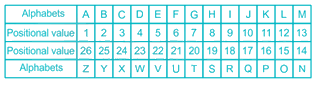 Given series: AB, BC, CD, DE, ?
The logic followed here is:
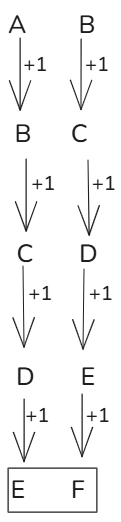 So, EF comes next.
Hence, the correct answer is "Option 4".
Q2 · Series
What comes next: 0, 1, 1, 2, 3, 5, 8, 13, ?, ?
- 21, 34
- 20, 33
- 22, 35
- 23, 36
Answer aur solution dekho
Archived marked answer: A
This is the Fibonacci sequence: each term is the sum of the preceding two. After 8 and 13 come 8 + 13 = 21 and 13 + 21 = 34.
Q3 · Series
Which of the following alternative will fill the blanks?
f_hk_gh_fg_k
- g,f,k,h
- g,k,h,f
- k,g,f,h
- k,g,h,f
Answer aur solution dekho
Archived marked answer: A
Given sequence: f_hk_gh_fg_k
1. g,f,k,h → fghk / fghk / fghk
'fghk' is repeated.
2. g,k,h,f → fghk / kghh / fgfk
3. k,g,f,h → fkhk / gghf / fghk
4. k,g,h,f → fkhk / gghh / fgfk
Thus, 'fghk' is repeated in option 1.
Hence, the correct answer is "Option 1".
Q4 · Series
What should come at the place of question mark?
100, 81, 64, 49, ?, 25
- 40
- 36
- 38
- 34
Answer aur solution dekho
Archived marked answer: B
Given: 100, 81, 64, 49, ?, 25
The logic followed here is:
10² = 100
92 = 81
82 = 64
72 = 49
62 = 36
52 = 25
So, 36 will come at the place of question mark.
Hence, the correct answer is "Option 2".
Q5 · Series
In the following number series, a wrong number is given. Find out the WRONG number.
1, 4, 16, 64, 324
- 1
- 16
- 4
- 324
Answer aur solution dekho
Archived marked answer: D
Given series: 1, 4, 16, 64, 324
The logic followed here is:
Q6 · Puzzle Subtypes Not To Miss
In a club of 9 members, a sub-committee of 4 members is to be formed. How many different sub-committe
- 124
- 167
- 126
- 169
Answer aur solution dekho
Archived marked answer: C
Given:
Total members = 9
Members to be selected = 4
Formula used:
Combination = ⁿCᵣ
nCr = n! ÷ [r! × (n − r)!]
Calculation:
Number of sub-committees = 9C4
⇒ 9C4 = 9! ÷ (4! × 5!)
⇒ (9 × 8 × 7 × 6 × 5!) ÷ (4 × 3 × 2 × 1 × 5!)
⇒ (9 × 8 × 7 × 6) ÷ (4 × 3 × 2 × 1)
⇒ 3024 ÷ 24
⇒ 126
∴ Number of different sub-committees = 126.
Q7 · Puzzle Subtypes Not To Miss
If in an examination the centre codes and roll numbers are decided by the initial of States/UT followed by digits in a particular pattern like MH10967 for Maharashtra, then Which of the following roll numbers is likely to be from Uttar Pradesh?
- MH20987
- UP19021
- GJ10243
- RJ30391
Answer aur solution dekho
Archived marked answer: B
The pattern given is:
- Initial of the State/UT + digits in a particular pattern
- Example: MH10967 → MH stands for Maharashtra
Now we check the options:
- MH20987 → MH = Maharashtra
- UP19021 → UP = Uttar Pradesh
- GJ10243 → GJ = Gujarat
- RJ30391 → RJ = Rajasthan
Since UP is the correct abbreviation for Uttar Pradesh, the roll number that is likely from Uttar Pradesh is UP19021.
Hence, the correct answer is "Option 2".
Q8 · Puzzle Subtypes Not To Miss
If × stands for addition, ÷ stands for subtraction, + stands for multiplication, and - stands for division, then 12 × 6 ÷ 3 - 2 + 5 = ?
- 36
- 10.5
- 18
- 12
Answer aur solution dekho
Archived marked answer: B
BODMAS Rule:
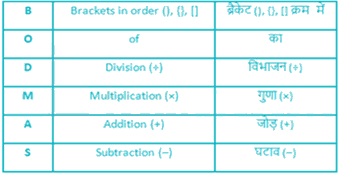 Decoding the given information:
Symbol
×
÷
+
- Meaning
+
- ×
÷
Given equation: 12 × 6 ÷ 3 - 2 + 5 = ?
Now replacing the sign from left to right using BODMAS Rule, we get:
⇒ 12 + 6 - 3 __÷__ 2 × 5 = ?
⇒ 12 + 6 - 1.5 × 5 = ?
⇒ 12 + 6 - 7.5 = ?
⇒ 18 - 7.5 = ?
⇒ 10.5 = ?
Hence, the correct answer is "Option 2".
Q9 · Puzzle Subtypes Not To Miss
Which two signs need to be interchanged?
22 - 4 × 2 ÷ 2 + 6 = 20
- × and +
- - and ÷
- ÷ and -
- + and -
Answer aur solution dekho
Archived marked answer: D
BODMAS Rule:
Let's check each option one by one.
1. × and +
Given: 22 - 4 × 2 ÷ 2 + 6 = 20
Now replacing the sign from left to right using BODMAS Rule, we get:
⇒ 22 - 4 + 2 ÷ 2 × 6 = 20
⇒ 22 - 4 + 1 × 6 = 20
⇒ 22 - 4 + 6 = 20
⇒ 28 - 4 = 20 Q10 · Puzzle Subtypes Not To Miss
Which interchanges of numbers and signs will make the equation correct? 8 × 3 + 4 = 28
- + and ×, 3 and 4
- + and ×, 8 and 3
- + and ×, 8 and 4
- + and ×, 4 and 3
Answer aur solution dekho
Archived marked answer: C
Given equation: 8 × 3 + 4 = 28
BODMAS Table:
Let's check each option one by one.
1. + and ×, 3 and 4
Given: 8 × 3 + 4 = 28
After interchanging the signs and numbers we get;
⇒ 8 + 4 × 3 = 28
⇒ 8 + 12 = 28
⇒ 20 ≠ 28
⇒ LHS ≠ RHS
2. + and ×, 8 and 3
Given: 8 × 3 + 4 = 28
After interchanging the signs and numbers we get;
⇒ 3 + 8 × 4 = 28
⇒ 3 + 32 = 28
⇒ 35 ≠ 28
⇒ LHS ≠ RHS
3. + and ×, 8 and 4
Given: 8 × 3 + 4 = 28
After interchanging the signs and numbers we get;
⇒ 4 + 3 × 8 = 28
⇒ 4 + 24 = 28
⇒ 28 = 28
⇒ LHS = RHS
4. + and ×, 4 and 3
Given: 8 × 3 + 4 = 28
After interchanging the signs and numbers we get;
⇒ 8 + 4 × 3 = 28
⇒ 8 + 12 = 28
⇒ 20 ≠ 28
⇒ LHS ≠ RHS
Hence, the correct answer is "Option 3". Q11 · Coding Decoding
In a certain code, WATER becomes VZSDQ, how is SUGAR written?
- RTFZQ
- RTDYQ
- RTDYZ
- RTDZQ
Answer aur solution dekho
Archived marked answer: A
The position and positional values or English Alphabets are:
The logic followed here is:
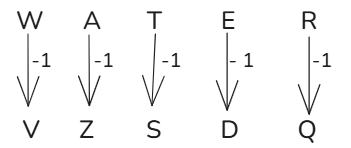 Similarly,
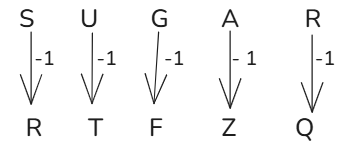 So, SUGAR is written as RTFZQ.
Hence, the correct answer is "Option 1".
Q12 · Coding Decoding
If FAMILY is coded as GBNJMZ, how is GBNJMZ coded?
- HCOKNA
- HCONLA
- HCOKMZ
- HCONMZ
Answer aur solution dekho
Archived marked answer: A
The position and positional values or English Alphabets are:
The logic followed here is:
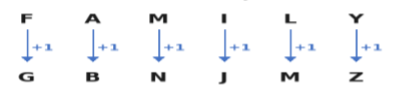 Similarly,
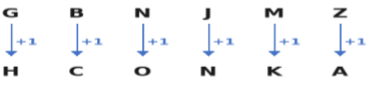 So, GBNJMZ is coded as HCOKNA.
Hence, the correct answer is "Option 1".
Q13 · Classification Odd One Out
Identify the odd one out:
- 289
- 347
- 361
- 441
Answer aur solution dekho
Archived marked answer: B
The logic followed here is:
1. 289
Q14 · Classification Odd One Out
Find the odd one out from the given alternatives.
- Balance of Trade
- Balance of Payments
- Current Account Deficit
- Food Security Act
Answer aur solution dekho
Archived marked answer: D
The logic followed here is:
1. Balance of Trade → Economic concept (difference between exports and imports of goods)
2. Balance of Payments → Economic concept (record of all international transactions)
3. Current Account Deficit → Economic concept (when imports + outflows exceed exports + inflows)
4. Food Security Act → Government legislation/law
All options except "Food Security Act" are economic/financial terms, while Food Security Act is a law/policy.
Hence, the correct answer is "Option 4".
Q15 · Classification Odd One Out
Find the word that does not fit in the group.
- Apple
- Orange
- Litchi
- Marigold
Answer aur solution dekho
Archived marked answer: D
The logic followed here is:
1. Apple → Fruit
2. Orange → Fruit
3. Litchi → Fruit
4. Marigold → Flower
Thus, all options except Marigold are fruits, while Marigold is a flower.
Hence, the correct answer is "Option 4".
Q16 · Logical Reasoning
Read the following statement carefully and identify the conclusion that follows.
Statement: All oranges are fruits. No fruit is a vegetable. All vegetables are green.
Conclusions:
I. No orange is green.
II. No orange is a vegetable.
- Only I follows
- Only II follows
- Both I and II follow
- Neither I nor II follows
Answer aur solution dekho
Archived marked answer: B
Statement: All oranges are fruits. No fruit is a vegetable. All vegetables are green.
The least possible Venn diagram for the given statement is:
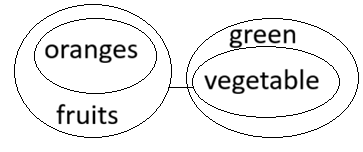 Conclusions:
I. No orange is green. - False (No orange being green is a possibility, but it is not definite. So, the conclusion is false)
II. No orange is a vegetable. - True (All orange being fruit is not a vegetable as No fruit is a vegetable)
Hence, the correct answer is "Option 2".
Q17 · Blood Relations
Pointing to a woman, John said, "She is my mother's only daughter." How is the woman related to John?
- Mother
- Sister
- Wife
- Aunt
Answer aur solution dekho
Archived marked answer: B
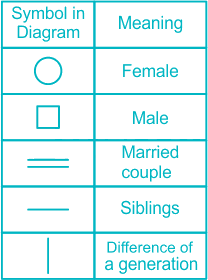
Family Chart:
 Given: Pointing to a woman, John said, "She is my mother's only daughter."
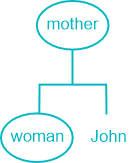 Clearly, the woman is siter of John.
Q18 · Blood Relations
In a family of six members A, B, C, D, E and F:
- A and B are a married couple.
- C is the only son of A.
- D is the daughter of B.
- F is the mother of B.
Who is the grandmother of C?
- D
- B
- E
- F
Answer aur solution dekho
Archived marked answer: D
Family Chart:
Given: In a family of six members A, B, C, D, E and F:
- A and B are a married couple.
- C is the only son of A.
- D is the daughter of B.
- F is the mother of B.
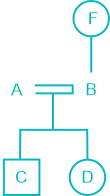 Clearly, F is the g
Q19 · Blood Relations
Directions: These questions are based on the following information:
'P@Q' means 'Q is the mother of P'.
'P$Q' means 'Q is the husband of P'.
'P#Q' means 'Q is the sister of P'.
'P&Q' means 'Q is the son of P'.
If 'Z # M $ C & D & E' then how is E related with M?
- Grandson
- Granddaughter
- Daughter
- Son
Answer aur solution dekho
Archived marked answer: A
Family Chart:
Decoding the Symbols:
Q is
Symbol
@
$
#
Meaning
mother
husband
sister
son
to P
Given: Z # M $ C & D & E
It means: M is sister of Z, C is husband of M, D is son of C, E is son of D.
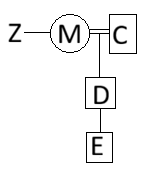 Clearly, E is grandson of M.
Hence, the correct answer is "Option 1".
Q20 · Alphabet Test
What is the 5th vowel from the right in the alphabet?
- A
- E
- I
- U
Answer aur solution dekho
Archived marked answer: A
Vowel series:
(Left) A, E, I, O , U (Right)
Clearly, 'A' is the 5th vowel from the right in the alphabet.
Hence, the correct answer is "Option 1".
Q21 · Alphabet Test
In the following question, from the given alternative words, select the word which can be formed using the letters of the given word.
Hollowness
- Hole
- whale
- Hang
- Hung
Answer aur solution dekho
Archived marked answer: A
Given word: Hollowness
Let's check each option:
1. Hole → Hollowness → Can be formed
2. whale
Q22 · Similarity and Differences
Choose the address that is the same as the one given below.
Sample Address:Plot No. 7, Green Park Extension,South Delhi, Delhi - 110016
- Plot No. 7, Greenpark Extension, South Delhi, Delhi - 110016
- Plot 7, Green Park Extension, South Delhi, Delhi - 110016
- Plot No. 7, Green Park Extension, South Delhi, Delhi - 110016
- Plot No. 7, Green Park Extn., South Delhi, Delhi - 110016
Answer aur solution dekho
Archived marked answer: C
Address
Options
Verdict
Plot No. 7, Green Park Extension,South Delhi, Delhi – 110016
1
Plot No. 7, Greenpark Extension, South Delhi, Delhi - 110016
There is no space between Green Park.
Plot No. 7, Green Park Extension,South Delhi, Delhi – 110016
2
Plot 7, Green Park Extension, South Delhi, Delhi - 110016
No. is missing after Plot.
Plot No. 7, Green Park Extension,South Delhi, Delhi – 110016
3
Plot No. 7, Green Park Extension, South Delhi, Delhi - 110016
Exactly Same
Plot No. 7, Green Park Extension,South Delhi, Delhi - 110016
4
Plot No. 7, Green Park Extn., South Delhi, Delhi - 110016
Extension is written as Extn.
Thus, option 3 is exactly the same as the one given.
Hence, the correct answer is "Option 3".
Q23 · Logical Statement Questions
Consider the following statement and choose the option that follows.
Statements:
I. People are preferring UPI payments over cash.
II. UPI is more convenient and widely accepted.
- I is the cause and II is the effect
- II is the cause and I is the effect
- Both are independent
- No relation
Answer aur solution dekho
Archived marked answer: B
Statements:
I. People are preferring UPI payments over cash.
II. UPI is more convenient and widely accepted.
If UPI is more convenient and widely accepted, it naturally leads to people preferring it over cash.
Statement II provides a reason explaining Statement I.
Thus, II is the cause and I is the effect.
Hence, the correct answer is "Option 2".
Q24 · Miscellaneous Other Possibilities
As a judge, you notice a lawyer influencing a witness. What should you do?
- Ignore unless it repeats
- Hold the lawyer in contempt
- Adjourn the case permanently
- Request the witness to stay silent
Answer aur solution dekho
Archived marked answer: B
Given: As a judge, you notice a lawyer influencing a witness.
1) Ignore unless it repeats
Ignoring such behavior is inappropriate because influencing a witness directly affects the fairness of the trial and the integrity of the judicial process.
2) Hold the lawyer in contempt
This is the correct action. Influencing a witness is professional misconduct and obstruction of justice. A judge has the authority to hold the lawyer in contempt of court to maintain fairness and discipline in proceedings.
3) Adjourn the case permanently
Permanently adjourning the case is not a proper response. The issue should be addressed by di
General Awareness
Q1 · Art and Culture
Read the below statements marked as Assertion (A) and Reason (R). Mark the correct options:
Assertion (A): The sculptures of the Nalanda School are three-dimensional and delicately ornamented.
Reason (R): The Nalanda sculptural tradition was influenced by Sarnath, local Bihar styles, and central Indian art.
- Both A and R are true, and R is the correct explanation of A.
- Both A and R are true, but R is not the correct explanation of A.
- A is true, but R is false.
- A is false, but R is true.
Answer aur solution dekho
Archived marked answer: A
The correct answer is Both A and R are true, and R is the correct explanation of A.
Key Points
- Assertion (A): The sculptures of the Nalanda School are three-dimensional and delicately ornamented.
- The Nalanda School of art is renowned for its exquisite sculptural art that displays delicate ornamentation and three-dimensional depth.
- The sculptures often depict Buddhist deities and figures, featuring intricate details like jewelry, drapery, and facial expressions, emphasizing their artistic finesse. Hence, the statement is correct.
- Reason (R): The Nalanda sculptural tradition was influenced by Sarnath, local Bihar styles, and central Indian art.
- The Nalanda School drew significant inspiration from the Sarnath School of Art, known for its simplicity, elegance, and spiritual themes.
- Local art traditions of Bihar and influences from central Indian sculptural techniques also contributed to its unique style
Q2 · Art and Culture
The dance form Ka Shad Suk Mynsiem is a thanks giving dance of which community?
- Khasi
- Ao
- Apatani
- Adi
Answer aur solution dekho
Archived marked answer: A
The correct answer is Khasi.
Key Points
- Ka Shad Suk Mynsiem is a traditional dance of the Khasi tribe, a major indigenous community of Meghalaya in Northeast India.
- This dance is performed as a thanksgiving ceremony to the divine power for blessings received during the past year.
- The term "Ka Shad Suk Mynsiem" translates to "Dance of the Happy Heart" in the Khasi language, symbolizing joy, gratitude, and harmony.
- The dance is usually performed during the spring season, marking the beginning of the sowing season and celebrating the bounties of nature.
- The event is characterized by traditional attire: men wear dhotis, sleeveless coats, and turbans, while women wear
Q3 · Art and Culture
Which Kodava harvest festival, celebrated with chants of "Poli, Poli, Deva" and a ceremonial paddy harvest, invokes Lord Iguthappa?
- Kambala
- Kailpodh
- Puthari
- Onam
Answer aur solution dekho
Archived marked answer: C
The correct answer is Puthari.
Key Points
- Puthari is a traditional harvest festival celebrated by the Kodava community in the Coorg (Kodagu) region of Karnataka, India.
- The festival marks the harvest of paddy crops and is celebrated with great enthusiasm and reverence for nature and agriculture.
- The ceremonial paddy harvest is accompanied by chants of "Poli, Poli, Deva," which invoke blessings from Lord Iguthappa, the deity of harvest and rains.
- The festival is characterized by rituals, traditional dances, and the preparation of special dishes made from freshly harvested rice.
- Puthari fosters a sense of community bonding and gratitude towards the land and the gods for a bountiful
Q4 · Indian Polity and Constitution
Which of the following witness types is formally recognized in the BSA, 2023?
- Political representatives
- Character witnesses only
- Mythological witnesses
- Expert witnesses such as forensic analysts
Answer aur solution dekho
Archived marked answer: D
The correct answer is Expert witnesses such as forensic analysts.
Key Points
- Expert witnesses are individuals with specialized knowledge, skills, or expertise in a particular field relevant to a legal case. They are formally recognized under the BSA (Bharatiya Sakshya Adhiniyam), 2023.
- The role of expert witnesses includes providing technical, scientific, or professional opinions to help the court understand complex evidence or facts.
- Fields of expertise commonly considered include forensics, medicine, ballistics, engineering, accounting, and digital forensics.
- The BSA, 2023 highlights the importance of expert opinions in cases involving scientific analysis, forensic evidence, and technical data.
- Unlike lay witnesses, expert witnesses are allowed to offer opinions based on their expertise rather than limiting their testimony to factual observations. This makes their input critical in modern legal proceedings.
Q5 · Indian Polity and Constitution
Fill in the blanks:
The _____ List in Schedule VII deals solely with matters of national importance like defence and foreign affairs.
- Union
- State
- Concurrent
- Residuary
Answer aur solution dekho
Archived marked answer: A
The correct answer is Union.
Key Points
- The Union List in Schedule VII of the Indian Constitution consists of subjects of national importance that require uniform policy across the country.
- It includes 97 items (originally 100), such as defence, foreign affairs, atomic energy, railways, banking, and currency, which are exclusively under the legislative jurisdiction of the Parliament of India.
- The subjects in the Union List are of such nature that they require centralized decision-making to ensure uniformity in administration and functioning across the nation. *Hence, matters like defence and foreign affairs are included in this list.*
- Article 246 of the Constitution specifies that Parliament has the exclusive power to make laws on any subject enumerated in the Union List.
- Examples of topics in the Union List include naval, military, and air forces, international treaties, and interstate trade and commerce.
Additional Information
- State List:
- The State List in Schedule VII contains subjects of local or state importance, such as police, public health, and agriculture. Only the state legislatures can make laws on these matters.
- It originally consisted of 66 items, but some subjects have been moved to other lists.
- Examples of State List topics include markets and fairs, burial grounds, and libraries.
- Concurrent List:
- The Concurrent List contains subjects of common interest to both the Union and States, such as education, marriage, and adoption.
- Both Parliament and state legislatures can legislate on these subjects, but in case of conflict, the Union law prevails.
- It originally consisted of 47 items.
- Residuary Powers:
- Any subject not mentioned in the Union, State, or Concurrent Lists comes under the residuary powers, which are vested exclusively in the Parliament.
- This provision ensures that unforeseen or new subjects like cybersecurity fall under the Union Government’s jurisdiction.
- Separation of Powers:
- The division of powers between the Union and State governments is a hallmark of India’s federal structure.
- This separation ensures a balance of governance, with the Union List focusing on national interests and the State List catering to regional needs.
Important Points
- Historical Context:
- The division of powers was heavily influenced by the Government of India Act, 1935, which served as the blueprint for Schedule VII.
- The framers of the Constitution intended to create a system ensuring both autonomy to states and strong central governance.
- Amendments to Schedule VII:
- The Union, State, and Concurrent Lists have undergone changes through Constitutional Amendments, reflecting evolving governance needs.
- For instance, subjects like education have been moved from the State List to the Concurrent List.
- Judicial Interpretation:
- The judiciary often interprets disputes related to the scope of legislative powers under different lists, ensuring the constitutional balance of power.
- Examples of Union List Usage:
- The Union List has been invoked for national-level initiatives like the Goods and Services Tax (GST) and international agreements.
99
Q6 · Indian Polity and Constitution
Which of the following statements regarding State Funds under the Indian Constitution is/are correct?
1) The Consolidated Fund of the State is defined under Article 266.
2) The Contingency Fund of the State is operated by the Governor in accordance with rules made by the State Legislature.
- Only 1
- Only 2
- Both 1 and 2
- Neither 1 nor 2
Answer aur solution dekho
Archived marked answer: C
The correct answer is Both 1 and 2.
Key Points
- Consolidated Fund of the State:
- The Consolidated Fund of the State is defined under Article 266(1) of the Indian Constitution.
- All revenues received by the State Government, loans raised, and money received in repayment of loans form part of this fund.
- No money can be withdrawn from this fund without the prior approval of the State Legislature. *Hence, statement 1 is correct.*
- Contingency Fund of the State:
- The Contingency Fund of the State is defined under Article 267(2) of the Constitution.
- It is a fund used to meet unforeseen expenditures, and
Q7 · Indian Economy
Which of the following correctly describes a heavy industry?
- It uses light raw materials like cotton.
- It produces light consumer goods.
- Uses bulky inputs to produce heavy goods.
- It manufactures cosmetics and toiletries.
Answer aur solution dekho
Archived marked answer: C
The correct answer is Uses bulky inputs to produce heavy goods.
Key Points
- Heavy industries are characterized by their use of bulky raw materials and heavy machinery to produce large-scale and heavy goods such as steel, machinery, and vehicles.
- These industries often require large capital investments and involve significant industrial processes, including mining, metallurgy, and production of heavy engineering equipment.
- The raw materials used, such as iron ore, coal, and limestone, are bulky and require extensive transportation and handling.
- The products of heavy industries are typically used as inputs for other industries, such as construction, automobile manufacturing, and shipbuilding, making them foundational to industrial development.
- Examples of heavy industries include the steel industry, oil refining, shipbuilding, and machinery manufacturing.
Additional Information
- Characteristics of Heavy Industries:
- They produce capital goods rather than consumer goods, such as machinery, tools, and construction materials.
- They require a large workforce and create significant employment opportunities in related sectors.
- Often located near raw material sources or transportation hubs to reduce costs.
- They play a critical role in a country’s infrastructure development and economic growth.
- Examples of Heavy Industries:
- The steel industry, which produces steel used in construction and manufacturing.
- Automobile and shipbuilding industries, which create large vehicles and ships for transportation and trade.
- The mining industry, which extracts and processes raw materials like coal and iron ore.
- The chemical industry, which produces industrial chemicals, fertilizers, and other heavy goods.
- Difference between Heavy and Light Industries:
- Heavy industries use bulky raw materials and produce goods that are often used in further industrial processes.
- Light industries, on the other hand, use light raw materials and produce consumer goods such as textiles, cosmetics, and electronics.
- Global Importance:
- Countries like China, the USA, Germany, and India have invested heavily in heavy industries to boost their economic infrastructure and industrial growth.
- Heavy industries form the backbone of export economies, contributing significantly to a nation’s GDP.
Important Points
- The Industrial Revolution of the 18th and 19th centuries marked the rapid growth of heavy industries, particularly in Europe and North America.
- Many heavy industries are considered energy-intensive and contribute significantly to greenhouse gas emissions, making sustainability a key concern in the modern era.
- Policies such as Make in India and Atmanirbhar Bharat aim to promote the growth of heavy industries in India to reduce dependence on imports and boost self-reliance.
- Technological advancements, such as the use of automation and AI in heavy industries, are improving efficiency and reducing production costs.
a9
Q8 · Indian Economy
Which international organizations played a crucial role in triggering the 1991 economic reforms in India?
- UN and WHO
- World Bank and IMF
- WTO and UNESCO
- ADB and WTO
Answer aur solution dekho
Archived marked answer: B
The correct answer is World Bank and IMF.
Key Points
- The 1991 Economic Reforms in India were a result of a severe balance of payments crisis. To address this, India approached the World Bank and International Monetary Fund (IMF) for financial assistance.
- The IMF provided a loan of $2.2 billion in exchange for implementing structural reforms, including liberalization, privatization, and globalization (LPG model).
- World Bank supported India’s structural adjustment programs by recommending policies to deregulate industries, reduce trade barriers, and encourage foreign investment.
- The reforms introduced in 1991 under the leadership of Prime Minister P.V. Narasimha Rao and Finance Mini
Q9 · Indian Economy
Read the below statements marked as Assertion (A) and Reason (R). Mark the correct options:
Assertion (A): The Human Development Index can increase even if income drops.
Reason (R): Improvements in life expectancy and education can offset income decline.
- Both A and R are true, and R is the correct explanation of A.
- Both A and R are true, but R is not the correct explanation of A.
- A is true, but R is false.
- A is false, but R is true.
Answer aur solution dekho
Archived marked answer: A
The correct answer is Both A and R are true, and R is the correct explanation of A.
Key Points
- Human Development Index (HDI): The HDI is a composite index used to measure a country's overall achievement in its social and economic dimensions. It combines three key dimensions: life expectancy at birth (health), mean years of schooling and expected years of schooling (education), and Gross National Income (GNI) per capita (income).
- Assertion (A) - The Human Development Index can increase even if income drops: This statement is true as the HDI is a composite measure. Even if the income component declines, improvements in life expectancy or education can compensate for the income drop, resulting in a net increase in HDI.
- Reason (R) - Improvements in life expectancy and education can offset income decline: This statement is also true. In the HDI calculation, all three components (health, education, and income) are weighted equally. A significant improvement in life expectancy or education can balance or even outweigh the adverse effects of a decline in income.
- R is the correct explanation of A: Since the HDI is calculated using a weighted approach, any improvement in one or more dimensions (like health or education) can counterbalance a drop in income, validating that Reason (R) explains Assertion (A).
Additional Information
- Components of HDI:
- Health: Measured by life expectancy at birth, it reflects the ability to lead a long and healthy life.
- Education: Calculated using two indicators – mean years of schooling (average number of years of education received by people aged 25 and older) and expected years of schooling (years of education a child entering school can expect).
- Income: Measured by Gross National Income (GNI) per capita (adjusted for purchasing power parity), reflecting the standard of living.
- Calculation of HDI: HDI is calculated as the geometric mean of normalized indices for each of the three dimensions (health, education, and income).
- Weightage of Dimensions: Each dimension contributes equally (one-third weightage) to the overall HDI value. This ensures that no single dimension dominates the calculation.
- Country Comparison: HDI enables the comparison of development levels between countries, focusing on human well-being rather than just economic growth.
- Global Trends: Countries like Norway, Switzerland, and Ireland often top the HDI rankings due to their strong performance in health, education, and income indicators.
Important Points
- Criticism of HDI: HDI does not capture inequality, poverty, or environmental sustainability. To address these gaps, the Inequality-adjusted HDI (IHDI) was introduced.
- HDI vs GDP: While GDP focuses solely on economic output, HDI provides a broader perspective, incorporating health and education dimensions.
- India’s HDI Rank: As per the latest Human Development Report, India ranks 132 among 191 countries, with significant improvements in life expectancy and education over the years.
- Example of Offset: In countries with declining income but improving healthcare and education (e.g., post-communist nations), HDI values may still rise.
a5
Q10 · Indian Economy
Read the below statements marked as Assertion (A) and Reason (R). Mark the correct option:
Assertion (A): In macroeconomics, treating a single commodity as representative of all goods allows simplification of aggregate analysis.
Reason (R): This is because all individual goods always behave identically under inflationary trends.
- Both A and R are true, and R is the correct explanation of A.
- Both A and R are true, but R is not the correct explanation of A.
- A is true, but R is false.
- A is false, but R is true.
Answer aur solution dekho
Archived marked answer: C
The correct answer is A is true, but R is false.
Key Points
- Assertion (A): In macroeconomics, treating a single commodity as representative of all goods allows simplification of aggregate analysis.
- This statement is true because macroeconomics often uses a representative commodity to analyze aggregate trends, such as inflation, output, or consumption.
- Using a single representative good or aggregate measure simplifies the complexities of dealing with numerous individual goods.
- For example, the concept of an "aggregate price level" is used to study inflation, even though it combines the prices of multiple goods and services.
- Reason (R): This is because all individual goods always behave identically under inflationary trends.
- This statement is false because different goods behave differently under inflationary trends.
- For instance, luxury goods, essential goods, and non-essential goods may show varied price elasticity and responses during inflation.
- The demand and supply dynamics of individual goods are influenced by factors such as consumer preferences, production costs, and market conditions, which do not always align uniformly under inflation.
- Since the assertion is correct but the reason provided does not justify the assertion, the correct option is A is true, but R is false.
Additional Information
- Macroeconomics and Aggregation:
- Macroeconomics studies the economy as a whole, focusing on aggregate indicators like GDP, inflation, and unemployment.
- To simplify analysis, macroeconomics often uses aggregate variables like "aggregate demand," "aggregate supply," and "price levels."
- The concept of treating a single commodity as representative is a methodological tool to make the analysis of complex economies more manageable.
- Inflationary Trends:
- Inflation refers to the general increase in prices of goods and services over a period of time.
- Not all goods are affected equally by inflation; for example, prices of necessities like food and fuel may rise faster compared to luxury items.
- Inflation impacts consumer purchasing power, but the degree of impact varies across different sectors and goods.
- Representative Commodity:
- The use of a representative commodity or index (e.g., Consumer Price Index) helps study the overall behavior of the economy.
- Indices like CPI and GDP Deflator are examples of aggregate measures created by combining data from multiple goods and services.
- Micro vs. Macro Behavior:
- In microeconomics, the behavior of individual goods is studied, which often varies based on market structure, demand elasticity, and other factors.
- In macroeconomics, the focus shifts to aggregate behavior, which is a summary of the entire economy, rather than individual goods.
Important Points
- Consumer Price Index (CPI):
- CPI measures changes in the price level of a basket of consumer goods and services purchased by households.
- It is widely used as an indicator of inflation and cost of living.
- Price Elasticity of Demand:
- Price elasticity measures how sensitive the quantity demanded of a good is to a change in its price.
- Essential goods tend to have low elasticity, while luxury goods often have higher elasticity.
- Inflation Types:
- Demand-pull inflation occurs when demand outpaces supply.
- Cost-push inflation arises due to increased production costs, such as raw materials and wages.
Q11 · Sports Static GK
What is the standard height of a football goal post?
- 2.44 m
- 3.66m
- 1.99 m
- 3.54 m
Answer aur solution dekho
Archived marked answer: A
The correct answer is 2.44 m.
Key Points
- The standard height of a football goal post is defined by the Laws of the Game, as set by the International Football Association Board (IFAB).
- The height of the goal post is exactly 2.44 meters (8 feet) from the ground to the underside of the crossbar.
- The width of the goal is 7.32 meters (24 feet), measured between the inside edges of the vertical goalposts.
- The dimensions of the goal post are standardized for all levels of professional football, as per FIFA regulations.
- The goalposts and crossbar must be made of suitable material, typically metal or other approved materials, and must have a consistent shape, often circular or elliptical.
Additional Information
- Laws of the Game (Football):
- The goal dimensions are outlined in Law 1 of the Laws of the Game, which governs the field of play.
- The goalpost’s height and width are consistent across all international matches, tournaments, and competitions to ensure uniformity.
- The area around the goal is marked by the goal area and the penalty area, which are also regulated by the Laws of the Game.
- Material and Safety Standards:
- Goalposts are required to be firmly anchored and must not pose any hazard to players.
- They are typically painted white, ensuring visibility during matches and in different lighting conditions.
- Historical Context:
- The first standardized dimensions for football goals were introduced in 1863, when the Football Association (FA) was formed in England.
- Prior to this, dimensions varied widely, leading to inconsistent play.
- Variations for Youth and Amateur Football:
- Youth and amateur leagues often use smaller goal dimensions to suit the age and skill level of players.
- For example, under-12 football matches may feature goalposts that are 1.83 meters (6 feet) high and 5.49 meters (18 feet) wide.
Q12 · Sports Static GK
Which of the following is true about relay races?
- A relay team has 6 members, with 4 running members.
- The baton exchange zone is 50 meters long.
- The baton must weigh exactly 100 grams.
- The length of the baton is 10-12 cm.
Answer aur solution dekho
Archived marked answer: A
The correct answer is 1.
Key Points
- A relay race team consists of 6 members in total, out of which 4 are running members. The additional members typically serve as substitutes or reserves for the team. *Hence, statement 1 is correct.*
- The baton exchange zone in relay races is 20 meters long, not 50 meters. This is a standard rule in athletics to ensure fair exchanges between runners. *Hence, statement 2 is incorrect.*
- The baton used in relay races must weigh between 50 to 60 grams, not exactly 100 grams. This weight is standardized to ensure ease of handling during the race. *Hence, statement 3 is incorrect.*
- The length of the baton is 28-30 cm, much longer than 10-12 cm. This ensures that the baton is visible and easy to pass during the exchange. Hence, statement 4
Q13 · Sports Static GK
Which is/ are correct about the first Asian Games held in 1951?
A) Held at Jawaharlal Nehru Stadium with 12 nations.
B) Japan topped the medals, India was second; venue was National Stadium, Delhi.
- Only A is correct
- Only B is correct
- Both A and B are correct
- Neither A nor B are Correct
Answer aur solution dekho
Archived marked answer: B
The correct answer is Only B is correct.
Key Points
- The first Asian Games were held in 1951 in New Delhi, India. The venue for the games was the National Stadium, Delhi, not Jawaharlal Nehru Stadium. *Hence, statement A is incorrect.*
- A total of 11 nations participated in the first Asian Games, not 12. These nations were Afghanistan, Burma (now Myanmar), Ceylon (now Sri Lanka), India, Indonesia, Iran, Japan, Nepal, the Philippines, Singapore, and Thailand. *Hence, statement A is incorrect.*
- Japan topped the medal tally in the 1951 Asian Games with the highest number of medals, while India secured the second position. This is in line with the information provided in statement B. *Hence, statement B is correct.*
- The Asian Games were held from 4th to 11th March 1951, marking the beginning of a significant sporting event for Asia.
- The first Asian Games were organized under the guidance of the Asian Games Federation, with the Indian Olympic Association playing a crucial role in their execution.
Additional Information
- History of the Asian Games:
- The idea of the Asian Games was first proposed during the 1948 London Olympics by Indian sports administrator Guru Dutt Sondhi.
- The Asian Games Federation was formed in February 1949 to oversee the organization of the games.
- Participation in the 1951 Asian Games:
- A total of 489 athletes from 11 nations competed in the games.
- There were 6 sports disciplines in the first edition: athletics, aquatics (swimming, diving, and water polo), basketball, cycling, football, and weightlifting.
- Medal Tally (1951 Asian Games):
- Japan won the most medals with 24 gold, 21 silver, and 15 bronze.
- India secured the second position with 15 gold, 16 silver, and 20 bronze.
- Legacy of the 1951 Asian Games:
- The games set the foundation for multi-sport events in Asia and are now held every four years.
- The Asian Games are considered the second-largest multi-sport event after the Olympics.
Important Points
- National Stadium vs. Jawaharlal Nehru Stadium:
- The National Stadium, Delhi, was the venue for the 1951 Asian Games.
- The Jawaharlal Nehru Stadium, often confused as the venue, was built later in 1982 for the 1982 Asian Games.
- Evolution of the Asian Games:
- The games have grown significantly since 1951, now featuring over 40 sports disciplines and participation from over 40 nations.
- The Olympic Council of Asia (OCA) oversees the organization of the games today.
Q14 · Sports Static GK
Which Union Minister officially announced that the Khelo India University Games 2025 will be held in Rajasthan this November?
- Mansukh Mandaviya
- Kiren Rijiju
- Anurag Thakur
- Nitin Gadkari
Answer aur solution dekho
Archived marked answer: A
The correct answer is Mansukh Mandaviya.
Key Points
- Mansukh Mandaviya, the Union Minister of Health and Family Welfare, officially announced that the Khelo India University Games 2025 will be held in Rajasthan this November.
- The announcement showcases the government's commitment to promoting sports culture and providing a platform for young talent to showcase their skills.
- The Khelo India University Games is a part of the Khelo India initiative, which aims to nurture grassroots sports talent and provide opportunities for young athletes.
- The decision to host the event in Rajasthan is significant as it highlights the state's growing role in sports development and infrastructure.
- The event will witness the participation of university athletes from across the country, promoting unity and sportsmanship.
Additional Information
- Khelo India Initiative:
- The Khelo India Programme was launched by the Government of India in 2018 to revive the sports culture in the country.
- It aims to promote mass participation in sports and identify and nurture sports talent at the grassroots level.
- Under the initiative, athletes are provided with financial assistance of Rs. 5 lakhs per annum for training and development.
- Previous Khelo India University Games:
- The inaugural edition of the Khelo India University Games was held in Bhubaneswar, Odisha, in 2020.
- The second edition was hosted by Bengaluru, Karnataka, in 2022.
- The games aim to bring together university athletes from all over the country and showcase their sporting prowess.
- Rajasthan's Role in Sports:
- Rajasthan has been actively developing its sports infrastructure, including stadiums and training facilities, to promote sports culture in the state.
- The state has hosted several national and international sporting events, contributing to its reputation as an emerging sports hub in India.
- Significance of Khelo India University Games:
- The games provide an important platform for young athletes to gain exposure and experience at a competitive level.
- They contribute to the identification of talent for national and international competitions, including the Olympics and Commonwealth Games.
- The event also fosters unity and cultural exchange among participants from different parts of the country.
</ul
Q15 · Indian Geography
The Vindhyan system of rocks is known for the production of which of the following?
- Manganese
- Iron ore and coal
- Limestones
- Bauxite
Answer aur solution dekho
Archived marked answer: C
The correct answer is Limestones.
Key Points
- The Vindhyan system of rocks is one of the largest rock systems in India, spanning across the central and northern regions of the country.
- The Vindhyan rocks are primarily known for their extensive deposits of limestone, which is a key raw material in industries like cement production and chemical manufacturing.
- These rocks are of sedimentary origin and were formed during the Proterozoic era, making them geologically significant.
- The limestone deposits found in the Vindhyan system are of high quality and are extensively used in construction, agriculture, and industrial applications.
- In addition to limestone, the Vindhyan system also contains minor deposits of minerals like sandstone and shale, but it is primarily recognized for its limestone production.
Additional Information
- Geographical Extent of Vindhyan System:
- The Vindhyan system spans across Madhya Pradesh, Uttar Pradesh, Rajasthan, and Bihar.
- The system forms the Vindhyan mountain range, which is a significant geological feature in central India.
- Economic Importance:
- The limestone extracted from the Vindhyan rocks is extensively used in the cement industry.
- It is also used as a flux in iron and steel production and as a soil conditioner in agriculture.
- Other Rocks in the Vindhyan System:
- In addition to limestone, the Vindhyan system contains sandstone, which is used in construction and building materials.
- Shale, another component of the Vindhyan rocks, is used in industries like ceramics and brick manufacturing.
- Historical Significance:
- The Vindhyan rocks are geologically ancient and represent one of the earliest formations of sedimentary rocks in India.
- The region is also known for its contribution to archaeological studies, as it contains fossils and evidence of early life forms.
Important Points
- Other Rock Systems in India:
- Aravalli System: Known for minerals like lead, zinc, and copper.
- Dharwar System: Known for iron ore, manganese, and gold deposits.
- Gondwana System: Famous for coal deposits in regions like Jharkhand and Odisha.
- Applications of Limestone:
- Widely used in the cement industry for producing cement and concrete.
- Used as a raw material in the chemical industry for producing lime and calcium-based compounds.
- Essential in agriculture as a soil conditioner to neutralize acidic soils.
</ul
Q16 · Modern Indian History
Fill in the blank:
The Federal Court of India, as provided under the Government of India Act 1935, was established in the year ____.
- 1936
- 1937
- 1939
- 1942
Answer aur solution dekho
Archived marked answer: B
The correct answer is 1937.
Key Points
- The Federal Court of India was established under the provisions of the Government of India Act, 1935, which was a landmark legislation enacted by the British Parliament to provide a new constitutional framework for India.
- The Federal Court was formally inaugurated on 1 October 1937, making it the first apex court of India before the Supreme Court was established post-independence.
- The court had jurisdiction to resolve disputes between provinces and princely states, as well as to hear appeals against decisions of the High Courts in certain cases.
- It comprised a Chief Justice and not more than six judges. The first Chief Justice of the Federal Court was Sir Maurice Gwyer.
- The Federal Court functioned until 28 January 1950, when it was replaced by the Supreme Court of India under the Constitution of India.
Additional Information
- Government of India Act, 1935:
- The act is regarded as the most comprehensive legislation enacted by the British Parliament for governing India. It introduced significant constitutional reforms, including the establishment of the Federal Court.
- It provided for a federal structure, dyarchy at the provincial level, and direct elections for legislative bodies.
- Jurisdiction of the Federal Court:
- The Federal Court had original jurisdiction to settle disputes between the provinces and princely states.
- It also had appellate jurisdiction over decisions of the High Courts in cases involving the interpretation of the Government of India Act, 1935.
- However, decisions of the Federal Court could be appealed to the Judicial Committee of the Privy Council in London.
- Composition:
- The Federal Court consisted of the Chief Justice and a maximum of six other judges appointed by the British Crown.
- The judges were selected based on their legal expertise and experience in judicial service.
- Replacement by Supreme Court:
- With the enforcement of the Constitution of India on 26 January 1950, the Federal Court ceased to exist and was replaced by the Supreme Court of India.
- The Supreme Court inherited the jurisdiction and functions of the Federal Court, along with additional powers outlined in the Constitution.
Important Points
- Sir Maurice Gwyer, the first Chief Justice of the Federal Court, played a pivotal role in shaping the judicial legacy of the Federal Court and establishing its independence.
- The Federal Court served as an important precedent for the creation of the independent judiciary in India, highlighting the concept of separation of powers and the rule of law.
- The Federal Court's original jurisdiction was limited, as it primarily dealt with inter-governmental disputes and constitutional matters under the 1935 Act.
- Though the Federal Court was an important institution, its decisions were often subject to review by the Privy Council, reflecting the colonial nature of governance during that period.
Q17 · Medieval Indian History
Which one of the following statements accurately describes a feature of the Vijayanagara Empire?
- The Hazara Rama temple was a public temple for commoners.
- The Lotus Mahal shows clear Persian(indo-islamic) architectural influence.
- The Mahanavami Dibba is topped by a stone super-structure.
- The city's sacred centre lay north of the Tungabhadra.
Answer aur solution dekho
Archived marked answer: B
The correct answer is The Lotus Mahal shows clear Persian(indo-islamic) architectural influence.
Key Points
- The Lotus Mahal in the Vijayanagara Empire is a fine example of Indo-Islamic architecture. It displays a fusion of Indian and Persian architectural styles, with its symmetrical arches and domes.
- This structure was likely used as a royal pavilion or council chamber, showcasing the empire's openness to incorporating diverse cultural elements into its architectural designs.
- The arched design and pyramidal roof of the Lotus Mahal are indicative of Persian influence, blending with traditional Indian architectural patterns.
- The building is part of the Royal Centre of the Vijayanagara Empire in Hampi and remains an iconic representation of the empire's grandeur.
- Its unique style demonstrates the cultural exchanges and syncretism tha
Q18 · Ancient Indian History
In Buddhist teachings, what does the term metta primarily refer to?
- Mindful meditation
- Ritual purity
- Fellow feeling
- Celibacy and renunciation
Answer aur solution dekho
Archived marked answer: C
The correct answer is Fellow feeling.
Key Points
- Metta, often translated as "loving-kindness" or "fellow feeling," is one of the four Brahmaviharas (sublime states) in Buddhist teachings.
- It is the practice of cultivating an attitude of unconditional goodwill, care, and compassion toward all living beings without discrimination.
- The term "Metta" originates from the Pali language and represents one of the primary qualities of an enlightened being in Theravāda Buddhism.
- In practice, Metta is typically developed through a structured meditation technique called Metta Bhavana, where one begins by directing loving-kindness toward oneself and gradually extends it to others, including friends, strangers, and even adversaries.
- The concept emphasizes the importance of fellow feeling and empathy, encouraging individuals to overcome hatred, jealou
Q19 · Government Schemes and Welfare Static Semi Static
Consider the following statements on the PRITHvi Vigyan Mission:
1. It aims to unify ocean, weather, and geoscience observations.
2. It supports India's early warning systems for tsunamis and cyclones.
3. It was launched by the Ministry of Health and Family Welfare.
- Only 1 and 2 are correct
- Only 2 and 3 are correct
- Only 1 and 3 are correct
- All 1, 2 and 3 are correct
Answer aur solution dekho
Archived marked answer: A
The correct answer is Only 1 and 2 are correct.
Key Points
- PRITHvi Vigyan Mission is an initiative aimed at unifying ocean, weather, and geoscience observations under a single framework to improve India's scientific capabilities. *Hence, statement 1 is correct.*
- The mission plays a pivotal role in supporting India's early warning systems for natural disasters like tsunamis, cyclones, and extreme weather events, enhancing disaster preparedness and response. *Hence, statement 2 is correct.*
- The mission is implemented by the Ministry of Earth Sciences (MoES), not the Ministry of Health and Family Welfare. This makes statement 3 incorrect.
- The PRITHvi Vigyan Mission is design
Q20 · Government Schemes and Welfare Static Semi Static
Which government initiative primarily focuses on improving learning outcomes and digital literacy in schools across India?
- Swachh Bharat Abhiyan
- Digital India Mission
- PM Gati Shakti National Master Plan
- PM eVIDYA
Answer aur solution dekho
Archived marked answer: D
The correct answer is PM eVIDYA.
Key Points
- PM eVIDYA was launched by the Government of India in May 2020 under the Atmanirbhar Bharat Abhiyan to unify all efforts aimed at digital education.
- The initiative primarily focuses on improving learning outcomes and promoting digital literacy in schools across India, especially during the COVID-19 pandemic.
- It includes the launch of "One Nation, One Digital Platform" and "One Class, One Channel" for providing access to quality education.
- The scheme aims to cater to diverse learners by providing multilingual content through platforms like Diksha, a national digital infrastructure for school education.
- PM eVIDYA integrates various initiatives such as TV channels, e-content, QR-coded textbooks, podcasts, and radio programs, ensuring inclusive access to e
Q21 · Government Schemes and Welfare Static Semi Static
What was the primary aim of import substitution policy in India's early planning era?
- Promote export-led industrialisation
- Encourage foreign capital inflow
- Replace foreign imports with domestic production
- Liberalise trade barriers
Answer aur solution dekho
Archived marked answer: C
The correct answer is Replace foreign imports with domestic production.
Key Points
- Import substitution policy was a strategy adopted by India during its early planning era, particularly under the Second Five-Year Plan (1956-1961), to promote self-reliance by reducing dependence on foreign imports.
- The primary objective was to develop domestic industries to produce goods that were previously imported, thereby fostering economic self-sufficiency.
- This policy involved the use of high tariffs and quotas on imports to protect nascent domestic industries from foreign competition.
- It was part of a larger strategy aimed at achieving industrialization and reducing India's reliance on foreign products, particularly in the wake of its colonial history.
- Import substitution was also aligned with the idea of creating a planned economy where the state played a central role in directing industrial and economic growth.
- Examples include the development of industries such as steel, chemicals, textiles, and heavy machinery, which were prioritized to replace imports.
Additional Information
- Key Features of Import Substitution Policy:
- The policy aimed at creating a self-reliant economy by reducing dependence on foreign goods and focusing on domestic production.
- It involved the use of protectionist measures such as import tariffs, quotas, and bans to restrict imports.
- Encouraged the growth of public sector enterprises in key industries like steel, heavy machinery, and energy production.
- Promoted the development of indigenous industries, particularly in the areas of manufacturing and capital goods.
- Focused on reducing the outflow of foreign exchange by minimizing imports of consumer goods.
- Outcomes of Import Substitution:
- India successfully developed a strong base in heavy industries and infrastructure during the early planning years.
- However, the policy led to reduced competition, resulting in low-quality goods and inefficiency in production.
- It created a license raj system, which involved complex bureaucratic controls and regulations, often stifling private sector growth.
- The policy contributed to technological stagnation and limited innovation in the industrial sector due to a lack of competition from foreign firms.
- Transition from Import Substitution:
- By the early 1990s, India shifted its focus from import substitution to export-oriented industrialization as part of economic liberalization and globalization policies.
- The 1991 economic reforms marked a significant shift in trade policy, reducing tariffs, removing import quotas, and promoting foreign direct investment (FDI).
- This transition was aimed at integrating India into the global economy, increasing competitiveness, and fostering economic growth.
Important Points
- Historical Context:
- India’s focus on import substitution was influenced by its colonial experience, during which the country was highly dependent on foreign goods and lacked a strong industrial base.
- The strategy was inspired by the Soviet model of planned economic development, emphasizing state control and self-reliance.
- Examples of Import Substitution in India:
- The establishment of Bhilai Steel Plant in collaboration with the Soviet Union in 1955 was a key milestone in building India’s industrial base.
- The indigenous production of goods like fertilizers, cement, and pharmaceuticals reduced dependency on imports significantly during the planned economy era.
- The Hindustan Aeronautics Limited (HAL) was set up to manufacture aircraft domestically, reducing reliance on foreign technology.
- Criticism of Import Substitution:
- Critics argue that the policy led to inefficiency, lack of innovation, and limited competitiveness in the global market.
- The restrictive trade policies also resulted in a lack of foreign exchange reserves and foreign investment.
ab
Q22 · General Science Physics
Why is it more difficult to walk on sand than on a concrete pavement?
- Sand has a higher coefficient of static friction than concrete.
- Sand is less dense than concrete, causing less gravitational pull.
- Sand displaces, reducing pushback
- Sand particles are magnetic, creating an opposing force.
Answer aur solution dekho
Archived marked answer: C
The correct answer is Sand displaces, reducing pushback.
Key Points
- Sand displaces under pressure: When you walk on sand, the particles beneath your feet shift and move apart. This displacement reduces the ability of the sand to provide a firm surface for pushback, making walking more difficult. *Hence, this explains the correct answer.*
- Concrete provides a rigid surface: Unlike sand, concrete is a solid, immovable surface. It does not shift or deform under pressure, allowing for greater pushback and making walking easier.
- Lack of resistance on sand: Sand does not offer as much resistance as concrete because it is composed of loose particles that can easily rearrange. This lack of resistance makes walking on sand more effort-intensive.
- Energy dissipation on sa
Q23 · Books and Authors Static
What is the primary literary significance of the book 'Bonkers!' by Natasha Sharma?
- Known as a memoir of rural life
- Known as a historical epic on colonial India
- Known for experimental style and social themes
- Known as a science fiction on future societies
Answer aur solution dekho
Archived marked answer: C
The correct answer is Known for experimental style and social themes.
Key Points
- 'Bonkers!' by Natasha Sharma is celebrated for its experimental literary style and its focus on social themes, making it a unique piece in contemporary children's literature.
- The book utilizes a playful and humorous narrative to explore complex social situations, presenting them in a manner that is accessible to children.
- The author’s innovative storytelling approach combines quirky characters, unusual settings, and relatable dilemmas to engage young readers and provoke thought.
- Through its narrative, 'Bonkers!' addresses themes of self-discovery, family dynamics, and individuality, promoting discussions on emotional intelligence and social awareness.
Q24 · General Science
Why is generative-design software used in launch vehicle (LV) structural engineering?
- To increase the mass of structural components
- To reduce structural weight while maintaining performance
- To simplify 2D CAD drafting in mission drawings
- To boost overall mission cost through advanced algorithms
Answer aur solution dekho
Archived marked answer: B
The correct answer is To reduce structural weight while maintaining performance.
Key Points
- Generative-design software is extensively used in launch vehicle (LV) structural engineering to reduce the structural weight of components while ensuring that they meet the required performance, strength, and safety standards.
- It utilizes advanced algorithms and artificial intelligence to explore a wide range of design possibilities, aiming to identify the most efficient and lightweight structures.
- This software can simulate and analyze stress, load distribution, and other mechanical properties of a structure to ensure that it can withstand extreme conditions during launch and space travel.
- By minimizing weight, generative design contributes to improving the payload capacity of the launch vehicl
Q25 · Other Edge Cases Possible SSC GK GS Questions
Which of the following best reflects the evolved focus of the India-US Exercise Tiger Triumph 2025 compared to its 2019 debut?
- From HADR to space combat
- Cyber ops over amphibious drills
- HADR + logistics via LEMOA
- Dropped tri-service format
Answer aur solution dekho
Archived marked answer: C
The correct answer is HADR + logistics via LEMOA.
Key Points
- Exercise Tiger Triumph: It is a biennial India-US military exercise launched in 2019 with a focus on Humanitarian Assistance and Disaster Relief (HADR).
- The 2025 edition of Exercise Tiger Triumph will expand its scope to include logistics cooperation under the Logistics Exchange Memorandum of Agreement (LEMOA).
- HADR: The exercise continues to emphasize disaster relief operations to enhance interoperability between the Indian and US armed forces for quick response during natural disasters.
- LEMOA: The logistics element in the 2025 exercise builds on the strategic agreement signed between India and the US in 2016, allowing mutual access to each other's bases for resupply, repair, and logistics support.
- The evolved focus reflects a shift toward integrating logistics and operational readiness alongside traditional HADR drills to strengthen military cooperation between the two nations.
Additional Information
- Logistics Exchange Memorandum of Agreement (LEMOA):
- LEMOA is one of the foundational agreements signed between India and the US in 2016 to facilitate logistics support, supplies, and services.
- It provides access to each other’s military facilities for refueling and replenishment, enhancing strategic and operational flexibility.
- Humanitarian Assistance and Disaster Relief (HADR):
- HADR operations involve providing aid and relief during natural disasters such as earthquakes, tsunamis, and cyclones.
- The India-US Tiger Triumph exercise began in 2019 to improve coordination and readiness in such operations.
- 2019 Edition of Tiger Triumph:
- The inaugural exercise was a tri-service exercise involving the Indian Army, Navy, and Air Force along with their US counterparts.
- It focused on amphibious drills and HADR scenarios to improve inter-operability.
- Strategic Importance:
- The exercise strengthens the India-US defense partnership, which is crucial in the Indo-Pacific region for addressing emerging security and humanitarian challenges.
- It aligns with India's focus on building regional capacity for disaster response and the US's strategy of fostering strong military alliances.
Important Points
- India-US Strategic Agreements:
- LEMOA (2016): Focuses on logistics support and interoperability.
- COMCASA (2018): Facilitates secure communication between militaries.
- BECA (2020): Enables sharing of geospatial intelligence for improved targeting and navigation.
- Indo-Pacific Relevance:
- The Indo-Pacific region faces challenges like natural disasters, piracy, and geopolitical tensions.
- Exercises like Tiger Triumph enhance India-US cooperation in ensuring regional stability and disaster management.
Mathematics
Q1 · Geometry
A right triangle has vertices at P(0, 0), Q(8, 0), and R(0, 6). What are the coordinates of its Circumcenter?
- (4, 3)
- (3, 4)
- (4, 4)
- (2, 2)
Answer aur solution dekho
Archived marked answer: A
Shortcut Trick
In a right-angled triangle, the circumcenter always lies exactly at the midpoint of the hypotenuse.
The given points P(0, 0), Q(8, 0), and R(0, 6) form a right triangle at the origin P(0, 0).
The hypotenuse is the line segment joining the other two vertices Q(8, 0) and R(0, 6).
Midpoint of hypotenuse = ((x₁ + x₂) ÷ 2, (y₁ + y₂) ÷ 2) = ((8 + 0) ÷ 2, (0 + 6) ÷ 2) = (4, 3).
∴ The correct answer is (4, 3).
Alternate Method
-
Q2 · Geometry
A large regular polygon is made by combining 6 regular hexagons around a common center. What is the ratio of area of the combined shape to one hexagon?
- 5:1
- 6:1
- 7:1
- 8:1
Answer aur solution dekho
Archived marked answer: B
Shortcut Trick
Let the area of a single regular hexagon be 1 unit.
Since the combined shape is formed by exactly 6 such regular hexagons without overlapping, its total area is simply the sum of all their individual areas.
Total area of the combined shape = 6 × 1 = 6 units.
Ratio of the combined area to the area of one hexagon = 6 : 1.
∴ The correct answer is 6:1.
Alternate Method
Given:
Number of regular hexagons combined together = 6
Concept Used:
When multiple non-overlapping two-dimensional figures are joined together, the total area of the resulting figure is equal to the sum of the individual areas (Conservation of Area principle).
Center
Area = A
Combined Shape (Area = 6A)
One Hexagon
Calculation:
⇒ Let the area of one regular hexagon = A
⇒ The large polygon is constructed by placing 6 regular hexagons around a common center in a tiled format.
⇒ Total Area of the new shape = Area of Hexagon 1 + Area of Hexagon 2 + ... + Area of Hexagon 6
⇒ Total Area = 6 × A = 6A
⇒ Required Ratio = (Total Area of combined shape) ÷ (Area of one hexagon)
⇒ Required Ratio = 6A / A = 6:1
∴ The correct answer is 6:1.
Additional Information
Area of a Regular Hexagon
The area of a regular hexagon with side length a is given by the formula: Area = (3√3 ÷ 2) × a².
Conservation of Area
In two-dimensional geometry, if a planar figure is divided into several non-overlapping pieces, the total area of the whole figure exactly equals the sum of the areas of those distinct pieces.
Tessellation of Hexagons
Regular hexagons are one of the only three regular polygons (along with equilateral triangles and squares) that can perfectly tile a flat plane without leaving gaps or creating overlaps.
</p
Q3 · Geometry
The number of triangles formed by diagonals from one vertex of an octagon is:
- 5
- 6
- 7
- 8
Answer aur solution dekho
Archived marked answer: B
Shortcut Trick
For any convex polygon with 'n' sides, the number of triangles formed by drawing all possible diagonals from a single vertex is given directly by the formula (n − 2).
An octagon has 8 sides, so n = 8.
Number of triangles = 8 − 2 = 6.
∴ The correct answer is 6.
Alternate Method
Given:
A polygon with 8 sides (Octagon).
Concept Used:
When drawing diagonals from one vertex of a polygon to all other possible non-adjacent vertices, the polygon gets divided completely into non-overlapping triangles.
Q4 · Geometry
What is the equation of line through (1,2) and (3,8)
- y = 3x - 1
- y = 2x + 1
- y = 4x - 2
- y = 4x + 2
Answer aur solution dekho
Archived marked answer: A
Shortcut Trick
A straight line must pass through both given points. We can find the correct equation by substituting the given coordinates into the options.
Test point (1, 2) in the options:
⇒ Option 1 gives y = 3(1) − 1 = 2 (Valid equation)
⇒ Option 3 gives y = 4(1) − 2 = 2 (Valid equation)
Now test point (3, 8) in the valid options: Option 1 gives y = 3(3) − 1 = 8 (Valid) whereas Option 3 gives y = 4(3) − 2 = 10 (Invalid).
∴ The correct answer is y = 3x − 1.
Alternate Method
Given:
Two points on the line are (x₁, y₁) = (1, 2) and (x₂, y₂) = (3, 8).
Formula Used:
The slope (m) of a line passing through two points is: m = (y₂ − y₁) ÷ (x₂ − x₁)
The equation of a straight line passing through a point (x₁, y₁) is: y − y₁ = m(x − x₁)
- - X
Y
- - - - 1
3
2
8
- A(1, 2)
B(3, 8)
y = 3x − 1
Calculations:
⇒ Slope m = (8 − 2) ÷ (3 − 1)
⇒ m = 6 ÷ 2 = 3
⇒ Now, substitute m = 3 and the point (1, 2) into the point-slope formula:
⇒ y − 2 = 3 × (x − 1)
⇒ y − 2 = 3x − 3
⇒ y = 3x − 3 + 2
⇒ y = 3x − 1
∴ The correct answer is y = 3x − 1.
Additional Information
Slope-Intercept Form
The equation of a straight line can be written directly as y = mx + c, where 'm' represents the slope and 'c' represents the y-intercept.
Point-Slope Form
The linear equation for a line with slope 'm' passing through a specific coordinate (x₁, y₁) is given by y − y₁ = m(x − x₁).
Collinear Points
Three or more points are considered collinear if they lie on the same straight line, which implies that the slope between any two pairs of these points is exactly equal.
Intercept Form
The equation of a line making intercepts 'a' and 'b' on the x-axis and y-axis respectively is written as (x ÷ a) + (y ÷ b) = 1.
</p
Q5 · Trigonometry
If sin θ = cos θ, what is the value of θ (in degrees)?
- 45°
- 35°
- 30°
- 40°
Answer aur solution dekho
Archived marked answer: A
Shortcut Trick
Given, sin θ = cos θ
Divide both sides of the equation by cos θ:
⇒ sin θ ÷ cos θ = 1
⇒ tan θ = 1
We know from standard trigonometric values that tan 45° = 1.
∴ The correct answer is 45°.
Alternate Method
θ
Perpendicular
Base
Hypotenuse
Isosceles Right Triangle (Base = Perpendicular)
Given:
sin θ = cos θ
Formulas Used:
sin θ = Perpendicular ÷ Hypotenuse
cos θ = Base ÷ Hypotenuse
Calculation:
⇒ Perpendicular ÷ Hypotenuse = Base ÷ Hypotenuse
⇒ Perpendicular = Base
In a right-angled triangle, if the perpendicular equals the base, the triangle is an isosceles right-angled triangle.
⇒ The sum of angles in a triangle is 180°, and the two non-right angles are equal.
⇒ θ + θ + 90° = 180°
⇒ 2θ = 90°
⇒ θ = 45°
∴ The correct answer is 45°.
Additional Information
Complementary Angles Property
We know that sin θ = cos (90° − θ). If sin θ = cos θ, then equating the angles gives θ = 90° − θ ⇒ 2θ = 90° ⇒ θ = 45°.
Standard Trigonometric Values
For standard angles, sin 30° = 1/2 and cos 30° = √3/2. However, for 45°, sin 45° = 1/√2 and cos 45° = 1/√2, hence their values are exactly equal.
Pythagorean Identity Method
Using the identity sin² θ + cos² θ = 1, substituting sin θ for cos θ gives 2 × sin² θ = 1 ⇒ sin θ = 1/√2, which yields θ = 45° in the first quadrant.
</p
Q6 · Trigonometry
If sin(3x + 10°) = cos(2x - 5°), find x.
- 27°
- 30°
- 25°
- 17°
Answer aur solution dekho
Archived marked answer: D
Shortcut Trick
If sin A = cos B, then A + B = 90°.
⇒ (3x + 10°) + (2x − 5°) = 90°
⇒ 5x + 5° = 90°
⇒ 5x = 85°
⇒ x = 17°
∴ The correct answer is 17°.
Alternate Method
A
B
C
3x+10°
2x−5°
sin A = BC/AC = cos C
Given:
⇒ sin(3x + 10°) = cos(2x − 5°)
Formula Used:
⇒ cos θ = sin(90° − θ)
Calculations:
⇒ sin(3x + 10°) = sin(90° − (2x − 5°))
Comparing the angles on both sides:
⇒ 3x + 10° = 90° − 2x + 5°
⇒ 3x + 10° = 95° − 2x
⇒ 3x + 2x = 95° − 10°
⇒ 5x = 85°
⇒ x = 17°
∴ The correct answer is 17°.
Additional Information
Complementary Angle Relations
Two angles are complementary if their sum is 90°. The relations are: sin(90° − θ) = cos θ, tan(90° − θ) = cot θ, and sec(90° − θ) = cosec θ.
Pythagorean Identities
The fundamental identity is sin²θ + cos²θ = 1. Others include sec²θ − tan²θ = 1 and cosec²θ − cot²θ = 1.
Equality of Sine and Cosine
For acute angles A and B, if sin A = cos B, then A + B = 90°. This geometric property stems from the two non-right angles in a right-angled triangle.
</p
Q7 · Trigonometry
A 5-foot person casts a 4-foot shadow. At the same time, a tree casts a 20-foot shadow. How tall is the tree?
- 20 feet
- 25 feet
- 30 feet
- 40 feet
Answer aur solution dekho
Archived marked answer: B
Shortcut Trick
At the same time of day, the ratio of height to shadow length remains constant due to direct proportion.
Height of tree / Shadow of tree = Height of person / Shadow of person
Height / 20 = 5 / 4
Height = 20 × (5 / 4) = 25
∴ The correct answer is 25 feet.
Alternate Method
Given:
Height of the person = 5 feet
Length of the person's shadow = 4 feet
Length of the tree's shadow = 20 feet
Formula Used:
At a specific time, objects and their shadows form similar triangles, meaning their corresponding sides are proportional:
H₁ / S₁ = H₂ / S₂
- 20 ft
x ft
Tree
- 4 ft
5 ft
Person
Similar Triangles Formed by Sun Rays
Calculations:
Let the height of the tree be x feet.
⇒ x / 20 = 5 / 4
⇒ x = (5 × 20) / 4
⇒ x = 100 / 4
⇒ x = 25
∴ The correct answer is 25 feet.
Additional Information
Similar Triangles Rule
When two triangles are similar, their corresponding angles are equal, and the ratio of their corresponding sides is proportional: a/x = b/y = c/z.
Direct Proportion
Two values are in direct proportion if an increase in one leads to a constant proportional increase in the other. In this case, taller objects cast proportionally longer shadows.
Sun Angle Constant
At any specific moment, the angle of elevation of the sun is identical for all objects in the same area. This identical angle causes objects and their shadows to naturally form similar right-angled triangles.
</p
Q8 · Trigonometry
If cosA = 1- sin²A, then what is the value of cos2A?
- sinA
- 1-2sin²A
- secA
- Cannot be determined
Answer aur solution dekho
Archived marked answer: B
Shortcut Trick
The problem directly asks for the standard double-angle trigonometric identity.
According to the standard identity: cos2A = cos²A − sin²A.
Since cos²A = 1 − sin²A, substituting this directly gives:
cos2A = (1 − sin²A) − sin²A = 1 − 2sin²A
∴ The correct answer is 1−2sin²A.
Q9 · Mensuration 2D
An L-shaped floor is made of two rectangles (6 m × 4 m and 8 m × 6 m). Tiles cost ₹450/m², but a 10% discount is given if more than 70 m² is tiled. What is the total cost after discount?
- ₹30, 600
- ₹29, 160
- ₹29, 240
- ₹29, 540
Answer aur solution dekho
Archived marked answer: B
Shortcut Trick
Total Area = (6 × 4) + (8 × 6) = 24 + 48 = 72 m².
Since 72 m² > 70 m², effective cost per m² = 450 × 0.9 = ₹405.
Total Cost = 72 × 405 = ₹29,160.
∴ The correct answer is ₹29,160.
Alternate Method
Given:
⇒ Dimensions of first rectangle = 6 m × 4 m
⇒ Dimensions of second rectangle = 8 m × 6 m
⇒ Rate of tiles = ₹450/m²
⇒ Discount = 10% (applicable if total area > 70 m²)
6 m
4 m
24 m²
+
8 m
6 m
48 m²
=
72 m²
Total Area = 72 m² (Discount Applies)
Calculations:
⇒ Total Area = (6 × 4) + (8 × 6)
⇒ Total Area = 24 + 48 = 72 m²
⇒ Total cost without discount = 72 × 450 = ₹32,400
⇒ Since 72 m² > 70 m², a 10% discount is applied to the total cost.
⇒ Discount amount = 10% of 32,400 = (10 ÷ 100) × 32400 = ₹3,240
⇒ Final Cost = 32400 − 3240 = ₹29,160
∴ The correct answer is ₹29,160.
Additional Information
Area of a Rectangle
The total space enclosed by a rectangular shape is calculated as Length × Breadth.
Calculating Total Cost
When a specific rate per unit area is given, Total Cost = Total Area × Rate per unit area.
Discount Percentage
When a discount of D% is applied on a value, Final Value = Initial Value × (100 − D) ÷ 100.
<
Q10 · Mensuration 2D
A triangular traffic sign has sides measuring 13 m, 14 m, and 15 m. If the cost to paint the sign is ₹5 per square meter, what will be the total expense to paint the entire sign?
- ₹420
- ₹380
- ₹360
- ₹480
Answer aur solution dekho
Archived marked answer: A
Shortcut Trick
Semi-perimeter (s) = (13 + 14 + 15) ÷ 2 = 21 m.
Area using Heron's formula = √(21 × 8 × 7 × 6) = √7056 = 84 m².
Total Cost = Area × Rate = 84 × 5 = ₹420.
∴ The correct answer is ₹420.
Alternate Method
Given:
Sides of the triangular sign: a = 13 m, b = 14 m, c = 15 m.
Painting cost rate = ₹5 per m².
Triangular Traffic Sign
- 14 m
13 m
15 m
Formula Used:
Heron's Formula for Area of a Triangle = √[s(s − a)(s − b)(s − c)]
Where semi-perimeter, s = (a + b + c) ÷ 2
Calculation:
⇒ s = (13 + 14 + 15) ÷ 2
⇒ s = 42 ÷ 2 = 21 m
⇒ Area = √[21 × (21 − 13) × (21 − 14) × (21 − 15)]
⇒ Area = √(21 × 8 × 7 × 6)
⇒ Area = √(7 × 3 × 4 × 2 × 7 × 3 × 2)
⇒ Area = √(7² × 3² × 4²)
⇒ Area = 7 × 3 × 4 = 84 m²
⇒ Total Cost = Area × Rate per m²
⇒ Total Cost = 84 × 5 = 420
∴ The correct answer is ₹420.
Additional Information
Area of an Equilateral Triangle
For a triangle with all equal sides (a), Area = (√3 ÷ 4) × a².
Area of a Right-Angled Triangle
When base and perpendicular height are given, Area = (1 ÷ 2) × Base × Height.
Inradius of a Triangle
The radius of the largest circle that can fit inside a triangle is calculated as r = Area ÷ s.
c9:T13
Q11 · Mensuration 2D
A solid pyramid is to be painted. If paint covers 2 m²/litre and total surface is 48 m², how much paint is needed, including 5% extra for retouch?
- 25.2 litres
- 35.8 litres
- 20.4 litres
- 15.5 litres
Answer aur solution dekho
Archived marked answer: A
Shortcut Trick
Total paint required = (Total Area ÷ Coverage per litre) × Increasing factor
Total paint = (48 ÷ 2) × 1.05
Total paint = 24 × 1.05 = 25.2 litres
∴ The correct answer is 25.2 litres.
Alternate Method
Given:
Total surface area of the solid pyramid = 48 m²
Paint coverage = 2 m²/litre
Extra paint required for retouch = 5%
Q12 · Mensuration 2D
The base area of a prism is increased by 25%, while the height remains the same. By what percentage does the volume increase?
- 10%
- 20%
- 25%
- 30%
Answer aur solution dekho
Archived marked answer: C
Shortcut Trick
The Volume of a prism is the product of its Base Area and Height (V = A × h).
Since the height of the prism remains constant, the Volume is directly proportional to the Base Area.
Therefore, a 25% increase in the Base Area directly results in a 25% increase in the Volume.
∴ The correct answer is 25%.
Alternate Method
Given:
Increase in Base Area = 25%
Height remains unchanged.
Formula Used:
Volume of Prism (V) = Base Area (A) × Height (h)
Percentage Increase = [(New Value − Original Value) ÷ Original Value] × 100
Q13 · Profit and Loss
A software company developed 800 licenses for a new application at a total cost of ₹4,000,000. They provided 50 licenses free to their top beta testers. For the remaining licenses, they offered a 15% discount on the market price of ₹6000 per license. Additionally, they gave 1 license free for every 9 licenses bought. If all 800 licenses were distributed, what is the company's overall gain or loss percentage?
- 16.64% profit
- 14.94% profit
- 13.94% loss
- 15.64% profit
Answer aur solution dekho
Archived marked answer: C
Shortcut Trick
Remaining licenses for sale = 800 − 50 = 750.
The offer 'Buy 9 get 1 free' implies 9 paid licenses out of every 10 distributed.
Total paid licenses = 750 × (9 ÷ 10) = 675.
Selling Price per license = ₹6000 × (1 − 0.15) = ₹5100.
Total SP = 675 × 5100 = ₹34,42,500. Total CP = ₹40,00,000.
Loss % = ((40,00,000 − 34,42,500) ÷ 40,00,000) × 100 = 13.9375% ≈ 13.94%.
∴ The correct answer is 13.94% loss.
Alternate Method
Given:
Total licenses = 800, Total CP = ₹4,000,000, Free to top beta testers = 50.
Remaining licenses = 750, Marked Price (MP) per license = ₹6000.
Discount = 15%, Promotional Offer = 1 free license for every 9 licenses bought.
Formula Used:
SP = MP × ((100 − Discount%) ÷ 100)
Loss = CP − SP
Loss % = (Loss ÷ CP) × 100
800 Licenses
- -50 free
750 Remaining
- 9:1 ratio
675 Paid
CP: ₹4,000,000
SP: 675 × ₹5100 = ₹3,442,500
Loss = ₹557,500 (13.94%)
Calculations:
⇒ SP of each license after a 15% discount = 6000 × (85 ÷ 100) = ₹5100.
⇒ The offer '1 free for every 9 bought' means for every bundle of 10 licenses, only 9 are paid for.
⇒ Total bundles formed from 750 remaining licenses = 750 ÷ 10 = 75.
⇒ Number of paid licenses = 75 × 9 = 675.
⇒ Total Selling Price (SP) = 675 × 5100 = ₹3,442,500.
⇒ Total Loss = Total CP − Total SP = 4,000,000 − 3,442,500 = ₹557,500.
⇒ Loss % = (557,500 ÷ 4,000,000) × 100 = 13.9375%.
⇒ Rounding off to two decimal places, the loss is 13.94%.
∴ The correct answer is 13.94% loss.
Additional Information
Marked Price and Discount
Discount is always calculated on the Marked Price. Formula: SP = MP × (100 − D%) ÷ 100.
Buy X Get Y Free Concept
When a dealer offers Y items free on the purchase of X items, the total items given are (X + Y). The equivalent discount percentage is (Y ÷ (X + Y)) × 100.
Profit and Loss Percentage
Profit or Loss is always evaluated on the Cost Price (CP) unless specified otherwise. Loss % = (Loss ÷ CP) × 100.
</p
Q14 · Profit and Loss
The investments of three partners, P, Q, and R, are initially in the ratio 6 : 7 : 9. After a year, P adds ₹30,000, Q adds ₹25,000, and R adds some amount to their respective investments. The new ratio of their investments becomes 8 : 9 : 11. Find the amount (in ₹) added by partner R.
- ₹10,000
- ₹12,500
- ₹15,000
- ₹18,000
Answer aur solution dekho
Archived marked answer: C
Shortcut Trick
Let the initial investments be 6x, 7x, and 9x.
Equating the scaling factors of the new ratio for P and Q: (6x + 30000) ÷ 8 = (7x + 25000) ÷ 9
⇒ 54x + 270000 = 56x + 200000 ⇒ 2x = 70000 ⇒ x = 35000
Value of 1 part in new ratio = (6 × 35000 + 30000) ÷ 8 = 30000
R's added amount = New Investment − Old Investment = (11 × 30000) − (9 × 35000) = 15000
∴ The correct answer is ₹15,000.
Alternate Method
Given:
Initial ratio of investments of P, Q, and R = 6 : 7 : 9
Amount added by P = ₹30,000
Amount added by Q = ₹25,000
New ratio of investments of P, Q, and R = 8 : 9 : 11
Formula Used:
Ratio = Value of Part 1 ÷ Value of Part 2
Partner P
Partner Q
Partner R
Initial: 6x
= 210,000
Initial: 7x
= 245,000
Initial: 9x
= 315,000
- + 30,000
- + 25,000
- + 15,000
Final: 8 parts
= 240,000
Final: 9 parts
= 270,000
Final: 11 parts
= 330,000
Amount added by R = 330,000 − 315,000 = 15,000
Calculations:
Let the initial investments of P, Q, and R be 6x, 7x, and 9x respectively.
After 1 year, new investments of P and Q are (6x + 30000) and (7x + 25000).
According to the given new ratio for P and Q:
⇒ (6x + 30000) ÷ (7x + 25000) = 8 ÷ 9
⇒ 9 × (6x + 30000) = 8 × (7x + 25000)
⇒ 54x + 270000 = 56x + 200000
⇒ 56x − 54x = 270000 − 200000
⇒ 2x = 70000
⇒ x = 35000
Initial investment of R:
⇒ 9x = 9 × 35000 = 315000
New investment of P:
⇒ 6x + 30000 = 6 × 35000 + 30000 = 240000
Since the new ratio for P is 8 parts, we can find the exact value of 1 ratio part:
⇒ 1 part = 240000 ÷ 8 = 30000
New investment of R:
⇒ 11 parts = 11 × 30000 = 330000
Amount added by R:
⇒ New investment − Initial investment
⇒ 330000 − 315000 = 15000
∴ The correct answer is ₹15,000.
Additional Information
Partnership Ratios
Profit in a partnership is distributed in proportion to the product of the capital invested and the time period of investment. (Profit Ratio = C₁ × T₁ : C₂ × T₂).
Changes in Capital
When a partner adds or withdraws capital midway through the term, the total investment weight is calculated by multiplying each active capital amount by the respective time duration it remained invested.
Ratio Equating Method
When fixed amounts are added to or subtracted from components of an original ratio to form a new ratio, setting up a cross-multiplication equation between any two quantities helps efficiently find the common scaling factor.
b3:T22
Q15 · Profit and Loss
A, B, and C invested in a business in the ratio 2:3:5. After a year, the total profit is Rs. 1,00,000. What is B's share?
- Rs. 30,000
- Rs. 25,000
- Rs. 20,000
- Rs. 40,000
Answer aur solution dekho
Archived marked answer: A
Shortcut Trick
Since the investment duration is identical for all partners, the profit is distributed exactly in the ratio of their investments.
Profit Ratio of A : B : C = 2 : 3 : 5
Total ratio parts = 2 + 3 + 5 = 10 parts.
B's share = Total Profit × (B's parts ÷ Total parts) = 1,00,000 × (3 ÷ 10) = 30,000.
∴ The correct answer is Rs. 30,000.
Alternate Method
Given:
Ratio of investments of A, B, and C = 2 : 3 : 5
Total profit earned after a year = Rs. 1,00,000
Formula Used:
Profit Ratio = Capital × Time
Whe
Q16 · Time and Work
A man and a woman are together filling a tank with water. The man pours 4 liters of water every 3 minutes, while the woman pours 3 liters every 4 minutes. How much time will it take to fill 100 liters of water in the tank?
- 38 min
- 40 min
- 44 min
- 48 min
Answer aur solution dekho
Archived marked answer: D
Shortcut Trick
LCM of given time intervals (3 mins and 4 mins) = 12 mins.
Water filled by the man in 12 mins = 4 × (12 ÷ 3) = 16 liters.
Water filled by the woman in 12 mins = 3 × (12 ÷ 4) = 9 liters.
Total water filled by both together in 12 mins = 16 + 9 = 25 liters.
Time required to fill 100 liters = (100 ÷ 25) × 12 = 48 min.
∴ The correct answer is 48 min.
Alternate Method
Given:
Man pours 4 liters every 3 minutes.
Woman pours 3 liters every 4 minutes.
Total capacity of the tank = 100 liters.
Formula Used:
Total Time = Total Work ÷ Combined Efficiency
Calculations:
⇒ Time taken by the man to independently fill 100 liters = (100 ÷ 4) × 3 = 75 min
⇒ Time taken by the woman to independently fill 100 liters = (100 ÷ 3) × 4 = 400/3 min
Person
Time (min)
Total Work
Efficiency
Man
75
100
4/3
Woman
400/3
3/4
⇒ Combined efficiency = 4/3 + 3/4
⇒ Combined efficiency = (16 + 9) ÷ 12 = 25/12 liters/min
⇒ Total time required to fill the tank = Total Work ÷ Combined efficiency
⇒ Total time = 100 ÷ (25/12)
⇒ Total time = (100 × 12) ÷ 25
⇒ Total time = 4 × 12 = 48 min
∴ The correct answer is 48 min.
Additional Information
Pipes & Cisterns Formula
If an inlet pipe fills a tank in x hours, its 1 hour work is 1/x. For two pipes taking x and y hours independently, their combined 1 hour work is given by (1/x + 1/y).
Rate of Work Principle
Total Work = Efficiency (Rate of Work) × Time. When multiple entities work together continuously without interruption, their individual volumetric efficiencies per unit time can simply be added to find the overall combined rate.
Alternate Working (Pipes)
If two individuals or pipes work on an alternate cycle basis, calculate the total volume filled in one complete cycle (e.g., 2 minutes) to deduce how many full cycles are required before calculating the remainder of the work.
</p
Q17 · Number System
Which of these is both an Integer and a Whole number?
- -4
- 0
- 3.5
- 1/2
Answer aur solution dekho
Archived marked answer: B
Shortcut Trick
Whole numbers comprise 0 and all positive counting numbers (0, 1, 2, 3...).
Integers encompass all whole numbers along with their negative counterparts (...−2, −1, 0, 1, 2...).
Since the set of whole numbers is a subset of integers, any whole number is automatically an integer.
Scanning the options, 0 is the only number that fits into the whole number category.
∴ The correct answer is 0.
Alternate Method
Given:
Four numbers: −4, 0, 3.5, and 1/2
Concept Used:
Integers (Z) = {..., −3, −2, −1, 0, 1, 2, 3, ...}
Whole Numbers (W) = {0, 1, 2, 3, ...}
Calculation:
⇒ Evaluate Option 1 (−4): It is a negative number. It belongs to integers but not whole numbers.
⇒ Evaluate Option 2 (0): It is a non-negative number without a fractional or decimal part. It belongs to both integers and whole numbers.
⇒ Evaluate Option 3 (3.5): It is a decimal value. It is neither an integer nor a whole number.
⇒ Evaluate Option 4 (1/2): It is a fractional value. It is neither an integer nor a whole number.
∴ The correct answer is 0.
Additional Information
Natural Numbers
These are all positive counting numbers starting from 1. Set N = {1, 2, 3, 4, ...}. Remember that 0 is not a natural number.
Rational Numbers
Any number that can be expressed in the form of p/q where p and q are integers and q ≠ 0. For example, 1/2, −4/1, 0/1.
Irrational Numbers
Numbers that cannot be written as a simple fraction, such as √2, √3, or π. Their decimal expansions are non-terminating and non-repeating.
</p
Q18 · Number System
What is the value of √9801 - √1681
- 58
- 68
- 78
- 88
Answer aur solution dekho
Archived marked answer: A
Shortcut Trick
For √9801: The nearest base square is 100² = 10000. Since 9801 is slightly less and ends in 1, its square root is 99.
For √1681: The nearest base square is 40² = 1600. Since 1681 is slightly more and ends in 1, its square root is 41.
Expression value = 99 − 41 = 58.
∴ The correct answer is 58.
Alternate Method
Given:
The expression is √9801 − √1681
Calculation:
⇒ Let us find the square root of 9801 by prime factorization.
⇒ 9801 = 9 × 1089
⇒ 9801 = 9 × 9 × 121
⇒ 9801 = 9² × 11²
⇒ √9801 = 9 × 11 = 99
⇒ Now let us find the square root of 1681.
⇒ Since 40² = 1600 and 1681 is slightly greater than 1600 with a unit digit of 1, the number must be 41.
⇒ 41 × 41 = 1681 ⇒ √1681 = 41
⇒ Now, substitute the extracted values back into the expression:
⇒ √9801 − √1681 = 99 − 41
⇒ 99 − 41 = 58
∴ The correct answer is 58.
Additional Information
Unit Digits of Perfect Squares
A perfect square can only end in 0, 1, 4, 5, 6, or 9. If a perfect square ends in 1, its square root will always have a unit digit of either 1 or 9.
Estimating Square Roots
Find the nearest multiples of 10 whose squares bracket the given number. For example, 1681 lies just above 1600 (which is 40²), immediately indicating the root is close to 40.
Base 100 Square Trick
For a number written as (100 − a), its square is formed by writing (100 − 2a) followed by a² (in two digits). For 99 (where a=1), (100 − 2) = 98 and 1² = 01, giving exactly 9801.
</p
Q19 · Time and Distance
The speeds of two motorcyclists are in the ratio 5 : 3. If the slower motorcyclist has a 24 km head start, and his speed is 12 km/h, how far (in km) will the faster motorcyclist travel to overtake him?
- 40 km
- 48 km
- 60 km
- 72 km
Answer aur solution dekho
Archived marked answer: C
Shortcut Trick
When the time taken to meet is constant, the ratio of distances covered is equal to the ratio of their speeds.
Distance ratio = Speed ratio = 5 : 3.
The difference in the distance ratio corresponds to the head start ⇒ 5 − 3 = 2 units.
Given head start = 24 km ⇒ 2 units = 24 km ⇒ 1 unit = 12 km.
Distance covered by the faster motorcyclist = 5 units = 5 × 12 = 60 km.
∴ The correct answer is 60 km.
Alternate Method
-
Q20 · Simplification
Simplify:
√12 + √75
- 6√3
- 7√3
- 8√3
- 9√3
Answer aur solution dekho
Archived marked answer: B
Shortcut Trick
Factorize the numbers inside the roots into perfect squares:
√12 = √(4 × 3) = 2√3
√75 = √(25 × 3) = 5√3
Add the similar surds: 2√3 + 5√3 = 7√3
∴ The correct answer is 7√3.
Alternate Method
Given:
Expression = √12 + √75
Concept Used:
√(a × b) = √a × √b (Identify the largest perfect square factor)
Calculations:
⇒ √12 + √75
⇒ √(4 × 3) + √(25 × 3)
⇒ √4 × √3 + √25 × √3
⇒ 2×√3 + 5×√3
⇒ (2 + 5)√3
⇒ 7√3
∴ The correct answer is 7√3.
Additional Information
Properties of Surds
Multiplication: √(ab) = √a × √b | Division: √(a/b) = √a ÷ √b.
Like Surds
Surds that have the exact same irrational factor are known as like surds (e.g., 2√3 and 5√3). Only like surds can be directly added or subtracted together.
BODMAS in Simplification
Always simplify the contents under roots or brackets before performing addition or subtraction when solving surd equations.
</p
Q21 · Proportion
Three numbers are in the ratio 2:3:5. If their average is 100, what is the difference between the largest and the smallest number?
- 100
- 90
- 80
- 70
Answer aur solution dekho
Archived marked answer: B
Shortcut Trick
Total sum = Average × 3 = 100 × 3 = 300.
Total ratio units = 2 + 3 + 5 = 10 units.
Value of 1 unit = 300 ÷ 10 = 30.
Difference in ratio between largest (5) and smallest (2) = 3 units.
Required difference = 3 × 30 = 90.
∴ The correct answer is 90.
Alternate Method
Given:
Ratio of the three numbers = 2 : 3 : 5
Average of the numbers = 100
Formula Used:
Sum of elements = Average × Number of elements
Total Sum = 100 × 3 = 300 (10 units)
2 units
3 units
5 units
Value = 60
Value = 90
Value = 150
- - - Difference = 150 − 60 = 90
Calculation:
⇒ Let the three numbers be 2x, 3x, and 5x.
⇒ Sum of the numbers = 2x + 3x + 5x = 10x
⇒ Average = 10x ÷ 3 = 100
⇒ 10x = 300
⇒ x = 30
⇒ The smallest number = 2x = 2 × 30 = 60
⇒ The largest number = 5x = 5 × 30 = 150
⇒ Difference between the largest and smallest = 150 − 60 = 90
∴ The correct answer is 90.
Additional Information
Average (Mean) Concept
The total sum of all given entities in a group is always equal to the average multiplied by the number of entities: Sum = Average × N.
Ratio Distribution
To find individual values from a given ratio, you must first divide the total sum of the entities by the sum of their corresponding ratio units to determine the exact value of a single unit.
Direct Difference Shortcut
Whenever you need to find the difference or sum between quantities in a ratio, operate on their ratio unit values directly first, then multiply by the calculated base value of a single unit. This avoids the extra step of calculating both exact numerical values.
</p
Q22 · Percentage
An employee contributes 20% of their salary to charity. From the remaining amount, 40% is allocated to investments. The rest is divided for education and travel in the ratio 7: 5. If the expense on travel is ₹6000, what is the employee's total salary?
- ₹28,000
- ₹30,000
- ₹32,000
- ₹35,000
Answer aur solution dekho
Archived marked answer: B
Shortcut Trick
Let the total salary of the employee be 100%.
Remaining after 20% charity = 100% − 20% = 80%.
Remaining after 40% investment = 80% × (100% − 40%) = 48%.
Travel portion = 48% × [5 ÷ (7 + 5)] = 20%.
Since 20% ≡ ₹6000, 100% = ₹6000 × 5 = ₹30,000.
∴ The correct answer is ₹30,000.
Alternate Method
Given:
Contribution to charity = 20%
Investment allocation = 40% of the remaining amount
Education to travel ratio = 7 : 5
Expense on travel = ₹6000
Formula Used:
Remaining Value = Initial Value × (1 − Percentage ÷ 100)
Salary 100%
- −20%
Rem. 80%
- −40%
Rest 48%
- - - - Edu (28%)
Travel (20%)
Travel = 20% = ₹6000 → Total (100%) = ₹30,000
Calculations:
⇒ Let total salary be S.
⇒ Remaining amount after charity = S × (100% − 20%) = 0.8S
⇒ Amount left after investment = 0.8S × (100% − 40%) = 0.48S
⇒ Share of travel in the rest amount = 5 ÷ (7 + 5) = 5/12
⇒ Expense on travel = 0.48S × (5 ÷ 12) = 0.2S
⇒ 0.2S = 6000
⇒ S = 6000 ÷ 0.2 = 30000
∴ The correct answer is ₹30,000.
Additional Information
Successive Percentage Change
When multiple percentage reductions occur successively on a remaining value, apply the multiplying factor method: Final Value = Initial × (1 − R₁/100) × (1 − R₂/100).
Base Change in Percentages
Always note whether a percentage is applied to the original total or the remaining amount. A 40% reduction on an 80% remaining balance means a net reduction of 32% (40% of 80%) from the original base.
Ratio Distribution
If an amount is distributed in the ratio a : b, the individual parts are calculated as (a ÷ (a + b)) and (b ÷ (a + b)) respectively of the total distributed amount.
<
Q23 · Simple Interest
A shopkeeper took a loan of ₹7500 from a bank on 1 April 2025 with simple interest at 9% per annum. He decided to clear the loan on 1 September 2025. How much amount did he pay back to the bank?
- ₹7775.00
- ₹7781.25
- ₹7784.79
- ₹7790.00
Answer aur solution dekho
Archived marked answer: B
Shortcut Trick
Time duration from 1st April to 1st September = 5 months = 5 ÷ 12 years.
Simple Interest = Principal × Rate × Time
SI = 7500 × 9% × (5 ÷ 12) = ₹281.25
Total Amount = Principal + SI = 7500 + 281.25 = ₹7781.25
∴ The correct answer is ₹7781.25.
Alternate Method
Given:
Principal (P) = ₹7500
Rate of Interest (R) = 9% per annum
Loan start date = 1 April 2025
Loan clear date = 1 September 2025
Formula Used:
Simple Interest (SI) = (P × R × T) ÷ 100
Amount (A) = P + SI
- 1 Apr 2025
P = ₹7500
1 Sep 2025
Amount = ?
Time = 5 Months (5/12 Year)
Rate = 9% p.a.
SI = ₹281.25 → Amount = ₹7781.25
Calculations:
⇒ Total duration from 1 April 2025 to 1 September 2025 is exactly 5 full months.
⇒ Time (T) in years = 5 ÷ 12 years.
⇒ SI = (7500 × 9 × 5) ÷ (100 × 12)
⇒ SI = (75 × 45) ÷ 12
⇒ SI = 3375 ÷ 12
⇒ SI = ₹281.25
⇒ Total Amount = Principal + SI
⇒ Total Amount = 7500 + 281.25
⇒ Total Amount = ₹7781.25
∴ The correct answer is ₹7781.25.
Additional Information
Conversion of Time
When the time given is in months or days, it must be converted to years for simple interest formulas. Divide months by 12 and days by 365.
Counting Days
When calculating exact days for simple interest, it is standard practice to exclude either the day the money is borrowed or the day it is returned, but not both.
Simple Interest vs Compound Interest
For the first year (or unit time period), Simple Interest and Compound Interest are identical. From the second period onwards, Compound Interest is calculated on the accumulated interest as well as the principal.
Q24 · Compound Interest
A certain amount increases to five times its initial value after 10 years of compounding interest. How many years will it take for it to grow to twenty-five times its original amount?
- 22
- 20
- 19
- 18
Answer aur solution dekho
Archived marked answer: B
Shortcut Trick
In Compound Interest, if a sum becomes n times in T years, it becomes nm times in m × T years.
Here, the amount becomes 5 times in 10 years (n = 5, T = 10).
We need to find the time it takes to become 25 times, which is 5² times (m = 2).
Required time = m × T = 2 × 10 = 20 years.
∴ The correct answer is 20 years.
Alternate Method
- P
5P
25P
0 Years
10 Years
20 Years
× 5
10 Years
× 5
10 Years
Compound Interest Timeline
Given:
Amount after 10 years = 5 × Initial Amount
Formula Used:
A = P(1 + R/100)T
Where A is amount, P is principal, R is rate of interest, and T is time in years.
Calculations:
⇒ Let the initial amount be P.
⇒ After 10 years, Amount A = 5P
⇒ 5P = P(1 + R/100)¹⁰
⇒ 5 = (1 + R/100)¹⁰ --- (Equation 1)
⇒ We need to find the time T when Amount A = 25P
⇒ 25P = P(1 + R/100)T
⇒ 25 = (1 + R/100)T
⇒ 5² = (1 + R/100)T
⇒ Substituting the value of 5 from Equation 1:
⇒ [(1 + R/100)¹⁰]² = (1 + R/100)T
⇒ (1 + R/100)²⁰ = (1 + R/100)T
⇒ By comparing the powers on both sides, T = 20 years.
∴ The correct answer is 20 years.
Additional Information
Compound Interest Multiplier Rule
If a given sum becomes n times in T years at a certain rate of compound interest, it will become nm times in m × T years.
Simple Interest Equivalent
In simple interest, becoming 5 times means earning an interest of 4P in 10 years. Becoming 25 times means earning an interest of 24P, which would take (24 ÷ 4) × 10 = 60 years.
Rule of 72
It is a quick approximation formula to estimate the doubling time of an investment. Doubling time ≈ 72 ÷ R years, where R is the annual compound interest rate.
</p
Q25 · Mixture and Alligation
A can contains 40 litres of oil at Rs. 50/litre. Another can contains 60 litres of oil at Rs. 60/litre. They are mixed, and 20 litres are sold at Rs. 70/litre. How much profit or loss does the seller make on this sale?
- Rs. 160 profit
- Rs. 160 loss
- Rs. 280 loss
- Rs. 280 profit
Answer aur solution dekho
Archived marked answer: D
Shortcut Trick
Average CP per litre = (40 × 50 + 60 × 60) ÷ 100 = Rs. 56
Selling Price (SP) per litre = Rs. 70
Profit per litre = SP − CP = 70 − 56 = Rs. 14
Total profit on 20 litres sold = 20 × 14 = Rs. 280
∴ The correct answer is Rs. 280 profit.
Alternate Method
Given:
Quantity of Can 1 = 40 litres at Rs. 50/litre
Quantity of Can 2 = 60 litres at Rs. 60/litre
Quantity sold = 20 litres at Rs. 70/litre
Formula Used:
Average CP = Total Cost ÷ Total Quantity
Profit = Selling Price (SP) − Cost Price (CP)
English
Q1 · Vocabulary
Select the most appropriate antonym of the given word. Furtive
- Covert
- Sneaky
- Open
- Stealthy
Answer aur solution dekho
Archived marked answer: C
The correct answer is: Option 3.
Key Points
- The word "Furtive" means attempting to avoid notice or attention, typically because of guilt or a belief that discovery would lead to trouble; secretive or sneaky.
- Example: He cast a furtive glance at the teacher before hiding the note.
- "Open" refers to something that is not secretive, hidden, or covert; it is transparent and accessible to everyone.
- Example: The government promised to maintain an open policy regarding public health issues.
- Hence, the antonym of "Furtive" is "Open".
Therefore, the correct answer is: Option 3.
Additional Information
Here are the other options explained along with their Hindi meanings and example sentences:
- Covert: Not openly acknowledged or displayed; secretive.
- Example: They conducted a covert operation to gather intelligence.
- Sneaky: Acting in a stealthy or underhanded manner to avoid detection.
- Example: The sneaky child took another cookie when no one was looking.
- Stealthy: Behaving in a cautious and surreptitious manner to avoid being seen or heard.
- Example: The cat moved stealthily toward the bird without making a sound.
Statements:</strong&g
Q3 · Vocabulary
Choose the correct meaning of idiom: Whistle in the dark
- Speak without clarity
- Put on a brave front despite fear
- Refuse to take sides
- Enjoy loneliness
Answer aur solution dekho
Archived marked answer: B
The correct answer is: Option 2 i.e. "Put on a brave front despite fear".
Key Points
- The idiom "Whistle in the dark" refers to pretending to be confident or putting on a brave front despite fear or uncertainty.
- Example: He was nervous about the exam results but tried to whistle in the dark by acting cheerful in front of his friends.
- The correct meaning of the idiom is "Put on a brave front despite fear".
- Example: Even though she was scared of the surgery, she whistled in the dark to comfort her family.
Therefore, the correct answer is: Option 2.
Additional Information
Here are the other options explained along with their Hindi meanings and example sentences:
- Option 1: Speak without clarity: Refers to speaking in a vague or unclear manner.
- Example: His presentation lacked preparation, and he spoke without clarity.
- Option 3: Refuse to take sides: Refers to staying neutral in a situation or conflict.
- Example: She refused to take sides in the argument between her two best friends.
- Option 4: Enjoy loneliness: Refers to finding pleasure in being alone or spending time with oneself.
- Example: He enjoys loneliness and often goes on solo trips to relax.
Q4 · Vocabulary
Choose the correct meaning of idiom: Sound and fury
- Echoes of truth from the past
- Great uproar that signifies nothing
- Confession followed by silence
- Loud actions with enduring impact
Answer aur solution dekho
Archived marked answer: B
The correct answer is: Option 2 i.e. Great uproar that signifies nothing.
Key Points
- The idiom "Sound and fury" refers to a lot of loud and passionate noise or commotion that ultimately has no meaning or result.
- Example: The argument between the two leaders was full of sound and fury but led to no concrete decision.
- The correct explanation of this idiom is "Great uproar that signifies nothing".
- Example: His angry speech was a lot of sound and fury, but it didn’t change anyone’s opinion.
- Hence, the idiom emphasizes situations or actions that are dramatic but lack substance or significance.
Therefore, the correct answer is: Option 2.
Additional Information
Here are the other options explained along with their Hindi meanings and example sentences:
- Option 1: Echoes of truth from the past : Refers to remnants or reflections of truth that are remembered from previous events.
- Example: His words carried echoes of truth from the past, reminding everyone of the hardships they overcame.
- Option 3: Confession followed by silence : Refers to admitting something and then remaining silent afterward.
- Example: After his confession, there was a prolonged silence in the courtroom.
- Option 4: Loud actions with enduring impact : Refers to actions that are dramatic and leave a lasting impression.
- Example: Her speech was full of loud actions with enduring impact, inspiring everyone in the audience.
- Option 5: No further explanation required as there is no additional context provided for Option 5.
Given series: 1, 4, 16, 64, 324
Q5 · Vocabulary
Choose the correct one-word substitute for: 'A person who loves and collects books'.
- Philatelist
- Bibliophile
- Calligrapher
- Archivist
Answer aur solution dekho
Archived marked answer: B
The correct answer is: Option 2) Bibliophile.
Key Points
- The word "Philatelist" refers to a person who collects or studies stamps.
- Example: My uncle is a philatelist and owns a remarkable collection of rare stamps.
- The word "Bibliophile" refers to a person who loves and collects books.
- Example: As a bibliophile, she spent hours browsing bookstores and adding rare editions to her collection.
- Hence, the correct one-word substitute for "A person who loves and collects books" is "Bibliophile."
Therefore, the correct answer is: Option 2) Bibliophile.
Additional Information
Here are the other options explained along with their Hindi meanings and example sentences:
- Philatelist: A person who collects or studies stamps.
- Example: The philatelist displayed his collection of rare stamps at the exhibition.
- Calligrapher: A person skilled in the art of beautiful handwriting.
- Example: The wedding invitations were crafted by a professional calligrapher.
- Archivist: A person responsible for preserving and organizing historical records or documents.
- Example: The archivist spent years cataloging the ancient manuscripts.
Q6 · Vocabulary
Fill in the blank with the correctly spelt word.
The ______ of the ancient manuscript was a painstaking process.
- resurection
- ressurection
- resurrection
- resurraction
Answer aur solution dekho
Archived marked answer: C
The correct answer is option 3.
Key Points
The correctly spelt word is 'resurrection'.
- The word 'resurrection' refers to the act of restoring or reviving something that was dead or forgotten.
- The word 'resurrection' is a noun and is often used in historical, religious, or metaphorical contexts.
- For Example -
- The resurrection of ancient manuscripts involves careful preservation techniques.
Therefore, the correct answer is 'resurrection'.
Additional Information
Explanation of the incorrect options -
- Resurection - Misspelled version of 'resurrection.'
- Ressurection - Incorrect spelling due to additional 's'.
- Resurraction - Misspelled due to incorrect usage of 'a' instead of 'e.'
The
Q7 · Vocabulary
Find the correct spelling for a term meaning to speak ambiguously or avoid the truth.
- Prevericate
- Prevaricate
- Prevarricate
- Privaricate
Answer aur solution dekho
Archived marked answer: B
The correct answer is option 2.
Key Points
The correct spelling is 'Prevaricate'.
- The word 'Prevaricate' means to speak or act in an evasive way or avoid the truth.
- It is a verb and is often used to describe someone who avoids answering questions directly.
Q8 · Vocabulary
Select the correct spelling for a word meaning 'capable of being done'.
- Feaseable
- Feasible
- Fiesible
- Fiesable
Answer aur solution dekho
Archived marked answer: B
The correct answer is option 2.
Key Points
The misspelled word is 'Feaseable'.
- The correct spelling would be 'Feasible'.
- The word 'Feasible' is an adjective which means 'capable of being done or achieved'.
- For Example -
- It is not feasible to complete the project within one week.
Therefore, the correct answer would be 'Feasible'.
Additional Information
Let's understand the meanings of the other incorrect options -
- Feaseable - Incorrect spelling of 'Feasible'.
- Fiesible - Another incorrect spelling of 'Feasible'.
- Fiesable - Incorrect variation of the word 'Feasible'.
45:T2b
Q9 · Vocabulary
Select the most appropriate synonym of the given word: CHICANERY
- Truth
- Deception
- Honesty
- Loyalty
Answer aur solution dekho
Archived marked answer: B
The correct answer is: Deception.
Key Points
- The word "CHICANERY" refers to the use of trickery or deception to achieve a purpose, often in legal, political, or business matters.
- Example: The politician was accused of chicanery for misleading the public with false promises.
- "Deception" means the act of deceiving someone by hiding the truth or giving a false impression, typically for personal gain.
- Example: His deception led everyone to believe he was an expert in the field, but he lacked actual knowledge.
- Hence, chicanery directly aligns with deception in meaning.
Therefore, the correct answer is: Deception.
Additional Information
Here are the other options explained along with their Hindi meanings and example sentences:
- Truth: Something that is factual and conforms to reality.
- Example: The truth about the incident was finally revealed after the investigation.
- Honesty: The quality of being truthful, sincere, and free from deceit.
- Example: His honesty earned him the respect of his colleagues.
- Loyalty: The quality of being faithful and committed to someone or something.
- Example: Her loyalty to her friends was evident during difficult times.
Q10 · Vocabulary
Choose the correct one-word substitution for the words in italics.
The professor specialized in the study of ancient societies.
- Anthropology
- Sociology
- Archaeology
- Paleontology
Answer aur solution dekho
Archived marked answer: C
The correct answer is: Option 3 i.e. Archaeology.
Key Points
- The word "Anthropology" refers to the study of humans, human behavior, and societies in the past and present.
- Example: Anthropologists study the rituals and customs of indigenous tribes to understand their culture.
- The word "Archaeology" refers to the scientific study of ancient societies through their material remains, such as artifacts, structures, and monuments.
- Example: Archaeologists discovered ancient pottery fragments during the excavation of the site.
- Hence, the professor who specializes in the study of ancient societies would be engaged in "Archaeology".
Therefore, the correct answer is: Option 3.
Additional Information
Here are the other options explained along with their Hindi meanings and example sentences:
- Anthropology: The study of humans, their behavior, and cultures across time.
- Example: The anthropology department is conducting research on the social structures of early civilizations.
- Sociology: The study of human society, its development, and functioning.
- Example: Sociology helps us understand the dynamics of modern urban life.
- Paleontology: The scientific study of fossils and ancient life forms.
- Example: Paleontologists uncovered dinosaur fossils from millions of years ago during their expedition.
Vowel series:
(Left) A, E, I, O, U (Right)
Clearly, &a
Q11 · Grammar
Find the part of the sentence that contains an error: To ensure every participant be heard (1)/ the chairperson requested that questions (2)/ be submitted in advance and that (3)/ moderators be assigned to each group. (4)
- 1
- 2
- 3
- 4
Answer aur solution dekho
Archived marked answer: A
The correct answer is Option 1.
Key Points
- The error lies in part (1) of the sentence: "To ensure every participant be heard."
- The use of "be" in this context is incorrect. The correct structure should be "To ensure every participant is heard."
- In formal or standard English, "is" is used to convey the correct tense and agreement with the subject.
-
Q12 · Grammar
Find the part of the sentence that contains an error: The official, addressing the press yesterday, (1)/ claimed that the matter had been resolved (2)/ though no evidences supporting the statement (3)/ was ever made available. (4)
- 1
- 2
- 3
- 4
Answer aur solution dekho
Archived marked answer: C
The correct answer is Option 3.
Key Points
- The primary issue in the sentence is the use of the plural form "evidences."
- In English grammar, "evidence" is an uncountable (or mass) noun.
- Uncountable nouns cannot be counted individually and do not take a plural "-s" suffix.
- The correct phrase should be "no evidence," ensuring grammatical correctness and proper agreement with the singular verb "was" later in the sentence.
- Thus, the error is located in part 3 of the sentence.
Therefore, the correct answer is Option 3.
Correct Sentence: *"The official, addressing the press yesterday, claimed that the matter had been resolved though no evidence supporting the statement was ever made available."*
Additional Information
- 1: "The official, addressing the press yesterday," – This part of the sentence is grammatically correct and properly uses a participial phrase.
- 2: "claimed that the matter had been resolved" – This part is grammatically correct, using the past perfect tense to indicate an action completed before the past claim.
- 4: "was ever made available." – This part is grammatically correct. The singular verb "was" perfectly agrees with the corrected singular noun "evidence."
Q13 · Grammar
Select the correct option: The director demanded the screenplay be revised to eliminate ____ dialogue.
- superfluous
- superfluity
- superfluously
- superfluousness
Answer aur solution dekho
Archived marked answer: A
The correct answer is 'superfluous'.
Key Points
- The word "superfluous" means unnecessary or redundant, which fits the context of eliminating dialogue that is not needed.
- Option 2 "superfluity" refers to the state of being superfluous, which does not fit grammatically in this sentence.
- Option 3 "
Q14 · Grammar
Select the correct option for the Direct Speech conversion of the sentence below.
She indicated that, unless the quorum were met promptly, the charter amendments would lapse.
- She said, "Unless the quorum had been met promptly, the charter amendments would have lapsed."
- She said, "Unless the quorum is met promptly, the charter amendments will lapse."
- She said, "If the quorum was not met promptly, the charter amendments might have lapsed."
- She said, "If the quorum is promptly met, the charter amendments must not lapse."
Answer aur solution dekho
Archived marked answer: B
The correct answer is Option 2.
Key Points
- Indirect Speech: She indicated that, unless the quorum were met promptly, the charter amendments would lapse.
- Key Conversions:
- "unless the quorum were met promptly" becomes "Unless the quorum is met promptly"
- The subjunctive "were" is converted to the present tense "is" for direct speech.
- "the charter amendments would lapse" becomes "the charter amendments will lapse"
- The modal verb "would" is converted to "will" to match the direct speech format.
- Reporting verb:
- Indirect: "She indicated that"
- Converted to: "She said," maintaining a neutral reporting tone.
- Punctuation and Format:
- Direct speech is enclosed in quotation marks.
- Starts with a capital letter "Unless" and ends with a period "." within the quotation marks.
- Reporting clause precedes the quoted speech, separated by a comma.
Therefore, the correct answer is Option 2.
Correct Sentence: *"She said, “Unless the quorum is met promptly, the charter amendments will lapse.”"*
Additional Information
- Option 1: "She said, ‘Unless the quorum had been met promptly, the charter amendments would have lapsed.’"
- Changes the meaning to a hypothetical past event, which is incorrect.
- Option 3: "She said, ‘If the quorum was not met promptly, the charter amendments might have lapsed.’"
- Incorrect conditional structure "if...was not met," and modal verb "might" alters the intended meaning.
- Option 4: “She said, ‘If the quorum is promptly met, the charter amendments must not lapse.’"
- Changes the meaning and introduces a compulsion ("must not") that is not present in the original sentence.
Q15 · Grammar
A sentence is provided in direct speech. From the four given options, choose the one that most accurately conveys the sentence in its corresponding indirect speech.
The teacher said, "Be quiet in the class."
- The teacher told be quiet in the class.
- The teacher told them to quiet in the class.
- The teacher said them to be quiet in the class.
- The teacher told them to be quiet in the class.
Answer aur solution dekho
Archived marked answer: D
The correct answer is Option 4.
Key Points
- Indirect Speech: The teacher told them to be quiet in the class.
- Key Conversions:
- Direct command "Be quiet in the class" is conver
Q17 · Voice Change
Convert the sentence provided below from its passive voice structure to an active voice structure: Was the conclusion reached by the jury after reviewing all the evidence?
- Did the jury reach the conclusion after reviewing all the evidence?
- Was all the evidence reviewed after reaching a conclusion by the jury?
- Had the jury reached a conclusion by the time the evidence was reviewed?
- Did the evidence conclude the jury's review?
Answer aur solution dekho
Archived marked answer: A
The correct answer is Option 1.
Key Points
- Passive voice structure: The object of the active voice sentence becomes the subject of the passive voice sentence.
- In the passive voice, the sentence is: "Was the conclusion reached by the jury after reviewing all the evidence?"
- To convert to active voice: Identify the subject "the jury" and make it the subject of the active voice sentence.
- Change the verb structure: "was reached" becomes "did reach."
- Ensure the time phrase and object, "after reviewing all the evidence," remain intact for clarity.
Therefore, the correct answer is Option 1.
Correct Sentence: *"Did the jury reach the conclusion after reviewing all the evidence?"*
Additional Information
- Option 1: "Did the jury reach the conclusion after reviewing all the evidence?" – This is the correct active voice conversion.
- Option 2: "Was all the evidence reviewed after reaching a conclusion by the jury?" – Incorrect as it remains in passive voice.
- Option 3: "Had the jury reached a conclusion by the time the evidence was reviewed?" – Incorrect tense (past perfect).
- Option 4: "Did the evidence conclude the jury's review?" – Incorrect meaning as it changes the intended subject.
</ul
Q18 · Voice Change
Change the following from active to passive: The audience applauded the singer enthusiastically.
- The singer was applauded enthusiastically by the audience.
- The singer is applauded enthusiastically by the audience.
- The singer has been applauded enthusiastically by the audience.
- The singer was being applauded enthusiastically by the audience.
Answer aur solution dekho
Archived marked answer: A
The correct answer is Option 1.
Key Points
- Passive voice structure: The object of the active voice sentence becomes the subject of the passive voice sentence.
- In the active voice, the sentence is: "The audience applauded the singer enthusiastically."
- To convert to passive voice: Place the object "the singer" at the beginning.
- Change the active verb form "applauded" to "was applauded" (past simple passive).
- Add the preposition "by" followed by the original subject "the audience."
- Ensure the adverb "enthusiastically" remains in the sentence for clarity.
Therefore, the correct answer is Option 1.
Correct Sentence: *"The singer was applauded enthusiastically by the audience."*
Additional Information
- Option 1: "The singer was applauded enthusiastically by the audience." – This is the correct passive voice version of the sentence.
- Option 2: "The singer is applauded enthusiastically by the audience." – Incorrect tense (present simple passive).
- Option 3: "The singer has been applauded enthusiastically by the audience." – Incorrect tense (present perfect passive).
- Option 4: "The singer was being applauded enthusiastically by the audience." – Incorrect use of past continuous passive.
</ul
Q19 · Para Jumble
Rearrange the following sentences in correct order to make a logical passage.
1. The team submitted the compiled data to the analytics division.
2. Raw survey responses were extracted from multiple sources.
3. Each dataset underwent preprocessing and standardization.
4. Redundant entries were eliminated using automated filters.
- 2-3-4-1
- 2-4-3-1
- 3-2-4-1
- 1-3-2-4
Answer aur solution dekho
Archived marked answer: A
The correct answer is Option 1.
Key Points
- The logical sequence of the sentences is based on the progression of the data processing and submission workflow.
- Sentence 2 is the first sentence as it introduces the initial step of extracting survey responses:
- "Raw survey responses were extracted from multiple sources."
</
Q20 · Verbal Ability
Rearrange the following sentences to form a coherent paragraph:
1. A key strategy is to diversify energy sources, transitioning from fossil fuels to renewable alternatives like solar, wind, and geothermal power.
2. To mitigate the worst effects of climate change, the global community must drastically reduce its reliance on carbon-intensive energy production.
3. This shift not only decreases greenhouse gas emissions but also improves air quality and creates new economic opportunities.
4. Additionally, policies that promote energy efficiency in buildings and transportation can further lower overall energy consumption.
- 2, 1, 3, 4
- 1, 2, 3, 4
- 4, 1, 2, 3
- 2, 3, 1, 4
Answer aur solution dekho
Archived marked answer: A
The correct answer is Option 1.
Key Points
- The paragraph discusses strategies to mitigate climate change by reducing carbon-intensive energy production and promoting renewable energy and energy efficiency.
- Sentence 2 is the first sentence as it introduces the broader goal:
- "To mitigate the worst effects of climate change, the global community must drastically reduce its reliance on carbon-intensive energy production."
- Sentence 1 follows as it provides a specific strategy to achieve this goal:
- "A key strategy is to diversify energy sources, transitioning from fossil fuels to renewable alternatives like solar, wind, and geothermal power."
- Sentence 3 comes next as it explains the benefits of this energy transition:
- "This shift not only decreases greenhouse gas emissions but also improves air quality and creates new economic opportunities."
- Sentence 4 is the last as it adds another aspect of reducing energy consumption through policies:
- "Additionally, policies that promote energy efficiency in buildings and transportation can further lower overall energy consumption."
- The correct sequence is 2, 1, 3, 4.
Coherent paragraph after rearrangement:
"To mitigate the worst effects of climate change, the global community must drastically reduce its reliance on carbon-intensive energy production. A key strategy is to diversify energy sources, transitioning from fossil fuels to renewable alternatives like solar, wind, and geothermal power. This shift not only decreases greenhouse gas emissions but also improves air quality and creates new economic opportunities. Additionally, policies that promote energy efficiency in buildings and transportation can further lower overall energy consumption."</÷