91 questions available to read. Bina signup padho; timed practice ke liye free sign in karo.
Archive coverageThis saved paper contains 100 of 100 expected questions. 9 stored records are excluded from this study page while their source or wording is checked. Missing original questions: 0. Local question numbers follow the saved archive; match the wording and choices when comparing another response sheet.
Archived marked answers and available solution notes are preserved. These are not claimed to be fully checked final SSC keys. How questions are checked.
Reasoning
Q1 · Series
What comes next?
CBA, DCB, EDC, FED, ?
- HGF
- GFE
- GEF
- FGE
Answer aur solution dekho
Archived marked answer: B
The position and positional values or English Alphabets are:
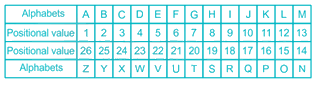 Given: CBA, DCB, EDC, FED, ?
The logic followed here is:
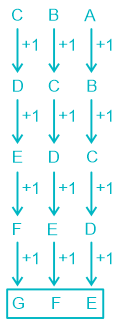 So, GFE comes next.
Hence, the correct answer is "Option 2".
Q2 · Series
Complete the series: AZ, BY, CX, DW, ?
- EV
- FU
- GV
- GU
Answer aur solution dekho
Archived marked answer: A
The position and positional values or English Alphabets are:
Given series: AZ, BY, CX, DW, ? Q3 · Series
What should come at the place of question mark? : 8, 27, 64, 125, ?, 343
- 200
- 216
- 243
- 250
Answer aur solution dekho
Archived marked answer: B
Given series: 8, 27, 64, 125, ?, 343
The logic followed here is:
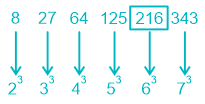 Thus, 216 will come at the place of question mark.
Hence, the correct answer is "Option 2".
Q4 · Analogy
If 5 @ 2 = 17 and 6 @ 3 = 27, what is 7 @ 4?
- 35
- 37
- 39
- 41
Answer aur solution dekho
Archived marked answer: C
The logic followed here is:
Logic: a @ b = (a × b) + (a + b)</span&g
Q5 · Analogy
If 9 @ 1 = 82 and 6 @ 2 = 38, what is the value of 7 @ 3?
- 50
- 60
- 52
- 41
Answer aur solution dekho
Archived marked answer: C
The logic followed here is:
Logic: a @ b = a2 + b
9 @ 1 = 82 → 92 + 1 = 81 + 1 = 82
6 @ 2 = 38 → 6² + 2 = 36 + 2 = 28
Similarly,
7 @ 3 → 72 + 3 = 49 + 3 = 52
Hence, the correct answer is "Option 3".
Q6 · Puzzle Subtypes Not To Miss
If '÷' means '+', 'x' means '-', '+' means '÷' and '-' means 'x', which of the following options is CORRECT?
- 7 × 42 + 7 ÷ 3 - 4 = 42 - 6 ÷ 2 - 7
- 50 × 49 + 7 ÷ 1 + 2 = 30 + 6 ÷ 9 - 5
- 6 × 16 + 2 ÷ 4 - 3 = 14 + 7 ÷ 4 - 2
- 9 × 16 + 8 ÷ 6 - 3 = 32 + 32 ÷ 4 - 8
Answer aur solution dekho
Archived marked answer: C
BODMAS Rule:
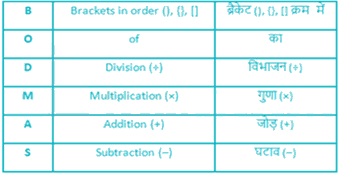 Decoding the given information:
Symbol
÷
×
+
- Meaning
+
- ÷
×
Let's check each option one by one.
1. 7 × 42 + 7 ÷ 3 - 4 = 42 - 6 ÷ 2 - 7
Now replacing the sign from left to right using BODMAS Rule, we get:
⇒ 7− 42 ÷ __7 + 3 × 4 = 42 × __6 + 2 × 7
⇒ 7− 6 + 3 × __4 = 252__ + 14
⇒ 7 − 6 + 12 = 266
Q7 · Puzzle Subtypes Not To Miss
Which two signs should be interchanged to make the following equation CORRECT?
{{(15 + 3) - (4 × 2)} ÷ (4 - 6)]} × 5 = 10
- + and -
- + and x
- + and ÷
- x and ÷
Answer aur solution dekho
Archived marked answer: A
Given equation: {{(15 + 3) - (4 × 2)} ÷ (4 - 6)]} × 5 = 10
BODMAS Rule:
Let's check each option one by one.
1. + and -
Given equation: {{(15 + 3) - (4 × 2)} ÷ (4 - 6)]} × 5 = 10
After interchanging the signs we get;
⇒ {(15 − __3) + (4 × 2)} ÷ (4 + __6) × 5} = 10
⇒ {12____ + 8} ÷ 10 × 5} = 10
⇒ {20____ ÷ 10 × 5} = 10
⇒ {2 __× __5} = 10
⇒ 10 = 10
⇒ LHS = RHS
2. + and x
Given equation: {{(15 + 3) - (4 × 2)} ÷ (4 - 6)]} × 5 = 10
After interchanging the signs we get;
⇒ {(15 × __3) − (4 + 2)} ÷ (4 − __6) + 5} = 10
⇒ {45 − 6} ÷ (-2) + 5} = 10
⇒ {45____ − 6} ÷ (-2) + 5} = 10
⇒ {39____ ÷ (-2) + 5} = 10
⇒ {-19.5 + ____5} = 10
⇒ -14.5 ≠ 10
⇒ LHS ≠ RHS
3. + and ÷
Given equation: {{(15 + 3) - (4 × 2)} ÷ (4 - 6)]} × 5 = 10
After interchanging the signs we get;
⇒ {(15 ÷ __3) − (4 × 2)} + (4 − __6) × 5} = 10
⇒ {5____ − 8} + (-2) × 5} = 10
⇒ {(-3)} + (-2) × ____5} = 10
⇒ {(-3)} + (-10)} = 10
⇒ -13 ≠ 10
⇒ LHS ≠ RHS
4. x and ÷
Given equation: {{(15 + 3) - (4 × 2)} ÷ (4 - 6)]} × 5 = 10
After interchanging the signs we get;
⇒ {(15 + __3) − (4 ÷ 2)} × (4 − __6) ÷ 5 = 10
⇒ {18____ − 2} × (−2)} ÷ 5 = 10
⇒ {16__ × (−2__)} ÷ 5 = 10
⇒ -32____ ÷ 5 = 10
⇒ -6.4 ≠ 10
⇒ LHS ≠ RHS
Hence, the correct answer is "Option 1". Q8 · Puzzle Subtypes Not To Miss
You are given a mathematical expression with basic operations. However, the symbols used are not their usual meaning. You must follow these symbol substitution rules:
'+' means '-'
'-' means '+'
'x' means '÷'
'÷' means 'x'
120 ÷ 6 x 5 + 10 - 4 = ?
- 85
- 138
- 100
- 98
Answer aur solution dekho
Archived marked answer: B
Given equation: 120 ÷ 6 x 5 + 10 - 4 = ?
BODMAS Rule:
Decoding the given information:
Symbol
+
- ×
÷
Meaning
- +
÷
×
Now replacing the sign from left to right using BODMAS Rule, we get:
⇒ 120 × 6 ÷ 5 − 10 + 4 = ?
⇒ 120 × 1.2 − 10 + 4 = ?
⇒ 144 − 10 + 4 = ?
⇒ 148 − 10 = ?
⇒ 138 = ?
Hence, the correct option is "Option 2". Q9 · Coding Decoding
If DESIGN is written as FGVKIQ, how is VISION written?
- XKYKQP
- XKZLQP
- XKVKQQ
- YKYLPP
Answer aur solution dekho
Archived marked answer: C
The position and positional values or English Alphabets are:
The logic followed here is:
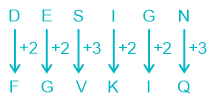 Similarly,
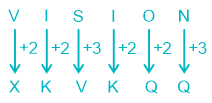 Thus, VISION is written as XKVKQQ.
Hence, the correct answer is "Option 3".
Q10 · Coding Decoding
If SCHOOL is coded as TIDPPM, how is TIDPPM coded?
- UJEQQN
- UOZQQN
- TJEQQN
- UJEQPN
Answer aur solution dekho
Archived marked answer: B
The position and positional values or English Alphabets are:
The logic followed here is:
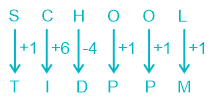 Similarly,
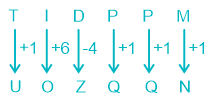 Thus, TIDPPM is coded as UOZQQN.
Hence, the correct answer is "Option 2".
Q11 · Coding Decoding
If 'COW' is coded as '3-15-23', how will 'WOC' be coded?
- 18-7-5
- 23-15-3
- 16-24-25
- 8-6-11
Answer aur solution dekho
Archived marked answer: B
The position and positional values or English Alphabets are:
The logic followed here is:
C
O
W
3
15
23
Similarly,
W
O
C
23
15
3
Thus, WOC is coded as 23-15-3.Hence, the correct answer is "Option 2". Q12 · Classification Odd One Out
Find the odd one out:
- 3 + 4 = 7
- 5 + 6 = 11
- 2 + 2 = 5
- 8 + 1 = 9
Answer aur solution dekho
Archived marked answer: C
The logic followed here is:
1. 3 + 4 = 7
Q13 · Classification Odd One Out
Find the odd one out from the given alternatives
- Geographical Phenomena
- Earthquake
- Cyclone
- Volcano
Answer aur solution dekho
Archived marked answer: A
The logic followed here is:
1. Geographical Phenomena - Geographical phenomena are natural events or processes that occur on the Earth’s surface and affect its physical features and environment.
2. Earthquake - A sudden shaking of the Earth’s surface.
3. Cyclone - A large-scale air mass that rotates around a strong center of low atmospheric pressure.
4. Volcano - An opening in the Earth's crust that allows lava, ash, and gases to escape.
Earthquake, Cyclone, and Volcano are specific examples of geographical phenomena.
Geographical Phenomena is a category, not a specific event.
Thus, Geographical Phenomena is the odd one out.
Hence, the correct answer is "Option 1".
Q14 · Classification Odd One Out
Find the odd one out:
Asia, Europe, Africa, Brazil, Australia
- Asia
- Europe
- Brazil
- Africa
Answer aur solution dekho
Archived marked answer: C
The logic followed here is:
- Asia → Continent
- Europe → Continent
- Africa → Continent
- Australia → Continent
- Brazil → Country
All options except "Brazil" are continents, while Brazil is a country (located in South America).
Hence, the correct answer is "Option 3".
Q15 · Logical Reasoning
Read the following statement carefully and identify the conclusion that follows.
Statement: All poets are writers.Some writers are critics. No critic is a fool.
Conclusions:
I. Some poets are critics.
II. Some writers are not fools.
- Only I follows
- Only II follows
- Both I and II follow
- Neither I nor II follows
Answer aur solution dekho
Archived marked answer: B
Statement: All poets are writers.Some writers are critics. No critic is a fool.
The least possible Venn diagram for the given statement is:
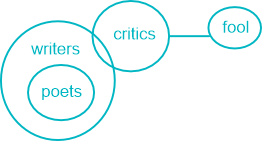 Conclusions:
I. Some poets are critics. - False (Some poets being critics is possible but it is not definite. So, the conclusion is false)
II. Some writers are not fools. - True (Some writers are critics. No critic is a fool, which means some writers who are critics are not fools)
Thus, only II follows.
Hence, the correct answer is "Option 2".
Q16 · Logical Reasoning
Statements:
All dancers are artists. No artist is lazy.
Conclusions:
I. No dancer is lazy.
II. Some lazy are dancers.
- Only I follows
- Only II follows
- Both I and II follow
- Neither I nor II follows
Answer aur solution dekho
Archived marked answer: A
Statements:
All dancers are artists.
No artist is lazy.
The least possible Venn diagram for the given statement is:
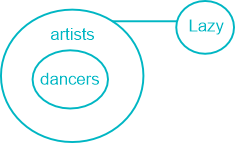 Conclusions:
I. No dancer is lazy. - True (As, All dancers are artists and No artist is lazy, which means No dancer is lazy)
II. Some lazy are dancers. - False (As, All dancers are artists and No artist is lazy, which means No dancer is lazy)
Thus, only I follows.
Hence, the correct answer is "Option 1".
Q17 · Blood Relations
Pointing to a man, Ravi said, "He is the son of my father's only son." How is the man related to Ravi?
- Uncle
- Brother
- Cousin
- Son
Answer aur solution dekho
Archived marked answer: D
Family Chart:
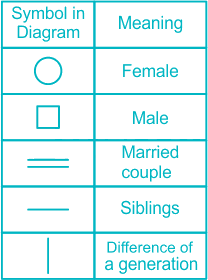 Given: Pointing to a man, Ravi said, "He is the son of my father's only son."
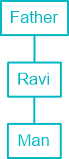 Clearly, the man is son of Ravi.
Hence, the correct answer is "Option 4".
Q18 · Blood Relations
Q is the daughter of R, who is the mother of S. T is the father of Q. How is T related to S?
- Son
- Husband
- Brother
- Father
Answer aur solution dekho
Archived marked answer: D
Family Chart:
Given: Q is the daughter of R, who is the mother of S. T is the father of Q.
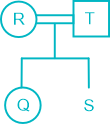 Clearly, T is father of S.
Q20 · Alphabet Test
Which meaningful word can be formed from the letters "MOTLETEE"?
- OMLETTEE
- METELOTE
- EMOTETLE
- OMELETTE
Answer aur solution dekho
Archived marked answer: D
Given letters: MOTLETEE
1. OMLETTEE → Incorrect spelling
2. METELOTE → Not meaningful
3. EMOTETLE → Not meaningful
4. OMELETTE → Uses all letters correctly and makes a meaningful word.
So, OMELETTE is the meaningful which word can be formed from the letters "MOTLETEE".
Hence, the correct answer is "Option 4".
Q21 · Similarity and Differences
Choose the address that is the same as the one given below.
Sample Address:Shop No. 11, Ground Floor,Plaza Mall, Sector 18, Noida,Uttar Pradesh - 201301
- Shop No. 11, Ground Floor, Plaza Mall, Sector 18, Noida, Uttar Pradesh - 201301
- Shop 11, Ground Floor, Plaza Mall, Sector 18, Noida, Uttar Pradesh - 201301
- Shop No. 11, Ground Floor, Plaza Mall, Sector-18, Noida, Uttar Pradesh - 201301
- Shop No. 11, Ground Floor, Plaza Mall, Sec 18, Noida, Uttar Pradesh - 201301
Answer aur solution dekho
Archived marked answer: A
Address
Options
Verdict
Shop No. 11, Ground Floor,Plaza Mall, Sector 18, Noida,Uttar Pradesh – 201301
1
Shop No. 11, Ground Floor, Plaza Mall, Sector 18, Noida, Uttar Pradesh - 201301
Exactly Same
Shop No. 11, Ground Floor,Plaza Mall, Sector 18, Noida,Uttar Pradesh - 201301
2
Shop 11, Ground Floor, Plaza Mall, Sector 18, Noida, Uttar Pradesh - 201301
"No." is missing
Shop No. 11, Ground Floor,Plaza Mall, Sector 18, Noida,Uttar Pradesh - 201301
3
Shop No. 11, Ground Floor, Plaza Mall, Sector-18, Noida, Uttar Pradesh - 201301
There is no "-" in "Sector 18"
Shop No. 11, Ground Floor,Plaza Mall, Sector 18, Noida,Uttar Pradesh - 201301
4
Shop No. 11, Ground Floor, Plaza Mall, Sec 18, Noida, Uttar Pradesh - 201301
Instead of "Sector", Sec is written
Thus, option 1 is exactly the same as the one given.
Hence, the correct answer is "Option 1".
Q22 · Logical Statement Questions
Instruction: Identify the judgements that must hold for the statement to be valid, then choose the correct option.
Statement: In an attempt to modernize agricultural output, the government has introduced AI-based crop surveillance tools in rural zones with high farmer suicide rates.
Judgements:
1.Traditional methods of crop monitoring are entirely ineffective.
2.Technological interventions may indirectly improve farmer well-being.
- Only judgement 1 follows
- Only judgement 2 follows
- Both 1 and 2 follow
- Neither 1 nor 2 follows
Answer aur solution dekho
Archived marked answer: B
Statement: In an attempt to modernize agricultural output, the government has introduced AI-based crop surveillance tools in rural zones with high farmer suicide rates.
Now,
Judgements:
1.Traditional methods of crop monitoring are entirely ineffective. - Does not follow (Because the statement only says the government wants to modernize agriculture. It does not say traditional methods are completely ineffective. Modernization does not imply total failure of existing methods.)
2.Technological interventions may indirectly improve farmer well-being. - Follows (Because the AI tools are introduced in areas with high farmer suicide rates. This suggests the government exp
Q23 · Miscellaneous Other Possibilities
You're an administrative officer. You see bias in staff recruitment. What should you do?
- Stay silent to avoid conflict
- Raise objection with evidence
- Inform selected candidate quietly
- Delay the joining process
Answer aur solution dekho
Archived marked answer: B
Given: You're an administrative officer. You see bias in staff recruitment. What should you do?
1. Stay silent to avoid conflict → Avoids conflict but allows injustice to continue.
2. Raise objection with evidence → Professional, ethical, and constructive approach. It addresses the issue properly.
3. Inform selected candidate quietly → Unprofessional and may create unnecessary complications.
4.
Q24 · Miscellaneous Other Possibilities
A doctor mistakenly discloses patient data. What legal principle is violated?
- Negligence
- Confidentiality
- Defamation
- Right to dignity
Answer aur solution dekho
Archived marked answer: B
Given: A doctor mistakenly discloses patient data. What legal principle is violated?
1. Negligence → Failure to take proper care, but the direct legal breach here is confidentiality.
2. Confidentiality → Protection of private patient information, which is "confidentiality" is the direct legal breach here.
3. Defamation → Making false statements that harm reputation, but the direct legal breach here is confidentiality.
4. Right to dignity → Related to respect and honor, but the direct legal breach here is confidentiality.
Thus, "Confidentiality" is the legal principle which is violated.
Hence, the correct option is "Option 2".
Q25 · Direction Sense
A person walks 5 km to a destination in 1 hour. On the return journey, they walk the same 5 km distance back to the starting point in 30 minutes. What is the average speed of the person for the entire journey?
- 6.67 km/h
- 7.5 km/h
- 8 km/h
- 10 km/h
Answer aur solution dekho
Archived marked answer: A
Given:
Distance₁ = 5 km
Time₁ = 1 hour
Distance₂ = 5 km
Time₂ = 30 minutes = 0.5 hour
Formula used:
Average speed = Total distance ÷ Total time
Calculation:
Total distance = 5 + 5 = 10 km
Total time = 1 + 0.5 = 1.5 hours
⇒ Average speed = 10 ÷ 1.5
⇒ Average speed = 20 ÷ 3
⇒ Average speed = 6.67 km/h
∴ Average speed of the whole journey = 6.67 km/h.
General Awareness
Q1 · Art and Culture
What is the main tower of a Draviḍa-style temple known as?
- Shikhara
- Vihāra
- Gopuram
- Vimāna
Answer aur solution dekho
Archived marked answer: D
The correct answer is Vimāna.
Key Points
- The Vimāna refers to the main sanctum tower of a Draviḍa-style temple, built directly above the garbhagriha (sanctum sanctorum).
- It is a hallmark of South Indian temple architecture, especially in Tamil Nadu and Karnataka, where the structure is pyramid-like and intricately carved.
- The Vimāna symbolizes Mount Meru, considered the sacred abode of the gods in Hindu cosmology.
- Unlike the Gopuram (gateway tower), the Vimāna is located over the central shrine and is often smaller but more ornately designed.
- The famous example of a Vimāna is the Brihadeeswarar Temple in Thanjavur, Tamil Nadu, where the Vimāna stands at a height of 60 meters.
Additional Information
- Shikhara
- The Shikhara is the tower or spire found in Nāgara-style temples, common in North India.
- It is typically curvilinear in shape and rises vertically above the sanctum sanctorum (garbhagriha).
- The Shikhara represents the sacred mountain and is often adorned with intricate carvings and decorative motifs.
- Famous examples include the Shikharas of the Khajuraho Group of Monuments and the Konark Sun Temple.
- Vihāra
- Vihāra refers to a Buddhist monastery or dwelling place for monks.
- It generally consists of a courtyard surrounded by small cells for the monks, with a central hall used for congregational prayers or teachings.
- Vihāras were prominent during the Mauryan, Gupta, and post-Gupta periods in Indian history.
- Examples include the rock-cut Vihāras at Ajanta and Ellora.
- Gopuram
- The Gopuram is the ornamental gateway tower of Draviḍa-style temples, usually located at the entrance of the temple complex.
- It is a monumental structure adorned with intricate sculptures of deities, mythological scenes, and decorative elements.
- Gopurams are typically larger and more elaborate than the Vimāna, often serving as the temple's most striking feature.
- Famous examples include the towering Gopurams of the Meenakshi Temple in Madurai and the Ranganathaswamy Temple in Srirangam.
- Main Theme: Draviḍa-Style Temples
- Draviḍa-style temples are primarily found in South India and are characterized by pyramidal Vimānas, sprawling courtyards, and elaborate Gopurams.
- These temples are typically constructed using granite, sandstone, or other durable materials, with intricate carvings and inscriptions.
- The central shrine houses the deity, with circumambulatory paths and mandapas (halls) for rituals and gatherings.
Q2 · Art and Culture
Consider the statements about Dangi:
1. Performed by Dangi Adivasis of Dang district, Gujarat.
2. The dance is a solo narrative mimicking farm tools. Which is/are correct?
- Only 1 correct
- Only 2 correct
- Both 1 & 2 correct
- Neither 1 nor 2 correct
Answer aur solution dekho
Archived marked answer: A
The correct answer is Only 1 correct.
Key Points
- Dangi dance is performed by the Dangi Adivasi community primarily from the Dang district of Gujarat, India.
- This traditional dance is deeply rooted in the cultural practices and social life of the Dangi Adivasis.
- The dance involves synchronized group movements and is often performed during festivals and community gatherings.
- It is characterized by vibrant costumes and rhythmic steps, showcasing the rich tribal heritage of Gujarat.
- The second statement, which claims that the dance is a solo narrative mimicking farm tools, is incorrect as Dangi is not a solo performance, nor does it mimic farm tools.
Additional Information
- Statement 1:
- Statement 1 is correct as it accurately identifies the Dangi dance as a traditional art form of the Dangi Adivasis in Gujarat's Dang district.
- The Dangi community is known for its vibrant culture and unique tribal art, including dance forms that often depict stories and celebrate their way of life.
- Statement 2:
- Statement 2 is incorrect since Dangi is a group dance rather than a solo performance.
- It does not involve mimicking farm tools, unlike some other tribal or folk dances that depict agricultural activities.
- About Dangi Community:
- The Dangi Adivasis are an indigenous tribal group residing in the Dang district of Gujarat and parts of Maharashtra.
- Their cultural practices include music, dance, and rituals that are integral to their festivals and social ceremonies.
- Other Tribal Dances of Gujarat:
- Tippani Dance: Performed by women, this dance involves the use of wooden sticks to create rhythmic sounds.
- Garba: A popular folk dance of Gujarat often performed during Navratri, involving circular movements and clapping.
- Raas: A traditional dance form using dandiya sticks, often associated with Lord Krishna's Raas Leela.
Q3 · Art and Culture
Which of the following best captures the key rituals and symbolism of the Nocte tribe's Loku festival?
- "Famlam" involves omen-reading by elders to determine jhum plots before the buffalo slaughter begins.
- "Chamkatja" includes prayers at Chaatam, Chamwangbong dance, and gunfire at the chief's house.
- "Thanglangja" features forest bonfires, rice-beer offerings, and blank firing by women elders.
- "Loku" derives from "Rang-Ku" meaning prosperity and is fixed by diviners on a lunar eclipse night.
Answer aur solution dekho
Archived marked answer: B
The correct answer is "Chamkatja" includes prayers at Chaatam, Chamwangbong dance, and gunfire at the chief's house..
Key Points
- The Nocte tribe celebrates the Loku festival, a harvest festival that marks the end of the agricultural season.
- "Chamkatja" is one of the key components of the Loku festival where rituals and cultural practices are performed.
- The rituals include offering prayers at Chaatam (a sacred location) to invoke blessings from ancestral spirits.
- The Chamwangbong dance, a traditional dance unique to the Nocte tribe, is performed during the festival to celebrate unity and prosperity.
- Gunfire at the chief's house symbolizes the spirit of celebration and marks the official commencement of the festivities.
Additional Information
- Option 1: "Famlam" involves omen-reading by elders to determine jhum plots before the buffalo slaughter begins.
- This statement refers to agricultural rituals but is not directly linked to the Loku festival.
- The practice of omen-reading is common among tribal communities to identify auspicious days for various activities.
- Option 3: "Thanglangja" features forest bonfires, rice-beer offerings, and blank firing by women elders.
- While this description aligns with certain tribal rituals, it does not represent a part of the Loku festival.
- Such practices may be observed in other festivals or ceremonies celebrated by the Nocte tribe or other neighboring tribes.
- Option 4: "Loku" derives from "Rang-Ku" meaning prosperity and is fixed by diviners on a lunar eclipse night.
- While Loku is indeed a festival symbolizing prosperity, the etymological derivation from "Rang-Ku" and its fixation on a lunar eclipse night is incorrect.
- The Loku festival is typically celebrated after the harvest season and does not depend on lunar eclipses for its scheduling.
- Main Theme - Loku Festival:
- The Loku festival is one of the most important festivals of the Nocte tribe of Arunachal Pradesh.
- It is celebrated with great fervor to mark the conclusion of the agricultural year and to pray for prosperity, unity, and good harvests in the coming year.
- The festival includes various rituals, dances, and communal feasts that showcase the rich cultural heritage of the Nocte tribe.
``
Q4 · Indian Polity and Constitution
The Uniform Civil Code primarily seeks to replace which types of laws currently governing personal matters in India?
- Criminal laws
- Property laws
- Religious personal laws (e.g., Hindu Marriage Act, Muslim Personal Law)
- Environmental laws
Answer aur solution dekho
Archived marked answer: C
The correct answer is Religious personal laws (e.g., Hindu Marriage Act, Muslim Personal Law).
Key Points
- The Uniform Civil Code (UCC) is a proposal to replace personal laws based on religious scriptures and customs with a common set governing every citizen.
- Personal laws in India differ for various religious communities, covering marriage, divorce, inheritance, adoption, and maintenance.
- The UCC aims to ensure equality and secular
Q5 · Indian Polity and Constitution
Consider the following statements:
1. Criminal law is exclusively under the Union List.
2. Agriculture is a State subject.
3. Trade and commerce within a State falls under the State List.
Which of the above is/are correct?
- 1 and 2 only
- 2 and 3 only
- 1 and 3 only
- 1, 2 and 3
Answer aur solution dekho
Archived marked answer: B
The correct answer is Option 2: 2 and 3 only.
Key Points
- Agriculture is a subject under the State List, as per Schedule VII of the Indian Constitution. States have exclusive authority to legislate on matters related to agriculture.
- Trade and commerce within a state is also listed under the State List. This gives states the power to regulate trade and commerce within their territorial boundaries.
- Criminal law, however, is not exclusively under the Union List. It is part of the Concurrent List, meaning both the Union and State governments can legislate on it.
- The Concurrent List allows overlapping legislative powers between the Union and States, which includes subjects like criminal law, marriage, bankruptcy, and more.
- Therefore, Statements 2 and 3 are correct, while Statement 1 is incorrect, making Option 2 the right choice.
Additional Information
- Statement 1: Criminal law is exclusively under the Union List
- This is incorrect. Criminal law is part of the Concurrent List (Entry 1), meaning both the Union and State legislatures can make laws on this subject.
- However, in case of any conflict between the central and state laws, the central law prevails (as per Article 254 of the Indian Constitution).
- Examples of criminal laws include the Indian Penal Code (IPC) and the Code of Criminal Procedure (CrPC), which apply uniformly across the country.
- Statement 2: Agriculture is a State subject
- This is correct. Agriculture falls under the State List (Entry 14) in Schedule VII of the Indian Constitution.
- States have the exclusive power to legislate on issues such as land tenure, irrigation, crop insurance, agricultural education, and farm policies.
- However, the Union government plays a role in framing national agricultural policies and schemes, such as the PM-KISAN scheme.
- Statement 3: Trade and commerce within a State falls under the State List
- This is correct. Trade and commerce within a state is included under the State List (Entry 26).
- States have the power to regulate markets, taxation on goods and services, and local trade policies.
- However, inter-state trade and commerce are regulated by the Union government under the Union List (Entry 42).
- Seventh Schedule of the Indian Constitution
- The Seventh Schedule divides legislative powers between the Union and State governments into three lists:
- Union List: Subjects of national importance (e.g., defense, foreign affairs, atomic energy).
- State List: Subjects of state and local importance (e.g., police, public health, agriculture).
- Concurrent List: Subjects where both Union and State governments can legislate (e.g., education, criminal law, marriage).
- This division ensures a federal structure while allowing cooperation between different levels of government.
``
Q6 · Indian Economy
Which of the following best defines the concept of 'opportunity cost'?
- The cost of production
- The next best alternative foregone
- The cost of labor
- The total money spent
Answer aur solution dekho
Archived marked answer: B
The correct answer is The next best alternative foregone.
Key Points
- Opportunity cost is the value of the next best alternative that is foregone when a choice is made.
- It represents the benefits or value that could have been gained if the resources had been utilized in the next best alternative.
- The concept is a fundamental principle in economics and helps in decision-making where resources are scarce and trade-offs are inevitable.
- Opportunity cost is not always expressed in monetary terms; it can also include time, effort, or other non-monetary factors.
- This principle underlines the importance of evaluating all possible options before committing resources to a specific decision.
Additional Information
- The cost of production
- This refers to the total expenditure incurred by a business to produce goods or services, including costs of raw materials, labor, and overheads.
- It is used to determine the selling price and profitability of a product or service.
- Unlike opportunity cost, this focuses only on the monetary aspect of production and does not consider foregone alternatives.
- The cost of labor
- This is a specific component of production cost and refers to the wages, salaries, and benefits paid to employees for their work.
- It can be divided into direct labor costs (workers directly involved in production) and indirect labor costs (support staff, management, etc.).
- It does not encompass the broader concept of trade-offs like opportunity cost.
- The total money spent
- This phrase typically refers to the sum of all expenses made by an individual, organization, or government in a particular context.
- It is a straightforward accounting measure and does not account for the value of forgone alternatives.
- While it helps in budgeting and tracking expenditures, it does not address the economic implications of resource allocation like opportunity cost does.
Q7 · Indian Economy
What was the main rationale for the policy of import substitution during the first seven Five Year Plans?
- To expand international trade
- To attract foreign investors
- To protect infant domestic industries
- To create export dependency
Answer aur solution dekho
Archived marked answer: C
The correct answer is To protect infant domestic industries.
Key Points
- The policy of import substitution was aimed at reducing reliance on foreign goods by fostering domestic production capabilities.
- It was designed to shield infant industries from international competition during their early stages of development.
- By restricting imports and promoting domestic production, the policy sought to build a self-reliant economy, especially in key sectors like manufacturing and industrial goods.
- Import substitution aligned with the broader goals of India's Five Year Plans, which emphasized economic self-sufficiency and industrialization.
- It involved protective measures such as tariffs, quotas, and subsidies for domestic industries to ensure their growth and competitiveness.
Additional Information
- Option 1: To expand international trade
- The focus of import substitution is not on expanding international trade but on reducing dependency on foreign imports.
- India’s economic policy during the first seven Five Year Plans prioritized self-reliance over global trade integration.
- While international trade was considered, it was secondary to the goal of fostering domestic industries.
- Option 2: To attract foreign investors
- Attracting foreign investors was not a primary objective of the import substitution policy during this period.
- In fact, the policy often discouraged foreign investment by emphasizing domestic production and limiting foreign participation in key industries.
- The focus was on building indigenous capabilities rather than relying on foreign capital or expertise.
- Option 4: To create export dependency
- Export dependency is the opposite of the goals of import substitution, which aimed at reducing reliance on foreign economies.
- The policy sought to create a balanced trade environment by ensuring that domestic industries catered to local demand first.
- Export promotion was considered later in India’s economic strategy, especially after liberalization in the 1990s.
- Context of Import Substitution Policy
- India adopted the import substitution strategy during its early economic planning phases (1951–1990) to accelerate industrialization and reduce foreign dependency.
- This policy was influenced by global economic theories such as protectionism and the idea of nurturing infant industries.
- Though effective in fostering domestic industries initially, the policy faced criticism for inefficiency, lack of competitiveness, and stagnant growth, leading to economic liberalization later.
Q8 · Sports Static GK
Which of the following statements about basketball equipment specifications is accurate?
- The backboard must be 1.05 meters wide and 1.80 meters tall.
- The diameter of the ring must be exactly 450 mm.
- The lines on the backboard must be white and 50 mm wide.
- The net must be black with 10 loops to attach it to the ring.
Answer aur solution dekho
Archived marked answer: C
The correct answer is The lines on the backboard must be white and 50 mm wide.
Key Points
- According to the official basketball equipment specifications set by the International Basketball Federation (FIBA), the lines on the backboard must be white and 50 mm wide.
- The backboard markings include a rectangle above the basketball hoop, which helps players aim and measure their shots accurately.
- These specifications ensure uniformity across basketball courts worldwide, maintaining consistency for professional and amateur games.
- Such precise measurements for the lines are critical for adhering to international standards and ensuring fair play.
- The color white is chosen for the lines for maximum visibility against the standard backboard material, which is often transparent or dark-colored.
Additional Information
- Option 1: The backboard must be 1.05 meters wide and 1.80 meters tall.
- This statement is incorrect. As per FIBA regulations, the standard dimensions of the backboard are 1.80 meters wide and 1.05 meters tall, but the phrasing in the option reverses the dimensions.
- The backboard's dimensions are standardized to ensure uniformity in gameplay across courts globally.
- The backboard is typically made of a transparent material like tempered glass to allow visibility for spectators and players.
- Option 2: The diameter of the ring must be exactly 450 mm.
- This statement is incorrect. The official diameter of the basketball hoop (ring) is 450 mm to 459 mm, as per FIBA standards.
- The inner edge of the ring must have this precise measurement to ensure compatibility with the standard basketball size (No. 7 for men and No. 6 for women).
- The ring is made of steel and must be securely attached to the backboard to withstand the force of dunks and other game actions.
- Option 4: The net must be black with 10 loops to attach it to the ring.
- This statement is incorrect. The net used in basketball is typically made of white cord, not black, for better visibility during gameplay.
- The net is attached to the ring using 12 loops, not 10, ensuring it hangs evenly around the hoop.
- The net's primary function is to slow the ball down after a successful basket, making it easier to identify a score.
- Main Theme: Basketball Equipment Specifications
- Basketball equipment, including the backboard, hoop, net, and court lines, must adhere to precise specifications set by governing bodies like FIBA and the NBA.
- These regulations ensure consistency and fairness in the game, regardless of where it is played.
- Key elements like the dimensions of the backboard, the diameter of the hoop, and the visibility of court markings are all standardized for professional and amateur play.
Q9 · Sports Static GK
Who won India's most recent Olympic medal in freestyle wrestling at the Paris 2024 Olympics?
- Ravi Kumar Dahiya
- Bajrang Punia
- Sakshi Malik
- Aman Sehrawat
Answer aur solution dekho
Archived marked answer: D
The correct answer is Aman Sehrawat.
Key Points
- Aman Sehrawat won India's most recent Olympic medal in freestyle wrestling at the Paris 2024 Olympics.
- Competing in the men's freestyle wrestling category, he showcased exceptional skill and determination to claim a podium finish.
- Aman Sehrawat has been a rising star in Indian wrestling, previously winning accolades in international tournaments, including the Asian Wrestling Championships.
- He trains at the Chhatrasal Stadium in Delhi, a hub for producing elite wrestlers like Sushil Kumar and Bajrang Punia.
- His achievement at the Paris 2024 Olympics underscores the continued success and dominance of Indian wrestlers on the global stage.
Additional Information
- Ravi Kumar Dahiya
- Ravi Kumar Dahiya is an Indian freestyle wrestler who won a silver medal in the men's 57 kg category at the Tokyo 2020 Olympics.
- He is known for his incredible stamina and technical skills, having also won multiple medals at the World Wrestling Championships and Asian Wrestling Championships.
- Bajrang Punia
- Bajrang Punia is one of India's most celebrated wrestlers, earning a bronze medal at the Tokyo 2020 Olympics in the men's 65 kg category.
- He has been a consistent performer in major international events, including the Commonwealth Games, Asian Games, and World Championships.
- Sakshi Malik
- Sakshi Malik made history by becoming the first Indian woman wrestler to win an Olympic medal, earning bronze in the 58 kg category at the Rio 2016 Olympics.
- Her achievement inspired a new generation of female wrestlers in India.
- Freestyle Wrestling in India
- Freestyle wrestling has a rich history in India, with wrestlers consistently bringing laurels from international competitions.
- India's wrestling tradition is deeply rooted in the 'akhada' system, which emphasizes rigorous training and discipline.
- Prominent training centers like the Chhatrasal Stadium and support from organizations like the Wrestling Federation of India (WFI) have nurtured world-class talent.
``
Q10 · Sports Static GK
Identify the athlete NOT correctly paired with their sport as per National Games 2025:
- Lovlina Borgohain - Boxing
- Tajinderpal Singh Toor - Shot Put
- Sarabjot Singh - Swimming
- Jyothi Yarraji - 100m hurdles
Answer aur solution dekho
Archived marked answer: C
The correct answer is Sarabjot Singh - Swimming.
Key Points
- Sarabjot Singh is an Indian athlete specializing in shooting, not swimming.
- He competes in the 10m Air Pistol event and has achieved remarkable success in this discipline, including winning gold medals at international shooting competitions.
- Shooting is governed by the International Shooting Sport Federation (ISSF), and Sarabjot Singh represents India in ISSF events.
- He is considered one of India's promising young shooters and has contributed significantly to the country's medal tally in shooting sports.
- The pairing of
Q11 · Indian Geography
Read the following Assertion (A) and Reason (R) carefully and choose the correct option:
Assertion (A): The Northern Plains are one of the most agriculturally productive regions in India.
Reason (R): These plains are composed of rich alluvial soil, have a favourable climate, and receive adequate water supply from major rivers.
- Both A and R are true, and R is the correct explanation of A.
- Both A and R are true, but R is not the correct explanation of A.
- A is true, but R is false.
- A is false, but R is true.
Answer aur solution dekho
Archived marked answer: A
The correct answer is Both A and R are true, and R is the correct explanation of A.
Key Points
- The Northern Plains of India are among the most agriculturally productive regions due to their fertile alluvial soil, formed by deposits from rivers like the Ganga, Yamuna, and Brahmaputra.
- The region has a favorable climate, characterized by adequate rainfall and a long growing season, which supports the cultivation of diverse crops such as wheat, rice, sugarcane, and pulses.
- The availability of water for irrigation from perennial rivers in the region reduces dependence on monsoons, ensuring consistent agricultural output.
- The fertile plains are supported by a dense population, which provides a readily available workforce for farming and facilitates infrastructure development for agricultural activities.
- These factors—fertile soil, favorable climate, and sufficient water supply—are the primary reasons behind the high agricultural productivity of the Northern Plains, directly explaining Assertion (A).
Additional Information
- Option 2: Both A and R are true, but R is not the correct explanation of A
- This option is incorrect because the reason (R)—fertile alluvial soil, favorable climate, and adequate water supply—is the direct explanation of why the Northern Plains are agriculturally productive, making it the correct explanation for Assertion (A).
- Option 3: A is true, but R is false
- This option is incorrect as both the Assertion (A) and Reason (R) are true. The Northern Plains are agriculturally productive, and the factors mentioned in R are valid and accurate explanations for this productivity.
- Option 4: A is false, but R is true
- This option is incorrect because the Assertion (A) is true. The Northern Plains are indeed one of the most agriculturally productive regions in India, supported by the factors stated in the Reason (R).
- Main Theme: The Northern Plains of India
- The Northern Plains of India, also known as the Indo-Gangetic Plains, are formed by the deposition of sediments brought by Himalayan rivers and their tributaries.
- These plains span several states, including Punjab, Haryana, Uttar Pradesh, Bihar, West Bengal, and Assam.
- The region is divided into three main sections: the Punjab Plains, the Ganga Plains, and the Brahmaputra Plains.
- Due to their fertile soil and abundant water resources, the Northern Plains play a crucial role in India's agriculture, contributing significantly to the production of staple crops like wheat and rice.
- The region's dense population and well-developed infrastructure facilitate efficient agricultural practices and the distribution of produce across the country.
Q12 · Indian Geography
Read the below statements marked as Assertion (A) and Reason (R).
Assertion (A): India and Nepal continue to experience unresolved border tensions in regions like Kalapani and Susta, despite finalizing over 90% of their boundary strip maps.
Reason (R): The border dispute in Susta arises due to encroachments by Nepalese villagers across the international border marked by the Treaty of Sugauli of 1816.
- Both A and R are true, and R is the correct explanation of A
- Both A and R are true, but R is not the correct explanation of A
- A is true, but R is false
- A is false, but R is true
Answer aur solution dekho
Archived marked answer: C
The correct answer is A is true, but R is false.
Key Points
- Assertion (A): True - India and Nepal continue to face unresolved border tensions in regions like Kalapani and Susta, even though they have finalized over 90% of their boundary strip maps.
- The Kalapani dispute involves territorial claims by both nations over an area of approximately 35 square kilometers. It stems from differing interpretations of the origin of the Kali River, which serves as the boundary according to the 1816 Treaty of Sugauli.
- The Susta region dispute arises due to shifting river courses caused by the Gandak River, which has led to encroachments and conflicting territorial claims between the two countries.
- Both nations have sought to address these issues through diplomatic negotiations and bilateral mechanisms, but no final resolution has been reached to date.
- Reason (R): False - The Susta dispute does not primarily arise due to encroachments by Nepalese villagers. Instead, it is a result of natural changes in the course of the Gandak River, which marks the boundary between India and Nepal. These changes have led to overlapping claims of territory by both nations.
Additional Information
- Option 1: Both A and R are true, and R is the correct explanation of A
- This option is incorrect because, while both the assertion and reason are individually true, the reason provided (R) does not correctly explain the assertion (A).
- The Susta dispute arises due to the shifting course of the Gandak River, not because of encroachments by Nepalese villagers.
- Option 2: Both A and R are true, but R is not the correct explanation of A
- This option is also incorrect because the reason (R) is false. The Susta dispute is rooted in natural geographical changes, not encroachments by villagers.
- Option 4: A is false, but R is true
- This option is incorrect because the assertion (A) is true. India and Nepal indeed face unresolved border tensions in regions like Kalapani and Susta.
- However, the reason (R) is false, as discussed earlier.
- Kalapani and Susta Dispute: Main Theme
- Kalapani: The disagreement originates from differing interpretations of the location of the Kali River's source, which forms the border according to the Treaty of Sugauli (1816). India considers the Kalapani area as part of Uttarakhand, while Nepal claims it as part of its Darchula district.
- Susta: The dispute in this region is caused by the shifting course of the Gandak River, which serves as a natural boundary. This has led to overlapping claims by both nations over certain tracts of land.
- Both disputes remain a subject of bilateral discussions and diplomatic engagement, with no conclusive resolution as of now.
Q13 · Modern Indian History
The Age of Consent Act 1891 raised the minimum marital age for girls from:
- 10 to 11 years
- 10 to 12 years
- 10 to 13 years
- 10 to 14 years
Answer aur solution dekho
Archived marked answer: B
The correct answer is 10 to 12 years.
Key Points
- The Age of Consent Act, 1891, was enacted during British rule in India to address the issue of child marriages and improve the condition of women.
- It raised the minimum age of consent for marital relations for girls from 10 years to 12 years.
- It was introduced following the tragic death of an 11-year-old girl, Phoolmoni Dasi, due to marital rape, which led to widespread outrage and calls for reform.
- The Act aimed to protect young girls from forced sexual relations and exploitation within marriage.
- Though the Act faced opposition from orthodox sections of society, it marked a significant step in the social reform movement of colonial India.
Additional Information
- Option 1: 10 to 11 years
- This option is incorrect as the Age of Consent Act, 1891, did not increase the minimum age by just one year.
- The Act was a significant reform aimed at providing better protection for young girls, raising the age limit to 12 instead of 11.
- Option 3: 10 to 13 years
- This option is incorrect because the Act specifically raised the minimum age to 12 years, not 13.
- No legislation under the Age of Consent Act, 1891, mentioned raising the age to 13 years during its enactment.
- Option 4: 10 to 14 years
- This option is incorrect as the Act did not raise the age to 14 years.
- Raising the age to 14 years was not part of the provisions of the Age of Consent Act, 1891.
- Main Theme: The Age of Consent Act, 1891
- The Act was one of the earliest attempts by the British government to introduce social reforms related to the rights of women and girls in India.
- It was a response to increasing awareness and activism by social reformers like Behramji Malabari and others who highlighted the plight of child brides.
- Despite its limitations, the Act paved the way for future legislation aimed at improving the conditions of women and children in India.
- It also sparked debates about the intersection of law, culture, and religion during colonial rule.
Q14 · Modern Indian History
Who among the following was the key leader of the Khongjom War (1891) against British annexation of Manipur?
- Tikendrajit Singh commanded the Manipuri army and was later executed.
- Rani Gaidinliu led resistance against the British in Naga regions post-1930s.
- U Kiang Nangbah led uprisings in Jaintia Hills against colonial intrusion.
- Veer Surendra Sai resisted the British in Sambalpur for over four decades.
Answer aur solution dekho
Archived marked answer: A
The correct answer is Tikendrajit Singh commanded the Manipuri army and was later executed.
Key Points
- Tikendrajit Singh, also known as Senapati (General), was a key figure in the Khongjom War of 1891, which marked Manipur's resistance against British annexation.
- As the Commander of the Manipuri Army, Tikendrajit led the defense forces of Manipur in their fight against the British Empire.
- The war culminated in the Battle of Khongjom, where Manipuri forces faced overwhelming British forces but displayed exemplary valor.
- Following the defeat, Tikendrajit was arrested by the British and executed publicly on 13 August 1891, becoming a martyr for India’s freedom struggle.
- The Khongjom War is commemorated annually in Manipur as Khongjom Day to honor the sacrifices of Manipuri warriors like Tikendrajit Singh.
Additional Information
- Rani Gaidinliu
- Rani Gaidinliu was a Naga spiritual and political leader who led resistance against British rule in the 1930s.
- She was associated with the Heraka religious movement, which sought to revive traditional Naga culture and religion.
- She was arrested by the British in 1932 and sentenced to life imprisonment but was released after India’s independence in 1947.
- She was honored with the title of ‘Rani’ by Jawaharlal Nehru for her role in the freedom struggle.
- U Kiang Nangbah
- U Kiang Nangbah was a freedom fighter from the Jaintia Hills (present-day Meghalaya) who led a rebellion against British colonial rule in the 1860s.
- He opposed the imposition of taxes and the erosion of traditional Khasi-Jaintia governance by the British.
- Captured by the British, he was executed in 1862, becoming a symbol of resistance in the region.
- Veer Surendra Sai
- Veer Surendra Sai was a prominent freedom fighter from Odisha who led resistance against British rule in Sambalpur for over four decades.
- He fought against the annexation of Sambalpur under British policies and defended tribal rights and local governance.
- His prolonged resistance lasted until his capture in 1864; he was imprisoned for the rest of his life.
- The Khongjom War (1891)
- The Khongjom War was the last war of independence fought by the Kingdom of Manipur against British annexation.
- Despite the advanced weaponry of the British, the Manipuri soldiers fought bravely to protect their sovereignty.
- It marks a significant chapter in India’s freedom struggle, highlighting the resilience of smaller kingdoms against colonial powers.
Q15 · Modern Indian History
What was the key contribution of Baikuntha Shukla in the Indian freedom struggle?
- He led the Champaran Satyagraha
- He protested against Simon Commission
- He assassinated a government approver
- He founded the HSRA
Answer aur solution dekho
Archived marked answer: C
The correct answer is He assassinated a government approver.
Key Points
- Baikuntha Shukla played a key role in the Indian freedom struggle by assassinating Phanindranath Ghosh, a government approver who betrayed revolutionaries like Bhagat Singh, Rajguru, and Sukhdev.
- Phanindranath Ghosh had turned into a British informant, leading to the arrest and execution of several revolutionary leaders.
- Shukla carried out the assassination on 9 November 1932 to uphold the revolutionary spirit and discourage betrayal within the freedom movement.
- He was associated with the revolutionary organization Hindustan Socialist Republican Association (HSRA), which was instrumental in fighting British colonial rule through armed resistance.
- Baikuntha Shukla was arrested, tried, and eventually hanged on 14 May 1934, making him one of the youngest martyrs of the Indian independence movement.
Additional Information
- Champaran Satyagraha (Option 1):
- The Champaran Satyagraha of 1917 was led by Mahatma Gandhi and marked his first significant involvement in the Indian freedom struggle.
- It was initiated to address the grievances of farmers in Bihar who were forced to grow indigo under oppressive conditions imposed by British landlords.
- This non-violent movement resulted in the abolition of the exploitative tinkathia system and marked Gandhi's emergence as a mass leader in India.
- Protest against Simon Commission (Option 2):
- The Simon Commission, formed in 1927, was a British initiative to review constitutional reforms in India, but it lacked Indian representation.
- The commission was met with widespread protests, and the slogan "Simon Go Back" became popular.
- Lala Lajpat Rai suffered fatal injuries during a protest against the commission in 1928, further igniting nationalist sentiments.
- Hindustan Socialist Republican Association (HSRA) (Option 4):
- The HSRA was a revolutionary organization formed in 1928 by leaders like Chandrasekhar Azad, Bhagat Singh, and Sukhdev.
- The group aimed to overthrow British rule through direct action, including armed resistance and political assassinations.
- HSRA members carried out significant actions, such as the assembly bombing in 1929 and the assassination of British police officer J.P. Saunders in 1928.
- Baikuntha Shukla and the Revolutionary Movement:
- Baikuntha Shukla's actions reflect the dedication and sacrifices of revolutionaries who believed in armed struggle as a means to achieve independence.
- His martyrdom serves as a reminder of the diverse strategies employed in India's fight against colonial oppression, ranging from non-violent satyagraha to armed resistance.
Q16 · Current Affairs
Who was appointed as the Secretary of the Ministry of New and Renewable Energy (MNRE) in April 2025?
- KK Pathak
- Santosh Kumar Sarangi
- Rajesh Kumar Sinha
- Abhishek Singh
Answer aur solution dekho
Archived marked answer: B
The correct answer is Santosh Kumar Sarangi.
Key Points
- Santosh Kumar Sarangi was appointed as the Secretary of the Ministry of New and Renewable Energy (MNRE) in April 2025.
- He is a senior IAS officer from the Odisha cadre, known for his extensive administrative experience across various sectors.
- The Ministry of New and Renewable Energy (MNRE) plays a key role in promoting renewable energy sources like solar, wind, hydro, and biomass in India.
- Under Sarangi's leadership, the ministry aims to achieve India's ambitious renewable energy goals, including meeting its 2030 target of 500 GW of non-fossil fuel capacity.
- His appointment aligns with the government's focus on clean energy transitions, climate goals, and ensuring energy security for the nation.
Additional Information
- KK Pathak
- KK Pathak is a senior IAS officer known for his contributions to infrastructure development and urban governance reforms.
- He has held various important positions in government administration but was not appointed as the Secretary of MNRE in 2025.
- Rajesh Kumar Sinha
- Rajesh Kumar Sinha is a reputed civil servant recognized for his expertise in policy implementation and governance.
- He has served in multiple capacities but was not chosen for the MNRE Secretary role in April 2025.
- Abhishek Singh
- Abhishek Singh is an accomplished IAS officer with vast experience in digital governance and technology-led public service delivery.
- Despite his impactful work in other domains, he was not appointed as the Secretary of MNRE in 2025.
- Ministry of New and Renewable Energy (MNRE)
- The MNRE is the nodal agency for all matters related to renewable energy development in India.
- India's renewable energy initiatives include flagship programs like the National Solar Mission, National Wind-Solar Hybrid Policy, and Waste to Energy Programme.
- India aims to achieve 50% of its installed energy capacity from non-fossil fuel sources by 2030 under its climate commitments.
- The ministry also collaborates with international organizations and governments to foster renewable energy research and development.
</ul
Q17 · Medieval Indian History
Which of the following statements is correct regarding Vijayanagara traditions?
- Rayas were called Ashvapati; Sultans were Narapati
- Rayas were called Gajapati; Sultans were Rajguru
- Rayas were called Narapati; Sultans were Ashvapati
- Both Rayas and Sultan were called Rajadhiraj
Answer aur solution dekho
Archived marked answer: C
The correct answer is Rayas were called Narapati; Sultans were Ashvapati.
Key Points
- The Vijayanagara Empire used specific terminologies to denote rulers and their characteristics.
- The term Narapati refers to the "Lord of Men" or king, a title attributed to the Rayas of Vijayanagara, emphasizing their role as protectors and leaders of their people.
- The term Ashvapati translates to "Lord of Horses," a title given to Sultans, highlighting their command over cavalry forces, which were a significant part of their military power.
- This distinction reflects how rulers in the Vijayanagara period and their contemporaries were categorized based on their military strengths and governance roles.
- These titles also showcase the cultural and political dynamics between the Hindu Vijayanagara kings and neighboring Islamic Sultanates.
Additional Information
- Option 1: Rayas were called Ashvapati; Sultans were Narapati
- This is incorrect because the term Ashvapati ("Lord of Horses") was used for Sultans, not Rayas. Similarly, the term Narapati ("Lord of Men") was used for the Rayas of Vijayanagara.
- The titles were based on the specific strengths and governance styles of these rulers, with Rayas emphasizing human governance and Sultans emphasizing military prowess through cavalry.
- Option 2: Rayas were called Gajapati; Sultans were Rajguru
- This is incorrect as the term Gajapati ("Lord of Elephants") was a title used by the rulers of Odisha, particularly from the Gajapati dynasty, and not the Vijayanagara Rayas.
- Rajguru refers to a royal spiritual advisor or teacher, a role in court but not a title for rulers.
- Option 4: Both Rayas and Sultans were called Rajadhiraj
- This is incorrect because Rajadhiraj ("King of Kings") was a title generally used by Hindu rulers to emphasize their sovereignty, but it was not used by both Rayas and Sultans together.
- Sultans had their distinct titles based on Islamic traditions, such as Sultan-ul-Islam or Shahenshah.
- The Vijayanagara Empire:
- The Vijayanagara Empire (1336–1646) was a South Indian empire known for its administration, military organization, and cultural achievements.
- It was founded by Harihara I and Bukka Raya I of the Sangama dynasty.
- The empire served as a stronghold of Hindu culture and traditions amidst the expansion of Islamic Sultanates in the Deccan and Northern India.
- The empire's rulers used titles and symbols that highlighted their role as protectors of dharma and their people.
Q18 · Ancient Indian History
Which Mahājanapada rose to political and military prominence between the 6th and 4th centuries BCE?
- Avanti
- Kuru
- Gandhāra
- Magadha
Answer aur solution dekho
Archived marked answer: D
The correct answer is Magadha.
Key Points
- Magadha was one of the most prominent Mahājanapadas in ancient India, rising to political and military dominance between the 6th and 4th centuries BCE.
- The Magadha kingdom was located in present-day Bihar and parts of Jharkhand, with its initial capital at Rajagriha (modern Rajgir) and later at Pataliputra (modern Patna).
- Under rulers like Bimbisara and Ajatashatru of the Haryanka dynasty, Magadha expanded its territory and became the center of Indian politics and culture.
- Magadha played a significant role in the spread of Buddhism and Jainism; both Gautama Buddha and Mahavira spent considerable time in the region.
- The Magadhan empire laid the foundation for larger dynasties such as the Maurya Empire under Chandragupta Maurya and Ashoka, making it a critical hub of ancient Indian history.
Additional Information
- Avanti:
- Avanti was another important Mahājanapada located in present-day Madhya Pradesh, with its capitals at Ujjayini (modern Ujjain) and Mahishmati.
- It was a center of trade and commerce and known for its cultural and economic significance in ancient India.
- Avanti later became a part of the Magadhan empire under the rule of Chandragupta Maurya.
- Kuru:
- The Kuru Mahājanapada was located in present-day Haryana and Delhi regions, with its capital at Indraprastha (modern Delhi).
- The Kurus were known for their contributions to Vedic culture and rituals and were influential in the development of early Hinduism.
- However, Kuru's political significance declined after the rise of other powerful Mahājanapadas like Magadha.
- Gandhāra:
- Gandhāra was a Mahājanapada located in modern-day northern Pakistan and eastern Afghanistan, with capitals at Takshashila (Taxila) and Pushkalavati.
- It was a prominent center of learning and trade, particularly known for the Taxila University, one of the oldest universities in the world.
- Gandhāra also played a significant role in the spread of Buddhism, as it was a major hub for Buddhist art and culture.
83:T19
Q19 · Government Schemes and Welfare Static Semi Static
The primary aim of the Soil Health Card Scheme is:
- Improve seed quality
- Promote organic farming
- Assess nutrient status
- Prevent land acquisition
Answer aur solution dekho
Archived marked answer: C
The correct answer is Assess nutrient status.
Key Points
- The Soil Health Card Scheme was launched by the Government of India in February 2015 to promote sustainable agriculture.
- The primary objective is to assess the nutrient and health status of soil across the country.
- The scheme provides farmers with soil health cards that include detailed information on soil nutrients, deficiencies, and recommendations for improving soil fertility.
- The soil health card suggests crop-specific fertilizers and integrated nutrient management practices to enhance productivity.
- By promoting scientific soil management, the scheme aims to reduce dependency on chemical fertilizers and ensure sustainable agricultural practices.
Additional Information
- Improve seed quality
- Improving seed quality refers to providing farmers with high-yielding, pest-resistant, and drought-tolerant seed varieties.
- Although improving seed quality is important for increasing agricultural productivity, it is not the direct focus of the Soil Health Card Scheme.
- Other government programs, such as the National Seed Policy, cater to the development and distribution of quality seeds.
- Promote organic farming
- Organic farming involves the use of natural inputs like compost, green manure, and biological pest control to enhance soil and crop health.
- While the Soil Health Card Scheme indirectly supports organic farming by reducing chemical fertilizer use, its primary focus is on soil nutrient assessment.
- Initiatives like the Paramparagat Krishi Vikas Yojana (PKVY) are specifically designed to promote organic farming practices in India.
- Prevent land acquisition
- Preventing land acquisition refers to safeguarding agricultural land from being acquired for non-agricultural purposes.
- This is not related to the Soil Health Card Scheme, as the scheme focuses on soil health and nutrient management, not land ownership or acquisition issues.
- Land acquisition laws and policies are governed under the Land Acquisition Act, 2013, which is unrelated to this scheme.
- Main Theme: Soil Health Card Scheme
- The Soil Health Card Scheme is a flagship program by the Ministry of Agriculture & Farmers Welfare to address declining soil fertility and productivity.
- It involves soil testing, preparation of soil health cards for individual farmers, and providing recommendations for efficient nutrient management.
- By ensuring balanced fertilizer use, the scheme helps reduce input costs for farmers and promotes sustainable agricultural practices.
Q20 · General Science Physics
A 60 W electric lamp is used for 5 hours daily. Calculate the energy consumed in 'units' (kilowatt-hours) in 30 days.
- 9 units
- 30 units
- 0.3 units
- 90 units
Answer aur solution dekho
Archived marked answer: A
The correct answer is 9 units.
Key Points
- Electric energy consumption is measured in kilowatt-hours (kWh), also referred to as "units."
- To calculate the energy consumed, the formula is Energy (kWh) = Power (kW) × Time (hours).
- The power of the lamp is given as 60 W, which is equivalent to 0.06 kW (since 1 kW = 1000 W).
- Daily usage is 5 hours, so the daily energy consumption is 0.06 × 5 = 0.3 kWh.
- For 30 days, the total energy consumed is 0.3 × 30 = 9 kWh.
Q21 · Books and Authors Static
What is the primary focus of Peter Frankopan's book The Silk Roads: A New History of the World?
- The colonization of the Americas by European powers
- The trade disputes between ancient Rome and China
- A global history centered on cultural and political exchanges along the Silk Road regions
- The history of Western Europe from the Renaissance to the Industrial Revolution
Answer aur solution dekho
Archived marked answer: C
The correct answer is A global history centered on cultural and political exchanges along the Silk Road regions.
Key Points
- Peter Frankopan's book, "The Silk Roads: A New History of the World," focuses on the interconnectedness of civilizations through cultural, political, and economic exchanges along the Silk Road regions.
- It emphasizes the importance of the Silk Roads as a central axis in the development of global history, challenging the traditional Eurocentric narrative.
- The book highlights how trade routes facilitated the spread of religions, technologies, goods, and ideas across Europe, Asia, and Africa, reshaping the world.
- Frankopan explores historical events and their impact on modern globalization, demonstrating how the Silk Roads have shaped geopolitics over centuries.
- The work provides a comprehensive view of the interactions among diverse cultures, kingdoms, and empires, making it a pivotal contribution to understanding world history.
Additional Information
- Option 1: The colonization of the Americas by European powers
- This topic primarily focuses on the exploration, conquest, and colonization of the Americas by European nations such as Spain, Portugal, France, and Britain between the 15th and 18th centuries.
- It involves the exploitation of indigenous peoples, the transatlantic slave trade, and the establishment of colonial economies based on agriculture, mining, and trade.
- While significant in shaping modern history, this subject is distinct from the Silk Roads' focus on Eurasian interconnectivity.
- Option 2: The trade disputes between ancient Rome and China
- Trade disputes between Rome and China are not a central theme in Frankopan's book.
- Historical interactions between Rome and China were limited, mainly through intermediaries like the Parthians, and focused on goods such as silk and spices.
- The book examines broader patterns of cultural and political exchange rather than specific bilateral trade disputes.
- Option 4: The history of Western Europe from the Renaissance to the Industrial Revolution
- This option pertains to the transformation of Western Europe during the Renaissance (14th–17th centuries) and the subsequent Industrial Revolution (18th–19th centuries).
- While important, this period is Eurocentric and does not capture the global scope of Frankopan's work, which centers on the Silk Roads as a worldwide phenomenon.
- Main Theme: The Silk Roads
- The Silk Roads were ancient trade routes connecting East Asia, Central Asia, the Middle East, and Europe, facilitating the exchange of goods, ideas, and culture.
- They played a crucial role in shaping civilizations, fostering trade networks, and driving cultural diffusion across continents.
Q22 · Environment and Ecology
The "Green Credit Programme" launched under the Environment Ministry rewards individuals and companies for which activity?
- Water conservation only
- Planting trees and ecosystem restoration
- Air pollution monitoring
- Solar panel installation
Answer aur solution dekho
Archived marked answer: B
The correct answer is Planting trees and ecosystem restoration.
Key Points
- The Green Credit Programme was launched by the Ministry of Environment, Forest, and Climate Change under the Environmental Protection Act.
- The programme incentivizes individuals, industries, and local bodies for activities that support planting trees, afforestation, and ecosystem restoration.
- It aims to mobilize private sector participation in restoring degraded lands and improving ecosystems.
- Participants are rewarded with Green Credits for measurable contributions to ecosystem enhancement, which can be traded or utilized for compliance with environmental laws.
- This initiative aligns with India’s commitment to achieving global environmental targets, including combating climate change and promoting biodiversity conservation.
Additional Information
- Water conservation only
- Water conservation refers to the efforts made to reduce water usage and preserve water resources.
- It includes techniques such as rainwater harvesting, reducing water wastage, and promoting efficient irrigation systems.
- While water conservation is essential for sustainable resource management, it is not directly incentivized under the Green Credit Programme.
- Air pollution monitoring
- Air pollution monitoring involves the use of devices and technologies to measure the levels of pollutants in the air.
- It helps in identifying sources of pollution, evaluating air quality, and implementing measures to reduce pollution.
- This activity is critical for environmental management but does not fall under the scope of the Green Credit Programme.
- Solar panel installation
- Solar panel installation is a renewable energy initiative aimed at reducing dependence on fossil fuels and lowering greenhouse gas emissions.
- It involves setting up photovoltaic systems to harness solar energy for electricity generation.
- Although solar panel installation contributes to environmental sustainability, it is not part of the Green Credit Programme's incentives.
- Main Theme: Green Credit Programme
- Launched by the Environment Ministry, the Green Credit Programme is designed to enhance environmental protection through private sector involvement.
- It aligns with India’s environmental goals, including restoration of ecosystems, afforestation, and combating climate change.
- The programme creates a market mechanism for trading Green Credits, fostering sustainable development practices across sectors.
Q23 · General Science
Fill in the Blanks:
India's Space Vision 2047 aims to have the Bharatiya Antariksha Station in orbit by the year __ and land Indians on the Moon using indigenous technologies by the year __.
- 2030, 2035
- 2035, 2040
- 2040, 2047
- 2027, 2035
Answer aur solution dekho
Archived marked answer: B
The correct answer is 2035, 2040.
Key Points
- India's Space Vision 2047 outlines ambitious goals for the country's space exploration capabilities, including setting up the Bharatiya Antariksha Station in orbit by 2035.
- The Bharatiya Antariksha Station is envisioned to be India's indigenous space station, enabling long-term human space missions and international collaborations.
- Another milestone in this vision is to land Indian astronauts on the Moon by 2040 using technologies dev
Q24 · Other Edge Cases Possible SSC GK GS Questions
Fill in the blanks:
The Sarkaria Commission (Centre-State Relations) was set up in the year ______.
- 1983
- 1990
- 1992
- 2000
Answer aur solution dekho
Archived marked answer: A
The correct answer is 1983.
Key Points
- The Sarkaria Commission was established by the Government of India in 1983 to examine and review the working of existing arrangements between the Central and State governments.
- The commission was chaired by Justice R.S. Sarkaria, a former judge of the Supreme Court of India.
- Its primary objective was to recommend changes to improve the relationship and distribution of powers between the Centre and States.
- The Sarkaria Commission submitted its report in 1988, providing detailed recommendations on various issues concerning federal governance in India.
- The commission emphasized cooperative federalism and suggested ways to strengthen the autonomy of states while maintaining the unity of the nation.
Additional Information
- Option 2: 1990
- This year does not align with the establishment of the Sarkaria Commission.
- However, during the early 1990s, significant political changes occurred in India, including the rise of coalition governments which further highlighted the importance of Centre-State relations.
- Option 3: 1992
- 1992 marks the introduction of the 73rd and 74th Constitutional Amendments, which provided constitutional status to Panchayati Raj institutions and urban local bodies.
- These amendments focused on decentralization and strengthening grassroots governance but are unrelated to the Sarkaria Commission.
- Option 4: 2000
- In 2000, India witnessed administrative reforms such as the formation of new states like Jharkhand, Chhattisgarh, and Uttarakhand.
- While these changes impacted Centre-State relations, they are not connected to the establishment of the Sarkaria Commission.
- Main Theme: Centre-State Relations in India
- India has a quasi-federal structure, where powers are distributed between the Centre and States as per the Constitution.
- The Sarkaria Commission was a landmark initiative to address challenges in this arrangement and recommend measures for effective governance.
- Key recommendations included guidelines for the imposition of President’s Rule, principles for the appointment of Governors, and the role of the Inter-State Council.
- Many of its recommendations continue to influence debates and policies on federalism in India.
Q25 · Other Edge Cases Possible SSC GK GS Questions
According to the Global Firepower (GFP) methodology, what is the purpose of using special modifiers like bonuses and penalties in its ranking formula?
- To exclude non-military nations from the ranking
- To prioritize countries with higher nuclear stockpiles
- To balance rankings between technologically advanced and lesser-developed nations
- To calculate the GDP-to-defense budget ratio
Answer aur solution dekho
Archived marked answer: C
The correct answer is To balance rankings between technologically advanced and lesser-developed nations.
Key Points
- The Global Firepower (GFP) methodology employs special modifiers, such as bonuses and penalties, to create a balanced and equitable military strength ranking.
- These modifiers ensure that rankings are not overly influenced by a single factor, such as the size of a country's military or its financial resources.
- The goal is to provide a fair comparison between technologically advanced nations with smaller militaries and nations with larger but less technologically advanced forces.
- Modifiers account for variables such as logistical capabilities, geographical factors, and natural resource availability, which play a significant role in a nation's military effectiveness.
- This balanced approach enables the GFP ranking to reflect a more comprehensive view of a nation's overall military strength rather than focusing solely on quantitative metrics.
Additional Information
- Option 1: To exclude non-military nations from the ranking
- While the GFP methodology focuses on military power, it does not specifically aim to exclude non-military nations.
- Instead, it evaluates nations with significant military capabilities and resources, ensuring that all eligible nations are included in the rankings.
- Non-military nations are naturally not part of the GFP ranking as they lack the necessary data points for evaluation.
- Option 2: To prioritize countries with higher nuclear stockpiles
- The GFP ranking does consider nuclear stockpiles as a factor; however, it does not prioritize them disproportionately.
- Nuclear capability is one of many aspects of military power, but it is balanced with other factors like conventional forces, logistics, and economic strength.
- This ensures that nations with smaller nuclear arsenals but strong conventional forces are not unfairly ranked lower.
- Option 4: To calculate the GDP-to-defense budget ratio
- The GDP-to-defense budget ratio is an important economic indicator, but it is not the primary focus of the GFP ranking methodology.
- Instead, the GFP uses a more comprehensive formula that accounts for military, economic, and logistical factors to rank nations.
- While economic strength is a factor, the ranking does not rely solely on financial metrics like GDP ratios.
- Main Theme: Global Firepower (GFP) Ranking
- The GFP ranking is an annual assessment of military strength for nations worldwide, based on over 60 individual factors.
- These factors include manpower, equipment, financial resources, logistical capabilities, and geography.
- The aim is to provide a realistic and balanced comparison of military power across nations, avoiding biases toward specific metrics like sheer size or spending.
- The GFP index uses a "Power Index" score, where lower scores indicate stronger military capabilities.
Mathematics
Q1 · Geometry
When a transversal intersects two parallel lines, one of the alternate interior angles is 115°. What is the measure of the angle that lies opposite to it on the alternate interior side?
- 65°
- 90°
- 180°
- 115°
Answer aur solution dekho
Archived marked answer: D
Shortcut Trick
According to the basic geometric properties of parallel lines intersected by a transversal:
Alternate interior angles are always equal to each other.
Since one alternate interior angle is given as 115°, the angle opposite to it on the alternate side must also be identical.
∴ The correct answer is 115°.
Alternate Method
Given:
⇒ Two parallel lines are cut by a transversal
Q2 · Geometry
A circle that has a radius of 5 centimeters, and there is a chord measuring 8 centimeters in length. What is the distance from the center of the circle to the chord?
- 3 centimeters
- 4 centimeters
- 5 centimeters
- 6 centimeters
Answer aur solution dekho
Archived marked answer: A
Shortcut Trick
The perpendicular from the center of a circle bisects the chord into two equal halves of 4 cm each.
The radius (5 cm), half-chord (4 cm), and the perpendicular distance form a right-angled triangle.
Using the standard Pythagorean triplet (3, 4, 5), the missing perpendicular distance is directly 3 cm.
∴ The correct answer is 3 cm.
Alternate Method
Given:
Radius of the circle (r) = 5 cm
Length of the chord (AB) = 8 cm
Formula Used:
Perpendicular drawn from the center to a chord bisects the chord.
Pythagoras Theorem: (Hypotenuse)² = (Perpendicular)² + (Base)²
O
- A
B
- d = ?
M
- r = 5 cm
4 cm
4 cm
Calculations:
⇒ Length of half-chord (MB) = 8 ÷ 2 = 4 cm
⇒ In right-angled triangle OMB, using Pythagoras theorem:
⇒ OB² = OM² + MB²
⇒ 5² = d² + 4²
⇒ 25 = d² + 16
⇒ d² = 25 − 16 = 9
⇒ d = √9 = 3 cm
∴ The correct answer is 3 cm.
Additional Information
Perpendicular to a Chord
A line drawn from the center of a circle perpendicular to a chord bisects the chord into two equal segments.
Equal Chords Property
Chords of equal length subtend equal angles at the center of the circle.
Pythagorean Triplets
Common standard triplets like (3, 4, 5), (5, 12, 13), and (8, 15, 17) are extremely useful for solving right-angled triangle problems directly without calculation.
</p
Q3 · Geometry
A circle of radius of 12 cm. Two radii are drawn such that the length of the chord connecting their endpoints is 12 cm. What is the area of the minor segment formed?
- (12π–18√3) sq. cm
- (24π–36√3) sq. cm
- (12π–36√3) sq. cm
- (24π–18√3) sq. cm
Answer aur solution dekho
Archived marked answer: B
Shortcut Trick
Since the radius and chord are equal (12 cm), they form an equilateral triangle with a central angle of 60°.
Area of minor segment = Area of 60° sector − Area of equilateral triangle.
Area = (60÷360) × π × r² − (√3÷4) × side²
Area = (1÷6) × 144π − (√3÷4) × 144
Area = 24π − 36√3
∴ The correct answer is (24π−36√3) sq. cm.
Alternate Method
Given:
Radius of the circle (r) = 12 cm
Length of the chord = 12 cm
- - - O
A
B
12 cm
12 cm
12 cm (Chord)
60°
Minor Segment
Formula Used:
Area of Sector = (θ÷360) × πr²
Area of Equilateral Triangle = (√3÷4) × a²
Area of Minor Segment = Area of Sector − Area of Triangle
Calculations:
⇒ In ΔOAB, OA = OB = AB = 12 cm. Thus, ΔOAB is an equilateral triangle and the central angle θ = 60°.
⇒ Area of sector OAB = (60÷360) × π × (12)²
⇒ Area of sector OAB = (1÷6) × 144π = 24π sq. cm
⇒ Area of equilateral ΔOAB = (√3÷4) × (12)²
⇒ Area of equilateral ΔOAB = (√3÷4) × 144 = 36√3 sq. cm
⇒ Area of minor segment = Area of sector − Area of triangle
⇒ Area of minor segment = (24π − 36√3) sq. cm
∴ The correct answer is (24π−36√3) sq. cm.
Additional Information
Area of Major Segment
It is the difference between the total area of the circle and the area of the minor segment. Formula: πr² − Area of minor segment.
Length of an Arc
The length of an arc subtending angle θ at the center is given by (θ÷360) × 2πr.
Area of a Sector (using arc length)
If the length of the arc (l) is known, the area of the sector can be directly calculated as (l × r) ÷ 2.
</p
Q4 · Geometry
If ΔABC ~ ΔXYZ and AB=4 cm, BC=6 cm, XY=8 cm, what is the length of YZ?
- 10 cm
- 12 cm
- 14 cm
- 16 cm
Answer aur solution dekho
Archived marked answer: B
Shortcut Trick
Since the triangles are similar, their sides are proportional.
Scale factor from ΔABC to ΔXYZ = XY ÷ AB = 8 ÷ 4 = 2
Side YZ corresponds to side BC.
Therefore, YZ = BC × Scale factor = 6 × 2 = 12
∴ The correct answer is 12 cm.
Alternate Method
Given:
ΔABC ~ ΔXYZ
AB = 4 cm
BC = 6 cm
XY = 8 cm
Formula Used:
If t
Q5 · Geometry
In an urban project, triangular plots with side ratios 3:4:5 are allocated. If the perimeter is 60 m, find the area.
- 180 m²
- 120 m²
- 100 m²
- 150 m²
Answer aur solution dekho
Archived marked answer: D
Shortcut Trick
The side ratio 3:4:5 indicates a right-angled triangle.
Total perimeter ratio = 3 + 4 + 5 = 12 units.
12 units = 60 m ⇒ 1 unit = 5 m.
Base = 3 × 5 = 15 m and Height = 4 × 5 = 20 m.
Area = 1/2 × Base × Height = 1/2 × 15 × 20 = 150 m².
∴ The correct answer is 150 m².
Alternate Method
Given:
Side ratio of the triangular plot = 3:4:5
Perimeter of the plot = 60 m
Formula Used:
Area of a right-angled triangle = 1/2 × base × height
Base = 20 m
Height = 15 m
Hypotenuse = 25 m
Right-Angled Triangle (3:4:5 ratio)
Calculations:
⇒ Let the sides of the triangle be 3x, 4x, and 5x.
⇒ Perimeter = Sum of all sides = 3x + 4x + 5x = 60 m
⇒ 12x = 60 m ⇒ x = 5 m
⇒ The lengths of the sides are: 3 × 5 = 15 m, 4 × 5 = 20 m, and 5 × 5 = 25 m.
⇒ Since 15² + 20² = 225 + 400 = 625 = 25², the triangle is a right-angled triangle.
⇒ The sides forming the right angle represent the base and height (15 m and 20 m).
⇒ Area = 1/2 × 15 × 20
⇒ Area = 150 m²
∴ The correct answer is 150 m².
Additional Information
Pythagorean Triples
Any set of positive integers satisfying a² + b² = c² is a Pythagorean triple. Common examples include (3, 4, 5), (5, 12, 13), and (8, 15, 17).
Heron's Formula
For any triangle with sides a, b, and c, the area is √[s(s − a)(s − b)(s − c)], where s = (a + b + c) ÷ 2 is the semi-perimeter.
Inradius of a Right Triangle
The radius of the incircle (r) for a right-angled triangle is given by r = (a + b − c) ÷ 2, where c is the hypotenuse.
</p
Q6 · Geometry
Find the solution to the system: y = 3x - 4 and y = -x + 2.
- (1, -1)
- (0, 2)
- (1.5, 0.5)
- (1.5, -3.5)
Answer aur solution dekho
Archived marked answer: C
Shortcut Trick
Since both equations are equal to y, equate them to find x directly.
3x − 4 = −x + 2 ⇒ 4x = 6 ⇒ x = 1.5
Substitute x = 1.5 in y = −x + 2 ⇒ y = 0.5
∴ The correct answer is (1.5, 0.5).
Alternate Method
Given:
Equation 1: y = 3x − 4
Equation 2: y = −x + 2
Method Used:
Substitution method for solving simultaneous linear equations.
Calculations:
⇒ Substitute the value of y from Equation 2 into Equation 1:
⇒ −x + 2 = 3x − 4
⇒ Move all x terms to one side and constants to the other:
⇒ 2 + 4 = 3x + x
⇒ 6 = 4x
⇒ x = 6 ÷ 4
⇒ x = 1.5
⇒ Now, substitute x = 1.5 back into Equation 2:
⇒ y = −(1.5) + 2
⇒ y = 0.5
∴ The correct answer is (1.5, 0.5).
Additional Information
System of Linear Equations
A system of linear equations consists of two or more linear equations involving the same variables. The solution is the coordinate point (x, y) where the lines intersect.
Types of Solutions
1. Unique Solution: Intersecting lines with different slopes (m₁ ≠ m₂).
2. No Solution: Parallel lines with the same slope but different y-intercepts.
3. Infinite Solutions: Identical overlapping lines with the same slope and y-intercept.
Methods of Solving
Linear systems can be solved algebraically using substitution or elimination methods, or visually by graphing both equations on a coordinate plane.
</p
Q7 · Trigonometry
If sin x = 0.6 and x ∈ (0, π/2), find sin 2x + cos 2x.
- 2,68
- 0.52
- 0.68
- 1.24
Answer aur solution dekho
Archived marked answer: D
Shortcut Trick
Given sin x = 0.6 = 3/5, this forms a 3-4-5 right-angled triangle where perpendicular = 3, hypotenuse = 5, and base = 4.
Thus, cos x = base ÷ hypotenuse = 4/5 = 0.8.
We know sin 2x = 2 × sin x × cos x = 2 × 0.6 × 0.8 = 0.96.
And cos 2x = cos²x − sin²x = 0.8² − 0.6² = 0.64 − 0.36 = 0.28.
Required sum = 0.96 + 0.28 = 1.24.
∴ The correct answer is 1.24.
Alternate Method
Given:
sin x = 0.6 and x ∈ (0, π/2) (First Quadrant, so all trigonometric ratios are positive)
Formula Used:
cos x = √(1 − sin²x)
sin 2x = 2 × sin x × cos x
cos 2x = 1 − 2sin²x
x
Base = 4
Perpendicular = 3
Hypotenuse = 5
Calculations:
⇒ cos x = √(1 − 0.6²)
⇒ cos x = √(1 − 0.36)
⇒ cos x = √0.64 = 0.8
⇒ sin 2x = 2 × 0.6 × 0.8 = 0.96
⇒ cos 2x = 1 − 2 × (0.6)²
⇒ cos 2x = 1 − 2 × 0.36 = 1 − 0.72 = 0.28
⇒ sin 2x + cos 2x = 0.96 + 0.28
⇒ sin 2x + cos 2x = 1.24
∴ The correct answer is 1.24.
Additional Information
Double Angle Identity for Sine
sin 2x = 2 × sin x × cos x
Double Angle Identity for Cosine
cos 2x = cos²x − sin²x = 2cos²x − 1 = 1 − 2sin²x
Pythagorean Trigonometric Identity
sin²x + cos²x = 1, which confirms cos x = √(1 − sin²x) for all angles in the first quadrant.
</p
Q8 · Trigonometry
If cotA = 7/24, then what is cosecA?
- 25/24
- 24/25
- 25/7
- 25/25
Answer aur solution dekho
Archived marked answer: A
Shortcut Trick
Given cot A = Base ÷ Perpendicular = 7 ÷ 24.
The lengths 7, 24, and 25 form a standard Pythagorean triplet.
Therefore, the Hypotenuse directly evaluates to 25.
cosec A = Hypotenuse ÷ Perpendicular = 25 ÷ 24.
∴ The correct answer is 25/24.
Alternate Method
A
Base = 7
Perp = 24
Hyp = 25
Given:
cot A = 7 / 24
Formula Used:
cot A = Base / Perpendicular
cosec A = Hypotenuse / Perpendicular
Hypotenuse² = Base² + Perpendicular²
Calculations:
⇒ Base = 7 and Perpendicular = 24
⇒ Hypotenuse = √(Base² + Perpendicular²)
⇒ Hypotenuse = √(7² + 24²)
⇒ Hypotenuse = √(49 + 576)
⇒ Hypotenuse = √625 = 25
⇒ cosec A = 25 / 24
∴ The correct answer is 25/24.
Additional Information
Cosecant and Cotangent Identity
The difference between the squares of cosecant and cotangent is exactly 1: cosec²θ − cot²θ = 1.
Pythagorean Triplets
A set of three positive integers that satisfy the Pythagoras theorem (a² + b² = c²) is called a Pythagorean triplet. Common triplets are (3, 4, 5), (5, 12, 13), (7, 24, 25), and (8, 15, 17).
Other Major Identities
Sine & Cosine: sin²θ + cos²θ = 1 | Secant & Tangent: sec²θ − tan²θ = 1.
</p
Q9 · Mensuration 2D
Three metallic spheres with radii 3 cm, 4 cm, and 5 cm respectively are melted together and recast into a single solid sphere. What is the radius of the new sphere?
- 12 cm
- 9 cm
- 6 cm
- 7 cm
Answer aur solution dekho
Archived marked answer: C
Shortcut Trick
When multiple spheres are melted into a single solid sphere, the sum of their cubes directly gives the cube of the new radius.
Using the standard cubic identity for radii 3, 4, and 5:
R³ = r₁³ + r₂³ + r₃³
R³ = 3³ + 4³ + 5³
R³ = 27 + 64 + 125 = 216 ⇒ R = 6
∴ The correct answer is 6 cm.
Alternate Method
3 cm
+
4 cm
+
5 cm
→
R = ?
Total Volume = Volume of New Sphere
Given:
Radius of first sphere (r₁) = 3 cm
Radius of second sphere (r₂) = 4 cm
Radius of third sphere (r₃) = 5 cm
Formula Used:
Volume of a sphere = (4/3)×π×r³
When metallic shapes are melted down and reformed, the overall volume is perfectly conserved.
Calculation:
⇒ Volume of new sphere = Volume of 1st + Volume of 2nd + Volume of 3rd
⇒ (4/3)×π×R³ = (4/3)×π×r₁³ + (4/3)×π×r₂³ + (4/3)×π×r₃³
⇒ (4/3)×π×R³ = (4/3)×π×(3³ + 4³ + 5³)
⇒ Canceling (4/3)×π from both sides:
⇒ R³ = 3³ + 4³ + 5³
⇒ R³ = 27 + 64 + 125
⇒ R³ = 216
⇒ R³ = 6³
⇒ R = 6 cm
∴ The correct answer is 6 cm.
Additional Information
Melting and Recasting Conservation
When solid objects are melted and recast into a new shape, their total volume remains perfectly conserved, though the total surface area will change.
Volume of a Sphere
The volume of a sphere of radius r is given by V = (4/3)×π×r³.
Surface Area of a Sphere
The entire surface of a sphere is curved, and its total surface area is derived as A = 4×π×r².
</p
Q10 · Mensuration 2D
A prism with a square base of side length 5 cm is constructed in layers. Its height follows an arithmetic progression, increasing from 4 cm in the first layer to 16 cm in the fourth layer. What is the total volume of the prism?
- 800 cm³
- 950 cm³
- 1000 cm³
- 1200 cm³
Answer aur solution dekho
Archived marked answer: C
Shortcut Trick
The heights form an AP with 4 layers: 4 cm, 8 cm, 12 cm, and 16 cm.
Total Height = 4 + 8 + 12 + 16 = 40 cm.
Base Area = 5 × 5 = 25 cm².
Total Volume = Base Area × Total Height = 25 × 40 = 1000 cm³.
∴ The correct answer is 1000 cm³.
Alternate Method
Given:
Side of the square base = 5 cm
First layer height (a) = 4 cm
Fourth layer height (a + 3d) = 16 cm
Formula Used:
Volume of Prism = Base Area × Total Height
Sum of AP = n/2 × (first term + last term)
Total H = 40 cm
16 cm
12 cm
8 cm
4 cm
- - - Square Base (5 × 5)
Calculations:
⇒ Total height (H) is the sum of the 4 arithmetic progression layers.
⇒ H = 4/2 × (4 + 16) = 2 × 20 = 40 cm
⇒ Area of the square base = 5 × 5 = 25 cm²
⇒ Total Volume = Base Area × Total Height
⇒ Total Volume = 25 × 40 = 1000 cm³
∴ The correct answer is 1000 cm³.
Additional Information
Arithmetic Progression (AP)
An arithmetic progression is a sequence where the differences between every two consecutive terms are identical. The sum of an AP is evaluated as Sₙ = n/2 × (a + l), where a is the first term and l is the last term.
Volume of a General Prism
The volume of any uniform cross-section solid is strictly the area of its base multiplied by its vertical height. Formula: V = Abₐₛₑ × h.
Square Prism
A square prism is a specific type of cuboid where the top and bottom faces are perfect squares. Its total surface area is 2a² + 4ah, where a is the base side and h is the total height.
</p
Q11 · Algebra
If x = 2 + √3, find x - 1/x.
- √3
- 2√3
- 3√2
- 5√3
Answer aur solution dekho
Archived marked answer: B
Shortcut Trick
If x = a + √b and a² − b = 1, then 1/x = a − √b.
Here, a = 2 and √b = √3. We check: 2² − (√3)² = 4 − 3 = 1.
Thus, 1/x = 2 − √3.
x − 1/x = (2 + √3) − (2 − √3) = 2√3.
∴ The correct answer is 2√3.
Alternate Method
Given:
x = 2 + √3
Formula Used:
(a + b)(a − b) = a² − b²
Calculations:
⇒ 1/x = 1 / (2 + √3)
Rationalising the denominator by multiplying the numerator and denominator by the conjugate (2 − √3):
⇒ 1/x = (2 − √3) / [(2 + √3) × (2 − √3)]
⇒ 1/x = (2 − √3) / (2² − (√3)²)
⇒ 1/x = (2 − √3) / (4 − 3)
⇒ 1/x = 2 − √3
Now, substituting the values of x and 1/x into the required expression:
⇒ x − 1/x = (2 + √3) − (2 − √3)
⇒ x − 1/x = 2 + √3 − 2 + √3
⇒ x − 1/x = 2√3
∴ The correct answer is 2√3.
Additional Information
Conjugate Surds
The conjugate of a binomial surd (a + √b) is (a − √b). Multiplying a binomial surd by its conjugate yields a rational number: (a + √b)(a − √b) = a² − b.
Rationalisation
Rationalisation is the process of removing a surd from the denominator of a fraction. This is done by multiplying both the numerator and the denominator by the conjugate of the denominator.
Direct Reciprocal Rule
If x = √a + √b and the difference between the bases is 1 (i.e., a − b = 1), then the reciprocal is directly 1/x = √a − √b. This is a crucial timesaver for competitive exams.
</p
Q12 · Profit and Loss
A furniture establishment initially disposes of a particular dining table for ₹Z, thereby realising a 25% profit margin. Subsequently, as a promotional strategy for a festive period, the marked price of this identical table is elevated to ₹1.6Z. Following this adjustment, a special concession of 20% is applied to the newly established marked price. The inquiry then seeks to ascertain the resulting percentage profit generated by the store during this specific celebratory sales period. What is the percentage profit earned by the store during the festive sale?
- 26%
- 56%
- 62%
- 60%
Answer aur solution dekho
Archived marked answer: D
Shortcut Trick
Assume the initial selling price Z = 100.
Since initial profit is 25%, Cost Price (CP) = 100 ÷ 1.25 = 80.
The new Marked Price (MP) during the sale = 1.6 × 100 = 160.
New Selling Price (SP) after 20% discount = 160 × (1 − 0.20) = 128.
Profit % = [(128 − 80) ÷ 80] × 100 = 60%.
∴ The correct answer is 60%.
Alternate Method
Given:
Initial Selling Price (SP₁) = ₹Z
Initial Profit Margin = 25%
New Marked Price (MP) = ₹1.6Z
Discount during festive sale = 20%
Formula Used:
CP = SP ÷ (1 + Profit%)
New SP = MP × (1 − Discount%)
Profit% = [(New SP
Q13 · Profit and Loss
In a three-way joint venture, the first investor contributes capital, the second contributes time and strategy, and the third brings a network of suppliers. They agree to share profits in the ratio 3:2:2. If the venture earns Rs. 1,40,000 in the first year, how much should the strategist (second partner) receive?
- Rs. 30,000
- Rs. 35,000
- Rs. 40,000
- Rs. 45,000
Answer aur solution dekho
Archived marked answer: C
Shortcut Trick
Total profit ratio = 3 : 2 : 2 ⇒ Total = 7 parts
Strategist's share = (2 / 7) × Total Profit
Strategist's share = (2 / 7) × 1,40,000
Strategist's share = 2 × 20,000 = Rs. 40,000
∴ The correct answer is Rs. 40,000.
Alternate Method
Given:
Ratio of profit sharing (Investor : Strategist : Supplier) = 3 : 2 : 2
Total profit earned in the first year = Rs. 1,40,000
Q14 · Time and Work
6 women and 4 men can complete a work in 10 days, while 4 women and 5 men complete it in 10 days. In how many days will 8 women complete it?
- 12 days
- 14 days
- 17.5 days
- 15 days
Answer aur solution dekho
Archived marked answer: C
Shortcut Trick
Equating efficiencies since the days taken are equal: 6W + 4M = 4W + 5M ⇒ 1M = 2W.
Converting the first group to women: 6W + 4(2W) = 14 Women.
Total work = 14 Women × 10 days = 140 units.
Time for 8 women = 140 ÷ 8 = 17.5 days.
∴ The correct answer is 17.5 days.
Alternate Method
Given:
6 women and 4 men complete the work in 10 days.
4 women and 5 men complete the work in 10 days.
Formula Used:
Total Work = Efficiency × Days
Person
Days
Total Work
Efficiency
6W + 4M
10
10
10 ÷ 10 = 1
4W + 5M
10
10 ÷ 10 = 1
Calculations:
⇒ 6W + 4M = 1 ... (i)
⇒ 4W + 5M = 1 ... (ii)
⇒ Equating (i) and (ii): 6W + 4M = 4W + 5M
⇒ 5M − 4M = 6W − 4W
⇒ 1M = 2W
⇒ Let the efficiency of 1 woman (W) = 1 unit/day and 1 man (M) = 2 units/day.
⇒ Total work based on the first group = (6 × 1 + 4 × 2) × 10 = (6 + 8) × 10 = 140 units.
⇒ Efficiency of 8 women = 8 × 1 = 8 units/day.
⇒ Time required for 8 women = Total Work ÷ Efficiency of 8 women
⇒ Time required = 140 ÷ 8 = 17.5 days.
∴ The correct answer is 17.5 days.
Additional Information
Work Equivalence (MDH Rule)
If M₁ persons can do W₁ work in D₁ days, and M₂ persons can do W₂ work in D₂ days, then (M₁ × D₁) ÷ W₁ = (M₂ × D₂) ÷ W₂.
Total Work Concept
Total work is considered constant and is generally found using the LCM of the days taken by different persons or groups.
Efficiency & Time Relation
Efficiency is inversely proportional to time. A person with higher efficiency takes less time to complete the same amount of work.
</p
Q15 · Time and Work
A contractor employs 15 men to complete a work in 24 days, working 8 hours per day. After six days, he adds five more men but also reduces the working hours to six per day from the seventh day onwards. If all men work with the same efficiency throughout, how many more days will be required to finish the remaining work?
- 20
- 18
- 21
- 22
Answer aur solution dekho
Archived marked answer: B
Shortcut Trick
Equating remaining work directly using the MDH rule: M₁ × D₁ × H₁ = M₂ × D₂ × H₂
Remaining work for 15 men would take 18 days (24 − 6) at 8 hours/day.
For the new group of 20 men (15 + 5) working at 6 hours/day, the required days is D₂.
15 × 18 × 8 = 20 × D₂ × 6 ⇒ 2160 = 120 × D₂ ⇒ D₂ = 18
∴ The correct answer is 18 days.
Q16 · Number System
What type of number is the result of multiplying a Rational Number with an Irrational Number?
- Always Rational
- Always Irrational
- Always Integer
- Sometimes Rational, Sometimes Irrational
Answer aur solution dekho
Archived marked answer: D
Shortcut Trick
Check the two extreme cases by taking examples of a rational number.
Case 1: If rational number = 0, then 0 × √3 = 0 (Rational).
Case 2: If rational number = 2, then 2 × √3 = 2√3 (Irrational).
Since the product changes based on the value of the rational number being zero or non-zero.
∴ The correct answer is Sometimes Rational, Sometimes Irrational.
Alternate Method
Given:
Multiplication of a Rational Number and an Irrational Number.
Concept Used:
Rational number = any number that can be expressed as p/q where q ≠ 0.
Irrational number = a number that cannot be written as a simple fraction (like √2, π).
Calculations:
⇒ Let Rational Number = R and Irrational Number = I.
⇒ Case 1: Let R = 0 (since 0/1 = 0, it is a valid rational number) and I = √5.
⇒ Product = R × I = 0 × √5 = 0.
⇒ Here, the result 0 is a Rational Number.
⇒ Case 2: Let R = 4 (a non-zero rational number) and I = √2.
⇒ Product = R × I = 4 × √2 = 4√2.
⇒ Here, the result 4√2 is an Irrational Number.
⇒ Therefore, the product of a rational and an irrational number can be rational or irrational depending purely on the value of the rational number.
∴ The correct answer is Sometimes Rational, Sometimes Irrational.
Additional Information
Sum and Difference Rule
The sum or difference of a rational number and an irrational number is always an irrational number (e.g., 2 + √3 is always irrational).
Product of Two Irrational Numbers
The product of two irrational numbers can be either rational or irrational. For example, √2 × √2 = 2 (Rational), but √2 × √3 = √6 (Irrational).
Non-Zero Rational Rule
If a rational number is strictly non-zero, its product with any irrational number will always result in an irrational number.
</p
Q17 · Number System
A car runs 18.4 km using 2 ½ liters of petrol. What is the mileage in km per liter (rounded to 2 decimals)?
- 7.28
- 7.36
- 7.44
- 7.52
Answer aur solution dekho
Archived marked answer: B
Shortcut Trick
Mileage is the distance covered per unit of fuel.
Mileage = Distance ÷ Fuel Volume = 18.4 ÷ 2.5
Multiply numerator and denominator by 4 for a quick decimal calculation:
Mileage = (18.4 × 4) ÷ (2.5 × 4) = 73.6 ÷ 10
Mileage = 7.36 km/liter
∴ The correct answer is 7.36 km/liter.
Alternate Method
Given:
Total distance covered = 18.4 km
Quantity of petrol used = 2 ½ liters = 2.5 liters
Formula Used:
Mileage = Total Distance ÷ Total Fuel Consumed
Total Distance = 18.4 km
1 Liter
7.36 km
1 Liter
7.36 km
0.5 L
3.68 km
Total Fuel = 2.5 Liters
Calculations:
⇒ Mileage = 18.4 ÷ 2.5
To remove the decimal from the denominator, convert 2.5 to a fraction:
⇒ Mileage = 18.4 ÷ (5 ÷ 2)
⇒ Mileage = (18.4 × 2) ÷ 5
⇒ Mileage = 36.8 ÷ 5
⇒ Mileage = 7.36 km/liter
∴ The correct answer is 7.36 km/liter.
Additional Information
Mileage Calculation
Mileage represents the efficiency of a vehicle, calculated as the ratio of distance traveled to the fuel consumed. Formula: Mileage = Distance ÷ Fuel Volume.
Decimal Division Shortcut
To simplify division by 2.5, multiply both the numerator and denominator by 4. This converts the denominator to 10, allowing you to easily find the result by shifting the decimal point.
Unitary Method Application
If 2.5 liters give 18.4 km, then 1 liter gives (18.4 ÷ 2.5) km. This direct proportion is fundamental in solving rate and efficiency problems.
</p
Q18 · Number System
Multiply 12.345 by 0.067 and round your answer to 4 decimal places.
- 0.8271
- 0.8764
- 0.5687
- 0.8765
Answer aur solution dekho
Archived marked answer: A
Shortcut Trick
Ignore the decimal points and multiply the numbers as integers: 12345 × 67 = 827115.
Count the total number of decimal places in both given numbers: 3 + 3 = 6 decimal places.
Place the decimal point 6 positions from the right in the product to get 0.827115.
To round to 4 decimal places, check the 5th digit (which is 1). Since 1 is less than 5, the 4th digit remains unchanged.
The rounded value is 0.8271.
∴ The correct answer is 0.8271.
Alternate Method
Given:
Expression: 12.345 × 0.067
Calculation:
⇒ Convert the given decimals into fractions:
⇒ 12.345 = 12345 ÷ 1000
⇒ 0.067 = 67 ÷ 1000
⇒ Multiply the fractions:
⇒ (12345 ÷ 1000) × (67 ÷ 1000)
⇒ (12345 × 67) ÷ (1000 × 1000)
⇒ 827115 ÷ 1000000
⇒ Convert back to a decimal by shifting the decimal point 6 places to the left:
⇒ 0.827115
⇒ Rounding off to 4 decimal places, we observe the 5th decimal digit is 1.
⇒ Since 1 is less than 5, the 4th decimal place remains exactly as it is.
⇒ Thus, the required value becomes 0.8271.
∴ The correct answer is 0.8271.
Additional Information
Rounding Rule for Decimals
Look at the digit immediately to the right of your target decimal place. If it is 5 or greater, round up by adding 1 to the target digit. If it is less than 5, round down by leaving the target digit unchanged.
Decimal Multiplication Rule
Multiply the numbers as standard integers, ignoring the decimals entirely. After finding the product, count the total number of decimal places in the original factors and insert the decimal point in the product so that it matches this total.
Significant Figures vs Decimal Places
Decimal places refer specifically to the count of digits after the decimal point, whereas significant figures include all digits starting from the first non-zero digit to denote overall precision.
</p
Q19 · Time and Distance
A thief and a police officer are 500 meters apart. If they run in the same direction, the police officer catches the thief in 10 minutes. If they run towards each other, they meet in 2 minutes. What is the speed of the thief in meters per minute?
- 150 meters/minute
- 100 meters/minute
- 200 meters/minute
- 50 meters/minute
Answer aur solution dekho
Archived marked answer: B
Shortcut Trick
Relative speed (same direction) = 500 ÷ 10 = 50 meters/minute.
Relative speed (opposite direction) = 500 ÷ 2 = 250 meters/minute.
Speed of thief = (Relative speed in opposite direction − Relative speed in same direction) ÷ 2
Speed of thief = (250 − 50) ÷ 2 = 100 meters/minute.
∴ The correct answer is 100 meters/minute.
Alternate Method
Case 1: Same Direction (Time = 10 min)
- </line
Q20 · Simplification
Find the value of x in given equation: (√(3+x)+√(3-x))/(√(3+x)-√(3-x)) = 2
- 12/5
- 7/5
- 6/5
- 8/5
Answer aur solution dekho
Archived marked answer: A
Shortcut Trick
Apply Componendo and Dividendo rule directly:
⇒ [√(3+x)] / [√(3−x)] = (2+1) / (2−1)
⇒ [√(3+x)] / [√(3−x)] = 3
Squaring both sides:
⇒ (3+x) / (3−x) = 9 ⇒ 3 + x = 27 − 9x ⇒ 10x = 24 ⇒ x = 12/5
∴ The correct answer is 12/5.
Alternate Method
Given:
[√(3+x) + √(3−x)] / [√(3+x) − √(3−x)] = 2
Method Used: Cross-multiplication
⇒ √(3+x) + √(3−x) = 2 × [√(3+x) − √(3−x)]
⇒ √(3+x) + √(3−x) = 2√(3+x) − 2√(3−x)
⇒ √(3−x) + 2√(3−x) = 2√(3+x) − √(3+x)
⇒ 3√(3−x) = √(3+x)
Squaring both sides:
⇒ [3√(3−x)]² = [√(3+x)]²
⇒ 9 × (3 − x) = 3 + x
⇒ 27 − 9x = 3 + x
⇒ 27 − 3 = x + 9x
⇒ 24 = 10x
⇒ x = 24 / 10 = 12/5
∴ The correct answer is 12/5.
Additional Information
Componendo and Dividendo
If a/b = c/d, then by this rule, (a+b) / (a−b) = (c+d) / (c−d). It quickly reduces complex fractions involving sums and differences of the same terms.
Squaring Equations
When dealing with expressions inside a square root (√), squaring both sides is the primary method to eliminate the root. Always verify roots back into the original equation to identify any extraneous solutions.
Cross Multiplication
For an equation of the form A/B = C/D, cross multiplying yields A × D = B × C, converting fractions into a simple linear expression.
</p
Q21 · Proportion
A ribbon is cut into three pieces in the ratio 2:3:5. If the length of the longest piece is 20 cm, what is the total length of the ribbon?
- 30 cm
- 40 cm
- 50 cm
- 60 cm
Answer aur solution dekho
Archived marked answer: B
Shortcut Trick
Total ratio parts of the ribbon = 2 + 3 + 5 = 10 parts.
The longest piece corresponds to the largest ratio value, which is 5 parts.
Given length of the 5 parts = 20 cm ⇒ 1 part = 4 cm.
Total length of the ribbon = 10 parts = 10 × 4 = 40 cm.
∴ The correct answer is 40 cm.
Alternate Method
Given:
Ratio of the three cut pieces of ribbon = 2 : 3 : 5
Length of the longest piece = 20 cm
2x
3x
5x = 20 cm
- - - - - 8 cm
- - 12 cm
- - 20 cm
- - - Total Length = 10x = 40 cm
Calculations:
⇒ Let the lengths of the three pieces of ribbon be 2x, 3x, and 5x.
⇒ The longest piece clearly corresponds to the 5x part.
⇒ 5x = 20
⇒ x = 20 ÷ 5
⇒ x = 4 cm
⇒ Total length of the ribbon = Sum of all three pieces
⇒ Total length = 2x + 3x + 5x
⇒ Total length = 10x
⇒ Total length = 10 × 4 = 40 cm
∴ The correct answer is 40 cm.
Additional Information
Dividing a Quantity in a Given Ratio
If a total quantity T is distributed among different segments in the ratio a : b : c, the parts are determined as [a / (a + b + c)] × T, [b / (a + b + c)] × T, and [c / (a + b + c)] × T respectively.
Equivalent Ratios
Multiplying or dividing each term of a ratio by the same non-zero constant does not alter the absolute value of the ratio (i.e., a : b is structurally equal to k×a : k×b).
Proportional Equality
When two individual ratios equate to each other, they are described as being in proportion. Example: a / b = c / d implies that ad = bc.
</p
Q22 · Percentage
A student's marks in Mathematics were 20% more than in Physics. If he scored 72 in Physics, how many marks did he score in Mathematics?
- 82.4
- 88.4
- 84.4
- 86.4
Answer aur solution dekho
Archived marked answer: D
Shortcut Trick
Marks in Mathematics = Physics marks × Multiplying factor for 20% increase
Maths marks = 72 × (1 + 20 ÷ 100)
Maths marks = 72 × 1.2 = 86.4
∴ The correct answer is 86.4 marks.
Alternate Method
Given:
Marks scored in Physics = 72
Marks in Mathematics = 20% more than in Physics
Physics: 72
Maths: ?
+ 20%
Maths = 72 + (20% of 72)
Formula Used:
New Value = Old Value × (100 + Percentage Increase) ÷ 100
Calculations:
⇒ Marks in Mathematics = 72 × (100 + 20) ÷ 100
⇒ Marks in Mathematics = 72 × 120 ÷ 100
⇒ Marks in Mathematics = 72 × 1.2
⇒ Marks in Mathematics = 86.4
∴ The correct answer is 86.4 marks.
Additional Information
Percentage Change Formula
Percentage change = (New Value − Old Value) ÷ Old Value × 100.
Multiplying Factor Concept
For an x% increase, the direct multiplying factor is (1 + x ÷ 100). For an x% decrease, it is (1 − x ÷ 100).
Successive Percentage
When a value is changed by a% and then b%, the effective combined percentage change is given by the formula: a + b + (a × b) ÷ 100.
</p
Q23 · Average
The average of a group of 8 consecutive even numbers is 41. What is the sum of the smallest and largest numbers in the group?
- 78
- 80
- 82
- 84
Answer aur solution dekho
Archived marked answer: C
Shortcut Trick
For any set of numbers in an Arithmetic Progression (like consecutive even numbers), the average is equal to the average of the first and last terms.
Average = (Smallest + Largest) ÷ 2
⇒ Sum of Smallest and Largest = 2 × Average
⇒ Sum = 2 × 41 = 82
∴ The correct answer is 82.
Alternate Method
Given:
Number of consecutive even numbers = 8
Average of these 8 numbers = 41
Formula Used:
Average = Sum of all observations ÷ Total number of observations
- - Avg = 41
34
Min
36
38
40
42
44
46
48
Max
Sum = 82
Calculations:
Let the 8 consecutive even numbers be x, x + 2, x + 4, x + 6, x + 8, x + 10, x + 12, and x + 14.
⇒ Average = (x + x + 2 + x + 4 + x + 6 + x + 8 + x + 10 + x + 12 + x + 14) ÷ 8
⇒ 41 = (8x + 56) ÷ 8
⇒ 41 = x + 7
⇒ x = 41 − 7 = 34
⇒ Smallest number = x = 34
⇒ Largest number = x + 14 = 34 + 14 = 48
⇒ Sum of smallest and largest numbers = 34 + 48 = 82
∴ The correct answer is 82.
Additional Information
Average of an Arithmetic Progression
For any sequence in an Arithmetic Progression (like consecutive integers, even/odd numbers), the average is exactly equal to the middle term, or the average of the first and last terms: Avg = (First + Last) ÷ 2.
Sum of 'n' Consecutive Even Numbers
The sum of the first 'n' consecutive even numbers starting from 2 is given by the formula: Sum = n × (n + 1).
Average of 'n' Consecutive Even Numbers
The average of the first 'n' consecutive even numbers starting from 2 is strictly equal to (n + 1).
</p
Q24 · Compound Interest
What is the compound interest on a sum of Rs. 12,500 at 15% p.a. in 2 years, if the interest is compounded 8-monthly?
- 4100
- 4137.50
- 4000
- 4200
Answer aur solution dekho
Archived marked answer: B
Shortcut Trick
Time = 2 years = 24 months = 3 cycles of 8 months.
Rate per 8 months = 15% × (8 ÷ 12) = 10%.
Effective compound interest rate for 10% over 3 cycles = 33.1%.
CI = 33.1% of ₹12,500 = (33.1 ÷ 100) × 12500
CI = 331 × 12.5 = ₹4137.50
∴ The correct answer is ₹4137.50.
Alternate Method
Given:
Principal (P) = ₹12,500
Rate of interest (R) = 15% p.a.
Time (T) = 2 years
Compounding frequency = 8-monthly
- - - -
Q25 · Mixture and Alligation
A bucket has 60 litres of a solution with sugar and water in the ratio 5:1. If 12 litres of the solution are replaced with water, what is the new ratio?
- 2:1
- 2:3
- 3:1
- 3:2
Answer aur solution dekho
Archived marked answer: A
Shortcut Trick
Remaining solution after removing 12 litres = 60 − 12 = 48 litres.
Quantity of Sugar in 48 litres = 48 × (5/6) = 40 litres.
Quantity of Water in 48 litres = 48 × (1/6) = 8 litres.
After adding 12 litres of water, new water quantity = 8 + 12 = 20 litres.
New ratio of Sugar to Water = 40 : 20 = 2 : 1.
∴ The correct answer is 2:1.
Alternate Method
Given:
Total volume of solution = 60 litres
Initial ratio of Sugar to Water = 5 : 1
Volume of mixture replaced with water = 12 litres
Formula Used:
Quantity of component = (Ratio of component ÷ Total Ratio parts) × Total Quantity
Replacement Process
- Sugar: 40 L
Water: 8 L
Remaining 48L
+
Water: 12 L
Added 12L
=
- Sugar: 40 L
Water: 20 L
Final 60L
⇒ Amount of mixture remaining after removal = 60 − 12 = 48 litres
⇒ The ratio of Sugar to Water in the remaining mixture remains exactly 5 : 1
⇒ Total ratio parts = 5 + 1 = 6 parts
⇒ Amount of Sugar in remaining mixture = (5 ÷ 6) × 48 = 40 litres
⇒ Amount of Water in remaining mixture = (1 ÷ 6) × 48 = 8 litres
⇒ Now, 12 litres of pure water is added to the mixture.
⇒ Total Water in the new mixture = 8 + 12 = 20 litres
⇒ Total Sugar in the new mixture remains 40 litres
⇒ New ratio of Sugar to Water = 40 : 20 = 2 : 1
∴ The correct answer is 2:1.
Additional Information
Replacement Principle
When a part of a uniformly mixed solution is removed, the concentration or ratio of the components in the remaining mixture stays exactly the same as the original mixture.
Rule of Alligation
Used to find the ratio in which two ingredients at given concentrations/prices must be mixed to produce a mixture of a desired concentration: Ratio = (C₂ − Cₘ) ÷ (Cₘ − C₁).
Successive Replacement Formula
If an initial volume V of pure liquid is repeatedly replaced by x volume of water 'n' times, the final volume of pure liquid left in the container = V × (1 − x/V)ⁿ.
</p
English
Q1 · Vocabulary
Select the most appropriate antonym of the given word. Vociferous
- Noisy
- Loud
- Silent
- Boisterous
Answer aur solution dekho
Archived marked answer: C
The correct answer is: Silent.
Key Points
- The word "Vociferous" means expressing opinions loudly and forcefully; it is associated with noise and being outspoken.
- Example: The vociferous protests outside the government building drew attention from the media.
- "Silent" refers to being quiet, not making noise, or being free from loud sounds or disturbances.
- Example: The library was silent, with only the faint sound of pages turning.
- Hence, we can inf
Q3 · Vocabulary
Choose the correct meaning of idiom: Flash in the pan
- A bright idea
- A sudden success that fails to last
- A criminal plan
- A methodical worker
Answer aur solution dekho
Archived marked answer: B
The correct answer is: Option 2 i.e. A sudden success that fails to last.
Key Points
- The idiom "Flash in the pan" means a sudden success or event that initially seems promising but fails to sustain or deliver long-term success.
- Example: The singer's debut hit was just a flash in the pan, as she failed to produce any more successful songs.
- "Flash in the pan" indicates something that sparks attention briefly but fades away quickly without lasting impact.
- Example: The startup gained a lot of attention initially, but it turned out to be a flash in the pan due to poor management.
Therefore, the correct answer is: Option 2.
Additional Information
Here are the other options explained along with their Hindi meanings and example sentences:
- Option 1: A bright idea: Refers to an innovative or brilliant thought.
- Example: She came up with a bright idea to solve the company’s financial issues.
- Option 3: A criminal plan: Refers to a scheme or plot intended for illegal activities.
- Example: The detective uncovered a criminal plan to smuggle goods across the border.
- Option 4: A methodical worker: Describes someone who works systematically and in an organized manner.
- Example: He is a methodical worker who always ensures that every detail is perfect.
The correct answer is: Silent.
Q4 · Vocabulary
Choose the correct meaning of idiom: To bite one's thumb at someone
- To mock one's own pride
- To insult someone contemptuously
- To offer false flattery
- To express internal fear
Answer aur solution dekho
Archived marked answer: B
The correct answer is: Option 2 i.e. "To insult someone contemptuously".
Key Points
- The idiom "To bite one's thumb at someone" means to insult someone in a contemptuous and disrespectful way.
- Example: In Shakespeare’s play "Romeo and Juliet," Sampson bites his thumb at the Montagues, which is a gesture of insult.
- In English literature and historical context, this gesture was considered highly offensive and provocative during the Elizabethan era.
Therefore, the correct answer is: Option 2.
Additional Information
Here are the other options explained along with their Hindi meanings and example sentences:
- Option 1: To mock one’s own pride : This phrase suggests someone ridiculing their own sense of pride or self-esteem, but it is not related to the idiom in question.
- Example: He mocked his own pride by laughing at his achievements.
- Option 3: To offer false flattery : This phrase means praising someone insincerely with ulterior motives.
- Example: She offered false flattery to her boss to get a promotion.
- Option 4: To express internal fear : This phrase refers to showing one’s hidden fears, but it is unrelated to the idiom.
- Example: Despite his brave face, his trembling hands expressed his internal fear.
Q5 · Vocabulary
Choose the correct one-word substitute for: 'Cancellation of a penalty or debt.'
- Acquittal
- Remission
- Reprieve
- Pardon
Answer aur solution dekho
Archived marked answer: B
The correct answer is: Remission.
Key Points
- The word "Remission" refers to the cancellation of a penalty, debt, or an obligation. It implies forgiveness, reduction, or suspension of punishment.
- Example: The court granted a remission of the fine due to the defendant's financial condition.
- Remission is the correct substitute for the given phrase "cancellation of a penalty or debt" as it perfectly aligns with the meaning.
- Example: The government announced a remission of taxes for small businesses during the economic crisis.
Therefore, the correct answer is: Remission.
Additional Information
Here are the other options explained along with their Hindi meanings and example sentences:
- Acquittal: A judgment or verdict that a person is not guilty of the crime they were charged with.
- Example: The defendant's acquittal brought relief to his family.
- Reprieve: A temporary delay in the execution of a punishment, especially a death sentence.
- Example: The prisoner was granted a reprieve just hours before the execution.
- Pardon: Official forgiveness for an offense or crime, often granted by a head of state or government.
- Example: The president issued a pardon to the activist who had been wrongfully convicted.
Q6 · Vocabulary
Choose the correct one-word substitute for: 'The use of trickery to achieve a political or financial goal'.
- Diplomacy
- Chicanery
- Bribery
- Propaganda
Answer aur solution dekho
Archived marked answer: B
The correct answer is: Chicanery.
Key Points
- The word "Chicanery" refers to the use of trickery or deception to achieve a political, financial, or legal purpose. /
- Example: The politician's chicanery was exposed during the investigation into the financial scandal.
- "Trickery" means the practice of deceiving or cheating someone, often involving clever but dishonest tactics.
- Example: The con artist relied on trickery to swindle people out of their money.
- Hence, the word 'Chicanery' perfectly fits the definition of "The use of trickery to achieve a political or financial goal."
Therefore, the correct answer is: Chicanery.
Additional Information
Here are the other options explained along with their Hindi meanings and example sentences:
- Diplomacy: The art of negotiating or managing international relations in a tactful or strategic manner.
- Example: His diplomacy helped resolve the conflict between the two nations peacefully.
- Bribery: The act of offering money or favors to influence someone's decisions or actions unlawfully.
- Example: The official was arrested for accepting bribery to pass illegal permits.
- Propaganda: Information, especially biased or misleading, used to promote a political cause or viewpoint.
- Example: During the election, the party used propaganda to influence public opinion.
BODMAS Rule:
Q7 · Vocabulary
Which spelling is correct for a word meaning 'calm and peaceful'?
- Serine
- Serenne
- Serene
- Sereen
Answer aur solution dekho
Archived marked answer: C
The correct answer is option 3.
Key Points
The correct spelling for the word meaning 'calm and peaceful' is 'Serene'.
- 'Serene' is an adjective that means calm, peaceful, and untroubled.
- For example -
- The serene beauty of the lake made it a popular spot for meditation and relaxation.
Therefore, the correct answer is 'Serene'.
Additional Information
Explanation of the other options:
- 1) Serine - Incorrect spelling; also, it refers to an amino acid, not related to the meaning of 'calm and peaceful'.
- 2) Serenne - Incorrect spelling.
- 4) Sereen - Incorrect spelling.
The corr
Q8 · Vocabulary
Choose the correct spelling for a word meaning 'basic or fundamental'.
- Rudimentry
- Rudimentary
- Rudementary
- Rudamentary
Answer aur solution dekho
Archived marked answer: B
The correct answer is option 2.
Key Points
The correct spelling for the word meaning 'basic or fundamental' is 'Rudimentary'.
- Definition: 'Rudimentary' is an adjective that means involving or limited to basic principles; or in the early stages of development.
- For Example -
- He has only a rudimentary knowledge of the subject.
Additional Information
Incorrect spellings and their explanations:
- Rudimentry: This spelling is incorrect as it omits the letter 'a' needed for proper formation.
- Rudementary: Incorrect due to the use of 'e' instead of 'i'.
- Rudamentary: Incorrect due to the use of 'a' instead of 'i'.
Q9 · Vocabulary
Select the most appropriate synonym of the given word: OBFUSCATION
- Explanation
- Clarity
- Transparency
- Confusion
Answer aur solution dekho
Archived marked answer: D
The correct answer is: Confusion.
Key Points
- The word "Obfuscation" means the action of making something obscure, unclear, or difficult to understand.
- Example: The lawyer’s deliberate obfuscation of the facts confused the jury.
- "Confusion" refers to a state of being bewildered or unclear in one’s mind about something.
- Example: The obfuscation caused confusion among the audience, who couldn’t follow the speaker’s argument.
- Hence, the closest synonym for 'obfuscation' is 'confusion'.
Therefore, the correct answer is: Confusion.
Additional Information
Here are the other options explained along with their Hindi meanings and example sentences:
- Explanation : A detailed description or clarification of something.
- Example: The teacher’s explanation of the concept helped the students understand the topic better.
- Clarity : The quality of being clear and easy to understand.
- Example: The clarity of her speech made the complex topic easy to grasp.
- Transparency: The state of being open, honest, and clear, without hidden agendas.
- Example: The company’s transparency in financial dealings earned the trust of its stakeholders.
Q10 · Vocabulary
Choose the correct phrasal verb: The professor asked the student to ____ her thesis argument.
- follow up
- expand on
- point out
- call for
Answer aur solution dekho
Archived marked answer: B
The correct answer is 'expand on'.
Key Points
- The phrasal verb "expand on" means to provide more details or elaborate on a specific topic.
- In the context of the sentence, the professor is asking the student to elaborate on her thesis argument, which aligns with the meaning of "expand on."
- Options 1, 3, and 4 do not fit the context as they do not convey the intended meaning of elaborating or providing additional details.
Therefore, the correct answer is Option 2.
Complete Sentence: *"The professor asked the student to expand on her thesis argument."*
Additional Information
- Option 1: "follow up" is incorrect because it means to check on or continue something, which is unrelated to elaborating on an argument.
- Option 3: "point out" is incorrect because it means to indicate or highlight something, not to elaborate on it.
- Option 4: "call for" is incorrect because it means to demand or require something, which does not fit the context.
Q11 · Grammar
Find the part of the sentence that contains an error:
The report was more preferable (1)/ to the previous version (2)/ due to its structured layout (3)/ and clarity of language. (4)/
- 1
- 2
- 3
- 4
Answer aur solution dekho
Archived marked answer: A
The correct answer is Option 1.
Key Points
- The phrase "more preferable" is incorrect because the word "preferable" already implies a comparison.
- Using "more" along with "preferable" results in redundancy and is grammatically incorrect.
- The correct usage should simply be "preferable" without the word "more."
- Thus, the error is located in part 1 of the sentence.
Therefore, the correct answer is Option 1.
Correct Sentence: *"The report was preferable to the previous version due to its structured layout and clarity of language."*
Additional Information
- Part 2: "to the previous version" – This part is grammatically correct and does not require any changes.
- Part 3: "due to its structured layout" – This part is grammatically correct and does not require any changes.
- Part 4: "and clarity of language" – This part is grammatically correct and does not require any changes.
Q12 · Grammar
Select the correct option: Far from being a liability, his dissenting views often served as a ____ to complacency within the group.
- counterweight
- detriment
- digression
- repudiation
Answer aur solution dekho
Archived marked answer: A
The correct answer is 'counterweight'.
Key Points
- The term "counterweight" refers to something that serves to balance or counteract something else.
- In the context of the sentence, the dissenting views provided a balance or a challenge to the complacency within the group.
- Options 2, 3, and 4 do not fit the context of the sentence:
- Option 2: detriment suggests harm or damage, which does not align with the positive contribution of dissenting views.
- Option 3: digression suggests a departure from the main topic, which is unrelated to the sentence's meaning.
- Option 4: repudiation suggests rejection or denial, which does not fit the context of serving as a balance.
Therefore, the correct answer is Option 1.
Complete Sentence: *"Far from being a liability, his dissenting views often served as a counterweight to complacency within the group."*
Additional Information
- Option 2: detriment refers to harm or damage, which is not the intended meaning in the context.
- Option 3: digression means a departure from the main subject, which is irrelevant here.
- Option 4: repudiation means rejection or denial, which does not align with the idea of balancing complacency.
</ul
Q13 · Grammar
A sentence is provided in indirect speech. From the four given options, choose the one that most accurately conveys the sentence in its corresponding direct speech.
She mentioned that she was working on a classified project.
- She said, "I work on a classified project."
- She said, "I am working on a classified project."
- She said, "I had worked on a classified project."
- She said, "I will work on a classified project."
Answer aur solution dekho
Archived marked answer: B
The correct answer is Option 2.
Key Points
- Indirect Speech: She mentioned that she was working on a classified project.
- Key Conversions:
- "She was working" becomes "I am working"
- Tense conversion: pa
Q14 · Grammar
A sentence is provided in direct speech. From the four given options, choose the one that most accurately conveys the sentence in its corresponding indirect speech.
Rita said, "Please close the window."
- Rita asked to close the window.
- Rita said to close the window.
- Rita requested that the window is closed.
- Rita requested to close the window.
Answer aur solution dekho
Archived marked answer: D
The correct answer is Option 4.
Key Points
- Indirect Speech: Rita requested to close the window.
- Key Conversions:
- "Please close the window" becomes "requested to close the window"
- The word "please" indicates a polite request.
- The reporting verb is converted to "requested" to reflect politeness.
- The phrase "to close the window" directly conveys the action being requested.
- Punctuation and Format:
- Direct speech is converted to indirect speech without quotation marks.
- The verb "requested" is followed by the infinitive "to close" to properly convey the polite request.
Therefore, the correct answer is Option 4.
Correct Sentence: *"Rita requested to close the window."*
Additional Information
- Option 1: "Rita asked to close the window."
- The word "asked" is not as polite as "requested" and does not fully convey the tone of the original sentence.
- Option 2: "Rita said to close the window."
- The word "said" is neutral and does not reflect the polite request implied by "please."
- Option 3: "Rita requested that the window is closed."
- The structure is grammatically incorrect; the phrase "the window is closed" is not the appropriate indirect speech conversion.
</ul
Q17 · Voice Change
Change the following from active to passive: They had been making the staff report discrepancies silently.
- The staff had been made to report discrepancies silently.
- The staff were made to report discrepancies silently.
- Discrepancies had been reported silently by the staff.
- The staff had been made report discrepancies silently.
Answer aur solution dekho
Archived marked answer: A
The correct answer is Option 1.
Key Points
- Passive voice structure: The object of the active voice sentence becomes the subject of the passive voice sentence.
- In the active voice, the sentence is: "They had been making the staff report discrepancies silently."
- To convert to passive voice: Place the object "the staff" at the beginning.
- Change the active verb form "had been making" to "had been made" (past perfect passive).
- Add the preposition "to" followed by the verb "report" and the phrase "discrepancies silently" to complete the sentence.
Therefore, the correct answer is Option 1.
Correct Sentence: *"The staff had been made to report discrepancies silently."*
Additional Information
- Option 1: "The staff had been made to report discrepancies silently." – This is the correct passive voice conversion of the sentence.
- Option 2: "The staff were made to report discrepancies silently." – Incorrect tense (past simple passive instead of past perfect passive).
- Option 3: "Discrepancies had been reported silently by the staff." – Incorrect meaning (focus shifts to discrepancies instead of the staff being made to report).
- Option 4: "The staff had been made report discrepancies silently." – Grammatically incorrect (missing "to" before "report").
</ul
Q18 · Voice Change
Convert the sentence provided below from its passive voice structure to an active voice structure:
The funds were believed to have been misallocated by certain board members over several quarters.
- Certain board members believed to misallocate the funds.
- Certain board members are believed to have misallocated the funds.
- It is believed that board members misallocate the funds.
- Board members believed that funds were misallocated.
Answer aur solution dekho
Archived marked answer: B
The correct answer is 'Certain board members are believed to have misallocated the funds.'.
Key Points
- The given sentence is in the passive voice.
- To convert it into active voice:
- The doer of the action, "certain board members", becomes the subject.
- The passive structure "were believed to have been misallocated" changes to "are believed to have misallocated".
- Option 2 correctly retains the meaning and tense structure of the original sentence.
- Options 1, 3, and 4 are grammatically incorrect or alter the meaning of the original sentence.
Therefore, the correct answer is Option 2.
Active Voice: *"Certain board members are believed to have misallocated the funds."*
Additional Information
- Option 1: is grammatically incomplete.
- Option 3: changes the tense and meaning.
- Option 4: does not correctly convert the passive construction into active voice.
Q19 · Para Jumble
Rearrange the following sentences in correct order to make a logical passage.
1. Therefore, critical evaluation of sources is paramount.
2. The proliferation of information online is immense.
3. Not all information is accurate or unbiased.
4. Media literacy skills are essential for navigating this landscape.
- 2-1-3-4
- 2-3-1-4
- 2-4-1-3
- 3-4-2-1
Answer aur solution dekho
Archived marked answer: B
The correct answer is Option 2.
Key Points
- The paragraph discusses the challenges posed by the proliferation of information online and emphasizes the importance of media literacy and critical evaluation skills.
- Sentence 2 is the first sentence as it introduces the immense proliferation of information available online:
- "The proliferation of information online is immense."
- Sentence 3 follows as it highlights the issue of accuracy and bias in the information available:
- "Not all information is accurate or unbiased."
- Sentence 1 comes next as it emphasizes the importance of critically evaluating the sources of information:
- "Therefore, critical evaluation of sources is paramount."
- Sentence 4 is the final sentence as it concludes the paragraph by stressing the necessity of media literacy skills:
- "Media literacy skills are essential for navigating this landscape."
- The correct sequence is 2-3-1-4.
Coherent paragraph after rearrangement:
"The proliferation of information online is immense. Not all information is accurate or unbiased. Therefore, critical evaluation of sources is paramount. Media literacy skills are essential for navigating this landscape."</÷
Q20 · Para Jumble
Rearrange the following sentences to form a meaningful passage:
1. Protein folding determines its biological function.
2. Misfolding can lead to diseases like Alzheimer's.
3. Molecular chaperones assist in correct folding.
4. AI tools like AlphaFold predict structures accurately.
- 1-2-3-4
- 1-3-2-4
- 3-1-4-2
- 4-1-3-2
Answer aur solution dekho
Archived marked answer: B
The correct answer is Option 2.
Key Points
- The paragraph begins with Sentence 1, which introduces protein folding as the central topic:
- "Protein folding determines its biological function."
- Sentence 3 fo