95 questions available to read. Bina signup padho; timed practice ke liye free sign in karo.
Reasoning
Q1 · Series
Select the letter-cluster from among the given options that can replace the question mark (?) in the following series.
BCD, EFG, HIJ, ?
- KLM
- GHS
- BHS
- KMN
Answer aur solution dekho
Archived marked answer: A
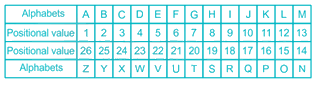 The logic followed here is:
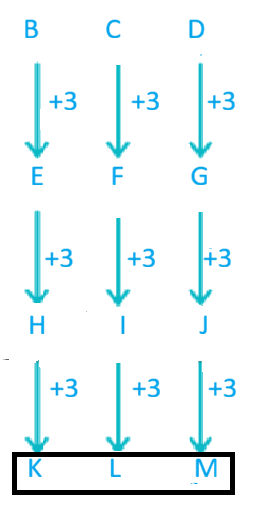 So, 'KLM' will replace the question mark in the given series.
Hence, the correct answer is "Option 1".
Q2 · Series
What comes next?
AZA, BYB, CXC, DWD, ?
- EVE
- FUF
- EUE
- EXE
Answer aur solution dekho
Archived marked answer: A
The logic followed here is:
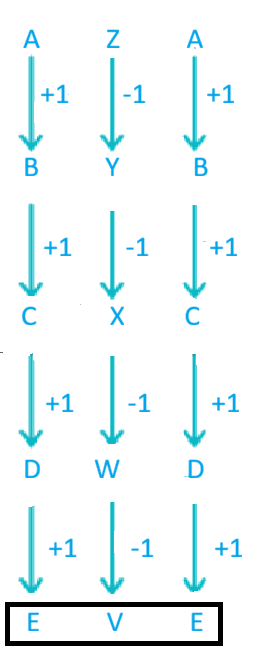 So, 'EVE' will replace the question mark in the given series.
Hence, the correct answer is "Option 1".
Q3 · Series
What will come at the place of question mark
4 9 2
3 5 7
8 1 ?
- 6
- 3
- 5
- 9
Answer aur solution dekho
Archived marked answer: A
The logic followed here is:
Logic: This is a magic square, where the sum of each row, each column, and both diagonals is 15.
Check rows:
Row 1: 4 + 9 + 2 = 15
Row 2: 3 + 5 + 7 = 15
Row 3: 8 + 1 + ? = 15 → 8 + 1 + ? = 15 → ? = 6
thus, "6" will replace the question mark in the given series.
Hence, the correct option is "Option 1".
Q4 · Series
Complete the given pattern : 13, 17, 23, 31, 41, ?
- 47
- 53
- 59
- 61
Answer aur solution dekho
Archived marked answer: B
The logic followed here is:
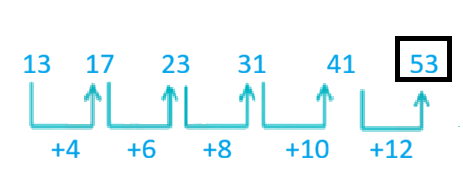 thus, "53" will replace the question mark in the given series.
Hence, the correct option is "Option 2".
Q5 · Series
What should come at the place of question mark? : 3, 6, 18, 108, ?
- 1944
- 648
- 216
- 864
Answer aur solution dekho
Archived marked answer: A
The logic followed here is:
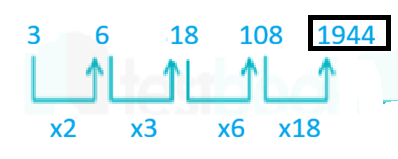 thus, "1944" will replace the question mark in the given series.
Hence, the correct option is "Option 1".
Q6 · Series
The series given below contains a sequence of numbers. Accordingly identify the incorrect combination. 5, 8, 16, 19, 39, 41, 81
- 16, 39
- 16, 41
- 39, 81
- 41, 81
Answer aur solution dekho
Archived marked answer: C
The logic followed here is:
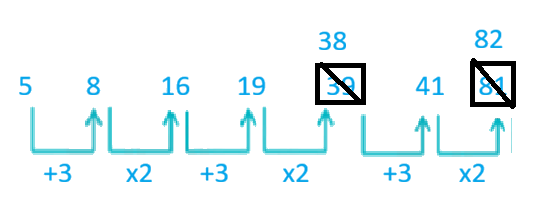 thus, "39, 81" will replace the question mark in the given series.
Hence, the correct option is "Option 3".
Q7 · Analogy
Solve:
STOP : ? :: FLOW : WOLF STOP : ? :: FLOW : WOLF
- POTS
- TPOS
- PSOT
- TSOP
Answer aur solution dekho
Archived marked answer: A
The logic followed here is:
Logic: The first word is reversed to get the second word.
Given: FLOW : WOLF
FLOW reversed → WOLF
Now, apply the same logic to STOP:
STOP reversed → POTS
Hence, the correct answer is "Option 1".
Q8 · Analogy
Find the odd one out from the given alternatives:
- Rainwater Harvesting
- Afforestation
- Deforestation
- Solar Panels
Answer aur solution dekho
Archived marked answer: C
The logic followed here is:
Logic: All options except one are environmental conservation methods, while one is a source of energy technology.
Rainwater Harvesting → Conservation method
Afforestation → Conservation method
Deforestation → Environmental degradation
Solar Panels → Renewable energy technology
Hence, the correct answer is "Option 3".
Q9 · Puzzle Subtypes Not To Miss
If × stands for addition, ÷ stands for subtraction, + stands for multiplication, and - stands for division, then 7 × 3 ÷ 6 - 4 + 2 = ?
- 7
- 9
- 10
- 8
Answer aur solution dekho
Archived marked answer: A
BODMAS Table:
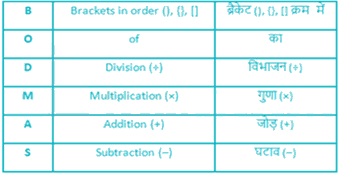 Given equation: 7 × 3 ÷ 6 - 4 + 2 = ?
Now, if
‘×’ stands fo
Q10 · Puzzle Subtypes Not To Miss
If "+" means division, "-" means multiplication, "x" means addition, and "÷" means subtraction, then what is: 24 - 6 + 3 ÷ 2 × 4 = ?
- 14
- 50
- 20
- 12
Answer aur solution dekho
Archived marked answer: B
BODMAS Table:
Given equation: 24 - 6 + 3 ÷ 2 × 4 = ?
Now, if ‘+’ means ‘division’, ‘-’ means ‘multiplication’, ‘x’ means ‘addition’ and ‘÷’ means ‘subtraction’, then:
⇒ 24 × 6 ÷ 3 - 2 + 4 = ?
⇒ 144 ÷ 3 - 2 + 4 = ?
⇒ 48 - 2 + 4 = ?
⇒ 46 + 4 = 50.
Hence, the correct answer is "Option 2". Q11 · Puzzle Subtypes Not To Miss
If 'P' denotes 'addition', 'D' denotes 'subtraction', 'S' denotes 'multiplication', and 'V' denotes 'division', then what will be the value of the following expression?
{20 D (25 D 33)} V {- 5 S 4 D (- 6)} P 56 V (- 27 P 13)
- -6
- 6
- 4
- -4
Answer aur solution dekho
Archived marked answer: A
BODMAS Table:
Given equation: {20 D (25 D 33)} V {- 5 S 4 D (- 6)} P 56 V (- 27 P 13) = ?
Now, if ‘P’ denotes ‘addition’, ‘D’ denotes ‘subtraction’, ‘S’ denotes ‘multiplication’ and ‘V’ denotes ‘division’, then:
⇒ {20 - (25 - 33)} ÷ {- 5 × 4 - (- 6)} + 56 ÷ (- 27 + 13) = ?
⇒ {20 - (-8)} ÷ {-20 + 6} + 56 ÷ (-14) = ?
⇒ {28} ÷ {-14} + (-4) = ?
⇒ -2 + (-4) = -6.
Hence, the correct answer is "Option 1". Q12 · Puzzle Subtypes Not To Miss
If the given symbols mean:
'+' means 'divided by'
'-' means 'multiplied by'
'x' means 'minus'
'÷' means 'plus'
Then, find the value of the following expressions: 12 + 3 - 8 x 2 ÷ 1=?
- 17
- 31
- 46
- 67
Answer aur solution dekho
Archived marked answer: B
BODMAS Table:
Given equation: 12 + 3 - 8 x 2 ÷ 1 = ?
Now, if ‘+’ means ‘divided by’, ‘-’ means ‘multiplied by’, ‘x’ means ‘minus’ and ‘÷’ means ‘plus’, then:
⇒ 12 ÷ 3 × 8 - 2 + 1 = ?
⇒ 4 × 8 - 2 + 1 = ?
⇒ 32 - 2 + 1 = ?
⇒ 30 + 1 = 31.
Hence, the correct answer is "Option 2". Q13 · Puzzle Subtypes Not To Miss
If 'x' means '+', '+' means '-', '-' means '÷', then 8 × 4 + 2 - 2 = ?
- 10
- 8
- 6
- 11
Answer aur solution dekho
Archived marked answer: D
BODMAS Table:
Given equation: 8 × 4 + 2 - 2 = ?
Now, if ‘×’ means ‘+’, ‘+’ means ‘-’ and ‘-’ means ‘÷’, then:
⇒ 8 + 4 - 2 ÷ 2 = ?
⇒ 8 + 4 - 1 = ?
⇒ 12 - 1 = 11.
Hence, the correct answer is "Option 4". Q14 · Puzzle Subtypes Not To Miss
If 'x' = '-', '-' = '+', '/' = 'x', '+' = '÷', which equation is correct?
- 12 × 4 - 2 + 8 / 4 = 11
- 18 - 6 × 3 + 2 / 2 = 13
- 14 + 7 - 3 / 2 × 1 = 16
- 20 - 4 + 8 / 2 × 1 = 20
Answer aur solution dekho
Archived marked answer: D
BODMAS Table:
Now, if ‘×’ = ‘-’, ‘-’ = ‘+’, ‘/’ = ‘×’ and ‘+’ = ‘÷’, then:
Option (1) 12 × 4 - 2 + 8 / 4 = 11
⇒ 12 - 4 + 2 ÷ 8 × 4 = ?
⇒ 12 - 4 + (2 ÷ 8 × 4) = ?
⇒ 12 - 4 + (0.25 × 4) = ?
⇒ 12 - 4 + 1 = ?
⇒ 8 + 1 = 9 ≠ 11
Option (2) 18 - 6 × 3 + 2 / 2 = 13
⇒ 18 + 6 - 3 ÷ 2 × 2 = ?
⇒ 18 + 6 - (3 ÷ 2 × 2) = ?
⇒ 18 + 6 - (1.5 × 2) = ?
⇒ 24 - 3 = 21 ≠ 13
Option (3) 14 + 7 - 3 / 2 × 1 = 16
⇒ 14 ÷ 7 + 3 × 2 - 1 = ?
⇒ 2 + 3 × 2 - 1 = ?
⇒ 2 + 6 - 1 = ?
⇒ 8 - 1 = 7 ≠ 16
Option (4) 20 - 4 + 8 / 2 × 1 = 20
⇒ 20 + 4 ÷ 8 × 2 - 1 = ?
⇒ 20 + (4 ÷ 8 × 2) - 1 = ?
⇒ 20 + (0.5 × 2) - 1 = ?
⇒ 20 + 1 - 1 = 20
⇒ 20 = 20
Hence, the correct answer is "Option 4". Q15 · Puzzle Subtypes Not To Miss
A number is increased by 20% and then decreased by 20%. What is the net change in the number?
- 4% increase
- 4% decrease
- No change
- 1% decrease
Answer aur solution dekho
Archived marked answer: B
Given: Let the original number = 100
According to Question: The number is increased by 20% and then decreased by 20%.
Increase = 20% of 100
20% of 100 = (20 / 100) × 100 = 20
So, new number after increase = 100 + 20 = 120
Decrease = 20% of 120
20% of 120 = (20 / 100) × 120 = 24
So, new number after decrease = 120 − 24 = 96
Net change = 100 − 96 = 4 (decrease)
Hence, the correct answer is Option 2.
Q16 · Coding Decoding
If GANGA is coded as 711471, how will YAMUNA be coded?
- 2511314211
- 2511314214
- 251113421
- 2511321141
Answer aur solution dekho
Archived marked answer: D
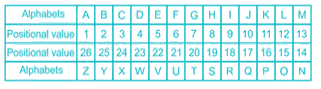 The logic followed here is:
Logic: Each letter is converted to its alphabetical position, and repeated letters are coded twice.
Given,
Q17 · Coding Decoding
If 'RUN' is coded as 'SVO', what is the code for 'JUMP'?
- KVRQ
- KVMO
- KVMQ
- KVNQ
Answer aur solution dekho
Archived marked answer: D
The logic followed here is:
Logic: Each letter is shifted +1 forward in the English alphabet.
Given,
RUN → SVO
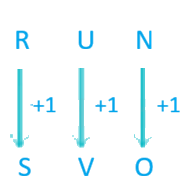 Now, applying the same logic to JUMP:
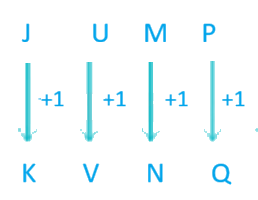 So, JUMP → K V N Q
Hence, the correct answer is "Option 4".
Q18 · Logical Reasoning
Consider the following statement and choose the option that follows.
Problem: Customers report long wait times at branches.
Course of Action:
I. Increase the number of service counters.
II. Encourage use of online and mobile banking.
- Only I follows
- Only II follows
- Both follow
- Neither follows
Answer aur solution dekho
Archived marked answer: C
Given:
Problem:
Customers report long wait times at branches.
Course of Action:
I. Increase the number of service counters - Follows (Because, increasing the number of service counters can directly reduce waiting time by serving more customers simultaneously.)
II. Encourage use of online and mobile banking - Follows (Because, promoting online and mobile banking can reduce the number of customers visiting branches, thereby decreasing wait times.)
So, Both follow.
Hence, the correct answer is "Option 3".
Q19 · Logical Reasoning
Read the following statement carefully and identify the conclusion that follows.
Statement: The new mobile app launched by the municipality helps citizens report garbage or broken infrastructure.
Conclusions:
I. Citizens can contribute to better civic maintenance through the app.
II. The municipality no longer needs field inspectors.
- Only Conclusion I follows
- Only Conclusion II follows
- Both I and II follow
- Neither I nor II follows
Answer aur solution dekho
Archived marked answer: A
Given Statement:
The new mobile app launched by the municipality helps citizens report garbage or broken infrastructure.
Conclusions:
I. Citizens can contribute to better civic maintenance through the app - True (Because, the app allows citizens to report garbage or broken infrastructure, which directly helps in improving civic maintenance.)
II. The municipality no longer needs field inspectors - False (Because, the statement does not mention anything about removing field inspectors. Reporting through an app does not imply inspectors are no longer required.)
So, Only conclusion I follows.
Hence, the correct answer is "Option 1".
Q20 · Logical Reasoning
Consider the following statement and choose the option that follows.
Statement: The bank has introduced a rewards program for debit card users.
Conclusions:
I. More customers will start using debit cards.
II. Credit card usage may decline.
- Only I follows
- Only II follows
- Both follows
- Neither follows
Answer aur solution dekho
Archived marked answer: D
Given Statement:
The bank has introduced a rewards program for debit card users.
Conclusions:
I. More customers will start using debit cards - False (Because, although a rewards program may encourage usage, it is not definitely stated that more customers will start using debit cards. It can be possible only.)
II. Credit card usage may decline - False (Because, no information is given about credit card usage or its impact due to the rewards program. So it can be possible only.)
So, Neither conclusion I nor II follow.
Hence, the correct answer is "Option 4".
Q21 · Logical Reasoning
Read the following statement carefully and identify the conclusion that follows.
Statement: The city traffic department has installed speed bumps on major roads.
Conclusions:
I. Speed bumps help in reducing accidents.
II. Drivers are often overspeeding on major roads.
- Only Conclusion I follows
- Only Conclusion II follows
- Both I and II follow
- Neither I nor II follows
Answer aur solution dekho
Archived marked answer: A
Given Statement:
The city traffic department has installed speed bumps on major roads.
Conclusions:
I. Speed bumps help in reducing accidents - True (Because, speed bumps are generally installed to slow down vehicles and improve road safety, which indicates they help in reducing accidents.)
II. Drivers are often overspeeding on major roads - False (Because, the statement does not mention overspeeding by drivers. Installation of speed bumps does not definitely prove that drivers are often overspeeding. It can be possible only.)
So, Only conclusion I follows.
Hence, the correct answer is "Option 1".
Q22 · Blood Relations
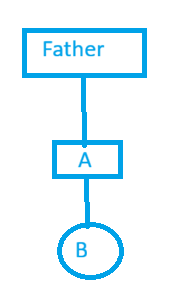
A is the father of B. B is the husband of C. D is the daughter of C. How is A related to D?
- Father
- Grandfather
- Uncle
- Brother
Answer aur solution dekho
Archived marked answer: B
Family Chart:
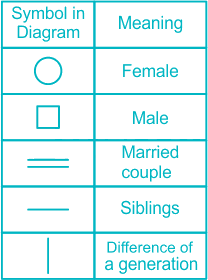 Given:
A is the father of B.
B is the husband of C.
D is the daughter of C.
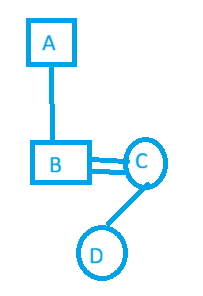 So, A is Grandfather of D.
Hence, the correct answer is "Option 2".
Q23 · Blood Relations
A says to B, "I am the daughter of the only son of your father." How is B related to A?
- Grandfather
- Father
- Uncle
- Brother
Answer aur solution dekho
Archived marked answer: B
Family Chart:
Given:
"Your father" → B’s father.
"The only son of your father" → B’s father’s only son → B himself.
"I am the daughter of B" → A is B’s daughter.
 So, B is A’s father.
Hence, the correct answer is "Option 2".
Q24 · Similarity and Differences
Choose the address that is the same as the one
given below. Bungalow 9, Marine Drive, Mumbai, Maharashtra - 400020
- Bungalow 9, Marine Drive, Mumbai, Maharashtra - 400020
- Bungalow 9, Marine Drive, Mumbai, Maharashtra - 401020
- Bungalow 9, Marine Drive, Mumbai, Maharashtra - 400012
- Bungalow 9, Marine Drive, Mumbai, Maharashtra - 400021
Answer aur solution dekho
Archived marked answer: A
The address given in the problem is,
Bungalow 9, Marine Drive, Mumbai, Maharashtra - 400020
Let's match this address with the given options one by one to figure out which one is exactly the same.
Option
Address in Option
Given Address
Comment
(1)
Bungalow 9, Marine Drive, Mumbai, Maharashtra - 400020
Bungalow 9, Marine Drive, Mumbai, Maharashtra - 400020
The address is exactly the same as the given address.
(2)
Bungalow 9, Marine Drive, Mumbai, Maharashtra - 401020
Bungalow 9, Marine Drive, Mumbai, Maharashtra - 400020
The PIN code is different (401020 instead of 400020).
(3)
Bungalow 9, Marine Drive, Mumbai, Maharashtra - 400012
Bungalow 9, Marine Drive, Mumbai, Maharashtra - 400020
The PIN code is different (400012 instead of 400020).
(4)
Bungalow 9, Marine Drive, Mumbai, Maharashtra - 400021
Bungalow 9, Marine Drive, Mumbai, Maharashtra - 400020
The PIN code is different (400021 instead of 400020).
So, the address that is exactly the same as the given address is in option (1).
Hence, the correct option is "option (1)".
Q25 · Similarity and Differences
Choose the address that is the same as the one given below.
Sample Address:House No. 77, Block C,Janakpuri, New Delhi,Delhi - 110058
- House No. 77, Block-C, Janakpuri, New Delhi, Delhi - 110059
- House No. 77, Block C, Janakpuri, New Delhi, Delhi - 110058
- House 77, Block C, Janakpuri, New Delhi, Delhi - 110057
- House No. 77, Block D, Janakpuri, New Delhi, Delhi - 110056
Answer aur solution dekho
Archived marked answer: B
The address given in the problem is,
House No. 77, Block C, Janakpuri, New Delhi, Delhi - 110058
Let's match this address with the given options one by one to figure out which one is exactly the same.
Option
Address in Option
Given Address
Comment
(1)
House No. 77, Block-C, Janakpuri, New Delhi, Delhi - 110059
House No. 77, Block C, Janakpuri, New Delhi, Delhi - 110058
The block has a hyphen and the PIN code is different (110059 instead of 110058).
(2)
House No. 77, Block C, Janakpuri, New Delhi, Delhi - 110058
House No. 77, Block C, Janakpuri, New Delhi, Delhi - 110058
The address is exactly the same as the given address.
(3)
House 77, Block C, Janakpuri, New Delhi, Delhi - 110057
House No. 77, Block C, Janakpuri, New Delhi, Delhi - 110058
'No.' is missing and the PIN code is different (110057 instead of 110058).
(4)
House No. 77, Block D, Janakpuri, New Delhi, Delhi - 110056
House No. 77, Block C, Janakpuri, New Delhi, Delhi - 110058
The block is different (D instead of C) and the PIN code is different (110056 instead of 110058).
So, the address that is exactly the same as the given address is in option (2).
Hence, the correct option is "option (2)".
General Awareness
Q1 · Art and Culture
Which type of folk song in Haryana is popularly known as 'Ragam', despite having no connection with the classical Raga-Ragint system?
- Seasonal Songs
- Marriage Ritual Songs
- Folk Songs
- Lullabies
Answer aur solution dekho
Archived marked answer: C
The correct answer is Folk Songs.
Key Points
- The term 'Ragam' in Haryana refers specifically to folk songs, which are an integral part of the region's cultural heritage.
- These folk songs are distinct from classical music and do not follow the Raga-Ragint system of Indian classical music.
- Haryanvi folk songs often narrate tales of love, valor, and devotion, reflecting the social and cultural fabric of the region.
- Such songs are performed during festivals, celebrations, and other communal gatherings, emphasizing their role in fostering community bonding.
- Examples of popular Haryanvi folk songs include 'Phag', 'Ragini', and 'Chaupai', which are performed in various traditional contexts and are unique to Haryana.
Additional Information
- Seasonal Songs
- Seasonal songs are folk songs that are linked to specific seasons or agricultural activities.
- They are sung to celebrate the changing seasons, harvests, or festivals like Basant and Teej in Haryana.
- These songs often convey themes of gratitude to nature and a celebration of life associated with the seasons.
- Marriage Ritual Songs
- Marriage ritual songs in Haryana are an important part of wedding ceremonies and are sung to mark different stages of the rituals.
- Examples include songs sung during 'Haldi', 'Mehndi', and 'Bidaai' ceremonies.
- These songs often express emotions of joy, humor, and sadness associated with weddings and are an essential part of the cultural tradition.
- Lullabies
- Lullabies are soft and melodious songs sung to soothe and put infants to sleep.
- In Haryana, lullabies often carry messages of love, blessings, and hopes for the child's future.
- These songs are generally passed down orally from generation to generation and are a cherished part of the region's musical heritage.
``
Q2 · Art and Culture
Fill in the Blank:
Tamasha is a folk theatre form mainly found in ______.
- Kerala
- Karnataka
- Maharashtra
- Odisha
Answer aur solution dekho
Archived marked answer: C
The correct answer is Maharashtra.
Key Points
- Tamasha is a traditional folk theatre form that originated in Maharashtra.
- The term "Tamasha" translates to "entertainment" or "show" in Marathi, symbolizing its theatrical and musical appeal.
- It is known for its lively and spontaneous performances, which include singing, dancing, and acting.
- Tamasha performances often revolve around social themes, moral stories, and satirical narratives presented in a humorous and engaging way.
- The Lavani dance form, a popular element of Tamasha, is characterized by its rhythmic beats and expressive gestures.
- Historically, Tamasha evolved during the 16th century under the patronage of Maratha rulers, blending elements of folk traditions and classical art forms.
Additional Information
- Kerala:
- Kerala is renowned for its classical art forms like Kathakali and Mohiniyattam.
- Kathakali is a dance-drama tradition known for its elaborate costumes, facial expressions, and storytelling based on Indian epics.
- Mohiniyattam is a graceful dance form performed by women, emphasizing soft movements and expressions.
- Folk art forms from Kerala include Theyyam and Thullal, representing ancient rituals and narratives.
- Karnataka:
- Karnataka is home to Yakshagana, a traditional dance-drama that combines music, dialogue, and elaborate costumes.
- Yakshagana performances often narrate stories from mythology and folklore, accompanied by dynamic drum beats.
- The state also hosts Dollu Kunitha, a folk dance performed by men with large drums, showcasing high-energy movements.
- Odisha:
- Odisha is known for its classical dance form Odissi, which is one of the eight recognized classical dances of India.
- Odissi emphasizes intricate footwork, hand gestures, and expressions based on devotional themes.
- The state also boasts folk traditions like Chhau dance, which uses masks and martial movements to narrate stories.
- Main Theme:
- Folk theatre forms like Tamasha are crucial in preserving the cultural heritage of India and reflecting the traditions, lifestyles, and social narratives of specific regions.
- These art forms serve as a medium of entertainment and education, often addressing societal issues through satire and humor.
Q3 · Art and Culture
Which of the following statements correctly describes a unique feature of the Dumhal dance of Kashmir?
- It is performed by women during harvest festivals.
- It is accompanied solely by string instruments and solo singing.
- Only Wattal men perform it around a banner planted into the ground.
- It allows spontaneous performance by any community on any occasion.
Answer aur solution dekho
Archived marked answer: C
The correct answer is Only Wattal men perform it around a banner planted into the ground.
Key Points
- Dumhal is a traditional folk dance of Jammu and Kashmir, performed exclusively by the Wattal community men.
- The performance begins with the participants planting a banner or flag into the ground, which is a unique feature of this dance form.
- The dancers wear long, colorf
Q4 · Art and Culture
Fill in the blank:
The sacred masked dances performed by monks at Hemis represent various _____ of the Drugpa lineage.
- reincarnated lamas
- ancient kings
- guardian divinities
- ancestral spirits
Answer aur solution dekho
Archived marked answer: C
The correct answer is guardian divinities.
Key Points
- The sacred masked dances performed at the Hemis Monastery are known as Cham dances and are integral to the Buddhist festivals celebrated in Ladakh.
- These dances symbolize various guardian divinities of the Drugpa lineage, who are believed to protect the Buddhist teachings and practitioners.
- The guardian divinities are often depicted in elaborate masks and costumes, showcasing their wrathful and protective nature in Buddhist iconography.
- These performances are deeply spiritual and are conducted as a form of meditation and ritual to ward off negative energies and invoke blessings.
- The Hemis Festival, celebrated annually at the Hemis Monastery, is dedicated to Lord Padmasambhava, a major figure in Tibetan Buddhism, and features these sacred dances.
Additional Information
- Reincarnated Lamas
- Reincarnated lamas, also known as tulkus, are spiritual leaders believed to be the rebirths of enlightened beings or teachers in Tibetan Buddhism.
- These individuals play a pivotal role in guiding and preserving Buddhist teachings, but they are not directly related to the Cham dances at Hemis.
- Examples include the Dalai Lama and Panchen Lama, who are significant figures in Tibetan Buddhism.
- Ancient Kings
- Ancient kings, while often revered in cultural and historical contexts, are not the focus of the sacred dances performed at Hemis.
- The dances are more centered around spiritual themes like divinities, protection, and enlightenment rather than historical figures.
- However, Tibetan and Ladakhi history do include stories of kings who supported Buddhism, such as King Songtsen Gampo of Tibet.
- Ancestral Spirits
- Ancestral spirits are often venerated in various cultures and religions, including shamanistic practices, but they do not play a role in the Cham dances at Hemis.
- Buddhist rituals at Hemis focus on deities and divinities rather than ancestral spirits.
- The concept of spirits in Buddhism is more aligned with karmic cycles and the realms of existence rather than familial ancestors.
- Main Theme: Drugpa Lineage and Cham Dance
- The Drugpa lineage is one of the major schools of Tibetan Buddhism, known for its emphasis on tantric practices and meditation.
- The Cham dances are a significant part of Buddhist rituals, representing stories and teachings through symbolic movements and masks.
- These dances are performed to honor protector deities, ensure the spiritual welfare of the community, and celebrate the teachings of Buddhism.
</ul
Q5 · Art and Culture
Read the following statements and choose the correct option:
Statement 1: The amalaka sits atop the shikhara in Nagara-style temples.
Statement 2: In Drāviḍa-style temples, the vimana refers to the gateway tower (gopuram).
- Both Statement 1 and Statement 2 are correct
- Both Statement 1 and Statement 2 are incorrect
- Statement 1 is correct, but Statement 2 is incorrect
- Statement 1 is incorrect, but Statement 2 is correct
Answer aur solution dekho
Archived marked answer: C
The correct answer is Statement 1 is correct, but Statement 2 is incorrect.
Key Points
- Statement 1: The amalaka is a distinctive, circular, ribbed stone disk that sits atop the shikhara (tower) of Nagara-style temples. This is a defining feature of the Nagara temple architecture.
- The amalaka symbolizes the celestial world and serves as a crowning feature of the shikhara, emphasizing verticality and spiritual connection.
- Statement 2: In Drāviḍa-style temples, the vimana refers to the tower or superstructure directly above the sanctum (garbhagriha), not the gateway tower (gopuram). The gopuram refers to the ornate gateway towers found predominantly in Drāviḍa temples.
- The confusion arises because both the vimana and gopuram are tall structures, but their functions and locations within the temple complex differ.
- Therefore, Statement 1 is correct, while Statement 2 is incorrect.
Additional Information
- Nagara Style of Temple Architecture:
- The Nagara style is primarily found in northern India and is characterized by its curvilinear shikhara (tower).
- The amalaka and kalasha are prominent features atop the shikhara.
- The temples have a square base and are often built on a raised platform called a jagati.
- Examples include the Kandariya Mahadev Temple in Khajuraho and the Sun Temple in Konark.
- Drāviḍa Style of Temple Architecture:
- The Drāviḍa style is predominant in southern India and is known for its pyramidal vimanas above the sanctum.
- The gopurams, or gateway towers, are a unique feature of this style and are often more prominent than the vimana itself.
- The temples are enclosed within walls, with multiple gopurams marking the entrances.
- Examples include the Brihadeeswarar Temple in Thanjavur and the Meenakshi Temple in Madurai.
- Key Differences Between Nagara and Drāviḍa Styles:
- The Nagara style emphasizes verticality with curvilinear shikharas, while the Drāviḍa style has tiered and pyramidal vimanas.
- Gopurams are a hallmark of the Drāviḍa style, but they are absent in the Nagara style.
- The Nagara temples are relatively smaller and lack boundary walls, unlike the enclosed complexes of Drāviḍa temples.
- Additional Terminologies:
- Shikhara: The tower or spire above the sanctum in Nagara-style temples.
- Amalaka: The circular, ribbed stone disk atop the shikhara, symbolizing the divine.
- Vimana: The pyramidal structure above the sanctum in Drāviḍa-style temples.
- Gopuram: Ornate gateway towers, typically found in Drāviḍa temple complexes.
- Garbhagriha: The innermost sanctum of a temple where the deity resides.
Q6 · Indian Polity and Constitution
Which Article of the Constitution confers the right to constitutional remedies, and how is it linked to Fundamental Rights?
- Article 32; it is called the "heart and soul" of the Constitution
- Article 226; it is a protective mechanism for Directive Principles
- Article 21; it deals with personal liberty only
- Article 14; it ensures equality before law
Answer aur solution dekho
Archived marked answer: A
The correct answer is Article 32; it is called the "heart and soul" of the Constitution.
Key Points
- Article 32 of the Indian Constitution provides the right to constitutional remedies, empowering individuals to move the Supreme Court directly for the enforcement of Fundamental Rights.
- It is referred to as the "heart and soul" of the Constitution by Dr. B.R. Ambedkar, as it ensures the protection and enforcement of Fundamental Rights.
- This article gives the Supreme Court the authority to issue writs like habeas corpus, mandamus, prohibition, quo warranto, and certiorari for the enforcement of rights.
- Article 32 guarantees the right to approach the highest court in case of a violation, making it a cornerstone of the Indian judiciary's role in safeguarding the Constitution.
- It is a fundamental part of the framework to ensure that citizens' rights are protected and upheld against arbitrary actions by the state.
Additional Information
- Article 226
- Article 226 empowers the High Courts to issue writs to enforce Fundamental Rights and for other purposes.
- It has a wider jurisdiction compared to Article 32, as it allows High Courts to address matters beyond Fundamental Rights, including statutory and legal rights.
- While Article 32 is limited to the Supreme Court, Article 226 provides individuals with an additional route to seek redressal at the state level.
- Article 21
- Article 21 guarantees the protection of life and personal liberty, stating that no person shall be deprived of these except according to a procedure established by law.
- It is one of the most expansive and interpreted articles, covering rights like the right to privacy, the right to live with dignity, and the right to a clean environment.
- However, it focuses specifically on personal liberty and life, not on constitutional remedies.
- Article 14
- Article 14 ensures equality before the law and equal protection of the laws within the territory of India.
- It prohibits discrimination by the state and upholds the principles of fairness and equal treatment in governance.
- While it is a critical Fundamental Right, it does not directly deal with remedies for the violation of rights.
Q7 · Indian Polity and Constitution
Consider the following statements regarding the South Asian Federation (SAF) Games and identify which are correct:
1) The first edition was held in Kathmandu, Nepal, in 1984 with participation from all seven SAARC nations.
2) India has hosted the SAF Games more times than any other country up to 2016.
- Both 1 and 2 are correct
- Only 1 is correct
- Only 2 is correct
- Neither 1 nor 2 are correct
Answer aur solution dekho
Archived marked answer: A
The correct answer is Both 1 and 2 are correct.
Key Points
- Statement 1 is correct. The first South Asian Federation (SAF) Games were held in Kathmandu, Nepal, in 1984.
- Seven South Asian nations participated: India, Pakistan, Bangladesh, Nepal, Sri Lanka, Bhutan, and Maldives.
- Statement 2 is correct. Up to 2016, India had hosted the SAF / South Asian Games more times than any other country.
- India hosted the Games in 1987 (Kolkata), 1995 (Chennai), and 2016 (Guwahati & Shillong).
- Hence, both statements are correct.
Additional Information
- SAF Games were later renamed as the South Asian Games.
- The event promotes sportsmanship and regional cooperation among South Asian countries.
- Afghanistan joined later after becoming a member of SAARC.
- India has also won the highest number of medals in most editions.
Important Points
- First SAF Games = Kathmandu, 1984.
- India hosted most times up to 2016 = 3 times.
- New name: South Asian Games.
- Important for exams: linked with SAARC countries.
Q8 · Indian Polity and Constitution
Consider the following statements about the Rajya Sabha and choose the correct option:
1) Rajya Sabha is a continuing house of the Parliament, immune to dissolution under any circumstance.
2) Rajya Sabha members serve staggered six-year terms, with one-third retiring every two years.
- Only 1
- Only 2
- Both 1 and 2
- Neither 1 nor 2
Answer aur solution dekho
Archived marked answer: C
The correct answer is Both 1 and 2.
Key Points
- Statement 1: Rajya Sabha is a continuing house, meaning it is not subject to dissolution like the Lok Sabha. Instead, it remains in perpetual operation with staggered membership changes.
- Statement 2: Members of the Rajya Sabha serve staggered six-year terms, with one-third of its members retiring every two years, ensuring continuity.
- Article 83 of the Indian Constitution provides for the duration of the Rajya Sabha and ensures that the house is not dissolved but continues to exist with biennial elections for retiring members.
- The Rajya Sabha represents the states and union territories in the Indian Parliament and ensures federal character in the legislative process.
- The staggered retirement process allows for the continuous functioning of the Rajya Sabha, even during times of political instability.
Additional Information
- Option 1: Only Statement 1
- If only Statement 1 were true, it would imply that Rajya Sabha is a continuing house, but without the mechanism of staggered retirement, it would lack the structural provisions for continuity.
- The concept of a "continuing house" is specifically tied to the staggered retirement process, highlighting the importance of both statements.
- Option 2: Only Statement 2
- If only Statement 2 were correct, it would indicate that members serve staggered six-year terms, but without the underlying principle of a "continuing house," the significance of staggered retirements would be diminished.
- Both statements together provide a complete understanding of the Rajya Sabha’s structure and functioning.
- Option 3: Both 1 and 2 (Correct Answer)
- Both statements are accurate and complementary.
- The Rajya Sabha's design ensures continuity through staggered retirements and its status as a "continuing house" prevents dissolution.
- Option 4: Neither 1 nor 2
- This option is incorrect as both statements are essential to understanding the nature of the Rajya Sabha.
- The Rajya Sabha’s unique features are integral to India’s federal and parliamentary system.
- Key Features of the Rajya Sabha:
- The Rajya Sabha is the upper house of the Indian Parliament and represents the states and union territories.
- It plays a crucial role in the legislative process and serves as a check on the Lok Sabha.
- It cannot be dissolved, ensuring stability and continuity in the parliamentary system.
- Members are elected by the legislative assemblies of the states and union territories using a proportional representation system.
```
7a:T
Q9 · Indian Economy
Which curve shows all combinations of two goods that give a consumer equal satisfaction?
- Indifference curve
- Budget constraint
- Isoquant curve
- Marginal cost curve
Answer aur solution dekho
Archived marked answer: A
The correct answer is Indifference Curve.
Key Points
- An Indifference Curve represents all combinations of two goods that provide the same level of satisfaction or utility to a consumer.
- It is a graphical representation used in microeconomics to analyze consumer preferences and choice.
- Each point on the curve indicates that the consumer is indifferent between the combinations of goods, meaning they derive equal utility from them.
- Indifference curves are typically downward sloping, reflecting the trade-offs between goods, and they do not intersect.
- The slope of the indifference curve, known as the Marginal Rate of Substitution (MRS), measures the rate at which a consumer is willing to give up one good for another while maintaining the same utility level.
Additional Information
- Budget Constraint:
- A budget constraint represents the combinations of goods and services a consumer can purchase given their income and the prices of the goods.
- It is a straight line that shows the trade-off between two goods, limited by the consumer's financial resources.
- The slope of the budget constraint is determined by the ratio of the prices of the two goods.
- While the budget constraint determines what is affordable, it does not indicate preferences or satisfaction like an indifference curve does.
- Isoquant Curve:
- An isoquant curve represents all combinations of inputs (e.g., labor and capital) that produce the same level of output.
- It is used in production theory to analyze input combinations and efficiency, not consumer preferences.
- Like indifference curves, isoquants are downward sloping, but they are specific to production rather than utility.
- The slope of an isoquant curve reflects the Marginal Rate of Technical Substitution (MRTS), which measures the rate at which one input can be substituted for another while maintaining the same output level.
- Marginal Cost Curve:
- The marginal cost curve shows the additional cost incurred for producing one more unit of a good or service.
- It is a key concept in production and cost analysis, helping firms determine optimal production levels.
- Unlike indifference curves, it does not deal with consumer satisfaction but focuses on cost dynamics and efficiency in production.
- The marginal cost curve typically intersects with the average cost curve at its minimum point.
- Main Theme - Consumer Choice Theory:
- The indifference curve is a fundamental concept in consumer choice theory, which analyzes how consumers make decisions to maximize their satisfaction given constraints such as income and prices.
- It helps in understanding the trade-offs consumers face and the relationship between preferences, affordability, and utility.
Q10 · Indian Economy
Read the below statements marked as Assertion (A) and Reason (R).
Assertion (A): Pakistan's move from a 'Positive List' to a 'Negative List' of 1209 tariff lines for Indian goods under SAFTA was challenged by India as a violation of the agreement.
Reason (R): Article 23 of the SAFTA Agreement permits member countries to make unilateral tariff reservations in case of political disagreement.
- Both A and R are true, and R is the correct explanation of A.
- Both A and R are true, but R is not the correct explanation of A.
- A is true, but R is false.
- A is false, but R is true.
Answer aur solution dekho
Archived marked answer: C
The correct answer is A is true, but R is false.
Key Points
- Assertion (A): Pakistan's decision to shift from a 'Positive List' to a 'Negative List' of 1209 tariff lines for Indian goods under the South Asian Free Trade Area (SAFTA) was indeed challenged by India as it was considered a violation of the SAFTA agreement.
- Under SAFTA, member nations are required to reduce or eliminate trade barriers to facilitate free trade across the region. Restricting specific tariff lines through a 'Negative List' can be interpreted as contrary to the core objectives of SAFTA.
- Pakistan’s move created trade barriers for India by limiting the number of goods eligible for reduced tariffs, which undermined the agreement’s purpose of free trade promotion within South Asia.
- Reason (R): Article 23 of the SAFTA Agreement does not explicitly permit member countries to make unilateral tariff reservations based on political disagreements. Instead, the article addresses dispute resolution mechanisms to resolve trade-related issues between member countries.
- Thus, the reason provided is incorrect, and the assertion is true, making option 3 the correct answer.
Additional Information
- Option 1: Both A and R are true, and R is the correct explanation of A
- This is incorrect because while the assertion is true, the reason is false. Article 23 of the SAFTA Agreement does not allow unilateral tariff reservations but instead outlines the process for resolving disputes through consultation and negotiation.
- The SAFTA Agreement emphasizes reducing tariff and non-tariff barriers to promote free trade among member countries, which Pakistan’s action contradicted.
- Option 2: Both A and R are true, but R is not the correct explanation of A
- This is incorrect because the reason (R) is not true. Article 23 does not permit unilateral tariff reservations, making this option invalid.
- Option 4: A is false, but R is true
- This is incorrect because the assertion (A) is true. Pakistan’s shift to a 'Negative List' was a clear violation of the SAFTA Agreement.
- The reason (R), however, is false because Article 23 does not grant the right to impose unilateral trade restrictions.
- SAFTA Agreement Overview:
- The South Asian Free Trade Area (SAFTA) is an agreement among SAARC nations aimed at reducing tariffs and promoting trade within the region.
- It was signed on 6 January 2004 in Islamabad and came into effect on 1 January 2006.
- The agreement envisions the elimination of all customs duties on trade by 2016, but political tensions and unilateral actions have often hindered its full implementation.
- Key principles of SAFTA include transparency, trade liberalization, and fostering regional integration.
```
72:T1d
Q11 · Indian Economy
Fill in the blanks:
The Chairperson of the GST Council is the ______ of India.
- Prime Minister
- Union Finance Minister
- President
- Vice-President
Answer aur solution dekho
Archived marked answer: B
The correct answer is Union Finance Minister.
Key Points
- The GST Council is a constitutional body established under Article 279A of the Constitution of India to make recommendations on GST-related issues.
- The Chairperson of the GST Council is the Union Finance Minister of India as per the provisions outlined in Article 279A.
- The GST Council consists of the Union Finance Minister as the Chairperson, the Union Minister of State for Finance, and finance ministers from all states and union territories.
- The Council is tasked with making decisions on tax rates, exemptions, thresholds, and other GST-related matters, ensuring uniformity and cooperation across states.
- All decisions in the GST Council are taken by a majority of not less than three-fourths of the weighted votes of members present, with the central government having one-third of the votes and state governments having two-thirds.
Additional Information
- Prime Minister:
- The Prime Minister is the head of the government and leads the executive branch of India.
- While the Prime Minister plays a significant role in policymaking, they do not chair the GST Council.
- The Prime Minister may influence GST-related matters indirectly through overall policy direction and coordination with the Union Finance Minister.
- President:
- The President of India is the ceremonial head of the state and acts on the advice of the Council of Ministers.
- Although the President appoints the Union Finance Minister, they do not have a direct role in the functioning of the GST Council.
- Vice-President:
- The Vice-President of India primarily serves as the Chairperson of the Rajya Sabha (Upper House of Parliament).
- They do not hold any constitutional role in the GST Council or its decision-making processes.
- GST Council:
- The Goods and Services Tax (GST) Council is a pivotal body for ensuring uniform tax policies across India.
- Its establishment was crucial for the implementation of the GST, which subsumed several indirect taxes into one unified tax system.
- The Council ensures cooperative federalism by involving both central and state governments in tax-related decisions.
Q12 · Indian Economy
Which is NOT part of the Washington Consensus?
- Trade liberalisation
- Fiscal discipline
- Export subsidies
- Tax reform
Answer aur solution dekho
Archived marked answer: C
The correct answer is Export subsidies.
Key Points
- The Washington Consensus does not include export subsidies as one of its policy recommendations.
- Export subsidies are considered distortive to market dynamics and contrary to the principles of free-market economics promoted by the Washington Consensus.
- The Washington Consensus advocates for policies that encourage trade liberalization and removal of barriers, rather than artificially supporting exports.
- Export subsidies involve direct financial support from governments to domestic industries to make their goods competitive in the global market, which can lead to trade disputes and inefficiency.
- International organizations like the World Trade Organization (WTO) discourage the use of export subsidies as they violate fair trade practices.
Additional Information
- Trade liberalisation
- Trade liberalization refers to reducing barriers to trade, such as tariffs, quotas, and regulations, to promote free trade among nations.
- It is a key component of the Washington Consensus aimed at improving economic efficiency and integrating economies into the global market.
- Trade liberalization is believed to spur economic growth by increasing access to goods, services, and technology.
- Fiscal discipline
- Fiscal discipline involves maintaining a sustainable level of government spending and ensuring that deficits and debt levels remain manageable.
- The Washington Consensus emphasizes fiscal discipline as a critical measure to achieve macroeconomic stability.
- It prevents excessive borrowing, reduces inflationary pressures, and builds investor confidence in the economy.
- Tax reform
- Tax reform under the Washington Consensus aims to simplify the tax system, broaden the tax base, and ensure equity and efficiency in tax collection.
- It typically includes measures like reducing high marginal tax rates, eliminating exemptions, and improving compliance mechanisms.
- Tax reform contributes to fiscal stability and promotes economic growth by reducing distortions in market behavior.
- Washington Consensus: Main Theme
- The Washington Consensus is a set of 10 economic policy recommendations proposed by economist John Williamson in 1989.
- It was designed to address economic crises and promote growth in developing countries, especially in Latin America.
- The consensus advocates for free-market principles, open trade policies, privatization, and macroeconomic stability.
- While influential, the Washington Consensus has been criticized for its one-size-fits-all approach and the socioeconomic challenges it posed for some nations.
Q13 · Indian Economy
Which plan introduced Minimum Needs Programme?
- Third
- Fourth
- Fifth
- Sixth
Answer aur solution dekho
Archived marked answer: C
The correct answer is Fifth.
Key Points
- The Minimum Needs Programme (MNP) was introduced during India’s Fifth Five-Year Plan (1969-1974).
- The MNP aimed to improve the living standards of the poor by meeting their basic needs, including health, education, drinking water, rural roads, housing, and nutrition.
- It was considered a crucial step towards reducing regional disparities and fostering economic and social equity in India.
- The program targeted rural and underprivileged areas, emphasizing the creation of infrastructure and provision of basic services.
- The MNP became a core component of national planning and was implemented in subsequent Five-Year Plans as well.
Additional Information
- Third Five-Year Plan (1961-1966):
- The focus of the Third Plan was on self-reliance and economic stability.
- It prioritized agriculture and aimed to achieve a target of 5% growth in national income.
- However, the plan faced challenges due to the Sino-Indian War (1962), droughts, and economic instability, which led to its underperformance.
- Fifth Five-Year Plan (1974-1979):
- The Fifth Plan emphasized poverty alleviation (Garibi Hatao) and self-reliance in the Indian economy.
- The plan introduced major initiatives like the Integrated Rural Development Programme (IRDP).
- It also focused on increasing employment opportunities and enhancing agricultural productivity.
- Sixth Five-Year Plan (1980-1985):
- This plan marked the beginning of economic liberalization in India.
- It focused on poverty eradication, technological development, and modernization of industries.
- Programs like the National Rural Employment Programme (NREP) were introduced during this period.
- Minimum Needs Programme (MNP):
- The MNP was a significant initiative to address basic needs such as education, healthcare, and infrastructure, particularly in rural areas.
- Its goal was to ensure equitable distribution of resources and balanced regional development.
- Over time, the program evolved and merged with other schemes to enhance its reach and effectiveness.
Q14 · Indian Economy
Read the following statements carefully and choose the correct option regarding Assertion (A) and Reason (R).
Assertion (A): The New Economic Policy of 1991 resulted in the abolition of industrial licensing for most industries.
Reason (R): Licensing was re-imposed to regulate growing private sector monopolies.
- Both A and R are true and R is the correct explanation of A.
- Both A and R are true but R is not the correct explanation of A.
- A is true but R is false.
- A is false but R is true.
Answer aur solution dekho
Archived marked answer: C
The correct answer is A is true but R is false.
Key Points
- The New Economic Policy (NEP) of 1991 introduced significant reforms aimed at liberalizing the Indian economy.
- One of the major outcomes of the NEP was the abolition of industrial licensing for most industries, except for a few sectors such as defense, hazardous chemicals, and alcohol.
- The primary goal of abolishing licensing was to promote competition, attract private investment, and boost industrial growth by reducing bureaucratic hurdles.
- The Reaso
Q15 · Sports Static GK
Which Indian para-athlete became the first para archer to receive the Padma Shri after winning a historic gold medal at the 2024 Paris Paralympics?
- Rakesh Kumar
- Harvinder Singh
- Mariyappan Thangavelu
- Sumit Antil
Answer aur solution dekho
Archived marked answer: B
The correct answer is Harvinder Singh.
Key Points
- Harvinder Singh is an Indian para archer who made history by winning a gold medal at the 2024 Paris Paralympics in the men’s individual recurve event.
- He became the first para archer in India to receive the prestigious Padma Shri award for his outstanding achievements in sports.
- Harvinder Singh has also previously won a bronze medal at the Tokyo 2020 Paralympics, marking India’s first-ever Paralympic medal in archery.
- He hails from the state of Punjab and has overcome physical challenges to establish himself as a trailblazer in para archery.
- His dedication and success have inspired countless individuals with disabilities to pursue sports and achieve their dreams.
Additional Information
- Rakesh Kumar:
- Rakesh Kumar is an Indian para archer who has represented India in international competitions, including the Tokyo 2020 Paralympics.
- He competed in the men’s compound archery category but did not win a medal at the Tokyo Paralympics.
- Kumar is known for his remarkable consistency in the sport, often ranking high in international para archery events.
- Mariyappan Thangavelu:
- Mariyappan Thangavelu is an Indian para-athlete specializing in high jump.
- He won a gold medal in the men’s T-42 high jump at the Rio 2016 Paralympics and a silver medal at the Tokyo 2020 Paralympics.
- Thangavelu is a recipient of the Padma Shri and the Khel Ratna awards for his contributions to sports.
- Sumit Antil:
- Sumit Antil is an Indian para-athlete who competes in javelin throw and won a historic gold medal at the Tokyo 2020 Paralympics.
- He set a world record in the men’s F64 javelin throw category during the Tokyo Paralympics, demonstrating exceptional skill and athleticism.
- Sumit has been honored with the Padma Shri for his outstanding achievements in para-athletics.
- Theme Explanation - Para Sports in India:
- Para sports in India have seen tremendous growth over the years, with athletes achieving significant milestones at global events like the Paralympics.
- The government has introduced various initiatives and schemes, such as the Target Olympic Podium Scheme (TOPS), to support para-athletes financially and provide world-class training facilities.
- Indian para-athletes, including Harvinder Singh, Mariyappan Thangavelu, and Sumit Antil, have brought international recognition to the country through their exceptional performances.
```
74:T1b5a
Q16 · Sports Static GK
What is the standard length of the zone where runners exchange the baton in a relay race?
- 10 meters
- 15 meters
- 20 meters
- 30 meters
Answer aur solution dekho
Archived marked answer: C
The correct answer is 20 meters.
Key Points
- In a relay race, the baton exchange zone is a standardized area where runners must pass the baton to ensure a smooth and efficient transition.
- The standard length of the baton exchange zone is 20 meters, as per regulations established by the International Association of Athletics Federations (IAAF).
- The exchange zone starts 10 meters before and ends 10 meters after the designated start point of the next runner's leg in the relay.
- The proper exchange of the baton within this 20-meter zone is critical; any exchange outside the zone results in disqualification.
- The rules are designed to ensure fairness and maintain the integrity of the competition, as well as to avoid accidents during the exchange process.
Additional Information
- 10 meters:
- 10 meters is the length of the "acceleration zone" provided to the incoming runner before they enter the baton exchange zone.
- It is a preparatory area in which the next runner can build momentum before receiving the baton.
- However, the baton must still be passed within the 20-meter exchange zone, not the acceleration zone.
- 15 meters:
- There is no official rule in athletics that specifies a 15-meter exchange zone.
- This option is incorrect and does not align with IAAF regulations for relay races.
- 30 meters:
- 30 meters is not associated with the baton exchange zone in relay races.
- This length is much longer than the standardized exchange zone, which is strictly set at 20 meters.
- Allowing a 30-meter exchange zone would disrupt the uniformity and timing required in professional relay events.
- Main Theme:
- The baton exchange zone is a crucial component of relay races, ensuring an even playing field and smooth transitions between runners.
- Proper adherence to the 20-meter exchange zone rule is essential for teams to avoid disqualification and maintain competitive performance.
- Relay races, particularly the 4x100m and 4x400m events, are some of the most thrilling athletic competitions, requiring speed, precision, and teamwork.
``
Q17 · Sports Static GK
Consider the statements about pawn promotion in chess:
1) A pawn can promote to any piece except king or pawn on reaching the other side.
2) Pawns can only promote to previously captured pieces. Which of the statements is/are correct?
- Only 1 is Correct
- Only 2 is Correct
- 1 and 2 are Correct
- Neither 1 nor 2 are Correct
Answer aur solution dekho
Archived marked answer: A
The correct answer is Option 1.
Key Points
- Pawn promotion in chess allows a pawn to be exchanged for any piece except the king or another pawn when it reaches the eighth rank.
- The promoted piece can be a queen, rook, bishop, or knight, based on the player's strategic choice.
- Most players choose to promote to a queen due to its powerful capabilities, making it the most common promotion.
- Pawn promotion is a rule that applies universally to all chess games and is not limited by previously captured pieces.
- This rule is designed to increase the dynamics and possibilities in the endgame phase of chess.
Additional Information
- Option 2: The statement that pawns can only promote to previously captured pieces is incorrect.
- Pawn promotion is not restricted by the availability of captured pieces in chess.
- Even if no pieces have been captured, the pawn can still promote to any eligible piece (queen, rook, bishop, or knight).
- This misconception may arise from older variants of the game or misunderstandings of modern chess rules.
- Option 3: The statement that both 1 and 2 are correct is incorrect.
- While Statement 1 is correct, Statement 2 is false, making this option invalid.
- Option 4: The statement that neither 1 nor 2 are correct is incorrect.
- Statement 1 is accurate, meaning this option cannot be correct as it denies the validity of Statement 1.
- Pawn Promotion in Chess:
- Pawn promotion occurs when a pawn reaches the opposite end of the chessboard (the eighth rank for white pawns and the first rank for black pawns).
- The choice of promoted piece can significantly alter the game's dynamics, often shifting the balance of power.
- Promoting to a queen is the most common choice, but players may choose other pieces like knights to create specific tactical opportunities.
- Pawn promotion is a critical strategic element in chess and is often a decisive factor in endgame play.
Q18 · Modern Indian History
How did Pitt's India Act contribute to unifying British administration in India?
- By allowing Governors to act independently.
- By dissolving the Court of Directors.
- By giving the Governor General supreme authority over Presidencies.
- By merging civil and military departments.
Answer aur solution dekho
Archived marked answer: C
The correct answer is By giving the Governor General supreme authority over Presidencies.
Key Points
- Pitt's India Act of 1784 was introduced to rectify the shortcomings of the Regulating Act of 1773 and to enhance British control over its Indian territories.
- The Act created a dual administration system, where the commercial activities of the East India Company were separated from political and administrative functions.
- The Governor-General of Bengal was given supreme authority over the presidencies of Madras and Bombay, centralizing power to unify British administration in India.
- The Act established the Board of Control in Britain, which worked alongside the Court of Directors to oversee political matters, further ensuring streamlined governance.
- This centralization of power under the Governor-General contributed significantly to a more cohesive and effective colonial administration system in India.
Additional Information
- Option 1: By allowing Governors to act independently
- This option is incorrect because Pitt's India Act aimed to reduce the autonomy of provincial governors and presidencies like Bombay and Madras by placing them under the control of the Governor-General of Bengal.
- The Act sought to centralize authority to avoid conflicts between presidencies and ensure uniformity in governance.
- Option 2: By dissolving the Court of Directors
- This option is incorrect as the Court of Directors was not dissolved under Pitt's India Act.
- Instead, the Act created the Board of Control, which worked alongside the Court of Directors to oversee both political and commercial activities, ensuring a balance of power.
- Option 4: By merging civil and military departments
- This option is incorrect as Pitt's India Act did not merge civil and military departments.
- While the Act did give the Governor-General greater control over political and military affairs, it did not explicitly reorganize or merge these departments.
- Theme of the Question: Pitt's India Act of 1784
- The Act marked a significant milestone in British colonial administration in India by introducing a dual system of governance.
- It was a response to the governance challenges and financial mismanagement faced by the East India Company under the earlier Regulating Act of 1773.
- The Act ensured more direct involvement of the British government in Indian administration, laying the foundation for future colonial policies.
Q19 · Current Affairs
According to the Global Peace Index 2024, what is the role of Positive Peace in the context of violent conflict and economic instability?
- It measures the number of conflicts per country
- It predicts military expenditure trend
- It identifies structural factors that promote peace and can forecast declines in peacefulness
- It calculates the percentage of GDP lost due to war
Answer aur solution dekho
Archived marked answer: C
The correct answer is It identifies structural factors that promote peace and can forecast declines in peacefulness.
Key Points
- Positive Peace refers to the attitudes, institutions, and structures that create and sustain peaceful societies, according to the Global Peace Index 2024.
- It is a framework that helps identify structural factors promoting peace and resilience against conflict and economic instability.
- The Positive Peace Index (PPI) uses eight pillars, including good governance, equitable distribution of resources, and high level
Q20 · General Science Biology
Read the below statements about connective tissues:
1. Tendons connect muscles to bones and are made of dense regular connective tissue.
2. Ligaments connect bones to bones and are slightly elastic.
3. Cartilage contains calcium salts and is harder than bone.
Which of the above statements are correct?
- Only 1 and 2 are correct
- Only 2 and 3 are correct
- Only 1 and 3 are correct
- 1, 2 and 3 all are correct
Answer aur solution dekho
Archived marked answer: A
The correct answer is Only 1 and 2 are correct.
Key Points
- Tendons connect muscles to bones and are composed of dense regular connective tissue, which provides high tensile strength essential for transmitting muscle force to bones.
- Ligaments connect bones to bones and possess slight elasticity due to their composition of collagen and elastin fibers, providing stability to joints while allowing limited movement.
- The third statement is incorrect because cartilage does not contain calcium salts. Instead, it is composed of a flexible matrix made of chondroitin sulfate, collagen, and elastic fibers, making it softer than bone.
- Dense regular connective tissue in tendons and ligaments is characterized by parallel collagen fibers for strength in a single direction.
- These connective tissues are crucial for the structural integrity and proper functioning of the musculoskeletal system.
Additional Information
- Explanation of Incorrect Statement 3:
- Cartilage does not contain calcium salts as bone does. It is a flexible connective tissue found in joints, the ear, nose, and respiratory passages.
- The cartilage matrix is primarily made of proteins like collagen and proteoglycans, which provide flexibility and resistance to compression.
- Unlike bone, cartilage is avascular (lacks blood vessels), making its healing process slower.
- Terminologies Related to Connective Tissues:
- Tendons: These are tough, inelastic cords of dense regular connective tissue that anchor muscles to bones, enabling movement.
- Ligaments: These are slightly elastic connective tissues that stabilize joints by connecting bones to other bones.
- Cartilage: This is a semi-rigid, flexible connective tissue that provides cushioning in joints and structural support in areas like the trachea and ears.
- Bone: A rigid connective tissue rich in calcium phosphate, providing structural support and protection to the body.
- Key Differences Between Bone and Cartilage:
- Bone: Hard, rigid, and rich in calcium salts; vascularized; supports body weight and protects organs.
- Cartilage: Flexible, softer, and lacks calcium salts; avascular; provides cushioning and structural flexibility.
Q21 · Medieval Indian History
Which of the following kingdom was under the rule of the Sisodia dynasty during the 15th century?
- Gujarat
- Malwa
- Mewar
- Bengal
Answer aur solution dekho
Archived marked answer: C
The correct answer is Mewar.
Key Points
- Mewar was a prominent kingdom ruled by the Sisodia dynasty during the 15th century.
- The Sisodia dynasty is renowned for its valor, resistance against external invasions, and commitment to protecting Rajput honor and culture.
- Notable rulers of Mewar during this period include Rana Kumbha (1433–1468), who was known for his military prowess and patronage of art and architecture, and Rana Sanga (1508–1528), who played a significant role in resisting the Mughal invasion.
- The Sisodia rulers constructed several iconic forts, including the Kumbhalgarh Fort, a UNESCO World Heritage Site, and Chittorgarh Fort, which served as symbols of Rajput pride and resistance.
- Under the Sisodia dynasty, Mewar became a center for Rajput traditions, bravery, and statecraft, influencing the history of Rajasthan and India.
Additional Information
- Gujarat:
- Gujarat during the 15th century was ruled by the Ahmed Shah I and other rulers of the Gujarat Sultanate.
- The Gujarat Sultanate was established in 1407 by Zafar Khan Muzaffar, and it played a pivotal role in the regional politics of western India.
- Ahmedabad was founded by Ahmed Shah I in 1411 and became a flourishing center for trade, culture, and architecture.
- The Sultanate was known for its unique Indo-Islamic architectural style, including monuments like the Jama Masjid and Sarkhej Roza.
- Malwa:
- Malwa during the 15th century was ruled by the Malwa Sultanate, founded by Dilawar Khan Ghuri in 1392.
- Rulers like Hoshang Shah (1405–1435) contributed significantly to Malwa's cultural and architectural development, including building the Hoshang Shah Tomb.
- Malwa's strategic location made it an important center for trade and military activities in central India.
- The kingdom was known for its contributions to literature and art during the Sultanate period.
- Bengal:
- During the 15th century, Bengal was under the rule of the Bengal Sultanate, founded by Shamsuddin Ilyas Shah in 1342.
- The Bengal Sultanate emerged as a powerful Islamic state in eastern India, with its capital in Gaur and Pandua.
- The Sultanate was known for fostering trade and commerce, particularly in the Bay of Bengal region, and maintaining diplomatic ties with foreign countries.
- Bengal’s culture and architecture flourished during this time, with notable examples like the Adina Mosque and Eklakhi Mausoleum.
- Main Theme:
- The question highlights the historical significance of kingdoms in India during the 15th century, showcasing their unique contributions to culture, architecture, and resistance against invasions.
- Mewar, Gujarat, Malwa, and Bengal each played distinct roles in shaping the political and cultural landscape of medieval India.
Q22 · Ancient Indian History
Which term-meaning pair is accurate in relation to the Gupta dynasty?
- Vaishtthika - enjoyment tax
- Bhaga - forced-labour levy
- Adeya - "that which is to be surrendered" (tribute/dues)
- Dasaparadha - grain tithe
Answer aur solution dekho
Archived marked answer: C
The correct answer is Adeya - "that which is to be surrendered" (tribute/dues).
Key Points
- The term Adeya was used during the Gupta dynasty to signify tribute or dues that were to be surrendered by the vassals or conquered territories to the ruling authority.
- It reflects the system of taxation and the relationship between the Gupta rulers and their subordinate rulers or territories.
- The tribute or dues (Adeya) were often in the form of cash, kind, or labor, and they formed an integral part of the revenue system during this period.
- Under the Gupta administration, land revenue was the primary source of income, and Adeya supplemented it through contributions from allied or conquered regions.
- This system demonstrates the hierarchical and feudal nature of governance in the Gupta period, emphasizing the economic and political dependency of subordinate rulers on the central authority.
Additional Information
- Vaishtthika - enjoyment tax
- The term "Vaishtthika" does not appear in the historical records of the Gupta dynasty, and there is no reference to it as an "enjoyment tax."
- However, the Gupta administration did impose various types of taxes like Bali (customary tribute), Bhaga (share of produce), and Kara (land revenue).
- The term provided in this option is incorrect in the context of the question.
- Bhaga - forced-labour levy
- Bhaga refers to a share of agricultural produce collected as tax from farmers during the Gupta dynasty.
- It was one of the most important sources of revenue for the state and was typically one-sixth of the produce.
- Bhaga was not a forced-labor levy, making this option incorrect.
- Dasaparadha - grain tithe
- There is no historical evidence of the term "Dasaparadha" being used to refer to a grain tithe during the Gupta period.
- The administration during this era primarily relied on taxes like Bali, Bhaga, and Kara for revenue collection.
- This option is historically inaccurate and unrelated to the Gupta taxation system.
Q23 · General Science Physics
Which phenomenon is primarily responsible for auroras near Earth's poles?
- Earthquake waves
- Lightning discharges
- Solar wind and magnetic field interaction
- Volcanic ash dispersion
Answer aur solution dekho
Archived marked answer: C
The correct answer is Solar wind and magnetic field interaction.
Key Points
- Auroras occur due to the interaction between charged particles from the solar wind and Earth's magnetic field.
- When these charged particles (mostly electrons and protons) collide with gases in Earth's atmosphere, such as oxygen and nitrogen, they excite these gases, causing them to emit light, which we see as auroras.
- Earth's magnetosphere directs the solar wind particles toward the polar regions, leading to the phenomenon predominantly occurring near the poles.
- The distinct colors of auroras, such as green, red, and purple, are due to different gases in the atmosphere and their altitude of interaction. For example, oxygen produces green or red hues, while nitrogen emits blue or purple light.
- Auroras are known as the Aurora Borealis (Northern Lights) in the northern hemisphere and Aurora Australis (Southern Lights) in the southern hemisphere.
Additional Information
- Earthquake Waves:
- Earthquake waves are seismic waves generated by the sudden release of energy in Earth's crust during an earthquake.
- There are two main types of seismic waves: body waves (P-waves and S-waves) that travel through Earth's interior and surface waves that move along Earth's surface.
- Seismic waves have no direct connection to the formation of auroras, as they are related to geological activity, not atmospheric or solar phenomena.
- Lightning Discharges:
- Lightning is a sudden electrostatic discharge caused by the imbalance of electrical charges between clouds, the air, or the ground.
- It produces light, heat, and sound (thunder) but does not involve solar wind or Earth's magnetic field.
- Although lightning occurs in Earth's atmosphere, it is unrelated to the mechanisms that create auroras.
- Volcanic Ash Dispersion:
- Volcanic ash dispersion refers to the spread of fine particles of ash into the atmosphere during a volcanic eruption.
- These particles can affect air travel, weather patterns, and climate but do not emit light or involve charged particles from the solar wind.
- While volcanic eruptions can produce phenomena like lightning within the ash plume, they are unrelated to auroras.
Q24 · Books and Authors Static
Who is the author of 'Sleeping on Jupiter', a novel longlisted for the Booker Prize in 2015?
- Kiran Desai
- Anuradha Roy
- Jhumpa Lahiri
- T.N. Ninan
Answer aur solution dekho
Archived marked answer: B
The correct answer is Anuradha Roy.
Key Points
- 'Sleeping on Jupiter' is a novel written by Anuradha Roy, an acclaimed Indian author.
- The book was longlisted for the 2015 Man Booker Prize, one of the most prestigious literary awards globally.
- 'Sleeping on Jupiter' explores themes of violence, love, loss, and the struggles of women in a patriarchal society.
- Anuradha Roy is known for her lyrical prose and her ability to weave
Q25 · Environment and Ecology
Which Indian state became the first to notify all its wetlands under the Wetlands (Conservation and Management) Rules, 2017 by mid-2025?
- Kerala
- Odisha
- Madhya Pradesh
- Himachal Pradesh
Answer aur solution dekho
Archived marked answer: B
The correct answer is Odisha.
Key Points
- Odisha became the first Indian state to notify all its wetlands under the Wetlands (Conservation and Management) Rules, 2017.
- The state identified and notified over 2,900 wetlands, ensuring their conservation and sustainable management.
- The Wetlands Rules, 2017 aim to prevent degradation and encroachment of wetlands while promoting their ecological health.
- Odisha's efforts involve collaboration with the Wetlands International South Asia and state-level agencies to implement robust conservation strategies.
- This achievement highlights Odisha’s commitment to safeguarding biodiversity, protecting water resources, and mitigating climate change impacts.
Additional Information
- Kerala:
- Kerala is known for its rich wetland ecosystems, including the famous Vembanad Lake, India's longest freshwater lake.
- The state has taken initiatives to conserve its wetlands under various schemes, including the Ramsar Convention, but it has not notified all wetlands under the Wetlands Rules, 2017.
- Kerala’s wetlands play a vital role in tourism, fisheries, and flood control, making their conservation crucial.
- Madhya Pradesh:
- Madhya Pradesh is home to diverse wetland ecosystems, such as the Upper Lake in Bhopal and wetlands in the Chambal region.
- Though efforts are being made to conserve wetlands, the state has not yet achieved comprehensive notification under the Wetlands Rules, 2017.
- Madhya Pradesh focuses on wetland conservation primarily through its State Biodiversity Board.
- Himachal Pradesh:
- Himachal Pradesh is renowned for high-altitude wetlands like Renuka Lake and Chandra Taal, which are ecologically significant.
- The state has implemented conservation projects for its wetlands, but it has not notified all wetlands under the Wetlands Rules, 2017.
- Wetlands in Himachal Pradesh contribute to the state's hydrological stability and are important for biodiversity conservation.
- Wetlands (Conservation and Management) Rules, 2017:
- These rules were notified by the Ministry of Environment, Forest and Climate Change (MoEFCC) to regulate the conservation and management of wetlands across India.
- The rules prohibit activities such as encroachment, dumping of solid waste, and discharge of untreated sewage within wetlands.
- They emphasize the importance of wetland authorities at the state level for sustainable management.
- Wetlands are vital for biodiversity, water purification, flood control, and climate change mitigation.
Mathematics
Q1 · Geometry
A point P is 13 cm away from the center of a circle. A tangent is drawn from P to the circle, and its length is 12 cm. What is the area of the circle?
- 25π cm²
- 144π cm²
- 36π cm²
- 169π cm²
Answer aur solution dekho
Archived marked answer: A
Shortcut Trick
The radius, tangent, and distance to the center form a right-angled triangle.
Radius r = √(Distance² − Tangent²)
⇒ r = √(13² − 12²) = √(169 − 144) = √25 = 5 cm.
Area of circle = πr² = π × 5² = 25π cm².
∴ The correct answer is 25π cm².
Alternate Method
Given:
Distance of point P from the center of the circle O (OP) = 13 cm
Length of the tangent drawn from P (PT) = 12 cm
- - - O
P
T
13 cm
12 cm
r = ?
Radius r = √(13² − 12²) = 5 cm
Formula Used:
The tangent to a circle is always perpendicular to the radius at the point of contact. Therefore, ΔOTP is a right-angled triangle at T.
Pythagoras Theorem: Hypotenuse² = Base² + Perpendicular²
Area of a circle = πr²
Calculations:
⇒ In right-angled ΔOTP, OP² = OT² + PT²
⇒ 13² = r² + 12²
⇒ 169 = r² + 144
⇒ r² = 169 − 144
⇒ r² = 25
⇒ r = √25 = 5 cm
⇒ Area of the circle = π × (5)²
⇒ Area = 25π cm²
∴ The correct answer is 25π cm².
Additional Information
Tangent Properties
A tangent touches a circle at exactly one point. The radius drawn from the center to the point of tangency is always strictly perpendicular to the tangent line.
Two Tangents from an External Point
If two tangents are drawn from a single external point to a circle, their lengths are always equal, and they subtend equal angles at the center.
Direct Common Tangent (DCT)
Length of DCT = √[d² − (r₁ − r₂)²], where d is the straight-line distance between the centers and r₁, r₂ are the radii of the two circles.
Transverse Common Tangent (TCT)
Length of TCT = √[d² − (r₁ + r₂)²]. The TCT crosses the connecting line segment joining the centers of the two circles.
</p
Q2 · Geometry
A sector has a central angle of 90° and a radius of 6 cm. Another sector has a central angle of π/2radians. What is the ratio of the area of the first sector to the area of the second sector?
- 2:1
- 1:1
- 3:2
- 5:6
Answer aur solution dekho
Archived marked answer: B
Shortcut Trick
Convert the central angle of the second sector from radians to degrees: π/2 radians × (180° / π) = 90°.
Both sectors have the exact same central angle (90°) and belong to circles of the same radius (6 cm).
Since both the radius and the central angle are identical, the areas of the two sectors must be equal.
Ratio of their areas = 1:1.
∴ The correct answer is 1:1.
Alternate Method
Given:
Radius of 1st sector (r₁) = 6 cm
Central angle of 1st sector (θ₁) = 90°
Central angle of 2nd sec
Q3 · Geometry
The angle between two tangents drawn from an external point to a circle is 60°. What is the angle subtended by the chord connecting their points of contact at the center?
- 60°
- 120°
- 90°
- 30°
Answer aur solution dekho
Archived marked answer: B
Shortcut Trick
The radius drawn to a tangent at the point of contact is perpendicular to it, forming a 90° angle.
This forms a quadrilateral where two opposite angles (at the points of contact) are 90° each.
The sum of the remaining two opposite angles (the angle at the center and the angle between the tangents) is exactly 180°.
Angle at the center = 180° − Angle between tangents = 180° − 60° = 120°.
∴ The correct answer is 120°.
Alternate Method
Given:
Angle between the two tangents = 60°
Formula Used:
The angle between a tangent to a circle and the radius drawn to the point of contact is 90°.
The sum of all interior angles of a quadrilateral is 360°.
Q4 · Geometry
From a point P outside a circle, a tangent PA and a secant PBC are drawn. If PA=6 cm and BC=5 cm, what is the length of the segment PB?
- 4 cm
- 5 cm
- 9 cm
- 12 cm
Answer aur solution dekho
Archived marked answer: A
Shortcut Trick
By the Tangent-Secant theorem, PA² = PB × PC
⇒ 6² = PB × (PB + 5)
⇒ 36 = PB × (PB + 5)
Checking the given options, if PB = 4 cm, then 4 × (4 + 5) = 36. This matches the equation perfectly.
∴ The correct answer is 4 cm.
Alternate Method
Given:
Length of the tangent segment PA = 6 cm
Length of the internal secant segment BC = 5 cm
Let the length of the external segment PB be x cm.
The total length of the secant segment PC = PB + BC = (x + 5) cm.
- - A
P
B
C
O
6 cm
PB = x
5 cm
Formula Used:
By the Tangent-Secant Theorem, when a tangent and a secant are drawn to a circle from an external point, the square of the tangent segment is equal to the product of the external secant segment and the total secant length.
⇒ PA² = PB × PC
Calculation:
Substitute the given values into the geometric equation:
⇒ 6² = x × (x + 5)
⇒ 36 = x² + 5x
⇒ x² + 5x − 36 = 0
⇒ x² + 9x − 4x − 36 = 0
⇒ x(x + 9) − 4(x + 9) = 0
⇒ (x − 4)(x + 9) = 0
Since the length of a geometric segment cannot be negative, we discard x = −9.
⇒ x = 4 cm
∴ The correct answer is 4 cm.
Additional Information
Secant-Secant Theorem
If two secant segments are drawn to a circle from an exterior point, the product of the external segment and the total segment of one secant equals the product of the external and total segments of the other. Formula for secants PAB and PCD: PA × PB = PC × PD.
Intersecting Chords Theorem
If two chords intersect inside a circle, the product of the lengths of the segments of one chord is equal to the product of the lengths of the segments of the other chord. Formula for chords AB and CD intersecting at P: PA × PB = PC × PD.
Length of Direct Common Tangent (DCT)
For two circles of radii R and r with their centers at a distance d apart, the length of DCT = √(d² − (R − r)²).
Length of Transverse Common Tangent (TCT)
For two circles of radii R and r with their centers at a distance d apart, the length of TCT = √(d² − (R + r)²).
</p
Q5 · Geometry
A regular polygon has each interior angle measuring 150°. Find the number of its sides
- 10
- 12
- 15
- 18
Answer aur solution dekho
Archived marked answer: B
Shortcut Trick
The sum of an interior angle and its corresponding exterior angle is 180°.
Exterior angle = 180° − 150° = 30°
For any regular polygon, the number of sides = 360° ÷ Exterior angle.
Number of sides = 360° ÷ 30° = 12
∴ The correct answer is 12 sides.
Alternate Method
Given:
Each interior angle of the regular polygon = 150°
Formula Used:
Each interior angle of a regular polygon with n sides = [(n − 2) × 180°] ÷ n
- - - - - 150°
30°
Polygon Vertex
Exterior Angle = 180° − 150° = 30°
Calculations:
⇒ 150° = [(n − 2) × 180°] ÷ n
⇒ 150n = 180n − 360
⇒ 180n − 150n = 360
⇒ 30n = 360
⇒ n = 360 ÷ 30 = 12
∴ The correct answer is 12 sides.
Additional Information
Sum of Interior Angles
The sum of all interior angles of a polygon with n sides is evaluated using the formula (n − 2) × 180°.
Sum of Exterior Angles
For any convex polygon, regardless of its number of sides, the sum of its exterior angles is consistently 360°.
Number of Diagonals
The total number of unique diagonals that can be drawn within an n-sided polygon is given by n(n − 3) ÷ 2.
</p
Q6 · Geometry
Which point lies on y = -3x + 7?
- (0, 7)
- (2, 1)
- (3, -2)
- (0,7), (2,1) and (3,-2) all
Answer aur solution dekho
Archived marked answer: D
Shortcut Trick
For any point to lie on a given line, its (x, y) coordinates must satisfy the line's equation.
Substitute the given points into y = −3x + 7 directly:
(0, 7) ⇒ 7 = −3(0) + 7 ⇒ 7 = 7 (True)
(2, 1) ⇒ 1 = −3(2) + 7 ⇒ 1 = 1 (True)
(3, −2) ⇒ −2 = −3(3) + 7 ⇒ −2 = −2 (True)
∴ The correct answer is (0,7), (2,1) and (3,-2) all.
Alternate Method
Given:
Equation of the straight line: y = −3x + 7
Points to verify: (0, 7), (2, 1), and (3, −2)
Formula Used:
A point (x₁, y₁) lies on the line y = mx + c if substituting x = x₁ gives y = y₁.
Q7 · Geometry
In △ABC, an angle bisector from A meets BC at D. If AD bisects ∠BAC, and AB=AC, are △ABD and △ACD congruent? If so, by what rule?
- Yes, by SSS
- Yes, by SAS
- Yes, by ASA
- No, they are not congruent
Answer aur solution dekho
Archived marked answer: B
Shortcut Trick
To prove congruence, check the matching parts between the two triangles.
⇒ Side: AB = AC (Given)
⇒ Angle: ∠BAD = ∠CAD (AD is the angle bisector)
⇒ Side: AD = AD (Common base)
Since two sides and the included angle are equal, the triangles are congruent by the SAS rule.
∴ The correct answer is Yes, by SAS.
Alternate Method
Given:
⇒ In ΔABC, AD bisects ∠BAC.
⇒ AB = AC.
Q8 · Trigonometry
If sin x + cos x = √2, what is the value of sin x - cos x?
- 0
- 1
- 2
- 3
Answer aur solution dekho
Archived marked answer: A
Shortcut Trick
We know that the maximum value of a × sin x + b × cos x is √(a² + b²).
For sin x + cos x, maximum value = √(1² + 1²) = √2.
This maximum value is obtained only when x = 45°.
Substitute x = 45° in the target expression: sin x − cos x
⇒ sin 45° − cos 45° = 1/√2 − 1/√2 = 0
∴ The correct answer is 0.
Alternate Method
Given:
sin x + cos x = √2
Formula Used:
(a − b)² = a² + b² − 2 × a × b
sin² x + cos² x = 1
Calculations:
Squaring both sides of the given equation:
⇒ (sin x + cos x)² = (√2)²
⇒ sin² x + cos² x + 2 × sin x × cos x = 2
Substitute sin² x + cos² x = 1:
⇒ 1 + 2 × sin x × cos x = 2
⇒ 2 × sin x × cos x = 1
Now, we need the value of sin x − cos x. Consider its square:
⇒ (sin x − cos x)² = sin² x + cos² x − 2 × sin x × cos x
Substitute the known values back into the expression:
⇒ (sin x − cos x)² = 1 − 1
⇒ (sin x − cos x)² = 0
⇒ sin x − cos x = 0
∴ The correct answer is 0.
Additional Information
Trigonometric Identities
sin² x + cos² x = 1 | sec² x − tan² x = 1 | cosec² x − cot² x = 1
Maximum and Minimum Values
For the expression a × sin x + b × cos x, the maximum value is √(a² + b²) and the minimum value is −√(a² + b²).
Complementary Angles
sin(90° − x) = cos x | cos(90° − x) = sin x | tan(90° − x) = cot x.
</p
Q9 · Trigonometry
A ladder reaches a window 8 meters high on a vertical wall. If the ladder is positioned at a 45° angle to the ground, what is its length? (nearest to a whole number)
- 10m
- 11m
- 12m
- 13m
Answer aur solution dekho
Archived marked answer: B
Shortcut Trick
In a 45°-45°-90° right-angled triangle, the ratio of the sides (Perpendicular : Base : Hypotenuse) is always 1 : 1 : √2.
Here, the perpendicular (height of the wall) corresponds to 1 unit = 8 m.
Therefore, the hypotenuse (length of the ladder) corresponds to √2 units = 8√2 m.
Length ≈ 8 × 1.414 = 11.312 m.
Rounding to the nearest whole number gives 11 m.
∴ The correct answer is 11 m.
Alternate Method
Given:</st
Q10 · Trigonometry
If sinA = x, then what is cos²A in terms of x?
- 1 - x²
- 2 - x²
- 3 - x²
- 1 - 2x²
Answer aur solution dekho
Archived marked answer: A
Shortcut Trick
From fundamental trigonometric identities, we know that sin²A + cos²A = 1.
⇒ cos²A = 1 − sin²A
By substituting the given value sinA = x into the equation:
⇒ cos²A = 1 − (x)²
∴ The correct answer is 1 − x².
Alternate Method
A
x
1
√(1 - x²)
Given:
sinA = x
Formula Used:
sinA = Perpendicular ÷ Hypotenuse
cosA = Base ÷ Hypotenuse
Pythagoras Theorem: Hypotenuse² = Perpendicular² + Base²
Calculations:
⇒ sinA = x ÷ 1 = Perpendicular ÷ Hypotenuse
⇒ By comparing, we get Perpendicular = x and Hypotenuse = 1
⇒ Base² = Hypotenuse² − Perpendicular²
⇒ Base² = 1² − x² = 1 − x²
⇒ Base = √(1 − x²)
⇒ cosA = Base ÷ Hypotenuse = √(1 − x²) ÷ 1 = √(1 − x²)
⇒ cos²A = (√(1 − x²))² = 1 − x²
∴ The correct answer is 1 − x².
Additional Information
Fundamental Trigonometric Identities
1) sin²A + cos²A = 1
2) sec²A − tan²A = 1
3) cosec²A − cot²A = 1
Basic Trigonometric Ratios
- sinA = Perpendicular ÷ Hypotenuse
- cosA = Base ÷ Hypotenuse
- tanA = Perpendicular ÷ Base
Pythagoras Theorem
For any right-angled triangle, the square of the hypotenuse is equal to the sum of the squares of the perpendicular and the base: Hypotenuse² = Perpendicular² + Base².
c
Q11 · Trigonometry
If cotA = √3, what is the value of (1 + sinA)(1 + cosA)?
- ((2+3√3))/2
- ((6+3√3))/4
- ((7+3√3))/4
- ((11+3√3))/5
Answer aur solution dekho
Archived marked answer: B
Shortcut Trick
Given cotA = √3 ⇒ A = 30° (since the standard value of cot30° is √3).
Substitute A = 30° in the expression (1 + sinA)(1 + cosA):
⇒ (1 + sin30°) × (1 + cos30°)
⇒ (1 + 1/2) × (1 + √3/2)
⇒ (3/2) × ((2 + √3) / 2) = (6 + 3√3) / 4
∴ The correct answer is (6+3√3)/4.
Alternate Method
Given:
cotA = √3
Formula Used:
In a right-angled triangle, cotA = Base / Perpendicular
Pythagoras Theorem: Hypotenuse = √(Base² + Perpendicular²)
sinA = Perpendicular / Hypotenuse
cosA = Base / Hypotenuse
A
A
B
C
Base = √3
Perpendicular = 1
Hypotenuse = 2
Calculations:
⇒ cotA = Base / Perpendicular = √3 / 1
⇒ Let Base = √3 and Perpendicular = 1
⇒ Hypotenuse = √((√3)² + 1²)
⇒ Hypotenuse = √(3 + 1) = √4 = 2
⇒ sinA = Perpendicular / Hypotenuse = 1 / 2
⇒ cosA = Base / Hypotenuse = √3 / 2
Now, substitute these values in the given expression:
⇒ (1 + sinA) × (1 + cosA)
⇒ (1 + 1/2) × (1 + √3/2)
⇒ (3/2) × ((2 + √3) / 2)
⇒ (6 + 3√3) / 4
∴ The correct answer is (6+3√3)/4.
Additional Information
Trigonometric Ratios
In a right-angled triangle, sinθ = Perpendicular/Hypotenuse, cosθ = Base/Hypotenuse, and tanθ = Perpendicular/Base.
Values of Standard Angles
For 30° angle: sin30° = 1/2, cos30° = √3/2, and tan30° = 1/√3.
Pythagoras Theorem
In any right-angled triangle, the square of the hypotenuse is equal to the sum of the squares of the other two sides: Hypotenuse² = Base² + Perpendicular².
Fundamental Trigonometric Identities
The three basic identities are: sin²θ + cos²θ = 1, 1 + tan²θ = sec²θ, and 1 + cot²θ = cosec²θ.
</p
Q12 · Mensuration 2D
A solid cylinder has a radius of 5 cm and a height of 10 cm. A smaller cylindrical hole of radius 3 cm is drilled coaxially through its entire length. What is the approximate volume of the remaining solid?
- 282.6 cm³
- 785 cm³
- 502 cm³
- 628.3 cm³
Answer aur solution dekho
Archived marked answer: C
Shortcut Trick
Volume of a hollow cylinder = Base Area × Height
Volume = π × (R² − r²) × H
Volume = 3.14 × (5² − 3²) × 10
Volume = 3.14 × 16 × 10 = 502.4 cm³
∴ The correct answer is 502 cm³.
Alternate Method
Given:
Outer radius (R) = 5 cm
Inner radius (r) = 3 cm
Height (H) = 10 cm
Formula Used:
Volume of a hollow cylinder = πH(R² − r²)
- - r=3
R=5
- - - H = 10 cm
Remaining Volume = πH(R² − r²)
Calculations:
⇒ Volume of the original solid cylinder = πR²H = π × 5² × 10 = 250π
⇒ Volume of the cylindrical hole = πr²H = π × 3² × 10 = 90π
⇒ Remaining Volume = 250π − 90π
⇒ Remaining Volume = 160π
⇒ Using π ≈ 3.14
⇒ Remaining Volume = 160 × 3.14 = 502.4 cm³
⇒ Approximating to the nearest integer, we get 502 cm³.
∴ The correct answer is 502 cm³.
Additional Information
Total Surface Area of Hollow Cylinder
The TSA includes the outer curved surface, inner curved surface, and the two circular rings at the top and bottom. Formula: 2πR H + 2πr H + 2π(R² − r²).
Curved Surface Area of Hollow Cylinder
The CSA only considers the lateral vertical surfaces (both inside and outside). Formula: CSA = 2πH(R + r).
Solid Cylinder Formulas
For a completely solid right circular cylinder with radius R and height H, Volume = πR²H and Total Surface Area = 2πR(R + H).
</p
Q13 · Mensuration 2D
A tank is in the shape of a rectangular parallelepiped of size 50 m × 40 m × 3 m. Its capacity in kilolitres is
- 6,000 kilolitres
- 5,000 kilolitres
- 4,500 kilolitres
- 5,500 kilolitres
Answer aur solution dekho
Archived marked answer: A
Shortcut Trick
Volume of a rectangular parallelepiped (cuboid) = Length × Breadth × Height
Volume = 50 × 40 × 3 = 6000 m³
Since 1 m³ of volume holds exactly 1000 litres (which is 1 kilolitre), the capacity in m³ is numerically equal to the capacity in kilolitres.
∴ The correct answer is 6,000 kilolitres.
Alternate Method
Given:
Length of the tank (l) = 50 m
Breadth of the tank (b) = 40 m
Height of the tank (h) = 3 m
50 m
40 m
3 m
Rectangular Parallelepiped Tank
Formula Used:
Volume of a cuboid = l × b × h
Relation between Volume and Capacity: 1 m³ = 1000 litres = 1 kilolitre
Calculations:
⇒ Volume of the tank = 50 × 40 × 3
⇒ Volume of the tank = 6000 m³
⇒ Capacity in kilolitres = Volume in m³ × 1
⇒ Capacity = 6000 kilolitres
∴ The correct answer is 6,000 kilolitres.
Additional Information
Unit Conversions for Volume & Capacity
1 m³ = 1000 Litres = 1 Kilolitre
1 Litre = 1000 cm³
Volume of a Cylinder
Volume = πr²h, where r is the base radius and h is the height.
Volume of a Cone
Volume = (1/3)πr²h, where r is the base radius and h is the vertical height.
</p
Q14 · Mensuration 2D
A solid hemisphere of radius R is melted and recast into n smaller hemispheres of radius r. Find the value of n.
- (R/r)³
- (2R/r)³
- (R/2r)³
- (4R/3r)³
Answer aur solution dekho
Archived marked answer: A
Shortcut Trick
When a 3D object is melted and recast into smaller objects of similar shape, the number of objects is simply the ratio of their volumes.
Since the volume of a hemisphere is strictly proportional to the cube of its radius, we can directly find the count.
Number of objects (n) = Volume of large hemisphere ÷ Volume of small hemisphere
n = R³ ÷ r³ = (R/r)³
∴ The correct answer is (R/r)³.
Alternate Method
-
Q15 · Mensuration 2D
A right circular cone having height of 30 cm is cut by two parallel planes at heights 10 cm and 20 cm from the base. What is the ratio of the volumes of the three parts (from top to bottom)?
- 8 : 19 : 27
- 1 : 6 : 20
- 8 : 19 : 64
- 1 : 7 : 19
Answer aur solution dekho
Archived marked answer: D
Shortcut Trick
The parallel planes are at heights 10 cm and 20 cm from the base, meaning heights from the top are 10 cm and 20 cm.
Heights of the three similar cones from the top vertex are 10 cm, 20 cm, and 30 cm.
Ratio of their heights = 10 : 20 : 30 = 1 : 2 : 3
Since volumes of similar 3D shapes are proportional to the cube of their heights, the ratio of their volumes = 1³ : 2³ : 3³ = 1 : 8 : 27
Ratio of volumes of the individual three parts (top to bottom) = 1 : (8 − 1) : (27 − 8) = 1 : 7 : 19
∴ The correct answer is 1 : 7 : 19.
Alternate Method
Given:
Total height of the original cone (H) = 30 cm
Cutting planes are parallel to the base at heights 10 cm and 20 cm from the base.
- - - - - - - - 10 cm
- - 10 cm
- - 10 cm
Part 1
Part 2
Part 3
Formula Used:
For a right circular cone cut by planes parallel to the base, the smaller cones formed are similar to the original cone.
If two cones are similar with heights h₁ and h₂, the ratio of their volumes is:
⇒ V₁ / V₂ = (h₁ / h₂)³
Calculations:
⇒ Total height of the cone (H) = 30 cm
⇒ Height of the first cut from base = 20 cm → Height from the top vertex (h₁) = 30 − 20 = 10 cm
⇒ Height of the second cut from base = 10 cm → Height from the top vertex (h₂) = 30 − 10 = 20 cm
⇒ Height of the entire cone (h₃) = 30 cm
Let V₁, V₂, and V₃ be the volumes of the three similar cones starting from the top with heights 10 cm, 20 cm, and 30 cm respectively.
⇒ V₁ : V₂ : V₃ = (10)³ : (20)³ : (30)³
⇒ V₁ : V₂ : V₃ = 1000 : 8000 : 27000
⇒ V₁ : V₂ : V₃ = 1 : 8 : 27
The volumes of the individual parts from top to bottom are:
⇒ Volume of Part 1 (Top cone) = V₁ = 1 part
⇒ Volume of Part 2 (Middle frustum) = V₂ − V₁ = 8 − 1 = 7 parts
⇒ Volume of Part 3 (Bottom frustum) = V₃ − V₂ = 27 − 8 = 19 parts
⇒ Ratio of volumes of the three parts (Top to Bottom) = 1 : 7 : 19
∴ The correct answer is 1 : 7 : 19.
Additional Information
Similar Solids Property
When a 3D solid is cut parallel to its base to form a smaller similar solid, the ratio of their volumes equals the cube of the ratio of their corresponding linear dimensions (height, radius, or slant height).
Volume of a Cone
The volume of a right circular cone is given by V = (1/3)πr²h, where r is the base radius and h is the perpendicular height.
Volume of a Frustum of a Cone
The volume of a frustum of a cone (the shape remaining after cutting the top off parallel to the base) is V = (1/3)πh(R² + r² + Rr), where h is the frustum's height, and R and r are the radii of its circular bases.
</p
Q16 · Algebra
Given: x + 1/x = -2, then determine the value of x⁶ + 1/(x⁶) - 3 (x⁴ + 1/(x⁴)) + 4 (x² + 1/x²)
- 5
- 8
- 3
- 4
Answer aur solution dekho
Archived marked answer: D
Shortcut Trick
When an algebraic equation is given as x + 1/x = −2, the only possible real value for x is −1.
For any even power, xeveⁿ = (−1)eveⁿ = 1.
Substitute x = −1 directly into the required expression:
⇒ (1 + 1) − 3 × (1 + 1) + 4 × (1 + 1)
⇒ 2 − 6 + 8 = 4
∴ The correct answer is 4.
Alternate Method
Given:
x + 1/x = −2
Formula Used:
(a + b)² = a² + 2ab + b²
Calculations:
⇒ (x² + 1) / x = −2
⇒ x² + 1 = −2x
⇒ x² + 2x + 1 = 0
⇒ (x + 1)² = 0
⇒ x = −1
Now, substitute x = −1 into the given expression:
Value = x⁶ + 1/x⁶ − 3(x⁴ + 1/x⁴) + 4(x² + 1/x²)
⇒ (−1)⁶ + 1/(−1)⁶ − 3 × [(−1)⁴ + 1/(−1)⁴] + 4 × [(−1)² + 1/(−1)²]
⇒ (1 + 1/1) − 3 × (1 + 1/1) + 4 × (1 + 1/1)
⇒ (1 + 1) − 3 × (1 + 1) + 4 × (1 + 1)
⇒ 2 − 3 × 2 + 4 × 2
⇒ 2 − 6 + 8
⇒ 4
∴ The correct answer is 4.
Additional Information
Standard Algebraic Case (x = 1)
If x + 1/x = 2, then the only real solution is x = 1. Consequently, xⁿ + 1/xⁿ = 2 for any real number n.
Standard Algebraic Case (x = −1)
If x + 1/x = −2, then the only real solution is x = −1. The value of xⁿ + 1/xⁿ will be 2 if n is even, and −2 if n is odd.
Algebraic Identities involving Squares and Cubes
x² + 1/x² = (x + 1/x)² − 2
x³ + 1/x³ = (x + 1/x)³ − 3(x + 1/x)
</p
Q17 · Algebra
What is the value of (0.23 + 0.023) ÷ (0.43 + 0.043)
- 0.055
- 0.051
- 0.125
- 0.052
Answer aur solution dekho
Archived marked answer: C
Shortcut Trick
Observe the ratio between the corresponding terms in the numerator and denominator.
Each term in the denominator (0.4 and 0.04) is exactly 2 times the respective term in the numerator (0.2 and 0.02).
The expression follows the pattern: (a³ + b³) ÷ ((2a)³ + (2b)³)
This simplifies to: 1 ÷ 2³ = 1 ÷ 8
1 ÷ 8 = 0.125
∴ The correct answer is 0.125.
Alternate Method
Given:
Expression: (0.2³ + 0.02³) ÷ (0.4³ + 0.04³)
Formula Used:
(a × b)ⁿ = aⁿ × bⁿ
Calculation:
⇒ Numerator = (0.2)³ + (0.02)³
⇒ Denominator = (0.4)³ + (0.04)³
⇒ We can rewrite 0.4 as (2 × 0.2) and 0.04 as (2 × 0.02).
⇒ Denominator = (2 × 0.2)³ + (2 × 0.02)³
⇒ Using the exponent formula, expand the terms:
⇒ Denominator = (2³ × 0.2³) + (2³ × 0.02³)
⇒ Factor out the common term 2³ (which equals 8):
⇒ Denominator = 8 × [(0.2)³ + (0.02)³]
⇒ Now, substitute this back into the original expression:
⇒ Expression = [(0.2)³ + (0.02)³] ÷ {8 × [(0.2)³ + (0.02)³]}
⇒ The common bracket [(0.2)³ + (0.02)³] cancels out from both the numerator and denominator:
⇒ Expression = 1 ÷ 8
⇒ Expression = 0.125
∴ The correct answer is 0.125.
Additional Information
Laws of Exponents
When multiplying two numbers within a common power, you can distribute the power: (a × b)ⁿ = aⁿ × bⁿ. This rule is highly useful for factoring out common numeric multiples from complex equations.
BODMAS Rule
Always follow the sequence of Brackets, Orders (powers/roots), Division/Multiplication, and Addition/Subtraction to ensure standard and accurate calculations.
Common Decimal Fractions
Memorizing basic fraction-to-decimal conversions saves significant time in arithmetic exams. Common equivalencies include: 1 ÷ 2 = 0.5, 1 ÷ 4 = 0.25, and 1 ÷ 8 = 0.125.
</p
Q18 · Profit and Loss
A trader marked an article 40% above its cost price. He then allowed a discount of 20% on the marked price. If the selling price of the article was ₹560, what was its cost price?
- ₹500
- ₹209
- ₹306
- ₹456
Answer aur solution dekho
Archived marked answer: A
Shortcut Trick
By using the ratio method for successive changes:
CP : MP = 100 : 140 = 5 : 7
MP : SP = 100 : 80 = 5 : 4
Overall ratio CP : MP : SP = (5 × 5) : (7 × 5) : (7 × 4) = 25 : 35 : 28
28 parts = ₹560 ⇒ 1 part = 20
Cost Price (CP) = 25 parts = 25 × 20 = 500
∴ The correct answer is ₹500.
Alternate Method
Given:
Markup = 40%
Discount = 20%
Selling Price (SP) = ₹560
Q19 · Time and Work
A & B together earn ₹840 for a job. A works the whole time; B joins after the job is 25 % done. B is twice as efficient as A. Find B's share.
- ₹ 420
- ₹ 300
- ₹ 360
- ₹ 400
Answer aur solution dekho
Archived marked answer: A
Shortcut Trick
Efficiency ratio of A to B = 1 : 2.
B works with A only for the remaining 75% of the job.
B's contribution = (2 ÷ 3) × 75% = 50% of the total work.
Wages are distributed in direct proportion to the actual work completed by each person.
B's share = 50% of ₹840 = ₹420.
∴ The correct answer is ₹420.
Alternate Method
Given:
Total wages = ₹840
B is twice as efficient as A.
A works the whole time; B joins when 25% of the work is complete.
Formula Used:
Total Work = Efficiency × Time
Wage Share = (Individual Work Done ÷ Total Work) × Total Wages
Calculations:
Let Total Work be 100 units. To construct the standard table, let us assume A completes the whole work in 100 days.
Person
Days
Total Work
Efficiency
A
100
100
1
B
50
2
⇒ Work done by A alone for the first 25% = 25 units.
⇒ Remaining work = 100 − 25 = 75 units.
⇒ Combined efficiency of A and B = 1 + 2 = 3 units/day.
⇒ Time taken by A and B to complete the remaining work = 75 ÷ 3 = 25 days.
⇒ Total work done by B = Efficiency × Time = 2 × 25 = 50 units.
⇒ Total work done by A = 25 (working alone) + (1 × 25) (working together) = 50 units.
⇒ Ratio of work done by A and B = 50 : 50 = 1 : 1.
⇒ B's share = (1 ÷ 2) × 840 = ₹420.
∴ The correct answer is ₹420.
Additional Information
Work and Wages Relation
Wages are always distributed in proportion to the actual amount of work done by each individual, not strictly by their time or efficiency alone.
When everyone works for the same time
If all individuals work together from the start to finish, their wages are distributed directly in the ratio of their efficiencies.
Efficiency and Time Relationship
Efficiency is inversely proportional to the time taken to complete a job. If A is twice as efficient as B, A will take half the time B takes to finish the same work independently.
Q20 · Number System
If you subtract the square of a number from 4052 and then multiply the result by 15, you get 41340. What is that number?
- 46
- 36
- 26
- 86
Answer aur solution dekho
Archived marked answer: B
Shortcut Trick
Using the reverse calculation method from the final result:
⇒ Step 1: Divide the final result by 15 → 41340 ÷ 15 = 2756
⇒ Step 2: Subtract from the initial value → 4052 − 2756 = 1296
⇒ Step 3: Take the square root of the difference → √1296 = 36
∴ The correct answer is 36.
Alternate Method
Given:
When the square of a number is subtracted from 4052 and then multiplied by 15, the result is 41340.
Calculation:
Let the unknown number be x.
According to the given condition:
⇒ (4052 − x²) × 15 = 41340
⇒ 4052 − x² = 41340 ÷ 15
⇒ 4052 − x² = 2756
⇒ x² = 4052 − 2756
⇒ x² = 1296
⇒ x = √1296
⇒ x = 36
∴ The correct answer is 36.
Additional Information
BODMAS Rule
Always follow the strict order of Brackets, Orders (powers/roots), Division, Multiplication, Addition, and Subtraction while simplifying algebraic equations.
Finding Square Roots Quickly
To find √1296 logically, note that 30² = 900 and 40² = 1600. Since 1296 ends in 6, its square root must end in 4 or 6. Hence, it can be 34 or 36. Verifying 36 × 36 = 1296 gives the answer instantly.
</p
Q21 · Simplification
Simplify:
1/(√(7)-√3) + 1/(√(7)+√3)
- √7
- 2√7
- √7/2
- 5√7
Answer aur solution dekho
Archived marked answer: C
Shortcut Trick
For any expression of the form 1/(√x − √y) + 1/(√x + √y), the direct shortcut formula is 2√x ÷ (x − y).
Here, x = 7 and y = 3.
⇒ Result = 2√7 ÷ (7 − 3)
⇒ Result = 2√7 ÷ 4 = √7 / 2
∴ The correct answer is √7/2.
Alternate Method
Given:
Expression = 1/(√7 − √3) + 1/(√7 + √3)
Formula Used:
(a − b)(a + b) = a² − b²
Calculations:
⇒ To simplify, take the LCM of the denominators:
⇒ Expression = [(√7 + √3) + (√7 − √3)] ÷ [(√7 − √3) × (√7 + √3)]
⇒ Numerator = √7 + √3 + √7 − √3 = 2√7
⇒ Denominator = (√7)² − (√3)² = 7 − 3 = 4
⇒ Expression = 2√7 ÷ 4
⇒ Expression = √7 / 2
∴ The correct answer is √7/2.
Additional Information
Rationalization
It is the process of removing surds or square roots from the denominator by multiplying the numerator and denominator by the conjugate of the denominator.
Algebraic Identities
The identity (a + b)(a − b) = a² − b² is a crucial rule for clearing out radical denominators.
Conjugate Pairs
The conjugate of the binomial surd √x + √y is √x − √y. Their product directly gives a rational number (x − y).
</p
Q22 · Simplification
Choose the correct relation:
(i) √10 < 3.2
(ii) √11 < √12
(iii) √13 < √14
- (i) only
- (i) and (ii)
- (ii) and (iii)
- (i), (ii) and (iii)
Answer aur solution dekho
Archived marked answer: D
Shortcut Trick
To compare square roots and decimals quickly, simply square both sides of each relation.
(i) (√10)² = 10 and (3.2)² = 10.24 ⇒ 10
Alternate Method
Given:
Three relations to evaluate:
(i) √10
Additional Information
Monotonicity of Square Roots
For any non-negative numbers a and b, if a < b, then √a < √b. This property allows you to compare surds directly by checking their internal radicands without finding their exact decimal values.
Square Root Estimation Formula
The square root of a non-perfect square N can be approximated quickly using the formula: √N ≈ x + (N − x²) ÷ (2 × x), where x² is the nearest perfect square to N.
Comparing Mixed Surds
To compare expressions like a√b and c√d, bring all outer numbers completely inside the root: √(a² × b) and √(c² × d). Then compare the resulting internal numbers directly.
Q23 · Proportion
If (x+y):(x-y)=5:2, find x3 + y<span style="position: relative; line-height: 0; vertical-align: baseline; top: -0.
- 185 : 158
- 158 : 185
- 17 : 23
- 23 : 17
Answer aur solution dekho
Archived marked answer: A
Shortcut Trick
By applying the Componendo and Dividendo rule on (x + y) / (x − y) = 5 / 2:
x / y = (5 + 2) / (5 − 2) = 7 / 3
Substitute x = 7 and y = 3 directly into the required expression:
(x³ + y³) : (x³ − y³) = (7³ + 3³) : (7³ − 3³)
= (343 + 27) : (343 − 27) = 370 : 316 = 185 : 158
∴ The correct answer is 185 : 158.
Alternate Method
Given:
(x + y) : (x − y) = 5 : 2
Ratio Visualization:
x
7 parts (x = 7)
y
3 parts (y = 3)
- x : y = 7 : 3
Calculations:
⇒ (x + y) / (x − y) = 5 / 2
⇒ By cross-multiplying:
⇒ 2 × (x + y) = 5 × (x − y)
⇒ 2x + 2y = 5x − 5y
⇒ 2y + 5y = 5x − 2x
⇒ 7y = 3x
⇒ x / y = 7 / 3
⇒ Using direct substitution, let x = 7 and y = 3 (since terms are homogeneous, common parts cancel out)
⇒ Substitute these into the expression: (x³ + y³) : (x³ − y³)
⇒ (7³ + 3³) : (7³ − 3³)
⇒ (343 + 27) : (343 − 27)
⇒ 370 : 316
⇒ Dividing both sides by 2:
⇒ 185 : 158
∴ The correct answer is 185 : 158.
Additional Information
Componendo and Dividendo Rule
If a/b = c/d, applying componendo and dividendo gives (a + b) / (a − b) = (c + d) / (c − d). This rule is widely used to solve complex ratio equations instantly.
Algebraic Identities for Cubes
Sum of cubes: a³ + b³ = (a + b)(a² − ab + b²)
Difference of cubes: a³ − b³ = (a − b)(a² + ab + b²)
Properties of Ratios
Invertendo: If a:b = c:d, then b:a = d:c.
Alternendo: If a:b = c:d, then a:c = b:d.
</p
Q24 · Simple Interest
A person invested a total sum of ₹1900 in three different schemes of simple interest at 2%, 4%, and 5% per annum. At the end of one year, he got the same interest from all three schemes. What was the amount (in ₹) invested at 4%?
- ₹1000
- ₹500
- ₹400
- ₹350
Answer aur solution dekho
Archived marked answer: B
Shortcut Trick
When the simple interest obtained from different schemes is equal, the ratio of principal investments is inversely proportional to the rates: P₁ : P₂ : P₃ = 1/R₁ : 1/R₂ : 1/R₃.
Ratio of investments = 1/2 : 1/4 : 1/5 = 10 : 5 : 4
Total parts = 10 + 5 + 4 = 19 parts
19 parts = ₹1900 ⇒ 1 part = ₹100
Amount invested at 4% corresponds to 5 parts = 5 × 100 = ₹500
∴ The correct answer is ₹500.
Alternate Method
Given:
Total sum invested = ₹1900
Interest rates = 2%, 4%, and 5%
Time period (T) = 1 year
Simple Interest from all three schemes is equal.
Formula Used:
Simple Interest (SI) = (P × R × T) ÷ 100
Total Investment = ₹1900 (19 parts)
10 parts (2%)
₹1000
5 parts (4%)
₹500
4 parts (5%)
₹400
- Interest is same → Ratio = 1/R1 : 1/R2 : 1/R3
1/2 : 1/4 : 1/5 → 10 : 5 : 4
Calculations:
⇒ Let the amounts invested be P₁, P₂, and P₃.
⇒ Interest from scheme 1 = (P₁ × 2 × 1) ÷ 100
⇒ Interest from scheme 2 = (P₂ × 4 × 1) ÷ 100
⇒ Interest from scheme 3 = (P₃ × 5 × 1) ÷ 100
⇒ Since interests are equal: 2P₁ = 4P₂ = 5P₃
⇒ To find the ratio, take the LCM of the coefficients 2, 4, and 5, which is 20.
⇒ Divide the entire equation by 20:
⇒ 2P₁ ÷ 20 = 4P₂ ÷ 20 = 5P₃ ÷ 20
⇒ P₁/10 = P₂/5 = P₃/4
⇒ The ratio of investments is P₁ : P₂ : P₃ = 10 : 5 : 4
⇒ Sum of the ratio parts = 10 + 5 + 4 = 19 parts
⇒ The amount invested at 4% corresponds to P₂, which has 5 parts.
⇒ P₂ = (5 ÷ 19) × 1900
⇒ P₂ = 5 × 100 = 500
∴ The correct answer is ₹500.
Additional Information
Equal Simple Interest Rule
When a sum is divided into multiple parts and invested such that the simple interest earned on each part is the same, the ratio of the invested parts is given by P₁ : P₂ : P₃ = 1/(R₁T₁) : 1/(R₂T₂) : 1/(R₃T₃).
Equal Amount Rule
If the final amounts (Principal + Simple Interest) are equal, then the ratio of the invested parts is given by P₁ : P₂ : P₃ = 1/(100 + R₁T₁) : 1/(100 + R₂T₂) : 1/(100 + R₃T₃).
Difference between SI and CI
For a duration of exactly 1 year (when compounded annually), the Simple Interest and Compound Interest are identical. The difference arises from the second year onwards because CI earns interest on the accumulated interest as well.
Q25 · Simple Interest
A sum becomes 2.5 times of itself in 5 years under simple interest. In how many years will it become 5 times itself at the same rate?
- 12 2/3 years
- 13 1/3 years
- 14 2/3 years
- 11 1/3 years
Answer aur solution dekho
Archived marked answer: B
Shortcut Trick
For simple interest, the time taken for a sum to become n times is given by the ratio formula:
⇒ T₁ ÷ (n₁ − 1) = T₂ ÷ (n₂ − 1)
⇒ 5 ÷ (2.5 − 1) = T₂ ÷ (5 − 1)
⇒ 5 ÷ 1.5 = T₂ ÷ 4
⇒ T₂ = (5 × 4) ÷ 1.5 = 20 ÷ 1.5 = 40 ÷ 3 = 13¹/₃ years.
∴ The correct answer is 13¹/₃ years.
Alternate Method
Given:
A sum becomes 2.5 times in 5 years.
We need to find the time it takes to become 5 times.
- P
0 Years
2.5P
5 Years
5P
T Years
+1.5P (SI)
+4P (SI)
Calculations:
Let the initial principal be P.
⇒ Amount after 5 years (A₁) = 2.5P
⇒ Simple Interest generated in 5 years (SI₁) = 2.5P − P = 1.5P
⇒ We need the target Amount (A₂) to be 5P.
⇒ Required Simple Interest (SI₂) = 5P − P = 4P
⇒ At a constant rate, Simple Interest is directly proportional to time.
⇒ Required Time = (SI₂ ÷ SI₁) × T₁
⇒ T₂ = (4P ÷ 1.5P) × 5
⇒ T₂ = (4 ÷ 1.5) × 5 = 20 ÷ 1.5
⇒ T₂ = 40 ÷ 3 = 13¹/₃ years.
∴ The correct answer is 13¹/₃ years.
Additional Information
Simple Interest Formula
SI = (P × R × T) ÷ 100, where P is the principal, R is the rate of interest, and T is the time period.
Amount in Simple Interest
The total amount A is the sum of the principal and interest: A = P + SI = P × (1 + (R × T) ÷ 100).
Proportionality of SI
For a given principal and fixed rate, the simple interest earned is directly proportional to the time period (SI ∝ T). This allows for direct ratio comparisons.
</p
English
Q1 · Vocabulary
Select the most appropriate antonym of the given word. Pusillanimous
- Timid
- Brave
- Cowardly
- Faint-hearted
Answer aur solution dekho
Archived marked answer: B
The correct answer is: Brave.
Key Points
- The word "Pusillanimous" means showing a lack of courage or determination; timid.
- Example: His pusillanimous behavior prevented him from standing up to the bully.
- "Brave" refers to someone who shows courage and is ready to face difficult situations without fear.
- Example: The brave firefighter entered the burning building to save the trapped family.
- Hence, the opposite of "Pusillanimous" is <
Q3 · Vocabulary
Choose the correct meaning of idiom: Chapter and verse
- With half-formed reasoning
- Incomplete explanation
- With precise reference and detail
- Through analogy or example
Answer aur solution dekho
Archived marked answer: C
The correct answer is: Option 3 i.e. "With precise reference and detail".
Key Points
- The idiom "Chapter and verse" means to give information with precise reference and detail, often with evidence or specific documentation.
- Example: When questioned about the policy, she quoted chapter and verse from the official handbook.
- The correct answer is "With precise reference and detail", which aligns perfectly with the idiom's meaning.
- Example: The lawyer provided chapter and verse to support her argument in court.
Therefore, the correct answer is: Option 3.
Additional Information
Here are the other options explained along with their Hindi meanings and example sentences:
- Option 1: With half-formed reasoning: Refers to reasoning or arguments that are not fully developed or logical.
- Example: His argument was based on half-formed reasoning and lacked depth.
- Option 2: Incomplete explanation: Refers to an explanation that lacks clarity or is missing important details.
- Example: The teacher rejected his incomplete explanation as it did not answer the question fully.
- Option 4: Through analogy or example: Refers to explaining something by drawing comparisons or giving examples.
- Example: He explained the concept through analogy, which made it easier to understand.
The address given in the problem is,
Bungalow 9, Marine Drive, Mumbai, Maharashtra - 400020
Q4 · Vocabulary
Choose the correct one-word substitute for: 'A system of government where priests rule in the name of God'.
- Plutocracy
- Theocracy
- Autocracy
- Aristocracy
Answer aur solution dekho
Archived marked answer: B
The correct answer is: Option 2 (Theocracy).
Key Points
- The word "Theocracy" refers to a system of government in which priests or religious leaders rule in the name of God or a deity.
- Example: Ancient Egypt was a theocracy where the Pharaoh was considered both a king and a god.
- "Government" means the governing body of a nation, state, or community.
- Example: The government passed a new law to protect the environment.
- Hence, the term "Theocracy" is the correct one-word substitute for a system of government where priests rule in the name of God.
Therefore, the correct answer is: Option 2 (Theocracy).
Additional Information
Here are the other options explained along with their Hindi meanings and example sentences:
- Plutocracy: A system of government in which the wealthy hold power.
- Example: Some people criticize modern societies for moving towards plutocracy, where only the rich have influence.
- Autocracy: A system of government where one person has absolute power.
- Example: The country was ruled by an autocracy until the people demanded democracy.
- Aristocracy: A form of government in which power is held by the nobility or elite class.
- Example: In medieval Europe, aristocracy was the dominant form of government.
BODMAS Table:
Q5 · Vocabulary
Choose the correct one-word substitute for: 'A harmless, inert substance or pill prescribed more for psychological benefit than for any physiological effect'.
- Panacea
- Placebo
- Antidote
- Palliative
Answer aur solution dekho
Archived marked answer: B
The correct answer is: Placebo.
Key Points
- The word "Placebo" refers to a harmless, inert substance or pill that is prescribed more for psychological benefits rather than for any actual physiological effect.
- Example: The doctor gave the patient a placebo, and the patient reported feeling better even though the pill had no active ingredients.
- Panacea means a solution or remedy for all difficulties or diseases.
- Example: Many people believe that exercise is a panacea for all health issues.
- Hence, we can confirm that the correct one-word substitute for the given description is "Placebo".
Therefore, the correct answer is: Placebo.
Additional Information
Here are the other options explained along with their Hindi meanings and example sentences:
- Panacea: A remedy or solution for all difficulties or diseases.
- Example: There is no panacea for success; hard work is essential.
- Antidote: A substance that counteracts poison or relieves an unpleasant feeling.
- Example: The doctor quickly administered an antidote to counteract the snake bite.
- Palliative: Something that relieves pain or alleviates a problem without addressing its root cause.
- Example: The medicine provided palliative care to the patient with chronic pain.
Q6 · Vocabulary
Choose the correct spelling of a word meaning 'to express disapproval or disappointment'.
- Reproove
- Reprove
- Reprovve
- Repruve
Answer aur solution dekho
Archived marked answer: B
The correct answer is option 2.
Key Points
The word 'Reprove' is correctly spelled and means 'to express disapproval or disappointment'.
- The word 'Reprove' is a *verb* which means to reprimand or criticize someone, often in a gentle or constructive manner.
- For Example -
- The teacher reproved the students for their lack of discipline in class.
Therefore, the correct spelling is 'Reprove'.
Additional Information
Let's understand the meanings of the misspelled options -
- Reproove - This is an incorrect spelling.
- Reprovve - This is an incorrect spelling.
- Repruve - This is an incorrect spelling.
</ul
Q7 · Vocabulary
Find the correctly spelled word meaning for extreme frugality.
- Parsimonious
- Parsimmonious
- Parsimonius
- Parcimonious
Answer aur solution dekho
Archived marked answer: A
The correct answer is option 1.
Key Points
The word 'parsimonious' is correctly spelled.
- Parsimonious means extreme frugality or unwillingness to spend money or use resources.
- For Example -<
Q8 · Vocabulary
Select the most appropriate synonym of the given word: CORUSCATE
- Blur
- Dim
- Sparkle
- Fade
Answer aur solution dekho
Archived marked answer: C
The correct answer is: Option 3 i.e. Sparkle.
Key Points
- The word "Coruscate" means to emit vivid flashes of light or sparkle; it is often associated with brilliance or radiance.
- Example: The chandelier coruscated in the soft glow of the evening light.
- "Sparkle" refers to shine brightly with flashes of light or to be full of energy and life.
- Example: Her eyes sparkled with excitement as she opened her birthday gift.
- Hence, the synonym of 'Coruscate' is 'Sparkle'.
Therefore, the correct answer is: Option 3 i.e. Sparkle.
Additional Information
Here are the other options explained along with their Hindi meanings and example sentences:
- Blur: To make or become unclear or less distinct.
- Example: Without my glasses, everything looks like a blur.
- Dim: Not bright or clear; faint.
- Example: The room was lit by a dim lamp in the corner.
- Fade /: To gradually lose brightness, color, or visibility.
- Example: The colors of the old painting have started to fade over time.
The correct answer is: Brave.
Q9 · Vocabulary
Select the most appropriate synonym of the given word: CADAVEROUS
- Vibrant
- Pale
- Lively
- Healthy
Answer aur solution dekho
Archived marked answer: B
The correct answer is: Option 2 (Pale).
Key Points
- The word "cadaverous" refers to something that resembles a corpse, especially in being very pale, thin, or bony.
- Example: After weeks of illness, he looked absolutely cadaverous, as though he hadn't eaten in days.
- "Pale" means having a light or whitish complexion or lacking color, often due to illness or fear.
- Example: She turned pale when she heard the shocking news.
- Hence, we can conclude that the most appropriate synonym of "cadaverous" is "pale".
Therefore, the correct answer is: Option 2 (Pale).
Additional Information
Here are the other options explained along with their Hindi meanings and example sentences:
- Vibrant: Full of energy and life; bright and striking in color.
- Example: The vibrant colors of the painting immediately caught my attention.
- Lively: Full of life and energy; active and outgoing.
- Example: The lively music got everyone on the dance floor.
- Healthy: In good physical or mental condition; free from illness or injury.
- Example: A balanced diet is essential for a healthy lifestyle.
Q10 · Grammar
Find the part of the sentence that contains an error:
The finance team (1)/ comprises of experts (2)/ in risk, audit, and compliance (3)/ from various industries. (4)/
- 1
- 2
- 3
- 4
Answer aur solution dekho
Archived marked answer: B
The correct answer is Option 2.
Key Points
- The primary issue in the sentence lies in the phrase "comprises of experts."
- The verb "comprise" does not require the preposition "of" after it. The correct usage is simply "comprises experts."
- Thus, the error is located in part 2 of the sentence.
Therefore, the correct answer is Option 2.
Correct Sentence: *"The finance team comprises experts in risk, audit, and compliance from various industries."*
Additional Information
- 1: "The finance team" – This part of the sentence is grammatically correct and does not require any changes.
- 3: "in risk, audit, and compliance" – This part of the sentence is grammatically correct and does not require any changes.
- 4: "from various industries." – This part of the sentence is grammatically correct and does not require any changes.
</ul
Q11 · Grammar
Find the part of the sentence that contains an error:
Each of the committee members (1)/ were obligated to disclose any potential conflict (2)/ regardless of how trivial it might appear (3)/ during the selection process. (4)
- 1
- 2
- 3
- 4
Answer aur solution dekho
Archived marked answer: B
The correct answer is Option 2.
Key Points
- The subject of the sentence, "Each of the committee members," is singular, but the verb used is "were."
- According to grammatical rules, singular subjects should be paired with singular verbs.
- The correct verb should be "was" instead of "were."
-
Q12 · Grammar
Fill in the blank with the correct option:
He spoke so ____ that the audience was mesmerized.
- fluently
- fluent
- fluented
- fluency
Answer aur solution dekho
Archived marked answer: A
The correct answer is 'fluently'.
Key Points
- The word "fluently" is an adverb, used to describe the manner of speaking.
- The sentence requires an adverb to describe how the person spoke, hence "fluently" fits perfectly.
- Options 2, 3, and 4 are incorrect because they either do not match the required part of speech or are grammatically incorrect.
Therefore, the correct answer is Option 1.
Complete Sentence: *"He spoke so fluently that the audience was mesmerized."*
Additional Information
- Option 2: "fluent" is incorrect because it is an adjective, not an adverb.
- Option 3: "fluented" is incorrect because it is not a valid word in English.
- Option 4: "fluency" is incorrect because it is a noun, not an adverb.
</ul
Q13 · Grammar
A sentence is provided in direct speech. From the four given options, choose the one that most accurately conveys the sentence in its corresponding indirect speech.
The patient said, "It has been three days since I last slept."
- The patient said that it was three days since he last slept.
- The patient said that it had been three days since he had last slept.
- The patient said that he didn't sleep for three days.
- The patient said that he was not sleeping for three days.
Answer aur solution dekho
Archived marked answer: B
The correct answer is Option 2.
Key Points
- Indirect Speech: The patient said that it had been three days since he had last slept.
- Key Conversions:
- "It has been" becomes "It had been":
- Present perfect tense "has been" is converted to past perfect tense "had been" in indirect speech.
- "I last slept" becomes "he had last slept":
- First-person pronoun "I" changes to third-person pronoun "he" to match the speaker in indirect speech.
- Past tense "slept" remains as "slept" while maintaining the past perfect structure.
- Reporting verb: The reporting verb "said" remains unchanged as it indicates a statement.
- Punctuation: The quotation marks are removed in indirect speech.
Therefore, the correct answer is Option 2.
Correct Sentence: *"The patient said that it had been three days since he had last slept."*
Additional Information
- Option 1: "The patient said that it was three days since he last slept."
- Incorrect tense: "was" does not correctly reflect the past perfect aspect of the original statement.
- Option 3: "The patient said that he didn’t sleep for three days."
- Incorrect interpretation: "didn’t sleep" changes the meaning and misses the perfect aspect of the original sentence.
- Option 4: "The patient said that he was not sleeping for three days."
- Incorrect tense: "was not sleeping" changes the meaning to continuous action, which is not implied in the original sentence.
5b
Q14 · Grammar
A sentence is provided in direct speech. From the four given options, choose the one that most accurately conveys the sentence in its corresponding indirect speech.
Teacher said, "Who broke the window?"
- Teacher asked who had broken the window.
- Teacher asked who has broken the window.
- Teacher asked who did break the window.
- Teacher said who broke the window.
Answer aur solution dekho
Archived marked answer: A
The correct answer is Option 1.
Key Points
- Indirect Speech: Teacher asked who had broken the window.
- Key Conversions:
- "Who broke the window?" becomes "asked who had broken the window"
- The reporting verb "said" changes to "asked" to reflect the interrogative nature of the speech.
- The tense of the verb changes from "broke" (past simple) to "had broken" (past perfect) to align with the rules of indirect speech.
- The question format is converted to a statement, removing the question mark.
- Punctuation and Format:
- Direct speech is enclosed in quotation marks.
- Indirect speech removes quotation marks and integrates the statement into the reporting clause.
- The question mark is replaced with a period as indirect speech does not retain direct punctuation.
Therefore, the correct answer is Option 1.
Correct Sentence: *"Teacher asked who had broken the window."*
Additional Information
- Option 2: "Teacher asked who has broken the window."
- Incorrect tense: "has broken" is present perfect, which is not appropriate for past events in reported speech.
- Option 3: "Teacher asked who did break the window."
- The auxiliary verb "did" is redundant and incorrect in indirect speech.
- Option 4: "Teacher said who broke the window."
- The reporting verb "said" does not reflect the interrogative nature of the sentence. It should be "asked."
</ul
Q15 · Grammar
A sentence is provided in indirect speech. From the four given options, choose the one that most accurately conveys the sentence in its corresponding direct speech.
He said that little did he realize what consequences his words would have.
- "Little do I realize what consequences my words would have," he said.
- "Little did I realize what consequences my words would have," he said.
- "I realized little about the consequences of my words," he said.
- "I hardly realize the consequences of my words," said he.
Answer aur solution dekho
Archived marked answer: B
The correct answer is Option 2.
Key Points
- Indirect Speech: He said that little did he realize what consequences his words would have.
- Key Conversions:
- "Little did he realize" becomes "Little did I realize"
- Pronoun "he" is changed to "I" to match the speaker in direct speech.
- The verb tense "did realize" remains unchanged as it is already in the past tense.
- "his words" becomes "my words"
- Possessive pronoun "his" is converted to "my" to match the speaker's perspective in direct speech.
- Reporting verb:
- Indirect: "He said"
- Converted to: "he said," maintaining the reporting clause format.
- Punctuation and Format:
- Direct speech is enclosed in quotation marks.
- Starts with a capital letter "Little" and ends with a comma before the reporting clause.
- Reporting clause follows the quoted speech, starting with a lowercase letter after the comma.
Therefore, the correct answer is Option 2.
Correct Sentence: *"Little did I realize what consequences my words would have," he said.*
Additional Information
- Option 1: "Little do I realize what consequences my words would have," he said.
- Incorrect tense: "do" implies present tense, whereas the sentence refers to past events.
- Option 3: "I realized little about the consequences of my words," he said.
- Changes the structure and tone of the original sentence, losing the emphasis on "Little did I realize."
- Option 4: "I hardly realize the consequences of my words," said he.
- Incorrect tense: "hardly realize" implies present tense, which contradicts the original sentence.
</ul
Q17 · Voice Change
Change the following from active to passive:
They will be delivering the parcels this afternoon.
- The parcels will be being delivered this afternoon.
- The parcels are being delivered this afternoon.
- The parcels will being delivered this afternoon.
- The parcels will have been delivered this afternoon.
Answer aur solution dekho
Archived marked answer: A
The correct answer is Option 1.
Key Points
- Passive voice structure: The object of the active voice sentence becomes the subject of the passive voice sentence.
- In the active voice, the sentence is: "They will be delivering the parcels this afternoon."
- To convert to passive voice: Place the object "the parcels" at the beginning.
Q18 · Voice Change
Convert the sentence provided below from its passive voice structure to an active voice structure:
The road was blocked by the fallen tree.
- The fallen tree blocked the road.
- The fallen tree had blocked the road.
- The road blocks the tree.
- The road had been blocked by the tree.
Answer aur solution dekho
Archived marked answer: A
The correct answer is Option 1.
Key Points
- Passive voice structure: The subject of the active voice sentence becomes the object of the passive voice sentence.
- In the given passive voice sentence: "The road was blocked by the fallen tree," the object "the fallen tree" is the doer of the action.
- To convert to active vo
Q19 · Para Jumble
Rearrange the following sentences in correct order to make a logical passage.
1. This provides real-time information for decision-making.
2. Data analytics is transforming modern business.
3. It involves collecting, processing, and interpreting large datasets.
4. Companies leverage data to identify trends and predict consumer behavior.
- 2-1-3-4
- 4-3-2-1
- 2-4-1-3
- 2-3-1-4
Answer aur solution dekho
Archived marked answer: D
The correct answer is Option 4.
Key Points
- The paragraph begins by introducing the transformation brought about by data analytics in modern business.
- Sentence 2 is the first sentence as it introduces the topic:
- "Data analytics is transforming modern business."
- Sentence 3 follows as it explains the process involved:
- "It involves collecting, processing, and interpreting large datasets."
- Sentence 1 is the third sentence as it describes the result of these processes:
- "This provides real-time information for decision-making."
- Sentence 4 is the last as it highlights the practical application of data analytics in business:
- "Companies leverage data to identify trends and predict consumer behavior."
- The correct sequence is 2-3-1-4.
Coherent paragraph after rearrangement:
"Data analytics is transforming modern business. It involves collecting, processing, and interpreting large datasets. This provides real-time information for decision-making. Companies leverage data to identify trends and predict consumer behavior."</÷
Q20 · Para Jumble
Rearrange the following sentences to form a coherent paragraph:
1. These factors include the amount of sunlight received, the composition of the atmosphere, and the Earth's orbit.
2. The long-term variations in Earth's climate are influenced by a complex interplay of natural and anthropogenic factors.
3. The most significant anthropogenic factor is the emission of greenhouse gases from industrial activities.
4. Together, these elements determine the planet's overall energy balance and, consequently, its average temperature.
- 2, 1, 4, 3
- 1, 2, 3, 4
- 3, 4, 1, 2
- 4, 2, 3, 1
Answer aur solution dekho
Archived marked answer: A
Among the offered orders, 2, 1, 4, 3 gives the clearest progression. Sentence 2 introduces the factors affecting climate. These factors in 1 refers to that introduction. Sentence 4 summarises their combined effect on energy balance and temperature. Sentence 3 then adds a specific anthropogenic factor. The other offered orders begin with a reference or detail before its introduction.
दिए गए विकल्पों में क्रम 2, 1, 4, 3 उपयुक्त है। वाक्य 2 जलवायु को प्रभावित करने वाले कारकों का परिचय देता है। वाक्य 1 का These factors उसी से जुड़ता है। वाक्य 4 उनका संयुक्त प्रभाव बताता है और वाक्य 3 मानवजनित कारक का विशेष उदाहरण जोड़ता है।
Q21 · Verbal Ability
What does the term “double burden” refer to in the context of urban Indian women?
- Dual employment
- Economic dependence and social isolation
- Gender-based violence at home
- Balancing job and household responsibilities
Answer aur solution dekho
Archived marked answer: D
The correct answer is 'Option 4'.
Key Points
- *A) Dual employment.*
- This is not correct. The passage does not describe the “double burden” as holding two jobs.
- *B) Economic dependence and social isolation.*
- This is not correct. The passage does not equate the double burden with dependence or isolation.
- *C) Gender-based violence at home.*
- This is not correct. The passage does not define the double burden in terms of violence.
- *D) Balancing job and household responsibilities.*
- This is true. The passage explicitly states that urban Indian women, even when educated and employed, often face the “double burden” of juggling professional obligations with entrenched domestic responsibilities.
Therefore, the correct answer is Option 4 (Balancing job and household responsibilities).
Additional Information
- Option 1: Incorrect because dual employment is not mentioned in the passage.
- Option 2: Incorrect because the passage does not link the double burden to dependence or isolation.
- Option 3: Incorrect because gender-based violence is not described as the double burden.
- Option 4: Correct because the double burden refers to women balancing professional work with domestic duties.
Q22 · Verbal Ability
What contradiction is highlighted in gender progress in urban India?
- Women are excluded from legislation
- Women are unwilling to work
- Superficial autonomy masks persistent traditional roles
- Male literacy has declined
Answer aur solution dekho
Archived marked answer: C
The correct answer is 'Option 3'.
Key Points
- *A) Women are excluded from legislation.*
- This is not correct. The passage notes that constitutional provisions guarantee equality and policies include gender-sensitive measures, so women are not excluded from legislation.
- *B) Women are unwilling to work.*
- This is not correct. The passage highlights women’s participation in the workforce, but emphasizes the challenges they face, not unwillingness to work.
- *C) Superficial autonomy masks persistent traditional roles.*
- This is true. The passage explains that urban centers show surface-level liberalization in female workforce participation and autonomy, but these mask the ongoing traditional expectations and domestic responsibilities women face.
- *D) Male literacy has declined.*
- This is not correct. The passage does not mention male literacy at all.
Therefore, the correct answer is Option 3 (Superficial autonomy masks persistent traditional roles).
Additional Information
- Option 1: Incorrect because legislation provides equality provisions.
- Option 2: Incorrect because women’s willingness to work is not questioned in the passage.
- Option 3: Correct because the passage highlights the contradiction of apparent progress masking persistent traditional roles.
- Option 4: Incorrect because male literacy is not discussed in the passage.