92 questions available to read. Bina signup padho; timed practice ke liye free sign in karo.
Reasoning
Q1 · Series
Select the letter-cluster from among the given options that can replace the question mark (?) in the following series.
C F J, H K O, M P T, ?
- RAS
- RYS
- TSG
- RUY
Answer aur solution dekho
Archived marked answer: D
The position and positional values or English Alphabets are:
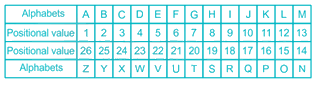 The logic followed here is:
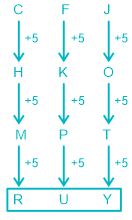 So, RUY will replace the question mark (?) in the following series.
Hence, the correct answer is "Option 4".
Q2 · Series
What comes next?
AX, JQ, SJ, ?
- BA
- BC
- ZC
- YC
Answer aur solution dekho
Archived marked answer: B
The position and positional values or English Alphabets are:
The logic followed here is:
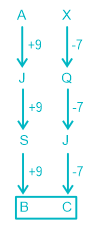 So, BC comes next.
Hence, the correct answer is "Option 2".
Q3 · Series
What comes next: 2, 3, 5, 9, 17, 33, ?
- 65
- 63
- 61
- 67
Answer aur solution dekho
Archived marked answer: A
The logic followed here is:
Logic: (Previous number × 2) - 1 = Next number
2
(2 × 2) - 1 = 4 - 1 = 3
(3 × 2) - 1 = 6 - 1 = 5
(5 × 2) - 1 = 10 - 1 = 9
(9 × 2) - 1 = 18 - 1 = 17
(17 × 2) - 1 = 34 - 1 = 33
(33 × 2) - 1 = 66 - 1 = 65
So, 65 comes next.
Hence, the correct answer is "Option 1".
Q4 · Series
Find the next number in the series : 2, 5, 11, 23, 47, ?
- 95
- 97
- 93
- 99
Answer aur solution dekho
Archived marked answer: A
The logic followed here is:
Logic: (Previous number × 2) + 1 = Next number
2
(2 × 2) + 1 = 4 + 1 = 5
(5 × 2) + 1 = 10 + 1 = 11
(11 × 2) + 1 = 22 + 1 = 23
(22 × 2) + 1 = 46 + 1 = 47
(47 × 2) + 1 = 94 + 1 = 95
So, 95 is the next number in the series.
Hence, the correct answer is "Option 1".
Q5 · Series
Find out the WRONG number in the given series.
336, 246, 166, 94, 36, -14
- 94
- 166
- 246
- 36
Answer aur solution dekho
Archived marked answer: A
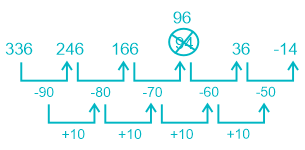
The logic followed here is:
Q6 · Series
The series given below contains a sequence of numbers. Accordingly identify the incorrect combination. 3 , 12 , 48 , 194 , 768 , 3074
- 12, 194
- 768, 3074
- 48, 194
- 194, 3074
Answer aur solution dekho
Archived marked answer: D
Given sequence: 3 , 12 , 48 , 194 , 768 , 3074
The logic followed here is:
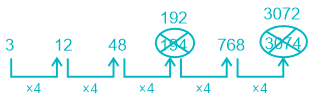 So, "194, 3074" is the incorrect combination.
Hence, the correct answer is "Option 4".
Q7 · Analogy
In the following question, find out the alternative that will replace the question mark.
SEAT : TEAS :: ROPE : ?
- PEOR
- PERO
- EPRO
- EOPR
Answer aur solution dekho
Archived marked answer: D
The logic followed here is:
 Similarly,
 So, EOPR will replace the question mark.
Hence, the correct answer is "Option 4".
Q8 · Puzzle Subtypes Not To Miss
If 9 % 2 = 81 and 8 % 2 = 64, what is 7 % 2 = ?
- 56
- 49
- 45
- 63
Answer aur solution dekho
Archived marked answer: B
Given: If 9 % 2 = 81 and 8 % 2 = 64
The logic followed here is:
Logic: a % b = ab
Q9 · Puzzle Subtypes Not To Miss
If "+" means subtraction, "-" means division, "x" means addition, and "÷" means multiplication, then find:
16 ÷ 2 - 4 + 3 × 5 = ?
- 27
- 10
- 25
- 20
Answer aur solution dekho
Archived marked answer: B
Given Equation: 16 ÷ 2 - 4 + 3 × 5 = ?
BODMAS Rule:
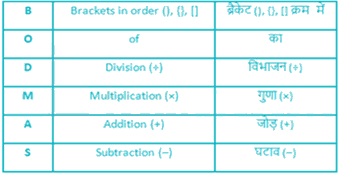 Decoding the given information:
Symbol
+
- ×
÷
Meaning
- ÷
+
×
Now replacing the sign from left to right using BODMAS Rule, we get:
⇒ 16 × 2 ÷ 4 - 3 + 5 = ?
⇒ 16 × 0.5 - 3 + 5 = ?
⇒ 8 - 3 + 5 = ?
⇒ 13 - 3 = ?
⇒ 10 = ?
Hence, the correct option is "Option 2".
Q10 · Puzzle Subtypes Not To Miss
Which two signs should be interchanged to make the given equation CORRECT?
97 × 23 - 18 + 9 ÷ 3 = 66
- × and +
- × and ÷
- ÷ and -
- + and -
Answer aur solution dekho
Archived marked answer: A
Given equation: 97 × 23 - 18 + 9 ÷ 3 = 66
BODMAS Table:
Let's check each option one by one.
1. × and +
After interchanging the signs we get;
⇒ 97 + 23 − 18 × 9 ÷ ____3 = 66
⇒ 97 + 23 − 18 × 3 = 66
⇒ 97 + ____23 − 54 = 66
⇒ 120 ____− 54 = 66
⇒ 66 = 66
⇒ LHS = RHS
2. × and ÷
After interchanging the signs we get;
⇒ 97 ÷ ____23 − 18 + 9 × 3 = 66
⇒ 4.2 − 18 + 9 × ____3 = 66
⇒ 4.2 − 18 + 27 = 66
⇒ 31.2____ − 18 = 66" id="MathJax-Element-40-Frame" role="presentation" style="text-align: center; position: relative;" tabindex="0">
⇒ 13.2 ≠ 66
⇒ LHS ≠ RHS
3. ÷ and -
After interchanging the signs we get;
⇒ 97 × 23 ÷ ____18 + 9 − 3 = 66" id="MathJax-Element-41-Frame" role="presentation" style="text-align: center; position: relative;" tabindex="0">
" role="presentation" style="text-align: center; position: relative;" tabindex="0">⇒ 97 × 1.27 + 9 − 3 = 66
⇒ 123.19__ + __9 − 3 = 66
⇒ 132.19 __− __3 = 66
⇒ 129.19 ≠ 66
⇒ LHS ≠ RHS
4. + and -
After interchanging the signs we get;
⇒ 97 × 23 + 18 − 9 ÷ ____3 = 66" id="MathJax-Element-45-Frame" role="presentation" style="text-align: center; position: relative;" tabindex="0">
" role="presentation" style="text-align: center; position: relative;" tabindex="0">⇒ 97 × ____23 + 18 − 3 = 66
⇒ 2231__ + __18 − 3 = 66
⇒ 2249__ − __3 = 66
⇒ 2246 ≠ 66
⇒ LHS ≠ RHS
Hence, the correct answer is "Option 1". Q11 · Puzzle Subtypes Not To Miss
If '+' means '-', '-' means '×', '×' means '÷', and '÷' means '+', then 20 + 5 × 4 - 2 = ?
- 12
- 5
- 16.78
- 17.5
Answer aur solution dekho
Archived marked answer: D
Given equation: 20 + 5 × 4 - 2 = ?
BODMAS Rule:
Decoding the given information:
Symbol
+
- ×
÷
Meaning
- ×
÷
+
Now replacing the sign from left to right using BODMAS Rule, we get:
⇒ 20 − 5 ÷ 4 × 2 = ?
⇒ 20 − 1.25 × 2 = ?
⇒ 20 − 2.5 = ?
⇒ 17.5 = ?
Hence, the correct option is "Option 4". Q12 · Puzzle Subtypes Not To Miss
Read the given statement and conclusions carefully. Decide which of the given conclusions is/are definitely TRUE from the statement.
Statement: P > Q V
Conclusion I: Q T
- Only Conclusion I is True.
- Only Conclusion II is True.
- Both Conclusion I and Conclusion II are True.
- Both Conclusion I and Conclusion II are False.
Answer aur solution dekho
Archived marked answer: A
Statement: P > Q V
Conclusion I: Q Q )
Conclusion II: U > T → False (As, T = R ≥ U, it gives U
So, only Conclusion I is True.
Hence, the correct answer is "Option 1".
Q13 · Coding Decoding
If "ROME" is coded as "VSQI", what is the code for "GREECE"?
- KVIIGI
- KVHHFD
- KWHHDF
- KVIHHD
Answer aur solution dekho
Archived marked answer: A
Each letter moves four places forward: R→V, O→S, M→Q, E→I. Applying +4 to GREECE gives G→K, R→V, E→I, E→I, C→G, E→I. The code is KVIIGI.
Q14 · Coding Decoding
If GOAL is coded as HPBM, what is the code for FAIL?
- GBJM
- EBJN
- FBKM
- GAJL
Answer aur solution dekho
Archived marked answer: A
The position and positional values or English Alphabets are:
The logic followed here is:
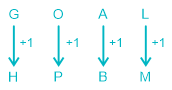 Similarly,
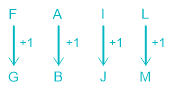 So, GBJM is the code for FAIL.
Hence, the correct answer is "Option 1".
Q15 · Classification Odd One Out
Find the odd one out from the given alternatives:
- Tansen
- Birbal
- Abul Fazl
- Tagore
Answer aur solution dekho
Archived marked answer: D
The logic followed here is:
1. Tansen – One of the Navratnas (Nine Gems) in Akbar’s court
2. Birbal – Also one of Akbar’s Navratnas
3. Abul Fazl – Court historian and one of Akbar’s Navratnas
4. Tagore – A modern Indian poet and Nobel laureate
The first three were members of Emperor Akbar’s court (Navratnas), while Tagore belonged to a completely different period and was not related to Akbar’s court.
So, Tagore is the odd one out.
Hence, the correct answer is "Option 4".
Q16 · Blood Relations
A is the only daughter of B, who is the only son of C. How is A related to C?
- Daughter
- Sister
- Granddaughter
- Cousin
Answer aur solution dekho
Archived marked answer: C
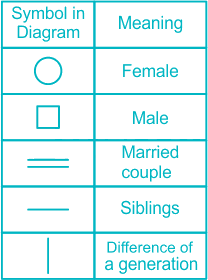
Family Chart:
 Given: A is the only daughter of B, who is the only son of C.
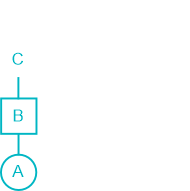 So, A is granddaughter of C.
Hence, the correct answer is "Option 3".
Q17 · Blood Relations
If A is the brother of B, B is the sister of C, and C is the father of D, how is A related to D?
- Uncle
- Father
- Brother
- Cousin
Answer aur solution dekho
Archived marked answer: A
Family Chart:
Given: If A is the brother of B, B is the sister of C, and C is the father of D.
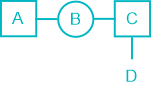 So, A is Uncle of D.
Q18 · Similarity and Differences
Choose the address that is the same as the one given below.
Sample Address:27, White Orchid Complex,S.G. Highway, Ahmedabad,Gujarat - 380054
- 27, White Orchid Complex,S.G. Highway, Ahmedabad,Gujarat - 380054
- 27, White Orchid Complex, SG Highway, Ahmedabad, Gujarat - 380054
- 27 White Orchid Complex, SG. Highway, Ahmedabad, Gujarat - 380054
- 27 White Orchid Complex, S.G Highway, Ahmedabad,Gujarat - 380054
Answer aur solution dekho
Archived marked answer: A
The logic followed here is:
Address
Options
Verdict
27, White Orchid Complex,S.G. Highway, Ahmedabad,Gujarat - 380054
1
27, White Orchid Complex,S.G. Highway, Ahmedabad,Gujarat - 380054
Exactly Same
27, White Orchid Complex,S.G. Highway, Ahmedabad,Gujarat - 380054
2
27, White Orchid Complex, SG Highway, Ahmedabad, Gujarat - 380054
'.' is missing between S and G
27, White Orchid Complex,S.G. Highway, Ahmedabad,Gujarat - 380054
3
27 White Orchid Complex, SG. Highway, Ahmedabad, Gujarat - 380054
'.' is missing after S
27, White Orchid Complex,S.G. Highway, Ahmedabad,Gujarat - 380054
4
27 White Orchid Complex, S.G Highway, Ahmedabad,Gujarat - 380054
'.' is missing after G
Hence, the correct answer is "Option 1".
Q19 · Similarity and Differences
Choose the address that is the same as the one given below.
S-50, Gokul Dham, Ajmer Road, Jaipur, Rajasthan - 302006
- S-50, Gokul Dham, Ajmer Road, Jaipur, Rajasthan - 302006
- S-50, Gokul Dham, Ajmer Road, Jaipur, Haryana - 302006
- S-50, Gokul Dham, Ajmer Road, Jaipur, Madhya Pradesh - 302006
- S-50, Gokul Dham, Ajmer Road, Jaipur, Gujarat - 302006
Answer aur solution dekho
Archived marked answer: A
The logic followed here is:
Address
Options
Verdict
S-50, Gokul Dham, Ajmer Road, Jaipur, Rajasthan - 302006
1
S-50, Gokul Dham, Ajmer Road, Jaipur, Rajasthan - 302006
Exactly Same
S-50, Gokul Dham, Ajmer Road, Jaipur, Rajasthan - 302006
2
S-50, Gokul Dham, Ajmer Road, Jaipur, Haryana - 302006
Instead of 'Rajasthan', it's Haryana
S-50, Gokul Dham, Ajmer Road, Jaipur, Rajasthan - 302006
3
S-50, Gokul Dham, Ajmer Road, Jaipur, Madhya Pradesh - 302006
Instead of 'Rajasthan', it's Madhya Pradesh
S-50, Gokul Dham, Ajmer Road, Jaipur, Rajasthan - 302006
4
S-50, Gokul Dham, Ajmer Road, Jaipur, Gujarat - 302006
Instead of 'Rajasthan', it's Gujarat
Hence, the correct answer is "Option 1".
Q20 · Logical Statement Questions
Consider the following statement and choose the option that follows.
Statements:
I. The government launched a financial literacy mission.
II. Many citizens remain unaware of basic banking facilities.
- I is the cause and II is the effect.
- II is the cause and I is the effect.
- Both are effects of the same cause.
- No relation.
Answer aur solution dekho
Archived marked answer: B
Statements:
I. The government launched a financial literacy mission. - Effect (Because the statement suggests there is a need to improve financial knowledge.)
II. Many citizens remain unaware of basic banking facilities. - Cause (Many citizens remain unaware of basic banking facilities. If the government launches a financial literacy mission, it usually implies that a section of people lacks financial awareness.)
So, Statement II provides a possible reason for Statement I.
Thus, II
Q21 · Logical Statement Questions
Consider the following statement and choose the option that follows.
Statement: A large number of city dwellers are subscribing to organic vegetable delivery services.
Conclusion
I. People are becoming more health conscious.
II. Supermarkets are no longer preferred.
- Only I follows
- Only II follows
- Both follows
- Neither follows
Answer aur solution dekho
Archived marked answer: A
Statement: A large number of city dwellers are subscribing to organic vegetable delivery services.
Now,
Conclusion
I. People are becoming more health conscious. - True (Because organic vegetables are generally associated with health benefits. If many people are subscribing to such services, it logically suggests growing health awareness.)
II. Supermarkets are no longer preferred. - False (Because the statement does not mention anything about supermarkets. People subscribing to organic delivery does not necessarily mean they have stopped preferring supermarkets.)
So, only I follows.
Hence, the correct answer is "Option 1".
Q22 · Logical Statement Questions
Read the following statement carefully and identify the conclusion that follows.
Statement: Government vehicles are instructed to avoid using sirens except during emergencies.
Conclusions:
I. Sirens are often used unnecessarily.
II. This will help reduce noise pollution.
- Only Conclusion I follows
- Only Conclusion II follows
- Both I and II follow
- Neither I nor II follows
Answer aur solution dekho
Archived marked answer: C
Statement: Government vehicles are instructed to avoid using sirens except during emergencies.
Now,
Conclusions:
I. Sirens are often used unnecessarily. - True (Because the instruction restricts usage to emergencies, which implies that sirens were being used even when not required.)
II. This will help reduce noise pollution. - True (If sirens are used only during emergencies, their overall usage will decrease. Reduced siren usage logically leads to reduced noise levels.)
So, both I and II follows.
Hence, the correct answer is "Option 3".
Q23 · Logical Statement Questions
Read the following statement carefully and identify the conclusion that follows.
Statement: India imports large quantities of crude oil every year.
Conclusions:
I. India is not self-sufficient in oil production.
II. All oil consumed in India is imported.
- Only Conclusion I follows
- Only Conclusion II follows
- Both I and II follow
- Neither I nor II follows
Answer aur solution dekho
Archived marked answer: A
Statement: India imports large quantities of crude oil every year.
Now,
Conclusions:
I. India is not self-sufficient in oil production. - True (Because If a country imports large quantities of crude oil, it clearly means domestic production is not sufficient to meet demand.)
II. All oil consumed in India is imported. - False (Because the statement says “large quantities” are imported, not “all” oil. India may also produce some oil domestically.)
So, only Conclusion I follows.
Hence, the correct answer is "Option 1".
Q24 · Miscellaneous Other Possibilities
A and B are partners in a business. A invests ₹20,000 for a period of 2 years. B invests ₹30,000 for a period of 3 years. If A's share of the total profit is ₹4,000, what is B's share of the profit?
- ₹9,000
- ₹4,000
- ₹5,000
- ₹7,000
Answer aur solution dekho
Archived marked answer: A
Given:
A’s investment = ₹20,000
A’s time = 2 years
B’s investment = ₹30,000
B’s time = 3 years
A’s share of profit = ₹4,000
Formula used:
Profit ∝ Investment × Time
Calculations:
A’s capital × time = 20000 × 2 = 40000
B’s capital × time = 30000 × 3 = 90000
⇒ Profit ratio A : B = 40000 : 90000
⇒ Profit ratio A : B = 4 : 9
If A’s 4 parts = ₹4000
⇒ 1 part = 4000 ÷ 4 = 1000
⇒ B’s share = 9 × 1000 = 9000
∴ B’s share of the profit is ₹9,000.
Q25 · Miscellaneous Other Possibilities
If 4 taps can fill a tank in 15 minutes, how many taps are needed to fill it in 6 minutes?
- 10
- 8
- 6
- 5
Answer aur solution dekho
Archived marked answer: A
Given:
Number of taps = 4
Time taken = 15 minutes
Required time = 6 minutes
Formula used:
Taps × Time = Constant (Work remains same)
Calculations:
Total work = 4 × 15 = 60 tap-minutes
⇒ Required taps = 60 ÷ 6
⇒ Required taps = 10
∴ 10 taps are needed to fill the tank in 6 minutes.
General Awareness
Q1 · Art and Culture
Fill in the blanks:
The composition "Guru Bin Kaise Gun Gaaye" is set to the rhythmic cycle known as ____
- Jhaptaal
- Keharwa
- Teentaal
- Roopak
Answer aur solution dekho
Archived marked answer: C
The correct answer is Teentaal.
Key Points
- Teentaal is one of the most widely used taals (rhythmic cycles) in Hindustani classical music.
- It consists of 16 beats, divided into four equal sections (vibhags) of four beats each, making it highly versatile.
- The structure of Teentaal follows a systematic pattern of claps (taali) and a wave (khali), with claps on beats 1, 5, and 13, and a wave on beat 9.
- Teentaal is extensively used in instrumental, vocal, and dance performances due to its symmetry and adaptability.
- The composition "Guru Bin Kaise Gun Gaaye" is set to Teentaal, showcasing its balanced and rhythmic framework.
Additional Information
- Jhaptaal
- Jhaptaal is a rhythmic cycle of 10 beats, divided into four sections (2+3+2+3).
- It is commonly used in semi-classical and classical music forms like khayal and instrumental compositions.
- Jhaptaal's unique structure offers a dynamic and intricate rhythmic framework for performances.
- Keharwa
- Keharwa is a 8-beat taal, divided into two sections (4+4).
- It is widely used in light classical, folk, and popular music across various Indian music traditions.
- Keharwa is known for its simplicity and is frequently used in bhajans, ghazals, and Bollywood songs.
- Roopak
- Roopak taal is composed of 7 beats, divided into three sections (3+2+2).
- It is often employed in semi-classical and classical music, providing a unique rhythmic feel.
- Roopak taal's distinctive structure makes it suitable for compositions requiring a lighter rhythmic touch.
Q2 · Art and Culture
Hojagiri dance, performed by women balancing bottles and lamps, is associated with which tribe and state?
- Bodo - Assam
- Reang - Tripura
- Angami - Nagaland
- Mishing - Arunachal Pradesh
Answer aur solution dekho
Archived marked answer: B
The correct answer is Reang - Tripura.
Key Points
- Hojagiri is a traditional dance form performed by the Reang tribe, one of the indigenous communities of Tripura.
- This unique dance showcases the exceptional balancing skills of women as they perform intricate movements while balancing earthen pots, bottles, and oil lamps on their heads.
- It is typically performed during the Hojagiri festival, which is celebrated after the harvest season, symbolizing joy, prosperity, and gratitude.
- The dance is accompanied by traditional musical instruments such as the Khamb (long drum), flute, cymbals, and bamboo-made instruments, creating a rhythmic and captivating performance.
- The Reang tribe, also known as Bru, is recognized as a Particularly Vulnerable Tribal Group (PVTG) in India, and their culture is an integral part of Tripura's heritage.
Additional Information
- Bodo - Assam:
- The Bodo tribe is one of the largest ethnic groups in Assam and belongs to the Bodo-Kachari community.
- Their traditional dance forms include the Bagurumba dance, also known as the "butterfly dance," which is performed by women during festivals and celebrations.
- Bodo culture is known for its rich folklore, music, and unique attire.
- Angami - Nagaland:
- The Angami tribe is one of the major Naga tribes residing in Nagaland, particularly in and around Kohima.
- They are known for their traditional dance forms like the War Dance and Harvest Dance, which are performed during festivals such as Sekrenyi.
- Angami culture is deeply rooted in agricultural practices and their festivals celebrate themes of prosperity, community, and nature.
- Mishing - Arunachal Pradesh:
- The Mishing tribe, also known as the Miris, primarily resides in Arunachal Pradesh and Assam.
- Their traditional dance forms include the Ali Ai Ligang dance, performed during the Ali Ai Ligang festival, which marks the beginning of the sowing season.
- Mishing culture is closely tied to agriculture, and their festivals and rituals often reflect their symbiotic relationship with nature.
Q3 · Art and Culture
What is the most notable feature of the Rouf dance of Kashmir?
- Colorful costumes
- Hand gestures
- Footwork of dancers
- Musical instruments
Answer aur solution dekho
Archived marked answer: C
The correct answer is Footwork of dancers.
Key Points
- The Rouf dance is a traditional folk dance of Kashmir, performed during joyous occasions such as Eid, marriages, and other festivals.
- Its most notable feature is the intricate footwork of the dancers, which is executed in perfect harmony with the rhythm of the accompanying music.
- Performed exclusively by women, the dancers align in two rows facing each other and move gracefully in sync, creating an enchanting visual display.
- The dance is accompanied by melodious Kashmiri folk songs, which add to the charm of the performance.
- The Rouf dance is a reflection of Kashmiri culture, showcasing grace, rhythm, and the community's celebration of life.
Additional Information
- Colorful costumes
- While the costumes worn during the Rouf dance are traditional and vibrant, they are not the defining feature of this dance form.
- The women typically wear the traditional Kashmiri attire known as the *Pheran*, accessorized with ornaments that enhance the aesthetics of the performance.
- However, the focus of the Rouf dance remains on the movements and coordination rather than the attire.
- Hand gestures
- Hand gestures play a minimal role in the Rouf dance compared to other Indian classical or folk dance forms.
- The dance primarily emphasizes synchronized footwork and body movements rather than intricate hand gestures.
- Musical instruments
- The Rouf dance is generally performed to the rhythm of Kashmiri folk songs, and the use of musical instruments is either minimal or absent.
- The focus is on the rhythmic clapping and foot movements of the dancers, which create a unique auditory experience.
Q4 · Art and Culture
The Kambala Festival of coastal Karnataka is primarily associated with which of the following traditions?
- Temple fairs
- Classical music
- Buffalo racing
- Tribal rituals
Answer aur solution dekho
Archived marked answer: C
The correct answer is Buffalo racing.
Key Points
- Kambala Festival is a traditional annual buffalo race held in the coastal regions of Karnataka, primarily in Udupi and Dakshina Kannada districts.
- The festival involves pairs of buffaloes racing across muddy, slushy tracks while being controlled by their handlers, known as "jockeys."
- Kambala is celebrated to honor the agricultural traditions and cultural heritage of the region, rooted in the worship of Bhoota (spirits) and nature.
- Historically, Kambala was organized by farming communities as a form of thanksgiving to gods for protecting their crops and providing a good harvest.
- Over time, the event transformed into a competitive sport, attracting participants and spectators from across Karnataka and neighboring states.
Additional Information
- Temple Fairs:
- Temple fairs are religious events held in and around temples, particularly in South India, to celebrate local deities and cultural traditions.
- These fairs often include rituals, processions, folk performances, stalls, and various community activities.
- They play an important role in preserving local traditions and fostering community bonds.
- Examples include the Mysuru Dasara festival and the Meenakshi Temple festival in Tamil Nadu.
- Classical Music:
- Karnataka is renowned for its contribution to Indian classical music, particularly Carnatic music, which originated in South India.
- It focuses on intricate ragas (melodic frameworks) and talas (rhythmic cycles), emphasizing devotion and spirituality.
- Prominent Carnatic musicians from Karnataka include Purandara Dasa (known as the father of Carnatic music) and Muthuswami Dikshitar.
- Carnatic music is distinct from Hindustani classical music, which developed in North India.
- Tribal Rituals:
- Tribal rituals in India are traditional ceremonies practiced by indigenous communities across the country.
- These rituals often involve nature worship, ancestor worship, and celebrations of tribal folklore and legends.
- Such practices are integral to preserving the unique cultural identity of tribal groups.
- In Karnataka, tribes like Soliga, Koraga, and Jenukuruba have their own distinct rituals and traditions.
- Main Theme – Kambala Festival:
- Kambala is deeply rooted in the agrarian culture of Karnataka, reflecting the harmonious relationship between humans, animals, and nature.
- While primarily celebrated as a sporting event today, it continues to serve as a reminder of the agricultural heritage and spiritual beliefs of the region.
Q5 · Indian Polity and Constitution
Fill in the blanks:
Taxes on interstate trade are restricted by Article ____ unless Parliament otherwise provides.
- 286
- 269
- 276
- 294
Answer aur solution dekho
Archived marked answer: A
The correct answer is 286.
Key Points
- Article 286 of the Indian Constitution restricts the imposition of taxes on the sale or purchase of goods in interstate trade or commerce, except as provided by Parliament.
- This provision ensures uniformity in the taxation system across states, preventing double taxation or undue burden on interstate commerce.
- Parliament has the power to legislate and provide exceptions or conditions under which such taxes can be imposed, as per this article.
- The purpose of Article 286 is to facilitate free trade and commerce within the country while maintaining the authority of the central government over interstate trade taxation.
- This article is supported by the framework of the Goods and Services Tax (GST), which aims to create a unified tax system across India.
Additional Information
- Article 269
- Article 269 deals with taxes on the sale or purchase of goods and consignment of goods in the course of inter-state trade or commerce.
- It specifies that certain taxes shall be levied and collected by the Government of India but distributed among the states.
- It includes taxes on inter-state trade and transactions, such as consignment of goods.
- Article 276
- Article 276 allows the states to impose taxes on professions, trades, callings, and employment, subject to a maximum limit as determined by Parliament.
- This article ensures that states have the power to generate revenue through professional taxes, but it imposes an upper ceiling to prevent excessive taxation.
- Article 294
- Article 294 deals with the succession of property, assets, rights, and liabilities of the Union and the states after independence.
- It is not directly related to taxation but focuses on the distribution of assets and liabilities between the Union and state governments post-independence.
- Main Theme: Interstate Trade Taxation
- Interstate trade taxation is governed under the framework of the Constitution to ensure a seamless flow of goods and services across state boundaries.
- Articles like 286, 269, and related provisions ensure a balanced taxation system and prevent trade barriers in the country.
- The introduction of GST further streamlined interstate trade taxation by subsuming various state and central taxes into a unified system.
Q6 · Indian Polity and Constitution
Which of the following statements about the Finance Commission of India is correct?
- Its recommendations are binding on the Union and State governments.
- Its members enjoy a fixed tenure protected from executive removal.
- Its recommendations are advisory in nature and not legally binding.
- It submits its report directly to the Parliament for enactment.
Answer aur solution dekho
Archived marked answer: C
The correct answer is Its recommendations are advisory in nature and not legally binding..
Key Points
- The Finance Commission of India is a constitutional body established under Article 280 of the Indian Constitution to make recommendations on the distribution of tax revenues between the Union and the States.
- The recommendations made by the Finance Commission are advisory in nature, meaning they are not legally binding on the government but hold persuasive value for policy formulation.
- The President of India appoints the Finance Commission every five years or earlier if required, and its main role is to ensure a fair and equitable distribution of financial resources.
- The Commission provides suggestions on grants-in-aid to states and other financial matters, keeping in view the objective of maintaining fiscal stability.
- The government, however, has the discretion to accept, modify, or reject the recommendations made by the Finance Commission.
Additional Information
- Option 1: Its recommendations are binding on the Union and State governments
- This statement is incorrect. The recommendations of the Finance Commission are not binding on the Union or State governments. They are advisory in nature and serve as guidance for financial distribution.
- While the recommendations are generally respected due to their importance in maintaining fiscal balance, governments have the discretion to accept or reject them.
- Option 2: Its members enjoy a fixed tenure protected from executive removal
- This statement is also incorrect. The tenure of the members of the Finance Commission is not fixed in the Constitution, and their removal is governed by rules prescribed by the President of India.
- Members are appointed by the President and serve for the duration of the Commission's term, which is typically five years or as specified in their appointment order.
- Option 4: It submits its report directly to the Parliament for enactment
- This statement is incorrect. The Finance Commission submits its report to the President of India, not directly to the Parliament.
- The report is then tabled in both Houses of Parliament along with an explanatory memorandum detailing the actions taken by the government on its recommendations.
- About the Finance Commission of India:
- The Finance Commission is tasked with defining the financial relations between the Union and the States in India.
- Its functions include recommending the distribution of net proceeds of taxes between the Centre and the States and determining the principles governing grants-in-aid to states.
- The Commission also reviews the financial position of the States and suggests measures to improve their financial stability and efficiency.
Q7 · Indian Polity and Constitution
Consider the following statements:
1. Article 131 provides exclusive original jurisdiction to High Courts in federal disputes.
2. The Supreme Court can adjudicate disputes between States under Article 131.
Which of the statements given above is/are correct?
- Only 1
- Only 2
- Both 1 and 2
- Neither 1 nor 2
Answer aur solution dekho
Archived marked answer: B
The correct answer is Only 2.
Key Points
- Article 131 of the Indian Constitution grants the Supreme Court exclusive original jurisdiction to adjudicate disputes between the Government of India and one or more States, or between two or more States.
- This jurisdiction is termed "original" because the Supreme Court can directly hear such disputes instead of them being referred to a lower court first.
- The disputes under Article 131 typically involve federal issues such as disagreements over laws, constitutional interpretation, or treaties.
- High Courts do not have jurisdiction under Article 131; this article is specifically reserved for the Supreme Court.
- Thus, Statement 2 is correct as it accurately reflects the role of the Supreme Court in resolving inter-state disputes under Article 131.
Additional Information
- Regarding Statement 1:
- Statement 1 is incorrect because Article 131 pertains to the Supreme Court, not High Courts.
- The High Courts have original jurisdiction in matters such as enforcement of fundamental rights under Article 226, but not in federal disputes between States or the Union Government.
- Article 131 Detailed Explanation:
- This article is foundational in maintaining the federal structure of India.
- The disputes it covers include issues like boundary disputes, financial disputes, or questions over the execution of constitutional provisions.
- However, the Supreme Court's jurisdiction under Article 131 does not extend to disputes arising out of political agreements or treaties.
- Role of High Courts in Indian Judiciary:
- High Courts function primarily under Articles 226 and 227 of the Constitution.
- They have jurisdiction over the respective States or Union Territories they serve and can issue writs for the enforcement of fundamental rights.
- Related Provisions in the Constitution:
- Article 132: Deals with the appellate jurisdiction of the Supreme Court in constitutional matters.
- Article 136: Grants the Supreme Court special leave to appeal against any judgment or order of any court or tribunal in India.
Q8 · Indian Economy
What is meant by 'mixed economy'?
- Only private sector
- Only public sector
- Both private and public sectors
- Only foreign companies
Answer aur solution dekho
Archived marked answer: C
The correct answer is Both private and public sectors.
Key Points
- A mixed economy is an economic system where both the private sector and the public sector co-exist and operate within the same market.
- This system allows for the cooperation between private businesses and government-owned entities to achieve balanced economic development.
- In a mixed economy, the private sector drives innovation, efficiency, and competition, while the public sector ensures essential services, infras
Q9 · Indian Economy
Which reform enabled MNCs to enter India?
- Land Reform
- Globalisation
- Labour Law
- Swadeshi
Answer aur solution dekho
Archived marked answer: B
The correct answer is Globalisation.
Key Points
- Globalisation refers to the process of interaction and integration among people, companies, and governments worldwide, primarily driven by international trade and investment.
- In the context of India, globalisation became prominent with the 1991 economic reforms under the New Economic Policy, which introduced liberalisation, privatisation, and globalisation (LPG reforms).
- This reform allowed Multi-National Corporations (MNCs) to enter the Indian market by reducing trade barriers, opening up Foreign Direct Investment (FDI), and deregulating the economy.
- The Indian government encouraged globalisation to boost economic growth, improve technological advancements, and integrate with the global economy.
- As a result of globalisation, India became a hub for foreign investments, witnessed significant technological advancements, and developed its manufacturing and service sectors.
Additional Information
- Land Reform
- Land reforms in India were introduced to address issues such as land inequality, zamindari system, and landlessness.
- The main objectives were to abolish intermediaries, ensure land redistribution to landless farmers, and implement tenancy reforms.
- Land reforms were aimed at improving agricultural productivity and equitable distribution of resources but are unrelated to the entry of MNCs in India.
- Labour Law
- Labour laws are a set of regulations governing the rights and responsibilities of workers, employers, and trade unions.
- Their primary focus is on ensuring fair wages, safe working conditions, and social security for workers.
- Though labour reforms are critical for industrial growth, they are not directly responsible for allowing MNCs to enter India.
- Swadeshi
- The Swadeshi movement was a part of the Indian independence struggle, encouraging the boycott of foreign goods and promoting indigenous products.
- It aimed to revive Indian industries and reduce dependence on British-made goods.
- Swadeshi, being a nationalist movement, contrasts globalisation and is unrelated to the entry of MNCs into India.
Q10 · Indian Economy
Read the following statements carefully and choose the correct option regarding Assertion (A) and Reason (R).
Assertion (A): The disinvestment policy has been widely criticized in India.
Reason (R): It resulted in increased market monopoly by public sector undertakings.
- Both A and R are true and R is the correct explanation of A.
- Both A and R are true but R is not the correct explanation of A.
- A is true but R is false.
- A is false but R is true.
Answer aur solution dekho
Archived marked answer: C
The correct answer is A is true but R is false..
Key Points
- Assertion (A): The disinvestment policy in India has been widely criticized for various reasons, including concerns over undervaluation of assets, lack of transparency, and the impact on employment in public sector enterprises.
- Reason (R): The claim that disinvestment increased market monopoly by public sector undertakings (PSUs) is incorrect. In fact, disinvestment typically involves selling government stakes in PSUs to private entities, reducing the government's monopoly in those sectors.
- The criticism of the disinvestment policy primarily stems from fears of privatization, loss of public control over strategic sectors, and potential exploitation by private players, rather than the creation of monopolies by PSUs.
- Disinvestment in India aims to improve the efficiency of PSUs by introducing private participation and raising revenue for the government, not to consolidate monopolies.
- Therefore, while Assertion (A) is true, Reason (R) is false as it provides an incorrect explanation for the criticism of disinvestment.
Additional Information
- Disinvestment Policy in India:
- Disinvestment refers to the process of selling or liquidating government-owned assets or stakes in public sector enterprises (PSUs).
- The primary objectives include reducing the fiscal burden, improving operational efficiency, and fostering private sector participation in the economy.
- It can take various forms, such as strategic disinvestment, minority stake sale, or outright privatization.
- Monopolies and Market Competition:
- Monopolies occur when a single entity dominates the market, limiting competition and consumer choice.
- Disinvestment typically reduces the monopoly of PSUs by introducing private players into the market.
- For instance, sectors like telecommunications and aviation saw increased competition after government disinvestment and deregulation.
- Criticism of Disinvestment:
- Critics argue that disinvestment often undervalues public assets, leading to losses for the government.
- Concerns about job losses and the erosion of workers' rights in privatized entities are frequently raised.
- There is also apprehension about private players prioritizing profits over public welfare in critical sectors like healthcare and education.
- Strategic Sectors and Privatization:
- While the government has retained control over strategic sectors such as defense, railways, and nuclear energy, it has allowed private participation in non-strategic areas.
- This approach aims to strike a balance between public control and private efficiency.
Q11 · Indian Economy
What is the main reason for the decline in core inflation across most countries in 2024?
- Fall in service sector productivity
- Decrease in export demand
- Drop in international commodity prices
- Increase in fiscal deficit
Answer aur solution dekho
Archived marked answer: C
The correct answer is Drop in international commodity prices.
Key Points
- A decline in international commodity prices, such as crude oil, natural gas, and agricultural products, reduces production costs for companies, leading to lower prices for goods and services, hence contributing to a decrease in core inflation.
- Global economic factors, such as a slowdown in demand from major economies like China and the US, often lead to a drop in commodity prices.
- Lower commodity prices also impact transportation and logistics costs, further reducing price pressures across various sectors.
- Commodity markets are sensitive to geopolitical events, and reduced geopolitical tensions or improved supply chains often stabilize or lower commodity prices globally.
- Central banks closely monitor commodity price trends as they significantly influence inflation expectations and monetary policy decisions.
Additional Information
- Fall in service sector productivity
- A fall in service sector productivity can lead to higher costs for services, which may increase core inflation, rather than causing a decline.
- Productivity drops often result from factors like labor shortages, inadequate infrastructure, or technological inefficiencies.
- In most economies, the service sector contributes significantly to GDP, and its performance directly impacts employment and economic stability.
- Decrease in export demand
- A decrease in export demand affects a country’s trade balance and economic growth but does not directly contribute to a decline in core inflation.
- Core inflation is primarily influenced by domestic factors like consumer demand and production costs, rather than external trade dynamics.
- However, prolonged weak export demand can lead to reduced industrial activity and lower employment, indirectly impacting inflation trends over time.
- Increase in fiscal deficit
- An increase in fiscal deficit generally puts upward pressure on inflation due to higher government borrowing and spending.
- Excessive fiscal deficits can lead to increased money supply in the economy, further fueling demand-driven inflation.
- Fiscal policy, when unbalanced, can exacerbate inflationary trends, particularly in countries with weaker monetary policy frameworks.
``
Q13 · Sports Static GK
How is the lane width for athletes in races up to 400 meters determined on a synthetic track?
- Each lane is 2 meters wide, marked by 10 cm lines.
- Each lane is 1.22 to 1.25 meters wide, marked by 5 cm lines.
- Lanes vary in width depending on the number of athletes.
- There are no separate lanes for races up to 400 meters.
Answer aur solution dekho
Archived marked answer: B
The correct answer is Each lane is 1.22 to 1.25 meters wide, marked by 5 cm lines.
Key Points
- For standard synthetic running tracks used in athletics, lanes must adhere to specific measurements set by the International Association of Athletics Federations (IAAF), now known as World Athletics.
- Each lane is 1.22 to 1.25 meters wide, with precise tolerances to ensure fairness and uniformity during races.
- The lanes are separated by lines 5 cm wide to clearly demarcate boundaries for athletes.
- These regulations apply to races up to 400 meters, where athletes run within their designated lanes from start to finish.
- The measurement of lane width and marking is crucial for maintaining consistency in competitions and ensuring that athletes do not gain an unfair advantage by encroaching on adjacent lanes.
Additional Information
- Option 1: Each lane is 2 meters wide, marked by 10 cm lines.
- This is incorrect as the standard lane width for athletics tracks is 1.22 to 1.25 meters, not 2 meters.
- Marking lanes with 10 cm lines would exceed the standard regulations and could create confusion during races.
- Option 3: Lanes vary in width depending on the number of athletes.
- This is incorrect because the width of lanes on a standard athletics track does not change based on the number of athletes participating in a race.
- The lane width is fixed to ensure uniformity and compliance with international standards.
- Option 4: There are no separate lanes for races up to 400 meters.
- This statement is incorrect as races up to 400 meters require athletes to run within designated lanes throughout the race.
- Separate lanes are mandatory to prevent interference and ensure fair competition.
- General Information about Synthetic Tracks
- Synthetic running tracks are made of materials like polyurethane or latex, offering durability and optimal performance for athletes.
- The standard track is 400 meters in circumference, with eight or more lanes, depending on the facility.
- Tracks are designed with a slight incline on curves to improve safety and speed for athletes.
- Compliance with World Athletics specifications is essential for hosting international competitions.
Q14 · Modern Indian History
Which of the following pairs (Governor-General - Policy followed) is correctly matched?
- Lord Hastings - Anti-expansionist policy
- Marquis of Hastings - Followed fiscal conservatism
- Lord Wellesley - Pursued imperialist conquests
- Henry Dundas - Opposed Charter renewal
Answer aur solution dekho
Archived marked answer: C
The correct answer is Lord Wellesley - Pursued imperialist conquests.
Key Points
- Lord Wellesley served as the Governor-General of India from 1798 to 1805 and is best known for his aggressive imperialist policies.
- He introduced the Subsidiary Alliance system, under which Indian states were compelled to accept British forces and political influence in exchange for protection.
- The Subsidiary Alliance system helped expand British control over large parts of India, including Hyderabad, Mysore, and Awadh.
- During his tenure, the British defeated Tipu Sultan
Q15 · Current Affairs
According to the 2025 Energy Transition Index, which factor is crucial for attracting long-term investment in energy transition?
- High electricity tariffs
- Adaptive and stable policy frameworks
- Rapid fossil fuel subsidies
- Deregulated industrial zones
Answer aur solution dekho
Archived marked answer: B
The correct answer is Adaptive and stable policy frameworks.
Key Points
- Adaptive and stable policy frameworks are essential to attract long-term investment in energy transition as they reduce uncertainties for investors and promote confidence in the energy sector.
- Such frameworks ensure clear regulations and long-term goals for the energy transition, enabling governments and businesses to work collaboratively toward decarbonization.
- Stability in energy policies helps protect investors from policy reversals, ensuring a consistent and predictable investment climate.
- Adaptive policies allow for flexibility to incorporate technological innovations and respond to dynamic market conditions, which is critical in transitioning to renewable energy sources.
- Countries with stable and adaptive energy policies, such as Germany and Denmark, have consistently attracted substantial investments in renewable energy projects, setting global examples.
Additional Information
- High electricity tariffs
- High electricity tariffs often deter investment in energy transition as they increase operational costs for industries and consumers.
- While they may promote energy efficiency, they do not directly attract investment in renewable energy generation or infrastructure development.
- Affordable and competitive electricity pricing is more conducive to encouraging the adoption of renewable energy technologies.
- Rapid fossil fuel subsidies
- Subsidizing fossil fuels contradicts the goals of energy transition as it perpetuates the use of carbon-intensive energy sources.
- Phasing out fossil fuel subsidies is recommended by international agencies like the International Energy Agency (IEA) to redirect financial resources toward renewable energy projects.
- Incentivizing renewable energy instead of fossil fuels is a globally recognized strategy for achieving energy transition goals.
- Deregulated industrial zones
- Deregulation in industrial zones may promote economic activities but does not necessarily facilitate investment in energy transition.
- Without targeted policies and incentives for renewable energy, deregulation alone is insufficient to drive the transition from fossil fuels to sustainable energy sources.
- Energy transition requires a combination of regulatory measures, incentives, and infrastructure development rather than blanket deregulation.
Q16 · General Science Biology
Read the below statements about enzymes and choose the correct option:
1. Enzymes increase the activation energy of a reaction.
2. Enzymes are specific to substrates due to active site configuration.
3. Enzyme activity is affected by pH and temperature. Which of the above statements are correct?
- Only 1 and 2 are correct
- Only 2 and 3 are correct
- Only 1 and 3 are correct
- 1, 2 and 3 all are correct
Answer aur solution dekho
Archived marked answer: B
The correct answer is Option 2.
Key Points
- Statement 2: Enzymes are specific to substrates due to active site configuration, is correct because enzymes have a unique three-dimensional structure that allows them to bind specifically to their corresponding substrates.
- Statement 3: Enzyme activity is affected by pH and temperature, is correct because enzymes work optimally within specific pH and temperature ranges, and deviations can lead to denaturation or reduced activity.
- Enzymes are biological catalysts that speed up biochemical reactions by lowering the activation energy required for the reaction to occur.
- Specificity of enzymes is governed by the "lock and key" model or "induced fit" model, where the substrate fits perfectly into the enzyme's active site.
- pH affects the ionization of enzyme active sites, while temperature influences the kinetic energy of molecules, impacting enzyme efficiency.
Additional Information
- Statement 1: Enzymes increase the activation energy of a reaction, is incorrect because enzymes lower the activation energy, enabling reactions to occur more efficiently and faster.
- Activation Energy: This is the minimum energy required for reactants to form products in a chemical reaction. Enzymes reduce this energy barrier by stabilizing the transition state.
- Denaturation: Extreme changes in pH or temperature can denature enzymes, altering their structure and rendering them inactive.
- Enzyme Specificity: The specificity of enzymes is crucial for metabolic pathways, preventing unwanted reactions and maintaining cellular function.
- Main Theme: The question focuses on understanding the fundamental properties of enzymes, their specificity, and how external factors like pH and temperature impact their activity.
Q17 · Awards Static
Half the Night is Gone' is written by which Sahitya Akademi winner?
- Amitav Ghosh
- Amit Chaudhuri
- Anuradha Roy
- Amitabha Bagchi
Answer aur solution dekho
Archived marked answer: D
The correct answer is Amitabha Bagchi.
Key Points
- Half the Night is Gone is a critically acclaimed novel authored by Amitabha Bagchi.
- The book won the Sahitya Akademi Award in 2019 in the English category, recognizing its literary excellence.
- It is a poignant exploration of themes such as family, loss, and the impact of history on personal lives, drawing inspiration from Indian traditions and societal structures.
- The narrative is structured through a blend of a fictionalized autobiography and a novel within the novel, showcasing Bagchi's unique storytelling style.
- Amitabha Bagchi is an acclaimed Indian author known for his works like The Householder and Above Average, which also delve into contemporary Indian life.
Additional Information
- Amitav Ghosh
- Amitav Ghosh is a renowned Indian author known for his works blending historical and contemporary themes.
- His notable books include The Shadow Lines, The Glass Palace, and the Ibis Trilogy (Sea of Poppies, River of Smoke, Flood of Fire).
- He was awarded the Jnanpith Award in 2018, one of India's highest literary honors.
- Amit Chaudhuri
- Amit Chaudhuri is a prominent Indian English author, poet, and essayist.
- His notable works include A Strange and Sublime Address, Afternoon Raag, and The Immortals.
- He has received numerous awards, including the Sahitya Akademi Award and the Commonwealth Writers' Prize.
- Anuradha Roy
- Anuradha Roy is an acclaimed Indian author whose novels often explore themes of love, loss, and societal change.
- Her notable works include Sleeping on Jupiter, which won the DSC Prize for South Asian Literature, and All the Lives We Never Lived.
- Her writing has been longlisted for the Booker Prize and translated into several languages.
- About 'Half the Night is Gone'
- The novel is set in post-colonial India and follows the intertwined lives of characters from different generations and backgrounds.
- It is deeply influenced by Indian epics like the Ramayana and Mahabharata, weaving traditional storytelling methods into modern narratives.
- The book delves into the complexities of human relationships, societal norms, and the legacy of colonialism in India.
Q18 · Awards Static
Who won the men's and women's recurve titles at the 2024 National Archery Championships held in Jamshedpur?
- Atanu Das and Deepika Kumari
- Dhiraj Bommadevara and Ankita Bhakat
- Dhiraj Bommadevara and Deepika Kumari
- Pravin Jadhav and Komalika Bari
Answer aur solution dekho
Archived marked answer: C
The correct answer is Dhiraj Bommadevara and Deepika Kumari.
Key Points
- Dhiraj Bommadevara won the men's recurve title at the 2024 National Archery Championships held in Jamshedpur.
- Deepika Kumari clinched the women's recurve title at the same event, showcasing her dominance in Indian archery.
- The National Archery Championships is one of the most prestigious tournaments in India, organized annually to promote and recognize the best archers in the country.
- Dhiraj Bommadevara and Deepika Kumari are renowned archers who have represented India at international events and won numerous accolades.
- The event in Jamshedpur witnessed tough competition, highlighting the growing talent pool in Indian archery.
Additional Information
- Atanu Das and Deepika Kumari
- Atanu Das is a prominent Indian archer and the husband of Deepika Kumari. Both have represented India at the Olympics.
- While Deepika Kumari won the women's recurve title at the 2024 National Archery Championships, Atanu Das did not win the men’s title at this event.
- Dhiraj Bommadevara and Ankita Bhakat
- Ankita Bhakat is another talented Indian archer who has represented the country at international events.
- Though Dhiraj Bommadevara won the men's recurve title, Ankita Bhakat did not win the women's title in the 2024 National Archery Championships.
- Pravin Jadhav and Komalika Bari
- Pravin Jadhav is an Indian archer who competed in the 2020 Tokyo Olympics and is known for his exceptional skills.
- Komalika Bari, a rising star in Indian archery, has won several titles at the junior level but did not win the women's recurve title at this event.
- National Archery Championships
- The National Archery Championships is an annual event organized by the Archery Association of India (AAI).
- The tournament features various categories, including recurve and compound events for men and women.
- It serves as a platform for identifying and promoting talent for national and international competitions.
- The event is crucial for the selection of archers who represent India in global tournaments like the Olympics, World Championships, and Asian Games.
``
Q19 · Medieval Indian History
Arrange the following historical structures in chronological order of their completion (earliest to latest):
(a) Red Fort, Delhi
(b) Jahangir Mahal, Orchha
(c) Agra Fort (Akbar)
- (a) → (b) → (c)
- (c) → (b) → (a)
- (b) → (c) → (a)
- (c) → (a) → (b)
Answer aur solution dekho
Archived marked answer: B
The correct answer is Option 2: (c) → (b) → (a).
Key Points
- Agra Fort (Akbar) was completed in 1573 during the reign of Mughal Emperor Akbar. It served as the residence of the Mughal emperors and was a significant military structure.
- Jahangir Mahal, Orchha, built by King Bir Singh Deo of Bundela dynasty in 1605, is a remarkable example of Mughal and Rajput architecture.
- Red Fort, Delhi, completed in 1648 under Shah Jahan, is a UNESCO World Heritage Site and symbol of Mughal architectural excellence.
- The chronological order of completion is Agra Fort → Jahangir Mahal → Red Fort, making Option 2 the correct choice.
- These structures represent the architectural and historical evolution during the Mughal and Bundela periods in Indian history.
Additional Information
- Agra Fort (Option c):
- Built during the reign of Emperor Akbar between 1565–1573.
- Constructed primarily using red sandstone, this fort became the stronghold of the Mughal Empire.
- It houses notable structures such as Jahangir's Palace, Khas Mahal, and Diwan-i-Aam.
- The fort reflects a blend of Indo-Islamic architectural styles.
- Jahangir Mahal (Option b):
- Constructed in 1605 AD by King Bir Singh Deo of the Bundela dynasty.
- Located in Orchha, Madhya Pradesh, it showcases a fusion of Mughal and Rajput architectural designs.
- The structure was built to honor Jahangir's visit to Orchha.
- Its intricate designs and expansive courtyards are iconic features.
- Red Fort (Option a):
- Commissioned by Emperor Shah Jahan in 1638 and completed in 1648.
- Constructed with red sandstone, it served as the political and ceremonial center of the Mughal Empire.
- Key structures within the fort include Diwan-i-Aam, Diwan-i-Khas, Rang Mahal, and the Pearl Mosque.
- It is a UNESCO World Heritage Site and continues to symbolize India's independence, with the Prime Minister hoisting the national flag here annually.
- Historical Context:
- These structures represent different phases of Indian history, reflecting the cultural and political significance of the Mughal and Bundela dynasties.
- Each monument demonstrates advancements in architectural techniques, materials, and artistic expression.
Q20 · Medieval Indian History
Which Rashtrakuta king defeated Parantaka I of the Chola dynasty?
- Krishna I
- Dantidurga
- Krishna III
- Govinda III
Answer aur solution dekho
Archived marked answer: C
The correct answer is Krishna III.
Key Points
- Krishna III, a prominent king of the Rashtrakuta dynasty, ruled during the late 10th century (939–967 CE).
- He is known for defeating the Chola king Parantaka I, who was attempting to expand Chola influence in South India.
- The victory of Krishna III over Parantaka I significantly weakened the Chola dynasty during that period.
- Krishna III extended the Rashtrakuta influence into Tamil Nadu and even captured the Chola capital, Tanjavur, for a brief period.
- He was also a patron of art and literature, contributing to the cultural advancements of the Rashtrakutas.
Additional Information
- Krishna I
- Krishna I ruled during the 8th century and was one of the early kings of the Rashtrakuta dynasty.
- He is credited with commissioning the famous Kailasa temple at Ellora, a UNESCO World Heritage site.
- Though he expanded the Rashtrakuta territory, Krishna I's primary focus was on cultural and architectural patronage.
- Dantidurga
- Dantidurga, the founder of the Rashtrakuta dynasty, ruled during the mid-8th century.
- He overthrew the Chalukyas of Badami and established the Rashtrakuta kingdom with its capital at Manyakheta.
- Dantidurga is credited with laying the foundation for the Rashtrakuta empire's subsequent expansion and dominance in Deccan politics.
- Govinda III
- Govinda III was another powerful Rashtrakuta ruler who reigned during the late 8th and early 9th centuries.
- He is known for his extensive military campaigns, which extended the Rashtrakuta influence to regions as far as Kannauj in North India.
- Govinda III's military exploits solidified the Rashtrakuta dynasty's position as a dominant power in the Indian subcontinent.
- Context of the Rashtrakuta-Chola conflict
- The Rashtrakuta dynasty was a prominent power in the Deccan region, often clashing with other South Indian dynasties like the Cholas, Pallavas, and Pandyas.
- The Chola dynasty under Parantaka I sought to expand its territory but faced resistance from the Rashtrakutas under Krishna III.
- These conflicts shaped the political landscape of South India, influencing the balance of power among the regional kingdoms.
``
Q21 · Ancient Indian History
Determine the correctly matched pair for Gupta-era obligations.
- Dasaparadha - fines from ten offences
- Bhoga - free-labour levy
- Adeya - registry-keeping duty
- Dhanya - forced labour
Answer aur solution dekho
Archived marked answer: A
The correct answer is Dasaparadha - fines from ten offences.
Key Points
- Dasaparadha refers to fines imposed for ten specific offences during the Gupta era, highlighting the structured legal system of that period.
- The term is derived from "Dasa" (ten) and "Aparadha" (offences), showcasing the categorization of crimes and penalties.
- These fines were part of the administrative and judicial measures to maintain law and order in th
Q22 · World Geography
Which matched pair is incorrect?
- Mesosphere - meteors burn
- Stratosphere - ozone layer
- Exosphere - tropospheric clouds
- Thermosphere - ISS orbit
Answer aur solution dekho
Archived marked answer: C
The correct answer is Exosphere - tropospheric clouds.
Key Points
- The exosphere is the outermost layer of Earth's atmosphere, located above the thermosphere.
- It is primarily composed of light gases such as hydrogen and helium, with extremely low atmospheric density.
- Tropospheric clouds form in the troposphere, the lowest layer of Earth's atmosphere, not the exosphere.
- The incorrect pairing arises because clouds, which require water vapor and relatively higher atmospheric density, cannot form in the exosphere due to its near-vacuum conditions.
- Temperatures in the exosphere vary widely, and particles here are so sparse that they rarely collide, making cloud formation impossible.
Additional Information
- Mesosphere - meteors burn
- The mesosphere lies between the stratosphere and the thermosphere, extending from about 50 km to 85 km above Earth's surface.
- This layer is where most meteors burn upon entering Earth's atmosphere due to friction with air molecules.
- Temperatures in the mesosphere decrease with altitude, making it one of the coldest layers of the atmosphere.
- Stratosphere - ozone layer
- The stratosphere lies above the troposphere and extends from about 12 km to 50 km above Earth's surface.
- The ozone layer, which absorbs and scatters ultraviolet solar radiation, is located within this layer.
- Temperature increases with altitude in the stratosphere due to the absorption of UV radiation by the ozone layer.
- Thermosphere - ISS orbit
- The thermosphere is located above the mesosphere and extends from approximately 85 km to 600 km above Earth's surface.
- This layer is where the International Space Station (ISS) orbits, typically at an altitude of about 400 km.
- The thermosphere experiences extremely high temperatures due to the absorption of intense solar radiation, but the air density is so low that it would not feel hot to a human.
Q23 · Environment and Ecology
What is the key objective of India's Green Credit Programme, recently operationalised under the Environment (Protection) Act, 1986?
- Generate green bonds for renewable industries
- Reward voluntary environmental actions by individuals or entities
- Penalize high carbon footprint industries
- Enforce green finance for real estate sector
Answer aur solution dekho
Archived marked answer: B
The correct answer is Reward voluntary environmental actions by individuals or entities.
Key Points
- The Green Credit Programme was operationalised under the Environment (Protection) Act, 1986, aiming to incentivize and reward environmental-friendly practices.
- The programme's primary objective is to encourage voluntary environmental actions by individuals, industries, and other entities, contributing to sustainable development.
- It facilitates the generation of "green credits" that can be traded or used as offsets, promoting active participation in environmental conservation.
- The programme focuses on areas such as afforestation, waste management, water conservation, air quality improvement, and other sustainable activities.
- By creating a market for green credits, the initiative aims to integrate environmental responsibility into economic frameworks.
Additional Information
- Option 1: Generate green bonds for renewable industries
- Green bonds are financial instruments used to fund projects that have positive environmental or climate benefits.
- These bonds are primarily issued by governments, corporations, or financial institutions to raise funds specifically for renewable energy projects, energy efficiency, sustainable infrastructure, and other green initiatives.
- While green bonds are an important tool for financing environmental projects, they are not the focus of the Green Credit Programme, which is aimed at rewarding voluntary environmental actions rather than issuing bonds.
- Option 3: Penalize high carbon footprint industries
- Penalizing high-carbon-footprint industries involves imposing fines, taxes, or regulatory restrictions on entities contributing significantly to greenhouse gas emissions.
- Such measures are part of environmental regulatory frameworks like carbon taxes or cap-and-trade systems but are not the central aim of the Green Credit Programme.
- The programme emphasizes voluntary participation and rewards rather than penalties for environmental non-compliance.
- Option 4: Enforce green finance for the real estate sector
- Green finance refers to funding investments that deliver environmental benefits, such as energy-efficient buildings, sustainable construction, and eco-friendly infrastructure in the real estate sector.
- While green finance is crucial for supporting sustainable development, the Green Credit Programme is broader in scope and not limited to any particular industry or sector.
- Theme of the Question
- The Green Credit Programme is part of India’s strategy to integrate environmental sustainability into its economic and social frameworks.
- It supports the global agenda for sustainable development and aligns with India’s commitments under international environmental agreements such as the Paris Agreement.
Q24 · Other Edge Cases Possible SSC GK GS Questions
Examine the statements below and select the most appropriate option.
Assertion (A): India's Dornier aircraft aid and OCC role show a shift in its development partnership with Sri Lanka towards defence focus.
Reason (R): President Disanayaka declined India's maritime security assistance and requested only cultural and financial cooperation.
- Both A and R are true, and R is the correct explanation of A
- Both A and R are true, but R is not the correct explanation of A
- A is false, but R is true
- A is true, but R is false
Answer aur solution dekho
Archived marked answer: D
The correct answer is A is true, but R is false.
Key Points
- India's Dornier aircraft aid to Sri Lanka and its establishment of an Operations Coordination Center (OCC) signify a shift in India's development partnership with Sri Lanka towards a defence and security-focused approach.
- This partnership is aimed at improving maritime security and surveillance in the Indian Ocean region, highlighting India's strategic interests in the area.
- India has been actively supporting Sri Lanka in capacity building and maritime security to address common challenges like illegal fishing, smuggling, and regional security threats.
- The agreement reflects India's commitment to strengthening its neighbourhood first policy by enhancing defence cooperation with Sri Lanka.
- President Disanayaka did not decline India's maritime security assistance, as mentioned in the Reason (R). Instead, Sri Lanka has been receptive to India's support in this domain.
Additional Information
- Option 1: Both A and R are true, and R is the correct explanation of A
- This option is incorrect because while Assertion (A) is true, Reason (R) is false.
- India's defence cooperation with Sri Lanka, including the Dornier aircraft, aligns with its strategic goals in the Indian Ocean region and is not linked to any rejection of maritime security assistance by President Disanayaka.
- Option 2: Both A and R are true, but R is not the correct explanation of A
- This option is also incorrect as Reason (R) is completely false. There is no record of President Disanayaka rejecting India's maritime security assistance.
- Option 3: A is false, but R is true
- This option is incorrect because Assertion (A) is true. India's Dornier aircraft aid and OCC role highlight its shift towards a defence-focused partnership with Sri Lanka.
- Reason (R) is false, making this option invalid.
- Context of Defence Partnership
- India's strategic partnership with Sri Lanka is part of its broader effort to counterbalance China's growing influence in the Indian Ocean region.
- Such initiatives also promote regional stability, economic cooperation, and mutual security interests.
Q25 · Other Edge Cases Possible SSC GK GS Questions
Which of the following about the 73rd Inter Services Water Polo Championship 2024-25 is/are correct?
1.) Hosted by Eastern Naval Command at Dolphin Hill Pool, Visakhapatnam.
2.) Navy defeated Army to win the title.
- Only 1 is correct
- Only 2 is correct
- Both 1 and 2 are correct
- Neither 1 nor 2 is correct
Answer aur solution dekho
Archived marked answer: C
The correct answer is Both 1 and 2 are correct.
Key Points
- The 73rd Inter Services Water Polo Championship 2024-25 was hosted by the Eastern Naval Command at Dolphin Hill Pool, Visakhapatnam.
- Visakhapatnam serves as a major base for the Indian Navy and is home to the Eastern Naval Command, making it a frequent venue for inter-services events.
- In the championship, the Navy defeated the Army in a closely contested match to secure the title.
- The Navy's victory highlights its strong water polo team and its dominance in aquatic sports among the Indian defense forces.
- Such inter-services championships foster camaraderie and competitive spirit among the armed forces while promoting physical fitness and discipline.
Additional Information
- Dolphin Hill Pool, Visakhapatnam
- Dolphin Hill is a prominent location within the Eastern Naval Command, known for its state-of-the-art facilities for aquatic sports and training.
- The pool is often used for professional-level competitions and training sessions for naval personnel.
- It is equipped with advanced facilities to host large-scale aquatic events, making it an ideal venue for the championship.
- Significance of Inter Services Championships
- Inter-services championships are organized among the Army, Navy, and Air Force to encourage sportsmanship and physical excellence.
- They provide an opportunity for armed forces personnel to showcase their talents and promote team spirit.
- Such events also help maintain high physical fitness standards and discipline within the defense forces.
- Water Polo as a Competitive Sport
- Water polo is a team aquatic sport that requires swimming proficiency, endurance, and strategic gameplay.
- It is often played in defense forces to enhance physical fitness and teamwork among personnel.
- India’s defense forces have a long tradition of excelling in aquatic sports, with many athletes representing the country in national and international events.
- Eastern Naval Command
- The Eastern Naval Command is one of the three major commands of the Indian Navy, headquartered in Visakhapatnam.
- It oversees naval operations along India's eastern coastline and is crucial for maritime security.
- The command frequently organizes inter-services and intra-navy events to boost morale and encourage physical fitness among its personnel.
Mathematics
Q1 · Geometry
A sector of a circle has a central angle of 60° and a radius of 9 cm. Another sector of the same circle has a central angle of π/3 radians. What is the ratio of the area of the first sector to the area of the second sector?
- 1:1
- 2:3
- 3:5
- 5:6
Answer aur solution dekho
Archived marked answer: A
Shortcut Trick
Both sectors belong to the same circle, so their radii are equal (r = 9 cm).
The central angle of the first sector is 60°.
The central angle of the second sector is π/3 radians.
Convert π/3 radians to degrees: (π/3) × (180°/π) = 60°.
Since both the radius and the central angle are exactly the same, their areas must be identical.
∴ The correct answer is 1:1.
Alternate Method
Given:
Radius of both sectors (r) = 9 cm
Central angle of the first sector (θ₁) = 60°
Central angle of the second sector (θ₂) = π/3 radians
Formula U
Q2 · Geometry
The length of each of two tangents drawn from an external point to a circle is 10 cm. What is the approximate distance from the external point to the center of the circle, if the radius is 6 cm?
- 4 cm
- 10 cm
- 12 cm
- 16 cm
Answer aur solution dekho
Archived marked answer: C
Shortcut Trick
The radius, tangent, and the line joining the external point to the center form a right-angled triangle.
Using the Pythagoras theorem: Distance = √(Radius² + Tangent²)
⇒ Distance = √(6² + 10²)
⇒ Distance = √(36 + 100) = √136
⇒ Distance ≈ 11.66 cm
The closest approximate value among the options is 12 cm.
∴ The correct answer is 12 cm.
Alternate Method
Given:
Length of the tangent (PT) = 10 cm
Radius of the circle (OT) = 6 cm
Formula Used:
According to the tangent-radius theorem, the tangent at any point of a circle is perpendicular to the radius through the point of contact.
In right-angled ΔOTP (where ∠OTP = 90°):
OP² = OT² + PT² (Pythagoras Theorem)
- - - - - O
P
T
6 cm
10 cm
d = ?
Calculations:
⇒ OP² = 6² + 10²
⇒ OP² = 36 + 100
⇒ OP² = 136
⇒ OP = √136
⇒ OP ≈ 11.66 cm
Approximating to the nearest whole number, the distance from the external point to the center is 12 cm.
∴ The correct answer is 12 cm.
Additional Information
Properties of Tangent
A tangent to a circle is a line that touches the circle at exactly one point, and it is always perpendicular to the radius at that specific point of tangency (∠OTP = 90°).
Number of Tangents
From any external point outside a circle, exactly two tangents can be drawn. The lengths of these two tangents to the points of tangency are always strictly equal.
Pythagorean Theorem Check
While 6, 8, and 10 form a famous Pythagorean triplet (where 10 is the hypotenuse), in this case, the tangent (10) and radius (6) are the perpendicular legs, making the hypotenuse √136 instead of an integer.
</p
Q3 · Geometry
A circle is inscribed in a right triangle with legs of length 5 and 12. What is the radius of the circle?
- 2
- 3
- 4
- 5
Answer aur solution dekho
Archived marked answer: A
Shortcut Trick
For a right-angled triangle, the inradius can be directly calculated using the lengths of the Perpendicular (P), Base (B), and Hypotenuse (H).
Inradius (r) = (P + B − H) ÷ 2
Hypotenuse = √(5² + 12²) = 13
r = (5 + 12 − 13) ÷ 2 = 4 ÷ 2 = 2
∴ The correct answer is 2 units.
Alternate Method
Q4 · Geometry
A parallelogram is a quadrilateral in which:
- Only one pair of opposite sides is parallel.
- All four interior angles are 90°
- Opposite sides are parallel and of equal length.
- The diagonals are perpendicular.
Answer aur solution dekho
Archived marked answer: C
Shortcut Trick
By basic geometric definitions, the term parallelogram explicitly means a quadrilateral with two pairs of parallel opposite sides.
A direct geometric consequence of opposite sides being parallel is that they must also be equal in length.
Statements defining only one parallel pair describe a trapezium, while perpendicular diagonals describe a rhombus.
∴ The correct answer is Opposite sides are parallel and of equal length.
Alternate Method
Given:
Four statements describing the properties of quadrilaterals.
A
B
C
D
- - - - - - Analysis of each option:
⇒ Statement 1: Only one pair of opposite sides is parallel. This defines a Trapezium.
⇒ Statement 2: All four interior angles are 90°. This defines a Rectangle or a Square.
⇒ Statement 3: Opposite sides are parallel and of equal length. This is the exact definition and core property of a Parallelogram.
⇒ Statement 4: The diagonals are perpendicular. This is a special property found in a Rhombus or a Square, but not in all standard parallelograms.
⇒ Therefore, the only universally true statement for any general parallelogram is that its opposite sides are parallel and equal.
∴ The correct answer is Opposite sides are parallel and of equal length.
Additional Information
Rhombus
A parallelogram in which all four sides are equal. The diagonals of a rhombus always bisect each other at exactly 90°.
Rectangle
A parallelogram where all four interior angles are exactly 90°. Its diagonals are equal in length and bisect each other.
Trapezium
A quadrilateral with strictly only one pair of parallel opposite sides. The parallel sides are called bases.
Square
A regular quadrilateral satisfying properties of both a rectangle and a rhombus. All sides are equal, all angles are 90°, and diagonals intersect at 90°.
</p
Q5 · Geometry
A right-angled triangle has a hypotenuse of 13 cm and one leg of 5 cm. A second right-angled triangle is similar to the first, and its hypotenuse is 39 cm. What is the area of the second triangle?
- 30 cm²
- 90 cm²
- 160 cm²
- 270 cm²
Answer aur solution dekho
Archived marked answer: D
Shortcut Trick
Scale factor of the similar triangles = 39 ÷ 13 = 3.
Area of 1st triangle = 1/2 × 5 × √(13² − 5²) = 1/2 × 5 × 12 = 30 cm².
Ratio of areas = (Scale factor)² = 3² = 9.
Area of 2nd triangle = 30 × 9 = 270 cm².
∴ The correct answer is 270 cm².
Alternate Method
5 cm
12 cm
13 cm
Triangle 1
15 cm
36 cm
39 cm
Triangle 2
Given:
Hypotenuse of first triangle = 13 cm
One leg of first triangle = 5 cm
Hypotenuse of second similar triangle = 39 cm
Formula Used:
Pythagoras Theorem: (Hypotenuse)² = (Base)² + (Height)²
Area of a Triangle = 1/2 × Base × Height
Calculations:
⇒ Let the unknown leg of the first triangle be x.
⇒ x² + 5² = 13²
⇒ x² + 25 = 169
⇒ x² = 144 ⇒ x = 12 cm
⇒ The second triangle is similar to the first triangle.
⇒ Ratio of their corresponding sides = 39 ÷ 13 = 3
⇒ Therefore, the legs of the second triangle will also be 3 times the legs of the first triangle.
⇒ Base of the second triangle = 5 × 3 = 15 cm
⇒ Height of the second triangle = 12 × 3 = 36 cm
⇒ Area of second triangle = 1/2 × 15 × 36
⇒ Area of second triangle = 15 × 18 = 270 cm²
∴ The correct answer is 270 cm².
Additional Information
Properties of Similar Triangles
If two triangles are similar, the ratio of their corresponding sides, medians, altitudes, and perimeters is exactly equal to the scale factor (k).
Area Theorem for Similar Triangles
The ratio of the areas of two similar triangles is equal to the square of the ratio of their corresponding sides: Area₁ ÷ Area₂ = (Side₁ ÷ Side₂)².
Pythagorean Triples
Memorizing common Pythagorean triples helps in fast calculations. Some common primitive triples are (3, 4, 5), (5, 12, 13), (8, 15, 17), and (7, 24, 25).
</p
Q6 · Geometry
The graph of y = 4x - 5 passes through which point?
- (1, -1)
- (0, -5)
- (2, 3)
- All the above
Answer aur solution dekho
Archived marked answer: D
Shortcut Trick
Substitute the coordinates (x, y) from each option directly into the equation y = 4x − 5.
For (1, −1): −1 = 4(1) − 5 ⇒ −1 = −1 (True)
For (0, −5): −5 = 4(0) − 5 ⇒ −5 = −5 (True)
For (2, 3): 3 = 4(2) − 5 ⇒ 3 = 8 − 5 ⇒ 3 = 3 (True)
Since all points satisfy the equation, the graph passes through all of them.
∴ The correct answer is All the above.
Alternate Method
Given:
The linear equation of the graph: y = 4x − 5
Concept Used:
A point (x, y) lies on a line if its coordinates completely satisfy the given linear equation when substituted into it.
Calculation:
- - - (0, −5)
(1, −1)
(2, 3)
y = 4x − 5
X
Y
⇒ Testing point (1, −1):
⇒ −1 = 4 × (1) − 5
⇒ −1 = −1 (Satisfies the equation)
⇒ Testing point (0, −5):
⇒ −5 = 4 × (0) − 5
⇒ −5 = −5 (Satisfies the equation)
⇒ Testing point (2, 3):
⇒ 3 = 4 × (2) − 5
⇒ 3 = 8 − 5 ⇒ 3 = 3 (Satisfies the equation)
⇒ As all the given points make the equation true, the graph of the line passes through all of them.
∴ The correct answer is All the above.
Additional Information
Slope-Intercept Form
The equation of a straight line is commonly expressed as y = mx + c, where m is the slope (steepness) of the line and c is the y-intercept (where the line intersects the Y-axis).
Finding Axis Intercepts
To find the x-intercept, set y = 0 and solve for x. To find the y-intercept, set x = 0 and solve for y. For the line y = 4x − 5, the y-intercept is −5 and the x-intercept is 5/4.
Collinear Points
If three or more points lie exactly on the same straight line, they are mathematically defined as collinear. This is confirmed if they satisfy the same single linear equation.
</p
Q7 · Geometry
In a quadrilateral ABCD, a line segment BD is a diagonal such that AB=CD and ∠ABD=∠CDB. Are the triangles ABD and CDB congruent? If so, by what rule?
- Yes, by SSS
- Yes, by SAS
- Yes, by ASA
- No, they are not congruent
Answer aur solution dekho
Archived marked answer: B
Shortcut Trick
Identify the equal corresponding parts between ΔABD and ΔCDB directly from the question parameters.
We are given Side AB = Side CD and ∠ABD = ∠CDB.
The third equal part is the common diagonal, so Side BD = Side DB.
Since the given equal angle is included strictly between the two equal sides, we apply the Side-Angle-Side rule.
Therefore, the triangles are congruent by the SAS criterion.
∴ The correct answer is Yes, by SAS.
Alternate Method
- - - θ
θ
A
B
C
D
Given:
⇒ Quadrilateral ABCD with diagonal BD.
⇒ AB = CD
⇒ ∠ABD = ∠CDB
Congruence Check:
⇒ Consider ΔABD and ΔCDB:
⇒ AB = CD (Given Side)
⇒ ∠ABD = ∠CDB (Given Included Angle)
⇒ BD = DB (Common Side)
⇒ Here, two sides and the included angle of ΔABD are strictly equal to the corresponding two sides and included angle of ΔCDB.
⇒ By Side-Angle-Side (SAS) congruence criterion, the two triangles are congruent (ΔABD ≅ ΔCDB).
∴ The correct answer is Yes, by SAS.
Additional Information
SAS (Side-Angle-Side) Congruence
If two sides and the included angle of one triangle are equal to the corresponding two sides and the included angle of another triangle, the triangles are exactly congruent.
SSS (Side-Side-Side) Congruence
If all three sides of one triangle are identical in length to the corresponding three sides of another triangle, then the two triangles are congruent.
ASA (Angle-Side-Angle) Congruence
If two angles and the included side of one triangle are equal to the corresponding two angles and the included side of another triangle, the triangles are congruent.
RHS (Right Angle-Hypotenuse-Side)
If the hypotenuse and one side of a right-angled triangle are equal to the hypotenuse and corresponding side of another right-angled triangle, they are congruent.
</p
Q8 · Trigonometry
If tanA + cotA = 2 and A ∈ (0, π/2), then what is sinA + cosA?
- 1
- √2
- 1/√2
- Cannot be determined
Answer aur solution dekho
Archived marked answer: B
Shortcut Trick
If x + 1/x = 2, then x = 1.
Here, tanA + cotA = 2 ⇒ tanA + 1/tanA = 2, so tanA = 1.
Since A ∈ (0, π/2), we get A = 45°.
Now, sinA + cosA = sin(45°) + cos(45°)
⇒ 1/√2 + 1/√2 = 2/√2 = √2.
∴ The correct answer is √2.
Alternate Method
Given:
tanA + cotA = 2
A ∈ (0, π/2)
Formula Used:
tanA = sinA / cosA
cotA = cosA / sinA
(a + b)² = a² + b² + 2ab
sin²A + cos²A = 1
Calculations:
⇒ tanA + cotA = 2
⇒ (sinA / cosA) + (cosA / sinA) = 2
⇒ (sin²A + cos²A) / (sinA × cosA) = 2
⇒ 1 / (sinA × cosA) = 2
⇒ sinA × cosA = 1/2
We need to find the value of (sinA + cosA).
⇒ Let (sinA + cosA) = x
Squaring both sides:
⇒ (sinA + cosA)² = x²
⇒ sin²A + cos²A + 2 × sinA × cosA = x²
Substituting the known identities and values:
⇒ 1 + 2 × (1/2) = x²
⇒ 1 + 1 = x²
⇒ x² = 2
⇒ x = √2 (Since A ∈ (0, π/2), both sinA and cosA are positive)
∴ The correct answer is √2.
Additional Information
Basic Trigonometric Identities
Three foundational identities are: sin²θ + cos²θ = 1, sec²θ − tan²θ = 1, and cosec²θ − cot²θ = 1.
Algebraic Reciprocal Property
If the sum of a number and its reciprocal is 2, i.e., x + 1/x = 2, then x must be equal to 1. This is frequently used in trigonometric equations involving tanθ and cotθ.
Signs in the First Quadrant
For any angle A ∈ (0, π/2), all six trigonometric ratios are positive. Thus, sinA + cosA must strictly be a positive value.
</p
Q9 · Trigonometry
What is the value of sin20°cos10° + cos20° sin10°?
- 1/2
- 3/4
- 5/4
- 7/8
Answer aur solution dekho
Archived marked answer: A
Shortcut Trick
Apply the direct trigonometric compound angle identity:
sin(A + B) = sin A × cos B + cos A × sin B
For A = 20° and B = 10°, the expression reduces to sin(20° + 10°) = sin 30°.
The standard value of sin 30° is 1/2.
∴ The correct answer is 1/2.
Alternate Method
Given:
Trigonometric expression: sin 20° × cos 10° + cos 20° × sin 10°
Formula Used:
sin(A + B) = sin A × cos B + cos A × sin B
Calculation:
⇒ Let angle A = 20° and angle B = 10°
⇒ The given expression exactly matches the right hand side of the formula.
⇒ sin 20° × cos 10° + cos 20° × sin 10° = sin(20° + 10°)
⇒ sin(30°)
⇒ From the standard trigonometric table, sin 30° = 1/2
∴ The correct answer is 1/2.
Additional Information
Compound Angle Identity for Sine
sin(A − B) = sin A × cos B − cos A × sin B
Compound Angle Identity for Cosine
cos(A + B) = cos A × cos B − sin A × sin B
cos(A − B) = cos A × cos B + sin A × sin B
Double Angle Formula
sin 2A = 2 × sin A × cos A
cos 2A = cos² A − sin² A
</p
Q10 · Trigonometry
If sin x = 3/5 and x in (0, π/2) , then find 1+tan x1-tan x
- 6
- 7
- 8
- 9
Answer aur solution dekho
Archived marked answer: B
Shortcut Trick
For a right-angled triangle, if sin x = 3/5, the sides form a standard Pythagorean triplet (3, 4, 5).
Thus, Perpendicular = 3, Hypotenuse = 5, and Base = 4.
We know tan x = Perpendicular ÷ Base = 3/4.
Expression = (1 + 3/4) ÷ (1 − 3/4) = (7/4) ÷ (1/4) = 7.
∴ The correct answer is 7.
Alternate Method
Given:
sin x = 3/5
x ∈ (0, π/2), which means x lies in the first quadrant, so all trigonometric ratios are positive.
Formula Used:
sin x = Perpendicular / Hypotenuse
tan x = Perpendicular / Base
Hypotenuse² = Perpendicular² + Base² (Pythagoras Theorem)
x
C
B
A
Base (B) = 4
Perpendicular (P) = 3
Hypotenuse (H) = 5
Calculations:
⇒ Let Perpendicular (P) = 3 units and Hypotenuse (H) = 5 units.
⇒ Base (B) = √(H² − P²)
⇒ B = √(5² − 3²) = √(25 − 9) = √16 = 4 units.
⇒ tan x = P / B = 3 / 4
Now, substitute the value of tan x into the given expression:
⇒ (1 + tan x) ÷ (1 − tan x)
⇒ (1 + 3/4) ÷ (1 − 3/4)
⇒ [(4 + 3) / 4] ÷ [(4 − 3) / 4]
⇒ (7 / 4) × (4 / 1)
⇒ 7
∴ The correct answer is 7.
Additional Information
Trigonometric Quadrant Rule (ASTC)
In the 1st quadrant (0 to π/2), All ratios are positive. In the 2nd quadrant, Sine & Cosec are positive. In the 3rd, Tangent & Cot are positive. In the 4th, Cosine & Sec are positive.
Pythagorean Triplets
Sets of integers that satisfy a² + b² = c². Standard base triplets include (3, 4, 5), (5, 12, 13), (8, 15, 17), and (7, 24, 25). Multiples of these base numbers are also proper triplets.
Basic Trigonometric Ratios
sin θ = Perpendicular / Hypotenuse | cos θ = Base / Hypotenuse | tan θ = Perpendicular / Base.
</p
Q11 · Trigonometry
A tower is 20 meters tall. What is the length of the shadow cast by the tower when the sun's elevation is 45°?
- 10m
- 20m
- 20√3 m
- 10√3 m
Answer aur solution dekho
Archived marked answer: B
Shortcut Trick
When the angle of elevation is 45°, the perpendicular and base of the right-angled triangle are equal.
Therefore, Height of the tower = Length of the shadow.
Length of shadow = 20 m.
∴ The correct answer is 20 m.
Alternate Method
Given:
Height of the tower (AB) = 20 m
Angle of elevation of the sun (θ) = 45°
45°
A
B
C
20 m
(Tower)
Shadow Length = x
- - - - - - - - Formula Used:
In a right-angled triangle, tan(θ) = Perpendicular ÷ Base
Calculation:
⇒ Let the length of the shadow be BC.
⇒ tan(45°) = AB ÷ BC
⇒ 1 = 20 ÷ BC
⇒ BC = 20 × 1
⇒ BC = 20 m
∴ The correct answer is 20 m.
Additional Information
Angle of Elevation vs Angle of Depression
The angle of elevation is formed when looking up from a horizontal line, while the angle of depression is formed when looking down. Both are numerically equal for the same line of sight due to alternate interior angles.
Standard Trigonometric Ratios
In height and distance problems, the most commonly used tangent values are tan(30°) = 1 ÷ √3, tan(45°) = 1, and tan(60°) = √3.
Complementary Elevation Angles
If a structure casts shadows of lengths a and b at two different times such that the respective angles of elevation are complementary (sum to 90°), the height of the structure is given by h = √(a × b).
</p
Q12 · Mensuration 2D
The sides of a rectangular prism are in the ratio 4:5:6. If the volume of the prism is 960 cm³ what is the length of its longest side?
- 12 cm
- 10 cm
- 8 cm
- 16 cm
Answer aur solution dekho
Archived marked answer: A
Shortcut Trick
Let the sides of the rectangular prism be 4x, 5x, and 6x.
Volume = 4x × 5x × 6x = 120x³
Since the volume is 960 cm³, we have 120x³ = 960.
⇒ x³ = 8 ⇒ x = 2
The longest side is 6x = 6 × 2 = 12 cm.
∴ The correct answer is 12 cm.
Alternate Method
Given:
The ratio of the sides of the rectangular prism = 4 : 5 : 6
Volume of the prism = 960 cm³
Formula Used:
Volume of a rectangular prism = Length × Width × Height
Length = 6x
Height = 4x
Width = 5x
Volume = 960 cm³
Calculations:
Let the exact dimensions of the sides be 4x, 5x, and 6x.
⇒ Volume = 4x × 5x × 6x
⇒ 120x³ = 960
⇒ x³ = 960 ÷ 120
⇒ x³ = 8
⇒ x = 2
Now, finding the exact lengths of all three sides:
⇒ First side = 4 × 2 = 8 cm
⇒ Second side = 5 × 2 = 10 cm
⇒ Third side = 6 × 2 = 12 cm
⇒ Out of the three, the longest side is clearly 12 cm.
∴ The correct answer is 12 cm.
Additional Information
Total Surface Area (TSA)
The total area of all 6 faces of a cuboid is calculated using the formula: TSA = 2(lw + wh + hl).
Lateral Surface Area (LSA)
The area of the 4 side vertical faces (excluding the top and bottom) is calculated as: LSA = 2h(l + w).
Length of Diagonal
The longest distance between two opposite corners in a rectangular prism is given by the formula: Diagonal = √(l² + w² + h²).
</p
Q13 · Mensuration 2D
A hemisphere of radius 5 cm is carved from a sphere. What is the volume of the hemisphere?
- 65π/6 cm³
- 125π/6 cm³
- 250π/3 cm³
- 375π/6 cm³
Answer aur solution dekho
Archived marked answer: C
Shortcut Trick
The volume of a hemisphere is exactly half the volume of a complete sphere.
Volume = (2/3) × π × r³
Substitute r = 5 cm directly into the formula.
Volume = (2/3) × π × 125 = 250π/3 cm³
∴ The correct answer is 250π/3 cm³.
Alternate Method
Given:
Radius of the hemisphere (r) = 5 cm
Formula Used:
Volume of a hemisphere = (2/3) × π × r³
- r = 5 cm
Hemisphere
Calculations:
⇒ Volume = (2/3) × π × (5)³
⇒ Volume = (2/3) × π × 125
⇒ Volume = 250π/3 cm³
∴ The correct answer is 250π/3 cm³.
Additional Information
Volume of a Full Sphere
The total volume of a complete sphere is given by V = (4/3) × π × r³. A hemisphere's volume is exactly half of this value.
Curved Surface Area (CSA)
The curved surface area of a hemisphere only accounts for the outer bowl part and is calculated as CSA = 2 × π × r².
Total Surface Area (TSA)
The total surface area includes both the curved surface and the flat circular top surface. It is calculated as TSA = 3 × π × r².
</p
Q14 · Mensuration 2D
A solid sphere is placed inside a cube such that it touches all six faces. What percentage of the cube's volume is not occupied by the sphere?
- 47.67%
- 47.56%
- 49.28%
- 42.56%
Answer aur solution dekho
Archived marked answer: A
Shortcut Trick
When a sphere is inscribed inside a cube, the ratio of the volume of the cube to the volume of the sphere is always 6 : π.
The ratio of the unoccupied volume to the total volume of the cube is (6 − π) : 6.
Percentage of unoccupied volume = [(6 − π) ÷ 6] × 100
Taking π ≈ 3.14: ⇒ [(6 − 3.14) ÷ 6] × 100 = (2.86 ÷ 6) × 100
⇒ 47.666...% ≈ 47.67%
∴ The correct answer is 47.67%.
Alternate Method
Given:
A solid sphere is placed inside a cube such that it touches all six faces.
- r = a/2
- - - a
2D Cross-section: Sphere inside a Cube
Formula Used:
Volume of cube = a³ (where a is the side of the cube)
Volume of sphere = (4 ÷ 3) × π × r³ (where r is the radius of the sphere)
Calculations:
⇒ Let the side of the cube be 'a'.
⇒ Since the sphere touches all six faces, its diameter is strictly equal to the side length of the cube.
⇒ Radius of the sphere (r) = a ÷ 2
⇒ Volume of the cube = a³
⇒ Volume of the sphere = (4 ÷ 3) × π × (a ÷ 2)³
⇒ Volume of the sphere = (4 ÷ 3) × π × (a³ ÷ 8) = (π ÷ 6) × a³
⇒ Volume not occupied by the sphere = a³ − (π ÷ 6) × a³ = a³ × (1 − π ÷ 6)
⇒ Percentage of unoccupied volume = [a³ × (1 − π ÷ 6) ÷ a³] × 100
⇒ Percentage = (1 − 3.14 ÷ 6) × 100
⇒ Percentage = [(6 − 3.14) ÷ 6] × 100 = (2.86 ÷ 6) × 100
⇒ Percentage = 286 ÷ 6 = 47.666... ≈ 47.67%
∴ The correct answer is 47.67%.
Additional Information
Cube Properties
For a cube of side 'a', the Total Surface Area = 6a², Lateral Surface Area = 4a², and the length of the longest body diagonal = a√3.
Sphere Properties
For a sphere of radius 'r', the Surface Area = 4πr². The sphere holds the maximum possible volume among all 3D solid shapes for any given surface area.
Cube and Inscribed Cylinder
If a right circular cylinder is inscribed inside a cube of side 'a', its volume will be (π ÷ 4) × a³. The percentage of occupied volume by the cylinder is roughly 78.5%.
</p
Q15 · Mensuration 2D
A conical bucket is cut at one-third its height from the top. What is the ratio of the volumes of the two parts (top part to bottom part)?
- 1 : 8
- 1 : 26
- 1 : 27
- 1 : 7
Answer aur solution dekho
Archived marked answer: B
Shortcut Trick
When a cone is cut parallel to its base, the volumes of the corresponding parts are proportional to the cubes of their heights.
Ratio of heights of top cone to total cone = 1 : 3.
Ratio of volumes of top cone to total cone = 1³ : 3³ = 1 : 27.
Volume of bottom part = Total volume − Top volume = 27 − 1 = 26 units.
Ratio of volumes of top part to bottom part = 1 : 26.
∴ The correct answer is 1 : 26.
Alternate Method
Given:
A conical bucket is cut at one-third of its height from the top.
Let total height of the cone be H and base radius be R.
Height of the top cone (h) = H / 3.
Formula Used:
Volume of cone = (1/3) × π × radius² × height
Q16 · Algebra
If x + (1/x) = -1, then compute: x⁴ + (1/(x⁴)) + 2x² + (2/x²).
- -3
- 3
- 4
- -4
Answer aur solution dekho
Archived marked answer: A
Shortcut Trick
If x + (1/x) = −1, then a standard algebraic result is x³ = 1.
Reduce higher powers using this property: x⁴ = x³ × x = x.
⇒ x⁴ + (1/x⁴) = x + (1/x) = −1
⇒ 2(x² + 1/x²) = 2[(x + 1/x)² − 2] = 2[(−1)² − 2] = −2
⇒ Given expression value = −1 + (−2) = −3
∴ The correct answer is −3.
Alternate Method
Given:
x + (1/x) = −1
Formula Used:
a² + b² = (a + b)² − 2ab
Calculations:
Squaring the given equation on both sides:
⇒ x² + (1/x²) + 2(x)(1/x) = (−1)²
⇒ x² + (1/x²) + 2 = 1
⇒ x² + (1/x²) = 1 − 2 = −1
Now, squaring this new equation on both sides:
⇒ (x²)² + (1/x²)² + 2(x²)(1/x²) = (−1)²
⇒ x⁴ + (1/x⁴) + 2 = 1
⇒ x⁴ + (1/x⁴) = 1 − 2 = −1
We need to find the value of: x⁴ + (1/x⁴) + 2x² + (2/x²)
⇒ [x⁴ + (1/x⁴)] + 2[x² + (1/x²)]
Substitute the obtained values into the expression:
⇒ −1 + 2(−1)
⇒ −1 − 2 = −3
∴ The correct answer is −3.
Additional Information
Special Case of x + 1/x = 1
If x + (1/x) = 1, then multiplying both sides by x yields x² − x + 1 = 0, which gives x³ = −1.
Special Case of x + 1/x = −1
If x + (1/x) = −1, multiplying by x yields x² + x + 1 = 0, giving x³ = 1.
Sum of Squares Formula
If x + (1/x) = k, then x² + (1/x²) = k² − 2.
Sum of Cubes Formula
If x + (1/x) = k, then x³ + (1/x³) = k³ − 3k.
</p
Q17 · Profit and Loss
A laptop is priced at ₹40,000. A customer gets a discount of ₹4,000 on it. After the discount, the customer buys a mouse for ₹1,500 at a 20% discount. What is the total amount the customer spends on both items?
- ₹35,500
- ₹36,500
- ₹37,200
- ₹38,600
Answer aur solution dekho
Archived marked answer: C
Shortcut Trick
Total amount spent = SP of Laptop + SP of Mouse
Total amount spent = (40000 − 4000) + 1500 × (100 − 20)%
Total amount spent = 36000 + (1500 × 0.8)
Total amount spent = 36000 + 1200 = 37200
∴ The correct answer is ₹37,200.
Alternate Method
Given:
Price of the laptop = ₹40,000
Discount on the laptop = ₹4,000
Marked price of the mouse = ₹1,500
Discount percentage on the mouse = 20%
Formula Used:
Selling Price (SP) = Marked Price (MP) − Discount Amount
Discount Amount = MP × (Discount % ÷ 100)
Laptop (MP: ₹40,000)
SP: ₹36,000
Dis: ₹4,000
Mouse (MP: ₹1,500)
SP: ₹1,200
Dis: 20%
- Total Spend = ₹36,000 + ₹1,200 = ₹37,200
Calculations:
⇒ Selling price of laptop = 40,000 − 4,000 = ₹36,000
⇒ Discount amount on mouse = 1,500 × (20 ÷ 100) = ₹300
⇒ Selling price of mouse = 1,500 − 300 = ₹1,200
⇒ Total amount spent = Selling price of laptop + Selling price of mouse
⇒ Total amount spent = 36,000 + 1,200 = 37,200
∴ The correct answer is ₹37,200.
Additional Information
Marked Price (MP) vs Selling Price (SP)
Discount is always calculated on the Marked Price of an item. Formula: SP = MP × (1 − Discount%/100).
Successive Discount
When two discounts d₁% and d₂% are given consecutively, the effective discount is (d₁ + d₂ − (d₁ × d₂)/100)%.
Cost Price (CP) vs Selling Price (SP)
Profit or loss is always calculated on the Cost Price. Profit = SP − CP.
Q18 · Time and Work
Two pipes A and B can fill a tank in 18 and 24 minutes respectively. After both are opened together for 6 minutes, the rate of pipe A becomes half, and pipe B becomes double its original. In how many more minutes will the tank be full?
- 3 min 45 sec
- 2 min 8 sec
- 5 min 42 sec
- 6 min 50 sec
Answer aur solution dekho
Archived marked answer: A
Shortcut Trick
Total work = LCM(18, 24) = 72 units.
Efficiencies: A = 4 units/min, B = 3 units/min ⇒ Combined = 7 units/min.
Work done in 6 mins = 7 × 6 = 42 units ⇒ Remaining work = 72 − 42 = 30 units.
New combined efficiency = (4 ÷ 2) + (3 × 2) = 2 + 6 = 8 units/min.
Time for remaining work = 30 ÷ 8 = 3.75 minutes = 3 min 45 sec.
∴ The correct answer is 3 min 45 sec.
Alternate Method
Given:
Pipe A can fill the tank in 18 minutes.
Pipe B can fill the tank in 24 minutes.
Pipe
Time (min)
Total Work
Efficiency
A
18
72
4
B
24
3
Calculations:
⇒ Initial combined efficiency of A and B = 4 + 3 = 7 units/min
⇒ Work completed by both pipes in 6 minutes = 7 × 6 = 42 units
⇒ Remaining work to be completed = 72 − 42 = 30 units
⇒ New efficiency of Pipe A (halved) = 4 ÷ 2 = 2 units/min
⇒ New efficiency of Pipe B (doubled) = 3 × 2 = 6 units/min
⇒ New combined efficiency = 2 + 6 = 8 units/min
⇒ Time required to complete the remaining work = 30 ÷ 8 = 15 / 4 minutes
⇒ 15 / 4 minutes = 3 minutes + (3 / 4 × 60) seconds = 3 minutes 45 seconds
∴ The correct answer is 3 min 45 sec.
Additional Information
Pipes & Cisterns Concept
Filling pipes are considered to have a positive efficiency, while emptying pipes (leaks) have a negative efficiency. Total capacity is usually assumed as the LCM of individual timings.
Work and Efficiency Relation
Efficiency is inversely proportional to time. The foundational formula is Total Work = Efficiency × Time.
Unit Conversion
To convert a fractional part of a minute into exact seconds, simply multiply the fraction by 60 (e.g., 0.75 min = 0.75 × 60 = 45 sec).
</p
Q19 · Simplification
Simplify the expression: √((9+4√5))
- √5 + 2
- 3 + √5
- 2 + √6
- 3 + √4
Answer aur solution dekho
Archived marked answer: A
Shortcut Trick
Rewrite the expression in the form √(x + 2√y) to apply the direct splitting method.
√(9 + 4√5) = √(9 + 2√(4 × 5)) = √(9 + 2√20)
Find two numbers whose sum is 9 and product is 20 ⇒ The numbers are 5 and 4.
The square root is directly the sum of their individual square roots: √5 + √4.
⇒ √5 + 2
∴ The correct answer is √5 + 2.
Alternate Method
Given:
Expression: √(9 + 4√5)
Formula Used:
(a + b)² = a² + b² + 2ab
Calculations:
⇒ We need to express 9 + 4√5 as a perfect square to remove the outer root.
⇒ Compare the irrational part (4√5) with the 2ab term of the identity: 2ab = 4√5 ⇒ ab = 2√5.
⇒ By trial, possible values for a and b are 2 and √5.
⇒ Verify the sum of their squares: a² + b² = 2² + (√5)² = 4 + 5 = 9.
⇒ Since a² + b² = 9 perfectly matches the rational part, we can rewrite the expression:
⇒ 9 + 4√5 = 4 + 5 + 4√5 = 2² + (√5)² + 2 × 2 × √5 = (2 + √5)²
⇒ √(9 + 4√5) = √((2 + √5)²)
⇒ √(9 + 4√5) = 2 + √5 = √5 + 2
∴ The correct answer is √5 + 2.
Additional Information
Square Root of Surds
To find the square root of a mixed surd a ± 2√b, find two numbers whose sum is a and product is b. The answer will be √x ± √y.
Conjugate of a Surd
The conjugate of a + √b is a − √b. This property is highly useful when rationalising the denominator of an irrational fraction.
BODMAS Rule
Always simplify expressions following the correct order: Brackets, Orders (Powers/Roots), Division, Multiplication, Addition, and Subtraction.
</p
Q20 · Simplification
27³ + 10³ - 29³ + 246 is equal to:
- 0
- -3460
- -2860
- 1
Answer aur solution dekho
Archived marked answer: B
Shortcut Trick
Apply the Digital Sum (DS) method to solve instantly.
DS of 27³ = 0; DS of 10³ = 1; DS of 29³ = 8; DS of 246 = 3.
DS of expression = 0 + 1 − 8 + 3 = −4. (Add 9 for positive DS) ⇒ 5.
Checking options, DS of −3460 = −(13) → −4 ⇒ 5, matching perfectly.
∴ The correct answer is -3460.
Alternate Method
Given:
27³ + 10³ − 29³ + 246
Calculation:
⇒ 27³ = 27 × 27 × 27 = 19683
⇒ 10³ = 10 × 10 × 10 = 1000
⇒ 29³ = 29 × 29 × 29 = 24389
Substituting the values into the given expression:
⇒ 19683 + 1000 − 24389 + 246
⇒ 20683 − 24389 + 246
⇒ 20929 − 24389
⇒ −3460
∴ The correct answer is -3460.
Additional Information
Digital Sum Method
The digital sum of a number is the single-digit value obtained by repeatedly adding its digits. It is highly useful in checking calculations because the digital sum of an expression equals the digital sum of its final answer. If a digital sum is negative, add 9 to it.
Unit Digit Concept
The unit digit of an expression can be determined by operating only on the unit digits of the numbers. For example, the unit digit of 27³ is the same as the unit digit of 7³, which is 3.
BODMAS Rule
Simplification should always follow the BODMAS order: Brackets, Orders (powers/roots), Division, Multiplication, Addition, and Subtraction.
Q21 · Simplification
Which of the following is correct?
(i) √7 + √2 > √6 + √3
(ii) √7 + √2 < √6 + √3
(iii) √7 + √2 = √6 + √3
- (i)
- (ii)
- (iii)
- (i), (ii) and (iii)
Answer aur solution dekho
Archived marked answer: B
Shortcut Trick
When the sum of numbers under square roots is equal (7 + 2 = 9 and 6 + 3 = 9), the expression with the greater product is larger.
Product for first expression: 7 × 2 = 14
Product for second expression: 6 × 3 = 18
Since 14
Alternate Method
Given:
Expression 1 = √7 + √2
Expression 2 = √6 + √3
Formula Used:
(a + b)² = a² + b² + 2ab
Calculation:
Let us compare the squares of both expressions.
⇒ (√7 + √2)² = (√7)² + (√2)² + 2 × √7 × √2
⇒ (√7 + √2)² = 7 + 2 + 2√14 = 9 + 2√14
⇒ (√6 + √3)² = (√6)² + (√3)² + 2 × √6 × √3
⇒ (√6 + √3)² = 6 + 3 + 2√18 = 9 + 2√18
Comparing the two results, we have the common term 9 in both.
We know that 14
Additional Information
Comparing Surds with Constant Sums
When the sum of the numbers inside the square roots is constant, simply check the product of the two numbers. The higher the product, the larger the value of the sum.
Comparing Surds with Constant Differences
If the difference between two surds is constant (e.g., √7 − √5 and √5 − √3), the expression with smaller numbers will always have a larger value.
Rationalization of Surds
Surds in the denominator are simplified by multiplying the numerator and denominator by the conjugate of the denominator, converting it into a rational number.
</p
Q22 · Simplification
What is the result of (0.5³ + 0.1³ – 0.6³) ÷ (3×0.5×0.1×0.6)?
- -1
- 0
- 1
- 2
Answer aur solution dekho
Archived marked answer: A
Shortcut Trick
If a + b + c = 0, then a³ + b³ + c³ = 3abc.
Here, a = 0.5, b = 0.1, and c = −0.6, which gives a + b + c = 0.5 + 0.1 − 0.6 = 0.
The numerator becomes 3 × 0.5 × 0.1 × (−0.6).
Expression = [3 × 0.5 × 0.1 × (−0.6)] ÷ (3 × 0.5 × 0.1 × 0.6).
All values cancel out leaving exactly −1.
∴ The correct answer is −1.
Alternate Method
Given:
(0.5³ + 0.1³ − 0.6³) ÷ (3 × 0.5 × 0.1 × 0.6)
Formula Used:
If a + b + c = 0, then a³ + b³ + c³ = 3abc.
Calculations:
⇒ Let a = 0.5, b = 0.1, and c = −0.6
⇒ Sum of terms: a + b + c = 0.5 + 0.1 + (−0.6) = 0.6 − 0.6 = 0
⇒ Since a + b + c = 0, the numerator a³ + b³ + c³ directly equals 3abc.
⇒ Numerator = 3 × 0.5 × 0.1 × (−0.6)
⇒ Substitute this evaluated numerator back into the full expression.
⇒ Expression = [3 × 0.5 × 0.1 × (−0.6)] ÷ (3 × 0.5 × 0.1 × 0.6)
⇒ Cancel out the common terms (3 × 0.5 × 0.1) from both the numerator and the denominator.
⇒ Expression = (−0.6) ÷ 0.6
⇒ Expression = −1
∴ The correct answer is −1.
Additional Information
Standard Identity for Cubes
a³ + b³ + c³ − 3abc = (a + b + c)(a² + b² + c² − ab − bc − ca)
Sum of Two Cubes
a³ + b³ = (a + b)(a² − ab + b²)
Difference of Two Cubes
a³ − b³ = (a − b)(a² + ab + b²)
Q23 · Proportion
If 25% of A = 20% of B = 10% of C, find A : B : C.
- 4 : 5 : 10
- 10 : 5 : 4
- 5 : 4 : 10
- 2 : 3 : 5
Answer aur solution dekho
Archived marked answer: A
Shortcut Trick
Given: 25% A = 20% B = 10% C
⇒ 25A = 20B = 10C ⇒ 5A = 4B = 2C
Find the LCM of the coefficients (5, 4, 2), which is 20.
⇒ A : B : C = (20 ÷ 5) : (20 ÷ 4) : (20 ÷ 2)
⇒ A : B : C = 4 : 5 : 10
∴ The correct answer is 4 : 5 : 10.
Alternate Method
Given:
25% of A = 20% of B = 10% of C
A
B
C
4 parts
5 parts
10 parts
Ratio Comparison of A, B, and C
Calculation:
Convert the given percentages into fractions:
⇒ (25 ÷ 100) × A = (20 ÷ 100) × B = (10 ÷ 100) × C
⇒ A / 4 = B / 5 = C / 10
Let A / 4 = B / 5 = C / 10 = k (where k is a constant)
⇒ A = 4k
⇒ B = 5k
⇒ C = 10k
⇒ A : B : C = 4k : 5k : 10k
⇒ A : B : C = 4 : 5 : 10
∴ The correct answer is 4 : 5 : 10.
Additional Information
Compound Ratio
The ratio obtained by multiplying antecedent to antecedent and consequent to consequent of two or more ratios is called a compound ratio. For a : b and c : d, the compound ratio is (a × c) : (b × d).
Duplicate & Triplicate Ratio
The duplicate ratio of a : b is a² : b², and the triplicate ratio of a : b is a³ : b³.
Sub-duplicate Ratio
The sub-duplicate ratio of a : b is √a : √b, and the sub-triplicate ratio is a¹/³ : b¹/³.
</p
Q24 · Simple Interest
If A, B, and C are three amounts of money such that B is the simple interest on A, and C is the simple interest on B, all for the same time and at the same rate of interest, then which of the following is true?
- A² = BC
- B2 = AC
- C² = AB
- A + B = C
Answer aur solution dekho
Archived marked answer: B
Shortcut Trick
Since the rate of interest and time period are the same, the ratio of Simple Interest to Principal remains constant.
Ratio for the first case = B ÷ A
Ratio for the second case = C ÷ B
Equating both ratios: B ÷ A = C ÷ B
By cross-multiplying, we get: B² = AC
∴ The correct answer is B² = AC.
Alternate Method
Given:
Simple interest on amount A = B
Simple interest on amount B = C
Rate of interest (R) and Time (T) are the same for both cases.
Formula Used:
Simple Interest (SI) = (P × R × T) ÷ 100
A
SI = B
B
SI = C
C
Ratio of SI to P is constant → B/A = C/B
Calculations:
⇒ For the first case, the principal is A and simple interest is B.
⇒ B = (A × R × T) ÷ 100
⇒ (R × T) ÷ 100 = B ÷ A --- (Equation 1)
⇒ For the second case, the principal is B and simple interest is C.
⇒ C = (B × R × T) ÷ 100
⇒ (R × T) ÷ 100 = C ÷ B --- (Equation 2)
⇒ Equating Equation 1 and Equation 2, we get:
⇒ B ÷ A = C ÷ B
⇒ B × B = A × C
⇒ B² = AC
∴ The correct answer is B² = AC.
Additional Information
Simple Interest (SI)
SI = (P × R × T) ÷ 100, where P = Principal, R = Rate %, and T = Time.
Compound Interest (CI)
Amount A = P × (1 + R ÷ 100)T and CI = A − P.
Difference between CI and SI
For 2 years, the difference is D = P × (R ÷ 100)².
</p
Q25 · Simple Interest
Sarah lent ₹12000 to John on 10 January 2024 at a simple interest rate of 6% per annum. John plans to pay back the entire amount on 10 July 2024. What is the total amount John needs to return?
- ₹12300
- ₹12360
- ₹12400
- ₹12420
Answer aur solution dekho
Archived marked answer: B
Shortcut Trick
Time from 10 January to 10 July is exactly 6 months (1/2 year).
Simple Interest for 6 months at 6% p.a. is effectively 3% of the Principal.
SI = 3% of 12000 = 3 × 120 = ₹360.
Total Amount = 12000 + 360 = ₹12360.
∴ The correct answer is ₹12360.
Alternate Method
Given:
Principal (P) = ₹12000
Rate (R) = 6% per annum
Time (T) = 10 January 2024 to 10 July 2024 = 6 months = 1/2 year
Formula Used:
Simple Inte
English
Q1 · Vocabulary
Select the most appropriate antonym of the given word. Refulgent
- Dull
- Radiant
- Gleaming
- Luminous
Answer aur solution dekho
Archived marked answer: A
The correct answer is '1' i.e. Dull .
Q3 · Vocabulary
Choose the correct meaning of idiom:
Hoist with one's own petard
- He has benefited by sheer luck
- He has risen through deceit
- He has gained unearned praise
- He is destroyed by his own trap or scheme
Answer aur solution dekho
Archived marked answer: D
The correct answer is '4' i.e. He is destroyed by his own trap or scheme .
Key Points
- The idiom
Q4 · Vocabulary
Choose the correct one-word substitute for: 'A government or state in which those in power exploit national resources and steal'.
- Plutocracy
- Kleptomania
- Oligarchy
- Kleptocracy
Answer aur solution dekho
Archived marked answer: D
The correct answer is '4' i.e. Kleptocracy .
Key Points
- The word Kleptocracy is used to describe a government or state where officials or leaders exploit national resources and steal for personal gain.
- The term is derived from the Greek words *kleptes* (thief) and *kratos* (rule or power).
- It implies a corrupt and exploitative ruling system.
Correct sentence: *A government or state in which those in power exploit national resources and steal is called a Kleptocracy.*
Additional Information
- Plutocracy: A government ruled by the wealthy.
- Kleptomania: A mental disorder characterized by the inability to resist the urge to steal.
- Oligarchy: A government ruled by a small group of people.
</ul
Q5 · Vocabulary
Select the correct spelling of a word meaning 'a person who avoids work or effort'.
- Sluggard
- Sluggerd
- Sluggart
- Slugerd
Answer aur solution dekho
Archived marked answer: A
The correct answer is '1' i.e. Sluggard .
Key Points
- The word "Sluggard" is correctly spelled and means "a person who avoids work or effort."
- The other options—Sluggerd, Sluggart, and Slugerd—are incorrect spellings of the word.
- The word "Sluggard" is often used to describe someone who is habitually lazy or idle.
Correct sentence: *The sluggard avoided all the chores assigned to him by pretending to be unwell.*
Additional Information
- Origin: The word "Sluggard" originates from Middle English and is derived from the word "slug," meaning slow-moving or lazy.
- Usage: It is often used in literature and formal contexts to describe someone who is habitually lazy.
37
Q6 · Vocabulary
Which of these is the correct spelling of a theory centered on utility and outcomes?
- Utilitarienism
- Utiliterianism
- Utilitarianism
- Utillitarianism
Answer aur solution dekho
Archived marked answer: C
The correct answer is '3' i.e. Utilitarianism .
Key Points
- Utilitarianism is the correct spelling of the theory centere
Q7 · Vocabulary
Select the most appropriate synonym of the given word: FELICITOUS
- Odd
- Irrelevant
- Unsuitable
- Appropriate
Answer aur solution dekho
Archived marked answer: D
The correct answer is '4' i.e. Appropriate.
Key Points
- The word felicitous means well-chosen or suited to the circumstances, or something that is appropriate or fitting.
- Out of the options provided, the word appropriate is the most suitable synonym for felicitous.
- Other options like odd, irrelevant, and unsuitable are antonyms or unrelated meanings, making them incorrect choices.
Correct sentence: *The word felicitous is often used to describe something that is suitable, apt, or appropriate in a given context.*
Additional Information
- Similar words: Suitable, apt, fitting, or relevant.
- Usage: "She made a felicitous remark that lightened the mood of the room."
</ul
Q8 · Vocabulary
Select the most appropriate synonym of the given word: DILATORY
- Quick
- Efficient
- Prompt
- Tardy
Answer aur solution dekho
Archived marked answer: D
The correct answer is '4' i.e. Tardy .
Key Points
- The word "Dilatory" means slow to act, causing a delay, or procrastinating.
- Among the given options, the synonym that best matches this meaning is "Tardy", which also means delayed or late.
- The other options do not fit:
- Quick: Opposite of slow.
- Efficient: Performing tasks effectively without delay.
- Prompt: Done without delay or very quick.
Correct sentence: *The most appropriate synonym of "Dilatory" is "Tardy".*
Additional Information
- Synonyms: Words with similar meanings. For example:
- Happy: Joyful, Cheerful.
- Sad: Downcast, Gloomy.
- Antonyms: Words with opposite meanings. For example:
- Quick: Slow.
- Efficient: Inefficient.
</ul
Q9 · Vocabulary
Choose the correct semantic fit:
The intervention was seen as a ____ to escalating tensions.
- deterrent
- detention
- detraction
- derision
Answer aur solution dekho
Archived marked answer: A
The correct answer is '1' i.e. deterrent.
Key Points
- The sentence indicates that the intervention aimed to prevent or reduce escalating tensions. The word 'deterrent' fits best
Q10 · Vocabulary
Choose the correct one-word substitution for: 'A person who pretends to be what he is not'.
- Mimic
- Actor
- Impostor
- Hypocrite
Answer aur solution dekho
Archived marked answer: C
The correct answer is '3' i.e. Impostor .
Key Points
- The word "Impostor" refers to someone who pretends to be someone else in order to deceive others. This
Q11 · Grammar
Find the part of the sentence that contains an error:
She spoke (1)/ concise during the press briefing (2)/ to ensure the journalists (3)/ captured the key points accurately. (4)/
- (1)
- (2)
- (3)
- (4)
Answer aur solution dekho
Archived marked answer: B
The correct answer is '2', i.e., "concise during the press briefing" contains an error.
Key Points
- The word "concise" is an adjective, which is incorrectly used in t
Q12 · Grammar
Find the part of the sentence that contains an error:
So intense was the resistance (1)/ that the proposal not only failed (2)/ but also faced with widespread criticism (3)/ across institutional stakeholders. (4)
- (1)
- (2)
- (3)
- (4)
Answer aur solution dekho
Archived marked answer: C
The correct answer is '3' i.e. "but also faced with widespread criticism" contains the error.
Key Points
- The error lies in part 3, specifically the phrase "but also faced with widespread criticism".
- The verb "faced" is incorrectly used in the passive voice. The phrase should be corrected to "but also faced widespread criticism" to make it grammatically correct.
- The word "with" is unnecessary and creates a grammatical inconsistency.
Correct sentence: *So intense was the resistance that the proposal not only failed but also faced widespread criticism across institutional stakeholders.*
Additional Information
- Usage of "but also":
- "Not only... but also" is a correlative conjunction used to emphasize two related elements in a sentence.
- Both elements should maintain parallel structure for clarity and grammatical accuracy.
- Active vs Passive Voice:
- The verb "faced" in active voice refers to the subject actively encountering criticism.
- Using "faced with" would incorrectly imply a passive construction that is inappropriate here.
</ul
Q13 · Grammar
A sentence is provided in direct speech. From the four given options, choose the one that most accurately conveys the sentence in its corresponding indirect speech.
She said, "Why didn't you tell me the truth earlier?"
- She asked why I hadn't told her the truth earlier.
- She asked why hadn't I told her the truth earlier.
- She said why I didn't tell her the truth earlier.
- She questioned why did I not tell her the truth.
Answer aur solution dekho
Archived marked answer: A
The correct answer is '1' i.e. She asked why I hadn’t told her the truth earlier. .
Key Points
- The given sentence is in direct speech and is a question.
- To convert direct speech into indirect speech for a question, the question form changes into a statement form.
- The reporting verb "said" changes to "asked" since it is a question.
- The auxiliary verb "did" is removed, and the verb "tell" is changed into its past perfect form "hadn't told."
- The pronouns are changed appropriately: "you" becomes "I," and "me" becomes "her."
Correct sentence: *She asked why I hadn’t told her the truth earlier.*
Additional Information
- Options 2, 3, and 4 are grammatically incorrect for the following reasons:
- Option 2: "why hadn't I told her" - Incorrect word order for indirect speech questions.
- Option 3: "why I didn’t tell her" - Incorrect tense; past simple should change to past perfect.
- Option 4: "why did I not tell her" - Incorrect as it retains the question form, which is not used in indirect speech.
64:T
Q14 · Grammar
A sentence is provided in direct speech. From the four given options, choose the one that most accurately conveys the sentence in its corresponding indirect speech.
He said, "The sun rises in the east."
- He said that the sun rose in the east.
- He said that the sun has risen in the east.
- He said that the sun rises in the east.
- He said that the sun had risen in the east.
Answer aur solution dekho
Archived marked answer: C
The correct answer is '3' i.e. He said that the sun rises in the east .
Key Points
- The given sentence is a universal truth: "The sun rises in the east."
Q15 · Grammar
A sentence is provided in indirect speech. From the four given options, choose the one that most accurately conveys the sentence in its corresponding direct speech.
The analyst said that were the policies amended earlier, the crisis could have been avoided.
- "If the policies were amended earlier, the crisis could have been avoided," said the analyst.
- "Had the policies been amended earlier, the crisis could have been avoided," said the analyst.
- "If only the policies would be amended, the crisis was avoided," he said.
- "Had we amended the policies, we avoided the crisis," the analyst said.
Answer aur solution dekho
Archived marked answer: B
The correct answer is '2' i.e. "Had the policies been amended earlier, the crisis could have been avoided," said the analyst.
Key Points
- The given sentence in indirect speech refers to a hypothetical situation in the past. The structure suggests a third conditional sentence.
- The third conditional structure is "If + Past Perfect, would have + past participle", which is used to talk about unreal past situations and their imagined outcomes.
- Option 2 correctly maintains the third conditional structure and accurately conveys the meaning of the original indirect speech sentence.
Correct sentence: *"Had the policies been amended earlier, the crisis could have been avoided," said the analyst.*
Additional Information
- 1st Conditional Sentence:
- Structure: If + Present Simple, will + base verb.
- Example: If it rains, we will cancel the picnic.
- Usage: Describes real or possible situations in the future with likely outcomes.
- 2nd Conditional Sentence:
- Structure: If + Past Simple, would + base verb.
- Example: If I were rich, I would travel the world.
- Usage: Refers to unreal or hypothetical present or future situations.
- 3rd Conditional Sentence:
- Structure: If + Past Perfect, would have + past participle.
- Example: If she had studied harder, she would have passed the exam.
- Usage: Refers to unreal past situations and their imagined outcomes.
</ul
Q17 · Voice Change
Convert the sentence provided below from its passive voice structure to an active voice structure:
New protocols are expected to have been implemented by the end of the fiscal year.
- Authorities implemented the protocols by the fiscal year-end.
- The administration expects to implement protocols soon.
- Authorities are expected to implement new protocols by fiscal year-end.
- The protocols were implemented as expected.
Answer aur solution dekho
Archived marked answer: C
The correct answer is '3' i.e. Authorities are expected to implement new protocols by fiscal year-end .
Key Points
- The given sentence is in the passive voice: "New protocols are expected to have been implemented by the end of the fiscal year."
- To convert this sentence into active voice, the subject performing the action must be explicitly stated.
- In the active voice, the subject "Authorities" is introduced, and the verb structure aligns with the expectation of the action being performed by the end of the fiscal year.
Correct sentence: *Authorities are expected to implement new protocols by fiscal year-end*.
Additional Information
- Passive Voice: Involves the object of an action becoming the subject of the sentence. Example: "The book was read by John."
- Active Voice: The subject of the sentence performs the action directly. Example: "John read the book."
- When converting from passive to active voice, ensure the subject is clear and the verb form remains consistent with the tense and context.
</ul
Q18 · Voice Change
Change the following from active to passive:
The agent could have sold the house.
- The house could have been sold by the agent.
- The house could be sold by the agent.
- The house could have sold by the agent.
- The house could had been sold by the agent.
Answer aur solution dekho
Archived marked answer: A
The correct answer is '1' i.e. The house could have been sold by the agent.
Key Points
- The given sentence is in the active voice: "The agent could have sold the house."
- To convert it into passive voice, we shift the focus from the "agent" (doer) to the "house" (receiver).
- The structure for passive voice in this case is: Object + could have been + past participle + by + subject.
- Thus, the correct passive form is: "The house could have been sold by the agent."
Additional Information
- Incorrect Options:
- Option 2: "The house could be sold by the agent" – This changes the tense to present conditional, which is incorrect.
- Option 3: "The house could have sold by the agent" – This is grammatically incorrect as "sold" is missing "been."
- Option 4: "The house could had been sold by the agent" – "could had" is grammatically incorrect; the correct form is "could have."
3f:T
Q19 · Para Jumble
Rearrange the following sentences to form a coherent paragraph:
1. This process, a crucial part of the water cycle, ensures that freshwater resources are replenished and distributed globally. 2. The sun's energy drives the evaporation of water from oceans, lakes, and rivers. 3. When the moist air cools, it condenses to form clouds, which then release the water back to the Earth as precipitation. 4. The resulting water vapor then rises into the atmosphere, carried by air currents.
- 2, 4, 3, 1
- 1, 2, 4, 3
- 4, 3, 2, 1
- 3, 2, 1, 4
Answer aur solution dekho
Archived marked answer: A
The correct answer is '1' i.e. 2, 4, 3, 1 .
Key Points
Getty Images
- Sentence 2 (The Start): This sentence introduces the primary driver of the cycle—the sun's energy—and the initial action of evaporation. It sets the foundation for the sequence.
- Sentence 4 (The Continuation): This follows by explaining what happens to the "resulting water vapor" mentioned in sentence 2. It describes the vapor rising into the atmosphere.
- Sentence 3 (The Transformation): This describes the next stage where the vapor condenses into clouds and eventually falls back to Earth as precipitation.
- Sentence 1 (The Conclusion): This summarizes the entire cycle. The phrase "This process" refers to the collective actions described in 2, 4, and 3, highlighting the overall benefit of replenishing freshwater.
Full Arranged Paragraph: *The sun's energy drives the evaporation of water from oceans, lakes, and rivers. The resulting water vapor then rises into the atmosphere, carried by air currents. When the moist air cools, it condenses to form clouds, which then release the water back to the Earth as precipitation. This process, a crucial part of the water cycle, ensures that freshwater resources are replenished and distributed globally.*
Additional Information
- Keyword Links:
- Evaporation (2) leads to Water Vapor (4).
- Atmosphere (4) leads to Condensation/Clouds (3).
- This process (1) acts as a concluding summary for the cycle.
- Chronological Order: In environmental science and geography para jumbles, sentences usually follow the natural physical sequence of the phenomenon being described.
Q20 · Para Jumble
Rearrange the following sentences in correct order to make a logical passage.
1. This requires strong leadership and teamwork.
2. Organizational change is often met with resistance.
3. Effective communication strategies are essential for a smooth transition.
4. It is a necessary process for growth and adaptation.
- 2-1-3-4
- 2-3-1-4
- 3-4-2-1
- 4-2-1-3
Answer aur solution dekho
Archived marked answer: B
The correct answer is '2' i.e. 2-3-1-4.
Key Points
- Opening Sentence: Sentence 2 introduces the main subject (Organizational change) and a common problem (resistance), making it a perfect starting point.
- Logical Connection: Sentence 3 follows sentence 2 by providing a remedy (communication strategies) for the resistance.
- Pronoun Reference: Sentence 1 starts with "This," which acts as a pointer to the collective effort of strategy and communication discussed in previous lines.
- Conclusion: Sentence 4 uses the pronoun "It" to refer back to the entire concept of change, closing the passage with its ultimate purpose (growth and adaptation).
- Rearranged paragraph: *Organizational change is often met with resistance. Effective communication strategies are essential for a smooth transition. This requires strong leadership and teamwork. It is a necessary process for growth and adaptation.*
Additional Information
- Para Jumble Tips:
- Look for Introductory Sentences that don't start with pronouns like 'He', 'It', or 'This'.
- Identify Mandatory Pairs (sentences that must follow each other based on keywords).
- Check the Chronological or Logical flow (Problem → Solution → Conclusion).
- Vocabulary:
- Resistance (Hindi meaning: / - Pratirodh / Virodh): The refusal to accept or comply with something.
- Adaptation (Hindi meaning: - Anukoolan): The process of changing to suit different conditions.
- Essential (Hindi meaning: - Aavashyak): Absolutely necessary; extremely important.