90 questions available to read. Bina signup padho; timed practice ke liye free sign in karo.
Archive coverageThis saved paper contains 98 of 100 expected questions. 8 stored records are excluded from this study page while their source or wording is checked. Missing original questions: 2. Local question numbers follow the saved archive; match the wording and choices when comparing another response sheet.
Archived marked answers and available solution notes are preserved. These are not claimed to be fully checked final SSC keys. How questions are checked.
Reasoning
Q1 · Series
Select the letter-cluster from among the given options that can replace the question mark (?) in the following series.
DIN, INS, NSX, SXC, ?
- LKA
- JNA
- GVA
- XCH
Answer aur solution dekho
Archived marked answer: D
The position and positional values or English Alphabets are:
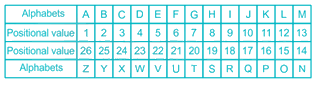 The logic followed here is:
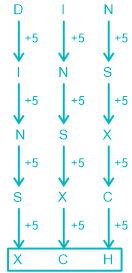 So, XCH will replace the question mark (?) in the following series.
Hence, the correct answer is "Option 4".
Q2 · Series
What comes next?
BYD, DWF, FUH, ?
- HSJ
- IQK
- HQJ
- JQL
Answer aur solution dekho
Archived marked answer: A
The position and positional values or English Alphabets are:
The logic followed here is:
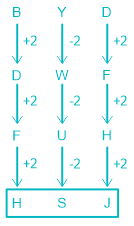 Thus, HSJ comes next.
Hence, the correct answer is "Option 1".
Q3 · Series
What comes next: 13, 16, 21, 30, 45, ?
- 70
- 66
- 67
- 68
Answer aur solution dekho
Archived marked answer: D
The logic followed here is:
Given: 13, 16, 21, 30, 45, ?So, 68 will come next in the series.
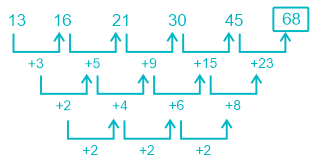 Hence, the correct answer is "Option 4".
Q4 · Series
The series given below contains a sequence of numbers. Accordingly identify the incorrect combination. 25, 32, 46, 67, 97
- 32
- 46
- 97
- 67
Answer aur solution dekho
Archived marked answer: C
The differences should be successive multiples of 7: +7, +14, +21, +28. Thus the final term should be 67 + 28 = 95. The printed term 97 is the incorrect term.
Q5 · Series
What is the sum of the first 10 terms of the series? 1, 3, 5, 7, ...?
- 90
- 100
- 110
- 120
Answer aur solution dekho
Archived marked answer: B
Given:
Series: 1, 3, 5, 7, …
Number of terms (n) = 10
First term (a) = 1
Common difference (d) = 2
Formula used:
Sum of n terms = n ÷ 2 × [2a + (n − 1)d]
Calculations:
Sum = 10 ÷ 2 × [2 × 1 + (10 − 1) × 2]
⇒ Sum = 5 × [2 + 18]
⇒ Sum = 5 × 20
⇒ Sum = 100
∴ The sum of the first 10 terms is 100.
Q6 · Analogy
Solve:
FD : KH :: QM : ?
- VP
- WT
- VQ
- UW
Answer aur solution dekho
Archived marked answer: C
The logic followed here is:
FD : KH
 Similarly,
QM : ?
 So, VQ will come in the place of ?.
Hence, the correct answer is "Option 3".
Q7 · Analogy
In each of the following questions, a specific alphabetical pattern is applied to the first set of letters to form the second. Apply the same logic to find the missing term that relates to the third set in the same way. Choose the correct option from the given alternatives.
AEFJ : KOPT :: ? : QUVZ
- HKQL
- GLKP
- GKLP
- HLKP
Answer aur solution dekho
Archived marked answer: C
The position and positional values or English Alphabets are:
The logic followed here is:
AEFJ : KOPT
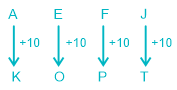 Similarly,
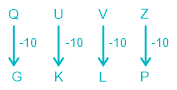 So, GKLP is the correct option from the given alternatives.
Hence, the correct answer is "Option 3".
Q8 · Analogy
TEACHER is to CLASSROOM as SURGEON is to:
- PATIENT
- SCALPEL
- OPERATION
- OT (Operation Theatre)
Answer aur solution dekho
Archived marked answer: D
Logic: Professional : Place of Work
TEACHER is to CLASSROOM: A teacher works in a classroom.
Similarly,
SURGEON is to: A surgeon works in an OT (Operation Theatre).
So, OT (Operation Theatre) is related to SURGEON.
Hence, the correct answer is "Option 4".
Q9 · Puzzle Subtypes Not To Miss
If 6 @ 2 = 9, 15 @ 3 = 125, then 8 @ 4 = ?
- 4
- 8
- 16
- 10
Answer aur solution dekho
Archived marked answer: C
The logic followed here is:
Logic: a @ b = (a ÷ b)ᵇ
6 @ 2 = 9
6 ÷ 2 = 3 → 3² = 9
and
15 @ 3 = 125
15 ÷ 3 = 5 → 5³ = 125
Similarly,
8 @ 4 = ?
8 ÷ 4 = 2 → 24 = 16
So, 16 will come in the place of ?
Hence, the correct answer is "Option 3".
Q10 · Puzzle Subtypes Not To Miss
Choose the correct signs to swap.
40 ÷ 8 + 10 - 5 × 2 = 5
- ÷ and ×
- + and -
- ÷ and +
- - and ×
Answer aur solution dekho
Archived marked answer: B
BODMAS Table:
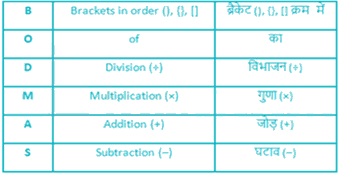 Given equation: 40 ÷ 8 + 10 - 5 × 2 = 5
Let's check each option one by one.
1. ÷ and ×
Given equation: 40 ÷ 8 + 10 - 5 × 2 = 5
After interchanging the signs we get;
⇒ 40 × 8 + 10 − 5 ÷ 2 = 5
⇒ 40 × 8 + 10 − 2.5 = 5
⇒ 320____ + 10 − 2.5 = 5
⇒ 330 ____− 2.5 = 5
⇒ 327.5 ≠ 5
⇒ LHS ≠ RHS
2. + and -
Given equation: 40 ÷ 8 + 10 - 5 × 2 = 5
After interchanging the signs we get;
⇒ 40 ÷ 8 − 10 + 5 × 2 = 5
⇒ 5 − 10 + 5 × 2 = 5
⇒ 5 − 10 + 10 = 5
⇒ 15____ − 10 = 5
⇒ 5 = 5
⇒ LHS = RHS
3. ÷ and +
Given equation: 40 ÷ 8 + 10 - 5 × 2 = 5
After interchanging the signs we get;
⇒ 40 + 8 ÷ 10 − 5 × 2 = 5
⇒ 40 + 0.8 − 5 × 2 = 5
⇒ 40 + 0.8 - 10 = 5
⇒ 40.8 - 10 = 5
⇒ 30.8 ≠ 5
⇒ LHS ≠ RHS
4. - and ×
Given equation: 40 ÷ 8 + 10 - 5 × 2 = 5
After interchanging the signs we get;
⇒ 40 ÷ 8 + 10 × 5 − 2 = 5
⇒ 5 + 10 × 5 − 2 = 5
⇒ 5____ + 50 − 2 = 5
⇒ 55 − 2 = 5
⇒ 53 ≠ 5
⇒ LHS ≠ RHS
So, '+ and -' are the correct signs to swap.
Hence, the correct answer is "Option 2".
Q11 · Puzzle Subtypes Not To Miss
If × = +, + = -, - = ×; then 4 × 5 + 2 - 3 = ?
- 3
- 7
- 35
- 29
Answer aur solution dekho
Archived marked answer: A
BODMAS Table:
Q12 · Coding Decoding
If CLOUD is coded as BKNTC, how is RAINY written?
- QZHMX
- QZHLX
- QZHLW
- QZHMV
Answer aur solution dekho
Archived marked answer: A
The position and positional values or English Alphabets are:
The logic followed here is:
CLOUD is coded as BKNTC
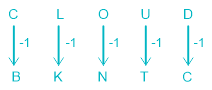 Similarly,
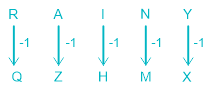 So, RAINY is written as QZHMX.
Hence, the correct answer is "Option 1".
Q13 · Coding Decoding
In a certain code, NIGHT is written as OHJIS How will LIGHT be written?
- MHJIS
- KJHIS
- LIHIS
- MIHIS
Answer aur solution dekho
Archived marked answer: A
NIGHT and LIGHT share the same last four letters IGHT, whose coded suffix is HJIS. The changed first letter follows the same one-place forward move N→O, so L→M. Therefore LIGHT becomes MHJIS.
Q14 · Classification Odd One Out
Identify the odd one out:
- 121
- 141
- 444
- 544
Answer aur solution dekho
Archived marked answer: D
The logic followed here is:
Logic: Palindrome (same forward & backward)
1. 121 → Palindrome
2. 141 → Palindrome
3. 444 → Palindrome
4. 544 → Not a palindrome
So, 544 is the only number that is not a palindrome (does not read the same forward and backward).
Hence, the correct answer is "Option 4".
Q15 · Classification Odd One Out
Find the odd one out:
Pacific, Atlantic, Indian, Arctic, Mediterranean
- Pacific
- Atlantic
- Mediterranean
- Arctic
Answer aur solution dekho
Archived marked answer: C
The logic followed here is:
- Pacific Ocean – The largest and deepest ocean on Earth.
- Atlantic Ocean – The second-largest ocean, separating the Americas from Europe and Africa.
- Indian Ocean – The third-largest ocean, located between Africa, Asia, and Australia.
- Arctic Ocean – The smallest and shallowest ocean, surrounding the North Pole.
- Mediterranean Sea – A sea connected to the Atlantic Ocean, surrounded by Europe, Asia, and Africa.
The first four are oceans, while the Mediterranean is a sea.
So, Mediterranean is the odd one out.
Hence, the correct answer is "Option 3".
Q16 · Classification Odd One Out
Find the odd one out from the given alternatives:
- Troposphere
- Stratosphere
- Hydrosphere
- Mesosphere
Answer aur solution dekho
Archived marked answer: C
The logic followed here is:
1. Troposphere – The lowest layer of Earth’s atmosphere where weather occurs and we live.
2. Stratosphere – The atmospheric layer above the troposphere that contains the ozone layer.
3. Hydrosphere – All the water present on Earth, including oceans, river
Q17 · Classification Odd One Out
Find the odd one out from the given alternatives:
- Retina
- Cornea
- Iris
- Femur
Answer aur solution dekho
Archived marked answer: D
The logic followed here is:
1. Retina – The light-sensitive layer at the back of the eye that helps in vision.
2. Cornea – The transparent front part of the eye that allows light to enter.
3. Iris – The colored part of the eye that controls the size of the pupil.
4. Femur – The thigh bone, which is the longest and strongest bone in the human body.
All options except Femur are parts of the eye, whereas Femur is a bone in the leg.
Hence, the correct answer is "Option 4".
Q18 · Logical Reasoning
Read the following statement carefully and identify the conclusion that follows.
Statement: No artist are athletes. Some athlete are painters. All artists are painters.
Conclusions:
I. Some painters are athletes.
II. Some athletes are not painters.
- Only I follows
- Only II follows
- Both I and II follow
- Neither I nor II follows
Answer aur solution dekho
Archived marked answer: A
Statement: No artist are athletes. Some athlete are painters. All artists are painters.
The least possible Venn diagram for the given statement is:
 Conclusions:
I. Some painters are athletes. - Follow (As some athlete are painters. so, some painters are definitely athletes).
II. Some athletes are not painters. - Does not follow (As some athlete are painters. so, some painters are definitely athletes but we can not say that some athlete are not painter)
So, only I follows.
Hence, the correct answer is "Option 1".
Q19 · Blood Relations
A is the brother of B. B is the sister of C. C is the brother of D. How is B related to D?
- Sister
- Aunt
- Niece
- Can't say
Answer aur solution dekho
Archived marked answer: A
Family Chart:
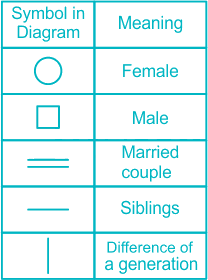 Given: A is the brother of B. B is the sister of C. C is the brother of D.
 Clearly, B is sister of D.
Hence, the correct answer is "Option 1".
Q20 · Blood Relations
Pointing to a woman, John says, "She is the wife of my uncle's only son." How is the woman related to John?
- Sister
- Cousin
- Sister-in-law
- Niece
Answer aur solution dekho
Archived marked answer: C
Family Chart:
Given: Pointing to a woman, John says, "She is the wife of my uncle's only son."
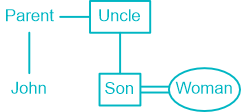 Clearly, the woman is Sister-in-law of John.
Hence, the correct answer is "Option 3".
Q21 · Logical Statement Questions
Instruction: Identify the assumptions that must hold for the statement to be valid, then choose the correct option.
Statement: The introduction of Artificial Intelligence into healthcare systems can enhance diagnostic accuracy, but its widespread implementation may lead to ethical dilemmas in patient care.
Assumptions:
I. AI can improve healthcare diagnostics.
II. The ethical concerns surrounding AI in healthcare are significant.
III. AI will eventually replace human healthcare professionals.
- Only I and II are implicit
- Only II and III are implicit
- All I, II and III are implicit
- Only I is implicit
Answer aur solution dekho
Archived marked answer: A
Statement: The introduction of Artificial Intelligence into healthcare systems can enhance diagnostic accuracy, but its widespread implementation may lead to ethical dilemmas in patient care.
Now,
Assumptions:
I. AI can improve healthcare diagnostics. → Implicit (The statement implies AI can enhance diagnostic accuracy. If AI cannot improve diagnostics, the statement would not be valid.)
II. The ethical concerns surrounding AI in healthcare are significant. → Implicit (The statement implies widespread implementation may lead to ethical dilemmas. For this to be meaningful, ethical concerns must exist and be relevant.)
III. AI will eventually replace human healthcare professionals. → Not Implicit (The statement does not explicitly mention replacement — only enhancement and ethical concerns.)
So, only I and II are implicit.
Hence, the correct answer is "Option 1".
Q22 · Logical Statement Questions
Read the following statement carefully and identify the conclusion that follows.
Statement: Rising noise pollution in urban areas is affecting children's concentration.
Conclusion I: Urban children can't study well.
Conclusion II: Controlling noise pollution may improve children's concentration.
- Only I follows
- Only II follows
- Both follow
- Neither follows
Answer aur solution dekho
Archived marked answer: B
Statement: Rising noise pollution in urban areas is affecting children's concentration.
Now,
Conclusion I: Urban children can't study well. - False (Because the statement says concentration is affected, but it does not say children cannot study at all.)
Conclusion II: Controlling noise pollution may improve children's concentration. - True (Because noise pollution is affecting concentration, then reducing or controlling it may improve concentration. The word “may” makes it logically valid.)
So, only II follows.
Hence, the correct answer is "Option 2".
Q23 · Logical Statement Questions
Read the following statement carefully and identify the conclusion that follows.
Statement: All metro stations are under CCTV surveillance.
Conclusions:
I. Activities at metro stations are being monitored.
II. No criminal activity can happen in metro stations.
- Only Conclusion I follows
- Only Conclusion II follows
- Both I and II follow
- Neither I nor II follows
Answer aur solution dekho
Archived marked answer: A
Statement: All metro stations are under CCTV surveillance.
Now,
Conclusions:
I. Activities at metro stations are being monitored. - True (If metro stations are under CCTV surveillance, activities there are being monitored/recorded.)
II. No criminal activity can happen in metro stations. - False (CCTV surveillance does not guarantee that crime cannot occur — it only helps monitor or record it.)
So, only Conclusion I follows.
Hence, the correct answer is "Option 1".
Q24 · Number Digit Operations
If the sum of 13 and 39 is multiplied by 2, what is the result?
- 100
- 104
- 106
- 110
Answer aur solution dekho
Archived marked answer: B
Given:
First number = 13
Second number = 39
Multiplier = 2
Formula used:
Result = (Sum of numbers) × Multiplier
Calculations:
Sum = 13 + 39 = 52
⇒ Result = 52 × 2 = 104
∴ The result is 104.
General Awareness
Q1 · Art and Culture
The term 'svaravalis' refers to what in the context of Indian classical music?
- A specific type of raga
- A melody composed using the seven notes of the scale
- Ornamentation and embellishment of a raga
- A rhythmic cycle used in carnatic music
Answer aur solution dekho
Archived marked answer: B
The correct answer is A melody composed using the seven notes of the scale.
Key Points
- Svaravalis are fundamental melodic exercises in Carnatic music, composed using the seven notes of the scale: Sa, Ri, Ga, Ma, Pa, Dha, and Ni.
- These exercises are designed to help beginners practice the accurate rendering of swaras (notes) and develop a strong foundation in melody and rhythm.
- Svaravalis typically progress in ascending (arohana) and descending (avarohana) sequences and are practiced in various speeds (kalams).
- They form the basic exercises for voice culture, improving vocal range, breath control, and swara alignment.
- Mastery of svaravalis prepares students for advanced Carnatic music training, including varnams and kritis.
Additional Information
- Option 1: A specific type of raga
- A raga is a specific melodic framework used in Indian classical music, characterized by a set of rules governing the selection and combination of notes.
- Each raga has a unique mood (rasa) and characteristic phrases (pakad) that distinguish it from others.
- While svaravalis involve sequences of notes, they do not represent a specific raga but are used as exercises to practice the swaras.
- Option 3: Ornamentation and embellishment of a raga
- Ornamentation in Indian classical music refers to gamakas (grace notes) and other techniques used to embellish a raga.
- Gamakas include oscillations, slides, and other expressive techniques that bring out the emotional essence of a raga.
- Svaravalis, however, are simple sequences of notes without ornamentation and are primarily used for practice.
- Option 4: A rhythmic cycle used in Carnatic music
- Rhythmic cycles in Carnatic music are known as talas, which provide the rhythmic framework for compositions and improvisations.
- Examples of talas include Adi Tala, Rupaka Tala, and Misra Chapu Tala.
- Svaravalis focus on melody and swara practice and are not directly related to rhythmic cycles.
Q2 · Art and Culture
Fill in the Blank:
Ghoomar was originally performed to worship ____.
- Shiva
- Saraswati
- Krishna
- Ganesha
Answer aur solution dekho
Archived marked answer: B
The correct answer is Saraswati.
Key Points
- Ghoomar is a traditional folk dance of Rajasthan, India, predominantly performed by women.
- It originated in the Bhil community and was later adopted by other Rajasthani communities, including Rajputs.
- The dance was traditionally performed in reverence to Saraswati, the Hindu goddess of wisdom, knowledge, and the arts.
- Ghoomar is characterized by graceful movements, including spinning in circles, with performers wearing traditional attire such as the ghagra (long skirt).
- Over time, the dance has evolved into a cultural symbol of Rajasthan and is performed during festivals, weddings, and other celebrations.
Additional Information
- Shiva
- Shiva is one of the principal deities in Hinduism, known as the "Destroyer" within the Trimurti (the Hindu trinity that includes Brahma and Vishnu).
- He is worshipped in various forms, such as Nataraja, the cosmic dancer, who represents the cycle of creation and destruction.
- Traditional dances like Bharatanatyam often depict stories and themes related to Lord Shiva, but Ghoomar is not directly associated with his worship.
- Krishna
- Krishna is a major deity in Hinduism, known as the eighth avatar of Vishnu.
- He is often associated with themes of love, compassion, and divine playfulness.
- Dance forms like Raslila and Manipuri are closely linked to Lord Krishna, celebrating his life and divine acts.
- Ganesha
- Ganesha is the Hindu god of wisdom, prosperity, and new beginnings, and is revered as the "Remover of Obstacles."
- He is worshipped at the beginning of rituals and ceremonies but is not directly linked to the origins of Ghoomar.
- About Ghoomar
- The word "Ghoomar" is derived from the Hindi word "ghoomna," meaning to spin, which is a key feature of the dance.
- This dance form is a celebration of femininity, grace, and cultural heritage, often performed to traditional Rajasthani songs.
- It has gained international recognition and is now a popular representation of Indian folk culture.
Q3 · Art and Culture
During the Solung festival celebrated by the Adi tribe of Arunachal Pradesh, which traditional drink is shared to promote social bonding?
- Soma
- Apong
- Thukpa
- Chhang
Answer aur solution dekho
Archived marked answer: B
The correct answer is Apong.
Key Points
- Apong is a traditional rice beer made by the Adi tribe of Arunachal Pradesh.
- It is a significant cultural element during the Solung festival, promoting social bonding and unity among the tribal community.
- The preparation of Apong involves fermenting rice mixed with natural herbs, making it a unique and eco-friendly beverage.
- Apong is consumed during various ceremonies and celebrations, symbolizing friendship, hospitality, and shared joy.
- The Solung festival is celebrated to mark prosperity, good harvest, and the welfare of livestock, and Apong plays an integral role in these festivities.
Additional Information
- Soma:
- Soma is an ancient Vedic drink mentioned in Hindu scriptures, particularly in Rigveda, believed to have ritualistic and spiritual significance.
- It is associated with the gods and ceremonies but is not related to Arunachal Pradesh's tribal traditions.
- The exact composition of Soma remains a mystery, with historical references suggesting it was made from plants with psychoactive properties.
- Thukpa:
- Thukpa is a traditional noodle soup originating from Tibet, widely consumed in northeastern Indian states, including Arunachal Pradesh.
- It is a popular dish but is not associated with any specific tribal festival like Solung.
- Thukpa typically includes vegetables, meat, and spices, making it a hearty meal rather than a ceremonial drink.
- Chhang:
- Chhang is a traditional Himalayan alcoholic beverage made from barley or millet, popular in regions like Ladakh, Nepal, and parts of Sikkim.
- It is similar to rice beer but is not specific to the Adi tribe or the Solung festival.
- Chhang is consumed during cold weather and social gatherings in high-altitude regions.
- Main Theme:
- The Solung festival is an important agricultural festival celebrated by the Adi tribe of Arunachal Pradesh.
- It is observed to invoke the deities of crops, livestock, and nature for a prosperous harvest and community well-being.
- Traditional practices, including sharing Apong, enhance the communal spirit and preserve the cultural heritage of the tribe.
Q4 · Indian Polity and Constitution
Under Article 258A, what power is granted to States?
- States need Presidential assent to assign functions to Union
- Governor can entrust Union tasks to State Legislature with President's consent
- State Legislature can entrust Union work to State officers with Centre's approval
- State Government can, with Union's consent, assign Union functions to its officers
Answer aur solution dekho
Archived marked answer: D
The correct answer is State Government can, with Union's consent, assign Union functions to its officers.
Key Points
- Article 258A of the Indian Constitution allows the State Government to assign functions that are part of Union duties to its officers, subject to the Union Government's consent.
- This provision enables cooperative federalism by facilitating smooth coordination between the Union and State Governments for administrative efficiency.
- The purpose of this article is to ensure that certain Union responsibilities can be carried out by State officers in cases where it is more practical or efficient to do so.
- Such assignments are typically used in areas of administrative overlap or when specific functions require local expertise or resource deployment at the state level.
- Through this article, the Constitution ensures that there is no legal ambiguity in delegating Union functions to state authorities with mutual agreement.
Additional Information
- Option 1: States need Presidential assent to assign functions to Union
- This statement is incorrect. The Constitution does not require Presidential assent for States to assign functions to the Union. Instead, Article 258 allows the Union Government to delegate its powers to the State, with Presidential consent.
- Article 258 pertains to the delegation of Union functions to State authorities and requires Presidential approval for such delegation but does not apply in reverse (States to Union).
- Option 2: Governor can entrust Union tasks to State Legislature with President's consent
- This is incorrect as per constitutional provisions. Governors do not have the authority to directly entrust Union tasks to the State Legislature.
- Under Article 258, the delegation of Union functions is usually administrative and does not involve legislative powers, which remain distinct for the Union and States.
- Option 3: State Legislature can entrust Union work to State officers with Centre's approval
- This option is incorrect because the State Legislature does not have the authority to assign Union work. Such powers are vested in the State Government (executive) and not the legislature.
- Legislative powers and administrative functions are separate under the Indian Constitution, and this distinction is maintained in the allocation of responsibilities.
- Main Theme: Article 258A
- Article 258A was inserted in the Constitution by the 7th Constitutional Amendment Act, 1956.
- Its primary purpose is to establish a framework for the delegation of Union functions to State Governments for better governance and administrative coordination.
- This article complements Article 258, which allows the President to entrust Union functions to States.
Q5 · Indian Polity and Constitution
Consider the following statements:
1. Article 300 allows legal suits against State Governments.
2. The term 'Government of India' is a legal entity under Article 300.
Which of the above is/are correct?
- Only 1
- Only 2
- Both 1 and 2
- Neither 1 nor 2
Answer aur solution dekho
Archived marked answer: C
The correct answer is Option 3 (Both 1 and 2).
Key Points
- Article 300 of the Indian Constitution establishes the legal liability of the Government of India and State Governments, allowing legal suits to be filed against them in cases of contractual or tortious obligations.
- The term 'Government of India' is recognized as a legal entity under Article 300, enabling it to sue and be sued in its name.
- The scope of Article 300 derives from the legal framework of the Government of India Act, 1935, and continues under the Constitution of India.
- Legal suits against the State Governments or the Government of India must be initiated in accordance with the rules and procedures prescribed under Article 300.
- Both statements in the question are correct because Article 300 explicitly provides for legal accountability and establishes the Government of India and State Governments as juristic entities.
Additional Information
- Article 300 - Legal Liability:
- Under Article 300, the Government can be held liable for acts done by its officials or representatives in their official capacity.
- It covers cases of breach of contract, negligence, or wrongful acts committed by government officials.
- The Government of India or State Governments can be sued in the same manner as private individuals, subject to certain legal restrictions.
- Historical Background:
- Article 300 traces its roots to Section 176 of the Government of India Act, 1935, which also dealt with the legal liability of the Crown.
- Post-independence, the provisions were adapted and incorporated into the Constitution of India.
- Legal Entity Concept:
- The term 'Government of India' refers to the Union Government as a juristic person capable of legal rights and obligations.
- This ensures accountability and transparency in governance, allowing citizens to seek legal remedies against government actions.
- Limitations of Article 300:
- While Article 300 allows for legal suits against the Government, certain restrictions apply, such as sovereign immunity in specific cases.
- Legal proceedings must adhere to the procedures outlined in the Code of Civil Procedure and other relevant laws.
- Relevance: Article 300 plays a critical role in ensuring accountability of the government and upholding the rule of law.
Q6 · Indian Economy
Which of the following statements is correct regarding population stabilization?
- Stabilization occurs when birth rate exceeds death rate
- Stabilization is reached when fertility rate drops to zero
- Stabilization occurs when birth and death rates are nearly equal
- Stabilization refers to doubling of population every decade
Answer aur solution dekho
Archived marked answer: C
The correct answer is Stabilization occurs when birth and death rates are nearly equal.
Key Points
- Population stabilization refers to a stage where the number of births is approximately equal to the number of deaths over a specific period.
- This balance ensures that the total population remains constant or changes very slightly, avoiding rapid growth or decline.
- Stabilization is achieved when the Total Fertility Rate (TFR) is at or slightly below the replacement level (approximately 2.1 children per woman).
- Population stabilization is a critical goal for sustainable development as it helps reduce pressure on resources like food, water, healthcare, and education.
- Countries like Japan and many European nations have achieved population stabilization through effective policies and societal changes.
Additional Information
- Option 1: Stabilization occurs when birth rate exceeds death rate
- This statement is incorrect because when the birth rate exceeds the death rate, the population grows rather than stabilizes.
- High birth rates without corresponding death rate reduction lead to population explosions, which are often unsustainable in the long term.
- Option 2: Stabilization is reached when fertility rate drops to zero
- This is inaccurate as a fertility rate of zero would result in no births, causing a population decline and eventual extinction over time.
- Population stabilization requires a fertility rate around the replacement level (2.1), not zero.
- Option 4: Stabilization refers to doubling of population every decade
- This statement is incorrect as doubling the population every decade signifies rapid growth, not stabilization.
- Rapid population growth can strain resources and hinder economic and social development.
- Main Theme: Population Stabilization
- Population stabilization is essential for sustainable development, reducing environmental degradation, and improving living standards.
- Policies like family planning, education, and access to healthcare play a vital role in achieving population stabilization.
- Global organizations, including the United Nations, emphasize the importance of stabilizing population growth to meet sustainable development goals (SDGs).
Q7 · Sports Static GK
Consider the following statements about recent National Basketball Championships:
1) Tamil Nadu won the 74th Senior Men's title; Punjab and Indian Railways were runner-up and second runner-up.
2) Rajasthan won the 39th Youth Boys, and Karnataka won the Youth Girls tournament.
Which of the statements is/are correct?
- Only 1 is Correct
- Only 2 is Correct
- 1 and 2 are Correct
- Neither 1 nor 2 is Correct
Answer aur solution dekho
Archived marked answer: C
The correct answer is 1 and 2 are Correct.
Key Points
- Tamil Nadu won the 74th Senior Men's National Basketball Championship, defeating Punjab in the final match.
- Punjab was the runner-up, while Indian Railways secured the second runner-up position in the Senior Men's category.
- In the 39th Youth Boys National Basketball Championship, Rajasthan emerged victorious, showcasing strong performances throughout the tournament.
- Karnataka clinched the Youth Girls title, demonstrating their dominance in the women's youth category.
- Both statements (1 and 2) are correct and reflect the outcomes of the respective championships held recently.
Additional Information
- Statement 1: Tamil Nadu's victory in the 74th Senior Men's National Basketball Championship highlights their prowess in basketball. Punjab and Indian Railways, as runner-up and second runner-up respectively, are traditionally strong teams in the national basketball circuit.
- Statement 2: Rajasthan’s win in the 39th Youth Boys National Basketball Championship signifies the growing talent pool in the state. Similarly, Karnataka’s triumph in the Youth Girls category underscores the state's focus on promoting basketball among women.
- National Basketball Championships:
- These championships are organized annually to promote basketball and identify talent across various age groups in India.
- The tournaments typically include categories like Senior Men, Senior Women, Youth Boys, and Youth Girls.
- States and organizations like Indian Railways actively participate, contributing to the competitive spirit and development of basketball in the country.
- Basketball in India:
- Basketball is governed by the Basketball Federation of India (BFI), which organizes national-level tournaments and training programs.
- The sport is growing in popularity, with increasing participation at the grassroots level and international representation by Indian players.
Q8 · Sports Static GK
Which of the following combinations of athletics winners at the 2025 National Games is entirely correct?
- Parul Chaudhary - 3000m steeplechase; Jyothi Yarraji - 100m hurdles
- Lovlina - 100m hurdles; Amoj Jacob - Shot Put
- Swapnil Kusale - Boxing; Sarabjot - Sprint
- Amoj Jacob - Wrestling; Jyothi - Relay
Answer aur solution dekho
Archived marked answer: A
The correct answer is Option 1.
Key Points
- Parul Chaudhary is a prominent Indian athlete specializing in long-distance running events, including the 3000m steeplechase. She has represented India in various international competitions and won accolades for her performance.
- Jyothi Yarraji is a leading Indian hurdler and sprinter who has earned recognition for her exceptional performance in the 100m hurdles</st
Q9 · Sports Static GK
Which of the following statements is correct regarding the Golden Raid and card system in Kabaddi?
- A team is allowed two Golden Raids before the result is decided.
- A Green Card leads to a 2-minute suspension from the game.
- A fresh toss is taken if the match is tied even after 5-5 raids.
- A Red Card results in a warning with no match suspension.
Answer aur solution dekho
Archived marked answer: C
The correct answer is A fresh toss is taken if the match is tied even after 5-5 raids.
Key Points
- In Kabaddi, if the match remains tied even after five raids by each team in the Golden Raid phase, a fresh toss is conducted to determine the next course of action.
- This rule ensures a fair opportunity for both teams and avoids indefinite extensions of the match duration.
- The Golden Raid is a tiebreaker mechanism where each team gets five raids to score points and secure a win.
- In the event of another tie after the Golden Raid phase, the fresh toss decides which team gets to initiate the next set of raids.
- This format introduces an element of strategy and luck, as the toss winner gains a tactical advantage by choosing to raid or defend first.
Additional Information
- Option 1: A team is allowed two Golden Raids before the result is decided
- This statement is incorrect. In Kabaddi, the Golden Raid phase involves only one set of five raids per team.
- The Golden Raid rule is designed to prevent excessive delays in determining the winner and ensures that the game concludes efficiently.
- Option 2: A Green Card leads to a 2-minute suspension from the game
- This statement is incorrect as well. A Green Card in Kabaddi serves as a warning to players or coaches for misconduct or minor rule violations.
- It does not result in any suspension or time penalty; however, repeated warnings can escalate to Yellow or Red Cards.
- Option 4: A Red Card results in a warning with no match suspension
- This statement is also incorrect. A Red Card in Kabaddi signifies a serious offense and leads to the immediate suspension of the player for the remainder of the match.
- Additionally, the team has to play with reduced strength, as the suspended player cannot be replaced.
- Main Theme: Golden Raid and Card System in Kabaddi
- The Golden Raid is a tiebreaking mechanism used in Kabaddi to determine the winner in case of a tied score at the end of regular time.
- The card system in Kabaddi, including Green, Yellow, and Red Cards, is implemented to maintain discipline and penalize players for misconduct or rule violations.
- This structured approach ensures that the game remains competitive, fair, and free from unnecessary interruptions.
Q10 · Indian Geography
Digboi, Moran, Sivasagar, and Naharkatiya oil fields are located in which of the following regions of India?
- Aravalli and Delhi Ridge
- Deccan Plateau
- North-Eastern India
- Western Coastal Plains
Answer aur solution dekho
Archived marked answer: C
The correct answer is North-Eastern India.
Key Points
- Digboi, Moran, Sivasagar, and Naharkatiya are prominent oil fields located in the state of Assam, which is in the North-Eastern region of India.
- Digboi is often referred to as the ‘Oil City of Assam’ and holds historical significance as it is home to Asia's first oil refinery, established in 1901.
- The oil fields of Moran and Naharkatiya are some of the largest contributors to India's crude oil production, reinforcing Assam's role as a vital hub in the Indian petroleum industry.
- These oil fields are managed by Oil India Limited (OIL) and Oil and Natural Gas Corporation (ONGC), two of India's leading oil companies.
- The North-Eastern region, with Assam at its core, is known for its abundant petroleum reserves, contributing significantly to the country’s energy resources.
Additional Information
- Aravalli and Delhi Ridge
- The Aravalli Range is one of the oldest mountain ranges in the world, primarily spread across Rajasthan, Haryana, and Delhi.
- The Delhi Ridge is an extension of the Aravalli Hills, forming a green lung for the national capital region.
- While the region is rich in minerals like granite, marble, and copper, it does not have any significant oil fields.
- Deccan Plateau
- The Deccan Plateau is a large plateau covering parts of southern India, including Maharashtra, Karnataka, Telangana, and Andhra Pradesh.
- This region is well-known for its rich deposits of minerals like iron ore, bauxite, and coal.
- However, the region is not a major source of crude oil production in India.
- Western Coastal Plains
- The Western Coastal Plains stretch along the Arabian Sea, covering states like Gujarat, Maharashtra, Goa, Karnataka, and Kerala.
- While Gujarat is home to the Cambay Basin (a significant oil-producing region), other parts of the Western Coastal Plains are not known for major oil fields.
- This region is more associated with fishing, tourism, and agriculture rather than petroleum production.
``
Q11 · Indian Geography
Consider the following physiographic features.
1. Tors
2. Spurs
3. Block Mountains
Which of the feature/features given above is/are found in the peninsular plateau of India?
- 1 and 3 only
- 3 only
- 2 and 3 only
- 1, 2, and 3
Answer aur solution dekho
Archived marked answer: D
The correct answer is 1, 2, and 3.
Key Points
- Tors: Tors are large, freestanding rock outcrops found primarily in the peninsular plateau, formed due to weathering and erosion of the granite rocks over millions of years.
- Spurs: Spurs are ridges or projections that extend from a higher landscape, often observed in the peninsular plateau, marking the rugged terrain formed due to tectonic activities.
- Block Mountains: These are formed due to faulting and are present in the peninsular plateau; examples include the Satpura and Vindhya ranges formed due to tectonic upliftment.
- The peninsular plateau of India is characterized by ancient crystalline rocks, geological stability, and features such as tors, spurs, and block mountains due to its geological history.
- This physiographic region is one of the oldest landforms in India, showcasing the remnants of tectonic, erosional, and weathering processes.
Additional Information
- Tors:
- Tors are commonly observed in the Deccan Plateau, where granite rocks dominate the landscape.
- They are formed due to the prolonged process of chemical weathering, joint expansion, and exfoliation of rocks.
- Tors are often associated with landscapes like the Mahabaleshwar hills in Maharashtra.
- Spurs:
- Spurs are elongated ridges descending from higher elevations, typically formed due to erosional forces like wind and water.
- These features are commonly found in the Satpura and Vindhya ranges of the peninsular plateau.
- Spurs contribute to the rugged and uneven terrain of the region, making it distinct from the northern plains.
- Block Mountains:
- Block mountains are formed due to the vertical displacement of land along faults, creating horsts and grabens.
- The Satpura and Vindhya ranges are classic examples of block mountains in India.
- The peninsular plateau's block mountains are a result of ancient tectonic movements that shaped the terrain millions of years ago.
- Peninsular Plateau Overview:
- The peninsular plateau is one of the oldest landforms in India, dating back to the Precambrian era.
- It covers the southern part of India, characterized by its stable geological structure and diverse physiographic features.
- Important rivers like the Narmada, Godavari, and Krishna flow through the plateau, enriching its geographical diversity.
Q12 · Modern Indian History
The integration of the princely states into the Indian Union after 1947 involved a complex interplay of political negotiation, popular movements, and, at times, coercion. Which of the following factors most significantly undermined the initial aspirations of some princely rulers to maintain independent or autonomous status?
- The overwhelming military superiority of the newly formed Pakistani state, compelling the rulers to seek protection within India.
- The consistent and unwavering support provided by the British government to the princely states seeking independence.
- The strong undercurrent of popular will within the princely states favoring accession to India, often expressed through organized movements and protests.
- The economic prosperity and stability offered by remaining independent, making integration into the financially strained Indian Union unattractive.
Answer aur solution dekho
Archived marked answer: C
The correct answer is The strong undercurrent of popular will within the princely states favoring accession to India, often expressed through organized movements and protests.
Key Points
- Post-independence, many princely states aspired to maintain independent or autonomous status due to historical autonomy and privileges enjoyed under British rule.
- Popular movements, protests, and strong public sentiment within princely states significantly influenced the rulers to accede to India. These movements reflected the will of the people to be part of a unified Indian nation.
- The integration process was spearheaded by Sardar Vallabhbhai Patel and V.P. Menon, who utilized diplomacy and strategic measures to persuade rulers while considering the popular will of the people.
- Many princely states, such as Hyderabad, Junagadh, and Kashmir, faced large-scale public uprisings and organized movements demanding integration into India, which significantly undermined the rulers' autonomy aspirations.
- The Indian government also used plebiscites in certain cases, such as Junagadh, where the overwhelming public vote favored joining India, further showcasing popular sentiment as a decisive factor.
Additional Information
- The overwhelming military superiority of the newly formed Pakistani state, compelling the rulers to seek protection within India (Option 1):
- This option is factually incorrect. India, not Pakistan, had greater military superiority after partition.
- Princely states were never compelled to join India due to Pakistani aggression; rather, India strategically handled integration efforts.
- Instances such as Hyderabad and Kashmir were resolved using Indian military and diplomatic efforts, with no role of Pakistani superiority influencing accession.
- The consistent and unwavering support provided by the British government to the princely states seeking independence (Option 2):
- After India's independence, British support to princely rulers ceased as they transferred power to the newly formed Indian and Pakistani governments.
- The British policy of "paramountcy" ended, leaving princely rulers to decide between joining India, Pakistan, or remaining independent.
- This option is incorrect because British influence was no longer a decisive factor post-1947.
- The economic prosperity and stability offered by remaining independent, making integration into the financially strained Indian Union unattractive (Option 4):
- While some rulers perceived independence as economically beneficial, the financial strain of maintaining sovereignty and administrative responsibilities outweighed perceived benefits.
- Integration into India also provided economic stability, access to resources, and infrastructural development which were favorable compared to isolated independence.
- Economic factors were secondary to popular will and political negotiations in determining accession.
- Main Theme:
- The integration of princely states into the Indian Union was a monumental task involving diplomacy, popular movements, and sometimes military intervention.
- Popular will played a decisive role in undermining the aspirations of rulers seeking independence, showcasing the democratic aspirations of the people.
- Sardar Vallabhbhai Patel and V.P. Menon's efforts were instrumental in ensuring a smooth transition and consolidation of the Indian Union.
Q13 · Current Affairs
The "Atal Innovation Mission (AIM)" is a flagship initiative to promote innovation and entrepreneurship in India. Which of the following is a key component or program under AIM?
- Skill India Centers
- Startup India Seed Fund Scheme
- Atal Tinkering Labs (ATLs)
- Pradhan Mantri Kaushal Vikas Yojana (PMKVY)
Answer aur solution dekho
Archived marked answer: C
The correct answer is Atal Tinkering Labs (ATLs).
Key Points
- The Atal Tinkering Labs (ATLs) are a key initiative under the Atal Innovation Mission (AIM) by the NITI Aayog, aimed at fostering innovation and creativity among school students in India.
- The primary objective of ATLs is to inculcate a culture of scientific temper, critical thinking, and problem-solving skills among students from a young age.
- Each ATL is equipped with cutting-edge technologies such as 3D printers, robotics kits, IoT (Internet of Things) devices, and miniaturized electronics to enable hands-on experimentation and innovation.
- As of 2023, more than 10,000 ATLs have been established across India, with a focus on promoting STEM (Science, Technology, Engineering, and Mathematics) education in both urban and rural areas.
- ATLs encourage students to identify local and global challenges and create innovative solutions through mentorship, workshops, and access to advanced tools and resources.
Additional Information
- Skill India Centers
- Skill India is an initiative by the Government of India aimed at empowering the youth with skill development and training.
- The program focuses on providing vocational training to enhance the employability of individuals in various sectors.
- It includes schemes like the Pradhan Mantri Kaushal Vikas Yojana (PMKVY) and the National Apprenticeship Promotion Scheme (NAPS).
- While Skill India Centers focus on vocational training, they are not a part of the Atal Innovation Mission.
- Startup India Seed Fund Scheme
- This scheme was launched by the Government of India to provide financial assistance to startups for proof of concept, prototype development, product trials, market entry, and commercialization.
- It aims to support innovative startups and encourage entrepreneurship across the country.
- Although it promotes innovation, it is not a direct component of the Atal Innovation Mission.
- Pradhan Mantri Kaushal Vikas Yojana (PMKVY)
- PMKVY is the flagship scheme of the Ministry of Skill Development and Entrepreneurship (MSDE) under the Skill India Mission.
- It aims to provide industry-relevant skill training to youth to enhance their employability.
- Unlike ATLs, PMKVY focuses more on vocational training and certification rather than fostering innovation and entrepreneurship.
</ul
Q14 · Current Affairs
The Bharatiya Nyaya Sanhita (BNS) was introduced as part of:
- The effort to codify personal laws.
- The effort to modernize and decolonize India's criminal justice system.
- The new taxation policy.
- A trade agreement.
Answer aur solution dekho
Archived marked answer: B
The correct answer is The effort to modernize and decolonize India's criminal justice system.
Key Points
- The Bharatiya Nyaya Sanhita (BNS) was introduced to replace the colonial-era Indian Penal Code (IPC), which was enacted during British rule in 1860.
- The primary objective of the BNS is to modernize India's criminal justice system and align it with the current socio-economic and legal realities of the country.
- The BNS is part of a larger effort by the Indian government to decolonize the legal framework and make it more representative of India's cultural and societal values.
- It emphasizes the protection of individual rights, ensures speedy justice, and strengthens mechanisms to address crimes more effectively.
- The BNS is accompanied by two other proposed laws—the Bharatiya Nagarik Suraksha Sanhita (replacing the Code of Criminal Procedure) and the Bharatiya Sakshya Bill (replacing the Indian Evidence Act)—as part of a comprehensive overhaul of the criminal justice system.
Additional Information
- The effort to codify personal laws
- Personal laws in India govern matters such as marriage, divorce, inheritance, and adoption, and are based on religious customs and traditions.
- Efforts to codify personal laws have been undertaken in the past, such as the Hindu Code Bills in the 1950s, which led to the enactment of laws like the Hindu Marriage Act and the Hindu Succession Act.
- However, the introduction of the BNS is not related to personal laws but rather to the criminal justice system.
- The new taxation policy
- Taxation policies in India are governed by laws such as the Income Tax Act and the Goods and Services Tax (GST) framework.
- These policies deal with the collection of revenue by the government and are unrelated to criminal justice reforms or the introduction of the BNS.
- A trade agreement
- Trade agreements are treaties or arrangements between countries to facilitate trade by reducing tariffs, quotas, or other trade barriers.
- The BNS is not connected to any trade agreement, as it is focused on reforms in the criminal justice system.
Q15 · Current Affairs
Which institute has been studying the Pensilungpa Glacier in Zanskar, Ladakh, to monitor its retreat and mass balance?
- Indian National Centre for Ocean Information Services (INCOIS)
- Wadia Institute of Himalayan Geology (WIHG)
- Central Marine Fisheries Research Institute (CMFRI)
- Zoological Survey of India (ZSI)
Answer aur solution dekho
Archived marked answer: B
The correct answer is Wadia Institute of Himalayan Geology (WIHG).
Key Points
- The Wadia Institute of Himalayan Geology (WIHG) is an autonomous research institute under the Department of Science and Technology, Government of India.
- The institute has been actively studying the Pensilungpa Glacier in Zanskar, Ladakh, to monitor its retreat and mass balance, which are key indicators of climate change impacts in the Himalayan regi
Q16 · Current Affairs
Ajit Doval is known as a key figure in India's strategic affairs, remains the National Security Advisor (NSA). In light of his ongoing tenure and recent developments, which of the following statements best reflects his current status as of July 2025?
- Ajit Doval's current tenure as NSA, which began in June 2025, is his first independent term after serving as Principal Advisor on National Security for a decade.
- He holds the ex-officio rank equivalent to a Cabinet Secretary, with his appointment typically for a fixed five-year term irrespective of the government's tenure.
- Having been reappointed for a fresh term in June 2024, his current position is co-terminus with the Prime Minister's term and he holds the rank of a Cabinet Minister.
- As NSA, his primary role is to chair the National Security Council (NSC), where he holds voting power on all key security policy decisions, including those related to defence procurement.
Answer aur solution dekho
Archived marked answer: C
The correct answer is Having been reappointed for a fresh term in June 2024, his current position is co-terminus with the Prime Minister's term and he holds the rank of a Cabinet Minister..
Key Points
- Ajit Doval is one of India's most prominent National Security Advisors, known for his strategic acumen and contributions to India's national security framework.
- In June 2024, he was reappointed for a fresh term as NSA, aligning his tenure with that of the Prime Minister, making it co-terminus with the government's tenure.
- Under the current appointment, Doval holds the rank of a Cabinet Minister, enabling him to participate directly in high-level policy-making and decision-making processes.
- Ajit Doval continues to play a pivotal role in shaping India's national security policies, including counter-terrorism strategies, intelligence coordination, and geopolitical diplomacy.
- His reappointment underscores the trust of the government in his leadership and strategic expertise, especially in addressing complex security challenges.
Additional Information
- Option 1: Ajit Doval's tenure as NSA began in 2014, making this his second term after being reappointed in 2019. The statement that his tenure began in June 2025 as his first independent term is factually incorrect.
- Option 2: While Ajit Doval holds a rank equivalent to a Cabinet Minister, not a Cabinet Secretary, his tenure is not fixed at five years irrespective of the government's term. This option confuses the tenure and rank specifics of the NSA position.
- Option 4: The NSA does not chair the National Security Council (NSC). The NSC is primarily an advisory body to the Prime Minister on security matters. The NSA's role is more operational and strategic, focusing on national security policies, rather than holding voting power on defence procurement decisions.
- Main Theme: The National Security Advisor (NSA) in India is a key position responsible for advising the Prime Minister on matters of national security and overseeing intelligence operations. The NSA plays a critical role in shaping India's security and foreign policy framework, especially amidst evolving global and regional challenges.
Q17 · Current Affairs
Which new element was incorporated in the 2023 edition of the Logistics Performance Index (LPI)?
- It evaluates only land-based transport systems
- It ranks countries based on tourism potential
- It includes indicators measuring trade speed using big data
- It excludes lower-income income economies from the analysis
Answer aur solution dekho
Archived marked answer: C
The correct answer is It includes indicators measuring trade speed using big data.
Key Points
- The 2023 edition of the Logistics Performance Index (LPI), published by the World Bank, introduced the use of big data analytics to measure trade speed and efficiency.
- Big data indicators include tracking container shipping times and border clearance durations, offering real-time insights into logistics performance.
- These new data-driven measures provide an accurate assessment of how efficiently countries handle imports and exports.
- The incorporation of big data allows countries to identify bottlenecks and improve their supply chain processes effectively.
- Trade speed is now measured with precision, focusing on the time taken for goods to reach destinations, enhancing transparency in global logistics operations.
Additional Information
- Option 1: It evaluates only land-based transport systems
- The Logistics Performance Index (LPI) assesses global logistics across various modes of transport, including air, sea, and land.
- Focusing solely on land-based transport systems would be restrictive and does not align with the comprehensive scope of the LPI.
- The LPI evaluates efficiency in logistics chains, customs performance, infrastructure quality, and timeliness across all transportation modes.
- Option 2: It ranks countries based on tourism potential
- The LPI is primarily designed to analyze logistics and supply chain performance rather than tourism potential.
- Tourism indices, such as the Travel and Tourism Competitiveness Index, are separate frameworks designed to measure tourism-related factors.
- The LPI focuses on trade facilitation, transportation infrastructure, and customs efficiency rather than tourism metrics.
- Option 4: It excludes lower-income economies from the analysis
- The LPI includes all economies, regardless of income level, to provide a global assessment of logistics performance.
- Excluding lower-income economies would limit the scope and purpose of the index, as it aims to provide comparative insights across nations.
- The inclusion of lower-income economies highlights disparities in logistics capabilities and helps identify areas for improvement.
- Main Theme: Logistics Performance Index (LPI)
- The LPI is a global benchmarking tool created by the World Bank to assess countries' logistics performance.
- It evaluates factors such as customs efficiency, infrastructure quality, ease of arranging shipments, competence of logistics services, tracking capabilities, and timeliness.
- The index helps policymakers, businesses, and stakeholders identify areas for improving trade facilitation and supply chain efficiency.
Q18 · Medieval Indian History
Which of the following building materials were primarily used in constructing Purana Qila?
- Granite and lime plaster
- Concrete and red bricks
- Sandstone and marble
- Wood and terracotta
Answer aur solution dekho
Archived marked answer: C
The correct answer is Sandstone and marble.
Key Points
- Purana Qila, also known as the Old Fort, is one of the oldest forts in Delhi, built during the reign of Sher Shah Suri and later completed by Humayun.
- Its construction prominently features red sandstone, which was widely used during the Mughal era due to its durability and aesthetic appeal.
- Marble was used in specific decorative elements and detailing, enhancing the beauty of the fort.
- The fort showcases typical Mughal architectural styles, combining strength and elegance through the use of sandstone and marble.
- Some of the iconic structures within Purana Qila include the Qila-i-Kuhna Mosque and the Sher Mandal, which also incorporate these materials.
Additional Information
- Granite and lime plaster:
- Granite is a very durable and hard stone commonly used in construction, but it was not a key material in Mughal architecture.
- Lime plaster was often used in ancient Indian constructions for finishing and binding purposes; however, it was not a primary material in Purana Qila.
- Concrete and red bricks:
- Concrete and red bricks are modern construction materials and were not available during the Mughal era.
- These materials are commonly used in contemporary buildings for their affordability and ease of use.
- Wood and terracotta:
- Wood and terracotta were used in ancient Indian architecture, particularly in temples and domestic structures.
- However, they were not suitable for large forts like Purana Qila, which required more durable materials such as stone and marble.
- Significance of Sandstone and Marble in Mughal Architecture:
- Sandstone was widely used for its strength and reddish hue, which gave monuments an imposing look.
- Marble was reserved for intricate detailing, decorative work, and creating contrast with sandstone.
- Examples of other Mughal structures using these materials include the Red Fort and Humayun's Tomb.
Q19 · Medieval Indian History
What was a major challenge for agriculture in the Chola kingdom apart from rocky land?
- Lack of seeds
- Lack of labour
- Irrigation water
- Pest infestation
Answer aur solution dekho
Archived marked answer: C
The correct answer is Irrigation water.
Key Points
- The Chola kingdom was located in South India, where agriculture depended heavily on water availability, especially due to the tropical climate and erratic rainfall patterns.
- The lack of an adequate irrigation system was a significant challenge, as agriculture in the region required controlled water supply for rice cultivation, the primary crop of the Chola empire.
- The Cholas implemented advanced water management techniques, including the construction of tanks, reservoirs, and canals, to overcome the issue of water scarcity.
- One of the most notable examples of their irrigation efforts is the Grand Anicut (Kallanai Dam), built across the Kaveri River, which helped regulate water flow and supply irrigation to vast agricultural lands.
- Despite these measures, maintaining and expanding irrigation systems remained an ongoing challenge due to the increasing population and agricultural demands during the Chola period.
Additional Information
- Lack of seeds:
- Seed availability was not a significant challenge in the Chola kingdom as agriculture was well-established, and farmers used traditional methods to preserve and exchange seeds.
- The Chola rulers supported agricultural development by providing resources to farmers, which ensured the availability of quality seeds for cultivation.
- Lack of labour:
- The Chola kingdom had a large agrarian population, and farming was the primary occupation for most people.
- Labour shortages were not a major issue due to the hierarchical social structure that ensured the availability of workers for agricultural activities.
- Pest infestation:
- While pest infestation might have posed occasional challenges, it was not a major concern during the Chola period.
- Traditional pest control methods, such as crop rotation and the use of natural repellents, were commonly employed by farmers.
- The Chola Empire and Agricultural Development:
- The Chola kingdom (9th to 13th century CE) was known for its efficient administration and emphasis on agrarian prosperity.
- Agriculture was the backbone of the Chola economy, with rice being the staple crop.
- The Chola rulers invested in large-scale infrastructure projects, including irrigation systems, to improve agricultural productivity and ensure food security.
- Their efforts in water management and agricultural development laid the foundation for a thriving and sustainable agrarian economy.
Q20 · Ancient Indian History
The drainage system at Mohenjodaro was notable because each house was connected to:
- An underground water tank
- A central pillar for support
- A covered street drain
- A rooftop reservoir
Answer aur solution dekho
Archived marked answer: C
The correct answer is A covered street drain.
Key Points
- The drainage system at Mohenjodaro was highly advanced and considered one of the best in the ancient world.
- Each house in the city was connected to a covered street drain, ensuring efficient waste disposal and cleanliness.
- The drains were made of baked bricks and were covered with stone slabs, which could be removed for cleaning purposes.
- The street drains were interconnected with larger sewer systems that carried waste out of the city, showing a systematic approach to urban sanitation.
- This sophisticated drainage system highlights the advanced engineering and urban planning skills of the Indus Valley Civilization.
Additional Information
- An underground water tank:
- While water storage was practiced in some ancient civilizations, there is no evidence of underground water tanks being connected to individual houses in Mohenjodaro.
- However, large public water tanks like the "Great Bath" were used for ceremonial or communal purposes.
- The Great Bath is one of the most iconic structures in Mohenjodaro, reflecting their water management skills.
- A central pillar for support:
- This option is irrelevant to the drainage system of Mohenjodaro.
- While some buildings may have used pillars for structural stability, they were not associated with sanitation or drainage.
- A rooftop reservoir:
- There is no archaeological evidence suggesting that houses in Mohenjodaro had rooftop reservoirs connected to the drainage system.
- Water was typically stored in wells or communal tanks rather than on rooftops.
- Indus Valley Civilization's Drainage System:
- The drainage system of the Indus Valley Civilization, particularly in cities like Mohenjodaro and Harappa, is considered a hallmark of their urban planning.
- It included covered drains, soak pits, and inspection holes for maintenance.
- The presence of such advanced systems indicates a high level of civic sense and hygiene awareness among the people.
Q21 · World Geography
Earth's atmosphere reaches what height approximately(Kármán line )?
- 100 km
- 1000 km
- 10,000 km
- 100,000 km
Answer aur solution dekho
Archived marked answer: A
The correct answer is 100 km.
Key Points
- The Kármán line is internationally recognized as the boundary between Earth's atmosphere and outer space, located at an altitude of 100 kilometers (62 miles) above sea level.
- It was named after Hungarian-American physicist Theodore von Kármán, who calculated that at this altitude, the atmosphere becomes too thin to support conventional aircraft flight.
- Beyond the Kármán line, aerodynamic lift becomes negligible, a
Q22 · General Science Physics
Read the following statements about the photoelectric effect:
1. The kinetic energy of emitted photoelectrons increases with increasing intensity of incident light.
2. The photoelectric effect demonstrates the particle nature of light.
3. There is a threshold frequency below which no photoemission occurs, regardless of light intensity.
Which of the above statements are correct?
- 1 and 2 only
- 2 and 3 only
- 1 and 3 only
- 1, 2 and 3
Answer aur solution dekho
Archived marked answer: B
The correct answer is 2) 2 and 3 only.
Key Points
- The photoelectric effect is a phenomenon where electrons are ejected from a metal surface when light of sufficient frequency strikes it.
- Statement 2 is correct: The photoelectric effect demonstrates the particle nature of light. This is because light interacts with electrons as discrete packets of energy called photons.
- Statement 3 is correct: There exists a threshold frequency below which no photoemission occurs, regardless of the intensity of the light. This threshold frequency corresponds to the minimum photon energy required to overcome the work function of the metal.
- The kinetic energy of emitted photoelectrons depends on the frequency of the incident light, not its intensity. This is a key characteristic of the photoelectric effect.
- Experimental evidence for the photoelectric effect played a pivotal role in the development of quantum mechanics, as it could not be explained by classical wave theory.
Additional Information
- Explanation of Statement 1:
- Statement 1 is incorrect because the kinetic energy of the emitted photoelectrons does not depend on the intensity of the incident light.
- Instead, the intensity of light affects the number of photoelectrons emitted, but their energy is determined by the frequency of the light and the work function of the metal.
- This distinction is critical in understanding the particle nature of light and why intensity influences quantity, not energy.
- Particle Nature of Light:
- The photoelectric effect provides conclusive evidence of the particle nature of light, as photons transfer their energy directly to electrons.
- The energy of a photon is given by the equation *E = hν*, where *h* is Planck's constant and *ν* is the frequency of light.
- Threshold Frequency Concept:
- The threshold frequency is directly related to the work function of the material, which is the minimum energy required to eject an electron from the metal surface.
- Light below the threshold frequency cannot eject electrons, no matter how intense it is, because the energy per photon is insufficient.
- Historical Significance:
- The photoelectric effect was first explained by Albert Einstein in 1905, for which he received the Nobel Prize in Physics in 1921.
- This phenomenon challenged classical wave theories of light and laid the foundation for quantum mechanics.
- Conclusion on Intensity vs Frequency:
- While intensity of light increases the number of photons striking the surface, frequency determines the energy of each photon and hence the kinetic energy of emitted electrons.
Q23 · Books and Authors Static
'The Namesake' is a famous novel by which Indian-American author?
- Jhumpa Lahiri
- Arundhati Roy
- Chitra Banerjee
- Kiran Desai
Answer aur solution dekho
Archived marked answer: A
The correct answer is Jhumpa Lahiri.
Key Points
- Jhumpa Lahiri is an Indian-American author renowned for her works exploring themes of identity, immigration, and cultural dislocation.
- Her novel "The Namesake", published in 2003, revolves around the life of Gogol Ganguli, a first-generation Indian-American grappling with his cultural identity.
- "The Namesake" was adapted into a critically acclaimed film in 2006, directed by Mira Nair and starring Kal Penn, Tabu, and Irrfan Khan.
- Lahiri won the Pulitzer Prize for Fiction in 2000 for her debut short story collection, "Interpreter of Maladies."
- Her works are celebrated for their minimalist prose and intricate depiction of the immigrant experience, making her one of the most influential voices in contemporary literature.
Additional Information
- Arundhati Roy
- Arundhati Roy is an Indian author and activist best known for her debut novel, "The God of Small Things," which won the Booker Prize in 1997.
- The novel is a semi-autobiographical work that explores themes of caste, family, and forbidden love in Kerala, India.
- She is also a prominent political activist and has written several non-fiction works, including "Field Notes on Democracy" and "The Algebra of Infinite Justice."
- Chitra Banerjee Divakaruni
- Chitra Banerjee Divakaruni is an Indian-American author, poet, and educator known for her works that blend myth, history, and contemporary issues.
- Her notable works include "The Palace of Illusions," a retelling of the Mahabharata from Draupadi's perspective, and "Sister of My Heart."
- Her writing often focuses on the experiences of Indian immigrants, women’s issues, and cultural identity.
- Kiran Desai
- Kiran Desai is an Indian author and the daughter of novelist Anita Desai.
- Her novel "The Inheritance of Loss" won the Man Booker Prize in 2006 and explores themes of globalization, migration, and post-colonialism.
- Desai’s works are lauded for their vivid descriptions and deep exploration of human emotions and societal complexities.
Q24 · Static GK
The "Kaladan Multimodal Transit Transport Project" links India with which country?
- China
- Myanmar
- Bangladesh
- Nepal
Answer aur solution dekho
Archived marked answer: B
The correct answer is Myanmar.
Key Points
- The Kaladan Multimodal Transit Transport Project is an important initiative by the Government of India to connect the northeastern region of India with Myanmar through a multimodal transport network.
- It involves a combination of shipping, inland water, and road transport to provide an alternative route for trade and connectivity.
- The project spans from the port of Kolkata to the Sittwe port in Myanmar via the Bay of Bengal, followed by inland water transport on the Kaladan River up to Paletwa in Myanmar, and further by road to Mizoram in India.
- The Kaladan project aims to enhance bilateral trade between India and Myanmar and improve connectivity to the landlocked northeastern states of India, reducing dependence on the Siliguri Corridor (also known as the Chicken's Neck).
- The development of this project is expected to strengthen India’s Act East Policy by improving economic and strategic ties with Southeast Asian countries.
Additional Information
- China
- China shares borders with northeastern India, but no direct bilateral project like the Kaladan is in place between the two nations for enhancing connectivity to northeastern states.
- China is an important regional player in South Asia and Southeast Asia, but its Belt and Road Initiative (BRI) is a separate global infrastructure project that does not directly involve the Kaladan project.
- Bangladesh
- India and Bangladesh have several connectivity projects, such as the Maitri Setu and the Agartala-Akhaura rail link, but they are separate from the Kaladan Multimodal Transit Transport Project.
- Bangladesh is a critical partner for India in terms of regional connectivity, especially for the northeastern states, under various bilateral and regional initiatives like the BBIN (Bangladesh, Bhutan, India, Nepal) framework.
- Nepal
- Nepal is a landlocked country that shares borders with India but is not part of the Kaladan project.
- India and Nepal have separate bilateral agreements for trade and transit, such as access to Indian ports for Nepalese trade.
- Main Theme: Kaladan Multimodal Transit Transport Project
- The project is part of India’s effort to establish seamless connectivity with Southeast Asia and strengthen its strategic and economic ties in the region.
- It also aims to provide an alternative route for the transportation of goods to the northeast, bypassing the narrow and congested Siliguri Corridor.
- Once completed, the project is expected to significantly reduce transportation costs and time for goods moving between India and Myanmar.
Q25 · General Science
What is the contribution of Vikram Sarabhai Space Centre (VSSC) to India's space program?
- Launch site for ISRO missions
- Designs and builds launch vehicles
- Trains Indian astronauts
- Controls ISRO satellites
Answer aur solution dekho
Archived marked answer: B
The correct answer is Designs and builds launch vehicles.
Key Points
- The Vikram Sarabhai Space Centre (VSSC), located in Thiruvananthapuram, Kerala, is the primary center for the design and development of launch vehicles for the Indian Space Research Organisation (ISRO).
- VSSC is responsible for developing critical technologies for satellite launch vehicles, including the Polar Satellite Launch Vehicle (PSLV) and Geosynchronous Satellite Launch Vehicle (GSLV).
- It is involved in the research and development of materials, propulsion systems, avionics, and aerospace structures required for launch vehicles.
- The center plays a significant role in ensuring the success of India's space missions by creating reliable and efficient launch systems capable of placing satellites into various orbits.
- Named after Dr. Vikram Sarabhai, the father of the Indian space program, VSSC has been pivotal in achieving India's self-reliance in space technology.
Additional Information
- Launch site for ISRO missions
- ISRO's primary launch site is the Satish Dhawan Space Centre (SDSC), located at Sriharikota, Andhra Pradesh.
- SDSC serves as the launchpad for various satellite launch vehicles, including PSLV, GSLV, and Gaganyaan missions.
- Although VSSC is not a launch site, it works closely with SDSC to ensure the seamless integration and launch of vehicles developed at VSSC.
- Trains Indian astronauts
- Training Indian astronauts for human spaceflight missions is the responsibility of the Human Spaceflight Centre (HSFC), based in Bengaluru, Karnataka.
- The Gaganyaan mission, India's first human spaceflight program, includes extensive astronaut training, which is conducted in collaboration with international space agencies and training centers.
- VSSC is not directly involved in astronaut training but contributes to developing launch vehicles and technologies for human spaceflight.
- Controls ISRO satellites
- The control and management of ISRO satellites are handled by the ISRO Telemetry, Tracking, and Command Network (ISTRAC), headquartered in Bengaluru.
- ISTRAC ensures the successful operation, navigation, and communication of satellites in orbit, including remote sensing and communication satellites.
- VSSC focuses on launch vehicle development, not satellite control or operations.
</ul
Mathematics
Q1 · Geometry
In triangle ABC, medians AD, BE, and CF intersect at the Centroid G. If the area of triangle ABC is 60 cm², what is the area of triangle GBC?
- 10 cm²
- 15 cm²
- 20 cm²
- 30 cm²
Answer aur solution dekho
Archived marked answer: C
Shortcut Trick
The centroid (G) of any triangle connects to its three vertices to form three smaller triangles of equal area.
These three triangles are ΔGAB, ΔGBC, and ΔGCA.
Area of ΔGBC = 1/3 × Area of ΔABC
Area of ΔGBC = 1/3 × 60 = 20 cm²
∴ The correct answer is 20 cm².
Alternate Method
Given:
⇒ Area of ΔABC = 60 cm²
⇒ AD, BE, and CF are the medians intersecting at the centroid G.
-
Q2 · Geometry
In a circle having a radius 10 cm, a chord is 6 cm away from the center. Find the length of the chord.
- 16 cm
- 12 cm
- 14 cm
- 18 cm
Answer aur solution dekho
Archived marked answer: A
Shortcut Trick
Length of chord = 2 × √(Radius² − Distance²)
Length = 2 × √(10² − 6²)
Length = 2 × √(100 − 36) = 2 × √64
Length = 2 × 8 = 16 cm
∴ The correct answer is 16 cm.
Alternate Method
Given:
Radius of the circle (r) = 10 cm
Distance of the chord from the center (d) = 6 cm
Formula Used:
By Pythagoras theorem, Half-chord length = √(r² − d²)
Length of chord = 2 × Half-chord length (since the perpendicular from the center to a chord bisects it)
- - - - O
A
B
M
10 cm
6 cm
Length of Chord AB = 16 cm
Calculations:
⇒ Let the chord be AB, center of the circle be O, and perpendicular from O to AB be OM.
⇒ Therefore, OM = 6 cm and OA = 10 cm.
⇒ In right-angled triangle OMA, by Pythagoras theorem:
⇒ OA² = OM² + AM²
⇒ 10² = 6² + AM²
⇒ 100 = 36 + AM²
⇒ AM² = 100 − 36 = 64
⇒ AM = √64 = 8 cm
⇒ Since OM is perpendicular to AB, it bisects the chord. So, AB = 2 × AM.
⇒ Length of chord AB = 2 × 8 = 16 cm
∴ The correct answer is 16 cm.
Additional Information
Perpendicular from the Centre
A perpendicular drawn from the center of a circle to a chord always bisects the chord into two equal parts.
Equal Chords Property
Chords of equal length in a circle are equidistant from the center. Conversely, chords that are equidistant from the center are equal in length.
Intersecting Chords Theorem
If two chords AB and CD intersect internally at a point P, then the product of their segments is equal: AP × PB = CP × PD.
</p
Q3 · Geometry
Two circles have radii in the ratio 2 : 1. The length of a direct common tangent is 8 cm, and the distance between their centers is 10 cm. What is the radius of the smaller circle?
- 3 cm
- 4 cm
- 5 cm
- 6 cm
Answer aur solution dekho
Archived marked answer: D
Shortcut Trick
By drawing a line parallel to the direct common tangent, a right-angled triangle is formed where hypotenuse = distance between centers, base = DCT, and perpendicular = R − r.
Given the hypotenuse = 10 cm and base = 8 cm.
Using the standard Pythagorean triplet (6, 8, 10), the perpendicular must be 6 cm.
So, R − r = 6 cm. Since R : r = 2 : 1, we know R = 2r.
Thus, 2r − r = 6 cm ⇒ r = 6 cm.
∴ The correct answer is 6 cm.
Alternate Method
- d = 10 cm
- DCT = 8 cm
- - R
r
- C1
C2
Given:
Ratio of radii R : r = 2 : 1
Distance between centers (d) = 10 cm
Direct Common Tangent (DCT) = 8 cm
Formula Used:
DCT = √(d² − (R − r)²)
Calculations:
⇒ Let the radius of the smaller circle be r and the larger circle be 2r.
⇒ 8 = √(10² − (2r − r)²)
⇒ 8 = √(100 − r²)
⇒ Squaring both sides to remove the square root:
⇒ 64 = 100 − r²
⇒ r² = 100 − 64
⇒ r² = 36
⇒ r = 6 cm
∴ The correct answer is 6 cm.
Additional Information
Direct Common Tangent (DCT)
It is a tangent that touches two circles without crossing the line joining their centers. The formula to calculate its length is √(d² − (R − r)²).
Transverse Common Tangent (TCT)
It is a tangent that crosses the line connecting the centers of the two circles. Its length is calculated as √(d² − (R + r)²).
Externally Touching Circles
When two circles touch each other externally, the distance between their centers is exactly R + r. In this case, the length of the Direct Common Tangent simplifies to 2√(Rr).
</p
Q4 · Geometry
If the side of a regular hexagon is doubled, what happens to its area?
- Doubled
- Tripled
- Quadrupled
- Increases 6 times
Answer aur solution dekho
Archived marked answer: C
Shortcut Trick
For any 2D geometrical figure, the area is directly proportional to the square of its side length.
If the side length is scaled by a factor of *n*, the area scales by a factor of *n*².
Given the side is doubled, *n* = 2.
New Area = 2² = 4 times the original area.
∴ The correct answer is Quadrupled.
Alternate Method
Given:
The side of a regular hexagon
Q5 · Geometry
What is the total sum of the exterior angles of any polygon, one at each vertex?
- 180°
- 360°
- Depends on the number of sides
- 540°
Answer aur solution dekho
Archived marked answer: B
Shortcut Trick
A fundamental property of any convex polygon is that a full trip around its perimeter involves exactly one complete rotation.
Therefore, the total sum of all exterior angles, taking one at each vertex, is equivalent to one full circle.
One complete circle rotation is always equal to 360°.
∴ The correct answer is 360°.
Alternate Method
Given:
Any arbitrary polygon with n sides.
Formula Used:
Sum of interior angles of an n-sided polygon = (n − 2) × 180°
At any vertex, Interior Angle + Exterior Angle = 180° (Linear Pair)
- - - - - e1
e2
e3
e4
e5
Sum of exterior angles = 360°
Calculations:
⇒ Total sum of all interior and exterior angles for n vertices = n × 180°
⇒ Sum of exterior angles = Total sum − Sum of interior angles
⇒ Sum of exterior angles = n × 180° − (n − 2) × 180°
⇒ Sum of exterior angles = 180° × (n − n + 2)
⇒ Sum of exterior angles = 180° × 2 = 360°
⇒ The sum evaluates to 360° independent of the number of sides.
∴ The correct answer is 360°.
Additional Information
Interior Angles of a Polygon
The sum of interior angles of an n-sided polygon is defined as (n − 2) × 180°. For a regular polygon, each interior angle is equal to ((n − 2) × 180°) ÷ n.
Exterior Angles of a Regular Polygon
Since the total sum of exterior angles is always fixed at 360°, each exterior angle of an n-sided regular polygon is given exactly by 360° ÷ n.
Number of Diagonals
The total number of unique diagonals that can be drawn within an n-sided polygon is calculated using the formula n(n − 3) ÷ 2.
</p
Q6 · Geometry
Find slope of line 7x + 4y = 8.
- -7/4
- 7/4
- -4/7
- 4/7
Answer aur solution dekho
Archived marked answer: A
Shortcut Trick
For any linear equation in the standard form Ax + By + C = 0 or Ax + By = C,
The slope (m) is directly given by the formula: m = −A ÷ B
Here, the equation is 7x + 4y = 8, which gives A = 7 and B = 4.
Slope = −7 ÷ 4 = −7/4
∴ The correct answer is −7/4.
Alternate Method
Given:
The linear equation is 7x + 4y = 8.
Q7 · Trigonometry
An airplane flying at a height of 300 m notices the angles of depression to two boats located on opposite sides as 45° and 30°. Find the distance between the two boats.
- 300(√3 - 1) m
- 300√3 m
- 300(1 + 1/(√(3))) m
- 300(√3 + 1) m
Answer aur solution dekho
Archived marked answer: D
Shortcut Trick
For an object at height h, if angles of depression to two points on opposite sides are α and β:
Total distance = h × (cot α + cot β)
Here, h = 300 m, α = 45° and β = 30°
Distance = 300 × (cot 45° + cot 30°)
Distance = 300 × (1 + √3) = 300(√3 + 1) m
∴ The correct answer is 300(√3 + 1) m.
Alternate Method
- - - A
B
C
D
300 m
Boat 1
Boat 2
45°
30°
45°
30°
Total Distance = ?
Given:
⇒ Height of airplane (AD) = 300 m
⇒ Angle of depression of Boat 1 (∠B) = 45°
⇒ Angle of depression of Boat 2 (∠C) = 30°
Formula Used:
⇒ tan θ = Perpendicular / Base
Calculations:
⇒ In right-angled ΔADB, tan 45° = AD / BD
⇒ 1 = 300 / BD
⇒ BD = 300 m
⇒ In right-angled ΔADC, tan 30° = AD / DC
⇒ 1 / √3 = 300 / DC
⇒ DC = 300√3 m
⇒ Total distance between the boats (BC) = BD + DC
⇒ BC = 300 + 300√3 = 300(√3 + 1) m
∴ The correct answer is 300(√3 + 1) m.
Additional Information
Same Side vs Opposite Sides
If two objects are located on the same side of the observer, the distance between them is h × |cot α − cot β|.
Angle of Elevation & Depression
The angle of elevation from an object to an observer is always mathematically equal to the angle of depression from the observer to the object due to alternate interior angles.
</p
Q8 · Trigonometry
A statue that is 1.6 meters in height is positioned on top of a pedestal. From a location on the ground, the angle of elevation to the top of the statue measures 60 degrees, while the angle of elevation to the top of the pedestal from the same point is 45 degrees. Determine the height of the pedestal.
- 0.8(√3 – 1) m
- 1.6(√3 – 1) m
- 0.8(√3 + 1) m
- 1.6(√3 + 1) m
Answer aur solution dekho
Archived marked answer: C
Shortcut Trick
Height of lower part (h) = Height of upper part (d) ÷ [tan(higher angle) ÷ tan(lower angle) − 1]
Given d = 1.6 m, higher angle = 60°, lower angle = 45°
h = 1.6 ÷ (tan 60° ÷ tan 45° − 1) = 1.6 ÷ (√3 ÷ 1 − 1) = 1.6 ÷ (√3 − 1)
Rationalizing the denominator: h = 1.6 × (√3 + 1) ÷ [(√3 − 1)(√3 + 1)]
h = 1.6(√3 + 1) ÷ (3 − 1) = 0.8(√3 + 1) m
∴ The correct answer is 0.8(√3 + 1) m.
Alternate Method
Given: Height of the statue (AB) = 1.6 m.
Let the height of the pedestal (BC) be h and the horizontal distance to observation point D (CD) be x.
- - - - - 45°
60°
A
B
C
D
- - - x
- - - h
- - 1.6 m
⇒ In right-angled triangle BCD, tan 45° = BC ÷ CD
⇒ 1 = h ÷ x
⇒ x = h
⇒ In right-angled triangle ACD, tan 60° = AC ÷ CD
⇒ √3 = (AB + BC) ÷ x
⇒ √3 = (1.6 + h) ÷ h
⇒ h√3 = 1.6 + h
⇒ h(√3 − 1) = 1.6
⇒ h = 1.6 ÷ (√3 − 1)
⇒ Rationalizing the denominator: h = 1.6(√3 + 1) ÷ [(√3 − 1)(√3 + 1)]
⇒ h = 1.6(√3 + 1) ÷ (3 − 1) = 0.8(√3 + 1) m
∴ The correct answer is 0.8(√3 + 1) m.
Additional Information
Trigonometric Values
Standard trigonometric ratios frequently used in heights and distances: tan 30° = 1/√3, tan 45° = 1, tan 60° = √3.
Rationalization of Surds
To simplify an expression of the form a / (√b − c), multiply both the numerator and the denominator by its conjugate (√b + c) to eliminate the square root from the denominator.
Angle of Elevation
It is the angle formed by the line of sight with the horizontal when an object is viewed from below. A higher angle of elevation corresponds to a greater vertical height for objects observed from the same horizontal distance.
</p
Q9 · Trigonometry
If tanA + cotA = 4 and tanA · cotA = 1, find tan²A + sec²A.
- 14 + 8√3
- 15 + 8√3
- 16 + 6√2
- 13 + 4√3
Answer aur solution dekho
Archived marked answer: B
Shortcut Trick
Given tanA + cotA = 4 ⇒ tanA + 1/tanA = 4 ⇒ tanA = 2 ± √3.
We need to find tan²A + sec²A = tan²A + (1 + tan²A) = 2tan²A + 1.
Taking the positive root, substitute tanA = 2 + √3 ⇒ tan²A = (2 + √3)² = 7 + 4√3.
Value = 2 × (7 + 4√3) + 1 = 14 + 8√3 + 1 = 15 + 8√3.
∴ The correct answer is 15 + 8√3.
Alternate Method
Given:
tanA + cotA = 4
Formula Used:
sec²A = 1 + tan²A
For ax² + bx + c = 0, roots are x = (−b ± √(b² − 4ac)) ÷ 2a
Calculations:
⇒ tanA + 1/tanA = 4
⇒ tan²A − 4tanA + 1 = 0
⇒ tanA = (−(−4) ± √((−4)² − 4 × 1 × 1)) ÷ (2 × 1)
⇒ tanA = (4 ± √(16 − 4)) ÷ 2
⇒ tanA = (4 ± √12) ÷ 2
⇒ tanA = (4 ± 2√3) ÷ 2 = 2 ± √3
Since the options contain an addition with radical terms, we evaluate for tanA = 2 + √3
⇒ tan²A = (2 + √3)²
⇒ tan²A = 4 + 3 + 2 × 2 × √3 = 7 + 4√3
Evaluating the required expression:
⇒ tan²A + sec²A
⇒ tan²A + (1 + tan²A)
⇒ 2tan²A + 1
⇒ 2 × (7 + 4√3) + 1
⇒ 14 + 8√3 + 1 = 15 + 8√3
∴ The correct answer is 15 + 8√3.
Additional Information
Trigonometric Identities
Fundamental Pythagorean identities include sin²A + cos²A = 1 and sec²A − tan²A = 1.
Standard Angle Equivalents
The equation tanA + cotA = 4 simplifies to sin2A = 1/2, meaning 2A = 30° or 150°. This yields A = 15° or 75°, where tan 75° = 2 + √3.
Algebraic Reciprocals
For any algebraic equation of the form x + 1/x = k, the squares can be directly found using x² + 1/x² = k² − 2.
</p
Q10 · Trigonometry
If sin A = ((2x))/((1+x²)), what is cosA?
- 1+x²1-x²
- 1-x²1+x²
- 2x1-x²
- 1-x²2x
Answer aur solution dekho
Archived marked answer: B
Shortcut Trick
Substitute x = 1/2 in the given equation to find the value of sin A.
sin A = (2 × 1/2) ÷ (1 + 1/4) = 1 ÷ (5/4) = 4/5
For a right-angled triangle, if the perpendicular is 4 and the hypotenuse is 5, the base is 3 (Pythagorean triplet).
Thus, cos A = Base ÷ Hypotenuse = 3/5.
Checking the options by substituting x = 1/2, only Option 2 gives (1 − 1/4) ÷ (1 + 1/4) = 3/5.
∴ The correct answer is 1 − x²1 + x².
Alternate Method
</
Q11 · Mensuration 2D
The inner and outer radius of a hollow hemispherical shell are 7 cm and 14 cm respectively. Find the approximate volume of the metal used.
- 5987.25 cm³
- 5026.09 cm³
- 4500.8 cm³
- 5500 cm³
Answer aur solution dekho
Archived marked answer: B
Shortcut Trick
Direct formula for the volume of a hollow hemisphere: V = ²/₃ × π × (R³ − r³)
Substitute R = 14 cm, r = 7 cm, and π = 3.14:
V = ²/₃ × 3.14 × (14³ − 7³)
V = ²/₃ × 3.14 × (2744 − 343) = ²/₃ × 7539.14
V ≈ 5026.09 cm³
∴ The correct answer is 5026.09 cm³.
Alternate Method
Given:
Outer radius of the hemispherical shell (R) = 14 cm
Inner radius of the hemispherical shell (r) = 7 cm
Formula Used:
Volume of the metal used = Volume of outer hemisphere − Volume of inner hemisphere
Volume = ²/₃
Q12 · Mensuration 2D
A right circular cone is divided into two sections by a plane that is parallel to the base, with the volumes of the frustum and the smaller cone having a ratio of 7:1. Determine the ratio of their heights.
- 1:1
- 1:7
- 5:1
- 6:1
Answer aur solution dekho
Archived marked answer: A
Shortcut Trick
For similar cones, the volume is proportional to the cube of the height: V ∝ H³
Volume of smaller cone = 1 unit ⇒ Volume of larger cone = 1 + 7 = 8 units.
Ratio of their heights (smaller : larger) = ³√1 : ³√8 = 1 : 2
Height of frustum = Height of larger cone − Height of smaller cone = 2 − 1 = 1 unit.
Ratio of heights of frustum and smaller cone = 1 : 1
∴ The correct answer is 1:1.
Alternate Method
Given:
Ratio of the volume of the frustum to the volume of the smaller cone = 7 : 1
Formula Used:
Ratio of volumes of similar geometric solids = (Ratio of their corresponding heights)³
Q13 · Mensuration 2D
A cylindrical storage container has a base radius of 3 cm. It is designed with sections whose heights form an arithmetic progression, starting from 2 cm for the bottom section and reaching 10 cm for the topmost section, covering a total of 5 sections. What is the total volume of the container? (Use π=3.14)
- 753.6 cm³
- 847.8 cm³
- 942.0 cm³
- 1130.4 cm³
Answer aur solution dekho
Archived marked answer: B
Shortcut Trick
Total height of the container = Sum of the arithmetic progression (AP)
⇒ Total height (H) = (n ÷ 2) × (a + l) = (5 ÷ 2) × (2 + 10) = 30 cm
Total Volume = π × r² × H
⇒ Volume = 3.14 × 3² × 30 = 847.8 cm³
∴ The correct answer is 847.8 cm³.
Alternate Method
Q14 · Algebra
If(x + 2/x = 7), find the value of x³ + 8/x³.
- 256
- 301
- 352
- 298
Answer aur solution dekho
Archived marked answer: B
Shortcut Trick
If x + a/x = k, then x³ + a³/x³ = k³ − 3ak.
Here, a = 2 and k = 7.
x³ + 8/x³ = 7³ − 3 × 2 × 7
x³ + 8/x³ = 343 − 42 = 301
∴ The correct answer is 301.
Alternate Method
Given:
x + 2/x = 7
Formula Used:
(a + b)³ = a³ + b³ + 3ab(a + b)
Calculations:
⇒ Cube both sides of the given equation:
⇒ (x + 2/x)³ = 7³
⇒ x³ + (2/x)³ + 3 × x × (2/x) × (x + 2/x) = 343
⇒ x³ + 8/x³ + 6(x + 2/x) = 343
⇒ Substitute the value of (x + 2/x) = 7:
⇒ x³ + 8/x³ + 6 × 7 = 343
⇒ x³ + 8/x³ + 42 = 343
⇒ x³ + 8/x³ = 343 − 42
⇒ x³ + 8/x³ = 301
∴ The correct answer is 301.
Additional Information
Cube of sum with reciprocal
If x + 1/x = k, then x³ + 1/x³ = k³ − 3k.
Cube of difference with reciprocal
If x − 1/x = k, then x³ − 1/x³ = k³ + 3k.
Square with reciprocal
If x + 1/x = k, then x² + 1/x² = k² − 2.
</p
Q15 · Algebra
Given, (√(5+x) + √(5-x))/(√(5+x) - √(5-x)) = 3, then what is the value of x?
- 3
- 4
- 5
- 2
Answer aur solution dekho
Archived marked answer: A
Shortcut Trick
By Componendo and Dividendo rule: if (a + b) / (a − b) = c / d, then a / b = (c + d) / (c − d).
Given a = √(5+x), b = √(5-x), and c/d = 3/1.
Apply the rule directly: √(5+x) / √(5-x) = (3 + 1) / (3 − 1) = 4 / 2 = 2.
Squaring both sides: (5 + x) / (5 − x) = 4
5 + x = 20 − 4x ⇒ 5x = 15 ⇒ x = 3.
∴ The correct answer is 3.
Alternate Method
Given:
[√(5+x) + √(5-x)] ÷ [√(5+x) − √(5-x)] = 3
Calculation:
⇒ By cross-multiplying, we get:
⇒ √(5+x) + √(5-x) = 3 × [√(5+x) − √(5-x)]
⇒ √(5+x) + √(5-x) = 3√(5+x) − 3√(5-x)
⇒ Grouping similar terms on each side:
⇒ √(5-x) + 3√(5-x) = 3√(5+x) − √(5+x)
⇒ 4√(5-x) = 2√(5+x)
⇒ Dividing both sides by 2:
⇒ 2√(5-x) = √(5+x)
⇒ Squaring both sides to eliminate the square root:
⇒ [2√(5-x)]² = [√(5+x)]²
⇒ 4 × (5 − x) = 5 + x
⇒ 20 − 4x = 5 + x
⇒ 20 − 5 = x + 4x
⇒ 15 = 5x
⇒ x = 3
∴ The correct answer is 3.
Additional Information
Componendo and Dividendo Rule
If a/b = c/d, then according to this rule: a+ba−b = c+dc−d. It helps to quickly simplify fractions involving sum and difference of the same terms.
Rationalization
It is a process to eliminate surds or square roots from the denominator by multiplying the numerator and denominator by the conjugate of the denominator.
Linear Equations
A mathematical equation in which the highest power of the variable is 1. Solving involves isolating the variable on one side by balancing the operations.
</p
Q16 · Profit and Loss
A retailer marked a product 60% above its cost price. He provided two successive discounts of 25% and 10%. If he earned a profit of ₹160, what was the cost price of the product?
- ₹2000
- ₹2500
- ₹1080
- ₹1000
Answer aur solution dekho
Archived marked answer: A
Shortcut Trick
Let the Cost Price be 100 units.
Marked Price = 160 units (60% markup).
Selling Price = 160 × 3/4 × 9/10 = 108 units.
Profit = 108 − 100 = 8 units.
8 units = ₹160 ⇒ 1 unit = ₹20.
∴ The correct answer is ₹2000.
Alternate Method
CP = 100x
MP = 160x
SP = 108x
+60%
-25%, -10%
Profit = 8x = ₹160
Given:
Markup % = 60%
Successive discounts = 25% and 10%
Profit = ₹160
Formula Used:
Selling Price (SP) = Marked Price × (100 − D₁)/100 × (100 − D₂)/100
Profit = SP − CP
Calculations:
Let the Cost Price (CP) be 100x.
⇒ Marked Price (MP) = 100x + 60% of 100x = 160x
⇒ SP = 160x × (100 − 25)/100 × (100 − 10)/100
⇒ SP = 160x × 75/100 × 90/100
⇒ SP = 160x × 3/4 × 9/10 = 108x
⇒ Profit = SP − CP = 108x − 100x = 8x
Given that the profit earned is ₹160:
⇒ 8x = 160
⇒ x = 20
⇒ Cost Price (CP) = 100x = 100 × 20 = 2000
∴ The correct answer is ₹2000.
Additional Information
Successive Discounts
When two successive discounts of a% and b% are given, the equivalent single discount percentage is calculated as (a + b − a×b/100)%.
Marked Price and Markup Percentage
The Marked Price (MP) is always marked up above the Cost Price (CP). Markup % = (MP − CP) ÷ CP × 100.
Selling Price Relation
Selling Price (SP) acts as the bridge connecting cost and markings. It can be found from CP as SP = CP × (100 + Profit%)/100, and from MP as SP = MP × (100 − Discount%)/100.
Q17 · Profit and Loss
A pair of shoes is listed at ₹ 800. After two successive discounts, it is sold for ₹ 612. If the first discount offered was 10%, what was the second discount percentage?
- 12%
- 14%
- 15%
- 18%
Answer aur solution dekho
Archived marked answer: C
Shortcut Trick
Selling Price after 1st discount = 800 × (100 − 10)% = ₹720
Second discount amount = 720 − 612 = ₹108
Second discount % = (108 ÷ 720) × 100 = 15%
∴ The correct answer is 15%.
Alternate Method
Given:
Marked Price (MP) = ₹800
Final Selling Price (SP) = ₹612
First discount (d₁) = 10%
MP = ₹800
- −10%
₹720
- −d%
SP = ₹612
Discount = ₹720 − ₹612 = ₹108
Formula Used:
SP = MP × (1 − d₁/100) × (1 − d₂/100)
Calculations:
⇒ Price after first discount = 800 − (10% of 800)
⇒ Price after first discount = 800 − 80 = ₹720
⇒ Second discount amount = 720 − 612 = ₹108
⇒ Second discount % = (Discount ÷ Price after 1st discount) × 100
⇒ d₂ = (108 ÷ 720) × 100
⇒ d₂ = 15%
∴ The correct answer is 15%.
Additional Information
Single Equivalent Discount
For two successive discounts of a% and b%, the single equivalent discount is given by (a + b − ab/100)%.
Marked Price vs Selling Price
Discount is always calculated on the Marked Price. Hence, Selling Price = Marked Price − Discount.
Successive Discounts Formula
Final SP = MP × (1 − d₁/100) × (1 − d₂/100) × ... × (1 − dₙ/100).
Q18 · Number System
Solve: (√5776-√4761) × (1/2)
- 3.5
- 4.5
- 6.5
- 7.5
Answer aur solution dekho
Archived marked answer: A
Shortcut Trick
Find square roots quickly using unit digits and base squares.
√5776: 70² = 4900, 80² = 6400. Unit digit 6 → ends in 4 or 6. Since 5776 > 5625 (75²), √5776 = 76.
√4761: 60² = 3600, 70² = 4900. Unit digit 1 → ends in 1 or 9. Since 4761 is close to 4900, √4761 = 69.
Expression = (76 − 69) × (1/2) = 7/2 = 3.5.
∴ The correct answer is 3.5.
Alternate Method
Given:
(√5776 − √4761) × (1/2)
Method Used:
Find the exact square roots of the given perfect squares, then apply the BODMAS rule for simplification.
Calculations:
⇒ √5776 = 76
⇒ √4761 = 69
⇒ Substitute these values back into the main expression:
⇒ (76 − 69) × (1/2)
⇒ 7 × (1/2)
⇒ 3.5
∴ The correct answer is 3.5.
Additional Information
BODMAS Rule
Always follow the order: Brackets, Orders (powers/roots), Division, Multiplication, Addition, Subtraction.
Square Root Shortcut
To find √N, identify the base tens (like 60², 70²) it lies between, check the unit digit, and compare N with the square of the middle number (ends in 5).
Squares Ending in 5
To square a number ending in 5 (like N5), multiply N by (N+1) and append 25. Example: 75² → 7 × 8 = 56 → 5625.
</p
Q19 · Simplification
Simplify: (0.25³ + 0.05³) ÷ (0.5³ + 0.1³)
- 0.25
- 0.125
- 0.5
- 0.75
Answer aur solution dekho
Archived marked answer: B
Shortcut Trick
Notice the relationship between the bases in the numerator and denominator.
Each base in the denominator is exactly twice the corresponding base in the numerator (0.5 = 2 × 0.25 and 0.1 = 2 × 0.05).
Since the terms are cubed, the denominator is 2³ = 8 times the numerator.
Thus, the given expression simplifies directly to 1/8 = 0.125.
∴ The correct answer is 0.125.
Q20 · Simplification
Find the value of (0.05³ + 0.005³) ÷ (0.25³ + 0.025³)
- 1/5
- 1/25
- 1/125
- 1/625
Answer aur solution dekho
Archived marked answer: C
Shortcut Trick
Observe that each term in the denominator is exactly 5 times the corresponding term in the numerator.
We know that 0.25 = 5 × 0.05 and 0.025 = 5 × 0.005.
Factoring out 5³ from the denominator terms:
Expression = (0.05³ + 0.005³) ÷ [ 5³ × (0.05³ + 0.005³) ]
Expression = 1 ÷ 5³ = 1/125
∴ The correct answer is 1/125.
Alternate Method
Given:
Expression: (0.05³ + 0.005³) ÷ (0.25³ + 0.025³)
Calculations:
⇒ Numerator = 0.05³ + 0.005³
⇒ Denominator = 0.25³ + 0.025³
Notice that the terms in the denominator are multiples of the numerator:
⇒ 0.25 = 5 × 0.05
⇒ 0.025 = 5 × 0.005
Substituting these relation values back into the denominator:
⇒ Denominator = (5 × 0.05)³ + (5 × 0.005)³
⇒ Denominator = (5³ × 0.05³) + (5³ × 0.005³)
Taking 5³ common from both terms:
⇒ Denominator = 125 × (0.05³ + 0.005³)
Now, substituting the simplified denominator back into the original fraction:
⇒ Expression = (0.05³ + 0.005³) ÷ [ 125 × (0.05³ + 0.005³) ]
Canceling the common bracket (0.05³ + 0.005³) from the numerator and denominator:
⇒ Expression = 1 / 125
∴ The correct answer is 1/125.
Additional Information
Laws of Exponents
The exponent rule (a × b)ⁿ = aⁿ × bⁿ is heavily utilized in simplification to separate and factor out common multiples from base numbers.
Algebraic Identities
Often questions of this format use the sum of cubes identity (a³ + b³) = (a + b)(a² − ab + b²) to simplify large decimal fractions directly without full calculation.
BODMAS Rule
Always evaluate mathematical operations in the correct sequence: Brackets, Orders (powers/roots), Division, Multiplication, Addition, and Subtraction to arrive at the accurate result.
Q21 · Simplification
Solve:(√6400-√2401) × (1/4)
- 7.75
- 8.75
- 9.75
- 10.75
Answer aur solution dekho
Archived marked answer: A
Shortcut Trick
Evaluate the square roots directly: √6400 = 80 and √2401 = 49
Subtract the values inside the bracket: 80 − 49 = 31
Multiply the result by 1/4: 31 × 1/4 = 7.75
∴ The correct answer is 7.75.
Alternate Method
Given:
(√6400 − √2401) × (1/4)
Concept Used:
BODMAS Rule (Brackets, Orders, Division/Multiplication, Addition/Subtraction)
Calculation:
⇒ First, evaluate the square roots present inside the bracket.
⇒ √6400 = 80 (since 80 × 80 = 6400)
⇒ √2401 = 49 (since 50² = 2500, so 49² = 2401)
⇒ Substitute these values back into the expression:
⇒ (80 − 49) × (1/4)
⇒ Solve the subtraction inside the bracket first according to BODMAS:
⇒ 31 × (1/4)
⇒ 31 ÷ 4
⇒ 7.75
∴ The correct answer is 7.75.
Additional Information
BODMAS Rule
Mathematical operations must always be solved in the exact sequence: Brackets, Orders (Powers/Roots), Division, Multiplication, Addition, and Subtraction.
Square Root
Shortcut Trick
For finding the square root of a number like 2401, check the nearest base square. 50² = 2500. Since 2401 ends in 1 and is slightly less than 2500, the square root logically must be 49.
Division by 4 Shortcut
To divide any number by 4 quickly without long division, simply halve the number twice. Half of 31 is 15.5, and half of 15.5 is 7.75.
Q22 · Proportion
If 40% of A = 0.5 of B = 1/4 of C, then what is A: B: C?
- 5 : 4 : 2
- 10 : 8 : 5
- 5 : 4 : 8
- 5 : 10 : 20
Answer aur solution dekho
Archived marked answer: C
Shortcut Trick
Convert all given values into simple fractions: 40% = 2/5, 0.5 = 1/2, and 1/4 remains 1/4.
The given equation becomes: (2/5)A = (1/2)B = (1/4)C.
To find the ratio A : B : C directly, take the reciprocal of their coefficients.
A : B : C = 5/2 : 2/1 : 4/1.
Multiply the entire ratio by 2 to eliminate the denominator: 5 : 4 : 8.
∴ The correct answer is 5 : 4 : 8.
Alternate Method
Given:
40% of A = 0.5 of B = 1/4 of C
Formula Used:
If p × A = q × B = r × C = k, then A = k/p, B = k/q, and C = k/r
A
5 units
B
4 units
C
8 units
Ratio A : B : C = 5 : 4 : 8
Calculations:
⇒ 40% = 40/100 = 2/5
⇒ 0.5 = 5/10 = 1/2
⇒ (2/5) × A = (1/2) × B = (1/4) × C
⇒ Let (2/5) × A = (1/2) × B = (1/4) × C = k
⇒ A = 5k/2
⇒ B = 2k
⇒ C = 4k
⇒ Ratio A : B : C = 5k/2 : 2k : 4k
⇒ Multiply all terms by 2 to clear fractions:
⇒ A : B : C = 5 : 4 : 8
∴ The correct answer is 5 : 4 : 8.
Additional Information
Equivalent Ratio
Multiplying or dividing each term of a ratio by the same non-zero number does not change the value of the ratio. For example, a : b = 2a : 2b.
Compound Ratio
The ratio compounded of two ratios a : b and c : d is the ratio of the products of the antecedents and consequents, i.e., ac : bd.
Invertendo Property
If two ratios are equal, i.e., a : b = c : d, then their inverse ratios are also equal, making b : a = d : c.
</p
Q23 · Simple Interest
An educational fund of ₹6,00,000 earns simple interest at 9% per annum. This annual interest is used to grant three scholarships. If the first and third scholarships are ₹18,000 and ₹22,000 respectively, what is the value of the second scholarship?
- ₹14,000
- ₹16,000
- ₹18,000
- ₹20,000
Answer aur solution dekho
Archived marked answer: A
Shortcut Trick
Total annual interest = 9% of ₹6,00,000 = ₹54,000.
Sum of the first and third scholarships = ₹18,000 + ₹22,000 = ₹40,000.
Second scholarship = Total interest − Sum of first and third scholarships.
Second scholarship = 54,000 − 40,000 = ₹14,000.
∴ The correct answer is ₹14,000.
Alternate Method
Given:
Educational Fund Principal (P) = ₹6,00,000
Rate of Interest (R) = 9% per annum
Time (T) = 1 year
First scholarship = ₹18,000
Third scholarship = ₹22,000
Formula Used:
Simple Interest (I) = (P × R × T) ÷ 100
Q24 · Simple Interest
Suppose ₹X is invested, and after 2 years at 5% simple interest, it yields ₹Y interest. If ₹Y is then invested for 2 years at 5% simple interest, it yields ₹Z interest. Which of the following is true?
- Y = X + Z
- Y² = XZ
- X = Y + Z
- X² = Y + Z
Answer aur solution dekho
Archived marked answer: B
Shortcut Trick
Since the rate (R = 5%) and time (T = 2 years) are constant, the ratio of Interest to Principal remains the same in both investments.
Interest ÷ Principal = (R × T) ÷ 100 = (5 × 2) ÷ 100 = 1 ÷ 10
For Case 1: Y ÷ X = 1 ÷ 10
For Case 2: Z ÷ Y = 1 ÷ 10
Equating both ratios: Y ÷ X = Z ÷ Y ⇒ Y² = XZ
∴ The correct answer is Y² = XZ.
Alternate Method
Given:
Principal 1 = ₹X, Interest 1 = ₹Y
Principal 2 = ₹Y, Interest 2 = ₹Z
Rate (R) = 5%, Time (T) = 2 years
Formula Used:
Simple Interest (I) = (P × R × T) ÷ 100
₹ X
Principal 1
₹ Y
Interest 1 / Prin. 2
₹ Z
Interest 2
R=5%, T=2
R=5%, T=2
Interest to Principal Ratio is Constant
Y ÷ X = Z ÷ Y
Calculations:
⇒ For the first investment, substituting values in the formula:
⇒ Y = (X × 5 × 2) ÷ 100
⇒ Y = 10X ÷ 100 = X ÷ 10
⇒ X = 10Y
⇒ For the second investment:
⇒ Z = (Y × 5 × 2) ÷ 100
⇒ Z = 10Y ÷ 100 = Y ÷ 10
⇒ Y = 10Z
⇒ Let's find the ratio of Interest to Principal in both cases:
⇒ Y ÷ X = 1 ÷ 10
⇒ Z ÷ Y = 1 ÷ 10
⇒ Equating both ratios: Y ÷ X = Z ÷ Y
⇒ Cross multiplying, we get: Y² = XZ
∴ The correct answer is Y² = XZ.
Additional Information
Simple Interest (SI)
It is calculated only on the principal amount, keeping the interest constant every year. Formula: SI = (P × R × T) ÷ 100.
Amount in Simple Interest
The total amount (A) accumulated at the end of the time period is the sum of Principal and Simple Interest. Formula: A = P + [(P × R × T) ÷ 100].
Effective Interest Rate
For simple interest, the total effective percentage of interest accumulated over T years is directly given by (R × T)%. In this given question, it is 5% × 2 = 10%.
</p
English
Q1 · Vocabulary
Select the most appropriate antonym of the given word. Opprobrium
- Disgrace
- Contempt
- Honor
- Censure
Answer aur solution dekho
Archived marked answer: C
The correct answer is 'Option 3' i.e. 'Honor'.
Key Points
- The word "Opprobrium" means harsh criticism, public disgrace, or shame. /
- Example: The corrupt official faced public opprobrium after the scandal was exposed.
- "Honor" refers to high respect, esteem, or public recognition of integrity and achievement. /
- Example: She received great honor for her contribution to society.
- Since opprobrium signifies disgrace and shame, its opposite would be honor, which signifies respect and admiration.
Therefore, the correct answer is Option 3.
Additional Information
Here are the other options explained along with their Hindi meanings and example sentences:
- Disgrace: Loss of respect or reputation.
- Example: His actions brought disgrace to the entire team.
- Contempt: The feeling that someone or something is worthless or beneath consideration.
- Example: She looked at the proposal with contempt.
- Censure: Formal expression of strong disapproval.
- Example: The manager faced censure for violating company policies.
Q3 · Vocabulary
Choose the correct meaning of idiom: The sword of Damocles
- A pleasant illusion
- A constant threat hanging over someone
- A royal invitation
- A wise judgment
Answer aur solution dekho
Archived marked answer: B
The correct answer is 'Option 2' i.e. 'A constant threat hanging over someone'.
Key Points
- The idiom "The sword of Damocles" refers to a constant and imminent danger or threat hanging over someone.
- Example: The fear of losing his job hung over him like the sword of Damocles.
- "A constant threat hanging over someone" means a situation where danger or trouble is always present and may strike at any time.
- Example: The heavy debt was a constant threat hanging over the family’s future.
- Thus, the idiom clearly conveys the idea of ever-present danger or risk.
Therefore, the correct answer is Option 2.
Additional Information
- A pleasant illusion: Something that appears attractive but is not real.
- Example: The promise of easy success turned out to be a pleasant illusion.
- A royal invitation: An invitation from a king or royal authority.
- Example: He felt honored to receive a royal invitation to the ceremony.
- A wise judgment: A decision made with good sense and understanding.
- Example: The judge delivered a wise judgment after carefully reviewing the case.
Q4 · Vocabulary
Choose the correct meaning of idiom:
Keeps a good table
- Serves generous and high-quality meals
- Maintains a disciplined home
- Follows religious rules strictly
- Provides food to the poor regularly
Answer aur solution dekho
Archived marked answer: A
The correct answer is 'Option 1' i.e. 'Serves generous and high-quality meals'.
Key Points
- The idiom "Keeps a good table" means to provide plentiful and excellent food to guests. /
- Example: My grandmother keeps a good table; every guest leaves the house satisfied and happy.
- "Serves generous and high-quality meals" refers to offering abundant and delicious food with warm hospitality.
- Example: The host served generous and high-quality meals during the festival celebration.
- Thus, the idiom clearly conveys the idea of excellent hospitality through food.
Therefore, the correct answer is Option 1.
Additional Information
- Maintains a disciplined home: Keeping order and rules strictly in the household.
- Example: She maintains a disciplined home where everyone follows a routine.
- Follows religious rules strictly: Observing religious customs carefully.
- Example: He follows religious rules strictly during the holy month.
- Provides food to the poor regularly: Offering charity in the form of meals.
- Example: The organization provides food to the poor regularly as part of its mission.
Q5 · Vocabulary
Which is the correct spelling of a word meaning 'clever or skillful'?
- Adept
- Adapt
- Addept
- Adeptt
Answer aur solution dekho
Archived marked answer: A
The correct answer is 'Option 1' i.e. 'Adept'.
Key Points
- The word "Adept" means highly skilled or proficient at something. /
- Example: She is adept at solving complex mathematical problems.
- "Adept" correctly conveys the meaning of being clever or skillful in a particular field.
- Example: He became adept in public speaking after years of practice.
- The other options are either incorrect spellings or have different meanings.
Therefore, the correct answer is Option 1.
Additional Information
- Adapt: To adjust or modify according to new conditions.
- Example: Animals adapt to their environment over time.
- Addept: Incorrect spelling; no meaning in standard English.
- Adeptt: Incorrect spelling of "Adept".
The correct answer is '
Q6 · Vocabulary
Select the most appropriate synonym of the given word: COMPLAISANT
- Insecure
- Anxious
- Alert
- Submissive
Answer aur solution dekho
Archived marked answer: D
The correct answer is 'Option 4' i.e. 'Submissive'.
Key Points
- The word "Complaisant" means willing to please others or agree with them excessively; overly polite or obliging. /
- Example: He gave a complaisant smile and agreed to every demand without protest.
- "Submissive" refers to someone ready to conform or yield to the authority or will of others; obedient. /
- Example: She remained submissive and accepted all the instructions without questioning them.
- Both words convey the idea of being overly agreeable or yielding, making 'Submissive' the closest synonym of 'Complaisant'.
Therefore, the correct answer is- Submissive.
Additional Information
- Insecure: Lacking confidence or assurance.
- Example: He felt insecure about his performance in the interview.
- Anxious: Feeling worried, nervous, or uneasy.
- Example: She was anxious about the upcoming examination.
- Alert: Quick to notice and respond to danger or opportunities.
- Example: The guard remained alert throughout the night.
Q7 · Vocabulary
Select the appropriate word form:
The policy's lack of clarity led to widespread ____.
- confuse
- confusing
- confusion
- confused
Answer aur solution dekho
Archived marked answer: C
The correct answer is 'Option 3' i.e. 'Confusion'.
Key Points
- The sentence requires a noun after the adjective "widespread".
- The word "Confusion" means a state of being unclear or bewildered. /
- Example: The sudden announcement caused confusion among the employees.
- "Confusion" correctly completes the sentence as it fits grammatically and contextually.
- Example: The unclear instructions led to confusion in the classroom.
- Thus, the correct word form required is the noun 'Confusion'.
Therefore, the correct answer is Option 3.
Additional Information
- Confuse: A verb meaning to make someone unable to think clearly.
- Example: The difficult question confused the students.
- Confusing: An adjective meaning causing confusion.
- Example: The instructions were confusing and hard to follow.
- Confused: An adjective describing someone who is unable to think clearly.
- Example: She looked confused after hearing the explanation.
Q8 · Vocabulary
Choose the correct one-word substitution for: 'A person who believes in fate or destiny'.
- Dreamer
- Realist
- Idealist
- Fatalist
Answer aur solution dekho
Archived marked answer: D
The correct answer is 'Option 4' i.e. 'Fatalist'.
Key Points
- The phrase "A person who believes in fate or destiny" refers to someone who thinks that events are predetermined and beyond human control.
- Example: He accepted the failure calmly, believing it was destined to happen.
- "Fatalist" means a person who believes that all events are decided in advance and are inevitable.
- Example: As a fatalist, she believed that whatever happens is already written in destiny.
- Thus, 'Fatalist' is the most appropriate one-word substitution.
Therefore, the correct answer is Option 4.
Additional Information
- Dreamer: A person who has impractical ideas or imagines things.
- Example: He is a dreamer who always thinks about impossible goals.
- Realist: A person who accepts situations as they are and deals with them practically.
- Example: She is a realist and always plans according to practical possibilities.
- Idealist: A person guided by high ideals rather than practical considerations.
- Example: The young leader was an idealist who believed in creating a perfect society.
Q9 · Vocabulary
Choose the correct one-word substitution for: 'One who lives entirely for pleasure'.
- Hermit
- Reveler
- Glutton
- Epicure
Answer aur solution dekho
Archived marked answer: D
The correct answer is 'Option 4' i.e. 'Epicure'.
Key Points
- The phrase "One who lives entirely for pleasure" refers to a person devoted to enjoyment and luxurious living.
- Example: He spent his wealth on parties and luxuries, living only for pleasure.
- "Epicure" means a person who takes special pleasure in fine food, drink, and luxurious living; someone devoted to enjoyment. /
- Example: As an epicure, she always searched for the finest cuisines in every city she visited.
- Thus, 'Epicure' is the most appropriate one-word substitution.
Therefore, the correct answer is- Epicure.
Additional Information
- Hermit /: A person who lives alone away from society.
- Example: The hermit lived quietly in a cave in the mountains.
- Reveler: A person who enjoys lively festivities.
- Example: The revelers danced all night at the festival.
- Glutton: A person who eats excessively.
- Example: He was called a glutton because he always overate at parties.
Q10 · Grammar
Find the part of the sentence that contains an error:
No sooner had the proposal been circulated (1)/ that objections were raised (2)/ regarding its feasibility and financial implications (3)/ across all departments. (4)
- (1)
- (2)
- (3)
- (4)
Answer aur solution dekho
Archived marked answer: B
The correct answer is 'Option 2'
Key Points
- The correlative conjunction "No sooner... than" is the correct grammatical structure.
- It is incorrect to use "that" after "No sooner".
- The sentence uses
Q11 · Grammar
Find the part of the sentence that contains an error:
The CEO demanded that the report is submitted (1)/ to the board (2)/ not later than Wednesday afternoon (3)/ for immediate evaluation. (4)/
- (1)
- (2)
- (3)
- (4)
Answer aur solution dekho
Archived marked answer: A
The correct answer is Option 1.
Key Points
- The verb "demanded" is followed by a subjunctive clause.
- In such constructions, we use the base form of the verb (without "is/was").
- Therefore, "is submitted" is incorrect a
Q12 · Grammar
Select the correct option:
She arrived at the interview ten minutes early, ___ showed professionalism.
- what
- which
- that
- this
Answer aur solution dekho
Archived marked answer: B
The correct answer is 'Option 2' i.e. 'Which'.
Key Points
- The blank requires a relative pronoun to refer to the entire preceding clause.
- The word "Which" is used to introduce a non-defining relative clause referring to a whole statement. /
- Example: He forgot his passport, which caused a delay at the airport.
- In the given sentence, "which" correctly refers to the act of arriving early and connects it to the result of showing professionalism.
- Thus, 'Which' is grammatically and contextually correct.
Therefore, the correct answer is Option 2.
Additional Information
- What /: Used to introduce noun clauses, not relative clauses after a comma.
- Example: I don’t know what she wants.
- That /: Used in defining clauses and generally not used after a comma.
- Example: The book that you gave me is interesting.
- This: A demonstrative pronoun, not suitable for joining clauses in this structure.
- Example: This is my favorite movie.
The c
Q13 · Grammar
Select the correct option for the Direct Speech conversion of the sentence below.
He remarked that the sculpture would have commanded greater gravitas had the pedestal been proportionally austere.
- He said, "The sculpture would have commanded greater gravitas had the pedestal been proportionally austere."
- He said, "If the pedestal is proportionally austere, the sculpture commands greater gravitas."
- He said, "The sculpture will command greater gravitas if the pedestal had been austere."
- He said, "Had the pedestal been austere, the sculpture must have commanded greater gravitas."
Answer aur solution dekho
Archived marked answer: A
The correct answer is 'Option 1'
Key Points
- The given sentence in indirect speech uses past perfect (“had been”) and would have + past participle, which indicates a third conditional structure.
- In converting from indirect to direct speech, the original verb structure must be retained without unnecessary tense changes.
- Option 1 correctly preserves the inverted conditional form: “had the pedestal been proportionally austere.”
- Other options either change the tense, distort the conditional type, or introduce incorrect modal usage.
Correct sentence: *He said, "The sculpture would have commanded greater gravitas had the pedestal been proportionally austere."*
Additional Information
- Option 2: Changes the structure to a first conditional, which alters the original meaning and tense.
- Option 3: Incorrect tense combination (“will command” with “had been”) creates grammatical inconsistency.
- Option 4: Incorrect modal verb “must have” changes the intended hypothetical meaning.
Q14 · Grammar
A sentence is provided in direct speech. From the four given options, choose the one that most accurately conveys the sentence in its corresponding indirect speech.
She said, "Why did you lie to me?"
- She asked why I lied to her.
- She asked why I had lied to her.
- She asked why had I lied to her.
- She asked why did I lie to her.
Answer aur solution dekho
Archived marked answer: B
The correct answer is 'Option 2' i.e. She asked why I had lied to her.
Key Points
- The given sentence is an interrogative sentence in direct speech beginning with “Why”.
- In indirect speech, interrogative sentences are introduced by ‘asked’ and follow the statement word order (subject + verb).
- The past tense “did lie” changes to past perfect (“had lied”) because the reporting verb “said” is in the past.
- Pronouns also change appropriately: “you” → “I” and “me” → “her”.
Correct sentence: *She asked why I had lied to her.*
Additional Information
- Option 1: “I lied” does not reflect proper backshift in tense.
- Option 3: Incorrect word order; interrogative inversion is not used in indirect speech.
- Option 4: Retains question structure (“did I lie”), which is grammatically incorrect in reported speech.
Q18 · Voice Change
Change the following from active to passive:
They feed the animals twice a day.
- The animals are fed twice a day.
- The animals were fed twice a day.
- The animals are being fed twice a day.
- The animals have been fed twice a day.
Answer aur solution dekho
Archived marked answer: A
The correct answer is 'Option 1' i.e. The animals are fed twice a day.
Key Points
- The given sentence is in the Simple Present Tense: "They feed the animals."
- In passive voice, the structure becomes: Object + is/am/are + past participle.
- The object "the animals" becomes the subject in passive form.
- The correct passive form is "are fed" because "animals" is plural.
Correct sentence: *The animals are fed twice a day.*
Additional Information
- Option 2: "were fed" – This is in the past tense, which changes the original meaning.
- Option 3: "are being fed" – This is present continuous passive, not simple present.
- Option 4: "have been fed" – This is present perfect passive, which does not match the original tense.
Q19 · Para Jumble
Rearrange the following sentences to form a meaningful passage:
1. Machine learning models require large datasets to train. 2. Data preprocessing ensures that the input is clean and formatted correctly. 3. The model is tested to evaluate its accuracy. 4. Once trained, the model can be deployed for real-world applications.
- 2-1-3-4
- 3-1-2-4
- 1-2-3-4
- 4-3-2-1
Answer aur solution dekho
Archived marked answer: C
The correct answer is 'Option 3' i.e. 1-2-3-4.
Key Points
- Sentence 1 introduces the general concept: machine learning models require large datasets to train.
- Sentence 2 logically follows, explaining that data preprocessing ensures clean and properly formatted input before training.
- Sentence 3 comes next, describing the evaluation phase where the model is tested for accuracy.
- Sentence 4 concludes the process, stating that once trained and tested, the model is deployed for real-world applications.
Correct sequence: *1 → 2 → 3 → 4*
Additional Information
- Option 1 (2-1-3-4): Begins with preprocessing before introducing the need for datasets, which disrupts logical flow.
- Option 2 (3-1-2-4): Starts with testing before training is mentioned, which is illogical.
- Option 4 (4-3-2-1): Presents the steps in reverse order, making the passage incoherent.
Q20 · Para Jumble
Rearrange the following sentences in correct order to make a logical passage.
1. The first step is to recognize unhealthy patterns.
2. Breaking bad habits requires discipline and self-awareness.
3. Seeking support from friends or professionals can be helpful.
4. Consistency in applying new behaviors is key to lasting change.
- 2-1-3-4
- 2-4-1-3
- 3-4-2-1
- 2-3-1-4
Answer aur solution dekho
Archived marked answer: A
The correct answer is 'Option 1' i.e. 2-1-3-4.
Key Points
- Sentence 2 introduces the general idea: breaking bad habits requires discipline and self-awareness.
- Sentence 1 logically follows by explaining the first step in the process—recognizing unhealthy patterns.
- Sentence 3 adds a supportive strategy that can assist in the process of change.
- Sentence 4 concludes the passage by emphasizing consistency as the key to lasting change.
Correct sequence: *2 → 1 → 3 → 4*
Additional Information
- Option 2 (2-4-1-3): Mentions consistency before identifying the first step, disrupting logical order.
- Option 3 (3-4-2-1): Begins with support before introducing the main idea.
- Option 4 (2-3-1-4): Places seeking support before recognizing unhealthy patterns, which weakens coherence.
Q22 · Verbal Ability
In the context of intercultural communication, what is implied by the phrase “constellation of values”?
- Cultures are astronomically defined.
- Values are isolated and static in different cultures.
- Communication patterns are random across cultures.
- Communication carries embedded assumptions and norms shaped by culture.
Answer aur solution dekho
Archived marked answer: D
The correct answer is Option 4: Communication carries embedded assumptions and norms shaped by culture.
Key Points
- The phrase “constellation of values” metaphorically suggests a cluster or interconnected system of beliefs and assumptions embedded within language.
- The passage explains that cultural semiotics shape communication, embedding values, power dynamics, and norms within expressions.
- It highlights how what is perceived as assertive in one culture may be interpreted as aggressive in another, showing culturally shaped assumptions.
- Thus, communication is not neutral but carries implicit cultural meanings and normative frameworks.
Therefore, the correct answer is Option 4.
Additional Information
- Option 1 – The phrase is metaphorical, not literal; it does not refer to astronomy.
- Option 2 – The passage suggests interconnected and dynamic values, not isolated or static ones.
- Option 3 – Communication patterns are culturally structured, not random.