95 questions available to read. Bina signup padho; timed practice ke liye free sign in karo.
Reasoning
Q1 · Series
Select the letter-cluster from among the given options that can replace the question mark (?) in the following series.
QAZ, RBY, SCX, TDW, ?
- UBS
- UEV
- JKS
- VSA
Answer aur solution dekho
Archived marked answer: B
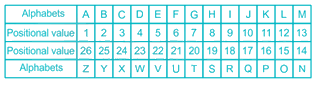 The logic followed here is:
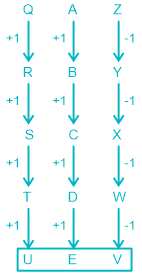 So, 'UEV will replace the question mark in the given series.
Hence, the correct answer is "Option 2".
Q2 · Series
What comes next?
ZYX, YXW, WVU, ?
- VUT
- UVT
- VTS
- TUV
Answer aur solution dekho
Archived marked answer: A
The logic followed here is:
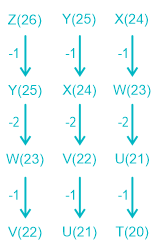 Hence, "Option 1" is the correct answer.
Q3 · Series
What comes at the place of question mark: 2, 6, 12, 20, 30, ?
- 42
- 56
- 38
- 48
Answer aur solution dekho
Archived marked answer: A
Series: 2, 6, 12, 20, 30, ?
Differences:
6 − 2 = 4
12 − 6 = 6
20 − 12 = 8
30 − 20 = 10
Pattern: +4, +6, +8, +10, +12
Next term = 30 + 12 = 42
∴ Missing number = 42
Q4 · Series
Find the next number in the series: 10, 21, 43, 87, ?, 351
- 175
- 173
- 177
- 179
Answer aur solution dekho
Archived marked answer: A
The logic followed here is:
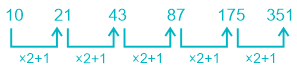 Hence, "Option 1" is the correct answer.
Q5 · Series
The series given below contains a sequence of numbers. Accordingly identify the incorrect combination 6, 7, 16, 51, 210
- 210
- 16
- 7
- 51
Answer aur solution dekho
Archived marked answer: A
The logic followed here is:
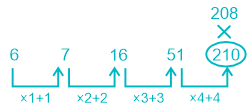 Thus, it should be 208 instead of 210.
Hence, "Option 1" is the correct answer.
Q6 · Series
Find the WRONG term in the given series.
5, 10, 15, 26, 37, 50
- 50
- 26
- 15
- 5
Answer aur solution dekho
Archived marked answer: C
Given:
Series: 5, 10, 15, 26, 37, 50
The logic followed here is:
n = 2 ⇒ 2² + 1 = 4 + 1 = 5
⇒ 3² + 1 = 9 + 1 = 10
⇒ 4² + 1 = 16 + 1 = 17 (Instead of 15)
⇒ 5² + 1 = 25 + 1 = 26
⇒ 6² + 1 = 36 + 1 = 37
⇒ 7² + 1 = 49 + 1 = 50
∴ The wrong term is 15.
Hence, the correct answer is "Option 3".
Q7 · Analogy
Find the option that best completes the analogy. DP : XZ :: EN : ?
- YZ
- YB
- ZB
- YX
Answer aur solution dekho
Archived marked answer: D
The logic followed here is:
DP : XZ
Q8 · Puzzle Subtypes Not To Miss
In a 30 L mixture, milk: water = 3:2. How much water must be added to make the ratio 1:1?
- 6 L
- 10 L
- 9 L
- 12 L
Answer aur solution dekho
Archived marked answer: A
Given:
Total mixture = 30 L
Milk : Water = 3 : 2
Target ratio = 1 : 1
Formula used:
Total parts = 3 + 2 = 5
Milk = Total × (Milk part ÷ Total parts)
Water = Total × (Water part ÷ Total parts)
For 1:1 ⇒ Final water = Milk
Calculations:
⇒ Milk = 30 × 3 ÷ 5 = 18 L
⇒ Water = 30 × 2 ÷ 5 = 12 L
⇒ Required water for 1:1 = 18 L
⇒ Water to add = 18 − 12 = 6 L
∴ Add 6 L water.
Hence, "Option 1" is the correct answer.
Q9 · Puzzle Subtypes Not To Miss
If 10 @ 2 = 120 and 5 @ 5 = 100, what is 8 @ 3?
- 80
- 96
- 108
- 110
Answer aur solution dekho
Archived marked answer: D
The logic followed here is:
10 @ 2 = 120 → (10 + 2) × 10 = 12 × 10 ⇒ 120
And,
5 @ 5 = 100 → (5 + 5) × 10 = 10 × 10 ⇒ 100
Similarly,
8 @ 3 = ? → (8 + 3) × 10 = 11 × 10 ⇒ 110
Hence, "Option 4" is the correct answer.
5d:T4e
Q10 · Puzzle Subtypes Not To Miss
If a man's present age is twice what it was 10 years ago, what is his current age?
- 20
- 30
- 40
- 25
Answer aur solution dekho
Archived marked answer: A
Given: A man's present age is twice what it was 10 years ago.
Let Man's age today be x years
Then, Man's age before 10 years = (x - 10) years
Now, according to the question
⇒ x = 2(x – 10) years
⇒ x = (2x – 20)
⇒ 2x - x = 20
⇒ x = 20 years
Hence, "Option 1" is the correct answer.
Q11 · Puzzle Subtypes Not To Miss
Replace special characters with mathematical signs as given in options to make it meaningful equation.
16 # 4 @ 2 = 62
- ÷, -
- ÷, ÷
- ×, -
- –, ×
Answer aur solution dekho
Archived marked answer: C
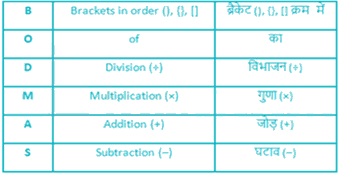 Given:
16 # 4 @ 2 = 62
Symbol
Replaced Sign (Option 1)
#
×
@
If # = × and @ = −
⇒ 16 × 4 − 2
⇒ 64 − 2
⇒ 62 ✔
∴ # = × and @ = −
Hence, the correct answer is "Option 3".
3e
Q12 · Puzzle Subtypes Not To Miss
By interchanging the given two signs which of the following equation will be NOT correct?
+ and -
I. 18 ÷ 3 + 8 × 5 - 4 = 20
II. 6 + 8 × 9 ÷ 3 - 4 = 14
- Neither I nor II
- Both I and II
- Only II
- Only I
Answer aur solution dekho
Archived marked answer: B
Interchange + and −
I. 18 ÷ 3 − 8 × 5 + 4
18 ÷ 3 = 6
8 × 5 = 40
⇒ 6 − 40 + 4 = −30 ≠ 20
II. 6 − 8 × 9 ÷ 3 + 4
8 × 9 = 72
72 ÷ 3 = 24
⇒ 6 − 24 + 4 = −14 ≠ 14
∴ Both I and II are NOT correct.
Hence correct Option 2.
Q13 · Puzzle Subtypes Not To Miss
Which two signs should be swapped to correct the following?
28 ÷ 4 × 3 - 5 + 7 = 19
- ÷ and ×
- × and -
- ÷ and +
- + and -
Answer aur solution dekho
Archived marked answer: D
Given:
28 ÷ 4 × 3 − 5 + 7 = 19
Check original (BODMAS):
28 ÷ 4 = 7
7 × 3 = 21
21 − 5 + 7 = 23 ≠ 19
Swap − and + :
28 ÷ 4 × 3 + 5 − 7
28 ÷ 4 = 7
7 × 3 = 21
21 + 5 − 7 = 19 ✔
∴ The correct signs to swap are − and +.
Q14 · Puzzle Subtypes Not To Miss
Find the LCM of 12, 18, 30?
- 90
- 180
- 60
- 120
Answer aur solution dekho
Archived marked answer: B
Given: Numbers are 12, 18, 30
Calculation:
Prime factorization of 12 = 22 × 3
Prime factorization of 18 = 32 × 2
Prime factorization of 30 = 2 × 3 × 5
Take the highest power of all prime factors: 22, 32, 5
⇒ LCM = 22 × 32 × 5
⇒ LCM = 2 × 9 × 5
⇒ LCM = 180
Hence, "Option 2" is the correct answer.
Q15 · Coding Decoding
If "CANADA" is written as "ADANAC", what is "MEXICO" written as?
- OCIXME
- OCIXEM
- OCXEIM
- OCMXIE
Answer aur solution dekho
Archived marked answer: B
The logic followed here is:
"CANADA" is written as "ADANAC"
"CANADA" → Reverse order → "ADANAC"
Similarly,
"MEXICO" written as
"MEXICO" → Reverse order → "OCIXEM"
Hence, "Option 2" is the correct answer.
Q16 · Coding Decoding
Instruction: In a certain code language, Greek letters are used to represent English letters consistently. Using the provided code, decode the target sequence.
If γ α λ α ξ ι α is coded as GALAXIA, σ τ α ρ is coded as STAR,
Question: Then what does σ γ α λ α represent?
- SGALA
- SPALA
- SRALA
- SMALA
Answer aur solution dekho
Archived marked answer: A
The logic followed here is:
γ α λ α ξ ι α is coded as GALAXIA
Code
γ
α
λ
α
ξ
Q17 · Classification Odd One Out
Find the odd one out from the given alternatives:
- Reuse
- Reduce
- Recycle
- Refuel
Answer aur solution dekho
Archived marked answer: D
The logic followed here is:
Option 1) Reuse → Action related to conservation / minimizing waste
Option 2) Reduce → Action related to conservation / minimizing waste
Option 3) Recycle → Action related to conservation / minimizing waste
Option 4) Refuel → Means to fill fuel again.
Hence, the correct answer is "Option 4"
Additional Information
Repair → Fixing an item to extend its life and reduce waste.
Reuse → Using an item again instead of discarding it.
Recycle → Converting waste into reusable material.
Q18 · Blood Relations
In a family, there are 6 members P, Q, R, S, T and U. P and Q are a married couple
R is the son of P
T is the sister of R
Q is the mother of S
U is the brother of P
Who is the father of S?
- P
- Q
- U
- R
Answer aur solution dekho
Archived marked answer: A
From the given information,
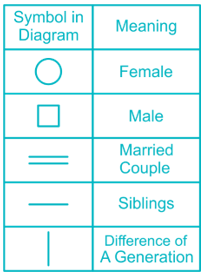 Based on given data, we can draw the family tree-
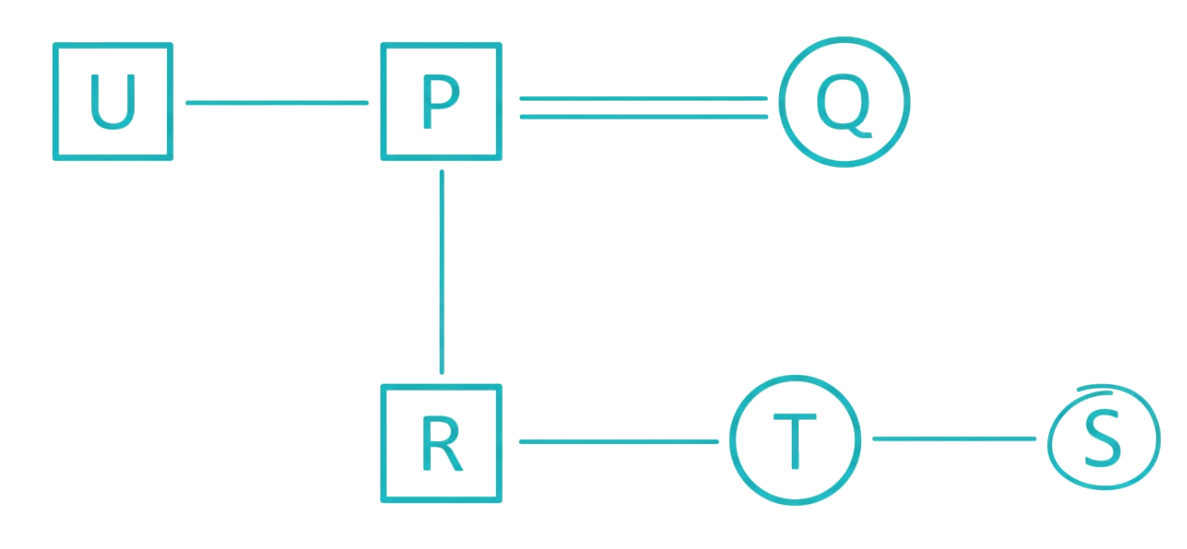 From the diagram, R,T and S are the children of P.
So P is the Father of S.
Hence correct Option 1.
Q19 · Blood Relations
If P is the brother of Q, R is the sister of Q, and S is the father of P, how is R related to S?
- Daughter
- Niece
- Wife
- Sister
Answer aur solution dekho
Archived marked answer: A
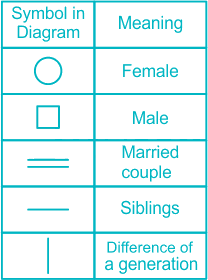 Given:
1) P is the brother of Q
2) R is the sister of Q
Q20 · Similarity and Differences
Choose the address that is the same as the one given below.
Flat No. 12B, Sunrise Towers, Park Street, Kolkata, West Bengal - 700016
- Flat No. 12B, Sunrise Towers, Park Street, Kolkata, Odisha - 700016
- Flat No. 12B, Sunrise Towers, Park Street, Kolkata, Bihar - 700016
- Flat No. 12B, Sunrise Towers, Park Street, Kolkata, Jharkhand - 700016
- Flat No. 12B, Sunrise Towers, Park Street, Kolkata, West Bengal - 700016
Answer aur solution dekho
Archived marked answer: D
Given Address:
Flat No. 12B, Sunrise Towers, Park Street, Kolkata, West Bengal - 700016
Check options:
1. State ⇒ Odisha ❌
2. State ⇒ Bihar ❌
3. State ⇒ Jharkhand ❌
4. Flat No. 12B, Sunrise Towers, Park Street, Kolkata, West Bengal - 700016 ✔
∴ The correct answer is Option 4.
Q21 · Similarity and Differences
Choose the address that is the same as the one given below.
Sample Address:#301, Galaxy Towers,Hinoo, Ranchi,Jharkhand - 834002
- #301, Galaxy Towers, Hinoo, Ranchi, Jharkhand - 834002
- #301, Galaxy Tower, Hinoo, Ranchi, Jharkhand - 834002
- 301, Galaxy Towers, Hinoo, Ranchi, Jharkhand - 834002
- #301, Galaxy Towers, Hinu, Ranchi, Jharkhand - 834002
Answer aur solution dekho
Archived marked answer: A
Given Address:
#301, Galaxy Towers, Hinoo, Ranchi, Jharkhand - 834002
Check options:
1. #301, Galaxy Towers, Hinoo, Ranchi, Jharkhand - 834002 ✔
2. Galaxy Tower (missing 's') ❌
3. 301 instead of #301 ❌
4. Hinu instead of Hinoo ❌
∴ Correct answer is Option 1.
Q22 · Logical Statement Questions
Consider the following statement and choose the option that follows.
Statement: The railway authority decided to reduce ticket prices on long-distance trains.
Assumptions:
I. Lower prices will attract more passengers.
II. The authority wants to compete with airlines.
- Only I is implicit
- Only II is implicit
- Both are implicit
- Neither is implicit
Answer aur solution dekho
Archived marked answer: A
Statement: The railway authority decided to reduce ticket prices on long-distance trains.
Assumption I: Lower prices will attract more passengers. ✔ (Reason for reducing prices)
Assumption II: The authority wants to compete with airlines. ✖ (Not mentioned or necessary)
∴ Correct option:
Only I is implicit.
Q23 · Logical Statement Questions
Read the following statement carefully and identify the conclusion that follows.
Statement: The library will remain closed on Sunday due to renovation.
I. The renovation is planned for Sunday.
II. People cannot use the library this Sunday.
- Only Conclusion I follows
- Only Conclusion II follows
- Both I and II follow
- Neither I nor II follows
Answer aur solution dekho
Archived marked answer: C
Statement: The library will remain closed on Sunday due to renovation.
Conclusion I: The renovation is planned for Sunday. (This follows because the closure is due to renovation.)
Conclusion II: People cannot use the library this Sunday. (If the library is closed, people cannot use it.)
∴ Both I and II follow.
Hence correct Option 3.
Q24 · Logical Statement Questions
Read the following statement carefully and identify the conclusion that follows.
Statement: The price of petrol has increased due to international oil prices.
Conclusions:
I. Petrol prices are linked to global markets.
II. The government has no control over fuel prices.
- Only Conclusion I follows
- Only Conclusion II follows
- Both I and II follow
- Neither I nor II follows
Answer aur solution dekho
Archived marked answer: A
Statement: The price of petrol has increased due to international oil prices.
Conclusion I: Petrol prices are linked to global markets. (This follows because the increase is due to international oil prices.)
Conclusion II: The government has no control over fuel prices. (This is not stated or implied.)
∴ Only Conclusion I follows.
Hence correct Option 1.
Q25 · Cause and Effect
Consider the following statement and choose the option that follows.
Statements:
I. Banks have increased staff training on cyber security.
II. There has been a surge in cyber attacks.
- I is the cause and II is the effect.
- II is the cause and I is the effect.
- Both are unrelated.
- No relation.
Answer aur solution dekho
Archived marked answer: B
Statements:
I. Banks have increased staff training on cyber security.
II. There has been a surge in cyber attacks.
Reasoning:
If cyber attacks increase, banks will respond by improving cyber security training for their staff.
∴ Correct option:
II is the cause and I is the effect.
General Awareness
Q1 · Art and Culture
Which of the following is a folk song form of Jharkhand that reflects the lived experiences, social unity, and often accompanies dance and drama performances?
- Lavani
- Domkach
- Bhavai
- Baul
Answer aur solution dekho
Archived marked answer: B
The correct answer is Domkach.
Key Points
- Domkach is a traditional folk song and dance form of Jharkhand and Bihar that reflects the lived experiences and cultural traditions of local communities.
- It is performed during wedding ceremonies and other festive occasions, emphasizing themes like social unity, familial bonds, and collective joy.
- The performance often includes a humorous enactment of bride and groom's family members, bringing an element of drama to the celebrations.
- The lyrics of Domkach songs are rich in cultural references and are sung in regional languages, including Nagpuri and Bhojpuri, making them deeply rooted in local traditions.
- This folk art form is often performed in a group, with participants forming a circle and dancing rhythmically to the beats of traditional instruments such as the dholak, manjira, and nagara.
Additional Information
- Lavani
- Lavani is a traditional folk dance and song form of Maharashtra, known for its powerful rhythm and sensuous movements.
- It is performed to the beats of the dholki drum and is a key feature of Marathi theatre and cultural performances.
- Lavani songs often address social issues, romantic themes, and historical events and are performed in a narrative style.
- Bhavai
- Bhavai is a traditional folk theatre form from Gujarat and Rajasthan that combines storytelling with dance and drama.
- It is performed in open-air settings and often includes satirical commentary on social and political issues.
- The performers, known as Bhavaiyas, use colorful costumes and masks to enact scenes from mythology and folklore.
- Baul
- Baul is a mystical folk music tradition from Bengal, including both West Bengal in India and Bangladesh.
- It is deeply spiritual in nature, focusing on themes of love, devotion, and the search for the divine within oneself.
- Baul songs are typically performed with simple musical instruments like the ektara, dotara, and khol, and are known for their soulful and meditative quality.
``
Q2 · Art and Culture
Fill in the Blank:
Tippani arises from the ______ region of Gujarat.
- Kutch
- Saurashtra
- Surat
- Vadodara
Answer aur solution dekho
Archived marked answer: B
The correct answer is Saurashtra.
Key Points
- Tippani is a traditional art form originating from the Saurashtra region of Gujarat.
- It involves intricate handcrafting techniques where artisans use wooden blocks and natural dyes to create vibrant patterns on fabric.
- Tippani work is primarily carried out by women in rural areas, who utilize this art as a source of livelihood.
- The designs often feature geometric patterns and floral motifs, reflecting the cultural heritage and artistic traditions of the Saurashtra region.
- Tippani is popular in creating household items like quilts, wall hangings, and other decorative pieces.
Additional Information
- Kutch:
- Kutch is renowned for its vibrant crafts, including Bandhani (tie-dye), embroidery, and Rogan painting.
- The region is also home to the Great Rann of Kutch, a vast salt marsh known for its annual Rann Utsav celebration.
- Artisans in Kutch are famous for their intricate mirror work and use of bright colors in textiles.
- Surat:
- Surat is primarily known for its textile industry and is referred to as the "Silk City of India."
- It specializes in the production of silk and synthetic fabrics and is one of the largest producers of man-made fibers in India.
- Surat is also popular for its diamond cutting and polishing industry.
- Vadodara:
- Vadodara, also known as Baroda, is famous for its rich cultural heritage and historical landmarks.
- It is not specifically associated with Tippani but is known for its art, including traditional paintings and sculptures.
- The city is home to the Maharaja Sayajirao University of Baroda, a prominent institution for fine arts.
- Importance of Tippani:
- Tippani work reflects the artistic traditions of Gujarat and serves as an important source of income for rural artisans.
- It plays a significant role in preserving the cultural heritage and promoting sustainable livelihoods.
Q3 · Art and Culture
Match the dance with its core tribe/community.
Folk dance
Song-theme
1. Panthi
A. Devotional hymns to Guru Ghasidas (Hari-Gaitri)
2. Gotipua
B. Krishna-Jagannath leela narratives
3. Kalbelia
C. Sensuous serpent metaphors
4. Tippani
D. Work-song pounding couplets (saathiyo re)
- 1-A 2-B 3-C 4-D
- 1-B 2-A 3-D 4-C
- 1-C 2-B 3-A 4-D
- 1-A 2-C 3-B 4-D
Answer aur solution dekho
Archived marked answer: A
The correct answer is Option 1.
Key Points
- Panthi Dance: It is associated with the Satnami community of Chhattisgarh and is performed as a devotional offering to Guru Ghasidas, the founder of the sect.
- The dance is characterized by songs and hymns dedicated to Hari-Gaitri, emphasizing themes of spirituality and devotion.
- It is often performed during religious occasions and festivals, reflecting the rich cultural heritage of the Satnami sect.
- Panthi dance involves energetic movements and symbolic gestures, representing the community’s faith and reverence.
Additional Information
- Gotipua Dance:
- Gotipua is a traditional dance form from Odisha, performed by young boys dressed as girls.
- The dance narrates leelas of Lord Krishna and Lord Jagannath through intricate movements and expressions.
- It is considered a precursor to the classical Odissi dance form, with its roots in temple rituals and devotional performances.
- The dancers exhibit remarkable flexibility and agility, showcasing acrobatic poses and rhythmic footwork.
- Kalbelia Dance:
- Kalbelia is a folk dance of Rajasthan, associated with the Kalbelia community, traditionally known for their snake-charmer heritage.
- The dance reflects the sensuous and fluid movements inspired by serpents, embodying the community’s close connection to nature.
- Kalbelia dancers wear vibrant costumes adorned with intricate embroidery, and the music includes traditional instruments like the pungi and dholak.
- UNESCO has recognized Kalbelia dance as an Intangible Cultural Heritage, highlighting its significance in preserving tribal traditions.
- Tippani Dance:
- Tippani is a folk dance from Gujarat, performed primarily by women laborers while pounding floors with long wooden sticks.
- The songs accompanying the dance are work-themed couplets, often reflecting the daily struggles and camaraderie of the laborers.
- It is typically performed during community gatherings, festivals, or celebrations, showcasing the spirit of unity and hard work.
- The rhythmic pounding and synchronized movements create a visually captivating performance.
Q4 · Art and Culture
The Nabanna (new rice) during the Nuakhai festival in Sambalpur, Odisha, is first offered to which deity?
- Maa Samaleswari
- Maa Mangala
- Maa Bhuaneswari
- Maa Budhi Thakurani
Answer aur solution dekho
Archived marked answer: A
The correct answer is Maa Samaleswari.
Key Points
- The Nabanna (new rice) offering during the Nuakhai festival in Sambalpur, Odisha, is first presented to Maa Samaleswari, the presiding deity of Sambalpur.
- Nuakhai is a major agrarian festival celebrated predominantly in western Odisha to mark the consumption of newly harvested rice.
- Maa Samaleswari is considered the goddess of fertility and prosperity, making her the central deity for agricultural celebrations like Nuakhai.
- The festival starts with the offering of the first harvest to Maa Samaleswari, symbolizing gratitude and seeking blessings for the prosperity of the community.
- Nuakhai follows the lunar calendar and is celebrated the day after Ganesh Chaturthi, symbolizing harmony, tradition, and cultural heritage.
Additional Information
- Maa Mangala
- Maa Mangala is a deity worshipped primarily in Odisha, particularly in Kakatpur. She is revered as a form of Goddess Shakti.
- The famous Mangala temple in Kakatpur is closely associated with the rituals of the Jagannath Temple in Puri.
- While Maa Mangala plays a significant role in Odisha's spiritual culture, she is not directly linked to Nuakhai festivities.
- Maa Bhuvaneswari
- Maa Bhuvaneswari is one of the ten Mahavidyas in Hindu philosophy and is considered a form of Goddess Durga.
- She is worshipped as the queen of the universe and is closely associated with tantric traditions.
- While Maa Bhuvaneswari is highly revered, her worship is not specifically related to agrarian festivals like Nuakhai.
- Maa Budhi Thakurani
- Maa Budhi Thakurani is another prominent deity worshipped in Odisha, particularly in Berhampur.
- She is considered a guardian deity and symbolizes protection and well-being.
- Though widely celebrated, Maa Budhi Thakurani is not directly linked to the Nuakhai festival or the Nabanna ritual.
- Nuakhai Festival
- Nuakhai is an integral cultural festival of western Odisha, signifying the beginning of a new harvest season.
- The term "Nuakhai" translates to "new food," representing the first consumption of freshly harvested rice.
- The festival promotes unity, harmony, and gratitude toward nature and the divine.
- Nuakhai is celebrated with rituals, community feasts, cultural performances, and family gatherings.
Q5 · Art and Culture
Which of the following pairs of temple style & region are correctly matched?
1. Vesara - Deccan
2. Rekha-Deul - Odisha
3. Bhumija - Malwa
4. Kalinga - Tamil Nadu
- 1 & 2 only
- 1, 2 & 3 are correct
- 2 & 4 only
- only 1
Answer aur solution dekho
Archived marked answer: B
The correct answer is Option 2: 1, 2 & 3 are correct.
Key Points
- Vesara - Deccan: Vesara style emerged in the Deccan region and represents a hybrid temple architecture combining elements of both Nagara (North Indian) and Dravida (South Indian) styles. It is prominently seen in Karnataka and adjoining areas.
- Rekha-Deul - Odisha: Rekha-Deul is a specific type of Nagara style temple architecture found in Odisha. It is characterized by its curvilinear tower (Shikhara) and intricate carvings, as seen in temples like the Lingaraja Temple in Bhubaneswar.
- Bhumija - Malwa: The Bhumija style is prevalent in the Malwa region (present-day Madhya Pradesh). It is distinguished by its vertically rising miniature towers arranged symmetrically around the main Shikhara, giving the temple a pyramidal appearance.
- Kalinga - Tamil Nadu: The Kalinga style of architecture is associated with Odisha and not Tamil Nadu. Tamil Nadu is known for the Dravidian style of temple architecture characterized by massive gopurams and pillared halls.
Additional Information
- Vesara Style:
- The Vesara style bridges the gap between the Nagara and Dravidian styles, often referred to as a mixed or transitional style.
- Examples include the temples of Badami, Pattadakal, and Aihole built during the Chalukya dynasty.
- Rekha-Deul Style:
- Rekha-Deul is a component of the Nagara style specific to Odisha, with temples having tall, curvilinear towers called Shikharas.
- Prominent examples include the Sun Temple at Konark and the Mukteshwar Temple in Bhubaneswar.
- Bhumija Style:
- The Bhumija style is notable for its intricate symmetry and miniature towers rising around the central Shikhara.
- It was widely adopted in the western and central parts of India, especially under the Paramara dynasty of Malwa.
- Examples include the Udayeshwar Temple in Udaipur (Madhya Pradesh).
- Kalinga Style:
- The Kalinga style is indigenous to Odisha and consists of three types: Rekha-Deul (curvilinear towers), Pidha-Deul (pyramidal roof), and Khakhara-Deul (rectangular structures).
- It is distinct from Tamil Nadu's Dravidian style, which features large gopurams and open courtyards.
Q6 · Indian Polity and Constitution
The concept of "Reasonable Classification" as a limitation to the Right to Equality (Article 14) was established in which case?
- Kesavananda Bharati v. State of Kerala
- State of West Bengal v. Anwar Ali Sarkar
- Maneka Gandhi v. Union of India
- Golakhnath Case v. State of Punjab & Anrs.
Answer aur solution dekho
Archived marked answer: B
The correct answer is State of West Bengal v. Anwar Ali Sarkar.
Key Points
- The concept of "Reasonable Classification" as a limitation to the Right to Equality under Article 14 of the Indian Constitution was established in the State of West Bengal v. Anwar Ali Sarkar case (1952).
- In this landmark case, the Supreme Court declared that Article 14 prohibits class legislation but allows reasonable classification based on intelligible differentia and a rational nexus to the object sought to be achieved.
- The court invalidated the West Bengal Special Courts Act, 1950, as it failed the test of reasonable classification since it gave unfettered power to the government to selectively prosecute individuals without clear guidelines.
- This judgment laid the foundation for the doctrine of reasonable classification, which continues to guide interpretations of Article 14 in subsequent cases.
- The case emphasized that any classification must not be arbitrary and should be founded on substantial distinctions that justify differential treatment.
Additional Information
- Kesavananda Bharati v. State of Kerala (1973):
- This case established the "Basic Structure Doctrine" of the Indian Constitution, which states that Parliament cannot amend the Constitution in a way that destroys its basic structure.
- It dealt with the extent of the power of Parliament to amend the Constitution under Article 368.
- While it did not directly relate to Article 14, it is considered one of the most important cases in Indian constitutional law.
- Maneka Gandhi v. Union of India (1978):
- This case expanded the scope of Article 21 (Right to Life and Personal Liberty) and established a close connection between Articles 14, 19, and 21.
- The Supreme Court ruled that any law violating personal liberty must be just, fair, and reasonable, thereby upholding the principle of non-arbitrariness under Article 14.
- Although it reinforced the principles of equality, it did not specifically address the concept of reasonable classification.
- Golakhnath v. State of Punjab (1967):
- This case dealt with the power of Parliament to amend fundamental rights under the Constitution.
- The Supreme Court held that fundamental rights cannot be amended by Parliament under Article 368.
- While it had a significant impact on constitutional law, it did not address Article 14 or reasonable classification.
``
Q7 · Indian Polity and Constitution
Which of the following is a key economic role of the government in both developed and developing countries?
- Only regulating private firms
- Only promoting exports
- Framing laws and delivering justice
- Engaging in currency exchange
Answer aur solution dekho
Archived marked answer: C
The correct answer is Framing laws and delivering justice.
Key Points
- The government plays a critical role in ensuring the smooth functioning of society by framing laws to regulate social, economic, and political activities.
- The judiciary system is responsible for delivering justice and resolving disputes among individuals, organizations, or the state itself.
- Legal frameworks help maintain law and order, ensuring the protection of citizens' rights and promoting fairness in society.
- In both developed and developing countries, the government ensures the implementation of laws related to property rights, labor regulations, and contract enforcement, which are vital for economic stability.
- Framing laws and delivering justice are fundamental functions of the government, acting as the backbone of governance and democracy in any nation.
Additional Information
- Option 1: Only regulating private firms
- While regulating private firms is an important government function, it is not the sole focus of economic governance.
- The government regulates private firms to ensure fair competition, consumer protection, and adherence to labor laws.
- However, this role is just one aspect of the government’s broader economic responsibilities, which include framing laws, delivering justice, and ensuring social welfare.
- Option 2: Only promoting exports
- Promoting exports is a key strategy for economic growth, especially in developing nations aiming to improve trade balances.
- Governments often use incentives, subsidies, and trade agreements to enhance export activities.
- However, the scope of government functions extends far beyond this, including activities like taxation, infrastructure development, and legal frameworks.
- Option 4: Engaging in currency exchange
- Currency exchange is primarily managed by central banks, such as the Reserve Bank of India (RBI) or the Federal Reserve in the USA.
- This function includes regulating exchange rates, foreign reserves, and monetary policy to stabilize the economy.
- However, this is a specialized role and not the broader economic function of the government in terms of lawmaking and justice delivery.
``
Q8 · Indian Polity and Constitution
Fill in the blanks:
The Union Home Minister chairs a Zonal Council meeting as _____ chairman.
- ex-officio
- rotating
- ceremonial
- honorary
Answer aur solution dekho
Archived marked answer: A
The correct answer is ex-officio.
Key Points
- The Union Home Minister serves as the ex-officio chairman of each Zonal Council in India.
- Zonal Councils were established under the States Reorganisation Act of 1956 to promote interstate cooperation and coordination.
- There are five Zonal Councils in India – Northern, Central, Eastern, Western, and Southern – each comprising state
Q9 · Indian Economy
When was the first Industrial Policy announced in independent India?
- 1948
- 1950
- 1951
- 1952
Answer aur solution dekho
Archived marked answer: A
The correct answer is 1948.
Key Points
- The first Industrial Policy of independent India was announced in 1948.
- The Industrial Policy of 1948 laid the foundational framework for India's industrial development post-independence.
- It categorized industries into four broad categories: (1) Industries exclusively owned by the state, (2) Mixed industries (state and private ownership), (3) Industries controlled by the state, and (4) Industries under private sector ownership.
- Key sectors like arms and ammunition, atomic energy, and railways were designated as exclusive government monopolies.
- The policy aimed to strike a balance between promoting industrialization, encouraging private entrepreneurship, and maintaining state control over critical sectors.
Additional Information
- 1950
- No new industrial policy was announced in 1950. However, the Constitution of India came into effect on January 26, 1950, establishing the framework for governance and economic policy in the country.
- The Planning Commission was set up in March 1950, which played a significant role in formulating Five-Year Plans for economic development, including industrial growth.
- 1951
- The Industries (Development and Regulation) Act, 1951, was introduced to regulate and develop industries in the national interest.
- It provided a framework for licensing industries to ensure planned industrial development.
- Though not an industrial policy in itself, this Act was a significant step in implementing the objectives of the 1948 Industrial Policy.
- 1952
- No distinct industrial policy was announced in 1952.
- However, the focus during this period remained on implementing the first Five-Year Plan (1951-56), which emphasized agricultural development and laid the foundation for industrial expansion.
- Main Theme: Industrial Policy in India
- Industrial policies in India are statements of the government that outline strategies for industrial development and economic growth.
- Over time, India has introduced several industrial policies, such as those in 1948, 1956, 1977, 1980, and 1991, each reflecting changing socio-economic priorities and challenges.
- The primary objectives of industrial policies in India are to promote industrialization, ensure balanced regional development, encourage private sector participation, and maintain state control over critical sectors.
Q10 · Indian Economy
Read the following statements carefully and choose the correct option regarding Assertion (A) and Reason (R).
Assertion (A): Globalization led to increased inequality in India.
Reason (R): Growth was unevenly distributed, benefiting mostly urban elite and service sectors.
- Both A and R are true and R is the correct explanation of A.
- Both A and R are true but R is not the correct explanation of A.
- A is true but R is false.
- A is false but R is true.
Answer aur solution dekho
Archived marked answer: A
The correct answer is Both A and R are true and R is the correct explanation of A..
Key Points
- Globalization in India has led to significant economic growth, but this growth has been unevenly distributed across different sectors and regions.
- The urban elite and service sectors, particularly in technology and finance, benefited disproportionately, leading to increased income inequality.
- Rural areas and agriculture-dependent populations have not seen comparable benefits, widening the urban-rural divide.
- The Gini coefficient, a measure of income inequality, has shown an upward trend in India post-globalization, indicating growing disparities.
- Thus, Reason (R) correctly explains the Assertion (A) that globalization led to increased inequality in India.
Additional Information
- Option 2: Both A and R are true but R is not the correct explanation of A
- This option would be valid if globalization had led to inequality due to factors unrelated to the uneven benefits for urban elites and service sectors.
- However, the direct link between the uneven growth distribution and increasing inequality makes R the correct explanation of A.
- Option 3: A is true but R is false
- While A is true that globalization increased inequality, rejecting R would imply that uneven growth distribution did not play a role, which is incorrect.
- Uneven growth is a well-documented driver of inequality in India, especially post-1991 economic reforms.
- Option 4: A is false but R is true
- This option would suggest that globalization did not lead to inequality, which contradicts empirical evidence.
- R is true, but it directly supports the assertion made in A, making A valid as well.
- Globalization in India
- The liberalization of the Indian economy in 1991 opened markets to foreign investment, trade, and private-sector participation.
- While this has driven economic growth, it has also accentuated income disparities, especially between urban and rural areas.
- Key beneficiaries include IT, financial services, and real estate sectors, while traditional industries and agriculture have lagged behind.
- This dual-speed growth highlights the importance of inclusive policies to address inequalities arising from globalization.
``
Q11 · Indian Economy
Disinvestment involves selling stakes in?
- NGOs
- Private firms
- Public enterprises
- Trade unions
Answer aur solution dekho
Archived marked answer: C
The correct answer is Public enterprises.
Key Points
- Disinvestment refers to the process of the government selling or diluting its ownership stakes in public sector enterprises (PSEs) to reduce its involvement in such businesses.
- The aim of disinvestment is to improve the financial health of public enterprises, reduce the fiscal burden on the government, and promote private sector participation in the economy.
- Disinvestment is often categorized into minority disinvestment (retaining majority ownership) and strategic disinvestment (transferring management control to private entities).
- The Department of Investment and Public Asset Management (DIPAM) under the Ministry of Finance spearheads the disinvestment process in India.
- Key examples of disinvestment in India include the sale of stakes in companies such as Bharat Petroleum Corporation Limited (BPCL) and Air India.
Additional Information
- NGOs (Non-Governmental Organizations):
- NGOs are private, non-profit organizations that work towards various social, cultural, or environmental causes.
- They operate independently of the government and are funded through donations, grants, or self-generated income.
- Examples include organizations like Greenpeace, the Red Cross, and CRY.
- Disinvestment does not involve NGOs as they are not owned or controlled by the government.
- Private Firms:
- Private firms are businesses owned by individuals or private entities rather than the government.
- These firms operate for profit and are not subject to government disinvestment since they are not public assets.
- Examples include companies like Reliance Industries, Tata Consultancy Services, and Infosys.
- Trade Unions:
- Trade unions are organizations formed by workers to promote their rights and interests, such as fair wages and safe working conditions.
- They are not business enterprises and therefore do not fall under the purview of disinvestment.
- Examples of trade unions in India include the All India Trade Union Congress (AITUC) and the Indian National Trade Union Congress (INTUC).
- Public Enterprises:
- Public enterprises are companies or corporations owned and controlled by the government, either fully or partially.
- Disinvestment in public enterprises aims to reduce the fiscal burden on the government and improve the efficiency and competitiveness of these enterprises.
- Examples of public enterprises in India include Coal India, Steel Authority of India Limited (SAIL), and Hindustan Aeronautics Limited (HAL).
Q12 · Sports Static GK
What is the standard width of a singles badminton court as per international regulations?
- 6.10 meters
- 13.40 meters
- 5.18 meters
- 12.00 meters
Answer aur solution dekho
Archived marked answer: C
The correct answer is 5.18 meters.
Key Points
- The standard width of a singles badminton court as per the Badminton World Federation (BWF) regulations is 5.18 meters.
- The overall dimensions of a badminton court are 13.40 meters in length and 6.10 meters in width, but the width of 5.18 meters is specifically for singles matches.
- The court is divided by a net at the center, with a height of 1.55 meters at the edges and 1.524 meters in the center.
- The sidelines for singles matches are marked inward from the outermost boundary, reducing the width from 6.10 meters (doubles width) to 5.18 meters.
- These regulations are consistent worldwide and are strictly followed in all international competitions.
Additional Information
- Option 1: 6.10 meters
- 6.10 meters is the standard width of a badminton court for doubles matches, not singles matches.
- In doubles, the additional width allows for a larger playing area, with sidelines extending outward from the singles boundaries.
- This width is used in doubles matches to accommodate two players on each side of the court.
- Option 2: 13.40 meters
- 13.40 meters is the total length of a standard badminton court, applicable to both singles and doubles matches.
- The court length is equally divided by the net, creating two halves of 6.70 meters each.
- This dimension ensures uniformity in competitive play across all levels.
- Option 4: 12.00 meters
- 12.00 meters is not a standard measurement in badminton court dimensions as per BWF regulations.
- The correct length of a badminton court is 13.40 meters, with no dimension reduced to 12.00 meters in any format of the game.
- General Information about Badminton Court Dimensions:
- The service courts are marked within the overall dimensions of the court and are used during the serve to define where the shuttle must land.
- For singles matches, the service area is narrower but longer, while for doubles matches, it is wider but shorter.
- The lines marking the court are 40 mm wide and are part of the area they define.
- The surface of the court must be made of wood or a synthetic material approved by the BWF to provide adequate grip and shock absorption.
``
Q13 · Sports Static GK
Consider the following statements about the high jump:
1) The minimum length of the runway is 15 meters.
2) The diameter of the crossbar ranges between 15 cm and 20 cm.
Which of the statements is/are correct?
- Only 1 is Correct
- Only 2 is Correct
- 1 and 2 are Correct
- Neither 1 nor 2 are Correct
Answer aur solution dekho
Archived marked answer: A
The correct answer is Option 1: Only 1 is Correct.
Key Points
- The high jump event requires a minimum runway length of 15 meters, ensuring athletes have adequate distance for their approach before jumping.
- The crossbar used in a high jump event does not have a diameter range of 15 cm to 20 cm. Instead, the crossbar is a cylindrical rod, commonly with a diameter of approximately 30 mm (3 cm), which is far smaller than the mentioned range.
- The IAAF (International Association of Athletics Federations) specifies these dimensions for official high jump competitions to standardize equipment and ensure fair competition.
- Statement 1 aligns with the official requirements for the minimum runway length, which is crucial for athlete preparation and safety during the event.
- Statement 2 is incorrect due to the misrepresentation of the crossbar dimensions, which are much smaller and standardized under international athletic regulations.
Additional Information
- Runway in High Jump:
- The runway must have a minimum length of 15 meters and a recommended length of 20 meters to 25 meters for optimal performance.
- Athletes use this runway to gain momentum before executing the jump.
- Crossbar Specifications:
- The crossbar is a cylindrical rod with a diameter of approximately 30 mm (3 cm), not the range of 15 cm to 20 cm stated in Statement 2.
- It is lightweight and designed to fall easily when touched by the jumper.
- The length of the crossbar is generally between 3.98 meters and 4.02 meters.
- High Jump Equipment and Rules:
- The high jump involves a landing area with a foam mat to ensure safety.
- The event is governed by strict rules under the IAAF, including specifications for the approach area, take-off point, and landing zone dimensions.
- Athletes must clear the bar without dislodging it, using techniques like the Fosbury Flop.
- IAAF Regulations:
- The International Association of Athletics Federations sets standards for equipment dimensions and event procedures to maintain uniformity worldwide.
- These regulations ensure fair competition and athlete safety in all high jump events.
Q14 · Sports Static GK
Which of the following statements about the Khelo India Youth Games (KIYG) 2023 is correct?
- The KIYG 2023 were held in four cities of Maharashtra.
- The games included 20 disciplines and no demo sport.
- The event lasted for 13 days across 15 venues.
- Only 4000 athletes participated in KIYG 2023.
Answer aur solution dekho
Archived marked answer: C
The correct answer is The event lasted for 13 days across 15 venues.
Key Points
- The Khelo India Youth Games (KIYG) 2023 lasted for 13 days and were conducted from January 30 to February 11, 2023.
- The games were held across 15 venues in different parts of Madhya Pradesh, including Bhopal, Indore, Gwalior, and Jabalpur.
- A total of 6,000 athletes from all over India participated in KIYG 2023, competing across various disciplines.
- The event featured 27 sports disciplines, including 4 demonstration sports: Mallakhamb, Yogasana, Gatka, and Kalaripayattu.
- KIYG 2023 was organized by the Ministry of Youth Affairs and Sports under the Government of India to promote sports culture at the grassroots level.
Additional Information
- Option 1: The KIYG 2023 were held in four cities of Maharashtra.
- This statement is incorrect. KIYG 2023 was held in Madhya Pradesh, not Maharashtra. The host cities were Bhopal, Indore, Gwalior, and Jabalpur.
- Each city hosted different sports events to ensure even distribution of infrastructure and facilities.
- Option 2: The games included 20 disciplines and no demo sport.
- This statement is incorrect. KIYG 2023 featured 27 sports disciplines, out of which 4 were demonstration sports.
- The demonstration sports included traditional and indigenous games: Mallakhamb, Yogasana, Gatka, and Kalaripayattu, showcasing India's rich sporting heritage.
- Option 4: Only 4000 athletes participated in KIYG 2023.
- This statement is incorrect. KIYG 2023 saw the participation of around 6,000 athletes from across India, making it one of the largest grassroots sports events in the country.
- The athletes competed across a wide variety of sports, including athletics, swimming, badminton, and kabaddi.
- Main Theme: Khelo India Youth Games (KIYG)
- Khelo India Youth Games is a flagship initiative by the Ministry of Youth Affairs and Sports aimed at identifying and nurturing young sporting talent.
- The program provides financial assistance, infrastructure, and training support to encourage grassroots participation in sports.
- It helps promote a culture of sports and fitness in the country in line with the vision of a healthier and more active India.
Q15 · Modern Indian History
Read the following statements:
Statement I: The Act of 1793 followed the tradition of personal rule without bringing in any legal reforms.
Statement II: Judges were assigned to interpret laws rather than depend on the ruler's personal judgment.
Which of the above statements is/are true?
- Only 1 is true
- Only 2 is true
- Both Statement 1 and 2 are true
- Neither 1 nor 2 is true
Answer aur solution dekho
Archived marked answer: B
The correct answer is Option 2.
Key Points
- Statement II is true: Judges were assigned the responsibility to interpret laws rather than relying on the ruler's personal judgment during the Act of 1793.
- The Act of 1793 aimed to institutionalize the functioning of the British administration in India by reducing the arbitrariness of personal rule.
- This Act focused on the codification of laws and emphasized the independence of the judiciary in interpreting these laws.
- The judges no longer depended on the whims of the ruler but followed a more structured legal framework.
- This was a step toward a more systematic approach to governance and justice under British rule in India.
Additional Information
- Statement I is false:
- The Act of 1793 did not entirely follow the tradition of personal rule. Instead, it focused on formalizing the administrative structure and codifying laws, which moved away from personal judgments to institutionalized governance.
- While the earlier periods of British rule in India might have seen personal judgments playing a role, the Act of 1793 marked a shift toward a more structured legal framework.
- Act of 1793:
- The Act of 1793, also known as the Charter Act of 1793, was an important piece of legislation that consolidated earlier regulations and aimed to bring reforms to British India's administration.
- It extended the tenure of the East India Company's rule and authorized the Governor-General to make regulations for civil, criminal, and revenue administration.
- It also sought to separate the judiciary from the executive to ensure impartiality in delivering justice.
- Judiciary under British Rule:
- The British introduced reforms to ensure a structured judiciary, which included the establishment of courts and the appointment of judges with defined roles and responsibilities.
- These efforts aimed to reduce the arbitrary nature of personal rulings and ensure impartiality.
``
Q16 · Current Affairs
The 2025 Global Peace Index indicates that global peacefulness has generally shown a:
- Consistent upward trend
- Gradual downward trend
- Significant improvement
- Stable and unchanging state
Answer aur solution dekho
Archived marked answer: B
The correct answer is Gradual downward trend.
Key Points
- The Global Peace Index (GPI) is an annual report published by the Institute for Economics and Peace (IEP) that measures the relative peacefulness of 163 countries worldwide.
- The 2025 Global Peace Index indicates a gradual downward trend in global peacefulness, continuing the pattern observed in recent years due to increasing geopolitical tensions, conflicts, and societal unrest.
- Key factors contributing to the decline include the rise in internal conflicts, economic instability, climate change-induced resource competition, and increasing political polarization in several regions.
- The report highlights that regions such as the Middle East, North Africa, and Sub-Saharan Africa have seen significant declines in peace due to sustained conflicts and political instability.
- Categories analyzed in the GPI include measures of ongoing domestic and international conflict, societal safety and security, and militarization, all of which show a deteriorating global trend in peacefulness.
Additional Information
- Consistent upward trend
- While certain individual countries may have improved their peace rankings, a consistent upward trend in global peacefulness has not been observed.
- The world has faced escalating challenges such as civil wars, terrorism, and economic inequality, which have negatively impacted global peace.
- Significant improvement
- A significant improvement in global peacefulness would require widespread reductions in violence, conflict, and militarization, which have not occurred according to the data.
- Instead, trends like the Russia-Ukraine conflict and rising global military expenditure indicate a worsening situation.
- Stable and unchanging state
- Global peacefulness has not remained stable due to dynamic geopolitical events and the ongoing impacts of climate change, economic crises, and pandemics.
- For example, the COVID-19 pandemic exacerbated inequalities and triggered social unrest in several countries, further impacting peace levels.
- About the Global Peace Index
- The GPI is a comprehensive measure based on 23 indicators grouped into three key domains: ongoing conflict, societal safety and security, and militarization.
- It is widely regarded as a critical tool for understanding global peace trends and their underlying factors.
- The report also provides insights into the economic cost of violence and recommendations for improving peace.
Q17 · General Science Biology
Which of the following statements regarding human antibodies is/are accurate?
1. IgG constitutes the largest proportion of antibodies in human blood.
2. IgE plays a key role in allergic responses.
3. IgA is primarily located in bodily secretions such as saliva and breast milk.
- Only 1 and 2 are correct
- Only 2 and 3 are correct
- Only 1 and 3 are correct
- 1, 2 and 3 all are correct
Answer aur solution dekho
Archived marked answer: D
The correct answer is 1, 2, and 3 all are correct.
Key Points
- IgG is the most abundant antibody in human blood, accounting for approximately 75-80% of the total antibodies. It plays a crucial role in providing long-term immunity and pathogen neutralization.
- IgE is responsible for mediating allergic reactions by binding to allergens and triggering the release of histamine from mast cells and basophils.
- IgA is primarily found in bodily secretions, such as saliva, tears, mucus, and breast milk, where it serves as the first line of defense against pathogens at mucosal surfaces.
- These antibodies are part of the adaptive immune system and are critical in protecting the body from infections and foreign invaders.
- The structural and functional diversity of antibodies allows them to perform specialized roles in immunity, ranging from neutralizing pathogens to activating other components of the immune system.
Additional Information
- IgG
- It is the only antibody that can cross the placenta, providing passive immunity to the fetus during pregnancy.
- IgG is highly effective in neutralizing toxins, viruses, and bacteria, as well as activating the complement system to enhance pathogen destruction.
- IgE
- While its levels are generally low in the bloodstream, IgE plays a significant role in hypersensitivity reactions, such as asthma, hay fever, and anaphylaxis.
- It also helps in defending the body against parasitic infections, such as those caused by helminths.
- IgA
- Its dimeric form is transported across epithelial cells into mucosal secretions, where it prevents the adherence of pathogens to mucosal surfaces.
- IgA in breast milk is essential for providing passive immunity to newborns, protecting them from gastrointestinal infections.
- Other Antibody Classes
- IgM: The first antibody produced during an immune response. It is primarily found in the blood and lymphatic fluid and is effective in forming antigen-antibody complexes.
- IgD: Found in small amounts in the bloodstream and on the surface of immature B cells. Its exact function is not completely understood, but it plays a role in initiating B-cell activation.
- Antibodies (also known as immunoglobulins) are Y-shaped proteins produced by B cells in response to specific antigens. They are a crucial component of the adaptive immune system.
Q18 · Awards Static
Which Indian fencer secured the bronze medal in the women's Cadet Epee category at the 2022 Asian Junior and Cadet Fencing Championships?
- Bhavani Devi
- Prachi Lohan
- C.A. Bhavya
- Kushi Chaudhary
Answer aur solution dekho
Archived marked answer: B
The correct answer is Prachi Lohan.
Key Points
- Prachi Lohan secured the bronze medal in the women's Cadet Epee category at the 2022 Asian Junior and Cadet Fencing Championships held in Uzbekistan.
- She is one of the promising young talents in Indian fencing, representing the nation on international platforms.
- This achievement highlights India's growing presence in international fencing competitions, showcasing the potential of Indian athletes in the sport.
- The Asian Junior and Cadet Fencing Championships is a prestigious event where young fencers from across Asia compete in different categories.
- Prachi Lohan's achievement is a significant milestone for Indian fencing, inspiring upcoming athletes to pursue the sport at competitive levels.
Additional Information
- Bhavani Devi
- Bhavani Devi is the first Indian fencer to qualify for the Olympics. She represented India at the Tokyo Olympics in 2021.
- She specializes in the sabre category of fencing and has won several medals in international competitions.
- Bhavani Devi is a role model for aspiring Indian fencers, paving the way for the sport's growth in the country.
- C.A. Bhavya
- C.A. Bhavya is another Indian fencer who has participated in various national and international fencing tournaments.
- She has shown promising skills in her category but has yet to secure a medal at major international championships like the Asian Junior and Cadet Fencing Championships.
- Kushi Chaudhary
- Kushi Chaudhary is an Indian fencer who has represented the country in several junior-level fencing competitions.
- Although she has not achieved a medal at the 2022 Asian Junior and Cadet Fencing Championships, she is considered a potential talent in the sport.
- Fencing in India
- Fencing is a relatively new and developing sport in India, gaining recognition in recent years due to achievements by athletes like Bhavani Devi and others.
- The Fencing Association of India (FAI) is the governing body responsible for organizing and promoting the sport in the country.
- India is investing in infrastructure, training, and international exposure to enhance the performance of its fencers on the global stage.
``
Q19 · Medieval Indian History
Who among the following Chola emperors constructed the grand temple at Gangaikonda Cholapuram?
- Rajaraja Chola I
- Rajendra Chola I
- Rajadhiraja Chola I
- Kulothunga Chola I
Answer aur solution dekho
Archived marked answer: B
The correct answer is Rajendra Chola I.
Key Points
- Rajendra Chola I, the son of Rajaraja Chola I, was one of the most prominent emperors of the Chola dynasty, ruling from 1014 CE to 1044 CE.
- He constructed the grand temple at Gangaikonda Cholapuram to commemorate his victory over the Gangetic plains and the title “Gangaikonda Chola” (the Chola who brought the Ganga).
- The temple, known as Gangaikonda Cholapuram Temple, is dedicated to Lord Shiva and is a UNESCO World Heritage Site as part of the "Great Living Chola Temples."
- The architectural style of the temple reflects the Dravidian style and is considered one of the finest examples of Tamil architecture.
- The temple complex served as the capital of the Chola Empire during Rajendra Chola's reign, symbolizing the empire's glory and power.
Additional Information
- Rajaraja Chola I:
- Rajaraja Chola I (985 CE–1014 CE) was the father of Rajendra Chola I and one of the greatest Chola rulers.
- He constructed the Brihadeeswarar Temple (also known as Periya Kovil) at Thanjavur, another UNESCO World Heritage Site.
- His reign marked the beginning of the Chola Empire's expansion, with conquests in Sri Lanka and South India.
- He is credited with laying the foundation for the administrative and military systems that Rajendra Chola I later expanded.
- Rajadhiraja Chola I:
- Rajadhiraja Chola I (1044 CE–1054 CE) was the son of Rajendra Chola I and succeeded him as emperor.
- He focused on consolidating the Chola Empire's vast territories and maintaining its dominance in South Asia.
- Rajadhiraja Chola I is known for his military campaigns against the Western Chalukyas and Pandya rulers.
- He also contributed to temple construction but is not associated with the Gangaikonda Cholapuram temple.
- Kulothunga Chola I:
- Kulothunga Chola I (1070 CE–1122 CE) was a later Chola ruler who was known for his administrative reforms and focus on trade.
- He is credited with initiating land revenue reforms and promoting maritime trade with Southeast Asia.
- He ruled during a period of relative peace and prosperity but had no connection to the construction of Gangaikonda Cholapuram.
- Main Theme:
- The Chola dynasty was one of the longest-ruling dynasties in South India, renowned for its contributions to art, architecture, and administration.
- Their temples, such as the Brihadeeswarar Temple and Gangaikonda Cholapuram, remain iconic symbols of Tamil culture and heritage.
- The Cholas were also known for their naval strength, which allowed them to establish influence in Southeast Asia.
Q20 · Ancient Indian History
According to the Gupta dynasty's administrative structure, which one of the following pairs of officer and role is correctly matched?
- Prathamakulika - Public Works Supervisor
- Gramika (Gramadhyaksha) - Village Headman
- Talavataka - Military Paymaster
- Pustapala - Tax-Collection Officer
Answer aur solution dekho
Archived marked answer: B
The correct answer is Gramika (Gramadhyaksha) - Village Headman.
Key Points
- The term Gramika or Gramadhyaksha refers to the village headman in the Gupta administrative system, and they were responsible for the management and administration of villages.
- The Gramika acted as the intermediary between the villagers and the central government, ensuring the smooth collection of taxes and implementation of policies.
- They supervised agricultural activities and resolved disputes within the village, maintaining harmony and order.
- Under the decentralized administrative structure of the Gupta Empire, the village was the lowest administrative unit, and the Gramika played a crucial role in its governance.
- The Gramika was often selected from among the elders or influential individuals in the village and was respected for their leadership and decision-making abilities.
Additional Information
- Prathamakulika - Public Works Supervisor:
- The Prathamakulika was associated with overseeing public works such as the construction and maintenance of roads, buildings, and irrigation systems.
- They played an essential role in ensuring infrastructure development during the Gupta period.
- However, they were not directly involved in village administration, and their role was distinct from that of the Gramika.
- Talavataka - Military Paymaster:
- Talavataka was a title given to officers responsible for managing the salaries and finances of the military personnel.
- They ensured the efficient allocation of resources to the army, which was vital for maintaining the military strength of the Gupta Empire.
- This role was unrelated to village governance or administration.
- Pustapala - Tax-Collection Officer:
- The Pustapala was a record-keeper or archivist responsible for maintaining revenue and tax records of the empire.
- They worked at a higher administrative level, focusing on documentation and ensuring that taxes were collected and accounted for properly.
- Although they dealt with revenue collection, their role did not directly involve managing village affairs like the Gramika.
- Gupta Administrative Structure:
- The Gupta Empire followed a decentralized administrative system, with autonomy given to local units such as villages and towns.
- The officers were organized into distinct roles, with clear responsibilities to ensure efficient governance.
- The village served as the basic unit of administration, and the Gramika played a pivotal role in its functioning, supported by other officers at higher levels for tasks like tax collection and public works.
``
Q21 · Books and Authors Static
An Area of Darkness is a travelogue by which Indian author?
- Raja Rao
- V.S. Naipaul
- R.K. Narayan
- Vikram Seth
Answer aur solution dekho
Archived marked answer: B
The correct answer is V.S. Naipaul.
Key Points
- V.S. Naipaul, a Nobel Prize-winning author, wrote the travelogue "An Area of Darkness" in 1964, which explores his experiences and observations during his first visit to India.
- The book is the first installment in Naipaul's Indian trilogy, followed by "India: A Wounded Civilization" and "India: A Million Mutinies Now."
- In "An Area of Darkness," Naipaul delves into the complexities of Indian society, highlighting themes like poverty, cultural practices, and the country's colonial past.
- The work is considered both a personal memoir and a critical analysis of India, reflecting Naipaul's conflicted feelings about his ancestral homeland.
- Despite its critical tone, the book has been widely acknowledged for its literary brilliance and depth of insight into Indian culture and history.
Additional Information
- Raja Rao
- Raja Rao (1908–2006) was an Indian writer known for his works that explore Indian culture, spirituality, and the independence movement.
- His most famous novel is "Kanthapura" (1938), which tells the story of a small Indian village and its participation in the fight for independence under Gandhi's influence.
- Rao's writing style often incorporates Indian oral traditions and philosophical themes.
- R.K. Narayan
- R.K. Narayan (1906–2001) is one of India’s most celebrated authors, known for his creation of the fictional town of Malgudi.
- He wrote numerous novels and short stories, with his notable works including "Swami and Friends," "The Guide," and "Malgudi Days."
- His works are characterized by their simplicity, humor, and keen observations of middle-class Indian life.
- Vikram Seth
- Vikram Seth is an Indian author and poet best known for his epic novel "A Suitable Boy" (1993), one of the longest novels ever published in a single volume.
- He has also written several poetry collections, including "Mappings" and "The Golden Gate."
- Seth’s works often explore themes of love, family, and societal changes in post-colonial India.
- Theme of the Question
- "An Area of Darkness" is a seminal travelogue that blends personal memoir with cultural critique, offering a deep and sometimes controversial perspective on India.
- Travelogues are a literary form that document the experiences and observations of authors as they journey through different places, often providing insights into the geography, culture, and history of those regions.
Q22 · Environment and Ecology
Which one of the following National Park-State pairs is correctly matched?
- Namdapha National Park - Nagaland
- Similipal National Park - Odisha
- Bandipur National Park - Andhra Pradesh
- Vansda National Park - Rajasthan
Answer aur solution dekho
Archived marked answer: B
The correct answer is Similipal National Park - Odisha.
Key Points
- Similipal National Park is located in the Mayurbhanj district of Odisha and is one of India's largest wildlife sanctuaries.
- The park derives its name from the red silk cotton trees (locally known as 'Simul') that bloom abundantly in the region.
- It was designated as a tiger reserve in 1973 under Project Tiger and declared a national park in 1980.
- Similipal is known for its rich biodiversity, including species such as tigers, elephants, leopards, and a wide variety of flora and fauna.
- The park is also a part of the UNESCO-recognized Similipal Biosphere Reserve, which was established in 1994 to preserve the region's ecological diversity.
Additional Information
- Namdapha National Park - Nagaland
- This option is incorrect as Namdapha National Park is located in Arunachal Pradesh, not Nagaland.
- It is the largest protected area in the Eastern Himalayas and is famous for its incredible biodiversity.
- The park is home to four big cat species: tigers, leopards, clouded leopards, and snow leopards.
- Namdapha is also known for its dense forests and serves as a crucial habitat for several endangered species.
- Bandipur National Park - Andhra Pradesh
- This option is incorrect as Bandipur National Park is located in Karnataka, not Andhra Pradesh.
- It is part of the Nilgiri Biosphere Reserve and is renowned for its tiger population.
- The park also forms a part of the larger Nilgiri Hills, which include the adjoining Mudumalai Wildlife Sanctuary (Tamil Nadu) and Wayanad Wildlife Sanctuary (Kerala).
- It is a critical tiger reserve under Project Tiger and is also known for its rich wildlife, including elephants, gaurs, and numerous bird species.
- Vansda National Park - Rajasthan
- This option is incorrect as Vansda National Park is located in Gujarat, not Rajasthan.
- It is a small yet significant protected area in the Navsari district of Gujarat.
- The park is known for its dense forests and is home to several species of mammals, reptiles, and birds.
- It is part of the Western Ghats and contributes to the region's ecological balance.
Q23 · Static GK
Which of the following best reflects the strategic impact of the India-Australia Economic Cooperation and Trade Agreement (ECTA) after three years of implementation?
- ECTA removed all tariffs on Australian farm goods unilaterally.
- ECTA mainly benefitted old sectors like cotton, with little new growth.
- ECTA led to 14% export growth (2022-24) and added new items like Air Liquefaction Machinery.
- ECTA includes mutual defence procurement via an Indo-Pacific charter.
Answer aur solution dekho
Archived marked answer: C
The correct answer is Option 3: ECTA led to 14% export growth (2022-24) and added new items like Air Liquefaction Machinery.
Key Points
- The India-Australia Economic Cooperation and Trade Agreement (ECTA) has led to a remarkable 14% growth in India’s exports to Australia between 2022 and 2024, showcasing its strategic impact.
- ECTA has expanded the portfolio of traded goods, introducing new items such as Air Liquefaction Machinery in the export list, reflecting diversification of trade opportunities.
- The agreement has provided preferential market access to Indian goods across various sectors, including engineering, textiles, and gems and jewelry, boosting bilateral trade relations.
- ECTA has strengthened economic ties between India and Australia, aligning with broader Indo-Pacific strategies to ensure regional stability and economic collaboration.
- India has benefited from tariff elimination on most goods exported to Australia under ECTA, allowing Indian exporters to remain competitive in the Australian market.
Additional Information
- Option 1: ECTA removed all tariffs on Australian farm goods unilaterally
- This statement is incorrect as tariff elimination under ECTA was not unilateral but mutual. India reduced tariffs on specific Australian agricultural products, while Australia offered duty-free access to Indian goods.
- Tariff removal was strategic, focusing on promoting bilateral benefits rather than unilateral concessions.
- Option 2: ECTA mainly benefitted old sectors like cotton, with little new growth
- This option is inaccurate as ECTA facilitated export growth in new and diverse sectors such as machinery, pharmaceuticals, and engineering goods.
- While traditional sectors like cotton and textiles benefited, the agreement also introduced opportunities for emerging industries.
- Option 4: ECTA includes mutual defence procurement via an Indo-Pacific charter
- This statement is incorrect because ECTA primarily focuses on economic and trade cooperation. Defence procurement and security arrangements are part of other bilateral agreements, not ECTA.
- ECTA complements broader Indo-Pacific strategies but does not directly address defence procurement.
- Main Theme: India-Australia Economic Cooperation and Trade Agreement (ECTA)
- ECTA was signed to strengthen bilateral trade and economic relations between India and Australia.
- The agreement aims to eliminate tariffs, facilitate market access, and promote collaboration in various sectors.
- It is a significant step toward enhancing trade in the Indo-Pacific region, aligning with strategic geopolitical goals.
Q24 · General Science
Identify the incorrect match of satellite type and application:
- Weather satellite - Cyclone tracking
- Communication satellite - TV broadcast
- Navigation satellite - Forest fire monitoring
- Remote sensing satellite - Land use mapping
Answer aur solution dekho
Archived marked answer: C
The correct answer is Navigation satellite - Forest fire monitoring.
Key Points
- Navigation satellites are primarily used for determining precise geographic locations and providing navigation services, such as GPS (Global Positioning System).
- These satellites assist in applications like route planning, vehicle tracking, aviation, maritime navigation, and disaster response.
- Forest fire monitoring is not an application of navigation satellites. Instead, remote sensing satellites ar
Q25 · Other Edge Cases Possible SSC GK GS Questions
Arrange the following in chronological order:
A) Sarkaria Commission report submitted
B) Inter-State Council constituted
C) Punchhi Commission constituted
- A-B-C
- A-C-B
- B-C-A
- C-B-A
Answer aur solution dekho
Archived marked answer: A
The correct answer is A-B-C.
Key Points
- Sarkaria Commission: The Sarkaria Commission, constituted in 1983, submitted its report in 1988. It was formed to examine the relationship and balance of power between the central and state governments in India.
- Inter-State Council: Based on the recommendations of the Sarkaria Commission, the Inter-State Council was constituted in 1990 under Article 263 of the Indian Constitution. It aims to foster cooperation and coordination between the center and the states.
- Punchhi Commission: The Punchhi Commission was constituted in 2007 to review the working of the center-state relations, and it submitted its report in 2010.
- The chronological order of events is: Sarkaria Commission report submission (1988) → Inter-State Council constitution (1990) → Punchhi Commission constitution (2007).
- The correct sequence ensures a logical progression of events based on the timeline of their occurrence.
Additional Information
- Sarkaria Commission:
- Set up in June 1983 by the Government of India under Justice R.S. Sarkaria.
- Its primary focus was on examining and recommending changes to strengthen center-state relations in the Indian federal structure.
- The report emphasized cooperative federalism and made several recommendations, including the establishment of the Inter-State Council.
- It highlighted the importance of decentralization and the active role of states in national governance.
- Inter-State Council:
- Constituted in 1990 under Article 263 of the Indian Constitution.
- Aims to investigate and discuss subjects of common interest between the center and the states or among the states themselves.
- Plays a significant role in promoting cooperative federalism and resolving inter-state disputes.
- Chaired by the Prime Minister and includes members from both the central and state governments.
- Punchhi Commission:
- Established in 2007 under the chairmanship of Justice M.M. Punchhi.
- Its mandate was to examine and review the working of existing arrangements between the center and the states.
- The commission submitted its report in 2010, consisting of recommendations on various issues, including emergency provisions, center-state financial relations, and better mechanisms for dispute resolution.
- One key recommendation was to include a provision for a "cooperative federalism framework" in the Constitution.
- Theme of the Question:
- The question revolves around the evolution of center-state relations in India and the initiatives taken to strengthen cooperative federalism.
- The Sarkaria and Punchhi Commissions, along with the Inter-State Council, are key milestones in this context, aiming to promote effective governance and coordination between various levels of government.
``
Mathematics
Q1 · Geometry
A sector of a circle has a central angle of 120° and a radius of 5 cm. Another sector of the same circle has a central angle of 2π/3 radians. What is the ratio of the area of the first sector to the area of the second sector?
- 1:1
- 3:4
- 2:3
- 5:6
Answer aur solution dekho
Archived marked answer: A
Shortcut Trick
For identical circles, the area of a sector is directly proportional to its central angle.
Convert the second sector's angle to degrees: 2π/3 radians = (2 × 180°) ÷ 3 = 120°.
Since both sectors have identical central angles (120°) and belong to the same circle (same radius), their areas are equal.
Therefore, the ratio of their areas is exactly 1:1.
∴ The correct answer is 1:1.
Alternate Method
Q2 · Geometry
A circle has radius 7 cm. A tangent is drawn from an external point P. If the length of the tangent is 24 cm, what is the distance from P to the center of the circle?
- 17 cm
- 25 cm
- 31 cm
- 576 cm
Answer aur solution dekho
Archived marked answer: B
Shortcut Trick
The radius, the tangent, and the line connecting the center to the external point always form a right-angled triangle.
The given lengths for the legs are 7 cm and 24 cm.
Using the standard Pythagorean triplet (7, 24, 25), the hypotenuse directly equals 25.
Thus, the distance from the point to the center is 25 cm.
∴ The correct answer is 25 cm.
Alternate Method
Given:
Radius of the circle (r) = 7 cm
Length of the t
Q3 · Geometry
From a point outside a circle, two tangents are drawn to the circle. If one of the tangents measures 12 cm, what is the length of the other tangent?
- 10 cm
- 11 cm
- 12 cm
- 14 cm
Answer aur solution dekho
Archived marked answer: C
Shortcut Trick
According to the fundamental properties of a circle, the lengths of tangents drawn from a single external point to a circle are always equal.
Since the length of one tangent from the external point is given as 12 cm, the other tangent must also be exactly equal in length.
∴ The correct answer is 12 cm.
Alternate Method
- - - - - O
P
A
B
12 cm
? cm
Given:
⇒ Let the circle have center O and the external point be P.
⇒ Two tangents PA and PB are drawn to the circle, where PA = 12 cm.
Calculations:
⇒ We know that the radius drawn to the point of tangency is perpendicular to the tangent line.
⇒ ∠OAP = ∠OBP = 90°
⇒ In right-angled triangles ΔOAP and ΔOBP:
⇒ OA = OB (Radii of the same circle)
⇒ OP = OP (Common hypotenuse)
⇒ By RHS (Right-angle Hypotenuse Side) congruence criterion, ΔOAP ≅ ΔOBP.
⇒ Therefore, PA = PB (Corresponding parts of congruent triangles).
⇒ PB = 12 cm.
∴ The correct answer is 12 cm.
Additional Information
Properties of Tangents
A tangent to a circle is perpendicular to the radius at the point of tangency. Lengths of the two tangents drawn from a common external point to a circle are always equal.
Direct Common Tangent (DCT)
Length of DCT = √[d² − (R − r)²], where d is the distance between centers and R, r are the radii of the two circles.
Transverse Common Tangent (TCT)
Length of TCT = √[d² − (R + r)²].
</p
Q4 · Geometry
What is the measure of each interior angle in a regular eight-sided polygon?
- 120°
- 135°
- 150°
- 165°
Answer aur solution dekho
Archived marked answer: B
Shortcut Trick
For any regular polygon, the sum of an interior angle and an exterior angle is 180°.
Exterior angle of a regular polygon = 360° ÷ n
⇒ Exterior angle = 360° ÷ 8 = 45°
⇒ Interior angle = 180° − 45° = 135°
∴ The correct answer is 135°.
Alternate Method
Given:
Number of sides in the regular polygon (octagon), n = 8
Formula Used:
Measure of each interior angle = (n − 2) × 180° ÷ n
- 135°
45°
Regular Octagon
n = 8
Calculations:
⇒ Sum of all interior angles = (8 − 2) × 180°
⇒ Sum of all interior angles = 6 × 180° = 1080°
⇒ Measure of each interior angle = 1080° ÷ 8
⇒ Measure of each interior angle = 135°
∴ The correct answer is 135°.
Additional Information
Sum of Interior Angles
For any convex polygon with n sides, the sum of its interior angles is (n − 2) × 180°.
Number of Diagonals
The total number of diagonals that can be drawn in an n-sided polygon is given by the formula n(n − 3) ÷ 2.
Exterior Angle Property
The sum of the exterior angles (taking one at each vertex) of any convex polygon is always exactly 360°, regardless of the number of sides.
</p
Q5 · Geometry
A line y = mx + 2 passes through (3,8). Find m.
- 5
- 4
- 3
- 2
Answer aur solution dekho
Archived marked answer: D
Shortcut Trick
Substitute the given point coordinates directly into the line equation.
⇒ y = mx + 2
⇒ 8 = m × 3 + 2
⇒ 3m = 8 − 2 = 6
⇒ m = 2
∴ The correct answer is 2.
Alternate Method
- <
Q6 · Geometry
△ABC has sides AB=5 cm, BC=6 cm, AC=7 cm. △XYZ is congruent to △ABC. What is the perimeter of △XYZ?
- 13 cm
- 18 cm
- 20 cm
- 24 cm
Answer aur solution dekho
Archived marked answer: B
Shortcut Trick
If two triangles are congruent, their corresponding sides and perimeters are identical.
Perimeter of ΔABC = AB + BC + AC = 5 + 6 + 7 = 18 cm.
Since ΔXYZ is exactly the same shape and size as ΔABC, its perimeter remains exactly the same.
∴ The correct answer is 18 cm.
Alternate Method
Given:
Sides of ΔABC: AB = 5 cm, BC = 6 cm, AC = 7 cm.
ΔXYZ is congruent to ΔABC (ΔXYZ ≅ ΔABC).
Formula Used:
Perimeter of a triangle = Sum of all three sides.
For congruent triangles, corresponding sides are equal (CPCT).
A
B
C
5 cm
6 cm
7 cm
X
Y
Z
5 cm
6 cm
7 cm
≅
Perimeter = 5 + 6 + 7 = 18 cm
Calculations:
⇒ Since ΔXYZ ≅ ΔABC, their corresponding side lengths strictly match.
⇒ XY = AB = 5 cm
⇒ YZ = BC = 6 cm
⇒ XZ = AC = 7 cm
⇒ Perimeter of ΔXYZ = XY + YZ + XZ
⇒ Perimeter of ΔXYZ = 5 + 6 + 7 = 18 cm
∴ The correct answer is 18 cm.
Additional Information
Congruence of Triangles
Two triangles are congruent if all three corresponding sides and all three corresponding angles are equal in measure, meaning they superimpose exactly when placed over each other.
Conditions for Congruence
Triangles can be formally proven congruent using established criteria such as SSS (Side-Side-Side), SAS (Side-Angle-Side), ASA (Angle-Side-Angle), AAS, and RHS (Right Angle-Hypotenuse-Side).
Properties of Congruent Triangles (CPCT)
Because congruent triangles possess the exact same overall dimensions, their calculated perimeters, internal areas, corresponding altitudes, and circumradii are mathematically identical.
</p
Q7 · Trigonometry
A rock climber uses a rope to ascend a cliff. If the vertical height of the cliff is 35 meters and the rope makes an angle of 30° with the level ground, what is the minimum length of the rope required to reach the top?
- 35m
- 40m
- 60m
- 70m
Answer aur solution dekho
Archived marked answer: D
Shortcut Trick
For a right-angled triangle with angles 30°, 60°, and 90°, the sides are in the ratio 1 : √3 : 2.
The side opposite to 30° is the cliff's height, which corresponds to 1 ratio part = 35 m.
The rope acts as the hypotenuse, which corresponds to 2 ratio parts.
Length of rope = 35 × 2 = 70 m.
∴ The correct answer is 70 m.
Alternate Method
30°
35 m
(Cliff)
L = ?
(Rope)
C
B
A
Given:
Vertical height of the cliff (Perpendicular) = 35 m
Angle of elevation of the rope with the ground (θ) = 30°
Formula Used:
sin(θ) = Perpendicular ÷ Hypotenuse
Calculations:
⇒ sin(30°) = 35 ÷ Length of rope
⇒ 1/2 = 35 ÷ Length of rope
⇒ Length of rope = 35 × 2
⇒ Length of rope = 70 m
∴ The correct answer is 70 m.
Additional Information
Heights and Distances (Trigonometry)
In right-angled triangles, trigonometric ratios relate angles to side lengths. For example, sin(θ) is used when the perpendicular and hypotenuse are involved, while tan(θ) relates perpendicular and base.
30°-60°-90° Triangle Theorem
In any 30°-60°-90° triangle, the lengths of the sides opposite these angles are always in the ratio of 1 : √3 : 2. This allows for direct calculation of sides without explicit trigonometric functions.
45°-45°-90° Triangle Theorem
In an isosceles right-angled triangle (45°-45°-90°), the sides opposite to the angles are in the proportion 1 : 1 : √2.
</p
Q8 · Trigonometry
A tower generates a shadow that is 40 meters long when the sun's angle of elevation is 45 degrees. What is the height of the tower?
- 50 m
- 40 m
- 20 m
- 10 m
Answer aur solution dekho
Archived marked answer: B
Shortcut Trick
When the angle of elevation is 45°, the height of the object and the length of its shadow are exactly equal.
Because tan(45°) = 1, the perpendicular (height) and base (shadow) form an isosceles right triangle.
Given the length of the shadow = 40 m.
⇒ Height of the tower = 40 m.
∴ The correct answer is 40 m.
Alternate Method
45°
Tower (h)
Shadow = 40 m
A
B
C
Given:
Length of the shadow (Base BC) = 40 m
Angle of elevation of the sun (∠ACB) = 45°
Formula Used:
tan θ = Perpendicular ÷ Base
Calculations:
⇒ Let the height of the tower be h meters (AB).
⇒ In right-angled ΔABC, tan 45° = AB ÷ BC
⇒ 1 = h ÷ 40
⇒ h = 40 × 1
⇒ h = 40 m
∴ The correct answer is 40 m.
Additional Information
Standard Trigonometric Values
tan 30° = 1 ÷ √3, tan 45° = 1, tan 60° = √3. These are frequently used to relate heights and shadows in elevation problems.
45-45-90 Triangle Ratio
In a right-angled triangle with two 45° angles, the sides opposite the angles 45°, 45°, and 90° are in the ratio 1 : 1 : √2. Thus, the two perpendicular legs are always equal.
30-60-90 Triangle Ratio
In a right-angled triangle with 30° and 60° angles, the sides opposite to the 30°, 60°, and 90° angles are in the ratio 1 : √3 : 2 respectively.
Angle of Elevation vs Depression
The angle of elevation is measured upwards from the horizontal, whereas the angle of depression is measured downwards. They are mathematically equal due to alternate interior angles.
</p
Q9 · Trigonometry
If sin A = 3/5 and cos B = 12/13, A and B ∈ (0, π/2), find sin(A + B).
- 56/65
- 63/65
- 33/65
- 77/85
Answer aur solution dekho
Archived marked answer: A
Shortcut Trick
Using Pythagorean triplets (3, 4, 5) and (5, 12, 13):
For angle A: sin A = 3/5 ⇒ Perpendicular = 3, Hypotenuse = 5 ⇒ Base = 4 ∴ cos A = 4/5
For angle B: cos B = 12/13 ⇒ Base = 12, Hypotenuse = 13 ⇒ Perpendicular = 5 ∴ sin B = 5/13
sin(A + B) = sin A × cos B + cos A × sin B
⇒ (3/5) × (12/13) + (4/5) × (5/13) = 36/65 + 20/65 = 56/65
∴ The correct answer is 56/65.
Alternate Method
Given:
sin A = 3/5
cos B = 12/13
Angles A and B lie in the first quadrant (0, π/2), so all trigonometric ratios are positive.
Q10 · Trigonometry
If cotA = 2, then sinA - cosA = ?
- 2/√5
- (-1)/(√(5))
- 0
- 3/5
Answer aur solution dekho
Archived marked answer: B
Shortcut Trick
Given, cotA = cosA ÷ sinA = 2 ÷ 1
This gives a direct ratio of cosA to sinA as 2 : 1. Let Base = 2 and Perpendicular = 1.
Using Pythagorean triplet logic, Hypotenuse = √(2² + 1²) = √5
⇒ sinA = 1/√5 and cosA = 2/√5
⇒ sinA − cosA = 1/√5 − 2/√5 = −1/√5
∴ The correct answer is −1/√5.
Alternate Method
Given:
cotA = 2 = 2/1
Formula Used:
cotA = Base ÷ Perpendicular
sinA = Perpendicular ÷ Hypotenuse
cosA = Base ÷ Hypotenuse
A
Base = 2
Perp = 1
Hyp = √5
Calculations:
⇒ Base (B) = 2, Perpendicular (P) = 1
⇒ Hypotenuse (H) = √(B² + P²) = √(2² + 1²) = √5
⇒ sinA = 1/√5
⇒ cosA = 2/√5
⇒ sinA − cosA = 1/√5 − 2/√5 = −1/√5
∴ The correct answer is −1/√5.
Additional Information
Trigonometric Identities
The primary Pythagorean identities are: sin²A + cos²A = 1, sec²A − tan²A = 1, and cosec²A − cot²A = 1.
Basic Trigonometric Ratios
For any right-angled triangle: sinA = Perpendicular/Hypotenuse, cosA = Base/Hypotenuse, and tanA = Perpendicular/Base.
Reciprocal Relations
The reciprocal ratios are: cosecA = 1/sinA, secA = 1/cosA, and cotA = 1/tanA = cosA/sinA.
</p
Q11 · Mensuration 2D
A marble is spherical in shape with a radius of 4 cm. If the marble is placed inside a cube with side length 10 cm, what is the volume of the cube that is not occupied by the marble?
- 100 cm³
- 732.06 cm³
- 300 cm³
- 624.82 cm³
Answer aur solution dekho
Archived marked answer: B
Shortcut Trick
Unoccupied Volume = Volume of Cube − Volume of Marble
⇒ Unoccupied Volume = a³ − (4/3)πr³
⇒ 10³ − (4/3) × 3.14 × 4³
⇒ 1000 − 267.94 ≈ 732.06
∴ The correct answer is 732.06 cm³.
Alternate Method
Given:
Side of the cube (a) = 10 cm
Radius of the marble (r) = 4 cm
Formula Used:
Volume of a Cube = a³
Volume of a Sphere = (4/3)πr³
Cube Cross-section
Marble
- 4 cm
- - - 10 cm
Calculations:
⇒ Volume of the cube = 10³ = 1000 cm³
⇒ Volume of the spherical marble = (4/3) × 3.14 × (4)³
⇒ Volume of the marble = (4/3) × 3.14 × 64
⇒ Volume of the marble = 803.84 ÷ 3 = 267.946 cm³
⇒ Unoccupied Volume = Volume of the cube − Volume of the marble
⇒ Unoccupied Volume = 1000 − 267.946 = 732.054 cm³
⇒ Rounding off to two decimal places, we get 732.06 cm³
∴ The correct answer is 732.06 cm³.
Additional Information
Volume of a Sphere
The total space occupied by a sphere in three-dimensional space is given by V = (4/3)πr³, where r is the radius.
Surface Area of a Sphere
The total curved surface area of a sphere is given by 4πr². For a sphere, the total surface area and curved surface area are exactly the same.
Inscribed Sphere in a Cube
The largest sphere that can fit perfectly inside a cube of side 'a' has a radius r = a/2. In this case, the maximum possible radius is 5 cm, allowing the 4 cm marble to easily fit inside.
</p
Q12 · Mensuration 2D
A cone is sliced into two sections by a plane that is parallel to its base, with the upper section representing 1/8 of the overall volume. What is the ratio of the heights of the smaller cone to the original cone?
- 1 : 2
- 1 : 7
- 5 : 1
- 6 : 1
Answer aur solution dekho
Archived marked answer: A
Shortcut Trick
When a cone is sliced parallel to its base, the smaller cone formed is similar to the original cone.
For similar 3D figures, Height Ratio = ∛(Volume Ratio)
Given Volume Ratio = 1 : 8
⇒ Height Ratio = ∛(1/8) = 1/2
∴ The correct answer is 1 : 2.
Alternate Method
Given:
Volume of the upper section (smaller cone), V₁ = 1/8 × Volume of the original cone (V₂)
Formula Used:
Volume of a cone, V = 1/3 × π × r² × h
Q13 · Mensuration 2D
Two hemispheres of radii 2 cm and 4 cm respectively are melted and recast into another hemisphere. What is the approximate total surface area of the newly formed hemisphere?
- 163cm²
- 142cm³
- 150cm²
- 138cm²
Answer aur solution dekho
Archived marked answer: A
Shortcut Trick
Since the given hemispheres are melted and recast, the total volume remains constant.
R³ = r₁³ + r₂³ ⇒ R³ = 2³ + 4³ = 8 + 64 = 72
Total Surface Area of new hemisphere = 3 × π × R²
TSA = 3 × π × (72)²/³ ≈ 3 × 3.1416 × 17.307 ≈ 163.11 cm²
∴ The correct answer is 163 cm².
Alternate Method
Given:
Radius of the first hemisphere (r₁) = 2 cm
Radius of the second hemisphere (r₂) = 4 cm
Formula Used:
Volume of a hemisphere = 2/3 × π × r³
Total Surface Area (TSA) of a hemisphere = 3 × π × r²
Q14 · Mensuration 2D
In a trapezoid, the two parallel sides are in the ratio 3:5. If the height of the trapezoid is 10 cm and its total area is 240 cm², determine the lengths of the parallel sides.
- 15 cm and 25 cm
- 18 cm and 30 cm
- 20 cm and 40 cm
- 30 cm and 50 cm
Answer aur solution dekho
Archived marked answer: B
Shortcut Trick
Sum of parallel sides = (2 × Area) ÷ Height = (2 × 240) ÷ 10 = 48 cm.
Ratio of parallel sides = 3 : 5 (Total 8 parts).
Value of 1 part = 48 ÷ 8 = 6 cm.
Lengths are 3 × 6 = 18 cm and 5 × 6 = 30 cm.
∴ The correct answer is 18 cm and 30 cm.
Alternate Method
Given:
Ratio of parallel sides = 3 : 5
Height (h) = 10 cm
Total Area = 240 cm²
Formula Used:
Area of Trapezoid = 1/2 × (Sum of parallel sides) × Height
- 3x
5x
h = 10 cm
Area = 240 cm²
⇒ Let the parallel sides be 3x and 5x.
⇒ Area = 1/2 × (3x + 5x) × 10 = 240
⇒ 1/2 × 8x × 10 = 240
⇒ 40x = 240
⇒ x = 240 ÷ 40 = 6
⇒ Length of first parallel side = 3 × 6 = 18 cm
⇒ Length of second parallel side = 5 × 6 = 30 cm
∴ The correct answer is 18 cm and 30 cm.
Additional Information
Isosceles Trapezoid
A trapezoid in which the non-parallel sides are equal in length. The base angles are equal and the diagonals are of equal length.
Midsegment of a Trapezoid
The line connecting the midpoints of the non-parallel sides. Its length is the average of the two parallel sides: Midsegment = (a + b) ÷ 2.
Area of Parallelogram
Area = Base × Height. Opposite sides are equal and parallel, meaning a parallelogram is considered a special type of trapezoid.
</p
Q15 · Algebra
Given, x + 1/x = 4,Find the value of: x⁶ + 1/(x⁶) - 3(x⁴ + 1/(x⁴)) + 4(x² + 1/x²)
- 2176
- 2087
- 2562
- 2476
Answer aur solution dekho
Archived marked answer: A
Shortcut Trick
For given x + 1/x = a, standard derived formulas are:
x² + 1/x² = a² − 2 ⇒ 4² − 2 = 14
x⁴ + 1/x⁴ = (14)² − 2 = 196 − 2 = 194
x⁶ + 1/x⁶ = (14)³ − 3 × 14 = 2744 − 42 = 2702
Substitute these values into the given expression directly: 2702 − 3(194) + 4(14) = 2702 − 582 + 56 = 2176.
∴ The correct answer is 2176.
Alternate Method
Given:
x + 1/x = 4
Formula Used:
(a + b)² = a² + b² + 2ab
(a + b)³ = a³ + b³ + 3ab(a + b)
Calculations:
⇒ Squaring both sides of the given equation:
⇒ (x + 1/x)² = 4²
⇒ x² + 1/x² + 2 = 16
⇒ x² + 1/x² = 14
⇒ Now, squaring x² + 1/x² = 14 on both sides:
⇒ (x² + 1/x²)² = 14²
⇒ x⁴ + 1/x⁴ + 2 = 196
⇒ x⁴ + 1/x⁴ = 194
⇒ Cubing the expression x² + 1/x² = 14 on both sides:
⇒ (x² + 1/x²)³ = 14³
⇒ x⁶ + 1/x⁶ + 3(x²)(1/x²)(x² + 1/x²) = 2744
⇒ x⁶ + 1/x⁶ + 3(14) = 2744
⇒ x⁶ + 1/x⁶ = 2744 − 42 = 2702
⇒ Now, we need to find the value of: x⁶ + 1/x⁶ − 3(x⁴ + 1/x⁴) + 4(x² + 1/x²)
Substituting the corresponding values we obtained:
⇒ 2702 − 3 × 194 + 4 × 14
⇒ 2702 − 582 + 56
⇒ 2120 + 56 = 2176
∴ The correct answer is 2176.
Additional Information
Square Identities
If x + 1/x = a, then x² + 1/x² = a² − 2. Conversely, if x − 1/x = a, then x² + 1/x² = a² + 2.
Cube Identities
If x + 1/x = a, then x³ + 1/x³ = a³ − 3a.
Alternative Power Identites
Powers like x⁵ + 1/x⁵ can be derived directly by multiplying (x² + 1/x²)(x³ + 1/x³) and subtracting (x + 1/x).
</p
Q16 · Algebra
Given, √x + 1 ÷ √x = 4, find x + 1 ÷ x.
- 15
- 14
- 16
- 17
Answer aur solution dekho
Archived marked answer: B
Shortcut Trick
If a + 1 ÷ a = k, then a² + 1 ÷ a² = k² − 2.
Let a = √x, then a² = x. We are given k = 4.
⇒ x + 1 ÷ x = 4² − 2
⇒ x + 1 ÷ x = 16 − 2 = 14
∴ The correct answer is 14.
Alternate Method
Given:
√x + 1 ÷ √x = 4
Formula Used:
(a + b)² = a² + b² + 2ab
Calculations:
⇒ Squaring both sides of the given equation:
⇒ (√x + 1 ÷ √x)² = 4²
⇒ (√x)² + (1 ÷ √x)² + 2 × √x × (1 ÷ √x) = 16
⇒ x + 1 ÷ x + 2 = 16
⇒ x + 1 ÷ x = 16 − 2
⇒ x + 1 ÷ x = 14
∴ The correct answer is 14.
Additional Information
Minus Identity Variant
If x − 1 ÷ x = k, then x² + 1 ÷ x² = k² + 2.
Cube Identity (Positive)
If x + 1 ÷ x = k, then x³ + 1 ÷ x³ = k³ − 3k.
Cube Identity (Negative)
If x − 1 ÷ x = k, then x³ − 1 ÷ x³ = k³ + 3k.
Power of 4 Variant
If x + 1 ÷ x = k, then x⁴ + 1 ÷ x⁴ = (k² − 2)² − 2.
</p
Q17 · Algebra
Evaluate: (0.04³ + 0.02³) ÷ (0.2³ + 0.1³)
- 0.008
- 0.004
- 0.002
- 0.016
Answer aur solution dekho
Archived marked answer: A
Shortcut Trick
Observe the multiplicative relation between the numerator and denominator: 0.04 = 0.2 × 0.2 and 0.02 = 0.2 × 0.1
⇒ Numerator = (0.2 × 0.2)³ + (0.2 × 0.1)³ = 0.2³ × (0.2³ + 0.1³)
The term (0.2³ + 0.1³) is common in both the numerator and denominator and cancels out.
⇒ Result = 0.2³ = 0.008
∴ The correct answer is 0.008.
Alternate Method
Given:
(0.04³ + 0.02³) ÷ (0.2³ + 0.1³)
Calculations:
Evaluate the cubes of the given decimals directly:
⇒ 0.04³ = 0.04 × 0.04 × 0.04 = 0.000064
⇒ 0.02³ = 0.02 × 0.02 × 0.02 = 0.000008
⇒ Numerator sum = 0.000064 + 0.000008 = 0.000072
Now evaluate the denominator:
⇒ 0.2³ = 0.2 × 0.2 × 0.2 = 0.008
⇒ 0.1³ = 0.1 × 0.1 × 0.1 = 0.001
⇒ Denominator sum = 0.008 + 0.001 = 0.009
Divide the numerator sum by the denominator sum:
⇒ 0.000072 ÷ 0.009
Multiply both numerator and denominator by 1000000 to remove decimals:
⇒ 72 ÷ 9000
⇒ 8 ÷ 1000 = 0.008
∴ The correct answer is 0.008.
Additional Information
Laws of Exponents
When factors are multiplied and raised to a power, the power distributes to each factor: (a × b)ⁿ = aⁿ × bⁿ.
Sum of Cubes Formula
The sum of two cubes can be factorised using the algebraic identity: a³ + b³ = (a + b)(a² − ab + b²).
Decimal Multiplication Rules
When multiplying decimals, the result has a number of decimal places equal to the sum of the decimal places in the individual numbers being multiplied.
</p
Q18 · Profit and Loss
A bookseller purchases 5 novels at the marked price of 4 novels from a distributor. If he then sells these novels to customers, offering a discount of 5% on the marked price, what is his profit percentage?
- 15%
- 18.75%
- 20.26%
- 25%
Answer aur solution dekho
Archived marked answer: B
Shortcut Trick
Let the marked price (MP) of 1 novel be ₹100.
Cost price (CP) of 1 novel = (MP of 4 novels) ÷ 5 = 400 ÷ 5 = ₹80.
Selling price (SP) of 1 novel after 5% discount on MP = 100 − 5 = ₹95.
Profit on 1 novel = SP − CP = 95 − 80 = ₹15.
Profit % = (15 ÷ 80) × 100 = 1500 ÷ 80 = 18.75%.
∴ The correct answer is 18.75%.
Alternate Method
- CP = ₹400
SP = ₹475
MP = ₹500
(For 5 Novels)
(For 5 Novels)
(For 5 Novels)
Profit = ₹75
Discount = 5%
Given:
⇒ Total purchased = 5 novels
⇒ CP of 5 novels = MP of 4 novels
⇒ Discount offered to customers = 5% on MP
Calculations:
⇒ Let the Marked Price (MP) of 1 novel be ₹100.
⇒ Total MP of 5 novels = 5 × 100 = ₹500.
⇒ Total CP of 5 novels = MP of 4 novels = 4 × 100 = ₹400.
⇒ Total discount on 5 novels = 5% of 500 = (5 ÷ 100) × 500 = ₹25.
⇒ Total SP of 5 novels = Total MP − Total discount = 500 − 25 = ₹475.
⇒ Profit earned = Total SP − Total CP = 475 − 400 = ₹75.
⇒ Profit % = (Profit ÷ Total CP) × 100
⇒ Profit % = (75 ÷ 400) × 100 = 75 ÷ 4 = 18.75%.
∴ The correct answer is 18.75%.
Additional Information
Marked Price and Discount
Discount is an allowance given to the buyer and is always calculated on the Marked Price (MP). SP = MP − Discount.
Successive Discounts
When two consecutive discounts of a% and b% are given, the single equivalent discount % = a + b − (a × b) ÷ 100.
Dishonest Dealer
If a trader sells goods at the cost price but uses false weights, his profit percentage is given by: (True Weight − False Weight) ÷ False Weight × 100.
Q19 · Time and Work
A and B can finish a certain job in 28 and 35 days, respectively. They started working together, but A left after a while, and B managed to complete the remaining work in 17 days. How many days did A work before leaving?
- 8 days
- 5 days
- 6⁷⁄₂ days
- 7⁵⁄₂ days
Answer aur solution dekho
Archived marked answer: A
Shortcut Trick
Let Total Work = LCM of 28 and 35 = 140 units.
Efficiency of A = 140 ÷ 28 = 5 units/day, Efficiency of B = 140 ÷ 35 = 4 units/day.
Work done by B in the last 17 days alone = 17 × 4 = 68 units.
Work done by A and B together before A left = 140 − 68 = 72 units.
Days A worked before leaving = 72 ÷ (5 + 4) = 72 ÷ 9 = 8 days.
∴ The correct answer is 8 days.
Alternate Method
Given:
Time taken by A alone = 28 days
Time taken by B alone = 35 days
B works alone for the final 17 days to finish the work.
Method Used: LCM Table Method
Person
Days
Total Work
Efficiency
A
28
140
140 ÷ 28 = 5
B
35
140 ÷ 35 = 4
Calculations:
⇒ Total work to be completed = 140 units
⇒ Combined efficiency of A and B = 5 + 4 = 9 units/day
⇒ Work finished by B alone in the last 17 days = 17 × 4 = 68 units
⇒ Remaining work initially completed by both A and B together = 140 − 68 = 72 units
⇒ Number of days A and B worked together = Remaining Work ÷ Combined Efficiency
⇒ Days they worked together = 72 ÷ 9 = 8 days
⇒ Since A left after working together with B, A worked for exactly 8 days.
∴ The correct answer is 8 days.
Additional Information
Time and Efficiency Relationship
Efficiency is inversely proportional to time. If person A takes x days and person B takes y days, the ratio of their efficiencies is y : x.
Work and Wages
Wages are strictly distributed in proportion to the total work done by each individual. If workers work for the exact same duration, their wages can be directly distributed in the ratio of their respective efficiencies.
Alternate Days Work
When two people work on alternate days, group their combined effort into a 2-day cycle. Find the maximum integer multiple of this cycle that fits within the total work, then calculate the time for the remaining individual days.
</p
Q20 · Number System
Find the value of √((388 + √((127 + √289))))
- 20
- 30
- 40
- 50
Answer aur solution dekho
Archived marked answer: A
Shortcut Trick
Solve nested square roots step-by-step from the innermost root to the outside.
√289 = 17
√(127 + 17) = √144 = 12
√(388 + 12) = √400 = 20
∴ The correct answer is 20.
Alternate Method
Given:
Expression = √(388 + √(127 + √289))
Calculation:
⇒ First, evaluate the innermost square root: √289 = 17
⇒ Substitute this back into the expression:
⇒ Expression = √(388 + √(127 + 17))
⇒ Simplify the term inside the second square root: 127 + 17 = 144
⇒ Expression = √(388 + √144)
⇒ Evaluate the next square root: √144 = 12
⇒ Substitute this back into the expression:
⇒ Expression = √(388 + 12)
⇒ Expression = √400
⇒ Expression = 20
∴ The correct answer is 20.
Additional Information
Order of Operations for Nested Roots
Always start solving nested square roots from the innermost root and work your way outwards step by step.
Squares of Numbers ending in 3 or 7
Any perfect square that ends in the digit 9 will always have a square root ending in either 3 or 7. For example, 13² = 169 and 17² = 289.
Memorising Perfect Squares
Memorising perfect squares up to 30 helps to significantly speed up simplification problems in competitive exams.
</p
Q21 · Simplification
Identify the incorrect relationship(s) from the list below:
(i) √6 + √2 = √5 + √3
(ii) √6 + √2 √5 + √3
- (i)
- (ii)
- (i) and (iii)
- (ii) and (iii)
Answer aur solution dekho
Archived marked answer: C
Shortcut Trick
For expressions like √a + √b and √c + √d where a + b = c + d, simply check their products ab and cd.
Here, the sum under the roots is equal: 6 + 2 = 5 + 3 = 8.
Now compare their products: 6 × 2 = 12 and 5 × 3 = 15.
Since 12
Alternate Method
Given:
Expression A = √6 + √2
Expression B = √5 + √3
Formula Used:
(a + b)² = a² + b² + 2ab
Calculation:
⇒ Square both expressions to compare their magnitudes easily.
⇒ A² = (√6 + √2)²
⇒ A² = 6 + 2 + 2√(6 × 2)
⇒ A² = 8 + 2√12
⇒ B² = (√5 + √3)²
⇒ B² = 5 + 3 + 2√(5 × 3)
⇒ B² = 8 + 2√15
⇒ Both squared terms have the same constant sum 8. We only need to compare 2√12 and 2√15.
⇒ Since 12
Additional Information
Comparison of Surds with Equal Sums
When comparing expressions of the form √x + √y and √p + √q, if their sums are equal (x + y = p + q), the greater expression is the one with the larger product of the terms (xy vs pq).
Comparison of Surds with Equal Differences
When comparing √x − √y and √p − √q, if their differences are equal (x − y = p − q), the greater expression is the one with the smaller product of the terms.
Squaring Inequalities
For any positive real numbers a and b, if a² > b², then it is strictly true that a > b. This property allows converting surds into integer sums for direct and accurate comparison.
</p
Q22 · Proportion
If 30% of m is equal to 18% of n, what is the ratio m: n?
- 5 : 3
- 2 : 3
- 3 : 5
- 3 : 2
Answer aur solution dekho
Archived marked answer: C
Shortcut Trick
Directly equate the percentages:
30 × m = 18 × n
m / n = 18 / 30
m / n = 3 / 5
∴ The correct answer is 3 : 5.
Alternate Method
Given:
30% of m = 18% of n
m (3 parts)
n (5 parts)
- - - - - - Ratio m : n = 3 : 5
Calculations:
⇒ (30 / 100) × m = (18 / 100) × n
⇒ 30 × m = 18 × n
⇒ m / n = 18 / 30
Dividing the numerator and denominator by their greatest common divisor (6):
⇒ m / n = 3 / 5
⇒ m : n = 3 : 5
∴ The correct answer is 3 : 5.
Additional Information
Compound Ratio
For two given ratios a : b and c : d, the compound ratio is calculated as ac : bd.
Duplicate and Sub-duplicate Ratios
The duplicate ratio of a : b is a² : b². The sub-duplicate ratio is √a : √b.
Componendo and Dividendo
If two ratios are equal, such that a / b = c / d, then (a + b) / (a − b) = (c + d) / (c − d).
</p
Q23 · Percentage
If all three dimensions of a cuboid are increased by 10%, the volume increases by what percentage?
- 10%
- 21%
- 30%
- 33.1%
Answer aur solution dekho
Archived marked answer: D
Shortcut Trick
Volume depends on three dimensions: Length, Breadth, and Height.
A 10% increase gives a multiplying factor of 1.1 for each dimension.
Effective multiplying factor for Volume = 1.1 × 1.1 × 1.1 = 1.331
Net percentage increase = (1.331 − 1) × 100 = 33.1%
∴ The correct answer is 33.1%.
Alternate Method
Given:
All three dimensions (Length, Breadth, and Height) of a cuboid are increased by 10%.
Formula Used:
Volume of cuboid = Length × Breadth × Height
Successive percentage formula = x + y + (x × y) ÷ 100
- L
- H
- B
Initial Volume
V = 100%
- +10%
in L, B, H
- 1.1L
- 1.1H
- 1.1B
New Volume
1.331V = 133.1%
Calculations:
⇒ Let the initial dimensions be L, B, and H.
⇒ Initial Volume (V₁) = L × B × H
⇒ After a 10% increase, the new dimensions are 1.1L, 1.1B, and 1.1H.
⇒ New Volume (V₂) = 1.1L × 1.1B × 1.1H
⇒ V₂ = 1.331(L × B × H) = 1.331V₁
⇒ Increase in volume = 1.331V₁ − V₁ = 0.331V₁
⇒ Percentage increase = (0.331V₁ ÷ V₁) × 100 = 33.1%
Successive Percentage Approach:
⇒ Successive increase of L and B = 10 + 10 + (10 × 10) ÷ 100 = 21%
⇒ Combining this 21% with the 10% increase in Height:
⇒ Final increase = 21 + 10 + (21 × 10) ÷ 100
⇒ Final increase = 31 + 2.1 = 33.1%
∴ The correct answer is 33.1%.
Additional Information
Successive Percentage Change Formula
When a value is changed by x% and then y%, the net percentage change is calculated as x + y + (x × y) ÷ 100. For three successive changes, apply the formula step-by-step.
Fraction Equivalent Method
A 10% increase means multiplying the base by 11/10. For a volume dependent on three dimensions, the net factor is (11/10)³ = 1331/1000, which represents a 33.1% overall increase.
Impact on Area vs. Volume
If all dimensions of an object scale by x%, its two-dimensional area scales by the factor (1 + x/100)² and its three-dimensional volume scales by (1 + x/100)³.
</p
Q24 · Simple Interest
A person invested ₹20,000 in two different schemes. He invested one part for 4 years at 8% simple interest and the other part for the same duration at 10% simple interest. If the interest earned from the second part was ₹2,240 more than the interest earned from the first part, how much money was invested in the second scheme?
- ₹8,000
- ₹10,000
- ₹12,000
- ₹12,500
Answer aur solution dekho
Archived marked answer: C
Shortcut Trick
Effective interest rates for 4 years: Scheme 1 = 32%, Scheme 2 = 40%
Let Scheme 2 investment be x, then Scheme 1 investment is (20000 − x).
40% of x − 32% of (20000 − x) = 2240
72% of x − 6400 = 2240 ⇒ x = 8640 ÷ 0.72 = 12000
∴ The correct answer is ₹12,000.
Alternate Method
Given:
Total Investment = ₹20,000
Scheme 1: Rate (R₁) = 8%, Time (T) = 4 years
Scheme 2: Rate (R₂) = 10%, Time (T) = 4 years
Difference in Interest (I₂ − I₁) = ₹2,240
Formula Used:
Simple Interest (SI) = (P × R × T) ÷ 100
Q25 · Simple Interest
Reena borrowed Rs. 1200 at simple interest for a number of years equal to the rate of interest. At the end of the loan term, she paid Rs. 432 in interest. What was the interest rate?
- 6%
- 7%
- 8%
- 9%
Answer aur solution dekho
Archived marked answer: A
Shortcut Trick
When the number of years (T) equals the rate of interest (R), the formula for Rate simplifies directly to R = √(SI × 100 ÷ P).
⇒ R = √(432 × 100 ÷ 1200)
⇒ R = √(36) = 6
∴ The correct answer is 6%.
Alternate Method
Given:
Principal (P) = ₹1200
Simple Interest (SI) = ₹432
Time (T) = Rate (R)
Principal
₹1200
- Rate = R%
Time = R years
Interest
₹432
Formula Used:
Simple Interest (SI) = (P × R × T) ÷ 100
Calculations:
⇒ Let the numerical value of the rate of interest be R% and time be R years.
⇒ 432 = (1200 × R × R) ÷ 100
⇒ 432 = 12 × R²
⇒ R² = 432 ÷ 12
⇒ R² = 36
⇒ R = √36 = 6
∴ The correct answer is 6%.
Additional Information
Compound Interest Formula
When interest is compounded annually, Amount (A) = P(1 + R÷100)T. The compound interest is calculated as CI = A − P.
SI vs CI Difference
The difference between Compound Interest and Simple Interest for exactly 2 years can be calculated directly using the formula: Difference = P(R÷100)².
Rule of 72
It is a quick calculation method used to estimate the number of years required to double the invested money at a given annual fixed interest rate. Years ≈ 72 ÷ R.
a7:T14
English
Q1 · Vocabulary
Select the most appropriate antonym of the given word. Sagacious
- Insightful
- Wise
- Foolish
- Prudent
Answer aur solution dekho
Archived marked answer: C
The correct answer is 'Option(3)' i.e. 'Foolish'.
Key Points
- The word "Sagacious" means having or showing keen mental discernment and good judgment; wise.
- Example: The sagacious leader made decisions that benefited the entire community.
- "Foolish" means lacking good sense or judgment; unwise.
- Example: It was foolish of him to ignore the warning signs.
- Since “sagacious” refers to wisdom and sound judgment, its opposite is someone who lacks wisdom.
Therefore, the correct answer is Option 3.
Additional Information
- Insightful: Showing deep understanding; similar in meaning to sagacious.
- Wise: Having experience, knowledge, and good judgment.
- Prudent: Acting with or showing care and thought for the future.
Q3 · Vocabulary
Choose the correct meaning of idiom:
Gall and wormwood
- Lingering curiosity
- Harmless envy
- Sudden realization or enlightenment
- Deep frustration or resentment
Answer aur solution dekho
Archived marked answer: D
The correct answer is 'Option(4)' i.e. 'Deep frustration or resentment'.
Key Points
- The idiom "Gall and wormwood" refers to a feeling of extreme bitterness, resentment, or deep frustration.
- Example: His defeat in the election filled him with gall and wormwood.
- "Deep frustration or resentment" means intense bitterness or anger caused by disappointment or injustice.
- Example: She spoke with deep frustration after being unfairly criticized.
- Both expressions convey a strong sense of bitterness and emotional pain.
Therefore, the correct answer is Option 4.
Additional Information
- Lingering curiosity: Continuing interest or desire to know something.
- Harmless envy: Mild jealousy without harmful intent.
- Sudden realization or enlightenment: A quick understanding or awareness of something.
Q4 · Vocabulary
Choose the correct one-word substitute for: "To leave suddenly and hurriedly".
- Abscond
- Perambulate
- Circumambulate
- Loiter
Answer aur solution dekho
Archived marked answer: A
The correct answer is 'Option(1)' i.e. 'Abscond'.
Key Points
- The word "Abscond" means to leave hurriedly and secretly, especially to avoid arrest or legal action.
- Example: The accused tried to abscond after committing the crime.
- "Abscond" correctly describes leaving suddenly and in haste.
- Example: He absconded from the office without informing anyone.
- The term is generally used in legal or criminal contexts.
Therefore, the correct answer is Option 1.
Additional Information
- Perambulate: To walk through or around a place.
- Circumambulate: To walk all the way around something, especially in a ritual manner.
- Loiter: To stand or wait around without purpose.
Q5 · Vocabulary
Choose the correct spelling of a word meaning 'a person of high rank or title'.
- Nobble
- Noblie
- Noble
- Nobel
Answer aur solution dekho
Archived marked answer: C
The correct answer is 'Option(3)' i.e. 'Noble'.
Key Points
- The word "Noble" refers to a person belonging to a high social rank or aristocracy; a person of high title. /
- Example: The noble was respected for his generosity and leadership.
- "Noble" is the correct spelling that conveys the meaning of a person of high rank or title.
- Example: In medieval times, nobles held important positions in the kingdom.
- The other options are incorrect spellings or different words with different meanings.
Therefore, the correct answer is Option 3.
Additional Information
- Nobble /: Means to cheat or bribe someone.
- Noblie: Incorrect spelling; no valid meaning in English.
- Nobel ): Refers to Alfred Nobel or the Nobel Prize; not related to social rank.
Q6 · Vocabulary
Choose the correctly spelt word for Expression of mild disapproval
- Expostulation
- Expossulation
- Expostelation
- Expostullation
Answer aur solution dekho
Archived marked answer: A
The correct answer is 'Option(1)' i.e. 'Expostulation'.
Key Points
- The word "Expostulation" means the act of expressing earnest disapproval or reasoning with someone gently.
- Example: Her expostulation with the child was calm and meant to correct his behavior.
- "Expostulation" is the correct spelling that conveys the meaning of mild disapproval or protest.
- Example: He listened patiently to her expostulation about his careless actions.
- The other options contain spelling errors and are not valid English words.
Therefore, the correct answer is Option 1.
Additional Information
- Expossulation: Incorrect spelling; not a valid English word.
- Expostelation: Incorrect spelling; no meaning in English.
- Expostullation: Incorrect spelling; not recognized in English vocabulary.
Given:
Series: 5, 10, 15, 26, 37, 50
Q7 · Vocabulary
Select the most appropriate synonym of the given word: INVECTIVE
- Eulogy
- Compliment
- Praise
- Tirade
Answer aur solution dekho
Archived marked answer: D
The correct answer is 'Option 4' i.e. 'Tirade'.
Key Points
- The word "Invective" means abusive, harsh, or insulting language used to criticize someone. /
- Example: The debate quickly turned into a stream of invective between the two rivals.
- "Tirade" refers to a long, angry speech of criticism or abuse. /
- Example: He launched into a tirade against the unfair policies.
- Both words convey the idea of strong verbal attack or abusive criticism.
Therefore, the correct answer is Option 4.
Additional Information
Here are the other options explained along with their Hindi meanings and example sentences:
- Eulogy: A speech or writing in praise of someone.
- Example: She delivered a heartfelt eulogy at the memorial service.
- Compliment: A polite expression of praise or admiration.
- Example: He gave her a compliment on her presentation.
- Praise: To express approval or admiration.
- Example: The teacher praised the student for her hard work.
Q8 · Vocabulary
Select the most appropriate synonym of the given word: EBULLIENT
- Depressed
- Dull
- Enthusiastic
- Calm
Answer aur solution dekho
Archived marked answer: C
The correct answer is 'Option(3)' i.e. 'Enthusiastic'.
Key Point
- The word "Ebullient" means cheerful, energetic, and full of excitement.
- Example: She gave an ebullient speech after winning the competition.
- "Enthusiastic" means showing intense and eager enjoyment or in
Q9 · Vocabulary
Choose the correct one-word substitution for: 'A person who is excessively concerned with minor details'.
- Critic
- Grammarian
- Scholar
- Pedant
Answer aur solution dekho
Archived marked answer: D
The correct answer is 'Option(4)' i.e. 'Pedant'.
Key Points
- The word "Pedant" refers to a person who is overly concerned with minor details, rules, or formalities, especially in teaching. /
- Example: The teacher was considered a pedant because he corrected every tiny mistake in punctuation.
- "Pedant" correctly describes someone who focuses excessively on trivial details.
- Example: He sounded like a pedant when he insisted on perfect grammar in casual conversations.
- The term often carries a negative connotation, suggesting unnecessary emphasis on minor points.
Therefore, the correct answer is Option 4.
Additional Information
- Critic: A person who evaluates and judges the merits of something.
- Grammarian: A person who studies or writes about grammar.
- Scholar: A learned person with deep knowledge in a subject.
Q10 · Grammar
Find the part of the sentence that contains an error:
The CEO along with his deputies (1)/ were present during the final negotiations (2)/ with the investors (3)/ and regulators. (4)/
- (1)
- (2)
- (3)
- (4)
Answer aur solution dekho
Archived marked answer: B
The correct answer is Option 2.
Key Points
- The subject of the sentence is “The CEO”, which is singular.
- The phrase “along with his deputies” is a parenthetical phrase and does not change the number of the subject.
- The verb “were” is plural and does not agree with the singular subject.
- The correct verb should be “was” to maintain subject-verb agreement.
Correct sentence: *The CEO along with his deputies was present during the final negotiations with the investors and regulators.*
Additional Information
- Expressions like along with, together with, as well as do not affect subject-verb agreement.
- The verb always agrees with the main subject, not with the accompanying phrase.
- Example: The manager along with his team is attending the meeting.
Q11 · Grammar
Find the part of the sentence that contains an error:
If the allegations were substantiated (1)/ and procedural lapses proven, the committee might have (2)/ had enough reason to initiate an internal probe (3)/ which never occurred. (4)
- (1)
- (2)
- (3)
- (4)
Answer aur solution dekho
Archived marked answer: A
The correct answer is Option 1.
Key Points
- The sentence attempts to form a mixed conditional structure.
- “If the allegations were substantiated” uses past simple, suggesting a second conditional structure.
- However, the main clause uses “might have had”, which reflects a third conditional structure.
- For correct parallelism, it should be either “were substantiated… might have had” (mixed conditional with clear logic) or “had been substantiated… might have had” (third conditional). The inconsistency makes part (2) structurally incorrect in context.
Correct sentence: *If the allegations had been substantiated and procedural lapses proven, the committee might have had enough reason to initiate an internal probe which never occurred.*
Additional Information
- Second Conditional: If + past simple, would/might + base verb (hypothetical present).
- Third Conditional: If + past perfect, would/might have + past participle (unreal past).
- Consistency between the if-clause and main clause is necessary for grammatical accuracy.
Q12 · Grammar
Fill in the Blanks :
Had they submitted the proposal earlier, they ____ the funding.
- would get
- would have received
- had received
- will have received
Answer aur solution dekho
Archived marked answer: B
The correct answer is '2' i.e. would have received.
Key Points
- The given sentence is an example of the third conditional, which is used to describe unreal situations in the past.
- “Had they submitted” is the inverted form of “If they had submitted,” showing a past perfect structure.
- The structure of the third conditional is Had + subject + past participle, would have + past participle.
- Therefore, the correct verb form to complete the sentence is Option 2.
Correct sentence: *Had they submitted the proposal earlier, they would have received the funding.*
Additional Information
- 1st Conditional Sentence:
- Structure: If + Present Simple, will + base verb.
- Example: If they submit the proposal now, they will receive the funding.
- Usage: Describes real or possible future situations.
- 2nd Conditional Sentence:
- Structure: If + Past Simple, would + base verb.
- Example: If they submitted the proposal earlier, they would get the funding.
- Usage: Refers to hypothetical present or future situations.
Q13 · Grammar
A sentence is provided in direct speech. From the four given options, choose the one that most accurately conveys the sentence in its corresponding indirect speech.
They said, "We shall overcome this challenge together."
- They said they will overcome that challenge together.
- They said they should overcome this challenge together.
- They said they would overcome that challenge together.
- They said they shall overcome that challenge together.
Answer aur solution dekho
Archived marked answer: C
The correct answer is Option 3: They said they would overcome that challenge together.
Key Points
- The reporting verb "said" is in the past tense, so modal verbs must follow the rule of backshifting.
- The modal verb "shall" changes to "would" in indirect speech.
- The pronoun "We" changes to "they" according to the subject of the reporting clause.
- The demonstrative "this" changes to "that" in indirect speech.
Correct sentence: *They said that they would overcome that challenge together.*
Additional Information
- Option 1: Uses "will" instead of "would", which does not follow the backshifting rule.
- Option 2: Incorrectly changes "shall" to "should", altering the meaning.
- Option 4: Keeps "shall" unchanged, which is incorrect in reported speech after a past reporting verb.
Q14 · Grammar
A sentence is provided in direct speech. From the four given options, choose the one that most accurately conveys the sentence in its corresponding indirect speech.
Rita said, "I haven't eaten anything."
- Rita said that she didn't eat anything.
- Rita said that she hasn't eaten anything.
- Rita said that she hadn't eaten anything.
- Rita said that she wasn't eating anything.
Answer aur solution dekho
Archived marked answer: C
The correct answer is Option 3: Rita said that she hadn't eaten anything.
Key Points
- The reporting verb "said" is in the past tense, so the tense in the reported speech must be backshifted.
- The original sentence uses present perfect tense ("haven't eaten").
- In indirect speech, present perfect changes to past perfect ("hadn't eaten").
- The pronoun "I" changes to "she" according to the subject.
Correct sentence: *Rita said that she hadn't eaten anything.*
Additional Information
- Option 1: Uses simple past ("didn't eat"), which is incorrect because present perfect should change to past perfect.
- Option 2: Keeps the tense unchanged, which is incorrect since backshifting is required after a past reporting verb.
- Option 4: Changes the tense to past continuous, which alters the original meaning.
Q15 · Grammar
A sentence is provided in indirect speech. From the four given options, choose the one that most accurately conveys the sentence in its corresponding direct speech.
The lawyer said that had the evidence not been tampered with, the verdict could have been different.
- "If the evidence had not tampered with, the verdict could change," said the lawyer.
- "If the evidence were not tampered with, the verdict could have changed," the lawyer said.
- "Had the evidence not been tampered with, the verdict could have been different," said the lawyer.
- "Had not the evidence tampered, the verdict may differ," said he.
Answer aur solution dekho
Archived marked answer: C
The correct answer is 'Option 3' i.e. "Had the evidence not been tampered with, the verdict could have been different," said the lawyer.
Key Points
- The given sentence is in the third conditional, expressing an unreal past situation and its possible different outcome.
- The structure used is inversion form of the third conditional: "Had + subject + past participle".
- The verb form "had not been tampered with" correctly maintains the past perfect passive voice.
- The result clause "could have been different" properly reflects an unreal past possibility.
Correct sentence: *"Had the evidence not been tampered with, the verdict could have been different," said the lawyer.*
Additional Information
- Option 1: Incorrect verb structure ("had not tampered") and wrong tense in the result clause ("could change").
- Option 2: Uses second conditional ("were not tampered") and changes meaning to a present unreal situation.
- Option 4: Grammatically incorrect structure and improper modal usage ("may differ").
Q16 · Grammar
Choose the most suitable option to replace the highlighted part of the sentence:
I am liking this movie a lot.
- have liked
- like
- liked
- am enjoy this movie
Answer aur solution dekho
Archived marked answer: B
The correct answer is 'Option 2' i.e. like.
Key Points
- The verb “like” is a stative verb, which expresses feelings or states rather than actions.
- Stative verbs are generally not used in continuous (–ing) form.
- The sentence is in the present tense, so the correct form should be simple present: “I like this movie.”
- Therefore, “am liking” is grammatically incorrect in standard usage.
Correct sentence: *I like this movie a lot.*
Additional Information
- Option 1: “have liked” – Present perfect tense; does not fit the context of general liking.
- Option 3: “liked” – Simple past tense; changes the meaning and time reference.
- Option 4: “am enjoy this movie” – Grammatically incorrect structure.
Q17 · Voice Change
Convert the sentence provided below from its passive voice structure to an active voice structure:
The findings were interpreted to have been misrepresented by the spokesperson in the official release.
- It is believed that the spokesperson misrepresented the findings.
- The official release was said to have misrepresented the spokesperson.
- The spokesperson is believed to have misrepresented the findings.
- It was believed that the spokesperson had misinterpreted the release.
Answer aur solution dekho
Archived marked answer: C
The correct answer is Option 3.
Key Points
- The given sentence is in passive voice, where the focus is on “the findings” rather than the doer of the action.
- The phrase “were interpreted to have been misrepresented” indicates a reporting structure in passive form.
- To convert into active voice, the doer (the spokesperson) must become the subject of the sentence.
- Option (3) correctly shifts the focus to the spokesperson and maintains the intended meaning.
Correct sentence: *The spokesperson is believed to have misrepresented the findings in the official release.*
Additional Information
- Option 1: Uses “It is believed,” which changes the sentence structure and does not directly convert the subject properly.
- Option 2: Incorrect meaning; it wrongly suggests the official release misrepresented the spokesperson.
- Option 4: Uses “misinterpreted” instead of “misrepresented” and alters the meaning of the sentence.
Q18 · Voice Change
Change the following from active to passive:
The storm damaged many houses.
- Many houses are damaged by the storm.
- Many houses had been damaged by the storm.
- Many houses were damaged by the storm.
- Many houses have been damaged by the storm.
Answer aur solution dekho
Archived marked answer: C
The correct answer is Option 3.
Key Points
- The given sentence is in the simple past tense (“damaged”).
- In passive voice, the structure for simple past is Object + was/were + past participle + by + subject.
- The object
Q19 · Para Jumble
Rearrange the following sentences to form a coherent paragraph:
1. Artificial Intelligence is a field of computer science focused on creating machines that can simulate human cognitive functions.
2. This process is used in various applications, from self-driving cars to medical diagnosis systems.
3. This is typically achieved by training machine learning models on vast datasets, allowing them to identify patterns and make predictions.
4. Through this training, an AI system learns to perform specific tasks, such as recognizing objects in images or translating text.
- 2, 3, 4, 1
- 3, 1, 2, 4
- 1, 3, 4, 2
- 1, 4, 3, 2
Answer aur solution dekho
Archived marked answer: C
The correct answer is 'Option 3' i.e. 1, 3, 4, 2.
Key Points
- Sentence 1 introduces the topic by defining Artificial Intelligence, so it logically begins the paragraph.
- Sentence 3 explains how AI is achieved, referring back to the concept introduced in sentence 1.
- Sentence 4 continues the explanation by describing what happens through this training, maintaining logical flow.
- Sentence 2 concludes the paragraph by mentioning applications of the process, and the phrase "This process" clearly refers to the training explained earlier.
Correct paragraph: *Artificial Intelligence is a field of computer science focused on creating machines that can simulate human cognitive functions. This is typically achieved by training machine learning models on vast datasets, allowing them to identify patterns and make predictions. Through this training, an AI system learns to perform specific tasks, such as recognizing objects in images or translating text. This process is used in various applications, from self-driving cars to medical diagnosis systems.*
Additional Information
- Option 1 (2, 3, 4, 1): Begins with an unclear reference "This process" without introduction.
- Option 2 (3, 1, 2, 4): Starts with explanation before defining the subject.
- Option 4 (1, 4, 3, 2): Disrupts logical sequence because training explanation (3) should precede its result (4).
Q20 · Verbal Ability
Rearrange the following sentences in correct order to make a logical passage.
1. Therefore, protecting them is a shared responsibility.
2. Coral reefs are vital marine ecosystems.
3. They provide habitats for countless species and protect coastlines.
4. Pollution and climate change pose severe threats to their survival.
- 2-1-3-4
- 2-4-1-3
- 3-4-2-1
- 2-3-4-1
Answer aur solution dekho
Archived marked answer: D
The correct answer is 'Option 4' i.e. 2-3-4-1.
Key Points
- Sentence 2 introduces the subject Coral reefs, making it the logical starting point of the paragraph.
- Sentence 3 explains their importance by describing the benefits they provide.
- Sentence 4 follows logically by highlighting the threats to their survival.
- Sentence 1 begins with "Therefore", which indicates a conclusion and must come at the end.
Correct paragraph: *Coral reefs are vital marine ecosystems. They provide habitats for countless species and protect coastlines. Pollution and climate change pose severe threats to their survival. Therefore, protecting them is a shared responsibility.*
Additional Information
- Option 1 (2-1-3-4): Places the conclusion immediately after the introduction, breaking logical progression.
- Option 2 (2-4-1-3): Ends with a supporting detail instead of a concluding statement.
- Option 3 (3-4-2-1): Begins with the pronoun "They" without a clear antecedent.
Q22 · Verbal Ability
What is meant by "cognitive echo chambers"?
- Media echoing public opinions
- Repetitive political slogans
- Information environments reinforcing existing beliefs
- Chatbots mimicking users
Answer aur solution dekho
Archived marked answer: C
The correct answer is Option 3: Information environments reinforcing existing beliefs.
Key Points
- The passage states that social media platforms create information ecosystems that reinforce existing biases.
- The term “cognitive echo chambers” refers to environments where individuals are repeatedly exposed to views that align with their prior beliefs.
- Such environments limit exposure to opposing perspectives, thereby strengthening confirmation bias.
- Thus, the phrase implies curated digital spaces that reinforce existing beliefs rather than encouraging critical thinking.
Therefore, the correct answer is Option 3.
Correct Concept: *Cognitive echo chambers are controlled information environments that amplify and validate pre-existing opinions.*
Additional Information
- Option 1: Refers broadly to media repetition, not specifically to reinforced belief systems.
- Option 2: Political slogans may repeat ideas, but they do not fully capture the psychological dimension described.
- Option 4: Chatbots mimicking users is unrelated to the contextual meaning provided in the passage.