94 questions available to read. Bina signup padho; timed practice ke liye free sign in karo.
Archive coverageThis saved paper contains 100 of 100 expected questions. 6 stored records are excluded from this study page while their source or wording is checked. Missing original questions: 0. Local question numbers follow the saved archive; match the wording and choices when comparing another response sheet.
Archived marked answers and available solution notes are preserved. These are not claimed to be fully checked final SSC keys. How questions are checked.
Reasoning
Q1 · Series
What comes next: 1, 2, 6, 24, 120, ?
- 720
- 504
- 840
- 600
Answer aur solution dekho
Archived marked answer: A
The pattern followed here is:
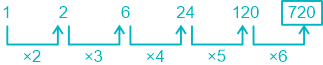 ∴ The next term will be '720'.
Q2 · Series
Complete the series.
3, 5, 10, 12, 24, 26, ?
- 52
- 54
- 53
- 50
Answer aur solution dekho
Archived marked answer: A
Observe the pattern:
3 → 5 (+2)
5 → 10 (×2)
10 → 12 (+2)
12 → 24 (×2)
24 → 26 (+2)
The pattern alternates between +2 and ×2.
So,
26 → 26 × 2 = 52
Therefore, the correct answer is: 52.
Q3 · Series
The series given below contains a sequence of numbers. Accordingly identify the incorrect combination 4, 5, 14, 14, 34, 36, 74, 68
- 74
- 34
- 36
- 68
Answer aur solution dekho
Archived marked answer: C
Given:
Series: 4, 5, 14, 14, 34, 36, 74, 68
Formula used:
Odd position numbers follow: ×2 + increasing even numbers
Calculation:
4 × 2 + 6 = 14
14 × 2 + 6 = 34
34 × 2 + 6 = 74
Odd position series: 4, 14, 34, 74 ✔
Even position numbers follow: ×2 + increasing even numbers
5 × 2 + 4 = 14
14 × 2 + 4 = 32
32 × 2 + 4 = 68
Expected even series: 5, 14, 32, 68
Given even series: 5, 14, 36, 68
⇒ 36 is incorrect (should be 32)
∴ The incorrect number is 36.
Q4 · Series
Select the letter-cluster from among the given options that can replace the question mark (?) in the following series.
C F J, F I M, I L P, ?
- LKN
- LOS
- NHS
- KIS
Answer aur solution dekho
Archived marked answer: B
The pattern followed here is:
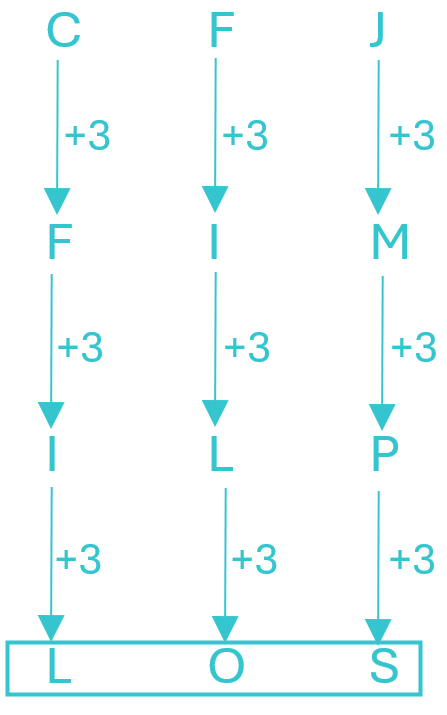 Hence, the correct answer is "Option 2".
Q5 · Series
What comes next?
MOA, NPB, OQC, PRD, ?
- QRE
- QTE
- RST
- QSE
Answer aur solution dekho
Archived marked answer: D
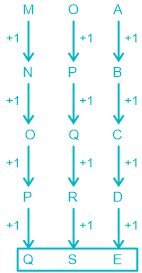
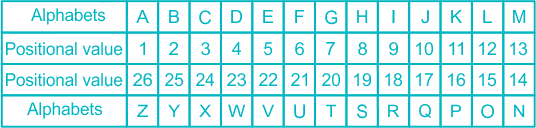 Pattern followed here is,
Q6 · Analogy
Solve:
LEAF : ? :: TIME : EMIT
- FEAL
- FAEL
- LFAE
- FELA
Answer aur solution dekho
Archived marked answer: B
Logic followed here is:
TIME : EMIT
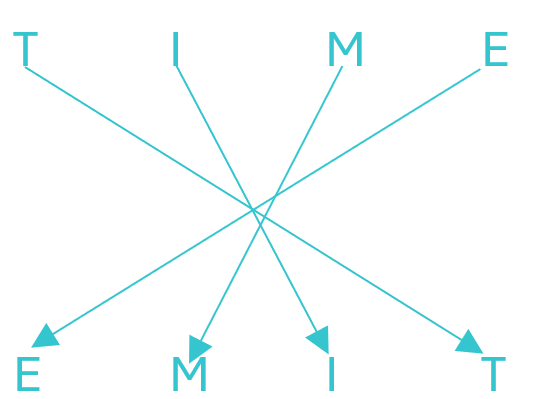 Similarly,
LEAF : ?
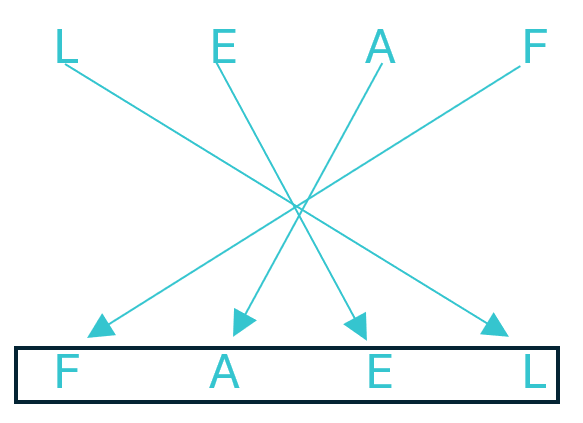 Hence, the correct answer is “Option 2”.
Q7 · Analogy
In each of the following questions, the second word is formed by applying a specific rearrangement or transformation to the first. Identify the same pattern and apply it to the third word to find the correct answer from the given alternatives. FLOWER : REWOLF :: FRUITS : ?
- STUIRF
- STIURF
- STUIFR
- STRUIF
Answer aur solution dekho
Archived marked answer: B
Step 1: Identify the pattern
FLOWER → REWOLF
The word FLOWER is written in reverse order.
FLOWER → F L O W E R
Reverse → R E W O L F = REWOLF
Step 2: Apply the same pattern to FRUITS
FRUITS → F R U I T S
Reverse → S T I U R F
Therefore, FRUITS → STIURF
Q8 · Puzzle Subtypes Not To Miss
If 8 * 2 = 20 and 6 * 3 = 27, then what is 5 * 4 = ?
- 32
- 24
- 36
- 22
Answer aur solution dekho
Archived marked answer: C
8 * 2 = 20
6 * 3 = 27
(8 + 2) × 2 = 10 × 2 = 20
(6 + 3) × 3 = 9 × 3 = 27
Apply the same rule:
(5 + 4) × 4 = 9 × 4 = 36
Therefore, the correct answer is: 36.
Q9 · Puzzle Subtypes Not To Miss
A boat travels 60 kilometers upstream in 3 hours and covers the same distance of 60 kilometers downstream in 2 hours. What is the speed of the boat in still water?
- 20 km/h
- 18 km/h
- 25 km/h
- 15 km/h
Answer aur solution dekho
Archived marked answer: C
Given:
Distance upstream = 60 km
Time upstream = 3 hours
Distance downstream = 60 km
Time downstream = 2 hours
Formula used:
Speed of boat in still water = (Upstream speed + Downstream speed) / 2
Calculation:
Upstream speed = 60 / 3 = 20 km/h
Downstream speed = 60 / 2 = 30 km/h
Speed of boat in still water = (20 + 30) / 2
= 50 / 2
= 25 km/h
Therefore, the speed of the boat in still water is 25 km/h
Q10 · Puzzle Subtypes Not To Miss
If '×' means '-', '-' means '+', '+' means '÷', then 12 + 6 × 2 - 4 =?
- 4
- 8
- 6
- 10
Answer aur solution dekho
Archived marked answer: A
BODMAS Rule:
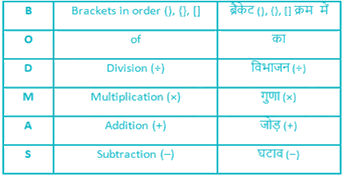 According to the question, the signs are interchanged as follows:
Original Symbol
×
−
+
New Symbol
−
+
÷
Now, given the equation: 12 + 6 × 2 - 4 = ?
After interchanging the specified signs, the new equation is:
12 ÷ 6 - 2 + 4 = ?
Perform operations according to BODMAS:
⇒ 2 + 2 = ?
⇒ 4
Hence, the correct answer is "Option 1".
Q11 · Puzzle Subtypes Not To Miss
A statement is given followed by two conclusions. Find which conclusion is TRUE based on the given statement.
Statement:
C ≥ T ; A = D ≥ O ; G ≥ D < S ; T ≥ A
Conclusions:
I: A ≤ O
II: C ≥ G
- Either I or II
- Only II
- Only I
- Neither I nor II
Answer aur solution dekho
Archived marked answer: D
Given statement: C ≥ T ; A = D ≥ O ; G ≥ D < S ; T ≥ A
Combine relations:
C ≥ T ≥ A = D ≥ O
G ≥ D < S
Conclusions:
I. A ≤ O → False (From A = D ≥ O, we get A ≥ O, so A ≤ O is incorrect.)
II. C ≥ G → False (From C ≥ T ≥ A = D and G ≥ D, no definite relation can be established between C and G.)
Thus, Neither I nor II follows.
∴ The correct answer is "Option 4".
Q12 · Puzzle Subtypes Not To Miss
If the sum of 31 and 19 is multiplied by 9, what is the result?
- 423
- 432
- 441
- 450
Answer aur solution dekho
Archived marked answer: D
Sum of 31 and 19 is multiplied by 9
(31 + 19) × 9 = 50 × 9 = 450
Hence, the correct answer is “Option 4”.
Q13 · Coding Decoding
If LEMON is coded as KDNLN, how is MANGO written?
- LZODO
- LZLFP
- LZMFQ
- LZLFO
Answer aur solution dekho
Archived marked answer: A
LEMON → KDNLN
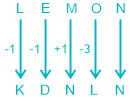 Similarly,
MANGO written as
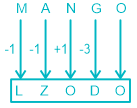
Q14 · Coding Decoding
Instruction: In a code language,"The tree grows tall" is coded as "so mo no lo", "The tree grows short" is coded as "so mo po lo", "The plant grows tall" is coded as "to mo no lo".
Question: What is the code for "The plant grows short"?
- to mo lo po
- so lo to fo
- po ko go jo
- no ko mo no
Answer aur solution dekho
Archived marked answer: A
According to given information,
 So the codes are:
The = mo/lo
plant = to
grows = lo/mo
short = po
Therefore, The plant grows short → to mo po lo.
Hence, the correct answer is “Option 1”.
Q15 · Classification Odd One Out
Which of the following groups does not follow the same arithmetic rule?
- 10,20,40
- 5,15,45
- 2,6,18
- 3,9,27
Answer aur solution dekho
Archived marked answer: A
In (2), (3), and (4) each number is multiplied by 3 to get the next number.
5 × 3 = 15, 15 × 3 = 45
2 × 3 = 6, 6 × 3 = 18
3 × 3 = 9, 9 × 3 = 27
But in (1): 10 × 2 = 20, 20 × 2 = 40 (multiplication by 2, not 3).
Therefore, the odd group is: 10, 20, 40.
Q16 · Classification Odd One Out
Find the odd one out from the given alternatives
- Lothal
- Harappa
- Mohenjodaro
- Nalanda
Answer aur solution dekho
Archived marked answer: D
1) Lothal
2) Harappa
3) Mohenjodaro
4) Nalanda
Nalanda is the odd one out because it was an ancient university, whereas Lothal, Harappa, and Mohenjodaro were cities of the Indus Valley Civilization.
Therefore, the correct answer is: Nalanda.
Q17 · Classification Odd One Out
Find the odd one out from the given alternatives.
- Tabla
- Mridangam
- Pakhawaj
- Sitar
Answer aur solution dekho
Archived marked answer: D
1) Tabla
2) Mridangam
3) Pakhawaj
4) Sitar
Sitar is the odd one out because it is a string instrument, whereas Tabla, Mridangam, and Pakhawaj are percussion instruments.
Therefore, the correct answer is: Sitar
Q18 · Logical Reasoning
Read the following statement carefully and identify the conclusion that follows.
Statement:
All circles are shapes. Some shapes are squares. All squares are polygons.
Conclusions:
I. Some shapes are polygons.
II. Some polygons are circles.
- Only I follows
- Only II follows
- Both I and II follow
- Neither I nor II follows
Answer aur solution dekho
Archived marked answer: A
Statements:
All circles are shapes.
Some shapes are squares.
All squares are polygons.
The least possible Venn diagram is:
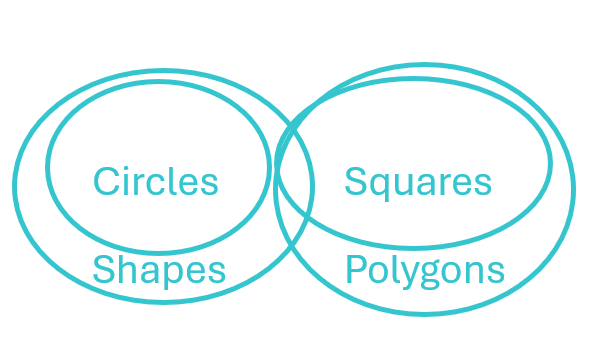 Conclusions:
I. Some shapes are polygons – True (Since some shapes are squares and all squares are polygons, therefore those shapes which are squares are also polygons.)
II. Some polygons are circles – False (No definite relation is given between polygons and circles, so this cannot be concluded.)
Thus, Only Conclusion I follows.
Hence, the correct answer is "Option 1".
Q19 · Blood Relations
A is the wife of B. B is the son of C. D is the daughter of A. How is D related to C?
- Granddaughter
- Daughter
- Sister
- Niece
Answer aur solution dekho
Archived marked answer: A
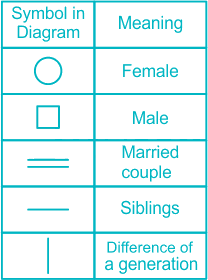
Preparing the family tree diagram using the following symbols
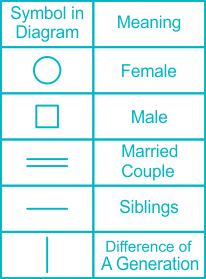 A possible tree diagram will be:
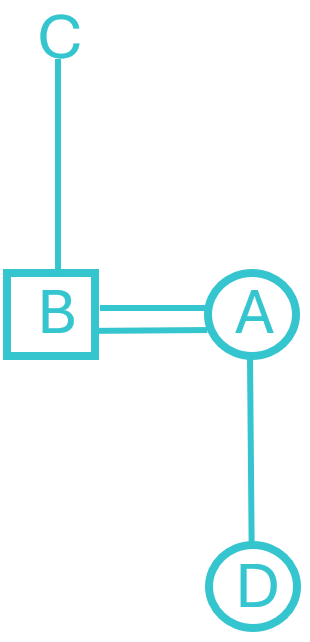 ∴ From the above diagram D is the Granddaughter of C.
Hence, the correct answer is "Option 1".
Q20 · Blood Relations
A man says, "The son of my wife's brother is my ___ ."
- Brother-in-law
- Nephew
- Cousin
- Son-in-law
Answer aur solution dekho
Archived marked answer: B
 Family tree,
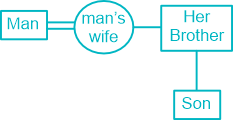 Therefore, the correct answer is: Nephew.
Hence, the correct answer is “Option 2”.
Q21 · Alphabet Test
Rearrange the letters of the word "LOVE" to form the name of an animal.
- VOLE
- VEOL
- VLEO
- OLEV
Answer aur solution dekho
Archived marked answer: A
Rearranging the letters of LOVE forms VOLE, which is the name of a small rodent.
Therefore, the correct answer is: VOLE.
Q22 · Similarity and Differences
Find the odd one out:
Rose, Lotus, Sunflower, Oak, Tulip
- Rose
- Lotus
- Oak
- Tulip
Answer aur solution dekho
Archived marked answer: C
Rose – Flowering plant
Lotus – Flowering aquatic plant
Sunflower – Flowering plant
Tulip – Flowering plant
Oak – Tree, not a flower
✅ Common pattern:
Rose, Lotus, Sunflower, and Tulip are flowers.
❌ Different:
Oak is a tree, not a flower.
Therefore, the odd one out is: Oak.
Q23 · Logical Statement Questions
Instruction: Identify the assumptions that must hold for the statement to be valid, then choose the correct option.
Statement: To reduce traffic congestion in urban areas, cities should invest in public transportation infrastructure, even though it requires significant initial investments.
Assumptions:
I. Public transportation can effectively reduce traffic congestion.
II. The initial cost of building transportation infrastructure is high.
III. People are willing to shift from private vehicles to public transportation.
- Only I and II are implicit
- Only II and III are implicit
- All I, II and III are implicit
- Only I is implicit
Answer aur solution dekho
Archived marked answer: A
Statement:
To reduce traffic congestion in urban areas, cities should invest in public transportation infrastructure, even though it requires significant initial investments.
Analysis:
I. Public transportation can effectively reduce traffic congestion – True (The statement suggests investing in public transport to reduce congestion, so it assumes public transport can help reduce traffic.)
II. The initial cost of building transportation infrastructure is high – True (The statement clearly mentions that it requires significant initial investments.)
III. People are willing to shift from private vehicles to public transportation – False (The statement does not necessarily assume people are willing to shift; it only suggests investment in infrastructure.)
Thus, Only I and II are implicit.
∴ The correct answer is "Option 1".
Q24 · Logical Statement Questions
Read the following statement carefully and identify the conclusion that follows.
Statement: All citizens must abide by traffic laws.
Conclusion I: Citizens who disobey traffic laws must be punished.
Conclusion II: Obeying traffic laws shows civic responsibility.
- Only I
- Only II
- Both follow
- Neither follows
Answer aur solution dekho
Archived marked answer: C
Given Statement:
All citizens must abide by traffic laws.
Conclusions:
I. Citizens who disobey traffic laws must be punished.
II. Obeying traffic laws shows civic responsibility.
Analysis:
I. Citizens who disobey traffic laws must be punished – True (If citizens are required to follow traffic laws, those who violate them are expected to face punishment.)
II. Obeying traffic laws shows civic responsibility – True (Following traffic rules reflects responsible behavior as a citizen.)
Thus, Both conclusions follow.
∴ The correct answer is "Option 3".
Q25 · Logical Statement Questions
Read the following statement carefully and identify the conclusion that follows.
Statement: Thousands of students appeared for the entrance exam conducted across the country.
Conclusions:
I. The exam is popular and competitive.
II. All students who appeared will get admission.
- Only Conclusion I follows
- Only Conclusion II follows
- Both I and II follow
- Neither I nor II follows
Answer aur solution dekho
Archived marked answer: A
Given Statement:
Thousands of students appeared for the entrance exam conducted across the country.
Conclusions:
I. The exam is popular and competitive.
II. All students who appeared will get admission.
Analysis:
I. The exam is popular and competitive – True (Since thousands of students appeared for the exam, it indicates that the exam is popular and likely competitive.)
II. All students who appeared will get admission – False (The statement does not say that all students will get admission; entrance exams usually select only some candidates.)
Hence, Only Conclusion I follows.
∴ The correct answer is "Option 1".
General Awareness
Q1 · Art and Culture
Which of the following correctly describes the musical form Svarajati?
- A bhajan form used only in temples
- A dance item without fixed structure
- A vocal form later adapted for dance
- A film-based item with fast rhythm
Answer aur solution dekho
Archived marked answer: C
The correct answer is A vocal form later adapted for dance.
Key Points
- Svarajati is a classical musical form in Carnatic music that originally developed as a vocal composition.
- It is characterized by its use of swaras (musical notes) and sahitya (lyrics) intertwined to create a melodic structure.
- While it was initially composed for vocal performances, Svarajati evolved over time and became an integral part of Bharatanatyam dance repertoire.
- In Bharatanatyam, Svarajati is often used as a medium to express intricate emotions and stories through abhinaya (expressions) and rhythmic movements.
- Some famous composers of Svarajati include Shyama Shastri, one of the Trinity of Carnatic music, who composed notable Svarajatis like "Kamakshi" in Raaga Bhairavi.
Additional Information
- A bhajan form used only in temples
- Bhajans are devotional songs that are typically sung in praise of deities, saints, or spiritual concepts.
- They are commonly performed in temples, homes, and other religious gatherings as a form of devotion.
- Bhajans have a simple structure and melody, making them accessible to everyone, unlike Svarajati, which is a more complex classical form.
- A dance item without fixed structure
- Dance items without fixed structures are generally improvisational and do not adhere to the rigid frameworks seen in classical compositions like Svarajati.
- Svarajati, on the contrary, follows a fixed melodic and rhythmic pattern, making it unsuitable to describe as a dance item without structure.
- A film-based item with fast rhythm
- Film-based musical items are typically composed for entertainment, often prioritizing rhythm and melody to appeal to popular audiences.
- Svarajati belongs to the classical tradition and does not align with the characteristics of film-based music, which is largely contemporary and commercial.
Q2 · Art and Culture
Fill in the Blank:
Ghoomar was listed among top local dances globally in ____ year.
- 2010
- 2013
- 2015
- 2018
Answer aur solution dekho
Archived marked answer: B
The correct answer is 2013.
Key Points
- Ghoomar, a traditional folk dance of Rajasthan, was recognized globally and listed among the top local dances in the year 2013.
- This dance form is primarily performed by women and is associated with the heritage of the Bhil tribe, later adopted by the Rajput community.
- Ghoomar is characterized by its graceful circular movements and vibrant attire, symbolizing the cultural richness of Rajasthan.
- The dance is performed on auspicious occasions such as weddings, festivals, and religious ceremonies.
- UNESCO has acknowledged Ghoomar as an integral part of India's intangible cultural heritage, increasing its international recognition.
Additional Information
- Option 1: 2010
- In 2010, cultural initiatives in India were focused on promoting and preserving traditional art forms, but Ghoomar had not yet been globally recognized in that year.
- However, this year saw the rise of several Indian art forms gaining attention at national festivals and events.
- Option 3: 2015
- In 2015, the Ministry of Culture in India emphasized the promotion of traditional dances, but Ghoomar had already gained global recognition by then.
- It was also a year when UNESCO added more elements of Indian heritage to its lists of intangible cultural heritage, though Ghoomar's recognition had occurred earlier.
- Option 4: 2018
- By 2018, Ghoomar had already been internationally recognized and popularized further through films such as "Padmaavat," where it was prominently featured.
- This year primarily saw a surge in the global appeal of Indian cultural elements, but Ghoomar's recognition as a top local dance had occurred much earlier.
- Main Theme: Ghoomar Dance
- Ghoomar is a Rajasthani folk dance that reflects the culture, traditions, and vibrancy of Rajasthan.
- It is performed by women wearing traditional ghagra-choli and is known for its intricate footwork and elegant swirling movements.
- The dance is often accompanied by traditional Rajasthani music, enhancing its charm and appeal.
- Ghoomar has become a symbol of India's rich cultural diversity and is celebrated both nationally and internationally.
``
Q3 · Art and Culture
Fill in the blank:
Ladakhhi new year (Losar) is welcomed with symbolic dough models of ______, sun, and moon placed in households.
- Ibex
- Yak
- Snow leopard
- Buddha
Answer aur solution dekho
Archived marked answer: A
The correct answer is Ibex.
Key Points
- In Ladakh, the Losar festival marks the beginning of the Tibetan New Year and holds great cultural and spiritual importance.
- The symbolic dough models of ibex, sun, and moon are placed in households as a part of the Losar celebrations to bring prosperity and well-being.
- The ibex is considered a sacred and auspicious animal in Ladakh, symbolizing strength, resilience, and endurance.
- These dough models are not only decorative but also carry spiritual significance, serving as offerings to deities and a representation of harmony with nature.
- Losar is celebrated with rituals, prayers, and traditional performances, reflecting the rich heritage of Tibetan Buddhism practiced in Ladakh.
Additional Information
- Yak
- The yak is a domesticated bovine animal found in the Himalayan region, including Ladakh, and is vital for the livelihood of the locals.
- Yaks provide milk, meat, wool, and transportation, making them indispensable in high-altitude areas.
- Although important in Ladakhi culture, the yak does not hold the same symbolic or spiritual significance as the ibex during Losar celebrations.
- Snow Leopard
- The snow leopard is a rare and endangered species found in the mountainous regions of Ladakh.
- It holds ecological importance as a top predator in the Himalayan ecosystem and is a symbol of Ladakh's wildlife diversity.
- However, it does not feature in the symbolic representations of the Losar festival.
- Buddha
- Buddha is a revered spiritual figure in Tibetan Buddhism, which is widely practiced in Ladakh.
- While Buddhist rituals and prayers play a key role during Losar, the symbolic dough models do not traditionally include representations of Buddha.
- Losar Festival
- Losar is celebrated during the 11th month of the Tibetan calendar, usually falling in December or January.
- The festival includes cleaning homes, lighting lamps, and performing traditional dances and songs to welcome the new year.
- It emphasizes harmony, renewal, and gratitude towards nature and deities.
Q4 · Indian Polity and Constitution
Which of the following statements correctly applies the weighted voting mechanism under Article 279A(9) of the Indian Constitution?
- The Centre holds 75% of the voting power in the GST Council.
- A GST Council decision can be passed solely with the support of the Centre and one State.
- The States collectively have twice the voting weight of the Centre in the GST Council.
- Each State has equal weightage as the Centre in GST Council voting.
Answer aur solution dekho
Archived marked answer: C
The correct answer is The States collectively have twice the voting weight of the Centre in the GST Council..
Key Points
- Article 279A of the Indian Constitution establishes the GST Council, which is a federal body tasked with making key decisions related to the Goods and Services Tax (GST).
- The voting structure in the GST Council is designed to balance the interests of the Centre and States.
- As per Article 279A(9), the Centre holds a voting weight of one-third (33.33%) of the total votes.
- The States collectively hold two-thirds (66.67%) of the total voting weight in the GST Council.
- A decision in the GST Council requires a three-fourths (75%) majority of the weighted votes, ensuring that the States play a significant role in decision-making.
Additional Information
- Option 1: The Centre holds 75% of the voting power in the GST Council
- This statement is incorrect as the Centre holds only one-third (33.33%) of the total voting power in the GST Council.
- The remaining two-thirds (66.67%) of the voting power is collectively held by the States.
- Option 2: A GST Council decision can be passed solely with the support of the Centre and one State
- This statement is incorrect as decisions in the GST Council require a three-fourths (75%) majority of the weighted votes.
- Since the Centre has only one-third (33.33%) of the voting power, it cannot pass a decision unilaterally or with the support of just one State.
- Option 4: Each State has equal weightage as the Centre in GST Council voting
- This statement is also incorrect. While each State has equal voting power among themselves, the collective weightage of all States is two-thirds (66.67%), which is twice that of the Centre's one-third (33.33%).
- The Centre does not hold equal voting weight as an individual State; instead, its voting weight is predefined as one-third of the total.
- Main Theme: GST Council and Its Voting Mechanism
- The GST Council is a constitutional body formed under Article 279A to make recommendations on various aspects of GST, such as tax rates, exemptions, and procedural rules.
- The council consists of the Union Finance Minister as the Chairperson, the Union Minister of State for Finance, and State Finance Ministers.
- The unique voting structure ensures cooperative federalism by giving States a collective upper hand while maintaining the Centre's significant say in decisions.
``
Q5 · Indian Polity and Constitution
In Bharatiya Nagarik suraksha Samhita(BNSS), which court may grant default bail after time limit lapses?
- District Court
- Magistrate
- High Court
- Gram Nyayalaya
Answer aur solution dekho
Archived marked answer: B
The correct answer is Magistrate.
Key Points
- Under the Bharatiya Nagarik Suraksha Samhita (BNSS), a Magistrate has the authority to grant default bail to an accused if the investigation agency fails to file a chargesheet within the stipulated time frame.
- The time limit for filing a chargesheet is generally 60 days for cases where the offense is punishable with imprisonment up to 10 years and 90 days for offenses punishable with death, life imprisonment, or imprisonment exceeding 10 years.
- Section 167(2) of the Code of Criminal Procedure (CrPC), which is incorporated under BNSS, mandates that a Magistrate must release the accused on default bail if the prosecution fails to meet these deadlines.
- Default bail is considered a statutory right of the accused and is not dependent on the merits of the case; it ensures procedural safeguards against unlawful detention.
- The Magistrate can impose reasonable conditions while granting default bail, such as requiring the accused to furnish a bail bond or adhere to certain restrictions during the bail period.
Additional Information
- District Court
- District Courts are subordinate courts in the judicial hierarchy and primarily function as trial courts for civil and criminal cases.
- They lack the jurisdiction to directly grant default bail unless the case has been escalated from the Magistrate's court.
- District and Sessions Judges handle cases involving serious offenses, appeals, and revisions against the orders of Magistrates.
- High Court
- The High Court is the apex judicial body at the state level and primarily deals with appeals, writs, and revisions.
- While the High Court can grant bail in exceptional cases, default bail is generally processed through the Magistrate’s court as per procedural norms.
- The High Court can intervene if there is procedural illegality or denial of statutory bail by lower courts.
- Gram Nyayalaya
- Gram Nyayalayas are village-level courts established under the Gram Nyayalayas Act, 2008, to provide speedy and accessible justice in rural areas.
- They primarily deal with minor civil and criminal cases and do not have jurisdiction over major offenses or default bail matters.
- Their objective is to reduce the burden on regular courts while ensuring justice at the grassroots level.
- About Bharatiya Nagarik Suraksha Samhita (BNSS)
- The BNSS is part of the set of bills introduced to replace the colonial-era laws like the Indian Penal Code (IPC), CrPC, and the Indian Evidence Act.
- It seeks to modernize India’s criminal laws to ensure justice delivery is more efficient and citizen-friendly.
- The provisions related to default bail under BNSS aim to uphold individual liberty while maintaining procedural discipline in criminal investigations.
Q6 · Indian Polity and Constitution
"Amit Shah already has the key portfolios of Union Home Minister and Minister of Cooperation in 2025. Think of these statements:
1. He remains Union Home Minister and Minister of Cooperation post the 2024 elections.
2. The Home Ministry is responsible for internal security, borders, and disaster management.
3. The Home Minister enjoys a constitutionalized fixed 6-year term.
Which one of the above is/are true?"
- 1 and 2 only
- 2 and 3 only
- 1 and 3 only
- 1, 2 and 3 all are correct
Answer aur solution dekho
Archived marked answer: A
The correct answer is Option 1) 1 and 2 only.
Key Points
- Statement 1: Amit Shah holds the key portfolios of Union Home Minister and Minister of Cooperation. If he retains his position post the 2024 elections, this statement stands true.
- Statement 2: The Union Home Ministry is responsible for internal security, borders, disaster management, and coordination with states regarding law and order. This is accurate based on the Home Ministry’s mandate under the Government of India.
- These two statements are factual and align with the responsibilities of the Union Home Ministry and the portfolio distribution in 2025.
- Statement 3: The claim that the Home Minister has a constitutionally fixed 6-year term is incorrect. The tenure of Union Ministers is not fixed and depends on the Prime Minister’s discretion and the government’s majority in the Lok Sabha.
- Since only Statements 1 and 2 are correct, the correct answer is Option 1) 1 and 2 only.
Additional Information
- Statement 1:
- The Union Home Minister’s role involves ensuring national security, dealing with internal threats, and managing the functioning of the paramilitary forces.
- The Ministry of Cooperation, launched in 2021, aims to strengthen the cooperative movement in India by providing a separate administrative, legal, and policy framework to deepen its reach.
- Statement 2:
- The Union Home Ministry’s key responsibilities include:
- Managing internal security and law enforcement.
- Overseeing border management and ensuring coordination between central and state agencies for maintaining law and order.
- Disaster management and rehabilitation efforts in case of emergencies.
- It also supervises agencies such as the Central Reserve Police Force (CRPF) and Border Security Force (BSF).
- Statement 3:
- The tenure of a Union Minister, including the Home Minister, is not fixed by the Constitution of India. It is determined by:
- The Prime Minister’s discretion to allocate or withdraw portfolios.
- The majority support of the government in the Lok Sabha.
- Ministers hold office during the pleasure of the President, as per Article 75 of the Constitution.
- General Information:
- The Union Council of Ministers is collectively responsible to the Lok Sabha, and its composition may change after a general election based on the formation of the new government.
- The Ministry of Cooperation is relatively new and works to promote cooperative-based economic models for inclusive development.
Q7 · Indian Economy
Consider the following statements:
1. The GST Council makes binding recommendations on GST rates.
2. Article 246A allows States to legislate on intra-state supply of goods and services.
Which of the above is/are correct?
- Only 1
- Only 2
- Both 1 and 2
- Neither 1 nor 2
Answer aur solution dekho
Archived marked answer: B
The correct answer is Only 2.
Key Points
- Article 246A of the Indian Constitution was introduced by the 101st Constitutional Amendment Act, 2016, granting both Parliament and State Legislatures the power to make laws on goods and services tax (GST).
- Under Article 246A, States have the exclusive power to legislate on intra-state supply of goods and services, except in the case of Union Territories without legislatures.
- The GST
Q8 · Sports Static GK
Consider the following statements about Judo competition areas and contestants:
1) The competition area is divided into an inner contest area (minimum 8m×8m) and an outer safety area (minimum 3m wide).
2) The blue uniform contestant is called first, followed by the white uniform contestant. Which of the statements is/are correct?
- Only 1 is Correct
- Only 2 is Correct
- 1 and 2 are Correct
- Neither 1 nor 2 are Correct
Answer aur solution dekho
Archived marked answer: A
The correct answer is Option 1.
Key Points
- In Judo, the competition area is divided into two key zones: an inner contest area and an outer safety area.
- The minimum dimensions of the inner contest area are 8m×8m, as per the International Judo Federation (IJF) rules.
- The outer safety area surrounding the contest area must be at least 3m wide to ensure the safety of contestants.
- The design of the competition area is crucial to prevent injuries and maintain fair play during matches.
- The first statement is correct as it aligns with the official regulations for Judo competition areas.
Additional Information
- Explanation of Statement 2:
- The second statement, which mentions that the blue uniform contestant is called first, followed by the white uniform contestant, is incorrect.
- In official Judo competitions, the contestant wearing the white uniform (Judogi) is traditionally called first, followed by the contestant in the blue uniform.
- This procedure is universally followed to maintain consistency during competitions.
- Overview of Judo Competitions:
- Judo is a modern martial art and combat sport that originated in Japan in 1882, created by Jigoro Kano.
- It emphasizes techniques such as throws, grappling, and submissions, with a focus on using an opponent's strength against them.
- Matches take place on a tatami (mat), and strict rules are in place to ensure safety and fairness.
- Safety Measures in Judo:
- The safety area ensures that contestants are protected from accidental falls or movements outside the inner contest area.
- Matches are overseen by referees who enforce rules and ensure the safety of both competitors.
``
Q9 · Sports Static GK
Which events were initially announced as demonstration sports but later became full-fledged medal events in the 38th National Games held at Uttarakhand?
- Kho-Kho and Kabaddi
- Yogasana and Mallakhamb
- Shooting and Athletics
- Kayaking and Rowing
Answer aur solution dekho
Archived marked answer: B
The correct answer is Yogasana and Mallakhamb.
Key Points
- Yogasana and Mallakhamb were initially introduced as demonstration sports in the 38th National Games held in Uttarakhand but were later upgraded to full-fledged medal events.
- Yogasana is a traditional Indian discipline involving physical postures (asanas) combined with breathing techniques (pranayama) and meditation. It has gained global recognition for promoting physical and mental well-being.
- Mallakhamb is an indigenous sport that involves acrobatics and yoga-like postures performed on a vertical wooden pole or rope. It is widely regarded as an ancient form of physical training in India.
- The decision to include these sports as medal events highlights India’s commitment to promoting traditional and indigenous sports on a national platform.
- The inclusion of Yogasana and Mallakhamb also aligns with the government’s efforts to preserve and promote India’s cultural heritage while encouraging physical fitness and mental discipline.
Additional Information
- Kho-Kho and Kabaddi
- Both are traditional Indian team sports that are immensely popular across the country.
- Kabaddi is a contact sport where players take turns raiding the opponent’s court to tag or tackle players while holding their breath.
- Kho-Kho is a tag-based game where speed, agility, and strategy play a key role. It involves chasing and touching opposing players in a predefined sequence.
- These sports have been long-standing medal events in national games and are not new additions or demonstration sports.
- Shooting and Athletics
- Both shooting and athletics are globally recognized sports and have been integral parts of the National Games in India for decades.
- Shooting involves precision-based events like rifle, pistol, and shotgun disciplines.
- Athletics includes a variety of track and field events such as running, jumping, and throwing, and is considered the backbone of any multi-sport event.
- These sports are not related to the context of being demonstration sports in the 38th National Games.
- Kayaking and Rowing
- These are water sports that involve paddling or rowing a boat through a water body.
- Kayaking uses a double-bladed paddle, while rowing requires participants to use oars in synchronization.
- Both sports are part of the National Games but were not introduced as demonstration sports in the 38th edition.
- Significance of National Games
- The National Games serve as a platform to promote sports culture and identify talent at the grassroots level in India.
- They aim to provide exposure to athletes and encourage participation in diverse sporting disciplines, including traditional and modern sports.
- The inclusion of indigenous sports like Yogasana and Mallakhamb reflects the government’s emphasis on promoting India’s rich sporting heritage.
Q10 · Indian Geography
Which of the following statements best explains why age-specific rates are used in demography?
- They help identify regional literacy levels
- They reflect age-wise variation in fertility or mortality
- They show the economic condition of elderly people
- They reduce the total number of indicators needed
Answer aur solution dekho
Archived marked answer: B
The correct answer is They reflect age-wise variation in fertility or mortality.
Key Points
- Age-specific rates are crucial in demography for analyzing variations in fertility and mortality across different age groups.
- These rates provide insights into the reproductive patterns and mortality risks associated with specific age brackets, helping governments and researchers plan targeted interventions.
- Age-specific fertility rates (ASFR) are used to calculate the number of births per 1,000 women in specific age groups, aiding in population growth analysis.
- Age-specific mortality rates (ASMR) reflect the death rates per 1,000 individuals in a particular age group, helping assess public health and predict life expectancy trends.
- These rates are essential in understanding population dynamics, especially in countries experiencing demographic transitions or shifts in age structure.
Additional Information
- Option 1: They help identify regional literacy levels
- Regional literacy levels are typically assessed using literacy rates, which measure the percentage of literate individuals in a population aged 7 years and above.
- This indicator is not directly related to age-specific rates, as literacy is a general measure rather than an age-specific demographic parameter.
- Option 3: They show the economic condition of elderly people
- The economic condition of elderly people is analyzed using indicators such as income levels, pension schemes, and dependency ratios.
- Age-specific rates focus on fertility and mortality rather than economic conditions.
- Option 4: They reduce the total number of indicators needed
- Age-specific rates do not necessarily reduce the number of indicators; rather, they provide more detailed insights into population dynamics.
- Demographic studies use multiple indicators to understand complex population characteristics, including age-specific rates alongside others like crude birth and death rates.
- Main Theme: Importance of Age-Specific Rates
- Age-specific rates are widely used in demographic studies for population analysis and planning.
- They help identify trends such as declining fertility among younger age groups or increasing mortality in older populations.
- These rates are critical for designing policies in healthcare, education, and social security tailored to specific age demographics.
Q11 · Indian Geography
The Kudremukh mines in Karnataka are primarily known for the extraction of which important mineral resource?
- Bauxite
- Limestone
- Iron Ore
- Copper
Answer aur solution dekho
Archived marked answer: C
The correct answer is Iron Ore.
Key Points
- Kudremukh mines, located in the Chikmagalur district of Karnataka, are known as one of the largest iron ore reserves in India.
- The ore extracted from Kudremukh is magnetite, which has a very high iron content and is considered of superior quality.
- Iron ore from Kudremukh was historically exported via the Mangalore port, as it was processed into pellets and transported through pipelines.
- Mining activities at Kudremukh were halted in 2005 following a Supreme Court order due to environmental concerns, as the area falls in the Western Ghats, a UNESCO World Heritage site.
- Kudremukh means "horse face" in Kannada, referring to the mountain range's unique shape in the region.
Additional Information
- Bauxite
- Bauxite is the primary ore of aluminum and is composed mainly of aluminum hydroxide minerals like gibbsite, boehmite, and diaspore.
- India is one of the major producers of bauxite, with significant deposits located in Odisha, Andhra Pradesh, and Gujarat.
- Bauxite mining is crucial for the aluminum industry, as it is refined to produce alumina and later smelted to obtain aluminum metal.
- Limestone
- Limestone is a sedimentary rock primarily composed of calcium carbonate (CaCO3).
- It is extensively used in the cement industry, the construction of buildings, and as a raw material in the steel and glass industries.
- Major limestone-producing states in India include Rajasthan, Madhya Pradesh, and Andhra Pradesh.
- Copper
- Copper is a base metal used extensively in electrical wiring, plumbing, and the manufacturing of electronics and alloys like brass and bronze.
- India's notable copper reserves are located in Rajasthan (Khetri mines), Madhya Pradesh, and Jharkhand.
- Copper mining contributes significantly to India's industrial growth and the global supply chain.
- Iron Ore and Its Importance
- Iron ore is the backbone of the steel industry, as it is the primary raw material used in steel production.
- India is among the largest producers of iron ore, with major deposits found in Odisha, Chhattisgarh, Jharkhand, and Karnataka.
- Iron ore is classified into four types based on its iron content: magnetite, hematite, limonite, and siderite, with magnetite being the richest in iron concentration.
Q12 · Modern Indian History
Which of the following statements regarding the Government of India Act, 1919 is correctly matched with its constitutional implication?
- Transferred and Reserved subjects – Created functional overlap between central and provincial powers
- Creation of bicameralism – Introduced two houses at the central level for the first time
- Establishment of Public Service Commission – Gave financial control to Indian members in the Viceroy's Council
- Introduction of diarchy in provinces – Empowered Indian ministers to control defence and foreign affairs
Answer aur solution dekho
Archived marked answer: B
The correct answer is Creation of bicameralism – Introduced two houses at the central level for the first time.
Key Points
- The Government of India Act, 1919, introduced a bicameral legislature at the central level for the first time in India.
- It created two houses: the Council of States (upper house) and the Legislative Assembly (lower house).
- The Council of States was composed of members who were mostly nominated and indirectly elected, while the Legislative Assembly had a mix of elected and nominated members.
- This step marked a significant constitutional development in India, aiming to create
Q13 · Current Affairs
According to Transparency International, what is a major concern with EU golden passport and visa schemes?
- They increase legal migration and help boost employment
- They encourage cultural exchange across the EU
- They enable the corrupt to exploit citizenship and residency systems for personal gain
- They promote tourism through relaxed visa regulations
Answer aur solution dekho
Archived marked answer: C
The correct answer is They enable the corrupt to exploit citizenship and residency systems for personal gain.
Key Points
- The EU golden passport and visa schemes allow individuals to acquire citizenship or residency in a member state in exchange for significant financial investments in that country.
- Transparency International has raised concerns that such schemes can be exploited by corrupt individuals or criminals to launder money or evade legal scrutiny in their home countries.
- The lack of stringent background checks and transparency in some member states' implementation of these schemes makes them vulnerable to abuse.
- By exploiting these schemes, individuals can gain access to the broader EU, bypassing stricter immigration controls in other member states.
- Transparency International has called for increased regulation and oversight to prevent misuse of these programs and ensure they do not facilitate corruption or crime.
Additional Information
- Option 1: They increase legal migration and help boost employment
- While golden passport schemes do attract high-net-worth individuals, they are not primarily designed to increase legal migration or create employment opportunities for the general population.
- These programs are often criticized for focusing on financial gains rather than fostering economic benefits for the broader society.
- Option 2: They encourage cultural exchange across the EU
- The primary goal of golden passport and visa schemes is not to promote cultural exchange but to attract investment through citizenship or residency offers.
- Although residency may indirectly lead to some cultural integration, it is not a major focus of these programs.
- Option 4: They promote tourism through relaxed visa regulations
- Golden passport schemes are distinct from visa waiver programs or policies aimed at boosting tourism.
- These schemes focus on granting long-term residency or citizenship in exchange for investment, rather than short-term relaxed visa regulations for tourists.
- Golden Passport and Visa Schemes – Main Theme
- Golden passport and visa schemes are offered by some EU member states, allowing individuals to obtain citizenship or residency rights in exchange for substantial investments.
- These programs often include investments in real estate, government bonds, or business ventures.
- While they generate revenue for the participating countries, they have been criticized for their lack of transparency and potential to facilitate corruption and money laundering.
- Calls for reform include stricter due diligence, enhanced transparency, and alignment with EU-wide standards to prevent abuse.
Q14 · Current Affairs
Which Indian city topped the Swachh Vayu Sarvekshan 2024 in the category of cities with a population over 10 lakh?
- Bengaluru
- Indore
- Mumbai
- Ahmedabad
Answer aur solution dekho
Archived marked answer: B
The correct answer is Indore.
Key Points
- Indore topped the Swachh Vayu Sarvekshan 2024 in the category of cities with a population of over 10 lakh.
- The ranking is part of the National Clean Air Programme (NCAP), which monitors and evaluates air quality levels in cities across India.
- Indore has consistently performed well in various cleanliness and sustainability indices due to its innovative waste management practices and environmental policies.
- Key factors contributing to Indore's top ranking include effective public participation, air pollution control measures, and solid waste management initiatives.
- The city has been a regular recipient of accolades for its efforts in cleanliness, including being ranked as India’s cleanest city under the Swachh Survekshan initiative.
Additional Information
- Bengaluru
- Bengaluru, also known as the "Silicon Valley of India," is one of the country’s major metropolitan cities, but it faces significant air quality challenges due to traffic congestion and industrial emissions.
- Despite its technological advancements, Bengaluru has struggled with particulate matter (PM) levels, making consistent improvements in air quality a challenge.
- The city has initiated steps to improve its air quality, such as promoting electric vehicles and enhancing public transportation infrastructure.
- Mumbai
- Mumbai, India’s financial capital, faces severe air pollution issues, primarily due to vehicle emissions, industrial activities, and construction dust.
- The coastal city has taken measures to combat air pollution, including the introduction of cleaner fuels and stricter emission norms.
- Efforts like the Mumbai Climate Action Plan aim to reduce emissions and improve air quality over the long term.
- Ahmedabad
- Ahmedabad has been proactive in tackling air pollution through its Ahmedabad Air Information and Response (AIR) Plan, which focuses on reducing particulate matter levels.
- The city has implemented measures such as expanding green cover, promoting the use of public transport, and regulating industrial emissions.
- Ahmedabad is also a participant in the NCAP and has shown progress in improving air quality metrics over the years.
- Swachh Vayu Sarvekshan
- The Swachh Vayu Sarvekshan is an initiative under the National Clean Air Programme (NCAP) to rank cities based on their efforts to improve air quality.
- The program evaluates cities based on parameters such as reduction in PM2.5 and PM10 levels, implementation of clean air action plans, and public awareness campaigns.
- It aims to encourage cities to adopt sustainable practices and innovative solutions to reduce air pollution.
Q15 · General Science Chemistry
Consider the given statements regarding the behavior of ideal gases:
1. Ideal gas molecules have negligible volume compared to the total volume of the container.
2. There are strong intermolecular attractive forces between ideal gas molecules.
3. Collisions between ideal gas molecules are perfectly elastic.
Which of the statements given above is/are correct?
- 1 and 2 only
- 1 and 3 only
- 2 and 3 only
- 1, 2 and 3
Answer aur solution dekho
Archived marked answer: B
The correct answer is Option 2) 1 and 3 only.
Key Points
- Ideal Gas Assumptions: The molecules of an ideal gas are assumed to have negligible volume compared to the total volume of the container. This is a key postulate of the kinetic molecular theory of gases.
- Collisions Are Perfectly Elastic: The collisions between ideal gas molecules are perfectly elastic, meaning that there is no loss of kinetic energy during the collisions.
- No Intermolecular Forces: Ideal gases are assumed to have no intermolecular attractive or repulsive forces. This ensures that the behavior of the gas is purely governed by kinetic energy.
- Statement 2 Is Incorrect: The claim that "there are strong intermolecular attractive forces between ideal gas molecules" contradicts the ideal gas postulate that assumes the absence of intermolecular forces.
- Thus, only Statements 1 and 3 are correct, making Option 2 the right answer.
Additional Information
- Statement 1: Ideal Gas Molecules Have Negligible Volume
- In the ideal gas model, the size of individual gas molecules is considered negligible compared to the volume of the container.
- This assumption simplifies calculations and ensures that the gas's behavior is dominated by the motion of molecules rather than their physical size.
- Statement 2: Strong Intermolecular Attractive Forces (Incorrect)
- In an ideal gas, intermolecular forces are assumed to be absent, which allows the gas molecules to move freely without being influenced by nearby molecules.
- Strong intermolecular forces are a characteristic of real gases, especially at low temperatures or high pressures, where deviations from ideal behavior occur.
- Statement 3: Collisions Between Molecules Are Perfectly Elastic
- Elastic collisions mean that the total kinetic energy of colliding particles remains constant before and after the collision.
- This is a fundamental assumption of the kinetic theory of gases, ensuring energy conservation within the system.
- Ideal Gas Behavior Overview
- The ideal gas law, represented as PV = nRT, describes the relationship between pressure (P), volume (V), temperature (T), and the amount of gas (n).
- Ideal gases are hypothetical and serve as a model to understand the behavior of real gases under certain conditions, such as high temperatures and low pressures.
Q16 · Awards Static
Which of the following statements regarding the Dronacharya Award is/are correct?
1) It carries a cash prize of ₹10 lakhs and features a gold statue of Guru Dronacharya.
2) O.M. Nambiar was honored with the first Dronacharya Award in 1985 for outstanding coaching.
- Only 1 is Correct
- Only 2 is Correct
- 1 and 2 are correct
- Neither 1 nor 2 are Correct
Answer aur solution dekho
Archived marked answer: B
The correct answer is Only 2 is Correct.
Key Points
- The Dronacharya Award is presented annually by the Government of India to sports coaches for their outstanding contributions to sports coaching.
- Statement 1 is incorrect as the Dronacharya Award carries a cash prize of ₹15 lakhs, along with a bronze statuette of Guru Dronacharya and a scroll of honor, not a gold statue.
- Statement 2 is correct as O.M. Nambiar, who was the coach of legendary athlete P.T. Usha, was honored with the first Dronacharya Award in 1985.
- The award was instituted in 1985 to recognize excellence in coaching and motivating athletes to achieve success in international sports.
- The Dronacharya Award is considered one of the highest honors for sports coaching in India.
Additional Information
- Statement 1 (Incorrect):
- The cash prize for the Dronacharya Award was increased from ₹5 lakhs to ₹15 lakhs in 2020 by the Government of India.
- The award includes a bronze statuette of Guru Dronacharya, not a gold statue as mentioned in the statement.
- The statuette symbolizes the legendary teacher Dronacharya from the Mahabharata, who was known for his mentorship and training of the Kauravas and Pandavas in warfare and archery.
- Statement 2 (Correct):
- O.M. Nambiar, the first recipient of the Dronacharya Award in 1985, is widely recognized for coaching P.T. Usha, one of India’s greatest athletes.
- He played a crucial role in shaping P.T. Usha’s career, helping her achieve international success, including at the Asian Games and the Olympics.
- About the Dronacharya Award:
- The award is conferred in two categories: Lifetime Contribution and Regular Coaching.
- Nominees are selected by a committee based on their contributions to the development of athletes and their achievements at national and international levels.
- It is one of four prominent sports awards in India, alongside the Rajiv Gandhi Khel Ratna (now renamed Major Dhyan Chand Khel Ratna), Arjuna Award, and Dhyan Chand Award.
61:T
Q17 · Medieval Indian History
What position did Hindu Beg hold during Humayun's reign?
- Rajput chief
- Court scholar
- Provincial governor
- Spiritual guide
Answer aur solution dekho
Archived marked answer: C
The correct answer is Provincial governor.
Key Points
- Hindu Beg was a trusted officer under the reign of Mughal Emperor Humayun.
- He served as a provincial governor, holding administrative authority over specific regions of the empire.
- As a provincial governor, Hindu Beg was responsible for maintaining law and order, collecting revenue, and ensuring the smooth functioning of the province.
- His appointment reflects Humayun's reliance on competent administrators to manage various parts of his empire during a period marked by political and military challenges.
- Hindu Beg's role highlights the administrative structure of the Mughal Empire, where governance was decentralized, with provinces being managed by appointed officials.
Additional Information
- Rajput chief
- Rajput chiefs were leaders of the Rajput clans, known for their warrior ethos and strong resistance to external invasions.
- Humayun had complex relations with Rajput chiefs; some supported him, while others opposed Mughal expansion.
- Hindu Beg was not a Rajput chief, as his role was administrative rather than tribal or military leadership.
- Court scholar
- Court scholars were intellectuals and advisors who contributed to the cultural and literary aspects of the Mughal court.
- They included historians, poets, and theologians such as Abul Fazl, who later served under Akbar.
- Hindu Beg, however, was not a court scholar; his contributions were in governance rather than literary or academic pursuits.
- Spiritual guide
- Spiritual guides, or Sufi saints, played an influential role in Mughal society, often serving as advisors to emperors and shaping public opinion.
- For example, Humayun sought blessings from Sufi saints like Sheikh Salim Chishti.
- Hindu Beg was not a spiritual guide; his role was secular and administrative.
- The Administrative Framework of the Mughal Empire
- The Mughal Empire was divided into provinces (subahs), each governed by a provincial governor (subedar).
- The administrative hierarchy included military commanders, revenue officials, and judicial officers to ensure effective governance.
- Governors like Hindu Beg played a crucial role in implementing imperial policies and maintaining stability in their respective regions.
Q18 · Ancient Indian History
What was the political significance of Bimbisara's marriage to a Kosalan princess?
- Spread of Buddhism
- Peace with Kosala
- Trade with South India
- Fall of Pasenadi
Answer aur solution dekho
Archived marked answer: B
The correct answer is Peace with Kosala.
Key Points
- Bimbisara, the ruler of the Haryanka dynasty, strengthened his kingdom by employing strategic matrimonial alliances.
- He married a Kosalan princess, who was the sister of King Prasenjit (Pasenadi), the ruler of Kosala.
- This marriage brought about a significant political alliance between Magadha and Kosala, ensuring peace and stability between the two kingdoms.
- As part of the marriage agreement, Bimbisara received the town of Kashi as dowry, which added economic significance to the alliance due to Kashi's fertile land and revenue generation.
- This matrimonial alliance played a crucial role in Bimbisara's policy of kingdom consolidation and expansion through diplomacy rather than conflict.
Additional Information
- Option 1: Spread of Buddhism
- While Bimbisara was a contemporary of Buddha and a key patron of Buddhism, this was not directly related to his marriage to the Kosalan princess.
- Bimbisara provided significant support to Buddha, offering him the bamboo grove (Veluvana) near Rajagriha for his monastic community.
- The spread of Buddhism during this period was more a result of Buddha's teachings and the support of rulers like Bimbisara and later Ashoka.
- Option 3: Trade with South India
- Bimbisara's reign focused on expanding trade routes and fostering economic growth, but his marriage to the Kosalan princess was not directly linked to trade with South India.
- South India became a significant trade partner during later periods, with the development of maritime routes and connections with Southeast Asia.
- Option 4: Fall of Pasenadi
- There is no historical evidence suggesting that Bimbisara's marriage led to the fall of Pasenadi, the ruler of Kosala.
- On the contrary, the alliance strengthened ties between Magadha and Kosala, ensuring mutual cooperation and peace during Bimbisara's reign.
- Main Theme:
- Bimbisara's diplomatic marriages were a key aspect of his strategy to expand and consolidate the Magadhan empire.
- Such alliances helped him establish peace with neighboring kingdoms, acquire strategic territories, and boost Magadha's political and economic strength.
Q19 · Ancient Indian History
Which of the following animals were NOT found on Mauryan stone pillars?
- Lions
- Bulls
- Elephants
- Eagle
Answer aur solution dekho
Archived marked answer: D
The correct answer is Eagle.
Key Points
- The Mauryan stone pillars, erected during the reign of Emperor Ashoka, prominently feature animal motifs at the top, symbolizing various aspects of Buddhist philosophy and teachings.
- The most common animals depicted on these pillars include lions, bulls, and elephants, which represent strength, determination, and enlightenment, respectively.
- There are no historical records or archaeological evidence suggesting the depiction of eagles on any of the Mauryan stone pillars.
- The absence of eagles on these pillars is attributed to their symbolic irrelevance in the context of Buddhist teachings and the Mauryan art tradition.
- The animal motifs were carefully chosen to align with the principles of Dhamma (Buddhist teachings) and to convey messages of peace, harmony, and moral values.
Additional Information
- Lions:
- Lions are the most iconic animal depicted on Mauryan stone pillars, with the Lion Capital of Sarnath being the most famous example.
- The four lions on the Sarnath pillar symbolize power, courage, pride, and confidence. This emblem is now the National Emblem of India.
- The lion also represents the Buddha, often referred to as the "Lion of the Shakyas."
- Bulls:
- The bull motif is another common feature on Mauryan pillars, symbolizing strength, fertility, and perseverance.
- Bulls were also significant in the cultural and economic life of ancient India, representing agricultural prosperity.
- The bull is often associated with Nandi, the sacred vehicle of Lord Shiva, in later Indian traditions.
- Elephants:
- Elephants on Mauryan pillars symbolize wisdom, mental strength, and the spreading of the Buddha's teachings.
- They are often linked to the story of the Buddha's birth, as Queen Maya dreamt of a white elephant entering her womb before his birth.
- Elephants also signify the importance of dharma and discipline in Buddhist philosophy.
- Main Theme - Mauryan Stone Pillars:
- Mauryan stone pillars are monolithic structures erected by Emperor Ashoka across his empire to propagate Buddhist teachings and his policy of Dhamma.
- The pillars are made of polished sandstone and often feature inscriptions in Brahmi script, promoting moral values and the importance of non-violence.
- They are remarkable for their architectural precision and artistic excellence, reflecting the advanced craftsmanship of the Mauryan period.
- The animal motifs on the capitals of these pillars serve as symbolic representations of Buddhist teachings and the emperor's vision of a harmonious society.
``
Q20 · Government Schemes and Welfare Static Semi Static
Which of the following schemes or initiatives is conceptually different from the others in terms of its sectoral focus?
- NSWS
- LEADS
- Gati Shakti
- PMFBY
Answer aur solution dekho
Archived marked answer: D
The correct answer is PMFBY.
Key Points
- Pradhan Mantri Fasal Bima Yojana (PMFBY) is a crop insurance scheme introduced by the Government of India in 2016 to provide financial support to farmers suffering from crop losses due to natural calamities, pests, and diseases.
- It is conceptually different from the other schemes listed, as it focuses on the agriculture sector, unlike the others, which are primarily related to infrastructure, logistics, and trade facilitation.<
Q21 · World Geography
Which of the following pairs is correctly matched with reference to limestone cave formations?
- Stalactite - Rises from cave floor
- Stalagmite - Hangs from cave roof
- Pillar - Formed by union of stalactite and stalagmite
- Stalagmite - Formed by water falling from floor
Answer aur solution dekho
Archived marked answer: C
The correct answer is Pillar - Formed by union of stalactite and stalagmite.
Key Points
- Pillar is formed when a stalactite (hanging from the roof) and a stalagmite (rising from the floor) grow long enough to meet and fuse together.
- This process takes thousands of years and occurs due to the deposition of calcium carbonate from dripping water in limestone caves.
- Pillars are often massive and can act as structural support for the cave roof.
- They are a common feature in limestone caves and are a result of continuous mineral deposition.
- The formation of a pillar signifies that the cave has been stable for a very long period, allowing time for the gradual growth of both stalactites and stalagmites.
Additional Information
- Stalactite
- A stalactite is a mineral formation that hangs from the roof of a cave and is formed by the deposition of calcium carbonate from dripping water.
- The term "stalactite" originates from the Greek word "stalaktos," meaning "dripping."
- Water carrying dissolved calcium carbonate seeps through the cave roof, and as it drips and evaporates, the calcium carbonate is left behind, creating a stalactite.
- Stalagmite
- A stalagmite is a mineral formation that rises from the cave floor, formed by the accumulation of calcium carbonate from water dripping from above.
- The term "stalagmite" comes from the Greek word "stalagma," meaning "drop."
- Unlike stalactites, stalagmites grow upward and are generally thicker and shorter due to the splattering of water on the floor.
- Formation Process in Limestone Caves
- Limestone caves are primarily formed through the chemical weathering process called "carbonation."
- Rainwater absorbs carbon dioxide from the atmosphere to form weak carbonic acid, which reacts with limestone (calcium carbonate) and dissolves it over time.
- When the dissolved calcium carbonate-rich water reaches an air-filled cave, it deposits calcium carbonate as stalactites, stalagmites, and eventually pillars.
- These formations are collectively referred to as speleothems.
Q22 · Books and Authors Static
Who is the author of the book 'The Argumentative Indian' ?
- Amartya Sen
- Shashi Tharoor
- Ramachandra Guha
- Arvind Subramanian
Answer aur solution dekho
Archived marked answer: A
The correct answer is Amartya Sen.
Key Points
- Amartya Sen is the author of the book "The Argumentative Indian", which is a collection of essays exploring the rich intellectual traditions of India.
- Published in 2005, the book emphasizes India's long history of debate, reasoning, and intellectual pluralism.
- The book covers topics like India's cultural heritage, history, identity, and the role of public reasoning in democracy.
- Amartya Sen is a Nobel Prize-winning economist, known for his contributions to welfare economics, social choice theory, and development studies.
- He has written several other acclaimed books, including "Development as Freedom" and "Poverty and Famines," which focus on economic and social issues.
Additional Information
- Shashi Tharoor
- An Indian politician, diplomat, and writer, Shashi Tharoor is known for his eloquent writing and speeches.
- He has authored several books, including "The Great Indian Novel" and "Why I Am a Hindu," which explore India's culture, history, and politics.
- Tharoor's works often focus on India's global role, colonial history, and democratic values.
- Ramachandra Guha
- Ramachandra Guha is a renowned historian and author specializing in Indian history and environmental studies.
- His notable works include "India After Gandhi" and "Gandhi Before India", which provide detailed insights into India's modern history and Mahatma Gandhi's life.
- Guha's writings often delve into political history, biographies, and the environmental movement.
- Arvind Subramanian
- An Indian economist and former Chief Economic Adviser to the Government of India, Arvind Subramanian is known for his contributions to economic policy.
- His book "Of Counsel: The Challenges of the Modi-Jaitley Economy" discusses India's economic challenges during his tenure.
- He has published extensively on trade, development, and economic reforms in India.
- The Argumentative Indian as a theme:
- The book explores India's intellectual traditions, promoting the idea that debate and discussion are integral to Indian culture.
- It connects historical reasoning to contemporary issues like democracy, secularism, and economic development.
- The book also emphasizes the importance of public reasoning for social justice and governance in India.
Q23 · General Science
Which instrument description on XPoSat is correct?
- XSPECT extends POLIX's polarimetry range to 0.5-20 keV.
- POLIX performs X-ray spectroscopy and timing.
- XSPECT measures X-ray polarization.
- POLIX measures X-ray polarization (8-30 keV) to study black holes.
Answer aur solution dekho
Archived marked answer: D
The correct answer is POLIX measures X-ray polarization (8-30 keV) to study black holes..
Key Points
- POLIX (Polarimeter Instrument on XPoSat) is designed to measure the polarization of X-rays in the energy range of 8-30 keV.
- This instrument specifically focuses on studying celestial sources such as black holes, neutron stars, and active galactic nuclei to understand their emission mechanisms and physical processes.
- The XPoSat mission is India's first dedicated polarimetry mission, developed by ISRO, and POLIX plays a pivotal role in achieving its scientific objectives.
- By m
Q24 · General Science
Aditya-L1 is placed in a halo orbit around which type of gravitationally balanced point in space?
- Polar
- Lagrangian
- Sun-synchronous
- Geostationary
Answer aur solution dekho
Archived marked answer: B
The correct answer is Lagrangian.
Key Points
- Aditya-L1 is India's first solar observatory mission, launched by the Indian Space Research Organisation (ISRO) to study the Sun.
- The spacecraft is placed in a halo orbit around the Lagrange Point 1 (L1), a specific location in space approximately 1.5 million kilometers from Earth.
- Lagrange Points are positions where the gravitational forces of two large celestial bodies (such as the Earth and the Sun) and the centrifugal force balance each other.
- Placing Aditya-L1 at the L1 point allows continuous observation of the Sun without any occultation (eclipses) or interference from Earth's shadow.
- From this vantage point, Aditya-L1 can provide real-time data on solar activities such as solar wind, coronal mass ejections (CMEs), and solar flares, which are critical for understanding space weather.
Additional Information
- Polar Orbit
- A polar orbit is one in which a satellite passes over the Earth's poles during each revolution.
- Satellites in polar orbits have an inclination of close to 90 degrees and can provide complete coverage of the Earth's surface over time.
- This type of orbit is typically used for Earth observation, weather satellites, and reconnaissance missions.
- However, this orbit is not suitable for solar observations as it does not provide a constant view of the Sun.
- Sun-synchronous Orbit
- A Sun-synchronous orbit is a near-polar orbit that allows a satellite to pass over the same region of the Earth at the same local solar time.
- This orbit is often used for remote sensing and Earth observation satellites to ensure consistent lighting conditions for imaging.
- Sun-synchronous orbits are not designed for studying the Sun, as they are limited to Earth-centered applications.
- Geostationary Orbit
- A geostationary orbit is a circular orbit around the Earth with an altitude of approximately 35,786 kilometers, where a satellite appears stationary relative to a point on the Earth's surface.
- Satellites in geostationary orbits are primarily used for communication, weather monitoring, and broadcasting services.
- This orbit is not suitable for solar missions because it is Earth-centered and does not provide a stable vantage point for continuous Sun observation.
- Lagrange Points and Aditya-L1
- There are five Lagrange Points (L1 to L5) in a two-body system where gravitational and centrifugal forces balance out.
- The L1 point is located between the Earth and the Sun, providing a stable position for continuous solar observation.
- The halo orbit around L1 ensures that Aditya-L1 has an unobstructed view of the Sun and can carry out its mission objectives effectively.
``
Q25 · Other Edge Cases Possible SSC GK GS Questions
Which country partners with India in the Maitri military exercise aimed at defence cooperation?
- Bhutan
- Sri Lanka
- Bangladesh
- Thailand
Answer aur solution dekho
Archived marked answer: D
The correct answer is Thailand.
Key Points
- Exercise Maitri is a bilateral military exercise conducted jointly by the armies of India and Thailand.
- The exercise is aimed at enhancing cooperation in counter-terrorism operations and fostering defence ties between the two nations.
- It generally focuses on joint training programs, sharing best practices, and improving interoperability between the armed forces.
- The Maitri exercise plays a vital role in strengthening bilateral relations and ensuring regional security.
- India and Thailand share strong cultural and historical ties, and this military collaboration reflects their mutual interest in building a stable and secure environment in Southeast Asia.
Additional Information
- Bhutan
- India conducts Exercise IMTRAT with Bhutan, which focuses on training Bhutanese Army personnel through the Indian Military Training Team.
- Bhutan is one of India’s closest allies, with deep cultural, economic, and defence ties between the two nations.
- The cooperation is aimed at securing the Himalayan region and maintaining peace and stability.
- Sri Lanka
- India and Sri Lanka engage in joint military exercises like Exercise Mitra Shakti, which focuses on counter-insurgency and counter-terrorism operations.
- The collaboration aims to strengthen defence cooperation and enhance interoperability between the two armies.
- Sri Lanka is strategically significant for India, especially in the Indian Ocean region.
- Bangladesh
- India conducts military exercises like Sampriti with Bangladesh, focusing on counter-terrorism and disaster management operations.
- The exercise aims to improve mutual understanding and cooperation between the two armies.
- Bangladesh and India share historical ties, with defence collaboration being an integral part of their bilateral relations.
- Maitri Exercise:
- It is part of India’s broader efforts to strengthen defence ties with Southeast Asian nations under its "Act East Policy."
- This initiative also complements India’s strategic partnerships and regional security frameworks aimed at countering common threats like terrorism.
Mathematics
Q1 · Geometry
Triangle ABC has its centroid at point G(4, 5), and vertex A is located at (2, 3). If point D is the midpoint of side BC, what are the coordinates of D?
- (5, 6)
- (5, 8)
- (6, 7)
- (6, 8)
Answer aur solution dekho
Archived marked answer: A
Shortcut Trick
The centroid G divides the median AD internally in the ratio 2:1.
Using the inverse section formula: 3G = 2D + A ⇒ 2D = 3G − A
⇒ Dₓ = (3 × 4 − 2) ÷ 2 = 10 ÷ 2 = 5
⇒ Dy = (3 × 5 − 3) ÷ 2 = 12 ÷ 2 = 6
∴ The correct answer is (5, 6).
Alternate Method
Given:
Centroid G = (4, 5)
Vertex A = (2, 3)
D is the midpoint of BC, meaning AD is the median of triangle ABC.
Q2 · Geometry
Find the midpoint of segment joining (3,4) and (7,8).
- (3, 4)
- (5, 6)
- (4, 5)
- (6, 7)
Answer aur solution dekho
Archived marked answer: B
Shortcut Trick
The coordinates of the midpoint are the simple average of the given x and y coordinates.
x-coordinate = (3 + 7) ÷ 2 = 5
y-coordinate = (4 + 8) ÷ 2 = 6
∴ The correct answer is (5, 6).
Alternate Method
Given:
First point (x₁, y₁) = (3, 4)
Second point (x₂, y₂) = (7, 8)
Formula Used:
Midpoint Formula: M(x, y) = ((x₁ + x₂) ÷ 2, (y₁ + y₂) ÷ 2)
- - - A (3, 4)
B (7, 8)
M (x, y)
Calculation:
⇒ x-coordinate = (3 + 7) ÷ 2 = 10 ÷ 2 = 5
⇒ y-coordinate = (4 + 8) ÷ 2 = 12 ÷ 2 = 6
⇒ The midpoint is (5, 6).
∴ The correct answer is (5, 6).
Additional Information
Distance Formula
The distance d between two points (x₁, y₁) and (x₂, y₂) is given by d = √((x₂ − x₁)² + (y₂ − y₁)²).
Section Formula
A point P(x, y) dividing a line segment joining two points internally in the ratio m:n has coordinates x = (mx₂ + nx₁) ÷ (m + n) and y = (my₂ + ny₁) ÷ (m + n).
Centroid of a Triangle
The centroid coordinates of a triangle with vertices (x₁, y₁), (x₂, y₂) and (x₃, y₃) are given by ((x₁ + x₂ + x₃) ÷ 3, (y₁ + y₂ + y₃) ÷ 3).
</p
Q3 · Geometry
A common internal tangent connecting two circles is 9 cm long. The distance between the circles' centers is 15 cm. If the larger circle has a radius of 8 cm, what is the radius of the smaller circle?
- 4 cm
- 1 cm
- 6 cm
- 7 cm
Answer aur solution dekho
Archived marked answer: A
Shortcut Trick
For a Transverse Common Tangent, the distance (d), TCT length, and sum of radii (R + r) form a right-angled triangle.
By Pythagoras theorem: (R + r)² + TCT² = d²
Given TCT = 9 cm and d = 15 cm, this perfectly forms a 9-12-15 right triangle triplet.
Therefore, R + r = 12 cm.
Since R = 8 cm, r = 12 − 8 = 4 cm.
∴ The correct answer is 4 cm.
Alternate Method
Given:
Length of Transverse Common Tangent (TCT) = 9 cm
Distance between centers (d) = 15 cm
Radius of larger circle (R) = 8 cm
Let the radius of the smaller circle be r.
- - - - 8 cm
r
TCT = 9 cm
d = 15 cm
Formula Used:
Length of TCT = √(d² − (R + r)²)
Calculations:
⇒ 9 = √(15² − (8 + r)²)
⇒ 9² = 15² − (8 + r)²
⇒ 81 = 225 − (8 + r)²
⇒ (8 + r)² = 225 − 81
⇒ (8 + r)² = 144
⇒ 8 + r = 12
⇒ r = 12 − 8 = 4 cm
∴ The correct answer is 4 cm.
Additional Information
Direct Common Tangent (DCT)
A tangent that touches two circles and does not cross the line segment joining their centers. The length formula is DCT = √(d² − (R − r)²).
Transverse Common Tangent (TCT)
A tangent that crosses the line joining the centers of the two circles. Its length is always less than the length of the Direct Common Tangent for the same set of circles.
Number of Common Tangents
When two circles do not intersect and are strictly outside each other, there can be exactly 4 common tangents drawn between them (2 direct and 2 transverse).
</p
Q4 · Geometry
In a cyclic quadrilateral ABCD, AB is the diameter of the circle. If angle ACD is 40°, what is the measure of angle BAD?
- 40°
- 50°
- 80°
- 90°
Answer aur solution dekho
Archived marked answer: B
Shortcut Trick
Angles subtended by the same arc (Arc AD) are always equal: ∠ABD = ∠ACD = 40°.
Angle formed in a semicircle by the diameter AB is a right angle, meaning ∠ADB = 90°.
In ΔABD, the sum of all interior angles must be 180°.
⇒ ∠BAD = 180° − (90° + 40°) = 50°.
∴ The correct answer is 50°.
Alternate Method
Cyclic Quadrilateral ABCD
- - - - - - A
B
C
D
O
40°
40°
?
Given:
⇒ AB is the diameter of the circle.
⇒ ABCD is a cyclic quadrilateral.
⇒ ∠ACD = 40°.
Formulas & Properties Used:
⇒ Angles subtended by the same arc at the circumference are equal.
⇒ The angle subtended by a diameter at any point on the circumference is 90°.
⇒ The sum of the interior angles of a triangle is always 180°.
Calculation:
⇒ Notice that both ∠ACD and ∠ABD are formed by joining the points A and D to the circumference.
⇒ Thus, they are in the same segment of the circle, making them equal.
⇒ ∠ABD = ∠ACD = 40°.
⇒ Since AB is the diameter passing through the center O, the angle it makes at the boundary is 90°.
⇒ Therefore, ∠ADB = 90°.
⇒ Now, in right-angled ΔABD, apply the angle sum property:
⇒ ∠BAD + ∠ABD + ∠ADB = 180°
⇒ ∠BAD + 40° + 90° = 180°
⇒ ∠BAD + 130° = 180°
⇒ ∠BAD = 180° − 130° = 50°.
∴ The correct answer is 50°.
Additional Information
Cyclic Quadrilateral Property
A quadrilateral is called a cyclic quadrilateral if all four of its vertices lie on the circumference of a single circle. The sum of any pair of opposite angles is exactly 180° (e.g., ∠A + ∠C = 180° and ∠B + ∠D = 180°).
Angle in a Semicircle
A foundational circle theorem dictates that the angle subtended by the diameter at any point on the boundary of the circle is always a right angle (90°).
Angles in the Same Segment
When two or more angles are subtended by the exact same arc at any point on the remaining part of the circle, those angles are completely identical in measure.
</p
Q5 · Geometry
The side of a regular octagon is half the side of a regular quadrilateral (square). If the perimeter of the quadrilateral is 20cm, what is the perimeter of the octagon?
- 10 cm
- 20 cm
- 30 cm
- 40 cm
Answer aur solution dekho
Archived marked answer: B
Shortcut Trick
Ratio of the number of sides of an octagon to a square = 8 : 4 = 2 : 1.
Ratio of their side lengths = 1 : 2 (since the octagon side is half of the square side).
Perimeter ratio = (Number of sides ratio) × (Side length ratio) = 2 × (1/2) = 1 : 1.
Since the perimeter ratio is exactly 1 : 1, the perimeters of both polygons are equal.
∴ The correct answer is 20 cm.
Alternate Method
Given:
Perimeter of the regular quadrilateral (square) = 20 cm<
Q6 · Geometry
The number of diagonals in a hexagon is:
- 6
- 9
- 12
- 15
Answer aur solution dekho
Archived marked answer: B
Shortcut Trick
For any polygon with n sides, the direct formula for the number of diagonals is n(n − 3) ÷ 2.
For a hexagon, n = 6.
Number of diagonals = 6 × (6 − 3) ÷ 2 = 6 × 3 ÷ 2 = 9
∴ The correct answer is 9.
Alternate Method
Given:
A hexagon (number of sides, n = 6).
Formula Used:
Number of diagonals in a polygon of n sides = n(n − 3) ÷ 2
- - - - - - - - - A
B
C
D
E
F
Calculations:
⇒ Number of diagonals = 6 × (6 − 3) ÷ 2
⇒ Number of diagonals = 6 × 3 ÷ 2
⇒ Number of diagonals = 18 ÷ 2 = 9
∴ The correct answer is 9.
Additional Information
Sum of Interior Angles
The sum of all interior angles of a polygon with n sides is given by (n − 2) × 180°.
Sum of Exterior Angles
The sum of the exterior angles of any convex polygon is always 360°, regardless of the number of sides.
Interior Angle of a Regular Polygon
Each interior angle of a regular polygon with n sides can be calculated as [(n − 2) × 180°] ÷ n.
</p
Q7 · Trigonometry
A man standing on the top of a 120 m high tower observes the angles of depression of two cars on opposite sides of the tower to be 30°and 45°. What is the distance between the two cars?
- 10(√3)
- 20(√3 + 1)
- 10(√3 + 1)
- 120(√3 + 1)
Answer aur solution dekho
Archived marked answer: D
Shortcut Trick
When objects are on opposite sides of a tower of height h with angles of depression α and β:
Distance between them = h × (cot α + cot β)
⇒ Distance = 120 × (cot 30° + cot 45°)
⇒ Distance = 120 × (√3 + 1)
∴ The correct answer is 120(√3 + 1) m.
Alternate Method
Given:
Height of the tower (AB) = 120 m
Angle of depression of first car (C) = 30° ⇒ Angle of elevation from C = 30°
Angle of depression of second car (D) = 45° ⇒ Angle of elevation from D = 45°
- - - 30°
45°
30°
45°
A
B
C
D
120 m
x = 120√3 m
y = 120 m
Calculations:
In right-angled triangle ABC:
⇒ tan 30° = AB ÷ BC
⇒ 1 ÷ √3 = 120 ÷ BC
⇒ BC = 120√3 m
In right-angled triangle ABD:
⇒ tan 45° = AB ÷ BD
⇒ 1 = 120 ÷ BD
⇒ BD = 120 m
Total distance between the two cars = BC + BD
⇒ Total distance = 120√3 + 120 = 120(√3 + 1) m
∴ The correct answer is 120(√3 + 1) m.
Additional Information
Heights and Distances on the Same Side
If both objects are on the same side of the tower, the distance between them is given by d = h(cot α − cot β), where α is the smaller angle of elevation.
Angle of Elevation vs Depression
The angle of depression from the top of an object is always equal to the angle of elevation from the bottom due to alternate interior angles formed by parallel horizontal lines.
Standard Trigonometric Values
tan 30° = 1/√3, tan 45° = 1, tan 60° = √3. Cotangent is always the reciprocal of tangent.
</p
Q8 · Trigonometry
A vertical pole TF has its base F on the ground. From a point A, 25 meters from F, the angle of elevation of T is x°. From another point B, 75 meters from F (and in the same line as A), the angle of elevation of T is y°. If the height of the pole is 25√3 meters, what is the value of x° + y°?
- 60°
- 75°
- 90°
- 120°
Answer aur solution dekho
Archived marked answer: C
Shortcut Trick
Using the tangent ratio for both points A and B directly:
tan(x) = Height ÷ Distance A = 25√3 ÷ 25 = √3 ⇒ x = 60°
tan(y) = Height ÷ Distance B = 25√3 ÷ 75 = 1/√3 ⇒ y = 30°
Sum of angles = x + y = 60° + 30° = 90°.
∴ The correct answer is 90°.
Alternate Method
-
Q9 · Trigonometry
If cot A = x + 1/x, find cosec²A.
- x² + 1/x² + 1
- x² + 1/x² + 1.
- x² + 1/x² + 3
- x² + 1/x² -1
Answer aur solution dekho
Archived marked answer: C
Shortcut Trick
Directly apply the identity: cosec²A = 1 + cot²A
Square the given value: cot²A = (x + 1/x)² = x² + 1/x² + 2
Substitute to find cosec²A = 1 + x² + 1/x² + 2 = x² + 1/x² + 3
∴ The correct answer is x² + 1/x² + 3.
Alternate Method
Given:
cot A = x + 1/x
Formula Used:
cosec²A − cot²A = 1 ⇒ cosec²A = 1 + cot²A
(a + b)² = a² + b² + 2ab
Calculations:
⇒ cosec²A = 1 + (x + 1/x)²
⇒ cosec²A = 1 + x² + 1/x² + (2 × x × 1/x)
⇒ cosec²A = 1 + x² + 1/x² + 2
⇒ cosec²A = x² + 1/x² + 3
∴ The correct answer is x² + 1/x² + 3.
Additional Information
Pythagorean Trigonometric Identities
sin²A + cos²A = 1, sec²A − tan²A = 1, and cosec²A − cot²A = 1.
Basic Algebraic Expansions
(a + b)² = a² + b² + 2ab and (a − b)² = a² + b² − 2ab.
Reciprocal Trigonometric Ratios
sin A = 1 ÷ cosec A | cos A = 1 ÷ sec A | tan A = 1 ÷ cot A.
</p
Q10 · Trigonometry
If sin² A - cos² A = 1/2, find the value of cos² A.
- 1/2
- 1/4
- 3/4
- 2/3
Answer aur solution dekho
Archived marked answer: B
Shortcut Trick
Substitute sin² A = 1 − cos² A directly into the equation.
⇒ (1 − cos² A) − cos² A = 1/2
⇒ 1 − 2cos² A = 1/2
⇒ 2cos² A = 1/2
⇒ cos² A = 1/4
∴ The correct answer is 1/4.
Alternate Method
Given:
sin² A − cos² A = 1/2
Formula Used:
sin² A + cos² A = 1
Calculations:
⇒ sin² A + cos² A = 1
⇒ sin² A = 1 − cos² A
Substitute the value of sin² A into the given equation:
⇒ (1 − cos² A) − cos² A = 1/2
⇒ 1 − 2cos² A = 1/2
⇒ 2cos² A = 1 − 1/2
⇒ 2cos² A = 1/2
⇒ cos² A = (1/2) × (1/2)
⇒ cos² A = 1/4
∴ The correct answer is 1/4.
Additional Information
Basic Trigonometric Identities
1) sin² θ + cos² θ = 1
2) 1 + tan² θ = sec² θ
3) 1 + cot² θ = cosec² θ
Double Angle Formulas
cos 2θ = cos² θ − sin² θ = 2cos² θ − 1 = 1 − 2sin² θ
Reciprocal Identities
sin θ = 1 ÷ cosec θ | cos θ = 1 ÷ sec θ | tan θ = 1 ÷ cot θ
</p
Q11 · Mensuration 2D
A decorative column is made in the shape of a regular hexagonal prism. The side length of its base is 10 cm. The column is built from multiple sections, and their heights form an arithmetic progression: the first section is 5 cm tall, and each subsequent section is 2 cm taller than the previous one. If the column has 4 sections in total, what is the total volume of the column?
- 4500√3 cm³
- 4800√3 cm³
- 5100√3 cm³
- 5400√3 cm³
Answer aur solution dekho
Archived marked answer: B
Shortcut Trick
Total height of the column = Sum of the 4 sections in AP = 5 + 7 + 9 + 11 = 32 cm.
Base area of the regular hexagon = 6 × (√3 ÷ 4) × (Side)² = 6 × (√3 ÷ 4) × 100 = 150√3 cm².
Total Volume = Base Area × Total Height = 150√3 × 32 = 4800√3 cm³.
∴ The correct answer is 4800√3 cm³.
Alternate Method
Given:
Side length of the regular hexagon base, a = 10 cm
Heights of the 4 sections form an Arithmetic Progression (AP): First height = 5 cm, Common difference = 2 cm.
Formula Used:
Area of a regular hexagon = 3√3 ÷ 2 × a²
Volume of a prism = Area of base × T
Q12 · Mensuration 2D
Creating a frustum, a right circular cone is sliced parallel to its base,. The height of the original cone is 30 cm, and the cut is made 10 cm from the vertex. What is the ratio of the volumes of the frustum to that of the entire cone?
- 26:27
- 11:18
- 16:19
- 14:15
Answer aur solution dekho
Archived marked answer: A
Shortcut Trick
Ratio of corresponding heights of the small cut cone to the large original cone = 10 / 30 = 1 / 3
For similar figures, the ratio of their volumes is the cube of the ratio of their heights.
Ratio of their volumes = (1 / 3)³ = 1 / 27
Volume of frustum = Volume of large cone − Volume of small cone = 27 − 1 = 26
Required ratio = Frustum Volume : Total Cone Volume = 26 : 27
∴ The correct answer is 26:27.
Alternate Method
Given:
Height of the original total cone (H) = 30 cm
A cut is made parallel to the base, 10 cm from the vertex.
Height of the smaller cone formed at the top (h) = 10 cm
Formula Used:
When a cone is cut parallel to its base, the smaller cone formed is similar to the original cone. The ratio of their volumes is equal to the cube of the ratio
Q13 · Mensuration 2D
Two identical solid hemispheres, each with a radius of 21 cm, are melted and recast into a single sphere. What is the radius of the new sphere formed?
- 18 cm
- 21 cm
- 24 cm
- 27 cm
Answer aur solution dekho
Archived marked answer: B
Shortcut Trick
Two identical solid hemispheres perfectly combine to form exactly one full solid sphere of the same radius.
Therefore, the volume and dimensions match perfectly without any relative change in the radius.
Radius of the new sphere = Radius of the given hemisphere = 21 cm.
∴ The correct answer is 21 cm.
Alternate Method
Given:
Radius of each hemisphere (R) = 21 cm
Number of identical hemispheres melted = 2
-
Q14 · Algebra
What will come in place of ? to satisfy the equation : (√3 + 2)² =? + 4√3
- 7
- 6
- 5
- 4
Answer aur solution dekho
Archived marked answer: A
Shortcut Trick
Expand the given expression using the formula (a + b)² = a² + b² + 2ab
⇒ (√3 + 2)² = (√3)² + (2)² + 2 × √3 × 2
⇒ 3 + 4 + 4√3 = ? + 4√3
⇒ 7 + 4√3 = ? + 4√3
⇒ ? = 7
∴ The correct answer is 7.
Alternate Method
Given:
(√3 + 2)² = ? + 4√3
Formula Used:
(a + b)² = a² + b² + 2ab
Calculations:
Let a = √3 and b = 2
⇒ LHS = (√3 + 2)²
⇒ LHS = (√3)² + (2)² + 2 × √3 × 2
⇒ LHS = 3 + 4 + 4√3
⇒ LHS = 7 + 4√3
Now, substituting this value back into the original equation:
⇒ 7 + 4√3 = ? + 4√3
Subtracting 4√3 from both sides:
⇒ ? = 7
∴ The correct answer is 7.
Additional Information
Algebraic Identities
Basic expansion formulas: (a − b)² = a² + b² − 2ab and a² − b² = (a + b)(a − b).
Rules of Surds
Squaring a square root gives the original base value: (√a)² = a. Also, √a × √b = √(ab).
</p
Q15 · Algebra
Given, √(x + 3) + √(x - 2) = 5, then find the value of x.
- 5
- 6
- 7
- 8
Answer aur solution dekho
Archived marked answer: B
Shortcut Trick
For equations involving algebraic square roots, substituting the given options is the fastest method.
Let us check Option 2: x = 6.
LHS = √(6 + 3) + √(6 − 2)
LHS = √9 + √4 = 3 + 2 = 5
Since LHS = RHS, x = 6 is the correct value.
∴ The correct answer is 6.
Alternate Method
Given:
√(x + 3) + √(x − 2) = 5
Method:
Let a = √(x + 3) and b = √(x − 2).
⇒ a + b = 5 . . . . (Equation 1)
Now, finding the difference of their squares:
⇒ a² − b² = (x + 3) − (x − 2)
⇒ a² − b² = x + 3 − x + 2 = 5
Using the algebraic identity a² − b² = (a − b)(a + b):
⇒ (a − b) × (a + b) = 5
⇒ (a − b) × 5 = 5
⇒ a − b = 1 . . . . (Equation 2)
Adding Equation 1 and Equation 2:
⇒ (a + b) + (a − b) = 5 + 1
⇒ 2a = 6
⇒ a = 3
Substituting the value of a back into our initial assumption:
⇒ √(x + 3) = 3
Squaring both sides:
⇒ x + 3 = 9
⇒ x = 9 − 3
⇒ x = 6
∴ The correct answer is 6.
Additional Information
Algebraic Identities
The difference of squares formula a² − b² = (a − b)(a + b) is extremely useful to eliminate surds when the difference of the terms under the root is a constant.
Extraneous Roots
When solving equations by squaring both sides, extraneous roots (false solutions) can be introduced. Always substitute the final answer back into the original equation to verify.
Surds and Indices
A surd is an unresolved radical, such as √2 or √3. Two surds of the form √a + √b and √a − √b are called conjugate surds, and their product is a rational number.
</p
Q16 · Algebra
If the cubic equation a³ - 4a² + 5a - 2 = 0 has the root x, y, z then find the value of x + y + z.
- 5
- 6
- 7
- 4
Answer aur solution dekho
Archived marked answer: D
Shortcut Trick
For a cubic equation Aa³ + Ba² + Ca + D = 0, the sum of its roots is −B/A.
Comparing the given equation a³ − 4a² + 5a − 2 = 0, we get A = 1 and B = −4.
Sum of roots (x + y + z) = −(−4) ÷ 1 = 4.
∴ The correct answer is 4.
Alternate Method
Given:
Cubic equation: a³ − 4a² + 5a − 2 = 0
Roots of the equation: x, y, and z
Method Used:
Factorisation Method
⇒ Let P(a) = a³ − 4a² + 5a − 2 = 0
⇒ By trial and error, put a = 1 → P(1) = 1³ − 4(1)² + 5(1) − 2 = 1 − 4 + 5 − 2 = 0
⇒ Since P(1) = 0, (a − 1) is a factor of the equation.
⇒ Dividing P(a) by (a − 1) gives a quotient of (a² − 3a + 2).
⇒ Factorising the quotient: a² − 3a + 2 = a² − 2a − a + 2 = a(a − 2) − 1(a − 2) = (a − 1)(a − 2)
⇒ The complete factorisation is: (a − 1)(a − 1)(a − 2) = 0
⇒ The three roots are a = 1, a = 1, and a = 2.
⇒ Let x = 1, y = 1, and z = 2.
⇒ x + y + z = 1 + 1 + 2 = 4
∴ The correct answer is 4.
Additional Information
Vieta's Formulas for Cubic Equations
For a cubic equation Aa³ + Ba² + Ca + D = 0 with roots x, y, z: Sum of roots (x + y + z) = −B/A, sum of roots taken two at a time (xy + yz + zx) = C/A, and product of roots (xyz) = −D/A.
Factor Theorem
If P(x) is a polynomial and P(c) = 0 for some value c, then (x − c) is a factor of the polynomial P(x).
Roots of Polynomials
A polynomial of degree 'n' always has exactly 'n' complex roots (including real roots), and the sum of its roots is always calculated directly as −(Coefficient of xⁿ−¹) ÷ (Coefficient of xⁿ).
</p
Q17 · Profit and Loss
A product is sold at a 20% discount on its marked price. This transaction results in a profit of 10% on its cost price. If the profit earned is ₹300, what would have been the selling price if the product was sold at a 30% discount on its marked price?
- ₹2887.50
- ₹3000.26
- ₹3300
- ₹3150
Answer aur solution dekho
Archived marked answer: A
Shortcut Trick
Profit = 10% of CP = ₹300 ⇒ CP = ₹3000
First Selling Price (SP₁) = CP + Profit = 3000 + 300 = ₹3300
Since SP₁ is after a 20% discount, SP₁ corresponds to 80% of Marked Price (MP).
New Selling Price after a 30% discount will correspond to 70% of MP.
New SP = SP₁ × (70 ÷ 80) = 3300 × (7 ÷ 8) = ₹2887.50
∴ The correct answer is ₹2887.50.
Alternate Method
Given:
Profit % = 10%
Discount % = 20%
Profit earned = ₹300
Formula Used:
Profit = (Profit% ÷ 100) × Cost Price (CP)
Selling Price (SP) = CP + Profit = Marked Price (MP) × (100 − Discount%) ÷ 100
Q18 · Profit and Loss
A shopkeeper marked a watch at ₹800. He sold it after allowing a 15% discount. If his profit on the sale was 20%, what was the cost price of the watch?
- ₹542.36
- ₹536.47
- ₹566.67
- ₹596.34
Answer aur solution dekho
Archived marked answer: C
Shortcut Trick
We know the direct ratio relation between Cost Price (CP) and Marked Price (MP):
⇒ CP / MP = (100 − Discount%) / (100 + Profit%)
⇒ CP / 800 = (100 − 15) / (100 + 20) = 85 / 120
⇒ CP = 800 × (85 / 120) = 1700 / 3
⇒ CP ≈ 566.67
∴ The correct answer is ₹566.67.
Alternate Method
Given:
Marked Price (MP) = ₹800
Discount = 15%
Profit = 20%
Formula Used:
Selling Price (SP) = MP − (Discount% of MP)
Cost Price (CP) = (SP × 100) / (100 + Profit%)
CP = ?
SP = ₹680
MP = ₹800
- +20% Profit
- −15% Discount
CP = ₹680 × (100 / 120) = ₹566.67
Calculations:
⇒ SP = 800 − (15 / 100) × 800
⇒ SP = 800 − 120 = ₹680
⇒ CP = (SP × 100) / (100 + 20)
⇒ CP = (680 × 100) / 120
⇒ CP = 68000 / 120
⇒ CP = 1700 / 3 ≈ ₹566.67
∴ The correct answer is ₹566.67.
Additional Information
Direct CP and MP Ratio
A very useful formula linking Cost Price and Marked Price directly without calculating the Selling Price intermediate is: CP / MP = (100 − Discount%) / (100 + Profit%).
Successive Discounts
If two successive discounts of x% and y% are offered, the equivalent single discount is given by the successive percentage formula: (x + y − xy / 100)%.
MarkUp Percentage
MarkUp is the initial amount added to the Cost Price to set the Marked Price. It is always calculated on the base of Cost Price: MarkUp% = ((MP − CP) / CP) × 100.
Q19 · Simplification
If 25% of (P + Q) = 75% of (P - Q), then find the ratio P: Q.
- 1 : 2
- 2 : 1
- 1 : 3
- 3 : 1
Answer aur solution dekho
Archived marked answer: B
Shortcut Trick
Given 25% of (P + Q) = 75% of (P − Q).
Taking the inverse ratio: (P + Q) / (P − Q) = 75% / 25% = 3 / 1
Applying the Componendo and Dividendo rule:
P / Q = (3 + 1) / (3 − 1)
⇒ P / Q = 4 / 2 = 2 / 1
∴ The correct answer is 2 : 1.
Alternate Method
Given:
25% of (P + Q) = 75% of (P − Q)
P (2 parts) Q (1 part) P + Q (3 parts) P − Q (1 part)
- - - - Ratio P : Q = 2 : 1
Calculations:
⇒ (25 / 100) × (P + Q) = (75 / 100) × (P − Q)
⇒ 1 × (P + Q) = 3 × (P − Q)
⇒ P + Q = 3P − 3Q
Bringing all P terms to one side and Q terms to the other:
⇒ Q + 3Q = 3P − P
⇒ 4Q = 2P
⇒ P / Q = 4 / 2
⇒ P : Q = 2 : 1
∴ The correct answer is 2 : 1.
Additional Information
Componendo and Dividendo
If a / b = c / d, then (a + b) / (a − b) = (c + d) / (c − d). This rule is extremely useful for rapidly solving equations that involve sums and differences of the same two variables.
Inverse Ratio Logic
If A% of X = B% of Y, the ratio of the variables is inversely proportional to their respective percentages. Therefore, X / Y = B / A.
Percentage Simplification
Converting standard percentages to simple fractions (e.g., 25% = 1 / 4, 75% = 3 / 4) makes cross-multiplication faster and prevents errors with larger numerical values.
Q20 · Simplification
Simplify: (((0.5)³ + (0.05)³ + (0.005)³) ÷ ((0.1)³ + (0.01)³ + (0.001)³)
- 5
- 25
- 125
- 625
Answer aur solution dekho
Archived marked answer: C
Shortcut Trick
Observe the relation between corresponding terms of the numerator and the denominator.
Each term in the numerator is exactly 5 times its corresponding term in the denominator (0.5 = 5 × 0.1, 0.05 = 5 × 0.01, etc.).
Since all terms are cubed, we can safely factor out 5³ from the entire numerator.
The remaining expression perfectly matches the denominator and completely cancels out.
Result = 5³ = 125.
∴ The correct answer is 125.
Alternate Method
Given:
[(0.5)³ + (0.05)³ + (0.005)³] ÷ [(0.1)³ + (0.01)³ + (0.001)³]
Calculations:
⇒ Let us express the numerator values as direct multiples of the denominator values:
⇒ 0.5 = 5 × 0.1
⇒ 0.05 = 5 × 0.01
⇒ 0.005 = 5 × 0.001
⇒ Substituting these rewritten values into the main expression:
⇒ [(5 × 0.1)³ + (5 × 0.01)³ + (5 × 0.001)³] ÷ [(0.1)³ + (0.01)³ + (0.001)³]
⇒ Expanding the cubes using the rule (a × b)³ = a³ × b³:
⇒ [5³ × (0.1)³ + 5³ × (0.01)³ + 5³ × (0.001)³] ÷ [(0.1)³ + (0.01)³ + (0.001)³]
⇒ Taking 5³ as a common factor from the numerator:
⇒ 5³ × [(0.1)³ + (0.01)³ + (0.001)³] ÷ [(0.1)³ + (0.01)³ + (0.001)³]
⇒ The common bracket term cancels out completely.
⇒ Remaining value = 5³ = 125
∴ The correct answer is 125.
Additional Information
Laws of Exponents
When a product of numbers is raised to a power, the power is smoothly distributed to each multiplier: (a × b)ⁿ = aⁿ × bⁿ.
BODMAS Rule
Simplification of arithmetic expressions always follows the strict sequence: Brackets, Orders (Powers/Roots), Division, Multiplication, Addition, and Subtraction.
Decimal Expansion Tricks
Avoid directly calculating large decimal powers, which consumes time and leads to errors. Always look for common ratios to extract as common factors first.
</p
Q21 · Simplification
What is the value of (0.12³ + 0.06³) ÷ (0.24³ + 0.12³)?
- 0.125
- 0.5
- 0.25
- 1
Answer aur solution dekho
Archived marked answer: A
Shortcut Trick
Observe that each term in the denominator is exactly twice the corresponding term in the numerator.
We know that (2x)³ = 8x³.
By factoring out 2³ = 8 from the denominator, the remaining expression perfectly cancels out the numerator.
Value = 1 ÷ 2³ = 1/8 = 0.125
∴ The correct answer is 0.125.
Alternate Method
Given:
Expression = (0.12³ + 0.06³) ÷ (0.24³ + 0.12³)
Calculations:
⇒ Let's express the denominator terms as multiples of the numerator terms.
⇒ Denominator = (2 × 0.12)³ + (2 × 0.06)³
⇒ Using the exponent rule (a × b)ⁿ = aⁿ × bⁿ:
⇒ Denominator = (2³ × 0.12³) + (2³ × 0.06³)
⇒ Taking 2³ common from both terms:
⇒ Denominator = 8 × (0.12³ + 0.06³)
⇒ Now substitute the denominator back into the given expression:
⇒ Expression = (0.12³ + 0.06³) ÷ [8 × (0.12³ + 0.06³)]
⇒ The term (0.12³ + 0.06³) cancels out entirely from both numerator and denominator.
⇒ Expression = 1 / 8
⇒ Expression = 0.125
∴ The correct answer is 0.125.
Additional Information
Laws of Exponents
When multiplying two terms with the same power, the rule (a × b)ⁿ = aⁿ × bⁿ is applied. This rule simplifies calculations by allowing you to factor out common bases efficiently.
Fraction to Decimal Conversion
It is helpful to remember common fraction conversions to save calculation time during exams: 1/2 = 0.5, 1/4 = 0.25, and 1/8 = 0.125.
Algebraic Identity for Cubes
Sum of cubes identity: a³ + b³ = (a + b)(a² − ab + b²). While not needed in this specific shortcut, it is frequently used to simplify complex polynomial expressions.
</p
Q22 · Simplification
Solve:(√7225- √1225) × (1/5)
- 10
- 20
- 30
- 40
Answer aur solution dekho
Archived marked answer: A
Shortcut Trick
Square roots of numbers ending in 25 follow a simple pattern: n × (n+1) followed by 25 gives a root of (n5).
√7225 → 72 = 8 × 9 ⇒ Root is 85.
√1225 → 12 = 3 × 4 ⇒ Root is 35.
⇒ (85 − 35) × 1/5
⇒ 50 ÷ 5 = 10
∴ The correct answer is 10.
Alternate Method
Given:
(√7225 − √1225) × (1/5)
Calculations:
To calculate √7225:
We know that 80² = 6400 and 90² = 8100.
Since 7225 is between these and ends in 25, the square root must end in 5.
⇒ √7225 = 85
To calculate √1225:
We know that 30² = 900 and 40² = 1600.
Since 1225 is between these and ends in 25, the square root must end in 5.
⇒ √1225 = 35
Substituting the square root values back into the expression:
⇒ (85 − 35) × (1/5)
⇒ 50 × (1/5)
⇒ 50 ÷ 5
⇒ 10
∴ The correct answer is 10.
Additional Information
BODMAS Rule
It defines the standard order of operations: Brackets, Orders (powers and roots), Division, Multiplication, Addition, and Subtraction.
Square Root Shortcut for Ends in 25
For a perfect square ending in 25, remove the last two digits. Factor the remaining number as n × (n + 1). The square root will simply be n followed by 5.
Q23 · Proportion
A bag contains ₹5, ₹2, and ₹1 coins in the ratio 2 : 3 : 4. If the total amount of money in the bag is ₹200, find the number of coins of each kind.
- 16 coins of ₹5, 24 coins of ₹2, and 32 coins of ₹1
- 20 coins of ₹5, 30 coins of ₹2, and 40 coins of ₹1
- 25 coins of ₹5, 35 coins of ₹2, and 45 coins of ₹1
- 18 coins of ₹5, 27 coins of ₹2, and 36 coins of ₹1
Answer aur solution dekho
Archived marked answer: B
Shortcut Trick
Value ratio = (Coin Ratio) × (Coin Denomination)
Value ratio of ₹5, ₹2, and ₹1 coins = (2 × 5) : (3 × 2) : (4 × 1) = 10 : 6 : 4
Total value in ratio units = 10 + 6 + 4 = 20 units
20 units = ₹200 ⇒ 1 unit = 10
Number of coins = 2 × 10, 3 × 10, and 4 × 10 = 20, 30, and 40 respectively.
∴ The correct answer is 20 coins of ₹5, 30 coins of ₹2, and 40 coins of ₹1.
Alternate Method
Given:
Ratio of number of ₹5, ₹2, and ₹1 coins = 2 : 3 : 4
Total amount in the bag = ₹200
Formula Used:
Total Value = (Denomination of coin) × (Number of coins)
Q24 · Simple Interest
C borrowed ₹6000 from D on 15 March 2023 at a simple interest rate of 10% per annum. C decided to repay the loan on 15 September 2023. How much total amount must C return to D?
- ₹6300
- ₹6500
- ₹5400
- ₹5800
Answer aur solution dekho
Archived marked answer: A
Shortcut Trick
Time duration from 15 March to 15 September is exactly 6 months (1/2 year).
Simple Interest = Principal × Rate × Time ÷ 100
Interest = 6000 × 10 × (1/2) ÷ 100 = ₹300
Total Amount = Principal + Interest = 6000 + 300 = ₹6300
∴ The correct answer is ₹6300.
Alternate Method
Given:
Principal (P) = ₹6000
Rate of Interest (R) = 10% per annum
Time (T) = 15 March to 15 September
Q25 · Simple Interest
A person invested a total sum of ₹2200 in three different schemes of simple interest at 4%, 5%, and 10% per annum. At the end of one year, he got the same interest from all three schemes. What was the amount (in ₹) invested at 5%?
- ₹1000
- ₹800
- ₹600
- ₹400
Answer aur solution dekho
Archived marked answer: B
Shortcut Trick
When the simple interest from different schemes is equal, the ratio of investments is inversely proportional to the product of Rate and Time.
Ratio of investments = 1/R₁ : 1/R₂ : 1/R₃ (since time is 1 year for all)
Ratio = 1/4 : 1/5 : 1/10 = 5 : 4 : 2
Total parts = 5 + 4 + 2 = 11 parts = ₹2200 ⇒ 1 part = ₹200
Amount invested at 5% corresponds to 4 parts = 4 × 200 = ₹800
∴ The correct answer is ₹800.
Alternate Method
Total = ₹2200
Part 1
@ 4% for 1 yr
Part 2
@ 5% for 1 yr
Part 3
@ 10% for 1 yr
Interest is EQUAL across all three parts (I1 = I2 = I3)
Given:
Total sum invested = ₹2200
Rate of interest for scheme 1 (R₁) = 4%
Rate of interest for scheme 2 (R₂) = 5%
Rate of interest for scheme 3 (R₃) = 10%
Time period (T) = 1 year
Formula Used:
Simple Interest (I) = (P × R × T) ÷ 100
Calculations:
Let the amounts invested in the three schemes be P₁, P₂, and P₃.
⇒ P₁ + P₂ + P₃ = 2200
According to the question, the simple interest earned from all three schemes is equal:
⇒ (P₁ × 4 × 1) ÷ 100 = (P₂ × 5 × 1) ÷ 100 = (P₃ × 10 × 1) ÷ 100
⇒ 4P₁ = 5P₂ = 10P₃
Dividing the equation by the LCM of 4, 5, and 10 (which is 20):
⇒ 4P₁ ÷ 20 = 5P₂ ÷ 20 = 10P₃ ÷ 20
⇒ P₁ ÷ 5 = P₂ ÷ 4 = P₃ ÷ 2
⇒ Ratio of investments (P₁ : P₂ : P₃) = 5 : 4 : 2
Sum of the ratio parts = 5 + 4 + 2 = 11 parts
⇒ 11 parts = 2200
⇒ 1 part = 2200 ÷ 11 = 200
The amount invested at 5% is P₂, which corresponds to 4 parts.
⇒ Amount invested at 5% = 4 × 200 = ₹800
∴ The correct answer is ₹800.
Additional Information
Equal Interest Condition in SI
If a total sum is divided into multiple parts such that the Simple Interest earned on each part is equal, the ratio of the principal amounts is directly given by: P₁ : P₂ : P₃ = (1/R₁T₁) : (1/R₂T₂) : (1/R₃T₃).
Equal Amount Condition in SI
If a sum is divided such that the Final Amount (Principal + Interest) earned on each part is equal, the ratio of the principal investments is given by: P₁ : P₂ : P₃ = 1/(100 + R₁T₁) : 1/(100 + R₂T₂) : 1/(100 + R₃T₃).
Simple vs Compound Interest Concept
In Simple Interest, the interest is calculated only on the original principal for the entire time period. In Compound Interest, the interest is calculated on both the principal and the accumulated interest from previous periods.
<
English
Q1 · Vocabulary
Select the most appropriate antonym of the given word. Lassitude
- Exhaustion
- Apathy
- Vigor
- Lethargy
Answer aur solution dekho
Archived marked answer: C
The correct answer is 'Option 3' i.e. 'Vigor'.
Key Points
- The word "Lassitude" means a state of physical or mental weariness; lack of energy. /
- Example: After working all day in the heat, he felt a deep sense of lassitude.
- "Vigor" refers to physical strength, energy, and enthusiasm. /
- Example: She completed the marathon with great vigor and determination.
- Since 'vigor' expresses energy and strength, it is the opposite of 'lassitude', which means tiredness.
Therefore, the correct answer is Option 3.
Additional Information
Here are the other options explained along with their Hindi meanings:
- Exhaustion: Extreme tiredness or fatigue.
- Apathy: Lack of interest, enthusiasm, or concern.
- Lethargy: A state of sluggishness and lack of energy
Q2 · Vocabulary
Select the sentence containing the homonym of the highlighted word:
The nobleman received a ceremonial fief from the sovereign.
- The farmer leased the fief to a local tenant.
- The law student confused fief with deed transfer.
- The engineer calibrated the hydraulic fief for flow control.
- The archives recorded the transfer of fief in Latin.
Answer aur solution dekho
Archived marked answer: C
The correct answer is 'Option 3' i.e. 'The engineer calibrated the hydraulic fief for flow control'.
Key Points
- The word fief means an estate of land granted by a feudal lord to a vassal.
- Example: The king granted him a fief as a reward for his loyalty.
- A homonym is a word that has the same pronunciation but a different meaning.
- The homonym of fief is fife which means a small high pitched musical instrument.
- Option 3 represents a different contextual meaning compared to the feudal land sense used in the original sentence.
Therefore the correct answer is Option 3.
Additional Information
- Option 1 uses fief in the same feudal land meaning.
- Option 2 also refers to the same land related concept.
- Option 4 again uses fief in the historical land transfer sense.
Q3 · Vocabulary
Choose the correct meaning of idiom:
Came of age
- Reached adulthood legally or socially
- Understood morality for the first time
- Abandoned earlier beliefs
- Inherited property
Answer aur solution dekho
Archived marked answer: A
The correct answer is 'Option 1'- 'Reached adulthood legally or socially'.
Key Points
- The idiom Came of age means to reach the age when a person is legally recognized as an adult or becomes mature.
- Example: He came of age and was finally allowed to vote in the elections.
- Reached adulthood legally or socially refers to attaining the age of maturity recognized by law or society.
- Example: She reached adulthood legally or socially at eighteen and started working independently.
- Thus the idiom clearly expresses attaining maturity or adulthood.
Therefore the correct answer is Option 1.
Additional Information
Here are the other options explained along with their Hindi meanings and example sentence.
- Understood morality for the first time
- Example: He understood morality for the first time after facing consequences.
- Abandoned earlier beliefs
- Example: She abandoned earlier beliefs after learning new facts.
- Inherited property
- Example: He inherited property from his grandfather.
The correct answer is 'Option 1' i.e. 'Achieved distinction or fame'.
Q4 · Vocabulary
Choose the correct meaning of idiom:
Won his laurels
- Achieved distinction or fame
- Lost everything
- Changed his opinion
- Saved money
Answer aur solution dekho
Archived marked answer: A
The correct answer is 'Option 1' i.e. 'Achieved distinction or fame'.
Key Points
- The idiom "Won his laurels" means to gain honor, recognition, or fame through achievement.
- Example: The young scientist won his laurels after discovering a new vaccine.
- "Achieved distinction or fame" refers to earning respect and recognition due to success or excellence.
- Example: She achieved distinction or fame through her outstanding performance in the competition.
- Thus, 'won his laurels' clearly indicates gaining fame or honor through merit.
Therefore, the correct answer is- Achieved distinction or fame.
Additional Information
Here are the other options explained along with their Hindi meanings:
- Lost everything: To lose all possessions, status, or success.
- Changed his opinion: To alter one's viewpoint or belief.
- Saved money: To keep money instead of spending it.
The correct answer is 'Option 1' i.e. 'Sanguine'.
Q5 · Vocabulary
Choose the correct one-word substitute for: 'One who writes traditional poems'.
- Bard
- Lyricist
- Dramatist
- Essayist
Answer aur solution dekho
Archived marked answer: A
The correct answer is 'Option 1' i.e. 'Bard'.
Key Points
- The word Bard refers to a poet especially one who composes traditional or epic poems.
- Example: The village bard recited heroic tales of ancient warriors.
- Bard is often used for poets who narrate legends and cultural stories in verse form.
- Example: He was known as a bard who preserved history through poetry.
- Thus bard is the correct one word substitute for a person who writes traditional poem.
Therefore the correct answer is Option 1.
Additional Information
Here are the other options explained along with their Hindi meaning.
- Lyricist: A person who writes the words of songs.
- Dramatist: A writer of plays or dramas.
- Essayist: A person who writes essays.
Q6 · Vocabulary
Select the correct spelling of a word meaning 'cheerfully optimistic, especially in difficult times'.
- Sanguine
- Sangwine
- Sanguin
- Sangueenm
Answer aur solution dekho
Archived marked answer: A
The correct answer is 'Option 1' i.e. 'Sanguine'.
Key Points
- The word Sanguine means cheerfully optimistic or positive especially in a difficult situation.
- Example: Despite the financial crisis he remained sanguine about the future.
- Sanguine also refers to having confidence and hopefulness even when circumstances are tough.
- Example: She was sanguine about clearing the exam even after failing once.
- Hence Sanguine is the correctly spelled word that matches the given meaning
Therefore the correct answer is Option 1.
Additional Information
- Sangwine This is an incorrect spelling of sanguine
- Sanguin This is an incomplete and incorrect spelling
- Sangueenm This is a completely incorrect spelling with no meaning
The correct answer is
Q7 · Vocabulary
Select the most appropriate synonym of the given word: COGENT
- Weak
- Dubious
- Convincing
- Unclear
Answer aur solution dekho
Archived marked answer: C
The correct answer is 'Option 3' i.e. 'Convincing'.
Key Points
- The word "Cogent" means clear, logical, and convincing in argument or reasoning.
- Example: She presented a cogent argument that impressed all the judges.
- "Convincing" refers to something that is capable of making someone believe that something is true or real. /
- Example: His explanation was so convincing that everyone agreed with him.
- Hence, we can infer that 'cogent' is synonymous with 'convincing'.
Therefore, the correct answer is Option 3.
Additional Information
Here are the other options explained along with their Hindi meanings:
- Weak: Lacking strength, power, or effectiveness.
- Dubious: Not to be relied upon; questionable or doubtful.
- Unclear: Not easy to see, understand, or interpret.
The correct answer is 'Option 3' i.e. '<
Q8 · Vocabulary
Choose the correct one-word substitution for: 'A loud and confused noise'.
- Cacophony
- Soliloquy
- Racket
- Roar
Answer aur solution dekho
Archived marked answer: A
The correct answer is 'Option 1' i.e. 'Cacophony'.
Key Points
- The term Cacophony means a harsh mixture of loud and unpleasant sounds.
- Example: The street was filled with the cacophony of honking horns and shouting vendors.
- Cacophony specifically refers to a confused and jarring noise rather than a single loud sound.
- Example: The classroom turned into a cacophony when the teacher left.
- Thus cacophony is the most accurate one word substitution for a loud and confused noise.
Therefore the correct answer is Option 1.
Additional Information
Here are the other options explained along with their Hindi meaning.
- Soliloquy: A speech delivered by a character alone on stage expressing inner thoughts.
- Racket: A loud unpleasant noise but not necessarily confused or mixed.
- Roar: A deep loud sound such as that of a lion or thunder.
The correct answer is 'Option 1' i.e. &
Q9 · Grammar
Find the part of the sentence that contains an error:
It was at the summit in Vienna (1)/ where the treaty was officially ratified, (2)/ thereby bringing to an end (3)/ decades of political uncertainty in the region. (4)
- (1)
- (2)
- (3)
- (4)
Answer aur solution dekho
Archived marked answer: B
The correct answer is 'Option 2'
Key Points
- The sentence follows an emphatic or cleft structure beginning with It was.
- In such constructions the correct conjunction used is that not where.
- The correct structure is It was + place or time + that + clause.
- Hence the error lies in part 2 where where should be replaced with that.
Correct sentence: *It was at the summit in Vienna that the treaty was officially ratified thereby bringing to an end decades of political uncertainty in the region*.
Additional Information
- Cleft Sentences
- Structure: It is or was + emphasized element + that + remaining clause.
- Example: It was the manager that approved the proposal.
- Use of where
- Where is used in relative clauses referring to place.
- Example: This is the city where the conference was held.
Q10 · Grammar
Find the part of the sentence that contains an error:
The interns were asked (1)/ to complete the assignment quickly (2)/ and submit it (3)/ with neat handwriting. (4)/
- (1)
- (2)
- (3)
- (4)
Answer aur solution dekho
Archived marked answer: D
The correct answer is 'Option 4' i.e. '(4)'.
Key Points
- The phrase with neat handwriting is incorrect in this context. Handwriting refers to the style of writing and cannot logically apply to typing or submitting assignments in general.
- Correction: It
Q11 · Grammar
Select the correct option:
The biochemist insisted _____ conducting a double-blind trial before publication.
- with
- on
- to
- about
Answer aur solution dekho
Archived marked answer: B
The correct answer is 'Option 2' i.e. 'on'.
Key Point
- The verb Insist is followed by the preposition on when it is used before a gerund verb form.
- Example: She insisted on checking the data twice.
- In
Q12 · Grammar
Fill in the blank with the right phrasal verb:
The investigation was ____ after new evidence emerged.
- called off
- picked up
- taken up
- revived up
Answer aur solution dekho
Archived marked answer: C
The correct answer is 'Option 3' i.e. 'taken up'.
Key Points
- The phrasal verb Taken up means to start or resume an activity or investigation.
- Example: The case was taken up again after fresh complaints were filed.
- In the sentence new evidence suggests that the investigation was started again or resumed.
- Hence taken up fits correctly in the blank according to meaning and grammar.
Therefore the correct answer is taken up
Additional Information
Here are the other options explained along with their Hindi meanings
- Called off: To cancel something.
- Picked up: To collect or improve but not suitable in this context.
- Revived up This is grammatically incorrect the correct phrase is revived.
The correct answer is &
Q13 · Grammar
A sentence is provided in direct speech. From the four given options, choose the one that most accurately conveys the sentence in its corresponding indirect speech.
She said, "I didn't see him at the station."
- She said that she hasn't seen him at the station.
- She said that she had not seen him at the station.
- She said she didn't saw him at the station.
- She said that she was not seeing him at the station.
Answer aur solution dekho
Archived marked answer: B
The correct answer is 'Option 2' i.e. She said that she had not seen him at the station .
Key Points
- The reporting verb said is in the past tense so the verb in direct speech undergoes backshift.
- The simple past tense did not see changes to had not seen in indirect speech.
- The pronoun I changes to she according to the subject of the reporting verb.
- Option 2 correctly follows the rules of tense change and pronoun shift.
Correct sentence: *She said that she had not seen him at the station*.
Additional Information
- Option 1 is incorrect because present perfect hasn't seen does not follow backshift rules.
- Option 3 is incorrect because didn't saw is grammatically wrong.
- Option 4 is incorrect because past continuous was not seeing changes the meaning.
Q14 · Grammar
Select the correct option for the Direct Speech conversion of the sentence below.
He confessed that the violin concerto would have remained fragmentary had the late maestro not bequeathed his annotated sketches.
- He said, "The violin concerto would have remained fragmentary had the late maestro not bequeathed his annotated sketches."
- He said, "The violin concerto would have remained fragmentary if the late maestro not bequeathed his annotated sketches."
- He said, "The violin concerto will be remaining fragmentary had the late maestro not bequeathed his annotated sketches."
- He said, "The violin concerto would be fragmentary if sketches had not been bequeathed."
Answer aur solution dekho
Archived marked answer: A
The correct answer is 'Option 1'
Key Points
- The reported speech uses would have remained which indicates a third conditional structure.
- The clause had the late maestro not bequeathed is an inverted form of if the late maestro had not bequeathed.
- In converting to direct speech the tense and conditional structure remain unchanged because they already express a past hypothetical situation.
- Option 1 correctly preserves the original tense structure and meaning without grammatical distortion.
Correct sentence: *He said, "The violin concerto would have remained fragmentary had the late maestro not bequeathed his annotated sketches*."
Additional Information
- Option 2 is incorrect because the conditional clause lacks the auxiliary had.
- Option 3 is incorrect due to wrong tense formation will be remaining.
- Option 4 changes both structure and meaning and shifts to passive construction.
Q16 · Grammar
Choose the most suitable option to replace the highlighted part of the sentence:
He was accused for stealing the documents.
- accused of stealing
- accused to steal
- accused with stealing
- charged for steal
Answer aur solution dekho
Archived marked answer: A
The correct answer is 'Option 1' i.e. accused of stealing .
Key Points
- The verb accuse is always followed by the preposition of.
- The correct structure is accused of + verb ing.
- Hence the grammatically correct sentence is He was accused of stealing the documents.
- Option 1 follows the correct prepositional usage and verb form.
Correct sentence: *He was accused of stealing the documents*.
Additional Information
- Option 2 is incorrect because accuse is not followed by to infinitive.
- Option 3 is incorrect as with is not used with accuse.
- Option 4 is incorrect because charged takes with not for and steal should be stealing.
Q17 · Voice Change
Change the following from active to passive:
They had been negotiating the deal for months.
- The deal had been negotiating for months.
- The deal had been being negotiated for months.
- The deal has been being negotiated for months.
- The deal was being negotiated for months.
Answer aur solution dekho
Archived marked answer: B
The correct answer is Option 2.
Key Points
- The given sentence is in the Past Perfect Continuous Tense which follows the structure had been + verb ing.
- To convert it into passive voice we use the structure had been being + past part
Q18 · Voice Change
Convert the sentence provided below from its passive voice structure to an active voice structure:
The possibility of the files being leaked before the official release was not ruled out.
- Officials ruled out the leak before the files were released.
- The leak of the files was ruled out before the release.
- Someone did not rule out the possibility that the files were leaked before release.
- The release happened before ruling out the leak possibility.
Answer aur solution dekho
Archived marked answer: C
The correct answer is 'Option 3'
Key Points
- The given sentence is in the passive voice because the subject The possibility receives the action.
- The verb phrase was not ruled out is in passive form.
- To convert into active voice we introduce a logical subject such as someone and use the verb did not rule out.
- Option 3 correctly maintains the original meaning and tense while converting it into active voice.
Correct sentence: *Someone did not rule out the possibility that the files were leaked before release*.
Additional Information
- Option 1 changes the meaning because it states the leak was ruled out.
- Option 2 remains in passive voice.
- Option 4 distorts the meaning and structure of the original sentence.
Q19 · Para Jumble
Rearrange the following sentences to form a coherent paragraph:
1. This phenomenon is often referred to as a "network effect," where the value of a service increases with the number of its users. 2. Consequently, they tend to dominate their respective markets, leading to the creation of powerful monopolies or oligopolies. 3. The digital economy has given rise to new business models that rely on the accumulation of data and the scale of their user base. 4. A prime example is the platform economy, where companies like social media networks and ride-sharing apps create value by connecting users.
- 2, 3, 4, 1
- 4, 1, 2, 3
- 3, 4, 1, 2
- 1, 3, 2, 4
Answer aur solution dekho
Archived marked answer: C
The correct answer is 'Option 3'- 3, 4, 1, 2 .
Key Points
- Sentence 3 introduces the broad idea of the digital economy and new business models so it logically begins the paragraph.
- Sentence 4 provides a specific example of the platform economy to support sentence 3.
- Sentence 1 explains the underlying concept called the network effect which relates directly to platform models.
- Sentence 2 begins with Consequently showing it is the concluding result of the previously explained phenomenon.
Coherent paragraph: *The digital economy has given rise to new business models that rely on the accumulation of data and the scale of their user base. A prime example is the platform economy, where companies like social media networks and ride sharing apps create value by connecting users. This phenomenon is often referred to as a network effect, where the value of a service increases with the number of its users. Consequently, they tend to dominate their respective markets, leading to the creation of powerful monopolies or oligopolies.*
Additional Information
- Option 1 is incorrect because it starts with a concluding sentence.
- Option 2 is incorrect because it places the example before introducing the main idea.
- Option 4 is incorrect because it begins with an explanatory sentence rather than the main topic.
Q20 · Para Jumble
Rearrange the following sentences in correct order to make a logical passage.
1. This helps prevent nutrient depletion and soil erosion.
2. Crop rotation is a sustainable agricultural practice.
3. It involves planting different crops sequentially on the same land.
4. It also reduces the need for synthetic fertilizers.
- 2-3-1-4
- 1-2-3-4
- 2-4-1-3
- 3-4-2-1
Answer aur solution dekho
Archived marked answer: A
The correct answer is 'Option 1' ( 2-3-1-4)
Key Points
- Sentence 2 introduces the topic Crop rotation so it logically begins the passage.
- Sentence 3 explains what crop rotation involves which naturally follows the introduction.
- Sentence 1 begins with This referring to the process described in sentence 3.
- Sentence 4 adds another benefit and the word also shows it should come at the end.
Coherent passage: *Crop rotation is a sustainable agricultural practice. It involves planting different crops sequentially on the same land. This helps prevent nutrient depletion and soil erosion. It also reduces the need for synthetic fertilizers.*
Additional Information
- Option 2 is incorrect because it begins with a reference word without context.
- Option 3 is incorrect due to improper logical sequencing of explanation and benefits.
- Option 4 is incorrect because it starts with an explanatory sentence without introducing the topic.