95 questions available to read. Bina signup padho; timed practice ke liye free sign in karo.
Reasoning
Q1 · Series
Select the letter-cluster from among the given options that can replace the question mark (?) in the following series.
MNO, JKL, GHI, DEF, ?
- ASD
- CGF
- ABC
- JHB
Answer aur solution dekho
Archived marked answer: C
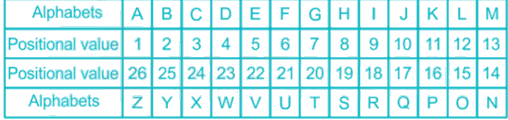 The logic followed here is:
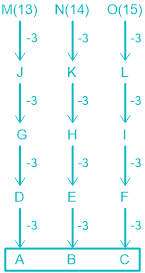 Thus, the missing term in the series is ABC
Hence, the correct answer is " Option 3 "
Q2 · Series
What comes next? RST, STU, TUV, UVW, VWX, WXY, XYZ, YZA, ?
- ZAB
- RST
- ABC
- ACD
Answer aur solution dekho
Archived marked answer: A
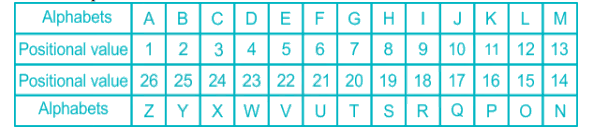 The logic followed here is:
Each term consists of three consecutive letters of the English alphabet, and every next term shifts forward by one letter.
RST → STU → TUV → UVW → VWX → WXY → XYZ → YZA
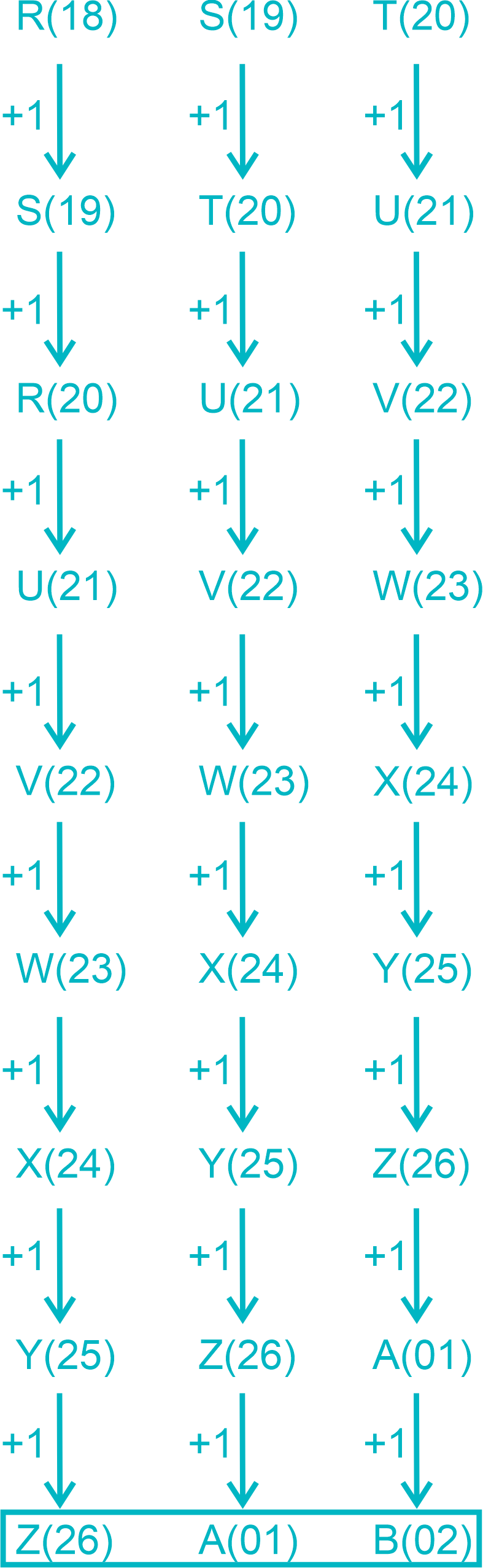 Thus, the missing term in the series is ZAB.
Hence, the correct answer is "Option 1".
Q3 · Series
Find the next number in the series:3, 7, 15, 31, 63, ?
- 127
- 125
- 126
- 129
Answer aur solution dekho
Archived marked answer: A
The logic followed here is :
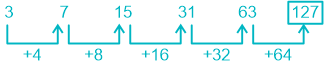 So, ' 127 ' is the missing number in given series
Thus, the correct answer is " Option 1 "
Q4 · Series
The series given below contains a sequence of numbers. Accordingly identify the incorrect combination. 25, 29, 37, 53, 87
- 29
- 37
- 53
- 87
Answer aur solution dekho
Archived marked answer: D
The logic followed here is:
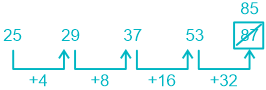 So, 87 is the incorrect combination in given series, it will be 85.
Hence the correct answer is " Option 4 "
Q5 · Series
Complete the series: 1331, 10648, 35937, 85184, ?
- 15478
- 189384
- 166375
- 136789
Answer aur solution dekho
Archived marked answer: C
The pattern followed here is:
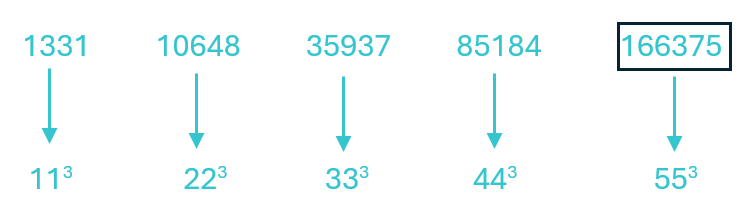 ∴ The correct answer is "Option 3".
Q6 · Analogy
Find the option that best completes the analogy. AB : IJ :: EF : ?
- MN
- OP
- QR
- KL
Answer aur solution dekho
Archived marked answer: A
The pattern followed here is :
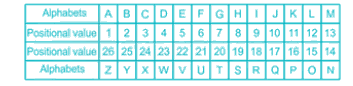 According to the alphabetical positions of the letters,
 Similarly,
 So, the missing term is " MN "
Thus, the correct answer is " Option 1 ".
Q7 · Puzzle Subtypes Not To Miss
If 3 @ 2 = 7
6 @ 3=21
8 @ 2=22
Then 5@4=?
- 21
- 15
- 30
- 20
Answer aur solution dekho
Archived marked answer: A
The logic followed here is,
Logic: a @ b = (a × b) + (a − b)
For,
3 @ 2 ⇒ (3 × 2) + (3 − 2) = 6 + 1 = 7
6 @ 3 ⇒ (6 × 3) + (6 − 3) = 18 + 3 = 21
8 @ 2 ⇒ (8 × 2) + (8 − 2) = 16 + 6 = 22
Similarly,
5 @ 4 ⇒ (5 × 4) + (5 − 4) = 20 + 1 = 21
So, the value of 5 @ 4 is 21
Hence, the correct answer is "option 1 "
Q8 · Puzzle Subtypes Not To Miss
If 4 & 4 = 32 and 5 & 5 = 50, what 6 & 6 is?
- 72
- 64
- 84
- 76
Answer aur solution dekho
Archived marked answer: A
The logic followed here is,
Logic: A & A = 2(A)²
For,
4 & 4 ⇒ 2 (4)² = 32
5 & 5 ⇒ 2 (5)² =50
Similarly,
6 & 6 ⇒ 2 (6)² = 72
So, the value of 6&6 is 72
Hence, the correct answer is "Option 1"
Q9 · Puzzle Subtypes Not To Miss
If 8 # 2 = 65 and 7 # 3 = 55, then 6 # 5 = ?
- 35
- 44
- 58
- 69
Answer aur solution dekho
Archived marked answer: C
The logic followed here is,
Logic: A # B = A² + B² − 3
For,
8 # 2 ⇒ 8² + 2² − 3 = 64 + 4 − 3 = 65
7 # 3 ⇒ 7² + 3² − 3 = 49 + 9 − 3 = 55
Similarly,
6 # 5 ⇒ 6² + 5² − 3 = 36 + 25 − 3 = 58
So, the value of 6 # 5 is 58.
Hence, the correct answer is " Option 3 "
Q10 · Puzzle Subtypes Not To Miss
If 'P' denotes 'addition', 'D' denotes 'subtraction', 'S' denotes 'multiplication', and 'V' denotes 'division', then what will be the value of the following expression?
(48 V 8 P 25 D 6 S 4 P 3) D (25 V 5 S 3 D 4 S 3)
- 4
- 5
- 6
- 7
Answer aur solution dekho
Archived marked answer: D
Given Equation:
(48 V 8 P 25 D 6 S 4 P 3) D (25 V 5 S 3 D 4 S 3)
BODMAS Rule:
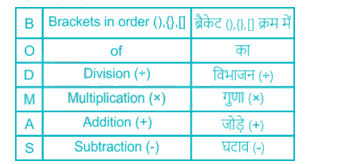 Decoding the given information:
Alphabet
P
D
S
V
Q11 · Puzzle Subtypes Not To Miss
If '+' means '×', '×' means '-', '-' means '÷', then 10 – 5 + 3 × 2 = ?
- 1
- 2
- 3
- 4
Answer aur solution dekho
Archived marked answer: D
BODMAS Table:
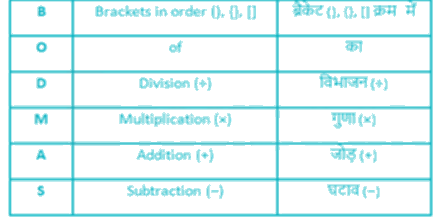 Given equation : 10 – 5 + 3 × 2 = ?
Now, if '+' means '×' and '×' means '-' and '-' means '÷', then:
⇒ 10 ÷ 5 × 3 - 2 = ?
⇒ 2 × 3 - 2 = ?
⇒ 6 - 2 = 4
Hence, the correct answer is " Option 4 "
Q12 · Puzzle Subtypes Not To Miss
The given statements are followed by two conclusions. Find out which conclusion is TRUE based on the given statements.
Statements:
S > T = U, V ≥ W Q > R
Conclusions:
I. T = O
II. T > O
- Only conclusion I is true
- Only conclusion II is true
- Both conclusion I and II are true
- Neither conclusion I nor II is true
Answer aur solution dekho
Archived marked answer: D
Given Statements:
S > T = U, V ≥ W Q > R
Now,
From S > T = U, it gives S > T and T = U.
From O = S = P, it gives O = S.</p&
Q13 · Coding Decoding
If "PATNA" is written as "ANTAP", how is "RAJASTHAN" written?
- NAHSTAJAR
- NAHTSAJAR
- NAHTSRAJA
- NAHTSAJRA
Answer aur solution dekho
Archived marked answer: B
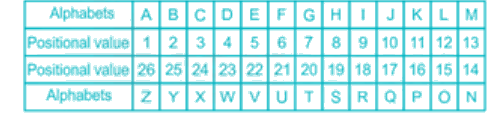 The logic followed here is :
For, 'PATNA is written as ANTAP',
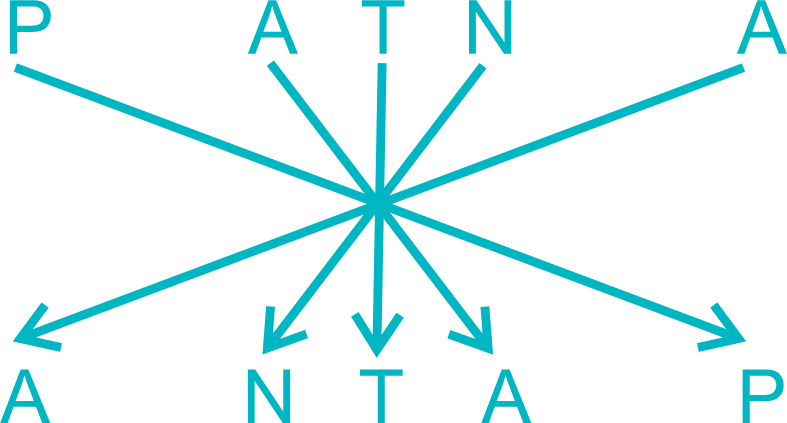 The word is reversed: PATNA → ANTAP
Similarly, for 'RAJASTHAN'
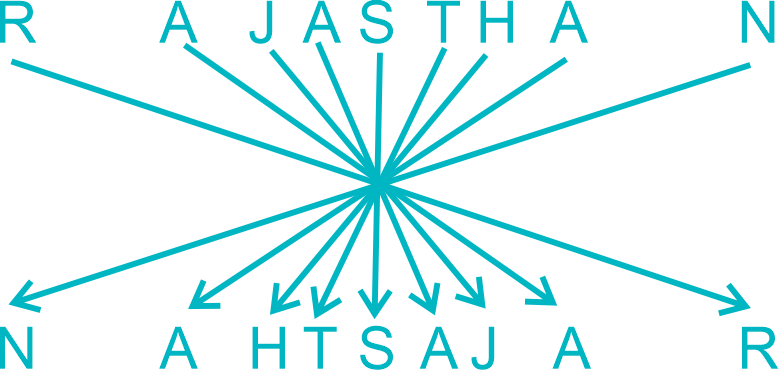 So, 'RAJASTHAN' will be written as 'NAHTSAJAR'.
Hence, the correct answer is "Option 2".
Q14 · Coding Decoding
If in a certain code 'TRUTH' is written as 'UQSVI', then how will 'FALSE' be written?
- GXMTF
- GZJUF
- GPLTF
- GQLTF
Answer aur solution dekho
Archived marked answer: B
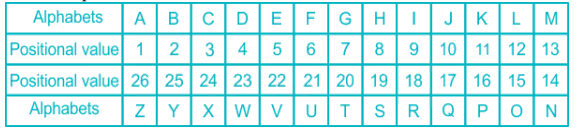 The logic followed here is:
For, ‘TRUTH’ is written as ‘UQSVI’
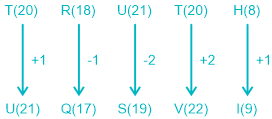 Similarly, for ‘FALSE’
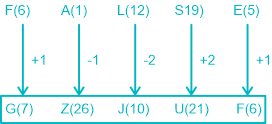 So, ‘FALSE’ will be written as ‘GZJUF’.
Hence, the correct answer is "Option 2".
Q15 · Classification Odd One Out
Find the odd one out from the given alternatives:
- National Park
- Biosphere Reserve
- Sanctuary
- Census
Answer aur solution dekho
Archived marked answer: D
The Logic followed here is:
- National Park → A protected area for conservation of wildlife and natural habitat.
- Biosphere Reserve → A large protected area for conservation of biodiversity.
-
Q16 · Blood Relations
P is the son of Q. Q is the brother of R. R is the son of S. How is P related to S?
- Son
- Nephew
- Grandson
- Uncle
Answer aur solution dekho
Archived marked answer: C
Preparing the family tree diagram using the following symbols
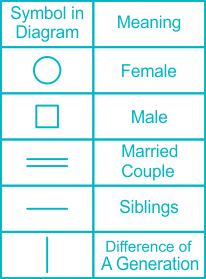 A possible tree diagram will be:
 ∴ From the above diagram P is the Grandson of S.
Hence, the correct answer is "Option 3".
Q17 · Blood Relations
Introducing a woman, Jay said, "She is the daughter of the only child of my grandfather." How is the woman related to Jay?
- Aunt
- Sister
- Niece
- Cousin
Answer aur solution dekho
Archived marked answer: B
Family chart :
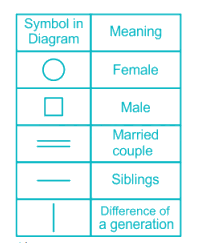 Given : Introducing a woman, Jay said, "She is the daughter of the only child of my grandfather."
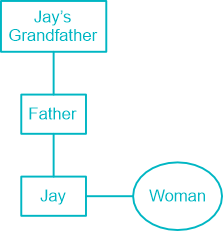 So, the women is the 'sister' of jay.
Hence, the correct answer is " Option 2 ".
Q18 · Similarity and Differences
Choose the address that is the same as the one given below.
10, Rani Ghat Road, Lucknow, Uttar Pradesh - 226003
- 10, Rani Ghat Road, Lucknow, Delhi - 226003
- 10, Rani Ghat Road, Lucknow, Rajasthan - 226003
- 10, Rani Ghat Road, Lucknow, Uttar Pradesh- 226003
- 10, Rani Ghat Road, Lucknow, Bihar - 226003
Answer aur solution dekho
Archived marked answer: C
The Master Address (MA) given in the problem is,
10, Rani Ghat Road,
Lucknow, Uttar Pradesh - 226003
Compare each candidate address with the Master Address.
Option
Candidate Address
Matching
(1)
10, Rani Ghat Road, Lucknow, Delhi - 226003
State mismatch: Delhi instead of Uttar Pradesh.
(2)
10, Rani Ghat Road, Lucknow, Rajasthan - 226003
State mismatch: Rajasthan instead of Uttar Pradesh.
(3)
10, Rani Ghat Road, Lucknow, Uttar Pradesh - 226003
The address matches exactly with the Master Address.
(4)
10, Rani Ghat Road, Lucknow, Bihar - 226003
State mismatch: Bihar instead of Uttar Pradesh.
So, the candidate address that exactly matches the Master Address is option (3).
Hence, the correct answer is "Option (3)".
Q19 · Similarity and Differences
Choose the address that is the same as the one given below.
Villa No. 204, Lake View Estate,Banjara Hills, Hyderabad,Telangana - 500034
- Villa No. 204, Lake View Estate,Banjara Hills, Hyderabad,Telangana - 500034
- Villa 204, Lakeview Estate, Banjara Hills, Hyderabad, Telangana - 500034
- Villa No. 204, Lake View Estates, Banjara Hills, Hyderabad, Telangana - 500034
- Villa No. 240, Lake View Estate, Banjara Hills, Hyderabad, Telangana - 500034
Answer aur solution dekho
Archived marked answer: A
The given Address in the problem is,
Villa No. 204, Lake View Estate
Banjara Hills, Hyderabad, Telangana - 500034
Compare each Option address with the given Address.
Option
Address
Matching
(1)
Villa No. 204, Lake View Estate, Banjara Hills, Hyderabad, Telangana - 500034
The address matches exactly with the Given Address.
(2)
Villa 204, Lakeview Estate, Banjara Hills, Hyderabad, Telangana - 500034
No. is missing and Lake View is written as Lakeview.
(3)
Villa No. 204, Lake View Estates, Banjara Hills, Hyderabad, Telangana - 500034
Estate is written as Estates.
(4)
Villa No. 240, Lake View Estate, Banjara Hills, Hyderabad, Telangana - 500034
Villa number is 240 instead of 204.
So, the address that exactly matches the Given Address is option (1).
Hence, the correct answer is "Option (1)".
Q20 · Logical Statement Questions
Consider the following statement and choose the option that follows.
Problem: Frequent breakdown of ATM machines in remote areas.
Course of:
Action I. Banks should deploy mobile ATMs in these areas.
Action II. Banks should shut down ATMs that face regular issues.
- Only I follows
- Only II follows
- Both follows
- Neither follows
Answer aur solution dekho
Archived marked answer: A
Problem: Frequent breakdown of ATM machines in remote areas.
Courses of action:
Action I: Banks should deploy mobile ATMs in these areas. → Follow (This action directly addresses the problem. If fixed ATMs frequently break down, deploying mobile ATMs would help ensure continuous banking services in remote areas. Therefore, this action is practical and helps solve the problem.)
Action II: Banks should shut down ATMs that face regular issues. → Does not Follow
(Shutting down ATMs would reduce banking access in remote areas and would not solve the core issue of breakdowns. Instead of improving the situation, it may worsen it).
So, only Action I follows.
Hence the correct answer is " Option 1"
Q21 · Logical Statement Questions
Instruction: Identify the assumptions that must hold for the statement to be valid, then choose the correct option.
Statement: The Directive Principles of State Policy (DPSPs) are non-justiciable in nature, meaning they cannot be enforced by the courts. However, they serve as guidelines for the government to formulate policies that promote social justice, economic welfare, and the overall well-being of the citizens.
Assumptions:
I. The DPSPs serve as instructions to the government to create policies aimed at promoting welfare.
II. Since the DPSPs are not enforceable by courts, they have limited significance in real governance.
III. The incorporation of DPSPs in the Constitution reflects the importance of social justice and welfare in Indian governance.
- Only I and II are implicit
- Only I and III are implicit
- Only I is implicit
- All I, II, and III are implicit
Answer aur solution dekho
Archived marked answer: B
The correct answer is 1 and 3 only.
Key Points
Directive Principles of State Policy (DPSPs):
They are contained in Articles 36–51 under Part IV of the Indian Constitution.
The concept of DPSPs
Q22 · Logical Statement Questions
Read the following statement carefully and identify the conclusion that follows.
Statement: The government has increased import duty on luxury cars.
Conclusions:
I. Imported luxury cars will become more expensive.
II. Local car manufacturers will stop making budget cars.
- Only Conclusion I follows
- Only Conclusion II follows
- Both I and II follow
- Neither I nor II follows
Answer aur solution dekho
Archived marked answer: A
Given Statement:
The government has increased import duty on luxury cars.
Conclusion I : Imported luxury cars will become more expensive.
✔ Follows
When import duty increases, the cost of importing goods rises. This additional cost is passed on to the buyer, making imported luxury cars more expensive.
Conclusion II: Local car manufacturers will stop making budget cars.
✘ Does not follow.
The statement only talks about import duty on luxury cars. There is no logical link between this and local manufacturers stopping budget car production.
Thus, Only Conclusion I follows.
Hence, the correct answer is "Option 1".
48
Q23 · Logical Statement Questions
Read the following statement carefully and identify the conclusion that follows.
Statement: Attendance in public libraries has increased in recent years.
Conclusions:
I. People are regaining interest in reading.
II. Digital platforms have become less popular.
- Only Conclusion I follows
- Only Conclusion II follows
- Both I and II follow
- Neither I nor II follows
Answer aur solution dekho
Archived marked answer: A
Given Statement:
Attendance in public libraries has increased in recent years.
Conclusions:
I. People are regaining interest in reading.
II. Digital platforms have become less popular.
Analysis:
I. People are regaining interest in reading – True (If attendance in libraries has increased, it indicates that more people are visiting libraries and showing interest in reading.)
II. Digital platforms have become less popular – False (The statement does not mention anything about digital platforms, so no definite conclusion can be drawn about their popularity.)
Hence, Only Conclusion I follows.
∴ The correct answer is "Option 1".
Q24 · Miscellaneous Other Possibilities
A train 180 m long passes a point in 12 s. Find the speed of the train.
- 45 km/h
- 54 km/h
- 60 km/h
- 72 km/h
Answer aur solution dekho
Archived marked answer: B
Given:
Length of train = 180 m
Time taken = 12 s
Formula used:
Speed = Distance ÷ Time
Calculations:
Distance covered = 180 m
⇒ Speed = 180 ÷ 12
⇒ Speed = 15 m/s
⇒ Speed in km/h = 15 × 18 ÷ 5 = 54 km/h
∴ The speed of the train is 54 km/h.
Q25 · Miscellaneous Other Possibilities
If 6 machines complete a task in 10 days, how many days for 15 machines at same rate?
- 4
- 6
- 5
- 8
Answer aur solution dekho
Archived marked answer: A
Given:
Number of machines = 6
Time taken = 10 days
New number of machines = 15
Formula used:
Machines × Days = Constant (Work remains same)
Calculations:
Total work = 6 × 10 = 60 machine-days
⇒ Days required for 15 machines = 60 ÷ 15
⇒ Days required = 4
∴ 15 machines will complete the task in 4 days.
General Awareness
Q1 · Art and Culture
Which of the following statements about Mumbai's architectural heritage is/are correct?
1. Victorian Gothic buildings in Mumbai reflect colonial-era architecture with Neo-Gothic elements.
2. Art Deco buildings in Mumbai were part of the 19th-century colonial urban development.
3. The Oval Maidan distinctly separates the Victorian Gothic and Art Deco architectural styles.
- Only 1 and 2 are correct
- Only 2 and 3 are correct
- Only 1 and 3 are correct
- All 1, 2, and 3 are correct
Answer aur solution dekho
Archived marked answer: C
The correct answer is Only 1 and 3 are correct.
Key Points
- Victorian Gothic architecture in Mumbai: The Victorian Gothic buildings, constructed during the colonial era, exhibit Neo-Gothic elements such as pointed arches, ribbed vaults, and flying buttresses. These structures symbolize British colonial architecture in India.
- Art Deco architecture in Mumbai: Art Deco buildings in the city emerged in the 1930s and 1940s, featuring sleek, geometric designs and modern aesthetics. It was a departure from traditional colonial styles and reflected global architectural trends.
- The Oval Maidan as a divider: The Oval Maidan in South Mumbai distinctly separates the Victorian Gothic structures on one side and the Art Deco buildings on the other, showcasing two contrasting architectural styles within close proximity.
- UNESCO World Heritage Site: The Victorian Gothic and Art Deco Ensembles of Mumbai were recognized as a UNESCO World Heritage Site in 2018, signifying their historical and architectural significance.
- Art Deco architecture in Mumbai is globally significant, with the city having the second-largest collection of Art Deco buildings after Miami, USA.
Additional Information
- Option 2 (Incorrect): Art Deco buildings in Mumbai were not a part of the 19th-century colonial urban development. Instead, they emerged during the early 20th century, specifically in the 1930s and 1940s, influenced by modern architectural trends from Europe and America.
- Victorian Gothic architecture:
- It was introduced during British colonial rule in the mid-19th century.
- Famous examples include the Chhatrapati Shivaji Maharaj Terminus (formerly Victoria Terminus) and the Bombay High Court.
- The structures often incorporated Indian design elements, blending Gothic Revival with local influences.
- Art Deco architecture:
- Art Deco represented a shift towards modernism and simplicity in design.
- Key features include streamlined forms, bold geometric patterns, and the use of new materials like reinforced concrete.
- Notable examples in Mumbai include the Eros Cinema and Marine Drive buildings.
- Significance of the Oval Maidan:
- The Oval Maidan is a large recreational ground in South Mumbai.
- It serves as a physical and visual separator between the two architectural styles, enhancing the aesthetic and cultural value of the area.
</ul
Q2 · Art and Culture
Which classical musical treatise, composed in the 13th century CE by Sharangadeva in Maharashtra, is considered a foundational text in Indian musicology?
- Natya Shastra
- Sangeet Sudha
- Sangeet Ratnakara
- Abhinaya Darpana
Answer aur solution dekho
Archived marked answer: C
The correct answer is Sangeet Ratnakara.
Key Points
- Sangeet Ratnakara is a renowned treatise on Indian classical music, written by Sharangadeva in the 13th century CE in Maharashtra.
- It is considered one of the most comprehensive works on Indian musicology, covering both the ancient traditions (marga) and contemporary practices (desi) of its time.
- The text is divided into seven chapters, each detailing different aspects of music such as swaras (notes), ragas, talas (rhythmic cycles), and dance.
- Sangeet Ratnakara forms the foundation of both Hindustani and Carnatic music traditions, making it a pivotal text in the history of Indian classical music.
- The treatise also provides extensive information on musical instruments, vocal techniques, and the theoretical framework of music.
Additional Information
- Natya Shastra
- Natya Shastra, attributed to Bharata, is an ancient Indian treatise on performing arts, including drama, dance, and music, written around 200 BCE to 200 CE.
- It provides detailed guidelines on theatrical performances, stagecraft, and musical compositions.
- The text is a foundational work for Indian classical dance forms like Bharatanatyam, Kathakali, and Odissi.
- While it includes music, its primary focus is on dramaturgy and dance rather than a comprehensive study of musicology.
- Sangeet Sudha
- Sangeet Sudha is another important work in Indian music, authored by Govinda Dikshitar in the 17th century CE.
- It focuses on the Carnatic music tradition and provides insights into the theoretical aspects of ragas and musical compositions.
- The work is not as expansive or foundational as Sangeet Ratnakara in terms of covering both Hindustani and Carnatic traditions.
- Abhinaya Darpana
- Abhinaya Darpana, written by Nandikeshvara, is a treatise on the art of expression (abhinaya) in Indian classical dance.
- It outlines the principles of gestures, facial expressions, and body movements essential for Indian dance forms.
- The focus of this text is on dance and acting rather than music as a standalone art form.
</ul
Q3 · Art and Culture
Fill in the Blank:
Tippani dance uses _______ tools to pound the floor.
- Metal rods
- Wooden sticks
- Bamboo poles
- Stones
Answer aur solution dekho
Archived marked answer: B
The correct answer is Wooden sticks.
Key Points
- Tippani dance is a traditional folk dance form originating from the Saurashtra region of Gujarat, India.
- The dancers perform using wooden sticks as tools to rhythmically pound the floor, showcasing their strength and precision.
- This dance form was initially performed by women laborers while working on construction sites to alleviate fatigue and boredom.
- The wooden sticks used in Tippani are often decorated, adding to the vibrant visual appeal of the dance.
- The rhythm of the pounding is synchronized with the beats of folk songs, creating a unique and lively performance.
Additional Information
- Metal rods:
- Metal rods are not used in Tippani dance as they are heavy and unsuitable for rhythmic pounding.
- They are typically used in construction and engineering for structural support.
- In traditional Indian dances, metal rods do not have a significant role due to their weight and lack of flexibility.
- Bamboo poles:
- Bamboo poles are commonly associated with traditional dances like the Cheraw dance of Mizoram, also known as the bamboo dance.
- In Cheraw, dancers rhythmically move and manipulate bamboo poles, creating patterns for performers to step into.
- Bamboo poles are flexible and lightweight, making them an excellent choice for other dances, but they are not used in Tippani dance.
- Stones:
- Stones are not utilized in Tippani dance as they are not practical tools for a rhythmic performance.
- In some cultures, stones are used for percussion or as part of rituals, but they are not part of this specific dance form.
- About Tippani Dance:
- This dance form is performed during festive occasions, weddings, and celebrations in Gujarat.
- The traditional attire for Tippani dancers includes colorful sarees and jewelry, adding to the cultural essence of the performance.
- The dance reflects the hard-working spirit and unity of women in rural communities.
</ul
Q4 · Art and Culture
Fill in the blank:
The hornbill bird, after which the festival is named, symbolizes boldness and _______ in Naga folklore.
- wisdom
- prosperity
- grandeur
- peace
Answer aur solution dekho
Archived marked answer: C
The correct answer is grandeur.
Key Points
- The hornbill bird holds a significant place in Naga folklore and is revered for its boldness and grandeur, symbolizing strength and pride.
- The Hornbill Festival, celebrated in Nagaland, is named after this majestic bird to honor its symbolic representation of courage and magnificence.
- Grandeur, in this context, reflects the cultural richness and majestic traditions of Nagaland, which align with the bird's regal and striking appearance.
- The festival showcases the grandeur of Naga heritage through traditional music, dance, art, and craft, creating a vibrant and majestic cultural atmosphere.
- The hornbill bird's association with boldness and grandeur is a testament to its prominent role in inspiring the Naga tribes and their cultural practices.
Additional Information
- Wisdom:
- Wisdom typically refers to the quality of having experience, knowledge, and good judgment.
- While wisdom is a valued trait, it is not directly associated with the symbolism of the hornbill bird in Naga folklore.
- In some cultures, other animals like owls are often linked to wisdom rather than hornbills.
- Prosperity:
- Prosperity refers to a state of wealth, success, and abundance.
- Although prosperity is an important theme in cultural celebrations, it does not capture the essence of the hornbill bird's symbolism in Naga folklore.
- Festivals like Pongal or Onam are more closely linked to the theme of prosperity.
- Peace:
- Peace signifies harmony and the absence of conflict or disturbance.
- While peace is a universal value, the hornbill bird is not specifically associated with peace in Naga folklore.
- Other symbols like the olive branch are more commonly linked to the idea of peace.
- The Hornbill Festival:
- The Hornbill Festival, held annually in Nagaland, is a celebration of Naga culture, heritage, and traditions.
- It is named after the hornbill bird, which is admired for its boldness and grandeur.
- The festival features traditional music, dance, crafts, and cuisines, showcasing the cultural richness of Nagaland.
- It serves as a platform for inter-tribal interaction and cultural exchange, fostering unity and pride among the Naga people.
</ul
Q5 · Art and Culture
What makes Chhau a syncretic Indian dance form?
- It uses Sanskrit-only chants in temple rituals
- It merges tribal, folk, and classical Hindu elements
- It evolved purely from Vaishnav temple dance
- It prohibits all forms of theatrical expression
Answer aur solution dekho
Archived marked answer: B
The correct answer is It merges tribal, folk, and classical Hindu elements.
Key Points
- Chhau is a unique Indian dance form that combines elements of tribal, folk, and classical traditions of Hindu culture, creating a syncretic art form.
- This dance form is predominantly practiced in the eastern regions of India, particularly in Odisha, Jharkhand, and West Bengal.
- Chhau incorporates vigorous martial movements, intricate footwork, and expressive facial gestures to narrate mythological and folk tales, often drawn from Hindu epics like the Ramayana and Mahabharata.
- It is recognized for its use of elaborate masks (especially in Purulia Chhau) and vibrant costumes, which are integral to the storytelling aspect of the performance.
- The dance form has been declared a part of the UNESCO Intangible Cultural Heritage of Humanity, underscoring its cultural significance and historical value.
Additional Information
- Option 1: It uses Sanskrit-only chants in temple rituals
- This is incorrect as Chhau is not associated with the exclusive use of Sanskrit chants or temple rituals. While it draws from Hindu mythology, it is a performance art that incorporates folk and tribal traditions rather than being limited to temple worship.
- Sanskrit chants are more closely linked with classical dance forms like Bharatanatyam or Odissi, which are temple-based traditions.
- Option 3: It evolved purely from Vaishnav temple dance
- This is incorrect as Chhau did not evolve solely from Vaishnav temple dances. While it draws from Hindu religious themes, its origins are rooted in tribal and martial traditions, making it a broader amalgamation of multiple influences.
- Vaishnav temple dances are more specifically associated with classical forms like Kathak and Manipuri.
- Option 4: It prohibits all forms of theatrical expression
- This is incorrect as Chhau is celebrated for its theatrical expressions, including elaborate facial movements, mask work, and dramatic gestures.
- Theatrical expression is a defining feature of Chhau, enabling performers to communicate stories effectively.
- Main Theme: Chhau Dance
- Chhau is a semi-classical Indian dance form that blends classical music with folk and tribal influences.
- There are three main styles of Chhau: Purulia Chhau (West Bengal), Mayurbhanj Chhau (Odisha), and Seraikella Chhau (Jharkhand), each with distinct characteristics.
- The dance is often performed during festivals, particularly in the spring season, and serves as a medium to preserve cultural heritage.
</ul
Q6 · Indian Polity and Constitution
By which Constitutional Amendment was education transferred to the Concurrent List?
- 42nd
- 24th
- 44th
- 61st
Answer aur solution dekho
Archived marked answer: A
The correct answer is 42nd Constitutional Amendment.
Key Points
- The 42nd Constitutional Amendment Act, 1976, also known as the "Mini Constitution," brought significant changes to the Constitution of India.
- It transferred the subject of education from the State List to the Concurrent List, enabling both the Center and States to legislate on matters related to education.
- This amendment was enacted during the tenure of Prime Minister Indira Gandhi and reflected the growing importance of education in achieving national development goals.
- The 42nd Amendment introduced several other changes, including the incorporation of Fundamental Duties for citizens and provisions strengthening the central government.
- This shift to the Concurrent List was aimed at ensuring uniformity in educational policies across the country, promoting national integration, and addressing disparities in access to education.
Additional Information
- 24th Constitutional Amendment Act, 1971:
- It was enacted to affirm Parliament’s power to amend any part of the Constitution, including Fundamental Rights.
- This amendment was passed to counter the Supreme Court’s judgment in the Golaknath case (1967), which restricted Parliament’s power to amend Fundamental Rights.
- It also made it mandatory for the President to give assent to Constitutional Amendment Bills.
- 44th Constitutional Amendment Act, 1978:
- This amendment was enacted to reverse some provisions of the 42nd Amendment, particularly to restore the balance of powers between the central and state governments.
- It abolished the Right to Property as a Fundamental Right and made it a legal right under Article 300A.
- The amendment also strengthened the protection of Fundamental Rights during emergencies by limiting the scope of Article 352 (National Emergency).
- 61st Constitutional Amendment Act, 1988:
- This amendment reduced the voting age for Lok Sabha and State Assembly elections from 21 years to 18 years.
- It sought to enhance youth participation in the electoral process and strengthen democratic governance in India.
- Main Theme: Education in India
- Education plays a crucial role in national development, fostering human resource growth and innovation.
- By including education in the Concurrent List, the 42nd Amendment ensured a collaborative approach between the Center and States for policy formulation and implementation.
- This move was instrumental in addressing disparities and ensuring equitable access to education across all regions of the country.
77:T
Q7 · Indian Polity and Constitution
Arrange the following judicial events chronologically:
1. Berubari Union case
2. Kesavananda Bharati case
3. S.R. Bommai case
- 1-2-3
- 3-2-1
- 2-1-3
- 3-1-2
Answer aur solution dekho
Archived marked answer: A
The correct answer is 1, 2, 3 (Berubari Union case, Kesavananda Bharati case, S.R. Bommai case).
Key Points
- Berubari Union Case (1960): This case addressed the interpretation of the Indian Constitution regarding the transfer of territory to another country. It clarified that a constitutional amendment under Article 368 is required for transferring any part of Indian territory.
- Kesavananda Bharati Case (1973): This landmark case established the doctrine of the Basic Structure of the Constitution, which restricts Parliament's power to amend the Constitution in a way that alters its fundamental framework.
- S.R. Bommai Case (1994): This case is a significant judgment regarding the scope and limitations of Article 356 (President's Rule). It emphasized the principle of federalism and judicial review of the imposition of President's Rule.
- The chronological order of these cases is essential in understanding the evolution of constitutional law in India.
- This question highlights milestones in India's judicial history that have shaped governance and federalism in the country.
Additional Information
- Berubari Union Case (1960):
- The issue arose following the Nehru-Noon Agreement (1958) between India and Pakistan to divide Berubari Union territory.
- The Supreme Court opined that the transfer of territory to Pakistan required a constitutional amendment, as it involved altering India's territorial integrity.
- This case clarified the interpretation of Article 3 and Article 368 regarding the alteration of India's boundaries.
- Kesavananda Bharati Case (1973):
- In this case, Swami Kesavananda Bharati challenged the Kerala government's land reform laws, questioning the extent of Parliament's power to amend the Constitution.
- The Supreme Court ruled that Parliament could amend the Constitution but could not alter its "Basic Structure," such as democracy, secularism, federalism, and judicial independence.
- This judgment is regarded as a cornerstone of constitutional law in India.
- S.R. Bommai Case (1994):
- This case arose when the Karnataka state government, led by S.R. Bommai, was dismissed by the central government under Article 356.
- The Supreme Court laid down guidelines for imposing President's Rule and emphasized that it cannot be used arbitrarily.
- It upheld the importance of federalism and judicial review in safeguarding democracy.
Q8 · Indian Polity and Constitution
When was the Amateur Athletics Federation of India (AAFI) established?
- 1936
- 1946
- 1956
- 1966
Answer aur solution dekho
Archived marked answer: B
The correct answer is 1946.
Key Points
- The Amateur Athletics Federation of India (AAFI) was established in the year 1946 as the apex body for athletics in India.
- The AAFI was founded with the goal of promoting and regulating athletics in the country and ensuring the participation of Indian athletes in international competitions.
- It is now known as the Athletics Federation of India (AFI) and serves as the governing body for athletics in India.
- AFI is affiliated with the World Athletics (formerly known as the International Association of Athletics Federations or IAAF), which governs athletics worldwide.
- The Athletics Federation of India organizes various national-level athletic events, trains athletes, and ensures their participation in global competitions, such as the Olympics, Asian Games, and Commonwealth Games.
Additional Information
- 1936
- The year 1936 is historically significant for Indian athletics as it marks the participation of Indian athletes in the Berlin Olympics. However, the AAFI had not been established at this time.
- During the 1936 Olympics, Indian hockey team won gold, and the event was notable for the legendary athlete Jesse Owens' remarkable performance.
- 1956
- The year 1956 is significant in Indian sports history as India participated in the Melbourne Olympics.
- Indian athletes competed in various events, but this year is not related to the establishment of the AAFI.
- 1966
- In 1966, the Asian Games were held in Bangkok, Thailand, where Indian athletes won several medals.
- This year also saw the progress of Indian sports on the global stage, but it is unrelated to the founding of the AAFI.
- Amateur Athletics Federation of India (AAFI)
- The AAFI was established to promote and develop athletics at grassroots, national, and international levels in India.
- It was renamed as the Athletics Federation of India (AFI) in later years to better reflect its evolving role and responsibilities.
- AFI works towards organizing championships, selecting and training athletes, and ensuring adherence to international standards in competitions.
</ul
Q9 · Indian Polity and Constitution
Fill in the blanks:
The Indian Olympic Association (IOA) was officially formed in ______, with Sir Dorabji Tata as its founding President and Dr. A.G. Noehren as Secretary.
- 1920
- 1922
- 1930
- 1927
Answer aur solution dekho
Archived marked answer: D
The correct answer is 1927.
Key Points
- The Indian Olympic Association (IOA) was officially formed in 1927 to promote and regulate sports in India.
- Sir Dorabji Tata served as the founding President of the IOA, playing a pivotal role in its establishment.
- Dr. A.G. Noehren was the first Secretary of the IOA, contributing to the organizational framework of Indian sports administration.
- The formation of the IOA marked India’s formal participation in international Olympic events, starting with the 1928 Amsterda
Q10 · Indian Economy
If the price of a product goes up by 10% and, as a result, the quantity demanded falls by 20%, how would you classify the demand?
- Demand is elastic (elasticity greater than 1)
- Demand is inelastic (elasticity less than 1)
- Demand is unitary elastic (elasticity equals 1)
- Demand is perfectly elastic (elasticity is infinite)
Answer aur solution dekho
Archived marked answer: A
Please provide the question that needs to be answered in the required format.
Q11 · Indian Economy
The BOP crisis of 1991 involved a shortage of?
- Water
- Electricity
- Foreign exchange
- Labour
Answer aur solution dekho
Archived marked answer: C
The correct answer is Foreign exchange.
Key Points
- The Balance of Payments (BOP) crisis of 1991 in India was primarily caused by a severe shortage of foreign exchange reserves. The reserves had dwindled to a point where India could barely finance three weeks' worth of imports.
- The crisis was triggered by a combination of factors, including a high fiscal deficit, an increasing current account deficit, and a surge in oil prices following the Gulf War.
- India's external debt had risen significantly, and the country faced challenges in repaying its borrowings and attracting foreign investments.
- To address the crisis, India had to pledge 67 tons of gold as collateral to the International Monetary Fund (IMF) to secure financial assistance.
- The crisis led to significant economic reforms in 1991, often referred to as the LPG (Liberalization, Privatization, and Globalization) reforms, which marked the beginning of India's shift towards a market-oriented economy.
Additional Information
- Water:
- Water scarcity is a global issue caused by overpopulation, climate change, and inefficient water management.
- While water crises can lead to economic and social challenges, they were not a factor in India's 1991 BOP crisis.
- Electricity:
- Electricity shortages can disrupt industrial production and economic growth but were not a contributing factor in the 1991 crisis.
- India's energy infrastructure in the 1990s was underdeveloped but unrelated to the balance of payments issue.
- Labour:
- Labour shortages can impact productivity and economic stability, but India has historically had a surplus of labour.
- The BOP crisis was not linked to labour shortages but to financial and economic mismanagement.
- Main Theme - Balance of Payments (BOP):
- The Balance of Payments is a comprehensive record of all economic transactions between residents of a country and the rest of the world over a specific period.
- A BOP crisis occurs when a country cannot meet its international financial obligations due to a shortage of foreign exchange reserves.
- Key components of the BOP include the current account (trade in goods and services), the capital account (investment flows), and the financial account (changes in foreign ownership of assets).
</ul
Q12 · Indian Economy
Read the following statements carefully and choose the correct option regarding Assertion (A) and Reason (R).
Assertion (A): India had to approach the IMF and World Bank in 1991 for a bailout loan.
Reason (R): Foreign exchange reserves had declined to the point that they could barely finance two weeks of imports.
- Both A and R are true and R is the correct explanation of A.
- Both A and R are true but R is not the correct explanation of A.
- A is true but R is false.
- A is false but R is true.
Answer aur solution dekho
Archived marked answer: A
The correct answer is Both A and R are true and R is the correct explanation of A.
Key Points
- In 1991, India faced a severe balance of payments (BoP) crisis due to a sharp decline in foreign exchange reserves.
- The foreign exchange reserves had fallen to a level that could barely finance two weeks' worth of imports, creating an economic emergency.
- To stabilize the economy and overcome the crisis, the government approached the International Monetary Fund (IMF) and the World Bank for assistance.
- India received a bailout package of $2.2 billion from the IMF, conditional on implementing economic reforms and liberalization policies.
- This event marked the beginning of India's economic liberalization, which included measures like reducing import tariffs, deregulating markets, and opening the economy to foreign investments.
Additional Information
- Explanation of Option 2 (Both A and R are true, but R is not the correct explanation of A):
- While A and R are both true, R directly explains the reason for the economic crisis in 1991.
- The severe depletion of foreign exchange reserves was the immediate cause of India seeking assistance from IMF and the World Bank. Hence, this option is incorrect.
- Explanation of Option 3 (A is true but R is false):
- Assertion A is true as India did approach the IMF and World Bank in 1991 for a bailout loan.
- However, Reason R is also true because the main trigger for this action was the depletion of foreign exchange reserves. Thus, this option is incorrect.
- Explanation of Option 4 (A is false but R is true):
- Assertion A is not false as India did face an economic crisis in 1991 and sought help from international financial institutions.
- Reason R is also true, but this option does not apply to the given scenario.
- Context of the 1991 Economic Crisis:
- Key reasons for the crisis included high fiscal deficits, rising inflation, and a trade imbalance.
- The Gulf War exacerbated the situation by causing a spike in oil prices, further draining India's foreign exchange reserves.
- The economic reforms initiated in 1991 under the leadership of then Finance Minister Dr. Manmohan Singh and Prime Minister Narasimha Rao laid the foundation for liberalization, privatization, and globalization in India.
</ul
Q13 · Indian Economy
Which of the following initiatives launched in 2025 aims to combine mangrove regeneration with rural employment under the MGNREGS platform?
- Mission Mangrove Mitra
- Sagar Suraksha Yojana
- EcoJobs for Coasts
- Blue Belt Programme
Answer aur solution dekho
Archived marked answer: A
The correct answer is Mission Mangrove Mitra.
Key Points
- Mission Mangrove Mitra is a sustainable development initiative launched in 2025 to regenerate coastal mangrove ecosystems while creating rural employment opportunities.
- The program integrates mangrove restoration efforts with the Mahatma Gandhi National Rural Employment Guarantee Scheme (MGNREGS) to ensure livelihood generation for rural communities.
- It aims to combat climate change by enhancing carbon sequestration through mangrove forests, which act as natural carbon sinks and provide coastal protection from erosion and storms.
- This initiative also enhances biodiversity as mangroves serve as breeding grounds for marine species, supporting coastal fisheries and local economies.
- By combining ecological restoration with rural job creation, the program aligns with India’s sustainable development goals and commitments under international agreements like the Paris Climate Accord.
Additional Information
- Sagar Suraksha Yojana
- This program is focused on coastal security and disaster preparedness to ensure the safety of coastal communities and resources.
- It involves deploying advanced technology and infrastructure to safeguard marine ecosystems and prevent illegal activities like poaching and smuggling in coastal areas.
- The scheme emphasizes collaboration with local governments and communities to protect coastal biodiversity and ensure maritime safety.
- EcoJobs for Coasts
- This conceptual framework aims at generating employment opportunities while focusing on the conservation of coastal and marine ecosystems.
- It promotes the creation of green jobs that align with the protection and sustainable utilization of coastal resources.
- While similar in intent, this initiative is not linked to MGNREGS or mangrove restoration efforts under Mission Mangrove Mitra.
- Blue Belt Programme
- The Blue Belt Programme is globally recognized for its focus on marine conservation and the sustainable management of marine resources.
- Primarily implemented in various countries, this program promotes marine protected areas and sustainable oceanic practices to combat overfishing and biodiversity loss.
- It is unrelated to mangrove restoration or rural employment generation under MGNREGS.
Q14 · Indian Economy
The Mahalanobis Model was used in which plan?
- First
- Second
- Fourth
- Fifth
Answer aur solution dekho
Archived marked answer: B
The correct answer is Second.
Key Points
- The Mahalanobis Model, formulated by Indian statistician P.C. Mahalanobis, was introduced in the Second Five-Year Plan (1956-1961).
- This model emphasized the development of the heavy industries sector to accelerate economic growth.
- The Mahalanobis model aimed to achieve self-reliance and reduce dependency on foreign imports by focusing on industrialization.
- It was inspired by Soviet planning methods, emphasizing capital goods production over consumer goods.
- The model laid the foundation for long-term economic planning and played a pivotal role in shaping India's industrial policy during its early years of independence.
Additional Information
- First Five-Year Plan (1951-1956):
- The focus of this plan was on agriculture, irrigation, and energy to address food shortages and promote rural development.
- It followed the Harrod-Domar Model, emphasizing investment in agriculture and basic industries.
- Key achievements included the construction of major dams like Bhakra Nangal and Hirakud.
- Fourth Five-Year Plan (1969-1974):
- This plan aimed to achieve growth with stability and self-reliance in food production.
- It focused on reducing income inequality and poverty through direct anti-poverty programs.
- The Green Revolution was a major highlight during this period, significantly increasing agricultural productivity.
- Fifth Five-Year Plan (1974-1979):
- The emphasis was on poverty eradication and attaining self-reliance in essential commodities.
- The Garibi Hatao (Remove Poverty) slogan was introduced during this plan.
- This plan prioritized employment generation and focused on social justice.
- Mahalanobis Model:
- The model is named after Prasanta Chandra Mahalanobis, a renowned Indian statistician.
- It is based on the idea that a country should prioritize investment in capital goods industries to create a robust industrial base.
- This strategy aimed to increase the production of goods that would enable further industrialization.
- Critics argue that the model overlooked the importance of the agricultural sector and consumer goods, leading to imbalances in the economy.
</ul
Q15 · Sports Static GK
Which of the following statements about India's boxing medals at the 2000 Sydney Olympics is correct?
- India did not win any boxing medals at Sydney 2000.
- India won multiple boxing medals at Sydney 2000.
- Karnam Malleswari won a boxing bronze medal at Sydney 2000.
- India won its first Olympic boxing medal at Sydney 2000.
Answer aur solution dekho
Archived marked answer: A
The correct answer is India did not win any boxing medals at Sydney 2000.
Key Points
- India did not win any boxing medals at the 2000 Sydney Olympics.
- No Indian boxer progressed to a medal-winning position during the Sydney 2000 games.
- At the time, India’s boxing achievements on the Olympic stage were still developing.
- India's first Olympic boxing medal came much later, at the 2008 Beijing Olympics, when Vijender Singh won a bronze medal in the middleweight category.
- The 2000 Sydney Olympics highlighted the need for more structured training and support for Indian boxers.
Additional Information
- Option 2: India won multiple boxing medals at Sydney 2000.
- This statement is incorrect as India did not win any boxing medals at the 2000 Sydney Olympics.
- India’s boxing achievements began gaining momentum in later years, particularly after the 2008 Beijing Olympics.
- Option 3: Karnam Malleswari won a boxing bronze medal at Sydney 2000.
- Karnam Malleswari did not win a boxing medal; she won a bronze medal in weightlifting in the 69 kg category at the Sydney 2000 Olympics.
- She became the first Indian woman to win an Olympic medal, marking a historic achievement for India.
- Option 4: India won its first Olympic boxing medal at Sydney 2000.
- This statement is incorrect as India’s first Olympic boxing medal was won by Vijender Singh at the 2008 Beijing Olympics.
- His achievement placed Indian boxing on the global map and inspired many young boxers in the country.
- India’s Olympic Boxing History
- India’s boxing journey at the Olympics began in 1948, but the country struggled to make a mark for several decades.
- Notable progress in Indian boxing was observed in the 21st century, with Vijender Singh’s 2008 Olympic bronze as a turning point.
- Subsequently, Mary Kom also won a bronze medal in women’s boxing at the 2012 London Olympics.
- Indian boxers such as Lovlina Borgohain and others have continued to perform well in recent Olympic events.
Q16 · Sports Static GK
Which of the following statements regarding the 56th National Kho Kho Championship 2023-24 is/are correct?
1.) Maharashtra won both the men's and women's titles, becoming overall champions.
2.) The championship matches were held at Delhi's Indira Gandhi Indoor Stadium and Karnail Singh Stadium.
- Only 1 is correct
- Only 2 is correct
- Both 1 and 2 are correct
- Neither 1 nor 2 is correct
Answer aur solution dekho
Archived marked answer: C
The correct answer is Both 1 and 2 are correct.
Key Points
- Maharashtra won both the men's and women's titles in the 56th National Kho Kho Championship 2023-24, becoming the overall champion of the tournament.
- The men's team from Maharashtra defeated Karnataka, while the women's team triumphed over Odisha in the finals.
- The championship matches were hosted at two venues: the Indira Gandhi Indoor Stadium and Karnail Singh Stadium in Delhi.
- This event was part of the National Kho Kho Federation's initiative to promote indigenous sports in India and witnessed participation from several states and union territories.
- The 56th National Kho Kho Championship 2023-24 showcased the increasing popularity of Kho Kho as a traditional Indian sport on a national level.
Additional Information
- About Kho Kho as a Sport:
- Kho Kho is a traditional Indian sport that is played by two teams, each consisting of 12 players, of which 9 enter the field.
- The game emphasizes speed, agility, teamwork, and strategy, making it one of India's most exciting indigenous sports.
- It is governed by the Kho Kho Federation of India (KKFI), which organizes various national and international tournaments to promote the game.
- Indira Gandhi Indoor Stadium:
- Located in Delhi, it is the largest indoor sports arena in India and one of the largest in Asia.
- The stadium is used for multiple sports and cultural events and has hosted prestigious events like the Asian Games and Commonwealth Games.
- Karnail Singh Stadium:
- This stadium, also located in Delhi, is primarily used for cricket but has been adapted to host various other sports events, including Kho Kho.
- It is named after Karnail Singh, who was a railway executive and known for his contributions to sports promotion in India.
- Significance of the National Kho Kho Championship:
- The championship serves as a platform for identifying and nurturing talent at the national level.
- It also helps in the promotion and preservation of India's traditional sports heritage.
- The event brings together players and enthusiasts from across the country, fostering a sense of unity and sportsmanship.
</ul
Q17 · Modern Indian History
What was the primary objective of the Ring-Fencing Policy adopted by the British in India during the 18th century?
- To expand British territory by annexing Indian states
- To economically exploit coastal trading companies
- To create buffer states to defend British territories
- To impose direct rule over all princely territories
Answer aur solution dekho
Archived marked answer: C
The correct answer is To create buffer states to defend British territories.
Key Points
- The Ring-Fencing Policy was primarily aimed at creating buffer states to protect British territories in India, particularly from external threats like the Marathas and Afghan invasions.
- It was implemented during the late 18th century under Governor-General Warren Hastings' administration, as the British East India Company sought to secure its territorial acquisitions.
- States such as Awadh (Oudh) were turned into buffer zones through alliances or treaties, ensuring that these regions bore the brunt of invasions before they could threaten core British territories like Bengal.
- The policy involved maintaining a strong military presence and entering into subsidiary alliances to control the external policies of the Indian princely states while allowing them nominal sovereignty.
- This strategy laid the groundwork for the subsequent Subsidiary Alliance system introduced by Lord Wellesley, which further tightened British control over Indian states.
Additional Information
- Option 1: To expand British territory by annexing Indian states
- This was not the primary objective of the Ring-Fencing Policy. Territorial expansion became a more prominent strategy later under policies like the Doctrine of Lapse (introduced by Lord Dalhousie) and outright annexation through military conquest.
- The Ring-Fencing Policy was more about securing existing territories rather than expanding them aggressively.
- Option 2: To economically exploit coastal trading companies
- This option does not align with the core objective of the Ring-Fencing Policy, which was focused on military and territorial security.
- Economic exploitation of India by the British was carried out through trade monopolies, land revenue systems like the Permanent Settlement, and later, industrial policies. However, these were separate from the Ring-Fencing Policy.
- Option 4: To impose direct rule over all princely territories
- The Ring-Fencing Policy did not aim at imposing direct British rule over princely states. Instead, it sought to maintain the sovereignty of buffer states while controlling their external affairs.
- Direct rule over princely states was achieved later through policies like the Subsidiary Alliance and the Doctrine of Lapse.
- Main Theme: The Ring-Fencing Policy
- The Ring-Fencing Policy was one of the earliest strategies employed by the British East India Company to secure its territories in India.
- It was a defensive strategy focusing on the containment of threats from external powers like the Marathas, Afghans, and other regional rulers.
- It marked the beginning of British interference in the internal affairs of Indian princely states, paving the way for eventual domination over the Indian subcontinent.
</ul
Q18 · Modern Indian History
Which major constitutional feature was first introduced by the Government of India Act, 1935 and later adopted in the Indian Constitution?
- Fundamental Duties
- Federal structure with Provincial Autonomy
- Parliamentary Sovereignty
- Universal Adult Franchise
Answer aur solution dekho
Archived marked answer: B
The correct answer is Federal structure with Provincial Autonomy.
Key Points
- The Government of India Act, 1935, introduced the concept of a federal structure in India, dividing powers between the Centre and the Provinces.
- It provided for Provincial Autonomy, giving elected provincial legislatures and governments significant control over provincial subjects.
- Under this Act, the provinces were granted the right to legislate on subjects listed in the Provincial List without interference from the Centre.
- It marked the first time that Indian provinces were allowed to administer their own affairs independently, albeit under the overarching supervision of the British government.
- This federal principle, with a division of powers between the Centre and states, was later adopted and expanded in the Indian Constitution of 1950.
Additional Information
- Fundamental Duties
- Fundamental Duties were not part of the original Indian Constitution. They were added by the 42nd Amendment Act in 1976.
- They are enshrined in Part IVA (Article 51A) of the Constitution and outline the moral obligations of citizens to promote a spirit of patriotism and uphold the unity of India.
- Examples include respecting the Constitution, safeguarding public property, and protecting the natural environment.
- Parliamentary Sovereignty
- Parliamentary Sovereignty refers to the concept where the Parliament is the supreme legal authority, capable of creating or ending any law.
- This concept is a feature of the British Parliamentary system but is not fully applicable to India as the Indian Constitution is supreme and Parliament operates within its limits.
- In India, Parliament is not sovereign due to the system of judicial review and the federal structure of the Constitution.
- Universal Adult Franchise
- Universal Adult Franchise guarantees that every adult citizen, irrespective of caste, gender, religion, or economic status, has the right to vote in elections.
- This was adopted in India with the commencement of the Constitution on January 26, 1950.
- It was not introduced by the Government of India Act, 1935, but rather was a decision made during the drafting of the Indian Constitution.
</ul
Q19 · Current Affairs
Which Swiss-based business school is known for publishing the annual World Competitiveness Index?
- University of Geneva School
- IMD Business School
- ETH Zurich Institute
- University of St. Gallen
Answer aur solution dekho
Archived marked answer: B
The correct answer is IMD Business School.
Key Points
- IMD Business School, located in Lausanne, Switzerland, is renowned for its focus on executive education and leadership development.
- The institute publishes the prestigious World Competitiveness Index annually, evaluating countries based on economic performance, government efficiency, business efficiency, and infrastructure.
- The World Competitiveness Center, an integral part of IMD, spearheads the research and development of the index to provide insights into global competitiveness.
- IMD's rankings and publications are widely respected and serve as a benchmark for policymakers, researchers, and business leaders worldwide.
- Established in 1990, the World Competitiveness Index by IMD has become an authoritative resource for analyzing the competitive landscape of nations.
Additional Information
- University of Geneva School
- The University of Geneva is a leading research institution in Switzerland, offering expertise in law, science, and humanities.
- It is not associated with the World Competitiveness Index but is known for its research contributions and high-quality education.
- ETH Zurich Institute
- ETH Zurich (Swiss Federal Institute of Technology) is one of the world's top science and technology universities.
- It is recognized for its groundbreaking research in engineering, natural sciences, and computer science but does not publish the World Competitiveness Index.
- University of St. Gallen
- The University of St. Gallen is a prominent Swiss university specializing in business administration, economics, and law.
- Although it is globally acclaimed for its MBA and executive education programs, it is not linked to the World Competitiveness Index.
- World Competitiveness Index
- The index assesses and ranks countries based on their ability to foster an environment that sustains business competitiveness.
- Key criteria include infrastructure, economic performance, government and business efficiency, and innovation.
- The index helps governments, organizations, and businesses identify areas for improvement and adopt strategies to enhance competitiveness.
</ul
Q20 · General Science Biology
Read the below statements about transpiration:
1. Transpiration is highest in dry and windy conditions.
2. It helps in the ascent of sap through cohesion-tension.
3. Transpiration always results in wilting. Which of the above statements are correct?
- Only 1 and 2 are correct
- Only 1 and 3 are correct
- Only 2 and 3 are correct
- 1, 2 and 3 are correct
Answer aur solution dekho
Archived marked answer: A
The correct answer is Option 1: Only 1 and 2 are correct.
Key Points
- Statement 1: Transpiration is highest in dry and windy conditions because these conditions enhance the evaporation of water from the leaf surface, increasing the transpiration rate.
- Statement 2: Transpiration helps in the ascent of sap through the plant’s vascular system by creating a negative pressure in the xylem, which is supported by the cohesion-tension theory.
- The process of transpiration is essential for water movement in plants as it aids in nutrient uptake and maintains plant temperature.
- Both statements 1 and 2 are scientifically correct and aligned with modern botanical principles.
- Statement 3 is incorrect: Transpiration does not always result in wilting. Wilting occurs only when water loss due to transpiration exceeds the water absorption by roots, leading to a water deficit in plant cells.
Additional Information
- Transpiration:
- It is the process by which plants lose water vapor through stomata in their leaves.
- Transpiration plays a critical role in nutrient transport, temperature regulation, and maintaining water balance in plants.
- Factors like temperature, humidity, wind speed, and soil water availability influence the rate of transpiration.
- About Statement 3:
- Wilting occurs when transpiration exceeds water absorption, leading to a loss of turgor pressure in plant cells.
- However, in normal conditions, plants regulate transpiration effectively and do not wilt.
- Guard cells play a key role in controlling the opening and closing of stomata to balance water loss and gas exchange.
- Cohesion-Tension Theory:
- It explains the movement of water through the xylem of plants.
- Water molecules are cohesive (stick to each other) and adhesive (stick to xylem walls), enabling the ascent of sap.
- Transpiration creates a negative pressure in the leaves, pulling water upward from the roots.
- Dry and Windy Conditions:
- Low humidity and high wind speed increase the water vapor concentration gradient between the leaf and the surrounding air, enhancing transpiration.
Q21 · Medieval Indian History
Fill in the blank:
After defeating the Mughal emperor, _____ declared himself the ruler and founded the Second Afghan Empire.
- Humayun
- Sher Shah Suri
- Bahlul Lodi
- Sikandar Lodi
Answer aur solution dekho
Archived marked answer: B
The correct answer is Sher Shah Suri.
Key Points
- Sher Shah Suri defeated the Mughal emperor Humayun in the Battle of Chausa (1539) and the Battle of Kannauj (1540), forcing Humayun to flee to Persia.
- After his victory, Sher Shah Suri declared himself the ruler and established the Second Afghan Empire in India.
- He was a skilled administrator and introduced several reforms, including the standardization of currency and the development of an efficient revenue system.
- Sher Shah Suri is credited with constructing the Grand Trunk Road, which connected major regions of India and facilitated trade and communication.
- His reign (1540–1545) is remembered for its administrative efficiency, infrastructure development, and the promotion of trade and agriculture.
Additional Information
- Humayun
- Humayun was the second Mughal emperor and the son of Babur, the founder of the Mughal Empire.
- He faced a series of setbacks during his reign, including defeats at the hands of Sher Shah Suri, which led to his temporary exile.
- Humayun regained the throne in 1555 with the help of the Persian Empire but died shortly after in 1556.
- His son Akbar succeeded him and consolidated the Mughal Empire.
- Bahlul Lodi
- Bahlul Lodi was the founder of the Lodi dynasty, the last dynasty of the Delhi Sultanate.
- He ruled from 1451 to 1489 and was known for his efforts to consolidate his rule in northern India.
- Bahlul Lodi successfully established control over Delhi and its surrounding regions, laying the foundation for the Lodi dynasty.
- Sikandar Lodi
- Sikandar Lodi, the son of Bahlul Lodi, was the second ruler of the Lodi dynasty.
- He ruled from 1489 to 1517 and was known for his administrative reforms and efforts to expand his kingdom.
- Sikandar Lodi moved the capital from Delhi to Agra and promoted trade and cultural activities.
- Main Theme
- The Second Afghan Empire refers to the period of Sher Shah Suri's rule, which marked a brief interruption in the Mughal Empire.
- Sher Shah Suri's reign is widely regarded as a golden period in terms of administrative reforms and infrastructure development in medieval India.
Q22 · Ancient Indian History
Which one of the following pairs is correctly matched in accordance with Gupta's administration (Officer-Stated Role)?
- Dhruvadhibaranika -Treasurer
- Bhandagaradhikrita-Chief of Police
- Talavataks-Village Accountant
- Utkhetayita-Land-Survey Officer
Answer aur solution dekho
Archived marked answer: C
The correct answer is Talavataks - Village Accountant.
Key Points
- The Talavataks in Gupta administration were responsible for maintaining village-level financial records, making them essentially village accountants.
- Their primary role included recording agricultural yields, tax collections, and other economic data relevant to the village.
- This role was significant during the Gupta period, reflecting the sophisticated administrative setup of the empire.
- Their work ensured proper revenue collection and management, which was crucial for the Gupta Empire's economic stability.
- The title of Talavataks is often highlighted in historical texts as a vital administrative position in rural governance.
Additional Information
- Dhruvadhibaranika - Treasurer
- The title Dhruvadhibaranika is not associated with the role of a treasurer in Gupta administration.
- In the Gupta Empire, the treasurer was typically referred to as Bhandagarika, who managed the royal treasury and finances.
- Dhruvadhibaranika, as a title, remains ambiguous in historical texts and is not directly linked with any administrative role.
- Bhandagaradhikrita - Chief of Police
- Bhandagaradhikrita was not a police chief but rather referred to an official associated with the management of state treasuries or granaries.
- The chief of police or law enforcement roles in the Gupta period were often undertaken by officials referred to as Mahadandanayaka.
- They were responsible for maintaining law and order within the empire.
- Utkhetayita - Land-Survey Officer
- The term Utkhetayita does not correspond to a land-survey officer.
- In the Gupta Empire, land survey and revenue assessments were often carried out by officials known as Rajukas.
- The role of the Rajukas was crucial for tax collection and agricultural management, ensuring accurate revenue generation.
- Gupta Administration
- The Gupta Empire had a highly organized administrative structure with a well-defined hierarchy of officials.
- Key administrative divisions included provinces (Bhuktis), districts (Vishayas), and villages.
- Village-level administration played a crucial role in managing resources and collecting taxes.
- The central administration was headed by the king, supported by ministers and other high-ranking officials.
</ul
Q23 · World Geography
Which of the following is NOT a consequence of space weather events like solar flares and CMEs?
- Disruption of satellite communication
- Blackouts in radio frequencies
- Alteration of ocean currents
- Damage to power grids
Answer aur solution dekho
Archived marked answer: C
The correct answer is Alteration of ocean currents.
Key Points
- Space weather events such as solar flares and Coronal Mass Ejections (CMEs) primarily impact the Earth's magnetosphere and ionosphere, not oceanic systems.
- Ocean currents are driven by factors such as wind patterns, Earth's rotation (Coriolis effect), salinity, and temperature gradients, which are unaffected by solar activity.
- Space weather influences are limited to electromagnetic interference, high-energy particle radiation, and geomagnetic storms, none of which have direct impacts on ocean currents.
- Changes in ocean currents are more closely associated with climate phenomena, like El Niño and La Niña, and tectonic activities rather than external solar or space events.
- While space weather can affect technological systems on Earth, it does not have the capability to alter the physical processes governing ocean currents.
Additional Information
- Disruption of satellite communication
- Space weather events, such as solar flares and CMEs, release high-energy electromagnetic radiation and charged particles that can disrupt satellite communication systems.
- Solar flares can cause radio blackouts, especially in high-frequency (HF) communication systems used for aviation and maritime purposes.
- Geomagnetic storms can interfere with satellite positioning systems like GPS, causing errors in navigation and communication services.
- Blackouts in radio frequencies
- Solar flares can emit X-rays and ultraviolet radiation that ionize the Earth's upper atmosphere, disrupting radio wave propagation.
- This ionization can lead to signal degradation or complete loss of radio communication over certain frequencies, particularly in the HF band.
- Such radio blackouts are often temporary but can have significant impacts on communication and navigation systems.
- Damage to power grids
- Geomagnetic storms caused by CMEs can induce electric currents in power transmission lines, potentially overloading and damaging transformers and other electrical infrastructure.
- Major geomagnetic storms in the past, such as the 1989 Quebec blackout, have caused widespread power outages due to geomagnetically induced currents (GICs).
- Power grid operators monitor space weather to prepare for potential disruptions and minimize risks.
Q24 · Books and Authors Static
Who authored 'The White Tiger', winner of the 2008 Man Booker Prize?
- Aravind Adiga
- Rohinton Mistry
- Arundhati Roy
- Vikram Seth
Answer aur solution dekho
Archived marked answer: A
The correct answer is Aravind Adiga.
Key Points
- Aravind Adiga is the author of the novel *The White Tiger*, which won the prestigious Man Booker Prize in 2008.
- The book provides a satirical and gripping account of India's class struggle through the journey of its protagonist, Balram Halwai.
- It was Aravind Adiga's debut novel, and he became the fourth Indian-born author to win the Man Booker Prize after Salman Rushdie, Arundhati Roy, and Kiran Desai.
- The novel explores themes such as poverty, corruption, globalization, and the socio-economic divide in India.
- Adiga's work was praised for its unique narrative style and its unflinching portrayal of the dark realities of modern India.
Additional Information
- Rohinton Mistry:
- He is an Indian-born Canadian writer known for his novels that often explore the lives of Parsis in India.
- His notable works include *Such a Long Journey*, *A Fine Balance*, and *Family Matters*.
- *A Fine Balance* was shortlisted for the Booker Prize in 1996 and is considered one of his most acclaimed works.
- Arundhati Roy:
- She is an Indian author and activist, famous for her debut novel *The God of Small Things*, which won the Man Booker Prize in 1997.
- The novel is a semi-autobiographical tale set in Kerala, exploring themes of family, caste, and forbidden love.
- Roy is also known for her activism and non-fiction works, including *Capitalism: A Ghost Story* and *Field Notes on Democracy*.
- Vikram Seth:
- He is an Indian novelist and poet, best known for his monumental work *A Suitable Boy*, one of the longest novels ever published in a single volume.
- His other notable works include *The Golden Gate* and *An Equal Music*.
- Seth is celebrated for his diverse storytelling abilities and mastery of various literary forms.
- The Man Booker Prize:
- It is one of the most prestigious literary awards, established in 1969 to recognize outstanding works of fiction written in English.
- Eligible authors must be from the Commonwealth, Ireland, or Zimbabwe (until 2014, when it was expanded to any English-language work).
- The award aims to celebrate the finest in contemporary fiction and has brought global attention to many authors.
</ul
Q25 · Other Edge Cases Possible SSC GK GS Questions
What was the strategic focus of the 10th India-Sri Lanka Mitra Shakti exercise in August 2024?
- Maritime piracy response and naval drills
- NATO-style warfare in desert terrain
- Joint counter-insurgency in semi-urban zones under UN mandate
- Cyber defence and digital warfare simulations
Answer aur solution dekho
Archived marked answer: C
The correct answer is Joint counter-insurgency in semi-urban zones under UN mandate.
Key Points
- The 10th India-Sri Lanka Mitra Shakti exercise was conducted in August 2024 to strengthen bilateral military cooperation and interoperability.
- The exercise focused on joint counter-insurgency operations in semi-urban zones, specifically under a United Nations (UN) mandate.
- The primary objective was to enhance the operational capabilities of both nations' armed forces in handling insurgency threats in urban and semi-urban areas.
- It highlighted the importance of coordination, intelligence sharing, and tactical execution in complex scenarios involving insurgents.
- The joint exercise aligns with UN peacekeeping protocols and international security standards, showcasing India and Sri Lanka's commitment to global peacekeeping efforts.
Additional Information
- Option 1: Maritime piracy response and naval drills
- Maritime piracy response refers to naval exercises aimed at combating piracy threats at sea.
- Such drills include search-and-rescue operations, anti-piracy maneuvers, and safeguarding maritime trade routes.
- While crucial for naval forces, this was not the focus of the Mitra Shakti exercise, which primarily involved land-based counter-insurgency operations.
- Option 2: NATO-style warfare in desert terrain
- NATO-style warfare emphasizes joint military operations following NATO protocols, often in diverse terrains, including deserts.
- Desert terrain operations involve strategies for managing extreme heat, limited visibility, and resource scarcity.
- Although valuable for military training, this was unrelated to the India-Sri Lanka Mitra Shakti exercise's counter-insurgency focus.
- Option 4: Cyber defence and digital warfare simulations
- Cyber defence involves protecting national and organizational digital assets from cyber threats, such as hacking and data breaches.
- Digital warfare simulations enable forces to practice scenarios for combating cyberattacks and securing critical infrastructure.
- While increasingly relevant in modern warfare, this was not the theme of the Mitra Shakti exercise in 2024.
- Main Theme: India-Sri Lanka Defence Cooperation
- The Mitra Shakti exercise is part of India and Sri Lanka's ongoing efforts to strengthen military ties and enhance regional security.
- These bilateral exercises focus on building mutual trust and operational synergy between the armed forces.
- Previous editions of Mitra Shakti have covered counter-terrorism, disaster management, and peacekeeping operations.
</ul
Mathematics
Q1 · Geometry
A sector has a central angle of 180° and a radius of 12 cm. Another sector has a central angle of π/2 radians and the same radius. What is the ratio of the area of the first sector to the area of the second sector?
- 1:2
- 2:1
- 3:1
- 1:3
Answer aur solution dekho
Archived marked answer: B
Shortcut Trick
For sectors with the same radius, their areas are directly proportional to their central angles.
Angle of the first sector = 180° = π radians.
Angle of the second sector = π/2 radians.
Ratio of areas = π ÷ (π/2) = 2 : 1.
∴ The correct answer is 2:1.
Alternate Method
Given:
Radius of both sectors (r) = 12 cm
Central angle of first sector (θ₁) = 180°
Central angle of second sector (θ₂) = π/2 radians
Q2 · Geometry
A tangent line PA is drawn from an external point P to a circle. If the radius is 8 cm and the distance from P to the center is 17 cm, what is the length of the tangent PA?
- 9 cm
- 15 cm
- 25 cm
- 28 cm
Answer aur solution dekho
Archived marked answer: B
Shortcut Trick
A tangent line forms a 90° angle with the radius at the point of contact, creating a right-angled triangle.
The sides of this triangle are the radius (8 cm), the tangent length, and the distance to the center (17 cm).
These values form a standard Pythagorean triplet: (8, 15, 17).
Since the radius is 8 cm and the hypotenuse is 17 cm, the tangent must be the remaining leg, which is 15 cm.
∴ The correct answer is 15 cm.
Alternate Method
Q3 · Geometry
When two tangents, PA and PB, are drawn to a circle from a point P outside the circle, and the angle between them is 90°, what is the distance from P to the center (O) of the circle, if the radius is 5 cm?
- 5 cm
- 5√2 cm
- 10 cm
- 5√3 cm
Answer aur solution dekho
Archived marked answer: B
Shortcut Trick
When the angle between two tangents from an external point is 90°, the tangents and the radii to the points of contact form a square.
The side of this square is exactly equal to the radius of the circle (r = 5 cm).
The distance from the external point to the center is simply the diagonal of this square.
Distance OP = r × √2 = 5 × √2 = 5√2 cm.
∴ The correct answer is 5√2 cm.
Alternate Method
-
Q4 · Geometry
What is the total measure of all interior angles in a ten-sided polygon?
- 540°
- 1440°
- 720°
- 900°
Answer aur solution dekho
Archived marked answer: B
Shortcut Trick
The sum of all interior angles of any polygon depends directly on its number of sides (n).
Sum = (n − 2) × 180°
For a 10-sided polygon, substitute n = 10.
Sum = (10 − 2) × 180° = 8 × 180° = 1440°
∴ The correct answer is 1440°.
Alternate Method
- - - - - - - Decagon (10 Sides)
Number of triangles = n − 2
Triangles = 10 − 2 = 8
Each triangle sums to 180°
Total = 8 × 180° = 1440°
Given:
The polygon is a decagon, which has 10 sides.
Formula Used:
Sum of interior angles of an n-sided polygon = (n − 2) × 180°
Calculations:
⇒ Number of sides (n) = 10
⇒ Sum of interior angles = (10 − 2) × 180°
⇒ Sum = 8 × 180°
⇒ Sum = 1440°
∴ The correct answer is 1440°.
Additional Information
Sum of Exterior Angles
The sum of all exterior angles for any convex polygon is always 360°, regardless of the number of sides.
Interior Angle of a Regular Polygon
Each interior angle of a regular n-sided polygon can be found using the formula: [(n − 2) × 180°] ÷ n.
Number of Diagonals
The total number of diagonals that can be drawn in an n-sided polygon is given by the formula: n(n − 3) ÷ 2.
</p
Q5 · Geometry
The ratios of the perimeters of two similar triangles are expressed as of 3 : 5. Together, their areas total 34 cm². What is the area of the larger triangle?
- 9 cm²
- 15 cm²
- 25 cm²
- 35 cm²
Answer aur solution dekho
Archived marked answer: C
Shortcut Trick
The ratio of the areas of similar triangles is the square of the ratio of their perimeters.
Ratio of areas = 3² : 5² = 9 : 25.
Total area in ratio units = 9 + 25 = 34 units.
Given total area = 34 cm², which means 34 units = 34 cm² ⇒ 1 unit = 1 cm².
Area of the larger triangle = 25 units × 1 = 25 cm².
∴ The correct answer is 25 cm².
Alternate Method
Given:
Ratio of perimeters of two similar triangles = 3 : 5
Sum of their areas = 34 cm²
Formula Used:
For two similar triangles, Ratio of Areas = (Ratio of Perimeters)²
Perimeter = 3x
Area = 9a
Perimeter = 5x
Area = 25a
Similar Triangles Area Relationship
Total Area = 9a + 25a = 34 cm²
Calculations:
⇒ Let the areas of the smaller and larger triangles be A₁ and A₂ respectively.
⇒ A₁ : A₂ = 3² : 5²
⇒ A₁ : A₂ = 9 : 25
⇒ Let A₁ = 9a and A₂ = 25a
⇒ Total Area = 9a + 25a = 34a
⇒ 34a = 34
⇒ a = 1 cm²
⇒ Area of the larger triangle = 25a = 25 × 1 = 25 cm²
∴ The correct answer is 25 cm².
Additional Information
Areas of Similar Triangles Theorem
The ratio of the areas of two similar triangles is equal to the square of the ratio of their corresponding sides, altitudes, or perimeters.
Perimeters of Similar Triangles Theorem
The ratio of the perimeters of two similar triangles is exactly equal to the ratio of their corresponding sides or corresponding medians.
Volumes of Similar Figures
If two 3D geometrical figures are similar, the ratio of their volumes is equal to the cube of the ratio of their corresponding linear dimensions (sides or radii).
</p
Q6 · Geometry
What is the slope of the line passing through points (2,3) and (4,7)?
- 2
- 3
- 5
- 4
Answer aur solution dekho
Archived marked answer: A
Shortcut Trick
Slope (m) is the ratio of the vertical change to the horizontal change between two points.
m = (Change in y) ÷ (Change in x)
m = (7 − 3) ÷ (4 − 2)
m = 4 ÷ 2 = 2
∴ The correct answer is 2.
Alternate Method
Given:
Points on the line: (x₁, y₁) = (2, 3) and (x₂, y₂) = (4, 7)
Formula Used:
Slope of a line, m = (y
Q7 · Geometry
What is the equation of the perpendicular bisector of the line segment connecting the points (2, 8) and (6, 4)?
- y=-x-10
- y=x-2
- y=-x+10
- y=x+2
Answer aur solution dekho
Archived marked answer: D
Shortcut Trick
Midpoint of the line connecting (2, 8) and (6, 4) is ((2 + 6) ÷ 2, (8 + 4) ÷ 2) = (4, 6).
Slope of the given line segment = (4 − 8) ÷ (6 − 2) = −4 ÷ 4 = −1.
Slope of its perpendicular bisector = −1 ÷ (−1) = 1.
Equation of the bisector passing through (4, 6) with slope 1: y − 6 = 1 × (x − 4).
Simplifying the equation gives: y = x + 2.
∴ The correct answer is y = x + 2.
Alternate Method
Given:
Two points: A(2, 8) and B(6, 4)
Formula Used:
Midpoint formula: M = ((x₁ + x₂) ÷ 2, (y₁ + y₂) ÷ 2)
Slope formula: m = (y₂ − y₁) ÷ (x₂ − x₁)
Perpendicular slope condition: m₁ × m₂ = −1
Equation of a straight line: y − y₁ = m × (x − x₁)
- - - - A (2, 8)
B (6, 4)
M (4, 6)
y = x + 2
Calculation:
⇒ Let the line segment be AB. The perpendicular bisector passes exactly through the midpoint M of AB.
⇒ Midpoint M = ((2 + 6) ÷ 2, (8 + 4) ÷ 2)
⇒ M = (8 ÷ 2, 12 ÷ 2) = (4, 6)
⇒ Slope of line AB (m₁) = (4 − 8) ÷ (6 − 2)
⇒ m₁ = −4 ÷ 4 = −1
⇒ Let the slope of the perpendicular bisector be m₂.
⇒ m₁ × m₂ = −1
⇒ −1 × m₂ = −1 ⇒ m₂ = 1
⇒ Now, substitute the point M(4, 6) and slope m₂ = 1 into the straight line equation.
⇒ y − 6 = 1 × (x − 4)
⇒ y − 6 = x − 4
⇒ y = x − 4 + 6
⇒ y = x + 2
∴ The correct answer is y = x + 2.
Additional Information
Distance Formula
The linear distance between two points (x₁, y₁) and (x₂, y₂) on a Cartesian plane is given by D = √((x₂ − x₁)² + (y₂ − y₁)²).
Section Formula
The coordinates of a point dividing a line segment internally in the ratio m:n are calculated as ((m×x₂ + n×x₁) ÷ (m+n), (m×y₂ + n×y₁) ÷ (m+n)).
Parallel and Perpendicular Lines
Two lines are parallel if their slopes are strictly equal (m₁ = m₂). Two lines are exactly perpendicular if the product of their respective slopes is negative one (m₁ × m₂ = −1).
</p
Q8 · Trigonometry
If sin A = m/n, then what is the value of (1 + tan² A)?
- n²n² - m²
- 2n²n² - m²
- (n²)/(2(n² - m²))
- 5n²n² - m²
Answer aur solution dekho
Archived marked answer: A
Shortcut Trick
According to the basic trigonometric identity, 1 + tan² A = sec² A.
We know that sec² A = 1 / cos² A = 1 / (1 − sin² A).
Substitute sin A = m / n into the equation:
⇒ sec² A = 1 / [1 − (m / n)²] = 1 / [(n² − m²) / n²]
⇒ sec² A = n² / (n² − m²)
∴ The correct answer is n² / (n² − m²).
Alternate Method
Given:
sin A = m / n = Perpendicular / Hypotenuse
A
m (Perpendicular)
n (Hypotenuse)
Base = √(n² - m²)
Calculations:
⇒ Perpendicular (P) = m
⇒ Hypotenuse (H) = n
Using Pythagoras theorem:
⇒ Base (B) = √(H² − P²) = √(n² − m²)
⇒ tan A = P / B = m / √(n² − m²)
Now, we need to find the value of (1 + tan² A):
⇒ 1 + [m / √(n² − m²)]²
⇒ 1 + m² / (n² − m²)
⇒ (n² − m² + m²) / (n² − m²)
⇒ n² / (n² − m²)
∴ The correct answer is n² / (n² − m²).
Additional Information
Pythagorean Identities
Fundamental relations between trigonometric functions: sin² θ + cos² θ = 1, sec² θ − tan² θ = 1, and cosec² θ − cot² θ = 1.
Reciprocal Identities
Functions that are inverses of each other: sin θ = 1 / cosec θ, cos θ = 1 / sec θ, and tan θ = 1 / cot θ.
Quotient Identities
Relation of tangent and cotangent with sine and cosine: tan θ = sin θ / cos θ and cot θ = cos θ / sin θ.
ae
Q9 · Trigonometry
If sinA = 3/5 and A lies in the second quadrant, find the value of (sinA + cosA)².
- 0
- 1
- 1/25
- 1/5
Answer aur solution dekho
Archived marked answer: C
Shortcut Trick
Since A lies in the 2nd quadrant, sine is positive and cosine is negative.
Using the 3-4-5 right angle triplet, if sinA = 3/5, then cosA = −4/5.
Expression: (sinA + cosA)²
⇒ (3/5 − 4/5)²
⇒ (−1/5)² = 1/25
∴ The correct answer is 1/25.
Alternate Method
Given:
sinA = 3/5
A lies in the second quadrant.
Formula Used:
Algebraic Identity: (a + b)² = a² + b² + 2ab
Trigonometric Identity: sin²A + cos²A = 1
- - A
Base = −4
Perp = 3
Hyp = 5
y-axis
x-axis
2nd Quadrant
Calculation:
⇒ In the 2nd quadrant, cosine values are negative.
⇒ cosA = −√(1 − sin²A)
⇒ cosA = −√(1 − 9/25) = −√(16/25) = −4/5
Now, expanding the given expression to solve it directly:
⇒ (sinA + cosA)² = sin²A + cos²A + 2 × sinA × cosA
⇒ (sinA + cosA)² = 1 + 2 × sinA × cosA
⇒ (sinA + cosA)² = 1 + 2 × (3/5) × (−4/5)
⇒ (sinA + cosA)² = 1 − 24/25
⇒ (sinA + cosA)² = (25 − 24) / 25 = 1/25
∴ The correct answer is 1/25.
Additional Information
ASTC Rule (Signs in Quadrants)
1st Quadrant: All positive. 2nd Quadrant: sin & csc positive. 3rd Quadrant: tan & cot positive. 4th Quadrant: cos & sec positive.
Pythagorean Identity
The foundational identity is sin²θ + cos²θ = 1 for any generic angle θ.
Common Pythagorean Triplets
Sets of integers that perfectly satisfy a² + b² = c². The most frequent sets in exams include (3, 4, 5), (5, 12, 13), and (8, 15, 17).
</p
Q10 · Trigonometry
A taut wire supports a vertical pole. The wire is fixed to the ground 10 meters away from the base of the pole and makes an angle of 60° with the ground. What is the length of the wire?
- 10 m
- 10√3 m
- 20 m
- 20/√3 m
Answer aur solution dekho
Archived marked answer: C
Shortcut Trick
In a 30°-60°-90° right-angled triangle, the ratio of sides opposite to the angles is 1 : √3 : 2.
The base adjacent to the 60° angle (which is opposite to 30°) corresponds to 1 part.
The length of the wire forms the hypotenuse, corresponding to 2 parts.
Given the base length is 10 m, we can multiply by 2 to get the hypotenuse directly.
Length of the wire = 10 × 2 = 20 m.
∴ The correct answer is 20 m.
Alternate Method
A
B
C
10 m
60°
L = ?
- Given:
Distance of the wire fixed on the ground from the base of the pole = 10 m
Angle of elevation of the wire from the ground = 60°
Formula Used:
cos(θ) = Base ÷ Hypotenuse
Calculation:
⇒ Let the length of the taut wire be L.
⇒ From the right-angled triangle formed, cos(60°) = 10 ÷ L
⇒ 1/2 = 10 ÷ L
⇒ L = 10 × 2
⇒ L = 20 m
∴ The correct answer is 20 m.
Additional Information
Trigonometric Ratios
For any right-angled triangle, sine = Perpendicular ÷ Hypotenuse, cosine = Base ÷ Hypotenuse, and tangent = Perpendicular ÷ Base.
Angle of Elevation
The angle formed by the line of sight with the horizontal plane when viewing an object located above the observer's eye level.
Standard 30°-60°-90° Triangle
The sides opposite to the angles 30°, 60°, and 90° respectively are always strictly in the ratio of 1 : √3 : 2.
</p
Q11 · Trigonometry
If cot A =x+1/x, find cosec²A.
- x² + 1/x² + 1
- x² + 1/x² + 2
- x² + 1/x² + 3
- x² + 1/x² + 4
Answer aur solution dekho
Archived marked answer: C
Shortcut Trick
Using the trigonometric identity: cosec²A = 1 + cot²A
Substitute cot A = x + 1/x directly into the identity.
cosec²A = 1 + (x + 1/x)²
cosec²A = 1 + x² + 1/x² + 2 = x² + 1/x² + 3
∴ The correct answer is x² + 1/x² + 3.
Alternate Method
Given:
cot A = x + 1/x
Formula Used:
cosec²θ − cot²θ = 1
(a + b)² = a² + b² + 2ab
Calculations:
⇒ cosec²A = 1 + cot²A
⇒ Substitute the given value of cot A:
⇒ cosec²A = 1 + (x + 1/x)²
⇒ Expanding the term using the algebraic identity:
⇒ (x + 1/x)² = x² + (1/x)² + 2 × x × (1/x)
⇒ (x + 1/x)² = x² + 1/x² + 2
⇒ Now substitute this back into the expression for cosec²A:
⇒ cosec²A = 1 + x² + 1/x² + 2
⇒ cosec²A = x² + 1/x² + 3
∴ The correct answer is x² + 1/x² + 3.
Additional Information
Fundamental Trigonometric Identities
1. sin²θ + cos²θ = 1
2. sec²θ − tan²θ = 1
3. cosec²θ − cot²θ = 1
Important Algebraic Identities
1. (a + b)² = a² + b² + 2ab
2. (a − b)² = a² + b² − 2ab
Reciprocal Trigonometric Relations
sin θ = 1 / cosec θ | cos θ = 1 / sec θ | tan θ = 1 / cot θ
</p
Q12 · Mensuration 2D
A cone and a sphere have equal volumes. If the cone's height is twice its radius, what is the ratio of the cone's radius to the sphere's radius?
- ∛2 : 1
- ∛4 : 1
- ∛6 : 1
- ∛9 : 1
Answer aur solution dekho
Archived marked answer: A
Shortcut Trick
Volume of Cone = Volume of Sphere ⇒ (1/3)πr꜀²h = (4/3)πrₛ³
Substitute cone height h = 2r꜀ directly into the equation:
⇒ r꜀² × 2r꜀ = 4rₛ³
⇒ 2r꜀³ = 4rₛ³ ⇒ r꜀³/rₛ³ = 2/1
Taking cube roots on both sides gives the direct ratio of their radii.
∴ The correct answer is ∛2 : 1.
Alternate Method
Given:
Volume of the cone = Volume of the sphere
Height of the cone (h) = 2 × Radius of the cone (r꜀)
Formula Used:
Volume of a Cone = (1/3)πr²h
Volume of a Sphere = (4/3)πr³
- - h = 2rc
rc
Cone
- rs
Sphere
Volume of Cone = Volume of Sphere
Calculations:
Let the radius of the cone be r꜀ and the radius of the sphere be rₛ.
⇒ (1/3) × π × r꜀² × h = (4/3) × π × rₛ³
Substitute h = 2r꜀ in the above equation:
⇒ (1/3) × π × r꜀² × (2r꜀) = (4/3) × π × rₛ³
Cancel out (π/3) from both sides of the equation:
⇒ 2r꜀³ = 4rₛ³
⇒ r꜀³ / rₛ³ = 4 / 2
⇒ (r꜀ / rₛ)³ = 2 / 1
Taking the cube root on both sides:
⇒ r꜀ / rₛ = ∛2 / 1
∴ The correct answer is ∛2 : 1.
Additional Information
Volume of a Hemisphere
A hemisphere is exactly half of a sphere. Its volume is calculated using the formula V = (2/3)πr³.
Surface Area of a Sphere
The total surface area of a sphere is equivalent to 4 times the area of its great circle: TSA = 4πr².
Curved Surface Area of a Cone
The lateral or curved surface area is CSA = πrl, where l = √(r² + h²) is the slant height.
</p
Q13 · Mensuration 2D
A hemisphere and cylinder of equal radii have equal total surface areas. Find the ratio of cylinder height to radius.
- 1:2
- 7:4
- 6:5
- 2:5
Answer aur solution dekho
Archived marked answer: A
Shortcut Trick
Total Surface Area (TSA) of Hemisphere = 3πr²
Total Surface Area (TSA) of Cylinder = 2πr(h + r)
Equating both: 3πr² = 2πr(h + r)
⇒ 3r = 2h + 2r ⇒ r = 2h
⇒ h/r = 1/2
∴ The correct answer is 1:2.
Alternate Method
Given:
Radius of hemisphere = Radius of cylinder = r
Total Surface Area (TSA) of hemisphere = TSA of cylinder
Formula Used:
TSA of a solid hemisphere = 3πr²
TSA of a solid
Q14 · Mensuration 2D
A large cubical cake needs to be cut into 64 smaller, identical cubical pieces. What is the minimum number of straight cuts required?
- 8
- 9
- 16
- 63
Answer aur solution dekho
Archived marked answer: B
Shortcut Trick
For a cube to be divided into n³ identical pieces, it must be cut into 'n' equal parts along all 3 dimensions.
Total identical pieces = 64 = 4³
⇒ Number of parts along each dimension (n) = 4
Number of cuts required for 'n' parts = n − 1 cuts per dimension.
⇒ Minimum total cuts = 3 × (4 − 1) = 3 × 3 = 9
∴ The correct answer is 9 cuts.
Alternate Method
Given:
Total number of identical smaller cubical pieces = 64
Formula Used:
Total number of pieces = (x + 1) × (y + 1) × (z + 1)
Where x, y, and z are the number of parallel straight cuts along the length, breadth, and height of the cube respectively.
To strictly minimize the total number of cuts (x + y + z), the individual factors must be as close to each other as possible.
- - - - - - - - - - - - - - - - - - Large Cube cut into 64 pieces (4 × 4 × 4)
3 cuts along Height
3 cuts along Breadth
3 cuts along Length
- - - Calculations:
⇒ 64 = 4 × 4 × 4
⇒ (x + 1) = 4 ⇒ x = 3
⇒ (y + 1) = 4 ⇒ y = 3
⇒ (z + 1) = 4 ⇒ z = 3
⇒ Minimum number of total cuts = x + y + z
⇒ Minimum cuts = 3 + 3 + 3 = 9
∴ The correct answer is 9 cuts.
Additional Information
Maximum Pieces from N Cuts
To get the maximum number of pieces from a given number of cuts (N), distribute the cuts equally among all three axes. Maximum pieces = (N/3 + 1)³.
Cubes with 3 Faces Painted
When a fully painted large cube is cut into n × n × n smaller identical pieces, the number of cubes with exactly 3 faces painted is always 8 (these are situated at the corners).
Cubes with 2 Faces Painted
The number of smaller cubes with exactly 2 faces painted lie precisely along the middle of the edges and is given by the formula 12 × (n − 2).
Cubes with 1 Face Painted
The number of smaller cubes with exactly 1 face painted lie in the center of the outer faces and is given by the formula 6 × (n − 2)².
</p
Q15 · Mensuration 2D
The radius of a cone is raised by 20%, while the height is reduced by 10%. What is the percentage change in the volume of the cone?
- 27.4% decrease
- 29.6% increase
- 4.8% increase
- 5.2% increase
Answer aur solution dekho
Archived marked answer: B
Shortcut Trick
The volume of a cone is proportional to r² × h, so the percentage change depends on three successive changes: +20%, +20%, and −10%.
First, apply the successive percentage formula (x + y + xy/100) on the radius (+20% and +20%):
⇒ 20 + 20 + (20 × 20) ÷ 100 = 40 + 4 = +44%
Next, apply the formula on the combined radius change (+44%) and height change (−10%):
⇒ 44 − 10 + (44 × −10) ÷ 100 = 34 − 4.4 = +29.6%
Since the result is positive, the overall change is a 29.6% increase.
∴ The correct answer is 29.6% increase.
Alternate Method
Given:
Percentage increase in radius = 20%
Percentage decrease in height = 10%
Formula Used:
Volume of a cone = 1/3 × π × r² × h
- - r
h
Original Cone
Volume = 100%
+29.6%
- - 1.2r
0.9h
New Cone
Volume = 129.6%
Calculations:
⇒ Let the original radius (r) be 10 units and original height (h) be 10 units.
⇒ Original Volume (V₁) = 1/3 × π × (10)² × 10 = 1000π / 3 cubic units.
⇒ New radius = 10 + (20% of 10) = 10 + 2 = 12 units.
⇒ New height = 10 − (10% of 10) = 10 − 1 = 9 units.
⇒ New Volume (V₂) = 1/3 × π × (12)² × 9 = 1/3 × π × 144 × 9 = 1296π / 3 cubic units.
⇒ Change in volume = V₂ − V₁ = (1296π / 3) − (1000π / 3) = 296π / 3 cubic units.
⇒ Percentage change = (Change in volume ÷ Original Volume) × 100
⇒ Percentage change = [(296π / 3) ÷ (1000π / 3)] × 100
⇒ Percentage change = (296 ÷ 1000) × 100 = 29.6%
∴ The correct answer is 29.6% increase.
Additional Information
Volume of Cone vs Cylinder
The volume of a cone is exactly one-third the volume of a cylinder that shares the same base radius and height (V = 1/3 × πr²h).
Successive Percentage Change
When a value undergoes multiple percentage changes sequentially, the net percentage change for two variables is found using (a + b + ab/100)%. For formulas depending on three variables like r × r × h, apply this successive change formula twice.
Surface Area of a Cone
The curved surface area is given by πrl and the total surface area is πr(r + l), where l = √(r² + h²) is the slant height of the cone.
</p
Q16 · Algebra
Given x + y + z = 0, and x³ + y³ + z³ = 3xyz, evaluate (x - y)³ + (y - z)³ + (z - x)³.
- 0
- 9(x - y) (y - z) (z - x)
- 27xyz
- 3(x - y)(y - z)(z - x)
Answer aur solution dekho
Archived marked answer: D
Shortcut Trick
Let A = x − y, B = y − z, and C = z − x.
Sum = A + B + C = (x − y) + (y − z) + (z − x) = 0.
If A + B + C = 0, then directly A³ + B³ + C³ = 3ABC.
Substituting A, B, and C back directly yields 3(x − y)(y − z)(z − x).
∴ The correct answer is 3(x − y)(y − z)(z − x).
Alternate Method
Given:
⇒ x + y + z = 0
⇒ x³ + y³ + z³ = 3xyz
Formula Used:
⇒ If a + b + c = 0, then a³ + b³ + c³ = 3abc
Calculations:
⇒ We need to evaluate (x − y)³ + (y − z)³ + (z − x)³
⇒ Let a = x − y, b = y − z, and c = z − x
⇒ Checking the sum of these variables:
⇒ a + b + c = (x − y) + (y − z) + (z − x)
⇒ a + b + c = x − y + y − z + z − x = 0
⇒ Since the sum of a, b, and c is 0, the special algebraic identity applies directly:
⇒ a³ + b³ + c³ = 3abc
⇒ Substitute the values of a, b, and c back into the equation:
⇒ (x − y)³ + (y − z)³ + (z − x)³ = 3 × (x − y) × (y − z) × (z − x)
⇒ (x − y)³ + (y − z)³ + (z − x)³ = 3(x − y)(y − z)(z − x)
∴ The correct answer is 3(x − y)(y − z)(z − x).
Additional Information
Standard Cubic Identity
a³ + b³ + c³ − 3abc = (a + b + c)(a² + b² + c² − ab − bc − ca)
Modified Cubic Identity
a³ + b³ + c³ − 3abc = (1 ÷ 2) × (a + b + c) × [(a − b)² + (b − c)² + (c − a)²]
Condition for 3abc
If a + b + c = 0 OR if a = b = c, then a³ + b³ + c³ perfectly evaluates to 3abc.
</p
Q17 · Profit and Loss
The cost price of an article is ₹500. A shopkeeper sells it at a discount of 20% on the marked price. If the marked price is ₹600, what is the shopkeeper's profit or loss percentage?
- 5% Profit
- 4% Loss
- 8% Profit
- 10% Loss
Answer aur solution dekho
Archived marked answer: B
Shortcut Trick
Selling Price (SP) = 80% of Marked Price (MP) = 0.8 × 600 = ₹480.
Loss = Cost Price (CP) − SP = 500 − 480 = ₹20.
Loss % = (20 ÷ 500) × 100 = 4%.
∴ The correct answer is 4% Loss.
Alternate Method
Given:
Cost Price (CP) = ₹500
Marked Price (MP) = ₹600
Discount = 20%
Formula Used:
Selling Price (SP) = MP × [(100 − Discount %) ÷ 100]
Loss % = (Loss ÷ CP) × 100
CP = ₹500
SP = ₹480
MP = ₹600
Discount = 20%
Loss = ₹20
Calculations:
⇒ SP = 600 × [(100 − 20) ÷ 100]
⇒ SP = 600 × (80 ÷ 100) = ₹480
⇒ Here, Cost Price is greater than Selling Price, so there is a loss.
⇒ Loss = CP − SP = 500 − 480 = ₹20
⇒ Loss % = (20 ÷ 500) × 100
⇒ Loss % = 4%
∴ The correct answer is 4% Loss.
Additional Information
Marked Price & Discount
Discount is always calculated on the Marked Price (MP). So, Selling Price = MP − Discount.
Profit/Loss Percentage
Profit or loss is always calculated on the Cost Price (CP) unless specifically stated otherwise. Loss % = (Loss ÷ CP) × 100.
Successive Discounts
If two successive discounts of x% and y% are given on an article, the equivalent single discount percentage is (x + y − xy ÷ 100)%.
Q18 · Time and Work
Pipes A and B can fill a tank in 20 minutes and 30 minutes, respectively. Meanwhile, a drainpipe C can empty the tank in 60 minutes. If all three pipes are opened simultaneously, how long will it take to fill the tank?
- 15 min
- 20 min
- 25 min
- 10 min
Answer aur solution dekho
Archived marked answer: A
Shortcut Trick
Total capacity of the tank = LCM of 20, 30 and 60 = 60 units.
Efficiency of A = +3, B = +2 and C (drainpipe) = −1 unit/min.
Combined efficiency of all pipes = 3 + 2 − 1 = 4 units/min.
Time taken to fill = 60 ÷ 4 = 15 minutes.
∴ The correct answer is 15 min.
Alternate Method
Given:
Time taken by Pipe A to fill the tank = 20 minutes
Time taken by Pipe B to fill the tank = 30 minutes
Time taken by drainpipe C to empty the tank = 60 minutes
Formula Used:
Efficiency = Total Work ÷ Time Taken
Time = Total Work ÷ Combined Efficiency
Pipe
Time (min)
Total Work
Efficiency
A
20
60
3
B
30
2
C
60
−1
Calculations:
⇒ Total efficiency when all pipes are open = Efficiency of A + Efficiency of B + Efficiency of C
⇒ Combined Efficiency = 3 + 2 + (−1)
⇒ Combined Efficiency = 4 units/min
⇒ Time taken to fill the tank = 60 ÷ 4
⇒ Time taken = 15 minutes
∴ The correct answer is 15 min.
Additional Information
Inlet vs Outlet Pipes
An inlet pipe fills the tank, hence its efficiency (work per unit time) is considered positive. An outlet or drainpipe empties the tank, so its efficiency is considered negative.
Combined Work Formula
If pipe A fills a tank in x units of time, pipe B fills it in y units, and pipe C empties it in z units, then the net part filled in 1 unit of time is (1/x + 1/y − 1/z).
Total Time to Fill or Empty
If the net efficiency is positive, the tank gets filled over time. If the net efficiency is negative, a partially or completely full tank will eventually get emptied.
</p
Q19 · Number System
A gardener organizes plants into rows to create a square formation but discovers that 15 plants are not included. If the total number of plants is 3984, then what is the number of plants in each row?
- 43
- 45
- 63
- 65
Answer aur solution dekho
Archived marked answer: C
Shortcut Trick
Plants arranged in the square formation = Total plants − Left out plants.
⇒ Plants in square = 3984 − 15 = 3969
For a perfect square formation, rows = columns, so the number of plants per row is √3969.
Since 60² = 3600 and 70² = 4900, and 3969 ends in 9, the root must end in 3.
⇒ Number of plants per row = 63
∴ The correct answer is 63 plants.
Alternate Method
Given:
Total number of plants = 3984
Number of plants left out = 15
n × n = n2 plants
Area = 3969
- - - n plants
- - - n rows
+ 15 plants
left out
Total = n2 + 15 = 3984
Formula Used:
Total plants = (Number of rows × Number of plants per row) + Plants left out
Calculations:
Let the number of rows be n. Since it is a square formation, the number of plants per row is also n.
⇒ Total plants used in the square formation = n × n = n²
⇒ n² + 15 = 3984
⇒ n² = 3984 − 15
⇒ n² = 3969
⇒ n = √3969
⇒ n = 63
∴ The correct answer is 63 plants.
Additional Information
Square Formation Principle
When objects are organized in a solid square arrangement, the number of columns is equal to the number of rows. Therefore, the total number of objects making up the square will always be a perfect square number (n²).
Unit Digits of Perfect Squares
Perfect squares can only end in the digits 0, 1, 4, 5, 6, or 9. If a perfect square ends in 9, its square root must end in either 3 or 7 (since 3 × 3 = 9 and 7 × 7 = 49). Numbers ending in 2, 3, 7, or 8 are never perfect squares.
</p
Q20 · Simplification
19³ + 20³ - 39³ + 118 is equal to:
- -44342
- -6789
- 0
- 1
Answer aur solution dekho
Archived marked answer: A
Shortcut Trick
If a + b + c = 0, then a³ + b³ + c³ = 3abc.
Here, a = 19, b = 20, and c = −39. Since 19 + 20 − 39 = 0, we can apply the trick.
19³ + 20³ − 39³ = 3 × 19 × 20 × (−39) = −44460.
Now, add 118 to this result: −44460 + 118 = −44342.
∴ The correct answer is −44342.
Alternate Method
Given:
19³ + 20³ − 39³ + 118
Formula Used:
If a + b + c = 0, then a³ + b³ + c³ = 3abc
Calculations:
⇒ Let a = 19, b = 20, and c = −39
⇒ Sum of terms: a + b + c = 19 + 20 − 39 = 0
⇒ Therefore, 19³ + 20³ + (−39)³ = 3 × 19 × 20 × (−39)
⇒ 3 × 19 = 57
⇒ 57 × 20 = 1140
⇒ 1140 × (−39) = −44460
⇒ Substituting this value back into the original expression:
⇒ −44460 + 118 = −44342
∴ The correct answer is −44342.
Additional Information
Algebraic Identity for Cubes
a³ + b³ + c³ − 3abc = (a + b + c)(a² + b² + c² − ab − bc − ca). If a + b + c = 0, the right-hand side becomes 0, leading to the direct shortcut: a³ + b³ + c³ = 3abc.
Sum of Cubes Formula
a³ + b³ = (a + b)(a² − ab + b²)
Difference of Cubes Formula
a³ − b³ = (a − b)(a² + ab + b²)
BODMAS Rule
Always follow the correct order of operations in algebraic expressions: Brackets, Orders (powers/roots), Division × Multiplication, Addition − Subtraction.
Q21 · Simplification
Evaluate √(12 + √(12 + √(12 + ·s)))
- 5
- 4
- 6
- 2
Answer aur solution dekho
Archived marked answer: B
Shortcut Trick
For an infinite series of the form √(n + √(n + √(n + ...))), check if n is a product of two consecutive integers.
If n = a × (a + 1), then the answer is the larger integer (a + 1).
Here, the given number is 12.
12 can be factored into consecutive integers as 3 × 4.
Since the series has a positive (+) sign, the answer is the larger factor, which is 4.
∴ The correct answer is 4.
Alternate Method
Given:
The expression is √(12 + √(12 + √(12 + ...∞)))
Method Used:
Assume the given infinite series is equal to x, then substitute x back into the expression to form a quadratic equation.
Calculations:
⇒ Let x = √(12 + √(12 + √(12 + ...∞)))
Since the series continues infinitely, the term inside the first square root is also equal to x:
⇒ x = √(12 + x)
Squaring both sides of the equation:
⇒ x² = 12 + x
⇒ x² − x − 12 = 0
Factorising the quadratic equation:
⇒ x² − 4x + 3x − 12 = 0
⇒ x(x − 4) + 3(x − 4) = 0
⇒ (x − 4)(x + 3) = 0
⇒ x = 4 or x = −3
Since the principal square root is always non-negative, x cannot be −3.
⇒ x = 4
∴ The correct answer is 4.
Additional Information
Infinite Series with Subtraction
For √(n − √(n − √(n ...∞))), if n = a × (a+1), the answer is the smaller integer, a.
Infinite Series with Multiplication
For √(n × √(n × √(n ...∞))), the answer is always n.
Finite Series with Multiplication
For √(n × √(n × ... k times)), the exact formula used is n⁽²k − 1) ÷ 2k.
When Factors are not Consecutive Integers
For √(n + √(n + ...∞)), use the direct root formula: x = (√(4n+1) + 1) ÷ 2.
</p
Q22 · Simplification
Multiply 0.45 by 0.6 and express the result as a decimal.
- 0.86
- 0.27
- 0.76
- 0.54
Answer aur solution dekho
Archived marked answer: B
Shortcut Trick
Step 1: Ignore the decimals and multiply the integers directly: 45 × 6 = 270.
Step 2: Count the total number of decimal places in the given numbers: 2 (in 0.45) + 1 (in 0.6) = 3 decimal places.
Step 3: Place the decimal point 3 positions from the right in the product: 0.270 = 0.27.
∴ The correct answer is 0.27.
Alternate Method
Given:
The expression to simplify is 0.45 × 0.6
Method Used:
Convert the decimal numbers into fractions, multiply the numerators and denominators, and then convert the result back to a decimal.
Calculations:
⇒ 0.45 = 45 / 100
⇒ 0.6 = 6 / 10
⇒ 0.45 × 0.6 = (45 / 100) × (6 / 10)
⇒ 0.45 × 0.6 = (45 × 6) / (100 × 10)
⇒ 0.45 × 0.6 = 270 / 1000
⇒ 0.45 × 0.6 = 27 / 100
⇒ 0.45 × 0.6 = 0.27
∴ The correct answer is 0.27.
Additional Information
Multiplication of Decimals
When multiplying decimal numbers, multiply them exactly as if they are whole numbers. The number of decimal places in the final product will always be equal to the total sum of the decimal places present in the original factors.
Converting Decimals to Fractions
To convert a decimal to a fraction, write the decimal number without the point as the numerator. For the denominator, write 1 followed by as many zeros as there are decimal places in the original number (e.g., 0.85 = 85/100).
BODMAS Rule
When simplifying mathematical expressions containing multiple operations, always follow the BODMAS sequence: Bracket, Order (Powers/Roots), Division, Multiplication, Addition, and Subtraction.
</p
Q23 · Percentage
If A is 25% more than B, and B is 20% more than C, then what is A : C?
- 3 : 2
- 2 : 3
- 5 : 4
- 6 : 5
Answer aur solution dekho
Archived marked answer: A
Shortcut Trick
Convert the given percentage increases into multiplying fractions:
25% more means 125% = 5/4
20% more means 120% = 6/5
A : C = (A/B) × (B/C) = (5/4) × (6/5) = 30/20 = 3/2
∴ The correct answer is 3 : 2.
Alternate Method
Given:
A is 25% more than B.
B is 20% more than C.
C = 100
- +20%
B = 120
- +25%
A = 150
- - - Ratio A : C = 150 : 100
Calculations:
⇒ Let the value of C be 100.
⇒ Value of B = 100 + 20% of 100 = 100 + 20 = 120
⇒ Value of A = 120 + 25% of 120
⇒ Value of A = 120 + (25/100) × 120 = 120 + 30 = 150
⇒ Ratio of A to C = 150 : 100
⇒ A : C = 3 : 2
∴ The correct answer is 3 : 2.
Additional Information
Compound Ratio
The compound ratio of two individual ratios a:b and c:d is obtained by multiplying their respective terms: (a/b) × (c/d) = (a × c) : (b × d).
Identifying the Base Value
In percentage comparison statements like "A is x% more than B", the quantity appearing immediately after the word "than" (which is B in this case) is taken as the original base (100%).
Successive Percentage Change
When a value undergoes multiple successive changes of a% and b%, the net percentage change can be calculated using the formula: a + b + (a × b)/100.
</p
Q24 · Simple Interest
A sum of ₹5000 is lent out in two parts, one at 6% simple interest and the other at 9% simple interest. If the annual interest is ₹390, the sum lent at 6% is:
- ₹2000
- ₹2500
- ₹3000
- ₹3500
Answer aur solution dekho
Archived marked answer: A
Shortcut Trick
Overall percentage of interest = (390 ÷ 5000) × 100 = 7.8%
By alligation method for 6% and 9% interest rates:
Ratio of parts = (9 − 7.8) : (7.8 − 6) = 1.2 : 1.8 = 2 : 3
Sum lent at 6% = 5000 × [2 ÷ (2 + 3)] = 5000 × (2 ÷ 5) = ₹2000
∴ The correct answer is ₹2000.
Alternate Method
Given:
Total Sum (P) = ₹5000
Total simple interest (I) = ₹390
Rates of interest = 6% and 9%
Time (T) = 1 year
Formula Used:
Simple Interest (SI) = (P × R × T) ÷ 100
₹ x at 6%
₹ (5000 − x) at 9%
- - - Total Principal = ₹5000
Total Interest = ₹390
Calculations:
⇒ Let the sum lent at 6% be ₹x.
⇒ Then, the sum lent at 9% will be ₹(5000 − x).
⇒ Total Interest = Interest on first part + Interest on second part
⇒ [(x × 6 × 1) ÷ 100] + [((5000 − x) × 9 × 1) ÷ 100] = 390
⇒ 6x + 45000 − 9x = 39000
⇒ 3x = 45000 − 39000
⇒ 3x = 6000
⇒ x = 2000
∴ The correct answer is ₹2000.
Additional Information
Simple Interest (SI)
It is calculated only on the principal amount for the entire tenure. Formula: SI = (P × R × T) ÷ 100.
Compound Interest (CI)
Interest is calculated on the principal and also on the accumulated interest of previous periods. Formula: Amount = P × (1 + R ÷ 100)T.
Difference between CI and SI
For a period of 2 years, the difference between Compound Interest and Simple Interest on a given principal is calculated as: D = P × (R ÷ 100)².
Alligation Method
A technique used to find the ratio in which two quantities at different rates or percentages are mixed to yield a mixture of a known average rate.
Q25 · Simple Interest
A man has ₹15,000. He lends a part of it to X for 3 years at 10% simple interest and the remaining to Y for 3 years at 12% simple interest. If the total interest received from both X and Y after 3 years is ₹4,950, find the amount lent to X.
- ₹7,000
- ₹7,500
- ₹8,000
- ₹8,500
Answer aur solution dekho
Archived marked answer: B
Shortcut Trick
Total interest for 1 year = 4950 ÷ 3 = ₹1650.
Assume the entire ₹15,000 is lent at X's rate of 10%. Expected interest = 10% of 15000 = ₹1500.
Extra interest generated = 1650 − 1500 = ₹150.
This ₹150 extra is due to the additional 2% rate (12% − 10%) on Y's share.
2% of Y = 150 ⇒ Y = 7500. Therefore, X's share = 15000 − 7500 = ₹7500.
∴ The correct answer is ₹7,500.
Alternate Method
Given:
Total principal = ₹15,000
Total Simple Interest (SI) for 3 years = ₹4,950
Rate for X = 10%, Rate for Y = 12%
Formula Used:
SI = (P × R × T) ÷ 100
Total = ₹15,000
- - Lent to X
Rate = 10% p.a.
Time = 3 years
Lent to Y
Rate = 12% p.a.
Time = 3 years
Total SI = ₹4,950
Calculation:
⇒ Let the amount lent to X be P.
⇒ Then, the amount lent to Y = 15000 − P.
⇒ Interest from X = (P × 10 × 3) ÷ 100 = 0.3P
⇒ Interest from Y = ((15000 − P) × 12 × 3) ÷ 100 = (15000 − P) × 0.36
⇒ Total Interest = 0.3P + 5400 − 0.36P = 4950
⇒ 5400 − 0.06P = 4950
⇒ 0.06P = 5400 − 4950
⇒ 0.06P = 450
⇒ P = 450 ÷ 0.06 = 7500
∴ The correct answer is ₹7,500.
Additional Information
Alligation Method for SI
Calculate the overall average rate of interest using the formula: Average Rate = (Total SI × 100) ÷ (Total Principal × Time). Use the alligation cross method to quickly find the ratio in which the total sum is divided.
Shift / Assume Method
Whenever a total amount is split into two parts at two different rates, assuming the entire amount is invested at the lower rate calculates the minimum expected interest. The excess interest is solely due to the higher rate part, directly revealing its value.
Simple Interest Key Fact
Unlike Compound Interest, Simple Interest remains constant every year if the principal, rate, and time do not change.
English
Q1 · Vocabulary
Select the most appropriate antonym of the given word. Turpitude
- Depravity
- Vice
- Morality
- Sin
Answer aur solution dekho
Archived marked answer: C
The correct answer is: Morality.
Key Points
- The word "Turpitude" refers to wickedness, depravity, or immoral behavior.
- Example: The court condemned the turpitude displayed by the corrupt officials.
- "Morality" denotes principles concerning the distinction between right and wrong or good and bad behavior. It reflects virtuous conduct and ethics.
- Example: He is known for his strong morality and ethical decision-making in business.
- Hence, we can infer that the opposite of 'turpitude' is 'morality'.
Therefore, the correct answer is: Morality.
Additional Information
Here are the other options explained along with their Hindi meanings and example sentences:
- Depravity: Moral corruption or wickedness.
- Example: The novel describes the depravity of the aristocratic society during that era.
- Vice: Immoral or wicked behavior; a bad habit.
- Example: Gambling is often considered a vice that can lead to financial ruin.
- Sin: An act considered morally wrong or a transgression against divine law.
- Example: According to religious teachings, stealing is a sin.
Q2 · Vocabulary
Select the sentence containing the homonym of the highlighted word:
The monk meditated beneath the ancient corbel protruding from the chapel wall.
- The corbel cracked under the weight of the vaulted stone.
- The corbel was adorned with grotesques typical of Gothic style.
- The scholar explained the political corbel in Machiavellian strategy.
- The mason restored the damaged stone corbel last year.
Answer aur solution dekho
Archived marked answer: C
The correct answer is: Option 3.
Key Points
- The word "corbel" in its architectural sense refers to a structural piece of stone, wood, or metal jutting out from a wall to carry a superincumbent weight. –
- Example: The corbel supported the overhanging balcony of the old castle.
- In the context of Option 3, "corbel" is used metaphorically to describe a political strategy or concept. This is the homonym of the architectural term. –
- Example: The scholar discussed the corbel of diplomacy in ancient treaties.
- The use of the word in Option 3 represents its homonym, as it is not referring to the architectural meaning but rather a metaphorical application.
Therefore, the correct answer is: Option 3.
Additional Information
Here are the other options explained along with their Hindi meanings and example sentences:
- Option 1: The corbel cracked under the weight of the vaulted stone. –
- Example: The heavy stone structure caused the corbel to crack due to excess pressure.
- Option 2: The corbel was adorned with grotesques typical of Gothic style. –
- Example: The Gothic chapel featured corbels decorated with intricate carvings of mythical creatures.
- Option 4: The mason restored the damaged stone corbel last year. –
- Example: The restoration work ensured the corbel could support the upper structure again.
The Logic followed here is:
- National Park → A protected area for conservation of wildlife and natural habitat.
- Biosphere Reserve → A large protected area for conservation of biodiversity.
<
Q3 · Vocabulary
Choose the correct meaning of idiom:
To cry stinking fish
- Boasting excessively
- Ridiculing others
- Taking pride silently
- Undervaluing one's own worth or effort
Answer aur solution dekho
Archived marked answer: D
The correct answer is: Option 4.
Key Points
- The idiom "To cry stinking fish" refers to undervaluing one's own worth or effort. It means presenting oneself negatively or undermining one's own abilities.
- Example: Despite his hard work, he always cries stinking fish and says his efforts are not good enough.
- This phrase is often used to describe people who fail to recognize their own talents or achievements and focus instead on their perceived flaws or shortcomings. Therefore, the correct answer is: Option 4.
Additional Information
Here are the other options explained along with their Hindi meanings and example sentences:
- Option 1: Boasting excessively: To brag or show off excessively about one's achievements or qualities.
- Example: He was boasting excessively about his promotion at the office party.
- Option 2: Ridiculing others: To mock or make fun of someone in a hurtful way.
- Example: Ridiculing others for their mistakes is not a good quality.
- Option 3: Taking pride silently: To feel proud without expressing it openly.
- Example: She silently took pride in her son's achievements.
Q4 · Vocabulary
Choose the correct one-word substitute for: 'A belief or opinion that goes against the established doctrine, especially in religion or ideology'.
- Sedition
- Heresy
- Blasphemy
- Schism
Answer aur solution dekho
Archived marked answer: B
The correct answer is: Heresy.
Key Points
- The word "Heresy" refers to a belief, opinion, or theory that goes against the accepted or established doctrines, especially in religion or ideology.
- Example: The scientist was accused of heresy for challenging the long-held views of the church.
- It is often used to describe actions or beliefs that defy traditional principles or tenets.
Therefore, the correct answer is: Heresy.
Additional Information
Here are the other options explained along with their Hindi meanings and example sentences:
- Sedition: Conduct or speech inciting people to rebel against the authority of a state or monarch.
- Example: The activist was arrested for sedition after making speeches that provoked unrest.
- Blasphemy: The act of showing disrespect or lack of reverence for God or sacred things.
- Example: The writer was criticized for blasphemy after publishing a controversial article about religious practices.
- Schism: A split or division between strongly opposed sections or parties caused by differences in opinion or belief.
- Example: The schism within the political party led to the formation of two separate groups.
The correct answer is: Pacifist.
Q5 · Vocabulary
Choose the correct one-word substitute for: 'A person who opposes war or use of violence'.
- Pacifist
- Terrorist
- Militant
- Revolutionary
Answer aur solution dekho
Archived marked answer: A
The correct answer is: Pacifist.
Key Points
- The word "Pacifist" refers to a person who believes in or advocates for peace and opposes war or the use of violence.
- Example: Gandhi is often considered a pacifist for his principle of non-violence in the fight for independence.
- Pacifist individuals typically promote dialogue and peaceful resolutions to conflicts rather than resorting to aggression or violence.
- Example: The pacifist refused to take part in the war, stating that violence only creates more problems.
Therefore, the correct answer is: Pacifist.
Additional Information
Here are the other options explained along with their Hindi meanings and example sentences:
- Terrorist: A person who uses unlawful violence and intimidation, especially against civilians, in the pursuit of political aims.
- Example: The government is taking strict measures to combat terrorist activities.
- Militant: A person who is aggressively active in support of a cause, sometimes using extreme or violent methods.
- Example: Militant groups have been involved in frequent clashes with the authorities.
- Revolutionary: A person who works for or advocates for fundamental change in society, often through radical methods.
- Example: The revolutionary leaders inspired the masses to fight for their rights.
The correct answer is 1 and 3 only
Q6 · Vocabulary
Which is the correct spelling for 'a statement of beliefs'?
- Creed
- Creade
- Crid
- Credd
Answer aur solution dekho
Archived marked answer: A
The correct answer is option 1.
Key Points
The correct word is 'Creed'.
- 'Creed' refers to a set of beliefs or aims that guide someone's actions.
- For Example -
- He lived by a simple creed: honesty above all.
Therefore, the correct spelling for 'a statement of beliefs' is 'Creed'.
Additional Information
Explanation of other options -
- Creade - Incorrect spelling, does not refer to anything meaningful.
- Crid - Incorrect spelling, not associated with 'a statement of beliefs'.
- Credd - Incorrect spelling, does not carry any meaning.
Q7 · Vocabulary
Find the correctly spelled word meaning having a harmful effect.
- Deleterious
- Deliterious
- Deleterous
- Deletrious
Answer aur solution dekho
Archived marked answer: A
The correct answer is option 1.
Key Points
The word 'deleterious' is correctly spelled.
- Meaning: 'Deleterious' means having a harmful effect, especially in a subtle or gradual way.
- For Example -
- Smoking has a deleterious effect on health.
Therefore, the correct answer is 'deleterious' (option 1).
Additional Information
Explanation of the incorrect options:
- Deliterious - Incorrect spelling.
- Deleterous - Incorrect spelling.
- Deletrious - Incorrect spelling.
Q8 · Vocabulary
Select the most appropriate synonym of the given word: REBELLIOUS
- Submissive
- Obedient
- Disobedient
- Agreeable
Answer aur solution dekho
Archived marked answer: C
The correct answer is: Disobedient.
Key Points
- The word "Rebellious" refers to a person or behavior that resists authority, control, or convention. It signifies defiance and a refusal to conform.
- Example: The rebellious teenager refused to follow the school rules and often challenged the teachers.
- "Disobedient" means refusing to obey rules or someone in authority, which aligns closely with the meaning of "rebellious."
- Example: The disobedient child ignored his parents' instructions and continued playing outside.
- Hence, we can infer that the synonym of "rebellious" is "disobedient".
Therefore, the correct answer is: Disobedient.
Additional Information
Here are the other options explained along with their Hindi meanings and example sentences:
- Submissive: Ready to conform to the authority or will of others; meekly obedient or passive.
- Example: The submissive employee always followed instructions without questioning.
- Obedient: Willing to comply with orders or requests; dutiful.
- Example: The obedient dog followed every command its owner gave.
- Agreeable: Willing to agree or consent; pleasant and easy to get along with.
- Example: She is an agreeable person who enjoys making others feel comfortable.
The correct answer is: Tribute.
Q9 · Vocabulary
Select the most appropriate synonym of the given word: EULOGY
- Tribute
- Criticism
- Insult
- Condemnation
Answer aur solution dekho
Archived marked answer: A
The correct answer is: Tribute.
Key Points
- The word "Eulogy" means a speech or piece of writing that praises someone or something highly, especially someone who has just died. /
- Example: The priest delivered a heartfelt eulogy at the funeral, remembering the deceased's kindness and contributions.
- "Tribute" refers to an act, statement, or gift that is intended to show gratitude, respect, or admiration. /
- Example: The statue was built as a tribute to the soldiers who sacrificed their lives for the country.
- Hence, the word "Tribute" is a synonym of "Eulogy", as they both convey admiration and respect for someone or something.
Therefore, the correct answer is: Tribute.
Additional Information
Here are the other options explained along with their Hindi meanings and example sentences:
- Criticism: The expression of disapproval of someone or something based on perceived faults or mistakes.
- Example: The movie received harsh criticism from the audience for its weak storyline.
- Insult: A disrespectful or scornful remark or action.
- Example: His rude comment was taken as an insult by the audience.
- Condemnation: The expression of very strong disapproval or censure.
- Example: The government faced widespread condemnation for its handling of the crisis.
Problem: Frequent breakdown of ATM machines
Q10 · Grammar
Find the part of the sentence that contains an error:
The training program was designed (1)/ to make the employees capable to handle (2)/ complex queries efficiently (3)/ in customer support operations. (4)/
- (1)
- (2)
- (3)
- (4)
Answer aur solution dekho
Archived marked answer: B
The correct answer is Option 2.
Key Points
- The error in the sentence lies in the phrase "capable to handle."
- The correct usage is "capable of handling," as the phrase "capable" is followed by "of" and a gerund (verb ending in -ing).
- Thus, the phrase should read "to make the employees capable of handling."
Q11 · Grammar
Find the part of the sentence that contains an error:
It was not until the second report (1)/ was leaked to the press (2)/ did the ministry issue (3)/ a formal clarification. (4)
- (1)
- (2)
- (3)
- (4)
Answer aur solution dekho
Archived marked answer: C
The correct answer is Option 3.
Key Points
- The error in the sentence lies in part (3).
- The use of "did the ministry issue" is incorrect in this context.
- The sentence is a declarative sentence, not an interrogative one, so "did" should not be used here.
- The correct phrase should be "
Q12 · Grammar
Fill in the blank with the correct inversion structure:
No sooner had he entered the room ___ the fire alarm went off.
- when
- than
- but
- and then
Answer aur solution dekho
Archived marked answer: B
The correct answer is 'than'.
Key Points
- The expression "No sooner ... than" is a common inversion structure used to indicate that one action occurs immediately after another.
- In such sentences, the auxiliary verb ("had") is placed before the subject, followed by the word "than."
- Option 1, 3, and 4 are grammatically incorrect because they do not fit the standard structure of "No sooner ... than."
Therefore, the correct answer is Option 2.
Complete Sentence: *"No sooner had he entered the room than the fire alarm went off."*
Additional Information
- Option 1: "when" is incorrect because "No sooner ... when" is not a valid grammatical structure.
- Option 3: "but" is incorrect as it does not convey the immediate sequence of actions required by the sentence.
- Option 4: "and then" is incorrect as it implies a less direct connection between the two actions.
Q13 · Grammar
A sentence is provided in direct speech. From the four given options, choose the one that most accurately conveys the sentence in its corresponding indirect speech.
He said, "What are you doing?"
- He asked what are you doing.
- He asked what I had been doing.
- He asked what was I doing.
- He asked what I was doing.
Answer aur solution dekho
Archived marked answer: D
The correct answer is Option 4.
Key Points
- Indirect Speech: He asked what I was doing.
- Key Conversions:
- "What are you doing?" becomes "what I was doing."
- Present continuous tense "are doing" changes to past continuous tense "was doing" in indirect speech.
- Pronoun "you" changes to "I" to align with the speaker's perspective in indirect speech.
- Question format is retained but becomes a statement in indirect speech.
- Reporting verb:
- Direct: "He said"
- Converted to: "He asked," as it is a question in indirect speech.
- Punctuation and Format:
- Quotation marks are removed in indirect speech.
- The structure of the question changes into a reported statement format.
Therefore, the correct answer is Option 4.
Correct Sentence: *"He asked what I was doing."*
Additional Information
- Option 1: "He asked what are you doing."
- Incorrect tense: "are doing" should change to "was doing" in indirect speech.
- Option 2: "He asked what I had been doing."
- Incorrect tense: "had been doing" implies past perfect continuous, which changes the meaning.
- Option 3: "He asked what was I doing."
- Incorrect structure: In indirect speech, the question format changes to a statement format.
</ul
Q14 · Grammar
A sentence is provided in direct speech. From the four given options, choose the one that most accurately conveys the sentence in its corresponding indirect speech.
She said, "Let him not be disturbed during the meeting."
- She asked not to disturb him during the meeting.
- She advised that he should not be disturbed during the meeting.
- She said that let him not be disturbed.
- She ordered no one disturb him.
Answer aur solution dekho
Archived marked answer: B
The correct answer is Option 2.
Key Points
- Indirect Speech: She advised that he should not be disturbed during the meeting.
- Key Conversions:
- "Let him not be disturbed" becomes "that he should not be disturbed"
- The imperative "Let" is converted to an indirect statement using "that" and "should."
- The pronoun "him" remains unchanged as it refers to the same person.
- Reporting verb:
- Direct: "She said"
- Converted to: "She advised" to better reflect the suggestion or instruction in the context.
- Punctuation and Format:
- Indirect speech does not use quotation marks.
- The indirect sentence is structured as a statement, following correct grammar and punctuation rules.
Therefore, the correct answer is Option 2.
Correct Sentence: *"She advised that he should not be disturbed during the meeting."*
Additional Information
- Option 1: "She asked not to disturb him during the meeting."
- This changes the tone to a request, which is not implied in the original sentence.
- Option 3: "She said that let him not be disturbed."
- This option is grammatically incorrect because "let" is not properly integrated into indirect speech.
- Option 4: "She ordered no one disturb him."
- This changes the tone to an order, which is not reflected in the original sentence.
</ul
Q15 · Grammar
A sentence is provided in indirect speech. From the four given options, choose the one that most accurately conveys the sentence in its corresponding direct speech.
The professor said that had he known earlier, he would have made the necessary arrangements.
- "If I knew earlier, I would have made the necessary arrangements," said the professor.
- "Had I known earlier, I would have made the necessary arrangements," said the professor.
- "If I would have known earlier, I would make arrangements," the professor said.
- "Had I knew earlier, I would arrange things," said the professor.
Answer aur solution dekho
Archived marked answer: B
The correct answer is Option 2.
Key Points
- Indirect Speech: The professor said that had he known earlier, he would have made the necessary arrangements.
- Key Conversions:
- "had he known earlier" becomes "Had I known earlier"
- Pronoun "he" is changed to "I" to match direct speech.
- The verb "had known" remains unchanged since it reflects the past perfect tense.
- "he would have made the necessary arrangements" becomes "I would have made the necessary arrangements"
- Pronoun "he" changes to "I" for direct speech.
- The modal verb "would have" remains unchanged to retain the conditional tone.
- Reporting verb:
- Indirect: "The professor said"
- Converted to: "said the professor," maintaining the reporting structure.
- Punctuation and Format:
- Direct speech is enclosed in quotation marks.
- Starts with a capital letter "Had" and ends with a period ".".
- Reporting clause follows the quoted speech, starting with a lowercase letter after the comma.
Therefore, the correct answer is Option 2.
Correct Sentence: *"“Had I known earlier, I would have made the necessary arrangements,” said the professor."*
Additional Information
- Option 1: "If I knew earlier, I would have made the necessary arrangements," said the professor.
- Incorrect verb tense: "knew" should be replaced with "had known" to reflect past perfect tense.
- Option 3: "If I would have known earlier, I would make arrangements," the professor said.
- Incorrect tense: "would have known" is inappropriate in the conditional clause; "had known" is correct.
- Incorrect sentence structure: "I would make arrangements" should be "I would have made the necessary arrangements."
- Option 4: "Had I knew earlier, I would arrange things," said the professor.
- Incorrect verb form: "knew" should be "had known" for past perfect tense.
- Incorrect phrasing: "I would arrange things" should be "I would have made the necessary arrangements."
</ul
Q17 · Voice Change
Convert the sentence provided below from its passive voice structure to an active voice structure:
The audience was made to believe that the product was revolutionary.
- The presenter made the audience believe the product was revolutionary.
- The audience believed the product to be revolutionary.
- The audience was forced to believe in the product.
- The presenter convinced the audience of the product's use.
Answer aur solution dekho
Archived marked answer: A
The correct answer is Option 1.
Key Points
- Passive voice structure: The subject of the active sentence becomes the object of the passive sentence.
- The original sentence in passive voice is: "The audience was made to believe that the product was revolutionary."
- In active voice, the subject performing the action ("the presenter") must be included.
- Active voice sentence: "The presenter made the audience believe the product was revolutionary."
Therefore, the correct answer is Option 1.
Correct Sentence: *"The presenter made the audience believe the product was revolutionary."*
Additional Information
- Option 2: "The audience believed the product to be revolutionary." – Incorrect as it changes the sentence meaning.
- Option 3: "The audience was forced to believe in the product." – Incorrect as "forced" changes the meaning of the sentence.
- Option 4: "The presenter convinced the audience of the product's use." – Incorrect as it does not accurately reflect the original sentence.
</ul
Q18 · Voice Change
Change the following from active to passive:
The nurse will give you the injection.
- You will be given the injection by the nurse.
- You are given the injection by the nurse.
- You will have been given the injection by the nurse.
- You were being given the injection by the nurse.
Answer aur solution dekho
Archived marked answer: A
The correct answer is Option 1.
Key Points
- Passive voice structure: The object of the active voice sentence becomes the subject of the passive voice sentence.
- In the active voice, the sentence is: "The nurse will give you the injection."
- To convert to passive voice: Place the object "you" at the beginning.
- Change the active verb form "will give" to "will be given" (future simple passive).
- Add the preposition "by" followed by the original subject "the nurse."
Therefore, the correct answer is Option 1.
Correct Sentence: *"You will be given the injection by the nurse."*
Additional Information
- Option 2: "You are given the injection by the nurse." – Incorrect tense (present simple passive).
- Option 3: "You will have been given the injection by the nurse." – Incorrect tense (future perfect passive).
- Option 4: "You were being given the injection by the nurse." – Incorrect tense (past continuous passive).
</ul
Q19 · Para Jumble
Rearrange the following sentences to form a meaningful passage:
1. Ocean acidification is a consequence of increased CO2 emissions.
2. This leads to a decline in marine biodiversity.
3. Coral reefs are particularly vulnerable to acidification.
4. Urgent action is required to reduce emissions and mitigate damage.
- 2-3-1-4
- 1-3-2-4
- 3-1-2-4
- 4-1-2-3
Answer aur solution dekho
Archived marked answer: B
The correct answer is Option 2.
Key Points
- The paragraph begins with a statement about ocean acidification, its cause, and consequences.
- Sentence 1 is the first sentence as it introduces the topic of ocean acidification and its cause:
- "Ocean acidification is a consequence of increased CO2 emissions."
- Sentence 3 follows as it elaborates on coral reefs being particularly vulnerable:
- "Coral reefs are particularly vulnerable to acidification."
- Sentence 2 is the third sentence as it highlights the broader impact on marine biodiversity:
- "This leads to a decline in marine biodiversity."
- Sentence 4 is the fourth sentence as it calls for action to mitigate the damage:
- "Urgent action is required to reduce emissions and mitigate damage."
- The correct sequence is 1-3-2-4.
Coherent paragraph after rearrangement:
"Ocean acidification is a consequence of increased CO2 emissions. Coral reefs are particularly vulnerable to acidification. This leads to a decline in marine biodiversity. Urgent action is required to reduce emissions and mitigate damage."</÷
Q20 · Para Jumble
Rearrange the following sentences in correct order to make a logical passage.
1. Therefore, emotional intelligence is highly valued in leadership.
2. Emotional intelligence (EQ) is distinct from IQ.
3. It involves understanding and managing one's own emotions.
4. It also includes perceiving and influencing others' emotions.
- 2-1-3-4
- 2-3-4-1
- 2-4-1-3
- 3-4-2-1
Answer aur solution dekho
Archived marked answer: B
The correct answer is Option 2.
Key Points
- The paragraph discusses emotional intelligence and its importance, so the sentences need to be arranged in a logical manner.
- Sentence 2 comes first as it introduces the concept of Emotional Intelligence (EQ) and distinguishes it from IQ:
- "Emotional intelligence (EQ) is distinct from IQ."
- Sentence 3 follows as it explains the first component of emotional intelligence—understanding and managing one’s own emotions:
- "It involves understanding and managing one’s own emotions."
- Sentence 4 is the third sentence because it adds to the explanation of EQ by mentioning perceiving and influencing others' emotions:
- "It also includes perceiving and influencing others' emotions."
- Sentence 1 concludes as it emphasizes the importance of emotional intelligence in leadership:
- "Therefore, emotional intelligence is highly valued in leadership."
- The correct sequence is 2-3-4-1.
Coherent paragraph after rearrangement:
"Emotional intelligence (EQ) is distinct from IQ. It involves understanding and managing one’s own emotions. It also includes perceiving and influencing others' emotions. Therefore, emotional intelligence is highly valued in leadership."
68:Tc8
Q21 · Verbal Ability
What is implied by calling native languages "vernaculars"?
- They were widely respected
- They were seen as equal to English
- They were considered culturally rich
- They were regarded as inferior or parochial
Answer aur solution dekho
Archived marked answer: D
The correct answer is 'Option 4'.
Key Points
- *Option 1: They were widely respected*
- This cannot be inferred. The passage shows that indigenous languages were subordinated, not widely respected under colonial rule.
- *Option 2: They were seen as equal to English*
- This cannot be inferred. English was elevated as the language of legitimacy and governance, while native languages were marginalized.
- *Option 3: They were considered culturally rich*
- This cannot be inferred. The passage notes that codification stripped languages of nuance, and they were not celebrated for cultural richness by colonial administrators.
- *Option 4: They were regarded as inferior or parochial*
- This can be inferred. The passage explains that calling indigenous languages “vernaculars” subtly suggested parochialism and inferiority, reinforcing colonial hierarchies.
Therefore, the correct answer is Option 4.
Additional Information
- Option 1: Incorrect because indigenous languages were subordinated, not respected.
- Option 2: Incorrect because English was elevated above native languages, not treated equally.
- Option 3: Incorrect because colonial codification diminished cultural richness rather than highlighting it.
- Option 4: Correct because the term “vernaculars” implied inferiority and parochialism, reinforcing colonial control.