93 questions available to read. Bina signup padho; timed practice ke liye free sign in karo.
Archive coverageThis saved paper contains 99 of 100 expected questions. 6 stored records are excluded from this study page while their source or wording is checked. Missing original questions: 1. Local question numbers follow the saved archive; match the wording and choices when comparing another response sheet.
Archived marked answers and available solution notes are preserved. These are not claimed to be fully checked final SSC keys. How questions are checked.
Reasoning
Q1 · Series
Select the letter-cluster from among the given options that can replace the question mark (?) in the following series.
DAC, GWH, JSM, MOR, ?
- PKW
- QKV
- PWK
- PJV
Answer aur solution dekho
Archived marked answer: A
The position and positional values or English Alphabets are:
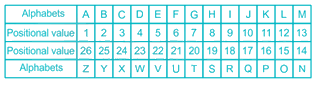 The logic followed here is:
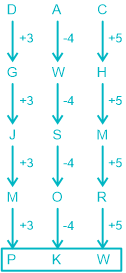 So, PKW will replace the question mark (?) in the following series.
Hence, the correct answer is "Option 1".
Q2 · Series
Select the letter-cluster from among the given options that can replace the question mark (?) in the following series:
DAPR, FESU, HIVX, JMYA ?
- ZBCX
- QCTR
- PYSB
- LQBD
Answer aur solution dekho
Archived marked answer: D
The position and positional values or English Alphabets are:
The logic followed here is:
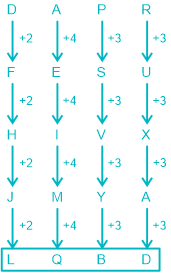 So, LQBD will replace the question mark (?) in the following series.
Hence, the correct answer is "Option 4".
Q3 · Series
Complete the series.
A1, C2, E3, G4, ?
- J5
- K5
- H5
- I5
Answer aur solution dekho
Archived marked answer: D
The position and positional values or English Alphabets are:
The logic followed here is:
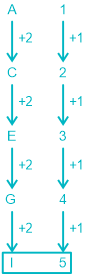 So, I5 will complete the series.
Hence, the correct answer is "Option 4".
Q4 · Series
Find the missing term: 7, 22, 89, ____, 2677, 18740
- 446
- 436
- 448
- 457
Answer aur solution dekho
Archived marked answer: A
Given: 7, 22, 89, ____, 2677, 18740
The logic followed here is:
7
7 × 3 + 1 = 21 + 1 = 22
Q5 · Analogy
Find the group of letters that best completes the analogy based on the given letter transformation pattern.
CIRCLE : DJSFMD :: SQUARE : ?
- YTUBN
- TRVDSD
- CVBGF
- QWERTY
Answer aur solution dekho
Archived marked answer: B
The logic followed here is:
CIRCLE : DJSFMD
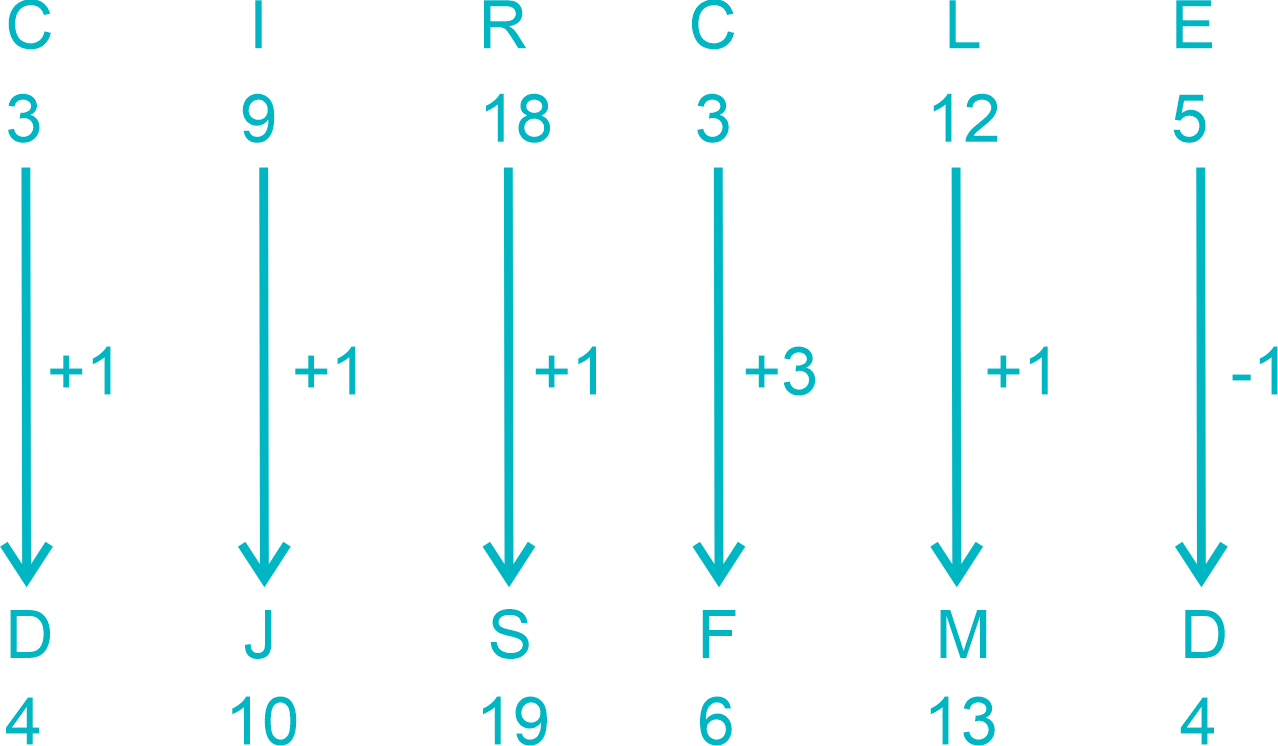 Similarly,
SQUARE : ?
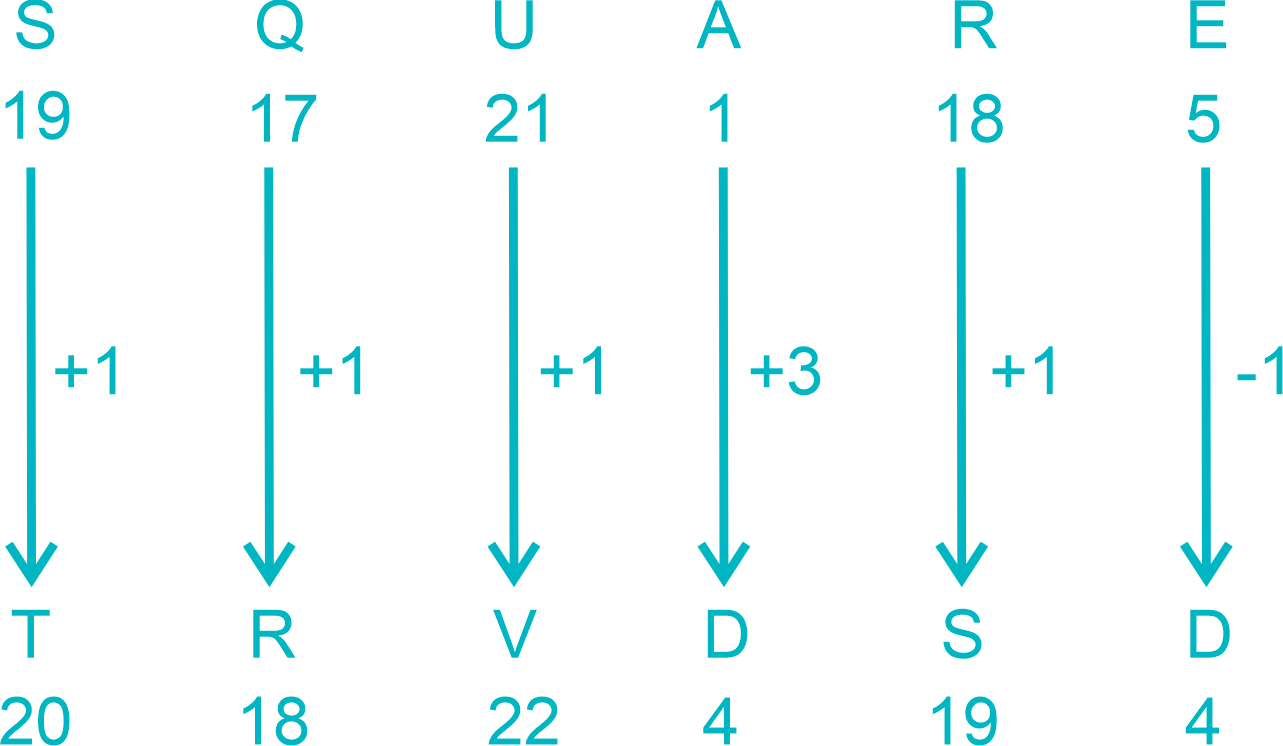 So, TRVDSD is the group of letters that best completes the analogy based on the given letter transformation pattern.
Hence, the correct answer is "Option 2".
Q6 · Puzzle Subtypes Not To Miss
If 4 @ 3 = 19 and 2 @ 5 = 9, then 5 @ 2 = ?
- 21
- 23
- 25
- 27
Answer aur solution dekho
Archived marked answer: D
The logic followed here is:
Logic: a @ b = a² + b
4 @ 3 = 19 → 4² + 3 = 16 + 3 = 19
2 @ 5 = 9 → 22 + 5 = 4 + 5 = 9
Similarly,
5 @ 2 = ? → 52 + 2 = 25 + 2 = 27
So, 27 will come in the place of '?'.
Hence, the correct answer is "Option 4".
Q7 · Puzzle Subtypes Not To Miss
If 2 $ 2 = 16 and 3 $ 3 = 36, what is 4 $ 4?
- 48
- 64
- 72
- 80
Answer aur solution dekho
Archived marked answer: B
The logic followed here is:
Logic: a $ b = (a + b)²
2 $ 2 = 16 → (2 + 2)² = 4² = 16
3 $ 3 = 36 → (3 + 3)² = 6² = 36
Similarly,
4 $ 4 → (4 + 4)² = 8² = 64
So, 64 will come in the place of '?'.
Hence, the correct answer is "Option 2".
Q8 · Puzzle Subtypes Not To Miss
Find the two signs to interchange to correct the equation.
30 - 12 ÷ 3 × 2 + 4 = 122
- ÷ and -
- - and ×
- × and +
- ÷ and +
Answer aur solution dekho
Archived marked answer: B
Given equation: 30 - 12 ÷ 3 × 2 + 4 = 122
BODMAS Table:
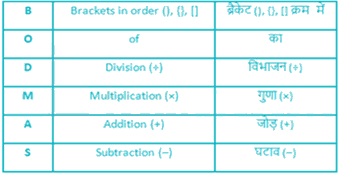 Let check each option, one by one:
1. ÷ and -
After interchanging the symbols, we get:
⇒ 30 ÷ 12 - 3 × 2 + 4 = 122
⇒ 2.5 - 3 × 2 + 4 = 122
⇒ 2.5 - 6 + 4 = 122
⇒ 6.5____ - 6 = 122
⇒ 0.5 ≠ 122
2. - and ×
After interchanging the symbols, we get:
⇒ 30 × 12 ÷ 3 - 2 + 4 = 122
⇒ 360____ ÷ 3 - 2 + 4 = 122
⇒ 120 - 2 + 4 = 122
⇒ 124 - 2 = 122
⇒ 122 = 122
3. × and +
After interchanging the symbols, we get:
⇒ 30 - 12 ÷ 3 + 2 × 4 = 122
⇒ 30 - 4 + 2 × 4 = 122
⇒ 30 - 4 + 2 × 4 = 122
⇒ 30 - 4 + 8 = 122
⇒ 38 - 4 = 122
⇒ 34 ≠ 122
4. ÷ and +
After interchanging the symbols, we get:
⇒ 30 - 12 + 3 × 2 __÷__ 4 = 122
⇒ 30 - 12 + 3 × 0.5 = 122
⇒ 30 - 12 + 1.5 = 122
⇒ 31.5 - 12 = 122
⇒ 19.5 ≠ 122
So, "- and ×" are the two signs to interchange to correct the equation.
Hence, the correct answer is "Option 2".
Q9 · Puzzle Subtypes Not To Miss
If 'M' means '+', 'N' means '-', 'O' means 'x', and 'P' means '÷' what is the value of the following expression?
18 P 3 M 5 O 2=?
- 16
- 22
- 28
- 8
Answer aur solution dekho
Archived marked answer: A
BODMAS Table:
Letter
M
N
O
P
Meaning
+
- ×
÷
Given equation: 18 P 3 M 5 O 2=?
After replacing the letters by their meaning, we get:
⇒ 18 ____÷ 3 + 5 × 2 = ?
⇒ 6 + 5 × 2 = ?
⇒ 6 + 10 = ?
⇒ 16 = ?
So, the value of the given expression is 16.
Hence, the correct answer is "Option 1". Q10 · Puzzle Subtypes Not To Miss
If $ = -, % = x, # = +, then 18 % 2 $ 3 # 1 = ?
- 33
- 34
- 32
- 35
Answer aur solution dekho
Archived marked answer: B
BODMAS Table:
Symbol
$
%
#
Meaning
- ×
+
Given expression: 18 % 2 $ 3 # 1 = ?
After replacing the symbols by their meaning, we get:
⇒ 18 × 2 − 3 + 1 = ?
⇒ 36 − 3 + 1 = ?
⇒ 37____ − 3 = ?
⇒ 34 = ?
So, 34 will come in the place of '?'.
Hence, the correct answer is "Option 2". Q11 · Puzzle Subtypes Not To Miss
If 'P' = x, 'Q' = ÷, 'R' = +, 'S' = -, which equation is correct?
- 18 R 2 P 4 S 2 Q 1 = 15
- 12 P 3 S 4 Q 2 R 1 = 13
- 20 Q 5 R 2 P 3 S 1 = 9
- 30 S 5 R 2 Q 1 P 3 = 32
Answer aur solution dekho
Archived marked answer: C
BODMAS Table:
Letter
P
Q
R
S
Meaning
×
÷
+
- 1. 18 R 2 P 4 S 2 Q 1 = 15
After replacing the symbols by their meaning, we get:
⇒ 18 + 2 × 4 − 2 ÷ 1 = 15
⇒ 18 + 2 × 4 − 2 = 15
⇒ 18 + 8 − 2 = 15
⇒ 26 − 2 = 15
⇒ 24 ≠ 15
2. 12 P 3 S 4 Q 2 R 1 = 13
After replacing the symbols by their meaning, we get:
⇒ 12 × 3 − 4 ÷ 2 + 1 = 13
⇒ 12 × 3 − 2 + 1 = 13
⇒ 36 − 2 + 1 = 13
⇒ 37 − 2 = 13
⇒ 35 ≠ 13
3. 20 Q 5 R 2 P 3 S 1 = 9
After replacing the symbols by their meaning, we get:
⇒ 20 ÷ 5 + 2 × 3 − 1 = 9
⇒ 4 + 2 × 3 − 1 = 9
⇒ 4____ + 6 − 1 = 9
⇒ 10____ − 1 = 9
⇒ 9 = 9
4. 30 S 5 R 2 Q 1 P 3 = 32
After replacing the symbols by their meaning, we get:
⇒ 30 − 5 + 2 ÷ 1 × 3 = 32
⇒ 30 − 5 + 2 × 3 = 32
⇒ 30 − 5 + 6 = 32
⇒ 36 − 5 = 32
⇒ 31 ≠ 32
So, "20 Q 5 R 2 P 3 S 1 = 9" is the correct equation.
Hence, the correct answer is "Option 3". Q12 · Coding Decoding
If each letter is coded as its position in reverse (Z=1, Y=2,..., A=26), what is ROAD?
- 10, 12, 25, 23
- 9, 12, 25, 23
- 9, 13, 25, 23
- 9, 12, 26, 23
Answer aur solution dekho
Archived marked answer: D
The logic followed here is:
Given Letters
R
O
A
D
Reverse Letters
I
L
Z
W
Place Value
9
12
26
23
Hence, the correct answer is "Option 4". Q13 · Coding Decoding
In a certain code language, each letter is assigned a unique digit. Based on the given codes for specific words, determine the code for the target word using the same logic. If MOUSE is coded as 45291 and RAT as 786, how is STORE coded?
- 96571
- 97653
- 98345
- 96278
Answer aur solution dekho
Archived marked answer: A
Given:
MOUSE is coded as 45291
M
O
U
S
E
4
5
2
9
Q14 · Coding Decoding
In a code language, 'FLOW' is written as 'G#3X', and 'WOLF' is written as 'X3#G'. How is 'FOWL' written?
- G#X3
- XG3#
- G3X#
- X#G3
Answer aur solution dekho
Archived marked answer: C
Given:
'FLOW' is written as 'G#3X'
F
L
O
W
G
#
3
X
'WOLF' is written as 'X3#G'
W
O
L
F
X
3
#
G
Similarly,
F
O
W
L
G
3
X
#
So, 'FOWL' is written as G3X#.
Hence, the correct answer is "Option 3". Q15 · Classification Odd One Out
Find the odd one out:
- 6 # 2 = 12
- 5 # 3 = 15
- 4 # 4 = 16
- 7 # 1 = 21
Answer aur solution dekho
Archived marked answer: D
The logic followed here is:
Logic: a # b = a × b
1. 6 # 2 = 12 → 6 × 2 = 12
2. 5 # 3 = 15 → 5 × 3 = 15
3. 4 # 4 = 16 → 4 × 4 = 16
4. 7 # 1 = 21 → 7 × 1 = 7 ≠ 21
So, "7 # 1" is the odd one out.
Hence, the correct answer is "Option 4".
Q16 · Classification Odd One Out
Find the odd one out from the given alternatives:
- Monopoly
- Oligopoly
- Barter
- Duopoly
Answer aur solution dekho
Archived marked answer: C
The logic followed here is:
1. Monopoly – A market structure where a single seller controls the entire supply of a product or service.
2. Oligopoly – A market structure where a few large firms dominate the market and influence prices.
3. Barter – A system of exchange where goods and services are traded directly without using money.
4. Duopoly – A market structure where only two sellers control the market.
Monopoly, Oligopoly, and Duopoly are all types of market structures, whereas Barter is a method of exchange.
So, Barter is the odd one out.
Hence, the correct answer is "Option 3".
Q17 · Blood Relations
X is the daughter of Y. Y is the son of Z. W is the wife of Z. How is W related to X?
- Mother
- Grandmother
- Aunt
- Sister
Answer aur solution dekho
Archived marked answer: B
Family Chart:
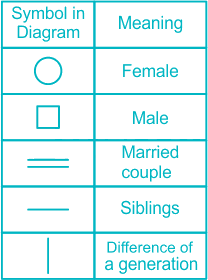 Given: X is the daughter of Y. Y is the son of Z. W is the wife of Z.
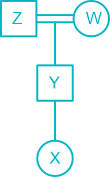 So, W is grandmother of X.
Hence, the correct answer is "Option 2".
Q18 · Blood Relations
X + Y means X is the mother of Y, X – Y means X is the brother of Y, X * Y means X is the sister of Y. Then what does A – B + C mean?
- A is brother-in-law of C
- A is maternal uncle of C
- A is brother of C
- A is father of C
Answer aur solution dekho
Archived marked answer: B
Family Chart:
X is
Symbol
+
- *
Meaning
mother
brother
sister
to Y
Given: A – B + C
It means: A is brother of B, B is mother of C
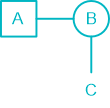 Clearly, A is maternal uncle of C.
Hence, the correct answer is "Option 2".
Q19 · Alphabet Test
Find the word which is between the 1st and 4th letters of the following word as per the English alphabet series.
CUTE
- F
- D
- V
- Z
Answer aur solution dekho
Archived marked answer: B
Given: Find the word which is between the 1st and 4th letters of the following word as per the English alphabet series.
CUTE
The position and positional values or English Alphabets are:
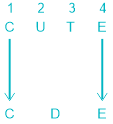 So, D comes between C and E.
Hence, the correct answer is "Option 2".
Q20 · Similarity and Differences
Choose the address that is exactly the same as the one given below.
A-5, Lotus Enclave, Patliputra Colony, Patna, Bihar - 800013
- A-5, Lotus Enclave, Patliputra Colony, Patna, Biharr - 800013
- A-5, Lotus Enclave, Patliputra Colony, Patna, Bihar - 800013
- A5, Lotus Enclave, Patliputra Colony, Patna, Biharr - 800013
- A-5, Lotus Enclave, Patliputra Colonny, Patna, Bihar - 800013
Answer aur solution dekho
Archived marked answer: B
Correct Option - 2
Address
Options
Verdict
A-5, Lotus Enclave, Patliputra Colony, Patna, Bihar - 800013
1
A-5, Lotus Enclave, Patliputra Colony, Patna, Biharr - 800013
There's an extra 'r' in Bihar.
A-5, Lotus Enclave, Patliputra Colony, Patna, Bihar - 800013
2
A-5, Lotus Enclave, Patliputra Colony, Patna, Bihar - 800013
Exactly Same
A-5, Lotus Enclave, Patliputra Colony, Patna, Bihar - 800013
3
A5, Lotus Enclave, Patliputra Colony, Patna, Biharr - 800013
There's an extra 'r' in Bihar.
A-5, Lotus Enclave, Patliputra Colony, Patna, Bihar - 800013
4
A-5, Lotus Enclave, Patliputra Colonny, Patna, Bihar - 800013
There's an extra 'n' in Colony.
Hence, the correct answer is "Option 2".
Q21 · Logical Statement Questions
Instruction: Identify the assumptions that must hold for the statement to be valid, then choose the correct option.
Statement: The discovery of gravitational waves has provided strong evidence for Einstein's theory of general relativity, but it also opens up new possibilities for understanding the universe's most extreme phenomena, such as black holes and neutron stars.
Assumptions:
I. Gravitational waves offer new insights into the nature of the universe.
II. Einstein's theory of general relativity has been conclusively proven by the discovery of gravitational waves.
III. The study of gravitational waves will lead to new breakthroughs in astrophysics.
- Only I and II are implicit
- Only II and III are implicit
- Only I is implicit
- All I, II, and III are implicit
Answer aur solution dekho
Archived marked answer: A
Statement: The discovery of gravitational waves has provided strong evidence for Einstein's theory of general relativity, but it also opens up new possibilities for understanding the universe's most extreme phenomena, such as black holes and neutron stars.
Now,
Assumptions:
I. Gravitational waves offer new insights into the nature of the universe. - Implicit (The statement implies that the discovery opens new possibilities for understanding extreme phenomena. That clearly assumes gravitational waves provide new insights.)
II. Einstein's theory of general relativity has been conclusively proven by the discovery of gravitational waves. - Implicit (The statement clearly implies that the discovery of gravitational waves has provided strong evidence for Einstein's theory of general relativity)
III. The study of gravitational waves will lead to new breakthroughs in astrophysics. - Not Implicit (The statement does not explicitly says it leads to breakthroughs will definitely occur, but rather mentions that it opens up new possibilities.)
So, only I and II are implicit.
Hence, the correct answer is "Option 1".
Q22 · Logical Statement Questions
Read the following statement carefully and identify the conclusion that follows.
Statement: Fewer people applied for teaching posts this year.
Conclusions:
I. Teaching is losing popularity.
II. Applicants may be seeking better-paying jobs.
- Only Conclusion I follows
- Only Conclusion II follows
- Both I and II follow
- Neither I nor II follows
Answer aur solution dekho
Archived marked answer: D
Statement: Fewer people applied for teaching posts this year.
Now,
Conclusions:
I. Teaching is losing popularity. - False (A fall in applications does not definitively suggest a decline in popularity; it could be due to other factors such as eligibility criteria or fewer vacancies.)
II. Applicants may be seeking better-paying jobs. - False (The statement does not mention salary or external factors, so this is an assumption rather than a l
Q23 · Logical Statement Questions
Read the following statement carefully and identify the conclusion that follows.
Statement:
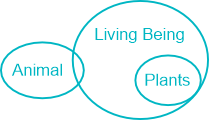
All plants are living beings. Some living beings are animals.
Conclusions:
I. Some plants are animals.
II. All animals are plants.
- Only I follows
- Only II follows
- Both I and II follow
- Neither I nor II follows
Answer aur solution dekho
Archived marked answer: D
Statement: All plants are living beings. Some living beings are animals.
Least possible Venn diagram,
 Conclusions:
I. Some plants are animals - Does not follow (There is no direct relation given between plants and animals. so it is possible not definite).
II. All animals are plants - Does not follow (There is no direct relation
Q24 · Miscellaneous Other Possibilities
In a 40 L solution, the ratio of acid to water is 5:3. How much water must be added to make it 1:1?
- 5 L
- 6 L
- 17 L
- 10 L
Answer aur solution dekho
Archived marked answer: D
Given:
Total solution = 40 L
Ratio of acid : water = 5 : 3
Required ratio = 1 : 1
Formula used:
Quantity = Total × (Part ÷ Sum of ratio)
Calculations:
Total parts = 5 + 3 = 8
Acid = 40 × 5 ÷ 8
⇒ Acid = 25 L
Water = 40 × 3 ÷ 8
⇒ Water = 15 L
For ratio 1 : 1
⇒ Required water = Acid = 25 L
⇒ Water to be added = 25 − 15 = 10 L
∴ 10 L of water must be added.
Q25 · Miscellaneous Other Possibilities
In a class of 80 students, 60% are girls. If 75% of the girls passed, how many girls failed?
- 12
- 15
- 18
- 20
Answer aur solution dekho
Archived marked answer: A
Given:
Total students = 80
Percentage of girls = 60%
Percentage of girls passed = 75%
Formula used:
Number = Percentage × Total ÷ 100
Calculations:
Number of girls = 60 × 80 ÷ 100 = 48
⇒ Girls passed = 75 × 48 ÷ 100 = 36
⇒ Girls failed = 48 − 36 = 12
∴ The number of girls who failed is 12.
General Awareness
Q1 · Art and Culture
Which of the following is a notable architectural feature of Notre Dame des Anges Church in Puducherry?
- Shikhara with amalaka
- Transparent enclosure with piers
- Minaret with balcony
- Corbelled arch with lattice work
Answer aur solution dekho
Archived marked answer: B
The correct answer is Transparent enclosure with piers.
Key Points
- The Notre Dame des Anges Church in Puducherry is renowned for its distinctive architectural style inspired by Greco-Roman architecture.
- The church features a transparent enclosure with piers, a rare architectural element that enhances the structure's aesthetic appeal.
- This feature allows natural light to permeate the interiors, creating a serene and ethereal ambiance within the church.
- The pink and white façade of the church, coupled with the transparent design elements, makes it a unique and visually stunning landmark in Puducherry.
- The church also boasts beautifully painted ceilings and intricate artwork, adding to its historical and cultural significance.
Additional Information
- Shikhara with amalaka
- The shikhara is a spire or tower that adorns the top of Hindu temples and is a key feature of Nagara-style architecture.
- An amalaka is a circular, ribbed stone disc placed at the top of the shikhara, symbolizing the celestial realm.
- This architectural style is typically seen in temples of North India, such as the Khajuraho temples, and is not associated with the Notre Dame des Anges Church.
- Minaret with balcony
- Minarets are tall, slender towers attached to mosques, commonly seen in Islamic architecture.
- They often feature balconies (called muezzin's galleries) from where the call to prayer is announced.
- This architectural feature is specific to Islamic religious buildings and is not relevant to the design of Notre Dame des Anges Church, a Christian site.
- Corbelled arch with lattice work
- A corbelled arch is constructed by overlapping stones or bricks in a step-like fashion, commonly used in ancient Indian architecture.
- Lattice work refers to decorative perforated designs, often seen in Mughal and Rajasthani architecture.
- These features are not part of the architectural style of the Notre Dame des Anges Church.
- Notre Dame des Anges Church
- Located in Puducherry, this church is a prominent landmark and represents a blend of European architectural styles.
- It was built in 1855 and is dedicated to Our Lady of Angels.
- The church is known for its serene atmosphere and historical significance, making it a major tourist attraction in the region.
Q2 · Art and Culture
Which of the following best describes Achal and Chal swaras in Indian classical music?
- All swaras have fixed pitch in both systems
- Sa and Pa are fixed; others have variants like Komal or Teevra
- Komal and Teevra swaras are used only in Carnatic music
- Ga and Ni are always sung in Shuddha form in all styles
Answer aur solution dekho
Archived marked answer: B
The correct answer is Sa and Pa are fixed; others have variants like Komal or Teevra.
Key Points
- In Indian classical music, the concept of Achal and Chal swaras refers to the classification of swaras (musical notes) based on their pitch variability.
- Achal swaras: Sa (Shadja) and Pa (Pancham) are considered fixed (Achal) swaras, meaning their pitch does not change.
- Chal swaras: The remaining five swaras (Re, Ga, Ma, Dha, Ni) can have variations and are classified as movable (Chal) swaras. These variations are categorized as Komal (flat) or Teevra (sharp).
- For instance, Re, Ga, Dha, and Ni can take both Shuddha (natural) and Komal (flat) forms, while Ma can be either Shuddha or Teevra (sharp).
- This classification is fundamental in both Hindustani and Carnatic music systems, and it forms the basis for creating different ragas and melodies.
Additional Information
- Achal and Chal Swaras
- The seven swaras in Indian classical music are Sa, Re, Ga, Ma, Pa, Dha, and Ni.
- The fixed swaras (Sa and Pa) act as reference points, while the movable swaras provide melodic flexibility.
- This combination of fixed and movable swaras is essential for the formation of ragas, which are melodic frameworks in Indian classical music.
- The interplay of Shuddha, Komal, and Teevra swaras adds depth and variety to musical compositions.
Q3 · Art and Culture
Consider the statements about Tippani :
1. Originated among Saurashtra women tamping lime floors with wooden rods.
2. Male drummers provide dhol-nagara accompaniment.
Which is/are correct?
- Only 1 correct
- Only 2 correct
- Both 1 & 2 correct
- Neither 1 nor 2 correct
Answer aur solution dekho
Archived marked answer: C
The correct answer is Option 3.
Key Points
- Tippani folk dance originated among Saurashtra women who tamped lime floors using wooden rods.
- It is a traditional dance that reflects the laborious work of women who took part in construction-related activities.
- Male drummers provide accompaniment using traditional instruments such as dhol and nagara, adding rhythm and vibrancy to the dance.
- Tippani symbolizes teamwork and coordination while celebrating the essence of folk culture.
- The dance is popular in Gujarat, especially in the Saurashtra region, and is performed during festivals and special occasions.
Additional Information
- Key Folk Dances of Saurashtra:
- Maniaro Raas: An all-male martial dance, especially by the Maher community, featuring swords and shields (or sticks) to symbolize bravery and victory, performed with strong beats and traditional songs.
- Gof-Gunthan: A unique Garba style from Saurashtra, popular with Koli and Kanbi communities, performed during Navratri with intricate patterns.
- Garba & Dandiya Raas: While widespread in Gujarat, these iconic circular dances, with their colorful costumes and energetic steps, are integral to Saurashtra's festive culture, especially during Navratri.
- Padhar Dance: A lively dance by the Padhar community from the Nal Sarovar area, known for its graceful, wave-like movements mimicking water.
Q4 · Art and Culture
Which of the following best captures the cultural and historical essence of Uttarakhand's Bissu Mela?
- A three-day martial arts event by Gorkha settlers in Garhwal to worship Lord Kartikeya as the harvest god.
- A week-long Jaunsari tribal fair in Chakrata, thanking for harvest and honoring Santoora Devi, a Durga form.
- A pilgrimage where Pandavas are worshipped at stone altars through Himachali Brahmin rituals.
- A fasting-based fair restricting women from dancing due to ancestral customs.
Answer aur solution dekho
Archived marked answer: B
The correct answer is A week-long Jaunsari tribal fair in Chakrata, thanking for harvest and honoring Santoora Devi, a Durga form..
Key Points
- Bissu Mela is a prominent cultural event celebrated primarily by the Jaunsari tribal community in the Chakrata region of Uttarakhand.
- This week-long festival is primarily held to express gratitude for a bountiful harvest and to honor Santoora Devi</stro
Q5 · Indian Polity and Constitution
Article 312 provides for creation of new ______ by Parliament.
- Union Territories
- Constitutional Amendments
- All India Services
- Finance Commissions
Answer aur solution dekho
Archived marked answer: C
The correct answer is All India Services.
Key Points
- Article 312 of the Constitution of India empowers the Parliament to create new All India Services apart from the existing ones, such as the Indian Administrative Service (IAS), Indian Police Service (IPS), and Indian Forest Service (IFS).
- The creation of such services requires a resolution passed by the Rajya Sabha by a majority of not less than two-thirds of the members present and voting.
- All India Services serve both the Central and State Governments, ensuring administrative uniformity across the country.
- Members of these services are recruited through the Union Public Service Commission (UPSC) and governed by the All India Services Rules.
- Such services play a crucial role in maintaining the federal structure and ensuring efficient governance across the Union and the States.
Additional Information
- Union Territories
- The Constitution of India provides for the establishment and governance of Union Territories under Articles 239 to 242.
- Union Territories are directly administered by the President of India through an Administrator appointed by him/her.
- Unlike All India Services, Union Territories are territorial entities governed by specific constitutional provisions, often with limited autonomy compared to states.
- Constitutional Amendments
- Constitutional amendments are governed by Article 368 of the Indian Constitution and are used to make changes to various provisions of the Constitution.
- These amendments require a special majority in Parliament and, in some cases, ratification by half of the state legislatures.
- While Article 312 deals with the creation of services, amendments under Article 368 are required for structural or functional changes in the Constitution.
- Finance Commissions
- Finance Commissions are constituted under Article 280 of the Indian Constitution to make recommendations to the President regarding the distribution of financial resources between the Union and the States.
- The commission is appointed every five years and ensures fiscal federalism and equitable distribution of taxes.
- Unlike All India Services, Finance Commissions focus on financial governance rather than administrative services.
</ul
Q6 · Indian Polity and Constitution
Consider the following statements:
1. Article 262 empowers Parliament to set up tribunals for river disputes.
2. The Supreme Court has appellate jurisdiction in such disputes.
Which of the above is/are correct?
- Only 1
- Only 2
- Both 1 and 2
- Neither 1 nor 2
Answer aur solution dekho
Archived marked answer: A
The correct answer is Option 1: Only 1.
Key Points
- Article 262 of the Indian Constitution gives power to the Parliament to provide for adjudication of disputes or complaints regarding the use, distribution, or control of inter-state river waters.
- It explicitly empowers the Parliament to bar the jurisdiction of the Supreme Court or other courts in such disputes, making the role of tribunals significant.
- The Inter-State River Water Disputes Act, 1956, enacted under Article 262, provides for the establishment of tribunals to settle water disputes between states.
- The Supreme Court does not have appellate jurisdiction in inter-state water disputes if Parliament has legislated to exclude it under Article 262.
- Thus, Statement 1 is correct, and Statement 2 is incorrect, making Option 1 the correct answer.
Additional Information
- About Article 262:
- Article 262 is specifically designed to address inter-state river disputes. It ensures that disputes over water allocation and usage between states are handled through specialized mechanisms, rather than the general judiciary.
- Under this Article, Parliament has the authority to establish tribunals, such as the Krishna Water Disputes Tribunal and Cauvery Water Disputes Tribunal, to resolve such disputes.
- Role of Tribunals:
- Tribunals act as specialized bodies for dispute resolution in cases where states have disagreements over water sharing.
- These tribunals ensure that disputes are resolved fairly and based on scientific and legal principles.
Q7 · Indian Polity and Constitution
Through which Constitutional Amendment was Article 21A introduced, mandating free and compulsory education as a Fundamental Right for children between 6 and 14 years of age?
- 42nd Amendment Act
- 86th Amendment Act
- 93rd Amendment Act
- 44th Amendment Act
Answer aur solution dekho
Archived marked answer: B
The correct answer is 86th Amendment Act.
Key Points
- The 86th Constitutional Amendment Act, 2002, inserted Article 21A into the Indian Constitution, making education a Fundamental Right for children aged 6 to 14 years.
- This amendment also brought changes to Article 45, which now directs the State to provide early childhood care and education for children below six years of age.
- Additionally, it added Clause (k) to Article 51A, which made it a Fundamental Duty of parents or guardians to provide opportunities for education to their children between the ages of 6 and 14 years.
- The 86th Amendment Act paved the way for the Right of Children to Free and Compulsory Education Act, 2009, commonly known as the RTE Act, which operationalized Article 21A.
- This historic amendment was a milestone in India's efforts to achieve universal primary education and combat illiteracy among children.
Additional Information
- 42nd Amendment Act:
- Enacted in 1976, it is also known as the "Mini-Constitution" of India due to the extensive changes it brought to the Constitution.
- It made India a "socialist", "secular", and "integrity" State by amending the Preamble.
- Transferred subjects like Education, Forests, and Protection of Wild Animals and Birds from the State List to the Concurrent List.
- Strengthened the Directive Principles of State Policy (DPSPs) and inserted provisions like Article 48A (environment protection) and Article 43A (worker participation in industries).
- 93rd Amendment Act:
- Enacted in 2005, it inserted Clause (5) to Article 15, enabling the State to make special provisions for the advancement of socially and educationally backward classes, Scheduled Castes (SCs), and Scheduled Tribes (STs).
- This amendment allowed for the reservation of seats in educational institutions, including private unaided institutions, except for minority institutions under Article 30(1).
- It laid the foundation for the implementation of the 27% reservation for Other Backward Classes (OBCs) in central educational institutions.
- 44th Amendment Act:
- Enacted in 1978, it reversed some provisions of the controversial 42nd Amendment Act.
- It restored the right to property as a legal right under Article 300A, removing it from the list of Fundamental Rights.
- It ensured that Articles 20 and 21, dealing with protection in respect of conviction for offenses and the right to life and personal liberty, could not be suspended even during an emergency.
</ul
Q8 · Indian Economy
Which of the following is unrelated to the components of population change?
- Births
- Deaths
- Migration
- Employment
Answer aur solution dekho
Archived marked answer: D
The correct answer is Employment.
Key Points
- Employment is not considered a direct component of population change as it does not directly influence the size of the population.
- Population change is typically determined by three key factors: births, deaths, and migration.
- Employment affects the socio-economic structure of a population but does not contribute directly to its growth or decline.
- While employment may influence migration patterns indirectly (e.g., people moving to cities for jobs), it is not a standalone factor in population change.
Additional Information
- Births:
- Births are a primary component of population change. The birth rate measures the number of live births per 1,000 people in a given year.
- It plays a significant role in determining the natural increase or decrease in population.
- Factors such as fertility rates, healthcare services, and socio-economic conditions influence birth rates.
- Deaths:
- Deaths are another critical component of population change. The death rate measures the number of deaths per 1,000 people in a given year.
- Mortality rates are affected by healthcare facilities, lifestyle, nutrition, and sanitation.
- A decline in the death rate due to advancements in medicine and public health can lead to population growth.
- Migration:
- Migration refers to the movement of people from one region to another, either within a country or across international borders.
- It can be classified into immigration (in-migration) and emigration (out-migration).
- Migration impacts the distribution and growth of a population in specific regions rather than the total global population size.
- Reasons for migration include employment opportunities, education, better living conditions, and political or environmental factors.
Q9 · Indian Economy
Read the following Assertion (A) and Reason (R) carefully and choose the correct option.
Assertion (A): Self-reliance was a major objective of India's early planning era.
Reason (R): India sought to reduce dependence on foreign aid and imports post-independence.
- Both A and R are true and R is the correct explanation of A.
- Both A and R are true but R is not the correct explanation of A.
- A is true but R is false.
- A is false but R is true.
Answer aur solution dekho
Archived marked answer: A
The correct answer is 1) Both A and R are true and R is the correct explanation of A..
Key Points
- Assertion (A): Self-reliance was a critical goal during India's early planning era due to the need to establish an independent economic foundation after years of colonial rule.
- Reason (R): India aimed to reduce dependency on foreign aid and imports by focusing on internal production and resource utilization, particularly in industries and agriculture.
- The strategy of self-reliance was emphasized in the Second Five-Year Plan (1956-61), which focused on industrialization and the establishment of heavy industries to reduce dependency on imports.
- Both the assertion and the reason are true, and the reason directly explains why self-reliance was prioritized in India's planning policies post-independence.
- The policy of self-reliance was crucial for ensuring that India would not be vulnerable to external economic pressures and could independently develop its economy.
Additional Information
- The focus on self-reliance in India's economic planning was driven by the political and economic context of the post-independence era.
- India's colonial history had left its economy dependent on imports for industrial products and foreign aid for development projects.
- By focusing on self-reliance, India sought to modernize its industries, boost agricultural production, and create a robust economic foundation that was independent of external influences.
Q10 · Indian Economy
Read the below statements marked as Assertion (A) and Reason (R). Mark the correct options:
Assertion (A): Human Development Index (HDI) in India improved significantly post-2010.
Reason (R): The methodology was revised globally to include inequality-adjusted Human Development Index (HDI).
- Both A and R are true, and R is the correct explanation of A.
- Both A and R are true, but R is not the correct explanation of A.
- A is true, but R is false.
- A is false, but R is true.
Answer aur solution dekho
Archived marked answer: B
The correct answer is Option 2: Both A and R are true, but R is not the correct explanation of A.
Key Points
- The Human Development Index (HDI) in India has shown significant improvement post-2010 due to progress in areas such as health, education, and income.
- Globally, the HDI methodology was revised in 2010 to include the Inequality-adjusted Human Development Index (IHDI), which accounts for inequality in each dimension of HDI.
- However, India’s improvement in HDI post-2010 is primarily attributed to socio-economic growth and policy interventions rather than just the inclusion of IHDI.
- The IHDI adjustment reflects the actual level of human development after accounting for inequality, but it is not the sole reason for India's HDI improvement.
- Thus, while both the assertion and reason are true, the reason does not directly explain the assertion.
Additional Information
- Inequality-adjusted Human Development Index (IHDI):
- The IHDI was introduced in 2010 to address the limitations of the HDI by considering inequality in each dimension.
- It provides a more accurate representation of human development by accounting for disparities in health, education, and income.
- If inequality is high, the IHDI value will be much lower than the HDI value.
- India’s Socio-Economic Policies:
- Post-2010, India implemented various schemes focusing on education (e.g., Right to Education Act), healthcare (e.g., Ayushman Bharat), and income generation (e.g., MNREGA).
- These policies collectively contributed to the improvement in India’s HDI.
Q11 · Sports Static GK
Which of the following is true about "en passant" in chess?
- Only after a pawn moves two squares and waits a turn.
- Can be done within two moves after the pawn's advance.
- Must be done immediately after the pawn moves two squares.
- Only if the capturing pawn is on a dark square.
Answer aur solution dekho
Archived marked answer: C
The correct answer is Must be done immediately after the pawn moves two squares.
Key Points
- En passant is a special pawn capture rule in chess that allows a pawn to capture an opponent's pawn immediately after it moves two squares forward from its starting position.
- The capture must be made on the very next move; otherwise, the opportunity is lost.
- The opponent's pawn must have moved two squares forward from its starting position, landing adjacent to the capturing pawn.
- When the en passant capture occurs, the capturing pawn moves diagonally to the square where the opponent's pawn would have landed if it had advanced only one square.
- The rule was introduced to prevent pawns from bypassing a potential capture when advancing two squares, maintaining fairness in the game.
Additional Information
- Pieces & Board
- Pieces: King, Queen, Rook, Bishop, Knight, Pawn.
- Board: Chessboard, Center (e4, d4, e5, d5), Ranks (rows), Files (columns).
- Game States & Results
- Check: King is attacked.
- Checkmate: King is attacked and cannot escape (Game Over).
- Stalemate: No legal moves, but not in check (Draw).
- Draw: Tie game (e.g., Perpetual Check, Threefold Repetition).
Q12 · Sports Static GK
In which Olympic Games did Leander Paes make his debut before winning India's first Olympic tennis medal in the following edition?
- Barcelona Olympic Games
- Atlanta Olympic Games
- Sydney Olympic Games
- New Delhi Olympic Games
Answer aur solution dekho
Archived marked answer: A
The correct answer is Barcelona Olympic Games.
Key Points
- Leander Paes made his debut at the 1992 Barcelona Olympic Games, representing India in tennis.
- He competed in both the singles and doubles events during the 1992 Olympics.
- Although he did not win a medal in Barcelona, his debut marked the beginning of a remarkable Olympic journey.
- In the subsequent 1996 Atlanta Olympics, Leander Paes won the bronze medal in men’s singles tennis, becoming the first Indian to win an Olympic medal in the sport.
- His bronze medal in Atlanta was also India’s first individual Olympic medal in 44 years since KD Jadhav’s wrestling bronze in 1952.
Additional Information
- Atlanta Olympic Games
- The 1996 Atlanta Olympics was where Leander Paes won his historic bronze medal in men’s singles tennis.
- Paes defeated Brazilian player Fernando Meligeni in the bronze medal match, earning India’s only medal in the Atlanta Olympics.
- This achievement marked India’s resurgence in individual sports on the Olympic stage.
- Sydney Olympic Games
- The 2000 Sydney Olympics saw Leander Paes compete in both singles and doubles events.
- In the doubles event, he partnered with Mahesh Bhupathi, but the duo did not secure a medal.
- The Sydney Olympics was part of Paes’ long-standing Olympic career, spanning seven consecutive appearances from 1992 to 2016.
- New Delhi Olympic Games
- There has never been an Olympic Games held in New Delhi.
- India hosted the Asian Games in New Delhi in 1951 and 1982 but has never hosted the Olympics.
- This option is incorrect as it does not correspond to any actual Olympic Games.
Q13 · Sports Static GK
With reference to the All India Inter-Club U21 Men & Women Water Polo League - 2025, which of the following statements are accurate?
1. The tournament was hosted at Mayo College in Ajmer, Rajasthan.
2. It was organized under the aegis of the Western Naval Command.
3. The event took place from 14 to 18 April 2025.
- 1 and 2 only
- 2 and 3 only
- 1 and 3 only
- 1, 2 and 3
Answer aur solution dekho
Archived marked answer: C
The correct answer is Option 3.
Key Points
- The All India Inter-Club U21 Men & Women Water Polo League - 2025 was hosted at Mayo College in Ajmer, Rajasthan.
- The event took place from 14 to 18 April 2025, making this information accurate as per the question.
- However, the statement regarding the organization of the event under the aegis of the Western Naval Command is incorrect, as it was not associated with this authority.
- Thus, only statements 1 and 3 are accurate, aligning with the question and confirming Option 3 as the correct choice.
- The league aimed to promote water polo at the grassroots level, offering young athletes a platform to showcase their talent and develop their skills.
Additional Information
- Importance of Water Polo in India
- Water polo is a growing sport in India, with increasing attention being given to grassroots development and youth participation.
- Events like the All India Inter-Club U21 Men & Women Water Polo League aim to provide a platform for young athletes to compete at a national level and gain exposure.
- Such tournaments also help identify talent for international competitions, fostering the growth of aquatic sports in the country.
Q14 · Indian Geography
Which state among the following is a major contributor to India's iron ore reserves?
- Maharashtra
- Andhra Pradesh
- Karnataka
- Tamil Nadu
Answer aur solution dekho
Archived marked answer: C
The correct answer is Karnataka.
Key Points
- Karnataka is one of the largest producers of iron ore in India, contributing significantly to the country's overall production.
- The state is rich in mineral resources, with the districts of Bellary, Chitradurga, and Tumkur being the key hubs for iron ore mining.
- Iron ore from Karnataka is of high quality and is extensively used in steel production, both domestically and internationally.
- Approximately one-fourth of India's total iron ore reserves are located in Karnataka, making it a leading state in this sector.
- The Kudremukh Iron Ore Company Ltd (KIOCL), a government-owned enterprise, is one of the major organizations involved in iron ore mining in Karnataka.
Additional Information
- Maharashtra:
- Maharashtra is not a major contributor to India’s iron ore reserves.
- It is more known for its reserves of manganese, coal, and bauxite.
- The Vidarbha region of Maharashtra is rich in coal and manganese deposits, making it a significant contributor to these resources.
- Andhra Pradesh:
- Andhra Pradesh has some deposits of iron ore but does not rank among the top iron ore-producing states in India.
- The state is better known for its reserves of limestone, bauxite, and barites.
- It is also a significant producer of mica and has abundant reserves of quartz and silica.
- Tamil Nadu:
- Tamil Nadu has limited reserves of iron ore compared to Karnataka, Odisha, and Chhattisgarh.
- The state is better known for its deposits of lignite and magnesite.
- It is also a leading producer of garnet and other industrial minerals.
Q15 · Indian Geography
Why are the Western Ghats considered globally significant according to UNESCO?
- They categorize urban rivers based on their economic contribution to the city.
- They influence the Indian monsoon and are among the world's top biodiversity hotspots.
- They are located near the equator and host polar species.
- They form the only volcanic plateau in peninsular India with desert flora.
Answer aur solution dekho
Archived marked answer: B
The correct answer is They influence the Indian monsoon and are among the world's top biodiversity hotspots.
Key Points
- The Western Ghats are recognized globally as one of the world's eight "hottest hotspots" of biological diversity, as per UNESCO.
- They play a crucial role in influencing the Indian monsoon, acting as a barrier to moisture-laden winds and triggering rainfall.
- They are home to an exceptional level of endemic species, including plants, animals, birds, and amphibians that are unique to this region.
- The Western Ghats are designated as a UNESCO World Heritage Site due to their ecological importance and rich biodiversity.
- Spread across six Indian states, these mountains are critical to water security, as they host several important rivers and watersheds.
Additional Information
- Key Focus Areas of UNESCO (Programmes):
- Education: Quality education for all, literacy, lifelong learning.
- Natural Sciences: Supporting science for sustainability, ocean health, biodiversity.
- Social & Human Sciences: Addressing ethical challenges, promoting inclusive societies, fighting racism.
- Culture: Safeguarding heritage (World Heritage Sites, Intangible Heritage), promoting diversity, creativity.
- Communication & Information: Upholding freedom of expression, press freedom, digital governance, information literacy.
Q16 · Current Affairs
Gaganyaan is planned to orbit Earth at approximately what altitude?
- 100 km
- 400 km
- 1000 km
- 36,000 km
Answer aur solution dekho
Archived marked answer: B
The correct answer is 400 km.
Key Points
- Gaganyaan Mission is India's first human spaceflight program developed by the Indian Space Research Organisation (ISRO).
- The planned altitude for the orbit of the spacecraft is approximately 400 km from Earth's surface.
- At this altitude, the spacecraft will perform microgravity experiments and other scientific studies.
- The mission aims to send a crew of three astronauts into space for a duration of up to seven days.
- The spacecraft will orbit in a low Earth orbit (LEO), which is ideal for human spaceflight missions due to reduced radiation exposure compared to higher altitudes.
- This milestone mission is expected to establish India as the fourth nation to send humans into space, after the USA, Russia, and China.
Additional Information
- The Gaganyaan mission is part of India's efforts to advance its space exploration capabilities and develop the technological infrastructure for human spaceflight.
- It involves critical systems like the GSLV Mk III rocket (launch vehicle), crew module, environmental control and life support systems, and ground support systems.
- Through Gaganyaan, ISRO aims to enhance India's status as a spacefaring nation and open avenues for future interplanetary missions.
Q17 · Current Affairs
What is India's first successful interplanetary mission?
- Chandrayaan-1
- Mangalyaan
- Gaganyaan
- Aditya-L1
Answer aur solution dekho
Archived marked answer: B
The correct answer is Mangalyaan.
Key Points
- Mangalyaan, also known as the Mars Orbiter Mission (MOM), is India’s first successful interplanetary mission.
- It was launched by the Indian Space Research Organisation (ISRO) on 5 November 2013, using the PSLV-C25 launch vehicle.
- The mission successfully entered Mars’ orbit on 24 September 2014, making India the first Asian nation to reach Mars and the first nation globally to succeed in its first attempt.
- The primary objective of the mission was to develop the technologies required for interplanetary missions and study Mars’ surface features, morphology, mineralogy, and atmosphere.
- Mangalyaan was achieved at a cost of approximately ₹450 crore, making it one of the most cost-effective Mars missions in the world.
Additional Information
- Chandrayaan-1:
- Chandrayaan-1 was India’s first lunar mission, launched by ISRO on 22 October 2008.
- The mission discovered the presence of water molecules on the Moon's surface, a significant scientific breakthrough.
- It carried 11 scientific instruments, including the Moon Impact Probe (MIP), which crash-landed on the Moon’s surface to collect data.
- Gaganyaan:
- Gaganyaan is India’s first human spaceflight mission currently under development by ISRO.
- The mission aims to send a crew of three astronauts into a 400 km low Earth orbit for a duration of 3–7 days.
- Originally planned for 2022, the mission timeline has been rescheduled, with uncrewed test flights expected in 2024.
- Aditya-L1:
- Aditya-L1 is India’s first dedicated solar mission, launched on 2 September 2023.
- The spacecraft is positioned at the Lagrange Point 1 (L1) to study the Sun’s corona, chromosphere, and solar winds in real-time.
- It carries seven scientific payloads to provide data on solar activities and their impact on space weather.
Q18 · Current Affairs
Which of the following best describes the purpose of the National Single Window System (NSWS) portal launched by the Ministry of Commerce & Industry?
- To streamline pension disbursal mechanisms for unorganized workers
- To facilitate industrial clearances and approvals through a single digital platform
- To monitor school enrollments across states using Aadhaar linkage
- To centralize water quality testing across urban and rural regions
Answer aur solution dekho
Archived marked answer: B
The correct answer is To facilitate industrial clearances and approvals through a single digital platform.
Key Points
- The National Single Window System (NSWS) is a digital platform aimed at simplifying and expediting the process of obtaining regulatory approvals and clearances for businesses in India.
- It provides a single-window clearance mechanism for investors and businesses, enabling seamless interaction with various government departments.
- NSWS integrates over 32 central departments and 15 state governments to provide a unified platform for industrial approvals, avoiding duplication and reducing paperwork.
- The platform is designed to boost the ease of doing business in India by making the approval process more efficient, transparent, and faster.
- Launched in September 2021 by the Ministry of Commerce & Industry, the system is a key initiative under the 'Make in India' and 'Digital India' campaigns.
Additional Information
- Schemes like the Pradhan Mantri Shram Yogi Maandhan Yojana (PM-SYM), which ensures old-age protection for unorganized workers.
- PM-SYM is implemented through the Life Insurance Corporation of India (LIC) and provides a minimum monthly pension of Rs. 3,000 after the age of 60.
- Educational enrollment and Aadhaar linkage fall under programs like the Samagra Shiksha Abhiyan or initiatives led by the Ministry of Education.
- The NSWS focuses exclusively on industrial clearances and does not handle educational or Aadhaar-related tasks.
- Water quality testing and monitoring are undertaken by initiatives like the Jal Jeevan Mission, which ensures safe drinking water supply to rural households.
- The Ministry of Jal Shakti oversees such programs, which are distinct from the objectives of the NSWS.
Q19 · Current Affairs
A key appointment in India's disaster management sector was made in 2024. Which Indian Police Service (IPS) officer took charge as the "Director General of the National Disaster Response Force", leading the nation's primary disaster relief efforts?
- Piyush Anand
- Atul Karwal
- Rajeev Kapoor
- Pradeep Kumar
Answer aur solution dekho
Archived marked answer: A
The correct answer is Piyush Anand.
Key Points
- Piyush Anand IPS officer Uttar Pradesh 1991 batch, who is presently posted as Special DG CISF Ministry of Home Affairs Government of India, has been appointed as Director General, National Disaster Response Force (NDRF)Ministry of Home Affairs Government of India, in place of Atul Karwal, IPS (GJ/88) upon his superannuation on 31.03.2024.
- The NDRF is India's premier agency for disaster management and plays a critical role in disaster relief and rescue operations across the country.
Additional Information
- Atul Karwal
- Appointed DG of NDRF on November 15, 2021, and served until March 31, 2024, when he retired.
- A decorated officer known for his leadership, ultra-marathon running, mountaineering (including Everest), and martial arts, he led NDRF through significant operations like Operation Dost.
- Rajeev Kapoor
- Rajeev Kapoor is another prominent IPS officer but has not served as the Director General of the NDRF.
- His contributions lie in other areas of public service and law enforcement, unrelated to disaster management.
- Pradeep Kumar
- Pradeep Kumar is a senior government official but has no connection with the NDRF's leadership role or disaster management operations.
- His expertise lies in other administrative domains rather than emergency response or relief efforts.
- About the National Disaster Response Force (NDRF)
- The NDRF was formed in 2006 under the Disaster Management Act, 2005, to respond to natural and man-made disasters.
- It comprises 12 battalions deployed across the country and is equipped with specialized training and modern equipment to handle disasters.
Q20 · General Science Biology
Which of these is an odd one out?
- ATP
- Glucose
- DNA
- NADH
Answer aur solution dekho
Archived marked answer: C
The correct answer is DNA.
Key Points
- DNA (Deoxyribonucleic Acid) is the odd one out as it is a molecule that carries genetic information, unlike the other options which are involved in energy metabolism.
- DNA is a nucleic acid, made up of nucleotide monomers, and its primary role is to store and transfer genetic information in living organisms.
- It is not directly involved in cellular energy transfer or metabolism, which is the primary function of ATP, NADH, and Glucose.
- The structure of DNA consists of a double helix made of two strands held together by complementary base pairing (adenine-thymine and cytosine-guanine).
- DNA is crucial for processes like replication, transcription, and translation, which are central to heredity and protein synthesis.
Additional Information
- ATP (Adenosine Triphosphate):
- ATP is often called the "energy currency" of the cell as it provides energy for various cellular processes.
- It is composed of adenine, ribose, and three phosphate groups. The energy is released during the hydrolysis of its terminal phosphate bond.
- ATP is synthesized in the mitochondria during cellular respiration and in chloroplasts during photosynthesis.
- It is critical for muscle contraction, active transport, and biochemical reactions.
- Glucose:
- Glucose is a simple sugar and a primary source of energy for most organisms.
- It is a monosaccharide with the chemical formula C6H12O6.
- Glucose undergoes metabolic processes like glycolysis, the citric acid cycle, and oxidative phosphorylation to produce ATP.
- It is obtained from dietary carbohydrates and is regulated in the body by hormones like insulin and glucagon.
- NADH (Nicotinamide Adenine Dinucleotide - Reduced Form):
- NADH is an electron carrier that plays a crucial role in cellular respiration and energy production.
- It is produced during glycolysis and the citric acid cycle and donates electrons to the electron transport chain in mitochondria.
- Through oxidative phosphorylation, NADH contributes to the generation of ATP.
- NADH is essential for maintaining redox balance in the cell and for metabolic pathways.
</ul
Q21 · Medieval Indian History
Match the dynasties listed in Column A with their respective founders mentioned in Column B:
Column A: Dynasty
Column B: Founder
A. Tomaras
1. Bahlul Lodi
B. Khalji Dynasty
2. Ananga Pala
C. Sayyid Dynasty
3. Jalaluddin Khalji
D. Lodi Dynasty
4. Khizr Khan
- A → 2, B → 3, C → 4, D → 1
- A → 3, B → 2, C → 4, D → 1
- A → 4, B → 3, C → 2, D → 1
- A → 1, B → 3, C → 4, D → 2
Answer aur solution dekho
Archived marked answer: A
The correct answer is Option 1: A → 2, B → 3, C → 4, D → 1.
Key Points
- Tomaras: Ananga Pala, the founder of the Tomara dynasty, established his rule in Delhi around the 8th or 9th century. The dynasty is known for laying the foundation of Delhi as a major political center.
- Khalji Dynasty: Jalaluddin Khalji was the founder of the Khalji dynasty, which ruled the Delhi Sultanate from 1290 to 1320 CE. His rule marked the beginning of a shift in power from the Turkic dynasties to Afghan rulers.
-
Q22 · Ancient Indian History
In the context of Gupta dynasty's taxation, which pair is correct?
- Adeya - penalty for libellous speech
- Bhaga - king's share of produce
- Hiranya - forced labour
- Dhanya - gold bullion fee
Answer aur solution dekho
Archived marked answer: B
The correct answer is Bhaga - king's share of produce.
Key Points
- In the Gupta dynasty, taxation was an essential part of the administrative system, contributing significantly to the empire's financial stability and governance.
- Bhaga referred to the king’s share of the agricultural produce, typically collected as a tax from cultivators.
- This share was usually set at a fixed proportion of the yield, often 1/6th of the total produce, a practice common in ancient Indian kingdoms.
- Taxes like Bhaga were collected to maintain the state’s functioning, including administrative expenses, military upkeep, and public welfare activities.
- The taxation system during the Gupta period was decentralized to some extent, with local officials or landlords overseeing collections in their respective regions.
Additional Information
- Adeya - penalty for libellous speech:
- Adeya does not refer to taxation in the Gupta dynasty but relates to penalties or fines for inappropriate or libellous speech.
- The term is more associated with judicial practices or moral codes rather than the economic framework of the Gupta administration.
- Hiranya - forced labour:
- Hiranya, contrary to the given option, refers to taxes paid in cash or precious metals like gold.
- It was distinct from Bhaga, which was collected as agricultural produce, and was often levied on urban dwellers or traders.
- Hiranya was a crucial component of the Gupta empire’s revenue system, showcasing the diversity of taxation methods.
- Dhanya - gold bullion fee:
- Dhanya does not imply a gold bullion fee; instead, it generally refers to grains or agricultural produce in Sanskrit terminology.
Q23 · General Science Physics
What happens when an ideal fluid flows through a narrowing horizontal pipe?
- Speed decreases, Pressure increases
- Speed increases, Pressure decreases
- Both Speed and Pressure increases
- Both speed and pressure decreases
Answer aur solution dekho
Archived marked answer: B
The correct answer is Speed increases, Pressure decreases.
Key Points
- An ideal fluid is incompressible and non-viscous, which means it flows without resistance or energy loss.
- According to the principle of conservation of mass (continuity equation), when the cross-sectional area of a pipe decreases, the velocity of the fluid increases to maintain a constant flow rate.
- The Bernoulli's principle states that an increase in the speed of a fluid occurs simultaneously with a decrease in pressure or potential energy.
- In a narrowing horizontal pipe, the fluid's velocity increases due to the reduced area, while the pressure decreases to conserve energy as per Bernoulli's equation.
- This phenomenon is commonly observed in fluid dynamics and is crucial in understanding the behavior of fluids in various systems, such as pipelines, nozzles, and aerodynamic designs.
Additional Information
- Bernoulli's Principle
- Bernoulli's principle is a fundamental concept in fluid dynamics.
- It states that in a streamline flow, the sum of the pressure energy, kinetic energy, and potential energy per unit volume remains constant.
- This principle is widely applied in various fields, including aerodynamics, hydrodynamics, and engineering systems.
Q24 · Books and Authors Static
Who wrote 'An Era of Darkness: The British Empire in India'?
- Shashi Tharoor
- Vikram Seth
- Pavan Varma
- Romila Thapar
Answer aur solution dekho
Archived marked answer: A
The correct answer is Shashi Tharoor.
Key Points
- Shashi Tharoor, a renowned Indian author, politician, and diplomat, wrote the book 'An Era of Darkness: The British Empire in India'.
- The book was published in 2016 and critiques the exploitative practices of British colonial rule in India.
- In this work, Tharoor elaborates on the economic, cultural, and social damages caused by the British Empire during its rule in India, often using historical evidence and statistics.
- The book is based on Tharoor’s famous speech at the Oxford Union debate in 2015, where he argued for reparations for colonial damages caused by Britain.
- 'An Era of Darkness' is lauded for its detailed and compelling narrative, exposing the harsh realities of colonial exploitation.
Additional Information
- Vikram Seth
- Vikram Seth is an acclaimed Indian author and poet, best known for his novel 'A Suitable Boy', which is one of the longest novels ever published in English.
- Seth’s works often explore themes of love, relationships, and the intricacies of Indian society.
- His other notable works include 'The Golden Gate', a novel in verse, and 'An Equal Music', which focuses on the life of a violinist.
- Pavan K. Varma
- Pavan K. Varma is an Indian diplomat and author known for his works on Indian culture and society.
- His notable books include 'The Great Indian Middle Class' and 'Being Indian', which provide deep insights into Indian identity and its evolution.
- Varma often delves into topics related to India’s socio-political framework and cultural ethos.
- Romila Thapar
- Romila Thapar is a prominent Indian historian, well-known for her scholarly works on ancient Indian history.
- Her major works include 'A History of India' and 'Ashoka and the Decline of the Mauryas'.
- Thapar has extensively written about the cultural, political, and social aspects of ancient India, providing a nuanced perspective on historical events.
Q25 · Static GK
At which BIMSTEC Summit was the agreement to set up the Technology Transfer Facility in Colombo signed?
- Third Summit
- Fourth Summit
- Fifth Summit
- Sixth Summit
Answer aur solution dekho
Archived marked answer: C
The correct answer is Fifth Summit.
Key Points
- The agreement to set up the BIMSTEC Technology Transfer Facility (TTF) in Colombo, Sri Lanka, was signed during the Fifth BIMSTEC Summit held on 30 March 2022.
- The summit was chaired by Sri Lanka, and it was held virtually due to the COVID-19 pandemic.
- The Technology Transfer Facility aims to strengthen cooperation among BIMSTEC member countries in the field of technology, innovation, and capacity building.
- This initiative focuses on sharing technologies and innovations to promote sustainable development and boost regional economic growth.
- The Fifth Summit also adopted the BIMSTEC Charter, which provides a formal structure for the organization and enhances its institutional framework.
Additional Information
- Third BIMSTEC Summit:
- The Third BIMSTEC Summit was held in Nay Pyi Taw, Myanmar, on 4 March 2014.
- The summit emphasized enhanced connectivity among member nations, including road, rail, and air links.
- It also highlighted the importance of energy cooperation and trade facilitation.
- Fourth BIMSTEC Summit:
- The Fourth BIMSTEC Summit took place in Kathmandu, Nepal, on 30-31 August 2018.
- The focus was on deepening regional integration and connectivity, including the signing of the BIMSTEC Convention on Mutual Legal Assistance in Criminal Matters.
- Leaders emphasized the need for a Free Trade Agreement (FTA) to strengthen economic cooperation.
- Sixth BIMSTEC Summit:
- The Sixth BIMSTEC Summit is yet to take place as of October 2023.
- It is expected to build upon the initiatives undertaken during the Fifth Summit, particularly in areas of technology, connectivity, and economic cooperation.
- BIMSTEC Overview:
- BIMSTEC stands for the Bay of Bengal Initiative for Multi-Sectoral Technical and Economic Cooperation.
- It includes seven member states: Bangladesh, Bhutan, India, Nepal, Sri Lanka, Myanmar, and Thailand.
- The organization aims to promote regional cooperation in areas such as trade, technology, energy, transport, and climate change.
</ul
Mathematics
Q1 · Geometry
A triangle ABC is inscribed in a circle. A tangent is drawn to the circle at point A, intersecting the extension of side BC at D. If AD=6 cm and CD=4 cm, what is the length of side BC?
- 5 cm
- 6 cm
- 7 cm
- 8 cm
Answer aur solution dekho
Archived marked answer: A
Shortcut Trick
By the Tangent-Secant Theorem: AD² = BD × CD
⇒ AD² = (BC + CD) × CD
⇒ 6² = (BC + 4) × 4
⇒ 36 = 4 × BC + 16
⇒ 4 × BC = 20 ⇒ BC = 5
∴ The correct answer is 5 cm.
Alternate Method
Given:
Length of tangent segment AD = 6 cm
Length of outer secant segment CD = 4 cm
Let the length of side BC be x cm.
- - - O
A
B
C
D
6 cm
4 cm
x
Formula Used:
Tangent-Secant Theorem: If a tangent segment and a secant segment are drawn to a circle from an exterior point, then the square of the length of the tangent segment is equal to the product of the lengths of the external secant segment and the entire secant segment.
⇒ AD² = CD × BD
Calculations:
From the figure, the entire secant segment BD is the sum of the side BC and the external part CD.
⇒ BD = BC + CD
⇒ BD = x + 4
Substitute the given values into the Tangent-Secant theorem equation:
⇒ 6² = 4 × (x + 4)
⇒ 36 = 4 × (x + 4)
⇒ x + 4 = 36 ÷ 4
⇒ x + 4 = 9
⇒ x = 9 − 4
⇒ x = 5 cm
∴ The correct answer is 5 cm.
Additional Information
Intersecting Secants Theorem
When two secants are drawn to a circle from an external point, the product of the entire secant and its external part is equal for both secants: AP × BP = CP × DP.
Intersecting Chords Theorem
When two chords intersect inside a circle, the product of their respective segments is equal: AE × EC = BE × ED.
Alternate Segment Theorem
The angle between a tangent and a chord through the point of contact is equal to the angle in the alternate segment of the circle.
</p
Q2 · Geometry
Two circles with radii 6 cm and 2 cm have their centers 10 cm apart. How many common tangents can be drawn between them, and what type(s) of tangents are they?
- 4 tangents: 2 direct and 2 transverse
- 3 tangents: 2 direct and 1 transverse
- 2 tangents: only direct tangents
- 0 tangents: the larger circle completely contains the smaller one
Answer aur solution dekho
Archived marked answer: A
Shortcut Trick
For two circles, check the relation between the distance of their centers (d) and the sum of their radii.
Sum of radii = 6 + 2 = 8 cm.
Distance between centers d = 10 cm.
Since 10 > 8 (d > r₁ + r₂), the circles are disjoint and external to each other.
A maximum of 4 common tangents can be drawn (2 direct and 2 transverse).
∴ The correct answer is 4 tangents: 2 direct and 2 transverse.
Alternate Method
Given:
Radius of larger circle, R = 6 cm
Radius of smaller circle, r = 2 cm
Distance between centers, d = 10 cm
Q3 · Geometry
A circle with radius x touches another circle with radius 2x externally. What is the length of a direct common tangent?
- 2x
- 3x
- 2x√2
- 3x√2
Answer aur solution dekho
Archived marked answer: C
Shortcut Trick
When two circles with radii r₁ and r₂ touch externally, the length of their Direct Common Tangent (DCT) is given directly by the formula 2√(r₁ × r₂).
Given, r₁ = 2x and r₂ = x.
DCT = 2√(2x × x)
DCT = 2√(2x²) = 2x√2
∴ The correct answer is 2x√2.
Alternate Method
- - - - C1
C2
A
B
2x
x
3x
DCT
Given:
Radius of the first circle, r₁ = 2x
Radius of the second circle, r₂ = x
Since the circles touch each other externally, the distance between their centers (d) is equal to the sum of their radii.
Formula Used:
Distance between centers, d = r₁ + r₂
Length of Direct Common Tangent (DCT) = √[d² − (r₁ − r₂)²]
Calculations:
⇒ d = 2x + x = 3x
⇒ DCT = √[(3x)² − (2x − x)²]
⇒ DCT = √[9x² − x²]
⇒ DCT = √(8x²)
⇒ DCT = 2x√2
∴ The correct answer is 2x√2.
Additional Information
Transverse Common Tangent (TCT)
The length of the Transverse Common Tangent is calculated using the formula: TCT = √[d² − (r₁ + r₂)²].
Number of Common Tangents
If two circles touch each other externally, they have exactly 3 common tangents (2 direct and 1 transverse). If they intersect, they have 2 direct common tangents.
Direct Common Tangent (DCT)
A tangent that touches two separate circles and does not cross the line segment connecting their centers is known as a Direct Common Tangent.
</p
Q4 · Geometry
Two chords AB and CD intersect at a point P inside a circle. If AP = 6 cm, PB = 8 cm, and CP = 4 cm, what is the length of PD?
- 10 cm
- 12 cm
- 16 cm
- 18 cm
Answer aur solution dekho
Archived marked answer: B
Shortcut Trick
By the Intersecting Chords Theorem, the product of the segments of each chord is equal.
AP × PB = CP × PD
6 × 8 = 4 × PD
PD = 48 ÷ 4 = 12
∴ The correct answer is 12 cm.
Alternate Method
- - P
A
B
C
D
6 cm
8 cm
4 cm
PD = ?
Given:
Chords AB and CD intersect at point P inside the circle.
AP = 6 cm
PB = 8 cm
CP = 4 cm
Formula Used:
When two chords of a circle intersect internally, the product of the segment lengths on each chord are equal. Thus, AP × PB = CP × PD.
Calculations:
⇒ AP × PB = CP × PD
⇒ 6 × 8 = 4 × PD
⇒ 48 = 4 × PD
⇒ PD = 48 ÷ 4
⇒ PD = 12 cm
∴ The correct answer is 12 cm.
Additional Information
Intersecting Chords Theorem
When two chords intersect inside a circle, the products of their respective segments are equal: AP × PB = CP × PD.
Intersecting Secants Theorem
When two secant lines intersect outside a circle, the product of the external segment and the total secant length is equal for both secants: PA × PB = PC × PD.
Tangent-Secant Theorem
When a tangent and a secant intersect outside a circle, the square of the tangent segment equals the product of the external secant segment and the total secant length: PT² = PA × PB.
</p
Q5 · Geometry
In a circle, a chord AB is 12 cm long and is at a distance of 4 cm from the center. What is the radius of the circle?
- √52 cm
- √65 cm
- 8 cm
- None of these
Answer aur solution dekho
Archived marked answer: A
Shortcut Trick
The perpendicular drawn from the center of a circle to a chord bisects the chord.
Half of the given chord length = 12 ÷ 2 = 6 cm.
Using Pythagoras theorem: Radius = √(Distance² + Half-chord²)
r = √(4² + 6²) = √(16 + 36) = √52 cm.
∴ The correct answer is √52 cm.
Alternate Method
Given:
⇒ Length of chord AB = 12 cm
⇒ Distance of the chord from the center (OM) = 4 cm
Formula Used:
⇒ Radius r = √(OM² + AM²)
O
- A
B
- M
- 4 cm
6 cm
6 cm
r
r = √(4² + 6²) = √52 cm
Calculations:
⇒ A perpendicular drawn from the center of a circle to a chord bisects it.
⇒ AM = MB = AB ÷ 2
⇒ AM = 12 ÷ 2 = 6 cm
⇒ In right-angled ΔOMA, using Pythagoras theorem: OA² = OM² + AM²
⇒ r² = 4² + 6²
⇒ r² = 16 + 36 = 52
⇒ r = √52 cm
∴ The correct answer is √52 cm.
Additional Information
Perpendicular from Center Rule
The perpendicular drawn from the center of a circle to a chord bisects the chord into two equal halves.
Equal Chords Theorem
Chords of equal length in a circle are equidistant from the center of the circle.
Intersecting Chords Theorem
If two chords AB and CD intersect internally at point P, then PA × PB = PC × PD.
Tangent-Secant Theorem
If a tangent segment PT and a secant segment PAB are drawn to a circle from an exterior point P, then PT² = PA × PB.
</p
Q7 · Mensuration 2D
A circular garden has a diameter of 28 m. If a gardener wants to fence 75% of the garden's circumference, what length of fencing is needed? (Use π= 22/7)
- 56 m
- 66 m
- 64 m
- 62 m
Answer aur solution dekho
Archived marked answer: B
Shortcut Trick
The required fencing length is simply 75% of the total circumference.
Required length = 75% × π × D
⇒ Length = (3/4) × (22/7) × 28
⇒ Length = 3 × 22 = 66 m
∴ The correct answer is 66 m.
Alternate Method
- r = 14 m
Fenced Path = 75% of Circumference
Unfenced
(25%)
Given:
Diameter of the circular garden (D) = 28 m
Fraction of the garden to be fenced = 75% = 75/100 = 3/4
Formula Used:
Circumference of a circle (C) = π × D
Calculations:
⇒ Total Circumference (C) = (22/7) × 28
⇒ C = 22 × 4 = 88 m
⇒ The gardener wants to fence 75% of the garden circumference.
⇒ Length of fencing needed = 75% of 88 m
⇒ Length of fencing needed = (3/4) × 88
⇒ Length of fencing needed = 3 × 22 = 66 m
∴ The correct answer is 66 m.
Additional Information
Area of a Circle
The area of a circle is the space enclosed within its boundary, calculated as Area = π × r².
Length of an Arc
An arc is a continuous portion of the circumference. Its length is given by Arc Length = (θ ÷ 360) × 2 × π × r, where θ is the central angle.
Area of a Sector
A sector is a portion of the circle enclosed by two radii and an arc. The formula is Area of Sector = (θ ÷ 360) × π × r².
</p
Q8 · Mensuration 2D
In an equilateral triangle with side length 'a', what is the ratio of the circumradius to the inradius?
- 2:1
- 3:1
- 4:1
- 1:2
Answer aur solution dekho
Archived marked answer: A
Shortcut Trick
In an equilateral triangle, the circumcenter, incenter, and centroid all coincide at the exact same point.
The centroid divides the median (which is also the altitude) in the ratio 2:1.
The longer segment from the vertex to the centroid is the circumradius (R).
The shorter segment from the centroid to the base is the inradius (r).
Thus, the ratio of circumradius to inradius (R:r) is directly 2:1 without any calculation.
∴ The correct answer is 2:1.
Q9 · Mensuration 2D
A spherical ball is submerged in water in a cylindrical container. The radius of the cylindrical container is 5 cm, and the height is 30 cm. What is the volume of water displaced by the ball if its radius is 4 cm?
- 640/3 π cm³
- 320/3 π cm³
- 160/3 π cm³
- 256/3 π cm³
Answer aur solution dekho
Archived marked answer: D
Shortcut Trick
By Archimedes' principle, the volume of water displaced by a completely submerged object is exactly equal to its own volume.
The cylinder's dimensions are extra information just to confirm the ball fits entirely inside.
Volume of water displaced = Volume of the sphere = 4/3 × π × r³
⇒ Volume = 4/3 × π × 4³ = 256/3 π cm³.
∴ The correct answer is 256/3 π cm³.
Alternate Method
- r = 4 cm
- R = 5 cm
- - - h = 30 cm
Displaced Volume = Volume of Submerged Sphere
Given:
Radius of the cylindrical container (R) = 5 cm
Height of the cylindrical container (h) = 30 cm
Radius of the spherical ball (r) = 4 cm
Formula Used:
Volume of a sphere = 4/3 × π × r³
Calculations:
⇒ When an object is completely immersed in water, the volume of water displaced is equal to its own volume.
⇒ The spherical ball has a diameter of 8 cm, which is less than the cylinder's 10 cm diameter. It fits completely inside the container.
⇒ Volume of water displaced = Volume of the spherical ball
⇒ Volume = 4/3 × π × (4)³
⇒ Volume = 4/3 × π × 64
⇒ Volume = 256/3 π cm³
∴ The correct answer is 256/3 π cm³.
Additional Information
Archimedes' Principle
When an object is fully immersed in a liquid, it displaces a volume of liquid exactly equal to its own total volume, regardless of the container's shape or size.
Identifying Redundant Data
In competitive exam mensuration problems, dimensions of the outer container are often provided merely to act as distractors or verify physical constraints. Only extract the required dimensions for your calculation.
Volume of a Cylinder
If required to calculate container capacity, the volume of a cylinder is found using the formula V = π × r² × h.
</p
Q10 · Mensuration 2D
A hollow hemisphere has uniform thickness. Its inner radius is r, and outer radius is R. If R=2r, find the ratio of outer to inner curved surface areas.
- 4 : 1
- 7 : 4
- 6 : 5
- 2 : 5
Answer aur solution dekho
Archived marked answer: A
Shortcut Trick
The curved surface area of a hemisphere is directly proportional to the square of its radius.
Ratio of outer to inner curved surface area = R² : r²
Given R = 2r, the ratio becomes (2r)² : r²
Ratio = 4r² : r² = 4 : 1
∴ The correct answer is 4 : 1.
Alternate Method
Given:
Inner radius = r
Outer radius = R = 2r
- r
- R = 2r
Center O
Hollow Hemisphere Cross-Section
Formula Used:
Curved Surface Area (CSA) of a hemisphere = 2π × (radius)²
Calculations:
⇒ Outer CSA = 2πR²
⇒ Inner CSA = 2πr²
⇒ Ratio = (Outer CSA) ÷ (Inner CSA)
⇒ Ratio = 2πR² ÷ 2πr²
⇒ Ratio = R² ÷ r²
Substitute R = 2r into the equation:
⇒ Ratio = (2r)² ÷ r²
⇒ Ratio = 4r² ÷ r²
⇒ Ratio = 4 : 1
∴ The correct answer is 4 : 1.
Additional Information
Total Surface Area of a Hollow Hemisphere
TSA = Outer CSA + Inner CSA + Area of base ring = 2πR² + 2πr² + π(R² − r²) = π(3R² + r²).
Volume of a Hollow Hemisphere
Volume = (2 ÷ 3)π(R³ − r³), where R is the outer radius and r is the inner radius.
Solid Hemisphere Properties
For a solid hemisphere of radius r: CSA = 2πr², TSA = 3πr², Volume = (2 ÷ 3)πr³.
</p
Q11 · Mensuration 2D
A hemispherical dome covers a circular area of diameter 20 m. What is the approximate curved surface area of this dome?
- 628m²
- 514m²
- 408m²
- 762m²
Answer aur solution dekho
Archived marked answer: A
Shortcut Trick
Radius of the dome (r) = 20 ÷ 2 = 10 m
Curved Surface Area (CSA) of Hemisphere = 2 × π × r²
CSA ≈ 2 × 3.14 × (10)²
CSA ≈ 628 m²
∴ The correct answer is 628 m².
Alternate Method
Given:
Diameter of the circular dome area = 20 m
Radius of the dome (r) = 20 &÷
Q12 · Mensuration 2D
A square pyramid has lateral surface area equal to twice the base area. If base side = 6 cm, find slant height.
- 6 cm
- 5 cm
- 4 cm
- 2 cm
Answer aur solution dekho
Archived marked answer: A
Shortcut Trick
For a square pyramid, Lateral Surface Area (LSA) = 2 × base side × slant height = 2al
Base Area = a²
Given LSA = 2 × Base Area
⇒ 2al = 2a² ⇒ l = a
Since the base side (a) is 6 cm, the slant height (l) is also 6 cm.
∴ The correct answer is 6 cm.
Alternate Method
Given:
Base side (a) = 6 cm
Lateral Surface Area = 2 × Base Area
Formula Used:
Area of square base = a²
Lateral Surface Area of square pyramid = 4 × (1/2 × base × slant height) = 2 × a × l
- - - - Base side (a) = 6 cm
Slant height (l)
Height (h)
Square Pyramid
Calculations:
⇒ Base Area = 6² = 36 cm²
⇒ Lateral Surface Area = 2 × 36 = 72 cm²
⇒ 2 × a × l = 72
⇒ 2 × 6 × l = 72
⇒ 12l = 72
⇒ l = 72 ÷ 12 = 6 cm
∴ The correct answer is 6 cm.
Additional Information
Total Surface Area (TSA)
The TSA of a square pyramid is the sum of its base area and lateral surface area. Formula: TSA = a² + 2al
Volume of Square Pyramid
The volume is one-third of the product of the base area and the vertical height. Formula: V = (1/3) × a² × h
Relation between Heights
Using the Pythagorean theorem inside the pyramid, the slant height (l), vertical height (h), and base side (a) form a right-angled triangle: l² = h² + (a/2)²
</p
Q13 · Profit and Loss
A shopkeeper mixes two varieties of pulses - one costing ₹80 per kg and the other costing ₹100 per kg, in the ratio 3 : 1. If he sells the mixed variety at ₹91.80 per kg, find his gain or loss percent.
- 8% Loss
- 10% Gain
- 8% Gain
- 10% Loss
Answer aur solution dekho
Archived marked answer: C
Shortcut Trick
Assume the quantities of the two varieties are 3 kg and 1 kg.
Total Cost Price = (80 × 3) + (100 × 1) = ₹340 for 4 kg.
Mean Cost Price = 340 ÷ 4 = ₹85 per kg.
Given Selling Price (SP) = ₹91.80 per kg.
Gain % = [(91.80 − 85) ÷ 85] × 100 = (6.80 ÷ 85) × 100 = 8%.
∴ The correct answer is 8% Gain.
Alternate Method
Given:
Cost of 1st variety = ₹80/kg
Cost of 2nd variety = ₹100/kg
Ratio of mixing = 3 : 1
Selling Price (SP) of mixture = ₹91.80/kg
Q14 · Profit and Loss
A furniture store marks its items at 80% above the cost price. They offer a discount of 30% on the marked price. If a customer receives an additional loyalty discount of ₹250, and the store still makes a 12% profit on the cost price, what is the cost price of the furniture item?
- ₹1,785.71
- ₹2,585.36
- ₹1,528.24
- ₹2,879.45
Answer aur solution dekho
Archived marked answer: A
Shortcut Trick
Let Cost Price (CP) be 100%.
Marked Price (MP) = 180% (since markup is 80% above CP).
Selling Price (SP) after 30% discount = 180% × 0.7 = 126%.
With an additional profit of 12%, the actual SP = CP + 12% profit = 112%.
The difference in SP represents the loyalty discount: 126% − 112% = 14%.
CP (100%) = (₹250 ÷ 14) × 100 ≈ ₹1,785.71.
∴ The correct answer is ₹1,785.71.
Alternate Method
CP
SP
MP
Markup: +80%
Discount: -30% & -₹250
Profit: +12%
Given:
Markup = 80%
Discounts = 30% and an additional loyalty discount = ₹250
Profit = 12%
Formula Used:
MP = CP × (1 + Markup% ÷ 100)
SP = MP × (1 − Discount% ÷ 100) − Loyalty Discount
SP = CP × (1 + Profit% ÷ 100)
Calculations:
⇒ Let the Cost Price (CP) be 100x.
⇒ MP = 100x × 1.80 = 180x
⇒ SP after standard 30% discount = 180x × (1 − 0.30) = 180x × 0.70 = 126x
⇒ Final SP = 126x − 250
⇒ According to the profit margin, SP = 100x × 1.12 = 112x
⇒ Equating the selling prices: 126x − 250 = 112x
⇒ 126x − 112x = 250
⇒ 14x = 250
⇒ x = 250 ÷ 14 = 125 ÷ 7
⇒ CP = 100x = 100 × (125 ÷ 7) = 12500 ÷ 7
⇒ CP ≈ ₹1,785.71
∴ The correct answer is ₹1,785.71.
Additional Information
Marked Price & Discount
Discount is always calculated on the Marked Price (MP) unless specified otherwise. Net Selling Price = MP − Discount.
Successive Discounts
If two successive discounts of a% and b% are given, the equivalent single discount is [a + b − (a × b)÷100]%.
Direct CP to MP Ratio
When Profit% (P) and Discount% (D) are given, their relationship is simply derived as CP ÷ MP = (100 − D) ÷ (100 + P).
Q15 · Profit and Loss
A fruit vendor sells 15 kg of apples for ₹750, thereby gaining the cost price of 5 kg of apples. What is his profit percentage?
- 28.65%
- 33.33%
- 26.32%
- 31.56%
Answer aur solution dekho
Archived marked answer: B
Shortcut Trick
When profit is given in terms of Cost Price (CP), the total transaction amount (₹750) is not needed.
Base (Total Cost Price) = CP of 15 kg
Profit = CP of 5 kg
Profit % = (Profit ÷ Total CP) × 100
Profit % = (5 ÷ 15) × 100 = 33.33%
∴ The correct answer is 33.33%.
Alternate Method
Given:
Quantity sold = 15 kg
Selling Price (SP) of 15 kg = ₹750
Profit = Cost Price (CP) of 5 kg
Formula Used:
Profit = Total SP − Total CP
Profit % = (Profit ÷
Q16 · Profit and Loss
An oven has a marked price of ₹ 12,000. It is sold with two successive discounts. If the second discount is 20% and the final selling price is ₹ 8,400, what is the percentage of the first discount?
- 10%
- 12%
- 12.5%
- 15%
Answer aur solution dekho
Archived marked answer: C
Shortcut Trick
Intermediate SP (before 20% second discount) = 8400 × (100 ÷ 80) = ₹10,500
First discount amount = Marked Price − Intermediate SP = 12000 − 10500 = ₹1,500
First discount % = (1500 ÷ 12000) × 100
First discount % = (1 ÷ 8) × 100 = 12.5%
∴ The correct answer is 12.5%.
Alternate Method
Given:
Marked Price (MP) = ₹12,000
Final Selling Price (SP) = ₹8,400
Second Discount (D₂) = 20%
Formula Used:
Final SP = MP × (1 − D₁ / 100) × (1 − D₂ / 100)
MP
₹12000
- − D₁%
Intermediate
₹10500
- − 20%
Final SP
₹8400
Successive Discount Process
Calculations:
⇒ Let the first discount be D₁%.
⇒ 8400 = 12000 × (1 − D₁ / 100) × (1 − 20 / 100)
⇒ 8400 = 12000 × (1 − D₁ / 100) × (80 / 100)
⇒ 8400 = 12000 × (1 − D₁ / 100) × 0.8
⇒ 8400 = 9600 × (1 − D₁ / 100)
⇒ 8400 ÷ 9600 = 1 − D₁ / 100
⇒ 7 / 8 = 1 − D₁ / 100
⇒ D₁ / 100 = 1 − 7 / 8
⇒ D₁ / 100 = 1 / 8
⇒ D₁ = 100 ÷ 8 = 12.5%
∴ The correct answer is 12.5%.
Additional Information
Successive Discount Formula
When two discounts a% and b% are given successively, the single equivalent discount is given by: (a + b − ab ÷ 100)%.
Marked Price (MP) Base
Any discount provided by a shopkeeper is fundamentally calculated on the Marked Price of the article, not the Cost Price. Selling Price (SP) = MP − Discount amount.
Multiplying Factor Method
For a standard discount of D%, the resultant value is found directly by multiplying the base with a factor of (1 − D ÷ 100). For continuous successive discounts, these multiplying factors are applied sequentially.
</p
Q17 · Profit and Loss
A and B invest ₹45,000 and ₹60,000 respectively. A remains in business for 8 months, B for 6 months. If the total profit is ₹36,000, what is A's share?
- ₹16,000
- ₹18,000
- ₹20,000
- ₹24,000
Answer aur solution dekho
Archived marked answer: B
Shortcut Trick
Profit ratio = (Investment of A × Time of A) : (Investment of B × Time of B)
Profit ratio = (45000 × 8) : (60000 × 6)
Profit ratio = 360000 : 360000 = 1 : 1
Total profit = ₹36,000, so A's share = 1 / 2 × 36000
A's share = ₹18,000
∴ The correct answer is ₹18,000.
Alternate Method
Given:
Investment of A = ₹45,000
Time period of A = 8 months
Investment of B = ₹60,000
Time period of B = 6 months
Total Profit = ₹36,000
Formula Used:
Profit Ratio = (C₁ × T₁) : (C₂ × T₂)
Partner A
₹45,000 × 8 mo
Profit: 360000
Partner B
₹60,000 × 6 mo
Profit: 360000
Ratio = 1 : 1
Calculations:
⇒ Profit share of A : Profit share of B = (45000 × 8) : (60000 × 6)
⇒ Ratio = 360000 : 360000
⇒ Simplified Ratio = 1 : 1
⇒ Total profit ratio parts = 1 + 1 = 2 parts
⇒ Given, 2 parts = ₹36,000
⇒ 1 part = 36000 ÷ 2 = ₹18,000
⇒ A's share = 1 part = ₹18,000
∴ The correct answer is ₹18,000.
Additional Information
Working vs Sleeping Partner
A working partner receives a fixed salary or a specific percentage of the profit for managing the business. The remaining profit is distributed among all partners based on their capital and time invested. A sleeping partner only receives their share based on their capital investment.
Joining Mid-way in Business
If a partner joins the business *x* months after it starts and the total accounting period is 1 year (12 months), their effective investment duration for calculating the profit ratio is taken as (12 − *x*) months.
Multiple Partners
For a business with multiple partners, the profit ratio is always the compound ratio of their investments and respective time periods. Profit Ratio = (C₁ × T₁) : (C₂ × T₂) : (C₃ × T₃).
Q18 · Simplification
What is the value of (0.02³ + 0.004³) ÷ (0.2³ + 0.04³)?
- 0.002
- 0.0045
- 0.0102
- 0.001
Answer aur solution dekho
Archived marked answer: D
Each base in the numerator is one tenth of the corresponding denominator base: 0.02 = 0.2/10 and 0.004 = 0.04/10. Cubing contributes a factor of 1/1000 to both terms. The ratio is therefore 1/1000 = 0.001.
Q19 · Simplification
What is the value of (0.4×0.4×0.4 + 0.02×0.02×0.02) ÷ (1.2×1.2×1.2 + 0.06×0.06×0.06)?
- 1/27
- 5/27
- 11/67
- 41/27
Answer aur solution dekho
Archived marked answer: A
Shortcut Trick
Observe that each term in the denominator is exactly 3 times the corresponding term in the numerator.
Denominator = (3 × 0.4)³ + (3 × 0.02)³
Denominator = 3³ × [(0.4)³ + (0.02)³]
Denominator = 27 × Numerator
Dividing the numerator by the denominator gives 1/27 directly.
∴ The correct answer is 1/27.
Alternate Method
Given:
Expression = (0.4 × 0.4 × 0.4 + 0.02 × 0.02 × 0.02) ÷ (1.2 × 1.2 × 1.2 + 0.06 × 0.06 × 0.06)
Formula Used:
Laws of exponents: (x × y)ⁿ = xⁿ × yⁿ
Calculations:
⇒ Numerator = (0.4)³ + (0.02)³
⇒ Denominator = (1.2)³ + (0.06)³
⇒ Denominator = (3 × 0.4)³ + (3 × 0.02)³
⇒ Denominator = 3³ × (0.4)³ + 3³ × (0.02)³
⇒ Denominator = 27 × [(0.4)³ + (0.02)³]
⇒ Expression = Numerator ÷ Denominator
⇒ Expression = [(0.4)³ + (0.02)³] ÷ {27 × [(0.4)³ + (0.02)³]}
⇒ Expression = 1 / 27
∴ The correct answer is 1/27.
Additional Information
Algebraic Identities for Cubes
Formulas such as a³ + b³ = (a + b)(a² − ab + b²) and a³ − b³ = (a − b)(a² + ab + b²) are frequently used to expand and simplify complex fractional equations.
Laws of Exponents
When multiplying numbers within a shared exponent, the rule is (x × y)ⁿ = xⁿ × yⁿ. This allows proportional multipliers to be factored out perfectly.
BODMAS Rule
Always follow the correct order of operations: Brackets, Orders (powers/roots), Division, Multiplication, Addition, and Subtraction. Solve all terms within brackets before executing outer division.
</p
Q20 · Simplification
Simplify: (2.4 + 3.125) × 0.25 - (0.75 ÷ 0.3)
- -1.11875
- 1.11875
- 2.8756
- -2.8756
Answer aur solution dekho
Archived marked answer: A
Shortcut Trick
Apply the BODMAS rule and use fraction equivalents for faster decimal multiplication.
⇒ (2.4 + 3.125) × 0.25 − (0.75 ÷ 0.3)
⇒ 5.525 × (1/4) − 2.5
⇒ 1.38125 − 2.5 = −1.11875
∴ The correct answer is -1.11875.
Q21 · Proportion
If 20% of (P + Q) = 50% of (P – Q), then find the ratio P: Q.
- 3 : 7
- 7 : 3
- 2 : 5
- 5 : 2
Answer aur solution dekho
Archived marked answer: B
Shortcut Trick
Given 20% of (P + Q) = 50% of (P − Q).
Write as a ratio: (P + Q) ÷ (P − Q) = 50 ÷ 20 = 5 ÷ 2.
Apply Componendo and Dividendo directly:
P ÷ Q = (5 + 2) ÷ (5 − 2) = 7 ÷ 3.
∴ The correct answer is 7 : 3.
Alternate Method
Given:
20% of (P + Q) = 50% of (P − Q)
20(P + Q)
=
50(P − Q)
- P : Q = 7 : 3
Calculations:
⇒ (20 ÷ 100) × (P + Q) = (50 ÷ 100) × (P − Q)
⇒ 20(P + Q) = 50(P − Q)
⇒ 2(P + Q) = 5(P − Q)
⇒ 2P + 2Q = 5P − 5Q
⇒ 2Q + 5Q = 5P − 2P
⇒ 7Q = 3P
⇒ P ÷ Q = 7 ÷ 3
⇒ P : Q = 7 : 3
∴ The correct answer is 7 : 3.
Additional Information
Componendo and Dividendo Rule
If a ÷ b = c ÷ d, then (a + b) ÷ (a − b) = (c + d) ÷ (c − d). This rule is very useful to directly extract the individual ratio values from the sum and difference equations without lengthy cross-multiplication.
Percentage Equality
When x% of A = y% of B, the relationship can be instantly simplified to A ÷ B = y ÷ x by cancelling out the common percentage base (100) on both sides.
Compound Ratio
When multiple ratios are combined by multiplication, the ratios a:b and c:d become ac:bd. This is often used in proportional reasoning.
</p
Q22 · Average
The average weight of 30 students is 60 kg. If one student is removed, the average drops to 59.5 kg. What is the weight of the removed student?
- 74.5 kg
- 84.5 kg
- 70.5 kg
- 16.5 kg
Answer aur solution dekho
Archived marked answer: A
Shortcut Trick
Weight of removed student = Old Average + (Remaining Students × Drop in Average)
⇒ Weight = 60 + (29 × 0.5)
⇒ Weight = 60 + 14.5 = 74.5
∴ The correct answer is 74.5 kg.
Alternate Method
Given:
Average weight of 30 students = 60 kg
Average weight of remaining 29 students = 59.5 kg
Total Weight of 30 Students = 1800 kg
- - - 29 Students = 1725.5 kg
1 Left = ? kg
+
Formula Used:
Total Weight = Average × Number of Students
Weight of removed student = Total initial weight − Total new weight
Calculation:
⇒ Total weight of 30 students = 30 × 60 = 1800 kg
⇒ Total weight of 29 students = 29 × 59.5 = 1725.5 kg
⇒ Weight of removed student = 1800 − 1725.5
⇒ Weight of removed student = 74.5 kg
∴ The correct answer is 74.5 kg.
Additional Information
Average Change on Removal
If removing an entity decreases the group's average, the value of the removed entity must be greater than the initial average. The direct logic formula is: Removed Value = Old Average + (Remaining Items × Decrease in Average).
Average Change on Addition
If a new entity joins and increases the average, its value is greater than the initial average. The direct logic formula is: Added Value = Old Average + (New Total Items × Increase in Average).
Combined Average
When combining two groups of sizes n₁ and n₂ having averages A₁ and A₂ respectively, the total combined average is calculated as (n₁A₁ + n₂A₂) ÷ (n₁ + n₂).
</p
Q23 · Average
In a group of 40 boys, the average height was initially determined to be 160 cm. However, it was later discovered that the height of one boy was incorrectly recorded as 165 cm when it should have been 156 cm. Calculate the accurate average height.
- 129.675cm
- 150.845 cm
- 159.775 cm
- 179.275 cm
Answer aur solution dekho
Archived marked answer: C
Shortcut Trick
Net change in total sum = Correct value − Incorrect value = 156 − 165 = −9 cm.
Change in average = Net change ÷ Total boys = −9 ÷ 40 = −0.225 cm.
Correct average = Initial average + Change in average = 160 − 0.225 = 159.775 cm.
∴ The correct answer is 159.775 cm.
Alternate Method
Q24 · Compound Interest
If ₹5000 amounts to ₹6050 over 2 years with compound interest, what is the annual interest rate?
- 10%
- 9%
- 8%
- 11%
Answer aur solution dekho
Archived marked answer: A
Shortcut Trick
Ratio of Amount to Principal = 6050 / 5000 = 121 / 100
For 2 years compound interest, the multiplying factor is the square root of the ratio.
⇒ Multiplying factor per year = √(121 / 100) = 11 / 10
⇒ Annual Interest Rate = (11 − 10) / 10 × 100 = 10%
∴ The correct answer is 10%.
Alternate Method
Q25 · Mixture and Alligation
A barrel contains a mixture of alcohol and water in the ratio 7:4 respectively. If 12 litres of water are added to it, the ratio of alcohol to water becomes 7:6. Find the initial total quantity of the mixture in the barrel.
- 33 litres
- 44 litres
- 55 litres
- 66 litres
Answer aur solution dekho
Archived marked answer: D
Shortcut Trick
Initial Ratio → Alcohol : Water = 7 : 4
Final Ratio → Alcohol : Water = 7 : 6
Since the alcohol quantity remains unchanged, its ratio parts (7) are identical.
Increase in water parts = 6 − 4 = 2 parts, which corresponds to the 12 litres added.
2 parts = 12 litres ⇒ 1 part = 6 litres.
Initial total quantity = (7 + 4) parts = 11 × 6 = 66 litres.
∴ The correct answer is 66 litres.
Alternate Method
Given:
Initial ratio of alcohol to water = 7 : 4
Amount of water added = 12 litres
Final ratio of alcohol to water = 7 : 6
Calculations:
Initial
Alcohol (7 parts)
Water (4)
Final
Alcohol (7 parts)
Water (4)
+ 2
+ 12 Litres
- 2 Parts = 12 L → 1 Part = 6 L
Initial Total = 11 Parts = 66 Litres
⇒ Let the initial quantity of alcohol and water be 7x and 4x respectively.
⇒ Total initial mixture = 7x + 4x = 11x
⇒ After adding 12 litres of water, quantity of water = 4x + 12
⇒ According to the new ratio: 7x / (4x + 12) = 7 / 6
⇒ 7x × 6 = 7 × (4x + 12)
⇒ 42x = 28x + 84
⇒ 14x = 84
⇒ x = 6
⇒ Initial total quantity = 11x = 11 × 6 = 66 litres
∴ The correct answer is 66 litres.
Additional Information
Constant Quantity Principle
In mixture problems, when only one component is added or removed, the absolute amount of the other component stays constant. Matching the ratio values for this constant part is the fastest method to solve the equation.
Rule of Alligation
Used to find the ratio in which two ingredients at given concentrations must be mixed to produce a mixture at a desired concentration. Formula: (Quantity 1 / Quantity 2) = (Price 2 − Mean Price) / (Mean Price − Price 1).
Replacement Method
When a specific volume of a mixture is drained and replaced by one of its constituent liquids, the ratio of the remaining mixture right before the replacement occurs is identical to the original mixture.
</p
English
Q1 · Vocabulary
Select the most appropriate antonym of the given word. Reverence
- Respect
- Devotion
- Contempt
- Worship
Answer aur solution dekho
Archived marked answer: C
The correct answer is: Option 3 (Contempt).
Key Points
- The word "Reverence" means deep respect or admiration for someone or something.
- Example: The students showed great reverence for their teacher by standing up when she entered the room.
- "Contempt" refers to a feeling of disdain or lack of respect for something or someone considered worthless or inferior.
- Example: She looked at the poorly written essay with utter contempt.
- Hence, the antonym of 'Reverence' is 'Contempt'.
Therefore, the correct answer is: Option 3 (Contempt).
Additional Information
Here are the other options explained along with their Hindi meanings and example sentences:
- Respect: A feeling of deep admiration for someone or something elicited by their abilities, qualities, or achievements.
- Example: The young boy had immense respect for his father’s hard work.
- Devotion: Love, loyalty, or enthusiasm for a person, activity, or cause.
- Example: Her devotion to her family was evident in everything she did.
- Worship: The feeling or expression of reverence and adoration for a deity.
- Example: They gathered at the temple for worship every Sunday.
The correct answer is: Random.
Q2 · Vocabulary
Select the most appropriate antonym of the given word. Incandescent
- Dusky
- Resplendent
- Glistening
- Fulgent
Answer aur solution dekho
Archived marked answer: A
The correct answer is: Dusky.
Key Points
- The word "Incandescent" means emitting light as a result of being heated, or something that is glowing and extremely bright. It can also refer to someone being passionate or brilliant in their work or expression.
- Example: The incandescent light bulb illuminated the room beautifully.
- "Dusky" refers to something that is dim, shadowy, or lacking brightness. It describes a darker or muted tone.
- Example: The dusky evening sky was a prelude to the approaching night.
- Hence, we can infer that the opposite of 'Incandescent' is 'Dusky'.
Therefore, the correct answer is: Dusky.
Additional Information
Here are the other options explained along with their Hindi meanings and example sentences:
- Resplendent: Shining brilliantly; characterized by a glowing splendor.
- Example: She looked resplendent in her golden wedding dress.
- Glistening: Reflecting a sparkling or shimmering light.
- Example: The morning dew was glistening on the grass under the sunlight.
- Fulgent: Dazzlingly bright or radiant.
- Example: The fulgent sun at noon made it hard to look directly at the sky.
Q4 · Vocabulary
Choose the correct meaning of idiom:
Not fit to hold a candle to
- Excellent in comparison
- Similar in ability
- Greatly inferior to
- Superior to in some aspects
Answer aur solution dekho
Archived marked answer: C
The correct answer is: Option 3 i.e. "Greatly inferior to".
Key Points
- The idiom "Not fit to hold a candle to" means to be greatly inferior to someone or something in terms of quality, ability, or value.
- Example: The new artist is talented, but he’s not fit to hold a candle to the legendary painter.
- "Greatly inferior to" refers to being significantly less capable, valuable, or impressive in comparison to another.
- Example: His cooking skills are greatly inferior to those of a professional chef.
Therefore, the correct answer is: Option 3.
Additional Information
Here are the other options explained along with their Hindi meanings and example sentences:
- Option 1: Excellent in comparison: Refers to being significantly better than something or someone else.
- Example: His performance was excellent in comparison to his previous attempts.
- Option 2: Similar in ability: Refers to two or more things or people having comparable levels of ability.
- Example: The two athletes are similar in ability and often compete against each other.
- Option 4: Superior to in some aspects: Refers to being better in certain specific areas or qualities.
- Example: This smartphone is superior to its competitors in terms of battery life.
The correct answer is: Stoic.
Q5 · Vocabulary
Choose the correct one-word substitute for: 'A person who is indifferent to pain or pleasure'.
- Apathetic
- Stoic
- Ascetic
- Hedonist
Answer aur solution dekho
Archived marked answer: B
The correct answer is: Stoic.
Key Points
- The word "Stoic" refers to a person who can endure pain or hardship without showing their feelings or complaining.
- Example: Despite the harsh criticism, she remained stoic and continued to perform her duties with determination.
- The meaning of "indifferent to pain or pleasure" aligns perfectly with the word "Stoic."
- Example: He faced the challenges of life with a stoic demeanor, never letting his emotions get in the way.
Therefore, the correct answer is: Stoic.
Additional Information
Here are the other options explained along with their Hindi meanings and example sentences:
- Apathetic: Showing or feeling no interest, enthusiasm, or concern.
- Example: The student was apathetic towards extracurricular activities and focused solely on academics.
- Ascetic: A person who practices severe self-discipline and abstention from all forms of indulgence, typically for religious reasons.
- Example: The monk lived an ascetic life in the mountains, far from the luxuries of the city.
- Hedonist: A person who believes that the pursuit of pleasure is the most important thing in life.
- Example: He was known as a hedonist who spent all his time seeking enjoyment and indulgence.
The correct answer is: Dusky.
Q6 · Vocabulary
Choose the correct one-word substitute for: 'One who pretends to have knowledge or skills'.
- Savante
- Charlatan
- Virtuoso
- Connoisseur
Answer aur solution dekho
Archived marked answer: B
The correct answer is: Charlatan.
Key Points
- The word "Charlatan" refers to a person who pretends to have knowledge or skills they do not actually possess, often to deceive others. /
- Example: The so-called doctor turned out to be a charlatan, with no real medical training.
- "Pretends" signifies acting falsely to appear knowledgeable or skillful. /
- Example: He pretended to know everything about the subject but was quickly exposed as a fraud.
- Hence, we can conclude that "One who pretends to have knowledge or skills" is best described as a "Charlatan".
Therefore, the correct answer is: Charlatan.
Additional Information
Here are the other options explained along with their Hindi meanings and example sentences:
- Savante: A learned person, especially one with specialized knowledge in a particular subject.
- Example: The savante shared his insights on quantum physics at the conference.
- Virtuoso: A person highly skilled in a particular art, especially music.
- Example: The pianist was a virtuoso, mesmerizing the audience with his performance.
- Connoisseur: An expert judge in matters of taste, such as food, art, or wine.
- Example: He is a connoisseur of fine wines and can identify the region of origin by taste alone.
Q7 · Vocabulary
Spot the correct spelling of a lab toxicity assay term.
- Cytotoxisity
- Cytotoxicity
- Cytotoxicety
- Cytotoxcity
Answer aur solution dekho
Archived marked answer: B
The correct answer is option 2.
Key Points
The correct spelling of the lab toxicity assay term is 'Cytotoxicity'.
- 'Cytotoxicity' refers to the quality of being toxic to cells.
- It is a critical term used in laboratory settings to describe the adverse effects of substances on cellular health and viability.
Therefore, the correct answer is 'Cytotoxicity'.
Additional Information
Explanation of incorrect options:
- Cytotoxisity: Incorrect spelling, the correct term is 'Cytotoxicity'.
- Cytotoxicety: Incorrect spelling, the correct term is 'Cytotoxicity'.
- Cytotoxcity: Incorrect spelling, the correct term is 'Cytotoxicity'.
</ul
Q8 · Vocabulary
Select the most appropriate synonym of the given word: HAPHAZARD
- Organized
- Intentional
- Random
- Planned
Answer aur solution dekho
Archived marked answer: C
The correct answer is: Random.
Key Points
- The word "haphazard" means something that is done in a disorderly, unplanned, or random manner.
- Example: The books were thrown on the table in a haphazard manner.
- "Random" refers to something occurring without a specific pattern, order, or purpose.
- Example: The teacher picked a student at random to answer the question.
- Hence, we can infer that the synonym of 'haphazard' is 'random'.
Therefore, the correct answer is: Random.
Additional Information
Here are the other options explained along with their Hindi meanings and example sentences:
- Organized: Something that is arranged or planned in a systematic and orderly way.
- Example: The files were neatly organized in alphabetical order.
- Intentional: Something that is done deliberately or on purpose.
- Example: His actions were intentional and aimed at solving the issue.
- Planned: Something that is carefully thought out or prearranged.
- Example: The event was well-planned and executed flawlessly.
The correct answer is: Option 3 i.e. "Greatly inferior to".
Q9 · Vocabulary
Select the correct phrasal verb:
We need to ____ the old files before moving the new ones.
- clean out
- clear off
- wipe over
- go over
Answer aur solution dekho
Archived marked answer: A
The correct answer is: Option 1 i.e. clean out.
Key Points
- The word "clean out" means to remove everything from inside a space or container, typically to tidy it up or make room for something else.
- Example: I need to clean out my closet to make space for new clothes.
- In the given sentence, "We need to ____ the old files before moving the new ones," the correct word is "clean out" because it involves removing old files completely to make way for the new ones.
- Example: Before the new project begins, the team has to clean out the old documents.
Therefore, the correct answer is: Option 1 - clean out.
Additional Information
Here are the other options explained along with their Hindi meanings and example sentences:
- Clear off: To leave a place quickly or to remove something from a surface.
- Example: The teacher told the students to clear off their desks before the exam.
- Wipe over: To clean a surface quickly and lightly, usually with a cloth.
- Example: She wiped over the kitchen counter after cooking dinner.
- Go over: To review or examine something carefully.
- Example: Let's go over the presentation one more time before the meeting.
Q10 · Grammar
Find the part of the sentence that contains an error:
Rarely if ever have there been a time (1)/ when dissent was met (2)/ with such institutional disregard (3)/ as in the present administration. (4)
- (1)
- (2)
- (3)
- (4)
Answer aur solution dekho
Archived marked answer: A
The correct answer is Option 1.
Key Points
- The phrase "Rarely if ever have there been a time" contains an error in subject-verb agreement.
- The singular subject "a time" should be paired with the singular verb "has" instead of the plural verb "have."
- The correct phrase should be "Rarely if ever has there been a time."
-
Q11 · Grammar
Find the part of the sentence that contains an error:
Much efforts have been made (1)/ by the development team (2)/ to reduce the application's loading time (3)/ without compromising features. (4)/
- (1)
- (2)
- (3)
- (4)
Answer aur solution dekho
Archived marked answer: A
The correct answer is Option 1.
Key Points
- The primary issue in the sentence is the incorrect use of the word "efforts" with "Much."
- The word "Much" is used with uncountable nouns, whereas "efforts" is a plural countable noun.
- The correct word to use here is "Many" instead of "Much."
- Thus, the error is located in part 1 of the sentence.
Therefore, the correct answer is Option 1.
Correct Sentence: *"Many efforts have been made by the development team to reduce the application's loading time without compromising features."*
Additional Information
- Part 2: "by the development team" – This part of the sentence is grammatically correct and does not require any changes.
- Part 3: "to reduce the application's loading time" – This part of the sentence is grammatically correct and does not require any changes.
- Part 4: "without compromising features" – This part of the sentence is grammatically correct and does not require any changes.
</ul
Q12 · Grammar
Select the correct option:
In light of recent discoveries, the theory has been subject to rigorous ____ and reinterpretation.
- scrutiny
- sanction
- insinuation
- subversion
Answer aur solution dekho
Archived marked answer: A
The correct answer is 'scrutiny'.
Key Points
- The word "scrutiny" refers to close and critical examination.
- The sentence suggests that the theory has been examined and reinterpreted in light of recent discoveries, which aligns with the meaning of "scrutiny."
- Option 2 ("sanction") is incorrect because it refers to approval or authorization, which does not fit the context.
- Option 3 ("insinuation") is incorrect because it refers to an indirect suggestion, which does not fit the context.
- Option 4 ("subversion") is incorrect because it refers to the act of undermining something, which is not relevant here.
Therefore, the correct answer is Option 1.
Complete Sentence: *"In light of recent discoveries, the theory has been subject to rigorous scrutiny and reinterpretation."*
Additional Information
- Option 2: "sanction" does not convey the idea of critical examination or reinterpretation.
- Option 3: "insinuation" is unrelated to the context of rigorous analysis.
- Option 4: "subversion" does not fit the context of the sentence, as it refers to undermining authority or structures.
</ul
Q13 · Grammar
A sentence is provided in direct speech. From the four given options, choose the one that most accurately conveys the sentence in its corresponding indirect speech.
He said, "I have seen that movie already."
- He said that he saw that movie already.
- He said that he had seen that movie already.
- He said that he have seen that movie already.
- He said that he was seeing that movie already.
Answer aur solution dekho
Archived marked answer: B
The correct answer is Option 2.
Key Points
- Indirect Speech: He said that he had seen that movie already.
- Key Conversions:
- "I have seen" becomes "he had seen"
- The verb "have seen" is converted to "had seen" to match the past perfect tense in indirect speech.
- The pronoun "I" changes to "he" to match the subject of the reporting clause.
- "that movie already" remains unchanged
- The object "that movie" and the adverb "already" remain the same as they do not require modification.
- Reporting verb:
- Indirect: "said" is used to report the speech verbatim without alteration.
- Punctuation and Format:
- Quotation marks are removed in indirect speech.
- The sentence structure is adjusted to maintain grammatical consistency.
Therefore, the correct answer is Option 2.
Correct Sentence: *"He said that he had seen that movie already."*
Additional Information
- Option 1: "He said that he saw that movie already."
- Incorrect tense: "saw" does not match the correct past perfect tense required for indirect speech.
- Option 3: "He said that he have seen that movie already."
- Incorrect verb form: "have seen" is grammatically incorrect in indirect speech.
- Option 4: "He said that he was seeing that movie already."
- Incorrect tense: "was seeing" alters the meaning to a continuous action, which does not match the original statement.
</ul
Q14 · Grammar
Select the correct option for the Direct Speech conversion of the sentence below.
The composer explained that, were the leitmotif transposed an octave higher, the tension might dissipate prematurely.
- The composer said, "If the leitmotif was transposed an octave higher, the tension will dissipate prematurely."
- The composer said, "Were the leitmotif transposed an octave higher, the tension might dissipate prematurely."
- The composer said, "The tension will dissipate prematurely if the leitmotif had been transposed an octave higher."
- The composer said, "Had the leitmotif been transposed an octave higher, the tension must have dissipated prematurely."
Answer aur solution dekho
Archived marked answer: B
The correct answer is Option 2.
Key Points
- Indirect Speech: The composer explained that, were the leitmotif transposed an octave higher, the tension might dissipate prematurely.
- Key Conversions:
- "were the leitmotif transposed" remains "Were the leitmotif transposed"
- The subjunctive mood in indirect speech ("were") is retained in direct speech.
- The sentence structure remains unchanged as it is already in hypothetical form.
- "the tension might dissipate prematurely" remains unchanged
- Modal verb "might" remains the same as it reflects a possibility in both speech forms.
- Reporting verb:
- Indirect: "explained"
- Converted to: "said" to simplify and align with direct speech conventions.
- Punctuation and Format:
- Direct speech is enclosed in quotation marks.
- Starts with a capital letter "Were" and ends with a period ".".
- Reporting clause precedes the quoted speech, ending with a comma.
Therefore, the correct answer is Option 2.
Correct Sentence: *"The composer said, "Were the leitmotif transposed an octave higher, the tension might dissipate prematurely.*
Additional Information
- Option 1: "If the leitmotif was transposed an octave higher, the tension will dissipate prematurely."
- Incorrect because "was" instead of "were" changes the subjunctive mood to indicative, altering the intended meaning.
- Modal verb "will" is incorrect; "might" is more appropriate for the conditional nature of the sentence.
- Option 3: "The tension will dissipate prematurely if the leitmotif had been transposed an octave higher."
- Incorrect tense: "had been" is past perfect, which does not match the hypothetical mood of the original sentence.
- The use of "will" instead of "might" changes the intended meaning.
- Option 4: "Had the leitmotif been transposed an octave higher, the tension must have dissipated prematurely."
- Incorrect: "must have" indicates certainty, which is not implied in the original sentence.
- The hypothetical nature of the original sentence is lost.
Q17 · Voice Change
Change the following from active to passive: The professor could have been explaining differential topology for hours.
- Differential topology could have be being explained for hours by the professor.
- Differential topology could have explained for hours by the professor.
- Differential topology could have been being explained for hours by the professor.
- Differential topology could have had been been explained for hours by the professor.
Answer aur solution dekho
Archived marked answer: C
The correct answer is Option 3.
Key Points
- Passive voice structure: The object of the active voice sentence becomes the subject of the passive voice sentence.
- In the active voice, the sentence is: "The professor could have been explaining differential topology for hours."
- To convert to passive voice: Place the object "differential topology" at the beginning.
- Change the active verb form "could have been explaining" to "could have been being explained" (past modal passive).
- Add the preposition "by" followed by the original subject "the professor."
- Ensure the time phrase "for hours" remains at the end of the sentence for clarity.
Therefore, the correct answer is Option 3.
Correct Sentence: *"Differential topology could have been being explained for hours by the professor."*
Additional Information
- Option 1: "Differential topology could have be being explained for hours by the professor." – Incorrect form of "be" and "being."
- Option 2: "Differential topology could have explained for hours by the professor." – Missing "been" and "being" to form the passive structure.
- Option 4: "Differential topology could have had been been explained for hours by the professor." – Redundant use of "had been been."
</ul
Q18 · Voice Change
Convert the sentence provided below from its passive voice structure to an active voice structure:
The documents had been submitted by the assistant before the deadline.
- The assistant submits the documents before the deadline.
- The assistant had submitted the documents before the deadline.
- The assistant was submitting the documents before the deadline.
- The assistant is submitting the documents before the deadline.
Answer aur solution dekho
Archived marked answer: B
The correct answer is Option 2.
Key Points
- Passive voice structure: The object of the active voice sentence becomes the subject of the passive voice sentence.
- In the given passive voice sentence: "The documents had been submitted by the assistant before the deadline," the subject of the active voice sentence is the assistant.
- To convert this sentence into active voice, the structure changes to: "The assistant had submitted the documents before the deadline."
- The verb form "had been submitted" (past perfect passive) is converted to "had submitted" (past perfect active).
- The object "the documents" follows the verb, and the time phrase "before the deadline" remains unchanged.
Therefore, the correct answer is Option 2.
Correct Sentence: *"The assistant had submitted the documents before the deadline."*
Additional Information
- Option 1: "The assistant submits the documents before the deadline." – Incorrect tense (present simple active).
- Option 2: "The assistant had submitted the documents before the deadline." – Correct conversion (past perfect active).
- Option 3: "The assistant was submitting the documents before the deadline." – Incorrect tense (past continuous active).
- Option 4: "The assistant is submitting the documents before the deadline." – Incorrect tense (present continuous active).
</ul
Q19 · Para Jumble
Rearrange the following sentences to form a coherent paragraph:
1. The most prevalent of these is the peer review process, where a manuscript is evaluated by other experts in the same field.
2. The integrity of scientific publications is upheld by a series of rigorous checks and balances.
3. The goal of this process is to validate the methodology, findings, and conclusions of the research before it is made public.
4. This external scrutiny helps to ensure that only high-quality, credible research is disseminated to the scientific community.
- 2, 1, 3, 4
- 1, 2, 3, 4
- 3, 4, 1, 2
- 4, 3, 2, 1
Answer aur solution dekho
Archived marked answer: A
The correct answer is Option 1.
Key Points
- The paragraph discusses the integrity of scientific publications and how it is maintained through a peer review process.
- Sentence 2 is the first sentence as it introduces the overarching theme of maintaining the integrity of scientific publications:
- "The integrity of scientific publications is upheld by a series of rigorous checks and balances."
- Sentence 1 follows as it describes the most common method used to ensure this integrity:
- "The most prevalent of these is the peer review process, where a manuscript is evaluated by other experts in the same field."
- Sentence 3 is the third sentence as it explains the goal of the peer review process:
- "The goal of this process is to validate the methodology, findings, and conclusions of the research before it is made public."
- Sentence 4 is the last sentence as it highlights the outcome of the peer review process:
- "This external scrutiny helps to ensure that only high-quality, credible research is disseminated to the scientific community."
- The correct sequence is 2, 1, 3, 4.
Coherent paragraph after rearrangement:
"The integrity of scientific publications is upheld by a series of rigorous checks and balances. The most prevalent of these is the peer review process, where a manuscript is evaluated by other experts in the same field. The goal of this process is to validate the methodology, findings, and conclusions of the research before it is made public. This external scrutiny helps to ensure that only high-quality, credible research is disseminated to the scientific community."</÷
Q20 · Para Jumble
Rearrange the following sentences to form a coherent paragraph:
1. This allows them to navigate and perform tasks with a high degree of precision in various environments, from factory floors to surgical theaters.
2. Robotics is an interdisciplinary field of engineering and computer science that deals with the design, construction, and operation of robots.
3. The core of a modern robot is its programming, which utilizes sophisticated algorithms and sensors to process information.
4. These machines are designed to assist humans by automating tasks that are either repetitive, hazardous, or require a level of accuracy beyond human capability.
- 2, 4, 3, 1
- 4, 3, 1, 2
- 3, 1, 2, 4
- 2, 3, 4, 1
Answer aur solution dekho
Archived marked answer: A
The correct answer is Option 1.
Key Points
- The paragraph discusses robotics and its applications in a logical order.
- Sentence 2 is the first sentence as it introduces the field of robotics:
- "Robotics is an interdisciplinary field of engineering and computer science that deals with the design, construction, and operation of robots."
- Sentence 4 follows as it explains the purpose of these machines:
- "These machines are designed to assist humans by automating tasks that are either repetitive, hazardous, or require a level of accuracy beyond human capability."
- Sentence 3 is the third sentence as it describes the programming and algorithms used in robots:
- "The core of a modern robot is its programming, which utilizes sophisticated algorithms and sensors to process information."
- Sentence 1 is the fourth as it concludes by explaining how these features allow robots to perform tasks with precision:
- "This allows them to navigate and perform tasks with a high degree of precision in various environments, from factory floors to surgical theaters."
- The correct sequence is 2, 4, 3, 1.
Coherent paragraph after rearrangement:
"Robotics is an interdisciplinary field of engineering and computer science that deals with the design, construction, and operation of robots. These machines are designed to assist humans by automating tasks that are either repetitive, hazardous, or require a level of accuracy beyond human capability. The core of a modern robot is its programming, which utilizes sophisticated algorithms and sensors to process information. This allows them to navigate and perform tasks with a high degree of precision in various environments, from factory floors to surgical theaters."</÷
Q22 · Verbal Ability
Why do informal credit systems persist despite formal financial inclusion efforts?
- Due to strict documentation
- Trust and familiarity of local lenders
- Higher interest rates attract borrowers
- Government incentives are unavailable
Answer aur solution dekho
Archived marked answer: B
The correct answer is 'Option 2'.
Key Points
- *Option 1: Due to strict documentation*
- This is mentioned as a barrier for some beneficiaries, especially women, but it is not the main reason for the persistence of informal credit systems.
- *Option 2: Trust and familiarity of local lenders*
- This can be inferred. The passage explains that local moneylenders, despite being exploitative, persist because they offer immediacy and familiarity—qualities often missing in formal banking processes. This trust and accessibility make them more appealing to rural borrowers.
- *Option 3: Higher interest rates attract borrowers*
- This cannot be inferred. Higher interest rates are exploitative, not attractive, and the passage does not suggest they draw borrowers in.
- *Option 4: Government incentives are unavailable*
- This cannot be inferred. The passage does not mention government incentives as a factor in the persistence of informal credit systems.
Therefore, the correct answer is Option 2.
Additional Information
- Option 1: Incorrect because documentation issues affect access but do not explain the persistence of informal credit.
- Option 2: Correct because trust, immediacy, and familiarity with local lenders make them more reliable in the eyes of rural borrowers.
- Option 3: Incorrect because higher interest rates are exploitative, not attractive.
- Option 4: Incorrect because government incentives are not discussed as a factor in the passage.
Q24 · Verbal Ability
What is implied about women's financial inclusion in rural India?
- They benefit more from informal lenders
- Lack of Aadhaar is the main barrier
- Cultural factors hinder their financial agency
- They lead financial decisions at home
Answer aur solution dekho
Archived marked answer: C
The correct answer is 'Option 3'.
Key Points
- *Option 1: They benefit more from informal lenders*
- This cannot be inferred. The passage mentions informal credit systems but does not state that women benefit more from them.
- *Option 2: Lack of Aadhaar is the main barrier*
- This cannot be inferred. While documentation issues are mentioned, the passage emphasizes cultural and patriarchal barriers as more significant obstacles.
- *Option 3: Cultural factors hinder their financial agency*
- This can be inferred. The passage clearly states that patriarchal norms discourage or control women’s interactions with banking services, limiting their financial inclusion.
- *Option 4: They lead financial decisions at home*
- This cannot be inferred. The passage suggests the opposite—that women’s financial agency is restricted by cultural norms.
Therefore, the correct answer is Option 3.
Additional Information
- Option 1: Incorrect because women’s reliance on informal lenders is not highlighted as a unique benefit.
- Option 2: Incorrect because documentation is mentioned, but patriarchal norms are emphasized as the deeper issue.
- Option 3: Correct because cultural and patriarchal factors are explicitly identified as hindering women’s financial inclusion.
- Option 4: Incorrect because the passage shows women’s financial decisions are often controlled, not led, by them.