94 questions available to read. Bina signup padho; timed practice ke liye free sign in karo.
Reasoning
Q1 · Series
Select the letter-cluster from among the given options that can replace the question mark (?) in the following series.
B E K, D G M, F I O, H K Q, ?
- KSA
- JAS
- JMS
- KJS
Answer aur solution dekho
Archived marked answer: C
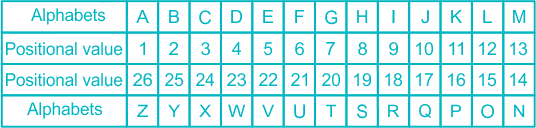
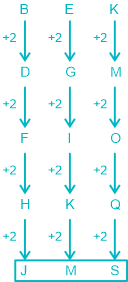 Hence, the correct answer is “Option 3”.
Q2 · Series
What comes next?
MZM, PXK, SVI, ?
- VTG
- USF
- WTG
- XRE
Answer aur solution dekho
Archived marked answer: A
Pattern followed here is,
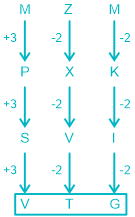 Hence, the correct answer is “Option 1”.
Q3 · Series
What will come at the place of question mark?
5, 9, 17, 33, 65, ?
- 129
- 120
- 130
- 127
Answer aur solution dekho
Archived marked answer: A
Find difference between consecutive terms:
9 - 5 = 4
17 - 9 = 8
33 - 17 = 16
65 - 33 = 32
⇒ Differences: 4, 8, 16, 32 (each double the previous)
Next difference = 32 × 2 = 64
Next term = 65 + 64 = 129
∴ The missing term is 129
Q4 · Series
What comes next: 3, 6, 18, 108, ?
- 1290
- 1944
- 648
- 432
Answer aur solution dekho
Archived marked answer: B
- 3 × 2 = 6
- 6 × 3 = 18
- 18 × 6 = 108
Now, pattern of multiplication: 2, 3, 6, ?
Check pattern: 2 × 1 = 2, 2 × 1 × 1? Let's try simple factor: 2, 3, 6, 108 × ?
Notice ratio:
6 ÷ 3 = 2, 18 ÷ 6 = 3, 108 ÷ 18 = 6 ⇒ Next ratio = 108 ÷ ? = ?
Pattern of multipliers: 2, 3, 6, 18 (previous × next multiplier?)
- 3 × 2 = 6
- 6 × 3 = 18
- 18 × 6 = 108
- 108 × 18 = 1944
∴ Next term = 1944
Q5 · Analogy
Each question involves rearranging specific positions of the letters from the original word, and you must choose the correct transformed version from the options. PLANET is to EAP LNT as TARGET is to:
- AGETRT
- GAE TRT
- ERTAGT
- GEA TRT
Answer aur solution dekho
Archived marked answer: C
PLANET is to EAP LNT
 Similarly,
TARGET is to:
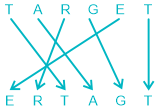 Hence, the correct answer is “Option 3”.
Q6 · Puzzle Subtypes Not To Miss
If 2 @ 3 = 13, 3 @ 4 = 25, then what is 4 @ 5?
- 36
- 39
- 41
- 33
Answer aur solution dekho
Archived marked answer: C
Logic Used:
Pattern → a² + b²
Calculation:
2 @ 3
⇒ 2² + 3²
⇒ 4 + 9 = 13
3 @ 4
⇒ 3² + 4²
⇒ 9 + 16 = 25
4 @ 5
⇒ 4² + 5²
⇒ 16 + 25 = 41
∴ The correct answer is option (3).
Q7 · Puzzle Subtypes Not To Miss
If 6 * 3 = 54 and 8 * 2 = 48, what is 5 * 4?
- 40
- 44
- 45
- 60
Answer aur solution dekho
Archived marked answer: D
Logic Used:
Pattern → a * b = a × b × 3
Calculation:
6 * 3 = 6 × 3 × 3 = 54
8 * 2 = 8 × 2 × 3 = 48
5 * 4 = 5 × 4 × 3 = 60
∴ The correct answer is option (4).
Q8 · Puzzle Subtypes Not To Miss
The following equation is incorrect. Which two signs should be interchanged to correct the equation?
18 + 6 × 4 - 12 ÷ 3 = 17
- + and ×
- × and ÷
- + and -
- - and ÷
Answer aur solution dekho
Archived marked answer: D
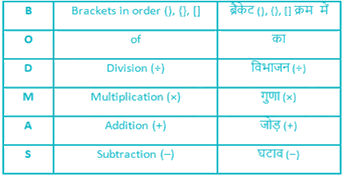 Given equation:
18 + 6 × 4 - 12 ÷ 3 = 17
1) Interchanging + and ×
New equation: 18 × 6 + 4 - 12 ÷ 3
= 18 × 6 + 4 - 12 ÷ 3
= 108 + 4 - 4
= 112 - 4
= 108 ≠ 17 (Incorrect)
2) Interchanging × and ÷
New equation: 18 + 6 ÷ 4 - 12 × 3
= 18 + 6 ÷ 4 - 12 × 3
= 18 + 1.5 - 36
= 19.5 - 36
= -16.5 ≠ 17 (Incorrect)
3) Interchanging + and -
New equation: 18 - 6 × 4 + 12 ÷ 3
= 18 - 6 × 4 + 12 ÷ 3
= 18 - 24 + 4
= -6 + 4
= -2 ≠ 17 (Incorrect)
4) Interchanging - and ÷
New equation: 18 + 6 × 4 ÷ 12 - 3
= 18 + 6 × 4 ÷ 12 - 3
= 18 + 24 ÷ 12 - 3
= 18 + 2 - 3
= 20 - 3
= 17
17 = 17 (Correct)
Hence, the correct answer is "Option 4".
Q9 · Puzzle Subtypes Not To Miss
If the given symbols mean:
'+' means 'divided by'
'-' means 'multiplied by'
'x' means 'minus'
'÷' means 'plus'
Then, find the value of the following expressions: 8 ÷ 2 x 3 + 18 - 6=?
- 9
- 11
- 13
- 15
Answer aur solution dekho
Archived marked answer: A
Given Equation : 8 ÷ 2 x 3 + 18 - 6 = ?
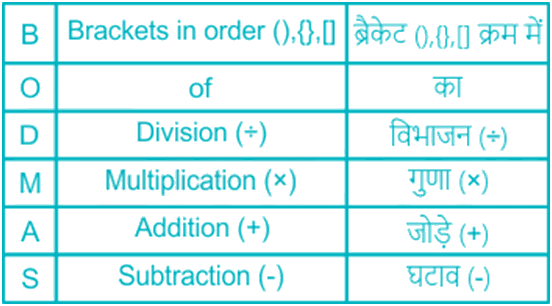 '+' means 'divided by' '-' means 'multiplied by' 'x' means 'minus' '÷' means 'plus'
After interchanging the signs
⇒ 8 + 2 - 3 ÷ 18 x 6=?
⇒ 8 + 2 - (1 / 6 ) x 6=?
⇒ 10 -1 = 9
∴ The correct answer is option (1).
Q10 · Puzzle Subtypes Not To Miss
If + = ÷, - = ×, ÷ = +, × = -; then 36 + 6 - 2 × 3 = ?
- 6
- 15
- 13
- 9
Answer aur solution dekho
Archived marked answer: D
Given Equation : 36 + 6 - 2 × 3 = ?
'+' means 'divided by' '-' means 'multiplied by' '×' means 'minus' '÷' means 'plus' Q11 · Puzzle Subtypes Not To Miss
The given statements are followed by two conclusions. Find out which conclusion is TRUE based on the given statements.
Statements:
J > K = L, M ≥ N Q > R
Conclusions:
I. P > M
II. N < P
- Only conclusion I is true
- Only conclusion II is true
- Neither conclusion I nor II is true
- Both conclusion I and II are true
Answer aur solution dekho
Archived marked answer: B
Given:
Statements:
J > K = L, M ≥ N Q > R
Conclusions:
I. P > M
II. N J > K = L
N P (undefined)
N M ⇒ Cannot determine ⇒ FALSE
II. N < P ⇒ True
∴ Only conclusion II is TRUE
Q12 · Coding Decoding
If 'SUN' is coded as 'RTM', what is the code for 'MOON'?
- LNNP
- LNNM
- LNNO
- LMPM
Answer aur solution dekho
Archived marked answer: B
Logic Used:
Each letter −1 position in alphabet
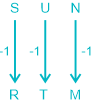 Similarly,
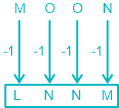 Hence, the correct answer is “Option 2”.
Q13 · Classification Odd One Out
Find the odd one out: :
Jawaharlal Nehru, Indira Gandhi, Atal Bihari Vajpayee, Sardar Vallabhbhai Patel, Narendra Modi, Rajiv Gandhi
- Jawaharlal Nehru
- Atal Bihari Vajpayee
- Sardar Vallabhbhai Patel
- Narendra Modi
Answer aur solution dekho
Archived marked answer: C
Logic Used:
⇒ Jawaharlal Nehru → Prime Minister ✔
⇒ Indira Gandhi → Prime Minister ✔
⇒ Atal Bihari Vajpayee → Prime Minister ✔
⇒ Narendra Modi → Prime Minister ✔
⇒ Rajiv Gandhi → Prime Minister ✔
⇒ Sardar Vallabhbhai Patel → Deputy Prime Minister ✖
∴ Odd one out Sardar Vallabhbhai Patel.
Q14 · Classification Odd One Out
Find the odd one out from the given alternatives:
- Alluvial Soil
- Black Soil
- Red Soil
- Igneous Rock
Answer aur solution dekho
Archived marked answer: D
Logic Used:
Check category → Soil or Rock
⇒ Alluvial Soil → Type of Soil ✔
⇒ Black Soil → Type of Soil ✔
⇒ Red Soil → Type of Soil ✔
⇒ Igneous Rock → Type of Rock ✖
∴ Odd one out Igneous Rock.
Q15 · Blood Relations
A is the brother of B. C is the sister of B. D is the father of C. How is D related to A?
- Father
- Uncle
- Brother
- Grandfather
Answer aur solution dekho
Archived marked answer: A
Preparing the family tree using the following symbol:
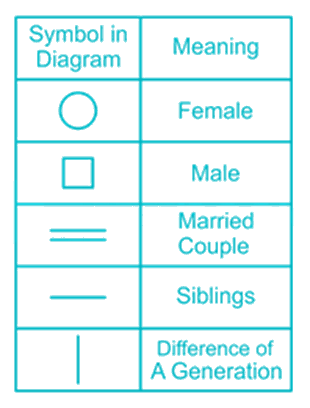 Family tree
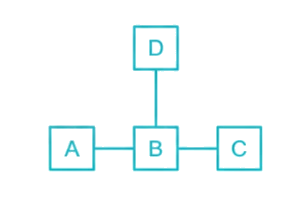 ∴ D is Father of A.
Hence, the correct answer is “Option 1”.
Q16 · Blood Relations
Pointing to a boy, a man said, "He is the son of my wife's sister's husband." How is the boy related to the man?
- Son
- Nephew
- Brother-in-law
- Cousin
Answer aur solution dekho
Archived marked answer: B
By using the symbols in the table given below, we can draw the following family tree:
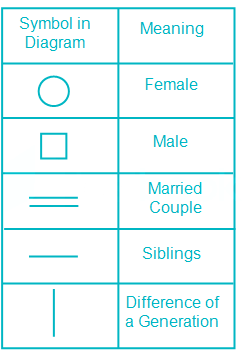 Pointing to a boy, a man said, "He is the son of my wife's sister's husband." How is the boy related
Q17 · Alphabet Test
Rearrange the letters given below to form the name of a weapon:
REPSA
- parse
- spear
- spare
- asper
Answer aur solution dekho
Archived marked answer: B
Logic Used:
Rearrange letters to form a meaningful weapon name
R E P S A ⇒ Arrange letters → S P E A R
( A long stick weapon with a sharp pointed metal tip).
∴ The correct answer is option (2).
Q18 · Similarity and Differences
Choose the address that is the same as the one given below.
No. 44, Hillcrest Villas, Shimla, Himachal Pradesh - 171001
- No. 44, Hillcrest Villas, Shimla, Uttarakhand - 171001
- No. 44, Hillcrest Villas, Shimla, Himachal Pradesh - 171001
- No. 44, Hillcrest Villas, Shimla, Punjab - 171001
- No. 44, Hillcrest Villas, Shimla, Delhi - 171001
Answer aur solution dekho
Archived marked answer: B
Address
Options
No. 44, Hillcrest Villas, Shimla, Himachal Pradesh – 171001
1
No. 44, Hillcrest Villas, Shimla, Uttarakhand – 171001
No. 44, Hillcrest Villas, Shimla, Himachal Pradesh – 171001
2
No. 44, Hillcrest Villas, Shimla, Himachal Pradesh – 171001
No. 44, Hillcrest Villas, Shimla, Himachal Pradesh – 171001
3
No. 44, Hillcrest Villas, Shimla, Punjab – 171001
No. 44, Hillcrest Villas, Shimla, Himachal Pradesh – 171001
4
No. 44, Hillcrest Villas, Shimla, Delhi – 171001
Thus, option 2 is exactly the same as the one given.
Hence, the correct answer is "Option 2".
Q19 · Similarity and Differences
Which of the following is/are identical to the address given:
Vikram Singh 18B, Golden Heights, Moti Nagar, Delhi, 110011
1. Vikram Singh 18B, Golden Heights, Moti Nagar, Delhi, 110011
2. Vikram Singh 18-B, Golden Heights, Moti Nagar, Delhi, 110011
3. Vikram Singh 18B, Golden Heights, Moti Nagar, Delhi, 110011
4. Vikram Singh 18B, Golden Heights, Moti Nagar, New Delhi, 110011
- 1 and 2
- 1 and 3
- 2 and 4
- 3 and 4
Answer aur solution dekho
Archived marked answer: B
Given Address
Options
Vikram Singh 18B, Golden Heights, Moti Nagar, Delhi, 110011
1
Vikram Singh 18B, Golden Heights, Moti Nagar, Delhi, 110011
Vikram Singh 18B, Golden Heights, Moti Nagar, Delhi, 110011
2
Vikram Singh 18-B, Golden Heights, Moti Nagar, Delhi, 110011
Vikram Singh 18B, Golden Heights, Moti Nagar, Delhi, 110011
3
Vikram Singh 18B, Golden Heights, Moti Nagar, Delhi, 110011
Vikram Singh 18B, Golden Heights, Moti Nagar, Delhi, 110011
4
Vikram Singh 18B, Golden Heights, Moti Nagar, New Delhi, 110011
Explanation:
Option 1 and Option 3 exactly match the given address.
Option 2 is different due to "18-B" instead of "18B".
Option 4 is different because "New Delhi" is used instead of "Delhi".
Thus, the identical addresses are 1 and 3.
Hence, the correct answer is "Option 2"
Q20 · Logical Statement Questions
Identify the relation between Statement I and Statement II.
Statement I. The bank's net profit increased significantly in the last quarter. Statement II. The bank implemented cost-cutting measures and improved loan recovery.
- I is the cause and II is the effect.
- II is the cause and I is the effect.
- Both are independent effects.
- No relation.
Answer aur solution dekho
Archived marked answer: B
Statement I. The bank's net profit increased significantly in the last quarter → Effect (The bank's net profit increased significantly.)
Statement II. The bank implemented cost-cutting measures and improved loan recovery → Cause (The bank implemented cost-cutting measures and improved loan recovery)
II is the cause and I is the effect.
Hence, the correct answer is “Option 2”.
Q21 · Logical Statement Questions
Instruction: Identify the assumptions that must hold for the statement to be valid, then choose the correct option.
Statement: While technological advancements in energy production have made renewable sources more cost-competitive, their intermittent nature means that large-scale adoption will require significant investments in energy storage technologies to stabilize the grid.
Assumptions:
I. Renewable energy sources are not continuous and need energy storage solutions.
II. The high cost of renewable energy production makes its adoption difficult without subsidies.
III. Energy storage technologies are a necessary component of a stable energy grid with high renewable energy input.
- Only I and III are implicit
- Only II and III are implicit
- Only I is implicit
- All assumptions are implicit
Answer aur solution dekho
Archived marked answer: A
⇒ Statement mentions intermittency ⇒ Assumption I is required ✅
⇒ Statement does not mention cost barriers or subsidies ⇒ Assumption II is not required ❌
⇒ Statement says large-scale adoption requires energy storage for grid stability ⇒ Assumption III is required ✅
∴ Assumptions I and III are correct
Q22 · Logical Statement Questions
Read the following statement carefully and identify the conclusion that follows.
Statement: Traffic violations have decreased after the installation of speed cameras.
Conclusions:
I. Surveillance discourages rule-breaking.
II. People respect traffic rules voluntarily.
- Only Conclusion I follows
- Only Conclusion II follows
- Both I and II follow
- Neither I nor II follows
Answer aur solution dekho
Archived marked answer: A
Statement: Traffic violations have decreased after the installation of speed cameras.
Conclusions:
I. Surveillance discourages rule-breaking → Follow (because the decrease in violations is linked to the presence of cameras (a form of surveillance), suggesting people are avoiding breaking rules due to monitoring).
II. People respect traffic rules voluntarily → Does not follow ( the statement does not say people are following rules *on their own*. It suggests behavior changed due to cameras, not voluntary respect)
Only Conclusion I follows.
Hence, the correct answer is “Option 1”.
Q23 · Logical Statement Questions
Read the following statement carefully and identify the conclusion that follows.
Statement: The government has announced a reduction in LPG subsidies.
Conclusions:
I. Citizens will now have to pay more for LPG.
II. The government has no money left.
- Only Conclusion I follows
- Only Conclusion II follows
- Both I and II follow
- Neither I nor II follows
Answer aur solution dekho
Archived marked answer: A
Statement: The government has announced a reduction in LPG subsidies.
Conclusions:
I. Citizens will now have to pay more for LPG → Follow (if subsidies are reduced, the financial support decreases, so people generally have to pay more).
II. The government has no money left → Does not follow (reduction in subsidy does not necessarily mean the government has no money; there could be many other reasons (policy change, budget reallocation, etc)).
Only Conclusion I follows.
Hence, the correct answer is “Option 1”.
Q24 · Miscellaneous Other Possibilities
If 25% of a certain number is 15, what is that number?
- 45
- 60
- 75
- 90
Answer aur solution dekho
Archived marked answer: B
Given:
25% of number = 15
Formula Used:
Percentage = (Part / Whole) × 100
Calculations:
Let number = x
25% of x = 15
⇒ d25/100 times x = 15
⇒ d1/4 times x = 15
⇒ x = 15 × 4
⇒ x = 60
∴ The correct answer is option (2).
Q25 · Miscellaneous Other Possibilities
A 30 L mixture contains milk and water in the ratio 3:2. How much milk must be added to make it 4:1?
- 51 L
- 60 L
- 30 L
- 40 L
Answer aur solution dekho
Archived marked answer: C
Given:
Total mixture = 30 L
Milk : Water = 3 : 2
Calculation:
Milk = 30 × 3/5 = 18 L
Water = 30 × 2/5 = 12 L
Let milk added = x L
New milk = 18 + x
Water = 12
Required ratio = 4 : 1
⇒ d(18 + x)/12 = d4/1
⇒ 18 + x = 48
⇒ x = 30 L
∴ The correct answer is option (3).
General Awareness
Q1 · Art and Culture
Vilasini Natyam, once performed in temples and courts, is a classical dance form revived in which Indian state?
- Tamil Nadu
- Karnataka
- Andhra Pradesh
- Kerala
Answer aur solution dekho
Archived marked answer: C
The correct answer is Andhra Pradesh.
Key Points
- Vilasini Natyam is a classical dance form that was historically performed in temples and courts in Andhra Pradesh.
- It was traditionally practiced by Devadasis as part of ritual worship and cultural performances in temples.
- The dance form was revived in the 20th century by Padma Bhushan Swapnasundari, who played a significant role in bringing it back to prominence.
- Vilasini Natyam is known for its intricate footwork, expressive gestures, and deep connection to religious and cultural traditions.
- It is rooted in the Natya Shastra, an ancient Indian treatise on performing arts, and is characterized by its storytelling and devotional themes.
Additional Information
- Tamil Nadu (Option 1):
- Tamil Nadu is renowned for Bharatanatyam, one of the oldest classical dance forms in India.
- Bharatanatyam originated in Tamil Nadu and was traditionally performed in temples as a form of devotional offering to deities.
- It is characterized by its fixed upper torso, bent legs, intricate hand gestures, and facial expressions that narrate stories.
- Karnataka (Option 2):
- Karnataka is known for Yakshagana, a traditional dance-drama form that combines dance, music, and dialogue.
- Yakshagana originated in coastal Karnataka and is recognized for its elaborate costumes, vibrant makeup, and powerful storytelling.
- It primarily depicts themes from epics like the Ramayana and Mahabharata.
- Kerala (Option 4):
- Kerala is famous for Kathakali, a highly stylized classical dance-drama noted for its elaborate makeup, costumes, and facial expressions.
- It is deeply rooted in Hindu mythology and is often performed as part of temple rituals and cultural festivals.
- Other significant dance forms from Kerala include Mohiniyattam, which is a graceful classical dance form performed by women.
Q2 · Art and Culture
In Rāga Vivodha, Pt. Somnath defined a rāga through Devamāyā svarūpa (ethos). Which of the following, denoting its tonal structure?
- Tālanga
- Rūpa
- Swarlakshana
- Jāti
Answer aur solution dekho
Archived marked answer: C
The correct answer is Swarlakshana.
Key Points
- In "Rāga Vivodha," Pt. Somnath defines a rāga through its Devamāyā svarūpa, which refers to the ethos or essence of a rāga.
- The term Swarlakshana is used to describe the tonal structure and characteristics of a rāga.
- Swarlakshana includes specific details of notes (swaras), ascending (āroha) and descending (avaroha) scales, and their unique arrangements that distinguish one rāga from another.
- It provides the foundation for understanding the technical and melodic framework of a rāga, making it an essential concept in Indian classical music theory.
- Swarlakshana serves as a guideline for composers and performers to adhere to the rāga’s traditional structure while improvising within its framework.
Additional Information
- Tālanga
- Tālanga typically refers to rhythmic patterns or aspects associated with Indian classical music.
- It focuses on the time cycle (tāla) used in compositions and performances, which is distinct from the melodic framework of a rāga.
- While an integral part of Indian music, it is not related to defining the tonal structure of a rāga.
- Rūpa
- Rūpa translates to "form" or "appearance" and can be a generic term referring to the overall aesthetic or shape of a musical piece.
- However, it is not a technical term used specifically for describing the tonal structure of a rāga.
- Jāti
- Jāti refers to the classification of rāgas based on the number of swaras used in ascending and descending scales.
- It divides rāgas into categories such as Audava (5 notes), Shadava (6 notes), and Sampurna (7 notes).
- While closely related to rāga structure, it does not specifically define the tonal framework in the detailed manner that Swarlakshana does.
Q3 · Art and Culture
Match the dominant folk dance with the song-theme:
Folk dance
Song-theme
1. Panthi
A. Devotional hymns to Guru Ghasidas (Hari-Gaitri)
2. Gotipua
B. Krishna-Jagannath leela narratives
3. Kalbelia
C. Sensuous serpent metaphors
4. Tippani
D. Work-song pounding couplets (saathiyo re)
- 1-A 2-B 3-C 4-D
- 1-B, 2-A, 3-D, 4-C
- 1-C 2-B 3-A 4-D
- 1-A 2-C 3-B 4-D
Answer aur solution dekho
Archived marked answer: A
The correct answer is Option 1: 1-A 2-B 3-C 4-D.
Key Points
- Panthi: This folk dance is associated with devotional hymns to Guru Ghasidas (Hari-Gaitri). It is performed by the Satnami community of Chhattisgarh and is deeply spiritual in nature.
- Gotipua: This traditional dance of Odisha narrates Krishna-Jagannath leela. It is performed by young boys dressed as females and is a precursor to the Odissi dance form.
- Kalbelia: The Kalbelia dance of Rajasthan uses sensuous serpent metaphors to mimic the movements of a snake, reflecting the community’s traditional association with snake charming.
- Tippani: This is a work-song dance from Gujarat that features pounding couplets (saathiyo re). It is performed by women using long sticks to pound the ground in rhythm.
Additional Information
- Panthi Dance:
- It is a devotional dance form performed by the Satnami sect in Chhattisgarh.
- The dance is a tribute to Guru Ghasidas, who is revered as a spiritual leader and social reformer.
- Gotipua Dance:
- This dance form has been performed in Odisha since ancient times, often in temples to praise Lord Jagannath and Lord Krishna.
- Gotipua translates to “single boy,” as young boys dress up as female dancers for this performance.
- Kalbelia Dance:
- Performed by the Kalbelia community of Rajasthan, who were traditionally snake charmers.
- The dance involves intricate footwork and fluid movements that mimic the slithering of a snake.
- Tippani Dance:
- This folk dance originates from the Saurashtra region of Gujarat.
- Performed by women in groups, it is a work-oriented dance in which pounding sticks are used rhythmically to compact mud or clay.
Q4 · Art and Culture
The festival of Bhagoria begins seven days before which Hindu festival?
- Diwali
- Holika Dahan
- Navratri
- Makar Sankranti
Answer aur solution dekho
Archived marked answer: B
The correct answer is Holika Dahan.
Key Points
- The Bhagoria festival is celebrated by the tribal communities, primarily the Bhil and Bhilala tribes, in the Indian states of Madhya Pradesh and Maharashtra.
- The festival begins seven days before Holika Dahan, which marks the start of Holi celebrations.
- Bhagoria is a unique tribal festival where fairs are held, and young people traditionally choose their life partners.
- During the festival, markets are set up, and cultural activities such as dances and music are performed.
- It is a celebration of love, joy, and social bonding among the tribal communities.
Additional Information
- Diwali
- Diwali, also known as the Festival of Lights, is a major Hindu festival celebrated across India and the world.
- It signifies the victory of light over darkness and good over evil, commemorating Lord Rama's return to Ayodhya after defeating Ravana.
- The festival involves lighting lamps (diyas), bursting crackers, and sharing sweets.
- It typically falls in October or November, depending on the lunar calendar.
- Navratri
- Navratri is a nine-day Hindu festival dedicated to the worship of Goddess Durga and her nine forms.
- It is celebrated twice a year—Sharad Navratri (autumn) and Chaitra Navratri (spring).
- The festival includes fasting, prayers, and cultural activities such as Garba and Dandiya Raas dances.
- Navratri symbolizes the triumph of good over evil, particularly Goddess Durga's victory over the demon Mahishasura.
- Makar Sankranti
- Makar Sankranti is a Hindu festival celebrated to mark the transition of the Sun into the zodiac sign Capricorn (Makara).
- It is associated with the harvest season and is observed with kite flying, feasting, and rituals across India.
- The festival usually falls on January 14th and signifies the end of the winter solstice.
- Different regions of India have unique names and traditions for celebrating Makar Sankranti, such as Pongal in Tamil Nadu and Lohri in Punjab.
Q5 · Indian Polity and Constitution
Which Article empowers the Parliament to create laws on State List subjects under national interest?
- Article 249
- Article 253
- Article 248
- Article 254
Answer aur solution dekho
Archived marked answer: A
The correct answer is Article 249.
Key Points
- Article 249 of the Indian Constitution empowers Parliament to legislate on matters enumerated in the State List if the Rajya Sabha declares by a resolution supported by not less than two-thirds of its members present and voting that it is necessary in the national interest.
- This resolution remains valid for one year and can be extended by one year at a time through further resolutions.
- The laws made under Article 249 are only applicable as long as the resolution is in force and cease to have effect after six months once the resolution expires.
- The provision ensures that Parliament can address matters of national interest even in areas under the State List, maintaining the unity and integrity of the country.
- Examples of matters in the State List include public order, police, public health, and agriculture, among others.
Additional Information
- Article 253:
- Article 253 enables Parliament to make laws for implementing any treaty, agreement, or convention with other countries or for implementing decisions made at international conferences, associations, or other bodies.
- This article primarily deals with India's compliance with international obligations and agreements.
- It serves as a basis for enacting laws on matters that may fall in the State List if required for implementing international commitments.
- Article 248:
- Article 248 provides Parliament with exclusive power to make laws on matters not enumerated in the State List or the Concurrent List, referred to as the residuary powers of legislation.
- This article ensures that any subject not explicitly mentioned in the Constitution can still be legislated upon by Parliament.
- It reflects the flexibility of the Indian Constitution in adapting to emerging issues and challenges.
- Article 254:
- Article 254 resolves conflicts between laws made by Parliament and laws made by the State Legislature on matters in the Concurrent List.
- If there is inconsistency between the two, the law made by Parliament prevails, and the state law becomes void to the extent of the repugnancy.
- However, a state law on the same subject can prevail if it has received Presidential assent, unless Parliament later enacts a law inconsistent with it.
Q6 · Indian Polity and Constitution
Consider the following statements:
1. The Sixth Schedule is applicable to Nagaland and Arunachal Pradesh.
2. It empowers autonomous district councils to make laws on specified subjects.
Which of the above is/are correct?
- Only 1
- Only 2
- Both 1 and 2
- Neither 1 nor 2
Answer aur solution dekho
Archived marked answer: B
The correct answer is Option 2.
Key Points
- The Sixth Schedule of the Indian Constitution is applicable only to the four northeastern states: Assam, Meghalaya, Tripura, and Mizoram. It is not applicable to Nagaland and Arunachal Pradesh.
- Under the Sixth Schedule, autonomous district councils (ADCs) are empowered to make laws on specified subjects such as land management, forest resources, and inheritance.
- These co
Q7 · Indian Polity and Constitution
Which of the following pairs (Educational Event - Key Outcome/Initiative) is correctly matched?
- Charter Act, 1813 – Allocated funds for promotion of education
- Macaulay's Minute, 1835 – Emphasized traditional Sanskrit learning
- Serampore Mission – Promoted technical education for elite Indians
- Orientalist-Anglicist Debate – Resolved by Charter Act, 1833
Answer aur solution dekho
Archived marked answer: A
The correct answer is Option 1: Charter Act, 1813 – Allocated funds for promotion of education.
Key Points
- The Charter Act of 1813 was a landmark legislation that marked the beginning of formal state support for education in India.
- It allocated a sum of Rs. 1 lakh annually for the promotion of education among Indians. This was the first instance of the British government funding education in India.
- The Act emphasized the need for promoting knowledge of sciences and literature in India, focusing on Western education.
- This initiative laid the foundation for future educational reforms and the establishment of institutions to impart Western-style education.
- The Charter Act, 1813, also allowed missionaries to spread education and Christianity in India, further influencing the educational landscape.
Additional Information
- Evolution of Education Policies in Colonial India
- The question revolves around key milestones in the history of education during British rule in India.
- Various policies, acts, and initiatives shaped the educational system, transitioning from traditional Indian learning to Western-style education.
- Important events like the Charter Act, Macaulay's Minute, and contributions of missionaries played vital roles in transforming education in colonial India.
Q8 · Indian Polity and Constitution
What is the minimum age required to contest the Presidential election in India?
- 35
- 30
- 25
- 40
Answer aur solution dekho
Archived marked answer: A
The correct answer is 35.
Key Points
- The minimum age required to contest the Presidential election in India is 35 years.
- This eligibility criterion is specified in Article 58(1)(b) of the Indian Constitution.
- In addition to the age requirement, the candidate must be an Indian citizen and qualified to be elected as a member of the Lok Sabha.
- Presidential candidates must secure endorsements from at least 50 proposers and 50 seconders, who should be members of the Electoral College.
- The Electoral College for the Presidential election includes elected members of both Houses of Parliament and the Legislative Assemblies of States and Union territories.
Additional Information
- Presidential Elections in India
- The President is the head of state and the highest constitutional authority in India.
- The election process is conducted through a system of proportional representation by means of a single transferable vote.
- The President holds office for a term of 5 years but is eligible for re-election.
Q9 · Indian Economy
Consider the following statements and choose the correct option:
Statement 1: The Production Possibility Frontier (PPF) shows the trade-offs and opportunity costs faced by an economy.
Statement 2: The PPF is used to estimate the government's total revenue and expenditure.
- Only Statement 1 is correct
- Only Statement 2 is correct
- Both Statement 1 and Statement 2 are correct
- Neither Statement 1 nor Statement 2 is correct
Answer aur solution dekho
Archived marked answer: A
The correct answer is Option 1: Only Statement 1 is correct.
Key Points
- The Production Possibility Frontier (PPF): It represents the maximum possible combinations of goods and services that an economy can produce given its resources and technology.
- Trade-offs and Opportunity Costs: The PPF graphically demonstrates the trade-offs and opportunity costs involved in allocating resources between different products.
- Efficient Resource Utilization: Any point on the PPF curve indicates the efficient use of resources, while points inside the curve indicate underutilization, and points outside are unattainable.
- PPF is a cornerstone concept in economics and is used to understand how economies allocate scarce resources efficiently.
- Statement 1 is correct because the PPF explicitly depicts trade-offs and opportunity costs faced by an economy.
Additional Information
- Concept of Opportunity Cost:
- Opportunity cost refers to the value of the next best alternative foregone when a choice is made.
- In the context of the PPF, when resources are reallocated from producing one good to another, the opportunity cost is the amount of the first good that must be sacrificed.
- Shape of the PPF:
- The PPF is typically concave to the origin because of the law of increasing opportunity costs. As more resources are allocated to one good, the cost of producing additional units of that good increases.
- However, a straight-line PPF indicates constant opportunity costs, which is less common in real-world scenarios.
Q10 · Indian Economy
Which Five-Year Plan focused on heavy industries?
- First
- Second
- Third
- Fourth
Answer aur solution dekho
Archived marked answer: B
The correct answer is Second.
Key Points
- The Second Five-Year Plan (1956-1961) of India was focused on the rapid industrialization of the country, especially the establishment and growth of heavy industries.
- This plan was based on the Mahalanobis Model, named after P.C. Mahalanobis, which emphasized investment in the heavy industrial sector as a means to achieve long-term economic growth.
- Key industries such as steel, coal, and heavy machinery were given priority to build a strong industrial base for the country.
- The government established public sector enterprises like the Bhilai Steel Plant, Durgapur Steel Plant, and Bokaro Steel Plant under this plan.
- Promoting self-reliance in industrial production and reducing dependence on foreign imports was one of the main objectives of this plan.
Additional Information
- First Five-Year Plan (1951-1956):
- The primary focus of the First Five-Year Plan was on the agricultural sector to address food shortages and ensure self-sufficiency in food production.
- It was based on the Harrod-Domar Model, which emphasized increasing investment in agriculture and irrigation projects.
- Key projects included the construction of major dams like Bhakra Nangal and Hirakud to improve irrigation and power generation.
- Third Five-Year Plan (1961-1966):
- The Third Plan aimed to achieve self-reliance in food production and accelerate economic development by prioritizing both agriculture and industry.
- It also focused on defense production following the 1962 Indo-China War.
- The plan, however, faced setbacks due to the war, drought, and economic challenges, leading to its partial success.
- Fourth Five-Year Plan (1969-1974):
- The Fourth Plan primarily focused on stabilizing the economy and achieving self-reliance in technology and production.
- It emphasized the growth of the Green Revolution to boost agricultural productivity and reduce dependence on food imports.
- Industrial growth was also pursued, but the focus shifted towards balancing agriculture and industry.
Q11 · Indian Economy
Economic liberalisation mainly affects which sector?
- Primary and Tertiary
- Primary and Secondary
- Secondary and Tertiary
- Primary, Secondary, and Tertiary
Answer aur solution dekho
Archived marked answer: D
The correct answer is Primary, Secondary, and Tertiary.
Key Points
- Economic liberalisation refers to the relaxation of government restrictions in areas such as trade, investment, and industry to encourage greater efficiency and economic growth.
- It impacts all three sectors of the economy—primary, secondary, and tertiary—by fostering competition, improving productivity, and increasing the flow of foreign investments.
- In the primary sector, liberalisation has enhanced agricultural exports, introduced modern farming techniques, and opened markets for global trade.
- In the secondary sector, industrial growth has surged due to deregulation of industries, foreign direct investment (FDI), and access to new technologies.
- In the tertiary sector, liberalisation has significantly boosted services such as banking, communication, IT, and transportation, making India a global hub for outsourcing and technology-driven services.
Additional Information
- Economic liberalisation was introduced in India in 1991 under the leadership of Prime Minister P.V. Narasimha Rao and Finance Minister Dr. Manmohan Singh.
- It aimed to remove trade barriers, deregulate industries, and open the economy to global markets.
- Liberalisation policies have led to rapid economic growth, increased foreign investments, and integration with the global economy.
- Key measures include reduction in tariffs, removal of licensing requirements, and encouragement of private sector involvement in various industries.
Q12 · Indian Economy
Read the following statements carefully and choose the correct option regarding Assertion (A) and Reason (R).
Assertion (A): The 1991 reforms boosted India foreign exchange reserves significantly.
Reason (R): Liberalized trade policies increased both exports and capital inflows.
- Both A and R are true and R is the correct explanation of A.
- Both A and R are true but R is not the correct explanation of A.
- A is true but R is false.
- A is false but R is true.
Answer aur solution dekho
Archived marked answer: A
The correct answer is Both A and R are true and R is the correct explanation of A.
Key Points
- The economic reforms of 1991, often referred to as the LPG (Liberalization, Privatization, and Globalization) reforms, were a watershed moment in India's economic history.
- Post-1991 reforms, India experienced a significant increase in foreign exchange reserves due to improved capital inflows and enhanced export performance.
- Trade liberalization led to a reduction in import tariffs, simplified export-import procedures, and a more open trade regime, which boosted export competitiveness.
- The liberalized foreign investment policies encouraged Foreign Direct Investment (FDI) and Foreign Portfolio Investment (FPI) inflows, further bolstering foreign exchange reserves.
- Reason (R) is the correct explanation of Assertion (A) because the enhanced trade policies and capital inflows directly contributed to the improvement of India's foreign exchange position.
Additional Information
- Impact of 1991 Economic Reforms
- The 1991 economic reforms dismantled the License Raj, reduced bureaucratic red tape, and opened up the Indian economy to foreign investment.
- India's GDP growth rate accelerated, and the country transitioned from a highly regulated economy to a market-driven one.
- Key measures included devaluation of the rupee, reduction in fiscal deficits, and structural adjustments to encourage private sector growth.
Q13 · Sports Static GK
Who won India's first Paralympic medals in the women's 200m T12 and men's javelin throw F41 events at Paris 2024?
- Simran (bronze, 200m T12) and Navdeep Singh (gold, javelin F41)
- Navdeep Singh (bronze, 200m T12) and Simran (gold, javelin F41)
- Simran (silver, 200m T12) and Navdeep Singh (gold, javelin F41)
- Navdeep Singh (gold, 200m T12) and Simran (bronze, javelin F41)
Answer aur solution dekho
Archived marked answer: A
The correct answer is Simran (bronze, 200m T12) and Navdeep Singh (gold, javelin F41).
Key Points
- Simran won India's first Paralympic bronze medal in the women's 200m T12 category at Paris 2024.
- Navdeep Singh secured a historic gold medal in the men's javelin throw F41 category, marking India's dominance in the field events.
- The T12 category in athletics is designated for visually impaired athletes who compete under specific classification rules.
- The F41 category in javelin throw is specifically for athletes with short stature, allowing them to compete on an equal platform.
- India's performance at the Paris 2024 Paralympics highlighted its growing presence in adaptive sports, with athletes overcoming physical challenges to excel at the highest level.
Additional Information
- Paralympic Classification:
- The Paralympics feature classification systems for athletes with physical, visual, or intellectual impairments to ensure fair competition.
- Track and field events are divided into categories based on the type of disability, such as T (Track) for running events and F (Field) for throwing events.
- T12 is specific to athletes with visual impairments who may compete with the assistance of a guide.
- F41 is reserved for athletes with short stature, ensuring equitable competition within this classification.
- India in Paralympics:
- India's participation in the Paralympics has grown exponentially in recent years, showcasing remarkable performances in athletics, shooting, and badminton.
- Paralympic athletes often overcome significant challenges to represent their country and inspire millions through their achievements.
- Medals won by athletes like Simran and Navdeep Singh reflect India's investment in adaptive sports and the potential of athletes with disabilities.
Q14 · Sports Static GK
Which of the following statements about the 2024 Inter-State Athletics Championships is/are correct?
1.) Sahil Silwal crossed 80m for the first time this season to win javelin gold.
2.) Jyothika and Amoj's 4x400m relay team broke the Asian Games record.
- Only 1
- Only 2
- Both 1 and 2 are correct
- Neither 1 nor 2 is correct
Answer aur solution dekho
Archived marked answer: A
The correct answer is Option 1.
Key Points
- Sahil Silwal crossed the 80m mark in the javelin throw for the first time this season, securing the gold medal in the 2024 Inter-State Athletics Championships.
- This achievement highlights Silwal's consistent improvement and his potential to compete at higher levels, including international competitions.
- The javelin throw event at the Inter-State Athletics Championships is one of the key events that attracts top athletes from across the country.
- The Inter-State Athletics Championships serve as a qualifying platform for athletes to secure spots in major international tournaments, including the Asian Games and World Championships.
Additional Information
- Inter-State Athletics Championships:
- This annual event is organized by the Athletics Federation of India (AFI) and serves as a key platform for athletes to showcase their talent.
- The competition features various track and field events, including sprints, long-distance running, throws, and jumps.
- It often acts as a selection event for international competitions, including the Olympics and Asian Games.
- Javelin Throw in India:
- India has seen a surge in javelin throw performances with athletes like Neeraj Chopra, who won gold at the Tokyo 2020 Olympics, inspiring many young throwers like Sahil Silwal.
- Throwers undergo rigorous training and participate in domestic and international meets to refine their technique and achieve qualifying standards.
- Relay Events:
- Relay races are team events in track and field, requiring precise coordination and speed during baton exchanges.
- The 4x400m relay is one of the most prestigious relay events, often featuring elite athletes and serving as a test of both speed and endurance.
Q15 · Sports Static GK
Which of the following terms is specifically associated with the javelin throw?
- Glide
- Sector
- Vault
- Spin
Answer aur solution dekho
Archived marked answer: B
The correct answer is Sector.
Key Points
- The term sector in the javelin throw refers to the designated area within which the javelin must land for the throw to be considered valid.
- The javelin must land within the 34.92-degree sector marked on the field, ensuring accuracy and fairness in the competition.
- The sector lines are marked as per international standards, and any deviation outside this area results in a foul throw.
- In professional javelin competitions, the sector is closely monitored to ensure compliance with the rules set by World Athletics.
- The sector lines are critical for determining the validity of the throw and play a key role in maintaining the integrity of the sport.
Additional Information
- Glide
- The term glide is associated with the shot put event in athletics.
- It refers to a technique in which the athlete glides across the throwing circle to generate momentum for the throw.
- This method was developed in the 1950s and is commonly used by shot putters to achieve better results.
- The glide technique is one of the two main techniques in shot put, the other being the rotational technique.
- Vault
- The term vault is specifically linked to the pole vault event in athletics.
- In this event, athletes use a pole to propel themselves over a horizontal bar set at a certain height.
- Pole vault requires a combination of speed, strength, and precision to achieve successful clearances.
- It is one of the most technically demanding field events in athletics.
- Spin
- The term spin is primarily associated with the discus throw and hammer throw events in athletics.
- In these events, athletes use a spinning motion to generate rotational force, which helps them throw the implement farther.
- The spin technique is crucial for maximizing the distance in these throwing events.
- It requires precise coordination and balance to execute effectively.
Q16 · Sports Static GK
Where was the 4th KIO National (Senior, U-21 & Para) Karate Championship held from 26-29 March 2025?
- Delhi
- Ahmedabad
- Hyderabad
- Bengaluru
Answer aur solution dekho
Archived marked answer: C
The correct answer is Hyderabad.
Key Points
- The 4th KIO National (Senior, U-21 & Para) Karate Championship was held in Hyderabad, Telangana, from 26-29 March 2025.
- This prestigious event was organized by the Karate India Organization (KIO), which is recognized for promoting karate as a sport across India.
- Hyderabad, known for its well-equipped sports facilities, hosted the event to ensure the participation of athletes from diverse regions of India, including para-athletes.
- The championship aimed to provide a platform for karate enthusiasts to showcase their skills and foster sportsmanship among participants.
- It also served as an opportunity for athletes to qualify for national and international karate competitions in various categories.
Additional Information
- Delhi
- Delhi is a prominent hub for national-level sports events due to its state-of-the-art facilities and infrastructure, such as the Jawaharlal Nehru Stadium and Indira Gandhi Indoor Stadium.
- It has hosted events like the 2010 Commonwealth Games and several international and national championships.
- However, the 4th KIO National Karate Championship was not conducted in Delhi in 2025.
- Ahmedabad
- Ahmedabad, Gujarat, is known for its newly constructed Narendra Modi Stadium, the world's largest cricket stadium.
- It also promotes other sports through various facilities like the Sardar Vallabhbhai Patel Sports Complex.
- Bengaluru
- Bengaluru, Karnataka, is known for promoting sports like cricket, hockey, and athletics, with renowned venues like the M. Chinnaswamy Stadium.
- The city has hosted several national and international sports events, including badminton and football tournaments.
Q17 · Indian Geography
Which of the following best reflects India's operational and diplomatic approach to boundary demarcation with Myanmar amidst recent local protests over fencing?
- India invoked a 1987 treaty and BIMSTEC arbitration to settle boundary pillar disputes.
- India and Myanmar conduct joint surveys and proposed a Joint Boundary Working Group.
- India halted border fencing to avoid ASEAN trade disruptions.
- India dismissed protests and assigned border oversight to AFSPA tribunals.
Answer aur solution dekho
Archived marked answer: B
The correct answer is India and Myanmar conduct joint surveys and proposed a Joint Boundary Working Group.
Key Points
- India and Myanmar share a 1,643-km-long land border, and both countries have a history of amicable relations with a focus on cooperation and mutual respect for sovereignty.
- The joint surveys and the establishment of a Joint Boundary Working Group have been instrumental in addressing boundary demarcation issues.
- India's approach involves collaboration and consultation to address disputes, ensuring that local sentiments and international norms are respected.
- The Joint Boundary Working Group serves as a platform to resolve differences in boundary alignment and ensure smooth implementation of border management mechanisms.
- India’s diplomatic strategy includes balancing national security interests with the need for peaceful resolution of disputes, thereby reducing tensions at the border.
Additional Information
- India-Myanmar Boundary Management
- India and Myanmar share a dynamic relationship involving trade, cultural e×changes, and strategic cooperation.
- Effective boundary management is critical for ensuring security, promoting trade, and fostering strong bilateral relations.
- Both nations work closely to resolve disputes peacefully and strengthen border infrastructure for mutual benefit.
Q18 · Current Affairs
Which Indian initiative under the National Adaptation Fund for Climate Change (NAFCC) aims to improve micro-climate resilience through community-led water harvesting in semi-arid zones?
- Jal Urja Yojana
- Climate Resilient Watershed Programme
- Hariyali Mission
- Jal Mitra Scheme
Answer aur solution dekho
Archived marked answer: B
The correct answer is Climate Resilient Watershed Programme.
Key Points
- Climate Resilient Watershed Programme is an Indian initiative under the National Adaptation Fund for Climate Change (NAFCC) focusing on improving micro-climate resilience in semi-arid zones.
- The programme emphasizes community-led water harvesting techniques to address water scarcity and enhance water resource management.
- It aims to bolster resilience against climate change by promoting sustainable agricultural practices that are less dependent on erratic rainfall.
- The initiative involves the construction of small check dams, percolation tanks, and farm ponds to ensure efficient water storage and utilization.
- By adopting integrated watershed development practices, the programme seeks to mitigate the adverse effects of climate change while improving the livelihoods of farmers in affected regions.
Additional Information
- Jal Urja Yojana
- The name suggests a focus on water and energy conservation; however, no specific programme titled "Jal Urja Yojana" exists under NAFCC or other climate-related schemes.
- It is likely a hypothetical option included in the question.
- Hariyali Mission
- The Hariyali Mission is primarily a plantation and afforestation initiative, aimed at increasing green cover and improving ecological balance.
- It does not directly address micro-climate resilience through community-led water harvesting.
- Jal Mitra Scheme
- The Jal Mitra Scheme is centered around water conservation and community engagement for sustainable water resource management.
- However, it is not linked specifically to the National Adaptation Fund for Climate Change (NAFCC) or its objectives of improving micro-climate resilience in semi-arid zones.
- National Adaptation Fund for Climate Change (NAFCC)
- Launched in 2015, NAFCC is a central government scheme aimed at addressing the impacts of climate change through adaptation measures.
- It provides financial assistance to projects that promote sustainable agricultural practices, water management, and ecosystem conservation.
- NAFCC is particularly focused on vulnerable regions and communities most affected by climate change.
</ul
Q19 · Current Affairs
A key component evaluated by the 2025 Index of Economic Freedom concerning "Government Size" is:
- Public Education Funding
- Government Spending Levels
- National Defense Expenditures
- Foreign Aid Contributions
Answer aur solution dekho
Archived marked answer: B
The correct answer is Government Spending Levels.
Key Points
- The 2025 Index of Economic Freedom evaluates "Government Size" by primarily analyzing government spending levels, tax burdens, and fiscal health.
- The "Government Spending" metric assesses how government expenditures as a percentage of GDP affect economic freedom and growth.
- High government spending is often associated with inefficiencies, slower economic growth, and a reduction in overall economic freedom.
- Countries with lower government spending levels relative to GDP typically score higher in this component, as they allow greater room for private sector activity.
- This category also evaluates the sustainability of government spending to ensure fiscal discipline and avoid excessive public debt.
Additional Information
- Public Education Funding
- While public education funding is an important government expenditure, it is not a primary metric used to evaluate "Government Size" in the Index of Economic Freedom.
- Education funding is typically analyzed under categories such as human capital development or social infrastructure, rather than government size.
- However, excessive government intervention in education systems can impact economic freedom indirectly by increasing public spending levels.
- National Defense Expenditures
- National defense spending is a critical area of government expenditure, but it is not specifically analyzed under "Government Size" in the Index of Economic Freedom.
- Such expenditures are typically assessed in terms of their efficiency and necessity for maintaining national security rather than their impact on economic freedom.
- In some cases, disproportionate defense spending can strain public finances, indirectly affecting economic freedom.
- Foreign Aid Contributions
- Foreign aid contributions are a form of international assistance provided by governments to other nations, often for humanitarian or developmental purposes.
- While foreign aid reflects a country’s external economic policies, it does not directly influence the evaluation of "Government Size" in the Index of Economic Freedom.
- Such contributions are more likely to be assessed under categories like international trade or investment freedom.
Q20 · General Science Biology
Read the following statements about aerobic respiration:
1. Glycolysis occurs in the mitochondria.
2. Kreb's cycle occurs in the mitochondrial matrix.
3. The final electron acceptor in aerobic respiration is oxygen.
Which of the above statements are correct?
- Only 1 and 2 are correct
- Only 2 and 3 are correct
- Only 1 and 3 are correct
- 1, 2 and 3 all are correct
Answer aur solution dekho
Archived marked answer: B
The correct answer is Only 2 and 3 are correct.
Key Points
- Glycolysis does not occur in the mitochondria; it takes place in the cytoplasm of the cell.
- Kreb's cycle (or citric acid cycle) occurs in the mitochondrial matrix, where acetyl-CoA is oxidized to produce energy carriers like NADH and FADH2.
- The final electron acceptor in aerobic respiration is oxygen, which combines with hydrogen ions and electrons to form water at the end of the electron transport chain.
- Aerobic respiration is a multi-step process that includes glycolysis, Kreb's cycle, and oxidative phosphorylation, with mitochondria playing a central role in the latter two stages.
- Energy in the form of ATP is produced primarily during the electron transport chain, a process that is dependent on oxygen as the terminal electron acceptor.
Additional Information
- Kreb's Cycle (Statement 2):
- This cycle occurs in the mitochondrial matrix and is a key step in aerobic respiration.
- It oxidizes acetyl-CoA derived from pyruvate to produce NADH, FADH2, and ATP (or GTP).
- The cycle also releases carbon dioxide as a byproduct.
- Statement 2 is correct as it accurately describes the location of the Krebs' cycle.
- Final Electron Acceptor (Statement 3):
- In the electron transport chain, electrons are passed through a series of protein complexes in the mitochondrial inner membrane.
- The final acceptor of electrons is oxygen, which combines with protons (H+) to form water.
- This step is essential for maintaining the flow of electrons and ensuring the production of ATP.
- Statement 3 is correct.
Q21 · Medieval Indian History
Which of the following dynasties minted the "Dehliwal" coins in Delhi?
- The Gahadavalas
- The Tomaras
- The Khaljis
- The Lodis
Answer aur solution dekho
Archived marked answer: B
The correct answer is The Tomaras.
Key Points
- The "Dehliwal" coins were introduced and minted by the Tomara dynasty during their rule over Delhi in the early medieval period.
- The Tomaras were a Rajput dynasty who ruled Delhi and its surrounding areas between the 8th and 12th centuries.
- The Dehliwal coins were made of silver and were known for their unique and intricate designs, showcasing the craftsmanship of the era.
- These coins held significant importance in trade and commerce, as they became a standard currency in the region.
- The introduction of Dehliwal coins by the Tomaras laid the foundation for a unified monetary system in Delhi, which was later adopted and modified by successive dynasties.
Additional Information
- The Gahadavalas
- The Gahadavalas were a Rajput dynasty that ruled parts of present-day Uttar Pradesh and Bihar during the 11th and 12th centuries.
- Their capital was located in Varanasi (Kashi), and they were known for their patronage of Hindu culture and temples.
- King Govindachandra was one of the notable rulers of the Gahadavala dynasty.
- They did not mint the Dehliwal coins as their rule was centered in regions far from Delhi.
- The Khaljis
- The Khalji dynasty ruled the Delhi Sultanate from 1290 to 1320 and was known for its military campaigns and administrative reforms.
- Their most notable ruler, Alauddin Khalji, implemented significant economic measures, including market control policies.
- The Khalji rulers minted coins, but they were different in design and type from the Dehliwal coins.
- Their coins often carried inscriptions in Persian and Arabic, reflecting the Islamic influence of the period.
- The Lodis
- The Lodis were the last dynasty of the Delhi Sultanate and ruled from 1451 to 1526.
- This Afghan dynasty was known for its architectural contributions and administrative reforms.
- The Lodi rulers minted coins during their reign, but these were distinct from the Dehliwal coins of the Tomaras.
- The Lodi dynasty came to an end after the defeat of Ibrahim Lodi by Babur at the First Battle of Panipat in 1526, leading to the establishment of the Mughal Empire.
Q22 · Medieval Indian History
Which of the following Mughal tombs deviates from the typical square 'hasht-bihisht' (eight-part) layout?
- Humayun's Tomb
- Akbar's Tomb (Sikandra)
- Itimad-ud-Daulah
- Safdarjung's Tomb
Answer aur solution dekho
Archived marked answer: B
The correct answer is Akbar's Tomb (Sikandra).
Key Points
- Akbar's Tomb, located in Sikandra, near Agra, deviates from the traditional 'hasht-bihisht' (eight-part) layout, which is common in Mughal architecture.
- Unlike the square or octagonal base of other Mughal mausoleums, Akbar's Tomb has a pyramidal structure with multiple tiers, culminating in an open terrace without a traditional dome.
- The tomb reflects a unique blend of Hindu, Islamic, Jain, and Buddhist architectural styles, showcasing Akbar's policy of religious tolerance.
- The structure is constructed using red sandstone and white marble, with intricate inlay work, but the absence of a central dome makes it distinct from other Mughal tombs.
- The garden surrounding the tomb follows the charbagh layout, which is divided into four equal quadrants by water channels, a common feature in Mughal gardens.
Additional Information
- Humayun's Tomb:
- Located in Delhi, it was commissioned by Humayun's wife, Haji Begum, in 1569-70.
- The tomb was the first garden-tomb in India and heavily inspired by Persian architecture.
- It follows the typical 'hasht-bihisht' layout, with a central dome and symmetrical square design.
- The structure is made of red sandstone and white marble, symbolizing Mughal grandeur.
- Itimad-ud-Daulah:
- Also known as the "Baby Taj," it is located in Agra and was commissioned by Nur Jahan, the wife of Jahangir, for her father, Mirza Ghiyas Beg.
- This tomb marks the transition from red sandstone to white marble as the primary construction material in Mughal architecture.
- It follows the 'hasht-bihisht' layout and features intricate pietra dura inlay work.
- The tomb is renowned for its delicate carvings and symmetrical design.
- Safdarjung's Tomb:
- Located in Delhi, this tomb was built in 1754 for Safdarjung, the Nawab of Oudh.
- It is one of the last examples of Mughal architecture and follows the 'hasht-bihisht' layout.
- The tomb is made of red sandstone and marble, with a central dome and a charbagh garden layout.
- It reflects the decline of Mughal architectural grandeur, with less intricate decoration compared to earlier tombs.
Q23 · Ancient Indian History
Read the following statements carefully:
Statement 1 : The seals of the Harappan culture were made using locally found steatite.
Statement 2 : These seals often feature animal motifs and undeciphered script symbols. Which of the following is/are correct?
- Only S1
- Only S2
- Both S1 and S2 are correct
- Neither S1 nor S2 is correct
Answer aur solution dekho
Archived marked answer: C
The correct answer is Option 3.
Key Points
- Statement 1 is correct: The seals of the Harappan culture were made using locally found steatite. Steatite, also known as soapstone, was a commonly used material in Harappan civilization due to its easy availability and soft texture, allowing intricate carvings.
- Statement 2 is correct: These seals often feature animal motifs and undeciphered script symbols. The seals depict animals like unicorns, bulls, elephants, and tigers, alongside inscriptions in the undeciphered Harappan script.
- The Harappan seals were primarily used for trade and administrative purposes, serving as markers of identity and authenticity.
- Most seals are square or rectangular, featuring a combination of pictorial motifs and inscriptions, highlighting the advanced artistic and linguistic capabilities of the civilization.
- The seals reflect the cultural and economic aspects of the Harappan civilization, showcasing their trade networks, artistic skills, and early forms of communication.
Additional Information
- Harappan Civilization:
- The Harappan civilization, also known as the Indus Valley Civilization, flourished between 2600 BCE and 1900 BCE in the Indian subcontinent.
- It was characterized by advanced urban planning, including well-organized cities like Harappa, Mohenjo-Daro, and Dholavira.
- Artifacts such as seals, pottery, beads, and tools highlight the economic and artistic achievements of the civilization.
- Despite extensive research, the Harappan script remains undeciphered, limiting complete understanding of their language and administrative practices.
Q24 · Books and Authors Static
Who is the author of the book 'School to Startup: Navigating the Path of Entrepreneurship'?
- Rohit Sinha
- Romila Thapar
- Bipin Chandra
- Shashi Tharoor
Answer aur solution dekho
Archived marked answer: A
The correct answer is Rohit Sinha.
Key Points
- Rohit Sinha is the author of the book *'School to Startup: Navigating the Path of Entrepreneurship'*.
- The book provides insightful guidance for aspiring entrepreneurs, particularly students, on transitioning from academic life to entrepreneurial ventures.
- It emphasizes the challenges and opportunities involved in building startups and navigating the entrepreneurial ecosystem.
- The book highlights key strategies for innovation, funding, team-building, and scaling businesses successfully.
- It serves as a motivational and practical resource for young minds looking to explore entrepreneurship as a career path.
Additional Information
- Romila Thapar
- Romila Thapar is a renowned Indian historian specializing in ancient Indian history.
- Her notable works include *'A History of India'* and *'Early India: From the Origins to AD 1300'*.
- She has contributed extensively to the study of social and political structures in ancient India.
- Bipin Chandra
- Bipin Chandra was a prominent historian of modern Indian history.
- His famous books include *'India's Struggle for Independence'* and *'The Rise and Growth of Economic Nationalism in India'*.
- He focused on India's freedom movement and socio-economic developments during British rule.
- Shashi Tharoor
- Shashi Tharoor is a well-known Indian politician, diplomat, and author.
- His notable books include *'Inglorious Empire: What the British Did and What India Lost'* and *'Why I Am a Hindu'*.
- He writes extensively on history, politics, and international relations.
Q25 · General Science
Consider the following statements about the James Webb Space Telescope (JWST):
1. It observes in the near-infrared and mid-infrared spectrum.
2. It is positioned at the Sun-Earth Lagrange Point L2.
3. It carries a coronagraph for exoplanet detection.
Which of the above statements is/are correct?
- Only 1 and 2
- Only 1 and 3
- Only 2 and 3
- All 1, 2 and 3
Answer aur solution dekho
Archived marked answer: D
The correct answer is Option 4.
Key Points
- The James Webb Space Telescope (JWST) observes primarily in the near-infrared and mid-infrared spectrum, enabling it to peer through cosmic dust and study distant galaxies, stars, and planetary systems.
- It is positioned at the Sun-Earth Lagrange Point L2, approximately 1.5 million kilometers away from Earth, providing a stable environment for its operations while keeping it shielded from solar and terrestrial radiation.
- The JWST is equipped with a coronagraph, a device designed to block light from a star to allow the observation of faint objects like exoplanets orbiting it.
- Launched on December 25, 2021, by NASA, in collaboration with ESA (European Space Agency) and CSA (Canadian Space Agency), the JWST is the most advanced space telescope to date, designed to succeed the Hubble Space Telescope.
- The JWST aims to explore fundamental questions about the formation of stars and galaxies, the atmospheres of exoplanets, and the origins of the universe.
Additional Information
- Lagrange Point L2:
- The Lagrange Point L2 is a gravitationally stable location behind Earth, where the combined gravitational forces of the Sun and Earth allow an object to remain in a fixed position relative to them.
- JWST:
- The JWST's primary mirror is 6.5 meters in diameter, significantly larger than Hubble's 2.4-meter mirror, enhancing its light-gathering capabilities.
- The telescope operates at extremely low temperatures, around -233°C, to ensure optimal performance of its infrared instruments.
- Its sunshield, the size of a tennis court, protects the telescope from solar radiation and helps maintain its operational temperature.
Mathematics
Q1 · Geometry
A sector of a circle has a central angle of 60° and a radius of 8 cm. Another sector of the same circle has a central angle of π/3 radians. What is the ratio of the area of the first sector to the area of the second sector?
- 2:3
- 1:2
- 1:1
- 1:3
Answer aur solution dekho
Archived marked answer: C
Shortcut Trick
For a given circle, the area of a sector is directly proportional to its central angle.
Central angle of the first sector = 60°.
Central angle of the second sector = π/3 radians = (180° ÷ 3) = 60°.
Since both sectors have the exact same radius and central angle, their areas are identically equal.
Ratio of their areas = 60° : 60° = 1 : 1.
∴ The correct answer is 1:1.
Alternate Method
Given:
Radius of the circle (r) = 8 cm
Central angle of the first sector (θ₁) = 60°
Central angle of the second sector (θ₂) = π/3 radians
Formula Used:
Area of a sector = (θ ÷ 360°) × πr²
Q2 · Geometry
From an outside point P, two tangents, PA and PB, are drawn to a circle. Given that the length of PA is 12 cm, what is the length of PB?
- 6 cm
- 10 cm
- 12 cm
- 24 cm
Answer aur solution dekho
Archived marked answer: C
Shortcut Trick
According to the tangent property of a circle, the lengths of two tangents drawn from an external point to a circle are always equal.
⇒ Length of Tangent PA = Length of Tangent PB
⇒ PB = 12 cm
∴ The correct answer is 12 cm.
Alternate Method
Given:
Length of tangent PA = 12 cm.
PA and PB are tangents from an external point P to a circle with center O.
- - - - - P
A
B
O
12 cm
? cm
Concept Used:
A tangent to a circle is perpendicular to the radius drawn to the point of tangency. By proving the two triangles formed by the tangents, radii, and the line connecting the external point to the center are congruent, we can establish that the tangent lengths are equal.
Calculations:
⇒ Consider △OAP and △OBP:
⇒ OA = OB (Radii of the same circle)
⇒ OP = OP (Common hypotenuse)
⇒ ∠OAP = ∠OBP = 90° (Tangent is perpendicular to the radius at the point of contact)
⇒ By RHS (Right angle - Hypotenuse - Side) congruence criterion, △OAP ≅ △OBP.
⇒ Therefore, PA = PB (Corresponding parts of congruent triangles)
⇒ Since PA = 12 cm, it follows that PB = 12 cm.
∴ The correct answer is 12 cm.
Additional Information
Direct Common Tangent (DCT)
When two circles do not intersect, the length of their direct common tangent is given by √(d² − (R − r)²), where d is the distance between their centers and R, r are their radii.
Transverse Common Tangent (TCT)
The length of the transverse common tangent (which crosses the line segment joining the centers) is calculated using the formula √(d² − (R + r)²).
Tangent-Secant Theorem
If a tangent segment and a secant segment are drawn to a circle from an exterior point, the square of the length of the tangent is equal to the product of the external secant part and the entire secant length (PT² = PA × PB).
Number of Tangents Rule
From an external point, exactly two tangents can be drawn to a circle. From a point on the circle, exactly one tangent can be drawn, and from a point inside the circle, zero tangents can be drawn.
</p
Q3 · Geometry
A circle is inscribed within a right triangle. Considering that the lengths of the two legs measure 6 cm and 8 cm, what is the radius of the inscribed circle?
- 2 cm
- 3 cm
- 4 cm
- 5 cm
Answer aur solution dekho
Archived marked answer: A
Shortcut Trick
For a right-angled triangle, the inradius (r) is calculated directly by:
r = (Perpendicular + Base − Hypotenuse) ÷ 2
Hypotenuse = √(6² + 8²) = √100 = 10 cm
r = (6 + 8 − 10) ÷ 2 = 4 ÷ 2 = 2 cm
∴ The correct answer is 2 cm.
Alternate Method
Given:
Base (b) = 8 cm
Height (p) = 6 cm
Formula Used:
Area = 1/2 × Base × Height
Semi-perimeter (s) = (a + b + c) &divid
Q4 · Geometry
The area of a triangle ABC is 16 cm². If a similar triangle DEF has sides that are twice the length of ΔABC's sides, what is the area of ΔDEF?
- 32 cm²
- 48 cm²
- 64 cm²
- 80 cm²
Answer aur solution dekho
Archived marked answer: C
Shortcut Trick
For similar triangles, the ratio of their areas is strictly equal to the square of the ratio of their corresponding sides.
Given the side ratio (DEF to ABC) is 2 : 1.
Area ratio = (2)² : (1)² = 4 : 1
Area of ΔDEF = 4 × Area of ΔABC
Area of ΔDEF = 4 × 16 = 64 cm²
∴ The correct answer is 64 cm².
Alternate Method
Given:
Area of ΔABC = 16 cm²
ΔABC is similar to ΔDEF (ΔABC ~ ΔDEF)
Side of ΔDEF = 2 × Corresponding side of ΔABC
A
B
C
D
E
F
16 cm²
Area = ?
- - x
2x
Formula Used:
If two triangles are similar, the ratio of their areas is equal to the square of the ratio of their corresponding sides.
Area(ΔDEF) ÷ Area(ΔABC) = (DE ÷ AB)²
Calculations:
⇒ Area(ΔDEF) ÷ 16 = (2x ÷ x)²
⇒ Area(ΔDEF) ÷ 16 = (2)²
⇒ Area(ΔDEF) ÷ 16 = 4
⇒ Area(ΔDEF) = 16 × 4
⇒ Area(ΔDEF) = 64 cm²
∴ The correct answer is 64 cm².
Additional Information
Similarity Area Theorem
The ratio of the areas of two similar triangles is strictly equal to the square of the ratio of their corresponding sides, altitudes, or medians. Formula: Area₁ / Area₂ = (S₁ / S₂)².
Perimeter of Similar Triangles
Unlike area, the ratio of the perimeters of two similar triangles is directly proportional to the ratio of their corresponding sides without any squaring. Formula: P₁ / P₂ = S₁ / S₂.
Congruent vs Similar
Congruent triangles are identical in both shape and size (Area ratio is exactly 1:1), while similar triangles have the same shape but may differ in size depending on the scale factor.
Q5 · Geometry
What is the slope of the line 2x + 3y = 6?
- -2/3
- 3/2
- -3/2
- 2/3
Answer aur solution dekho
Archived marked answer: A
Shortcut Trick
For any linear equation given in the standard form Ax + By = C, the slope of the line can be directly calculated as −A ÷ B.
Here, the given equation is 2x + 3y = 6.
Comparing it with Ax + By = C, we clearly get A = 2 and B = 3.
Slope = −A ÷ B = −2 ÷ 3 = −2/3.
∴ The correct answer is −2/3.
Alternate Method
Given:
The equation of the straight line is: 2x + 3y = 6
Formula Used:
The slope-intercept form of a linear equation is y = mx + c, where 'm' represents the slope of the line and 'c' represents the y-intercept.
- - X
Y
O
- - Run = +3
Rise = −2
- 2x + 3y = 6
(0, 2)
(3, 0)
Calculations:
⇒ 2x + 3y = 6
⇒ Transpose 2x to the right-hand side:
⇒ 3y = −2x + 6
⇒ Divide the entire equation by 3 to isolate y:
⇒ y = (−2/3)x + (6/3)
⇒ y = (−2/3)x + 2
⇒ Comparing this final equation with y = mx + c, we can identify that the slope m is −2/3.
∴ The correct answer is −2/3.
Additional Information
Slope from General Form
When a straight line is defined algebraically as Ax + By + C = 0, its constant slope can be rapidly determined using the ratio formula m = −A ÷ B.
Slope-Intercept Form y = mx + c
This specific arrangement cleanly maps line properties directly: 'm' dictates line steepness and direction (slope), while 'c' pinpoints exactly where the line crosses the y-axis.
Slope Formula Using Two Points
If a straight line passes through any two unique points (x₁, y₁) and (x₂, y₂), the standard formula for its slope is evaluated as m = (y₂ − y₁) ÷ (x₂ − x₁), representing standard "rise over run".
Parallel and Perpendicular Characteristics
Lines that are purely parallel will inherently have identically equal slopes (m₁ = m₂). Lines intersecting at exactly 90 degrees possess completely negative reciprocal slopes (m₁ × m₂ = −1).
</p
Q6 · Geometry
A line L is the perpendicular bisector of the line segment connecting points A(2, 5) and B(8, -1). What is the y-intercept of line L?
- -3
- 2
- 3
- 5
Answer aur solution dekho
Archived marked answer: A
Shortcut Trick
Midpoint of AB = ((2 + 8) ÷ 2, (5 − 1) ÷ 2) = (5, 2).
Slope of AB = (−1 − 5) ÷ (8 − 2) = −1, so the slope of its perpendicular bisector is 1.
Using the equation y = mx + c for the bisector passing through (5, 2):
2 = 1 × 5 + c ⇒ c = −3.
∴ The correct answer is −3.
Alternate Method
Given:
Points A(2, 5) and B(8, −1)
Line L is the perpendicular bisector of segment AB.
Formulas Used:
Midpoint = ((x₁ + x₂) ÷ 2, (y₁ + y₂) ÷ 2)
Slope m = (y₂ − y₁) ÷ (x₂ − x₁)
Point-slope equation: y − y₁ = m × (x − x₁)
- - X
Y
O
- - A(2, 5)
B(8, -1)
M(5, 2)
(0, -3)
Line L
Calculations:
⇒ Midpoint of AB, M = ((2 + 8) ÷ 2, (5 − 1) ÷ 2)
⇒ M = (10 ÷ 2, 4 ÷ 2) = (5, 2)
⇒ Slope of line segment AB, mAB = (−1 − 5) ÷ (8 − 2)
⇒ mAB = −6 ÷ 6 = −1
⇒ Since line L is perpendicular to AB, its slope mL = −1 ÷ mAB
⇒ mL = −1 ÷ (−1) = 1
⇒ Equation of line L passing through M(5, 2) with slope 1:
⇒ y − y₁ = mL × (x − x₁)
⇒ y − 2 = 1 × (x − 5)
⇒ y = x − 5 + 2
⇒ y = x − 3
⇒ To find the y-intercept, set x = 0:
⇒ y = 0 − 3 = −3
∴ The correct answer is −3.
Additional Information
Midpoint Formula
The coordinates of the midpoint of a line segment connecting (x₁, y₁) and (x₂, y₂) are given by ((x₁ + x₂) ÷ 2, (y₁ + y₂) ÷ 2).
Slope of Perpendicular Lines
If two lines are perpendicular to each other, the product of their slopes is always −1 (m₁ × m₂ = −1).
Equation of a Line
The slope-intercept form is y = mx + c, where m is the slope and c is the y-intercept (the point where the line crosses the y-axis).
</p
Q7 · Trigonometry
If sin θ = 12/13, and θ ∈ (0, π/2), then what is the value of tan θ?
- 9/16
- 25/9
- 12/5
- 16/9
Answer aur solution dekho
Archived marked answer: C
Shortcut Trick
The standard Pythagorean triplet for a right-angled triangle is (5, 12, 13).
Given sin θ = 12/13, we identify Perpendicular = 12 and Hypotenuse = 13.
Using the triplet, the Base is directly found to be 5.
tan θ = Perpendicular ÷ Base = 12/5.
Since θ is in the 1st quadrant, the ratio is positive.
∴ The correct answer is 12/5.
Alternate Method
Given:
sin θ = 12/13
θ ∈ (0, π/2)
Formula Used:
sin θ = Perpendicular (P) ÷ Hypotenuse (H)
Base (B) = √(H² − P²)
tan θ = Perpendicular (P) ÷ Base (B)
θ
H = 13
P = 12
B = 5
Calculations:
⇒ Let P = 12 and H = 13
⇒ B = √(13² − 12²)
⇒ B = √(169 − 144)
⇒ B = √25
⇒ B = 5
⇒ tan θ = P ÷ B
⇒ tan θ = 12/5
Since θ lies in the first quadrant, all trigonometric functions are positive.
∴ The correct answer is 12/5.
Additional Information
Pythagorean Theorem
In a right-angled triangle, the square of the hypotenuse is equal to the sum of the squares of the other two sides (H² = P² + B²).
Trigonometric Ratios
The primary trigonometric ratios are defined as sin θ = P/H, cos θ = B/H, and tan θ = P/B.
Quadrant Sign Rule (ASTC)
In the 1st quadrant (0 to π/2), all trigonometric ratios are positive. The ASTC rule (All, Sin, Tan, Cos) applies sequentially to the four quadrants.
</p
Q8 · Trigonometry
What is the value of tanA + cotA if tanA = 2?
- 5/2
- 3/2
- 1/2
- 7/2
Answer aur solution dekho
Archived marked answer: A
Shortcut Trick
Given tanA = 2.
We know that cotA is the reciprocal of tanA, so cotA = 1/2.
Now, tanA + cotA = 2 + 1/2
⇒ (4 + 1) / 2 = 5/2
∴ The correct answer is 5/2.
Alternate Method
Given:
tanA = 2
Formula Used:
cotA = 1 / tanA
Calculations:
⇒ cotA = 1 / 2
⇒ tanA + cotA = 2 + 1/2
⇒ tanA + cotA = (4 + 1) / 2
⇒ tanA + cotA = 5/2
∴ The correct answer is 5/2.
Additional Information
Reciprocal Trigonometric Identities
tanθ and cotθ are reciprocals of each other. Therefore, tanθ × cotθ = 1.
Quotient Identities
tanθ = sinθ ÷ cosθ and cotθ = cosθ ÷ sinθ.
Pythagorean Identities
1 + tan²θ = sec²θ and 1 + cot²θ = cosec²θ.
</p
Q9 · Trigonometry
A flagpole has a shadow measuring 10 meters. Given that the height of the flagpole is 10√3 meters, What is the angle at which the sun is elevated?
- 30°
- 45°
- 60°
- 75°
Answer aur solution dekho
Archived marked answer: C
Shortcut Trick
The tangent of the angle of elevation (θ) is the ratio of the flagpole's height to the shadow's length.
⇒ tan(θ) = 10√3 ÷ 10
⇒ tan(θ) = √3
Since tan(60°) = √3, the angle of elevation of the sun is 60°.
∴ The correct answer is 60°.
Alternate Method
Q10 · Trigonometry
If sinA + cosA = 5/4, find sin2A.
- 1/4
- 5/18
- 7/8
- 9/16
Answer aur solution dekho
Archived marked answer: D
Shortcut Trick
Given, sinA + cosA = 5/4
Square both sides directly to use the relation (sinA + cosA)² = 1 + sin2A.
1 + sin2A = (5/4)² = 25/16
sin2A = 25/16 − 1 = 9/16
∴ The correct answer is 9/16.
Alternate Method
Given:
sinA + cosA = 5/4
Formula Used:
(a + b)² = a² + b² + 2ab
sin²A + cos²A = 1
sin2A = 2sinAcosA
Calculation:
⇒ sinA + cosA = 5/4
Squaring both sides,
⇒ (sinA + cosA)² = (5/4)²
⇒ sin²A + cos²A + 2sinAcosA = 25/16
Substitute sin²A + cos²A = 1 and 2sinAcosA = sin2A,
⇒ 1 + sin2A = 25/16
⇒ sin2A = 25/16 − 1
⇒ sin2A = (25 − 16) / 16
⇒ sin2A = 9/16
∴ The correct answer is 9/16.
Additional Information
Trigonometric Identities
The fundamental Pythagorean identity states that sin²A + cos²A = 1 for any angle A.
Double Angle Formula
The double angle formula for sine is sin2A = 2sinAcosA. Other common variations include cos2A = cos²A − sin²A.
Difference Identity
Similarly, squaring the difference gives the relation (sinA − cosA)² = 1 − 2sinAcosA = 1 − sin2A.
</p
Q11 · Mensuration 2D
A triangle can have:
- Two right angles
- One obtuse angle and one right angle
- Only one right or one obtuse angle
- Three acute angles each measuring more than 60°
Answer aur solution dekho
Archived marked answer: C
Shortcut Trick
The sum of all three interior angles of a triangle is always exactly 180°.
A triangle cannot have two right angles (90° + 90° = 180°) as the third angle would be 0°.
Similarly, having one right angle and one obtuse angle (>90°) would exceed the maximum sum of 180°.
Therefore, a valid triangle can have at most one right angle or one obtuse angle, with the remaining two angles strictly acute.
∴ The correct answer is Only one right or one obtuse angle.
Alternate Method
Given:
A closed polygon with three sides and three interior angles.
Formula Used:
Angle Sum Property of a Triangle: Sum of all three interior angles = 180°
Q12 · Mensuration 2D
A hollow metallic sphere has outer radius 10 cm and is melted to make 50 smaller solid spheres of radius 2 cm. What is the inner radius of the original sphere?
- 8.43 cm
- 7.48 cm
- 5.46 cm
- 6.44 cm
Answer aur solution dekho
Archived marked answer: A
Shortcut Trick
When melting and recasting spheres, the constant terms (like (4/3) × π) cancel out.
Equate the effective volumes directly: R³ − r³ = n × rₛₘₐₗₗ³
10³ − r³ = 50 × 2³
1000 − r³ = 400 ⇒ r³ = 600
r = ³√600 ≈ 8.43 cm (Since 8³ = 512 and 9³ = 729)
∴ The correct answer is 8.43 cm.
Alternate Method
Given:
Outer radius of the hollow sphere (R) = 10 cm
Radius of smaller solid spheres (rₛₘₐₗₗ) = 2 cm
Number of smaller spheres (n) = 50
Formula Used:
Volume of hollow sphere = (4/3) × π × (R³ − r³)
Volume of solid sphere = (4/3) × π × r³
- R=10
- r=?
Hollow Sphere
- Melted
- 2
50 Solid Spheres
Calculations:
Let the inner radius of the hollow sphere be r.
⇒ Volume of hollow sphere = Volume of 50 solid spheres
⇒ (4/3) × π × (10³ − r³) = 50 × (4/3) × π × 2³
⇒ Cancelling (4/3) × π from both sides:
⇒ 1000 − r³ = 50 × 8
⇒ 1000 − r³ = 400
⇒ r³ = 1000 − 400
⇒ r³ = 600
⇒ r = ³√600 ≈ 8.434 cm
∴ The correct answer is 8.43 cm.
Additional Information
Principle of Melting and Recasting
When a 3D object is melted and recast into another shape, the total volume of the material remains constant. Volumeᵢₙᵢₜᵢₐₗ = Volumefᵢₙₐₗ.
Volume and Surface Area of a Solid Sphere
Volume = (4/3) × π × r³ | Total Surface Area = 4 × π × r²
Hemisphere Formulas
Volume = (2/3) × π × r³ | Curved Surface Area = 2 × π × r² | Total Surface Area = 3 × π × r²
</p
Q13 · Mensuration 2D
What is the minimum number of cuts required to divide a cuboid into 8 equal cuboids?
- 2
- 3
- 5
- 4
Answer aur solution dekho
Archived marked answer: B
Shortcut Trick
Total pieces formed by making cuts along three perpendicular axes is (x + 1)(y + 1)(z + 1) = 8.
To minimize total cuts (x + y + z), the factors must be as close to each other as possible.
The closest integer factors for 8 are 2 × 2 × 2.
Thus, x + 1 = 2 ⇒ x = 1, y = 1, and z = 1.
Total minimum cuts = 1 + 1 + 1 = 3 cuts.
∴ The correct answer is 3 cuts.
Alternate Method
Given:
A cuboid is to be divided into 8 equal cuboids.
Formula Used:
Number of pieces = (x + 1) × (y + 1) × (z + 1)
Where x, y, and z are the number of cuts along the length, breadth, and height respectively.
3 Cuts = 8 Equal Cuboids
Cut 1
Cut 2
Cut 3
Calculations:
⇒ Total pieces required = 8
⇒ (x + 1) × (y + 1) × (z + 1) = 8
⇒ To find the minimum number of cuts (x + y + z), we must express 8 as the product of three integers as close to each other as possible.
⇒ Let us evaluate the possible combinations for factors of 8:
⇒ Case 1: 8 × 1 × 1 → x = 7, y = 0, z = 0 → Total cuts = 7 + 0 + 0 = 7
⇒ Case 2: 4 × 2 × 1 → x = 3, y = 1, z = 0 → Total cuts = 3 + 1 + 0 = 4
⇒ Case 3: 2 × 2 × 2 → x = 1, y = 1, z = 1 → Total cuts = 1 + 1 + 1 = 3
⇒ The absolute minimum number of total cuts is obtained in Case 3.
⇒ Minimum cuts = 3.
∴ The correct answer is 3 cuts.
Additional Information
Maximum Pieces with N cuts
To maximize pieces for a given number of total cuts N, distribute the cuts equally among the three dimensions so that x ≈ y ≈ z ≈ N ÷ 3.
Total Painted Faces in a Cut Cube
If a fully painted larger cube is cut into n³ identical smaller cubes, the number of smaller cubes with exactly 3 painted faces is always 8 (located at the corners).
Zero Face Painted Cubes
The number of completely unpainted internal identical cubes is determined using the formula (n − 2)³, where n is the number of parts cut along one edge.
</p
Q14 · Mensuration 2D
The volume of a hemisphere is numerically equal to four times its curved surface area. Find its radius.
- 12 cm
- 15 cm
- 16 cm
- 17cm
Answer aur solution dekho
Archived marked answer: A
Shortcut Trick
The ratio of Volume to Curved Surface Area of a hemisphere is [(2/3)πr³] ÷ [2πr²] = r / 3.
Given that Volume = 4 × CSA, we can write the ratio as 4.
⇒ r / 3 = 4
⇒ r = 12
∴ The correct answer is 12 cm.
Alternate Method
- r
Volume (V) = 2/3 × π × r³
Curved Surface Area (CSA) = 2 × π × r²
Given:
Volume of the hemisphere = 4 × Curved Surface Area of the hemisphere
Formula Used:
Volume of a hemisphere = 2/3 × πr³
Curved Surface Area (CSA) of a hemisphere = 2πr²
Calculations:
Let the radius of the hemisphere be r cm.
According to the given condition:
⇒ 2/3 × πr³ = 4 × (2πr²)
⇒ 2/3 × πr³ = 8πr²
Dividing both sides by πr²:
⇒ 2/3 × r = 8
⇒ r = 8 × (3 / 2)
⇒ r = 12
∴ The correct answer is 12 cm.
Additional Information
Total Surface Area of Hemisphere
It includes the curved surface area and the flat circular base area. Formula: TSA = 3πr².
Volume of a Sphere
A complete sphere has exactly twice the volume of a hemisphere of the same radius. Formula: V = (4/3)πr³.
Surface Area of a Sphere
The total curved surface of a complete sphere is four times the area of its great circle. Formula: SA = 4πr².
</p
Q15 · Mensuration 2D
If the height of a cone is tripled and the radius is halved, how does the volume change?
- Doubles
- Becomes three-fourths of the original
- Becomes one-third of the original
- Remains unchanged
Answer aur solution dekho
Archived marked answer: B
Shortcut Trick
The volume of a cone is directly proportional to the square of its radius and its height (V ∝ r²h).
Given the radius is halved (1/2) and the height is tripled (3).
Multiplying factor for Volume = (1/2)² × 3
New Volume factor = 1/4 × 3 = 3/4
∴ The correct answer is three-fourths of the original.
Alternate Method
Given:
⇒ Original radius = r, Original height = h
⇒ New radius = r/2, New height = 3h
Formula Used:
⇒ Volume of a cone (V) = 1/3 × πr²h
- - r
h
Original Cone
- - r/2
3h
New Cone
Calculations:
⇒ Original Volume (V₁) = 1/3 × π × r² × h
⇒ New Volume (V₂) = 1/3 × π × (r/2)² × (3h)
⇒ V₂ = 1/3 × π × (r² / 4) × 3h
⇒ V₂ = 3/4 × (1/3 × π × r² × h)
⇒ V₂ = 3/4 × V₁
∴ The correct answer is three-fourths of the original.
Additional Information
Curved Surface Area of a Cone
CSA = πrl, where l is the slant height and is calculated as l = √(r² + h²).
Total Surface Area of a Cone
TSA = πr(r + l), combining the area of the circular base and the curved surface area.
Volume of a Cylinder
A cylinder with the same base radius and height as a cone has exactly 3 times the volume. The formula is V = πr²h.
</p
Q16 · Algebra
If a + b = 5 and ab = 6, Find:(a3 + b3)</spa
- -6875
- 6875
- -3876
- 3876
Answer aur solution dekho
Archived marked answer: A
Shortcut Trick
Given a + b = 5 and ab = 6, we can deduce the values are a = 3 and b = 2.
Substitute these directly into (a³ + b³)² − 9a²b²(a + b)²:
⇒ (3³ + 2³)² − 9(3 × 2)²(3 + 2)² ⇒ (27 + 8)² − 9(36)(25)
⇒ (35)² − 8100 ⇒ 1225 − 8100 = -6875
∴ The correct answer is -6875.
Alternate Method
Given:
a + b = 5
ab = 6
Formula Used:
a³ + b³ = (a + b)³ − 3ab(a + b)
Calculations:
⇒ a³ + b³ = (5)³ − 3 × 6 × 5
⇒ a³ + b³ = 125 − 90 = 35
Now, substitute the required values into the given expression:
⇒ (a³ + b³)² − 9a²b²(a + b)²
⇒ (35)² − 9 × (ab)² × (a + b)²
⇒ 1225 − 9 × (6)² × (5)²
⇒ 1225 − 9 × 36 × 25
⇒ 1225 − 8100
⇒ -6875
∴ The correct answer is -6875.
Additional Information
Sum of Cubes Formula
The sum of cubes can be factored as a³ + b³ = (a + b)(a² − ab + b²) or expressed as (a + b)³ − 3ab(a + b).
Difference of Cubes Formula
Similarly, the difference of cubes is given by a³ − b³ = (a − b)(a² + ab + b²) or (a − b)³ + 3ab(a − b).
Square of a Sum Formula
The expansion for the square of a sum is (a + b)² = a² + 2ab + b², which is frequently used to find sums of squares: a² + b² = (a + b)² − 2ab.
</p
Q17 · Algebra
If a = 0.02, b = 0.03, c = -0.05, and a + b + c = 0, find (a³ + b³ + c³) ÷ (3abc)
- -1
- 0
- 1
- 2
Answer aur solution dekho
Archived marked answer: C
Shortcut Trick
For any real numbers, if a + b + c = 0, then a³ + b³ + c³ = 3abc.
Given expression: (a³ + b³ + c³) ÷ (3abc)
Substitute a³ + b³ + c³ = 3abc directly into the numerator.
⇒ 3abc ÷ 3abc = 1
∴ The correct answer is 1.
Alternate Method
Given:
a = 0.02
b = 0.03
c = −0.05
a + b + c = 0
Formula Used:
a³ + b³ + c³ − 3abc = (a + b + c)(a² + b² + c² − ab − bc − ca)
Calculations:
⇒ We are given that a + b + c = 0.
⇒ Substitute this value into the standard formula.
⇒ a³ + b³ + c³ − 3abc = 0 × (a² + b² + c² − ab − bc − ca)
⇒ a³ + b³ + c³ − 3abc = 0
⇒ a³ + b³ + c³ = 3abc
We need to find the value of (a³ + b³ + c³) ÷ (3abc)
⇒ Substitute the derived value of a³ + b³ + c³ into the given expression.
⇒ (3abc) ÷ (3abc) = 1
∴ The correct answer is 1.
Additional Information
Standard Algebraic Identity
a³ + b³ + c³ − 3abc = (a + b + c)(a² + b² + c² − ab − bc − ca)
Alternative Form
a³ + b³ + c³ − 3abc = 1/2 × (a + b + c) × [(a − b)² + (b − c)² + (c − a)²]
Conditional Identity
If a + b + c = 0, or if a = b = c, then a³ + b³ + c³ = 3abc.
</p
Q18 · Profit and Loss
A vendor purchases 7 shirts at the marked price of 6 shirts. If he sells each shirt after giving a 4% discount on its marked price, what is his profit percentage?
- 10%
- 11%
- 12%
- 13%
Answer aur solution dekho
Archived marked answer: C
Shortcut Trick
Let the Marked Price (MP) of 1 shirt be 100.
Total Cost Price (CP) for 7 shirts = MP of 6 shirts = 600.
Total Selling Price (SP) for 7 shirts after 4% discount = 7 × 96 = 672.
Profit = SP − CP = 672 − 600 = 72.
Profit % = (72 ÷ 600) × 100 = 12%.
∴ The correct answer is 12%.
Alternate Method
Given:
Number of shirts purchased = 7
Cost Price of 7 shirts = Marked Price of 6 shirts
Discount on Marked Price = 4%
Formula Used:
Selling Price (SP) = Marked Price (MP) − Discount
Profit % = (Profit ÷ Cost Price) × 100
Cost, Selling & Marked Price Relationship
- - - - CP = 600
(7 shirts)
SP = 672
(7 shirts)
MP = 700
(7 shirts)
+ Profit: 72
(12%)
- Discount: 28
(4%)
Calculation:
Let the Marked Price (MP) of 1 shirt be ₹100.
⇒ MP of 7 shirts = 7 × 100 = ₹700
⇒ Total CP of 7 shirts = MP of 6 shirts = 6 × 100 = ₹600
⇒ Discount applied on each shirt = 4% of ₹100 = ₹4
⇒ Selling Price (SP) of 1 shirt = 100 − 4 = ₹96
⇒ Total SP of 7 shirts = 7 × 96 = ₹672
⇒ Profit earned = SP − CP = 672 − 600 = ₹72
⇒ Profit % = (72 ÷ 600) × 100
⇒ Profit % = 12%
∴ The correct answer is 12%.
Additional Information
Marked Price & Discount
Discount is an allowance given to the buyer and is strictly calculated on the Marked Price (MP), not the Cost Price (CP).
Formula: SP = MP × (100 − Discount%) ÷ 100
Profit & Loss Basics
Profit and Loss percentages indicate the financial gain or loss relative to the cost. Both are always calculated on the Cost Price (CP) unless stated otherwise.
Formula: Profit% = (Profit ÷ CP) × 100
Markup Percentage
Markup is the additional percentage by which the Cost Price is increased to set the Marked Price (label price) of an item.
Formula: MP = CP × (100 + Markup%) ÷ 100
<
Q19 · Time and Work
Pipe A is capable of filling a tank in 16 minutes while Pipe B can fill the same tank in 24 minutes. Both pipes are opened together, but after 4 minutes, the rate of Pipe A doubles and the rate of Pipe B becomes half of its original. How many more minutes will it take to fill the tank completely?
- 4 min
- 5 min
- 6 min
- 7 min
Answer aur solution dekho
Archived marked answer: A
Shortcut Trick
Total capacity = LCM(16, 24) = 48 units.
Initial efficiency: A = 3 units/min, B = 2 units/min ⇒ Total = 5 units/min.
Work completed in 4 mins = 5 × 4 = 20 units ⇒ Remaining = 48 − 20 = 28 units.
New efficiency: A = 6 (doubled), B = 1 (halved) ⇒ New total = 7 units/min.
Time for remaining work = 28 ÷ 7 = 4 min.
∴ The correct answer is 4 min.
Alternate Method
Given:
Time taken by Pipe A = 16 minutes
Time taken by Pipe B = 24 minutes
Pipe
Time (min)
Total Work
Efficiency
Pipe A
16
48
3
Pipe B
24
2
Calculations:
⇒ Initial combined efficiency of A and B = 3 + 2 = 5 units/min
⇒ Work completed by both pipes in the first 4 minutes = 5 × 4 = 20 units
⇒ Remaining work to be done = 48 − 20 = 28 units
⇒ After 4 minutes, the rate of Pipe A doubles ⇒ New efficiency of A = 3 × 2 = 6 units/min
⇒ Rate of Pipe B becomes half ⇒ New efficiency of B = 2 ÷ 2 = 1 unit/min
⇒ New combined efficiency of both pipes = 6 + 1 = 7 units/min
⇒ Time required to complete the remaining work = Remaining work ÷ New combined efficiency
⇒ Time required = 28 ÷ 7 = 4 minutes
∴ The correct answer is 4 min.
Additional Information
Inlet vs Outlet Pipes
An inlet pipe fills the tank (taken as positive efficiency), while an outlet pipe or leak empties it (taken as negative efficiency). Net efficiency is the algebraic sum of all operating pipes.
Proportional Efficiency
The efficiency of a pipe is inversely proportional to the time it takes to fill the tank independently. If a pipe's efficiency is doubled, the time it takes to do the same work is halved.
Varying Efficiencies
Whenever efficiency changes mid-way, always calculate the exact total work completed using the old efficiency first, and then apply the new efficiency strictly to the remaining units of work.
</p
Q20 · Simplification
44³ + 35³ - 53³ + 159 is equal to:
- -20659
- 0
- -18659
- 1
Answer aur solution dekho
Archived marked answer: A
Shortcut Trick
Using the Digital Root (DR) method:
DR of 44³ = 8³ = 512 ⇒ 8
DR of 35³ = 8³ = 512 ⇒ 8
DR of 53³ = 8³ = 512 ⇒ 8, and DR of 159 = 1 + 5 + 9 = 15 ⇒ 6
Expression DR = 8 + 8 − 8 + 6 = 14 ⇒ 5
Checking options, DR of −20659 is 9 − (2 + 0 + 6 + 5 + 9) = 9 − 22 ⇒ 9 − 4 = 5. (Matches perfectly)
∴ The correct answer is -20659.
Alternate Method
Given:
44³ + 35³ − 53³ + 159
Calculations:
First, calculate the cube of each number:
⇒ 44³ = 44 × 44 × 44 = 85184
⇒ 35³ = 35 × 35 × 35 = 42875
⇒ 53³ = 53 × 53 × 53 = 148877
Substitute the values back into the expression:
⇒ 85184 + 42875 − 148877 + 159
Summing the positive numbers:
⇒ (85184 + 42875 + 159) − 148877
⇒ 128218 − 148877
Subtracting the larger value from the smaller value:
⇒ −20659
∴ The correct answer is -20659.
Additional Information
BODMAS Rule
Simplification strictly follows the BODMAS sequence: Brackets, Orders (powers and roots), Division, Multiplication, Addition, and Subtraction.
Digital Root Method
The sum of the digits of a number until a single digit is obtained. It serves as an excellent shortcut to verify large calculations without doing the actual arithmetic.
Digital Root for Negative Numbers
If an algebraic calculation involves negative final roots, you find the positive single digit form by subtracting its absolute digital root from 9.
</p
Q21 · Simplification
What is the value of √(6+√(6+√(6+dots)))
- 3
- 2
- 5
- 6
Answer aur solution dekho
Archived marked answer: A
Shortcut Trick
For an infinite series of the form √(a + √(a + √(a + ...))), we find two consecutive integers whose product is a.
Here, a = 6, which can be factored into consecutive integers as 2 × 3.
Since the series has a positive (+) sign throughout, the answer will be the larger integer.
The larger integer between 2 and 3 is 3.
∴ The correct answer is 3.
Alternate Method
Given:
The infinite nested radical expression is √(6 + √(6 + √(6 + ...∞)))
Calculations:
⇒ Let x = √(6 + √(6 + √(6 + ...∞)))
⇒ Squaring both sides of the equation, we get:
⇒ x² = 6 + √(6 + √(6 + ...∞))
⇒ Since the expression goes to infinity, the repeating part is equal to x:
⇒ x² = 6 + x
⇒ x² − x − 6 = 0
⇒ x² − 3x + 2x − 6 = 0
⇒ x(x − 3) + 2(x − 3) = 0
⇒ (x − 3)(x + 2) = 0
⇒ x = 3 or x = −2
⇒ Since the value of a positive square root cannot be negative, we take x = 3.
∴ The correct answer is 3.
Additional Information
Negative Infinite Nested Radical
For a series √(a − √(a − √(a − ...))), if a can be written as the product of two consecutive integers, the answer is the smaller integer. Example: √(6 − √(6 − ...)) = 2.
Multiplicative Infinite Nested Radical
For an infinite series under multiplication like √(a × √(a × √(a × ...))), the final value evaluates exactly to a. Example: √(6 × √(6 × ...)) = 6.
Non-Factorable Infinite Radical
If the term a cannot be factored into two consecutive integers, the exact value of √(a + √(a + ...)) is found using the direct formula (√(4a + 1) + 1) ÷ 2.
Q22 · Simplification
Simplify: √((12+6√(3)))
- 2 + √3
- 3 + √3
- √3 + 2√3
- 3 + √9
Answer aur solution dekho
Archived marked answer: B
Shortcut Trick
In surd square roots √(A + B), split B into 2 × a × b.
Here, 6√3 = 2 × 3 × √3. Let a = 3 and b = √3.
Check if a² + b² = A ⇒ 3² + (√3)² = 9 + 3 = 12. This matches perfectly!
So, the expression is exactly (a + b)² = (3 + √3)².
Taking the square root cancels the square, giving 3 + √3.
∴ The correct answer is 3 + √3.
Alternate Method
Given:
√(12 + 6√3)
Formula Used:
(a + b)² = a² + b² + 2ab
Calculations:
⇒ Let us express the term inside the square root in the form of a perfect square.
⇒ The given expression is 12 + 6√3.
⇒ We can rewrite the middle term 6√3 as 2 × 3 × √3.
⇒ This implies a = 3 and b = √3 in the identity (a + b)².
⇒ Now, let us check a² + b²: 3² + (√3)² = 9 + 3 = 12.
⇒ So, 12 + 6√3 can be written as 3² + (√3)² + 2 × 3 × √3.
⇒ This perfectly matches the expansion of (3 + √3)².
⇒ Therefore, √(12 + 6√3) = √((3 + √3)²).
⇒ The square root and square cancel each other out.
⇒ Simplification gives 3 + √3.
∴ The correct answer is 3 + √3.
Additional Information
Square Root of Surds
To find the square root of a mixed surd A + √B, assume it equals √x + √y. Squaring both sides gives A + √B = x + y + 2√(xy). Then equate rational and irrational parts to solve for x and y.
Algebraic Identities
The identities (a + b)² = a² + b² + 2ab and (a − b)² = a² + b² − 2ab are crucial. If the given expression was √(12 − 6√3), the simplified answer would be 3 − √3.
Conjugate Surds
When surds appear in the denominator, multiply both numerator and denominator by the conjugate (changing the middle sign) to rationalise it: 1 ÷ (a + √b) × (a − √b) ÷ (a − √b).
</p
Q23 · Proportion
Given that W : X = 5 : 6, X : Y = 3 : 7, and Y : Z = 8 : 9, find the compound ratio W : X : Y : Z.
- 20 : 24 : 56 : 63
- 5 : 6 : 7 : 9
- 5 : 6 : 14 : 9
- 20 : 24 : 42 : 63
Answer aur solution dekho
Archived marked answer: A
Shortcut Trick
Using the shift method or blank space filling technique:
W : X : Y : Z = (5 × 3 × 8) : (6 × 3 × 8) : (6 × 7 × 8) : (6 × 7 × 9)
W : X : Y : Z = 120 : 144 : 336 : 378
Simplifying by dividing all ratio terms by their HCF, which is 6:
W : X : Y : Z = 20 : 24 : 56 : 63
∴ The correct answer is 20 : 24 : 56 : 63.
Alternate Method
Given:
W : X = 5 : 6
X : Y = 3 : 7
Y : Z = 8 : 9
W
X
Y
Z
5
6
6
6
3
3
7
7
8
8
8
9
- 120
:
144
:
336
:
378
20
:
24
:
56
:
63
(÷ 6)
Calculations:
⇒ First, equate the common term X in the first two ratios by making them equal to the LCM of 6 and 3.
⇒ W : X = 5 : 6
⇒ X : Y = 3 : 7 = (3 × 2) : (7 × 2) = 6 : 14
⇒ Combining W, X, and Y gives W : X : Y = 5 : 6 : 14
⇒ Now, equate the common term Y with the third ratio using the LCM of 14 and 8, which is 56.
⇒ Y : Z = 8 : 9
⇒ W : X : Y = (5 × 4) : (6 × 4) : (14 × 4) = 20 : 24 : 56
⇒ Y : Z = (8 × 7) : (9 × 7) = 56 : 63
⇒ By combining all four variables, we obtain W : X : Y : Z = 20 : 24 : 56 : 63
∴ The correct answer is 20 : 24 : 56 : 63.
Additional Information
Compound Ratio
When two or more ratios are multiplied together, it is known as a compound ratio. For ratios a : b and c : d, the compound ratio is ac : bd.
Duplicate and Sub-duplicate Ratio
The duplicate ratio of a : b is determined as a² : b², whereas its sub-duplicate ratio is expressed as √a : √b.
Proportionality Rule
If four numbers a, b, c, d are in a perfect proportion (a : b :: c : d), then the product of extremes is always equal to the product of means (ad = bc).
</p
Q24 · Simple Interest
A sum of ₹10000 is lent out in two parts, one at 7% simple interest and the other at 12% simple interest. If the annual interest is ₹900, the sum lent at 12% is:
- ₹3500
- ₹4000
- ₹4500
- ₹5000
Answer aur solution dekho
Archived marked answer: B
Shortcut Trick
If the entire sum of ₹10000 was lent at 7%, the interest would be 7% of 10000 = ₹700.
Extra interest received = ₹900 − ₹700 = ₹200.
This extra interest is purely due to the additional 5% (12% − 7%) on the second part.
⇒ 5% of the sum at 12% = ₹200
⇒ Sum at 12% = (200 × 100) ÷ 5 = ₹4000
∴ The correct answer is ₹4000.
Alternate Method
Given:
Total sum = ₹10000
Total annual interest = ₹900
Formula Used:
Overall Rate (R) = (Total Interest × 100) ÷ (Principal × Time)
Part 1 (7%)
Part 2 (12%)
Mean (9%)
- - - - 12 − 9 = 3
9 − 7 = 2
Ratio of Parts = 3 : 2
Calculations:
⇒ Overall rate of interest = (900 × 100) ÷ (10000 × 1) = 9%
⇒ By rule of alligation, ratio of sum lent at 7% to sum lent at 12% = 3 : 2
⇒ Total ratio parts = 3 + 2 = 5 parts
⇒ Value of 5 parts = ₹10000
⇒ Value of 1 part = 10000 ÷ 5 = ₹2000
⇒ Sum lent at 12% (2 parts) = 2 × 2000 = ₹4000
∴ The correct answer is ₹4000.
Additional Information
Simple Interest vs Compound Interest
Simple Interest is calculated only on the principal amount, while Compound Interest is calculated on the principal and the accumulated interest of previous periods.
Rule of Alligation
When two ingredients or parts are mixed, the ratio in which they are distributed is given by: (Quantity of cheaper) / (Quantity of dearer) = (Price of dearer − Mean price) / (Mean price − Price of cheaper).
Effective Rate of Interest
The effective interest rate is the total interest generated over a year expressed as a percentage of the total principal. Formula: R = (Total SI × 100) / (Total Principal × Time).
Q25 · Simple Interest
Rs. 900 is lent at a certain rate of simple interest. After 9 months, another Rs. 600 is lent at a rate that is 1.5 times the original rate. If the total simple interest after 1 year is Rs. 72, find the original rate.
- 6.4%
- 4.5 %
- 8.2%
- 5.6%
Answer aur solution dekho
Archived marked answer: A
Shortcut Trick
Find the effective principal for 1 year at rate R% by normalizing the second amount.
Effective P = P₁ + P₂ × (Rate multiplier) × (Time in years)
Effective P = 900 + 600 × 1.5 × (3 ÷ 12) = 900 + 225 = 1125
Now, apply the simple interest formula: (1125 × R × 1) ÷ 100 = 72
⇒ R = 7200 ÷ 1125 = 6.4%
∴ The correct answer is 6.4%.
Alternate Method
Given:
⇒ First Principal (P₁) = ₹900, Rate (R₁) = R%
⇒ Total Time for P₁ = 1 year = 12 months
⇒ Second Principal (P₂) = ₹600, Rate (R₂) = 1.5R%
⇒ Time for second sum (T₂) = 12 − 9 = 3 months = 1/4 year
⇒ Total Simple Interest = ₹72
- - - 0 Months
9 Months
12 Months
₹900 @ R% for 12 months
₹600 @ 1.5R%
for 3 months
Total Interest = ₹72
Calculations:
⇒ Simple Interest Formula = (P × R × T) ÷ 100
⇒ SI from P₁ = (900 × R × 1) ÷ 100 = 9R
⇒ SI from P₂ = (600 × 1.5R × 0.25) ÷ 100 = (600 × 1.5R × 1) ÷ 400
⇒ SI from P₂ = 150 × 1.5R ÷ 100 = 2.25R
⇒ Total SI = SI from P₁ + SI from P₂
⇒ 9R + 2.25R = 72
⇒ 11.25R = 72
⇒ R = 72 ÷ 11.25
⇒ R = 7200 ÷ 1125 = 6.4
∴ The correct answer is 6.4%.
Additional Information
Simple Interest Formula
Simple Interest (SI) is always calculated on the initial principal using I = (P × R × T) ÷ 100, where P is principal, R is rate of interest, and T is time in years.
Effective Principal Concept
When multiple investments are made at different rates and time periods, they can be merged into a single equivalent principal at the base rate: Effective P = Σ(Pᵢ × Time factor × Rate multiplier).
Amount Formula
The total accumulated amount (A) after the given duration is simply the principal combined with the total interest earned: A = P + I.
English
Q1 · Vocabulary
Select the most appropriate antonym of the given word. Abrogate
- Abolish
- Revoke
- Uphold
- Annul
Answer aur solution dekho
Archived marked answer: C
The correct answer is: Option 3 i.e. Uphold.
Key Points
- The word "Abrogate" means to repeal or do away with a law, right, or formal agreement.
- Example: The government decided to abrogate the outdated law that hindered economic growth.
- "Uphold" refers to maintaining or supporting something, particularly laws or principles, without letting them be repealed or discarded.
- Example: The court upheld the decision to protect the environment from industrial pollution.
- Hence, we can infer that the opposite of 'Abrogate' is 'Uphold'.
Therefore, the correct answer is: Option 3.
Additional Information
Here are the other options explained along with their Hindi meanings and example sentences:
- Abolish: To formally put an end to a system, practice, or institution.
- Example: The government abolished the old tax regime to simplify the process for taxpayers.
- Revoke: To officially cancel or withdraw something, such as a law, order, or privilege.
- Example: His driving license was revoked after the court found him guilty of reckless driving.
- Annul: To declare something invalid, such as a law or agreement, often legally.
- Example: The marriage was annulled due to legal discrepancies in the documentation.
The correct answer is: Option 3 (Pondering deeply).
Q3 · Vocabulary
Choose the correct meaning of idiom:
To chew the cud of reflection
- Eating slowly
- Daydreaming without focus
- Pondering deeply
- Mentally preparing for battle
Answer aur solution dekho
Archived marked answer: C
The correct answer is: Option 3 (Pondering deeply).
Key Points
- The idiom "To chew the cud of reflection" means to think deeply or meditate over something. It originates from the behavior of cows chewing cud, which metaphorically represents careful and prolonged consideration.
- Example: After hearing the news, she sat by the window and chewed the cud of reflection, wondering what to do next.
- To "ponder deeply" refers to careful thought or contemplation, often before making a decision or forming an opinion.
- Example: He pondered deeply about the consequences of his actions before making a final decision.
Therefore, the correct answer is: Option 3 (Pondering deeply).
Additional Information
Here are the other options explained along with their Hindi meanings and example sentences:
- Option 1: Eating slowly: This simply refers to consuming food at a slow pace.
- Example: She enjoys eating slowly to savor every bite of her meal.
- Option 2: Daydreaming without focus: This refers to indulging in aimless thoughts or fantasies.
- Example: He spent the afternoon daydreaming without focus, staring out of the window.
- Option 4: Mentally preparing for battle: This indicates getting ready for a challenging situation, often involving mental preparation.
- Example: Before the debate, she spent hours mentally preparing for battle against her opponent.
The correct answer is: Reformer.
Q4 · Vocabulary
Choose the correct one-word substitute for: 'A person who supports change'.
- Conservative
- Radical
- Reformer
- Constitutionalist
Answer aur solution dekho
Archived marked answer: C
The correct answer is: Reformer.
Key Points
- The word "Reformer" refers to a person who works to bring about positive changes in society, systems, or institutions. They aim to improve the existing conditions by introducing reforms.
- Example: Mahatma Gandhi was a great reformer who advocated for non-violence and social change.
- In this context, the term describes someone who actively supports change for the betterment of the system or society.
Therefore, the correct answer is: Reformer.
Additional Information
Here are the other options explained along with their Hindi meanings and example sentences:
- Conservative: Refers to a person who is resistant to change and prefers to maintain traditional values and practices.
- Example: He is a conservative who opposes any reforms in the educational system.
- Radical: Refers to someone who advocates for thorough or complete political or social change, often through revolutionary means.
- Example: The radical leaders demanded immediate and drastic changes in the government policies.
- Constitutionalist: Refers to a person who supports or adheres to the principles of a constitution, particularly a written one.
- Example: As a constitutionalist, he always emphasizes the importance of rule of law in governance.
Q5 · Vocabulary
Choose the correct one-word substitute for: 'Extremely old-fashioned; belonging to a time before the biblical flood'.
- Tale
- Obsolete
- Antediluvian
- Medieval
Answer aur solution dekho
Archived marked answer: C
The correct answer is: Antediluvian.
Key Points
- The word "Antediluvian" means extremely old-fashioned or outdated; it refers to something that existed before the biblical flood.
- Example: Her ideas about gender roles are so antediluvian that they seem out of place in the modern world.
- "Antediluvian" is derived from the Latin words "ante" (before) and "diluvium" (flood), meaning before the flood.
- Example: The antediluvian artifacts found in the excavation site amazed the archaeologists.
Therefore, the correct answer is: Antediluvian.
Additional Information
Here are the other options explained along with their Hindi meanings and example sentences:
- Tale: A story, especially one that is imaginative or fictitious.
- Example: The children were captivated by the tale of the brave knight and the dragon.
- Obsolete: No longer in use or outdated.
- Example: Typewriters have become obsolete in the age of computers.
- Medieval: Relating to the Middle Ages, roughly the period from the 5th to the late 15th century.
- Example: The medieval castle stood tall as a reminder of the region's rich history.
Q6 · Vocabulary
Choose the correct spelling of a word meaning 'witty, clever, and verbally skillful'.
- Persiflage
- Persiphledge
- Pursiflage
- Persiflagee
Answer aur solution dekho
Archived marked answer: A
The correct answer is option 1.
Key Points
The correct spelling of the word meaning 'witty, clever, and verbally skillful' is *‘Persiflage’*.
- Meaning of Persiflage - light and slightly contemptuous mockery or banter.
- F
Q7 · Vocabulary
Find the word that is spelled correctly and means the quality of being sarcastic in a bitter way.
- Causticity
- Costicity
- Cawstic
- Caustisity
Answer aur solution dekho
Archived marked answer: A
The correct answer is option 1.
Key Points
The correctly spelled word is 'Causticity'.
- Causticity is a noun that means the quality of being sarcastic in a bitter or scathing way.
Q8 · Vocabulary
Select the most appropriate synonym of the given word: LUMINOUS
- Dull
- Dim
- Opaque
- Radiant
Answer aur solution dekho
Archived marked answer: D
The correct answer is: Option 4 i.e. Radiant.
Key Points
- The word "Luminous" refers to something that emits or reflects light; it is bright or shining, especially in the dark.
- Example: The luminous stars lit up the night sky beautifully.
- "Radiant" means emitting rays of light or shining brightly, which makes it synonymous with "luminous."
- Example: Her radiant smile lit up the entire room.
Q9 · Vocabulary
Select the most appropriate synonym of the given word: EXIGUOUS
- Scanty
- Huge
- Excessive
- Abundant
Answer aur solution dekho
Archived marked answer: A
The correct answer is: Scanty.
Key Points
- The word "Exiguous" means something that is very small in size or quantity, or insufficient.
- Example: The company’s exiguous profits barely covered their operating expenses.
- "Scanty" refers to something that is insufficient or meager in amount or size.
- Example: The scanty rainfall this year has led to drought conditions in the region.
- Hence, the synonym for "Ex
Q10 · Vocabulary
Choose the correct option:
The anthropologist's findings were considered so controversial that they were initially ______.
- disregarded
- celebrated
- acclaimed
- adopted
Answer aur solution dekho
Archived marked answer: A
The correct answer is 'disregarded'.
Key Points
- The anthropologist's findings were considered controversial, which suggests that they were not immediately accepted.
- The word "disregarded" fits this context as it means "ignored" or "not given importance."
- Options 2 ("celebrated"), 3 ("acclaimed"), and 4 ("adopted") imply positive reception, which contradicts the idea of controversy.
Therefore, the correct answer is Option 1.
Complete Sentence: *"The anthropologist's findings were considered so controversial that they were initially disregarded."*
Additional Information
- Option 2: "celebrated" is incorrect because controversial findings are unlikely to be celebrated immediately.
- Option 3: "acclaimed" is incorrect because acclaim typically follows widespread acceptance, not controversy.
- Option 4: "adopted" is incorrect because adopting something implies approval, which contradicts the initial controversy.
</ul
Q11 · Grammar
Find the part of the sentence that contains an error:
The draft policy outlines (1)/ that each employee must adhere to (2)/ the code of conduct (3)/ irrespective of their position. (4)/
- (1)
- (2)
- (3)
- (4)
Answer aur solution dekho
Archived marked answer: D
The correct answer is Option 4.
Key Points
- The error lies in the use of "their" in part 4 of the sentence.
- The pronoun "their" is plural, but the subject "each employee" is singular.
- To maintain grammatical consistency, the singular pronoun "his or her" should be used instead of "their."
- Thus, the correct phrase should be "irrespective of his or her position."
Therefore, the correct answer is Option 4.
Correct Sentence: *"The draft policy outlines that each employee must adhere to the code of conduct irrespective of his or her position."*
Additional Information
- Option 1: "The draft policy outlines" – This part of the sentence is grammatically correct and does not require any changes.
- Option 2: "that each employee must adhere to" – This part of the sentence is grammatically correct and does not require any changes.
- Option 3: "the code of conduct" – This part of the sentence is grammatically correct and does not require any changes.</ul
Q12 · Grammar
Find the part of the sentence that contains an error:
Rarely had the court encountered a petition (1)/ so devoid of legal merit, nor so conspicuously intended (2)/ to attract media attention rather than judicial remedy. (3)/ No error (4)
- (1)
- (2)
- (3)
- (4)
Answer aur solution dekho
Archived marked answer: B
The correct answer is Option 2.
Key Points
- The error lies in part 2 of the sentence.
- The phrase "so devoid of legal merit, nor so conspicuously intended" is incorrect because "nor" is used incorrectly in this context.
- "Nor" is generally used in negative sentences following "neither." Here, "and" would be appropriate instead of
Q13 · Grammar
A sentence is provided in indirect speech. From the four given options, choose the one that most accurately conveys the sentence in its corresponding direct speech.
The diplomat said that only after the ceasefire would negotiations begin.
- "Negotiations begin only after the ceasefire," said the diplomat.
- "Only after the ceasefire, negotiations would begin," said the diplomat.
- "Only after the ceasefire will negotiations begin," said the diplomat.
- "Negotiations would begin once the ceasefire is announced," said the diplomat.
Answer aur solution dekho
Archived marked answer: C
The correct answer is Option 3.
Key Points
- Indirect Speech: The diplomat said that only after the ceasefire would negotiations begin.
- Key Conversions:
- "only after the ceasefire would negotiations begin" becomes "Only after the ceasefire will negotiations begin"
- The structure of the sentence is maintained, with the modal verb "would" in indirect speech converted to "will" in direct speech.
- The position of "only after the ceasefire" is unchanged to preserve the emphasis.
- Reporting verb:
- Indirect: "The diplomat said that"
- Converted to: "said the diplomat" at the end of the direct speech.
- Punctuation and Format:
- Direct speech is enclosed in quotation marks.
- Starts with a capital letter "Only" and ends with a period "."
- Reporting clause ("said the diplomat") follows the quoted speech, starting with a lowercase letter after the comma.
Therefore, the correct answer is Option 3.
Correct Sentence: *"Only after the ceasefire will negotiations begin," said the diplomat.*
Additional Information
- Option 1: "Negotiations begin only after the ceasefire," said the diplomat.
- Incorrect word order: "Negotiations begin only after" changes the intended emphasis.
- Option 2: "Only after the ceasefire, negotiations would begin," said the diplomat.
- Incorrect modal verb: "would" is used instead of "will," which alters the tense and meaning.
- Option 4: "Negotiations would begin once the ceasefire is announced," said the diplomat.
- Changes the structure and meaning by introducing "once the ceasefire is announced."
</ul
Q14 · Grammar
A sentence is provided in direct speech. From the four given options, choose the one that most accurately conveys the sentence in its corresponding indirect speech.
The scientist said, "We have been working on this project for months."
- The scientist said they had been working on that project for months.
- The scientist said they have been working on this project for months.
- The scientist said that they were working on that project.
- The scientist said that we had worked on this project.
Answer aur solution dekho
Archived marked answer: A
The correct answer is Option 1.
Key Points
- Indirect Speech: The scientist said they had been working on that project for months.
- Key Conversions:
- "We have been working" becomes "they had been working"
- Pronoun "we" is changed to "they" to reflect the third person in indirect speech.
- Verb "have been working" is changed to "had been working" to match the past perfect continuous tense in indirect speech.
- "this project" becomes "that project"
- Demonstrative pronoun "this" is changed to "that" for indirect speech.
- Reporting verb:
- "The scientist said" remains unchanged as it correctly conveys the reporting clause.
- Punctuation and Format:
- Direct speech is transformed into indirect speech without quotation marks.
- Tense and pronouns are accurately converted to match the context.
Therefore, the correct answer is Option 1.
Correct Sentence: *"The scientist said they had been working on that project for months."*
Additional Information
- Option 2: "The scientist said they have been working on this project for months."
- Incorrect tense: "have been working" should be "had been working" in indirect speech.
- Option 3: "The scientist said that they were working on that project."
- Incorrect tense: "were working" is not equivalent to "had been working" in indirect speech.
- Option 4: "The scientist said that we had worked on this project."
- Incorrect pronoun: "we" should be "they" in indirect speech.
- Incorrect tense: "had worked" changes the meaning and does not match the original sentence.
</ul
Q15 · Grammar
A sentence is provided in direct speech. From the four given options, choose the one that most accurately conveys the sentence in its corresponding indirect speech.
He said to me, "You should work harder."
- He said me that I should work harder.
- He told me that I should work harder.
- He told me that you should work harder.
- He told that I should work harder.
Answer aur solution dekho
Archived marked answer: B
The correct answer is Option 2.
Key Points
- Indirect Speech: He told me that I should work harder.
- Key Conversions:
- "You should work harder" becomes "I should work harder"
- Pronoun "You" is converted to "I" to match the perspective of the person being addressed.
- Verb "should work" remains unchanged as it is modal and does not require tense changes.
- Reporting verb:
- Direct: "said to me"
- Converted to: "told me," which is more appropriate for indirect speech.
- Punctuation and Format:
- Direct speech is removed and replaced with a reporting clause.
- Quotation marks are omitted as the sentence is converted to indirect speech.
- The sentence is structured to convey meaning without altering the original intent.
Therefore, the correct answer is Option 2.
Correct Sentence: *"He told me that I should work harder."*
Additional Information
- Option 1: "He said me that I should work harder."
- Incorrect use of "said me" instead of "told me." The verb "said" must be followed by "to" when addressing someone.
- Option 3: "He told me that you should work harder."
- Incorrect pronoun "you" instead of "I," which changes the perspective of the sentence.
- Option 4: "He told that I should work harder."
- Missing the indirect object "me," which makes the sentence incomplete.
</ul
Q17 · Voice Change
Change the following from active to passive:
They were showing the movie at 7 pm.
- The movie is shown at 7 pm.
- The movie was shown at 7 pm.
- The movie was being shown at 7 pm.
- The movie has been shown at 7 pm.
Answer aur solution dekho
Archived marked answer: C
The correct answer is Option 3.
Key Points
- Passive voice structure: The object of the active voice sentence becomes the subject of the passive voice sentence.
- In the active voice, the sentence is: "They were showing the movie at 7 pm."
- To convert to passive voice: Place the object "the movie" at the beginning.
- Change the active verb form
Q18 · Voice Change
Convert the sentence provided below from its passive voice structure to an active voice structure:
A decision has been taken to have the proposal reviewed by an external panel.
- An external panel has reviewed the proposal.
- The proposal is being reviewed by an external panel.
- They have decided to get the proposal reviewed by an external panel.
- The proposal was reviewed by the panel as per the decision.
Answer aur solution dekho
Archived marked answer: C
The correct answer is Option 3.
Key Points
- Passive voice structure: The subject of the active voice sentence becomes the object of the passive voice sentence.
- The original sentence is in passive voice: "A decision has been taken to have the proposal reviewed by an external panel."
- To convert to active voice, identify the implied subject ("They") and rewrite the sentence with an active structure.
- The correct active voice sentence is: "They have decided to get the proposal reviewed by an external panel."
Therefore, the correct answer is Option 3.
Correct Sentence: *"They have decided to get the proposal reviewed by an external panel."*
Additional Information
- Option 1: "An external panel has reviewed the proposal." – This is incorrect as it implies the action is already completed rather than being decided upon.
- Option 2: "The proposal is being reviewed by an external panel." – This is incorrect as it reflects an ongoing process, not a decision.
- Option 3: "They have decided to get the proposal reviewed by an external panel." – Correct. This reflects the active voice equivalent of the passive sentence.
- Option 4: "The proposal was reviewed by the panel as per the decision." – Incorrect as it changes the tense and implies the review has already occurred.
47:T85
Q19 · Para Jumble
Rearrange the following sentences in correct order to make a logical passage.
1. The blueprint is finalized after approval from stakeholders.
2. First, a basic framework is proposed.
3. Then revisions are made after discussions.
4. Finally, execution begins as per plan.
- 2-3-1-4
- 1-3-2-4
- 3-2-1-4
- 2-1-3-4
Answer aur solution dekho
Archived marked answer: A
The correct answer is Option 1.
Key Points
- The logical sequence to form a coherent paragraph is 2-3-1-4.
- The process starts with proposing a basic framework, followed by discussions and revisions.
- After stakeholder approval, the finalized blueprint is prepared.
- Finally, the execution begins as per the plan.
Coherent paragraph after rearrangement:
"First, a basic framework is proposed. Then revisions are made after discussions. The blueprint is finalized after approval from stakeholders. Finally, execution begins as per plan."
Q20 · Para Jumble
Rearrange the following sentences to form a coherent paragraph:
1. A central tenet of this approach is the concept of a "class," which acts as a blueprint for creating objects.
2. Object-Oriented Programming (OOP) is a programming paradigm based on the concept of "objects," which can contain data and code.
3. This allows a programmer to specify the structure and behavior of an object-oriented program.
4. The key advantage of this approach is that it models real-world entities, making complex systems easier to manage and debug.
- 2, 1, 3, 4
- 4, 3, 2, 1
- 3, 1, 4, 2
- 1, 2, 3, 4
Answer aur solution dekho
Archived marked answer: A
The correct answer is Option 1.
Key Points
- The paragraph begins by introducing Object-Oriented Programming (OOP) as a programming paradigm based on the concept of "objects."
- Sentence 2 is the first sentence as it provides the definition of OOP:
- "Object-Oriented Programming (OOP) is a programming paradigm based on the concept of 'objects,' which can contain data and code."
- Sentence 1 follows as it introduces the concept of a "class," which acts as a blueprint for creating objects:
- "A central tenet of this approach is the concept of a 'class,' which acts as a blueprint for creating objects."
- Sentence 3 is the third sentence as it explains how a programmer can specify the structure and behavior of an object-oriented program:
- "This allows a programmer to specify the structure and behavior of an object-oriented program."
- Sentence 4 is the last sentence because it highlights the key advantage of OOP:
- "The key advantage of this approach is that it models real-world entities, making complex systems easier to manage and debug."
- The correct sequence is 2, 1, 3, 4.
Coherent paragraph after rearrangement:
"Object-Oriented Programming (OOP) is a programming paradigm based on the concept of 'objects,' which can contain data and code. A central tenet of this approach is the concept of a 'class,' which acts as a blueprint for creating objects. This allows a programmer to specify the structure and behavior of an object-oriented program. The key advantage of this approach is that it models real-world entities, making complex systems easier to manage and debug."</÷
Q23 · Comprehension
Which of the following best reflects the Ayurvedic approach to disease?
- Eradicating bacteria via antibiotics
- Using synthetic drugs for immediate relief
- Restoring internal bodily balance through lifestyle
- Targeting genetic mutations
Answer aur solution dekho
Archived marked answer: C
The correct answer is Option 3: Restoring internal bodily balance through lifestyle.
Key Points
- Ayurveda focuses on restoring the internal balance of the body and mind, rather than targeting external pathogens or symptoms directly.
- This approach involves holistic practices such as diet, exercise, meditation, and herbal remedies to enhance overall well-being.
- Unlike conventional medicine, Ayurveda aims to treat the root cause of disease by addressing lifestyle and environmental factors.
- Options involving antibiotics, synthetic drugs, or genetic mutation targeting reflect methods of modern medicine, not Ayurveda.
Therefore, the correct answer is Option 3.
Explanation: *Ayurveda emphasizes achieving harmony in the body through natural methods like proper nutrition, mindfulness, and herbal therapies, rather than relying on quick fixes or invasive treatments.*
Additional Information
- Option 1: Eradicating bacteria via antibiotics – This reflects conventional medicine rather than Ayurveda.
- Option 2: Using synthetic drugs for immediate relief – Ayurvedic practices do not rely on synthetic drugs but focus on long-term balance.
- Option 4: Targeting genetic mutations – This approach is part of modern genetic research and does not align with Ayurveda's principles.