93 questions available to read. Bina signup padho; timed practice ke liye free sign in karo.
Archive coverageThis saved paper contains 99 of 100 expected questions. 6 stored records are excluded from this study page while their source or wording is checked. Missing original questions: 1. Local question numbers follow the saved archive; match the wording and choices when comparing another response sheet.
Archived marked answers and available solution notes are preserved. These are not claimed to be fully checked final SSC keys. How questions are checked.
Reasoning
Q1 · Series
What will come at the place of question mark? 4, 10, 22, 46, 94, ?
- 190
- 191
- 192
- 196
Answer aur solution dekho
Archived marked answer: A
The logic followed here is:
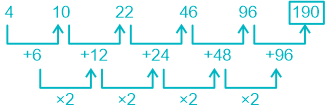 thus, "190" will replace the question mark in the given series.
Hence, the correct option is "Option 1".
Q2 · Series
What comes next: 2, 3, 10, 15, 26, 35, ?
- 50
- 57
- 47
- 49
Answer aur solution dekho
Archived marked answer: A
The logic followed here is:
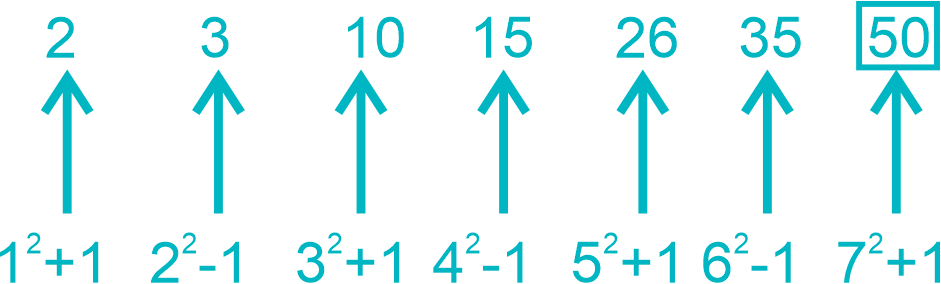 thus, "50" will replace the question mark in the given series.
Hence, the correct option is "Option 1".
Q3 · Series
Select the letter-cluster from among the given options that can replace the question mark (?) in the following series:
HDZ LGB PJD TMF ?
- X P H
- X O H
- X P G
- W P H
Answer aur solution dekho
Archived marked answer: A
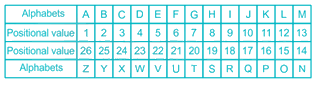 The logic followed here is:
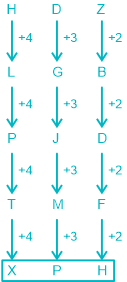 So, 'XPH' will replace the question mark in the given series.
Hence, the correct answer is "Option 1".
Q4 · Analogy
In each of the following questions, a word is transformed into a combination of letters and numbers following a specific pattern. Analyze the transformation used in the first pair and apply the same rule to find the missing term in the second pair.
BOAT : C40U :: JUMP : ?
- K58Q
- K76P
- K95T
- K52E
Answer aur solution dekho
Archived marked answer: A
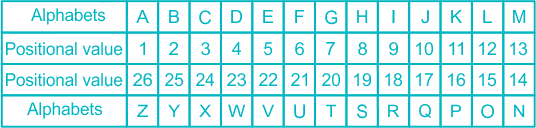 BOAT : C40U
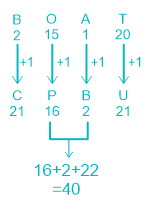 Similarly,
JUMP : ?
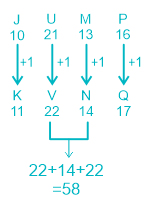 Hence, the correct answer is "Option 1".
Q5 · Analogy
In each of the following questions, a specific rearrangement of letters has been applied to the first word to form the second. Apply the same rearrangement pattern to the third word and choose the correct answer from the given options. METAPHOR : EMATHPRO :: NORMAL : ?
- ORMLAN
- ONRMLA
- ONMRLA
- ONMRAL
Answer aur solution dekho
Archived marked answer: C
The logic followed here is:
Logic: The 1st and 2nd letters are interchanged, the 3rd and 4th letters are interchanged, and the last three letters are rearranged as 7th, 5th, 6th.
Given, M E T A P H O R
After rearrangement:
1st and 2nd → E M
3rd and 4th → A T
Last four letters P H O R → H P R O
So, METAPHOR : EMATHPRO
Now, applying the same logic:
N O R M A L
1st and 2nd → O N
3rd and 4th → M R
Last two letters A L → L A
So, NORMAL : O N M R L A
Hence, the correct answer is "Option 3".
Q6 · Analogy
Choose the correct option to complete the series.
Needle : Sew :: Keyboard : ?
- Draw
- Type
- Write
- Print
Answer aur solution dekho
Archived marked answer: B
The logic followed here is:
Logic: Tool and its primary function.
Given, Needle : Sew
⇒ A needle is used to sew.
Now, applying the same logic:
Keyboard : ?
⇒ A keyboard is used to type.
Now, checking the options:
Option 1) Draw
⇒ A keyboard is not used to draw.
Option 2) Type
⇒ A keyboard is used to type.
Option 3) Write
⇒ Writing is done using a pen or pencil, not directly by a keyboard.
Option 4) Print
⇒ Printing is done using a printer.
Hence, the correct answer is "Option 2".
Q7 · Puzzle Subtypes Not To Miss
A principal amount of ₹1,000 yields a simple interest of ₹180 over a period of 2 years. What is the annual rate of simple interest?
- 8 %
- 9 %
- 7 %
- 6 %
Answer aur solution dekho
Archived marked answer: B
Given:
Principal amount = ₹1,000
Simple Interest = ₹180
Time = 2 years
According to Question:
Simple Interest = (Principal × Rate × Time) / 100
180 = (1000 × Rate × 2) / 100
180 = (2000 × Rate) / 100
180 = 20 × Rate
Rate = 180 / 20
Rate = 9
So, Annual Rate of Simple Interest = 9 %
Hence, the correct answer is Option 2.
Q8 · Puzzle Subtypes Not To Miss
If 3 @ 4 = 19, 5 @ 6 = 41, then what is 6 @ 7?
- 49
- 55
- 61
- 65
Answer aur solution dekho
Archived marked answer: B
The logic followed here is:
Logic: (First number × Second number) + (First number + Second number)
Given,
3 @ 4
⇒ (3 × 4) + (3 + 4)
⇒ 12 + 7 = 19
And, 5 @ 6
⇒ (5 × 6) + (5 + 6)
⇒ 30 + 11 = 41
Now, 6 @ 7:
⇒ (6 × 7) + (6 + 7)
⇒ 42 + 13 = 55
Hence, the correct answer is "Option 2".
Q9 · Puzzle Subtypes Not To Miss
If the given symbols mean:
'+' means 'divided by'
'-' means 'multiplied by'
'x' means 'minus'
'÷' means 'plus'
Then, find the value of the following expressions: 60 + 5 - 4 x 10 ÷ 2=?
- 35
- 40
- 55
- 65
Answer aur solution dekho
Archived marked answer: B
BODMAS Table:
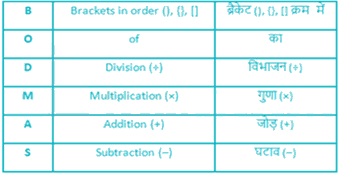 Given equation: 60 + 5 - 4 x 10 ÷ 2 = ?
Now, replace the symbols as given:
⇒ 60 ÷ 5 × 4 - 10 + 2 = ?
⇒ 60 ÷ 5 × 4 - 10 + 2 = ?
⇒ 12 × 4 - 10 + 2 = ?
⇒ 48 - 10 + 2 = ?
⇒ 38 + 2 = 40
Hence, the correct answer is "Option 2".
Q10 · Puzzle Subtypes Not To Miss
If '×' = '-', '-' = '+', '+' = '÷', '÷' = '×', which equation is correct?
- 14 + 2 - 6 × 1 = 10
- 12 - 4 + 2 × 2 = 12
- 10 × 2 + 4 - 1 = 23
- 20 - 2 × 3 + 4 = 18
Answer aur solution dekho
Archived marked answer: B
BODMAS Table:
Given equation: 12 − 4 + 2 × 2 = 12
Now, if '×' = '-', '-' = '+', '+' = '÷', '÷' = '×', then:
⇒ 12 + 4 ÷ 2 − 2 = 12
⇒ 12 + 2 − 2 = 12
⇒ 14 − 2 = 12
⇒ 12
Hence, the correct answer is "Option 2". Q11 · Puzzle Subtypes Not To Miss
10 friends went for dinner and planned to split Rs. 200 equally. 2 didn't pay. How much did each of the rest pay?
- Rs. 25
- Rs. 20
- Rs. 22
- Rs. 28
Answer aur solution dekho
Archived marked answer: A
Given:
Total friends = 10
Total bill amount = Rs. 200
According to Question:
2 friends did not pay.
So, Number of friends who paid = 10 − 2 = 8
Amount paid by each friend = 200 ÷ 8
= Rs. 25
Hence, the correct answer is Option 1.
Q12 · Coding Decoding
Comprehension: In a certain number system there are only two notations to represent numbers: Δ and β. 0 is represented by Δ and 1 by β. The subsequent numbers are represented in the following manner:
2 is represented as βΔ,
3 is represented as ββ,
4 is represented as βΔΔ,
5 is represented as βΔβ and so on.
How will you represent 81 in the given number system?
- βΔΔβΔβΔ
- βΔΔΔββ
- βΔβΔββ
- βΔβΔΔΔβ
Answer aur solution dekho
Archived marked answer: D
The logic followed here is:
This is a binary-like number system where:
Δ = 0
β = 1
Numbers are represented in binary form using Δ and β instead of 0 and 1.
Convert 81 to binary:
81 ÷ 2 = 40 remainder 1
40 ÷ 2 = 20 remainder 0
20 ÷ 2 = 10 remainder 0
10 ÷ 2 = 5 remainder 0
5 ÷ 2 = 2 remainder 1
2 ÷ 2 = 1 remainder 0
1 ÷ 2 = 0 remainder 1
So, binary (from last to first remainder) = 1010001
Replace 1 → β and 0 → Δ
Binary 1010001 → βΔβΔΔΔβ
Hence, the correct answer is "Option 4".
Q13 · Coding Decoding
In a certain code language, WATER is written as YCVGT. How is VAPOR written in that code?
- XCRQT
- XCQRT
- XCPRT
- XCQTS
Answer aur solution dekho
Archived marked answer: A
The logic followed here is:
Logic: Each letter is shifted 2 positions forward in the English alphabet.
Given,
W A T E R
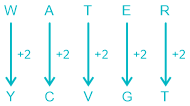 So, WATER : Y C V G T
Now, V A P O R:
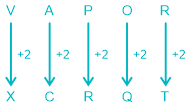 So, VAPOR : X C R Q T
Hence, the correct answer is "Option 1".
Q14 · Classification Odd One Out
Choose the group in which all numbers belong to the same category:
- 2, 4, 6, 8
- 3, 6, 9, 11
- 5, 10, 13, 21
- 7, 14, 26, 38
Answer aur solution dekho
Archived marked answer: A
The logic followed here is:
Logic: Numbers which are divisible by 2 (Even numbers).
Now, checking the options:
Option 1) 2, 4, 6, 8
⇒ 2 is divisible by 2
⇒ 4 is divisible by 2
⇒ 6 is divisible by 2
⇒ 8 is divisible by 2
(All numbers are even numbers.)
Option 2) 3, 6, 9, 11
⇒ 3 is not divisible by 2
⇒ 6 is divisible by 2
⇒ 9 is not divisible by 2
⇒ 11 is not divisible by 2
(Not all are even.)
Option 3) 5, 10, 13, 21
⇒ 5 is not divisible by 2
⇒ 10 is divisible by 2
⇒ 13 is not divisible by 2
⇒ 21 is not divisible by 2
(Not all are even.)
Option 4) 7, 14, 26, 38
⇒ 7 is not divisible by 2
⇒ 14 is divisible by 2
⇒ 26 is divisible by 2
⇒ 38 is divisible by 2
(Not all are even.)
Hence, the correct answer is "Option 1".
Q15 · Classification Odd One Out
Find the odd one out from the given alternatives.
- Saturn
- Venus
- Jupiter
- Sun
Answer aur solution dekho
Archived marked answer: D
The logic followed here is:
Option 1) (Saturn) → It is a planet.
Option 2) (Venus) → It is a planet.
Option 3) (Jupiter) → It is a planet.
Option 4) (Sun) → It is a star, not a planet.
Here, Saturn, Venus and Jupiter are planets, whereas Sun is a star.
Hence, the correct answer is "Option 4".
Q16 · Blood Relations
B is the sister of A. A is the brother of C. C is the daughter of D. How is B related to D?
- Daughter
- Sister
- Son
- Granddaughter
Answer aur solution dekho
Archived marked answer: A
Family Chart:
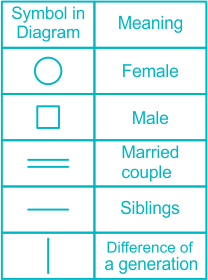 Given:
B is the sister of A.
A is the brother of C.
Q17 · Blood Relations
A is the brother of B. B is the daughter of C. How is A related to C?
- Daughter
- Son
- Father
- Uncle
Answer aur solution dekho
Archived marked answer: B
Family Chart:
Given:
A is the brother of B.
B is the daughter of C.
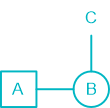 So, A is the Son of C.
Hence, the correct answer is "Option 2".
Q18 · Alphabet Test
Count consonants between the 2nd and 7th letter of TECHNOLOGY.
- 3
- 4
- 5
- 6
Answer aur solution dekho
Archived marked answer: A
Given word: T E C H N O L O G Y
2nd letter = E
7th letter = L
Letters between them (excluding 2nd and 7th):
C, H, N, O
Now, count consonants:
C
H
N
O (vowel)
So,Total consonants = 3
Hence, the correct answer is "Option 1".
Q19 · Alphabet Test
Arrange the following in chronological order (Based on Age/History):
1. Industrial Revolution
2. Bronze Age
3. Information Age
4. Iron Age
5. Stone Age
- 5, 2, 4, 1, 3
- 2, 4, 5, 1, 3
- 5, 4, 2, 1, 3
- 1, 2, 3, 4, 5
Answer aur solution dekho
Archived marked answer: A
The correct chronological order (based on Age/History) is:
5. Stone Age
6. Bronze Age
7. Iron Age
8. Industrial Revolution
9. Information Age
Thus, The correct order is '5, 2, 4, 1, 3'.
Hence, the correct answer is "Option (1)".
Q20 · Alphabet Test
Which of these words will come last in a dictionary?
- bench
- beneath
- bend
- bent
Answer aur solution dekho
Archived marked answer: D
Dictionary order of given words,
1. bench
2. beneath
3. bend
4. bent
Word "bent" will come last in a dictionary.
Hence, the correct answer is "Option 4".
Q21 · Similarity and Differences
Choose the address that is the same as the one given below.
56/A, Greenwood Villa, Salt Lake City, Kolkata, West Bengal - 700091
- 56/A, Greenwood Villa, Salt Lake, Kolkata,West Bengal - 700091
- 56/A, Greenwood Villas, Salt Lake City, Kolkata, West Bengal - 700091
- 56/A, Greenwood Villa, Salt Lake City, Kolkata, West Bengal - 700091
- 65/A, Greenwood Villa, Salt Lake City, Kolkata, West Bengal - 700091
Answer aur solution dekho
Archived marked answer: C
The address given in the problem is,
56/A, Greenwood Villa,Salt Lake City, Kolkata,West Bengal - 700091
Let's match this address with the given options one by one to figure out which one is exactly the same.
Option
Address in Option
Given Address
Comment
(1)
56/A, Greenwood Villa,Salt Lake City, Kolkata,West Bengal - 700091
56/A, Greenwood Villa,Salt Lake, Kolkata,West Bengal - 700091
The word 'city' is missing in this option.
(2)
56/A, Greenwood Villas, Salt Lake City, Kolkata, West Bengal - 700091
56/A, Greenwood Villa,Salt Lake City, Kolkata,West Bengal - 700091
The address in this option has 'Villas' instead of 'Villa' and extra spaces after commas.
(3)
56/A, Greenwood Villa, Salt Lake City, Kolkata, West Bengal - 700091
56/A, Greenwood Villa,Salt Lake City, Kolkata,West Bengal - 700091
The address is exactly the same as the one given.
(4)
65/A, Greenwood Villa, Salt Lake City, Kolkata, West Bengal - 700091
56/A, Greenwood Villa,Salt Lake City, Kolkata,West Bengal - 700091
The house number is '65/A' instead of '56/A'.
So, the address that is exactly the same as the given address is in option (3).
Hence, the correct option is "option (3)".
Q22 · Similarity and Differences
Find the word that does not fit in the series:
Complex, Intricate, Sophisticated, Simple, Elaborate
- Complex
- Intricate
- Simple
- Sophisticated
Answer aur solution dekho
Archived marked answer: C
The logic followed here is:
Logic: Words having similar meaning (related to complexity).
Now, checking the words:
Complex → means complicated
Intricate → means very detailed and complicated
Sophisticated → means complex or advanced
Elaborate → means detailed and complicated
Simple → means easy or not complicated
Here, all words except "Simple" indicate something complicated or complex.
Hence, the correct answer is "Option 3".
Q23 · Similarity and Differences
Find the unit that does not fit in the series:
Kelvin, Celsius, Fahrenheit, Joule, Rankine
- Kelvin
- Rankine
- Fahrenheit
- Joule
Answer aur solution dekho
Archived marked answer: D
The logic followed here is:
Logic: Units of temperature.
Now, checking the units:
Kelvin → Unit of temperature
Celsius → Unit of temperature
Fahrenheit → Unit of temperature
Rankine → Unit of temperature
Joule → Unit of energy
Here, all except "Joule" are units of temperature.
Hence, the correct answer is "Option 4".
Q24 · Logical Statement Questions
Instruction: Identify the assumptions that must hold for the statement to be valid, then choose the correct option.
Statement: Despite the unpredictability of future technologies, regulatory frameworks must evolve to preempt ethical crises.
Assumptions:
I. Unregulated technological growth can cause ethical dilemmas.
II. Ethical standards are often retrofitted to existing technology.
III. Regulatory systems can always accurately predict technological outcomes.
- Only I and II are implicit
- Only I is implicit
- All are implicit
- Only II and III are implicit
Answer aur solution dekho
Archived marked answer: A
Given Statement: Despite the unpredictability of future technologies, regulatory frameworks must evolve to preempt ethical crises.
Now,
Assumptions:
I. Unregulated technological growth can cause ethical dilemmas → Implicit (If technology does not cause ethical problems, there would be no need to evolve regulations to prevent them).
II. Ethical standards are often retrofitted to existing technology → Implicit (The statement suggests regulations should evolve before crises occur, implying that normally ethical rules are applied after technology appears).
III. Regulatory systems can always accurately predict technological outcomes → Not implicit (The statement actually says future technologies are unpredictable).
Only I and II are implicit
Hence, the correct answer is "Option 1".
Q25 · Logical Statement Questions
Read the following statement carefully and identify the conclusion that follows.
Statement: The education ministry has made moral education compulsory in schools.
Conclusions:
I. Students must attend moral education classes.
II. Schools were not offering moral education earlier.
- Only Conclusion I follows
- Only Conclusion II follows
- Both I and II follow
- Neither I nor II follows
Answer aur solution dekho
Archived marked answer: A
Given Statement:
The education ministry has made moral education compulsory in schools.
Conclusion I: Students must attend moral education classes → Follow (If a subject is compulsory in schools, students studying in those schools must attend those classes).
Conclusion II: Schools were not offering moral education earlier → Does not follow ( The statement only says it is now compulsory. It does not state whether schools offered it earlier or not.Some schools may already have been teaching it).
Hence, only conclusion I follows.
Hence, the correct answer is "Option 1".
General Awareness
Q1 · Art and Culture
What material were the double-storeyed gates of Purana Qila primarily built with?
- Marble
- Red sandstone
- Glazed tiles
- Rubble
Answer aur solution dekho
Archived marked answer: B
The correct answer is Red sandstone.
Key Points
- The double-storeyed gates of Purana Qila were primarily built using red sandstone, a material widely used in Mughal architecture.
- Red sandstone was chosen for its durability and aesthetic appeal, ensuring the monument's longevity over centuries.
- The gates, including the majestic Bara Darwaza, showcase intricate carvings and architectural finesse, characteristic of the medieval period.
- Purana Qila, constructed during the reign of Humayun and later enhanced by Sher Shah Suri, is a fine example of Indo-Islamic architecture.
- The use of red sandstone became a hallmark of Mughal architecture, visible in other iconic structures such as the Red Fort and Humayun’s Tomb.
Additional Information
- Marble:
- Marble was used extensively during the later Mughal period, especially under Shah Jahan’s rule.
- Famous examples include the Taj Mahal and the Moti Masjid (Pearl Mosque) in Agra.
- It is a metamorphic rock known for its elegance and was primarily reserved for decorative purposes and royal buildings.
- Glazed tiles:
- Glazed tiles were commonly used in Islamic architecture for decorative purposes.
- These tiles were used to adorn walls and domes, especially in mosques and mausoleums.
- Rubble:
- Rubble masonry involves the use of undressed or roughly dressed stones.
- It was a common construction technique in ancient and medieval India for fortifications and basic structures.
Q2 · Art and Culture
Who is credited with developing the modern notation system for Hindustani classical music and documenting compositions in the Kramik Pustak Maalika?
- Ustad Allauddin Khan of Maihar Gharana
- Pandit Vishnu Digambar Paluskar of Gwalior
- Pandit Vishnu Narayan Bhatkhande of Bombay
- Saint Tyagaraja of Carnatic Tradition
Answer aur solution dekho
Archived marked answer: C
The correct answer is Pandit Vishnu Narayan Bhatkhande of Bombay.
Key Points
- Pandit Vishnu Narayan Bhatkhande (1860–1936) is credited with standardizing and developing the modern notation system for Hindustani classical music.
- He documented a wide range of classical compositions in his pioneering work, the Kramik Pustak Maalika, a six-volume series that categorizes and systematizes ragas and compositions.
- Bhatkhande divided ragas into ten major thaats (parent scales) to provide a simplified and systematic approach to the study of Hindustani music.
- He emphasized the importance of written documentation of music, which had previously been passed down orally, ensuring its preservation for future generations.
- His efforts led to the establishment of music institutions, such as the Marris College of Music (now Bhatkhande Music Institute University) in Lucknow, to formalize music education in India.
Additional Information
- Ustad Allauddin Khan of Maihar Gharana
- Ustad Allauddin Khan (1862–1972) was a legendary Indian musician and composer from the Maihar Gharana.
- He was a master of multiple instruments, particularly the sarod, and is known for training iconic musicians like Pandit Ravi Shankar and Ustad Ali Akbar Khan.
- Pandit Vishnu Digambar Paluskar of Gwalior
- Pandit Vishnu Digambar Paluskar (1872–1931) was a prominent Hindustani classical vocalist and music educator.
- He is credited with popularizing Hindustani music among the masses and founding the Gandharva Mahavidyalaya, a music school in Lahore, in 1901.
- Saint Tyagaraja of Carnatic Tradition
- Saint Tyagaraja (1767–1847) was a prolific composer and one of the most revered figures in Carnatic music, a classical music tradition of South India.
- He composed thousands of devotional songs, primarily in Telugu, in praise of Lord Rama, and is considered one of the Trinity of Carnatic music, along with Muthuswami Dikshitar and Shyama Sastri.
Q3 · Art and Culture
Match the dance with its prime social/religious context:
Dance
social/religious context
1. Rauf
A. Eid & spring-wedding festivities
2. Karma
B. Bhadra Ekadashi agrarian ritual
3. Tamasha
C. Night-long folk-theatre in Shimga season
4. Jhumar
D. Post-monsoon tea-garden recreations
- 1-A, 2-B, 3-C, 4-D
- 1-B, 2-A, 3-C, 4-D
- 1-A, 2-C, 3-D, 4-B
- 1-A, 2-C, 3-B, 4-D
Answer aur solution dekho
Archived marked answer: A
The correct answer is Option 1: 1-A, 2-B, 3-C, 4-D.
Key Points
- Rauf: This is a traditional folk dance of Kashmir performed during Eid celebrations and spring-wedding festivities. It showcases community bonding and joy.
- Karma: Associated with Bhadra Ekadashi agrarian rituals, this dance is popular among tribal communities in central and eastern India, particularly during the harvest season.
- Tamasha: A traditional night-long folk-theatre performed during the Shimga (Holi) season, originating from Maharashtra, blending dance, music, and drama.
- Jhumar: This is a vibrant dance from eastern India, particularly Jharkhand, associated with post-monsoon tea-garden recreations.
- The correct pairing of the dances with their social or religious contexts is essential for understanding their cultural significance.
Additional Information
- Rauf (Dance):
- Performed by women in Kashmir, Rauf is a traditional dance form that symbolizes joy and celebration during festive occasions like Eid.
- The dancers form two rows and perform rhythmic movements to traditional Kashmiri folk music.
- Karma (Dance):
- This dance is deeply connected to nature and is performed during the worship of the Karma tree on Bhadra Ekadashi.
- It is popular among tribal communities like the Gonds, Oraons, and Santhals in states like Madhya Pradesh, Chhattisgarh, and Odisha.
- Tamasha (Dance):
- Tamasha is a form of folk theatre originating in Maharashtra, which involves a blend of dance, music, and dramatic storytelling.
- It is traditionally performed during the Shimga festival and is known for its entertaining and satirical content.
- Jhumar (Dance):
- Jhumar is a folk dance of Jharkhand, Odisha, and West Bengal, performed during the autumn season in tea gardens or after the harvest.
- The dance is characterized by graceful hand movements and rhythmic footwork, accompanied by traditional folk songs.
Q4 · Art and Culture
Fill in the blank:
The Tusu festival is primarily celebrated in the tribal belt of Jharkhand, especially around the area between _____, Tamar, and Raidih.
- Dumka
- Bundu
- Daltonganj
- Chaibasa
Answer aur solution dekho
Archived marked answer: B
The correct answer is Bundu.
Key Points
- The Tusu Festival is a harvest festival celebrated predominantly by the tribal communities in the state of Jharkhand.
- It is particularly observed in areas such as Bundu, Tamar, and Raidih, which are part of the tribal belt of the state.
- Bundu serves as a significant location where the festivities take place, marked by vibrant rituals and cultural practices tied to the agricultural calendar.
- The festival is celebrated during the harvest season, particularly in the month of January, and coincides with the Makar Sankranti festival.
- During the Tusu Festival, people sing traditional folk songs, perform dances, and pay homage to Goddess Tusu, believed to bless them with prosperity and good harvests.
Additional Information
- Dumka:
- Dumka is one of the oldest districts in Jharkhand and is known as the sub-capital of the state.
- The district is not directly associated with the Tusu Festival but is significant for hosting other cultural events and tribal traditions.
- It is home to the Santhal tribe, which celebrates festivals like Sohrai and Baha.
- Daltonganj:
- Located in the Palamu district, Daltonganj is not a focal point for the Tusu Festival celebrations.
- It is more known for its historic Palamu Fort and the Betla National Park, a prominent tiger reserve in Jharkhand.
- Chaibasa:
- Chaibasa is a town in the West Singhbhum district of Jharkhand, home to the Ho tribe.
- Although not directly linked to the Tusu Festival, the region is culturally rich and celebrates tribal festivals like Mage Parab and Kolom Sankaranti.
Q5 · Indian Polity and Constitution
Under Pitt's India Act, what restriction was placed on the Governor General and Council?
- They could not pass any civil law without Queen's consent.
- They could not issue orders without majority support.
- They were forbidden to declare war or make treaties without approval.
- They had to resign after 5 years in office.
Answer aur solution dekho
Archived marked answer: C
The correct answer is They were forbidden to declare war or make treaties without approval..
Key Points
- Pitt's India Act of 1784 was passed to address the deficiencies of the Regulating Act of 1773 and improve governance in British India.
- The Act established a Board of Control in Britain to supervise the political activities of the East India Company in India.
- The Governor-General and his Council were forbidden to declare war or make treaties without prior approval from the Court of Directors and the British Crown.
- This restriction was aimed at preventing unilateral decisions that could lead to unnecessary conflicts or alliances, ensuring better oversight and control.
- Pitt's India Act marked a significant step in centralizing British control over Indian administration, reducing the autonomy of the East India Company.
Additional Information
- Lord Canning (1858-1862): First Viceroy of India, following the 1857 Revolt.
- Lord Lytton (1876-1880): Controversial figure, held the Delhi Durbar.
- Lord Ripon (1880-1884): Known for liberal policies and local self-government reforms.
- Lord Curzon (1899-1905): Implemented the controversial Partition of Bengal in 1905.
- Lord Irwin (1926-1931): Associated with the Simon Commission and the Dandi March.
- Lord Linlithgow (1936-1944): Oversaw the launch of the Quit India Movement.
- Lord Wavell (1944-1947): Key figure during the end of the Raj, involved in the Cabinet Mission.
- Lord Mountbatten (1947): Last Viceroy and first Governor-General of independent India (until June 1948)
Q6 · Indian Polity and Constitution
Fill in the Blank:
Doctrine of Severability allows the _____ part of a law to be retained.
- Repealed
- Inconsistent
- Valid
- Unconstitutional
Answer aur solution dekho
Archived marked answer: C
The correct answer is Valid.
Key Points
- The Doctrine of Severability refers to the ability of the judiciary to separate the valid portions of a law from the invalid or unconstitutional ones.
- It is enshrined in Article 13 of the Indian Constitution, which ensures that any law inconsistent with or violating Fundamental Rights is void to the extent of its inconsistency.
- Under this doctrine, only the unconstitutional or invalid parts of a legislation are struck down, while the valid parts remain enforceable.
- The doctrine ensures that the entire law is not invalidated but retains the valid and constitutional provisions.
- This principle is applied to protect the legislative intent and preserve the valid portions of the law wherever possible, ensuring a balance between judicial review and legislative sovereignty.
Additional Information
- Repealed:
- When a law is repealed, it is formally revoked or annulled, either partially or fully, by legislative authority.
- Repealing a law completely removes its legal enforceability and existence.
- This is different from severability, where only the unconstitutional parts are struck down, and the rest of the law remains intact.
- Inconsistent:
- The term "inconsistent" refers to provisions in a law that conflict with or violate the Constitution, particularly Fundamental Rights.
- As per Article 13 of the Indian Constitution, laws inconsistent with Fundamental Rights are declared void to the extent of their inconsistency.
- However, inconsistent provisions are not retained under the Doctrine of Severability; only valid ones are upheld.
- Unconstitutional:
- Any law, policy, or action that contravenes the provisions of the Constitution is deemed unconstitutional.
- Unconstitutional laws are struck down by courts during judicial review. The Doctrine of Severability ensures that only unconstitutional parts of a law are invalidated, preserving the valid portions.
Q7 · Indian Polity and Constitution
Under Bharatiya Nagarik Suraksha Samhita(BNSS), the period for default bail in minor offences is capped at?
- 30 days
- 45 days
- 60 days
- 90 days
Answer aur solution dekho
Archived marked answer: C
The correct answer is 60 days.
Key Points
- Under the Bharatiya Nagarik Suraksha Samhita (BNSS), the timeline for default bail in minor offences has been capped at 60 days.
- This period is aligned with the procedural reforms introduced in the BNSS to streamline criminal justice delivery and ensure timely disposal of cases.
- Minor offences are typically classified as offences punishable with imprisonment of up to three years.
- The BNSS aims to modernize and simplify procedural laws, replacing the traditional Criminal Procedure Code (CrPC) with updated provisions.
- The emphasis on default bail timelines ensures the protection of individual rights and prevents unnecessary detention.
Additional
- BNS (Bharatiya Nyaya Sanhita): Replaces the IPC; focuses on defining criminal offenses, introducing new crimes (like organized crime), and updating punishments, including for repeat offenders and offenses against women/children.
- BNSS (Bharatiya Nagarik Suraksha Sanhita): Replaces the CrPC; covers the procedural aspects of investigation and trial, streamlining processes, ensuring time limits for stages, and incorporating technology like video recording.
- BSA (Bharatiya Sakshya Adhiniyam): Replaces the Indian Evidence Act; deals with rules of evidence, including digital evidence, DNA, and modern forensic methods.
Q8 · Indian Polity and Constitution
Consider the following statements:
1. The Concurrent List allows both Centre and States to legislate.
2. In case of conflict, State law prevails over Union law. Which of the above is/are correct?
- Only 1
- Only 2
- Both 1 and 2
- Neither 1 nor 2
Answer aur solution dekho
Archived marked answer: A
The correct answer is Option 1.
Key Points
- Statement 1 is correct: The Concurrent List in the Indian Constitution allows both the Centre and States to legislate on matters included in it. Examples include education, marriage, adoption, etc.
- The Concurrent List is one of the three lists under the Seventh Schedule of the Constitution, the others being the Union List and State List.
- Legislation on the Concurrent List ensures cooperation between the Centre and States while addressing shared responsibilities.
- In case of a conflict between Union and State laws on the same subject, the Union law prevails, as provided under Article 254 of the Constitution of India.
- Thus, Statement 2 is incorrect because the Union law overrides State law in case of conflict.
Additional Information
- Union List:
- Subjects under the Union List are exclusively legislated by the Parliament.
- Examples include defense, foreign affairs, atomic energy, railways, and currency.
- It contains 97 subjects (originally) as per the Constitution of India.
- State List:
- Subjects under the State List are exclusively legislated by the State Legislatures.
- Examples include police, public health, agriculture, and local government.
- The State List originally contained 66 subjects.
- Concurrent List:
- It contains subjects where both the Centre and States can legislate.
- It originally consisted of 47 subjects, which include criminal law, education, forests, and marriage.
- In case of conflict, Union law prevails as per Article 254 of the Indian Constitution.
- Article 254:
- If there is an inconsistency between laws made by the Parliament and laws made by State Legislatures on a Concurrent List subject, the law enacted by Parliament prevails.
- The only exception is if the State law has received Presidential assent, then it can prevail in that state.
Q9 · Indian Polity and Constitution
Which of the following disputes falls under the Supreme Court's exclusive original jurisdiction as per Article 131 of the Indian Constitution?
- Inter-State water disputes
- Election disputes of MPs and MLAs
- Disputes between Centre and one or more States
- Appeals against High Court decisions
Answer aur solution dekho
Archived marked answer: C
The correct answer is Disputes between Centre and one or more States.
Key Points
- Article 131 of the Indian Constitution provides the exclusive original jurisdiction of the Supreme Court of India in certain disputes.
- These disputes include those between the Government of India and one or more States or between two or more States.
- The Supreme Court's original jurisdiction is called "exclusive" because it cannot be exercised by any other court in India.
- The jurisdiction applies only to legal matters and not political disputes or policy matters.
- This provision ensures the role of the Supreme Court as the final arbiter in resolving disputes concerning the interpretation of the Constitution.
Additional Information
- Key Jurisdictions of the Supreme Court of India:
- Original Jurisdiction (Article 131):
- Hears disputes between the Government of India and States, or between States themselves, involving questions of law or fact.
- Writ Jurisdiction (Article 32): Enforces Fundamental Rights by issuing writs like Habeas Corpus, Mandamus, Prohibition, Quo Warranto, and Certiorari.
- Appellate Jurisdiction:
- The final court of appeal, hearing appeals from High Courts in constitutional, civil, criminal, and special leave petition (SLP) cases.
- Advisory Jurisdiction (Article 143):
- Advises the President on matters of public importance or law, though these are not binding.
- Review Jurisdiction:
- Power to review its own judgments or orders.
- Extraordinary & Other Powers:
- Transfer of Cases: Can transfer civil/criminal cases between High Courts or subordinate courts.
- Suo Moto Powers: Can take up cases on its own motion.
- Article 142: Powers to pass orders for "complete justice".
Q10 · Sports Static GK
Consider the following statements about India's Winter Olympics participation:
1) Shiva Keshavan competed in six Games and introduced luge to India.
2) Arif Mohammad Khan was the first Indian to qualify for two alpine skiing events in 2022. Which of the statements is/are correct?
- Only Statement 1 is correct
- Only Statement 2 is correct
- 1 and 2 both are correct
- Neither 1 nor 2 is Correct
Answer aur solution dekho
Archived marked answer: C
The correct answer is Option 3: Both statements 1 and 2 are correct.
Key Points
- Shiva Keshavan is a six-time Winter Olympian from India and is widely regarded as the pioneer of luge in India.
- He was the first Indian to represent the country in luge at the Winter Olympics, beginning his journey at Nagano in 1998.
- Arif Mohammad Khan made history by becoming the first Indian to qualify for two alpine skiing events at the Winter Olympics 2022 in Beijing.
- Arif represented India in slalom and giant slalom events, showcasing his remarkable skills in alpine skiing.
- India has a limited yet impactful presence at the Winter Olympics, with athletes like Shiva Keshavan and Arif Mohammad Khan bringing global attention to winter sports in the country.
Additional Information
- India's Participation in the Winter Olympics:
- India's Winter Olympics journey began in 1964, with sporadic participation in skiing, luge, and other sports.
- Due to geographical and infrastructural limitations, winter sports in India have not gained widespread popularity.
- Efforts are being made to encourage winter sports through initiatives like training programs and international exposure.
Q11 · Sports Static GK
Consider the following statements about service rules in table tennis:
1) At 10-10, service alternates every two points.
2) In the final doubles game, receiver order changes when one side reaches 5 points.
Which of the above is/are correct?
- Only 1 is Correct
- Only 2 is Correct
- 1 and 2 are correct
- Neither 1 nor 2 is Correct
Answer aur solution dekho
Archived marked answer: B
The correct answer is Option 2.
Key Points
- In table tennis, service alternates every point once the score reaches 10-10 (deuce), rather than every two points as stated in the question. Hence, Statement 1 is incorrect.
- In doubles matches, the receiver order changes after one side reaches 5 points in the final game (often referred to as the deciding game). This rule ensures fairness by balancing the playing sides. Statement 2 is correct.
- The rules for service and receiver order in table tennis are specified by the International Table Tennis Federation (ITTF) and are strictly adhered to in official matches.
- Table tennis service rules are designed to ensure fairness, prevent predictability, and maintain the competitive nature of the game.
- Statement 2 aligns with the official rules of ITTF regarding receiver order in the final doubles game.
Additional Information
- General Table Tennis Rules:
- Table tennis matches consist of either best-of-five or best-of-seven games, depending on the tournament format.
- The service rules require the ball to be tossed at least 16 cm vertically and hit behind the end line of the table.
- A game is won by the player or team that first scores 11 points with at least a 2-point lead.
- The ITTF governs the rules and regulations for table tennis worldwide.
Q12 · Sports Static GK
What is meant by an "own goal" in football?
- A goal scored by a goalkeeper
- A goal scored from a penalty
- A goal scored accidentally into one's own net
- A goal scored during injury time
Answer aur solution dekho
Archived marked answer: C
The correct answer is A goal scored accidentally into one's own net.
Key Points
- An "own goal" in football refers to a situation where a player inadvertently scores a goal in their own team's net.
- It typically occurs due to a mistake, misjudgment, or an attempt to clear the ball that results in the ball going into their own goal.
- Own goals are counted as valid scores but credited to the opposing team.
- These goals can significantly impact the outcome of a match, often leading to frustration for the player and the team.
- FIFA and other football governing bodies officially record own goals in match statistics, but they are not attributed to the player as a positive contribution to the game.
Additional
- Dribble: Running with the ball, keeping control with your feet.
- Pass: Kicking or moving the ball to a teammate.
- Tackle: Attempting to take the ball from an opponent legally.
- Shoot: Kicking the ball towards the opponent's goal.
- Header: Using the head to direct the ball.
- Volley: Kicking the ball in mid-air.
- Cross: A pass from the side of the field into the penalty area.
- Chip: A high, delicate kick over an opponent, usually the goalkeeper.
- Backheel: Kicking the ball backward with the heel.
Q13 · Sports Static GK
Fill in the blank:
Javelin thrower Neeraj Chopra won India's first-ever gold at the World Athletics Championships in ______ in 2023.
- Eugene
- Tokyo
- Budapest
- Doha
Answer aur solution dekho
Archived marked answer: C
The correct answer is Budapest.
Key Points
- Neeraj Chopra won the gold medal in the men’s javelin throw event at the 2023 World Athletics Championships, held in Budapest, Hungary.
- With this victory, Neeraj became the first Indian athlete to win a gold medal in the history of the World Athletics Championships.
- His winning throw measured 88.17 meters, achieved in his second attempt during the final.
- The World Athletics Championships 2023 took place from August 19 to August 27, 2023, in Budapest, Hungary.
- Neeraj Chopra's achievement is significant as it adds to his previous accomplishments, including his gold medal at the Tokyo 2020 Olympics, further cementing his status as one of India's greatest athletes.
Additional Information
- Eugene
- Eugene, Oregon, USA, hosted the 2022 World Athletics Championships, making it the first time the event was held in the United States.
- Neeraj Chopra won a silver medal at this championship with a throw of 88.13 meters, marking India’s first-ever silver medal at the World Athletics Championships.
- Tokyo
- Tokyo, Japan, was the host city for the 2020 Summer Olympics, held in 2021 due to the COVID-19 pandemic.
- At this event, Neeraj Chopra made history by winning the gold medal in the men’s javelin throw with a throw of 87.58 meters, becoming the first Indian track and field athlete to win an Olympic gold medal.
- Doha
- Doha, Qatar, hosted the 2019 World Athletics Championships from September 27 to October 6, 2019.
- Neeraj Chopra did not participate in this event due to an elbow injury that kept him out of competitive athletics during this period.
Q14 · Indian Geography
What causes a river to develop meanders?
- High-altitude origin
- Sudden tectonic uplift
- Lateral erosion in flat terrain
- Ocean current influence
Answer aur solution dekho
Archived marked answer: C
The correct answer is Lateral erosion in flat terrain.
Key Points
- Lateral erosion occurs in the middle course of a river, where the gradient decreases, and the flow becomes slower, causing the river to erode its banks horizontally.
- This process is most prominent in flat terrains, as the river tends to meander and shift sideways rather than cutting vertically into the land.
- Meanders are formed due to the combined processes of erosion (on the outer bank of the curve) and deposition (on the inner bank of the curve).
- The constant shifting of the river flow due to varying velocity leads to the creation of winding curves known as meanders.
- Meanders are a characteristic feature of mature river systems and develop over time as the river seeks to balance its energy and flow.
Additional Information
- High-altitude origin
- Rivers originating from high altitudes generally have steep gradients, causing vertical erosion rather than lateral erosion.
- Such rivers typically form features like V-shaped valleys and waterfalls, but they do not develop meanders.
- Examples include Himalayan rivers like the Ganga and Brahmaputra in their upper course.
- Sudden tectonic uplift
- Tectonic uplift can cause rivers to increase their vertical erosion due to a change in gradient or slope.
- This process leads to the formation of canyons, gorges, and river terraces rather than meanders.
- It is not a direct contributor to the development of meanders.
- Ocean current influence
- Ocean currents primarily affect coastal processes such as wave action, sediment transport, and erosion along shorelines.
- They have no direct role in the formation of meanders within river systems.
- Meanders are an inland river phenomenon and are unrelated to marine processes.
Q15 · Current Affairs
Fill in the Blanks:
NISAR maps the global surface every ____.
- 3 days
- 12 days
- 24 hrs
- 5 days
Answer aur solution dekho
Archived marked answer: B
The correct answer is 12 days.
Key Points
- NISAR (NASA-ISRO Synthetic Aperture Radar) is a joint Earth observation mission between NASA and ISRO.
- One of the key features of NISAR is its ability to map the Earth's surface globally every 12 days.
- The mission aims to provide high-resolution data on changes in Earth's land and ice surfaces, helping scientists monitor environmental changes such as deforestation, glacier melting, and land subsidence.
- The radar system uses two frequencies: L-band and S-band. The L-band radar is provided by NASA, while the S-band radar is developed by ISRO.
- NISAR's data is expected to support disaster management efforts, agricultural monitoring, and climate change research.
Additional Information
- ISRO's major Achievements & Milestones
- Cost-Effectiveness: Known for achieving missions at significantly lower costs than global counterparts.
- Lunar Missions: Chandrayaan-1 discovered water molecules; Chandrayaan-3 achieved a soft landing.
- Mars Mission (MOM): Mangalyaan successfully reached Mars on its first attempt (2014).
- Record Launches: Launched 104 satellites in a single rocket launch (2017).
- Indigenous Capability: One of few agencies to develop its own launch vehicles and satellites.
Q16 · Current Affairs
Which 2024 India-Bangladesh energy project involves a 765 kV cross-border transmission line to boost hydroelectric trade across multiple countries?
- Agartala-Parbotipur-Guwahati Transmission Grid
- Katihar-Parbotipur-Bornagar Interconnection Project
- Jalpaiguri-Chattogram Power Corridor
- Siliguri-Bogura-Mymensingh HVDC Link
Answer aur solution dekho
Archived marked answer: B
The correct answer is Katihar-Parbotipur-Bornagar Interconnection Project.
Key Points
- The Katihar-Parbotipur-Bornagar Interconnection Project involves the construction of a 765 kV cross-border transmission line between India and Bangladesh.
- This project aims to enhance hydroelectric power trade across multiple countries, including Bhutan and Nepal, leveraging the regional energy grid.
- The interconnection will serve as a critical infrastructure for energy security and economic cooperation between India and Bangladesh.
- It is expected to facilitate the export of surplus electricity from India to Bangladesh and other neighboring nations.
- The project is part of India's broader vision of regional energy integration to promote sustainable development in South Asia.
Additional Information
- Regional Energy Integration
- India's energy projects with Bangladesh and other neighboring countries aim to create a South Asian energy hub, facilitating sustainable development and reducing energy deficits.
- Such initiatives promote cross-border electricity trade, regional cooperation, and infrastructure development.
- The Katihar-Parbotipur-Bornagar Interconnection Project is a key example of India's commitment to regional energy security.
Q17 · Current Affairs
Who launched the campaign "Ek Ped Maa Ke Naam" in 2024, encouraging citizens to plant trees in honor of their mothers and Mother Earth?
- Narendra Modi
- Leena Nandan
- Bhupender Yadav
- Ashwini Vaishnaw
Answer aur solution dekho
Archived marked answer: A
The correct answer is Narendra Modi.
Key Points
- Prime Minister Narendra Modi launched the campaign "Ek Ped Maa Ke Naam" in 2024 to promote environmental conservation and honor the contributions of mothers.
- The campaign encourages citizens to plant trees in the name of their mothers, symbolizing the nurturing nature of motherhood and the importance of Mother Earth.
- It aligns with the Indian government’s broader environmental initiatives such as ‘Mission LiFE’ (Lifestyle for Environment) to create awareness about sustainable living.
- PM Modi has consistently supported eco-friendly programs like afforestation, renewable energy projects, and water conservation to combat climate change.
- The initiative also aims to enhance public awareness about the role of individuals in environmental preservation and to promote community participation in tree-planting drives.
Additional Information
- Leena Nandan
- Leena Nandan is an Indian Administrative Service (IAS) officer who has served as the Secretary of the Ministry of Environment, Forest, and Climate Change (MoEFCC).
- She has been instrumental in framing and implementing policies related to environmental protection and climate change mitigation.
- Bhupender Yadav
- Bhupender Yadav is the Union Minister for Environment, Forest, and Climate Change as of 2024.
- He has played a significant role in representing India at global climate conferences, such as the COP (Conference of Parties) summits.
- Under his leadership, the ministry has focused on sustainable development and increasing India’s green cover.
- Ashwini Vaishnaw
- Ashwini Vaishnaw is the Union Minister for Railways, Communications, and Electronics & Information Technology.
- He has introduced several technological and infrastructural advancements in Indian railways and digital governance.
- Although not directly associated with environmental campaigns, his ministry has contributed to sustainability efforts, such as promoting solar energy in railway stations.
Q18 · General Science Biology
Which of the below statements on the plant hormones is INCORRECT?
- Auxins promote growth
- Cytokinins delay aging
- Ethylene promotes seed germination
- Gibberellins promote stem elongation
Answer aur solution dekho
Archived marked answer: C
The correct answer is Ethylene promotes seed germination.
Key Points
- Ethylene is primarily known as a gaseous plant hormone responsible for regulating processes such as fruit ripening, leaf abscission, and flower senescence.
- It is not directly linked with promoting seed germination; instead, other hormones such as gibberellins play a more dominant role in this process.
- The role of ethylene is often associated with responses to stress conditions and the promotion of senescence rather than germination.
- Studies have shown that ethylene can inhibit seed germination under certain conditions, contrary to the statement in the question.
- Thus, the statement "Ethylene promotes seed germination" is incorrect.
Additional Information
- Auxins promote growth:
- Auxins are a class of plant hormones that play a critical role in cell elongation, root formation, and overall plant growth.
- They are primarily produced in the shoot apical meristem and transported to other parts of the plant.
- Auxins stimulate cell division and elongation, especially in the stem and roots, contributing to phototropism and gravitropism.
- Indole-3-acetic acid (IAA) is the most common naturally occurring auxin in plants.
- Cytokinins delay aging:
- Cytokinins are plant hormones that promote cell division and delay senescence (aging) in leaves and other plant tissues.
- They work antagonistically with auxins in regulating plant growth and development.
- Cytokinins help maintain chlorophyll levels in leaves, delaying leaf yellowing and promoting nutrient mobilization.
- Natural cytokinins include zeatin, which is derived from adenine and plays a role in promoting shoot initiation and growth.
- Gibberellins promote stem elongation:
- Gibberellins are a group of plant hormones that stimulate stem elongation, seed germination, and flowering.
- They break seed dormancy by promoting the synthesis of enzymes required for mobilizing stored nutrients.
- Gibberellins also influence the development of fruits and delay senescence in certain plants.
- They are widely used in agriculture to improve crop yield and quality.
Q19 · General Science Chemistry
Read the statements carefully and choose the correct option:
Assertion (A): Aluminium smelting is the most important metallurgical industry in India.
Reason (R): Aluminium is used in the manufacture of aircraft, wires, and utensils.
- Both A and R are true, and R is the correct explanation of A
- Both A and R are true, but R is not the correct explanation of A
- A is true, but R is false
- A is false, but R is true
Answer aur solution dekho
Archived marked answer: D
The correct answer is A is false, but R is true.
Key Points
- Assertion (A): Aluminium smelting is the most important metallurgical industry in India. - This statement is false because while aluminium smelting is a significant industry, iron and steel production is considered the most important metallurgical industry in India due to its extensive applications in infrastructure, construction, transportation, and manufacturing.
- Reason (R): Aluminium is used in the manufacture of aircraft, wires, and utensils. - This statement is true as aluminium is widely utilized in various industries due to its lightweight, corrosion resistance, and high conductivity.
- Aluminium smelting involves extracting aluminium from bauxite ore through electrolysis, and India is one of the leading producers of aluminium.
- Aluminium's applications include its use in the aviation industry (aircraft bodies), electrical industry (wires and cables), and household utensils, making it a versatile material.
- Despite its importance, aluminium smelting ranks below iron and steel in terms of economic contribution and industrial significance in India.
Additional Information
- Iron and Steel Industry:
- It is regarded as the backbone of industrial development in India and is considered the most important metallurgical industry.
- Iron and steel are used extensively in construction, transportation, machinery manufacturing, and numerous other industries.
- India is one of the largest producers of crude steel globally, with major steel plants located in Bhilai, Rourkela, Durgapur, and Jamshedpur.
- The significance of iron and steel lies in their contribution to GDP, employment generation, and infrastructure development.
- Aluminium Smelting:
- India has abundant reserves of bauxite, the ore from which aluminium is extracted.
- Aluminium smelting is critical for producing lightweight materials used in the aerospace, automotive, and electrical industries.
- Major aluminium-producing companies in India include Hindalco Industries and the National Aluminium Company (NALCO).
- Other Metallurgical Industries:
- India also has significant copper smelting industries, which contribute to the electrical and electronic sectors.
- Lead and zinc are other metallurgical sectors that play crucial roles in batteries, galvanization, and industrial applications.
- Bauxite and Aluminium:
- Bauxite is the principal ore for aluminium, and India ranks among the top producers globally.
- Aluminium is highly valued for its lightweight, durability, and corrosion resistance, making it indispensable for modern industries.
Q20 · Government Schemes and Welfare Static Semi Static
Which scheme promotes crop diversification through cluster-based planning?
- PM-AASHA (Pradhan Mantri Annadata Aay Sanrakshan Abhiyan)
- RKVY (Rashtriya Krishi Vikas Yojana)
- SMAM (Sub-Mission on Agricultural Mechanization)
- AIF (Agriculture Infrastructure Fund)
Answer aur solution dekho
Archived marked answer: B
The correct answer is RKVY (Rashtriya Krishi Vikas Yojana).
Key Points
- The Rashtriya Krishi Vikas Yojana (RKVY) was launched in 2007 by the Ministry of Agriculture and Farmers' Welfare to incentivize states to increase their investment in agriculture and allied sectors.
- The scheme focuses on promoting crop diversification through cluster-based planning, enabling farmers to adopt high-value and market-driven crops.
- RKVY supports projects that promote sustainable agriculture practices, including better crop management and diversification to enhance farmers' income.
- Under RKVY, funds are allocated to states based on their agricultural performance and the level of investment made in the sector.
- The scheme has been restructured into RKVY-RAFTAAR (Remunerative Approaches for Agriculture and Allied sector Rejuvenation) to focus more on pre- and post-harvest infrastructure, value addition, and innovation.
Additional Information
- PM-AASHA (Pradhan Mantri Annadata Aay Sanrakshan Abhiyan)
- Launched in 2018, PM-AASHA aims to ensure remunerative prices to farmers for their produce.
- The scheme has three components: Price Support Scheme (PSS), Price Deficiency Payment Scheme (PDPS), and Private Procurement & Stockist Scheme (PPSS).
- Its primary objective is to strengthen procurement mechanisms and provide price assurance for crops.
- SMAM (Sub-Mission on Agricultural Mechanization)
- Launched in 2014, SMAM aims to promote the mechanization of agricultural activities to reduce drudgery and enhance productivity.
- The scheme focuses on providing subsidies to farmers for purchasing farm machinery and implements.
- It aims to increase the reach of farm mechanization to small and marginal farmers and regions with low mechanization levels.
- AIF (Agriculture Infrastructure Fund)
- The Agriculture Infrastructure Fund, launched in 2020, is a medium to long-term debt financing facility for agricultural infrastructure projects.
- The fund provides support to farmers, primary agricultural credit societies (PACS), startups, and agri-entrepreneurs for building post-harvest infrastructure like cold storage, warehouses, and collection centers.
- It aims to improve the overall agricultural value chain and reduce post-harvest losses.
Q21 · World Geography
Which pair correctly matches atmosphere layer & feature?
- Troposphere - weather
- Thermosphere- ozone
- Mesosphere - satellites
- Stratosphere - meteors
Answer aur solution dekho
Archived marked answer: A
The correct answer is Troposphere - weather.
Key Points
- The troposphere is the lowest layer of the Earth's atmosphere, extending from the Earth's surface up to about 8–15 km, depending on the latitude.
- All weather phenomena, such as rain, snow, storms, and clouds, occur in the troposphere because it contains most of the atmosphere’s water vapor and aerosols.
- The temperature in the troposphere decreases with altitude, which drives the vertical mixing of air masses and supports weather formation.
- It accounts for approximately 75% of the atmosphere's mass and is where most human activities, such as aviation, take place.
- The troposphere plays a crucial role in the Earth's climate system, influencing temperature, precipitation, and wind patterns.
Additional Information
- Thermosphere - ozone:
- The thermosphere is the fourth layer of the atmosphere, located above the mesosphere, ranging from about 80 km to 700 km above the Earth's surface.
- It is characterized by extremely high temperatures, which can reach up to 2,500 °C due to solar radiation absorption.
- However, it does not contain the ozone layer; the ozone layer is located in the stratosphere, which absorbs harmful ultraviolet (UV) radiation from the Sun.
- Mesosphere - satellites:
- The mesosphere is the third layer of the atmosphere, extending from about 50 km to 80 km above the Earth's surface.
- It is known for being the layer where meteors burn up upon entering the Earth's atmosphere, creating "shooting stars."
- Satellites do not orbit in the mesosphere; they are located in the thermosphere or beyond, in the exosphere.
- Stratosphere - meteors:
- The stratosphere is the second layer of the atmosphere, extending from about 10 km to 50 km above the Earth’s surface.
- It contains the ozone layer, which absorbs and scatters the Sun’s UV radiation, protecting life on Earth.
- Meteors do not burn up in the stratosphere; they burn up in the mesosphere.
Q22 · General Science Physics
If the resistance of a conductor is doubled while keeping the potential difference across its ends constant, what will happen to the current flowing through it?
- It will double
- It will halve
- It will remain unchanged
- It will quadruple
Answer aur solution dekho
Archived marked answer: B
The correct answer is It will halve.
Key Points
- The relationship between current (I), voltage (V), and resistance (R) is given by Ohm's Law: I = V/R.
- If the resistance of a conductor is doubled and the potential difference (voltage) remains constant, the current flowing through it is inversely proportional to the resistance.
- Doubling the resistance causes the current to be
Q23 · Books and Authors Static
Consider the following statements about the book 'Being Indian' by Pavan K. Varma:
1) The book won the Vodafone Crossword Book Award for exploring Indian identity and culture.
2) It received the Sahitya Akademi Award for its contributions to Indian English poetry. Which of the above statements is/are correct?
- Only statement 1 is correct
- Only statement 2 is correct
- Both statements 1 and 2 are correct
- Neither statement 1 nor 2 is correct
Answer aur solution dekho
Archived marked answer: A
The correct answer is Option 1.
Key Points
- The book "Being Indian" by Pavan K. Varma explores the complexities of Indian identity, culture, and society.
- The book won the prestigious Vodafone Crossword Book Award for its insightful exploration of Indian identity.
- It sheds light on modern Indian attitudes, behaviors, and societal dynamics while addressing the contrast between traditional values and contemporary realities.
- Statement 1 is correct as the book earned recognition for its cultural and societal analysis.
- Statement 2 is incorrect because the book was not awarded the Sahitya Akademi Award, nor is it related to Indian English poetry.
Additional Information
- Vodafone Crossword Book Award
- This award is one of the most prestigious literary awards in India, recognizing excellence in Indian writing.
- It celebrates authors across genres, providing a platform for Indian literature to gain recognition.
- Sahitya Akademi Award
- The Sahitya Akademi Award is a literary honor conferred annually by the Sahitya Akademi, India's National Academy of Letters.
- It recognizes outstanding literary work in 24 recognized Indian languages, including poetry, fiction, drama, and criticism.
Q24 · Environment and Ecology
Read the below statements marked as Assertion (A) and Reason (R). Mark the correct options:
Assertion (A): PM2.5 is more harmful than PM10 in AQI.
Reason (R): PM2.5 particles are smaller and can reach deep into the lungs and bloodstream.
- Both A and R are true, and R is the correct explanation of A.
- Both A and R are true, but R is not the correct explanation of A.
- A is true, but R is false.
- A is false, but R is true.
Answer aur solution dekho
Archived marked answer: A
The correct answer is Option 1: Both A and R are true, and R is the correct explanation of A.
Key Points
- PM2.5 particles are more harmful than PM10 because they are smaller and can penetrate deeper into the respiratory system, reaching the lungs and even entering the bloodstream.
- PM2.5 refers to particulate matter with a diameter of 2.5 micrometers or smaller, whereas PM10 refers to particles with a diameter of 10 micrometers or smaller.
- Due to their smaller size, PM2.5 particles remain suspended in the air for longer durations and are more likely to be inhaled by humans.
- Exposure to PM2.5 is associated with severe health risks, including respiratory diseases, cardiovascular issues, and even premature death, as these particles can directly impact vital organs by traveling through the bloodstream.
- The Air Quality Index (AQI) considers PM2.5 as a critical pollutant due to its severe health implications, making it a significant parameter in assessing air quality.
Additional Information
- Particulate Matter (PM)
- It is a mix of tiny solid particles and liquid droplets in the air, like dust, soot, smoke, and pollen.Types & Sizes
- PM10 (Coarse Particles): 2.5 to 10 micrometers in diameter; larger particles from dust, pollen, mold.
- PM2.5 (Fine Particles): Less than 2.5 micrometers; smaller, more dangerous particles from combustion, industry, vehicles (e.g., soot, smoke).
- Sources
- Natural: Wildfires, dust storms, sea spray, volcanoes.
- Anthropogenic (Human-Made): Vehicle exhaust, industrial emissions, power plants, construction, wood burning, agriculture.
Q25 · Environment and Ecology
Which national park reported a successful tiger population rise in 2024, reaching over 150 tigers?
- Ranthambore
- Nagarhole National Park
- Corbett
- Satpura
Answer aur solution dekho
Archived marked answer: C
The correct answer is Corbett.
Key Points
- Jim Corbett National Park, located in Uttarakhand, is one of the most renowned tiger reserves in India and was the first to come under Project Tiger in 1973.
- In 2024, Corbett National Park reported a significant increase in its tiger population, surpassing 150 tigers, showcasing the success of conservation efforts.
- This increase is attributed to effective anti-poaching measures, habitat restoration, and community awareness programs implemented by the park authorities.
- The park spans an area of approximately 520 square kilometers and offers a diverse habitat including grasslands, riverine belts, marshy depressions, and hills, making it ideal for tiger conservation.
- Corbett is a popular destination for wildlife enthusiasts and researchers and is globally recognized for its rich biodiversity and as a critical tiger habitat.
Additional Information
- Ranthambore National Park
- Located in Rajasthan, Ranthambore is another famous tiger reserve in India and is known for its historical Ranthambore Fort inside the park.
- The park is spread over an area of 1,334 square kilometers and is home to a significant tiger population.
- It is known for providing one of the best opportunities to spot tigers in the wild and has been a focus area for wildlife photography and tourism.
- Nagarhole National Park
- Also known as Rajiv Gandhi National Park, it is located in Karnataka and is part of the Nilgiri Biosphere Reserve.
- The park is known for its dense forest cover and a healthy population of tigers, leopards, and elephants.
- Nagarhole has been a significant contributor to tiger conservation under Project Tiger and is also known for its stunning landscape and rich biodiversity.
- Satpura National Park
- Located in Madhya Pradesh, Satpura National Park is part of the Satpura Tiger Reserve and is known for its rugged terrain, sandstone peaks, and deep ravines.
- Though not as famous as Corbett or Ranthambore, it provides a serene habitat for tigers and other wildlife species.
- The park is unique for offering walking safaris, allowing visitors to explore its diverse flora and fauna on foot.
Mathematics
Q1 · Geometry
Which line has slope -1 and passes through (2,3)?
- y = -x + 5
- y = x + 5
- y = 5x + 2
- y = -5x + 2
Answer aur solution dekho
Archived marked answer: A
Shortcut Trick
Check the given options to find the line that has a slope of −1 and satisfies the point (2, 3).
The standard slope-intercept form is y = mx + c, where m is the slope.
Option 1: y = −x + 5 → Here, slope m = −1.
Substitute x = 2 into this equation: y = −2 + 5 = 3. This directly matches our given point (2, 3).
∴ The correct answer is y = −x + 5.
Alternate Method
Given:
Slope of the line (m) = −1
The line passes through the point (x₁, y₁) = (2, 3)
Formula Used:
The point-slope form of a linear equation is given by:
y − y₁ = m(x − x₁)
- - - - - (2, 3)
5
5
2
3
0
X-axis
Y-axis
y = −x + 5
Slope (m) = −1
Calculations:
⇒ Substitute the given point and slope into the formula:
⇒ y − 3 = −1(x − 2)
⇒ y − 3 = −x + 2
⇒ y = −x + 2 + 3
⇒ y = −x + 5
∴ The correct answer is y = −x + 5.
Additional Information
Slope-Intercept Form
The linear equation of a straight line can also be written directly as y = mx + c, where m is the slope and c is the y-intercept (the coordinate where the line crosses the y-axis).
Slope Formula
The slope m between any two valid points (x₁, y₁) and (x₂, y₂) on a line is calculated as m = (y₂ − y₁) ÷ (x₂ − x₁).
Parallel and Perpendicular Lines
Parallel lines always share the exact same slope value (m₁ = m₂). Conversely, two lines are perpendicular if their slopes are negative reciprocals of each other (m₁ × m₂ = −1).
</p
Q2 · Geometry
In a circle, chord AB and chord CD intersect at E such that AE : EB = 2 : 3 and CE : ED = 5 : 2. If AB = x and CD = y, which of the following is true?
- x²/y² = 15/16
- x/y = 6/15
- x/y = 10/9
- x²/y² = 125/147
Answer aur solution dekho
Archived marked answer: D
Shortcut Trick
By Intersecting Chords Theorem, the product of the segments of intersecting chords are equal.
⇒ (2/5 × x) × (3/5 × x) = (5/7 × y) × (2/7 × y)
⇒ 6x² / 25 = 10y² / 49
⇒ x² / y² = (10 × 25) / (6 × 49)
∴ The correct answer is x²/y² = 125/147.
Alternate Method
Given:
AE : EB = 2 : 3 and AB = x
CE : ED = 5 : 2 and CD = y
Formula Used:
Intersecting Chords Theorem: If two chords AB and CD intersect at E, then AE × EB = CE &ti
Q3 · Geometry
Three non-overlapping, non-touching circles are drawn in a plane. What is the maximum number of distinct common tangents that can be drawn to them in total?
- 17
- 16
- 9
- 12
Answer aur solution dekho
Archived marked answer: D
Shortcut Trick
The maximum number of distinct pairs that can be formed from 3 non-overlapping, non-touching circles is 3.
For each distinct pair of separate circles, a maximum of 4 common tangents (2 direct and 2 transverse) can be drawn.
To maximize the total number of distinct tangents, we assume no single line acts as a tangent to all three circles simultaneously.
Maximum distinct common tangents = 3 pairs × 4 tangents/pair = 12.
∴ The correct answer is 12 tangents.
Alternate Method
Given:
Three non-overlapping, non-touching circles are drawn in a plane.
Formula Used:
Maximum common tangents for 2 disjoint circles = 4
Number of pairs from n items = n(n − 1) ÷ 2
Q4 · Trigonometry
A tower stands 50 meters tall. From its peak, the angles of depression to the top and bottom of a nearby building are measured at 30° and 45°, respectively. Determine the approximate height of the building as well as the horizontal distance separating the tower from the building.
- height= 21 m , distance =50 m
- height = 25 m , distance = 25 m
- height = 28 m , distance = 15 m
- height = 18 m , distance = 15 m
Answer aur solution dekho
Archived marked answer: A
Shortcut Trick
Horizontal Distance = Height of tower × cot(bottom depression angle)
⇒ Distance = 50 × cot(45°) = 50 × 1 = 50 m
Height of building = Height of tower × [1 − cot(bottom angle) × tan(top angle)]
⇒ Height = 50 × [1 − cot(45°) × tan(30°)] = 50 × [1 − 1 × (1 ÷ √3)]
⇒ Height ≈ 50 × [1 − 0.577] = 50 × 0.423 = 21.15 m ≈ 21 m
∴ The correct answer is Height = 21 m, Distance = 50 m.
Alternate Method
- - - - - 30°
45°
30°
45°
50 m
x = 50 m
h ≈ 21 m
A
B
C
D
E
F
Given:
Height of tower AB = 50 m
Angle of depression to the top of the building ∠FAC = 30°
Angle of depression to the bottom of the building ∠FAD = 45°
Calculations:
From the property of alternate interior angles, ∠ACE = ∠FAC = 30° and ∠ADB = ∠FAD = 45°.
In right-angled ΔABD:
⇒ tan(45°) = AB ÷ BD
⇒ 1 = 50 ÷ BD
⇒ BD = 50 m
So, the horizontal distance separating the tower from the building is 50 m.
Since CE is parallel to the ground BD, CE = BD = 50 m.
In right-angled ΔAEC:
⇒ tan(30°) = AE ÷ CE
⇒ 1 ÷ √3 = AE ÷ 50
⇒ AE = 50 ÷ √3 ≈ 50 ÷ 1.732 ≈ 28.87 m
The height of the building (CD) = EB = AB − AE
⇒ CD = 50 − 28.87 = 21.13 m
⇒ Approximated height of the building ≈ 21 m
∴ The correct answer is Height = 21 m, Distance = 50 m.
Additional Information
Angles of Elevation & Depression
An angle of elevation is measured upwards from the horizontal observer's line, whereas an angle of depression is measured downwards. They are numerically equivalent via the alternate interior angles property.
Common Trigonometric Values
tan(30°) = 1 ÷ √3 | tan(45°) = 1 | tan(60°) = √3. Standard approximate value used for √3 is 1.732.
Multi-Angle Height Formula
If top and bottom of an object are observed at respective depression angles α and β from height H, object height h = H × [1 − cot(β) × tan(α)].
</p
Q5 · Mensuration 2D
A circular fountain with a radius of 7 m is encircled by a grass bed that is 3.5 m wide. Determine the ratio of the area of the grass bed to the area of the fountain.
- 3:2
- 2:1
- 5:4
- 4:1
Answer aur solution dekho
Archived marked answer: C
Shortcut Trick
Ratio of inner radius (fountain) to outer radius (total) = 7 : (7 + 3.5) = 7 : 10.5 = 2 : 3.
Ratio of fountain area to total area = (2)² : (3)² = 4 : 9.
Area of grass bed in ratio units = Total area − Fountain area = 9 − 4 = 5.
Ratio of grass bed area to fountain area = 5 : 4.
∴ The correct answer is 5:4.
Alternate Method
Q6 · Mensuration 2D
The area of a regular hexagon is made of how many equilateral triangles?
- 3
- 4
- 5
- 6
Answer aur solution dekho
Archived marked answer: D
Shortcut Trick
A regular hexagon has 6 equal sides and 6 equal interior angles of 120°.
By joining the opposite vertices, the hexagon is symmetrically divided by its diagonals passing through the center.
The full central angle of 360° is split equally into 6 parts of 60° each.
Because the sides of the hexagon are equal and the angles are all 60°, exactly 6 perfectly equilateral triangles are formed.
∴ The correct answer is 6.
Alternate Method
Q7 · Mensuration 2D
A sphere is melted and recast into 8 identical cones, each with radius 3 cm and height 4 cm. What was the radius of the original sphere?
- 4.16 cm
- 5.28 cm
- 6.54 cm
- 7.56 cm
Answer aur solution dekho
Archived marked answer: A
Shortcut Trick
When an object is melted and recast, its total volume remains completely conserved.
Volume of Original Sphere = 8 × Volume of One Cone
4/3 × π × R³ = 8 × (1/3 × π × r² × h)
R³ = 2 × 3² × 4 = 72
R = ³√72 ≈ 4.16 cm
∴ The correct answer is 4.16 cm.
Alternate Method
Given:
Radius of each cone (r) = 3 cm
Height of each cone (h) = 4 cm
Number of cones (n) = 8
Formula Used:
Volume of a sphere = 4/3 × π × R³
Volume of a cone = 1/3 × π × r² × h
- R = ?
Original Sphere
- Melted & Recast
- - h=4
r=3
8 Identical Cones
Calculations:
⇒ Volume of the original sphere = n × Volume of one cone
⇒ 4/3 × π × R³ = 8 × [1/3 × π × (3)² × 4]
⇒ 4 × R³ = 8 × 9 × 4
⇒ 4 × R³ = 288
⇒ R³ = 288 ÷ 4
⇒ R³ = 72
⇒ R = ³√72
⇒ We know that 4³ = 64 and 5³ = 125.
⇒ Since 72 is slightly greater than 64, its cube root will be slightly greater than 4.
⇒ From the given options, R ≈ 4.16 cm.
∴ The correct answer is 4.16 cm.
Additional Information
Conservation of Volume
When a three-dimensional object is melted and reshaped into another form, the total volume of the material always remains conserved. Only the surface area changes.
Volume of a Sphere
The total space occupied by a sphere of radius R is calculated using the formula V = 4/3 × π × R³.
Volume of a Cone
A cone with base radius r and vertical height h has a volume equal to V = 1/3 × π × r² × h, which is exactly one-third of the volume of a cylinder having the exact same base and height.
</p
Q8 · Mensuration 2D
A tent designed as a triangular prism features a triangular base with an area of 20 m² and a height of 6 m. What is the volume of this tent?
- 100 m³
- 120 m³
- 130 m³
- 140 m³
Answer aur solution dekho
Archived marked answer: B
Shortcut Trick
For any uniform geometric prism, the volume is calculated by simply multiplying its base area by its height (or length).
Volume = Base Area × Height
Volume = 20 × 6 = 120 m³
∴ The correct answer is 120 m³.
Alternate Method
Given:
Area of the triangular base = 20 m²
Height of the tent (length of the prism) = 6 m
Formula Used:
Volume of a Prism = Base Area × Height
- - - Base Area
= 20 sq. m
Height = 6 m
Volume = Base Area × Height
Calculation:
⇒ Volume of the tent = Base Area × Height
⇒ Volume of the tent = 20 × 6
⇒ Volume of the tent = 120 m³
∴ The correct answer is 120 m³.
Additional Information
Volume of a Prism
For any prism (triangular, rectangular, etc.), the volume is calculated by multiplying the area of its base by its perpendicular height or length: V = Base Area × h.
Surface Area of a Prism
The lateral surface area of a prism is the perimeter of the base multiplied by the height: LSA = Base Perimeter × h. The total surface area is TSA = LSA + 2 × Base Area.
Volume of a Pyramid
Unlike a prism, the volume of a pyramid is one-third the product of its base area and height: V = (1 ÷ 3) × Base Area × h.
</p
Q9 · Mensuration 2D
A chord in a circle with radius 10 cm subtends an angle of 90° at the center. What is the area of the minor segment?
- (25π−50) sq. cm
- (50π−25) sq. cm
- (50π−50) sq. cm
- (100π−50) sq. cm
Answer aur solution dekho
Archived marked answer: A
Shortcut Trick
Area of minor segment = Area of a Quadrant − Area of the Right-Angled Triangle
⇒ Area = (πr² ÷ 4) − (r² ÷ 2)
⇒ Area = (π × 100 ÷ 4) − (100 ÷ 2)
⇒ Area = 25π − 50
∴ The correct answer is (25π−50) sq. cm.
Alternate Method
Q10 · Algebra
What is the value of:(√18 + √2)²-(√8 + √2)²
- 14
- 15
- 16
- 17
Answer aur solution dekho
Archived marked answer: A
Shortcut Trick
Simplify the surds first: √18 = 3√2 and √8 = 2√2.
Substitute into the expression: (3√2 + √2)² − (2√2 + √2)²
This simplifies to: (4√2)² − (3√2)²
Calculate the squares directly: 32 − 18 = 14.
∴ The correct answer is 14.
Alternate Method
Given:
(√18 + √2)² − (√8 + √2)²
Formula Used:
(a + b)² = a² + b² + 2ab
Calculations:
⇒ Expand the first term: (√18 + √2)² = 18 + 2 + 2√(18 × 2)
⇒ 20 + 2√36 = 20 + 2(6) = 32
⇒ Expand the second term: (√8 + √2)² = 8 + 2 + 2√(8 × 2)
⇒ 10 + 2√16 = 10 + 2(4) = 18
⇒ Subtract the two results: 32 − 18
⇒ 14
∴ The correct answer is 14.
Additional Information
Properties of Surds
√(a × b) = √a × √b, which helps in simplifying large square roots, e.g., √18 = √(9 × 2) = 3√2.
Algebraic Identities
Using standard formulas like (a + b)² = a² + b² + 2ab and a² − b² = (a − b)(a + b) simplifies complex algebraic and numerical calculations significantly.
Simplification Rules
According to BODMAS, always solve the expressions inside the brackets first (when possible) before evaluating powers and applying subtraction.
</p
Q11 · Algebra
Evaluate: (0.053 + 0.013) ÷ (0.253 + 0.053)
- 0.008
- 0.004
- 0.006
- 0.002
Answer aur solution dekho
Archived marked answer: A
Shortcut Trick
Observe the relation between the numerator and denominator terms.
Each term in the denominator is exactly 5 times the corresponding term in the numerator.
Denominator = (5 × 0.05)³ + (5 × 0.01)³ = 5³ × (0.05³ + 0.01³)
Expression = 1 ÷ 5³ = 1 ÷ 125 = 0.008
∴ The correct answer is 0.008.
Alternate Method
Given:
Expression: (0.05³ + 0.01³) ÷ (0.25³ + 0.05³)
Calculations:
⇒ Numerator = 0.05³ + 0.01³
⇒ Denominator = 0.25³ + 0.05³
⇒ Rewrite the denominator by extracting 5 as a common multiple:
⇒ Denominator = (5 × 0.05)³ + (5 × 0.01)³
⇒ Denominator = 5³ × 0.05³ + 5³ × 0.01³
⇒ Denominator = 5³ × (0.05³ + 0.01³)
⇒ Substitute this back into the expression:
⇒ (0.05³ + 0.01³) ÷ [125 × (0.05³ + 0.01³)]
⇒ Cancel out the common terms from the numerator and denominator:
⇒ Expression = 1 ÷ 125
⇒ 1 ÷ 125 = 0.008
∴ The correct answer is 0.008.
Additional Information
BODMAS Rule
BODMAS stands for Brackets, Orders, Division, Multiplication, Addition, and Subtraction, dictating the correct sequence for evaluating mathematical expressions.
Laws of Exponents
When calculating the power of a product, distribute the exponent to each individual factor: (a × b)ⁿ = aⁿ × bⁿ.
Decimal Conversion Trick
To convert 1 ÷ 125 to a decimal quickly, multiply both the numerator and denominator by 8: (1 × 8) ÷ (125 × 8) = 8 ÷ 1000 = 0.008.
</p
Q12 · Profit and Loss
A mobile phone retailer sells a phone for ₹P and earns a profit of 20%. For a special festive offer, he marks the same phone at ₹1.5P. At the offer, he provides a discount of 10%. What will be the percentage profit that he will make during the festive offer?
- 26%
- 56%
- 62%
- 60%
Answer aur solution dekho
Archived marked answer: C
Shortcut Trick
Let the Cost Price (CP) of the mobile phone be 100 units.
Since the initial profit is 20%, the original selling price P = 120 units.
The Marked Price (MP) for the festive offer is 1.5P = 1.5 × 120 = 180 units.
After a 10% discount on MP, the final Selling Price = 180 − (10% of 180) = 162 units.
Net Profit % = [(162 − 100) ÷ 100] × 100 = 62%.
∴ The correct answer is 62%.
Alternate Method
Given:
Initial Profit = 20%
Initial Selling Price = ₹P
Marked Price (MP) = 1.5P
Discount = 10%
Formula Used:
Profit = Final Selling Price − Cost Price
Profit % = (Profit ÷ Cost Price) × 100
- CP = 100
P = 120
New SP = 162
MP = 180
+20% Profit
Marked at 1.5P
-10% Discount
Final Profit = 62%
Calculations:
⇒ Let Cost Price (CP) = 100x
⇒ Original Selling Price (P) = CP + 20% of CP = 100x + 20x = 120x
⇒ Marked Price (MP) = 1.5 × P = 1.5 × 120x = 180x
⇒ Discount given = 10% of MP = (10 ÷ 100) × 180x = 18x
⇒ Final Selling Price = MP − Discount = 180x − 18x = 162x
⇒ Profit = Final Selling Price − CP = 162x − 100x = 62x
⇒ Profit % = (62x ÷ 100x) × 100 = 62%
∴ The correct answer is 62%.
Additional Information
Marked Price and Discount
Marked price is the price printed on an article. Discount is always provided on the Marked Price. Formula: SP = MP × (100 − Discount%) ÷ 100
Mark-up Percentage
It is the percentage by which the cost price is increased to set the marked price. Formula: MP = CP × (100 + Mark-up%) ÷ 100
Successive Discounts
When two discounts d₁% and d₂% are given consecutively, the equivalent single discount is [d₁ + d₂ − (d₁ × d₂) ÷ 100]%.
Q13 · Profit and Loss
A gadget is sold at a 15% discount on its marked price. This sale leads to a profit of 20% on its cost price. If the profit earned is ₹450, what would have been the selling price if the gadget was sold at a 25% discount on its marked price?
- ₹2,585.36
- ₹1,528.24
- ₹2,879.45
- ₹2382.35
Answer aur solution dekho
Archived marked answer: D
Shortcut Trick
If 20% profit corresponds to ₹450, the Selling Price (120% of CP) = ₹450 × 6 = ₹2700.
This SP is after a 15% discount, meaning 85% of Marked Price (MP) = ₹2700.
We need the new Selling Price at a 25% discount, which is 75% of MP.
New SP = ₹2700 × (75 ÷ 85) = ₹2700 × (15 ÷ 17)
New SP = 40500 ÷ 17 ≈ ₹2382.35
∴ The correct answer is ₹2382.35.
Alternate Method
Given:
Discount₁ = 15%
Profit = 20%
Profit amount = ₹450
Discount₂ = 25%
Formula Used:
Cost Price (CP) = Profit × (100 ÷ Profit%)
Selling Price (SP) = CP + Profit
Marked Price (MP) = SP × [100 ÷ (100 − Discount%)]
CP
SP₁ = 2700
MP
SP₂ = ?
- +20%
(₹450)
- -15%
-25% Discount
Calculations:
⇒ Cost Price (CP) = 450 × (100 ÷ 20) = ₹2250
⇒ Selling Price (SP₁) = 2250 + 450 = ₹2700
⇒ SP₁ is after a 15% discount, meaning it is 85% of MP.
⇒ 85% of MP = ₹2700
⇒ MP = 2700 × (100 ÷ 85) = 54000 ÷ 17
⇒ New Selling Price (SP₂) at a 25% discount is 75% of MP.
⇒ SP₂ = (54000 ÷ 17) × (75 ÷ 100)
⇒ SP₂ = 40500 ÷ 17 ≈ ₹2382.35
∴ The correct answer is ₹2382.35.
Additional Information
Marked Price (MP)
The price printed on an article. Discount is always calculated on the MP unless explicitly stated otherwise.
Direct Relation (CP & MP)
The ratio between Marked Price and Cost Price can be directly found using: MP ÷ CP = (100 + Profit%) ÷ (100 − Discount%).
Successive Discounts
If two successive discounts of a% and b% are given, the equivalent single discount is (a + b − ab ÷ 100)%.
</p
Q14 · Profit and Loss
A, B, and C invested ₹24,000, ₹36,000, and ₹40,000 respectively. A's investment was for 12 months, B's for 8 months, and C's for 6 months. The total profit is ₹50,000. What is B's share of the profit?
- ₹17,647.06
- ₹27,647.56
- ₹23,647.46
- ₹21,647.72
Answer aur solution dekho
Archived marked answer: A
Shortcut Trick
Profit ratio = (CapitalA × TimeA) : (CapitalB × TimeB) : (CapitalC × TimeC)
Profit ratio = (24 × 12) : (36 × 8) : (40 × 6)
Profit ratio = 288 : 288 : 240 = 6 : 6 : 5
B's share = (6 ÷ 17) × 50000
B's share = 300000 ÷ 17 ≈ 17647.06
∴ The correct answer is ₹17,647.06.
Alternate Method
Given:
A's investment = ₹24,000 for 12 months
B's investment = ₹36,000 for 8 months
C's investment = ₹40,000 for 6 months
Total profit = ₹50,000
Formula Used:
Ratio of Profit = (Investment × Time Period)
A
B
C
24k × 12m
= 288k
Ratio: 6
36k × 8m
= 288k
Ratio: 6
40k × 6m
= 240k
Ratio: 5
Total Profit Ratio = 6 : 6 : 5 (Total 17 parts)
Calculations:
⇒ Profit ratio of A : B : C = (24000 × 12) : (36000 × 8) : (40000 × 6)
⇒ Profit ratio = 288000 : 288000 : 240000
⇒ Dividing by 1000: Profit ratio = 288 : 288 : 240
⇒ Dividing by 48: Profit ratio = 6 : 6 : 5
⇒ Total ratio parts = 6 + 6 + 5 = 17 parts
⇒ B's share of profit = (6 ÷ 17) × 50000
⇒ B's share = 300000 ÷ 17
⇒ B's share = 17647.0588...
⇒ B's share ≈ ₹17,647.06
∴ The correct answer is ₹17,647.06.
Additional Information
Compound Partnership
When investments are made for different time periods, profit is shared based on the product of capital and time. Profit Ratio = (C₁ × T₁) : (C₂ × T₂).
Simple Partnership
When all partners invest for the exact same time period, the profit is shared directly in the ratio of their invested capital amounts.
Working vs Sleeping Partner
A working partner manages the business and receives a fixed salary or commission from the total profit before the remaining profit is divided among all partners (including the working partner) based on investments.
Q15 · Time and Work
A, B, and C can complete a certain task in 20, 30, and 60 days, respectively. How many days will it take for A to finish the work if he receives help from B and C every third day?
- 15 days
- 12 days
- 10 days
- 9 days
Answer aur solution dekho
Archived marked answer: A
Shortcut Trick
Total work = LCM(20, 30, 60) = 60 units.
Efficiencies: A = 60 ÷ 20 = 3, B = 60 ÷ 30 = 2, C = 60 ÷ 60 = 1.
Pattern: A works for 2 days, and A + B + C work on the 3rd day.
Work done in 3 days = (3) + (3) + (3 + 2 + 1) = 3 + 3 + 6 = 12 units.
Number of 3-day cycles needed = 60 ÷ 12 = 5 cycles.
Total time = 5 × 3 = 15 days.
∴ The correct answer is 15 days.
Alternate Method
Given:
Time taken by A = 20 days
Time taken by B = 30 days
Time taken by C = 60 days
Calculations:
Let the Total Work be the LCM of the given days.
Person
Days
Total Work
Efficiency
A
20
60
3
B
30
2
C
60
1
⇒ Work done by A on the 1st day = 3 units
⇒ Work done by A on the 2nd day = 3 units
⇒ Work done by A, B, and C together on the 3rd day = 3 + 2 + 1 = 6 units
⇒ Total work done in one 3-day cycle = 3 + 3 + 6 = 12 units
⇒ Number of cycles required to complete 60 units of work = 60 ÷ 12 = 5 cycles
⇒ Total days required = 5 cycles × 3 days/cycle = 15 days
∴ The correct answer is 15 days.
Additional Information
Total Work Rule
Total Work is often considered as the Least Common Multiple (LCM) of the days taken by different individuals to complete the given task.
Work Efficiency
Efficiency = Total Work ÷ Total Days. It represents the units of work done by a person in a single day.
Alternate Day Work
When people work in a specific periodic pattern, sum their combined work into a cycle and find the total time by finding the number of full cycles needed.
Combined Efficiency
When individuals work together on any given day, their combined efficiency is simply the sum of their individual daily efficiencies.
</p
Q16 · Time and Distance
The ratio of the speeds of a car and a bus is 3 : 4. If the bus covers a distance of 320 km in 4 hours, what is the speed of the car in km/h?
- 60 km/h
- 75 km/h
- 80 km/h
- 90 km/h
Answer aur solution dekho
Archived marked answer: A
Shortcut Trick
Speed of the bus = 320 ÷ 4 = 80 km/h.
Given the speed ratio of Car : Bus = 3 : 4.
Car's speed = (3 ÷ 4) × 80 = 60 km/h.
∴ The correct answer is 60 km/h.
Alternate Method
Given:
Distance covered by the bus = 320 km
Time taken by the bus = 4 hours
Ratio of speeds (Car : Bus) = 3 : 4
Formula Used:
Speed = Distance ÷ Time
Speed Ratio → Car : Bus = 3 : 4
BUS
320 km ÷ 4 h = 80 km/h
4 units = 80
CAR
Speed = ?
3 units = 60
- Car Speed = 60 km/h
Calculations:
⇒ Speed of the bus = 320 ÷ 4 = 80 km/h
⇒ Let the speed of the car and the bus be 3x and 4x respectively.
⇒ Speed of the bus = 4x
⇒ 4x = 80
⇒ x = 20
⇒ Speed of the car = 3x = 3 × 20 = 60 km/h
∴ The correct answer is 60 km/h.
Additional Information
Relative Speed
When two bodies are moving in the same direction, relative speed = a − b. When moving in opposite directions, relative speed = a + b.
Average Speed Formula
When equal distances are covered at speeds a and b, Average Speed = (2 × a × b) ÷ (a + b). For varying distances, Average Speed = Total Distance ÷ Total Time.
Unit Conversion
To convert km/h to m/s, multiply the speed by 5 ÷ 18. To convert m/s to km/h, multiply by 18 ÷ 5.
</p
Q17 · Simplification
Simplify: (5/6 + 3/4) ÷ (7/8-1/3)
- 38/13
- 48/13
- 58/13
- 68/13
Answer aur solution dekho
Archived marked answer: A
Shortcut Trick
First bracket: LCM of 6 and 4 is 12 → (10 + 9)/12 = 19/12
Second bracket: LCM of 8 and 3 is 24 → (21 − 8)/24 = 13/24
Divide the fractions: (19/12) × (24/13) = 19 × 2 / 13 = 38/13
∴ The correct answer is 38/13.
Alternate Method
Given:
Expression: (5/6 + 3/4) ÷ (7/8 − 1/3)
Concept Used:
Apply the BODMAS rule to solve the values inside the brackets first, then perform the division of fractions.
Calculations:
⇒ Step 1: Solve the first bracket (5/6 + 3/4)
⇒ LCM of denominators 6 and 4 is 12
⇒ 5 × 26 × 2 + 3 × 34 × 3
⇒ 10/12 + 9/12 = 19/12
⇒ Step 2: Solve the second bracket (7/8 − 1/3)
⇒ LCM of denominators 8 and 3 is 24
⇒ 7 × 38 × 3 − 1 × 83 × 8
⇒ 21/24 − 8/24 = 13/24
⇒ Step 3: Divide the results
⇒ (19/12) ÷ (13/24)
⇒ (19/12) × (24/13)
⇒ (19 × 24) / (12 × 13)
⇒ (19 × 2) / 13
⇒ 38/13
∴ The correct answer is 38/13.
Additional Information
BODMAS Rule
It dictates the order of operations: Brackets, Orders (powers/roots), Division, Multiplication, Addition, and Subtraction. Expressions inside brackets are always evaluated first.
Dividing Fractions
To divide by a fraction, you simply multiply by its reciprocal: (a/b) ÷ (c/d) = (a/b) × (d/c).
Lowest Common Multiple (LCM)
When adding or subtracting fractions with different denominators, you must find a common denominator by taking the LCM of the original denominators.
</p
Q18 · Simplification
Simplify:
√45 + √20 - √5.
- 4√5
- 6√5
- 8√5
- 7√5
Answer aur solution dekho
Archived marked answer: A
Shortcut Trick
Express each term as a multiple of the simplest surd form.
√45 = √(9 × 5) = 3√5
√20 = √(4 × 5) = 2√5
Now, substitute the simplified terms back into the expression:
3√5 + 2√5 − √5 = (3 + 2 − 1)√5 = 4√5
∴ The correct answer is 4√5.
Alternate Method
Given:
Expression = √45 + √20 − √5
Method Used:
Factorize the numbers inside the square roots to extract the perfect square factors.
Calculations:
⇒ Expression = √(3 × 3 × 5) + √(2 × 2 × 5) − √5
⇒ Expression = 3√5 + 2√5 − 1√5
⇒ Taking √5 common from all the terms
⇒ Expression = (3 + 2 − 1)√5
⇒ Expression = 4√5
∴ The correct answer is 4√5.
Additional Information
Rules of Surds
√(a × b) = √a × √b. This property is strictly used to simplify square roots by factoring out perfect squares.
Addition and Subtraction of Surds
Only like surds (surds having the exact same irrational part) can be directly added or subtracted. For example: x√a + y√a = (x + y)√a.
BODMAS Rule
Always follow the correct order of operations: Brackets, Orders (powers/roots), Division, Multiplication, Addition, and Subtraction for successful simplification.
Q19 · Proportion
If p:q=4:1, find (5p+3q):(5p-3q).
- 23 : 17
- 17 : 23
- 7 : 17
- 17 : 7
Answer aur solution dekho
Archived marked answer: A
Shortcut Trick
For a homogeneous ratio expression, directly substitute the ratio values.
Put p = 4 and q = 1 in the expression (5p + 3q) : (5p − 3q).
⇒ (5 × 4 + 3 × 1) : (5 × 4 − 3 × 1)
⇒ (20 + 3) : (20 − 3)
⇒ 23 : 17
∴ The correct answer is 23 : 17.
Alternate Method
Given:
p : q = 4 : 1
p = 4k
q = k
5(4k) + 3(k) : 5(4k) − 3(k)
23k : 17k
Calculations:
⇒ Let p = 4k and q = k, where k is a common multiple.
⇒ We need to find the value of the expression: (5p + 3q) : (5p − 3q)
⇒ Substitute the values of p and q into the expression:
⇒ [5(4k) + 3(k)] : [5(4k) − 3(k)]
⇒ (20k + 3k) : (20k − 3k)
⇒ 23k : 17k
⇒ Canceling the common term k from both sides, we get 23 : 17.
∴ The correct answer is 23 : 17.
Additional Information
Homogeneous Expression
An expression where the sum of the powers of variables in each term is identical. In ratio forms like ax + bycx + dy, substituting equivalent proportional values directly always gives the correct simplified ratio.
Componendo and Dividendo
A fundamental proportion rule stating that if a : b = c : d, then (a + b) : (a − b) = (c + d) : (c − d). This is extremely useful for quickly simplifying complex rational equations.
Proportion Rule
When two ratios are equivalent, they form a proportion. For any relation a : b = c : d, the product of the extremes equals the product of the means (a × d = b × c).
</p
Q20 · Percentage
Seventy-five percent of a number is 15 more than two-thirds of that number. Find the number.
- 120
- 150
- 180
- 210
Answer aur solution dekho
Archived marked answer: C
Shortcut Trick
Let the total number be 12 units (the LCM of denominators 4 and 3).
75% (or 3/4) of 12 units = 9 units.
2/3 of 12 units = 8 units.
Difference = 9 units − 8 units = 1 unit.
Since 1 unit represents 15, the total number = 12 × 15 = 180.
∴ The correct answer is 180.
Alternate Method
Given:
75% of a number is 15 more than 2/3 of that number.
Method Used:
Convert percentage to fraction: 75% = 75/100 = 3/4
Total Number = 12 Units
12 Units (LCM of 4 and 3)
75% (or 3/4) = 9 Units
9 Units
2/3 = 8 Units
8 Units
- - - Diff = 15
Calculations:
Let the required number be x.
⇒ 75% of x = 3x/4
⇒ Two-thirds of x = 2x/3
According to the problem statement:
⇒ 3x/4 − 2x/3 = 15
Taking the LCM of the denominators 4 and 3 (LCM = 12):
⇒ (9x − 8x) ÷ 12 = 15
⇒ x / 12 = 15
⇒ x = 15 × 12
⇒ x = 180
∴ The correct answer is 180.
Additional Information
Fractions and Percentages Equivalents
Percentages can be converted into fractions by dividing by 100. Important standard equivalents to remember: 75% = 3/4, 66.66% = 2/3, 25% = 1/4, and 50% = 1/2.
LCM Method for Fractions
When solving problems with multiple fractional parts, assuming the total initial value as the Least Common Multiple (LCM) of all denominators allows for faster, integer-based calculations.
Percentage Change
If a value changes from an initial base A to a new value B, the overall percentage change is given by the formula: ((B − A) ÷ A) × 100%.
</p
Q21 · Average
There are 6 consecutive integers and 5 consecutive integers. The average of the 6 integers is 2 less than the average of the 5 integers. The sum of the 5 integers is 4 more than the sum of the 6 integers. Find the average of the 6 integers.
- 6
- 5
- 4
- 3
Answer aur solution dekho
Archived marked answer: A
Shortcut Trick
Let the average of the 6 integers be A ⇒ Sum = 6A.
Average of 5 integers = A + 2 ⇒ Sum = 5(A + 2) = 5A + 10.
Difference in sums is given as 4: (5A + 10) − 6A = 4.
⇒ 10 − A = 4 ⇒ A = 6.
∴ The correct answer is 6.
Alternate Method
Given:
⇒ Number of integers in the first set = 6
⇒ Number of integers in the second set = 5
⇒ The average of the 6 integers is 2 less than the average of the 5 integers.
⇒ The sum of the 5 integers is 4 more than the sum of the 6 integers.
Formula Used:
⇒ Sum of observations = Average × Number of observations
Sum of 5 integers = 5 × (A + 2)
A+2
A+2
A+2
A+2
A+2
Sum of 6 integers + 4 = 6A + 4
A
A
A
A
A
A
+4
Equal
Sum
5(A + 2) = 6A + 4
Calculations:
⇒ Let the average of the 6 integers be x.
⇒ Therefore, the average of the 5 integers = x + 2.
⇒ Sum of the 6 integers = 6 × x = 6x.
⇒ Sum of the 5 integers = 5 × (x + 2) = 5x + 10.
⇒ According to the problem statement: Sum of 5 integers = Sum of 6 integers + 4.
⇒ 5x + 10 = 6x + 4
⇒ 6x − 5x = 10 − 4
⇒ x = 6
∴ The correct answer is 6.
Additional Information
Average Formula
The average (or arithmetic mean) is defined as the sum of all observations divided by the total number of observations. Conversely, Sum = Average × Total Count.
Average of Consecutive Integers
For any sequence of consecutively spaced numbers, the average is always equal to the exact middle value of the data set. Additionally, the average equals (First Term + Last Term) ÷ 2.
Properties of Averages
If every observation in a dataset is increased, decreased, multiplied, or divided by a constant value 'k', the new resulting average also undergoes the exact same mathematical operation by 'k'.
</p
Q22 · Average
The average age of a committee of 9 members increases by 3 years when two men aged 42 and 44 years are replaced by two women. What is the average age of these two women?
- 50.5 years
- 46.5 years
- 56.5 years
- 60.5 years
Answer aur solution dekho
Archived marked answer: C
Shortcut Trick
Total age increase for the 9 committee members = 9 × 3 = 27 years.
Sum of the ages of the two replaced men = 42 + 44 = 86 years.
Total age of the two incoming women = Age of replaced men + Total age increase.
Total age of the two women = 86 + 27 = 113 years.
Average age of the two women = 113 ÷ 2 = 56.5 years.
∴ The correct answer is 56.5 years.
Alternate Method
Given:
Number of members in the committee = 9
Increase in the average age = 3 years
Ages of the replaced men = 42 years and 44 years
Formula Used:
Total Sum = Average × Number of observations
New Sum = Old Sum − Sum of outgoing + Sum of incoming
Outgoing: 42 + 44 = 86
Increase: 9 × 3 = 27
Incoming 2 Women: 86 + 27 = 113
Average = 113 ÷ 2 = 56.5 years
Calculations:
⇒ Let the initial average age of the committee be A years.
⇒ Initial total age of the 9 members = 9A
⇒ After replacing the two men with two women, the new average becomes (A + 3) years.
⇒ New total age = 9 × (A + 3) = 9A + 27
⇒ Also, New total age = Initial total age − (42 + 44) + Sum of ages of the two women
⇒ 9A + 27 = 9A − 86 + Sum of ages of the two women
⇒ Sum of ages of the two women = 27 + 86
⇒ Sum of ages of the two women = 113 years
⇒ Average age of the two women = 113 ÷ 2 = 56.5 years
∴ The correct answer is 56.5 years.
Additional Information
Replacement Method in Averages
When individuals are replaced and the overall average changes, the value of the incoming individuals can be found using: New Value = Replaced Value + (Increase in Average × Total Members).
Total Sum Logic
The sum of elements in a group is strictly linked to their average by the equation: Sum = Average × Count. Any deviation in the sum proportionally affects the average.
Combined Group Average
When merging two groups of sizes n₁ and n₂ having individual averages A₁ and A₂, the resulting average is represented as (n₁A₁ + n₂A₂) ÷ (n₁ + n₂).
</p
Q23 · Simple Interest
An individual invested certain amounts in three different schemes P, Q, and R at simple interest rates of 7% p.a., 9% p.a., and 11% p.a. respectively. If the total interest accrued in one year was ₹2520 and the amount invested in Scheme R was 250% of the amount invested in Scheme P and 300% of the amount invested in Scheme Q, what was the amount invested in Scheme P?
- ₹5000
- ₹5500
- ₹6000
- ₹6500
Answer aur solution dekho
Archived marked answer: C
Shortcut Trick
From the given conditions, R = 2.5P and R = 3Q. The ratio of investments P : Q : R is 6 : 5 : 15.
Let the investments in the three schemes be 600, 500, and 1500 units respectively.
Total interest in 1 year = 7% of 600 + 9% of 500 + 11% of 1500 = 42 + 45 + 165 = 252 units.
We are given total interest = ₹2520, so 252 units = 2520 ⇒ 1 unit = 10.
Amount invested in Scheme P = 600 units = 600 × 10 = ₹6000.
∴ The correct answer is ₹6000.
Alternate Method
Given:
Rate of interest for P = 7% p.a., Q = 9% p.a., R = 11% p.a.
Total Simple Interest (SI) earned in 1 year = ₹2520
Investment in R = 250% of P ⇒ R = (5 ÷ 2) × P ⇒ P ÷ R = 2 ÷ 5 = 6 ÷ 15
Investment in R = 300% of Q ⇒ R = 3 × Q ⇒ Q ÷ R = 1 ÷ 3 = 5 ÷ 15
Formula Used:
Simple Interest (SI) = (P × R × T) ÷ 100
Q24 · Compound Interest
A TV set is available for ₹19,650 in cash or for ₹3,100 as a cash down payment and three equal annual instalments. If the shopkeeper charges interest at the rate of 10% per annum compounded annually, calculate the amount of each instalment.
- ₹ 9,655
- ₹ 7,655
- ₹ 6,655
- ₹ 8,655
Answer aur solution dekho
Archived marked answer: C
Shortcut Trick
Interest rate = 10% = 1/10 ⇒ The amount to be paid back becomes 11/10 times the principal each year.
Since the rate multiplier has 11 in the numerator, the annual instalment value must be completely divisible by 11.
Checking the given options, only ₹6,655 is exactly divisible by 11 (6655 ÷ 11 = 605).
Alternatively, the remaining principal = 19650 − 3100 = ₹16,550.
Each Instalment = 16550 × (1331 / 3310) = 5 × 1331 = ₹6,655.
∴ The correct answer is ₹6,655.
Alternate Method
PV = ₹16,550
Year 1: ₹X
Year 2: ₹X
Year 3: ₹X
PV&sub1; = X / 1.1
PV&sub2; = X / 1.21
PV&sub3; = X / 1.331
Given:
⇒ Total price of TV = ₹19,650
⇒ Down payment = ₹3,100
⇒ Rate of interest (R) = 10% per annum
⇒ Number of equal instalments (n) = 3
Formula Used:
⇒ Present Value (P) = X / (1 + R/100) + X / (1 + R/100)² + X / (1 + R/100)³
Calculations:
⇒ Principal to be paid in instalments (P) = 19,650 − 3,100 = ₹16,550
⇒ Let the equal annual instalment be ₹X.
⇒ 16550 = X / (1 + 10/100) + X / (1 + 10/100)² + X / (1 + 10/100)³
⇒ 16550 = X / 1.1 + X / 1.21 + X / 1.331
⇒ 16550 = X × [10/11 + 100/121 + 1000/1331]
⇒ 16550 = X × [(1210 + 1100 + 1000) / 1331]
⇒ 16550 = X × (3310 / 1331)
⇒ X = (16550 × 1331) / 3310
⇒ X = 5 × 1331 = 6655
∴ The correct answer is ₹6,655.
Additional Information
Compound Interest Instalments
When a loan P is paid back in *n* equal annual instalments X at a compound interest rate R%, the formula used is: P = X / (1 + R/100) + X / (1 + R/100)² + ... + X / (1 + R/100)ⁿ.
Simple Interest Instalments
If a debt A is discharged in *n* equal annual instalments X at a simple interest rate R%, the formula is: A = nX + [RX × n(n − 1)] / 200.
Present Value Concept
The sum of the present values of all future instalment payments is always exactly equal to the total principal loan amount taken initially.
Q25 · Mixture and Alligation
Two distinct grades of rice, one priced at ₹80 per kilogram and the other at ₹120 per kilogram, are amalgamated in an undisclosed proportion. The resultant blend is retailied at ₹132 per kilogram, securing a profit margin of 20% on the overall cost price. Determine the precise ratio in which the two rice varieties were intermingled.
- 1 : 3
- 2 : 1
- 3 : 2
- 4 : 1
Answer aur solution dekho
Archived marked answer: A
Shortcut Trick
Mean Cost Price = Selling Price × [100 ÷ (100 + Profit%)]
Mean Cost Price = 132 × (100 ÷ 120) = ₹110/kg
Using Alligation Cross-Multiplication directly:
Quantity Ratio = (120 − 110) : (110 − 80)
Quantity Ratio = 10 : 30 = 1 : 3
∴ The correct answer is 1 : 3.
Alternate Method
Given:
Cost price of Grade 1 rice (CP₁) = ₹80/kg
Cost price of Grade 2 rice (CP₂) = ₹120/kg
Selling price of the mixture (SP) = ₹132/kg
Overall profit margin = 20%
Formula Used:
Cost Price (CP) = (SP × 100) ÷ (100 + Profit%)
Alligation Ratio = (CP₂ − Mean CP) : (Mean CP − CP₁)
Calculations:
⇒ Mean CP of mixture = (132 × 100) ÷ (100 + 20)
⇒ Mean CP = 13200 ÷ 120 = ₹110/kg
- - - - 80
CP₁
120
CP₂
110
Mean CP
10
30
Ratio = 10 : 30
⇒ Quantity of Grade 1 : Quantity of Grade 2 = 10 : 30
⇒ Simplest Ratio = 1 : 3
∴ The correct answer is 1 : 3.
Additional Information
Rule of Alligation
It allows finding the specific ratio in which two or more ingredients at given prices must be mixed to produce a mixture of a desired average price. Ratio = (Dearer Price − Mean Price) : (Mean Price − Cheaper Price).
Mean Price Concept
The cost price of a unit quantity of the mixture is called its mean price. When using the alligation method, always ensure that all values (CP₁, CP₂, and Mean Price) are purely Cost Prices. Never use Selling Price directly in the alligation cross.
Repeated Replacement
If a vessel contains 'x' units of a pure liquid and 'y' units are taken out and replaced by water 'n' times, the quantity of pure liquid remaining = x × (1 − y ÷ x)ⁿ.
English
Q1 · Vocabulary
Select the most appropriate antonym of the given word. Incessant
- Constant
- Ceaseless
- Intermittent
- Perpetual
Answer aur solution dekho
Archived marked answer: C
The correct answer is '3' i.e. Intermittent .
Key Points
Q2 · Vocabulary
Select the most appropriate antonym of the given word. Piquant
- Bland
- Spicy
- Zesty
- Tart
Answer aur solution dekho
Archived marked answer: A
The correct answer is '1' i.e. Bland .
Key Points
- The word 'Piquant' refers to something that is pleasantly sharp, tangy, or spicy i
Q4 · Vocabulary
Choose the correct meaning of idiom:
Carry coals to Newcastle
- Provide something where it is already abundant
- Seek advice from experts
- Complain without cause
- Travel without direction
Answer aur solution dekho
Archived marked answer: A
The correct answer is '1' i.e. Provide something where it is already abundant.
Key Points
- The idiom "Carry coals to Newcastle" means to do something that is redundant or unnecessary because the place already has an abundance of the thing being provided.
- Newcastle is a city in England that was historically known for its coal production. Hence, taking coal to Newcastle would be pointless as the city already had plenty of it.
- This idiom is often used to describe actions that are futile or excessive.
Correct interpretation: *"Provide something where it is already abundant."*
Additional Information
- Other examples of idioms with similar usage:
- "Preaching to the choir" - giving advice to people who already agree or understand.
- "Selling ice to Eskimos" - trying to sell something to people who don't need it.
- Usage: This idiom is used in situations where someone's efforts are unnecessary or duplicative.
</ul
Q5 · Vocabulary
Choose the correct meaning of idiom:
Toe the line
- Follow the leader physically
- Join the military
- Obey rules or authority exactly
- Oppose popular opinion
Answer aur solution dekho
Archived marked answer: C
The correct answer is '3' i.e. Obey rules or authority exactly .
Key Points
Q6 · Vocabulary
Choose the correct one-word substitute for: 'A deep and seemingly bottomless chasm'.
- Crevasse
- Crater
- Abyss
- Gorge
Answer aur solution dekho
Archived marked answer: C
The correct answer is '3' i.e. Abyss .
Key Points
- The term "Abyss" refers to
Q7 · Vocabulary
Choose the correct one-word substitute for: 'Something that is impossible to be read'.
- Illegible
- Decipherable
- Invisible
- Unutterable
Answer aur solution dekho
Archived marked answer: A
The correct answer is '1' i.e. Illegible .
Key Points
- The word 'Illegible' refers to something that cannot be read or deciphered due to poor handwriting, faded ink, or similar reasons.
- The other options do not match the meaning:
- Decipherable: Means something that can be decoded or understood.
- Invisible: Refers to something that cannot be seen.
- Unutterable: Refers to something that cannot be spoken or expressed.
Correct sentence: *Something that is impossible to be read is called Illegible.*
Additional Information
- Illegible: Commonly used to describe poor handwriting or any text that cannot be interpreted due to clarity issues.
- Synonyms: Unreadable, indecipherable.
- Antonyms: Legible, readable.
</ul
Q8 · Vocabulary
Spot the correct spelling of a 24-hour biological cycle.
- Circadion
- Circadian
- Circadien
- Circadijan
Answer aur solution dekho
Archived marked answer: B
The correct answer is '2' i.e. Circadian.
Key Points
- The term "Circadian" refers to biological processes that follow a 24-hour cycle, such as sleep-wake patterns or hormonal rhythms.
- Option 2, "Circadian," is the correct spelling of the word.
- The other options (Circadion, Circadien, and Circadijan) are incorrect spellings and do not represent the standard term.
Correct sentence: *The correct spelling of a 24-hour biological cycle is Circadian.*
Additional Information
- The circadian rhythm is controlled by an internal biological clock located in the brain.
- It regulates various functions such as sleep, metabolism, and body temperature.
- Disruption of circadian rhythms can lead to health problems such as insomnia, fatigue, or mood disorders.
</ul
Q9 · Vocabulary
Which is the correct spelling of a word meaning 'self-rule'?
- Autonomy
- Autonamy
- Autonommy
- Autonaumy
Answer aur solution dekho
Archived marked answer: A
The correct answer is '1' i.e. Autonomy .
Key Points
- The word "Autonomy" refers to the ability of self-rule or independence, particularly in decision-making.
- The correct spelling of the word is "Autonomy" as given in option 1.
- Options 2, 3, and 4 (Autonamy, Autonommy, Autonaumy) are incorrect as they do not represent the accurate spelling of the word.
Correct usage: *The country's autonomy was celebrated after years of colonial rule.*
Additional Information
- The word "Autonomy" originates from the Greek word "autonomos," meaning "self-governing" or "independent."
- It is commonly used in political, organizational, and personal contexts to indicate self-governance or freedom from external control.
</ul
Q10 · Vocabulary
Select the most appropriate synonym of the given word: GARRULOUS
- Talkative
- Reserved
- Silent
- Listen
Answer aur solution dekho
Archived marked answer: A
The correct answer is '1' i.e. Talkative .
Key Points
- The word Garrulous refers to a person who is excessively talkative, especially on trivial matters.
- Among the given options, Talkative is the most appropriate synonym, as it directly matches the meaning of the word.
- Other options like Reserved, Silent, and Listen are either antonyms or irrelevant in this context.
Correct sentence: *The synonym of Garrulous is Talkative.*
Additional Information
- Other synonyms of Garrulous: Loquacious, Chatty.
- Antonyms of Garrulous: Reserved, Quiet, Reticent.
</ul
Q11 · Grammar
Find the part of the sentence that contains an error:
It was the misalignment between projected and actual data (1)/ that cast doubt not only on the calculations (2)/ but also on the assumptions that (3)/ underlied the funding strategy. (4)
- 1
- 2
- 3
- 4
Answer aur solution dekho
Archived marked answer: D
The correct answer is '4' i.e. underlied should be replaced with underlay.
Key Points
- The word 'underlied' is incorrect because it does not follow the appropriate tense or form.
- In the given sentence, the correct verb form should be 'underlay', which is the past tense of 'underlie'.
- The sentence refers to past assumptions that supported the funding strategy, so the past tense is required.
Correct sentence: *It was the misalignment between projected and actual data that cast doubt not only on the calculations but also on the assumptions that underlay the funding strategy.*
Additional Information
- Common Errors:
- Misuse of verb forms in past tense.
- Incorrectly using a non-existent word like 'underlied'.
- Tips for Correct Usage:
- Always verify the tense and form of the verb according to the context of the sentence.
- Use a dictionary to check the past tense of irregular verbs.
</ul
Q12 · Grammar
Choose the correct phrasal verb:
The scientist was unable to _____ a definitive conclusion from the data.
- draw out
- bring up
- make over
- arrive at
Answer aur solution dekho
Archived marked answer: D
The correct answer is '4' i.e. arrive at .
Key Points
- The phrase "arrive at" is commonly used to indicate reaching a conclusion or decision after careful consideration or analysis.
- In the given sentence, the scientist was trying to come to a definitive conclusion based on the data, making "arrive at" the most appropriate choice.
- Other options like "draw out," "bring up," and "make over" do not fit the context or meaning required in the sentence.
Correct sentence: *The scientist was unable to arrive at a definitive conclusion from the data*.
Additional Information
- Usage of Phrasal Verbs:
- Draw out: To extract information or to prolong something (e.g., "The teacher tried to draw out answers from the students.").
- Bring up: To mention or introduce a topic (e.g., "She brought up the issue during the meeting.").
- Make over: To change or improve something (e.g., "The house was made over completely.").
</ul
Q13 · Grammar
Select the correct option:
He spoke so ____ that even abstruse theories seemed digestible.
- lucid
- lucidly
- lucidity
- lucidness
Answer aur solution dekho
Archived marked answer: B
The correct answer is '2' i.e. lucidly .
Key Points
- The sentence describes the manner in which someone spoke, hence requiring an adverb to modify the verb "spoke."
- Among the options, "lucidly" is the correct form as it is the adverbial form of "lucid."
- The other options — "lucid" (adjective), "lucidity" (noun), and "lucidness" (noun) — are not grammatically suitable in this context.
Correct sentence: *He spoke so lucidly that even abstruse theories seemed digestible.*
Additional Information
- Explanation of Parts of Speech:
- Adjective: Describes or modifies a noun (e.g., "lucid" theories).
- Adverb: Describes or modifies a verb, adjective, or other adverbs (e.g., "lucidly" spoke).
- Noun: Refers to a person, place, thing, or idea (e.g., "lucidity" or "lucidness").
- Use of Adverbs:
- Adverbs often answer questions like "how," "when," "where," and "to what extent."
- In this case, "lucidly" answers the question "how" he spoke.
4c
Q14 · Grammar
A sentence is provided in direct speech. From the four given options, choose the one that most accurately conveys the sentence in its corresponding indirect speech.
He said, "I am reading a book."
- He said he is reading a book.
- He said that he was reading a book.
- He said that he had read a book.
- He said he read a book.
Answer aur solution dekho
Archived marked answer: B
The correct answer is '2' i.e. He said that he was reading a book .
Key Points
- The given sentence in direct speech is: "I am reading a book."
- When converting direct speech to indirect speech, the tense of the verb changes depending on the reporting verb.
- In this case, the reporting verb "said" is in the past tense, so the present continuous tense "am reading" changes to past continuous tense "was reading".
- Option 2 correctly converts the sentence into indirect speech.
Correct sentence: *He said that he was reading a book*.
Additional Information
- Rules for converting Direct Speech to Indirect Speech:
- If the reporting verb is in the past tense, the tense of the verb in direct speech changes accordingly (e.g., present tense becomes past tense).
- Words indicating time and place may also change (e.g., "now" becomes "then", "today" becomes "that day").
- The structure of the sentence changes to remove quotation marks and introduce "that" (optional in some cases).
- Examples:
- Direct: She said, "I am cooking." Indirect: She said that she was cooking.
- Direct: He said, "I will call you." Indirect: He said that he would call me.
</ul
Q15 · Grammar
Select the correct option for the Direct Speech conversion of the sentence below.
He observed that, had market liquidity vanished entirely, the exchange would have suspended trading.
- He said, "If market liquidity vanishes entirely, the exchange suspends trading."
- He said, "Had market liquidity vanished entirely, the exchange would have suspended trading."
- He said, "The exchange will suspend trading if market liquidity had vanished entirely."
- He said, "If the exchange suspended trading, it was because market liquidity vanished entirely."
Answer aur solution dekho
Archived marked answer: B
The correct answer is '2' i.e. He said, "Had market liquidity vanished entirely, the exchange would have suspended trading.".
Key Points
- The sentence provided is in reported speech and refers to a hypothetical situation in the past.
- It uses the conditional structure "Had + past participle, would have + past participle", which is typical of the third conditional.
- Option 2 retains the correct meaning and tense of the original sentence while converting it into direct speech.
Correct sentence: *He said, "Had market liquidity vanished entirely, the exchange would have suspended trading."*.
Additional Information
- 1st Conditional Sentence:
- Structure: If + Present Simple, will + base verb.
- Example: If it rains, we will cancel the picnic.
- Usage: Describes real or possible situations in the future with likely outcomes.
- 2nd Conditional Sentence:
- Structure: If + Past Simple, would + base verb.
- Example: If I were rich, I would travel the world.
- Usage: Refers to unreal or hypothetical situations in the present or future.
- 3rd Conditional Sentence:
- Structure: If + Past Perfect, would have + past participle.
- Example: If she had studied harder, she would have passed the exam.
- Usage: Refers to unreal past situations and their imagined outcomes.
Q18 · Voice Change
Change the following from active to passive:
Someone must have tempered with the encryption keys.
- The encryption keys must have been tempered with.
- The encryption keys must have tempered by someone.
- The encryption keys must be tempered with by someone.
- The encryption keys must had been tempered with.
Answer aur solution dekho
Archived marked answer: A
The correct answer is '1' i.e. The encryption keys must have been tempered with.
Key Points
- The given sentence is in the active voice: Someone m
Q19 · Voice Change
Convert the sentence provided below from its passive voice structure to an active voice structure:
A solution has been suggested by the team to resolve the issue.
- The team had suggested a solution to resolve the issue.
- The team was suggesting a solution to resolve the issue.
- The team suggested a solution to resolve the issue.
- The team has suggested a solution to resolve the issue.
Answer aur solution dekho
Archived marked answer: D
The correct answer is '4' i.e. The team has suggested a solution to resolve the issue. .
Key Points
- The given sentence is in the passive voice, where the subject receives the action.
- To convert it to the active voice, the subject performing the action must come first.
- The verb tense in the sentence is present perfect passive, which will change to present perfect active.
- The active voice equivalent of the sentence is: The team has suggested a solution to resolve the issue.
Correct sentence: *The team has suggested a solution to resolve the issue*.
Additional Information
- Key Differences Between Active and Passive Voice:
- Active Voice: The subject of the sentence performs the action. Example: The team has suggested a solution.
- Passive Voice: The subject of the sentence receives the action. Example: A solution has been suggested by the team.
- When to Use Active Voice:
- To make sentences more direct, clear, and concise.
- To emphasize the subject performing the action.
</ul
Q20 · Para Jumble
Rearrange the following sentences to form a meaningful passage:
1. Solar energy is one of the most promising renewable energy sources.
2. It has a minimal environmental impact compared to fossil fuels.
3. Solar panels convert sunlight into electricity.
4. However, energy storage remains a significant challenge for solar energy systems.
- 2-1-4-3
- 1-2-4-3
- 3-2-4-1
- 4-1-2-3
Answer aur solution dekho
Archived marked answer: B
The correct answer is '2' i.e. 1-2-4-3 .
Key Points
- The question requires rearranging the given sentences to form a meaningful and coherent passage.
- The first sentence in the correct sequence is "Solar energy is one of the most promising renewable energy sources" (1), which introduces the topic.
- The second sentence is "It has a minimal environmental impact compared to fossil fuels" (2), which elaborates on the environmental benefits.
- The third sentence is "However, energy storage remains a significant challenge for solar energy systems" (4), which points out a challenge associated with the topic.
- The final sentence is "Solar panels convert sunlight into electricity" (3), which adds a concluding fact about the functioning of solar energy systems.
Correct sequence: *1-2-4-3*.
Additional Information
- When rearranging sentences, it is crucial to identify the introductory sentence, supporting details, and the concluding statement for logical flow.
- Understanding the theme of the passage helps in determining the correct order of sentences.
Q23 · Comprehension
What is implied about the relationship between citizens and democratic institutions?
- Citizens cannot influence institutions
- Institutions are entirely self-preserving
- Citizens play an active role in sustaining democracy
- Democratic institutions should restrict citizens' rights
Answer aur solution dekho
Archived marked answer: C
The correct answer is: Citizens play an active role in sustaining democracy.
This is correct because democratic institutions rely on active citizen participation to uphold democratic values, ensuring accountability, representation, and the preservation of rights.