92 questions available to read. Bina signup padho; timed practice ke liye free sign in karo.
Reasoning
Q1 · Series
Select the letter-cluster from among the given options that can replace the question mark (?) in the following series:
GBDF, GHMR, GNVD, GTEP, ?
- G Z M B
- G Z N C
- G Z N B
- G Y N B
Answer aur solution dekho
Archived marked answer: C
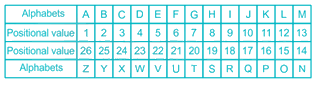 The logic followed here is:
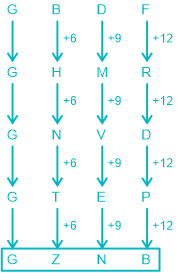 Thus, GZNB will replace the question mark (?) in the following series.
Hence, the correct answer is "Option 3".
Q2 · Series
What will come at the place of question mark?
1, 3, 7, 15, 31, ?
- 62
- 63
- 64
- 65
Answer aur solution dekho
Archived marked answer: B
Logic: Each number = Previous number × 2 + 1
The logic followed here is:
1
1 × 2 + 1 = 2 + 1 = 3
3 × 2 + 1 = 6 + 1 = 7
7 × 2 + 1 = 14 + 1= 15
15 × 2 + 1 = 30 + 1 = 31
31 × 2 + 1 = 62 + 1 = 63
Thus, 63 will come at the place of question mark.
Hence, the correct answer is "Option 2".
Q3 · Series
Complete the series.
Z1, Y2, X3, W4, ?
- V5
- V4
- U5
- X5
Answer aur solution dekho
Archived marked answer: A
The logic followed here is: Q4 · Analogy
In the following question, a pair of letters is given, followed by its corresponding product of alphabetical positions (A = 1, B = 2, ..., Z = 26). A second pair of letters is given without its product. Identify the correct product for the second pair that maintains the same relationship as the first.
N x P : 14 x 16 :: E x I : ?
- 5×9
- 6×9
- 5×10
- 6×8
Answer aur solution dekho
Archived marked answer: A
The logic followed here is:
Logic: Letters : Position Value
N x P : 14 x 16& Q5 · Puzzle Subtypes Not To Miss
If 'Z' denotes 'addition', 'x' denotes 'multiplication', 'Y' denotes 'division', and 'W' denotes 'subtraction', then what will be the value of the following expression?
3.2 Z (0.56 Y 1.4 X 4) W 5 X 5 Y 25 Z 5.
- 6.9
- 8.8
- 8.6
- 9.8
Answer aur solution dekho
Archived marked answer: B
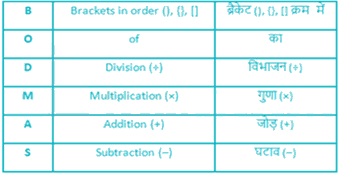 Given equation: 3.2 Z (0.56 Y 1.4 X 4) W 5 X 5 Y 25 Z 5.
Letter
Z
X
Y
W
Meaning
+
×
÷
- After replacing the letters by their meaning, we get:
= 3.2 + (0.56 ÷ 1.4 × 4) - 5 × 5 ÷ 25 + 5
= 3.2 + (0.4__ ×__ 4) - 5 × 5 ÷ 25 + 5
= 3.2 + 1.6 - 5 × 5 ÷ 25 + 5
= 3.2 + 1.6 - 5 ____× 0.2 + 5
= 3.2 + 1.6 - 1 + 5
= 9.8 - 1
= 8.8
Hence, the correct answer is "Option 2".
Q6 · Puzzle Subtypes Not To Miss
If 3 + 4 = 19 and 2 + 5 = 17, what is 1 + 6 = ?
- 15
- 13
- 12
- 11
Answer aur solution dekho
Archived marked answer: B
Given: If 3 + 4 = 19 and 2 + 5 = 17
The logic followed here is:
Logic: First number × Second number + (First number + Second number)
Q7 · Puzzle Subtypes Not To Miss
If 5 * 4 = 41 and 6 * 3 = 45, what is 7 * 2?
- 48
- 51
- 53
- 55
Answer aur solution dekho
Archived marked answer: C
Correct Option - 3
Given: If 5 * 4 = 41 and 6 * 3 = 45
The logic followed here is:
Logic: First number * Second number = (First number)² + (Second number)²
5 * 4 = 41 → 5² + 4² = 25 + 16 = 41
6 * 3 = 45 → 62 + 32 = 36 + 9 = 45
Similarly,
7 * 2? → 72 + 22 = 49 + 4 = 53
Thus, 53 will come in the place of ?.
Hence, the correct answer is "Option 3".
Q8 · Puzzle Subtypes Not To Miss
If the given symbols mean:
'+' means 'divided by'
'-' means 'multiplied by'
'x' means 'minus'
'÷' means 'plus' Then, find the value of the following expressions: 40 x 5 ÷ 8 + 16 - 2=?
- 56
- 27
- 48
- 36
Answer aur solution dekho
Archived marked answer: D
Correct Option - 4
BODMAS Table:
Symbol
+
- ×
÷
Meaning
÷
×
- +
Given equation: 40 x 5 ÷ 8 + 16 - 2=?
Replacing the symbols by their meaning, we get:
⇒ 40 - 5 + 8 ÷ 16 × 2 = ?
⇒ 40 - 5 + 0.5 × 2 = ?
⇒ 40 - 5 + 1 = ?
⇒ 41 - 5 = ?
⇒ 36 = ?
Hence, the correct answer is "Option 4". Q9 · Puzzle Subtypes Not To Miss
If '+' means 'x', '-' means '÷', 'x' means '+', then 4 – 2 × 3 + 6 = ?
- 12
- 6
- 5
- 20
Answer aur solution dekho
Archived marked answer: D
Correct Option - 4
BODMAS Table:
Symbol
+
- ×
Meaning
×
÷
+
Given equation: 4 – 2 × 3 + 6 = ?
After replacing the symbols by their meaning, we get:
⇒ 4 ÷ 2 + 3 × 6 = ?
⇒ 2 + 3 × 6 = ?
⇒ 2____ + 18 = ?
⇒ 20 = ?
Hence, the correct answer is "Option 4". Q10 · Puzzle Subtypes Not To Miss
The ratio of two numbers is 4:5 and their sum is 180. Find the numbers.
- 60 and 75
- 72 and 108
- 80 and 100
- 64 and 116
Answer aur solution dekho
Archived marked answer: C
Correct Option - 3
Given: The ratio of two numbers is 4:5 and their sum is 180.
Let the numbers be 4a and 5a.
According to question:
⇒ 4a + 5a = 180
⇒ 9a = 180
⇒ a = 180 ÷ 9
⇒ a = 20
Thus, the numbers are:
4a = 4 × 20 = 80
5a = 5 × 20 = 100
Hence, the correct answer is "Option 3".
Q11 · Puzzle Subtypes Not To Miss
If 'x' = '+', '+' = '-', '-' = '÷', '÷' = 'x', which equation is correct?
- 10 + 2 x 2 - 4 = 10
- 14 ÷ 2 - 2 + 4 = 10
- 12 x 2 + 4 - 1 = 27
- 8 + 4 - 2 x 1 = 10
Answer aur solution dekho
Archived marked answer: B
Correct Option - 2
BODMAS Table:
Symbol
×
+
- ÷
Meaning
+
- ÷
×
Now, checking each option one by one:
1.& Q12 · Puzzle Subtypes Not To Miss
What is the average of 5 consecutive odd numbers starting from 13?
- 17
- 18
- 20
- 23
Answer aur solution dekho
Archived marked answer: A
Correct Option - 1
5 consecutive odd numbers starting from 13 is 13, 15, 17, 19, 21
Sum = 13 + 15 + 17 + 19 + 21 = 85
Average = Sum of all the number ÷ Number of observations
= 85 ÷ 5
= 17
Hence, the correct answer is "Option 1".
Q13 · Coding Decoding
Sentence: "Reflections are clearer in calm waters." If each letter is mirrored using alphabetical symmetry (A↔Z, B↔Y...), what is the 2nd letter of the 6th word after mirroring?
- d
- x
- y
- z
Answer aur solution dekho
Archived marked answer: D
Given sentence: "Reflections are clearer in calm waters."
1. Reflections
2. are
Q14 · Coding Decoding
In a certain code language, each letter is assigned a unique digit. Based on the given codes for specific words, determine the code for the target word using the same logic. If SPEED is coded as 83551 and COOL is coded as 9226, then how will SCOOP be coded
- 89213
- 89276
- 89223
- 89327
Answer aur solution dekho
Archived marked answer: C
Correct Option - 3
Given:
SPEED is coded as 83551
S
P
E
E
D
8
3
5
5
1
COOL is coded as 9226
C
O
O
L
9
2
2
6
then, SCOOP will be coded as:
S
C
O
O
P
8
9
2
2
3
Hence, the correct answer is "Option 3".
Q15 · Coding Decoding
If 'READ' is coded as T2@3, and 'DEAR' is coded as 3@2T, then what is the code for 'DARE'?
- 3@T2
- T@23
- @32T
- @32Y
Answer aur solution dekho
Archived marked answer: A
Correct Option - 1
Given:
'READ' is coded as T2@3
R
E
A
D
T
2
@
3
'DEAR' is coded as 3@2T
D
E
A
R
3
@
2
T
Similarly,
D
A
R
E
3
@
T
2
Thus, DARE is coded as 3@T2.
Hence, the correct answer is "Option 1".
Q16 · Classification Odd One Out
Find the odd one out:
- A@1A,
- B@2B,
- C@4C,
- D@4D
Answer aur solution dekho
Archived marked answer: C
The logic followed here is:
Logic: First and fourth letter are same, 2nd element is @ and number at 3rd position is the place value of the letter.
1. A@1A → follows the logic
2. B@2B → follows the logic
3. C@4C → doesn't follow the logic as the place value of C is 3.
4. D@4D → follows the logic
Thus, C@4C is the odd one out.
Hence, the correct answer is "Option 3". Q17 · Classification Odd One Out
Find the odd one out from the given alternatives:
- Article 14
- Article 19
- Article 21
- Article 370
Answer aur solution dekho
Archived marked answer: D
The logic followed here is:
1. Article 14 → Right to Equality
2. Article 19 → Right to Freedom
3. Article 21 → Right to Life and Personal Liberty
4. Article 370 → Provided special status to Jammu & Kashmir (now revoked in 2019). It was not a Fundamental Right and was placed under Part XXI (Temporary, Transitional and Special Provisions).
All options except "Article 370", (14, 19, 21) are Fundamental Rights under Part III of the Indian Constitution.
Thus, Article 370 is the odd one out.
Hence, the correct answer is "Option 4".
Q18 · Logical Reasoning
Read the following statements and evaluate the conclusions based on traditional syllogistic logic. Consider the statements to be absolutely true, even if they appear contrary to known facts. Determine which conclusion(s) logically follow from the given statements.
Statements:
All metals are elements.
Some elements are gases.
Conclusions:
I. Some metals are gases.
II. All gases being elements is a possibility.
- Only Conclusion II follows
- Both I and II follow
- Only Conclusion I follows
- Neither I nor II follows
Answer aur solution dekho
Archived marked answer: A
Statements:
All metals are elements.
Some elements are gases.
The least possible Venn diagram for the given statement is:
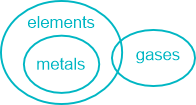 Conclusions:
I. Some metals are gases. - False (No definite relation given between metal and gases, so it can be possible only)
II. All gases beig elements is a possibility. - True (No definite relation given between metal and gases, so it can be possible only)
Hence, the correct answer is "Option 1".
Q19 · Blood Relations
A is the daughter of B. B is the son of C. D is the wife of C. How is D related to A?
- Aunt
- Mother
- Grandmother
- Sister
Answer aur solution dekho
Archived marked answer: C
 Given: A is the daughter of B. B is the son of C. D is the wife of C.
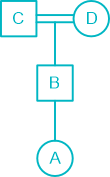 Clearly, D is grandmother of A.
Hence, the correct answer is "Option 3".
Q20 · Blood Relations
Pointing to a photograph, a man says, "She is the daughter of the only son of my father's wife". Who is the woman to the man?
- Sister
- Cousin
- Niece
- Daughter
Answer aur solution dekho
Archived marked answer: D
Correct Option - 4
Family Chart:
Given: Pointing to a photograph, a man says, "She is the daughter of the only son of my father's wife".
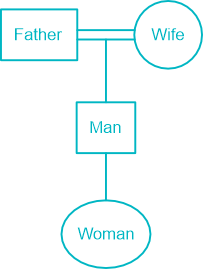 Clearly, the Woman is Daughter of the Man.
Hence, the correct answer is "Option 4".
Q21 · Alphabet Test
Which of the following alternative will fill the blanks?
m_u_mg_p_gu_
- g,p,u,m,p
- g,p,u,p,m
- p,u,u,p,m
- p,p,u,m,g
Answer aur solution dekho
Archived marked answer: A
Given: m_u_mg_p_gu_
The pattern followed here is:
1. g,p,u,m,p
Q22 · Alphabet Test
How many meaningful four-letter English words can be formed using the first, second, third, and fifth letters of the word "TRAVEL" (when counted from left to right), using each letter only once in each word?
- One
- Three
- Two
- Five
Answer aur solution dekho
Archived marked answer: B
Given word: TRAVEL
1
2
3
4
5
Q23 · Similarity and Differences
Choose the address that is exactly the same as the one given below.
Flat 201, Sapphire Tower, Garia Station Rd., Kolkata, West Bengal - 700084
- Flat 201, Saphire Tower, Garia Station Rd., Kolkata, West Bengal - 700084
- Flat 201, Sapphire Tower, Garia Station Rd., Kolkata, West Bengal - 700084
- Flat 201, Sapphire Tower, Gariya Station Rd., Kolkata, West Bengal - 700084
- Flat 201, Sapphire Tower, Garia Station Road, Kolkata, West Bengal - 700084
Answer aur solution dekho
Archived marked answer: B
Address
Options
Verdict
Flat 201, Sapphire Tower, Garia Station Rd., Kolkata, West Bengal – 700084
1
Flat 201, Saphire Tower, Garia Station Rd., Kolkata, West Bengal - 700084
It should be Sapphire to be exactly same as given address
Flat 201, Sapphire Tower, Garia Station Rd., Kolkata, West Bengal – 700084
2
Flat 201, Sapphire Tower, Garia Station Rd., Kolkata, West Bengal - 700084
Exactly Same
Flat 201, Sapphire Tower, Garia Station Rd., Kolkata, West Bengal – 700084
3
Flat 201, Sapphire Tower, Gariya Station Rd., Kolkata, West Bengal - 700084
It should be Garia to be exactly same as given address
Flat 201, Sapphire Tower, Garia Station Rd., Kolkata, West Bengal - 700084
4
Flat 201, Sapphire Tower, Garia Station Road, Kolkata, West Bengal - 700084
It should be Rd. to be exactly same as given address
Thus, option 2 is exactly the same as the one given.
Hence, the correct answer is "Option 2".
Q24 · Logical Statement Questions
Instruction: Identify the assumptions that must hold for the statement to be valid, then choose the correct option.
Statement: Deforestation in tropical rainforests, primarily driven by agricultural expansion and logging, not only contributes to the loss of biodiversity but also exacerbates global warming by reducing the Earth's capacity to absorb carbon dioxide.
Assumptions:
I. Deforestation reduces the Earth's ability to absorb carbon dioxide.
II. Agricultural expansion and logging are the primary causes of deforestation.
III. The loss of biodiversity is the most significant consequence of deforestation.
- Only I and II are implicit
- Only II and III are implicit
- Only I is implicit
- All I, II and III are implicit
Answer aur solution dekho
Archived marked answer: A
Statement: Deforestation in tropical rainforests, primarily driven by agricultural expansion and logging, not only contributes to the loss of biodiversity but also exacerbates global warming by reducing the Earth's capacity to absorb carbon dioxide.
Assumptions:
I. Deforestation reduces the Earth's ability to absorb carbon dioxide. → Implicit (The statement clearly implies global warming is exacerbated by reducing the Earth's capacity to absorb carbon dioxide)
II. Agricultural expansion and logging are the primary causes of deforestation. → Implicit (The statement clearly says deforestation is primarily driven by agricultural expansion and logging)
III. The loss of biodiversity is the most significant consequence of deforestation. → Not Implicit (The statement only says deforestation contributes to biodiversity loss. It does not explicitly mention that biodiversity loss is the most significant consequence)
Thus, only I and II are implicit.
Hence, the correct answer is "Option 1".
Q25 · Logical Statement Questions
Read the following statement carefully and identify the conclusion that follows.
Statement: The city experienced its worst rainfall in 50 years.
Conclusions:
I. The city's drainage systems may have failed.
II. Such rainfall occurs regularly.
- Only Conclusion I follows
- Only Conclusion II follows
- Both I and II follow
- Neither I nor II follows
Answer aur solution dekho
Archived marked answer: A
Given:
Statement: The city experienced its worst rainfall in 50 years
Conclusions:
I. The city's drainage systems may have failed - True ⇒ The phrase &ldq
General Awareness
Q1 · Art and Culture
What feature was used on Golconda Fort's gates to protect it during attacks involving war elephants?
- Deep moat with water channels
- Electrified spikes
- Steel spikes on doors
- Stone cannon towers
Answer aur solution dekho
Archived marked answer: C
The correct answer is Steel spikes on doors.
Key Points
- Steel spikes were strategically installed on the gates of Golconda Fort to prevent war elephants from ramming and breaking the gates during attacks.
- The spikes were pointed and sharp, making it impossible for elephants to use their strength to push or damage the gates.
- This feature was a common defensive mechanism in medieval Indian forts to counter the use of war elephants by invading armies.
- The gates of Golconda Fort were also designed with robust wooden structures, reinforced with steel to withstand heavy impacts.
- The strategic use of these spikes showcases the advanced engineering and defensive architecture of the era, ensuring the fort's safety during sieges.
Additional Information
- Deep moat with water channels:
- Moats were commonly used as a defensive feature in forts to prevent enemy forces from approaching the fort walls easily.
- Filled with water, moats acted as a barrier against infantry and cavalry attacks.
- However, Golconda Fort did not primarily rely on moats for defense against war elephants; the steel spikes were the preferred solution.
- Electrified spikes:
- This option is incorrect as the technology for electrified spikes was not available during the time of Golconda Fort's construction.
- Electricity was discovered centuries after the fort was built, making this an anachronistic suggestion.
- Stone cannon towers:
- Stone cannon towers were used for defensive purposes to place cannons for firing at approaching enemies.
- While the fort did have cannon towers, they were not specifically used to defend against war elephants.
- Cannons were primarily aimed at infantry, siege equipment, and other large-scale attackers.
Q2 · Art and Culture
Which musical instrument from Sikkim is believed to have been the first created for the deity Tetlara Lahadongna, and is associated with mythological origins?
- Niyara Hongsing Ke
- Simikla Koom (Binayo)
- Yema Dhol
- Nagara of Yeba
Answer aur solution dekho
Archived marked answer: B
The correct answer is Simikla Koom (Binayo).
Key Points
- Simikla Koom (Binayo) is a traditional musical instrument of Sikkim and is associated with the folklore and culture of the region.
- It is believed to have been crafted for the deity Tetlara Lahadongna, highlighting its mythological and spiritual significance.
- This instrument is made from natural materials, primarily bamboo, which reflects the eco-friendly practices and resourcefulness of the local communities.
- Simikla Koom (Binayo) is classified as a wind instrument, which produces sound through the vibration of air columns.
- The use of this instrument is deeply embedded in Sikkimese culture, often played during festivals, rituals, and traditional ceremonies.
Additional Information
- Niyara Hongsing Ke
- This is not a recognized traditional instrument from Sikkim, but the name may reflect a fictional or lesser-known term.
- In the context of traditional instruments, Sikkim primarily features bamboo-based and folk instruments associated with the Lepcha, Bhutia, and Nepali communities.
- Yema Dhol
- The Yema Dhol is a type of drum and is commonly found in many Indian traditions, but it is not specifically linked to Sikkimese culture.
- Drums like the Dhol are often associated with other regions in India, including Bengal, Assam, and Punjab, and are used in traditional and folk music.
- Nagara of Yeba
- The Nagara is a traditional drum instrument, but it is not particularly associated with Sikkim or the deity Tetlara Lahadongna.
- It is a common percussion instrument used in various parts of India and is often played during religious ceremonies and processions.
Q3 · Art and Culture
Consider the statements about Rauf:
1. It is a women's group dance of Kashmir usually performed at Eid.
2. Dancers align in two facing rows executing toe-heel footwork called ras. Which is/are correct?
- Only 1 correct
- Only 2 correct
- Both 1 & 2 correct
- Neither 1 nor 2 correct
Answer aur solution dekho
Archived marked answer: C
The correct answer is Option 3: Both 1 & 2 correct.
Key Points
- Rauf is a traditional dance form of Kashmir, primarily performed by women during festive occasions such as Eid.
- The dance is performed in groups, with women aligning themselves into two facing rows.
- Rauf is characterized by intricate toe-heel footwork, which is locally referred to as ras.
- The dance reflects the vibrant culture and traditions of Kashmir and is a significant representation of its rich heritage.
- It is a popular folk dance that also serves as a medium of social interaction and communal harmony among women in the region.
Additional Information
- Key Kashmiri Dances:
- Rouf (or Rauf):
- Who: Performed by women in colorful dresses.
- When: Celebrates spring and festivals like Eid and Ramzan.
- How: Simple, rhythmic footwork, with dancers facing each other, mimicking bees.
- Dumhal:
- Who: Exclusively performed by men of the Wattal tribe.
- When: Performed on special, auspicious occasions.
- How: Dancers wear vibrant robes and conical caps, plant a banner, and dance around it, singing folk songs in chorus.
- Hikat:
- A simple dance by two girls holding hands, moving clockwise and anti-clockwise, often involving weeding/harvesting themes.
- Bhand Pather:
- A traditional folk theatre form that combines dance, music, and satire, performed by wandering minstrels (Bhand).
Q4 · Art and Culture
Which of the following best captures the core rituals and symbolism of the Fagli (Kus/Kuns) festival in Pattan Valley?
- Baraza, symbolizing Shikhara-Appa, is made with marigold and turmeric and placed at village shrines.
- Punha involves symbolic ploughing indoors using willow sticks, reflecting farming hopes during snow.
- Totu, made of wheat and honey, is offered on rooftops to priests, then fed to goats.
- Kwari sweets are made by elder women for temple offerings, as men chant to crow spirits.
Answer aur solution dekho
Archived marked answer: B
The correct answer is Punha involves symbolic ploughing indoors using willow sticks, reflecting farming hopes during snow..
Key Points
- The Fagli festival, celebrated in the Pattan Valley of Himachal Pradesh, is a traditional winter event celebrated to mark the end of the harsh winter season.
- Punha, one of the rituals, involves symbolic indoor ploughing using willow sticks, symbolizing hope and prosperity for agriculture in the upcoming season.
- This symbolic ritual is significant as it reflects the dependence of the local community on farming and their connection with nature, even during snow-covered winters.
- The festival emphasizes agricultural prosperity, community bonding, and the preparation for the upcoming farming season.
- The use of willow sticks indoors signifies adaptability and reverence toward nature, as agricultural activities halt during heavy snow.
Additional Information
- Some of the key festivals and fairs of Himachal Pradesh:
- Kullu Dussehra (Kullu): A huge, unique Dussehra celebrated with traditional deities brought from villages, unlike other parts of India.
- Mandi Shivratri (Mandi): Features processions of local deities (Devtas) to the main temple, showcasing rich culture.
- Lavi Fair (Rampur Bushahr): An ancient trade fair, famous for trading wool, pashmina, and dry fruits, with significant cultural events.
- Shimla Summer Festival (Shimla): A multi-day cultural extravaganza held in summer, boosting tourism.
- Nalwari Fair (Bilaspur): A prominent cattle fair with wrestling and other activities.
Q5 · Indian Polity and Constitution
Article 50 is part of which section of the Constitution?
- Fundamental Duties
- Directive Principles of State Policy
- Fundamental Rights
- Preamble
Answer aur solution dekho
Archived marked answer: B
The correct answer is Directive Principles of State Policy.
Key Points
- Article 50 of the Indian Constitution falls under the Directive Principles of State Policy (DPSP), which are outlined in Part IV of the Constitution (Articles 36-51).
- It specifically states, "The State shall take steps to separate the judiciary from the executive in the public services of the State."
- The purpose of Article 50 is to maintain the independence of the judiciary, a vital component of a democratic system, and to ensure the impartiality of justice.
- DPSPs, including Article 50, are non-justiciable, meaning they are not enforceable by the courts, but they act as guiding principles for the State to establish policies and laws.
- Article 50 has played a crucial role in the Indian judicial system by emphasizing the doctrine of separation of powers between the judiciary and the executive.
Additional Information
- Fundamental Duties:
- Fundamental Duties are listed under Part IVA of the Indian Constitution (Article 51A).
- They were added by the 42nd Amendment Act, 1976, based on the recommendations of the Swaran Singh Committee.
- These duties serve as moral obligations for citizens to promote a spirit of patriotism and uphold the unity of the nation.
- Examples include abiding by the Constitution, respecting the national flag and anthem, protecting the environment, and promoting harmony.
- Fundamental Rights:
- Fundamental Rights are enshrined in Part III of the Indian Constitution (Articles 12-35).
- They guarantee basic rights to all citizens, essential for their development and protection against state actions.
- Key Fundamental Rights include the Right to Equality (Article 14-18), Right to Freedom (Article 19-22), and Right to Constitutional Remedies (Article 32).
- These rights are justiciable, meaning individuals can approach the courts if their rights are violated.
- Preamble:
- The Preamble serves as the introductory statement of the Indian Constitution, outlining its objectives and philosophy.
- It declares India as a Sovereign, Socialist, Secular, and Democratic Republic and ensures Justice, Liberty, Equality, and Fraternity to all its citizens.
- Although not enforceable in a court of law, the Preamble is considered a guiding light for interpreting the Constitution.
Q6 · Indian Polity and Constitution
Fill in the Blank:
During India's BRICS Chairship in 2021, key initiatives included the Digital Health Summit and the ____ for environmental cooperation.
- BRICS Water Security Pact
- BRICS Alliance for Green Tourism
- BRICS Climate Finance Agreement
- BRICS Sustainable Energy Forum
Answer aur solution dekho
Archived marked answer: B
The correct answer is BRICS Alliance for Green Tourism.
Key Points
- During India’s BRICS Chairship in 2021, one of the major initiatives was the launch of the BRICS Alliance for Green Tourism, focusing on sustainable tourism practices among member nations.
- This initiative aimed to promote collaborative efforts among BRICS countries (Brazil, Russia, India, China, and South Africa) to adopt eco-friendly tourism strategies and reduce the carbon footprint of the tourism sector.
- The alliance emphasized the importance of preserving biodiversity, reducing the environmental impact of tourism, and promoting resource-efficient practices in the sector.
- It provided a platform for sharing best practices, innovations, and policies to strengthen sustainable tourism, benefiting local communities and preserving cultural heritage.
- The BRICS Alliance for Green Tourism also aligned with global sustainability goals, particularly the United Nations Sustainable Development Goals (SDGs), focusing on climate action and responsible consumption and production.
Additional Information
- BRICS Water Security Pact
- This option refers to a hypothetical agreement among BRICS nations to address water security challenges. However, no such pact was launched during India’s BRICS Chairship in 2021.
- Water security is a critical issue for BRICS nations, but it was not a specific focus of the 2021 initiatives.
- BRICS Climate Finance Agreement
- This refers to a potential agreement for financial mechanisms to combat climate change. However, no such specific agreement was introduced during the 2021 BRICS Chairship.
- While climate finance remains a crucial topic for BRICS discussions, it was not a formalized initiative in 2021.
- BRICS Sustainable Energy Forum
- The BRICS Sustainable Energy Forum focuses on energy efficiency and renewable energy cooperation among member nations.
- Although energy sustainability is a significant area of focus for BRICS, it was not one of the key initiatives launched during India’s 2021 Chairship.
Q7 · Indian Polity and Constitution
Consider the following statements:
1) Both the Prime Minister (PM) and Chief Minister (CM) can advise dissolution of the respective Lower House.
2) Only the PM can recommend President's Rule under Article 356 of the Constitution.
Which of the statements is/are correct?
- Only 1
- Only 2
- Both 1 and 2
- Neither 1 nor 2
Answer aur solution dekho
Archived marked answer: A
The correct answer is Only 1.
Key Points
- Statement 1: Both the Prime Minister (PM) and the Chief Minister (CM) can advise the dissolution of their respective Lower Houses. Correct.
- The Prime Minister, along with the Council of Ministers, can advise the President to dissolve the Lok Sabha under Article 85 of the Constitution.
- Similarly, the Chief Minister, along with the Council of Ministers, can advise the Governor to dissolve the Legislative Assembly (Vidhan Sabha) of the state.
- The President and Governor generally act on the aid and advice of their respective Councils of Ministers.
*Hence, Statement 1 is correct.*
- Statement 2: Only the PM can recommend President's Rule under Article 356 of the Constitution. Incorrect.
- President's Rule is imposed by the President of India under Article 356 when a state's constitutional machinery fails.
- The recommendation is generally made by the Union Council of Ministers, headed by the Prime Minister, and is often based on a report from the Governor of the concerned state.
- The Constitution does not provide that the Prime Minister alone can recommend President's Rule.
*Hence, Statement 2 is incorrect.*
- *Therefore, only Statement 1 is correct.*
Additional Information
- Article 74 provides that the President shall act in accordance with the aid and advice of the Council of Ministers headed by the Prime Minister.
- Article 163 provides that the Governor acts on the aid and advice of the Council of Ministers headed by the Chief Minister, except in matters where the Constitution grants discretionary powers.
- Article 356 deals with the imposition of President's Rule in a state if the constitutional machinery fails.
- During President's Rule, the powers of the state government are assumed by the President, and the state legislature may be suspended or dissolved.
- The proclamation of President's Rule must be approved by both Houses of Parliament within two months from the date of its issuance.
Important Points
- The landmark S.R. Bommai vs Union of India (1994) judgment placed significant restrictions on the arbitrary use of Article 356.
- The Lok Sabha is the Lower House at the Union level, while the Legislative Assembly (Vidhan Sabha) is the Lower House at the state level.
- The power to dissolve the Lower House is exercised formally by the President or Governor, but usually on the advice of the elected executive.
Q8 · Indian Economy
Arrange the following in chronological order:
1. GST Council constituted
2. Constitution (101st Amendment) Act enacted
3. GST launched
Choose the correct chronological sequence:
- 1-2-3
- 2-1-3
- 3-2-1
- 2-3-1
Answer aur solution dekho
Archived marked answer: B
The correct answer is 2-1-3.
Key Points
- The Goods and Services Tax (GST) was implemented in India on July 1, 2017, marking the beginning of a unified indirect tax structure across the nation.
- Before its launch, the Constitution (101st Amendment) Act was enacted on September 8, 2016, to provide the legal framework for GST implementation.
- The GST Council, which is responsible for making recommendations on GST-related matters, was constituted on September 15, 2016.
- Hence, the correct chronological order is as follows:
- Constitution (101st Amendment) Act enacted (September 8, 2016)
- GST Council constituted (September 15, 2016)
- GST launched (July 1, 2017)
- This sequence aligns with the preparatory steps taken by the Indian government to roll out GST effectively.
Additional Information
- Constitution (101st Amendment) Act, 2016:
- The 101st Constitutional Amendment was enacted to introduce GST in India.
- It empowered both the Centre and the States to levy and collect GST on goods and services.
- The amendment subsumed several indirect taxes such as excise duty, service tax, and VAT into a single tax structure.
- GST Council:
- The GST Council is a constitutional body established under Article 279A of the Indian Constitution.
- It is chaired by the Union Finance Minister and includes State Finance Ministers as members.
- The council is responsible for making recommendations on tax rates, exemptions, and other policy matters related to GST.
Q9 · Indian Economy
Read the following Assertion (A) and Reason (R) carefully and choose the correct option.
Assertion (A): The IPR 1956 created an industrial classification into Schedules A, B, and C.
Reason (R): This was to identify sectors for exclusive state control, joint sectors, and private sector operation.
- Both A and R are true and R is the correct explanation of A.
- Both A and R are true but R is not the correct explanation of A.
- A is true but R is false.
- A is false but R is true.
Answer aur solution dekho
Archived marked answer: A
The correct answer is Both A and R are true and R is the correct explanation of A..
Key Points
- The Industrial Policy Resolution (IPR) of 1956 was a significant policy document that aimed to classify industries into three categories: Schedule A, Schedule B, and Schedule C.
- Schedule A included industries that were exclusively under state control and were regarded as essential for national defense and economic development (e.g., railways, atomic energy).
- Schedule B covered industries that were to be developed under joint sector arrangements, i.e., both state and private enterprises could participate in these industries.
- Schedule C comprised industries that were to be left for private sector operations, allowing individual entrepreneurship to thrive.
- The classification was designed to promote a mixed economy model and was rooted in the philosophy of socialist planning, which sought to balance private and state ownership.
Additional Information
- Post-Independence (IPR 1948, 1956): Focused on public sector dominance and planned development.
- Liberalization (IPR 1991): Shifted towards opening the economy and global integration.
- Recent Initiatives:
- Make in India (2014): To make India a global manufacturing hub.
- Atmanirbhar Bharat Abhiyan (2020): Aimed at self-reliance and reducing import dependency.
- Production-Linked Incentive (PLI) Scheme (2020): Offers incentives for increased domestic production.
Q10 · Indian Economy
Read the below statements marked as Assertion (A) and Reason (R). Mark the correct options:
Assertion (A): India's rank in the Global Happiness Index is lower than most South Asian neighbours.
Reason (R): India's GDP per capita is the lowest in South Asia.
- Both A and R are true, and R is the correct explanation of A.
- Both A and R are true, but R is not the correct explanation of A.
- A is true, but R is false.
- A is false, but R is true.
Answer aur solution dekho
Archived marked answer: C
The correct answer is 3) A is true, but R is false..
Key Points
- India's rank in the Global Happiness Index has been consistently low, with neighboring South Asian countries like Nepal, Bhutan, and Bangladesh often ranking higher.
- As per the 2023 World Happiness Report, India ranked 126th out of 137 countries, while countries like Bhutan ranked significantly higher.
- The Global Happiness Index considers factors such as social support, life expectancy, freedom to make life choices, and perceptions of corruption—not just economic indicators like GDP per capita.
- India's GDP per capita is not the lowest in South Asia. For example, countries like Afghanistan have a lower GDP per capita than India.
- Hence, while the assertion (A) is correct that India's rank is lower than most South Asian neighbors, the reason (R) is incorrect since the ranking is based on several factors beyond GDP per capita.
Additional Information
- Factors influencing the Global Happiness Index:
- The ranking is based on six key metrics: GDP per capita, social support, healthy life expectancy, freedom to make life choices, generosity, and perceptions of corruption.
- While GDP per capita is an important factor, other social and psychological well-being aspects weigh heavily in the index.
- Countries like Bhutan rank higher because of their focus on Gross National Happiness, despite having lower GDP per capita.
- India's performance in the Global Happiness Index:
- India's lower ranking is attributed to factors such as weak social support, perceived corruption, and lower levels of individual freedom.
- Efforts to improve quality of life through government initiatives like Digital India, Swachh Bharat Abhiyan, and Ayushman Bharat are aimed at addressing these issues.
- GDP per capita in South Asia:
- India's GDP per capita is higher than several South Asian nations, including Afghanistan and Nepal.
- However, countries like Bhutan and Maldives have higher GDP per capita due to their smaller populations and focused economic strategies.
Q11 · Sports Static GK
Karnam Malleswari became the first Indian woman to win an Olympic medal in which sporting discipline?
- Boxing
- Athletics
- Weightlifting
- Long Jump
Answer aur solution dekho
Archived marked answer: C
The correct answer is Weightlifting.
Key Points
- Karnam Malleswari became the first Indian woman to win an Olympic medal by securing a bronze in Weightlifting at the 2000 Sydney Olympics.
- She competed in the 69 kg Women’s Weightlifting category, lifting a total of 240 kg (110 kg in snatch and 130 kg in clean and jerk).
- Her achievement marked a historic moment for India, as she was the first Indian fem
Q12 · Sports Static GK
Fill in the blanks:
At the 1984 Summer Olympics, P. T. Usha narrowly missed a bronze medal by ____ of a second.
- One-hundredth
- One-tenth
- One-thousandth
- One-fiftyth
Answer aur solution dekho
Archived marked answer: A
The correct answer is One-hundredth.
Key Points
- P. T. Usha, popularly known as the "Payyoli Express," is one of India’s greatest athletes and a legend in track and field.
- At the 1984 Summer Olympics held in Los Angeles, she competed in the women’s 400m hurdles event.
- She narrowly missed the bronze medal, finishing fourth in the final with a timing of 55.42 seconds.
- The difference between P. T. Usha and the bronze medalist was just one-hundredth (0.01) of a second, making it a historic and heartbreaking moment in Indian sports history.
- Despite not winning a medal, her achievement remains significant as she became the first Indian woman to reach the finals of an Olympic event.
Additional Information
- 1984 Summer Olympics:
- The 1984 Summer Olympics were held in Los Angeles, USA, from July 28 to August 12.
- India’s participation in athletics was highlighted by P. T. Usha’s remarkable performance in the 400m hurdles.
- Her near-podium finish brought attention to Indian athletics on the global stage and inspired future generations of athletes.
Q13 · Sports Static GK
Which of the following about the men's hockey event at the 38th National Games 2025 is/are correct?
1.) Karnataka beat Uttar Pradesh 3-2 in the final.
2.) Karnataka vs Maharashtra semifinal ended 2-2, decided by shootout.
3.) Punjab won bronze by defeating Maharashtra 1-0.
- Both 1 and 2 are correct
- Both 1 and 3 are correct
- Both 2 and 3 are correct
- 1, 2 and 3 all are Correct
Answer aur solution dekho
Archived marked answer: A
The correct answer is Option 1: Both 1 and 2 are correct.
Key Points
- The men's hockey event at the 38th National Games 2025 witnessed intense competition among several states, with Karnataka emerging as the winner by defeating Uttar Pradesh 3-2 in the final.
- Karnataka and Maharashtra had a closely contested semifinal match, which ended in a 2-2 draw and was ultimately decided by a shootout.
- These results highlight Karnataka's dominance in the tournament and their ability to perform under pressure, especially during the shootout in the semifinals.
- The National Games are a multi-sport event held in India every few years, and hockey remains one of the most competitive sports in the event.
- Option 1 is correct as both statements 1 and 2 about the men's hockey event align with the verified outcomes reported during the 38th National Games.
Additional Information
- National Games
- The National Games are organized by the Indian Olympic Association and are held in different states to promote sports culture in India.
- The event features competitions in various sports, including hockey, athletics, swimming, and more.
- It serves as a platform for athletes to showcase their talent and prepare for international tournaments like the Asian Games and Olympics.
Q14 · Indian Geography
Uttar Pradesh accounted for approximately what percent of India's total population in 2011?
- 10%
- 12%
- 16%
- 18%
Answer aur solution dekho
Archived marked answer: C
The correct answer is 16%.
Key Points
- As per the 2011 Census of India, Uttar Pradesh accounted for approximately 16% (or 0.16) of the total population of India.
- The total population of India in 2011 was around 1.21 billion, and Uttar Pradesh contributed approximately 199.81 million to this figure.
- Uttar Pradesh is the most populous state in India, followed by Maharashtra and Bihar.
- The state’s high population is attributed to factors such as a high fertility rate, large geographical area, and significant rural population.
- Uttar Pradesh alone has a population larger than many countries, ranking as the fifth most populous administrative unit globally, after China, India, the United States, and Indonesia.
Additional Information
- Population Dynamics of India
- The Census of India, conducted every 10 years, is the most reliable source of demographic data for the country.
- India has a highly uneven distribution of population, with Uttar Pradesh being the most populous state, while states like Sikkim and Mizoram have much smaller populations.
- Population distribution in India is influenced by factors like fertility rates, migration, urbanization, and socioeconomic conditions.
Q15 · Indian Geography
Which of the following minerals is found in large quantities in India and holds high economic importance?
- Copper
- Petroleum
- Iron ore
- Tin
Answer aur solution dekho
Archived marked answer: C
The correct answer is Iron ore.
Key Points
- Iron ore is one of the most abundant and economically significant minerals in India, making the country the fourth-largest producer in the world as of 2022.
- The majority of iron ore production in India comes from states like Odisha, Chhattisgarh, Karnataka, and Jharkhand, with Odisha being the largest producer.
- India's iron ore is predominantly used in the production of steel, which is critical to the construction, automobile, and infrastructure sectors.
- The two main types of iron ore found in India are hematite and magnetite, with hematite being the more dominant type.
- India exports significant quantities of iron ore to countries like China and Japan, contributing to its foreign exchange reserves and economic growth.
Additional Information
- Copper
- Copper is an important metal used in electrical equipment, construction, and industrial machinery due to its excellent conductivity and malleability.
- India has limited copper reserves, with key mining areas located in Madhya Pradesh, Rajasthan, and Jharkhand.
- India imports a significant amount of its copper requirements to meet domestic demand.
- Petroleum
- Petroleum is a crucial energy resource and raw material for industries like petrochemicals, plastics, and fertilizers.
- India is the third-largest consumer of crude oil globally but relies heavily on imports to meet around 85% of its demand.
- Major petroleum-producing regions in India include Assam, Gujarat, Rajasthan, and offshore fields in the Mumbai High basin.
- Tin
- Tin is primarily used in soldering, tin plating, and the production of alloys like bronze.
- India has very limited tin reserves, with some deposits found in Chhattisgarh and Jharkhand, making it dependent on imports to meet domestic demand.
Q16 · Indian Geography
Which Indian river was added to the National River Conservation Plan in 2024?
- Yamuna
- Musi
- Krishna
- Gomti
Answer aur solution dekho
Archived marked answer: B
The correct answer is Musi.
Key Points
- The Musi River, located in Telangana, was added to the National River Conservation Plan (NRCP) in 2024.
- The NRCP is an initiative by the Ministry of Environment, Forest and Climate Change (MoEFCC) to conserve and rejuvenate polluted rivers across India.
- The Musi River flows through Hyderabad and has been heavily polluted due to untreated sewage, industrial waste, and urban runoff.
- Under the NRCP, measures such as sewage treatment plants, bio-remediation, riverbank restoration, and public awareness campaigns are implemented to revive polluted rivers.
- The inclusion of the Musi River in the NRCP aims to address environmental concerns and improve water quality for better ecological and human health.
Additional Information
- Yamuna River:
- The Yamuna River is the largest tributary of the Ganga and flows through several states, including Uttarakhand, Haryana, and Uttar Pradesh.
- It has been part of the NRCP since 1993 due to high pollution levels in cities like Delhi and Agra.
- Under the NRCP, projects such as sewage treatment, riverfront development, and waste management have been undertaken.
- Krishna River:
- The Krishna River is one of India's major rivers, flowing through Maharashtra, Karnataka, Telangana, and Andhra Pradesh.
- It is known for its importance in irrigation, hydroelectric power generation, and water supply.
- The Krishna is not part of the NRCP, as pollution levels are comparatively lower than rivers like the Yamuna or Musi.
- Gomti River:
- The Gomti River flows through Uttar Pradesh, including the city of Lucknow.
- It has been part of the NRCP since the late 1990s due to pollution from untreated sewage and industrial effluents.
- Efforts under the NRCP include constructing sewage treatment plants and reducing pollution sources.
Q17 · Current Affairs
What does the designation HLVM3 stand for in the Gaganyaan mission context?
- Heavy LVM3
- Hybrid LVM3
- Human LVM3
- High LVM3
Answer aur solution dekho
Archived marked answer: C
The correct answer is Human LVM3.
Key Points
- The designation HLVM3 stands for Human LVM3, which refers to the modified version of the Launch Vehicle Mark-3 (LVM3) developed by the Indian Space Research Organisation (ISRO) for the Gaganyaan mission.
- LVM3, also known as GSLV Mk-III, is India’s heaviest and most advanced rocket, capable of launching payloads up to 8 tons into low Earth orbit.
- For the Gaganyaan mission, LVM3 has been customized to carry humans safely into space, integrating advanced safety features such as an abort system and life-support mechanisms.
- The HLVM3 is equipped with a crew module and service module designed to house astronauts and ensure their safety during the mission.
- The Gaganyaan program aims to send a crew of three astronauts into low Earth orbit for a duration of up to seven days using the HLVM3 rocket.
Additional Information
- Gaganyaan Mission:
- The Gaganyaan mission is India’s first human spaceflight program, aimed at demonstrating the capability of sending astronauts into space and bringing them back safely.
- It involves critical technologies such as crew safety systems, life-support systems, space medicine, and crew training.
- The program is a significant milestone in India’s space exploration journey and aims to position India as a key player in human spaceflight capabilities.
Q18 · Current Affairs
What initiative did Dr. Jitendra Singh launch in May 2025 as MoS PMO and MoS Personnel?
- National Grievance Redress Portal
- e-Civil List 2025 e-book
- Central Police Commemoration Day
- Digital Land Records Survey
Answer aur solution dekho
Archived marked answer: B
The correct answer is e-Civil List 2025 e-book.
Key Points
- The e-Civil List 2025 e-book was launched by Dr. Jitendra Singh in May 2025 in his capacity as Minister of State (MoS) PMO and MoS Personnel.
- This initiative is part of the government’s effort to digitize official records and make them accessible to stakeholders in a user-friendly manner.
- The e-Civil List provides comprehensive information about IAS officers across India, including their postings, cadre, and career details.
- It aims to enhance transparency, accountability, and ease of access to the details of civil servants for administrative and public use.
- The platform leverages technology to ensure up-to-date record maintenance and helps in better governance and human resource management of IAS officers.
Additional Information
- National Grievance Redress Portal
- This is an online platform designed to address public grievances efficiently and transparently.
- It allows citizens to register complaints related to government services and schemes, ensuring timely resolution.
- The portal is part of the government’s ongoing efforts to improve governance and citizen-centric service delivery.
- While significant, this initiative was not launched in May 2025.
- Central Police Commemoration Day
- Observed annually on October 21, this day is dedicated to honoring police personnel who have sacrificed their lives in the line of duty.
- It was first commemorated in 1959 following the tragic loss of police forces during a skirmish with Chinese forces at Hot Springs, Ladakh.
- While it is an important event, it is not related to the initiative launched by Dr. Jitendra Singh in May 2025.
- Digital Land Records Survey
- This initiative focuses on digitizing land records to streamline land ownership documentation and minimize disputes.
- It aims to create a transparent and accessible database of land records for citizens and government authorities.
- It is a separate program from the e-Civil List 2025 e-book and was not launched in May 2025.
8f
Q19 · Current Affairs
Read the below statements marked as Assertion (A) and Reason (R). Mark the correct options:
Assertion (A): Mission Amrit Sarovar promotes water conservation.
Reason (R): It aims to construct 75 ponds in each district by 2024.
- Both A and R are true, and R is the correct explanation of A
- Both A and R are true, but R is not the correct explanation of A
- A is true, but R is false
- A is false, but R is true
Answer aur solution dekho
Archived marked answer: A
The correct answer is Both A and R are true, and R is the correct explanation of A.
Key Points
- Mission Amrit Sarovar is a flagship initiative by the Government of India, launched to promote water conservation and sustainable water resource management.
- The objective of Mission Amrit Sarovar is to develop and rejuvenate 75 water bodies in every district across the country by August 15, 2023, as part of the Azadi Ka Amrit Mahotsav celebrations.
- The project aims to strengthen water security and ensure environmental sustainability by constructing ponds and water reservoirs to increase water storage and recharge groundwater levels.
- The Reason (R) correctly explains the Assertion (A) since the construction of 75 ponds in each district directly contributes to promoting water conservation efforts.
- Mission Amrit Sarovar seeks to involve multiple stakeholders, including rural communities, local bodies, and government agencies, to revive traditional water conservation practices.
Additional Information
- Water Conservation
- Water conservation refers to the strategies, policies, and activities aimed at managing the use of fresh water to meet current and future demands sustainably.
- It includes measures such as rainwater harvesting, groundwater recharge, and the construction of water bodies like ponds and reservoirs.
- Programs like Mission Amrit Sarovar align with the United Nations Sustainable Development Goals (SDG), particularly Goal 6: Clean Water and Sanitation.
- Importance of Groundwater Recharge
- Groundwater recharge is essential for maintaining aquifer levels, which are a critical source of drinking water and irrigation in India.
- Constructing ponds and water reservoirs helps in reducing surface runoff and ensures that water infiltrates into the ground, replenishing groundwater levels.
- Community Participation in Water Conservation
- Mission Amrit Sarovar emphasizes the active involvement of local communities in creating and maintaining water bodies.
- Such participation fosters awareness about water conservation and ensures the sustainability of the initiative in the long term.
</ul
Q20 · General Science Biology
Which of the following pairs of type of nutrient - nutrient is correctly matched?
- Micronutrient - Calcium
- Macronutrient - Zinc
- Micronutrient - Boron
- Macronutrient - Iron
Answer aur solution dekho
Archived marked answer: C
The correct answer is Micronutrient - Boron.
Key Points
- Boron is classified as a micronutrient because plants require it in very small amounts for proper growth and development.
- It plays a critical role in cell wall formation, membrane stability, and pollen tube growth in plants.
- Deficiency of boron leads to symptoms like stunted root growth, hollow stems, or flower abortion in plants.
- Boron is absorbed by plants from the soil in the form of borate ions (BO3³⁻).
- Common sources of boron in agriculture include fertilizers like borax and boric acid.
Additional Information
- Micronutrient - Calcium (Option 1):
- Calcium is actually a macronutrient, not a micronutrient, as it is required by plants in relatively large amounts.
- It is essential for cell wall integrity and acts as a secondary messenger in various cellular processes.
- Calcium deficiency can lead to problems like blossom end rot in tomatoes and weak cell walls in plants.
- Macronutrient - Zinc (Option 2):
- Zinc is a micronutrient, not a macronutrient, as it is needed in small quantities by plants.
- It is essential for enzyme activation, protein synthesis, and hormone production in plants.
- Zinc deficiency often manifests as chlorosis (yellowing of leaves) and stunted growth.
- Macronutrient - Iron (Option 4):
- Iron is also a micronutrient, not a macronutrient.
- It plays a key role in chlorophyll synthesis and acts as a cofactor for various enzymatic reactions.
- Iron deficiency is characterized by interveinal chlorosis in young leaves.
- Macronutrients vs Micronutrients:
- Macronutrients (e.g., nitrogen, phosphorus, potassium) are required in large amounts by plants, while micronutrients (e.g., zinc, boron, iron) are needed in trace amounts.
- Both types of nutrients are vital for plant health, growth, and productivity.
</ul
Q21 · Medieval Indian History
Match each ruler listed in Column A with their respective period of reign given in Column B:
Column A: Ruler
Column B: Reign Period
A. Qutbuddin Aybak
1. 1175-1192
B. Prithviraj Chauhan
2. 1206-1210
C. Alauddin Khalji
3. 1296-1316
D. Muhammad Tughluq
4. 1324-1351
- A → 1, B → 2, C → 3, D → 4
- A → 1, B → 4, C → 3, D → 2
- A → 2, B → 1, C → 3, D → 4
- A → 4, B → 3, C → 2, D → 4
Answer aur solution dekho
Archived marked answer: C
The correct answer is Option 3: A → 2, B → 1, C → 3, D → 4.
Key Points
- Qutbuddin Aybak (1206–1210): Qutbuddin Aybak was the founder of the Delhi Sultanate and the first ruler of the Slave Dynasty. He ruled from 1206 to 1210 and was known for constructing the Qutub Minar in Delhi.
- Prithviraj Chauhan (1175–1192): Prithviraj Chauhan was a Rajput king of the Chahamana dynasty who ruled during 1175–1192 CE. He is remembered for his valiant battles against Muhammad Ghori.
- Alauddin Khalji (1296–1316): Alauddin Khalji was the second ruler of the Khalji dynasty in India. His reign, from 1296 to 1316, is marked by military expansion and administrative reforms.
- Muhammad bin Tughluq (1324–1351): Muhammad bin Tughluq, the Sultan of Delhi, ruled from 1324 to 1351. He was known for his ambitious and often controversial reforms, such as the attempted introduction of token currency.
Additional Information
- Slave Dynasty (1206–1290): The Slave Dynasty, also known as the Mamluk Dynasty, was the first dynasty of the Delhi Sultanate. It was established by Qutbuddin Aybak, who was originally a slave of Muhammad Ghori. The dynasty laid the foundation of Muslim rule in India.
- Chahamana Dynasty: The Chahamanas (Chauhans) were a prominent Rajput dynasty that ruled over parts of northwestern India, including Delhi and Ajmer. Prithviraj Chauhan is the most celebrated ruler of this dynasty.
- Khalji Dynasty (1290–1320): This dynasty is known for its expansionist policies and economic reforms. Alauddin Khalji implemented price control measures and established a strong central administration.
- Tughluq Dynasty (1320–1414): The Tughluq dynasty was known for its ambitious rulers like Muhammad bin Tughluq, who attempted various reforms, including shifting the capital from Delhi to Daulatabad and the introduction of token currency. These reforms, however, were largely unsuccessful and led to administrative challenges.
Q22 · Ancient Indian History
Determine the correctly matched Gupta fiscal term with its meaning.
- Hiranya - compulsory labour service
- Dhanya - gold tax
- Bhoga - king's share of produce
- Vaishthika - forced or corvée labour
Answer aur solution dekho
Archived marked answer: D
The correct answer is Vaishthika - forced or corvée labour.
Key Points
- In the Gupta administrative and fiscal system, Vaishthika referred to forced labour or corvée labour imposed by the state. *Hence, option 4 is correctly matched.*
- Corvée labour means compulsory unpaid labour provided by subjects for public works or state purposes.
- Hiranya referred to taxes paid in the form of cash or precious metals, not compulsory labour. *Hence, option 1 is incorrect.*
- Dhanya referred to taxes paid in the form of grain or agricultural produce, not gold tax. *Hence, option 2 is incorrect.*
- Bhoga denoted the periodic supply of fruits, flowers, fuel, and other provisions to the king or officials, rather than the king’s share of produce. *Hence, option 3 is incorrect.*
- Statement-wise Analysis:
- Hiranya - compulsory labour service – Incorrect.
- Dhanya - gold tax – Incorrect.
- Bhoga - king's share of produce – Incorrect.
- Vaishthika - forced or corvée labour – Correct.
- *Hence, the correct answer is Vaishthika - forced or corvée labour.*
Additional Information
- Gupta Empire: The Gupta period lasted approximately from 320 CE to 550 CE and is often called the “Golden Age of Ancient India”.
- Main Sources: Information about Gupta administration comes from inscriptions, coins, land grants, and accounts of Chinese traveler Faxian.
- Land Revenue: The major source of state income during the Gupta period was land tax, generally collected as a share of agricultural produce.
- Bhaga: The term Bhaga referred to the king’s share of produce, usually around one-sixth of the agricultural yield.
- Economic System: Both cash payments and payments in kind were common during the Gupta age.
Important Points
- Important Gupta Fiscal Terms:
- Hiranya – Cash tax
- Dhanya – Tax in grain
- Bhaga – King’s share of produce
- Vaishthika – Forced labour
- Bhoga – Supplies or provisions to officials
- Questions related to Gupta administration, taxation, and economic terms are frequently asked in history and competitive examinations.
Q23 · World Geography
Regarding Earth's major climatic zones:
1. Tropical zones experience minimal seasonal temperature variation
2. Temperate zones are characterized by four distinct seasons.
Which of the above is/are correct?
- Statement 1 only
- Statement 2 only
- Both 1 and 2
- Neither 1 nor 2
Answer aur solution dekho
Archived marked answer: C
The correct answer is Option 3: Both 1 and 2.
Key Points
- Statement 1: Tropical zones experience minimal seasonal temperature variation because they are located near the equator and receive consistent solar radiation throughout the year. This results in relatively stable temperatures.
- Statement 2: Temperate zones are characterized by four distinct seasons: spring, summer, autumn, and winter. These zones experience significant temperature variations due to their location between the tropical and polar zones.
- The Earth's major climatic zones are divided into tropical, temperate, and polar zones based on latitude, solar radiation, and prevailing weather patterns.
- The tropical zone spans from the Tropic of Cancer to the Tropic of Capricorn and is known for its hot and humid climate, while the temperate zones lie between the tropics and polar regions and experience moderate climates.
- The distinction between these zones is important for understanding global weather patterns, biodiversity, and human activities adapted to these climates.
Additional Information
- Earth's Climatic Zones
- The Earth is divided into three major climatic zones based on latitude: tropical, temperate, and polar.
- Tropical Zone: Located between 23.5°N and 23.5°S, it experiences high temperatures and rainfall year-round.
- Temperate Zone: Found between 23.5° and 66.5° in both hemispheres, it has distinct seasonal changes and moderate climates.
- Polar Zone: Situated beyond 66.5° in both hemispheres, it experiences extremely cold temperatures and long winters.
- These climatic zones influence global weather patterns, ecosystem diversity, and human adaptation to different environments.
Q24 · General Science Physics
Which of the following pairs is correctly matched regarding electromagnetic devices?
- Electric Generator : Converts electrical energy to mechanical energy.
- Transformer : Operates on DC current to change voltage.
- Electromagnet : A permanent magnet.
- Electric Bell : Uses the magnetic effect of electric current.
Answer aur solution dekho
Archived marked answer: D
The correct answer is Electric Bell: Uses the magnetic effect of electric current.
Key Points
- An electric bell operates on the principle of the magnetic effect of electric current, where an electromagnet is created by passing an electric current through a coil of wire.
- The magnetic field generated attracts a metal armature, causing it to strike the bell and produce sound.
- The electric bell consists of components like an electromagnet, armature, contact screw, and hammer, all working in synchronization to create the ringing sound.
- When the circuit is complete, the current flows through the coil, magnetizing the core, and pulling the armature, which simultaneously breaks the circuit and causes the hammer to strike the bell.
- This cycle repeats rapidly as long as the switch is pressed, producing a continuous ringing sound.
Additional Information
- Electric Generator: Converts electrical energy to mechanical energy
- This statement is incorrect. An electric generator actually converts mechanical energy into electrical energy.
- It operates on the principle of electromagnetic induction, as discovered by Michael Faraday, where a conductor moving through a magnetic field induces an electric current.
- Generators are widely used in power plants to produce electricity for homes, industries, and businesses.
- Transformer: Operates on DC current to change voltage
- This statement is incorrect because transformers only work with alternating current (AC), not direct current (DC).
- Transformers are used to step up (increase) or step down (decrease) the voltage levels in an AC circuit.
- They function based on the principle of mutual induction between two coils of wire.
- Electromagnet: A permanent magnet
- This statement is incorrect because an electromagnet is a temporary magnet that only exhibits magnetic properties when an electric current flows through its coil.
- Once the current is stopped, the magnetic field disappears, unlike a permanent magnet that retains its magnetism.
- Electromagnets are widely used in devices like motors, relays, and magnetic cranes.
Q25 · Books and Authors Static
Who wrote 'Indica: A Deep Natural History of the Indian Subcontinent'?
- Sanjeev Sanyal
- Pranay Lal
- Rohan Murty
- Tony Joseph
Answer aur solution dekho
Archived marked answer: B
The correct answer is Pranay Lal.
Key Points
- Pranay Lal is the author of the critically acclaimed book 'Indica: A Deep Natural History of the Indian Subcontinent'.
- The book presents an in-depth exploration of the geological, biological, and ecological history of the Indian subcontinent.
- 'Indica' is the first comprehensive account of the natural history of India, covering over 4.5 billion years of Earth's evolution.
- The book combines storytelling, scientific research, and illustrations to make complex topics accessible to a broad audience.
- It has been praised for its interdisciplinary approach, blending geology, paleontology, and biodiversity to paint a vivid picture of India's natural history.
Additional Information
- Sanjeev Sanyal
- Sanjeev Sanyal is an Indian economist and author known for works like *'The Ocean of Churn'* and *'The Indian Renaissance'*.
- His books primarily focus on history, economics, and the cultural heritage of India.
- Rohan Murty
- Rohan Murty is a computer scientist, entrepreneur, and founder of the Murty Classical Library of India.
- The Murty Classical Library of India publishes English translations of classical Indian texts to promote India's literary heritage.
- Tony Joseph
- Tony Joseph is the author of the popular book *'Early Indians: The Story of Our Ancestors and Where We Came From'*.
- The book delves into the genetic and archaeological history of the Indian subcontinent, focusing on human migration and settlement patterns.
Mathematics
Q1 · Geometry
Two right-angled triangular blocks, ABC and DEF, have ∠B=∠E=90 °. If the lengths of the hypotenuses AC and DF are equal, and the sides AB and DE are equal, are the triangles congruent? If so, by what rule?
- Yes, by SSS
- Yes, by SAS
- Yes, by RHS
- Yes, by ASA
Answer aur solution dekho
Archived marked answer: C
Shortcut Trick
In the given right-angled triangles ABC and DEF, we are given:
∠B = ∠E = 90° (Right angles)
AC = DF (Hypotenuses are equal)
AB = DE (One pair of corresponding sides are equal)
Since we have matching right angles, equal hypotenuses, and one pair of equal sides, the RHS (Right angle − Hypotenuse − Side) congruence criterion is perfectly satisfied.
∴ The correct answer is Yes, by RHS.
Alternate Method
Given:
⇒ Two right-angled triangles, ΔABC and ΔDEF.
⇒ ∠B = ∠E = 90°
⇒ Hypotenuse AC = Hypotenuse DF
⇒ Side AB = Side DE
Q2 · Geometry
A right triangle ABC is inscribed in a circle with a diameter of 10 cm. An altitude BD is drawn from the vertex B to the hypotenuse AC. If the length of the leg AB is 6 cm, what is the length of the segment AD?
- 3.6 cm
- 4 cm
- 4.8 cm
- 6 cm
Answer aur solution dekho
Archived marked answer: A
Shortcut Trick
The hypotenuse of the right triangle is the diameter of the inscribed circle, so AC = 10 cm.
By the right triangle altitude theorem: AB² = AD × AC
⇒ 6² = AD × 10
⇒ 36 = 10 × AD
⇒ AD = 3.6 cm
∴ The correct answer is 3.6 cm.
Alternate Method
Given:
⇒ Diameter (Hypotenuse AC) = 10 cm
⇒ Leg AB = 6 cm
Q3 · Geometry
In a triangle ABC, medians AD and BE intersect at G. If the length of median AD is 12 cm, what is the length of the segment AG?
- 4 cm
- 6 cm
- 8 cm
- 9 cm
Answer aur solution dekho
Archived marked answer: C
Shortcut Trick
The intersection of medians of a triangle is called its centroid.
The centroid always divides a median in the ratio 2 : 1 (from vertex to base).
Length of AG = (2/3) × Total length of median AD
AG = (2/3) × 12 cm = 8 cm
∴ The correct answer is 8 cm.
Alternate Method
Given:
Length of median AD = 12 cm
Intersection of medians AD and BE is G.
Concept Used:
The point where the medians of a triangle intersect is called the centroid.
The centroid divides each median in the ratio 2 : 1, measuring from the vertex to the midpoint of the opposite side.
Q4 · Geometry
A chord of a circle has a length of 12 cm. The angle subtended by the chord at a point on the circumference is 30°. What is the distance from the center of the circle to the chord?
- 6√3 cm
- 3√3 cm
- 6 cm
- 3 cm
Answer aur solution dekho
Archived marked answer: A
Shortcut Trick
The angle at the center is twice the angle at the circumference → 2 × 30° = 60°.
The triangle formed by the center and the chord is an isosceles triangle with a 60° vertex, making it an equilateral triangle.
Radius of the circle = Chord length = 12 cm.
The distance from the center to the chord is simply the altitude of this equilateral triangle.
Distance = (√3 ÷ 2) × Side = (√3 ÷ 2) × 12 = 6√3 cm.
∴ The correct answer is 6√3 cm.
Alternate Method
Given:
Length of the chord (AB) = 12 cm
Angle subtended at the circumference (∠ACB) = 30°
Formula Used:
Angle at the center = 2 × Angle at the circumference
Pythagoras Theorem: Hypotenuse² = Perpendicular² + Base²
- - - 60°
30°
O
A
B
C
M
AB = 12 cm
d = ?
Calculation:
⇒ Angle subtended at the center (∠AOB) = 2 × 30° = 60°
⇒ In ▵AOB, OA = OB (radii of the same circle), making it an isosceles triangle.
⇒ Base angles ∠OAB = ∠OBA = (180° − 60°) ÷ 2 = 60°
⇒ Since all internal angles are exactly 60°, ▵AOB is an equilateral triangle.
⇒ Radius (OA) = AB = 12 cm
⇒ Let OM be the perpendicular drawn from the center O to the chord AB.
⇒ The perpendicular from the center bisects the chord perfectly, so AM = AB ÷ 2 = 12 ÷ 2 = 6 cm.
⇒ In right-angled ▵OMA, applying Pythagoras Theorem:
⇒ OA² = OM² + AM²
⇒ 12² = OM² + 6²
⇒ 144 = OM² + 36
⇒ OM² = 144 − 36 = 108
⇒ OM = √108 = √(36 × 3) = 6√3 cm
∴ The correct answer is 6√3 cm.
Additional Information
Angle Subtended by an Arc
The angle subtended by an arc at the center is always double the angle subtended by it at any remaining part of the circle's circumference.
Perpendicular from Center to Chord
A perpendicular drawn from the center of a circle to any chord will perfectly bisect the chord into two equal halves.
Equilateral Triangle Altitude
In an equilateral triangle where all sides are equal, the height or altitude can be calculated directly using the standard formula h = (√3 ÷ 2) × side.
</p
Q5 · Geometry
Two circles with radii r₁ and r₂ touch each other externally. If the length of their direct common tangent is T, which of the following is the correct relationship between T, r₁, and r₂?
- T = r₁ + r₂
- T = 2(r₁ + r₂)
- T = 2√(r₁r₂)
- T = r₁² + r₂²
Answer aur solution dekho
Archived marked answer: C
Shortcut Trick
When two circles with radii r₁ and r₂ touch externally, the distance between their centers is exactly d = r₁ + r₂.
By applying this to the standard Direct Common Tangent formula, it reduces to a direct standard result.
The length of the direct common tangent is the geometric mean of their diameters.
Direct Formula: T = √(4 × r₁ × r₂)
This simplifies directly to T = 2√(r₁r₂).
∴ The correct answer is 2√(r₁r₂).
Alternate Method
- - - - - r₁
r₂
T (Tangent)
C₁
C₂
r₁ − r₂
T
r₁ + r₂
Given:
Radius of the larger circle = r₁
Radius of the smaller circle = r₂
Since the circles touch each other externally, the distance between their centers (d) = r₁ + r₂.
Length of the direct common tangent = T
Formula Used:
In the right-angled triangle formed by drawing a horizontal line from C₂ to the radius of C₁:
⇒ Base² + Perpendicular² = Hypotenuse²
Calculations:
⇒ T² + (r₁ − r₂)² = (r₁ + r₂)²
⇒ T² = (r₁ + r₂)² − (r₁ − r₂)²
Applying the standard algebraic identity (a + b)² − (a − b)² = 4ab:
⇒ T² = 4 × r₁ × r₂
⇒ T = √(4r₁r₂)
⇒ T = 2√(r₁r₂)
∴ The correct answer is 2√(r₁r₂).
Additional Information
General Direct Common Tangent (DCT)
DCT = √[d² − (r₁ − r₂)²], where d is the straight line distance between the centers of the two circles.
Transverse Common Tangent (TCT)
TCT = √[d² − (r₁ + r₂)²]. The transverse tangent diagonally crosses the line joining the centers.
Maximum Common Tangents
When two circles touch each other externally, exactly 3 common tangents can be drawn (2 direct common tangents and 1 transverse common tangent touching at the intersection point).
Internally Touching Circles
If two circles touch each other internally, the distance between their centers is d = |r₁ − r₂| and only 1 common tangent can be drawn.
</p
Q6 · Mensuration 2D
Two circular pizzas have radii in the ratio 2:3. If the smaller pizza has an area of 100π cm², what is the area of the larger pizza?
- 265π cm²
- 225π cm²
- 215π cm²
- 250π cm²
Answer aur solution dekho
Archived marked answer: B
Shortcut Trick
Ratio of areas = (Ratio of radii)²
Area ratio = 2² : 3² = 4 : 9
Given 4 units = 100π cm² ⇒ 1 unit = 25π cm²
Area of larger pizza = 9 units = 9 × 25π = 225π cm²
∴ The correct answer is 225π cm².
Alternate Method
Given:
Ratio of radii of two circular pizzas, r₁ : r
Q7 · Mensuration 2D
What is the area of the segment formed by a chord in a circle of radius 8 cm, if the angle subtended at the center is 60°?
- 32π/3 - 16√3
- 64π · 3 - 16√3
- 32π/3 - 8√3
- 64π/3 - 32√3
Answer aur solution dekho
Archived marked answer: A
Shortcut Trick
Area of segment = Area of sector − Area of triangle
Area = [(θ ÷ 360°) × πr²] − [(1 ÷ 2) × r² × sin(θ)]
Substitute r = 8 cm and θ = 60°:
Area = [(60 ÷ 360) × π × 8²] − [(1 ÷ 2) × 8² × sin(60°)]
Area = (64π ÷ 6) − (32 × √3 ÷ 2)
Area = 32π/3 − 16√3 cm²
∴ The correct answer is 32π/3 − 16√3 cm².
Alternate Method
<!-
Q8 · Mensuration 2D
If the radius of a sphere is increased to twice its original size, what is the ratio of the new surface area to the original surface area, as well as the proportion of the new volume to the original volume?
- 4:1 and 2:1
- 4:1 and 8:1
- 8:1 and 4:1
- 2:1 and 4:1
Answer aur solution dekho
Archived marked answer: B
Shortcut Trick
For any 3D shape, if its linear dimensions (like radius) are multiplied by a factor 'n', its surface area becomes n² times and volume becomes n³ times.
Here, the radius is doubled, meaning the scaling factor n = 2.
Ratio of New Surface Area to Original = 2² : 1 = 4 : 1
Ratio of New Volume to Original = 2³ : 1 = 8 : 1
∴ The correct answer is 4:1 and 8:1.
Alternate Method
- r
Original Sphere
SA = 4×π×r²
- 2r
New Sphere
SA = 16×π×r²
Given:
Let the original radius of the sphere be r.
The new radius of the sphere is doubled, so new radius = 2r.
Formula Used:
Surface Area of a Sphere = 4 × π × radius²
Volume of a Sphere = 4/3 × π × radius³
Calculations:
⇒ Original Surface Area = 4 × π × r²
⇒ New Surface Area = 4 × π × (2r)² = 16 × π × r²
⇒ Ratio of New Surface Area to Original = (16 × π × r²) : (4 × π × r²) = 4 : 1
⇒ Original Volume = 4/3 × π × r³
⇒ New Volume = 4/3 × π × (2r)³ = 4/3 × π × 8r³ = 8 × (4/3 × π × r³)
⇒ Ratio of New Volume to Original = 8 × (4/3 × π × r³) : (4/3 × π × r³) = 8 : 1
∴ The correct answer is 4:1 and 8:1.
Additional Information
Scaling Principle
For any 3D geometric solid, if all its linear dimensions are scaled by a factor 'k', its total surface area directly increases by a factor of k², and its volume increases by a factor of k³.
Hemisphere Volume
When a sphere is cut exactly in half, it forms a hemisphere. The volume of a solid hemisphere is given by 2/3 × π × r³.
Hemisphere Surface Area
The Curved Surface Area (CSA) of a hemisphere is 2 × π × r², whereas the Total Surface Area (TSA), which includes the flat circular base, is 3 × π × r².
</p
Q9 · Mensuration 2D
A hemisphere and a cone share the same base and have equal volumes. Given that their common radius is R, determine the height of the cone.
- 2R
- R
- 5R
- 4R
Answer aur solution dekho
Archived marked answer: A
Shortcut Trick
Since the hemisphere and the cone have equal volumes and share the same base radius R, we directly equate their volume formulas.
⇒ (2/3) × πR³ = (1/3) × πR²h
⇒ 2R = h
∴ The correct answer is 2R.
Alternate Method
Given:
Volume of Hemisphere = Volume of Cone
Radius of Hemisphere = Radius of Cone = R
- R
Hemisphere
V = (2/3)×π×R³
- R
- h
Cone
V = (1/3)×π×R²h
=
Formula Used:
Volume of a Hemisphere = (2/3) × πr³
Volume of a Cone = (1/3) × πr²h
Calculation:
Equating the volume of the hemisphere and the cone:
⇒ (2/3) × πR³ = (1/3) × πR²h
Multiplying both sides by 3 to remove the fraction:
⇒ 2 × πR³ = πR²h
Dividing both sides by πR²:
⇒ 2R = h
⇒ h = 2R
∴ The correct answer is 2R.
Additional Information
Cylinder vs Cone Relationship
A cylinder with base radius r and height h has a volume of V = πr²h. Its volume is exactly 3 times that of a cone with the identical base and height.
Sphere vs Hemisphere Volume
A complete sphere has a volume of V = (4/3)πr³, while a hemisphere (which is half a sphere) has a volume of V = (2/3)πr³.
Surface Area of a Cone
The total surface area of a cone is calculated as TSA = πr(r + l), where l is the slant height given by l = √(r² + h²).
Q10 · Mensuration 2D
A solid hemisphere of radius 10 cm is melted into two cones of equal height. If each cone's radius is 5 cm, what is the height of each cone?
- 40 cm
- 45 cm
- 50 cm
- 55cm
Answer aur solution dekho
Archived marked answer: A
Shortcut Trick
When a hemisphere is melted into 2 equal cones, their total volumes remain equal.
Volume of Hemisphere = Volume of 2 Cones
2/3 × π × R³ = 2 × (1/3 × π × r² × h)
⇒ R³ = r² × h
⇒ 10³ = 5² × h ⇒ 1000 = 25 × h ⇒ h = 40
∴ The correct answer is 40 cm.
Alternate Method
Given:
Radius of the solid hemisphere (R) = 10 cm
Radius of each newly formed cone (r) = 5 cm
Number of cones formed = 2
Formula Used:
Volume of a hemisphere = 2/3 × π × R³
Volume of a cone = 1/3 × π × r² × h
Q11 · Mensuration 2D
If base perimeter = 40 cm, slant height = 10 cm, what is lateral surface area of square pyramid?
- 260 cm²
- 200 cm²
- 400 cm²
- 432 cm²
Answer aur solution dekho
Archived marked answer: B
Shortcut Trick
For any regular pyramid, the lateral surface area can be calculated directly using its base perimeter and slant height.
Lateral Surface Area = ½ × Base Perimeter × Slant Height
⇒ LSA = ½ × 40 × 10
⇒ LSA = 200 cm²
∴ The correct answer is 200 cm².
Alternate Method
Given:
Base perimeter = 40 cm
Slant height (l) = 10 cm
- - - - l = 10 cm
a = 10 cm
Base Perimeter = 40 cm
Formula Used:
Area of one lateral triangle = ½ × Base × Slant height
Side of square base (a) = Perimeter ÷ 4
Calculation:
⇒ Side of the base (a) = 40 ÷ 4 = 10 cm
⇒ A square pyramid has 4 identical lateral triangular faces.
⇒ Area of one triangular face = ½ × 10 × 10
⇒ Area of one triangular face = 50 cm²
⇒ Total Lateral Surface Area = 4 × Area of one face
⇒ Total LSA = 4 × 50 = 200 cm²
∴ The correct answer is 200 cm².
Additional Information
Total Surface Area (TSA)
The TSA of a regular pyramid is the sum of its Lateral Surface Area and Base Area. For a square pyramid of base side 'a': TSA = LSA + a².
Volume of a Pyramid
The volume of any pyramid is one-third of the product of its base area and true vertical height. V = ⅓ × Base Area × h.
Relation between Heights
For a regular square pyramid, the true vertical height (h), slant height (l), and base side (a) form a right-angled triangle. By Pythagoras theorem: l² = h² + (a/2)².
</p
Q12 · Mensuration 2D
Two circles intersect at two points. Which of the following statements is true?
- The internal tangent is longer than the external tangent
- Only two common tangents exist
- The number of tangents depends on radii
- They must be concentric
Answer aur solution dekho
Archived marked answer: B
Shortcut Trick
When two circles intersect, they overlap each other, meaning the distance between their centers is less than the sum of their radii.
Any internal (transverse) common tangent must pass between their centers, which is impossible without intersecting the overlapping area.
Thus, no internal common tangents can exist for intersecting circles.
Only external (direct) tangents can be drawn to touch the outer boundaries of both circles simultaneously.
Consequently, exactly 2 direct common tangents can be drawn.
∴ The correct answer is Only two common tangents exist.
Alternate Method
Given:
Two circles intersect at two distinct points.<
Q13 · Profit and Loss
A manufacturer marked a product 30% above its cost price. He provided a discount to a customer, which resulted in him making a profit of 17%. What was the rate of discount given by the manufacturer?
- 24%
- 50%
- 60%
- 10%
Answer aur solution dekho
Archived marked answer: D
Shortcut Trick
Let the Cost Price (CP) be 100.
Since the product is marked 30% above CP, Marked Price (MP) = 130.
With a profit of 17%, Selling Price (SP) = 117.
Discount = MP − SP = 130 − 117 = 13.
Discount % = (13 ÷ 130) × 100 = 10%.
∴ The correct answer is 10%.
Alternate Method
Given:
Mark-up percentage = 30%
Profit percentage = 17%
Formula Used:
MP = CP × (1 + Mark-up% ÷ 100)
SP = CP × (1 + Profit% ÷ 100)
Discount % = [(MP − SP) ÷ MP] × 100
Q14 · Profit and Loss
A and B invested in a business in the ratio 5:6. The profit ratio was 10:9. If B invested his money for 12 months, for how many months did A invest?
- 15 months
- 16 months
- 17 months
- 18 months
Answer aur solution dekho
Archived marked answer: B
Shortcut Trick
Time Ratio = Profit Ratio ÷ Investment Ratio
Time Ratio of A : B = (10 ÷ 5) : (9 ÷ 6) = 2 : 1.5 = 4 : 3
Here, B invested for 12 months, which corresponds to 3 parts in the ratio.
So, A's investment time (4 parts) = (12 ÷ 3) × 4 = 16 months.
∴ The correct answer is 16 months.
Alternate Method
Given:
Ratio of investments of A and B = 5 : 6
Ratio of profits of A and B = 10 : 9
Time period of investment for B = 12 months
Formula Used:
Profit = Investment × Time
⇒ Profit Ratio = (Capital of A × Time of A) : (Capital of B × Time of B)
Partnership: Capital × Time = Profit
Partner A
- Capital = 5 units
Time = t months
Profit Ratio = 10
Partner B
- Capital = 6 units
Time = 12 months
Profit Ratio = 9
VS
Calculations:
Let the time period for A's investment be TA months.
⇒ PA / PB = (IA × TA) / (IB × TB)
⇒ 10 / 9 = (5 × TA) / (6 × 12)
⇒ 10 / 9 = 5TA / 72
⇒ 10 × 72 = 9 × 5TA
⇒ 720 = 45TA
⇒ TA = 720 ÷ 45 = 16
∴ The correct answer is 16 months.
Additional Information
Simple Partnership
When investments of all the partners are for the same time period, the profit or loss is distributed purely in the ratio of their original capital investments.
Compound Partnership
When investments of the partners are for different time periods, the profit or loss is distributed in the ratio of the product of their capital and respective time periods (Profit Ratio = Capital × Time).
Working and Sleeping Partner
A working partner actively manages the business and usually receives a fixed salary or a specific percentage of the profit before the final division. A sleeping partner simply invests money and only receives a share of the remaining profit based on their capital and time invested.
</p
Q15 · Profit and Loss
A television set has a marked price of ₹ 20,000. It is sold after two successive discounts. If the first discount is 15% and the final selling price is ₹ 15,300, what is the percentage of the second discount?
- 10%
- 12%
- 14%
- 15%
Answer aur solution dekho
Archived marked answer: A
Shortcut Trick
Intermediate Price after 1st discount = ₹20,000 × 85/100 = ₹17,000
Value of 2nd discount = ₹17,000 − ₹15,300 = ₹1,700
Percentage of 2nd discount = (1700 ÷ 17000) × 100 = 10%
∴ The correct answer is 10%.
Alternate Method
Given:
Marked Price (MP) = ₹20,000
First discount = 15%
Final Selling Price (SP) = ₹15,300
Formula Used:
Price after discount = MP × (100 − D%)/100
Discount % = (Discount Amount ÷ Base Price) × 100
Q16 · Number System
A tank holds 5 3/4 liters of water. If 2.375 liters are drained twice, how much water remains?
- 1
- 1 1/4
- 1 3/8
- 1 1/2
Answer aur solution dekho
Archived marked answer: A
Shortcut Trick
Convert the fractions into decimals to make calculation faster.
Total capacity = 5¾ = 5.75 L
Total drained = 2.375 × 2 = 4.75 L
Remaining water = 5.75 − 4.75 = 1 L
∴ The correct answer is 1 liter.
Alternate Method
Given:
Total water = 5¾ L
Water drained each time = 2.375 L
Number of times drained = 2
- Drained: 4.75 L
Left: 1 L
- - - Total Water: 5.75 L
Calculations:
⇒ Total water = 23/4 L
⇒ Total water drained = 2 × (19/8) = 19/4 L
⇒ Remaining water = Total water − Total water drained
⇒ Remaining water = 23/4 − 19/4 = 4/4 = 1 L
∴ The correct answer is 1 liter.
Additional Information
Converting Mixed Fractions
To convert a mixed fraction a(b/c) to an improper fraction, multiply the whole number by the denominator and add the numerator: (a × c + b) / c.
Fraction to Decimal Conversion
Common standard conversions: 1/2 = 0.5, 1/4 = 0.25, 3/4 = 0.75, 1/8 = 0.125, 3/8 = 0.375. Memorizing these saves time in exams.
Operations on Fractions
When adding or subtracting fractions, always take the Least Common Multiple (LCM) of the denominators to equate them before computing the numerators.
</p
Q17 · Simplification
Simplify:[(2/3) + (4/5 ÷ 2/7)] ÷ [(3/2)-(5/6 times 3/4)]
- 416/105
- 418/110
- 425/250
- 526/350
Answer aur solution dekho
Archived marked answer: A
Shortcut Trick
Solve Numerator: 2/3 + (4/5 × 7/2) = 2/3 + 14/5 = 52/15
Solve Denominator: 3/2 − (15/24) = 3/2 − 5/8 = 7/8
Divide them: 52/15 ÷ 7/8 = 52/15 × 8/7 = 416/105
∴ The correct answer is 416/105.
Alternate Method
Given:
Expression: [(2/3) + (4/5 ÷ 2/7)] ÷ [(3/2) − (5/6 × 3/4)]
Formula Used:
BODMAS Rule (Brackets, Orders, Division, Multiplication, Addition, Subtraction)
Calculations:
⇒ Numerator = (2/3) + (4/5 ÷ 2/7)
⇒ Numerator = (2/3) + (4/5 × 7/2)
⇒ Numerator = (2/3) + (14/5)
⇒ Numerator = (10/15) + (42/15) = 52/15
⇒ Denominator = (3/2) − (5/6 × 3/4)
⇒ Denominator = (3/2) − (15/24)
⇒ Denominator = (3/2) − (5/8)
⇒ Denominator = (12/8) − (5/8) = 7/8
⇒ Result = (52/15) ÷ (7/8)
⇒ Result = (52/15) × (8/7)
⇒ Result = (52 × 8) / (15 × 7)
⇒ Result = 416/105
∴ The correct answer is 416/105.
Additional Information
BODMAS Rule
Dictates the correct sequence of operations in mathematical expressions: Brackets first, then Orders (roots/powers), Division, Multiplication, Addition, and finally Subtraction.
Fraction Division
To divide by a fraction, multiply by its reciprocal: (a/b) ÷ (c/d) = (a/b) × (d/c).
Fraction Addition and Subtraction
Find the Least Common Multiple (LCM) of the denominators to ensure fractions are equivalent before proceeding to add or subtract their respective numerators.
Q18 · Simplification
Simplify:(2 1/2 + 3.6) ÷ 0.75 + (1.25 times 4/5)
- 137/15
- 160/15
- 127/15
- 148/15
Answer aur solution dekho
Archived marked answer: A
Shortcut Trick
Convert decimals to fractions for faster calculation.
⇒ (5/2 + 18/5) ÷ 3/4 + (5/4 × 4/5)
⇒ (61/10) × 4/3 + 1
⇒ 122/15 + 1 = 137/15
∴ The correct answer is 137/15.
Alternate Method
Given:
(2 1/2 + 3.6) ÷ 0.75 + (1.25 × 4/5)
Method Used:
BODMAS Rule (Brackets, Orders, Division, Multiplication, Addition, Subtraction)
Calculations:
⇒ Step 1: Solve the brackets first.
⇒ First bracket: 2 1/2 + 3.6 = 2.5 + 3.6 = 6.1
⇒ Second bracket: 1.25 × 4/5 = 1.25 × 0.8 = 1
⇒ Step 2: Substitute values back into the expression.
⇒ 6.1 ÷ 0.75 + 1
⇒ Step 3: Perform division.
⇒ 6.1 ÷ (3/4) = 6.1 × 4/3
⇒ 24.4 / 3 = 244 / 30 = 122 / 15
⇒ Step 4: Perform addition.
⇒ 122 / 15 + 1 = (122 + 15) / 15
⇒ 137 / 15
∴ The correct answer is 137/15.
Additional Information
BODMAS Rule
Always strictly follow the sequence of operations: Brackets → Orders → Division → Multiplication → Addition → Subtraction to ensure the final result is accurate.
Fraction to Decimal Conversion
Converting common decimals into fractions (e.g., 0.75 to 3/4 and 1.25 to 5/4) allows division to become simple multiplication by the reciprocal.
Adding Fractions
To add a whole number to a fraction, express the whole number as a fraction with the same denominator: a/b + c = (a + b × c) / b.
Q19 · Proportion
A bag contains ₹10, ₹5, and ₹2 coins in the ratio 1 : 2 : 3. If the total amount of money in the bag is ₹390, find the number of coins of each kind.
- 10 coins of ₹10, 20 of ₹5, and 30 of ₹2
- 15 coins of ₹10, 30 of ₹5, and 45 of ₹2
- 20 coins of ₹10, 40 of ₹5, and 60 of ₹2
- 12 coins of ₹10, 24 of ₹5, and 36 of ₹2
Answer aur solution dekho
Archived marked answer: B
Shortcut Trick
Total value ratio = (10 × 1) + (5 × 2) + (2 × 3) = 10 + 10 + 6 = 26 units.
Total given money = ₹390.
Value of 1 ratio unit = 390 ÷ 26 = 15.
Multiply the initial coin ratio (1 : 2 : 3) by 15.
Number of coins = (1 × 15), (2 × 15), and (3 × 15) = 15, 30, and 45.
∴ The correct answer is 15 coins of ₹10, 30 of ₹5, and 45 of ₹2.
Alternate Method
Given:
Denominations of coins = ₹10, ₹5, and ₹2
Ratio of number of coins = 1 : 2 : 3
Total amount in the bag = ₹390
₹10
Q20 · Proportion
If P : Q = 6 : 11, Q : R = 5 : 4, and R : S = 9 : 7, find P : Q : R : S.
- 270 : 495 : 396 : 308
- 6 : 11 : 4 : 7
- 30 : 55 : 44 : 35
- 270 : 396 : 495 : 308
Answer aur solution dekho
Archived marked answer: A
Shortcut Trick
Use the column multiplication method for continuous ratios:
P = 6 × 5 × 9 = 270
Q = 11 × 5 × 9 = 495
R = 11 × 4 × 9 = 396
S = 11 × 4 × 7 = 308
∴ The correct answer is 270 : 495 : 396 : 308.
Alternate Method
Given:
⇒ P : Q = 6 : 11
⇒ Q : R = 5 : 4
⇒ R : S = 9 : 7
Visual Method: Fill empty spaces with adjacent numbers
P
Q
R
S
6
11
11
11
5
5
4
4
9
9
9
7
- × Multiply columns vertically
270
495
396
308
Ratio → 270 : 495 : 396 : 308
Calculations:
⇒ Equalize Q in the first two ratios (LCM of 11 and 5 is 55).
⇒ P : Q = (6 × 5) : (11 × 5) = 30 : 55
⇒ Q : R = (5 × 11) : (4 × 11) = 55 : 44
⇒ Combining them, P : Q : R = 30 : 55 : 44
⇒ Now, equalize R in P : Q : R and R : S (LCM of 44 and 9 is 396).
⇒ P : Q : R = (30 × 9) : (55 × 9) : (44 × 9) = 270 : 495 : 396
⇒ R : S = (9 × 44) : (7 × 44) = 396 : 308
⇒ Combine all to get the final ratio:
⇒ P : Q : R : S = 270 : 495 : 396 : 308
∴ The correct answer is 270 : 495 : 396 : 308.
Additional Information
Compound Ratio
When two or more ratios are multiplied together, it is called a compound ratio. For a:b and c:d, the compound ratio is (a × c) : (b × d).
Duplicate & Sub-duplicate Ratio
The duplicate ratio of a : b is a² : b². The sub-duplicate ratio is √a : √b.
Componendo and Dividendo
If a/b = c/d, then (a + b) / (a − b) = (c + d) / (c − d). This rule is heavily used to simplify complex algebraic fraction statements.
</p
Q21 · Average
The average of 9 numbers is 56. When one number is removed, the average becomes 54. What number was removed?
- 52
- 72
- 82
- 92
Answer aur solution dekho
Archived marked answer: B
Shortcut Trick
Removed Number = Old Average + Remaining Numbers × Decrease in Average
⇒ Removed Number = 56 + 8 × (56 − 54)
⇒ Removed Number = 56 + 8 × 2
⇒ Removed Number = 56 + 16
⇒ Removed Number = 72
∴ The correct answer is 72.
Alternate Method
Given:
Average of 9 numbers = 56
Average of remaining 8 numbers (after one is removed) = 54
Formula Used:
Total Sum = Average × Number of items
Total Sum of 9 numbers = 9 × 56 = 504
Sum of 8 numbers = 8 × 54 = 432
72
- Removed
Calculation:
⇒ Initial total sum of 9 numbers = 9 × 56 = 504
⇒ New total sum of remaining 8 numbers = 8 × 54 = 432
⇒ The removed number = Initial total sum − New total sum
⇒ The removed number = 504 − 432 = 72
∴ The correct answer is 72.
Additional Information
Averages
The average is the central value of a set of numbers, calculated as the sum of all values divided by the number of values: Average = Sum of observations ÷ Total number of observations.
Deviation Method
The net deviation from the average across all terms is always zero. This property helps in quickly finding missing numbers, replacing numbers, or discovering new averages without multiplying large values.
Weighted Average
When combining groups, the combined average is calculated as (n₁A₁ + n₂A₂) ÷ (n₁ + n₂), where n represents the number of items and A is the average of each respective group.
</p
Q22 · Compound Interest
A sum becomes ₹12100 in 2 years at 10% Compound Interest annually. Find the principal.
- ₹10000
- ₹11000
- ₹11500
- ₹10500
Answer aur solution dekho
Archived marked answer: A
Shortcut Trick
Rate = 10% = 1 / 10. Multiplying factor = 11 / 10.
Ratio of Principal to Amount for 2 years = (10)² : (11)² = 100 : 121.
Here, 121 units correspond to ₹12100.
1 unit = ₹12100 ÷ 121 = ₹100.
Principal = 100 units = 100 × ₹100 = ₹10000.
∴ The correct answer is ₹10000.
Alternate Method
Given:
Amount (A) = ₹12100
Time (T) = 2 years
Rate (R) = 10% per annum
Formula Used:
A = P × (1 + R / 100)T
Where A = Amount, P = Principal, R = Rate, and T = Time.
- +10% CI
+10% CI
Year 0
Year 1
Year 2
P = ?
A = ₹12100
Calculations:
⇒ 12100 = P × (1 + 10 / 100)²
⇒ 12100 = P × (1 + 1 / 10)²
⇒ 12100 = P × (11 / 10)²
⇒ 12100 = P × (121 / 100)
⇒ P = (12100 × 100) ÷ 121
⇒ P = 100 × 100 = 10000
∴ The correct answer is ₹10000.
Additional Information
Effective Compound Interest Rate
For 2 years, the effective CI rate can be found using the successive percentage formula: R + R + (R × R) / 100. For 10%, the effective rate is 10 + 10 + (10 × 10) / 100 = 21%.
Difference Between SI and CI (2 Years)
The difference between Compound Interest and Simple Interest for exactly 2 years can be directly calculated using the formula: Difference = P × (R / 100)².
Half-Yearly Compounding
When interest is compounded half-yearly, the rate of interest is halved (R / 2) and the given time period is doubled (2T) because interest is computed every 6 months.
</p
Q23 · Mixture and Alligation
A grocer purchased 50 kg of rice at ₹40 per kg and 20 kg of another variety of rice at ₹55 per kg. He mixed the two varieties and sold the entire mixture at ₹48 per kg. Find his total profit or loss in this transaction.
- Loss of ₹260
- Loss of ₹240
- Profit of ₹260
- Loss of ₹290
Answer aur solution dekho
Archived marked answer: C
Shortcut Trick
Find the profit or loss per kg for each variety relative to the selling price.
Profit on 50 kg rice = (48 − 40) × 50 = +8 × 50 = +₹400
Loss on 20 kg rice = (48 − 55) × 20 = −7 × 20 = −₹140
Net Profit = 400 − 140 = ₹260
∴ The correct answer is Profit of ₹260.
Alternate Method
Given:
Quantity 1 = 50 kg, Rate 1 = ₹40/kg
Quantity 2 = 20 kg, Rate 2 = ₹55/kg
Selling rate of mixture = ₹48/kg
Formula Used:
Total CP = (Q₁ × R₁) + (Q₂ × R₂)
Profit = Total SP − Total CP
50 kg @ ₹40
CP: ₹2000
20 kg @ ₹55
CP: ₹1100
- - Total CP
₹3100
70 kg @ ₹48
SP: ₹3360
- Profit = SP − CP = 3360 − 3100 = ₹260
Calculations:
⇒ Cost Price of 50 kg of rice = 50 × 40 = ₹2000
⇒ Cost Price of 20 kg of rice = 20 × 55 = ₹1100
⇒ Total Cost Price (CP) = 2000 + 1100 = ₹3100
⇒ Total quantity of mixture = 50 + 20 = 70 kg
⇒ Total Selling Price (SP) of the mixture = 70 × 48 = ₹3360
⇒ Since SP > CP, there is a profit.
⇒ Profit = Total SP − Total CP = 3360 − 3100 = ₹260
∴ The correct answer is Profit of ₹260.
Additional Information
Profit and Loss Basic Formula
Profit occurs when Selling Price > Cost Price. Profit = SP − CP.
Profit and Loss Percentage
Profit % = (Profit ÷ CP) × 100. Loss % = (Loss ÷ CP) × 100.
Weighted Average Concept
Average Cost Price per unit of a mixture is calculated as (Q₁ × C₁ + Q₂ × C₂) ÷ (Q₁ + Q₂).
Q24 · Mixture and Alligation
Two containers, A and B, contain mixtures of alcohol and water. Container A has alcohol and water in the ratio 4:1, while Container B has them in the ratio 5:2. If 10 liters are drawn from Container A and 14 liters from Container B, and the contents are mixed in a third container, what is the ratio of alcohol to water in the new mixture?
- 3:1
- 7:2
- 9:4
- 11:3
Answer aur solution dekho
Archived marked answer: A
Shortcut Trick
Alcohol from Container A = (4 ÷ 5) × 10 = 8 L and Water from A = 10 − 8 = 2 L
Alcohol from Container B = (5 ÷ 7) × 14 = 10 L and Water from B = 14 − 10 = 4 L
Total Alcohol in new mixture = 8 + 10 = 18 L
Total Water in new mixture = 2 + 4 = 6 L
Required Ratio of Alcohol to Water = 18 : 6 = 3 : 1
∴ The correct answer is 3:1.
Alternate Method
Given:
Ratio of alcohol to water in Container A = 4:1
Ratio of alcohol to water in Container B = 5:2
Mixture drawn from Container A = 10 liters
Mixture drawn from Container B = 14 liters
Formula Used:
Quantity of component = (Ratio of component ÷ Total ratio parts) × Total quantity
English
Q1 · Vocabulary
Select the most appropriate antonym of the given word. Demur
- Agree
- Oppose
- Object
- Resist
Answer aur solution dekho
Archived marked answer: A
The correct answer is '1' i.e. Agree .
Key Points
- The word "Demur" means to raise objections or show reluctance.
- Its antonym would be a word that conveys agreement or acceptance.
- From the given options:
- Agree: Correct, as it is the opposite of showing objection.
- Oppose: Incorrect, as it is similar to the meaning of "Demur".
- Object: Incorrect, as it is similar to "Demur".
- Resist: Incorrect, as it conveys a meaning similar to "Demur".
Correct sentence: *The correct antonym of "Demur" is Agree, as it signifies a lack of objection or reluctance.*</p
Q2 · Vocabulary
Select the most appropriate antonym of the given word. Zany
- Sensible
- Bizarre
- Clownish
- Eccentric
Answer aur solution dekho
Archived marked answer: A
The correct answer is '1' i.e. Sensible .
Key Points
</
Q4 · Vocabulary
Choose the correct meaning of idiom:
Eat humble pie
- To demand an apology
- To celebrate one's success
- To accept insult or defeat gracefully
- To prepare for failure
Answer aur solution dekho
Archived marked answer: C
The correct answer is '3' i.e. To accept insult or defeat gracefully .
Key Points
- The idiom "Eat humble pie" is used to describe a situation where one has to accept defeat or admit their mistakes gracefully.
- This idiom originates from historical usage, where "humble pie" referred to a dish made from the less desirable parts of an animal, symbolizing humility and submission.
- Among the given options:
- Option 1: "To demand an apology" is incorrect as the idiom implies accepting, not demanding.
- Option 2: "To celebrate one's success" is incorrect as the idiom refers to humility, not celebration.
- Option 4: "To prepare for failure" is incorrect as the idiom signifies the acceptance of failure, not preparation.
Correct meaning: *To accept insult or defeat gracefully*.
Additional Information
- Examples of usage:
- After realizing his mistake, he had to eat humble pie and apologize to his colleagues.
- She boasted about her success, but when the truth came out, she had to eat humble pie.
</ul
Q5 · Vocabulary
Choose the correct one-word substitute for: 'A secret or disguised way of writing'.
- Cipher
- Epistle
- Diatribe
- Manuscript
Answer aur solution dekho
Archived marked answer: A
The correct answer is '1' i.e. Cipher .
Key Points
- The given question is asking for a one-word substitute for "A secret or disguised way of writing."
- The word "Cipher" is used to describe a secret or disguised way of writing, often used in cryptography.
- The other options can be ruled out as:
- Epistle: Refers to a letter or written communication, not a secret code.
- Diatribe: Refers to a forceful or bitter verbal attack, unrelated to secret writing.
- Manuscript: Refers to a handwritten or typed document, not specifically secret or coded.
Correct sentence: *The correct one-word substitute for "A secret or disguised way of writing" is Cipher.*
Additional Information
- Cipher in Cryptography:
- A cipher is an algorithm used for encrypting and decrypting information to ensure secure communication.
- Examples include Caesar cipher, Vigenère cipher, and modern symmetric or asymmetric encryption algorithms.
- Synonyms of Cipher:
- Code, cryptogram, encryption.
Q6 · Vocabulary
Spot the correct spelling of weather science.
- Meterology
- Meteorology
- Meteorologie
- Metereology
Answer aur solution dekho
Archived marked answer: B
The correct answer is '2' i.e. Meteorology.
Key Points
- Meteorology is the branch of science concerned with the processes and phenomena of the atmosphere, especially as a means of forecasting the weather.
- The correct spelling of the word is Meteorology.
- Option 1 (Meterology), Option 3 (Meteorologie), and Option 4 (Metereology) are incorrect spellings of the word.
Correct sentence: *The correct spelling of weather science is Meteorology.*
Additional Information
- The word Meteorology originates from the Greek word "meteoron," which means "thing high up" or "in the air."
- Meteorology includes the study of atmospheric phenomena such as weather patterns, climate change, and atmospheric dynamics.
</ul
Q7 · Vocabulary
Select the most appropriate synonym of the given word: ILLUMINATE
- Explain
- Darken
- Destroy
- Hide
Answer aur solution dekho
Archived marked answer: A
The correct answer is '1' i.e. Explain .
Key Points
- Illuminate means to make something clear or understandable.
- The word is often used metaphorically, meaning to explain or shed light on a topic.
- Among the options provided:
- Explain: Synonym for illuminate, as it clarifies or makes something clear.
- Darken: Opposite in meaning, as it refers to making things less clear.
- Destroy: Unrelated meaning; refers to ruining or breaking something.
- Hide: Opposite of illuminate; means to conceal or obscure something.
Correct synonym: *Explain*
Additional Information
- Usage in Sentence: The professor used diagrams to illuminate the complex concept for the students.
- Other Synonyms: Clarify, enlighten, elucidate.
</ul
Q8 · Vocabulary
Select the correct option:
The artifact was notable not merely for its age but also for the ____ with which it was preserved.
- meticulousness
- velocity
- brevity
- severity
Answer aur solution dekho
Archived marked answer: A
The correct answer is '1' i.e. meticulousness .
Key Points
- The given sentence discusses two aspects of the artifact: its age and the way it was preserved.
- The missing word must describe the quality or manner in which the artifact was preserved.
- Out of the provided options:
- Meticulousness: Refers to extreme care or attention to detail, which fits perfectly in the context of how the artifact was preserved.
- Velocity: Refers to speed, which is irrelevant here.
- Brevity: Refers to shortness, particularly in speech or writing, and does not suit the context.
- Severity: Refers to harshness, which is also unrelated to the preservation of the artifact.
Correct sentence: *The artifact was notable not merely for its age but also for the meticulousness with which it was preserved.*
Additional Information
- This question tests vocabulary and the ability to choose a word that fits the context of the sentence.
- When solving such questions:
- Understand the context of the sentence.
- Eliminate options that do not fit the meaning or tone of the sentence.
</ul
Q9 · Vocabulary
Choose the correct one-word substitution for: 'A general pardon granted by a government'.
- Amnesty
- Reprieve
- Clemency
- Parole
Answer aur solution dekho
Archived marked answer: A
The correct answer is '1' i.e. Amnesty .
Key Points
- The word '
Q10 · Grammar
Find the part of the sentence that contains an error:
Not only the minister but also the bureaucrats (1)/ has been accused of manipulating (2)/ the data presented in the economic survey (3)/ to align with political interests. (4)
- 1
- 2
- 3
- 4
Answer aur solution dekho
Archived marked answer: B
The correct answer is '2' i.e. 'has been accused' contains the error .
Key Points
- The sentence uses the correlative conjunction "Not only... but also." When this conjunction is used, the verb must agree with the subject closest to it.
- Here, the subject closest to the verb "has been accused" is "bureaucrats," which is plural.
- Therefore, the verb should be "have been accused" instead of "has been accused."
Correct sentence: *Not only the minister but also the bureaucrats have been accused of manipulating the data presented in the economic survey to align with political interests.*
Additional Information
- Subject-Verb Agreement: The verb must always agree in number with the subject.
- Correlative Conjunctions: When using "Not only... but also," the verb agrees with the subject closest to it.
- Plural Subjects: Words like "bureaucrats" take plural verbs such as "have."
</ul
Q11 · Grammar
Find the part of the sentence that contains an error:
The company needs a detailed feedback (1)/ from all departments (2)/ before finalising its restructuring plan (3)/ for the upcoming fiscal year. (4)/
- 1
- 2
- 3
- 4
Answer aur solution dekho
Archived marked answer: A
The correct answer is '1' i.e. The company needs a detailed feedback .
Key Points
- The error lies in the phrase "a detailed feedback". The word "feedback" is an uncountable noun and does not require the article "a".
- The correct phrase should be "detailed feedback".
- Uncountable nouns like "feedback" cannot have articles like "a" or "an" before them.
Correct sentence: *The company needs detailed feedback from all departments before finalising its restructuring plan for the upcoming fiscal year*.
Additional Information
- Uncountable nouns:
- These are nouns that cannot be counted and do not have plural forms.
- Examples include "information," "advice," "feedback," "equipment," and "furniture".
- Articles like "a" or "an" are not used with uncountable nouns.
- Common errors with uncountable nouns:
- Using "a" or "an" incorrectly.
- Trying to make them plural (e.g., "feedbacks" is incorrect).
</ul
Q12 · Grammar
Choose the correct phrasal verb:
The issue was so delicate that she chose to ____ it altogether.
- brush aside
- walk into
- shy away from
- lean over
Answer aur solution dekho
Archived marked answer: C
The correct answer is '3' i.e. shy away from .
Key Points
- The phrasal verb "shy away from" means to avoid something because of fear, discomfort, or reluctance.
- In the given sentence, the issue is described as delicate, implying it required careful handling or avoidance. The phrase "shy away from" is the most appropriate choice to convey this meaning.
- Other options such as "brush aside", "walk into", or "lean over" do not fit the context of deliberately avoiding a sensitive issue.
Correct sentence: *The issue was so delicate that she chose to shy away from it altogether.*
Additional Information
- Brush aside: Means to dismiss something as unimportant or irrelevant.
- Walk into: Refers to entering or encountering something, often unexpectedly.
- Lean over: Indicates bending the upper body forward or sideways.
</ul
Q14 · Grammar
A sentence is provided in direct speech. From the four given options, choose the one that most accurately conveys the sentence in its corresponding indirect speech.
She said, "I can solve this problem."
- She said that she will solve that problem.
- She said that she could solve this problem.
- She said that she could solve that problem.
- She said she can solve the problem.
Answer aur solution dekho
Archived marked answer: C
The correct answer is '3' i.e. She said that she could solve that problem.
Key Points
- When converting from direct speech to indirect speech, the tense of
Q15 · Grammar
A sentence is provided in indirect speech. From the four given options, choose the one that most accurately conveys the sentence in its corresponding direct speech.
She said that she used to play the violin when she was young.
- "I played the violin when I was young," she said.
- "I use to play the violin when I was young," she said.
- "I used to play the violin when I was young," she said.
- "I was playing the violin when I was young," she said.
Answer aur solution dekho
Archived marked answer: C
The correct answer is '3' i.e. "I used to play the violin when I was young," she said. .
Key Points
- The given sentence is in indirect speech, and it conveys a past habit or repeated action.
- In direct speech, the phrase "used to" correctly indicates past habits or actions that are no longer performed.
- The correct transformation from indirect to direct speech retains the tense and meaning.
Correct sentence: *"I used to play the violin when I was young," she said.*
Additional Information
- Indirect speech often involves converting verb tenses, pronouns, and time references appropriately.
- Here, the verb "used to play" in indirect speech directly corresponds to "used to play" in direct speech because it talks about past habits.
- Other options either misrepresent the tense or meaning, such as "use to" (incorrect spelling) or "was playing" (different context).
</ul
Q18 · Voice Change
Convert the sentence provided below from its passive voice structure to an active voice structure:
The children were made to apologize by the principal for their behavior.
- The principal was made to apologize to the children.
- The principal had made the children apologize.
- The principal made the children apologize for their behavior.
- The principal was apologizing to the children for their behavior.
Answer aur solution dekho
Archived marked answer: C
The correct answer is '3' i.e. The principal made the children apologize for their behavior. .
Key Points
- The question asks for the conversion of a sentence from passive voice to active voice.
- The given sentence, *"The children were made to apologize by the principal for their behavior,"* is in the passive voice.
- In the active voice, the subject (the principal) performs the action, and the sentence becomes: *"The principal made the children apologize for their behavior."*
- Option 3 correctly reflects this conversion.
Correct sentence: *The principal made the children apologize for their behavior.*
Additional Information
- Passive Voice:
- Structure: Object + was/were + past participle + by + subject.
- Example: The book was read by the student.
- Usage: Focuses on the action rather than the doer.
- Active Voice:
- Structure: Subject + verb + object.
- Example: The student read the book.
- Usage: Focuses on the doer of the action.
</ul
Q19 · Voice Change
Change the following from active to passive:
The team will be revising the algorithms during the workshop.
- The algorithms were being revised during the workshop.
- The algorithms will be been revised during the workshop.
- The algorithms will be revised during the workshop.
- The algorithms will be being revised during the workshop.
Answer aur solution dekho
Archived marked answer: D
The correct answer is '4' i.e. The algorithms will be being revised during the workshop .
Key Points
- The original sentence is in the active voice: "The team will be revising the algorithms during the workshop."
- To convert the sentence into the passive voice:
- The subject ("The team") is dropped or replaced with "The algorithms" (object of the active sentence).
- The verb "will be revising" is changed to its passive form "will be being revised."
- The time frame ("during the workshop") remains unchanged.
- Thus, the passive form becomes: "The algorithms will be being revised during the workshop."
Correct sentence: *The algorithms will be being revised during the workshop*.
Additional Information
- Active Voice: The subject performs the action (e.g., "The team will be revising the algorithms").
- Passive Voice: The object of the active sentence becomes the subject, and the verb is changed to its passive form (e.g., "The algorithms will be being revised by the team").
- Usage of "will be being":
- This form is used in the passive voice to indicate an action that will be ongoing in the future.
- It adds a continuous aspect to the future passive construction.
</ul
Q20 · Para Jumble
Rearrange the following sentences to form a coherent paragraph:
1. This occurs because the cooling liquid traps the internal heat, preventing a standard crystal structure from forming.
2. The resulting substance is an amorphous solid, possessing the molecular disorder of a fluid but the physical rigidity of a crystal.
3. Rapid thermal quenching is the primary method used to bypass the natural crystallization process of certain alloys.
4. Such structural irregularity gives the material unique properties, such as extreme strength and corrosion resistance.
- 2, 4, 3, 1
- 2, 3, 4, 1
- 3, 2, 4, 1
- 3, 1, 2, 4
Answer aur solution dekho
Archived marked answer: D
The correct answer is '4' i.e. 3, 1, 2, 4 .
Key Points
- Sentence 3 (The Introduction): This sentence introduces the main topic, "Rapid thermal quenching," and its purpose (to bypass crystallization). It serves as the logical anchor for the paragraph.
- Sentence 1 (The Mechanism): This follows by explaining why the quenching works. The phrase "This occurs because..." directly explains the result of the quenching mentioned in sentence 3 (trapping internal heat).
- Sentence 2 (The Resulting State): Once the process and mechanism are established, this sentence describes the substance produced by this method—an amorphous solid.
- Sentence 4 (The Properties): This sentence begins with "Such structural irregularity," which refers back to the "molecular disorder" mentioned in sentence 2. It concludes the paragraph by listing the benefits (strength and resistance).
Full Arranged Paragraph: *Rapid thermal quenching is the primary method used to bypass the natural crystallization process of certain alloys. This occurs because the cooling liquid traps the internal heat, preventing a standard crystal structure from forming. The resulting substance is an amorphous solid, possessing the molecular disorder of a fluid but the physical rigidity of a crystal. Such structural irregularity gives the material unique properties, such as extreme strength and corrosion resistance.*
Additional Information
- Demonstrative Adjectives: Words like "Such" (in sentence 4) and "This" (in sentence 1) are crucial markers. They signal that these sentences must follow the specific idea or noun they are referencing.
- Cause and Effect: Paragraphs often move from the Process (3) to the Cause (1) to the Effect/Result (2) and finally the Application/Properties (4).
Q21 · Para Jumble
Rearrange the following sentences to form a coherent paragraph:
1. This is especially useful in software development, where multiple programmers can work on the same codebase simultaneously without conflict.
2. Version control is a system that records changes to a file or set of files over time so that you can recall specific versions later.
3. The process involves a specific set of tools and commands that allow for the manipulation and tracking of changes.
4. By using version control, a project can maintain a complete history of its development, allowing for easy rollback and collaboration.
- 2, 4, 3, 1
- 2, 3, 4, 1
- 3, 2, 4, 1
- 4, 1, 2, 3
Answer aur solution dekho
Archived marked answer: A
The correct answer is '1' i.e. 2, 4, 3, 1 .
Key Points
- Sentence 2 (The Opening): This is an independent sentence that defines the core subject: Version Control. It serves as the logical starting point for the paragraph.
- Sentence 4 (The Benefit): This sentence follows the definition by explaining the immediate advantages of using such a system (history, rollback, and collaboration).
- Sentence 3 (The Method): After establishing the definition and benefits, this sentence introduces the technical aspect—the tools and commands used in the process.
- Sentence 1 (The Application): This sentence starts with "This," which refers back to the collaborative nature and tools mentioned previously. It provides a specific real-world example in software development to conclude the thought.
Full Arranged Paragraph: *Version control is a system that records changes to a file or set of files over time so that you can recall specific versions later. By using version control, a project can maintain a complete history of its development, allowing for easy rollback and collaboration. The process involves a specific set of tools and commands that allow for the manipulation and tracking of changes. This is especially useful in software development, where multiple programmers can work on the same codebase simultaneously without conflict.*
Additional Information
- Pronoun Linkage: Identifying what words like "This" or "The process" refer to is a key strategy for solving Para Jumbles. In this case, "This" in Sentence 1 refers to the collaborative tools mentioned in the preceding context.
- Logical Progression: Paragraphs typically move from Definition (2) to Purpose (4) to Mechanism (3) and finally to Example (1).
Q23 · Verbal Ability
The phrase "semiotic dissonance" most likely refers to:
- Discord in musical structure.
- Misinterpretation of cultural symbols and signs.
- Breakdown in Wi-Fi or digital signals.
- Agreement over symbolic meaning.
Answer aur solution dekho
Archived marked answer: B
The correct answer is Option 2.
Key Points
- The passage explains semiotic dissonance as differences in interpreting gestures, silences, intonations, or proxemics.
- These elements are cultural signs and symbols that vary across societies.
- When interpreted through incongruent cultural lenses, they lead to misunderstanding.
- Thus, the phrase refers to misinterpretation of cultural symbols and signs.
Therefore, the correct answer is Option 2.
Correct Sentence: *"Misunderstandings often arise not from lexical deficiencies but from semiotic dissonance—where gestures, silences, intonations, or proxemics are interpreted through incongruent cultural lenses."*
Additional Information
- Option 1: Discord in musical structure – Relates to music, not communication or cultural interpretation.
- Option 3: Breakdown in Wi-Fi or digital signals – Refers to technology failure, not semiotics.
- Option 4: Agreement over symbolic meaning – Opposite of “dissonance,” which implies conflict or mismatch.
- Correct Option (2) – Accurately reflects the idea of conflicting interpretations of cultural signs.