94 questions available to read. Bina signup padho; timed practice ke liye free sign in karo.
Reasoning
Q1 · Series
Which of the following alternatives will replace the question mark?
Alpha, Beta, Gamma, Delta, ?
- Sigma
- Zeta
- Epsilon
- Θ
Answer aur solution dekho
Archived marked answer: C
Given Series:
Alpha, Beta, Gamma, Delta, ?
These are names of Greek letters in order:
1) Alpha
2) Beta
3) Gamma
4) Delta
5) Epsilon
Hence, the missing term is Epsilon.
Hence, the correct option is Option 3
Q2 · Series
Complete the pattern: 2, 6, 14, 30, 62, ?
- 126
- 124
- 130
- 128
Answer aur solution dekho
Archived marked answer: A
Given Series
2, 6, 14, 30, 62, ?
Observe the pattern:
2 × 2 + 2 = 6
6 × 2 + 2 = 14
14 × 2 + 2 = 30
30 × 2 + 2 = 62
62 × 2 + 2 = 124 + 2 = 126
Hence, the correct option is Option 1.
Q3 · Series
What comes next: 1, 4, 27, 256, ?
- 625
- 2195
- 312
- 3125
Answer aur solution dekho
Archived marked answer: D
Given Series:
1, 4, 27, 256, ?
Observe the pattern:
1 = 1¹
4 = 2²
27 = 3³
256 = 4⁴
Next term = 5⁵ = 3125
Hence, the correct option is Option 4
Q4 · Analogy
In each of the following questions, a pair of letters is related to a numerical fraction based on their positions in the English alphabet. Determine the logic behind the relationship and apply the same rule to the second pair to find the missing value. JG : 100/49 :: TB : ?
- 400/5
- 650/4
- 400/4
- 709/45
Answer aur solution dekho
Archived marked answer: C
The logic followed here
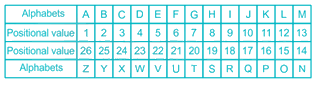 JG : 100/49
Alphabetical positions:
J = 10
G = 7
Logic:
(10 × 10) / (7 × 7) = 100 / 49
Now, for TB:
T = 20
B = 2
(20 × 20) / (2 × 2) = 400 / 4
Correct Answer: Option 3 (400/4)
Q5 · Analogy
Which of the following alternative will fill the blanks?
pq_st_qr_tp_rst
- r,p,s,q
- p,s,q,r
- p,q,s,r
- r,p,q,s
Answer aur solution dekho
Archived marked answer: A
Given series: pq _ st _ qr _ tp _ rst
Option 1) r,p,s,q → pq r st p qr s tp q rst → (It follows the pattern of: pqrst - pqrst - pqrst)
Option 2) p,s,q,r → pq p st s qr q tp r rst → (It doesn't follow any pattern)
Option 3) p,q,s,r → pq p st q qr s tp r rst → (It doesn't follow any pattern)
Option 4) r,p,q,s → pq r st p qr q tp s rst → (It doesn't follow any pattern)
Hence, the correct answer is Option 1.
Q6 · Analogy
In each of the following questions, a specific alphabetical pattern is applied to the first word to obtain the second word. Apply the same pattern to the third word and find the correct answer from the given alternatives. CIQY : DJRZ :: AGOW : ?
- BJPX
- BHPX
- BHPU
- BJRZ
Answer aur solution dekho
Archived marked answer: B
The logic followed here:
CIQY : DJRZ
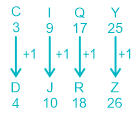 Similarly,
AGOW : ?
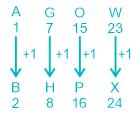 Hence, the correct option is Option 2.
Q7 · Analogy
In a certain code, FOLDER is written as GMLECR. Using the same pattern, how is MARKET written?
- NYRLCT
- OZRLCT
- NYTLCR
- NYRCLT
Answer aur solution dekho
Archived marked answer: A
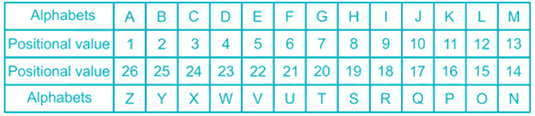 The logic followed here is:
FOLDER is written as GMLECR
Q8 · Analogy
Choose the correct option to complete the series.
Create :: Destroy :: Build : ?
- Design
- Construct
- Ruin
- Develop
Answer aur solution dekho
Archived marked answer: C
Given Analogy:
Create : Destroy :: Build : ?
Create and Destroy are opposites.
Similarly, the opposite of Build is Ruin.
Hence, the correct option is Option 3.
Q9 · Puzzle Subtypes Not To Miss
If the given symbols mean:
'+' means 'divided by'
'-' means 'multiplied by'
'×' means 'minus'
'÷' means 'plus'
Then, find the value of the following e×pressions: 48 × 8 ÷ 12 + 4 - 7=?
- 16
- 37
- 51
- 61
Answer aur solution dekho
Archived marked answer: D
Decoding signs:
Sign
+
×
Q10 · Puzzle Subtypes Not To Miss
In a pet shop, there are only parrots and rabbits. Total heads = 40, and total legs = 100. How many parrots are there?
- 20
- 25
- 30
- 35
Answer aur solution dekho
Archived marked answer: C
The logic followed here:
Number of parrots = P (2 legs each)
Number of rabbits = R (4 legs each)
Given:
P + R = 40 (Total heads)
2P + 4R = 100 (Total legs)
Divide second equation by 2:
P + 2R = 50
Now subtract first equation:
(P + 2R) − (P + R) = 50 − 40
R = 10
So,
P + 10 = 40
P = 30
Number of parrots = 30
Correct Answer: Option 3
Q11 · Puzzle Subtypes Not To Miss
If 5 * 2 = 35, 4 * 3 = 28, then what is 6 * 4?
- 42
- 48
- 54
- 60
Answer aur solution dekho
Archived marked answer: D
Given:
5 * 2 = 35
4 * 3 = 28
5 × (5 + 2) = 5 × 7 = 35
4 × (4 + 3) = 4 × 7 = 28
Rule: a * b = a × (a + b)
Now,
6 * 4 = 6 × (6 + 4)
= 6 × 10
= 60
Hence, the correct option is Option 4
Q12 · Puzzle Subtypes Not To Miss
If '×' means '-', '-' means '+', '/' means '×', and '+' means '÷', which equation is correct?
- 18 - 6 + 3 × 2 = 27
- 36 / 6 - 3 + 2 × 1 = 20
- 16 / 2 + 4 - 1 × 3 = 6
- 12 × 4 - 2 + 1 = 19
Answer aur solution dekho
Archived marked answer: C
Given Symbol Meanings:
× → −
− → +
/ → ×
+ → ÷
Option 1: 18 - 6 + 3 × 2
Replace symbols:
18 + 6 ÷ 3 − 2
6 ÷ 3 = 2
18 + 2 − 2 = 18
≠ 27
Option 2: 36 / 6 - 3 + 2 × 1
Replace symbols:
36 × 6 + 3 ÷ 2 − 1
36 × 6 = 216
3 ÷ 2 = 1.5
216 + 1.5 − 1 = 216.5
≠ 20
Option 3: 16 / 2 + 4 - 1 × 3
Replace symbols:
16 × 2 ÷ 4 + 1 − 3
16 × 2 = 32
32 ÷ 4 = 8
8 + 1 − 3 = 6
= 6
Option 4: 12 × 4 - 2 + 1
Replace symbols:
12 − 4 + 2 ÷ 1
12 − 4 = 8
2 ÷ 1 = 2
8 + 2 = 10
≠ 19
Hence, the correct option is Option 3
Q13 · Coding Decoding
Instruction: In a certain code language, Greek letters are used to represent English letters in a consistent manner. Based on the given coded words, determine the correct English decoding of the target sequence using the same letter-to-letter substitution pattern. If φ α ν τ α σ is coded as FANTASY, λ α β ε λ is coded as LABEL,
Question: Then what does λ φ α ν τ α represent?
- LFANTA
- LFANTY
- LFANTE
- LFANTS
Answer aur solution dekho
Archived marked answer: A
The logic is followed:
φαντασ → FANTASY
λαβελ → LABEL
Letter Mapping:
φ → F
α → A
ν → N
τ → T
σ → SY
λ → L
β → B
ε → E
Now decode: λ φ α ν τ α
λ → L
φ → F
α → A
ν → N
τ → T
α → A
So, λ φ α ν τ α → LFANTA
Hence, the correct option is Option 1. Q14 · Classification Odd One Out
Find the odd one out:
- 6 @ 2 = 16
- 7 @ 1 = 14
- 7 @ 3 = 20
- 4 @ 4 = 16
Answer aur solution dekho
Archived marked answer: B
Check the pattern:
1) 6 @ 2 = 16 → (6 + 2) × 2 = 8 × 2 = 16
2) 7 @ 1 = 14 → (7 + 1) × 2 = 8 × 2 = 16 (Given 14)
3) 7 @ 3 = 20 → (7 + 3) × 2 = 10 × 2 = 20
4) 4 @ 4 = 16 → (4 + 4) × 2 = 8 × 2 = 16
Only option 2 does not follow the pattern.
Hence, the correct option is Option 2
Q15 · Classification Odd One Out
Find the odd one out from the given alternatives:
- Bharatnatyam
- Kathak
- Odissi
- Kalbelia
Answer aur solution dekho
Archived marked answer: D
Given Options
Bharatnatyam → Classical dance
Kathak → Classical dance
Odissi → Classical dance
Kalbelia → Folk dance
Kalbelia is a folk dance, while the others are classical dances.
Hence, the correct option is Option 4
Q16 · Blood Relations
A is B's mother. C is B's father. How is C related to A?
- Husband
- Brother
- Son
- Cousin
Answer aur solution dekho
Archived marked answer: A
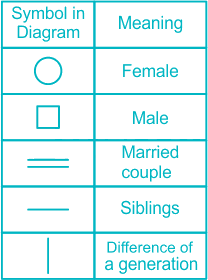 Given:
1) A is B’s mother
 2) C is B’s father
 so, C is the husband of A.
Hence, the correct option is "Option 1"
Q17 · Blood Relations
A says, "My mother's husband's only son is B." How is A related to B? (A and B are not the same)
- Sister
- Son
- Father
- Wife
Answer aur solution dekho
Archived marked answer: A
Given: A says, "My mother's husband's only son is B."
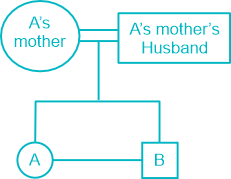 so, A is the sister of B.
Hence, the correct option is "Option 1"
Q18 · Alphabet Test
Which is the 2nd last word in the sentence "Technology is advancing very rapidly"?
- is
- rapidly
- very
- advancing
Answer aur solution dekho
Archived marked answer: C
Technology is advancing very rapidly
Words in order:
1) Technology
2) is
3) advancing
4) very
5) rapidly
The 2nd last word is very.
Hence, the correct answer is "Option 3".
Q19 · Alphabet Test
Each of the letters in the word DEVELOPMENT is arranged in alphabetical order. How many letters are there in the English alphabetical series between the letter that is third from the left and the one that is fourth from the right in the new letter-cluster formed?
- 7
- 9
- 6
- 8
Answer aur solution dekho
Archived marked answer: B
Given Word: DEVELOPMENT
Arrange letters in alphabetical order:
D, E, E, E, L, M, N, O, P, T, V
Third from the left = E
Fourth from the right = O
Letters between E and O in English alphabetical series:
F, G, H, I, J, K, L, M, N
Total letters = 9
Hence, the correct option isOption 2
Q20 · Alphabet Test
Arrange the following words in dictionary order and choose the second word:
- gold
- gone
- golf
- good
Answer aur solution dekho
Archived marked answer: C
Dictionary Order:
gold
golf
gone
good
The second word is golf.
Hence, the correct option is Option 3.
Q21 · Similarity and Differences
Choose the address that is exactly the same as the one given below.
B-104, Orchid Meadows, Bannerghatta Road, Bengaluru, Karnataka - 560076
- B-104, Orchid Meadows, Bannerghatta Road, Bengaluru, Karnataka - 560077
- B-104, Orchid Meadows, Bannerghatta Road, Bengaluru, Karnataka - 560076
- B-104, Orchid Meadows, Bannerghatta Road, Bengaluru, Karnataka - 560078
- B-104, Orchid Meadows, Bannerghatta Road, Bengaluru, Karnataka - 560079
Answer aur solution dekho
Archived marked answer: B
Given: B-104, Orchid Meadows, Bannerghatta Road, Bengaluru, Karnataka - 560076
Option 1) B-104, Orchid Meadows, Bannerghatta Road, Bengaluru, Karnataka - 560077 → Incorrect
Option 2) B-104, Orchid Meadows, Bannerghatta Road, Bengaluru, Karnataka - 560076 →&n
Q22 · Similarity and Differences
Find the person that does not fit in the series:
Bhagat Singh, Sardar Vallabhbhai Patel, Mahatma Gandhi, C. V. Raman, Subhash Chandra Bose
- C. V. Raman
- Subhash Chandra Bose
- Sardar Vallabhbhai Patel
- Mahatma Gandhi
Answer aur solution dekho
Archived marked answer: A
Bhagat Singh, Sardar Vallabhbhai Patel, Mahatma Gandhi, C. V. Raman, Subhash Chandra Bose
Bhagat Singh → Freedom fighter
Sardar Vallabhbhai Patel → Freedom fighter
Mahatma Gandhi → Freedom fighter
Subhash Chandra Bose → Freedom fighter
C. V. Raman → Scientist (Nobel Prize winner), not a freedom fighter.
Therefore, the person who does not fit in the series is C. V. Raman.
Hence, the correct option is Option 1.
Q23 · Logical Statement Questions
Instruction: Identify the assumptions that must hold for the statement to be valid, then choose the correct option.
Statement: Despite increasing consumer interest, electric vehicles are still significantly more expensive than gasoline-powered vehicles, and subsidies are essential to boost their adoption.
Assumptions:
I. The price difference is a major barrier to widespread adoption of electric vehicles.
II. Subsidies can make electric vehicles affordable for consumers.
III. The adoption of electric vehicles will significantly reduce carbon emissions.
- Only I and II are implicit
- Only II and III are implicit
- All are implicit
- Only I is implicit
Answer aur solution dekho
Archived marked answer: A
Assumption I: The price difference is a major barrier to widespread adoption of electric vehicles.
Yes. The statement links high cost with low adoption, so this must be assumed.
Assumption II: Subsidies can make electric vehicles affordable for consumers.
Yes. If subsidies are essential to boost adoption, it assumes they reduce the affordability barrier.
Assumption III: The adoption of electric vehicles will significantly reduce carbon emissions.
No. The statement talks about cost and adoption, not environmental impact.
Hence, the correct option is Option 1
Q24 · Logical Statement Questions
Read the following statement carefully and identify the conclusion that follows.
Statement: The school library is open from 9 AM to 5 PM.
Conclusions:
I. Students can borrow books after 5 PM.
II. The library is not accessible before 9 AM.
- Only Conclusion I follows
- Only Conclusion II follows
- Both I and II follow
- Neither I nor II follows
Answer aur solution dekho
Archived marked answer: B
Conclusion I: Students can borrow books after 5 PM.
This does not follow. The library closes at 5 PM.
Conclusion II: The library is not accessible before 9 AM.
This follows. Since it opens at 9 AM, it is not accessible before that time.
Hence, the correct option is Option 2
Q25 · Mathematical Operations
What is the value of Middle if Left = 12, Right = 24, and Middle is average of both?
- 15
- 18
- 20
- 22
Answer aur solution dekho
Archived marked answer: B
Given:
Left = 12
Right = 24
Middle is the average of both.
Average = (12 + 24) / 2
= 36 / 2
= 18
Hence, the correct option is Option 2
General Awareness
Q1 · Art and Culture
What do the carved wheels on the Konark Sun Temple represent?
- Planets
- Time divisions
- Festivals
- Weapons
Answer aur solution dekho
Archived marked answer: B
The correct answer is Time divisions.
Key Points
- The Konark Sun Temple is a 13th-century architectural marvel located in Odisha, India, dedicated to the Sun God, Surya.
- The temple is renowned for its chariot-like structure with 12 intricately carved wheels, each wheel symbolizing the 12 months of the year, representing divisions of time.
- Each wheel has 8 spokes, which further denote the division of a day into 8 equal parts (praharas), symbolizing the passage of time.
- The wheels also serve as a sundial, with their shadows indicating the time of the day with remarkable precision.
- The carvings on the wheels showcase the advanced understanding of astronomy and time management that existed during ancient India.
Additional Information
- Planets:
- The Konark Sun Temple is dedicated to Surya, the Sun God, who is often associated with the solar system and celestial bodies.
- While the temple is aligned with the sun's movement and reflects astronomical knowledge, the carved wheels specifically represent time rather than planets.
- Festivals:
- The Konark Sun Temple hosts the annual Konark Dance Festival, which celebrates classical Indian dance forms like Odissi, Bharatanatyam, and Kathak.
- While festivals are significant in the cultural heritage of the temple, they are not represented by the carved wheels.
- Weapons:
- The carvings on the Konark Sun Temple primarily depict mythological themes, daily life, and celestial phenomena, not weapons.
- Weapons are occasionally seen in sculptures of deities or warriors but are unrelated to the symbolic purpose of the wheels.
Q2 · Art and Culture
Which of the following best describes traditional Rajasthani music?
- Focuses only on temple rituals
- Uses electric sounds as the base
- Tied to nature, life, and stories
- Known only for classical ragas
Answer aur solution dekho
Archived marked answer: C
The correct answer is Tied to nature, life, and stories.
Key Points
- Traditional Rajasthani music is deeply connected to the region's nature, daily life, and folklore, reflecting its cultural richness and heritage.
- It revolves around the themes of love, valor, devotion, and the natural beauty of Rajasthan, often inspired by the desert landscape.
- The music is primarily folk in nature, featuring instruments like the dholak, sarangi, and khartal, which produce earthy, melodious sounds.
- Rajasthani music often incorporates storytelling, where singers narrate tales of local heroes, legends, and deities through soulful melodies.
- The traditional music has been preserved and passed down orally through generations, primarily by communities like the Manganiyars and Langas.
Additional Information
- Focuses only on temple rituals
- While temple music is an important aspect of Indian traditional music, Rajasthani music extends far beyond temple rituals.
- Devotional music like bhajans and chants are a part of the cultural fabric but do not encompass the entirety of Rajasthani music.
- The region's music includes a wide variety of forms such as folk songs, dance music, and storytelling traditions.
- Uses electric sounds as the base
- Traditional Rajasthani music relies on acoustic instruments and does not incorporate modern electronic sounds.
- Instruments like the ektara, algoza, and morchang are commonly used to produce authentic folk sounds.
- Modern adaptations or fusion versions might include electric elements, but these are not part of the traditional music.
- Known only for classical ragas
- Rajasthan has a strong classical music tradition, but its folk music forms the true essence of its cultural identity.
- Classical ragas are performed in royal courts or by highly trained musicians, whereas folk music is more community-oriented and widely practiced.
- Both classical and folk traditions coexist, but Rajasthani music is best characterized by its folk roots tied to daily life and oral storytelling.
Q3 · Art and Culture
Which of the following statements is/are correct?
1. Panthi steps encode teachings from Guru Ghasidas's Amritvani.
2. Masks representing Satpurush are worn in high ritual versions.
- Only 1
- Only 2
- 1 and 2 both
- Neither 1 nor 2
Answer aur solution dekho
Archived marked answer: A
The correct answer is Option 1: Only 1.
Key Points
- Panthi dance is a prominent folk dance form of the Satnami community in Chhattisgarh.
- The steps and movements of Panthi dance are deeply rooted in the teachings and philosophy of Guru Ghasidas, the founder of the Satnami sect.
- Guru Ghasidas's teachings, encapsulated in his holy scripture known as Amritvani, are the primary inspiration for Panthi dance.
- The dance reflects the spiritual message of equality, truth, and devotion as emphasized by Guru Ghasidas, making it a significant cultural and religious expression for the community.
- Although Panthi dance is a devotional form, it does not traditionally involve wearing masks representing Satpurush, which confirms that statement 2 is incorrect.
Additional Information
- Guru Ghasidas and the Satnami Sect
- Guru Ghasidas (1756–1836) was a social reformer and spiritual leader who founded the Satnami sect in Chhattisgarh.
- His teachings emphasized the principles of equality, truth, non-violence, and the rejection of caste-based discrimination.
- The holy scripture Amritvani compiled his teachings, forming the basis of the Satnami philosophy and practices.
- Panthi Dance as Cultural Heritage
- Panthi dance is a vital part of Chhattisgarhi culture and is performed during religious events, particularly on the birth anniversary of Guru Ghasidas.
- The dance is characterized by synchronized movements, rhythmic steps, and devotional songs that reflect the teachings of Guru Ghasidas.
- Its cultural and spiritual significance has earned it recognition beyond the Satnami community.
Q4 · Art and Culture
What is the name of the festival celebrated simultaneously by unmarried tribal girls during the Karam celebrations in Jharkhand and eastern India?
- Jawa
- Sohrai
- Karma
- Madai
Answer aur solution dekho
Archived marked answer: A
The correct answer is Jawa.
Key Points
- Jawa is a festival celebrated during the Karam festivities in Jharkhand and eastern India, primarily by unmarried tribal girls.
- The celebration involves the worship of germinated grains, symbolizing fertility, prosperity, and the life cycle.
- This festival is deeply rooted in tribal culture and traditions, where young girls pray for the well-being of their families and good fortune.
- Jawa is an integral part of Karam Puja, which marks the beginning of agricultural activities and honors nature.
- It showcases the rich cultural heritage of tribal communities and their connection to nature and agriculture.
Additional Information
- Sohrai:
- Sohrai is a harvest festival celebrated by tribal communities in Jharkhand, Bihar, and West Bengal.
- It is associated with cattle worship and the decoration of mud walls with traditional tribal art.
- The festival is marked by feasting, dancing, and rituals to thank nature for the harvest.
- Karma:
- Karma is a popular tribal festival in Jharkhand, Chhattisgarh, Odisha, and Madhya Pradesh.
- The festival centers around the worship of the Karam tree, which is considered sacred and symbolizes fertility and prosperity.
- During Karma, people sing and dance around the Karam tree to celebrate nature and the agricultural cycle.
- Madai:
- Madai is a tribal festival celebrated in the state of Chhattisgarh.
- It is a fair-like event featuring cultural performances, rituals, and offerings to deities.
- The festival is an important occasion for social gatherings and the display of tribal art, dance, and music.
Q5 · Indian Polity and Constitution
The concept of Uniform Civil Code is a part of which category of principles in the Indian Constitution?
- Fundamental Rights
- Fundamental Duties
- Directive Principles of State Policy
- Preamble objectives
Answer aur solution dekho
Archived marked answer: C
The correct answer is Directive Principles of State Policy.
Key Points
- The concept of the Uniform Civil Code (UCC) is enshrined in Article 44 of the Indian Constitution under the Directive Principles of State Policy (DPSP).
- Article 44 directs the State to strive to secure a UCC for all citizens throughout the territory of India to ensure uniformity in personal laws.
- The UCC aims to replace personal laws based on the scriptures and customs of each major religious community in India with a common set governing every citizen.
- The DPSPs, including the provision for UCC, are non-justiciable in nature, meaning they are not enforceable by the courts but aim to guide the State in policymaking.
- The objective of the UCC is to promote national integration and gender equality by ensuring that personal laws do not discriminate based on religion or gender.
Additional Information
- Fundamental Rights
- Fundamental Rights are enshrined in Part III of the Indian Constitution (Articles 12-35) and are enforceable by the courts.
- They guarantee individual rights such as the right to equality, freedom, and protection against exploitation, and ensure cultural and educational rights for minorities.
- Although Fundamental Rights are enforceable, the Uniform Civil Code is not part of this category as it is non-justiciable and falls under DPSPs.
- Fundamental Duties
- Fundamental Duties are incorporated in Part IV-A (Article 51A) of the Constitution and were added by the 42nd Amendment Act of 1976.
- They outline the moral obligations of citizens, such as respecting the Constitution, promoting harmony, safeguarding public property, and protecting the environment.
- The UCC is not part of Fundamental Duties as it pertains to State policy and not individual duties.
- Preamble Objectives
- The Preamble serves as the introduction to the Constitution, outlining the guiding principles and objectives of the Indian State such as justice, liberty, equality, and fraternity.
- While the Preamble reflects the ideals of the Constitution, it is not enforceable and does not directly mention the UCC.
- Directive Principles of State Policy (DPSP)
- DPSPs are enshrined in Part IV (Articles 36-51) of the Indian Constitution and are aimed at achieving socio-economic justice and welfare.
- These principles guide the State in formulating policies that ensure the socio-economic and political welfare of the citizens.
- While not enforceable, they are fundamental in the governance of the country and aim to create a welfare state.
Q6 · Indian Polity and Constitution
Which Article defines State and Union Territories for the purposes of the Constitution?
- Article 1
- Article 3
- Article 239
- Article 240
Answer aur solution dekho
Archived marked answer: A
The correct answer is Article 1.
Key Points
- Article 1 of the Indian Constitution defines India as a "Union of States."
- It specifies that India shall be divided into states and union territories for administrative purposes.
- Article 1 establishes the territorial composition of India, including states, union territories, and any other territories that may be acquired.
- The inclusion of terms like "Union of States" emphasizes the indestructible nature of the Indian Union.
- This Article is crucial for understanding the territorial framework of the nation as per constitutional provisions.
Additional Information
- Article 3:
- Article 3 deals with the formation of new states and alteration of existing states' boundaries or names.
- It empowers Parliament to make laws for creating new states, merging states, or altering boundaries or names of states.
- Before introducing such a bill, the President must refer it to the concerned state's legislature for their opinion, although their opinion is not binding.
- Article 239:
- Article 239 pertains to the administration of Union Territories.
- It states that every Union Territory shall be administered by the President through an administrator appointed by him.
- This Article establishes the framework for governance in regions not classified as states under the Constitution.
- Article 240:
- Article 240 grants the President the authority to make regulations for Union Territories that do not have legislatures.
- This power can be exercised in territories like Andaman and Nicobar Islands, Lakshadweep, Dadra and Nagar Haveli, Daman and Diu, and Puducherry under special circumstances.
- The regulations made by the President under this Article have the same force as laws passed by Parliament.
Q7 · Indian Polity and Constitution
Which of the following statements is/are correct?
1) If a State law on a Concurrent List subject is reserved for the President and receives assent, it overrides the existing Union law on the same subject in that state.
2) Parliament can later nullify such a State law by passing another law on the same subject.
- Only 1
- Only 2
- Both 1 and 2
- Neither 1 nor 2
Answer aur solution dekho
Archived marked answer: C
The correct answer is Option 3 (Both 1 and 2).
Key Points
- Statement 1: When a State law on a subject from the Concurrent List is reserved for the President and receives his/her assent, it overrides the Union law on the same subject within that particular State. This provision is mentioned under Article 254(2) of the Indian Constitution.
- Statement 2: Parliament retains the power to nullify such a State law by passing another law on the same subject. This ensures the supremacy of Parliament as per Article 254(1) of the Constitution.
- The Concurrent List allows both the Union and State legislatures to make laws on certain subjects. However, in case of conflict between State and Union laws, Union law usually prevails unless the State law is specifically reserved for Presidential assent.
- Presidential assent under Article 254(2) enables State laws to have precedence over Union laws within the State, but this is not absolute. Parliament retains overriding powers to enact a law to nullify or supersede the State law.
- This mechanism ensures a balance between centralization and decentralization within India's federal structure, promoting cooperation between the Union and State governments.
Additional Information
- Concurrent List:
- The Concurrent List is one of the three lists in the Seventh Schedule of the Indian Constitution, alongside the Union List and the State List.
- It contains subjects on which both the Union and State governments can legislate, such as education, marriage, adoption, and bankruptcy.
- In case of conflict between Union and State laws, Article 254(1) ensures that Union law prevails unless the State law has received Presidential assent under Article 254(2).
- Article 254 – Conflict of Laws:
- Article 254 deals with conflicts between Union and State laws made on subjects listed in the Concurrent List.
- Clause 1: If there is an inconsistency between Union and State laws, the Union law prevails.
- Clause 2: A State law inconsistent with Union law can prevail within the State only if it is reserved for the President's consideration and receives assent.
- This article ensures that the federal structure is maintained while granting limited precedence to State laws under specific conditions.
- Supremacy of Parliament:
- Despite the autonomy granted to States in certain cases, Parliament retains overriding legislative powers over the Concurrent List subjects.
- Parliament can enact new laws or amend existing ones to nullify or supersede State laws, ensuring that national interests are prioritized.
- This highlights the unitary bias within India's federal system, where the Union has more legislative control than States.
- Legislative Process in India:
- Legislation in India is governed by the division of powers outlined in the Seventh Schedule of the Constitution.
- The Union List grants exclusive legislative powers to Parliament, while the State List empowers State legislatures.
- The Concurrent List promotes cooperative federalism, allowing both levels of government to legislate while preserving Union supremacy in case of conflicts.
Q8 · Indian Polity and Constitution
Consider the following statements:
1. Delegated legislation is made by administrative authorities.
2. It cannot be challenged in a court of law.
Which of the above statements is/are correct?
- Only 1
- Only 2
- Both 1 and 2
- Neither 1 nor 2
Answer aur solution dekho
Archived marked answer: A
The correct answer is Option 1: Only 1.
Key Points
- Delegated legislation refers to laws made by an administrative authority under powers delegated to it by the legislature.
- It is typically used to fill in the details of legislation that the primary law enacted by the legislature cannot cover comprehensively.
- Administrative authorities, such as government ministers or departments, are empowered to make rules, regulations, or orders under this framework.
- Delegated legislation allows for flexibility and expertise in lawmaking, especially in technical areas where detailed knowledge is required.
- While delegated legislation is legal, its validity may be challenged in a court of law if it exceeds the powers given by the parent act or violates constitutional provisions.
Additional Information
- Delegated Legislation:
- Delegated legislation is essential to handle technical and specialized areas that require detailed rules and regulations.
- It saves time for the legislature by allowing experts and administrative bodies to draft specific provisions.
- However, it requires oversight to prevent misuse of power, and judicial review serves as an important safeguard.
Q9 · Sports Static GK
Who won India's first Olympic medals at the 1900 Paris Games by securing silver in 200m sprint and 200m hurdles?
- Milkha Singh
- Norman Pritchard
- K.D. Jadhav
- Dhyan Chand
Answer aur solution dekho
Archived marked answer: B
The correct answer is Norman Pritchard.
Key Points
- Norman Pritchard was the first athlete from India to win an Olympic medal at the 1900 Paris Games.
- He won two silver medals in athletics: one in the 200m sprint and the other in the 200m hurdles.
- Pritchard is recognized as the first Asian-born athlete to win an Olympic medal.
- He competed under the British Indian flag since India was under British rule during that time.
- Norman Pritchard was also a professional actor in Hollywood, where he was known as Norman Trevor.
Additional Information
- Milkha Singh
- Milkha Singh, also known as the "Flying Sikh," was one of India's greatest athletes and a legendary sprinter.
- He represented India in the Olympics in 1956, 1960, and 1964, with his most notable performance being at the 1960 Rome Olympics, where he narrowly missed a bronze medal in the 400m race.
- Milkha Singh won gold medals in the 1958 and 1962 Asian Games and the 1958 Commonwealth Games.
- K.D. Jadhav
- Khashaba Dadasaheb Jadhav was an Indian wrestler who won a bronze medal in the 1952 Helsinki Olympics.
- He was the first Indian athlete to win an individual Olympic medal in independent India.
- Jadhav competed in the Bantamweight category of freestyle wrestling and is remembered for his incredible agility and technique.
- Dhyan Chand
- Dhyan Chand, also known as "The Wizard of Hockey," was one of the greatest hockey players in history.
- He was a key player in the Indian hockey team that won gold medals in the 1928, 1932, and 1936 Olympics.
- Dhyan Chand is known for his exceptional ball control, goal-scoring ability, and contribution to India's dominance in hockey during his era.
Q10 · Sports Static GK
Which of the following actions is not allowed for a player in handball?
- Pulling or punching the ball out of an opponent's hands
- Intercepting the ball mid-air using both hands
- Dribbling the ball before making a pass
- Blocking the ball with the torso above the knees
Answer aur solution dekho
Archived marked answer: A
The correct answer is Pulling or punching the ball out of an opponent's hands.
Key Points
- In handball, players are prohibited from pulling, punching, or forcibly removing the ball from an opponent's hands, as it is considered a foul under the rules of the game.
- The sport emphasizes fair play and clean defense, where players must focus on intercepting the ball or blocking shots without aggressive physical contact.
- Using excessive force or unfair actions, such as punching the ball out of an opponent's hands, can lead to penalties, warnings, or even disqualification depending on the severity.
- The International Handball Federation (IHF) guidelines explicitly prohibit such actions to ensure the safety of players and maintain the integrity of the game.
Additional Information
- Handball Rules:
- Handball is a fast-paced team sport where two teams aim to score by throwing the ball into the opponent's goal.
- Players are required to follow strict rules that promote fair play and ensure the safety of all participants.
- Illegal moves, such as pulling or punching the ball from an opponent, are penalized to maintain the flow and spirit of the game.
Q11 · Sports Static GK
Match the following Taekwon-Do Korean terms with their correct English meanings:
Which of the following is the correct pairing?
Column A (Korean Term)
B (English Meaning)
1. Tae
A. Discipline or way
2. Kwon
B. To strike with the hand
3. Do
C. To strike with the feet
4. Dojang Column
D. Training Hall or place of practice
- 1-B, 2-C, 3-A, 4-D
- 1-C, 2-B, 3-A, 4-D
- 1-A, 2-D, 3-B, 4-C
- 1-D, 2-A, 3-C, 4-B
Answer aur solution dekho
Archived marked answer: B
The correct answer is Option 2: 1-C, 2-B, 3-A, 4-D.
Key Points
- Tae (1-C): The Korean term "Tae" refers to striking or kicking with the feet, emphasizing the art of foot techniques in Taekwon-Do.
- Kwon (2-B): "Kwon" signifies striking or punching with the hand, highlighting hand techniques in the martial art.
- Do (3-A): "Do" translates to the "way" or "discipline," representing the philosophical and ethical aspects of Taekwon-Do.
- Dojang (4-D): "Dojang" refers to the training hall or place where martial arts practice is conducted.
- This pairing represents the fundamental terminologies of Taekwon-Do, a Korean martial art that combines self-defense techniques, discipline, and physical fitness.
Additional Information
- Other Key Terms in Taekwon-Do:
- Ki-Hap: A loud yell or shout made during a technique to enhance focus and power. It is also used to intimidate the opponent.
- Poomsae: Patterns or forms practiced in Taekwon-Do that consist of a series of movements for training and self-defense.
- Saju-Jirugi: A fundamental exercise that involves executing punches in four different directions to develop basic skills.
- Historical Context of Taekwon-Do:
- Taekwon-Do originated in Korea in the 1940s and 1950s and was officially named by General Choi Hong Hi in 1955.
- The word "Taekwon-Do" is derived from three Korean words:
- Tae: Foot or kicking technique.
- Kwon: Hand or fist techniques like striking or punching.
- Do: The way or discipline, reflecting the philosophy behind the martial art.
Q12 · Sports Static GK
In which Indian city is the prestigious Subroto Cup inter-school football tournament conducted every year?
- Hyderabad
- Mumbai
- New Delhi
- Lucknow
Answer aur solution dekho
Archived marked answer: C
The correct answer is New Delhi.
Key Points
- The Subroto Cup is an annual inter-school football tournament held in New Delhi, India, named after Air Marshal Subroto Mukerjee, the founding father of the Indian Air Force.
- It was first organized in 1960 and has since become one of the most prestigious football tournaments for school-level teams in India.
- The competition is organized by the Indian Air Force in collaboration with the Ministry of Youth Affairs and Sports and the Subroto Mukerjee Sports Education Society.
- It features participation from schools across India and abroad, making it an international event.
- The tournament is held in various age categories, primarily under-14 and under-17 for boys and under-17 for girls.
Additional Information
- Hyderabad
- Hyderabad is known for its historical landmarks like the Charminar and Golconda Fort, and it serves as the capital of Telangana.
- The city is also a major hub for IT industries and is home to the famous Hyderabad FC, a football team playing in the Indian Super League (ISL).
- Mumbai
- Mumbai, the financial capital of India, is renowned for cricket and its iconic Wankhede Stadium.
- The city also promotes football through clubs like Mumbai City FC, which competes in the ISL.
- Mumbai has hosted several international and national-level sports events.
- Lucknow
- Lucknow, the capital city of Uttar Pradesh, is famous for its cultural heritage, including Nawabi cuisine and classical dance forms like Kathak.
- The city has hosted events in cricket and hocky.
Q13 · Indian Geography
The Lohit River is a tributary of which of the following major Himalayan rivers?
- Ganga
- Brahmaputra
- Indus
- Yamuna
Answer aur solution dekho
Archived marked answer: B
The correct answer is Brahmaputra.
Key Points
- The Lohit River is a major tributary of the Brahmaputra River in the northeastern region of India.
- It originates in the eastern Tibet region, from the Zayal Chu (Zayu Chu) river near the Indo-China border, and flows through Arunachal Pradesh before joining the Brahmaputra in Assam.
- The Lohit River is known for its swift flow and turbulent waters as it traverses through mountainous terrain.
- After entering India, the river flows through the districts of Anjaw and Lohit in Arunachal Pradesh, making the region fertile and supporting agriculture.
- The confluence of the Lohit River with the Brahmaputra takes place near the town of Sadia in Assam.
Additional Information
- Ganga River
- The Ganga is the holiest and longest river in India, originating from the Gangotri Glacier in Uttarakhand.
- It flows through major Indian states such as Uttarakhand, Uttar Pradesh, Bihar, and West Bengal before emptying into the Bay of Bengal.
- The Ganga has numerous tributaries, including the Yamuna, Ghaghara, Son, and Gandak, but the Lohit River is not one of them.
- Indus River
- The Indus River originates from the Tibetan Plateau near Lake Mansarovar and flows through Ladakh, Pakistan, and finally into the Arabian Sea.
- It is one of the longest rivers in Asia and has several tributaries like the Jhelum, Chenab, Ravi, Beas, and Sutlej.
- The Indus River basin does not include the Lohit River.
- Yamuna River
- The Yamuna River is the largest tributary of the Ganga River, originating from the Yamunotri Glacier in Uttarakhand.
- It flows through states such as Haryana, Delhi, and Uttar Pradesh before merging with the Ganga at Prayagraj (Allahabad).
- The Yamuna does not intersect with the Lohit River.
Q14 · Modern Indian History
What was the function of the Board of Control established by Pitt's India Act?
- To manage only military operations in India.
- To oversee taxation and local revenue.
- To control civil and military affairs in British India.
- To regulate trade between India and China.
Answer aur solution dekho
Archived marked answer: C
The correct answer is To control civil and military affairs in British India.
Key Points
- Pitt's India Act of 1784 established a dual system of governance by creating the Board of Control to oversee political affairs and the Court of Directors for commercial operations.
- The Board of Control was tasked with controlling civil and military administration in British India to ensure proper supervision and accountability.
- This arrangement aimed to eliminate the inefficiency and corruption associated with the East India Company's management of Indian territories.
- The Board of Control consisted of six members, including the British cabinet ministers, and was headed by the Secretary of State for India.
- The Act marked the beginning of increased British government involvement in Indian administration, centralizing power to ensure better governance.
Additional Information
- The Regulating Act of 1773
- was the first step by the British Parliament to control the East India Company's administration in India,
- establishing a central government under a Governor-General of Bengal (first being Warren Hastings),
- making Bombay/Madras subservient, banning private trade/bribes by officials, and
- creating the Supreme Court in Calcutta to address company mismanagement and corruption, though it created jurisdictional conflicts and executive weaknesses.
Q15 · Current Affairs
The Laser Retroreflector Array (LRA) onboard Chandrayaan-3 was supplied by which space agency?
- ESA
- JAXA
- NASA
- ROSCOSMOS
Answer aur solution dekho
Archived marked answer: C
The correct answer is NASA.
Key Points
- The Laser Retroreflector Array (LRA) onboard Chandrayaan-3 was supplied by NASA (National Aeronautics and Space Administration).
- The LRA is a scientific instrument designed to reflect laser beams sent from Earth, enabling accurate measurement of the distance between the Earth and the Moon.
- The retroreflector technology helps in enhancing lunar science by enabling precise orbital studies and laser ranging experiments.
- NASA often collaborates with international space agencies, such as ISRO, to contribute scientific payloads for space exploration missions.
- The inclusion of the LRA strengthens global cooperation in space exploration and contributes to the success of Chandrayaan-3’s scientific objectives.
Additional Information
- ESA (European Space Agency):
- The ESA is an intergovernmental organization dedicated to space exploration and research.
- It has contributed to various missions, including Mars exploration and the development of the Ariane series of launch vehicles.
- JAXA (Japan Aerospace Exploration Agency):
- JAXA is the national space agency of Japan, responsible for various space exploration missions, including asteroid exploration through missions like Hayabusa.
- ROSCOSMOS (Russian Federal Space Agency):
- ROSCOSMOS oversees Russia’s space exploration activities, including human spaceflight and planetary missions.
Q16 · General Science Biology
Which of the following is the correct sequence of blood flow through heart chambers?
- Right atrium → Right ventricle → Left atrium → Left ventricle
- Left atrium → Left ventricle → Right atrium → Right ventricle
- Right ventricle → Right atrium → Left ventricle → Left atrium
- Left ventricle → Left atrium → Right ventricle → Right atrium
Answer aur solution dekho
Archived marked answer: A
The correct answer is Right atrium → Right ventricle → Left atrium → Left ventricle.
Key Points
- The sequence of blood flow through the heart chambers is: Right atrium → Right ventricle → Left atrium → Left ventricle.
- Deoxygenated blood from the body enters the right atrium via the superior and inferior vena cava.
- The blood then flows into the right ventricle, which pumps it to the lungs through the pulmonary artery for oxygenation.
- Oxygenated blood from the lungs returns to the left atrium via the pulmonary veins.
- Finally, the blood enters the left ventricle, which pumps it to the rest of the body through the aorta.
Additional Information
- Heart and Circulatory System
- The human heart is a four-chambered organ consisting of two atria and two ventricles.
- The right side of the heart pumps deoxygenated blood to the lungs for oxygenation (pulmonary circulation).
- The left side of the heart pumps oxygenated blood to the rest of the body (systemic circulation).
- Valves within the heart, such as the tricuspid, pulmonary, mitral, and aortic valves, ensure unidirectional blood flow and prevent backflow.
Q17 · General Science Biology
Which of the following sets of locations in India is known for having significant coral reef ecosystems?
- Bay of Bengal coast and deltas
- East coast of India near major river mouths
- Gulf of Kutch, Gulf of Mannar, Lakshadweep, and Andaman & Nicobar Islands
- Deep-sea trenches in the Indian Ocean
Answer aur solution dekho
Archived marked answer: C
The correct answer is Gulf of Kutch, Gulf of Mannar, Lakshadweep, and Andaman & Nicobar Islands.
Key Points
- Coral reefs in India are primarily found in tropical and subtropical regions and are biodiversity hotspots that support a wide range of marine life.
- The major coral reef ecosystems in India are located in the Gulf of Kutch (western India), Gulf of Mannar (southeastern India), the Lakshadweep Islands, and the Andaman & Nicobar Islands.
- The Gulf of Mannar hosts fringing reefs and supports one of the richest marine biodiversity hotspots in India.
- The Lakshadweep Islands are known for their atolls and coral lagoons, which provide habitat for various marine species.
- The Andaman & Nicobar Islands support fringing and barrier reefs, contributing significantly to India’s coral reef biodiversity.
Additional Information
- Bay of Bengal coast and deltas
- The Bay of Bengal coast and deltas are primarily known for their mangroves, such as the Sundarbans, which is one of the largest mangrove forests in the world.
- While these areas are rich in biodiversity, they are not significant locations for coral reef ecosystems.
- East coast of India near major river mouths
- The east coast of India, especially near river mouths like the Ganges and Mahanadi, is dominated by sedimentation, making it unsuitable for the growth of coral reefs.
- Instead, these regions are better known for their estuarine ecosystems and mangrove forests.
- Deep-sea trenches in the Indian Ocean
- Deep-sea trenches in the Indian Ocean are not suitable for coral reef growth as corals require sunlight for photosynthesis, which is facilitated by their symbiotic relationship with zooxanthellae algae.
- These trenches are characterized by extreme depths and pressures.
Q18 · General Science Biology
Read the below statements marked as Assertion (A) and Reason (R). Mark the correct options:
Assertion (A): Delhi frequently records the highest AQI levels among Indian cities.
Reason (R): It lies in a low-lying basin surrounded by the Himalayas.
- Both A and R are true, and R is the correct explanation of A
- Both A and R are true but R is not the correct explanation of A.
- A is true but R is false.
- A is false but R is true.
Answer aur solution dekho
Archived marked answer: A
The correct answer is Both A and R are true, and R is the correct explanation of A.
Key Points
- Delhi frequently records the highest Air Quality Index (AQI) levels among Indian cities due to severe air pollution caused by vehicular emissions, industrial pollutants, burning of crop stubble, and construction dust.
- The city's geographical location contributes significantly to its poor air quality as it lies in a low-lying basin surrounded by the Himalayas, which traps pollutants and prevents their dispersal.
- Delhi's air pollution worsens during the winter months due to temperature inversion, where cold air near the ground traps pollutants and prevents their upward movement.
- The Himalayas act as a barrier, preventing the movement of polluted air masses away from the region, resulting in stagnation of pollutants over Delhi.
- Local factors such as population density, unregulated industrial activities, and lack of green cover further exacerbate the air quality crisis in Delhi.
Additional Information
- The AQI (Air Quality Index) measures the concentration of pollutants in the air, including PM2.5, PM10, sulfur dioxide (SO2), nitrogen dioxide (NO2), carbon monoxide (CO), and ozone (O3).
- Delhi's air pollution crisis is a significant environmental challenge, impacting public health and necessitating urgent policy interventions.
- Geographical features, seasonal factors, human activities, and lack of effective pollution control measures contribute to Delhi’s high AQI levels.
Q19 · General Science Chemistry
Read the statements carefully and select the correct option:
Assertion (A): Production of inorganic chemicals in India is centered in only northern states.
Reason (R): Sulphuric acid and soda ash are crucial chemicals in the production of fertilizers, detergents, and glass,
- Both A and R are true, and R is the correct explanation of A
- Both A and R are true, but R is not the correct explanation of A
- A is true, but R is false
- A is false, but R is true
Answer aur solution dekho
Archived marked answer: D
The correct answer is A is false, but R is true.
Key Points
- Assertion (A) is false: The production of inorganic chemicals in India is not centered only in northern states. It is distributed across various regions including Gujarat, Maharashtra, Tamil Nadu, and Andhra Pradesh, which are major hubs for chemical industries.
- Reason (R) is true: Sulphuric acid and soda ash are indeed crucial chemicals used in the production of fertilizers, detergents, and glass.
- Sulphuric acid is widely used in the manufacturing of fertilizers such as phosphate fertilizers. It is also utilized in petroleum refining and wastewater processing.
- Soda ash, also known as sodium carbonate, is a key ingredient in the production of glass, detergents, and other industrial products. India is a significant producer of soda ash, with Gujarat being a major contributor.
- Regions such as Gujarat and Maharashtra play a prominent role in inorganic chemical production due to favorable industrial infrastructure and proximity to raw materials.
Additional Information
- India's chemical industry is one of the largest globally and is divided into organic and inorganic chemicals.
- Inorganic chemicals, such as soda ash and sulphuric acid, are foundational for industries like fertilizers, detergents, and glass manufacturing.
- The presence of raw materials, proximity to ports, and industrial infrastructure influence the distribution of chemical production hubs across India.
Q20 · Government Schemes and Welfare Static Semi Static
The slogan "Har Khet Ko Pani" belongs to:
- Paramparagat Krishi Vikas Yojana
- Pradhan Mantri Fasal Bima Yojana
- Pradhan Mantri Krishi Sinchayee Yojana
- Rashtriya Krishi Vikas Yojana
Answer aur solution dekho
Archived marked answer: C
The correct answer is Pradhan Mantri Krishi Sinchayee Yojana.
Key Points
- The slogan "Har Khet Ko Pani" is associated with the Pradhan Mantri Krishi Sinchayee Yojana (PMKSY), launched by the Government of India in 2015.
- The scheme aims to enhance irrigation coverage and improve water use efficiency in agriculture across the country.
- PMKSY focuses on providing water to every farm ("Har Khet Ko Pani") and improving on-farm water management to minimize wastage.
- The program integrates multiple schemes such as Accelerated Irrigation Benefit Programme (AIBP), Watershed Development, and On-Farm Water Management.
- The scheme is implemented by the Ministry of Jal Shakti, Ministry of Agriculture, and Ministry of Rural Development.
- It addresses critical issues like rainwater harvesting, groundwater recharge, and the adoption of sustainable water conservation practices.
Additional Information
- Paramparagat Krishi Vikas Yojana (PKVY)
- PKVY was launched in 2015 by the Ministry of Agriculture and Farmers Welfare to promote organic farming practices.
- It aims to reduce dependency on chemical fertilizers and pesticides while increasing soil fertility and productivity.
- The scheme encourages farmers to form clusters and adopt organic farming techniques, which are environmentally sustainable.
- Financial assistance is provided for organic farming certification, marketing, and cluster formation.
- Pradhan Mantri Fasal Bima Yojana (PMFBY)
- Launched in 2016, PMFBY is a crop insurance scheme that aims to provide financial support to farmers in case of crop losses due to natural calamities.
- The scheme covers risks such as drought, floods, hailstorms, pests, and diseases.
- Farmers pay a nominal premium (1.5% for rabi crops, 2% for kharif crops, and 5% for commercial crops), while the government provides the remaining subsidy.
- It ensures timely claim settlement and provides coverage for post-harvest losses.
- Rashtriya Krishi Vikas Yojana (RKVY)
- RKVY was launched in 2007 to incentivize states to invest more in agriculture and allied sectors.
- The scheme aims to achieve 4% annual growth in the agriculture sector by addressing production constraints.
- It focuses on infrastructure development, crop diversification, and promoting value addition in agriculture.
- States are provided flexibility to design and implement projects based on local needs.
Q21 · World Geography
What is the most likely reason for temperature increase in the thermosphere during solar storms?
- Molecular friction
- UV and X-ray absorption
- Convection currents
- Cloud condensation
Answer aur solution dekho
Archived marked answer: B
The correct answer is UV and X-ray absorption.
Key Points
- The thermosphere is the layer of Earth's atmosphere where solar activity has a significant impact on temperature.
- During solar storms, the Sun emits high-energy ultraviolet (UV) and X-ray radiation, which is absorbed by the thermosphere, causing the temperature to rise significantly.
- This absorption of UV and X-ray radiation excites the molecules and atoms present, leading to increased kinetic energy and thus higher temperatures.
- Solar storms also produce charged particles, which interact with Earth's magnetic field and contribute to heating effects in the thermosphere.
- Temperatures in the thermosphere can reach several thousand degrees Celsius during intense solar activity due to this radiation absorption.
Additional Information
- Molecular friction
- Molecular friction generally occurs in the lower layers of the atmosphere due to dense air molecules colliding and generating heat.
- In the thermosphere, air density is extremely low, making molecular friction an insignificant contributor to temperature increase.
- Convection currents
- Convection currents are vertical movements of air caused by temperature differences, commonly found in the troposphere.
- In the thermosphere, convection is negligible because the air is so thin that heat transfer primarily occurs through radiation rather than convection.
- Cloud condensation
- Cloud condensation is a process that occurs in the troposphere when water vapor cools and forms clouds.
- The thermosphere does not have sufficient water vapor or atmospheric pressure to support cloud formation, making this option irrelevant to the question.
Q22 · General Science Physics
What change occurs when sound passes from air into water?
- Frequency remains unchanged, but wavelength varies
- Frequency increases while wavelength stays constant
- Both frequency and wavelength decrease
- Speed decreases while frequency increases
Answer aur solution dekho
Archived marked answer: A
The correct answer is Frequency remains unchanged, but wavelength varies.
Key Points
- When sound passes from air to water, its frequency remains unchanged because the frequency of a wave is determined by its source and does not depend on the medium.
- The speed of sound increases significantly in water compared to air due to the higher density and elasticity of water.
- The wavelength of the sound wave changes because wavelength is directly proportional to the speed of sound in the medium (wavelength = speed/frequency).
- In water, due to the increased speed of sound, the wavelength becomes longer compared to its value in air.
- This phenomenon adheres to the principle of wave mechanics, where the product of frequency and wavelength equals the speed of the wave.
Additional Information
- Behavior of Sound Waves in Different Media
- Sound is a mechanical wave that requires a medium to propagate and travels as a longitudinal wave.
- The speed of sound depends on the medium's density and elasticity. It travels faster in solids, slower in liquids, and slowest in gases.
- The relationship between speed, frequency, and wavelength is given by the equation: speed = frequency × wavelength.
- The change in speed and wavelength occurs to maintain the same frequency as the wave moves from one medium to another.
Q23 · Books and Authors Static
Which of the following best describes the theme of the book Why Bharat Matters?
- India's economic and cultural importance
- Biography of Mahatma Gandhi
- Ancient mythology of India and festival
- Fictional rural story and moral values
Answer aur solution dekho
Archived marked answer: A
The correct answer is India's economic and cultural importance.
Key Points
- Why Bharat Matters emphasizes the pivotal role of India in global economic, cultural, and political spheres.
- The book highlights India's economic growth trajectory, focusing on its rising significance in international trade and commerce.
- It explores India's cultural heritage and diversity, showcasing how its traditions, languages, and philosophies have influenced the world.
- The narrative delves into India’s strategic geopolitical position, illustrating its importance in global diplomacy and regional stability.
- The book also underscores India’s contributions to technology, education, and sustainable development, reinforcing its status as a global powerhouse.
Additional Information
- Influential Indian Authors & Works
- Rabindranath Tagore: Gitanjali, The Post Office (poetry, spirituality).
- Mahatma Gandhi: The Story of My Experiments with Truth (autobiography).
- Jawaharlal Nehru: The Discovery of India, Glimpses of World History (history, Indian context).
- R.K. Narayan: Malgudi Days, The Guide (slice-of-life fiction).
- Mulk Raj Anand: Untouchable, The Private Life of an Indian Prince (social realism).
- Arundhati Roy: The God of Small Things (family, society).
- Aravind Adiga: The White Tiger (class, corruption).
- Jhumpa Lahiri: Interpreter of Maladies, Whereabouts (identity, displacement).
Q24 · Static GK
The Trilateral Highway Project aims to enhance connectivity between India and which two Southeast Asian countries?
- Bangladesh and Bhutan
- Nepal and Bhutan
- Myanmar and Thailand
- Nepal and Bangladesh
Answer aur solution dekho
Archived marked answer: C
The correct answer is Myanmar and Thailand.
Key Points
- The Trilateral Highway Project is a strategic initiative aimed at enhancing connectivity between India, Myanmar, and Thailand.
- This highway spans approximately 1,360 km, connecting Moreh in Manipur, India, to Mae Sot in Thailand via Myanmar.
- It facilitates trade, cultural exchange, and economic cooperation between India and Southeast Asian nations as part of India’s "Act East Policy."
- The project is jointly developed by India, Myanmar, and Thailand to improve transportation infrastructure in the region.
- India has invested significantly in road construction in Myanmar under this project, including the Kalewa-Yagyi section and upgrading 69 bridges along the route.
Additional Information
- Bangladesh and Bhutan
- India cooperates with Bangladesh under the BBIN (Bangladesh, Bhutan, India, Nepal) initiative to enhance regional connectivity.
- Bhutan is connected to India through bilateral agreements and road networks.
- Nepal and Bhutan
- Nepal and Bhutan maintain strong connectivity ties with India through other bilateral and regional initiatives.
- Bangladesh
- Bangladesh is part of other regional projects, such as the BBIN initiative, aimed at improving connectivity and trade in South Asia.
Q25 · Static GK
Which Indian political leader was conferred Namibia's highest civilian award during his first state visit to the country?
- Ram Nath Kovind
- Amit Shah
- Narendra Modi
- S. Jaishankar
Answer aur solution dekho
Archived marked answer: C
The correct answer is Narendra Modi.
Key Points
- Prime Minister Narendra Modi was conferred with Namibia’s highest civilian honor, the Order of the Most Ancient Welwitschia Mirabilis, during his state visit to the country.
- This prestigious award was presented to PM Modi in recognition of his efforts to strengthen bilateral relations between India and Namibia.
- The visit marked a significant step in fostering diplomatic, economic, and cultural ties between the two nations.
- Namibia and India share a historical bond, with India playing a pivotal role in supporting Namibia’s independence movement.
- During the visit, discussions were held on key areas of cooperation, including trade, energy, technology, and wildlife conservation, particularly the translocation of cheetahs from Namibia to India.
Additional Information
- Ram Nath Kovind
- Ram Nath Kovind served as the 14th President of India from 2017 to 2022.
- He was known for his focus on promoting education and social inclusion, particularly for marginalized communities.
- Before becoming President, he served as the Governor of Bihar and was a member of the Rajya Sabha.
- Amit Shah
- Amit Shah is an Indian politician serving as the Home Minister of India since 2019 under the Modi government.
- He played a key role in the abrogation of Article 370, which granted special status to Jammu and Kashmir.
- Shah has also been instrumental in implementing policies like the Citizenship Amendment Act (CAA).
- S. Jaishankar
- Dr. Subrahmanyam Jaishankar is the current External Affairs Minister of India since May 2019.
- He has been pivotal in shaping India’s foreign policy, focusing on enhancing global partnerships and addressing regional challenges.
- Before entering politics, he served as India’s Foreign Secretary and held key diplomatic positions in countries like the USA, China, and Singapore.
Mathematics
Q1 · Geometry
If the perimeter of a regular octagon is 80 cm, what is the side length?
- 10 cm
- 8 cm
- 12 cm
- 6 cm
Answer aur solution dekho
Archived marked answer: A
Shortcut Trick
A regular octagon has 8 equal sides.
Side length = Total Perimeter ÷ Number of sides
Side length = 80 ÷ 8 = 10 cm
∴ The correct answer is 10 cm.
Alternate Method
Side = a
Regular Octagon
Perimeter = 8a
Given:
Perimeter of the regular octagon = 80 cm
Formula Used:
Perimeter of a regular polygon = Number of sides × Length of one side
For a regular octagon, Perimeter = 8 × a (where a is the side length)
Calculations:
⇒ 8 × a = 80
⇒ a = 80 ÷ 8
⇒ a = 10 cm
∴ The correct answer is 10 cm.
Additional Information
Sum of Interior Angles
The sum of interior angles of an n-sided polygon is given by (n − 2) × 180°. For an octagon, it is (8 − 2) × 180° = 1080°.
Interior and Exterior Angle
Each interior angle of a regular octagon is 1080° ÷ 8 = 135°. Each exterior angle is 360° ÷ 8 = 45°.
Number of Diagonals
The total number of diagonals in an n-sided polygon is n(n − 3) ÷ 2. For an octagon, it is 8(8 − 3) ÷ 2 = 20 diagonals.
Area of Regular Octagon
The area of a regular octagon with side a is 2a²(1 + √2).
</p
Q2 · Geometry
Solve system: y = 2x + 1 and y = -x + 4
- (1, 3)
- (2, 5)
- (3, 7)
- (0, 1)
Answer aur solution dekho
Archived marked answer: A
Shortcut Trick
Since both expressions are equal to y, equate them directly:
2x + 1 = -x + 4
3x = 3 ⇒ x = 1
Substitute x = 1 back into the second equation:
y = -1 + 4 = 3
∴ The correct answer is (1, 3).
Alternate Method
Given:
Equation 1: y = 2x + 1
Equation 2: y = -x + 4
- -
Q3 · Geometry
A sector of a circle with radius 6 cm has a central angle of 60°. What is the area of the corresponding segment?
- (3π-9√3) sq. cm
- (6π-9√3) sq. cm
- (6π-18√3) sq. cm
- (12π-18√3) sq. cm
Answer aur solution dekho
Archived marked answer: B
Shortcut Trick
Area of a segment = r² × [(πθ ÷ 360°) − (sinθ ÷ 2)]
⇒ Area = 6² × [(π × 60° ÷ 360°) − (sin60° ÷ 2)]
⇒ Area = 36 × [(π ÷ 6) − (√3 ÷ 4)]
⇒ Area = (6π − 9√3) sq. cm
∴ The correct answer is (6π−9√3) sq. cm.
Alternate Method
60° O A B 6 cm 6 cm Segment
Given:
Radius of the circle (r) = 6 cm
Central angle of the sector (θ) = 60°
Formula Used:
Area of sector = (θ ÷ 360°) × πr²
Area of equilateral triangle = (√3 ÷ 4) × side²
Calculations:
⇒ Area of sector OAB = (60° ÷ 360°) × π × 6²
⇒ Area of sector OAB = (1 ÷ 6) × 36π = 6π sq. cm
⇒ Since two sides (OA and OB) are equal radii and the included angle is 60°, the remaining angles are also 60°. Thus, ▵OAB is an equilateral triangle with side 6 cm.
⇒ Area of triangle OAB = (√3 ÷ 4) × 6²
⇒ Area of triangle OAB = (√3 ÷ 4) × 36 = 9√3 sq. cm
⇒ Area of corresponding segment = Area of sector − Area of triangle
⇒ Area of corresponding segment = (6π − 9√3) sq. cm
∴ The correct answer is (6π−9√3) sq. cm.
Additional Information
Area of a Sector
The area of a sector of a circle with radius r and central angle θ is directly given by the formula A = (θ ÷ 360°) × πr².
Length of an Arc
The length of an arc corresponding to a central angle θ can be calculated using the formula L = (θ ÷ 360°) × 2πr.
Area of Triangle in a Sector
The area of the triangle formed by two respective radii and their corresponding chord is obtained generally by A = (1 ÷ 2) × r² × sinθ.
Q4 · Geometry
If two circles are touching internally how many common tangents do they have?
- 0
- 1
- 2
- 3
Answer aur solution dekho
Archived marked answer: B
Shortcut Trick
When two circles touch each other internally, they share exactly one point of contact.
A common tangent is a straight line that touches both circles without crossing inside them.
Since one circle is inside the other, any line touching the smaller circle elsewhere will cut through the larger circle.
Thus, a tangent can only be drawn exactly at their single shared point of contact.
∴ The correct answer is 1.
Alternate Method
Q5 · Trigonometry
A vertical pole of height H stands on the ground. From a point P on the ground, the angle of elevation of the top of the pole is 60°. From a different point Q, located 10 meters away from point P (directly along the line extending from the base of the pole), the angle of elevation to the top of the pole is 30°.What is the height of the pole?
- 5√3m
- 10√3m
- 10 m
- 20 m
Answer aur solution dekho
Archived marked answer: A
Shortcut Trick
When the angle of elevation changes from β to α over a distance d, the height H is found using: d = H × (cot β − cot α).
Here d = 10 m, α = 60° and β = 30°:
10 = H × (cot 30° − cot 60°)
10 = H × (√3 − 1/√3) ⇒ 10 = H × (2/√3)
H = 5√3 m.
∴ The correct answer is 5√3 m.
Alternate Method
Given:
Distance between the two points, PQ = 10 m.
Angle of elevation from point P, ∠APB = 60°.
Angle of elevation from point Q, ∠AQB = 30°.
- - - - - 30°
60°
A
B
P
Q
H
- - - 10 m
- - x
Formula Used:
tan(θ) = Perpendicular ÷ Base
Calculations:
Let the height of the pole AB be H and the distance PB be x.
In right-angled triangle APB:
⇒ tan(60°) = AB ÷ PB
⇒ √3 = H ÷ x
⇒ x = H ÷ √3 ... (Equation 1)
In right-angled triangle AQB:
⇒ tan(30°) = AB ÷ QB
⇒ 1 ÷ √3 = H ÷ (PQ + PB)
⇒ 1 ÷ √3 = H ÷ (10 + x)
⇒ 10 + x = H√3
Substitute the value of x from Equation 1:
⇒ 10 + (H ÷ √3) = H√3
⇒ 10 = H√3 − (H ÷ √3)
⇒ 10 = (3H − H) ÷ √3
⇒ 10 = 2H ÷ √3
⇒ 2H = 10√3
⇒ H = 5√3 m
∴ The correct answer is 5√3 m.
Additional Information
Distance Formula in Heights & Distances
When moving a distance d directly towards or away from a vertically standing object of height H, causing the angle of elevation to change between α and β (where α > β), the relation is given by d = H × (cot β − cot α).
Angle of Elevation vs Angle of Depression
The angle of elevation is the angle formed above the horizontal line of sight when looking up. The angle of depression is the angle formed below the horizontal line when looking down. Geometrically, they are equal for two observers looking at each other due to alternate interior angles.
Key Trigonometric Values
Most height and distance questions are solved using three standard tangent values: tan(30°) = 1/√3, tan(45°) = 1, and tan(60°) = √3.
</p
Q6 · Mensuration 2D
Two chords, AB and CD, are equal in length and are at a distance of 10 cm from the center of a circle. If the radius is 26 cm, what is the length of AB?
- 12 cm
- 24 cm
- 36 cm
- 48 cm
Answer aur solution dekho
Archived marked answer: D
Shortcut Trick
The perpendicular from the center bisects the chord, forming a right-angled triangle with the radius.
Half of the chord length = √(Radius² − Distance²)
Half chord = √(26² − 10²) = √(676 − 100) = √576 = 24 cm.
Total length of chord AB = 2 × 24 = 48 cm.
∴ The correct answer is 48 cm.
Alternate Method
Given:
Radius of the circle (OA) = 26 cm
Distance of the chord from the center (OM) = 10 cm
For
Q7 · Mensuration 2D
A circular wheel is divided into 8 equal sectors. If the area of one sector is 45 cm², what is the radius of the wheel?
- 8.6 cm
- 6.5 cm
- 10.7 cm
- 7.5 cm
Answer aur solution dekho
Archived marked answer: C
Shortcut Trick
Total area of the wheel = Area of 1 sector × Number of sectors
⇒ Total area = 45 × 8 = 360 cm²
Area of a circle = πr² = 360
⇒ r² = 360 × (7 ÷ 22) = 114.54
⇒ r = √114.54 ≈ 10.7 cm
∴ The correct answer is 10.7 cm.
Alternate Method
- - - - - - - - 45 cm²
r
Total Area = 8 × 45 = 360 cm²
Given:
Number of equal sectors in the wheel = 8
Area of one sector = 45 cm²
Formula Used:
Total Area of a circle = πr²
Total Area = Area of one sector × Total number of sectors
Calculations:
⇒ Total Area of the wheel = 45 × 8 = 360 cm²
⇒ πr² = 360
⇒ (22 ÷ 7) × r² = 360
⇒ r² = (360 × 7) ÷ 22
⇒ r² = 2520 ÷ 22 = 114.54
⇒ r = √114.54
⇒ r ≈ 10.7 cm
∴ The correct answer is 10.7 cm.
Additional Information
Area of a Sector
The area of a sector of a circle with radius r and central angle θ (in degrees) is given by Area = (θ ÷ 360°) × πr².
Length of an Arc
The length of an arc that subtends an angle θ at the center is given by L = (θ ÷ 360°) × 2πr.
Central Angle of Equal Sectors
When a circle is divided into 'n' equal sectors, the central angle of each sector formed is θ = 360° ÷ n.
Q8 · Mensuration 2D
A right circular cone has radius of 7 cm and a height of 24 cm. A sphere is placed inside the cone such that it touches the base and the slanted surface of the cone. Find the radius of this inscribed sphere.
- 5.25 cm
- 4.86 cm
- 3.82 cm
- 6.24 cm
Answer aur solution dekho
Archived marked answer: A
Shortcut Trick
The radius (r) of a sphere inscribed in a right circular cone of base radius R, height H, and slant height L is given directly by the formula:
⇒ r = (R × H) ÷ (R + L)
⇒ L = √(R² + H²) = √(7² + 24²) = √625 = 25 cm
⇒ r = (7 × 24) ÷ (7 + 25) = 168 ÷ 32
⇒ r = 5.25 cm
∴ The correct answer is 5.25 cm.
Alternate Method
- - - V
A
B
O
C
P
r
r
R = 7
H = 24
L = 25
Given:
Radius of the cone (R) = 7 cm
Height of the cone (H) = 24 cm
Let the radius of the inscribed sphere be r.
Formula Used:
Slant height of cone (L) = √(R² + H²)
Using similar triangles ΔVPC ≈ ΔVOB:
⇒ CP ÷ VC = OB ÷ VB
Calculation:
⇒ L = √(7² + 24²) = √(49 + 576) = 25 cm
In ΔVOB, OB = 7 cm, VO = 24 cm, and VB = 25 cm.
In ΔVPC, CP = r and VC = (24 − r).
Equating the ratios from the similar triangles:
⇒ r ÷ (24 − r) = 7 ÷ 25
⇒ 25 × r = 7 × (24 − r)
⇒ 25r = 168 − 7r
⇒ 32r = 168
⇒ r = 168 ÷ 32 = 5.25 cm
∴ The correct answer is 5.25 cm.
Additional Information
Volume & Surface Area of Cone
Volume = ⅓ × π × R² × H | Curved Surface Area (CSA) = π × R × L.
Incircle of a Triangle
The radius of a circle inscribed inside a triangle (inradius) is calculated using the formula: r = Area ÷ Semi-perimeter.
Similar Triangles Property
When two triangles are similar, the ratio of their corresponding sides is always equal. This property frequently solves inscription problems in geometry.
</p
Q9 · Mensuration 2D
If the lateral surface area of a prism is 240 cm² and height is 8 cm, what is the perimeter of the base?
- 30 cm
- 24 cm
- 36 cm
- 40 cm
Answer aur solution dekho
Archived marked answer: A
Shortcut Trick
The Lateral Surface Area (LSA) of any regular prism is directly proportional to its base perimeter and height.
Base Perimeter = LSA ÷ Height
Base Perimeter = 240 ÷ 8 = 30 cm
∴ The correct answer is 30 cm.
Alternate Method
Given:
Lateral Surface Area (LSA) of the prism = 240 cm²
Height of the prism (h) = 8 cm
- - - - - Height = 8 cm
LSA = 240 cm²
Base Perimeter = ?
Formula Used:
Lateral Surface Area of a Prism = Perimeter of the base × Height
Calculations:
⇒ LSA = Base Perimeter × Height
⇒ 240 = Base Perimeter × 8
⇒ Base Perimeter = 240 ÷ 8
⇒ Base Perimeter = 30 cm
∴ The correct answer is 30 cm.
Additional Information
Total Surface Area of a Prism
TSA = Lateral Surface Area + 2 × (Area of Base)
Volume of a Prism
Volume = Area of Base × Height
Prism vs Pyramid
A prism is a 3D shape with two identical and parallel bases connected by rectangular faces. A pyramid has only one base and its lateral faces are triangles meeting at a single top vertex.
</p
Q10 · Profit and Loss
A garment shop sells a shirt for ₹ A, incurring a loss of 5%. During an end-of-season sale, they mark up the same shirt to ₹ 1.2A. At the sale, they provide a flat discount of 10% on this marked price. What will be the percentage profit or loss for the garment shop on that shirt during the sale?
- 4.6% Profit
- 2.6% Loss
- 2.6% Profit
- 4.6% Loss
Answer aur solution dekho
Archived marked answer: C
Shortcut Trick
Let the initial selling price (A) be ₹ 95 to simplify calculations.
Since there is a 5% loss on A, the Cost Price (CP) = 100.
New Marked Price (MP) during the sale = 1.2 × 95 = 114.
New Selling Price (SP) after a flat 10% discount = 114 × 0.9 = 102.6.
Profit = New SP − CP = 102.6 − 100 = 2.6 ⇒ Profit % = 2.6%.
∴ The correct answer is 2.6% Profit.
Alternate Method
Given:
Initial Selling Price = ₹ A
Loss = 5%
Marked Price during sale = ₹ 1.2A
Discount on Marked Price = 10%
Formula Used:
Cost Price (CP) = SP ÷ (1 − Loss%)
Selling Price (SP) = MP × (1 − Discount%)
Profit % = [(SP − CP) ÷ CP] × 100
Initial SP = A | Loss = 5%
CP = A/0.95
MP = 1.2A
SP = 1.08A
Markup
-10% Disc.
Profit = +2.6%
Calculations:
⇒ Initial SP = A
⇒ Loss = 5% ⇒ CP = A ÷ (1 − 0.05) = A ÷ 0.95
⇒ Marked Price (MP) = 1.2A
⇒ New Selling Price (SP) = 1.2A × (1 − 0.10) = 1.2A × 0.90 = 1.08A
⇒ Profit = New SP − CP = 1.08A − (A ÷ 0.95)
⇒ Profit = A × (1.08 × 0.95 − 1) ÷ 0.95
⇒ Profit = A × (1.026 − 1) ÷ 0.95 = 0.026A ÷ 0.95
⇒ Profit % = (Profit ÷ CP) × 100
⇒ Profit % = [(0.026A ÷ 0.95) ÷ (A ÷ 0.95)] × 100
⇒ Profit % = 0.026 × 100 = 2.6%
∴ The correct answer is 2.6% Profit.
Additional Information
Marked Price & Discount
Discount is a reduction given on the Marked Price (MP) set by the shopkeeper. It is always calculated on the MP. Formula: SP = MP × (1 − Discount / 100).
Successive Discounts
When two consecutive discounts of x% and y% are given on an item, the equivalent single effective discount is calculated using the formula: Effective Discount = (x + y − xy / 100)%.
Unified Relation (CP, MP, SP)
Profit or Loss is always evaluated on the Cost Price (CP). The most useful equation connecting all three variables seamlessly is: CP × (1 ± Profit/Loss%) = SP = MP × (1 − Discount%).
91:T
Q11 · Profit and Loss
A shopkeeper marked an item 50% above its cost price. He then offered two successive discounts of 10% and 20% to a customer. If he made a profit of ₹80, at what price did he sell the item to that customer?
- ₹2000
- ₹2500
- ₹1080
- ₹1000
Answer aur solution dekho
Archived marked answer: C
Shortcut Trick
Let Cost Price (CP) = 100%, then Marked Price (MP) = 150%.
Equivalent discount for 10% and 20% = 10 + 20 − (10 × 20) ÷ 100 = 28%.
Selling Price (SP) = 150% × (100 − 28) ÷ 100 = 150% × 0.72 = 108%.
Profit = SP − CP = 108% − 100% = 8%.
Given 8% = ₹80 ⇒ 1% = ₹10 ⇒ SP (108%) = 108 × 10 = ₹1080.
∴ The correct answer is ₹1080.
Alternate Method
Given:
Markup = 50% above CP
Successive Discounts = 10% and 20%
Profit = ₹80
Formula Used:
MP = CP × (1 + Markup% ÷ 100)
SP = MP × (1 − D₁ ÷ 100) × (1 − D₂ ÷ 100)
Q12 · Profit and Loss
A and B invest ₹50,000 and ₹70,000 respectively in a business. After 1 year, the total profit is distributed including simple interest at 10% per annum on the capital of each partner. If the total profit including interest is ₹18,000, what is A's share of the profit?
- ₹7,000
- ₹7,500
- ₹8,000
- ₹8,500
Answer aur solution dekho
Archived marked answer: B
Shortcut Trick
Total Capital = 50,000 + 70,000 = 1,20,000.
Total Interest to be paid = 10% of 1,20,000 = ₹12,000.
Remaining profit to be shared = 18,000 − 12,000 = ₹6,000.
Capital ratio A : B = 5 : 7 → A's profit share = (5 ÷ 12) × 6,000 = ₹2,500.
A's total share = Interest (5,000) + Profit (2,500) = ₹7,500.
∴ The correct answer is ₹7,500.
Alternate Method
Given:
A's Capital = ₹50,000
B's Capital = ₹70,000
Total Profit including interest = ₹18,000
Interest rate = 10% per annum on capital
Formula Used:
Profit Ratio = Ratio of Investment × Time
Simple Interest = (Principal × Rate × Time) ÷ 100
Q13 · Time and Work
A is three times as efficient as a worker than B, which allows A to complete a job in 60 days less than B. If they work together, they can finish the job in:
- 19.2 days
- 22.5 days
- 16 days
- 20 days
Answer aur solution dekho
Archived marked answer: B
Shortcut Trick
Efficiency ratio of A : B = 3 : 1, so Time ratio A : B = 1 : 3.
Difference in time ratio = 3 − 1 = 2 units.
2 units = 60 days ⇒ 1 unit = 30 days (A's time) and 3 units = 90 days (B's time).
Time taken together = (30 × 90) ÷ (30 + 90) = 2700 ÷ 120 = 22.5 days.
∴ The correct answer is 22.5 days.
Alternate Method
Given:
A is 3 times as efficient as B.
A completes the job in 60 days less than B.
Formula Used:
Total Work = Efficiency × Time
Calculation:
⇒ Let time taken by A be x days and by B be 3x days.
⇒ Difference in time = 3x − x = 2x = 60 days
⇒ x = 30 days (Time taken by A)
⇒ 3x = 90 days (Time taken by B)
Person
Days
Total Work
Efficiency
A
30
90
3
B
90
1
⇒ Total efficiency of A and B = 3 + 1 = 4 units/day
⇒ Time taken by A and B together = Total Work ÷ Total Efficiency
⇒ Time taken = 90 ÷ 4 = 22.5 days
∴ The correct answer is 22.5 days.
Additional Information
Efficiency and Time Relationship
Efficiency is inversely proportional to time. If efficiency ratio of A and B is x:y, then the time taken ratio will be y:x.
Work and Wages
Wages are distributed in the direct ratio of the amount of work done by each person. If they work for the same number of days, wages are distributed in the ratio of their efficiencies.
Pipes & Cisterns
The concept of pipes filling or emptying a tank is identical to Time and Work. An inlet pipe has positive efficiency while an outlet pipe has negative efficiency.
</p
Q14 · Number System
Express 0.121212... as a fraction.
- 4/33
- 5/33
- 7/33
- 12/33
Answer aur solution dekho
Archived marked answer: A
Shortcut Trick
To convert a pure recurring decimal to a fraction, write the repeating digits over the same number of 9s.
Here, the repeating sequence is 12, which has two digits.
Fraction = 12 / 99
Simplifying by dividing both numerator and denominator by 3 gives 4 / 33.
∴ The correct answer is 4/33.
Alternate Method
Given:
Decimal value = 0.121212...
Method Used:
Let the repeating decimal be x. Multiply it by 10ⁿ (where n is the number of repeating digits) and subtract the original x to solve for the fraction.
Calculation:
⇒ Let x = 0.121212... — (Equation 1)
⇒ Multiply by 100 since two digits (12) are repeating.
⇒ 100x = 12.121212... — (Equation 2)
⇒ Subtracting Equation 1 from Equation 2:
⇒ 100x − x = 12.121212... − 0.121212...
⇒ 99x = 12
⇒ x = 12 / 99
⇒ Dividing numerator and denominator by 3:
⇒ x = 4 / 33
∴ The correct answer is 4/33.
Additional Information
Pure Recurring Decimal
A decimal in which all digits after the decimal point repeat continuously (e.g., 0.333...). It is converted by placing the repeating part over an equal number of 9s.
Mixed Recurring Decimal
A decimal where some digits after the decimal point do not repeat, followed by a repeating sequence (e.g., 0.12333...).
Converting Mixed Recurring Decimal
Fraction = (Total number formed after decimal − Non-repeating part) ÷ (Number of 9s equal to repeating digits followed by 0s equal to non-repeating digits).
</p
Q15 · Number System
Which of the following equals 10?
- (√7 + √3)² - 2√21
- (√5 + √5)²
- (√2 + √3)² + 2√6
- (√11 + √5)² - 2√55
Answer aur solution dekho
Archived marked answer: A
Shortcut Trick
We know the algebraic identity: (a + b)² = a² + b² + 2ab.
Rearranging it gives a direct shortcut: (a + b)² − 2ab = a² + b².
Checking the first expression where a = √7 and b = √3, the term 2ab is exactly 2√21.
⇒ (√7 + √3)² − 2√21 = (√7)² + (√3)² = 7 + 3 = 10.
∴ The correct answer is (√7 + √3)² − 2√21.
Alternate Method
Given:
Four algebraic expressions.
Formula Used:
(a + b)² = a² + b² + 2ab
√a × √b = √(ab)
Calculation:
Let's evaluate each option step-by-step:
Option 1: (√7 + √3)² − 2√21
⇒ [(√7)² + (√3)² + 2 × √7 × √3] − 2√21
⇒ [7 + 3 + 2√21] − 2√21
⇒ 10 + 2√21 − 2√21 = 10
Option 2: (√5 + √5)²
⇒ (2√5)² = 4 × 5 = 20
Option 3: (√2 + √3)² + 2√6
⇒ [(√2)² + (√3)² + 2 × √2 × √3] + 2√6
⇒ [2 + 3 + 2√6] + 2√6
⇒ 5 + 4√6
Option 4: (√11 + √5)² − 2√55
⇒ [(√11)² + (√5)² + 2 × √11 × √5] − 2√55
⇒ [11 + 5 + 2√55] − 2√55
⇒ 16 + 2√55 − 2√55 = 16
Only the first expression yields exactly 10.
∴ The correct answer is (√7 + √3)² − 2√21.
Additional Information
Algebraic Identities
Standard formulas such as (a + b)² = a² + 2ab + b² and (a − b)² = a² − 2ab + b² are critical for expanding expressions quickly without manual term-by-term multiplication.
Properties of Surds
Multiplication of surds follows the product rule √a × √b = √(ab). This allows simplification of middle terms in squared expansions, like transforming 2√7√3 to 2√21.
Simplification (BODMAS / PEMDAS)
Expressions must be simplified adhering to the order of operations: brackets and exponent powers (such as squares and square roots) are resolved before executing additions and subtractions.
</p
Q16 · Time and Distance
A cyclist has to cover a distance of 80 km. After cycling for 4 hours and 48 minutes, he finds that he has completed 4/5 th of the total distance. What is his speed in km/h?
- 15.45 km/h
- 16 km/h
- 13.33 km/h
- 10 km/h
Answer aur solution dekho
Archived marked answer: C
Shortcut Trick
Distance covered = 80 × (4/5) = 64 km.
Time = 4 hrs 48 mins = 4 + (48 ÷ 60) = 24/5 hours.
Speed = Distance ÷ Time = 64 × (5/24) = 40/3 = 13.33 km/h.
∴ The correct answer is 13.33 km/h.
Alternate Method
Given:
Total Distance = 80 km
Time taken = 4 hours 48 minutes
Fraction of distance completed = 4/5
Formula Used:
Speed = Distance ÷ Time
- - Start
Current
End
64 km in 24/5 hrs
Total Distance = 80 km
Speed = ?
Calculations:
⇒ Distance covered = 80 × (4/5) = 64 km
⇒ Time taken in hours = 4 + (48 ÷ 60)
⇒ Time taken = 4 + 4/5 = 24/5 hours
⇒ Speed = 64 ÷ (24/5)
⇒ Speed = 64 × (5/24)
⇒ Speed = 40/3 = 13.33 km/h
∴ The correct answer is 13.33 km/h.
Additional Information
Unit Conversion
To convert km/h to m/s, multiply by 5/18. To convert m/s to km/h, multiply by 18/5.
Average Speed
Average Speed = Total Distance ÷ Total Time. If equal distances are covered at speeds x and y, Average Speed = 2xy ÷ (x + y).
Relative Speed
If two objects move in opposite directions, Relative Speed = S₁ + S₂. If moving in the same direction, Relative Speed = |S₁ − S₂|.
</p
Q17 · Simplification
What is the value of (7/8 × 2.4) ÷ 0.6?
- 3.5
- 2.5
- 3.2
- 2.8
Answer aur solution dekho
Archived marked answer: A
Shortcut Trick
Apply the BODMAS rule by solving the bracket first: (7/8 × 2.4)
Simplify the multiplication: 2.4 ÷ 8 = 0.3, so 7 × 0.3 = 2.1
Now perform the division: 2.1 ÷ 0.6
Since both numbers have one decimal place, remove the decimals directly: 21 ÷ 6
Simplify the fraction: 21/6 = 7/2 = 3.5
∴ The correct answer is 3.5.
Q18 · Simplification
Evaluate: 80% of 350 - 37 (1/2)% of 160 + 11% of 500
- 225
- 250
- 275
- 300
Answer aur solution dekho
Archived marked answer: C
Shortcut Trick
Convert standard percentages directly into fractions: 80% = 4/5 and 37.5% = 3/8.
Expression = (4/5 × 350) − (3/8 × 160) + (11% × 500)
Expression = (4 × 70) − (3 × 20) + (11 × 5)
Expression = 280 − 60 + 55
Expression = 275
∴ The correct answer is 275.
Alternate Method
Given:
80% of 350 − 37.5% of 160 + 11% of 500
Calculations:
⇒ (80 ÷ 100) × 350 − (37.5 ÷ 100) × 160 + (11 ÷ 100) × 500
⇒ (4 ÷ 5) × 350 − (375 ÷ 1000) × 160 + 11 × 5
⇒ 280 − (3 ÷ 8) × 160 + 55
⇒ 280 − 60 + 55
⇒ 220 + 55
⇒ 275
∴ The correct answer is 275.
Additional Information
Percentage to Fraction Conversion
Memorizing basic percentage equivalents saves significant calculation time. Key fractional values include: 12.5% = 1/8, 37.5% = 3/8, 62.5% = 5/8, and 87.5% = 7/8.
BODMAS Rule
Always evaluate mathematical expressions in the sequential order of Brackets, Orders, Division/Multiplication, and Addition/Subtraction. The word 'of' simply indicates multiplication and must be processed before standard addition or subtraction operations.
Q19 · Simplification
Simplify:
√98 - √32 + √50
- 7√2
- 6√2
- 5√2
- 8√2
Answer aur solution dekho
Archived marked answer: D
Shortcut Trick
Convert each surd into its simplest form by extracting perfect square factors.
√98 = 7√2 | √32 = 4√2 | √50 = 5√2
Expression = 7√2 − 4√2 + 5√2 = 8√2
∴ The correct answer is 8√2.
Alternate Method
Given:
The expression to simplify is √98 − √32 + √50
Method Used:
Prime factorisation method to simplify the square roots.
Calculations:
⇒ √98 = √(2 × 49) = √(2 × 7 × 7) = 7√2
⇒ √32 = √(2 × 16) = √(2 × 4 × 4) = 4√2
⇒ √50 = √(2 × 25) = √(2 × 5 × 5) = 5√2
Substituting these simplified values into the original expression:
⇒ 7√2 − 4√2 + 5√2
⇒ (7 − 4 + 5)√2
⇒ (3 + 5)√2
⇒ 8√2
∴ The correct answer is 8√2.
Additional Information
Properties of Surds
For any positive numbers a and b, √(a × b) = √a × √b. This property allows us to separate perfect squares from non-perfect squares under the root.
Addition and Subtraction of Surds
Only like surds (surds having the exact same number under the root) can be added or subtracted directly. For example, x√a + y√a = (x + y)√a.
BODMAS Rule
Always follow the order of operations. Roots (Orders) are simplified first, followed by addition and subtraction from left to right as they have the same priority level.
Q20 · Proportion
If a:b=5:3, then find (6a+2b):(6a-2b).
- 3:2
- 2:3
- 5:3
- 3:5
Answer aur solution dekho
Archived marked answer: A
Shortcut Trick
Since the given expression is homogeneous (same degree for variables), we can directly substitute the ratio values.
Substitute a = 5 and b = 3 in the given expression (6a + 2b) : (6a − 2b).
⇒ (6 × 5 + 2 × 3) : (6 × 5 − 2 × 3)
⇒ (30 + 6) : (30 − 6)
⇒ 36 : 24 = 3 : 2
∴ The correct answer is 3:2.
Alternate Method
Given:
Ratio a : b = 5 : 3
Let a = 5x and b = 3x, where x is a common multiplier.
6a + 2b = 36x
6a − 2b = 24x
- Diff = 12x
Final Ratio = 36x : 24x = 3 : 2
Calculations:
Substitute the exact values of a and b into the required expression:
⇒ (6a + 2b) : (6a − 2b)
⇒ [6(5x) + 2(3x)] : [6(5x) − 2(3x)]
⇒ (30x + 6x) : (30x − 6x)
⇒ 36x : 24x
Divide both sides by 12x to find the simplest ratio:
⇒ 3 : 2
∴ The correct answer is 3:2.
Additional Information
Homogeneous Expressions
If the numerator and denominator of a ratio have the same total variable degree, the basic ratio components can be directly substituted without variables like x.
Componendo and Dividendo Rule
If a : b = c : d, then by the mathematical rule of componendo and dividendo, (a + b) : (a − b) = (c + d) : (c − d).
Duplicate and Sub-duplicate Ratio
The duplicate ratio of a : b is determined by squaring the values as a² : b², and the sub-duplicate ratio is found by taking the square roots as √a : √b.
</p
Q21 · Average
There are 5 consecutive even numbers X₁, X₂, X₃, X₄, x₅ and 4 consecutive odd numbers Y₁, Y₂, Y₃, Y₄. The average of the even numbers is 5 more than the average of the odd numbers. If the sum of the even numbers is 30 more than the sum of the odd numbers, find the average of the odd numbers.
- 3
- 4
- 5
- 6
Answer aur solution dekho
Archived marked answer: C
Shortcut Trick
Let the average of the 4 consecutive odd numbers be A.
Average of the 5 consecutive even numbers = A + 5
Given: Sum of even numbers − Sum of odd numbers = 30
⇒ 5 × (A + 5) − 4 × A = 30
⇒ 5A + 25 − 4A = 30 ⇒ A = 5
∴ The correct answer is 5.
Alternate Method
Given:
Number of consecutive even numbers = 5
Number of consecutive odd numbers = 4
Average of even numbers is 5 more than the average of odd numbers.
Sum of the even numbers is 30 more than the sum of the odd numbers.
Formula Used:
Sum of observations = Average × Number of observations
Calculations:
Sum of 5 Even Numbers = 5 × (A + 5)
A + 5
A + 5
A + 5
A + 5
A + 5
Sum of 4 Odd Numbers + Difference = 4A + 30
A
A
A
A
Difference = 30
- 2 × (A + 5) = 4A
3 × (A + 5) = 30
From right side: 3 × (A + 5) = 30 ⇒ A = 5
⇒ Let the average of the 4 consecutive odd numbers be A.
⇒ Sum of the odd numbers = 4 × A = 4A
⇒ The average of the 5 consecutive even numbers = A + 5
⇒ Sum of the even numbers = 5 × (A + 5) = 5A + 25
⇒ According to the given condition: (Sum of even numbers) − (Sum of odd numbers) = 30
⇒ (5A + 25) − 4A = 30
⇒ A + 25 = 30
⇒ A = 30 − 25
⇒ A = 5
∴ The correct answer is 5.
Additional Information
Average of Consecutive Numbers
For an arithmetic progression or a sequence of consecutive integers, the average is always the exact middle term or the average of the two middle terms.
Sum and Average Relation
The total sum of any set of numbers is directly proportional to its average. It is determined by the relation: Sum = Average × Number of observations.
Even and Odd Constraints Note
Mathematically, the average of an even number of consecutive odd numbers must be an even integer. However, in standard competitive examination framing, logical precedence is always given to solving the core algebraic equation derived from the question data, as shown above.
</p
Q22 · Average
What is the average of all numbers between 1000 and 1300 that are divisible by 25?
- 1150
- 1200
- 1575
- 1500
Answer aur solution dekho
Archived marked answer: A
Shortcut Trick
Numbers divisible by 25 form an Arithmetic Progression (AP) since the gap between consecutive numbers is constant (25).
For any sequence in an AP, the average is simply the mean of the first and the last terms.
The first multiple of 25 strictly after 1000 is 1025, and the last multiple strictly before 1300 is 1275.
Average = (First Term + Last Term) ÷ 2
Average = (1025 + 1275) ÷ 2 = 2300 ÷ 2 = 1150.
∴ The correct answer is 1150.
Alternate Method
- - 1025
- 1050
...
1150
...
- 1250
- 1275
Average = 1150
Arithmetic Progression Range
Given:
Numbers between 1000 and 1300.
Condition: Numbers must be completely divisible by 25.
Formula Used:
Average = Sum of all terms ÷ Total number of terms
Nth term of an AP (l) = a + (n − 1) × d
Sum of n terms in AP (Sₙ) = (n ÷ 2) × (a + l)
Calculations:
⇒ The sequence of numbers strictly between 1000 and 1300 divisible by 25 is: 1025, 1050, 1075, ..., 1275.
⇒ First term (a) = 1025
⇒ Last term (l) = 1275
⇒ Common difference (d) = 25
⇒ Finding the number of terms (n):
⇒ l = a + (n − 1) × d
⇒ 1275 = 1025 + (n − 1) × 25
⇒ 250 = (n − 1) × 25
⇒ n − 1 = 10
⇒ n = 11 terms
⇒ Finding the sum of the sequence:
⇒ Sum = (n ÷ 2) × (a + l)
⇒ Sum = (11 ÷ 2) × (1025 + 1275)
⇒ Sum = (11 ÷ 2) × 2300
⇒ Sum = 11 × 1150 = 12650
⇒ Finding the average:
⇒ Average = Total Sum ÷ n
⇒ Average = 12650 ÷ 11 = 1150
∴ The correct answer is 1150.
Additional Information
Arithmetic Progression (AP)
An AP is a number sequence where the difference between consecutive terms remains perfectly constant throughout. Example: 5, 10, 15, 20...
Average of an Arithmetic Progression
For any uniformly spaced series (AP), the overall average strictly equals the midpoint. It can be found directly by applying the formula: Average = (First Term + Last Term) ÷ 2.
Sum of an Arithmetic Progression
The sum of an AP series containing n terms is calculated using Sₙ = (n ÷ 2) × (a + l), where a represents the starting term and l represents the final term in the sequence.
</p
Q23 · Simple Interest
Aman needed ₹30,000 for a start-up and split the sum between two private lenders under simple-interest terms:
Lender A charges 9 % p.a. (simple interest)
Lender B charges 6 % p.a. (simple interest)
Aman kept both loans exactly 4 years and then made a single lump-sum payment that settled only the accumulated interest, which came to ₹9,600. After preparing his books of account, Aman discovered that he interchanged the principal amounts taken from the two lenders, his four-year interest outgo would have been ₹1,200 less than what he actually paid. How much of the original ₹30,000 did Aman borrow at 9 % p.a. from Lender A?
- ₹10,000
- ₹8,000
- ₹7,000
- ₹20,000
Answer aur solution dekho
Archived marked answer: A
Shortcut Trick
Actual SI = 9600 - 1200 = Rs. 8400
Total interest paid in 1 year = 8400 ÷ 4 = ₹2100.
Overall average rate of interest = (2100 ÷ 30000) × 100 = 7%.
Using the Alligation method, the ratio of principals at 9% and 6% = (7 − 6) : (9 − 7) = 1 : 2.
Amount borrowed from Lender A (at 9%) = 30000 × [1 ÷ (2 + 1)] = ₹10,000.
∴ The correct answer is ₹10,000.
Alternate Method
Given:
⇒ Total principal amount borrowed = ₹30,000
⇒ Total simple interest paid in 4 years = 9,600 - 1200 = Rs. 8400
Total = ₹30,000
Lender A (x) R = 9%, T = 4 yrs Lender B (y) R = 6%, T = 4 yrs
Actaul SI = Rs. 8400
Formula used:
⇒ Simple Interest (SI) = (P × R × T) ÷ 100
Calculation:
Let the principal borrowed from Lender A (9% p.a.) be x.
Then, the principal borrowed from Lender B (6% p.a.) is (30000 − x).
⇒ SI from Lender A + SI from Lender B = Total SI
⇒ [(x × 9 × 4) ÷ 100] + [((30000 − x) × 6 × 4) ÷ 100] = 8400
⇒ (36x ÷ 100) + ((720000 − 24x) ÷ 100) = 8400
⇒ 36x + 720000 − 24x = 840000
⇒ 12x = 840000 − 720000
⇒ 12x = 120000
⇒ x = 10000
(Note: The second condition in the question serves as a verifier. Interchanging the principals means calculating 6% on 20,000 and 9% on 10,000, yielding ₹8,400 as total interest, which is precisely ₹1,200 less than ₹9,600.)
∴ The correct answer is ₹10,000.
Additional Information
Simple Interest vs Compound Interest
Simple Interest is calculated solely on the principal amount, whereas Compound Interest is calculated on the principal and all accumulated interest. Formula for CI: A = P(1 + R/100)T.
Alligation Method
A rapid calculation technique used to determine the ratio in which two quantities are combined to produce a mixture of known average rate. Ratio = (Mean Rate − Lower Rate) / (Higher Rate − Mean Rate).
Effective Interest Rate
When money is split and invested at multiple independent rates, the effective interest rate is the single uniform rate that would yield the same total interest over the identical time period.
Q24 · Simple Interest
Sarah invested amounts in three different schemes M, N, and O at simple interest rates of 10% p.a., 12% p.a., and 15% p.a. respectively. If the total interest accrued in one year was ₹2282 and the amount invested in Scheme O was 180% of the amount invested in Scheme M and 250% of the amount invested in Scheme N, what was the amount invested in Scheme N?
- ₹3000
- ₹3200
- ₹3600
- ₹4000
Answer aur solution dekho
Archived marked answer: C
Shortcut Trick
From the given condition, O = 1.8M and O = 2.5N.
Investment ratio M : N : O = (1 ÷ 1.8) : (1 ÷ 2.5) : 1 = 25 : 18 : 45.
Let the investments be 25 units, 18 units, and 45 units.
Total Simple Interest = (25 × 10%) + (18 × 12%) + (45 × 15%) = 2.5 + 2.16 + 6.75 = 11.41 units.
Since 11.41 units = ₹2282, 1 unit = 2282 ÷ 11.41 = ₹200.
Amount in Scheme N = 18 units = 18 × 200 = ₹3600.
∴ The correct answer is ₹3600.
Alternate Method
Scheme M
25x
10%
I = 2.5x
Scheme N
18x
12%
I = 2.16x
Scheme O
45x
15%
I = 6.75x
+
+
Total Interest = 11.41x
Given:
Rate of interest for Scheme M (RM) = 10% p.a.
Rate of interest for Scheme N (RN) = 12% p.a.
Rate of interest for Scheme O (RO) = 15% p.a.
Total Interest accrued in 1 year = ₹2282
Formula Used:
Simple Interest (SI) = (P × R × T) ÷ 100
Calculations:
Let the amount invested in Scheme O be O.
⇒ O = 180% of M = 1.8 M ⇒ M = O ÷ 1.8 = 5O / 9
⇒ O = 250% of N = 2.5 N ⇒ N = O ÷ 2.5 = 2O / 5
Ratio of investments M : N : O = 5/9 : 2/5 : 1
Multiplying by 45 (LCM of 9 and 5) to remove fractions:
⇒ M : N : O = 25 : 18 : 45
Let the investments be 25x, 18x, and 45x respectively.
Calculating Simple Interest for 1 year for each scheme:
⇒ IM = (25x × 10 × 1) ÷ 100 = 2.5x
⇒ IN = (18x × 12 × 1) ÷ 100 = 2.16x
⇒ IO = (45x × 15 × 1) ÷ 100 = 6.75x
Total interest from all three schemes:
⇒ Total Interest = IM + IN + IO
⇒ 2.5x + 2.16x + 6.75x = 2282
⇒ 11.41x = 2282
⇒ x = 2282 ÷ 11.41 = 200
Amount invested in Scheme N:
⇒ N = 18x = 18 × 200 = ₹3600
∴ The correct answer is ₹3600.
Additional Information
Simple Interest (SI)
Interest calculated uniformly only on the initial principal amount throughout the investment period. The formula is I = (P × R × T) ÷ 100, where P is principal, R is rate, and T is time.
Fraction and Ratio Simplification
If a relation is given as A = x% of B, convert it to A/B = x/100 to find the direct ratio. For multiple components, equate all parts using the LCM of their denominators to create a flat ratio without fractions.
Total Interest across Multiple Schemes
When a capital sum is divided into parts P₁, P₂, and P₃ invested at different rates, the total simple interest accrued is just the additive sum of individual interests: I = I₁ + I₂ + I₃.
Q25 · Mixture and Alligation
A shopkeeper has two types of pulses: one costing ₹60/kg and the other costing ₹90/kg. He mixes them in a specific ratio and sells the mixture at ₹84/kg, thereby earning a 20% profit. In what ratio did he mix the two types of pulses?
- 1:3
- 2:1
- 3:2
- 4:1
Answer aur solution dekho
Archived marked answer: B
Shortcut Trick
Mean Cost Price (CP) = SP × [100 ÷ (100 + Profit%)] = 84 × (100 ÷ 120) = ₹70/kg.
By applying the rule of alligation on the Cost Prices:
Ratio = (CP of Type 2 − Mean CP) : (Mean CP − CP of Type 1)
Ratio = (90 − 70) : (70 − 60)
Ratio = 20 : 10 = 2 : 1
∴ The correct answer is 2:1.
Alternate Method
Given:
Cost price of Type 1 pulse = ₹60/kg
Cost price of Type 2 pulse = ₹90/kg
Selling price of the mixture = ₹84/kg
Profit on selling = 20%
Formula Used:
Cost Price (CP) = Selling Price (SP) × [100 / (100 + Profit%)]
Alligation Ratio = (Dearer CP − Mean CP) : (Mean CP − Cheaper CP)
Calculations:
⇒ Mean CP of the mixture = 84 × [100 / (100 + 20)]
⇒ Mean CP = 84 × (100 / 120) = ₹70/kg
English
Q1 · Vocabulary
Select the most appropriate antonym of the given word. Obsequious
- Assertive
- Submissive
- Flattering
- Senile
Answer aur solution dekho
Archived marked answer: A
The correct answer is: Assertive.
Key Points
- The word "Obsequious" means excessively obedient or attentive to an excessive degree, often to gain favor or approval.
- Example: The employee's obsequious behavior annoyed his colleagues as he constantly flattered his boss.
- "Assertive" refers to having a confident and forceful personality, expressing opinions or desires in a firm and respectful way, without being submissive.
- Example: She was assertive during the meeting and presented her ideas confidently.
- Hence, we can infer that the opposite of 'Obsequious' is 'Assertive'.
Therefore, the correct answer is: Assertive.
Additional Information
Here are the other options explained along with their Hindi meanings and example sentences:
- Submissive: Willing to obey someone without arguing or questioning.
- Example: He has a submissive attitude towards his authority figures, rarely questioning their decisions.
- Flattering: Complimenting someone excessively, often to gain their favor.
- Example: The salesperson's flattering comments convinced her to buy the product.
- Senile: Showing a decline in mental faculties due to old age.
- Example: The senile man often forgot where he had kept his belongings.
The correct answer is: Unyielding.
Q2 · Vocabulary
Select the most appropriate antonym of the given word. Soporific
- Stimulating
- Drowsy
- Sleep-inducing
- Sedative
Answer aur solution dekho
Archived marked answer: A
The correct answer is: Option 1 i.e., Stimulating.
Key Points
- The word "Soporific" means something that tends to induce drowsiness or sleep.
- Example: The professor's lecture was so soporific that many students struggled to stay awake.
- "Stimulating" refers to something that arouses excitement, interest, or activity, often having an invigorating effect.
- Example: The stimulating conversation kept everyone engaged well past midnight.
- Hence, we can infer that the opposite of 'soporific' is 'stimulating'.
Therefore, the correct answer is: Option 1 (Stimulating).
Additional Information
Here are the other options explained along with their Hindi meanings and example sentences:
- Drowsy: Feeling sleepy or lethargic.
- Example: After a heavy meal, John felt drowsy and decided to take a nap.
- Sleep-inducing: Causing or promoting sleep, similar to soporific.
- Example: The sound of rain can have a sleep-inducing effect on some people.
- Sedative: A substance or drug that calms or reduces excitement and induces sleep.
- Example: The doctor prescribed a mild sedative to help the patient relax before surgery.
The correct answer is option 1.
Q4 · Vocabulary
Choose the correct meaning of idiom:
Tooth and nail
- With full force or vigour
- Without planning
- Secretly and quietly
- Half-heartedly
Answer aur solution dekho
Archived marked answer: A
The correct answer is: Option 1 i.e. "With full force or vigour".
Key Points
- The idiom "Tooth and nail" means to fight or work with full force and determination, often in a very intense or vigorous manner.
- Example: The students fought tooth and nail to get their demands heard by the administration.
- Explanation: The phrase symbolizes the use of all available resources (teeth and nails) to achieve a goal or to defend oneself.
- Example: She defended her position tooth and nail against her opponents.
Therefore, the correct answer is: Option 1.
Additional Information
Here are the other options explained along with their Hindi meanings and example sentences:
- Option 2: Without planning
- Explanation: This suggests doing something spontaneously or without prior preparation.
- Example: They went on a trip without planning and had to face many difficulties.
- Option 3: Secretly and quietly
- Explanation: This refers to doing something in a secretive and silent manner.
- Example: She left the room secretly and quietly, without anyone noticing.
- Option 4: Half-heartedly
- Explanation: This refers to doing something without much enthusiasm or effort.
- Example: He completed the assignment half-heartedly, and it showed in his work.
The correct answer is: Option 1 i.e., Stimulating.
Q5 · Vocabulary
Choose the correct meaning of idiom:
Steal a march on
- Surrender unexpectedly
- Gain an advantage by acting before others do
- Betray one's allies
- Escape punishment
Answer aur solution dekho
Archived marked answer: B
The correct answer is: Option 2 i.e. Gain an advantage by acting before others do.
Key Points
- The idiom "Steal a march on" means to gain an advantage over someone, especially by acting before them.
- Example: By announcing the product early, the company managed to steal a march on its competitors.
- Correct Meaning: "Gain an advantage by acting before others do"
- Example: The candidate stole a march on her rivals by launching her election campaign well in advance.
- Hence, the correct meaning of the idiom is Option 2.
Therefore, the correct answer is: Option 2.
Additional Information
Here are the other options explained along with their Hindi meanings and example sentences:
- Option 1: Surrender unexpectedly: To give up or yield without warning.
- Example: The army was forced to surrender unexpectedly when they ran out of supplies.
- Option 3: Betray one's allies: To act disloyally or treacherously towards someone who trusts you.
- Example: Betraying one's allies during a crucial moment can lead to disastrous consequences.
- Option 4: Escape punishment: To avoid facing consequences for wrongdoing.
- Example: The criminal managed to escape punishment due to a lack of evidence.
The correct answer is: Arrogance.
Q6 · Vocabulary
Choose the correct one-word substitute for: 'Excessive self-importance or over-confidence.'
- Prudence
- Humility
- Arrogance
- Modesty
Answer aur solution dekho
Archived marked answer: C
The correct answer is: Arrogance.
Key Points
- The word "Arrogance" refers to an attitude of excessive self-importance, over-confidence, or a sense of superiority.
- Example: His arrogance made it difficult for others to work with him, as he always dismissed their ideas.
- "Excessive self-importance or over-confidence" is the definition of arrogance. People with arrogance often underestimate others' capabilities.
- Example: The manager's arrogance led to a lack of communication in the team.
Therefore, the correct answer is: Arrogance.
Additional Information
Here are the other options explained along with their Hindi meanings and example sentences:
- Prudence: The quality of being cautious and wise in practical affairs.
- Example: His prudence in financial matters saved the company from bankruptcy.
- Humility: The quality of being humble and not considering oneself superior to others.
- Example: Despite his success, he always treated everyone with humility.
- Modesty: The quality of being unassuming or moderate in one's abilities or achievements.
- Example: Her modesty was evident in how she spoke about her achievements.
The correct answer is '
Q7 · Vocabulary
Which is the correct spelling for a word meaning 'a very large number'?
- Myriad
- Myriod
- Miriad
- Mirriad
Answer aur solution dekho
Archived marked answer: A
The correct answer is option 1.
Key Points
The word 'Myriad' means 'a very large number'.
- The correct spelling is 'Myriad'.
- The word 'Myriad' is a noun and sometimes also used as an <
Q8 · Vocabulary
Spot the correct spelling of an autism-linked speech echo.
- Echolallia
- Echolalia
- Echollalia
- Echolaliah
Answer aur solution dekho
Archived marked answer: B
The correct answer is option 2.
Key Points
The correct spelling is 'Echolalia'.
- Echolalia is a term used to describe the repetition of phrases, words, or sounds that an individual hears. It is often associated with autism or other developmental disorders.
- This behavior is common in language development among children but can also persist in certain neurodevelopmental conditions.
Therefore, the correct answer is 'Echolalia'.
Additional Information
Explanation of Other Options:
- Echolallia, Echollalia, and Echolaliah are incorrect spellings of the word.
- Always ensure correct spelling to avoid miscommunication or misunderstanding, especially in medical and technical terms.
</ul
Q9 · Vocabulary
Select the most appropriate synonym of the given word: IMPLACABLE
- Soft
- Unyielding
- Flexible
- Gentle
Answer aur solution dekho
Archived marked answer: B
The correct answer is: Unyielding.
Key Points
- The word "implacable" means something that cannot be pacified, appeased, or changed; it refers to someone or something that is relentless or stubbornly unyielding.
- Example: The implacable enemy refused to negotiate, making peace talks impossible.
- Unyielding refers to someone or something that is firm, rigid, and not easily changed or influenced, often synonymous with implacable.
- Example: Her unyielding determination to succeed inspired everyone around her.
- Hence, we can infer that the synonym of 'implacable' is 'unyielding'.
Therefore, the correct answer is: Unyielding.
Additional Information
Here are the other options explained along with their Hindi meanings and example sentences:
- Soft: Something that is gentle, tender, or not hard in texture.
- Example: The blanket is made of soft fabric, perfect for cold winters.
- Flexible : Capable of bending easily without breaking; adaptable.
- Example: She has a flexible schedule that allows her to work at different times.
- Gentle: Kind, mild, or soft in behavior or attitude.
- Example: He spoke in a gentle tone to calm the nervous child.
Q10 · Vocabulary
Choose the correct one-word substitution for: 'A person who opposes official policy'.
- Activist
- Agitator
- Dissident
- Atheist
Answer aur solution dekho
Archived marked answer: C
The correct answer is: Dissident.
Key Points
- The word "Dissident" refers to a person who opposes official policy, especially that of an authoritarian state.
- Example: The dissident was arrested for speaking out against the government’s policies.
- Explanation: A dissident is someone who challenges or disagrees with a prevailing set of beliefs, rules, or policies.
- Example: Dissidents often face significant persecution in authoritarian regimes for their opposing views.
Therefore, the correct answer is: Dissident.
Additional Information
Here are the other options explained along with their Hindi meanings and example sentences:
- Activist: A person who campaigns to bring about political or social change.
- Example: The activist worked tirelessly to raise awareness about climate change.
- Agitator: Someone who stirs up public feelings or protests, often for political reasons.
- Example: The agitator incited the crowd to demand better wages.
- Atheist: A person who does not believe in the existence of God.
- Example: As an atheist, he does not participate in any religious ceremonies.
Q11 · Grammar
Find the part of the sentence that contains an error:
Not only does the report fail to address the structural gaps, (1)/ but also it overlooks the more pressing issue (2)/ of community exclusion which, according to activists, (3)/ have been systematically ignored for years. (4)
- 1
- 2
- 3
- 4
Answer aur solution dekho
Archived marked answer: D
The correct answer is Option 4.
Key Points
- The error lies in part 4 of the sentence.
- The subject of the clause is "community exclusion," which is singular. Therefore, the verb used should also be singular.
- The verb "have" in part 4 is incorrect and should be replaced with "has."
- The corrected sentence ensures subject-verb agreement.
Therefore, the correct answer is Option 4.
Correct Sentence: *"Not only does the report fail to address the structural gaps, but also it overlooks the more pressing issue of community exclusion which, according to activists, has been systematically ignored for years."*
Additional Information
- Part 1: "Not only does the report fail to address the structural gaps," – This part is grammatically correct and does not require any changes.
- Part 2: "but also it overlooks the more pressing issue" – This part is also correct and does not need modification.
- Part 3: "of community exclusion which, according to activists," – This part is free from errors.
- Part 4: "have been systematically ignored for years." – The error is here, as explained above.
</ul
Q12 · Grammar
Choose the right collocation:
The article offers a ______ critique of contemporary educational paradigms.
- thorough going
- through-going
- thorough-go
- go-through
Answer aur solution dekho
Archived marked answer: A
The correct answer is 'thorough going'.
Key Points
- The phrase "thorough going" is a correct collocation and is used to describe something that is done thoroughly or comprehensively.
- It is commonly used in formal contexts, such as academic or critical writing, to emphasize the depth or completeness of an analysis or critique.
- Option 2: "through-going"</s
Q13 · Grammar
Select the correct option:
The discovery, ____ was unexpected, altered the trajectory of the entire study.
- that
- which
- what
- whose
Answer aur solution dekho
Archived marked answer: B
The correct answer is 'which'.
Key Points
- The word "which" is used to introduce a non-restrictive clause that provides additional information about the discovery.
- In this sentence, the clause "which was unexpected" adds context without altering the fundamental meaning of the sentence.
- Option 1: "that" is incorrect here because it is used for restrictive clauses, and this sentence doesn’t require one.
- Option 3: "what" is incorrect because "what" does not fit grammatically in this context.
- Option 4: "whose" is incorrect as it is used to indicate possession, which is not applicable here.
Therefore, the correct answer is Option 2.
Complete Sentence: *"The discovery, which was unexpected, altered the trajectory of the entire study."*
Additional Information
- Option 1: "that" would make the clause restrictive, which is not suitable for this sentence.
- Option 3: "what" is typically used to mean "the thing that," and does not fit the structure of this sentence.
- Option 4: "whose" suggests possession, which does not align with the intended meaning of the sentence.
Q14 · Grammar
Select the correct option for the Direct Speech conversion of the sentence below.
The zoologist warned that the island's carrying capacity might be exceeded should invasive species proliferate unchecked.
- The zoologist said, "The island's carrying capacity will be exceeded if invasive species proliferate unchecked."
- The zoologist said, "Should invasive species have proliferated unchecked, the island's carrying capacity would be exceeded."
- The zoologist said, "The island's carrying capacity might be exceeded should invasive species proliferate unchecked."
- The zoologist said, "If invasive species proliferated unchecked, the carrying capacity had been exceeded."
Answer aur solution dekho
Archived marked answer: C
The correct answer is Option 3.
Key Points
- Indirect Speech: The zoologist warned that the island's carrying capacity might be exceeded should invasive species proliferate unchecked.
- Key Conversions:
- "might be exceeded should invasive species proliferate unchecked" becomes "might be exceeded should invasive species proliferate unchecked"
- The verb "might" remains unchanged as it is appropriate for the hypothetical nature of the statement.
- Maintains the conditional clause "should invasive species proliferate unchecked."
- Reporting verb:
- Indirect: "warned"
- Converted to: "said," keeping the context of the warning intact.
- Punctuation and Format:
- Direct speech is enclosed in quotation marks.
- Starts with a capital letter "The" and ends with a period inside the quotation marks.
- Reporting clause is followed by the quoted speech, separated by a comma.
Therefore, the correct answer is Option 3.
Correct Sentence: *"The zoologist said, "The island's carrying capacity might be exceeded should invasive species proliferate unchecked.""*
Additional Information
- Option 1: "The zoologist said, "The island's carrying capacity will be exceeded if invasive species proliferate unchecked.""
- Changes "might" to "will," altering the hypothetical tone to certainty, which is incorrect.
- Option 2: "The zoologist said, "Should invasive species have proliferated unchecked, the island's carrying capacity would be exceeded.""
- Incorrectly shifts the tense to past perfect, changing the meaning.
- Option 4: "The zoologist said, "If invasive species proliferated unchecked, the carrying capacity had been exceeded.""
- Misrepresents the time frame and changes the meaning to past events rather than a hypothetical situation.
</ul
Q15 · Grammar
A sentence is provided in direct speech. From the four given options, choose the one that most accurately conveys the sentence in its corresponding indirect speech.
He said, "I bought a new laptop."
- He said that he had bought a new laptop.
- He said that he buys a new laptop.
- He said that he was buying a new laptop.
- He said that he has bought a new laptop.
Answer aur solution dekho
Archived marked answer: A
The correct answer is Option 1.
Key Points
- Indirect Speech: He said that he had bought a new laptop.
- Key Conversions:
- "I bought" becomes "he had bought"
- The pronoun "I" is changed to "he" to match the third person in indirect speech.
- The verb "bought" (past tense) is converted to "had bought" to represent past perfect tense in indirect speech.
- Reporting verb:
- The reporting verb "said" remains unchanged.
- Punctuation and Format:
- Quotation marks enclosing the direct speech are removed.
- The sentence is restructured to follow indirect speech rules.
Therefore, the correct answer is Option 1.
Correct Sentence: *"He said that he had bought a new laptop."*
Additional Information
- Option 2: "He said that he buys a new laptop."
- Incorrect: The verb "buys" indicates present tense, which does not match the original past tense context.
- Option 3: "He said that he was buying a new laptop."
- Incorrect: The verb "was buying" implies a continuous action, altering the meaning of the original sentence.
- Option 4: "He said that he has bought a new laptop."
- Incorrect: The verb "has bought" indicates present perfect tense, which does not align with the past tense of the original sentence.
</ul
Q18 · Voice Change
Change the following from active to passive:
Did the analysts anticipate the sudden market downturn?
- Was the sudden market downturn anticipated from the analysts?
- Had the sudden market downturn been anticipated by the analysts?
- Was the sudden market downturn anticipated by the analysts?
- Is the sudden market downturn being anticipated by the analysts?
Answer aur solution dekho
Archived marked answer: C
The correct answer is Option 3.
Key Points
- Passive voice structure: The object of the active voice sentence becomes the subject of the passive voice sentence.
- In the active voice, the sentence is: "Did the analysts anticipate the sudden market downturn?"
- To convert to passive voice: Place the object "the sudden market downturn" at the beginning.
- Change the active verb form "did anticipate" to "was anticipated" (past simple passive).
- Add the preposition "by" followed by the original subject "the analysts."
Therefore, the correct answer is Option 3.
Correct Sentence: *"Was the sudden market downturn anticipated by the analysts?"*
Additional Information
- Option 1: "Was the sudden market downturn anticipated from the analysts?" – Incorrect preposition usage ("from" instead of "by").
- Option 2: "Had the sudden market downturn been anticipated by the analysts?" – Incorrect tense (past perfect passive).
- Option 4: "Is the sudden market downturn being anticipated by the analysts?" – Incorrect tense (present continuous passive).
Q19 · Voice Change
Convert the sentence provided below from its passive voice structure to an active voice structure:
The ministers were being briefed about the situation by the intelligence officers.
- The intelligence officers briefed the ministers about the situation.
- The intelligence officers had briefed the ministers.
- The ministers were briefed by the intelligence officers.
- The intelligence officers were briefing the ministers.
Answer aur solution dekho
Archived marked answer: D
The correct answer is Option 4.
Key Points
- Passive voice structure: In the passive voice, the subject receives the action, while in the active voice, the subject performs the action.
- Original sentence in passive voice: "The ministers were being briefed about the situation by the intelligence officers."
- To convert it to active voice, make the doer of the action ("the intelligence officers") the subject of the sentence.
- The correct active voice sentence is: "The intelligence officers were briefing the ministers about the situation."
- This retains the meaning and tense of the original sentence.
Therefore, the correct answer is Option 4.
Correct Sentence: *"The intelligence officers were briefing the ministers."*
Additional Information
- Option 1: "The intelligence officers briefed the ministers about the situation." – Incorrect tense (past simple instead of past continuous).
- Option 2: "The intelligence officers had briefed the ministers." – Incorrect tense (past perfect instead of past continuous).
- Option 3: "The ministers were briefed by the intelligence officers." – This is still in passive voice.
- Option 4: "The intelligence officers were briefing the ministers." – Correct active voice conversion, matching the original tense.
Q20 · Verbal Ability
Rearrange the following sentences to form a coherent paragraph:
1. A key strategy is to diversify energy sources, transitioning from fossil fuels to renewable alternatives like solar, wind, and geothermal power.
2. To mitigate the worst effects of climate change, the global community must drastically reduce its reliance on carbon-intensive energy production.
3. This shift not only decreases greenhouse gas emissions but also improves air quality and creates new economic opportunities.
4. Additionally, policies that promote energy efficiency in buildings and transportation can further lower overall energy consumption.
- 2, 1, 3, 4
- 1, 2, 3, 4
- 4, 1, 2, 3
- 2, 3, 1, 4
Answer aur solution dekho
Archived marked answer: A
The correct answer is Option 1.
Key Points
- The paragraph discusses strategies to mitigate climate change, starting with the global necessity to reduce reliance on carbon-intensive energy production.
- Sentence 2 is the first sentence as it introduces the problem and the need for a global response:
- "To mitigate the worst effects of climate change, the global community must drastically reduce its reliance on carbon-intensive energy production."
- Sentence 1 follows as it provides a key strategy to achieve this goal:
- "A key strategy is to diversify energy sources, transitioning from fossil fuels to renewable alternatives like solar, wind, and geothermal power."
- Sentence 3 is next as it highlights the benefits of this transition:
- "This shift not only decreases greenhouse gas emissions but also improves air quality and creates new economic opportunities."
- Sentence 4 is the last as it suggests additional policies to complement the strategy:
- "Additionally, policies that promote energy efficiency in buildings and transportation can further lower overall energy consumption."
- The correct sequence is 2, 1, 3, 4.
Coherent paragraph after rearrangement:
"To mitigate the worst effects of climate change, the global community must drastically reduce its reliance on carbon-intensive energy production. A key strategy is to diversify energy sources, transitioning from fossil fuels to renewable alternatives like solar, wind, and geothermal power. This shift not only decreases greenhouse gas emissions but also improves air quality and creates new economic opportunities. Additionally, policies that promote energy efficiency in buildings and transportation can further lower overall energy consumption."</÷
Q23 · Verbal Ability
What is the closest meaning of the word "banality" as used in the sentence: "...threaten to flatten it into banality"?
- Vitality
- Triviality
- Versatility
- Brutality
Answer aur solution dekho
Archived marked answer: B
The correct answer is Option 2.
Key Points
- In the context of the passage, "banality" refers to something that is unoriginal, boring, or lacking in depth and complexity.
- The author argues that market and media pressures "flatten" art, stripping it of its "nuance, complexity, or transgression," which makes it trivial or common.
- "Triviality" is the state of being unimportant or lacking in seriousness/depth, which perfectly mirrors the author's concern that art might become a mere "spectacle optimized for consumption."
- Thus, Option 2 is the most accurate synonym for how the word is used in this specific narrative.
Therefore, the correct answer is Option 2.
Contextual Sentence from Text: *"The challenge, therefore, is to preserve the sanctity of artistic integrity in the face of market and media pressures that threaten to flatten it into banality."*
Additional Information
- Option 1: Vitality – This refers to being strong, active, and full of life. It is the opposite of the "flattening" effect described in the text.
- Option 3: Versatility – This refers to the ability to adapt or be used in many different ways. The text is concerned with art losing its unique power, not its flexibility.
- Option 4: Brutality – This refers to savage cruelty or harshness. While the text mentions "urban decay" and "protest," the term "banality" refers to a loss of meaning rather than an increase in violence.
Q24 · Verbal Ability
Which of the following best explains the dialectical nature of art as per the last paragraph?
- Art is always destructive and marginal.
- Art evolves through opposing forces of creation and criticism.
- Art functions only within elite institutions.
- Art is limited to reflecting the past.
Answer aur solution dekho
Archived marked answer: B
The correct answer is Option 2.
Key Points
- The passage concludes by defining art as a "dialectical force," a term that implies progress through the tension of opposing qualities.
- The author specifies these dualities as being "at once reflective and projective, disruptive and redemptive."
- This suggests that art does not serve a single, static purpose; instead, it exists in a state of constant evolution between looking back (reflective) and forward (projective), and between challenging norms (disruptive) and providing meaning (redemptive).
- Option 2 best encapsulates this interaction of opposing forces (creation/projection vs. criticism/disruption) as the mechanism for art's role in society.
Therefore, the correct answer is Option 2.
Correct Sentence from Text: *"Ultimately, the role of art in society is neither static nor monolithic. It is a dialectical force—at once reflective and projective, disruptive and redemptive."*
Additional Information
- Option 1: Incorrect. While the text mentions art can be "disruptive," it also calls it "redemptive" and a "vessel of collective memory," meaning it is not exclusively destructive or marginal.
- Option 3: Incorrect. The passage discusses participatory forms of art like street theatre and folk traditions that "democratize aesthetic engagement," explicitly refuting the idea that art functions only for the elite.
- Option 4: Incorrect. The text describes art as "projective" and a "catalyst for socio-cultural evolution," which means its scope is not limited to the past.