92 questions available to read. Bina signup padho; timed practice ke liye free sign in karo.
Reasoning
Q1 · Series
Select the letter-cluster from among the given options that can replace the question mark (?) in the following series:
HLPT, HOUA, HRZH, HUEO, ?
- H X J V
- H X I T
- H W J T
- H V K U
Answer aur solution dekho
Archived marked answer: A
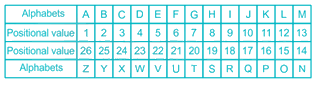 The logic followed here is:
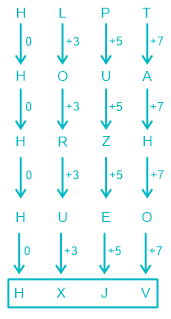 So, 'HXJV' will replace the question mark in the given series.
Hence, the correct answer is "Option 1".
Q2 · Series
Select the letter-cluster from among the given options that can replace the question mark (?) in the following series.
GEA, IJH, KOO, MTV ?
- OYC
- OYD
- OYB
- PZD
Answer aur solution dekho
Archived marked answer: A
The logic followed here is:
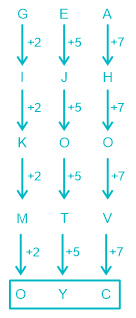 So, 'OYC' will replace the question mark in the given series.
Hence, the correct answer is "Option 1".
Q3 · Series
What will come at the place of question mark? 1, 2, 6, 21, 88, ?
- 445
- 441
- 443
- 440
Answer aur solution dekho
Archived marked answer: A
The logic followed here is:
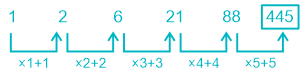 thus, "445" will replace the question mark in the given series.
Hence, the correct option is "Option 1".
Q4 · Series
Which term is wrong in the series: 2, 5, 10, 17, 26, 36
- 5
- 10
- 36
- 26
Answer aur solution dekho
Archived marked answer: C
The logic followed here is:
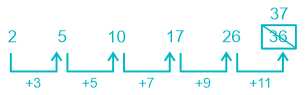 thus, "36" will replace the question mark in the given series.
Hence, the correct option is "Option 3".
Q5 · Analogy
If FLOWER is written as GNQXFS, how is GARDEN written in that code?
- HBSEFO
- HBSDFO
- HASEFO
- HCTEFO
Answer aur solution dekho
Archived marked answer: D
The logic followed here is:
For, FLOWER is written as GNQXFS Q6 · Analogy
In the following question, a pair of letters is given, followed by its corresponding product of alphabetical positions (A = 1, B = 2, ..., Z = 26). A second pair of letters is given without its product. Identify the correct product for the second pair that maintains the same relationship as the first.
BxD : 2x4 :: GxJ : ?
- 6x11
- 7x10
- 8x9
- 5x12
Answer aur solution dekho
Archived marked answer: B
The logic followed here is:
Logic: Each letter is represented by its alphabetical position (A = 1, B = 2, … Z = 26).
For, BxD : 2x4
B → 2
D → 4
So, the pair is written as 2x4.
Similarly, for GxJ : ?
G → 7
J → 10
So, the pair is written as 7x10.
Hence, the correct answer is "Option 2". Q7 · Puzzle Subtypes Not To Miss
If 'P' denotes 'addition', 'D' denotes 'subtraction', 'S' denotes 'multiplication', and 'V' denotes 'division', then what will be the value of the following expression? 5 (7 S 3) D 3 (8 P 6) V 7 D 11 (3 S 13 S 2) P 2 (41 S 9)
- 96
- 42
- -21
- 21
Answer aur solution dekho
Archived marked answer: C
BODMAS Table:
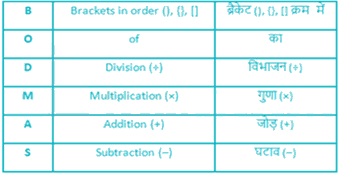 Given expression: 5 (7 S 3) D 3 (8 P 6) V 7 D 11 (3 S 13 S 2) P 2 (41 S 9) = ?
Now, if ‘P’ means ‘+’, ‘D’ means ‘-’, ‘S’ means ‘×’, and ‘V’ means ‘÷’, then:
⇒ 5 (7 × 3) - 3 (8 + 6) ÷ 7 - 11 (3 × 13 × 2) + 2 (41 × 9)
⇒ 5 (21) - 3 (14) ÷ 7 - 11 (78) + 2 (369)
⇒ 105 - 42 ÷ 7 - 858 + 738
⇒ 105 - 6 - 858 + 738
⇒ 99 - 858 + 738
⇒ -759 + 738
⇒ -21
Hence, the correct answer is "Option 3".
Q8 · Puzzle Subtypes Not To Miss
If a geometric progression (GP) starts at 3.6 and the common ratio (CR) = 1.5, what is the 3rd term?
- 7.2
- 8.1
- 6
- 6.6
Answer aur solution dekho
Archived marked answer: B
The logic followed here is:
Given:
In a geometric progression (GP), the nth term = first term × (common ratio)n-1
First term = 3.6
Common ratio = 1.5
Here, 3rd term = 3.6 × (1.5)² = 3.6 × 2.25 = 8.1
Hence, the correct answer is Option 2.
Q9 · Puzzle Subtypes Not To Miss
Evaluate (2 + 3) × (7 - 4)² = ?
- 45
- 75
- 40
- 30
Answer aur solution dekho
Archived marked answer: A
The logic followed here is:
Solve inside the brackets:
(2 + 3) = 5
(7 - 4) = 3
Now, Square the second bracket:
3² = 9
Finally, multiply:
5 × 9 = 45
Hence, the correct answer is Option 1.
Q10 · Puzzle Subtypes Not To Miss
If the given symbols mean: '+' means 'divided by' '-' means 'multiplied by' '×' means 'minus' '÷' means 'plus' Then, find the value of the following e×pressions: 7 × 3 ÷ 4 + 20 - 5=?
- 7
- 9
- 5
- 11
Answer aur solution dekho
Archived marked answer: C
BODMAS Table:
Given equation: 7 × 3 ÷ 4 + 20 - 5 = ?
Sign
+
÷
×
Meaning
÷
×
+
After changing the signs,
⇒ 7 - 3 + 4 ÷ 20 × 5 = ?
⇒ 7 - 3 + 1 = ?
⇒ 8 - 3 = ?
⇒ 5 = ?
Hence, the correct answer is "Option 3". Q11 · Puzzle Subtypes Not To Miss
If '×' means '-', '-' means '+', '/' means '×', and '+' means '÷', which of the following is correct?
- 20 + 4 - 2 × 5 = 10
- 15 - 3 + 6 / 2 = 12
- 48 / 8 + 3 - 5 × 1 = 15
- 10 × 2 - 4 + 8 / 2 = 9
Answer aur solution dekho
Archived marked answer: D
BODMAS Table:
Given equation: 10 × 2 − 4 + 8 ÷ 2 = ?
Now, if ‘×’ means &lsquo Q12 · Puzzle Subtypes Not To Miss
If # = +, @ = x, % = -, then (5 # 2) @ 3 % 4 = ?
- 20
- 17
- 18
- 21
Answer aur solution dekho
Archived marked answer: B
BODMAS Table:
Given equation: (5 # 2) @ 3 % 4 = ?
Now, if ‘#’ = ‘+’, ‘@’ = ‘×’, ‘%’ = ‘−’, then:
⇒ (5 + 2) × 3 − 4 = ?
⇒ 7 × 3 − 4 = ?
⇒ 21 − 4 = ?
⇒ 17
Hence, the correct answer is "Option 2". Q13 · Puzzle Subtypes Not To Miss
If '+' means '÷', '-' means '×', '×' means '+', and '÷' means '-', then 18 + 6 - 2 × 3 = ?
- 9
- 6
- 5
- 15
Answer aur solution dekho
Archived marked answer: A
BODMAS Table:
Given equation: 18 + 6 − 2 × 3 = ?
Now, if ‘+&am Q14 · Puzzle Subtypes Not To Miss
If 4 # 2 = 10 and 6 # 3 = 21, what is 8 # 4?
- 36
- 40
- 44
- 48
Answer aur solution dekho
Archived marked answer: A
The logic followed here is:
Logic: The operation “#” is defined as a # b = a × b + b
4 # 2 = 4 × 2 + 2 = 10
6 # 3 = 6 × 3 + 3 = 21
Similarly, 8 # 4 = 8 × 4 + 4 = 36
Hence, the correct answer is Option 1.
Q15 · Puzzle Subtypes Not To Miss
A person buys 4 apples at ₹18 each and 2 melons at ₹35 each. What is the total cost?
- ₹142
- ₹128
- ₹144
- ₹150
Answer aur solution dekho
Archived marked answer: A
The logic followed here is:
Given:
Cost of 4 apples = 4 × 18 = 72
Cost of 2 melons = 2 × 35 = 70
Here, Total cost = 72 + 70 = 142
Hence, the correct answer is Option 1.
Q16 · Coding Decoding
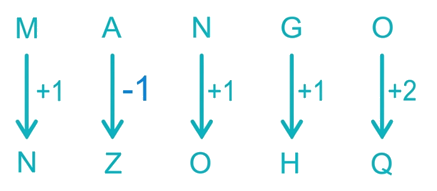
If 'MANGO' is coded as 'NZOHQ', how is 'PEACH' written?
- QFBDI
- QDBDJ
- PFBID
- FBIDP
Answer aur solution dekho
Archived marked answer: B
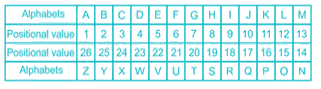 The logic followed here is:
Logic: The pattern is +1,-1,+1,+1,+2.
For, MANGO → NZOHQ
 Applying same to PEACH:
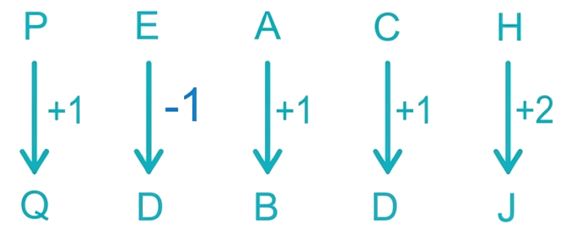 So, PEACH → QDBDJ
Hence, the correct answer is Option 2.
Q17 · Classification Odd One Out
Find the odd one out from the given alternatives:
- Lok Sabha
- Rajya Sabha
- Vidhan Sabha
- Supreme Court
Answer aur solution dekho
Archived marked answer: D
The logic followed here is:
Option 1) Lok Sabha → part of the Parliament
Option 2) Rajya Sabha → part of the Parliament
Option 3) Vidhan Sabha → state legislative assembly
Option 4) Supreme Court → judiciary
Here, All except the Supreme Court are legislative bodies.
Hence, the correct answer is Option 4.
Q18 · Logical Reasoning
Statements: No circles are squares. Some squares are triangles.
Conclusions:
I. Some triangles are not circles.
II. No triangle is a circle.
- Only I follows
- Only II follows
- Both I and II follow
- Neither I nor II follows
Answer aur solution dekho
Archived marked answer: A
Given Statements:
No circles are squares.
Some squares are triangles.
The least possible Venn diagram for the given statement is:
 Conclusions:
I. Some triangles are not circles - True (Since some squares are triangles and no square is a circle, those triangles which are squares cannot be circles.)
II. No triangle is a circle - False (Only triangles that are squares are not circles. Other triangles may or may not be circles.)
So, Only conclusion I follows.
Hence, the correct answer is "Option 1".
Q19 · Blood Relations
Rani said, "The man in the photo is my mother's son-in-law." Who is the man to Rani?
- Husband
- Father
- Uncle
- Cousin
Answer aur solution dekho
Archived marked answer: A
Family Chart:
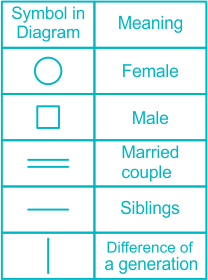 Given:
Mother’s son-in-law =
The man who is married
Q20 · Blood Relations
A is the brother of B. C is the father of A. D is the brother of C. E is the son of D. How is E related to B?
- Cousin
- Nephew
- Uncle
- Brother-in-law
Answer aur solution dekho
Archived marked answer: A
Family Chart:
Given:
A is the brother of B.
C is the father of A.
D is the brother of C.
E is the son of D.
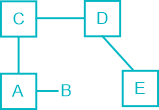 So, E is the Cousin of B.
Hence, the correct answer is "Option 1".
Q21 · Alphabet Test
Sentence: "The quantum universe expands silently into infinity." If the 3rd letter of every 2nd word is written in order, what word is formed?
- tufe
- tule
- apf
- apt
Answer aur solution dekho
Archived marked answer: D
The logic followed here is:
Given:
In the sentence "The quantum universe expands silently into infinity," the 2nd words are quantum, expands, into.
Then, The 3rd letters of these words are a, p, t.
Thus, Combining them gives the word apt.
Hence, the correct answer is Option 4) apt.
Q22 · Alphabet Test
How many meaningful four-letter English words can be formed using the first, second, third, and fourth letters of the word "CAMERA" (when counted from left to right), using each letter only once in each word?
- One
- Four
- Two
- Three
Answer aur solution dekho
Archived marked answer: D
Given word: CAMERA
The first four letters = C, A, M, E
We need to form meaningful four-letter English words using these letters, each letter only once.
Possible combinations:
CAME (meaningful)
ACME (meaningful)
MACE (meaningful)
Other combinations like MEAC, ECAM, etc., either don’t form valid words or are repetitions.
Total meaningful words = 3
Hence, the correct answer is Option 4.
Q23 · Similarity and Differences
Which of the following is/are identical to the address given: Vill: Sangrur, PO: Sangrur, PS: Patiala, Dist: Punjab – 148001
1. Vill: Sangrur, PO: Sangrur, PS: Patiala, Dist: Punjab – 148001
2. Vill: Sangrur, PO: Sangrur, PS: Patiala, Dist: Punjab – 148002
3. Vill: Sangrur, PO: Sangrur, PS: Patiala, Dist: Punjab – 148003
4. Vill: Sangrur, PO: Sangrur, PS: Patiala, Dist: Punjab – 148004
- 1 Only
- 3 Only
- 4 Only
- 2 Only
Answer aur solution dekho
Archived marked answer: A
The address given in the problem is:
Vill: Sangrur, PO: Sangrur, PS: Patiala, Dist: Punjab – 148001
Now, match this address with the given options:
Option
Address in Option
Given Address
Comment
1
Vill: Sangrur, PO: Sangrur, PS: Patiala, Dist: Punjab – 148001
Vill: Sangrur, PO: Sangrur, PS: Patiala, Dist: Punjab – 148001
Exactly identical.
2
Vill: Sangrur, PO: Sangrur, PS: Patiala, Dist: Punjab – 148002
Vill: Sangrur, PO: Sangrur, PS: Patiala, Dist: Punjab – 148001
Not identical (PIN code different: 148002 vs 148001).
3
Vill: Sangrur, PO: Sangrur, PS: Patiala, Dist: Punjab – 148003
Vill: Sangrur, PO: Sangrur, PS: Patiala, Dist: Punjab – 148001
Not identical (PIN code different: 148003 vs 148001).
4
Vill: Sangrur, PO: Sangrur, PS: Patiala, Dist: Punjab – 148004
Vill: Sangrur, PO: Sangrur, PS: Patiala, Dist: Punjab – 148001
Not identical (PIN code different: 148004 vs 148001).
So, only Option 1 is exactly identical to the given address.
Hence, the correct answer is Option 1 Only.
Q24 · Logical Statement Questions
Instruction: Identify the assumptions that must hold for the statement to be valid, then choose the correct option.
Statement: The advancement of biotechnology has the potential to revolutionize medicine by allowing for the development of personalized treatments, but it also raises ethical questions regarding genetic manipulation and the potential for inequality in access to these treatments.
Assumptions:
I. Biotechnology has the power to create personalized medical treatments.
II. The ethical implications of biotechnology need to be addressed to prevent misuse.
III. Biotechnology will be accessible to everyone, ensuring equality in treatment access.
- Only I and II are implicit
- Only II and III are implicit
- Only I is implicit
- All assumptions are implicit
Answer aur solution dekho
Archived marked answer: A
Given Statement:
The advancement of biotechnology has the potential to revolutionize medicine by allowing for the development of personalized treatments, but it also raises ethical questions regarding genetic manipulation and the potential for inequality in access to these treatments.
Now,
Assumptions:
1.Biotechnology has the power to create personalized medical treatments - Implicit (The statement clearly mentions development of personalized treatments through biotechnology.)
2.The ethical implications of biotechnology need to be addressed to prevent misuse - Implicit (Since the statement says it raises ethical questions, it assumes ethical concerns are significant and must be considered.)
3.Biotechnology will be accessible to everyone, ensuring equality in treatment access - Not Implicit (The statement mentions potential inequality in access, not guaranteed equality.)
Here, Only assumptions I and II are implicit.
Hence, the correct answer is "Option 1".
Q25 · Logical Statement Questions
Read the following statement carefully and identify the conclusion that follows.
Statement: The economy grew by 8% this year, the highest in a decade.
Conclusions:
I. Economic reforms have been successful.
II. Growth in previous years was below 8%.
- Only Conclusion I follows
- Only Conclusion II follows
- Both I and II follow
- Neither I nor II follows
Answer aur solution dekho
Archived marked answer: B
Given Statement: The economy grew by 8% this year, the highest in a decade.
Now,
Conclusions:
(i) Economic reforms have been successful → Does not follow (The reason for the growth is not mentioned.)
(ii) Growth in previous years was below 8% → Follows (Since 8% is the highest in a decade, previous years’ growth must have been less than 8%.)
Here, Only conclusion II follows.
Hence, the correct answer is "Option 2".
General Awareness
Q1 · Art and Culture
How many pairs of decorative wheels are found on the Konark Sun Temple chariot?
- 10 pairs
- 11 pairs
- 12 pairs
- 13 pairs
Answer aur solution dekho
Archived marked answer: C
The correct answer is 12 pairs.
Key Points
- The Konark Sun Temple, located in Odisha, India, is a UNESCO World Heritage Site and is renowned for its architectural brilliance.
- The temple is designed as a colossal chariot of the Sun God, Surya, with twelve pairs of intricately carved stone wheels.
- Each pair of decorative wheels represents the months of the year and symbolizes the passage of time.
- The wheels are approximately 3 meters in diameter and are adorned with detailed carvings depicting various motifs, including animals and floral designs.
- The temple was constructed in the 13th century by King Narasimhadeva I of the Eastern Ganga dynasty.
Additional Information
- Nagara Style (North India)
- Features: Curvilinear towers (shikharas), square ground plans, often with a water tank and no boundary walls, with amalakas (grooved stone discs) at the top.
- Examples: Kandariya Mahadeva Temple (Khajuraho), Lingaraja Temple (Bhubaneswar), Sun Temple (Konark).
- Dravida Style (South India)
- Features: Pyramidical towers (vimanas), large gateways (gopurams), enclosed compounds with walls, water tanks, and pillared halls (mandapas).
- Examples: Brihadeeswarar Temple (Thanjavur), Meenakshi Temple (Madurai), Ranganathaswamy Temple (Srirangam).
- Vesara Style (Deccan/Central India)
- Features: A hybrid style blending Nagara and Dravida elements, often with complex layouts, a pyramidal but shorter tower, and sometimes gopurams.
- Examples: Kailasanatha Temple (Ellora), Virupaksha Temple (Pattadkal).
Q2 · Art and Culture
Which of the following best reflects Kerala's musical instrument heritage?
- Ravana-Hatta originated in Kerala and spread northward
- Kerala's music uses only wind instruments like Turi and Kombu
- Kerala's instruments are recent and mostly Western-influenced
- Drums like Timila and Maddalam are mentioned in Silappadikaram and still used today
Answer aur solution dekho
Archived marked answer: D
The correct answer is Drums like Timila and Maddalam are mentioned in Silappadikaram and still used today.
Key Points
- Timila and Maddalam are traditional percussion instruments integral to Kerala's musical heritage and are prominently used in temple rituals and classical performances like Kathakali and Koodiyattam.
- Both instruments are mentioned in the ancient Tamil epic Silappadikaram, which provides insights into South India's rich cultural history and traditions.
- The Maddalam is a barrel-shaped drum played horizontally, while the Timila is a high-pitched percussion instrument used in temple music, especially in Panchavadyam ensembles.
- Kerala is renowned for its percussion-based music traditions, where drums like Chenda, Idakka, and Maddalam play a central role in performances such as Theyyam and temple rituals.
- These instruments symbolize the continuity of Kerala's cultural and musical heritage, showcasing how ancient traditions are preserved in the modern era.
Additional Information
- Maharaja Swathi Thirunal Rama Varma (1813-1847): Kerala's most celebrated historical composer, known for numerous works in Sanskrit, Marathi, Telugu, and Malayalam.
- Irayimman Thampi (1782-1856): Recognized as the first composer of Malayalam Kirthanas, enriching the state's classical music traditions.
- K. J. Yesudas: A legendary Carnatic vocalist and playback singer, widely known across India.
Q3 · Art and Culture
Consider the statements about Jhora:
1. It is danced in Kumaon by mixed circles of men and women during spring fairs.
2. The dance is accompanied primarily by the Hurka drum. Which is/are correct?
- Only 1 correct
- Only 2 correct
- Both 1 & 2 correct
- Neither 1 nor 2 correct
Answer aur solution dekho
Archived marked answer: C
The correct answer is Option 3: Both 1 & 2 correct.
Key Points
- Jhora is a traditional folk dance performed in the Kumaon region of Uttarakhand, India.
- It is primarily performed during spring fairs, celebrating the arrival of the new season with joy and unity.
- The dance is characterized by mixed circles of men and women, symbolizing harmony and togetherness.
- The Hurka drum is the primary musical instrument that accompanies the Jhora dance, providing rhythm and vibrancy to the performance.
- This dance is an integral part of Kumaoni culture and highlights the region's rich heritage and traditions.
Additional Information
- Jhora Dance:
- Jhora is a community dance that is performed on special occasions, such as weddings and festivals, to mark celebrations.
- The dancers form a circular formation and move in coordinated steps, reflecting the unity and strength of the community.
- It is considered one of the most famous folk dances of the Kumaon region and is a significant part of its cultural identity.
- Hurka Drum:
- The Hurka drum is a traditional musical instrument used in Uttarakhand, especially in folk dances such as Jhora and Hurka Baul.
- It is a small, handheld drum that produces rhythmic beats, adding energy and enthusiasm to the dance.
- The Hurka drum is often accompanied by other traditional instruments, enhancing the overall musical experience during performances.
- Traditional Kumaoni Culture:
- The Kumaon region of Uttarakhand is known for its unique cultural heritage, which includes traditional dances, music, and festivals.
- Other notable folk dances of Kumaon include Chholiya, a sword dance performed during weddings, and Ramola, a dance that narrates local folklore.
- Kumaoni culture is deeply rooted in nature worship and the celebration of seasons, which is reflected in its folk traditions.
Q4 · Art and Culture
Which of the following best captures the cultural essence and rituals of Baran's Dol Mela in Rajasthan?
- The fair opens with Dev Viman stunts by akhada artists and concludes with an Amavasya night immersion across the city.
- Lord Shreeji and Raghunathji's processions on Jaljhulani Gyaras attract traders from several states.
- Known as Annapurna Gyaras, Baran's Dol Mela is celebrated only in Madhya Pradesh after the monsoon harvest.
- Held between Shravan and Ashwin, the event is led by monks in caves, separate from temple traditions.
Answer aur solution dekho
Archived marked answer: B
The correct answer is Lord Shreeji and Raghunathji's processions on Jaljhulani Gyaras attract traders from several states.
Key Points
- Baran's Dol Mela is one of the most prominent cultural fairs in Rajasthan, celebrated with significant enthusiasm and devotion.
- The highlight of the festival is the grand processions of Lord Shreeji and Raghunathji on the occasion of Jaljhulani Gyaras, a religious event that attracts devotees and traders from multiple states.
- Jaljhulani Gyaras is a sacred day in the Hindu calendar, observed during the month of Bhadrapada (August-September), celebrated for the ceremonial immersion of deities in water.
- Traders from several states converge at the fair, making it an important hub for cultural exchange and commerce.
- The Dol Mela showcases traditional Rajasthani culture through folk dances, music, and various rituals, symbolizing the region's rich heritage and devotion.
Additional Information
- Major Festivals & Fairs
- Pushkar Camel Fair: An iconic annual event known for livestock trading, holy dips in Pushkar Lake, and cultural performances.
- Bikaner Camel Festival: Celebrates camels with processions, local crafts, and delicacies in winter.
- Jaisalmer Desert Festival: A colorful event in the desert showcasing traditional Rajasthani arts, music, and crafts.
- Marwar Festival: Held in Jodhpur, it honors the legendary heroes of Rajasthan with folk music and dance.
- Nagaur Fair: A significant cattle fair, second only to Pushkar, known for trade and cultural events.
Q5 · Indian Polity and Constitution
Under which Article of the Indian Constitution is Hindi in Devanagari script declared as the official language of the Union?
- Article 348
- Article 343
- Article 344
- Article 351
Answer aur solution dekho
Archived marked answer: B
The correct answer is Article 343.
Key Points
- Article 343 of the Indian Constitution declares Hindi written in the Devanagari script as the official language of the Union.
- It also specifies that the numerals used for official purposes must be in the international form of Indian numerals.
- The Constitution initially allowed English to continue as an official language of the Union for a period of 15 years from the commencement of the Constitution (1950), which was later extended through amendments.
- Article 343(2) empowers Parliament to provide for the continued use of English for official purposes, alongside Hindi, even after the initial 15-year period.
- The Official Languages Act of 1963 extended the use of English as an associate official language indefinitely, ensuring bilingual usage for administrative purposes.
Additional Information
- Article 348:
- It provides for the language to be used in the Supreme Court and High Courts and for Acts, Bills, and other official documents.
- According to this Article, English shall be used for all proceedings in the Supreme Court and High Courts, as well as for authoritative texts of laws and bills at the Union and State levels unless otherwise specified by Parliament or the State Legislature.
- Article 344:
- This Article deals with the Constitution and functions of the Official Language Commission.
- The Commission is tasked with making recommendations regarding the progressive use of Hindi for official purposes and the restrictions on using English.
- It also advises on measures to promote the spread and development of Hindi throughout the country.
- Article 351:
- It directs the Union Government to promote the spread of the Hindi language and develop it to serve as a medium of expression for all elements of India's composite culture.
- The Government is also instructed to enrich Hindi by assimilating its forms, style, and expressions from other Indian languages and Sanskrit.
Q6 · Indian Polity and Constitution
What is the primary purpose of the BRICS Startup Knowledge Hub launched in 2025?
- Financial trade platform
- Startup knowledge repository
- Cultural archive
- Capital control system
Answer aur solution dekho
Archived marked answer: B
The correct answer is Startup knowledge repository.
Key Points
- The BRICS Startup Knowledge Hub aims to serve as a centralized repository for information, resources, and best practices related to startups across BRICS nations.
- This initiative was launched in 2025 to promote innovation, collaboration, and entrepreneurship among the member countries: Brazil, Russia, India, China, and South Africa.
- It focuses on sharing knowledge and fostering partnerships among startups, investors, and governments of the BRICS nations.
- The hub supports the exchange of startup-related policies, research, funding opportunities, and technological expertise to accelerate growth in the startup ecosystem.
- BRICS Startup Knowledge Hub contributes to economic development and the creation of a robust innovation-driven ecosystem in member countries.
Additional Information
- BRICS
- Origin & Acronym: Coined by Goldman Sachs economist Jim O'Neill in 2001 (BRIC), representing Brazil, Russia, India, & China; South Africa joined in 2010, adding the 'S'.
- Expansion: Recently expanded to include Iran, Egypt, Ethiopia, UAE, and Indonesia, broadening its global reach.
- Purpose: A platform for dialogue and cooperation in trade, finance, technology, and security, aiming to increase Global South influence in international affairs.
- Economic Significance: Members collectively hold significant shares of the world's population, GDP, and trade, acting as a major engine for global growth.
- Key Initiatives: Includes the New Development Bank (NDB) for infrastructure financing and promoting local currency settlements.
Q7 · Indian Polity and Constitution
Which Constitutional Amendment Act is often referred to as the "Mini-Constitution" due to the extensive changes it introduced to the Indian Constitution?
- 44th Amendment Act, 1978
- 52nd Amendment Act, 1985
- 42nd Amendment Act, 1976
- 86th Amendment Act, 2002
Answer aur solution dekho
Archived marked answer: C
The correct answer is 42nd Amendment Act, 1976.
Key Points
- The 42nd Amendment Act, 1976, is often referred to as the "Mini-Constitution" due to the extensive changes it introduced to the Indian Constitution.
- It was passed during the Emergency period under the leadership of Prime Minister Indira Gandhi.
- This amendment brought significant changes to the Preamble, Fundamental Rights, Directive Principles of State Policy, and the powers of the Parliament and judiciary.
- It introduced terms like "Socialist" and "Secular" in the Preamble of the Constitution.
- It curtailed the power of the judiciary and strengthened the authority of the Parliament, especially in the context of amending the Constitution.
- The 42nd Amendment also extended the term of the Lok Sabha and State Legislative Assemblies from 5 to 6 years, though this was later reversed by the 44th Amendment.
Additional Information
- 44th Amendment Act, 1978:
- This amendment was enacted to undo the excesses of the 42nd Amendment, restoring the balance between the executive, legislature, and judiciary.
- It restored the term of the Lok Sabha and State Legislative Assemblies to 5 years.
- It also ensured that Fundamental Rights like the Right to Property were no longer included as part of Fundamental Rights but rather as a legal right under Article 300A.
- Additionally, it introduced safeguards against the misuse of emergency provisions by requiring stricter conditions for the proclamation of national emergencies.
- 52nd Amendment Act, 1985:
- This amendment introduced the anti-defection law in India by adding the Tenth Schedule to the Constitution.
- The purpose was to curb defections by legislators to ensure the stability of the government and uphold the integrity of the democratic process.
- It laid down conditions under which a legislator could be disqualified on grounds of defection.
- 86th Amendment Act, 2002:
- This amendment made education a Fundamental Right under Article 21A of the Constitution.
- It mandated free and compulsory education for children aged 6 to 14 years.
- It also altered the Directive Principles of State Policy by adding a new clause under Article 45, directing the state to provide early childhood care and education for children below six years of age.
Q8 · Indian Polity and Constitution
Consider the following statements:
1. Parliament can create All India Services with approval of Rajya Sabha.
2. Article 312 mentions 'Security Services' as part of All India Services. Which of the above statements is/are correct?
- Only 1
- Only 2
- Both 1 and 2
- Neither 1 nor 2
Answer aur solution dekho
Archived marked answer: A
The correct answer is Option 1: Only 1.
Key Points
- Statement 1 is correct: Parliament has the authority to create new All India Services under Article 312 of the Constitution of India. However, this requires the approval of the Rajya Sabha by a two-thirds majority of the members present and voting.
- Statement 2 is incorrect: Article 312 of the Indian Constitution does not mention "Security Services" as part of All India Services. The three All India Services currently in existence are the Indian Administrative Service (IAS), Indian Police Service (IPS), and Indian Forest Service (IFS).
- The creation of new All India Services is intended to ensure uniformity and efficiency in the administration of the country.
- All India Services officers are recruited and trained by the central government but serve both the central and state governments, ensuring better coordination between the two levels of administration.
Additional Information
- About Article 312:
- Article 312 of the Indian Constitution provides for the creation of one or more All India Services, including an All India Judicial Service, common to the Union and the States.
- The services created under this article are meant to ensure uniform standards of administration across the country.
- The central government handles recruitment and training for these services through institutions like the Union Public Service Commission (UPSC).
- Existing All India Services:
- Indian Administrative Service (IAS): Responsible for policy implementation and general administration in the government.
- Indian Police Service (IPS): Maintains law and order and ensures internal security.
- Indian Forest Service (IFS): Manages forests, wildlife, and environmental conservation.
- Role of the Rajya Sabha in Creating All India Services:
- The Rajya Sabha must pass a resolution by a two-thirds majority to authorize the creation of a new All India Service.
- This provision is intended to ensure that states are consulted before the creation of services that will operate at both the central and state levels.
Q9 · Indian Economy
Read the below statements marked as Assertion (A) and Reason (R). Mark the correct options:
Assertion (A): Global Ease of Doing Business (EoDB) indicators excluded informal sectors.
Reason (R): Informal enterprises are difficult to measure consistently across nations.
- Both A and R are true, and R is the correct explanation of A.
- Both A and R are true, but R is not the correct explanation of A.
- A is true, but R is false.
- A is false, but R is true.
Answer aur solution dekho
Archived marked answer: A
The correct answer is Option 1: Both A and R are true, and R is the correct explanation of A.
Key Points
- Global Ease of Doing Business (EoDB) indicators measure how conducive a country's regulatory environment is for starting and operating businesses.
- These indicators primarily focus on formal sectors, excluding informal enterprises, as they lack consistent data across nations.
- Informal enterprises are challenging to measure due to their non-standardized structure and operations, which vary significantly across countries.
- The World Bank, which publishes the EoDB rankings, generally relies on data from registered businesses and government regulations, leaving out the informal sector.
- Reason (R) correctly explains the exclusion of informal enterprises, as they are difficult to assess uniformly across different nations due to inconsistencies in data collection methods and definitions of informal businesses.
Additional Information
- Ease of Doing Business Rankings and Informal Sector
- The Ease of Doing Business rankings are published by the World Bank to compare the business environments of different countries.
- The rankings primarily evaluate regulations affecting registered businesses, ignoring informal sectors due to challenges in uniform data collection.
- Informal businesses often operate outside formal regulatory frameworks, making them difficult to assess using standardized metrics.
- Including informal enterprises would require developing globally consistent definitions and measurement methods, which are currently lacking.
Q10 · Indian Economy
Consider the following statements about the eSanjeevani initiative:
Statement 1: eSanjeevani OPD enables remote doctor consultations for citizens via online mode.
Statement 2: eSanjeevani AB-HWC connects citizens with Ayushman Bharat Health and Wellness Centers (AB-HWC). Which of the above is/are correct?
- Only Statement 1 is correct
- Only Statement 2 is correct
- Both 1 and 2
- Neither 1 nor 2
Answer aur solution dekho
Archived marked answer: C
The correct answer is option 3.
Key Points
- eSanjeevani OPD is a teleconsultation platform under the Ministry of Health and Family Welfare that enables citizens to connect with doctors remotely via online mode for medical consultations.
- eSanjeevani AB-HWC is another branch of the eSanjeevani initiative that connects citizens with Ayushman Bharat Health and Wellness Centers (AB-HWCs) for teleconsultation services.
- The initiative aims to bridge the rural-urban divide by making quality healthcare accessible, especially in remote and underserved areas.
- Both eSanjeevani OPD and eSanjeevani AB-HWC were launched to strengthen India’s digital health ecosystem and improve healthcare delivery across the country.
- It has emerged as one of the largest telemedicine platforms globally, with millions of consultations completed, contributing to the Government of India’s goal of achieving universal healthcare access.
Additional Information
- eSanjeevani OPD:
- It allows patients to consult with doctors from the comfort of their homes using audio-video communication technologies.
- The service is available free of cost and ensures privacy and confidentiality of patient data.
- It has been particularly beneficial during the COVID-19 pandemic by reducing the need for physical visits to hospitals.
- eSanjeevani AB-HWC:
- This service connects beneficiaries with doctors and specialists at Ayushman Bharat Health and Wellness Centers (AB-HWCs).
- AB-HWCs focus on providing comprehensive primary healthcare services, including maternal and child health, non-communicable diseases, and mental health services.
- It is designed to strengthen the grassroots healthcare system by leveraging digital technology.
- Ayushman Bharat Initiative:
- Ayushman Bharat is a flagship healthcare initiative launched by the Government of India to achieve Universal Health Coverage (UHC).
- It has two components: Health and Wellness Centers (HWCs) and the Pradhan Mantri Jan Arogya Yojana (PMJAY).
- Under PMJAY, financial protection of up to Rs. 5 lakh per family is provided annually for secondary and tertiary healthcare services.
Q11 · Indian Economy
Read the following Assertion (A) and Reason (R) carefully and choose the correct option.
Assertion (A): The Mahalanobis strategy prioritized heavy industries and capital goods.
Reason (R): It was believed that investing in such industries would create long-term capacity for growth.
- Both A and R are true and R is the correct explanation of A.
- Both A and R are true but R is not the correct explanation of A.
- A is true but R is false.
- A is false but R is true.
Answer aur solution dekho
Archived marked answer: A
The correct answer is Both A and R are true and R is the correct explanation of A.
Key Points
- The Mahalanobis strategy was developed by Prasanta Chandra Mahalanobis, an Indian statistician and economist, and was adopted in India's Second Five-Year Plan (1956–1961).
- Heavy industries and capital goods were prioritized under this strategy as these sectors were deemed crucial for laying the foundation of industrialization and long-term economic growth.
- The strategy emphasized import substitution industrialization to reduce dependency on foreign goods and build a self-reliant economy.
- The rationale behind prioritizing heavy industries and capital goods was that these sectors would generate the necessary infrastructure and machinery for other industries, thus creating a ripple effect of economic development.
- The approach was based on the belief that capital-intensive industries would create a strong base for technological advancements and economic independence.
Additional Information
- India's Second Five-Year Plan (1956-1961)
- focused on rapid industrialization, particularly heavy industries, using the Nehru-Mahalanobis model, aiming for a 25% increase in national income and new jobs by boosting public sector investment in steel, coal, and energy, establishing major steel plants (Bhilai, Durgapur, Rourkela) with foreign help, but faced forex shortages and price rises.
- Key Features & Objectives:
- Focus: Rapid industrialization with emphasis on basic and heavy industries, shifting away from agriculture.
- Model: Based on the Nehru-Mahalanobis model, prioritizing investment in capital goods.
- Goals: Increase national income by 25%, create more jobs, and develop infrastructure.
- Public Sector: Significant expansion of the public sector.
Q12 · Sports Static GK
Read the following Assertion (A) and Reason (R) carefully about-The Khelo India Youth Games (Table Tennis Doubles Finals) and choose the correct option:
Assertion (A): Kavya Bhatt and Divyanshi Bhowmick dropped only one game in the girls' doubles tournament.
Reason (R): They beat Subhankrita Datta and Avisha Karmakar 3-0 in the final.
- Both A and R are true, and R is the correct explanation of A.
- Both A and R are true, but R is not the correct explanation of A.
- A is false, but R is true.
- A is true, but R is false.
Answer aur solution dekho
Archived marked answer: C
The correct answer is A is false, but R is true.
Key Points
- In the girls' doubles final of the Khelo India Youth Games (Table Tennis Doubles), Kavya Bhatt and Divyanshi Bhowmick defeated Subhankrita Datta and Avisha Karmakar with a clean score of 3-0.
- The Reason (R) that they won the final match with a 3-0 score is correct.
- However, the Assertion (A), which states that Kavya Bhatt and
Q13 · Sports Static GK
What is a "brace" in football?
- Two consecutive wins
- Two yellow cards
- Scoring two goals in a match
- Saving two penalties
Answer aur solution dekho
Archived marked answer: C
The correct answer is Scoring two goals in a match.
Key Points
- The term "brace" in football refers to when a player scores two goals in a single match.
- The phrase originated from hunting terminology, where "brace" was used to signify a pair of something, such as two birds or animals caught.
- It is considered a significant achievement for a football player, highlighting their contribution to the team's performance in a match.
- Scoring a brace often indicates a player's ability to perform under pressure and capitalize on opportunities.
- Players who score two goals in a match are often celebrated for their skill and consistency in finishing.
Additional Information
- Two consecutive wins:
- This refers to when a team wins two matches in a row, showcasing consistency and strong performance over multiple games.
- However, this is not related to individual player performance and is different from the concept of scoring a brace.
- Two yellow cards:
- In football, two yellow cards in a single match lead to a red card, resulting in the player being sent off the field.
- A yellow card is a caution given to a player for offenses such as unsporting behavior or repeated fouls.
- Saving two penalties:
- This refers to a goalkeeper successfully stopping two penalty kicks in a match, which is a rare and commendable feat.
- While it demonstrates exceptional goalkeeping skills, it is unrelated to the term "brace," which pertains to scoring goals.
Q14 · Indian Geography
Which of the following district-state combinations is correctly matched with respect to iron ore reserves in India?
- Singhbhum - Jharkhand
- Mayurbhanj - Uttar Pradesh
- Sundargarh - Meghalaya
- Keonjhar - Rajasthan
Answer aur solution dekho
Archived marked answer: A
The correct answer is Singhbhum - Jharkhand.
Key Points
- Singhbhum, located in Jharkhand, is one of the richest districts in India in terms of iron ore reserves.
- The Singhbhum region is well-known for its iron ore belt, which stretches across Jharkhand and Odisha.
- Jharkhand accounts for a significant portion of India's iron ore production, with Singhbhum being a major contributor.
- Major iron ore mines in the Singhbhum district include Chiria, Gua, and Noamundi.
- The high-grade iron ore from Singhbhum is crucial for India's steel industry and is also exported to various countries.
Additional Information
- Mayurbhanj - Uttar Pradesh:
- This is an incorrect pair as Mayurbhanj is located in Odisha, not Uttar Pradesh.
- Mayurbhanj is known for its mineral resources, including iron ore, but it is not in Uttar Pradesh.
- Uttar Pradesh, on the other hand, is not a significant iron ore-producing state in India.
- Sundargarh - Meghalaya:
- This is an incorrect pair as Sundargarh is located in Odisha, not Meghalaya.
- Sundargarh is a major district for iron ore mining in Odisha and contributes significantly to India's total iron ore output.
- Meghalaya, however, is known for limestone, coal, and uranium deposits, not iron ore.
- Keonjhar - Rajasthan:
- This is an incorrect pair as Keonjhar is located in Odisha, not Rajasthan.
- Keonjhar is one of the leading districts for iron ore production in Odisha and India.
- Rajasthan, on the other hand, is known for its reserves of non-ferrous minerals like zinc, lead, and gypsum.
- Iron Ore Reserves in India:
- India ranks among the top producers of iron ore in the world, with significant reserves located in states such as Odisha, Jharkhand, Chhattisgarh, Karnataka, and Goa.
- Odisha is the largest producer of iron ore, followed by Chhattisgarh and Karnataka.
- Iron ore is a crucial raw material for the steel industry, which is a key sector for India's economic development.
Q15 · Indian Geography
India's land area covers what percentage of the world's total area?
- 1.4%
- 2.4%
- 3.4%
- 4.4%
Answer aur solution dekho
Archived marked answer: B
The correct answer is 2.4%.
Key Points
- India’s land area constitutes approximately 2.4% of the world’s total geographical area.
- India has a total land area of about 3.287 million square kilometers, making it the 7th largest country in the world in terms of area.
- The world’s total land area is estimated to be around 149 million square kilometers, and India’s share in this is 0.024 (or 2.4%).
- Despite its relatively small share in the global landmass, India is home to 17.7% of the world's population, as of the latest census data.
- India’s geographical diversity spans mountains, plains, plateaus, deserts, and coastal areas, contributing to its significance despite the limited land area.
Additional Information
- Geographical Importance of India
- India is strategically located in South Asia, bordered by the Himalayas to the north and surrounded by oceans on three sides.
- Its geographical position makes it a significant player in global trade and geopolitics.
- India’s diverse topography includes the fertile Indo-Gangetic Plain, the Thar Desert, and the Deccan Plateau.
Q16 · General Science Biology
Which of these biomolecules is an essential component of the plasma membrane?
- Cellulose
- Phospholipids
- DNA
- Glycogen
Answer aur solution dekho
Archived marked answer: B
The correct answer is Phospholipids.
Key Points
- Phospholipids are a major component of the plasma membrane, forming a bilayer that provides structure and acts as a selective barrier for the cell.
- Each phospholipid molecule has a hydrophilic (water-attracting) "head" and two hydrophobic (water-repelling) "tails," which arrange themselves into a bilayer to create the plasma membrane.
- The phospholipid bilayer is responsible for the fluidity of the membrane, allowing for the movement of proteins and lipids within it.
- It plays a critical role in maintaining cell integrity, enabling the transport of substances in and out of the cell, and facilitating cell signaling.
- Phospholipids also contribute to membrane flexibility, which is essential for processes like endocytosis, exocytosis, and cell division.
Additional Information
- Cellulose
- Cellulose is a complex carbohydrate (polysaccharide) composed of glucose units linked by beta-1,4-glycosidic bonds.
- It is the primary structural component of plant cell walls, providing rigidity and support to plants.
- Cellulose is not present in the plasma membrane of animal cells; it is exclusive to plants and some algae.
- DNA
- DNA (Deoxyribonucleic Acid) is the hereditary material in humans and most other organisms, carrying genetic instructions for development, functioning, growth, and reproduction.
- DNA is located within the nucleus of eukaryotic cells and is not part of the plasma membrane structure.
- It plays no direct role in forming or maintaining the plasma membrane but is crucial for coding the proteins that may integrate into the membrane.
- Glycogen
- Glycogen is a polysaccharide that serves as a form of energy storage in animals, fungi, and bacteria.
- It is stored primarily in the liver and muscle tissues and is broken down into glucose when energy is needed.
- Glycogen is not a structural component of the plasma membrane and serves a different biological function related to energy storage and metabolism.
Q17 · General Science Chemistry
Why is it generally more severe to be burnt by steam at 100°C than by boiling water at 100°C?
- Steam is hotter than boiling water.
- Steam contains more latent heat of vaporization.
- Steam has a higher specific heat capacity.
- Steam molecules are moving faster.
Answer aur solution dekho
Archived marked answer: B
The correct answer is Steam contains more latent heat of vaporization.
Key Points
- Steam at 100°C contains additional energy in the form of latent heat of vaporization, which is the energy required to convert water into steam without changing its temperature.
- This latent heat of vaporization is released when steam condenses on the skin, transferring a large amount of heat energy, causing more severe burns compared to boiling water.&
Q18 · General Science Chemistry
Why is fiberglass preferred over metal for making high jump bars?
- Metal is too flexible for accurate performance
- Fibreglass is light, flexible, and safer on impact
- Metal bends permanently; fibreglass is rigid
- Fibreglass is cheaper and easier to shape
Answer aur solution dekho
Archived marked answer: B
The correct answer is Fibreglass is light, flexible, and safer on impact.
Key Points
- Fibreglass is lightweight: Fibreglass has a low density, making it significantly lighter than metal bars, which is essential for ease of handling and transportation.
- Flexibility: Fibreglass has excellent flexibility, allowing it to absorb impact without permanent deformation. This property makes it ideal for high jump bars as it can bend and return to its original shape.
- Safety on impact: Fibreglass is less rigid than metal, reducing the risk of injuries to athletes if they collide with the bar during a high jump attempt.
- Durable and reliable: Fibreglass resists weathering, corrosion, and wear over time, ensuring consistent performance in various environmental conditions.
- Preferred in sports equipment: The unique combination of lightweight, flexibility, and safety features makes fibreglass a standard material for high jump bars in professional and amateur athletics.
Additional Information
- Metals and non-metals are fundamental categories of elements with contrasting properties:
- metals (like iron, copper) are typically shiny, malleable, ductile, and excellent conductors of heat/electricity, while non-metals (like oxygen, sulfur) are often dull, brittle, poor conductors (except graphite), and can be solids, liquids, or gases.
- Key differences also lie in their electron behavior, density, and oxide formation, with metals tending to lose electrons and form basic oxides, whereas non-metals gain or share electrons and form acidic/neutral oxides.
Q19 · Awards Static
Who was honoured with the Padma Shri in 2025 for empowering women by teaching traditional Bengali folk percussion?
- Gokul Chandra Das
- Farooq Ahmad Mir
- Shyam Bihari Agrawal
- Sheen Kaaf Nizam
Answer aur solution dekho
Archived marked answer: A
The correct answer is Gokul Chandra Das.
Key Points
- Gokul Chandra Das was honoured with the Padma Shri in 2025 for his contributions to empowering women through the teaching of traditional Bengali folk percussion.
- He has dedicated years to preserving and promoting Bengali folk music, particularly percussion instruments such as the dhak, which hold cultural significance in Bengal.
- Das has trained numerous women in rural areas to master the art of Bengali folk percussion, enabling them to gain financial independence and recognition.
- His work has helped revive traditional art forms while simultaneously providing a platform for women to showcase their talents at national and international events.
- The Padma Shri award recognizes his efforts to preserve India’s intangible heritage and promote gender equality through the arts.
Additional Information
- Farooq Ahmad Mir
- Farooq Ahmad Mir is a notable poet and writer from Jammu and Kashmir known for his contributions to literature.
- His works often focus on themes of communal harmony, nature, and the socio-political landscape of Jammu and Kashmir.
- Shyam Bihari Agrawal
- Shyam Bihari Agrawal is a philanthropist and social worker known for his contributions to community service and welfare programs.
- He has worked extensively to improve education, healthcare, and rural development in India.
- Sheen Kaaf Nizam
- Sheen Kaaf Nizam is a renowned Urdu poet celebrated for his literary works and contributions to Urdu poetry.
- His poetry is known for its depth, emotional resonance, and exploration of themes such as love and human values.
- Despite his literary achievements, he is unrelated to traditional Bengali folk percussion or women empowerment through music.
Q20 · Medieval Indian History
Arrange the following rulers of the Delhi Sultanate in the correct chronological order of their reigns, starting from the earliest:
1.Razia Sultan
2.Ghiyas ud din Balban
3.Qutb al-Din Aibak
4.Iltutmish
- 3 - 4 - 1 - 2
- 4 - 3 - 1 - 2
- 3 - 1 - 4 - 2
- 1 - 3 - 4 - 2
Answer aur solution dekho
Archived marked answer: A
The correct answer is 3 - 4 - 1 - 2.
Key Points
- Qutb al-Din Aibak (1206–1210 CE) was the first ruler of the Delhi Sultanate and established the Slave Dynasty. He became the Sultan after the death of Muhammad Ghori.
- Iltutmish (1211–1236 CE), the successor of Qutb al-Din Aibak, is credited with strengthening the Delhi Sultanate and introducing a centralized administrative system.
- Razia Sultan (1236–1240 CE) was the daughter of Iltutmish and the first and only female ruler of the Delhi Sultanate. Her reign was marked by opposition from nobles.
- Ghiyas ud din Balban (1266–1287 CE) was a powerful ruler of the Slave Dynasty known for his strong administration and the theory of kingship.
- The correct chronological order of their reigns is Qutb al-Din Aibak (3) → Iltutmish (4) → Razia Sultan (1) → Ghiyas ud din Balban (2).
Additional Information
- Qutb al-Din Aibak:
- He was originally a slave of Muhammad Ghori and played a crucial role in the conquest of northern India.
- Founded the Qutb Minar in Delhi and laid the foundation of the Slave Dynasty.
- His sudden death in a polo accident ended his brief reign.
- Iltutmish:
- He was the first Sultan to obtain the investiture of sovereignty from the Abbasid Caliph, enhancing the legitimacy of his rule.
- Introduced the silver tanka and copper jital, standardizing the coinage system in the Sultanate.
- Expanded the Delhi Sultanate by annexing several territories, including Bengal and Sindh.
- Razia Sultan:
- She was chosen as the successor by Iltutmish due to her administrative skills and capabilities.
- Faced opposition from the Turkish nobles (Chihalgani), who were reluctant to accept a female ruler.
- Her reign was marked by political instability, leading to her eventual defeat and death.
- Ghiyas ud din Balban:
- He introduced the theory of kingship, emphasizing the divine right of the Sultan to rule.
- Implemented strict laws to maintain law and order and crushed rebellions with an iron hand.
- Strengthened the military and expanded the administrative framework of the Sultanate.
Q21 · Ancient Indian History
Which of the following correctly describes the Sarthavaha in Gupta dynasty's administration?
- Chief artisan overseeing temples and sculpture guilds.
- Officer-in-charge of military recruitment.
- Head of the trading guilds representing various trading communities.
- Official supervising irrigation and waterworks.
Answer aur solution dekho
Archived marked answer: C
The correct answer is Head of the trading guilds representing various trading communities.
Key Points
- The term Sarthavaha in the Gupta dynasty referred to the head of the trading guilds who represented various trading communities and managed commercial activities.
- Sarthavahas were responsible for overseeing the functioning of trading guilds, ensuring smooth trade operations, and resolving disputes within the trading community.
- They played a key role in maintaining economic stability and fostering long-distance trade, which flourished during the Gupta period.
- Trading guilds under the leadership of Sarthavahas were significant in connecting the Gupta Empire with other regions, including Southeast Asia, the Roman Empire, and Central Asia, thereby enhancing economic prosperity.
- The Gupta period is often referred to as the "Golden Age" of India, marked by flourishing trade, urbanization, and cultural advancements, with Sarthavahas contributing significantly to economic growth.
Additional Information
- Gupta dynasty's administration
- King (Maharajadhiraja): Supreme head, responsible for war, peace, justice, and appointing officials, often seen as divine.
- Council of Ministers (Mantri Parishad): Assisted the king, included high officials like the Kumaramatya (minister) and Sandhivigrahika (peace/war minister).
- Judiciary: King was the highest court; Mahanandanayaka (Chief Justice) oversaw justice, with local judges handling regional cases.
- - Vishaya (District): Headed by a Vishayapati, assisted by various officials like Saulkika (toll collector), Gaulmika (forest/fort officer), and Talavataka (accountant).
- Village: Administered by a headman (Gramapati) and elders, settling local disputes.
Q22 · World Geography
Match the geological feature with its primary plate boundary type:
1. Mid-ocean ridge
2. Mariana Trench
3. San Andreas Fault
- 1-Divergent, 2-Convergent, 3-Transform
- 1-Convergent 2-Divergent 3-Transform
- 1-Transform 2-Convergent 3-Divergent
- 1-Divergent 2-Transform 3-Convergent
Answer aur solution dekho
Archived marked answer: A
The correct answer is Option 1: 1-Divergent, 2-Convergent, 3-Transform.
Key Points
- Mid-ocean ridge is associated with divergent plate boundaries, where tectonic plates move apart, allowing magma to rise and form new oceanic crust. An example is the Mid-Atlantic Ridge.
- Mariana Trench is formed at a convergent plate boundary, where one tectonic plate is subducted under another. This creates deep oceanic trenches like the Mariana Trench,
Q23 · Books and Authors Static
Who wrote the novel Sahela Re?
- Vasanti Muzumdar
- Mrinal Pande
- Priyanka Sarkar
- Shubhangi Tiwari
Answer aur solution dekho
Archived marked answer: B
The correct answer is Mrinal Pande.
Key Points
- Mrinal Pande is a renowned Indian author, journalist, and television personality, known for her significant contributions to Hindi literature.
- She wrote the novel "Sahela Re," which explores the intricacies of human relationships, particularly focusing on women’s lives and struggles.
- Mrinal Pande has a deep understanding of Indian societal norms, and her works often reflect feminist perspectives and cultural nuances.
- Besides being an author, she has served as the editor of the Hindi daily "Hindustan" and has worked as the chairperson of Prasar Bharati.
- Her literary works have earned widespread recognition for their vivid portrayal of Indian social issues and have contributed significantly to modern Hindi literature.
Additional Information
- Vasanti Muzumdar
- Vasanti Muzumdar is a less widely known name in Indian literature, and there is limited information on her contributions to Hindi or regional literature.
- She may have contributed to cultural or literary works in regional languages, but she is not associated with the novel "Sahela Re."
- Priyanka Sarkar
- Priyanka Sarkar is primarily recognized as an Indian actress known for her work in Bengali cinema.
- She has not written the novel "Sahela Re" or contributed significantly to Hindi literature.
- Shubhangi Tiwari
- Shubhangi Tiwari is not a recognized name in the field of literature or Hindi novels.
- Her name does not appear in association with the novel "Sahela Re" or any notable literary contributions.
Q24 · Environment and Ecology
How is Indian Railways cutting carbon emissions?
- Return to coal
- Shift to road freight
- Electrify broad gauge & use renewables
- End passenger services
Answer aur solution dekho
Archived marked answer: C
The correct answer is Electrify broad gauge & use renewables.
Key Points
- Indian Railways is prioritizing the electrification of its broad-gauge railway lines to replace diesel locomotives, reducing dependency on fossil fuels and significantly cutting carbon emissions.
- It aims to become a net-zero carbon emitter by 2030, aligning with India’s commitment to global climate change mitigation efforts under the Paris Agreement.
- The initiative involves integrating renewable energy sources like solar and wind power into its energy mix to cater to its electricity requirements.
- Indian Railways has set a target of installing 30 GW of renewable energy capacity by 2030, including solar panels and wind farms at its stations, tracks, and other facilities.
- This electrification and renewable energy adoption is expected to reduce the annual carbon dioxide emissions by millions of tons, making it a major contributor to India’s overall decarbonization goals.
Additional Information
- Decarbonizing Indian Railways
- Indian Railways is one of the largest rail networks in the world and a critical component of India’s transportation infrastructure.
- It is working towards decarbonization by adopting energy-efficient technologies, renewable energy, and electrification of rail networks to mitigate its environmental impact.
Q25 · General Science
What is the orbital regime of the NISAR (NASA-ISRO Synthetic Aperture Radar) satellite?
- GEO
- HEO
- LEO
- SSO
Answer aur solution dekho
Archived marked answer: D
The correct answer is SSO.
Key Points
- The NISAR (NASA-ISRO Synthetic Aperture Radar) satellite will operate in a Sun-Synchronous Orbit (SSO), which ensures consistent solar illumination for its observations.
- The satellite is set to be launched into space aboard an ISRO GSLV (Geosynchronous Satellite Launch Vehicle).
- NISAR is a joint mission between NASA and ISRO, designed to map the Earth's surface with unprecedented detail using advanced radar imaging.
- SSO is particularly suited for Earth observation satellites as it allows for consistent observation under similar lighting conditions, crucial for accurate and comparable data collection.
- The primary focus of NISAR is to monitor natural disasters, melting ice sheets, and changes in the Earth's surface to better understand environmental changes and their impacts.
Additional Information
- GEO (Geostationary Earth Orbit)
- Satellites in GEO orbit at an altitude of approximately 35,786 km above the equator, maintaining a fixed position relative to the Earth's surface.
- GEO is ideal for telecommunications, weather monitoring, and broadcasting as satellites appear stationary from the Earth.
- HEO (Highly Elliptical Orbit)
- HEO satellites follow an elliptical orbit with a high apogee (farthest point) and a low perigee (closest point).
- This orbit is commonly used for communication satellites in high-latitude regions and scientific missions requiring prolonged observation of specific areas.
- LEO (Low Earth Orbit)
- LEO satellites orbit at altitudes ranging from 160 km to 2,000 km above the Earth's surface.
- This orbit is commonly used for Earth observation, communication, and scientific research as it allows for high-resolution imaging.
- However, LEO satellites require frequent repositioning to maintain orbit and have limited coverage compared to GEO or SSO satellites.
Mathematics
Q1 · Geometry
In triangle ABC, medians AD, BE, and CF intersect at the centroid G. What is the ratio of the area of triangle GAB to the area of triangle ABC?
- 1:2
- 1:3
- 2:3
- 1:4
Answer aur solution dekho
Archived marked answer: B
Shortcut Trick
According to the geometric properties of a triangle, the centroid divides the triangle into three smaller triangles of equal area.
These three triangles are ΔGAB, ΔGBC, and ΔGCA.
Since their areas are equal, the area of ΔGAB is exactly one-third of the total area of ΔABC.
Ratio = Area(ΔGAB) : Area(ΔABC) = 1 : 3.
∴ The correct answer is 1:3.
Alternate Method
Q2 · Geometry
In △ABC, a line segment DE is parallel to BC, with D on AB and E on AC. If the ratio of the area of △ADE to the area of the trapezoid DECB is 4:21, what is the ratio of AD to DB?
- 2:3
- 2:5
- 3:5
- 4:5
Answer aur solution dekho
Archived marked answer: A
Shortcut Trick
Area of △ADE : Area of trapezoid DECB = 4 : 21
Total Area of △ABC = Area(△ADE) + Area(DECB) = 4 + 21 = 25 parts
Ratio of corresponding sides AD : AB = √(Area of △ADE) : √(Area of △ABC) = √4 : √25 = 2 : 5
Since point D is on AB, DB = AB − AD = 5 − 2 = 3 parts
∴ The correct answer is 2:3.
Alternate Method
Q3 · Geometry
Two circles have radii of 12 cm and 4 cm. If the length of a direct common tangent is 15 cm, what is the distance between their centers?
- 15 cm
- 17 cm
- 18 cm
- 20 cm
Answer aur solution dekho
Archived marked answer: B
Shortcut Trick
For Direct Common Tangent (DCT) and distance between centers (d):
d² = DCT² + (R − r)²
⇒ d = √(15² + 8²)
⇒ d = √(225 + 64) = √289 = 17 cm
∴ The correct answer is 17 cm.
Alternate Method
- - - - C1
C2
R = 12 cm
r = 4 cm
DCT = 15 cm
d = ?
T1
T2
Given:
⇒ Radius of larger circle (R) = 12 cm
⇒ Radius of smaller circle (r) = 4 cm
⇒ Length of Direct Common Tangent (DCT) = 15 cm
Formula Used:
⇒ DCT = √[d² − (R − r)²]
Where 'd' is the distance between the centers of the two circles.
Calculations:
⇒ 15 = √[d² − (12 − 4)²]
⇒ 15 = √[d² − 8²]
Squaring both sides:
⇒ 225 = d² − 64
⇒ d² = 225 + 64
⇒ d² = 289
⇒ d = 17 cm
∴ The correct answer is 17 cm.
Additional Information
Transverse Common Tangent (TCT)
A tangent that crosses the line joining the centers of the circles. Formula: TCT = √[d² − (R + r)²]
Touching Circles Externally
When circles touch each other externally, the distance between centers is d = R + r, and the DCT length simplifies directly to 2√(R × r).
Number of Common Tangents
If circles are completely disjoint (d > R + r), they have exactly 4 common tangents (2 direct and 2 transverse).
</p
Q4 · Geometry
The distance between the centers of two circles is d. The lengths of their direct and transverse common tangents are L and M, respectively. If L² + M² = 200 and the sum of the squares of their radii is 100, what is the value of d?
- 10
- 10√2
- 5√2
- 20
Answer aur solution dekho
Archived marked answer: B
Shortcut Trick
The standard identity relating the direct common tangent (L), transverse common tangent (M), distance between centers (d) and radii (r₁, r₂) is:
L² + M² = 2d² − 2(r₁² + r₂²)
Given: L² + M² = 200, and r₁² + r₂² = 100
⇒ 200 = 2d² − 2(100)
⇒ 2d² = 400 ⇒ d² = 200 ⇒ d = 10√2
∴ The correct answer is 10√2 units.
Alternate Method
Given:
Distance between centers = d
Direct common tangent = L
Transverse common tangent = M
Sum of squares of common tangents, L² + M² = 200
Sum of squares of radii, r₁² + r₂² = 100
Q5 · Geometry
There are two parallel chords measuring 16 cm and 12 cm, both situated on the same side of the center of a circle. The space between the two chords is 2 cm. What is the radius of the circle?
- 8 cm
- 10 cm
- 12 cm
- 15 cm
Answer aur solution dekho
Archived marked answer: B
Shortcut Trick
The half-lengths of the two chords are 16 ÷ 2 = 8 cm and 12 ÷ 2 = 6 cm.
In a circle, the radius, half-chord, and perpendicular distance from the center form a right-angled triangle.
Notice that the lengths 6, 8, and 10 form a standard Pythagorean triplet (6² + 8² = 10²).
The distances from the center to the chords are 6 cm and 8 cm, and their difference is 8 − 6 = 2 cm, matching the given spacing perfectly.
Therefore, the hypotenuse, which represents the circle's radius, must be 10 cm.
∴ The correct answer is 10 cm.
Alternate Method
Given:
Length of larger chord (AB) = 16 cm
Length of smaller chord (CD) = 12 cm
Space between the chords = 2 cm
O
- C
D
- A
B
- P
Q
- - 8
6
2
x
r
r
Formula Used:
A perpendicular drawn from the center of a circle to a chord bisects the chord.
According to Pythagoras theorem: r² = (Perpendicular distance)² + (Half of chord)²
Calculations:
Let the perpendicular distance of the larger chord from the center be x cm.
Since both chords are on the same side of the center, the distance of the smaller chord from the center will be (x + 2) cm.
Half of larger chord = 16 ÷ 2 = 8 cm
Half of smaller chord = 12 ÷ 2 = 6 cm
Applying the Pythagoras theorem for the larger chord:
⇒ r² = x² + 8²
⇒ r² = x² + 64 --- (Equation 1)
Applying the Pythagoras theorem for the smaller chord:
⇒ r² = (x + 2)² + 6²
⇒ r² = x² + 4x + 4 + 36
⇒ r² = x² + 4x + 40 --- (Equation 2)
Equating (Equation 1) and (Equation 2):
⇒ x² + 64 = x² + 4x + 40
⇒ 4x = 64 − 40
⇒ 4x = 24
⇒ x = 6 cm
Substituting the value of x into Equation 1:
⇒ r² = 6² + 64
⇒ r² = 36 + 64 = 100
⇒ r = √100 = 10 cm
∴ The correct answer is 10 cm.
Additional Information
Perpendicular Bisector Theorem
A perpendicular dropped from the center of a circle to a chord bisects the chord into two equal halves.
Parallel Chords on Opposite Sides
If two parallel chords lie on opposite sides of the center, the perpendicular distance between them is the sum of their individual distances from the center (d₁ + d₂).
Pythagorean Triplets
Many geometry problems can be solved significantly faster by recognizing common triplets like (3, 4, 5), (6, 8, 10), or (5, 12, 13) which perfectly satisfy the equation a² + b² = c².
</p
Q6 · Mensuration 2D
What is the area of the segment formed by a chord in a circle of radius 12 cm, if the angle subtended at the center is 150°?
- 60π-36
- 36π-36
- 60π-72
- 36π-72
Answer aur solution dekho
Archived marked answer: A
Shortcut Trick
Direct formula for the Area of a Segment:
⇒ Area = r² × [(π × θ ÷ 360°) − (sin θ ÷ 2)]
⇒ Area = 12² × [(π × 150° ÷ 360°) − (sin 150° ÷ 2)]
⇒ Area = 144 × [(5π ÷ 12) − (1 ÷ 4)]
⇒ Area = 60π − 36 cm²
∴ The correct answer is 60π−36 cm².
Alternate Method
150°
12 cm
12 cm
O
A
B
Segment
Area of Segment = Area of Sector − Area of Triangle
Given:
⇒ Radius of the circle (r) = 12 cm
⇒ Angle subtended at the center (θ) = 150°
Formula Used:
⇒ Area of Sector = (θ ÷ 360°) × πr²
⇒ Area of Triangle = (1 ÷ 2) × r² × sin θ
⇒ Area of Segment = Area of Sector − Area of Triangle
Calculations:
⇒ Area of Sector = (150° ÷ 360°) × π × 12²
⇒ Area of Sector = (5 ÷ 12) × π × 144 = 60π cm²
⇒ To find the area of the triangle, we use sin(150°) = sin(180° − 30°) = sin(30°) = 1 ÷ 2
⇒ Area of Triangle = (1 ÷ 2) × 12² × (1 ÷ 2)
⇒ Area of Triangle = (1 ÷ 2) × 144 × (1 ÷ 2) = 36 cm²
⇒ Area of Segment = 60π − 36 cm²
∴ The correct answer is 60π−36 cm².
Additional Information
Area of Major Segment
It is calculated by subtracting the area of the minor segment from the total area of the circle: Area = πr² − Area of Minor Segment.
Length of an Arc
The arc length corresponding to a central angle θ is a fraction of the circle's circumference: L = (θ ÷ 360°) × 2πr.
Perimeter of a Sector
The boundary length of a sector comprises the arc length and two radii: Perimeter = L + 2r.
</p
Q7 · Mensuration 2D
A circular disc of radius 7 cm is inscribed inside an equilateral triangle. What is the approximate area of the remaining portion of the triangle?
- 100.6 cm²
- 148.2 cm²
- 200.3 cm²
- 155.6 cm²
Answer aur solution dekho
Archived marked answer: A
Shortcut Trick
For an equilateral triangle circumscribing a circle of radius r, the remaining area can be directly calculated as:
⇒ Remaining Area = r² × (3√3 − π)
⇒ Remaining Area = 7² × (3 × 1.732 − 3.142)
⇒ Remaining Area ≈ 49 × (5.196 − 3.142) = 49 × 2.054
⇒ Remaining Area ≈ 100.64 cm²
∴ The correct answer is 100.6 cm².
Alternate Method
Given:
Radius of the inscribed circular disc (r) = 7 cm
Formula Used:
Inradius of equilateral triangle = a ÷ 2√3 (where a is the side length)
Area of equilateral triangle = (√3 ÷ 4) × a²
Area of a circle = π × r²
- r = 7 cm
- - - a = 14√3 cm
Remaining Area = Area of Triangle − Area of Circle
Calculations:
⇒ a ÷ 2√3 = 7
⇒ a = 14√3 cm
⇒ Area of the equilateral triangle = (√3 ÷ 4) × (14√3)²
⇒ Area of the equilateral triangle = (√3 ÷ 4) × 196 × 3 = 147√3 cm²
⇒ Taking √3 ≈ 1.732
⇒ Area of the triangle ≈ 147 × 1.732 = 254.604 cm²
⇒ Area of the circle = (22 ÷ 7) × 7² = 154 cm²
⇒ Remaining Area = Area of the triangle − Area of the circle
⇒ Remaining Area = 254.604 − 154 = 100.604 cm²
∴ The correct answer is 100.6 cm².
Additional Information
Circumcircle of an Equilateral Triangle
The circumradius (R) of an equilateral triangle is exactly double its inradius. Formula: R = a ÷ √3 = 2r.
Area Ratio of Incircle and Circumcircle
For any equilateral triangle, the ratio of the area of the incircle to the area of the circumcircle is always 1:4.
Height of an Equilateral Triangle
The height or median (h) divides the triangle symmetrically. Formula: h = (√3 ÷ 2) × a.
</p
Q8 · Mensuration 2D
A right triangle has sides 3, 4, and 5. A smaller triangle is drawn inside it with its vertices on the sides of the larger triangle, such that it is similar to the larger triangle. If its perimeter is 6, what is its area?
- 1.5
- 2.4
- 3
- 6
Answer aur solution dekho
Archived marked answer: A
Shortcut Trick
Perimeter of larger triangle = 3 + 4 + 5 = 12.
Area of larger triangle = 1/2 × 3 × 4 = 6.
For similar triangles, the ratio of their areas equals the square of the ratio of their perimeters.
Area of smaller triangle = 6 × (6 ÷ 12)²
⇒ Area = 6 × (1/2)² = 6 ÷ 4 = 1.5.
∴ The correct answer is 1.5 sq. units.
Alternate Method
Given:
⇒ Sides of the larger right-angled triangle = 3, 4, and 5
⇒ Perimeter of the inscribed smaller similar triangle = 6
Formula Used:
⇒ Area of a right triangle = 1/2 × Base × Perpendicular Height
⇒ For two similar triangles: Area1<
Q9 · Mensuration 2D
A metal sphere having a radius of 10 centimeters is melted down and molded into 8 identical smaller solid spheres. What is the ratio of the surface area of the original sphere to the total surface area of all 8 smaller spheres?
- 1:2
- 2:1
- 1:4
- 1:1
Answer aur solution dekho
Archived marked answer: A
Shortcut Trick
Volume is proportional to the cube of the radius, while surface area is proportional to the square of the radius.
Since 1 large sphere is melted into 8 identical smaller spheres, the volume ratio of 1 Large : 1 Small = 8 : 1.
Therefore, the radius ratio of Large : Small = 8¹/³ : 1¹/³ = 2 : 1.
The surface area ratio of 1 Large : 1 Small = 2² : 1² = 4 : 1.
Ratio of the surface area of 1 Large sphere to 8 Small spheres = 4 : (8 × 1) = 4 : 8 = 1 : 2.
∴ The correct answer is 1:2.
Alternate Method
Given:
Radius of original metal sphere (R) = 10 cm
Number of identical smaller spheres (n) = 8
Formula Used:
Volume of a sphere = (4/3) × π × r³
Surface Area of a sphere = 4 × π × r²
Q10 · Mensuration 2D
A cylinder and hemisphere have the same radius. Their combined height is 30 cm. If the cylinder and hemisphere have equal volumes, find the radius.
- 12cm
- 15cm
- 16cm
- 18cm
Answer aur solution dekho
Archived marked answer: D
Shortcut Trick
Since the cylinder and hemisphere have equal volumes on the same base radius, their height ratio h : r = 2 : 3.
Total height in terms of ratio units = 2 + 3 = 5 units.
Given total combined height = 30 cm.
Radius of hemisphere (3 units) = (30 ÷ 5) × 3 = 18 cm.
∴ The correct answer is 18 cm.
Alternate Method
Given:
Total combined height = h + r = 30 cm
Volume of the Cylinder = Volume of the Hemisphere
Formula Used:
Volume of Cylinder = πr²h
Volume of Hemisphere = (2/3)πr³
- - - 30 cm
- - - h
- - r
- r
- Cylinder and Hemisphere
Calculations:
⇒ πr²h = (2 ÷ 3) × πr³
⇒ h = (2 ÷ 3)r
⇒ Substituting the value of h in the combined height equation:
⇒ (2 ÷ 3)r + r = 30
⇒ (5 ÷ 3)r = 30
⇒ r = 30 × 3 ÷ 5
⇒ r = 18 cm
∴ The correct answer is 18 cm.
Additional Information
Volume and Surface Area of a Cylinder
The volume is given by V = πr²h. The total surface area is 2πr(r + h), where r is the base radius and h is the height.
Volume and Surface Area of a Hemisphere
The volume is given by V = (2/3)πr³. The curved surface area is 2πr², and the total surface area is 3πr².
Ratio-Unitary Method in Geometry
When two 3D shapes have equal volumes and identical base radii, equating their volume formulas directly provides the ratio of their heights, significantly speeding up complex fractional calculations.
</p
Q11 · Mensuration 2D
A pyramid has a base area of 60 cm² and height 9 cm. What is its volume?
- 180 cm³
- 280 cm³
- 240 cm³
- 160 cm³
Answer aur solution dekho
Archived marked answer: A
Shortcut Trick
The volume of any pyramid is directly one-third of the product of its base area and height.
Volume = (1 ÷ 3) × Base Area × Height
Volume = (1 ÷ 3) × 60 × 9 = 180 cm³
∴ The correct answer is 180 cm³.
Alternate Method
Given:
Base Area of the pyramid = 60 cm²
Height of the pyramid = 9 cm
Formula Used:
Volume of a Pyramid = (1 ÷ 3) × Base Area × Height
- - - - - - - h = 9 cm
Base Area = 60 sq. cm
Calculations:
⇒ Volume = (1 ÷ 3) × 60 × 9
⇒ Volume = 20 × 9
⇒ Volume = 180 cm³
∴ The correct answer is 180 cm³.
Additional Information
Prism vs Pyramid Volume
The volume of a prism is directly calculated as Base Area × Height, whereas a pyramid's volume is exactly one-third of the prism's volume having the same base and height.
Total Surface Area of a Pyramid
Total Surface Area = Lateral Surface Area + Base Area. For a regular pyramid, Lateral Surface Area = (1 ÷ 2) × Base Perimeter × Slant Height.
Cone as a Pyramid
A cone is a specific type of pyramid with a circular base. Its volume formula is exactly (1 ÷ 3) × πr²h, which follows the same foundational logic.
</p
Q12 · Mensuration 2D
How many hemispheres with a radius of 3 cm can be produced by melting down a hemisphere with a radius of 12 cm?
- 32
- 64
- 12
- 54
Answer aur solution dekho
Archived marked answer: B
Shortcut Trick
When a large shape is melted into smaller identical shapes, the number of objects is the ratio of their volumes.
For identical shapes like hemispheres, constants cancel out, leaving only the ratio of the radii cubed.
Number of small hemispheres = (Radius of large ÷ Radius of small)³
⇒ Number = (12 ÷ 3)³ = 4³
⇒ Number = 64
∴ The correct answer is 64.
Alternate Method
Q13 · Profit and Loss
The ratio of the profit to the cost price of a product is 2: 7. What is the ratio of its selling price to its profit?
- 9:2
- 9:10
- 5:15
- 6:17
Answer aur solution dekho
Archived marked answer: A
Shortcut Trick
Given the ratio of Profit to Cost Price is 2 : 7.
Let Profit = 2 units and Cost Price = 7 units.
Selling Price = Cost Price + Profit = 7 + 2 = 9 units.
Required Ratio (Selling Price : Profit) = 9 : 2.
∴ The correct answer is 9:2.
Alternate Method
Given:
Ratio of Profit to Cost Price (CP) = 2 : 7
Cost Price (CP) = 7x
Profit = 2x
- - - Selling Price (SP) = 7x + 2x = 9x
Profit & Loss Visualisation
Formula Used:
Selling Price (SP) = Cost Price (CP) + Profit
Calculation:
⇒ Let the Profit be 2x and the Cost Price be 7x.
⇒ SP = 7x + 2x
⇒ SP = 9x
⇒ The required ratio of Selling Price to Profit is SP : Profit
⇒ Ratio = 9x : 2x
⇒ Ratio = 9 : 2
∴ The correct answer is 9:2.
Additional Information
Profit and Loss Percentage
Both profit percentage and loss percentage are always calculated on the Cost Price (CP) unless specified otherwise. Formula: Profit % = (Profit ÷ CP) × 100.
Selling Price under Loss
When a product is sold at a loss, the Selling Price is less than the Cost Price. Formula: SP = CP − Loss.
Marked Price and Discount
Discount is always calculated on the Marked Price (MP) of the article. Selling Price = Marked Price − Discount.
</p
Q14 · Profit and Loss
A book publisher offers a novel to a bookstore at a 30% discount on the cover price. However, they charge an additional 5% on the discounted price for shipping. The bookstore sells the novel for ₹1620 more, earning a profit of 40%. What was the original cover price of the novel?
- ₹5,510.20
- ₹19,254.62
- ₹18,181.82
- ₹20,654.67
Answer aur solution dekho
Archived marked answer: A
Shortcut Trick
Let the Cover Price be 100 units.
Discounted Price = 100 − 30% = 70 units.
Total Cost Price = 70 + (5% of 70) = 73.5 units.
Profit = 40% of Cost Price = 0.40 × 73.5 = 29.4 units.
Since 29.4 units = ₹1620, Cover Price (100 units) = (1620 ÷ 29.4) × 100 ≈ ₹5510.20
∴ The correct answer is ₹5,510.20.
Alternate Method
Given:
Discount on Cover Price = 30%
Shipping charge on discounted price = 5%
Profit percentage = 40%
Profit amount (sold for ₹1620 more) = ₹1620
Cover Price
(x)
- -30% disc
+5% ship
Cost Price
(0.735x)
- +40% Profit
= ₹1620
Selling Price
(CP + 1620)
Equation: 40% of 0.735x = 1620
Formula Used:
Cost Price (CP) = Discounted Price × (1 + Shipping Rate)
Profit = Profit % × CP
Calculations:
⇒ Let the original Cover Price of the novel be x.
⇒ Discounted Price = x − 30% of x = 0.70x
⇒ Cost Price (CP) = 0.70x + 5% of 0.70x
⇒ CP = 0.70x + 0.035x = 0.735x
⇒ Profit = 40% of CP = 0.40 × 0.735x = 0.294x
⇒ We are given that the Profit earned is ₹1620.
⇒ 0.294x = 1620
⇒ x = 1620 ÷ 0.294
⇒ x = 1620000 ÷ 294
⇒ x ≈ 5510.20
∴ The correct answer is ₹5,510.20.
Additional Information
Marked Price (Cover Price)
It is the original price printed on an item. Successive discounts or flat discounts are always calculated on the Marked Price before deciding the Selling Price or Purchase Cost.
Effective Cost Price with Overheads
When extra charges like shipping, repairs, or transportation are incurred, they are added to the initial discounted purchase price to evaluate the total effective Cost Price.
Profit and Loss Application
All Profit and Loss calculations and percentage margins are applied purely on the final Cost Price, not on the original marked price. Formula: Profit % = (Profit ÷ CP) × 100.
<
Q15 · Profit and Loss
A sweet shop owner buys 10 boxes of sweets for the price of 8 boxes from a wholesaler. If he sells each box at a 2% discount on its marked price, what is his profit percentage?
- 20%
- 24.36%
- 22.5%
- 25.86%
Answer aur solution dekho
Archived marked answer: C
Shortcut Trick
Let the Marked Price (MP) of 1 box = 100.
Cost Price (CP) of 1 box = (MP of 8 boxes) ÷ 10 = 800 ÷ 10 = 80.
Selling Price (SP) of 1 box = MP − 2% discount = 100 − 2 = 98.
Profit % = [(SP − CP) ÷ CP] × 100 = [(98 − 80) ÷ 80] × 100.
Profit % = (18 ÷ 80) × 100 = 22.5%.
∴ The correct answer is 22.5%.
Alternate Method
Given:
Total number of boxes bought by the shop owner = 10
Price paid for 10 boxes = Price of 8 boxes
Discount allowed on each box during sale = 2% on Marked Price
Formula Used:
Profit = Selling Price (SP) − Cost Price (CP)
Profit % = (Profit ÷ CP) × 100
Q16 · Profit and Loss
Gautam started a business with a sum of ₹ 60,000. Jatin joined him 8 months later with a sum of ₹ 35,000. At what respective ratio will the two share the profit after two years?
- 18:7
- 15:7
- 12:7
- 5:7
Answer aur solution dekho
Archived marked answer: A
Shortcut Trick
In a partnership, the profit ratio is directly proportional to the product of Investment and Time.
Gautam's equivalent investment = 60000 × 24 months
Jatin's equivalent investment = 35000 × 16 months
Profit Ratio = (60000 × 24) : (35000 × 16) = (60 × 3) : (35 × 2) = 180 : 70 = 18 : 7
∴ The correct answer is 18:7.
Alternate Method
Given:
Gautam's investment (C₁) = ₹ 60,000
Jatin's investment (C₂) = ₹ 35,000
Total business duration = 2 years = 24 months
Jatin joins 8 months later.
Formula Used:</st
Q17 · Simplification
Simplify:(7/5 ÷ 14/15)times(10/7 ÷ 5/3)
- 9/7
- 5/7
- 6/7
- 8/7
Answer aur solution dekho
Archived marked answer: A
Shortcut Trick
Convert division to multiplication by taking the reciprocal of the second fraction in each bracket.
⇒ (7/5 × 15/14) × (10/7 × 3/5)
⇒ (3/2) × (6/7)
⇒ 18/14 = 9/7
∴ The correct answer is 9/7.
Alternate Method
Given:
Expression: (7/5 ÷ 14/15) × (10/7 ÷ 5/3)
Formula Used:
BODMAS Rule: Solve Brackets first, then Division (by converting to multiplication with reciprocal), then Multiplication.
Fraction Division: a/b ÷ c/d = a/b × d/c
Calculation:
Solving the first bracket:
⇒ 7/5 ÷ 14/15 = 7/5 × 15/14
⇒ (7 × 15) / (5 × 14) = 105 / 70 = 3/2
Solving the second bracket:
⇒ 10/7 ÷ 5/3 = 10/7 × 3/5
⇒ (10 × 3) / (7 × 5) = 30 / 35 = 6/7
Multiplying the results of both brackets:
⇒ 3/2 × 6/7
⇒ (3 × 6) / (2 × 7)
⇒ 18 / 14 = 9/7
∴ The correct answer is 9/7.
Additional Information
BODMAS Rule
BODMAS stands for Brackets, Orders, Division, Multiplication, Addition, and Subtraction. Expressions must be solved in this exact sequential order.
Fraction Division
To divide one fraction by another, multiply the first fraction by the reciprocal of the second fraction: a/b ÷ c/d = a/b × d/c.
Simplifying Fractions
Always cancel out common factors from the numerator and denominator before multiplying to make calculations faster and avoid large numbers.
Q18 · Simplification
Simplify:((1.5 + 3/4) ÷ (2.25 - 1/2)) + 0.6
- 1.8857
- 2.8857
- 3.8857
- 4.8857
Answer aur solution dekho
Archived marked answer: A
Shortcut Trick
Convert the given fractions directly to decimals for faster calculation:
⇒ 3/4 = 0.75 and 1/2 = 0.5
Substitute these values into the expression:
⇒ ((1.5 + 0.75) ÷ (2.25 − 0.5)) + 0.6
⇒ (2.25 ÷ 1.75) + 0.6 = (9 ÷ 7) + 0.6 ≈ 1.2857 + 0.6 = 1.8857
∴ The correct answer is 1.8857.
Alternate Method
Given:
Expression = ((1.5 + 3/4) ÷ (2.25 − 1/2)) + 0.6
Calculations:
To avoid decimal division, convert all values to fractions:
⇒ 1.5 = 3/2
⇒ 2.25 = 9/4
⇒ 0.6 = 3/5
Substitute the fractions back into the expression:
⇒ ((3/2 + 3/4) ÷ (9/4 − 1/2)) + 3/5
Make denominators equal to add and subtract the inner terms:
⇒ ((6/4 + 3/4) ÷ (9/4 − 2/4)) + 3/5
⇒ (9/4 ÷ 7/4) + 3/5
⇒ (9/4 × 4/7) + 3/5
⇒ 9/7 + 3/5
Take the LCM of 7 and 5, which is 35:
⇒ (45 + 21) / 35
⇒ 66 / 35 ≈ 1.885714...
⇒ Rounding to 4 decimal places, we get 1.8857.
∴ The correct answer is 1.8857.
Additional Information
BODMAS Rule
Always follow the sequence of Brackets, Orders, Division/Multiplication, and Addition/Subtraction while simplifying expressions.
Fraction to Decimal Conversion
Memorising common fraction-to-decimal values like 1/2 = 0.5, 3/4 = 0.75, and 1/5 = 0.2 helps in quick calculation without the need to take an LCM.
Q19 · Simplification
Simplify:(1.5 + 3/8)³ - (9/5 × 1.25)
- 4.3418
- 5.3418
- 6.5526
- 7.5526
Answer aur solution dekho
Archived marked answer: A
Shortcut Trick
Convert terms to simple fractions for faster and error-free calculation:
(3/2 + 3/8)³ − (9/5 × 5/4)
⇒ (15/8)³ − 9/4
⇒ 3375/512 − 1152/512 = 2223/512
⇒ 2223 ÷ 512 ≈ 4.3418
∴ The correct answer is 4.3418.
Alternate Method
Given:
(1.5 + 3/8)³ − (9/5 × 1.25)
Calculations:
⇒ Convert decimals to fractions to easily simplify the expression:
⇒ 1.5 = 15/10 = 3/2
⇒ 1.25 = 125/100 = 5/4
⇒ Substitute the fraction values back into the expression:
⇒ (3/2 + 3/8)³ − (9/5 × 5/4)
⇒ Make denominators equal inside the bracket:
⇒ (12/8 + 3/8)³ − 9/4
⇒ Add the terms together inside the bracket:
⇒ (15/8)³ − 9/4
⇒ Calculate the cube of the fraction (15³ = 3375, 8³ = 512):
⇒ 3375/512 − 9/4
⇒ Make denominators equal to perform subtraction (multiply 9/4 by 128/128):
⇒ 3375/512 − 9 × 1284 × 128
⇒ 3375/512 − 1152/512
⇒ Subtract the numerators:
⇒ (3375 − 1152) / 512
⇒ 2223 / 512
⇒ Convert the final fraction back to a decimal:
⇒ 2223 ÷ 512 = 4.341796875
⇒ Rounding to four decimal places, we get 4.3418.
∴ The correct answer is 4.3418.
Additional Information
BODMAS Rule
Always simplify complex mathematical expressions in the exact order of Brackets, Orders (powers and roots), Division, Multiplication, Addition, and Subtraction.
Fraction to Decimal Conversion
Memorizing common fraction values makes calculations significantly faster. For example, 1/8 = 0.125, 3/8 = 0.375, and 1/4 = 0.25.
Rounding Decimals
When rounding to 4 decimal places, check the 5th decimal digit. If it is 5 or more, round up the 4th digit by 1. Otherwise, leave it unchanged.
Q20 · Proportion
If A : B = 7 : 5, B : C = 2 : 3, and C : D = 4 : 5, find the ratio A : D.
- 14 : 25
- 28 : 25
- 56 : 75
- 75 : 56
Answer aur solution dekho
Archived marked answer: C
Shortcut Trick
To find the ratio of the first and last terms (A : D), simply multiply all the given ratios together.
A/D = (A/B) × (B/C) × (C/D)
A/D = (7/5) × (2/3) × (4/5)
A/D = (7 × 2 × 4) / (5 × 3 × 5)
A/D = 56 / 75
∴ The correct answer is 56 : 75.
Alternate Method
Given:
A : B = 7 : 5
B : C = 2 : 3
C : D = 4 : 5
Method Used:
We can use the shift method to find the combined ratio A : B : C : D by copying the adjacent numbers into the empty spaces of each row.
Q21 · Average
The average weight of 12 people is 65 kg. If one person leaves and the new average becomes 64.5 kg, what is the weight of the person who left?
- 70.5
- 80.5
- 90.5
- 60.5
Answer aur solution dekho
Archived marked answer: A
Shortcut Trick
Weight of the left person = Old Average + (Remaining People × Decrease in Average)
Old Average = 65 kg, Remaining People = 11
Decrease in Average = 65 − 64.5 = 0.5 kg
Weight = 65 + (11 × 0.5)
Weight = 65 + 5.5 = 70.5 kg
∴ The correct answer is 70.5 kg.
Alternate Method
Given:
Initial average weight of 12 people = 65 kg
New average weight after 1 person leaves = 64.5 kg
12 People | Average: 65 kg (Total: 780 kg)
11 People | Avg: 64.5 kg
1 Left
Total: 709.5 kg
? kg
Calculations:
⇒ Total initial weight of 12 people = 12 × 65 = 780 kg
⇒ Total weight of remaining 11 people = 11 × 64.5 = 709.5 kg
⇒ Weight of the person who left = (Total initial weight) − (Total new weight)
⇒ Weight of the person who left = 780 − 709.5
⇒ Weight of the person who left = 70.5 kg
∴ The correct answer is 70.5 kg.
Additional Information
When a Person Joins
If a new person joins and the average increases, New Weight = Old Average + (New total people × Increase in average).
When a Person is Replaced
If one person is replaced by another and the average changes, Weight of New Person = Weight of Replaced Person ± (Total number of people × Change in average).
Weighted Average
When combining two groups, Combined Average = (n₁A₁ + n₂A₂) ÷ (n₁ + n₂).
</p
Q22 · Compound Interest
In how many years will ₹50,000 become ₹66,550 at 10% compound interest per annum?
- 4
- 5
- 6
- 3
Answer aur solution dekho
Archived marked answer: D
Shortcut Trick
Rate = 10% = 1/10 ⇒ Multiplying factor per year = 11/10
Ratio of Amount to Principal = 66550 ÷ 50000 = 1331 ÷ 1000
We know that (11/10)³ = 1331 / 1000
Since the cube corresponds to 3 periods, the time taken is 3 years.
∴ The correct answer is 3 years.
Alternate Method
Given:
Principal (P) = ₹50,000
Amount (A) = ₹66,550
Rate of Interest (R) = 10% per annum
Formula Used:
A = P × (1 + R/100)ⁿ
Step-by-Step Compound Interest Growth
₹50,000
₹55,000
₹60,500
₹66,550
+10%
1 Yr
+10%
1 Yr
+10%
1 Yr
- - Total Time = 3 Years
Calculations:
⇒ 66,550 = 50,000 × (1 + 10/100)ⁿ
⇒ 66,550 ÷ 50,000 = (1 + 1/10)ⁿ
⇒ 6,655 ÷ 5,000 = (11/10)ⁿ
⇒ 1,331 ÷ 1,000 = (11/10)ⁿ
⇒ (11/10)³ = (11/10)ⁿ
⇒ n = 3
∴ The correct answer is 3 years.
Additional Information
Effective Rate of CI
For a 10% annual interest rate, the effective CI rate for 2 years is 21%, and for 3 years it is 33.1%. Here, 33.1% of ₹50,000 exactly equals the interest of ₹16,550.
Difference between CI and SI (2 Years)
The difference between compound interest and simple interest for a period of 2 years is calculated directly as: Difference = P × (R ÷ 100)².
Difference between CI and SI (3 Years)
For a period of 3 years, the formula extends to: Difference = P × (R ÷ 100)² × (3 + R ÷ 100).
<
Q23 · Mixture and Alligation
A container holds a mixture of three liquids A, B, and C in ratio 2 : 3 : 5. If 6 liters of liquid A, 12 liters of liquid B, and a certain amount of liquid C are added to the container, the new ratio of liquids A, B, and C becomes 3 : 5 : 8. Find the quantity (in liters) of liquid C added.
- 15 liters
- 16 liters
- 18 liters
- 20 liters
Answer aur solution dekho
Archived marked answer: C
Shortcut Trick
Equating the initial and new ratios for liquids A and B: (2x + 6) ÷ (3x + 12) = 3 ÷ 5 ⇒ 10x + 30 = 9x + 36 ⇒ x = 6.
New quantity of A = 2(6) + 6 = 18 liters (which represents 3 parts of the new ratio).
Since 3 parts = 18 liters, 1 part = 6 liters, and new C (8 parts) = 8 × 6 = 48 liters.
Initial quantity of C = 5x = 5(6) = 30 liters.
Quantity of C added = Final C − Initial C = 48 − 30 = 18 liters.
∴ The correct answer is 18 liters.
Alternate Method
Given:
Initial ratio of A, B, and C = 2 : 3 : 5
Quantity added to A = 6 liters
Quantity added to B = 12 liters
New ratio of A, B, and C = 3 : 5 : 8
Formula Used:
New Quantity = Initial Quantity + Quantity Added
Q24 · Mixture and Alligation
A cistern contains 100 liters of pure syrup. 10 liters of syrup are drawn out and replaced by water. Then, 10 liters of the mixture are drawn out and replaced by water again. What is the ratio of syrup to water in the final mixture?
- 18:1
- 89:14
- 81:19
- 18:17
Answer aur solution dekho
Archived marked answer: C
Each time 10 litres is removed from 100 litres,the fraction of syrup retained is 90/100. After two replacements,the syrup left is 100×(9/10)²=81 litres. The total is still 100 litres,so water=19 litres. Required syrup:water=81:19.
हिन्दी: दो बार बदलने के बाद81लीटर शरबत और19लीटर पानी होगा। अनुपात81:19 है।
English
Q1 · Vocabulary
Select the most appropriate antonym of the given word.
Quixotic
- Romantic
- Visionary
- Pragmatic
- Idealistic
Answer aur solution dekho
Archived marked answer: C
The correct answer is Option 3: Pragmatic.
Key Points
- The word "Quixotic" means exceedingly idealistic, unrealistic, or impractical in pursuing noble ideas. ( / )
- Example: His quixotic plan to eliminate poverty overnight was admirable but unrealistic.
- "Pragmatic" refers to dealing with things realistically and practically rather than theoretically. ( )
- Example: She took a pragmatic approach to solving the financial crisis.
- Since "quixotic" suggests impractical idealism and "pragmatic" suggests practical realism, they are opposites in meaning.
Therefore, the correct answer is Option 3.
Additional Information
Here are the other options explained along with their Hindi meanings:
- Romantic /: Characterized by idealized or emotional views.
- Example: He has a romantic notion of living in the countryside.
- Visionary: Having original and imaginative ideas about the future.
- Example: The visionary leader introduced revolutionary reforms.
- Idealistic: Guided by ideals or high principles, often unrealistic.
- Example: Her idealistic views sometimes clash with reality.
The correct answer is Option 3: Onomatopiea.</sp
Q3 · Vocabulary
Choose the correct meaning of idiom:
Keep at bay
- To monitor closely
- To keep away or at a safe distance
- To defeat completely
- To take advantage of
Answer aur solution dekho
Archived marked answer: B
The correct answer is Option 2:To keep away or at a safe distance.
Key Points
- The idiom "Keep at bay" means to prevent someone or something from approaching or causing harm; to maintain distance. ( / )
- Example: She used mosquito repellent to keep insects at bay.
- "To keep away or at a safe distance" means to prevent danger or trouble from coming near. ( )
- Example: Regular exercise helps keep diseases at a safe distance.
- Hence, the meaning of "Keep at bay" closely matches "to keep away or at a safe distance."
Therefore, the correct answer is Option 2.
Additional Information
Here are the other options explained along with their Hindi meanings:
- To monitor closely: To watch or observe carefully.
- Example: The teacher monitored the students closely during the exam.
- To defeat completely: To win over someone decisively.
- Example: The team defeated their opponents completely in the final match.
- To take advantage of: To use a situation for personal benefit.
- Example: He took advantage of the opportunity to improve his skills.
Q4 · Vocabulary
Choose the correct one-word substitute for:
'Fear of public speaking.'
- Glossophobia
- Sociophobia
- Anthophobia
- Ergophobia
Answer aur solution dekho
Archived marked answer: A
The correct answer is Option 1: Glossophobia.
Key Points
- The term "Glossophobia" refers to the fear of public speaking. ( )
- Example: Due to glossophobia, he avoided giving presentations in front of large audiences.
- The word is derived from the Greek word "glossa" meaning tongue and "phobia" meaning fear.
- Hence, "Glossophobia" correctly describes the fear of speaking in public.
Therefore, the correct answer is- Glossophobia.
Additional Information
Here are the other options explained along with their Hindi meanings:
- Sociophobia: Fear of social interactions or social situations.
- Example: Sociophobia can make attending social gatherings stressful.
- Anthophobia: Fear of flowers.
- Example: People with anthophobia may feel anxious around gardens.
- Ergophobia: Fear of work or the workplace.
- Example: Ergophobia can interfere with a person’s professional life.
Q5 · Vocabulary
Spot the correct spelling of adjective 'relating to the muscular tissue of the heart'.
- Myocardiac
- Myocordial
- Myocardial
- Myocardiol
Answer aur solution dekho
Archived marked answer: C
The correct answer is Option 3: Myocardial.
Key Points
- The adjective "Myocardial" refers to anything relating to the muscular tissue of the heart (myocardium). ( )
- Example: The patient was admitted after suffering a myocardial infarction.
- The word is derived from "myo" (muscle) and "cardial" (relating to the heart).
- Hence, "Myocardial" is the correct spelling that accurately describes the muscular tissue of the heart.
Therefore, the correct answer is- Myocardial.
Additional Information
Here are the other options explained along with their Hindi meanings:
- Myocardiac: Incorrect formation; not the accepted medical adjective.
- Myocordial: Incorrect spelling; not used in medical terminology.
- Myocardiol: Not a valid medical term.
The correct answer is Option 3:
Q6 · Vocabulary
Identify the misspelt word
- Apothegm
- Esoterica
- Onomatopiea
- Sesquipedalian
Answer aur solution dekho
Archived marked answer: C
The correct answer is Option 3: Onomatopiea.
Key Points
- The word "Onomatopiea" is incorrectly spelt. The correct spelling is "Onomatopoeia". ( )
- Example: Words like "buzz" and "hiss" are examples of onomatopoeia.
- "Onomatopoeia" refers to the formation of a word from a sound associated with what is named. ( )
- Example: The word "clang" imitates the sound it represents, making it an example of onomatopoeia.
- Hence, "Onomatopiea" is the misspelt word among the given options.
Therefore, the correct answer is- Onomatopiea.
Additional Information
Here are the other options explained along with their Hindi meanings:
- Apothegm: A short, witty, and instructive saying.
- Example: "Know thyself" is a famous apothegm.
- Esoterica: Things that are understood by only a small number of people with specialized knowledge.
- Example: The lecture was filled with philosophical esoterica.
- Sesquipedalian: Given to using long words.
- Example: His sesquipedalian style made the speech difficult to follow.
The correct answer is Option 3: Arson.
Q7 · Vocabulary
Select the most appropriate synonym of the given word:
NONCHALANT
- Anxious
- Tense
- Worried
- Carefree
Answer aur solution dekho
Archived marked answer: D
The correct answer is Option 4: Carefree.
Key Points
- The word "Nonchalant" means feeling or appearing casually calm and relaxed; not displaying anxiety, interest, or enthusiasm. ( / )
- Example: She gave a nonchalant shrug when asked about the upcoming exam.
- "Carefree" refers to being free from anxiety or worry; relaxed and unconcerned. ( / )
- Example: The children enjoyed a carefree day at the park without any worries.
- Thus, "carefree" closely matches the meaning of "nonchalant" as both describe a relaxed and unconcerned attitude.
Therefore, the correct answer is- Carefree.
Additional Information
Here are the other options explained along with their Hindi meanings:
- Anxious: Feeling worried, nervous, or uneasy about something.
- Example: He felt anxious before the interview.
- Tense: Unable to relax because of nervousness or anxiety.
- Example: The atmosphere in the room became tense during the discussion.
- Worried: Feeling troubled or anxious about actual or potential problems.
- Example: She was worried about her exam results.
Q8 · Vocabulary
Choose the correct one-word substitution for:
'An act of intentionally setting fire to property'.
- Burglary
- Vandalism
- Arson
- Sabotage
Answer aur solution dekho
Archived marked answer: C
The correct answer is Option 3: Arson.
Key Points
- The term "Arson" refers to the criminal act of deliberately setting fire to property. ( )
- Example: The accused was arrested on charges of arson after the warehouse was set ablaze.
- It is considered a serious crime because it endangers life and causes heavy property damage.
- Thus, "Arson" precisely matches the given definition.
Therefore, the correct answer is Option 3.
Additional Information
Here are the other options explained along with their Hindi meanings:
- Burglary: Illegal entry into a building with intent to commit a crime, especially theft.
- Example: The police investigated the burglary at the jewellery shop.
- Vandalism: Deliberate destruction or damage to public or private property.
- Example: The monument was damaged due to vandalism.
- Sabotage: Deliberate action aimed at weakening or damaging something, often secretly.
- Example: The workers were accused of sabotage during the strike.
Q9 · Grammar
Find the part of the sentence that contains an error:
The spokesperson refused to comment (1)/ until the investigation would be completed (2)/ to avoid jeopardising (3)/ ongoing proceedings. (4)/
- 1
- 2
- 3
- 4
Answer aur solution dekho
Archived marked answer: B
The correct answer is Option 2: until the investigation would be completed.
Key Points
- The error lies in the use of "would be completed" after the conjunction "until".
- After words like "until," "when," "before," "after", we generally use the simple present tense to refer to future time.
- The correct form should be "until the investigation is completed", not "would be completed."
- "Would" is not used in time clauses referring to future events.
Correct sentence: *The spokesperson refused to comment until the investigation is completed to avoid jeopardising ongoing proceedings.*
Additional Information
- Part (1) – Grammatically correct.
- Part (3) – "Jeopardising" is correctly used as a gerund after "avoid."
- Part (4) – "Ongoing proceedings" is correctly structured.
Q10 · Grammar
Find the part of the sentence that contains an error:
Were he to have responded promptly (1)/ the crisis could have been (2)/ averted far earlier than it ultimately was (3)/ saving valuable diplomatic capital. (4)
- 1
- 2
- 3
- 4
Answer aur solution dekho
Archived marked answer: A
The correct answer is Option 1.
Key Points
- The error lies in part (1): “Were he to have responded promptly.”
- In conditional inversion for hypothetical past situations, the correct structure is “Had he responded promptly”, not “Were he to have responded.”
- “Were he to respond” is used for hypothetic
Q11 · Grammar
Select the correct option:
Not until the data was independently verified ____ accepted by the journal.
- it was
- was it
- did it
- had it
Answer aur solution dekho
Archived marked answer: B
The correct answer is Option 2: was it.
Key Points
- The sentence begins with "Not until", which is a negative adverbial expression.
- When a sentence starts with a negative expression like "Not until", it requires subject-auxiliary inversion.
- The correct structure becomes: Auxiliary verb + subject + main verb.
- Therefore, "was it accepted" follows the correct inverted structure.
Correct sentence: *Not until the data was independently verified was it accepted by the journal.*
Additional Information
- Option 1: "it was" – Incorrect because inversion is required after "Not until."
- Option 3: "did it" – Incorrect as the sentence is in passive voice and requires "was," not "did."
- Option 4: "had it" – Incorrect because past perfect is not required in this context.
Q12 · Grammar
Select the correct option:
Though the board remained divided on procedural issues, the chairperson, ____ authority was rarely contested, pushed the resolution through.
- whose
- whom
- who's
- which
Answer aur solution dekho
Archived marked answer: A
The correct answer is Option 1: whose
Key Points
- The blank introduces a non-restrictive relative clause giving additional information about "the chairperson".
- The word required must show possession (authority belonging to the chairperson).
- "Whose" is a possessive relative pronoun used for both people and things.
- Thus, the correct structure is: "the chairperson, whose authority was rarely contested,"
Correct sentence: *Though the board remained divided on procedural issues, the chairperson, whose authority was rarely contested, pushed the resolution through.*
Additional Information
- Option 2: "whom" – Used as an object pronoun, not to show possession.
- Option 3: "who's" – Contraction of "who is" or "who has"; incorrect in possessive context.
- Option 4: "which" – Used for things, not appropriate for referring to a person in this context.
Q13 · Grammar
A sentence is provided in direct speech. From the four given options, choose the one that most accurately conveys the sentence in its corresponding indirect speech.
I said, "He will be here by noon."
- I said he will be there by noon.
- I said that he would be here by noon.
- I said that he would be there by noon.
- I said he shall be there by noon.
Answer aur solution dekho
Archived marked answer: C
The correct answer is Option 3: I said that he would be there by noon.
Key Points
- When the reporting verb is in the past tense (“said”), the future tense “will” changes to “would” in indirect speech.
- The word “here” changes to “there” to reflect the shift in place reference.
- The conjunction “that” is correctly used to introduce the reported clause.
- The correct transformation is: I said that he would be there by noon.
Therefore, the correct answer is Option 3.
Additional Information
- I said he will be there by noon. – Incorrect because “will” should change to “would.”
- I said that he would be here by noon. – Incorrect because “here” should change to “there.”
- I said he shall be there by noon. – Incorrect because “shall” is not appropriate and does not follow the correct tense change rule.
Q14 · Grammar
A sentence is provided in indirect speech. From the four given options, choose the one that most accurately conveys the sentence in its corresponding direct speech.
The assistant said that she was not feeling well and would leave early.
- "I am not feeling well and will leave early," the assistant said.
- "I was not feeling well and would leave early," said the assistant.
- "I'm not well and am leaving," she said.
- "I am not well and I leave now," said the assistant.
Answer aur solution dekho
Archived marked answer: A
The correct answer is Option 1: "I am not feeling well and will leave early," the assistant said.
Key Points
- The reporting verb "said" is in the past tense, so in indirect speech the verbs are backshifted (was, would).
- To convert back to direct speech, we restore the original tense: "was" becomes "am", and "would" becomes "will".
- The pronoun "she" changes to "I" because the assistant is speaking about herself.
- The correct direct speech must preserve both meaning and proper tense structure.
Correct sentence: *"I am not feeling well and will leave early," the assistant said.*
Additional Information
- Option 2: Incorrect because it keeps the backshifted tense (was, would) instead of restoring the original direct speech tense.
- Option 3: Incorrect because it changes the meaning and tense structure.
- Option 4: Incorrect because "I leave now" does not correctly represent the future intention expressed by "would leave."
Q17 · Voice Change
Change the following from active to passive:
Did the council approve the comprehensive zoning plan?
- Has the comprehensive zoning plan been approved by the council?
- Is the comprehensive zoning plan being approved by the council?
- Was the comprehensive zoning plan being approved by the council?
- Was the comprehensive zoning plan approved by the council?
Answer aur solution dekho
Archived marked answer: D
The correct answer is Option 4: Was the comprehensive zoning plan approved by the council?
Key Points
- The given sentence is in the simple past interrogative form: “Did the council approve…?”
- In passive voice, the object “the comprehensive zoning plan” becomes the subject.
- The auxiliary “did” changes to “was” to maintain the simple past tense in passive form.
- The structure follows: Was + subject + past participle + by + agent?
- The past participle of “approve” is approved.
- Thus, the correct passive form is: “Was the comprehensive zoning plan approved by the council?”
Therefore, the correct answer is Option 4.
Additional Information
- Option 1: Uses present perfect tense (“Has…been approved”), which changes the original tense.
- Option 2: Uses present continuous passive (“is being approved”), which is incorrect.
- Option 3: Uses past continuous passive (“was being approved”), which does not match the simple past form.
Q18 · Voice Change
Convert the sentence provided below from its passive voice structure to an active voice structure:
The accused was believed to have been hiding in the hills before being captured.
- The accused believed he was hiding in the hills.
- Someone believed the accused had hidden in the hills.
- It was believed that the accused had been hiding in the hills.
- Authorities believed the accused was hiding in the hills.
Answer aur solution dekho
Archived marked answer: D
The correct answer is Option 4: Authorities believed the accused was hiding in the hills.
Key Points
- The given sentence is in passive voice because the subject "The accused" is receiving the action.
- The structure "was believed to have been hiding" indicates that an unnamed agent believed something about the accused.
- To convert it into active voice, we must introduce a logical subject (doer of the action), such as "Authorities".
- The correct active form becomes: "Authorities believed the accused was hiding in the hills."
Correct sentence: *Authorities believed the accused was hiding in the hills before being captured.*
Therefore, the correct answer is Option 4.
Additional Information
- Option 1: Incorrect because it changes the meaning; it suggests the accused himself believed something.
- Option 2: Incorrect because "had hidden" changes the tense and meaning from continuous to perfect.
- Option 3: Incorrect because it remains in passive structure.
Q19 · Para Jumble
Rearrange the following sentences to form a coherent paragraph:
1. This is particularly challenging in industries such as steel and cement production, where emissions are an integral part of the manufacturing process.
2. As a result, carbon capture and storage (CCS) technologies have emerged as a crucial component of strategies aimed at reducing industrial greenhouse gas emissions.
3. Achieving carbon neutrality requires a significant reduction in emissions across all economic sectors.
4. These technologies capture carbon dioxide at the source, preventing its release into the atmosphere and either utilizing it or storing it permanently underground.
- 1, 2, 3, 4
- 3, 1, 2, 4
- 2, 1, 3, 4
- 4, 3, 1, 2
Answer aur solution dekho
Archived marked answer: B
The correct answer is Option 2: (3, 1, 2, 4)
Key Points
- Sentence 3 introduces the broad theme of carbon neutrality and the need to reduce emissions across sectors, making it the logical opening statement.
- Sentence 1 follows because the word "This" refers back to the challenge of reducing emissions mentioned in sentence 3.
- Sentence 2 logically comes next, as the phrase "As a result" shows a consequence of the challenge discussed in sentences 3 and 1.
- Sentence 4 explains "These technologies", referring back to CCS technologies mentioned in sentence 2, making it the concluding explanation.
Correct paragraph: *Achieving carbon neutrality requires a significant reduction in emissions across all economic sectors. This is particularly challenging in industries such as steel and cement production, where emissions are an integral part of the manufacturing process. As a result, carbon capture and storage (CCS) technologies have emerged as a crucial component of strategies aimed at reducing industrial greenhouse gas emissions. These technologies capture carbon dioxide at the source, preventing its release into the atmosphere and either utilizing it or storing it permanently underground.*
Additional Information
- Option 1 (1, 2, 3, 4) – Incorrect because it begins with a reference word "This" without a prior context.
- Option 3 (2, 1, 3, 4) – Incorrect because "As a result" cannot logically start the paragraph.
- Option 4 (4, 3, 1, 2) – Incorrect because "These technologies" lacks an antecedent at the beginning.
Q20 · Para Jumble
Rearrange the following sentences to form a coherent paragraph:
1. This allows a programmer to specify the structure and behavior of an object-oriented program.
2. Object-Oriented Programming (OOP) is a programming paradigm based on the concept of "objects," which can contain data and code.
3. A central tenet of OOP is the concept of a "class," which acts as a blueprint for creating objects.
4. The key advantage of this approach is that it models real-world entities, making complex systems easier to manage and debug.
- 2, 3, 1, 4
- 4, 3, 2, 1
- 3, 1, 4, 2
- 1, 2, 3, 4
Answer aur solution dekho
Archived marked answer: A
The correct answer is Option 1: (2, 3, 1, 4)
Key Points
- Sentence 2 introduces the topic by defining Object-Oriented Programming (OOP), making it the appropriate opening sentence.
- Sentence 3 logically follows because it explains a central tenet of OOP, namely the concept of a class.
- Sentence 1 continues the explanation, where the word "This" refers to the concept of a class mentioned in sentence 3.
- Sentence 4 concludes the paragraph by highlighting the key advantage of this approach, summarizing its benefit.
Correct paragraph: *Object-Oriented Programming (OOP) is a programming paradigm based on the concept of "objects," which can contain data and code. A central tenet of OOP is the concept of a "class," which acts as a blueprint for creating objects. This allows a programmer to specify the structure and behavior of an object-oriented program. The key advantage of this approach is that it models real-world entities, making complex systems easier to manage and debug.*
Additional Information
- Option 2 (4, 3, 2, 1) – Incorrect because it begins with "this approach" without introducing the topic first.
- Option 3 (3, 1, 4, 2) – Incorrect because it starts with a detailed concept before defining OOP.
- Option 4 (1, 2, 3, 4) – Incorrect because it begins with "This" without a clear antecedent.
Q25 · Verbal Ability
Which of the following best completes the analogy: Joy is to presence as sorrow is to — ?
- Freedom
- Anticipation
- Absence
- Stagnation
Answer aur solution dekho
Archived marked answer: C
The correct answer is Option 3.
Key Points
- The passage explores the interdependence of emotions, specifically how one provides the necessary context for the other.
- The author explicitly links these concepts by stating: "the pang of loss finds contour only because we have once cherished the presence of what is now absent."
- In this logic, "presence" (cherishing something) is the source of joy, while "absence" (the loss of that presence) is the source of sorrow.
- The analogy follows a cause-and-effect relationship defined in the text: Joy arises from having (presence), and sorrow arises from no longer having (absence).
Therefore, the correct answer is Option 3.
Correct Sentence from Text: *"...the pang of loss finds contour only because we have once cherished the presence of what is now absent."*
Additional Information
- Option 1: Freedom – While sorrow can lead to growth, the passage does not define sorrow as freedom; instead, it uses "presence" and "absence" as direct structural counterparts.
- Option 2: Anticipation – The passage discusses the "memory" of experiences (like winter or failure), but doesn't link sorrow specifically to the act of looking forward.
- Option 4: Stagnation – The text actually argues the opposite; it suggests sorrow leads to growth and "refining our capacity," which is the antithesis of stagnation.