93 questions available to read. Bina signup padho; timed practice ke liye free sign in karo.
Reasoning
Q1 · Series
Select the letter-cluster from among the given options that can replace the question mark (?) in the following series.
GHZ, HIY, IJX, JKW, ?
- JHG
- KLV
- KMN
- HGK
Answer aur solution dekho
Archived marked answer: B
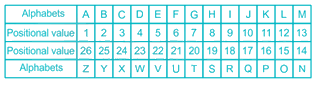 The logic followed here is:
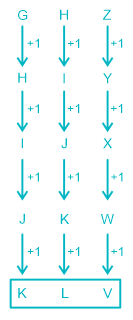 So, 'KLV' will replace the question mark in the given series.
Hence, the correct answer is "Option 2".
Q2 · Series
Select the letter-cluster from among the given options that can replace the question mark (?) in the following series.
RXD RUJ RRP ROV ?
- RLC
- RDA
- RDF
- RLB
Answer aur solution dekho
Archived marked answer: D
The logic followed here is: Q3 · Series
What comes next? 3, 8, 18, 35, 61, ?
- 88
- 98
- 97
- 100
Answer aur solution dekho
Archived marked answer: B
The logic followed here is:
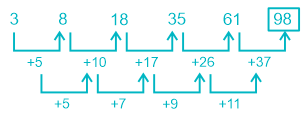 thus, "98" will replace the question mark in the given series.
Hence, the correct option is "Option 2".
Q4 · Series
Complete the series.
11, 13, 17, 19, ?
- 21
- 23
- 25
- 27
Answer aur solution dekho
Archived marked answer: B
The logic followed here is:
Series: 11, 13, 17, 19, ?
All the numbers are prime numbers.
Prime numbers in order:
11, 13, 17, 19, 23 …
thus, "23" will replace the question mark in the given series.
Hence, the correct option is "Option 2".
Q5 · Puzzle Subtypes Not To Miss
A box has 5 red, 3 blue, 2 green balls. Probability of drawing a non-green ball?
- 0.5
- 0.8
- 0.6
- 0.7
Answer aur solution dekho
Archived marked answer: B
Given:
Total balls = 5 red + 3 blue + 2 green = 10 balls
Now, Non-green balls = Red + Blue
= 5 + 3
= 8
So, Probability of drawing a non-green ball =
= 8 / 10
= 0.8
Hence, the correct answer is "Option 2".
Q6 · Puzzle Subtypes Not To Miss
If 9 @ 3 = 36 and 6 @ 2 = 16, then 8 @ 2 = ?
- 20
- 18
- 19
- 17
Answer aur solution dekho
Archived marked answer: A
The logic followed here is:
Logic: a @ b = (a + b) × b
Given:
9 @ 3 = 36
→ (9 + 3) × 3
= 12 × 3
= 36
6 @ 2 = 16
→ (6 + 2) × 2
= 8 × 2
= 16
Now, For 8 @ 2 :
8 @ 2 = (8 + 2) × 2
= 10 × 2
= 20
Hence, the correct answer is "Option 1".
Q7 · Puzzle Subtypes Not To Miss
A 25 L solution has sugar: water = 3:2. How much water to make sugar: water = 1:1?
- 2.5 L
- 5 L
- 7.5 L
- 10 L
Answer aur solution dekho
Archived marked answer: B
Given:
Total solution = 25 L
Sugar : Water = 3 : 2
Total parts = 3 + 2 = 5
Sugar = (3/5) × 25 = 15 L
Water = (2/5) × 25 = 10 L
Now, Sugar : Water = 1 : 1
Sugar is already 15 L, so water must also be 15 L.
Currently water = 10 L
So, Water to be added = 15 − 10 = 5 L
Hence, the correct answer is "Option 2".
Q8 · Puzzle Subtypes Not To Miss
If '+' means 'x', 'x' means '-', '-' means '÷', then 20 + 5 × 2 - 10 = ?
- 89
- 67
- 78.89
- 99.8
Answer aur solution dekho
Archived marked answer: D
BODMAS Table:
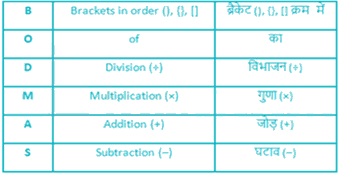 Given equation: 20 + 5 × 2 - 10 = ?
Now, if ‘+’ means ‘×’, ‘×’ means ‘-’, and ‘-’ means ‘÷’, then:
⇒ 20 × 5 - 2 ÷ 10 = ?
⇒ 100 - 2 ÷ 10 = ?
⇒ 100 - 0.2 = ?
⇒ 99.8
Hence, the correct answer is "Option 4".
Q9 · Puzzle Subtypes Not To Miss
After interchanging + & × and 15 & 30, which of the following equations will hold true?
- (15+2)×30=60
- (30+3)×15=40
- (15+4)×30=135
- (30+1)×15=40
Answer aur solution dekho
Archived marked answer: C
BODMAS Table:
Given condition: Interchange ‘+’ and ‘×’ and 15 & 30
Now, check each option after interchanging:
Option 1) (15 + 2) × 30 = 60
After interchange:
(30 × 2) + 15 = ?
⇒ 60 + 15 = 75 ≠ 60 (False)
Option 2) (30 + 3) × 15 = 40
After interchange:
(15 × 3) + 30 = ?
⇒ 45 + 30 = 75 ≠ 40 (False)
Option 3) (15 + 4) × 30 = 135
After interchange:
(30 × 4) + 15 = ?
⇒ 120 + 15 = 135 = 135 (True)
Option 4) (30 + 1) × 15 = 40
After interchange:
(15 × 1) + 30 = ?
⇒ 15 + 30 = 45 ≠ 40 (False)
Hence, the correct answer is "Option 3". Q10 · Puzzle Subtypes Not To Miss
A two-digit number is 4 times the sum of its digits. If the digits are reversed, the new number is 18 more than the original. What is the number?
- 24
- 30
- 36
- 32
Answer aur solution dekho
Archived marked answer: A
According to the question:
Let, the unit place digit be: "x".
Let, the tens place digit be: "y".
Therefore, the number will be:
10y + x.
According to the question, this two-digit number is 4 times the sum of digits.
→ 4(x + y) = 10y + x.
→ 4x + 4y = 10y + x.
→ 3x = 6y.
→ x = (2)y ----(1).
Now, the new number is 18 more than the original if the digits are reversed.
→ 10y + x = 10x + y + 18
→ 9y - 18 = 9x
Putting the value of "x" from the equation (1)
→ 9y - 18 = 9(2)y
→ 9y - 18 = 18y
→ 9y = 18
→ y = 2
Putting the value of "y" in equation (1).
→ x = (2) × 2
→ x = 4
As the tense digit is 2 and one digit is 4.
The number is "24".
Hence, the correct answer is "Option 1".
Q11 · Puzzle Subtypes Not To Miss
If '÷' means '+', '-' means 'x', '+' means '-' and, 'x' means '÷', then which of the following equations is CORRECT?
- 42 × 28 - 30 ÷ 48 + 45 = 45
- 42 × 28 - 30 ÷ 48 + 45 = 40
- 42 × 28 - 30 ÷ 48 + 45 = 50
- 42 × 28 - 30 ÷ 48 + 45 = 48
Answer aur solution dekho
Archived marked answer: D
BODMAS Table:
Given:
'÷' means '+'
'-' means '×'
'+' means '-'
'×' means '÷'
Given equation:
42 × 28 - 30 ÷ 48 + 45 = ?
Now replace the signs accordingly:
⇒ 42 ÷ 28 × 30 + 48 - 45
Now solve step by step:
⇒ 42 ÷ 28 = 1.5
⇒ 1.5 × 30 = 45
⇒ 45 + 48 - 45
⇒ 93 - 45
⇒ 48
Hence, the correct answer is "Option 4". Q12 · Puzzle Subtypes Not To Miss
If 9 $ 3 = 18, 8 $ 2 = 12, then what is 6 $ 4?
- 8
- 10
- 12
- 14
Answer aur solution dekho
Archived marked answer: A
The logic followed here is:
Logic: a $ b = (a − b) × b
Given:
9 $ 3 = 18
→ (9 − 3) × 3
= 6 × 3
= 18
8 $ 2 = 12
→ (8 − 2) × 2
= 6 × 2
= 12
Now, For 6 $ 4 :
6 $ 4 = (6 − 4) × 4
= 2 × 4
= 8
Hence, the correct answer is "Option 1".
Q13 · Coding Decoding
In each of the following questions, a specific pattern of alphabetic transformation has been applied to the first word to produce the second. Identify that pattern and apply it to the third word to determine the correct option. DEVIL :: ABSFI :: OTHER : ?
- MRFCP
- RWKHU
- LQEBO
- LRECO
Answer aur solution dekho
Archived marked answer: C
The logic followed here is:
Logic: Each letter of the word is shifted 3 steps backward in the English alphabetical order.
For, DEVIL → AB Q14 · Coding Decoding
Instruction: In a code language, "The music sounds sweet" is coded as "la ma na ta", "The music sounds loud" is coded as "la ma pa ta", "The song sounds sweet" is coded as "ka ma na ta". Question: What is the code for "The song sounds loud"?
- pa na ka ta
- ma na ra ka
- la na ya ka
- ka ma ta pa
Answer aur solution dekho
Archived marked answer: D
The logic followed here is:
Given:
"The music sounds sweet" → la ma na ta
"The music sounds loud" → la ma pa ta
"The song sounds sweet" → ka ma na ta
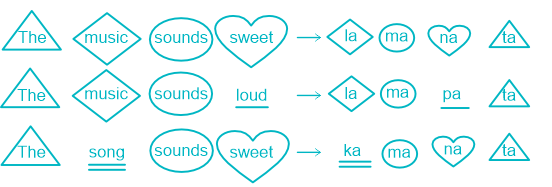 So, the code is: ka ma ta pa
Hence, the correct answer is "Option 4".
Q15 · Classification Odd One Out
Find the odd one out from the given alternatives.
- Photoshop
- Illustrator
- CorelDRAW
- Linux
Answer aur solution dekho
Archived marked answer: D
Given options:
Option 1) Photoshop
⇒ It is a raster graphics editing software mainly used for photo editing, image manipulation, and digital art.
Option 2) Illustrator
⇒ It is a vector graphics design software u
Q16 · Classification Odd One Out
In each of the following questions, a group of three numbers/symbols is given in each option. Identify the group that does NOT follow the same pattern as the others.
- A1@ : C3# : E5$
- B2% : D4^ : F6&
- C3* : E5( : G7)
- D4_ : F6@ : I9&
Answer aur solution dekho
Archived marked answer: D
The logic followed here is:
Now, checking the given options:
Option 1: A1@ : C3# : E5$
Letters → A, C, E (each +2)
Numbers → 1, 3, 5 (each +2)
Option 2: B2% : D4^ : F6&
Letters → B, D, F (each +2)
Numbers → 2, 4, 6 (each +2)
Option 3: C3* : E5( : G7)
Letters → C, E, G (each +2)
Numbers → 3, 5, 7 (each +2)
Option 4: D4_ : F6@ : I9&
Letters → D, F, I
D → F (+2)
F → I (+3) (pattern breaks)
and Numbers → 4, 6, 9
4 → 6 (+2)
6 → 9 (+3) (pattern breaks)
Thus, D4_ : F6@ : I9& does not follow the same +2 pattern in letters and numbers.
Hence, the correct answer is "Option 4".
Q17 · Logical Reasoning
If 'ABCDE' is coded as 'EDCBA', 'FGHIJ' is coded as 'JIHGF', and 'KLMNO' is coded as 'ONMLK', then how is 'PQRST' coded?
- TSRQP
- TSRQQ
- TSSQP
- TSRRP
Answer aur solution dekho
Archived marked answer: A
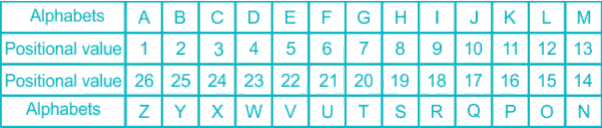 The logic followed here is:
'ABCDE' is coded as 'EDCBA'
ABCDE → Reverse order → EDCBA
'FGHIJ' is coded as 'JIHGF'
FGHIJ → Reverse order → JIHGF
And,
'KLMNO' is coded as 'ONMLK'
KLMNO → Reverse order → ONMLK
Similarly,
'PQRST' is coded as
PQRST → Reverse order → TSRQP
Hence, the correct answer is "Option 1".
Q18 · Blood Relations
Pointing to a man, Seema said, 'His mother is the only daughter of my mother's father.' How is the man related to Seema?
- Cousin
- Nephew
- Brother
- Son
Answer aur solution dekho
Archived marked answer: C
Family Chart:
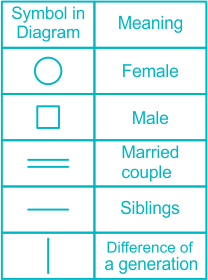 Given:
1. My mother's father = My maternal grandfather.
2. The only daughter of my maternal grandfather = My mother (since she is his only daughter).
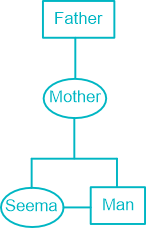 So, the man is Seema’s Brother.
Hence, the correct answer is "Option 3".
Q19 · Blood Relations
Ravi is married to Rekha. Rekha's brother is Ramesh. Ramesh's wife is Rina. Rina's son is Raj. How is Raj related to Ravi?
- Nephew
- Son
- Cousin
- Brother-in-law
Answer aur solution dekho
Archived marked answer: A
Family Chart:
Given:
1.Ravi is married to Rekha.
2.Rekha's brother is Ramesh. Q20 · Alphabet Test
The position of how many letters will remain unchanged if each of the letters in the word FRIEND is arranged in alphabetical order?
- One
- Four
- Three
- Five
Answer aur solution dekho
Archived marked answer: A
Given word: FRIEND
Arrange letters in alphabetical order: D, E, F, I, N, R
Compare positions:
Position 1: F ≠ D
Position 2: R ≠ E
Position 3: I ≠ F
Position 4: E ≠ I
Position 5: N = N
Position 6: D ≠ R
So, Only N (position 5) remains unchanged → 1 letter
Hence, the correct answer is "Option 1".
Q21 · Alphabet Test
Each of the letters in the word UNIVERSAL is arranged in alphabetical order. How many letters are there in the English alphabetical series between the letter that is second from the left and the one that is fifth from the right in the new letter-cluster formed?
- 7
- 8
- 6
- 9
Answer aur solution dekho
Archived marked answer: B
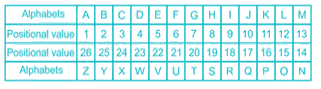 Given word: UNIVERSAL
Arrange letters in alphabetical order: A, E, I, L, N, R, S, U, V
New letter cluster: A E I L N R S U V
Second from the left = E
Fifth from the right:
Counting from right → V (1), U (2), S (3), R (4), N (5)
So the fifth from the right = N
Now ,
Alphabet positions:
E = 5
N = 14
Thus,Letters between them = 14 − 5 − 1 = 8
Hence, the correct answer is "Option 2".
Q22 · Similarity and Differences
Identify the similar address: Shruti Bansal E-55, Palm Greens, Faridabad, 121002
- Shruti Bansal E-55, Palm Green, Faridabad, 121002
- Shruti Bansal E-55, Palm Greens, Faridabad, 121002
- Shruti Bansal E-55, Palm Greens, Faridabad, 121200
- Shruti Bansel E-55, Palm Greens, Faridabad, 121002
Answer aur solution dekho
Archived marked answer: B
The address given in the problem is:
Shruti Bansal E-55, Palm Greens, Faridabad, 121002
Now, match this address with the given options:
Option
Address in Option
Given Address
Comment
1
Shruti Bansal E-55, Palm Green, Faridabad, 121002
Shruti Bansal E-55, Palm Greens, Faridabad, 121002
Not identical (“Palm Green” instead of “Palm Greens”).
2
Shruti Bansal E-55, Palm Greens, Faridabad, 121002
Shruti Bansal E-55, Palm Greens, Faridabad, 121002
Exactly identical.
3
Shruti Bansal E-55, Palm Greens, Faridabad, 121200
Shruti Bansal E-55, Palm Greens, Faridabad, 121002
Not identical (PIN code different: 121200 vs 121002).
4
Shruti Bansel E-55, Palm Greens, Faridabad, 121002
Shruti Bansal E-55, Palm Greens, Faridabad, 121002
Not identical (Surname spelled differently: Bansel vs Bansal).
So, address Option 2 is exactly identical to the given address.
Hence, the correct answer is Option 2.
Q23 · Similarity and Differences
In each of the following questions, the second word is derived from the first word by applying a specific letter-coding pattern, such as shifting letters forward or backward in the alphabet. Identify the pattern and apply it to the third word to choose the correct answer from the options given. MASTER : OCUVGT :: LABOUR : ?
- NCDQWT
- NDERWT
- NBCRWT
- NEDRWT
Answer aur solution dekho
Archived marked answer: A
The logic followed here is:
Logic: Each letter is shifted 2 steps forward in the English alphabetical order.
For, MASTER → OCUVGT
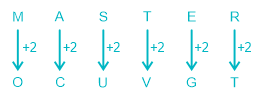 Similarly, For LABOUR:
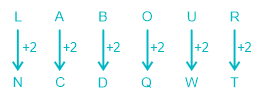 So, LABOUR becomes NCDQWT.
Hence, the correct answer is "Option 1".
Q24 · Logical Statement Questions
Instruction: Identify the assumptions that must hold for the statement to be valid, then choose the correct option.
Statement: The rapid advancement of automation and artificial intelligence could lead to significant job displacement, but it also presents an opportunity to create new jobs in emerging industries.
Assumptions:
I. Automation and AI could cause job losses in some sectors.
II. New industries will emerge as a result of automation and AI.
III. The displacement caused by automation is temporary and will be reversed by new industries.
- Only I and II are implicit
- Only II and III are implicit
- All are implicit
- Only I is implicit
Answer aur solution dekho
Archived marked answer: A
Given:
Statement:
The rapid advancement of automation and artificial intelligence could lead to significant job displacement, but it also presents an opportunity to create new jobs in emerging industries.
Assumptions:
I. Automation and AI could cause job losses in some sectors &a
mp;ndash; True (The statement clearly mentions “job displacement,” which assumes th
Q25 · Mathematical Operations
In the following questions, the symbols @, #, $, © and % are used with the following meaning as illustrated below:
P @ Q => P ≥ Q
P # Q => P ≤ Q
P $ Q => P P > Q
P % Q => P = Q
Statements: M © N N # O
Conclusions:
I. M © O
II. M @ O
- If only conclusion I is true.
- If only conclusion II is true.
- Both I and II are true
- Neither I nor II is true
Answer aur solution dekho
Archived marked answer: D
Given Statement: M > N ≤ O
Now,
Conclusions:
(i) M > O → False (From M > N and N ≤ O, no definite relation between M and O)
(ii) M ≥ O → False (Again, no definite relation between M and O can be established)
Here, Neither conclusion I nor II is true.
Hence, the correct answer is "Option 4".
General Awareness
Q1 · Art and Culture
Fill in the Blank:
Panthi dance is linked to the followers of ______ in Chhattisgarh.
- Guru Ghasidas
- Kabir
- Kabuli
- Nanak
Answer aur solution dekho
Archived marked answer: A
The correct answer is Guru Ghasidas.
Key Points
- Panthi dance is a traditional folk dance form closely associated with the followers of Guru Ghasidas in Chhattisgarh.
- It is performed as a devotional tribute to Guru Ghasidas, who founded the Satnami sect, emphasizing equality, truth, and social justice.
- The dance is characterized by spiritual songs and rhythmic movements, portraying the teachings of Guru Ghasidas and the values of the Satnami sect.
- Panthi dance holds great cultural significance in Chhattisgarh, particularly during festive occasions such as Maghi Purnima, which marks the birth anniversary of Guru Ghasidas.
- The performers use expressive gestures, devotional hymns, and synchronized movements to narrate stories of Guru Ghasidas' life and his efforts to promote social harmony.
Additional Information
- Kabir
- Kabir was a 15th-century Indian mystic poet and saint whose teachings emphasized devotion to one God and rejected idol worship.
- He inspired the Kabir Panth, a religious movement based on his philosophy of universal love and unity.
- Kabir's poetry, including dohas (couplets), is widely studied for its spiritual depth and social relevance.
- Kabuli
- The term "Kabuli" generally refers to people or things originating from Kabul, Afghanistan.
- It is not directly related to any specific dance or cultural tradition in Chhattisgarh.
- Nanak
- Guru Nanak was the founder of Sikhism and the first Sikh Guru, whose teachings focused on equality, truth, and devotion to one God.
- His philosophy inspired the formation of a distinct religious community, and his hymns are included in the Guru Granth Sahib.
Q2 · Art and Culture
Which of the following statements are correct?
1. Kalbelia performers rarely document their art due to its oral nomadic heritage.
2. Costumes avoid stitched elements in honor of serpent rituals.
3. The community's art was included in UNESCO ICH list without any written application process.
- Only 1
- Only 2 & 3
- All 1, 2 & 3
- Only 1 & 3
Answer aur solution dekho
Archived marked answer: A
The correct answer is Only 1.
Key Points
- Kalbelia performers primarily pass down their art forms orally, which aligns with their nomadic traditions and cultural heritage.
- The Kalbelia dance and music are deeply tied to the community's identity, and the lack of documentation reflects their oral knowledge systems.
- The dance, performed by the women of the Kalbelia community, is inspired by the graceful movements of serpents.
- The Kalbelia art form was inscribed in the UNESCO Representative List of the Intangible Cultural Heritage of Humanity in 2010.
- The inclusion in the UNESCO list required formal documentation and an application process, which was facilitated by cultural organizations and not directly by the community.
Additional Information
- Kalbelia Community and Art
- The Kalbelia community is traditionally a nomadic tribe in Rajasthan, India, known for their association with snake-charming.
- Their dance and music reflect their traditional occupation of snake-catching and their deep cultural and spiritual connection to serpents.
- Kalbelia dance is characterized by intricate footwork, fluid body movements, and rhythmic music played with instruments like the pungi and dholak.
- The art form is a significant part of Rajasthan's cultural heritage and showcases the creativity and resilience of the Kalbelia community.
Q3 · Art and Culture
Which of the following best describes the cultural significance of "Mim" in the "Mim Kut festival"?
- A rare millet stored for famine
- The sacred herb for tribal healing
- The last harvest representing survival and love
- A mythological offering for spirits only
Answer aur solution dekho
Archived marked answer: C
The correct answer is The last harvest representing survival and love.
Key Points
- The Mim Kut festival is a significant cultural event celebrated by the Mizo tribe in Northeast India, particularly in Mizoram.
- The term "Mim" refers to maize, which is the central crop associated with the festival and symbolizes the last harvest of the year.
- The festival highlights the themes of survival and love, as it is a time to express gratitude for the harvest and remember loved ones who have passed away.
- Traditional practices such as offering maize, bread, and other local delicacies to spirits and ancestors are central to the celebrations.
- The Mim Kut festival is also marked by vibrant cultural performances, traditional dances, and community feasts that showcase the unity and cultural heritage of the Mizo people.
Additional Information
- Major Festivals by State
- Assam:
- Bihu: Three festivals (Rongali, Kati, Bhogali) marking seasons, New Year, and harvest with dancing, feasting, and bonfires.
- Ambubachi Mela: Major Hindu fair at Kamakhya Temple in June.
- Jonbeel Mela: A unique barter trade festival.
- Nagaland:
- Hornbill Festival: A 10-day-long celebration of Naga tribes' culture in December.
- Aoling Festival: Konyak tribe's spring festival.
- Moatsu Mong: Ao tribe's post-sowing festival.
- Arunachal Pradesh:
- Ziro Festival of Music: An acclaimed outdoor music festival.
- Losar: Tibetan Buddhist New Year in Tawang.
- Dree Festival: Apatani tribe's agricultural festival.
- Mopin: Galo tribe's harvest festival.
- Meghalaya:
- Wangala: Garo tribe's "100 Drums" harvest festival.
- Nongkrem Dance Festival: Khasi harvest festival.
Q4 · Art and Culture
The Kharchi Puja of Tripura is associated with worship of how many deities?
- 12
- 14
- 15
- 16
Answer aur solution dekho
Archived marked answer: B
The correct answer is 14.
Key Points
- The Kharchi Puja is an important festival celebrated in Tripura, India, dedicated to the worship of 14 deities.
- The word "Kharchi" is derived from two Tripuri words: "Khar" (sin) and "chi" (cleaning), symbolizing the purification of sins and the worship of the deities.
- The 14 deities represent the guardians of Tripura, each deity being associated with specific aspects of nature, culture, and governance.
- The festival is celebrated annually in the month of July in the temple of 14 gods located in Old Agartala.
- Kharchi Puja is marked by elaborate rituals, offerings, cultural performances, and prayers that emphasize the harmony between humans and nature.
- The deities are worshipped for their blessings and protection, and the festival is a major cultural and religious highlight of Tripura.
Additional Information
- Major Festivals
- Garia Puja: A vibrant tribal festival for health and harvest, honoring the bamboo deity Baba Garia, with rituals, music, and dance.
- Kharchi Puja: A significant religious festival at Puran Haveli, worshipping 14 deities for purification and well-being, known for its unique rituals and folk performances.
- Ker Puja: A secretive but crucial festival dedicated to the guardian deity of the royal family, ensuring the state's protection.
- Durga Puja & Diwali: Celebrated with great fervor, especially at the Tripura Sundari Temple (Matabari).
Q5 · Indian Polity and Constitution
Bharatiya Nagarik suraksha Samhita(BNSS) ensures access to FIR through which portal?
- National Crime Portal
- CCTNS
- BHAVISHYA
- DIGI-FIR
Answer aur solution dekho
Archived marked answer: B
The correct answer is CCTNS.
Key Points
- Crime and Criminal Tracking Network and Systems (CCTNS) is a comprehensive and integrated system for effective policing through e-Governance.
- It was launched by the Ministry of Home Affairs (MHA), Government of India, in 2009 as part of the national e-governance initiative.
- CCTNS facilitates a nationwide networked infrastructure for tracking crime and criminals in real-time, ensuring seamless sharing of information between police stations and higher police authorities.
- The system also enables citizens to access police services such as lodging FIRs, tracking case status, and obtaining verification certificates online.
- As of now, most states and union territories in India use the CCTNS platform to provide services like digital filing of FIRs, improving transparency and efficiency in policing activities.
Additional Information
- National Crime Portal
- It is not a specific portal but often refers to platforms like the National Crime Records Bureau (NCRB) website.
- The NCRB is responsible for collecting and analyzing crime data as mandated by the Ministry of Home Affairs but does not directly allow citizens to lodge FIRs.
- BHAVISHYA
- BHAVISHYA is an online Pension Sanction and Payment Tracking System launched by the Government of India.
- It is designed to cater to retiring employees for tracking their pension process, ensuring transparency and timely disbursal.
- This portal is unrelated to crime or police services.
- DIGI-FIR
- DIGI-FIR is a concept introduced in some states like Madhya Pradesh to allow citizens to lodge FIRs online.
- While it serves a similar purpose, it is not implemented nationwide or as comprehensively as CCTNS.
- Bharatiya Nagarik Suraksha Samhita (BNSS)
- The BNSS is a proposed draft legislation aimed at replacing the existing Code of Criminal Procedure (CrPC) to modernize and streamline the criminal justice system in India.
- One of its key features is enabling citizens to access FIRs and other police services online, which aligns with the goals of CCTNS.
Q6 · Indian Polity and Constitution
Consider the following statements:
1. Every Money Bill is a Financial Bill.
2. Every Financial Bill is a Money Bill.
Which of the above statements is/are correct?
- Only 1
- Only 2
- Both 1 and 2
- Neither 1 nor 2
Answer aur solution dekho
Archived marked answer: A
The correct answer is Option 1.
Key Points
- A Money Bill is a specific type of Financial Bill under Article 110 of the Indian Constitution.
- Every Money Bill is a Financial Bill because it contains provisions exclusively dealing with financial matters such as taxation, borrowing, expenditure, or other money-related issues.
- However, not every Financial Bill is a Money Bill. Financial Bills can also include provisions beyond the scope of Article 110, requiring approval from both Houses of Parliament.
- A Money Bill can only be introduced in the Lok Sabha and requires the certification of the Speaker of the Lok Sabha.
- Thus, Statement 1 is correct, and Statement 2 is incorrect, making Option 1 the correct answer.
Additional Information
- Money Bill:
- A Money Bill is defined under Article 110 of the Indian Constitution.
- It contains provisions exclusively related to taxes, borrowing of money by the government, withdrawal of money from the Consolidated Fund or Contingency Fund, and appropriation of funds.
- It must be introduced in the Lok Sabha with the recommendation of the President.
- The Rajya Sabha can suggest amendments but cannot amend or reject a Money Bill. It has to return the bill to the Lok Sabha within 14 days.
- Financial Bill:
- Financial Bills are broader in scope and include Money Bills as a subset. There are two types of Financial Bills:
- Category A: These contain provisions related to financial matters and provisions not covered under Article 110. They need the President's recommendation and must be introduced in the Lok Sabha.
- Category B: These involve only incidental financial provisions and do not require the President's recommendation.
Q7 · Indian Polity and Constitution
Fill in the blanks:
Zonal Councils were created by the ______ Act, 1956.
- States Reorganisation
- Finance Commission
- Panchayati Raj
- Representation of People
Answer aur solution dekho
Archived marked answer: A
The correct answer is States Reorganisation Act, 1956.
Key Points
- The Zonal Councils in India were established under the States Reorganisation Act, 1956, which aimed to reorganize states based on linguistic and administrative considerations.
- The primary objective of Zonal Councils was to foster cooperation and coordination among states and Union Territories in a particular zone.
- There are five Zonal Councils—Northern, Central, Eastern, Western, and Southern—each comprising states grouped based on geographical proximity.
- The Zonal Councils are chaired by the Union Home Minister and include the Chief Ministers of the member states, along with other ministers as representatives.
- Zonal Councils serve as a platform to resolve inter-state disputes and promote regional development by addressing common issues such as economic planning, border disputes, and cultural exchanges.
Additional Information
- Finance Commission
- The Finance Commission is constituted under Article 280 of the Indian Constitution.
- It is primarily responsible for dividing tax revenues between the Central and State governments and addressing financial relations between them.
- The Finance Commission is appointed every five years, and its recommendations are advisory in nature.
- It does not pertain to the creation of Zonal Councils but plays a crucial role in managing fiscal matters in federal governance.
- Panchayati Raj
- The Panchayati Raj system was introduced as a form of decentralized governance under Article 40 of the Directive Principles of State Policy in the Constitution.
- The 73rd Constitutional Amendment Act, 1992, provided constitutional status to Panchayati Raj institutions.
- It focuses on grassroots-level governance and local self-government but does not relate to Zonal Councils.
- Representation of the People Act
- The Representation of the People Act, 1951, governs the conduct of elections in India.
- It provides provisions for the qualification and disqualification of Members of Parliament and State Legislatures.
- While it is critical in ensuring free and fair elections, it is unrelated to the establishment of Zonal Councils.
Q8 · Indian Polity and Constitution
Which of the following statements regarding the distribution of legislative powers between the Union and State legislatures is correct?
- The State legislature can legislate on matters enumerated in the Union List
- The Union legislature can legislate on matters in the Concurrent List only with State approval
- The Union Government can issue directions to the States under Article 256
- The Union and States have equal powers on matters in the Union List
Answer aur solution dekho
Archived marked answer: C
The correct answer is The Union Government can issue directions to the States under Article 256.
Key Points
- Article 256 of the Indian Constitution states that the executive power of every state is to be exercised in a way that ensures compliance with the laws made by the Parliament.
- The Union Government has the authority to issue directions to the states to ensure the implementation of such laws.
- This provision ensures the supremacy of parliamentary laws over state laws in case of conflict.
- Such directions issued by the Union are binding on the states, and non-compliance may result in consequences under Article 356 (President’s Rule).
- This mechanism ensures the cohesive functioning of the federal structure in India and maintains the unity and integrity of the country.
Additional Information
- Union Legislature (Parliament)
- Composition: President, Lok Sabha (House of the People), and Rajya Sabha (Council of States).
- Powers: Exclusive power over Union List, concurrent power over Concurrent List, with overriding power over states.
- Rajya Sabha: Indirectly elected, permanent house (not dissolved), one-third members retire every two years, 12 nominated members for arts/science.
- Lok Sabha: Directly elected, represents the people.
- State Legislature
- Composition: Varies; some bicameral (Assembly & Council), most unicameral (Assembly only).
- Powers: Exclusive power over State List, concurrent power over Concurrent List.
- Legislative Council (Upper House): Indirectly elected members from local authorities, graduates, teachers, MLAs, and nominated by Governor; permanent house, not dissolved, one-third retire every two years.
- Legislative Assembly (Lower House): Directly elected by people, members 40-500.
Q9 · Indian Economy
Which of the following statements about the sugar industry is/are correct?
1. Sugarcane's sucrose content decreases during transportation.
2. Sugar industry is seasonal in nature.
3. The industry is unsuitable for cooperative management.
4. Major sugar-producing states include Maharashtra and Tamil Nadu.
- Only 1 and 3
- Only 1, 2 and 4
- Only 2, 3 and 4
- Only 1 and 4
Answer aur solution dekho
Archived marked answer: B
The correct answer is Only 1, 2 and 4.
Key Points
- Sucrose content in sugarcane decreases during transportation: Sugarcane is highly perishable, and its sucrose content starts deteriorating if there is a delay in processing after harvesting. This makes timely transportation critical for the sugar industry.
- Seasonal nature of the sugar industry: Sugar production depends heavily on sugarcane harvest seasons, which makes the industry seasonal in nature. The crushing season typically occurs from October to March in India.
- Major sugar-producing states include Maharashtra and Tamil Nadu: Maharashtra is the largest sugar-producing state, followed by Uttar Pradesh, Karnataka, and Tamil Nadu. Favorable climatic conditions and irrigation facilities contribute to high sugarcane yields in these states.
- Cooperative management's role: The sugar industry in India thrives on the cooperative model, especially in states like Maharashtra. Farmers are often stakeholders in cooperative sugar mills, which helps in organizing small-scale producers and ensuring equitable returns.
Additional Information
- Key Sectors by Contribution & Growth:
- Information Technology & Services: A global powerhouse, especially in software, IT-enabled services (ITES), and digital infrastructure (e.g., IT/BPM, Fintech).
- Manufacturing:
- Automobile: India is a major global market and producer of vehicles and components.
- Textiles & Apparel: An ancient, large employer, crucial for exports.
- Pharmaceuticals & Biotech: A leading global supplier of generic medicines.
- Chemicals: Specialty chemicals and petrochemicals are growing.
- Core Industries: Steel, Cement, Electricity, Petroleum products, Coal, Crude Oil, Natural Gas, and Fertilizers are foundational.
- Agriculture & Food Processing: A massive sector supporting food security, with significant processing growth.
- Infrastructure: Includes Construction, Power, Ports, Roads, and related Engineering & Capital Goods.
Q10 · Indian Economy
Which of the following statements correctly describe the MISHTI initiative launched in India?
1. The MISHTI programme is designed to increase mangrove forest cover and enhance livelihood opportunities in coastal areas.
2. It is a project initiated under the Ministry of Rural Development.
3. The program is financed with a mix of fundings coming from the CAMPA (Compensatory Afforestation Fund Management and Planning Authority) Fund and the MGNREGS (Mahatma Gandhi National Rural Employment Guarantee Scheme).
- 1 and 2
- 1 and 3
- 2 and 3
- 1, 2, and 3
Answer aur solution dekho
Archived marked answer: B
The correct answer is Option 2: 1 and 3.
Key Points
- The MISHTI (Mangrove Initiative for Shoreline Habitats & Tangible Incomes) programme is designed to increase mangrove forest cover across India's coastal regions.
- This initiative aims to enhance livelihood opportunities for communities residing in coastal areas by promoting sustainable mangrove conservation.
- The programme is financed through a mix of funding sources, specifically from the CAMPA (Compensatory Afforestation Fund Management and Planning Authority) Fund and MGNREGS (Mahatma Gandhi National Rural Employment Guarantee Scheme).
- It aligns with India’s international commitments to combat climate change, such as the Nationally Determined Contributions (NDCs) under the Paris Agreement.
- Mangroves are critical ecosystems that protect shorelines from erosion, act as carbon sinks, and support biodiversity.
Additional Information
- CAMPA Fund
- The CAMPA Fund is a mechanism established to manage the money collected for compensatory afforestation in India.
- It is utilized to restore degraded ecosystems, including mangroves, to offset the ecological damage caused by deforestation for development projects.
- MGNREGS
- The Mahatma Gandhi National Rural Employment Guarantee Scheme (MGNREGS) is a rural employment programme providing 100 days of wage employment to rural households.
- Under the MISHTI initiative, MGNREGS is leveraged to provide livelihood opportunities for local communities engaged in mangrove plantation and conservation activities.
Q11 · Sports Static GK
Which sports player won the bronze medal in the Mixed Team Compound Open Archery event at the Paris 2024 Paralympics?
- Harvinder Singh and Jyoti Baliyan
- Sheetal Devi and Rakesh Kumar
- Sheetal Devi and Harvinder Singh
- Rakesh Kumar and Vivek Chikara
Answer aur solution dekho
Archived marked answer: B
The correct answer is Sheetal Devi and Rakesh Kumar.
Key Points
- Sheetal Devi and Rakesh Kumar won the bronze medal in the Mixed Team Compound Open Archery event during the Paris 2024 Paralympics.
- They showcased exceptional skills and teamwork, earning a podium finish for India in the prestigious global event.
- The Mixed Team Compound Open Archery event features teams composed of one male and one female archer, emphasizing coordination and precision.
- Sheetal Devi is recognized as one of India's promising para-archers, while Rakesh Kumar has been a consistent performer in international para-archery tournaments.
- Their achievement contributed to India's growing reputation in para-sports and inspired budding athletes across the nation.
Additional Information
- Harvinder Singh and Jyoti Baliyan
- Harvinder Singh is an accomplished para-archer who won a bronze medal at the Tokyo 2020 Paralympics in the men's individual recurve event.
- Jyoti Baliyan is one of India’s top para-archers who has represented the country in multiple international competitions.
- Although both are celebrated athletes, they did not win the bronze medal in the Mixed Team Compound Open Archery at the Paris 2024 Paralympics.
- Sheetal Devi and Harvinder Singh
- While both Sheetal Devi and Harvinder Singh are prominent para-archers, they did not team up for the Mixed Team Compound Open event at the Paris 2024 Paralympics.
- Harvinder Singh specializes in the recurve bow category, whereas Sheetal Devi competed in the compound bow category.
- Rakesh Kumar and Vivek Chikara
- Rakesh Kumar is a renowned para-archer specializing in compound archery and has consistently performed well in international tournaments.
- Vivek Chikara is another talented para-archer; however, they did not participate as a team in the Mixed Team Compound Open Archery event at Paris 2024.
Q12 · Sports Static GK
What correctly describes Neeraj Chopra's performance at the Paris Diamond League 2025?
- He secured victory with his third throw measuring 88.16m at Stade de France.
- His only valid attempt, 88.16m, came in the final round.
- He won with his opening throw of 88.16m at Stade Sébastien Charléty.
- He placed second with a best throw of 88.16m.
Answer aur solution dekho
Archived marked answer: C
The correct answer is He won with his opening throw of 88.16m at Stade Sébastien Charléty..
Key Points
- Neeraj Chopra secured victory at the Paris Diamond League 2025 with his opening throw of 88.16 meters at Stade Sébastien Charléty.
- This outstanding throw placed him at the top of the leaderboard, cementing his dominance in javelin throwing on the global stage.
- The Paris Diamond League is a prestigious athletics competition that attracts top athletes from around the world.
- Neeraj Chopra's consistent performance and ability to excel under pressure highlight his expertise as an Olympic gold medalist and world-class javelin thrower.
- He continues to be a source of pride for India, showcasing his extraordinary talent in international competitions.
Additional Information
- Neeraj Chopra’s major International Medals:
- Olympic Games: Gold (Tokyo 2020), Silver (Paris 2024).
- World Athletics Championships: Gold (Budapest 2023), Silver (2022).
- Asian Games: Gold (Jakarta 2018, Hangzhou 2023).
- Commonwealth Games: Gold (Gold Coast 2018).
- Diamond League: Wins and podium finishes, including breaking national records.
Q13 · Sports Static GK
Which of the following is a correct statement regarding violations in basketball?
- A player may stay in the restricted area for 5 seconds.
- A team must shoot the ball within 8 seconds of play.
- A dribble ends when both hands touch the ball once.
- A player remains in play while standing on sideline.
Answer aur solution dekho
Archived marked answer: C
The correct answer is A dribble ends when both hands touch the ball once..
Key Points
- In basketball, a dribble ends when a player uses both hands to touch the ball simultaneously or when the ball comes to rest in one or both hands.
- This rule is enforced to maintain the flow of the game and prevent unfair advantages that could arise from manipulating the ball with both hands.
- Once a dribble ends, the player cannot resume dribbling the ball; doing so constitutes a "double dribble" violation.
- After the dribble ends, the player must either pass the ball to a teammate or attempt a shot.
- The dribble is a fundamental basketball skill used to advance the ball, evade defenders, or create opportunities for passing and shooting.
Additional Information
- Fundamental Skills
- Dribbling: Bouncing the ball continuously with one hand while moving; essential for ball control and advancing.
- Passing: Moving the ball to teammates using chest, bounce, or overhead passes to create scoring chances.
- Shooting: Throwing the ball into the basket (layups, jump shots, free throws).
- Defense: Preventing the opponent from scoring through man-to-man, zone, or blocking shots.
- Rebounding: Gaining possession of missed shots.
Q14 · Indian Geography
Which of the following statements about dams is/are correct?
1.A dam always refers to a concrete or structural wall built to block water.
2.Spillways in dams help in regulating water flow, either intermittently or continuously.
3.Dams can be classified based on structure, purpose, and height.
- Both 1 and 2
- Both 2 and 3
- Both 1 and 3
- 1, 2 and 3 all are correct
Answer aur solution dekho
Archived marked answer: B
The correct answer is Option 2.
Key Points
- Statement 2: Spillways in dams are structures designed to regulate the water flow from the dam, ensuring safety by preventing overflow or damage during high inflow periods.
- Spillways can be operated either intermittently during periods of excess water inflow or continuously for controlled discharge, depending on the dam’s design and requirements.
- Statement 3: Dams are classified based on various factors such as structure (e.g., gravity dams, arch dams), purpose (e.g., irrigation, hydroelectricity, flood control), and height (e.g., low, medium, or high dams).
- Both statements 2 and 3 are factually accurate and highlight the functional and classification aspects of dams.
Additional Information
- Spillways:
- Spillways are integral safety features of dams used to release excess water when the reservoir reaches its capacity.
- Types of spillways include gated spillways, ogee spillways, and chute spillways, among others.
- They help prevent overtopping, which could otherwise lead to the dam’s failure.
- Dams classification: Dams are categorized based on:
- Structure: Examples include gravity dams, arch dams, and embankment dams.
- Purpose: Common purposes include irrigation, hydroelectric power generation, water supply, and flood control.
- Height: Dams are classified as low dams (less than 15 meters), medium dams (15-30 meters), and high dams (above 30 meters).
Q15 · Current Affairs
Read the following statements marked as Assertion (A) and Reason (R). Choose the correct option:
Assertion (A): The PSLV-C59 mission, launched in October 2024, achieved a notable milestone for international space cooperation.
Reason (R): This mission successfully deployed the Proba-3 satellites, marking the first dedicated satellite launch for ESA's unique formation-flying experiment.
- Both A and R are true, and R is the correct explanation of A
- Both A and R are true, but R is not the correct explanation of A
- A is true, but R is false
- A is false, but R is true
Answer aur solution dekho
Archived marked answer: A
The correct answer is 1) Both A and R are true, and R is the correct explanation of A.
Key Points
- The PSLV-C59 mission, mentioned in Assertion (A), is projected to take place in October 2024, marking a significant milestone for international space cooperation.
- Reason (R) highlights the deployment of Proba-3 satellites, which are part of the European Space Agency’s (ESA) innovative formation-flying experiment.
- Proba-3 is designed to demonstrate precise satellite positioning in orbit, enabling scientific experiments such as solar coronagraphy.
- The connection between Assertion (A) and Reason (R) lies in the fact that the successful deployment of Proba-3 by PSLV-C59 exemplifies international collaboration and technological advancement.
- Hence, both Assertion and Reason are true, and Reason correctly explains Assertion.
Additional Information
- PSLV and Proba-3
- PSLV (Polar Satellite Launch Vehicle) is India’s third-generation satellite launch vehicle, known for its reliability and versatility.
- Proba-3 is a pair of ESA satellites designed for formation-flying experiments, with applications in solar science and other advanced research areas.
- Such missions emphasize the importance of international collaboration in space exploration and technological advancements.
Q16 · Current Affairs
Following a significant change in leadership at India's premier space agency, which distinguished scientist was appointed as the new Chairman of ISRO and Secretary of the Department of Space in January 2025, succeeding S. Somanath?
- K Radhakrishnan
- K. Sivan
- V. Narayanan
- S. Sashidhar Sinha
Answer aur solution dekho
Archived marked answer: C
The correct answer is V. Narayanan.
Key Points
- Dr. V. Narayanan is a distinguished scientist at ISRO and has played a crucial role in India's space programs, especially in the domain of rocket propulsion.
- He succeeded S. Somanath as the Chairman of ISRO and Secretary of the Department of Space in January 2025.
- Dr. Narayanan has been instrumental in the development of cryogenic propulsion systems, including the Cryogenic Upper Stage (CUS) for the GSLV rocket.
- He led the Liquid Propulsion Systems Centre (LPSC), which is a vital division of ISRO responsible for the development of liquid propulsion technologies.
- Under his leadership, ISRO has achieved significant advancements in rocket technologies and launched several impactful missions.
Additional Information
- K. Radhakrishnan
- Dr. K. Radhakrishnan is a former Chairman of ISRO who served from 2009 to 2014.
- He was instrumental in the successful launch of the Mars Orbiter Mission (Mangalyaan) in 2013, making India the first country to reach Mars in its maiden attempt.
- He was honored with the Padma Bhushan in 2014 for his contributions to space science and technology.
- K. Sivan
- Dr. K. Sivan served as the Chairman of ISRO from January 2018 to January 2022.
- He played a key role in launching Chandrayaan-2 and several other satellite missions during his tenure.
- Dr. Sivan is well-known for his work in designing and developing the PSLV project.
- S. Sashidhar Sinha
- S. Sashidhar Sinha is not associated with ISRO leadership roles or space technology advancements.
- This option is irrelevant to the context of ISRO Chairman appointments.
Q17 · Current Affairs
According to the 2024 Corruption Perceptions Index (CPI) findings, how does corruption most directly undermine global climate action?
- By weakening financial markets in developing countries
- By discouraging public participation in environmental protests
- By diverting climate funds and allowing undue influence over environmental policies
- By increasing competition among fossil fuel companies
Answer aur solution dekho
Archived marked answer: C
The correct answer is By diverting climate funds and allowing undue influence over environmental policies.
Key Points
- Corruption diverts funds allocated for climate change mitigation and adaptation projects, reducing their effectiveness and delaying critical climate action.
- By allowing undue influence over environmental policies, corrupt practices prioritize the interests of powerful corporations or individuals over the environment and public welfare.
- Mismanagement of climate funds can lead to inefficient or poorly executed projects, further exacerbating environmental degradation.
- Corruption undermines trust in public institutions and international climate agreements, discouraging investment and collaboration in environmental initiatives.
- According to Transparency International, corruption in environmental governance is a significant barrier to achieving global climate goals, as it weakens enforcement mechanisms and promotes unsustainable practices.
Additional Information
- Corruption and Global Climate Action
- Corruption poses a significant challenge to global efforts to combat climate change, as it weakens the governance and implementation of policies.
- Addressing corruption is crucial for ensuring the effective use of climate funds and achieving sustainable development goals (SDGs).
- Global initiatives, such as the Paris Agreement, emphasize the need for transparency and accountability in climate financing and governance.
Q18 · General Science Chemistry
Which group consists of non-ferrous metallic minerals that are scarce in India?
- Iron, Coal, Bauxite
- Copper, Zinc, Lead
- Manganese, Bauxite, Limestone
- Mica, Dolomite, Felspar
Answer aur solution dekho
Archived marked answer: B
The correct answer is Copper, Zinc, Lead.
Key Points
- Copper, zinc, and lead are classified as non-ferrous metallic minerals, which are metals that do not contain iron.
- India has limited reserves of these minerals, making them scarce in comparison to other metallic and non-metallic minerals.
- Copper is primarily used in electrical wiring, electronics, and alloys. India produces copper mainly in Rajasthan, Madhya Pradesh, and Jharkhand, but the production levels do not meet domestic demand.
- Zinc is used for galvanizing iron and steel to prevent rusting, as well as in alloys and chemical industries. Zinc reserves in India are concentrated in Rajasthan, but the production is insufficient for industrial requirements.
- Lead is used in batteries, shielding against radiation, and other industrial applications. Its reserves are also limited in India, mainly found in Rajasthan.
Additional Information
- Iron, Coal, Bauxite
- Iron is a ferrous metallic mineral widely found in India, particularly in Odisha, Jharkhand, Chhattisgarh, and Karnataka. It is used in the steel industry.
- Coal is a non-metallic mineral and serves as a major energy source. India is the second-largest producer of coal globally, with reserves in Jharkhand, Odisha, and Chhattisgarh.
- Bauxite is a non-metallic mineral and the primary ore for aluminum production. India has significant reserves of bauxite, especially in Odisha, Andhra Pradesh, and Maharashtra.
- Manganese, Limestone
- Manganese is a ferrous metallic mineral used in steel production and chemical industries. India is one of the leading producers of manganese globally, with deposits in Madhya Pradesh, Maharashtra, and Odisha.
- Bauxite, as stated earlier, is a non-metallic mineral primarily used for aluminum production.
- Limestone is a non-metallic mineral used in cement production and as a flux in steel manufacturing. It is abundantly found in India, particularly in Madhya Pradesh, Rajasthan, and Andhra Pradesh.
- Mica, Dolomite, Felspar
- Mica is a non-metallic mineral used in electrical and electronic industries for insulation. India is the largest producer of mica globally, with reserves in Andhra Pradesh, Rajasthan, and Jharkhand.
- Dolomite is a non-metallic mineral used in the steel, glass, and ceramic industries. It is found in Madhya Pradesh, Chhattisgarh, and Andhra Pradesh.
- Feldspar is a non-metallic mineral used in the glass and ceramic industries. It is widely found in Rajasthan and Tamil Nadu.
Q19 · Medieval Indian History
Consider the following statements about Mughal architecture:
1.Mughal architecture is known for blending Persian, Islamic, Turkish, and Indian styles to create a unique Indo-Islamic aesthetic.
2.Red sandstone and white marble were the two most commonly used materials in Mughal construction.
- Only 1 is correct
- Only 2 is correct
- Both 1 and 2 are correct
- Neither 1 nor 2 is correct
Answer aur solution dekho
Archived marked answer: C
The correct answer is Both 1 and 2 are correct.
Key Points
- Mughal architecture is renowned for blending Persian, Islamic, Turkish, and Indian styles, resulting in a unique and harmonious Indo-Islamic architectural aesthetic.
- It emphasized symmetry, grandeur, and the use of geometrical designs, which were heavily influenced by Persian and Central Asian traditions.
- Red sandstone and white marble were the most commonly used materials, as seen in iconic structures like the Red Fort (sandstone) and the Taj Mahal (white marble).
- Some of the most famous Mughal architectural marvels include the Humayun’s Tomb, Taj Mahal, Jama Masjid, and Fatehpur Sikri, which showcase artistic finesse and innovation.
- Structures were often adorned with intricate carvings, floral motifs, calligraphy, and pietra dura (inlay work using precious and semi-precious stones).
Additional Information
- Mughal architecture:
- This synthesis of styles was a hallmark of the Mughal era, reflecting the rulers’ cultural inclusivity.
- The use of domes, minarets, arches, and gardens (Charbagh style) are prominent features derived from Persian and Islamic architecture.
- Indian architectural elements like chhatris (elevated dome-shaped pavilions) and jalis (intricate lattice screens) were also incorporated into Mughal structures.
Q20 · Government Schemes and Welfare Static Semi Static
Which of the following pairs of Government Scheme and its associated Nodal Ministry/Department is correctly matched?
1. PM-AASHA - Ministry of Consumer Affairs, Food & Public Distribution
2. e-NAM - Ministry of Agriculture & Farmers Welfare
3. PMKSY - Ministry of Water Resources, River Development & Ganga Rejuvenation
4. RODTEP - Ministry of Finance
- 1 and 2 only
- 2 and 3 only
- 2 only
- 1, 2 and 4
Answer aur solution dekho
Archived marked answer: C
The correct answer is e-NAM - Ministry of Agriculture & Farmers Welfare.
Key Points
- e-NAM (National Agriculture Market) is an online trading platform developed to create a unified national market for agricultural commodities.
- It is spearheaded by the Ministry of Agriculture & Farmers Welfare, aiming to connect farmers, traders, and buyers digitally.
- e-NAM was launched by the Government of India on 14th April 2016 as a major step towards agricultural reforms.
- The platform facilitates better price discovery through transparent auction processes and eliminates intermediaries, benefiting farmers directly.
- As of October 2023, e-NAM has integrated over 1,000 mandis across India, enhancing the efficiency of agricultural marketing.
Additional Information
- PM-AASHA - Ministry of Consumer Affairs, Food & Public Distribution
- PM-AASHA (Pradhan Mantri Annadata Aay Sanrakshan Abhiyan) is a scheme launched in 2018 aimed at ensuring remunerative prices for farmers' produce.
- It comprises three components: Price Support Scheme (PSS), Price Deficiency Payment Scheme (PDPS), and Pilot of Private Procurement and Stockist Scheme (PPPS).
- However, the nodal ministry for PM-AASHA is the Ministry of Agriculture & Farmers Welfare, not the Ministry of Consumer Affairs, Food & Public Distribution.
- PMKSY - Ministry of Water Resources, River Development & Ganga Rejuvenation
- Pradhan Mantri Krishi Sinchayee Yojana (PMKSY) aims to improve irrigation efficiency and increase agricultural productivity.
- The nodal ministry for PMKSY is the Ministry of Agriculture & Farmers Welfare, not the Ministry of Water Resources.
- It includes components such as Accelerated Irrigation Benefit Programme (AIBP) and Har Khet Ko Pani.
- RODTEP - Ministry of Finance
- Remission of Duties and Taxes on Exported Products (RODTEP) is a scheme launched in January 2021 to boost exports by reimbursing taxes and duties incurred during manufacturing and transport.
- The nodal ministry for RODTEP is the Ministry of Commerce and Industry, not the Ministry of Finance.
- It replaced the earlier MEIS (Merchandise Exports from India Scheme) to align with World Trade Organization (WTO) rules.
Q21 · Government Schemes and Welfare Static Semi Static
Objective of India's new Eco-Tourism Policy in protected areas?
- Ban human activity
- Maximize profit w/o community
- Balance conservation and livelihoods
- Turn areas into resorts
Answer aur solution dekho
Archived marked answer: C
The correct answer is Balance conservation and livelihoods.
Key Points
- India's new Eco-Tourism Policy aims to balance environmental conservation and sustainable livelihoods for local communities residing in protected areas.
- The policy promotes community-based tourism, involving local stakeholders to ensure their active participation and equitable benefit-sharing.
- It emphasizes responsible tourism practices that minimize negative ecological impacts while enhancing awareness about biodiversity conservation.
- Protected areas under this policy, including wildlife sanctuaries and national parks, will integrate sustainable economic activities to support local communities.
- The Eco-Tourism Policy aligns with India's National Biodiversity Action Plan and Sustainable Development Goals (SDGs), particularly SDG 15 (Life on Land) and SDG 8 (Decent Work and Economic Growth).
Additional Information
- Ban human activity
- Banning human activity entirely in protected areas is not feasible or practical as many local communities depend on these areas for their livelihoods.
- While certain activities like poaching and deforestation are prohibited, regulated human activity, such as eco-tourism, is encouraged to strike a balance between conservation and community needs.
- India's wildlife protection laws, including the Wildlife Protection Act 1972, allow for controlled human interaction to support conservation efforts.
- Maximize profit without community
- This approach contradicts the principles of sustainable and responsible tourism.
- Ignoring local communities in eco-tourism policies can lead to social unrest and environmental degradation.
- India's Eco-Tourism Policy emphasizes community involvement to ensure equitable distribution of benefits and preservation of ecological integrity.
- Turn areas into resorts
- Turning protected areas into resorts is against the principles of conservation and can lead to habitat destruction.
- Eco-tourism promotes low-impact accommodations, such as eco-lodges, rather than large-scale resorts.
- The policy strictly avoids commercialization and prioritizes preserving the natural environment.
Q22 · World Geography
Which of the following statements about rockslide is correct?
- It affects only the outermost layer of the rock face
- It is slower than rock fall
- It involves backward rotation of debris
- It affects material to considerable depth
Answer aur solution dekho
Archived marked answer: D
The correct answer is It affects material to considerable depth.
Key Points
- Rockslides are a form of mass wasting, characterized by the downslope movement of rock material along a bedding plane, fracture, or other structural weakness.
- Unlike rockfalls, rockslides involve the sliding of large masses of rock, which often penetrates to significant depths within the geological formation.
- T
Q23 · General Science Physics
Aditya-L1 spacecraft primarily studies which part of the Sun?
- Regolith
- Corona
- Craters
- Magnetosphere
Answer aur solution dekho
Archived marked answer: B
The correct answer is Corona.
Key Points
- Aditya-L1 spacecraft is India’s first solar mission launched by the Indian Space Research Organisation (ISRO).
- The primary focus of Aditya-L1 is to study the Sun’s corona, which is the outermost layer of the Sun’s atmosphere.
- The corona is known for its extremely high temperature, which is much hotter than the Sun’s surface, reaching up to millions of degrees Celsius.
- The spacecraft is equipped with multiple scientific instruments, including the Visible Emission Line Coronagraph (VELC), to observe the corona and understand the mechanisms behind solar activity.
- Studying the corona helps scientists understand phenomena like solar flares, coronal mass ejections (CMEs), and their impact on space weather and Earth’s magnetosphere.
Additional Information
- Regolith:
- Regolith refers to the layer of loose, unconsolidated material covering solid rock, such as soil, dust, and broken rock.
- It is commonly studied in planetary science, particularly for celestial bodies like the Moon, Mars, and asteroids.
- Regolith is unrelated to the Sun, as it deals primarily with terrestrial or planetary surface materials.
- Craters:
- Craters are bowl-shaped depressions formed by the impact of meteorites or volcanic activity on solid surfaces such as planets, moons, or asteroids.
- They are not relevant to the study of the Sun, as the Sun does not have a solid surface to form craters.
- Magnetosphere:
- The magnetosphere is the region surrounding a planet, dominated by its magnetic field, which protects it from solar wind and cosmic radiation.
- Though the Sun’s magnetic field plays a key role in solar activity, Aditya-L1 primarily focuses on studying the corona rather than the magnetosphere.
Q24 · Books and Authors Static
Which of the following statements best captures the essence of the book Because Words Matter?
- Language's role in social justice
- Ancient Sanskrit grammar
- Novel on colonial India
- Linguist's critique of post-colonial English
Answer aur solution dekho
Archived marked answer: A
The correct answer is Language's role in social justice.
Key Points
- The book "Because Words Matter" highlights the significance of language as a tool for shaping social discourse and advocating for justice.
- It explores how language influences power structures, societal norms, and perceptions that can either promote equality or reinforce injustice.
- The book delves into the importance of inclusive and non-discriminatory language in creating equitable societies.
- It emphasizes the responsibility of policymakers, educators, and individuals to use language in ways that empower marginalized communities.
- Through examples and case studies, the book demonstrates how thoughtful language can lead to constructive social change and justice-driven narratives.
Additional Information
- Ancient Sanskrit grammar
- Sanskrit grammar is one of the oldest linguistic systems, meticulously codified by Panini in his work "Ashtadhyayi."
- It provides insights into the structure and phonetics of the Sanskrit language, forming the basis of modern linguistic studies.
- While significant, the topic of ancient Sanskrit grammar does not align with the theme of social justice discussed in "Because Words Matter."
- Novel on colonial India
- Colonial literature often explores themes of oppression, cultural conflict, and the impact of British rule on Indian society.
- Such novels typically focus on historical narratives rather than the impact of language on societal structures.
- "Because Words Matter" does not fall under this category as it addresses the broader implications of language in social justice contexts.
- Linguist's critique of post-colonial English
- Post-colonial English studies analyze how language evolved in former colonies under British influence.
- It examines how colonial powers imposed their linguistic norms, often suppressing indigenous languages and cultures.
- Although the critique of post-colonial English intersects with language studies, "Because Words Matter" focuses on broader issues of social justice rather than this specific area.
</ul
Q25 · Static GK
Where was the Americas Regional Office of the New Development Bank (NDB) announced to be established during the BRICS Foreign Ministers' Meeting in 2018?
- Mexico City
- Buenos Aires
- São Paulo
- Lima
Answer aur solution dekho
Archived marked answer: C
The correct answer is São Paulo.
Key Points
- The Americas Regional Office of the New Development Bank (NDB) was announced to be established in São Paulo, Brazil, during the BRICS Foreign Ministers' Meeting in 2018.
- São Paulo, being one of the largest and most economically significant cities in Brazil, was selected to bolster the NDB's engagement in the Americas region.
- The New Development Bank, established by the BRICS nations (Brazil, Russia, India, China, and South Africa), aims to mobilize resources for infrastructure and sustainable development projects in emerging economies.
- The Americas Regional Office in São Paulo plays a crucial role in identifying and financing development projects in the region, particularly focusing on areas such as energy, transport, and urban development.
- The establishment of this office underscores the NDB's commitment to enhancing its global outreach and strengthening collaboration with member countries in the Americas.
Additional Information
- Mexico City:
- Mexico City is the capital and largest city of Mexico, known for being a cultural and financial hub in Latin America.
- While it is a prominent city in the Americas, it was not chosen for the establishment of the NDB's Americas Regional Office.
- Buenos Aires:
- Buenos Aires is the capital of Argentina and a major economic center in South America.
- It plays a significant role in regional trade and finance but was not selected as the location for the NDB's regional office.
- Lima:
- Lima is the capital of Peru and an important city in the Pacific region of South America.
- Despite its strategic position, it was not chosen as the location for the NDB's Americas Regional Office.
- New Development Bank (NDB):
- The NDB was established in 2014 by the BRICS nations to support infrastructure and sustainable development projects in emerging economies.
- The bank's headquarters is located in Shanghai, China, and it has regional offices in South Africa, Russia, and Brazil.
- The institution aims to foster economic growth, reduce the infrastructure gap, and promote sustainable development in member countries.
79
Mathematics
Q1 · Mensuration 2D
A square field of side 28 m has a circular pond in the center. If the area of the pond is 616 m², what is the area of the remaining field?
- 148 m²
- 168 m²
- 678 m²
- 682 m²
Answer aur solution dekho
Archived marked answer: B
Shortcut Trick
Area of remaining field = Area of Square − Area of Pond
Area of remaining field = (Side)² − 616
Area of remaining field = 28² − 616
Area of remaining field = 784 − 616 = 168 m²
∴ The correct answer is 168 m².
Alternate Method
Pond
Area = 616 m2
- 28 m
- 28 m
Field
Field
Given:
Side of the square field (a) = 28 m
Area of the circular pond = 616 m²
Formula Used:
Area of a square = a²
Area of remaining part = Area of square − Area of internal shape
Calculations:
⇒ Area of the square field = 28 × 28
⇒ Area of the square field = 784 m²
⇒ Area of the remaining field = Area of square field − Area of pond
⇒ Area of the remaining field = 784 − 616 = 168 m²
∴ The correct answer is 168 m².
Additional Information
Square Properties
Area = a² | Perimeter = 4a | Diagonal = a√2
Circle Properties
Area = πr² | Circumference = 2πr (where r is the radius)
Largest Circle in a Square
When a circle perfectly fits inside a square of side a, its radius is a/2. It occupies exactly π/4 (approx. 78.5%) of the square's total area.
</p
Q2 · Mensuration 2D
A sector of a circle with a radius of 15 cm has a central angle of 45°. Another sector of the same circle has a central angle of π/4 radians. What is the ratio of the area of the first sector to the area of the second sector?
- 1:2
- 2:3
- 1:1
- 3:4
Answer aur solution dekho
Archived marked answer: C
Shortcut Trick
For sectors of the same circle, the area is directly proportional to the central angle.
Angle of the first sector = 45°
Angle of the second sector = π/4 radians = (180° ÷ 4) = 45°
Since both central angles are equal, their areas will be exactly the same.
∴ The correct answer is 1:1.
Alternate Method
Given:
Radius of the circle (r) = 15 cm
Central angle of first sector (θ₁) = 45°
Central angle of second sector (θ₂) = π/4 radians
45°
r = 15 cm
First Sector
π/4
r = 15 cm
Second Sector
Ratio = ?
Formula Used:
Area of a sector (when θ is in degrees) = (θ ÷ 360°) × πr²
Area of a sector (when θ is in radians) = (1 ÷ 2) × r²θ
Calculations:
⇒ Area of first sector = (45° ÷ 360°) × π × (15)²
⇒ Area of first sector = (1 ÷ 8) × 225π = 28.125π cm²
⇒ Area of second sector = (1 ÷ 2) × (15)² × (π ÷ 4)
⇒ Area of second sector = (1 ÷ 2) × 225 × (π ÷ 4) = 28.125π cm²
⇒ Ratio of areas = Area of first sector : Area of second sector
⇒ Ratio = 28.125π : 28.125π = 1 : 1
∴ The correct answer is 1:1.
Additional Information
Area of a Sector
The area of a sector of a circle with radius r and central angle θ is given by (θ ÷ 360°) × πr² if θ is measured in degrees, and (1 ÷ 2)r²θ if θ is measured in radians.
Radian to Degree Conversion
To convert an angle from radians into degrees, multiply the radian value by (180° ÷ π). For example, π radians equals 180°.
Length of an Arc
The arc length of a corresponding sector is calculated as (θ ÷ 360°) × 2πr (for degrees) or simply rθ (for radians).
</p
Q3 · Mensuration 2D
A cone is such that the area of its base equals its lateral surface area. If radius is r, find the slant height l.
- r
- 2r
- 3r
- 4r
Answer aur solution dekho
Archived marked answer: A
Shortcut Trick
Base area of a cone = πr²
Lateral surface area = πrl
Equating both as per the given condition: πr² = πrl
Canceling π and r from both sides directly gives: l = r
∴ The correct answer is r.
Alternate Method
- - r
l
h
Given:
Radius of the cone = r
Slant height of the cone = l
Area of the base = Lateral surface area
Formula Used:
Area of base of a cone = πr²
Lateral surface area of a cone = πrl
Calculations:
⇒ According to the question, Area of base = Lateral surface area
⇒ πr² = πrl
⇒ Dividing both sides by πr (since r > 0)
⇒ r = l
∴ The correct answer is r.
Additional Information
Total Surface Area of a Cone
The total surface area includes the area of the circular base and the curved lateral surface: TSA = πr(l + r).
Volume of a Cone
The volume represents the 3D space enclosed by the cone: V = (1÷3)πr²h, where h is the perpendicular height.
Slant Height Relationship
The slant height (l), base radius (r), and perpendicular height (h) form a right-angled triangle. Applying Pythagoras theorem: l = √(r² + h²).
</p
Q4 · Mensuration 2D
A circular decorative wall clock with a radius of 20 cm has a design where a chord connects two points on the circumference. This chord, along with two radii, forms an equilateral triangle at the center of the clock face. The smaller segment created by this chord is painted in a contrasting color. What percentage of the clock's total area does this smaller painted segment represent? (Use π=3.14, √3=1.732)
- 2.88%
- 5.6%
- 9.08%
- 12.5%
Answer aur solution dekho
Archived marked answer: A
Shortcut Trick
The percentage area of a minor segment formed by an equilateral triangle at the center is independent of the circle's radius.
Required % = [(Area of Sector − Area of Triangle) ÷ Total Area] × 100
Required % = (1 ÷ 6 − √3 ÷ 4π) × 100 = (0.1667 − 1.732 ÷ 12.56) × 100
Required % = (0.1667 − 0.1379) × 100 = 0.0288 × 100 = 2.88%
∴ The correct answer is 2.88%.
Alternate Method
Given:
Radius of the clock (r) = 20 cm
Central angle (θ) = 60° (since the chord and two radii form an equilateral triangle)
π = 3.14, √3 = 1.732
Formula Used:
Total Area of Clock = πr²
Area of Sector = (θ ÷ 360) × πr²
Area of Equilateral Triangle = (√3 ÷ 4) × r²
O
60°
r = 20
r = 20
Chord
A
B
- Painted Minor Segment
Calculations:
⇒ Total Area = 3.14 × 20² = 3.14 × 400 = 1256 cm²
⇒ Area of Sector = (60 ÷ 360) × 1256 = 1256 ÷ 6 ≈ 209.33 cm²
⇒ Area of Triangle = (1.732 ÷ 4) × 400 = 1.732 × 100 = 173.20 cm²
⇒ Area of Painted Segment = Area of Sector − Area of Triangle
⇒ Area of Painted Segment = 209.33 − 173.20 = 36.13 cm²
⇒ Required Percentage = (36.13 ÷ 1256) × 100 = 2.876% ≈ 2.88%
∴ The correct answer is 2.88%.
Additional Information
Area of a Sector
The area of a sector of a circle with radius r and central angle θ in degrees is given by the formula (θ ÷ 360) × πr².
Area of a Circular Segment
A segment is the region bounded by a chord and an arc. The area of a minor segment is calculated as the Area of the corresponding Sector − Area of the Triangle formed by the two radii and the chord.
Equilateral Triangle Area
An equilateral triangle has all sides equal and internal angles of exactly 60°. Its total area can be determined using the direct formula (√3 ÷ 4) × side².
</p
Q5 · Mensuration 2D
If the height of a right prism is increased by 50% and base area remains the same, what is the percentage increase in volume?
- 25%
- 50%
- 75%
- 100%
Answer aur solution dekho
Archived marked answer: B
Shortcut Trick
Volume of any right prism = Base Area × Height.
Since the base area remains constant, Volume ∝ Height.
Therefore, the percentage change in volume will be exactly equal to the percentage change in height.
Given percentage increase in height = 50%.
⇒ Percentage increase in volume = 50%.
∴ The correct answer is 50%.
Alternate Method
Given:
Increase in height of the right prism = 50%
Base area remains constant.
Formula Used:
Volume of a Right Prism = Base Area × Height
Q6 · Mensuration 2D
A cylinder (r = 4 cm, h = 10 cm) is bored through by a hole (r = 2 cm, full height). What percentage of original volume is removed?
- 25%
- 50%
- 75%
- 37.5%
Answer aur solution dekho
Archived marked answer: A
Shortcut Trick
Since the hole is bored through the entire height, the ratio of the volume removed depends only on the square of the radii.
Volume Removed % = (rₕₒₗₑ ÷ Rₒᵣᵢgᵢₙₐₗ)² × 100
⇒ Volume Removed % = (2 ÷ 4)² × 100
⇒ (1/2)² × 100 = 25%
∴ The correct answer is 25%.
Alternate Method
Given:
Radius of original cylinder (R) = 4 cm
Height of original cylinder (h) = 10 cm
Radius of bored hole (r) = 2 cm
Height of bored hole = 10 cm (full height)
Q7 · Profit and Loss
Sohan started a business with ₹90,000. After 5 months, Rohan joined with ₹1,50,000. After another 3 months, Sohan withdrew ₹30,000. What is the ratio of their profits at the end of the year?
- 32:35
- 15:16
- 12:15
- 11:12
Answer aur solution dekho
Archived marked answer: A
Shortcut Trick
In partnership, Profit Ratio = Ratio of (Investment × Time).
Working in terms of thousands (k) to simplify calculations:
Sohan's effective capital = (90 × 8) + (60 × 4) = 720 + 240 = 960
Rohan's effective capital = 150 × 7 = 1050
Profit Ratio = 960 : 1050 = 96 : 105 = 32 : 35
∴ The correct answer is 32:35.
Alternate Method
Given:
Sohan's initial investment = ₹90,000
Time for which Sohan invested his initial amount = 5 + 3 = 8 months
Amount withdrawn by Sohan after 8 months = ₹30,000
Remaining time for Sohan's adjusted investment = 12 − 8 = 4 months
Rohan's investment = ₹1,50,000
Rohan joined after 5 months, so his investment time = 12 − 5 = 7 months
Formula Used:
Profit Ratio = (Investment₁ × Time₁) : (Investment₂ × Time₂)
- 0m
5m
8m
12m
- - - - Sohan
₹90k × 8m
₹60k × 4m
Rohan
₹150k × 7m
Effective Capital = Investment × Time
Calculations:
⇒ Sohan's remaining investment after withdrawal = 90,000 − 30,000 = ₹60,000
⇒ Sohan's effective capital = (90,000 × 8) + (60,000 × 4)
⇒ Sohan's effective capital = 7,20,000 + 2,40,000 = 9,60,000
⇒ Rohan's effective capital = 1,50,000 × 7 = 10,50,000
⇒ Profit Ratio (Sohan : Rohan) = 9,60,000 : 10,50,000
⇒ Ratio = 96 : 105
Dividing both sides by 3:
⇒ Ratio = 32 : 35
∴ The correct answer is 32:35.
Additional Information
Partnership Profit Sharing
Profit is shared among partners strictly based on their effective capital. The effective capital is calculated as the product of the capital invested and the time duration of the investment.
Compound Partnership
When partners invest for varying time intervals, or they alter (add/withdraw) their invested capital mid-way through the business term, it represents a compound partnership. The total effective capital is the sum of (capital × time) for each sub-period.
Working vs Sleeping Partner
A working partner actively manages the business and frequently takes a specified salary or percentage of the profit before the remainder is divided. A sleeping partner simply invests funds without engaging in day-to-day operations and receives only their proportionate share.
Q8 · Profit and Loss
X, Y, and Z started a business with capitals in the ratio 2:3:5. After 3 months, Z withdrew 40% of his capital. After another 3 months, Y withdrew half of his capital. The business continued for a total of 18 months. If total profit is ₹3,24,000, find the ratio of profit shares of X : Y : Z.
- 3:3:5
- 3:3:4
- 1:2:2
- 1:3:1
Answer aur solution dekho
Archived marked answer: A
Shortcut Trick
Let the initial investments of X, Y, and Z be 2, 3, and 5 units respectively.
Profit ratio is directly proportional to the product of Investment × Time.
X's share = 2 × 18 = 36
Y's share = (3 × 6) + (1.5 × 12) = 18 + 18 = 36
Z's share = (5 × 3) + (3 × 15) = 15 + 45 = 60
Ratio of profit shares = 36 : 36 : 60 ⇒ 3 : 3 : 5.
∴ The correct answer is 3:3:5.
Alternate Method
Given:
Ratio of initial capitals of X, Y, and Z = 2 : 3 : 5
Total duration of the business = 18 months
After 3 months, Z withdrew 40% of his capital.
After another 3 months (i.e., after 6 months total), Y withdrew half of his capital.
Total profit = ₹3,24,000 (not required to find the ratio)
Formula Used:
Profit Ratio = (C₁ × T₁) : (C₂ × T₂) : (C₃ × T₃)
- - - 2 units × 18 months
3 × 6m
1.5 × 12m
5×3m
3 × 15m
X
Y
Z
= 36
= 36
= 60
Calculations:
⇒ Let the initial capitals of X, Y, and Z be 2x, 3x, and 5x respectively.
⇒ X invested 2x for the entire duration of 18 months.
⇒ X's equivalent capital = 2x × 18 = 36x
⇒ Y invested 3x for 6 months. He then withdrew half (1.5x) for the remaining 12 months.
⇒ Y's equivalent capital = (3x × 6) + (1.5x × 12) = 18x + 18x = 36x
⇒ Z invested 5x for 3 months. He then withdrew 40% (2x) leaving 3x for the remaining 15 months.
⇒ Z's equivalent capital = (5x × 3) + (3x × 15) = 15x + 45x = 60x
⇒ Ratio of profit shares of X : Y : Z = 36x : 36x : 60x
⇒ Dividing by the common factor of 12x, we get the ratio as 3 : 3 : 5.
∴ The correct answer is 3:3:5.
Additional Information
Partnership Profit Ratio
The profit is distributed among partners in the ratio of the product of their capital and the time period for which it is invested: Profit Ratio = (C₁ × T₁) : (C₂ × T₂).
Variable Investments
When a partner adds or withdraws capital mid-way, their total effective capital is calculated as the sum of the varying capital amounts multiplied by their respective time durations.
Sleeping vs Active Partner
An active partner may receive a fixed salary or a certain percentage of the total profit for managing the business before the remaining profit is distributed as per the capital-time ratio.
Q9 · Profit and Loss
A bookseller sells 10 pens for ₹300, but in doing so, he incurs a loss equal to the cost price of 4 pens. The loss percent is:
- 40%
- 70%
- 60%
- 50%
Answer aur solution dekho
Archived marked answer: A
Shortcut Trick
The actual Selling Price (₹300) is not required to find the Loss %.
Let the Cost Price (CP) of 1 pen = 1 unit.
Total CP of 10 pens = 10 units.
Loss = CP of 4 pens = 4 units.
Loss % = (Loss ÷ Total CP) × 100 = (4 ÷ 10) × 100 = 40%.
∴ The correct answer is 40%.
Alternate Method
Given:
Selling Price (SP) of 10 pens = ₹300
Loss = Cost Price (CP) of 4 pens
Formula Used:
Loss = Total
Q10 · Profit and Loss
A fruit seller buys three varieties of mangoes. The first variety is bought at 4 for ₹10, the second at 5 for ₹12, and the third at 2 for ₹5. He mixes them in the ratio 2 : 3 : 1 respectively. If he sells all the mangoes at 3 for ₹7, what is his approximate gain or loss percentage?
- Profit of 4.76%
- Loss of 4.76%
- Loss of 6%
- Profit of 6%
Answer aur solution dekho
Archived marked answer: B
Shortcut Trick
Assume quantities identical to the ratio: 2, 3, and 1 (Total = 6 items).
Total CP = 2 × (10 ÷ 4) + 3 × (12 ÷ 5) + 1 × (5 ÷ 2) = 5 + 7.2 + 2.5 = ₹14.7
Total SP of 6 items = 6 × (7 ÷ 3) = ₹14.0
Loss = Total CP − Total SP = 14.7 − 14.0 = ₹0.7
Loss % = (0.7 ÷ 14.7) × 100 = (1 ÷ 21) × 100 ≈ 4.76%
∴ The correct answer is Loss of 4.76%.
Alternate Method
Given:
Buying price of 1st variety = 4 for ₹10
Buying price of 2nd variety = 5 for ₹12
Buying price of 3rd variety = 2 for ₹5
Ratio of the three varieties mixed = 2 : 3 : 1
Selling price of the mixture = 3 for ₹7
Formula Used:
Loss = Total CP − Total SP
Loss % = (Loss ÷ Total CP) × 100
Comparison of Cost and Selling Price
Total Cost Price (CP) = ₹14.7
Total Selling Price (SP) = ₹14.0
Loss = ₹0.7
- ₹14.7
Calculations:
⇒ Let the number of mangoes bought be 2, 3, and 1 respectively, making the total number of mangoes 6.
⇒ CP of 1st variety = 10 ÷ 4 = ₹2.5 per mango
⇒ CP of 2nd variety = 12 ÷ 5 = ₹2.4 per mango
⇒ CP of 3rd variety = 5 ÷ 2 = ₹2.5 per mango
⇒ Total CP = (2 × 2.5) + (3 × 2.4) + (1 × 2.5)
⇒ Total CP = 5 + 7.2 + 2.5 = ₹14.7
⇒ SP of 1 mixture mango = ₹(7 ÷ 3)
⇒ Total SP for all 6 mangoes = 6 × (7 ÷ 3) = ₹14.0
⇒ Since the Cost Price is greater than the Selling Price, there is an overall loss.
⇒ Loss = 14.7 − 14.0 = ₹0.7
⇒ Loss % = (0.7 ÷ 14.7) × 100
⇒ Loss % = (1 ÷ 21) × 100 ≈ 4.76%
∴ The correct answer is Loss of 4.76%.
Additional Information
Profit and Loss Fundamentals
A profit is realized when the Selling Price (SP) is greater than the Cost Price (CP). A loss occurs when the Cost Price is greater than the Selling Price.
Percentage Calculation Rule
Unless explicitly mentioned otherwise, both profit percentage and loss percentage are strictly computed relative to the Cost Price base: Percentage = (Value ÷ CP) × 100.
Weighted Mixtures Concept
When combining different quantities at varying rates, treating the given mixing ratio units as the actual physical quantity simplifies the arithmetic needed to evaluate the overall expenditure and returns.
Q11 · Profit and Loss
A dress is marked at ₹3,500. A discount offer changes from 10% to 15%. How much extra discount does a customer get?
- ₹175
- ₹185
- ₹195
- ₹200
Answer aur solution dekho
Archived marked answer: A
Shortcut Trick
Difference in discount percentages = 15% − 10% = 5%
Extra discount amount is simply 5% of the Marked Price.
Extra discount = (5 ÷ 100) × 3500 = 175
∴ The correct answer is ₹175.
Alternate Method
Given:
Marked Price (MP) = ₹3,500
Initial Discount = 10%
New Discount = 15%
Q12 · Profit and Loss
A dealer sets the marked price of a television 20% higher than its cost price. If he gives a discount of 15% and makes a profit of ₹300, what is the cost price of the television?
- ₹10,000
- ₹12,500
- ₹15,000
- ₹18,000
Answer aur solution dekho
Archived marked answer: C
Shortcut Trick
Let Cost Price (CP) = 100%.
Marked Price (MP) = 100% + 20% = 120%.
Selling Price (SP) = 120% − (15% of 120%) = 120% − 18% = 102%.
Profit = SP − CP = 102% − 100% = 2%.
Given, 2% = ₹300 ⇒ 100% = ₹15,000.
∴ The correct answer is ₹15,000.
Alternate Method
Given:
Markup = 20%
Discount = 15%
Profit = ₹300
Formula Used:
MP = CP × (100 + Markup%) ÷ 100
SP = MP × (100 − Discount%) ÷ 100
Profit = SP − CP
CP = 100x
MP = 120x
SP = 102x
+20% Markup
-15% Discount
Profit = 2x = ₹300
Calculations:
⇒ Let the Cost Price (CP) be 100x.
⇒ Marked Price (MP) = 100x × (100 + 20) ÷ 100 = 120x
⇒ Selling Price (SP) = 120x × (100 − 15) ÷ 100 = 120x × 85 ÷ 100 = 102x
⇒ Profit = 102x − 100x = 2x
⇒ 2x = 300
⇒ x = 150
⇒ CP = 100x = 100 × 150 = 15000
∴ The correct answer is ₹15,000.
Additional Information
Marked Price & Discount
Discount is always calculated on the Marked Price (MP). SP = MP × (100 − D%) ÷ 100.
Successive Discounts
If two successive discounts of a% and b% are given, the single equivalent discount is (a + b − a×b ÷ 100)%.
Relation between CP and MP
CP ÷ MP = (100 − Discount%) ÷ (100 + Profit%). This is a direct shortcut formula to find CP or MP without having to calculate SP.
Q13 · Profit and Loss
A merchant marked an article such that its price was 25% above its cost price. He offered two consecutive discounts of 10% and 20% to a buyer. If he incurred a loss of ₹400, what was the marked price of the article?
- ₹5000
- ₹2000
- ₹2500
- ₹1080
Answer aur solution dekho
Archived marked answer: A
Shortcut Trick
Let Cost Price (CP) = 100 units ⇒ Marked Price (MP) = 100 + 25% = 125 units.
Net discount = 10% + 20% − (10 × 20) ÷ 100 = 28%.
Selling Price (SP) = 125 × (1 − 0.28) = 125 × 0.72 = 90 units.
Loss = CP − SP = 100 − 90 = 10 units.
10 units = ₹400 ⇒ 1 unit = ₹40.
MP = 125 units × 40 = ₹5000.
∴ The correct answer is ₹5000.
Alternate Method
Given:
Markup = 25% above CP
Consecutive discounts = 10% and 20%
Loss = ₹400
CP = 100x
MP = 125x
SP = 90x
- +25%
- -10%, -20%
Loss = 100x − 90x = 10x
10x = ₹400 ⇒ x = 40
Calculations:
Let the Cost Price (CP) of the article be 100x.
⇒ Marked Price (MP) = 100x + (25/100) × 100x = 125x
Two consecutive discounts are given on the Marked Price: 10% and 20%.
⇒ Selling Price (SP) = MP × (100 − D₁)/100 × (100 − D₂)/100
⇒ SP = 125x × (100 − 10)/100 × (100 − 20)/100
⇒ SP = 125x × 0.90 × 0.80
⇒ SP = 125x × 0.72 = 90x
Loss is incurred when CP > SP.
⇒ Loss = CP − SP
⇒ Loss = 100x − 90x = 10x
According to the given data, Loss = ₹400.
⇒ 10x = 400
⇒ x = 40
Now, substitute the value of x to find the Marked Price:
⇒ MP = 125x = 125 × 40 = ₹5000
∴ The correct answer is ₹5000.
Additional Information
Successive Discounts
When two discounts d₁% and d₂% are given consecutively, the effective discount is: Net Discount = d₁ + d₂ − (d₁ × d₂) ÷ 100.
Marked Price & Profit/Loss
Marked price is the price printed on an article. Discount is always calculated on Marked Price (MP), while Profit or Loss is always calculated on Cost Price (CP).
Single Equivalent Discount for 3 Discounts
For three successive discounts a%, b% and c%, final SP = MP × (100 − a) ÷ 100 × (100 − b) ÷ 100 × (100 − c) ÷ 100.
Q14 · Number System
If 45% of a number is 0.9 more than 30% of it, what is the number?
- 6
- 7
- 8
- 9
Answer aur solution dekho
Archived marked answer: A
Shortcut Trick
Difference in percentage = 45% − 30% = 15%
Value of 15% of the number = 0.9
1% of the number = 0.9 ÷ 15 = 0.06
100% of the number = 0.06 × 100 = 6
∴ The correct answer is 6.
Alternate Method
Given:
45% of a number is 0.9 more than 30% of it.
- - 30%
15%
0.9 Difference
55%
Total = 100% = x
Calculations:
Let the number be x.
⇒ 45% of x − 30% of x = 0.9
⇒ (45 − 30)% of x = 0.9
⇒ 15% of x = 0.9
⇒ (15 ÷ 100) × x = 0.9
⇒ x = 0.9 × (100 ÷ 15)
⇒ x = 90 ÷ 15
⇒ x = 6
∴ The correct answer is 6.
Additional Information
Percentage Difference
When comparing two percentages of the same base value, the difference between their absolute values is equal to the percentage of the difference applied to the base. Formula: a% of x − b% of x = (a − b)% of x.
Base of Percentage
A percentage is always calculated on a base value (considered as 100%). Finding the unknown base given a percentage value involves multiplying the value by 100 and dividing by the given percentage.
Percentage to Fraction Conversion
To convert a percentage into a fraction, divide the value by 100. For example, 15% is equivalent to 15 ÷ 100 or 3 ÷ 20 in simplified fractional form.
</p
Q15 · Number System
Two individuals, A and B, rent a pasture together. A has 18 horses that they graze for 4 months. B grazes 24 cows for 6 months and 36 sheep for 4 months.
The following relationships are given:
- 3 horses are equivalent to 6 cows,
- 4 cows are equivalent to 8 sheep.
What amount of rent should A pay ?
- 2/5
- 3/5
- 4/5
- 1/5
Answer aur solution dekho
Archived marked answer: A
Shortcut Trick
Convert all animals to equivalent cows based on eating capacity: 1 horse = 2 cows, 1 sheep = 0.5 cows.
A's grazing = 18 horses × 4 months = (18 × 2) × 4 = 144 cow-months.
B's grazing = (24 cows × 6 months) + (36 sheep × 4 months) = 144 + (36 × 0.5) × 4 = 216 cow-months.
A's rent share = A's grazing ÷ Total grazing = 144 ÷ (144 + 216) = 144 ÷ 360 = 2/5.
∴ The correct answer is 2/5.
Alternate Method
Given:
A grazes 18 horses for 4 months.
B grazes 24
Q16 · Simplification
What is the result of 2 1/4 ÷ 0.5?
- 4.25
- 4.5
- 4.75
- 5.25
Answer aur solution dekho
Archived marked answer: B
Shortcut Trick
Convert the mixed fraction directly to a decimal: 2¹/₄ = 2.25
Dividing any number by 0.5 is mathematically equivalent to multiplying that number by 2.
⇒ 2.25 × 2 = 4.5
∴ The correct answer is 4.5.
Alternate Method
Given:
Expression: 2¹/₄ ÷ 0.5
Calculations:
⇒ Convert the mixed fraction into an improper fraction:
⇒ 2¹/₄ = (2 × 4 + 1) / 4 = 9/4
⇒ Convert the decimal 0.5 into a fraction:
⇒ 0.5 = 5/10 = 1/2
⇒ Substitute the fractions into the given expression:
⇒ 9/4 ÷ 1/2
⇒ To divide by a fraction, multiply by its reciprocal:
⇒ 9/4 × 2/1
⇒ Multiply the numerators and denominators:
⇒ 18/4
⇒ Simplify the resulting fraction:
⇒ 9/2 = 4.5
∴ The correct answer is 4.5.
Additional Information
Fraction Division Rule
To divide by a fraction, multiply the first number by the reciprocal of the second fraction: (a/b) ÷ (c/d) = (a/b) × (d/c).
Mixed Fraction to Improper Fraction
Multiply the whole number part by the denominator, add the numerator, and place the result over the original denominator.
Decimal to Fraction Conversion
Decimals can be easily converted to fractions by placing the number over its place value (e.g., 0.5 = 5/10 = 1/2, or 0.25 = 25/100 = 1/4).
Q17 · Proportion
What should be subtracted from 10, 12, 13, 16 so that the remaining numbers may be proportional?
- 3
- 9
- 4
- 12
Answer aur solution dekho
Archived marked answer: C
Shortcut Trick
Let the given numbers be a = 10, b = 12, c = 13, and d = 16.
Direct formula for the number to be subtracted: x = (a × d − b × c) ÷ ((a + d) − (b + c))
⇒ x = (10 × 16 − 12 × 13) ÷ ((10 + 16) − (12 + 13))
⇒ x = (160 − 156) ÷ (26 − 25)
⇒ x = 4 ÷ 1 = 4
∴ The correct answer is 4.
Alternate Method
Given:
The numbers are 10, 12, 13, and 16.
Let the number to be subtracted from each term be x.
Formula Used:
If four numbers A, B, C, and D are in proportion, then A : B :: C : D or A ÷ B = C ÷ D.
10 − x
12 − x
- =
13 − x
16 − x
- Proportion: (10 − x) : (12 − x) :: (13 − x) : (16 − x)
Calculations:
⇒ (10 − x) ÷ (12 − x) = (13 − x) ÷ (16 − x)
⇒ Cross-multiplying both the sides:
⇒ (10 − x) × (16 − x) = (13 − x) × (12 − x)
⇒ 160 − 10x − 16x + x² = 156 − 13x − 12x + x²
⇒ 160 − 26x = 156 − 25x
⇒ 26x − 25x = 160 − 156
⇒ x = 4
∴ The correct answer is 4.
Additional Information
Fourth Proportional
If a, b, c, and d are in proportion (a : b :: c : d), then d is called the fourth proportional. It is calculated as d = (b × c) ÷ a.
Third Proportional
For two numbers a and b, the third proportional c is defined such that a : b :: b : c. It is calculated as c = b² ÷ a.
Mean Proportional
The mean proportional between two positive numbers a and b is given by √(a × b). It represents the middle term in a continuous proportion.
Componendo and Dividendo Rule
If a ÷ b = c ÷ d, then according to this mathematical rule: (a + b) ÷ (a − b) = (c + d) ÷ (c − d).
</p
Q18 · Proportion
Rohan ordered 5 kg of premium coffee and some additional kilograms of ordinary coffee. The price of the premium coffee per kg was three times that of the ordinary coffee. When the order was delivered, it was found that the quantities of premium and ordinary coffee had been swapped. This change increased his bill by 40%. Find the ratio of the original quantity of premium coffee to the original quantity of ordinary coffee.
- 2 : 1
- 1 : 3
- 1 : 2
- 3 : 1
Answer aur solution dekho
Archived marked answer: C
Shortcut Trick
Let ordinary coffee price = 1 unit, premium = 3 units, and original ordinary quantity = x kg.
Original bill = (5 × 3) + (x × 1) = 15 + x
Swapped bill = (x × 3) + (5 × 1) = 3x + 5
Bill increased by 40%, meaning New Bill ÷ Old Bill = 140% = 7 / 5
⇒ (3x + 5) / (15 + x) = 7 / 5 ⇒ 15x + 25 = 105 + 7x ⇒ 8x = 80 ⇒ x = 10 kg
∴ The correct answer is 1 : 2.
Alternate Method
Original Order
Premium: 5 kg × 3P
Q19 · Proportion
If M : N = 4 : 5, N : O = 6 : 7, and O : P = 9 : 11, then find N : P.
- 54 : 77
- 45 : 77
- 42 : 55
- 36 : 63
Answer aur solution dekho
Archived marked answer: A
Shortcut Trick
To find the compound ratio N : P directly, we can multiply the given intermediate ratios N : O and O : P.
N / P = (N / O) × (O / P)
N / P = (6 / 7) × (9 / 11)
N / P = 54 / 77
∴ The correct answer is 54 : 77.
Alternate Method
Given:
M : N = 4 : 5
N : O = 6 : 7
O : P = 9 : 11
N
O
P
6
7
→
7
9
←
9
11
- 54
63
77
Calculations:
⇒ To find the combined ratio, make the common term (O) equal in both ratios by taking the LCM of 7 and 9, which is 63.
⇒ Multiply the N : O ratio by 9 ⇒ N : O = (6 × 9) : (7 × 9) = 54 : 63
⇒ Multiply the O : P ratio by 7 ⇒ O : P = (9 × 7) : (11 × 7) = 63 : 77
⇒ Now, the combined ratio N : O : P = 54 : 63 : 77
⇒ Extracting the required values N and P from the combined ratio, we get N : P = 54 : 77
*(Note: M : N is extraneous information and is not required for solving the problem.)*
∴ The correct answer is 54 : 77.
Additional Information
Compound Ratio
When two or more ratios are multiplied together, the resulting ratio is called a compound ratio. For a : b and c : d, the compound ratio is ac : bd.
Combining Ratios
If A : B = x : y and B : C = p : q, you can combine them by equating the common term 'B'. Multiply the first ratio by p and the second by y to get A : B : C = xp : yp : yq.
Extraneous Data in Exams
Questions often contain additional data (like M : N in this problem) that is not required to find the final answer. Reading the question carefully to identify the core requirement saves valuable exam time.
</p
Q20 · Average
The monthly average salary for 8 employees plus one supervisor is ₹15,000. If the supervisor earns ₹25,000, what is the average salary of the 8 employees?
- ₹14,750
- ₹13,000
- ₹13,750
- ₹13,500
Answer aur solution dekho
Archived marked answer: C
Shortcut Trick
Supervisor's salary is ₹10,000 more than the group average (₹25,000 − ₹15,000).
When excluded, this ₹10,000 deficit is shared equally among the remaining 8 employees.
Decrease in their average = 10,000 ÷ 8 = ₹1,250
New average of 8 employees = 15,000 − 1,250 = ₹13,750
∴ The correct answer is ₹13,750.
Alternate Method
Given:
Total number of people = 8 employees + 1 supervisor = 9
Monthly average salary of 9 people = ₹15,000
Supervisor's salary = ₹25,000
Formula Used:
Total Value = Average × Number of Items
8 Employees
1 Sup.
Total = ₹1,10,000
₹25,000
Total Salary of 9 = 9 × ₹15,000 = ₹1,35,000
Calculations:
⇒ Total salary of all 9 people = 9 × 15,000 = ₹1,35,000
⇒ Total salary of 8 employees = Total salary of 9 people − Supervisor's salary
⇒ Total salary of 8 employees = 1,35,000 − 25,000 = ₹1,10,000
⇒ Average salary of 8 employees = 1,10,000 ÷ 8
⇒ Average salary of 8 employees = ₹13,750
∴ The correct answer is ₹13,750.
Additional Information
Exclusion in Averages
When a value is removed from a group, the new average is calculated directly as: New Average = Old Average − [ (Value of Excluded Item − Old Average) ÷ Remaining Number of Items ].
Weighted Average
Used when combining two groups of varying sizes and averages: Combined Average = (n₁x₁ + n₂x₂) ÷ (n₁ + n₂).
Net Deviation Method
The sum of all deviations from the true average is always zero. Adding an item greater than the average increases the overall average, while removing it decreases the average.
Q21 · Average
A company has 80 employees, of whom 35 % are women. The average monthly salary of the women is ₹72,000, while that of the men is ₹68,000. What is the overall average monthly salary (in ₹1000) of the whole workforce?
- 70.8
- 699.4
- 245.4
- 69.4
Answer aur solution dekho
Archived marked answer: D
Shortcut Trick
Ratio of women to men = 35% : 65% = 7 : 13
Let the base average be the men's average = 68 (in thousands).
Deviation of women's average from base = 72 − 68 = +4
Net change in overall average = (+4 × 7) ÷ (7 + 13) = +28 ÷ 20 = +1.4
Overall average = 68 + 1.4 = 69.4
∴ The correct answer is 69.4 (in ₹1000).
Alternate Method
Given:
Total employees = 80
Percentage of women = 35%
Average monthly salary of women = 72 (in ₹1000)
Average monthly salary of men = 68 (in ₹1000)
Formula Used:
Overall Average = (Total sum of salaries) ÷ (Total number of employees)
- Men (68)
Women (72)
Avg (69.4)
7 parts
13 parts
Weight: 13
Weight: 7
Calculations:
⇒ Number of women = 35% of 80 = 28
⇒ Number of men = 80 − 28 = 52
⇒ Total salary of women = 28 × 72 = 2016 (in ₹1000)
⇒ Total salary of men = 52 × 68 = 3536 (in ₹1000)
⇒ Total salary of all employees = 2016 + 3536 = 5552 (in ₹1000)
⇒ Overall average salary = 5552 ÷ 80 = 69.4
∴ The correct answer is 69.4 (in ₹1000).
Additional Information
Weighted Average
When two groups of sizes n₁ and n₂ have individual averages x₁ and x₂, the combined group average is computed using the formula: (n₁x₁ + n₂x₂) ÷ (n₁ + n₂).
Deviation Method for Averages
To simplify calculations without multiplying large numbers, assume a base average. Determine the total surplus or deficit relative to this base, divide it evenly among all items, and adjust the base average accordingly.
Rule of Alligation
It establishes the ratio in which two components of different values must be combined to yield a specific average value. The ratio is derived as (Dearer Value − Mean Value) : (Mean Value − Cheaper Value).
Q22 · Average
The average age of 40 students in a class is 16 years. When a new student is admitted, the average increases by 0.2 years. What is the age of the new student?
- 24.2
- 20.2
- 19.2
- 16.2
Answer aur solution dekho
Archived marked answer: A
Shortcut Trick
Age of new student = Old Average + (New Total Members × Increase in Average)
Old Average = 16 years
New Total Members = 40 + 1 = 41 students
Increase in Average = 0.2 years
Age of new student = 16 + (41 × 0.2) = 16 + 8.2 = 24.2 years
∴ The correct answer is 24.2 years.
Alternate Method
Given:
⇒ Average age of 40 students = 16 years
⇒ Increase in average age = 0.2 years
Formula Used:
⇒ Total Age = Number of Students × Average Age
⇒ Age of New Student = Total age of new group − Total age of old group
40 Students
Average = 16
+
1 New Student
Age = x
- 41 Students (Total)
New Average = 16.2 (+0.2)
Calculations:
⇒ Total age of 40 students = 40 × 16 = 640 years
⇒ Total students after admission = 40 + 1 = 41
⇒ New average age = 16 + 0.2 = 16.2 years
⇒ Total age of 41 students = 41 × 16.2 = 664.2 years
⇒ Age of the new student = 664.2 − 640 = 24.2 years
∴ The correct answer is 24.2 years.
Additional Information
1. Weighted Average
When combining two different groups, the overall combined average is calculated as A = (n₁A₁ + n₂A₂) ÷ (n₁ + n₂).
2. Replacement in Average
If an existing person is replaced by a new person and the average changes, the value of the new person = Value of removed person + (Total members × Change in average).
3. Person Leaving a Group
When a person leaves the group, their age/value can be found directly by: Value = Old Average − (Remaining Members × Change in average).
</p
Q23 · Simple Interest
Rahul borrowed a sum of money at simple interest of 5% per annum for the first 3 years, 7% per annum for the next 5 years, and 9% per annum for the period beyond 8 years. If he pays a total of ₹6800 as interest only at the end of 10 years, how much money did he borrow?
- ₹8000
- ₹9000
- ₹10000
- ₹12000
Answer aur solution dekho
Archived marked answer: C
Shortcut Trick
Total effective interest rate = (3 × 5%) + (5 × 7%) + (2 × 9%)
⇒ Total rate = 15% + 35% + 18% = 68%
We are given that 68% of the total Principal = ₹6800
⇒ Principal (100%) = (6800 ÷ 68) × 100 = ₹10000
∴ The correct answer is ₹10000.
Alternate Method
- - - Total Time = 10 Years
3 yrs @ 5%
15%
5 yrs @ 7%
35%
2 yrs @ 9%
18%
Total Interest = 15% + 35% + 18% = 68%
68% = ₹6800 → 100% = ₹10000
Given:
Rate for the first 3 years (R₁) = 5% per annum
Rate for the next 5 years (R₂) = 7% per annum
Total time given = 10 years, so remaining time (T₃) = 10 − (3 + 5) = 2 years
Rate for the remaining 2 years (R₃) = 9% per annum
Total Simple Interest (SI) paid at the end = ₹6800
Formula Used:
Simple Interest (SI) = (P × R × T) ÷ 100
Calculations:
⇒ Total SI = SI₁ + SI₂ + SI₃
⇒ 6800 = (P × 5 × 3) ÷ 100 + (P × 7 × 5) ÷ 100 + (P × 9 × 2) ÷ 100
⇒ 6800 = (15P ÷ 100) + (35P ÷ 100) + (18P ÷ 100)
⇒ 6800 = (15P + 35P + 18P) ÷ 100
⇒ 6800 = 68P ÷ 100
⇒ P = (6800 × 100) ÷ 68
⇒ P = 10000
∴ The correct answer is ₹10000.
Additional Information
Effective Rate of Simple Interest
When money is borrowed at different rates for different periods, the total effective percentage interest is simply the sum of the products of each rate and its respective time period: Rₑffₑ꜀ₜᵢvₑ = R₁T₁ + R₂T₂ + ...
Amount in Simple Interest
The total amount to be repaid at the end of the term is the sum of the Principal and the Simple Interest generated: A = P + SI = P(1 + RT ÷ 100).
Difference Between SI and CI
Unlike Compound Interest where interest is calculated on the accumulated interest at the end of each cycle, Simple Interest is always calculated solely on the initial Principal amount for the entire duration.
Q24 · Compound Interest
A certain amount grows to ₹6400 in 2 years and ₹7040 in 3 years at compound interest. Determine the interest rate.
- 10%
- 9%
- 8%
- 11%
Answer aur solution dekho
Archived marked answer: A
Shortcut Trick
For Compound Interest, the amount at the end of a year acts as the principal for the very next year.
Interest for the 3rd year = A₃ − A₂ = 7040 − 6400 = ₹640
Rate % = (Interest ÷ Principal) × 100
Rate % = (640 ÷ 6400) × 100 = 10%
∴ The correct answer is 10%.
Alternate Method
Given:
Amount after 2 years (A₂) = ₹6400
Amount after 3 years (A₃) = ₹7040
*(Note: Based on the given options, the interest is compounded annually)*
Formula Used:
A = P(1 + R/100)ⁿ
- Year 0 Year 2 Year 3 Principal ₹6400 ₹7040
- - - + ₹640 (1 Year Interest) Rate = (640 ÷ 6400) × 100 = 10%
Calculations:
⇒ For 2 years: 6400 = P(1 + R/100)² --- (Equation 1)
⇒ For 3 years: 7040 = P(1 + R/100)³ --- (Equation 2)
⇒ Dividing Equation 2 by Equation 1:
⇒ 7040 ÷ 6400 = [P(1 + R/100)³] ÷ [P(1 + R/100)²]
⇒ 704 ÷ 640 = 1 + R/100
⇒ 1.1 = 1 + R/100
⇒ R/100 = 0.1
⇒ R = 10%
∴ The correct answer is 10%.
Additional Information
Compound Interest Successive Years
The amount at the end of any year acts as the principal for the very next year. Rate = [(Aₙ − Aₙ₋₁) ÷ Aₙ₋₁] × 100.
Simple Interest vs Compound Interest
For the first year, SI and CI are identical. From the second year onwards, CI earns interest on the accumulated interest, whereas SI is always calculated on the initial principal only.
Difference Between CI and SI
For 2 years, Difference = P(R/100)². For 3 years, Difference = P(R/100)² × (3 + R/100).
Q25 · Mixture and Alligation
A drum contains a blend of three chemicals: P, Q, and R, in the ratio of 3:5:2. 30 litres of this blend are removed, and then 12 litres of chemical P and 8 litres of chemical Q are poured into the drum. If the resultant quantity of chemical Q is 20 litres more than the resultant quantity of chemical P, what was the initial total quantity of the mixture in the drum (in litres)?
- 100
- 120
- 150
- 180
Answer aur solution dekho
Archived marked answer: C
Shortcut Trick
Let the remaining mixture (after removing 30 L) be 10x (since ratio is 3:5:2).
Quantities of P and Q in the remaining mixture are 3x and 5x respectively.
After adding 12 L of P and 8 L of Q, the difference is given as 20 L: (5x + 8) − (3x + 12) = 20.
⇒ 2x − 4 = 20 ⇒ x = 12.
Remaining mixture = 10 × 12 = 120 L. Initial total quantity = 120 + 30 = 150 L.
∴ The correct answer is 150 litres.
Alternate Method
Initial Mix
P:Q:R = 3:5:2
- − 30 L
Remaining
P=3x, Q=5x
- +12L P
+8L Q
Final
P = 3x + 12
Q = 5x + 8
Given: Final Q − Final P = 20 L
Given:
Initial ratio of chemicals P, Q, and R = 3:5:2
Quantity of mixture removed = 30 litres
Quantity of P added = 12 litres
Quantity of Q added = 8 litres
Final amount of Q − Final amount of P = 20 litres
Calculations:
⇒ Let the remaining quantity of the mixture be 10x (since 3 + 5 + 2 = 10).
⇒ In the remaining mixture, quantity of P = 3x and quantity of Q = 5x.
⇒ After addition, resultant P = 3x + 12.
⇒ After addition, resultant Q = 5x + 8.
⇒ According to the given condition: Resultant Q − Resultant P = 20
⇒ (5x + 8) − (3x + 12) = 20
⇒ 2x − 4 = 20
⇒ 2x = 24 ⇒ x = 12
⇒ Remaining quantity of the mixture = 10x = 10 × 12 = 120 litres.
⇒ Initial total quantity = Remaining quantity + Removed quantity
⇒ Initial total quantity = 120 + 30 = 150 litres.
∴ The correct answer is 150 litres.
Additional Information
Mixture Replacement Rule
When a certain volume of a mixture is withdrawn, the ratio of the constituent elements in the remaining mixture remains exactly the same as in the original mixture.
Ratio & Proportion
If elements are present in the ratio a:b:c, their respective quantities can be assumed to be ax, bx, and cx, where the common multiplier 'x' represents a unit part of the total mixture.
Alligation Method
It is a general rule used to find the ratio in which two components of different concentrations are mixed to yield a desired concentration. The ratio of components is inversely proportional to the differences in their concentrations.
</p
English
Q1 · Vocabulary
Select the most appropriate antonym of the given word. Fulsome
- Overdone
- Sincere
- Excessive
- Lavish
Answer aur solution dekho
Archived marked answer: B
The correct answer is: Sincere.
Key Points
- The word "Fulsome" means excessive or insincere praise that might come across as overdone or exaggerated.
- Example: His fulsome compliments made everyone doubt his sincerity.
- "Sincere" refers to being genuine, honest, and free from pretense or deceit.
- Example: Her sincere apology was appreciated by everyone.
- Hence, we can infer that the opposite of 'Fulsome' is 'Sincere'.
Therefore, the correct answer is: Sincere.
Additional Information
Here are the other options explained along with their Hindi meanings and example sentences:
- Overdone: Something that is excessive or exaggerated beyond what is necessary.
- Example: The decorations at the party were overdone and too flashy.
- Excessive: More than necessary, too much.
- Example: His excessive demands made it hard to work with him.
- Lavish: Rich, elaborate, or luxurious.
- Example: They threw a lavish party to celebrate their anniversary.
Q2 · Vocabulary
Select the most appropriate antonym of the given word. Placatory
- Pacifying
- Soothing
- Aggravating
- Conciliatory
Answer aur solution dekho
Archived marked answer: C
The correct answer is: Option 3) Aggravating.
Key Points
- The word "Placatory" means intended to make someone less angry or hostile; soothing or pacifying.
- Example: She spoke in a placatory tone to calm the agitated crowd.
- "Aggravating" refers to something that makes a situation worse or more serious, or causes annoyance or anger.
- Example: His constant interruptions during the meeting were highly aggravating to everyone present.
- H
Q4 · Vocabulary
Choose the correct meaning of idiom:
Blow hot and cold
- To change one's mood or opinion frequently
- To talk boastfully
- To enjoy both success and failure
- To remain consistent in behavior
Answer aur solution dekho
Archived marked answer: A
The correct answer is: Option 1.
Key Points
- The idiom "Blow hot and cold" means to change one's mood, opinion, or attitude frequently, often causing confusion or inconsistency.
- Example: She always blows hot and cold about her plans, so we never know where she stands.
- Hence, the correct meaning of the idiom is "To change one's mood or opinion frequently."
- Example: His tendency to blow hot and cold makes it difficult to work with him effectively.
Therefore, the correct answer is: Option 1.
Additional Information
Here are the other options explained along with their Hindi meanings and example sentences:
- Option 2: To talk boastfully: Refers to speaking in an exaggerated manner about oneself or one's achievements.
- Example: He talked boastfully about how he single-handedly completed the project.
- Option 3: To enjoy both success and failure: Suggests experiencing both good and bad outcomes in life.
- Example: Life teaches us to enjoy both success and failure as part of the journey.
- Option 4: To remain consistent in behavior: Refers to maintaining the same attitude or approach without wavering.
- Example: Despite the challenges, she remained consistent in her behavior.
The correct answer is: Sincere.
Q5 · Vocabulary
Choose the correct one-word substitute for: 'A statement that appears self-contradictory yet may be true'.
- Axiom
- Maxim
- Paradox
- Irony
Answer aur solution dekho
Archived marked answer: C
The correct answer is: Option 3 i.e. Paradox.
Key Points
- The word "Paradox" means a statement that appears self-contradictory or absurd but may hold a hidden truth.
- Example: "Less is more" is a popular paradox that emphasizes how simplicity can lead to greater impact.
- Explanation of the Correct Word: A paradox is often used to provoke thought or reveal deeper insights into a concept.
- Example: The paradox of time is that while it is infinite, our time on Earth is finite.
Therefore, the correct answer is: Option 3 i.e. Paradox.
Additional Information
Here are the other options explained along with their Hindi meanings and example sentences:
- Axiom: A self-evident truth that requires no proof.
- Example: In mathematics, the statement "The whole is greater than the part" is an axiom.
- Maxim: A short, pithy statement expressing a general truth or rule of conduct.
- Example: "Actions speak louder than words" is a well-known maxim.
- Irony: The expression of one's meaning by using language that normally signifies the opposite, typically for humorous or emphatic effect.
- Example: It was ironic that the fire station burned down.
The correct answer is option 3.
Q6 · Vocabulary
Spot the correct spelling of body-position sense.
- Propriozeption
- Propiocaption
- Proprioception
- Proprioseption
Answer aur solution dekho
Archived marked answer: C
The correct answer is option 3.
Key Points
The correct spelling is 'Proprioception'.
- Proprioception refers to the ability to sense the position, movement, and action of body parts. It is sometimes referred to as the "sixth sense."
- This se
Q7 · Vocabulary
Select the most appropriate synonym of the given word: CALLOW
- Inexperienced
- Experienced
- Wise
- Mature
Answer aur solution dekho
Archived marked answer: A
The correct answer is: Inexperienced.
Key Points
- The word "Callow" means someone who is young, immature, or lacking experience.
- Example: The callow intern struggled to adapt to the fast-paced environment of the corporate world.
- "Inexperienced" refers to someone who does not have much practice, knowledge, or exposure in a particular field or activity.
- Example: As an inexperienced driver, she was nervous about driving on the highway.
- Hence, the synonym of "Callow" is "Inexperienced".
Therefore, the correct answer is: Inexperienced.
Additional Information
Here are the other options explained along with their Hindi meanings and example sentences:
- Experienced: Someone who has knowledge or skill gained through practice or exposure to a particular activity.
- Example: The experienced chef crafted a meal that amazed everyone at the table.
- Wise: Someone who has good judgment, knowledge, or insight, often gained through experience.
- Example: The wise old man offered advice that changed the young boy's perspective.
- Mature: Someone who is fully developed or grown, both physically and mentally.
- Example: She handled the situation in a mature manner, showing great composure.
The correct answer is: Option 1.
Q8 · Grammar
Find the part of the sentence that contains an error:
The perception that the guidelines are optional (1)/ rather than compulsory have led (2)/ to widespread inconsistencies in compliance (3)/ across state-level implementations. (4)
- (1)
- (2)
- (3)
- (4)
Answer aur solution dekho
Archived marked answer: B
The correct answer is Option 2.
Key Points
- The error lies in part 2 of the sentence: "rather than compulsory have led."
- The subject "The perception" is singular, so the verb should be singular as well.
- The correct phrase should be "has led" instead of "have led."
- Thus, the error is in part 2 of the sentence.
Therefore, the correct answer is Option 2.
Correct Sentence: *"The perception that the guidelines are optional rather than compulsory has led to widespread inconsistencies in compliance across state-level implementations."*
Additional Information
- Part 1: "The perception that the guidelines are optional" – This part of the sentence is correct and does not require any changes.
- Part 3: "to widespread inconsistencies in compliance" – This part of the sentence is grammatically correct and does not require any changes.
- Part 4: "across state-level implementations" – This part of the sentence is grammatically correct and does not require any changes.
Q9 · Grammar
Find the part of the sentence that contains an error:
The fact that dissenting opinions are stifled (1)/ without due institutional safeguards (2)/ reflect a worrying trend in democratic regression (3)/ observed across multiple levels of governance. (4)
- (1)
- (2)
- (3)
- (4)
Answer aur solution dekho
Archived marked answer: C
The correct answer is Option 3.
Key Points
- The error in the sentence lies in part 3.
- The subject of the sentence, "The fact", is singular, so the verb following it should also be singular.
- However, the verb used in part 3 is "reflect", which is plural. This creates a subject-verb agreement error.
- To correct the sentence, "reflect" should be replaced with the singular verb "reflects".
Therefore, the correct answer is Option 3.
Correct Sentence: *"The fact that dissenting opinions are stifled without due institutional safeguards reflects a worrying trend in democratic regression observed across multiple levels of governance."*
Additional Information
- 1: "The fact that dissenting opinions are stifled" – This part of the sentence is grammatically correct and does not require any changes.
- 2: "without due institutional safeguards" – This part of the sentence is grammatically correct and does not require any changes.
- 4: "observed across multiple levels of governance." – This part of the sentence is grammatically correct and does not require any changes.
- No error – This would be the correct option if there were no mistakes in the sentence, but there is an error in part 3.
</ul
Q10 · Grammar
Select the correct option:
Scarcely had the satellite deployed ____ it transmitted its first data packet.
- than
- when
- before
- until
Answer aur solution dekho
Archived marked answer: B
The correct answer is 'when'.
Key Points
- The phrase "Scarcely had..." is a common structure in English, and it is followed by the conjunction "when."
- The use of "when" indicates that one action occurred immediately after another.
- Option 1: "than" is incorrect because it is typically used in comparisons.
- Option 3: "before" is incorrect as it does not suit the context of the sentence.
- Option 4: "until" is incorrect as it implies a different meaning related to the timing of an event.
Therefore, the correct answer is Option 2.
Complete Sentence: *"Scarcely had the satellite deployed when it transmitted its first data packet."*
Additional Information
- Option 1: "than" is incorrect as it does not align with the grammatical structure of the sentence.
- Option 3: "before" implies a prior action, which is not the intended meaning here.
- Option 4: "until" suggests a delay in action, which is not relevant in this context.
</ul
Q11 · Grammar
Select the correct option:
It was imperative that the document ___ signed before the close of business.
- will be
- was
- be
- had been
Answer aur solution dekho
Archived marked answer: C
The correct answer is 'be'.
Key Points
- The verb "be" is used in the subjunctive mood to indicate necessity, urgency, or importance.
- In this context, the sentence expresses an imperative action that must be completed before the close of business.
- Options 1, 2, and 4 are incorrect because they do not fit the grammatical structure or intended meaning of the sentence.
Therefore, the correct answer is Option 3.
Complete Sentence: *"It was imperative that the document be signed before the close of business."*
Additional Information
- Option 1: "will be" is incorrect because it changes the tense to future, which does not fit the imperative nature of the sentence.
- Option 2: "was" is incorrect because it suggests the action has already been completed, contradicting the urgent requirement.
- Option 4: "had been" is incorrect because it refers to a past perfect tense that does not align with the sentence structure or meaning.
</ul
Q12 · Grammar
Select the correct option:
____ having completed the feasibility study, the team requested additional funding.
- Having
- On
- Upon
- Despite
Answer aur solution dekho
Archived marked answer: C
The correct answer is 'Upon'.
Key Points
- The word "Upon" is commonly used to indicate an action or event happening immediately after something else.
- In this sentence, "Upon" correctly connects the completion of the feasibility study with the team's request for additional funding.
- Option 1: "Having" is grammatically incorrect as it does not fit the sentence structure properly.
- Option 2: "On" is incorrect because it does not convey the sense of immediate sequence in this context.
- Option 4: "Despite" is incorrect because it implies contrast, which does not align with the intended meaning of the sentence.
Therefore, the correct answer is Option 3.
Complete Sentence: *"Upon having completed the feasibility study, the team requested additional funding."*
Additional Information
- Option 1: "Having" is a participial phrase, but in this case, it does not correctly fit the syntax or meaning of the sentence.
- Option 2: "On" is not the best choice as it does not express the immediate sequence of actions as effectively as "Upon" does.
- Option 4: "Despite" introduces a sense of contrast or contradiction, which is not relevant to the context of the sentence.
</ul
Q13 · Grammar
A sentence is provided in direct speech. From the four given options, choose the one that most accurately conveys the sentence in its corresponding indirect speech.
She said to me, "Open the window."
- She told me open the window.
- She told me to open the window.
- She told me opening the window.
- She said me to open the window.
Answer aur solution dekho
Archived marked answer: B
The correct answer is Option 2.
Key Points
- Indirect Speech: She told me to open the window.
- Key Conversions:
- "Open the window" becomes "to open the window"
- The imperative sentence in direct speech is converted into an infinitive in indirect speech.
- The reporting verb "said to" is changed to "told" to indicate a command or instruction.
- Pronoun Change:
- The pronoun "me" remains unchanged as it is correctly used as the object in indirect speech.
- Punctuation and Format:
- Direct speech is enclosed in quotation marks.
- In indirect speech, the quotation marks are removed, and the sentence is restructured.
- The word "to" is added before the verb to reflect the command in indirect speech.
Therefore, the correct answer is Option 2.
Correct Sentence: *She told me to open the window.*
Additional Information
- Option 1: "She told me open the window."
- This option is grammatically incorrect as the infinitive "to" is missing before the verb "open".
- Option 3: "She told me opening the window."
- This option is incorrect as the verb form "opening" is not appropriate for indirect speech.
- Option 4: "She said me to open the window."
- This option is incorrect as the reporting verb "said" is not followed by the object "me" in this context.
</ul
Q14 · Grammar
A sentence is provided in indirect speech. From the four given options, choose the one that most accurately conveys the sentence in its corresponding direct speech.
She said that they had already left before she arrived.
- "They have already left before I arrived," she said.
- "They already left before I arrived," she said.
- "They had already left before I arrived," she said.
- "They left before I had arrived," she said.
Answer aur solution dekho
Archived marked answer: C
The correct answer is Option 3.
Key Points
- Indirect Speech: She said that they had already left before she arrived.
- Key Conversions:
- "they had already left" remains "They had already left"
- The past perfect tense "had already left" remains unchanged while converting to direct speech.
- "before she arrived" becomes "before I arrived"
- Pronoun "she" is changed to "I" to reflect direct speech.
- Reporting verb:
- Indirect: "She said that"
- Converted to: "she said," maintaining the reporting clause.
- Punctuation and Format:
- Direct speech is enclosed in quotation marks.
- Starts with a capital letter "They" and ends with a period ".".
- Reporting clause follows the quoted speech, starting with a lowercase letter after the comma.
Therefore, the correct answer is Option 3.
Correct Sentence: *"They had already left before I arrived," she said.*
Additional Information
- Option 1: "They have already left before I arrived," she said.
- Incorrect tense: "have already left" is present perfect, which doesn't match the past perfect tense in the indirect speech.
- Option 2: "They already left before I arrived," she said.
- Incorrect tense: "already left" is simple past, which doesn't match the past perfect tense in the indirect speech.
- Option 4: "They left before I had arrived," she said.
- Incorrect word order and tense: "left" is simple past and "had arrived" is past perfect, which doesn't align with the original indirect speech.
</ul
Q17 · Voice Change
Change the following from active to passive:
Historians may well reinterpret the artifact after new evidence emerges.
- The artifact may well be reinterpreted by historians after new evidence emerges.
- The artifact may have been reinterpreted by historians after new evidence emerges.
- The artifact will be reinterpreted well by historians after new evidence emerges.
- The artifact could well be reinterpreting by historians after new evidence emerges.
Answer aur solution dekho
Archived marked answer: A
The correct answer is Option 1.
Key Points
- Passive voice structure: The object of the active voice sentence becomes the subject of the passive voice sentence.
- In the active voice, the sentence is: "Historians may well reinterpret the artifact after new evidence emerges."
- To convert to passive voice: Place the object "the artifact" at the beginning.
- Change the active verb form "may well reinterpret" to "may well be reinterpreted" (modal verb passive structure).
- Add the preposition "by" followed by the original subject "historians."
- Ensure the phrase "after new evidence emerges" remains at the end of the sentence for clarity.
Therefore, the correct answer is Option 1.
Correct Sentence: *"The artifact may well be reinterpreted by historians after new evidence emerges."*
Additional Information
- Option 2: "The artifact may have been reinterpreted by historians after new evidence emerges." – Incorrect tense (past perfect passive).
- Option 3: "The artifact will be reinterpreted well by historians after new evidence emerges." – Incorrect adverb placement and verb structure.
- Option 4: "The artifact could well be reinterpreting by historians after new evidence emerges." – Incorrect verb form.
</ul
Q18 · Voice Change
Convert the sentence provided below from its passive voice structure to an active voice structure:
The land is believed to have been acquired illegally by the company through forged documents.
- The company is believed to have acquired the land illegally.
- The company acquired the land illegally, as believed.
- Someone believed the company acquired land illegally.
- The company had acquired land using forged documents.
Answer aur solution dekho
Archived marked answer: A
The correct answer is Option 1.
Key Points
- Passive voice structure: The subject of the active voice sentence becomes the object in the passive voice sentence.
- In the given passive sentence: "The land is believed to have been acquired illegally by the company through forged documents."
- To convert to active voice: The subject "the company" becomes the actor, and the action "is believed to have acquired" remains intact.
- Reorganize the sentence structure for clarity while maintaining the meaning.
Therefore, the correct answer is Option 1.
Correct Sentence: *"The company is believed to have acquired the land illegally."*
Additional Information
- Option 2: "The company acquired the land illegally, as believed." – This changes the meaning slightly by adding “as believed.”
- Option 3: "Someone believed the company acquired land illegally." – This introduces “someone” which is not part of the original sentence.
- Option 4: "The company had acquired land using forged documents." – This changes the tense and omits the belief aspect.
51:T46
Q19 · Para Jumble
Rearrange the following sentences to form a coherent paragraph:
1. This process, known as photosynthesis, is fundamental to life on Earth as it forms the base of most food webs.
2. Plants, algae, and some bacteria possess a unique ability to convert light energy into chemical energy.
3. The captured light energy is then used to synthesize glucose molecules from water and carbon dioxide.
4. It begins with the absorption of photons by chlorophyll pigments within the plant cells.
- 1, 4, 3, 2
- 2, 1, 4, 3
- 4, 3, 2, 1
- 3, 2, 1, 4
Answer aur solution dekho
Archived marked answer: B
The correct answer is Option 2.
Key Points
- The paragraph describes the process of photosynthesis, fundamental to life on Earth.
- Sentence 2 is the first sentence as it introduces the entities that perform photosynthesis:
- "Plants, algae, and some bacteria possess a unique ability to convert light energy into chemical energy."
- Sentence 1 follows as it highlights the importance of photos
Q20 · Para Jumble
Rearrange the following sentences to form a coherent paragraph:
1. This process, a crucial part of the plant's life cycle, is vital for the continued existence of many plant species.
2. Pollination is the transfer of pollen from the male part of a flower to the female part.
3. The transfer can be carried out by various agents, including insects, birds, and wind.
4. Successful pollination leads to fertilization and the subsequent production of seeds and fruits.
- 2, 3, 4, 1
- 3, 4, 1, 2
- 1, 2, 3, 4
- 4, 1, 2, 3
Answer aur solution dekho
Archived marked answer: A
The correct answer is Option 1.
Key Points
- The paragraph is structured to explain the process of pollination in a logical sequence:
- Sentence 2 is the first sentence as it introduces the concept of pollination:
- "Pollination is the transfer of pollen from the male part of a flower to the female part."
- Sentence 3 follows as it explains how pollination occurs:
- "The transfer can be carried out by various agents, including insects, birds, and wind."
- Sentence 4 is the third sentence as it highlights the result of successful pollination:
- "Successful pollination leads to fertilization and the subsequent production of seeds and fruits."
- Sentence 1 is the final sentence as it emphasizes the importance of pollination in the plant lifecycle:
- "This process, a crucial part of the plant's life cycle, is vital for the continued existence of many plant species."
- The correct sequence is 2, 3, 4, 1.
Coherent paragraph after rearrangement:
"Pollination is the transfer of pollen from the male part of a flower to the female part. The transfer can be carried out by various agents, including insects, birds, and wind. Successful pollination leads to fertilization and the subsequent production of seeds and fruits. This process, a crucial part of the plant's life cycle, is vital for the continued existence of many plant species."</÷
Q23 · Verbal Ability
How are Test cricket and ODIs contrasted in terms of viewer appeal?
- Tests are faster and more entertaining
- ODIs are only popular among senior fans
- Tests reward showmanship over skills
- ODIs cater to shorter attention spans
Answer aur solution dekho
Archived marked answer: D
The correct answer is Option 4.
Key Points
- The passage notes that the "adrenaline-infused pace of ODIs appeals to a broader demographic, especially in an era of dwindling attention spans and time constraints."
- In contrast, Test cricket is described as a "slow-burning" format that requires "patience" and unfolds over five days, typically appealing to "purists."
- Therefore, the distinction in viewer appeal is that ODIs are designed for the modern viewer's need for faster, more compressed entertainment.
Therefore, the correct answer is 4.
Relevant Quote: *"The adrenaline-infused pace of ODIs appeals to a broader demographic, especially in an era of dwindling attention spans and time constraints."*
Additional Information
- Option 1: This is incorrect as the passage describes Test cricket as "slow-burning" and ODIs as the faster format.
- Option 2: The passage does not specify the age of fans, only that ODIs appeal to a "broader demographic."
- Option 3: This is incorrect; the passage states Test cricket rewards "consistency and grit" rather than just flamboyance/showmanship.