96 questions available to read. Bina signup padho; timed practice ke liye free sign in karo.
Reasoning
Q1 · Series
Select the letter-cluster from among the given options that can replace the question mark (?) in the following series.
CDE, FGH, IJK, ?
- OJB
- TYC
- LJN
- LMN
Answer aur solution dekho
Archived marked answer: D
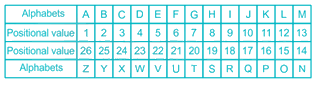 The logic followed here is:
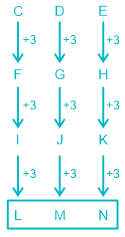 So, 'LMN' will replace the question mark in the given series.
Hence, the correct answer is "Option 4".
Q2 · Series
Select the letter-cluster from among the given options that can replace the question mark (?) in the following series.
JKL, MNO, PQR, ?
- SFD
- BHF
- STU
- DTG
Answer aur solution dekho
Archived marked answer: C
The logic followed here is:
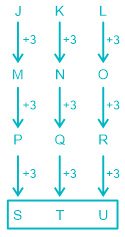 So, 'STU' will replace the question mark in the given series.
Hence, the correct answer is "Option 3".
Q3 · Series
Select the letter-cluster from among the given options that can replace the question mark (?) in the following series:
TDGJ, TGMS, TJSB, TMYK, ?
- TEFY
- TESD
- TESO
- TPET
Answer aur solution dekho
Archived marked answer: D
The logic followed here is: Q4 · Series
Select the letter-cluster from among the given options that can replace the question mark (?) in the following series.
LWB → OZE → RCH → UFK → ?
- CGF
- BHF
- XIN
- HIB
Answer aur solution dekho
Archived marked answer: C
The logic followed here is:
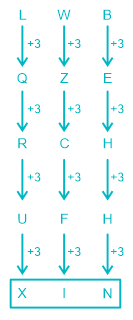 So, 'XIN' will replace the question mark in the given series.
Hence, the correct answer is "Option 3".
Q5 · Series
Select the letter-cluster from among the given options that can replace the question mark (?) in the following series:
D A F H, D D K O, D G P V, D J U C, ?
- DMKA
- DJSH
- DMNS
- DMZJ
Answer aur solution dekho
Archived marked answer: D
The logic followed here is: Q6 · Series
Find the missing number: 1, 4, 9, 16, ?, 36
- 20
- 25
- 30
- 27
Answer aur solution dekho
Archived marked answer: B
The logic followed here is:
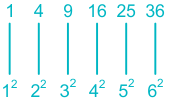 thus, "25" will replace the question mark in the given series.
Hence, the correct option is "Option 2".
Q7 · Series
What comes next: 3, 7, 16, 35, 74, ?
- 153
- 156
- 151
- 152
Answer aur solution dekho
Archived marked answer: A
The logic followed here is:
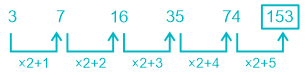 thus, "153" will replace the question mark in the given series.
Hence, the correct option is "Option 1".
Q8 · Analogy
Find the group of letters that best completes the analogy. Use alphabetical positions and reverse position logic where necessary.
DINS : WRMH :: EKPT : ?
- VJOG
- VJNF
- VPKG
- VJOF
Answer aur solution dekho
Archived marked answer: C
*]:pointer-events-auto scroll-mt-[calc(var(--header-height)+min(200px,max(70px,20svh)))]" data-scroll-anchor="true" data-testid="conversation-turn-4" data-turn="assistant" data-turn-id="request-WEB:40db1bed-6e80-4dd5-a581-5fab703540a3-1" dir="auto" tabindex="-1">
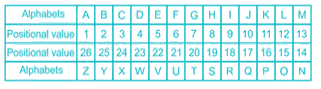 The logic followed here is:
DINS : WRMH
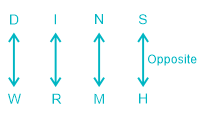 Similarly,
EKPT : ?
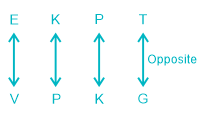 Hence, the correct answer is "Option 3.
Q9 · Analogy
In each of the following questions, a specific rearrangement pattern has been applied to the first word to form the second. Apply the same rearrangement to the third word and choose the correct answer from the given alternatives. PRINTING : RPNIITGN :: PROTOCOL : ?
- RPTOCOOL
- RPOTCOLO
- PRTOOOL
- RPTOCOLO
Answer aur solution dekho
Archived marked answer: D
The logic followed here is:
PRINTING : RPNIITGN
 Similarly,
PROTOCOL : ?
 Hence, the correct answer is "Option 4.
Q10 · Analogy
In each of the following questions, a word is transformed into another using a specific alphabetic pattern (such as letter shifting or substitution). Apply the same transformation to the third word to determine the correct answer from the given options. HOUSE : GNTRD :: ? : KHFGS
- SIGHT
- FIGHT
- MIGHT
- LIGHT
Answer aur solution dekho
Archived marked answer: D
The logic followed here is:
HOUSE : GNTRD
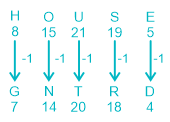 Similarly,
? : KHFGS
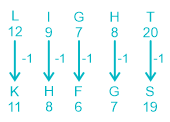 Hence, the correct answer is "Option 4."
Q11 · Analogy
In the following question, a pair of letters is given, followed by its corresponding product of alphabetical positions (A = 1, B = 2, ..., Z = 26). A second pair of letters is given without its product. Identify the correct product for the second pair that maintains the same relationship as the first.
AxE : 1x5 :: DxK : ?
- 3×9
- 4×11
- 5×10
- 4×12
Answer aur solution dekho
Archived marked answer: B
*]:pointer-events-auto scroll-mt-(--header-height)" data-scroll-anchor="false" data-testid="conversation-turn-5" data-turn="user" data-turn-id="8ac2bb9e-6b46-4009-8faf-8eb25870642c" dir="auto" tabindex="-1">
The logic followed here is:
Logic: Each letter is replaced by its alphabetical position, and the product is written in the same order. Q12 · Analogy
In the following question, select the related word from the given alternatives
Plaintiff : Complaint :: Petitioner : ?
- Plea
- Allegation
- Verdict
- Petition
Answer aur solution dekho
Archived marked answer: D
The logic followed here is:
Logic: The first word is the person who files or makes the second word.
Here,
Plaintiff : Complaint → A plaintiff is a person who files a complaint in a court of law.
Similarly,
Petitioner : Petition → A petitioner is a person who files a petition.
Hence, the correct answer is "Option 4.".
Q13 · Analogy
In the following question, select the related word from the given alternatives.
Clock : Time :: Thermometer : ?
- Pressure
- Speed
- Temperature
- Distance
Answer aur solution dekho
Archived marked answer: C
The logic followed here is:
Logic: The first word is an instrument used to measure the second word.
Here,
Clock : Time → A clock is used to measure time.
Similarly,
Thermometer : Temperature → A thermometer is used to measure temperature.
Hence, the correct answer is "Option 3".
Q14 · Puzzle Subtypes Not To Miss
If + = ×, - = +, × = ÷; then 6 + 3 - 2 × 1 = ?
- 20
- 21
- 19
- 24
Answer aur solution dekho
Archived marked answer: A
BODMAS Table:
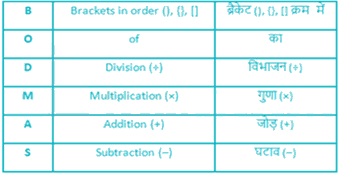 Given equation: 6 + 3 − 2 × 1 = ?
Now, if ‘+’ = ×, ‘−’ = +, and ‘×’ = ÷, then:
⇒ 6 × 3 + 2 ÷ 1 = ?
⇒ 18 + 2 ÷ 1 = ?
⇒ 18 + 2 = 20
Hence, the correct answer is "Option 1."
Q15 · Classification Odd One Out
Identify the number which does not satisfy: Sum of digits is a divisor of the number
- 21
- 30
- 36
- 39
Answer aur solution dekho
Archived marked answer: D
The logic followed here is:
Given:
Check each number:
Option 1) 21: Sum of digits = 2 + 1 = 3 → 21 ÷ 3 = 7
Option 2) 30: Sum of digits = 3 + 0 = 3 → 30 ÷ 3 = 10
Q16 · Classification Odd One Out
In each of the following questions, a group of three numbers/symbols is given in each option. Identify the group that does NOT follow the same pattern as the others.
- A1 : D5 : G9
- B2 : E6 : H10
- C3 : F7 : I11
- D4 : G8 : K13
Answer aur solution dekho
Archived marked answer: D
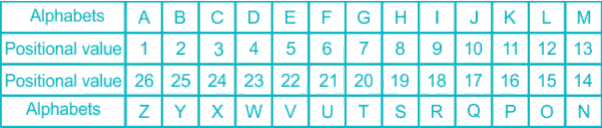 The pattern followed here is:
Option 1) A1 : D5 : G9
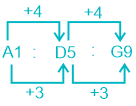 Option 2) B2 : E6 : H10
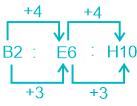 Option 3) C3 : F7 : I11
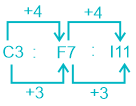 Option 4) D4 : G8 : K13
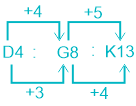 So, the odd group is D4 : G8 : K13.
Hence, the correct option is "Option 4".
Q17 · Classification Odd One Out
In each of the following questions, a group of three numbers/symbols is given in each option. Identify the group that does NOT follow the same pattern as the others.
- A1@ : D4# : G7$
- B2% : E5^ : H8&
- C3* : F6( : I9)
- D4_ : G8@ : K13$
Answer aur solution dekho
Archived marked answer: D
The logic followed here is:
Logic: Letters increase by +3 positions and numbers increase by +3 in each step.
Now,
A1@ : D4# : G7$
Letters →
A → D (+3)
D → G (+3)
Numbers →
1 → 4 (+3)
4 → 7 (+3)
Follows the pattern
B2% : E5^ : H8&
Letters →
B → E (+3)
E → H (+3)
Numbers
Q18 · Blood Relations
A said to B, "Your father's wife's son is my brother." How is B related to A?
- Cousin
- Sibling
- Uncle
- Nephew
Answer aur solution dekho
Archived marked answer: B
Family Chart:
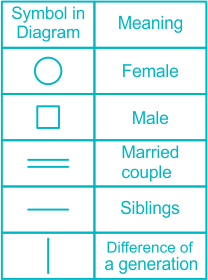 Given:
B’s father’s wife → This is B’s mother (assuming no complication like remarriage).
B’s mother’s son → That is B himself (since B is the son of his parents).
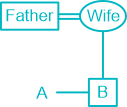 So, “Your father's wife's son” = B = Sibling.
Hence, the correct answer is "Option 2".
Q19 · Blood Relations
Introducing a man, Shruti said, "He is the husband of the granddaughter of the only son of my grandfather." How is the man related to Shruti?
- Son-in-law
- Husband
- Son
- Cousin
Answer aur solution dekho
Archived marked answer: A
Given: Introducing a man, Shruti said, "He is the husband of the granddaughter of the only son of my gr Q20 · Blood Relations
A man says, "My son's mother is the only child of your father." How is the man related to the person being spoken to?
- Brother-in-law
- Husband
- Son-in-law
- Son
Answer aur solution dekho
Archived marked answer: B
Given: A man says, "My son's mother is the only child of your father."
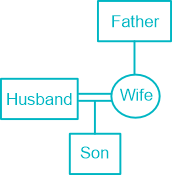 So, the man is the husband of that person.
Hence, the correct answer is "Option 2".
Q21 · Blood Relations
A said to B: "The woman I met yesterday at the park was the only daughter of the father of your brother." How is the woman related to B?
- Sister
- Cousin
- Mother
- Aunt
Answer aur solution dekho
Archived marked answer: A
Given: A said
to B: "The woman I met yesterday at the park was the only daughter of Q22 · Alphabet Test
Each of the letters in the word FRIENDLY is arranged in alphabetical order. How many letters are there in the English alphabetical series between the letter that is third from the left and the one that is second from the right in the new letter-cluster formed?
- 2
- 4
- 13
- 11
Answer aur solution dekho
Archived marked answer: D
Given: FRIENDLY
Alphabetically: D, E, F, I, L, N, R, Y
Third from left → F
Second from right → R
Positions:
F = 6
R = 18
So, Letters between them = 18 − 6 − 1 = 11
Hence, the correct answer is "Option 4".
Q23 · Similarity and Differences
Which of the following addresses are identical to each other:
1. Dr Ruchi Jain 4/88, Skyline Residency, Jaipur, 302001
2. Dr. Ruchi Jain 4/88, Skyline Residency, Jaipur , 302001
3. Dr. Ruchi Jain 4/88, Skyline Residency, Jaipur , 302001
4. Dr Ruchi Jain 4/88, Skyline Residency, Jaipur , 302001
- 1 and 2
- 2 and 3
- 2 and 4
- 3 and 4
Answer aur solution dekho
Archived marked answer: B
The address given in the problem is,
Dr Ruchi Jain
4/88, Skyline Residency, Jaipur, 302001
Let's match this address with the given options one by one to figure out which addresses are exactly identical.
Option
Address in Option
Given Address
Comment
(1)
Dr Ruchi Jain
4/88, Skyline Residency, Jaipur, 302001
Dr Ruchi Jain
4/88, Skyline Residency, Jaipur, 302001
Exactly identical.
(2)
Dr. Ruchi Jain
4/88, Skyline Residency, Jaipur , 302001
Dr Ruchi Jain
4/88, Skyline Residency, Jaipur, 302001
Not identical (extra full stop after Dr and extra space before comma).
(3)
Dr. Ruchi Jain
4/88, Skyline Residency, Jaipur , 302001
Dr Ruchi Jain
4/88, Skyline Residency, Jaipur, 302001
Not identical (extra full stop after Dr and extra space before comma).
(4)
Dr Ruchi Jain
4/88, Skyline Residency, Jaipur , 302001
Dr Ruchi Jain
4/88, Skyline Residency, Jaipur, 302001
Not identical (extra space before comma after Jaipur).
From the comparison above, only options (2) and (3) are exactly identical to each other.
Hence, the correct answer is "2) 2 and 3".
Q24 · Similarity and Differences
Which of the following addresses are identical to each other:
1. Amitabh S 112/44 Block-B, Indira Nagar, Lucknow, 226016
2. Amitabh S. 112/44 Block-B, Indira Nagar, Lucknow, 226016
3. Amitabh S. 112/44 Block-B, Indira Nagar, Lucknow, 226016
4. Amitabh S. 112/44 Block B, Indira Nagar, Lucknow, 226016
- 1 and 2
- 2 and 3
- 2 and 4
- 3 and 4
Answer aur solution dekho
Archived marked answer: B
The address given in the problem is,
Amitabh S.
112/44 Block-B, Indira Nagar, Lucknow, 226016
Let's match this address with the given options one by one to figure out which ones are exactly the same.
Option
Address in Option
Given Address
Comment
(1)
Amitabh S
112/44 Block-B, Indira Nagar, Lucknow, 226016
Amitabh S.
112/44 Block-B, Indira Nagar, Lucknow, 226016
Not Identical (missing dot after letter 'S')
(2)
Amitabh S.
112/44 Block-B, Indira Nagar, Lucknow, 226016
Amitabh S.
112/44 Block-B, Indira Nagar, Lucknow, 226016
Exactly identical.
(3)
Amitabh S.
112/44 Block-B, Indira Nagar, Lucknow, 226016
Amitabh S.
112/44 Block-B, Indira Nagar, Lucknow, 226016
Exactly identical.
(4)
Amitabh S.
112/44 Block B, Indira Nagar, Lucknow, 226016
Amitabh S.
112/44 Block-B, Indira Nagar, Lucknow, 226016
Not identical (missing hyphen in "Block B").
So, addresses (2), and (3) are exactly identical, while address (1) and (4) is different due to the missing dot and hyphen.
Hence, the correct answer is option (2)
Q25 · Ranking Order
There are 40 students in a line. Rahul is 13th from the left and Kunal is 17th from the right. How many students are there between them?
- 7
- 9
- 10
- 12
Answer aur solution dekho
Archived marked answer: C
Given: 40 students.
Rahul is 13th from the left,
Kunal is 17th from the right.
So, students between Rahul and Kunal = 40 − 13 − 17 = 10.
So, there are '10' students standing between Rahul and Kunal.
Hence, the correct answer is "Option 3."
General Awareness
Q1 · Art and Culture
Mārgi Sangita in ancient Indian music was rooted in:
- Folk music
- Vedic traditions
- Courtly entertainment
- Western-influence
Answer aur solution dekho
Archived marked answer: B
The correct answer is Vedic traditions.
Key Points
- Mārgi Sangita refers to the classical music tradition of ancient India, which is deeply rooted in the Vedic traditions.
- It was considered divine and sacred, often used in rituals, spiritual practices, and worship.
- The Samaveda, one of the four Vedas, provides the earliest references to music, including chants and h
Q2 · Art and Culture
Based on the given statements which option is correct:
Statement I: Mathura art produced images for both Indian and non-Indian patrons.
Statement II: Mathura art ignored nature-based themes in its sculptures.
- Statement I and II both are Correct.
- Only statement I is correct
- Only Statement II is correct
- Neither I nor II
Answer aur solution dekho
Archived marked answer: B
The correct answer is Option 2: Only Statement I is correct.
Key Points
- Statement I is correct: Mathura art was a significant school of art during the Kushana period, producing sculptures for both Indian and non-Indian patrons, including images of Buddha, Bodhisattvas, Yakshas, and Jain Tirthankaras.
- Mathura art is renowned for its syncretic style, blending indigenous Indian artistic traditions with Greco-Roman influences.
- It catered to diverse religious communities like Buddhists, Jains, and Hindus, reflecting its inclusive nature and wide patronage.
- Mathura art produced sculptures for Buddhist stupas in India and beyond, including regions such as Central Asia, showcasing its appeal to non-Indian patrons.
Additional Information
- Statement II is incorrect: Mathura art did not ignore nature-based themes. In fact:
- It prominently featured nature-inspired motifs such as trees, animals, and floral designs in its sculptures.
- Yakshas and Yakshinis, celestial beings associated with nature and fertility, were frequently depicted in Mathura sculptures.
- Nature was often used symbolically in Buddhist and Jain art, such as the Bodhi tree representing Buddha's enlightenment.
- Key Features of Mathura Art:
- Mathura art evolved during the Kushana period and served as a major center of artistic activity.
- It is characterized by red sandstone sculptures with intricate detailing and bold expressions.
- The art form emphasized realism and depicted human and divine figures with naturalistic features and elaborate ornamentation.
- Notable examples include the seated Buddha statues and images of Hindu deities like Vishnu and Shiva.
- Comparison with Gandhara Art:
- While Mathura art represented indigenous Indian styles, Gandhara art reflected strong Greco-Roman influences.
- Mathura sculptures were made of red sandstone, whereas Gandhara sculptures predominantly used grey schist stone.
Q3 · Art and Culture
Fill in the Blank:
Koli dance is traditionally performed by the ______ community.
- Fisherfolk
- Farmers
- Shepherds
- Weavers
Answer aur solution dekho
Archived marked answer: A
The correct answer is Fisherfolk.
Key Points
- Koli dance is a traditional folk dance performed by the Koli community, primarily comprising fisherfolk in Maharashtra, India.
- The dance represents the culture, lifestyle, and livelihood of the fishing community, symbolizing their connection with the sea and fishing activities.
- Koli dance is characterized by synchronized movements, vibrant costumes, and rhythmic music that depict the daily lives of fisherfolk, including fishing techniques and boat rowing.
- The dance is performed during community celebrations, festivals, and special occasions to express joy and unity.
- The Koli community has a rich cultural heritage, and their dance is an important representation of their identity and traditions.
Additional Information
- Popular Folk Dances of Maharashtra:
- Lavani: A dynamic dance with powerful rhythms, often performed by women in nine-yard sarees, narrating stories of love, society, and politics.
- Tamasha: A traditional folk theatre with dance, music, and drama, known for its entertainment and social commentary.
- Koli Dance: A lively dance of the Koli fishing community, reflecting their daily life and traditions.
- Lezim: An energetic dance performed with small cymbals (lezim), popular in processions and celebrations.
- Powada: A ballad form narrating the heroic tales of Chhatrapati Shivaji Maharaj.
- Dindi & Kala: Devotional dances performed during religious festivals, often honoring Lord Vithoba.
- Gondhal: A ritualistic dance performed for deities like Goddess Renuka.
- Dhangari Gaja: A dance performed solely by men, originating from the Dhangar (shepherd) community.
Q4 · Art and Culture
Which of the following statements about Hola Mohalla festival of Punjab is correct?
- It is celebrated mainly by women through crafts and songs in Patiala.
- It showcases martial arts, langars, and Nihang mock battles at Anandpur Sahib.
- It is a harvest festival observed in Punjab just before Diwali.
- Hola Mohalla is celebrated on the same day as Holi.
Answer aur solution dekho
Archived marked answer: B
The correct answer is It showcases martial arts, langars, and Nihang mock battles at Anandpur Sahib..
Key Points
- Hola Mohalla is a Sikh festival that was first introduced by Guru Gobind Singh, the tenth Sikh Guru, in 1701.
- The festival is celebrated a day after Holi and is marked by demonstrations of martial arts, mock battles by Nihang warriors, and traditional Sikh customs.
- The main celebrations are held at Anandpur Sahib, a significant Sikh pilgrimage site in Punjab.
- It is known for its community kitchens (langars), where free meals are served to all visitors as part of Sikh tradition.
- The festival also includes religious processions, poetry recitations, and devotional music, making it a vibrant cultural and spiritual event.
Additional Information
- It seems to be a misrepresentation of certain other cultural festivals in Punjab where women actively participate in folk activities like *Giddha* and *Phulkari*.
- In Punjab, Baisakhi is the prominent harvest festival celebrated in April to mark the wheat harvesting season.
- Hola Mohalla is celebrated a day after Holi and is distinct in its focus on martial traditions and Sikh spiritual values.
Q5 · Indian Polity and Constitution
Article 246A of the Constitution of India gives power to both Parliament and State Legislatures to make laws on ______.
- Property Rights
- Taxation of Goods and Services
- Emergency Provisions
- Criminal Law
Answer aur solution dekho
Archived marked answer: B
The correct answer is Taxation of Goods and Services.
Key Points
- Article 246A of the Indian Constitution was introduced through the 101st Constitutional Amendment Act, 2016, which enabled the implementation of the Goods and Services Tax (GST).
- It grants concurrent powers to both the Parliament and State Legislatures to make laws with respect to GST.
- Under this article, the Parliament has exclusive power to make laws on inter-state trade or commerce of goods and services, while both Parliament and State Legislatures can legislate on intra-state transactions.
- GST subsumes multiple indirect taxes such as VAT, Service Tax, Excise Duty, and others, simplifying India's indirect taxation system.
- The introduction of Article 246A aimed to promote a unified market, enhance ease of doing business, and eliminate the cascading effects of taxes.
Additional Information
- Property Rights (Option 1):
- Property rights in India are addressed under Article 300A of the Indian Constitution, which states that no person shall be deprived of their property except by the authority of law.
- Initially, property rights were a fundamental right under Article 31, but it was abolished by the 44th Constitutional Amendment Act, 1978, and made a legal right under Article 300A.
- This provision ensures that private property cannot be taken away without due process of law or proper compensation.
- Emergency Provisions (Option 3):
- Emergency provisions are detailed under Part XVIII (Articles 352 to 360) of the Indian Constitution.
- These provisions enable the government to assume greater control during times of crisis and include three types of emergencies: National Emergency (Article 352), State Emergency/President’s Rule (Article 356), and Financial Emergency (Article 360).
- These provisions are invoked to safeguard the sovereignty, unity, and integrity of India during extraordinary situations.
- Criminal Law (Option 4):
- Criminal law in India is primarily governed by the Indian Penal Code (IPC), 1860, the Code of Criminal Procedure (CrPC), 1973, and various special laws.
- The Parliament and state legislatures can legislate on criminal law under the Concurrent List (List III) of the Seventh Schedule to the Constitution.
- Criminal law ensures the maintenance of public order, punishment for offenses, and the protection of citizens’ rights.
Q6 · Indian Polity and Constitution
The Bharatiya Nyaya Samhita (BNS), 2023, consolidates and amends provisions related to which branch of law?
- Civil Procedure Law
- Criminal Substantive Law
- Evidence Law
- Contract Law
Answer aur solution dekho
Archived marked answer: B
The correct answer is Criminal Substantive Law.
Key Points
- The Bharatiya Nyaya Samhita (BNS), 2023, is aimed at consolidating and amending laws related to Criminal Substantive Law in India.
- BNS is designed as a replacement for the Indian Penal Code (IPC), 1860, which was drafted during British colonial rule in India.
- The primary objective of the BNS is to modernize and reform criminal laws to align with the changing socio-economic and technological landscape of the country.
- It seeks to simplify criminal laws, ensure speedy justice, and address contemporary challenges such as cybercrime and organized crime.
- The Bharatiya Nyaya Samhita Bill, 2023, was introduced in Parliament in August 2023 as part of a broader initiative to overhaul colonial-era legal frameworks, including the Code of Criminal Procedure (CrPC) and the Indian Evidence Act.
Additional Information
- Civil Procedure Law
- Civil Procedure Law governs the procedures and practices in civil courts, such as filing lawsuits, conducting trials, and enforcing judgments.
- The primary legislation governing this branch in India is the Civil Procedure Code (CPC), 1908.
- Civil laws deal with private disputes between individuals or organizations, such as property disputes, contracts, or family matters.
- Evidence Law
- The law of evidence deals with the rules and principles that determine what evidence is admissible in courts.
- The Indian Evidence Act, 1872, is the governing framework for evidence-related matters in Indian courts.
- It specifies the type and manner of evidence that can be presented in civil or criminal cases, including oral, documentary, and circumstantial evidence.
- Contract Law
- Contract law governs agreements between parties that are enforceable by law.
- The primary legislation in India is the Indian Contract Act, 1872, which outlines the essentials of a valid contract, including offer, acceptance, consideration, and capacity to contract.
- It also covers specific contracts such as indemnity, guarantee, bailment, agency, and partnership agreements.
Q7 · Indian Polity and Constitution
Which mechanism did India operationalize in 2024 to strengthen regional financial resilience within SAARC?
- SAARC Development Fund capital increase
- SAARC Currency Swap Framework (2024-27)
- SAARC Trade Insurance Scheme
- SAARC Sovereign Credit Pool
Answer aur solution dekho
Archived marked answer: B
The correct answer is SAARC Currency Swap Framework (2024-27).
Key Points
- The SAARC Currency Swap Framework (2024-27) was operationalized by the Reserve Bank of India (RBI) to enhance financial cooperation and stability among SAARC member nations.
- Under this mechanism, India provides short-term financial assistance in foreign currency to SAARC member countries facing liquidity constraints.
- The total corpus for the framework is USD 2 billion, with each eligible member country allowed to withdraw up to USD 400 million within specified limits.
- The framework aims to strengthen regional financial resilience, mitigate balance of payment crises, and promote economic stability within the SAARC region.
- The currency swap facility is offered in major international currencies (e.g., USD, EUR) or Indian Rupees to support member nations in times of financial distress.
Additional Information
- SAARC Development Fund (SDF) capital increase:
- The SAARC Development Fund was established in 2010 to promote regional integration and economic development in SAARC member states.
- It primarily funds projects under its three windows: Social, Economic, and Infrastructure development.
- Although increasing the SDF's capital has been proposed, it is not directly linked to the financial resilience mechanisms implemented in 2024.
- About SAARC:
- The South Asian Association for Regional Cooperation (SAARC) was established in 1985 to promote economic, social, and cultural cooperation among its eight member states: Afghanistan, Bangladesh, Bhutan, India, Maldives, Nepal, Pakistan, and Sri Lanka.
- SAARC initiatives aim to foster regional integration, address common challenges, and promote sustainable development within South Asia.
Q8 · Indian Polity and Constitution
Fill in the blanks: Established in 1961 within the former Palace of the Maharaja of Patiala, the National Institute of Sports was later renamed as the Netaji Subhas National Institute of Sports (NSNIS) on ______ .
- 15th August 1975
- 26th January 1972
- 23rd January 1973
- 7th May 1961
Answer aur solution dekho
Archived marked answer: C
The correct answer is 23rd January 1973.
Key Points
- The National Institute of Sports (NIS) was established in 1961 within the premises of the historic Palace of the Maharaja of Patiala, Punjab.
- It was renamed as the Netaji Subhas National Institute of Sports (NSNIS) on 23rd January 1973.
- The renaming was done in honor of Netaji Subhas Chandra Bose, a prominent leader in India’s freedom struggle, whose birth anniversary falls on January 23rd.
- NSNIS is widely regarded as the "Mecca" of Indian sports, providing professional training and technical education in various sports disciplines.
- It functions under the aegis of the Sports Authority of India (SAI) and plays a pivotal role in nurturing and developing athletes and sports coaches in the country.
Additional Information
- National Institute of Sports (NIS) and its importance:
- The institute offers advanced training programs for athletes and coaches in a range of disciplines, including athletics, hockey, football, boxing, and wrestling.
- It also conducts diploma and certification courses in sports coaching, equipping individuals with the skills to train athletes effectively.
- NSNIS has played a key role in producing several Olympians and international-level athletes for India.
- It continues to be a hub for sports research and the development of modern training methodologies.
Q9 · Indian Polity and Constitution
Read the below statement:
1. Solicitor General of India is appointed by the president of India.
2. A candidate contesting for the post of the President of India is required to make a security deposit of ₹15,000.
Which of the above statements is/are correct?
- Only statement 1
- Only statement 2
- Both statements 1 and 2
- Neither statement 1 nor 2
Answer aur solution dekho
Archived marked answer: B
The correct answer is Only statement 2.
Key Points
- The security deposit of ₹15,000 is mandatory for candidates contesting the election for the President of India, as per Article 58 of the Constitution of India and the Presidential and Vice-Presidential Elections Act, 1952.
- The deposit is forfeited if the candidate fails to secure at least one-sixth of the votes cast in the election.
- The security deposit ensures that only serious candidates participate in the election process.
- The election of the President of India is conducted by an electoral college consisting of elected members of both Houses of Parliament and the Legislative Assemblies of States and Union Territories.
- As per the rules, the nomination paper must be supported by at least 50 proposers and 50 seconders to ensure legitimacy.
Additional Information
- Statement 1: Solicitor General of India is appointed by the president of India
- The Solicitor General of India is the second-highest law officer in the country after the Attorney General of India.
- Unlike the Attorney General, the Solicitor General is not appointed directly by the President of India. Instead, the appointment is made by the Union Government, specifically by the Ministry of Law and Justice.
- The Solicitor General assists the Attorney General in performing legal duties and advises the government on legal matters.
- Therefore, Statement 1 is incorrect.
- Concept of Presidential Elections in India:
- The President is elected by an electoral college through a proportional representation system using a single transferable vote.
- Every member of the electoral college casts their vote, and the candidate receiving the highest number of votes is elected.
- The process is governed by the provisions in Articles 52 to 62 of the Constitution.
- Other Important Facts:
- The President of India serves a term of five years and can be re-elected.
- The eligibility criteria for candidates contesting the Presidential elections include being a citizen of India, at least 35 years old, and qualified to be a member of the Lok Sabha.
- In case of vacancy, the election must be held within six months.
Q10 · Indian Polity and Constitution
How are Money Bills handled in both Houses of Parliament and State Legislatures with bicameralism under the Constitution?
- Rajya Sabha must approve Money Bills within 14 days
- In States, the Legislative Council can amend a Money Bill within 14 days
- Both Rajya Sabha and Legislative Councils have equal powers on Money Bills
- Rajya Sabha and Legislative Councils can only make recommendations within 14 days
Answer aur solution dekho
Archived marked answer: D
The correct answer is Rajya Sabha and Legislative Councils can only make recommendations within 14 days.
Key Points
- Under Article 110 of the Indian Constitution, a Money Bill can only be introduced in the Lok Sabha and not in the Rajya Sabha.
- Once the Lok Sabha passes a Money Bill, it is sent to the Rajya Sabha for its recommendations, but the Rajya Sabha cannot amend or reject it.
- The Rajya Sabha must return the Money Bill to the Lok Sabha with or without recommendations within a period of 14 days. If not returned within this period, the Bill is deemed passed by both Houses of Parliament.
- In the case of State Legislatures with bicameralism, the Legislative Council can only make recommendations to the Legislative Assembly on Money Bills and must return the Bill within 14 days.
- The powers of the Rajya Sabha and the Legislative Councils on Money Bills are limited to recommendations, and the final decision rests with the Lok Sabha and the Legislative Assembly, respectively.
Additional Information
- A Money Bill deals exclusively with matters listed in Article 110(1) of the Constitution, such as taxation, borrowing, expenditure, and matters incidental to these.
- The distinction between Money Bills and other financial Bills is significant because it limits the role of the Rajya Sabha and Legislative Councils in the legislative process.
- The Speaker of the Lok Sabha or the Legislative Assembly is the final authority to decide whether a Bill is a Money Bill.
Q11 · Indian Polity and Constitution
Consider the following statements:
1. Supreme Court can transfer cases from one High Court to another.
2. Article 139A was introduced by the 42nd Amendment.
Which of the above is/are correct?
- Only 1
- Only 2
- Both 1 and 2
- Neither 1 nor 2
Answer aur solution dekho
Archived marked answer: C
The correct answer is Both 1 and 2.
Key Points
- Statement 1: Supreme Court can transfer cases from one High Court to another – Article 139A of the Indian Constitution empowers the Supreme Court to transfer cases involving the same or substantially the same question of law from one High Court to another to ensure uniformity in decisions.
- This provision is aimed at eliminating conflicting judgments by different High Courts on the same legal matter, thereby ensuring consistency in the interpretation of laws across the country.
- Statement 2: Article 139A was introduced by the 42nd Amendment – The 42nd Amendment Act of 1976 added Article 139A to the Indian Constitution. This amendment is often referred to as the "mini-Constitution" due to the extensive changes it introduced.
- Article 139A allows the Supreme Court to withdraw cases from one or more High Courts if it feels that these cases involve a substantial question of law of general importance.
- Both statements are correct, as Article 139A was indeed introduced by the 42nd Amendment, and it authorizes the Supreme Court to transfer cases between High Courts.
Additional Information
- 42nd Amendment of 1976:
- Known as the "mini-Constitution," this amendment brought significant changes to the Indian Constitution.
- It added several articles, including Article 139A, and amended many existing provisions to strengthen the central government's powers.
- Key changes included the addition of the Fundamental Duties (Article 51A) and the insertion of the words "Socialist," "Secular," and "Integrity" into the Preamble.
- Supreme Court’s Powers under Article 139A:
- The Supreme Court has the authority to transfer cases between High Courts or withdraw cases from High Courts to itself if substantial questions of law are involved.
- This provision ensures uniformity in the interpretation of laws across different jurisdictions in India.
- Judicial Transfers under Article 139A:
- This article is critical for maintaining judicial discipline and consistency in legal interpretations by higher judiciary bodies.
- Such transfers are often considered in cases involving constitutional interpretation or significant questions of national importance.
- Role of High Courts:
- High Courts are the principal civil courts of original jurisdiction in India, but their decisions may differ based on regional contexts.
- Article 139A ensures that conflicting decisions on similar issues are avoided by centralizing the matter in the Supreme Court.
Q12 · Indian Economy
Which of the following is correctly classified as a consumer goods industry?
- Iron and steel
- Aluminium smelting
- Toothpaste
- Copper smelting
Answer aur solution dekho
Archived marked answer: C
The correct answer is Toothpaste.
Key Points
- Consumer goods industries produce goods that are directly consumed by customers, meaning they do not require further processing.
- Toothpaste is a prime example of a consumer goods product as it is manufactured for direct use by individuals for personal hygiene.
- It falls under the category of FMCG (Fast-Moving Consumer Goods), which are frequently purchased, low-cost items such as toiletries, beverages, and packaged food products.
- Consumer goods industries focus on manufacturing products that cater to everyday needs, including items like toothpaste, soap, cosmetics, and food products.
- Products from consumer goods industries are typically mass-produced to meet the demand of a large consumer base and distributed through retail outlets or e-commerce platforms.
Additional Information
- Iron and steel:
- The iron and steel industry is classified as a heavy industry as it deals with large-scale production of materials used in infrastructure, construction, and manufacturing.
- It provides raw materials for industries like automobile manufacturing, shipbuilding, and machinery production.
- Steel is not a consumer product but an intermediate good, which requires further processing to create consumer or industrial goods.
- Aluminium smelting:
- Aluminium smelting is an industrial process that involves the extraction of aluminium from its ore, bauxite, using electrolytic reduction.
- This industry is classified as a basic or heavy industry because aluminium is an intermediate product used in manufacturing sectors such as transportation, construction, and packaging.
- It does not directly produce goods for consumer use but supports other industries by providing raw materials.
- Copper smelting:
- Copper smelting involves the extraction of copper metal from its ores through heating and chemical processes.
- It is a heavy or basic industry, as the copper produced is used in electrical wiring, plumbing, and industrial machinery.
- Like aluminium and steel, copper is an intermediate product and not directly consumed by individuals.
Q13 · Indian Economy
Assertion (A) and Reason (R) are given below. Choose the correct option:
Assertion (A): Demographic statistics like birth and death rates rely on accurate reporting by households.
Reason (R): Birth and death registration is mandatory and always accurately followed in all parts of India.
- Both A and R are true, and R is the correct explanation of A
- Both A and R are true, but R is not the correct explanation
- A is true, but R is false
- A is false, but R is true
Answer aur solution dekho
Archived marked answer: C
The correct answer is A is true, but R is false.
Key Points
- Demographic statistics like birth and death rates depend heavily on accurate reporting from households to maintain the reliability of population data.
- Birth and death registration in India is governed by the Registration of Births and Deaths Act, 1969, which mandates recording these events.
- Despite the legal requirement, the implementation of birth and death registration varies widely across regions due to factors like literacy levels, infrastructure, and accessibility.
- The claim in the reason (R) that registration is "always accurately followed in all parts of India" is incorrect. Challenges such as lack of awareness, geographical inaccessibility, and resource constraints often result in underreporting or delayed registration.
- Thus, while the assertion (A) is correct, the reason (R) is false, as it does not accurately explain the situation of registration compliance in India.
Additional Information
- Importance of Birth and Death Registration
- Accurate registration is crucial for demographic analysis, policy-making, and resource allocation at both national and state levels.
- Birth certificates serve as proof of age, identity, and nationality, which are essential for accessing various benefits and rights.
- Death registration helps track mortality rates, causes of death, and contributes to public health planning.
- Efforts are being made to improve registration rates in India through awareness campaigns and the digitization of records.
Q14 · Sports Static GK
In freestyle wrestling, which of the following actions can result in a technical point for the wrestler?
- Running out of the mat deliberately
- Holding the opponent's singlet
- Performing a successful takedown
- Using an illegal headlock
Answer aur solution dekho
Archived marked answer: C
The correct answer is Performing a successful takedown.
Key Points
- A takedown is a critical technique in freestyle wrestling that allows a wrestler to bring their opponent from a standing position to the mat and gain control.
- Performing a successful takedown awards the wrestler technical points, which depend on the skill level and execution of the move (usually 2 to 5 points).
- Common types of takedowns include single-leg takedown, double-leg takedown, and throws.
- In addition to scoring points, a takedown puts the wrestler in an advantageous position to attempt further scoring or pinning.
- Freestyle wrestling emphasizes both offensive and defensive techniques, with takedowns being one of the primary methods of scoring.
Additional Information
- Running out of the mat deliberately
- Running out of the mat is considered a form of passive wrestling or avoiding engagement, which can lead to penalties.
- Instead of gaining points, wrestlers may receive warnings or penalties for deliberately stepping out of the mat to escape an opponent’s hold or avoid engagement.
- In some cases, referees may award points to the opponent if this action is deemed intentional.
- Holding the opponent's singlet
- Grabbing the opponent's singlet, headgear, or other parts of their uniform is prohibited in freestyle wrestling.
- This action is considered illegal and results in penalties or warnings against the wrestler committing the foul.
- The purpose of this rule is to ensure fairness and maintain the integrity of the sport.
- Using an illegal headlock
- An illegal headlock occurs when a wrestler applies a headlock without an arm included in the hold.
- This technique is not allowed as it can cause serious injuries and is against the rules of freestyle wrestling.
- Wrestlers using illegal holds may face penalties, warnings, or even disqualification in extreme cases.
Q15 · Sports Static GK
Vijender Singh defeated which player in the quarter-finals to secure India's first Olympic boxing medal?
- Emilio Correa
- Carlos Góngora
- Misha Aloyan
- Vasyl Lomachenko
Answer aur solution dekho
Archived marked answer: B
The correct answer is Carlos Góngora.
Key Points
- Vijender Singh defeated Carlos Góngora, a boxer from Ecuador, in the quarter-finals of the Men's Middleweight category at the 2008 Beijing Olympics.
- This victory secured Vijender Singh a medal in boxing, making him the first Indian boxer to win an Olympic medal.
- The match was intensely fought, with Vijender showcasing exceptional strategy, precision, and stamina to outclass Carlos Góngora.
- Vijender's performance at the Beijing Olympics marked a milestone for Indian boxing, elevating the sport's status in the country.
- He eventually secured the bronze medal in the Men's Middleweight (75 kg) category, creating history for Indian sports.
Additional Information
- Emilio Correa:
- Emilio Correa is a Cuban boxer who competed in the Middleweight category at the 2008 Beijing Olympics.
- He won the silver medal in the event, losing to James DeGale of Great Britain in the final.
- Correa was known for his aggressive fighting style and strong punches in the competition.
- Misha Aloyan:
- Misha Aloyan is a Russian boxer who specializes in the Flyweight category.
- He is a two-time world champion and an Olympic medalist, winning the bronze medal at the 2012 London Olympics.
- However, Aloyan did not compete in the same weight category or event as Vijender Singh during the 2008 Olympics.
- Vasyl Lomachenko:
- Vasyl Lomachenko is a celebrated Ukrainian boxer, widely regarded as one of the greatest amateur boxers of all time.
- He won gold medals in the Featherweight and Lightweight categories at the 2008 and 2012 Olympics respectively.
- Despite his legendary status, Lomachenko competed in a different weight category than Vijender Singh during the 2008 Beijing Olympics.
Q16 · Indian Geography
Which statements accurately describe water bodies in the Indian Desert?
1. Streams are perennial and flow year-round.
2. Most streams disappear into the sand.
- Only 1
- Only 2
- 1 and 2 both are correct
- Neither 1 nor 2 are correct
Answer aur solution dekho
Archived marked answer: B
The correct answer is Option 2: Only 2.
Key Points
- The Indian Desert, also known as the Thar Desert, is one of the most arid regions in India, and water scarcity is a defining feature of this landscape.
- Most streams in the Indian Desert are ephemeral in nature, meaning they flow only during the monsoon season and disappear into the sand due to high porosity and evaporation rates.
- Perennial streams are rare in the Thar Desert as the region receives an average annual rainfall of only 100-500 mm, which is insufficient to sustain year-round water flow.
- One notable exception is the Luni River, which is the largest river in the Thar Desert but even it becomes saline after flowing through the desert region, limiting its usability.
- The hydrological characteristic of the Thar Desert is such that most of the water from surface streams infiltrates into the sandy terrain or evaporates quickly due to the high temperatures.
Additional Information
- The Indian Desert:
- The Thar Desert covers approximately 200,000 square kilometers, making it the world's 17th largest desert.
- The region is characterized by sand dunes, rocky outcrops, and sparse vegetation.
- Oases in the Thar Desert, such as those in Jaisalmer, provide limited water resources for the local population.
- The region supports unique flora and fauna adapted to the arid environment, such as desert foxes and thorny shrubs.
Q17 · Indian Geography
Oxygen concentration in Earth's atmosphere is roughly?
- 18%
- 21%
- 24%
- 28%
Answer aur solution dekho
Archived marked answer: B
The correct answer is 21%.
Key Points
- The Earth's atmosphere contains approximately 21% oxygen, which is essential for the survival of most living organisms.
- Oxygen is the second most abundant gas in the atmosphere, after nitrogen, which makes up around 78% of the atmosphere.
- The high concentration of oxygen is main
Q18 · Current Affairs
Which of the following accurately reflects the critical technological outcome of ISRO's RLV-LEX3 mission conducted on June 23, 2024?
- In-flight fuel transfer at hypersonic speeds
- Autonomous high-speed landing under tough cross-range & wind
- Launch abort test for crewed reusable launchers
- Orbital deployment via dual-mode scramjet propulsion
Answer aur solution dekho
Archived marked answer: B
The correct answer is Autonomous high-speed landing under tough cross-range & wind.
Key Points
- ISRO's RLV-LEX3 mission on June 23, 2024, successfully demonstrated autonomous high-speed landing capabilities, a critical step in reusable launch vehicle technology development.
- The landing operation was conducted under challenging conditions, including tough cross-range and wind scenarios, showcasing the robustness of the vehicle's autonomous systems.
- This achievement marks a significant step forward in ISRO's plans to develop reusable space technology, which aims to reduce the cost of satellite launches and make space access more economical.
- The mission tested advanced technologies like precision navigation, guidance, and control systems, essential for enabling autonomous landing of spacecraft.
- The RLV (Reusable Launch Vehicle) program is part of ISRO's efforts to create a sustainable and cost-effective space ecosystem through reusable technologies.
Additional Information
- Reusable Launch Vehicle Technology
- Reusable launch vehicles are designed to be recovered and reused for multiple missions, significantly reducing the cost of satellite launches.
- The RLV program is a pioneering effort by ISRO to develop technologies such as autonomous landing, precision navigation, and reusability for space systems.
- These technologies are crucial for creating a sustainable and economically viable space exploration framework.
Q19 · Current Affairs
The Global Energy Transition Index 2025 is released by which international organization?
- IRENA
- IEA
- World Economic Forum
- UNDP
Answer aur solution dekho
Archived marked answer: C
The correct answer is World Economic Forum.
Key Points
- The Global Energy Transition Index is released by the World Economic Forum (WEF), a Swiss-based international organization committed to improving the state of the world.
- This index assesses the energy systems of countries based on factors like environmental sustainability, energy security, and affordability, focusing on their readiness for energy transition.
- The index uses a unique framework called the Energy Transition Readiness Framework, considering both current performance and enabling conditions for energy transition.
- It ranks countries based on their ability to adopt clean energy technologies, reduce carbon emissions, and ensure reliable access to energy.
- The WEF works closely with governments, businesses, and other stakeholders to provide actionable insights for achieving sustainable energy transitions globally.
Additional Information
- IRENA (International Renewable Energy Agency)
- IRENA is an intergovernmental organization that supports countries in their transition to sustainable energy.
- It primarily focuses on promoting renewable energy sources like solar, wind, and hydroelectric power.
- Its reports and initiatives emphasize renewable energy deployment, innovation, and policy frameworks worldwide.
- While IRENA plays a key role in global energy discussions, it does not release the Global Energy Transition Index.
- IEA (International Energy Agency)
- IEA is an autonomous agency established in the framework of the Organisation for Economic Co-operation and Development (OECD).
- It focuses on energy security, economic development, and environmental sustainability across member countries.
- IEA releases reports like the World Energy Outlook and Energy Technology Perspectives.
- UNDP (United Nations Development Programme)
- UNDP is a global development network under the United Nations, focusing on sustainable development, poverty alleviation, and climate change.
- Its energy-related work often involves improving energy access and promoting clean energy solutions in developing countries.
Q20 · General Science Biology
The term "pleiotropy" refers to:
- One gene affects multiple traits
- Multiple genes affect one trait
- Gene mutation in one allele
- Gene duplication
Answer aur solution dekho
Archived marked answer: A
The correct answer is One gene affects multiple traits.
Key Points
- Pleiotropy refers to a situation where a single gene affects multiple phenotypic traits.
- This occurs because the gene encodes a product (such as a protein) that is involved in multiple biological processes.
- Examples of pleiotropy include the gene responsible for sickle-cell anemia, which affects red blood cell shape and provides resistance to malaria.
- Pleiotropic effects can be observed in both normal physiological processes and genetic disorders.
- Pleiotropy is a fundamental concept in genetics and demonstrates how genes can have far-reaching effects on an organism's phenotype.
Additional Information
- Option 2: Multiple genes affect one trait
- This describes a phenomenon known as polygenic inheritance, where a trait is governed by two or more genes.
- Examples include human height, skin color, and eye color, which result from the combined effect of several genes.
- Polygenic traits often show continuous variation, unlike pleiotropic traits, which are influenced by a single gene.
- Option 3: Gene mutation in one allele
- This refers to a mutation in one copy of a gene (allele) that can affect its function.
- Such mutations can lead to genetic disorders if the mutated allele is dominant or if the condition is recessive and both alleles are affected.
- While this is a distinct genetic concept, it does not describe pleiotropy.
- Option 4: Gene duplication
- Gene duplication is an evolutionary process where a segment of DNA containing a gene is copied, resulting in multiple copies of that gene in the genome.
- This can lead to the evolution of new gene functions or increased gene dosage but is unrelated to pleiotropy.
- Explanation of Pleiotropy:
- Pleiotropy is critical for understanding the complexity of genetic interactions and how single genes can have multiple impacts on an organism's physiology and development.
- It is also significant in studying diseases with pleiotropic effects, such as Marfan syndrome, where a single gene mutation affects the connective tissue throughout the body.
Q21 · Awards Static
Which Padma awardees and fields is/are correctly paired?
1. Gokul Chandra Das – Folk Music
2. Dinesh Saini – Environment
3. Farooq Ahmad Mir – Literature
4. Geeta Devi – Agriculture
- 1 only
- 2 only
- 3 only
- 4 only
Answer aur solution dekho
Archived marked answer: A
The correct answer is Option 1: Gokul Chandra Das – Folk Music.
Key Points
- Gokul Chandra Das is a renowned artist in the field of Folk Music, recognized for his significant contributions to preserving and promoting traditional folk music in India.
- He was awarded the Padma Shri for his outstanding contribution to Folk Music, a category under Arts.
- The Padma Awards are one of the highest civilian honors in India, given in various fields such as art, literature, social work, and public affairs.
- The Padma Shri is the fourth highest civilian award in India, conferred to individuals for distinguished contributions in various fields.
- The recognition of individuals like Gokul Chandra Das highlights the importance of preserving and celebrating India’s rich cultural heritage.
Additional Information
- Dinesh Saini – Environment
- Dinesh Saini is not listed among the Padma awardees under the category of Environment.
- The Environment category in Padma Awards recognizes individuals for their work in environmental conservation, climate change mitigation, and ecological preservation.
- Farooq Ahmad Mir – Literature
- Farooq Ahmad Mir is not associated with receiving the Padma Award in the field of Literature.
- The Literature category in Padma Awards celebrates contributions to Indian literature, creative writing, and linguistic studies.
- Geeta Devi – Agriculture
- Geeta Devi is not listed among Padma awardees in the field of Agriculture.
- Agriculture-related Padma Awards are given to individuals who have contributed to advancements in farming techniques, sustainable agriculture, and rural development.
- Padma Awards Overview
- The Padma Awards are classified into three categories: Padma Vibhushan, Padma Bhushan, and Padma Shri, in decreasing order of prestige.
- These awards are announced annually on the eve of Republic Day in India.
- Fields covered include art, literature, science, sports, social work, public affairs, and more.
- The awards aim to recognize individuals from diverse backgrounds who have made exceptional contributions to society.
Q22 · General Science Physics
It is difficult to start motion with a heavy box and also difficult to stop it once it's moving. This best exemplifies:
- The concept of power
- Conservation of energy
- Property of inertia
- Action-reaction principle
Answer aur solution dekho
Archived marked answer: C
The correct answer is Property of inertia.
Key Points
- Inertia is the property of matter that causes it to resist changes in its state of motion or rest unless acted upon by an external force.
- It is a fundamental concept of classical mechanics, based on Newton's First Law of Motion, which states that "an object at rest remains at rest, and an object in motion continues in motion with the same speed and direction unless acted upon by an external force."
- The difficulty in starting the motion of a heavy box is due to its inertia of rest, which resists any change from a stationary state.
- Similarly, the difficulty in stopping the box once it is moving is due to its inertia of motion, which resists any change in its current velocity.
- The larger the mass of an object, the greater its inertia, which is why heavier objects are harder to start or stop in motion.
Additional Information
- Concept of Power:
- Power is defined as the rate at which work is done or energy is transferred over time.
- The formula for power is given as P = W/t, where P is power, W is work, and t is the time taken.
- It is measured in Watts (W) in the SI system.
- Power is not directly related to the resistance to motion or stopping, and hence it is not the correct answer.
- Conservation of Energy:
- This principle states that energy cannot be created or destroyed; it can only change from one form to another.
- The total energy in an isolated system remains constant over time.
- While conservation of energy is a fundamental concept in physics, it does not directly explain the difficulty in starting or stopping the motion of a heavy object.
- Action-Reaction Principle:
- Based on Newton's Third Law of Motion, this principle states that "for every action, there is an equal and opposite reaction."
- It explains how forces act in pairs, such as when you push against a wall and the wall pushes back with an equal and opposite force.
- Although this principle is crucial in understanding motion, it does not account for the resistance to changes in motion, which is the domain of inertia.
</ul
Q23 · Books and Authors Static
Consider the following statements about "The Vine of Desire" by Chitra Banerjee Divakaruni:
1) Explores cultural conflicts in an Indian immigrant family across generations.
2) A historical account of India's freedom struggle and politics.
3) A science fiction tale about identity and technology in future India.
Which of the following is correct?
- Only statement 1 is correct
- Only statement 2 is correct
- Statements 2 and 3 both are correct
- 1, 2 and 3 all are correct
Answer aur solution dekho
Archived marked answer: A
The correct answer is Option 1.
Key Points
- "The Vine of Desire" by Chitra Banerjee Divakaruni is a novel exploring the complexities of relationships, cultural conflicts, and identity within the context of Indian immigrant families.
- The book delves into themes of love, betrayal, reconciliation, and the challenges faced by immigrants in adapting to a new culture while holding onto traditional values.
- It primarily focuses on the lives of two cousins, Anju and Sudha, and their struggles to navigate personal and cultural dilemmas in the United States.
- The novel is known for its emotional depth and vivid portrayal of Indian-American immigrant life.
- Statement 1 is correct as it captures the essence of the book, which revolves around the cultural conflicts and generational challenges within an Indian immigrant family.
Additional Information
- Other notable works:
- The Mistress of Spices (1997): A bestseller about a woman who runs a spice shop and uses spices for magical, life-altering purposes.
- Sister of My Heart (1999): A story of two cousins and best friends in India, exploring deep bonds and fate.
- The Palace of Illusions (2008): A retelling of the Mahabharata from the perspective of the heroine, Panchaali (Draupadi).
- The Forest of Enchantments (2019) & The Last Queen (2021): Companion novels to The Palace of Illusions, continuing the epic mythological saga from other key female characters' viewpoints.
- Independence (2023): A powerful novel exploring the 1947 Partition of India through three generations of women.
Q24 · Environment and Ecology
Read the below statements marked as Assertion (A) and Reason (R). Mark the correct options:
Assertion (A): The National Green Hydrogen Mission aims to reduce dependency on fossil fuels.
Reason (R): It is implemented by MoEFCC.
- Both A and R are true, and R is the correct explanation of A
- Both A and R are true, but R is not the correct explanation of A
- A is true, but R is false
- A is false, but R is true
Answer aur solution dekho
Archived marked answer: C
The correct answer is A is true, but R is false.
Key Points
- The National Green Hydrogen Mission was approved by the Indian government in January 2023 with the aim of making India a global hub for green hydrogen production and export.
- The mission primarily focuses on reducing dependency on fossil fuels by promoting green hydrogen, a clean and sustainable energy source derived from renewable energy sources like solar and wind power.
- Through this mission, India aims to produce 5 million metric tonnes of green hydrogen annually by 2030, reducing carbon emissions and aiding the country's energy transition.
- The mission is led by the Ministry of New and Renewable Energy (MNRE), not the Ministry of Environment, Forest and Climate Change (MoEFCC).
- The mission also seeks to attract investments, create employment opportunities, and position India as a leader in the global green hydrogen economy.
Additional Information
- Key Focus of the National Green Hydrogen Mission:
- Promotes the use of green hydrogen in industries such as steel, chemicals, and transportation to reduce carbon footprints.
- Encourages research and development (R&D) to advance green hydrogen technologies and infrastructure.
- Aims to reduce import dependency on fossil fuels, supporting India's energy security.
- Ministry of Environment, Forest and Climate Change (MoEFCC):
- This ministry is responsible for implementing policies and programs related to the conservation of the environment, forests, and climate change mitigation.
- It oversees various environmental clearance processes, biodiversity conservation efforts, and initiatives to combat climate change.
- Although it plays a significant role in environmental sustainability, it is not directly involved in implementing the National Green Hydrogen Mission.
Q25 · Environment and Ecology
Which newly designated Ramsar Site is recognized for hosting the largest population of Sarus Cranes in India?
- Sarsai Nawar Wetland, UP
- Keoladeo National Park, Rajasthan
- Nalsarovar Bird Sanctuary, Gujarat
- Harike Wetland, Punjab
Answer aur solution dekho
Archived marked answer: A
The correct answer is Sarsai Nawar Wetland, Uttar Pradesh.
Key Points
- Sarsai Nawar Wetland, located in Uttar Pradesh, is one of the wetlands recognized under the Ramsar Convention as a Ramsar Site.
- This wetland is renowned for hosting the largest population of Sarus Cranes in India, which are also the world's tallest flying birds.
- The Sarsai Nawar Wetland was designated
Mathematics
Q1 · Geometry
Find y-intercept of 4x + 5y = 20.
- 3
- 4
- 5
- 6
Answer aur solution dekho
Archived marked answer: B
Shortcut Trick
For any linear equation in the standard form Ax + By = C, the y-intercept can be calculated directly by dividing the constant term by the y-coefficient.
Formula: y-intercept = C ÷ B
Here, the given equation is 4x + 5y = 20, where C = 20 and B = 5.
y-intercept = 20 ÷ 5 = 4
∴ The correct answer is 4.
Alternate Method
Given:
The linear equation of the line is 4x + 5y = 20.
Formula Used:
The y-intercept is the exact point where the graph of the line crosses the y-axis. At this specific point, the x-coordinate is always 0.
- - - X
Y
O
(0, 4) y-intercept
(5, 0) x-intercept
4x + 5y = 20
Calculations:
⇒ To find the y-intercept, substitute x = 0 in the given equation.
⇒ 4(0) + 5y = 20
⇒ 0 + 5y = 20
⇒ 5y = 20
⇒ y = 20 ÷ 5
⇒ y = 4
∴ The correct answer is 4.
Additional Information
Intercept Form of a Line
The equation of a straight line can be expressed as x/a + y/b = 1, where a represents the x-intercept and b represents the y-intercept.
Slope-Intercept Form
A line can be represented as y = mx + c, where m signifies the slope of the line and c represents the y-intercept.
Finding the x-intercept
The x-intercept is the exact point where the graph of the line intersects the x-axis. It is determined by setting y = 0 in the equation.
</p
Q2 · Mensuration 2D
A circular garden having a diameter of 10 m is surrounded by a concrete path that is 1 m wide. Calculate the percentage increase in area resulting from the addition of the path.
- 18%
- 12%
- 44%
- 54%
Answer aur solution dekho
Archived marked answer: C
Shortcut Trick
Initial radius (r) = 10 ÷ 2 = 5 m, New radius (R) = 5 + 1 = 6 m.
Percentage increase in radius = (1 ÷ 5) × 100 = 20%.
Since area is proportional to the square of the radius, apply successive percentage change: 2x + (x² ÷ 100).
Percentage increase in area = 2 × 20 + (20² ÷ 100) = 40 + 4 = 44%.
∴ The correct answer is 44%.
Alternate Method
Given:
Diameter of the circular garden = 10 m
Q3 · Mensuration 2D
A sector of a circle having a radius 14 cm has area 154 cm². Find the angle of the sector.
- 90°
- 120°
- 150°
- 180°
Answer aur solution dekho
Archived marked answer: A
Shortcut Trick
Total area of the circle = πr² = (22/7) × 14 × 14 = 616 cm².
Sector area as a fraction of the total area = 154 / 616 = 1/4.
Angle of the sector = Fraction of area × 360°.
Angle = (1/4) × 360° = 90°.
∴ The correct answer is 90°.
Alternate Method
Given:
Radius (r) = 14 cm
Area of the sector = 154 cm²
<
Q4 · Mensuration 2D
A circular signboard has a radius of 2 m. If painting costs ₹60 per m² and 10% of the board is left unpainted, what is the total painting cost?
- ₹658.2
- ₹678.2
- ₹630.4
- ₹681.9
Answer aur solution dekho
Archived marked answer: B
Shortcut Trick
Total Cost = (Percentage Painted) × (Area of Circle) × Rate
⇒ Total Cost = 90% × (π × r²) × 60
⇒ Total Cost = 0.9 × 3.14 × 2² × 60
⇒ Total Cost = 0.9 × 12.56 × 60 = 678.24
⇒ Total Cost ≈ ₹678.2
∴ The correct answer is ₹678.2.
Alternate Method
- 90% Painted
10%
r = 2 m
Total Cost = Painted Area × Cost per m²
Given:
Radius of the circular signboard (r) = 2 m
Cost of painting = ₹60 per m²
Unpainted portion = 10%
Formula Used:
Area of a circle = πr²
Calculation:
⇒ Total area of the board = 3.14 × 2² = 12.56 m²
⇒ Painted portion = 100% − 10% = 90%
⇒ Area to be painted = 90% of 12.56 = 0.9 × 12.56 = 11.304 m²
⇒ Total cost of painting = Painted area × Cost per m²
⇒ Total cost = 11.304 × 60 = ₹678.24
⇒ Total cost ≈ ₹678.2
∴ The correct answer is ₹678.2.
Additional Information
Area of a Sector
A sector represents a fraction of the circle. The formula is Area = (θ ÷ 360°) × πr², where θ is the central angle.
Circumference of a Circle
The total length of the boundary of a circle is given by C = 2πr.
Percentage Application in Geometry
Instead of finding the excluded area and subtracting, directly calculate the effective percentage (e.g., 100% − 10% = 90%) and multiply it with the total area.
Q5 · Algebra
Given, x + 1/x = 4 find the value of x³ + 1/x³.
- 55
- 57
- 52
- 50
Answer aur solution dekho
Archived marked answer: C
Shortcut Trick
For any given algebraic expression where x + 1/x = k, the value of x³ + 1/x³ is directly given by k³ − 3k.
Here, the given value is k = 4.
Substituting the value in the shortcut formula, we get: 4³ − 3 × 4
Value = 64 − 12 = 52
∴ The correct answer is 52.
Alternate Method
Given:
x + 1/x = 4
Formula Used:
(a + b)³ = a³ + b³ + 3ab(a + b)
Calculation:
⇒ Cubing both sides of the given equation, we get:
⇒ (x + 1/x)³ = 4³
⇒ x³ + 1/x³ + 3 × x × (1/x) × (x + 1/x) = 64
⇒ x³ + 1/x³ + 3 × 1 × 4 = 64
⇒ x³ + 1/x³ + 12 = 64
⇒ x³ + 1/x³ = 64 − 12
⇒ x³ + 1/x³ = 52
∴ The correct answer is 52.
Additional Information
Algebraic Identity 1
If x − 1/x = k, then the direct result is x³ − 1/x³ = k³ + 3k.
Algebraic Identity 2
If x + 1/x = k, then the square values relate as x² + 1/x² = k² − 2.
Algebraic Identity 3
If x − 1/x = k, then the square values relate as x² + 1/x² = k² + 2.
</p
Q6 · Algebra
A school organized a field trip for 100 students and 10 chaperones. Each student was given a snack pack containing items equal to 15% of the total number of students. Each chaperone received a snack pack with items equal to 25% of the total number of students. How many snack items were distributed in total?
- 1750
- 2000
- 2250
- 2500
Answer aur solution dekho
Archived marked answer: A
Shortcut Trick
Total items for students = 100 × (15% of 100) = 100 × 15 = 1500
Total items for chaperones = 10 × (25% of 100) = 10 × 25 = 250
Total items distributed = 1500 + 250 = 1750
∴ The correct answer is 1750 items.
Alternate Method
Given:
Total number of students = 100
Total number of chaperones = 10
Items per student's snack pack = 15% of total students
Items per chaperone's snack pack = 25% of total students
Formula Used:
Value = (Percentage ÷ 100) × Base Value
Students
Count = 100
Items/pack = 15% of 100 = 15
Total = 100 × 15 = 1500
+
Chaperones
Count = 10
Items/pack = 25% of 100 = 25
Total = 10 × 25 = 250
Total Snack Items = 1500 + 250 = 1750
Calculations:
⇒ Items in each student's pack = 15% of 100 = (15 ÷ 100) × 100 = 15 items
⇒ Total items given to 100 students = 100 × 15 = 1500 items
⇒ Items in each chaperone's pack = 25% of 100 = (25 ÷ 100) × 100 = 25 items
⇒ Total items given to 10 chaperones = 10 × 25 = 250 items
⇒ Total items distributed = Total student items + Total chaperone items
⇒ Total items distributed = 1500 + 250 = 1750
∴ The correct answer is 1750 items.
Additional Information
Percentage Calculation Rule
Percentage is fundamentally a fraction based on 100. To find x% of a quantity Y, the formula is (x ÷ 100) × Y. Always identify the correct base from the question text carefully before calculating.
Successive Distribution
When distinct items are given to multiple groups, compute the quantities for each group individually according to their independent rules, and then sum up the results.
Common Percentage Ratios
Memorizing basic percentage-to-fraction conversions helps solve equations faster in exams: 25% = 1/4, 20% = 1/5, 15% = 3/20, and 10% = 1/10.
</p
Q7 · Profit and Loss
A, B, and C invest ₹40,000, ₹60,000, and ₹80,000 respectively for 1 year. What is B's share in a ₹55,000 profit?
- ₹18,333.33
- ₹20,333.33
- ₹21,333.33
- ₹22,333.33
Answer aur solution dekho
Archived marked answer: A
Shortcut Trick
Profit Ratio = Ratio of (Capital × Time)
Since the time is the same (1 year), Profit Ratio = Capital Ratio
A : B : C = 40,000 : 60,000 : 80,000 = 2 : 3 : 4
B's share = [3 ÷ (2 + 3 + 4)] × 55,000 = (3 ÷ 9) × 55,000
B's share = 55,000 ÷ 3 = 18,333.33
∴ The correct answer is ₹18,333.33.
Alternate Method
Given:
A's investment = ₹40,000
B's investment = ₹60,000
C's investment = ₹80,000
Total time for each = 1 year
Total profit = ₹55,000
Formula Used:
Profit Ratio = (Investment of A × Time) : (Investment of B × Time) : (Investment of C × Time)
Share of a partner = (Partner's ratio part ÷ Total ratio parts) × Total Profit
- ₹40k
A
₹60k
B
₹80k
C
Profit Ratio = 2 : 3 : 4
Calculations:
⇒ Ratio of profits of A, B, and C = 40000 : 60000 : 80000
⇒ Ratio of profits = 4 : 6 : 8
⇒ Simplifying the ratio further, we get A : B : C = 2 : 3 : 4
⇒ Sum of ratio parts = 2 + 3 + 4 = 9 parts
⇒ B's share in profit = (3 parts ÷ 9 parts) × Total Profit
⇒ B's share = (1 ÷ 3) × 55,000
⇒ B's share = 55,000 ÷ 3 = 18,333.33
∴ The correct answer is ₹18,333.33.
Additional Information
Simple Partnership
When all partners invest their capital for the same time period, the profits or losses are distributed exactly in the ratio of their original investments.
Compound Partnership
When partners invest their capital for different time periods, the profit sharing ratio is determined by multiplying each partner's capital by their respective time period (C₁T₁ : C₂T₂).
Sleeping Partner
A partner who only invests capital but does not actively participate in the management of the business. They still receive a share of the profit proportional to their investment unless explicitly stated otherwise.
Q8 · Profit and Loss
A and B invest ₹60,000 and ₹90,000 respectively, in a business. After one year, the profit is distributed, including simple interest at 10% per annum on the capital. Total profit, including interest, is ₹25,000. What is A's share?
- ₹7,000
- ₹10,500
- ₹10,000
- ₹8,500
Answer aur solution dekho
Archived marked answer: C
Shortcut Trick
Total Capital = 60,000 + 90,000 = 1,50,000
Total Interest = 10% of 1,50,000 = 15,000
Remaining Profit = 25,000 − 15,000 = 10,000
Profit Ratio = 60,000 : 90,000 = 2 : 3
A's Total Share = (10% of 60,000) + (2/5 × 10,000) = 6,000 + 4,000 = 10,000
∴ The correct answer is ₹10,000.
Alternate Method
- ₹60,000
Ratio: 2
A
₹90,000
Ratio: 3
B
Given:
A's investment = ₹60,000
B's investment = ₹90,000
Total profit including interest = ₹25,000
Rate of interest on capital = 10% per annum
Formula Used:
Total Interest = Interest on A's capital + Interest on B's capital
Profit Ratio = (A's Investment × Time) : (B's Investment × Time)
Calculation:
⇒ Total investment = 60,000 + 90,000 = ₹1,50,000
⇒ Total interest to be paid = 10% of 1,50,000 = ₹15,000
⇒ Remaining profit = 25,000 − 15,000 = ₹10,000
⇒ Ratio of investments A:B = 60,000 : 90,000 = 2 : 3
⇒ A's share in remaining profit = (2 ÷ 5) × 10,000 = ₹4,000
⇒ A's interest amount = 10% of 60,000 = ₹6,000
⇒ A's total share = A's interest + A's share in profit
⇒ A's total share = 6,000 + 4,000 = ₹10,000
∴ The correct answer is ₹10,000.
Additional Information
Partnership Profit Division
Profits in a partnership are divided in the ratio of the product of capital invested and the time period of investment. Ratio = (C₁ × T₁) : (C₂ × T₂).
Active vs Sleeping Partner
An active partner manages the business and usually receives a fixed salary or commission from the profit before the remaining profit is distributed. A sleeping partner only invests capital.
Interest on Capital in Partnership
If the partnership deed specifies interest on capital, it is paid out of the total profit first. The leftover profit is then distributed in the standard capital ratio.
Q9 · Profit and Loss
A clothing store sold three dresses, D1, D2, and D3, whose selling prices were in the ratio 5:6:7. They made a profit of 20% on D1, a loss of 10% on D2, and a profit of 30% on D3. What was their approximate total profit or loss percentage for the entire sale?
- profit of 12.25%
- loss of 10.98%
- profit of 10.98%
- loss of 12.25%
Answer aur solution dekho
Archived marked answer: C
Shortcut Trick
Let SP of dresses D₁, D₂, and D₃ be 5, 6, and 7 units respectively. (Total SP = 18)
Since profit is 20%, loss is 10%, and profit is 30% respectively, their multipliers are 1.2, 0.9, and 1.3.
Total CP = 5/1.2 + 6/0.9 + 7/1.3 = 25/6 + 20/3 + 70/13 = 65/6 + 70/13 = 1265/78
Total Profit = Total SP − Total CP = 18 − 1265/78 = 139/78
Profit % = (Total Profit ÷ Total CP) × 100 = (139/78 ÷ 1265/78) × 100 = 13900/1265 ≈ 10.98%
∴ The correct answer is profit of 10.98%.
Alternate Method
Total Cost vs Selling Price Comparison
Q10 · Profit and Loss
A wholesaler marks up the price of a microwave oven by 60% above its cost price. He gives a 15% trade discount to a retailer. The retailer, in turn, marks up the price by 25% above his purchase price and offers a 10% festival discount to the customer. If the customer finally pays ₹14,490 for the microwave, what is the original approximate cost price of the oven to the wholesaler?
- ₹9,471
- ₹9,500
- ₹10,000
- ₹10,500
Answer aur solution dekho
Archived marked answer: A
Shortcut Trick
In successive chain transactions, the equivalent multiplying factor method is the fastest.
Net multiplying factor = 1.60 (wholesaler markup) × 0.85 (wholesaler discount) × 1.25 (retailer markup) × 0.90 (retailer discount)
Net factor = 1.60 × 0.85 × 1.25 × 0.90 = 1.53
14490 = Original CP × 1.53 ⇒ CP = 14490 ÷ 1.53 ≈ 9470.588
∴ The correct answer is ₹9,471.
Alternate Method
Wholesaler
CP = 100x
Wholesaler
MP = 160x
Retailer
CP = 136x
Retailer
MP = 170x
Final
SP = 153x
+60%
−15%
+25%
−10%
Final SP = 153x = ₹14,490
Given:
Final Selling Price (paid by customer) = ₹14,490
Let the original cost price of the microwave to the wholesaler be 100x.
Calculations:
⇒ Wholesaler's Marked Price (MP) = 100x + 60% of 100x = 160x
⇒ Trade discount given by wholesaler = 15% of 160x = 24x
⇒ Retailer's Cost Price (CP) = 160x − 24x = 136x
⇒ Retailer's Marked Price (MP) = 136x + 25% of 136x = 136x + 34x = 170x
⇒ Festival discount given by retailer = 10% of 170x = 17x
⇒ Final Selling Price (SP) = 170x − 17x = 153x
⇒ According to the given data, Final SP = 14490
⇒ 153x = 14490
⇒ x = 14490 ÷ 153 ≈ 94.7058
⇒ Wholesaler's Cost Price = 100x = 100 × 94.7058 = 9470.58
⇒ Approximate original cost price = ₹9,471
∴ The correct answer is ₹9,471.
Additional Information
Marked Price & Discount
Discount is always calculated on the Marked Price (MP). The formula used is: SP = MP × (1 − Discount / 100).
Markup Percentage
Markup is always calculated on the Cost Price (CP) before any discount is offered. The formula used is: MP = CP × (1 + Markup / 100).
Successive Transactions
When an article passes through multiple hands where percentage increases or decreases occur consecutively, the Final Value = Initial Value × (1 ± r₁/100) × (1 ± r₂/100) × ...
c9:T1f46
Q11 · Time and Work
A can do a work in 8 days and B in 12 days. They work together for 3 days. What part of the work is left?
- 1/4
- 5/8
- 3/8
- 7/24
Answer aur solution dekho
Archived marked answer: C
Shortcut Trick
Total Work = LCM(8, 12) = 24 units.
Efficiency of A = 24 ÷ 8 = 3 units/day, and Efficiency of B = 24 ÷ 12 = 2 units/day.
Combined efficiency = 3 + 2 = 5 units/day.
Work done in 3 days = 5 × 3 = 15 units.
Remaining work = 24 − 15 = 9 units, which is 9 ÷ 24 = 3/8 of the total work.
∴ The correct answer is 3/8.
Alternate Method
Given:
Time taken by A = 8 days
Time taken by B = 12 days
Time they worked together = 3 days
Formula / Method Used:
LCM Method: Total Work = LCM of given days, Efficiency = Total Work ÷ Days
Person
Days
Total Work
Efficiency
A
8
24
3
B
12
2
Calculations:
⇒ Total efficiency of A and B = 3 + 2 = 5 units/day
⇒ Work done by A and B together in 3 days = 5 × 3 = 15 units
⇒ Remaining work = Total Work − Work Done
⇒ Remaining work = 24 − 15 = 9 units
⇒ Part of the work left = Remaining Work ÷ Total Work
⇒ Part of the work left = 9 ÷ 24 = 3/8
∴ The correct answer is 3/8.
Additional Information
Pipes & Cisterns
This topic follows the same logic as Time & Work. The only difference is that an emptying pipe has a negative efficiency. Net work in 1 hour for a filling pipe (x hours) and emptying pipe (y hours) = (1 ÷ x) − (1 ÷ y).
Work & Wages
Total wages are always distributed in proportion to the total work completed by each individual. If workers operate for the same number of days, their wages are directly proportional to their efficiencies.
Alternate Days Work
When individuals work consecutively on alternate days, group their efforts by calculating the combined work done in one complete cycle (e.g., 2 days) to easily track total completion time.
</p
Q12 · Time and Work
A and B can complete a task together in 12 days, while B and C can finish it in 16 days. After A works on it for 5 days and B for 7 days, C takes the remaining 13 days to finish the work. How many days would it take for C to complete the work alone?
- 24 days
- 16 days
- 20 days
- 18 days
Answer aur solution dekho
Archived marked answer: A
Shortcut Trick
Total Work = LCM(12, 16) = 48 units. Efficiency: (A + B) = 4, (B + C) = 3.
Given: A works 5 days, B works 7 days, C works 13 days = Total Work.
Rewrite as: 5(A + B) + 2(B + C) + 11C = 48 units.
⇒ 5(4) + 2(3) + 11C = 48 ⇒ 26 + 11C = 48 ⇒ C = 2 units/day.
Time taken by C alone = Total Work ÷ Efficiency = 48 ÷ 2 = 24 days.
∴ The correct answer is 24 days.
Alternate Method
Given:
Time taken by (A + B) to complete the work = 12 days
Time taken by (B + C) to complete the work = 16 days
A works for 5 days, B works for 7 days, and C works for 13 days to complete the task.
Person
Days
Total Work
Efficiency
A + B
12
48
4
B + C
16
3
Calculations:
Let the total work be 48 units (LCM of 12 and 16).
⇒ Efficiency of (A + B) = 48 ÷ 12 = 4 units/day
⇒ Efficiency of (B + C) = 48 ÷ 16 = 3 units/day
Let efficiency of A, B, and C be a, b, and c respectively.
⇒ a + b = 4
⇒ b + c = 3
According to the given condition, A works for 5 days, B for 7 days, and C for 13 days:
⇒ 5a + 7b + 13c = 48
We can group the terms to use the known combined efficiencies:
⇒ 5a + 5b + 2b + 2c + 11c = 48
⇒ 5(a + b) + 2(b + c) + 11c = 48
Substitute the values of (a + b) and (b + c):
⇒ 5 × 4 + 2 × 3 + 11c = 48
⇒ 20 + 6 + 11c = 48
⇒ 26 + 11c = 48
⇒ 11c = 48 − 26
⇒ 11c = 22
⇒ c = 2 units/day
Total time taken by C alone to complete the work = Total Work ÷ Efficiency of C
⇒ Time taken by C = 48 ÷ 2 = 24 days
∴ The correct answer is 24 days.
Additional Information
Time and Work Relation
Time taken to complete a work is inversely proportional to the efficiency. Work = Efficiency × Time.
Combined Efficiency Rule
When multiple people work together, their combined efficiency is the sum of their individual efficiencies: ETₒₜₐₗ = E₁ + E₂ + ... + Eₙ.
Pipes and Cisterns
The concept is identical to Time & Work, but an emptying pipe has negative efficiency, decreasing the total work done per unit time.
MDH Formula
If M₁ men can do W₁ work in D₁ days working H₁ hours/day, then (M₁ × D₁ × H₁) ÷ W₁ = (M₂ × D₂ × H₂) ÷ W₂.
</p
Q13 · Time and Distance
A train leaves Station A at 6:00 AM and travels towards Station B at a constant speed of 60 km/h. Another train leaves Station B at 8:00 AM and travels towards Station A at a constant speed of 90 km/h. The distance between the two stations is 540 km. At what time will the two trains meet?
- 9:48 AM
- 10:48 AM
- 11:45 AM
- 12:45 AM
Answer aur solution dekho
Archived marked answer: B
Shortcut Trick
Distance covered by the first train in 2 hours (6:00 AM to 8:00 AM) = 60 × 2 = 120 km.
Remaining distance at 8:00 AM = 540 − 120 = 420 km.
Relative speed of both trains moving towards each other = 60 + 90 = 150 km/h.
Time taken to meet after 8:00 AM = 420 ÷ 150 = 2.8 hours = 2 hours 48 minutes.
Meeting time = 8:00 AM + 2 hours 48 minutes = 10:48 AM.
∴ The correct answer is 10:48 AM.
Alternate Method
Given:
Distance between Station A and Station B = 540 km
Speed of Train 1 (from Station A) = 60 km/h
Speed of Train 2 (from Station B) = 90 km/h
Formula Used:
Distance = Speed × Time
Relative Speed (Opposite Directions) = S₁ + S₂
Time = Distance ÷ Speed
- A
at 8:00 AM
B
6:00 AM
8:00 AM
- 120 km
- 420 km
- Total: 540 km
60 km/h →
← 90 km/h
2 hours
Calculations:
⇒ Train 1 starts at 6:00 AM and Train 2 starts at 8:00 AM. Hence, Train 1 travels alone for 2 hours.
⇒ Distance covered by Train 1 in 2 hours = 60 × 2 = 120 km.
⇒ Remaining distance between the two trains at 8:00 AM = 540 − 120 = 420 km.
⇒ At 8:00 AM, both trains are moving towards each other.
⇒ Relative Speed = Speed of Train 1 + Speed of Train 2
⇒ Relative Speed = 60 + 90 = 150 km/h.
⇒ Time required to meet = Remaining distance ÷ Relative speed
⇒ Time = 420 ÷ 150 = 14 ÷ 5 hours.
⇒ Converting hours into hours and minutes: (14 ÷ 5) hours = 2 hours and (4 ÷ 5) × 60 minutes.
⇒ Time taken to meet = 2 hours 48 minutes after 8:00 AM.
⇒ Meeting Time = 8:00 AM + 2 hours 48 minutes = 10:48 AM.
∴ The correct answer is 10:48 AM.
Additional Information
Relative Speed in Opposite Directions
When two objects move towards each other, their relative speed is the sum of their individual speeds: SR = S₁ + S₂.
Relative Speed in Same Direction
When two objects move in the same direction, their relative speed is the absolute difference of their individual speeds: SR = |S₁ − S₂|.
Average Speed
If an object covers equal consecutive distances at speeds S₁ and S₂, the average speed over the entire journey is given by (2 × S₁ × S₂) ÷ (S₁ + S₂).
</p
Q14 · Time and Distance
A cyclist travels from City A to City B at an average speed of 20 km/h and takes 4 hours. If they want to complete the same journey in 2.5 hours, by what amount (in km/h) should they increase their average speed?
- 12 km/h
- 10 km/h
- 15 km/h
- 8 km/h
Answer aur solution dekho
Archived marked answer: A
Shortcut Trick
When distance is constant, speed and time are inversely proportional: S₁ × T₁ = S₂ × T₂.
⇒ 20 × 4 = S₂ × 2.5
⇒ S₂ = 80 ÷ 2.5 = 32 km/h
Increase in speed = S₂ − S₁ = 32 − 20 = 12 km/h
∴ The correct answer is 12 km/h.
Alternate Method
Given:
Initial Speed (S₁) = 20 km/h
Initial Time (T₁) = 4 hours
Required Time (T₂) = 2.5 hours
Formula Used:
Distance = Speed × Time
Speed = Distance ÷ Time
- City A
City B
Total Distance = 80 km
Case 1: S = 20 km/h, T = 4 hrs
Case 2: S = 32 km/h, T = 2.5 hrs
Calculations:
⇒ Total Distance = S₁ × T₁
⇒ Distance = 20 × 4 = 80 km
⇒ To cover the same distance in 2.5 hours, required New Speed (S₂) = Distance ÷ T₂
⇒ S₂ = 80 ÷ 2.5
⇒ S₂ = 32 km/h
⇒ Required increase in speed = New Speed − Initial Speed
⇒ Required increase = 32 − 20 = 12 km/h
∴ The correct answer is 12 km/h.
Additional Information
Proportionality of Speed, Time, and Distance
If Distance is constant, Speed is inversely proportional to Time (S ∝ 1/T). If Time is constant, Distance is directly proportional to Speed.
Average Speed
Average Speed = Total Distance Covered ÷ Total Time Taken. It is not always the simple average of speeds unless time intervals are equal.
Average Speed for Equal Distances
When a person travels equal distances at speeds x and y, the average speed for the whole journey is (2xy) ÷ (x + y).
</p
Q15 · Simplification
What is the value of ((0.1×0.1×0.1+0.03×0.03×0.03))/((0.3×0.3×0.3+0.09×0.09×0.09))
- 0.027
- 0.009
- 0.729
- 0.037
Answer aur solution dekho
Archived marked answer: D
Shortcut Trick
Observe the relationship between the numerator and the denominator.
Each term in the denominator is exactly 3 times the corresponding term in the numerator.
Expression = (0.1³ + 0.03³) ÷ [(3 × 0.1)³ + (3 × 0.03)³]
⇒ 1 ÷ 3³ = 1 ÷ 27
⇒ 1 ÷ 27 ≈ 0.037
∴ The correct answer is 0.037.
Alternate Method
Given:
Expression = (0.1 × 0.1 × 0.1 + 0.03 × 0.03 × 0.03) ÷ (0.3 × 0.3 × 0.3 + 0.09 × 0.09 × 0.09)
Formula Used:
(x × y)ⁿ = xⁿ × yⁿ
Calculations:
⇒ Numerator = 0.1³ + 0.03³
⇒ Denominator = 0.3³ + 0.09³
⇒ Denominator = (3 × 0.1)³ + (3 × 0.03)³
⇒ Denominator = 3³ × 0.1³ + 3³ × 0.03³
⇒ Denominator = 27 × (0.1³ + 0.03³)
⇒ Expression = (0.1³ + 0.03³) ÷ [27 × (0.1³ + 0.03³)]
⇒ Expression = 1 ÷ 27
⇒ 1 ÷ 27 = 0.037037...
∴ The correct answer is 0.037.
Additional Information
Laws of Exponents
When terms are multiplied and raised to a common power, the power distributes directly to both numbers: (xy)ⁿ = xⁿ × yⁿ. This allows easy extraction of common multiples from complex decimals.
Algebraic Simplification
In simplification problems involving decimals that look similar, always check if the denominator is a direct multiple of the numerator before calculating the actual cubes or squares.
Recurring Decimals
Fractions like 1 ÷ 27 result in non-terminating, repeating decimals. The value 1 ÷ 27 equals 0.037037037..., which is generally rounded off to 0.037 as given in the exam options.
</p
Q16 · Simplification
Find the product: 1.2 × 2 2/5 × 3/4
- 2.4
- 2.5
- 2.16
- 2.1
Answer aur solution dekho
Archived marked answer: C
Shortcut Trick
Convert the fractions into decimals for faster and easier multiplication.
⇒ 2 ²/₅ = 2.4
⇒ ³/₄ = 0.75
⇒ Product = 1.2 × 2.4 × 0.75
⇒ Rearranging for ease: (1.2 × 0.75) × 2.4 = 0.9 × 2.4 = 2.16
∴ The correct answer is 2.16.
Q17 · Simplification
0.1 + 0.01 + 0.001 = ?
- 0.123
- 0.111
- 0.121
- 0.211
Answer aur solution dekho
Archived marked answer: B
Shortcut Trick
When adding decimals with a single 1 in different place values, just position 1 in each corresponding decimal place.
0.1 has 1 in the tenths place.
0.01 has 1 in the hundredths place.
0.001 has 1 in the thousandths place.
⇒ Combining them directly gives 0.111
∴ The correct answer is 0.111.
Alternate Method
Given:
Expression: 0.1 + 0.01 + 0.001
Method Used:
Convert the given decimals into fractions with a common denominator of 1000, and then add them together.
Calculation:
⇒ 0.1 = 1 ÷ 10 = 100 ÷ 1000
⇒ 0.01 = 1 ÷ 100 = 10 ÷ 1000
⇒ 0.001 = 1 ÷ 1000
⇒ Sum = (100 ÷ 1000) + (10 ÷ 1000) + (1 ÷ 1000)
⇒ Sum = (100 + 10 + 1) ÷ 1000
⇒ Sum = 111 ÷ 1000
⇒ Sum = 0.111
∴ The correct answer is 0.111.
Additional Information
BODMAS Rule
It determines the correct sequence of operations in any mathematical expression: Brackets, Orders, Division, Multiplication, Addition, and Subtraction.
Decimal Fractions
Fractions in which denominators are powers of 10 (like 10, 100, 1000) are known as decimal fractions. Example: 1 ÷ 10 = 0.1
Like Decimals
Decimals having the exact same number of decimal places are called like decimals. Adding trailing zeros converts unlike decimals to like decimals, making addition simpler (e.g., 0.100 + 0.010 + 0.001).
Q18 · Average
Three numbers are such that when the average of any two of them is added to the third, the results obtained are 180, 168, and 150, respectively. What is the average of the original three numbers?
- 83
- 84
- 85
- 86
Answer aur solution dekho
Archived marked answer: A
Shortcut Trick
Summing the three given results evaluates to 2 times the sum of the three numbers.
⇒ 2 × (Sum of three numbers) = 180 + 168 + 150 = 498
⇒ Sum of three numbers = 498 ÷ 2 = 249
⇒ Average of three numbers = 249 ÷ 3 = 83
∴ The correct answer is 83.
Alternate Method
Given:
Three numbers where the average of any two added to the third gives 180, 168, and 150 respectively.
Formula Used:
Average = Sum of all observations ÷ Total number of observations
- - - a + b + 2c = 360
2a + b + c = 336
a + 2b + c = 300
+
+
4(a + b + c) = 996
- Average = 83
Calculations:
Let the original three numbers be a, b, and c.
⇒ (a + b) ÷ 2 + c = 180
⇒ a + b + 2c = 360 ... (Equation 1)
⇒ (b + c) ÷ 2 + a = 168
⇒ 2a + b + c = 336 ... (Equation 2)
⇒ (c + a) ÷ 2 + b = 150
⇒ a + 2b + c = 300 ... (Equation 3)
Adding Equation 1, Equation 2, and Equation 3 together:
⇒ 4a + 4b + 4c = 360 + 336 + 300
⇒ 4(a + b + c) = 996
⇒ a + b + c = 249
The average of the three numbers is their sum divided by 3:
⇒ Average = (a + b + c) ÷ 3
⇒ Average = 249 ÷ 3 = 83
∴ The correct answer is 83.
Additional Information
Properties of Average
If a constant value is added, subtracted, multiplied, or divided by each observation in a dataset, the new average also changes exactly by the same arithmetic operation and constant.
Weighted Average
If quantities are divided into multiple groups with respective averages, the combined group average is evaluated as (n₁A₁ + n₂A₂) ÷ (n₁ + n₂).
Average of Arithmetic Progression
For any sequence of numbers operating with a common difference, the average is strictly derived as (First Term + Last Term) ÷ 2, which also represents the exact middle term.
</p
Q19 · Compound Interest
A certain amount invested at compound interest of 12% per annum, compounded annually, amounts to ₹3,136 in 2 years. What is 140% of the amount invested?
- ₹3,600
- ₹3,800
- ₹3,500
- ₹3,000
Answer aur solution dekho
Archived marked answer: C
Shortcut Trick
Fraction value of 12% = 3/25 ⇒ Multiplying factor = 28/25.
For 2 years, Amount / Principal = (28/25)² = 784/625.
Given Amount = 784 parts = ₹3136 ⇒ 1 part = 4.
Principal = 625 parts = 625 × 4 = ₹2500.
140% of Principal = 1.4 × 2500 = ₹3500.
∴ The correct answer is ₹3500.
Alternate Method
Given:
Rate (R) = 12% per annum
Time (T) = 2 years
Amount (A) = ₹3136
Formula Used:
A = P(1 + R/100)T
Q20 · Compound Interest
Find the compound interest on ₹10,000 at 10% per annum for 2 years 6 months, compounded annually.
- ₹2,000
- ₹2,705
- ₹2,700
- ₹2,500
Answer aur solution dekho
Archived marked answer: B
Shortcut Trick
Effective CI rate for 2 years at 10% = 10 + 10 + (10 × 10)/100 = 21%
For the next 6 months (half-year), the rate becomes = 10% ÷ 2 = 5%
Net effective rate for 2.5 years = 21 + 5 + (21 × 5)/100 = 26 + 1.05 = 27.05%
Compound Interest = 27.05% of 10000 = 2705
∴ The correct answer is ₹2,705.
Alternate Method
Given:
Principal (P) = ₹10,000
Rate (R) = 10% per annum
Time (T) = 2 years 6 months = 2.5 years
Formula Used:
Amount (A) = P × [1 + R/100]ⁿ × [1 + (R × fraction of year)/100]
Compound Interest (CI) = A − P
- Start
₹10k
Year 1
₹11k
Year 2
₹12.1k
Year 2.5
₹12705
+10% (₹1000)
+10% (₹1100)
+5% (₹605)
Total CI = 1000 + 1100 + 605 = 2705
Calculations:
⇒ Full years (n) = 2, Fraction of year = 6/12 = 1/2 year
⇒ A = 10000 × [1 + 10/100]² × [1 + (10 × 1/2)/100]
⇒ A = 10000 × (11/10) × (11/10) × (105/100)
⇒ A = 10000 × (121/100) × (21/20)
⇒ A = 100 × 121 × (21/20)
⇒ A = 5 × 121 × 21
⇒ A = 121 × 105 = 12705
⇒ CI = 12705 − 10000 = 2705
∴ The correct answer is ₹2,705.
Additional Information
Effective Rate Method
For 2 years, the effective compound interest rate is calculated directly as A + B + (A × B)/100.
Half-Yearly Compounding
When interest is compounded half-yearly, the applied rate is halved (R/2) and the time periods are doubled (2T).
SI vs CI Difference
The exact difference between Compound Interest and Simple Interest for a 2-year period is given by the formula P(R/100)².
ba:T
Q21 · Mixture and Alligation
A 60-litres solution of alcohol and water has 20% water. How many litres of alcohol must be added to the solution to make the water content 15%?
- 10 litres
- 20 litres
- 30 litres
- 40 litres
Answer aur solution dekho
Archived marked answer: B
Shortcut Trick
Since only alcohol is added, the total quantity of water remains constant throughout the process.
Initial Water % × Initial Volume = Final Water % × Final Volume
20% × 60 = 15% × Final Volume
Final Volume = (20 × 60) ÷ 15 = 1200 ÷ 15 = 80 litres
Amount of alcohol added = Final Volume − Initial Volume = 80 − 60 = 20 litres.
∴ The correct answer is 20 litres.
Alternate Method
Given:
Initial volume of solution = 60 litres
Percentage of water initially = 20%
Target percentage of water finally = 15%
Formula Used:
We can solve this using the rule of Alligation on the alcohol percentage.
Initial alcohol % = 100% − 20% = 80%
Pure alcohol added % = 100%
Final mixture alcohol % = 100% − 15% = 85%
- - 80%
Initial
60 Litres
100%
Added
x Litres
85%
Mixture
15
5
Ratio = 15 : 5 = 3 : 1
Calculations:
From the Alligation diagram, the ratio of the initial volume to the pure added alcohol is:
⇒ Initial Volume : Added Alcohol = 15 : 5
⇒ Initial Volume : Added Alcohol = 3 : 1
⇒ 3 ratio units = 60 litres
⇒ 1 ratio unit = 60 ÷ 3 = 20 litres
⇒ Added alcohol = 20 litres
∴ The correct answer is 20 litres.
Additional Information
Constant Component Principle
When one ingredient is added or removed from a mixture, the total quantity of the other ingredient remains constant. Equating the amount of the constant element (like water in this problem) gives a direct one-step equation.
Rule of Alligation
Used to find the ratio in which two mixtures or ingredients of given concentrations must be mixed to produce a mixture of a desired concentration. The cross-difference of concentrations directly provides the ratio of quantities.
Pure Substance Concentration
When applying alligation, pure substances like pure alcohol or pure milk are always taken as 100% concentration for that element, while pure water is taken as 0% of that active ingredient.
</p
Q22 · Mixture and Alligation
One type of pulses is sold for ₹72 per kg at a 20% profit. Another type is sold for ₹60 per kg at a 25% profit. If these two varieties are mixed in the ratio of 2:1 (first variety to second variety) and the mixture is sold at ₹70 per kg, what is the overall profit or loss percentage?
- Profit of 50%
- Loss of 25%
- Profit of 25%
- Loss of 50%
Answer aur solution dekho
Archived marked answer: C
Shortcut Trick
CP of first pulse = 72 × 100/120 = ₹60/kg
CP of second pulse = 60 × 100/125 = ₹48/kg
Net CP of mixture = (60 × 2 + 48 × 1) ÷ 3 = 168/3 = ₹56/kg
Overall Profit % = ((70 − 56) ÷ 56) × 100 = (14/56) × 100 = 25%
∴ The correct answer is Profit of 25%.
Alternate Method
Given:
⇒ SP of first variety = ₹72/kg, Profit = 20%
⇒ SP of second variety = ₹60/kg, Profit = 25%
⇒ Ratio of mixture (first : second) = 2 : 1
⇒ SP of mixture = ₹70/kg
Formula Used:
⇒ Cost Price (CP) = SP × 100 / (100 + Profit%)
⇒ Profit % = [(SP − CP) / CP] × 100
- Type 1: 2 kg
CP = ₹60/kg
Type 2: 1 kg
CP = ₹48/kg
Mix CP: 3 kg
Avg = ₹56/kg
Mix SP
₹70/kg
Profit = ₹14/kg (+25%)
Calculations:
⇒ Let the quantities of the two varieties be 2 kg and 1 kg respectively.
⇒ CP of 1st variety = 72 × 100 / (100 + 20) = 7200 / 120 = ₹60 per kg
⇒ Total CP for 2 kg of 1st variety = 60 × 2 = ₹120
⇒ CP of 2nd variety = 60 × 100 / (100 + 25) = 6000 / 125 = ₹48 per kg
⇒ Total CP for 1 kg of 2nd variety = 48 × 1 = ₹48
⇒ Total CP of 3 kg mixture = 120 + 48 = ₹168
⇒ Average CP of mixture = 168 ÷ 3 = ₹56 per kg
⇒ The SP of the mixture is given as ₹70 per kg
⇒ Overall Profit = SP − CP = 70 − 56 = ₹14 per kg
⇒ Profit Percentage = (Profit / CP) × 100 = (14 / 56) × 100 = (1 / 4) × 100 = 25%
∴ The correct answer is Profit of 25%.
Additional Information
Cost Price (CP)
The base price at which goods are purchased. It is the reference value for calculating profit or loss percentages. Formula: CP = SP × 100 / (100 + Profit%).
Mixtures & Alligation
A mathematical rule used to find the weighted average price of a mixture when two components with different prices are mixed in a specific ratio.
Profit & Loss Percentage
Profit and loss are always calculated over the overall Cost Price unless explicitly stated otherwise. Profit% = [(SP − CP) / CP] × 100.
Q23 · Mixture and Alligation
A grocer mixes 40 kg of lentils costing ₹65 per kg with a certain quantity of lentils costing ₹80 per kg. If he sells the mixture at ₹75 per kg, making a 10% profit, what quantity of the second type of lentils did he mix?
- 25.98 kg
- 10.77 kg
- 35 kg
- 40 kg
Answer aur solution dekho
Archived marked answer: B
Shortcut Trick
Mean CP of the mixture = 75 ÷ 1.1 = 750/11 ₹/kg.
Applying alligation on CP: (80 − 750/11) : (750/11 − 65)
Ratio of Type 1 to Type 2 = 130/11 : 35/11 = 26 : 7
Given 26 parts = 40 kg ⇒ 1 part = 40 ÷ 26 = 20/13 kg.
Quantity of Type 2 = 7 parts = 7 × (20/13) = 140/13 ≈ 10.77 kg.
∴ The correct answer is 10.77 kg.
Alternate Method
Given:
Quantity of Type 1 lentils (Q₁) = 40 kg, Cost Price (CP₁) = ₹65/kg
Cost Price of Type 2 lentils (CP₂) = ₹80/kg
Selling Price of mixture (SP) = ₹75/kg, Profit = 10%
Formula Used:
Cost Price = (Selling Price × 100) ÷ (100 + Profit%)
Type 1: ₹65
Type 2: ₹80
Mean: ₹750/11
130/11
35/11
- - - - Ratio = 26
Ratio = 7
26 : 7
Calculations:
⇒ Mean CP of the mixture = (75 × 100) ÷ 110 = 750/11 ₹/kg
⇒ Let the quantity of Type 2 lentils be x kg.
⇒ Total Cost Price = (65 × 40) + (80 × x) = 2600 + 80x
⇒ Total Selling Price = 75 × (40 + x) = 3000 + 75x
⇒ We know, SP = CP × 1.1 (for 10% profit)
⇒ 3000 + 75x = 1.1 × (2600 + 80x)
⇒ 3000 + 75x = 2860 + 88x
⇒ 88x − 75x = 3000 − 2860
⇒ 13x = 140
⇒ x = 140 ÷ 13 ≈ 10.77 kg
∴ The correct answer is 10.77 kg.
Additional Information
Alligation Rule
When two ingredients are mixed, their ratio is given by: (Quantity of Cheaper) / (Quantity of Dearer) = (Price of Dearer − Mean Price) / (Mean Price − Price of Cheaper).
Mean Price (Cost Price)
Alligation must always be applied on the Cost Price (CP) of the mixture. If the Selling Price (SP) and Profit/Loss percentages are given, first find the CP using: CP = (SP × 100) / (100 + Profit%).
Direct Algebraic Method
Alternatively, mixture problems can be solved directly using the total cost balance equation: Q₁ × CP₁ + Q₂ × CP₂ = (Q₁ + Q₂) × Mean CP.
<
English
Q1 · Vocabulary
Select the most appropriate antonym of the given word. Extirpate
- Exterminate
- Establish
- Uproot
- Eradicate
Answer aur solution dekho
Archived marked answer: B
The correct answer is: Establish.
Key Points
- The word "Extirpate" means to completely destroy or eradicate something, often referring to removing it from its roots.
- Example: Efforts were made to extirpate invasive species from the ecosystem.
- "Establish" is the opposite of extirpate as it refers to creating or setting up something permanently or firmly.
- Example: The company plans to establish a new office in the city.
- Hence, we can infer that the antonym of "Extirpate" is "Establish".
Therefore, the correct answer is: Establish.
Additional Information
Here are the other options explained along with their Hindi meanings and example sentences:
- Exterminate : To destroy completely, often used in the context of killing pests or enemies.
- Example: The government launched a campaign to exterminate mosquitoes carrying the disease.
- Uproot : To pull out by the roots or completely remove something from its place.
- Example: The farmer uprooted the weeds from the field.
- Eradicate: To destroy or eliminate completely.
- Example: Scientists are working to eradicate diseases from the world.
The correct answer is option 2.
Q2 · Vocabulary
Select the sentence containing the homonym of the highlighted word:
The knight raised his pauldron before mounting.
- The blacksmith polished the steel pauldron until it gleamed.
- The art historian admired the engraved pauldron of the effigy.
- The biology student dissected the pauldron of the sea slug.
- The museum displayed a 15th-century Italian pauldron.
Answer aur solution dekho
Archived marked answer: C
The correct answer is: Option 3.
Key Points
- The word "pauldron" refers to a piece of armor used to protect the shoulder.
- Example: The knight raised his pauldron before going into battle.
- In Option 3, the word "pauldron" is used as a homonym because it refers to a part of the anatomy of a sea slug rather than a piece of armor. Here, it is a metaphorical or scientific use of the word.
- Example: The biology student dissected the pauldron of the sea slug to study its anatomy.
- Homonyms are words that sound or are spelled the same but have different meanings. In this case, "pauldron" has two distinct meanings: a piece of armor and a part of a sea slug's anatomy.
Therefore, the correct answer is: Option 3.
Additional Information
Here are the other options explained along with their Hindi meanings and example sentences:
- Option 1: The blacksmith polished the steel pauldron until it gleamed.
- Example: The blacksmith ensured the knight's pauldron was in perfect condition before the tournament.
This refers to the literal armor piece and does not involve a homonym.
- Option 2: The art historian admired the engraved pauldron of the effigy.
- Example: The effigy's pauldron was covered in intricate designs that reflected the era's craftsmanship.
This option also refers to the literal meaning of "pauldron" as a piece of armor.
- Option 4: The museum displayed a 15th-century Italian pauldron. (15
- Example: The museum's pauldron was a rare artifact from the Renaissance period.
This statement refers to an actual historic artifact, not a homonym.
Q3 · Vocabulary
Choose the correct meaning of idiom:
Bury the hatchet
- To reconcile after a conflict
- To deepen hostility
- To run away
- To forget someone's name
Answer aur solution dekho
Archived marked answer: A
The correct answer is: Option 1 i.e. To reconcile after a conflict.
Key Points
- The idiom "Bury the hatchet" means to end a dispute or conflict and restore friendly relations.
- Example: After years of rivalry, the two leaders decided to bury the hatchet and work together for the betterment of their people.
Therefore, the correct answer is: Option 1.
Q4 · Vocabulary
Choose the correct one-word substitute for: 'A person who eats excessively or greedily'.
- Glutton
- Gourmet
- Epicure
- Sybarite
Answer aur solution dekho
Archived marked answer: A
The correct answer is: Glutton.
Key Points
- The word "Glutton" refers to a person who eats excessively or greedily.
- Example: He is such a glutton that he finished the entire pizza by himself in just a few minutes.
- "Glutton" is the correct answer because it perfectly describes someone who overindulges in food or drink.
- Example: The glutton at the party consumed more food than everyone else combined.
</u
Q5 · Vocabulary
Identify the misspelt word
- Embarrassment
- Indispensible
- Camouflage
- Rendezvous
Answer aur solution dekho
Archived marked answer: B
The correct answer is option 2.
Key Points
The misspelled word is 'Indispensible'.
- The correct spelling would be 'Indispensable'.
- The word 'indispensable' is an adjective which means 'absolutely necessary or essential'.
- For Example -
- Go
Q6 · Vocabulary
Spot the correct spelling of early film base compound.
- Nitracelullose
- Nitrocellulose.
- Nitracellulose
- Nitrocellullose
Answer aur solution dekho
Archived marked answer: B
The correct answer is option 2.
Key Points
The correct spelling is 'Nitrocellulose'.
- Nitrocellulose is a compound used as an early film base and is also known as cellulose nitrate.
- It is highly flammable and was once widely used in photography and filmmaking.
- Over time, it was replaced by safer materials due to its tendency to degrade and pose fire hazards.
Therefore, the correct answer is 'Nitrocellulose'.
Additional Information
Interesting facts about Nitrocellulose:
- Nitrocellulose was initially used in the production of gunpowder and explosives before its application in film production.
- It is known for its glossy finish and is still used in some musical instrument coatings.
- The instability of nitrocellulose led to the development of safer, more durable alternatives for films.
Q7 · Vocabulary
Select the most appropriate synonym of the given word: JUVENILE
- Adult
- Wise
- Childish
- Mature
Answer aur solution dekho
Archived marked answer: C
The correct answer is: Childish.
Key Points
- The word "Juvenile" refers to something related to young people, especially children or adolescents, or something immature. /
- Example: The juvenile behavior of the students disrupted the class.
- "Childish" refers to behavior or actions that resemble those of a child and are often immature or silly.
- Example: His childish argument showed a lack of seriousness.
- Hence, the word "Juvenile" closely relates to "Childish," making option 3 the correct answer.
Therefore, the correct answer is: Childish.
Additional Information
Here are the other options explained along with their Hindi meanings and example sentences:
- Adult: Refers to a person who is fully grown or mature.
- Example: As an adult, he took full responsibility for his actions.
- Wise: Having or showing experience, knowledge, and good judgment.
- Example: Her wise advice helped me solve the problem effectively.
- Mature: Fully developed physically or mentally; showing maturity in behavior.
- Example: His mature response to the crisis impressed everyone.
Q8 · Vocabulary
Select the correct option:
The philosopher's stance was diametrically ____ to the prevailing orthodoxy.
- adverse
- averse
- converse
- opposed
Answer aur solution dekho
Archived marked answer: D
The correct answer is 'opposed'.
Key Points
- The word "opposed" means being in direct conflict or contrast with something.
- The sentence indicates that the philosopher's stance was completely contrary to the prevailing orthodoxy, which aligns with the meaning of "opposed."
- Options 1, 2, and 3 do not fit the context. "Adverse" and "averse" have different meanings, and "converse" does not describe direct opposition.
Therefore, the correct answer is Option 4.
Complete Sentence: *"The philosopher's stance was diametrically opposed to the prevailing orthodoxy."*
Additional Information
- Option 1: "adverse" refers to something harmful or unfavorable, which does not fit the context here.
- Option 2: "averse" refers to a strong dislike, not a direct opposition.
- Option 3: "converse" means something reversed in position or order, which does not convey the intended meaning.
</ul
Q9 · Grammar
Find the part of the sentence that contains an error:
The policy aims to neither penalise first-time offenders (1)/ nor those who may have violated norms (2)/ due to systemic ambiguity (3)/ rather than deliberate intent. (4)
- (1)
- (2)
- (3)
- (4)
Answer aur solution dekho
Archived marked answer: A
The correct answer is Option 1.
Key Points
- The issue in this sentence is the incorrect placement of the correlative conjunction "neither...nor."
- The phrase "neither penalise first-time offenders" should be correctly placed to ensure parallel structure with "nor those who may have violated norms."
- The sentence should read: "The policy aims to penalise neither first-time offenders nor those who may have violated norms..."
- The error lies in part 1 of the sentence.
Therefore, the correct answer is Option 1.
Correct Sentence: *"The policy aims to penalise neither first-time offenders nor those who may have violated norms due to systemic ambiguity rather than deliberate intent."*
Additional Information
- Option 2: "nor those who may have violated norms" is grammatically correct and does not require any changes.
- Option 3: "due to systemic ambiguity" is grammatically correct and does not require any changes.
- Option 4: "rather than deliberate intent" is grammatically correct and does not require any changes.
Q10 · Grammar
Find the part of the sentence that contains an error:
It was not merely the fragmentation of administrative jurisdictions across sectors (1)/ that disrupted cohesive governance, but the inertia embedded in overlapping regulatory mandates (2)/ which, though designed to safeguard institutional autonomy, (3)/ ends up paralyzing inter-departmental responsiveness altogether. (4)
- (1)
- (2)
- (3)
- (4)
Answer aur solution dekho
Archived marked answer: D
The correct answer is Option 4.
Key Points
- The error lies in part 4 of the sentence. The phrase "ends up" is inconsistent in tense with the rest of the sentence, which is in the past tense.
- To maintain consistency, the correct phrase should be "ended up" instead of "ends up."
- This ensures that the sentence adheres to proper tense usage throughout.
Therefore, the correct answer is Option 4.
Correct Sentence: *"It was not merely the fragmentation of administrative jurisdictions across sectors that disrupted cohesive governance, but the inertia embedded in overlapping regulatory mandates which, though designed to safeguard institutional autonomy, ended up paralyzing inter-departmental responsiveness altogether."*
Additional Information
- Part 1: "It was not merely the fragmentation of administrative jurisdictions across sectors" – This part of the sentence is grammatically correct and does not require any changes.
- Part 2: "that disrupted cohesive governance, but the inertia embedded in overlapping regulatory mandates" – This part is correctly written and aligns with the intended meaning of the sentence.
- Part 3: "which, though designed to safeguard institutional autonomy," – This part is also grammatically correct and does not contain any errors.
- Part 4: "ends up paralyzing inter-departmental responsiveness altogether." – This is the part that contains the error, as explained above.
Q11 · Grammar
Select the correct option:
The finance minister's statement was laden with caveats, none of ____ were explained.
- that
- them
- which
- whom
Answer aur solution dekho
Archived marked answer: C
The correct answer is 'which'.
Key Points
- The word "which" is used to refer to a specific item or subset from a group that was mentioned earlier.
- In this sentence, the phrase "none of ____ were explained" requires the relative pronoun "which" to refer to the caveats in the finance minister's statement.
- Options 1, 2, and 4 are grammatically incorrect in this context.
Therefore, the correct answer is Option 3.
Complete Sentence: *"The finance minister's statement was laden with caveats, none of which were explained."*
Additional Information
- Option 1: "that" is incorrect because "that" is not used to refer to specific items in this context.
- Option 2: "them" is incorrect because "them" is a pronoun and does not fit the grammatical structure of the sentence.
- Option 4: "whom" is incorrect because "whom" is used for people, not things.
</ul
Q12 · Grammar
Select the correct option:
No sooner ____ the findings published than critics began questioning their legitimacy.
- was
- had
- were
- have
Answer aur solution dekho
Archived marked answer: B
The correct answer is 'had'.
Key Points
- The phrase "No sooner" is always followed by the auxiliary verb in the past perfect tense, which in this case is "had."
- When using "No sooner", the sentence structure typically follows an inversion pattern: "No sooner + auxiliary verb + subject + main verb."</l
Q13 · Grammar
A sentence is provided in direct speech. From the four given options, choose the one that most accurately conveys the sentence in its corresponding indirect speech.
He said, "Do it right now."
- He said do it immediately.
- He told to do it now.
- He told me to do it at once.
- He told me do it right now.
Answer aur solution dekho
Archived marked answer: C
The correct answer is Option 3.
Key Points
- Indirect Speech: He told me to do it at once.
- Key Conversions:
- Command in Direct Speech:
- The direct speech "Do it right now" is a command.
- In indirect speech, a command is usually reported using the verb "told" followed by the object (if specified) and the infinitive form of the verb (to + verb).
- Time Phrase:
- The phrase "right now" is replaced with "at once" in indirect speech, as it conveys the same urgency in reported speech.
- Punctuation and Format:
- In indirect speech, quotation marks are removed.
- The sentence is rephrased to fit the structure of reported speech.
Therefore, the correct answer is Option 3.
Correct Sentence: *He told me to do it at once.*
Additional Information
- Option 1: He said do it immediately.
- Incorrect format: "said" should be followed by "to" when reporting a command in indirect speech.
- Does not specify the object "me," making it incomplete.
- Option 2: He told to do it now.
- Incomplete: Does not specify the object (e.g., "me").
- Incorrect time phrase: "now" should be converted to "at once" or "immediately" in indirect speech.
- Option 4: He told me do it right now.
- Incorrect structure: Missing the infinitive "to" before the verb "do."
- The phrase "right now" should be converted to "at once" in indirect speech.
</ul
Q14 · Grammar
A sentence is provided in indirect speech. From the four given options, choose the one that most accurately conveys the sentence in its corresponding direct speech.
The professor remarked that students needed to submit their papers before Friday.
- "Students need to submit their papers before Friday," the professor remarked.
- "Students needed to submit their papers before Friday," said the professor.
- "Submit your papers before Friday," the professor instructed.
- "You were to submit your papers before Friday," said the professor.
Answer aur solution dekho
Archived marked answer: A
The correct answer is Option 1.
Key Points
- Indirect Speech: The professor remarked that students needed to submit their papers before Friday.
- Key Conversions:
- "students needed to submit" becomes "Students need to submit"
- Indirect past tense "needed" is converted to the present tense "need" in direct speech to match the statement context.
- "their papers" remains "their papers"
- No pronoun changes are required, as the subject remains the same.
- Reporting verb:
- Indirect: "remarked"
- Converted to: "the professor remarked," maintaining the tone of the statement.
- Punctuation and Format:
- Direct speech is enclosed in quotation marks.
- Starts with a capital letter "Students" and ends with a comma within the quotation marks.
- Reporting clause follows the quoted speech, starting with a lowercase letter after the comma.
Therefore, the correct answer is Option 1.
Correct Sentence: *"“Students need to submit their papers before Friday,” the professor remarked."*
Additional Information
- Option 2: "Students needed to submit their papers before Friday," said the professor.
- The verb tense "needed" is incorrect for direct speech in this context.
- Option 3: "Submit your papers before Friday," the professor instructed.
- The tone changes from a remark to an instruction, altering the meaning.
- Option 4: "You were to submit your papers before Friday," said the professor.
- The tense "were to submit" changes the meaning to a past obligation.
</ul
Q17 · Voice Change
Change the following from active to passive:
The committee had been debating complex amendments when the bell rang.
- Complex amendments had had been been debated by the committee when the bell rang.
- Complex amendments had been being debated by the committee when the bell rang.
- Complex amendments had be being debated by the committee when the bell rang.
- Complex amendments had debated by the committee when the bell rang.
Answer aur solution dekho
Archived marked answer: B
The correct answer is Option 2.
Key Points
- Passive voice structure: The object of the active voice sentence becomes the subject of the passive voice sentence.
- In the active voice, the sentence is: "The committee had been debating complex amendments when the bell rang."
- To convert to passive voice: Place the object "complex amendments" at the beginning.
- Change the active verb form "had been debating" to "had been being debated" (past perfect continuous passive).
- Ensure the time clause "when the bell rang" remains at the end for clarity.
Therefore, the correct answer is Option 2.
Correct Sentence: *"Complex amendments had been being debated by the committee when the bell rang."*
Additional Information
- Option 1: "Complex amendments had had been been debated by the committee when the bell rang." – Incorrect repetition of "had" and "been."
- Option 3: "Complex amendments had be being debated by the committee when the bell rang." – Incorrect verb form "had be being debated."
- Option 4: "Complex amendments had debated by the committee when the bell rang." – Incorrect structure, missing "been."
</ul
Q18 · Voice Change
Convert the sentence provided below from its passive voice structure to an active voice structure:
A letter is written to the editor by the citizen every week.
- The editor writes a letter to the citizen every week.
- The citizen writes a letter to the editor every week.
- The editor wrote a letter every week.
- The citizen has been writing letters to the editor weekly.
Answer aur solution dekho
Archived marked answer: B
The correct answer is Option 2.
Key Points
- Passive voice structure: The object of the active voice sentence becomes the subject of the passive voice sentence.
- In the passive voice, the sentence is: "A letter is written to the editor by the citizen every week."
- To convert to active voice: Place the original subject "the citizen" at the beginning.
- Change the passive verb form "is written" to "writes" (simple present active).
- Ensure the object "a letter to the editor" remains in its original place.
Therefore, the correct answer is Option 2.
Correct Sentence: *"The citizen writes a letter to the editor every week."*
Additional Information
- Option 1: "The editor writes a letter to the citizen every week." – Incorrect subject-object reversal.
- Option 3: "The editor wrote a letter every week." – Incorrect tense (past tense).
- Option 4: "The citizen has been writing letters to the editor weekly." – Incorrect tense (present perfect continuous).
</ul
Q19 · Para Jumble
Rearrange the following sentences to form a coherent paragraph:
1. The primary purpose of this process is to ensure that the food we eat is safe and does not contain harmful bacteria or other contaminants.
2. Food processing is a series of methods used to transform raw ingredients into consumable products.
3. These methods can range from simple actions like cutting and grinding to more complex procedures such as pasteurization and fermentation.
4. Furthermore, it also helps to preserve food, extend its shelf life, and enhance its nutritional value.
- 2, 3, 1, 4
- 1, 2, 3, 4
- 3, 1, 4, 2
- 4, 2, 1, 3
Answer aur solution dekho
Archived marked answer: A
The correct answer is Option 1.
Key Points
- The paragraph begins with Sentence 2, which introduces the concept of food processing:
- "Food processing is a series of methods used to transform raw ingredients into consumable products."
- Sentence 3 follows, as it describes the range of methods involved in food processing:
- "These methods can range from simple actions like cutting and grinding to more complex procedures such as pasteurization and fermentation."
- Sentence 1 comes next, explaining the primary purpose of food processing:
- "The primary purpose of this process is to ensure that the food we eat is safe and does not contain harmful bacteria or other contaminants."
- Sentence 4 concludes the paragraph, elaborating on the additional benefits of food processing:
- "Furthermore, it also helps to preserve food, extend its shelf life, and enhance its nutritional value."
- The correct sequence is 2, 3, 1, 4.
Coherent paragraph after rearrangement:
"Food processing is a series of methods used to transform raw ingredients into consumable products. These methods can range from simple actions like cutting and grinding to more complex procedures such as pasteurization and fermentation. The primary purpose of this process is to ensure that the food we eat is safe and does not contain harmful bacteria or other contaminants. Furthermore, it also helps to preserve food, extend its shelf life, and enhance its nutritional value."</÷
Q20 · Verbal Ability
Rearrange the following sentences to form a coherent paragraph:
1. This makes them ideal for tasks like image recognition, natural language processing, and medical diagnostics.
2. Machine learning is a subset of artificial intelligence that focuses on the creation of algorithms that can learn from data without explicit programming.
3. The algorithm improves its performance by analyzing vast amounts of input data and identifying underlying patterns.
4. Instead of being given a set of rules, a machine learning model is trained on examples.
- 2, 4, 3, 1
- 4, 3, 2, 1
- 3, 4, 2, 1
- 2, 3, 4, 1
Answer aur solution dekho
Archived marked answer: A
The correct answer is Option 1.
Key Points
- The paragraph introduces machine learning and explains its functioning in a logical order.
- Sentence 2 is the first sentence as it introduces the concept of machine learning:
- "Machine learning is a subset of artificial intelligence that focuses on the creation of algorithms that can learn from data without explicit programming."
- Sentence 4 follows as it describes how machine learning models are trained:
- "Instead of being given a set of rules, a machine learning model is trained on examples."
- Sentence 3 is next as it explains how machine learning models improve their performance:
- "The algorithm improves its performance by analyzing vast amounts of input data and identifying underlying patterns."
- Sentence 1 comes last as it highlights the applications of machine learning:
- "This makes them ideal for tasks like image recognition, natural language processing, and medical diagnostics."
- The correct sequence is 2, 4, 3, 1.
Coherent paragraph after rearrangement:
"Machine learning is a subset of artificial intelligence that focuses on the creation of algorithms that can learn from data without explicit programming. Instead of being given a set of rules, a machine learning model is trained on examples. The algorithm improves its performance by analyzing vast amounts of input data and identifying underlying patterns. This makes them ideal for tasks like image recognition, natural language processing, and medical diagnostics."</÷
Q21 · Verbal Ability
What major issue plagued India's Olympic performance post-1980?
- Limited fan interest
- Over-dependence on cricket
- Systemic inefficiencies in sports
- Lack of global tournaments
Answer aur solution dekho
Archived marked answer: C
The correct answer is: Systemic inefficiencies in sports.
This option is correct as the passage highlights India's Olympic performance struggles post-1980 due to structural flaws and inefficiencies in its sports system, hindering growth and success.
Q22 · Verbal Ability
When did India first win an Olympic team gold medal?
- 1900 Paris
- 1936 Berlin
- 1928 Amsterdam
- 1948 London
Answer aur solution dekho
Archived marked answer: C
The correct answer is: 1928 Amsterdam. India won its first Olympic team gold medal in hockey during the 1928 Amsterdam Olympics, as indicated in the passage provided.
Q23 · Comprehension
Which initiative is mentioned as a game-changer in recent Olympic preparation?
- Mission Khel Udaan
- Olympic Gold Hunt
- Fit India Movement
- Target Olympic Podium Scheme (TOPS)
Answer aur solution dekho
Archived marked answer: D
The correct answer is: Target Olympic Podium Scheme (TOPS).
TOPS is highlighted as a transformative initiative in Olympic preparation, aiming to support Indian athletes in achieving podium finishes at international sporting events.
Q24 · Comprehension
What recent trend is encouraging in India's Olympic profile?
- Reduced investment in cricket
- Domination in hockey again
- Emergence of multiple sports and women athletes
- Decline of Western dominance
Answer aur solution dekho
Archived marked answer: C
The correct answer is: Emergence of multiple sports and women athletes.
This option is correct as the statement highlights India's encouraging Olympic trend, showcasing diverse sports participation and increasing contributions by women athletes, which aligns with option 3.
Q25 · Comprehension
What is implied about India's Olympic aspirations?
- They rely entirely on foreign coaching
- They aim for consistent participation
- They are growing but need sustained reforms
- They are limited to traditional sports
Answer aur solution dekho
Archived marked answer: C
The correct answer is: Option 3.
India's Olympic aspirations are growing but require sustained reforms, as implied by the need for improved infrastructure, policies, and investments to achieve consistent success in global sporting events.