92 questions available to read. Bina signup padho; timed practice ke liye free sign in karo.
Reasoning
Q1 · Series
Select the letter-cluster from among the given options that can replace the question mark (?) in the following series.
PQR, STU, VWX, ?
- YZD
- YVA
- YZA
- DFR
Answer aur solution dekho
Archived marked answer: C
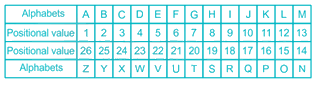 The logic followed here is:
.
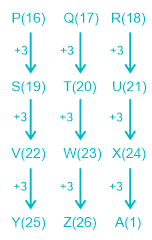 Hence, the correct answer is "Option 3".
Q2 · Series
Select the letters from among the given options that can replace the question mark (?) in the following series.
K, M, O, ?, S, U, ?, Y
- Q, X
- Q, W
- P, W
- R, W
Answer aur solution dekho
Archived marked answer: B
The logic followed here is:
 Hence, the correct answer is "Option 2".
Q3 · Series
Select the letter-cluster from among the given options that can replace the question mark (?) in the following series:
RBEH, RGOW, RLYL, RQIA, ?
- RVSP
- RVSH
- RVHS
- RSVP
Answer aur solution dekho
Archived marked answer: A
The logic followed here is:
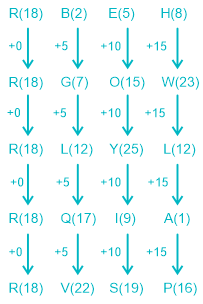 Hence, the correct answer is "Option 1".
Q4 · Series
Select the letter-cluster from among the given options that can replace the question mark (?) in the following series.
YMW, VJT, SGQ, PDN, ?
- TYD
- HGF
- MJH
- MAK
Answer aur solution dekho
Archived marked answer: D
The logic followed here is:
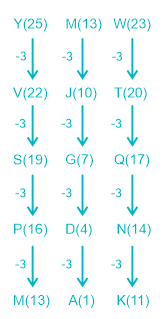 Hence, the correct answer is "Option 4".
Q5 · Series
Select the letter-cluster from among the given options that can replace the question mark (?) in the following series:
CDEF, CKSA, CRGV, CYUQ, ?
- CEHK
- CFHK
- CFHL
- CFIL
Answer aur solution dekho
Archived marked answer: D
The logic followed here is:
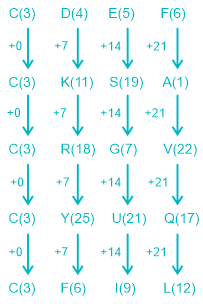 Hence, the correct answer is "Option 4".
Q6 · Series
Complete the pattern: 120, 96, 76.8, 61.44, ?
- 60.27
- 78.91
- 47.89
- 49.152
Answer aur solution dekho
Archived marked answer: D
The logic followed here is:
Each number is multiplied by 0.8.
120 × 0.8 = 96
96 × 0.8 = 76.8
76.8 × 0.8 = 61.44
61.44 × 0.8 = 49.152
Hence, the correct answer is Option 4.
Q7 · Analogy
Find the best option that best completes the analogy.
CAB : EDF :: GIH : ?
- JKL
- KJI
- ILL
- JLI
Answer aur solution dekho
Archived marked answer: C
The logic followed here is:
CAB : EDF Q8 · Analogy
Find the option that best completes the analogy.
DP : XZ :: EN : ?
- YZ
- YB
- ZB
- YX
Answer aur solution dekho
Archived marked answer: D
The logic followed here is:
DP : XZ
D (4) + 20 = X (24)
P (16) + 10 = Z (26)
Similarly,
EN : ?
E (5) + 20 = Y (25)
N (14) + 10 = X (24)
Hence, the correct answer is Option 4. Q9 · Analogy
In each of the following questions, a specific rearrangement pattern is applied to the first word to form the second. Identify the same pattern and apply it to the third word to determine the correct answer from the given alternatives. AROUND : RAUODN :: GROUND : ?
- RGUODN
- NDOOGR
- OUNDGR
- DNUURG
Answer aur solution dekho
Archived marked answer: A
The logic followed here is:
AROUND : RAUODN Q10 · Analogy
In each of the following questions, the second group of letters is formed from the first using a specific alphabetical transformation. Apply the same pattern to the third group and find the correct option that completes the analogy. QDXM : SFYN :: UIOZ : ?
- PAQM
- LPWA
- QNLA
- WKPA
Answer aur solution dekho
Archived marked answer: D
The logic followed here is:
QDXM : SFYN
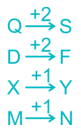 UIOZ : ?
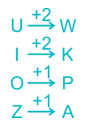 Hence, the correct answer is Option 4.
Q11 · Analogy
In the following question, select the related word from the given alternatives.
Architect : Design :: Chef : ?
- Cook
- Serve
- Recipe
- Food
Answer aur solution dekho
Archived marked answer: A
The logic followed here is:
Logic: The first word is the Profession and the second word is the Work done by that profession.
Architect : Design → An Architect designs.
Chef : Cook → A Chef cooks.
Hence, the correct answer is Option 1.
Q12 · Analogy
In the following question, select the related word from the given alternatives
Utilitarianism : Consequence :: Deontology : ?
- Virtue
- Duty
- Intention
- Value
Answer aur solution dekho
Archived marked answer: B
The logic followed here is:
Logic: The first word represents an Ethical Theory and the second word represents its Main Principle.
Utilitarianism : Consequence →
Q13 · Puzzle Subtypes Not To Miss
If 'X' means '+', 'Y' means '-', 'Z' means 'x', and 'W' means '÷'
what is the value of the following expression?
15 W 3 X 2 Y 4=?
- 1
- 3
- 5
- 7
Answer aur solution dekho
Archived marked answer: B
Decoding signs:
Sign
X
Y
Z
W
Stands For
+
×
÷
Given: 15 W 3 X 2 Y 4=?
15 W 3 X 2 Y 4=? ⇒ 15 ÷ 3 + 2 - 4=?
⇒ 15 __÷__ 3 + 2 - 4=?
⇒ 5____ + 2 - 4=?
⇒ 7 - 4=?
⇒ 3 = ?
Hence, "Option 2" is the correct answer.
Q14 · Puzzle Subtypes Not To Miss
If '+' means '-', '-' means '+', 'x' means '÷', then 50 + 10 - 5 × 5 = ?
- 41
- 60
- 65
- 70
Answer aur solution dekho
Archived marked answer: A
Decoding signs:
Sign
+
x
Stands For
+
÷
Given: 50 + 10 - 5 × 5 = ?
50 + 10 - 5 × 5 = ? ⇒ 50 - 10 + 5 ÷ 5 = ?
⇒ 50 - 10 + 5 __÷__ 5 = ?
⇒ 50 + 1 - 10 = ?
⇒ 51 - 10 = ?
⇒ 41 = ?
Hence, "Option 1" is the correct answer.
Q15 · Classification Odd One Out
Choose the odd one:
- Mon Feb 04 2008 00:00:00 GMT+0530 (India Standard Time)
- Tue Mar 09 2027 00:00:00 GMT+0530 (India Standard Time)
- Fri May 25 0125 00:00:00 GMT+0553 (India Standard Time)
- Thu Apr 16 1936 00:00:00 GMT+0530 (India Standard Time)
Answer aur solution dekho
Archived marked answer: C
The logic followed here is:
1) Mon Feb 04 2008 00:00:00 GMT+0530 – Modern date, standard GMT offset.
2) Tue Mar 09 2027 00:00:00 GMT+0530 – Future date, standard GMT offset.
3) Fri May 25 0125 00:00:00 GMT+0553 – Ancient year (0125), unusual GMT offset (+0553), not standard.
4) Thu Apr 16 1936 00:00:00 GMT+0530 – Historical, but normal GMT offset (+0530).
Year is very old (0125)
GMT offset is non-standard (+0553)
Hence, the odd one is Option 3.
Q16 · Classification Odd One Out
In each of the following questions, a group of three numbers/symbols is given in each option. Identify the group that does NOT follow the same pattern as the others.
- M13 : J10 : G7
- Z26 : W23 : T20
- D4 : A1 : X24
- H8 : E6 : B4
Answer aur solution dekho
Archived marked answer: D
The logic followed here is:
Option 1) M13 : J10 : G7
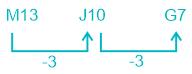 Option 2) Z26 : W23 : T20
Q17 · Classification Odd One Out
In each of the following questions, a group of three numbers/symbols is given in each option. Identify the group that does NOT follow the same pattern as the others.
- Z1$ : Y2# : X3@
- W4% : V5^ : U6&
- T7* : S8( : R9)
- Q10$ : P11$ : O12$
Answer aur solution dekho
Archived marked answer: D
The logic followed here is:
Z1$ : Y2# : X3@ → Letters decrease by 1, numbers increase by 1, symbols change
W4% : V5^ : U6& → Letters decrease by 1, numbers increase by 1, symbols change
T7* : S8( : R9) → Letters decrease by 1, numbers increase by 1, symbols change
Q10$ : P11$ : O12$ → Letters decrease by 1, numbers increase by 1, symbols do not change
Hence, the correct answer is Option 4. Q18 · Blood Relations
B is the daughter of A. C is the husband of B. D is the son of C. How is A related to D?
- Father
- Grandfather
- Grandmother
- Cannot be determined
Answer aur solution dekho
Archived marked answer: D
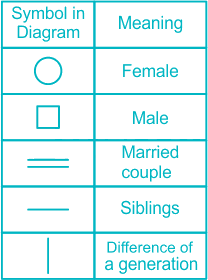 Given:
1) B is the daughter of A.
2) C is the husband of B.
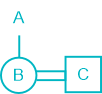 3) D is the son of C.
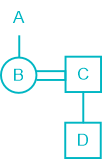 As the A's gender is not known yet, therefore A's relation with D cannot be determined.
Hence, the correct option is Option 4.
Q19 · Blood Relations
A's father's wife's only daughter is B. How is A related to B?
- Nephew
- Cousin
- Sibling
- Uncle
Answer aur solution dekho
Archived marked answer: C
Given: A's father's wife's only daughter is B.
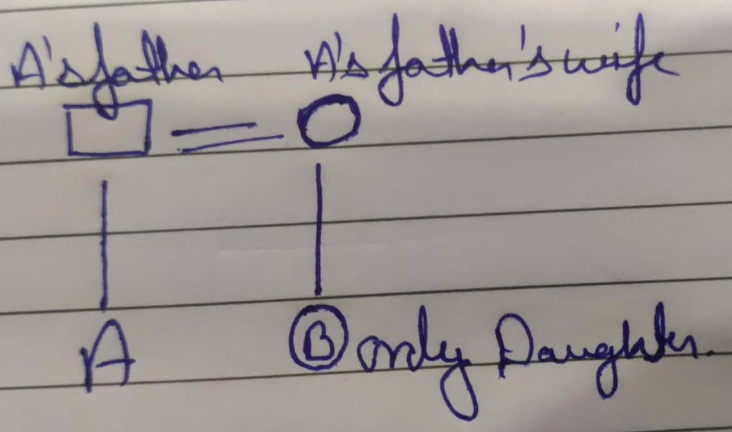
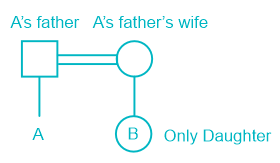 A is the sibling of B
Hence, the correct option is Option 3.
Q20 · Blood Relations
A is the wife of B. B is the brother of C. C is the father of D. How is A related to D?
- Aunt
- Mother
- Sister-in-law
- Grandmother
Answer aur solution dekho
Archived marked answer: A
Given:
1) A is the wife of B.
2) B is the brother of C.
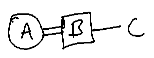
 3) C is the father of D.
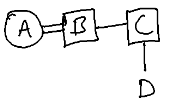
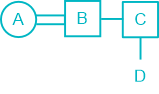 Thus, A is D's aunt.
Hence, the correct answer is "Option 1".
Q21 · Blood Relations
Introducing a boy, a girl says, "He is the son of my mother's only son." Who is the boy to the girl?
- Brother
- Son
- Nephew
- Cousin
Answer aur solution dekho
Archived marked answer: C
From the given information
Given: Introducing a boy, a girl says, "He is the son of my mother's only son." Q22 · Alphabet Test
Each of the letters in the word CONTRAST is arranged in alphabetical order. How many letters are there in the English alphabetical series between the letter that is first from the left and the one that is fifth from the right in the new letter-cluster formed?
- 10
- 13
- 15
- 11
Answer aur solution dekho
Archived marked answer: B
The given word: CONTRAST
A
C
N
O
R
S
T
T
Q23 · Similarity and Differences
Which of the following addresses are identical to each other:
1. S. Iyer 17-D, Coral Residency, Thiruvananthapuram , 695014
2. S. Iyer 17-D, Coral Residency, Thiruvananthapuram , 695014
3. S. Iyer 17-D Coral Residency, Thiruvananthapuram , 695014
4. S. Iyer 17-D Coral Residency, Thiruvananthapuram , 695013
- 1 and 2
- 1 and 3
- 2 and 4
- 3 and 4
Answer aur solution dekho
Archived marked answer: A
Given address:
Address No.
Address
Observation
1
S. Iyer 17-D, Coral Residency, Thiruvananthapuram , 695014
Exactly matches Address 2.
2
S. Iyer 17-D, Coral Residency, Thiruvananthapuram , 695014
Exactly matches Address 1.
3
S. Iyer 17-D Coral Residency, Thiruvananthapuram , 695014
Comma missing after 17-D.
4
S. Iyer 17-D Coral Residency, Thiruvananthapuram , 695013
Comma missing after 17-D and PIN code is 695013 instead of 695014.
Thus, addresses 1 and 2 are exactly identical to each other.
Hence, the correct answer is "Option (1)".
Q24 · Similarity and Differences
Which of the following is/are identical to the address given:
Sunil Kumar 21/4, Ashok Vihar, Delhi, 110052
1. Sunil Kumar 21/4, Ashok Vihar, Delhi, 1100522
2. Sunil Kumar 21/4, Ashok Vihar, Delhi, 110052
3. Sunil Kumar 21/4, Ashok Vihar, New Delhi, 110052
4. Sunil Kumar 21/4, Ashok Vihar, Delhi, 110053
- 1 Only
- 3 Only
- 2 Only
- 4 Only
Answer aur solution dekho
Archived marked answer: C
The address given in the problem is,
Sunil Kumar
21/4, Ashok Vihar
Delhi, 110052
Let's compare each option with the given address.
Option
Address in Option
Matching
(1)
Sunil Kumar 21/4, Ashok Vihar, Delhi, 1100522
Q25 · Seating Arrangement
Ten persons are sitting in two parallel rows containing five persons each, such that there is an equal distance between adjacent persons.
Line 1: Five men (A-E) are seated and all of them are facing South.
Line 2: Five women (M-Q) are seated and all of them are facing North.
Based on the arrangement, answer the question:
D is opposite to M.
M is at one of the extreme ends of Line 2.
O is at the center position of Line 2.
Who is second to the right of M in Line 2 (facing North)?
- O
- M
- A
- N
Answer aur solution dekho
Archived marked answer: A
Given: Ten persons are sitting in two parallel rows containing five persons each, such that there is an equal distance between adjacent persons.
Line 1: Five men (A–E) are seated and all of them are facing South.
Line 2: Five women (M–Q) are seated and all of them are facing North.
1) D is opposite to M.
2) M is at one of the extreme ends of Line 2.
3) O is at the center position of Line 2.
there are 2 possibilty
Case 1) M is extreme left end
General Awareness
Q1 · Art and Culture
What is the term for a structured musical composition in Hindustani classical music?
- Kriti
- Bandish
- Gamaka
- Rasa
Answer aur solution dekho
Archived marked answer: B
The correct answer is Bandish.
Key Points
- A Bandish is a fixed, melodic composition in Hindustani classical music, often set to a specific raga and taal.
- It serves as the foundation for improvisation and is typically performed in a specific rhythmic cycle, such as Teentaal or Ektaal.
- Bandish is composed of two main parts: the Sthayi (the initial part) and the Antara (the second part), which explore the raga's characteristics.
- It is usually written in a specific language, such as Hindi, Urdu, Braj Bhasha, or Sanskrit, and often has devotional or romantic themes.
- Bandishes are an integral part of the Gharana system, with each Gharana having its unique repertoire of compositions.
Additional Information
- Kriti
- A Kriti is a structured composition in Carnatic classical music, not Hindustani music.
- It consists of three main sections: Pallavi (opening), Anupallavi (middle section), and Charanam (ending).
- Kritis often emphasize devotional themes and are composed in South Indian languages like Tamil, Telugu, or Kannada.
- Famous Carnatic composers like Tyagaraja, Muthuswami Dikshitar, and Syama Sastri are known for their kritis.
- Gamaka
- Gamaka refers to the ornamentation or embellishment of notes in Indian classical music.
- It involves techniques such as oscillation, slides, and bends to bring out the essence of a raga.
- Gamaka is not a composition but a stylistic element used during performance.
- It varies in execution between Hindustani and Carnatic music styles.
- Rasa
- Rasa refers to the aesthetic or emotional experience evoked in the listener by a musical performance.
- Indian classical music often aims to evoke specific rasas, such as joy (Hasya), sorrow (Karuna), or peace (Shanta).
- It is a broader concept rooted in Indian aesthetics and applies to various art forms, including dance and drama.
Q2 · Art and Culture
Thang-Ta is a traditional martial dance associated with which northeastern state of India?
- Assam
- Nagaland
- Manipur
- Tripura
Answer aur solution dekho
Archived marked answer: C
The correct answer is Manipur.
Key Points
- Thang-Ta is a traditional martial art dance form originating from Manipur, a northeastern state of India.
- It is an integral part of the Manipuri martial arts system known as Huyen Langlon, which combines armed and unarmed combat techniques.
- The term Thang-Ta is derived from the Manipuri words "Thang" (sword) and "Ta" (spear), symbolizing the weapons used in this martial art.
- This martial art was historically practiced by the Meitei warriors for self-defense and warfare.
- Thang-Ta also has a spiritual dimension and is performed as a dance-drama to depict the valor and heroism of Manipuri warriors.
- The art form has evolved into a cultural performance and is now showcased at various festivals and events to preserve its traditional heritage.
Additional Information
- Assam
- Assam is known for its classical dance form called Sattriya, which was introduced by the Vaishnavite saint Srimanta Sankardev.
- Sattriya is a blend of dance, drama, and music and is performed in monasteries called "Satras."
- The state is also famous for Bihu dance, a joyous folk dance performed during the Bihu festival.
- Nagaland
- Nagaland is renowned for its rich tribal culture, and the Naga warrior dances are an important tradition.
- The dances reflect the bravery and unity of different Naga tribes, often performed during festivals like Hornbill Festival.
- The tribes of Nagaland use vibrant costumes and rhythmic steps to celebrate their heritage.
- Tripura
- Tripura is home to the famous tribal dance called Hojagiri, performed by the Reang community.
- Hojagiri involves intricate balancing acts and is performed by women, showcasing their skill and grace.
- The dance is an integral part of Tripura's culture and is performed during the Hojagiri Festival.
Q3 · Art and Culture
Which of the following statements about the Chithirai Festival of Madurai is correct?
- The Chithirai Festival is celebrated in the tamil month of Margazhi
- Lord Kallazhagar arrives on a golden horse
- The festival is held exclusively in December
- The festival ends with a game of bullfight
Answer aur solution dekho
Archived marked answer: B
The correct answer is Lord Kallazhagar arrives on a golden horse.
Key Points
- The Chithirai Festival is one of the most famous festivals of Tamil Nadu, celebrated annually in Madurai during the Tamil month of Chithirai (April-May).
- The festival reenacts the celestial wedding of Goddess Meenakshi (an avatar of Parvati) and Lord Sundareswarar (an avatar of Shiva).
- A significant highlight of the festival is the arrival of Lord Kallazhagar (an avatar of Vishnu) to the Vaigai River on a golden horse to bless the wedding of his sister Meenakshi.
- Lord Kallazhagar's journey from his temple in Alagar Kovil to Madurai is celebrated with great fervor and devotion, drawing thousands of devotees.
- The event symbolizes the unity of the Shaivite (followers of Shiva) and Vaishnavite (followers of Vishnu) traditions in Tamil culture.
Additional Information
- Major Festivals
- Pongal: A four-day harvest festival giving thanks to the Sun God, featuring traditional cooking, cattle worship, and the famous Jallikattu bull sport in Madurai.
- Puthandu (Tamil New Year): Celebrated in mid-April (Chittirai month) with traditional customs and feasts.
- Thaipusam: Devotees carry milk pots to temples for Lord Murugan (Kartikeya).
- Karthigai Deepam: A ten-day festival marked by new clothes, gifts, and temple celebrations, with large lamps lit.
- Diwali (Deepavali): The festival of lights, celebrated with lamps, sweets, and family gatherings.
Q4 · Indian Polity and Constitution
Which of the following correctly reflects the legal implication of Article 255 regarding presidential or governor's assent to bills?
- State law is void without written Governor assent.
- Mention of assent is mandatory for validity.
- Omission of prior recommendation doesn't invalidate law if assent is given.
- President's assent must precede legislative passage to be valid.
Answer aur solution dekho
Archived marked answer: C
The correct answer is Omission of prior recommendation doesn't invalidate law if assent is given.
Key Points
- Article 255 of the Indian Constitution states that the absence of prior recommendation or sanction required by the Constitution does not invalidate a law if it has received the assent of the President or the Governor.
- The provision ensures that minor procedural lapses do not obstruct the legislative process, provided the bill has been duly assented to.
- For example, even if a recommendation from the President or Governor is not obtained at the time of introducing a bill, the law remains valid if subsequent assent is granted.
- This article upholds the principle of legislative supremacy by ensuring that procedural errors do not nullify valid legislative acts.
- It applies to both state and central legislation, ensuring uniformity in the treatment of procedural lapses related to assent.
Additional Information
- Constitutional Articles (Part VI, Chapter II)
- Article 153: Establishes the office of the Governor for each state (one person can be Governor for two or more states).
- Article 154: Vests the executive power of the state in the Governor.
- Article 155: Appointment by the President (warrant under hand and seal).
- Article 156: Term of office (holds office during President's pleasure).
- Article 157: Qualifications for appointment (Citizen of India, 35 years old).
- Article 163: Council of Ministers to aid and advise the Governor (except in discretionary matters).
- Article 164: Other provisions as to Ministers (appointment, responsibility to the Assembly).
Q5 · Indian Polity and Constitution
Read the following statements regarding K. Sanjay Murthy's recent appointment as Comptroller and Auditor General (CAG) of India:
1. He took office as the CAG in November 2024 after the term of Girish Chandra Murmu.
2. The CAG is a constitutional office, which is appointed by the President under Article 148 of the Indian Constitution.
3. The CAG's term is only five years and cannot be repeated. Which of the above is/are correct?
- 1 and 2 only
- 2 and 3 only
- 1 and 3 only
- 1, 2 and 3 all are correct
Answer aur solution dekho
Archived marked answer: A
The correct answer is Option 1) 1 and 2 only.
Key Points
- K. Sanjay Murthy has not been appointed as Comptroller and Auditor General (CAG) of India as of October 2023. The question contains an incorrect timeline for the assumed appointment in November 2024.
- The CAG is a constitutional authority and is appointed by the President of India as per Article 148 of the Indian Constitution.
- The CAG is responsible for auditing the accounts of the Union and State governments and public sector organizations to ensure accountability.
- The term of the CAG is six years, or until the age of 65, whichever is earlier, as per the Constitution. There is no restriction on repeat appointments.
- Statement 1 is incorrect, as it refers to a fictional event, while Statement 2 is correct regarding the constitutional provisions of the CAG’s appointment.
Additional Information
- Role of the CAG:
- The CAG audits all receipts and expenditure of the Government of India and the state governments, including those of bodies and authorities substantially financed by the government.
- The CAG reports are laid before the Parliament and state legislatures, ensuring transparency and accountability in public finances.
- The CAG plays a key role in ensuring financial discipline and adherence to financial rules and regulations.
- Constitutional Provisions:
- Article 148 of the Indian Constitution provides for the establishment of the CAG as an independent authority.
- The CAG is considered the guardian of the public purse and serves as a critical institution for democracy.
Q6 · Indian Polity and Constitution
The Bharatiya Sakshya Adhiniyam(BSA) aims to align Indian evidence law with advancements in:
- Forensic science and digital technology
- Traditional agricultural practices
- Ancient philosophical texts
- Oral storytelling traditions
Answer aur solution dekho
Archived marked answer: A
The correct answer is Forensic science and digital technology.
Key Points
- The Bharatiya Sakshya Adhiniyam (Indian Evidence Act) aims to modernize evidence laws by incorporating advancements in forensic science and digital technology.
- The amendments address the increasing reliance on digital evidence, such as electronic records, emails, social media posts, and CCTV footage, in legal proceedings.
- Forensic science advancements, including DNA profiling, fingerprint analysis, and other scientific methods, are being integrated to ensure the reliability and accuracy of evidence.
- The Act seeks to align Indian legal practices with global standards by focusing on scientific evidence and digital tools to improve the justice delivery system.
- The government aims to combat cybercrime, fraud, and other crimes effectively through the use of advanced forensic and digital technologies.
Additional Information
- The Bharatiya Sakshya Adhiniyam focuses on modernizing legal evidence practices by adopting scientific and technological advancements.
- It aims to strengthen the credibility of legal evidence by integrating forensic science and digital technology into the Indian judicial system.
- This modernization is crucial for addressing contemporary challenges like cybercrime, fraud, and the growing reliance on digital data.
Q7 · Indian Polity and Constitution
Consider the following statements regarding BRICS Science, Technology and Innovation (STI) cooperation:
1) It is based on mutual benefit and public-good-driven innovation.
2) It is governed only through annual Heads of State Summits. Which of the statements is/are correct?
- Only 1 is correct
- Only 2 is correct
- Both 1 and 2 are correct
- Neither 1 nor 2 is correct
Answer aur solution dekho
Archived marked answer: A
The correct answer is Option 1.
Key Points
- BRICS Science, Technology and Innovation (STI) cooperation is established on the foundation of mutual benefit, public-good-driven innovation, and sustainable development.
- The cooperation framework is designed to address common challenges faced by BRICS nations, such as energy security, healthcare, and climate change, while promoting inclusive growth.
- It is not solely governed through annual Heads of State Summits but includes several ministerial meetings, working groups, and collaborative initiatives to ensure effective coordination and implementation.
- BRICS STI cooperation emphasizes joint research projects, knowledge sharing, and capacity building among member nations: Brazil, Russia, India, China, and South Africa.
- This initiative fosters collaboration in areas like technology transfer, innovation policy exchange, and the development of advanced technologies.
Additional Information
- Statement 2: It is governed only through annual Heads of State Summits
- This statement is incorrect as BRICS STI cooperation is not limited to annual Heads of State Summits.
- The framework involves various mechanisms, including ministerial-level meetings, expert-level working groups, and joint initiatives in STI fields.
- Moreover, the BRICS STI Steering Committee plays a significant role in formulating strategies and monitoring progress.
- About BRICS STI Cooperation
- The initiative was launched to enhance collaboration between BRICS nations in science, technology, and innovation to solve global and regional challenges.
- Key focus areas include energy, climate change, water resources, biotechnology, and information and communication technologies (ICTs).
- The BRICS Young Scientist Forum (YSF) is an integral part of this cooperation, aiming to foster the exchange of knowledge among young researchers.
- BRICS STI Framework Program promotes joint multilateral research and development (R&D) projects in priority areas of mutual interest.
Q8 · Indian Polity and Constitution
The President is elected by an electoral college, while the Governor is _______.
- Directly elected
- Appointed by the President
- Nominated by Supreme Court
- Chosen by State Assembly
Answer aur solution dekho
Archived marked answer: B
The correct answer is Appointed by the President.
Key Points
- The Governor of a state in India is appointed by the President of India under Article 155 of the Indian Constitution.
- The Governor acts as the nominal head of the state, while the real executive powers lie with the Chief Minister and the Council of Ministers.
- The Governor serves a term of 5 years, but they hold office at the pleasure of the President, meaning they can be removed earlier.
- The appointment process ensures that the Governor is a representative of the central government in the state and maintains coordination between the center and state.
- The role of the Governor includes duties such as granting assent to bills, appointing the Chief Minister, and overseeing the formation of the state government after elections.
Additional Information
- Key Appointments by the President:
- Prime Minister (PM) & Council of Ministers: Appoints the PM (usually leader of the majority in Lok Sabha) and other ministers on the PM's advice.
- Judiciary: Chief Justice of India, Supreme Court Judges, and High Court Judges (on consultation).
- Election Commission: Chief Election Commissioner and other Commissioners.
- Union Public Service Commission (UPSC): Chairman and Members.
- Attorney General of India: The government's chief legal advisor.
- Comptroller and Auditor General (CAG): Guardian of public finances.
- Governors: Appointed for each state.
- Administrators: For Union Territories.
- National Commissions: Chairpersons & members for Scheduled Castes, Scheduled Tribes, Minorities, etc.
Q9 · Indian Polity and Constitution
Consider the following statements:
1. The Governor can dissolve the State Legislative Assembly.
2. The President has no such power regarding the Lok Sabha. Which of the above is/are correct?
- Only 1
- Only 2
- Both 1 and 2
- Neither 1 nor 2
Answer aur solution dekho
Archived marked answer: A
The correct answer is Option 1: Only 1.
Key Points
- The Governor of a state has the constitutional authority to dissolve the State Legislative Assembly under Article 174(2)(b) of the Indian Constitution, usually on the advice of the Chief Minister or in certain circumstances like a no-confidence motion.
- The President of India, on the other hand, has the power to dissolve the Lok Sabha under Article 85(2)(b) of the Indian Constitution. Therefore, Statement 2 is incorrect.
- The dissolution of the State Legislative Assembly is an executive action of the Governor and is generally done to pave the way for fresh elections.
- The President's power to dissolve the Lok Sabha is exercised on the advice of the Council of Ministers headed by the Prime Minister.
- Thus, only Statement 1 is correct, as the Governor has the power to dissolve the State Legislative Assembly.
Additional Information
- Governor's Role and Powers:
- The Governor is the constitutional head of the state and acts on the advice of the state's Chief Minister and Council of Ministers.
- The Governor can summon, prorogue, or dissolve the State Legislative Assembly under Article 174 of the Constitution.
- In extraordinary circumstances (e.g., no-confidence motion passed), the Governor can dissolve the assembly without the advice of the Chief Minister, but this is subject to judicial review.
- President's Power to Dissolve Lok Sabha:
- The President of India can dissolve the Lok Sabha under Article 85(2)(b) of the Constitution.
- This power is exercised on the advice of the Prime Minister and the Council of Ministers.
- The dissolution of the Lok Sabha paves the way for general elections in the country.
- Difference Between Dissolution and Prorogation:
- Dissolution: Refers to the complete termination of the current House of Parliament or State Legislative Assembly. It necessitates fresh elections.
- Prorogation: Refers to the termination of a session of the House without dissolving it. It simply ends the proceedings for the session.
Q10 · Indian Economy
Which of the following industry pairs is correctly grouped as heavy industries?
- Sewing machines and Paint brushes
- Shipbuilding and Automobile
- Electric bulbs and Fuse wires
- Watches and Paint brushes
Answer aur solution dekho
Archived marked answer: B
The correct answer is Shipbuilding and Automobile.
Key Points
- Heavy industries are characterized by the production of large-scale goods or machinery requiring significant capital investment, energy, and raw materials.
- Shipbuilding and Automobile industries are correctly classified as heavy industries due to their large-scale operations, heavy machinery usage, and production of durable goods.
- Shipbuilding involves the construction of ships and other sea vessels, requiring extensive infrastructure, labor, and advanced engineering techniques.
- The automobile industry focuses on manufacturing vehicles, which involves complex processes such as designing, assembling, and testing heavy machinery and components.
- Both industries significantly contribute to the economic development and infrastructure of a nation, providing employment opportunities and driving technological advancements.
Additional Information
- Major Industry Sectors in India
- Primary Sector (Extraction & Agriculture)
- Agriculture & Allied: Food processing, dairy, fishing, forestry, horticulture.
- Mining & Minerals: Coal, iron ore, steel, cement, oil & gas.
- Secondary Sector (Manufacturing & Construction)
- Manufacturing: Automotive, textiles, electronics, pharmaceuticals, chemicals, engineering goods.
- Construction: Real estate, infrastructure (roads, ports).
- Tertiary Sector (Services)
- IT & BPM: Software services, IT outsourcing, tech consulting.
- Financial Services: Banking, insurance, FinTech, NBFCs.
- Healthcare & Education: Hospitals, medical devices, training.
- FMCG: Fast-moving consumer goods (food, personal care).
- Telecom & Media: Mobile networks, digital content.
- Tourism & Hospitality: Hotels, travel, aviation.
Q11 · Indian Economy
Assertion (A) and Reason (R) are given below. Choose the correct option:
Assertion (A): Population growth can be measured in absolute numbers and percentage change per year.
Reason (R): Measuring growth only in absolute numbers provides detailed insights into population trends over time.
- Both A and R are true, and R is the correct explanation of A
- Both A and R are true, but R is not the correct explanation of A
- A is true, but R is false
- A is false, but R is true
Answer aur solution dekho
Archived marked answer: C
The correct answer is Option 3: A is true, but R is false.
Key Points
- Assertion (A): Population growth can be measured in absolute numbers and percentage change per year.
- This statement is correct as population growth is commonly assessed using both absolute numbers (total increase in population) and percentage change (growth rate relative to the total population).
- Absolute numbers give the actual increase in population size, while percentage change provides a standardized measure to compare growth rates across regions or time periods.
- Reason (R): Measuring growth only in absolute numbers provides detailed insights into population trends over time.
- This statement is incorrect because measuring growth only in absolute numbers does not provide a complete or detailed picture of population trends. For example, it does not account for variations in population size or growth rates across regions or timeframes.
- Therefore, while the assertion is true, the reason does not correctly explain it, making Option 3 the correct answer.
Additional Information
- Population Growth Measurement
- Population growth can be influenced by factors such as birth rate, death rate, immigration, and emigration.
- Absolute numbers are useful for understanding the total increase in population size but do not account for population distribution or density.
- Percentage change provides a relative measure, enabling comparison across regions or time periods.
Q12 · Indian Economy
As per Article 279A of the Indian Constitution, the GST Council's decisions require what kind of majority of the weighted votes of the members present and voting?
- Simple majority
- Three-fourths majority
- Two-thirds majority
- Half majority
Answer aur solution dekho
Archived marked answer: B
The correct answer is Three-fourths majority.
Key Points
- Article 279A of the Indian Constitution establishes the Goods and Services Tax (GST) Council, responsible for making recommendations to the Union and State governments on key GST issues.
- Decisions of the GST Council require a three-fourths majority of the weighted votes of the members present and voting.
- The voting weightage is split between the Union Government and State Governments—one-third of the total votes are allocated to the Union Government, and two-thirds to the State Governments.
- A quorum of at least 50% of the total members of the GST Council is required to conduct a meeting, ensuring sufficient representation for decision-making.
- The GST Council’s decisions are pivotal in determining tax rates, exemptions, thresholds, and other GST-related matters, fostering cooperative federalism in India.
Additional Information
- Simple majority
- A simple majority refers to a decision being passed if more than 50% of the members present and voting approve it.
- Many parliamentary decisions in India, such as passing ordinary bills, require a simple majority.
- However, the GST Council requires a higher threshold to ensure wider consensus among members.
- Two-thirds majority
- A two-thirds majority is required for certain critical decisions, such as constitutional amendments (under Article 368 of the Indian Constitution).
- This majority ensures a larger agreement among members for significant changes to the legal framework.
- However, GST Council decisions require an even higher threshold of three-fourths majority.
- GST Council
- The GST Council is a constitutional body formed under Article 279A to create a unified tax structure for India.
- It comprises the Union Finance Minister as the Chairperson, the Union Minister of State for Revenue, and representatives from all states and union territories.
- It plays a crucial role in promoting cooperative federalism by ensuring participation from both the central and state governments in tax-related decisions.
Q13 · Sports Static GK
Who broke the 30-year-old Asian Games men's 5,000m meet record in National Open Athletics Championships 2024?
- Bahadur Singh
- Gulveer Singh
- Neeraj Chopra
- Hima Das
Answer aur solution dekho
Archived marked answer: B
The correct answer is Gulveer Singh.
Key Points
- Gulveer Singh broke the 30-year-old Asian Games men's 5,000m meet record during the National Open Athletics Championships in 2024.
- He clocked an impressive time, surpassing all previous records set in the Asian Games men's 5,000m event.
- Gulveer Singh is recognized as one of India's emerging long-distance runners, gaining accolades for his performance in national and international events.
- The record-breaking achievement highlights India's growing prominence in athletics, especially in long-distance running.
- His performance has placed him among the ranks of elite Indian athletes contributing to the nation's success in global athletics.
Additional Information
- Bahadur Singh:
- Bahadur Singh is a renowned former Indian shot putter who represented India in multiple international events, including the Olympics.
- He held national records in shot put for several years and was a pivotal figure in Indian athletics during his active years.
- While he excelled in field events, he is not associated with long-distance running or the 5,000m event.
- Neeraj Chopra:
- Neeraj Chopra is India's iconic javelin thrower, known for winning gold medals at the Olympics and Asian Games.
- He became the first Indian to win an Olympic gold medal in athletics during the Tokyo 2020 Olympics.
- Although he is highly celebrated in throwing events, he does not compete in the 5,000m race.
- Hima Das:
- Hima Das is an Indian sprinter popularly known as the "Dhing Express" for her achievements in short-distance running.
- She specializes in 400m and 200m events and has won numerous medals in international competitions.
- Her expertise lies in sprinting, not long-distance events like the 5,000m race.
- Asian Games Men's 5,000m Event:
- The Asian Games men's 5,000m is a long-distance track event that tests endurance, strategy, and speed.
- It has historically seen records set by athletes from various nations, showcasing their athletic prowess.
- Breaking a 30-year-old record signifies immense skill, dedication, and training, marking the athlete's place in history.
</ul
Q14 · Sports Static GK
Consider the following statements regarding belt ranks and competition area in Judo:
1) A red-and-white belt is associated with judokas from Sixth dan to Eighth dan levels.
2) A shared safety zone of at least 1 meter must be maintained between adjoining competition areas. Which of the above statements is/are correct?
- Only 1 is Correct
- Only 2 is Correct
- 1 and 2 both are correct
- Neither 1 nor 2 is Correct
Answer aur solution dekho
Archived marked answer: C
The correct answer is Option 3 (1 and 2 both are correct).
Key Points
- Statement 1: A red-and-white belt is associated with judokas from Sixth dan to Eighth dan levels in Judo. This is correct as per the International Judo Federation (IJF) guidelines.
- In Judo, dan ranks represent levels of mastery beyond the black belt. The red-and-white belt is traditionally worn by practitioners holding the Sixth, Seventh, and Eighth dan ranks.
- Statement 2: A shared safety zone of at least 1 meter must be maintained between adjoining competition areas. This is accurate and aligns with IJF competition rules, ensuring the safety of participants.
- The competition area in Judo is surrounded by a safety zone to prevent injuries. The minimum 1-meter shared safety zone between competition areas is essential to avoid accidental collisions during matches.
- Both statements are correct as they align with the official rules and traditions of Judo established by governing bodies like the IJF.
Additional Information
- Dan Ranks and Belt Colours in Judo:
- Dan ranks in Judo signify the level of expertise and experience of a judoka (practitioner).
- Black belts are awarded for the first five dan ranks. For Sixth, Seventh, and Eighth dan ranks, a red-and-white belt is worn as a mark of distinction.
- For Ninth and Tenth dan ranks, a solid red belt is worn, representing the highest levels of accomplishment in Judo.
- Judo:
- Judo is a martial art and Olympic sport that focuses on throws, joint locks, and grappling techniques.
- It was founded in 1882 by Jigoro Kano in Japan and is based on principles of mutual benefit and maximum efficiency.
- Competitions follow strict rules to ensure fairness and athlete safety, including regulations on scoring, prohibited techniques, and equipment.
Q15 · Sports Static GK
Fill in the blank:
The inaugural Khelo India Para Games took place in _____, showcasing seven sporting disciplines across three venues in New Delhi.
- Mar 2024
- Jan 2023
- Dec 2023
- Mar 2025
Answer aur solution dekho
Archived marked answer: C
The correct answer is Dec 2023.
Key Points
- The inaugural Khelo India Para Games were held from December 2 to December 6, 2023, in New Delhi, India.
- The event was organized to promote inclusivity and provide a platform for para-athletes to showcase their talent.
- Seven sporting disciplines were featured, highlighting the government’s commitment to promoting sports among persons with disabilities (PwDs).
- The event took place at three venues in New Delhi, including Jawaharlal Nehru Stadium and others.
- The Khelo India initiative aims to promote grassroots sports and encourage young athletes to participate in national and international events.
Additional Information
- Khelo India Initiative:
- The Khelo India program is a flagship initiative by the Ministry of Youth Affairs and Sports, Government of India, aimed at promoting sports and fitness among youth.
- It includes various events like the Khelo India Youth Games, Khelo India University Games, and Khelo India Para Games.
- The initiative also provides financial assistance to athletes, infrastructure development, and training programs to nurture sports talent in the country.
Q16 · Current Affairs
The Global Gender Gap Report primarily measures disparities between genders in which key areas?
- Politics, Economy, Health, Education
- Income, Wealth, Land, Technology
- Crime, Law, Justice, Security
- Environment, Climate, Water, Food
Answer aur solution dekho
Archived marked answer: A
The correct answer is Politics, Economy, Health, Education.
Key Points
- The Global Gender Gap Report, published annually by the World Economic Forum (WEF), measures gender-based disparities in four key areas: Politics, Economy, Health, and Education.
- It uses a comprehensive framework to evaluate countries on how effectively they are closing gender gaps across these four dimensions.
- The report assigns a Gender Gap Index score between 0 (complete inequality) and 1 (complete equality) for each country.
- In the political domain, factors such as the percentage of women in parliamentary and ministerial positions are considered.
- In the economic domain, the report assesses metrics like workforce participation, wage equality, and leadership roles.
- The health dimension examines life expectancy and the gender gap in survival rates, while education focuses on literacy rates and access to education at all levels.
Additional Information
- World Economic Forum (WEF) releases several major annual reports, including:
- Global Risks Report: Identifies and analyzes the most critical global risks, drawing from expert surveys.
- Future of Jobs Report: Explores how technology and socio-economic shifts are reshaping jobs and required skills.
- Global Gender Gap Report: Benchmarks progress on gender equality in four key areas (Economic Participation, Education, Health, Politics).
- Top 10 Emerging Technologies: Spotlights technologies with the potential to positively impact society.
- Global Cybersecurity Outlook: Examines cybersecurity trends affecting economies and societies.
- Global Competitiveness Report: Assesses national competitiveness.
Q17 · General Science Biology
What is the primary function of the Golgi apparatus?
- ATP production
- Protein modification
- Lipid synthesis
- DNA replication
Answer aur solution dekho
Archived marked answer: B
The correct answer is Protein modification.
Key Points
- The Golgi apparatus is an essential organelle in eukaryotic cells responsible for processing and modifying proteins received from the endoplasmic reticulum (ER).
- It functions by adding carbohydrates, lipids, or other molecules to proteins, forming glycoproteins and lipoproteins.
- Proteins are sorted, packaged, and directed to their specific destinations, such as lysosomes, the plasma membrane, or secretion outside the cell.
- The Golgi consists of cisternae (flattened membrane-bound sacs) arranged in a stack, with the cis-face receiving proteins and the trans-face dispatching them.
- It also plays a role in the synthesis of polysaccharides used in the cell wall of plants and extracellular matrix components in animal cells.
Additional Information
- ATP Production:
- ATP production primarily occurs in the mitochondria through cellular respiration, not the Golgi apparatus.
- Mitochondria are known as the "powerhouse of the cell" and produce ATP via oxidative phosphorylation during the electron transport chain.
- ATP serves as the main energy currency for cellular processes, including muscle contraction, active transport, and biosynthesis.
- Lipid Synthesis:
- Lipid synthesis occurs predominantly in the smooth endoplasmic reticulum (SER), not the Golgi apparatus.
- The SER is responsible for synthesizing phospholipids, cholesterol, and steroid hormones essential for cellular membranes and signaling molecules.
- DNA Replication:
- DNA replication occurs in the nucleus during the S-phase of the cell cycle, not the Golgi apparatus.
- It involves unwinding the DNA double helix and synthesizing a complementary strand using enzymes like DNA polymerase.
Q18 · Awards Static
Read the below statements marked as Assertion (A) and Reason (R). Mark the correct options:
Assertion (A): Rashtriya Vigyan Puraskar is a civilian science award.
Reason (R): It is conferred by Ministry of Culture.
- Both A and R are true, and R is the correct explanation of A
- Both A and R are true, but R is not the correct explanation of A
- A is true, but R is false
- A is false, but R is true
Answer aur solution dekho
Archived marked answer: C
The correct answer is A is true, but R is false.
Key Points
- The Rashtriya Vigyan Puraskar is indeed a civilian award designed to honor individuals for their contributions in the field of science.
- It is a prestigious recognition aimed at promoting scientific research, innovation, and excellence in India.
- The award is conferred by the Government of India and is not directly associated with the Ministry of Culture.
- The Ministry of Science and Technology is typically the administering authority for science-related awards in India.
- Hence, while the assertion (A) about the nature of the award is correct, the reason (R) attributing it to the Ministry of Culture is incorrect.
Additional Information
- Ministry of Science and Technology
- The Ministry of Science and Technology is responsible for promoting scientific research and innovation in India.
- It administers various awards and recognitions to encourage excellence in science and technology.
- These awards aim to foster a culture of innovation and research among scientists and researchers.
Q19 · Ancient Indian History
Arrange the following sites in chronological order based on the stylistic development of Buddhist sculpture:
a) Mathura
b) Bharhut
c) Sanchi Stupa-1
- b-c-a
- c-a-b
- c-b-a
- a-c-b
Answer aur solution dekho
Archived marked answer: A
The correct answer is b-c-a.
Key Points
- Bharhut (2nd century BCE): It represents the earliest phase of Buddhist art in India, with its relief sculptures being relatively simple and narrative in nature. The themes revolve around the Jataka tales and early Buddhist motifs.
- Sanchi Stupa-1 (1st century BCE): Located in Madhya Pradesh, the Sanchi Stupa showcases more advanced artistic techniques, with intricate carvings, toranas (gateways), and a more evolved style of Buddhist representation.
- Mathura (1st-2nd century CE): The Mathura school of art is known for creating Buddha and Bodhisattva sculptures in human form, transitioning from symbolic representation to anthropomorphic depictions.
- The chronological sequence of the development of Buddhist sculptures starts with Bharhut, followed by Sanchi Stupa-1, and ends with Mathura, reflecting a clear evolution in artistic styles and techniques.
- This progression demonstrates the shift from symbolic to anthropomorphic representation of Buddha in Indian art, marking the stylistic evolution of Buddhist sculpture over centuries.
Additional Information
- Bharhut:
- Located in Madhya Pradesh, Bharhut is one of the earliest examples of Buddhist art and architecture.
- The Bharhut stupa features narrative reliefs depicting Jataka tales and early Buddhist symbols like the Bodhi tree, footprints, and wheels.
- The art here is relatively simple, with less emphasis on intricate detailing compared to later styles.
- Sanchi Stupa-1:
- The Great Stupa at Sanchi is a UNESCO World Heritage Site and one of the most significant monuments of Indian Buddhist architecture.
- The intricately carved toranas (gateways) and railings depict scenes from the life of Buddha, Jataka tales, and Buddhist symbols.
- The Sanchi sculptures show a transition toward more detailed and refined artistry compared to Bharhut.
- Mathura:
- The Mathura school of art developed during the Kushana period and is known for its anthropomorphic depictions of Buddha and Bodhisattvas.
- This style represents a clear shift from symbolic to human representation, with figures characterized by intricate detailing and a spiritual expression.
- Mathura art also influenced other Buddhist art forms, including the Gandhara school of art.
Q20 · World Geography
Choose the correctly matched cave feature and its formation:
- Stalactite - Grows upward from cave floor
- Stalagmite - Formed by dripping water from cave ceiling
- Pillar - Hangs from the cave roof
- Stalactite - Formed by upward mineral flow
Answer aur solution dekho
Archived marked answer: B
The correct answer is Stalagmite - Formed by dripping water from cave ceiling.
Key Points
- Stalagmites are mineral formations that rise from the floor of caves, formed due to the deposition of minerals from dripping water.
- They are created when water containing dissolved calcium carbonate or other minerals drips from the cave ceiling, leaving deposits on the cave floor.
- The process involves evaporation of water and deposition of minerals over time, leading to upward growth of the stalagmite.
- Stalagmites typically grow in a conical shape, but their appearance can vary depending on environmental conditions and mineral concentration.
- The formation is a slow process, often taking thousands of years to develop significant size.
Additional Information
- Stalactites
- Stalactites are mineral formations that hang from the ceiling of caves, formed by dripping water rich in calcium carbonate or other minerals.
- Water drips down from the ceiling, leaving behind small deposits of minerals that accumulate over time.
- The growth direction of stalactites is downward and they often appear like icicles.
- Stalactites and stalagmites can sometimes join together to form a column or pillar.
- Pillars
- Pillars, also known as columns, are formed when a stalactite and a stalagmite grow until they meet and connect.
- This process can take hundreds of thousands of years depending on the rate of mineral deposition.
- Pillars symbolize the unification of upward (stalagmite) and downward (stalactite) mineral formation.
- General Cave Formations
- Cave formations, also known as speleothems, are created by the deposition of minerals from water.
- The most common minerals involved are calcium carbonate, forming structures like stalactites, stalagmites, and pillars.
- The process of mineral deposition is influenced by factors such as water flow rate, mineral concentration, temperature, and humidity within the cave.
- Cave formations are important for understanding geological processes and the history of Earth's climate.
Q21 · General Science Physics
When light enters from air into a medium, its speed changes. Which of the following properties of light remains constant during this transition?
- Wavelength
- Frequency
- Speed
- Amplitude
Answer aur solution dekho
Archived marked answer: B
The correct answer is Frequency.
Key Points
- When light transitions from one medium to another, its frequency remains constant because frequency is determined by the source of the light and does not change during refraction.
- The speed of light changes depending on the refractive index of the medium, resulting in a change in wavelength to maintain the constant frequency.
- Frequency is the number of oscillations or cycles per second of a wave and is measured in Hertz (Hz).
- According to the equation v = f × λ (where *v* is the speed, *f* is the frequency, and *λ* is the wavelength), frequency must remain unchanged during refraction to preserve energy conservation.
- Since the frequency is directly linked to the energy of photons, maintaining constant frequency ensures that the energy of light remains unchanged during its transition between different media.
Additional Information
- Wavelength:
- The wavelength of light changes when it enters a different medium because its speed changes.
- As per the formula λ = v / f, a decrease in speed due to a higher refractive index leads to a shorter wavelength.
- This is why light bends when transitioning from air to a denser medium (e.g., glass or water).
- Speed:
- Light travels at different speeds depending on the refractive index of the medium.
- In air or vacuum, light travels at its maximum speed (approximately 3 × 10⁸ m/s), but in denser media, the speed decreases.
- The relationship between speed and refractive index is given by v = c / n, where *c* is the speed of light in a vacuum and *n* is the refractive index.
- Amplitude:
- The amplitude of light represents the intensity or brightness of the wave.
- While amplitude can change due to absorption or scattering in the medium, it is unrelated to the refractive properties of the medium.
- Amplitude affects how bright or dim the light appears, but does not influence its frequency or wavelength.
- Concept of Refraction:
- Refraction occurs when light changes direction upon entering a medium with a different refractive index.
- The refractive index is a measure of how much the medium slows down light compared to a vacuum.
- The change in speed and wavelength during refraction leads to bending of light, as described by Snell's Law: n₁ sin θ₁ = n₂ sin θ₂.
b9:T1ca9
Q22 · Books and Authors Static
Read the below statements marked as Assertion (A) and Reason (R). Mark the correct options:
Assertion (A): Last Man in Tower explores the moral and ethical conflicts faced by residents during rapid urban development and real estate pressures in Mumbai.
Reason (R): The novel focuses on the historical evolution of Mumbai's architecture and its colonial past.
- Both A and R are true, and R is the correct explanation of A.
- Both A and R are true, but R is not the correct explanation of A.
- A is true, but R is false.
- A is false, but R is true.
Answer aur solution dekho
Archived marked answer: C
The correct answer is A is true, but R is false.
Key Points
- Assertion (A): Last Man in Tower by Aravind Adiga primarily explores the moral and ethical dilemmas faced by residents during rapid urban development and real estate pressures in Mumbai.
- This novel highlights the conflicting aspirations of residents in a cooperative housing society when confronted with a lucrative buyout offer from a real estate developer.
- The characters in the story grapple with their conscience, values, and the implications of urbanization on their lives and relationships.
- Reason (R): The novel does not focus on the historical evolution of Mumbai's architecture or its colonial past. Instead, it centers on contemporary issues related to urbanization and societal changes.
- Hence, while the assertion (A) is true, the reason (R) is false as it does not accurately explain the assertion.
Additional Information
- Main Theme of the Novel:
- Last Man in Tower is a social and moral commentary on the effects of rapid urbanization and real estate development in modern India.
- The novel sheds light on the human cost of progress, such as strained relationships, greed, and the erosion of communal values in the face of economic temptations.
- It portrays the tension between traditional values and modern aspirations in a rapidly changing urban landscape.
Q23 · Environment and Ecology
The Western Ghats are a recognized biodiversity hotspot. Which of the following is currently considered the most significant threat to its endemic species, beyond general habitat loss?
- Infrastructure development projects (e.g., roads, dams, mining).
- Introduction of invasive alien species.
- Forest fires due to climate change.
- Human-wildlife conflict due to encroachment.
Answer aur solution dekho
Archived marked answer: B
The correct answer is Introduction of invasive alien species.
Key Points
- Invasive alien species disrupt ecosystems by outcompeting native species, altering habitat structure, and sometimes causing extinctions.
- The Western Ghats are home to numerous endemic species that are highly vulnerable to invasive species like Lantana camara, Chromolaena odorata, and Parthenium hysterophorus.
- Invasive plants and animals often modify the soil chemistry and nutrient cycles, making it harder for native flora and fauna to thrive.
- Species such as the African Giant Snail and Tilapia fish have been introduced, impacting indigenous species and ecosystems in the Western Ghats.
- Research indicates that invasive alien species are considered one of the most significant threats to biodiversity globally, and the Western Ghats are no exception.
Additional Information
- Western Ghats Biodiversity Hotspot:
- The Western Ghats is one of the eight "hottest hotspots" of biological diversity in the world.
- It is home to numerous endemic species, including plants, amphibians, reptiles, and mammals.
- Efforts to conserve this biodiversity include biosphere reserves, sanctuaries, and national parks.
- Key threats include habitat loss, climate change, invasive alien species, and human activities.
Q24 · General Science
What is the primary function of the NVS-02 satellite launched aboard GSLV-F15?
- It supports meteorological observations for cyclone prediction.
- It enables satellite-based television broadcasting.
- It boosts India's navigation system by offering precise position and timing data.
- It conducts deep-space communication with planetary probes.
Answer aur solution dekho
Archived marked answer: C
The correct answer is It boosts India's navigation system by offering precise position and timing data.
Key Points
- NVS-02 is part of the NavIC (Navigation with Indian Constellation) satellite system, designed to enhance India's regional navigation capabilities.
- The satellite was launched aboard the GSLV-F15 rocket by the Indian Space Research Organisation (ISRO).
- It primarily strengthens India's indigenous satellite-based navigation system by providing accurate positional and timing data.
- The satellite ensures improved accuracy for navigation services across India and a region extending up to 1,500 km beyond Indian borders.
- NVS-02 is equipped with advanced rubidium atomic clocks for precise timekeeping, a critical component for navigation systems.
Additional Information
- India's NavIC System
- NavIC (Navigation with Indian Constellation) is India's independent regional navigation satellite system developed by ISRO.
- It provides accurate position information services to users in India and the surrounding region.
- NavIC is comparable to global navigation systems like GPS (USA), GLONASS (Russia), Galileo (EU), and BeiDou (China).
- It has applications in terrestrial, aerial, and marine navigation, disaster management, vehicle tracking, and more.
Q25 · General Science
NISAR's orbit regime is?
- GTO
- GEO
- Polar sun-sync
- LEEO
Answer aur solution dekho
Archived marked answer: C
The correct answer is Polar sun-synchronous orbit.
Key Points
- NISAR is a collaborative Earth observation satellite jointly developed by NASA and ISRO.
- The satellite will operate in a polar sun-synchronous orbit, which allows it to cover the entire Earth while maintaining consistent lighting conditions.
- A sun-synchronous orbit passes over the same region at the same local solar time, making it ideal for imaging applications like environmental monitoring, disaster management, and agricultural assessments.
- The orbit's altitude is approximately 747 kilometers above Earth, ensuring optimal radar imaging capabilities.
- NISAR aims to provide high-resolution data for measuring changes in Earth’s surface, such as ice sheet collapses, land subsidence, and vegetation patterns.
Additional Information
- Geostationary Transfer Orbit (GTO):
- A GTO is an elliptical orbit used to transfer satellites from low Earth orbit to geostationary orbit.
- This orbit is commonly used for communication satellites that need to maintain a fixed position relative to Earth.
- However, NISAR does not use this orbit because it requires global coverage, which a geostationary satellite cannot provide.
- Geostationary Earth Orbit (GEO):
- Satellites in GEO orbit at an altitude of approximately 35,786 km and match Earth's rotation to stay over a fixed point.
- GEO is ideal for communication, weather monitoring, and broadcasting satellites.
- NISAR, designed for Earth observation, requires frequent revisits to different regions, making GEO unsuitable.
- Low Earth Equatorial Orbit (LEEO):
- LEEO is a type of low Earth orbit where satellites travel close to the equator.
- It is commonly used for regional observation and communication satellites.
- NISAR needs to monitor global phenomena, making polar sun-synchronous orbit a better choice.
- Polar Sun-Synchronous Orbit:
- This orbit combines polar coverage with consistent lighting conditions, making it suitable for imaging and remote sensing satellites like NISAR.
- It enables monitoring of the entire Earth’s surface, including polar regions, over time.
- Such orbits are used extensively in environmental studies, disaster monitoring, and climate research.
Mathematics
Q1 · Geometry
What is the equation of line through (0,3) with slope -1?
- y = -x + 3
- y = x - 3
- y = -x - 3
- y = x + 3
Answer aur solution dekho
Archived marked answer: A
Shortcut Trick
The line passes through the y-axis at (0, 3), which means its y-intercept (c) is 3.
The given slope (m) is −1.
Using the slope-intercept form equation: y = mx + c
Substituting the given values: y = (−1)x + 3 ⇒ y = −x + 3
∴ The correct answer is y = −x + 3.
Alternate Method
Given:
Point on the line (x₁, y₁) = (0, 3)
Slope of the line (m) = −1
Q2 · Mensuration 2D
A ring-shaped metallic sheet has outer and inner radii 10 cm and 6 cm. What percentage of the full circle's area is the ring?
- 36%
- 48%
- 64%
- 76%
Answer aur solution dekho
Archived marked answer: C
Shortcut Trick
The percentage area of a ring relative to the full circle is independent of π.
Required Percentage = [(R² − r²) ÷ R²] × 100
⇒ Required Percentage = [(10² − 6²) ÷ 10²] × 100
⇒ Required Percentage = [(100 − 36) ÷ 100] × 100 = 64%
∴ The correct answer is 64%.
Alternate Method
- r = 6 cm
- R = 10 cm
Metallic Ring Area
Given:
Outer radius of the metallic sheet (R) = 10 cm
Inner radius of the metallic sheet (r) = 6 cm
Formula Used:
Area of a circle = π × R²
Area of the ring = Area of outer circle − Area of inner circle
Calculation:
⇒ Area of the full outer circle = π × 10² = 100π cm²
⇒ Area of the inner empty circle = π × 6² = 36π cm²
⇒ Area of the ring = 100π − 36π = 64π cm²
⇒ Percentage of the full circle's area = (Area of ring ÷ Area of full circle) × 100
⇒ Percentage = (64π ÷ 100π) × 100
⇒ Percentage = 64%
∴ The correct answer is 64%.
Additional Information
Concentric Circles
Two or more circles that share the exact same center point but have different radii are called concentric circles.
Area of an Annulus (Ring)
The flat shape bounded by two concentric circles is known as an annulus. Its area is calculated using the formula π(R² − r²).
Width of the Ring
The uniform width or thickness of any circular ring is strictly the difference between the outer radius and the inner radius: Width = R − r.
</p
Q3 · Mensuration 2D
The ratio of the circumferences of two circular flower beds is 3:5. If the smaller flower bed has a radius of 9 m, what is the radius of the larger flower bed?
- 15 m
- 17 m
- 19 m
- 21 m
Answer aur solution dekho
Archived marked answer: A
Shortcut Trick
The ratio of the circumferences of two circles is directly equal to the ratio of their radii.
Ratio of radii = 3 : 5
3 parts = 9 m (radius of the smaller flower bed)
1 part = 9 ÷ 3 = 3 m
5 parts = 5 × 3 = 15 m (radius of the larger flower bed)
∴ The correct answer is 15 m.
Alternate Method
Given:
Ratio of circumferences of two circular flower beds = 3 : 5
Radius of the smaller flower bed (r1</s
Q4 · Mensuration 2D
A circular pond is surrounded by a path 2 m wide. If the total area (pond + path) is 616 m² and the pond area is 452.16 m², what is the radius of the pond? ( take π = 3.14 )
- 10 m
- 11 m
- 12 m
- 13 m
Answer aur solution dekho
Archived marked answer: C
Shortcut Trick
The area of the pond is directly given as 452.16 m².
Area of a circular pond = π × r²
⇒ 3.14 × r² = 452.16
⇒ r² = 452.16 ÷ 3.14 = 144
⇒ r = √144 = 12 m
∴ The correct answer is 12 m.
Alternate Method
Given:
Area of the pond = 452.16 m²
Total area of pond and path = 616 m²
Width of the path = 2 m
Formula Used:
Area of a circle = π × radius²
- r
- 2 m
- R Pond Area = 452.16 m² Total Area = 616 m²
Calculation:
Method 1: Using Pond Area
⇒ Area of Pond = π × r²
⇒ 3.14 × r² = 452.16
⇒ r² = 452.16 ÷ 3.14
⇒ r² = 144
⇒ r = √144 = 12 m
Method 2: Using Total Area
Let the outer radius be R. (where R = r + 2)
⇒ Total Area = π × R² = 616
⇒ (22 ÷ 7) × R² = 616
⇒ R² = (616 × 7) ÷ 22
⇒ R² = 28 × 7 = 196
⇒ R = √196 = 14 m
Since R = r + 2,
⇒ r = R − 2 = 14 − 2 = 12 m
Both calculations confirm the radius of the pond.
∴ The correct answer is 12 m.
Additional Information
Area of a Circular Path
The area of a circular ring or path is calculated as π × (R² − r²), where R is the outer radius and r is the inner radius.
Circumference of a Circle
The total length of the outer boundary of a given circle is computed using the formula C = 2 × π × r.
Area of a Sector
The area of a circle's sector with a central angle θ (in degrees) is derived by the formula (θ ÷ 360) × π × r².
Q5 · Algebra
Given, x + 1/x = 5, then determine the value of x² + 1/x²..
- 25
- 24
- 26
- 23
Answer aur solution dekho
Archived marked answer: D
Shortcut Trick
If x + 1/x = k, then x² + 1/x² = k² − 2.
Here, k = 5.
x² + 1/x² = 5² − 2 = 25 − 2 = 23
∴ The correct answer is 23.
Alternate Method
Given:
x + 1/x = 5
Formula Used:
(a + b)² = a² + b² + 2ab
Calculations:
⇒ x + 1/x = 5
Squaring both sides, we get:
⇒ (x + 1/x)² = 5²
⇒ x² + 1/x² + 2 × x × (1/x) = 25
⇒ x² + 1/x² + 2 = 25
⇒ x² + 1/x² = 25 − 2
⇒ x² + 1/x² = 23
∴ The correct answer is 23.
Additional Information
Minus Identity Shortcut
If x − 1/x = k, then x² + 1/x² = k² + 2.
Cubic Identity (Plus)
If x + 1/x = k, then x³ + 1/x³ = k³ − 3k.
Cubic Identity (Minus)
If x − 1/x = k, then x³ − 1/x³ = k³ + 3k.
Power of 4 Identity
If x + 1/x = k, then x⁴ + 1/x⁴ = (k² − 2)² − 2.
</p
Q6 · Profit and Loss
A invests ₹20,000, while B invests ₹30,000. A receives an additional 20% for management. The total profit is ₹60,000. What is A's share?
- ₹51,200
- ₹41,200
- ₹31,200
- ₹21,200
Answer aur solution dekho
Archived marked answer: C
Shortcut Trick
A's management fee = 20% of ₹60,000 = ₹12,000
Remaining profit to be shared = 60,000 − 12,000 = ₹48,000
Profit sharing ratio of A and B = 20,000 : 30,000 = 2 : 3
A's profit share = (2/5) × 48,000 = ₹19,200
A's total share = 12,000 + 19,200 = ₹31,200
∴ The correct answer is ₹31,200.
Alternate Method
Given:
A's investment = ₹20,000
B's investment = ₹30,000
Total profit = ₹60,000
A's management commission = 20% of total profit
- - - - - - - Total Profit: ₹60,000
A's Mgmt: ₹12,000
Remaining: ₹48,000
A's Share: ₹19,200
B's: ₹28,800
A's Total: ₹31,200
Calculations:
⇒ Profit distribution ratio = Ratio of investments (since time period is equal)
⇒ Ratio of A : B = 20,000 : 30,000 = 2 : 3
⇒ A's management fee = (20 / 100) × 60,000 = ₹12,000
⇒ Remaining profit = 60,000 − 12,000 = ₹48,000
⇒ A's share from remaining profit = 48,000 × [2 ÷ (2 + 3)]
⇒ A's share = 48,000 × (2 / 5) = ₹19,200
⇒ Total share of A = Management fee + Profit share
⇒ Total share of A = 12,000 + 19,200 = ₹31,200
∴ The correct answer is ₹31,200.
Additional Information
Active vs Sleeping Partner
An active partner manages the business and receives a salary or a fixed percentage of the profit before the remainder is split. A sleeping partner only invests capital and takes a share of the remaining profit based on investment and time.
Partnership Profit Formula
Profit is directly proportional to the product of capital invested and the time period for which it is invested. Profit Ratio = (C₁ × T₁) : (C₂ × T₂).
Q7 · Profit and Loss
Tina and Meera started a business with ₹1,00,000 and ₹80,000 respectively. After 6 months, Meera added ₹40,000 more. Tina withdrew ₹20,000 at the same time. What is the profit-sharing ratio at the end of 1 year?
- 9:10
- 5:6
- 7:4
- 2:3
Answer aur solution dekho
Archived marked answer: A
Shortcut Trick
Work with ratios in 10-thousands to simplify the calculation (1 unit = ₹10,000).
Tina's equivalent capital = 10 × 6 + 8 × 6 = 60 + 48 = 108
Meera's equivalent capital = 8 × 6 + 12 × 6 = 48 + 72 = 120
Profit Ratio = 108 : 120 = 9 : 10
∴ The correct answer is 9:10.
Alternate Method
Given:
Tina's initial investment = ₹1,00,000
Meera's initial investment = ₹80,000
After 6 months, Tina withdrew ₹20,000 and Meera added ₹40,000.
₹100k × 6m
₹80k × 6m
Tina
₹80k × 6m
₹120k × 6m
Meera
Total = 1080k
Total = 1200k
Final Ratio = 1080 : 1200 = 9 : 10
Formula Used:
Profit Ratio = (C₁ × T₁ + C₂ × T₂) : (C₃ × T₃ + C₄ × T₄)
Calculations:
⇒ For the first 6 months, Tina's investment = ₹1,00,000
⇒ For the next 6 months, Tina's investment = ₹1,00,000 − ₹20,000 = ₹80,000
⇒ Total equivalent capital for Tina = (1,00,000 × 6) + (80,000 × 6) = 6,00,000 + 4,80,000 = ₹10,80,000
⇒ For the first 6 months, Meera's investment = ₹80,000
⇒ For the next 6 months, Meera's investment = ₹80,000 + ₹40,000 = ₹1,20,000
⇒ Total equivalent capital for Meera = (80,000 × 6) + (1,20,000 × 6) = 4,80,000 + 7,20,000 = ₹12,00,000
⇒ Profit sharing ratio = Tina's equivalent capital : Meera's equivalent capital
⇒ Profit sharing ratio = 10,80,000 : 12,00,000
⇒ Profit sharing ratio = 108 : 120 = 9 : 10
∴ The correct answer is 9:10.
Additional Information
Partnership Basic Rule
When investments are made for different time periods, the profit is distributed in the ratio of the product of capital and time. P₁ : P₂ = (C₁ × T₁) : (C₂ × T₂).
Compound Partnership
If a partner's capital changes during the year, calculate the equivalent capital by multiplying each unique capital amount by the respective number of months it remained invested, then sum them up.
Active vs Sleeping Partner
An active partner takes part in running the business and typically gets a salary or a fixed percentage of the total profits before the remaining profit is divided based on their capital ratios.
Q8 · Profit and Loss
An antique dealer sold three items, A, B, and C, with their selling prices in the ratio 4:5:6. He suffered a loss of 10% on item A, made a profit of 50% on item B, and broke even (no profit, no loss) on item C. What was his approximate percentage gain or loss in the overall deal?
- loss of 8.88%
- profit of 8.88%
- profit of 10.88%
- loss of 10.88%
Answer aur solution dekho
Archived marked answer: B
Shortcut Trick
To avoid decimal calculations, multiply the SP ratio 4 : 5 : 6 by 9 to get assumed SP values: 36, 45, and 54.
Total SP = 36 + 45 + 54 = 135 units.
CP of A = 36 ÷ 0.90 = 40, CP of B = 45 ÷ 1.50 = 30, and CP of C = 54 (no profit/loss).
Total CP = 40 + 30 + 54 = 124 units.
Profit = 135 − 124 = 11 units. ⇒ Profit % = (11 ÷ 124) × 100 ≈ 8.87% (approx. 8.88%).
∴ The correct answer is profit of 8.88%.
Alternate Method
Given:
Selling price (SP) ratio of A, B, and C = 4 : 5 : 6
Loss on item A = 10%
Profit on item B = 50%
No profit or loss on item C
Q9 · Profit and Loss
A tea seller bought 15 kg of Darjeeling tea at ₹300 per kg and 25 kg of Assam tea at ₹240 per kg. He mixed them together. Due to a slight drop in market prices, he had to sell the entire mixture at ₹260 per kg. Calculate his total profit or loss.
- Loss of ₹100
- Profit of ₹100
- Profit of ₹200
- Profit of ₹300
Answer aur solution dekho
Archived marked answer: A
Shortcut Trick
Calculate the net profit or loss per unit directly using individual deviations from the final Selling Price:
Loss on Darjeeling tea = (300 − 260) = ₹40/kg ⇒ Total = 15 × 40 = ₹600 (Loss)
Profit on Assam tea = (260 − 240) = ₹20/kg ⇒ Total = 25 × 20 = ₹500 (Profit)
Net overall effect = 500 (Profit) − 600 (Loss) = −100 (Net Loss)
∴ The correct answer is Loss of ₹100.
Alternate Method
Given:
Quantity of Darjeeling tea = 15 kg at ₹300/kg
Quantity of Assam tea = 25 kg at ₹240/kg
Selling price of the entire mixture = ₹260/kg
Formula Used:
Total Cost Price (CP) = Sum of (Quantity × Rate per kg)
Total Selling Price (SP) = Total Quantity × SP per kg
Profit or Loss = Total SP − Total CP
Q10 · Profit and Loss
A wholesaler buys a batch of ceiling fans at a 50% markup over the factory's base cost ₹C. He then allows a 20% trade discount to the retailer. The retailer applies a 40% markup on his cost and offers a flat 10% discount to customers on the printed price. If a customer finally pays ₹18,144, what is the original base cost (₹C) of one ceiling fan from the factory?
- ₹12,000
- ₹11,500
- ₹10,800
- ₹10,000
Answer aur solution dekho
Archived marked answer: A
Shortcut Trick
Applying successive percentage multipliers on the base cost C yields the final selling price:
Final SP = C × 1.5 (markup) × 0.8 (discount) × 1.4 (markup) × 0.9 (discount)
⇒ 18144 = C × 1.2 × 1.26
⇒ 18144 = 1.512C
⇒ C = 18144 ÷ 1.512 = 12000
∴ The correct answer is ₹12,000.
Alternate Method
Given:
Factory base cost = ₹ C
Wholesaler markup = 50%, Trade discount = 20%
Retailer markup = 40%, Customer discount = 10%
Final amount paid by customer = ₹18,144
Base Cost
₹ C
Retailer CP
1.2 C
Final SP
1.512 C
- Markup 50%
Discount 20%
- Markup 40%
Discount 10%
1.512 C = ₹18,144
Calculations:
⇒ Wholesaler Marked Price (MP) = C × (1 + 50 ÷ 100) = 1.5C
⇒ Retailer Cost Price (CP) = 1.5C × (1 − 20 ÷ 100) = 1.5C × 0.8 = 1.2C
⇒ Retailer Marked Price (MP) = 1.2C × (1 + 40 ÷ 100) = 1.2C × 1.4 = 1.68C
⇒ Final Selling Price (SP) = 1.68C × (1 − 10 ÷ 100) = 1.68C × 0.9 = 1.512C
Equating this to the final amount paid:
⇒ 1.512C = 18144
⇒ C = 18144 ÷ 1.512
⇒ C = 12000
∴ The correct answer is ₹12,000.
Additional Information
Successive Percentage Change
When a value undergoes multiple sequential percentage changes (like markup followed by discount), the final value is found by multiplying the initial base value by the combined multiplying factors (1 + R ÷ 100) or (1 − R ÷ 100).
Marked Price & Discount
Discount is always calculated on the Marked Price (also known as Printed Price or Label Price) and never on the Cost Price. Formula: Selling Price = Marked Price × (1 − Discount%).
Effective Discount Formula
If two successive discounts of a% and b% are given, the equivalent single discount percentage is given by the formula: (a + b − a × b ÷ 100)%.
Q11 · Time and Work
A can lay railway track between two specified stations in 16 days, while B can complete the same task in 12 days. When C assists them, they manage to finish the job in just 4 days. How long would it take for C to complete the job on their own?
- 8⁽¹⁾/⁽²⁾ days
- 9⁽¹⁾/⁽²⁾ days
- 9 ⁽³⁾/⁽⁵⁾ days
- 10 days
Answer aur solution dekho
Archived marked answer: C
Shortcut Trick
Total Work = LCM(16, 12, 4) = 48 units
Efficiencies: A = 48 ÷ 16 = 3, B = 48 ÷ 12 = 4, A + B + C = 48 ÷ 4 = 12
Efficiency of C = 12 − (3 + 4) = 5 units/day
Time taken by C alone = 48 ÷ 5 = 9 ³/₅ days
∴ The correct answer is 9 ³/₅ days.
Alternate Method
Given:
⇒ Time taken by A = 16 days
⇒ Time taken by B = 12 days
⇒ Time taken by A, B and C together = 4 days
Formula Used:
⇒ Total Work = Efficiency × Time
Calculations:
Person
Days
Total Work
Efficiency
A
16
48
3
B
12
4
A + B + C
4
12
⇒ Total efficiency of A, B and C = 12 units/day
⇒ Efficiency of A = 3 units/day
⇒ Efficiency of B = 4 units/day
⇒ Efficiency of C = Total efficiency − (Efficiency of A + Efficiency of B)
⇒ Efficiency of C = 12 − (3 + 4) = 5 units/day
⇒ Time taken by C alone = Total Work ÷ Efficiency of C
⇒ Time taken by C alone = 48 ÷ 5 = 9 ³/₅ days
∴ The correct answer is 9 ³/₅ days.
Additional Information
Work & Wages
Wages are distributed in direct proportion to the work done. If individuals work for the same number of days, their wages are divided exactly in the ratio of their daily efficiencies.
Pipes & Cisterns
This concept operates similarly to time and work, but inlet pipes have a positive efficiency (filling) while outlet pipes or leaks have a negative efficiency (emptying).
Alternate Days Work
When workers operate on alternate days, find the combined work done in a complete cycle (e.g., 2 days for 2 workers) and multiply to approach the total work limit before calculating the remaining days.
</p
Q12 · Time and Work
A can build up a wall in 8 days while B can break it in 3 days. A has worked for 4 days and then B joined to work with A for another 2 days only. In how many days will A alone build up the remaining part of the wall?
- 7frac13
- 8⁽²⁾/⁽⁵⁾days
- 9⁽¹⁾/⁽⁵⁾ days
- 5⁽¹⁾/⁽²⁾days
Answer aur solution dekho
Archived marked answer: A
Shortcut Trick
Let total work be LCM(8, 3) = 24 units.
Efficiency of A = 24 ÷ 8 = +3 units/day, Efficiency of B = 24 ÷ 3 = −8 units/day (negative as B breaks the wall).
Work done in first 4 days by A = 4 × 3 = +12 units.
Work done in next 2 days by A and B together = 2 × (3 − 8) = −10 units.
Total work completed = 12 − 10 = 2 units. Remaining work = 24 − 2 = 22 units.
Time for A to build the remaining work = 22 ÷ 3 = 7¹/₃ days.
∴ The correct answer is 7¹/₃ days.
Alternate Method
Given:
Time taken by A to build the wall = 8 days
Time taken by B to break the wall = 3 days
Person
Days
Total Work
Efficiency
A (Build)
8
24
+3
B (Break)
3
−8
Calculations:
⇒ Work completed by A alone in the first 4 days = 4 × 3 = 12 units
⇒ Combined efficiency of A and B when working together = 3 − 8 = −5 units/day
⇒ Work done by A and B together in 2 days = 2 × (−5) = −10 units
⇒ Total work completed by the end of 6 days = 12 − 10 = 2 units
⇒ Remaining work to be completed = 24 − 2 = 22 units
⇒ Time required by A alone to build the remaining wall = Remaining work ÷ Efficiency of A
⇒ Time required = 22 ÷ 3 = 7¹/₃ days
∴ The correct answer is 7¹/₃ days.
Additional Information
Pipes & Cisterns Analogy (Negative Work)
When a person breaks a wall or a pipe empties a tank, their work is considered negative. Combined work = Positive Efficiency − Negative Efficiency.
Alternate Day Work
When people work on alternate days, calculate the work done in a complete cycle of days, then find the remaining work and assign it sequentially to the person whose turn it is next.
Work & Wages
Wages are strictly distributed in the ratio of the total work done by each individual. If the time worked by all is the same, the wages are simply distributed in the ratio of their efficiencies.
</p
Q13 · Time and Distance
A person travels from city A to city B. If he travels at a speed of 50 km/h, he arrives 1 hour early. If he travels at a speed of 30 km/h, he arrives 1 hour late. What is the distance (in km) between city A and city B?
- 150 km
- 120 km
- 200 km
- 180 km
Answer aur solution dekho
Archived marked answer: A
Shortcut Trick
Distance = [ (S₁ × S₂) / |S₁ − S₂| ] × Δt
Here, S₁ = 50 km/h, S₂ = 30 km/h.
Time difference Δt = 1 hour early + 1 hour late = 2 hours.
⇒ Distance = [ (50 × 30) / (50 − 30) ] × 2
⇒ Distance = [ 1500 / 20 ] × 2 = 150 km.
∴ The correct answer is 150 km.
Alternate Method
- City A
City B
Distance = d km
50 km/h → Arrives 1 hr early
30 km/h → Arrives 1 hr late
Given:
Speed 1 (S₁) = 50 km/h, Time 1 (t₁) = t − 1 hours
Speed 2 (S₂) = 30 km/h, Time 2 (t₂) = t + 1 hours
Formula Used:
Distance = Speed × Time
Calculations:
Let the usual time taken to cover distance d be t hours.
⇒ d = 50 × (t − 1) --- (Equation 1)
⇒ d = 30 × (t + 1) --- (Equation 2)
Equating both the distances since the actual distance is constant:
⇒ 50 × (t − 1) = 30 × (t + 1)
⇒ 5t − 5 = 3t + 3
⇒ 2t = 8
⇒ t = 4 hours
Substituting the value of t in Equation 1:
⇒ d = 50 × (4 − 1)
⇒ d = 50 × 3 = 150 km
∴ The correct answer is 150 km.
Additional Information
Average Speed
When a person travels equal distances at two different speeds S₁ and S₂, the average speed for the entire journey is given by (2 × S₁ × S₂) / (S₁ + S₂).
Relative Speed
If two bodies are moving in the same direction, relative speed = |S₁ − S₂|. If they are moving in opposite directions, relative speed = S₁ + S₂.
Time Difference Formula
When travelling the same distance with varying speeds resulting in early or late arrivals, the direct distance is always (S₁ × S₂) / |S₁ − S₂| × Total Time Difference.
</p
Q14 · Time and Distance
An airplane travels a specific distance at a speed of 240 km/h over the course of 5 hours. To cover the same distance in just 1 hour, it needs to fly at a speed of:
- 1200 km/h
- 1500 km/h
- 1400 km/h
- 1600 km/h
Answer aur solution dekho
Archived marked answer: A
Shortcut Trick
When distance is constant, speed is inversely proportional to time.
Time ratio = 5 : 1
Speed ratio = 1 : 5
Given 1 unit of speed = 240 km/h
Required speed = 5 units = 5 × 240 = 1200 km/h.
∴ The correct answer is 1200 km/h.
Alternate Method
Q15 · Simplification
What is the value of 4 + 44 + 444 + 4444 + 44444?
- 49380
- 42300
- 41300
- 45000
Answer aur solution dekho
Archived marked answer: A
Shortcut Trick
For a series of a repeated digit 'd' in the form d + dd + ddd + ... up to n terms (where n ≤ 9):
Sum = d × 123...n
Here, the digit d = 4 and there are 5 terms.
Sum = 4 × 12345 = 49380
∴ The correct answer is 49380.
Alternate Method
Given:
Expression = 4 + 44 + 444 + 4444 + 44444
Calculation:
Factoring out 4 from the expression:
⇒ 4 × (1 + 11 + 111 + 1111 + 11111)
Adding the numbers inside the bracket step-by-step:
⇒ 1 + 11 = 12
⇒ 12 + 111 = 123
⇒ 123 + 1111 = 1234
⇒ 1234 + 11111 = 12345
Now, multiply the sum by 4:
⇒ 4 × 12345
Breaking it down:
⇒ 4 × (10000 + 2000 + 300 + 40 + 5)
⇒ 40000 + 8000 + 1200 + 160 + 20 = 49380
∴ The correct answer is 49380.
Additional Information
Sum of Repeated 1s
The sum of a series 1 + 11 + 111 + ... up to n terms (for n ≤ 9) is always a sequential number 123...n.
Sum of Repeated 9s
For a series like 9 + 99 + 999 + ... up to n terms, rewrite each term as (10 − 1) + (100 − 1) + (1000 − 1) ... to simplify the calculation to (10 + 100 + 1000 + ...) − n.
Column Addition Shortcut for Repeated Digits
To add repeated digit terms vertically, count the digits in each column. The units column has n terms, tens has n−1 terms, and so on. Multiply the digit by the count and sequentially carry over the extra value to the next place.
Q16 · Simplification
Simplify:(1 2/5+2.6)-1 3/4
- 2.25
- 2.1
- 2.35
- 2.5
Answer aur solution dekho
Archived marked answer: A
Shortcut Trick
Convert all mixed fractions directly into decimals for faster calculation.
1 ²/₅ = 1 + 0.4 = 1.4
1 ³/₄ = 1 + 0.75 = 1.75
⇒ (1.4 + 2.6) − 1.75
⇒ 4.0 − 1.75 = 2.25
∴ The correct answer is 2.25.
Alter
Q17 · Simplification
Evaluate the expression:(1/(3-√(8))) - (1/(√(8)-√7)) + (1/(√(7)-√6)) - (1/(√(6)-√5)) + (1/(√(5)-2)) = ?
- 5
- 3
- 2
- 0
Answer aur solution dekho
Archived marked answer: A
Shortcut Trick
Rewrite 3 as √9 and 2 as √4 to see the continuous pattern.
Rationalizing 1/(√a − √b) gives √a + √b when a − b = 1.
The given expression evaluates to: (√9 + √8) − (√8 + √7) + (√7 + √6) − (√6 + √5) + (√5 + √4)
All intermediate terms cancel out, leaving only the first and last parts: √9 + √4 = 3 + 2 = 5
∴ The correct answer is 5.
Alternate Method
Given:
1/(3 − √8) − 1/(√8 − √7) + 1/(√7 − √6) − 1/(√6 − √5) + 1/(√5 − 2)
Formula Used:
(a − b)(a + b) = a² − b²
Calculations:
⇒ Rationalize the first term:
⇒ 1/(3 − √8) = (3 + √8) / (3² − (√8)²) = (3 + √8) / (9 − 8) = 3 + √8
⇒ Rationalize the second term:
⇒ 1/(√8 − √7) = (√8 + √7) / ((√8)² − (√7)²) = (√8 + √7) / (8 − 7) = √8 + √7
⇒ Rationalize the third term:
⇒ 1/(√7 − √6) = (√7 + √6) / (7 − 6) = √7 + √6
⇒ Rationalize the fourth term:
⇒ 1/(√6 − √5) = (√6 + √5) / (6 − 5) = √6 + √5
⇒ Rationalize the fifth term:
⇒ 1/(√5 − 2) = (√5 + 2) / ((√5)² − 2²) = (√5 + 2) / (5 − 4) = √5 + 2
⇒ Substitute all these simplified values back into the original expression:
⇒ (3 + √8) − (√8 + √7) + (√7 + √6) − (√6 + √5) + (√5 + 2)
⇒ Expand by applying the minus signs:
⇒ 3 + √8 − √8 − √7 + √7 + √6 − √6 − √5 + √5 + 2
⇒ Cancel out the opposite matching pairs:
⇒ 3 + 0 + 0 + 0 + 0 + 2 = 5
∴ The correct answer is 5.
Additional Information
Rationalization of Surds
To remove a square root surd from the denominator, multiply both the numerator and denominator by its conjugate. The conjugate of (√a − √b) is (√a + √b).
Difference of Squares Formula
The standard algebraic identity (x − y)(x + y) = x² − y² is widely applied during rationalization to eliminate square root symbols entirely from denominators.
Continuous Series Simplification
When solving a continuous sequence of surd fractions, locating patterns like differences of 1 will allow quick cancellation of intermediate terms, drastically reducing calculation time.
</p
Q18 · Percentage
In an election, 80% of eligible voters cast their votes. Of these votes, 5% were declared invalid. If a winning candidate received 11,400 votes, which accounted for 60% of the total valid votes, what was the total number of eligible voters enrolled in that election?
- 20000
- 22500
- 25000
- 27500
Answer aur solution dekho
Archived marked answer: C
Shortcut Trick
Let the total eligible voters be V.
V × 80% × 95% × 60% = 11400
V × (4/5) × (19/20) × (3/5) = 11400
V × (228/500) = 11400 ⇒ V = (11400 × 500) ÷ 228 = 25000
∴ The correct answer is 25000.
Alternate Method
Given:
Votes cast = 80% of total eligible voters
Invalid votes = 5% of cast votes
Winner's votes = 60% of valid votes = 11400
Q19 · Average
A batsman's average score for a certain number of innings is 44. If he scores 132 runs in the next innings, his average becomes 48. How many innings did he play earlier?
- 21
- 22
- 23
- 24
Answer aur solution dekho
Archived marked answer: A
Shortcut Trick
Net increase in average = 48 − 44 = 4 runs
Total extra runs scored above the old average = 132 − 44 = 88 runs
Total number of innings played (new) = Total extra runs ÷ Net increase = 88 ÷ 4 = 22
Earlier innings played = 22 − 1 = 21
∴ The correct answer is 21 innings.
Alternate Method
Given:
Initial average = 44
Score in the next inning = 132
New average = 48
Formula Used:
Average = Total Runs ÷ Number of Innings
-
Q20 · Average
The average of 13 numbers is 70. The average of the first five numbers is 60. The average of the next five numbers is 25 % higher than the average of the first five numbers. The 11th number is 6 less than the 13th number, and the 12th number is 4 greater than the 13th number. What is the average of the 11th and 12th numbers?
- 78
- 77
- 76
- 74
Answer aur solution dekho
Archived marked answer: A
Shortcut Trick
Net deviation of the first 10 numbers from the overall average 70 = 5 × (60 − 70) + 5 × (75 − 70) = −50 + 25 = −25.
To balance the overall average, the sum of the last 3 numbers must be = 3 × 70 − (−25) = 235.
Let the 13th number be x. Then 11th = x − 6, and 12th = x + 4.
Sum = (x − 6) + (x + 4) + x = 3x − 2 = 235 ⇒ x = 79.
The 11th number = 73, and the 12th number = 83. Their average = (73 + 83) ÷ 2 = 78.
∴ The correct answer is 78.
Alternate Method
Given:
Average of 13 numbers = 70
Average of first 5 numbers = 60
Average of next 5 numbers = 60 + (25% of 60) = 75
11th number = 13th number − 6
12th number = 13th number + 4
Q21 · Compound Interest
If the compound interest on a certain sum at 16frac23 per annum for 3 years is ₹1270, find the simple interest on the same sum at the same rate and for the same period.
- ₹1080
- ₹1000
- ₹1500
- ₹2000
Answer aur solution dekho
Archived marked answer: A
Shortcut Trick
Rate = 16 2/3% = 1/6.
Let Principal = 6³ = 216 units.
Amount after 3 years = 7³ = 343 units ⇒ CI = 343 − 216 = 127 units.
Given CI = ₹1270 ⇒ 127 units = 1270 ⇒ 1 unit = ₹10.
SI for 3 years = 216 × (1/6) × 3 = 108 units = 108 × 10 = ₹1080.
∴ The correct answer is ₹1080.
Alternate Method
Given:
Rate (R) = 16 2/3% = 50/3% per annum
Time (T) = 3 years
Compound Interest (CI) = ₹1270
Formula Used:
Amount (A) = P × (1 + R/100)T
CI = A − P
SI = (P × R × T) ÷ 100
Q22 · Compound Interest
The compound interest on a sum at 18 % p.a. for 1frac12years, compounded yearly, is ₹2 862. Find the principal.
- ₹10,000
- ₹8 000
- ₹2,000
- ₹4,000
Answer aur solution dekho
Archived marked answer: A
Shortcut Trick
Effective rate for the 1st year = 18%
Effective rate for the next 1/2 year = 18% ÷ 2 = 9%
Total effective Compound Interest % = 18 + 9 + (18 × 9) / 100 = 28.62%
According to the question, 28.62% of Principal = ₹2862
Principal = (2862 ÷ 28.62) × 100 = 10000
∴ The correct answer is ₹10,000.
Alternate Method
Given:
Compound Interest (CI) = ₹2862
Rate of Interest (R) = 18% p.a.
Time (T) = 1.5 years
Formula Used:
For time = n + f years (where n is the complete year and f is the fraction), compounded yearly:
Amount (A) = P × (1 + R/100)ⁿ × (1 + fR/100)
Compound Interest (CI) = A − P
100% (P)
+18%
(1 Year)
118%
+9%
(1/2 Year)
128.62%
Total CI = 28.62% = ₹2862
Calculations:
⇒ Amount (A) = P × (1 + 18/100) × (1 + (1/2 × 18)/100)
⇒ A = P × (118/100) × (109/100)
⇒ A = P × 1.18 × 1.09
⇒ A = 1.2862 P
⇒ CI = A − P = 1.2862 P − P = 0.2862 P
⇒ 0.2862 P = 2862
⇒ P = 2862 ÷ 0.2862
⇒ P = 10000
∴ The correct answer is ₹10,000.
Additional Information
Fractional Year Compounding
When time is given in fractions (e.g., n full years and f fraction of a year), interest for the fractional year is applied as simple interest on the compounded amount: A = P × (1 + R/100)ⁿ × (1 + fR/100).
Effective Interest Rate
For two successive periods with different rates R₁ and R₂, the net effective rate is given by the formula: R₁ + R₂ + (R₁ × R₂) / 100.
Half-Yearly & Quarterly Compounding
If compounded half-yearly, the rate becomes R/2 and the time periods become 2T. If quarterly, the rate is R/4 and the time is 4T.
f4:T17f6
Q23 · Mixture and Alligation
Three varieties of rice costing ₹40/kg, ₹50/kg, and a third unknown price are mixed in the ratio 2:3:5. If the resulting mixture is sold at ₹55/kg, making a profit of 10% on the cost price, what is the price of the third variety of rice per kg?
- ₹52.50
- ₹57.50
- ₹54.00
- ₹62.50
Answer aur solution dekho
Archived marked answer: C
Shortcut Trick
Cost Price (CP) of mixture = 55 × (100 ÷ 110) = ₹50/kg.
Using the net deviation method from the average CP (₹50):
Net deviation = 2 × (40 − 50) + 3 × (50 − 50) + 5 × (x − 50) = 0
⇒ −20 + 0 + 5(x − 50) = 0
⇒ 5(x − 50) = 20 ⇒ x − 50 = 4 ⇒ x = 54
∴ The correct answer is ₹54.00.
Alternate Method
Given:
Prices of the first two varieties = ₹40/kg and ₹50/kg
Ratio of the three varieties = 2 : 3 : 5
Selling Price (SP) of the mixture = ₹55/kg at 10% profit
Mixture CP = ₹55 × (100 ÷ 110) = ₹50/kg
- - - 2 parts
₹40/kg
3 parts
₹50/kg
5 parts
₹x/kg
Total = 10 parts
Avg CP = ₹50/kg
Formula Used:
Cost Price (CP) = (SP × 100) ÷ (100 + Profit %)
Average Cost = (Total Cost) ÷ (Total parts)
Calculations:
⇒ CP of the mixture = (55 × 100) ÷ (100 + 10) = ₹50/kg
⇒ Let the price of the third variety be ₹x/kg.
⇒ Total parts of the mixture = 2 + 3 + 5 = 10 parts
⇒ Total CP for 10 parts = 10 × 50 = ₹500
⇒ Sum of individual costs = (2 × 40) + (3 × 50) + (5 × x)
⇒ 80 + 150 + 5x = 500
⇒ 230 + 5x = 500
⇒ 5x = 500 − 230 = 270
⇒ x = 270 ÷ 5 = 54
∴ The correct answer is ₹54.00.
Additional Information
Rule of Alligation
When two ingredients are mixed, the ratio of their quantities is inversely proportional to the difference in their prices from the average price. Quantity of cheaper / Quantity of dearer = (CP of dearer − Mean price) / (Mean price − CP of cheaper).
Weighted Average Method
For multiple mixtures, the weighted average cost is calculated as Aw = (w₁x₁ + w₂x₂ + ... + wₙxₙ) ÷ (w₁ + w₂ + ... + wₙ), where w represents the weight or ratio and x represents the value.
Cost Price from Selling Price
When profit percentage (P%) is given, Cost Price (CP) = SP × 100 ÷ (100 + P%). All mixture calculations must always be done on Cost Price, never on Selling Price directly.
Q24 · Mixture and Alligation
A 75-liter mixture contains milk and water in the ratio 3:2. If 15 liters of this mixture are removed and replaced with 10 liters of pure milk, what is the new ratio of milk to water in the mixture?
- 11:7
- 23:12
- 17:11
- 19:12
Answer aur solution dekho
Archived marked answer: B
Shortcut Trick
Remaining mixture volume = 75 − 15 = 60 liters.
Since the ratio is 3:2, Milk = 60 × (3 / 5) = 36 liters and Water = 60 × (2 / 5) = 24 liters.
After adding 10 liters of pure milk, the new volume of Milk = 36 + 10 = 46 liters.
The volume of Water remains the same at 24 liters.
New ratio of Milk to Water = 46 : 24 = 23 : 12.
∴ The correct answer is 23:12.
Alternate Method
Given:
Total initial volume of mixture = 75 liters
Initial ratio of Milk to Water = 3 : 2
Volume of mixture removed = 15 liters
Volume of pure milk added = 10 liters
60 L Mix
Milk: 36 L
Water: 24 L
+
10 L
Pure Milk
=
70 L Final
Milk: 46 L
Water: 24 L
Mixture Replacement Visualization
Final Ratio = 46 : 24 = 23 : 12
Calculations:
⇒ Quantity of mixture remaining after removal = 75 − 15 = 60 liters
⇒ In the remaining 60 liters, the ratio of Milk to Water remains 3 : 2
⇒ Quantity of milk in the remaining mixture = 60 × (3 / 5) = 36 liters
⇒ Quantity of water in the remaining mixture = 60 × (2 / 5) = 24 liters
⇒ Now, 10 liters of pure milk is added to the mixture
⇒ Total milk in the final mixture = 36 + 10 = 46 liters
⇒ Total water in the final mixture remains strictly unchanged = 24 liters
⇒ Final ratio of Milk to Water = 46 : 24
⇒ Simplifying the ratio by dividing by 2 = 23 : 12
∴ The correct answer is 23:12.
Additional Information
Ratio Stability Principle
When any portion of a uniform mixture is drawn out, the ratio of its constituents remains exactly the same in both the drawn-off part and the remaining mixture.
Single Component Addition
If pure milk is explicitly added to a milk-water mixture, the absolute quantity of water naturally remains fully unchanged from its previous state, altering only the total total volume and the milk fraction.
Successive Replacement Formula
When a volume 'v' of a mixture of total volume 'V' is repeatedly drawn out and completely replaced by a pure component 'n' times, the remaining quantity of the other untouched component is given by Initial Quantity × (1 − v/V)ⁿ.
</p
English
Q1 · Vocabulary
Select the most appropriate antonym of the given word.
Lachrymose
- Tearful
- Mournful
- Weepy
- Jovial
Answer aur solution dekho
Archived marked answer: D
The correct answer is '4' i.e. Jovial .
Q3 · Vocabulary
Choose the correct meaning of idiom:
Has two strings to his bow
- He is indecisive in crucial matters.
- He has two romantic interests simultaneously.
- He has an additional skill or option to rely on.
- He uses deception to achieve goals.
Answer aur solution dekho
Archived marked answer: C
The correct answer is '3' i.e. He has an additional skill or option to rely on .
Key Points
- The idiom "has two strings to his bow" refers to having an additional skill or option to rely on.
- It originates from archery, where having two strings for a bow ensures a backup if one string fails.
- This idiom is often used figuratively to describe someone with a backup plan or an extra skill that can be utilized when needed.
Correct interpretation: *"He has an additional skill or option to rely on."*
Additional Information
- Option 1: "He is indecisive in crucial matters" - This is incorrect as it does not relate to the meaning of the idiom.
- Option 2: "He has two romantic interests simultaneously" - This is incorrect and unrelated to the idiom's meaning.
- Option 4: "He uses deception to achieve goals" - This is incorrect as the idiom does not imply deceit.
</ul
Q4 · Vocabulary
Choose the correct one-word substitute for: 'A state of temporary disuse or suspension.'
- Intermission
- Recess
- Abeyance
- Dormancy
Answer aur solution dekho
Archived marked answer: C
The correct answer is '3' i.e. Abeyance .
Key Points
- The term Abeyance refers to a state of temporary disuse or suspension.
- It is used when something is temporarily set aside or paused.
- The other options do not match the exact meaning:
- Intermission: A pause or break between acts or events, often in a performance or meeting.
- Recess: A short break during work or school hours.
- Dormancy: A state of inactivity, often used for living organisms like plants or animals.
Correct usage in a sentence: *The project was held in abeyance while the team awaited further instructions.*
Additional Information
- Synonyms of Abeyance: Suspension, pause, dormancy, intermission.
- Antonyms of Abeyance: Continuation, activity, operation.
- Example: The negotiations were in abeyance due to disagreements among the parties.
</ul
Q5 · Vocabulary
Identify the misspelt word
- Acquiescence
- Bourgeoisie
- Consciencious
- Epitome
Answer aur solution dekho
Archived marked answer: C
The correct answer is '3' i.e. Consciencious.
Key Points
- Option 3, Consciencious, is the misspelt word.
- The correct spelling is Conscientious, which means being diligent and careful.
- The other options are correctly spelt:
- Acquiescence: Refers to passive agreement without protest.
- Bourgeoisie: Refers to the middle class, typically with materialistic values.
- Epitome: Refers to a perfect example or embodiment of something.
Correct sentence: *The correct spelling for option 3 is Conscientious.*
Additional Information
- Spelling errors are common in English, especially for words with complex structures or similar sounds.
- To avoid such errors, you can use tools like dictionaries or spell-check software.
- Regular practice and reading can help improve spelling skills.
</ul
Q6 · Vocabulary
Spot the correct spelling of an electron-transport protein.
- Cytocrome
- Cytocrhome
- Cytochrome
- Cytohrome
Answer aur solution dekho
Archived marked answer: C
The correct answer is '3' i.e. Cytochrome.
Q7 · Vocabulary
Select the most appropriate synonym of the given word: BIBLIOPHILE
- Publisher
- Bookkeeper
- Librarian
- Book-lover
Answer aur solution dekho
Archived marked answer: D
The correct answer is '4' i.e. Book-lover .
Key Points
- The word "Bibliophile" refers to a person who has a great love or fondness for books.
- Among the given options, option 4, "Book-lover", is the most appropriate synonym for the word "Bibliophile".
- Other options like Publisher, Bookkeeper, or Librarian refer to professions or roles related to books but do not convey the sense of having a deep love for books.
Correct meaning: *A bibliophile is someone who loves and collects books.*
Additional Information
- Bibliophile Origin:
- Root Words: Derived from the Greek words "biblion" (book) and "philos" (loving).
- Meaning: A person with a passionate interest in books, often collecting rare or special editions.
- Examples of Usage:
- John is a true bibliophile; his library is filled with rare books from around the world.
- As a bibliophile, Maria spends most of her weekends exploring second-hand bookstores.
</ul
Q8 · Vocabulary
Select the correct option:
Her argument was compelling; ___, it was based on outdated data.
- otherwise
- conversely
- nevertheless
- subsequently
Answer aur solution dekho
Archived marked answer: C
The correct answer is '3' i.e. nevertheless .
Key Points
- The sentence conveys a contrast between the compelling nature of the argument and the fact that it is based on outdated data.
- The word "nevertheless" is used to introduce a contrasting idea while maintaining coherence in the statement.
- The other options do not fit the context as they fail to provide a logical contrast:
- Option 1: "otherwise" suggests an alternative condition, which is not relevant here.
- Option 2: "conversely" indicates a reversal of a situation, which is not applicable.
- Option 4: "subsequently" refers to time sequence, which is irrelevant to the contrast being presented.
Correct sentence: *Her argument was compelling; nevertheless, it was based on outdated data*.
Additional Information
- Usage of Nevertheless:
- Definition: "Nevertheless" is used to introduce a contrasting idea despite the previous statement.
- Example: The weather was cold; nevertheless, they went for a walk.
</ul
Q9 · Vocabulary
Select the correct option:
Had it not been for her timely intervention, the discussion might well have ____ into an acrimonious stalemate.
- evolved
- devolved
- emerged
- absorbed
Answer aur solution dekho
Archived marked answer: B
The correct answer is '2' i.e. devolved .
Key Points
- The sentence uses the construction "Had it not been for...", which is a way of expressing a hypothetical past situation.
- The word "devolved" is appropriate here because it means to "degenerate" or "deteriorate" into a worse state, which fits the context of the discussion potentially becoming acrimonious and reaching a stalemate.
- The other options don't fit the context:
- evolved: Implies a positive or neutral progression, which is contrary to the negative tone implied in the sentence.
- emerged: Refers to coming into existence or becoming visible, which doesn't align with the idea of deterioration.
- absorbed: Refers to soaking up or integrating, which is irrelevant to the context.
Correct sentence: *Had it not been for her timely intervention, the discussion might well have devolved into an acrimonious stalemate.*
Additional Information
- Understanding "Had it not been for...":
- This phrase is used to express that something would have happened if it weren't for a specific action or event.
- It often sets up a hypothetical situation in the past.
- Usage of "devolved":
- Devolved is commonly used in contexts where there is a decline or regression to a worse state.
- Example: The meeting devolved into chaos after the heated argument.
</ul
Q10 · Grammar
Find the part of the sentence that contains an error:
That there exists no recourse for citizens (1)/ if environmental violations are condoned at the ministerial level (2)/ underline a systemic erosion of (3)/ constitutional accountability. (4)
- (1)
- (2)
- (3)
- (4)
Answer aur solution dekho
Archived marked answer: C
The correct answer is '3' i.e. underline a systemic erosion of .
Key Points
- The phrase "underline a systemic erosion of" is incorrect because the verb "underline" does not align with the subject "that there exists no recourse for citizens." It should instead be replaced with "underlines" to correctly match the singular subject.
- This error is related to subject-verb agreement, where a singular subject requires a singular verb.
- The corrected sentence should read: "*That there exists no recourse for citizens if environmental violations are condoned at the ministerial level underlines a systemic erosion of constitutional accountability.*"
Correct sentence: *That there exists no recourse for citizens if environmental violations are condoned at the ministerial level underlines a systemic erosion of constitutional accountability.*
Additional Information
- Subject-Verb Agreement:
- Ensure the verb agrees with the subject in number (singular/plural).
- Example: "He runs" vs "They run".
- Common Errors:
- Misalignment between subject and verb.
- Ignoring singular/plural forms.
</ul
Q11 · Grammar
Find the part of the sentence that contains an error:
The regulator's decision to postpone the implementation (1)/ was attributed partly to industry pressure (2)/ and partly due to legal ambiguity (3)/ surrounding the recent amendments. (4)
- (1)
- (2)
- (3)
- (4)
Answer aur solution dekho
Archived marked answer: C
The correct answer is '3' i.e. partly due to legal ambiguity (3).
Key Points
- The phrase "partly due to" in part (3) is incorrect in this context. The correct phrase should be "and partly because of" to maintain parallelism with "partly to" used earlier in the sentence.
- The sentence structure demands consistency in the prepositional phrases for smooth readability and correctness.
- The corrected sentence would read: "The regulator's decision to postpone the implementation was attributed partly to industry pressure and partly because of legal ambiguity surrounding the recent amendments."
Correct sentence: *The regulator's decision to postpone the implementation was attributed partly to industry pressure and partly because of legal ambiguity surrounding the recent amendments.*
Additional Information
- Parallelism in Grammar:
- Parallelism ensures that elements in a sentence that are similar in meaning or function are expressed in the same grammatical form.
- Example: "She likes reading, writing, and painting" (correct parallelism).
- Common Errors in Parallelism:
- Mixing inconsistent prepositional phrases (e.g., "partly to" and "partly due to").
- Using different verb forms in lists or comparisons.
</ul
Q12 · Grammar
Select the correct option:
The analyst found the correlation to be ____ marginal to influence policy.
- too
- very
- so
- as
Answer aur solution dekho
Archived marked answer: A
The correct answer is '1' i.e. too .
Key Points
- The sentence reads: "The analyst found the correlation to be ____ marginal to influence policy." The blank requires a word that signifies an extent that prevents an action.
- The word "too" is used to indicate that something is excessive and thus prevents the intended outcome.
- In this context, the correlation is excessively marginal, meaning it is insufficient to influence policy.
Correct sentence: *The analyst found the correlation to be too marginal to influence policy*.
Additional Information
- Explanation of Options:
- Option 1: too - Correct. "Too" is the correct word choice to indicate an excessive degree.
- Option 2: very - Incorrect. "Very" emphasizes intensity but does not convey excess that prevents an outcome.
- Option 3: so - Incorrect. "So" requires a concluding clause (e.g., "so...that").
- Option 4: as - Incorrect. "As" does not fit the context of excess or degree.
- Option 5: Blank - Incorrect. Leaving it blank would make the sentence incomplete.
</ul
Q13 · Grammar
A sentence is provided in indirect speech. From the four given options, choose the one that most accurately conveys the sentence in its corresponding direct speech.
The judge said that justice must be served at any cost.
- "Justice should be served at any cost," said the judge.
- "Justice must be served at any cost," the judge said.
- "We serve justice at any cost," said the judge.
- "One must serve justice," the judge said.
Answer aur solution dekho
Archived marked answer: B
The correct answer is '2' i.e. "Justice must be served at any cost," the judge said. .
Key Points
- Direct speech repeats the exact words spoken, enclosed within quotation marks.
- Indirect speech converts the quoted words into a narrative form, often making changes to pronouns, tense, and structure.
- The given sentence in indirect speech is: "The judge said that justice must be served at any cost."
- Option 2 correctly converts this into direct speech, maintaining the exact words and structure as spoken by the judge.
Correct sentence: *"Justice must be served at any cost," the judge said.*
Additional Information
- Indirect Speech:
- Uses a reporting verb (e.g., said, told, etc.) followed by the reported speech.
- Changes pronouns, tense, and occasionally words to suit the context.
- Example: She said that she was going to the market.
- Direct Speech:
- Repeats the exact words spoken by the speaker.
- Uses quotation marks to enclose the words.
- Example: She said, "I am going to the market."
</ul
Q14 · Grammar
A sentence is provided in direct speech. From the four given options, choose the one that most accurately conveys the sentence in its corresponding indirect speech.
Ravi said, "I like this pen."
- Ravi said he liked that pen.
- Ravi said he like that pen.
- Ravi said he liked this pen.
- Ravi said he likes that pen.
Answer aur solution dekho
Archived marked answer: A
The correct answer is '1' i.e. Ravi said he liked that pen .
Key Points
- The original sentence is in direct speech: Ravi said, "I like this pen."
- When converting to indirect speech, the tense of the verb changes as the reporting verb "said" is in the past tense. Thus, "like" changes to "liked."
- The demonstrative pronoun "this" changes to "that" in indirect speech.
- Option 1 correctly reflects these changes: "Ravi said he liked that pen."
Correct sentence: *Ravi said he liked that pen.*
Additional Information
- Changes in tense while converting direct to indirect speech:
- Present Simple → Past Simple
- Present Continuous → Past Continuous
- Present Perfect → Past Perfect
- Changes in demonstrative pronouns:
- "This" → "That"
- "These" → "Those"
Q17 · Voice Change
Change the following from active to passive:
We shall have dispatched the invitations before Friday evening.
- The invitations shall have dispatched before Friday evening.
- The invitations shall have had been dispatched before Friday evening.
- The invitations shall have be dispatched before Friday evening.
- The invitations shall have been dispatched before Friday evening.
Answer aur solution dekho
Archived marked answer: D
The correct answer is '4' i.e. The invitations shall have been dispatched before Friday evening.
Key Points
- When changing a sentence from active to passive voice, the object of the active sentence becomes the subject of the passive sentence.
- In the given sentence, "We shall have dispatched the invitations before Friday evening," the object is "the invitations."
- The verb in the active voice is "shall have dispatched." In the passive voice, this becomes "shall have been dispatched."
- The passive structure for future perfect tense is Subject + shall/will + have + been + past participle.
Correct sentence: *The invitations shall have been dispatched before Friday evening.*
Additional Information
- Active to Passive Transformation:
- Identify the subject, verb, and object in the active sentence.
- Swap the subject with the object, making the object the subject of the passive sentence.
- Adjust the verb according to the tense, adding "been" for perfect tenses.
- Examples:
- Active: She has finished the project. Passive: The project has been finished by her.
- Active: They will clean the house tomorrow. Passive: The house will be cleaned by them tomorrow.
</ul
Q18 · Voice Change
Convert the sentence provided below from its passive voice structure to an active voice structure:
The photos will be printed by the studio within an hour.
- The studio prints the photos within an hour.
- The studio will print the photos within an hour.
- The photos printed by the studio soon.
- The studio had printed the photos in an hour.
Answer aur solution dekho
Archived marked answer: B
The correct answer is '2' i.e. The studio will print the photos within an hour.
Key Points
- The given sentence is in the passive voice.
- In the passive voice, the subject of the sentence receives the action, while in the active voice, the subject performs the action.
- To convert a sentence from passive to active voice:
- Identify the subject performing the action (in this case, "the studio").
- Rearrange the sentence so the subject appears first, followed by the action (verb) and the object.
- The verb "will be printed" in the passive voice changes to "will print" in the active voice to maintain the future tense.
Correct sentence: *The studio will print the photos within an hour.*
Additional Information
- Structure of Passive Voice: Object + will be + past participle (by + subject).
- Structure of Active Voice: Subject + will + base verb + object.
- Other options:
- Option 1: Incorrect as it uses the present tense ("prints") instead of future tense.
- Option 3: Incorrect as it is incomplete and grammatically incorrect.
- Option 4: Incorrect as it uses the past perfect tense ("had printed") instead of future tense.
</ul
Q19 · Para Jumble
Rearrange the following sentences to form a coherent paragraph:
1. The rapid spread of misinformation and disinformation on social media platforms represents a major challenge to public discourse.
2. This method involves a systematic verification of facts, claims, and sources to provide a credible assessment of accuracy.
3. This phenomenon can erode public trust in news sources and undermine informed decision-making in a democratic society.
4. As a result, professional fact-checking organizations have emerged as a critical line of defense against the proliferation of false narratives.
- 2, 1, 4, 3
- 3, 1, 2, 4
- 1, 3, 4, 2
- 1, 4, 2, 3
Answer aur solution dekho
Archived marked answer: C
The correct answer is '3' i.e. 1, 3, 4, 2 .
Key Points
- The paragraph begins with a general statement on the challenge posed by misinformation and disinformation on social media platforms (Sentence 1).
- It then elaborates on the consequences of this challenge, highlighting the erosion of public trust and informed decision-making (Sentence 3).
- The emergence of professional fact-checking organizations is introduced as a solution to this problem (Sentence 4).
- Finally, the systematic verification process employed by these organizations is described (Sentence 2).
Correct arrangement: *1, 3, 4, 2*.
Additional Information
- Coherence in a paragraph:
- Sentences should flow logically from one idea to the next, maintaining a consistent theme or argument.
- Transitions and connections between sentences are critical for readability and comprehension.
- Tips for sentence arrangement:
- Identify the main idea or topic sentence that introduces the subject of the paragraph.
- Look for supporting details, examples, or elaborations that build on the main idea.
- Conclude with a sentence that wraps up the discussion or provides a final point.
</ul
Q20 · Para Jumble
Rearrange the following sentences to form a coherent paragraph:
1. It is a process that involves the systematic and objective investigation of a subject to discover new facts or to confirm existing ones.
2. Research is a foundational pillar of academic and scientific progress.
3. This can be either theoretical, aiming to expand knowledge, or applied, seeking to solve a practical problem.
4. The findings of this investigation are then documented and peer-reviewed to ensure validity and credibility.
- 2, 1, 3, 4
- 1, 2, 4, 3
- 4, 3, 2, 1
- 3, 4, 1, 2
Answer aur solution dekho
Archived marked answer: A
The correct answer is '1' i.e. 2, 1, 3, 4.
Key Points
- The sentences in the paragraph are related to the concept of research, outlining its significance, process, and documentation.
- Option 1 (2, 1, 3, 4) forms a logical sequence:
- Sentence 2: Introduces the topic by stating the importance of research.
- Sentence 1: Defines research as a systematic and objective investigation.
- Sentence 3: Elaborates on the types of research (theoretical or applied).
- Sentence 4: Concludes by explaining how findings are documented and reviewed for credibility.
Correct arrangement: *2, 1, 3, 4.*
Additional Information
- The sequence ensures the paragraph flows logically from introducing the topic (Sentence 2) to defining it (Sentence 1), explaining its types (Sentence 3), and finally concluding with how research is validated (Sentence 4).
- Other options (2, 4, 3, 1; 4, 3, 2, 1; 3, 4, 1, 2) disrupt the logical progression and do not form a coherent paragraph.
</ul
Q22 · Verbal Ability
What is implied by “absence of assured income” in the context of entrepreneurship?
- Entrepreneurs always work voluntarily
- No fixed salary or stable cash flow
- Profits are guaranteed from start
- Income is controlled by the government
Answer aur solution dekho
Archived marked answer: B
The correct answer is Option 2.
Key Points
- In the passage, "absence of assured income" is listed as one of the major challenges entrepreneurs face, contrasting with the "financial stability" of traditional employment.
- This term implies that unlike a salaried job, where an employee receives a fixed, predictable amount at regular intervals, an entrepreneur's earnings are dependent on business performance.
- It highlights the financial volatility and lack of a stable cash flow that characterizes the early or scaling stages of a business venture.
- The passage links this lack of certainty to the need for "resilience" and a "high tolerance for ambiguity."
Therefore, the correct answer is Option 2.
Correct Sentence Analysis: *"Entrepreneurs must navigate volatile markets, regulatory complexities, and the absence of assured income—challenges often underestimated by aspirants."*
Additional Information
- Option 1: Incorrect. Entrepreneurs work for profit and "exponential returns," not strictly as volunteers.
- Option 3: Incorrect. The passage describes the path as "fraught with uncertainties," meaning profits are far from guaranteed.
- Option 4: Incorrect. While "regulatory complexities" are mentioned, the lack of income is attributed to market volatility, not government control.