92 questions available to read. Bina signup padho; timed practice ke liye free sign in karo.
Reasoning
Q1 · Series
Select the letter-cluster from among the given options that can replace the question mark (?) in the following series.
QAZ, SDF, UGL, ?
- VIJ
- TFG
- TGH
- WJR
Answer aur solution dekho
Archived marked answer: D
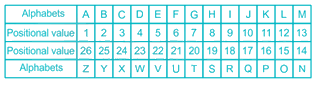 The logic followed here is:
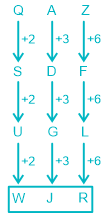 So, 'WJR' will replace the question mark in the given series.
Hence, the correct answer is "Option 4".
Q2 · Series
Select the letter-cluster from among the given options that can replace the question mark (?) in the following series.
MNK, NOJ, OPI, PQH, ?
- GFD
- HJG
- QRG
- IJH
Answer aur solution dekho
Archived marked answer: C
The logic followed here is:
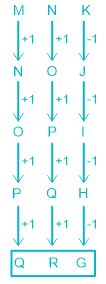 So, 'QRG' will replace the question mark in the given series.
Hence, the correct answer is "Option 3".
Q3 · Series
What comes next: 0, 6, 24, 60, 120, ?
- 196
- 156
- 210
- 200
Answer aur solution dekho
Archived marked answer: C
The logic followed here is:
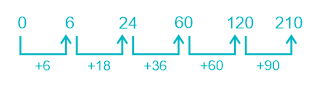 thus, "210" will replace the question mark in the given series.
Hence, the correct option is "Option 3".
Q4 · Series
What should come at the place of question mark? 3, 4, 13, 14, 45, 46, ?
- 143
- 136
- 140
- 138
Answer aur solution dekho
Archived marked answer: A
The logic followed here is:
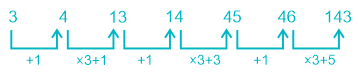 thus, "143" will replace the question mark in the given series.
Hence, the correct option is "Option 1".
Q5 · Analogy
In each of the following questions, the second word is formed by rearranging the letters of the first word according to a specific pattern. Apply the same pattern to the third word to determine the correct answer from the given alternatives.
NUMBER : UNBMRE :: GHOSTS : ?
- HGOSTS
- HOGSTS
- HGSOST
- HGSOTS
Answer aur solution dekho
Archived marked answer: C
The logic followed here is :-
Logic: Swap letters in pairs → (1↔2), (3↔4), (5↔6)
Given:
NUMBER : UNBMRE
NUMBER Positions:
1
2
3
4
5
6
N
U
M
B
E
R
Rearranged as: 2 1 4 3 6 5 ⇒ U N B M R E
Similarly, GHOSTS : ?
GHOSTS Positions:
1
2
3
4
5
6
G
H
O
S
T
S
Rearranged as: 2 1 4 3 6 5 ⇒ H G S O S T
Hence, the correct answer is "Option 3".
Q6 · Analogy
Find the option that best completes the analogy.
EK :: MS :: FP : ?
- ND
- NL
- NX
- NT
Answer aur solution dekho
Archived marked answer: C
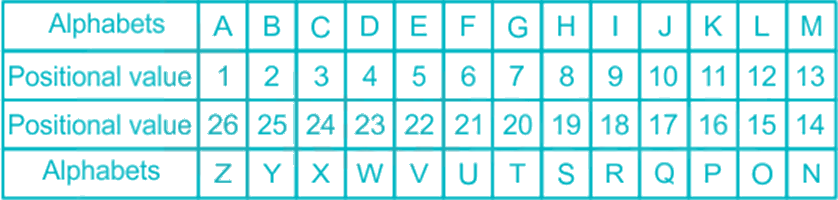 The logic followed here is :-
EK :: MS
Q7 · Analogy
In the following question, select the related word from the given alternatives
Jurisprudence : Law :: Epistemology : ?
- Reality
- Logic
- Knowledge
- Ethics
Answer aur solution dekho
Archived marked answer: C
The logic followed here is :-
Given, Jurisprudence : Law
Jurisprudence is the study or philosophy of Law.
Similarly, Epistemology : ?
Epistemology is the study or philosophy of Knowledge.
So, Epistemology : Knowledge
Hence, the correct answer is Option 3.
Q8 · Puzzle Subtypes Not To Miss
If 5 # 3 = 19 and 7 # 2 = 17, what is 9 # 1?
- 12
- 10
- 8
- 11
Answer aur solution dekho
Archived marked answer: D
The logic followed here is:
Logic: Extra number decreasing by 1 as first number increases by 2.
Given:
If 5 # 3 = 19,
⇒ 5 # 3 = 5×3 + 4
and 7 # 2 = 17,
⇒ 7 # 2 = 7×2 + 3
Similarly, 9 # 1?
⇒ 9 # 1 = 9×1 + 2
= 9 + 2
= 11
Hence, the correct answer is "Option 4."
Q9 · Puzzle Subtypes Not To Miss
If 11 / 19 = A and 2 / 9 = B, then what is A - B?
- 0.36
- 0.56
- 0.76
- 0.6
Answer aur solution dekho
Archived marked answer: A
Given:
A = 11 / 19
B = 2 / 9
We need to find: A − B
Formula Used: a/b − c/d = (ad − bc) / bd
Calculation:
A − B = (11/19) − (2/9)
Take LCM of 19 and 9:
19 × 9 = 171
Now convert into like fractions:
(11 × 9 − 2 × 19) / 171
= (99 − 38) / 171
= 61 / 171
Now convert to decimal:
61 ÷ 171 ≈ 0.356 ≈ 0.36
∴ The correct answer is "Option 1."
Q10 · Puzzle Subtypes Not To Miss
One number doesn't match this factorial series: 2, 6, 24, 120, 720, 1000
- 6
- 24
- 1000
- 120
Answer aur solution dekho
Archived marked answer: C
The logic followed here is:
Logic: All numbers are factorials (!)
These numbers look like factorials:
2 = 2!
6 = 3!
24 = 4!
120 = 5!
720 = 6!
So, Next should be: 7! = 5040
thus, Instead of 5040, the series has 1000, which is not a factorial number.
Hence, the correct option is "Option 3".
Q11 · Coding Decoding
If WRITE is coded as YTKVG, how is READ coded?
- TGCF
- ZTCF
- YTDF
- YTCF
Answer aur solution dekho
Archived marked answer: A
The logic followed here is:
Logic: the pattern is a @ b = a² + b
Given:
WRITE is coded as YTKVG,
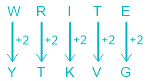 Similarly, READ = ?
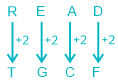 Hence, the correct answer is "Option 1."
Q12 · Classification Odd One Out
Which number set is different? : (11, 22, 44), (13, 26, 52), (15, 30, 60), (14, 28, 43)
- (11,22,44)
- (13,26,52)
- (15,30,60)
- (14,28,43)
Answer aur solution dekho
Archived marked answer: D
The logic followed here is:
Logic: In the first three sets, each number is double the previous number.
Given,
(11, 22, 44), (13, 26, 52), (15, 30, 60), (14, 28, 43)
Now, checking the options:
Option 1) (11,22,44)
⇒ 11 × 2 = 22&l
Q13 · Classification Odd One Out
Which word does not belong to the category?
- Hibiscus
- Tulip
- Apple
- Daisy
Answer aur solution dekho
Archived marked answer: C
The logic followed here is :-
Given:
Hibiscus – a flower
Tulip – a flower
Apple – a fruit
Q14 · Blood Relations
Introducing a boy, a girl said, "He is the son of my mother's only son." Who is the boy to the girl?
- Brother
- Son
- Nephew
- Cousin
Answer aur solution dekho
Archived marked answer: C
Family Chart:
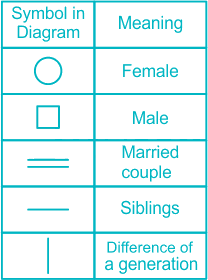 Given:
“He is the son of my mother's only son.”
Means: Your mother’s only son = your brother
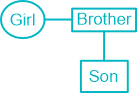 So, Brother’s son = Nephew.
Hence, the correct answer is "Option 3".
Q15 · Blood Relations
Ramesh says, "The boy playing football is the younger of the two sons of my father's wife." How is the boy related to Ramesh?
- Brother
- Stepbrother
- Cousin
- Nephew
Answer aur solution dekho
Archived marked answer: A
Family Chart:
Given:
My father’s wife → This is *Ramesh’s mother*.
The two sons of my father’s wife → This means *Ramesh and his brother*, because both are sons of the same mother
The boy is the younger of the two sons → So the boy must be *Ramesh’s younger brother*.
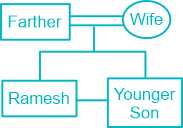 So, the football-playing boy is Ramesh’s brother.
Hence, the correct answer is "Option 1".
Q16 · Blood Relations
Pointing to a girl, Aryan said, "She is the daughter of the only child of my grandmother." How is the girl related to Aryan?
- Niece
- Cousin
- Sister
- Aunt
Answer aur solution dekho
Archived marked answer: C
Family Chart:
Given:
“She is the daughter of the only child of my grandmother.”
Aryan’s grandmother has only one child.
That child must be Aryan’s parent (either father or mother).
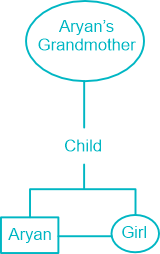 Therefore, the girl is Aryan’s Sister.
Hence, the correct answer is "Option 3".
Q17 · Alphabet Test
Each of the letters in the word GARDEN is arranged in alphabetical order. How many letters are there in the English alphabetical series between the letter that is fifth from the left and the one that is third from the right in the new letter-cluster formed?
- Two
- Four
- Six
- One
Answer aur solution dekho
Archived marked answer: C
The logic followed here is :-
Given Word: GARDEN
Letters: G, A, R, D, E, N
Alphabetical order: A, D, E, G, N, R
New letter cluster:
Q18 · Alphabet Test
Which of the following alternatives will replace the question mark?
Chaos, Conflict, Negotiation, Resolution, ?
- Justice
- Harmony
- Stability
- Law
Answer aur solution dekho
Archived marked answer: B
The logic followed here is :-
Given sequence:
Chaos → Conflict → Negotiation → Resolution → ?
Let’s understand the flow:
Chaos – Disorder
Conflict – Open disagreement
Negotiation – Attempt to solve the conflict
Resolution – Conflict is solved
Thus, the natural outcome is peace and balance.
Now, checking the given options:
Option 1) Justice
Justice – may or may not follow
Option 2) Harmony
Harmony – state of peace after resolution
Option 3) Stability
Stability – possible but broader term
Option 4) Law
Law – not directly part of the sequence.
Here, The most logical continuation is Harmony.
Hence, the correct answer is Option 2.
Q19 · Alphabet Test
How many letters in "SIGNATURE" are between the first vowel and the last consonant?
- 3
- 4
- 5
- 6
Answer aur solution dekho
Archived marked answer: C
The logic followed here is :-
Let’s check the letters between the first vowel and the last consonant in "SIGNATURE":
First vowel = I → 2nd letter
Last consonant = R → 8th letter
Now, the letters between them are:
G (3rd), N (4th), A (5th), T (6th), U (7th) → total 5 letters
Hence, the correct answer is "Option 3".
Q20 · Alphabet Test
How many meaningful four-letter English words can be formed using the first, second, fourth, and fifth letters of the word "ELEVATE" (when counted from left to right), using each letter only once in each word?
- 1
- 2
- 3
- 4
Answer aur solution dekho
Archived marked answer: C
The logic followed here is :-
Given Word: "ELEVATE"
1st letter → E
2nd letter → L
4th letter → V
5th letter → A
So, the letters are: E, L, V, A
Thus, Possible meaningful words:
VEAL
VALE
LAVE
All three are valid English words.
Therefore, total meaningful four-letter words = 3
Hence, the correct answer is Option 3.
Q21 · Similarity and Differences
Which of the following is/are identical to the address given: Rajesh Verma 15B, Sapphire Towers, Jaipur, 302018
1. Rajesh Verma 15B, Sapphire Towers, Jaipur, 302018
2. Rajesh Verma 15B, Sapphire Towers, Jaipur, 302019
3. Rajesh Verma 15B, Sapphire Tower, Jaipur, 302018
4. Rajesh Verma 15B, Sapphire Towers, Jaipur, 302017
- 2 Only
- 1 Only
- 4 Only
- 3 Only
Answer aur solution dekho
Archived marked answer: B
The logic followed here is:
Logic: The address should match exaxtly.
Given Addrtess:
Rajesh Verma 15B, Sapphire Towers, Jaipur, 302018
Now, checking all the given options:
1. Rajesh Verma 15B, Sapphire Towers, Jaipur, 302018
⇒ Exactly the same.
2. Rajesh Verma 15B, Sapphire Towers, Jaipur, 302019
⇒ PIN code is different (302019 instead of 302018).
3. Rajesh Verma 15B, Sapphire Tower, Jaipur, 302018
⇒ "Tower" is singular instead of "Towers".
4. Rajesh Verma 15B, Sapphire Towers, Jaipur, 302017
⇒ PIN code is different (302017 instead of 302018).
Hence, Option 2 is the correct answer.
Q22 · Logical Statement Questions
Instruction: Identify the assumptions that must hold for the statement to be valid, then choose the correct option.
Statement: Although recent advancements in quantum computing have significantly improved processing speeds, the stability of quantum states remains a critical barrier to developing large-scale quantum computers for practical applications.
Assumptions:
I. Quantum computing holds the potential for faster data processing than classical computing.
II. Quantum states are inherently unstable, making large-scale quantum computing unfeasible.
III. Recent advancements in quantum computing have resolved the issue of quantum state stability.
- Only I and II are implicit
- Only II and III are implicit
- Only I is implicit
- All I, II, and III are implicit
Answer aur solution dekho
Archived marked answer: C
Given Statement:
Although recent advancements in quantum computing have significantly improved processing speeds, the stability of quantum states remains a critical barrier to developing large-scale quantum computers for practical applications.Now,
Assumptions:
I. Quantum computing holds the potential for faster data processing than classical computing - Implicit (The statement talks about improved processing speeds, which assumes quantum
Q23 · Logical Statement Questions
Read the following statement carefully and identify the conclusion that follows.
Statement: No student of Class X failed the science exam this year.
Conclusions:
I. The science exam was very easy.
II. All students of Class X passed science.
- Only Conclusion I follows
- Only Conclusion II follows
- Both I and II follow
- Neither I nor II follows
Answer aur solution dekho
Archived marked answer: B
Given Statements:
No student of Class X failed the science exam this year.
Conclusions:
I. The science exam was very easy - False (Even if no one failed, it doesn’t prove the exam was easy.
Students might have prepared well, or grading may have been lenient.).
II. All students of Class X passed science - True (If no student failed, it logically means all students passed.).
So, Only Conclusion II follows
Hence, the correct answer is "Option 2".
Q24 · Miscellaneous Other Possibilities
A 60 L mixture has a milk-water ratio of 7:3. How much water to add to make the ratio 1:1?
- 18 L
- 20 L
- 22 L
- 24 L
Answer aur solution dekho
Archived marked answer: D
Given:
Total mixture = 60 L
Ratio of milk : water = 7 : 3
Formula used: Quantity of each component = (Respective ratio / Total ratio) × Total mixture
Calculations:
Find total parts: 7 + 3 = 10 parts
Find quantity of milk
Milk = (7 / 10) × 60
Milk = 42 L
Find quantity of water
Water = (3 / 10) × 60
Water = 18 L
For ratio 1 : 1
Milk = Water
Milk is already 42 L, so water must also be 42 L.
Water to be added = 42 − 18
Water to be added = 24 L
∴ The correct answer is "Option 4."
Q25 · Number Digit Operations
If the sum of 35 and 46 is multiplied by 2, what is the result?
- 158
- 160
- 162
- 164
Answer aur solution dekho
Archived marked answer: C
Given:
If the sum of 35 and 46 is multiplied by 2
First number = 35
Second number = 46
Calculations:
Find the sum of 35 and 46
35 + 46 = 81
Multiply the sum by 2
81 × 2 = 162
So, the result is 162
∴ The correct answer is "Option 3."
General Awareness
Q1 · Art and Culture
Which of the following best describes Annamacharya's contribution to Indian devotional music?
- Composed Sanskrit hymns on caste rituals
- Wrote over 32,000 songs promoting devotion and equality
- Restricted songs to temples and priests only
- Focused only on melody, not on social reform
Answer aur solution dekho
Archived marked answer: B
The correct answer is Wrote over 32,000 songs promoting devotion and equality.
Key Points
- Annamacharya, also known as Tallapaka Annamacharya, was a 15th-century saint and composer hailed as the “Padakavita Pitamaha” (Grandfather of Telugu Songwriting).
- He composed over 32,000 devotional songs (kritis) dedicated primarily to Lord Venkateswara of Tirumala, many of which promote the values of devotion, equality, and social harmony.
- His works were composed in Telugu and Sanskrit, making him one of the earliest composers in Indian music to use vernacular languages for devotional expression.
- He strongly believed in the principle of equality and opposed the caste-based discrimination prevalent during his time, which is often reflected in his compositions.
- Annamacharya’s compositions are not only devotional in nature but also convey profound spiritual and social messages, emphasizing bhakti (devotion) and the importance of human values.
Additional Information
- Contribution of Annamacharya
- Annamacharya was a pioneering figure in Indian devotional music and played a crucial role in enriching Carnatic music with his kritis.
- His works continue to inspire generations of musicians and devotees, and he is celebrated as a reformer who upheld the values of bhakti and equality in society.
Q2 · Indian Polity and Constitution
What change did the Regulating Act bring to the post of the Governor of Bengal?
- He was required to report directly to the British Crown.
- He was reduced to a ceremonial position.
- His role was elevated to Governor-General with a council of four members.
- He was transferred to the Madras Presidency.
Answer aur solution dekho
Archived marked answer: C
The correct answer is His role was elevated to Governor-General with a council of four members..
Key Points
- The Regulating Act of 1773 was enacted by the British Parliament to address the administrative and financial issues of the East India Company in India.
- Under this Act, the Governor of Bengal was elevated to the position of Governor-General of Bengal.
- A council of four members was established to assist the Governor-General in decision-making, marking the beginning of centralized administration in India.
- Warren Hastings became the first Governor-General of Bengal under the provisions of this Act.
- The Act also brought the presidencies of Bombay and Madras under the control of the Governor-General of Bengal in matters of war and diplomacy.
Additional Information
- Regulating Act of 1773
- The Regulating Act of 1773 was the first major legislative intervention by the British Parliament in Indian affairs.
- It aimed to reform the administration of the East India Company and ensure better governance in its Indian territories.
- The Act marked the beginning of British parliamentary control over the East India Company's operations in India.
- It also laid the foundation for subsequent acts that gradually centralized British authority in India.
Q3 · Indian Polity and Constitution
Which Article enables the President to establish an Inter-State Council?
- Article 263
- Article 264
- Article 312
- Article 262
Answer aur solution dekho
Archived marked answer: A
The correct answer is Article 263.
Key Points
- Article 263 of the Indian Constitution empowers the President of India to establish an Inter-State Council.
- The primary function of the Inter-State Council is to inquire into and advise upon disputes that may arise between states.
- It also aims to investigate and discuss subjects of common interest between states or between the Union and one or more states.
- The Inter-State Council promotes coordination and cooperation among the states and the Union of India, ensuring smooth governance and resolving inter-state disputes.
- The council may also be assigned the responsibility to formulate policies and improve the implementation of laws and schemes for national integration.
Additional Information
- Article 264:
- This article deals with the provisions related to the "definition" of the territory of India for taxation purposes.
- It defines the jurisdiction of the Union and States in terms of taxes and duties, but it does not relate to the Inter-State Council.
- Article 312:
- Article 312 provides for the creation of All India Services, such as the Indian Administrative Service (IAS) and Indian Police Service (IPS).
- It allows Parliament to create new All India Services by passing a law, if deemed necessary in the national interest.
- Article 262:
- Article 262 grants Parliament the power to adjudicate disputes related to inter-state rivers or river valleys.
- It also provides that Parliament may, by law, bar the jurisdiction of the Supreme Court or any other court in such disputes.
Q4 · Indian Polity and Constitution
What is the primary objective of a Uniform Civil Code (UCC) in India?
- To establish a common criminal law for all citizens.
- To unify direct and indirect tax laws.
- To provide a common set of personal laws for all citizens, irrespective of religion.
- To standardize administrative procedures across all states.
Answer aur solution dekho
Archived marked answer: C
The correct answer is To provide a common set of personal laws for all citizens, irrespective of religion.
Key Points
- The Uniform Civil Code (UCC) aims to replace personal laws based on the customs and scriptures of various religious communities with a common set of laws governing marriage, divorce, inheritance, and adoption for all citizens of India.
- The UCC is enshrined as a directive principle under Article 44 of the Indian Constitution, which calls for the State to endeavor to secure a uniform civil code for all citizens.
- It seeks to ensure equality and secularism by eliminating discriminatory practices embedded in personal laws based on religion or gender.
- The implementation of UCC is viewed as a significant step toward achieving gender justice and promoting national integration by ensuring uniformity in legal matters across all communities.
- The Supreme Court of India has, on several occasions, emphasized the need for a Uniform Civil Code to ensure equality and uniformity in personal laws.
Additional Information
- Classification of DPSPs (Philosophical Basis):
- Socialistic Principles: Aim for socio-economic justice, reducing inequality (e.g., equal pay, right to work).
- Gandhian Principles: Promote Gandhian ideals (e.g., village panchayats, cow protection, cottage industries).
- Liberal-Intellectual Principles: Advocate for individual freedoms and state action (e.g., uniform civil code, separation of judiciary from executive).
Q5 · Indian Economy
Which of the following best describes the rate of natural increase of population?
- It is the crude birth rate multiplied by crude death rate
- It is the ratio of working population to total population
- It is the difference between the birth rate and the death rate
- It is the average annual growth due to migration alone
Answer aur solution dekho
Archived marked answer: C
The correct answer is It is the difference between the birth rate and the death rate.
Key Points
- The rate of natural increase (RNI) of a population refers to the difference between the crude birth rate (CBR) and the crude death rate (CDR).
- It measures the population growth occurring solely due to natural factors (births and deaths), excluding migration.
- The rate of natural increase is typically expressed as a percentage or per 1,000 individuals per year.
- For example, if the crude birth rate is 20 per 1,000 and the crude death rate is 8 per 1,000, the RNI is 12 per 1,000 (or 1.2%).
- The RNI is a critical indicator in demography, as it provides insights into the natural population growth and helps in policy planning, resource allocation, and infrastructure development.
Additional Information
- Crude Birth Rate (CBR)
- Definition: The number of live births per 1,000 people in a year.
- Formula: (Total Live Births / Total Population) * 1,000.
- Significance: Indicates fertility levels and contributes to population growth.
- Crude Death Rate (CDR)
- Definition: The number of deaths per 1,000 people in a year.
- Formula: (Total Deaths / Total Population) * 1,000.
- Significance: Reflects mortality conditions and public health, with declines often due to better healthcare and sanitation.
Q6 · Indian Economy
Which of the following statements correctly reflect India's recent(2024) economic diplomacy and domestic investment facilitation reforms?
1) The India-Uzbekistan BIT allows unconditional access to international arbitration without exhausting local remedies.
2) The National Infrastructure Readiness Index (NIRI) solely ranks Smart Cities and excludes private investment indicators.
- Only 1
- Only 2
- 1 and 2 Both are correct
- Neither 1 nor 2 is correct
Answer aur solution dekho
Archived marked answer: D
The correct answer is Option 4: Neither 1 nor 2 is correct.
Key Points
- Statement 1: The India-Uzbekistan Bilateral Investment Treaty (BIT) does not allow unconditional access to international arbitration without exhausting local remedies. Most modern BITs, including India’s revised BIT model, require the exhaustion of local remedies before arbitration.
- The revised Indian Model BIT (2016) emphasizes the protection of national interest and mandates that disputes be attempted to be resolved in domestic courts before proceeding to international arbitration.
- Statement 2: The National Infrastructure Readiness Index (NIRI) does not solely rank Smart Cities, nor does it exclude private investment indicators. It is designed to evaluate the readiness and performance of infrastructure across various sectors, including private investment indicators as a key parameter.
- The NIRI evaluates infrastructure readiness across multiple categories, combining public and private sector contributions, and does not limit its scope to Smart Cities alone.
- Both statements are factually incorrect, making Option 4 the correct answer.
Additional Information
- India-Uzbekistan BIT:
- Bilateral Investment Treaties are agreements between two countries to ensure fair treatment of investments made by investors of one country in the other.
- The revised Indian Model BIT (2016) replaced the earlier version to safeguard the country’s regulatory autonomy and restrict unqualified access to international arbitration.
- India’s Model BIT includes provisions like exhaustion of local remedies, limited protection for investors, and specific definitions of investment and investor.
- National Infrastructure Readiness Index (NIRI):
- The NIRI is a comprehensive framework to assess the readiness of infrastructure projects across sectors, including energy, transportation, water, and social infrastructure.
- It integrates both public and private sector contributions to infrastructure development and considers private investments as a critical performance indicator.
- The index is developed to improve infrastructure planning, execution, and monitoring in alignment with India’s economic growth goals.
Q7 · Indian Economy
Which of the following correctly highlights a unique feature of India's textile industry?
- It focuses only on raw material exports.
- It is partially self-reliant and imports final products.
- It is self-reliant across the full value chain
- It only caters to domestic markets.
Answer aur solution dekho
Archived marked answer: C
The correct answer is It is self-reliant across the full value chain.
Key Points
- India's textile industry is one of the most self-reliant sectors in the country, encompassing the entire value chain from raw materials to finished goods. This includes cotton production, spinning, weaving, dyeing, printing, and garment manufacturing.
- The Indian textile sector is among the largest globally, contributing approximately 2.3% to India's GDP, 7% to the industrial output, and 12% to the country’s export earnings.
- India is the largest producer of cotton and jute globally and ranks second in silk and polyester production, ensuring a strong foundation for raw material availability.
- With a balanced integration of traditional handloom techniques and advanced machinery, the textile industry caters to both domestic and international markets.
- Government initiatives such as the Production Linked Incentive (PLI) Scheme for textiles and the establishment of Mega Textile Parks aim to further boost the self-reliance of the sector across the value chain.
Additional Information
- Post-Independence (1948 & 1956): Focused on public sector dominance, planned development, and import substitution, with state control over strategic industries (IPR 1956).
- 1991 New Industrial Policy (LPG Reforms): Marked a major shift towards liberalization, privatization, and globalization, dismantling the License Raj, opening up sectors to private and foreign investment, and encouraging exports.
- National Manufacturing Policy (NMP 2011): Aimed to increase manufacturing's share in GDP, create jobs, promote SEZs, and develop National Investment and Manufacturing Zones (NIMZs).
- Make in India (2014): Aims to make India a global manufacturing hub, improve ease of doing business, attract FDI, and boost key sectors like defense, aerospace, and electronics.
- Current Focus (Post-2020): Emphasizes Production Linked Incentive (PLI) Schemes for high-growth sectors, further deregulation, skill development, and infrastructure, seeking self-reliance (Atmanirbhar Bharat).
Q8 · Indian Economy
The Agriculture Infrastructure Fund (AIF) provides support for?
- Free fertilizers
- Agri-logistics and cold chains
- Cash transfers
- MGNREGA work
Answer aur solution dekho
Archived marked answer: B
The correct answer is Agri-logistics and cold chains.
Key Points
- The Agriculture Infrastructure Fund (AIF) is a financing facility launched by the Government of India in 2020 to strengthen agricultural infrastructure across the country.
- It provides medium to long-term debt financing for investment in viable projects for post-harvest management infrastructure and community farming assets.
- Key projects funded under the AIF include cold storage, warehousing, sorting & grading units, packhouses, ripening chambers, and other agri-logistics infrastructure.
- Through this initiative, farmers and Farmer Producer Organizations (FPOs) can access loans with interest subvention and credit guarantee support.
- The fund also aims to reduce post-harvest losses and improve the efficiency of agricultural supply chains, ensuring better price realization for farmers.
Additional Information
- Free Fertilizers
- The government of India provides subsidies on fertilizers to ensure affordability for farmers, but there is no provision for free fertilizers under the AIF.
- Subsidized fertilizers such as urea, DAP, and MOP are made available through schemes like the Nutrient Based Subsidy (NBS) scheme.
- The subsidy is directly transferred to fertilizer companies, which reduces the retail price for farmers.
- Cash Transfers
- Cash transfers are direct benefit transfers (DBT) under schemes like PM-KISAN, where eligible farmers receive Rs. 6,000 annually in three installments.
- The objective of cash transfers is to provide income support to farmers for agricultural and allied activities.
- However, AIF does not involve cash transfers and focuses on infrastructure development.
- MGNREGA Work
- The Mahatma Gandhi National Rural Employment Guarantee Act (MGNREGA) provides wage employment for rural households through unskilled manual work.
- It aims to enhance livelihood security and create durable assets in rural areas.
- While MGNREGA contributes to rural development, it is unrelated to the objectives of AIF, which targets agricultural infrastructure.
</ul
Q9 · Indian Economy
Read the below statements marked as Assertion (A) and Reason (R). Mark the correct options:
Assertion (A): India Industrial Land Bank provides GIS-based information.
Reason (R): It is managed by the Ministry of Mines.
- Both A and R are true, and R is the correct explanation of A
- Both A and R are true, but R is not the correct explanation of A
- A is true, but R is false
- A is false, but R is true
Answer aur solution dekho
Archived marked answer: C
The correct answer is A is true, but R is false.
Key Points
- India Industrial Land Bank (IILB) is a GIS-based portal that provides detailed information about industrial land and resources in India.
- The platform integrates data from various states and union territories to offer a one-stop repository for industrial information.
- It is part of the Indian government’s effort to improve the ease of doing business and attract investments by providing transparent and accessible data.
- The IILB is managed by the Department for Promotion of Industry and Internal Trade (DPIIT), under the Ministry of Commerce and Industry.
- The platform allows investors to identify and select industrial land based on their requirements, such as connectivity, infrastructure, and natural resources.
Additional Information
- GIS-Based Information
- GIS (Geographic Information System)-based platforms are used to map and analyze data related to geography and infrastructure.
- The IILB platform provides details such as the availability of land, location-specific infrastructure, and connectivity through GIS mapping.
- Such platforms are instrumental in improving transparency and aiding investors in making informed decisions.
- Ease of Doing Business
- The India Industrial Land Bank initiative is a step towards improving the ease of doing business in India, a key government priority.
- It aims to attract both domestic and foreign investments by providing a seamless and transparent platform for industrial information.
Q10 · Sports Static GK
Fill in the blanks:
At the 1960 Rome Olympics, Milkha Singh set an Indian record by finishing Fourth in the men's 400 meters with a timing of _________ a record that stood until 1984.
- 43.2 seconds
- 46.2 seconds
- 44.8 seconds
- 45.6 seconds
Answer aur solution dekho
Archived marked answer: D
The correct answer is 45.6 seconds.
Key Points
- Milkha Singh, popularly known as the "Flying Sikh," represented India in the 1960 Rome Olympics.
- He participated in the men’s 400 meters race and finished fourth, narrowly missing a medal in one of the most competitive events of the Olympics.
- Milkha Singh clocked a timing of 45.6 seconds, which was an Indian national record at the time.
- This record remained unbroken for 24 years, until 1984, showcasing the exceptional performance of Milkha Singh.
- His fourth-place finish was a remarkable achievement and is considered one of the greatest performances by an Indian athlete in Olympic history.
Additional Information
- Global Icons & Their Records
- Michael Phelps (Swimming, USA): Most decorated Olympian ever with 28 medals, including 23 golds, and the only one to win 8 golds in a single Olympics (2008).
- Usain Bolt (Sprinting, Jamaica): World records in 100m (9.58s) and 200m (19.19s), the fastest man in history.
- Sergei Bubka (Pole Vault, Ukraine): Set 35 world records (17 outdoor, 18 indoor) in the pole vault.
- Jackie Joyner-Kersee (Heptathlon, USA): World record holder in the heptathlon (7291 points)
Q11 · Sports Static GK
Why can hockey players use only the flat, left-hand side of the stick?
- Better control and reduced injury risk
- Prevents unfair left-handed advantage
- Prevents uneven bounce, ensures uniform rebound
- Mandated right-hand play for training ease
Answer aur solution dekho
Archived marked answer: C
The correct answer is Prevents uneven bounce, ensures uniform rebound.
Key Points
- Hockey sticks are designed with a flat left-hand side to ensure uniform rebound and control of the ball during gameplay.
- The flat side prevents uneven bounce, which could occur if the stick had varying surfaces, ensuring consistency in ball handling.
- This uniformity is critical for fair play as it standardizes the performance of all players, regardless of their stick's orientation.
- Using only the flat side helps maintain the game's tempo and predictability, as the ball behaves consistently upon contact.
- Regulations by the International Hockey Federation (FIH) mandate that players use only the left-hand flat side of the stick, ensuring uniformity in gameplay across all levels of hockey.
Additional Information
- General Information about Hockey Sticks:
- The hockey stick's flat side is made of materials like wood, fiberglass, or carbon fiber for durability and performance.
- The curved side is not used for hitting the ball, as it would lead to unpredictable ball movement and uneven rebounds.
- The design and use of hockey sticks are strictly regulated by the International Hockey Federation to ensure fairness and safety in the game.
Q12 · Indian Geography
Which Indian state recorded negative population growth between 2001-2011?
- Kerala
- Goa
- Nagaland
- Manipur
Answer aur solution dekho
Archived marked answer: C
The correct answer is Nagaland.
Key Points
- According to the Census of India 2011, Nagaland was the only state to record a negative population growth rate of -0.58% during the period 2001-2011.
- The negative growth rate was attributed to migration, as many people left Nagaland for better opportunities outside the state.
- Another contributing factor was an overestimation of the population in the 2001 Census, which led to a decrease in the reported population for 2011.
- The population of Nagaland decreased from 1,988,636 in 2001 to 1,978,502 in 2011, reflecting the negative growth rate.
- Such trends highlight demographic challenges in the northeastern region, including migration and socio-economic factors.
Additional Information
- Total Population: 1,210,854,977 (approx. 1.21 billion).
- Decadal Growth (2001-2011): 17.7%, a decrease from the previous decade's 21.5%.
- Sex Ratio: 940 females per 1000 males (up from 933 in 2001).
- Child Sex Ratio (0-6 years): 914 females per 1000 males (down from 927).
- Density: 382 persons per square kilometer.
Q13 · Indian Geography
Where is the Dr. S. P. Mookerjee Swimming Stadium located?
- Mumbai
- Chandigarh
- New Delhi
- Bangalore
Answer aur solution dekho
Archived marked answer: C
The correct answer is New Delhi.
Key Points
- The Dr. S. P. Mookerjee Swimming Stadium is located in New Delhi, India.
- It is a part of the larger sports complex known as the Jawaharlal Nehru Stadium Complex, which was primarily built for the 1982 Asian Games.
- The stadium is equipped with advanced facilities and has hosted various international aquatic events and competitions.
- It was renovated and upgraded for the 2010 Commonwealth Games, which were held in New Delhi.
- It is named after Dr. Syama Prasad Mookerjee, a prominent Indian politician and founder of the Bharatiya Jana Sangh.
Additional Information
- Narendra Modi Stadium (Ahmedabad): World's largest cricket stadium, a major venue for international matches.
- Eden Gardens (Kolkata): One of India's oldest and most iconic cricket grounds, known as the "Mecca of Indian Cricket".
- Wankhede Stadium (Mumbai): Home to the Mumbai Indians (IPL) and India, famous for hosting the 2011 Cricket World Cup Final.
- M. A. Chidambaram Stadium (Chennai): A historic ground known for its passionate crowds.
- M Chinnaswamy Stadium (Bengaluru): Known for its high-scoring matches and central location.
Q14 · Current Affairs
Who inaugurated India's first lithium-ion battery plant in Tirupati, Andhra Pradesh, in September 2022?
- Prime Minister Narendra Modi
- Rajeev Chandrasekhar, Minister of State for Electronics and Information Technology
- Nirmala Sitharaman, Minister of Finance
- Amit Shah, Union Home Minister
Answer aur solution dekho
Archived marked answer: B
The correct answer is Rajeev Chandrasekhar, Minister of State for Electronics and Information Technology.
Key Points
- India's first lithium-ion cell manufacturing plant was inaugurated in Tirupati, Andhra Pradesh, in September 2022.
- Rajeev Chandrasekhar, the Minister of State for Electronics and Information Technology, inaugurated this significant facility.
- The plant is part of India's push towards promoting self-reliance in the manufacturing of advanced energy storage systems and reducing dependency on imports.
- The facility was established by Munoth Industries Limited, marking a key milestone in India's journey toward building a local ecosystem for lithium-ion battery production.
- This project aligns with the government’s Make in India initiative, aiming to bolster domestic manufacturing and support the clean energy transition.
Additional Information
- Prime Minister Narendra Modi
- Prime Minister Narendra Modi has been at the forefront of launching several initiatives like Make in India, Atmanirbhar Bharat, and the National Electric Mobility Mission Plan to promote domestic production and clean energy adoption in India.
- Nirmala Sitharaman, Minister of Finance
- Nirmala Sitharaman has played a crucial role in facilitating financial incentives for the electric vehicle (EV) industry, including schemes like Faster Adoption and Manufacturing of Electric Vehicles (FAME).
- Lithium-Ion Battery Technology
- Lithium-ion batteries are rechargeable batteries widely used in electronics, electric vehicles, and renewable energy storage systems due to their high energy density, lightweight, and long cycle life.
- The production of lithium-ion batteries aligns with India's National Electric Mobility Mission Plan (NEMMP) and its commitment to achieving net-zero carbon emissions by 2070.
Q15 · Current Affairs
According to the Global Peace Index 2024, which of the following statements correctly reflects global peace trends since 2008?
- All three GPI domains have steadily improved since 2008
- The average country score has improved by 4.5% since 2008
- Ongoing Conflict and Safety & Security have deteriorated, while Militarisation has improved
- The number of countries showing improvement exceeds those showing deterioration
Answer aur solution dekho
Archived marked answer: C
The correct answer is Ongoing Conflict and Safety & Security have deteriorated, while Militarisation has improved.
Key Points
- The Global Peace Index (GPI) measures the relative peacefulness of nations using three primary domains: Ongoing Conflict, Safety & Security, and Militarisation.
- Since 2008, there has been a deterioration in the domains of Ongoing Conflict and Safety & Security globally, primarily due to an increase in conflicts, violence, and political instability.
- However, the Militarisation domain has shown improvement, reflecting reduced military expenditure and fewer armed forces in some regions.
- Global peace has deteriorated over the years, with 2024 marking the continuation of this trend, driven by factors such as geopolitical tensions, terrorism, and internal conflicts.
- The GPI provides a comprehensive overview of global trends in peace, helping policymakers address issues related to conflict and security.
Additional Information
- Human Development Report (UNDP): Measures health, education, and living standards.
- Global Gender Gap Report (WEF): Ranks countries on gender equality.
- Global Innovation Index (WIPO): Ranks innovation performance.
- Global Hunger Index (Concern Worldwide/Welthungerhilfe): Assesses hunger levels.
- World Economic Outlook (IMF): Forecasts global economic growth, ranking economies.
- Corruption Perceptions Index (Transparency International): Ranks perceived levels of public sector corruption.
Q16 · General Science Biology
What is the primary function of telomerase enzyme?
- DNA replication
- Telomere lengthening
- DNA repair
- RNA transcription
Answer aur solution dekho
Archived marked answer: B
The correct answer is Telomere lengthening.
Key Points
- Telomerase is an enzyme responsible for maintaining the length of telomeres, which are repetitive nucleotide sequences at the ends of chromosomes.
- Telomeres protect chromosomes from degradation, fusion with neighboring chromosomes, and incomplete replication during cell division.
- The enzyme adds DNA sequence repeats to the telomere regions, compensating for the shortening that occurs during DNA replication.
- Telomerase activity is particularly high in germ cells, stem cells, and certain cancer cells, ensuring their proliferative capacity.
- In most somatic cells, telomerase activity is low or absent, leading to progressive telomere shortening and cellular aging.
Additional Information
- DNA replication
- DNA replication is the process by which a cell duplicates its DNA, resulting in two identical DNA molecules.
- This process involves enzymes like DNA polymerase, helicase, and ligase, but telomerase is not directly involved in the core replication process.
- While telomerase addresses the replication of telomeres, it is not responsible for the replication of the entire DNA strand.
- DNA repair
- DNA repair refers to the mechanisms by which cells identify and correct damage to the DNA molecules that encode their genome.
- It involves processes like base excision repair, nucleotide excision repair, and mismatch repair.
- Telomerase does not play a role in DNA repair but focuses on preventing the loss of genetic information at chromosome ends.
- RNA transcription
- RNA transcription is the process of synthesizing RNA from a DNA template, carried out by RNA polymerase enzymes.
- It is a critical step in gene expression but is unrelated to telomere lengthening or the activity of telomerase.
Q17 · General Science Chemistry
Why are cooking utensils often made with a copper bottom?
- Copper is a good insulator, preventing heat loss.
- Copper has a low melting point, making it easy to manufacture.
- Copper is an good conductor of heat, ensuring even heating.
- Copper reacts readily with food, enhancing flavor.
Answer aur solution dekho
Archived marked answer: C
The correct answer is Copper is a good conductor of heat, ensuring even heating.
Key Points
- Copper is an excellent conductor of heat, meaning it allows heat to spread quickly and evenly across its surface.
- This property ensures uniform cooking, preventing hotspots that could cause unevenly cooked food.
- Copper’s high thermal conductivity allows it to respond quickly to temperature changes, offering better control over cooking processes.
- Many cooking utensils have copper bottoms because it improves energy efficiency, reducing cooking time and saving fuel or electricity.
- Due to its efficient heat transfer, copper is commonly used in combination with other materials like stainless steel, which adds durability and prevents direct contact with food.
Additional Information
- Properties of Copper
- Copper is widely used in cookware due to its unique thermal properties, making it ideal for efficient and precise cooking.
- Its ability to conduct heat efficiently makes it a preferred choice for professional chefs and cooking enthusiasts.
- However, due to its reactivity with certain foods, it is usually paired with other materials to ensure safety.
Q18 · Medieval Indian History
In Bhakti traditions, which two broad types of worship are mentioned?
- Vedic and Non-Vedic
- Saguna and Nirguna
- Orthodox and Reformist
- Shaiva and Vaishnava
Answer aur solution dekho
Archived marked answer: B
The correct answer is Saguna and Nirguna.
Key Points
- The Bhakti movement in India emphasized devotion to a personal deity and was categorized into two main traditions: Saguna and Nirguna.
- Saguna Bhakti refers to devotion to a deity with form and attributes, such as Lord Krishna, Rama, or Goddess Durga.
- Nirguna Bhakti focuses on the worship of a formless, infinite, and abstract divine reality, often associated with concepts like the ultimate truth or Brahman.
- Famous saints like Meera Bai, Tulsidas, and Surdas were proponents of Saguna Bhakti, while Kabir and Guru Nanak emphasized Nirguna Bhakti.
- The two traditions reflect different approaches to spirituality, offering flexibility for individual beliefs and practices within the Bhakti movement.
Additional Information
- Vedic and Non-Vedic
- The terms "Vedic" and "Non-Vedic" classify traditions based on their alignment with the Vedas.
- Vedic traditions include rituals, sacrifices, and practices outlined in the Vedas, while Non-Vedic traditions involve independent or alternative spiritual practices, such as Jainism and Buddhism.
- However, the Bhakti movement does not strictly align with this classification as it incorporates elements from both.
- Orthodox and Reformist
- The "Orthodox" approach adheres strictly to traditional practices and scriptures, while the "Reformist" approach focuses on modifying or reforming traditional religious practices.
- While the Bhakti movement did involve some reformist ideas, it is not categorized within this binary classification.
- Shaiva and Vaishnava
- Shaiva and Vaishnava traditions refer to sects within Hinduism that worship Lord Shiva and Lord Vishnu, respectively, as the supreme deity.
- These sects are part of the broader Bhakti traditions but are not the two main categories of Bhakti worship.
Q19 · Ancient Indian History
Consider the following statements about Gwalior Fort:
1. It is spread over a hilltop more than 2 km in length.
2. Its southern path features intricately carved rock-cut temples of Jain tirthankars.
3. The Caturbhuj Mandir within the fort is an example of a Vaiṣṇavite shrine.
Which of the statements given above is/are correct?
- 1 and 2 only
- 2 and 3 only
- 1 and 3 only
- 1, 2 and 3
Answer aur solution dekho
Archived marked answer: D
The correct answer is 4) 1, 2 and 3.
Key Points
- Gwalior Fort is located on a hilltop and spans over 2 km in length, making it one of the largest forts in India.
- The southern path of the fort is known for its intricately carved rock-cut Jain temples, dedicated to Jain tirthankars. These sculptures are an example of exquisite craftsmanship.
- The Caturbhuj Mandir (Chaturbhuj Temple) within the fort is a Vaishnavite shrine dedicated to Lord Vishnu.
- Gwalior Fort is renowned for its architectural brilliance and historical importance, being a confluence of various styles and influences from different dynasties.
- It has been a significant cultural and historical landmark, witnessing the reign of the Tomars, Mughals, Marathas, and Scindias.
Additional Information
- Key Examples & Locations of Jain Architecture:
- Dilwara Temples (Mt. Abu, Rajasthan): 11th-13th century masterpieces known for stunning marble carvings, detailed ceilings, and ornate pillars.
- Ranakpur Jain Temple (Rajasthan): Famous for its 1,444 uniquely carved pillars, a 15th-century marvel dedicated to Adinatha.
- Gomateshwara Statue (Shravanabelagola, Karnataka): A towering monolithic granite statue of Bahubali, a key Jain pilgrimage site.
- Palitana & Girnar (Gujarat): Hilltop temple complexes, considered sacred pilgrimage cities.
- Khandagiri & Udayagiri Caves (Odisha): Early rock-cut caves used by Jain monks, featuring simple entrances and carved pillars.
Q20 · World Geography
Evaluate these statements regarding atmospheric layeers: 1. Most weather phenomena occur in the stratosphere. 2. The ozone layer is primarily found in the troposphere. Which of the above is/are correct?
- Statement 1 only
- Statement 2 only
- Both 1 and 2
- Neither 1 nor 2
Answer aur solution dekho
Archived marked answer: D
The correct answer is Option 4: Neither 1 nor 2.
Key Points
- Statement 1 is incorrect: Most weather phenomena, such as clouds, rain, storms, and winds, occur in the troposphere, the lowest atmospheric layer, not the stratosphere.
- Statement 2 is incorrect: The ozone layer is primarily found in the stratosphere, not the troposphere. It is located at an altitude of approximately 10 to 50 km above Earth's surface.
- The troposphere is the closest layer to Earth's surface and extends up to about 8-15 km, depending on geographic location. It contains most of the atmospheric water vapor, making it the layer where weather occurs.
- The stratosphere lies above the troposphere and extends from about 15 km to 50 km. It is characterized by the presence of the ozone layer, which absorbs harmful ultraviolet radiation from the Sun.
- Both statements in the question are factually incorrect, and therefore, the correct option is "Neither 1 nor 2."
Additional Information
- Troposphere:
- It is the lowest atmospheric layer and contains approximately 75% of the atmosphere's mass and nearly all its water vapor.
- Weather phenomena such as cloud formation, precipitation, storms, and winds occur in this layer.
- The temperature decreases with altitude in this layer due to the Earth's heat radiation.
- Stratosphere:
- It lies above the troposphere and extends from about 15 km to 50 km above the Earth's surface.
- The ozone layer is located within the stratosphere, helping to absorb harmful UV radiation from the Sun.
- The temperature increases with altitude in the stratosphere due to the absorption of UV radiation by ozone.
- This layer is relatively stable and free from weather disturbances, making it ideal for high-altitude flights.
- Ozone Layer:
- It is a region within the stratosphere containing high concentrations of ozone (O₃).
- The ozone layer plays a critical role in protecting life on Earth by absorbing the majority of the Sun's harmful ultraviolet radiation.
- Depletion of the ozone layer, often caused by human-made chemicals like chlorofluorocarbons (CFCs), leads to increased UV radiation exposure, causing health and environmental risks.
- Atmospheric Layers:
- The Earth's atmosphere is divided into five principal layers: troposphere, stratosphere, mesosphere, thermosphere, and exosphere.
- Each layer has unique characteristics, such as composition, temperature variation, and phenomena occurring within it.
Q21 · World Geography
In which type of geological formation are gorges most commonly developed?
- Soft sediment
- Hard rocks
- Glacial till
- Volcanic ash
Answer aur solution dekho
Archived marked answer: B
The correct answer is Hard rocks.
Key Points
- Gorges are deep valleys with steep, almost vertical walls, commonly formed by the erosive action of rivers over geological time.
- They are most commonly developed in hard rock formations because these rocks resist erosion better than softer materials, allowing the river to cut deep, narrow valleys rather than wide ones.
- Examples of hard rocks where gorges are formed include granite, basalt, and other igneous or metamorphic rocks.
- Famous gorges like the Grand Canyon in the USA and Kali Gandaki Gorge in Nepal were carved through hard rock formations by persistent river erosion.
- The steep walls of gorges are created as the hard rock resists weathering and collapsing, maintaining the narrow and deep profile of the valley.
Additional Information
- Soft sediment:
- Soft sediment consists of loose, unconsolidated materials such as sand, silt, and clay, which are easily eroded by water and wind.
- In areas dominated by soft sediment, rivers typically form wide valleys or floodplains rather than narrow gorges.
- These areas are more prone to erosion and deposition processes, leading to the formation of features like meanders and oxbow lakes.
- Glacial till:
- Glacial till is an unsorted mixture of sediments deposited directly by glacier ice.
- It does not form gorges, as it lacks the structural integrity required to create steep walls.
- Instead, glacial till can form moraines, drumlins, and other glacial landforms.
- Volcanic ash:
- Volcanic ash consists of fine particles of volcanic glass and minerals ejected during volcanic eruptions.
- It is highly susceptible to erosion and compaction, making it unsuitable for gorge formation.
- However, volcanic activity can create other landforms, such as calderas, lava plateaus, and volcanic cones.
- Gorge Formation:
- Gorges are typically formed by the long-term erosive action of rivers cutting through resistant rock layers over millions of years.
- Other factors, such as tectonic uplift and changes in sea level, can enhance the formation of gorges by increasing river gradient and erosive power.
- Gorges can also be formed by glacial activity, where a glacier carves out a U-shaped valley that later becomes a gorge after glacial retreat.
Q22 · Books and Authors Static
Which statement accurately represents the connection between 'Heart: A History' by Sandeep Jauhar and the Edgar Award for Best Novel?
- Nominated for Edgar Award for blending medical history and mystery
- Won Edgar Award as pioneering medical fiction
- Received Edgar Award for fictional cardiac surgery
- Non-fiction memoir, ineligible for Edgar Award
Answer aur solution dekho
Archived marked answer: D
The correct answer is Non-fiction memoir, ineligible for Edgar Award.
Key Points
- 'Heart: A History' by Sandeep Jauhar is a non-fiction memoir that explores the historical and scientific journey of cardiology.
- The Edgar Award is primarily awarded to works in the genre of mystery, crime, and suspense fiction, making non-fiction works like 'Heart: A History' ineligible.
- The book chronicles the evolution of heart treatments and delves into personal and emotional experiences with heart diseases.
- As a memoir focused on medical history, science, and the personal reflections of the author, it does not align with the criteria for the Edgar Award.
Additional Information
- Theme of 'Heart: A History'
- The book provides an insightful look into the history of cardiology, exploring how scientific advancements have revolutionized heart treatments.
- It also shares the author Sandeep Jauhar's personal experiences with heart disease in his family, making it a blend of science, history, and memoir.
- The book emphasizes the emotional and psychological connections people have with their hearts, making it a compelling narrative in the field of medical literature.
Q23 · Environment and Ecology
Under India's updated State Action Plan on Climate Change (SAPCC) for 2025, which sector received the highest budgetary allocation for climate adaptation?
- Transport
- Urban Planning
- Agriculture and Water Resources
- Renewable Energy
Answer aur solution dekho
Archived marked answer: C
The correct answer is Agriculture and Water Resources.
Key Points
- Under India's updated State Action Plan on Climate Change (SAPCC) for 2025, the highest budgetary allocation for climate adaptation is given to the Agriculture and Water Resources sector.
- Agriculture is highly vulnerable to climate change as it depends heavily on climatic conditions such as rainfall, temperature, and seasonal variations.
- Water resources management is critical in addressing climate adaptation challenges, such as droughts, floods, and water scarcity exacerbated by climate change.
- The allocation aims to enhance irrigation infrastructure, promote sustainable agricultural practices, and improve water conservation efforts to adapt to shifting climate patterns.
- This step aligns with India's National Action Plan on Climate Change (NAPCC), which emphasizes resource efficiency, climate resilience, and sustainable development in agriculture and water management.
Additional Information
- Renewable Energy
- Renewable energy is a key area in mitigating climate change by reducing dependency on fossil fuels and cutting carbon emissions.
- India has launched ambitious initiatives, including the National Solar Mission, to transition towards cleaner energy sources.
- While important for mitigation, renewable energy is often considered less relevant to immediate adaptation needs, leading to lower allocation under the SAPCC for adaptation purposes.
Q24 · General Science
Examine the following statements about the SSLV-D2 mission and select the correct option:
Statement 1: SSLV-D2 inserted EOS-07, Janus-1, and AzaadiSAT-2 into a 450 km circular orbit utilizing a three-stage vehicle powered entirely by liquid propulsion.
Statement 2: The SSLV-D2 mission showcased rapid deployment capability with low turnaround time and limited ground infrastructure needs.
- Only Statement 1 is correct
- Only Statement 2 is correct
- 1 and 2 are correct
- Neither 1 nor 2 are correct
Answer aur solution dekho
Archived marked answer: B
The correct answer is Option 2.
Key Points
- The SSLV-D2 mission demonstrated rapid deployment capability, characterized by a reduced turnaround time and minimal ground infrastructure requirements.
- The mission is specifically designed for launching small satellites into low Earth orbit, catering to increasing demand in the satellite market.
- The SSLV (Small Satellite Launch Vehicle) is equipped with a three-stage propulsion system, featuring solid propulsion for the first two stages and a liquid propulsion system for the velocity trimming module (VTM).
- On February 10, 2023, SSLV-D2 successfully deployed EOS-07, Janus-1, and AzaadiSAT-2 into a 450 km circular orbit, marking a significant milestone in India's space program.
- The mission reinforces the Indian Space Research Organisation's (ISRO) capability to facilitate cost-effective, timely launches for small satellite payloads.
Additional Information
- Statement 1 is incorrect: SSLV-D2 uses a three-stage propulsion system with solid propulsion for the first two stages and a velocity trimming module (VTM) powered by liquid propulsion. The claim that all stages are powered entirely by liquid propulsion is inaccurate.
- EOS-07: It is an Earth observation satellite developed by ISRO to meet the demands of various applications, such as environmental monitoring, agriculture, and disaster management.
- Janus-1: A satellite built by Antaris, a US-based company, featuring significant contributions from Indian space industry partners. It is designed for commercial applications and showcases international collaboration.
- AzaadiSAT-2: Developed by Indian students under the guidance of Space Kidz India, this satellite aims to encourage female participation in STEM fields and includes payloads designed for communication and data collection.
Q25 · Other Edge Cases Possible SSC GK GS Questions
Which of the following commissions recommended the establishment of a Permanent Secretariat for the Inter-State Council to institutionalize Centre-State cooperation?
- Rajamannar Committee
- Punchhi Commission
- Sarkaria Commission
- Venkatachelliah Commission
Answer aur solution dekho
Archived marked answer: C
The correct answer is Sarkaria Commission.
Key Points
- The Sarkaria Commission was established by the Government of India in June 1983 to review the Centre-State relations.
- It recommended the establishment of a Permanent Secretariat for the Inter-State Council to institutionalize Centre-State cooperation.
- The Inter-State Council is a constitutional body under Article 263 of the Indian Constitution to investigate and discuss subjects of common interest between the Union and States.
- The Sarkaria Commission emphasized the need for better communication and coordination between the Centre and States to strengthen federalism in India.
- Its recommendations led to the formation of the Inter-State Council in 1990, which serves as an important platform for resolving disputes and promoting cooperative federalism.
Additional Information
- Rajamannar Committee
- It was set up by the Tamil Nadu government in 1969 under the chairmanship of P.V. Rajamannar.
- The committee recommended more autonomy to states and a redefinition of Centre-State relations.
- It suggested the abolition of the Planning Commission, the discontinuation of All India Services, and the transfer of subjects from the Union List to the State List.
- However, its recommendations were not implemented at the national level.
- Punchhi Commission
- The Punchhi Commission was set up in April 2007 under the chairmanship of Justice M.M. Punchhi to look into Centre-State relations.
- It recommended a fixed term for Governors, a comprehensive framework for disaster management, and changes to the role of the Governor in state politics.
- It focused on addressing challenges to federalism in the context of globalization and socio-economic changes.
- Its report is considered significant for improving Centre-State relations but is yet to be fully implemented.
- Venkatachelliah Commission
- Also known as the National Commission to Review the Working of the Constitution (NCRWC), it was established in 2000 under Justice M.N. Venkatachaliah.
- The commission aimed to review the Constitution to make it more effective and relevant in contemporary times.
- It suggested reforms in electoral processes, judicial accountability, and the functioning of parliamentary institutions.
- It did not specifically focus on Centre-State relations or the Inter-State Council.
Mathematics
Q1 · Geometry
In a cyclic quadrilateral ABCD, if angle A is 100°, what is the measure of angle C?
- 100°
- 80°
- 90°
- 70°
Answer aur solution dekho
Archived marked answer: B
Shortcut Trick
The sum of opposite angles in a cyclic quadrilateral is always 180°.
Angle A and Angle C are opposite angles in the cyclic quadrilateral ABCD.
∠C = 180° − ∠A
∠C = 180° − 100° = 80°
∴ The correct answer is 80°.
Alternate Method
A
B
C
D
100°
80°
∠A + ∠C = 180°
Given:
∠A = 100°
ABCD is a cyclic quadrilateral.
Formula Used:
In a cyclic quadrilateral, the sum of a pair of opposite interior angles is equal to 180°.
Calculation:
⇒ ∠A + ∠C = 180°
⇒ 100° + ∠C = 180°
⇒ ∠C = 180° − 100°
⇒ ∠C = 80°
∴ The correct answer is 80°.
Additional Information
Cyclic Quadrilateral
A quadrilateral is called cyclic if all its four vertices lie on the circumference of a single circle. The primary property of a cyclic quadrilateral is that the sum of its opposite interior angles is always 180°.
Exterior Angle Property
If any one side of a cyclic quadrilateral is extended outwardly, the exterior angle formed is strictly equal to the interior opposite angle.
Ptolemy's Theorem
For a cyclic quadrilateral, the product of the lengths of the diagonals is equal to the sum of the products of the lengths of its opposite sides (AC × BD = AB × CD + AD × BC).
</p
Q2 · Geometry
In triangles ABC and XYZ, if the lengths of the sides are such that AB equals XY, BC equals YZ, and CA equals ZX, which congruence rule demonstrates that triangle ABC is congruent to triangle XYZ?
- SSS
- SAS
- ASA
- AAS
Answer aur solution dekho
Archived marked answer: A
Shortcut Trick
The congruence of triangles is determined by matching their corresponding sides and angles.
Since the problem states that all three corresponding sides are exactly equal (AB = XY, BC = YZ, CA = ZX).
This perfectly matches the defining condition for the Side-Side-Side (SSS) congruence rule.
∴ The correct answer is SSS.
Alternate Method
Given:
⇒ In Triangle ABC and Triangle XYZ:
⇒ AB = XY
⇒ BC = YZ
⇒ CA = ZX
A
Q3 · Geometry
Which of these lines is parallel to 3x + 2y = 5?
- 3x + 2y = 7
- 2x + 3y = 5
- 3x - 2y = 5
- x + y = 5
Answer aur solution dekho
Archived marked answer: A
Shortcut Trick
For any linear equation ax + by = c, all lines parallel to it are of the identical form ax + by = k (where k ≠ c).
The given line is 3x + 2y = 5.
By comparing the options, only the equation 3x + 2y = 7 matches this exact a and b coefficient format.
∴ The correct answer is 3x + 2y = 7.
Alternate Method
Given:
The equation of the original line is 3x + 2y = 5.
Concept Used:
Two lines are strictly parallel if their slopes are equal (m₁ = m₂).
For a line represented as ax + by = c, the slope m is determined by −a/b.
- - - - X
Y
O
3x + 2y = 5
3x + 2y = 7
Calculations:
⇒ Slope of the given line 3x + 2y = 5 is m = −3/2.
⇒ Let us calculate the slopes of all given options to find the identical one:
⇒ 1) 3x + 2y = 7 → Slope = −3/2 (Parallel to given line)
⇒ 2) 2x + 3y = 5 → Slope = −2/3 (Not parallel)
⇒ 3) 3x − 2y = 5 → Slope = 3/2 (Not parallel)
⇒ 4) x + y = 5 → Slope = −1 (Not parallel)
⇒ Only the first equation has the same slope as the original given line.
∴ The correct answer is 3x + 2y = 7.
Additional Information
Parallel Lines Condition
Two general lines a₁x + b₁y + c₁ = 0 and a₂x + b₂y + c₂ = 0 are strictly parallel and do not touch when a₁/a₂ = b₁/b₂ ≠ c₁/c₂.
Perpendicular Lines Condition
Two lines cross each other at exactly 90 degrees if the mathematical product of their slopes equals −1 (m₁ × m₂ = −1). The perpendicular inverse format is bx − ay + k = 0.
Intersecting Lines Condition
Linear graphs will always intersect at exactly one unique point if they possess structurally different slopes, proven when a₁/a₂ ≠ b₁/b₂.
Coincident Lines Condition
Two drawn lines represent the exact same path and hold infinite solutions universally if their constants are fully proportional: a₁/a₂ = b₁/b₂ = c₁/c₂.
</p
Q4 · Geometry
What is the area of a sector with a central angle of 120° and radius 8 cm?
- 64π/3cm²
- 54π/3 cm²
- 48 cm²
- 52 cm²
Answer aur solution dekho
Archived marked answer: A
Shortcut Trick
Since the central angle is 120°, the sector represents exactly 120° ÷ 360° = 1/3 of the full circle.
Area of the full circle = π × r² = π × 8² = 64π cm².
Area of the sector = (1 / 3) × 64π = 64π/3 cm².
∴ The correct answer is 64π/3 cm².
Alternate Method
120°
r = 8 cm
r = 8 cm
Centre O
Area of Sector
Given:
⇒ Radius of the sector (r) = 8 cm
⇒ Central angle (θ) = 120°
Formula Used:
⇒ Area of Sector = (θ ÷ 360°) × πr²
Calculations:
⇒ Area = (120° ÷ 360°) × π × (8)²
⇒ Area = (1 / 3) × π × 64
⇒ Area = 64π/3 cm²
∴ The correct answer is 64π/3 cm².
Additional Information
Area of a Circle
The total region enclosed by a circle is given by πr², which corresponds to a full central angle of 360°.
Length of an Arc
The length of the curved boundary of a sector is proportional to its central angle, given by the formula L = (θ ÷ 360°) × 2πr.
Perimeter of a Sector
The total boundary length of a sector is obtained by adding the arc length to twice the radius: Perimeter = L + 2r.
Area of a Segment
The region bounded by a chord and its corresponding arc. It is calculated by subtracting the area of the corresponding triangle from the total area of the sector.
</p
Q5 · Trigonometry
If sin(90° - x) = cos(2x), then what is x?
- 0°
- 30°
- 25°
- 15°
Answer aur solution dekho
Archived marked answer: A
Shortcut Trick
Using the identity sin(90° − θ) = cos(θ), we get cos(x) = cos(2x).
By comparing the angles directly for the principal value, we can write:
x = 2x ⇒ x = 0°
Checking the options, 0° satisfies the equation: sin(90°) = cos(0°) ⇒ 1 = 1.
∴ The correct answer is 0°.
Alternate Method
Given:
sin(90° − x) = cos(2x)
Formula Used:
sin(90° − θ) = cos(θ)
cos(2θ) = 2cos²(θ) − 1
Calculation:
⇒ sin(90° − x) = cos(2x)
⇒ cos(x) = cos(2x)
⇒ cos(x) = 2cos²(x) − 1
⇒ 2cos²(x) − cos(x) − 1 = 0
⇒ 2cos²(x) − 2cos(x) + cos(x) − 1 = 0
⇒ 2cos(x)(cos(x) − 1) + 1(cos(x) − 1) = 0
⇒ (2cos(x) + 1)(cos(x) − 1) = 0
⇒ cos(x) = 1 or cos(x) = −1/2
For x in the first quadrant (as per options), cos(x) = 1.
⇒ x = 0°
∴ The correct answer is 0°.
Additional Information
Complementary Angle Identities
For any angle θ, sin(90° − θ) = cos(θ), cos(90° − θ) = sin(θ), and tan(90° − θ) = cot(θ).
General Solution of Cosine
If cos(x) = cos(y), then the general solution is x = 360° × n ± y, where n is any integer.
Double Angle Formula
cos(2θ) can be expressed as cos²(θ) − sin²(θ), or 2cos²(θ) − 1, or 1 − 2sin²(θ).
</p
Q6 · Trigonometry
Given, A and B are complementary angles, and sinA = 3/5, what is tanB?
- 4/3
- 3/4
- 5/4
- 5/3
Answer aur solution dekho
Archived marked answer: A
Shortcut Trick
A and B are complementary angles ⇒ A + B = 90° ⇒ B = 90° − A
tanB = tan(90° − A) = cotA
Given sinA = 3/5 = Perpendicular / Hypotenuse ⇒ Base = √(5² − 3²) = 4
cotA = Base / Perpendicular = 4/3
∴ The correct answer is 4/3.
Alternate Method
Given:
sinA = 3/5
A and B are complementary angles (A + B = 90°).
Formula Used:
Pythagoras Theorem: (Hypotenuse)² = (Perpendicular)2
Q7 · Trigonometry
If sin²A – cos²A = 1/4, find the value of cos²A.
- 5/8
- 3/8
- 1/2
- 1/4
Answer aur solution dekho
Archived marked answer: B
Shortcut Trick
Using the fundamental trigonometric identity: sin²A + cos²A = 1
Subtract the given equation (sin²A − cos²A = 1/4) from this identity:
(sin²A + cos²A) − (sin²A − cos²A) = 1 − 1/4
2cos²A = 3/4
cos²A = 3/8
∴ The correct answer is 3/8.
Alternate Method
Given:
sin²A − cos²A = 1/4
Formula Used:
sin²A + cos²A = 1 ⇒ sin²A = 1 − cos²A
Calculations:
⇒ Substitute the value of sin²A in the given equation.
⇒ (1 − cos²A) − cos²A = 1/4
⇒ 1 − 2cos²A = 1/4
⇒ 2cos²A = 1 − 1/4
⇒ 2cos²A = 3/4
⇒ cos²A = 3/4 × 1/2
⇒ cos²A = 3/8
∴ The correct answer is 3/8.
Additional Information
Trigonometric Square Identities
1. sin²θ + cos²θ = 1
2. sec²θ − tan²θ = 1
3. cosec²θ − cot²θ = 1
Double Angle Formula for Cosine
The double angle formula can be expressed in three different forms:
cos(2θ) = cos²θ − sin²θ = 2cos²θ − 1 = 1 − 2sin²θ
</p
Q8 · Trigonometry
What is the radian measure of 150°?
- 5π/6
- 2π/3
- 3π/4
- π/3
Answer aur solution dekho
Archived marked answer: A
Shortcut Trick
To convert any angle from degrees to radians, multiply the degree value by π / 180°.
⇒ Radian measure = 150° × (π / 180°)
⇒ Radian measure = 15π / 18
⇒ Radian measure = 5π / 6
∴ The correct answer is 5π/6.
Alternate Method
Given:
Angle measure = 150°
Formula Used:
Angle in radians = Angle in degrees × (π / 180°)
- - - - 150°
0°
150° = 5π/6
Calculations:
⇒ Radian measure = 150° × (π / 180°)
⇒ Radian measure = (150 / 180) × π
⇒ Radian measure = (15 / 18) × π
⇒ Radian measure = 5π / 6
∴ The correct answer is 5π/6.
Additional Information
Degrees to Radians Conversion
The formula to convert degrees to radians is: Radians = Degrees × (π / 180°).
Radians to Degrees Conversion
The formula to convert an angle from radians back to degrees is: Degrees = Radians × (180° / π).
Standard Angles in Radians
Important values to remember: 30° = π/6, 45° = π/4, 60° = π/3, 90° = π/2, 180° = π, and 360° = 2π.
</p
Q9 · Mensuration 2D
The area of a sector of a circle with radius 7 cm and central angle 90° is:
- 38.5 cm²
- 35.2 cm²
- 40.5 cm²
- 42.62 cm²
Answer aur solution dekho
Archived marked answer: A
Shortcut Trick
A central angle of 90° means the sector is exactly a quarter of the full circle.
Area of a full circle = π × r²
⇒ Full Area = (22/7) × 7 × 7 = 154 cm²
Area of the sector = 154 ÷ 4 = 38.5 cm²
∴ The correct answer is 38.5 cm².
Alternate Method
r = 7 cm
90°
Area of Sector
Given:
Radius of the circle (r) = 7 cm
Central angle (θ) = 90°
Formula Used:
Area of a sector = (θ ÷ 360°) × π × r²
Calculations:
⇒ Area = (90° ÷ 360°) × (22/7) × 7²
⇒ Area = (1/4) × (22/7) × 49
⇒ Area = (1/4) × 154
⇒ Area = 38.5 cm²
∴ The correct answer is 38.5 cm².
Additional Information
Length of an Arc
The length of the arc bounding the sector is given by: *l = (θ ÷ 360°) × 2πr*.
Perimeter of a Sector
The perimeter of a sector includes the arc length and the two radii forming the sector: *Perimeter = l + 2r*.
Area of a Segment
A segment is the region bounded by a chord and an arc. Its area is: *Area of segment = Area of sector − Area of the corresponding triangle*.
</p
Q10 · Algebra
If x = √5 + 2, find x²-4√5.
- 1
- 7
- 9
- 3
Answer aur solution dekho
Archived marked answer: C
Shortcut Trick
Given x = √5 + 2
Square both sides directly: x² = 5 + 4 + 4√5 = 9 + 4√5
We need to find the value of x² − 4√5
Substitute x²: 9 + 4√5 − 4√5 = 9
∴ The correct answer is 9.
Alternate Method
Given:
x = √5 + 2
Formula Used:
(a + b)² = a² + b² + 2ab
Calculation:
⇒ x² = (√5 + 2)²
⇒ x² = (√5)² + (2)² + 2 × 2 × √5
⇒ x² = 5 + 4 + 4√5
⇒ x² = 9 + 4√5
Now, the required expression is x² − 4√5.
Substituting the value of x²:
⇒ (9 + 4√5) − 4√5
⇒ 9
∴ The correct answer is 9.
Additional Information
Algebraic Identities
Basic identities like (a + b)² = a² + b² + 2ab and (a − b)² = a² + b² − 2ab are fundamental in simplification questions involving surds and radicals.
Simplification of Surds
When squaring a binomial containing a surd, the rational parts and irrational parts are combined separately. For example, (√x + y)² = x + y² + 2y√x.
Conjugate Surds
The expressions (a + √b) and (a − √b) are conjugates. Their product (a + √b)(a − √b) = a² − b is always a rational number.
</p
Q11 · Profit and Loss
A vendor sold 15 toys for ₹3000 and gained a profit of 25%. How many toys should he sell for ₹2816 to make a profit of 10%?
- 15
- 16
- 17
- 18
Answer aur solution dekho
Archived marked answer: B
Shortcut Trick
Using the combined ratio method: Amount₁ ÷ (Quantity₁ × SP₁%) = Amount₂ ÷ (Quantity₂ × SP₂%)
⇒ 3000 ÷ (15 × 125%) = 2816 ÷ (N × 110%)
⇒ 200 ÷ 125 = 2816 ÷ 110N
⇒ 8 ÷ 5 = 25.6 ÷ N ⇒ N = 25.6 × 5 ÷ 8 = 16
∴ The correct answer is 16 toys.
Alternate Method
Given:
Selling price of 15 toys = ₹3000
Initial profit percentage = 25%
Required profit percentage = 10%
Target selling amount = ₹2816
CP: ₹160
SP&sub1;: ₹200
SP&sub2;: ₹176
+25% Profit
+10% Profit
Calculations:
⇒ Selling price of 1 toy (SP₁) = 3000 ÷ 15 = ₹200
⇒ Cost price of 1 toy (CP) = SP₁ × [100 ÷ (100 + P₁%)]
⇒ CP = 200 × (100 ÷ 125) = ₹160
⇒ New selling price of 1 toy for 10% profit (SP₂) = CP × [100 + P₂%] ÷ 100
⇒ SP₂ = 160 × (110 ÷ 100) = ₹176
⇒ Number of toys to sell = Target amount ÷ SP₂
⇒ Number of toys = 2816 ÷ 176 = 16
∴ The correct answer is 16 toys.
Additional Information
Cost Price Formula
Cost Price = Selling Price × [100 ÷ (100 + Profit %)]. It acts as the fundamental base for calculating any subsequent profit or loss margins.
Successive Changes in Selling Price
When the SP varies due to a different profit or loss percentage on the same object, use the direct ratio: SP₁ ÷ (100 + P₁) = SP₂ ÷ (100 + P₂).
Unitary Method for Quantities
Total Value = Price per unit × Total Quantity. Applying this helps compare different transaction scenarios independently of the absolute Cost Price.
<
Q12 · Profit and Loss
A juice vendor mixes water with pure orange juice. If he sells the mixture at the cost price of pure orange juice and makes a profit of 20%, what is the ratio of water to pure orange juice in the mixture, respectively?
- 1 : 4
- 1 : 5
- 4 : 1
- 5 : 1
Answer aur solution dekho
Archived marked answer: B
Shortcut Trick
When a mixture is sold at the cost price of the pure liquid, the profit earned is entirely due to the free liquid (water) added.
Ratio of Water : Pure Liquid = Profit % : 100%
Ratio of Water : Pure Orange Juice = 20 : 100
Ratio of Water : Pure Orange Juice = 1 : 5
∴ The correct answer is 1 : 5.
Alternate Method
Given:
Profit earned = 20%
Selling price of the mixture = Cost price of pure orange juice
Formula Used:
Quantity of Cheaper / Quantity of Dearer = (Price of Dearer − Mean Price) / (Mean Price − Price of Cheaper)
Mean Price (CP of Mixture) = (SP × 100) ÷ (100 + Profit %)
Calculation:
Water CP = 0
Juice CP = 100
Mean = 500/6
- - - - 100 − 500/6
100/6
500/6 − 0
500/6
Ratio = 1 : 5
⇒ Let the cost price (CP) of pure orange juice be ₹100 per unit.
⇒ Since the mixture is sold at the CP of pure juice, Selling Price (SP) of the mixture = ₹100.
⇒ The given profit is 20%, so CP of the mixture = (SP × 100) ÷ (100 + 20)
⇒ CP of the mixture = (100 × 100) ÷ 120 = 500/6.
⇒ The cost price of water is ₹0 per unit.
⇒ Applying the rule of alligation as shown in the diagram above:
⇒ Quantity of water = 100 − 500/6 = 100/6
⇒ Quantity of pure juice = 500/6 − 0 = 500/6
⇒ Ratio of water to pure juice = 100/6 : 500/6
⇒ Ratio = 1 : 5
∴ The correct answer is 1 : 5.
Additional Information
Rule of Alligation
It states that if two ingredients at given prices are mixed to produce a mixture at a given mean price, the ratio of their quantities is inversely proportional to the differences of their prices from the mean price. Ratio = (Price of Dearer − Mean Price) : (Mean Price − Price of Cheaper).
Dishonest Dealer Concept
When a dealer professes to sell his goods at cost price but uses a false weight or adds impurities, the profit percentage is calculated as: Profit % = (Error ÷ True Value) × 100. This is conceptually identical to adding free water to pure goods.
Replacement Formula in Mixtures
If from a vessel containing 'x' units of pure liquid, 'y' units are removed and replaced with water, and this operation is repeated 'n' times, the quantity of pure liquid left = x × (1 − y/x)ⁿ.
f1:T
Q13 · Profit and Loss
X, Y, and Z invested ₹25,000, ₹35,000, and ₹40,000 respectively in a business. If the profit at the end of the year was ₹30,000, find Y's share.
- ₹10,500
- ₹10,000
- ₹11,000
- ₹11,500
Answer aur solution dekho
Archived marked answer: A
Shortcut Trick
Since the time period is identical for all, the profit ratio equals the investment ratio.
Investment Ratio of X : Y : Z = 25000 : 35000 : 40000 = 5 : 7 : 8
Total profit parts = 5 + 7 + 8 = 20 parts
Y's share = (7 ÷ 20) × 30000 = 7 × 1500 = 10500
∴ The correct answer is ₹10,500.
Alternate Method
Given:
Investment of X = ₹25,000
Investment of Y = ₹35,000
Investment of Z = ₹40,000
Total profit at the end of the year = ₹30,000
Formula Used:
Profit Ratio = Capital Investment × Time Period
Q14 · Profit and Loss
A and B started a business by investing ₹48,000 and ₹72,000 respectively. After 6 months, A withdrew half of his capital, while B increased his capital by ₹24,000. At the end of the year, they earned a total profit of ₹55,000. What is B's share in the profit?
- ₹26,500
- ₹28,000
- ₹38,500
- ₹36,000
Answer aur solution dekho
Archived marked answer: C
Shortcut Trick
Ratio of Profit = (CapitalA × TimeA) : (CapitalB × TimeB)
Profit Ratio = [(48 × 6) + (24 × 6)] : [(72 × 6) + (96 × 6)]
Profit Ratio = [6 × (48 + 24)] : [6 × (72 + 96)] = 72 : 168 = 3 : 7
B's share = (7 ÷ 10) × 55000 = ₹38,500
∴ The correct answer is ₹38,500.
Alternate Method
Given:
Initial capital of A = ₹48,000
Initial capital of B = ₹72,000
Total time of investment = 1 year = 12 months
Total profit earned at the end of the year = ₹55,000
A
₹48k × 6m
₹24k × 6m
= 432k
B
₹72k × 6m
₹96k × 6m
= 1008k
- Profit Ratio (A : B) = 432 : 1008 = 3 : 7
Formula Used:
Profit Ratio = Product of Capital and Time Period = C₁T₁ : C₂T₂
Calculations:
⇒ Equivalent capital of A = (₹48,000 × 6 months) + (₹24,000 × 6 months)
⇒ Equivalent capital of A = ₹2,88,000 + ₹1,44,000 = ₹4,32,000
⇒ Equivalent capital of B = (₹72,000 × 6 months) + (₹96,000 × 6 months)
⇒ Equivalent capital of B = ₹4,32,000 + ₹5,76,000 = ₹10,08,000
⇒ Ratio of profit (A : B) = 4,32,000 : 10,08,000
⇒ Ratio of profit (A : B) = 432 : 1008 = 3 : 7
⇒ Sum of ratio parts = 3 + 7 = 10 parts
⇒ B's share in profit = (7 ÷ 10) × Total Profit
⇒ B's share = (7 ÷ 10) × 55,000
⇒ B's share = 7 × 5,500 = ₹38,500
∴ The correct answer is ₹38,500.
Additional Information
Partnership Profit Ratio
When investments are made for unequal time periods, the profit is distributed in the ratio of the product of capital and corresponding time period: C₁T₁ : C₂T₂ : C₃T₃.
Sleeping vs Working Partner
A working partner manages the business and usually receives a fixed salary or a certain percentage of the total profit before the remaining profit is distributed according to capital ratios.
Joining Mid-Way
If a partner joins x months after the start of a year, their investment time period is taken as (12 − x) months when calculating the effective capital for profit distribution.
Q15 · Time and Work
A and B together can complete a work in 12 days. B and C together can complete the same work in 15 days. C and A together can do it in 20 days. In how many days can A alone complete the job?
- 30 days
- 20 days
- 50 days
- 15 days
Answer aur solution dekho
Archived marked answer: A
Shortcut Trick
Total work = LCM of 12, 15 and 20 = 60 units.
Combined efficiencies: (A + B) = 60 ÷ 12 = 5, (B + C) = 60 ÷ 15 = 4, (C + A) = 60 ÷ 20 = 3.
Total efficiency of 2(A + B + C) = 5 + 4 + 3 = 12 ⇒ Efficiency of (A + B + C) = 6.
Efficiency of A = Total Efficiency − Efficiency of (B + C) = 6 − 4 = 2 units/day.
Time taken by A alone = Total work ÷ Efficiency of A = 60 ÷ 2 = 30 days.
∴ The correct answer is 30 days.
Alternate Method
Given:
Time taken by A and B together = 12 days
Time taken by B and C together = 15 days
Time taken by C and A together = 20 days
Formula Used:
Total Work = Efficiency × Time
Person
Days
Total Work
Efficiency
A + B
12
60
5
B + C
15
4
C + A
20
3
Calculations:
⇒ Adding all the combined efficiencies: (A + B) + (B + C) + (C + A) = 5 + 4 + 3
⇒ 2(A + B + C) = 12
⇒ Efficiency of A + B + C = 12 ÷ 2 = 6 units/day
⇒ Efficiency of A = (Efficiency of A + B + C) − (Efficiency of B + C)
⇒ Efficiency of A = 6 − 4 = 2 units/day
⇒ Time taken by A alone = Total Work ÷ Efficiency of A
⇒ Time taken by A alone = 60 ÷ 2 = 30 days
∴ The correct answer is 30 days.
Additional Information
Pipes & Cisterns
This concept works exactly like Time & Work. Inlet pipes have positive efficiency (filling) and outlet pipes have negative efficiency (emptying).
Work & Wages
Wages are always distributed in the direct ratio of the total work done by each person. If the working time is equal for all, wages are distributed in the ratio of their efficiencies.
Alternate Day Work
When people work on alternate days, calculate the combined work done in one complete cycle (e.g., 2 days for 2 people) and use it to find the number of cycles required to complete the total work.
</p
Q16 · Time and Distance
A car covers 40% of a certain distance at a pace of 20 km/h and the remaining distance at a pace of 30 km/h. What is the average speed of the car for the entire journey?
- 24 km/h
- 25 km/h
- 26 km/h
- 27 km/h
Answer aur solution dekho
Archived marked answer: B
Shortcut Trick
Let the total distance be assumed as 100 km.
First part of the distance = 40 km, covered at 20 km/h.
Time taken = 40 ÷ 20 = 2 hours.
Remaining distance = 60 km, covered at 30 km/h.
Time taken = 60 ÷ 30 = 2 hours.
Average Speed = Total Distance ÷ Total Time = 100 ÷ (2 + 2) = 25 km/h.
∴ The correct answer is 25 km/h.
Alternate Method
Given:
First part of distance (D₁) = 40% of total distance
Speed for first part (S₁) = 20 km/h
Remaining distance (D₂) = 60% of total distance
Speed for remaining part (S₂) = 30 km/h
Formula Used:
Average Speed = Total Distance ÷ Total Time
Time = Distance ÷ Speed
- 40% Distance
60% Distance
20 km/h
30 km/h
Total Distance Journey
Average Speed = ?
Calculations:
⇒ Let the total distance be D km.
⇒ Time taken for the first part = 0.4D ÷ 20 = 4D ÷ 200 = D ÷ 50 hours
⇒ Time taken for the remaining part = 0.6D ÷ 30 = 6D ÷ 300 = D ÷ 50 hours
⇒ Total Time taken = (D ÷ 50) + (D ÷ 50) = 2D ÷ 50 = D ÷ 25 hours
⇒ Average Speed = Total Distance ÷ Total Time
⇒ Average Speed = D ÷ (D ÷ 25)
⇒ Average Speed = 25 km/h
∴ The correct answer is 25 km/h.
Additional Information
Average Speed for Equal Distances
When a certain distance is covered at speed 'x' and an equal distance at speed 'y', the Average Speed = (2xy) ÷ (x + y).
Average Speed for Equal Time Intervals
When travelling for equal time periods at speeds 'x' and 'y', the Average Speed = (x + y) ÷ 2.
Relative Speed
If two bodies move in the same direction, relative speed = S₁ − S₂. If they move in opposite directions, relative speed = S₁ + S₂.
</p
Q17 · Time and Distance
A and B are jogging around a park's circular track which has a perimeter of 1.2 km. They start from the same point at 6:00 a.m. and run in opposite directions. A's speed is 5 km/h, and B's speed is 7 km/h. At what time will they meet for the fifth time?
- 6:25 AM
- 6:30 AM
- 6:45 AM
- 7:00 AM
Answer aur solution dekho
Archived marked answer: B
Shortcut Trick
Relative speed (opposite directions) = 5 + 7 = 12 km/h.
Time for first meeting = Distance ÷ Relative speed = 1.2 ÷ 12 = 0.1 hours = 6 minutes.
Time for 5th meeting = 5 × 6 = 30 minutes.
Meeting Time = 6:00 AM + 30 minutes = 6:30 AM.
∴ The correct answer is 6:30 AM.
Alternate Method
Q18 · Simplification
Evaluate: 6 - [2/3 ÷ left{1/6 + (1/2 times (1 - 1/3))right}]
- 14/3
- 15/3
- 16/3
- 17/3
Answer aur solution dekho
Archived marked answer: A
Shortcut Trick
According to BODMAS, solve inner brackets first: (1 − 1/3) = 2/3
Multiply inner terms: 1/2 × 2/3 = 1/3
Solve curly brackets: 1/6 + 1/3 = 1/2
Solve square brackets: 2/3 ÷ 1/2 = 2/3 × 2 = 4/3
Final subtraction: 6 − 4/3 = 14/3
∴ The correct answer is 14/3.
Q19 · Simplification
Suppose x = √2 + √3, y = √5 + √1, and z = 2√2 + 1. ; then which of the following is true?
- x < y < z
- z < y < x
- y < x < z
- x < z < y
Answer aur solution dekho
Archived marked answer: A
Shortcut Trick
Substitute approximate decimal values: √2 ≈ 1.414, √3 ≈ 1.732, √5 ≈ 2.236
⇒ x ≈ 1.414 + 1.732 = 3.146
⇒ y ≈ 2.236 + 1 = 3.236
⇒ z ≈ 2 × 1.414 + 1 = 3.828
⇒ Comparing values: 3.146
Alternate Method
Given:
x = √2 + √3
y = √5 + √1
z = 2√2 + 1
Calculations:
⇒ Squaring all the given terms to compare their magnitudes:
⇒ x² = (√2 + √3)² = 2 + 3 + 2√6 = 5 + √24
⇒ y² = (√5 + 1)² = 5 + 1 + 2√5 = 6 + √20
⇒ z² = (2√2 + 1)² = 8 + 1 + 4√2 = 9 + √32
⇒ Using approximations for easier comparison: √20 ≈ 4.47, √24 ≈ 4.89, √32 ≈ 5.65
⇒ x² ≈ 5 + 4.89 = 9.89
⇒ y² ≈ 6 + 4.47 = 10.47
⇒ z² ≈ 9 + 5.65 = 14.65
⇒ Comparing the calculated squares gives: 9.89
Additional Information
Comparing Surds
To compare irrational numbers (surds), squaring both sides is a standard method. It removes the square roots and helps compare the resulting rational and irrational parts more easily.
Important Square Roots
Memorising common square roots helps quickly estimate and simplify values in exams: √2 ≈ 1.414, √3 ≈ 1.732, √5 ≈ 2.236, √6 ≈ 2.449.
Inequality Property of Squares
For any positive real numbers a and b, if a² > b², it directly implies a > b. This fundamental property allows us to determine the order of numbers by ordering their squares.
</p
Q20 · Proportion
A baker ordered 10 kg of premium flour and some additional kg of standard flour. The price of premium flour per kg was twice that of the standard flour. Due to an ordering error, the quantities of the two types of flour were interchanged. This decreased the total cost by 25%. Find the ratio of the quantity of premium flour to standard flour in the original order.
- 1:2
- 5:2
- 3:4
- 4:5
Answer aur solution dekho
Archived marked answer: B
Shortcut Trick
Let the price of standard flour = ₹1/kg and premium flour = ₹2/kg.
Original cost = 10 × 2 + x × 1 = 20 + x
New cost = x × 2 + 10 × 1 = 2x + 10
As cost decreased by 25%, New Cost = 75% of Original Cost ⇒ 3/4
⇒ (2x + 10) / (20 + x) = 3/4 ⇒ 8x + 40 = 60 + 3x ⇒ 5x = 20 ⇒ x = 4 kg.
∴ The correct answer is 5:2.
Alternate Method
Original Order
Prem: 10 kg @ 2P
Std: x kg @ 1P
Cost = 20P + xP
New Order
Prem: x kg @ 2P
Std: 10 kg @ 1P
Cost = 2xP + 10P
−25%
Cost
Given:
⇒ Premium flour quantity = 10 kg
⇒ Let standard flour quantity = x kg
⇒ Let standard flour price = P per kg, then premium flour price = 2P per kg
Calculations:
⇒ Original Total Cost = (10 × 2P) + (x × P) = P(20 + x)
⇒ After interchange, New Total Cost = (x × 2P) + (10 × P) = P(2x + 10)
⇒ The new cost is 25% less than the original cost.
⇒ New Cost = (100% − 25%) of Original Cost = 75% of Original Cost
⇒ P(2x + 10) = 0.75 × P(20 + x)
⇒ 2x + 10 = 0.75(20) + 0.75x
⇒ 2x + 10 = 15 + 0.75x
⇒ 2x − 0.75x = 15 − 10
⇒ 1.25x = 5
⇒ x = 5 ÷ 1.25 = 4
⇒ The original quantity of standard flour is 4 kg.
⇒ Ratio of premium to standard flour = 10 : 4 = 5 : 2
∴ The correct answer is 5:2.
Additional Information
Cost-Quantity Relationship
The total cost or value of a commodity is the product of its unit price and the total quantity purchased: Total Cost = Price per unit × Quantity.
Percentage Change
A decrease of R% in a value means the new value becomes (100 − R)% of the original value. For example, a 25% decrease results in a multiplier of 0.75 or 3/4.
Ratio and Proportion
A ratio compares two quantities of the same unit, representing how many times one value contains or is contained within the other. Ratios should always be expressed in their simplest form.
e7
Q21 · Percentage
In a city, the current number of literate people is 25,000. If the number of literate males decreases by 5% and the number of literate females increases by 10%, the total literate population becomes 25,250. What is the present number of literate males in the city?
- 12,500
- 14,000
- 15,000
- 16,500
Answer aur solution dekho
Archived marked answer: C
Shortcut Trick
Net increase in population = 25250 − 25000 = 250.
Overall percentage change = (250 ÷ 25000) × 100 = +1%.
Using the Alligation method on the percentage change of Males (−5%) and Females (+10%):
Ratio of Males to Females = (10 − 1) : (1 − (−5)) = 9 : 6 = 3 : 2.
Present number of literate males = (3 ÷ 5) × 25000 = 15000.
∴ The correct answer is 15,000 males.
Alternate Method
Given:
Total current literate population = 25,000
New total literate population = 25,250
Net increase = 25,250 − 25,000 = 250
Total: 25,000
- - Males (M)
Females (F)
- - −5%
+10%
Net Change: +250
Calculations:
Let the current number of literate males be M and females be F.
⇒ M + F = 25,000 --- (Equation 1)
The number of males decreases by 5% and females increases by 10%, resulting in a net increase of 250.
⇒ 10% of F − 5% of M = 250
⇒ (10 ÷ 100) × F − (5 ÷ 100) × M = 250
Multiplying the entire equation by 100:
⇒ 10F − 5M = 25,000
Dividing by 5 to simplify:
⇒ 2F − M = 5,000 --- (Equation 2)
Adding Equation 1 and Equation 2:
⇒ (M + F) + (2F − M) = 25,000 + 5,000
⇒ 3F = 30,000
⇒ F = 10,000
Substituting the value of F back into Equation 1:
⇒ M + 10,000 = 25,000
⇒ M = 15,000
∴ The correct answer is 15,000 males.
Additional Information
Alligation Rule
It is a powerful technique used to quickly find the ratio in which two components are combined to achieve a given overall change. The shortcut structure dictates: Ratio = (Higher % − Net %) : (Net % − Lower %).
Percentage Shift Method (Alternate Mental Trick)
If both groups decreased by 5%, the total decrease would be 5% of 25,000 = 1,250. The actual change is an increase of 250, creating a numerical gap of 1,500. This gap is entirely filled by the 15% difference in the females' group (from −5% to +10%). Hence, 15% of Females = 1,500 ⇒ Females = 10,000.
Linear Equations in Two Variables
When solving questions with two interconnected parts (like males and females in a total population), setting up two equations (Sum of parts = Total, and Sum of their changes = Net change) reliably yields an exact algebraic solution without getting confused by ratios.
</p
Q22 · Percentage
The budget for a construction project is allocated to land acquisition, building materials, and labor in the ratio 5 : 3 : 2. During the project, the cost of land acquisition rose by 5%, building materials rose by 10%, and labor fell by 20%. What is the percent change (increase or decrease) in the total project cost?
- 1.0% increase
- 1.5% decrease
- 1.5% increase
- 2.0% decrease
Answer aur solution dekho
Archived marked answer: C
Shortcut Trick
Net percentage change can be calculated directly using the weighted average of the given ratios.
Net % Change = [(Ratio₁ × %₁) + (Ratio₂ × %₂) + (Ratio₃ × %₃)] ÷ Total Ratio parts
Net % Change = [5 × 5 + 3 × 10 + 2 × (−20)] ÷ (5 + 3 + 2)
Net % Change = (25 + 30 − 40) ÷ 10 = 15 ÷ 10
Net % Change = +1.5% (A positive value denotes an increase)
∴ The correct answer is 1.5% increase.
Alternate Method
Given:
Ratio of cost of land acquisition : building materials : labor = 5 : 3 : 2
Change in land acquisition cost = +5%
Change in building materials cost = +10%
Change in labor cost = −20%
Formula Used:
Percentage change = (Net Change ÷ Initial Total) × 100
Q23 · Mixture and Alligation
A trader sells one brand of tea at ₹150 per kg, incurring a 25% loss. He also sells another brand of tea at ₹200 per kg, incurring a 20% loss. If he mixes the two brands in equal proportions and sells the mixture at ₹175 per kg, what is his overall profit or loss percentage?
- Loss of 22.22%
- Profit of 22.22%
- Loss of 25%
- Profit of 25%
Answer aur solution dekho
Archived marked answer: A
Shortcut Trick
CP of Brand A = 150 × (100 / 75) = ₹200/kg
CP of Brand B = 200 × (100 / 80) = ₹250/kg
For an equal mixture (1 kg each), Total CP = 200 + 250 = ₹450
Total SP for 2 kg = 175 × 2 = ₹350
Loss % = ((450 − 350) / 450) × 100 = (100 / 450) × 100 = 22.22%
∴ The correct answer is Loss of 22.22%.
Alternate Method
Given:
SP of Brand A = ₹150/kg, Loss = 25%
SP of Brand B = ₹200/kg, Loss = 20%
Mixture proportion = 1 : 1
SP of the mixture = ₹175/kg
Formula Used:
CP = SP × [100 / (100 − Loss %)]
Loss % = (Loss / Total CP) × 100
Brand A (1 kg)
CP = ₹200
Brand B (1 kg)
CP = ₹250
Mixture (2 kg)
Total CP = ₹450
Total SP = ₹350
Overall Loss = ₹100
Calculations:
⇒ CP of Brand A = 150 × [100 / (100 − 25)]
⇒ CP of Brand A = 150 × (100 / 75) = ₹200/kg
⇒ CP of Brand B = 200 × [100 / (100 − 20)]
⇒ CP of Brand B = 200 × (100 / 80) = ₹250/kg
⇒ Assuming he mixes exactly 1 kg of each brand, Total Quantity = 2 kg
⇒ Total CP for 2 kg = 200 + 250 = ₹450
⇒ Total SP for 2 kg = 175 × 2 = ₹350
⇒ Overall Loss = Total CP − Total SP = 450 − 350 = ₹100
⇒ Overall Loss % = (Loss / Total CP) × 100
⇒ Overall Loss % = (100 / 450) × 100 = (2 / 9) × 100 ≈ 22.22%
∴ The correct answer is Loss of 22.22%.
Additional Information
Weighted Average Cost Price
When mixing two quantities in ratio n₁ : n₂, the average CP = (n₁ × CP₁ + n₂ × CP₂) / (n₁ + n₂).
Alligation Method
The ratio of quantities mixed is inversely proportional to the difference between their unit prices and the mean price: (Quantity 1) / (Quantity 2) = (CP₂ − Mean Price) / (Mean Price − CP₁).
Profit and Loss on Overall Transaction
To find the exact profit or loss percentage for mixed articles, always calculate the total Selling Price (SP) of the final mixture and compare it against the total Cost Price (CP) of the combined ingredients.
Q24 · Mixture and Alligation
From a 64-liter container of pure spirit, 8 liters are removed and replaced by water. This operation is performed a total of three times. What is the final quantity of spirit remaining in the container?
- 34.34 liters
- 36.45 liters
- 38.62 liters
- 42.88 liters
Answer aur solution dekho
Archived marked answer: D
Shortcut Trick
Direct Replacement Formula: Remaining Spirit = Initial Quantity × (1 − Replaced Quantity / Initial Quantity)ⁿ
⇒ Remaining Quantity = 64 × (1 − 8 / 64)³
⇒ Remaining Quantity = 64 × (7 / 8)³ = 64 × (343 / 512)
⇒ Remaining Quantity = 343 / 8 = 42.875 ≈ 42.88 liters
∴ The correct answer is 42.88 liters.
Alternate Method
English
Q1 · Vocabulary
Select the most appropriate antonym of the given word. Evanescent
- Ephemeral
- Transient
- Enduring
- Fleeting
Answer aur solution dekho
Archived marked answer: C
The correct answer is: Enduring.
Key Points
- The word "Evanescent" means something that is fleeting, vanishing, or lasting only for a very short time. /
- Example: The evanescent beauty of a sunset leaves us in awe, even though it lasts only a few moments.
- "Enduring" refers to something that is lasting, permanent, or continuing over time despite challenges or changes.
- Example: His love for music is enduring, having lasted throughout his entire life.
- Hence, we can conclude that the opposite of 'Evanescent' is 'Enduring'.
Therefore, the correct answer is: Enduring.
Additional Information
Here are the other options explained along with their Hindi meanings and example sentences:
- Ephemeral: Something that lasts for a very short period of time.
- Example: The joy of winning the lottery was ephemeral, as money brought its own challenges.
- Transient: Something that is temporary or short-lived.
- Example: The transient nature of the spring bloom makes it even more precious.
- Fleeting: Something that passes quickly or is momentary.
- Example: She caught a fleeting glimpse of the bird before it disappeared into the forest.
Q3 · Vocabulary
Choose the correct meaning of idiom:
Make no bones about it
- To hesitate before speaking
- To remain neutral
- To be direct and honest
- To confuse the listener
Answer aur solution dekho
Archived marked answer: C
The correct answer is: Option 3.
Key Points
- The idiom "Make no bones about it" means to be direct, clear, and honest about something without hesitation or ambiguity.
- Example: He made no bones about his dislike for the new policy and spoke openly against it.
- It is used when someone expresses their thoughts or opinions in a straightforward manner without sugar-coating their words. Therefore, the correct answer is: Option 3.
Additional Information
Here are the other options explained along with their Hindi meanings and example sentences:
- Option 1: To hesitate before speaking: Refers to being uncertain or pausing before expressing thoughts.
- Example: He hesitated before speaking in the meeting, unsure of how his ideas would be received.
- Option 2: To remain neutral: Refers to not taking sides in a conflict or argument.
- Example: The mediator remained neutral throughout the discussion to resolve the dispute.
- Option 4: To confuse the listener: Refers to speaking in a way that creates misunderstanding or lack of clarity.
- Example: His vague explanation confused the listener and led to further questions.
The correct answer is: Enduring.
Q4 · Vocabulary
Choose the correct one-word substitute for: 'A political system based on the rule of the wealthy'.
- Oligarchy
- Aristocracy
- Plutocracy
- Meritocracy
Answer aur solution dekho
Archived marked answer: C
The correct answer is: Option 3 i.e. Plutocracy.
Key Points
- The word "Plutocracy" refers to a political system or society that is ruled or controlled by the wealthy.
- Example: Some critics argue that modern democracies are evolving into plutocracies where the rich have disproportionate influence over political decisions.
- "Plutocracy" is derived from the Greek words "ploutos" (wealth) and "kratos" (power), which signify "the rule of the wealthy."
Therefore, the correct answer is: Option 3 i.e. Plutocracy.
Additional Information
Here are the other options explained along with their Hindi meanings and example sentences:
- Oligarchy : A form of government in which power is held by a small group of people.
- Example: The country was run as an oligarchy by a small elite group of political leaders.
- Aristocracy : A form of government in which power is held by the nobility.
- Example: The aristocracy of the old European societies wielded significant power over the common people.
- Meritocracy: A system in which advancement is based on individual ability or achievement.
- Example: The company promoted employees based on meritocracy, rewarding hard work and talent.
The correct answer is '
Q5 · Vocabulary
Identify the misspelt word
- Avaricious
- Temerarious
- Penitent
- Inadvertant
Answer aur solution dekho
Archived marked answer: D
The correct answer is option 4.
Key Points
The misspelled word is 'Inadvertant'.
- The correct spelling would be 'Inadvertent'.
- The word 'Inadvertent' is an adjective which means 'not resulting from or achieved through deliberate planning'.
Q6 · Vocabulary
Spot the correct spelling of an REE-bearing metamorphic texture word.
- Prophyroblastic
- Porphyroblastic
- Porfyrblastic
- Porphyroblastik
Answer aur solution dekho
Archived marked answer: B
The correct answer is option 2.
Key Points
The misspelled word is 'Prophyroblastic'.
- The correct spelling would be 'Porphyroblastic'.
- The word 'Porphyroblastic' refers to a metamorphic texture characterized by large crystals (called porphyroblasts) within a finer-grained matrix.
- Porphyroblasts are formed during the metamorphism of rocks and can include minerals like garnet, staurolite, or kyanite.
Therefore, the correct answer would be 'Porphyroblastic'.
Additional Information
Other options and their details -
- Option 1: Prophyroblastic - This is an incorrect spelling and does not refer to any known geological term.
- Option 3: Porfyrblastic - This is also an incorrect spelling.
- Option 4: Porphyroblastik - This is a misspelling and not a recognized term.
</ul
Q7 · Vocabulary
Select the most appropriate synonym of the given word: CAUSTIC
- Kind
- Mild
- Gentle
- Sarcastic
Answer aur solution dekho
Archived marked answer: D
The correct answer is: Sarcastic.
Key Points
- The word "Caustic" means sarcastic in a scathing and bitter way, or capable of burning, corroding, or destroying organic tissue by chemical action.
- Example: Her caustic comments about his work left him feeling insulted.
- "Sarcastic" refers to using irony to mock or convey contempt.
- Example: He made a sarcastic remark about her punctuality, knowing she was always late.
- Hence, the word "caustic" aligns closely with "sarcastic" in terms of its meaning.
Therefore, the correct answer is: Sarcastic.
Additional Information
Here are the other options explained along with their Hindi meanings and example sentences:
- Kind: Having or showing a friendly, generous, and considerate nature.
- Example: She is always kind to animals and takes care of stray dogs.
- Mild: Not severe, serious, or harsh.
- Example: The weather today is mild, perfect for a picnic.
- Gentle: Having or showing a mild, kind, or tender temperament.
- Example: He gave her a gentle push to signal that it was her turn to speak.
Q8 · Vocabulary
Select the correct option:
Her rebuttal, though eloquent, failed to ____ the central issue raised by the opposition.
- address
- digress
- circumvent
- elude
Answer aur solution dekho
Archived marked answer: A
The correct answer is 'address'.
Key Points
- The word "address" means to deal with or discuss a particular issue or topic.
- The sentence suggests that although the rebuttal was eloquent, it failed to directly deal with the central issue raised by the opposition.
- Options 2, 3, and 4 are incorrect as they imply deviating from or avoiding the issue, which is contrary to the intended meaning of the sentence.
Therefore, the correct answer is Option 1.
Complete Sentence: *"Her rebuttal, though eloquent, failed to address the central issue raised by the opposition."*
Additional Information
- Option 2: "digress" is incorrect because it means to stray away from the topic, which doesn’t fit the context.
- Option 3: "circumvent" is incorrect as it means to avoid dealing with something, which is not the intended meaning.
- Option 4: "elude" is incorrect because it means to escape or avoid, which doesn’t align with the context of addressing the issue.
11
Q9 · Vocabulary
Select the correct option:
The professor's remarks were so dense with jargon that they bordered on _____.
- opacity
- opaque
- opacus
- opalescent
Answer aur solution dekho
Archived marked answer: A
The correct answer is 'opacity'.
Key Points
- The term "opacity" refers to the quality of being difficult to understand or lacking clarity, which fits the context of the professor's jargon-heavy remarks.
- Option 2 (opaque) is an adjective, not a noun, and doesn't fit grammatically in the sentence.
- Option 3 (opacus) refers to a type of cl
Q10 · Grammar
Find the part of the sentence that contains an error:
What the committee failed to deliberate on adequately (1)/ were not the policy's objectives themselves, (2)/ but the political ramifications it (3)/ might have had if implemented without broader consensus. (4)
- (1)
- (2)
- (3)
- (4)
Answer aur solution dekho
Archived marked answer: B
The correct answer is Option 2.
Key Points
- The error lies in the phrase "were not the policy's objectives themselves" present in part 2 of the sentence.
- The verb "were" is incorrectly used as the subject "What the committee failed to deliberate on adequately" is singular and requires a singular verb.
- The correct verb should be "was" instead of "were."
- This ensures subject-verb agreement, which is essential for grammatical correctness.
Therefore, the correct answer is Option 2.
Correct Sentence: *"What the committee failed to deliberate on adequately was not the policy's objectives themselves, but the political ramifications it might have had if implemented without broader consensus."*
Additional Information
- Part 1: "What the committee failed to deliberate on adequately" – This part is grammatically correct and does not require any changes.
- Part 3: "but the political ramifications it" – This part is grammatically correct and does not require any changes.
- Part 4: "might have had if implemented without broader consensus" – This part is grammatically correct and does not require any changes.
- No error – This would be the correct option if there were no mistakes in the sentence, but there is an error in part 2.
</ul
Q11 · Grammar
Find the part of the sentence that contains an error:
The reforms being recommended by the panel (1)/ are not only intended to streamline administrative functions (2)/ but also addressing the asymmetries in resource allocation (3)/ that have long plagued rural districts. (4)
- (1)
- (2)
- (3)
- 4
Answer aur solution dekho
Archived marked answer: C
The correct answer is Option 3.
Key Points
- The error in the sentence is in part (3), where the phrase "but also addressing" is incorrect.
- The phrase should maintain parallelism with the earlier phrase "to streamline." Thus, "addressing" should be replaced with "to address."
- Parallel structure ensures grammatical consistency and improves readability.
- Therefore, the corrected phrase will be "but also to address the asymmetries in resource allocation."
Therefore, the correct answer is Option 3.
Correct Sentence: *"The reforms being recommended by the panel are not only intended to streamline administrative functions but also to address the asymmetries in resource allocation that have long plagued rural districts."*
Additional Information
- (1): "The reforms being recommended by the panel" – This part is grammatically correct and requires no changes.
- (2): "are not only intended to streamline administrative functions" – This part is also correct and does not require any changes.
- (4): "that have long plagued rural districts" – This part is grammatically correct and needs no changes.
Q12 · Grammar
Select the correct option:
Only after a decade of fieldwork ____ fully grasp the dialect's nuances.
- she had
- did she
- had she
- she did
Answer aur solution dekho
Archived marked answer: B
The correct answer is 'did she'.
Key Points
- The correct structure for inversion in the sentence is "did she" because the sentence starts with "Only after" requiring the auxiliary verb to precede the subject.
- Option 1 ("she had") is incorrect because it does not follow the grammatical rule of inversion.
- Option 3 ("had she") is incorrect because it suggests past perfect tense, which does not fit the context.
- Option 4 ("she did") is incorrect because it does not follow the correct inversion structure.
Therefore, the correct answer is Option 2.
Complete Sentence: *"Only after a decade of fieldwork did she fully grasp the dialect's nuances."*
Additional Information
- Option 1: "she had" is incorrect because it does not follow inversion rules after "Only after."
- Option 3: "had she" is incorrect because it implies past perfect tense, which is not required here.
- Option 4: "she did" is incorrect because it does not follow the correct inversion structure.
</ul
Q13 · Grammar
A sentence is provided in direct speech. From the four given options, choose the one that most accurately conveys the sentence in its corresponding indirect speech.
She said, "He doesn't listen to me."
- She said he don't listen to her.
- She said that he doesn't listened to her.
- She said that he didn't listen to her.
- She said that he didn't listened to her.
Answer aur solution dekho
Archived marked answer: C
The correct answer is Option 3.
Key Points
- Indirect Speech: She said that he didn’t listen to her.
- Key Conversions:
- Direct to Indirect:
- The verb "doesn't" in the direct speech is converted to "didn't" to match the past tense as the reporting verb "said" is in the past tense.
- The pronoun "me" is changed to "her" to match the subject "She" in the reporting clause.
- Conjugation:
- "Doesn't listen" is changed to "didn't listen" to maintain proper tense consistency in indirect speech.
- Punctuation and Format:
- Quotation marks used in direct speech are removed in indirect speech.
- The conjunction "that" is used to connect the reporting clause and the reported speech.
- The sentence in indirect speech ends with a period.
Therefore, the correct answer is Option 3.
Correct Sentence: *She said that he didn’t listen to her.*
Additional Information
- Option 1: "She said he don't listen to her."
- Incorrect usage of "don't" instead of "didn't". The verb should be in the past tense to match the reporting verb "said".
- Option 2: "She said that he doesn’t listened to her."
- Incorrect verb form. "Doesn't listened" is grammatically incorrect.
- Option 4: "She said that he didn’t listened to her."
- Incorrect verb form. "Didn’t listened" is grammatically incorrect. The correct form is "didn’t listen".
Q14 · Grammar
A sentence is provided in indirect speech. From the four given options, choose the one that most accurately conveys the sentence in its corresponding direct speech.
The manager informed the employees that the deadline for submission had been extended by two days.
- "You may submit the work two days later than planned," the manager informed.
- "The deadline has been extended by two days," said the manager.
- "We are extending the submission deadline by two days," the manager said.
- "You must finish it within two extra days," the manager said.
Answer aur solution dekho
Archived marked answer: B
The correct answer is Option 2.
Key Points
- Indirect Speech: The manager informed the employees that the deadline for submission had been extended by two days.
- Key Conversions:
- "the deadline for submission had been extended" becomes "The deadline has been extended"
- In direct speech, the past perfect tense ("had been extended") is changed to the present perfect tense ("has been extended") to reflect the immediacy of the direct statement.
- "by two days" remains "by two days"
- The time frame stays unchanged as it accurately conveys the information.
- Reporting Verb:
- Indirect: "informed"
- Converted to: "said" in direct speech to reflect a neutral reporting tone.
- Punctuation and Format:
- Direct speech is enclosed in quotation marks.
- Starts with a capital letter "The" and ends with a period ".".
- Reporting clause follows the quoted speech, starting with a lowercase letter after the comma.
Therefore, the correct answer is Option 2.
Correct Sentence: *"The deadline has been extended by two days," said the manager.*
Additional Information
- Option 1: "You may submit the work two days later than planned," the manager informed.
- This changes the form of the statement to a permission-based one ("You may"), which is not implied in the original sentence.
- Option 3: "We are extending the submission deadline by two days," the manager said.
- Changes the tense from past perfect in the indirect sentence to present continuous in direct speech, which is incorrect.
- Option 4: "You must finish it within two extra days," the manager said.
- Alters the meaning of the sentence by suggesting a strict requirement ("must finish"), which is not indicated in the original statement.
</ul
Q17 · Voice Change
Change the following from active to passive:
The laboratory will have double-checked the reagents by dawn.
- The reagents have been double-checked by the laboratory by dawn.
- The reagents will have been double-checked by the laboratory by dawn.
- The reagents will be double-checked by the laboratory by dawn.
- The reagents would have been double-checking by the laboratory by dawn.
Answer aur solution dekho
Archived marked answer: B
The correct answer is Option 2.
Key Points
- Passive voice structure: The object of the active voice sentence becomes the subject of the passive voice sentence.
- In the active voice, the sentence is: "The laboratory will have double-checked the reagents by dawn."
- To convert to passive voice: Place the object "the reagents" at the beginning.
- Change the active verb form "will have double-checked" to "will have been double-checked" (future perfect passive).
- Add the preposition "by" followed by the original subject "the laboratory."
- Ensure the time phrase "by dawn" remains at the end of the sentence for clarity.
Therefore, the correct answer is Option 2.
Correct Sentence: *"The reagents will have been double-checked by the laboratory by dawn."*
Additional Information
- Option 1: "The reagents have been double-checked by the laboratory by dawn." – Incorrect tense (present perfect passive).
- Option 3: "The reagents will be double-checked by the laboratory by dawn." – Incorrect tense (future simple passive).
- Option 4: "The reagents would have been double-checking by the laboratory by dawn." – Incorrect and awkward tense structure.
</ul
Q18 · Voice Change
Convert the sentence provided below from its passive voice structure to an active voice structure:
Rare minerals are known to have been secretly extracted from the site by unauthorized workers before the inspection.
- Unauthorized workers extracted the rare minerals before inspection.
- The site was secretly mined before the inspection.
- Unauthorized workers are known to have secretly extracted rare minerals before inspection.
- The minerals had been extracted prior to inspection.
Answer aur solution dekho
Archived marked answer: C
The correct answer is Option 3.
Key Points
- Passive voice structure: The object of the active voice sentence becomes the subject of the passive voice sentence.
- Active voice structure: The subject of the active voice sentence performs the action described.
- The sentence in the active voice is: "Unauthorized workers are known to have secretly extracted rare minerals before inspection."
- The active voice retains the clarity of the
Q19 · Para Jumble
Rearrange the following sentences to form a coherent paragraph:
1. These narratives often explore the ethical and social consequences of technological advancement, from artificial intelligence to genetic engineering.
2. Science fiction is a genre of speculative fiction that typically deals with imaginative concepts such as futuristic science and technology.
3. This makes it a powerful tool for social commentary and for anticipating future challenges and dilemmas.
4. While entertaining, the genre serves a purpose beyond mere escapism.
- 2, 4, 1, 3
- 1, 3, 2, 4
- 4, 1, 3, 2
- 2, 1, 4, 3
Answer aur solution dekho
Archived marked answer: A
The correct answer is Option 1.
Key Points
- The paragraph introduces the genre of science fiction and elaborates on its purpose and implications.
- Sentence 2 is the first sentence as it defines science fiction:
- "Science fiction is a genre of speculative fiction that typically deals with imaginative concepts such as futuristic science and technology."
- Sentence 4 follows as it explains the genre's purpose beyond entertainment:
- "While entertaining, the genre serves a purpose beyond mere escapism."
- Sentence 1 is next as it elaborates on the themes explored in science fiction:
- "These narratives often explore the ethical and social consequences of technological advancement, from artificial intelligence to genetic engineering."
- Sentence 3 is the last sentence as it concludes by emphasizing the genre's significance:
- "This makes it a powerful tool for social commentary and for anticipating future challenges and dilemmas."
- The correct sequence is 2, 4, 1, 3.
Coherent paragraph after rearrangement:
"Science fiction is a genre of speculative fiction that typically deals with imaginative concepts such as futuristic science and technology. While entertaining, the genre serves a purpose beyond mere escapism. These narratives often explore the ethical and social consequences of technological advancement, from artificial intelligence to genetic engineering. This makes it a powerful tool for social commentary and for anticipating future challenges and dilemmas."
Q20 · Para Jumble
Rearrange the following sentences to form a coherent paragraph:
1. This process ensures that the food we eat is safe and does not contain harmful bacteria or other contaminants.
2. Food processing is a series of methods used to transform raw ingredients into consumable products.
3. These methods can range from simple actions like cutting and grinding to more complex procedures such as pasteurization and fermentation.
4. Furthermore, it also helps to preserve food, extend its shelf life, and enhance its nutritional value.
- 2, 3, 1, 4
- 1, 2, 3, 4
- 3, 1, 4, 2
- 4, 2, 1, 3
Answer aur solution dekho
Archived marked answer: A
The correct answer is Option 1.
Key Points
- The paragraph logically introduces the concept of food processing and its relevance in a coherent manner.
- Sentence 2 is the first sentence as it defines food processing:
- "Food processing is a series of methods used to transform raw ingredients into consumable products."
- Sentence 3 follows as it elaborates on the various methods of food processing:
- "These methods can range from simple actions like cutting and grinding to more complex procedures such as pasteurization and fermentation."
- Sentence 1 is the third sentence as it explains the importance of food processing in ensuring food safety:
- "This process ensures that the food we eat is safe and does not contain harmful bacteria or other contaminants."
- Sentence 4 is the final sentence as it concludes with the benefits of food processing:
- "Furthermore, it also helps to preserve food, extend its shelf life, and enhance its nutritional value."
- The correct sequence is 2, 3, 1, 4.
Coherent paragraph after rearrangement:
"Food processing is a series of methods used to transform raw ingredients into consumable products. These methods can range from simple actions like cutting and grinding to more complex procedures such as pasteurization and fermentation. This process ensures that the food we eat is safe and does not contain harmful bacteria or other contaminants. Furthermore, it also helps to preserve food, extend its shelf life, and enhance its nutritional value."
Q23 · Verbal Ability
What concept helped Meera begin recovering emotionally?
- Narcissistic validation
- Self-image distortion
- Social withdrawal management
- Behavioral conditioning
Answer aur solution dekho
Archived marked answer: B
The correct answer is: Self-image distortion.
Meera began recovering emotionally by addressing distortions in her self-image, which likely helped her rebuild confidence and improve her emotional well-being, as implied by the passage.