94 questions available to read. Bina signup padho; timed practice ke liye free sign in karo.
Reasoning
Q1 · Series
Select the letter-cluster from among the given options that can replace the question mark (?) in the following series:
A E I, E I M, I M Q, M Q U, ?
- QUY
- QKS
- LMX
- KJS
Answer aur solution dekho
Archived marked answer: A
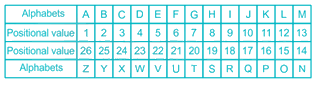 The logic followed here is:
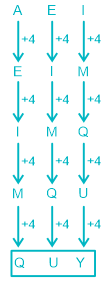 So, 'QUY' will replace the question mark in the given series.
Hence, the correct answer is "Option 1".
Q2 · Series
Select the letter-cluster from among the given options that can replace the question mark (?) in the following series.
ACE EIM IOU MUC ?
- QSA
- UHG
- QAK
- CGD
Answer aur solution dekho
Archived marked answer: C
The logic followed here is:
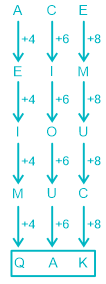 So, 'QAK' will replace the question mark in the given series.
Hence, the correct answer is "Option 3".
Q3 · Series
What will be come at the place of question mark? 1, 2, 5, 26, 677, ?
- 458330
- 456976
- 453625
- 458329
Answer aur solution dekho
Archived marked answer: A
The logic followed here is:
Logic: Next term = (Previous term
Q4 · Series
What comes next: 12, 30, 56, 90, 132, ?
- 182
- 250
- 190
- 293
Answer aur solution dekho
Archived marked answer: A
The logic followed here is:
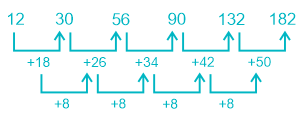 thus, "182" will replace the question mark in the given series.
Hence, the correct option is "Option 1".
Q5 · Series
Find the number that fits: 2, 5, 10, 17, ?
- 26
- 24
- 21
- 20
Answer aur solution dekho
Archived marked answer: A
The logic followed here is:
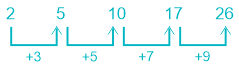 thus, "26" will replace the question mark in the given series.
Hence, the correct option is "Option 1".
Q6 · Analogy
In each of the following questions, a specific alphabetic coding pattern has been applied to the first word to form the second word. Identify the same coding logic and apply it to the third word to determine the correct answer from the given options.
COUNTRY : FRXQWUB :: EXAMINE : ?
- HAPDLQH
- HADPLQH
- HAHPLDQ
- GBQDVWB
Answer aur solution dekho
Archived marked answer: B
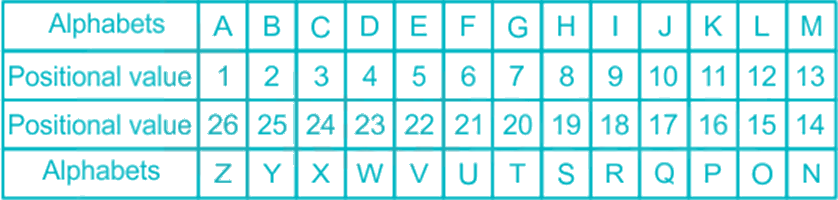 The logic followed here is :-
COUNTRY : FRXQWUB
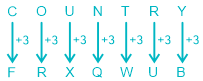 Similarly,
EXAMINE : ?
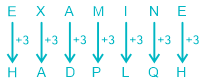 Hence, the correct answer is "HADPLQH".
Thus, the correct answer is Optrion 2.
Q7 · Analogy
In each of the following questions, the second word is formed by rearranging the letters of the first word using a specific transformation, such as reversal or block shifting. Identify that transformation and apply it to the third word to choose the correct option.
KITCAT : CATTIK :: PENTOP : ?
- TOPPEN
- TOPNEP
- POPTEN
- POPNET
Answer aur solution dekho
Archived marked answer: B
The logic followed here is :-
Logic: Split into two equal halves and interchange them (block shifting).
Given, KITCAT : CATTIK
Break KITCAT into two equal blocks: KIT | CAT
Now reverse the order of the two blocks: CA
Q8 · Puzzle Subtypes Not To Miss
If 6 $ 2 = 20 and 4 $ 3 = 19, then 5 $ 2 = ?
- 18
- 17
- 16
- 15
Answer aur solution dekho
Archived marked answer: B
The logic followed here is:
Given:
If 6 $ 2 = 20,
⇒ 6 x 2 = 12
⇒ 6 + 2 = 8
⇒ 12 + 8 = 20
and 4 $ 3 = 19,
⇒ 4 x 3 = 12
⇒ 4 + 3 = 7
⇒ 12 + 7 = 19
Similarly, 5 $ 2 = ?
⇒ 5 x 2 = 10
⇒ 5 + 2 = 7
⇒ 10 + 7 = 17
Hence, the correct answer is "Option 2."
Q9 · Puzzle Subtypes Not To Miss
If a % b = 37, where a % b = a + 2b, what is the value of a and b?
- 25,5
- 27, 5
- 16, 10
- 27, 10
Answer aur solution dekho
Archived marked answer: B
Given: a % b = 37, where a % b = a + 2b,
Now,checking the given equations,
Option 1) 25,5
⇒ 25 + 2×5 = 25 + 10 = 35 (Not correct)
Option 2)
Q10 · Puzzle Subtypes Not To Miss
After interchanging + & × and 3 & 9, which of the following equations will hold true?
- (3+5)×9=48
- (9+2)×3=10
- (3+7)×9=60
- (9+1)×3=15
Answer aur solution dekho
Archived marked answer: A
BODMAS Table:
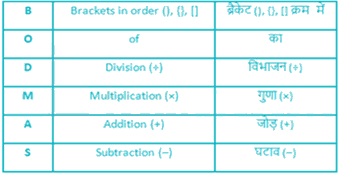 Given:
interchanging + & × and 3 & 9
Now,checking the given equations,
Option 1) (3+5)×9=48
⇒ (9×5)+3
= (45)+3
= 48
Option 2) (9+2)×3=10
⇒ (3×2)+9
= 6+9
= 15 ≠ 10
Option 3) (3+7)×9=60
⇒ (9×7)+3
= 63+3
= 66 ≠ 60
Option 4) (9+1)×3=15
⇒ (3×1)+9
= 3+9
= 12 ≠ 15
Hence, the correct answer is "Option 1".
Q11 · Puzzle Subtypes Not To Miss
If + = x, - = +, x = ÷; then 10 + 2 - 4 × 2 = ?
- 10
- 19
- 22
- 24
Answer aur solution dekho
Archived marked answer: C
BODMAS Table:
Given equation: 10 + 2 - 4 × 2 = ?
Now, if ‘+’, ‘-’, and ‘×’ are interchanged as:
= ×, - = +, × = ÷, then:
⇒ 10 × 2 + 4 ÷ 2 = ?
⇒ 20 + 2 = ?
⇒ 22
Hence, the correct answer is "Option 3". Q12 · Puzzle Subtypes Not To Miss
If x+2y=14 and x-y=5, find x.
- 6
- 4
- 8
- 10
Answer aur solution dekho
Archived marked answer: C
Given:
x + 2y = 14
x − y = 5
Calculations:
From the second equation:
x = 5 + y
Substitute into the first equation:
5 + y + 2y = 14
5 + 3y = 14
3y = 9
y = 3
Now substitute back:
x = 5 + 3
x = 8
∴ The correct answer is 'Option 3.'
Q13 · Puzzle Subtypes Not To Miss
If the ratio of two numbers is 3:5 and their sum is 64, find the numbers
- 24, 40
- 20, 44
- 18, 46
- 16, 48
Answer aur solution dekho
Archived marked answer: A
Given:
Let the two numbers be 3x and 5x (since ratio is 3 : 5).
Their sum is given as 64.
3x + 5x = 64
8x = 64
x = 8
Calculations:
Now find the numbers:
3x = 3 × 8 = 24
5x = 5 × 8 = 40
So, the two numbers are 24 and 40.
∴ The correct answer is "Option 1."
Q14 · Puzzle Subtypes Not To Miss
If 5 @ 3 = 28 and 4 @ 2 = 18, then what is 6 @ 4?
- 40
- 52
- 64
- 76
Answer aur solution dekho
Archived marked answer: A
The logic followed here is:
Logic: the pattern is a @ b = a² + b
Given:
If 5 @ 3 = 28 ,
⇒ 5² + 3 = 25 + 3 = 28
and 4 @ 2 = 18,
⇒ 4² + 2 = 16 + 2 = 18
Similarly, 6 @ 4 = ?
⇒ 6 @ 4 = 6² + 4
= 36 + 4
= 40
Hence, the correct answer is "Option 1."
Q15 · Coding Decoding
Instruction: In a certain coding system:
'dream focus build skill' is coded as 'trq, xnz, hmd, clv'
'focus logic dream' is coded as 'trq, jkp, xnz'
'trust logic build dream' is coded as 'xnj, clv, jkp, trq'
Question: What is the code for 'build skill logic trust'?
- clv, hmd, jkp, xnj
- clv, xnj, jkp, trq
- hmd, xnz, jkp, xnj
- hmd, clv, xnj, xnz
Answer aur solution dekho
Archived marked answer: A
The logic followed here is:
Given:
dream focus build skill → trq, xnz, hmd, clv
focus logic dream → trq, jkp, xnz
Q16 · Coding Decoding
If 'SAVE' is coded as '★3#5', and 'VASE' as '#3★5', then what is the code for 'EVAS'?
- 5★3#
- ★5#7
- ★5#3
- 5#3★
Answer aur solution dekho
Archived marked answer: D
The logic followed here is:
Given:
'SAVE' is coded as '★3#5',
S → ★
A → 3
V → #
E → 5
and 'VASE' as '#3★5',
V → #
A → 3
S → ★
E → 5
Similarly, for 'EVAS'
E → 5
V → #
A → 3
S → ★
Here, the code for EVAS is 5#3★
Hence, the correct answer is "Option 4."
Q17 · Classification Odd One Out
In each of the following questions, a group of three numbers/symbols is given in each option. Identify the group that does NOT follow the same pattern as the others.
- Z1# : Y2@ : X3$
- W4% : V5^ : U6&
- T7* : S8( : R9)
- Q10_ : P9@ : O8$
Answer aur solution dekho
Archived marked answer: D
The logic followed here is:
Logic: Letter ↓1, Number ↑1
Now, checking the options, we get:
Option 1) Z1# : Y2@ : X3$
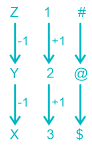 Option 2) W4% : V5^ : U6&
Q18 · Blood Relations
Pointing to a girl, a man said, "She is the daughter of my mother's only son." How is the girl related to the man?
- Daughter
- Niece
- Sister
- Cousin
Answer aur solution dekho
Archived marked answer: A
Family Chart:
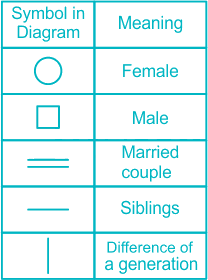 Given:
"She is the daughter of my mother's only son."
→ My mother’s only son = I (the man himself).
 So, The girl is his daughter.
Hence, the correct answer is "Option 1".
Q19 · Blood Relations
If P is the maternal uncle of Q, how is Q related to P's sister?
- Niece
- Cousin
- Son
- Cannot be determined
Answer aur solution dekho
Archived marked answer: D
Family Chart:
Given:
P is the maternal uncle of Q.
Maternal uncle means mother’s brother.
So, P is Q’s mother’s brother.
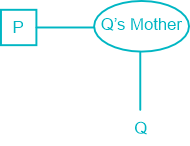 Possible relation:
If P's sister is
Q is her
Q's Mother
Son or Daughter
Q's Maternal Aunt
Nephew or Niece
Since the information provided doesn't specify which sister we are talking about. So we can not extinguish the relation between them.
Hence, the correct answer is "Cannot be determined".
Q20 · Alphabet Test
From the given options, find the word which cannot be formed using the letters of the given word: INTELLIGENCE
- CANCEL
- NEGLECT
- GENTLE
- INCITE
Answer aur solution dekho
Archived marked answer: A
Let’s check each option,
1) CANCEL → cannot be formed as there is No A in INTELLIGENCE.
2) NEGLECT→ can be formed as INTELLIGENCE
3) GENTLE → can be formed as INTELLIGENCE
4) INCITE → can be formed as INTELLIGENCE
Hence, “CANCEL” can’t be formed.
Hence, the correct answer is "option (1)".
Q21 · Alphabet Test
The position of how many letters will remain unchanged if each of the letters in the word DEVELOP is arranged in alphabetical order?
- Two
- Four
- Three
- Five
Answer aur solution dekho
Archived marked answer: A
Given word: 'DEVELOP'
After arranged in alphabetical order:
Alphabets
D
E
V
E
L
O
P
Alphabetical order
D
E
E
L
O
P
V
After arranged in alphabetical order: D, E, E, L, O, P, V
Thus,Two letters remain in the same position.
Hence, the correct answer is "Option 1".
Q22 · Similarity and Differences
Identify the similar address: No. 45, First Avenue, Raja Annamalaipuram, Chennai, Tamil Nadu - 600028
- No. 45, 1st Avenue, R.A. Puram, Chennai, TN 600028
- No. 45, First Avenue, Raja Annamalaipuram, Chennai, Tamil Nadu - 600028
- 45, First Avenue, Raja Annamalai Puram, Chennai, Tamil Nadu - 600028
- No. 45/1, First Avenue, R. Annamalaipuram, Chennai, Tamil Nadu - 600028
Answer aur solution dekho
Archived marked answer: B
The address given in the problem is,
No. 45, First Avenue, Raja Annamalaipuram, Chennai, Tamil Nadu - 600028
Let's match this address with the given options one by one to figure out which one is exactly the same.
Option
Address in Option
Given Address
Comment
(1)
No. 45, 1st Avenue, R.A. Puram, Chennai, TN 600028
No. 45, First Avenue, Raja Annamalaipuram, Chennai, Tamil Nadu - 600028
The address in this option uses abbreviations like "1st", "R.A. Puram" and "TN" instead of the full forms given in the original address.
(2)
No. 45, First Avenue, Raja Annamalaipuram, Chennai, Tamil Nadu - 600028
No. 45, First Avenue, Raja Annamalaipuram, Chennai, Tamil Nadu - 600028
The address is exactly the same as the given address.
(3)
45, First Avenue, Raja Annamalai Puram, Chennai, Tamil Nadu - 600028
No. 45, First Avenue, Raja Annamalaipuram, Chennai, Tamil Nadu - 600028
This option is missing "No." and has spacing difference in "Annamalai Puram".
(4)
No. 45/1, First Avenue, R. Annamalaipuram, Chennai, Tamil Nadu - 600028
No. 45, First Avenue, Raja Annamalaipuram, Chennai, Tamil Nadu - 600028
The house number is different (45/1 instead of 45) and the locality name is shortened.
So, the address that is exactly the same as the given address is in option (2).
Hence, the correct option is "option (2)".
Q23 · Logical Statement Questions
Instruction: Identify the assumptions that must hold for the statement to be valid, then choose the correct option.
Statement: While the world is moving towards automation, it is essential to ensure that ethical frameworks evolve alongside technological advancements to prevent misuse.
Assumptions:
I. Automation can lead to ethical dilemmas.
II. Ethical frameworks must be updated to keep pace with technological advancements.
III. Automation will eventually replace human labor in all sectors.
- Only I and II are implicit
- Only I and III are implicit
- All are implicit
- Only I is implicit
Answer aur solution dekho
Archived marked answer: A
Given Statement: While the world is moving towards automation, it is essential to ensure that ethical frameworks evolve alongside technological advancements to prevent misuse.
Now,
Assumptions:
I. Automation can lead to ethical dilemmas - Implicit (If there were no ethical risks, there would be no need to evolve ethical frameworks to prevent misuse)
II. Ethical frameworks must be updated to keep pace with technological advancements - Implicit (The statement directly argues that ethical frameworks should evolve alongside technology.)
III. Automation will eventually replace human labor in all sectors - Not Implicit (The statement only discusses automation increasing, not complete replacement of human labor.)
Here, Only I and II are implicit
Hence, the correct answer is "Option 1".
Q24 · Miscellaneous Other Possibilities
In a tournament of 7 players, each player plays every other player once. How many matches are there?
- 21
- 42
- 36
- 28
Answer aur solution dekho
Archived marked answer: A
Given:
In a tournament of 7 players, each player plays every other player once.
Formula used:
When each player plays every other player once, the number of matches is given by:
Number of matches = n(n − 1) / 2
Where n = number of players
Calculations:
Here, n = 7
Substitute the value:
Number of matches = 7(7 − 1) / 2
= 7 × 6 / 2
= 42 / 2
= 21
So, the total number of matches = 21
∴ The correct answer is "Option 1."
Q25 · Seating Arrangement
Eight persons A, B, C, D, E, F, G, and H are sitting around a circle facing the center.
C is second to the right of A.
E is opposite C.
F is to the immediate left of E.
B is to the immediate right of A.
G is to the immediate left of D.
Who is sitting to the right of D?
- H
- U
- B
- F
Answer aur solution dekho
Archived marked answer: D
Given: Eight persons A, B, C, D, E, F, G, and H are sitting around a circle facing the center.
1.C is second to the right of A.
2.E is opposite C.
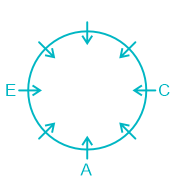 3.F is to the immediate left of E.
4.B is to the immediate right of A.
5.G is to the immediate left of D.
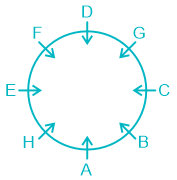 Thus, F is sitting to the right of D.
Hence, the correct answer is "Option 4".
General Awareness
Q1 · Art and Culture
Arrange the following classical dances in chronological order of earliest historical references (oldest to newest):
1. Bharatanatyam
2. Mohiniyattam
3. Kathak
4. Manipuri
- 1 - 3 - 2 - 4
- 1 - 2 - 4 - 3
- 1 - 3 - 4 - 2
- 1 - 4 - 3 - 2
Answer aur solution dekho
Archived marked answer: C
The correct answer is 1 - 3 - 4 - 2.
Key Points
- Bharatanatyam is considered one of the oldest classical dance forms of India, with references dating back to ancient texts such as the Natyashastra, written by Bharata around 200 BCE to 200 CE. It originated in Tamil Nadu and was initially performed in temples as a form of religious expression.
- Kathak, a classical dance form from North India, traces its roots to the storytelling tradition of ancient India. It evolved during the Mughal era and incorporates influences from both Hindu and Muslim cultures. Its historical references date back to the Bhakti movement, which emerged between the 15th and 17th centuries.
- Manipuri, originating from Manipur, is closely linked to the Vaishnavite traditions and the worship of Lord Krishna. Manipuri dance developed during the medieval period, particularly under King Bhagyachandra's reign in the 18th century.
- Mohiniyattam, a classical dance from Kerala, has relatively later references compared to the other forms. It gained prominence during the 18th century, particularly under the patronage of the rulers of Travancore.
Additional Information
- Bharatanatyam:
- Originated in Tamil Nadu, Bharatanatyam was performed in temples as a form of devotional offering.
- It is deeply rooted in the Natyashastra, which is an ancient treatise on drama and performance arts.
- The dance form is known for its graceful movements, expressions, and intricate footwork.
- It is performed to classical Carnatic music and often depicts stories from Hindu mythology.
- Kathak:
- Developed in North India, Kathak is known for its storytelling roots, derived from the Sanskrit word "Katha" meaning story.
- It reflects a blend of Hindu and Muslim cultural influences, especially during the Mughal era.
- Kathak dancers emphasize spins, facial expressions, and intricate rhythmic patterns.
- It is accompanied by classical Hindustani music and tabla or pakhawaj for rhythm.
- Manipuri:
- It emerged in the Vaishnavite traditions of Manipur.
- The dance form is notable for its soft and graceful movements, often depicting stories of Lord Krishna and Radha.
- Manipuri dancers typically wear traditional costumes, including a cylindrical skirt and intricate jewelry.
- The dance is performed to folk music and devotional songs.
- Mohiniyattam:
- Originated in Kerala, Mohiniyattam is known as the dance of the enchantress.
- It is characterized by gentle and flowing movements, complementing the lasya (feminine) aspect of dance.
- The dance form is performed to classical Carnatic music and often narrates mythological stories.
- It gained prominence under the rulers of Travancore during the 18th century.
Important Points
- Chronological Order:
- Bharatanatyam: Oldest, references in the Natyashastra (200 BCE - 200 CE).
- Kathak: Developed during the Bhakti movement and flourished under the Mughals.
- Manipuri: Evolved under the Vaishnavite traditions in the 18th century.
- Mohiniyattam: Gained prominence in Kerala during the 18th century.
- These classical dances are integral to India's cultural heritage and reflect the country's diverse traditions.
- The Natyashastra serves as the foundational text for most classical dance forms in India.
Q2 · Art and Culture
Which of the following pairs is correctly matched with the shape of its roof?
- Latina — rectangular, wagon-shaped
- Phamsana — slabs rising to a point, straight incline
- Valabhi — tall, curving inward sharply
- Latina — low and broad with stepped roofing
Answer aur solution dekho
Archived marked answer: B
The correct answer is Phamsana — slabs rising to a point, straight incline.
Key Points
- Phamsana style roofs are characterized by slabs rising upwards in a straight slope toward a central point, forming a pyramidal appearance. *Hence, this pair is correctly matched.*
- Latina is the most common type of Nagara temple shikhara, marked by a tall curvilinear tower that curves inward gradually toward the top. Therefore, it is not rectangular or wagon-shaped.
- Valabhi roofs are rectangular and wagon-vault shaped, resembling the roof of a barrel vault. Hence, the pair mentioning Valabhi as “tall, curving inward sharply” is incorrect.
- Latina temples are not low and broad with stepped roofing; such stepped or pyramidal forms are associated more with other temple roof styles.
- Option-wise Analysis:
- Latina — rectangular, wagon-shaped – Incorrect.
- Phamsana — slabs rising to a point, straight incline – Correct.
- Valabhi — tall, curving inward sharply – Incorrect.
- Latina — low and broad with stepped roofing – Incorrect.
- *Hence, the correct answer is Phamsana — slabs rising to a point, straight incline.*
Additional Information
- Nagara Style: The dominant temple architecture style of North India, identified by curving towers called Shikharas.
- Latina Shikhara: Simple curvilinear tower with smooth vertical projection, commonly found in early Nagara temples.
- Phamsana Roof: Usually broader and shorter than Latina towers, often used for mandapas (assembly halls).
- Valabhi Style: Features a wagon-vault roof, similar to ancient Buddhist chaitya hall roofing patterns.
- Temple Architecture Period: Major developments in Nagara architecture occurred between the 5th century CE and 13th century CE.
Important Points
- Latina, Phamsana, and Valabhi are important classifications of Nagara temple superstructures.
- Wagon-vaulted roofs are strongly associated with Valabhi architecture, while curvilinear towers are associated with Latina.
Q3 · Art and Culture
Fill in the blanks:
In Teen Taal of Hindustani Classical Music, the Khali is marked on the ____ matra.
- 1
- 5
- 9
- 13
Answer aur solution dekho
Archived marked answer: C
The correct answer is 9.
Key Points
- Teen Taal is one of the most popular and foundational taals (rhythmic cycles) in Hindustani Classical Music. It consists of 16 matras (beats).
- The structure of Teen Taal is divided into four vibhags (sections), each containing four matras. These divisions are essential for understanding and performing the taal rhythmically.
- The Khali, or the "empty beat," is a significant aspect of Teen Taal. It is marked with a wave of the hand instead of a clap, signifying a moment of rhythmic void or lightness.
- In Teen Taal, the Khali is placed on the 9th matra. This placement divides the taal into two halves, creating a balance between the claps (taali) and the wave (khali).
- The sequence of Teen Taal is represented as 1 (Sam), 2, 3, Taali on 5, 6, 7, 8, Khali on 9, 10, 11, 12, and Taali on 13, 14, 15, 16. This cyclic pattern is repeated throughout the composition.
Additional Information
- Structure of Teen Taal:
- Teen Taal has 16 beats divided into four sections of four beats each.
- Its notation is represented as + 2 0 3, where "+" denotes the first clap (Sam), "2" is the second clap (Taali on the 5th matra), "0" is the Khali (empty beat on the 9th matra), and "3" is the third clap (Taali on the 13th matra).
- Importance of Khali:
- The Khali, marked by a wave of the hand, provides contrast and adds a sense of lightness to the rhythm cycle.
- It helps distinguish between sections of the taal and guides the performer in maintaining proper rhythm.
- Applications of Teen Taal:
- Teen Taal is widely used in classical music compositions, including khayal, dhrupad, and instrumental music.
- It is also a foundation for tabla solos and accompaniment, where intricate rhythmic patterns are explored.
- Comparison with Other Taals:
- Teen Taal is distinguished by its 16-beat cycle, whereas other taals like Dadra have 6 beats and Ek Taal has 12 beats.
- This versatility makes Teen Taal suitable for a variety of compositions and improvisations.
Important Points
- Sam: The first beat of a taal, denoted by a clap, is called Sam. It is the most emphasized beat and serves as the starting and ending point of the rhythmic cycle.
- Taali: The clapping points in the taal, such as those on the 5th and 13th matras in Teen Taal, are called Taali. They help emphasize specific beats.
- Khali: The wave of the hand on the 9th matra indicates the Khali or empty beat. It provides a sense of contrast and balance within the taal cycle.
- Matra: A matra is a unit of time in Indian rhythm, similar to a beat in Western music. The number of matras determines the length of the rhythmic cycle.
Q4 · Art and Culture
Fill in the Blank: Kalbelia dance represents the movement of _____.
- Camels
- Snakes
- Birds
- Horses
Answer aur solution dekho
Archived marked answer: B
The correct answer is Snakes.
Key Points
- Kalbelia Dance is a traditional folk dance performed by the Kalbelia community of Rajasthan, India, primarily known for their expertise in snake charming.
- The movements of the dancers in Kalbelia mimic the graceful and fluid movements of a snake. This is in line with the community’s traditional association with snake charming.
- It is performed by women wearing traditional black swirling skirts that are embroidered with silver ribbons, representing the color and movement of snakes.
- The music accompanying the dance is provided by male members of the community using traditional instruments like the pungi (a wind instrument traditionally used by snake charmers), the dholak (a type of drum), and the khanjari (a tambourine-like instrument).
- In 2010, Kalbelia dance was included in the UNESCO Representative List of the Intangible Cultural Heritage of Humanity, recognizing its cultural significance.
Additional Information
- Kalbelia Community:
- The Kalbelias are a semi-nomadic community traditionally involved in snake charming and trading snake venom.
- Their livelihood has historically revolved around their deep connection with snakes, which is reflected in their art forms like dance and music.
- In modern times, the Kalbelia community has shifted from snake charming due to legal restrictions and has focused more on preserving their cultural heritage through dance and music.
- Costumes:
- The dancers wear black skirts that are embroidered with silver or white patterns resembling snake skin.
- Their jewelry is elaborate, often including headpieces, necklaces, and bangles, complementing the vibrant and dynamic dance movements.
- Musical Instruments:
- The pungi is the primary instrument, traditionally used by snake charmers to control snakes.
- Other instruments like the dholak and khanjari add rhythm and vibrancy to the performance, creating a lively and captivating atmosphere.
- Performance Style:
- The dance is characterized by intricate footwork, swirling movements, and graceful gestures, all mimicking the sinuous and undulating motion of a snake.
- The performers often incorporate storytelling elements into their dance, narrating tales of their heritage and connection to nature.
- UNESCO Recognition:
- Kalbelia dance was recognized by UNESCO in 2010 as part of the Intangible Cultural Heritage of Humanity.
- This recognition has helped in preserving and promoting the dance on global platforms, highlighting its cultural significance and artistic value.
Important Points
- Kalbelia Dance and Indian Culture:
- The Kalbelia dance is a significant representation of India’s diverse cultural heritage, showcasing the unique traditions of a marginalized community.
- Its inclusion in UNESCO’s list has brought attention to the need for preserving endangered cultural practices and supporting the communities that sustain them.
- Connection with Wildlife:
- The dance reflects the Kalbelia community’s historical relationship with wildlife, particularly snakes, and their environment.
- Their cultural practices highlight the importance of coexistence with nature and respecting biodiversity.
- Tourism and Cultural Preservation:
- Kalbelia dance has become a popular attraction in Rajasthan’s cultural festivals and tourism events, contributing to the local economy and cultural preservation.
- Efforts are being made by the government and NGOs to promote and support the Kalbelia community in preserving their cultural identity.
Q5 · Art and Culture
The Pongtu Festival, celebrated by the Tutsa tribe of Arunachal Pradesh, is primarily observed to seek blessings from which deity before millet harvesting?
- Donyi-Polo
- Rangkhothak
- Rangfraa
- Nyegi-Nyapa
Answer aur solution dekho
Archived marked answer: B
The correct answer is Rangkhothak.
Key Points
- The Pongtu Festival is a significant cultural celebration of the Tutsa tribe in Arunachal Pradesh. This festival marks the post-sowing season and is celebrated primarily before the millet harvesting period.
- The festival is observed to seek blessings from the deity Rangkhothak. The deity is revered for ensuring a bountiful harvest and protecting the crops from natural calamities and pests.
- The Tutsa people express gratitude and hope for prosperity through their rituals and prayers during the festival. Hence, the correct answer is Rangkhothak.
- The Pongtu Festival is characterized by traditional dances, feasts, and offerings to the deity, which are performed to honor the divine forces that influence agriculture.
- It is an integral part of the cultural identity of the Tutsa tribe, symbolizing unity, gratitude, and their connection with nature and agricultural practices.
Q6 · Indian Polity and Constitution
Article 370, which granted special status to Jammu and Kashmir, was abrogated by which constitutional mechanism?
- Presidential Order under Article 370(3)
- Amendment by Parliament under Article 368
- Ordinance by the President
- Order under Article 356
Answer aur solution dekho
Archived marked answer: A
The correct answer is Presidential Order under Article 370(3).
Key Points
- Article 370 granted special status to Jammu and Kashmir, providing autonomy over its internal matters except for defense, foreign affairs, finance, and communications.
- The abrogation of Article 370 was executed using a Presidential Order issued under Article 370(3), which allowed the President of India to make modifications or exceptions to Article 370.
- The Presidential Order C.O. 272, issued on 5th August 2019, replaced the previous Presidential Order from 1954, extending all provisions of the Indian Constitution to Jammu and Kashmir.
- The Jammu and Kashmir Reorganization Act, 2019, was passed by Parliament, bifurcating Jammu and Kashmir into two Union Territories: Jammu and Kashmir and Ladakh.
- The procedure involved obtaining the concurrence of the Jammu and Kashmir Legislative Assembly, which was absent at the time due to President's Rule. Consequently, the concurrence was given by the Governor, who was acting on behalf of the state legislature.
Additional Information
- Article 370:
- Article 370 was part of the Indian Constitution that provided special autonomy to Jammu and Kashmir.
- It was incorporated as a temporary provision under Part XXI of the Constitution, which deals with “Temporary, Transitional, and Special Provisions.”
- Under Article 370, the state had its own Constitution and decision-making rights in all matters except defense, foreign affairs, finance, and communications.
- It also allowed Jammu and Kashmir to have a separate flag and denied property rights to outsiders.
- Presidential Order and Article 370(3):
- Article 370(3) empowered the President of India to declare Article 370 inoperative or modify it, provided the recommendation of the Constituent Assembly of Jammu and Kashmir was obtained.
- Since the Constituent Assembly of Jammu and Kashmir ceased to exist in 1957, the Indian government used the provision of President's Rule in the state to bypass this requirement.
- The Presidential Order issued on 5th August 2019 extended all provisions of the Indian Constitution to Jammu and Kashmir, effectively nullifying its special status.
- Jammu and Kashmir Reorganization Act, 2019:
- Passed on 6th August 2019, this Act reorganized the state of Jammu and Kashmir into two Union Territories: Jammu and Kashmir (with a Legislative Assembly) and Ladakh (without a Legislative Assembly).
- The Act came into effect on 31st October 2019.
- The bifurcation aimed to improve governance and integrate the region fully with the rest of India.
- Impact of Abrogation:
- The abrogation of Article 370 has led to the extension of all Indian laws and provisions to Jammu and Kashmir.
- It has sparked debates on federalism, autonomy, and the rights of states under the Indian Constitution.
- While some argue it has brought greater integration, others highlight concerns over political representation and regional identity.
Important Points
- Article 368: This article pertains to the power of Parliament to amend the Constitution, including fundamental rights. However, it was not used for the abrogation of Article 370.
- Article 356: This article allows the imposition of President's Rule in a state due to the failure of constitutional machinery. While President's Rule was in effect in Jammu and Kashmir, Article 356 was not directly used for the abrogation.
- Ordinance by the President: Ordinances are temporary laws issued by the President when Parliament is not in session. This mechanism was not employed for abrogating Article 370.
- It is important to understand that the abrogation of Article 370 followed a unique constitutional process, combining Presidential Orders and Parliamentary legislation.
Q7 · Indian Polity and Constitution
Which of the following changes has Bharatiya Nagarik suraksha Samhita(BNSS) brought to criminal procedure?
- Replaced all IPC sections
- Video-recorded confessions
- Presumption of guilt
- Scrapping of all bail rights
Answer aur solution dekho
Archived marked answer: B
The correct answer is Video-recorded confessions.
Key Points
- Bharatiya Nagarik Suraksha Samhita (BNSS) replaces the Code of Criminal Procedure (CrPC), focusing on modernizing criminal procedure laws in India to align with contemporary requirements.
- The introduction of video-recorded confessions ensures transparency and enhances the reliability of evidence presented in courts. This provision aims to eliminate coercion and safeguard the rights of the accused.
- The initiative reflects a move toward digitization and technological integration in judicial processes, ensuring accountability and reducing malpractices.
- BNSS does not include provisions like presumption of guilt or scrapping of bail rights, as these would violate fundamental rights under the Constitution of India. Hence, these statements are incorrect.
- BNSS does not replace all IPC sections. It specifically deals with procedures rather than substantive criminal laws. Hence, this statement is also incorrect.
- *Hence, the correct answer is video-recorded confessions.*
Additional Information
- Bharatiya Nagarik Suraksha Samhita (BNSS):
- The BNSS, enacted in 2023, aims to enhance efficiency in criminal procedures and ensure justice delivery in a time-bound manner.
- The law emphasizes digital integration, including the use of technology for evidence recording, case management, and monitoring judicial processes.
- The BNSS also facilitates victim-centric justice by ensuring their active participation in the legal process and introducing provisions for victim compensation.
- Video-recorded confessions:
- This provision is aligned with global best practices, enhancing the credibility of the judicial system and ensuring compliance with Article 21 of the Constitution, which guarantees the right to life and personal liberty.
- It addresses concerns related to custodial torture or forced confessions by ensuring that statements are recorded in a transparent and impartial manner.
- Key Principles of Criminal Procedure:
- The principles of criminal procedure emphasize fair trial, presumption of innocence, and adherence to fundamental rights.
- BNSS retains these principles, reinforcing the importance of due process and equality before the law.
- Indian Penal Code (IPC):
- The IPC, enacted in 1860, is the primary criminal code in India, addressing substantive criminal law.
- BNSS focuses exclusively on procedures, ensuring streamlined processes for investigation, trial, and sentencing.
- Constitutional Provisions:
- Article 22 protects against arbitrary arrest and detention, ensuring safeguards for the accused during criminal proceedings.
- BNSS aligns with constitutional mandates to uphold justice, transparency, and the rule of law.
Important Points
- Digitization in Criminal Justice:
- The use of technology, such as video recording, reduces the scope for manipulation and ensures transparency in judicial proceedings.
- India's judicial reforms, including BNSS, aim to integrate digital tools to expedite case disposal and improve access to justice.
- International Best Practices:
- Several countries, including the United States and United Kingdom, have implemented video-recorded confessions to ensure the integrity of legal processes.
- India's adoption of such practices reflects its commitment to modernizing its judicial system in line with global standards.
- Victim-Centric Justice:
- BNSS incorporates provisions to ensure timely justice for victims and safeguard their rights during legal proceedings.
- Compensation mechanisms under BNSS aim to reduce the financial burden on victims and their families.
Q8 · Indian Polity and Constitution
A Proclamation of National Emergency must be approved by each House within how many months?
- 1
- 3
- 6
- 9
Answer aur solution dekho
Archived marked answer: A
The correct answer is 1.
Key Points
- A Proclamation of National Emergency in India is issued under Article 352 of the Constitution of India.
- Once the Proclamation of National Emergency is made, it must be approved by both Houses of Parliament within a period of 1 month from the date of its issue.
- If approved, the emergency remains in force for an initial period of six months and can be extended further by parliamentary approval.
- The approval requires a special majority, meaning the resolution must be passed by a majority of the total membership of each House and by a majority of not less than two-thirds of the members present and voting.
- If the Proclamation is not approved within 1 month, it automatically ceases
Q9 · Indian Polity and Constitution
Which of the following is true regarding the Anglo-Indian representation in State Assemblies?
- The Governor still nominates one Anglo-Indian member to the Assembly.
- The provision was abolished by the 42nd Constitutional Amendment.
- The provision was abolished by the 104th Constitutional Amendment.
- Anglo-Indian members are elected through proportional representation.
Answer aur solution dekho
Archived marked answer: C
The correct answer is The provision was abolished by the 104th Constitutional Amendment..
Key Points
- The Anglo-Indian representation in the Lok Sabha and State Legislative Assemblies was provided under Article 331 and Article 333 of the Indian Constitution, respectively.
- The 104th Constitutional Amendment Act, 2019, abolished the provision for the nomination of Anglo-Indian members to the Lok Sabha and State Legislative Assemblies. This amendment came into effect on January 25, 2020.
- The provision for Anglo-Indian representation was initially introduced to provide political representation to a small minority community in India. However, the government reasoned that the Anglo-Indian population had significantly decreased, and there was no longer a need for this special representation.
- Governors of states were earlier empowered to nominate one Anglo-Indian member to the State Legislative Assemblies under Article 333, but this provision was removed by the 104th Amendment.
- Statements in the question:
- Statement 1: "The Governor still nominates one Anglo-Indian member to the Assembly." – Incorrect, as this provision was abolished by the 104th Constitutional Amendment.
- Statement 2: "The provision was abolished by the 42nd Constitutional Amendment." – Incorrect, as the 42nd Amendment (1976) did not deal with Anglo-Indian representation.
- Statement 3: "The provision was abolished by the 104th Constitutional Amendment." – Correct.
- Statement 4: "Anglo-Indian members are elected through proportional representation." – Incorrect, as they were nominated and not elected.
Additional Information
- Anglo-Indian Community:
- Anglo-Indians are a small community in India that originated during the British colonial period, with mixed Indian and European ancestry.
- The community played an important role in India's administration, railways, and education system during British rule.
- 104th Constitutional Amendment Act:
- It abolished the special representation of Anglo-Indians in the Lok Sabha and State Legislative Assemblies.
- It also extended the reservation for Scheduled Castes (SC) and Scheduled Tribes (ST) in the Lok Sabha and State Assemblies for another 10 years.
- Historical Context:
- The Anglo-Indian representation was initially a safeguard for a minority community to voice their concerns in legislative bodies.
- Over time, with the decline in the population of Anglo-Indians and their assimilation into mainstream society, this provision was deemed unnecessary.
- Other Reserved Categories in India:
- Seats are reserved for Scheduled Castes (SC) and Scheduled Tribes (ST) in legislative bodies under Articles 330 and 332 of the Constitution.
- These reservations aim to ensure the political representation of historically disadvantaged communities.
Important Points
- The 42nd Constitutional Amendment Act (1976) is often referred to as the "Mini-Constitution" because it introduced significant changes but did not address Anglo-Indian representation.
- The 104th Constitutional Amendment was passed in December 2019 and came into effect on January 25, 2020.
- Currently, no seats are reserved for Anglo-Indians in either the Lok Sabha or State Legislative Assemblies.
- This amendment highlights the dynamic nature of the Constitution, which adapts to social and demographic changes.
Q10 · Sports Static GK
Which of the following about the 61st National Chess Championship is/are correct?
1.) GM Karthik Venkataraman won in Gurgaon and got ₹6 lakh.
2.) IM Neelash Saha finished 2nd but lost due to a tiebreak game vs Ganguly.
- Only 1
- Only 2
- Both 1 and 2 are correct
- Neither 1 nor 2 is correct
Answer aur solution dekho
Archived marked answer: A
The correct answer is Option 1.
Key Points
- Statement 1: Grandmaster (GM) Karthik Venkataraman won the 61st National Chess Championship held in Gurgaon and received a prize money of ₹6 lakh. This is *correct* as per official sources.
- Statement 2: International Master (IM) Neelash Saha finished second in the championship but lost to Surya Sekhar Ganguly in a tiebreak game. This is *incorrect* because there is no record of such a tiebreak game in the championship between these players.
- The championship was organized under the aegis of the All India Chess Federation (AICF), which is the governing body for chess in India.
- The event witnessed participation from several top-rated players in the country, showcasing their strategic and intellectual prowess in the game.
- The final standings were determined based on performance over multiple rounds, and the monetary rewards were distributed accordingly to the winners.
Q11 · Sports Static GK
Why is the weight and circumference of a cricket ball strictly regulated in official matches?
- Heavier balls suit bowlers, lighter ones suit batsmen, so balance is needed
- Variations affect bounce, swing, and fairness on standard pitches
- ICC mandates it to cut costs and simplify logistics
- Only red balls follow this; white balls have separate norms
Answer aur solution dekho
Archived marked answer: B
The correct answer is Variations affect bounce, swing, and fairness on standard pitches.
Key Points
- Regulation by ICC: The International Cricket Council (ICC) strictly regulates the weight and circumference of cricket balls in official matches to maintain uniformity and fairness across all formats of the game.
- Impact on performance: Variations in weight and size significantly affect the bounce, swing, and spin of the ball. These factors are crucial in determining the outcome of matches and ensuring equal opportunities for both bowlers and batsmen.
- Standard pitches: Standard pitches are designed with specific dimensions and characteristics. Cricket balls must conform to regulated specifications to ensure predictable behavior on these pitches, contributing to a balanced contest.
- Consistency in gameplay: Uniformity in ball specifications helps ensure consistency in gameplay across different venues and conditions, fostering fair competition.
- Quality assurance: Strict regulations ensure that cricket balls are produced with high-quality materials and standardized manufacturing processes, preventing any unfair advantages or discrepancies.
Additional Information
- Specifications for Cricket Balls:
- The weight of a cricket ball must be between 156 grams and 163 grams as per ICC regulations.
- The circumference should be between 22.4 cm and 22.9 cm.
- Red balls are used in Test matches, while white balls are used in ODIs and T20s.
- Different ball brands such as Kookaburra, Dukes, and SG are used globally, with slight variations in seam and finish.
- Impact of Ball Variations:
- Heavier balls may offer more swing, while lighter balls might favor batsmen due to less movement.
- The seam plays a critical role in generating spin and swing, affecting bowler performance.
- Changes in ball dimensions can disrupt the balance between batting and bowling, leading to unfair outcomes.
- Role of ICC in Cricket:
- The ICC is the governing body for international cricket, responsible for standardizing rules, regulations, and equipment specifications.
- Its guidelines ensure uniformity in gameplay across various formats and tournaments.
- ICC also monitors ball manufacturing to uphold these standards.
- Red vs. White Balls:
- Red balls: Used in longer formats, they have a pronounced seam for better swing and spin.
- White balls: Used in limited-overs formats, they are treated for durability under floodlights.
- White balls tend to deteriorate faster, affecting their performance over time.
Important Points
- Advantages of Standardized Cricket Balls:
- Ensures fair gameplay and equal opportunities for all players.
- Maintains consistency across matches played in different regions and conditions.
- Helps bowlers and batsmen strategize effectively based on predictable ball behavior.
- Examples of ICC Regulations:
- In Test cricket, only red balls conforming to ICC specifications are permitted.
- In ODIs and T20s, white balls are used, but they must meet the same weight and circumference standards as red balls.
- Special cases like pink balls are used for day-night Test matches but are also regulated for consistency.
Q12 · Sports Static GK
Which Indian athlete won the first-ever Paralympic gold in archery at the Paris 2024 Paralympics?
- Sheetal Devi
- Harvinder Singh
- Rakesh Kumar
- Preethi Pal
Answer aur solution dekho
Archived marked answer: B
The correct answer is Harvinder Singh.
Key Points
- Harvinder Singh won India’s first-ever Paralympic gold medal in archery at the Paris 2024 Paralympics.
Testbook
Testbook
Competing in the Men's Individual Recurve Open category on 4 September 2024, Singh defeated Poland's Lukasz Ciszek with a dominant 6-0 score in the final at the Esplanade des Invalides. This victory marked the first gold medal in archery for India across both the Paralympic and Olympic Games
- Sheetal Devi became the first Indian athlete to win a Paralympic gold medal in archery at the Paris 2024 Paralympics.
- She achieved this historic feat in the Women’s Compound Archery category, showcasing exceptional skills and focus under pressure.
- Sheetal Devi is an inspiration in the field of para sports, especially as a bilateral upper-limb amputee, demonstrating immense perseverance and determination.
- Her win marked a significant milestone for India in the Paralympic Games, bringing pride and recognition to para-athletes across the country.
- The event highlighted India's growing dominance in international archery competitions, encouraging more individuals to pursue sports inclusively.
Additional Information
- Sheetal Devi:
- She hails from Jammu and Kashmir and has been a trailblazer in the realm of para archery.
- Despite her physical challenges as a bilateral upper-limb amputee, she uses a special assistive device to shoot arrows with precision.
- Her rigorous training and determination have made her a role model for aspiring para-athletes.
- Paris 2024 Paralympics:
- The Paralympic Games in Paris, France, showcased the talents of athletes with disabilities from around the globe.
- India’s performance at the event was remarkable, with athletes like Sheetal Devi achieving historic milestones.
- Para Archery:
- It is an inclusive sport that allows athletes with physical impairments to compete at national and international levels.
- Competitions are divided into categories based on the type and extent of disability, ensuring fair play.
- India has seen significant growth in this discipline, with increasing participation and support for para-athletes.
- Other Indian Paralympians:
- Harvinder Singh: He was the first Indian to win a Paralympic medal in archery, securing a bronze at the Tokyo 2020 Paralympics.
- Rakesh Kumar: A prominent Indian para-archer who has represented the country in multiple international events.
Important Points
- India’s Paralympic Achievements:
- India has consistently improved its performance in the Paralympic Games, with increasing medals in disciplines like athletics, shooting, and archery.
- Government initiatives, such as the Target Olympic Podium Scheme (TOPS), have played a crucial role in supporting para-athletes.
- Archery in India:
- The Archery Association of India (AAI) is the governing body for the sport in the country.
- India has a rich tradition of excellence in archery, with athletes excelling in both able-bodied and para categories.
- Recent successes have increased awareness and investment in the sport at grassroots levels.
Mistake Points
Sheetal Devi is not the correct answer for this specific question because of the distinction between winning a medal and winning the first-ever gold.
Sheetal Devi won a Bronze medal (Mixed Team Compound) at the Paris 2024 Paralympics. Harvinder Singh is the correct answer because he won the Gold medal (Men's Individual Recurve), marking India's first-ever gold in the sport.
Hence, the correct answer is "Harvinder Singh".
Q13 · Indian Geography
Read the following statements carefully and choose the correct option:
Assertion (A): Iron and steel is considered a heavy industry.
Reason (R): It requires lightweight raw materials like cotton and rubber.
- Both A and R are true, and R is the correct explanation of A
- Both A and R are true, but R is not the correct explanation of A
- A is true, but R is false
- A is false, but R is true
Answer aur solution dekho
Archived marked answer: C
The correct answer is A is true, but R is false.
Key Points
- Assertion (A): Iron and steel is considered a heavy industry.
- The assertion is true. The iron and steel industry is classified as a heavy industry because it involves large-scale operations, significant capital investment, and the handling of heavy raw materials like iron ore, coal, and limestone.
- Heavy industries primarily focus on producing materials that serve as the foundation for other industries, and iron and steel are crucial for sectors like construction, manufacturing, and transportation.
- Reason (R): It requires lightweight raw materials like cotton and rubber.
- The reason is false. The iron and steel industry does not use lightweight raw materials like cotton and rubber.
- Instead, it heavily relies on iron ore, coal, and limestone, which are bulky and heavy raw materials, making the reasoning incorrect.
- Relationship between Assertion (A) and Reason (R):
- While the assertion is true, the reason provided is not valid as it does not align with the requirements or characteristics of the iron and steel industry.
- Hence, the correct explanation for the assertion is not the one given in the reason.
Additional Information
- Iron and Steel Industry Overview:
- The iron and steel industry is a key component of the global economy, serving as the backbone of modern infrastructure development.
- The main raw materials for the industry include iron ore, coal, limestone, and scrap steel.
- It is highly energy-intensive and requires large setups for smelting, refining, and producing steel products.
- Characteristics of Heavy Industry:
- Involves large-scale production and significant capital investment.
- Requires heavy raw materials and machinery for operations.
- Examples include the iron and steel industry, shipbuilding, and heavy machinery manufacturing.
- Lightweight Raw Materials in Industries:
- Lightweight raw materials like cotton and rubber are primarily used in light industries such as textiles, garment production, and rubber manufacturing.
- Light industries typically involve consumer goods and have smaller-scale operations compared to heavy industries.
- Importance of the Iron and Steel Industry:
- It is critical for sectors like construction, infrastructure, and transportation.
- Major steel-producing countries include China, India, Japan, and the United States.
- The industry contributes significantly to the GDP of industrialized nations and supports economic growth through job creation and trade.
Important Points
- Global Production Statistics:
- As of 2023, China is the largest producer of steel, accounting for more than 50% of global production.
- India is the second-largest producer, playing a crucial role in meeting domestic and international demand.
- Environmental Concerns:
- The iron and steel industry is a major contributor to carbon dioxide emissions, prompting the need for sustainable practices.
- Technological advancements like hydrogen-based steelmaking are being explored to reduce environmental impact.
- Applications of Steel:
- Steel is used in building skyscrapers, bridges, automobiles, railways, and household appliances.
- It is also essential for the production of machinery and tools in various industries.
Q14 · Indian Geography
Which of the following is not typically considered a weather element?
- Temperature
- Humidity
- Soil pH
- Wind
Answer aur solution dekho
Archived marked answer: C
The correct answer is Soil pH.
Key Points
- Weather elements are the characteristics used to describe and measure atmospheric conditions. These commonly include temperature, humidity, wind, pressure, and precipitation. Soil pH, however, is related to soil science rather than atmospheric conditions.
- Temperature: It is one of the primary weather elements, indicating the heat level in the atmosphere. It affects human activities, ecosystems, and weather patterns. *Hence, temperature is considered a weather element.*
- Humidity: It refers to the amount of water vapor in the air and is crucial for understanding precipitation, fog, and dew formation. *Thus, humidity is considered a weather element.*
- Wind: Wind represents the movement of air from high to low pressure areas and significantly impacts climate and weather. *Therefore, wind is a weather element.*
- Soil pH: This is a measure of the acidity or alkalinity of soil and pertains to soil science. It impacts agriculture and plant growth but is not relevant to weather patterns or atmospheric studies. *Hence, soil pH is not considered a weather element.*
Additional Information
- Temperature:
- Measured in units such as Celsius, Fahrenheit, or Kelvin.
- Affects evaporation, condensation, and the overall climate.
- Monitoring temperature is crucial for weather forecasting and studying climate change.
- Temperature can vary significantly based on location, altitude, and time of day.
- Humidity:
- Measured using instruments like hygrometers or psychrometers.
- Relative humidity is expressed as a percentage, indicating the air's moisture content relative to its capacity.
- High humidity can lead to discomfort, while low humidity can cause dryness in the atmosphere.
- It influences weather phenomena such as rainfall, snow, and storms.
- Wind:
- Measured using anemometers and wind vanes.
- Wind direction and speed are crucial for understanding weather systems.
- Global wind patterns are influenced by Earth's rotation and temperature differences.
- Strong winds can result in cyclones, hurricanes, and tornadoes.
- Soil pH:
- Measured using pH meters or litmus paper.
- Ranges from 0 to 14, with 7 being neutral. Below 7 is acidic, and above 7 is alkaline.
- Affects nutrient availability and microbial activity in the soil.
- Important for agriculture, as different crops require specific pH ranges for optimal growth.
Important Points
- Instruments used for weather elements:
- Thermometers for temperature.
- Hygrometers for humidity.
- Anemometers for wind speed.
- Barometers for atmospheric pressure.
- Applications:
- Weather forecasting relies on the accurate measurement of weather elements.
- Agriculture benefits from understanding weather patterns, such as rainfall and temperature.
- Climate studies use weather data to predict long-term changes in the atmosphere.
Q15 · Indian Geography
Read the following Assertion (A) and Reason (R) carefully and choose the correct option:
Assertion (A): The Chotanagpur Plateau is considered an eastern extension of the Central Highlands.
Reason (R): The Chotanagpur Plateau is drained primarily by the Chambal and Betwa rivers.
- Both A and R are true, and R is the correct explanation of A
- Both A and R are true, but R is not the correct explanation of A
- A is true, but R is false
- A is false, but R is true
Answer aur solution dekho
Archived marked answer: C
The correct answer is A is true, but R is false.
Key Points
- Assertion (A): The Chotanagpur Plateau is considered an eastern extension of the Central Highlands.
- The Chotanagpur Plateau lies in the eastern part of India, primarily in the state of Jharkhand, and spreads over parts of Odisha, West Bengal, Bihar, and Chhattisgarh.
- Geologically, it is a part of the Peninsular Plateau region and is considered an extension of the Central Highlands due to its similar topography and geological structure.
- It is composed of Precambrian rocks, rich in mineral resources like coal, mica, and iron ore, making it an important industrial region in India.
- *Hence, the assertion is correct.*
- Reason (R): The Chotanagpur Plateau is drained primarily by the Chambal and Betwa rivers.
- This statement is incorrect, as the Chotanagpur Plateau is drained by rivers like the Damodar, Subarnarekha, Koel, and Barakar.
- The Chambal and Betwa rivers, on the other hand, flow through the Malwa Plateau and the Bundelkhand region, located in the Central Highlands of India.
- The Damodar River, known as the "Sorrow of Bengal," is the most significant river that drains this region, contributing to its unique drainage pattern.
- *Hence, the reason is false.*
- The reason given does not correctly explain the assertion, as it mentions rivers that do not drain the Chotanagpur Plateau.
- *Therefore, the correct answer is: A is true, but R is false.*
Additional Information
- Chotanagpur Plateau:
- Located in the eastern part of India, covering an area of approximately 65,000 sq. km.
- Divided into various smaller plateaus, the most prominent being the Ranchi Plateau, Hazaribagh Plateau, and Palamau Plateau.
- It is a rich source of minerals like coal, iron ore, copper, bauxite, and mica, contributing significantly to India's industrial development.
- Known for its unique terraced landscapes and abundant forest cover.
- The plateau is an important watershed for rivers like Damodar, Subarnarekha, Koel, and Barakar.
- Central Highlands:
- Part of the Peninsular Plateau of India, located to the north of the Narmada River.
- Includes regions like the Malwa Plateau, Bundelkhand, and Baghelkhand.
- Drained by rivers such as the Chambal, Betwa, Son, and Ken.
- Composed of ancient igneous and metamorphic rocks.
- Rivers of the Chotanagpur Plateau:
- Damodar River: Flows through Jharkhand and West Bengal, known for its coal deposits.
- Subarnarekha River: Originates near Ranchi and flows through Jharkhand, Odisha, and West Bengal.
- Koel River: A tributary of the Son River, originating in Jharkhand.
- Barakar River: A tributary of the Damodar River, important for industrial activities.
- Difference between Chambal and Betwa Rivers:
- Both rivers are part of the Yamuna River system and flow through the Central Highlands.
- The Chambal River is famous for its ravines and is a sanctuary for the gharials and other aquatic species.
- The Betwa River flows through Madhya Pradesh and Uttar Pradesh, with historical significance due to its proximity to Bundelkhand.
Important Points
- Mineral Importance: The Chotanagpur Plateau is often called the "Storehouse of Minerals" in India due to its rich deposits of coal, iron ore, mica, and other minerals.
- Drainage Pattern: Rivers of the Chotanagpur Plateau exhibit a radial drainage pattern, flowing in various directions from the plateau's elevated areas.
- Geological Structure: Composed of Precambrian rocks, these are some of the oldest rocks on Earth, dating back over 540 million years.
- Industrial Significance: The presence of mineral resources has led to the development of industries like steel plants in Bokaro and Jamshedpur.
- Flora and Fauna: The plateau is home to several forest reserves, including Betla National Park, which shelters tigers, elephants, and leopards.
Q16 · Indian Geography
Which statement best reflects the role of non-metallic minerals in India?
- India lacks enough reserves for industrial use.
- Mostly used as gems, with minimal industrial use.
- India has rich reserves vital for major industries.
- Only metallic minerals drive industrial growth.
Answer aur solution dekho
Archived marked answer: C
The correct answer is India has rich reserves vital for major industries..
Key Points
- Non-metallic minerals such as limestone, mica, gypsum, and dolomite are abundant in India and form the backbone of many industries like cement, glass, ceramics, and fertilizers.
- India is one of the world's largest producers of mica, a mineral critical for electrical equipment and thermal insulation.
- The availability of non-metallic minerals plays a vital role in supporting the construction, agriculture, and chemical industries, contributing significantly to economic growth.
- Gypsum reserves in India are crucial for the cement industry, which is a key sector in infrastructure development.
- Contrary to the statement that India lacks reserves or that they are minimally used, the country’s non-metallic minerals are extensively used in both domestic industries and exports.
Q17 · Current Affairs
According to the IMD World Competitiveness Ranking 2025, which dimension does the country Switzerland hold 1st position in for both 2024 and 2025?
- Business Efficiency
- Infrastructure
- Economic Performance
- Employment
Answer aur solution dekho
Archived marked answer: B
The correct answer is Infrastructure.
Key Points
- Switzerland secured the 1st position in Infrastructure in the IMD World Competitiveness Ranking for both 2024 and 2025, reflecting its consistent excellence in this domain.
- The Infrastructure dimension in the IMD ranking evaluates factors such as technology infrastructure, scientific research capabilities, education systems, healthcare facilities, and environmental sustainability.
- Switzerland’s robust education system, advanced healthcare infrastructure, and commitment to environmental sustainability significantly contribute to its top rank in this category.
- The country is widely recognized for its technological innovation, with substantial investments in R&D and a thriving ecosystem for scientific research.
- This achievement reaffirms Switzerland’s position as a leader in providing world-class facilities and fostering a conducive environment for its citizens and businesses.
Additional Information
- IMD World Competitiveness Ranking:
- This ranking is published annually by the International Institute for Management Development (IMD), based in Lausanne, Switzerland.
- The ranking assesses the competitiveness of countries based on four key dimensions: Economic Performance, Government Efficiency, Business Efficiency, and Infrastructure.
- The evaluation incorporates data from various sources and surveys, ensuring a comprehensive analysis of each country’s performance.
- Switzerland’s Infrastructure Strengths:
- Switzerland boasts a highly developed public transport system, including its renowned rail network, which is among the most efficient globally.
- The country’s education system emphasizes innovation and scientific research, supported by world-class institutions such as ETH Zurich and EPFL.
- Its healthcare system is consistently ranked as one of the best in the world, offering universal coverage and top-tier medical facilities.
- Switzerland prioritizes environmental sustainability, with policies aimed at reducing carbon emissions and promoting renewable energy sources.
- Other Dimensions of IMD Competitiveness Ranking:
- Economic Performance: Evaluates macroeconomic indicators, international trade, and employment.
- Government Efficiency: Assesses the quality of governance, public services, and regulatory framework.
- Business Efficiency: Focuses on labor market conditions, productivity, and business practices.
- Global Competitiveness:
- Switzerland’s position in global rankings highlights its ability to attract foreign investments and foster economic growth.
- Its infrastructure is a key factor that drives innovation, enhances productivity, and supports sustainable development.
Important Points
- Switzerland’s Educational Institutions:
- ETH Zurich and EPFL are globally renowned for their contributions to scientific research and technological innovation.
- These institutions attract international students and researchers, fostering a diverse and dynamic academic environment.
- Environmental Policies:
- Switzerland is committed to achieving carbon neutrality by 2050, with strategies focusing on renewable energy and energy efficiency.
- The country’s policies aim to balance economic growth with sustainability, ensuring long-term benefits for its citizens.
- Public Transport:
- The Swiss rail network is considered one of the most punctual and efficient globally, providing seamless connectivity across the country.
- This infrastructure supports economic activities and enhances the quality of life for residents and visitors.
Q18 · General Science Biology
The 'Mangrove Cell' initiative in 2025 is primarily linked to which Indian state?
- Odisha
- Andhra Pradesh
- Maharashtra
- West Bengal
Answer aur solution dekho
Archived marked answer: C
The correct answer is Maharashtra.
Key Points
- The Mangrove Cell initiative was launched in Maharashtra to promote conservation, restoration, and sustainable management of mangrove ecosystems within the state.
- Maharashtra is home to approximately 320 sq. km of mangrove forests, which are ecologically significant for protecting coastal areas and supporting biodiversity.
- The state government established the Mangrove Cell under its Forest Department in 2012 to address growing concerns about mangrove destruction due to urbanization and industrialization.
- The initiative focuses on activities such as afforestation, enforcement of laws against mangrove destruction, and creating awareness among local communities about the importance of mangroves.
- Maharashtra’s Mangrove Cell is actively involved in research and collaboration with organizations like the UNDP and Wetlands International</strong&g
Q19 · Government Schemes and Welfare Static Semi Static
Which scheme supports financial services through postmen?
- NSAP
- IPPB
- PMJAY
- PRAGATI
Answer aur solution dekho
Archived marked answer: B
The correct answer is(IPPB..
Key Points
- India Post Payments Bank (IPPB) was launched by the Government of India to provide financial inclusion services through the extensive network of post offices across the country.
- IPPB operates under the Department of Posts, Ministry of Communications, and was formally inaugurated by Prime Minister Narendra Modi on September 1, 2018.
- IPPB leverages the services of postmen and Gramin Dak Sevaks to deliver banking and financial services at the doorstep of citizens, especially in rural and remote areas.
- The bank offers services such as savings accounts, money transfers, bill payments, recharges, and insurance products in a secure and seamless manner.
- IPPB is aimed at making financial services accessible to the unbanked population, enhancing financial literacy, and promoting digital banking in India.
- The bank uses a QR code-based biometric authentication system, ensuring secure transactions for customers.
Additional Information
- Services offered by IPPB:
- Savings accounts: IPPB provides savings accounts with no minimum balance requirement. Customers can open a regular savings account or a digital savings account.
- Money transfer: The bank facilitates domestic money transfers and payments using mobile banking and doorstep banking services.
- Utility bill payments: Customers can pay their utility bills such as electricity, water, and gas through IPPB’s platform.
- Insurance products: IPPB partners with insurance providers to offer life insurance and other products to rural customers.
- Micro-ATM services: Postmen equipped with micro-ATMs deliver financial services to citizens’ doorsteps.
- IPPB and rural outreach:
- IPPB has a presence in over 1.55 lakh post offices across India, with more than 1.35 lakh post offices in rural areas.
- It employs Gramin Dak Sevaks and postmen as banking agents to reach underserved sections of society.
- These agents use mobile devices to process transactions, ensuring ease of access for customers.
- Technology and security:
- IPPB uses Aadhaar-enabled Payment Systems (AePS) and QR code-based systems for transactions, ensuring security and transparency.
- Its platform integrates with the Unified Payments Interface (UPI), enabling seamless digital payments.
- Other related schemes:
- Pradhan Mantri Jan Dhan Yojana (PMJDY): This financial inclusion scheme provides basic banking services like savings accounts and credit facilities to the unbanked population.
- Aadhaar Payments Bridge System (APBS): This system helps in the direct transfer of government subsidies to beneficiaries through Aadhaar-linked accounts.
Important Points
- Role of IPPB in financial inclusion:
- IPPB plays a crucial role in bridging the gap between urban and rural banking infrastructure.
- It enhances the reach of banking services to the last mile, ensuring accessibility for rural populations.
- The bank also assists in implementing government-sponsored schemes, such as Direct Benefit Transfers (DBT), ensuring subsidies reach beneficiaries without leakages.
- Key facts about IPPB:
- IPPB started with 650 branches across India at the time of launch.
- It is 100% owned by the Government of India under the Department of Posts.
- IPPB operates on a model of paperless banking, promoting digital transactions and financial literacy.
Q20 · Government Schemes and Welfare Static Semi Static
Consider the following statements about the MISHTI Scheme:
1. It aims at mangrove plantation using scientific methods.
2. It was announced under Budget 2023-24.
3. It includes commercial leasing of mangrove forests.
- Only 1 and 2 are correct
- Only 2 and 3 are correct
- Only 1 and 3 are correct
- All 1, 2 and 3 are correct
Answer aur solution dekho
Archived marked answer: A
The correct answer is Only 1 and 2 are correct.
Key Points
- Statement 1: The MISHTI scheme aims at mangrove plantation using scientific methods. The primary objective of the scheme is to protect and restore India’s coastal ecosystems, particularly mangroves, which play a critical role in combating climate change and protecting coastal areas. *Hence, this statement is correct.*
- Statement 2: The MISHTI scheme was announced as part of the Union Budget 2023-24 by Finance Minister Nirmala Sitharaman. It was introduced under the Green Growth initiative to promote sustainable development and environmental conservation. *Hence, this statement is correct.*
- Statement 3: The scheme does not include commercial leasing of mangrove forests. The focus is on restoration and conservation, not exploitation for commercial purposes. This statement is incorrect as it contradicts the environmental conservation aspect of the scheme. *Hence, this statement is incorrect.*
Q21 · Government Schemes and Welfare Static Semi Static
What was launched on Electrical Safety Day 2025 by MoS Power and New & Renewable Energy, Shri Shripad Naik?
- National Fire Safety Code
- Suraksha Shakti safety mascot
- Smart Meter Adoption Program
- Digital Grid Optimization Tool
Answer aur solution dekho
Archived marked answer: B
The correct answer is Suraksha Shakti safety mascot.
Key Points
- Suraksha Shakti safety mascot was launched by Shri Shripad Naik, the Minister of State for Power and New & Renewable Energy, on Electrical Safety Day in 2025.
- This mascot aims to promote awareness about electrical safety among citizens and reduce accidents caused by electrical hazards.
- The initiative is part of the government’s efforts to enhance public safety and encourage the adoption of safe electrical practices.
- The mascot is designed to be an engaging and interactive symbol, targeting individuals of all age groups to understand the importance of electrical safety.
- This campaign complements other government programs focused on sustainable energy and safe electricity usage.
Additional Information
- Electrical Safety Day:
- Electrical Safety Day is observed annually to raise awareness about safe electrical practices and the prevention of accidents due to electrical faults.
- This day highlights the importance of adhering to standard safety protocols in residential, industrial, and commercial settings.
- Importance of Electrical Safety:
- Electrical accidents can lead to severe injuries, fatalities, and damage to property.
- Adopting measures such as using certified equipment, regular maintenance, and proper insulation can significantly reduce such incidents.
- Government Efforts for Electrical Safety:
- The Ministry of Power regularly conducts campaigns, workshops, and training sessions to educate the public about safe electricity usage.
- Programs like the National Energy Conservation Campaign also emphasize electrical safety as part of energy conservation efforts.
- Suraksha Shakti Mascot Features:
- The mascot serves as a visual representation of electrical safety and is designed to appeal to children and adults alike.
- It is often integrated into digital campaigns, social media outreach, and public events to maximize its impact.
Important Points
- National Fire Safety Code: This option refers to a set of guidelines for fire safety in buildings and industries, but it was not launched on Electrical Safety Day 2025.
- Smart Meter Adoption Program: This program focuses on the installation of smart meters to improve energy efficiency, but it is unrelated to the safety mascot initiative.
- Digital Grid Optimization Tool: This tool is used for optimizing grid operations and energy distribution; however, it was not part of the Electrical Safety Day 2025 launch.
Q22 · Books and Authors Static
Which of the following best describes the theme of the book 'Hot Stage'?
- A collection of modern Indian plays on social issues
- A historical account of India's independence movement
- A novel about ancient Indian mythology
- A travelogue about the Himalayas
Answer aur solution dekho
Archived marked answer: A
The correct answer is A collection of modern Indian plays on social issues.
Key Points
- "Hot Stage" is a book that brings together a collection of modern Indian plays, focusing on various social issues.
- The book highlights the cultural diversity and social dynamics of India through theatrical works, making it a reflection of contemporary Indian society.
- It aims to use the medium of drama to address societal problems such as inequality, gender discrimination, corruption, and poverty.
- Plays included in the book are written by modern Indian playwrights who contribute to creating awareness and stimulating thought among readers and audiences.
- Hence, the theme of the book aligns directly with social issues portrayed in a theatrical format.
Additional Information
- Role of Theatre in India:
- Theatre has been a powerful medium for storytelling and addressing social issues since ancient times.
- Modern Indian theatre often focuses on themes like poverty, gender issues, caste discrimination, and political corruption.
- Notable playwrights such as Girish Karnad, Mahesh Dattani, and Vijay Tendulkar have significantly contributed to Indian theatre addressing social concerns.
- Social Issues in Indian Plays:
- Plays often serve as a mirror to society, showcasing issues such as domestic violence, economic inequality, and societal norms.
- They act as an educational tool for audiences, creating awareness about the struggles faced by marginalized communities.
- Other Themes in Indian Literature:
- While "Hot Stage" deals with social issues, Indian literature also explores themes of mythology, history, and travel.
- For example, novels like "The Palace of Illusions" delve into ancient Indian mythology, while books like "Freedom at Midnight" focus on historical events such as India's independence movement.
- Difference Between Social Plays and Other Genres:
- Social plays often focus on real-life societal challenges, aiming to drive change through art.
- In contrast, plays based on mythology or history tend to showcase traditional values or revisit the past.
Important Points
- Option 2: "A historical account of India's independence movement" refers to works like "Freedom at Midnight" but does not align with the theme of "Hot Stage."
- Option 3: "A novel about ancient Indian mythology" focuses on works like "The Palace of Illusions" and is unrelated to social issues portrayed in modern plays.
- Option 4: "A travelogue about the Himalayas" pertains to books such as "Into Thin Air", focusing on adventure and exploration rather than societal themes.
Q23 · Static GK
Which city hosted the Meeting of the BRICS Ministers of Foreign Affairs on 4 June 2018?
- Pretoria, South Africa
- Brasilia, Brazil
- Beijing, China
- New Delhi, India
Answer aur solution dekho
Archived marked answer: A
The correct answer is Pretoria, South Africa.
Key Points
- The Meeting of BRICS Ministers of Foreign Affairs was held in Pretoria, South Africa on 4 June 2018.
- The meeting aimed to strengthen cooperation among the BRICS nations (Brazil, Russia, India, China, South Africa) in areas such as economics, trade, and diplomacy.
- South Africa hosted the meeting as part of its role as the chair of BRICS for the year 2018.
- Discussions during the meeting focused on international peace, economic reforms, and strategies to promote sustainable development among member countries.
- BRICS is an important platform for emerging economies, and South Africa plays a significant role as the only African member of this group.
Q24 · General Science
In which year is the first module of the Bharatiya Antariksh Station (BAS) scheduled for launch?
- 2028
- 2030
- 2035
- 2040
Answer aur solution dekho
Archived marked answer: A
The correct answer is 2028.
Key Points
- The Bharatiya Antariksh Station (BAS) is India’s ambitious plan to establish its own independent space station, marking significant progress in its space program.
- The Indian Space Research Organisation (ISRO) has announced that the first module of the BAS is scheduled for launch in the year 2028.
- The BAS is expected to serve as a platform for conducting long-term space experiments, including microgravity research, biological studies, and material science experiments.
- ISRO plans to develop a 20-tonne modular space station capable of hosting astronauts for up to 20 days at a time.
- The decision to launch the BAS aligns with India’s increasing focus on advancing human spaceflight capabilities, particularly after the success of the Gaganyaan mission scheduled for completion by 2024.
Additional Information
- 2030:
- While 2030 is not the planned year for the launch of the BAS, it is seen as a significant year for global space programs, with many countries aiming to achieve advancements in space exploration and technology by this time.
- The European Space Agency (ESA) and NASA have outlined ambitious plans for lunar exploration and Mars missions by the year 2030.
- 2035:
- 2035 is not the target year for the BAS launch, but it is a year often associated with long-term space exploration goals.
- China, for instance, has set goals for its lunar base and deep space exploration missions to be fully operational by 2035.
- 2040:
- 2040 is not the correct year for the BAS launch, but it is projected as a significant period for advanced space exploration.
- Many space-faring nations, including the United States and China, aim to establish permanent bases on the Moon or Mars by 2040.
- Main Theme:
- The Bharatiya Antariksh Station (BAS) reflects India’s growing capabilities in space exploration, aiming to establish a foothold in human spaceflight and independent research in low Earth orbit.
- India’s focus on developing its space infrastructure, including the success of Chandrayaan and Mangalyaan missions, has laid the foundation for this ambitious project.
Q25 · General Science
Read the following statements marked as Assertion (A) and Reason (R). Choose the correct option:
Assertion (A): The Polar Satellite Launch Vehicle (PSLV) is widely recognized as the workhorse launch vehicle of ISRO.
Reason (R): PSLV is highly versatile, capable of launching a diverse range of payloads into various Earth orbits (including Earth Observation, small Geosynchronous, and Navigation satellites), and boasts an exceptionally high mission success rate across its different variants.
- Both A and R are true, and R is the correct explanation of A
- Both A and R are true, but R is not the correct explanation of A
- A is true, but R is false
- A is false, but R is true
Answer aur solution dekho
Archived marked answer: A
The correct answer is Both A and R are true, and R is the correct explanation of A.
Key Points
- Assertion (A): The Polar Satellite Launch Vehicle (PSLV) is widely recognized as the workhorse launch vehicle of the Indian Space Research Organisation (ISRO). This statement is true as PSLV has been instrumental in launching numerous satellites for a variety of purposes since its inception.
- Reason (R): PSLV is highly versatile, capable of launching a diverse range of payloads into different Earth orbits, including Earth Observation satellites, small Geosynchronous satellites, and Navigation satellites. Additionally, PSLV boasts an exceptionally high mission success rate across its different variants. This statement is also true, and it explains why PSLV is regarded as ISRO’s workhorse.
- PSLV was first launched on September 20, 1993, and has since been used for multiple missions, including interplanetary missions such as the Mars Orbiter Mission (Mangalyaan).
- The PSLV is known for its reliability and flexibility, having launched satellites into Low Earth Orbit (LEO), Polar Sun-Synchronous Orbit, and Geostationary Transfer Orbit (GTO).
- The statement "Both A and R are true, and R is the correct explanation of A" aptly explains the significance and versatility of PSLV in ISRO's space programs.
Additional Information
- Polar Satellite Launch Vehicle (PSLV):
- The PSLV is a four-stage launch vehicle developed by ISRO, with alternate solid and liquid propulsion systems.
- It has launched satellites not only for India but also for international customers, making it a globally recognized launch vehicle.
- PSLV-C37 set a world record by successfully launching 104 satellites in a single mission on February 15, 2017.
- The PSLV has variants such as PSLV-XL, PSLV-G, and PSLV-CA, each designed for specific payload capacities and mission requirements.
- ISRO:
- ISRO, established in 1969, is India’s space agency responsible for space exploration and satellite development.
- It has developed multiple launch vehicles, including the GSLV (Geosynchronous Satellite Launch Vehicle) and SSLV (Small Satellite Launch Vehicle).
- ISRO’s achievements include missions like Chandrayaan-1, Mangalyaan, and Chandrayaan-3, demonstrating its technological prowess.
- Satellite Launch Missions:
- PSLV has launched satellites for applications like remote sensing, navigation, communication, and climate monitoring.
- Examples include the Cartosat series for Earth observation and NavIC satellites for navigation.
- International Collaboration:
- PSLV has launched satellites for countries like USA, Germany, Canada, and Japan, strengthening ISRO’s global footprint.
- This has contributed to ISRO’s reputation as a cost-effective and reliable space agency.
Important Points
- PSLV Variants:
- PSLV-XL: Extended configuration used for heavier payloads.
- PSLV-CA: Core-alone version without strap-on boosters, suitable for smaller payloads.
- PSLV-G: Standard configuration designed for medium payloads.
- Mars Orbiter Mission (Mangalyaan):
- Launched on November 5, 2013, using PSLV-C25.
- India became the first nation to reach Mars in its maiden attempt.
- The mission showcased PSLV’s capability to carry out interplanetary missions.
- World Record:
- PSLV’s ability to launch 104 satellites in one mission highlights its efficiency and versatility.
Mathematics
Q1 · Geometry
A sector of a circle has a central angle of 120° and a radius of 7 cm. Another sector of the same circle has a central angle of 2π/3 radians. What is the ratio of the area of the first sector to the area of the second sector?
- 3:5
- 2:3
- 1:1
- 4:5
Answer aur solution dekho
Archived marked answer: C
Shortcut Trick
Convert the central angle of the second sector from radians to degrees to easily compare them.
Angle in degrees = (2π ÷ 3) × (180° ÷ π) = 120°.
Both sectors belong to the same circle (radius = 7 cm) and have equal central angles of 120°.
Since both the radius and the central angles are identical, their areas must be exactly equal.
∴ The correct answer is 1:1.
Alternate Method
Given:
Radius of the circle (r) = 7 cm
Central angle of the first sector (θ₁) = 120°
Central angle of the second sector (θ₂) = 2π/3 radians
120°
7 cm
Sector 1
2π/3 rad
7 cm
Sector 2
:
Formulas Used:
Area of sector (degrees) = (θ ÷ 360°) × πr²
Area of sector (radians) = (1 ÷ 2) × θ × r²
Calculations:
Calculating the area of the first sector (A₁):
⇒ A₁ = (120° ÷ 360°) × π × (7)²
⇒ A₁ = (1 ÷ 3) × 49π
⇒ A₁ = 49π ÷ 3 cm²
Calculating the area of the second sector (A₂):
⇒ A₂ = (1 ÷ 2) × (2π ÷ 3) × (7)²
⇒ A₂ = (π ÷ 3) × 49
⇒ A₂ = 49π ÷ 3 cm²
Finding the ratio of their areas:
⇒ A₁ : A₂ = (49π ÷ 3) : (49π ÷ 3)
⇒ A₁ : A₂ = 1 : 1
∴ The correct answer is 1:1.
Additional Information
Area of a Sector
The area of a sector is directly proportional to its central angle. It represents a specific fraction of the entire area of the circle. Formula: Area = (θ ÷ 360°) × πr²
Radians and Degrees
Degrees and radians are two distinct units for measuring angles. A complete circle equals 360° or 2π radians. Conversion: Angle in Degrees = Angle in Radians × (180° ÷ π).
Arc Length
The length of the boundary arc of a sector relies on the central angle. The formula is: L = (θ ÷ 360°) × 2πr (when in degrees) or simply L = rθ (when in radians).
</p
Q2 · Mensuration 2D
A right circular cone has a radius of 7 cm and height of 24 cm. What is the slant height?
- 25 cm
- 30 cm
- 35 cm
- 40 cm
Answer aur solution dekho
Archived marked answer: A
Shortcut Trick
In a right circular cone, the height, base radius, and slant height always form a right-angled triangle.
Using the common Pythagorean triplet (7, 24, 25), where the two legs are 7 and 24, the hypotenuse is directly 25.
Since the given radius is 7 cm and the height is 24 cm, the slant height is directly 25 cm.
∴ The correct answer is 25 cm.
Alternate Method
Given:
Radius of the base (r) = 7 cm
Height of the cone (h) = 24 cm
Formula Used:
Slant height (l) = √(r² + h²)
- - - h = 24 cm
r = 7 cm
l = ?
Calculations:
⇒ l = √(7² + 24²)
⇒ l = √(49 + 576)
⇒ l = √(625)
⇒ l = 25 cm
∴ The correct answer is 25 cm.
Additional Information
Volume of a Cone
The volume is one-third of the volume of a cylinder with the same base and height: V = (1 ÷ 3) × π × r² × h.
Curved Surface Area (CSA)
The area of the curved surface alone is calculated using the slant height: CSA = π × r × l.
Total Surface Area (TSA)
The total surface area includes both the base area and the curved surface area: TSA = π × r × (r + l).
</p
Q3 · Mensuration 2D
A triangular prism has base area of 25 cm². If height is increased by 20%, what is the new volume (original height was 10 cm)?
- 250 cm³
- 275 cm³
- 300 cm³
- 225 cm³
Answer aur solution dekho
Archived marked answer: C
Shortcut Trick
Volume of any prism is directly proportional to its height when the base area is constant.
Original volume = 25 × 10 = 250 cm³
Since the height increases by 20%, the volume also increases by exactly 20%.
New volume = 250 × 1.2 = 300 cm³
∴ The correct answer is 300 cm³.
Alternate Method
Given:
Base area of the triangular prism = 25 cm²
Original height = 10 cm
In
Q4 · Mensuration 2D
A vertical cylindrical container is filled with oil. A solid hemispherical stone of radius 7 cm is immersed completely, and the oil level rises by 3 cm. What is the radius of the cylinder?
- 6.29 cm
- 7.43 cm
- 8.73 cm
- 11.41 cm
Answer aur solution dekho
Archived marked answer: C
Shortcut Trick
By the principle of displacement, Volume of oil raised = Volume of immersed hemisphere.
⇒ π × R² × h = ²⁄₃ × π × r³
⇒ R² × 3 = ²⁄₃ × 7³
⇒ R² = 686 ÷ 9
⇒ R = √686 ÷ 3 ≈ 26.19 ÷ 3 ≈ 8.73 cm
∴ The correct answer is 8.73 cm.
Alternate Method
Given:
Radius of the hemispherical stone (r) = 7 cm
Rise in the oil level (h) = 3 cm
Formula Used:
Volume of a cylinder = πR²h
Volume of a hemisphere = ²⁄₃πr³
- - - - - - - R = ?
- r = 7 cm
- h = 3 cm
Rise in Level
Original Level
Volume Displaced = Volume of Hemisphere
Calculations:
When the stone is immersed completely, the volume of the oil displaced equals the volume of the stone.
⇒ Volume of displaced oil = Volume of hemisphere
⇒ π × R² × h = ²⁄₃ × π × r³
⇒ π × R² × 3 = ²⁄₃ × π × 7³
Cancelling π from both sides:
⇒ 3 × R² = ²⁄₃ × 343
⇒ R² = 686 ÷ 9
⇒ R = √(686 ÷ 9) = √686 ÷ 3
⇒ R ≈ 26.19 ÷ 3
⇒ R ≈ 8.73 cm
∴ The correct answer is 8.73 cm.
Additional Information
Displacement Principle
When a solid object is fully immersed in a liquid, the volume of the displaced liquid is exactly equal to the volume of the object.
Volume of Cylinder
The total space occupied by a right circular cylinder is calculated as V = πR²h.
Volume of Hemisphere
A hemisphere is half of a sphere. Its volume is given by V = ²⁄₃πr³.
</p
Q5 · Profit and Loss
A fruit seller sells apples at a loss of 5% on the cost price but uses a weight that is 20% less than the actual weight. Find his total profit percentage.
- 20.62%.
- 19.25%
- 16.28%
- 18.75%
Answer aur solution dekho
Archived marked answer: D
Shortcut Trick
Let the Cost Price (CP) of 100 units of apples be ₹100.
Selling Price (SP) at a claimed 5% loss = ₹95.
Actual weight used is 20% less, so the seller gives only 80 units (True CP = ₹80).
Profit earned by the seller = SP − CP = 95 − 80 = ₹15.
Total Profit % = (15 ÷ 80) × 100 = 18.75%.
∴ The correct answer is 18.75%.
Alternate Method
Given:
Loss percentage on Cost Price = 5%
False weight used = 20% less than actual weight
Formula Used:
Profit % = (Profit ÷ Cost Price) × 100
<!-- CP
Q6 · Profit and Loss
The profit made on an item sold for ₹2200 is equal to the loss incurred when it is sold for ₹1800. What will be the profit or loss percentage if the item is sold for ₹2050?
- Profit of 2.25%
- Loss of 3.5%
- Profit of 2.5%
- Loss of 4.25%
Answer aur solution dekho
Archived marked answer: C
Shortcut Trick
If the profit at one selling price equals the loss at another, the Cost Price is exactly halfway between them.
CP = (SP₁ + SP₂) ÷ 2
CP = (2200 + 1800) ÷ 2 = ₹2000
New SP = ₹2050 ⇒ Profit = 2050 − 2000 = ₹50
Profit % = (50 ÷ 2000) × 100 = 2.5%
∴ The correct answer is Profit of 2.5%.
Alternate Method
Given:
Selling Price 1 (SP₁) = ₹2200
Selling Price 2 (SP₂) = ₹1800
Profit at SP₁ = Loss at SP₂
Formula Used:
Profit = SP − CP
Loss = CP − SP
Profit % = (Profit ÷ CP) × 100
- ₹1800
CP = ₹2000
₹2200
New SP = ₹2050
Loss (L)
Profit (P = L)
Profit = ₹50
Calculations:
Let the cost price of the item be CP.
⇒ Profit at SP₁ = Loss at SP₂
⇒ 2200 − CP = CP − 1800
⇒ 2CP = 2200 + 1800
⇒ 2CP = 4000
⇒ CP = ₹2000
Now, the item is sold for a new SP = ₹2050.
⇒ Profit = New SP − CP = 2050 − 2000 = ₹50
⇒ Profit % = (50 ÷ 2000) × 100
⇒ Profit % = 2.5%
∴ The correct answer is Profit of 2.5%.
Additional Information
Marked Price and Successive Discount
Successive discounts of a% and b% are equivalent to a single net discount of (a + b − (a × b) ÷ 100)%.
Relation between CP and MP
The exact ratio of Cost Price to Marked Price is directly proportional to the discount and profit given: CP ÷ MP = (100 − Discount%) ÷ (100 + Profit%).
Dishonest Dealer
If a dealer claims to sell goods at cost price but uses a false weight, the actual profit percentage is (Error ÷ False Weight) × 100.
Q7 · Profit and Loss
A mobile phone retailer sells a phone for ₹P and earns a profit of 20%. For a special festive offer, he marks the same phone at ₹1.5P. At the offer, he provides a discount of 10%. What will be the percentage profit that he will make during the festive offer?
- 0.26
- 0.56
- 0.62
- 0.6
Answer aur solution dekho
Archived marked answer: C
Shortcut Trick
Cost Price (CP) to Selling Price (SP1) ratio at 20% profit = 100 : 120 = 5 : 6.
Assuming CP = 5 units, then initial SP1 = P = 6 units.
Given the festive Marked Price (MP) = 1.5P ⇒ MP = 1.5 × 6 = 9 units.
A discount of 10% is given, so New SP = 9 × 0.9 = 8.1 units.
Profit % = [(New SP − CP) ÷ CP] × 100 = [(8.1 − 5) ÷ 5] × 100 = 62%.
∴ The correct answer is 62% (or 0.62).
Alternate Method
Given:
Initial Selling Price = ₹P
Initial Profit = 20%
New Marked Price (MP) = 1.5P
Festive Discount = 10%
Formula Used:
CP = SP × [100 ÷ (100 + Profit%)]
New SP = MP × [100 − Discount%] ÷ 100
Profit % = [(New SP − CP) ÷ CP] × 100
- CP 5P/6 SP1 P SP2 1.35P MP 1.5P
+20%
-10%
New Profit = 62%
Calculations:
⇒ CP = P × (100 ÷ 120) = 5P/6
⇒ New SP = 1.5P × (90 ÷ 100) = 1.35P = 27P/20
⇒ Profit = New SP − CP = (27P/20) − (5P/6)
⇒ LCM of 20 and 6 is 60.
⇒ Profit = (81P − 50P) ÷ 60 = 31P/60
⇒ Profit % = [(31P/60) ÷ (5P/6)] × 100
⇒ Profit % = (31/60) × (6/5) × 100
⇒ Profit % = (31/50) × 100 = 62%
⇒ Expressed as a decimal fraction, it is 0.62.
∴ The correct answer is 62% (or 0.62).
Additional Information
Successive Percentage Change
When a value undergoes two successive changes of a% and b%, the net percentage change is given by: Net Change = a + b + (a × b) ÷ 100.
Marked Price & Discount
Discount is always calculated on the Marked Price (MP). The Selling Price is derived as: SP = MP × [100 − Discount%] ÷ 100.
Relationship between CP, MP, Profit and Discount
A direct relationship ratio is given by: MP ÷ CP = (100 + Profit%) ÷ (100 − Discount%).
Q8 · Profit and Loss
A shopkeeper marks his goods at 60% above the cost price. He allows a discount of 25% on the marked price. If he also gives an additional cash discount of ₹150, and still makes a profit of 14% on the cost price, what is the cost price of the goods?
- ₹2000
- ₹2500
- ₹3000
- ₹3500
Answer aur solution dekho
Archived marked answer: B
Shortcut Trick
Let CP = 100%. Then Marked Price (MP) = 160% (as it is 60% above CP).
Selling Price (SP) after 25% discount = 160% − (25% of 160%) = 120%.
Actual Final SP = 100% + 14% profit = 114%.
Difference in SPs = 120% − 114% = 6%, which corresponds to the ₹150 cash discount.
⇒ 6% of CP = 150 ⇒ CP = 150 × 100 ÷ 6 = ₹2500.
∴ The correct answer is ₹2500.
Alternate Method
Given:
Markup = 60% above Cost Price
Discount = 25%
Additional Cash Discount = ₹150
Overall Profit = 14%
Formula Used:
Selling Price (SP) = Marked Price × (100 − Discount%) ÷ 100
Final SP = Cost Price × (100 + Profit%) ÷ 100
CP = 100%
+60%
MP = 160%
-25%
SP = 120%
+14% Profit
Final SP = 114%
- ₹150
120% - 114% = 6% → ₹150 ∴ 100% = ₹2500
Calculations:
⇒ Let the Cost Price (CP) be 100x.
⇒ Marked Price (MP) = 100x + (60% of 100x) = 160x.
⇒ Selling Price before cash discount = 160x − (25% of 160x) = 160x − 40x = 120x.
⇒ Final Selling Price = 120x − 150.
⇒ Based on the profit percentage, Final SP = CP + (14% of CP) = 114x.
⇒ Equating both values of Final SP:
⇒ 120x − 150 = 114x
⇒ 120x − 114x = 150
⇒ 6x = 150
⇒ x = 25
⇒ Cost Price = 100x = 100 × 25 = ₹2500.
∴ The correct answer is ₹2500.
Additional Information
Marked Price & Discount
Discount is exclusively given on the Marked Price (MP), never on Cost Price. It is simply a reduction in price directly impacting the Selling Price. Formula: SP = MP × (100 − Discount%) ÷ 100.
Direct Formula for CP and MP
When Profit% and Discount% are known, the direct ratio between Cost Price and Marked Price is efficiently calculated as CP / MP = (100 − Discount%) / (100 + Profit%).
Successive Discounts
When multiple flat discounts x% and y% are given sequentially, the single equivalent discount percentage is evaluated using: (x + y − x × y ÷ 100)%.
Q9 · Profit and Loss
A shopkeeper marked an item 25% above its cost price. During a sale, he offered a discount of 10%. What was his profit percentage?
- 10%
- 12.50%
- 15%
- 17.5%
Answer aur solution dekho
Archived marked answer: B
Shortcut Trick
Using the effective successive percentage change formula:
Net Profit % = M − D − (M × D) / 100
Where Markup (M) = 25% and Discount (D) = 10%
⇒ Profit % = 25 − 10 − (25 × 10) / 100
⇒ Profit % = 15 − 2.5 = 12.5%
∴ The correct answer is 12.50%.
Alternate Method
Given:
Markup = 25% above Cost Price (CP)
Discount = 10% on Marked Price (MP)
CP = 100
SP = 112.5
MP = 125
+25% Markup
−10%
+12.5% Profit
Calculations:
⇒ Let the Cost Price (CP) = 100
⇒ Marked Price (MP) = CP + 25% of CP = 100 + 25 = 125
⇒ Discount = 10% of MP = (10 / 100) × 125 = 12.5
⇒ Selling Price (SP) = MP − Discount = 125 − 12.5 = 112.5
⇒ Profit = SP − CP = 112.5 − 100 = 12.5
⇒ Profit Percentage = (Profit / CP) × 100 = (12.5 / 100) × 100 = 12.5%
∴ The correct answer is 12.50%.
Additional Information
Marked Price & Discount
Discount is always calculated on the Marked Price (MP). The formula is: Selling Price (SP) = MP − Discount.
Successive Percentage Rule
When a value is increased by A% and then decreased by B%, the effective change percentage is given by the formula: A − B − (A × B) / 100.
Profit & Loss Basics
Profit or Loss percentage is always calculated on the original Cost Price (CP) unless specifically stated otherwise.
</p
Q10 · Profit and Loss
A and B invested ₹1,20,000 and ₹1,60,000 respectively. A remained for 10 months and B for 7 months. What is the total profit if B's share is ₹16,800?
- ₹34,800
- ₹34,000
- ₹10,000
- ₹10,500
Answer aur solution dekho
Archived marked answer: A
Shortcut Trick
Profit ratio A : B = (1,20,000 × 10) : (1,60,000 × 7) = 15 : 14.
Total profit units = 15 + 14 = 29 units.
Given B's share (14 units) = ₹16,800.
Value of 1 unit = 16,800 ÷ 14 = ₹1,200.
Total profit (29 units) = 29 × 1,200 = ₹34,800.
∴ The correct answer is ₹34,800.
Alternate Method
Given:
Investment by A = ₹1,20,000
Investment by B = ₹1,60,000
Time period for A = 10 months
Time period for B = 7 months
B's profit share = ₹16,800
Formula Used:
Profit Ratio = (Capital of A × Time of A) : (Capital of B × Time of B)
Partner A
1.2L × 10 months
Profit: 15 Units
Partner B
1.6L × 7 months
Profit: 14 Units
- 14 Units = ₹16,800 → 29 Units = ₹34,800
Calculations:
⇒ Profit Ratio of A : B = (1,20,000 × 10) : (1,60,000 × 7)
⇒ Profit Ratio = 12,00,000 : 11,20,000
⇒ By simplifying, we get Profit Ratio = 120 : 112 = 15 : 14
⇒ Let A's profit be 15x and B's profit be 14x.
⇒ Total profit = 15x + 14x = 29x
⇒ We are given that B's profit share is ₹16,800.
⇒ 14x = 16,800
⇒ x = 16,800 ÷ 14 = 1,200
⇒ Total profit = 29 × 1,200 = 34,800
∴ The correct answer is ₹34,800.
Additional Information
Partnership Profit Ratio
When investments are made for different time periods, the profit is distributed in the ratio of the product of capital and time. P₁ : P₂ = (C₁ × T₁) : (C₂ × T₂).
Active vs Sleeping Partner
A sleeping partner only invests capital, while an active partner also manages the business. An active partner may receive a fixed salary or percentage from total profit before the remainder is split.
Joining Mid-way
If a partner joins x months after the start of a year, their investment time period will be calculated as (12 − x) months for the annual profit distribution.
Q11 · Number System
Two individuals, A and B, have rented a field. A places 21 horses in the field for 6 months and 15 cows for 2 months. B adds 15 cows for 6 months and 40 sheep for 7.5 months. If 3 horses consume the same amount of food as 5 cows, and 6 cows eat as much as 10 sheep, what portion of the rent should A cover?
- 8/17
- 19/17
- 16/17
- 20/17
Answer aur solution dekho
Archived marked answer: A
Shortcut Trick
Convert all animals to equivalent cows to find the total grazing units.
1 horse = 5/3 cows and 1 sheep = 3/5 cows.
A's total grazing = (21 × 5/3 × 6) + (15 × 2) = 210 + 30 = 240 cow-months.
B's total grazing = (15 × 6) + (40 × 3/5 × 7.5) = 90 + 180 = 270 cow-months.
A's rent portion = 240 ÷ (240 + 270) = 240 ÷ 510 = 8/17.
∴ The correct answer is 8/17.
Alternate Method
Given:
A places 21 horses for 6 months and 15 cows for 2 months.
B places 15 cows for 6 months and 40 sheep for 7.5 months.
Food equality: 3 horses = 5 cows and 6 cows = 10 sheep.
Formula Used:
Total Usage = Equivalent Number of Animals × Time Period
- 240 Units
Ratio: 8
270 Units
Ratio: 9
A's Rent Share
B's Rent Share
Calculations:
⇒ First, convert all animals into equivalent cow units for calculation consistency.
⇒ 3 horses = 5 cows ⇒ 1 horse = 5/3 cows
⇒ 6 cows = 10 sheep ⇒ 1 sheep = 6/10 = 3/5 cows
⇒ Total grazing consumption for A = (21 × 5/3 × 6) + (15 × 2)
⇒ Total equivalent units for A = 210 + 30 = 240 cow-months
⇒ Total grazing consumption for B = (15 × 6) + (40 × 3/5 × 7.5)
⇒ Total equivalent units for B = 90 + 180 = 270 cow-months
⇒ The total rent will be distributed in the ratio of their total grazing consumption.
⇒ Ratio of rent share (A : B) = 240 : 270 = 8 : 9
⇒ Total ratio parts = 8 + 9 = 17 parts
⇒ Portion of the rent A should cover = 8 / 17
∴ The correct answer is 8/17.
Additional Information
Partnership / Joint Rent Ratio
When multiple partners invest in a business or rent a shared resource, the profit or expense is distributed in the exact ratio of the product of their investment (or resource usage) and the time period. Ratio = (Usage₁ × Time₁) : (Usage₂ × Time₂).
Proportional Division
To divide a total quantity representing fractions of a whole into a given ratio a:b, the individual fractional parts are calculated directly as [a / (a+b)] and [b / (a+b)] respectively.
</p
Q12 · Number System
Two individuals, A and B rent a pasture. A uses 16 cows for a duration of 3 months and 20 sheep for 4 months and B uses 30 sheep for 6 months. If 4 cows are equivalent to 8 sheep, determine A's portion of the rent.
- 44/89
- 54/89
- 64/89
- 74/89
Answer aur solution dekho
Archived marked answer: A
Shortcut Trick
Convert cows to equivalent sheep: 4 cows = 8 sheep ⇒ 1 cow = 2 sheep.
A's equivalent sheep-months = (16 × 2 × 3) + (20 × 4) = 96 + 80 = 176.
B's equivalent sheep-months = 30 × 6 = 180.
Ratio of A's rent to B's rent = 176 : 180 = 44 : 45.
A's portion out of the total rent = 44 ÷ (44 + 45) = 44/89.
∴ The correct answer is 44/89.
Alternate Method
Given:
A uses 16 cows for 3 months and 20 sheep for 4 months.
B uses 30 sheep for 6 months.
Equivalence: 4 cows = 8 sheep.
Formula Used:
Rent Share Ratio = Total equivalent animal-months of A : Total equivalent animal-months of B
Rent Sharing Proportion
A: 176 units
B: 180 units
Ratio = 44
Ratio = 45
- Calculations:
⇒ First, find the sheep equivalent for A's cows.
⇒ 4 cows = 8 sheep → 1 cow = 2 sheep.
⇒ A's 16 cows = 16 × 2 = 32 sheep.
⇒ Total equivalent sheep-months for A = (32 sheep × 3 months) + (20 sheep × 4 months).
⇒ Total for A = 96 + 80 = 176 sheep-months.
⇒ Total equivalent sheep-months for B = 30 sheep × 6 months.
⇒ Total for B = 180 sheep-months.
⇒ Rent Ratio (A : B) = 176 : 180 = 44 : 45.
⇒ Total proportion parts = 44 + 45 = 89.
⇒ A's portion of the rent = 44/89.
∴ The correct answer is 44/89.
Additional Information
Partnership Basic Rule
When resources are used for different time periods, the profit or rent sharing ratio is directly proportional to the product of capital (or equivalent resource) and time period. Formula: Ratio = C₁×T₁ : C₂×T₂.
Compound Partnership
When individuals invest different amounts in different phases, their effective capital is calculated by multiplying each invested amount by its respective time period and summing them up.
Equivalent Units Principle
In scenarios involving different entities (like cows, sheep, or men, women), a common unit ratio must first be established to calculate the total effective capital or work completed before determining any proportions.
</p
Q13 · Time and Distance
A car travels 0.875 km in 1 minute. How far does it travel in 1 hour 45 minutes?
- 91.875km
- 94.576 km
- 95.444 km
- 92.582 km
Answer aur solution dekho
Archived marked answer: A
Shortcut Trick
Convert the total time into minutes: 1 hour 45 minutes = 105 minutes.
Since the distance covered in 1 minute is 0.875 km, directly multiply the distance by the total time.
Total Distance = 0.875 × 105 = 91.875 km.
∴ The correct answer is 91.875 km.
Alternate Method
Given:
Distance covered in 1 minute = 0.875 km
Total time traveled = 1 hour 45 minutes
Formula Used:
Distance = Speed × Time
- - - 0 min
1 min
105 min
0 km
0.875 km
? km
1 min gap
× 105 multiplier
Calculations:
⇒ First, convert the total time strictly into minutes.
⇒ Total Time = 1 hour + 45 minutes
⇒ Total Time = 60 minutes + 45 minutes = 105 minutes
⇒ The car's speed is effectively 0.875 km per minute.
⇒ Distance in 105 minutes = 0.875 × 10⁵
⇒ Distance = 0.875 × (100 + 5)
⇒ Distance = 87.5 + 4.375
⇒ Distance = 91.875 km
∴ The correct answer is 91.875 km.
Additional Information
Unitary Method
The unitary method involves finding the value of a single base unit and then multiplying it by the necessary number of units to determine the final total value.
Speed & Distance Formula
Distance is always calculated as the product of Speed and Time (Distance = Speed × Time). Here, the car's speed acts directly as the rate per minute.
Unit Matching
Before executing a multiplication, ensure all parameters share the same base dimension. In this case, converting hours to minutes allowed a direct multiplication with the given rate.
</p
Q14 · Simplification
Simplify: (1/(7+√(2))) + (1/(7-√(2))) - (14/(49-2))
- 0
- 1
- 2
- √2
Answer aur solution dekho
Archived marked answer: A
Shortcut Trick
Combine the first two fractional terms directly by cross-multiplying their denominators.
Sum = [(7 − √2) + (7 + √2)] ÷ [(7 + √2) × (7 − √2)]
Sum = 14 ÷ (49 − 2)
Notice that the third term is exactly identical to this sum.
Expression = [14 ÷ (49 − 2)] − [14 ÷ (49 − 2)] = 0
∴ The correct answer is 0.
Q15 · Simplification
Evaluate: 12 (1/2)% of 560 km + 66 (2/3)% of 240 km
- 140 km
- 230 km
- 320 km
- 450 km
Answer aur solution dekho
Archived marked answer: B
Shortcut Trick
Memorize common percentage to fraction conversions for faster calculation.
12 ¹/₂% = 1/8 and 66 ²/₃% = 2/3
⇒ Expression = (1/8) × 560 + (2/3) × 240
⇒ Expression = 70 + 160 = 230
∴ The correct answer is 230 km.
Alternate Method
Given:
12 ¹/₂% of 560 km + 66 ²/₃% of 240 km
Calculation:
⇒ 12 ¹/₂% = 25/2 % = (25/2) × (1/100) = 25/200 = 1/8
⇒ 66 ²/₃% = 200/3 % = (200/3) × (1/100) = 200/300 = 2/3
Substituting the fractional values into the original expression:
⇒ (1/8 × 560) + (2/3 × 240)
⇒ 70 + 160
⇒ 230
∴ The correct answer is 230 km.
Additional Information
Common Percentage-Fraction Equivalents
Memorizing standard equivalents saves calculation time: 16 ²/₃% = 1/6, 14 ²/₇% = 1/7, 33 ¹/₃% = 1/3, and 37 ¹/₂% = 3/8.
BODMAS Rule
Always follow the order of operations: Brackets, Orders, Division/Multiplication (left to right), Addition/Subtraction (left to right). The word 'of' indicates multiplication and is solved before division.
Percentage Reversibility
X% of Y is always equal to Y% of X. This property can be used interchangeably to make calculations easier when numbers are reversed.
Q16 · Proportion
If 60% of A = 0.3 of B = 1/6 of C, find A: B: C.
- 5 : 10 : 18
- 18 : 10 : 5
- 6 : 3 : 10
- 10 : 5 : 18
Answer aur solution dekho
Archived marked answer: A
Shortcut Trick
Given: 60% of A = 0.3 of B = 1/6 of C
⇒ (3/5)A = (3/10)B = (1/6)C
Take the LCM of the numerators (3, 3, 1) = 3.
Divide the entire equation by 3 to get direct denominators:
⇒ A / 5 = B / 10 = C / 18
∴ The correct answer is 5 : 10 : 18.
Alternate Method
Given:
60% of A = 0.3 of B = 1/6 of C
- 5
A
10
B
18
C
Ratio Comparison of A, B, and C
Calculations:
⇒ 60% of A = 0.3 of B = 1/6 of C
⇒ (60/100) × A = (3/10) × B = (1/6) × C
⇒ (3/5) × A = (3/10) × B = (1/6) × C
Let (3/5)A = (3/10)B = (1/6)C = k
⇒ A = 5k / 3
⇒ B = 10k / 3
⇒ C = 6k = 18k / 3
Now, finding the ratio A : B : C by substituting the values:
⇒ A : B : C = (5k / 3) : (10k / 3) : (18k / 3)
⇒ A : B : C = 5 : 10 : 18
∴ The correct answer is 5 : 10 : 18.
Additional Information
Ratio of Equalities
If pA = qB = rC, then the ratio A : B : C is calculated as (1/p) : (1/q) : (1/r) or by dividing each term by the LCM of numerators p, q, and r.
Compound Ratio
The compound ratio of two individual ratios a:b and c:d is generated by multiplying the antecedents and consequents respectively, given by (a × c) : (b × d).
Invertendo
If a : b = c : d, then applying invertendo property gives b : a = d : c.
</p
Q17 · Proportion
A builder has 100 m of fencing wire. He can use this wire to enclose a circular garden or a square garden. If he wants to maximize the enclosed area, what is the approximate ratio of the area of the largest possible circular garden to the area of the largest possible square garden, using the entire 100 m of wire?
- 1:1
- 1.27:1
- 1.57:1
- 2:1
Answer aur solution dekho
Archived marked answer: B
Shortcut Trick
For any given perimeter, the ratio of the area of a circle to a square is the constant 4 : π.
Ratio = 4 / π ≈ 4 ÷ 3.1416
Ratio ≈ 1.27 : 1
The total wire length of 100 m is not needed to find this ratio.
∴ The correct answer is 1.27:1.
Alternate Method
Given:
Total length of wire = Perimeter of circle =
Q18 · Percentage
The expenditure of a household on food, clothing, and entertainment is in the ratio 2 : 4 : 4. In the coming year, the cost of food is expected to fall by 10%, clothing to rise by 5%, and entertainment to fall by 15%. What is the percent change (increase or decrease) in the total household expenditure?
- 5% decrease
- 6% increase
- 6% decrease
- 5% increase
Answer aur solution dekho
Archived marked answer: C
Shortcut Trick
Using the weighted average method for net percentage change:
Net % Change = [ (2 × −10%) + (4 × 5%) + (4 × −15%) ] ÷ (2 + 4 + 4)
Net % Change = ( −20% + 20% − 60% ) ÷ 10
Net % Change = −60% ÷ 10 = −6%
The negative sign represents a decrease.
∴ The correct answer is 6% decrease.
Alternate Method
Given:
Ratio of expenditure on Food, Clothing, and Entertainment = 2 : 4 : 4
Let actual initial expenditures be a convenient multiple of the ratio, such as 200, 400, and 400.
Food
200
−10%
Clothing
400
+5%
Entertainment
400
−15%
−20
+20
−60
Net Change = −60 out of Total 1000 = −6%
Calculations:
⇒ Total initial expenditure = 200 + 400 + 400 = 1000
⇒ New expenditure on Food = 200 − (10% of 200) = 200 − 20 = 180
⇒ New expenditure on Clothing = 400 + (5% of 400) = 400 + 20 = 420
⇒ New expenditure on Entertainment = 400 − (15% of 400) = 400 − 60 = 340
⇒ Total new expenditure = 180 + 420 + 340 = 940
⇒ Net change in expenditure = 940 − 1000 = −60
⇒ Percentage change = (Net change ÷ Total initial expenditure) × 100
⇒ Percentage change = (−60 ÷ 1000) × 100 = −6%
The negative value implies a decrease of 6%.
∴ The correct answer is 6% decrease.
Additional Information
Weighted Average in Percentages
When a quantity is divided into specific parts, the net percentage change is the sum of (part ratio × % change) divided by the total ratio sum.
Base Shifting Technique
Assuming a convenient base value like 100 or a multiple of 10 for abstract ratio amounts makes calculating percentage increases or decreases purely integer-based and minimizes error.
Net Percentage Change
A negative final percentage signifies an overall decrement (loss/fall), while a positive percentage denotes an increment (gain/rise).
</p
Q19 · Percentage
A circular disc's radius is decreased by 10%. What is the percentage decrease in its area?
- 10%
- 19%
- 18%
- 15%
Answer aur solution dekho
Archived marked answer: B
Shortcut Trick
For a circular disc, Area ∝ (Radius)².
The net percentage change can be calculated using the successive change formula: x + y + (x × y) ÷ 100.
Since the radius is decreased by 10%, we substitute x = −10 and y = −10.
Net Change = −10 − 10 + [(−10) × (−10)] ÷ 100 = −20 + 1 = −19%.
The negative sign indicates a 19% decrease in the overall area.
∴ The correct answer is 19%.
Alternate Method
Given:
The radius of the circular disc is decreased by 10%.
Formula Used:
Area of a circle = π × r²
Perc
Q20 · Percentage
A vendor sells shirts at ₹500 each, earning a 2% commission, and ties at ₹150 each, with a 12% commission. If he sells 3 shirts and 4 ties per day, what will be his total commission earned in 30 days?
- ₹2850
- ₹3000
- ₹3060
- ₹3200
Answer aur solution dekho
Archived marked answer: C
Shortcut Trick
Daily commission from shirts = 3 × (2% of 500) = 3 × 10 = ₹30
Daily commission from ties = 4 × (12% of 150) = 4 × 18 = ₹72
Total daily commission = 30 + 72 = ₹102
Total commission earned in 30 days = 102 × 30 = ₹3060
∴ The correct answer is ₹3060.
Alternate Method
Given:
Price of a shirt = ₹500, Commission on a shirt = 2%
Price of a tie = ₹150, Commission on a tie = 12%
Items sold per day = 3 shirts and 4 ties
Total days = 30
Shirts
Price: ₹500 | Comm: 2%
Comm/item: ₹10
Daily (x3): ₹30
Ties
Price: ₹150 | Comm: 12%
Comm/item: ₹18
Daily (x4): ₹72
Total in 30 Days = ₹3060
Calculations:
⇒ Commission earned on one shirt = 2% of 500 = (2 ÷ 100) × 500 = ₹10
⇒ Commission earned on 3 shirts per day = 3 × 10 = ₹30
⇒ Commission earned on one tie = 12% of 150 = (12 ÷ 100) × 150 = ₹18
⇒ Commission earned on 4 ties per day = 4 × 18 = ₹72
⇒ Total commission earned per day = 30 + 72 = ₹102
⇒ Total commission earned in 30 days = 102 × 30 = ₹3060
∴ The correct answer is ₹3060.
Additional Information
Percentage Application
Percentage implies 'out of 100'. Thus, x% of y is calculated as (x ÷ 100) × y. In practical applications like commissions, discounts, or taxes, the percentage is applied directly to the base value.
Commission and Base Amount
Commission is generally paid as a percentage of the total sales value. If multiple items are sold with varying commission rates, they must be calculated individually before summation.
Unitary Method
Finding the value for a single unit and then multiplying it by the total number of units required is called the unitary method. It is highly effective for scaling daily quantities to monthly or annual values.
Q21 · Average
Three groups of students have average ages 18, 20, and 22 respectively. If the number of students in the three groups is in the ratio 2:3:5, what is the overall average age?
- 19.6
- 20.6
- 15.6
- 14.6
Answer aur solution dekho
Archived marked answer: B
Shortcut Trick
Assume the overall average is 20 years (the middle value).
Calculate net deviation: (18 − 20)×2 + (20 − 20)×3 + (22 − 20)×5
⇒ Net deviation = (−4) + 0 + 10 = +6
Average deviation per student = +6 ÷ (2 + 3 + 5) = +0.6
Overall average = Assumed Average + Average Deviation = 20 + 0.6 = 20.6
∴ The correct answer is 20.6 years.
Alternate Method
Given:
Average ages of three groups = 18, 20, and 22
Ratio of number of students in the groups = 2 : 3 : 5
Formula Used:
Weighted Average = (N₁A₁ + N₂A₂ + N₃A₃) ÷ (N₁ + N₂ + N₃)
Ratio: 2
Avg: 18
Ratio: 3
Avg: 20
Ratio: 5
Avg: 22
Total Ratio Sum = 10
Combined Average = 20.6
Calculations:
Let the exact number of students in the three groups be 2x, 3x, and 5x respectively.
⇒ Total sum of ages = (18 × 2x) + (20 × 3x) + (22 × 5x)
⇒ Total sum = 36x + 60x + 110x = 206x
⇒ Total number of students = 2x + 3x + 5x = 10x
⇒ Overall average age = 206x ÷ 10x
⇒ Overall average age = 20.6 years
∴ The correct answer is 20.6 years.
Additional Information
Weighted Average
It is used when different subsets of data have different frequencies or sample sizes. Formula: Aw = (N₁A₁ + N₂A₂ + ... + NₙAₙ) ÷ (N₁ + N₂ + ... + Nₙ).
Net Deviation Method
This shortcut simplifies heavy calculations by selecting an assumed central mean. The true average is obtained using the relation: True Average = Assumed Mean + (Sum of Net Deviations ÷ Total Frequency).
Key Property of Averages
If every observation in a specific dataset is increased, decreased, multiplied, or divided by a constant 'k', the overall average of that dataset will automatically reflect the exact same mathematical operation.
</p
Q22 · Average
What is the average of all integers between 300 and 450 that are exactly divisible by 13?
- 277
- 377
- 477
- 577
Answer aur solution dekho
Archived marked answer: B
Shortcut Trick
The numbers exactly divisible by 13 form an Arithmetic Progression (AP).
For any AP, the average is simply the midpoint of the first and last terms.
First multiple of 13 after 300 = 24 × 13 = 312.
Last multiple of 13 before 450 = 34 × 13 = 442.
Average = (312 + 442) ÷ 2 = 754 ÷ 2 = 377.
∴ The correct answer is 377.
Alternate Method
Given:
Range = 300 to 450
Divisor = 13
Formula Used:
Average of an Arithmetic Progression (AP) = (First term + Last term) ÷ 2
Q23 · Average
The average of 11 numbers is 68. If the average of the first five is 63 and the average of the last five is 72, find the 6th number.
- 73
- 74
- 75
- 76
Answer aur solution dekho
Archived marked answer: A
Shortcut Trick
Using the deviation method from the total average (68):
Total deviation = 5 × (63 − 68) + 5 × (72 − 68)
Total deviation = −25 + 20 = −5
To balance the sum to zero, the 6th number must offset this deviation: 68 − (−5) = 73.
∴ The correct answer is 73.
Alternate Method
Given:
Average of 11 numbers = 68
Average of the first 5 numbers = 63
Average of the last 5 numbers = 72</
Q24 · Simple Interest
A lent Rs. 5000 to B for a duration of 2 years and Rs. 3000 to C for a period of 4 years both at the same simple interest rate. In total, he received Rs. 2200 as interest from both borrowers. What is the rate of interest per annum?
- 0.1
- 0.12
- 0.15
- 0.17
Answer aur solution dekho
Archived marked answer: A
Shortcut Trick
Equivalent principal for 1 year = (5000 × 2) + (3000 × 4) = 10000 + 12000 = 22000
Total Simple Interest received = 2200
Rate (decimal) = Total Interest ÷ Equivalent Principal = 2200 ÷ 22000
Rate = 0.1
∴ The correct answer is 0.1 per annum.
Alternate Method
Given:
Principal lent to B = ₹5000, Time = 2 years
Principal lent to C = ₹3000, Time = 4 years
Total simple interest = ₹2200
Formula Used:
Simple Interest (SI) = Principal × Rate × Time
(where Rate is taken as a decimal fraction r)
Lent to B
₹5000 × 2 yrs
Lent to C
₹3000 × 4 yrs
Total SI = ₹2200
Calculations:
⇒ Interest from B = 5000 × r × 2 = 10000r
⇒ Interest from C = 3000 × r × 4 = 12000r
⇒ Total Interest = 10000r + 12000r
⇒ 22000r = 2200
⇒ r = 2200 ÷ 22000
⇒ r = 0.1
∴ The correct answer is 0.1 per annum.
Additional Information
Simple Interest (SI) Formula
SI = (P × R × T) ÷ 100, where P is Principal, R is Rate in %, and T is Time in years.
Decimal vs Percentage Rate
When solving equations, the percentage rate R can be expressed directly as a decimal r (where r = R ÷ 100) making the SI calculation simply P × r × T.
Equivalent Principal
When multiple investments are made at the same simple interest rate, the overall principal equivalent to a 1-year term is the sum of the products of each Principal and its respective Time period.
Q25 · Mixture and Alligation
How many approximate kgs of sugar costing ₹45 per kg must be mixed with 25 kg of sugar costing ₹32 per kg so that a 15% gain may be obtained by selling the mixture at ₹43.70 per kg?
- 15 kg
- 25 kg
- 21 kg
- 18 kg
Answer aur solution dekho
Archived marked answer: C
Shortcut Trick
First, find the Cost Price (CP) of the mixture from its Selling Price (SP) and Gain %.
CP of mixture = SP ÷ (1 + Gain%) = 43.70 ÷ 1.15 = ₹38/kg
Using Alligation, Ratio of quantities = (38 − 32) : (45 − 38) = 6 : 7
Since 7 parts correspond to 25 kg, 6 parts will correspond to: (25 ÷ 7) × 6 = 150 ÷ 7 ≈ 21.43 kg
∴ The correct answer is 21 kg.
Alternate Method
Given:
CP of first type of sugar = ₹45/kg
CP of second type of sugar = ₹32/kg
Quantity of second type of sugar = 25 kg
SP of mixture = ₹43.70/kg
Profit on mixture = 15%
Formula Used:
CP = SP × [100 ÷ (100 + Gain%)]
Sugar 1 (₹45)
Sugar 2 (₹32)
- - - - ₹38
38 − 32 = 6
45 − 38 = 7
Quantity Ratio = 6 : 7
Calculations:
⇒ Mean CP of mixture = 43.70 × [100 ÷ (100 + 15)]
⇒ Mean CP = (43.70 × 100) ÷ 115
⇒ Mean CP = 4370 ÷ 115 = ₹38/kg
⇒ Using the rule of alligation (as shown in the diagram), the ratio of the quantities is:
⇒ (Mean CP − CP₂) : (CP₁ − Mean CP) = (38 − 32) : (45 − 38) = 6 : 7
⇒ Let the required quantity of the first type of sugar be x kg.
⇒ x ÷ 25 = 6 ÷ 7
⇒ x = (25 × 6) ÷ 7
⇒ x = 150 ÷ 7 ≈ 21.43 kg
⇒ Therefore, approximately 21 kg of the first type of sugar must be mixed.
∴ The correct answer is 21 kg.
Additional Information
Rule of Alligation
It is a fast cross-calculation method used to find the ratio in which two ingredients at given unit prices must be mixed to produce a mixture of a desired target price. The target price must always lie exactly between the two given prices.
Mean Price Requirement
The central value placed in the alligation cross is called the Mean Price. It must always be the Cost Price (CP) of the mixture. Never place Selling Price (SP) in the alligation diagram.
Cost Price from Selling Price
When Selling Price (SP) and Gain Percentage (P%) are given, Cost Price (CP) is computed backwards using the relation: CP = [100 ÷ (100 + P%)] × SP.
</p
English
Q1 · Vocabulary
Select the most appropriate antonym of the given word. Erudite
- Scholarly
- Uninformed
- Learned
- Intellectual
Answer aur solution dekho
Archived marked answer: B
The correct answer is: Uninformed.
Key Points
- The word "Erudite" means having or showing great knowledge or learning; highly educated and scholarly.
- Example: The professor's erudite lectures were admired by all the students.
- "Uninformed" refers to someone lacking knowledge or awareness in general or about a particular subject.
- Example: The uninformed audience failed to grasp the depth of the topic being discussed.
- Hence, the most ap
Q2 · Vocabulary
Select the most appropriate antonym of the given word. Encomium
- Panegyric
- Praise
- Castigation
- Tribute
Answer aur solution dekho
Archived marked answer: C
The correct answer is: Castigation.
Key Points
- The word "Encomium" refers to a speech or piece of writing that warmly praises someone or something.
- Example: He delivered a heartfelt encomium at his mentor's retirement party.
- "Castigation" means severe criticism or punishment, often as a corrective measure.
- Example: The manager's castigation of the team was a wake-up call for everyone to improve their performance.
- Hence, we can infer that the opposite of 'Encomium' is 'Castigation'.
Therefore, the correct answer is: Castigation.
Additional Information
Here are the other options explained along with their Hindi meanings and example sentences:
- Panegyric : A public speech or published text in praise of someone or something.
- Example: The author wrote a panegyric to celebrate the scientist's groundbreaking discoveries.
- Praise : Expression of approval or admiration.
- Example: The teacher praised the student for her excellent performance in the exam.
- Tribute: An act, statement, or gift that is intended to show gratitude, respect, or admiration.
- Example: The event was a tribute to the brave soldiers who sacrificed their lives for the nation.
The correct answer is '&l
Q4 · Vocabulary
Choose the correct meaning of idiom:
Fly off the handle
- To escape quietly
- To disappear quickly
- To become suddenly angry
- To handle a situation smartly
Answer aur solution dekho
Archived marked answer: C
The correct answer is: Option 3 i.e. "To become suddenly angry".
Key Points
- The idiom "Fly off the handle" refers to someone losing their temper or becoming suddenly angry without warning.
- Example: He flew off the handle when he realized someone had scratched his car.
- The correct meaning of the idiom is "to become suddenly angry" and is commonly used in situations where someone reacts emotionally or angrily to a situation.
- Example: She tends to fly off the handle whenever someone criticizes her work.
- Therefore, the correct answer is: Option 3.
Additional Information
Here are the other options explained along with their Hindi meanings and example sentences:
- Option 1: To escape quietly: Refers to sneaking away or leaving a place without attracting attention.
- Example: He managed to escape quietly before the guards noticed him.
- Option 2: To disappear quickly: Refers to vanishing or going out of sight within a short period.
- Example: The magician made the coin disappear quickly during his performance.
- Option 4: To handle a situation smartly: Refers to dealing with or managing a situation efficiently and wisely.
- Example: She handled the crisis smartly and calmed everyone down.
The correct answer is: Uninformed.
Q5 · Vocabulary
Choose the correct one-word substitute for: 'A state of disuse or inactivity'.
- Hiatus
- Oblivion
- Interregnum
- Desuetude
Answer aur solution dekho
Archived marked answer: D
The correct answer is: Option 4 (Desuetude).
Key Points
- The word "Desuetude" means a state of disuse or inactivity.
- Example: The old factory fell into desuetude after the company relocated to another city.
- "Desuetude" is the correct word to describe something that is no longer in use or has become inactive.
- Example: This law has fallen into desuetude as society has moved on to more progressive policies.
Therefore, the correct answer is: Option 4 (Desuetude).
Additional Information
Here are the other options explained along with their Hindi meanings and example sentences:
- Hiatus: A pause or gap in a sequence, series, or process.
- Example: The show went on hiatus for the summer but resumed in the fall.
- Oblivion: The state of being unaware or unconscious of what is happening around one; or being forgotten.
- Example: His groundbreaking work fell into oblivion after his death.
- Interregnum: A period when normal government is suspended, especially between successive reigns or regimes.
- Example: There was an interregnum of two years before the new king was crowned.
The correct answer is '
Q6 · Vocabulary
Spot the correct spelling of a chromosomal "three copies" term.
- Trisomie
- Trissomy
- Trisomy
- Trissomie
Answer aur solution dekho
Archived marked answer: C
The correct answer is option 3.
Key Points
The correct spelling is 'Trisomy'.
- Trisomy refers to a chromosomal condition in which there are three copies of a specific chromosome instead of the normal two.
- The term is commonly associated with genetic disorders such as Down syndrome (Trisomy 21).
- For example - Trisomy 18 (Edwards syndrome) and Trisomy 13 (Patau syndrome).
Therefore, the correct spelling is 'Trisomy'.
Additional Information
Let's understand the meanings of the other incorrect options -
- Trisomie - This is incorrect spelling derived from French, though not used in English.
- Trissomy - This is an incorrect spelling and does not exist as a biological term.
- Trissomie - This is an incorrect spelling and does not exist as a biological term.
</ul
Q7 · Vocabulary
Select the most appropriate synonym of the given word: NEBULOUS
- Vague
- Precise
- Obvious
- Clear
Answer aur solution dekho
Archived marked answer: A
The correct answer is: Vague.
Key Points
- The word "nebulous" refers to something that is unclear, vague, or ill-defined.
- Example: Her plans for the future remain nebulous and lack a clear direction.
- "Vague" means not clearly expressed, defined, or understood; it is similar in meaning to "nebulous."
- Example: He gave a vague answer when asked about his goals.
- Hence, we can conclude that the synonym of 'nebulous' is 'vague'.
Therefore, the correct answer is: Vague.
Additional Information
Here are the other options explained along with their Hindi meanings and example sentences:
- Precise : Clearly defined or accurate; not ambiguous or vague.
- Example: The instructions were precise and easy to follow.
- Obvious : Easily understood or clear; not difficult to see or understand.
- Example: It was obvious from his expression that he was upset.
- Clear: Easily perceived or understood; free from ambiguity or doubt.
- Example: The teacher gave a clear explanation of the topic.
Q8 · Vocabulary
Select the correct option:
The reforms, while ostensibly motivated by economic exigencies, were in effect a veiled attempt to ____ dissent under the guise of austerity.
- quell
- swell
- rebut
- impugn
Answer aur solution dekho
Archived marked answer: A
The correct answer is 'quell'.
Key Points
- The verb "quell" means to suppress or subdue something, especially by force.
- The sentence context indicates that the reforms were designed to suppress (or "quell") dissent.
- Options 2, 3, and 4 do not fit the sentence context:
- Option 2 (swell): "Swell" means to increase in size or number, which is the opposite of suppression.
- Option 3 (rebut): "Rebut" means to argue or refute something, which does not fit the meaning of suppressing dissent.
- Option 4 (impugn): "Impugn" means to challenge or question something, which is unrelated to the act of suppression.
Therefore, the correct answer is Option 1.
Complete Sentence: *"The reforms, while ostensibly motivated by economic exigencies, were in effect a veiled attempt to quell dissent under the guise of austerity."*
Additional Information
- Option 2 (swell): Does not match the context, as it implies growth or increase, which is contradictory to the intended meaning.
- Option 3 (rebut): Incorrect because rebut refers to arguing against something, not suppressing it.
- Option 4 (impugn): Incorrect because impugn refers to questioning or challenging something, not quelling dissent.
</ul
Q9 · Grammar
Find the part of the sentence that contains an error:
The more senior the position was (1)/ the more urgent became the need for (2)/discretion, decorum, and (3)/ refraining from premature disclosure. (4)
- (1)
- (2)
- (3)
- (4)
Answer aur solution dekho
Archived marked answer: D
The correct answer is 'Option (4):refraining from premature disclosure'.
Key Points
- The error lies in the final part of the sentence due to a lack of parallel structure.
- In the list "discretion, decorum, and refraining from premature disclosure," the first two items ("discretion" and "decorum") are abstract nouns.
- The third item, "refraining from premature disclosure," is a gerund phrase, which breaks the parallel rhythm. To maintain parallelism, it should be changed to a noun like "reticence" or "secrecy."
- Options 1, 2, and 3 are grammatically correct and follow the "The more... the more..." comparative structure.
Therefore, the correct answer is Option 4.
Complete Sentence: *"The more senior the position was, the more urgent became the need for discretion, decorum, and reticence* *from premature disclosure."*
Additional Information
- Option 1: "The more senior..." correctly initiates the double comparative structure.
- Option 2: "...the more urgent became..." is a correct inversion used for emphasis in formal English.
- Option 3: "discretion, decorum, and" properly lists the first two nouns required for the parallel series.
Q10 · Grammar
Find the part of the sentence that contains an error:
The report's emphasis on techno-optimism, while commendable, (1)/ overlook the structural inequities (2)/ that persist in data accessibility and digital literacy (3)/ across demographic and regional divides. (4)
- (1)
- (2)
- (3)
- (4)
Answer aur solution dekho
Archived marked answer: B
The correct answer is Option 2.
Key Points
- The error in the sentence lies in part 2, where the verb "overlook" is incorrectly used.
- The subject of the sentence, "The report's emphasis," is singular and requires the verb to be conjugated in singular form.
- The correct verb should be "overlooks" instead of "overlook."
- Thus, the correct phrase should read: "The report's emphasis on techno-optimism, while commendable, overlooks the structural inequities..."
Therefore, the correct answer is Option 2.
Correct Sentence: *"The report's emphasis on techno-optimism, while commendable, overlooks the structural inequities that persist in data accessibility and digital literacy across demographic and regional divides."*
Additional Information
- Part 1: "The report's emphasis on techno-optimism, while commendable," – This part is grammatically correct and does not require any changes.
- Part 3: "that persist in data accessibility and digital literacy" – This part is also grammatically correct and does not require any changes.
- Part 4: "across demographic and regional divides." – This part of the sentence is also error-free.
- No error: This would be the correct option if there were no mistakes in the sentence, but there is an error in part 2.
</ul
Q11 · Grammar
Select the correct option:
So delicate ___ the negotiations that a single leak could derail them.
- are
- were
- is
- was
Answer aur solution dekho
Archived marked answer: B
The correct answer is 'were'.
Key Points
- The word "were" correctly agrees with "negotiations" which is plural and sets the sentence in the past tense.
- The structure "So delicate were" introduces the sentence in an emphatic way.
- Options 1, 3, and 4 are not suitable for this context with "negotiations" happening in the past.
Therefore, the correct answer is Option 2.
Complete Sentence: *"So delicate were the negotiations that a single leak could derail them."*
Additional Information
- Option 1: "are" is incorrect as it suggests present tense, while the sentence sets the scenario in the past.
- Option 3: "is" is incorrect since the subject "negotiations" is plural and also it suggests present tense.
- Option 4: "was" is incorrect as it fails to agree with the plural subject "negotiations."
Q12 · Grammar
Select the correct option: Her interpretation was ___ than insightful; it bordered on the revelatory.
- less
- more
- other
- rather
Answer aur solution dekho
Archived marked answer: B
The correct answer is 'more'.
Key Points
- The sentence suggests a positive comparison. The word "more" fits appropriately to indicate that the interpretation was insightful to a greater extent.
- The use of "more" aligns with the context of the sentence, which emphasizes the revelatory nature of the interpretation.
- Options 1, 3, and 4 do not maintain the logical flow of the sentence or fit grammatically in the given context.
Therefore, the correct answer is Option 2.
Complete Sentence: *"Her interpretation was more than insightful; it bordered on the revelatory."*
Additional Information
- Option 1: "less" is incorrect as it conveys a negative comparison, which contradicts the context.
- Option 3: "other" is incorrect as it does not fit the comparative structure of the sentence.
- Option 4: "rather" is incorrect because it does not complete the comparison in the sentence logically.
</ul
Q13 · Grammar
A sentence is provided in direct speech. From the four given options, choose the one that most accurately conveys the sentence in its corresponding indirect speech.
He said, "I am not feeling well."
- He said that he is not feeling well.
- He said that he was not feeling well.
- He said that he didn't felt well.
- He said he not feeling well.
Answer aur solution dekho
Archived marked answer: B
The correct answer is Option 2.
Key Points
- Indirect Speech: He said that he was not feeling well.
- Key Conversions:
- "I am not feeling well" becomes "he was not feeling well"
- Pronoun "I" is converted to "he" to match the third-person perspective of indirect speech.
- Verb tense "am" is changed to "was" to reflect the past tense in reported speech.
- Punctuation and Format:
- Quotation marks are removed in indirect speech.
- The reporting clause "He said that" introduces the reported speech.
Therefore, the correct answer is Option 2.
Correct Sentence: *"He said that he was not feeling well."*
Additional Information
- Option 1: "He said that he is not feeling well."
- Incorrect tense: "is" should be "was" to match the past reporting verb "said."
- Option 3: "He said that he didn't felt well."
- Incorrect grammar: "didn't felt" should be "didn't feel" to follow proper verb structure.
- Option 4: "He said he not feeling well."
- Missing auxiliary verb: "he not feeling well" should be "he was not feeling well."
Q14 · Grammar
A sentence is provided in indirect speech. From the four given options, choose the one that most accurately conveys the sentence in its corresponding direct speech.
The manager told the staff that deadlines must be followed strictly.
- "Deadlines must be followed strictly," said the manager.
- "You should follow deadlines strictly," said the manager.
- "Follow deadlines strictly," the manager said.
- "Deadlines are to be followed," said the manager.
Answer aur solution dekho
Archived marked answer: A
The correct answer is Option 1.
Key Points
- Indirect Speech: The manager told the staff that deadlines must be followed strictly.
- Key Conversions:
- "Deadlines must be followed strictly" remains unchanged.
- The statement is in present tense and does not require modification in direct speech.
- Reporting verb:
- Indirect: "The manager told the staff"
- Converted to: "said the manager" to match direct speech format.
- Punctuation and Format:
- Direct speech is enclosed in quotation marks.
- Starts with a capital letter "Deadlines" and ends with a period "."
- Reporting clause follows the quoted speech, starting with a lowercase letter after the comma.
Therefore, the correct answer is Option 1.
Correct Sentence: *"Deadlines must be followed strictly," said the manager.*
Additional Information
- Option 2: "You should follow deadlines strictly," said the manager.
- Changes "must" to "should," altering the level of obligation conveyed in the original sentence.
- Option 3: "Follow deadlines strictly," the manager said.
- Changes the tone from a statement to an imperative command.
- Option 4: "Deadlines are to be followed," said the manager.
- Alters the original sentence structure, losing the emphasis on "strictly."
</ul
Q17 · Voice Change
Change the following from active to passive:
Why did the editor overlook the substantial stylistic anomalies?
- Why have the substantial stylistic anomalies been overlooked by the editor?
- Why are the substantial stylistic anomalies being overlooked by the editor?
- Why did the substantial stylistic anomalies be overlooked by the editor?
- Why were the substantial stylistic anomalies overlooked by the editor?
Answer aur solution dekho
Archived marked answer: D
The correct answer is Option 4.
Key Points
- Passive voice structure: The object of the active voice sentence becomes the subject of the passive voice sentence.
- In the active voice, the sentence is: "Why did the editor overlook the substantial stylistic anomalies?"
- To convert to passive voice: Place the object "the substantial stylistic anomalies" at the beginning.
- Change the active verb form "did overlook
Q18 · Voice Change
Convert the sentence provided below from its passive voice structure to an active voice structure:
It has been alleged that confidential data was being leaked by insiders within the firm.
- Insiders were leaking confidential data within the firm.
- Confidential data had been leaked by insiders, it is alleged.
- Insiders were allegedly leaking confidential data within the firm.
- The firm was allegedly leaking insider data.
Answer aur solution dekho
Archived marked answer: C
The correct answer is Option 3.
Key Points
- Passive voice structure: The subject of the active voice sentence becomes the object in the passive voice sentence, and the object becomes the subject.
- In the given passive sentence, the subject "confidential data" is being acted upon, and the action is performed by "insiders."
- To convert to active voice: "Insiders" should become the subject of the sentence, and the verb should reflect the original meaning while maintaining grammatical correctness.
- The phrase "has been alleged" indicates that the action is alleged, which should be retained in the active voice sentence.
- Thus, the correct active voice transformation is: "Insiders were allegedly leaking confidential data within the firm." Therefore, the correct answer is Option 3. Correct Sentence: *"Insiders were allegedly leaking confidential data within the firm."*
Additional Information
- Option 1: "Insiders were leaking confidential data within the firm." – This does not convey the alleged nature of the action.
- Option 2: "Confidential data had been leaked by insiders, it is alleged." – This is still in passive voice and does not meet the requirement.
- Option 4: "The firm was allegedly leaking insider data." – This is incorrect as it changes the meaning of the sentence entirely. </ul
Q19 · Para Jumble
Rearrange the following sentences to form a coherent paragraph:
1. These factors include the amount of sunlight received, the composition of the atmosphere, and the Earth's orbit.
2. The long-term variations in Earth's climate are influenced by a complex interplay of natural and anthropogenic factors.
3. The most significant anthropogenic factor is the emission of greenhouse gases from industrial activities.
4. Together, these elements determine the planet's overall energy balance and, consequently, its average temperature.
- 2, 1, 4, 3
- 1, 2, 3, 4
- 3, 4, 1, 2
- 4, 2, 3, 1
Answer aur solution dekho
Archived marked answer: A
Among the offered orders, 2, 1, 4, 3 gives the clearest progression. Sentence 2 introduces the factors affecting climate. These factors in 1 refers to that introduction. Sentence 4 summarises their combined effect on energy balance and temperature. Sentence 3 then adds a specific anthropogenic factor. The other offered orders begin with a reference or detail before its introduction.
दिए गए विकल्पों में क्रम 2, 1, 4, 3 उपयुक्त है। वाक्य 2 जलवायु को प्रभावित करने वाले कारकों का परिचय देता है। वाक्य 1 का These factors उसी से जुड़ता है। वाक्य 4 उनका संयुक्त प्रभाव बताता है और वाक्य 3 मानवजनित कारक का विशेष उदाहरण जोड़ता है।
Q20 · Verbal Ability
Rearrange the following sentences in correct order to make a logical passage:
1. The team analyzed the survey data.
2. Insights were used to improve the customer experience.
3. A targeted marketing campaign was created.
4. The data was collected through various channels.
- 1-4-3-2
- 3-1-2-4
- 4-3-1-2
- 4-1-3-2
Answer aur solution dekho
Archived marked answer: D
The correct answer is Option 4.
Key Points
- The passage begins with collecting data through various channels.
- Sentence 4 is the first sentence as it introduces the process of data collection:
- "The data was collected through various channels."
-
Q22 · Verbal Ability
Which event is cited as a real-world consequence of groupthink?
- Cold War treaty signing
- Challenger disaster
- Brexit vote
- The Dot-com crash
Answer aur solution dekho
Archived marked answer: B
The correct answer is Option 2.
Key Points
- The passage explicitly mentions the Challenger space shuttle disaster as a textbook example of groupthink.
- It highlights how flawed decision-making due to suppressed dissent can lead to catastrophic outcomes.
- Along with the Bay of Pigs invasion, the Challenger disaster is cited as a real-world consequence.
- Thus, the correct answer aligns directly with the example provided in the passage.
Therefore, the correct answer is Option 2.
Correct Sentence: *"The infamous Bay of Pigs invasion and the Challenger space shuttle disaster are frequently cited as textbook examples of decisions marred by groupthink."*
Additional Information
- Option 1: Cold War treaty signing – Not mentioned in the passage as an example of groupthink.
- Option 3: Brexit vote – Although a major event, it is not cited in the passage.
- Option 4: The Dot-com crash – This economic event is not linked to groupthink in the passage.
- Correct Option (2) – Directly stated in the passage as a consequence of groupthink.
Q23 · Verbal Ability
What is suggested as a solution to groupthink and conformity?
- Hiring more senior leaders
- Mandating compliance
- Encouraging constructive dissent
- Expanding digital networks
Answer aur solution dekho
Archived marked answer: C
The correct answer is Option 3.
Key Points
- The passage clearly suggests institutionalizing dissent as a remedy to groupthink.
- It emphasizes that constructive disagreement acts as an intellectual safeguard against tunnel vision.
- Encouraging counterarguments helps in achieving more balanced and resilient decision-making.
- Thus, promoting constructive dissent is identified as the key solution.
Therefore, the correct answer is Option 3.
Correct Sentence: *"Constructive disagreement, when encouraged within teams or communities, acts as an intellectual safeguard against tunnel vision."*
Additional Information
- Option 1: Hiring more senior leaders – The passage does not suggest leadership expansion as a solution.
- Option 2: Mandating compliance – This would reinforce conformity, not reduce it.
- Option 4: Expanding digital networks – The passage links digital platforms with echo chambers, not solutions.
- Correct Option (3) – Directly aligns with the passage’s emphasis on encouraging dissent.