92 questions available to read. Bina signup padho; timed practice ke liye free sign in karo.
Reasoning
Q1 · Series
Select the letter-cluster from among the given options that can replace the question mark (?) in the following series.
BGL, GLQ, LQV, QVA, ?
- ZAS
- OKS
- VAF
- AVG
Answer aur solution dekho
Archived marked answer: C
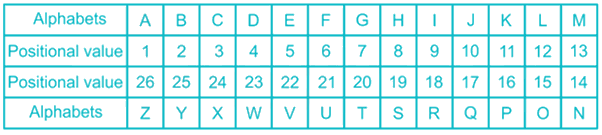 The pattern followed here is
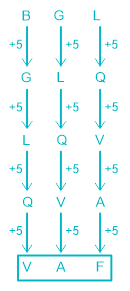 Hence, the correct answer is "Option 3"
Q2 · Series
What will come at the place of question mark? 2, 12, 30, 56, 90, ?
- 132
- 140
- 142
- 150
Answer aur solution dekho
Archived marked answer: A
The logic follows here,
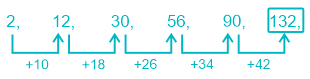 Hence, the correct answer is "Option 1"
Q3 · Series
Which of the following alternatives will replace the question mark?
Atom, Molecule, Cell, ?
- Tissue
- Proton
- System
- Gene
Answer aur solution dekho
Archived marked answer: A
The sequence is arranged in increasing order of structural complexity.
- Atom → basic unit of matter
- Molecule → combination of atoms
- Cell → basic unit of life (made of molecules)
- The next higher level of organization after a cell is a Tissue.
- Atom, Molecule, Cell, Tissue
Hence, the correct answer is "Option 1"
Q4 · Series
Select the letter-cluster from among the given options that can replace the question mark (?) in the following series.
DAG, FCI, ?, JGM, LIO
- GDJ
- IFL
- HKE
- HEK
Answer aur solution dekho
Archived marked answer: D
The pattern followed here is:
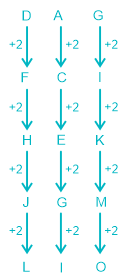 Hence, the correct answer is "Option 4"
Q5 · Series
Complete the series: _______, 150, 183, 219, 258
- 120
- 148
- 361
- 247
Answer aur solution dekho
Archived marked answer: A
The logic follows here,
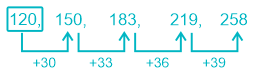 Hence, the correct answer is "Option 1"
Q6 · Series
Find the number that breaks the pattern: 2, 5, 10, 17, 28, 40, 58
- 10
- 17
- 40
- 28
Answer aur solution dekho
Archived marked answer: C
The logic follows here,
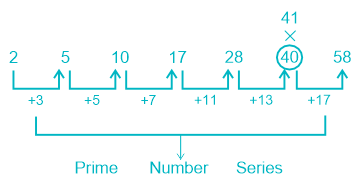 Thus, it should be 41 instead of 40.
Hence, the correct answer is "Option 3"
Q7 · Analogy
Find the best option that best completes the analogy.
NPR : OQS :: XYZ : ?
- YZA
- ZAB
- YAC
- YAZ
Answer aur solution dekho
Archived marked answer: A
The pattern followed here is: Q8 · Analogy
In the following question, select the related word from the given alternatives
Liberty : Autonomy :: Equality : ?
- Legitimacy
- Neutrality
- Fairness
- Diversity
Answer aur solution dekho
Archived marked answer: C
The logic follows here,
- Liberty : Autonomy
- Autonomy is the state or condition of liberty (they are closely related in meaning)
Similarly,
Q9 · Puzzle Subtypes Not To Miss
If 7 $ 3 = 58 and 6 $ 2 = 40, what is 5 $ 1?
- 26
- 24
- 28
- 22
Answer aur solution dekho
Archived marked answer: A
The logic followed here is,
Logic: x $ y = x² + y²
Now,
→ 7 $ 3:
7² + 3² = 49 + 9 = 58 (Matches)
→&nbs
Q10 · Coding Decoding
In each of the following questions, the second word is formed by rearranging the letters of the first word according to a specific pattern. Identify that pattern and apply the same to the third word to find the correct answer from the given alternatives.
NUMERAL : UEALRMN :: ALGEBRA : ?
- LRBAGEA
- BARLAGE
- LERAGBA
- LERABGA
Answer aur solution dekho
Archived marked answer: D
The logic followed here is:
NUMERAL : UEALRMN
<
Q11 · Coding Decoding
In a certain code language, each letter is assigned a unique digit. Based on the given codes for specific words, determine the code for the target word using the same logic. If MOUSE is coded as 45291 and RAT as 786, how is STORE coded?
- 96571
- 97653
- 98345
- 96278
Answer aur solution dekho
Archived marked answer: A
The logic followed here is:
MOUSE is coded as 45291
Letter
M
O
U
S
E
Code
4
5
2
9
1
And,
RAT as 786
Letter
R
A
T
Code
7
8
6
 Similarly,
STORE is coded as
Letter
S
T
O
R
E
Code
9
6
5
7
1
Hence, the correct answer is "Option 1"
Q12 · Classification Odd One Out
One number is not like the others: 1331, 2197, 3375, 4096
- 1331
- 3375
- 4096
- 2197
Answer aur solution dekho
Archived marked answer: C
The logic follows here,
- 1331 = 113 11³" id="MathJax-Element-1-Frame" role="presentation" style="position: relative;" tabindex="0">113113 11³
11311³
- 2197 = 133 13³" id="MathJax-Element-2-Frame" role="presentation" style="position: relative;" tabindex="0">133133 13³
13313³
- 3375 = 153 15³" id="MathJax-Element-3-Frame" role="presentation" style="position: relative;" tabindex="0">153153 15³
15315³
- 4096 = 163 16³" id="MathJax-Element-4-Frame" role="presentation" style="position: relative;" tabindex="0">163163 16³
16316³
- 1331, 2197, 3375 are cubes of odd numbers
- 4096 is the cube of an even number
- Hence, the correct answer is "Option 3"
Q13 · Classification Odd One Out
Find the odd one out from the given alternatives:
- TDS
- GST
- VAT
- DNA
Answer aur solution dekho
Archived marked answer: D
The logic follows here,
- TDS → Tax Deducted at Source (tax-related)
- GST → Goods and Services Tax (tax-related)
- VAT → Value Added Tax (tax-related)
- DNA → Deoxyribonucleic Acid (biology-related)
- TDS, GST, VAT are all taxation terms
- DNA is a biological term
Hence, the correct answer is "Option 4"
Q14 · Blood Relations
If A is the son of B, and B is the brother of C, how is C related to A?
- Father
- Uncle
- Brother
- Can't be determined
Answer aur solution dekho
Archived marked answer: D
Family Chart:
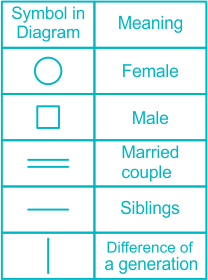 As per the given information
 Since we don't know the gender of 'C'.
So, we cannot determine how 'C' is related to 'A'
Hence, the correct answer is "Option 4"
Q15 · Blood Relations
Pointing to a girl, a woman says, 'She is the daughter of my mother's only daughter.' How is the girl related to the woman?
- Daughter
- Daughter-in-law
- Cousin
- Sister
Answer aur solution dekho
Archived marked answer: A
Decoding symbols for Family Tree:
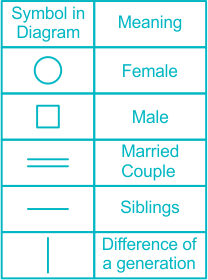 Step-by-step Relationship Analysis:
Breakdown the statement made by the woman: "She is the daughter of my mother's only daughter."
Q16 · Blood Relations
A woman says, "This man's son's sister is my daughter." How is the woman related to the man?
- Wife
- Sister
- Mother
- Daughter-in-law
Answer aur solution dekho
Archived marked answer: A
Decoding symbols for Family Tree:
Step-by-step Relationship Analysis:
Breakdown the statement: "This man's son's sister is my daughter."
- "This man's son's sister" – A son's sister is simply the man's Daughter.
- If the same girl is the daughter of the man AND the daughter of the woman, then the man and the woman must be the parents of that girl.
Consolidated Family Structure:
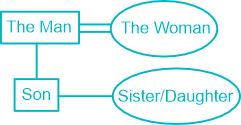 Thus, the woman is the Wife of the man.
Hence, the correct answer is "Option 1"
Q17 · Alphabet Test
Each of the letters in the word STAMINA is arranged in alphabetical order. How many letters are there in the English alphabetical series between the letter that is first from the left and the one that is fourth from the right in the new letter-cluster formed?
- 11
- 12
- 13
- 14
Answer aur solution dekho
Archived marked answer: A
Given Word : STAMINA
Arrange letters in alphabetical order
Left A A I M N S T Right
First from the left = A
Fourth from the righ = M
Q18 · Alphabet Test
How many meaningful four-letter English words can be formed using the first, second, third, and sixth letters of the word "PROVIDE" (when counted from left to right), using each letter only once in each word?
- One
- Three
- Two
- Five
Answer aur solution dekho
Archived marked answer: B
The letters identified from the word PROVIDE are:
- 1st: P
- 2nd: R
- 3rd: O
- 6th: D
Using the letters P, R, O, D once each, the only meaningful English word that can be formed is:
- DROP (to fall or let fall)
- PROD (to poke or rouse to action)
- DORP (a small village or hamlet, commonly used in South African English and recognized in major dictionaries)
Because all three are recognized English words, the correct count is three.
Hence, the correct answer is "Option 2".
Q19 · Similarity and Differences
Which of the following addresses are identical to each other:
1. Rajeev Chauhan 3/5, Lotus Enclave, Kanpur, 208012
2. Rajeev Chauhan 3-5, Lotus Enclave, Kanpur, 208012
3. Rajeev Chauhan 3-5, Lotus Enclave, Kanpur, 208012
4. Rajeev Chauhan 3-5, Lotus Enclave, Kanpur, 208002
- 1 and 2
- 2 and 3
- 2 and 4
- 3 and 4
Answer aur solution dekho
Archived marked answer: B
Addresses are identical to each other:
2. Rajeev Chauhan 3-5, Lotus Enclave, Kanpur, 208012
3. Rajeev Chauhan 3-5, Lotus Enclave, Kanpur, 208012
Option 2 and 3
Hence, the correct answer is "Option 2"
Q20 · Logical Statement Questions
Instruction: Identify the assumptions that must hold for the statement to be valid, then choose the correct option. Statement: The discovery of exoplanets in habitable zones around distant stars has provided exciting prospects for the search for extraterrestrial life, yet the vast distances and technological limitations pose significant obstacles to direct exploration.
Assumptions:
I. Exoplanets located in habitable zones may have the potential to support life.
II. Current technology is insufficient to directly explore exoplanets in habitable zones.
III. Direct exploration of exoplanets will be unnecessary if we detect signs of life remotely.
- Only I and II are implicit
- Only II and III are implicit
- Only I is implicit
- All assumptions are implicit
Answer aur solution dekho
Archived marked answer: A
The logic follows here,
Assumption I: *Exoplanets in habitable zones may have the potential to support life.*
Otherwise, their discovery would not create “exciting prospects” for extraterrestrial life.
Assumption II:
Q21 · Logical Statement Questions
Read the following statement carefully and identify the conclusion that follows. Statement: Most farmers in the region depend on monsoon rains for irrigation. Conclusions:
I. The region does not have proper irrigation infrastructure.
II. A weak monsoon may reduce agricultural output.
- Only Conclusion I follows
- Only Conclusion II follows
- Both I and II follow
- Neither I nor II follows
Answer aur solution dekho
Archived marked answer: B
The logic follows here,
Conclusion I: The region does not have proper irrigation infrastructure.
Does not follow — Dependence on monsoon rains does not necessarily mean irrigation infrastructure is absent or inadequate. Some infrastructure may exist, but farmers may still rely mainly on rainfall.
Conclusion II: A weak monsoon may reduce agricultural output.
Follows — If most farmers depend on monsoon rains, a weak monsoon can negatively affect irrigation, leading to lower agricultural output.
Hence, the correct answer is "Option 2"
Q22 · Miscellaneous Other Possibilities
Two numbers are in ratio 7:9, and their sum is 128. Find the numbers.
- 49, 79
- 56, 72
- 62, 66
- 70, 58
Answer aur solution dekho
Archived marked answer: B
Given:
Ratio of two numbers = 7:9
Sum of two numbers = 128
Formula used:
Let the numbers be 7x and 9x. Their sum is:
7x + 9x = 128
Calculations:
⇒ 16x = 128
⇒ x = 128 ÷ 16
⇒ x = 8
First number = 7x = 7 × 8 = 56
Second number = 9x = 9 × 8 = 72
∴ The correct answer is option (2): 56, 72.
Q23 · Number Digit Operations
If the sum of 28 and 22 is multiplied by 8, what is the result?
- 384
- 400
- 415
- 416
Answer aur solution dekho
Archived marked answer: B
Given:
Sum of 28 and 22 = 28 + 22
Multiplier = 8
Formula used:
Total = (Sum) × Multiplier
Calculation:
⇒ Total = (28 + 22) × 8
⇒ Total = 50 × 8
⇒ Total = 400
∴ The correct answer is option (2).
Q24 · Number Digit Operations
If 16 + 11 = A and 1/9 = B, and A% B = (A × B) - 1, then what is A% B?
- 0
- -3
- 2
- 5
Answer aur solution dekho
Archived marked answer: C
Given:
If 16 + 11 = A and 1/9=B, A % B = (A×B)-1, then find A % B.
Formula used:
A % B = (A×B) - 1
Calculations:
A = 16 + 11 = 27
B = 1/9
A % B = (A×B) - 1
⇒ A % B = (27×1/9) - 1
⇒ A % B = 3 - 1
⇒ A % B = 2
∴ The correct answer is option (3).
Q25 · Ranking Order
In a row of 50 books, Book A is 15th from left and Book B is 20th from right. How many books lie between them?
- 17
- 15
- 12
- 10
Answer aur solution dekho
Archived marked answer: B
Given: In a row of 50 books, Book A is 15th from left and Book B is 20th from right
Position of B from left = 50 − 20 + 1 = 31
- A → 15th from left
- B → 31st from left
Find number of books between A and B
31 − 15 −1 = 15
Hence, the correct answer is "Option 2"
General Awareness
Q1 · Art and Culture
Which of the following correctly reflects the evolution of Indian classical music?
- Jatis evolved from ragas as per ancient texts
- 72-mela system was given by Bharata in 13th century
- Folk music originally used mela and grama scales
- Ragas evolved from jatis; 72-mela was by Venkatamakhi
Answer aur solution dekho
Archived marked answer: D
The correct answer is Ragas evolved from jatis; 72-mela was by Venkatamakhi.
Key Points
- Ragas evolved from jatis: The concept of jatis (a classification of musical scales) formed the basis of Indian classical music, and over time, these evolved into the more structured and expressive ragas. This evolution can be traced back to ancient Indian music treatises such as the *Natya Shastra*, which describes jatis in detail. *Hence, this statement is correct.*
- 72-mela system by Venkatamakhi: The 72-mela system (or Melakarta system) was developed in the 17th century by the South Indian musicologist Venkatamakhi. It is a systematic arrangement of 72 parent ragas (melas) that form the foundation of Carnatic music. *Hence, this statement is correct.*
- Jatis evolved from ragas: This statement is incorrect because historical evidence and ancient texts confirm that jatis preceded ragas. Jatis were simpler and less structured, while ragas represent a more developed form of musical expression.
- Bharata and the 72-mela system: The statement that Bharata developed the 72-mela system is incorrect. Bharata, the author of the *Natya Shastra*, lived around the 2nd century BCE and is credited with describing the earliest concepts of music, drama, and dance. The 72-mela system was introduced much later by Venkatamakhi.
- Folk music and mela/grama scales: Folk music did not originally use the structured mela and grama scales. These are theoretical constructs of classical music and are not traditionally associated with folk music. *Hence, this statement is incorrect.*
Additional Information
- Jatis:
- Jatis were the precursors to ragas and are mentioned extensively in the *Natya Shastra* by Bharata.
- They described specific tonal sequences and were categorized into shuddha (pure), bhinna (divergent), and gaudi (regional) types.
- The development from jatis to ragas marked the transition from ancient to medieval Indian music.
- Ragas:
- A raga is a melodic framework for improvisation and composition in Indian classical music.
- Ragas are structured around specific notes (swaras) and rules for their progression, emphasizing aesthetics and emotional expression.
- Each raga is associated with a particular time of day, season, or mood (rasa).
- 72-Melakarta System:
- The Melakarta system categorizes parent ragas into 72 groups based on their scale structure (ascending and descending note patterns).
- It is fundamental to Carnatic music and aids in the systematic study and composition of ragas.
- Venkatamakhi's work, *Chaturdandi Prakasika*, outlines this system in detail.
- Role of Bharata:
- Bharata is regarded as the father of Indian classical music and dance due to his seminal work, the *Natya Shastra*.
- He provided the first theoretical framework for Indian music, including swaras, gramas (scales), and talas (rhythmic patterns).
- Folk Music vs Classical Music:
- Folk music is informal and often specific to regions, communities, or traditions.
- It lacks the rigid theoretical frameworks of classical music, which are based on ragas, talas, and structured improvisations.
Important Points
- Natya Shastra: Written by Bharata, it is one of the earliest treatises on performing arts in India, covering music, drama, and dance.
- Sangeet Ratnakara: A 13th-century text by Sharangadeva that bridges the gap between ancient and medieval Indian music traditions.
- Rasa Theory: A key concept in Indian aesthetics, linking music and art with emotional expression.
- Venkatamakhi: A 17th-century musicologist who systematized Carnatic music through his 72-Melakarta framework.
Q2 · Indian Polity and Constitution
Which of the following statements regarding Article 270 are correct?
1) Article 270 governs the sharing of taxes between the Union and States, including proceeds from GST.
2) After the 101st Constitutional Amendment, Article 270 includes provisions for distributing revenue from Union taxes and GST.
3) The GST Compensation Cess is also shared between the Union and States under Article 270.
- 1 and 3 only
- 1 Only
- 1 & 2 only
- 2 & 3 only
Answer aur solution dekho
Archived marked answer: C
The correct answer is 3) 1 & 2 only.
Key Points
- Article 270 of the Indian Constitution governs the sharing of taxes between the Union and the States. After the 101st Constitutional Amendment Act, 2016, it was amended to include provisions for the sharing of revenue from Goods and Services Tax (GST). *Hence, statement 1 is correct.*
- The 101st Constitutional Amendment added provisions in Article 270 to ensure that the revenue collected through GST is apportioned between the Union and the States based on the recommendations of the Finance Commission. *Hence, statement 2 is correct.*
- The GST Compensation Cess, however, is not shared between the Union and the States under Article 270. It is governed by the GST (Compensation to States) Act, 2017, which ensures compensation to States for any revenue loss due to the implementation of GST. *Hence, statement 3 is incorrect.*
- The Finance Commission plays a key role in determining the sharing formula for taxes, including GST, under Article 270.
-
Q3 · Indian Polity and Constitution
Schedule VII of the Constitution contains _______.
- Election guidelines
- Three legislative lists
- Emergency powers
- Judicial provisions
Answer aur solution dekho
Archived marked answer: B
The correct answer is Three legislative lists.
Key Points
- Schedule VII of the Constitution of India deals with the division of powers between the Union and State governments. It contains three legislative lists: Union List, State List, and Concurrent List.
- The Union List includes subjects of national importance, such as defense, foreign affairs, atomic energy, and banking. The Parliament of India has exclusive power to legislate on these matters.
- The State List contains subjects of state and local importance like police, public health, agriculture, and local governm
Q4 · Sports Static GK
Consider the following statements about the phases of long jump: 1) The athlete attains maximum momentum by running on the runway before take-off. 2) During take-off, the athlete pushes off with the weaker foot to maintain balance. Which of the statements given above are correct?
- Only 1 is Correct
- Only 2 is Correct
- 1 and 2 are correct
- Neither 1 nor 2 are Correct
Answer aur solution dekho
Archived marked answer: A
The correct answer is Only 1 is Correct.
Key Points
- Statement 1: The athlete attains maximum momentum by running on the runway before take-off.
- In the long jump, the runway phase is crucial as the athlete builds maximum speed and momentum.
- The purpose of this phase is to ensure the athlete achieves the highest horizontal velocity before take-off.
- This momentum directly influences the distance covered during the jump. *Hence, statement 1 is correct.*
- Statement 2: During take-off, the athlete pushes off with the weaker foot to maintain balance.
- This statement is incorrect because the athlete typically uses their stronger or dominant foot for the take-off.
- The take-off foot provides the required explosive force to propel the body upward and forward.
- Using the weaker foot would compromise the efficiency and distance of the jump. *Hence, statement 2 is incorrect.*
- In conclusion, only the first statement is correct, making the correct answer Only 1 is Correct.
Q5 · Sports Static GK
Mary Kom's most recent international gold medal was won at which tournament?
- Asian Games, Hangzhou
- President's Cup, Indonesia
- Commonwealth Games, Birmingham
- Olympic Games, Tokyo
Answer aur solution dekho
Archived marked answer: B
The correct answer is President's Cup, Indonesia.
Key Points
- Mary Kom, a six-time world boxing champion, won her most recent international gold medal at the President's Cup held in Indonesia.
- The event took place in July 2019, and Mary Kom secured the gold medal in the 51 kg category.
- This victory was significant as Mary Kom defeated her opponent with a 5-0 unanimous decision in the final, showcasing her exceptional skill and experience.
- The President's Cup&l
Q6 · Sports Static GK
Fill in the blank:
Under the SLKIC vertical of Khelo India, ____ Kendriya Vidyalayas have been adopted in partnership with KVS.
- 3
- 4
- 5
- 6
Answer aur solution dekho
Archived marked answer: D
The correct answer is 4.
Key Points
- Under the SLKIC vertical of Khelo India, the Government of India has adopted 6 Kendriya Vidyalayas in partnership with the Kendriya Vidyalaya Sangathan (KVS).
- Khelo India is a national programme aimed at promoting sports and fitness in India. It focuses on developing sports infrastructure and nurturing talent at the grassroots level.
- The adoption of Kendriya Vidyalayas under the SLKIC vertical intends to integrate sports into the academic curriculum, ensuring holistic development of students.
- The SLKIC (School Level Khelo India Centre) initiative serves as a platform for identifying and nurturing sports talent within schools, which are equipped with proper facilities and training programs.
- This partnership between KVS and Khelo India emphasizes the Government's commitment to promoting sports at the school level and ensuring that students are provided with adequate resources for sporting excellence.
Additional Information
- Khelo India Programme:
- Launched in 2018 by the Ministry of Youth Affairs and Sports to promote sports culture in India.
- The program aims to encourage young talent and provide them with financial assistance and training facilities.
- It includes initiatives like the Khelo India Youth Games, Khelo India University Games, and Khelo India School Centres.
- The scheme offers up to ₹5 lakh per year to selected athletes for training and development.
- Kendriya Vidyalaya Sangathan (KVS):
- KVS was established in 1963 under the Ministry of Education to provide high-quality education to the children of transferable Central Government employees.
- KVS schools are known for their uniform curriculum, excellent infrastructure, and co-curricular activities, including sports.
- There are more than 1,200 Kendriya Vidyalayas across India, providing education to lakhs of students.
- SLKIC (School Level Khelo India Centre):
- The SLKIC initiative is part of the Khelo India mission to identify and develop sports talent at the school level.
- Schools adopted under this program are provided with basic sports infrastructure, equipment, and expert coaching.
- The centers focus on various sports disciplines, ensuring that students receive specialized training in sports like athletics, swimming, football, etc.
- Sports Development in India:
- India has been actively promoting sports culture through schemes such as Khelo India, Target Olympic Podium Scheme (TOPS), and Fit India Movement.
- The government is investing in grassroots sports development and high-performance training for elite athletes.
- Sports infrastructure like stadiums and training centers are being developed in collaboration with public and private organizations.
Important Points
- Objective of Khelo India:
- To create a strong framework for sports development in the country.
- To identify and nurture sports talent at the grassroots level.
- To integrate sports into the academic system and promote physical fitness among students.
- Role of KVS in Sports Development:
- KVS schools have been actively participating in national and regional sports tournaments.
- By adopting Kendriya Vidyalayas under Khelo India, the government aims to maximize the reach of sports programs and training facilities.
Q7 · Indian Geography
Assertion (A) and Reason (R) are given below. Choose the correct option:
Assertion (A): Population explosion occurs when death rates decline rapidly but birth rates remain high.
Reason (R): Societal reproductive behavior changes instantly with improvements in healthcare.
- Both A and R are true, and R is the correct explanation of A
- Both A and R are true, but R is not the correct explanation
- A is true, but R is false
- A is false, but R is true
Answer aur solution dekho
Archived marked answer: C
The correct answer is A is true, but R is false.
Key Points
- Assertion (A): Population explosion occurs when death rates decline rapidly but birth rates remain high.
- This statement is correct. A population explosion typically occurs due to advancements in healthcare, leading to a significant reduction in mortality rates (death rates), while birth rates remain consistently high.
- It is observed in the demographic transition model, particularly during the early stages of development when better medical facilities, sanitation, and food supply reduce deaths, but societal or cultural changes do not immediately reduce birth rates.
- Reason (R): Societal reproductive behavior changes instantly with improvements in healthcare.
- This statement is false. While healthcare improvements can reduce death rates, societal reproductive behavior does not change immediately.
- Cultural, social, and economic factors heavily influence birth rates, and these changes often take decades to manifest. For example, education, particularly of women, and access to family planning methods play critical roles in reducing birth rates.
- In the demographic transition theory, population explosion is often observed in the second stage, where death rates decline due to healthcare advancements, but birth rates remain high due to traditional societal norms.
- The assertion (A) is true because it explains the phenomenon of population explosion accurately. However, the reason (R) is false as societal reproductive behavior does not change instantly with healthcare improvements.
Additional Information
- Demographic Transition Model (DTM):
- The DTM explains population changes as societies progress economically and socially.
- It consists of four stages:
- Stage 1: High birth and death rates lead to a stable population.
- Stage 2: Declining death rates due to improved healthcare and sanitation, but high birth rates result in a population explosion.
- Stage 3: Birth rates begin to decline, leading to a slow population growth.
- Stage 4: Low birth and death rates stabilize the population.
- Factors Influencing Birth Rates:
- Education: Higher literacy levels, especially among women, lead to lower fertility rates.
- Economic Development: Economic progress often reduces dependency on large families for labor and security.
- Access to Contraceptives: Availability and usage of family planning tools play a key role in controlling birth rates.
- Population Explosion:
- It refers to a rapid increase in the population size within a short period.
- It often places immense pressure on resources like food, water, housing, healthcare, and education.
- Examples:
- The period of the Industrial Revolution in Europe saw improved healthcare and sanitation, leading to population growth in the 18th and 19th centuries.
- In India, significant population growth occurred post-independence due to healthcare improvements, while birth rates remained high.
Important Points
- Measures to Control Population Explosion:
- Family Planning Programs: Governments promote the use of contraceptives and provide incentives for smaller families.
- Education and Awareness: Educating people about the socio-economic benefits of smaller families helps in controlling population growth.
- Healthcare Access: Ensuring access to reproductive healthcare services reduces unintended pregnancies.
- Challenges Posed by Population Explosion:
- Overburdened resources like food, water, and energy.
- Increased unemployment and poverty.
- Environmental degradation due to overconsumption and waste generation.
Q8 · Indian Geography
What is meant by population density?
- Population per household
- People per square kilometre
- People per region
- People per district
Answer aur solution dekho
Archived marked answer: B
The correct answer is People per square kilometre.
Key Points
- Population density refers to the number of people living per unit area of land. It is typically measured as the number of people per square kilometre.
- This metric is used in demographic studies to understand the distribution of populations across various geographical locations.
- Population density helps in assessing the pressure on resources such as land, water, and infrastructure in specific regions.
- It is calculated using the formula: Population Density = Total Population / Land Area (in square kilometres).
- The concept is essential for urban planning, environmental management, and policy-making, especially in densely populated countries like India, China, and others.
Q9 · Indian Geography
Which of the following statements about light industries is correct?
- They process heavy ores and minerals.
- They produce large-scale industrial machinery.
- They require bulky and heavy raw materials.
- Use light materials to make consumer goods
Answer aur solution dekho
Archived marked answer: D
The correct answer is Use light materials to make consumer goods.
Key Points
- Light industries primarily utilize lightweight materials such as plastics, fabrics, and smaller metals to produce consumer goods like clothes, electronics, furniture, and toys. This statement is *correct.*
- They are generally involved in the production of goods with higher value per unit weight, making transportation and logistics easier and cost-effective.
- Unlike heavy industries, light industries do not process heavy ores and minerals. Instead, they focus on finished goods rather than raw material processing. *Hence, statement 1 is incorrect.*
- These industries are not involved in the creation of large-scale industrial machinery. Their primary focus is on small-scale, high-demand products. *Hence, statement 2 is incorrect.*
- Light industries do not require bulky and heavy raw materials for production. Their raw materials are often compact and lightweight. *Hence, statement 3 is incorrect.*
Additional Information
- Definition and Scope:
- Light industries are characterized by their focus on low capital investment and less resource-intensive production processes.
- They are typically located near urban areas to cater to consumer needs and to minimize transportation costs.
- Examples of Light Industries:
- Textile industry: Produces clothing and other fabric-based products.
- Electronics: Manufacturing of small consumer appliances like mobile phones, laptops, and televisions.
- Food processing: Packaging and production of processed foods, dairy products, and beverages.
- Furniture-making: Use of light materials like plywood and aluminum to create household furniture.
- Differences Between Light and Heavy Industries:
- Raw Materials: Heavy industries process large, bulky raw materials like coal and iron, while light industries use smaller, lightweight materials.
- Location: Heavy industries are often located near mines and resources, while light industries are near markets or urban centers.
- Pollution: Heavy industries are generally more pollution-intensive, whereas light industries have less environmental impact.
- Economic Importance:
- Light industries are significant contributors to employment generation and urban economic development.
- They play a pivotal role in the export economy by producing high-demand consumer goods.
Important Points
- Global Examples of Light Industries:
- Japan: Known for high-quality electronics and textiles.
- Italy: Renowned for its fashion and furniture industries.
- China: A global hub for consumer goods production, especially electronics and toys.
- Government Support:
- In India, the government promotes light industries through initiatives like Make in India and MSME (Micro, Small, and Medium Enterprises) schemes.
- These industries are offered tax benefits, subsidized loans, and infrastructure support to encourage growth.
Q10 · Modern Indian History
The Regulating Act of 1773 primarily introduced changes in the Company's administration in which two distinct areas?
- Company's Judicial system and revenue collection.
- Company's Military strategy and trade regulations.
- Company's constitution at home and territorial control in India.
- Company's relations with princely states and foreign policy.
Answer aur solution dekho
Archived marked answer: C
The answer refers to the Company's governing arrangements in Britain and its territorial administration in India. The 1773 intervention increased parliamentary oversight and established a Governor-General with a four-member council. Distinguish the later India Act of 1784: it created the Board of Control. The Board was not established by the Regulating Act of 1773.
उत्तर ब्रिटेन में कंपनी के प्रशासनिक ढाँचे और भारत में उसके प्रादेशिक प्रशासन से संबंधित है। 1773 के कदम से संसदीय नियंत्रण बढ़ा तथा गवर्नर-जनरल और चार सदस्यीय परिषद की व्यवस्था बनी। बोर्ड ऑफ कंट्रोल बाद में 1784 के कानून से बना था; उसे 1773 की उपलब्धि न मानें।
Q11 · Current Affairs
Which indian political leader addressed a special session in 2025 on "Environment, COP-30, and Global Health" ?
- Piyush Goyal
- Hardeep Puri
- Narendra Modi
- S. Jaishankar
Answer aur solution dekho
Archived marked answer: C
The correct answer is Narendra Modi.
Key Points
- Narendra Modi, the current Prime Minister of India, is known for his active participation in global discussions and efforts to address issues like climate change, environmental sustainability, and global health challenges.
- In 2025, he addressed a special session focused on "Environment, COP-30, and Global Health". This event highlighted India's leadership in international climate negotiations and its commitment to sustainable development.
- India's active engagement in the COP-30 discussions is crucial, especially in the context of its growing role in renewable energy transition and efforts to mitigate climate change.
- Modi has launched major initiatives like the International Solar Alliance (ISA), reaffirming India's dedication to promoting clean energy globally.
- His emphasis during the session was on fostering international collaboration to address global health challenges like pandemics and ensuring equitable access to healthcare resources globally.
Additional Information
- COP-30:
- The 30th Conference of Parties (COP-30) under the United Nations Framework Convention on Climate Change (UNFCCC) is a global platform for discussing climate-related issues.
- India has been a significant participant, advocating for climate justice and emphasizing the principle of Common but Differentiated Responsibilities (CBDR).
- Recent COP sessions have focused on the transition to renewable energy, sustainable practices, and funding mechanisms for developing nations.
- India's role in COP-30 reflects its increasing influence in shaping global climate policies.
- Global Health:
- Global health encompasses challenges like pandemics, healthcare access, and the equitable distribution of medical resources.
- India has played a vital role in global healthcare, particularly during the COVID-19 pandemic, by providing vaccines under the Vaccine Maitri initiative.
- Focus during the session included addressing emerging infectious diseases, strengthening healthcare infrastructure, and fostering global cooperation.
- India's pharmaceutical industry is pivotal in supplying affordable medicines worldwide.
- International Solar Alliance (ISA):
- Founded in 2015, the ISA is a collaborative initiative led by India and France to promote solar energy use globally.
- It aims to mobilize resources for deploying solar energy solutions in member countries, particularly in tropical regions.
- India has committed to significant investments and partnerships within ISA to boost renewable energy adoption.
- This alliance is central to achieving sustainable energy goals and combating climate change.
- Important Developments:
- India has set ambitious targets under its Nationally Determined Contributions (NDCs), including achieving net-zero emissions by 2070.
- The country is actively increasing its renewable energy capacity, with a focus on solar, wind, and hydropower.
- India's leadership in addressing global environmental and health issues is recognized internationally, as demonstrated by Modi's participation in the 2025 session.
Q12 · Current Affairs
Under Bharatiya Nagarik Suraksha Sanhita(BNSS), what is the maximum period for which a person can be held in police custody in total, even if remanded periodically by a magistrate?
- 30 days
- 60 days
- 90 days
- 15 days (for initial remand, extendable)
Answer aur solution dekho
Archived marked answer: D
The correct answer is 15 days (for initial remand, extendable).
Key Points
- Bharatiya Nagarik Suraksha Sanhita (BNSS) governs various provisions related to criminal proceedings in India, replacing the earlier Criminal Procedure Code (CrPC).
- Under BNSS, a person can be held in police custody for an initial period of 15 days. This period can be extended periodically if the magistrate approves such extensions.
- The magistrate has the authority to grant extensions beyond the initial 15 days, but the cumulative period of police custody cannot exceed the prescribed limits.
- As per BNSS, police custody is limited to 15 days at a time, ensuring judicial oversight to prevent misuse of custodial provisions.
- This provision ensures that the rights of individuals are protected while allowing the police sufficient time to conduct investigations. Hence, option "15 days (for initial remand, extendable)" is c
Q13 · Current Affairs
According to the Global Cities Index 2025 by Oxford Economics, which two cities retained their top positions?
- Tokyo and Beijing
- London and New York
- Paris and Rome
- Berlin and Moscow
Answer aur solution dekho
Archived marked answer: B
The correct answer is London and New York.
Key Points
- The Global Cities Index, published by Oxford Economics, ranks cities based on their global influence, economic power, and connectivity. It evaluates cities across various metrics such as business activity, human capital, cultural experience, and political engagement.
- In the 2025 Global Cities Index, London and New York retained their top positions due to their significant contributions to global finance, international trade, and cultural influence.
- London is consistently ranked at the top due to its status as a leading financial center, housing major gl
Q14 · General Science Biology
The function of lysosomes in cells is:
- Protein synthesis
- Intracellular digestion
- Energy production
- Genetic information storage
Answer aur solution dekho
Archived marked answer: B
The correct answer is Intracellular digestion.
Key Points
- Lysosomes are membrane-bound organelles found in animal cells that contain digestive enzymes. These enzymes help in breaking down cellular waste, debris, and foreign particles through intracellular digestion.
- Intracellular digestion occurs when lysosomes fuse with vesicles containing cellular waste or foreign particles. The digestive enzymes degrade these substances into simpler molecules that can be reused or expelled from the cell.
- Lysosomes play a vital role in maintaining cellular health by removing damaged organelles, pathogens, and cellular debris. This process is known as autophagy.
- Lysosomal enzymes function optimally at acidic pH levels, making lysosomes a specialized compartment for digestion within the cell.
- Disorders related to lysosomal function, such as Lysosomal Storage Diseases (e.g., Tay-Sachs disease), occur when these enzymes are defective, leading to the accumulation of undigested substances in cells.
Additional Information
- Protein synthesis:
- Protein synthesis primarily occurs in the ribosomes, which are present in the cytoplasm or attached to the rough endoplasmic reticulum.
- This process involves two major steps: transcription (DNA to mRNA) and translation (mRNA to protein).
- Lysosomes are not involved in protein synthesis, but they help degrade proteins that are damaged or no longer needed.
- Energy production:
- Energy production in cells is mainly carried out by the mitochondria, known as the "powerhouse of the cell."
- Mitochondria generate energy in the form of ATP through processes such as cellular respiration and oxidative phosphorylation.
- Lysosomes do not contribute to energy production; their primary role is in digestion and waste removal.
- Genetic information storage:
- Genetic information is stored in the form of DNA within the cell nucleus and mitochondria.
- The nucleus contains the majority of the cell’s genetic material and regulates gene expression and replication.
- Lysosomes do not have any role in storing or managing genetic information.
- Function of lysosomes:
- Lysosomes are involved in processes such as endocytosis (intake of substances), exocytosis (expulsion of waste), and autophagy (self-digestion of cellular components).
- They contain hydrolytic enzymes such as proteases, lipases, and nucleases, which break down various biomolecules.
- Lysosomes are often referred to as the "cell's garbage disposal" due to their role in waste degradation.
Important Points
- Discovery: Lysosomes were first discovered by Belgian biologist Christian de Duve in 1955.
- Structure: Lysosomes are spherical vesicles surrounded by a lipid bilayer membrane that maintains their acidic environment.
- Enzymes: The enzymes within lysosomes are synthesized in the rough endoplasmic reticulum and processed in the Golgi apparatus before being enclosed in lysosomes.
- Diseases: Mutations affecting lysosomal enzymes can lead to conditions like Gaucher disease and Niemann-Pick disease.
Q15 · Medieval Indian History
Read the below statements marked as Assertion (A) and Reason (R). Mark the correct options:
Assertion (A): Humayun's Tomb was the first major Mughal garden tomb and directly inspired the design of the Taj Mahal.
Reason (R): It introduced the charbagh garden layout and double-domed mausoleum style that became characteristic of later Mughal architecture.
- Both A and R are true, and R is the correct explanation of A.
- Both A and R are true, but R is not the correct explanation of A.
- A is true, but R is false.
- A is false, but R is true.
Answer aur solution dekho
Archived marked answer: A
The correct answer is 1) Both A and R are true, and R is the correct explanation of A..
Key Points
- Assertion (A): Humayun's Tomb was the first major Mughal garden tomb and directly inspired the design of the Taj Mahal.
- Humayun's Tomb, built in 1565-1572, was commissioned by Empress Bega Begum, Humayun's widow.
- It was the first garden tomb of the Mughal Empire in India and represents a significant milestone in Mughal architecture.
- The tomb's design influenced later Mughal structures, including the Taj Mahal, particularly in its symmetry and grandeur. *Hence, statement A is correct.*
- Reason (R): It introduced the charbagh garden layout and double-domed mausoleum style that became characteristic of later Mughal architecture.
- The tomb's charbagh layout, a Persian-inspired quadrilateral garden divided by walkways, became a hallmark of Mughal architectural design.
- It also featured the innovative double-domed structure, ensuring proportionality between the interior and exterior
Q16 · Ancient Indian History
Which ancient ruler's administration is noted for its highly centralized structure?
- Harshavardhana
- Samudragupta
- Chandragupta Maurya
- Pulakeshin II
Answer aur solution dekho
Archived marked answer: C
The correct answer is Chandragupta Maurya.
Key Points
- Chandragupta Maurya was the founder of the Mauryan Empire, which was established in approximately 321 BCE. He unified India under a centralized authority for the first time.
- His administration was characterized by a highly centralized structure, with the emperor holding supreme authority over the state and decision-making.
- The Mauryan administration was divided into provinces, each governed by a royal prince or trusted administrator. These provinces were further subdivided into districts and villages.
- The famous advisor and prime minister Kautilya (Chanakya) played a crucial role in guiding Chandragupta’s administration. His work, Arthashastra, provides detailed insights into the governance, economy, military, and judicial systems of the Mauryan Empire.
- The Mauryan government was highly organized, with a strong emphasis on collecting taxes, maintaining a large standing army, and establishing a network of spies to ensure stability and control.
- Chandragupta Maurya's capital was at Pataliputra (modern-day Patna), which served as the center of administration and governance.
Additional Information
- Harshavardhana:
- Harshavardhana ruled from 606 CE to 647 CE and controlled northern India. His administration was decentralized, with local leaders and feudal lords having significant autonomy.
- He was known for promoting Buddhism and organizing the Kannauj Assembly to discuss religious matters.
- Unlike Chandragupta Maurya, Harsha’s administration lacked the strong centralization seen in the Mauryan Empire.
- Samudragupta:
- Samudragupta, a ruler of the Gupta Empire, reigned between 335 CE and 375 CE. He was known more for his military conquests and cultural patronage than administrative centralization.
- The Gupta administration was a mix of centralized and decentralized governance, with local rulers maintaining autonomy under the emperor's oversight.
- Samudragupta’s reign marked the beginning of India’s classical age, with advancements in art, literature, and science.
- Pulakeshin II:
- Pulakeshin II was a ruler of the Chalukya dynasty, reigning during the 6th century CE. He was renowned for his military campaigns and resistance against Harshavardhana.
- His administration was primarily focused on maintaining regional authority rather than centralizing power across a vast empire.
- The Chalukya administration was largely decentralized, with local chiefs enjoying significant autonomy.
-
Important Points
:
- The Arthashastra, authored by Kautilya, remains one of the most comprehensive treatises on ancient Indian administration, economy, and politics.
- The Mauryan Empire's centralized administration laid the foundation for future governance models in India.
- Chandragupta Maurya's legacy is remembered for creating a unified empire in India and establishing efficient governance systems.
- The centralized nature of the Mauryan Empire facilitated effective tax collection, law enforcement, and resource management across its vast territory.
Q17 · Government Schemes and Welfare Static Semi Static
What is the age range for farmers to enrol in the Pradhan Mantri Kisan Maandhan Yojana (PM-KMY)?
- 18-30 years
- 18-40 years
- 21-45 years
- 25-50 years
Answer aur solution dekho
Archived marked answer: B
The correct answer is 18-40 years.
Key Points
- The Pradhan Mantri Kisan Maandhan Yojana (PM-KMY) is a government-backed pension scheme aimed specifically at providing social security to small and marginal farmers.
- The scheme is applicable to farmers in the age group of 18 to 40 years. This means individuals within this age range can enroll in the scheme and start contributing towards their pension.
- Under the scheme, farmers are required to contribute a specific amount monthly based on their age at the time of joining. The Government of India matches the farmer's contribution equally.
- Subscribers to the scheme will receive a monthly pension of Rs. 3000 after attaining the age of 60 years.
- The scheme primarily targets small and marginal farmers with landholding up to 2 hectares, ensuring financial security in their old age
Q18 · Government Schemes and Welfare Static Semi Static
Read the below statements marked as Assertion (A) and Reason (R). Mark the correct options:
Assertion (A): UDAN Scheme improves regional air connectivity.
Reason (R): It provides financial viability gap funding to airlines.
- Both A and R are true, and R is the correct explanation of A
- Both A and R are true, but R is not the correct explanation of A
- A is true, but R is false
- A is false, but R is true
Answer aur solution dekho
Archived marked answer: A
The correct answer is 1) Both A and R are true, and R is the correct explanation of A..
Key Points
- Assertion (A): UDAN Scheme improves regional air connectivity:
- The UDAN Scheme, known as Ude Desh Ka Aam Nagrik, is a flagship regional air connectivity scheme launched by the Government of India in 2016.
- Its primary aim is to make air travel affordable and accessible for common citizens, especially in tier-2 and tier-3 cities.
- By connecting underserved and remote regions of India, UDAN improves regional connectivity and fosters economic growth. *Hence, the assertion is correct.*
- Reason (R): It provides financial viability gap funding to airlines:
- Under the UDAN scheme, airlines operating on regional routes receive Viability Gap Funding (VGF) from the government.
- The VGF reduces the financial burden on airlines to operate flights on less profitable routes, ensuring sustained operations.
- This funding is critical to achieving the goals of UDAN by incentivizing airlines to cover underserved routes. *Hence, the reason is correct.*
- The reason (R) directly explains the assertion (A), as the financial VGF mechanism is integral to improving regional air connectivity through the UDAN scheme. *Thus, both A and R are true, and R is the correct explanation of A.*
Additional Information
- UDAN Scheme:
- The UDAN Scheme is jointly funded by the Central Government and the State Governments.
- It aims to reduce the cost of air travel by capping fares at Rs. 2,500 for an hour-long flight.
- The scheme also promotes the development of regional airports and infrastructure in remote areas.
- As of 2023, the scheme has connected several underserved regions, including cities like Darbhanga, Kanpur, and Jharsuguda.
- Viability Gap Funding (VGF):
- VGF is a financial support mechanism provided by the government to make projects commercially viable.
- Under UDAN, VGF is funded through a levy collected from airlines operating on metro routes.
- It ensures that airlines can operate on regional routes without incurring significant losses.
- Impact of UDAN:
- Boosts tourism and trade in remote and underserved areas.
- Generates employment opportunities in aviation and related sectors.
- Strengthens socioeconomic development by connecting regions with the rest of the country.
- Other Regional Connectivity Efforts:
- Development of regional airports under Regional Connectivity Infrastructure Investment.
- Promotion of private sector investments in aviation infrastructure.
- Collaboration with state governments to enhance last-mile connectivity.
Important Points
- UDAN Achievements:
- As of October 2023, the UDAN scheme has connected over 70 airports and initiated 425 routes in India.
- It has made air travel accessible to millions of citizens, especially in remote regions.
- Future Goals:
- The scheme aims to connect all regions of India, including the North-Eastern States and hilly terrains, by 2030.
- Plans to expand infrastructure and increase the number of operational airports to 100+.
Q19 · World Geography
Which of the following types of landslides involves backward rotation of the slipping material?
- Rockslide
- Rock fall
- Slump
- Debris fall
Answer aur solution dekho
Archived marked answer: C
The correct answer is Slump.
Key Points
- A slump is a type of landslide characterized by the backward rotation of the slipping material along a curved surface.
- This rotational movement often creates a concave-upward shape in the displaced material and leaves a crescent-shaped scarp at the top.
- Slumps occur when a slope becomes unstable due to water infiltration, weak soil, or geological disturbances.
- They are commonly found in areas with clay-rich soils, as clay can become saturated and lose its cohesive strength.
- Unlike other types of landslides, slumps usually involve large blocks of material moving as a coherent unit, rather than chaotic debris flow.
Additional Information
- Rockslide:
- A rockslide involves the rapid movement of large masses of bedrock downslope.
- It typically occurs on steep slopes where rock layers are weakened by fractures or weathering.
- Unlike slumps, rockslides do not rotate; instead, they slide along a planar surface.
- Example: The Frank Slide in Canada (1903).
- Rock fall:
- A rock fall is characterized by the free fall or bouncing of individual rocks from steep cliffs or slopes.
- It is often triggered by freeze-thaw cycles, erosion, or seismic activity.
- Rock falls are the fastest type of landslide and can cause significant damage.
- Example: Yosemite National Park has frequent rock falls due to its granite cliffs.
- Debris fall:
- Debris falls involve the rapid downward movement of unconsolidated material, such as soil, rocks, and organic matter.
- They are often triggered by heavy rainfall or earthquakes, which destabilize the slope.
- Debris falls are chaotic and lack the coherent rotational movement seen in slumps.
- Example: The 2014 Oso landslide in Washington, USA, was a debris fall.
- Characteristics of Slumps:
- Slumps are slower than rockslides and debris falls due to their rotational movement.
- They are common in areas with poorly consolidated sediments, especially in regions prone to water saturation.
- Preventive measures include slope stabilization, proper drainage systems, and vegetation cover to improve soil cohesion.
Important Points
- Types of Landslides:
- Falls: Free-falling movement of material from a cliff or steep slope.
- Slides: Coherent movement along a planar or curved surface (e.g., slumps).
- Flows: Chaotic movement of water-saturated debris and soil.
- Creep: Slow, imperceptible movement of soil or rock downslope over time.
- Causes of Landslides:
- Natural factors: Heavy rainfall, earthquakes, volcanic activity, and weathering.
- Human activities: Deforestation, mining, construction, and improper land use.
- Preventive Measures:
- Stabilizing slopes using retaining walls and terracing.
- Improving drainage to reduce water saturation in soil.
- Planting vegetation to enhance soil cohesion.
- Monitoring slopes for signs of instability.
Q20 · General Science Physics
If Earth's radius were reduced by 1% while its mass remained unchanged, what would be the effect on the gravitational acceleration at its surface?
- Increase by approximately 1%
- Decrease by approximately 2%
- Increase by approximately 2%
- Decrease by approximately 1%
Answer aur solution dekho
Archived marked answer: C
The correct answer is Increase by approximately 2%.
Key Points
- The formula for gravitational acceleration (g) at the surface of the Earth is g = G × (M / R²), where G is the gravitational constant, M is the mass of the Earth, and R is the radius of the Earth.
- If the Earth's radius is reduced by 1%, the new radius becomes R' = 0.99 × R.
- Gravitational acceleration is inversely proportional to the square of the radius. Thus, a decrease in radius increases the value of g.
- The percentage change in g can be calculated using the formula: Percentage Change ≈ 2 × Percentage Change in Radius. Since the radius decreases by 1%, gravitational acceleration increases by approximately 2%.
- This phenomenon occurs because the mass remains constant while the radius decreases, concentrating the mass closer to the surface, thereby increasing the gravitational pull.
Additional Information
- Gravitational Constant (G): The universal gravitational constant is approximately 6.674 × 10⁻¹¹ N·m²/kg². It is a fundamental constant used to calculate gravitational forces.
- Mass of the Earth: The Earth's mass is approximately 5.972 × 10²⁴ kg. It remains unchanged regardless of changes in the radius.
- Effect of Radius: The radius of the Earth is approximately 6,371 km. If the radius is reduced, the gravitational pull at the surface increases due to the inverse square relationship.
- Applications: This principle is essential in understanding planetary physics, satellite mechanics, and designing space missions, where accurate calculations of gravity are required.
- Examples: Similar calculations are applied to study the gravitational acceleration on other planets or celestial bodies, such as the Moon or Mars, where the radius and mass differ significantly from Earth.
Important Points
- Inverse Square Law: Gravitational acceleration (g) is inversely proportional to the square of the radius. A smaller radius results in a stronger gravitational force at the surface.
- Percentage Calculation: When radius decreases by a percentage, the gravitational acceleration increases approximately by twice that percentage.
- Impact on Weight: If g increases, the weight of objects on the Earth's surface will also increase proportionally because weight is calculated as W = mg.
- Practical Implications: Understanding changes in g is crucial for designing infrastructure and equipment that interact with gravity, such as bridges, airplanes, and space vehicles.
8f
Q21 · General Science Physics
What specific physical quantity ensures a satellite maintains its orbit without continuous propulsion?
- Mass
- Gravitational pull
- Orbital velocity
- Atmospheric drag
Answer aur solution dekho
Archived marked answer: C
The correct answer is Orbital velocity.
Key Points
- Orbital velocity is the speed required for a satellite to maintain its orbit around a celestial body, like Earth, without propulsion or falling back due to gravity.
- It is determined by the balance between the satellite's inertia (from its motion) and the gravitational pull of the planet it is orbiting. This ensures the satellite remains in a stable orbit.
- For a satellite to remain in orbit, its orbital velocity must match the gravitational force pulling it toward the planet. If the velocity is too high, the satellite will escape into space; if too low, it will fall back to Earth.
- The formula for orbital velocity is given by v = √(GM/r), where G is the gravitational constant, M is the mass of the celestial body, and r is the radius of the orbit.
- Atmospheric drag can influence orbital velocity in low Earth orbits, causing satellites to lose speed and eventually deorbit. However, in the absence of atmospheric drag in higher orbits, orbital velocity alone ensures stability.
Additional Information
- Mass: A satellite's mass does not directly determine its orbit. While mass affects gravitational attraction, the satellite's orbital velocity is independent of its weight.
- Gravitational pull: The gravitational pull of a planet provides the force that keeps the satellite in orbit. However, it needs to be balanced by the satellite's orbital velocity to ensure stable motion.
- Atmospheric drag: This factor is significant in low Earth orbits (LEO). Atmospheric particles can slow the satellite over time, causing it to lose altitude and eventually re-enter the atmosphere.
- Examples: Geostationary satellites, such as communication satellites, maintain their orbit by traveling at speeds matching the Earth's rotation, ensuring they appear stationary from the surface.
- Applications of Orbital Velocity: Orbital velocity is crucial for launching satellites, space exploration, and maintaining space stations like the International Space Station (ISS). It ensures that objects remain in their designated trajectories.
Important Points
- Low Earth Orbit (LEO): Satellites in LEO typically have orbital velocities of around 7.8 km/s. They are closer to Earth, making them more prone to atmospheric drag.
- Geostationary Orbit: Satellites in geostationary orbit (~36,000 km above Earth) travel at a speed of approximately 3.07 km/s. This ensures they remain fixed relative to Earth's surface.
- Escape Velocity: If a satellite's speed exceeds the escape velocity (~11.2 km/s for Earth), it will leave Earth's gravitational influence and move into interplanetary space.
- Space Missions: Missions like ISRO's Chandrayaan and NASA's Mars rovers calculate orbital and escape velocities accurately for successful launches and operations.
- Newton's Laws: Orbital velocity is derived using Newton's Laws of Motion and Universal Gravitation. These principles explain the relationship between force, mass, and motion in orbit.
Q22 · Books and Authors Static
Consider the following statements about "The Adventures of Kakababu, Volume 1" by Sunil Gangopadhyaya:
1) A pioneering Bengali adventure novel featuring detective Kakababu with mystery and cultural themes.
2) A political satire on post-independence Indian governance.
3) An autobiography of the author's freedom fighter experiences in Bengal. Which of the above statements is/are correct?
- Only statement 1 is correct
- Only statement 2 is correct
- Statements 2 and 3 are correct
- 1, 2 and 3 are correct
Answer aur solution dekho
Archived marked answer: A
The correct answer is Only statement 1 is correct.
Key Points
- "The Adventures of Kakababu, Volume 1" by Sunil Gangopadhyay is a pioneering Bengali adventure novel that introduces the character Kakababu, a detective with a unique personality. The novel is known for its blend of mystery, adventure, and cultural themes. *Hence, statement 1 is correct.*
- The book does not contain elements of political satire on post-independence Indian governance. Kakababu’s stories revolve around adventures and mysteries rather than political commentary. *Hence, statement 2 is incorrect.*
- This novel is not an autobiography of Sunil Gangopadhyay’s freedom fighter experiences. It is purely fictional and focuses on the character of Kakababu and his adventures. *Hence, statement 3 is incorrect.*
- The series primarily highlights adventure and cultural exploration, often intertwining puzzles, historical secrets, and thrilling escapades that are distinct from political or autobiographical themes.
- *Thus, the correct answer is "Only statement 1 is correct."*
Additional Information
- About Kakababu:
- The character Kakababu, originally named Raja Roy Chowdhury, is a fictional detective created by Sunil Gangopadhyay. He is portrayed as a former director of the Archaeological Survey of India.
- Kakababu’s adventures often include thrilling mysteries, archaeological findings, and interactions with various cultures.
- The series is popular among readers of young adult fiction and is celebrated for its ability to blend intellectual challenges with entertaining narratives.
- The Kakababu novels are widely appreciated for their depiction of Bengal’s heritage, history, and culture.
- Sunil Gangopadhyay:
- Sunil Gangopadhyay is a renowned Indian writer and poet, primarily known for his works in Bengali literature.
- He has authored multiple novels, poetry collections, and essays, contributing significantly to modern Bengali literature.
- His stories often reflect themes of adventure, romance, history, and social issues.
- He received the prestigious Sahitya Akademi Award for his contribution to literature.
- Other Adventure Series:
- Besides Kakababu, Sunil Gangopadhyay created other fictional works that showcase his literary prowess, but Kakababu remains one of his most iconic characters.
- The books have been adapted into films and television series, further cementing their popularity among audiences.
- Characteristics of Bengali Adventure Novels:
- Bengali adventure novels often feature strong protagonists, gripping mysteries, and cultural insights.
- Other notable authors in this genre include Satyajit Ray (creator of Feluda) and Hemendra Kumar Roy.
- The novels are known for their ability to engage readers with a mix of intellectual puzzles and entertaining narratives.
Important Points
- Popularity of Kakababu: The Kakababu series has inspired generations of readers and is considered a classic in Bengali literature.
- Adaptations: Several novels from the Kakababu series have been adapted into films, such as "Mishawr Rawhoshyo", directed by Srijit Mukherji.
- Literary Significance: The series is an excellent example of how Bengali literature combines thrilling adventures with an exploration of history, archaeology, and culture.
- Target Audience: Although primarily aimed at young adults, the books are enjoyed by readers of all ages due to their engaging storytelling and intellectual depth.
- Legacy: Sunil Gangopadhyay’s works have left an indelible mark on Indian literature, inspiring future writers and filmmakers.
Q23 · Environment and Ecology
A coastal city implements a plan to build sea walls and elevate buildings in response to rising sea levels. This action primarily falls under which category of climate change response?
- Climate Change Mitigation.
- Carbon Sequestration.
- Geoengineering.
- Climate Change Adaptation.
Answer aur solution dekho
Archived marked answer: D
The correct answer is Climate Change Adaptation.
Key Points
- Climate Change Adaptation refers to measures taken to adjust to the current or expected effects of climate change in order to minimize harm or exploit beneficial opportunities.
- The construction of sea walls and elevation of buildings specifically addresses the impacts of rising sea levels, which are a direct consequence of climate change. These are preventive actions to safeguard infrastructure and human lives.
- Adaptation strategies are often localized and cater to the specific challenges posed by climate change, such as floods, droughts, or temperature increases.
- The goal of adaptation is to build resilience in communities, economies, and ecosystems, allowing them to cope with the adverse effects of climate change.
- This approach differs from mitigation, which focuses on reducing the causes of climate change, such as greenhouse gas emissions.
Additional Information
- Climate Change Mitigation:
- Mitigation involves efforts to reduce or prevent the emission of greenhouse gases (GHGs) that contribute to global warming.
- Examples include switching to renewable energy sources like solar or wind, increasing energy efficiency, and adopting sustainable transportation practices.
- This strategy aims to address the root cause of climate change rather than its effects.
- For instance, the Paris Agreement focuses on mitigation by setting targets for reducing global GHG emissions.
- Carbon Sequestration:
- It refers to the process of capturing and storing atmospheric carbon dioxide (CO2) to reduce its concentration in the atmosphere.
- Natural methods include afforestation, reforestation, and soil management, while technological solutions include carbon capture and storage (CCS).
- Carbon sequestration is a key component of climate change mitigation strategies, aimed at offsetting emissions from industrial processes.
- Geoengineering:
- Geoengineering involves large-scale interventions in Earth's natural systems to counteract climate change.
- Examples include solar radiation management (reflecting sunlight back into space) and ocean fertilization to enhance carbon capture by marine ecosystems.
- These methods are controversial due to their potential unintended consequences and ethical concerns.
- Examples of Climate Change Adaptation:
- Constructing flood barriers in coastal cities prone to rising sea levels.
- Implementing drought-resistant crops in regions experiencing water scarcity due to climate changes.
- Developing early warning systems for extreme weather events such as hurricanes or heatwaves.
- Retrofitting infrastructure to withstand extreme weather conditions, such as stronger buildings to resist cyclones.
Important Points
- Rising Sea Levels:
- Sea levels have been rising globally due to melting ice caps and glaciers, as well as the thermal expansion of seawater caused by global warming.
- According to the Intergovernmental Panel on Climate Change (IPCC), global sea levels could rise by 0.3 to 1 meter by 2100.
- This poses threats to low-lying and coastal areas, leading to increased flooding, erosion, and loss of habitats.
- Global Adaptation Efforts:
- The UN Framework Convention on Climate Change (UNFCCC) emphasizes the need for adaptation measures alongside mitigation strategies.
- Programs like the Global Environment Facility (GEF) and the Green Climate Fund (GCF) provide financial support for adaptation projects in developing countries.
- Several nations, including the Netherlands, have implemented large-scale adaptation projects such as flood management systems and sustainable urban planning.
Q24 · General Science
Which of the following best reflects the fundamental objective of applying generative design in aerospace systems engineering?
- Facilitating seamless integration of multi-payload platforms in shared bus structures
- Optimizing mechanical configurations for minimum mass and maximum structural resilience
- Enhancing life-support redundancies to meet crew safety protocols in deep-space missions
- Designing adaptive thrust mechanisms to dynamically control orbital corrections
Answer aur solution dekho
Archived marked answer: B
The correct answer is Optimizing mechanical configurations for minimum mass and maximum structural resilience.
Key Points
- Generative design in aerospace engineering focuses on creating optimized mechanical configurations that minimize mass while maximizing structural resilience. This ensures the systems are lightweight yet durable enough to withstand extreme conditions.
- It leverages advanced algorithmic design tools and AI-driven simulations to explore multiple design options and choose the most efficient structure.
- Reducing mass is critical in aerospace systems as it directly impacts fuel efficiency, payload capacity, and overall mission success. Structural resilience ensures that components endure high stress and varying environmental conditions.
- The process integrates finite element analysis (FEA) and computational fluid dynamics (CFD) to test designs for their ability to handle pressure, temperature, and aerodynamic forces effectively.
- Generative design enables engineers to develop lightweight components such as fuselage structures, wing designs, and spacecraft bodies without compromising safety or performance.
Additional Information
- Facilitating multi-payload platforms: This statement refers to the integration of multiple payloads into shared structures, but it is not the primary objective of generative design. While generative design can aid in achieving this, its focus is more on structural optimization. Hence, this statement is incorrect.
- Enhancing life-support redundancies: This pertains to ensuring crew safety in deep-space missions, which involves systems engineering but does not directly relate to the purpose of generative design. Hence, this statement is incorrect.
- Designing adaptive thrust mechanisms: Adaptive thrust mechanisms are crucial for orbital corrections but are more related to propulsion engineering rather than generative design's core objective. Hence, this statement is incorrect.
- Applications of generative design: Generative design is widely used in aerospace for creating lightweight and optimized components such as engine mounts, brackets, and spacecraft structures. It supports innovations in material science, such as using carbon composites and additive manufacturing techniques.
- Advantages: Generative design reduces design time, improves component efficiency, and supports sustainability by minimizing material usage.
Important Points
- Generative Design in Aerospace: The aerospace industry extensively uses generative design to create structures that balance lightweight design and structural durability.
- Historical Examples: NASA and SpaceX utilize generative design for optimizing spacecraft components like lander legs and fuselages. For instance, SpaceX's Falcon series employs lightweight designs to maximize payload efficiency.
- Material Science Integration: Generative design often incorporates advanced materials like titanium alloys and carbon fiber composites, which are lightweight and strong.
- Future Prospects: With advancements in AI and machine learning, generative design will continue to play a crucial role in developing next-generation aerospace systems.
Q25 · Indian Rivers
Consider the following statements regarding India's water-sharing treaties with its neighbours:
1) The Mahakali Treaty signed with Nepal in 1996 includes provisions for integrated development of the Mahakali River and the Pancheshwar Project.
2) The Ganga Water Treaty signed with Bangladesh in 1996 allows for the sharing of Ganga waters at Farakka throughout the entire year.
Which of the statements above is/are correct?
- Only 1 is Correct
- Only 2 is Correct
- Both 1 and 2 are Correct
- Neither 1 nor 2 are Correct
Answer aur solution dekho
Archived marked answer: A
The correct answer is Only 1 is Correct.
Key Points
- Statement 1: The Mahakali Treaty signed between India and Nepal in 1996 includes provisions for the integrated development of the Mahakali River, as well as the construction and operation of the Pancheshwar Multipurpose Project. This treaty ensures equitable utilization of the river's resources for irrigation, hydropower, and other benefits. *Hence, this statement is correct.*
- Statement 2: The Ganga Water Treaty signed between India and Bangladesh in 1996 provides a framework for the sharing of Ganga waters at Farakka. However, it does not allow for water sharing throughout the year. Instead, it specifies seasonal sharing agreements, particularly during the dry season (January to May). *Hence, this statement is incorrect.*
- The c
Mathematics
Q1 · Geometry
The angles of a cyclic quadrilateral are in the ratio 1:2:3:4. What is the measure of the smallest angle?
- 36°
- 72°
- 108°
- 144°
Answer aur solution dekho
Archived marked answer: A
Shortcut Trick
The sum of opposite angles in a cyclic quadrilateral is exactly 180°.
The given ratio of angles is 1 : 2 : 3 : 4. Let the angles be x, 2x, 3x, and 4x.
Since the sum of opposite angle pairs must be equal, we must pair them as (x, 4x) and (2x, 3x) because x + 4x = 5x and 2x + 3x = 5x.
Equating the sum to 180°: 5x = 180° ⇒ x = 36°.
The smallest angle in the ratio is x, which is 36°.
∴ The correct answer is 36°.
Alternate Method
Given:
The angles of a cyclic quadrilateral are in the ratio of 1 : 2 : 3 : 4.
Formula Used:
The sum of the opposite angles of a cyclic quadrilateral is always 180°.
O
x
2x
3x
4x
Calculations:
⇒ Let the four angles of the cyclic quadrilateral be x, 2x, 3x, and 4x.
⇒ In a valid cyclic quadrilateral, the pairs of opposite angles must sum to the same value (180°).
⇒ Grouping the angles to find equal sums: (x + 4x) = 5x and (2x + 3x) = 5x.
⇒ Therefore, the opposite angle pairs are (x, 4x) and (2x, 3x).
⇒ Summing either opposite pair gives: 5x = 180°
⇒ x = 180° ÷ 5 = 36°
⇒ The measures of the four angles are 36°, 72°, 108°, and 144°.
⇒ Smallest angle = x = 36°
∴ The correct answer is 36°.
Additional Information
Cyclic Quadrilateral
A quadrilateral is called cyclic if all four of its vertices lie on the circumference of a circle. The sum of either pair of opposite angles is exactly 180°.
Exterior Angle Property
If any side of a cyclic quadrilateral is extended, the exterior angle formed is equal to the interior opposite angle.
Ptolemy's Theorem
For any cyclic quadrilateral with side lengths a, b, c, d and diagonals p, q, the product of the diagonals equals the sum of the products of opposite sides: p × q = (a × c) + (b × d).
Brahmagupta's Formula
The area of a cyclic quadrilateral is given by Area = √(s − a)(s − b)(s − c)(s − d), where s is the semi-perimeter calculated as s = (a + b + c + d) ÷ 2.
</p
Q2 · Geometry
Two triangles are similar with sides in the ratio 3:5. What is the ratio of their areas?
- 3:5
- 5:3
- 9:25
- 25:9
Answer aur solution dekho
Archived marked answer: C
Shortcut Trick
For similar triangles, the ratio of their areas is equal to the square of the ratio of their corresponding sides.
Ratio of areas = (3 ÷ 5)²
Ratio of areas = 9 / 25
∴ The correct answer is 9:25.
Alternate Method
Side = 3 units
Area 1
Side = 5 units
Area 2
Given:
Ratio of corresponding sides of two similar triangles = 3:5
Formula Used:
If two triangles are similar, the ratio of their areas is equal to the square of the ratio of their corresponding sides.
Area₁ ÷ Area₂ = (Side₁ ÷ Side₂)²
Calculations:
⇒ Area₁ ÷ Area₂ = (3 ÷ 5)²
⇒ Area₁ ÷ Area₂ = (3² ÷ 5²)
⇒ Area₁ ÷ Area₂ = 9 ÷ 25
⇒ The ratio of their areas = 9:25
∴ The correct answer is 9:25.
Additional Information
Similar Triangles
Two triangles are similar if their corresponding angles are equal and their corresponding sides are proportional. Similarity preserves the shape but not necessarily the size of the figure.
Ratio of Perimeters
The ratio of the perimeters of two similar triangles is identical to the ratio of their corresponding sides.
Ratio of Volumes
For similar three-dimensional objects, the ratio of their volumes is equal to the cube of the ratio of their corresponding sides (V₁ ÷ V₂ = s₁³ ÷ s₂³).
</p
Q3 · Geometry
The line y = -x + 4 passes through which of the following points?
- (2, 2)
- (5, 4)
- (1, 2)
- (3, 6)
Answer aur solution dekho
Archived marked answer: A
Shortcut Trick
Rewrite the equation y = -x + 4 as x + y = 4.
For a point to lie on the line, the sum of its coordinates must be 4.
Check the options: (5, 4) → 9; (1, 2) → 3; (3, 6) → 9; (2, 2) → 4.
Only the point (2, 2) gives a sum of 4.
∴ The correct answer is (2, 2).
Alternate Method
Given:
Equation of the line: y = -x + 4
- - X
Y
O
- y = -x + 4
(2, 2)
(5, 4)
(1, 2)
(3, 6)
Calculations:
⇒ Let us substitute the given coordinates (x, y) into the equation x + y = 4.
⇒ Option 1: For (2, 2), LHS = 2 + 2 = 4. This satisfies the equation.
⇒ Option 2: For (5, 4), LHS = 5 + 4 = 9 ≠ 4. This does not satisfy.
⇒ Option 3: For (1, 2), LHS = 1 + 2 = 3 ≠ 4. This does not satisfy.
⇒ Option 4: For (3, 6), LHS = 3 + 6 = 9 ≠ 4. This does not satisfy.
∴ The correct answer is (2, 2).
Additional Information
Slope-Intercept Form
The equation of a straight line is often written as y = mx + c, where m is the slope of the line and c is the y-intercept. For y = -x + 4, the slope is -1 and the y-intercept is 4.
Checking a Point on a Line
A coordinate point (x₁, y₁) lies on a specific line if and only if its coordinates satisfy the equation of that line.
Intercepts of a Line
The x-intercept is calculated by setting y = 0, giving (4, 0). The y-intercept is calculated by setting x = 0, giving (0, 4). These are the points where the line crosses the respective axes.
</p
Q4 · Trigonometry
If secA = 13/5and A is acute, find sinA
- 5/13
- 12/13
- 13/12
- 13/5
Answer aur solution dekho
Archived marked answer: B
Shortcut Trick
We know that sec A = Hypotenuse ÷ Adjacent = 13/5.
This directly forms the standard Pythagorean triplet (5, 12, 13).
Thus, the Opposite side to angle A is 12.
Since sin A = Opposite ÷ Hypotenuse, we get 12/13.
∴ The correct answer is 12/13.
Alternate Method
Given:
sec A = 13/5
Formula Used:
Pythagoras Theorem: Hypotenuse² = Opposite² + Adjacent²
sin A = Opposite ÷ Hypotenuse
A
B
C
Adjacent = 5
Opposite = 12
Hypotenuse = 13
Let the sides of the right-angled triangle be:
⇒ Hypotenuse = 13k
⇒ Adjacent = 5k
Applying the Pythagoras theorem:
⇒ (13k)² = Opposite² + (5k)²
⇒ 169k² = Opposite² + 25k²
⇒ Opposite² = 169k² − 25k²
⇒ Opposite² = 144k²
⇒ Opposite = 12k
Now, substitute the values to find sin A:
⇒ sin A = Opposite / Hypotenuse
⇒ sin A = 12k / 13k
⇒ sin A = 12 / 13
∴ The correct answer is 12/13.
Additional Information
Trigonometric Ratios
In a right-angled triangle, sin A = Opposite ÷ Hypotenuse, cos A = Adjacent ÷ Hypotenuse, and tan A = Opposite ÷ Adjacent.
Pythagorean Triplets
A set of three positive integers a, b, and c that satisfy a² + b² = c². Common triplets include (3, 4, 5), (5, 12, 13), (8, 15, 17), and (7, 24, 25).
Trigonometric Identities
The fundamental identities are: sin²A + cos²A = 1, sec²A − tan²A = 1, and cosec²A − cot²A = 1.
</p
Q5 · Trigonometry
If tan(90° – A) = √3, what is sin A?
- 1/2
- √3/2
- √2/2
- 3/4
Answer aur solution dekho
Archived marked answer: A
Shortcut Trick
Given: tan(90° − A) = √3
We know from standard trigonometric values that tan 60° = √3.
Comparing both sides, we get: 90° − A = 60°
⇒ A = 30°
Therefore, sin A = sin 30° = 1/2.
∴ The correct answer is 1/2.
Alternate Method
A
Base = √3
Perp = 1
Hyp = 2
Given:
tan(90° − A) = √3
Formula Used:
tan(90° − θ) = cot θ
cot θ = Base ÷ Perpendicular
sin θ = Perpendicular ÷ Hypotenuse
Calculations:
⇒ cot A = √3
⇒ Base ÷ Perpendicular = √3 ÷ 1
⇒ Let Base = √3 and Perpendicular = 1
⇒ By Pythagoras Theorem, Hypotenuse = √(Base² + Perpendicular²)
⇒ Hypotenuse = √((√3)² + 1²) = √(3 + 1) = √4 = 2
⇒ sin A = Perpendicular ÷ Hypotenuse = 1/2
∴ The correct answer is 1/2.
Additional Information
Complementary Angles
Two angles are complementary if their sum is 90°. Trigonometric ratios for complementary angles satisfy relations like sin(90°−θ) = cos θ and tan(90°−θ) = cot θ.
Pythagoras Theorem
In any right-angled triangle, the square of the hypotenuse is equal to the sum of the squares of its base and perpendicular: H² = P² + B².
Standard Trigonometric Values
Common values frequently used in exams include sin 30° = 1/2, cos 30° = √3/2, tan 30° = 1/√3, and tan 60° = √3.
</p
Q6 · Trigonometry
What is 5π/4 radians in degrees?
- 225°
- 180°
- 240°
- 360°
Answer aur solution dekho
Archived marked answer: A
Shortcut Trick
To convert an angle from radians to degrees quickly, directly substitute π = 180°.
Given angle = 5π ÷ 4
⇒ Angle = (5 × 180°) ÷ 4
⇒ Angle = 5 × 45°
∴ The correct answer is 225°.
Alternate Method
Given:
Angle in radians = 5π ÷ 4
Formula Used:
Angle in degrees = Angle in radians × (180° ÷ π)
- - - - 0°
90°
180°
270°
5π/4 = 225°
225°
Calculations:
⇒ Angle in degrees = (5π ÷ 4) × (180° ÷ π)
⇒ Angle in degrees = (5 × 180°) ÷ 4
⇒ Angle in degrees = 900° ÷ 4
⇒ Angle in degrees = 225°
∴ The correct answer is 225°.
Additional Information
Degrees to Radians Conversion
To convert an angle from degrees to radians, multiply the given angle by (π ÷ 180°).
Radian Measure
A radian is the angle subtended at the center of a circle by an arc whose length is exactly equal to the radius of the circle.
Common Angle Conversions
π ÷ 2 = 90°, π ÷ 3 = 60°, π ÷ 4 = 45°, and π ÷ 6 = 30°.
</p
Q7 · Mensuration 2D
A circular park having a radius of 14 m. If a 1.5 m wide path is built around it, what is the approximate area of the path?
- 139 m²
- 135 m²
- 142 m²
- 150 m²
Answer aur solution dekho
Archived marked answer: A
Shortcut Trick
Area of a circular path outside a circle = π × w × (2r + w)
Area = (22 ÷ 7) × 1.5 × (2 × 14 + 1.5)
Area = (33 ÷ 7) × 29.5 = 973.5 ÷ 7 ≈ 139.07 m²
∴ The correct answer is 139 m².
Alternate Method
O
- 14 m
- 1.5 m
- R = 15.5 m
Given:
⇒ Radius of the circular park, r = 14 m
⇒ Width of the path built around it, w = 1.5 m
Formula Used:
⇒ Area of the path = Area of the outer circle − Area of the inner circle
⇒ Area of a circle = πR²
Calculations:
⇒ Outer radius, R = r + w
⇒ R = 14 + 1.5 = 15.5 m
⇒ Area of the path = πR² − πr²
⇒ Area = π × (15.5² − 14²)
⇒ Area = (22 ÷ 7) × (15.5 + 14) × (15.5 − 14)
⇒ Area = (22 ÷ 7) × 29.5 × 1.5
⇒ Area = (33 ÷ 7) × 29.5
⇒ Area = 973.5 ÷ 7 ≈ 139.07 m²
⇒ The approximate area of the path is 139 m².
∴ The correct answer is 139 m².
Additional Information
Area of Circular Path Outside
When a path of width 'w' is constructed outside a circle of radius 'r', the Area is calculated as πw(2r + w).
Area of Circular Path Inside
When a path of width 'w' is constructed inside a circle of radius 'r', the Area is calculated as πw(2r − w).
Area of a Circle
The total space occupied by a circular region is denoted by πr².
</p
Q8 · Mensuration 2D
What is the central angle of a sector with an arc length of 10 cm in a circle of radius 5 cm?
- 6 radians
- 3 radians
- 2 radians
- 4 radians
Answer aur solution dekho
Archived marked answer: C
Shortcut Trick
The relationship between arc length (l), radius (r), and central angle (θ) in radians is directly calculated using the formula:
θ = l ÷ r
⇒ θ = 10 ÷ 5 = 2 radians
∴ The correct answer is 2 radians.
Alternate Method
θ = ?
r = 5 cm
r = 5 cm
Arc length (l) = 10 cm
Center O
Given:
Arc length of the sector (l) = 10 cm
Radius of the circle (r) = 5 cm
Formula Used:
The central angle in radians subtended by an arc at the center of a circle is the ratio of the arc length to its radius.
Angle (θ) = Arc length (l) ÷ Radius (r)
Calculations:
⇒ θ = 10 cm ÷ 5 cm
⇒ θ = 2
Since the formula directly yields the angle in radians, the central angle is 2 radians.
∴ The correct answer is 2 radians.
Additional Information
Conversion between Radians and Degrees
To convert an angle from radians to degrees, multiply by (180° ÷ π). Similarly, to convert degrees to radians, multiply by (π ÷ 180°). Thus, π radians = 180°.
Area of a Sector
The area of a sector with radius r and central angle θ (in radians) is determined by the formula A = (1 ÷ 2) × r² × θ. It can also be found using the arc length as A = (1 ÷ 2) × l × r.
Full Circle Arc Length
The total arc length encompassing a complete circle is its circumference, calculated as C = 2 × π × r. This aligns with a full rotation having a central angle of 2π radians.
</p
Q9 · Algebra
If x = √(2+√32-√3) , then determine the value of x² + x - 9?
- 3√3
- 5√3
- 7√3
- 9√3
Answer aur solution dekho
Archived marked answer: B
Shortcut Trick
Rationalize the denominator inside the root to find x.
x = √[(2 + √3)² ÷ (4 − 3)] = 2 + √3
Substitute x into the expression: x² + x − 9
⇒ (2 + √3)² + (2 + √3) − 9
⇒ 7 + 4√3 + 2 + √3 − 9 = 5√3
∴ The correct answer is 5√3.
Alternate Method
Given:
x = √[(2 + √3) ÷ (2 − √3)]
Calculations:
Rationalizing the denominator inside the square root:
⇒ x = √[((2 + √3) × (2 + √3)) ÷ ((2 − √3) × (2 + √3))]
⇒ x = √[(2 + √3)² ÷ (2² − (√3)²)]
⇒ x = √[(2 + √3)² ÷ (4 − 3)]
⇒ x = √[(2 + √3)² ÷ 1]
⇒ x = 2 + √3
Now, substitute the value of x in the given expression:
⇒ x² + x − 9
⇒ (2 + √3)² + (2 + √3) − 9
Using the algebraic formula (a + b)² = a² + 2ab + b²:
⇒ (2² + 2 × 2 × √3 + (√3)²) + 2 + √3 − 9
⇒ (4 + 4√3 + 3) + 2 + √3 − 9
⇒ 7 + 4√3 + 2 + √3 − 9
⇒ 9 + 5√3 − 9
⇒ 5√3
∴ The correct answer is 5√3.
Additional Information
Rationalization of Surds
To eliminate a square root from the denominator, multiply both the numerator and the denominator by its conjugate. The conjugate of a − √b is a + √b.
Algebraic Identity for Squares
The square of a binomial sum is calculated using the identity (a + b)² = a² + 2ab + b².
Difference of Squares
The product of the sum and difference of the same two terms yields the difference of their squares: (a − b)(a + b) = a² − b².
Q10 · Algebra
If x = √7, determine the value of x + 1/x.
- 8√7/7
- 7√7/8
- 7√7/9
- 9√7/7
Answer aur solution dekho
Archived marked answer: A
Shortcut Trick
Substitute x = √7 directly into the expression x + 1/x.
Calculate 1/x = 1/√7 and rationalize it by multiplying the numerator and denominator by √7 to get √7/7.
Add the terms: √7 + √7/7 = (7√7 + √7) / 7.
Simplify the numerator to get 8√7/7.
∴ The correct answer is 8√7/7.
Alternate Method
Given:
x = √7
Formula Used:
For rationalization: 1/√a = √a / a
Calculations:
⇒ Substitute the given value of x in the expression x + 1/x
⇒ x + 1/x = √7 + 1/√7
⇒ Taking the common denominator as √7 for addition:
⇒ x + 1/x = (√7 × √7 + 1) / √7
⇒ x + 1/x = (7 + 1) / √7
⇒ x + 1/x = 8 / √7
⇒ Multiply the numerator and denominator by √7 to rationalize the denominator:
⇒ x + 1/x = (8 × √7) / (√7 × √7)
⇒ x + 1/x = 8√7 / 7
∴ The correct answer is 8√7/7.
Additional Information
Rationalizing the Denominator
When a fraction has an irrational number like √a in the denominator, multiplying both the numerator and denominator by √a removes the radical from the denominator. Formula: 1/√a = √a / a.
Operations with Surds
When multiplying square roots of the same base number, the square root symbol is eliminated: √a × √a = a. This basic property simplifies addition and multiplication of irrational fractions.
Standard Algebraic Identities
If x + 1/x = k, then x² + 1/x² = k² − 2. This rule is highly useful for finding higher powers of algebraic expressions quickly in quantitative aptitude exams.
</p
Q11 · Profit and Loss
A candy shop owner buys three kinds of candies: red, blue, and green. Red candies are purchased at 3 for ₹15, blue candies at 4 for ₹18, and green candies at 5 for ₹22. He mixes them in the ratio 1 : 1 : 2. He sells all the mixed candies at 2 for ₹10. What is his approximate gain or loss percentage?
- Loss of 9.2%
- Profit of 9.29%
- Profit of 10%
- Loss of 10%
Answer aur solution dekho
Archived marked answer: B
Shortcut Trick
CP per candy: Red = 15 ÷ 3 = ₹5, Blue = 18 ÷ 4 = ₹4.5, Green = 22 ÷ 5 = ₹4.4
Total CP for 4 mixed candies (in ratio 1:1:2) = 5 + 4.5 + (2 × 4.4) = ₹18.3
SP for 4 mixed candies = 4 × (10 ÷ 2) = ₹20
Profit = 20 − 18.3 = ₹1.7
Profit % = (1.7 ÷ 18.3) × 100 ≈ 9.29%
∴ The correct answer is Profit of 9.29%.
Alternate Method
Candy Mixture (1 : 1 : 2 Ratio)
1 Red @ ₹5
Q12 · Profit and Loss
A and B invest ₹40,000 and ₹60,000 respectively in a business. What is A's share in a profit of ₹50,000?
- ₹15,000
- ₹20,000
- ₹25,000
- ₹30,000
Answer aur solution dekho
Archived marked answer: B
Shortcut Trick
Profit Ratio = Capital Ratio (since time is constant) = 40000 : 60000 = 2 : 3
Total profit ratio parts = 2 + 3 = 5 parts
5 parts = ₹50,000 ⇒ 1 part = ₹10,000
A's share (2 parts) = 2 × 10,000 = ₹20,000
∴ The correct answer is ₹20,000.
Alternate Method
Given:
A's investment = ₹40,000
B's investment = ₹60,000
Total Profit = ₹50,000
Formula Used:
Profit Ratio = (Capital of A × Time of A) : (Capital of B × Time of B)
Capital & Profit Distribution
Total Profit = ₹50,000 (5 units)
A
₹40,000
B
₹60,000
Ratio: 2 Units
Ratio: 3 Units
A's Share = 2/5 × ₹50,000 = ₹20,000
Calculations:
⇒ Since the investment time is exactly the same for both A and B, their profit ratio will be directly equal to their investment ratio.
⇒ Profit Ratio = 40000 : 60000
⇒ Profit Ratio = 4 : 6 = 2 : 3
⇒ Total profit parts = 2 + 3 = 5
⇒ A's share = (2 ÷ 5) × Total Profit
⇒ A's share = (2 ÷ 5) × 50000
⇒ A's share = 2 × 10000 = 20000
∴ The correct answer is ₹20,000.
Additional Information
Simple Partnership
When partners invest their capital for the exact same time period, all final profits or losses are distributed in the direct ratio of their original investments.
Compound Partnership
When partners invest for varying time periods, their profit distribution ratio is calculated as (Capital₁ × Time₁) : (Capital₂ × Time₂).
Working vs Sleeping Partner
A working partner manages the business operations and generally receives a fixed salary or percentage of the profit before the remaining balance is divided among all partners based on their respective investments.
Q13 · Profit and Loss
A and B contribute to a business investment in the ratio 3:5. They earn a profit of ₹64,000. A is a working partner and receives 10% of the profit extra. What is A's total share?
- ₹26,500
- ₹28,000
- ₹38,500
- ₹36,000
Answer aur solution dekho
Archived marked answer: B
Shortcut Trick
Total share of A = (Salary as working partner) + (Investment share of remaining profit)
⇒ A's total share = 10% of 64000 + (3 ÷ 8) × 90% of 64000
⇒ A's total share = 6400 + (3 ÷ 8) × 57600
⇒ A's total share = 6400 + 21600 = 28000
∴ The correct answer is ₹28,000.
Alternate Method
Given:
Total profit = ₹64,000
Investment ratio of A and B = 3 : 5
A's extra share (working partner) = 10% of total profit
Q14 · Time and Work
A, B, and C are capable of completing a job in 30, 45, and 90 days, respectively. A works every day, while B and C join A every fifth day. How long will it take to finish the task?
- 25 days
- 18 days
- 16 days
- 12 days
Answer aur solution dekho
Archived marked answer: A
Shortcut Trick
Total work = LCM(30, 45, 90) = 90 units.
Efficiencies: A = 3, B = 2, C = 1.
Work done in a 5-day cycle = (3 × 5) + 2 + 1 = 18 units.
Number of cycles = Total work ÷ Work per cycle = 90 ÷ 18 = 5 cycles.
Total days = 5 cycles × 5 days/cycle = 25 days.
∴ The correct answer is 25 days.
Alternate Method
Given:
Time taken by A = 30 days
Time taken by B = 45 days
Time taken by C = 90 days
Person
Days
Total Work
Efficiency
A
30
90
3
B
45
2
C
90
1
Calculations:
⇒ In 1 cycle of 5 days, A works for all 5 days, while B and C work only on the 5th day.
⇒ Work done by A in 5 days = 5 × 3 = 15 units
⇒ Work done by B and C on the 5th day = 2 + 1 = 3 units
⇒ Total work done in 5 days = 15 + 3 = 18 units
⇒ Number of 5-day cycles required to complete 90 units = 90 ÷ 18 = 5 cycles
⇒ Total time taken = 5 cycles × 5 days/cycle = 25 days
∴ The correct answer is 25 days.
Additional Information
Total Work Concept
Total work is considered as the Least Common Multiple (LCM) of the days taken by individuals. Efficiency is the work done per unit time (Total Work ÷ Days).
Alternate or Cyclic Work
Find the work done in one complete cycle. Divide the total work by the work per cycle to find the number of cycles, then multiply by days per cycle to find the total time required.
Pipes and Cisterns
Works exactly on the same principle as Time and Work, but pipes that empty the tank are assigned a negative efficiency value.
</p
Q15 · Time and Work
The ratio of the efficiencies of two workers, P and Q, is 5 : 2. If P can complete a project in 12 days, how many days will Q take to complete the same project alone?
- 24 days
- 30 days
- 35 days
- 40 days
Answer aur solution dekho
Archived marked answer: B
Shortcut Trick
Time and efficiency are inversely proportional to each other.
Ratio of Time taken by P and Q = 2 : 5
Here, 2 parts correspond to 12 days.
So, 1 part = 12 ÷ 2 = 6 days.
Time taken by Q (5 parts) = 5 × 6 = 30 days.
∴ The correct answer is 30 days.
Alternate Method
Given:
Ratio of the efficiencies of P and Q = 5 : 2
Time taken by P to complete the project = 12 days
Formula Used:
Total Work = Efficiency × Time
Time = Total Work ÷ Efficiency
Person
Days
Total Work
Efficiency
P
12
60
5
Q
60 ÷ 2 = 30
2
Calculations:
⇒ Let the efficiency of P be 5 units/day and Q be 2 units/day.
⇒ Total Work = Efficiency of P × Time taken by P
⇒ Total Work = 5 × 12 = 60 units
⇒ Time taken by Q = Total Work ÷ Efficiency of Q
⇒ Time taken by Q = 60 ÷ 2 = 30 days
∴ The correct answer is 30 days.
Additional Information
Time and Efficiency Relationship
Efficiency is inversely proportional to the time taken to complete a work. If the ratio of efficiencies of A and B is x : y, then the ratio of time taken by them is y : x.
Combined Work Rule
If A can do a piece of work in x days and B can do it in y days, their combined efficiency is (1/x + 1/y). Together they complete the work in (x × y) ÷ (x + y) days.
Work and Wages
Wages are distributed in proportion to the total work done by each person. If workers work for the exact same number of days, wages are distributed in the direct ratio of their efficiencies.
</p
Q16 · Number System
Let x = √3 + √5 and y = √8 + √2. Which is greater?
- x=y
- x>y
- y>x
- Cannot be determined
Answer aur solution dekho
Archived marked answer: C
Shortcut Trick
Square both values to compare them directly without estimating decimal roots.
x² = (√3 + √5)² = 8 + 2√15
y² = (√8 + √2)² = 10 + 2√16 = 18
Since √15 16, it follows that y² > x², which means y > x.
∴ The correct answer is y > x.
Alternate Method
Given:
x = √3 + √5
y = √8 + √2
Formula Used:
(a + b)² = a² + b² + 2ab
Calculations:
⇒ Square the value of x:
⇒ x² = (√3 + √5)²
⇒ x² = (√3)² + (√5)² + 2 × √3 × √5
⇒ x² = 3 + 5 + 2√15
⇒ x² = 8 + 2√15
⇒ Simplify and square the value of y:
⇒ y = 2√2 + √2 = 3√2
⇒ y² = (3√2)² = 9 × 2 = 18
⇒ Compare the squared values:
⇒ We know that √15 is strictly less than √16 (which evaluates to 4).
⇒ So, x² = 8 + 2√15 x².
⇒ y > x
∴ The correct answer is y > x.
Additional Information
Squaring Method to Compare Surds
When comparing irrational expressions involving square roots, squaring both sides removes the root operations and provides whole numbers or simplified surds for easier comparison.
Simplifying Like Surds
Surds that can be reduced to have the exact same irrational part can be added or subtracted directly like standard algebraic terms, for example, √8 + √2 = 2√2 + √2 = 3√2.
Comparing Roots of Different Orders
For comparing surds of different roots (such as cube roots and square roots), find the LCM of the orders of the roots and raise all surds to that LCM power to compare exact integer values.
</p
Q17 · Time and Distance
A car starts from point P on a circular track and an SUV starts from point Q, which is 600 meters ahead of P in the direction of motion. The car's speed is 15 m/s, and the SUV's speed is 10 m/s. The circumference of the track is 1.5 km. How much distance will the car have traveled when it first overtakes the SUV?
- 900 m
- 1200 m
- 1500 m
- 1800 m
Answer aur solution dekho
Archived marked answer: D
Shortcut Trick
Relative speed of Car with respect to SUV = 15 − 10 = 5 m/s.
Time required to close the initial gap of 600 m = 600 ÷ 5 = 120 seconds.
Distance traveled by car in this time = Speed × Time = 15 × 120 = 1800 m.
∴ The correct answer is 1800 m.
Alternate Method
- Point P
Car (15 m/s)
Point Q
SUV (10 m/s)
Meeting
Gap = 600 m
SUV dist = 1200 m
Car distance = 1800 m
Given:
⇒ Speed of car (SC) = 15 m/s
⇒ Speed of SUV (SS) = 10 m/s
⇒ Initial distance between them in direction of motion (d) = 600 m
⇒ Track circumference = 1.5 km = 1500 m (Extra information)
Formula Used:
⇒ Time taken to overtake = Distance ÷ Relative Speed
⇒ Distance = Speed × Time
Calculation:
⇒ Since both vehicles are moving in the same direction, Relative Speed = SC − SS
⇒ Relative Speed = 15 − 10 = 5 m/s
⇒ Time taken to overtake = 600 ÷ 5 = 120 seconds
⇒ Distance traveled by car = SC × Time taken
⇒ Distance = 15 × 120 = 1800 m
∴ The correct answer is 1800 m.
Additional Information
Relative Speed (Same Direction)
When two bodies move in the same direction, their relative speed is the difference of their individual speeds: SR = S₁ − S₂. The distance required to overtake is determined by the initial gap between them.
Relative Speed (Opposite Direction)
When two bodies move in opposite directions (e.g., towards each other), their relative speed is the sum of their individual speeds: SR = S₁ + S₂.
Circular Track Properties
The circumference of the track is only needed when finding the time taken for the vehicles to meet again at the starting point, or for a subsequent overtake cycle (which requires covering an extra 1 full lap).
</p
Q19 · Proportion
A company placed an order for 20 high-end laptops and some quantity of standard desktops. The price of a high-end laptop was 5 times that of a standard desktop. Due to a mistake, the number of laptops and desktops was interchanged in the delivery. This caused the total bill to increase by 80%. What was the ratio of the number of high-end laptops to standard desktops in the original order?
- 1:2
- 2:1
- 5:2
- 2:5
Answer aur solution dekho
Archived marked answer: D
Shortcut Trick
Let desktop price = 1, laptop price = 5, and the number of desktops ordered = x.
Original bill = 20 × 5 + x × 1 = 100 + x
New interchanged bill = x × 5 + 20 × 1 = 5x + 20
Given the new bill is 80% more, so (5x + 20) = 1.8 × (100 + x)
⇒ 5x + 20 = 180 + 1.8x ⇒ 3.2x = 160 ⇒ x = 50
∴ The correct answer is 2:5.
Alternate Method
Original Order
Laptops = 20
Q20 · Proportion
The number of red, blue, and green marbles in a bag is in the ratio 3 : 4 : 6. If 20 red marbles, 15 blue marbles, and an unknown number of green marbles are added to the bag, the ratio of red, blue, and green marbles becomes 4 : 5 : 7. Determine the number of green marbles added.
- 3
- 5
- 7
- 9
Answer aur solution dekho
Archived marked answer: B
Shortcut Trick
By applying the cross-multiplication method on Red and Blue marbles:
Initial Ratio → 3 : 4 | Final Ratio → 4 : 5 | Quantity Added → +20, +15
1 initial ratio unit = [(4 × 15) − (5 × 20)] ÷ [(3 × 5) − (4 × 4)] = (60 − 100) ÷ (15 − 16) = 40.
Initial Green marbles = 6 × 40 = 240.
New Red marbles = (3 × 40) + 20 = 140, which represents 4 parts in the final ratio ⇒ 1 final unit = 140 ÷ 4 = 35.
New Green marbles = 7 × 35 = 245 ⇒ Green marbles added = 245 − 240 = 5.
∴ The correct answer is 5.
Alternate Method
Given:
Initial ratio of red, blue, and green marbles = 3 : 4 : 6
Marbles added = 20 red, 15 blue, and an unknown number of green marbles (y).
Final ratio of red, blue, and green marbles = 4 : 5 : 7
Q21 · Proportion
The ratio of boys to girls in a school is 7:5. If 20 more girls join the school, the new ratio of boys to girls becomes 7:6. What is the total number of students in the school initially?
- 200
- 240
- 300
- 360
Answer aur solution dekho
Archived marked answer: B
Shortcut Trick
Initial Ratio of Boys : Girls = 7 : 5 and Final Ratio = 7 : 6
Since the number of boys remains the same, the ratio part for boys (7) is unchanged.
Increase in girls' ratio = 6 − 5 = 1 unit.
This 1 unit increase corresponds to the 20 girls who joined.
Total initial students = 7 + 5 = 12 units = 12 × 20 = 240.
∴ The correct answer is 240 students.
Alternate Method
Given:
Initial ratio of Boys : Girls = 7 : 5
Number of girls added = 20
Final ratio of Boys : Girls = 7 : 6
Formula Used:
If a ratio is given as a:b, the actual values can be taken as ax and bx.
Initial (7:5)
Final (7:6)
Boys (7 units)
Girls (5 units)
Boys (7 units)
Girls (5 units)
+1
+ 20 Girls
Calculations:
⇒ Let the initial number of boys be 7x and girls be 5x.
⇒ Total initial students = 7x + 5x = 12x.
⇒ After 20 girls join, the new number of girls = 5x + 20.
⇒ According to the given condition, 7x ÷ (5x + 20) = 7 ÷ 6
⇒ Cross-multiplying: 6 × 7x = 7 × (5x + 20)
⇒ 42x = 35x + 140
⇒ 42x − 35x = 140
⇒ 7x = 140
⇒ x = 20
⇒ Total initial students = 12x = 12 × 20 = 240
∴ The correct answer is 240 students.
Additional Information
Ratio Balancing Method
When one quantity changes while the other remains constant, ensure the ratio parts of the constant quantity are made equal before directly equating the change in units.
Compound Ratio
The compound ratio of two independent ratios a:b and c:d is evaluated as (a × c):(b × d).
Basic Proportion Property
If four quantities are in proportion such that a:b = c:d, then their cross products are equal (a × d = b × c).
</p
Q22 · Percentage
The price of petrol shot up by 5%. Before the hike, the price was Rs. 82 per litre. A man travels 3045 km every month and his car gives a mileage of 15 km per litre. What is the increase in the monthly expenditure (to the nearest Rs.) on the man's travel due to the hike in the petrol prices?
- ₹820
- ₹832
- ₹845
- ₹850
Answer aur solution dekho
Archived marked answer: B
Shortcut Trick
Total fuel consumed = Total distance ÷ Mileage = 3045 ÷ 15 = 203 litres
Increase in price per litre = 5% of ₹82 = ₹4.1
Total increase in expenditure = 203 × 4.1 = ₹832.3 ≈ ₹832
∴ The correct answer is ₹832.
Alternate Method
Given:
Initial price of petrol = ₹82 per litre
Price hike = 5%
Monthly distance travelled = 3045 km
Car mileage = 15 km/l
Q23 · Average
In a team of 75 employees, the average monthly sales per employee is ₹ 1.8 lakh. If 30 junior employees average ₹ 1.2 lakh each, what is the average monthly sales figure (in ₹ lakh) for the senior employees?
- ₹4.2 lakh
- ₹2.2 lakh
- ₹2.8 lakh
- ₹2.7 lakh
Answer aur solution dekho
Archived marked answer: B
Shortcut Trick
Using the Net Deviation Method:
Ratio of Junior to Senior employees = 30 : 45 = 2 : 3
Junior group deviation from overall average = 1.2 − 1.8 = −0.6 lakh
Total deviation of Junior parts = 2 × (−0.6) = −1.2 lakh
To balance the mean, total deviation of 3 Senior parts must be +1.2 lakh ⇒ per part = +0.4 lakh
Average sales of Senior employees = Overall average + Senior deviation = 1.8 + 0.4 = 2.2 lakh
∴ The correct answer is ₹2.2 lakh.
Alternate Method
Given:
Total employees = 75
Overall average monthly sales = ₹1.8 lakh
Junior employees = 30
Average sales of junior employees = ₹1.2 lakh
Formula Used:
Total Value = Average × Number of Entities
- - 1.2
Junior (₹ lakh)
x
Senior (₹ lakh)
1.8
Overall Avg
x − 1.8
Emp: 30 (Ratio 2)
0.6
Emp: 45 (Ratio 3)
Calculations:
⇒ Number of senior employees = 75 − 30 = 45
⇒ Total sales of all employees = 75 × 1.8 = 135 lakh
⇒ Total sales of junior employees = 30 × 1.2 = 36 lakh
⇒ Total sales of senior employees = 135 − 36 = 99 lakh
⇒ Average sales of senior employees = 99 ÷ 45
⇒ Average sales of senior employees = 2.2 lakh
∴ The correct answer is ₹2.2 lakh.
Additional Information
Weighted Average
When combining two different groups, the overall average is calculated using the formula: A = (n₁x₁ + n₂x₂) ÷ (n₁ + n₂), where 'n' represents the number of elements and 'x' represents their respective averages.
Method of Deviation
This method assumes a central mean value and calculates the difference (deviation) of all group components from it. For any perfectly balanced average, the net sum of all weighted deviations must always be zero.
Alligation Cross Rule
A visual shortcut applied when two differently priced or valued sets are mixed to get a final average. The ratio of the quantities mixed is always given by (Higher Average − Target Average) : (Target Average − Lower Average).
Q24 · Compound Interest
Find the compound interest on ₹8,000 at 12% per annum for 3 years 4 months, compounded annually.
- ₹3,000
- ₹4,000
- ₹3,689
- ₹3,600
Answer aur solution dekho
Archived marked answer: C
Shortcut Trick
Using the multiplying factor method for Compound Interest:
Rate for 3 full years = 12% (Multiplier = 1.12)
Rate for next 4 months = 12% × (4/12) = 4% (Multiplier = 1.04)
Amount = P × (1.12)³ × (1.04)
Amount = 8000 × 1.404928 × 1.04 ≈ 11689
Compound Interest = 11689 − 8000 = 3689
∴ The correct answer is ₹3,689.
Alternate Method
Given:
Principal (P) = ₹8,000
Rate (R) = 12% per annum
Time (T) = 3 years 4 months = 3 + 4/12 years = 10/3 years
Formula Used:
A = P × (1 + R/100)ⁿ × (1 + r/100)
Where n is the full years and r is the rate for the fractional year.
- Start
₹8000
+12% (1Yr)
Year 1
₹8960
+12% (1Yr)
Year 2
₹10035.2
+12% (1Yr)
Year 3
₹11239.4
+4% (4Mo)
3 Yr 4 Mo
₹11689
Total CI = ₹11689 − ₹8000 = ₹3689
Calculations:
⇒ Rate for the fractional 4 months (1/3 year) = 12% × 1/3 = 4%
⇒ Amount (A) = 8000 × (1 + 12/100)³ × (1 + 4/100)
⇒ A = 8000 × (112/100)³ × (104/100)
⇒ A = 8000 × 1.12 × 1.12 × 1.12 × 1.04
⇒ A = 8000 × 1.404928 × 1.04
⇒ A = 11239.424 × 1.04 = 11689.00
⇒ Compound Interest (CI) = A − P
⇒ CI = 11689 − 8000 = 3689
∴ The correct answer is ₹3,689.
Additional Information
Fractional Year Compounding
When time is in fractions (e.g., n years and m months), apply the full compounding rate for complete years and a proportionally reduced rate for the remaining fractional year.
Effective Compound Interest Rate
For two consecutive periods at rates x% and y%, the overall effective compound interest percentage can be calculated using the successive percentage formula: x + y + (x × y)/100.
Difference Between CI and SI
For 2 years, the difference between compound and simple interest is CI − SI = P(R/100)². For 3 years, the difference is CI − SI = P(R/100)²(3 + R/100).
Q25 · Mixture and Alligation
A 100-litre solution contains acid and water in the ratio 3:2. Some quantity of this solution is removed and replaced with pure acid. If the final ratio of acid to water becomes 7:3, how many litres of solution were replaced?
- 35 litres
- 25 litres
- 50 litres
- 20 litres
Answer aur solution dekho
Archived marked answer: B
Shortcut Trick
Apply the alligation method on the water concentration of the mixtures.
Initial mixture water = 40%, Added pure acid water = 0%, Final mixture water = 30%.
Ratio of remaining mixture to added pure acid = (30 − 0) : (40 − 30) = 30 : 10 = 3 : 1.
This means 1 part out of a total of (3 + 1) = 4 parts was replaced.
Replaced quantity = 1 / 4 of total volume = (1 / 4) × 100 = 25 litres.
∴ The correct answer is 25 litres.
Alternate Method
Given:
Initial volume of the solution = 100 litres
Initial ratio of acid to water = 3 : 2
Final ratio of acid to water = 7 : 3
- - Initial Mix
Water: 40%
Pure Acid
Water: 0%
Final
30%
30 − 0 = 30
40 − 30 = 10
Ratio (Remaining : Replaced) = 30 : 10 = 3 : 1
Replaced Quantity = 1 / 4 × 100 = 25 L
Calculations:
⇒ Quantity of water in the initial solution = (2 / 5) × 100 = 40 litres
⇒ Let x litres of the solution be removed and replaced with pure acid.
⇒ Quantity of water removed = (2 / 5) × x = 0.4x litres
⇒ Remaining water in the solution = 40 − 0.4x litres
⇒ Since only pure acid is added back, the overall quantity of water in the final mixture does not increase.
⇒ Final volume of the solution is maintained at 100 litres.
⇒ Quantity of water in the final solution = (3 / 10) × 100 = 30 litres
⇒ Equating the remaining water to final water:
⇒ 40 − 0.4x = 30
⇒ 0.4x = 10
⇒ x = 10 ÷ 0.4 = 25 litres
∴ The correct answer is 25 litres.
Additional Information
Alligation Rule
It is a quick method used to find the ratio in which two ingredients at their given prices or concentrations must be mixed to produce a mixture of a desired average concentration.
Tracking the Untouched Component
When solving replacement questions, always frame your equation using the component that is NOT being added from the outside. In this case, since pure acid is added back, it is much faster to track the changing quantity of water.
Replacement Formula
If a container initially holds V units of pure liquid and x units are taken out and replaced by water n times sequentially, the final quantity of pure liquid remaining is given by V × (1 − x/V)ⁿ.
</p
English
Q1 · Vocabulary
Select the most appropriate antonym of the given word. Puissant
- Feeble
- Robust
- Powerful
- Strong
Answer aur solution dekho
Archived marked answer: A
The correct answer is '1' i.e. Feeble .
Key Points
-
Q3 · Vocabulary
Choose the correct meaning of idiom:
Move heaven and earth
- To relocate frequently
- To work tirelessly to achieve something
- To stay silent in protest
- To follow blindly
Answer aur solution dekho
Archived marked answer: B
The correct answer is '2' i.e. To work tirelessly to achieve something .
Key Points
- The idiom "Move heaven and earth" signifies making immense efforts or going to great lengths to achieve a goal.
- This phrase is often used to describe determination and tireless effort in pursuit of something important.
- It does not imply relocating, staying silent, or following blindly.
Correct sentence: *If someone says they will move heaven and earth to help, they mean they will put in extraordinary effort to ensure success.*.
Additional Information
- Idioms enrich language by expressing meanings that are often figurative, rather than literal.
- Understanding idioms helps in interpreting the deeper, culturally relevant meaning of expressions.
</ul
Q4 · Vocabulary
Choose the correct one-word substitute for: 'A person who abstains from all forms of indulgence'.
- Ascetic
- Agnostic
- Mystic
- Skeptic
Answer aur solution dekho
Archived marked answer: A
The correct answer is '1' i.e. Ascetic.
Key Points
- The word "Ascetic" refers to a person who leads a life of severe self-discipline and abstains from all forms of indulgence, typically for religious or spiritual reasons.
- Agnostic: A person who believes that nothing can be known about the existence of God.
- Mystic: A person who seeks spiritual truth and believes in achieving a connection with the divine through contemplation and meditation.
- Skeptic: A person who questions or doubts accepted opinions and beliefs.
Correct sentence: *An ascetic avoids all forms of indulgence, often for religious or spiritual reasons.*
Additional Information
- Asceticism: A lifestyle characterized by abstinence from worldly pleasures, often pursued for spiritual goals.
- Ascetic practices are common in many religions, such as Buddhism, Hinduism, and Christianity, where they are seen as a way to achieve spiritual enlightenment or closeness to the divine.
</ul
Q5 · Vocabulary
Identify the misspelt word
- Supersede
- Perseverance
- Priviledge
- Assassinate
Answer aur solution dekho
Archived marked answer: C
The correct answer is '3' i.e. Priviledge .
Key Points
- The word Priviledge is misspelt.
- The correct spelling is Privilege.
- Other options, such as Supersede, Perseverance, and Assassinate, are correctly spelled.
Correct sentence: *The correct spelling is Privilege.*
Additional Information
- Spelling errors are common, but they can be avoided by careful proofreading.
- It is essential to know the correct spellings of commonly used words to improve your writing skills.
</ul
Q6 · Vocabulary
Spot the correct spelling of a drug-effect psychology field.
- Psychopharmacology
- Psychopharmacholog
- Psychopharmeocology
- Psychopharmocology
Answer aur solution dekho
Archived marked answer: A
The correct answer is '1' i.e. Psychopharmacology .
Key Points
- The correct spelling of the dru
Q7 · Vocabulary
Select the most appropriate synonym of the given word: ABNEGATE
- Demand
- Accept
- Renounce
- Support
Answer aur solution dekho
Archived marked answer: C
The correct answer is '3' i.e. Renounce .
Key Points
- The word 'Abnegate' means to renounce or reject something, often in a self-sacrificing manner.
- Among the options provided:
- Demand means to ask for something forcefully, which is the opposite of renouncing.
- Accept means to agree to receive or take something, which is also the opposite of rejecting.
- Renounce means to formally declare one's abandonment of something, which aligns with the meaning of 'Abnegate'.
- Support means to back or help something, which is unrelated to the meaning of 'Abnegate'.
- Thus, the correct synonym for 'Abnegate' is 'Renounce'.
Correct sentence: *The most appropriate synonym of 'Abnegate' is Renounce.*
Additional Information
- Synonyms are words that have the same or similar meanings.
- Abnegate is often used in formal contexts, particularly when referring to self-denial or the rejection of privileges, desires, or responsibilities.
- For example: "He decided to abnegate his personal desires for the greater good of the community."
</ul
Q8 · Vocabulary
Select the correct option:
Nothing short of a paradigm shift will ____ the entrenched bureaucratic inertia.
- persuade
- dislodge
- dissuasion
- disillusion
Answer aur solution dekho
Archived marked answer: B
The correct answer is '2' i.e. dislodge .
Key Points
- The given sentence talks about the need for a paradigm shift to counteract entrenched bureaucratic inertia, implying a strong and forceful action is required.
- The verb “dislodge” means to remove or force out from a position or state, which fits perfectly in the context of overcoming entrenched inertia.
- Other options like “persuade” and “disillusion” do not convey the idea of forceful removal, while “dissuasion” is a noun and does not fit grammatically.
Correct sentence: *Nothing short of a paradigm shift will dislodge the entrenched bureaucratic inertia.*
Additional Information
- Entrenched: Refers to something deeply established or fixed.
- Inertia: A tendency to resist change or remain unchanged.
- Dislodge: To forcibly remove something or someone from a position.
Q9 · Grammar
Find the part of the sentence that contains an error:
That the framework lacks provisions for backward compatibility (1)/ is less problematic than the assumption (2)/ that all peripheral institutions will, without coercion, (3)/ adheres to the central directive as framed. (4)
- (1)
- (2)
- (3)
- (4)
Answer aur solution dekho
Archived marked answer: D
The correct answer is '4' i.e. adheres to the central directive as framed.
Key Points
- The subject of the clause in part (4) is "all peripheral institutions," which is plural.
- The verb "
Q10 · Grammar
Find the part of the sentence that contains an error:
Much of what appears to be coordination (1)/ among the regulatory bodies and private stakeholders (2)/ are, in fact, coincidental overlaps (3)/ caused by differing mandates. (4)
- (1)
- (2)
- (3)
- (4)
Answer aur solution dekho
Archived marked answer: C
The correct answer is '3' i.e. are, in fact, coincidental overlaps .
Key Points
- The subject of the sentence is "Much", which is singular.
Q11 · Grammar
Select the correct option:
Neither the principal investigator ________ the co-authors anticipated the backlash.
- nor
- or
- and
- nor did
Answer aur solution dekho
Archived marked answer: A
The correct answer is '1' i.e. nor.
Key Points
- The sentence uses a correlative conjunction pair "neither" and "nor" to indicate that both the principal investigator and the co-authors did not anticipate the backlash.
- Option "nor" is grammatically correct because it complements "neither" in this structure.
- Other options, such as "or", "and", or "nor did", do not fit the grammatical structure of this sentence.
Correct sentence: *Neither the principal investigator nor the co-authors anticipated the backlash.*
Additional Information
- Neither...nor:
- This pair of correlative conjunctions is used to join two negative ideas.
- Example: Neither the team members nor the coach were prepared for the match.
- Usage: Ensures both parts of the sentence are negative.
- Other conjunctions:
- "Or" is used to present alternative options, but does not fit in this sentence.
- "And" is used to connect two positive or neutral ideas, which is not appropriate here.
- "Nor did" introduces a new clause and is not suitable for this sentence structure.
Q12 · Grammar
Select the correct option:
The board will convene next Friday, ____ final approval is expected.
- at which
- on which
- when
- whereupon
Answer aur solution dekho
Archived marked answer: C
The correct answer is '3' i.e. when .
Key Points
- The sentence refers to a specific moment in time (next Friday) when an event (final a
Q13 · Grammar
A sentence is provided in direct speech. From the four given options, choose the one that most accurately conveys the sentence in its corresponding indirect speech.
She said, "I saw him last night."
- She said she had seen him the previous night.
- She said she has seen him last night.
- She said she was seeing him last night.
- She said she had saw him the previous night.
Answer aur solution dekho
Archived marked answer: A
The correct answer is '1' i.e. She said she had seen him the previous night.
Key Points
- The given sentence is in direct speech, and the goal is to convert it into indirect speech.
- When converting from direct to indirect speech, the tense often changes, especially when the reporting verb (e.g., "she said") is in the past tense.
- In this case:
- The direct speech, "I saw him last night," uses the past simple tense ("saw").
- In indirect speech, the past simple tense changes to the past perfect tense ("had seen").
- The phrase "last night" changes to "the previous night" to reflect the change in perspective.
- Thus, the correct answer is: She said she had seen him the previous night.
Correct sentence: *She said she had seen him the previous night.*
Additional Information
- Changes in tense for indirect speech:
- Present simple → Past simple
- Present continuous → Past continuous
- Past simple → Past perfect
- Changes in time expressions:
- Now → Then
- Today → That day
- Last night → The previous night
<
Q14 · Grammar
A sentence is provided in indirect speech. From the four given options, choose the one that most accurately conveys the sentence in its corresponding direct speech.
The librarian said that silence must be maintained in the library.
- "Silence should be maintained in the library," said the librarian.
- "You will maintain silence in the library," the librarian said.
- "Maintain silence in the library," said the librarian.
- "Must you maintain silence in the library?" asked the librarian.
Answer aur solution dekho
Archived marked answer: C
The correct answer is '3' i.e. "Maintain silence in the library," said the librarian. .
Key Points
- The given sentence in indirect speech mentions that the librarian said that silence must be maintained in the library.
- To convert this into direct speech, the verb "said" in indirect speech aligns with a command or instruction in direct speech.
- The most accurate representation of this command is: "Maintain silence in the library," said the librarian.
Correct sentence: *"Maintain silence in the library," said the librarian.*
Additional Information
- In direct speech, a command or instruction is often conveyed using the imperative form of the verb (e.g., "Maintain silence").
- Option 1 ("Silence should be maintained in the library") is incorrect as it uses a modal verb ("should") that doesn't precisely convey a command.
- Option 2 ("You will maintain silence in the library") is incorrect as it implies a future commitment rather than a present command.
- Option 4 ("Must you maintain silence in the library?") is incorrect as it changes the sentence into a question, which alters its meaning.
</ul
Q17 · Voice Change
Change the following from active to passive:
People can seldom access archived manuscripts without clearance.
- Archived manuscripts can seldom being accessed without clearance.
- Archived manuscripts could seldom be accessed without clearance.
- Archived manuscripts can seldom be accessed without clearance.
- Archived manuscripts are seldom able to be accessed without clearance.
Answer aur solution dekho
Archived marked answer: C
The correct answer is '3' i.e. Archived manuscripts can seldom be accessed without clearance.
Key Points
- The given sentence is in the active voice, and the task is to convert it into the passive voice.
- The structure of the sentence in the active voice is: Subject + Modal Verb + Base Verb + Object +
Additional Information
.
- To convert this into the passive voice, the structure becomes: Object + Modal Verb + Be + Past Participle +
Additional Information
.
- In the given sentence, "People" is the subject, "can access" is the modal verb + base verb, and "archived manuscripts" is the object.
- In the passive voice, "archived manuscripts" becomes the subject of the sentence, and "can be accessed" is used to maintain the correct structure.
Correct sentence: *Archived manuscripts can seldom be accessed without clearance.*
Additional Information
- Common Passive Voice Rules:
- Identify the object in the active sentence and make it the subject in the passive sentence.
- Add the appropriate form of the verb "to be" based on the tense of the original sentence.
- Use the past participle form of the main verb.
- Examples:
- Active: People must clean the room. → Passive: The room must be cleaned.
- Active: Students should complete the assignment. → Passive: The assignment should be completed.
3f
Q18 · Voice Change
Convert the sentence provided below from its passive voice structure to an active voice structure:
The package is delivered to the office every morning.
- The office delivers the package every morning.
- Someone delivers the package to the office every morning.
- The office has delivered the package every morning.
- The package delivers itself to the office every morning.
Answer aur solution dekho
Archived marked answer: B
The correct answer is '2' i.e. Someone delivers the package to the office every morning .
Key Points
- The given sentence is in the passive voice.
- In the passive voice, the subject receives the action, whereas in the active voice, the subject performs the action.
- The sentence "The package is delivered to the office every morning" follows the structure of passive voice: "Object + is/are + past participle + by agent."
- To convert it into active voice, we need to identify the subject that performs the action. In this case, "someone" is the implied subject.
- The active voice structure would be: "Subject + verb + object."
Correct sentence: *Someone delivers the package to the office every morning*.
Additional Information
- Passive to Active Voice Rule:
- Identify the subject performing the action in the passive sentence (if it's not explicitly mentioned, use "someone" or "they").
- Reconstruct the sentence in the active voice with the subject performing the action.
- For example:
- Passive: "The book was read by the student."
- Active: "The student read the book."
</ul
Q20 · Para Jumble
Rearrange the following sentences to form a coherent paragraph:
1. Consequently, effective communication hinges on more than just the words we choose.
2. Non-verbal cues, such as tone of voice, facial expressions, and body language, can convey more meaning than the verbal message itself.
3. Communication is a complex process involving the exchange of information, ideas, and feelings between individuals.
4. It's often the subtle signals that tell us how a message is truly being received or intended.
- 3, 2, 1, 4
- 2, 4, 1, 3
- 1, 4, 3, 2
- 3, 4, 2, 1
Answer aur solution dekho
Archived marked answer: A
The correct answer is '1' i.e. 3, 2, 1, 4 .
Key Points
- The question asks to rearrange the sentences into a coherent paragraph.
- The first sentence (3) introduces the concept of communication, making it the logical start of the paragraph.
- The second sentence (2) elaborates on non-verbal cues, explaining how communication is more than just verbal words.
- The third sentence (1) builds on the previous idea, emphasizing the importance of effective communication beyond words.
- The fourth sentence (4) concludes the paragraph, highlighting the subtle signals that convey true meaning.
Correct sequence: *3, 2, 1, 4*.
Additional Information
- This type of question tests your ability to logically organize sentences to create a meaningful paragraph.
- Always identify the introductory sentence first, followed by supporting details, and then the concluding statement.
Q21 · Verbal Ability
Rearrange the following sentences to form a coherent paragraph:
1. A key strategy is to diversify energy sources, transitioning from fossil fuels to renewable alternatives like solar, wind, and geothermal power.
2. To mitigate the worst effects of climate change, the global community must drastically reduce its reliance on carbon-intensive energy production.
3. This shift not only decreases greenhouse gas emissions but also improves air quality and creates new economic opportunities.
4. Additionally, policies that promote energy efficiency in buildings and transportation can further lower overall energy consumption.
- 2, 1, 3, 4
- 1, 2, 3, 4
- 4, 1, 2, 3
- 2, 3, 1, 4
Answer aur solution dekho
Archived marked answer: A
The correct answer is '1' i.e. 2, 1, 3, 4 .
Key Points
- The given sentences need to be arranged in a sequence that forms a coherent paragraph. The correct sequence is 2, 1, 3, 4.
- Sentence 2 introduces the main idea of reducing reliance on carbon-intensive energy production to combat climate change.
- Sentence 1 explains a key strategy for achieving this goal: transitioning to renewable energy sources.
- Sentence 3 elaborates on the benefits of this transition, such as decreased greenhouse gas emissions, improved air quality, and economic opportunities.
- Sentence 4 concludes by highlighting additional policy measures to lower energy consumption through energy efficiency.
Correct paragraph: *To mitigate the worst effects of climate change, the global community must drastically reduce its reliance on carbon-intensive energy production. A key strategy is to diversify energy sources, transitioning from fossil fuels to renewable alternatives like solar, wind, and geothermal power. This shift not only decreases greenhouse gas emissions but also improves air quality and creates new economic opportunities. Additionally, policies that promote energy efficiency in buildings and transportation can further lower overall energy consumption.*.
Additional Information
- When arranging sentences to form a coherent paragraph, it is important to identify the introductory sentence, supporting details, and the concluding statement.
- Pay attention to logical progression and connect ideas using keywords or phrases.
Q23 · Comprehension
What makes social media a double-edged tool in democratic societies?
- Its affordability
- Its visual design
- Its ability to spread both truth and misinformation
- Its international reach
Answer aur solution dekho
Archived marked answer: C
The correct answer is: Its ability to spread both truth and misinformation.
This is correct because social media serves as a tool for sharing information, but it also risks propagating falsehoods, making it a double-edged sword in democratic societies.