94 questions available to read. Bina signup padho; timed practice ke liye free sign in karo.
Reasoning
Q1 · Series
Select the letter-cluster from among the given options that can replace the question mark (?) in the following series.
C G K, G K O, K O S, O S W, ?
- SDA
- KNB
- SWA
- KJH
Answer aur solution dekho
Archived marked answer: C
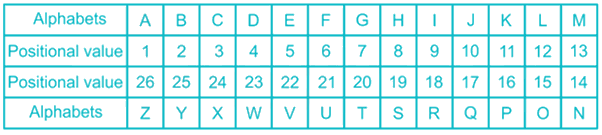 The pattern followed here is
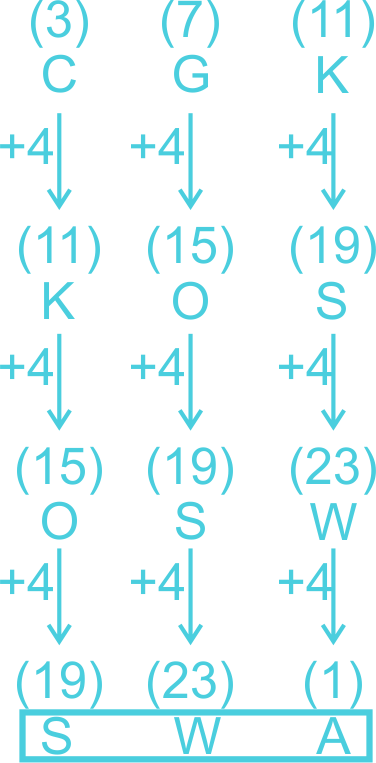 Hence, the correct answer is "Option 3"
Q2 · Series
Select the letter-cluster from among the given options that can replace the question mark (?) in the following series.
MIN, NJM, OKL, PLK, ?
- QWS
- HGF
- QMJ
- UJH
Answer aur solution dekho
Archived marked answer: C
The pattern followed here is
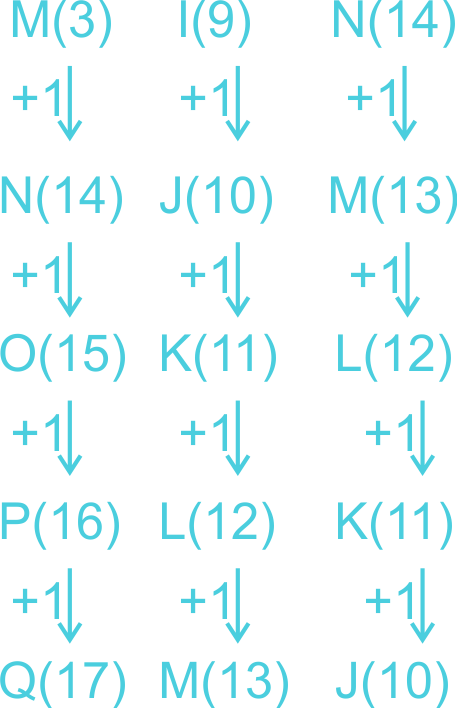 Hence, the correct answer is "Option 3"
Q3 · Series
Select the letter-cluster from among the given options that can replace the question mark (?) in the following series:
WZWT, WVOH, WRGV, WNYJ, ?
- W J Q X
- W J Q W
- W H P X
- W J P X
Answer aur solution dekho
Archived marked answer: A
The pattern followed here is
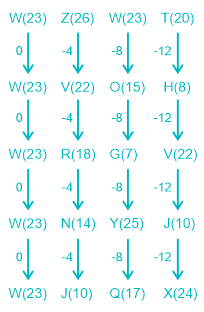 Hence, the correct answer is "Option 1"
Q4 · Series
Select the letter-cluster from among the given options that can replace the question mark (?) in the following series.
BRF , EUH , HXJ , KAL , ?
- NMB
- NKH
- NHG
- NDN
Answer aur solution dekho
Archived marked answer: D
The pattern followed here is
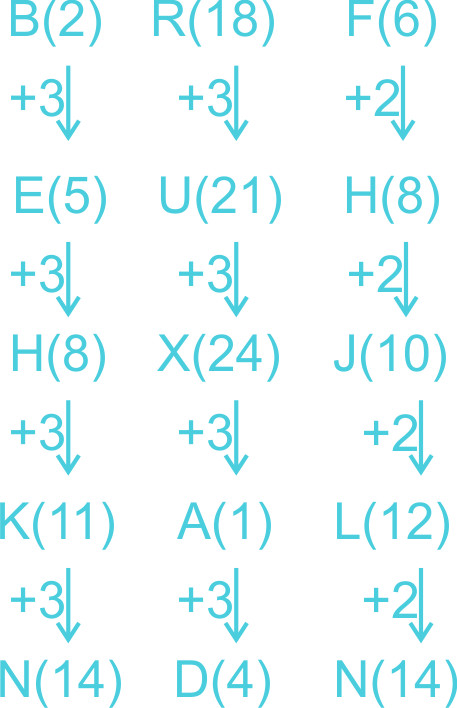 Hence, the correct answer is "Option 4"
Q5 · Series
Select the letter-cluster from among the given options that can replace the question mark (?) in the following series:
MCFI, NEKP, OGPW, PIUD, ?
- N K Y D
- Q L Y L
- Q K Z K
- Q K Z L
Answer aur solution dekho
Archived marked answer: C
The pattern followed here is
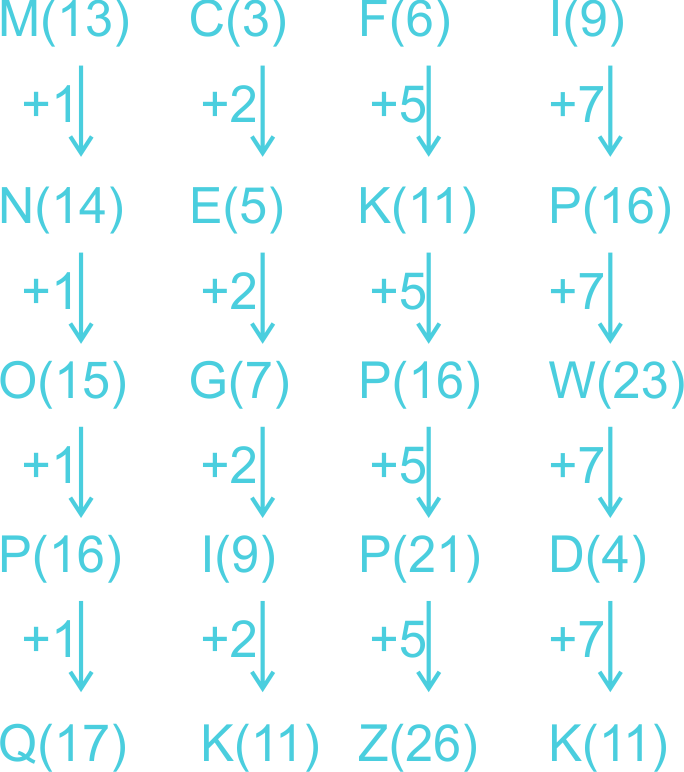 Hence, the correct answer is "Option 3"
Q6 · Series
What comes next: 3, 12, 7, 16, 11, 20, 15, ?
- 16
- 24
- 14
- 18
Answer aur solution dekho
Archived marked answer: B
The logic follows here,
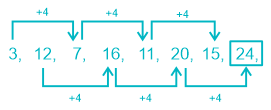 Hence, the correct answer is "Option 2"
Q7 · Analogy
Find the option that best completes the analogy.
AG : IO :: CM : ?
- KO
- KU
- KS
- KW
Answer aur solution dekho
Archived marked answer: B
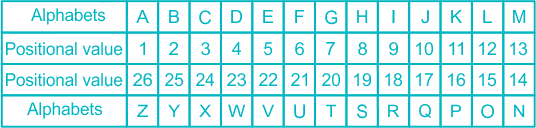
Alphabets Table
The pattern followed here is:
AG : IO
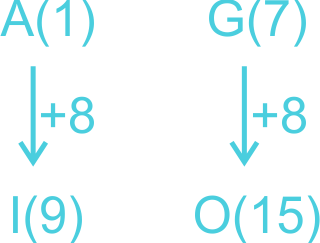 Similarly,
CM : ?
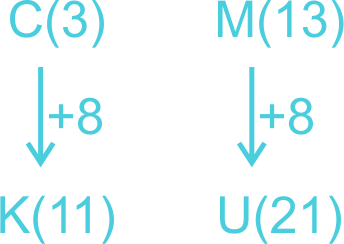 Hence, the correct answer is "Option 2"
Q8 · Analogy
In the following question, the second word is related to the first word by a specific pattern of letter transformation. Identify the same pattern and apply it to the third word to find the correct option that completes the analogy.
TIME : VJOG :: WORD : ?
- YPTF
- YQTG
- YPSF
- ZPSF
Answer aur solution dekho
Archived marked answer: A
Alphabet Table
The pattern followed here is
TIME : VJOG
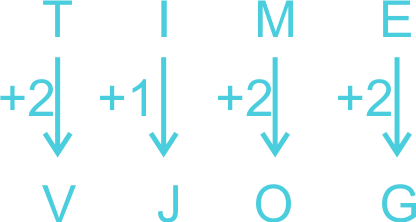 Similarly,
WORD : ?
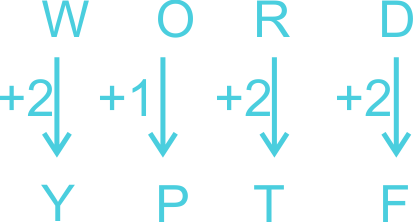 Hence, the correct answer is "Option 1"
Q9 · Analogy
In each of the following questions, the first word is coded to form the second word using a specific rearrangement and/or substitution rule. Apply the same rule to the third word to determine the correct corresponding word from the given alternatives.
AYRRJC :: CATTLE :: NCPDCAR : ?
- SUBJECTS
- NEGLECT
- PERFECT
- OPERATE
Answer aur solution dekho
Archived marked answer: C
The pattern followed here is
AYRRJC :: CATTLE< Q10 · Analogy
In each of the following questions, a specific pattern such as reversal or rearrangement has been applied to the first word to get the second. Apply the same pattern to the third word and find the correct answer from the given options. GNIDAER : READING :: NOITULOS : ?
- SOLUTION
- SOLUNOIT
- NOILOSUT
- POLLUTION
Answer aur solution dekho
Archived marked answer: A
The pattern followed here is
GNIDAER : READING
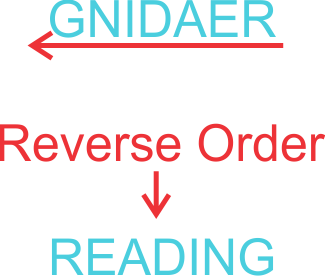 Similarly,
NOITULOS : ?
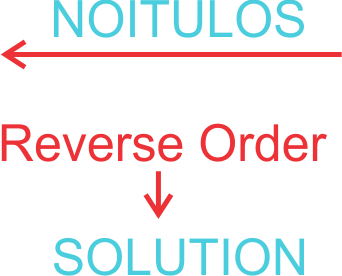 Hence, the correct answer is "Option 1"
Q11 · Analogy
In the following question, select the related word from the given alternatives.
Watt : Power :: Pascal : ?
- Energy
- Temperature
- Pressure
- Force
Answer aur solution dekho
Archived marked answer: C
The logic follows here is:
Watt : Power → Watt is SI unit of Power.
Similarly,
Pascal : ? → Pascal is SI unit of Pressure.
Hence, the correct answer is "Option 3"
Q12 · Analogy
In the following question, select the related word from the given alternatives.
Mekong : Tibet :: Amazon : ?
- Chile
- Peru
- Colombia
- Ecuador
Answer aur solution dekho
Archived marked answer: B
The logic follows here,
Peru, because the Mekong River originates in Tibet, similarly the Amazon River originates in the Andes mountains, primarily in Peru, making Peru the analogous origin point for the Amazon
Mekong : Tibet (Origin) :: Amazon : Peru (Origin)
Hence, the correct answer is "Option 2"
Q13 · Puzzle Subtypes Not To Miss
If # = ×, @ = -, $ = +, then evaluate: 9 # 2 @ 3 $ 1
- 18
- 14
- 16
- 17
Answer aur solution dekho
Archived marked answer: C
Given Equation: 9 # 2 @ 3 $ 1 = ?
BODMAS Rule:
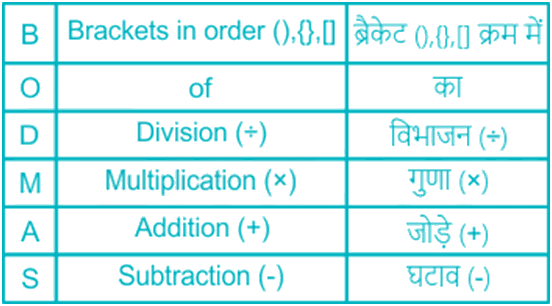 Decoding the given information:
Symbol
Q14 · Classification Odd One Out
Identify the odd one: 2, 3, 5, 7, 11, 13, 17, 20
- 17
- 13
- 20
- 11
Answer aur solution dekho
Archived marked answer: C
The logic follows here,
- 2, 3, 5, 7, 11, 13, 17 → all are prime numbers
- 20 → not a prime number (it is composite)
- 20 is odd one.
Hence, the correct answer is "Option 3"
Q15 · Classification Odd One Out
Which of the following is the odd one out?
- 2, 3, 5
- 11, 13, 17
- 4, 6, 8
- 7, 19, 23
Answer aur solution dekho
Archived marked answer: C
The logic follows here,
Option 1. 2, 3, 5 → all are prime numbers
Option 2. 11, 13, 17 → all are prime numbers
Option 3. 4, 6, 8 → all are composite numbers
Option 4. 7, 19, 23 → all are prime numbers
Hence, the correct answer is "Option 3"
Q16 · Classification Odd One Out
In each of the following questions, a group of three numbers/symbols is given in each option. Identify the group that does NOT follow the same pattern as the others.
- K11 : I9 : G7
- M13 : K11 : I9
- O15 : M13 : K11
- N14 : K11 : H8
Answer aur solution dekho
Archived marked answer: D
The pattern followed here is
Option 1) K11 : I9 : G7
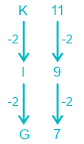 Option 2) M13 : K11 : I9
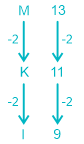 Option 3) O15 : M13 : K11
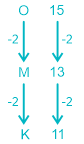 Option 4) N14 : K11 : H8
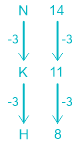 N14 : K11 : H8 - Not follows the same pattern.
Hence, the correct answer is "Option 4"
Q17 · Classification Odd One Out
In each of the following questions, a group of three numbers/symbols is given in each option. Identify the group that does NOT follow the same pattern as the others.
- A1@ : B2# : C3$
- D4% : E5^ : F6&
- G7* : H8( : I9)
- J10_ : K11@ : L12@
Answer aur solution dekho
Archived marked answer: D
 Options
Letter pattern
Number pattern
Symbol pattern
(1)
A → B → C
1 → 2 → 3
@, #, $ (All Unique)
(2)
D → E → F
4 → 5 → 6
%, ^, & (All Unique)
(3)
G → H → I
7 → 8 → 9
*, (, ) (All Unique)
(4)
J → K → L
10 → 11 → 12
_, @, @ (Repetitive)
Option 4 is the different one because it breaks the symbol progression. While the letters (J, K, L) and numbers (10, 11, 12) follow the established pattern, the symbol "@" is repeated in the second and third groups (K11@ and L12@).
Hence, the correct answer is “Option 4”.
Q18 · Blood Relations
Rani said, "The man in the photo is my mother's son-in-law." Who is the man to Rani?
- Husband
- Father
- Uncle
- Cousin
Answer aur solution dekho
Archived marked answer: A
Family Chart:
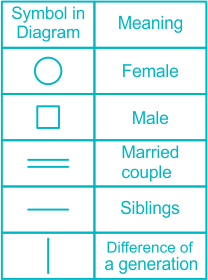 As per the given information:
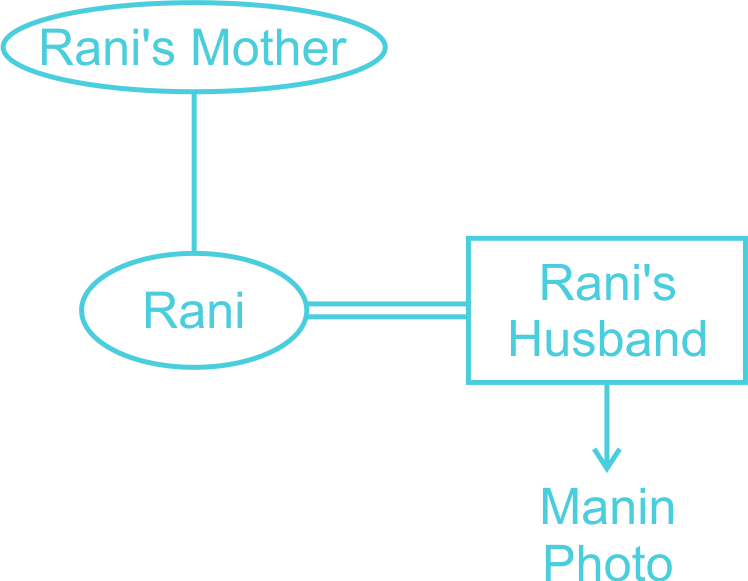 Thus, the man is Rani's husband.
Hence, the correct answer is "Option 1"
Q19 · Blood Relations
Pointing to a man, a woman said, "His mother is the only daughter of my father." How is the man related to the woman?
- Son
- Nephew
- Cousin
- Grandson
Answer aur solution dekho
Archived marked answer: A
Decoding symbols for Family Tree:
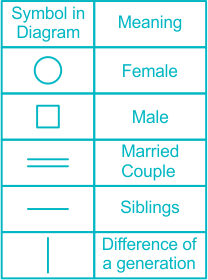 Step-by-step Relationship Analysis:
Breakdown the statement made by the woman: "His (the man's) mother is the only daughter of my father."
- "The only daughter of my father" – Since the sp
Q20 · Blood Relations
Pointing to a woman, John says, "She is the wife of my uncle's only son." How is the woman related to John?
- Sister
- Cousin
- Sister-in-law
- Niece
Answer aur solution dekho
Archived marked answer: C
Decoding symbols for Family Tree:
Step-by-step Relationship Analysis:
Breakdown the statement made by John: "She is the wife of my uncle's only son."</ Q21 · Blood Relations
A man said, "My mother's husband's only son is the father of your sister's brother." How is the man related to you?
- Uncle
- Father
- Grandfather
- Brother
Answer aur solution dekho
Archived marked answer: B
Step-by-step Relationship Analysis:
Breakdown the statement made by the man: "My mother's husband's only son is the father of your sister's brother."
- "My mother's husband" refers to the man's Father.
- "Father's only son" refers to the man himself (the speaker).
- "Your sister's brother" refers to your Brother (or you, if you are male).
- Now, replace the parts in the sentence: "I (the man) am the father of your Brother."
Consolidated Family Structure:
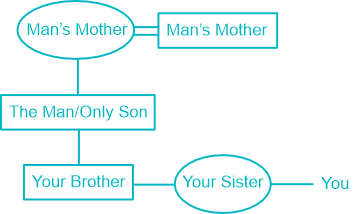 If the man is the father of your brother, he must also be your father.
Thus, the man is your Father.
Hence, the correct answer is "Option 2"
Q22 · Alphabet Test
Each of the letters in the word STUDENT is arranged in alphabetical order. How many letters are there in the English alphabetical series between the letter that is second from the left and the one that is fourth from the right in the new letter-cluster formed?
- 17
- 13
- 11
- 15
Answer aur solution dekho
Archived marked answer: B
The logic followed here is:
Given Word: STUDENT
According to the question, arraged in alphabetical order → D E N S T T U
So, Letter second from the left Q23 · Similarity and Differences
Which of the following addresses are identical to each other:
1. Arjun Mehta A-101, Emerald Towers, Surat, 395001
2. Arjun Mehta A-101, Emerald Tower, Surat, 395001
3. Arjun M. A-101, Emerald Tower, Surat, 395001
4. Arjun Mehta A-101, Emerald Tower, Surat, 395001
- 1 and 2
- 1 and 3
- 2 and 4
- 3 and 4
Answer aur solution dekho
Archived marked answer: C
The following addresses are identical
2. Arjun Mehta A-101, Emerald Tower, Surat, 395001
4. Arjun Mehta A-101, Emerald Tower, Surat, 395001
Hence, the correct answer is "Option 3"
Q24 · Similarity and Differences
Which of the following is/are identical to the address given: Meenal Gupta 102, Silver Oaks, Sector 12, Noida, 201301
1. Meenal Gupta 102, Silver Oaks, Sector 12, Noida, 201301
2. Meenal Gupta 102, Silver Oaks, Sector-12, Noida, 201301
3. Meenal Gupta 102, Silver Oaks, Sector 12, Noida 201301
4. Meenal Gupta 102, Silver Oaks, Sector 12, Noida, 201302
- 1
- 3
- 2
- 4
Answer aur solution dekho
Archived marked answer: A
Given: Meenal Gupta 102, Silver Oaks, Sector 12, Noida, 201301
1. Meenal Gupta 102, Silver Oaks, Sector 12, Noida, 201301 → Correct
2. Meenal Gupta 102, Silver Oaks, Sector-12, Noida, 201301 → Incorrect
3. Meenal Gupta 102, Silver Oaks, Sector 12, Noida 201301 → Incorrect
4. Meenal Gupta 102, Silver Oaks, Sector 12, Noida, 201302 → Incorrect
Hence, "Option 1" is the correct answer.
Q25 · Seating Arrangement
A is facing North. B is seated second to the right of A. Who is sitting immediately to the left of B?
- The person seated to the immediate right of A
- The person seated opposite to A
- The person seated to the immediate left of A
- Cannot be determined
Answer aur solution dekho
Archived marked answer: D
The answer is Cannot be determined (option 4). Only A’s facing direction is given; B’s facing direction and the seating arrangement are not specified. Even a row allows different answers. For example, take four occupied positions numbered 0, 1, 2 and 3 from west to east, with A at 0 facing north and B at 2. If B faces north, B’s immediate-left seat is position 1, which is immediately right of A. If B faces south, B’s immediate-left seat is position 3 instead. Both arrangements satisfy the statements, so no unique person can be identified. We must not assume that everyone faces the same direction.
General Awareness
Q1 · Art and Culture
Which of the following features distinguishes the Elephanta Caves from other rock-cut sites of early India?
- They are primarily Buddhist caves with large stupas.
- The caves focus on Shaivite themes and feature sculptural depth through light and shadow.
- They contain a mix of Jain and Vaishnavite depictions in pillar halls.
- The caves are entirely monolithic structures from the Mauryan period.
Answer aur solution dekho
Archived marked answer: B
The Correct answer is The caves focus on Shaivite themes and feature sculptural depth through light and shadow.
Key Points
- The Elephanta Caves are located on the Elephanta Island, near Mumbai, Maharashtra.
- The caves primarily focus on Shaivite themes, highlighting the Hindu god Shiva in various forms such as Trimurti Shiva (three-faced Shiva),
Q2 · Art and Culture
Fill in the blanks:
In Carnatic music, a laghu with five beats is known as ____ jaati.
- Tishra
- Chaturashra
- Khanda
- Mishra
Answer aur solution dekho
Archived marked answer: C
The Correct answer is Khanda Jaati.
Key Points
- In Carnatic music, rhythm plays a vital role, and it is structured using various rhythmic cycles called talas.
- A laghu is a rhythmic unit within a tala, and its beat count is determined by the jaati.
- The term Khanda Jaati refers to a laghu with five beats.
- In the Khanda Jaati, the rhythmic pattern consists of five syllables or beats, which can be represented as ta ka ta ki ta.
- This is one of the five types of jaatis in Carnatic music, which include Tishra (3 beats), Chaturashra (4 beats), Khanda (5 beats), Mishra (7 beats), and Sankeerna (9 beats).
- The usage of Khanda Jaati in talas adds complexity and richness to the rhythmic structure, showcasing the intricacy of South Indian classical music.
- Khanda Jaati is often employed in compositions to create distinctive and challenging rhythmic patterns that test the skill of performers.
Additional Information
- Tishra Jaati
- Tishra Jaati consists of three beats in the laghu.
- This jaati is represented as ta ki ta.
- It is one of the simplest jaatis and is widely used in basic rhythmic compositions in Carnatic music.
- Chaturashra Jaati
- Chaturashra Jaati consists of four beats in the laghu.
- The rhythmic pattern for Chaturashra Jaati is ta ka di mi.
- This is the most common jaati in Carnatic music and serves as the foundation for many talas.
- Mishra Jaati
- Mishra Jaati consists of seven beats in the laghu.
- The rhythmic syllables are represented as ta ki ta ta ka di mi.
- This jaati is more intricate and is used to add complexity to compositions.
Q3 · Art and Culture
Cheraw, the bamboo dance performed using crossed bamboo sticks, is a folk dance of which state?
- Mizoram
- Meghalaya
- Arunachal Pradesh
- Sikkim
Answer aur solution dekho
Archived marked answer: A
The correct answer is Mizoram.
Key Points
- Cheraw, also known as the bamboo dance, is one of the most famous traditional dances of Mizoram.
- The dance involves the use of long bamboo sticks, which are held horizontally and tapped rhythmically on the ground by performers.
- The performers (usually women) move gracefully in and out of the bamboo sticks to the beat of the music without getting their feet caught.
- This dance holds cultural and religious significance for the Mizo community, as it is often performed during festivals and special occasions, such as weddings or harvest celebrations.
- The Cheraw dance reflects the rich heritage and traditions of the state of Mizoram.
- It symbolizes the harmony and coordination between nature and mankind through its intricate movements.
- Cheraw has gained international fame and is considered a symbol of Mizoram's cultural identity.
Additional Information
- Meghalaya
- Meghalaya is known for its rich tribal culture and several traditional dances, such as Wangala Dance, performed by the Garo tribe to celebrate the harvest festival.
- Another famous dance is the Shad Suk Mynsiem, performed by the Khasi tribe during the spring season.
- Arunachal Pradesh
- Arunachal Pradesh is famous for its diverse tribal dances such as Yak Dance, Buiya Dance, and Ajilamu Dance.
- These dances are often linked to religious rituals and seasonal celebrations.
- Sikkim
- Sikkim is known for its traditional dances like the Chu-Faat Dance and Mask Dance, performed during religious festivals.
- These dances are deeply rooted in Buddhist culture and depict various mythological stories and traditions.
Q4 · Art and Culture
Read the statements about the Goncha Festival of Bastar:
1.) Tupki, a mock gun made of bamboo, uses Goncha fruit as bullets.
2.) The chariot procession was started by Chalukya rulers.
3.) Rath Yatra begins on Ashadh Shukla Dashmi and ends on Dutiya.
Which of the above statements are correct?
- Only 1 and 2
- Only 2 and 3
- Only 1 and 3
- 1, 2 and 3 are correct
Answer aur solution dekho
Archived marked answer: A
The Correct answer is Only 1 and 2.
Key Points
- The Goncha Festival is a famous festival celebrated in the Bastar region of Chhattisgarh.
- The festival is marked by the use of Tupki, which is a mock gun made of bamboo, and it uses the Goncha fruit as its bullets. This is a playful and symbolic activity during the festival.
- The chariot procession, a significant part of the Goncha Festival, was started during the rule of the Chalukya dynasty. This tradition is still carried out with grandeur and devotion.
- The festival reflects the rich cultural heritage and traditions of the region, highlighting the historical and religious significance of the event.
Additional Information
- Statement 3: "Rath Yatra begins on Ashadh Shukla Dashmi and ends on Dutiya."
- This statement is incorrect as it does not align with the traditional timeline of the Goncha Festival. While the Rath Yatra is part of the festival, the dates mentioned are not accurate for this specific festival.
- The Goncha Festival is celebrated with unique practices like the playful use of Tupki, which symbolizes the harmonious coexistence of people from different communities.
- The festival emphasizes regional identity, showcasing the historical and cultural richness of the Bastar region.
Q5 · Indian Polity and Constitution
Which of the following most accurately describes the legal character of the right to property under Article 300A of the Indian Constitution?
- It is a fundamental right that guarantees compensation for all property acquisitions.
- It allows the State to deprive a person of property by any law, even without due process.
- It is a constitutional legal right that permits deprivation only by authority of law.
- It permits citizens to claim property protection under Article 32 before the Supreme Court.
Answer aur solution dekho
Archived marked answer: C
The Correct answer is It is a constitutional legal right that permits deprivation only by authority of law.
Key Points
- Under Article 300A of the Indian Constitution, the right to property is no longer a fundamental right. It was demoted to a constitutional legal right by the 44th Constitutional Amendment Act, 1978.
- This article states that no person shall be deprived of their property except by the authority of law.
- This ensures that property can only be taken by the state through a legally established process, providing protection against arbitrary deprivation.
- As a constitutional legal right, this provision primarily ensures that property rights are safeguarded as long as the deprivation occurs through proper legislation.
- Unlike fundamental rights, violations of Article 300A cannot be directly challenged under Article 32 in the Supreme Court.
- However, if property is taken away without following the due process of law, remedies can be sought through the High Courts under Article 226 or other legal avenues.
- The transformation of the right to property from fundamental to constitutional legal right reflects the state's ability to regulate property for public welfare, subject to legal procedures.
Additional Information
- It is a fundamental right that guarantees compensation for all property acquisitions.
- Before the 44th Amendment Act, the right to property was a fundamental right under Articles 19(1)(f) and 31. However, post-amendment, Article 300A does not guarantee compensation for all acquisitions, and the right to property is now a constitutional legal right.
- It allows the State to deprive a person of property by any law, even without due process.
- This statement is incorrect as Article 300A explicitly requires deprivation to occur through the authority of law. Arbitrary deprivation without legal procedures violates the article.
- It permits citizens to claim property protection under Article 32 before the Supreme Court.
- Property rights under Article 300A cannot be enforced through Article 32, as they are not fundamental rights. Remedies for violations must be sought through High Courts under Article 226 or other legal mechanisms.
Q6 · Indian Polity and Constitution
Education is now placed under which list after the 42nd Amendment?
- Union List
- State List
- Concurrent List
- None of these
Answer aur solution dekho
Archived marked answer: C
The correct answer is Concurrent List.
Key Points
- The 42nd Amendment Act of 1976 is one of the most comprehensive amendments to the Indian Constitution. It brought about significant changes in various provisions.
- One of the key changes was the transfer of Education from the State List to the Concurrent List.
- By placing education in the Concurrent List, both the Union Government and the State Governments can legislate on matters related to education.
- This amendment was aimed at achieving a uniform educational policy across the country, ensuring better coordination and implementation of educational reforms.
- The Concurrent List is one of the three legislative lists under the Seventh Schedule of the Constitution of India. It contains subjects on which both the Union and State Governments can make laws.
- Other important subjects in the Concurrent List include criminal law, marriage and divorce, bankruptcy, and forests.
Additional Information
- Union List
- The Union List contains subjects on which only the Parliament has exclusive powers to make laws.
- Examples of subjects in the Union List include defense, foreign affairs, atomic energy, banking, and communications.
- It is mentioned in the Seventh Schedule of the Constitution and includes 100 subjects.
- State List
- The State List contains subjects on which only the State Legislatures have the authority to legislate.
- Examples of subjects in the State List include police, public health, agriculture, and local government.
- This list also falls under the Seventh Schedule and contains 61 subjects.
Q7 · Indian Polity and Constitution
Which of the following is true about Fundamental Rights and DPSPs?
- Both are justiciable and enforceable by courts
- DPSPs override Fundamental Rights when in conflict
- Fundamental Rights are justiciable, but DPSPs are not
- DPSPs are guaranteed by the Constitution;Fundamental Rights are optional
Answer aur solution dekho
Archived marked answer: C
The Correct answer is Fundamental Rights are justiciable, but DPSPs are not.
Key Points
- Fundamental Rights are explicitly mentioned in Part III of the Indian Constitution.
- They are enforceable by the courts, meaning individuals can approach the courts if their rights are violated. This makes them justiciable.
- The Directive Principles of State Policy (DPSPs), enshrined in Part IV of the Constitution, are not enforceable by the courts, making them non-justiciable.
- DPSPs act as guidelines for the government to achieve socio-economic goals and establish a welfare state.
- While Fundamental Rights focus on individual rights and liberties, DPSPs emphasize collective welfare and societal development.
- The Supreme Court of India has clarified that Fundamental Rights and DPSPs must be harmonized and not seen as conflicting entities.
- Examples of Fundamental Rights include the Right to Equality (Article 14-18) and the Right to Freedom (Article 19-22).
- Examples of DPSPs include the directive to promote equal justice and free legal aid (Article 39A) and to ensure living wages for workers (Article 43).
Additional Information
- Both are justiciable and enforceable by courts
- This option is incorrect because only Fundamental Rights are enforceable by courts, while DPSPs are not.
- DPSPs serve as principles for governance and cannot be legally upheld in courts.
- DPSPs override Fundamental Rights when in conflict
- The Supreme Court has ruled that Fundamental Rights hold a higher position in cases of conflict.
- However, efforts have been made to harmonize both, recognizing their complementary nature.
- DPSPs are guaranteed by the Constitution; Fundamental Rights are optional
- This is incorrect as both Fundamental Rights and DPSPs are integral parts of the Constitution.
- Fundamental Rights are guaranteed and enforceable, while DPSPs are guidelines that cannot be enforced legally.
Q8 · Indian Polity and Constitution
The Bharatiya Sakshya Adhiniyam (BSA) places emphasis on the use of technology to ensure the authenticity of evidence. This is particularly relevant for:
- Physical exhibits from crime scenes.
- Hand-written diaries.
- Digital and electronic evidence.
- Oral confessions.
Answer aur solution dekho
Archived marked answer: C
The correct answer is Digital and electronic evidence.
Key Points
- The Bharatiya Sakshya Adhiniyam (BSA), or the Indian Evidence Act, emphasizes the importance of using technology to ensure the authenticity and reliability of evidence.
- It is particularly relevant for digital and electronic evidence, as such evidence can be tampered with or altered without proper mechanisms to ensure its integrity.
- Digital evidence includes data obtained from electronic devices such as computers, smartphones, hard drives, and cloud-based storage systems. Examples include emails, SMS messages, call logs, and CCTV footage.
- The Act includes provisions for the admissibility of electronic records under Section 65B of the Indian Evidence Act, 1872, where certified electronic records are treated as evidence in courts.
- This emphasis on technology aligns with global judicial trends where digital evidence plays a crucial role in solving crimes ranging from cybercrimes to financial fraud and organized crime.
Additional Information
- Digital and Electronic Evidence:
- It includes all forms of evidence that are stored or transmitted in a digital format. Examples: emails, social media posts, digital documents, and server logs.
- Key features: It is highly prone to tampering, requires proper authentication, and necessitates the use of advanced forensic techniques for validation.
- Under Section 65B of the Indian Evidence Act, electronic records are treated as valid evidence if they meet certain technical criteria, like certification by a responsible official.
- Physical Exhibits:
- This refers to tangible objects obtained from crime scenes, such as weapons, clothing, or fingerprints.
- Physical evidence is crucial but is not typically subject to the same scrutiny as digital evidence in terms of authenticity checks because of its material nature.
- Hand-Written Diaries:
- This type of evidence is considered under traditional documentary evidence and does not involve technology for validation.
- Handwriting experts may be used for authentication.
- Oral Confessions:
- These are verbal statements made by a suspect or accused during interrogation.
- Such evidence is admissible under Indian law but must be corroborated with other evidence to ensure reliability.
- Admissibility of Digital Evidence Globally:
- The United Nations Office on Drugs and Crime (UNODC) has emphasized the importance of digital evidence in combating transnational crimes.
- Countries like the USA and the UK also have laws in place, such as the Federal Rules of Evidence in the USA, that govern the admissibility of digital evidence.
Important Points
- Section 65B Certification: A certificate is required for the admissibility of electronic records, which ensures that the evidence was generated and stored in a reliable manner.
- Electronic Evidence Forensics: Advanced forensic tools are used to extract and analyze data while maintaining its integrity.
- Challenges: The dynamic nature of digital evidence, jurisdictional issues (e.g., data stored overseas), and encryption can complicate its use in legal proceedings.
- Role in Modern Crimes: Digital evidence is indispensable in solving cybercrimes, financial fraud, and even traditional crimes where technology plays a role, such as using CCTV footage in robbery cases.
- Judicial Precedents: Indian courts have increasingly relied on digital evidence, with landmark cases such as Anvar P.V. v. P.K. Basheer (2014) setting important precedents for admissibility.
Q9 · Indian Polity and Constitution
Arrange the following events in chronological order:
a. Eastern Zonal Council meeting 2022
b. States Reorganisation Act passed
c. First Central Zonal Council meeting
- b-c-a
- c-b-a
- a-b-c
- b-a-c
Answer aur solution dekho
Archived marked answer: A
The correct answer is b-c-a.
Key Points
- The States Reorganisation Act was passed in 1956. It restructured India's states and territories, marking a significant moment in the political and administrative history of the country.
- The First Central Zonal Council meeting was held after the creation of zonal councils, which were established following the States Reorganisation Act. These councils aimed to promote cooperation and coordination between states.
- The Eastern Zonal Council meeting in 2022 occurred significantly later and focused on contemporary issues related to the states in the eastern region of India.
- The chronological order of the events is therefore: States Reorganisation Act passed (b), followed by the First Central Zonal Council meeting (c), and finally the Eastern Zonal Council meeting in 2022 (a).
Additional Information
- States Reorganisation Act
- The States Reorganisation Act, 1956 was a major reform that reorganized the boundaries of Indian states and territories based on linguistic lines.
- It led to the creation of 14 states and 6 union territories.
- This Act also provided the basis for the establishment of Zonal Councils under the States Reorganisation Commission.
- Zonal Councils
- The Zonal Councils were set up to foster interstate cooperation and coordination, as recommended by the States Reorganisation Commission.
- They are statutory bodies, established under the States Reorganisation Act, 1956.
- There are five Zonal Councils: Northern, Southern, Eastern, Western, and Central Zonal Councils.
- The Central Zonal Council includes states like Uttar Pradesh, Madhya Pradesh, Uttarakhand, and Chhattisgarh.
- Eastern Zonal Council
- The Eastern Zonal Council comprises the states of West Bengal, Odisha, Bihar, and Jharkhand.
- It focuses on issues like economic and social development, border disputes, and security concerns specific to the eastern region of India.
- The 2022 meeting of the Eastern Zonal Council aimed at resolving issues related to connectivity, infrastructure, and law and order in the eastern states.
Q10 · Indian Economy
Which of the following correctly describes cooperative sector industries?
- Owned and operated by central government agencies.
- Operated solely for export purposes.
- Owned by workers or suppliers sharing profits and losses
- Maintained by foreign companies with Indian partnerships.
Answer aur solution dekho
Archived marked answer: C
The correct answer is Owned by workers or suppliers sharing profits and losses.
Key Points
- Cooperative sector industries are those owned and managed by groups of individuals who share common economic interests. These groups often consist of workers, suppliers, or consumers.
- The primary objective is to ensure mutual benefit, where profits and losses are shared equally among all members.
- These industries follow the principle of cooperation, which promotes economic equality and prevents exploitation.
- Examples of cooperative sector industries include milk cooperatives like Amul, handloom cooperatives, and agricultural cooperative societies.
- Cooperatives play a crucial role in empowering rural areas by providing employment, income stability, and promoting sustainable economic growth.
- They also adhere to the democratic principle of one member, one vote, ensuring equitable decision-making.
Additional Information
- Owned and operated by central government agencies
- Industries owned and operated by the central government fall under the category of public sector industries, not cooperative sector industries.
- These industries are managed by the government for purposes like national development, security, and providing essential services.
- Examples include Indian Railways, BHEL, and ONGC.
- Operated solely for export purposes
- Industries that primarily focus on exports are often classified as export-oriented industries.
- They aim to produce goods and services for international markets rather than domestic consumption.
- Examples include industries involved in textiles, pharmaceuticals, and IT services catering to global demand.
- Maintained by foreign companies with Indian partnerships
- Industries maintained by foreign companies in collaboration with Indian entities are referred to as joint ventures.
- They aim to combine resources, technology, and expertise from both parties for mutual benefit.
- Examples include Maruti Suzuki, a joint venture between India's Maruti and Japan's Suzuki.
Q11 · Sports Static GK
Which of the following statements about Judo is correct?
- Judo was introduced in 1882 by Jigoro Kano in Japan.
- India's first National Judo Championship was held in 1970 at Delhi University.
- Kalpana Devi won gold at the 2010 Judo World Cup.
- Judo became an Olympic sport in 1965.
Answer aur solution dekho
Archived marked answer: A
The correct answer is Judo was introduced in 1882 by Jigoro Kano in Japan.
Key Points
- Judo is a modern Japanese martial art and combat sport that was created in 1882 by Jigoro Kano.
- The term Judo translates to "the gentle way" in Japanese.
- Kano founded the Kodokan Judo Institute in Japan, where he developed and taught this martial art.
- Judo focuses on techniques like grappling, joint locks, chokeholds, and throws, making it distinct from other martial arts that emphasize striking.
- It is based on principles like "maximum efficiency with minimum effort" and "mutual welfare and benefit".
- Kano’s Judo emphasized physical education, self-defense, and moral development, which contributed to its recognition worldwide.
- Judo has become a global sport and is practiced in numerous countries, with competitions held at national and international levels.
- It became an Olympic sport for men in 1964 (Tokyo Olympics) and for women in 1992 (Barcelona Olympics).
Additional Information
- India's first National Judo Championship
- The first National Judo Championship in India was held in 1970 at Delhi University. This event marked the formal recognition and organization of Judo as a sport in India.
- While this is a significant milestone in the history of Judo in India, it is not the correct answer as the question focuses on Judo's origins.
- Kalpana Devi and the 2010 Judo World Cup
- Kalpana Devi is a renowned Indian judoka who has represented India in various international competitions.
- However, she did not win the gold medal at the 2010 Judo World Cup. This statement is factually incorrect.
- Judo as an Olympic sport
- Judo became an official Olympic sport in the year 1964 at the Tokyo Olympics, not in 1965 as stated in the option.
- The inclusion of Judo in the Olympics was a significant step in its international recognition.
Q12 · Sports Static GK
Where and when will the 59th National Cross Country Championships - 2025 be held?
- 10th January 2025, Lucknow, Uttar Pradesh
- 12th January 2025, Meerut, Uttar Pradesh
- 15th January 2025, Kanpur, Uttar Pradesh
- 12th January 2025, Jaipur, Rajasthan
Answer aur solution dekho
Archived marked answer: B
The correct answer is 12th January 2025, Meerut, Uttar Pradesh.
Key Points
- The 59th National Cross Country Championships is scheduled to be held on 12th January 2025.
- The event will take place in Meerut, Uttar Pradesh, a city known for its rich history and sports culture.
- Cross Country Championships are athletic events conducted over natural terrains such as grass, dirt trails, or hills, emphasizing endurance and strategy.
- The event is organized under the guidance of the Athletics Federation of India (AFI), which is the apex body for athletics in India.
- Meerut has a prominent reputation in sports equipment manufacturing and is a major contributor to the sports industry in India, making it a fitting choice for hosting such events.
- This championship attracts participants from across the nation, providing a platform for talented athletes to showcase their skills and gain recognition.
- Hosting the championship in Uttar Pradesh aligns with the state’s efforts to promote sports and athletics, further boosting regional development in this sector.
Additional Information
- 10th January 2025, Lucknow, Uttar Pradesh
- Lucknow, the capital city of Uttar Pradesh, is renowned for its historical monuments and cultural heritage.
- It has been a host to various national-level events and is equipped with modern sports infrastructure.
- 15th January 2025, Kanpur, Uttar Pradesh
- Kanpur is an industrial hub and one of the largest cities in Uttar Pradesh.
- The city has a growing focus on sports and athletics, with several recent initiatives to upgrade its sports facilities.
- 12th January 2025, Jaipur, Rajasthan
- Jaipur, the capital of Rajasthan, is known as the Pink City due to its distinct architectural style.
- Although primarily famous for its tourism, Jaipur has hosted various sports events in the past.
Q13 · Sports Static GK
Fill in the blanks:
The Santosh Trophy 2022-23 final was uniquely held in _____, where Karnataka defeated Meghalaya to win the title after 54 years.
- Dubai
- Riyadh
- Doha
- Muscat
Answer aur solution dekho
Archived marked answer: B
The correct answer is Riyadh.
Key Points
- The Santosh Trophy 2022-23 final was held in Riyadh, Saudi Arabia. This was the first time the tournament was organized outside India, making it a unique event in the history of the Santosh Trophy.
- The final match took place between Karnataka and Meghalaya. Karnataka defeated Meghalaya to win the title after a gap of 54 years.
- The match was hosted at the King Fahd International Stadium in Riyadh, a renowned venue for international football matches.
- The decision to hold the final in Riyadh was part of an effort to promote Indian football internationally and to engage with the Indian diaspora in Saudi Arabia.
- This victory marked Karnataka’s fifth Santosh Trophy title, with their last win being in 1968-69.
Additional Information
- Santosh Trophy:
- The Santosh Trophy is a prestigious inter-state football tournament in India, organized by the All India Football Federation (AIFF).
- It was established in 1941 and is named after the late Maharaja Sir Manmatha Nath Roy Chowdhary of Santosh, a prominent patron of football in India.
- Over the years, it has been a platform for discovering young and talented football players from across the country.
- Karnataka’s Performance:
- Karnataka has now won the Santosh Trophy title five times, with their first win in 1946.
- The 2022-23 win was a significant achievement as it ended a 54-year drought for the team in the tournament.
- King Fahd International Stadium:
- Located in Riyadh, Saudi Arabia, this stadium is a major venue for international football events.
- It has a seating capacity of over 68,000 spectators and is known for hosting significant matches, including the AFC Champions League and Saudi Pro League games.
- Indian Football Abroad:
- Hosting the Santosh Trophy final in Riyadh reflects the growing efforts to globalize Indian football.
- It aims to connect with the large Indian expatriate community in the Middle East and promote the sport beyond national borders.
Q14 · Current Affairs
Which of the following statements about Justice Sanjiv Khanna is/are true?
1. He is the 51st Chief Justice of India
2. He succeeded Justice D.Y. Chandrachud
3. He served as CJI from 2023
- 1 and 2 only
- 2 and 3 only
- 1 and 3 only
- 1, 2, and 3 all are true
Answer aur solution dekho
Archived marked answer: A
The correct answer is 1 and 2 only.
Key Points
- Justice Sanjiv Khanna became the 51st Chief Justice of India (CJI). *Hence, statement 1 is correct.*
- He succeeded Justice D.Y. Chandrachud, who demitted office after completing his tenure as the 50th CJI. *Hence, statement 2 is correct.*
- He did not serve as CJI from 2023. Justice D.Y. Chandrachud served as Chief Justice during 2022–2024. *Hence, statement 3 is incorrect.*
- *Therefore, the correct option is 1 and 2 only.*
Additional Information
- Chief Justice of India (CJI)
- Appointed under Article 124 of the Constitution of India.
- Appointed by the President of India following the convention of seniority.
- Retirement age: 65 years.
- Justice Sanjiv Khanna
- Elevated to the Supreme Court of India in January 2019.
- Previously served as a judge of the Delhi High Court.
- Belongs to a distinguished legal family; his uncle Justice H.R. Khanna was a renowned Supreme Court judge.
- Justice D.Y. Chandrachud
- Served as the 50th Chief Justice of India.
- Known for landmark judgments related to constitutional law, fundamental rights, and digital privacy.
Q15 · Current Affairs
What is a key factor assessed in the Global Firepower Military Strength Ranking 2025?
- Economic Stability
- Cultural Influence
- Defense Budget
- Healthcare Spending
Answer aur solution dekho
Archived marked answer: C
The correct answer is Defense Budget.
Key Points
- The Global Firepower Military Strength Ranking evaluates the military capabilities of nations globally by analyzing several factors, including their defense budget.
- A country's defense budget directly impacts its ability to procure advanced weaponry, maintain military infrastructure, and invest in research and development for new technologies.
- The ranking considers the allocation of financial resources to defense-related activities as a critical element of a country's overall military strength.
- Countries with a larger and more consistent defense budget are typically better equipped to modernize their armed forces and maintain readiness.
- This factor is one of the most significant indicators of a nation's military might in terms of both quality and quantity of resources.
- Other elements of the ranking, such as manpower, equipment, and logistical capabilities, are often supported and enhanced by a robust defense budget.
- Leading nations like the United States, China, and India allocate substantial portions of their annual budgets to defense, which reflects their prioritization of national security.
Additional Information
- Economic Stability
- Economic stability refers to a country's ability to maintain a steady rate of economic growth and avoid inflation or deflation.
- Although related to national strength, it is not directly assessed in the Global Firepower Military Strength Ranking.
- Economic stability often indirectly supports military strength by ensuring the availability of resources for defense spending.
- Cultural Influence
- Cultural influence pertains to a nation's ability to impact others through its culture, values, and traditions.
- It is a component of soft power rather than military or hard power, making it irrelevant to the Global Firepower Military Strength Ranking.
- Healthcare Spending
- Healthcare spending involves a nation’s investment in the health and well-being of its citizens.
- While it contributes to a country's overall development and quality of life, it is not a parameter used in determining military strength.
Q16 · General Science Biology
Which pathway in cellular respiration generates the most ATP?
- Glycolysis
- Krebs cycle
- Electron transport chain
- Fermentation
Answer aur solution dekho
Archived marked answer: C
The Correct answer is Electron Transport Chain.
Key Points
- The electron transport chain (ETC) is a crucial pathway in cellular respiration that generates the most ATP (adenosine triphosphate).
- It occurs in the inner membrane of the mitochondria in eukaryotic cells.
- The ETC uses high-energy electrons from molecules like NADH and FADH₂, which are produced during earlier stages of respiration.
- Electrons are transferred through a series of protein complexes, including cytochromes, which pump protons (H⁺) across the mitochondrial membrane, creating a proton gradient.
- This proton gradient powers the enzyme ATP synthase to synthesize ATP via a process called oxidative phosphorylation.
- The ETC is responsible for producing approximately 34 ATP molecules per glucose molecule, making it the most efficient pathway in energy production.
- Oxygen acts as the final electron acceptor in the ETC, combining with protons and electrons to form water, which is essential to the process.
Additional Information
- Glycolysis
- Glycolysis is the first step in cellular respiration, occurring in the cytoplasm of the cell.
- It breaks down glucose into two molecules of pyruvate, producing a net gain of 2 ATP molecules and 2 NADH molecules.
- Though it is an essential step, it generates far less ATP compared to the ETC.
- Krebs Cycle
- The Krebs cycle, also known as the citric acid cycle, occurs in the mitochondrial matrix.
- It produces NADH and FADH₂, which are used in the electron transport chain.
- The cycle directly generates only 2 ATP molecules per glucose molecule.
- Fermentation
- Fermentation is an anaerobic process that occurs in the absence of oxygen.
- It produces ATP through glycolysis and regenerates NAD+ for continued glycolysis.
- However, it generates only 2 ATP molecules per glucose molecule, making it far less efficient than aerobic respiration.
Q17 · General Science Chemistry
Argon is produced in Earth's crust via?
- Decay of K-40
- Volcanoes
- Photosynthesis
- Cosmic rays
Answer aur solution dekho
Archived marked answer: A
The correct answer is Decay of K-40.
Key Points
- Argon is a noble gas and is chemically inert, making it an important element in various industrial applications.
- On Earth, Argon is primarily produced through the radioactive decay of Potassium-40 (K-40).
- K-40, a naturally occurring isotope of potassium, undergoes beta decay to form Argon-40 (Ar-40).
- This process occurs deep within the Earth's crust and contributes significantly to the presence of argon in the atmosphere.
- The Earth's atmosphere contains approximately 0.93% argon, making it the third most abundant gas after nitrogen and oxygen.
- The decay of K-40 is a long-term geological process and is essential for understanding the Earth's isotopic composition and age.
Additional Information
- Volcanoes
- Volcanoes release various gases, including water vapor, carbon dioxide, sulfur dioxide, and sometimes traces of argon. However, argon from volcanic eruptions is minimal compared to its production through the decay of K-40.
- Volcanic activity contributes more significantly to the release of greenhouse gases like CO₂ rather than inert gases like argon.
- Photosynthesis
- Photosynthesis is a biological process performed by plants, algae, and cyanobacteria to convert sunlight, carbon dioxide, and water into glucose and oxygen.
- It does not involve the production of argon or any other noble gases.
- Cosmic rays
- Cosmic rays are high-energy particles from outer space. They can interact with the Earth's atmosphere to produce isotopes like Carbon-14, but they do not contribute significantly to the formation of argon in the Earth's crust.
Q18 · Government Schemes and Welfare Static Semi Static
Which of the following objectives are part of the National Population Policy (NPP) 2000?
1. Providing free and compulsory education up to 14 years of age
2. Increasing fertility rate to ensure demographic dividend
3. Reducing infant mortality rate below 30 per 1000 live births
4. Promoting delayed marriage for girls
- Only 1 and 2 are correct
- Only 1 and 3 are correct
- Only 1, 3 and 4 are correct
- 1, 2, 3 and 4 all are correct
Answer aur solution dekho
Archived marked answer: C
The correct answer is Only 1, 3 and 4 are correct.
Key Points
- The National Population Policy (NPP) 2000 was formulated with the objective of stabilizing the population of India while ensuring sustainable development and improving the quality of life of its citizens.
- One of the key goals of the policy is providing free and compulsory education up to 14 years of age, as outlined in the Directive Principles of State Policy under the Indian Constitution. This helps address population issues through better awareness and education.
- The policy aims to reduce the infant mortality rate (IMR) below 30 per 1000 live births by improving healthcare services, immunization programs, and maternal health facilities.
- Promoting delayed marriage for girls is another critical goal of the policy. Encouraging marriage at a later age not only helps in reducing fertility rates but also allows women to pursue education and professional opportunities.
- The policy focuses on several other measures such as addressing unmet needs for contraception, improving maternal healthcare, and achieving population stabilization by 2045.
Additional Information
- Incorrect Option: Increasing fertility rate to ensure demographic dividend
- This is incorrect as the National Population Policy (NPP) 2000 focuses on reducing the fertility rate, not increasing it.
- Reducing fertility rates helps to stabilize population growth and improve socioeconomic indicators.
- Achieving a stable Total Fertility Rate (TFR) is one of the major goals of the policy, aiming for a replacement-level TFR of 2.1.
- Importance of Infant Mortality Rate Reduction
- Reducing the infant mortality rate (IMR) is a key indicator of healthcare quality in a country.
- It reflects improvements in areas such as nutrition, immunization, sanitation, and access to healthcare services.
Q19 · Government Schemes and Welfare Static Semi Static
Read the below statements marked as Assertion (A) and Reason (R). Mark the correct options:
Assertion (A) : The One Nation One Ration Card ensures portability of food grains.
Reason (R) : It uses Aadhaar-enabled biometric authentication.
- Both A and R are true, and R is the correct explanation of A
- Both A and R are true, but R is not the correct explanation of A
- A is true, but R is false
- A is false, but R is true
Answer aur solution dekho
Archived marked answer: A
The correct answer is Both A and R are true, and R is the correct explanation of A.
Key Points
- The One Nation One Ration Card (ONORC) scheme ensures the portability of food grains under the National Food Security Act (NFSA).
- Portability allows eligible beneficiaries to access their entitled food grains from any Fair Price Shop (FPS) in India, irrespective of their location.
- It particularly benefits migrant workers and their families who relocate to different states or regions for work or other reasons.
- The scheme uses Aadhaar-enabled biometric authentication to verify the identity of beneficiaries at FPS outlets. This ensures that food grains are delivered to the rightful beneficiaries.
- The integration of Aadhaar with the Public Distribution System (PDS) helps in preventing leakages, duplication, and fraud in the system.
- ONORC was introduced to support the vision of a unified India and address food security challenges faced by the migrant population.
Additional Information
- A is true, but R is false
- This option is incorrect because Reason (R) is true. The Aadhaar-enabled biometric authentication plays a crucial role in ensuring portability under the scheme.
- A is false, but R is true
- This option is incorrect because Assertion (A) is correct. The One Nation One Ration Card indeed ensures portability of food grains.
- Both A and R are true, but R is not the correct explanation of A
- This option is incorrect because Reason (R) directly supports Assertion (A). The Aadhaar-enabled system is a core component of ensuring portability.
Q20 · World Geography
Consider the following statements about glacial landforms:
Statement 1: Hanging valleys are often found opening into main glacial valleys at higher elevations.
Statement 2: Spurs of such hanging valleys are frequently truncated into triangular facets.
Which of the following Statements is/are Correct?
- Only 1
- Only 2
- 1 and 2 are correct
- Neither 1 nor 2 are correct
Answer aur solution dekho
Archived marked answer: C
The Correct answer is 1 and 2 are correct.
Key Points
- Hanging valleys are formed by tributary glaciers that join the main glacier at a higher elevation. This happens because the main glacier erodes deeper and more extensively than the tributary glacier.
- These valleys often open into main glacial valleys at a higher elevation, appearing as steep cliffs or waterfalls after the ice melts.
- The spurs of such hanging valleys are truncated into triangular facets due to glacial erosion. This truncation occurs as the glacier carves through the valley, cutting across the spurs and leaving behind triangular landforms.
- Hanging valleys are commonly associated with waterfalls, as the streams from the tributary valleys flow down into the main valley after the ice melts. A notable example is the Yosemite Valley in the United States.
- The processes involved in the formation of hanging valleys and triangular facets are examples of how glaciers reshape landscapes through both erosion and deposition.
- These features provide key evidence of the intensity and direction of glacial movement in an area, helping researchers understand past glacial environments.
Additional Information
- Glacial Landforms
- Glaciers create various landforms through erosion, transportation, and deposition. These include features like cirques, horns, aretes, U-shaped valleys, and moraines.
- The study of glacial landforms helps in understanding climatic changes and the extent of glacial advances and retreats during the Earth's history.
- Glacial erosion processes like plucking and abrasion are responsible for the characteristic shape of valleys and other landforms.
Q21 · General Science Physics
For a rigid body, the angular velocity of any particle about a given axis of rotation is:
- Proportional to its distance from the axis
- The same for all particles
- Inversely proportional to its distance from the axis
- Always zero
Answer aur solution dekho
Archived marked answer: B
The Correct answer is The same for all particles.
Key Points
- In a rigid body, all particles are fixed relative to each other and move collectively during rotation.
- The angular velocity is a measure of the rate of rotation of a body about a given axis and is denoted as ω (omega).
- For a rigid body, the angular velocity of all particles is the same because they rotate together about the same axis at the same rate.
- While the linear velocity of particles depends on their distance from the axis of rotation, the angular velocity remains constant for all particles of the rigid body.
- This uniformity of angular velocity ensures that the body remains rigid and its shape does not change during rotation.
- Angular velocity is a vector quantity, having both magnitude and direction, where the direction is determined by the right-hand rule.
- The concept of angular velocity is widely used in mechanics, engineering, and physics to study rotational motion.
Additional Information
- Proportional to its distance from the axis
- The linear velocity of a particle in a rigid body is proportional to its distance from the axis of rotation. However, angular velocity is the same for all particles.
- This is because linear velocity (v) is calculated as v = ω × r, where r is the distance from the axis, and ω is the angular velocity.
- Inversely proportional to its distance from the axis
- This statement is incorrect because angular velocity does not depend on the distance from the axis. However, other properties, like torque, can depend inversely on certain factors.
- Always zero
- For a rigid body in rotational motion, angular velocity is never zero unless the body is at rest.
- If angular velocity were zero, the body would not exhibit any rotational motion.
Q22 · Books and Authors Static
Which of the following statements best captures the essence of "Landscapes of Loss: The Story of an Indian Drought" by Kavitha Iyer?
- A study on drought's human and ecological impacts in India.
- A fictional story about a family in a drought-hit area.
- A history of monsoon patterns and ancient agriculture in India.
- A colonial-era policy analysis of water management.
Answer aur solution dekho
Archived marked answer: A
The Correct answer is A study on drought's human and ecological impacts in India.
Key Points
- "Landscapes of Loss: The Story of an Indian Drought" by Kavitha Iyer focuses on the human and ecological consequences of droughts in India.
- The book sheds light on the socio-economic impact of droughts on rural communities, particularly farmers, and their families.
- It explores how droughts lead to migrations, loss of livelihoods, and challenges related to water scarcity.
- The narrative highlights the struggles faced by rural India, delving into the personal stories of individuals and communities.
- It discusses the ecological ramifications of droughts, including degradation of land and water resources.
- The book advocates for sustainable water management and policy reforms to address these recurring issues in India.
- Kavitha Iyer, as a journalist, uses her expertise to provide an in-depth analysis of drought's impact on India's agrarian landscape.
Additional Information
- Option 2: A fictional story about a family in a drought-hit area
- The book is not fictional. It is a non-fictional account based on real events and experiences.
- It uses journalistic tools to highlight the real plight of communities facing droughts in India.
- Option 3: A history of monsoon patterns and ancient agriculture in India
- While the book discusses water scarcity and droughts, it does not focus on the historical aspects of monsoon patterns or ancient agriculture.
- The primary focus is on modern-day droughts and their impact on communities.
- Option 4: A colonial-era policy analysis of water management
- The book does not explore colonial-era water policies; its emphasis is on contemporary issues related to drought and water scarcity.
Q23 · Environment and Ecology
What is the main objective of the National Framework for Climate Services (NFCS) launched in 2024?
- To set emission trading targets
- To regulate groundwater quality
- To deliver sector-specific climate information services
- To mandate carbon offsetting in the private sector
Answer aur solution dekho
Archived marked answer: C
The Correct answer is To deliver sector-specific climate information services.
Key Points
- The National Framework for Climate Services (NFCS) was launched in 2024 to provide climate information tailored to specific sectors.
- This framework aims to enhance decision-making and improve resilience in areas such as agriculture, water resources, health, energy, and disaster management.
- Its primary objective is to ensure the delivery of timely, accurate, and actionable climate data to stakeholders across various sectors.
- The NFCS aligns with international frameworks, such as the Global Framework for Climate Services (GFCS), to promote better climate governance and collaboration.
- Sector-specific services include forecasting for crop yields, managing water resources, and planning for energy distribution based on climate patterns.
- By addressing the impacts of climate change, the NFCS supports sustainable development and helps mitigate risks associated with climate variability and extreme weather events.
- It also emphasizes capacity building and promotes collaboration between scientists, policymakers, and stakeholders.
Additional Information
- To set emission trading targets
- Emission trading, also known as cap-and-trade, is a market-based approach to control pollution by providing economic incentives for reducing emissions.
- This option relates to environmental economics rather than direct climate service delivery.
- India has previously introduced a carbon market mechanism, but it is not directly linked to the NFCS.
- To regulate groundwater quality
- Regulating groundwater quality involves policies to maintain water standards, often under environmental protection acts.
- While groundwater is affected by climate change, this is not the main objective of the NFCS.
- Groundwater regulation is generally managed by organizations like the Central Ground Water Authority (CGWA) in India.
- To mandate carbon offsetting in the private sector
- Carbon offsetting involves compensating for emissions by investing in projects that reduce greenhouse gases.
- This option primarily pertains to corporate social responsibility and environmental policy, not climate service frameworks.
- India has introduced carbon offset programs, but the NFCS focuses more on providing climate data and services rather than mandates for offsetting.
Q24 · Static GK
What is the core structural focus of the 2024 India-UAE Bilateral Investment Treaty (BIT) within India's international investment strategy?
- Proposes joint sovereign funds and links INR swap with UAE banks.
- Focuses on pre-establishment rights and UAE-based arbitration.
- Assures post-establishment investor confidence via standard and national treatment.
- Aims at GCC-wide tax regulation under India-led digital framework.
Answer aur solution dekho
Archived marked answer: C
The Correct answer is Assures post-establishment investor confidence via standard and national treatment.
Key Points
- The 2024 India-UAE Bilateral Investment Treaty (BIT) focuses on post-establishment investor rights to ensure investor confidence.
- Key principles include standard treatment and national treatment, which ensure fair and equitable treatment of investments made by UAE investors in India and vice versa.</l
Q25 · General Science
What is the primary function of the Crew Escape System (CES) on ISRO's Human Rated LVM3 (HLVM3) rocket?
- To guide the crew module into its designated Low Earth Orbit.
- To eject the crew module to safety during launch emergencies.
- To assist in docking the crew module with a space station.
- To provide thermal shielding during re-entry into Earth's atmosphere.
Answer aur solution dekho
Archived marked answer: B
The Correct answer is To eject the crew module to safety during launch emergencies.
Key Points
- The Crew Escape System (CES) is a critical safety feature integrated into the ISRO's Human Rated LVM3 (HLVM3) rocket.
- Its primary function is to eject the crew module safely in case of any emergency during the launch or ascent phase.
- The CES ensures the safety of astronauts in scenarios such as rocket malfunctions,
Mathematics
Q1 · Geometry
The line y = mx + 5 passes through (1,8). Find m.
- 5
- 4
- 3
- 2
Answer aur solution dekho
Archived marked answer: C
Shortcut Trick
If a line passes through a given point, the coordinates of the point directly satisfy the equation of the line.
Substitute the point (1, 8) into the line equation y = mx + 5.
⇒ 8 = m × 1 + 5
⇒ m = 8 − 5 = 3
∴ The correct answer is 3.
Alternate Method
Given:
Equation of the straight line: y = mx + 5
The line passes through the point (1, 8).
- - x
y
O
- (0, 5)
(1, 8)
- - Δx = 1
Δy = 3
Line: y = mx + 5
y-intercept c = 5 → point (0, 5)
Slope m = Δy ÷ Δx = 3 ÷ 1 = 3
Formula Used:
If a point (x, y) lies on a line, its values must satisfy the equation y = mx + c.
Calculations:
⇒ By placing x = 1 and y = 8 in the given equation y = mx + 5:
⇒ 8 = m(1) + 5
⇒ 8 = m + 5
⇒ m = 8 − 5
⇒ m = 3
∴ The correct answer is 3.
Additional Information
Slope-Intercept Form
The equation of a straight line is commonly written as y = mx + c, where m is the slope of the line and c is its y-intercept.
Calculating Slope
The slope m of a line passing through any two distinct points (x₁, y₁) and (x₂, y₂) is evaluated as m = (y₂ − y₁) ÷ (x₂ − x₁).
Point-Slope Form
If a line has a given slope m and passes through a specific point (x₁, y₁), its exact equation is found using y − y₁ = m(x − x₁).
X and Y Intercepts
The x-intercept is the point where the line touches the x-axis (y = 0). The y-intercept is the point where it crosses the y-axis (x = 0).
</p
Q2 · Mensuration 2D
A bicycle wheel having a radius of 35 cm. What percentage of its circumference is covered in a quarter turn? (Use π=22/7)
- 15%
- 25%
- 30%
- 35%
Answer aur solution dekho
Archived marked answer: B
Shortcut Trick
The percentage of circumference covered depends solely on the fraction of the turn, making the radius extraneous data.
A full turn (1 complete revolution) always covers exactly 100% of the circumference.
Therefore, a quarter turn covers exactly 1/4 of a full revolution.
Percentage covered = (1 ÷ 4) × 100% = 25%.
∴ The correct answer is 25%.
Alternate Method
Given:
Radius (r) = 35 cm
π = 22/7
Formula Used:
Circumference of a circle = 2 × π × r
Distance covered in a quarter turn = Circumference ÷ 4
90°
r = 35 cm
Full Turn (360°)
= 100% of
Circumference
Quarter Turn
= 1/4 of Circle
= 25%
1/4 Turn = 25% of Circumference
Calculations:
⇒ Total Circumference = 2 × (22/7) × 35
⇒ Total Circumference = 2 × 22 × 5 = 220 cm
⇒ Distance covered in a quarter turn = Total Circumference ÷ 4
⇒ Distance covered = 220 ÷ 4 = 55 cm
⇒ Percentage of circumference covered = (Distance ÷ Total Circumference) × 100
⇒ Percentage = (55 ÷ 220) × 100
⇒ Percentage = (1 ÷ 4) × 100 = 25%
∴ The correct answer is 25%.
Additional Information
Extraneous Data in Math Problems
When a question asks for a ratio, fraction, or percentage of a total, exact numerical measurements (like radius = 35 cm) are often not required to solve the problem and can be bypassed to save time.
Arc Length Formula
The length of an arc is proportional to its central angle: Arc Length = (θ ÷ 360) × 2 × π × r. A quarter turn has an angle of 90°, so the arc length is exactly 1/4 of the full circumference.
Distance and Rotations
The total linear distance covered by a rolling wheel equals the number of rotations multiplied by its circumference (Distance = n × 2 × π × r).
</p
Q3 · Mensuration 2D
A circular pizza having a radius of 21 cm. If 75% of it is eaten, what is the area of pizza remaining?
- 173.25 cm²
- 346.5 cm²
- 432.25 cm²
- 115.5 cm²
Answer aur solution dekho
Archived marked answer: B
Shortcut Trick
Remaining pizza percentage = 100% − 75% = 25% = 1/4 of total pizza.
Area remaining = (1/4) × π × r²
⇒ Area = (1/4) × (22/7) × 21 × 21
⇒ Area = (1/4) × 1386 = 346.5 cm²
∴ The correct answer is 346.5 cm².
Alternate Method
Given:
Radius of the circular pizza (r) = 21 cm
Percentage of pizza eaten = 75%
Formula U
Q4 · Mensuration 2D
A ring-shaped disc has outer radius 10 cm and inner radius 7 cm. What is the approximate ratio of the ring's area to the whole outer circle?
- 1:2
- 2:3
- 3:4
- 4:5
Answer aur solution dekho
Archived marked answer: A
Shortcut Trick
Ratio of ring area to outer circle area = (R² − r²) : R²
⇒ Ratio = (10² − 7²) : 10² = (100 − 49) : 100
⇒ Exact Ratio = 51 : 100
⇒ Approximate Ratio ≈ 50 : 100 = 1 : 2
∴ The correct answer is 1:2.
Alternate Method
Given:
Outer radius (R) = 10 cm
Q5 · Algebra
31 ^ 3 + 18 ^ 3 - 37 ^ 3 + 210 is equal to:
- -36810
- -14820
- -45670
- -23450
Answer aur solution dekho
Archived marked answer: B
Shortcut Trick
Apply the Digital Sum (DS) method to solve the equation quickly.
DS of 31³ = 4³ = 64 ⇒ 1 | DS of 18³ = 9³ = 729 ⇒ 0.
DS of 37³ = 1³ = 1 | DS of 210 = 3.
Overall Expression DS = 1 + 0 − 1 + 3 = 3.
Check options: DS of −14820 = −(1+4+8+2) = −15 ⇒ −6. Add 9 to get positive DS: −6 + 9 = 3.
∴ The correct answer is -14820.
Alternate Method
Given:
Expression: 31³ + 18³ − 37³ + 210
Formula Used:
x³ = x × x × x
Calculations:
⇒ 31³ = 31 × 31 × 31 = 29791
⇒ 18³ = 18 × 18 × 18 = 5832
⇒ 37³ = 37 × 37 × 37 = 50653
Substitute the obtained values back into the expression:
⇒ Expression = 29791 + 5832 − 50653 + 210
⇒ Expression = 35623 − 50653 + 210
⇒ Expression = −15030 + 210
⇒ Expression = −14820
∴ The correct answer is -14820.
Additional Information
Simplification Rules
Always follow the proper order of operations (BODMAS). First evaluate powers and exponents before proceeding with addition and subtraction.
Digital Sum Concept
The digital sum of a number is the single-digit sum of its digits. The digital sum of the problem expression must equal the digital sum of its exact solution, making it an excellent verification tool.
Unit Digit Concept
The unit digit of an arithmetic expression relies purely on the unit digits of the numbers involved. For example, 1³ + 8³ − 7³ + 0 yields a unit digit calculation of 1 + 2 − 3 + 0 = 0.
</p
Q6 · Profit and Loss
Suman purchased 25 liters of milk at ₹45 per liter and another 15 liters of milk at ₹50 per liter. She combined both quantities and then sold the entire mixture at ₹48 per liter. What was her total profit or loss?
- Loss of ₹45
- Profit of ₹45
- Profit of ₹90
- Loss of ₹90
Answer aur solution dekho
Archived marked answer: B
Shortcut Trick
Calculate the profit or loss per liter directly by comparing the cost prices with the final selling price of ₹48/liter.
Profit on the first quantity (25 liters) = 25 × (48 − 45) = 25 × 3 = +₹75
Loss on the second quantity (15 liters) = 15 × (48 − 50) = 15 × (−2) = −₹30
Net result = +75 − 30 = +₹45
Since the net result is positive, it represents an overall profit.
∴ The correct answer is Profit of ₹45.
Alternate Method
Given:
Quantity of first milk = 25 liters at ₹45/liter
Quantity of second milk = 15 liters at ₹50/liter
Selling price of the combined mixture = ₹48/liter
Q7 · Profit and Loss
Two oils priced at ₹90 per kg and ₹150 per kg are blended and sold at ₹144 per kg, achieving a profit margin of 20%. What is the ratio of the two oils in the mixture?
- 1 : 1
- 2 : 1
- 3 : 2
- 4 : 1
Answer aur solution dekho
Archived marked answer: A
Shortcut Trick
Mean Cost Price (CP) = SP × [100 ÷ (100 + Profit%)]
⇒ Mean CP = 144 × (100 ÷ 120) = ₹120/kg
Apply Alligation: Ratio = (Dearer Price − Mean Price) : (Mean Price − Cheaper Price)
⇒ Ratio = (150 − 120) : (120 − 90) = 30 : 30 = 1 : 1
∴ The correct answer is 1 : 1.
Alternate Method
Given:
Price of cheaper oil (C) = ₹90/kg
Price of dearer oil (D) = ₹150/kg
Selling price of mixture (SP) = ₹144/kg
Profit = 20%
Formula Used:
Cost Price (CP) = SP × [100 ÷ (100 + Profit%)]
Q8 · Profit and Loss
A toy manufacturer produced 1200 toy cars at a total cost of ₹90,000. He donated 200 cars to a charity event. For the rest, he announced a 10% discount on the market price of ₹120 per car. He also offered 2 toy cars free for every 8 toy cars purchased. If all 1200 toy cars were distributed, what is his overall gain or loss percentage?
- 4% loss
- 4% profit
- 5% loss
- 5% profit
Answer aur solution dekho
Archived marked answer: A
Shortcut Trick
Remaining cars after charity = 1200 − 200 = 1000.
Effective paid cars = 1000 × [8 ÷ (8 + 2)] = 800.
Selling Price (SP) per car = ₹120 − 10% = ₹108.
Total Revenue (SP) = 800 × ₹108 = ₹86,400.
Loss % = [(90,000 − 86,400) ÷ 90,000] × 100 = 4%.
∴ The correct answer is 4% loss.
Alternate Method
Given:
Total cost price (CP) = ₹90,000
Total toy cars produced = 1200
Cars given to charity = 200
Market price (MP) per car = ₹120
Discount = 10%
-
Q9 · Profit and Loss
A retailer marks an air conditioner 80% above its cost price. He offers a first discount of 25% on the marked price. During a festive offer, an additional discount of 10% is applied on the already discounted price. If the final selling price is ₹15,552, what is the approximate cost price of the air conditioner?"
- ₹9,000
- ₹9,200
- ₹12,800
- ₹10,000
Answer aur solution dekho
Archived marked answer: C
Shortcut Trick
Let the Cost Price be CP.
Fraction values: +80% markup = 180/100 = 9/5.
Fraction values: 25% discount = 3/4, and 10% discount = 9/10.
Final Selling Price = CP × 9/5 × 3/4 × 9/10 = CP × 243/200
⇒ 15552 = CP × 243/200 ⇒ CP = 15552 × 200 ÷ 243 = 12800
∴ The correct answer is ₹12,800.
Alternate Method
Given:
Markup = 80%, 1st Discount = 25%, 2ⁿd Discount = 10%
Final Selling Price = ₹15,552
Q10 · Profit and Loss
A and B start a business. A invests ₹80,000 for 9 months, B invests ₹1,20,000 for 6 months. What is B's share of a ₹45,000 profit?
- ₹26,500
- ₹28,000
- ₹36,000
- ₹22,500
Answer aur solution dekho
Archived marked answer: D
Shortcut Trick
Profit Ratio = (Capital of A × Time of A) : (Capital of B × Time of B)
Profit Ratio = (80000 × 9) : (120000 × 6)
Profit Ratio = 720000 : 720000 = 1 : 1
B's share = (1 ÷ 2) × 45000 = 22500
∴ The correct answer is ₹22,500.
Alternate Method
Given:
Investment by A = ₹80,000
Time period of A = 9 months
Investment by B = ₹1,20,000
Time period of B = 6 months
Total Profit = ₹45,000
Formula Used:
Profit Ratio = (Investment × Time)
- Partner A
80k × 9m
Partner B
120k × 6m
Profit: 720k
Profit: 720k
Ratio A : B = 1 : 1
Calculations:
⇒ Equivalent Capital of A = 80000 × 9 = 7,20,000
⇒ Equivalent Capital of B = 120000 × 6 = 7,20,000
⇒ Profit Ratio (A : B) = 720000 : 720000 = 1 : 1
⇒ Total ratio parts = 1 + 1 = 2
⇒ B's share in profit = (1 ÷ 2) × Total Profit
⇒ B's share = (1 ÷ 2) × 45000 = 22500
∴ The correct answer is ₹22,500.
Additional Information
Simple Partnership
When partners invest their capital for the exact same duration, profits or losses are distributed directly in the ratio of their original investments.
Compound Partnership
When capital is invested for different time periods, the actual profit sharing ratio is derived by multiplying each partner's invested capital with the respective time period.
Working vs Sleeping Partner
A working partner actively manages the business and often draws a fixed salary from the profit before it is divided. A sleeping partner strictly provides capital and gets a pure proportional share based on investment and time.
c2:T165a
Q11 · Profit and Loss
Arvind started a business by investing ₹80,000. After 4 months, Bhavin joined with ₹1,20,000. At the end of 8 months from the start, Chandan joined with ₹1,60,000. If the total profit is ₹1,05,000 at the end of the year, find the share of Chandan.
- ₹26,500
- ₹26,000
- ₹26,200
- ₹26,250
Answer aur solution dekho
Archived marked answer: D
Shortcut Trick
Profit Ratio = (Capital × Time)
Arvind : Bhavin : Chandan = (80 × 12) : (120 × 8) : (160 × 4)
⇒ Profit Ratio = 960 : 960 : 640 = 3 : 3 : 2
Total parts = 3 + 3 + 2 = 8 parts ≡ ₹1,05,000
Chandan's share (2 parts) = ₹1,05,000 × (2 ÷ 8) = ₹26,250.
∴ The correct answer is ₹26,250.
Alternate Method
Given:
Arvind's investment = ₹80,000 for 12 months
Bhavin's investment = ₹1,20,000 for (12 − 4) = 8 months
Chandan's investment = ₹1,60,000 for (12 − 8) = 4 months
Total profit = ₹1,05,000
Q12 · Time and Work
A is able to complete a task in 15 days, while B takes 20 days to finish the same task. If they collaborate and work together for 4 days, what fraction of the work will still remain?
- frac{1}4
- 7/15
- 8/15
- 11/15
Answer aur solution dekho
Archived marked answer: C
Shortcut Trick
Total work = LCM(15, 20) = 60 units.
Combined efficiency = (60 ÷ 15) + (60 ÷ 20) = 4 + 3 = 7 units/day.
Work done in 4 days = 7 × 4 = 28 units.
Remaining work = 60 − 28 = 32 units.
Fraction of work remaining = 32 ÷ 60 = 8/15.
∴ The correct answer is 8/15.
Alternate Method
Given:
Time taken by A to complete the task = 15 days
Time taken by B to complete the task = 20 days
Time they worked together = 4 days
Person
Days
Total Work
Efficiency
A
15
60
4
B
20
3
⇒ Total efficiency of A and B = 4 + 3 = 7 units/day
⇒ Work done by A and B together in 4 days = 7 × 4 = 28 units
⇒ Remaining work = Total Work − Work Done
⇒ Remaining work = 60 − 28 = 32 units
⇒ Fraction of work remaining = Remaining Work ÷ Total Work
⇒ Fraction of work remaining = 32 ÷ 60 = 8/15
∴ The correct answer is 8/15.
Additional Information
Total Work & Efficiency
Efficiency is inversely proportional to the time taken. Total work is usually assumed as the LCM of the given individual days to avoid complex fractional calculations.
Work & Wages
Wages are completely distributed in proportion to the total actual work done by each person during the given period, not just by their efficiency ratios.
Pipes & Cisterns
This topic follows identical principles to Time & Work. The key difference is that filling pipes have a positive efficiency while emptying pipes (or leaks) have a negative efficiency.
</p
Q13 · Time and Work
Three pipes, A, B, and C are capable of filling a tank in 6, 8, and 12 hours, respectively. When all three pipes are opened together, they operate for 2 hours before pipe C is closed. How much additional time will it take to completely fill the tank after that?
- frac{6}7 hours
- frac{2}6 hours
- frac{3}5 hours
- frac{9}2 hours
Answer aur solution dekho
Archived marked answer: A
Shortcut Trick
Total capacity = LCM(6, 8, 12) = 24 units.
Total efficiency of A, B and C = 4 + 3 + 2 = 9 units/hr.
Tank filled in 2 hours = 9 × 2 = 18 units.
Remaining capacity = 24 − 18 = 6 units.
Time taken by A and B to fill the rest = 6 ÷ (4 + 3) = 6/7 hours.
∴ The correct answer is 6/7 hours.
Alternate Method
Given:
Time taken by pipe A to fill the tank = 6 hours
Time taken by pipe B to fill the tank = 8 hours
Time taken by pipe C to fill the tank = 12 hours
Time all pipes operated together = 2 hours
Pipe
Hours
Total Work
Efficiency
A
6
24
24 ÷ 6 = 4
B
8
24 ÷ 8 = 3
C
12
24 ÷ 12 = 2
Calculations:
⇒ Combined efficiency of A, B and C = 4 + 3 + 2 = 9 units/hr
⇒ Work done by A, B and C in 2 hours = 9 × 2 = 18 units
⇒ Remaining work = 24 − 18 = 6 units
⇒ Pipe C is closed, so the remaining work is done by pipes A and B.
⇒ Combined efficiency of pipes A and B = 4 + 3 = 7 units/hr
⇒ Additional time taken by A and B = Remaining work ÷ Combined efficiency
⇒ Additional time taken = 6/7 hours
∴ The correct answer is 6/7 hours.
Additional Information
Pipes and Cisterns Basics
If a pipe can fill a tank in x hours, the part filled in 1 hour is 1/x. This is analogous to the concept of Time and Work where efficiency is inversely proportional to time.
Inlet vs Outlet Pipes
An inlet pipe fills the tank and its work is considered positive. An outlet pipe empties the tank and its work is considered negative. Net work = 1/x − 1/y.
Alternate Working of Pipes
When pipes are opened in alternate hours, work is calculated in cycles (e.g., 2 hours if 2 pipes are working alternately) rather than directly summing their efficiencies per hour.
Q14 · Number System
What is the average of all integers between 100 and 250 that are exactly divisible by 11?
- 176
- 186
- 196
- 146
Answer aur solution dekho
Archived marked answer: A
Shortcut Trick
For an Arithmetic Progression, Average = (First term + Last term) ÷ 2
First multiple of 11 after 100 = 110
Last multiple of 11 before 250 = 242
Average = (110 + 242) ÷ 2 = 352 ÷ 2 = 176
∴ The correct answer is 176.
Alternate Method
- 100
110
121
176
242
250
Average = 176
Arithmetic Progression (Common Difference = 11)
Given:
⇒ Range = Integers between 100 and 250.
⇒ The numbers must be exactly divisible by 11.
Calculations:
⇒ First integer divisible by 11 = 110 (since 11 × 10 = 110).
⇒ Last integer divisible by 11 = 242 (since 11 × 22 = 242).
⇒ The series is 110, 121, 132, ..., 242.
⇒ Total number of terms (n) = [(Last term − First term) ÷ Common Difference] + 1
⇒ n = [(242 − 110) ÷ 11] + 1
⇒ n = [132 ÷ 11] + 1 = 12 + 1 = 13 terms
⇒ Sum of an AP = (n ÷ 2) × (First term + Last term)
⇒ Sum = (13 ÷ 2) × (110 + 242)
⇒ Sum = (13 ÷ 2) × 352 = 13 × 176 = 2288
⇒ Average = Total Sum ÷ n
⇒ Average = 2288 ÷ 13 = 176
∴ The correct answer is 176.
Additional Information
Average of an Arithmetic Progression
If a series has a constant common difference (like multiples of a number), it forms an Arithmetic Progression (AP). Its average is always the exact mean of the first and last terms: Average = (First Term + Last Term) ÷ 2.
Sum of an Arithmetic Progression
The sum of n terms in an AP is calculated as: Sₙ = (n ÷ 2) × (First Term + Last Term).
Finding the Number of Terms
To find the total number of terms (n) in any given range for a specific sequence: n = [(Last Term − First Term) ÷ Common Difference] + 1.
</p
Q15 · Time and Distance
A bullet train covers a fixed distance in 30 minutes at an average speed of 240 km/h. Due to track maintenance, it needs to be diverted, increasing the distance by 20%. If the train needs to arrive at its destination on time (i.e., in 30 minutes), what should its new average speed be in km/h?
- 280 km/h
- 300 km/h
- 288 km/h
- 320 km/h
Answer aur solution dekho
Archived marked answer: C
Shortcut Trick
Since the travel time remains constant (30 minutes) in both cases, Speed is directly proportional to Distance.
Because the distance increases by 20%, the required average speed must also increase by exactly 20%.
New Speed = 240 + (20% of 240)
New Speed = 240 + 48 = 288 km/h
∴ The correct answer is 288 km/h.
Alternate Method
Given:
Initial Average Speed (S₁) = 240 km/h
Initial Time (T₁) = 30 minutes = 0.5 hours
New Time (T₂) = 30 minutes = 0.5 hours
- - - Initial Distance: 120 km
Speed: 240 km/h | Time: 30 min
New Distance: 144 km (+20%)
New Speed: 288 km/h | Time: 30 min
Formula Used:
Distance = Speed × Time
Speed = Distance ÷ Time
Calculations:
⇒ Initial Distance (D₁) = 240 × 0.5 = 120 km
⇒ The distance is increased by 20% due to track maintenance.
⇒ New Distance (D₂) = 120 + (20 ÷ 100) × 120
⇒ D₂ = 120 + 24 = 144 km
⇒ The train needs to arrive in the same exact time window.
⇒ New Time (T₂) = 0.5 hours
⇒ New Speed (S₂) = D₂ ÷ T₂
⇒ S₂ = 144 ÷ 0.5 = 288 km/h
∴ The correct answer is 288 km/h.
Additional Information
Direct and Inverse Proportionality
When Time is constant, Distance and Speed are directly proportional (S₁ ÷ S₂ = D₁ ÷ D₂). When Distance is constant, Time and Speed are inversely proportional.
Unit Conversions for Speed
To convert an object's speed from km/h to m/s, multiply it by 5 ÷ 18. To change m/s back to km/h, multiply by 18 ÷ 5.
Average Speed
Average Speed over an entire journey equals Total Distance ÷ Total Time. If two equal distances are traveled at speeds a and b, the Average Speed is 2ab ÷ (a + b).
</p
Q16 · Time and Distance
Two cars, X and Y, start from points 360 km apart and travel at constant speeds. If they move towards each other, they meet in 4 hours. If they move in the same direction, they meet in 12 hours. What is the speed of car X? (Assume X is the faster car).
- 60 km/h
- 75 km/h
- 45 km/h
- 90 km/h
Answer aur solution dekho
Archived marked answer: A
Shortcut Trick
Relative speed in opposite direction = 360 ÷ 4 = 90 km/h
Relative speed in same direction = 360 ÷ 12 = 30 km/h
Speed of the faster car (X) = (Sum of relative speeds + Difference of relative speeds) ÷ 2
Speed of X = (90 + 30) ÷ 2 = 120 ÷ 2 = 60 km/h
∴ The correct answer is 60 km/h.
Alternate Method
Case 1: Opposite Direction (X + Y)
- Distance = 360 km
X
- Y
- Meet in 4 hours
Case 2: Same Direction (X − Y)
- - 360 km
X
- Y
- Meet in 12 hours
Meeting Point
Given:
Distance between X and Y = 360 km
Time to meet moving towards each other = 4 hours
Time to meet moving in the same direction = 12 hours
Formula Used:
Speed = Distance ÷ Time
Opposite Direction: Relative Speed = X + Y
Same Direction: Relative Speed = X − Y
Calculations:
⇒ X + Y = 360 ÷ 4
⇒ X + Y = 90 ... (Equation 1)
⇒ X − Y = 360 ÷ 12
⇒ X − Y = 30 ... (Equation 2)
⇒ Adding Equation 1 and Equation 2:
⇒ (X + Y) + (X − Y) = 90 + 30
⇒ 2X = 120
⇒ X = 60 km/h
∴ The correct answer is 60 km/h.
Additional Information
Relative Speed in Opposite Direction
When two bodies move towards each other, their relative speed is calculated as the sum of their individual speeds (S₁ + S₂).
Relative Speed in Same Direction
When two bodies move in the same direction, their relative speed is calculated as the difference of their individual speeds (S₁ − S₂).
Distance Constant Rule
If the distance to be covered remains constant, the speed of an object is inversely proportional to the time taken: S₁ ÷ S₂ = T₂ ÷ T₁.
</p
Q17 · Simplification
Simplify: (2frac{1}2 + 3.6) – 1.9
- 4.2
- 5.2
- 6.2
- 7.2
Answer aur solution dekho
Archived marked answer: A
Shortcut Trick
Apply the BODMAS rule and convert the fraction to a decimal directly.
Expression: (2½ + 3.6) − 1.9
⇒ (2.5 + 3.6) − 1.9
⇒ 6.1 − 1.9 = 4.2
∴ The correct answer is 4.2.
Alternate Method
Given:
Expression: (2½ + 3.6) − 1.9
Method Used:
BODMAS Rule (Brackets, Orders, Division, Multiplication, Addition, Subtraction)
Calculations:
⇒ First, convert the mixed fraction into a decimal:
⇒ 2½ = 2.5
⇒ Substitute this value back into the original expression:
⇒ (2.5 + 3.6) − 1.9
⇒ According to the BODMAS rule, perform the addition inside the brackets first:
⇒ 2.5 + 3.6 = 6.1
⇒ Finally, subtract 1.9 from the sum obtained:
⇒ 6.1 − 1.9 = 4.2
∴ The correct answer is 4.2.
Additional Information
BODMAS Rule
It defines the correct order of operations to solve an expression: Brackets, Orders (powers/roots), Division, Multiplication, Addition, Subtraction.
Fraction to Decimal Conversion
Common fractions should be converted to decimals to make addition and subtraction easier (e.g., 1/2 = 0.5, 1/4 = 0.25).
Decimal Arithmetic
Always align the decimal points vertically when adding or subtracting numbers to ensure correct place value calculation.
Q18 · Simplification
Evaluate: 7 1/4 - [ 5/6 ÷ left{ 1/3 - ( 1/2 times ( 3/4 - 1/2 ) ) right} ]
- -3frac{1}4
- 3frac{1}4
- -2frac{3}4
- 2frac{3}4
Answer aur solution dekho
Archived marked answer: B
Shortcut Trick
Using the BODMAS rule, evaluate from the innermost brackets outwards.
Inner terms: (3/4 − 1/2) = 1/4 ⇒ 1/2 × 1/4 = 1/8
Curly brackets: {1/3 − 1/8} = 8/24 − 3/24 = 5/24
Square brackets: [5/6 ÷ 5/24] = 5/6 × 24/5 = 4
Final step: 7 1/4 − 4 = 3 1/4
∴ The correct answer is 3 1/4.
Alternate Method
Given:
Expression: 7 1/4 − [ 5/6 ÷ { 1/3 − ( 1/2 × ( 3/4 − 1/2 ) ) } ]
Concept Used:
BODMAS Rule (Brackets, Orders, Division, Multiplication, Addition, Subtraction)
Calculations:
⇒ 29/4 − [ 5/6 ÷ { 1/3 − ( 1/2 × ( 3/4 − 2/4 ) ) } ]
⇒ 29/4 − [ 5/6 ÷ { 1/3 − ( 1/2 × 1/4 ) } ]
⇒ 29/4 − [ 5/6 ÷ { 1/3 − 1/8 } ]
⇒ 29/4 − [ 5/6 ÷ { 8/24 − 3/24 } ]
⇒ 29/4 − [ 5/6 ÷ 5/24 ]
⇒ 29/4 − [ 5/6 × 24/5 ]
⇒ 29/4 − 24/6
⇒ 29/4 − 4
⇒ 29/4 − 16/4
⇒ 13/4 = 3 1/4
∴ The correct answer is 3 1/4.
Additional Information
BODMAS Rule
BODMAS stands for Brackets, Orders, Division, Multiplication, Addition, and Subtraction. It dictates the proper sequence to solve any mathematical expression systematically.
Fraction Division
To divide a number by a fraction, multiply the number by the reciprocal of the fraction: (a/b) ÷ (c/d) = (a/b) × (d/c).
Types of Brackets
Brackets are resolved in a specific order: first Line brackets (vinculum), then Round brackets ( ), followed by Curly brackets { }, and finally Square brackets [ ].
</p
Q20 · Proportion
From a sample of 200 software engineers, determine the ratio of those proficient in Python to those proficient in Java using the given information:
Category
Number
Proficient in Python and Java
50
Proficient in Python only
70
Proficient in Java only
60
Proficient in neither language
20
- 11:12
- 12:11
- 7:6
- 6:7
Answer aur solution dekho
Archived marked answer: B
Shortcut Trick
Total engineers proficient in Python = Python only + Both = 70 + 50 = 120
Total engineers proficient in Java = Java only + Both = 60 + 50 = 110
Required Ratio = 120 : 110 = 12 : 11
∴ The correct answer is 12:11.
Alternate Method
Given:
Engineers proficient in both Python and Java = 50
Engineers proficient in Python only = 70
Engineers proficient in Java only = 60
Formula Used:
Total elements in a set = Elements exclusively in that set + Elements in intersection
Calculations:
⇒ Total engineers proficient in Python = Proficient in Python only + Proficient in both
⇒ Total engineers proficient in Python = 70 + 50 = 120
⇒ Total engineers proficient in Java = Proficient in Java only + Proficient in both
⇒ Total engineers proficient in Java = 60 + 50 = 110
⇒ Required Ratio = Total Python : Total Java
⇒ Required Ratio = 120 : 110 = 12 : 11
∴ The correct answer is 12:11.
Additional Information
Set Theory (Venn Diagram) Formula
For any two overlapping sets A and B, the total number of unique elements is given by: n(A ∪ B) = n(A) + n(B) − n(A ∩ B).
Total Elements vs 'Only' Elements
The total number of elements in Set A is the sum of elements exclusively in Set A and the elements shared with Set B: n(A) = n(Only A) + n(A ∩ B).
Simplifying Ratios
A ratio indicates how many times one number contains another. It is simplified by dividing both quantities by their Highest Common Factor (HCF).
</p
Q21 · Percentage
A landlord bought a flat for ₹8,00,000. He wants to earn a 9% annual return on his investment after paying ₹2,000 per month for maintenance. What should be the monthly rent he charges?
- ₹7,000
- ₹7,500
- ₹8,000
- ₹8,500
Answer aur solution dekho
Archived marked answer: C
Shortcut Trick
Monthly Return = (9% of ₹8,00,000) ÷ 12 = ₹72,000 ÷ 12 = ₹6,000
Monthly Rent = Monthly Return + Maintenance
Monthly Rent = ₹6,000 + ₹2,000 = ₹8,000
∴ The correct answer is ₹8,000.
Alternate Method
Given:
Investment (Cost of flat) = ₹8,00,000
Required annual return = 9%
Monthly maintenance = ₹2,000
Formula Used:
Monthly Rent = Monthly Net Return + Monthly Maintenance
Total Monthly Rent = ₹8,000
Maintenance
₹2,000
+
Net Return (9% p.a.)
₹6,000
9% of ₹8,00,000 ÷ 12 months
Calculations:
⇒ Annual Net Return = 9% of ₹8,00,000
⇒ Annual Net Return = (9 ÷ 100) × 8,00,000 = ₹72,000
⇒ Monthly Net Return = 72,000 ÷ 12 = ₹6,000
⇒ Total Monthly Rent = Monthly Net Return + Monthly Maintenance
⇒ Total Monthly Rent = 6,000 + 2,000 = ₹8,000
∴ The correct answer is ₹8,000.
Additional Information
Return on Investment (ROI)
ROI is a financial metric used to evaluate the profitability of an investment. It is calculated as the ratio of net profit to the initial investment cost, often expressed as an annual percentage.
Gross vs Net Income
Gross income refers to the total revenue generated (e.g., total rent collected), while net income is the profit remaining after deducting all operating expenses such as maintenance and taxes.
Annual to Monthly Equivalence
When cash flows or returns are uniform throughout the year, a monthly equivalent is obtained by simply dividing the annual expected value by 12. Monthly Return = Annual Return ÷ 12.
Q22 · Average
The average of 15 numbers is 80. The average of the first 6 numbers is 72. The average of the next 6 numbers is 25% more than the average of the first 6 numbers. The 13th number is 8 more than the 15th number, and the 14th number is 10 less than the 15th number. What is the average of the 13th and 14th numbers?
- 70.89
- 85
- 75.67
- 80.65
Answer aur solution dekho
Archived marked answer: C
Shortcut Trick
Net deviation of first 12 numbers = 6 × (72 − 80) + 6 × (90 − 80) = −48 + 60 = +12
Sum of the 13th, 14th, and 15th numbers = (3 × 80) − 12 = 228
Assuming the 15th number is x: (x + 8) + (x − 10) + x = 228 ⇒ 3x = 230
Average of 13th and 14th numbers = [(x + 8) + (x − 10)] ÷ 2 = x − 1
Required Average = 230/3 − 1 = 227/3 ≈ 75.67
∴ The correct answer is 75.67.
Alternate Method
Given:
Total numbers = 15 (Average = 80)
Average of first 6 numbers = 72
Average of next 6 numbers = 72 + 25% of 72 = 90
13th number = 15th number + 8
14th number = 15th number − 10
Formula Used:
Total Sum = Average × Total Observations
Q23 · Compound Interest
A sum becomes ₹6,600 in 2 years and ₹7,920 in 3 years at compound interest. What is the original principal?
- ₹4,000.33
- ₹5,583.33
- ₹4,583.33
- ₹6,583.33
Answer aur solution dekho
Archived marked answer: C
Shortcut Trick
Multiplying factor for 1 year = Amount₃ ÷ Amount₂ = 7920 ÷ 6600 = 6/5
Since the sum amounts to ₹6,600 in 2 years at CI:
Principal × (6/5)² = 6600
⇒ Principal = 6600 × (25/36) ≈ 4583.33
∴ The correct answer is ₹4,583.33.
Alternate Method
Given:
Amount after 2 years (A₂) = ₹6,600
Amount after 3 years (A₃) = ₹7,920
- Year 0
P = ?
Year 2
₹6,600
Year 3
₹7,920
× (1 + R/100)²
× (1 + R/100)
Compound Interest Timeline
Formula Used:
A = P × (1 + R/100)ⁿ
Calculations:
⇒ A₃ ÷ A₂ = [P × (1 + R/100)³] ÷ [P × (1 + R/100)²]
⇒ 7920 ÷ 6600 = 1 + R/100
⇒ 1.2 = 1 + R/100
⇒ R = 20%
Now, substitute R into the 2nd year amount formula:
⇒ P × (1 + 20/100)² = 6600
⇒ P × (1.2)² = 6600
⇒ P × 1.44 = 6600
⇒ P = 6600 ÷ 1.44 = 4583.33
∴ The correct answer is ₹4,583.33.
Additional Information
Interest for 1 Year in CI
In compound interest, the amount accumulated at the end of a year acts as the principal for the next year. Thus, dividing the amount of any given year by the previous year's amount gives the direct multiplying factor for one year.
Simple Interest vs Compound Interest
For the first year (or the first compounding period), both Simple Interest and Compound Interest generate exactly the same interest. The difference arises from the second year onwards because Compound Interest charges interest on the previously accumulated interest.
Effective Rate for 2 Years
The effective compound interest rate for 2 consecutive years at R% per annum can be calculated directly using the successive percentage formula: R + R + (R × R) ÷ 100.
Q24 · Compound Interest
An amount is said to double in 5 years with compound interest. How many years will it take for the amount to grow to 8 times its original value?
- 15
- 16
- 17
- 18
Answer aur solution dekho
Archived marked answer: A
Shortcut Trick
If an amount becomes n times in t years at compound interest, it becomes nm times in m × t years.
Given: The amount becomes 2 times (n = 2) in 5 years (t = 5).
We need it to become 8 times, which is 2³ times, so m = 3.
Required time = m × t = 3 × 5 = 15 years.
∴ The correct answer is 15 years.
Alternate Method
- - - P
2P
4P
8P
5 years
× 2
5 years
× 2
5 years
× 2
Total Time = 5 + 5 + 5 = 15 years
Given:
Amount doubles in 5 years at compound interest.
Let the initial principal be P.
Amount (A) = 2P, Time (t) = 5 years.
Formula Used:
A = P(1 + r/100)t
Calculations:
⇒ 2P = P(1 + r/100)⁵
⇒ 2 = (1 + r/100)⁵
We need to find the time T when the amount becomes 8 times (A = 8P).
⇒ 8P = P(1 + r/100)T
⇒ 8 = (1 + r/100)T
Since 8 can be written as 2³:
⇒ 2³ = (1 + r/100)T
Substituting the value of 2 from the first equation:
⇒ [(1 + r/100)⁵]³ = (1 + r/100)T
⇒ (1 + r/100)¹⁵ = (1 + r/100)T
Comparing the exponents on both sides:
⇒ T = 15
∴ The correct answer is 15 years.
Additional Information
Compound Interest Multiple Concept
If an amount becomes n times in t years at CI, it will become nm times in m × t years.
Simple Interest Multiple Concept
If an amount becomes n times in t years at SI, it will become m times in [m−1n−1] × t years.
Rule of 72
A quick formula to approximate the number of years required to double the principal at a fixed annual CI rate (Time ≈ 72 ÷ r).
</p
Q25 · Mixture and Alligation
A 40-liter mixture contains juice and water in the ratio 5:3. How much water (in liters) must be added to this mixture to change the ratio of juice to water to 2:3?
- 15.5 litres
- 22.5 litres
- 25 litres
- 30 litres
Answer aur solution dekho
Archived marked answer: B
Shortcut Trick
Since only water is added, the juice quantity is constant. Make juice units equal in both ratios:
Initial Juice : Water = 5 : 3 ⇒ (× 2) ⇒ 10 : 6
Final Juice : Water = 2 : 3 ⇒ (× 5) ⇒ 10 : 15
Initial quantity = 10 + 6 = 16 units = 40 L ⇒ 1 unit = 2.5 L.
Water added = 15 − 6 = 9 units ⇒ 9 × 2.5 = 22.5 L.
∴ The correct answer is 22.5 litres.
Alternate Method
Given:
Initial mixture = 40 liters | Initial ratio (Juice : Water) = 5 : 3
Final ratio (Juice : Water) = 2 : 3
Initial Mixture
Water: 37.5%
Added Water
Water: 100%
Final
60%
- - - - 100 − 60 = 40
60 − 37.5 = 22.5
Ratio of Quantities (Initial : Added) = 40 : 22.5
Since Initial Mixture is 40 L → Added Water = 22.5 L
Calculations:
⇒ Quantity of Juice = (5 ÷ 8) × 40 = 25 liters
⇒ Quantity of Water = (3 ÷ 8) × 40 = 15 liters
Let the amount of water added be x liters, so the new amount of water = (15 + x) liters.
According to the new ratio of Juice to Water:
⇒ 25 ÷ (15 + x) = 2 ÷ 3
⇒ 75 = 30 + 2x
⇒ 2x = 45 ⇒ x = 22.5
∴ The correct answer is 22.5 litres.
Additional Information
Rule of Alligation
When two ingredients of different concentrations are mixed, the ratio of their quantities is: (Quantity of Cheaper) ÷ (Quantity of Dearer) = (Price of Dearer − Mean Price) ÷ (Mean Price − Price of Cheaper).
Constant Term Logic in Ratios
When only one component (like water) is added to a mixture, the quantity of the other component (like juice) remains unchanged. Equating the ratio units of the constant component naturally streamlines the calculation without needing algebra.
Replacement Formula
If V is the initial volume of pure liquid, and x volume is removed and replaced by water n times, the final volume of pure liquid left = V × (1 − x/V)ⁿ.
</p
English
Q1 · Vocabulary
Select the most appropriate antonym of the given word.
Perfidious
- Betraying
- Faithless
- Loyal
- Treacherous
Answer aur solution dekho
Archived marked answer: C
The correct answer is: Loyal.
Key Points
- The word "Perfidious" means deceitful and untrustworthy; someone who deliberately betrays trust or behaves dishonestly.
- Example: He was accused of being perfidious when he revealed confidential information to the enemy.
- "Loyal" refers to someone who is faithful, devoted, and trustworthy, showing unwavering support and allegiance.
- Example: She has always been loyal to her friends, standing by them during tough times.
- Hence, we can infer that the opposite of 'Perfidious' is 'Loyal'.
Therefore, the correct answer is: Loyal.
Additional Information
Here are the other options explained along with their Hindi meanings and example sentences:
- Betraying: Act of being disloyal or breaking trust.
- Example: Betraying someone's trust can lead to irreparable damage to relationships.
- Faithless : Lacking loyalty or trustworthiness.
- Example: The faithless soldier deserted his post during the battle.
- Treacherous: Guilty of betrayal or deception; dangerous and unreliable.
- Example: The treacherous path through the mountains was fraught with danger.
The correct answer is '
Q2 · Vocabulary
Select the sentence containing the homonym of the highlighted word:
The choir began the introit at the priest's signal.
- The child sang the introit during the intermission.
- The introit was replaced by an organ improvisation.
- The missal included Latin text for the introit.
- The cantor rehearsed the Sunday introit.
Answer aur solution dekho
Archived marked answer: A
The correct answer is Option 1 i.e. The child sang the introit during the intermission.
Key Points
- The given word "introit" refers to an introductory part of a religious ceremony, specifically a psalm or antiphon sung while the priest approaches the altar for the Eucharist.
- Example: The choir began the introit at the priest's signal.
- The correct word is the homonym "introit", which in a non-liturgical or secular context, shifts its meaning to refer generally to an introductory musical piece or a vocal performance played during a secular event or intermission. /
- Example: The child sang the introit during the intermission.
- Therefore, the correct answer is- Option 1
Additional Information
Here are the remaining options explained along with their Hindi meanings in brackets:
- Option 2: The introit was replaced by an organ improvisation. : In this sentence, the word retains its strict religious meaning as a part of the church service.
- Option 3: The missal included Latin text for the introit. : A missal is a liturgical book, so the word here is used in its original religious context.
- Option 4: The cantor rehearsed the Sunday introit. : A cantor is a church official, maintaining the original liturgical meaning of the word.
Q3 · Vocabulary
Choose the correct meaning of idiom:
Hobson's choice
- A dilemma between two evils
- A free and fair decision
- No real choice at all
- A selection made under duress
Answer aur solution dekho
Archived marked answer: C
The correct answer is: Option 3.
Key Points
- The idiom "Hobson's choice" means having no real choice at all; you must either accept what is offered or take nothing at all.
- Example: When it comes to the company's policies, employees often face Hobson's choice—either follow them or leave the job.
- It refers to a situation where only one option is available, and it can feel like an illusion of choice.
- Example: The restaurant offers Hobson's choice on its fixed menu—take it or leave it!
Therefore, the correct answer is: Option 3.
Additional Information
Here are the other options explained along with their Hindi meanings and example sentences:
- Option 1: A dilemma between two evils : Refers to choosing between two undesirable options.
- Example: She faced a dilemma between two evils—either betray her friend or lose her job.
- Option 2: A free and fair decision : Refers to making a decision without pressure or bias.
- Example: The committee ensured that the decision-making process was free and fair.
- Option 4: A selection made under duress : Refers to choosing something under pressure or force.
- Example: He signed the contract under duress, fearing repercussions.
Q4 · Vocabulary
Choose the correct one-word substitute for:
'An official reprimand or strong criticism'.
- Accusation
- Denunciation
- Censure
- Indictment
Answer aur solution dekho
Archived marked answer: C
The correct answer is: Censure.
Key Points
- The word "Censure" refers to an official reprimand or strong criticism. It is often used in the context of formal disapproval, especially by an authority or institution.
- Example: The senator faced censure from his colleagues for violating ethical guidelines.
- The correct word "Censure" is used to describe a strong disapproval or condemnation, typically in an official capacity.
- Example: The teacher issued a censure to the student
Q5 · Vocabulary
Spot the correct spelling of a CSF-shunt procedure.
- Ventriculoperitoneal
- Ventriculoperitonal
- Ventriculaperitoneal
- Ventriculoperetoneal
Answer aur solution dekho
Archived marked answer: A
The correct answer is option 1.
Key Points
The correctly spelled term is 'Ventriculoperitoneal'.
- A ventriculoperitoneal (VP) shunt is a medical device that relieves pressure on the brain caused by fluid accumulation.
- The word 'ventriculoperitoneal' refers to the connection between the ventricles of the brain and the peritoneal cavity in the abdomen.
Therefore, the correct answer would be 'Ventriculoperitoneal'.
Additional Information
Let's understand the meanings of the other marked words -
- Ventriculoperitoneal - The correct spelling and term related to the medical procedure involving a shunt.
- Ventriculoperitonal - Incorrect spelling.
- Ventriculaperitoneal - Incorrect spelling.
- Ventriculoperetoneal - Incorrect spelling.
Q6 · Vocabulary
Identify the misspelt word.
- Vicereine
- Floccinaucinihilipilification
- Defenestrate
- Quintessance
Answer aur solution dekho
Archived marked answer: D
The correct answer is option 4.
Key Points
The misspelled word is 'Quintessance'.
- The correct spelling would be 'Quintessence'.
- The word 'quintessence' is a noun which means 'the most perfect or typica
Q7 · Vocabulary
Select the most appropriate synonym of the given word:
PERFIDIOUS
- Honest
- Faithful
- Treacherous
- Loyal
Answer aur solution dekho
Archived marked answer: C
The correct answer is: Treacherous.
Key Points
- The word "Perfidious" means deceitful and untrustworthy, especially in betraying someone who trusts you.
- Example: The spy revealed all the secrets to the enemy, proving to be perfidious to his country.
- "Treacherous" refers to someone or something that is guilty of betrayal or deception. It is synonymous with the word "perfidious."
- Example: The treacherous guide led them into a trap instead of the safe path.
- Hence, we can infer that the most appropriate synonym of 'Perfidious' is 'Treacherous'.
Therefore, the correct answer is: Treacherous.
Additional Information
Here are the other options explained along with their Hindi meanings and example sentences:
- Honest : Someone who is truthful and sincere in their actions or words.
- Example: She is known for being an honest person, always speaking the truth no matter the consequences.
- Faithful : Someone who is loyal and devoted, especially to a person, cause, or belief.
- Example: The dog was faithful to its owner and never left his side.
- Loyal : Someone who is steadfast in allegiance or support to a person or cause.
- Example: He remained loyal to his friends even during difficult times.
The correct answer is: Option 3.
Q8 · Vocabulary
Select the correct option:
The startup scaled so rapidly that its infrastructure could ____ keep pace.
- barely
- merely
- scarcely
- all but
Answer aur solution dekho
Archived marked answer: A
The correct answer is 'barely'.
Key Points
- The word "barely" means "only just" or "not quite," which accurately conveys the idea that the infrastructure struggled to keep pace with the startup's rapid scaling.
- Option 2: "merely" is incorrect because it suggests a minimal action without implying difficulty, which does not fit the context.
- Option 3: "scarcely" is incorrect as it conveys a negative connotation and is less appropriate than "barely" here.
- Option 4: "all but" is incorrect because it means "almost" and does not fit the context of the sentence.
Therefore, the correct answer is Option 1.
Complete Sentence: *"The startup scaled so rapidly that its infrastructure could barely keep pace."*
Additional Information
- Option 2: "merely" is incorrect as it lacks the implication of difficulty that "barely" provides.
- Option 3: "scarcely" is incorrect because it implies a stronger sense of insufficiency, which is less fitting.
- Option 4: "all but" is incorrect as it means "almost" and does not align with the intended meaning.
</ul
Q9 · Grammar
Find the part of the sentence that contains an error:
That the report failed to address the root causes (1)/ of the community unrest were surprising (2)/ given the exhaustive data (3)/ compiled over several months. (4)
- (1)
- (2)
- (3)
- (4)
Answer aur solution dekho
Archived marked answer: B
The correct answer is Option 2.
Key Points
- The error lies in part (2) of the sentence due to incorrect subject-verb agreement.
- The subject of the sentence is the entire noun clause: "That the report failed to address the root causes of the community unrest."
- When a noun clause acts as the subject of a sentence, it is treated as a singular unit.
- The plural verb "were" must be replaced by the singular verb "was" to match the singular subject.
Therefore, the correct answer is 2.
Correct Sentence: *"That the report failed to address the root causes of the community unrest was surprising given the exhaustive data compiled over several months."*
Additional Information
- (1): "That the report failed to address the root causes" – This is the beginning of the noun clause and is grammatically sound.
- (3): "given the exhaustive data" – This part correctly introduces the reason or evidence for the surprise.
- (4): "compiled over several months." – This uses a past participle phrase correctly to modify the noun "data."
Q10 · Grammar
Find the part of the sentence that contains an error:
What renders the draft legislation particularly contentious is not its proposed realignment of fiscal powers per se, (1)/ but that it presumes, without empirical substantiation, (2)/ a fiscal equivalence among states whose developmental baselines are (3)/ incommensurable by any normative metric. (4)
- (1)
- (2)
- (3)
- (4)
Answer aur solution dekho
Archived marked answer: B
The correct answer is Option 2.
Key Points
- The error is located in part (2) of the sentence due to a lack of parallel structure (parallelism).
- The sentence uses the correlative construction "is not [A] but [B].&
Q11 · Grammar
Select the correct option:
While the proposal appeared pragmatic on paper, its implementation proved ____ complicated than expected.
- less
- more
- much
- rather
Answer aur solution dekho
Archived marked answer: B
The correct answer is 'more'.
Key Points
- The word "more" is used to indicate a comparative degree, implying that the level of complexity was higher than expected.
- The sentence suggests that the implementation was not as simple as anticipated, and hence, "more" is the correct choice.
- Option 1 ("less") is incorrect because it contradicts the intended meaning.
- Option 3 ("much") is incorrect as it does not fit grammatically in this context.
- Option 4 ("rather") is incorrect as it does not convey the comparative nature required here.
Therefore, the correct answer is Option 2.
Complete Sentence: *"While the proposal appeared pragmatic on paper, its implementation proved more complicated than expected."*
Additional Information
- Option 1: "less" implies a lower level of complexity, which contradicts the intended meaning.
- Option 3: "much" is grammatically inappropriate as it does not express comparison.
- Option 4: "rather" does not fit the sentence structure or convey the intended meaning.
</ul
Q12 · Grammar
Select the correct option:
Rare though the phenomenon is, it can occur ___ prolonged drought conditions.
- towards
- amid
- among
- under
Answer aur solution dekho
Archived marked answer: D
The correct answer is 'under'.
Key Points
- The preposition "under" is used to indicate conditions or situations.
- In this context, "prolonged drought conditions" refers to a situation, so "under" is the most appropriate choice.
- Options 1, 2, and 3 are not suitable prepositions for this context.
Therefore, the correct answer is Option 4.
Complete Sentence: *"Rare though the phenomenon is, it can occur under prolonged drought conditions."*
Additional Information
- Option 1: "towards" suggests direction, not suitable for conditions.
- Option 2: "amid" suggests being surrounded by, not typically used for conditions.
- Option 3: "among" suggests being a part of a group, not used for conditions.
Q13 · Grammar
A sentence is provided in direct speech. From the four given options, choose the one that most accurately conveys the sentence in its corresponding indirect speech.
He asked me, "Have you done your homework?"
- He asked me if I had done my homework.
- He asked me have I done my homework.
- He asked me whether I have done my homework.
- He asked me whether had I done my homework.
Answer aur solution dekho
Archived marked answer: A
The correct answer is Option 1.
Key Points
- Indirect Speech: He asked me if I had done my homework.
- Key Conversions:
- "Have you done your homework?" becomes "if I had done my homework"
- The interrogative form "Have you" is converted to the statement form "if I had".
- The pronoun "you" is changed to "I" to match the indirect speech.
- The present perfect tense "have done" is changed to the past perfect tense "had done".
- The sentence "He asked me" remains the same.
- The reporting verb "asked" is maintained.
- Punctuation and Format:
- Indirect speech does not require quotes.
- The sentence starts with a capital letter and ends with a period.
Therefore, the correct answer is Option 1.
Additional Information
- Option 2: "He asked me have I done my homework."
- The sentence structure is incorrect in indirect speech.
- Option 3: "He asked me whether I have done my homework."
- The tense "have done" should be "had done" in indirect speech.
- Option 4: "He asked me whether had I done my homework."
- The word order "had I done" is incorrect in indirect speech.
Q14 · Grammar
A sentence is provided in indirect speech. From the four given options, choose the one that most accurately conveys the sentence in its corresponding direct speech.
He said that he would join the meeting after lunch.
- "I will join the meeting after lunch," he said.
- "I would join the meeting after lunch," he said.
- "I shall join the meeting after lunch," he said.
- "I can join the meeting after lunch," he said.
Answer aur solution dekho
Archived marked answer: A
The correct answer is Option 1.
Key Points
- Direct Speech: "I will join the meeting after lunch," he said.
- Key Conversions:
- "that he would join" becomes "I will join"
- The reporting clause "he said that" is converted to "he said" and followed by the direct speech in quotes.
- The pronoun "he" is changed to "I" to indicate the speaker's original words.
- The verb "would" is changed to "will" to match the future tense in direct speech.
- The time reference "after lunch" remains unchanged.
Therefore, the correct answer is Option 1.
Additional Information
- Option 2: "I would join the meeting after lunch," he said.
- The use of "would" instead of "will" is incorrect in direct speech for this context.
- Option 3: "I shall join the meeting after lunch," he said.
- The use of "shall" is less common and would not typically be used in this context.
- Option 4: "I can join the meeting after lunch," he said.
- The use of "can" changes the meaning of the sentence and does not accurately reflect the original intent.
Q15 · Grammar
Choose the most suitable option to replace the highlighted part of the sentence:
She has the reputation *to be a kind woman.*
- to have kindness
- of being a kind woman
- of being the kind woman
- to be kind-hearted
Answer aur solution dekho
Archived marked answer: B
The correct answer is 'of being a kind woman'.
Key Points
- The phrase "of being a kind woman" is grammatically correct and appropriately fits the context of the sentence.
- The sentence is talking about reputation, which is correctly followed by the preposition "of" and the gerund "being."
- Option 1 ("to have kindness") and Option 4 ("to be kind-hearted") are not suitable as they are not idiomatic in this context.
- Option 3 ("of being the kind woman") is incorrect because the use of "the" changes the meaning and is not appropriate here.
Therefore, the correct answer is Option 2.
Complete Sentence: *"She has the reputation of being a kind woman."*
Additional Information
- Option 1: "to have kindness" is incorrect because it does not match the structure "reputation of" and is not idiomatic.
- Option 3: "of being the kind woman" is incorrect because the use of "the" changes the meaning unnecessarily.
- Option 4: "to be kind-hearted" is incorrect as it does not match the prepositional phrase structure "reputation of."
Q16 · Grammar
Choose the most suitable option to replace the highlighted part of the sentence:
The doctor advised him to avoid eating sweets and doing exercise regularly.
- avoiding sweets and doing regular exercise
- to avoid sweets and to exercises regularly
- to avoid eating sweets and to exercise regularly
- to not eat sweets and do exercises
Answer aur solution dekho
Archived marked answer: C
The correct answer is 'to avoid eating sweets and to exercise regularly'.
Key Points
- The sentence discusses two pieces of advice given by the doctor: avoiding eating sweets and doing exercise regularly.
- The correct form of the sentence must maintain parallelism in the construction of the two actions.
- Option 3: "to avoid eating sweets and to exercise regularly" is the most appropriate option as it maintains grammatical correctness and parallel structure.
Therefore, the correct answer is Option 3.
Complete Sentence: *"The doctor advised him to avoid eating sweets and to exercise regularly."*
Additional Information
- Option 1: "avoiding sweets and doing regular exercise" is incorrect because it uses "avoiding" instead of "to avoid," breaking the parallel structure.
- Option 2: "to avoid sweets and to exercises regularly" is incorrect as "to exercises" is grammatically wrong (the correct form is "to exercise").
- Option 4: "to not eat sweets and do exercises" is incorrect as it does not maintain proper parallel structure and uses "do exercises" instead of "to exercise."
</ul
Q17 · Voice Change
Convert the sentence provided below from its passive voice structure to an active voice structure:
It was being suggested by multiple sources that the operation had been compromised internally.
- Multiple sources were suggesting that the operation had been compromised internally.
- The operation was compromised, multiple sources suggested.
- The sources were suggesting an operation compromise.
- The operation had compromised multiple internal sources.
Answer aur solution dekho
Archived marked answer: A
The correct answer is Option 1.
Key Points
- In the passive voice, the focus is on the action and the receiver of the action, rather than the doer.
- Original passive sentence: "It was being suggested by multiple sources that the operation had been compromised internally."
- To convert to active voice, make "multiple sources" the subject performing the action.
- Use the correct tense: "were suggesting" (past continuous).
- Keep the rest of the sentence the same to preserve the original meaning.
Therefore, the correct answer is Option 1.
Correct Sentence: *"Multiple sources were suggesting that the operation had been compromised internally."*
Additional Information
- Option 2: "The operation was compromised, multiple sources suggested." – Changes the meaning and tense of the original sentence.
- Option 3: "The sources were suggesting an operation compromise." – Alters the structure and meaning.
- Option 4: "The operation had compromised multiple internal sources." – Reverses the subject and object, changing the meaning entirely.
Q18 · Voice Change
Change the following from active to passive:
They have been neglecting maintenance of the archives for years.
- Maintenance of the archives had been neglected by them for years.
- Maintenance of the archives is being neglected by them for years.
- Maintenance of the archives was being neglected by them for years.
- Maintenance of the archives has been being neglected by them for years.
Answer aur solution dekho
Archived marked answer: D
The correct answer is Option 4.
Key Points
- Passive voice structure: The object of the active voice sentence becomes the subject of the passive voice sentence.
- In this case, the active voice sentence is: "They have been neglecting maintenance of the archives for years."
- To convert to passive voice: Place the object "maintenance of the archives" at the beginning.
- Change the active verb form "have been neglecting" to "has been being neglected" (present perfect continuous passive).
- Add the preposition "by" followed by the original subject "them."
- Ensure the time phrase "for years" remains at the end of the sentence for clarity.
Therefore, the correct answer is Option 4.
Correct Sentence: *"Maintenance of the archives has been being neglected by them for years."*
Additional Information
- Option 1: "Maintenance of the archives had been neglected by them for years." – Incorrect tense (past perfect).
- Option 2: "Maintenance of the archives is being neglected by them for years." – Incorrect tense (present continuous).
- Option 3: "Maintenance of the archives was being neglected by them for years." – Incorrect tense (past continuous).
Q19 · Para Jumble
Rearrange the following sentences in correct order to make a logical passage:
1. A media strategy was framed based on outreach results.
2. Demographic metrics were tracked from campaign dashboards.
3. User interactions were collected across platforms.
4. Analysts segmented users by age and behavior.
- 3-2-4-1
- 2-3-1-4
- 3-1-4-2
- 4-1-2-3
Answer aur solution dekho
Archived marked answer: A
The correct answer is Option 1.
Key Points
- The passage follows a logical progression of a data-driven marketing workflow, starting from data gathering and ending with strategic implementation.
- Sentence 3 is the first sentence as it establishes the initial step of the process: data collection.
- "User interactions were collected across platforms."
- Sentence 2 follows as it describes how the collected data is monitored and organized for visibility:
- "Demographic metrics were tracked from campaign dashboards."
- Sentence 4 is the third sentence because it represents the analytical phase where the tracked data is categorized into meaningful groups:
- "Analysts segmented users by age and behavior."
- Sentence 1 is the final sentence as it provides the conclusion—using those analytical insights to create an actionable plan:
- "A media strategy was framed based on outreach results."
- The correct sequence is 3-2-4-1.
Coherent paragraph after rearrangement:
"User interactions were collected across platforms. Demographic metrics were tracked from campaign dashboards. Analysts segmented users by age and behavior. A media strategy was framed based on outreach results."
Q20 · Para Jumble
Rearrange the following sentences to form a coherent paragraph:
1. It is a process that involves the systematic and objective investigation of a subject to discover new facts or to confirm existing ones.
2. Research is a foundational pillar of academic and scientific progress.
3. This can be either theoretical, aiming to expand knowledge, or applied, seeking to solve a practical problem.
4. The findings of this investigation are then documented and peer-reviewed to ensure validity and credibility.
- 2, 1, 3, 4
- 1, 2, 4, 3
- 4, 3, 2, 1
- 3, 4, 1, 2
Answer aur solution dekho
Archived marked answer: A
The correct answer is Option 1.
Key Points
- The paragraph follows a logical flow from defining a concept to explaining its methodology, types, and final validation.
- Sentence 2 is the first sentence as it introduces the main subject—Research—and establishes its significance.
- "Research is a foundational pillar of academic and scientific progress."
- Sentence 1 follows by providing a formal definition of the "process" mentioned in the context of the subject introduced:
- "It is a process that involves the systematic and objective investigation of a subject to discover new facts or to confirm existing ones."
- Sentence 3 is the third sentence because it categorizes the "investigation" or "process" into two specific types (theoretical vs. applied):
- "This can be either theoretical, aiming to expand knowledge, or applied, seeking to solve a practical problem."
- Sentence 4 is the final sentence as it describes the concluding step of the research lifecycle: documentation and peer review.
- "The findings of this investigation are then documented and peer-reviewed to ensure validity and credibility."
- The correct sequence is 2-1-3-4.
Shutterstock Explore
Coherent paragraph after rearrangement:
"Research is a foundational pillar of academic and scientific progress. It is a process that involves the systematic and objective investigation of a subject to discover new facts or to confirm existing ones. This can be either theoretical, aiming to expand knowledge, or applied, seeking to solve a practical problem. The findings of this investigation are then documented and peer-reviewed to ensure validity and credibility."