92 questions available to read. Bina signup padho; timed practice ke liye free sign in karo.
Archive coverageThis saved paper contains 92 of 100 expected questions. 0 stored records are excluded from this study page while their source or wording is checked. Missing original questions: 8. Local question numbers follow the saved archive; match the wording and choices when comparing another response sheet.
Archived marked answers and available solution notes are preserved. These are not claimed to be fully checked final SSC keys. How questions are checked.
Reasoning
Q1 · Series
Select the option that represents the letters that when sequentially placed from left to right in the blanks below will complete
the letter series.
Z _ A _ Z _ _ Z A _ Z _
- AZZAZZ
- AZAZAZ
- ZZAZZA
- ZZZAAA
Answer aur solution dekho
Archived marked answer: C
Given series: Z _ A _ Z _ _ Z A _ Z _
Option 1) AZZAZZ → Z A A Z Z Z A Z A Z Z Z → (It doesn't follow any pattern)
Option 2)
Q2 · Series
Which letter-cluster will replace the question mark (?) to complete the given series?
CQJG, ERMJ, ?, ITSP, KUVS
- GSQM
- GRPM
- GSPM
- GTPM
Answer aur solution dekho
Archived marked answer: C
The logic followed here is:
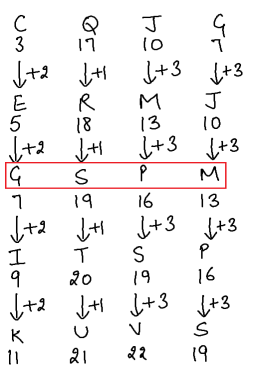
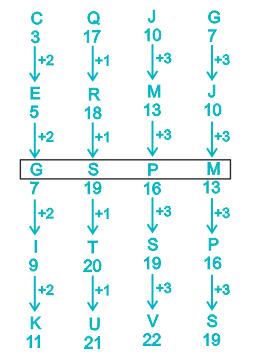 Hence, "Option 3" is the correct answer.
Q3 · Series
Select the figure from among the given options that can replace the question mark (?) and complete the pattern.



Answer aur solution dekho
Archived marked answer: C
The logic followed here is:
1) The element shift anticlockwise downward direction.
2) The elements are positions alternately left diagonally and right diagonally.&
Q4 · Series
Select the term from among the given options that can replace the question mark (?) in the given series.
HM71, JP68, LS65, NV62, ?
- QY57
- RX59
- QX58
- PY59
Answer aur solution dekho
Archived marked answer: D
The logic followed here is:
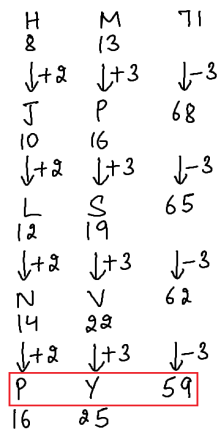
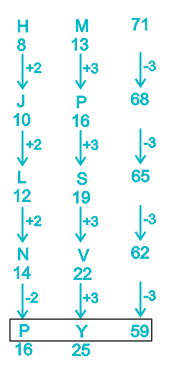 Hence, "Option 4" is the correct answer.
Q5 · Series
Select the number from among the given options that can replace the question mark (?) in the following series.
35, 46, 68, 101, 145, ?
- 200
- 214
- 212
- 210
Answer aur solution dekho
Archived marked answer: A
The logic followed here is:
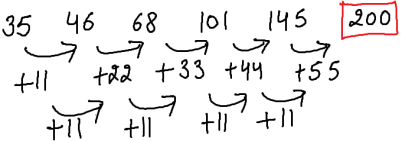
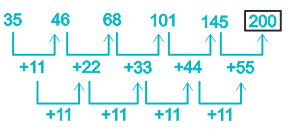 Hence, "Option 1" is the correct answer.
Q6 · Series
Select the figure from among the given option that can replace the question mark (?) in the following series.



Answer aur solution dekho
Archived marked answer: D
The logic followed here is:
1) First box series →
The 2nd column elements shift anticlockwise in the downward direction.
The elements at the corners interchange positions diagonally.
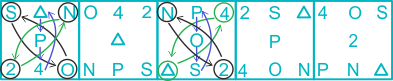 2) Second box series →
The 1st column and center elements shift clockwise subsequently.
The rest of the elements shift clockwise subsequently.
 Thus, the final series is:
 Hence, "Option 4" is the correct answer.
Q7 · Analogy
11 is related to 121 following a certain logic. Following the same logic, 22 is related to 484. To which of the following is 31
related, following the same logic?
(NOTE: Operations should be performed on the whole numbers, without breaking down the numbers into its constituent
digits. E.g. 13 – Operations on 13 such as adding /deleting /multiplying etc. to 13 can be performed. Breaking down 13 into 1
and 3 and then performing mathematical operations on 1 and 3 is not allowed)
- 961
- 957
- 943
- 973
Answer aur solution dekho
Archived marked answer: A
The logic followed here is:
Logic: (1st number)² = 2nd number.
Now,
For, 11 : 121
⇒ 11² = 121.
For, 22 : 484
⇒ 22² = 484.
Similarly, for 31 ∶ ?
⇒ 31² = 961.
Hence, the correct answer is "Option 1".
Q8 · Analogy
Select the set in which the numbers are related in the same way as are the numbers of the following set.
(24, 15, 120)
(21, 19, 133)
(NOTE: Operations should be performed on the whole numbers, without breaking down the numbers into its constituent
digits. E.g. 13 – Operations on 13 such as adding/deleting/multiplying etc. to 13 can be performed. Breaking down 13 into 1
and 3 and then performing mathematical operations on 1 and 3 is not allowed.)
- (18, 16, 99)
- (31, 9, 96)
- (33, 10, 170)
- (27, 12, 108)
Answer aur solution dekho
Archived marked answer: D
The logic followed here is:
Logic: (1st number × 2nd number) ÷ 3 = 3rd number.
Now,
For, 24, 15, 120
⇒ (24 × 15) ÷ 3
⇒ 360 ÷ 3 = 120.
For, (21, 19, 133)
⇒ (21 × 19) ÷ 3
⇒ 399 ÷ 3 = 133
Similarly, for (27, 12, 108)
⇒ (27 × 12) ÷ 3
⇒ 324 ÷ 3 = 108.
Hence, the correct answer is "Option 4".
Q9 · Analogy
Select the option that is related to the fifth number in the same way as the second number is related to the first number and the fourth number is related to the third number.
4 : 68 :: 8 : 136 :: 9 : ?
(NOTE: Operations should be performed on the whole numbers, without breaking down the numbers into its constituent digits. E.g., 13 – Operations on 13 such as adding/deleting/multiplying etc., to 13 can be performed. Breaking down 13 into 1 and 3 and then performing mathematical operations on 1 and 3 is not allowed.)
- 152
- 149
- 147
- 153
Answer aur solution dekho
Archived marked answer: D
The logic followed here is:
Logic: (1st number × 16) + 1st number = 2nd number.
Now,
For, 4 : 68
⇒ (4 × 16) + 4
Q10 · Non Verbal Reasoning
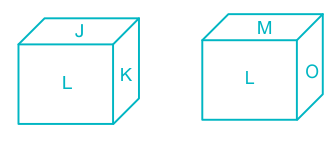
Six letters J, K, L, M, N and O are written on different faces of a dice. Two positions of this dice are shown in the figurebelow. Find the letter on the face opposite to N.
- M
- L
- J
- K
Answer aur solution dekho
Archived marked answer: B
The logic followed here is :-
From the given two different dices the adjacent sides are as shown below :
As L is common on both the dices, it is clear that J, K, M, and O are adjacent to it, and the remaining i.e. N will be opposite to it.
Q11 · Non Verbal Reasoning
Select the option figure in which the given figure (X) is embedded (rotation is NOT allowed).


Answer aur solution dekho
Archived marked answer: C
The image embedded in the given figure is as shown below :
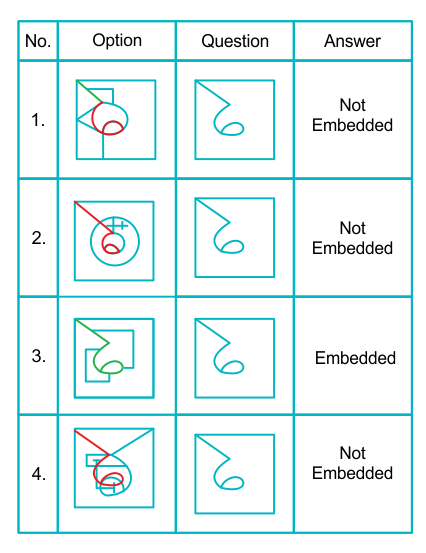 ∴ Here, given figure is embedded in the option figure 3.
Hence, the correct answer is "Option 3".
Q12 · Non Verbal Reasoning
How many squares are there in the figure shown below?

- 17
- 18
- 16
- 15
Answer aur solution dekho
Archived marked answer: A
The number of squares in the given figure is shown below:
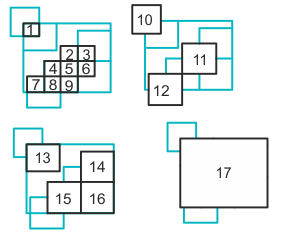 Thus, as marked there are a total of 17 squares.
Hence, "Option 1" is the correct answer.
Q13 · Non Verbal Reasoning
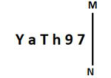
Select the correct mirror image of the given figure when the mirror is placed at MN as shown below.









Answer aur solution dekho
Archived marked answer: C
The correct mirror image of the given figure is:
 Hence, the correct answer is "Option 3".
Q14 · Non Verbal Reasoning
A paper is folded and cut as shown below. How will it appear when unfolded?




Answer aur solution dekho
Archived marked answer: C
The figure which will look like the paper when unfolded is shown below:
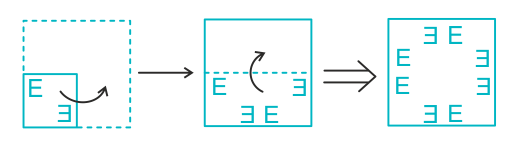 Thus, option Figure 3 will look like the paper when unfolded.
Hence, "Option 3" is the correct answer.
Q15 · Puzzle Subtypes Not To Miss
Select the correct combination of mathematical signs to sequentially place from left to right in the blanks below to balance the given equation.
75 _ 3 _ 17 _ 8 = 0
- ×, +, −
- −, −, ×
- −, −, +
- ÷, −, −
Answer aur solution dekho
Archived marked answer: D
Given: 75 _ 3 _ 17 _ 8 = 0480÷0.3×5+500190+9×27÷1.6=2" id="MathJax-Element-9-Frame" role="presentation" style="display: inline; line-height: normal; font-size-adjust: none; word-spacing: normal; overflow-wrap: normal; text-wrap-mode: nowrap; float: none; direction: ltr; max-width: none; max-height: none; min-width: 0px; min-height: 0px; border: 0px; padding: 0px; margin: 0px; position: relative;" tabindex="0">480÷0.3×5+500190+9×27÷1.6=2" id="MathJax-Element-5-Frame" role="presentation" style="position: relative;" tabindex="0">480÷0.3×5+500190+9×27÷1.6=2480÷0.3×5+500190+9×27÷1.6=2" id="MathJax-Element-1-Frame" role="presentation" style="position: relative;" tabindex="0">480÷0.3×5+500190+9×27÷1.6=2480÷0.3×5+500190+9×27÷1.6=2" id="MathJax-Element-18-Frame" role="presentation" style="position: relative;" tabindex="0">480÷0.3×5+500190+9×27÷1.6=2480÷0.3×5+500190+9×27÷1.6=2 480÷0.3×5+500190+9×27÷1.6=2 480÷0.3×5+500190+9×27÷1.6=2 480÷0.3×5+500190+9×27÷1.6=2 480÷0.3×5+500190+9×27÷1.6=2
According to the question, after interchanging the signs:
Option 1): ×, +, −
75 _ 3 _ 17 _ 8 = 0 ⇒ 75 × 3 + 17 - 8 = 0
⇒ 75 ×____ 3 + 17 - 8 = 0
⇒ 225____ + 17 - 8 = 0
⇒ 242____ - 8 = 0
⇒ 234 ≠ 2 (LHS ≠ RHS)
Option 2): −, −, ×
75 _ 3 _ 17 _ 8 = 0 ⇒ 75 - 3 - 17 × 8 = 0
⇒ 75 - 3 - 17 __×__ 8 = 0
⇒ 75 - 3 - 136 = 0
⇒ -64 ≠ 0 (LHS ≠ RHS)
Option 3): −, −, +480÷0.3×5+500190+9×27÷1.6=2" id="MathJax-Element-20-Frame" role="presentation" style="display: inline; line-height: normal; font-size-adjust: none; word-spacing: normal; overflow-wrap: normal; text-wrap-mode: nowrap; float: none; direction: ltr; max-width: none; max-height: none; min-width: 0px; min-height: 0px; border: 0px; padding: 0px; margin: 0px; position: relative;" tabindex="0">
75 _ 3 _ 17 _ 8 = 0 ⇒ 75 - 3 - 17 + 8 = 0
⇒ 75 + 8 - 3 - 17 = 0
⇒ 83 - 3 - 17 = 0
⇒ 63 ≠ 0 (LHS ≠ RHS)
Option 4): ÷, −, −480÷0.3×5+500190+9×27÷1.6=2" id="MathJax-Element-25-Frame" role="presentation" style="display: inline; line-height: normal; font-size-adjust: none; word-spacing: normal; overflow-wrap: normal; text-wrap-mode: nowrap; float: none; direction: ltr; max-width: none; max-height: none; min-width: 0px; min-height: 0px; border: 0px; padding: 0px; margin: 0px; position: relative;" tabindex="0">
75 _ 3 _ 17 _ 8 = 0 ⇒ 75 ÷ 3 - 17 - 8 = 0
⇒ 75 __÷__ 3 - 17 - 8 = 0
⇒ 25____ - 17 - 8 = 0
⇒ 0 = 0 (LHS = RHS)
Hence, "Option 4" is the correct answer.
<
Q16 · Puzzle Subtypes Not To Miss
Select the option that is related to the fifth letter-cluster in the same way as the second letter-cluster is related to the first letter-cluster and the fourth letter-cluster is related to the third letter-cluster.
CRW: TIN:: DOZ: UFQ:: ALW:?
- JCN
- RCN
- RCM
- JCM
Answer aur solution dekho
Archived marked answer: B
The logic followed here is:
CRW: TIN
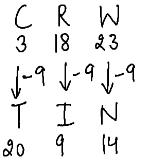
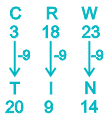 And,
DOZ: UFQ
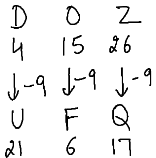
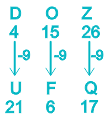 Similarly,
ALW:?
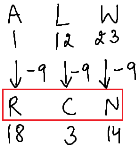
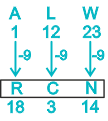 Hence, "Option 2" is the correct answer.
Q17 · Puzzle Subtypes Not To Miss
Which number will come in the place of the question mark (?) in the following equation if ‘+’ and ‘−’ are interchanged and ‘×’ and ‘÷’ are interchanged?
27 × 3 + 4 ÷ 2 − 7 = ?
- 6
- 10
- 9
- 8
Answer aur solution dekho
Archived marked answer: D
BODMAS Table:
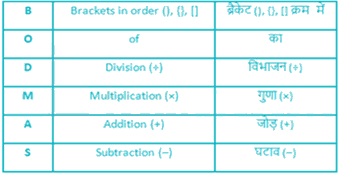 Given equation: 27 × 3 + 4 ÷ 2 - 7 = ?
Now, if ‘+’ and ‘-‘ and ‘×' and '÷’ are interchan
Q18 · Coding Decoding
In a certain code language, 'EAGLE' is written as 'DZFKD' and 'DREAM' is written as 'CQDZL'. How will 'SINCE' be written in that language?
- RJOGD
- THMDF
- RHMBD
- TJODF
Answer aur solution dekho
Archived marked answer: C
The logic followed here is:
'EAGLE' is written as 'DZFKD'
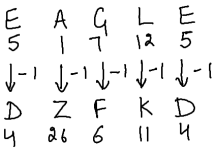
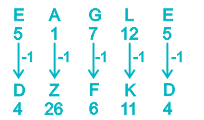 And,
'DREAM' is written as 'CQDZL'
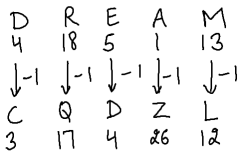
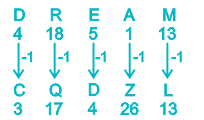 Similarly,
'SINCE' is written as
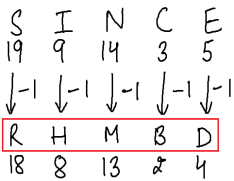
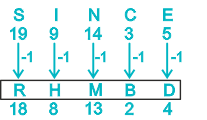 Hence, "Option 3" is the correct answer.
Q19 · Coding Decoding
In a certain code language, 'EXCESS' is written as '726572121', 'ENERGY' is written as '716720927', how will 'ESCAPE' be written in that language?
- 72153165
- 72151167
- 72153187
- 71933187
Answer aur solution dekho
Archived marked answer: C
The logic followed here is:
'EXCESS' is written as '726572121'
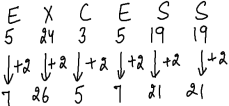
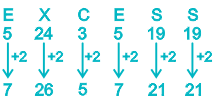 And,
'ENERGY' is written as '716720927'
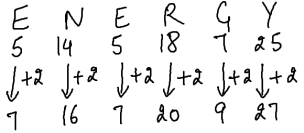
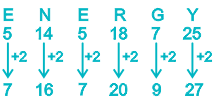 Similarly,
'ESCAPE' is written as
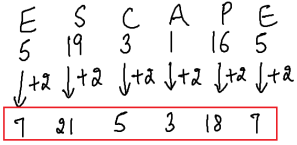
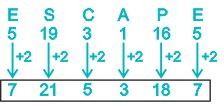 Hence, "Option 3" is the correct answer.
Q20 · Classification Odd One Out
Four letter-clusters have been given, out of which three are alike in some manner and one is different. Select the one that is different.
Note: The odd one out is not based on the number of consonants/vowels or their position in the letter cluster.
- YWVT
- NLKI
- WVTS
- SQPN
Answer aur solution dekho
Archived marked answer: C
The logic followed here is:
Option 1) YWVT
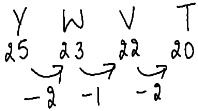
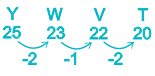 Option 2) NLKI
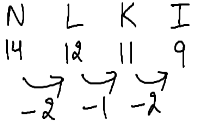
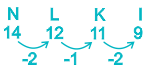 Option 3) WVTS
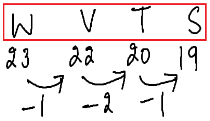
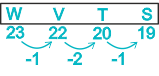 Option 4) SQPN
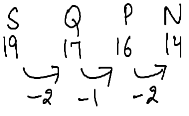
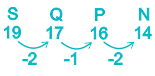 Thus, out of all the options, 'WVTS' is the odd one out.
Hence, "Option 3" is the correct answer.
Q21 · Classification Odd One Out
The same operation(s) are followed in all the given number pairs except one. Find that odd number pair.
(NOTE : Operations should be performed on the whole numbers, without breaking down the numbers into its constituent
digits. E.g. 13 – Operations on 13 such as adding /deleting /multiplying etc., to 13 can be performed. Breaking down 13 into 1
and 3 and then performing mathematical operations on 1 and 3 is not allowed.)
- 7 : 15
- 11 : 121
- 22 : 45
- 5 : 11
Answer aur solution dekho
Archived marked answer: B
The logic followed here is:
Option 1) 7 : 15
(7 × 2) + 1 = 15
14 + 1 = 15
15 = 15 (LHS = RHS)
Option 2) 11 : 121
(11 × 2) + 1 = 121
22 + 1 = 121
23 ≠ 121 (LHS ≠ RHS)
Option 3) 22 : 45
(22 × 2) + 1 = 45
44 + 1 = 45
45 = 45 (LHS = RHS)
Option 4) 5 : 11
(5 × 2) + 1 = 11
10 + 1 = 11
11 = 11 (LHS = RHS)
Thus, out of all the options '11 : 121' is the odd one out.
Hence, "Option 2" is the correct answer.
Q22 · Classification Odd One Out
The question contains pairs of words that are related to each other in a certain way. Three of the following four word pairs are alike as these have the same relationship and thus form a group. Which word pair is the one that DOES NOT belong to that group?
(The words must be considered as meaningful English words and must not be related to each other based on the number of letters / number of consonants/vowels in the word.)
- Shoes – feet
- Book – pages
- Spectacles – lens
- Flowers – petals
Answer aur solution dekho
Archived marked answer: A
The logic followed here is:
Shoes
Cover feet
Book
Comprise pages
Spectacles
Contain lens
Flowers
Have petals
Book, Spectacles, Flowers all contain or comprise something,
Whereas,
Shoes cover something (feet).
Hence, the correct answer is "Shoes – feet".
Q23 · Logical Reasoning
Read the given statements and conclusions carefully. Assuming that the information given in the statements is true, even if it appears to be at variance with commonly known facts, decide which of the given conclusions logically follow(s) from the statements.
Statements:
Some vegetables are fruits.
Some fruits are flowers.
All flowers are garlands.
Conclusions:
I. Some garlands are fruits.
II. Some vegetables are flowers.
III. Some vegetables are garlands.
- Only conclusions I and II follow
- Only conclusion I follows
- Only conclusions II and III follow
- Only conclusions I and III follow
Answer aur solution dekho
Archived marked answer: B
The least possible Venn diagram for the given statements is as shown below :
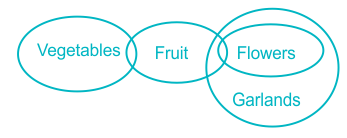 Conclusions:
I. Some garlands are fruits → Follow (As some fruits are flowers and all flowers are garlands. As some part of fruits is common with flowers which whole comes in garlands, therefore it is true.)
II. Some vegetables are flowers → Does not follow (As some vegetables are fruits and some fruits are flowers. So it is possible but not definite.)
III. Some vegetables are garlands → Does not follow (As some vegetables are fruits, some fruits are flowers and all flowers are garlands. So it is possible but not definite.)
∴ Here, Only conclusion I follows.
Hence, the correct answer is "Option 2".
Q24 · Blood Relations
All the six members of a family, 1, 2, 3, 4, 5 and 6, live together. 2 is the daughter of 3, but 3 is not the mother of 2. 1 and 3 are a married couple. 5 is the sister of 3. 4 is the daughter of 1. 6 is the brother of 2. Who is the mother of 2?
- 4
- 5
- 1
- 2
Answer aur solution dekho
Archived marked answer: C
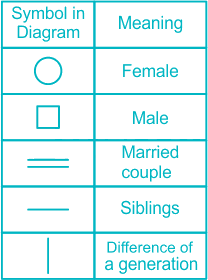 Given: All the six members of a family, 1, 2, 3, 4, 5 and 6, live together.
1) 2 is the daughter of 3, but 3 is not the mother of 2.
2) 1 and 3 are a married couple.
 3) 5 is the sister of 3.
4) 4 is the daughter of 1.
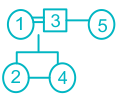 5) 6 is the brother of 2.
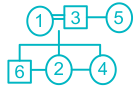 Thus, 1 is 2's mother.
Hence, the correct answer is "Option 3".
Q25 · Alphabet Test
The position of how many letters will change if each of the letters in the word 'CORNFLAKES' is re-arranged in the English alphabetical order from left to right?
- Nine
- Seven
- Eight
- Ten
Answer aur solution dekho
Archived marked answer: C
Given word: 'CORNFLAKES'
After arranged in alphabetical order:
Alphabets
C
O
R
N
F
L
A
K
E
S
Alphabetical order
A
C
E
F
K
L
N
O
R
S
Now,
there are no alphabets that will remain unchanged if each of the letters in the word 'CORNFLAKES' is arranged in English alphabetical order.
Hence, the correct answer is "Option 3".
General Awareness
Q1 · Art and Culture
Ishwari Prasad is credited to have introduced the _______ Gharana of Kathak.
- Jaipur
- Raigarh
- Banaras
- Lucknow
Answer aur solution dekho
Archived marked answer: D
The correct answer is Lucknow.
Key Points
- Ishwari Prasad is credited with the introduction of the Lucknow Gharana of Kathak.
- The Lucknow Gharana is one of the major schools of Kathak dance, and it emphasizes graceful movements and precise footwork.
- It was established in the early 19th century in the court of Nawab Wajid Ali Shah, a patron of the arts.
- The Lucknow Gharana is known for its intricate abhinaya (expression) and delicate movements, making it distinct from other Kathak styles.
Additional Information
- Jaipur Gharana:
- It emphasizes strong and powerful footwork.
- Founded by Bhanuji, it is known for its dynamic spins and extensive use of tatkars (footwork patterns).
- Raigarh Gharana:
- Developed in the princely state of Raigarh, it combines elements of both Jaipur and Lucknow styles.
- It is also known for its musical compositions and rhythm patterns.
- Banaras Gharana:
- It is famous for its expressive and devotional elements.
- Founded by Janakiprasad, this style uses intricate hand movements and facial expressions.
</ul
Q2 · Art and Culture
Alla Rakha is famous for playing which of the following musical instruments?
- Damaru
- Bansuri
- Shehnai
- Tabla
Answer aur solution dekho
Archived marked answer: D
The correct answer is Tabla.
Key Points
- Ustad Alla Rakha, born as Allah Rakha Qureshi, was an Indian tabla player known for his virtuosity and innovation on the instrument.
- He is most famous for his collaboration with sitar maestro Ravi Shankar, with whom he performed at many prestigious venues worldwide.
- Alla Rakha played a crucial role in popularizing the tabla and Indian classical music in the West during the 20th century.
- He is also the father of renowned tabla player Zakir Hussain, who continues his legacy in Indian classical music.
Additional Information
- Tabla
- The tabla is a pair of twin hand drums from the Indian subcontinent, used in traditional, classical, popular, and folk music.
- The instrument consists of a small right-hand drum called "Dayan" and a larger metal drum called "Bayan".
- It is used in a variety of genres and is a significant instrument in Hindustani classical music.
- The technique of playing tabla involves extensive use of fingers and palms in various configurations to create a wide range of sounds and rhythms.
- Damaru
- The damaru is a small two-headed drum, which is played by twisting it back and forth, causing the strikers to beat against the drumheads.
- It is often associated with the Hindu deity Shiva and is used in various religious and spiritual contexts.
- Bansuri
- The bansuri is a traditional Indian flute made from bamboo.
- It is used in Hindustani classical music and is known for its soothing sound.
- The instrument has six to eight holes and is played by blowing air into a hole near one end.
- Shehnai
- The shehnai is a double-reed instrument, similar to the oboe, and is used in North Indian classical music.
- It is often played during weddings and other auspicious occasions in India.
Q3 · Art and Culture
Which famous santoor player was honoured with the Ustad Hafiz Ali Khan Award in 1998?
- Tarun Bhattacharya
- Shivkumar Sharma
- Satish Vyas
- Abhay Sopori
Answer aur solution dekho
Archived marked answer: B
The correct answer is Shivkumar Sharma.
Key Points
- Shivkumar Sharma is one of the most prominent and celebrated santoor players in India.
- He was honoured with the Ustad Hafiz Ali Khan Award in 1998 for his contribution to Indian classical music.
- Shivkumar Sharma is credited with bringing the santoor to the forefront of Indian classical music.
- He has received several prestigious awards throughout his career, including the Padma Shri in 1991 and the Padma Vibhushan in 2001.
Additional Information
- Ustad Hafiz Ali Khan Award:
- The Ustad Hafiz Ali Khan Award is a prestigious award given in the field of Indian classical music.
- It is named after the legendary sarod maestro Ustad Hafiz Ali Khan, who was a notable figure in the classical music domain.
- The award recognizes outstanding contributions and excellence in the field of Indian classical music.
- Santoor:
- The santoor is a trapezoid-shaped hammered dulcimer, a traditional Indian musical instrument.
- It has its origins in the folk music of Jammu and Kashmir.
- It is played using a pair of curved wooden mallets, and it has a characteristic shimmering sound.
- Shivkumar Sharma's efforts have been instrumental in popularizing the santoor in Indian classical music.
- Shivkumar Sharma's Contribution to Music:
- Shivkumar Sharma has composed music for several films, bringing the sound of the santoor to a wider audience.
- He has performed extensively worldwide, collaborating with various artists and promoting Indian classical music globally.
- His innovative techniques and dedication have significantly expanded the santoor's repertoire and scope.
Q4 · Art and Culture
Makar Sankranti is the festival dedicated to which of the following Lords?
- Ganesha
- Surya
- Chandra
- Indra
Answer aur solution dekho
Archived marked answer: B
The correct answer is Surya.
Key Points
- Makar Sankranti is dedicated to the Hindu sun god, Surya.
- It is one of the few Hindu festivals that is observed according to the solar cycles, unlike other festivals which follow the lunar calendar.
- The festival marks the transition of the sun into the zodiac sign of Makara (Capricorn) on its celestial path.
- Makar Sankranti is also known as Uttarayan and is celebrated with kite flying, bonfires, and feasts.
Additional Information
- Makar Sankranti
- Makar Sankranti is a festival day in the Hindu calendar, dedicated to the deity Surya (sun).
- It is observed each year in January and is a significant solar event.
- The festival is also a cultural festival, observed by Hindus and Sikhs, and marks the end of the winter solstice and the start of longer days.
- Traditional practices include taking holy dips in rivers like Ganga, Yamuna, Godavari, Krishna, and Cauvery.
- Surya
- Surya is the solar deity in Hinduism.
- He is considered the source of life and energy, and is often depicted riding a chariot harnessed by seven horses, which represent the seven colors of light and the seven days of the week.
- Surya is worshipped during various festivals throughout the year, including Makar Sankranti, Pongal, and Chhath.
- Other Associated Festivals
- Pongal - Celebrated in Tamil Nadu, it is a four-day festival marking the harvest season and is dedicated to the sun god.
- Lohri - Celebrated in Punjab, it marks the passing of the winter solstice and is associated with the harvest of the rabi crops.
- Uttarayan - In Gujarat, Makar Sankranti is celebrated as Uttarayan and is known for the International Kite Festival.
Q5 · Indian Polity and Constitution
Which Article of the Indian Constitution provides for protecting and improving the environment and safeguarding forests and wildlife?
- Article 47-A
- Article 47-B
- Article 48-A
- Article 49-C
Answer aur solution dekho
Archived marked answer: C
The correct answer is Article 48-A.
Key Points
- Article 48-A of the Indian Constitution specifically deals with the Protection and improvement of the environment and safeguarding of forests and wildlife.
- It falls under Part IV of the Indian Constitution, which encompasses the Directive Principles of State Policy (DPSP).
- This article was added to the Constitution by the 42nd Amendment Act of 1976.
- According to Article 48-A, the State shall endeavor to protect and improve the environment and to safeguard the forests and wildlife of the country.
Additional Information
- Directive Principles of State Policy (DPSP)
- These are guidelines or principles given to the central and state governments of India, to be kept in mind while framing laws and policies.
- They are non-justiciable, meaning their application cannot be enforced by the courts.
- However, they are considered fundamental in the governance of the country, aiming to create social and economic conditions under which citizens can lead a good life.
- 42nd Amendment Act of 1976
- This amendment is also known as the "Mini-Constitution" due to the significant changes it brought to the Indian Constitution.
- It added new directives in the form of Article 48-A and Article 51-A(g) which deals with the protection of the environment and the duty of citizens to protect the environment, respectively.
- It also added ten fundamental duties to the Constitution, emphasizing the responsibility of citizens towards the nation.
- Environmental Protection
- It refers to the practice of protecting the natural environment by individuals, organizations, and governments.
- The primary goal is to conserve natural resources and the existing natural environment and, where possible, to repair damage and reverse trends.
- In India, various laws and regulations have been implemented to ensure environmental protection, including the Environment Protection Act of 1986.
- Forest and Wildlife Conservation
- Conservation of forests and wildlife is crucial for maintaining the ecological balance and biodiversity.
- In India, this is governed by various laws, including the Indian Forest Act, 1927, and the Wildlife Protection Act, 1972.
- These laws aim to regulate and manage forest resources and protect wildlife species from exploitation and extinction. </ul
Q6 · Indian Polity and Constitution
When did a States Reorganisation Commission was set up, which recommended the creation of linguistic States on the basis of larger linguistic groups?
- December 1963
- December 1953
- December 1956
- December 1958
Answer aur solution dekho
Archived marked answer: B
The correct answer is December 1953.
Key Points
- The States Reorganisation Commission (SRC) was formed in December 1953.
- The Commission was tasked with recommending the reorganization of state boundaries based on linguistic lines.
- The SRC was headed by Fazal Ali and its other members were H.N. Kunzru and K.M. Panikkar.
- The recommendations of the SRC led to the passage of the States Reorganisation Act in 1956, which redefined the boundaries of Indian states.
Additional Information
- States Reorganisation Commission (SRC):
- The SRC was constituted by the Government of India in 1953 to address demands for the reorganization of India's states on linguistic lines.
- The SRC's primary objective was to ensure that state boundaries were redrawn to reflect the linguistic and cultural identities of the populations within them.
- The Commission's final report was submitted in 1955, and it recommended the reorganization of states primarily on linguistic lines.
- The recommendations of the SRC were implemented through the States Reorganisation Act of 1956, which led to the creation of 14 states and 6 union territories.
- Fazal Ali:
- Fazal Ali was an Indian civil servant and politician who served as the head of the States Reorganisation Commission.
- He played a crucial role in the reorganization of Indian states based on linguistic lines.
- His leadership and contributions were instrumental in shaping the modern political map of India.
- States Reorganisation Act, 1956:
- The States Reorganisation Act was a major reform of the boundaries and governance structures of Indian states, implemented in 1956.
- This act led to the creation of several new states and union territories, primarily based on linguistic and cultural commonalities.
- It aimed to address the demands for statehood from various linguistic and regional groups within India.
- The Act marked a significant step towards accommodating the diverse linguistic and cultural identities within the Indian union.
Q7 · Indian Polity and Constitution
Which part of the Indian Constitution deals with the Election Commission?
- Part XV
- Part XII
- Part IV
- Part XI
Answer aur solution dekho
Archived marked answer: A
The correct answer is Part XV.
Key Points
- Part XV of the Indian Constitution deals with elections, which includes provisions related to the Election Commission of India.
- It encompasses Articles 324 to 329, which provide the framework for the conduct of elections in the country.
- Article 324 specifically vests the power of superintendence, direction, and control of elections in an independent Election Commission.
- The Election Commission is responsible for conducting elections to the Parliament, state legislatures, and offices of the President and Vice-President in India.
Additional Information
- Part XII of the Indian Constitution deals with finance, property, contracts, and suits. It includes provisions related to the distribution of revenue between the Union and the States.
- Part IV contains the Directive Principles of State Policy, which are guidelines for the framing of laws by the government. These principles aim to create social and economic conditions under which citizens can lead a good life.
- Part XI deals with the relations between the Union and the States, defining the distribution of legislative and administrative powers between the two.
- The Election Commission of India is an autonomous constitutional authority responsible for administering election processes in India at both national and state levels. The body administers elections to the Lok Sabha, Rajya Sabha, and State Legislative Assemblies in India, as well as the offices of the President and Vice President in the country.
- Being a constitutional body, the Election Commission operates independently of the government to ensure free and fair elections. Its autonomy and impartial functioning are crucial for the democratic structure of the country.
Q8 · Indian Polity and Constitution
In 1910, The United India House at Seattle, USA, was set up by ________.
- Shyamji Krishna Varma
- Tarak Nath Das and GD Kumar
- Khudiram Bose and Prafulla Chaki
- VD Savarkar and Ganesh
Answer aur solution dekho
Archived marked answer: B
The correct answer is Tarak Nath Das and GD Kumar.
Key Points
- Tarak Nath Das was an Indian revolutionary and a professor of political science. He was one of the key members of the Indian independence movement against British rule.
- GD Kumar was a notable figure associated with the Indian independence movement. He collaborated with Tarak Nath Das in various activities aimed at promoting Indian independence.
- The United India House was established in 1910 in Seattle, USA, by these two notable Indian nationalists.
- This establishment served as a center for Indian students and a hub for revolutionary activities against British colonial rule in India.
Additional Information
- Indian Independence Movement
- The Indian independence movement was a series of activities with the ultimate aim of ending British rule in India. It spanned from 1857 to 1947.
- The movement saw the participation of different sections of society, including political leaders, revolutionaries, and common people.
- Various revolutionary activities were carried out both within India and in other parts of the world where Indians resided, including Europe and North America.
- Ghadar Party
- The Ghadar Party was an organization founded by Indian immigrants in the United States and Canada with the aim of securing India's independence from British rule.
- It was established in 1913 and played a significant role in mobilizing Indians abroad to support the cause of Indian independence.
- Many members of the Ghadar Party were involved in revolutionary activities and sought to incite rebellion against British authorities in India.
- Indian Nationalism in the United States
- Indian nationalism in the United States was marked by the efforts of Indian immigrants to promote the cause of India's independence.
- Prominent figures like Lala Har Dayal, Bhikaji Cama, and Shyamji Krishna Varma were involved in these activities.
- Organizations such as the India House in London and the United India House in Seattle were centers for Indian nationalists to plan and organize their efforts against British rule.
Q9 · Indian Economy
What is the primary objective of the Micro, Small, and Medium Enterprises Development (MSMED) Act of 2006 in India?
- To regulate foreign companies
- To focus on large-scale industries only
- To increase import tariffs to protect MSMEs
- To promote and facilitate the development of MSMEs
Answer aur solution dekho
Archived marked answer: D
The correct answer is To promote and facilitate the development of MSMEs.
Key Points
- The primary objective of the MSMED Act, 2006 is to promote and facilitate the development and competitiveness of micro, small, and medium enterprises (MSMEs) in India.
- The Act provides the first-ever legal framework for the recognition of the concept of "enterprise", which comprises both manufacturing and service entities.
- It aims to address the policy issues affecting MSMEs as well as the coverage and investment ceiling of the sector.
- The Act also emphasizes on the promotion of MSMEs through various schemes and incentives to enhance their productivity and competitiveness.
Additional Information
- Micro, Small, and Medium Enterprises (MSMEs)
- MSMEs are categorized based on their investment in plant and machinery or equipment and annual turnover.
- Micro enterprises: Investment up to Rs. 1 crore and turnover up to Rs. 5 crore.
- Small enterprises: Investment up to Rs. 10 crore and turnover up to Rs. 50 crore.
- Medium enterprises: Investment up to Rs. 50 crore and turnover up to Rs. 250 crore.
- MSMED Act, 2006
- The Act was enacted to address the diverse issues faced by the MSME sector and to promote its development.
- It provides for the establishment of a National Board for MSMEs to lay down policies and programs for the sector.
- The Act also includes provisions related to the delayed payments to MSMEs, aimed at ensuring timely payments and reducing financial stress on these enterprises.
- Importance of MSMEs
- MSMEs play a crucial role in the socio-economic development of India.
- They contribute significantly to the country's GDP, exports, and employment generation.
- MSMEs are vital for the balanced regional development of the country as they often operate in rural and semi-urban areas.
- The sector also fosters entrepreneurship and innovation.
- Government Initiatives for MSMEs
- Various schemes and programs have been launched to support MSMEs, such as the Credit Guarantee Fund Scheme, MUDRA Yojana, and the MSME Champions Scheme.
- The government has also implemented measures to improve ease of doing business for MSMEs, including simplifying registration processes and providing financial incentives.
Q10 · Indian Economy
NDP = ________.
- GDP - Depreciation
- GDP + Depreciation
- GDP - Net factor income from abroad
- GDP + Net factor income from abroad
Answer aur solution dekho
Archived marked answer: A
The correct answer is GDP - Depreciation.
Key Points
- Net Domestic Product (NDP) is derived by subtracting depreciation from the Gross Domestic Product (GDP).
- Depreciation refers to the reduction in the value of assets over time, often due to wear and tear.
- GDP represents the total monetary value of all finished goods and services produced within a country's borders in a specific time period.
- NDP provides a more accurate reflection of an economy's actual productivity and sustainability by accounting for the depreciation of capital assets.
Additional Information
- Gross Domestic Product (GDP)
- GDP is the total market value of all goods and services produced within a country in a given period.
- It includes all private and public consumption, government outlays, investments, and exports minus imports.
- GDP is a broad measure of a nation's overall economic activity.
- It is often used as an indicator of the economic health of a country.
- Depreciation
- Depreciation is an accounting method of allocating the cost of a tangible or physical asset over its useful life.
- It represents how much of an asset's value has been used up over time.
- Businesses depreciate long-term assets for both tax and accounting purposes.
- Depreciation can affect the net income of a business as it is listed as an expense.
- Net Domestic Product (NDP)
- NDP is an economic indicator that provides a more accurate assessment of an economy's productivity by accounting for depreciation.
- It is calculated as GDP minus depreciation.
- NDP helps in understanding the sustainability of the economic activities by indicating the net addition to the nation's wealth.
- It ensures that the measure of economic performance considers the wear and tear of capital assets.
- Net Factor Income from Abroad (NFIA)
- NFIA is the difference between the income residents receive from abroad for factor services (like labor and capital) and the income paid to foreign residents for their factor services within the domestic economy.
- It is used in the calculation of Gross National Product (GNP).
- NFIA can indicate the level of economic interaction a country has with the rest of the world.
- A positive NFIA means a country is earning more from its investments abroad than it is paying to foreign investors in the domestic market.
Q11 · Sports Static GK
In chess which of the following may move only diagonally?
- The Bishop
- The Knight
- The Queen
- The Rook
Answer aur solution dekho
Archived marked answer: A
The correct answer is The Bishop.
Key Points
- The Bishop is a piece in the game of chess that can move diagonally on the board.
- Each player starts the game with two Bishops, placed on either side of the King and Queen.
- The Bishop can move any number of squares along the diagonal, but cannot jump over other pieces.
- The Bishop's movement allows it to control squares of only one color throughout the game.
Additional Information
- Chess Pieces and Their Movements:
- The Knight: Moves in an L-shape: two squares in one direction and then one square perpendicular to that direction. It is the only piece that can jump over other pieces.
- The Queen: Can move any number of squares along a row, column, or diagonal. It combines the power of the Rook and Bishop.
- The Rook: Moves any number of squares along a row or column but cannot move diagonally.
- The Pawn: Moves forward one square, but captures diagonally. On its first move, it can move forward two squares.
- The King: Moves one square in any direction. The objective of the game is to checkmate the opponent's King.
- Chessboard Layout:
- The chessboard is an 8x8 grid with alternating light and dark squares.
- Each player begins with 16 pieces: one King, one Queen, two Rooks, two Knights, two Bishops, and eight Pawns.
- The pieces are placed on the two rows closest to each player, with Pawns on the second row and the major pieces on the first row.
- Objective of the Game:
- The primary objective in chess is to checkmate the opponent's King, which means the King is in a position to be captured (in check) and there is no legal move to escape.
- Players must use strategy and tactics to outmaneuver their opponent and gain a positional or material advantage.
Q12 · Sports Static GK
Where was the Durand Cup Tournament started in India in 1888?
- Mumbai
- Calcutta
- Shimla
- Delhi
Answer aur solution dekho
Archived marked answer: C
The correct answer is Shimla.
Key Points
- The Durand Cup is one of the oldest football tournaments in the world and the oldest in Asia.
- It was started in the year 1888 in Shimla, India.
- The tournament was initially a military affair, organized by then India's Foreign Secretary, Mortimer Durand.
- Over the years, it has grown to become a prestigious event in Indian football, with clubs from across the country participating.</
Q13 · Indian Geography
Which of the following is an example of an eastern coast port?
- Mumbai Port
- Chennai Port
- Mormugao Port
- New Mangalore Port
Answer aur solution dekho
Archived marked answer: B
The correct answer is Chennai Port.
Key Points
- Chennai Port is one of the largest ports on the eastern coast of India.
- It is located on the Coromandel Coast of the Bay of Bengal.
- Chennai Port is the second largest container port in India, after Mumbai's Nhava Sheva.
- It handles a variety of cargo such as automobiles, petroleum products, coal, and containers, making it a critical port for trade and commerce.
Additional Information
- Mumbai Port
- Mumbai Port is located on the western coast of India.
- It is one of the oldest and most significant ports of India, handling a large volume of cargo.
- Mormugao Port
- Mormugao Port is located in Goa, on the western coast of India.
- It is known for handling iron ore exports.
- New Mangalore Port
- New Mangalore Port is situated on the western coast of India in Karnataka.
- It primarily handles bulk cargo such as iron ore, coal, and crude oil.
Q14 · Indian Geography
Which of the following is associated with the retreating monsoon in India?
- Mahawat
- Kal Baisakhi
- October heat
- Loo
Answer aur solution dekho
Archived marked answer: C
The correct answer is October heat.
Key Points
- October heat is a phenomenon associated with the retreating monsoon in India.
- It occurs during the transition period from the monsoon season to the winter season, typically in the month of October.
- The weather is characterized by high temperatures and high humidity due to the withdrawal of the monsoon.
- This period can be uncomfortable and is often accompanied by a lack of rainfall.
Additional Information
- Mahawat:
- Mahawat refers to the winter rains caused by the western disturbances in the north-western part of India.
- It is not associated with the retreating monsoon but rather with the winter season.
- Kal Baisakhi:
- Kal Baisakhi is a local name for the pre-monsoon thunderstorms in the eastern part of India, particularly in West Bengal and Odisha.
- These occur in the months of April and May and are not related to the retreating monsoon.
- Loo:
- Loo is a hot, dry wind that blows in the northern plains of India during the summer season, particularly in the months of May and June.
- It is not associated with the retreating monsoon.
- Retreating Monsoon:
- The retreating monsoon refers to the withdrawal of the southwest monsoon from the Indian subcontinent.
- This process typically begins in the northwestern parts of India by early September and gradually progresses southwards.
- The retreating monsoon is characterized by clear skies and a decrease in humidity, although the weather can still be quite warm, leading to the phenomenon known as October heat.
</ul
Q15 · Indian Geography
According to Census of India 2011, female adolescents in the age group of 10-19 years had a share of:
- 52.7%
- 47.3%
- 31.3%
- 20.9%
Answer aur solution dekho
Archived marked answer: D
The correct answer is 20.9%.
Key Points
- According to the Census of India 2011, the female population in the age group of 10-19 years had a share of 20.9%.
- This percentage is significant as it represents nearly half of the adolescent population within this age group.
- The data highlights the gender distribution among adolescents, which is crucial for planning and implementing youth-centric policies.
- Understanding the demographic distribution helps in addressing the specific needs of female adolescents in terms of education, health, and social services.
Additional Information
- Census of India 2011:
- The Census of India is conducted every 10 years by the Office of the Registrar General and Census Commissioner, under the Ministry of Home Affairs, Government of India.
- The 2011 Census was the 15th National Census of the country since 1872 and the 7th after independence.
- It collects demographic data that includes various parameters such as population size, distribution, density, sex ratio, and literacy rate.
- The data collected is crucial for policy-making, planning, and administration at all levels of government.
- Adolescent Age Group (10-19 years):
- The World Health Organization (WHO) defines adolescents as individuals in the 10 to 19 years age group.
- This stage marks the transition from childhood to adulthood and is characterized by significant physical, psychological, and social changes.
- Adolescents require special attention in terms of health, education, and social support to ensure their overall development.
- Policies targeting adolescents aim to address issues like reproductive health, substance abuse, and mental health.
- Female Adolescents:
- Female adolescents face unique challenges such as gender-based discrimination, early marriage, and limited access to education and healthcare.
- Empowering female adolescents through education and health initiatives is crucial for their personal development and for achieving gender equality.
- Programs like the Beti Bachao Beti Padhao (Save the Daughter, Educate the Daughter) aim to improve the status of girls in society by promoting education and protection.
Q16 · Modern Indian History
Who suggested the law that the British Government passed in 1856 to support widow remarriage?
- Keshub Chandra Sen
- Ishwar Chandra Vidyasagar
- Atmaram Pandurang
- Raja Ram Mohan Roy
Answer aur solution dekho
Archived marked answer: B
The correct answer is Ishwar Chandra Vidyasagar.
Key Points
- Ishwar Chandra Vidyasagar was a prominent social reformer in India who worked tirelessly for the upliftment of women's rights.
- He was instrumental in convincing the British government to pass the Hindu Widows' Remarriage Act in 1856, which legalized the remarriage of Hindu widows.
- His efforts were based on rational thinking and deep knowledge of Sanskrit and Hindu scriptures, which he used to argue against the prevailing social norms that restricted widow remarriage.
- Vidyasagar's work had a lasting impact on Indian society, helping to break down oppressive traditions and improve the status of women.
Additional Information
- Hindu Widows' Remarriage Act of 1856:
- This act was a significant social reform that allowed Hindu widows to remarry, which was previously prohibited by societal norms and traditions.
- The act was passed on July 16, 1856, by the British colonial administration in India.
- The law was a result of the extensive campaign led by Ishwar Chandra Vidyasagar, who used his knowledge of Hindu scriptures to argue that widow remarriage was sanctioned by ancient texts.
- This reform was an important step towards gender equality and improving the social status of women in India.
- Ishwar Chandra Vidyasagar:
- Born on September 26, 1820, Vidyasagar was a key figure in the Bengal Renaissance and a well-known scholar, educator, and social reformer.
- He was known for his contributions to education, particularly the introduction of the modern Bengali alphabet and prose.
- Vidyasagar's advocacy for women's rights, including widow remarriage and female education, marked him as a pioneer in the fight for social justice in India.
- He also worked towards simplifying and modernizing the Bengali language, making it more accessible to the common people.
- Other Social Reforms:
- Raja Ram Mohan Roy: Another prominent social reformer, he played a significant role in the abolition of the practice of Sati through the Sati Regulation Act of 1829.
- Keshub Chandra Sen: A leader of the Brahmo Samaj, he also worked towards social and religious reforms in India, including the promotion of women's education.
- Atmaram Pandurang: He was a key figure in the Prarthana Samaj, which aimed at reforming Hindu religious practices and promoting social equality.
Q17 · Current Affairs
In 2022, Vinay Mohan Kwatra took charge as the Foreign Secretary of India. Prior to this, he served as the ambassador to which of the following countries?
- Bhutan
- Sri Lanka
- Nepal
- Maldives
Answer aur solution dekho
Archived marked answer: C
The correct answer is Nepal.
Key Points
- Vinay Mohan Kwatra was appointed as the Foreign Secretary of India in 2022.
- Prior to this appointment, he served as the Ambassador of India to Nepal.
- His tenure as the Ambassador to Nepal was noted for significant diplomatic engagements between the two nations.
- He has held various important positions in the Indian Foreign Service, contributing to India's foreign policy.
Additional Information
- Foreign Secretary of India
- The Foreign Secretary of India is the top diplomat of India and heads the Ministry of External Affairs.
- The position is a senior-level Indian Foreign Service officer, responsible for overseeing the execution of India's foreign policy.
- The Foreign Secretary plays a crucial role in formulating and implementing diplomatic strategies, representing India in international forums, and managing India's diplomatic missions.
- Indian Foreign Service (IFS)
- The IFS is a Central Civil Service under Group A and Group B of the executive branch of the Government of India.
- It is one of the premier civil services that deals with India's external affairs, including diplomacy, trade, and cultural relations.
- IFS officers represent India in various international organizations, negotiate treaties, and promote India's interests abroad.
- Diplomatic Relations between India and Nepal
- India and Nepal share deep historical, cultural, and political ties, with open borders and strong people-to-people connections.
- Diplomatic relations between the two countries are marked by cooperation in various fields, including trade, security, and infrastructure development.
- Regular high-level visits and engagements help in strengthening the bilateral relationship and addressing common challenges.
Q18 · General Science Biology
Which essential amino acid enhances calcium absorption and also plays an important role in the formation of collagen?
- Arginine
- Tyrosine
- Lysine
- Histidine
Answer aur solution dekho
Archived marked answer: C
The correct answer is Lysine.
Key Points
- Lysine is an essential amino acid that the body cannot synthesize and must be obtained from the diet.
- Lysine plays a crucial role in enhancing calcium absorption in the body, which is vital for bone health.
- This amino acid is also essential for the formation of collagen, a protein that provides structure to skin, bones, and connective tissues.
- Additionally, lysine is involved in the production of carnitine, a nutrient responsible for converting fatty acids into energy and helping to lower cholesterol levels.
Additional Information
- Essential Amino Acids:
- These are amino acids that cannot be synthesized by the body and must be obtained from the diet.
- There are nine essential amino acids: histidine, isoleucine, leucine, lysine, methionine, phenylalanine, threonine, tryptophan, and valine.
- Calcium Absorption:
- Calcium is a mineral essential for bone health, muscle function, nerve signaling, and blood clotting.
- Vitamin D and certain amino acids, such as lysine, enhance the absorption of calcium in the gut.
- Collagen Formation:
- Collagen is the most abundant protein in the human body, providing structure to skin, bones, and connective tissues.
- Lysine is vital for the synthesis of collagen, contributing to tissue repair and skin elasticity.
- Protein Synthesis:
- Proteins are made up of amino acids, which are the building blocks of the body.
- Essential amino acids, including lysine, are crucial for the synthesis of proteins needed for growth, repair, and maintenance of tissues.
Q19 · General Science Biology
Match the points under Column A with those under Column B.
<÷ clas
- i-b, ii-a, iii-c, iv-d
- i-d, ii-c, iii-b, iv-a
- i-a, ii-c, iii-b, iv-d
- i-a, ii-b, iii-c, iv-d
Answer aur solution dekho
Archived marked answer: B
The correct answer is 'i-d, ii-c, iii-b, iv-a'
Key Points
- Matching Diseases with the Organism Responsible:
- i. Malaria - Plasmodium: Malaria is caused by the Plasmodium parasite, which is transmitted to humans through the bites of infected Anopheles mosquitoes.
- ii. Diarrhoea - Rotavirus: Diarrhoea can be caused by various pathogens, but Rotavirus is a leading cause of severe diarrhoea in infants and young children.
- iii. Typhoid - Salmonella: Typhoid fever is caused by the bacterium Salmonella Typhi, which is typically spread through contaminated food and water.
- iv. Cholera - Vibrio: Cholera is caused by the Vibrio cholerae bacterium, which is also usually spread through contaminated water and food.
Q20 · General Science Chemistry
An organic reaction used to convert an aryl diazonium salt into an aryl halide using a copper(I) halide catalyst is called:
- Finkelstein reaction
- Gattermann reaction
- Sandmeyer reaction
- Balz-Schiemann reaction
Answer aur solution dekho
Archived marked answer: C
The correct answer is Sandmeyer reaction.
Key Points
- The Sandmeyer reaction is used to convert an aryl diazonium salt into an aryl halide.
- The reaction employs a copper(I) halide catalyst, such as CuCl or CuBr.
- This reaction is particularly useful in the synthesis of various aromatic compounds.
- It is named after the Swiss chemist Traugott Sandmeyer, who discovered it in 1884.
Additional Information
- Finkelstein reaction
- Named after the German chemist Hans Finkelstein.
- It is a halogen exchange reaction used to convert alkyl halides (usually bromides or chlorides) into iodides.
- The reaction employs a metal halide, such as sodium iodide (NaI), in acetone as the solvent.
- This reaction is typically used for the preparation of alkyl iodides.
- Gattermann reaction
- Named after the German chemist Ludwig Gattermann.
- It involves the formylation of aromatic compounds using a mixture of hydrogen cyanide (HCN) and hydrochloric acid (HCl) in the presence of a Lewis acid catalyst such as AlCl3.
- This reaction is used to introduce a formyl group (-CHO) into aromatic rings.
- It is often referred to as the Gattermann-Koch reaction when carbon monoxide (CO) is used instead of HCN.
- Balz-Schiemann reaction
- Named after the German chemists Günther Balz and Günther Schiemann.
- It is used to synthesize aryl fluorides from aryl diazonium salts.
- The reaction involves the thermal decomposition of the diazonium tetrafluoroborate salt.
- This method is particularly useful for introducing fluorine into aromatic compounds.
Q21 · General Science Chemistry
According to Mendeleev's Periodic Table, which elements' properties matched up remarkably well with eka-silicon?
- Gallium
- Scandium
- Titanium
- Germanium
Answer aur solution dekho
Archived marked answer: D
The correct answer is Germanium.
Key Points
- Germanium was the element predicted by Mendeleev and referred to as eka-silicon before its actual discovery.
- Mendeleev predicted the existence of germanium based on his periodic table and its properties matched remarkably well with his predictions.
- Germanium was discovered in 1886 by Clemens Winkler, about 15 years after Mendeleev's prediction.
- The discovery of germanium provided strong support for the accuracy and predictive power of Mendeleev's periodic table.
Additional Information
- Mendeleev's Periodic Table
- Developed by Dmitri Mendeleev in 1869, the periodic table is an arrangement of chemical elements organized by their atomic number, electron configuration, and recurring chemical properties.
- Mendeleev's table predicted the existence and properties of elements that had not yet been discovered.
- His periodic law states that the properties of the elements are a periodic function of their atomic weights.
- Eka-elements
- The term "eka" was used by Mendeleev to denote an element that would be found below another element in the periodic table, following a predicted pattern of properties.
- For example, "eka-silicon" was the name given to the yet-to-be-discovered element germanium.
- Discovery of Germanium
- Germanium was discovered by Clemens Winkler in 1886 in a mineral called argyrodite.
- Winkler's discovery matched Mendeleev's predictions in terms of atomic weight, density, and other properties, thus validating the periodic table.
Q22 · Medieval Indian History
Ghiyas ud-din Balban had set up a _______ department called 'Diwan-i-arz'.
- military
- commerce
- education
- agriculture
Answer aur solution dekho
Archived marked answer: A
The correct answer is military.
Key Points
- Ghiyas ud-din Balban was a Sultan of the Delhi Sultanate from the Mamluk dynasty.
- He established the 'Diwan-i-arz' department to organize and manage the military affairs of the state.
- The 'Diwan-i-arz' was responsible for the recruitment, training, and payment of soldiers.
- This department played a crucial role in strengthening the military capabilities of the Delhi Sultanate under Balban's rule.
Additional Information
- Ghiyas ud-din Balban
- He was the ninth Sultan of the Mamluk dynasty of Delhi and ruled from 1266 to 1287.
- Balban was known for his strong centralized administration and efforts to maintain the integrity of the Sultanate against internal and external threats.
- He introduced various administrative reforms and was known for his strict enforcement of law and order.
- Balban's reign is often marked by his efforts to suppress the power of the nobility and consolidate the authority of the Sultan.
- Diwan-i-arz
- This was a military department established by Balban to oversee all aspects of military organization.
- The Diwan-i-arz was responsible for the recruitment of soldiers, their training, and their payment.
- It played a key role in maintaining the efficiency and readiness of the Sultanate's army.
- By creating this department, Balban ensured that his military forces were well-organized and capable of defending the Sultanate against any threats.
- Mamluk Dynasty
- The Mamluk dynasty was the first of the Delhi Sultanates and was established by Qutb-ud-din Aibak.
- The dynasty ruled the northern Indian subcontinent from 1206 to 1290.
- It is known for laying the foundation of Muslim rule in India and introducing Islamic culture and architecture.
- The Mamluks were originally slave soldiers who rose to power through military prowess and administrative skills.
Q23 · Ancient Indian History
Pulakeshin II assumed the title of 'Dakshinapatheshvara' (lord of the south) after defeating which of the following rulers of north India?
- Rudrasena II
- Harshavardhana
- Dhruvasena II
- Prabhakarvardhana
Answer aur solution dekho
Archived marked answer: B
The correct answer is Harshavardhana.
Key Points
- Pulakeshin II was a renowned ruler of the Chalukya dynasty in South India.
- He defeated Harshavardhana, the ruler of North India, on the banks of the Narmada river.
- After this victory, Pulakeshin II assumed the title of 'Dakshinapatheshvara' which means 'lord of the south'.
- Harshavardhana was a powerful ruler of the Vardhana dynasty who ruled over North India from 606 to 647 AD.
Additional Information
- Pulakeshin II
- Pulakeshin II (reigned 610–642 AD) is considered one of the greatest kings of the Chalukya dynasty of Vatapi (modern Badami in Karnataka).
- He is known for his military conquests and efficient administration.
- His reign marked the high point of the Chalukya power in South India.
- Pulakeshin II's exploits are detailed in the Aihole inscription composed by his court poet Ravikirti.
- Harshavardhana
- Harshavardhana, also known as Harsha, ruled North India from 606 to 647 AD.
- He was a patron of art and culture and his court was adorned with scholars such as Banabhatta and Xuanzang.
- Harsha attempted to expand his kingdom into the Deccan but was thwarted by Pulakeshin II.
- His reign is considered a significant period in Indian history due to the cultural and economic developments that took place.
- Title 'Dakshinapatheshvara'
- The title 'Dakshinapatheshvara' means 'Lord of the South'.
- It signified Pulakeshin II's supremacy over the Deccan region after his victory over Harshavardhana.
- This title was significant as it marked the assertion of Chalukya power in the southern part of India.
- Chalukya Dynasty
- The Chalukya dynasty ruled large parts of southern and central India between the 6th and 12th centuries.
- They are known for their contribution to Indian architecture, particularly the rock-cut temples of Badami and the structural temples of Aihole and Pattadakal.
- The Chalukyas played a crucial role in the history of South India and maintained significant cultural and political influence during their reign.
Q24 · Government Schemes and Welfare Static Semi Static
The Atal Innovation Mission was launched in year _______.
- 2021
- 2016
- 2014
- 2004
Answer aur solution dekho
Archived marked answer: B
The correct answer is 2016.
Key Points
- The Atal Innovation Mission (AIM) was launched in 2016 as a flagship initiative by the Government of India to promote a culture of innovation and entrepreneurship.
- AIM aims to create an ecosystem of innovation and entrepreneurship at various levels in the country, from schools to higher education institutions and beyond.
- It focuses on fostering innovation and nurturing an innovative mindset through initiatives like Atal Tinkering Labs (ATLs) in schools.
- Additionally, AIM supports the establishment of Atal Incubation Centers (AICs) and aims to encourage startups and small businesses to thrive.
Additional Information
- Atal Tinkering Labs (ATLs)
- ATLs are dedicated workspaces where students (Class 6 to Class 12) learn innovation skills and develop ideas that will go on to transform India.
- These labs are equipped with state-of-the-art tools and technologies like 3D printers, robotics & electronics development tools, IoT & sensors, etc.
- The goal is to foster curiosity, creativity, and imagination in young minds, and inculcate skills such as design mindset, computational thinking, adaptive learning, physical computing, etc.
- Atal Incubation Centers (AICs)
- AIM provides financial support to establish new incubation centers across India.
- AICs aim to foster and support world-class innovation and dynamic startups in various sectors, including social innovation.
- They provide necessary infrastructure and support to startups, such as mentoring, networking, and access to funding.
- Atal New India Challenges
- These challenges aim to foster product innovations and align them to needs of various sectors/ministries.
- The program provides a grant-in-aid of up to Rs. 1 crore for selected innovators/startups to develop their products further.
- Mentor of Change
- This initiative aims to engage leaders who can guide and mentor students in ATLs, entrepreneurs in AICs, and other beneficiaries of AIM programs.
- Mentors provide guidance on various aspects like technology development, business strategy, and market access.
Q25 · General Science Physics
The record obtained by the measurement of earthquake is called a:
- seismograph
- seismogram
- seismology
- seismic wave
Answer aur solution dekho
Archived marked answer: B
The correct answer is seismogram.
Key Points
- A seismogram is the actual record or output produced by a seismograph.
- It is a visual output that shows the amplitude and frequency of the seismic waves generated by an earthquake.
- Seismograms are essential for analyzing and understanding the characteristics of earthquakes.
- The data from seismograms help seismologists determine the magnitude, depth, and location of an earthquake.
Additional Information
- Seismograph:
- A seismograph is an instrument used to detect and record earthquakes.
- It measures the motion of the ground caused by seismic waves.
- The seismograph produces a seismogram, which is the visual record of the detected seismic activity.
- Seismology:
- Seismology is the scientific study of earthquakes and the propagation of elastic waves through the Earth.
- It encompasses the study of the causes, effects, and the distribution of earthquakes.
- Seismologists use data from seismographs and seismograms to understand and predict seismic activity.
- Seismic Wave:
- Seismic waves are waves of energy that travel through the Earth's layers, and are a result of an earthquake, volcanic eruption, or other explosive events.
- There are two main types of seismic waves: body waves (P-waves and S-waves) and surface waves (Love waves and Rayleigh waves).
- Each type of wave travels at different speeds and through different parts of the Earth, which helps in the study of the Earth's interior.
Mathematics
Q1 · Geometry
It is always possible to draw a circle passing through ______ non-collinear points in a plane.
- 3
- 6
- 5
- 4
Answer aur solution dekho
Archived marked answer: A
Shortcut Trick
According to fundamental geometric principles, exactly one unique circle can be drawn passing through three non-collinear points.
Any three non-collinear points form a triangle, and the center of the unique circle passing through them is the circumcenter of this triangle.
The circumcenter is geometrically determined by the intersection of the perpendicular bisectors of the sides, ensuring it is equidistant from all three vertices.
Hence, 3 non-collinear points are always required and strictly sufficient to define a single circle.
∴ The correct answer is 3.
Alternate Method
Given:
We need to determine the exact number of non-collinear points required to draw a circle.
Concept Used:
A circle is geometrically defined as the locus of all points in a plane that are at an equal distance (radius) from a fixed center point.
Q2 · Geometry
The centres of two circles are 36 cm apart. If the radii of these two circles are 15 cm and 9 cm, respectively, then what is the sum of the lengths (in cm) of a direct common tangent and a transverse common tangent of these two circles?
- 6√5(√7 + 2)
- 6√7(√5 + 2)
- 6√5(√5 + 2)
- 6√7(√7 + 2)
Answer aur solution dekho
Archived marked answer: A
Shortcut Trick
Direct Common Tangent (DCT) = √[d² − (r₁ − r₂)²] = √[36² − 6²] = √1260 = 6√35 cm
Transverse Common Tangent (TCT) = √[d² − (r₁ + r₂)²] = √[36² − 24²] = √720 = 12√5 cm
Total sum of tangents = 6√35 + 12√5 = 6√5(√7 + 2) cm
∴ The correct answer is 6√5(√7 + 2) cm.
Alternate Method
Given:
Distance between centers (d) = 36 cm
Radius of larger circle (r₁) = 15 cm
Radius of smaller circle (r₂) = 9 cm
Formula Used:
Length of DCT = √[d² − (r₁ − r₂)²]
Length of TCT = √[d² − (r₁ + r₂)²]
- C1
C2
- - - - - - 36 cm
15 cm
9 cm
DCT
TCT
Calculations:
⇒ DCT = √[36² − (15 − 9)²]
⇒ DCT = √[36² − 6²] = √[(36 − 6) × (36 + 6)]
⇒ DCT = √[30 × 42] = √1260 = 6√35 cm
⇒ TCT = √[36² − (15 + 9)²]
⇒ TCT = √[36² − 24²] = √[(36 − 24) × (36 + 24)]
⇒ TCT = √[12 × 60] = √720 = 12√5 cm
⇒ Sum of DCT and TCT = 6√35 + 12√5
⇒ Sum = 6√5 × √7 + 6√5 × 2
⇒ Sum = 6√5(√7 + 2) cm
∴ The correct answer is 6√5(√7 + 2) cm.
Additional Information
Direct Common Tangent (DCT)
The common tangent that touches the two circles on the same side of the line joining their centers. Its length is always greater than the length of the Transverse Common Tangent.
Transverse Common Tangent (TCT)
The common tangent that crosses the segment connecting the centers of the two circles. It exists only when the distance between centers is greater than the sum of their radii.
Number of Tangents Based on Distance (d)
If d > r₁ + r₂, circles do not touch and have 4 common tangents (2 DCT, 2 TCT). If d = r₁ + r₂, circles touch externally and have exactly 3 common tangents.
</p
Q3 · Geometry
The side BC of triangle ABC is produced to a point D. If AC = BC and ∠BAC = 70º, then find the value of ∠ACD - ∠ ABC .
- 70°
- 60°
- 75°
- 45°
Answer aur solution dekho
Archived marked answer: A
Shortcut Trick
By the Exterior Angle Theorem, an exterior angle of a triangle is equal to the sum of the two opposite interior angles.
⇒ ∠ACD = ∠BAC + ∠ABC
Rearranging the terms, we directly get:
⇒ ∠ACD − ∠ABC = ∠BAC
Given ∠BAC = 70°, the result is 70°.
∴ The correct answer is 70°.
Alternate Method
-
Q4 · Trigonometry
{Evaluate } 2 tan 54^circcot 36^circ - cot 41^circtan 49^circ.
- -1
- 1
- 0
- 2
Answer aur solution dekho
Archived marked answer: B
Shortcut Trick
If A + B = 90°, then tan A ÷ cot B = 1 and cot A ÷ tan B = 1.
Here, 54° + 36° = 90° ⇒ tan 54° ÷ cot 36° = 1
Also, 41° + 49° = 90° ⇒ cot 41° ÷ tan 49° = 1
Given expression = 2 × 1 − 1 = 2 − 1 = 1
∴ The correct answer is 1.
Alternate Method
Given:
2 × (tan 54° ÷ cot 36°) − (cot 41° ÷ tan 49°)
Formula Used:
tan(90° − θ) = cot θ
cot(90° − θ) = tan θ
Calculations:
⇒ tan 54° = tan(90° − 36°) = cot 36°
⇒ cot 41° = cot(90° − 49°) = tan 49°
⇒ Substituting these values into the given expression:
⇒ 2 × (cot 36° ÷ cot 36°) − (tan 49° ÷ tan 49°)
⇒ 2 × 1 − 1
⇒ 2 − 1 = 1
∴ The correct answer is 1.
Additional Information
Complementary Angles
Two angles are said to be complementary if their sum is exactly 90°.
Sine and Cosine Relation
sin(90° − θ) = cos θ and cos(90° − θ) = sin θ
Tangent and Cotangent Relation
tan(90° − θ) = cot θ and cot(90° − θ) = tan θ
Secant and Cosecant Relation
sec(90° − θ) = cosec θ and cosec(90° − θ) = sec θ
</p
Q5 · Trigonometry
If m + 5 = sec²A cosec²A (1 - cos²A) (1 - sin²A) + 5, then find the value of m:
- 10
- 0
- 1
- 5
Answer aur solution dekho
Archived marked answer: C
Shortcut Trick
Put A = 45° to quickly evaluate the expression.
m + 5 = sec²45° × cosec²45° × (1 − cos²45°) × (1 − sin²45°) + 5
⇒ m + 5 = (√2)² × (√2)² × (1 − 1/2) × (1 − 1/2) + 5
⇒ m + 5 = 2 × 2 × 1/2 × 1/2 + 5
⇒ m + 5 = 1 + 5 ⇒ m = 1
∴ The correct answer is 1.
Alternate Method
Given:
m + 5 = sec²A × cosec²A × (1 − cos²A) × (1 − sin²A) + 5
Formula Used:
sin²A + cos²A = 1 ⇒ 1 − cos²A = sin²A and 1 − sin²A = cos²A
sec A = 1 / cos A, cosec A = 1 / sin A
Calculation:
⇒ m + 5 = sec²A × cosec²A × sin²A × cos²A + 5
⇒ m + 5 = (1 / cos²A) × (1 / sin²A) × sin²A × cos²A + 5
⇒ m + 5 = 1 + 5
⇒ m + 5 = 6
⇒ m = 6 − 5
⇒ m = 1
∴ The correct answer is 1.
Additional Information
Pythagorean Identities
The three basic identities are: sin²A + cos²A = 1 | sec²A − tan²A = 1 | cosec²A − cot²A = 1.
Reciprocal Identities
Trigonometric functions are reciprocals of each other: sin A = 1/cosec A | cos A = 1/sec A | tan A = 1/cot A.
Quotient Identities
Tangent and cotangent can be expressed as: tan A = sin A / cos A | cot A = cos A / sin A.
</p
Q6 · Trigonometry
Find the value of (cosec θ - sin θ)(sec θ - cos θ)(tan θ + cot θ).
- 0
- 1/2
- 1
- -1
Answer aur solution dekho
Archived marked answer: C
Shortcut Trick
Put θ = 45° in the given expression.
Expression = (cosec 45° − sin 45°)(sec 45° − cos 45°)(tan 45° + cot 45°)
⇒ (√2 − 1/√2)(√2 − 1/√2)(1 + 1)
⇒ (1/√2) × (1/√2) × (2)
⇒ (1/2) × 2 = 1
∴ The correct answer is 1.
Alternate Method
Given:
Expression: (cosec θ − sin θ)(sec θ − cos θ)(tan θ + cot θ)
Formula Used:
cosec θ = 1/sin θ, sec θ = 1/cos θ
tan θ = sin θ/cos θ, cot θ = cos θ/sin θ
sin² θ + cos² θ = 1
Calculations:
⇒ First term = (1/sin θ − sin θ) = (1 − sin² θ)/sin θ = cos² θ/sin θ
⇒ Second term = (1/cos θ − cos θ) = (1 − cos² θ)/cos θ = sin² θ/cos θ
⇒ Third term = (sin θ/cos θ + cos θ/sin θ) = sin² θ + cos² θsin θ cos θ = 1/(sin θ cos θ)
⇒ Product = (cos² θ/sin θ) × (sin² θ/cos θ) × 1/(sin θ cos θ)
⇒ Product = (cos² θ × sin² θ) ÷ (sin² θ × cos² θ)
⇒ Product = 1
∴ The correct answer is 1.
Additional Information
Value Substitution Trick
When simplifying trigonometric expressions without specified conditions, substituting an angle like θ = 45° gives a quick numerical result. Avoid values like 0° or 90° if they make any term undefined.
Fundamental Trigonometric Identities
sin² θ + cos² θ = 1 | sec² θ − tan² θ = 1 | cosec² θ − cot² θ = 1
Reciprocal Ratios
sin θ × cosec θ = 1 | cos θ × sec θ = 1 | tan θ × cot θ = 1.
</p
Q7 · Mensuration 2D
The circumference of the base of the cylindrical vessel is 154 cm and its height is 49 mm. How many litres of water can it hold? (correct to three places of decimals, use π = 22/7)
- 9.244
- 2.439
- 3.924
- 4.329
Answer aur solution dekho
Archived marked answer: A
Shortcut Trick
Base Circumference = 2πr = 154 ⇒ r = 154 × (7/44) = 24.5 cm.
Height = 49 mm = 4.9 cm.
Volume (cm³) = πr²h = (22/7) × 24.5² × 4.9 = 9243.85 cm³.
Capacity in Litres = 9243.85 ÷ 1000 = 9.24385 Litres ≈ 9.244 Litres.
∴ The correct answer is 9.244 Litres.
Alternate Method
Given:
Circumference of the base = 154 cm
Height of the cylinder (h) = 49 mm = 4.9 cm
Formula Used:
Circumference of a circle = 2πr
Volume of a cylinder = πr²h
1 Litre = 1000 cm³
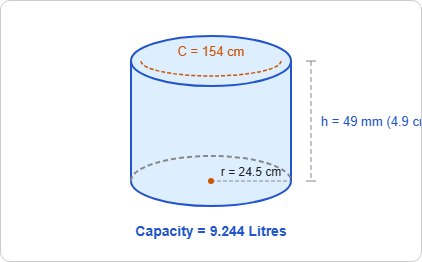 Calculation:
⇒ 2 × (22/7) × r = 154
⇒ (44/7) × r = 154
⇒ r = (154 × 7) ÷ 44
⇒ r = 24.5 cm
⇒ Volume of the vessel = (22/7) × (24.5)² × 4.9
⇒ Volume = (22/7) × 600.25 × 4.9
⇒ Volume = 22 × 600.25 × 0.7
⇒ Volume = 9243.85 cm³
Since 1000 cm³ = 1 Litre:
⇒ Capacity in Litres = 9243.85 ÷ 1000 = 9.24385 Litres
⇒ Correct to three places of decimals ≈ 9.244 Litres
∴ The correct answer is 9.244 Litres.
Additional Information
Volume and Surface Area of a Cylinder
Curved Surface Area (CSA) = 2πrh | Total Surface Area (TSA) = 2πr(r + h) | Volume = πr²h
Liquid Capacity Conversions
1 m³ = 1000 Litres | 1 Litre = 1000 cm³ | 1 cm³ = 1 millilitre (ml)
</p
Q8 · Mensuration 2D
If the lengths of two sides of an isosceles triangle are 6 cm and 12 cm, then find the length of the third side.
- 8 cm
- 6 cm
- 12 cm
- 14 cm
Answer aur solution dekho
Archived marked answer: C
Shortcut Trick
In an isosceles triangle, two sides are equal, so the third side is either 6 cm or 12 cm.
According to the triangle inequality theorem, the sum of any two sides must be strictly greater than the third side.
If sides are 6 cm, 6 cm, and 12 cm: 6 + 6 = 12 (not greater than 12, so it is invalid).
If sides are 12 cm, 12 cm, and 6 cm: 12 + 6 = 18 > 12 (satisfies the condition, so it is valid).
∴ The correct answer is 12 cm.
Alternate Method
Given:
Length of two sides of an isosceles triangle = 6 cm and 12 cm.
Concept Used:</stro
Q9 · Algebra
If a³ + 1/a³ = 2 (a > 0) , then the value of a + 1/a is:
- 1
- 3
- 2
- 4
Answer aur solution dekho
Archived marked answer: C
Shortcut Trick
If xⁿ + 1/xⁿ = 2 for any positive value of x, then x must be 1.
Given, a³ + 1/a³ = 2, which directly implies a = 1.
Substituting a = 1 in the required expression:
⇒ a + 1/a = 1 + 1/1 = 2
∴ The correct answer is 2.
Alternate Method
Given:
a³ + 1/a³ = 2 (where a > 0)
Formula Used:
(a + 1/a)³ = a³ + 1/a³ + 3(a + 1/a)
Calculation:
Let (a + 1/a) = k
Substitute the given values into the algebraic identity:
⇒ k³ = 2 + 3k
⇒ k³ − 3k − 2 = 0
⇒ k³ − k − 2k − 2 = 0
⇒ k(k² − 1) − 2(k + 1) = 0
⇒ k(k − 1)(k + 1) − 2(k + 1) = 0
⇒ (k + 1)[k(k − 1) − 2] = 0
⇒ (k + 1)(k² − k − 2) = 0
⇒ (k + 1)(k − 2)(k + 1) = 0
⇒ (k + 1)²(k − 2) = 0
This gives k = −1 or k = 2.
Since it is given that a > 0, the sum (a + 1/a) must be a positive number.
⇒ k = 2
⇒ a + 1/a = 2
∴ The correct answer is 2.
Additional Information
Algebraic Identities for Squares
If x + 1/x = k, then x² + 1/x² = k² − 2. Similarly, if x − 1/x = k, then x² + 1/x² = k² + 2.
Algebraic Identities for Cubes
If x + 1/x = k, then x³ + 1/x³ = k³ − 3k. Similarly, if x − 1/x = k, then x³ − 1/x³ = k³ + 3k.
Special Case for Value 2
If x + 1/x = 2, then x = 1. Consequently, xⁿ + 1/xⁿ = 2 for any positive integer n.
</p
Q10 · Algebra
If x² + 7x + 8 = 0 , then find the value of 4xx² - 5x + 8 .
- 1/2
- -1/4
- -1/3
- 1/6
Answer aur solution dekho
Archived marked answer: C
Shortcut Trick
Given: x² + 7x + 8 = 0 ⇒ x² + 8 = −7x
Substitute x² + 8 = −7x into the given expression:
⇒ 4x / (x² − 5x + 8) = 4x / (x² + 8 − 5x)
⇒ 4x / (−7x − 5x)
⇒ 4x / (−12x) = −1/3
∴ The correct answer is −1/3.
Alternate Method
Given:
x² + 7x + 8 = 0
To find:
4x / (x² − 5x + 8)
Calculations:
⇒ Divide the numerator and the denominator of the given expression by x:
⇒ Expression = (4x / x) / [ (x² − 5x + 8) / x ]
⇒ Expression = 4 / (x − 5 + 8/x)
⇒ Rearranging the terms: 4 / [(x + 8/x) − 5]
⇒ Now, from the given equation x² + 7x + 8 = 0, divide by x:
⇒ x + 7 + 8/x = 0
⇒ x + 8/x = −7
⇒ Substitute this value into the expression:
⇒ Expression = 4 / (−7 − 5)
⇒ Expression = 4 / −12
⇒ Expression = −1/3
∴ The correct answer is −1/3.
Additional Information
Dividing by Variable Technique
When both the numerator and denominator are polynomials, dividing by x (or x²) helps convert the expression into the form (x + 1/x), making substitution easier.
Direct Substitution Method
Instead of finding the exact roots of a quadratic equation, rearranging the equation to isolate parts of it (like x² + constant) and substituting it into the target expression saves significant calculation time.
Properties of Quadratic Equations
For a standard quadratic equation ax² + bx + c = 0, the sum of roots is −b/a and the product of roots is c/a. These algebraic relationships can often be used to simplify symmetric expressions.
</p
Q11 · Algebra
Find the values of 'a' and 'b' for which the system of equations 3x + y = 3 and (a - b)x + (a + b)y = 3a + b - 3 has infinite solutions.
- a = 3, b = -2/3
- a = -3/2, b = 2
- a = 3, b = -3/2
- a = 2, b = -3/2
Answer aur solution dekho
Archived marked answer: C
Shortcut Trick
For a system to have infinite solutions, a₁/a₂ = b₁/b₂ = c₁/c₂
⇒ 3 / (a − b) = 1 / (a + b) = 3 / (3a + b − 3)
From 1st & 2nd terms: 3a + 3b = a − b ⇒ 2a = −4b ⇒ a = −2b
From 2nd & 3rd terms: 3a + b − 3 = 3a + 3b ⇒ 2b = −3 ⇒ b = −3/2
Substituting b into a: a = −2 × (−3/2) = 3
∴ The correct answer is a = 3, b = −3/2.
Alternate Method
Given:
System of equations:
3x + y = 3
(a − b)x + (a + b)y = 3a + b − 3
Formula Used:
For a system of linear equations a₁x + b₁y = c₁ and a₂x + b₂y = c₂ to have infinite solutions:
a₁/a₂ = b₁/b₂ = c₁/c₂
Calculations:
⇒ Comparing the given equations with standard form:
⇒ a₁ = 3, b₁ = 1, c₁ = 3
⇒ a₂ = a − b, b₂ = a + b, c₂ = 3a + b − 3
⇒ Applying the condition for infinite solutions:
⇒ 3 / (a − b) = 1 / (a + b) = 3 / (3a + b − 3)
Taking the first two parts of the equation:
⇒ 3 / (a − b) = 1 / (a + b)
⇒ 3(a + b) = 1(a − b)
⇒ 3a + 3b = a − b
⇒ 3a − a = −b − 3b
⇒ 2a = −4b
⇒ a = −2b --- (Equation 1)
Taking the second and third parts of the equation:
⇒ 1 / (a + b) = 3 / (3a + b − 3)
⇒ 1(3a + b − 3) = 3(a + b)
⇒ 3a + b − 3 = 3a + 3b
⇒ 3a − 3a − 3 = 3b − b
⇒ −3 = 2b
⇒ b = −3/2
Substitute the value of b in Equation 1:
⇒ a = −2 × (−3/2)
⇒ a = 3
∴ The correct answer is a = 3, b = −3/2.
Additional Information
Condition for Unique Solution
A system of equations a₁x + b₁y = c₁ and a₂x + b₂y = c₂ has a unique solution (intersecting lines) if a₁/a₂ ≠ b₁/b₂.
Condition for No Solution
A system of equations has no solution (parallel lines) if a₁/a₂ = b₁/b₂ ≠ c₁/c₂.
Condition for Infinite Solutions
A system has infinitely many solutions (coincident lines) if a₁/a₂ = b₁/b₂ = c₁/c₂.
</p
Q12 · Profit and Loss
Rohini buys a Bluetooth headphone set for ₹1,700 from a wholesale shop and marks it at ₹2,000. Later on, she allows a discount of 40% on its sale. What is her loss or gain percentage (correct up to two decimal places)?
- 25.19% loss
- 29.41% gain
- 29.41% loss
- 25.19% gain
Answer aur solution dekho
Archived marked answer: C
Shortcut Trick
SP = 60% of MP = 0.60 × 2000 = ₹1,200
Loss = CP − SP = 1700 − 1200 = ₹500
Loss % = (Loss ÷ CP) × 100
⇒ (500 ÷ 1700) × 100 = 500 ÷ 17 ≈ 29.41%
∴ The correct answer is 29.41% loss.
Alternate Method
Given:
Cost Price (CP) = ₹1,700
Marked Price (MP) = ₹2,000
Discount = 40%
Formula Used:
Selling Price (SP) = MP × (1 − Discount% ÷ 100)
Loss = CP − SP
Loss % = (Loss ÷ CP) × 100
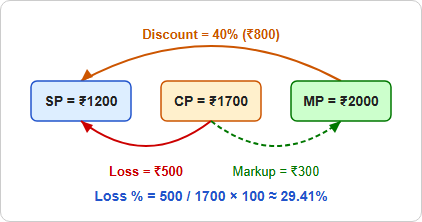 Calculation:
⇒ SP = 2000 × (1 − 0.40)
⇒ SP = 2000 × 0.60 = ₹1,200
⇒ Loss = 1700 − 1200 = ₹500
⇒ Loss % = (500 ÷ 1700) × 100
⇒ Loss % = 500 ÷ 17 ≈ 29.41%
∴ The correct answer is 29.41% loss.
Additional Information
Marked Price & Discount
Discount is fundamentally an allowance offered to a buyer, always calculated on the Marked Price (MP). Hence, SP = MP − Discount.
Profit & Loss Percentage
Unless otherwise stated, Profit or Loss percentage is strictly calculated with respect to Cost Price (CP). Loss% = (Loss ÷ CP) × 100.
Direct Relation between CP and MP
A rapid formula linking CP and MP directly is: CP ÷ MP = (100 − Discount%) ÷ (100 − Loss%). It bypasses solving for SP.
Q13 · Profit and Loss
Ramesh purchased 130 books at the rate of ₹200 each and sold half of them at the rate of ₹300 each, one-fifth of them at the rate of ₹350 each and the rest at the cost price. Find his profit percentage.
- 35%
- 40%
- 38%
- 44%
Answer aur solution dekho
Archived marked answer: B
Shortcut Trick
Let's find the average profit per book directly using fraction parts:
Profit on 1/2 of books = ₹300 − ₹200 = ₹100
Profit on 1/5 of books = ₹350 − ₹200 = ₹150
Average profit = (1/2 × 100) + (1/5 × 150) + (3/10 × 0) = 50 + 30 = ₹80
Profit % = (80 ÷ 200) × 100 = 40%
∴ The correct answer is 40%.
Alternate Method
Given:
Total number of books = 130
Cost price of each book = ₹200
Formula Used:
Profit = Total SP − Total CP
Profit % = (Profit ÷ Total CP) × 100
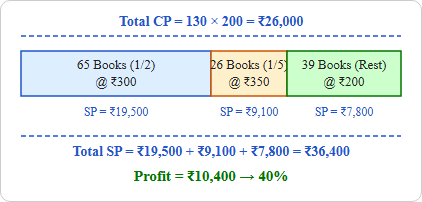 Calculations:
⇒ Total CP of 130 books = 130 × 200 = ₹26,000
⇒ SP of half the books (130 ÷ 2 = 65) = 65 × 300 = ₹19,500
⇒ SP of one-fifth of the books (130 ÷ 5 = 26) = 26 × 350 = ₹9,100
⇒ Remaining books = 130 − (65 + 26) = 39
⇒ SP of remaining books at CP = 39 × 200 = ₹7,800
⇒ Total SP = 19,500 + 9,100 + 7,800 = ₹36,400
⇒ Profit = 36,400 − 26,000 = ₹10,400
⇒ Profit % = (10,400 ÷ 26,000) × 100 = 40%
∴ The correct answer is 40%.
Additional Information
Weighted Average Profit/Loss
When different parts of a total quantity are sold at different profit or loss percentages, the net profit/loss % is the weighted sum of individual percentages.
Profit and Loss Formulas
Profit = Selling Price (SP) − Cost Price (CP). Profit percentage is always calculated on the base of Cost Price: Profit % = (Profit ÷ CP) × 100.
Q14 · Time and Work
An inlet pipe can fill a water storage tank in 11 hours and an outlet pipe can empty the completely filled tank in 15 hours. If both pipes opened simultaneously. The time taken to fill the empty tank (in hrs) is :
- 45 1/2
- 41 1/4
- 49 3/4
- 40
Answer aur solution dekho
Archived marked answer: B
Shortcut Trick
If an inlet pipe fills a tank in x hours and an outlet pipe empties it in y hours (where y > x):
Total time to fill = (x × y) ÷ (y − x)
Total time = (11 × 15) ÷ (15 − 11)
Total time = 165 ÷ 4 = 41 ¹/₄ hours
∴ The correct answer is 41 ¹/₄ hours.
Alternate Method
Given:
Time taken by the inlet pipe to fill the tank = 11 hours
Time taken by the outlet pipe to empty the tank = 15 hours
Pipe
Hours
Total Capacity
Efficiency
Inlet Pipe
11
165
165 ÷ 11 = +15
Outlet Pipe
15
165 ÷ 15 = −11
Calculations:
⇒ Total capacity of the tank = LCM of 11 and 15 = 165 units
⇒ Combined efficiency of both pipes = +15 − 11 = +4 units/hour
⇒ Total time taken = Total Capacity ÷ Combined efficiency
⇒ Total time taken = 165 ÷ 4
⇒ Total time taken = 41 ¹/₄ hours
∴ The correct answer is 41 ¹/₄ hours.
Additional Information
Pipes and Cisterns Net Flow
When both inlet and outlet pipes are open simultaneously, the net filling rate is the difference between their individual efficiencies: Net Rate = Inlet Efficiency − Outlet Efficiency.
LCM Method for Total Capacity
Assuming the total capacity as the LCM of all given times avoids fractions, allowing quick and accurate calculation of pipe efficiencies in whole numbers.
</p
Q15 · Time and Distance
Suppose P starts walking at a speed of 8 km/h. After 8 hours B started travelling on a bicycle at a speed of 24 km/h. The distance from the starting B can catch P is:
- 64 km
- 96 km
- 72 km
- 88 km
Answer aur solution dekho
Archived marked answer: B
Shortcut Trick
Head start distance covered by P in 8 hours = 8 × 8 = 64 km.
Relative speed of B (moving in the same direction) = 24 − 8 = 16 km/h.
Time taken by B to catch P = 64 ÷ 16 = 4 hours.
Distance from the starting point = B's speed × time = 24 × 4 = 96 km.
∴ The correct answer is 96 km.
Alternate Method
Given:
Speed of P = 8 km/h
Speed of B = 24 km/h
Head start time for P = 8 hours
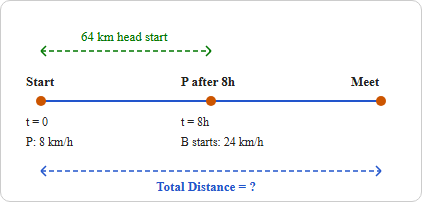 Formula Used:
Distance = Speed × Time
Relative Speed (same direction) = Speed of B − Speed of P
Catch-up Time = Initial Gap Distance ÷ Relative Speed
Calculations:
⇒ Distance covered by P before B starts = 8 × 8 = 64 km
⇒ This 64 km is the gap that B needs to cover to catch P.
⇒ Relative speed of B to P = 24 − 8 = 16 km/h
⇒ Time taken by B to close the gap = 64 ÷ 16 = 4 hours
⇒ Distance from the starting point = B's speed × Time taken
⇒ Distance = 24 × 4 = 96 km
∴ The correct answer is 96 km.
Additional Information
Relative Speed (Same Direction)
When two objects travel in the same direction, their relative speed is the difference between their individual speeds: Relative Speed = S₁ − S₂.
Catch-up Time Formula
The time required to overtake or catch a head-start object is given by: Time = Initial Gap Distance ÷ Relative Speed.
Distance by Ratio Method
When the travel time is constant for two moving bodies, the ratio of the distances they cover is directly proportional to the ratio of their speeds: D₁/D₂ = S₁/S₂.
</p
Q16 · Data Interpretation
The given bar graph shows sugar imports of a country (in thousand tonnes) over the years. Study the graph and answer the question that follows.
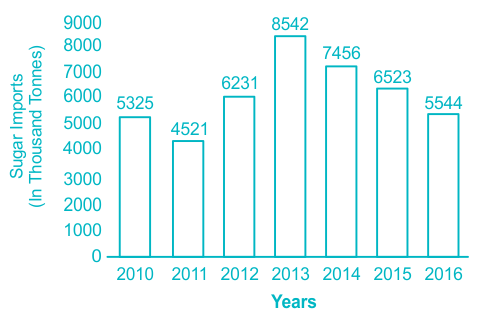 The average imports (in thousand tonnes) of all the years is:
- 6306
- 6469
- 6433
- 6603
Answer aur solution dekho
Archived marked answer: A
Formula used:
Average = (Sum of imports for all years) ÷ (Number of years)
Calculation:
Calculate the sum of imports:
Sum = 5325 + 4521 + 6231 + 8542 + 7456 + 6523 + 5544
Sum = 44142
Number of years = 7
Average = 44142 ÷ 7 = 6306
Therefore, the average imports over all the years is 6306 thousand tonnes.
Q17 · Simplification
Which of the following fractions is the largest?
3/7,7/53,41/80,29/79
- 29/79
- 7/53
- 3/7
- 41/80
Answer aur solution dekho
Archived marked answer: D
Given:
We need to find the largest fraction among:
3/7, 7/53, 41/80, 29/79
Calculation:
Convert each fraction to its decimal value:
3/7 = 0.4286 (approximately)
7/53 = 0.1321 (approximately)
41/80 = 0.5125 (approximately)
29/79 = 0.3671 (approximately)
The largest decimal value is 0.5125, which corresponds to 41/80.
Therefore, the largest fraction is 41/80.
Q18 · Simplification
9 ÷ [ 1 + left{ 4 times ( 5/6 - (1/3 + 1/2 )) right} ]
- 1
- 9/5
- 0
- 9
Answer aur solution dekho
Archived marked answer: D
Given:
Simplify the expression:
9 ÷ [1 + {4 × (5/6 - (1/3 + 1/2))}]
Simplify inside the parentheses (1/3 + 1/2):
Find the LCM of 3 and 2, which is 6:
1/3 + 1/2 = (2/6) + (3/6) = 5/6
So the expression becomes:
9 ÷ [1 + {4 × (5/6 - 5/6)}]
Simplify inside the curly brackets:
5/6 - 5/6 = 0
So the expression becomes:
9 ÷ [1 + {4 × 0}]
Simplify the expression further:
9 ÷ [1 + 0] = 9 ÷ 1 = 9
Therefore, the result is 9.
Q19 · Percentage
The salaries of P and Q together amount to ₹9,60,000. P and Q save 64% and 44%, respectively of their individual salaries. If P's expenditure is 1.5 times Q's expenditure, then what is the ratio of P's salary to Q's salary?
- 2 : 3
- 7 : 3
- 3 : 7
- 3 : 2
Answer aur solution dekho
Archived marked answer: B
Shortcut Trick
P's expenditure % = 100% − 64% = 36%
Q's expenditure % = 100% − 44% = 56%
Given, P's expenditure = 1.5 × Q's expenditure
⇒ 36% of P = 1.5 × 56% of Q
⇒ P / Q = (1.5 × 56) / 36 = 84 / 36 = 7 / 3
∴ The correct answer is 7 : 3.
Alternate Method
Given:
⇒ Total Salary of P and Q = ₹9,60,000
⇒ Savings of P = 64% of P's Salary
⇒ Savings of Q = 44% of Q's Salary
⇒ Expenditure of P = 1.5 × Expenditure of Q
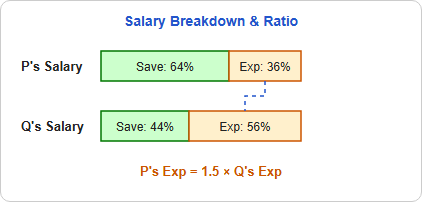 Calculations:
⇒ Expenditure of P = (100 − 64)% of P's Salary = 36% of P's Salary
⇒ Expenditure of Q = (100 − 44)% of Q's Salary = 56% of Q's Salary
⇒ According to the given condition, 36% of P's Salary = 1.5 × 56% of Q's Salary
⇒ (36 / 100) × P = 1.5 × (56 / 100) × Q
⇒ 36 × P = 84 × Q
⇒ P / Q = 84 / 36
⇒ P / Q = 7 / 3
∴ The correct answer is 7 : 3.
Additional Information
Income, Expenditure and Savings
Total Income is the sum of total expenditure and total savings: Income = Expenditure + Savings.
Redundant Data Trick
When calculating ratios or percentage relationships, exact values (such as the combined sum of ₹9,60,000) are often unnecessary and skipping them saves valuable time.
Ratio Scaling Rule
If a × A = b × B, then A : B = b : a. This cross-multiplication principle quickly converts algebraic equations into straightforward ratios by swapping the coefficients.
</p
Q20 · Average
The average of the squares of the first 48 natural numbers is
- 793.17
- 791.17
- 794.17
- 792.17
Answer aur solution dekho
Archived marked answer: D
Shortcut Trick
The average of the squares of the first n natural numbers is directly given by the formula (n + 1)(2n + 1) ÷ 6.
Substitute n = 48 in the formula.
Average = (48 + 1)(2 × 48 + 1) ÷ 6 = (49 × 97) ÷ 6
Average = 4753 ÷ 6 ≈ 792.17
∴ The correct answer is 792.17.
Alternate Method
Given:
Total count of natural numbers (n) = 48
Formula Used:
Sum of squares of first n natural numbers = n(n + 1)(2n + 1) ÷ 6
Average = Sum ÷ n = (n + 1)(2n + 1) ÷ 6
Average of Squares Formula
Sum of Squares
n(n+1)(2n+1)/6
÷
Total Numbers
n
- Average = (n+1)(2n+1)/6
Calculations:
⇒ Average = (48 + 1)(2 × 48 + 1) ÷ 6
⇒ Average = (49 × 97) ÷ 6
⇒ Average = 4753 ÷ 6
⇒ Average = 792.1666...
⇒ Average ≈ 792.17
∴ The correct answer is 792.17.
Additional Information
Average of First 'n' Natural Numbers
The sum of the first 'n' natural numbers is n(n + 1) ÷ 2, so dividing by 'n' directly gives the average as (n + 1) ÷ 2.
Average of Cubes of First 'n' Natural Numbers
The sum of the cubes is [n(n + 1) ÷ 2]², which simplifies the average of the cubes to n(n + 1)² ÷ 4.
Average of First 'n' Even & Odd Numbers
The average of the first 'n' even natural numbers is strictly (n + 1). Meanwhile, the average of the first 'n' odd natural numbers is simply n.
</p
Q21 · Simple Interest
The simple interest on a sum for 6 years is three-fifth of the sum. The rate of interest per annum is:
- 3%
- 7%
- 10%
- 5%
Answer aur solution dekho
Archived marked answer: C
Shortcut Trick
Total Simple Interest = 3/5 of the sum = 60% of the sum.
This 60% interest is generated over a period of 6 years.
Rate per annum = Total Interest % ÷ Time = 60% ÷ 6 = 10%.
∴ The correct answer is 10%.
Alternate Method
Given:
Simple Interest (SI) = 3/5 × Principal (P)
Time (T) = 6 years
Formula Used:
SI = (P × R × T) ÷ 100
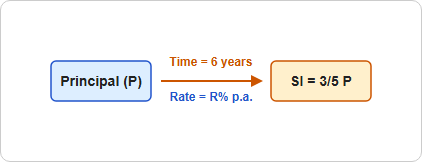 Calculations:
⇒ 3/5 × P = (P × R × 6) ÷ 100
⇒ 3/5 = (R × 6) ÷ 100
⇒ 300 ÷ 5 = R × 6
⇒ 60 = R × 6
⇒ R = 60 ÷ 6 = 10
∴ The correct answer is 10%.
Additional Information
Simple Interest Formula
Simple Interest is calculated only on the initial principal amount. The formula is SI = (P × R × T) ÷ 100.
Amount Formula
The total amount at the end of the time period is Amount (A) = Principal (P) + Simple Interest (SI). It can be expressed as A = P[1 + (R × T) ÷ 100].
Effective Interest Rule
For simple interest, the overall effective interest rate over T years is simply R × T%.
</p
Q22 · Age
Nihira is 25 years old and Punith is 30 years old. How many years ago was the ratio of their ages 3 : 4?
- 20 years
- 15 years
- 5 years
- 10 years
Answer aur solution dekho
Archived marked answer: D
Shortcut Trick
The difference in ages is always constant over time. Difference in present ages = 30 − 25 = 5 years.
In the past, the ratio was 3 : 4. Difference in ratio parts = 4 − 3 = 1 part.
So, 1 part = 5 years.
Past age of Nihira = 3 parts = 3 × 5 = 15 years.
Number of years ago = Present age − Past age = 25 − 15 = 10 years.
∴ The correct answer is 10 years.
Alternate Method
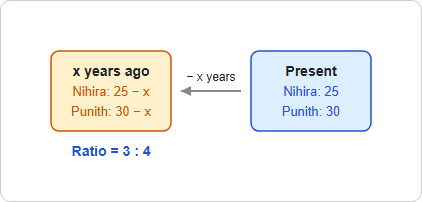 Given:
Present age of Nihira = 25 years
Present age of Punith = 30 years
Let the required number of years ago be x.
Calculation:
⇒ x years ago, Nihira's age = (25 − x) years
⇒ x years ago, Punith's age = (30 − x) years
According to the given condition, their age ratio was 3 : 4.
⇒ (25 − x) / (30 − x) = 3 / 4
Cross-multiplying the equation:
⇒ 4 × (25 − x) = 3 × (30 − x)
⇒ 100 − 4x = 90 − 3x
⇒ 100 − 90 = 4x − 3x
⇒ x = 10
∴ The correct answer is 10 years.
Additional Information
Constant Age Difference Rule
The difference between the ages of two individuals remains exactly the same regardless of the time period (past, present, or future).
Ratio of Ages in Future/Past
If the present ages are A and B, then 't' years ago, their age ratio was (A − t) : (B − t), and 't' years hence, it will be (A + t) : (B + t).
Cross-Multiplication Method
When comparing two ratios at two different points in time, you can directly equate the differences of cross products to the time gap to find the 1-unit multiplier quickly.
</p
English
Q1 · Vocabulary
Select the most appropriate ANTONYM of the given word.
Laudable
- Commendable
- Severe
- Deplorable
- Humorous
Answer aur solution dekho
Archived marked answer: C
The correct answer is: Deplorable.
Key Points
- The word "laudable" means deserving praise and commendation.
- Example: Her efforts to help the underprivileged were truly laudable.
- "Deplorable" refers to something deserving strong condemnation; completely unacceptable.
- Example: The living conditions in the camp were deplorable, with no access to clean water or sanitation.
- Hence, we can infer that the opposite of 'laudable' is 'deplorable'.
Therefore, the correct answer is: Deplorable.
Additional Information
Here are the other options explained along with their Hindi meanings and example sentences:
- Commendable: Deserving praise.
- Example: His quick thinking during the crisis was commendable.
- Severe: Very great; intense.
- Example: The region is expected to experience severe weather conditions.
- Humorous: Causing laughter and amusement; comic.
- Example: His humorous remarks lightened the mood during the meeting.
The correct answer is &l
Q2 · Vocabulary
Select the most appropriate ANTONYM of the given word.
Dissolve
- Vanish
- Fade
- Solve
- Appear
Answer aur solution dekho
Archived marked answer: D
The correct answer is: Appear.
Key Points
- The word "dissolve" means to become incorporated into a liquid so as to form a solution, or to disappear. /
- Example: The sugar will dissolve in the tea.
- "Appear" means to come into sight or become visible, the opposite of disappearing or dissolving.
- Example: As the fog lifted, the mountain range appeared in the distance.
- Hence, we can infer that the opposite of 'dissolve' </stro
Q3 · Vocabulary
Select the most appropriate ANTONYM of the underlined word to fill in the blank.
Ram failed initially but after a few years, he _________ in every field.
- elevated
- succeeded
- enjoyed
- reserved
Answer aur solution dekho
Archived marked answer: B
The correct answer is: Option 2.
Key Points
- The word "failed" means to be unsuccessful in achieving one's goal.
- Example: Despite his best efforts, he failed the exam.
- "Succeeded" refers to achieving the desired aim or result, accomplishing an aim or purpose.
- Example: After years of hard work, she finally succeeded in her business venture.
- Hence, we can infer that the opposite of 'failed' is 'succeeded'.
Therefore, the correct answer is: Option 2.
Additional Information
Here are the other options explained along with their Hindi meanings and example sentences:
- Elevated : Raised to a higher level or position.
- Example: The elevated platform provided a better view of the stage.
- Enjoyed : To take delight or pleasure in something.
- Example: He enjoyed his vacation at the beach.
- Reserved: To keep something for a particular purpose or time.
- Example: The table was reserved for the VIP guests.
Q4 · Vocabulary
Select the most appropriate idiom that can substitute the underlined segment in the given sentence.
Leela was in class when the big fight happened. So, if you want to know the details, You should ask her, you will get the truth given by somebody who is directly involved and therefore likely to be accurate.
- with kid gloves
- shooting off the cuff
- calling a spade a spade
- straight from the horse's mouth
Answer aur solution dekho
Archived marked answer: D
The correct answer is: Option 4.
Key Points
- The idiom "straight from the horse's mouth" means getting information directly from the original or most reliable source.
- Example: To be sure about the news, you should hear it straight from the horse's mouth.
- "With kid gloves" refers to treating someone very gently or carefully.
- Example: He handled the delicate situation with kid gloves.
- "Shooting off the cuff" means speaking without preparation or thinking.
- Example: He was shooting off the cuff during the entire meeting.
- "Calling a spade a spade" means speaking directly and bluntly about something, even if it is unpleasant.
- Example: She is known for calling a spade a spade, regardless of the consequences.
Therefore, the correct answer is: Option 4.
Additional Information
Here are the other options explained along with their Hindi meanings and example sentences:
- With kid gloves : Treating someone very gently or carefully.
- Example: He handled the delicate situation with kid gloves.
- Shooting off the cuff : Speaking without preparation or thinking.
- Example: He was shooting off the cuff during the entire meeting.
- Calling a spade a spade : Speaking directly and bluntly about something.
- Example: She is known for calling a spade a spade, regardless of the consequences.
Q5 · Vocabulary
Select the option that can be used as a one-word substitute for the given group of words.
A performer's first public appearance
- Foundation
- Debut
- Premise
- Dawn
Answer aur solution dekho
Archived marked answer: B
The correct answer is: Debut.
Key Points
- The word "Debut" means a performer’s first public appearance.
- Example: The young singer made her debut at the concert last night.
- "Debut" refers to the occasion when someone performs or presents something to the public for the first time.
- Example: Her debut in the film industry was highly anticipated by her fans.
- Hence, we can infer that the word for a performer's first public appearance is 'Debut'.
Therefore, the correct answer is: Debut.
Additional Information
Here are the other options explained along with their Hindi meanings and example sentences:
- Foundation : The basis or groundwork of anything.
- Example: Education is the foundation of a successful career.
- Premise : A previous statement or proposition from which another is inferred or follows as a conclusion.
- Example: The premise of his argument was flawed.
- Dawn: The first appearance of light in the sky before sunrise.
- Example: We woke up at dawn to watch the sunrise.
Q6 · Vocabulary
Select the option that can be used as a one-word substitute for the given group of words.
To go through an area making a lot of noise and causing damage
- Brutality
- Cacophony
- Violence
- Rampage
Answer aur solution dekho
Archived marked answer: D
The correct answer is: Rampage.
Key Points
- The word "Rampage" means to go through an area making a lot of noise and causing damage.
- Example: The angry mob went on a rampage, breaking windows and setting cars on fire.
- "Brutality" refers to savage physical violence; great cruelty.
- Example: The brutality of the attack shocked the entire community.
- "Cacophony" is a harsh, discordant mixture of sounds.
- Example: The cacophony of horns honking and people shouting made it hard to concentrate.
- "Violence" involves behavior involving physical force intended to hurt, damage, or kill someone or something.
- Example: There was a lot of violence during the protest.
Therefore, the correct answer is: Rampage.
Additional Information
Here are the other options explained along with their Hindi meanings and example sentences:
- Brutality: Savage physical violence; great cruelty.
- Example: The brutality of the dictator was feared by all.
- Cacophony: A harsh, discordant mixture of sounds.
- Example: The cacophony of the city was overwhelming to the countryside visitors.
- Violence: Behavior involving physical force intended to hurt, damage, or kill someone or something.
- Example: The violence in the movie was disturbing.
Q7 · Vocabulary
The following sentence contains a word with a spelling error. Rectify the sentence by selecting the correct spelling of the identified word from the given options.
Later on, he was truely apologetic for his misconduct in the meeting.
- Trooly
- Truily
- Truly
- Treuly
Answer aur solution dekho
Archived marked answer: C
The correct answer is: Option 3.
Key Points
- The word "truely" is incorrectly spelled. The correct spelling is "truly".
- Example: He truly regretted his actions after the meeting.
- "Truly" refers to something that is genuine, sincere, or real.
- Example: She is truly dedicated to her work.
Therefore, the correct answer is: Option 3.
Additional Information
Here are the other options explained along with their Hindi meanings and example sentences:
- Trooly: This is an incorrect spelling.
- Truily: This is an incorrect spelling.
- Treuly: This is an incorrect spelling.
Q8 · Vocabulary
Select the correctly spelt word.
- Exhilaration
- Exilaration
- Exhillaration
- Exhilleration
Answer aur solution dekho
Archived marked answer: A
The correct answer is: Option 1.
Key Points
- The word "Exhilaration" means a feeling of great happiness and excitement.
- Example: The exhilaration of riding a roller coaster is unmatched.
- "Exhilaration" refers to a state of being cheerful and full of energy.
- Example: She felt a sense of exhilaration after completing the marathon.
- Hence, we can infer that the correct spelling is 'Exhilaration'.
Therefore, the correct answer is: Option 1.
Additional Information
Here are the other options explained along with their Hindi meanings and example sentences:
- Exilaration: This is an incorrect spelling and does not have a recognized meaning in English.
- Exhillaration: This is an incorrect spelling and does not have a recognized meaning in English.
- Exhilleration: This is an incorrect spelling and does not have a recognized meaning in English.
The correct answer is: Appear.
Q9 · Vocabulary
Select the most appropriate synonym of the underlined word.
We went to a legitimate Mexican restaurant for my birthday, where they served cuisine like you would find in Mexico.
- genuine
- fictitious
- falsified
- productive
Answer aur solution dekho
Archived marked answer: A
The correct answer is: Option 1.
Key Points
- The word "legitimate" means something that is lawful, genuine, or conforming to recognized principles or accepted rules and standards.
- Example: He has a legitimate claim to the property.
- "Genuine" refers to something that is truly what it is said to be; authentic.
- Example: She showed us a genuine diamond ring.
- Hence, we can infer that the correct synonym of 'legitimate' is 'genuine'.
Therefore, the correct answer is: Option 1.
Additional Information
Here are the other options explained along with their Hindi meanings:
- Fictitious : Not real or true; imaginary or fabricated.
- Example: The character in the story is completely fictitious.
- Falsified : Altered information or documents to mislead.
- Example: He was accused of submitting falsified documents to the court.
- Productive: Capable of producing something, especially in abundance.
- Example: The team had a very productive meeting.
Q10 · Vocabulary
Select the most appropriate synonym of the underlined word.
Our university is affiliated with various institutes all over the world.
- disparate
- diverse
- unlike
- allied
Answer aur solution dekho
Archived marked answer: D
The correct answer is: Option 4.
Key Points
- The word "affiliated" means officially attached or connected to an organization.
- Example: The hospital is affiliated with a leading medical school.
- "Allied" refers to being joined or united in a common purpose or by shared interests.
- Example: The two companies are allied in their commitment to sustainable practices.
- Hence, we can infer that "affiliated" is synonymous with "allied".
Therefore, the correct answer is: Option 4.
Additional Information
Here are the other options explained along with their Hindi meanings and example sentences:
- Disparate: Essentially different in kind; not allowing comparison.
- Example: The two cultures were so utterly disparate that she found it hard to adapt.
- Diverse: Showing a great deal of variety; very different.
- Example: The university offers a diverse range of courses.
- Unlike: Different from; not similar to.
- Example: Unlike his brother, he is very outgoing and sociable.
The correct answer is
Q11 · Vocabulary
Select the most appropriate synonym of the given word.
Derogatory
- Insulting
- Derivative
- Delegation
- Salutary
Answer aur solution dekho
Archived marked answer: A
The correct answer is: Insulting.
Key Points
- The word "derogatory" means showing a critical or disrespectful attitude.
- Example: His derogatory comments about her work were completely uncalled for.
- "Insulting" refers to something that is disrespectful or scornful.
- Example: Calling someone lazy can be very insulting.
- Hence, we can infer that the synonym of 'derogatory' is 'insulting'.
Ther
Q12 · Vocabulary
Select the most appropriate option to fill in the blank.
Raj is very interested in studying human psychology, so he decided to pursue his master’s degree in ________.
- Archaeology
- Philosophy
- Psychology
- Anatomy
Answer aur solution dekho
Archived marked answer: C
The correct answer is: Option 3 i.e. Psychology.
Key Points
- The word "Psychology" means the scientific study of the human mind and its functions, especially those affecting behavior in a given context.
- Example: He is studying psychology to understand how people's minds work.
- Archaeology is the study of human history and prehistory through the excavation of sites and the analysis of artifacts and other physical remains.
- Example: Archaeologists discovered ancient tools that provided insight into early human life.
- Philosophy is the study of the fundamental nature of knowledge, reality, and existence, especially when considered as an academic discipline.
- Example: She is majoring in philosophy to explore questions about existence and ethics.
- Anatomy is the branch of science concerned with the bodily structure of humans, animals, and other living organisms.
- Example: Medical students must study human anatomy to understand the body's structure.
Therefore, the correct answer is: Option 3 i.e. Psychology.
Q13 · Grammar
The following sentence has been split into four segments. Identify the segment that contains a grammatical error.
My dog / barks / very louder / at night.
- My dog
- very louder
- barks
- at night
Answer aur solution dekho
Archived marked answer: B
The correct answer is Option 2.
Key Points
- The primary issue in the sentence is the incorrect use of "very louder".
- The correct comparative form should be "very loudly" or simply "louder".
- The correct phrase should be "barks very loudly" to ensure grammatical correctness and clarity.
- Thus, the error is located in part 2 of the sentence.
Therefore, the correct answer is Option 2.
Correct Sentence: *"My dog barks very loudly at night."*
Additional Information
- "My dog" – This part of the sentence is grammatically correct and does not require any changes.
- "barks" – This part of the sentence is grammatically correct and does not require any changes.
- "at night" – This part of the sentence is grammatically correct and does not require any changes.
Q14 · Grammar
The following sentence has been split into four segments. Identify the segment that contains a grammatical error.
The company specialises at / designing, crafting and manufacturing / exquisite, high-quality furniture / of exceptional craftsmanship.
- exquisite, high-quality furniture
- designing, crafting and manufacturing
- The company specialises at
- of exceptional craftsmanship
Answer aur solution dekho
Archived marked answer: C
The correct answer is Option 3.
Key Points
- The primary issue in the sentence is the incorrect use of the preposition "at" after the verb "specialises".
- The correct preposition to be used with "specialises" is "in".
- The correct phrase should be "The company specialises in" to ensure grammatical correctness and clarity.
- Thus, the error is located in part 3 of the sentence.
Therefore, the correct answer is Option 3.
Correct Sentence: *"The company specialises in designing, crafting and manufacturing exquisite, high-quality furniture of exceptional craftsmanship."*
Additional Information
- "designing, crafting and manufacturing" – This part of the sentence is grammatically correct and does not require any changes.
- "exquisite, high-quality furniture" – This part of the sentence is grammatically correct and does not require any changes.
- "of exceptional craftsmanship" – This part of the sentence is grammatically correct and does not require any changes.
Q15 · Grammar
Select the option that can substitute/replace the bracketed word correctly and complete the sentence.
If he runs, he (get) there in time.
- will get
- is getting
- got there in time
- has to get
Answer aur solution dekho
Archived marked answer: A
The correct answer is '1' i.e. will get.
Key Points
- The correct option should follow the "if" clause in the future tense.
- "Will get" correctly follows modals with the base form of the verb to form future tense for conditional sentences.
Hence, the correct answer is option 1.
Additional Information
- "Is getting" is present continuous and does not fit in the conditional structure.
- "Got there in time" is past tense and does not work with the present/future conditional.
- "Has to get" implies obligation and changes the meaning of the sentence.
Q16 · Grammar
Select the most appropriate option that can substitute the underlined part in the following sentence.
The entire speech of the revivalist fell flat with the crowd that was present there.
- had a great impact on
- had moderate influence on
- had somewhat of a result on
- had no effect on
Answer aur solution dekho
Archived marked answer: D
The correct answer is '4' i.e. had no effect on.
Key Points
- The phrase "fell flat" means that something failed to generate the desired effect or impact, so the correct replacement is "had no effect on."
- The other options imply varying levels of impact, which contradict the meaning of "fell flat":
- "Had a great impact on" means it was very influential.
- "Had moderate influence on" suggests some level of impact.
- "Had somewhat of a result on" implies there was some effect.
Hence, the correct answer is option 4.
Q17 · Voice Change
Select the option that expresses the given sentence in passive voice.
The research team is conducting experiments on a new drug that could revolutionise the treatment of the disease.
- Experiments have been conducted on a new drug that could have revolutionised the treatment of the disease through the research team.
- Experiments were being conducted on a new drug that could revolutionise the treatment of the disease by the research team.
- Experiments are conducted on a new drug that could revolutionise the treatment of the disease from the research team.
- Experiments are being conducted on a new drug that could revolutionise the treatment of the disease by the research team.
Answer aur solution dekho
Archived marked answer: D
The correct answer is Option 4.
Key Points
- Passive voice structure: The object of the active voice sentence becomes the subject of the passive voice sentence.
- In the active voice, the sentence is: "The research team is conducting experiments on a new drug that could revolutionise the treatment of the disease."
- To convert to passive voice: Place the object "experiments on a new drug" at the beginning.
- Change the active verb form "is conducting" to "are being conducted" (present continuous passive).
- Add the preposition "by" followed by the original subject "the research team."
- Ensure the additional information "that could revolutionise the treatment of the disease" remains at the end of the sentence for clarity.
Therefore, the correct answer is Option 4.
Correct Sentence: *"Experiments are being conducted on a new drug that could revolutionise the treatment of the disease by the research team."*
Additional Information
- Option 1: "Experiments have been conducted on a new drug that could have revolutionised the treatment of the disease through the research team." – Incorrect tense (present perfect).
- Option 2: "Experiments were being conducted on a new drug that could revolutionise the treatment of the disease by the research team." – Incorrect tense (past continuous).
- Option 3: "Experiments are conducted on a new drug that could revolutionise the treatment of the disease from the research team." – Incorrect preposition (from instead of by) and tense (present simple).
Q18 · Voice Change
Select the option that expresses the given sentence in active voice.
A comic play was performed by the comedian.
- The comedian performs a comic play.
- The comedian performed a comic play.
- The comedian performance a comic play.
- The comedian do perform a comic play.
Answer aur solution dekho
Archived marked answer: B
```html
The correct answer is Option 2.
Key Points
- Passive voice structure: The object of the active voice sentence becomes the subject of the passive voice sentence.
- In the active voice, the sentence is: "A comic play was performed by the comedian."
- To convert to active voice: Place the subject "the comedian" at the beginning.
-
Q19 · Para Jumble
Parts of a sentence are given below in jumbled order. Arrange the parts in the correct order to form a meaningful sentence.
P) achieve success
Q) when you
R) and polite
S) stay humble
- PRQS
- SRQP
- RQPS
- PQRS
Answer aur solution dekho
Archived marked answer: B
The correct answer is Option 2.
Key Points
- Begin with: setting condition ‘when you’, then explains the required quality/upright to action' ‘stay humble’.
- why apart the phrase connects how each steps lead together making achievements:
- Next: implication on condition ‘u' then the rest parts located in logical sequence:
- connecting result outcome phrases ‘achieves success and polite.
- Hence correct sequence SRQP logical
Meaningful Sentence clear sequence: "
Q20 · Para Jumble
Parts of a sentence are given below in jumbled order. Arrange the parts in the correct order to form a meaningful sentence.
(A) and was searching for them
(B) the grandmother couldn’t find
(C) all around the house
(D) placed them on her head
(E) her spectacles because she had
- BADEC
- BEDAC
- CABED
- ADBEC
Answer aur solution dekho
Archived marked answer: B
The correct answer is Option 2.
Key Points
- Part (B) should come first as it introduces the subject and what she couldn’t find, "the grandmother couldn’t find":
- "the grandmother couldn’t find"
- Part (E) follows to explain what she couldn’t find, "her spectacles because she had":
- "her spectacles because she had"
- Part (D) follows to give the reason why she couldn’t find them, "placed them on her head":
- "placed them on her head"
- Part (A) comes next to show the action taken due to not finding spectacles, "and was searching for them":
- "and was searching for them"
- Part (C) comes last to show where the search happened, "all around the house":
- "all around the house"
- The correct sequence is BEDAC.
Coherent sentence after rearrangement:
"The grandmother couldn’t find her spectacles because she had placed them on her head and was searching for them all around the house."