92 questions available to read. Bina signup padho; timed practice ke liye free sign in karo.
Archive coverageThis saved paper contains 92 of 100 expected questions. 0 stored records are excluded from this study page while their source or wording is checked. Missing original questions: 8. Local question numbers follow the saved archive; match the wording and choices when comparing another response sheet.
Archived marked answers and available solution notes are preserved. These are not claimed to be fully checked final SSC keys. How questions are checked.
Reasoning
Q1 · Series
Which of the following terms will replace the question mark (?) in the given series?
HKPT, JLNS, LMLR, ?, POHP
- NNJQ
- NNKQ
- NNQJ
- NNIQ
Answer aur solution dekho
Archived marked answer: A
The logic followed here is:
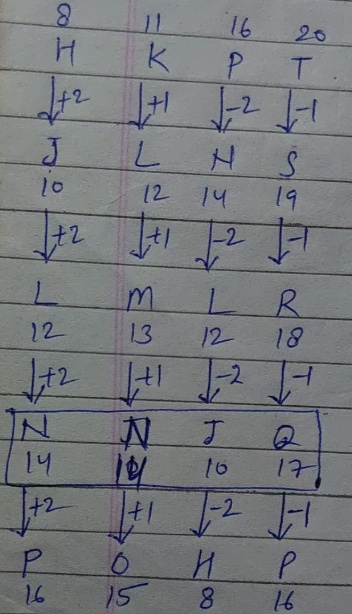
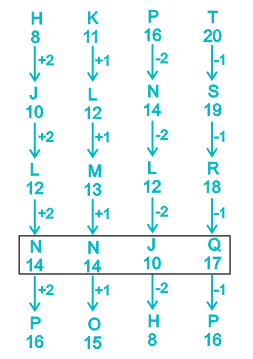 Hence, the correct answer is "NNJQ".
Q2 · Series
Select the figure from among the given options that can replace the question mark (?) and logically complete the series.



Answer aur solution dekho
Archived marked answer: D
The logic followed here is:
Minute hand is moving two step ahead in a clockwise direction.
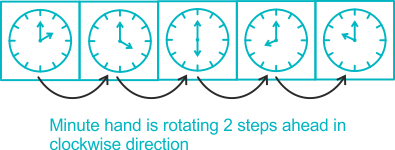 Hence, the correct answer is "Option 4".
Q3 · Series
Select the figure that will replace the question mark (?) in the following figure series.



Answer aur solution dekho
Archived marked answer: B
The logic followed here is:
From figure 1 to 2 and figure 3 to 4:
Top-right and left-middle symbols and right-middle and top-left symbols are interchanging their position.
Bottom 2 and middle symbols are shifting their position in clockwise direction.
Q4 · Series
Select the combination of letters that when sequentially placed in the blanks of the given series will complete the series.
LM_O_NPMRO_KU_TI
- RPMO
- PNOR
- NORP
- NOPR
Answer aur solution dekho
Archived marked answer: C
The logic followed here is:
Given Sequence: LM_O_NPMRO_KU_TI
Now, putting the letters in the blank spaces given in the option one by one:
Option 1) RPMO → LMRO / PNPM / ROMK / UOTI
Option 2) PNOR → LMPO / NNPM / ROOK / URTI
Option 3) NORP → LMNO / ONPM / RORK / UPTI
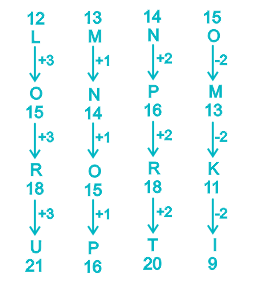 Option 4) NOPR → LMNO / ONPM / ROPK / URTI
Hence, the correct answer is "NORP".
Q5 · Series
Select the number from among the given options that can replace the question mark (?) in the following series.
5, 10, 17, 26, 37, ?
- 50
- 52
- 60
- 54
Answer aur solution dekho
Archived marked answer: A
The logic followed here is:
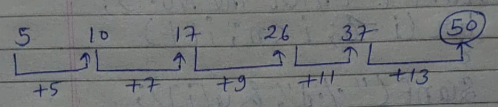
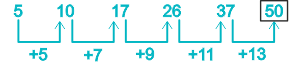 Hence, the correct answer is "50".
Q6 · Analogy
Select the option in which the numbers share the same relationship as that shared by the given pair of numbers.
(NOTE: Operations should be performed on the whole numbers, without breaking down the numbers into its constituent digits. E.g. 13 – Operations on 13 such as adding/deleting/multiplying etc. to 13 can be performed. Breaking down 13 into 1 and 3 and then performing mathematical operations on 1 and 3 is not allowed.)
11 : 1331
9 : 729
- 6 : 180
- 7 : 343
- 8 : 6561
- 13 : 2028
Answer aur solution dekho
Archived marked answer: B
The logic followed here is:
Logic: (1st number)³= 2nd number.
Now,
For, 11 : 1331
⇒ 11³ = 1331.
For, 9 : 729
⇒ 9³ = 729.
Similarly, for 7 : 343
⇒ 7³ = 343.
Hence, the correct answer is "Option 2".
.solution {
color: rgb(33, 37, 41);
}
.logic {
font-weight: bolder;
}
Q7 · Analogy
22 is related to 176 following a certain logic. Following the same logic, 32 is related to 256. To which of the following is 48 related, following the same logic?
(NOTE: Operations should be performed on the whole numbers, without breaking down the numbers into its constituent digits. E.g. 13 – Operations on 13 such as adding/deleting/multiplying etc. to 13 can be performed. Breaking down 13 into 1 and 3 and then performing mathematical operations on 1 and 3 is not allowed)
- 374
- 384
- 380
- 370
Answer aur solution dekho
Archived marked answer: B
The logic followed here is:
Logic: 1st number × 8 = 2nd number.
Now,
For 22 : 176
⇒ 22 × 8 = 176.
For 32 : 256
⇒ 32 × 8 = 256.
Similarly, for 48 : ?
⇒ 48 × 8 = 384.
Hence, the correct answer is "Option 2".
Q8 · Analogy
Select the option in which the numbers share the same relationship as that shared by the given pair of numbers.
(317, 202)
(438, 323)
(NOTE: Operations should be performed on the whole numbers, without breaking down the numbers into its constituent
digits. E.g. 13 – Operations on 13 such as adding/deleting/multiplying etc. to 13 can be performed. Breaking down 13 into 1
and 3 and then performing mathematical operations on 1 and 3 is not allowed.)
- (402, 287)
- (424, 315)
- (415, 295)
- (391, 270)
Answer aur solution dekho
Archived marked answer: A
The logic followed here is:
Logic: 1st number - 115 = 2nd number.
Now,
For, 317 : 202
⇒ 317 - 115 = 202.
For, 438 : 323
⇒ 438 - 115 = 323.
Similarly, for 402 ∶ ?
⇒ 402 - 115 = 287.
Hence, the correct answer is "Option 1".
Q9 · Analogy
Select the word pair that best represents a similar relationship to the one expressed in the pair of words given below. (The words must be considered as meaningful English words and must not be related to each other based on the number of letters/number of consonants/vowels in the word)
Cessation : Beginning
- Incredible : Magnificent
- Plutonic : Abyssal
- Enormous : Miniscule
- Obsession : Problem
Answer aur solution dekho
Archived marked answer: C
The logic followed here is:
Logic: Antonyms
Here,
Cessation : Beginning → Cessation is the antonym of &l
Q10 · Analogy
Select the option that is related to the third word in the same way as the second word is related to the first word. (The words must be considered as meaningful English words and must not be related to each other based on the number of letters/number of consonants/vowels in the word.)
Pig : Piglets :: Deer : ?
- Pup
- Foal
- Fawn
- Calf
Answer aur solution dekho
Archived marked answer: C
The logic followed here is:
Logic: Animal and their young ones.
Here,
Pig : Piglets → Piglets are the young ones of Pig.
Similarly,
Deer : Fawn → Fawn is the young one of Deer.
Hence, the correct answer is "Option 3".
Q11 · Analogy
Select the word pair that best represents a similar relationship to the one expressed in the pair of words given below. (The words must be considered as meaningful English words and must not be related to each other based on the number of letters/number of consonants/vowels in the word)
Scissors : Paper
- Furnace : Water
- Axe : Wood
- Mines : Diamond
- Heater : Plastic
Answer aur solution dekho
Archived marked answer: B
The logic followed here is:
Logic: Tools and their primary objects of use.
Here,
Scissors : Paper → Scissors are primarily used to cut
Q12 · Non Verbal Reasoning
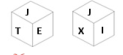
Six letters J, T, E, X, I and O are written on different faces of a dice. Two positions of this dice are shown in the figures below. Find the letter on the face opposite to X.

- I
- E
- O
- T
Answer aur solution dekho
Archived marked answer: D
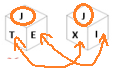
For find the opposite surface of 'X', we need to compare the common surface in the given dices,
So, From Dice 1 and Dice 2,
 c
From both dices, J is common and on the same surface. So, all remaining surface will be opposite to each other.
E is opposite to I.
So, T will be opposite to X.
Hence, the correct answer is "T".
Q13 · Non Verbal Reasoning
How many triangles are there in the given figure?

- 16
- 17
- 18
- 19
Answer aur solution dekho
Archived marked answer: D
Counting the triangles are there in the given figure:
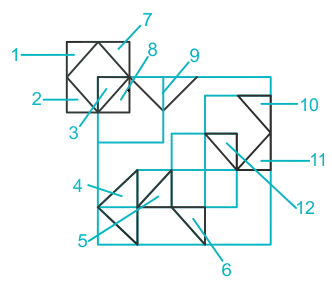
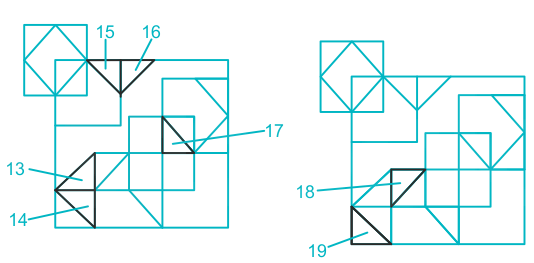 Hence, the correct answer is "19".
Q14 · Non Verbal Reasoning
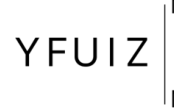
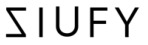
Select the correct mirror image of the given figure when the mirror is placed at MN as shown.




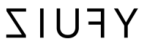



Answer aur solution dekho
Archived marked answer: C
The correct mirror image of the given figure is:
 Hence, the correct answer is "Option 3".
Q15 · Non Verbal Reasoning
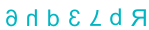
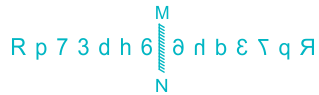
Select the correct mirror image of the given figure when the mirror is placed at MN.
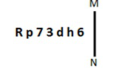
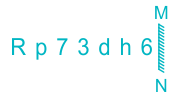
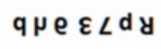
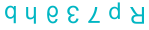
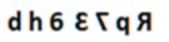

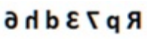

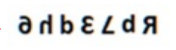
Answer aur solution dekho
Archived marked answer: C
The correct mirror image of the given figure is:
 Hence, the correct answer is "Option 3".
Q16 · Non Verbal Reasoning
The sequence of folding a piece of paper and the manner in which the folded paper has been cut is shown in the following figures. How would this paper look when unfolded?



Answer aur solution dekho
Archived marked answer: B
The paper look when unfolded:
 Hence, the correct answer is "Option 2".
Q17 · Puzzle Subtypes Not To Miss
Which number will come in the place of the question mark (?) in the following equation if ‘+’ and ‘−’ are interchanged and ‘×’ and ‘÷’ are interchanged?
14 − 45 × 5 + 6 ÷ 3 = ?
- 3
- 6
- 5
- 4
Answer aur solution dekho
Archived marked answer: C
BODMAS Table:
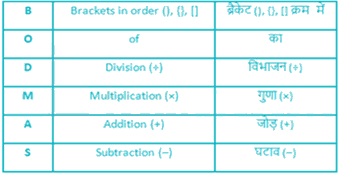 Given equation: 14 − 45 × 5 + 6 ÷ 3 = ?
Now, if ‘+’ and ‘−’ and ‘×’ and ‘÷’ are interchanged, then:
⇒ 14 + 45 ÷ 5 − 6 × 3 = ?
⇒ 14 + 9 − 18 = ?
⇒ 23 − 18 = ?
⇒ 5.
Hence, the correct answer is "Option 3".
Q18 · Puzzle Subtypes Not To Miss
Which two signs should be interchanged to make the following equation correct?
29 × 145 + 5 − 640 ÷ 15 = 216
- ÷ and +
- ÷ and ×
- − and +
- − and ×
Answer aur solution dekho
Archived marked answer: A
Given equation: 29 × 145 + 5 − 640 ÷ 15 = 216
Option 1) ÷ and +
Two signs need to be interchanged then:
⇒ 29 × 145 __÷__ 5 − 640 + 15 = 216
⇒ 29 × 29 − 640 + 15 = 216
⇒&nbs Q19 · Coding Decoding
In a certain code language, 'IFF' is coded as '21' and 'ARB' is coded as '21'. How will 'CAW' be coded in that language?
- 25
- 27
- 23
- 26
Answer aur solution dekho
Archived marked answer: B
The logic followed here is:
'IFF' is coded as '21'
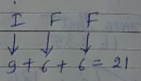
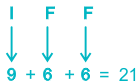 'ARB' is coded as '21'
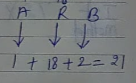
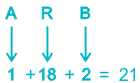 Similarly, 'CAW' will be coded as:
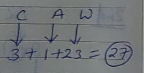
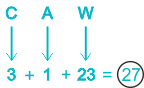 Hence, the correct answer is "27".
Q20 · Coding Decoding
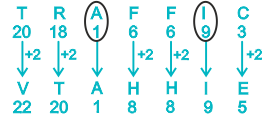
In a certain code language, 'TERRAIN' is written as 'VETTAIP' and 'TRAFFIC' is written as 'VTAHHIE'. How will 'MOTOR' be written in that language?
- OOVOT
- VOOOT
- OOTVO
- OVOTO
Answer aur solution dekho
Archived marked answer: A
The logic followed here is: Consonants + 2; and Vowels are the same.
'TERRAIN' is written as 'VETTAIP'
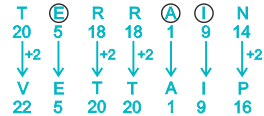 'TRAFFIC' is written as 'VTAHHIE'
 Similarly, 'MOTOR' will be written as:
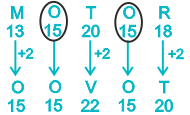 Hence, the correct answer is "OOVOT".
Q21 · Classification Odd One Out
Four letter-clusters have been given, out of which three are alike in some manner and one is different. Select the letter-
cluster that is different.
Note: The odd one out is not based on the number of consonants/vowels or their position in the letter cluster.
- TWZ
- MPS
- DGJ
- KNP
Answer aur solution dekho
Archived marked answer: D
The logic followed here is:
Option 1) TWZ
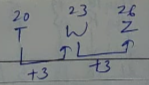
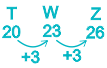 Option 2) MPS
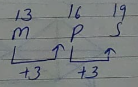
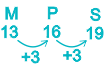 Option 3) DGJ
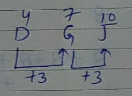
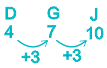 Option 4) KNP
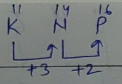
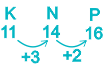 Hence, the correct answer is "KNP".
Q22 · Classification Odd One Out
The second number in the given number-pairs is obtained by performing certain mathematical operation(s) on the first number. The same operation(s) is/are followed in all the number-pairs, except one. Find that odd number-pair.
(NOTE: The relation should be found without breaking down the numbers into its constituent digits)
- 18 : 306
- 25 : 650
- 23 : 552
- 13: 182
Answer aur solution dekho
Archived marked answer: A
The logic followed here is: (1st number)² + 1st number = 2nd number.
1) 18 : 306 → (18)² + 18 = 324 + 18 = 342
2) 25 : 650 → (25)2 + 25 = 625 + 25 = 650
3) 23 : 552 → (23)2 + 23 = 529 + 23 = 552
4) 13: 182 → (13)2 + 13 = 169 + 13 = 182
Thus, 18 : 306 is odd number-pair.
Hence, the correct answer is "18 : 306".
Q23 · Logical Reasoning
In this question, three statements are given, followed by three conclusions numbered I, II and III. Assuming the statements
to be true, even if they seem to be at variance with commonly known facts, decide which of the conclusions logically
follow(s) from the statements.
Statements:
All necklaces are squares.
Some squares are circles.
No circle is a ring.
Conclusions:
I.No square is a ring.
II.No ring is a circle.
III.Some squares are necklaces.
- Only conclusions II and III follow.
- Only conclusion III follows.
- All the conclusions follow.
- Only conclusions I and III follow.
Answer aur solution dekho
Archived marked answer: A
Statements:
All necklaces are squares.
Some squares are circles.
No circle is a ring.
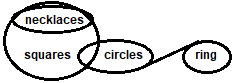
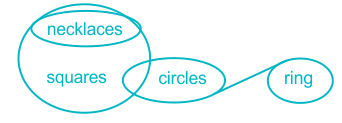
The least possible Venn diagram is as follows:
 Conclusions:
I. No square is a ring. - False (because there is no direct relation given between them so it can be possible but not definite)
II. No ring is a circle. - True (because No circle is a ring given, so No ring is a circle it is definite)
III. Some squares are necklaces. - True (because All necklaces are squares given, so Some squares are also necklaces)
Hence, the correct answer is "Only conclusions II and III follow."
Q24 · Blood Relations
In a certain code language,
‘A + B’ means ‘A is the mother of B’;
‘A – B’ means ‘A is the brother of B’;
‘A x B’ means ‘A is the wife of B’ and
‘A ÷ B’ means ‘A is the father of B’.
Based on the above, if M + Q – R + K – Y, then how is M related to Y?
- Father’s mother
- Brother’s wife
- Mother’s mother
- Mother
Answer aur solution dekho
Archived marked answer: C
Family Chart:
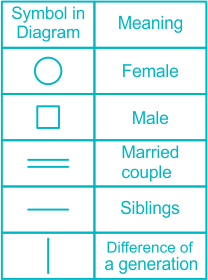 Decoding the Symbols:
Symbol
+
÷
x
Meaning
Mother
Father
Wife
Brother
Given: M + Q – R + K – Y
It means: M is the mother of Q, Q is the brother of R, R is the mother of K and K is the brother of Y.
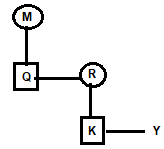
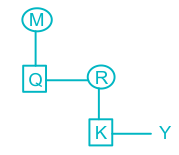 So, M is the Mother’s mother of Y.
Hence, the correct answer is "Mother’s mother".
Q25 · Alphabet Test
The position(s) of how many letters will remain unchanged if all the letters in the word 'ASTEROID' are arranged in English alphabetical order?
- Three
- None
- Two
- One
Answer aur solution dekho
Archived marked answer: D
The logic followed here is:
Given word: 'ASTEROID'
After arranged in English alphabetical order:
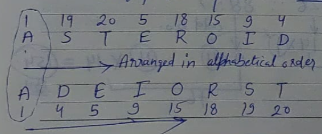
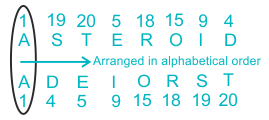 Thus, the position of One letter will remain unchanged if all the letters in the word 'ASTEROID' are arranged in English alphabetical order.
Hence, the correct answer is "One".
General Awareness
Q1 · Art and Culture
Some of the talas invented by _________ include Trimukhi, Panchamukhi, Saptamukhi and Navamukhi.
- M. Balamuralikrishna
- Hariprasad Chaurasia
- Yashraj
- Bhimasen Joshi
Answer aur solution dekho
Archived marked answer: A
The correct answer is M. Balamuralikrishna.
Key Points
- M. Balamuralikrishna was an Indian Carnatic vocalist, musician, multi-instrumentalist, playback singer, composer, and character actor.
- He was known for his deep knowledge of both the theoretical and practical aspects of Carnatic music.
- He invented new ragas as well as talas, including the ones mentioned: Trimukhi, Panchamukhi, Saptamukhi, and Navamukhi.
- His contributions to Carnatic music earned him several prestigious awards, including the Padma Vibhushan and the Sangeet Natak Akademi Award.
Additional Information
- Carnatic Music
- Carnatic music is a system of music commonly associated with the southern part of the Indian subcontinent, with its foundations in ancient Hindu traditions.
- It is one of the two main subgenres of Indian classical music that evolved from ancient Hindu traditions, the other subgenre being Hindustani music.
- The main emphasis in Carnatic music is on vocal music; most compositions are written to be sung, and even when played on instruments, they are meant to be performed in a singing style (known as gayaki).
- Tala
- Tala, literally meaning "clap," is the term used in Indian classical music to refer to musical meter, that is, any rhythmic beat or strike that measures musical time.
- It is a series of beats that are cyclically repeated.
- Talas can have different numbers of beats, and the cycle of beats is divided into sections called "angas," which can be of varying lengths.
- Instruments Played by M. Balamuralikrishna
- Besides being a renowned vocalist, M. Balamuralikrishna was proficient in playing the violin, viola, mridangam, and kanjira.
- His multifaceted talent in playing various instruments added to his versatility and depth as a musician.
Q2 · Art and Culture
Which of the following festivals observed in Assam is majorly celebrated by Vaishnavites?
- Bihu
- Doljatra
- Ambuchi Mela
- Rongker
Answer aur solution dekho
Archived marked answer: B
The correct answer is Doljatra.
Key Points
- Doljatra, also known as Dol Purnima or Dol Yatra, is a major festival celebrated by the Vaishnavites of Assam.
- It is observed on the full moon day in the month of Phalguna (February-March).
- Doljatra marks the arrival of spring and is a festival of colors, similar to Holi.
- During this festival, people worship Lord Krishna and celebrate his divine play (Leela) with Radha and the Gopis.
Additional Information
- Bihu
- Bihu is the most important festival of Assam, celebrated thrice a year as Rongali Bihu, Kongali Bihu, and Bhogali Bihu.
- It is primarily an agricultural festival associated with the changing seasons.
- Rongali Bihu is celebrated in April to mark the Assamese New Year and the onset of spring.
- Kongali Bihu is observed in October and is a solemn occasion with less merrymaking.
- Bhogali Bihu, celebrated in January, marks the end of the harvest season and is characterized by feasts and bonfires.
- Ambuchi Mela
- Ambuchi Mela is a significant festival held at the Kamakhya Temple in Assam.
- It is celebrated during the monsoon season in June and marks the annual menstruation of the goddess Kamakhya.
- Devotees from all over the country visit the temple to seek blessings during this time.
- The temple remains closed for three days, and on the fourth day, the doors are opened with great festivities.
- Rongker
- Rongker is a traditional festival of the Karbi tribe in Assam.
- It is celebrated to appease local deities and ensure a bountiful harvest.
- The festival involves elaborate rituals, prayers, and sacrifices to seek the blessings of the gods.
- Rongker is usually observed in the month of April or May.
Q3 · Indian Polity and Constitution
Which of the following statements is INCORRECT regarding Fundamental Rights?
- Fundamental Rights can be enforced by Law.
- Fundamental rights are derived from the Britain Constitution.
- The Fundamental Rights are mentioned in constitution from article 12 to 35.
- Article 21 provides right to life.
Answer aur solution dekho
Archived marked answer: B
The correct answer is Fundamental rights are derived from the Britain Constitution..
Key Points
- Fundamental Rights are enshrined in Part III of the Indian Constitution, from Article 12 to 35.
- These rights are essential for the overall development of individuals and the preservation of human dignity.
- Article 21 of the Indian Constitution guarantees the Right to Life and Personal Liberty.
- Fundamental Rights are justiciable, meaning they can be enforced through the courts of law in India.
Additional Information
- Fundamental Rights
- Fundamental Rights are the basic human rights guaranteed to all individuals by the Constitution of India. These rights are crucial for the protection and development of individuals.
- They are meant to promote the ideal of political democracy and prevent the arbitrary use of power by the state.
- Some of the key Fundamental Rights include the Right to Equality (Articles 14-18), Right to Freedom (Articles 19-22), Right against Exploitation (Articles 23-24), Right to Freedom of Religion (Articles 25-28), Cultural and Educational Rights (Articles 29-30), and the Right to Constitutional Remedies (Article 32).
- These rights are enforceable by the courts, and individuals can approach the judiciary to seek protection and enforcement of their Fundamental Rights.
- Enforcement of Fundamental Rights
- Fundamental Rights are justiciable, meaning individuals can approach the courts to enforce these rights if they are violated.
- The Supreme Court and High Courts have the power to issue writs for the enforcement of Fundamental Rights.
- Writs such as habeas corpus, mandamus, prohibition, quo warranto, and certiorari are used to enforce these rights.
- Right to Life (Article 21)
- Article 21 of the Indian Constitution guarantees the Right to Life and Personal Liberty.
- This article ensures that no person shall be deprived of their life or personal liberty except according to the procedure established by law.
- The Right to Life under Article 21 has been interpreted by the Supreme Court to include various rights such as the right to live with human dignity, right to livelihood, right to health, right to education, and more.
Q4 · Indian Polity and Constitution
Which Article mentions the Comptroller and Auditor General of India?
- Article 154
- Article 156
- Article 148
- Article 136
Answer aur solution dekho
Archived marked answer: C
The correct answer is Article 148.
Key Points
- Article 148 of the Indian Constitution deals with the appointment, duties, and powers of the Comptroller and Auditor General of India (CAG).
- The CAG is responsible for auditing the accounts of the Union and State governments and public sector organizations, ensuring accountability and transparency.
- The CAG is appointed by the President of India and can only be removed from office in a manner similar to the removal of a Supreme Court judge.
- The CAG submits audit reports to the President or the Governor, who then places them before the Parliament or the State Legislature.
Additional Information
- Comptroller and Auditor General of India (CAG)
- The CAG is the head of the Indian Audit and Accounts Department and acts as the guardian of the public purse.
- The office of the CAG is a constitutional body established under Article 148 of the Constitution of India.
- The CAG audits all receipts and expenditure of the Government of India and the state governments, including those of bodies and authorities substantially financed by the government.
- The CAG ensures that the financial administration of the country is carried out in accordance with the Constitution and the laws made by the Parliament and State Legislatures.
- Article 154
- Article 154 of the Indian Constitution vests the executive power of the State in the Governor.
- It states that the executive power shall be exercised by the Governor either directly or through officers subordinate to him in accordance with the Constitution.
- Article 156
- Article 156 of the Indian Constitution deals with the term of office of the Governor.
- It states that the Governor shall hold office during the pleasure of the President and for a term of five years.
- Article 136
- Article 136 of the Indian Constitution grants special leave to appeal by the Supreme Court.
- It gives the Supreme Court the discretionary power to grant special leave to appeal against any judgment, decree, determination, sentence, or order passed by any court or tribunal in the territory of India.
Q5 · Indian Economy
Under which scheme are collateral free loans of up to ₹10 Lakh extended by the Member Lending Institutions (MLIs) in India?
- National Strategy for Financial Inclusion
- Pradhan Mantri MUDRA Yojana
- Stand Up India scheme
- Pradhan Mantri Jan Dhan Yojana
Answer aur solution dekho
Archived marked answer: B
The correct answer is Pradhan Mantri MUDRA Yojana.
Key Points
- Pradhan Mantri MUDRA Yojana (PMMY) is a scheme launched by the government of India to provide loans up to ₹10 Lakh to non-corporate, non-farm small/micro enterprises.
- These loans are classified as MUDRA loans under PMMY and are given by commercial banks, RRBs, small finance banks, MFIs, and NBFCs.
- The scheme was launched on 8 April 2015 by Prime Minister Narendra Modi.
- MUDRA stands for Micro Units Development and Refinance Agency Limited, which provides funding support to the micro-enterprise sector.
Additional Information
- National Strategy for Financial Inclusion
- It is a strategy prepared by the Reserve Bank of India to provide access to formal financial services in an affordable manner.
- The strategy aims at promoting financial education, financial literacy, and consumer protection.
- It includes various stakeholders like banks, non-banking financial companies (NBFCs), micro-finance institutions (MFIs), and insurance companies.
- It emphasizes the need for a robust digital financial ecosystem to achieve universal financial access.
- Stand Up India scheme
- It was launched on 5 April 2016 by the Government of India.
- The scheme aims to promote entrepreneurship among Scheduled Castes/Scheduled Tribes and women by providing loans between ₹10 lakh and ₹1 crore.
- It ensures that each bank branch provides at least one loan to SC/ST and one to women borrowers.
- Stand Up India scheme provides handholding support and guidance to borrowers during the loan tenure.
- Pradhan Mantri Jan Dhan Yojana
- Launched on 28 August 2014, it aims to provide universal access to banking facilities with at least one basic banking account for every household.
- The scheme promotes financial inclusion by ensuring access to financial services such as bank savings and deposit accounts, remittance, credit, insurance, and pension.
- It allows direct benefit transfer (DBT) to accounts opened under PMJDY, ensuring transparency and reducing leakages.
- The scheme also provides an overdraft facility of up to ₹10,000 to account holders.
b6:T1b
Q6 · Indian Economy
The 'Make in India' initiative primarily focuses on which sector?
- Manufacturing
- Service
- Agriculture
- Import
Answer aur solution dekho
Archived marked answer: A
The correct answer is Manufacturing.
Key Points
- The 'Make in India' initiative was launched by the Government of India in September 2014.
- It aims to transform India into a global manufacturing hub by encouraging both multinational and domestic companies to manufacture their products within the country.
- Key sectors focused on include automobiles, chemicals, IT, pharmaceuticals, textiles, ports, aviation, leather, tourism, hospitality, wellness, railways, and more.
- The initiative is designed to facilitate investm
Q7 · Sports Static GK
Rudrankksh Patil is associated with ________.
- badminton
- shooting
- chess
- wrestling
Answer aur solution dekho
Archived marked answer: B
The correct answer is shooting.
Key Points
- Rudrankksh Patil is an emerging talent in the sport of shooting, representing India at various national and international competitions.
- He has shown remarkable proficiency in the 10m air rifle category, a discipline where competitors aim at a target from a distance of 10 meters using an air rifle.
- Rudrankksh has garnered attention for his precision and consistency in shooting, traits vital for excelling in this sport.
- He has been training rigorously under the guidance of experienced coaches and is considered one of the promising young shooters in the Indian shooting circuit.
Additional Information
- 10m Air Rifle Shooting
- This is a precision shooting event where athletes shoot a series of shots using a 4.5 mm caliber air rifle at a target 10 meters away.
- The event is governed by the International Shooting Sport Federation (ISSF) and is included in the Olympics, World Championships, and various other international competitions.
- The target used in this event has a total of 10 concentric scoring rings, with the innermost ring worth 10 points and each outer ring worth one point less.
- Competitors typically shoot from a standing position, and the event requires immense control, focus, and steadiness to score high.
- International Shooting Sport Federation (ISSF)
- The ISSF is the governing body for Olympic shooting events in rifle, pistol, and shotgun disciplines.
- It was founded in 1907 and is responsible for setting the rules and regulations for international shooting competitions.
- The ISSF organizes the World Championships, World Cups, and oversees shooting events at the Olympic Games.
- It aims to promote the sport of shooting and ensure fair play and sportsmanship in all its competitions.
- Olympic Shooting Events
- Shooting has been part of the Olympic Games since the first modern Games in 1896.
- There are various shooting events in the Olympics, including rifle, pistol, and shotgun disciplines, for both men and women.
- The events are designed to test the accuracy and precision of the athletes under highly regulated conditions.
- Olympic shooting events are highly competitive, with athletes from all over the world competing for the prestigious Olympic medals.
Q8 · Sports Static GK
Who among the following is the first Indian to win gold at Junior World Weightlifting Championship in May 2022?
- Sathish Sivalingam
- Mirabai Chanu
- Santoshi Matsa
- Harshada Sharad Garud
Answer aur solution dekho
Archived marked answer: D
The correct answer is Harshada Sharad Garud.
Key Points
- Harshada Sharad Garud became the first Indian to win a gold medal at the Junior World Weightlifting Championship in May 2022.
- She achieved this historic feat in the women's 45 kg category.
- Harshada lifted a total of 153 kg (70 kg in snatch and 83 kg in clean and jerk).
- This accomplishment has made her a significant figure in Indian weightlifting, inspiring many young athletes.
Additional Information
- Weightlifting is a sport in which athletes attempt to lift heavy weights mounted on steel bars called barbells. The two main events in weightlifting are the snatch and the clean and jerk.
- Snatch: The lift in which the weight is lifted from the ground to overhead in one continuous motion.
- Clean and Jerk: The lift in which the weight is first lifted to the shoulders (clean) and then from the shoulders to overhead (jerk).
- Junior World Weightlifting Championship: An annual event organized by the International Weightlifting Federation (IWF) where junior athletes (under 20 years of age) from around the world compete.
- India has a growing history in weightlifting, with several athletes achieving international success, bringing recognition and honor to the country.
Q9 · Sports Static GK
Sankalp Gupta is associated with which of the following events?
- Chess
- Wrestling
- Badminton
- Boxing
Answer aur solution dekho
Archived marked answer: A
The correct answer is Chess.
Key Points
- Sankalp Gupta is a renowned chess player from India.
- He achieved the title of International Master (IM) in chess.
- Gupta has participated in several national and international chess tournaments, showcasing his strategic skills.
- He is known for his analytical prowess and has contributed to the growth of chess in India.
Additional Information
- Chess Terminologies and Titles:
- International Master (IM): This is a high-level title awarded by the World Chess Federation (FIDE). It is one step below the Grandmaster (GM) title.
- Grandmaster (GM): The highest title awarded in chess, signifying a player of exceptional skill and achievement.
- FIDE: Fédération Internationale des Échecs or International Chess Federation, the governing body of international chess competition.
- Chess Rating: A system used by FIDE to estimate the strength of players, based on their performance in tournaments.
- History of Chess in India:
- Chess, known as "Chaturanga" in ancient India, has deep roots in Indian history.
- India has produced several notable chess players including Viswanathan Anand, the former World Chess Champion.
- The All India Chess Federation (AICF) governs the sport in India, promoting and organizing chess activities across the nation.
- Chess Strategies:
- Opening: The initial phase of the game where players develop their pieces and control the center of the board.
- Middle Game: The phase where players engage in tactical maneuvers and strategic planning.
- Endgame: The final phase where the number of pieces is reduced, and players aim to checkmate the opponent’s king.
- Importance of Chess:
- Chess improves cognitive skills such as memory, problem-solving, and critical thinking.
- It enhances concentration and patience among players.
- Playing chess promotes strategic and analytical thinking, beneficial for various aspects of life.
Q10 · Indian Geography
According to the Census of India 2001, which of the following is the main reason that Indian men migrate?
- Education
- Marriage
- Work and employment
- Business
Answer aur solution dekho
Archived marked answer: C
The correct answer is Work and employment.
Key Points
- The Census of India 2001 identified work and employment as the main reason for migration among Indian men.
- According to the data, a significant proportion of male migration is driven by the search for better employment opportunities.
- This trend reflects the economic dynamics of the country, where individuals move from rural to urban areas in search of jobs.
- The migration pattern underscores the importance of employment opportunities in influencing demographic movements within the country.
Additional Information
- Education:
- Education is another significant factor for migration, especially among the younger population seeking higher education in urban centers.
- However, compared to employment, education accounts for a smaller percentage of migration among men.
- Marriage:
- Marriage is a predominant reason for migration among women in India.
- For men, marriage-related migration is relatively less significant.
- Business:
- Business opportunities also drive migration, but primarily for individuals with entrepreneurial aspirations and capital.
- This reason is more common among those seeking to establish or expand their businesses.
- Work and Employment:
- As stated, work and employment are the primary reasons for male migration.
- It encompasses migration to urban areas, other states, or even countries to find better job opportunities.
Q11 · Indian Geography
Which of the following group of months is the coldest in North India?
- February and March
- September and October
- December and January
- October and November
Answer aur solution dekho
Archived marked answer: C
The correct answer is December and January.
Key Points
- December and January are the peak winter months in North India.
- During these months, temperatures can drop significantly, often reaching sub-zero levels in hilly areas.
- These months typically experience the lowest average temperatures compared to other months.
- Cold waves and frost are common during December and January, making it the coldest period in the region.
Additional Information
- Winter Season in North India
- The winter season in North India typically starts in late November and lasts until February.
- December and January are considered the coldest months due to the high pressure areas that develop over the region, leading to cold waves.
- Temperature variations are significant, with some plains experiencing night temperatures close to freezing, while day temperatures remain relatively moderate.
- Snowfall is common in the Himalayan regions, attracting tourists to hill stations like Shimla, Manali, and Gulmarg.
- Climate Influences
- The climate of North India is influenced by the Himalayas and the Thar Desert. The Himalayas act as a barrier to the cold winds from Central Asia, while the Thar Desert brings dry and cold air.
- Western disturbances, which are weather phenomena originating from the Mediterranean region, also bring cold air and precipitation to North India during the winter months.
- Impact on Daily Life
- The cold weather affects daily life, especially for those who do not have adequate heating facilities. It can lead to health issues such as hypothermia and respiratory problems.
- Agricultural activities are also impacted as frost can damage crops, leading to economic losses for farmers.
Q12 · Indian Geography
About what percentage of passenger traffic is carried by roads in India?
- 77%
- 87%
- 57%
- 67%
Answer aur solution dekho
Archived marked answer: B
The correct answer is 0.87.
Key Points
- In India, roads are the most preferred mode of transportation for passengers, carrying a significant portion of passenger traffic.
- Approximately 87% of passenger traffic in India is carried by roads, highlighting the dominance of road transport in the country.
- Roads provide door-to-door service, which is a major advantage over other modes of transport.
- The extensive network of roads in India, including national highways, state highways, and rural roads, facilitates connectivity and accessibility across various regions.
Additional Information
- Passenger Traffic
- Passenger traffic refers to the movement of people from one place to another, typically measured in terms of the number of passengers or passenger-kilometers.
- It is a crucial indicator of the demand for transportation services in a country.
- Modes of Transport
- There are various modes of transport, including road, rail, air, and water transport.
- Each mode has its advantages and disadvantages in terms of cost, speed, accessibility, and convenience.
- Road Transport
- Road transport involves the movement of passengers and goods using vehicles such as cars, buses, trucks, and motorcycles.
- It is the most flexible mode of transport, providing last-mile connectivity and door-to-door service.
- India has an extensive network of roads, including national highways, state highways, district roads, and rural roads.
- Road transport plays a vital role in the economic development of a country by facilitating trade, commerce, and tourism.
- National Highways
- National highways are the primary roadways in India, connecting major cities, ports, and industrial hubs.
- They are managed and maintained by the National Highways Authority of India (NHAI).
</ul
Q13 · Modern Indian History
In which year was the temple entry movement started by Bhimrao Ambedkar?
- 1935
- 1918
- 1927
- 1922
Answer aur solution dekho
Archived marked answer: C
The correct answer is 1927.
Key Points
- The temple entry movement was started by Dr. Bhimrao Ambedkar in the year 1927.
- This movement was aimed at allowing untouchables or Dalits to enter Hindu temples.
- Dr. Ambedkar led several Dalits to enter the Kalaram Temple in Nashik, Maharashtra, which was significant for its religious importance.
- The movement was part of a broader effort by Dr. Ambedkar to fight against the caste system and for the rights of Dalits.
Additional Information
- Dr. Bhimrao Ambedkar
- Dr. B.R. Ambedkar was an Indian jurist, economist, politician, and social reformer who inspired the Dalit Buddhist movement and campaigned against social discrimination towards the untouchables (Dalits).
- He was the principal architect of the Constitution of India and served as the first Law and Justice Minister of independent India.
- Ambedkar’s efforts to eradicate social evils like untouchability and caste restrictions were profound and were recognized by the nation, which posthumously awarded him the Bharat Ratna, India’s highest civilian award.
- Temple Entry Movement
- The Temple Entry Movement was part of the broader Dalit movement in India aimed at securing equal rights for untouchables.
- It was a social movement aimed at ensuring that Dalits had the right to enter temples and participate in religious activities, which were traditionally denied to them due to caste-based discrimination.
- The movement was significant in highlighting the issues faced by Dalits and in pushing for social reforms.
- Kalaram Temple Satyagraha
- The Kalaram Temple Satyagraha was a landmark protest led by Dr. Ambedkar in 1930, where he and his followers attempted to enter the Kalaram Temple in Nashik.
- The protest was aimed at challenging the traditional prohibitions that barred Dalits from entering temples.
- Though the attempt faced significant resistance, it marked a crucial step in the fight against caste-based discrimination and temple entry restrictions.
- Impact of the Movement
- The Temple Entry Movement significantly contributed to the social reforms in India, paving the way for the eventual abolition of untouchability.
- It also helped in raising awareness about the plight of Dalits and inspired future generations to continue the fight for equality and justice.
- The movement laid the groundwork for legal and social changes, including the enactment of laws that prohibited untouchability and discrimination.
Q14 · Modern Indian History
Where was the 1912 session of the India National Congress held in Bihar?
- Sasaram
- Gaya
- Bankipore
- Madhubani
Answer aur solution dekho
Archived marked answer: C
The correct answer is Bankipore.
Key Points
- The 1912 session of the Indian National Congress was held in Bankipore, Bihar.
- Bankipore is a locality in the city of Patna, the capital of Bihar.
- This session was significant as it continued the momentum set by the Swadeshi Movement.
- It witnessed participation from various prominent leaders of the time, continuing the fight for Indian self-governance.
Additional Information
- Indian National Congress (INC)
- The Indian National Congress was founded in 1885 and became the principal leader of the Indian independence movement.
- The INC played a pivotal role in the shaping of Indian politics and the fight against British colonial rule.
- Many prominent leaders like Mahatma Gandhi, Jawaharlal Nehru, Subhas Chandra Bose, and others were associated with the INC.
- Swadeshi Movement
- The Swadeshi Movement was part of the Indian independence movement and aimed at removing British rule.
- It involved the promotion of local goods and the boycott of British products.
- The movement started in 1905, during the partition of Bengal, and continued to influence Indian politics.
- Patna
- Patna is the capital and largest city of the state of Bihar in India.
- It has a rich historical heritage and has been a center for learning and politics for many centuries.
- Patna was known as Pataliputra in ancient times, the capital of the Magadh Empire.
Q15 · Current Affairs
N. Rangasamy sworn in as the Chief Minister of Puducherry in May 2021. What is the name of the party he formed?
- Naam Tamilar Katchi
- All India NR Congress
- Amma Makkal Munnettra Kazagam
- Viduthalai Chiruthaigal Katchi
Answer aur solution dekho
Archived marked answer: B
The correct answer is All India NR Congress.
Key Points
- N. Rangasamy is the founder and leader of the All India NR Congress (AINRC).
- The All India NR Congress was formed by N. Rangasamy in 2011 after he split from the Indian National Congress.
- The AINRC has a significant political presence in the Union Territory of Puducherry, India.
- Under his leadership, the AINRC won the Puducherry Legislative Assembly elections in 2011 and 2021, making Rangasamy the Chief Minister.
Additional Information
- Naam Tamilar Katchi (NTK)
- A Tamil nationalist party in the state of Tamil Nadu, India.
- It was founded by Senthamizhan Seeman, a Tamil film director, actor, and politician.
- The party's ideology is based on Tamil nationalism and the promotion of the Tamil language and culture.
- Amma Makkal Munnettra Kazagam (AMMK)
- A political party in Tamil Nadu founded by T. T. V. Dhinakaran in 2018.
- The party was formed after a split within the All India Anna Dravida Munnetra Kazhagam (AIADMK).
- The party's name honors the late Chief Minister Jayalalithaa, who was popularly known as "Amma".
- Viduthalai Chiruthaigal Katchi (VCK)
- A political party in Tamil Nadu founded by Thol. Thirumavalavan.
- The party primarily represents the Dalit community and advocates for their rights and social justice.
- VCK has been active in various social and political movements aimed at empowering marginalized communities.
Q16 · Current Affairs
Which of the following States have enacted the Cattle Preservation Act, 2021 in July-August 2021 to regulate slaughter and transport of cattle and proposed an amendment in December 2021 to allow inter-district transportation of cattle for agricultural and animal husbandry except in districts sharing international border?
- Tripura
- Sikkim
- Arunachal Pradesh
- Assam
Answer aur solution dekho
Archived marked answer: D
The correct answer is Assam.
Key Points
- The Assam Cattle Preservation Act, 2021 was enacted to regulate the slaughter, consumption, and transportation of cattle in the state.
- It was introduced in July-August 2021 and aimed at preserving and protecting cattle, while prohibiting their slaughter except under certain conditions.
- In December 2021, an amendment was proposed to allow the inter-district transportation of cattle for agricultural and animal husbandry purposes, except in districts sharing an international border.
- This amendment was aimed at addressing the concerns of farmers and cattle owners while ensuring the protection and preservation of cattle.
Additional Information
- Assam Cattle Preservation Act, 2021:
- The act aims to regulate the slaughter, consumption, and transportation of cattle in Assam.
- It prohibits the slaughter of cattle except under certain conditions, such as when the cattle are over 14 years of age or have become permanently incapacitated.
- The act also restricts the sale and purchase of beef and beef products within areas predominantly inhabited by non-beef-eating communities.
- Transport of cattle within the state and to other states is also regulated to prevent illegal trade and smuggling.
- Agricultural and Animal Husbandry:
- Agriculture and animal husbandry are crucial sectors in Assam, providing livelihood to a large part of the population.
- Cattle play an essential role in agricultural activities such as ploughing fields and providing manure.
- Animal husbandry involves the breeding, raising, and caring for animals, including cattle, for various purposes like milk, meat, and labor.
- The amendment to the act aims to facilitate the movement of cattle within the state for legitimate agricultural and husbandry purposes, while still preventing illegal activities.
- International Border Districts:
- Assam shares international borders with Bhutan and Bangladesh.
- Districts sharing international borders are subject to stricter regulations to prevent cross-border smuggling and illegal trade.
- The amendment to the Cattle Preservation Act excludes these border districts from the relaxed transportation norms to ensure security and prevent illegal activities.
</ul
Q17 · General Science Biology
Which types of gametes are found in Spirogyra?
- Isogamous and flagellated
- Heterogamous and non-flagellated
- Heterogamous and flagellated
- Isogamous and non-flagellated
Answer aur solution dekho
Archived marked answer: D
The correct answer is Isogamous and non-flagellated.
Key Points
- Spirogyra is a genus of filamentous green algae that is commonly found in fresh water.
- The gametes in Spirogyra are isogamous, meaning they are morphologically similar or identical.
- Isogamous gametes in Spirogyra are non-flagellated, meaning they do not have flagella and thus do not have the ability to move independently.
- During reproduction, Spirogyra undergoes a process called conjugation, where gametes from different filaments join together to form a zygote.
Additional Information
- Isogamy:
- Isogamy refers to a type of sexual reproduction involving gametes of similar morphology (shape and size), differing only in their allelic composition.
- In isogamous species, the gametes are often referred to as "+" and "-" types rather than male and female.
- Flagella:
- Flagella are long, whip-like appendages that protrude from the cell body and enable many protozoa, bacteria, and spermatozoa to swim.
- Non-flagellated gametes lack these appendages and thus rely on other means for movement, such as water currents.
- Conjugation in Spirogyra:
- Conjugation in Spirogyra is a form of sexual reproduction where two filaments align side by side and form conjugation tubes.
- Protoplasts from one filament move through these tubes and fuse with the protoplasts of the other filament to form zygospores.
- Zygospores are thick-walled and can survive harsh conditions. Upon germination, they undergo meiosis to produce new haploid filaments.
- Spirogyra:
- Spirogyra is known for its spiral arrangement of chloroplasts, which is unique and easily identifiable.
- It is commonly referred to as "pond scum" and can form dense mats on the surface of freshwater bodies.
- Spirogyra plays an important role in the ecosystem by producing oxygen through photosynthesis and serving as food for aquatic organisms.
</ul
Q18 · General Science Biology
Which of the following classes includes the family of turtles?
- Chondrichthyes
- Reptilia
- Amphibia
- Aves
Answer aur solution dekho
Archived marked answer: B
The correct answer is Reptilia.
Key Points
- Turtles belong to the class Reptilia, which also includes snakes, lizards, and crocodiles.
- Reptiles are characterized by their cold-blooded metabolism, scaly skin, and the laying of eggs with leathery shells.
- Turtles have a distinctive feature known as a shell, which is developed from their ribs and acts as a shield.
- Most reptiles, including turtles, are ectothermic (rely on external sources of temperature to regulate their body heat).
Additional Information
- Chondrichthyes
- Chondrichthyes is a class that includes cartilaginous fishes such as sharks, rays, and skates.
- These fishes have a skeleton made of cartilage rather than bone.
- They are characterized by having paired fins, paired nostrils, scales, a heart with its chambers in series, and skeletons made of cartilage.
- Amphibia
- Amphibia is a class that includes amphibians such as frogs, toads, salamanders, and newts.
- Amphibians are characterized by their ability to live both in water and on land.
- They have a life cycle that includes both an aquatic larval stage and a terrestrial adult stage.
- Amphibians have moist, permeable skin that assists in respiration.
- Aves
- Aves is a class that includes birds.
- Birds are characterized by their feathers, beaks, and laying of hard-shelled eggs.
- They have a high metabolic rate, a four-chambered heart, and a lightweight but strong skeleton.
- Most birds are capable of flight, though some species are flightless.
Q19 · General Science Chemistry
Which gas is evolved when iron and water react?
- Hydrogen
- Oxygen
- Ammonia
- Methane
Answer aur solution dekho
Archived marked answer: A
The correct answer is Hydrogen.
Key Points
- When iron reacts with water, particularly steam, it forms iron oxide and hydrogen gas.
- The chemical equation for this reaction is: 3Fe + 4H₂O → Fe₃O₄ + 4H₂.
- Hydrogen is a colorless, odorless gas that is highly flammable.
- This reaction typically occurs at high temperatures where steam is involved.
Additional Information
- Iron (Fe):
- Iron is a chemical element with symbol Fe (from Latin: ferrum) and atomic number 26.
- It is a metal that belongs to the first transition series and is the most common element on Earth by mass, forming much of Earth's outer and inner core.
- Iron is a vital component of hemoglobin, a protein in red blood cells that transports oxygen in the blood.
- Hydrogen (H₂):
- Hydrogen is the chemical element with the symbol H and atomic number 1.
- With a standard atomic weight of 1.008, hydrogen is the lightest element in the periodic table.
- It is the most abundant chemical substance in the universe, constituting roughly 75% of all normal matter by mass.
- Hydrogen is used in various industrial processes including the hydrogenation of fats and oils, production of methanol, and as a reducing agent in metallurgy.
- Water (H₂O):
- Water is a molecule composed of two hydrogen atoms bonded to one oxygen atom.
- It is a vital substance for all known forms of life.
- In its pure form, it is a colorless, odorless, tasteless liquid at room temperature.
- Water is widely used as a solvent, a means of heat transfer, and as a reactant in various chemical reactions.
- Iron Oxide (Fe₃O₄):
- Iron(II, III) oxide is one of the three principal oxides of iron, the others being iron(II) oxide (FeO) and iron(III) oxide (Fe₂O₃).
- It occurs naturally as the mineral magnetite.
- It is used as a pigment and in the production of iron.
Q20 · Awards Static
Who among the following dancers was the first one from the state of Odisha to be conferred the Padma Vibhushan Award?
- Uday Shankar
- Pandit Birju Maharaj
- Kelucharan Mohapatra
- Guru Bipin Singh
Answer aur solution dekho
Archived marked answer: C
The correct answer is Kelucharan Mohapatra.
Key Points
- Kelucharan Mohapatra was an iconic Indian classical dancer, known for his contributions to the Odissi dance form.
- He was the first dancer from Odisha to be conferred with the Padma Vibhushan Award in 2000, which is the second-highest civilian award in India.
- Kelucharan Mohapatra played a pivotal role in popularizing Odissi dance both in India and internationally.
- His dedication and contributions to the field of dance have earned him numerous accolades and recognition, making him a revered figure in Indian classical dance.
Additional Information
- Padma Awards
- The Padma Awards are one of the highest civilian honors in India, instituted in 1954. They are awarded in three categories: Padma Vibhushan, Padma Bhushan, and Padma Shri.
- Padma Vibhushan: It is the second-highest civilian award in India, given for exceptional and distinguished service.
- Padma Bhushan: It is the third-highest civilian award in India, given for distinguished service of a high order.
- Padma Shri: It is the fourth-highest civilian award in India, given for distinguished service in any field.
- Odissi Dance
- Odissi is one of the eight classical dance forms of India, originating from the state of Odisha.
- It is known for its fluid movements, intricate gestures, and expressive facial expressions, often depicting mythological stories and devotional themes.
- Odissi dance has a rich history, dating back to ancient times and is closely associated with the temples of Odisha.
- Kelucharan Mohapatra is renowned for reviving and popularizing this ancient dance form, making significant contributions to its development and preservation.
</ul
Q21 · Awards Static
Harmonium player, Tulsidas Borkar, was awarded with the ________ in 2016.
- Padma Shri
- Padma Bhushan
- Bharat Ratna
- Padma Vibhushan
Answer aur solution dekho
Archived marked answer: A
The correct answer is Padma Shri.
Key Points
- Tulsidas Borkar was a renowned harmonium player known for his contributions to Indian classical music.
- He was awarded the Padma Shri in 2016 for his exceptional contribution to the field of arts.
- The Padma Shri is the fourth highest civilian award in India, given for distinguished service in various disciplines.
- His mastery and innovative techniques in harmonium playing earned him this prestigious recognition.
Additional Information
- Padma Awards
- The Padma Awards are one of the highest civilian honors of India announced annually on the eve of Republic Day.
- Instituted in 1954, the awards are given in three categories: Padma Vibhushan, Padma Bhushan, and Padma Shri.
- The Padma Vibhushan is awarded for exceptional and distinguished service; the Padma Bhushan for distinguished service of high order; and the Padma Shri for distinguished service in any field.
- The awards seek to recognize achievements in all fields of activities or disciplines where an element of public service is involved.
- Harmonium
- The harmonium is a free-reed organ that generates sound as air flows past a vibrating piece of thin metal in a frame.
- It is widely used in Indian classical music and is a significant instrument in the genres of Khayal, Thumri, and Bhajan.
- The instrument has keys like a piano and is played by hand, with air being pumped through bellows operated by hand or foot.
- Harmonium players like Tulsidas Borkar have greatly contributed to its popularity and development in Indian music.
- Indian Classical Music
- Indian classical music is a genre of South Asian music, rooted in ancient traditions and scriptures.
- It has two major traditions: the North Indian Hindustani classical music and the South Indian Carnatic music.
- Classical music in India is characterized by its complex rhythms, intricate melodies, and a wide range of instruments including the sitar, tabla, and harmonium.
- It is known for its improvisational nature and its deep spiritual and cultural significance.
</ul
Q22 · Medieval Indian History
Which of the following was NOT one of the basic attributes of Ashokas' Dhamma?
- Political unification
- Ahimsa
- Celibacy
- Secularism
Answer aur solution dekho
Archived marked answer: C
The correct answer is Celibacy.
Key Points
- Ashoka's Dhamma focused on promoting values such as non-violence, tolerance, and respect for all life.
- It was aimed at creating a moral and ethical society based on the principles of Ahimsa (non-violence) and compassion towards all living beings.
- Ashoka's Dhamma emphasized secularism and religious tolerance, encouraging respect for all religions and beliefs.
- It also included the political unification of his empire through the spread of these ethical and moral values, thus promoting peace and harmony.
Additional Information
- Ashoka's Dhamma:
- Ashoka, the third emperor of the Maurya Dynasty, is renowned for his efforts to spread Dhamma (a set of moral and ethical guidelines) throughout his empire.
- After the Kalinga War, Ashoka embraced Buddhism and dedicated his life to spreading the teachings of Buddha.
- He issued edicts inscribed on rocks and pillars across his empire, which communicated his Dhamma to his subjects.
- Ahimsa:
- Ahimsa, or non-violence, is a fundamental principle in many Indian religions, including Buddhism, Jainism, and Hinduism.
- It advocates for the avoidance of harm to any living being and promotes compassion and peaceful coexistence.
- Secularism:
- Secularism refers to the principle of separating religion from the political and administrative functions of the state.
- In the context of Ashoka's Dhamma, it meant promoting religious tolerance and respecting all faiths equally.
- Political Unification:
- Political unification under Ashoka's rule involved consolidating various regions and cultures within the Mauryan Empire.
- Through the promotion of his Dhamma, Ashoka aimed to create a cohesive and harmonious society.
Q23 · Ancient Indian History
The real name of Babur, the founder of Mughal dynasty in India was:
- Zahiruddin Muhammad
- Ifranuddin Muhammad
- Zainuddin Muhammad
- Ruknuddin Muhammad
Answer aur solution dekho
Archived marked answer: A
The correct answer is Zahiruddin Muhammad.
Key Points
- Zahiruddin Muhammad Babur was the founder of the Mughal Empire in India.
- He was born on 14 February 1483 in Andijan, in present-day Uzbekistan.
- Babur was a descendant of Timur on his father's side and Genghis Khan on his mother's side, giving him a prestigious lineage.
- He established the Mughal Empire in 1526 after his victory in the First Battle of Panipat.
Additional Information
- Babur
- Babur was a conqueror from Central Asia who, following a series of setbacks, finally succeeded in laying the basis for the Mughal dynasty in the Indian subcontinent and became the first Mughal emperor.
- He was known for his military ability, leadership, and cultural contributions.
- His memoirs, known as the Baburnama, provide a detailed account of his life and the political conditions of his time.
- Mughal Dynasty
- The Mughal Empire was an early-modern empire in South Asia. For some two centuries, the empire stretched from the outer fringes of the Indus basin, northern Afghanistan, and Kashmir in the northwest to the highlands of present-day Assam and Bangladesh in the east, and to the uplands of the Deccan plateau in south India.
- The Mughal Empire brought about a significant change in the culture, economy, and architecture of the Indian subcontinent.
- It is particularly noted for its contributions to art and architecture, such as the Taj Mahal.
- First Battle of Panipat
- The First Battle of Panipat was fought on 21 April 1526, between the invading forces of Babur and the Lodi Empire.
- This battle marked the beginning of the Mughal Empire in India.
- Babur's use of artillery and innovative tactics were pivotal in his victory.
Q24 · World Geography
Which ocean is encircling the continent of Antarctica and extends northward to 60 degrees south latitude?
- Atlantic Ocean
- Indian Ocean
- Pacific Ocean
- Southern Ocean
Answer aur solution dekho
Archived marked answer: D
The correct answer is Southern Ocean.
Key Points
- The Southern Ocean, also known as the Antarctic Ocean, comprises the southernmost waters of the World Ocean, generally taken to be south of 60° S latitude and encircling Antarctica.
- It is the fourth largest ocean and is recognized by the International Hydrographic Organization (IHO) as the fifth ocean in 2000.
- This ocean is unique because it is defined by a current, the Antarctic Circumpolar Current, which flows from west to east around Antarctica.
- The Southern Ocean plays a critical role in Earth's climate and ocean systems, influencing global weather patterns and serving as a major sink for atmospheric carbon dioxide.
Additional Information
- Atlantic Ocean:
- The Atlantic Ocean is the second-largest of the world's oceans, covering approximately 20% of Earth's surface.
- It separates the Americas from Europe and Africa.
- It is known for its role in trade, exploration, and the exchange of cultures and goods between continents.
- Indian Ocean:
- The Indian Ocean is the third-largest of the world's oceanic divisions, covering 19.8% of Earth's water surface.
- It is bounded by Asia to the north, Africa to the west, and Australia to the east.
- This ocean is key to the monsoon weather patterns in the region and is rich in marine life and resources.
- Pacific Ocean:
- The Pacific Ocean is the largest and deepest of the world's oceans, covering more than 63 million square miles.
- It extends from the Arctic Ocean in the north to the Southern Ocean in the south and is bounded by Asia and Australia in the west and the Americas in the east.
- The Pacific is known for its Ring of Fire, a large area where many earthquakes and volcanic eruptions occur.
- Southern Ocean:
- The Southern Ocean is the newest named ocean and is recognized for its unique boundary defined by the Antarctic Circumpolar Current.
- It is crucial in regulating Earth's climate due to its role in oceanic circulation and its capacity to absorb carbon dioxide.
- The Southern Ocean is home to a diverse range of marine life, including species adapted to its cold waters, such as the Antarctic krill, which is a fundamental food source for many larger animals.
Q25 · General Science Physics
Identify the INCORRECT pair regarding motion and their examples?
- Translatory motion – A ball falling from the cliff
- Periodic motion – Hands of a clock
- Oscillatory motion – Earth moving around the sun
- Rotatory motion – blades of a fan
Answer aur solution dekho
Archived marked answer: C
The correct answer is Oscillatory motion – Earth moving around the sun.
Key Points
- Oscillatory motion refers to the to-and-fro motion of an object about a mean position.
- The Earth moving around the sun is an example of circular motion, not oscillatory motion.
- In oscillatory motion, an object moves back and forth within a certain range.
- Examples of oscillatory motion include the motion of a pendulum and the vibrations of a spring.
Additional Information
- Translatory Motion
- In translatory motion, all parts of an object move the same distance in a given time.
- Examples include a car moving on a road and a ball falling from a cliff.
- Periodic Motion
- Periodic motion is a type of motion that repeats itself at regular time intervals.
- Examples include the hands of a clock and the motion of a swing.
- Oscillatory Motion
- Oscillatory motion is a type of periodic motion where an object moves back and forth about a mean position.
- Examples include the motion of a pendulum and the vibrations of a guitar string.
- Rotatory Motion
- Rotatory motion occurs when an object rotates around a fixed axis.
- Examples include the blades of a fan and the rotation of the Earth on its axis.
- Circular Motion
- Circular motion is a movement of an object along the circumference of a circle or rotation along a circular path.
- Examples include the Earth moving around the sun and a satellite orbiting the Earth.
Mathematics
Q1 · Geometry
Let C be a circle with centre O and PQ be a minor arc on C. Let R and S be two points on the major arc of PQ on C. If PQ subtends an angle 80º at O, find ∠PRQ and ∠PSQ, respectively.
- 40º and 60º
- 50º and 80º
- 40º and 40º
- 40º and 50º
Answer aur solution dekho
Archived marked answer: C
Shortcut Trick
The angle subtended by an arc at the centre is always double the angle it subtends at any point on the remaining part of the circle.
∠PRQ = ∠POQ ÷ 2 = 80º ÷ 2 = 40º
Angles in the same segment of a circle are equal.
∠PSQ = ∠PRQ = 40º
∴ The correct answer is 40º and 40º.
Alternate Method
Given:
Angle subtended by minor arc PQ at the centre, ∠POQ = 80º
Points R and S lie on the major arc of PQ.
Q2 · Geometry
The radii of two concentric circles are 26 cm and 10 cm. If the chord of the greater circle is a tangent to the smaller circle, then find the length of that chord.
- 38.7 cm
- 28.7 cm
- 48 cm
- 28 cm
Answer aur solution dekho
Archived marked answer: C
Shortcut Trick
For concentric circles, Length of chord = 2 × √(R² − r²)
Length of chord = 2 × √(26² − 10²)
Length of chord = 2 × √(676 − 100) = 2 × √576
Length of chord = 2 × 24 = 48 cm
∴ The correct answer is 48 cm.
Alternate Method
Given:
Radius of the larger circle (R) = 26 cm
Radius of the smaller circle (r) = 10 cm
Formula Used:
Pythagoras Theorem: Hypotenuse² = Perpendicular² + Base²
- - - O
P
A
B
10 cm
26 cm
24 cm
Length of Chord AB = 48 cm
Calculations:
⇒ Let the chord of the larger circle be AB and the point of tangency be P.
⇒ The radius of the smaller circle OP is perpendicular to the chord AB at P.
⇒ The perpendicular from the center bisects the chord. So, AP = PB.
⇒ In right-angled ΔOPB, using the Pythagoras theorem:
⇒ OB² = OP² + PB²
⇒ 26² = 10² + PB²
⇒ 676 = 100 + PB²
⇒ PB² = 676 − 100
⇒ PB = √576 = 24 cm
⇒ Length of the chord AB = 2 × PB = 2 × 24 = 48 cm.
∴ The correct answer is 48 cm.
Additional Information
Perpendicular from Center
The perpendicular drawn from the center of a circle to a chord perfectly bisects the chord into two equal halves.
Tangent to a Circle
A tangent touches a circle at a single unique point. The radius drawn to this specific point of tangency is always strictly perpendicular to the tangent line.
Concentric Circles
Circles that inherently share the same central point but possess varying radii are formally identified as concentric circles.
</p
Q3 · Trigonometry
If 3 tan A = 4 and A is an acute angle, then the value of 4sinA + 3cosA is:
- 1
- 3
- 4
- 5
Answer aur solution dekho
Archived marked answer: D
Shortcut Trick
Given 3 tan A = 4 ⇒ tan A = 4/3 = Perpendicular / Base.
The sides form a classic Pythagorean triplet (3, 4, 5), so Hypotenuse = 5.
Therefore, sin A = 4/5 and cos A = 3/5.
Value of expression = 4 × (4/5) + 3 × (3/5) = 16/5 + 9/5 = 25/5 = 5.
∴ The correct answer is 5.
Alternate Method
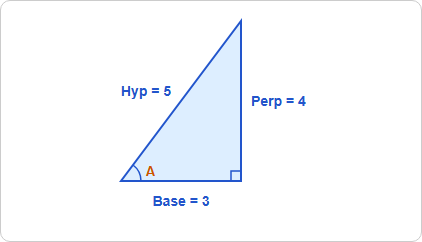 Given:
⇒ 3 tan A = 4
⇒ tan A = 4/3
Formula Used:
⇒ tan A = P ÷ B (where P = Perpendicular, B = Base)
⇒ sin A = P ÷ H (where H = Hypotenuse)
⇒ cos A = B ÷ H
⇒ H = √(P² + B²)
Calculation:
⇒ From tan A = 4/3, let P = 4 and B = 3
⇒ H = √(4² + 3²) = √(16 + 9) = √25 = 5
⇒ sin A = 4/5
⇒ cos A = 3/5
⇒ 4sin A + 3cos A = 4 × (4/5) + 3 × (3/5)
⇒ 4sin A + 3cos A = 16/5 + 9/5
⇒ 4sin A + 3cos A = 25/5 = 5
∴ The correct answer is 5.
Additional Information
Trigonometric Ratios
In a right-angled triangle, sin θ = Perpendicular ÷ Hypotenuse, cos θ = Base ÷ Hypotenuse, and tan θ = Perpendicular ÷ Base.
Pythagorean Triplets
A set of three positive integers a, b, and c that strictly satisfy a² + b² = c². Commonly tested triplets include (3, 4, 5), (5, 12, 13), and (8, 15, 17).
Trigonometric Identities
The three core fundamental identities are sin²θ + cos²θ = 1, 1 + tan²θ = sec²θ, and 1 + cot²θ = cosec²θ.
</p
Q4 · Trigonometry
If tanA + cotA = 2, then the value of tan² A + cot² A is:
- 16
- 2
- 8
- 4
Answer aur solution dekho
Archived marked answer: B
Shortcut Trick
If x + 1/x = 2, then the value of x is always 1.
Since cotA is the reciprocal of tanA, the equation tanA + 1/tanA = 2 implies tanA = 1.
This means cotA = 1/1 = 1.
Substitute these values directly: tan² A + cot² A = 1² + 1² = 2.
∴ The correct answer is 2.
Alternate Method
Given:
tanA + cotA = 2
Formula Used:
(a + b)² = a² + b² + 2ab
tanA × cotA = 1
Calculations:
⇒ Squaring both sides of the given equation:
⇒ (tanA + cotA)² = 2²
⇒ tan² A + cot² A + 2 × tanA × cotA = 4
⇒ tan² A + cot² A + 2 × 1 = 4
⇒ tan² A + cot² A = 4 − 2
⇒ tan² A + cot² A = 2
∴ The correct answer is 2.
Additional Information
Higher Powers Identity
If x + 1/x = 2, then for any positive integer n, the value of xⁿ + 1/xⁿ will always be equal to 2.
Squaring Concept for Variables
If x + 1/x = k, then the sum of their squares is derived directly as x² + 1/x² = k² − 2.
Basic Trigonometric Conversions
tanA = sinA ÷ cosA and cotA = cosA ÷ sinA, meaning that tanA and cotA are always reciprocals of each other.
</p
Q5 · Trigonometry
The value of (sin A + cosec A)² + (cos A + sec A)² is:
- 3 + tan² A + cot² A
- 7 + tan² A + cot² A
- 5 + tan² A + cot² A
- 1 + tan² A + cot² A
Answer aur solution dekho
Archived marked answer: B
Shortcut Trick
Put A = 45° in the given expression (since sin 45° = 1/√2 and cosec 45° = √2).
⇒ Expression = (1/√2 + √2)² + (1/√2 + √2)² = (3/√2)² + (3/√2)²
⇒ Expression = 9/2 + 9/2 = 9
Checking the given options for A = 45° (where tan 45° = 1 and cot 45° = 1), Option 2 gives 7 + 1² + 1² = 9.
∴ The correct answer is 7 + tan² A + cot² A.
Alternate Method
Given:
⇒ The expression: (sin A + cosec A)² + (cos A + sec A)²
Formula Used:
⇒ (x + y)² = x² + y² + 2xy
⇒ sin² θ + cos² θ = 1
⇒ sec² θ = 1 + tan² θ
⇒ cosec² θ = 1 + cot² θ
Calculations:
⇒ Expression = (sin A + cosec A)² + (cos A + sec A)²
⇒ Expression = (sin² A + cosec² A + 2 × sin A × cosec A) + (cos² A + sec² A + 2 × cos A × sec A)
⇒ Expression = sin² A + cosec² A + 2(1) + cos² A + sec² A + 2(1)
⇒ Expression = (sin² A + cos² A) + cosec² A + sec² A + 4
⇒ Expression = 1 + (1 + cot² A) + (1 + tan² A) + 4
⇒ Expression = 7 + tan² A + cot² A
∴ The correct answer is 7 + tan² A + cot² A.
Additional Information
Reciprocal Trigonometric Identities
The reciprocal relationships are given by: sin θ = 1 ÷ cosec θ, cos θ = 1 ÷ sec θ and tan θ = 1 ÷ cot θ.
Pythagorean Trigonometric Identities
Important identities: sin² θ + cos² θ = 1, sec² θ − tan² θ = 1, and cosec² θ − cot² θ = 1.
Value Substitution Trick
When expression options are in terms of variables, substituting standard angles (like 30° or 45°) can quickly verify the correct option directly and easily save calculation time.
</p
Q6 · Mensuration 2D
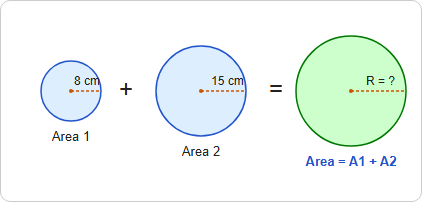
The radii of two circles are 8 cm and 15 cm. The perimeter of the circle having area equal to the sum of the areas of the two circles (in cm) is:
- 32π
- 30π
- 28π
- 34π
Answer aur solution dekho
Archived marked answer: D
Shortcut Trick
If the area of a circle is equal to the sum of the areas of two circles with radii r₁ and r₂, then the new radius R satisfies R² = r₁² + r₂².
The given radii 8 cm and 15 cm form a Pythagorean triplet with 17 cm.
Thus, the radius of the new circle is R = 17 cm.
Perimeter = 2πR = 2 × π × 17 = 34π cm.
∴ The correct answer is 34π cm.
Alternate Method
Given:
Radius of the first circle (r₁) = 8 cm
Radius of the second circle (r₂) = 15 cm
 Formula Used:
Area of a circle = πr²
Perimeter of a circle = 2πr
Calculations:
⇒ Area of first circle = π × 8² = 64π cm²
⇒ Area of second circle = π × 15² = 225π cm²
⇒ Total Area = 64π + 225π = 289π cm²
⇒ Let the radius of the new circle be R.
⇒ Area of the new circle = πR² = 289π
⇒ R² = 289
⇒ R = √289 = 17 cm
⇒ Perimeter of the new circle = 2 × π × R
⇒ Perimeter = 2 × π × 17 = 34π cm
∴ The correct answer is 34π cm.
Additional Information
Perimeter and Area of a Circle
The perimeter (circumference) of a circle is 2πr, and its area is πr², where r is the radius of the circle.
Area Proportionality Concept
When the area of a circle equals the sum of the areas of two other circles, their radii naturally form a Pythagorean triplet satisfying the equation R² = r₁² + r₂².
Circumference Proportionality Concept
If the circumference of a given circle equals the sum of the circumferences of two other circles, then the new radius directly satisfies R = r₁ + r₂.
Semi-Circle Formulas
The area of a semi-circle is πr² ÷ 2, and its total perimeter including the base diameter is πr + 2r.
</p
Q7 · Mensuration 2D
In △DEF , DE = 12 cm, EF = 15 cm, and ∠DEF = 90º. △DEF is congruent to △XYZ . If YZ = 15 cm, then what is the length of XZ?
- 3√(41)
- 2√(41)
- 5√(41)
- 4√(41)
Answer aur solution dekho
Archived marked answer: A
Shortcut Trick
Since △DEF ≅ △XYZ, their corresponding parts are equal. Therefore, XZ = DF.
In right-angled △DEF, DF is the hypotenuse as it is opposite to ∠DEF (90º).
Using the Pythagorean theorem: DF = √(DE² + EF²)
DF = √(12² + 15²) = √(144 + 225)
DF = √369 = √(9 × 41) = 3√41 cm.
∴ The correct answer is 3√41 cm.
Alternate Method
Given:
In △DEF, DE = 12 cm, EF = 15 cm, and ∠DEF = 90º.
△DEF ≅ △XYZ and YZ = 15 cm.
Formula Used:
Pythagoras Theorem: Hypotenuse² = Perpendicular² + Base²
Q8 · Mensuration 2D
What is the length (in cm) of each side of a cube if the volume of a cube is 13,824 cm3?
- 20.4
- 24
- 22
- 34
Answer aur solution dekho
Archived marked answer: B
Shortcut Trick
To find the side of the cube, we need the cube root of the given volume (13824 cm³).
The unit digit of 13824 is 4, which means its cube root will also end in 4 (since 4³ ends in 4).
Ignoring the last three digits (824), the remaining number is 13.
The largest perfect cube less than or equal to 13 is 8 (which is 2³), so the tens digit is 2.
Thus, the side length is 24 cm.
∴ The correct answer is 24 cm.
Alternate Method
Given:
Volume of the cube = 13824 cm³
Formula Used:
Volume of a cube = a³ (where a is the side of the cube)
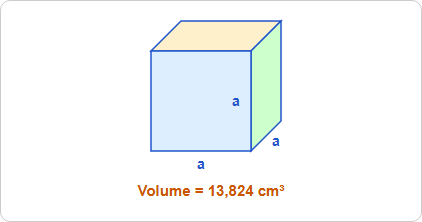 Calculations:
⇒ a³ = 13824
⇒ a³ = 2⁹ × 3³
⇒ a = (2⁹ × 3³)¹/³
⇒ a = 2³ × 3¹
⇒ a = 8 × 3
⇒ a = 24 cm
∴ The correct answer is 24 cm.
Additional Information
Total Surface Area of a Cube
The total surface area of a cube with side length 'a' is calculated using the formula 6a².
Lateral Surface Area of a Cube
The surface area excluding the top and bottom faces is known as lateral surface area, given by 4a².
Diagonal of a Cube
The length of the main diagonal connecting two completely opposite corners of the cube is a√3.
</p
Q9 · Algebra
Find the value of ((453 times 453 times 453 - 383 times 383 times 383))/((453 times 383 + 383 times 383 + 453 times 453))
- 60
- 50
- 80
- 70
Answer aur solution dekho
Archived marked answer: D
Shortcut Trick
The given expression follows the exact algebraic identity pattern: (a³ − b³) / (a² + ab + b²).
This structure directly simplifies to (a − b).
Here, a = 453 and b = 383.
Result = 453 − 383 = 70.
∴ The correct answer is 70.
Alternate Method
Given:
Expression: (453 × 453 × 453 &am
Q10 · Algebra
For what value of K does the following system have an infinite number of solutions? x + 2Ky - 8 = 0 2x - y - 16 = 0
- 4
- -1/4
- 2
- -1/2
Answer aur solution dekho
Archived marked answer: B
Shortcut Trick
For infinite solutions, the ratio of coefficients of x and y must be equal to the ratio of constants.
⇒ a₁/a₂ = b₁/b₂
⇒ 1/2 = 2K/(−1)
⇒ −2K = 1/2
⇒ K = −1/4
∴ The correct answer is −1/4.
Alternate Method
Given:
Equation 1: x + 2Ky − 8 = 0
Equation 2: 2x − y − 16 = 0
Formula Used:
For a system of linear equations a₁x + b₁y + c₁ = 0 and a₂x + b₂y + c₂ = 0 to have an infinite number of solutions, the condition is:
a₁/a₂ = b₁/b₂ = c₁/c₂
Calculation:
⇒ From the given equations, we identify the coefficients:
⇒ a₁ = 1, b₁ = 2K, c₁ = −8
⇒ a₂ = 2, b₂ = −1, c₂ = −16
⇒ Applying the condition for infinite solutions:
⇒ 1/2 = 2K/(−1) = −8−16
⇒ 1/2 = −2K = 1/2
⇒ Equating the first two parts to find K:
⇒ 1/2 = −2K
⇒ K = −1/4
∴ The correct answer is −1/4.
Additional Information
Condition for Unique Solution
If a₁/a₂ ≠ b₁/b₂, the system has exactly one solution and the lines intersect at a single point.
Condition for No Solution
If a₁/a₂ = b₁/b₂ ≠ c₁/c₂, the system has no solution and the lines are parallel.
Condition for Infinite Solutions
If a₁/a₂ = b₁/b₂ = c₁/c₂, the system has infinitely many solutions and the lines are coincident (overlapping).
</p
Q11 · Profit and Loss
A person purchased a table and a sofa for ₹28,000. He sold the sofa at a profit of 10% and the table at a profit 15.25%. If his total profit was 13%, then the difference between the cost price of the sofa and the table (in ₹) is:
- 1500
- 4000
- 5000
- 2500
Answer aur solution dekho
Archived marked answer: B
Shortcut Trick
Using the Alligation Method directly on profit percentages to find the ratio of their Cost Prices (CP):
Ratio of CP of Sofa to Table = (Table Profit % − Overall Profit %) : (Overall Profit % − Sofa Profit %)
⇒ Ratio = (15.25 − 13) : (13 − 10) = 2.25 : 3 = 225 : 300 = 3 : 4
Total CP parts = 3 + 4 = 7 parts ⇒ 7 parts = ₹28,000
⇒ 1 part = ₹4,000
Difference in CP = 4 parts − 3 parts = 1 part = ₹4,000
∴ The correct answer is ₹4000.
Alternate Method
Given:
⇒ Total Cost Price (CP) of Sofa and Table = ₹28,000
⇒ Profit percentage on selling the Sofa = 10%
⇒ Profit percentage on selling the Table = 15.25%
⇒ Overall profit percentage on both = 13%
Formula Used:
We apply the Rule of Alligation to find the ratio of the Cost Prices of the two articles.
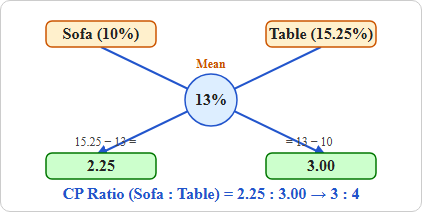 Calculations:
⇒ Let the CP of the Sofa be 3x and the CP of the Table be 4x.
⇒ Total CP = 3x + 4x = 7x
⇒ 7x = 28000
⇒ x = 28000 ÷ 7 = 4000
⇒ Required difference in CP = CP of Table − CP of Sofa
⇒ Difference = 4x − 3x = x
⇒ Difference = ₹4000
∴ The correct answer is ₹4000.
Additional Information
Rule of Alligation in Profit & Loss
When two items are mixed or sold together at different profit/loss percentages, applying the alligation method yields the ratio of their Base Values, which is the Cost Price (CP) for profit and loss scenarios.
Weighted Average Formula
The overall profit percentage is the weighted average of the individual profit percentages. Formula: Overall % = (CP₁ × P₁ + CP₂ × P₂) ÷ (CP₁ + CP₂).
Handling Loss in Alligation
If an item is sold at a loss, its percentage must be written with a negative sign (e.g., −10%) in the alligation cross. The arithmetic difference must be carefully calculated considering the negative sign.
<
Q12 · Profit and Loss
An article is sold for ₹747 after successive discounts of 17% and x%. If the marked price of the article is ₹1,600, what is the value of x?
- 32.26
- 43.75
- 22.12
- 40.28
Answer aur solution dekho
Archived marked answer: B
Shortcut Trick
Price after 1st discount of 17% = 1600 × (100 − 17)% = 1600 × 83% = ₹1328
Selling Price after 2nd discount (x%) = ₹747
Amount of 2nd discount = 1328 − 747 = ₹581
Value of x = (581 ÷ 1328) × 100 = 43.75
∴ The correct answer is 43.75.
Alternate Method
Given:
Marked Price (MP) = ₹1,600
Selling Price (SP) = ₹747
First discount (D₁) = 17%
Second discount (D₂) = x%
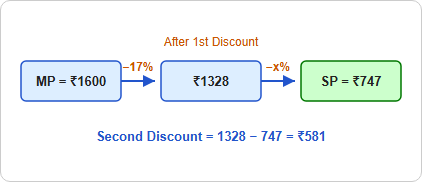 Formula Used:
SP = MP × (1 − D₁/100) × (1 − D₂/100)
Calculation:
⇒ 747 = 1600 × (1 − 17/100) × (1 − x/100)
⇒ 747 = 1600 × (83/100) × (1 − x/100)
⇒ 747 = 1328 × (1 − x/100)
⇒ 1 − x/100 = 747 ÷ 1328
⇒ 1 − x/100 = 9/16
⇒ x/100 = 1 − 9/16
⇒ x/100 = 7/16
⇒ x = (7 × 100) ÷ 16
⇒ x = 700 ÷ 16 = 43.75
∴ The correct answer is 43.75.
Additional Information
Marked Price (MP) and Discount
Discount is always calculated on the Marked Price (MP) of the article. SP = MP − Discount.
Successive Discounts
When two discounts of x% and y% are given successively, the equivalent single discount percentage is [x + y − (x × y)/100]%.
Profit/Loss Percentage
Profit or Loss is always calculated on the Cost Price (CP) unless stated otherwise. Profit % = (Profit ÷ CP) × 100.
Q13 · Time and Work
Pipe A takes 4/5 of the time required by pipe B to fill an empty tank individually. When an outlet pipe C is also opened simultaneously with pipes A and B, it takes 4/5 more time to fill the empty tank than it takes when only pipe A and pipe B are opened together. If it takes 40 hours to fill the tank when all the three pipes are opened simultaneously, in what time (in hours) will pipe C empty the full tank, operating alone?
- 50
- 45
- 65
- 75
Answer aur solution dekho
Archived marked answer: A
Shortcut Trick
Time taken by pipes A + B + C together = 40 hours.
Since A + B + C takes 4/5 more time than A + B, Time(A + B + C) = (1 + 4/5) × Time(A + B) = 9/5 × Time(A + B).
Time taken by A + B = 40 × (5/9) = 200/9 hours.
Let Total Work = LCM(40, 200/9) = 200 units.
Efficiency of C = Efficiency(A + B) − Efficiency(A + B + C) = 9 − 5 = 4 units/hour.
Time taken by C alone = 200 ÷ 4 = 50 hours.
∴ The correct answer is 50 hours.
Q14 · Number System
On dividing a number by 55, we get 28 as the remainder. On dividing the same number by 11, what is the remainder?
- 5
- 8
- 7
- 6
Answer aur solution dekho
Archived marked answer: D
Shortcut Trick
When a number is divided by D₁ leaving remainder R, and we divide it by D₂ (where D₁ is exactly divisible by D₂):
New Remainder = Remainder of (R ÷ D₂)
Here, D₁ (55) is exactly divisible by D₂ (11).
So, divide the first remainder 28 by 11 directly.
28 ÷ 11 = 2 with a remainder of 6.
∴ The correct answer is 6.
Alternate Method
Given:
A number when divided by 55 leaves a remainder of 28.
Formula Used:
Dividend = (Divisor × Quotient) + Remainder
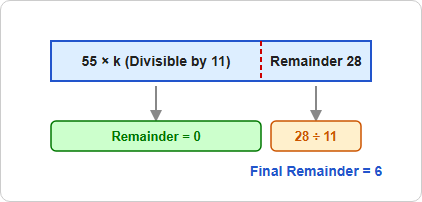 Calculations:
⇒ Let the quotient be k and the number be N.
⇒ N = 55 × k + 28
⇒ We need to find the remainder when N is divided by 11.
⇒ Let us express N in terms of multiples of 11.
⇒ N = (11 × 5 × k) + (11 × 2 + 6)
⇒ N = 11 × (5k + 2) + 6
⇒ Since 11 × (5k + 2) is completely divisible by 11, the remaining value 6 is the remainder.
∴ The correct answer is 6.
Additional Information
Division Algorithm
Dividend = (Divisor × Quotient) + Remainder. This equation forms the basis of all basic remainder theorem problems.
Divisibility Condition
This direct remainder shortcut only works when the first divisor (55) is an exact multiple of the second divisor (11). If it is not, the answer cannot be determined.
Negative Remainder Concept
For easier calculations in complex problems, remainders can also be treated as negative. For example, 28 ÷ 11 gives remainder 6, which is equivalent to a negative remainder of −5 (since 11 − 5 = 6).
</p
Q15 · Time and Distance
Two goods trains 132 m and 108 m in length are running towards each other on parallel tracks. The first train is running at a speed of 32 km/h and the second at a speed of 40 km/h. How much time will they take to cross each other after meeting?
- 12 s
- 10 s
- 13 s
- 15 s
Answer aur solution dekho
Archived marked answer: A
Shortcut Trick
Total distance = 132 + 108 = 240 m
Relative speed (opposite directions) = 32 + 40 = 72 km/h
Convert speed to m/s = 72 × (5/18) = 20 m/s
Time = Distance ÷ Speed = 240 ÷ 20 = 12 s
∴ The correct answer is 12 s.
Alternate Method
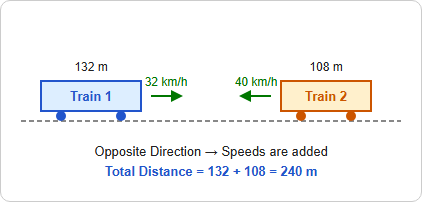 Given:
Length of first train (L₁) = 132 m
Length of second train (L₂) = 108 m
Speed of first train (V₁) = 32 km/h
Speed of second train (V₂) = 40 km/h
Formula Used:
Time taken to cross = Total distance ÷ Relative speed
For trains moving in opposite directions, Relative Speed = V₁ + V₂
Speed in m/s = Speed in km/h × (5/18)
Calculations:
⇒ Total Distance = L₁ + L₂ = 132 + 108 = 240 m
⇒ Relative Speed = V₁ + V₂ = 32 + 40 = 72 km/h
⇒ Relative Speed in m/s = 72 × (5/18) = 20 m/s
⇒ Time taken = 240 ÷ 20 = 12 s
∴ The correct answer is 12 s.
Additional Information
Relative Speed in Same Direction
When two bodies move in the same direction, their relative speed is the difference between their individual speeds: Vᵣₑₗ = |V₁ − V₂|.
Crossing a Stationary Object with Length
When a train crosses a bridge, tunnel, or platform, the total distance covered is the sum of the train's length and the object's length: Total Distance = Lₜᵣₐᵢₙ + Lₒbjₑ꜀ₜ.
Crossing a Stationary Point Object
When a train crosses a pole or a standing man, the distance covered is exactly equal to the length of the train: Total Distance = Lₜᵣₐᵢₙ.
Speed Unit Conversion Rule
To convert km/h to m/s, multiply by (5/18). To convert m/s to km/h, multiply by (18/5).
</p
Q16 · Data Interpretation
Study the given bar graph and answer the question that follows.
The following bar graph shows the higher secondary students of a school for the years 2008, 2009 and 2010.
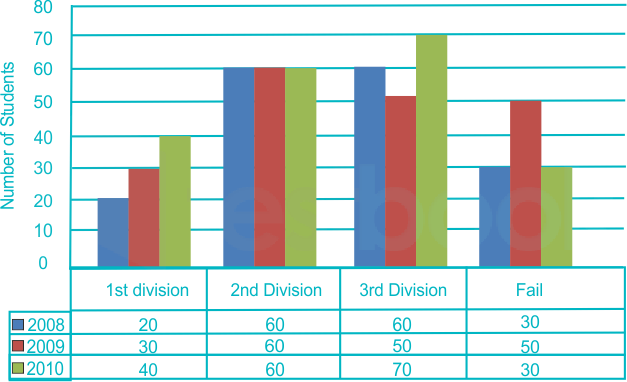 What was the percentage of students who passed in the first division in 2009?
- 16 13/19\% hspace{0.5em}
- 15 15/19\%
- 16 15/19\%$ hspace{0.5em}
- 15 13/19\% hspace{0.5em}
Answer aur solution dekho
Archived marked answer: B
Given:
The bar graph shows the number of higher secondary students of a school for the years 2008, 2009, and 2010, categorized by division (1st, 2nd, 3rd, and Fail).
Calculation:
Number of students who passed in the first division in 2009: 30
Total number of students in 2009: 30 (1st division) + 60 (2nd division) + 50 (3rd division) + 50 (Fail) = 190
Percentage of students who passed in the first division in 2009: (30 / 190) × 100 = 15 15/19\%
Therefore, the percentage of students who passed in the first division in 2009 i
s approximately 15 15/19\%.
Q17 · Simplification
Simplify the following expression. 133 ÷ 19 × 3 – 48 × 2 ÷ 24 + 841 ÷ { 45 – 16}
- 46
- 21
- 12
- 42
Answer aur solution dekho
Archived marked answer: A
Given:
Expression: 133 ÷ 19 × 3 – 48 × 2 ÷ 24 + 841 ÷ { 45 – 16}
Formula Used:
We will use the BODMAS/PEMDAS rule (Brackets, Orders (i.e., powers and square roots, etc.), Division and Multiplication, Addition and Subtraction) to simplify the expression.
Calculation:
First, solve the expression inside the brackets { 45 – 16 }:
⇒ 45 – 16 = 29
Now simplify the expression step by step:
⇒ 133 ÷ 19 × 3 – 48 × 2 ÷ 24 + 841 ÷ 29
Perform the division and multiplication from left to right:
⇒ (133 ÷ 19) × 3 – (48 × 2) ÷ 24 + (841 ÷ 29)
⇒ 7 × 3 – 96 ÷ 24 + 29
⇒ 21 – 4 + 29
Perform the addition and subtraction from left to right:
⇒ 21 – 4 = 17
⇒ 17 + 29 = 46
The correct answer is option 1.
Q18 · Proportion
If the mean proportional between p and q is 12, then the possible values of p and q, respectively, are:
- 3, 38
- 3, 28
- 24, 6
- 24, 16
Answer aur solution dekho
Archived marked answer: C
Shortcut Trick
The mean proportional between two numbers p and q is given by √(pq).
⇒ √(pq) = 12 ⇒ pq = 144
Checking the given options for a product equal to 144:
⇒ 24 × 6 = 144
∴ The correct answer is 24, 6.
Alternate Method
Given:
Mean proportional between p and q = 12
Formula Used:
If b is the mean proportional between a and c, then b² = a × c.
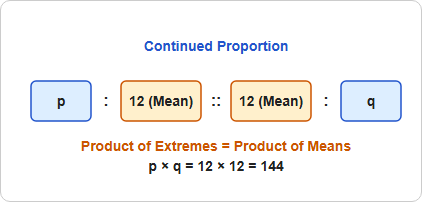 Calculations:
⇒ As 12 is the mean proportional, p, 12, and q are in continued proportion.
⇒ p : 12 :: 12 : q
⇒ p ÷ 12 = 12 ÷ q
⇒ p × q = 12 × 12
⇒ pq = 144
Now, let's substitute the values from the given options to find which pair gives a product of 144:
⇒ Option 1: 3 × 38 = 114
⇒ Option 2: 3 × 28 = 84
⇒ Option 3: 24 × 6 = 144
⇒ Option 4: 24 × 16 = 384
⇒ Only Option 3 satisfies the condition (24 × 6 = 144).
∴ The correct answer is 24, 6.
Additional Information
Third Proportional
If c is the third proportional to a and b, then a : b :: b : c, which gives the formula c = b² ÷ a.
Fourth Proportional
If d is the fourth proportional to a, b, and c, then a : b :: c : d, which gives the formula d = (b × c) ÷ a.
Duplicate & Sub-duplicate Ratio
The duplicate ratio of a : b is given by a² : b². The sub-duplicate ratio of a : b is given by √a : √b.
</p
Q19 · Percentage
Vipul spends 30% of his monthly income on rent, 60% of the remaining on groceries, and 40% of the remaining on others. If he saves ₹ 7056 in a month, then how much (in ₹) does he spend on groceries?
- 18323
- 15230
- 17640
- 22386
Answer aur solution dekho
Archived marked answer: C
Shortcut Trick
Savings % = 100% × (100% − 30%) × (100% − 60%) × (100% − 40%)
⇒ Savings = 100% × 0.7 × 0.4 × 0.6 = 16.8%
Given 16.8% of Income = ₹ 7056 ⇒ 1% = 7056 ÷ 16.8 = ₹ 420
Grocery % = 60% of the first remaining (70%) = 42%
Amount spent on groceries = 42% × 420 = ₹ 17640
∴ The correct answer is ₹ 17640.
Alternate Method
Given:
Rent spend = 30% of Income
Grocery spend = 60% of remaining
Other spend = 40% of remaining
Savings = ₹ 7056
Formula Used:
Remaining Amount = Initial Amount × (100 − Spend %)/100
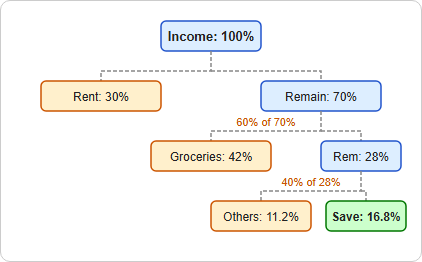 Calculations:
⇒ Let the total monthly income be x.
⇒ Amount left after paying rent = x − 0.30x = 0.70x
⇒ Amount spent on groceries = 60% of 0.70x = 0.42x
⇒ Amount left after grocery spend = 0.70x − 0.42x = 0.28x
⇒ Amount spent on others = 40% of 0.28x = 0.112x
⇒ Final Savings = 0.28x − 0.112x = 0.168x
⇒ 0.168x = 7056
⇒ x = 7056 ÷ 0.168 = ₹ 42000
⇒ Amount spent on groceries = 0.42 × 42000 = ₹ 17640
∴ The correct answer is ₹ 17640.
Additional Information
Successive Percentage Model
When a base value is continuously reduced by varying percentages, the final value is calculated as: Final = Base × (1 − R₁/100) × (1 − R₂/100)...
Multiplier Fraction Method
Instead of decimals, use fractions: 30% = 3/10 (remaining 7/10), 60% = 3/5 (remaining 2/5), 40% = 2/5 (remaining 3/5). Total remaining fraction = 7/10 × 2/5 × 3/5 = 42/250 = 16.8%.
Reverse Calculation
To find initial income from final savings directly, divide the savings successively by the remaining percentage factors: Base = Savings ÷ [ (1 − p₁) × (1 − p₂) ... ]
<
Q20 · Compound Interest
A cell phone is available for Rs.600 or for Rs.300 cash down payment together with Rs.360 to be paid after two months. Find the rate of interest charged under this scheme.
- 60%
- 120%
- 20%
- 50%
Answer aur solution dekho
Archived marked answer: B
Shortcut Trick
Remaining Principal = Total Price − Down Payment = 600 − 300 = Rs. 300
Interest = Final Amount − Remaining Principal = 360 − 300 = Rs. 60
Time = 2 months = 2 ÷ 12 = 1/6 years
Rate (%) = (Interest × 100) ÷ (Principal × Time)
Rate = (60 × 100) ÷ (300 × 1/6) = 6000 ÷ 50 = 120%
∴ The correct answer is 120%.
Alternate Method
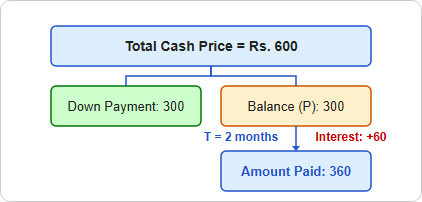 Given:
Cash price of the cell phone = Rs. 600
Down payment = Rs. 300
Amount paid after 2 months = Rs. 360
Formula Used:
Simple Interest (I) = (P × R × T) ÷ 100
Where P = Principal, R = Rate of interest, T = Time in years
Calculations:
⇒ Principal (P) = Cash price − Down payment
⇒ P = 600 − 300 = Rs. 300
⇒ Interest (I) = Amount paid − Principal
⇒ I = 360 − 300 = Rs. 60
⇒ Time (T) = 2 months = 2 ÷ 12 years = 1/6 years
⇒ 60 = (300 × R × (1/6)) ÷ 100
⇒ 60 = (300 ÷ 100) × R × (1/6)
⇒ 60 = 3 × R × (1/6)
⇒ 60 = R ÷ 2
⇒ R = 60 × 2 = 120%
∴ The correct answer is 120%.
Additional Information
Simple Interest (SI)
The interest calculated strictly on the original principal amount over a given time period. Formula: I = (P × R × T) ÷ 100.
Installment Interest Calculation
In partial payment or down payment schemes, the interest is continually charged only on the unpaid balance (outstanding principal) for the specific time interval until the final settlement is made.
Time Conversion
When the time is given in months rather than years, it must always be divided by 12 to convert it to annual terms before substituting it into the standard Simple Interest formula.
</p
Q21 · Mixture and Alligation
A man buys 10 kg of wheat at a rate of ₹26/kg. The wheat is mixed with 6 kg of other good quality of wheat to get a mixture at a price of ₹35/kg. The price of good quality wheat per kg (in ₹) is:
- 38
- 42
- 50
- 46
Answer aur solution dekho
Archived marked answer: C
Shortcut Trick
Using the Alligation Method:
Quantity Ratio = 10 kg : 6 kg = 5 : 3
By alligation rule: (x − 35) ÷ (35 − 26) = 5 ÷ 3
⇒ (x − 35) ÷ 9 = 5 ÷ 3
⇒ x − 35 = 15 ⇒ x = 50
∴ The correct answer is ₹50.
Alternate Method
Given:
Quantity of regular wheat = 10 kg at ₹26/kg
Quantity of good quality wheat = 6 kg at ₹x/kg
Resulting mixture price = ₹35/kg
Formula Used:
Weighted Average Price = (Q₁ × P₁ + Q₂ × P₂) ÷ (Q₁ + Q₂)
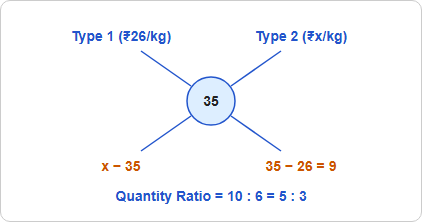 Calculations:
⇒ Total quantity of the mixture = 10 + 6 = 16 kg
⇒ Total cost of 10 kg wheat = 10 × 26 = ₹260
⇒ Total cost of 6 kg good quality wheat = 6 × x = ₹6x
⇒ Total cost of 16 kg mixture = 16 × 35 = ₹560
⇒ 260 + 6x = 560
⇒ 6x = 560 − 260
⇒ 6x = 300
⇒ x = 50
∴ The correct answer is ₹50.
Additional Information
Alligation Rule
When two ingredients of different prices are mixed, the ratio of their quantities is given by: Quantity 1 : Quantity 2 = (Price 2 − Mean Price) : (Mean Price − Price 1).
Weighted Average
The mean or average value of a mixture is calculated using the weighted average formula: Mean = (w₁x₁ + w₂x₂) ÷ (w₁ + w₂).
Replacement in Mixtures
When a quantity 'y' is replaced 'n' times from an initial mixture volume 'x', the remaining quantity of the pure substance is given by: x(1 − y ÷ x)ⁿ.
<
Q22 · Age
Ghanshyam is thrice as old as Akash. 10 years ago, Ghanshyam was four times as old as Akash. What is the difference between their current ages (in years)?
- 65
- 50
- 55
- 60
Answer aur solution dekho
Archived marked answer: D
Shortcut Trick
The age difference between two persons remains constant over time.
Present Ratio (Ghanshyam : Akash) = 3 : 1 (Difference = 2 parts)
10 Years Ago Ratio = 4 : 1 (Difference = 3 parts)
Multiply present ratio by 3 and past ratio by 2 to equate differences → Present = 9 : 3, Past = 8 : 2
Change in ratio = 9 − 8 = 1 part = 10 years.
Present age difference = 9 − 3 = 6 parts = 6 × 10 = 60 years.
∴ The correct answer is 60 years.
Alternate Method
Given:
Current age of Ghanshyam is thrice the current age of Akash.
10 years ago, Ghanshyam was 4 times as old as Akash.
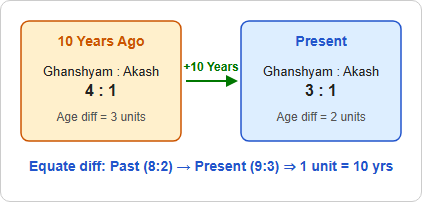 Calculations:
Let the current age of Akash be x years.
⇒ Current age of Ghanshyam = 3x years
Age of Akash 10 years ago = (x − 10) years
Age of Ghanshyam 10 years ago = (3x − 10) years
According to the given condition, 10 years ago Ghanshyam was 4 times as old as Akash:
⇒ 3x − 10 = 4 × (x − 10)
⇒ 3x − 10 = 4x − 40
⇒ x = 40 − 10
⇒ x = 30
⇒ Current age of Akash = 30 years
⇒ Current age of Ghanshyam = 3 × 30 = 90 years
⇒ Difference in their current ages = 90 − 30 = 60 years
∴ The correct answer is 60 years.
Additional Information
Constant Age Difference
The absolute difference between the ages of two individuals always remains constant at any point in time. This fundamental property is heavily used to equate ratio differences in age-related problems.
Ratio & Proportion Basics
If two quantities are in the ratio a : b, their actual values can be assumed to be ax and bx, where x is a common multiplier representing the value of one proportional unit.
Linear Equations in Ages
Most age-related word problems can be converted into standard linear equations of the form ax + b = cy + d, which can be rapidly solved by simplifying the variables on one side.
</p
English
Q1 · Vocabulary
Select the most appropriate ANTONYM of the given word.
Foment
- Proximity
- Remoteness
- Separation
- Regulate
Answer aur solution dekho
Archived marked answer: D
The correct answer is: Regulate.
Key Points
- The word "foment" means to instigate or stir up an undesirable or violent sentiment or course of action.
- Example: He was accused of fomenting violence during the protests.
- "Regulate" means to control or maintain the rate or speed of a machine or process so that it operates properly.
- Example: The government plans to regulate the financial market to prevent fraud.
Q2 · Vocabulary
Select the most appropriate ANTONYM of the given word.
Hostile
- Incoherent
- Doubtful
- Eager
- Friendly
Answer aur solution dekho
Archived marked answer: D
The correct answer is: Option 4.
Key Points
- The word "Hostile" means unfriendly, antagonistic, or showing ill will.
- Example: The negotiations were difficult due to the hostile attitude of the other party.
- "Friendly" refers to being kind, pleasant, and supportive.
- Example: She has a friendly demeanor that makes everyone feel welcome.
- Hence, we can infer that the opposite of 'Hostile' is 'Friendly'.
<
Q3 · Vocabulary
Select the most appropriate option to substitute the underlined segment in the given sentence.
Nina has not yet learned how to straighten up and fly right.
- forget the wrongdoings of the others
- improve her absurd behaviour and act seriously
- be professional in flying the aircraft
- remember the past and prepare for the future
Answer aur solution dekho
Archived marked answer: B
The correct answer is Option 2.
Key Points
- The phrase "straighten up and fly right" is an idiomatic expression meaning to improve one's behavior, act properly, and conduct oneself correctly.
- It does not refer to piloting an aircraft or addressing the past, rather it focuses on correcting one's improper behavior and becoming more responsible.
- Thus, the most appropriate substitution is improve her absurd behaviour and act seriously.
Therefore, the correct answer is Option 2.
Correct Sentence: *"Nina has not yet learned how to improve her absurd behaviour and act seriously."*
Additional Information
- Option 1: "forget the wrongdoings of the others" – This does not capture the meaning of improving one's own behavior.
- Option 3: "be professional in flying the aircraft" – This is a literal interpretation involving aviation, which is unrelated to the idiomatic context of the sentence.
- Option 4: "remember the past and prepare for the future" – This is about reflecting on the past and planning ahead, which, although good advice, does not convey the essence of improving inappropriate behavior.
Q4 · Vocabulary
Select the most appropriate meaning of the underlined idiom in the following sentence.
Rahul won the extempore competition. He is lucky to be blessed with the gift of the gab.
- An honest person
- A big surprise
- A lucky person
- A talent for speaking
Answer aur solution dekho
Archived marked answer: D
The correct answer is: Option 4.
Key Points
- The idiom "gift of the gab" means a talent for speaking fluently and persuasively.
- Example: Politicians often have the gift of the gab, which helps them to engage with the public effectively.
- "Gift of the gab" refers to the ability to speak easily, confidently, and in a way that makes people want to listen to you.
- Example: She has the gift of the gab, making her an excellent salesperson.
Therefore, the correct answer is: Option 4.
Additional Information
Here are the other options explained along with their Hindi meanings and example sentences:
- Option 1: An honest person: Someone who is truthful and sincere.
- Example: She is known to be an honest person who never lies.
- Option 2: A big surprise: Something unexpected and astonishing.
- Example: The news of his promotion came as a big surprise to everyone.
- Option 3: A lucky person: Someone who frequently experiences good fortune.
- Example: He is such a lucky person; he always wins the lottery.
Q5 · Vocabulary
Select the option that can be used as a one-word substitute for the given group of words.
That which is no longer in existence
- Extinct
- Removed
- Vanished
- Destroyed
Answer aur solution dekho
Archived marked answer: A
The correct answer is: Extinct.
Key Points
- The word "Extinct" means something that is no longer in existence, having no living members.
- Example: Dinosaurs have been extinct for millions of years.
- "Extinct" refers to a species, family, or other larger group having no living members.
- Example: The dodo bird is an example of an extinct species.
- Hence, we can infer that the meaning of 'Extinct' is 'no longer in existence'.
Therefore, the correct answer is: Extinct.
Additional Information
Here are the other options explained along with their Hindi meanings and example sentences:
- Removed : Taken away or off from the position occupied.
- Example: The outdated files were removed from the system.
- Vanished : Disappeared suddenly and completely.
- Example: The magician vanished into thin air.
- Destroyed: Put an end to the existence of (something) by damaging or attacking it.
- Example: The building was destroyed by the fire.
Q6 · Vocabulary
Select the option that can be used as a one-word substitute for the given group of words.
Dealing with things in a practical and sensible way
- Pragmatic
- Sceptic
- Stoic
- Cynic
Answer aur solution dekho
Archived marked answer: A
The correct answer is: Option 1.
Key Points
- The word "Pragmatic" means dealing with things sensibly and realistically in a way that is based on practical rather than theoretical considerations.
- Example: His pragmatic approach to problem-solving has always been effective.
- "Pragmatic" refers to being practical and focused on reaching a goal.
- Example: She took a pragmatic stance on the issue, favoring practical solutions over theoretical debates.
Therefore, the correct answer is: Option 1.
Additional Information
Here are the other options explained along with their Hindi meanings and example sentences:
- Sceptic : A person inclined to question or doubt accepted opinions.
- Example: As a sceptic, he doubted the authenticity of the news.
- Stoic : A person who can endure pain or hardship without showing their feelings or complaining.
- Example: Even during tough times, she remained stoic and composed.
- Cynic: A person who believes that people are motivated purely by self-interest rather than acting for honorable or unselfish reasons.
- Example: His cynical view of the world made it difficult for him to trust others.
Q7 · Vocabulary
Select the option that can be used as a one-word substitute for the given group of words
Anything pertaining to cats
- Bovine
- Canine
- Taurine
- Feline
Answer aur solution dekho
Archived marked answer: D
The correct answer is: Option 4.
Key Points
- The word "Bovine" pertains to cattle or oxen.
- Example: The farmer took care of his bovine herd with great dedication.
- "Feline" pertains to cats.
- Example: The feline grace of the cat made it a favorite among the pet lovers.
Therefore, the correct answer is: Option 4.
Additional Information
Here are the other options explained along with their Hindi meanings and example sentences:
- Canine: Pertaining to dogs.
- Example: The canine unit of the police force is highly trained.
- Taurine: Pertaining to bulls.
- Example: The taurine energy drink is believed to boost physical performance.
Given:
Expression: 133 ÷ 19 &time
Q8 · Vocabulary
Select the correct spelling to fill in the blank.
Definitions of _______ are subjective to various interpretations.
- sovereignty
- suvereignty
- sovereinity
- sovereinty
Answer aur solution dekho
Archived marked answer: A
The correct answer is: Option 1.
Key Points
- The word "sovereignty" means supreme power or authority; it can also refer to the authority of a state to govern itself or another state.
- Example: The country struggled to maintain its sovereignty in the face of external pressures.
- "Sovereignty" refers to the full right and power of a governing body to govern itself without any interference from outside sources or bodies.
- Example: The sovereignty of the nation was a key point of discussion at the international conference.
Therefore, the correct answer is: Option 1.
Additional Information
Here are the other options explained along with their Hindi meanings and example sentences:
- Suvereignty : This is an incorrect spelling and does not have a specific meaning.
- Sovereinity : This is an incorrect spelling and does not have a specific meaning.
- Sovereinty: This is an incorrect spelling and does not have a specific meaning.
The correct answer is Option
Q9 · Vocabulary
Select the INCORRECTLY spelt word.
- Guilty
- Atempt
- Admit
- Agree
Answer aur solution dekho
Archived marked answer: B
The correct answer is: Option 2.
Key Points
- The word "Atempt" is incorrectly spelt. The correct spelling is "Attempt".
- Example: He made an attempt to climb the mountain.
- "Attempt" refers to an effort to achieve or complete a challenging task.
- Example: She made a second attempt to pass the exam.
Therefore, the correct answer is: Option 2.
Additional Information
Here are the other options explained along with their Hindi meanings and example sentences:
- Guilty: Responsible for a specified wrongdoing.
- Example: He felt guilty for lying to his friend.
- Admit: Confess to be true or to be the case.
- Example: She admitted to making a mistake.
- Agree: Have the same opinion about something; concur.
- Example: We all agreed on the need for change.
The correct answer is: Option 2
Q10 · Vocabulary
Select the most appropriate meaning of the underlined word.
At times, David behaves in a very obdurate manner to kids.
- trusting
- amiable
- obstinate
- envious
Answer aur solution dekho
Archived marked answer: C
The correct answer is: Option 3.
Key Points
- The word "obdurate" means stubbornly refusing to change one's opinion or course of action.
- Example: Despite the pleas from his friends, he remained obdurate in his decision to leave the city.
- "Obstinate" also means stubbornly refusing to change one's opinion or action, often despite attempts to persuade one to do so.
- Example: He was too obstinate to admit that he was wrong.
- Hence, we can infer that "obdurate" is synonymous with "obstinate".
Therefore, the correct answer is: Option 3.
Additional Information
Here are the other options explained along with their Hindi meanings and example sentences:
- Trusting : Showing or tending to have a belief in a person's honesty or sincerity; not suspicious.
- Example: She was so trusting that she lent him her car without hesitation.
- Amiable : Having or displaying a friendly and pleasant manner.
- Example: He was an amiable host, making everyone feel at home.
- Envious: Feeling or showing envy; wanting what someone else has.
- Example: She was envious of her friend's new job.
Q11 · Vocabulary
Select the most appropriate synonym of the given word.
Cascade
- Garden
- Waterfall
- Criticise
- Arcade
Answer aur solution dekho
Archived marked answer: B
The correct answer is: Option 2.
Key Points
- The word "Cascade" means a small waterfall, typically one of several that fall in stages down a steep rocky slope.
- Example: The mountain stream formed a beautiful cascade over the rocks.
- "Waterfall" refers to a place where water flows over a vertical drop or a series of steep drops in the course of a stream or river.
- Example: Niagara Falls is one of the most famous waterfalls in the world.
- Therefore, we can infer that the synonym of 'Cascade' is 'Waterfall'.
Therefore, the correct answer is: Option 2.
Additional Information
Here are the other options explained along with their Hindi meanings and example sentences:
- Garden : A piece of ground, often near a house, used for growing flowers, fruit, or vegetables.
- Example: She spends her weekends tending to her beautiful garden.
- Criticise : To express disapproval of someone or something.
- Example: It is easy to criticise others, but difficult to improve yourself.
- Arcade: A covered passageway with arches along one or both sides.
- Example: The shopping arcade was filled with people browsing the various stores.
Q12 · Vocabulary
Select the most appropriate synonym of the underlined word in the following sentence.
Sachin Tendulkar was an indispensable member of the Indian cricket team in his days.
- Motivational
- Essential
- Optional
- Functional
Answer aur solution dekho
Archived marked answer: B
The correct answer is: Option 2 i.e. Essential.
Key Points
- The word "indispensable" means something that is absolutely necessary or essential; it cannot be done without.
- Example: Water is indispensable for all living beings.
- "Essential" refers to something that is absolutely necessary; extremely important.
- Example: Food, water, and shelter are essential for survival.
- Hence, we can infer that the synonym of 'indispensable' is 'essential'.
Therefore, the correct answer is: Essential.
Additional Information
Here are the other options explained along with their Hindi meanings and example sentences:
- Motivational: Providing inspiration or encouragement.
- Example: His motivational speech inspired everyone to pursue their dreams.
- Optional: Available to be chosen but not obligatory.
- Example: Attendance at the seminar is optional but highly recommended.
- Functional: Having a special activity, purpose, or task; relating to the way in which something works or operates.
- Example: The new design is not only aesthetic but also highly functional.
The correct answer is '
Q13 · Vocabulary
Select the most appropriate option to fill in the blank.
Sharat is always ______ about showing up for work because he believes that tardiness gets us nowhere.
- selective
- patient
- drowsy
- punctual
Answer aur solution dekho
Archived marked answer: D
The correct answer is 'punctual'.
Key Points
- The word "punctual" means happening or doing something at the agreed or proper time; on time.
- Being punctual is essential in professional settings to demonstrate reliability and respect for others' time.
- The other options: "selective," "patient," and "drowsy" do not fit the context as appropriately.
Therefore, the correct answer is 'Option 4'.
Complete Sentence: *Sharat is always punctual about showing up for work because he believes that tardiness gets us nowhere.*
Additional Information
- Selective : means having the function or power of selecting; making a choice.
- Patient : means able to accept or tolerate delays, problems, or suffering without becoming annoyed or anxious.
- Drowsy : means being sleepy or lethargic.
Q14 · Grammar
The following sentence has been divided into four segments. Identify the segment in which the article has been used INCORRECTLY.
Master Sam / is a heaviest / boy in / grade twelve.
- boy in
- Master Sam
- grade twelve.
- is a heaviest
Answer aur solution dekho
Archived marked answer: D
The correct answer is: Option 4.
Key Points
- The word "heaviest" means having great weight; very large or much more than usual in size, amount, or degree.
- Example: The heaviest book in the library weighs over five kilograms.
- "a heaviest" is incorrect because "heaviest" is a superlative form and should be used with "the" instead of "a".
- Example: He is the heaviest boy in the class.
Therefore, the correct answer is: Option 4.
Additional Information
Here are the other options explained along with their Hindi meanings and example sentences:
- Master Sam : A respectful way of addressing a young boy.
- Example: Master Sam is very polite and well-mannered.
- boy in : Refers to a male child or young man.
- Example: He is a boy in grade five.
- grade twelve: The final year of secondary education in many countries.
- Example: She is studying hard for her grade twelve exams.
The correct answer is Fundamental rights
Q15 · Grammar
Parts of the following sentence have been given as options. Select the option that contains an error.
Deepak is studying B.tech. at IIT Delhi to become the engineer.
- B.tech. at IIT Delhi
- the engineer
- to become
- Deepak is studying
Answer aur solution dekho
Archived marked answer: B
The correct answer is Option 2.
Key Points
- In English, when referring to a generic profession, we do not use the definite article "the."
- The correct phrase should be "to become an engineer," not "the engineer."
Therefore, the correct answer is Option 2.
Correct Sentence: *"Deepak is studying B.tech. at IIT Delhi to become an engineer."*
Additional Information
- Option 1: "B.tech. at IIT Delhi" – This part is correct; it specifies what and where Deepak is studying.
- Option 3: "to become" – This part is correct; it accurately describes the purpose of his studies.
- Option 4: "Deepak is studying" – This part is correct; it is the main clause of the sentence.
Q16 · Grammar
Select the most appropriate option to substitute the underlined segment in the given sentence.
I had not only helped her by giving hints but also with providing her links.
- helped her not only by
- helped her not by
- helped her only by
- helped not only her by
Answer aur solution dekho
Archived marked answer: A
The correct answer is Option 1.
Key Points
- The phrase "not only... but also" is used to connect two related actions, emphasizing that both actions were done.
- The correct format for this phrase in the sentence is: "helped her not only by giving hints but also by providing her links."
- Thus, the most appropriate substitution is helped her not only by.
Therefore, the correct answer is Option 1.
Correct Sentence: *"I had helped her not only by giving hints but also by providing her links."*
Additional Information
- Option 2: "helped her not by" – This changes the intended meaning of the sentence and does not use the "not only... but also" structure correctly.
- Option 3: "helped her only by" – This implies that helping was limited to one action and does not reflect the intended emphasis of doing more than one thing.
- Option 4: "helped not only her by" – This is incorrect because it disrupts the proper structure and meaning of the phrase "not only... but also."
Q17 · Grammar
Select the most appropriate option to substitute the underlined segment in the given sentence.
Positive self-talk have a great affect on one’s self-worth.
- has a great affect
- have a great effect
- having a great affect
- has a great effect
Answer aur solution dekho
Archived marked answer: D
The correct answer is Option 4.
Key Points
- The verb "have" should be "has" to agree with the singular subject "Positive self-talk."
- The correct noun is "effect" rather than "affect." "Effect" is the noun form that means a change that results from an action, whereas "affect" is usually a verb.
- Thus, the correct substitution is has a great effect.
Therefore, the correct answer is Option 4.
Correct Sentence: *"Positive self-talk has a great effect on one’s self-worth."*
Additional Information
- Option 1: "has a great affect" – The word "affect" is incorrect here; "effect" is needed.
- Option 2: "have a great effect" – The verb "have" does not agree with the singular subject "Positive self-talk."
- Option 3: "having a great affect" – The structure "having" and the word "affect" are both incorrect in this context.
Q18 · Voice Change
Select the option that expresses the given sentence in active voice.
He was given a reward for his contribution by the Governor.
- For his contribution, he was rewarded by the governor.
- The governor rewarded him.
- The governor gave him a reward for his contribution.
- Rewarded by the governor, as he contributed along.
Answer aur solution dekho
Archived marked answer: C
The correct answer is Option 3.
Key Points
- Passive voice structure: The object of the active voice sentence becomes the subject of the passive voice sentence.
- In the active voice, the sentence is: "The governor gave him a reward for his contribution."
- To convert to passive voice: Place the object "a reward" at the beginning.
- Change the active verb form "gave" to "was given" (past simple passive).
- Add the preposition "by" followed by the original subject "the governor."
- Ensure the phrase "for his contribution" remains for clarity.
Therefore, the correct answer is Option 3.
Correct Sentence: *"The governor gave him a reward for his contribution."*
Additional Information
- Option 1: "For his contribution, he was rewarded by the governor." – This is a passive voice sentence.
- Option 2: "The governor rewarded him." – This is a correct active voice sentence but less detailed.
- Option 4: "Rewarded by the governor, as he contributed along." – This is an incomplete and incorrect sentence structure.
Q19 · Voice Change
Select the option that expresses the given sentence in passive voice.
We have to say little in this matter.
- Little had to be said in this matter.
- In this matter, little is to be said.
- In this matter, little must be said.
- Little has to be said in this matter.
Answer aur solution dekho
Archived marked answer: D
The correct answer is Option 4.
Key Points
- Passive voice structure: The object of the active voice sentence becomes the subject of the passive voice sentence.
- In the active voice, the sentence is: "We have to say little in this matter."
- To convert to passive voice: Place the object "little" at the beginning.
- Change the active verb form "have to say" to "has to be said" (passive form).
- Ensure the phrase "in this matter" remains at the end of the sentence for clarity.
Therefore, the correct answer is Option 4.
Correct Sentence: *"Little has to be said in this matter."*
Additional Information
- Option 1: "Little had to be said in this matter." – Incorrect tense (past tense).
- Option 2: "In this matter, little is to be said." – Incorrect structure and verb form.
- Option 3: "In this matter, little must be said." – Incorrect modal verb usage.
Q20 · Para Jumble
Sentences of a paragraph are given below in jumbled order. Select the option that arranges the sentences in the correct
logical sequence to form a meaningful and coherent paragraph.
a. It regulates the operation of all body organs and protects the body and mind from becoming unbalanced as a result of
negative circumstances and unhealthy lifestyles.
b. It only requires frequent practice of the proper body motions and breathing techniques.
c. The physical benefits of yoga can be enjoyed for a lifetime without risk or injury.
d. It regulates the relationship between the body, the intellect, and the spirit.
- d, a, b, c
- c, b, d, a
- b, a, c, d
- a, b, c, d
Answer aur solution dekho
Archived marked answer: B
The correct answer is Option (2) i.e. c, b, d, a
Key Points
- The sentence starts with "The physical benefits of yoga can be enjoyed for a lifetime without risk or injury," which is correctly indicated by part (c).
- Following the introduction, "It only requires frequent practice of the proper body motions and breathing techniques" (b) continues the logical sequence, explaining the requirement for achieving those benefits.
- The next part, "It regulates the relationship between the body, the intellect, and the spirit," elaborates on the benefits mentioned, indicated by (d).
- Ending with, "It regulates the operation of all body organs and protects the body and mind from becoming unbalanced as a result of negative circumstances and unhealthy lifestyles" (a) completes the explanation by describing the holistic impact of yoga.
Therefore, the correct answer is c, b, d, a.
Additional Information
- Option 1 (d, a, b, c): This option disrupts the logical flow, starting with a general statement about regulation and ending with the benefits of yoga, which is less coherent.
- Option 3 (b, a, c, d): This option places the requirement of practice before mentioning the benefits, making the initial statement unclear.
- Option 4 (a, b, c, d): This option starts with a detailed function of yoga instead of introducing the benefits first, which is less effective for understanding the overall advantages.