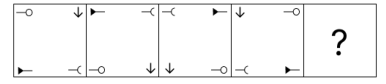
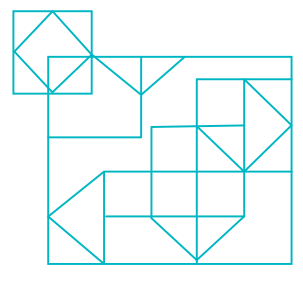
Q1 · Series
Answer aur solution dekho
Archived marked answer: A
SSC CGL · Tier 1 · Previous-year archive
94 questions available to read. Bina signup padho; timed practice ke liye free sign in karo.
This saved paper contains 95 of 100 expected questions. 1 stored records are excluded from this study page while their source or wording is checked. Missing original questions: 5. Local question numbers follow the saved archive; match the wording and choices when comparing another response sheet.
Archived marked answers and available solution notes are preserved. These are not claimed to be fully checked final SSC keys. How questions are checked.
Printable archive and coverage notes · Prepare this shift as a timed test
Archived marked answer: A
Archived marked answer: D
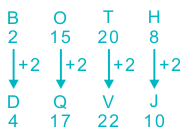
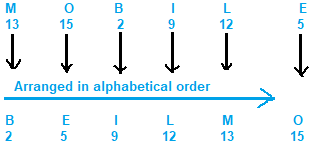
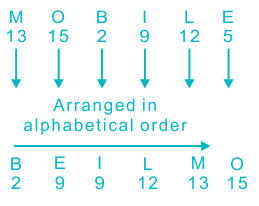
Hence, the correct answer is "GMTVI".Archived marked answer: D

Archived marked answer: C
Hence, the correct answer is "Option 3".Archived marked answer: B
Archived marked answer: C
Archived marked answer: B
Archived marked answer: C

Archived marked answer: A
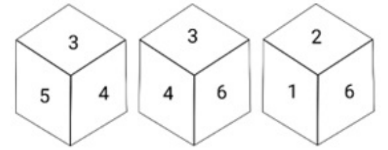
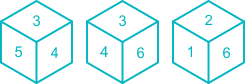
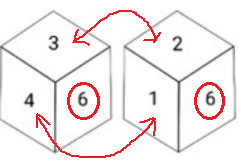
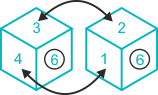
From both dices, 6 is common and on the same surface. So, all remaining surface will be opposite to each other.
6→5
4→1
3→2
4 is opposite to 1.
So, 3 will be opposite to 2.
Hence, the correct answer is "3".Archived marked answer: C
Archived marked answer: B
Archived marked answer: D
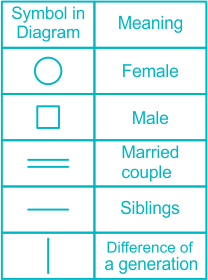
Decoding the Symbols:
Symbol
#
@
%
^
α
Meaning
Brother
Sister
Wife
Mother
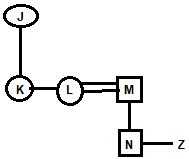
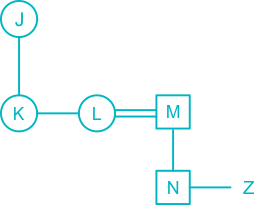
Brother of Z’s father
Father
Given: J % K # L @ M α N & Z
It means: J is the mother of K, K is the sister of L, L is the wife of M, M is the father of N and N is the brother of Z.
S, J is the Mother’s mother of Z.
Hence, the correct answer is "Mother’s mother".Archived marked answer: B
Archived marked answer: D
Archived marked answer: A
Archived marked answer: D
Archived marked answer: B
Archived marked answer: C
Archived marked answer: B
Archived marked answer: C
Archived marked answer: A
Archived marked answer: C
Archived marked answer: D
Archived marked answer: A
Archived marked answer: D
Archived marked answer: A
Archived marked answer: D
Archived marked answer: B
Archived marked answer: A
Archived marked answer: C
Archived marked answer: B
Archived marked answer: A
Archived marked answer: B
Archived marked answer: D
Calculations:
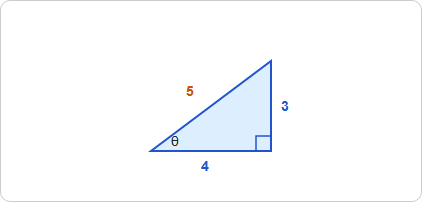
⇒ Let Perpendicular = 3k and Base = 4k
⇒ Hypotenuse = √((3k)² + (4k)²) = √(9k² + 16k²) = 5k
⇒ cosθ = 4k / 5k = 4/5
⇒ cos2θ = 2(4/5)² − 1 = 2(16/25) − 1 = 32/25 − 1 = 7/25
⇒ Now evaluate: (1 − cos2θ) / (1 + cos2θ)
⇒ (1 − 7/25) / (1 + 7/25)
⇒ (18/25) / (32/25)
⇒ 18 / 32 = 9 / 16
∴ The correct answer is 9/16.
Additional Information
Trigonometric Identities
sin²θ + cos²θ = 1, sec²θ − tan²θ = 1, cosec²θ − cot²θ = 1
Double Angle Formulas
sin2θ = 2sinθcosθ = 2tanθ / (1 + tan²θ)
cos2θ Formulas
cos2θ = cos²θ − sin²θ = 2cos²θ − 1 = 1 − 2sin²θ = (1 − tan²θ) / (1 + tan²θ)
tan2θ Formula
tan2θ = 2tanθ / (1 − tan²θ)
</pArchived marked answer: C
Archived marked answer: D
Archived marked answer: A
Archived marked answer: B
Given:
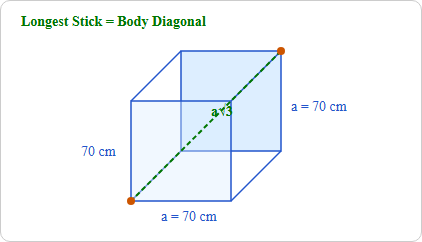
Edge length of the cubical vessel (a) = 70 cm
Formula Used:
The length of the longest stick that can be fitted inside a regular cubical vessel is equal to the length of its main body diagonal.
Body Diagonal of a cube = √(a² + a² + a²) = a√3
Calculations:
⇒ Length of longest stick = 70 × √3
⇒ Length of longest stick = 70√3 cm
∴ The correct answer is 70√3 cm.
Additional Information
Diagonal of a Cuboid
For a rectangular cuboid with length l, breadth b, and height h, the longest stick is its body diagonal given by √(l² + b² + h²).
Surface Area & Volume of a Cube
Volume = a³ | Total Surface Area = 6a² | Lateral (4-wall) Surface Area = 4a².
Inradius & Circumradius of a Cube
The radius of the largest sphere fitting inside (inradius) is a/2. The radius of the circumscribing sphere containing the cube (circumradius) is (a√3)/2.
</pArchived marked answer: B
Archived marked answer: A
Archived marked answer: D
Calculations:
Let Marked Price (MP) be 100 units.
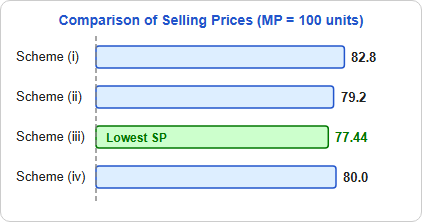
⇒ For Scheme (i): 10% and 8%
⇒ Effective Discount = 10 + 8 − (10 × 8) ÷ 100 = 18 − 0.8 = 17.2%
⇒ SP = 100 − 17.2 = 82.8 units
⇒ For Scheme (ii): successive discounts of 12% and 10%
⇒ Effective Discount = 12 + 10 − (12 × 10) ÷ 100 = 22 − 1.2 = 20.8%
⇒ SP = 100 − 20.8 = 79.2 units
⇒ For Scheme (iii): two successive discounts of 12%
⇒ Effective Discount = 12 + 12 − (12 × 12) ÷ 100 = 24 − 1.44 = 22.56%
⇒ SP = 100 − 22.56 = 77.44 units
⇒ For Scheme (iv): single discount of 20%
⇒ SP = 100 − 20 = 80 units
⇒ Comparing all Selling Prices, 77.44 units is the lowest.
⇒ The selling price is lowest for scheme (iii).
∴ The correct answer is scheme (iii).
Additional Information
Successive Discounts
When two discounts x% and y% are applied sequentially, the equivalent single discount is given by [x + y − (x × y) ÷ 100]%.
Selling Price Calculation
Selling Price (SP) = Marked Price (MP) × (100 − Discount %) ÷ 100. A higher equivalent discount directly results in a lower selling price.
Customer vs Retailer Benefit
For a customer, the scheme offering the maximum effective discount is the most beneficial. For a retailer, the scheme offering the minimum effective discount yields the highest profit margin.
</pArchived marked answer: D
Calculations:
⇒ For Amit:
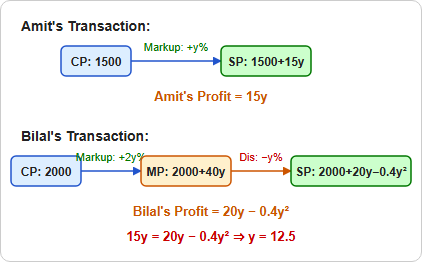
⇒ SP = 1500 × (1 + y/100) = 1500 + 15y
⇒ Profit = (1500 + 15y) − 1500 = 15y
⇒ For Bilal:
⇒ MP = 2000 × (1 + 2y/100) = 2000 + 40y
⇒ SP = (2000 + 40y) × (1 − y/100)
⇒ SP = 2000 − 20y + 40y − 0.4y² = 2000 + 20y − 0.4y²
⇒ Profit = (2000 + 20y − 0.4y²) − 2000 = 20y − 0.4y²
⇒ Since both make the same profit:
⇒ 15y = 20y − 0.4y²
⇒ 0.4y² = 5y
⇒ y = 5 ÷ 0.4 = 12.5
∴ The correct answer is 12.5.
Additional Information
Marked Price (MP) & Discount
Discount is always calculated on the Marked Price. Formula: SP = MP × (1 − Discount/100).
Successive Discounts
If two successive discounts of a% and b% are given, the equivalent single discount is (a + b − (a × b)/100)%.
Markup Percentage
Markup is always calculated on the Cost Price to arrive at the Marked Price. Formula: MP = CP × (1 + Markup/100).
14Archived marked answer: C
Archived marked answer: B
Archived marked answer: C
Formula Used:
Relative speed (running in the same direction) = Speed₁ − Speed₂
Time = Distance ÷ Relative Speed
Calculations:
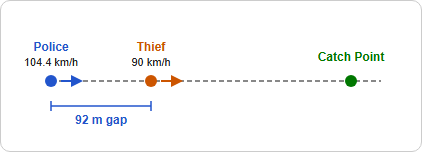
⇒ Relative speed = 104.4 − 90 = 14.4 km/h
⇒ To convert km/h to m/s, multiply by (5 / 18)
⇒ Relative speed in m/s = 14.4 × (5 / 18) = 0.8 × 5 = 4 m/s
⇒ Time required to catch the thief = Distance ÷ Relative speed
⇒ Time = 92 ÷ 4
⇒ Time = 23 seconds
∴ The correct answer is 23 seconds.
Additional Information
Relative Speed
When two bodies are moving in the same direction, their relative speed is the difference between their speeds (S₁ − S₂). If moving in opposite directions, it is the sum of their speeds (S₁ + S₂).
Unit Conversion
To convert a speed value from km/h into m/s, multiply the value by (5 / 18). Conversely, to convert from m/s into km/h, multiply by (18 / 5).
</p
Archived marked answer: D
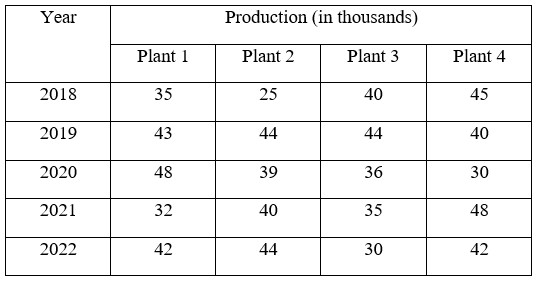
What is the difference between the average production of plant 1 and plant 2 during five years?Archived marked answer: A
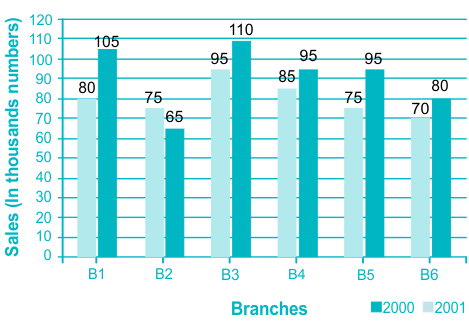
What is the ratio of the total sales of branch B2 for both years to the total sales of branch B4 for both years?Archived marked answer: B
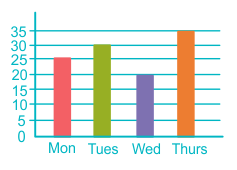
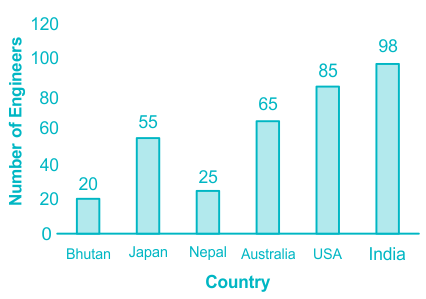
What is the ratio of the number of countries with above-average numbers of engineers to the number of countries with below-average numbers of engineers?Archived marked answer: A
Archived marked answer: A
Archived marked answer: D
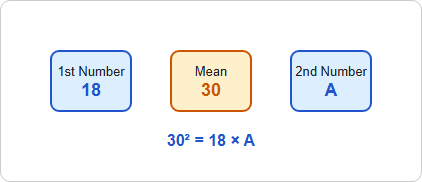
Calculation:
⇒ 30² = 18 × A
⇒ 900 = 18 × A
⇒ A = 900 ÷ 18
⇒ A = 50
∴ The correct answer is 50.
Additional Information
Mean Proportional
The mean proportional between two numbers a and b is given by √(a × b). It acts as the geometric mean of the two numbers.
Third Proportional
For two numbers a and b, the third proportional c satisfies a : b = b : c, which results in the formula c = b² ÷ a.
Fourth Proportional
For three numbers a, b, and c, the fourth proportional d satisfies a : b = c : d, yielding the formula d = (b × c) ÷ a.
</pArchived marked answer: A
Calculations:
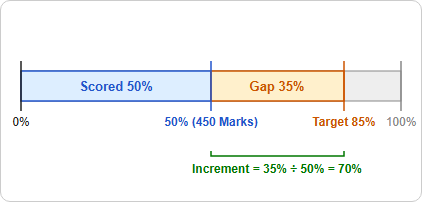
⇒ Percentage of marks scored by R = 85% − 35% = 50%
⇒ 50% of Total Marks = 450
⇒ Total Marks = (450 × 100) ÷ 50 = 900
⇒ Target marks = 85% of 900 = 765
⇒ Required increment to meet target = Target marks − Scored marks
⇒ Increment = 765 − 450 = 315
⇒ Percentage increment = (Increment ÷ Scored marks) × 100
⇒ Percentage increment = (315 ÷ 450) × 100 = 70%
∴ The correct answer is 70%.
Additional Information
Percentage Change Concept
To calculate the percentage change (increment or decrement) between two values, the reference base is always the initial value. Formula: % Change = (Difference ÷ Initial Value) × 100.
Base Concept in Marks
When an exam problem states that a student misses a target by a certain percentage, this deficit is calculated directly on the total maximum marks of the exam, meaning the target percentage and deficit percentage can be subtracted directly.
</pArchived marked answer: B
Calculations:
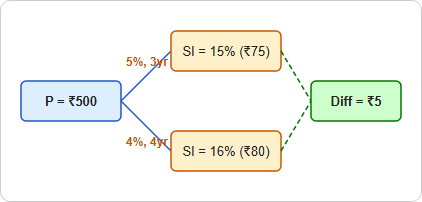
⇒ SI₁ = (500 × 5 × 3) ÷ 100 = 75
⇒ SI₂ = (500 × 4 × 4) ÷ 100 = 80
⇒ Difference = SI₂ − SI₁
⇒ Difference = 80 − 75 = 5
∴ The correct answer is ₹5.
Additional Information
Effective Interest Rate in SI
In Simple Interest, the interest is uniform every year. The effective percentage of interest over T years at R% p.a. is directly (R × T)% of the principal.
Compound Interest (CI)
Unlike SI, Compound Interest is calculated on both the initial principal and the accumulated interest from previous periods. Amount = P × (1 + R ÷ 100)T.
Difference Between CI and SI
For 2 years, the difference between CI and SI on a certain principal P at rate R% is determined by the formula: Difference = P × (R ÷ 100)².
138:T652Archived marked answer: A
Given:
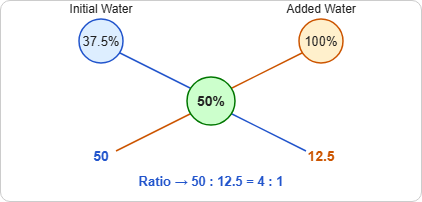
Total initial mixture = 32 litres
Ratio of Milk : Water = 5 : 3
Calculations:
⇒ Quantity of milk = (5 ÷ 8) × 32 = 20 litres
⇒ Quantity of water = (3 ÷ 8) × 32 = 12 litres
Let the quantity of pure water to be added be x litres.
⇒ Total volume of the new mixture = (32 + x) litres
⇒ Total volume of water in the new mixture = (12 + x) litres
According to the given condition, water becomes 50% of the resultant mixture.
⇒ (12 + x) ÷ (32 + x) = 50 ÷ 100
⇒ (12 + x) ÷ (32 + x) = 1 ÷ 2
⇒ 2 × (12 + x) = 32 + x
⇒ 24 + 2x = 32 + x
⇒ 2x − x = 32 − 24
⇒ x = 8 litres
∴ The correct answer is 8 litres.
Additional Information
Constant Component Principle
When a specific component (like water) is added to a mixture, the quantity of the other component (like milk) remains unchanged. Equating the unchanged component helps solve mixture problems rapidly without complex variables.
Rule of Alligation
It is used to find the ratio in which two ingredients or mixtures of given prices/concentrations must be mixed to produce a mixture of a desired price/concentration. The ratio is given by Quantity of Cheaper / Quantity of Dearer = (D − M) / (M − C).
Replacement Formula
If a container initially contains 'x' units of a pure liquid, and 'y' units are taken out and replaced by water for 'n' operations, then the final quantity of original liquid left = x × (1 − y/x)ⁿ.
</pArchived marked answer: B
Calculations:
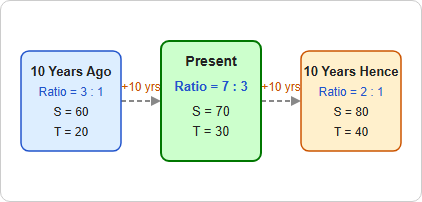
⇒ 10 years ago: S − 10 = 3 × (T − 10)
⇒ S − 3T = −20 ... (Equation 1)
⇒ 10 years hence: S + 10 = 2 × (T + 10)
⇒ S − 2T = 10 ... (Equation 2)
⇒ Subtracting (Equation 1) from (Equation 2):
⇒ (S − 2T) − (S − 3T) = 10 − (−20)
⇒ T = 30 years
⇒ Substituting the value of T in (Equation 2):
⇒ S − 2(30) = 10 ⇒ S = 70 years
⇒ Ratio of present ages = S : T = 70 : 30 = 7 : 3
∴ The correct answer is 7 : 3.
Additional Information
Cross-Multiplication Method
When an initial ratio a:b changes to c:d after adding/subtracting values x and y, the ratio value can be evaluated directly using: 1 unit = (c×y − d×x) ÷ (a×d − b×c).
Ratio Difference Technique
Since the absolute age gap between two individuals always remains constant over time, you can equate the difference in ratio parts of two periods by multiplying them with suitable common integers to solve problems faster.
Average Age Concept
If the average age of n persons is A, after x years, their new average age directly becomes A + x. The total sum of their ages increases by n × x years.
</pArchived marked answer: B
Archived marked answer: D
Archived marked answer: A
Archived marked answer: D
Archived marked answer: B
Archived marked answer: D
Archived marked answer: C
Archived marked answer: D
Archived marked answer: C
Archived marked answer: D
Archived marked answer: C
Archived marked answer: B
Archived marked answer: C