91 questions available to read. Bina signup padho; timed practice ke liye free sign in karo.
Archive coverageThis saved paper contains 91 of 100 expected questions. 0 stored records are excluded from this study page while their source or wording is checked. Missing original questions: 9. Local question numbers follow the saved archive; match the wording and choices when comparing another response sheet.
Archived marked answers and available solution notes are preserved. These are not claimed to be fully checked final SSC keys. How questions are checked.
Reasoning
Q1 · Series
Select the option that represents the letters that when sequentially placed from left to right in the blanks below will complete the letter series.
_ _ C _ D C _ _ C C _ _
- CCDCCDD
- CDCCDDC
- DCCCDCC
- DDCCCDD
Answer aur solution dekho
Archived marked answer: B
Given series: _ _ C _ D C _ _ C C _ _
Option 1) CCDCCDD → C C C D D C C C C C D D → (It doesn't follow any pattern)
Option 2) CDCCDDC → C D C C D C C D C C D C → (It follows the pattern of: CDC - CDC - CDC - CDC)
Option 3) DCCCDCC → D C C C D C C D C C C C → (It doesn't follow any pattern)
Option 4) DDCCCDD → D D C C D C C C C C D D → (It doesn't follow any pattern)
Hence, "Option 2" is the correct answer.
Q2 · Series
Select the number from among the given options that can replace the question mark (?) in the following series.
3, 6, 9, 18, 21, ?
- 42
- 24
- 40
- 63
Answer aur solution dekho
Archived marked answer: A
The logic followed here is:
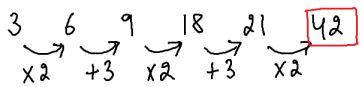 Hence, "Option 1" is the correct answer.
Q3 · Series
Identify the figure given in the options which when put in place of ? will logically complete the series.
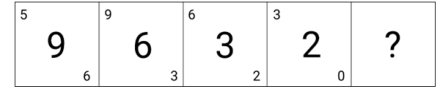


Answer aur solution dekho
Archived marked answer: C
The logic followed here is:
1) All the element shift upward anticlockwise direction subsequently.
2) The top element is replaced by new element on shifting.
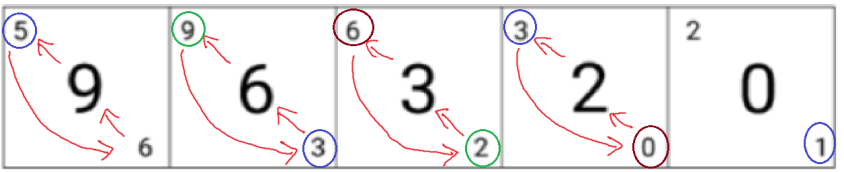 Thus, the final series is:
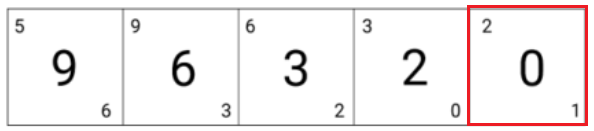 Hence, "Option 3" is the correct answer.
Q4 · Series
Select the option that can replace the question mark (?) in the following series.
NW17, PY19, RA21, TC23, ?
- VE25
- WD24
- XD24
- WF23
Answer aur solution dekho
Archived marked answer: A
The logic followed here is:
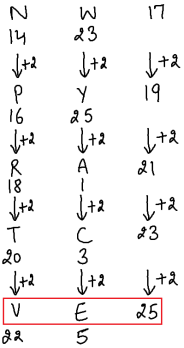 Hence, "Option 1" is the correct answer.
Q5 · Series
Select the combination of letters that when sequentially placed in the blanks of the given series will logically complete the series.
QUA_TO_ANT_UAN_KU_NT
- NUMTA
- NUTMA
- NUTAM
- NULTA
Answer aur solution dekho
Archived marked answer: A
The logic followed here is:
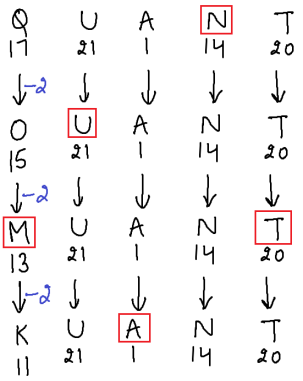 Hence, "Option 1" is the correct answer.
Q6 · Series
Select the figure from among the given option that can replace the question mark (?) in the following series.
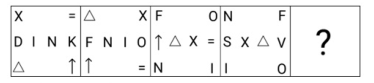


Answer aur solution dekho
Archived marked answer: D
The logic followed here is:
1) First box series →
The corner elements shift clockwise subsequently.
The center elements of 1st an 4th column are replaced by new element.
The rest of the elements interchange positions.
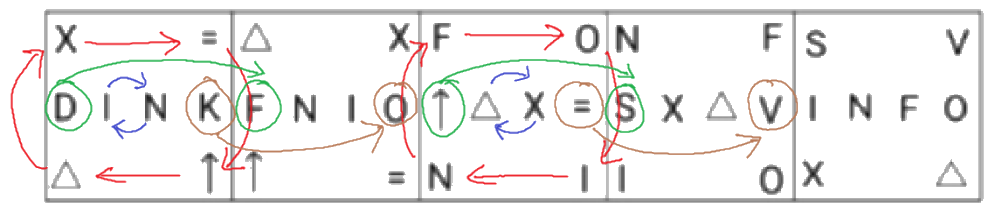 2) Second box series →
The 1st and 2nd column elements shift clockwise subsequently.
The 3rd and 4th column elements shift anticlockwise subsequently.
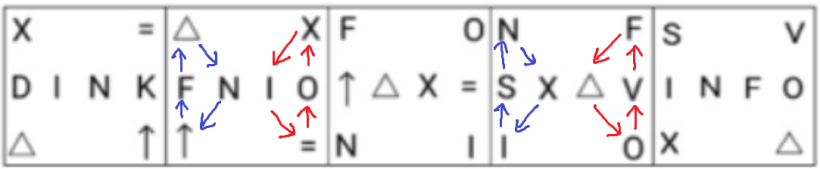 Thus, the final series is:
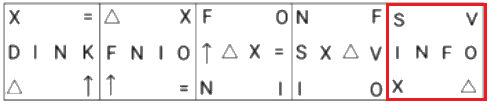 Hence, "Option 4" is the correct answer.
Q7 · Analogy
40 is related to 53 following certain logic. Following the same logic, 8 is related to 13. To which of the following numbers is 68 related, following the same logic? (NOTE : Operations should be performed on the whole numbers, without breaking
down the numbers into its constituent digits. E.g. 13 – Operations on 13 such as adding /deleting /multiplying etc., to 13 can be performed. Breaking down 13 into 1 and 3 and then performing mathematical operations on 1 and 3 is not allowed.)
- 84
- 85
- 83
- 73
Answer aur solution dekho
Archived marked answer: B
The logic followed here is:
Logic: [{√(1st number - 4)} + 1]² + 4 = 2nd number.
Now,
For, 40 : 53
⇒ [{√(40 - 4)} + 1]² + 4
⇒ [{√36} + 1]² + 4
⇒ [6 + 1]² + 4
⇒ 7² + 4
⇒ 49 + 4 = 53.
For, 8 : 13
⇒ [{√(8 - 4)} + 1]² + 4
⇒ [{√4} + 1]² + 4
⇒ [2 + 1]² + 4
⇒ 3² + 4 = 9 + 4 = 13.
Similarly, for 68 ∶ ?
⇒ [{√(68 - 4)} + 1]² + 4
⇒ [{√64} + 1]² + 4
⇒ [8 + 1]² + 4
⇒ 9² + 4 = 81 + 4 = 85.
Hence, the correct answer is "Option 2".
Q8 · Analogy
Select the option that is related to the fifth number in the same way as the second number is related to the first number and the fourth number is related to the third number.
10 : 110 :: 7 : 56 :: 9 : ?
(NOTE : Operations should be performed on the whole numbers, without breaking down the numbers into its constituent
digits. E.g. 13 – Operations on 13 such as adding /deleting /multiplying etc., to 13 can be performed. Breaking down 13 into 1
and 3 and then performing mathematical operations on 1 and 3 is not allowed.)
- 90
- 91
- 85
- 81
Answer aur solution dekho
Archived marked answer: A
The logic followed here is:
Logic: (1st number × (1st number + 1)) = 2nd number.
Now,
For, 10 : 110
⇒ (10 × (10 + 1)) = 10 × 11 = 110.
Q9 · Analogy
Select the set in which the numbers are related in the same way as are the numbers of the following sets.
(NOTE: Operations should be performed on the whole numbers, without breaking down the numbers into its constituent
digits. E.g. 13 – Operations on 13 such as adding /deleting /multiplying etc. to 13 can be performed. Breaking down 13 into 1
and 3 and then performing mathematical operations on 1 and 3 is not allowed.)
(21, 504, 8)
(17, 408, 8)
- (16, 320, 5)
- (23, 230, 5)
- (17, 272, 8)
- (16, 336, 7)
Answer aur solution dekho
Archived marked answer: D
The logic followed here is:
Logic: (1st number × 3rd number) × 3 = 2nd number.
Now,
For, (21, 504, 8)
⇒ (21 × 8) × 3
⇒ 168 × 3 = 504.
Q10 · Analogy
Select the word pair that best represents a similar relationship to the one expressed in the pair of words given below.
(The words must be considered as meaningful English words and must not be related to each other based on the number of
letters/number of consonants/vowels in the word)
Control : Domination
- Creation : Destruction
- Liberation : Slavery
- Descend : climb
- Manipulation : Deceive
Answer aur solution dekho
Archived marked answer: D
The logic followed here is:
Logic: Synonyms relationship.
Control : Domination → Control is synonymous with Domination.
Similarly,
Manipulation : Deceive → Manipulation is synonymous with Deceive.
Hence, the correct answer is "Manipulation : Deceive".
Q11 · Non Verbal Reasoning
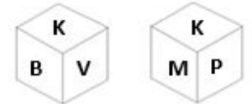
Two different positions of the same dice with faces K, B, V, M, P and T are shown below. Select the letter that will be on the
face opposite to the one having B.
- V
- P
- K
- M
Answer aur solution dekho
Archived marked answer: D
The logic followed here is :-
From the given two different dices the adjacent sides are as shown below :
As K is common on both the dices, it is clear that B, V, M, and P are adjacent to it, and the remaining i.e. T will be opposite to it.
Q12 · Non Verbal Reasoning
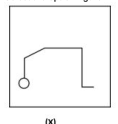
Select the option figure in which the given figure (X) is embedded (rotation is NOT allowed).
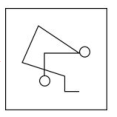
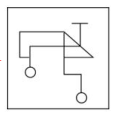
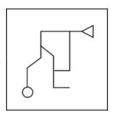
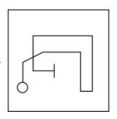
Answer aur solution dekho
Archived marked answer: D
The image embedded in the given figure is as shown below :
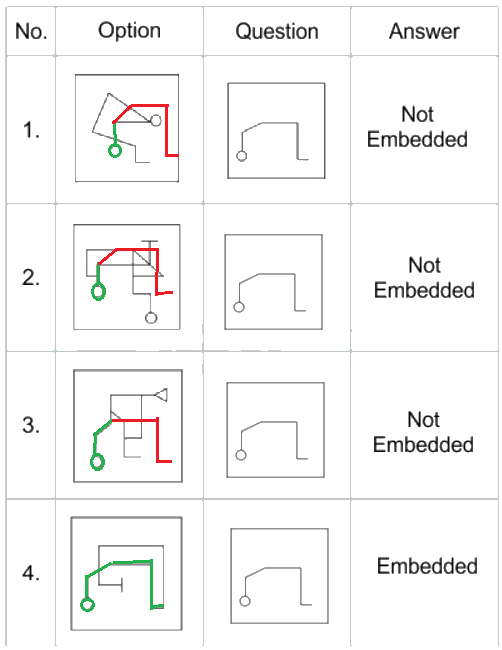 ∴ Here, given figure is embedded in the option figure 4.
Hence, the correct answer is "Option 4".
Q13 · Non Verbal Reasoning
How many triangles are there in the given figure?
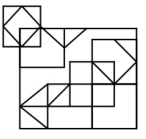
- 17
- 12
- 15
- 18
Answer aur solution dekho
Archived marked answer: D
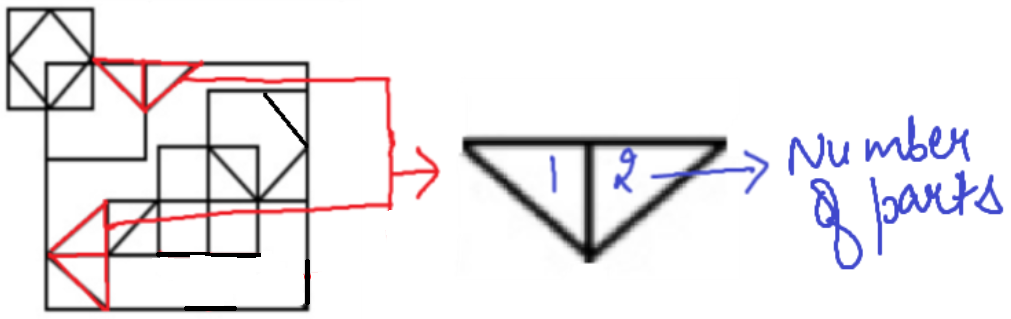
The number of triangles in the given figure is shown below:
1) Total triangles = [Number of parts × (1 + Number of parts)] ÷ 2
= [2 × (1 + 2)] ÷ 2
= [2 × 3] ÷ 2
= 6 ÷ 2
= 3
As there are 2 same types of triangles, therefore total number of triangles will be (3 × 2) = 6
 2) As marked there are total 12 triangles.
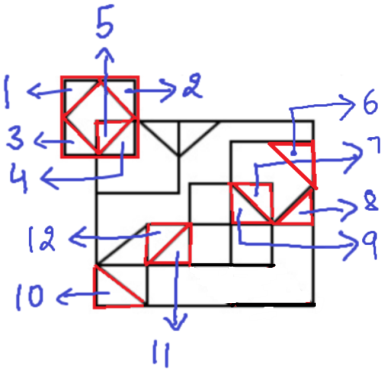 Thus, there are total (6 + 12) = 18 triangles.
Hence, "Option 4" is the correct answer.
Q14 · Non Verbal Reasoning
Select the correct mirror image of the given figure when the mirror is placed at MN as shown below.
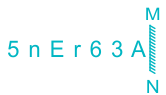




Answer aur solution dekho
Archived marked answer: D
The correct mirror image of the given figure is:
Q15 · Non Verbal Reasoning
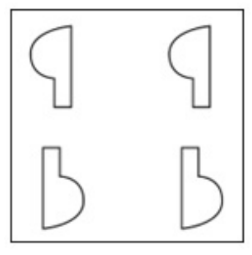
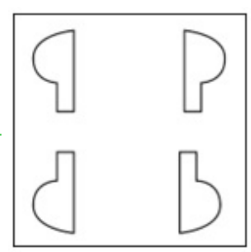
A paper is folded and cut as shown below. How will it appear when unfolded?
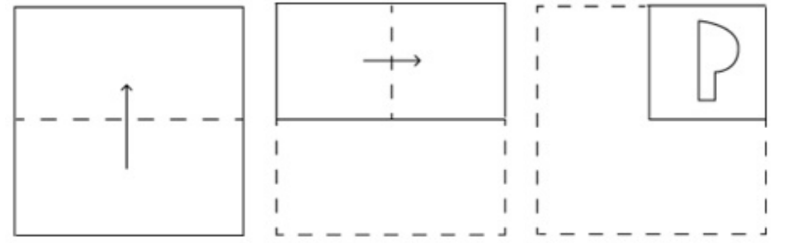
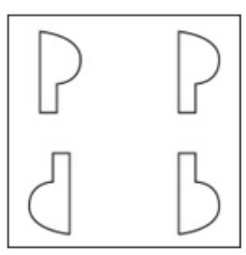
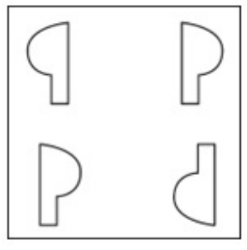
Answer aur solution dekho
Archived marked answer: B
The figure which will look like the paper when unfolded is shown below:
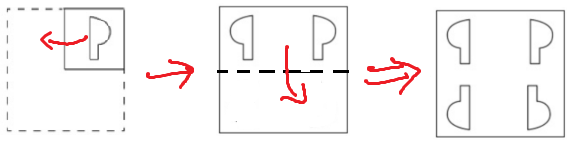 Thus, option Figure 2 will look like the paper when unfolded.
Hence, "Option 2" is the correct answer.
Q16 · Puzzle Subtypes Not To Miss
Select the number that will come in the place of the question mark(?), if ‘+’ and ‘ – ‘ are interchanged and ‘×’ and ‘÷’ are
interchanged
93 – 7 ÷ 65 × 13 + 34 = ?
- 87
- 94
- 99
- 104
Answer aur solution dekho
Archived marked answer: B
BODMAS Table:
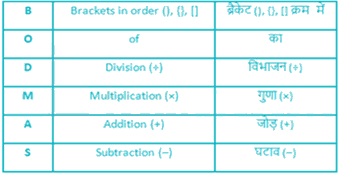 Given equation: 93 - 7 ÷ 65 × 13 + 34 = ?
Now, if ‘+’ and ‘-‘ are interchanged and ‘×’ and ‘÷’ are interchanged, then:
⇒ 93 + 7 × 65 ÷ 13 - 34 = ?
Following BODMAS rule:
⇒ 93 + 7 × 65 ÷ 13 - 34 = ?
⇒ 93 + 7 × 5 - 34 = ?
⇒ 93 + 35 - 34 = ?
⇒ 128 - 34 = ?
⇒ 94.
Hence, the correct answer is "Option 2".
Q17 · Puzzle Subtypes Not To Miss
Which two numbers (not digits) should be interchanged to make the given equation correct?
19 + 125 ÷ 25 – 100 ÷ 5 + 4 × 3 = 52
- 19 and 4
- 125 and 100
- 25 and 5
- 4 and 5
Answer aur solution dekho
Archived marked answer: C
Given: 19 + 125 ÷ 25 – 100 ÷ 5 + 4 × 3 = 52480÷0.3×5+500190+9×27÷1.6=2" id="MathJax-Element-9-Frame" role="presentation" style="display: inline; position: relative;" tabindex="0">480÷0.3×5+500190+9×27÷1.6=2" id="MathJax-Element-1-Frame" role="presentation" style="position: relative;" tabindex="0">480÷0.3×5+500190+9×27÷1.6=2480÷0.3×5+500190+9×27÷1.6=2
480÷0.3×5+500190+9×27÷1.6=2
According to the question, after interchanging the numbers:
Option 1): 19 and 4
19 + 125 ÷ 25 – 100 ÷ 5 + 4 × 3 = 52 ⇒ 4 + 125 ÷ 25 – 100 ÷ 5 + 19 × 3 = 52
⇒ 4 + 125 ÷ 25 – 100 ÷ 5 + 19 × 3 = 52
⇒ 4 + 5 – 20 + 19 × 3 = 52
⇒ 4 + 5 + 57 – 20 = 52
⇒ 66 – 20 = 52
⇒ 46 ≠ 52 (LHS ≠ RHS)
Option 2): 125 and 100
19 + 125 ÷ 25 – 100 ÷ 5 + 4 × 3 = 52 ⇒ 19 + 100 ÷ 25 – 125 ÷ 5 + 4 × 3 = 52
⇒ 19 + 100 ÷ 25 – 125 ÷ 5 + 4 × 3 = 52
⇒ 19 + 4 – 25 + 4 × 3 = 52
⇒ 19 + 4 + 12 – 25 = 52
⇒ 35 – 25 = 52
⇒ 10 ≠ 52 (LHS ≠ RHS)
Option 3): 25 and 5480÷0.3×5+500190+9×27÷1.6=2" id="MathJax-Element-20-Frame" role="presentation" style="display: inline; position: relative;" tabindex="0">
19 + 125 ÷ 25 – 100 ÷ 5 + 4 × 3 = 52 ⇒ 19 + 125 ÷ 5 – 100 ÷ 25 + 4 × 3 = 52
⇒ 19 + 125 ÷ 5 – 100 ÷ 25 + 4 × 3 = 52
⇒ 19 + 25 – 4 + 4 × 3 = 52
⇒ 19 + 25 + 12 – 4 = 52
⇒ 56 – 4 = 52
⇒ 52 = 52 (LHS = RHS)
Option 4): 4 and 5480÷0.3×5+500190+9×27÷1.6=2" id="MathJax-Element-25-Frame" role="presentation" style="display: inline; position: relative;" tabindex="0">
19 + 125 ÷ 25 – 100 ÷ 5 + 4 × 3 = 52 ⇒ 19 + 125 ÷ 25 – 100 ÷ 4 + 5 × 3 = 52
⇒ 19 + 125 ÷ 25 – 100 ÷ 4 + 5 × 3 = 52
⇒ 19 + 5 – 25 + 5 × 3 = 52
⇒ 19 + 5 + 15 – 25 = 52
⇒ 39 – 25 = 52
⇒ 14 ≠ 52 (LHS ≠ RHS)
Hence, "Option 3" is the correct answer.
bc
Q18 · Coding Decoding
In a certain code language, 'BIRD' is written as 'DKTF' and 'KITE' is written as 'MKVG'. How will 'EAGLE' be written in that language?
- GCING
- GGCNI
- INGGC
- IGNCG
Answer aur solution dekho
Archived marked answer: A
The logic followed here is:
'BIRD' is written as 'DKTF'
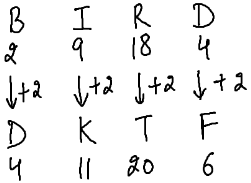 And,
'KITE' is written as 'MKVG'
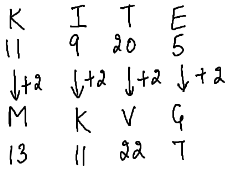 Similarly,
'EAGLE' is written as
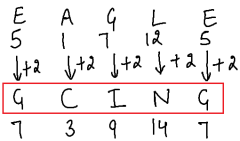 Hence, "Option 1" is the correct answer.
Q19 · Coding Decoding
In a certain code language, ‘MORE’ is coded as ‘14 - 12 - 9 - 22’ and ‘KNOW’ is coded as ‘16 - 13 - 12 - 4’. How will ‘SAID’ be coded in the given language?
- 7 - 26 - 18 - 22
- 8 - 26 - 18 - 23
- 8 - 26 - 17 - 23
- 7 - 25 - 18 - 23
Answer aur solution dekho
Archived marked answer: B
The logic followed here is:
‘MORE’ is coded as ‘14 - 12 - 9 - 22’
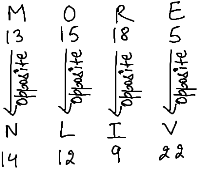 And,
‘KNOW’ is coded as ‘16 - 13 - 12 - 4’
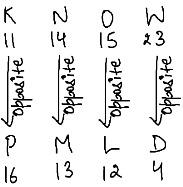 Similarly,
‘SAID’ is coded as
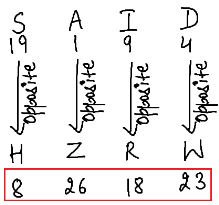 Hence, "Option 2" is the correct answer.
Q20 · Classification Odd One Out
Three of the following four letter-clusters are alike in a certain way and thus form a group. Which is the letter-cluster that does NOT belong to that group?
(Note: The odd one out is not based on the number of consonants/vowels or their positions in the letter-cluster.)
- MPR
- CFH
- IKN
- EHJ
Answer aur solution dekho
Archived marked answer: C
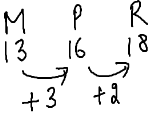
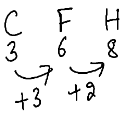
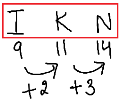
The logic followed here is:
Option 1) MPR
 Option 2) CFH
 Option 3) IKN
 Option 4) EHJ
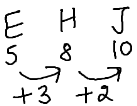 Thus, out of all the options 'IKN' is the odd one out.
Hence, "Option 3" is the correct answer.
Q21 · Classification Odd One Out
Three of the following numbers are alike in a certain way and one is different. Pick the odd one out.
(NOTE: Operations should be performed on the whole numbers, without breaking down the numbers into its constituent digits. E.g., 13 – Operations on 13 such as adding/deleting/multiplying etc., to 13 can be performed. Breaking down 13 into 1 and 3 and then performing mathematical operations on 1 and 3 is not allowed.)
- 11 – 882
- 3 – 72
- 4 – 128
- 7 – 392
Answer aur solution dekho
Archived marked answer: A
The logic followed here is: (First Number × 8) × First Number = Second Number
Option 1) 11 – 882
(11 × 8) × 11 = 882
88 × 11 = 882
968 ≠ 882 (LHS ≠ RHS)
Option 2) 3 – 72
(3 × 8) × 3 = 72
24 × 3 = 72
72 = 72 (LHS = RHS)
Option 3) 4 – 128
(4 × 8) × 4 = 128
32 × 4 = 128
128 = 128 (LHS = RHS)
Option 4) 7 – 392
(7 × 8) × 7 = 392
56 × 7 = 392
392 = 392 (LHS = RHS)
Thus, out of all the options '11 – 882' is the odd one out.
Hence, "Option 1" is the correct answer.
Q22 · Logical Reasoning
In this question, three statements are given, followed by two conclusions numbered I and II. Assuming the statements to be true, even if they seem to be at variance with commonly known facts, decide which of the conclusion(s) logically follows/follow from the statements.
Statements:
No medicine is a capsule.
Some capsules are tablets.
Some tablets are laptops.
Conclusions:
I. Some capsules are laptops.
II. All tablets can never be medicines.
- Neither Conclusion I nor II follow.
- Both Conclusions I and II follow.
- Only Conclusion II follows.
- Only Conclusion I follows.
Answer aur solution dekho
Archived marked answer: C
The least possible Venn diagram for the given statements is as shown below :
 Conclusions:
I. Some capsules are laptops → Does not follow (As some capsules are tablets and some tablets are laptops. So it is possible but not definite.)
II. All tablets can never be medicines → Follow (As no medicine is a capsule and some capsules are tablets. As no direct relation is given between medicine and tablets, therefore it is false.)
∴ Here, Only Conclusion II follows.
Hence, the correct answer is "Option 3".
Q23 · Logical Reasoning
Read the given statements and conclusions carefully. You have to take the given statements to be true even if they seem to
be at variance from commonly known facts. You have to decide which conclusion/s logically follow/s from the given
statements.
Statements:
All beaches are sand.
Some deserts are sand.
All mountains are rocky.
Conclusions:
(I) At least some beaches are desert.
(II) At least some sands are rocky.
- Only conclusion (II) follows.
- Both conclusions (I) and (II) follows.
- Only conclusion (I) follows.
- Neither conclusion (I) nor (II) follows.
Answer aur solution dekho
Archived marked answer: D
The least possible Venn diagram for the given statements is as shown below :
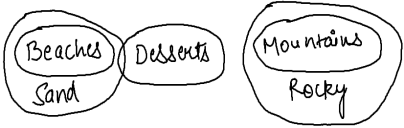 Conclusions:
I. At least some beaches are desert → Does not follow (As all beaches are sand and some deserts are sand. So it is possible but not definite.)
II. At least some sands are rocky → Does not follow (As all beaches are sand, some deserts are sand and all mountains are rocky. So it is possible but not definite.)
∴ Here, Neither conclusion (I) nor (II) follows.
Hence, the correct answer is "Option 4".
Q24 · Blood Relations
In a certain code language,
‘A + B’ means ‘A is the mother of B’;
‘A – B’ means ‘ A is the father of B’;
‘A $ B’ means ‘A is the daughter of B’ and
‘A % B’ means ‘A is the sister of B’.
Based on the above, how is P related to S if P + Q − R $ S % T?
- Sister’s daughter
- Sister’s husband
- Husband’s mother
- Mother
Answer aur solution dekho
Archived marked answer: C
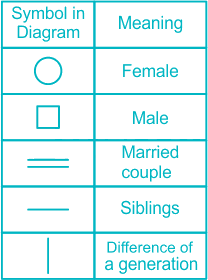 Decoding symbols:
A is
Symbol
+
–
$
%
Meaning
Mother
Father
Daughter
Sister
to B
Given: P + Q − R $ S % T
P + Q → P is the mother of Q.
 Q − R → Q is the father of R.
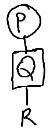 R $ S → R is the daughter of S.
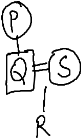 S % T → S is the sister of T.
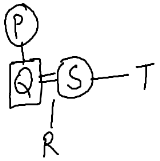 Thus, P is S's husband’s mother or mother-in-law.
Hence, the correct answer is "Option 3".
Q25 · Alphabet Test
The position of how many letters will remain unchanged if each of the letter in the word ‘HUSBAND’ is arranged in English alphabetical order?
- Three
- Zero
- One
- Two
Answer aur solution dekho
Archived marked answer: B
Given word: 'HUSBAND'
After arranged in alphabetical order:
Alphabets
H
U
S
B
A
N
D
Alphabetical order
A
B
D
H
N
S
U
Now,
there are Zero alphabets that will remain unchanged if each of the letters in the word 'HUSBAND' is arranged in English alphabetical order.
Hence, the correct answer is "Option 2".
General Awareness
Q1 · Art and Culture
With which of the following dances is Yamini Krishnamurthy associated?
- Bharatanatyam
- Mohiniyattam
- Odissi
- Sattriya
Answer aur solution dekho
Archived marked answer: A
The correct answer is Bharatanatyam.
Key Points
- Yamini Krishnamurthy is a renowned Indian dancer known for her proficiency in Bharatanatyam.
- She began her Bharatanatyam training at the age of 5.
- Yamini Krishnamurthy has received numerous awards including the Padma Shri and Padma Bhushan for her contributions to Indian classical dance.
- She has performed Bharatanatyam extensively both in India and internationally, promoting the dance form worldwide.
Additional Information
- Bharatanatyam
- Bharatanatyam is one of the oldest classical dance traditions of India, originating from Tamil Nadu.
- It is known for its fixed upper torso, bent legs, and intricate footwork combined with expressive hand gestures and facial expressions.
- Bharatanatyam performances are usually accompanied by classical Carnatic music.
- The dance form has a rich history and was traditionally performed in temples by Devadasis.
- Mohiniyattam
- Mohiniyattam is a classical dance form from Kerala.
- It is characterized by graceful, swaying body movements and subtle expressions.
- Mohiniyattam is typically performed as a solo dance by women.
- Odissi
- Odissi is a classical dance form from the state of Odisha.
- It is known for its lyrical grace and expressive eye movements.
- Odissi dance is distinguished by its intricate footwork and is often performed to traditional Odia music.
- Sattriya
- Sattriya is a classical dance form from Assam.
- It was introduced by the Vaishnava saint Srimanta Sankardev in the 15th century.
- Sattriya dance is performed in monasteries called Satras and often depicts mythological stories.
Q2 · Art and Culture
Easter festival is celebrated by which community?
- Christian
- Parsi
- Hindu
- Sikh
Answer aur solution dekho
Archived marked answer: A
The correct answer is Christian.
Key Points
- Easter is one of the most significant festivals in Christianity, marking the resurrection of Jesus Christ from the dead.
- This festival is celebrated on the first Sunday after the first full moon following the vernal equinox.
- Easter is the culmination of the Passion of Jesus, preceded by Lent, a 40-day period of fasting, prayer, and penance.
- The Easter festival also includes traditions such as Easter eggs and the Easter Bunny, which symbolize new life and rebirth.
Additional Information
- Easter:
- Easter is a festival and holiday commemorating the resurrection of Jesus from the dead, described in the New Testament as having occurred on the third day of his burial after his crucifixion by the Romans at Calvary c. 30 AD.
- It is the culmination of the Passion of Jesus, preceded by Lent (or Great Lent), a 40-day period of fasting, prayer, and penance.
- Most Christians refer to the week before Easter as "Holy Week"—it contains the days of the Easter Triduum, including Maundy Thursday (commemorating the Maundy and Last Supper), as well as Good Friday (commemorating the crucifixion and death of Jesus).
- In Western Christianity, Easter is always celebrated on the Sunday following the first full moon that occurs on or after the spring equinox.
- Christianity:
- Christianity is an Abrahamic monotheistic religion based on the life and teachings of Jesus of Nazareth. It is the world's largest religion, with about 2.4 billion followers.
- Its adherents, known as Christians, believe that Jesus is the Christ, whose coming as the Messiah was prophesied in the Hebrew Bible, called the Old Testament in Christianity, and chronicled in the New Testament.
- Christian theology is summarized in creeds such as the Apostles' Creed and the Nicene Creed, which state that Jesus suffered, died, was buried, descended into hell, and rose from the dead, and ascended into heaven, from where he will return.
- Christianity is divided into three main branches: Catholicism, Orthodoxy, and Protestantism.
Q3 · Indian Polity and Constitution
Who among the following is NOT a member of the National Human Rights Commission?
- District Magistrate
- Former Chief Justice of the High Court
- Former Chief Justice of the Supreme Court
- Former Judge of the Supreme Court
Answer aur solution dekho
Archived marked answer: A
The correct answer is District Magistrate.
Key Points
- The National Human Rights Commission (NHRC) is a statutory body established under the Protection of Human Rights Act, 1993.
- The NHRC consists of a Chairperson and members who are appointed by the President of India.
- The Chairperson of the NHRC is a former Chief Justice of the Supreme Court of India.
- Members of the NHRC include former Chief Justices and Judges of the Supreme Court, as well as other eminent persons with knowledge and experience in human rights.
Additional Information
- National Human Rights Commission (NHRC)
- The NHRC is responsible for the protection and promotion of human rights in India.
- Human rights include the rights to life, liberty, equality, and dignity of individuals guaranteed by the Indian Constitution and enforceable by courts in India.
- The NHRC investigates complaints of human rights violations, conducts inquiries, and makes recommendations to the government.
- The NHRC also engages in human rights education, awareness, and training programs.
- District Magistrate
- A District Magistrate (DM) is an administrative officer of an Indian state, responsible for maintaining law and order, implementing government policies, and overseeing the administration of a district.
- The DM is not a member of the NHRC.
- Former Chief Justice of the High Court
- A former Chief Justice of a High Court can be appointed as a member of the NHRC.
- Former Chief Justice of the Supreme Court
- The Chairperson of the NHRC is a former Chief Justice of the Supreme Court of India.
- Former Judge of the Supreme Court
- A former Judge of the Supreme Court can be appointed as a member of the NHRC.
Q4 · Indian Polity and Constitution
Which committee recommended Constitutional recognition for the local government bodies in 1989?
- Ashok Mehta Committee
- PK Thungon Committee
- Balwant Rai Committee
- Verma Committee
Answer aur solution dekho
Archived marked answer: B
The correct answer is PK Thungon Committee.
Key Points
- The PK Thungon Committee was formed in 1988 to review the working of the Panchayati Raj institutions.
- The committee recommended Constitutional recognition for the local government bodies.
- It suggested the establishment of three-tier Panchayati Raj system in the states.
- The recommendations led to the 73rd and 74th Constitutional Amendments, which were enacted in 1992 and came into effect in 1993.
Additional Information
- Panchayati Raj System
- The Panchayati Raj system is a form of local self-government in rural India.
- It was introduced by the 73rd Constitutional Amendment Act of 1992.
- The system consists of three levels: the Gram Panchayat (village level), the Panchayat Samiti (block level), and the Zila Parishad (district level).
- This system aims to decentralize the administration and promote local governance.
- 73rd Constitutional Amendment Act
- It was enacted in 1992 and came into effect on 24 April 1993.
- This amendment provided a constitutional status to the Panchayati Raj institutions.
- It introduced Article 243 to 243O in Part IX of the Constitution.
- The Act mandates the establishment of Panchayats at the village, intermediate, and district levels in all states and Union territories.
- It also provides for the reservation of seats for Scheduled Castes, Scheduled Tribes, and women.
- 74th Constitutional Amendment Act
- It was enacted in 1992 and came into effect on 1 June 1993.
- This amendment provided a constitutional status to the Urban Local Bodies (ULBs).
- It introduced Article 243P to 243ZG in Part IXA of the Constitution.
- The Act mandates the establishment of Municipalities in urban areas.
- It also provides for the reservation of seats for Scheduled Castes, Scheduled Tribes, and women.
Q5 · Indian Economy
Which of the following institutions has contributed mainly in improving the economic status of the poor women in rural areas?
- Indira Awas Yojana
- Integrated Development Project
- Self-help Group
- Rural Health Scheme
Answer aur solution dekho
Archived marked answer: C
The correct answer is Self-help Group.
Key Points
- Self-help Groups (SHGs) are small informal associations of poor people, typically women, who come together to collectively save and lend among themselves.
- SHGs have been instrumental in empowering rural women economically and socially by promoting thrift, savings, and income-generating activities.
- They facilitate access to credit by linking with financial institutions, enabling members to start small businesses and improve their livelihoods.
- SHGs also play a significant role in fostering community development, enhancing social cohesion, and promoting gender equality in rural areas.
Additional Information
- Indira Awas Yojana
- It is a social welfare program created by the Indian Government to provide housing for the rural poor in India.
- The scheme aims to assist construction of houses for Below Poverty Line (BPL) families.
- It is now known as the Pradhan Mantri Awas Yojana (Gramin).
- Integrated Development Project
- It is a development initiative aimed at the holistic development of various sectors such as agriculture, education, healthcare, etc.
- The project focuses on improving the overall socio-economic status of the rural population.
- Rural Health Scheme
- This scheme is aimed at improving healthcare access and quality in rural areas.
- It addresses issues such as maternal and child health, nutrition, and communicable diseases.
Q6 · Indian Economy
In which five-year plan was the 'food, work, and productivity' slogan used?
- Sixth
- Fifth
- Fourth
- Seventh
Answer aur solution dekho
Archived marked answer: D
The correct answer is Seventh.
Key Points
- The slogan 'food, work, and productivity' was used during the Seventh Five-Year Plan of India.
- This plan was implemented during the period from 1985 to 1990.
- The main focus was on increasing agricultural production, employment, and productivity in various sectors.
- It aimed to achieve self-sufficiency in food grains and increase employment opportunities to reduce poverty.
Additional Information
- Five-Year Plans of India
- India's Five-Year Plans were centralized and integrated national economic programs. These plans aimed at economic development and were formulated by the Planning Commission of India.
- The First Five-Year Plan (1951-1956) focused on agriculture and energy.
- The Second Five-Year Plan (1956-1961) aimed at the rapid industrialization of the country.
- The Third Five-Year Plan (1961-1966) focused on agriculture and improving production of wheat.
- The Fourth Five-Year Plan (1969-1974) aimed at growth with stability and progressive achievement of self-reliance.
- The Fifth Five-Year Plan (1974-1979) focused on poverty alleviation and achieving self-reliance.
- The Sixth Five-Year Plan (1980-1985) emphasized the elimination of poverty and technological self-reliance.
- The Seventh Five-Year Plan (1985-1990) focused on "food, work, and productivity."
- The Eighth Five-Year Plan (1992-1997) aimed at improving the quality of life, generating employment, and reducing inequality.
- The Ninth Five-Year Plan (1997-2002) aimed at achieving a rapid and sustainable growth rate.
- The Tenth Five-Year Plan (2002-2007) focused on reducing poverty and achieving a growth rate of 8% per annum.
- The Eleventh Five-Year Plan (2007-2012) aimed at inclusive growth.
- The Twelfth Five-Year Plan (2012-2017) focused on faster, more inclusive and sustainable growth.
- Planning Commission of India
- The Planning Commission was an institution in the Government of India, which formulated India's Five-Year Plans, among other functions.
- It was established in March 1950 by an executive resolution of the Government of India, on the recommendation of the Planning Commission's Report.
- The Planning Commission was replaced by the NITI Aayog (National Institution for Transforming India) in 2015.
Q7 · Indian Economy
Ranjana Prakash Desai who became the first woman chairperson of the Press Council of India originally worked in which of the following organs of the government?
- Legislature
- Judiciary
- Vigilance
- Executive
Answer aur solution dekho
Archived marked answer: B
The correct answer is Judiciary.
Key Points
- Ranjana Prakash Desai is a former judge of the Supreme Court of India.
- She has served in the judiciary system and has made significant contributions to the legal field.
- As a judge, she has been involved in several landmark judgments and cases.
- Her appointment as the chairperson of the Press Council of India marks a significant milestone as she is the first woman to hold this position.
Additional Information
- Judiciary:
- The judiciary is one of the three pillars of democracy, the other two being the legislature and the executive.
- It is responsible for interpreting the laws, ensuring justice, and maintaining the rule of law in the country.
- The judiciary comprises various levels of courts, including the Supreme Court, High Courts, and lower courts.
- Judges in the judiciary system play a crucial role in adjudicating disputes, protecting rights, and upholding the Constitution.
- Press Council of India (PCI):
- The Press Council of India is a statutory body established under the Press Council Act of 1978.
- It aims to preserve the freedom of the press and maintain and improve the standards of newspapers and news agencies in India.
- The PCI acts as a watchdog of the press, ensuring ethical standards and addressing complaints against the press.
- The chairperson of the PCI is typically a retired judge of the Supreme Court or a High Court.
- Supreme Court of India:
- The Supreme Court of India is the highest judicial authority in the country.
- It has the power of judicial review, which allows it to invalidate laws and executive actions that are inconsistent with the Constitution.
- It comprises the Chief Justice of India and a number of other judges as prescribed by law.
- The Supreme Court ensures the protection of fundamental rights and resolves disputes between the central and state governments.
Q8 · Sports Static GK
As of 14 October 2021, which Indian footballer was in the news for breaking Pele's 77 international goals?
- Bhaichung Bhutia
- Sunil Chhetri
- Gurpreet Singh Sandhu
- Sandesh Jhingan
Answer aur solution dekho
Archived marked answer: B
The correct answer is Sunil Chhetri.
Key Points
- Sunil Chhetri is a professional Indian footballer who plays as a forward and is the captain of both the Indian Super League side Bengaluru FC and the Indian national team.
- As of 14 October 2021, he surpassed the legendary Brazilian footballer Pele's record of 77 international goals.
- Chhetri is among the top international goal scorers in the world, often compared with football legends such as Lionel Messi and Cristiano Ronaldo.
- He has been a pivotal figure in Indian football, leading the national team to several significant victories and is regarded as one of the greatest Indian footballers of all time.
Additional Information
- International Goals
- International goals are goals scored by a player in matches between national teams, recognized by the sport's governing bodies.
- Sunil Chhetri's record-breaking feat places him among the elite footballers who have scored the most goals in international matches.
- Pele
- Edson Arantes do Nascimento, known as Pele, is a retired Brazilian footballer widely regarded as one of the greatest players of all time.
- Pele scored 77 goals in 92 appearances for Brazil, holding the record for the most goals scored for the Brazilian national team for many years.
- Indian Football
- Indian football has a rich history, with the national team known for its strong performances in the mid-20th century.
- In recent times, players like Sunil Chhetri have brought significant attention to the sport in India, inspiring a new generation of footballers.
This source code provides a detailed solution for the question about the Indian footballer who broke Pele's record of 77 international goals as of 14 October 2021. The "key points" section highlights important facts about Sunil Chhetri, and the "additional information" section provides context on international goals, Pele, and Indian football
Q9 · Sports Static GK
The third edition of the Khelo India University Games was hosted by which of the following states?
- Uttar Pradesh
- Haryana
- Punjab
- Madhya Pradesh
Answer aur solution dekho
Archived marked answer: A
The correct answer is Uttar Pradesh.
Key Points
- The third edition of the Khelo India University Games was hosted by the state of Uttar Pradesh.
- The event is organized as part of the Khelo India initiative, which aims to promote sports and fitness among youth in India.
- The University Games provide a platform for university athletes to showcase their talents and compete at a national level.
- The Khelo India University Games help in the identification and nurturing of young sports talents across various disciplines.
Additional Information
- Khelo India Initiative
- The Khelo India initiative was launched by the Ministry of Youth Affairs and Sports in 2018 to revive the sports culture in India at the grass-root level.
- It aims to build a strong framework for all sports played in the country and establish India as a great sporting nation.
- The program includes the Khelo India School Games, Khelo India Youth Games, and Khelo India University Games, among others.
- It provides financial assistance to talented players identified through these games, supporting their training and development.
- Previous Editions of Khelo India University Games
- The first edition of the Khelo India University Games was held in Odisha in 2020.
- The second edition took place in Karnataka in 2021.
- The games have seen participation from universities across the country, with athletes competing in various sports like athletics, swimming, basketball, football, and more.
- Impact of Khelo India University Games
- The games have played a crucial role in promoting sports among university students and encouraging a healthy lifestyle.
- They have helped in the identification of future sports stars who have the potential to represent India at international levels.
- The games have also contributed to the development of sports infrastructure in the host states.
Q10 · Indian Geography
According to Census 2011, which district displays the highest population?
- Kollam
- Ajmer
- Thane
- Pune
Answer aur solution dekho
Archived marked answer: C
The correct answer is Thane.
Key Points
- Thane district, located in the state of Maharashtra, displays the highest population according to the Census 2011.
- The population of Thane district as per Census 2011 is approximately 11 million.
- The district is known for its rapid urbanization and proximity to Mumbai, the financial capital of India.
- Thane has a mix of residential, industrial, and commercial areas contributing to its high population density.
Additional Information
- Census:
- A census is the procedure of systematically acquiring and recording information about the members of a given population.
- The Indian Census is conducted every ten years and is the largest single source of a variety of statistical information on different characteristics of the people of India.
- The Census 2011 was the 15th National Census of the Country since 1872 and the 7th after independence.
- Population Density:
- It refers to the number of people living per unit of an area (e.g., per square kilometer).
- Higher population density areas are often urban centers with significant economic activities and employment opportunities.
- Urbanization:
- Urbanization refers to the population shift from rural to urban areas, the gradual increase in the proportion of people living in urban areas, and the ways in which each society adapts to this change.
- Thane's rapid urbanization has been influenced by its proximity to Mumbai, leading to increased migration and development.
- Maharashtra:
- Maharashtra is a state in the western peninsular region of India occupying a substantial portion of the Deccan Plateau.
- It is the second-most populous state in India and has a significant contribution to the country's economy.
Q11 · Indian Geography
'Bhagirathi' and 'Alaknanda' rivers confluence at:
- Joshimath
- Haridwar
- Karanprayag
- Devprayag
Answer aur solution dekho
Archived marked answer: D
The correct answer is Devprayag.
Key Points
- Devprayag is a town and a nagar panchayat (municipality) in Tehri Garhwal district in the state of Uttarakhand, India.
- It is one of the Panch Prayag (five confluences) of Alaknanda River, where Alaknanda and Bhagirathi rivers meet and take the name Ganges or Ganga.
- Devprayag is situated at an altitude of 830 meters (2,723 feet) above sea level.
- The town is a significant pilgrimage site for Hindus, and the confluence point is considered sacred.
Additional Information
- Bhagirathi River:
- The Bhagirathi River is one of the two headstreams of the Ganges, the other being the Alaknanda.
- It originates from the Gangotri Glacier in Uttarakhand and flows for approximately 205 kilometers before meeting the Alaknanda at Devprayag.
- The Bhagirathi River is named after King Bhagiratha who, according to Hindu mythology, brought the river Ganga to Earth.
- Alaknanda River:
- The Alaknanda River is another major tributary of the Ganges.
- It originates at the confluence of the Satopanth and Bhagirath Kharak glaciers in Uttarakhand.
- The river flows for about 190 kilometers before joining the Bhagirathi at Devprayag.
- Alaknanda is considered a sacred river and is closely associated with Hindu mythology and pilgrimage sites.
- Devprayag:
- Devprayag is the first of the Panch Prayag, the five sacred confluences in the Garhwal Himalayas.
- The town is famous for its temples and the sacred confluence of the Bhagirathi and Alaknanda rivers.
- It is a starting point for the Char Dham pilgrimage, which includes Yamunotri, Gangotri, Kedarnath, and Badrinath.
- Devprayag is also known for the Raghunathji Temple, dedicated to Lord Rama.
Q12 · Indian Geography
Which state of India has the maximum number of large dams?
- Maharashtra
- Madhya Pradesh
- Odisha
- Rajasthan
Answer aur solution dekho
Archived marked answer: A
The correct answer is Maharashtra.
Key Points
- Maharashtra is the state with the maximum number of large dams in India, having more than 1800 dams.
- The state has a large number of irrigation projects, with the largest dam being the Jayakwadi Dam on the Godavari River.
- Maharashtra's dams are crucial for water storage, irrigation, and hydroelectric power generation.
- The state has invested heavily in water resources infrastructure to support its agricultural and industrial sectors.
Additional Information
- Large Dams in India
- A large dam is defined by the International Commission on Large Dams (ICOLD) as a dam with a height of 15 meters or more from the foundation.
- India has over 5200 large dams, which are used for irrigation, water supply, hydroelectric power, and flood control.
- The Bhakra-Nangal Dam on the Sutlej River is one of the highest gravity dams in the world.
- The Tehri Dam in Uttarakhand is the highest dam in India and one of the highest in the world.
- Irrigation Projects
- Irrigation projects in India include the construction of canals, wells, and dams to support agricultural activities.
- The major irrigation projects include the Indira Gandhi Canal in Rajasthan and the Nagarjuna Sagar Dam in Andhra Pradesh.
- Irrigation is vital for India’s agriculture, which is highly dependent on monsoon rains.
- Hydroelectric Power
- Hydroelectric power is generated by using the energy of falling or flowing water to turn turbines connected to generators.
- India has significant hydroelectric potential, with major hydroelectric projects located in the Himalayan region.
- The Sardar Sarovar Dam on the Narmada River is one of the largest water resource projects in India, providing both irrigation and hydroelectric power.
Q13 · Indian Geography
Which of the following is an inosilicate amphibole mineral used in highway construction and as railroad ballast?
- Shale
- Olivine
- Geyserite
- Hornblende
Answer aur solution dekho
Archived marked answer: D
The correct answer is Hornblende.
Key Points
- Hornblende is an inosilicate amphibole mineral found in many types of igneous and metamorphic rocks.
- It is commonly used in highway construction and as railroad ballast due to its hardness and durability.
- Hornblende can be identified by its dark color, usually green to black, and its elongate, prismatic crystals.
- It is composed of double chain SiO₄ tetrahedra linked at the vertices and generally contains calcium, iron, and magnesium.
Additional Information
- Inosilicates:
- Inosilicates, also known as chain silicates, are a group of silicate minerals that form chains of SiO4 tetrahedra linked together by sharing oxygen atoms.
- There are two types of chain structures: single chains and double chains.
- Single chain inosilicates include minerals like pyroxenes, while double chain inosilicates include amphiboles like hornblende.
- Amphibole Minerals:
- Amphiboles are a group of inosilicate minerals that form prism or needle-like crystals.
- They are typically hydrous (contain water in their structure) and can include various elements such as iron, magnesium, calcium, and aluminum.
- Amphiboles are important rock-forming minerals found in both igneous and metamorphic rocks.
- Railroad Ballast:
- Railroad ballast is the gravel or coarse stone used to form the bed of a railroad track.
- It provides stability, drainage, and support for the weight of the trains.
- Materials used for ballast include crushed stone, gravel, or other durable materials, such as hornblende.
- Highway Construction:
- In highway construction, durable materials like hornblende are used for various purposes including base layers, subbase layers, and as aggregate in asphalt or concrete.
- These materials provide strength, stability, and longevity to the constructed highways.
Q14 · Modern Indian History
Which of the following Acts introduced 'provincial autonomy' by discontinuing the application of dyarchy?
- Government of India Act, 1919
- Charter Act of 1813
- India Council Act, 1909
- Government of India Act, 1935
Answer aur solution dekho
Archived marked answer: D
The correct answer is Government of India Act, 1935.
Key Points
- The Government of India Act, 1935, introduced the concept of 'provincial autonomy' in British India.
- This Act marked the end of the system of dyarchy introduced by the Government of India Act, 1919.
- Under provincial autonomy, provinces were given more authority and independence in their internal administration.
- Indian ministers, chosen by provincial legislatures, were given authority in provincial governments, reducing the British governors' power.
Additional Information
- Government of India Act, 1919
- Also known as the Montagu-Chelmsford Reforms.
- Introduced the concept of dyarchy in the provinces, splitting the provincial subjects into reserved and transferred subjects.
- Reserved subjects were administered by the Governor and his Executive Council, while transferred subjects were administered by Indian ministers responsible to the legislative council.
- Charter Act of 1813
- It ended the East India Company's commercial monopoly in India, opening trade to private British merchants.
- Asserted the sovereignty of the British Crown over the Indian territories held by the Company.
- Provided for the promotion of education in India.
- India Council Act, 1909
- Also known as the Morley-Minto Reforms.
- Introduced separate electorates for Muslims, a measure designed to provide representation to minorities.
- Increased the size of the legislative councils at both the central and provincial levels.
Q15 · Modern Indian History
Which of the following Sikh reform movements was started in 1873 in Amritsar?
- Babbar Akali Movement
- Akali Movement
- Singh Sabha Movement
- Gurudwara Movement
Answer aur solution dekho
Archived marked answer: C
The correct answer is Singh Sabha Movement.
Key Points
- The Singh Sabha Movement was a Sikh reform movement started in 1873 in Amritsar.
- It aimed at reforming the Sikh community by promoting education and a return to the teachings of the Sikh Gurus.
- The movement was a reaction to the proselytizing activities of Christian missionaries and the Arya Samaj, which were seen as a threat to Sikhism.
- It played a significant role in the revival of Sikh institutions, literature, and the Punjabi language.
Additional Information
- Babbar Akali Movement:
- This was a militant movement in the 1920s aimed at freeing India from British rule.
- The Babbar Akali Dal was formed by a group of Sikh farmers in Punjab.
- They were against British policies and sought to restore Sikh sovereignty.
- It was named "Babbar" (lion) to denote the fierce nature of the movement.
- Akali Movement:
- The Akali Movement (also known as the Gurudwara Reform Movement) was a campaign in the early 20th century to reform the management of Sikh gurudwaras.
- It aimed at removing corrupt mahants (custodians) appointed by the British government.
- The movement led to the formation of the Shiromani Gurudwara Parbandhak Committee (SGPC).
- The SGPC now oversees the management of gurudwaras in Punjab, Haryana, and Himachal Pradesh.
- Gurudwara Movement:
- This movement is synonymous with the Akali Movement mentioned above.
- It focused on freeing Sikh places of worship from the control of corrupt mahants.
- The movement gained momentum in the 1920s and led to significant reforms in the management of Sikh religious institutions.
- It was a major milestone in the history of the Sikhs and their religious autonomy.
Q16 · General Science Biology
Identify a spiral-shaped bacteria.
- Bacillus
- Spirillum
- Coccus
- Vibrio
Answer aur solution dekho
Archived marked answer: B
The correct answer is Spirillum.
Key Points
- Spirillum is a genus of Gram-negative bacteria characterized by their spiral shape.
- They are typically found in stagnant freshwater environments and are known for their unique helical structure.
- Spirillum bacteria are motile, meaning they can move, using flagella located at both ends of the cell.
- These bacteria are often used in microbiological studies to understand bacterial motility and structure.
Additional Information
- Bacillus
- Bacillus is a genus of rod-shaped, Gram-positive bacteria.
- These bacteria are commonly found in soil and water and are known for their ability to form endospores.
- Examples include Bacillus anthracis, which causes anthrax, and Bacillus subtilis, a model organism for laboratory studies.
- Coccus
- Coccus refers to any bacterium that has a spherical, ovoid, or generally round shape.
- They can exist as single cells or in clusters, chains, and other formations.
- Examples include Staphylococcus (clusters) and Streptococcus (chains).
- Vibrio
- Vibrio is a genus of Gram-negative bacteria, possessing a curved-rod (comma) shape.
- They are typically aquatic and can cause diseases such as cholera (caused by Vibrio cholerae).
- Vibrio bacteria are facultative anaerobes, meaning they can survive with or without oxygen.

Q17 · General Science Biology
Which of the following is NOT related to reticulate venation?
- China rose
- Tulsi
- Maize
- Coriander
Answer aur solution dekho
Archived marked answer: C
The correct answer is Maize.
Key Points
- Maize exhibits parallel venation, which is typical of monocotyledonous plants.
- In parallel venation, veins run parallel to each other, which is different from reticulate venation where veins form a network.
- Examples of plants with parallel venation include grasses, lilies, and maize.
- Reticulate venation is commonly found in dicotyledonous plants like China rose and Tulsi.
Additional Information
- Venation
- Venation refers to the arrangement of veins in the leaf blade.
- It is important for the identification of plant species and helps in the distribution of nutrients and water throughout the leaf.
- Reticulate Venation
- Reticulate venation is characterized by a net-like pattern of veins.
- It is commonly found in dicots such as China rose, Tulsi, and Coriander.
- In this type of venation, the main vein (midrib) branches into secondary veins which further branch into tertiary veins forming a network.
- Parallel Venation
- Parallel venation is characterized by veins running parallel to each other.
- It is typical of monocots such as Maize, wheat, and other grasses.
- In this type of venation, veins do not form a network but run parallel from the base to the tip of the leaf.
- Examples of Plants
- China Rose (Hibiscus rosa-sinensis) - Exhibits reticulate venation.
- Tulsi (Ocimum tenuiflorum) - Exhibits reticulate venation.
- Maize (Zea mays) - Exhibits parallel venation.
- Coriander (Coriandrum sativum) - Exhibits reticulate venation.
Q18 · General Science Chemistry
Which of the following chemical reactions takes place when quick lime reacts with water?
- CaO(s) + H₂O(l) → Ca + H₂(aq)
- C(s) + O₂(g) → CO₂(g)
- CaO(s) + H₂O(l) → Ca(OH)₂(aq)
- CH₄(g) + 2O₂(g) → CO₂(g) + 2H₂O(g)
Answer aur solution dekho
Archived marked answer: C
The correct answer is CaO(s) + H2O(l) → Ca(OH)2(aq).
Key Points
- Quick lime is chemically known as calcium oxide (CaO).
- When quick lime reacts with water, it forms calcium hydroxide (Ca(OH)2), also known as slaked lime.
- This reaction is exothermic, meaning it releases heat.
- The chemical equation for this reaction is: CaO(s) + H2O(l) → Ca(OH)2(aq).
Additional Information
- Quick Lime (Calcium Oxide)
- Quick lime, or calcium oxide (CaO), is a white, caustic, alkaline substance.
- It is produced by heating limestone (calcium carbonate, CaCO3) to a high temperature, a process known as calcination.
- CaO is widely used in industrial processes such as steelmaking, chemical production, and wastewater treatment.
- Calcium Hydroxide
- Calcium hydroxide, also known as slaked lime, is a compound with the chemical formula Ca(OH)2.
- It is a white powdery substance that forms when calcium oxide reacts with water.
- Ca(OH)2 is used in the construction industry to make mortar and plaster, in the food industry for processing water and as a food additive, and in various chemical processes.
- Exothermic Reactions
- An exothermic reaction is a chemical reaction that releases energy in the form of heat or light.
- In the reaction of calcium oxide with water, the release of heat is significant enough to make the mixture hot and sometimes boiling.
- Exothermic reactions are used in various applications, including heat packs, combustion engines, and industrial manufacturing processes.
Q19 · General Science Chemistry
Identify a monoatomic molecule.
- carbon monoxide
- Oxygen
- Helium
- Chlorine
Answer aur solution dekho
Archived marked answer: C
The correct answer is Helium.
Key Points
- Helium is a noble gas and is represented by the symbol He.
- It is the second lightest and second most abundant element in the observable universe.
- Helium is a monoatomic gas, meaning it exists as single atoms rather than molecules.
- It is chemically inert and does not easily form compounds with other elements.
Additional Information
- Monoatomic Molecule
- A monoatomic molecule consists of a single atom, unlike diatomic or polyatomic molecules which consist of two or more atoms.
- Examples of monoatomic molecules include noble gases like Helium (He), Neon (Ne), Argon (Ar), Krypton (Kr), and Xenon (Xe).
- These elements exist as individual atoms because their outer electron shells are complete, making them highly stable and unreactive.
- Carbon Monoxide (CO)
- Carbon monoxide is a diatomic molecule consisting of one carbon atom and one oxygen atom.
- It is a colorless, odorless, and highly toxic gas.
- CO is produced by the incomplete combustion of carbon-containing fuels.
- Oxygen (O₂)
- Oxygen is a diatomic molecule consisting of two oxygen atoms.
- It is essential for respiration in most living organisms.
- Oxygen makes up about 21% of the Earth's atmosphere.
- Chlorine (Cl₂)
- Chlorine is a diatomic molecule consisting of two chlorine atoms.
- It is a greenish-yellow gas with a strong, pungent odor.
- Chlorine is used in water purification, disinfectants, and the production of many consumer products.
Q20 · Awards Static
Who among the following is the first vocalist to receive the Bharat Ratna in 2009 and is also credited to have popularised 'Khyal Gayaki'?
- Pandit Bhimsen Joshi
- Begum Akhtar
- Vishnu Digambar Paluskar
- Gangubai Hangal
Answer aur solution dekho
Archived marked answer: A
The correct answer is Pandit Bhimsen Joshi.
Key Points
- Pandit Bhimsen Joshi was the first vocalist to receive the Bharat Ratna in 2009.
- He is renowned for his contribution to Hindustani classical music.
- He is credited with popularising the 'Khyal Gayaki' style of singing.
- His music is characterized by a powerful voice and intricate improvisations.
Additional Information
- Bharat Ratna
- The Bharat Ratna is India's highest civilian award, given for exceptional service towards the advancement of Art, Literature, and Science, and in recognition of public service of the highest order.
- It was instituted in 1954 and the recipients receive a certificate known as 'Sanad' signed by the President of India and a medallion.
- The recommendations for the Bharat Ratna are made by the Prime Minister of India to the President, with a maximum of three nominees being awarded each year.
- Khyal Gayaki
- 'Khyal' is a form of vocal music in Hindustani classical music.
- It is characterized by a greater emphasis on improvisation and flexibility.
- This style of singing allows the artist to explore the raga extensively, often with intricate and complex patterns.
- The word 'Khyal' means imagination, thought, or idea, reflecting the creative freedom this style offers to the performer.
- Pandit Bhimsen Joshi
- Pandit Bhimsen Joshi was born on February 4, 1922, in Gadag, Karnataka.
- He belonged to the Kirana gharana and was a disciple of Sawai Gandharva.
- He was known for his deep, robust voice and mastery over ragas such as Puriya Dhanashree, Multani, and Miyan Ki Todi.
- In addition to Bharat Ratna, he was also awarded the Sangeet Natak Akademi Award, Padma Shree, Padma Bhushan, and Padma Vibhushan.
Q21 · Awards Static
Harivarasanam award is given in the field of music by which of the following state governments?
- Kerala
- Karnataka
- Maharashtra
- Himachal Pradesh
Answer aur solution dekho
Archived marked answer: A
The correct answer is Kerala.
Key Points
- The Harivarasanam Award is given annually by the Kerala state government to honor individuals for their contributions to the field of music.
- The award is named after the famous song "Harivarasanam," which is dedicated to the deity Ayyappa and is sung at the Sabarimala Temple in Kerala.
- This award recognizes the achievements and contributions of musicians who have made significant impact in the realm of devotional and classical music.
- The award includes a cash prize, citation, and a plaque, which are presented to the recipient during a ceremony organized by the Kerala government.
Additional Information
- Harivarasanam
- Harivarasanam is a Sanskrit devotional song dedicated to Lord Ayyappa.
- It is also known as the "Lullaby Song" because it is sung just before the temple closes for the night.
- The song describes the glory and virtues of Lord Ayyappa, and is an integral part of the rituals at the Sabarimala Temple.
- The song was composed by Kambangudi Kulathur Srinivasa Iyer and was popularized by the renowned singer K.J. Yesudas.
- Sabarimala Temple
- Sabarimala Temple is one of the most famous pilgrimage centers in India, located in the Pathanamthitta district of Kerala.
- The temple is dedicated to Lord Ayyappa, and it attracts millions of devotees every year, especially during the Mandala season (mid-November to mid-January).
- Sabarimala is known for its unique customs, including the strict 41-day vratham (fasting and abstinence) that devotees must observe before visiting the temple.
- The temple is situated amidst dense forests and mountains, symbolizing the spiritual journey and the ultimate union with the divine.
- Devotional Music
- Devotional music plays a significant role in the cultural and spiritual life of India.
- It encompasses a wide range of genres including bhajans, kirtans, qawwalis, and more, each associated with different religious and spiritual traditions.
- Devotional music is often performed in temples, religious ceremonies, and spiritual gatherings, serving as a medium for expressing devotion and reverence towards the divine.
- Many renowned musicians and composers have contributed to the rich tradition of devotional music in India, making it an integral part of the country's cultural heritage.
Q22 · Ancient Indian History
The Pandya Kingdom was first mentioned by Megasthenes, who said that their kingdom was famous for pearls. Their capital was:
- Thanjavur
- Uraiyur
- Madurai
- Kaveripattinam
Answer aur solution dekho
Archived marked answer: C
The correct answer is Madurai.
Key Points
- Madurai was the capital of the ancient Pandya Kingdom, known for its flourishing trade and cultural heritage.
- The city is famous for the Meenakshi Amman Temple, a historic Hindu temple located on the southern bank of the Vaigai River.
- It has been a major settlement for two millennia and is one of the oldest continuously inhabited cities in the world.
- Madurai has a rich historical background and has been mentioned in ancient texts and inscriptions, highlighting its significance during the Pandya rule.
Additional Information
- Pandya Kingdom
- The Pandya Kingdom was one of the three ancient Tamil kingdoms, the other two being the Chola and the Chera kingdoms.
- The Pandyas were known for their contributions to Tamil literature, art, and architecture.
- Their rule is dated back to several centuries BCE, and they were contemporary to other South Indian dynasties like the Cholas and the Cheras.
- The Pandyas were great patrons of the Tamil language and literature, which flourished under their rule.
- Megasthenes
- Megasthenes was a Greek historian and diplomat who served as an ambassador to the court of Chandragupta Maurya in India.
- His work "Indica" provides an account of the Indian subcontinent during the Maurya Empire, including descriptions of the people, culture, and geography.
- Megasthenes' writings are considered valuable historical sources for understanding ancient India.
- Meenakshi Amman Temple
- The Meenakshi Amman Temple is dedicated to Meenakshi, a form of Parvati, and her consort, Sundareshwar, a form of Shiva.
- The temple complex is a significant symbol of South Indian architecture, featuring tall gopurams (gateway towers) adorned with intricate carvings.
- The temple is a major pilgrimage site and attracts millions of visitors and devotees annually.
Q23 · Ancient Indian History
In which of the following Major Rock Edicts of Ashoka is the Kalinga war mentioned?
- XII
- X
- XIII
- XI
Answer aur solution dekho
Archived marked answer: C
The correct answer is XIII.
Key Points
- The Kalinga War is mentioned in the Major Rock Edict XIII of Ashoka.
- This edict provides details about the war, its aftermath, and Ashoka's remorse over the bloodshed and suffering caused.
- Edict XIII also highlights Ashoka's conversion to Buddhism and his efforts towards spreading Dhamma (moral law).
- The edict emphasizes Ashoka's change of heart and his dedication towards non-violence and the welfare of his subjects.
Additional Information
- Major Rock Edicts of Ashoka
- The Major Rock Edicts are a set of 14 inscriptions that were issued by Emperor Ashoka of the Maurya Dynasty around 250 BCE.
- These edicts are found across various parts of the Indian subcontinent, including modern-day India, Nepal, Pakistan, and Afghanistan.
- The edicts focus on ethical and moral teachings, emphasizing non-violence, tolerance, and respect for all forms of life.
- Ashoka's edicts also promote social welfare, justice, and the importance of following the Dhamma.
- Kalinga War
- The Kalinga War was fought between the Mauryan Empire under Ashoka and the state of Kalinga (present-day Odisha) around 261 BCE.
- The war is renowned for its massive scale and the significant loss of life and suffering it caused.
- Ashoka's experience in the aftermath of the war led to his deep remorse and a transformative shift in his beliefs.
- The Kalinga War played a pivotal role in Ashoka's adoption of Buddhism and his subsequent efforts to promote peace and non-violence.
- Ashoka the Great
- Ashoka was the third emperor of the Maurya Dynasty, ruling from approximately 268 to 232 BCE.
- He is widely remembered for his role in spreading Buddhism and his emphasis on moral governance.
- Ashoka's reign marked a period of significant cultural and religious transformation in ancient India.
- His legacy is celebrated for his contributions to the promotion of non-violence, social welfare, and the spread of Buddhist teachings.
Q24 · Government Schemes and Welfare Static Semi Static
In which year did the Central Government launch the National Air Sports Policy?
- 2022
- 2021
- 2023
- 2020
Answer aur solution dekho
Archived marked answer: A
The correct answer is 2022.
Key Points
- The National Air Sports Policy (NASP) was officially launched in the year 2022 by the Central Government of India.
- This policy aims to promote air sports in the country including activities like paragliding, hang gliding, ballooning, and aerobatics.
- The policy is designed to make India one of the top air sports nations by 2030.
- The NASP intends to provide a safe, affordable, accessible, and sustainable air sports ecosystem in India.
Additional Information
- National Air Sports Policy (NASP)
- The NASP outlines the framework and guidelines for the development of air sports in India.
- It aims at ensuring the safety of participants, standardizing regulations, and promoting air sports activities.
- The policy encourages the establishment of air sports academies, training centers, and clubs to nurture talent and create job opportunities.
- The NASP also focuses on encouraging participation from all sections of society, including women and differently-abled individuals.
- Air Sports in India
- Air sports include activities like paragliding, skydiving, ballooning, aerobatics, and drone racing.
- These sports require high levels of skill, precision, and adherence to safety norms.
- India's diverse geography provides a natural advantage for a variety of air sports activities.
- The promotion of air sports can also boost tourism and create employment opportunities in the sector.
- International Context
- Countries like the USA, France, and Switzerland have well-established air sports ecosystems.
- By adopting international best practices and standards, India aims to elevate its status in the global air sports community.
- Collaboration with international air sports bodies will be crucial for the development of the sector.
Q25 · Government Schemes and Welfare Static Semi Static
Consider the following statements and identify the INCORRECT statement(s).
1. The ‘Saksham Anganwadi and Poshan 2.0’ scheme has been implemented under the National Food Security Act, 2003.
2. It is an ongoing, Central Government-sponsored scheme under the Ministry of Women and Child Development.
3. It is extended to children aged below 6 years only.
4. Six services are provided under this scheme through the National Health Mission and Public Health Infrastructure.
- Only 1, 3 and 4
- Only 4
- Only 1, 2 and 3
- Only 2 and 3
Answer aur solution dekho
Archived marked answer: A
The correct answer is Only 1, 3 and 4.
Key Points
- The Saksham Anganwadi and Poshan 2.0 scheme is a restructured scheme from the previous 'Integrated Child Development Services (ICDS)' scheme.
- This scheme is implemented under the Ministry of Women and Child Development.
- It is not just limited to children aged below 6 years but also includes pregnant women and lactating mothers.
- Six services provided under this scheme include supplementary nutrition, pre-school non-formal education, nutrition & health education, immunization, health check-up, and referral services.
Additional Information
- Saksham Anganwadi and Poshan 2.0
- This is a flagship program of the Government of India aimed at improving the nutritional and health status of children, pregnant women, and lactating mothers.
- It is a Centrally-Sponsored Scheme and not under the National Food Security Act, 2003.
- The scheme is designed to address the challenges of malnutrition and to ensure holistic development of children.
- It integrates supplementary nutrition, early childhood care, and education, maternal care, and various health services.
- Integrated Child Development Services (ICDS)
- Launched on 2nd October 1975, ICDS is one of the world's largest programs for early childhood care and development.
- ICDS aims to provide food, preschool education, primary healthcare, immunization, health check-up, and referral services to children under 6 years of age and their mothers.
- It is a significant step towards meeting the nutritional and health needs of the most vulnerable sections of society.
- National Food Security Act, 2013
- The National Food Security Act, 2013 (also known as the Right to Food Act), was legislated by the Indian Parliament in 2013.
- The Act aims to provide subsidized food grains to approximately two-thirds of India's 1.2 billion people.
- It includes provisions for both rural and urban populations and covers a range of food security measures.
Mathematics
Q1 · Geometry
If we extend a chord infinitely on both sides, then the chord becomes a __________.
- diameter
- tangent
- secant
- normal
Answer aur solution dekho
Archived marked answer: C
Shortcut Trick
A chord is a finite line segment connecting two points on the circumference of a circle.
When any finite line segment is extended infinitely on both sides, it becomes a straight line.
A straight line that passes through and intersects a circle at exactly two distinct points is defined as a secant.
∴ The correct answer is secant.
Alternate Method
- - - O
A
B
Chord AB
Extended
Extended
Extended Chord = Secant Line
Given:
A chord of a circle extended infinitely on both sides.
Definitions Used:
⇒ Chord: A line segment whose endpoints lie on the circle.
⇒ Secant: A line that intersects a circle at two distinct points.
Analysis:
⇒ Let AB be a chord of a circle with center O.
⇒ The chord AB itself is a finite line segment entirely inside the boundaries of the circle.
⇒ When we extend the line segment AB infinitely on both sides, it loses its bounded endpoints and becomes a straight continuous line.
⇒ Because this straight line intersects the circle at exactly two points (A and B) and goes beyond them, it directly satisfies the geometrical definition of a secant.
∴ The correct answer is secant.
Additional Information
Tangent
A line that touches the circle at exactly one single point is called a tangent. The tangent is always perpendicular to the radius at the point of contact.
Diameter
The longest chord of a circle that passes through its geometric center is called a diameter. Its length is exactly twice the radius (d = 2 × r).
Secant vs Chord Difference
A chord is a finite line segment contained entirely inside the circle, while a secant is an infinitely extending line that crosses through the circle, containing the chord within it.
</p
Q2 · Geometry
The side MN of a parallelogram MNOP is produced to Q such that MN = NQ. PQ intersects ON at R. The point R divides ON in the ratio:
- 3 : 1
- 2 : 1
- 1 : 2
- 1 : 1
Answer aur solution dekho
Archived marked answer: D
Shortcut Trick
In parallelogram MNOP, opposite side OP is parallel and equal to MN.
Line MN is extended to Q such that MN = NQ, making OP parallel and equal to NQ.
The intersection of PQ and ON at R forms two triangles: ΔPOR and ΔQNR.
Since OP || NQ, alternate interior angles are equal, and with OP = NQ, ΔPOR ≅ ΔQNR (ASA congruence).
Therefore, corresponding sides OR and RN are equal, meaning R is the midpoint of ON.
∴ The correct answer is 1 : 1.
Alternate Method
Given:
MNOP is a parallelogram.
MN is produced to Q such that MN = NQ.
PQ intersects ON at R.
Formula Used:
Properties of parallelograms and congruent triangles (ASA criterion).
- - - M
N
Q
O
P
R
- - - Calculations:
⇒ In parallelogram MNOP, opposite sides are parallel and equal, so OP || MN and OP = MN.
⇒ Line MN is produced to Q, so OP || NQ.
⇒ It is given that MN = NQ. Thus, substituting MN, we get OP = NQ.
⇒ In ΔPOR and ΔQNR:
⇒ ∠POR = ∠QNR (Alternate interior angles, as OP || NQ and ON is the transversal)
⇒ ∠OPR = ∠NQR (Alternate interior angles, as OP || NQ and PQ is the transversal)
⇒ OP = NQ (Proved above)
⇒ By ASA congruence criterion, ΔPOR ≅ ΔQNR.
⇒ Since corresponding parts of congruent triangles are equal, OR = RN.
⇒ This implies R is the midpoint of ON, so it divides ON in the ratio 1 : 1.
∴ The correct answer is 1 : 1.
Additional Information
Congruence of Triangles (ASA Rule)
Two triangles are congruent if two angles and the included side of one are equal to the corresponding parts of the other. Congruent triangles have equal corresponding side lengths.
Properties of a Parallelogram
In a parallelogram, opposite sides are strictly parallel and equal in length. The opposite angles are equal, and the diagonals bisect each other perfectly.
Alternate Interior Angles
When a transversal line intersects two parallel lines, the alternate interior angles formed on opposite sides of the transversal line are equal.
</p
Q3 · Geometry
Two equal circles pass through each other’s centre. If the radius of each of the circle is 13 cm, then what is the length of the common chord?
- 13√6
- 7√3
- 13√2
- 13√3
Answer aur solution dekho
Archived marked answer: D
Shortcut Trick
When two equal circles of radius r pass through each other's centre, the length of their common chord is directly given by the formula L = r√3.
Here, the radius of the circles is given as r = 13 cm.
Length of the common chord = 13 × √3 = 13√3 cm.
∴ The correct answer is 13√3 cm.
Alternate Method
Q4 · Trigonometry
What is the value of √(9sin² 26circ + 9sin² 64circ + 3632 - 7cos² 32circ - 7cos² 58circ) ?
- (3 √5)/5
- (5 √3)/3
- (5 √5)/3
- (3 √3)/5
Answer aur solution dekho
Archived marked answer: A
Shortcut Trick
For complementary angles A + B = 90°, we use the properties sin²A + sin²B = 1 and cos²A + cos²B = 1.
Since 26° + 64° = 90°, the numerator term 9sin² 26° + 9sin² 64° = 9(1) = 9.
Since 32° + 58° = 90°, the denominator term 7cos² 32° + 7cos² 58° = 7(1) = 7.
Expression = √[ (9 + 36) ÷ (32 − 7) ] = √(45 ÷ 25)
Result = √(9 ÷ 5) = 3 ÷ √5 = 3√5 / 5.
∴ The correct answer is 3√5 / 5.
Alternate Method
Given:
Expression = √[ (9sin² 26° + 9sin² 64° + 36) ÷ (32 − 7cos² 32° − 7cos² 58°) ]
Formula Used:
sin(90° − θ) = cosθ
cos(90° − θ) = sinθ
sin²θ + cos²θ = 1
Calculations:
⇒ sin 64° = sin(90° − 26°) = cos 26°
⇒ cos 58° = cos(90° − 32°) = sin 32°
⇒ Numerator = 9sin² 26° + 9cos² 26° + 36
⇒ Numerator = 9(sin² 26° + cos² 26°) + 36
⇒ Numerator = 9(1) + 36 = 45
⇒ Denominator = 32 − (7cos² 32° + 7sin² 32°)
⇒ Denominator = 32 − 7(cos² 32° + sin² 32°)
⇒ Denominator = 32 − 7(1) = 25
⇒ Given Expression = √(45 ÷ 25) = √(9 ÷ 5) = 3 / √5
⇒ Rationalizing the denominator: (3 × √5) ÷ (√5 × √5) = 3√5 / 5
∴ The correct answer is 3√5 / 5.
Additional Information
Complementary Angles
Two angles are complementary if their sum is exactly 90°. Key trigonometric relations for complementary angles are: sin(90° − θ) = cosθ, cos(90° − θ) = sinθ, and tan(90° − θ) = cotθ.
Pythagorean Trigonometric Identities
The foundational identity is sin²θ + cos²θ = 1. Other standard identities derived from this include 1 + tan²θ = sec²θ and 1 + cot²θ = cosec²θ.
Rationalization
When a fraction contains a square root in the denominator, it is rationalized to clear the radical by multiplying both the numerator and the denominator by the radical term (e.g., 1 / √x = √x / x).
</p
Q5 · Trigonometry
sinA sinB=.______
- 1/2 { sin(A + B) + sin(A - B) }
- 1/2 { sin(A + B) - sin(A - B)}
- 1/2 { cos(A + B) - cos(A - B)}
- 1/2 { cos(A - B) - cos(A + B)}
Answer aur solution dekho
Archived marked answer: D
Shortcut Trick
The product of two sine terms can be converted to a difference of cosine terms directly using standard trigonometric identities.
We know the identity: 2 × sin A × sin B = cos(A − B) − cos(A + B)
Dividing the entire equation by 2, we get:
sin A × sin B = 1/2 { cos(A − B) − cos(A + B) }
∴ The correct answer is 1/2 { cos(A − B) − cos(A + B) }.
Alternate Method
Given:
The trigonometric expression is sin A × sin B
Formula Used:
Expansion of cosine formulas:
cos(A − B) = cos A × cos B + sin A × sin B
cos(A + B) = cos A × cos B − sin A × sin B
Calculations:
⇒ Subtract the equation of cos(A + B) from cos(A − B)
⇒ cos(A − B) − cos(A + B) = (cos A × cos B + sin A × sin B) − (cos A × cos B − sin A × sin B)
⇒ cos(A − B) − cos(A + B) = cos A × cos B + sin A × sin B − cos A × cos B + sin A × sin B
⇒ cos(A − B) − cos(A + B) = 2 × sin A × sin B
⇒ sin A × sin B = 1/2 { cos(A − B) − cos(A + B) }
∴ The correct answer is 1/2 { cos(A − B) − cos(A + B) }.
Additional Information
Product to Sum Formulas
2 × sin A × cos B = sin(A + B) + sin(A − B)
2 × cos A × sin B = sin(A + B) − sin(A − B)
2 × cos A × cos B = cos(A + B) + cos(A − B)
Sum to Product Formulas
sin C + sin D = 2 × sin((C + D)/2) × cos((C − D)/2)
cos C + cos D = 2 × cos((C + D)/2) × cos((C − D)/2)
</p
Q6 · Trigonometry
The given expression is equivalent to:
√(sec θ + 1sec θ - 1) + √(sec θ - 1sec θ + 1)
- 2sinθ
- 2cosecθ
- 2 tan θ
- 2tanθ.secθ
Answer aur solution dekho
Archived marked answer: B
Shortcut Trick
Put θ = 60° in the given expression (since sec 60° = 2).
Expression = √((2 + 1) ÷ (2 − 1)) + √((2 − 1) ÷ (2 + 1))
⇒ √(3/1) + √(1/3) = √3 + 1/√3 = 4/√3
Now, checking the options by substituting θ = 60°:
Only Option 2 gives: 2cosec(60°) = 2 × (2/√3) = 4/√3
∴ The correct answer is 2cosecθ.
Alternate Method
Given:
Expression = √[(sec θ + 1) ÷ (sec θ − 1)] + √[(sec θ − 1) ÷ (sec θ + 1)]
Formula Used:
⇒ sec²θ − 1 = tan²θ
⇒ sec θ = 1 / cos θ , tan θ = sin θ / cos θ
Calculations:
⇒ By taking the LCM of the denominators, we get:
⇒ Expression = [ (sec θ + 1) + (sec θ − 1) ] / √[(sec θ − 1)(sec θ + 1)]
⇒ Expression = (2sec θ) / √(sec²θ − 1)
⇒ Expression = (2sec θ) / √(tan²θ)
⇒ Expression = 2sec θ / tan θ
⇒ Expression = 2(1 / cos θ) ÷ (sin θ / cos θ)
⇒ Expression = 2 / sin θ
⇒ Expression = 2cosec θ
∴ The correct answer is 2cosecθ.
Additional Information
Pythagorean Trigonometric Identities
sin²θ + cos²θ = 1 | sec²θ − tan²θ = 1 | cosec²θ − cot²θ = 1
Reciprocal Identities
sin θ = 1/cosec θ | cos θ = 1/sec θ | tan θ = 1/cot θ
Value Substitution Method
To quickly solve trigonometric simplifications, substitute standard angles like 30°, 45°, or 60°. Always avoid angles that make the expression undefined (e.g., denominators becoming zero).
</p
Q7 · Mensuration 2D
Find the area (in cm²) of the sector, where the radius of the circle is 24 cm and length of the arc is 7 cm.
- 72
- 84
- 48
- 168
Answer aur solution dekho
Archived marked answer: B
Shortcut Trick
The area of a circular sector can be calculated directly if the arc length and radius are given.
Area of Sector = (Arc Length × Radius) ÷ 2
Area = (7 × 24) ÷ 2
Area = 168 ÷ 2 = 84
∴ The correct answer is 84 cm².
Alternate Method
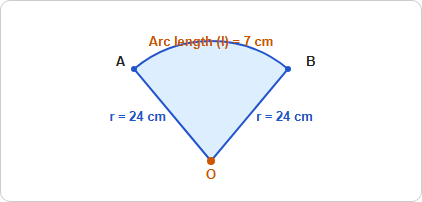 Given:
⇒ Radius of the circle (r) = 24 cm
⇒ Length of the arc (l) = 7 cm
Formula Used:
⇒ Area of a Sector = (θ ÷ 360) × π × r²
⇒ Arc Length (l) = (θ ÷ 360) × 2 × π × r
⇒ By substituting Arc Length in the Area formula: Area = (l × r) ÷ 2
Calculations:
⇒ Area = (7 × 24) ÷ 2
⇒ Area = 168 ÷ 2
⇒ Area = 84 cm²
∴ The correct answer is 84 cm².
Additional Information
Area of a Sector with Central Angle
When the central angle θ is given in degrees, the area is calculated using the formula: Area = (θ ÷ 360) × π × r².
Perimeter of a Sector
The perimeter includes the length of the arc and the two radii enclosing it. It is computed as: Perimeter = l + 2 × r.
Area of a Circle
The total area covered by a complete circle is evaluated using the formula: Area = π × r².
Arc Length Formula
The length of an arc spanning a central angle θ is given by: l = (θ ÷ 360) × 2 × π × r.
</p
Q8 · Mensuration 2D
What is the volume of a cone (in cubic units) with radius of 3 units and slant height 3√2 units?
- 18π
- 10π/3
- 9π/3
- 9π
Answer aur solution dekho
Archived marked answer: D
Shortcut Trick
By the relation between slant height (l), radius (r), and height (h) of a cone: h = √(l² − r²).
h = √((3√2)² − 3²) = √(18 − 9) = √9 = 3 units.
Volume of a cone = (1 ÷ 3) × π × r² × h.
Volume = (1 ÷ 3) × π × 3² × 3 = 9π.
∴ The correct answer is 9π cubic units.
Alternate Method
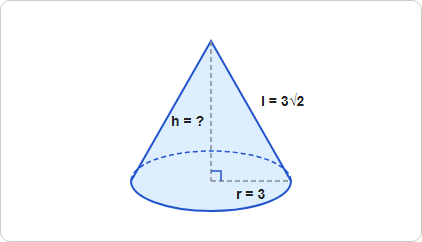 Given:
Radius of the cone (r) = 3 units
Slant height of the cone (l) = 3√2 units
Formula Used:
Volume of cone (V) = (1 ÷ 3) × π × r² × h
Pythagorean relation for a cone: l² = r² + h²
Calculations:
⇒ First, find the height (h) of the cone.
⇒ l² = r² + h²
⇒ (3√2)² = 3² + h²
⇒ 18 = 9 + h²
⇒ h² = 18 − 9
⇒ h² = 9
⇒ h = √9 = 3 units
⇒ Now, substitute the calculated height into the volume formula:
⇒ V = (1 ÷ 3) × π × (3)² × 3
⇒ V = (1 ÷ 3) × π × 9 × 3
⇒ V = 9π cubic units
∴ The correct answer is 9π cubic units.
Additional Information
Curved Surface Area (CSA) of a Cone
The area of only the curved side is calculated using the formula CSA = π × r × l, where r is the radius and l is the slant height.
Total Surface Area (TSA) of a Cone
The total surface area includes the circular base along with the curved surface. It is given by TSA = π × r × (r + l).
Relationship with a Cylinder
A cylinder having the exact same base radius (r) and height (h) as a cone will always have exactly three times the volume of the cone. Cylinder Volume = π × r² × h.
</p
Q9 · Algebra
If 3a + 2b = 27 and 27a³ + 8b³ = 1458, then find 2ab.
- 72
- 70
- 77
- 75
Answer aur solution dekho
Archived marked answer: D
Shortcut Trick
Use the derived algebraic identity: x³ + y³ = (x + y)[(x + y)² − 3xy]
Let x = 3a and y = 2b, which means xy = (3a)(2b) = 6ab.
⇒ 1458 = 27 × [27² − 3 × (6ab)]
⇒ 54 = 729 − 18ab
⇒ 18ab = 675 ⇒ ab = 37.5
∴ The correct answer is 75.
Alternate Method
Given:
3a + 2b = 27
27a³ + 8b³ = 1458
Formula Used:
(x + y)³ = x³ + y³ + 3xy(x + y)
Calculation:
Let x = 3a and y = 2b, so we need to find 2ab.
⇒ (3a + 2b)³ = (3a)³ + (2b)³ + 3 × (3a) × (2b) × (3a + 2b)
⇒ 27³ = 27a³ + 8b³ + 18ab(3a + 2b)
Substitute the given values into the expanded formula:
⇒ 19683 = 1458 + 18ab × 27
⇒ 19683 − 1458 = 486ab
⇒ 18225 = 486ab
⇒ ab = 18225 ÷ 486
⇒ ab = 37.5
Now, multiply by 2 to find the required value of 2ab:
⇒ 2ab = 2 × 37.5 = 75
∴ The correct answer is 75.
Additional Information
Algebraic Cube Identities
- (a + b)³ = a³ + b³ + 3ab(a + b)
- (a − b)³ = a³ − b³ − 3ab(a − b)
Sum of Cubes
- a³ + b³ = (a + b)(a² − ab + b²)
Difference of Cubes
- a³ − b³ = (a − b)(a² + ab + b²)
Q10 · Algebra
Simplify the given expression 4x² + 9y² - 12xy3y - 2x
- 2y−3x
- 3y−2x
- 2x-3y
- 3x-2y
Answer aur solution dekho
Archived marked answer: B
Shortcut Trick
Recognize that the numerator is a perfect square trinomial.
4x² + 9y² − 12xy = (3y − 2x)²
The given fraction reduces to: (3y − 2x)² ÷ (3y − 2x)
Canceling the common term gives: 3y − 2x
∴ The correct answer is 3y − 2x.
Alternate Method
Given:
Expression: (4x² + 9y² − 12xy) ÷ (3y − 2x)
Formula Used:
(a − b)² = a² − 2ab + b²
Calculations:
⇒ Rewrite the numerator in the form of a² − 2ab + b²
⇒ Numerator = (2x)² + (3y)² − 2 × (2x) × (3y)
⇒ This simplifies to (2x − 3y)²
⇒ Since squaring a negative gives a positive, (2x − 3y)² is identical to (3y − 2x)²
⇒ Substitute this back into the fraction: (3y − 2x)² ÷ (3y − 2x)
⇒ Dividing by the common factor (3y − 2x) yields: 3y − 2x
∴ The correct answer is 3y − 2x.
Additional Information
Perfect Square Trinomial
An algebraic expression obtained by squaring a binomial. The key formulas are: (a + b)² = a² + 2ab + b² and (a − b)² = a² − 2ab + b².
Difference of Two Squares
A squared number subtracted from another squared number. The standard identity is: a² − b² = (a − b)(a + b).
Sum and Difference of Cubes
For sum and difference of cubed terms, the formulas are: a³ + b³ = (a + b)(a² − ab + b²) and a³ − b³ = (a − b)(a² + ab + b²).
</p
Q11 · Algebra
Anna and Ben each have a collection of marbles. If Anna gives one marble to Ben, they will both have an equal number of marbles. Conversely, if Ben gives one marble to Anna, she will end up with three times the number of marbles that Ben has. What is the total number of marbles they both have?
- 10
- 8
- 11
- 9
Answer aur solution dekho
Archived marked answer: B
Shortcut Trick
From the first condition, Anna has 2 more marbles than Ben. Thus, Total = 2 × Ben + 2, which must be an even number.
Eliminate the odd options (11 and 9); verify the even options starting with 8.
If Total = 8, then Ben = 3 and Anna = 5.
Checking the second condition: If Ben gives 1 to Anna, Anna gets 6 and Ben is left with 2.
Since 6 is exactly 3 × 2, this satisfies all the given conditions perfectly.
∴ The correct answer is 8 marbles.
Alternate Method
Given:
Let the initial number of marbles with Anna be A and with Ben be B.
Final Verified Distribution
Anna:
(5 Marbles)
Ben:
(3 Marbles)
- Total = 5 + 3 = 8 Marbles
Calculations:
Case 1: If Anna gives one marble to Ben, they have an equal number.
⇒ A − 1 = B + 1
⇒ A = B + 2 (Equation 1)
Case 2: If Ben gives one marble to Anna, she has three times as many as Ben.
⇒ A + 1 = 3 × (B − 1)
⇒ A + 1 = 3B − 3 (Equation 2)
Substitute Equation 1 into Equation 2:
⇒ (B + 2) + 1 = 3B − 3
⇒ B + 3 = 3B − 3
⇒ 2B = 6
⇒ B = 3
Now find the number of marbles Anna has using Equation 1:
⇒ A = 3 + 2 = 5
Find the total number of marbles for both:
⇒ Total = A + B
⇒ Total = 5 + 3 = 8
∴ The correct answer is 8 marbles.
Additional Information
Linear Equations in Two Variables
A mathematical system of two linear equations models relationships between two unknowns. Such simultaneous equations can be efficiently solved using the substitution or elimination method.
Translating Word Problems
Common transaction phrases like 'gives 1 to' mean subtracting from the giver and adding to the receiver simultaneously, maintaining the same total item count overall.
Option Testing Strategy
For aptitude problems embedded with multiple linked conditions, testing the given multiple-choice options backward is often faster than setting up and solving long algebraic formulas.
</p
Q12 · Profit and Loss
A seller sold 19 cookies for ₹95 instead of 20 cookies in one kg, cheating a customer. What is the gain (in ₹) if the seller bought the cookies for ₹76?
- 28.2
- 26.2
- 22.8
- 25.8
Answer aur solution dekho
Archived marked answer: C
Shortcut Trick
Cost price of 1 cookie = ₹76 ÷ 20 = ₹3.8
Since the seller gives 19 cookies, the actual cost incurred = 19 × ₹3.8 = ₹72.2
Selling price collected from the customer = ₹95
Gain = Selling Price − Cost Price = 95 − 72.2 = ₹22.8
∴ The correct answer is ₹22.8.
Alternate Method
Given:
Total cost price of 1 kg (20 cookies) = ₹76
Total selling price of the transaction = ₹95
Number of cookies actually given to the customer = 19
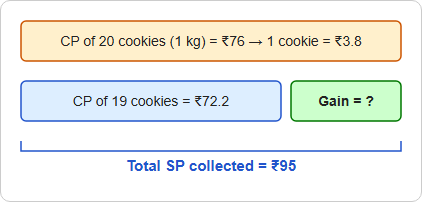 Formula Used:
Gain = Total Selling Price − Total Cost Price Incurred
Total Cost Price = Cost Price of 1 unit × Actual Quantity Given
Calculations:
⇒ Cost price of 1 cookie = 76 ÷ 20 = ₹3.8
⇒ Cost incurred by the seller for giving 19 cookies = 19 × 3.8 = ₹72.2
⇒ Selling price collected from the customer = ₹95
⇒ Gain = SP − CP incurred
⇒ Gain = 95 − 72.2 = ₹22.8
∴ The correct answer is ₹22.8.
Additional Information
Dishonest Dealer Concept
When a dealer cheats by altering the true quantity or weight, the effective Cost Price must be calculated based only on the items actually handed over to the customer, not on the promised or standard quantity.
Profit and Loss Basics
Gain occurs when the total Selling Price (SP) is greater than the total Cost Price (CP) incurred. It is calculated as Gain = SP − CP. The Profit Percentage is always calculated on the base of CP: (Gain ÷ CP) × 100.
Successive Markup and Quantity Cheat
If a seller marks up the price and simultaneously cheats in quantity, the overall profit combines both effects. You can calculate it directly by taking the ratio of the total money received (SP) to the total money spent (actual CP).
Q13 · Profit and Loss
If the selling price of an article is ₹1,792 after a 20% discount, then the marked price of the article is:
- ₹2,140
- ₹2,240
- ₹2,160
- ₹2,260
Answer aur solution dekho
Archived marked answer: B
Shortcut Trick
Discount = 20% = 1/5
If Marked Price is 5 units, Selling Price will be 5 − 1 = 4 units.
Given 4 units = ₹1,792
⇒ 1 unit = 1792 ÷ 4 = ₹448
⇒ Marked Price (5 units) = 448 × 5 = ₹2,240
∴ The correct answer is ₹2,240.
Alternate Method
Given:
Selling Price (SP) = ₹1,792
Discount = 20%
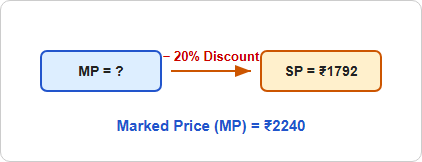 Formula Used:
Marked Price (MP) = (SP × 100) ÷ (100 − Discount%)
Calculations:
⇒ MP = (1792 × 100) ÷ (100 − 20)
⇒ MP = (1792 × 100) ÷ 80
⇒ MP = 179200 ÷ 80
⇒ MP = 17920 ÷ 8
⇒ MP = 2240
∴ The correct answer is ₹2,240.
Additional Information
Marked Price & Discount Base
Discount is always calculated on the Marked Price (MP) of an article, not the Cost Price (CP). The selling formula is: Selling Price = MP − Discount.
Successive Discounts
If an article is subject to two successive discounts of a% and b%, the equivalent single discount can be calculated using the formula: (a + b − (a × b) ÷ 100)%.
Markup Percentage
The percentage by which a seller increases the Marked Price over the original Cost Price is called the Markup Percentage. It is given by: MP = CP × (1 + Markup% ÷ 100).
Q14 · Time and Work
Pipe Q can fill the tank in 60 hours while pipe R may fill in 45 hours. Q and R pipes are opened together for 6 hours after which pipe W is also opened to empty the tank. All three pipes are opened simultaneously for 24 hours to reach the half level mark. How much time (in hours) will pipe W alone take to empty the entire tank?
- 48
- 42
- 36
- 30
Answer aur solution dekho
Archived marked answer: C
Shortcut Trick
Let total capacity = LCM(60, 45) = 180 units ⇒ Q = 3 units/hr, R = 4 units/hr.
Volume filled in first 6 hours by Q and R = 6 × (3 + 4) = 42 units.
To reach half mark (90 units), required volume in next 24 hours = 90 − 42 = 48 units.
Net efficiency of (Q + R − W) = 48 ÷ 24 = 2 units/hr.
Efficiency of W = 7 − 2 = 5 units/hr ⇒ Time = 180 ÷ 5 = 36 hours.
∴ The correct answer is 36 hours.
Alternate Method
Given:
Time taken by Pipe Q = 60 hours
Time taken by Pipe R = 45 hours
Method Used: LCM Method
Pipe
Hours
Total Work
Efficiency
Pipe Q
60
180
3
Pipe R
45
4
⇒ Combined efficiency of Pipe Q and Pipe R = 3 + 4 = 7 units/hour.
⇒ Work done by Q and R in 6 hours = 7 × 6 = 42 units.
⇒ Half level mark of the tank = 180 ÷ 2 = 90 units.
⇒ Remaining work to reach half mark = 90 − 42 = 48 units.
⇒ This remaining work is done by pipes Q, R, and W working together in 24 hours.
⇒ Combined net efficiency of (Q + R − W) = 48 ÷ 24 = 2 units/hour.
⇒ Let the efficiency of emptying pipe W be w units/hour.
⇒ 7 − w = 2
⇒ w = 5 units/hour.
⇒ Time taken by pipe W alone to empty the entire tank = Total capacity ÷ w
⇒ Time taken = 180 ÷ 5 = 36 hours.
∴ The correct answer is 36 hours.
Additional Information
Pipes and Cisterns Basics
If a pipe can fill a tank in x hours, its efficiency is 1 ÷ x of the tank per hour. The total capacity is often taken as the LCM of the given times to simplify calculations.
Emptying Pipe Efficiency
An emptying pipe performs negative work. If a pipe empties the tank in y hours, its efficiency is effectively −1 ÷ y.
Combined Work Concept
When multiple pipes are opened simultaneously, their combined operational efficiency is the algebraic sum of their individual efficiencies (positive for filling, negative for emptying).
</p
Q15 · Number System
If the 9-digit number 5x79856y6 is divisible by 36, then what is the negative value of √((2x + y)) for the largest possible value of y, given x and y are natural numbers?
- -7
- -2
- -4
- -5
Answer aur solution dekho
Archived marked answer: D
Shortcut Trick
Divisibility by 36 requires checking divisibility by both its co-prime factors, 4 and 9.
For divisibility by 4, the last two digits 'y6' must be a multiple of 4 ⇒ largest single digit y = 9.
For divisibility by 9, the sum of digits (5+x+7+9+8+5+6+9+6 = 55+x) must be a multiple of 9 ⇒ x = 8.
The negative value of √(2x + y) = −√(2 × 8 + 9) = −√25 = −5.
∴ The correct answer is −5.
Alternate Method
Given:
A 9-digit number 5x79856y6 is divisible by 36.
x and y are natural numbers.
Formula Used:
A number is divisible by 36 if it is divisible by both 4 and 9.
Divisibility by 4: The number formed by the last two digits must be divisible by 4.
Divisibility by 9: The sum of all digits must be divisible by 9.
Calculations:
⇒ For the number to be divisible by 4, the last two digits 'y6' must be divisible by 4.
⇒ Since y is a natural number, the possible single-digit values for y are 1, 3, 5, 7, and 9.
⇒ We are asked to find the answer for the largest possible value of y, so we take y = 9.
⇒ Substituting y = 9 gives the number 5x7985696.
⇒ For the number to be divisible by 9, the sum of its digits must be a multiple of 9.
⇒ Sum of digits = 5 + x + 7 + 9 + 8 + 5 + 6 + 9 + 6
⇒ Sum of digits = 55 + x
⇒ The closest multiple of 9 greater than 55 is 63.
⇒ 55 + x = 63
⇒ x = 63 − 55 = 8
⇒ We need the negative value of √(2x + y):
⇒ √(2x + y) = √(2 × 8 + 9)
⇒ √(16 + 9) = √25 = ±5
⇒ The negative value is −5.
∴ The correct answer is −5.
Additional Information
Divisibility Rule of 4
A number is divisible by 4 if the number formed by its last two digits is divisible by 4.
Divisibility Rule of 8
A number is divisible by 8 if the number formed by its last three digits is divisible by 8.
Divisibility Rule of 9
A number is divisible by 9 if the sum of all its digits is a multiple of 9.
Composite Divisibility
To check divisibility by a composite number, break it into its co-prime factors. For example, for 72 check 8 and 9; for 36 check 4 and 9.
</p
Q16 · Time and Distance
A man can row a distance of 6 km in 1 hour in still water. He can row the same distance in 45 minutes with the current. Find the total time taken by him to row a distance of 16 km with the current and to return to the starting point.
- 4 hours and 40 minutes
- 6 hours
- 4 hours
- 6 hours and 40 minutes
Answer aur solution dekho
Archived marked answer: B
Shortcut Trick
Downstream speed = Distance ÷ Time = 6 ÷ (45/60) = 8 km/h.
Stream speed = Downstream speed − Still water speed = 8 − 6 = 2 km/h.
Upstream speed = Still water speed − Stream speed = 6 − 2 = 4 km/h.
Total Time = Downstream Time + Upstream Time = (16 ÷ 8) + (16 ÷ 4)
Total Time = 2 + 4 = 6 hours.
∴ The correct answer is 6 hours.
Alternate Method
Given:
Speed of the man in still water (Vb) = 6 km/h
Distance covered downstream = 6 km
Time taken downstream = 45 minutes = 45 ÷ 60 = 3/4 hours
Distance for final trip = 16 km each way
Formulas Used:
Downstream Speed (Vd) = Vb + Speed of stream (Vₛ)
Upstream Speed (Vᵤ) = Vb − Vₛ
Time = Distance ÷ Speed
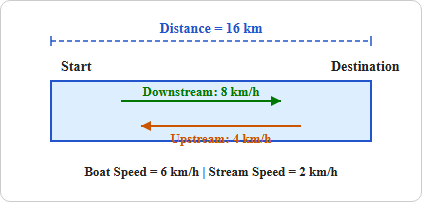 Calculations:
⇒ Downstream Speed (Vd) = Distance ÷ Time = 6 ÷ (3/4) = 8 km/h
⇒ We know Vd = Vb + Vₛ
⇒ 8 = 6 + Vₛ ⇒ Vₛ = 2 km/h
⇒ Upstream Speed (Vᵤ) = Vb − Vₛ = 6 − 2 = 4 km/h
⇒ Time taken to row 16 km downstream = 16 ÷ 8 = 2 hours
⇒ Time taken to row 16 km upstream = 16 ÷ 4 = 4 hours
⇒ Total Time = 2 + 4 = 6 hours
∴ The correct answer is 6 hours.
Additional Information
Downstream Speed
When a boat moves in the direction of the stream, the effective speed is the sum of the speed of the boat in still water and the speed of the current. Formula: D = Vb + Vₛ
Upstream Speed
When a boat moves against the direction of the stream, the effective speed is the difference between the speed of the boat in still water and the speed of the current. Formula: U = Vb − Vₛ
Speed of Boat and Stream from D and U
Speed of boat in still water = (D + U) ÷ 2 | Speed of stream = (D − U) ÷ 2
</p
Q17 · Simplification
The value of 9 − 5 × 6 + {29 −(7 − 2)} ÷ 8 i
- -8
- 18
- -18
- 8
Answer aur solution dekho
Archived marked answer: C
Given:
Expression: 9 - 5 × 6 + {29 - (7 - 2)} ÷ 8
Formula Used:
Follow the BODMAS/BIDMAS rule (Brackets, Orders (i.e. powers and square roots, etc.), Division and Multiplication, Addition and Subtraction).
Calculation:
Simplify inside the brackets first:
⇒ 9 - 5 × 6 + {29 - (7 - 2)} ÷ 8
⇒ 9 - 5 × 6 + {29 - 5} ÷ 8
Simplify the curly braces:
⇒ 9 - 5 × 6 + 24 ÷ 8
Perform Division and Multiplication next:
⇒ 9 - 30 + 3
Finally, perform Addition and Subtraction:
⇒ 9 - 30 + 3
⇒ -21 + 3
⇒ -18
The value is -18.
The correct answer is option 3.
Q18 · Proportion
If A : B = 6 : 8 and B : C = 7 : 12, then A : B : C is:
- 14 : 31 : 20
- 21 : 32 : 40
- 11 : 23 : 40
- 21 : 28 : 48
Answer aur solution dekho
Archived marked answer: D
Shortcut Trick
Simplify A : B = 6 : 8 ⇒ 3 : 4.
Given B : C = 7 : 12.
Using the shifted-neighbor method for combining ratios:
A : B : C = (3 × 7) : (4 × 7) : (4 × 12)
A : B : C = 21 : 28 : 48
∴ The correct answer is 21 : 28 : 48.
Alternate Method
Given:
A : B = 6 : 8
B : C = 7 : 12
Calculations:
⇒ First, simplify the ratio A : B to its lowest terms.
⇒ A : B = 6 : 8 = 3 : 4
⇒ To combine the ratios, make the common term (B) equal in both expressions.
⇒ The LCM of 4 and 7 is 28.
⇒ Multiply the A : B ratio by 7 ⇒ A : B = (3 × 7) : (4 × 7) = 21 : 28
⇒ Multiply the B : C ratio by 4 ⇒ B : C = (7 × 4) : (12 × 4) = 28 : 48
⇒ Now that B is equal in both ratios (28), we can combine them directly.
⇒ A : B : C = 21 : 28 : 48
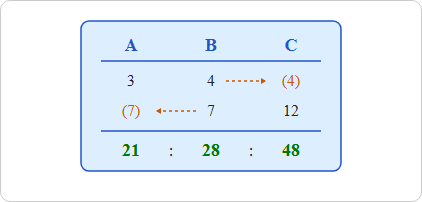 ∴ The correct answer is 21 : 28 : 48.
Additional Information
Compound Ratio
When two or more ratios are multiplied term-wise, the resulting ratio is called a compound ratio. For a:b and c:d, the compound ratio is ac:bd.
Duplicate Ratio
The ratio of the squares of two numbers is called their duplicate ratio. The duplicate ratio of a:b is a²:b².
Invertendo Rule
If a : b = c : d, then by the invertendo property, taking the reciprocal of both sides gives b : a = d : c.
</p
Q19 · Percentage
An investor, invested ₹2,00,000 in shares. The shares rose by 18% on the first day, fell by 15% on the second day, and then fell by 3% on the third day. What is the net percentage increase or decrease in the value of the investor's shares? (Rounded up to one decimal place)
- increase by 2.2%
- increase by 2.7%
- decrease by 2.7%
- decrease by 2.2%
Answer aur solution dekho
Archived marked answer: C
Shortcut Trick
Use successive percentage formula: Net Change = a + b + (a × b) / 100
Effective change for +18% and −15%: 18 − 15 − (18 × 15) / 100 = 3 − 2.7 = 0.3%
Effective change for +0.3% and −3%: 0.3 − 3 − (0.3 × 3) / 100 = −2.7 − 0.009 = −2.709%
The negative sign represents a decrease. Rounding to one decimal place gives a 2.7% decrease.
∴ The correct answer is decrease by 2.7%.
Alternate Method
Given:
Initial investment = ₹2,00,000
Successive changes: +18%, −15%, −3%
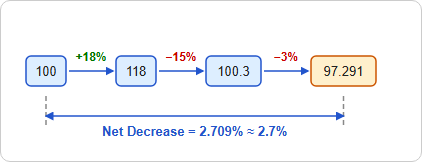 Formula Used:
Net Value = Initial Value × (100 ± R₁)/100 × (100 ± R₂)/100 × (100 ± R₃)/100
Calculations:
⇒ Let the initial value of shares be 100 (since the final answer is a percentage, the base of ₹2,00,000 is not needed).
⇒ Value after Day 1 = 100 × 118/100 = 118
⇒ Value after Day 2 = 118 × 85/100 = 100.3
⇒ Value after Day 3 = 100.3 × 97/100 = 97.291
⇒ Net Percentage Change = 97.291 − 100 = −2.709%
⇒ Since the result is negative, it indicates a decrease of approximately 2.7%.
∴ The correct answer is decrease by 2.7%.
Additional Information
Successive Percentage Change
For two successive changes of a% and b%, the effective percentage change is calculated using the formula: a + b + (a × b) / 100. Use a negative sign for any decrease.
Independence of Base Value
When solving for a net percentage change, the actual initial amount is completely redundant. Assuming a base of 100 always simplifies the calculation.
Multiplying Factor Method
An increase of x% gives a multiplying factor of (1 + x/100), while a decrease of x% gives (1 − x/100). The overall multiplying factor is the product of all individual factors.
</p
Q20 · Average
Find the average of first 125 natural numbers.
- 62.5
- 63
- 62
- 63.5
Answer aur solution dekho
Archived marked answer: B
Shortcut Trick
The average of the first n natural numbers can be directly calculated using the formula (n + 1) ÷ 2.
Here, the total number of terms is n = 125.
Average = (125 + 1) ÷ 2
Average = 126 ÷ 2 = 63.
∴ The correct answer is 63.
Alternate Method
- - - - 1
First
Number
125
Last
Number
63
Average
Average of Arithmetic Progression
Given:
The sequence of the first 125 natural numbers: 1, 2, 3, ..., 125.
First term (a) = 1
Last term (l) = 125
Formula Used:
Since the difference between consecutive natural numbers is constant, they form an Arithmetic Progression (AP).
For an AP, the average is calculated as: Average = (First term + Last term) ÷ 2
Calculations:
⇒ Average = (1 + 125) ÷ 2
⇒ Average = 126 ÷ 2
⇒ Average = 63
∴ The correct answer is 63.
Additional Information
Sum of First n Natural Numbers
The sum of the first n natural numbers can be found using the formula S = n × (n + 1) ÷ 2.
Average of First n Odd and Even Numbers
The average of the first n odd numbers is always equal to n, whereas the average of the first n even numbers is equal to n + 1.
Average of Squares of First n Natural Numbers
The average of the squares of the first n consecutive natural numbers is calculated using the formula (n + 1) × (2n + 1) ÷ 6.
</p
Q21 · Simple Interest
Aman borrows a sum of ₹192208 at the rate of 15% per annum simple interest. At the end of the first year, he repays ₹20196 towards return of principal amount borrowed. If Aman clears all pending dues at the end of the second year, including interest payment that accrued during the first year, how much does he pay (in ₹) at the end of the second year?
- 226645
- 221777
- 221757
- 230028
Answer aur solution dekho
Archived marked answer: A
Shortcut Trick
Total amount to clear the dues = (Total amount of original loan for 2 years) − (Amount of the repaid part for the remaining period).
Total amount for original loan for 2 years at 15% SI = ₹192208 + (₹192208 × 15% × 2) = ₹192208 + ₹57662.4 = ₹249870.4
Amount of the repaid part for the remaining 1 year = ₹20196 + (₹20196 × 15% × 1) = ₹20196 + ₹3029.4 = ₹23225.4
Remaining dues at the end of 2nd year = ₹249870.4 − ₹23225.4 = ₹226645.
∴ The correct answer is ₹226645.
Alternate Method
Given:
Principal (P) = ₹192208
Rate of Interest (R) = 15% per annum
Principal repaid at the end of 1st year = ₹20196
Formula Used:
Simple Interest = (P × R × T) ÷ 100
Amount = P + SI
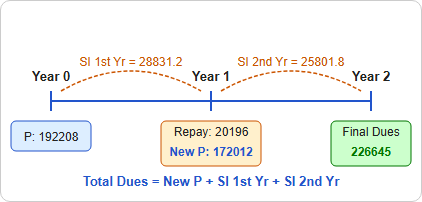 Calculations:
⇒ Interest for the 1st year = (192208 × 15 × 1) ÷ 100 = ₹28831.2
⇒ After repaying ₹20196 towards principal, the remaining principal for the 2nd year = 192208 − 20196 = ₹172012
⇒ Interest for the 2nd year on the new principal = (172012 × 15 × 1) ÷ 100 = ₹25801.8
⇒ Total pending dues at the end of 2nd year = Remaining Principal + Interest for 1st year + Interest for 2nd year
⇒ Total dues = 172012 + 28831.2 + 25801.8 = ₹226645
∴ The correct answer is ₹226645.
Additional Information
Simple Interest (SI)
The interest is calculated strictly on the original principal for the given period. The interest itself does not earn interest. Formula: SI = (P × R × T) ÷ 100.
Partial Repayment in SI
When a partial payment is made towards the principal amount, the simple interest for the subsequent periods is calculated on the newly reduced principal balance.
Total Amount (Dues)
The total sum of money to be cleared at the end of a loan tenure includes both the final remaining principal and all unpaid accrued interest. Formula: Amount = P + SI.
English
Q1 · Vocabulary
Select the most appropriate ANTONYM of the given word.
Triumphant
- Flourishing
- Unsuccessful
- Jubilant
- Tender
Answer aur solution dekho
Archived marked answer: B
The correct answer is: Option 2 i.e. Unsuccessful.
Key Points
- The word "Triumphant" means having achieved victory or success; it denotes a state of being victorious.
- Example: The team felt triumphant after winning the championship.
- "Unsuccessful" refers to not achieving the desired aim or result; it denotes failure.
- Example: Despite their efforts, the mission was unsuccessful.
- Hence, we can infer that the opposite of 'Triumphant' is 'Unsuccessful'.
Therefore, the correct answer is: Option 2 i.e. Unsuccessful.
Additional Information
Here are the other options explained along with their Hindi meanings and example sentences:
- Flourishing: Developing rapidly and successfully; thriving.
- Example: The business is flourishing under the new management.
- Jubilant: Feeling or expressing great happiness and triumph.
- Example: The crowd was jubilant after the team’s victory.
- Tender: Showing gentleness and concern or sympathy.
- Example: He gave her a tender kiss on the forehead.
The correct answer is: Option
Q2 · Vocabulary
Identify the correct antonym for the given word.
Envious
- Generous
- Suspicious
- Malicious
- Untrustworthy
Answer aur solution dekho
Archived marked answer: A
The correct answer is: Generous.
Key Points
- The word "Envious" means feeling or showing jealousy towards someone for their possessions, qualities, or luck.
- Example: She was envious of her friend's success and accolades.
- "Generous" refers to showing a readiness to give more of something, such as money or time, than is strictly necessary or expected; it is the opposite of being envious.
- Example: He was very generous with his time, always helping those in need.
- Hence, we can infer that the opposite of 'envious' is 'generous'.
Therefore, the correct answer is: Generous.
Additional Information
Here are the other options explained along with their Hindi meanings and example sentences:
- Suspicious: Having or showing a cautious distrust of someone or something.
- Example: She was suspicious of the stranger's intentions.
- Malicious: Intending or intended to do harm.
- Example: The malicious rumors caused a lot of pain and suffering.
- Untrustworthy: Not able to be relied on as honest or truthful.
- Example: He was deemed untrustworthy after multiple instances of deceit.
The correct answer is Opti
Q3 · Vocabulary
Select the most appropriate ANTONYM of the underlined word in the given sentence.
Coffee was too hot; it burnt my tongue.
- Scorching
- Frigid
- Balmy
- Subtle
Answer aur solution dekho
Archived marked answer: B
The correct answer is: Option 2 i.e. Frigid.
Key Points
- The word "hot" means having a high temperature.
- Example: The soup is hot, be careful when you eat it.
- "Frigid" refers to something extremely cold.
- Example: The water in the pool was frigid, so I didn't swim.
- Hence, we can infer that the opposite of 'hot' is 'frigid'.
Therefore, the correct answer is: Frigid.
Additional Information
Here are the other options explained along with their Hindi meanings and example sentences:
- Scorching : Extremely hot.
- Example: The scorching sun made it hard to stay outside for long.
- Balmy : Pleasantly warm.
- Example: We enjoyed the balmy evening by the beach.
- Subtle: Not obvious; delicate or precise.
- Example: Her subtle hint did not go unnoticed.
The logi
Q4 · Vocabulary
Select the most appropriate ANTONYM of the word in the brackets to fill in the blank.
Dhara ______ the way to Mumbai. [lost]
- paved
- slept
- found
- helped
Answer aur solution dekho
Archived marked answer: C
The correct answer is: Option 3.
Key Points
- The word "lost" means unable to find one's way or not knowing one's whereabouts.
- Example: She was lost in the new city and had to ask for directions.
- "found" refers to discovering something or someone after a search, or locating something that was missing.
- Example: After hours of searching, he finally found his missing keys.
- Hence, we can infer that the opposite of 'lost' is 'found'.
Therefore, the correct answer is: Option 3.
Additional Information
Here are the other options explained along with their Hindi meanings and example sentences:
- Paved : Covered with a firm surface, such as concrete or asphalt.
- Example: The newly paved road made the journey much smoother.
- Slept : Past tense of sleep, meaning to rest by sleeping.
- Example: He slept for eight hours and woke up feeling refreshed.
- Helped: To assist or aid someone in doing something.
- Example: She helped her friend complete the project on time.
Q5 · Vocabulary
Select the most appropriate meaning of the given idiom.
Creature of habit
- A mean person
- A bad habit
- A faithful dog
- One who does same thing in the same way
Answer aur solution dekho
Archived marked answer: D
The correct answer is: Option 4 i.e. 'One who does same thing in the same way'.
Key Points
- The word "creature of habit" means a person who follows the same routine or habits consistently; they are predictable in their actions.
- Example: John is a creature of habit who eats the same breakfast every day and takes the same route to work.
- "One who does same thing in the same way" refers to a person who regularly follows the same routine or method without variation.
- Example: Sarah is one who does the same thing in the same way, ensuring her tasks are always completed with precision.
- Hence, we can infer that 'creature of habit' is synonymous with 'one who does same thing in the same way'.
Therefore, the correct answer is: Option 4 i.e. 'One who does same thing in the same way'.
Additional Information
Here are the other options explained along with their Hindi meanings and example sentences:
- Mean person : Someone who is unkind or spiteful.
- Example: Jane is known to be a mean person who never shares her resources with anyone.
- Bad habit : A habitual action that is considered negative or harmful.
- Example: Smoking is a bad habit that can lead to serious health issues.
- Faithful dog : A dog that shows loyalty and affection towards its owner.
- Example: Max is a faithful dog who always waits for his owner to return home.
The correct answer is 'have been renovating'.</÷
Q6 · Vocabulary
Select the most appropriate meaning of the given idiom.
Hit the roof
- To destruct a building
- To become very angry
- To jump high
- To play joyfully
Answer aur solution dekho
Archived marked answer: B
The correct answer is: Option 2 i.e. To become very angry.
Key Points
- The idiom "hit the roof" means to become very angry or furious.
- Example: When he saw the mess his children had made, he hit the roof.
- "To become very angry" refers to a state of intense irritation or rage.
- Example: She hit the roof when she found out that her project was rejected without any valid reason.
Therefore, the correct answer is: Option 2 i.e. To become very angry.
Additional Information
Here are the other options explained along with their Hindi meanings and example sentences:
- To destruct a building: Refers to demolishing or tearing down a structure.
- Example: The old mall was destructed to make way for a new park.
- To jump high: Refers to leaping or springing upwards to a great height.
- Example: The athlete trained hard to jump high in the upcoming competition.
- To play joyfully: Refers to engaging in playful activities with delight and happiness.
- Example: The children played joyfully in the park during their break.
The correct answer is 'colloquial'.</s
Q7 · Vocabulary
Select the option that can be used as a one-word substitute for the given group of words.
Having unlimited power
- Omnipotent
- Omnipresence
- Omniscient
- Omnivorous
Answer aur solution dekho
Archived marked answer: A
The correct answer is Option 1.
Key Points
- The correct one-word substitute for the phrase "Having unlimited power" is Omnipotent.
- Omnipotent refers to the quality of having unlimited or infinite power, especially in reference to a deity or supreme being.
Hence, the correct answer is Option 1.
Correct sentence: *Having unlimited power is a quality often attributed to omnipotent beings.*
Additional Information
- Option 2: Omnipresence refers to the quality of being present everywhere, which does not fit the meaning of having unlimited power.
- Option 3: Omniscient means all-knowing, which is unrelated to having unlimited power.
- Option 4: Omnivorous refers to an organism that eats both plants and animals, which does not fit the context of unlimited power.
Q8 · Vocabulary
Select the option that can be used as a one-word substitute for the given group of words.
A short stay that you make while on a longer journey
- Saga
- Stopover
- Refugee
- Tent
Answer aur solution dekho
Archived marked answer: B
The correct answer is Option 2.
Key Points
- A stopover refers to a short stay made during a longer journey, which is the definition needed in this sentence.
Hence, the correct answer is Option 2.
Correct Sentence*: A short stay that you make while on a longer journey is called a stopover.*
Additional Information
- Option 1: "Saga" refers to an epic or long narrative, not a brief stop on a journey.
- Option 3: "Refugee" pertains to a person who has fled from a dangerous situation, not a brief stay during travel.
- Option 4: "Tent" is a physical structure for shelter, not a term for a stopover in travel.
Q9 · Vocabulary
Select the option that can be used as a one-word substitute for the given group of words.
Much more than usual or expected
- Mordancy
- Ordinate
- Subordinate
- Exceeding
Answer aur solution dekho
Archived marked answer: D
The correct answer is 'Option 4'.
Key Points
- The phrase "Much more than usual or expected" refers to something surpassing normal expectations, which aligns with the word Exceeding.
- Thus, the most appropriate one-word substitute is Exceeding.
Hence, the correct answer is Option 4.
Correct sentence:* The growth of the company has been exceeding expectations.*
Additional Information
- Option 1: Mordancy means sharpness or bitterness, which is unrelated to exceeding expectations.
- Option 2: Ordinate refers to something that is arranged in order, not applicable here.
- Option 3: Subordinate means lower in rank or position, which doesn't fit the context.
Q10 · Vocabulary
Select the word with the correct spelling to fill in the blank.
Hiren loves to use _______ words while writing anything.
- coloquial
- colloquial
- colloquil
- olloqual
Answer aur solution dekho
Archived marked answer: B
The correct answer is 'colloquial'.
Key Points
- The word "co
Q11 · Vocabulary
Select the INCORRECTLY spelt word in the given sentence.
Economics began with growth and removel of poverty as its grand theme.
- Poverty
- Grand
- Removel
- Economics
Answer aur solution dekho
Archived marked answer: C
The correct answer is option 3.
Key Points
The misspelled word is 'removel'.
- The correct spelling would be 'removal'.
- The word 'removal' is a noun which means 'the action of taking away or abolishing something'.
- For Example -
- The removal of outdated laws is necessary for the progress of society.
- Therefore, the correct answer would be 'removel'.
Additional Information
Let's understand the meanings of the other marked words -
- Poverty - the state of being extremely poor
- Grand - magnificent and imposing in appearance, size, or style
- Economics - the branch of knowledge concerned with the production, consumption, and transfer of wealth
The correct answer is:
Q12 · Vocabulary
Select the most appropriate synonym of the given word.
Mellifluous
- Distinct
- Musical
- Loud
- Cacophonous
Answer aur solution dekho
Archived marked answer: B
The correct answer is: Option 2 i.e. Musical.
Key Points
- The word "Mellifluous" means a sound that is sweet, smooth, and pleasant to hear.
- Example: The singer's mellifluous voice captivated everyone in the audience.
- "Musical" refers to something that is related to or has the qualities of music, often pleasing and harmonious.
- Example: The musical notes from the piano filled the room with a soothing melody.
Therefore, the correct answer is: Option 2 i.e. Musical.
Additional Information
Here are the other options explained along with their Hindi meanings and example sentences:
- Distinct : Clearly different or of a different kind.
- Example: The two cultures are distinct in many ways, including their language and traditions.
- Loud : Producing or capable of producing much noise; easily audible.
- Example: The loud music from the party could be heard from several blocks away.
- Cacophonous : Involving or producing a harsh, discordant mixture of sounds.
- Example: The cacophonous sound of the construction work disturbed the entire neighborhood.
The correct answer is: O
Q13 · Vocabulary
Select the most appropriate synonym of the underlined word in the given sentence.
A period of free outdoor play can provide a very necessary respite from the hustle and bustle of the day.
- Progression
- Commencement
- Break
- Continuation
Answer aur solution dekho
Archived marked answer: C
The correct answer is: Option 3 i.e. Break.
Key Points
- The word "respite" means a short period of rest or relief from something difficult or unpleasant.
- Example: After working for several hours without a break, they finally had a short respite to relax.
- "Break" refers to a pause in work or during an activity for rest or refreshment.
- Example: They took a short break to enjoy some coffee and snacks.
Therefore, the correct answer is: Option 3 i.e. Break.
Additional Information
Here are the other options explained along with their Hindi meanings and example sentences:
- Progression : The process of developing or moving gradually towards a more advanced state.
- Example: His progression in the company was rapid due to his hard work and dedication.
- Commencement : The beginning or start of something.
- Example: The commencement of the new project was marked by a grand ceremony.
- Continuation: The action of carrying something on over a period of time.
- Example: The continuation of the meeting was scheduled for the next day.
The correct answer is: Option
Q14 · Grammar
The following sentence has been split into four segments. Identify the segment that contains a grammatical error.
He never talks / for anybody. / He is alone / all day.
- He is alone
- for anybody
- He never talks
- all day
Answer aur solution dekho
Archived marked answer: B
The correct answer is Option 2.
Key Points
- The primary issue in the sentence is th
Q15 · Grammar
Select the most appropriate verb / verb phrase to fill in the blank.
They __________ their house for the past two months, and it's finally starting to look fantastic.
- were renovating
- will renovate
- has renovated
- have been renovating
Answer aur solution dekho
Archived marked answer: D
The correct answer is 'have been renovating'.
Key Points
- The verb phrase "have been renovating" is in the present perfect continuous tense, which is used to describe an action that started in the past and is still ongoing or has recently finished.
- The sentence indicates that the action of renovating has been happening for the past two months and is still relevant now.
Therefore, the correct answer is Option 4.
Complete Sentence: *"They have been renovating their house for the past two months, and it's finally starting to look fantastic."*
Additional Information
- Option 1: "were renovating" is incorrect because it does not indicate that the action is ongoing or recently finished.
- Option 2: "will renovate" is incorrect because it indicates a future action, not a current ongoing action.
- Option 3: "has renovated" is incorrect because it indicates a completed action, not an ongoing one.
Q16 · Grammar
Select the most appropriate option to substitute the underlined segment in the given sentence.
A computer can't function without it's mother board.
- its
- his
- their
- it is
Answer aur solution dekho
Archived marked answer: A
The correct answer is Option 1.
Key Points
Q17 · Grammar
Select the most appropriate option to substitute the underlined segment in the given sentence.
Do you know where does she reside?
- where does she resides?
- where she reside?
- where she resides?
- where do she reside?
Answer aur solution dekho
Archived marked answer: C
The correct answer is Option 3.
Key Points
- The primary issue in the sentence is the incorrect use of the auxiliary verb "does" in a direct question format within an indirect question.
- In indirect questions, the auxiliary verb "does" should not be used, and the verb should be in its correct form to match the subject.
- The correct phrase should be "where she resides," ensuring grammatical correctness and clarity.
- Thus, the error is located in the original sentence structure.
Therefore, the correct answer is Option 3.
Correct Sentence: *"Do you know where she resides?"*
Additional Information
- where does she resides? – Incorrect, as it improperly conjugates the verb with an unnecessary auxiliary verb.
- where she reside? – Incorrect, as the verb "reside" should be in agreement with the subject "she" (i.e., "resides").
- where do she reside? – Incorrect, as the auxiliary verb "do" does not agree with the singular subject "she".
Q18 · Voice Change
Select the option that expresses the given sentence in passive voice.
People will respect his bravado.
- His bravado will being respected by people.
- His bravado will have to be respected by people.
- His bravado will be respected by people.
- His bravado will be respect by people.
Answer aur solution dekho
Archived marked answer: C
The correct answer is Option 3.
Key Points
- Passive voice structure: The object of the active voice sentence becomes the subject of the passive voice sentence.
- In the active voice, the sentence is: "People will respect his bravado."
- To convert to passive voice: Place the object "his bravado" at the beginning.
- Change the active verb form "will respect" to "will be respected" (future simple passive).
- Add the preposition "by" followed by the original subject "people."
Therefore, the correct answer is Option 3.
Correct Sentence: *"His bravado will be respected by people."*
Additional Information
- Option 1: "His bravado will being respected by people." – Incorrect verb form.
- Option 2: "His bravado will have to be respected by people." – Incorrect modal usage.
- Option 4: "His bravado will be respect by people." – Incorrect verb form.
Q19 · Voice Change
Select the option that expresses the given sentence in passive voice.
People know Stellenbosch for its greenery and delicious street foods.
- Stellenbosch was known to people for its greenery and delicious street foods.
- Stellenbosch is known to people for its greenery and delicious street foods.
- Stellenbosch had been known to people for its greenery and delicious street foods.
- Stellenbosch have been known to people for its greenery and delicious street foods.
Answer aur solution dekho
Archived marked answer: B
The correct answer is Option 2.
Key Points
- Passive voice structure: The object of the active voice sentence becomes the subject of the passive voice sentence.
- In the active voice, the sentence is: "People know Stellenbosch for its greenery and delicious street foods."
- To convert to passive voice: Place the object "Stellenbosch" at the beginning.
- Change the active verb form "know" to "is known" (present simple passive).
- Add the preposition "to" followed by the original subject "people."
- Ensure the rest of the sentence remains unchanged for clarity.
Therefore, the correct answer is Option 2.
Correct Sentence: *"Stellenbosch is known to people for its greenery and delicious street foods."*
Additional Information
- Option 1: "Stellenbosch was known to people for its greenery and delicious street foods." – Incorrect tense (past simple passive).
- Option 3: "Stellenbosch had been known to people for its greenery and delicious street foods." – Incorrect tense (past perfect passive).
- Option 4: "Stellenbosch have been known to people for its greenery and delicious street foods." – Incorrect verb form (should be "has been" instead of "have been").
Q20 · Para Jumble
Parts of a sentence are given below in jumbled order. Arrange the parts in the correct order to form a meaningful sentence.
A: new facts and advanced
B: but my opinion is
C: he has discovered
D: unchanged
E: new arguments
- DACBE
- CAEBD
- BDAEC
- EBDCA
Answer aur solution dekho
Archived marked answer: B
The correct answer is Option (2) i.e. CAEBD
Key Points
- The sentence begins with the subject "he has discovered," which is correctly indicated by part (C).
- Following the subject, "new facts and advanced new arguments" (CAE) continues the logical sequence, making it clear what he has discovered.
- The next part, "but my opinion is" indicated by (B) introduces a contrast or another point of view.
- Ending with "unchanged" (D) completes the sentence by stating that the opinion remains the same.
Therefore, the correct answer is CAEBD.
Additional Information
- Option 1 (DACBE): This option starts with "unchanged he has discovered but my opinion is," which is a grammatically incorrect and fragmented sequence.
- Option 3 (BDAEC): This option starts with "but my opinion is unchanged he has discovered," which disrupts the logical flow of the sentence.
- Option 4 (EBDCA): This option starts with "new arguments but my opinion is unchanged he has discovered," which creates a confusing and incomplete sentence.