92 questions available to read. Bina signup padho; timed practice ke liye free sign in karo.
Archive coverageThis saved paper contains 92 of 100 expected questions. 0 stored records are excluded from this study page while their source or wording is checked. Missing original questions: 8. Local question numbers follow the saved archive; match the wording and choices when comparing another response sheet.
Archived marked answers and available solution notes are preserved. These are not claimed to be fully checked final SSC keys. How questions are checked.
Reasoning
Q1 · Series
Select the option that represents the letters that when sequentially placed from left to right in the blanks below will complete
the letter series.
_ O _ O _ _ O _ P _ O _
- PPOOPOP
- OOPPPOO
- OPOPOOP
- PPOOOPO
Answer aur solution dekho
Archived marked answer: C
Given series: _ O _ O _ _ O _ P _ O _
Option 1) PPOOPOP → P O P O O O O P P O O P → (It doesn't follow any pattern)
Option 2)
Q2 · Series
Which of the following terms will replace the question mark (?) in the given series?
BHVC, ZLTG, XPRK, ? , TXNS
- VTPO
- VTPN
- VPTN
- VPTO
Answer aur solution dekho
Archived marked answer: A
The logic followed here is:
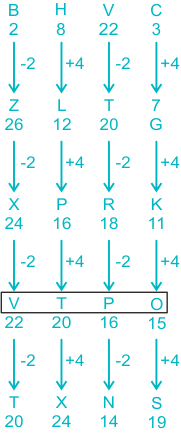 Hence, "Option 1" is the correct answer.
Q3 · Series
Which figure should replace the question mark (?) if the following series were to be continued?
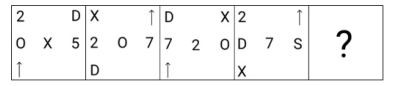



Answer aur solution dekho
Archived marked answer: B
The logic followed here is:
1) For first box series →
The right diagonal elements interchange positions.
The second element of 3rd column is replaced by new element subsequently.
The rest of the elements shifts anticlockwise.
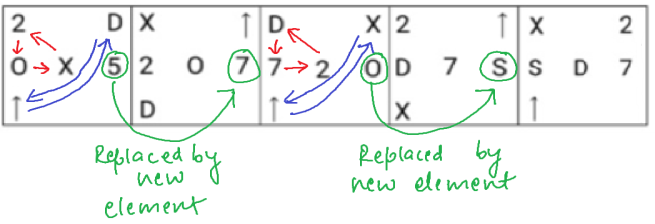
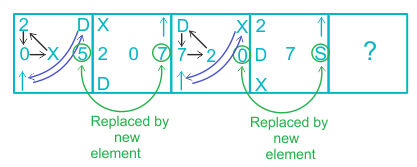 2) For second box series →
The elements at the corners shifts clockwise.
The rest of the elements shifts anticlockwise.
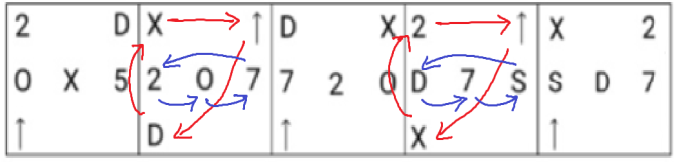
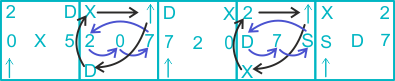 Thus, the final series is:
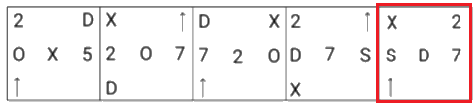
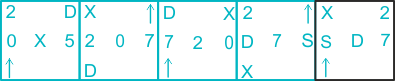 Hence, "Option 2" is the correct answer.
Q4 · Series
Identify the figure given in the options which when put in place of the question mark (?) will logically complete the series?



Answer aur solution dekho
Archived marked answer: A
The logic followed here is:
1) All the elements including the center element shifts clockwise.
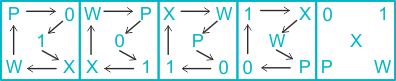 Thus, the final series is:
 Hence, "Option 1" is the correct answer.
Q5 · Series
Which of the following numbers will replace the question mark (?) in the given series?
22, 23, 27, 54, 70, 195, ?
- 196
- 230
- 200
- 231
Answer aur solution dekho
Archived marked answer: D
The logic followed here is:
 Hence, "Option 4" is the correct answer.
Q6 · Analogy
13 is related to 117 following a certain logic. Following the same logic, 23 is related to 207. To which of the following is 51
related, following the same logic?
(NOTE: Operations should be performed on the whole numbers, without breaking down the numbers into its constituent digits. E.g. 13 – Operations on 13 such as adding /deleting /multiplying etc. to 13 can be performed. Breaking down 13 into 1 and 3 and then performing mathematical operations on 1 and 3 is not allowed)
- 350
- 450
- 359
- 459
Answer aur solution dekho
Archived marked answer: D
The logic followed here is:
Logic: (1st number × 9) = 2nd number.
Now,
For, 13 : 117
⇒ (13 × 9) = 117.
For, 23 : 207
⇒ (23 × 9) = 207.
Similarly, for 51 ∶ ?
⇒ (51 × 9) = 459.
Hence, the correct answer is "Option 4".
Q7 · Analogy
Two sets of numbers are given below. In each set of numbers, certain mathematical operation(s) on the first number result(s) in the second number. Similarly, certain mathematical operation(s) on the second number result(s) in the third number and so on. Which of the given options follows the same set of operations as in the given sets?
(NOTE: Operations should be performed on the whole numbers, without breaking down the numbers into their constituent digits. E.g. 13 – Operations on 13 such as adding/subtracting/multiplying to 13 can be performed. Breaking down 13 into 1 and 3 and then performing mathematical operations on 1 and 3 is not allowed.)
9 – 27 – 31 – 36; 10 – 30 – 34 – 39
- 8 – 24 – 28 – 35
- 15 – 45 – 50 – 55
- 11 – 33 – 38 – 44
- 5 – 15 – 19 – 24
Answer aur solution dekho
Archived marked answer: D
The logic followed here is:
Logic: 1st number × 3 = 2nd number; 2nd number + 4 = 3rd number; 3rd number + 5 = 4th number.
Now, for 9 – 27 – 31 – 36
⇒ 9 × 3 = 27;
⇒ 27 + 4 = 31;
Q8 · Analogy
Select the option in which the numbers share the same relationship as that shared by the given pair of numbers.
(NOTE: Operations should be performed on the whole numbers, without breaking down the numbers into its constituent digits. E.g., 13 – Operations on 13 such as adding/deleting/multiplying etc. to 13 can be performed. Breaking down 13 into 1 and 3 and then performing mathematical operations on 1 and 3 is not allowed.)
63 : 441
51 : 357
- 68 : 340
- 54 : 324
- 39 : 273
- 89 : 96
Answer aur solution dekho
Archived marked answer: C
The logic followed here is:
Logic: (1st number × 7) = 2nd number.
Now,
For, 63 : 441
⇒ (63 × 7) = 441.
For, 51 : 357
⇒ (51 × 7) = 357.
Similarly, for:
68 : ?
⇒ (68 × 7) = 476 (not equal to 340)
54 : ?
⇒ (54 × 7) = 378 (not equal to 324)
39 : ?
⇒ (39 × 7) = 273 (equal to 273)
89 : ?
⇒ (89 × 7) = 623 (not equal to 96)
Hence, the correct answer is "Option 3".
Q9 · Analogy
Select the option that is related to the third word in the same way as the second word is related to the first word. (The words must be considered as meaningful English words and must NOT be related to each other based on the number of letters/number of consonants/vowels in the word)
Magician : Magic :: Dancer : ?
- Dance
- Theatre
- Movie
- Song
Answer aur solution dekho
Archived marked answer: A
The logic followed here is:
Logic: Profession and its related activity.
Here,
Magician : Magic → Magic</spa
Q10 · Analogy
Select the word-pair that best represents a similar relationship to the one expressed in the pair of words given below.
(The words must be considered as meaningful English words and must NOT be related to each other based on the number
of letters/number of consonants/vowels in the word)
Kaziranga : Rhinoceros
- Gahirmatha : Lions
- Periyar : Elephants
- Ranthambore : Peacocks
- Gir : Leopards
Answer aur solution dekho
Archived marked answer: B
The logic followed here is:
Logic: Animal reserves and the animals they are famous for.
Here,
Kaziranga : Rhinoceros → Kaziranga
Q11 · Non Verbal Reasoning
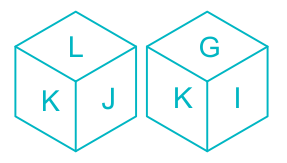
Six letters G, H, I, J, K and L are written on different faces of a dice. Two positions of this dice are shown in the figure below. Find the letter on the face opposite to G.
- K
- I
- L
- J
Answer aur solution dekho
Archived marked answer: C
The logic followed here is :-
From the given two different dices the adjacent sides are as shown below :
As K is common on both the dices, it is clear that L, J, G, and I are adjacent to it, and the remaining i.e. H will be opposite to it.
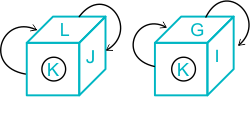 Opposite pairs:
L → G
J → I
K → H
So, the opposite side of "G" will be side "L".
Hence, the correct answer is "Option 3".
Q12 · Non Verbal Reasoning
Six letters B, F, D, X, N and A are written on different faces of a dice. Two positions of this dice are shown in the figures below. Find the letter on the face opposite to D.

- A
- N
- B
- F
Answer aur solution dekho
Archived marked answer: A
The logic followed here is :-
From the given two different dices the adjacent sides are as shown below :
As D is common on both the dices, it is clear that F, B, X, and N are adjacent to it, and the remaining i.e. A will be opposite to it.
Q13 · Non Verbal Reasoning
Select the option figure that will replace the question mark (?) in the figure given below to complete the pattern.





Answer aur solution dekho
Archived marked answer: A
The figure which when put in place of '?' will logically complete the pattern is shown below:
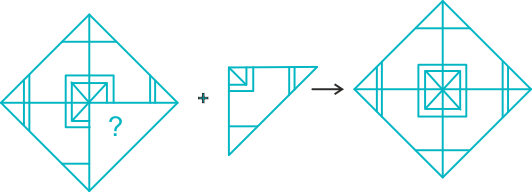 Thus, option Figure 1 will logically complete the pattern given.
Hence, "Option 1" is the correct answer.
Q14 · Non Verbal Reasoning
How many squares are there in the figure shown below?

- 11
- 13
- 9
- 10
Answer aur solution dekho
Archived marked answer: A
The number of squares in the given figure is shown below:
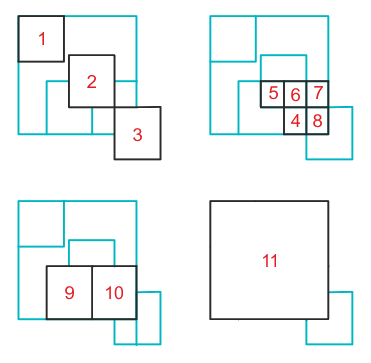 Thus, as marked there are a total of 11 squares.
Hence, "Option 1" is the correct answer.
Q15 · Non Verbal Reasoning
Select the correct mirror image of the given figure when the mirror is placed at MN as shown below.
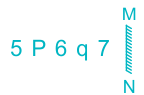
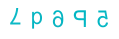

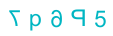
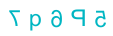
Answer aur solution dekho
Archived marked answer: D
The correct mirror image of the given figure is:
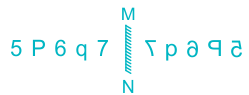 Hence, the correct answer is "Option 4".
Q16 · Puzzle Subtypes Not To Miss
What will come in place of the question mark (?) in the following equation, if '+' and '−' are interchanged and '×' and '÷' are interchanged?
2864 × 4 - 168 ÷ 2 + 69 = ?
- 389
- 983
- 839
- 938
Answer aur solution dekho
Archived marked answer: B
BODMAS Table:
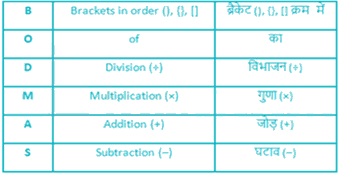 After decoding signs:
Signs
Decoded signs
+
-
+
×
÷
÷
×
Given equation: 2864 × 4 - 168 ÷ 2 + 69 = ?
After interchanging the signs then:
⇒ 2864 ÷ 4 + 168 × 2 - 69 = ?
⇒ ? = 716 + 168 __×__ 2 - 69
⇒ ? = 716____ + 336 - 69
⇒ ? = 1052____ - 69
⇒ ? = 983
Hence, the correct answer is "983".
Q17 · Puzzle Subtypes Not To Miss
What will come in place of the question mark (?) in the following equation if '+' and '×' are interchanged and '−' and '÷' are interchanged?
27 − 6 + 4 × 8 ÷ 6 = ?
- 22
- 18
- 16
- 20
Answer aur solution dekho
Archived marked answer: D
BODMAS Table:
After decoding signs:
Signs
Decoded signs
+
×
×
+
÷
÷
Given equation: 27 − 6 + 4 × 8 ÷ 6 = ?
After interchanging the signs then:
⇒ 27 ÷ 6 × 4 + 8 - 6 = ?
⇒ ? = 4.5 __×__ 4 + 8 - 6
⇒ ? = 18 + 8 - 6
⇒ ? = 26____ - 6
⇒ ? = 20
Hence, the correct answer is "20". Q18 · Coding Decoding
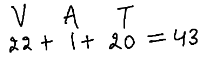
In a certain code language, 'VAT' is coded as '43' and 'AWW' is coded as '47'. How will 'ZHU' be coded in that language?
- 63
- 48
- 55
- 62
Answer aur solution dekho
Archived marked answer: C
The logic followed here is:
'VAT' is coded as '43'
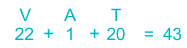
Q19 · Coding Decoding
In a certain code language, 'ESTATE' is written as '80', 'FAMOUS' is written as '85', how will 'FOREST' be written in that language?
- 93
- 88
- 83
- 90
Answer aur solution dekho
Archived marked answer: A
The logic followed here is:
'ESTATE' is written as '80'
 And,
'FAMOUS' is written as '85'
 Similarly,
'FOREST' is written as
 Hence, "Option 1" is the correct answer.
Q20 · Classification Odd One Out
Three of the following four options are alike in a certain way and thus form a group. Which is the one that does NOT belong to that group?
(NOTE: Operations should be performed on the whole numbers, without breaking down the numbers into its constituent digits. E.g. 13 – Operations on 13 such as adding/subtracting/multiplying etc. to 13 can be performed. Breaking down 13 into 1 and 3 and then performing mathematical operations on 1 and 3 is not allowed.)
- 360 – 12 – 6
- 82 – 8 – 2
- 63 – 6 – 3
- 164 – 10 – 4
Answer aur solution dekho
Archived marked answer: B
The logic followed here is:
Option 1) 360 – 12 – 6
12² + 6³ = 360
144 + 216 = 360
360 = 360 (LHS = RHS)
Option 2) 82 – 8 – 2
8
Q21 · Classification Odd One Out
The following contains two pairs of words which are related to each other in a certain way. Three of the following four word-
pairs are alike as these have the same relationship and thus form a group. Which word-pair does NOT belong to that group?
(The words must be considered as meaningful English words and must not be grouped based on the number of
letters/number of consonants/vowels in the word)
- Joy - Peace
- Misery - Happiness
- Problem - Concern
- Worry - Fear
Answer aur solution dekho
Archived marked answer: B
The logic followed here is:
Joy
Peace
Misery
Happiness
Problem
Concern
Worry
Fear
Joy - Peace, Problem - Concern, Worry - Fear all are Synonyms,
Whereas,
Misery - Happiness are Antonyms.
Hence, the correct answer is "Misery - Happiness".
Q22 · Logical Reasoning
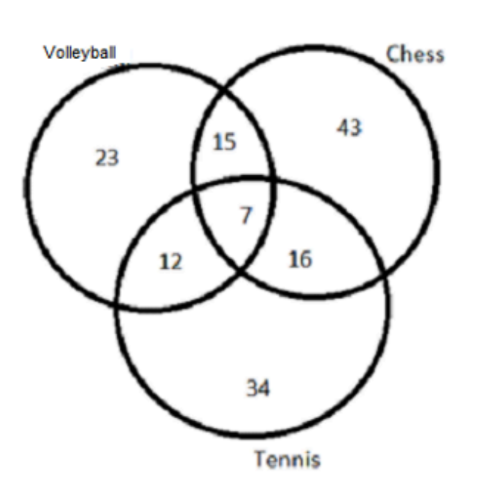
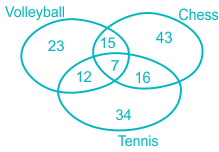
How many people play either only volleyball or only chess as per the given Venn diagram?
- 81
- 88
- 15
- 66
Answer aur solution dekho
Archived marked answer: D
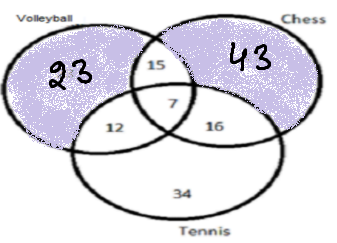
According to the given Venn diagram:
Q23 · Logical Reasoning
Study the given Venn diagram and answer the question that follows.
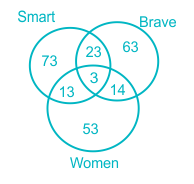 How many women are either smart or brave or both?
- 27
- 23
- 30
- 26
Answer aur solution dekho
Archived marked answer: C
According to the given Venn diagram:
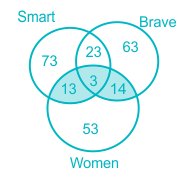 The shaded region represents the number of women who are either smart or brave or both.
So, the number of women who are either smart or brave or both = 13 + 14 + 3 → 30
Hence, the correct answer is "Option 3".
Q24 · Blood Relations
In a certain code language,
'A ? B' means ‘A is the mother of B’,
'A ! B' means ‘A is the wife of B’,
'A & B' means ‘A is the brother of B’ and
'A x B' means ‘A is the father of B’.
Which of the following means that Z is the wife's father's mother of L?
- Z & B ! T x J ? L
- Z ! B x T ? J & L
- Z ? B x T & J ! L
- Z ? B ! T & J x L
Answer aur solution dekho
Archived marked answer: C
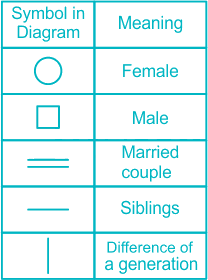 Decoding symbols:
A is
Symbol
?
!
x
Meaning
Mother
Wife
Brother
Father
to B
So, by checking each option one by one:
i. Z & B ! T x J ? L → Z is the brother of B who is the wife of T who is the father of J who is the mother of L.
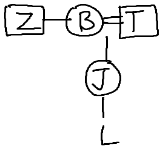
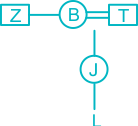 Here, Z is L's mother's maternal uncle.
ii. Z ! B x T ? J & L → Z is the wife of B who is the father of T who is the mother of J who is the brother of L.
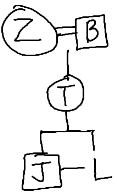
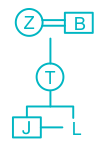 Here, Z is L's maternal grandmother.
iii. Z ? B x T & J ! L → Z is the mother of B who is the father of T who is the brother of J who is the wife of L.
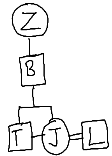
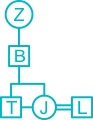 Here, Z is L's wife's father's mother.
iv. Z ? B ! T & J x L → Z is the mother of B who is the wife of T who is the brother of J who is the father of L.
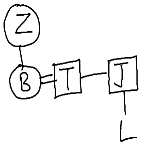
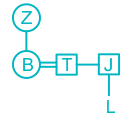 Here, Z is L's father's brother's mother-in-law.
Hence, the correct answer is "Option 3".
Q25 · Alphabet Test
Each of the letters in the word 'REDUCTION' are arranged in the English alphabetical order. How many letters are there in the English alphabetical order between the letter which is the third from the left end and the fourth from the left end in the group of letters thus formed?
- Two
- One
- Three
- Four
Answer aur solution dekho
Archived marked answer: C
Given word: 'REDUCTION'
After arranged in alphabetical order:
Alphabets
R
E
D
U
C
T
I
O
N
Alphabetical order
C
D
E
I
N
O
R
T
U
After arranged in alphabetical order,
Third alphabet from the left end is: E,
Fourth alphabet from the left end is: I,
Now,
there are 3 letters between E and I.
E
F
G
H
I
Hence, the correct answer is "Option 3".
General Awareness
Q1 · Art and Culture
Sangeet Natak Akademy Awardee Sulochana Chavan was a famous _______ singer.
- Giddha
- Jhumair
- Ghumar
- Lavani
Answer aur solution dekho
Archived marked answer: D
The correct answer is Lavani.
Key Points
- Sulochana Chavan was a legendary singer known for her contributions to the traditional Marathi folk genre of Lavani music.
- Lavani is a genre of music popular in Maharashtra and is noted for its powerful rhythm and sensuous, yet socially significant, lyrics.
- Lavani has traditionally been performed by female artists and is recognized for its combination of song and dance.
- Chavan's contributions to Lavani music earned her widespread acclaim and numerous accolades, including the prestigious Sangeet Natak Akademi Award.
Additional Information
- Giddha
- Giddha is a popular folk dance of women in the Punjab region of India and Pakistan.
- It is performed by women during special occasions and festivals, characterized by energetic movements and traditional Punjabi attire.
- Jhumair
- Jhumair is a traditional folk dance and song of the Chotanagpur plateau region in Jharkhand, India.
- It is performed during harvest season and other community celebrations, featuring slow rhythmic movements and traditional instruments.
- Ghumar
- Ghumar is a traditional folk dance of Rajasthan, India, performed by women in colorful attire.
- The dance is noted for its graceful circular movements and is performed during festive occasions like weddings and other celebrations.
- Lavani
- Lavani is a traditional folk art form that combines song and dance, originating from Maharashtra, India.
- The word 'Lavani' is derived from the Marathi word 'Lavanya', which means beauty, signifying the grace and charm of the performance.
- Lavani songs are known for their fast tempo and are often performed to the beats of the dholki drum.
- The dance is characterized by its vibrant costumes, energetic footwork, and expressive gestures.
Q2 · Art and Culture
Sangeet Kala Acharya Award is given by which organisation every year since 1993?
- Madras Music Academy
- Calcutta School of Music
- Shankar Mahadevan Academy
- Subramaniam Academy of Performing Arts
Answer aur solution dekho
Archived marked answer: A
The correct answer is Madras Music Academy.
Key Points
- The Sangeet Kala Acharya Award is given by the Madras Music Academy, which is one of the oldest and most prestigious music academies in India.
- This award has been conferred annually since 1993.
- The award is given to individuals who have made significant contributions to the field of music and dance.
- The Madras Music Academy is known for its annual music festival, which is one of
Q3 · Art and Culture
Tera Tali folk dance is primarily associated with which of the following states?
- Rajasthan
- Assam
- Madhya Pradesh
- Haryana
Answer aur solution dekho
Archived marked answer: A
The correct answer is Rajasthan.
Key Points
- Tera Tali is a unique and traditional folk dance form predominantly performed in the state of Rajasthan.
- This dance is a significant part of the culture of the Kamar tribe of Rajasthan.
- It involves the use of manjiras (small brass cymbals) tied to different parts of the body, especially the hands and feet.
- The performance is often accompanied by singing and is a reflection of the vibrant and rich cultural heritage of Rajasthan.
Additional Information
- Rajasthan:
- Rajasthan is the largest state in India by area, located in the northwestern part of the country.
- It is known for its rich cultural heritage, historical forts, palaces, art, and traditional music and dance forms.
- Rajasthan is home to other famous folk dances like Ghoomar, Kalbelia, and Bhavai.
- The state's vibrant and colorful festivals like the Pushkar Camel Fair and the Jaipur Literature Festival attract tourists from all over the world.
- Assam:
- Assam is a state in northeastern India known for its tea plantations, wildlife, and the Brahmaputra River.
- Bihu is the most important and widely celebrated festival in Assam, involving traditional dance and music.
- The state is also known for its rich biodiversity and is home to the Kaziranga National Park, famous for the one-horned rhinoceros.
- Madhya Pradesh:
- Madhya Pradesh is located in central India and is often referred to as the "Heart of India" due to its geographical location.
- The state has a rich cultural history and is known for its historical sites like Khajuraho, Bhimbetka rock shelters, and Sanchi Stupa.
- Folk dances like Gaur, Phulpati, and Maanch are popular in Madhya Pradesh.
- Haryana:
- Haryana is a state in northern India, known for its agricultural prosperity and as the home of the Green Revolution.
- The state is known for traditional folk dances like Jhumar, Dhamal, and Phag.
- Haryana has a rich history and is known for its contributions to Indian sports, especially wrestling and kabaddi.
Q4 · Art and Culture
The festival of 'Rath Yatra' of Puri in Odisha is dedicated to which deity?
- Lord Jagannath
- Lord Ganesha
- Lord Shiva
- Lord Hanuman
Answer aur solution dekho
Archived marked answer: A
The correct answer is Lord Jagannath.
Key Points
- The Rath Yatra of Puri is dedicated to Lord Jagannath, who is considered a form of Lord Vishnu.
- This annual festival involves a grand procession where the deities are taken out of the Jagannath Temple and placed in chariots, symbolizing their journey to their aunt's house.
- The festival is celebrated with much pomp and grandeur, attracting millions of devotees from across the world.
- The festival generally occurs in the month of June or July, based on the Hindu lunar calendar.
Additional Information
- Lord Jagannath:
- Lord Jagannath is a deity worshipped primarily in the Indian state of Odisha.
- He is considered a form of Lord Vishnu, and is also identified with Krishna and Buddha.
- The Jagannath Temple in Puri is one of the Char Dham pilgrimage sites, which are considered very sacred by Hindus.
- The temple is famous for its annual Rath Yatra, or chariot festival, in which the three main deities are pulled on huge and elaborately decorated temple cars.
- Rath Yatra:
- The Rath Yatra involves the transportation of deities on large chariots from the Jagannath Temple to the Gundicha Temple, which is about 3 kilometers away.
- The three deities—Lord Jagannath, his brother Balabhadra, and sister Subhadra—are taken out in three separate chariots.
- The chariots are pulled by thousands of devotees who consider it an auspicious act.
- The festival lasts for nine days, and the return journey of the deities is known as Bahuda Yatra.
- Significance:
- The Rath Yatra symbolizes the journey of Lord Jagannath along with his siblings to their maternal aunt's house.
- It represents the idea of the divine coming down to meet the devotees, breaking the barriers of the temple.
- The festival promotes the spirit of brotherhood and unity among people, irrespective of their caste or creed.
Q5 · Indian Polity and Constitution
Dr. B. R. Ambedkar described Directive Principles of State Policy as ________ of the Indian constitution.
- soul of the state
- identity card of the constitution
- The most precious part of the constitution
- a novel feature of the constitution
Answer aur solution dekho
Archived marked answer: D
The correct answer is a novel feature of the constitution.
Key Points
- Dr. B.R. Ambedkar, the principal architect of the Indian Constitution, described the Directive Principles of State Policy (DPSP) as a novel feature of the Indian Constitution.
- The DPSPs are guidelines for the framing of laws by the government and are considered fundamental in the governance of the country.
- They are enshrined in Part IV of the Constitution, covering Articles 36 to 51.</li&
Q6 · Indian Polity and Constitution
As per article 123, the ordinance making power is the most important legislative power of __________.
- President
- Rajya Sabha
- Legislative council
- Chief Justice of India
Answer aur solution dekho
Archived marked answer: A
The correct answer is President.
Key Points
- The ordinance making power is a significant legislative power vested in the President of India.
- As per Article 123 of the Indian Constitution, the President has the authority to promulgate ordinances when either of the two Houses of Parliament is not in session.
- The ordinance holds the same force and effect as an act of Parliament.
- This power is intended to address urgent situations requiring immediate legislative action.
Additional Information
- Ordinance:
- An ordinance is a temporary law enacted by the President of India on the advice of the Union Cabinet.
- It is promulgated when Parliament is not in session and immediate action is required.
- Ordinances must be approved by Parliament within six weeks of reassembling, or they cease to operate.
- Ordinances allow the government to take swift action on matters of urgency without waiting for Parliament to convene.
- Article 123 of the Indian Constitution:
- Article 123 grants the President the power to promulgate ordinances during the recess of Parliament.
- This provision ensures that the executive can address urgent issues without legislative delays.
- Ordinances must be laid before both Houses of Parliament and require their approval to become permanent laws.
- This power is subject to judicial review to prevent misuse and ensure adherence to constitutional principles.
- Separation of Powers:
- The Indian Constitution follows the principle of separation of powers among the executive, legislature, and judiciary.
- The President's ordinance-making power represents an overlap between the executive and legislative functions.
- This power is exercised with checks and balances to prevent abuse and ensure accountability.
Q7 · Indian Polity and Constitution
How many members are nominated by the President to the Rajya Sabha?
- 12
- 10
- 20
- 15
Answer aur solution dekho
Archived marked answer: A
The correct answer is 12.
Key Points
- The President of India has the authority to nominate 12 members to the Rajya Sabha.
- These nominated members are chosen for their expertise in various fields such as literature, science, art, and social service.
- This provision is under Article 80 of the Indian Constitution.
- The purpose of these nominations is to ensure that the Rajya Sabha benefits from the experience and specialized knowledge of distinguished individuals.
Additional Information
- Rajya Sabha
- The Rajya Sabha is the upper house of the Parliament of India.
- It represents the states and union territories of the country.
- The Rajya Sabha has a maximum membership of 250 members.
- Out of these, 238 members are elected by the states and union territories, while 12 are nominated by the President.
- The Rajya Sabha is a permanent body and is not subject to dissolution, but one-third of its members retire every two years.
- Article 80 of the Indian Constitution
- This article deals with the composition of the Rajya Sabha.
- It specifies the maximum number of members, the method of election, and the nomination of members by the President.
- Under this article, the President nominates 12 members who have special knowledge or practical experience in various fields such as literature, science, art, and social service.
- Nominated Members
- The nominated members bring diverse expertise to the Rajya Sabha.
- They are not bound by party lines and can contribute independently to debates and legislation.
- Some notable nominated members include Lata Mangeshkar (singer), Sachin Tendulkar (cricketer), and Raghunath Mohapatra (sculptor).
Q8 · Indian Economy
Which of the following is an example of a non-tax revenue source for the government?
- Fees and fines
- Personal income tax
- Corporate income tax
- Value-added tax
Answer aur solution dekho
Archived marked answer: A
The correct answer is Fees and fines.
Key Points
- Non-tax revenue refers to the recurring income earned by the government from sources other than taxes.
- Fees and fines are common examples of non-tax revenue. Fees are payments made to the government for specific services or activities (e.g., passport fees, court fees), while fines are penalties imposed for violating laws or regulations.
- Non-tax revenue sources help the government fund its operations without increasing the tax burden on citizens.
- Other examples of non-tax revenue include interest receipts on loans given by the government, dividends from public sector enterprises, and income from government property.
Additional Information
- Personal income tax:
- It is a direct tax levied on the income of individuals.
- The rate of personal income tax varies based on income slabs and is progressive in nature, meaning higher income earners pay a higher percentage in taxes.
- Corporate income tax:
- This is a tax imposed on the net income or profit of corporations.
- It is a significant source of revenue for the government and is also a direct tax.
- Value-added tax (VAT):
- VAT is an indirect tax levied on the value added to goods and services at each stage of production or distribution.
- Consumers ultimately bear the cost of VAT as it is included in the purchase price of goods and services.
- Non-tax revenue sources:
- These include all government revenue sources that do not fall under the category of taxes.
- Examples include fees for services, fines and penalties, dividends from public enterprises, interest receipts, and revenue from government properties.
Q9 · Indian Economy
Which of the following is NOT the socio-economic objective of Industrial Policy Statement 1980?
- Higher employment generation
- Consumer protection against high prices and bad quality
- Promotion of export-oriented industries
- Allowing the maximum foreign direct investment
Answer aur solution dekho
Archived marked answer: D
The correct answer is Allowing the maximum foreign direct investment.
Key Points
- The Industrial Policy Statement of 1980 emphasized enhancing productivity, employment generation, and the optimum utilization of existing production capacity.
- It aimed at the promotion of export-oriented industries to improve foreign exchange earnings.
- The policy also focused on consumer protection against high prices and poor quality of goods.
- Allowing the maximum foreign direct investment (FDI) was not a primary objective of the Industrial Policy Statement of 1980.
Additional Information
- Industrial Policy Statement 1980
- The Industrial Policy Statement of 1980 was introduced to revitalize the Indian economy and make it more competitive.
- The policy emphasized modernization, technological upgradation, and the development of small and medium enterprises (SMEs).
- It aimed at achieving higher growth rates and industrial diversification to reduce regional disparities.
- The policy also sought to improve the efficiency of public sector enterprises and increase their contribution to the economy.
- Foreign Direct Investment (FDI)
- FDI involves investment from a foreign entity into the business interests of another country.
- It is a significant source of non-debt financial resources for the economic development of a country.
- FDI brings in capital, technology, and expertise, and can lead to job creation and infrastructure development.
- While FDI is important, it was not the main focus of the Industrial Policy of 1980, which was more oriented towards self-reliance and domestic industrial growth.
Q10 · Sports Static GK
Who among the following won a Gold Medal at the 2021 World Cadet Wrestling Championship held in Budapest, Hungary?
- Geeta Phogat
- Vinesh Phogat
- Pooja Dhanda
- Priya Malik
Answer aur solution dekho
Archived marked answer: D
The correct answer is Priya Malik.
Key Points
- Priya Malik won the Gold Medal in the World Cadet Wrestling Championship held in Budapest, Hungary in 2021.
- She competed in the 73 kg category.
- Her victory came shortly after India's Neeraj Chopra won a gold medal in javelin at the Tokyo Olympics, raising the country's spirits.
- Priya Malik's win is significant as it demonstrates the growing prowess of Indian wrestlers on the world stage.
Additional Information
- World Cadet Wrestling Championship
- This championship is an international wrestling competition for athletes aged 16-17 years.
- It is organized by the United World Wrestling (UWW), the international governing body for the sport of amateur wrestling.
- The event features various weight categories for both male and female wrestlers.
- The championship aims to provide a platform for young wrestlers to showcase their talent and gain international experience.
- United World Wrestling (UWW)
- UWW is the international governing body for the sport of wrestling, overseeing wrestling disciplines such as Freestyle, Greco-Roman, and Beach Wrestling.
- It was founded in 1912 and is headquartered in Corsier-sur-Vevey, Switzerland.
- UWW organizes various international competitions, including the World Wrestling Championships, Continental Championships, and the Olympic Games wrestling events.
- The organization is committed to promoting and developing the sport of wrestling globally, ensuring fair play and adherence to the rules.
- Indian Wrestlers on the Global Stage
- India has a rich history in wrestling, with the sport being one of the oldest and most popular in the country.
- Indian wrestlers have made significant strides on the international stage, winning medals in events such as the Olympics, Asian Games, Commonwealth Games, and World Championships.
- Notable Indian wrestlers include Sushil Kumar, Bajrang Punia, Vinesh Phogat, and Sakshi Malik.
- The success of wrestlers like Priya Malik highlights the continued growth and potential of Indian wrestling on the global stage.
Q11 · Sports Static GK
Who was the player of the match in the semi-final of the T20 Women’s World Cup 2023 played between India and Australia?
- Deepti Sharma
- Ashleigh Gardner
- Meg Lanning
- Harmanpreet Kaur
Answer aur solution dekho
Archived marked answer: B
The correct answer is Ashleigh Gardner.
Key Points
- Ashleigh Gardner is an Australian cricketer who plays as an all-rounder.
- She was awarded the Player of the Match in the semi-final of the T20 Women's World Cup 2023.
- In the semi-final match against India, Gardner made significant contributions with both bat and ball.
- Her performance was crucial in leading Australia to the final of the T20 Women's World Cup 2023.
Additional Information
- T20 Women's World Cup
- The T20 Women's World Cup is an international championship of Twenty20 cricket organized by the International Cricket Council (ICC).
- The tournament format consists of a round-robin group stage followed by knockout matches, including semi-finals and a final.
- It is one of the most prestigious events in women's cricket, featuring teams from around the world.
- The 2023 edition showcased excellent performances and competitive spirit among the participating teams.
- Semi-Final Match
- The semi-final match is a critical knockout stage in the tournament where the winning team proceeds to the final.
- In the 2023 edition, the semi-final between India and Australia was highly anticipated due to the strong track records of both teams.
- Key players' performances in semi-finals often play a pivotal role in determining the outcome of the match.
- Player of the Match
- The Player of the Match award is given to the standout performer in a particular match.
- This award recognizes the player who has made the most significant impact on the match's outcome through exceptional performance.
- In the context of the T20 Women's World Cup, this award is highly prestigious and highlights individual brilliance on a global stage.
Q12 · Sports Static GK
In which of the following years will India host the World Badminton Championship?
- 2025
- 2028
- 2026
- 2027
Answer aur solution dekho
Archived marked answer: C
The correct answer is 2026.
Key Points
- India has been selected to host the BWF World Championships in 2026.
- This prestigious event is one of the most significant tournaments in the badminton world, drawing top players from across the globe.
- The decision to award India the hosting rights reflects the country's growing prominence in the sport of badminton.
- India has previously hosted the BWF World Championships in 2009, showcasing its capability to manage such large-scale international events.
Additional Information
- BWF World Championships
- The Badminton World Federation (BWF) World Championships is the most prestigious tournament in the sport of badminton.
- It was first held in 1977 and is now conducted annually, except in Olympic years.
- The tournament determines the world champions in five disciplines: men’s singles, women’s singles, men’s doubles, women’s doubles, and mixed doubles.
- Winning a title at the BWF World Championships is considered a significant achievement and highly coveted among badminton players.
- Badminton in India
- Badminton is one of the most popular sports in India, with a growing number of players achieving international success.
- India has produced several world-class badminton players such as Prakash Padukone, Pullela Gopichand, Saina Nehwal, and PV Sindhu.
- PV Sindhu made history by becoming the first Indian woman to win a silver medal in badminton at the 2016 Rio Olympics.
- The Badminton Association of India (BAI) is the governing body responsible for the development and promotion of badminton in the country.
- Significance of Hosting International Sports Events
- Hosting international sports events like the BWF World Championships can have significant benefits for the host country.
Q13 · Indian Geography
Which is the colloquial term to describe the occurrence of pre-monsoon rains in India especially in parts of Kerala, Karnataka and Tamil Nadu?
- Mango showers
- Kalbaisakhi
- Nor Westers
- Orange showers
Answer aur solution dekho
Archived marked answer: A
The correct answer is Mango showers.
Key Points
- Mango showers are the colloquial term used to describe pre-monsoon rains in India, particularly in Kerala, Karnataka, and Tamil Nadu.
- These showers usually occur between March and April and are known to aid the ripening of mangoes, which is why they are called "mango showers".
- They are also beneficial for other crops and help to mitigate the high temperatures experienced in the summer months.
- The showers are a result of thunderstorms caused by the confluence of moist air from the Indian Ocean and the Bay of Bengal.
Additional Information
- Kalbaisakhi
- Kalbaisakhi, also known as Nor'westers, are violent thunderstorms that occur in the northeastern and eastern parts of India, particularly in West Bengal and Odisha.
- These storms are common in the pre-monsoon season, especially in the months of April and May.
- They are characterized by high-speed winds, heavy rain, and sometimes hail, which can cause significant damage to crops and property.
- Nor Westers
- Nor'westers are a type of storm that occurs in the northeastern and eastern parts of India, particularly in West Bengal, Bihar, Jharkhand, and Odisha.
- They are caused by the interaction of hot, dry air from the northwest with moist air from the Bay of Bengal.
- These storms can bring heavy rainfall, strong winds, and hail, often leading to damage in the affected areas.
- Orange Showers
- There is no widely recognized meteorological phenomenon known as "Orange showers".
- This term does not correspond to any specific weather pattern or event in India.
Q14 · Modern Indian History
Where was the Hindu College established in the year 1791?
- Mathura
- Kolkata
- Benaras
- Patna
Answer aur solution dekho
Archived marked answer: C
The correct answer is Benaras.
Key Points
- The Hindu College was established in the year 1791.
- It was founded in the city of Benaras, which is now known as Varanasi.
- The institution was set up to provide Western education to Indians.
- It played a significant role in the Indian Renaissance and the spread of modern education in India.
Additional Information
- Hindu College:
- The Hindu College in Benaras was one of the earliest institutions to provide a structured curriculum for Western-style education in India.
- It was founded by influential citizens of Benaras, including Raja Rammohan Roy.
- The college was established with the aim of imparting modern education in various fields such as science, mathematics, and the humanities.
- It later evolved into the Central Hindu School and eventually became a part of Banaras Hindu University (BHU).
- Banaras Hindu University (BHU):
- Established in 1916 by Pandit Madan Mohan Malaviya, BHU is one of the largest residential universities in Asia.
- BHU offers courses in various fields including arts, science, engineering, medicine, and agriculture.
- The university is renowned for its research and academic excellence.
- It has a sprawling campus spread over 1,300 acres in Varanasi.
- Raja Rammohan Roy:
- Raja Rammohan Roy was a prominent social and educational reformer in India during the early 19th century.
- He is often called the "Father of the Indian Renaissance" due to his efforts in promoting modern education and social reforms.
- He was an advocate for the abolition of practices such as Sati and child marriage.
- His contributions laid the foundation for the development of modern Indian society.
Q15 · Modern Indian History
In which year was the Gandhi-Irwin Pact signed?
- 1935
- 1929
- 1931
- 1941
Answer aur solution dekho
Archived marked answer: C
The correct answer is 1931.
Key Points
- The Gandhi-Irwin Pact was signed on 5 March 1931 between Mahatma Gandhi and the then Viceroy of India, Lord Irwin.
- This pact marked the end of the civil disobedience movement led by the Indian National Congress against British rule in India.
- Under the terms of the pact, the British Government agreed to release all political prisoners who had been detained during the civil disobedience movement.
- Mahatma Gandhi, representing the Indian National Congress, agreed to discontinue the civil disobedience movement and participate in the Second Round Table Conference in London.
Additional Information
- Gandhi-Irwin Pact
- The Gandhi-Irwin Pact was a political agreement signed by Mahatma Gandhi and the Viceroy of India, Lord Irwin, in 1931.
- It was a significant event in the Indian freedom struggle, which led to the cessation of the civil disobedience movement that was initiated against the British Salt Tax.
- The pact included several concessions by the British Government, such as the withdrawal of all ordinances and prosecutions, release of prisoners arrested for participating in the salt march, and the return of confiscated properties of the satyagrahis.
- Gandhi agreed to attend the Second Round Table Conference in London as the sole representative of the Indian National Congress.
- Civil Disobedience Movement
- Launched by Mahatma Gandhi in 1930, the Civil Disobedience Movement aimed at disobeying certain laws, demands, and commands of the British government, particularly the Salt Act.
- The movement began with the Dandi March, where Gandhi and his followers marched to the Arabian Sea coast to produce salt from seawater in defiance of British laws.
- This movement attracted widespread participation from various sections of Indian society and was a crucial step towards India's independence.
- The movement saw significant government repression, including the arrest of thousands of protesters and leaders.
- Second Round Table Conference
- The Second Round Table Conference was held in London in September 1931 and was attended by Mahatma Gandhi as the representative of the Indian National Congress.
- The conference aimed to discuss constitutional reforms in India and the future governance of the country.
- Despite the discussions, the conference did not result in any significant agreements, leading to Gandhi's return to India and the resumption of the civil disobedience movement.
- The failure of the conference highlighted the deep divisions between the British authorities and Indian leaders regarding India's political future.
Q16 · General Science Biology
Name a common electrolyte disorder that occurs when the amount of sodium in your blood becomes abnormally low.
- Hyperkalemia
- Hypokalemia
- Hyponatremia
- Hypernatremia
Answer aur solution dekho
Archived marked answer: C
The correct answer is Hyponatremia.
Key Points
- Hyponatremia is a condition where the sodium level in the blood is lower than normal.
- Sodium is an essential electrolyte that helps regulate water balance in and around cells.
- Common causes of hyponatremia include excessive fluid intake, certain medications, and conditions like heart failure or kidney disease.
- Symptoms of hyponatremia can range from mild (nausea, headache) to severe (confusion, seizures, coma).
Additional Information
- Hyperkalemia
- Hyperkalemia is a condition characterized by an abnormally high level of potassium in the blood.
- Potassium is crucial for normal cell function, especially in the heart, muscles, and nerves.
- Causes include kidney dysfunction, excessive potassium intake, and certain medications.
- Symptoms can include muscle fatigue, weakness, paralysis, and abnormal heart rhythms.
- Hypokalemia
- Hypokalemia is a condition where there is a lower than normal level of potassium in the blood.
- It can result from conditions like chronic kidney disease, excessive loss of potassium through urine, or inadequate potassium intake.
- Symptoms may include muscle cramps, weakness, fatigue, and cardiac arrhythmias.
- Treatment typically involves potassium supplements and addressing the underlying cause.
- Hypernatremia
- Hypernatremia is a condition where the sodium level in the blood is higher than normal.
- It often occurs due to dehydration, water loss, or excessive sodium intake.
- Symptoms can include thirst, confusion, muscle twitching, and, in severe cases, seizures or coma.
- Treatment focuses on slowly rehydrating the patient and addressing the cause of the sodium imbalance.
Q17 · General Science Biology
Which of the following plants is used to cure cold and cough?
- Tulsi
- Babool
- Jamun
- Arjun
Answer aur solution dekho
Archived marked answer: A
The correct answer is Tulsi.
Key Points
- Tulsi (Ocimum sanctum), also known as Holy Basil, is a revered medicinal plant in India.
- It is traditionally used in Ayurvedic medicine to treat cold, cough, and other respiratory ailments.
- Tulsi leaves are known to have antibacterial, antiviral, and antifungal properties, which help in relieving infections causing cold and cough.
- Consumption of Tulsi tea or Tulsi-infused water can boost immunity and provide relief from respiratory disorders.
Additional Information
- Babool (Acacia nilotica)
- Babool tree has various medicinal uses, including in dental care, skin care, and as a remedy for diarrhea and dysentery.
- Its bark and leaves are commonly used in traditional medicine.
- Jamun (Syzygium cumini)
- Jamun fruit and seeds are used in Ayurvedic medicine to manage diabetes.
- It is also beneficial for digestive health and in treating ulcers.
- Arjun (Terminalia arjuna)
- Arjun tree is well-known for its cardiovascular benefits.
- Its bark is used to treat heart diseases, hypertension, and cholesterol issues.
Q18 · General Science Biology
Which of the following is NOT a component of a flower?
- Androecium
- Corolla
- Spines
- Calyx
Answer aur solution dekho
Archived marked answer: C
The correct answer is Spines.
Key Points
- Spines are not a component of a flower; they are modified leaves, stems, or stipules that are typically hard, pointed, and meant for protection.
- Flowers are reproductive structures in angiosperms (flowering plants) and typically consist of four main parts: androecium, corolla, calyx, and gynoecium.
- The primary role of spines is to protect the plant from herbivores and reduce water loss, especially in arid environments.
- Unlike the other options listed (androecium, corolla, and calyx), spines do not play a role in the reproductive process of the flower.
Additional Information
- Androecium
- The androecium is the collective term for the stamens in a flower. Each stamen typically consists of a filament and an anther, where pollen is produced.
- It is the male reproductive part of the flower.
- Corolla
- The corolla is the collective term for the petals of a flower.
- Petals are often brightly colored to attract pollinators.
- Calyx
- The calyx is the collective term for the sepals of a flower.
- Sepals are typically green and provide protection to the flower bud before it opens.
- Gynoecium
- The gynoecium is the collective term for the female reproductive parts of a flower, consisting of one or more carpels.
- Each carpel typically includes an ovary, style, and stigma.
Q19 · General Science Chemistry
Grignard reagent is represented as:
- CH₃-Ca-F
- CH₃-Be-F
- CH₃-Mg-Cl
- H-Mg-H
Answer aur solution dekho
Archived marked answer: C
The correct answer is CH₃-Mg-Cl.
Key Points
- Grignard reagents are organomagnesium compounds which are commonly represented as R-Mg-X, where R is an organic group and X is a halogen.
- In the given options, CH₃-Mg-Cl (Methylmagnesium chloride) fits this representation.
- Grignard reagents are highly reactive and are used in various organic synthesis reactions, particularly for forming carbon-carbon bonds.
- They were discovered by the French chemist Victor Grignard, who was awarded the Nobel Prize in Chemistry in 1912 for this discovery.
Additional Information
- Grignard Reagent:
- Grignard reagents are typically prepared by reacting an alkyl or aryl halide with magnesium metal in an anhydrous ether solvent.
- They are strong nucleophiles and strong bases, making them very useful in organic chemistry for forming new carbon-carbon bonds.
- The general formula for a Grignard reagent is R-Mg-X, where R can be an alkyl, aryl, or vinyl group, and X is usually a halogen like chlorine, bromine, or iodine.
- Due to their high reactivity, Grignard reagents must be handled under an inert atmosphere (such as nitrogen or argon) to prevent them from reacting with moisture or oxygen in the air.
- Victor Grignard:
- François Auguste Victor Grignard was a French chemist who discovered the Grignard reagent, which revolutionized the field of organic chemistry.
- His discovery allowed for the formation of carbon-carbon bonds, which is fundamental in the synthesis of a wide variety of organic compounds.
- He was awarded the Nobel Prize in Chemistry in 1912 for this significant contribution.
- Applications of Grignard Reagents:
- Grignard reagents are used to form various types of carbon-carbon bonds, making them invaluable in the synthesis of alcohols, acids, and other organic compounds.
- They can react with carbonyl compounds (such as aldehydes and ketones) to form secondary and tertiary alcohols.
- They are also used in the synthesis of carboxylic acids by reacting with carbon dioxide.
- In addition to their use in academic research, Grignard reagents are also used in the pharmaceutical and chemical industries for the synthesis of complex organic molecules.
ee
Q20 · Medieval Indian History
Who among the following was the Vakil under the reign of Mughal Emperor, Akbar, who received the title of Khan-i-Khanan?
- Mulla do-Piyaza
- Birbal
- Raja Todar Mal
- Bairam Khan
Answer aur solution dekho
Archived marked answer: D
The correct answer is Bairam Khan.
Key Points
- Bairam Khan was a prominent noble and general of the Mughal Empire during the reign of Emperor Akbar.
- He served as the regent and guardian of young Akbar, managing the affairs of the state and the military.
- Bairam Khan was conferred with the title of "Khan-i-Khanan," which means "Khan of Khans" or "Chief of Chiefs."
- His loyalty and strategic expertise were instrumental in consolidating Mughal rule in India.
Additional Information
- Vakil: The term "Vakil" in the Mughal administration refers to a representative or a high-ranking official who acted on behalf of the emperor. The Vakil was responsible for supervising the administration and ensuring that the emperor's orders were implemented.
- Khan-i-Khanan: This title was one of the highest honors in the Mughal hierarchy, bestowed upon individuals who demonstrated exceptional loyalty and service to the emperor. It signified supreme authority and respect.
- Akbar's Reign: Akbar, also known as Akbar the Great, was the third Mughal emperor who ruled from 1556 to 1605. His reign is noted for significant administrative, cultural, and military achievements, including the establishment of a centralized government and promoting a policy of religious tolerance.
- Birbal and Raja Todar Mal: While Birbal was one of Akbar's trusted advisors and known for his wit and wisdom, Raja Todar Mal served as Akbar's finance minister and played a crucial role in the implementation of revenue reforms. Neither of them held the title of "Khan-i-Khanan."
Q21 · Ancient Indian History
The name ‘Piyadassi’ is associated with whom among the following Mauryan kings?
- Bindusara
- Brihadratha
- Ashoka
- Chandragupta Maurya
Answer aur solution dekho
Archived marked answer: C
The correct answer is Ashoka.
Key Points
- Piyadassi is a title which means "beloved of the gods" and it was used by Ashoka in his inscriptions.
- Ashoka was the third emperor of the Mauryan dynasty and is considered one of India's greatest rulers.
- Ashoka ruled from 268 to 232 BCE and his reign was marked by an extensive expansion of the Mauryan Empire.
- Ashoka embraced Buddhism after the Kalinga War and propagated the religion across Asia.
Additional Information
- Mauryan Empire
- The Mauryan Empire was founded by Chandragupta Maurya in 322 BCE after overthrowing the Nanda dynasty.
- It was one of the largest empires in the world at its peak, spanning from modern-day Afghanistan to Bengal and south into the Deccan Plateau.
- Chandragupta was succeeded by his son Bindusara, who expanded the empire further before passing it to Ashoka.
- The Mauryan administration was highly organized with a centralized government and a bureaucratic system.
- Kalinga War
- The Kalinga War was fought between the Mauryan Empire under Ashoka and the state of Kalinga around 261 BCE.
- This war is particularly significant because of the massive destruction and loss of life it caused.
- The aftermath of the war had a profound impact on Ashoka, leading him to embrace Buddhism and propagate peace and non-violence.
- Ashoka's transformation post-Kalinga War is well-documented in his rock and pillar edicts.
- Buddhism
- Buddhism is a religion and philosophy based on the teachings of Siddhartha Gautama (the Buddha) who lived in the 5th century BCE.
- Ashoka's patronage played a significant role in the spread of Buddhism across India and beyond.
- Ashoka convened the Third Buddhist Council at Pataliputra (modern-day Patna) to discuss the teachings and spread of Buddhism.
- His efforts in promoting Buddhism included sending emissaries and missionaries to various parts of Asia, including Sri Lanka, Southeast Asia, and Central Asia.
Q22 · Government Schemes and Welfare Static Semi Static
Which of the following schemes was launched for the welfare of the unorganised sector workers and labourers on 26 August 2021?
- e-Shram Portal
- PM Mentoring Yuva Scheme
- PM Daksh Yojana
- Gram Ujala Scheme
Answer aur solution dekho
Archived marked answer: A
The correct answer is e-Shram Portal.
Key Points
- The e-Shram Portal was launched by the Ministry of Labour and Employment on 26 August 2021.
- This portal aims to create a National Database of Unorganized Workers (NDUW) to ensure their welfare and social security.
- It provides a unique identification number called Universal Account Number (UAN) to each worker.
- The registration on the portal is free of cost and is expected to benefit around 38 crore unorganized workers in India.
Additional Information
- PM Mentoring Yuva Scheme
- This scheme is aimed at mentoring young authors below the age of 30.
- The goal is to create a pool of authors who can write on a variety of subjects to promote the Indian culture and literature globally.
- PM Daksh Yojana
- Launched by the Ministry of Social Justice and Empowerment to provide skill training to marginalized groups.
- The aim is to enhance the competency levels of marginalized communities and improve their employability.
- Gram Ujala Scheme
- Launched by Convergence Energy Services Limited (CESL) to provide affordable LED bulbs in rural areas.
- The scheme aims to promote energy efficiency and reduce carbon emissions.
This HTML code contains detailed information about the correct answer "e-Shram Portal" including key points about the scheme and additional information about other related schemes
Q23 · World Geography
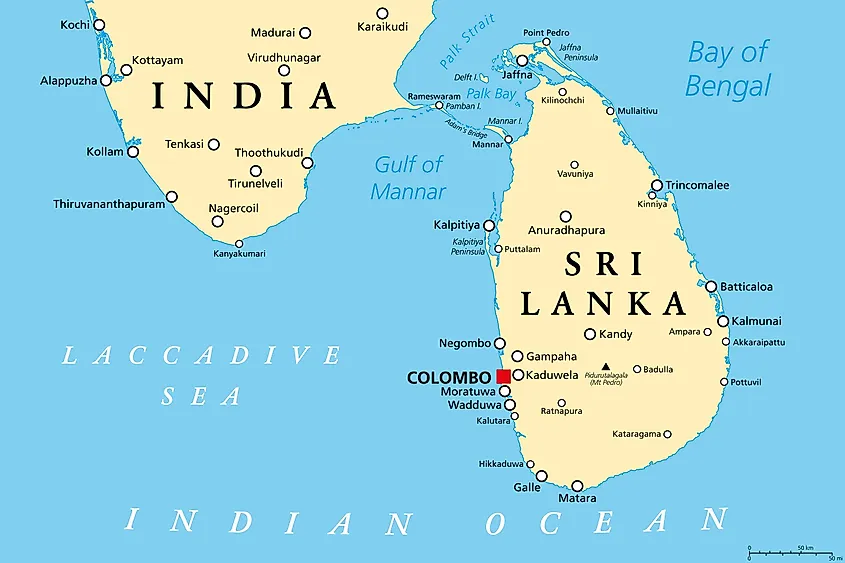
Where is the Gulf of Mannar located?
- Between the south-eastern tip of India and the eastern coast of Sri Lanka
- Between the south-eastern tip of India and the western coast of Sri Lanka
- Between the south-eastern tip of India and the north-western coast of Sri Lanka
- Between the south-eastern tip of India and the southern coast of Sri Lanka
Answer aur solution dekho
Archived marked answer: B
The correct answer is Between the south-eastern tip of India and the western coast of Sri Lanka.
Key Points
- The Gulf of Mannar is a large shallow bay forming part of the Laccadive Sea in the Indian Ocean.
- It lies between the south-eastern tip of India and the western coast of Sri Lanka, specifically between Tamil Nadu and the Northern Province of Sri Lanka.
- The Gulf of Mannar is renowned for its rich biodiversity and is home to the Gulf of Mannar Marine National Park, which is one of the richest coastal regions in Asia.
- This region is famous for its pearl banks and is often referred to as the Pearl of the Indian Ocean.
 Additional Information
- Gulf of Mannar Marine National Park
- It is a protected area in the Gulf of Mannar and covers an area of about 560 square kilometers.
- The park is known for its coral reefs, seagrasses, and mangroves, which provide habitat for numerous marine species.
- It is home to endangered species such as the dugong, sea turtles, and various species of dolphins and whales.
- The park is part of the larger Gulf of Mannar Biosphere Reserve, which is recognized by UNESCO.
- Geographical Significance
- The Gulf of Mannar acts as a natural boundary between India and Sri Lanka.
- This region is historically significant as it has been a major trading route for centuries.
- The Mannar Island, located in the gulf, is known for its historical importance and natural beauty.
- The shallow waters and coral reefs make it a popular destination for marine research and ecotourism.
- Environmental Concerns
- The region faces environmental challenges such as coral bleaching, overfishing, and pollution.
- Conservation efforts are in place to protect the unique marine biodiversity of the Gulf of Mannar.
- Local communities are involved in sustainable fishing practices to preserve the ecological balance.
- There are ongoing initiatives to promote awareness and education about marine conservation in the area.
Q24 · General Science Physics
What is the SI unit of current?
- Ohm
- Ampere
- Metre
- Volt
Answer aur solution dekho
Archived marked answer: B
The correct answer is Ampere.
Key Points
- The SI unit of electric current is the Ampere, symbolized as A.
- It is named after André-Marie Ampère, a French physicist and mathematician who is considered one of the founders of the science of classical electromagnetism.
- One Ampere is defined as the flow of one coulomb of charge per second.
- It is a fundamental unit in the International System of Units (SI), and it is used to quantify the amount of electric charge passing a point in an electric circuit per unit time.
Additional Information
- Ohm (Ω)
- The Ohm is the SI unit of electrical resistance.
- Named after German physicist Georg Simon Ohm, it quantifies the resistance in a circuit.
- One Ohm is defined as the resistance between two points of a conductor when a constant potential difference of 1 Volt, applied to these points, produces a current of 1 Ampere.
- Volt (V)
- The Volt is the SI unit of electric potential, electric potential difference, and electromotive force.
- Named after the Italian physicist Alessandro Volta, it measures the potential difference between two points.
- One Volt is defined as the potential difference that will drive one Ampere of current against one Ohm of resistance.
- Metre (m)
- The Metre is the SI unit of length.
- It is defined as the distance traveled by light in a vacuum in 1/299,792,458 seconds.
- It is a fundamental unit in the metric system and is used to measure distance.
Q25 · Agriculture
Which of the following crops is NOT grown during the Zaid season in India?
- Rice
- Cucumber
- Watermelon
- Muskmelon
Answer aur solution dekho
Archived marked answer: A
The correct answer is Rice.
Key Points
- Rice is typically grown during the Kharif season (June to November) and Rabi season (November to March) in India.
- The Zaid season falls between the Rabi and Kharif seasons, specifically from March to June.
- Crops like cucumber, watermelon, and muskmelon are commonly grown during the Zaid season due to their shorter growing period and summer adaptability.
- Rice requires a significant amount of water and is usually grown in areas with assured irrigation during the monsoon season (Kharif) or post-monsoon season (Rabi).
Additional Information
- Kharif Season
- The Kharif season is also known as the monsoon season, running from June to November.
- Crops grown during this season are typically sown with the beginning of the first rains in July, during the south-west monsoon season, and harvested in October.
- Major Kharif crops include rice, maize, sorghum, pearl millet, and cotton.
- Rabi Season
- The Rabi season is known as the winter season, running from November to March.
- Crops are sown in winter and harvested in the spring.
- Major Rabi crops include wheat, barley, peas, gram, and mustard.
- Zaid Season
- The Zaid season falls between the Kharif and Rabi seasons, specifically from March to June.
- Crops grown during this season have a shorter growing period and are typically summer crops.
- Examples of Zaid crops include cucumber, watermelon, muskmelon, and bitter gourd.
This detailed solution provides comprehensive information about the correct option and explains the different agricultural seasons in India
Mathematics
Q1 · Geometry
In the following sets, which set represents the angles of a triangle?
- {30°,60°,90°}
- {80°,50°,90°}
- {30°,50°,110°}
- {30°,50°,90°}
Answer aur solution dekho
Archived marked answer: A
Shortcut Trick
According to the angle sum property of triangles, the sum of all three interior angles must equal exactly 180°.
We can quickly sum the values in each option to find the valid set.
Sum of {30°, 60°, 90°} = 30° + 60° + 90° = 180°, which perfectly forms a valid triangle.
∴ The correct answer is {30°, 60°, 90°}.
Alternate Method
Given:
Four sets of possible angles fo
Q2 · Geometry
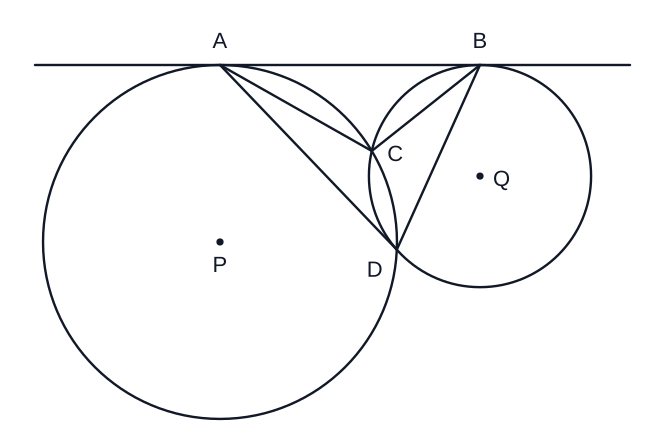
Two circles, centred at P and Q intersect at two points C and D. AB is tangent to the two circles at A and B. If ∠ADB = 68°, then ∠ACB = ________.
- 132°
- 112°
- 124°
- 102°
Answer aur solution dekho
Archived marked answer: B
AB is the common tangent at A and B. By the tangent–chord theorem, ∠BAC = ∠ADC and ∠ABC = ∠BDC. In the shown configuration, ∠ADC + ∠BDC = ∠ADB = 68°. Therefore, in triangle ABC, ∠ACB = 180° − (∠BAC + ∠ABC) = 180° − 68° = 112°.
Q3 · Geometry
The perimeters of two similar triangles ΔRST and ΔABC are 26 cm and 39 cm, respectively. If AB = 24 cm, then RS is __.
- 16 cm
- 36 cm
- 18 cm
- 24 cm
Answer aur solution dekho
Archived marked answer: A
Shortcut Trick
For similar triangles, the ratio of corresponding sides is equal to the ratio of their perimeters.
⇒ RS ÷ AB = Perimeter of ΔRST ÷ Perimeter of ΔABC
⇒ RS ÷ 24 = 26 ÷ 39
⇒ RS ÷ 24 = 2 ÷ 3
⇒ RS = 16 cm
∴ The correct answer is 16 cm.
Alternate Method
Given:
Perimeter of ΔRST = 26 cm
Perimeter of ΔABC = 39 cm
Side AB = 24 cm
R
S
T
RS = ?
P = 26 cm
A
B
C
AB = 24 cm
P = 39 cm
ΔRST ∼ ΔABC
Formula Used:
For two similar triangles, the ratio of their perimeters is strictly equal to the ratio of their corresponding sides.
⇒ If ΔRST ∼ ΔABC, then Perimeter(ΔRST) ÷ Perimeter(ΔABC) = RS ÷ AB
Calculations:
⇒ 26 ÷ 39 = RS ÷ 24
⇒ 2 ÷ 3 = RS ÷ 24
⇒ RS = (2 × 24) ÷ 3
⇒ RS = 48 ÷ 3
⇒ RS = 16 cm
∴ The correct answer is 16 cm.
Additional Information
Ratio of Areas of Similar Triangles
The ratio of the areas of two similar triangles is equal to the square of the ratio of their corresponding sides. Area(Δ1) ÷ Area(Δ2) = (Side1 ÷ Side2)².
Ratio of Perimeters of Similar Triangles
The ratio of perimeters is exactly equal to the ratio of corresponding sides, altitudes, or medians. P1 ÷ P2 = S1 ÷ S2.
Congruence vs Similarity
Congruent triangles are identical in both shape and size (ratio 1:1), whereas similar triangles have the same shape but are proportionally scaled relative to each other.
</p
Q4 · Trigonometry
If m = a secA and y = b tanA, then find the value of b²m² - a²y² + a² y²b² m² + cos²A.
- a² b²
- 1 - a² b²
- a² b² + 2
- a² b² + 1
Answer aur solution dekho
Archived marked answer: D
Shortcut Trick
Put A = 45° ⇒ m = a sec 45° = a√2 and y = b tan 45° = b
Substitute in b²m² − a²y² + (a²y²) / (b²m²) + cos²A
⇒ b²(a√2)² − a²(b)² + (a²b²) / (b²(a√2)²) + cos²45°
⇒ 2a²b² − a²b² + (a²b²) / (2a²b²) + (1/√2)²
⇒ a²b² + 1/2 + 1/2 = a²b² + 1
∴ The correct answer is a²b² + 1.
Alternate Method
Given:
m = a secA ⇒ secA = m/a
y = b tanA ⇒ tanA = y/b
Formula Used:
sec²A − tan²A = 1
sin²A + cos²A = 1
Calculations:
⇒ (m/a)² − (y/b)² = 1
⇒ (b²m² − a²y²) / (a²b²) = 1
⇒ b²m² − a²y² = a²b²
Evaluating the fractional term:
⇒ (a²y²) / (b²m²) = (a²b² tan²A) / (a²b² sec²A)
⇒ tan²A / sec²A = (sin²A / cos²A) × cos²A = sin²A
Substitute these calculated values into the main expression:
⇒ b²m² − a²y² + (a²y²) / (b²m²) + cos²A
⇒ a²b² + sin²A + cos²A
⇒ a²b² + 1
∴ The correct answer is a²b² + 1.
Additional Information
Trigonometric Identities
sin²θ + cos²θ = 1
sec²θ − tan²θ = 1
cosec²θ − cot²θ = 1
Trigonometric Conversions
tanθ = sinθ / cosθ ⇒ tanθ × cosθ = sinθ
secθ = 1 / cosθ ⇒ secθ × cosθ = 1
</p
Q5 · Trigonometry
The angle turned by minutes hand in 25 minutes in a clock is:
- π
- π/2
- 5π/3
- 5π/6
Answer aur solution dekho
Archived marked answer: D
Shortcut Trick
The minute hand covers 2π radians (a full circle) in 60 minutes.
Angle turned in 1 minute = 2π ÷ 60 = π/30 radians.
Angle turned in 25 minutes = 25 × π/30 = 5π/6 radians.
∴ The correct answer is 5π/6 radians.
Alternate Method
Given:
Time duration for which the minute hand turned = 25 minutes
Formula Used:
Angle (in radians) = (Given minutes ÷ Total minutes in 1 hour) × 2π
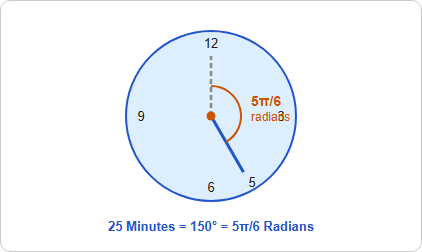 Calculations:
⇒ Total minutes in a complete clock revolution = 60 minutes
⇒ Fraction of the clock covered by the minute hand = 25 ÷ 60 = 5/12
⇒ The total angle for one full revolution = 360° = 2π radians
⇒ Angle turned in 25 minutes = (5/12) × 2π
⇒ Angle turned = 10π ÷ 12 = 5π/6 radians
∴ The correct answer is 5π/6 radians.
Additional Information
Speed of the Minute Hand
The minute hand moves at a constant speed of 6° per minute (which is equivalent to π/30 radians per minute).
Speed of the Hour Hand
The hour hand moves much slower at a speed of 0.5° per minute (which is equivalent to π/360 radians per minute).
Angle Between Clock Hands
The exact internal angle θ between the hour and minute hand at H hours and M minutes can be calculated using the formula: θ = |30H − 11/2 M| degrees.
Degrees to Radians Conversion
To convert an angle from degrees into radians, simply multiply the value by π/180. For example, an angle of 150° corresponds to 150° × (π/180) = 5π/6 radians.
</p
Q6 · Trigonometry
The value of (cosecAcosecA-1 + cosecAcosecA+1)(secAsecA-1 + secAsecA+1)⁻¹, when A = 60° is:
- 4
- 3
- 1
- 2
Answer aur solution dekho
Archived marked answer: B
Shortcut Trick
Substitute A = 60° directly (cosec 60° = 2/√3, sec 60° = 2).
First term = (2/√3) ÷ (2/√3 − 1) + (2/√3) ÷ (2/√3 + 1) = 2/(2 − √3) + 2/(2 + √3).
First term = 2(2 + √3) + 2(2 − √3) = 8.
Second term = 2 ÷ (2 − 1) + 2 ÷ (2 + 1) = 2/1 + 2/3 = 8/3.
Given expression = 8 × (8/3)−¹ = 8 × 3/8 = 3.
∴ The correct answer is 3.
Alternate Method
Given:
Expression: [cosecA / (cosecA − 1) + cosecA / (cosecA + 1)] × [secA / (secA − 1) + secA / (secA + 1)]−¹
Calculations:
⇒ Let's simplify the first part:
⇒ cosecA / (cosecA − 1) + cosecA / (cosecA + 1)
⇒ = cosecA × [ (cosecA + 1 + cosecA − 1) ÷ (cosec²A − 1) ]
⇒ = cosecA × [ 2cosecA ÷ cot²A ] = 2cosec²A ÷ cot²A
⇒ = 2(1/sin²A) ÷ (cos²A/sin²A) = 2/cos²A = 2sec²A
⇒ Now, simplify the second part:
⇒ secA / (secA − 1) + secA / (secA + 1)
⇒ = secA × [ (secA + 1 + secA − 1) ÷ (sec²A − 1) ]
⇒ = secA × [ 2secA ÷ tan²A ] = 2sec²A ÷ tan²A
⇒ = 2(1/cos²A) ÷ (sin²A/cos²A) = 2/sin²A = 2cosec²A
⇒ Substitute both simplified parts into the original expression:
⇒ Result = 2sec²A × (2cosec²A)−¹ = 2sec²A ÷ 2cosec²A
⇒ Result = (1/cos²A) ÷ (1/sin²A) = sin²A ÷ cos²A = tan²A
⇒ Given A = 60°, substitute the value:
⇒ tan²60° = (√3)² = 3
∴ The correct answer is 3.
Additional Information
Trigonometric Identities
Important squared identities: sin²θ + cos²θ = 1 | sec²θ − tan²θ = 1 | cosec²θ − cot²θ = 1.
Reciprocal Relations
sinθ = 1 ÷ cosecθ | cosθ = 1 ÷ secθ | tanθ = 1 ÷ cotθ.
Standard Values at 60°
sin 60° = √3/2 | cos 60° = 1/2 | tan 60° = √3 | sec 60° = 2 | cosec 60° = 2/√3.
</p
Q7 · Mensuration 2D
The area of a sector of a circle of radius 12 cm, formed by an arc of length 7 cm is:
- 42 cm²
- 84 cm²
- 21 cm²
- 28 cm²
Answer aur solution dekho
Archived marked answer: A
Shortcut Trick
When the arc length and radius of a sector are given, its area can be found directly using the formula:
Area = ½ × l × r
Where l = length of the arc, and r = radius of the circle.
⇒ Area = ½ × 7 × 12
⇒ Area = 7 × 6 = 42 cm²
∴ The correct answer is 42 cm².
Alternate Method
Given:
Radius of the sector (r) = 12 cm
Length of the arc (l) = 7 cm
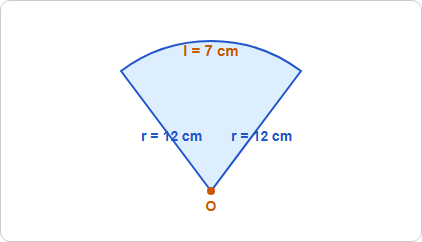 Formula Used:
Angle subtended at the centre, θ = Arc length ÷ Radius (in radians)
Area of a sector = ½ × r² × θ
Calculations:
⇒ θ = l ÷ r = 7 ÷ 12 radians
⇒ Area of the sector = ½ × (12)² × (7 ÷ 12)
⇒ Area = ½ × 144 × (7 ÷ 12)
⇒ Area = ½ × 12 × 7
⇒ Area = 6 × 7 = 42 cm²
∴ The correct answer is 42 cm².
Additional Information
Area of Sector (Degree Measure)
If the central angle is given in degrees (θ), the area of the sector is calculated as Area = (θ ÷ 360°) × πr².
Length of an Arc (Degree Measure)
The length of an arc that subtends an angle θ at the centre is given by l = (θ ÷ 360°) × 2πr.
Perimeter of a Sector
The total perimeter of a sector consists of the arc length along with the two enclosing radii. Thus, Perimeter = l + 2r.
</p
Q8 · Algebra
Simplify 1.5 times 1.5 + 2.5 times 2.5 + 3.5 times 3.5 + 2 times 1.5 times 2.5 + 2 times 2.5 times 3.5 + 2 times 1.5 times 3.51.5 + 2.5 + 3.5.
- 9.5
- 6.5
- 8.5
- 7.5
Answer aur solution dekho
Archived marked answer: D
Shortcut Trick
The expression follows the algebraic pattern: (a² + b² + c² + 2ab + 2bc + 2ca) ÷ (a + b + c).
By using the standard identity, the numerator is equivalent to (a + b + c)².
Thus, the given expression simplifies directly to (a + b + c).
Here, substituting a = 1.5, b = 2.5, and c = 3.5.
Result = 1.5 + 2.5 + 3.5 = 7.5.
∴ The correct answer is 7.5.
Alternate Method
Given:
Expression: (1.5 × 1.5 + 2.5 × 2.5 + 3.5 × 3.5 + 2 × 1.5 × 2.5 + 2 × 2.5 × 3.5 + 2 × 1.5 × 3.5) ÷ (1.5 + 2.5 + 3.5)
Formula Used:
(a + b + c)² = a² + b² + c² + 2ab + 2bc + 2ca
Calculation:
Let a = 1.5, b = 2.5, and c = 3.5
⇒ Numerator = a² + b² + c² + 2ab + 2bc + 2ca
⇒ Numerator = (a + b + c)²
⇒ Denominator = a + b + c
⇒ Expression = (a + b + c)² ÷ (a + b + c)
⇒ Expression = a + b + c
⇒ Expression = 1.5 + 2.5 + 3.5
⇒ Expression = 7.5
∴ The correct answer is 7.5.
Additional Information
Square of a Binomial
(a + b)² = a² + 2ab + b² and (a − b)² = a² − 2ab + b²
Difference of Squares
a² − b² = (a − b)(a + b)
Sum of Cubes Identity
a³ + b³ + c³ − 3abc = (a + b + c)(a² + b² + c² − ab − bc − ca)
Conditional Zero Sum
If a + b + c = 0, then a³ + b³ + c³ = 3abc
</p
Q9 · Algebra
Simplify the following expression.
(g−h)2</sp
- 4gh
- -4gh
- 4
- 0
Answer aur solution dekho
Archived marked answer: D
Shortcut Trick
We know the standard algebraic identity: (a + b)² − (a − b)² = 4ab.
By reversing the terms, we get: (a − b)² − (a + b)² = −4ab.
Substitute a = g and b = h directly into the given expression.
⇒ (g − h)² − (g + h)² + 4gh = −4gh + 4gh = 0.
∴ The correct answer is 0.
Alternate Method
Given:
Expression: (g − h)² − (g + h)² + 4gh
Formula Used:
(a − b)² = a² + b² − 2ab
(a + b)² = a² + b² + 2ab
Calculations:
Expand the first term (g − h)²:
⇒ g² + h² − 2gh
Expand the second term (g + h)²:
⇒ g² + h² + 2gh
Substitute both expansions back into the original expression:
⇒ (g² + h² − 2gh) − (g² + h² + 2gh) + 4gh
Distribute the negative sign over the second term:
⇒ g² + h² − 2gh − g² − h² − 2gh + 4gh
Group the like terms together:
⇒ (g² − g²) + (h² − h²) − 2gh − 2gh + 4gh
⇒ 0 + 0 − 4gh + 4gh
⇒ 0
∴ The correct answer is 0.
Additional Information
Sum of Squares Identity
When adding the squares of sum and difference, the middle terms cancel out: (a + b)² + (a − b)² = 2(a² + b²).
Difference of Squares
The difference between the squares of two terms can be factored into a product: a² − b² = (a − b)(a + b).
Cube Formulas
The sum and difference formulas for perfect cubes are frequently used in simplification: (a ± b)³ = a³ ± b³ ± 3ab(a ± b).
</p
Q10 · Algebra
2 biscuits and 1 chocolate cost ₹69. 2 chocolates and 3 cups of coffee cost ₹127. 3 biscuits, 4 chocolates and 2 cups of coffee cost ₹229. Find the total cost (in ₹) of 5 biscuits, 5 chocolates and 5 cups of coffee.
- 304
- 375
- 345
- 355
Answer aur solution dekho
Archived marked answer: D
Shortcut Trick
Let b, c, and f be the unit prices of biscuit, chocolate, and coffee.
Given: 2b + c = 69; 2c + 3f = 127; 3b + 4c + 2f = 229.
From the first, c = 69 − 2b. Substitute this in the other two equations:
4b − 3f = 11 and 5b − 2f = 47. Solving these gives b = 17, f = 19.
Hence, c = 69 − 2(17) = 35. Total cost of 1 set = 17 + 35 + 19 = 71.
∴ The correct answer is ₹355.
Alternate Method
Let the cost of 1 biscuit, 1 chocolate, and 1 coffee be b, c, and f respectively.
Given:
⇒ 2b + c = 69 --- (1)
⇒ 2c + 3f = 127 --- (2)
⇒ 3b + 4c + 2f = 229 --- (3)
From (1), we get c = 69 − 2b.
Substitute c in (2):
⇒ 2(69 − 2b) + 3f = 127
⇒ 138 − 4b + 3f = 127
⇒ 4b − 3f = 11 --- (4)
Substitute c in (3):
⇒ 3b + 4(69 − 2b) + 2f = 229
⇒ 3b + 276 − 8b + 2f = 229
⇒ 5b − 2f = 47 --- (5)
Multiply (4) by 2 and (5) by 3:
⇒ 8b − 6f = 22
⇒ 15b − 6f = 141
Subtracting the first equation from the second:
⇒ 7b = 119 ⇒ b = 17
Putting b = 17 in (1):
⇒ 2(17) + c = 69 ⇒ c = 69 − 34 = 35
Putting c = 35 in (2):
⇒ 2(35) + 3f = 127 ⇒ 3f = 127 − 70 = 57 ⇒ f = 19
Total cost of 5 of each item = 5 × (b + c + f)
⇒ 5 × (17 + 35 + 19) = 5 × 71 = 355
∴ The correct answer is ₹355.
Additional Information
System of Linear Equations
A collection of one or more linear equations involving the same variables. They can be solved systematically using substitution, elimination, or matrix methods to find the unique solution values.
Substitution Method
A method for solving systems of equations by expressing one variable in terms of the others and substituting it into the remaining equations to reduce the number of variables.
Elimination Method
A process of multiplying equations by specific constants so that adding or subtracting them eliminates one of the variables entirely, allowing for easier resolution.
11
Q11 · Profit and Loss
A dishonest fruit-seller sells fruits at 20% profit but he uses 950 gm weight in place of 1 kg. What is the profit per cent?
- 500/17\%
- 500/19\%
- 500/32\%
- 700/19\%
Answer aur solution dekho
Archived marked answer: B
Shortcut Trick
Ratio 1 (Profit on Price): 100 → 120 = 5 : 6
Ratio 2 (Profit on Weight): 950 → 1000 = 19 : 20
Net Ratio (CP : SP) = (5 × 19) : (6 × 20) = 95 : 120 = 19 : 24
Profit % = [(24 − 19) / 19] × 100 = 5/19 × 100 = 500/19 %
∴ The correct option is (B).
Alternate Method
Given:
Declared Profit % = 20%
False Weight = 950 gm instead of 1 kg (1000 gm)
Formula Used:
Overall Profit % = [(Total SP − Effective CP) / Effective CP] × 100
- - - - 0 g
950 g (Real CP)
1200 g (Final SP)
Profit = 250 units
(Seller spends for 950g)
(Seller earns for 1200g)
Calculations:
⇒ Let the Cost Price (CP) of 1 gm = Re. 1
⇒ CP of 1000 gm = Rs. 1000
⇒ Seller sells 1 kg at 20% profit, so SP = 1000 + 20% of 1000 = Rs. 1200
⇒ Seller uses 950 gm instead of 1000 gm, so Effective CP = Rs. 950
⇒ Total Profit = SP − Effective CP = 1200 − 950 = Rs. 250
⇒ Profit % = (Profit / Effective CP) × 100
⇒ Profit % = (250 / 950) × 100
⇒ Profit % = 25/95 × 100 = 5/19 × 100 = 500/19 %
∴ The correct option is (B).
Additional Information
Dishonest Dealer Weight Profit
Profit % due to false weight = [ (True Weight − False Weight) / False Weight ] × 100
Combined Profit Rule
If a dealer sells at x% profit and uses y% less weight, the overall profit multiplier is [(100 + x) / (100 − y)].
Successive Percentage for Profit
Total Gain % = [ (100 + g₁)/100 × (100 + g₂)/100 − 1 ] × 100, where g₁ and g₂ are individual gains.</p
Q12 · Profit and Loss
A manufacturer announces a trade discount of 30% on his products for his dealers. One of the dealers purchased 6 smartphones manufactured by the company at the rate of Rs.25,000 each. What is the amount of trade discount?
- Rs.50,00
- Rs.55,000
- Rs.1,05,000
- Rs.45,000
Answer aur solution dekho
Archived marked answer: D
Shortcut Trick
Total list price of 6 smartphones = 6 × 25000 = Rs. 1,50,000
Trade discount = 30% of Total list price
Trade discount = (30 ÷ 100) × 1,50,000 = Rs. 45,000
∴ The correct answer is Rs. 45,000.
Alternate Method
Given:
Number of smartphones purchased = 6
Price of each smartphone = Rs. 25,000
Trade discount percentage = 30%
Formula Used:
Total List Price = Number of items × Price per item
Discount Amount = Total List Price × (Discount % ÷ 100)
Calculations:
⇒ Total List Price = 6 × 25,000
⇒ Total List Price = Rs. 1,50,000
⇒ Discount Amount = 1,50,000 × (30 ÷ 100)
⇒ Discount Amount = 1,50,000 × 0.30
⇒ Discount Amount = Rs. 45,000
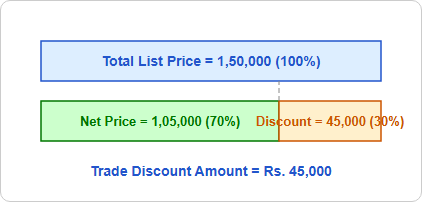 ∴ The correct answer is Rs. 45,000.
Additional Information
Trade Discount
It is a reduction in the list price of goods allowed by a manufacturer or wholesaler to retailers, typically for bulk purchases. It is not recorded individually in accounting books.
Cash Discount
A cash discount is allowed to encourage prompt payment. It is always calculated on the net invoice price (i.e., List Price − Trade Discount).
Successive Discounts
When two discounts a% and b% are given successively, the effective discount percentage is given by the formula: Effective Discount = (a + b − (a × b) ÷ 100)%.
</p
Q13 · Time and Work
Two pipes P and Q can fill a tank in 36 minutes and 45 minutes, respectively. If both pipes are opened together, the time taken to fill the tank is:
- 81 minutes
- 20 minutes
- 40.5 minutes
- 10 minutes
Answer aur solution dekho
Archived marked answer: B
Shortcut Trick
When two pipes can fill a tank in x and y minutes individually, the time taken to fill the tank together is (x × y) ÷ (x + y).
Time taken = (36 × 45) ÷ (36 + 45)
⇒ Time taken = 1620 ÷ 81
⇒ Time taken = 20 minutes
∴ The correct answer is 20 minutes.
Alternate Method
Given:
Time taken by Pipe P to fill the tank = 36 minutes
Time taken by Pipe Q to fill the tank = 45 minutes
Calculations:
Total capacity of the tank = LCM of 36 and 45 = 180 units
Pipe
Time (minutes)
Total Work
Efficiency
P
36
180
180 ÷ 36 = 5
Q
45
180 ÷ 45 = 4
⇒ Combined efficiency of P and Q = 5 + 4 = 9 units/minute
⇒ Time taken to fill the tank together = Total Work ÷ Combined Efficiency
⇒ Time taken = 180 ÷ 9
⇒ Time taken = 20 minutes
∴ The correct answer is 20 minutes.
Additional Information
Inlet and Outlet Pipes
An inlet pipe fills the tank and its work (efficiency) is always taken as positive. An outlet pipe empties the tank and its work (efficiency) is always taken as negative.
Unitary Method for Time & Work
If a pipe can fill a tank in x hours, the part of the tank filled in 1 hour is 1/x. If two pipes operate simultaneously, their 1 hour work is given by (1/x + 1/y).
Three Pipes Working Together
If three pipes A, B and C have efficiencies eₐ, eb, and e꜀ respectively, the total time required to fill a tank is calculated as Total Capacity ÷ (eₐ + eb + e꜀).
</p
Q14 · Number System
Find the remainder: (17¹³ - 21) ÷ 18
- 15
- 17
- 14
- 21
Answer aur solution dekho
Archived marked answer: C
Shortcut Trick
17 ÷ 18 gives a remainder of −1, so 17¹³ ÷ 18 gives a remainder of (−1)¹³ = −1.
21 ÷ 18 gives a remainder of 3.
Combined remainder = −1 − 3 = −4.
Since the remainder is negative, add the divisor: 18 − 4 = 14.
∴ The correct answer is 14.
Alternate Method
Given:
Expression: (17¹³ − 21) ÷ 18
Concept Used:
Remainder Theorem: When dividing a polynomial by (x − a), the remainder is found by evaluating the expression at x = a.
Calculations:
⇒ We can express the base 17 as (18 − 1).
⇒ The given expression becomes: ((18 − 1)¹³ − 21) ÷ 18
⇒ When expanding (18 − 1)¹³ using the binomial theorem, all terms containing 18 are perfectly divisible by 18.
⇒ The only remaining term from the expansion is the constant term: (−1)¹³ = −1.
⇒ Now, divide the constant 21 by 18, which gives a remainder of 3.
⇒ Total remainder expression = −1 − 3 = −4.
⇒ A remainder of −4 means the value is 4 less than the divisor.
⇒ Actual positive remainder = 18 − 4 = 14.
∴ The correct answer is 14.
Additional Information
Remainder of aⁿ ÷ (a+1)
When aⁿ is divided by (a+1), the remainder is 1 if n is an even number, and the remainder is 'a' (or −1) if n is an odd number.
Remainder of aⁿ ÷ (a−1)
When aⁿ is divided by (a−1), the remainder is always 1, regardless of whether the power n is odd or even.
Negative Remainder Concept
A negative remainder mathematically indicates how much less the number is from the next multiple of the divisor. The actual positive remainder is obtained by adding the divisor: Actual Remainder = Divisor − Negative Remainder.
</p
Q15 · Time and Distance
A boatman rows to a place 30 km distant and back in 14 hours. He finds that he can row 10 km with the stream at the same time as 4 km against the stream. Find the speed (in km/h) of the stream.
- 9/2
- 9/4
- 2/9
- 4/9
Answer aur solution dekho
Archived marked answer: B
Shortcut Trick
Downstream speed (D) : Upstream speed (U) = Distance Ratio (in same time) = 10 : 4 = 5 : 2.
Let D = 5k and U = 2k. Total time = (30 ÷ 5k) + (30 ÷ 2k) = 14 ⇒ 6/k + 15/k = 14 ⇒ 21/k = 14 ⇒ k = 3/2.
Speed of stream = (D − U) ÷ 2 = (5k − 2k) ÷ 2 = 3k/2.
Substitute k = 3/2 ⇒ Speed of stream = (3 × 3/2) ÷ 2 = 9/4 km/h.
∴ The correct answer is 9/4 km/h.
Alternate Method
Given:
Total distance for a one-way trip = 30 km.
Total time for the round trip = 14 hours.
Distance covered downstream in a given time = 10 km.
Distance covered upstream in the same time = 4 km.
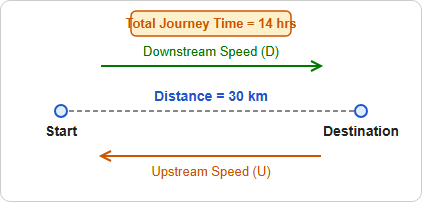 Formula Used:
Time = Distance ÷ Speed
Speed of stream = (Downstream Speed − Upstream Speed) ÷ 2
Calculations:
Let the speed of the boat in still water be u km/h and the speed of the stream be v km/h.
⇒ Downstream speed (D) = u + v
⇒ Upstream speed (U) = u − v
Since the time taken is the same for 10 km downstream and 4 km upstream:
⇒ 10 ÷ (u + v) = 4 ÷ (u − v)
⇒ (u + v) ÷ (u − v) = 10/4 = 5/2
Let Downstream speed D = 5k and Upstream speed U = 2k.
Total time taken for the round trip is 14 hours:
⇒ 30 ÷ D + 30 ÷ U = 14
⇒ 30 ÷ 5k + 30 ÷ 2k = 14
⇒ 6/k + 15/k = 14
⇒ 21/k = 14
⇒ k = 21 ÷ 14 = 3/2
Now, calculate the absolute speeds D and U:
⇒ Downstream Speed (D) = 5 × 3/2 = 15/2 = 7.5 km/h
⇒ Upstream Speed (U) = 2 × 3/2 = 3 km/h
Speed of the stream (v) = (D − U) ÷ 2
⇒ v = (7.5 − 3) ÷ 2 = 4.5 ÷ 2 = 9/4 km/h
∴ The correct answer is 9/4 km/h.
Additional Information
Downstream and Upstream Speeds
When a boat moves with the stream, its effective speed increases (D = u + v). When it moves against the stream, its effective speed decreases (U = u − v).
Boat in Still Water
The speed of a boat in still water (u) can be calculated directly if downstream and upstream speeds are known: u = (D + U) ÷ 2.
Speed of the Stream
The speed of the stream or current (v) is half the difference between the downstream and upstream speeds: v = (D − U) ÷ 2.
Constant Time Principle
If the time taken to travel two different distances is the same, the ratio of the distances is directly proportional to the ratio of their respective speeds (D₁ ÷ D₂ = S₁ ÷ S₂).
</p
Q16 · Data Interpretation
Study the given graph carefully and answer the question that follows.
The given graph shows the number of male and female volunteers for helping handicapped people from four different districts A, B, C and D.
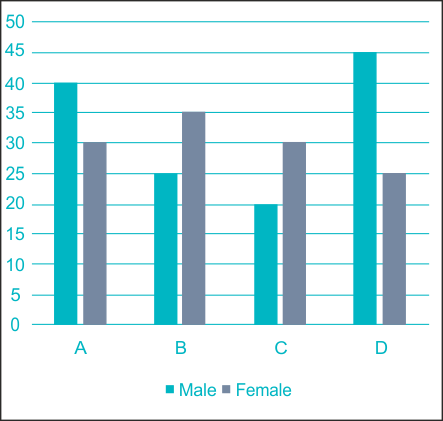 Find the number of volunteers altogether.
- 230
- 250
- 240
- 260
Answer aur solution dekho
Archived marked answer: B
Given:
District A: Male = 40, Female = 30
District B: Male = 25, Female = 35
District C: Male = 20, Female = 30
District D: Male = 45, Female = 25
Formula used:
To find the total number of male and female volunteers in all districts:
Q17 · Simplification
Simplify the following.
16 ÷ 2− 7 × 15 ÷ 3 + 5 × 5 + 4 × 3 − 10
- 1
- 2
- 0
- -1
Answer aur solution dekho
Archived marked answer: C
Given:
Expression: 16 ÷ 2 - 7 × 15 ÷ 3 + 5 × 5 + 4 × 3 - 10
Formula Used:
Apply the BODMAS/BIDMAS rule (Brackets, Orders (i.e. powers and square roots, etc.), Division and Multiplication, Addition and Subtraction)
Calculation:
Start with division and multiplication from left to right:
16 ÷ 2 = 8
7 × 15 = 105
105 ÷ 3 = 35
5 × 5 = 25
4 × 3 = 12
Now substitute these values back into the expression:
8 - 35 + 25 + 12 - 10
Next, perform addition and subtraction from left to right:
8 - 35 = -27
-27 + 25 = -2
-2 + 12 = 10
10 - 10 = 0
The simplified result is 0.
The correct answer is option 3.
Q18 · Proportion
Find the mean proportional of 12.96 and 0.16.
- 1.21
- 1.96
- 1.44
- 1.69
Answer aur solution dekho
Archived marked answer: C
Shortcut Trick
The mean proportional between two numbers a and b is given by √(a × b).
Required Mean = √(12.96 × 0.16)
We know that √12.96 = 3.6 and √0.16 = 0.4
⇒ Mean = 3.6 × 0.4 = 1.44
∴ The correct answer is 1.44.
Alternate Method
Given:
First number (a) = 12.96
Second number (b) = 0.16
Q19 · Percentage
Kalyan spends 80% of his income. His income increases by 15% and his expenditure also increases by 5%. The percentage of increase in his savings is:
- 50%
- 20%
- 55%
- 40%
Answer aur solution dekho
Archived marked answer: C
Shortcut Trick
Ratio of Expenditure to Savings = 80% : 20% = 4 : 1.
We apply the weighted average method: Income = Expenditure + Savings.
Change in Income = (Exp Ratio × Exp Change + Sav Ratio × Sav Change) ÷ Total Ratio
⇒ 15% = (4 × 5% + 1 × x%) ÷ 5
⇒ 75% = 20% + x% ⇒ x = 55%
∴ The correct answer is 55%.
Alternate Method
Given:
Kalyan spends 80% of his income.
Increase in income = 15%.
Increase in expenditure = 5%.
Formula Used:
Savings = Income − Expenditure
Percentage Increase = (Increase Value ÷ Initial Value) × 100
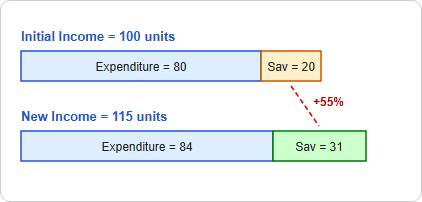 Calculation:
⇒ Let initial income be 100 units.
⇒ Initial expenditure = 80% of 100 = 80 units
⇒ Initial savings = 100 − 80 = 20 units
⇒ After a 15% increase, new income = 100 + 15 = 115 units
⇒ After a 5% increase, new expenditure = 80 + (5% of 80) = 80 + 4 = 84 units
⇒ New savings = New income − New expenditure = 115 − 84 = 31 units
⇒ Increase in savings = 31 − 20 = 11 units
⇒ Percentage increase in savings = (11 ÷ 20) × 100 = 55%
∴ The correct answer is 55%.
Additional Information
Income, Expenditure & Savings
The basic relationship is Income = Expenditure + Savings. Any percentage change in income impacts both expenditure and savings proportional to their initial distributions.
Percentage Change Formula
The percentage change is always calculated on the base original value: % Change = [(New Value − Old Value) ÷ Old Value] × 100.
Weighted Average (Alligation) Method
When a whole is divided into two parts in the ratio n₁ : n₂, the net percentage change can be calculated directly as: Net % = (n₁ × x₁ + n₂ × x₂) ÷ (n₁ + n₂).
</p
Q20 · Average
A class of 30 students appeared in a test. The average score of 12 students is 62, and that of the rest is 72. What is the average score of the class?
- 66
- 68
- 67
- 69
Answer aur solution dekho
Archived marked answer: B
Shortcut Trick
Ratio of number of students in the two groups = 12 : 18 ⇒ 2 : 3.
Let the assumed average of the class be 62 (the average of the first group).
Deviation of the second group from the assumed average = 72 − 62 = +10.
Net average deviation = (3 × 10) ÷ (2 + 3) = 30 ÷ 5 = +6.
Overall average = Assumed Average + Net deviation = 62 + 6 = 68.
∴ The correct answer is 68.
Alternate Method
Given:
Total number of students = 30
Average score of 12 students = 62
Average score of the remaining students = 72
Formula Used:
Overall Average = (Total sum of all scores) ÷ (Total number of students)
Q21 · Simple Interest
A sum of ₹10,000 is taken as a loan by Rajesh at a rate of 15% p.a. simple interest for 2 years. But Rajesh could not repay it at the agreed time and asked for an extension of two more years. So, the lender included the interest amount for the period as principal for the next two years at the same rate of interest. The total amount paid by Rajesh at the end of 4 years is:
Ans
- ₹18,590
- ₹16,900
- ₹17,650
- ₹15,630
Answer aur solution dekho
Archived marked answer: B
Shortcut Trick
Total Simple Interest (SI) percentage for 2 years at 15% p.a. = 15 × 2 = 30%.
Amount after the first 2 years = 10000 × 1.30 = ₹13,000.
The lender includes the interest in the principal, so the new principal for the next 2 years is ₹13,000.
Amount after the next 2 years = 13000 × 1.30 = ₹16,900.
∴ The correct answer is ₹16,900.
Alternate Method
Given:
Initial Principal (P₁) = ₹10,000
Rate of Interest (R) = 15% p.a.
Time period (T₁) = 2 years
Formula Used:
Simple Interest (SI) = (P × R × T) ÷ 100
Amount (A) = P + SI
Q22 · Mensuration 3D
If the curved surface area of a cylinder is 880 cm², then the product of its height and radius is:
- 90 cm²
- 120 cm²
- 220 cm²
- 140 cm²
Answer aur solution dekho
Archived marked answer: D
Shortcut Trick
Curved Surface Area (CSA) of cylinder = 2πrh
Given 2πrh = 880
r × h = 880 ÷ (2 × 22 ÷ 7)
r × h = 880 × (7 ÷ 44) = 140
∴ The correct answer is 140 cm².
Alternate Method
Given:
Curved surface area of the cylinder = 880 cm²
Formula Used:
Curved surface area of a cylinder = 2πrh
Where r = radius and h = height
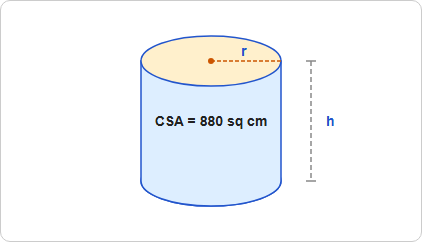 Calculations:
⇒ 2 × (22 ÷ 7) × r × h = 880
⇒ (44 ÷ 7) × r × h = 880
⇒ r × h = 880 × (7 ÷ 44)
⇒ r × h = 20 × 7
⇒ r × h = 140 cm²
∴ The correct answer is 140 cm².
Additional Information
Total Surface Area of Cylinder
The total surface area includes the curved surface and the two circular bases: TSA = 2πr(r + h).
Volume of Cylinder
The volume represents the total space occupied by the cylinder: V = πr²h.
Surface Area of Cone
For a cone with base radius r and slant height l, the Curved Surface Area = πrl and Total Surface Area = πr(r + l).
</p
English
Q1 · Vocabulary
Select the most appropriate ANTONYM of the given word.
Affirmative
- Sanction
- Negative
- Acquiescence
- Accession
Answer aur solution dekho
Archived marked answer: B
The correct answer is: Option 2 i.e. Negative.
Key Points
- The word "Affirmative" means expressing agreement or consent; positive.
- Example: The committee gave an affirmative response to the proposal.
- "Negative" refers to expressing refusal, disagreement, or denial; not positive.
- Example: His negative attitude towards the project was disheartening.
- Hence, we can infer that the opposite of 'affirmative' is 'negative'.
Therefore, the correct answer is: Option 2 i.e. Negative.
Additional Information
Here are the other options explained along with their Hindi meanings and example sentences:
- Sanction: Official permission or approval for an action.
- Example: The government granted a sanction for the new project.
- Acquiescence: Agreement or consent by silence or without objection.
- Example: Her acquiescence to the changes was unexpected.
- Accession: The act of coming into a position of power or an increase by something added.
- Example: The accession of the new manager brought many changes to the company.
Given:
State Q
Q2 · Vocabulary
Select the most appropriate ANTONYM of the underlined word.
If someone babbles, it means that they talk in a confused or excited way.
- Gossips
- Quiet
- Talkative
- Rants
Answer aur solution dekho
Archived marked answer: B
The correct answer is: Option 2 i.e. Quiet.
Key Points
- The word "babble" means to talk in a confused or excited way.
- Example: The toddler started to babble as soon as she saw her favorite toy.
- "Quiet" refers to making very little or no noise; it is the opposite of talking excessively or noisily.
- Example: The library is a quiet place where people can read and study without distractions.
- Hence, we can infer that the opposite of 'babble' is 'quiet'.
Therefore, the correct answer is: Option 2 i.e. Quiet.
Additional Information
Here are the other options explained along with their Hindi meanings and example sentences:
- Gossips: Talking casually or informally about others, often involving details that are not confirmed as true.
- Example: She loves to gossip about her coworkers during lunch breaks.
- Talkative: Fond of or given to talking a lot.
- Example: He is a talkative person who enjoys long conversations.
- Rants: Speaking or shouting at length in an angry, impassioned way.
- Example: He went on a rant about the poor service he received at the restaurant.
Given:&l
Q3 · Vocabulary
Select the most appropriate ANTONYM of the word in the brackets to fill in the blank.
Akash went to ______ his school uniform. [sell]
- loan
- rent
- buy
- make
Answer aur solution dekho
Archived marked answer: C
The correct answer is: Option 3 i.e. buy.
Key Points
- The word "sell" means to give something in exchange for money.
- Example: She decided to sell her old car to buy a new one.
- "Buy" refers to acquiring something in exchange for money; it is the opposite action of selling.
- Example: He went to the market to buy fresh vegetables.
- Hence, we can infer that the opposite of 'sell' is 'buy'.
Therefore, the correct answer is: Option 3 i.e. buy.
Additional Information
Here are the other options explained along with their Hindi meanings and example sentences:
- Loan: A thing that is borrowed, especially a sum of money that is expected to be paid back with interest.
- Example: He took a loan from the bank to buy a house.
- Rent: A tenant's regular payment to a landlord for the use of property or land.
- Example: They decided to rent an apartment in the city.
- Make: Form (something) by putting parts together or combining substances; create.
- Example: She loves to make handmade gifts for her friends.
Q4 · Vocabulary
Choose the most appropriate ANTONYM for the underlined word in the given sentence.
The war was followed by a long period of prosperity.
- Security
- Secure
- Affluence
- Failure
Answer aur solution dekho
Archived marked answer: D
The correct answer is: Option 4 i.e. Failure.
Key Points
- The word "prosperity" means a state of being successful, usually by making a lot of money.
- Example: The country enjoyed a period of peace and prosperity after the war.
- "Failure" refers to the lack of success or the inability to meet an expectation.
- Example: The project ended in failure due to poor planning.
- Hence, we can infer that the opposite of 'prosperity' is 'failure'.
Therefore, the correct answer is: Option 4 i.e. Failure.
Additional Information
Here are the other options explained along with their Hindi meanings and example sentences:
- Security : The state of being free from danger or threat.
- Example: The government has increased security at all airports.
- Secure : Fixed or fastened so as not to give way, become loose, or be lost.
- Example: Please make sure the doors are secure before you leave.
- Affluence: The state of having a great deal of money; wealth.
- Example: His affluence is evident from the luxurious lifestyle he leads.
Q5 · Vocabulary
Select the most appropriate meaning of the given idiom.
Radhika stood by Monica's side through thick and thin.
- Under easy situations wherein she could ensure Monica's safety and security
- In all the happy moments, personally spending most of her time
- Under all conditions, no matter how challenging or difficult
- In the moments when Monica couldn't complete some simple tasks
Answer aur solution dekho
Archived marked answer: C
The correct answer is: Option 3.
Key Points
- The idiom "through thick and thin" means supporting someone in all circumstances, good or bad, no matter how difficult.
- Example: True friends will stand by you through thick and thin, no matter what happens.
Therefore, the correct answer is: Option 3.
Additional Information
Here are the other options explained along with their Hindi meanings and example sentences:
- Option 1: Under easy situations wherein she could ensure Monica's safety and security: Supporting only in simple and safe conditions.
- Example: She helps her friends only when things are going smoothly.
- Option 2: In all the happy moments, personally spending most of her time: Being with someone only during joyful times.
- Example: She enjoys celebrating with friends in their happy times.
- Option 4: In the moments when Monica couldn't complete some simple tasks: Helping someone only when they struggle with simple tasks.
- Example: She only steps in to help when her friend faces minor difficulties.
Q6 · Vocabulary
Give one word substitution for :
A person who is unsure about God’s existence
- Ignorant
- Atheist
- Agnostic
- Theist
Answer aur solution dekho
Archived marked answer: C
The correct answer is 'Option 3'.
Key Points
- A person who is unsure about God’s existence is called an Agnostic, as they neither affirm nor deny God's existence.
Hence, the correct answer is 'Option 3'.
Explanation:* The term "Agnostic" refers to someone uncertain or unsure about the existence of God, making it the correct choice for this definition.*
Additional Information
- Option 1: "Ignorant" refers to a lack of knowledge, which is not the same as being unsure about God's existence.
- Option 2: "Atheist" is someone who believes in the absence of God, which is distinct from the uncertainty described in the question.
- Option 4: "Theist" refers to someone who believes in the existence of God, which is opposite to being unsure.
Q7 · Vocabulary
Select the most appropriate option that can substitute the underlined part in the following sentence.
Everyone called the reporter a daredevil after he came back safely from the war zone.
- a common man
- a fearless person
- an insignificant person
- a hypocrite
Answer aur solution dekho
Archived marked answer: B
The correct answer is: Option 2.
Key Points
- The word "daredevil" refers to a person who is adventurous and willing to take great risks.
- Example: The daredevil skydiver performed stunts that amazed the audience.
- "Fearless person" refers to someone who is not afraid to take risks or face danger.
- Example: The fearless person marched forward without hesitation, even in the face of danger.
Therefore, the correct answer is: Option 2.
Additional Information
Here are the other options explained along with their Hindi meanings and example sentences:
- Option 1: "A common man" refers to an average person who does not stand out in any particular way.
- Example: The common man struggles to make ends meet every day.
- Option 3: "An insignificant person" refers to someone who is not important or does not have an impact on others.
- Example: He felt like an insignificant person in a crowd of successful professionals.
- Option 4: "A hypocrite" refers to someone who pretends to have moral standards or beliefs that they do not actually possess.
- Example: She was a hypocrite, always criticizing others while doing the same things herself.
Q8 · Vocabulary
Select the option that can be used as a one-word substitute for the given phrase.
An important person who represents his/her country in a foreign country
- Amateur
- Ambassador
- Altruist
- Anonymous
Answer aur solution dekho
Archived marked answer: B
The correct answer is 'Option 2'.
Key Points
- The word "Ambassador" (Option 2) fits perfectly as it refers to an important person who represents his/her country in a foreign country.
Hence, the correct answer is 'Option 2'.
Explanation:* An ambassador is an official representative of a country's government who is appointed to represent their country in a foreign nation.*
Additional Information
- Option 1: "Amateur" refers to a non-professional and does not describe the role of representing a country in a foreign land.
- Option 3: "Altruist" refers to a person with selfless concern for others, but does not pertain to the official role of an ambassador.
- Option 4: "Anonymous" means unknown, which is not suitable for the description of an ambassador.
Q9 · Vocabulary
Select the most appropriate option to substitute the underlined word segment in the given sentence.
Carnatic music is usually performed by a small troupe of actors, consisting of a principal performer, a melodic accompaniment, and a rhythm accompaniment.
- board of directors
- ensemble of musicians
- panel of judges
- band of singers
Answer aur solution dekho
Archived marked answer: B
The correct answer is 'Option 2'.
Key Points
- The word "troupe" refers to a group of people who
Q10 · Vocabulary
Select the option that can be used as a one-word substitute for the given group of words.
One who speaks less in a forum.
- Eccentric
- Loquacious
- Gabby
- Reticent
Answer aur solution dekho
Archived marked answer: D
The correct answer is 'Option 4'.
Key Points
- The word "reticent" refers to someone who is reserved, introverted, or speaks less in a forum or in public settings.
- Example: He was reticent about discussing his personal life in front of strangers.
Hence, the correct answer is 'Option 4'.
Correct Sentence*: She was a reticent speaker who preferred to observe rather than engage in discussions.*
Additional Information
- Option 1: "Eccentric" refers to someone who behaves in unusual or odd ways, not related to speaking less.
- Example: The eccentric artist wore mismatched clothes every day.
- Option 2: "Loquacious" means talkative, which is the opposite of speaking less.
- Example: She was so loquacious that she dominated every conversation.
- Option 3: "Gabby" also means talkative or overly chatty, which again does not fit the context.
- Example: The gabby student never stopped talking during class.
The correct answer is:
Q11 · Vocabulary
Select the most appropriate option that can rectify the incorrectly spelt word in the following sentence.
The government has ordered for the maintainance of the roads.
- maintenance
- maintainence
- maintainance
- maintenence
Answer aur solution dekho
Archived marked answer: A
The correct answer is option 1.
Key Points
The misspelled word is &
Q12 · Vocabulary
In the following sentence, four words are underlined out of which one word is misspelt. Identify the INCORRECTLY spelt word.
I felt absolutely (A) fit at the summit. My mind was absolutely clear.(B) I didn’t feel tired, I felt exhilerated. (C)It was a very clear sensation.(D)
- C
- D
- B
- A
Answer aur solution dekho
Archived marked answer: A
The correct answer is option 1.
Key Points</strong&
Q13 · Vocabulary
Select the most appropriate meaning of the given word.
illiterate
- A person who cannot speak
- One who is well-educated
- A person who cannot read and write
- Highly rated thing
Answer aur solution dekho
Archived marked answer: C
The correct answer is: Option 3 i.e. "A person who cannot read and write".
Key Points
- The word "illiterate" means:
- A person who cannot read and write.
- Example: Many adults in the remote village are illiterate and cannot read or write.
Therefore, the correct answer is: Opt
Q14 · Vocabulary
Select the most appropriate synonym of the underlined word in the given sentence.
His approach was filled with such perseverance that it was difficult to overlook his merit.
- Ignorance
- Doggedness
- Reluctance
- Monotonous
Answer aur solution dekho
Archived marked answer: B
The correct answer is: Option 2 i.e. Doggedness.
Key Points
- The word "perseverance" means persistence in doing something despite difficulty or delay in achieving success.
- Example: Her perseverance in completing the project was commendable.
- "Doggedness" refers to the quality of being determined to achieve something despite difficulties.
- Example: His doggedness in pursuing his goals has always been an inspiration to his peers.
Therefore, the correct answer is: Option 2 i.e. Doggedness.
Additional Information
Here are the other options explained along with their Hindi meanings and example sentences:
- Ignorance: Lack of knowledge or information.
- Example: His ignorance of the local laws caused him a lot of trouble.
- Reluctance: Unwillingness or disinclination to do something.
- Example: She showed reluctance to join the meeting.
- Monotonous: Dull, tedious, and repetitious; lacking in variety and interest.
- Example: His job became monotonous over the years, leading him to look for new opportunities.
The correct answer is: Option 2</b&
Q15 · Grammar
Parts of the given sentence have been underlined. Identify the part that has an error. Select 'No error' if there is no error.
Although the team had trained diligently for months, they had still overwhelmed by the opponent's unexpected tactics.
- No error
- had still overwhelmed
- trained diligently
- for months
Answer aur solution dekho
Archived marked answer: B
The correct answer is Option 2.
Key Points
- The error lies in the phrase “had still overwhelmed”.
- The verb form “overwhelmed” is incorrect here as it does not match the intended passive voice structure.
- The correct form should be “had still been overwhelmed”, indicating that the team was affected by the opponent’s tactics.
- In the past perfect tense, when expressing a passive action, the structure should be: had + been + past participle.
Therefore, the correct answer is Option 2.
Correct Sentence: *“Although the team had trained diligently for months, they had still been overwhelmed by the opponent's unexpected tactics.”*
Q16 · Grammar
The following sentence has been divided into five segments. The first segment has no error. Select the option that has the segment with the grammatical error.
Due to the pandemic, / the prices of / medicines increased / every day since / last December.
- every day since
- medicines increased
- last December.
- the prices of
Answer aur solution dekho
Archived marked answer: B
The correct answer is Option 2.
Key Points
- The primary issue in the sentence is the incorrect use of the tense.
- Since the sentence refers to a period starting in the past and continuing to the present, the present perfect tense should be used.
- The correct phrase should be "medicines have increased," ensuring grammatical correctness and clarity.
- Thus, the error is located in part C of the sentence.
Therefore, the correct answer is C.
Correct Sentence: *"Due to the pandemic, the prices of medicines have increased every day since last December."*
Q17 · Voice Change
Select the option that expresses the given sentence in active voice.
I will be gifted a fancy doll by them the next day.
- They gifted me a fancy doll yesterday.
- They are gifting me a fancy doll the next day.
- They gift me a fancy doll the previous day.
- They will gift me a fancy doll tomorrow.
Answer aur solution dekho
Archived marked answer: D
The correct answer is Option 4.
Key Points
- Passive voice structure: The object of the active voice sentence becomes the subject of the passive voice sentence.
- In the passive voice, the sentence is: "I will be gifted a fancy doll by them the next day."
- To convert to active voice: Place the subject "they" at the beginning.
- Change the passive verb form "will be gifted" to "will gift" (future simple active).
- Ensure the time phrase "the next day" is appropriately changed to "tomorrow" for clarity.
Therefore, the correct answer is Option 4.
Correct Sentence: *"They will gift me a fancy doll tomorrow."*
Additional Information
- Option 1: "They gifted me a fancy doll yesterday." – Incorrect because it changes the tense to past simple.
- Option 2: "They are gifting me a fancy doll the next day." – Incorrect because it changes the tense to present continuous.
- Option 3: "They gift me a fancy doll the previous day." – Incorrect because it changes the tense and time reference.
Note: This is a PYP question, and the official answer key has marked (correct option) as the correct answer, hence we cannot make any changes to it.
Q18 · Voice Change
Select the option that expresses the given sentence in passive voice.
Martha made pancakes yesterday.
- Pancakes had been made by Martha yesterday.
- Pancakes were being made by Martha yesterday.
- Pancakes were made by Martha yesterday.
- Pancakes was made by Martha yesterday.
Answer aur solution dekho
Archived marked answer: C
The correct answer is Option 3.
Key Points
- Passive voice structure: The object of the active voice sentence becomes the subject of the passive voice sentence.
- In the active voice, the sentence is: "Martha made pancakes yesterday."
- To convert to passive voice: Place the object "pancakes" at the beginning.
- Change the active verb form "made" to "were made" (past simple passive).
- Add the preposition "by" followed by the original subject "Martha."
- Ensure the time phrase "yesterday" remains at the end of the sentence for clarity.
Therefore, the correct answer is Option 3.
Correct Sentence: *"Pancakes were made by Martha yesterday."*
Additional Information
- Option 1: "Pancakes had been made by Martha yesterday." – Incorrect tense (past perfect passive).
- Option 2: "Pancakes were being made by Martha yesterday." – Incorrect tense (past continuous passive).
- Option 4: "Pancakes was made by Martha yesterday." – Subject-verb agreement error.
Q19 · Para Jumble
Parts of a sentence are given below in jumbled order. Select the option that gives their correct logical sequence and forms a meaningful sentence.
In November, Lakshman fell (P) / with fever (Q) / seriously ill (R) and pneumonia (S).
- P, Q, S, R
- P, R, Q, S
- P, Q, R, S
- R, Q, S, P
Answer aur solution dekho
Archived marked answer: B
The correct answer is Option (2) i.e. P, R, Q, S
Key Points
- The sentence begins with "In November, Lakshman fell," which is correctly indicated by part (P).
- Following the subject, "seriously ill" (R) continues the logical sequence, making it clear how Lakshman fell.
- The next part, "with fever" (Q) adds more detail about Lakshman's condition.
- Ending with "and pneumonia" (S) completes the sentence by specifying the illnesses.
Therefore, the correct answer is P, R, Q, S.
Additional Information
- Option 1 (P, Q, S, R): This option starts with "In November, Lakshman fell with fever and pneumonia seriously ill," which is not grammatically correct.
- Option 3 (P, Q, R, S): This option starts with "In November, Lakshman fell with fever seriously ill and pneumonia," which is not logically correct as the structure is awkward.
- Option 4 (R, Q, S, P): This option starts with "seriously ill with fever and pneumonia In November, Lakshman fell," which does not make sense contextually.
Q20 · Para Jumble
In the given question, a statement divided into different segments is given. Rearrange all the segments to form a coherent
statement.
O: also benefit from knowing
P: there are several reasons
Q: why even parents would
R: more about how and why
S: children do the things that they do
- RQOPS
- OPQSR
- PQORS
- PQROS
Answer aur solution dekho
Archived marked answer: C
The correct answer is Option 3.
Key Points
- The sentence construction begins by stating the existence of multiple reasons, establishing the context:
- "There are several reasons why even parents would also benefit from knowing more about how and why children do the things that they do."
- Sentence P is the first sentence as it introduces the existence of several reasons:
- "There are several reasons"
- Sentence Q follows as it begins to explain who benefits from these reasons:
- "why even parents would"
- Sentence O is the next part as it expands on the benefits that parents would have:
- "also benefit from knowing"
- Sentence R follows as it begins to detail what parents would know more about:
- "more about how and why"
- Sentence S is the concluding part as it completes the thought with the specific actions of children:
- "children do the things that they do"
- The correct sequence is PQORS.
Coherent sentence after rearrangement:
"There are several reasons why even parents would also benefit from knowing more about how and why children do the things that they do."