93 questions available to read. Bina signup padho; timed practice ke liye free sign in karo.
Archive coverageThis saved paper contains 94 of 100 expected questions. 1 stored records are excluded from this study page while their source or wording is checked. Missing original questions: 6. Local question numbers follow the saved archive; match the wording and choices when comparing another response sheet.
Archived marked answers and available solution notes are preserved. These are not claimed to be fully checked final SSC keys. How questions are checked.
Reasoning
Q1 · Series
Which of the following terms will replace the question mark (?) in the given series?
RLYV, PJWT, NHUR, ?, JDQN
- LFTP
- LGTP
- LGSP
- LFSP
Answer aur solution dekho
Archived marked answer: D
The logic followed here is:
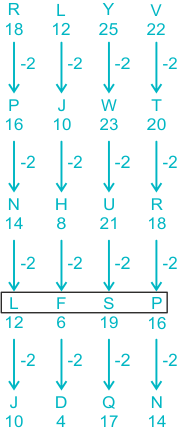 Hence, "Option 4" is the correct answer.
Q2 · Series
Select the option that represents the letters which, when sequentially placed from left to right in the blanks below, will
complete the letter series.
f h _ h _ g f _ h g _ h _ f f _ g _ h _ f
- tphthghg
- phthghfg
- phthfghg
- ghfhghhg
Answer aur solution dekho
Archived marked answer: D
Given series: f h _ h _ g f _ h g _ h _ f f _ g _ h _ f
Option 1) tphthghg → f h t h p g f h h g t h h f f g g h h g f → (It doesn't follow any pattern)
Option 2) phthghfg → f h p h h g f t h g h h g f f h g f h g f → (It doesn't follow any pattern)
Option 3) phthfghg → f h p h h g f t h g h h f f f g g h h g f → (It doesn't follow any pattern)
Option 4) ghfhghhg → f h g h h g f f h g h h g f f h g h h g f → (It follows the pattern of: fhghhgf - fhghhgf - fhghhgf)
Hence, "Option 4" is the correct answer.
Q3 · Series
Select the figure from among the given options that can replace the question mark (?) in the following series.





Answer aur solution dekho
Archived marked answer: B
The logic followed here is:
1) Alternately horizontal lines and vertical lines are added row wise subsequently.
Q4 · Series
What should come in place of the question mark (?) in the given series?
9 17 33 65 129 ?
- 259
- 264
- 257
- 265
Answer aur solution dekho
Archived marked answer: C
The logic followed here is:
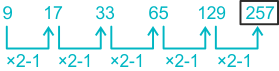 Hence, "Option 3" is the correct answer.
Q5 · Analogy
Select the option that is related to the third figure in the same way as the second figure is related to the first figure. Follow the analogyFigure 1 : Figure 2 :: Figure 3 : ?
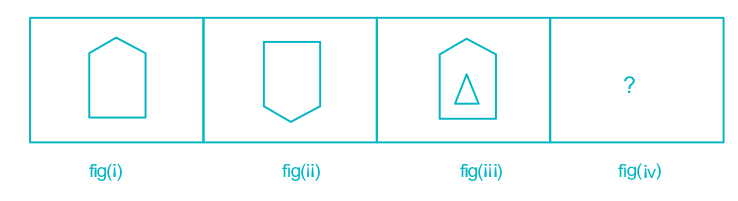




Answer aur solution dekho
Archived marked answer: B
The logic followed here is:
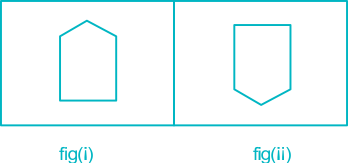 ⇒ The whole figure is flipped vertically.
Similarly,
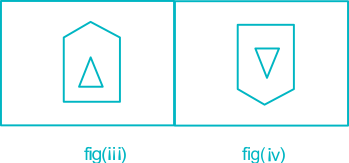 ⇒ The whole figure is flipped vertically.
Hence, "Option 2" is the correct answer.
Q6 · Analogy
Select the triad in which the numbers are related to each other in the same way as are the numbers of the given triads.
(148, 126, 104), (98, 76, 54)
(NOTE : Operations should be performed on the whole numbers, without breaking down the numbers into its constituent
digits. E.g. 13 – Operations on 13 such as adding /deleting /multiplying etc. to 13 can be performed. Breaking down 13 into 1
and 3 and then performing mathematical operations on 1 and 3 is not allowed)
- (157, 135, 113)
- (148, 137, 116)
- (124, 102, 96)
- (134, 120, 90)
Answer aur solution dekho
Archived marked answer: A
The logic followed here is:
Logic: (1st number + 3rd number) ÷ 2 = 2nd number.
Now,
For, (148, 126, 104)
⇒ (148 + 104) ÷ 2
⇒ 252 ÷ 2 = 126.
For, (98, 76
Q7 · Analogy
Select the triad in which the numbers are related to each other in the same way as the numbers in the following triads.
16-40-100
8-20-50
(NOTE : Operations should be performed on the whole numbers, without breaking down the numbers into its constituent
digits. E.g. 13 – Operations on 13 such as adding /deleting /multiplying etc., to 13 can be performed. Breaking down 13 into 1
and 3 and then performing mathematical operations on 1 and 3 is not allowed.)
- 12-30-120
- 18-50-110
- 22-74-185
- 24-60-150
Answer aur solution dekho
Archived marked answer: D
The logic followed here is:
Logic: 1st number × 2.5 = 2nd number; 2nd number × 2.5 = 3rd number.
Now,
For, 16-40-100:
⇒ 16 × 2.5 = 40
⇒ 40 × 2.5 = 100
For, 8-20-50:
⇒ 8 × 2.5 = 20
⇒ 20 × 2.5 = 50
Similarly, for 24-60-150:
⇒ 24 × 2.5 = 60
⇒ 60 × 2.5 = 150
Hence, the correct answer is "Option 4".
Q8 · Analogy
16 is related to 30 following a certain logic. Following the same logic, 81 is related to 110. To which of the following is 49 related, following the same logic?
(NOTE: Operations should be performed on the whole numbers, without breaking down the numbers into its constituent digits. E.g., 13 - Operations on 13 such as adding/subtracting/multiplying, etc., to 13 can be performed. Breaking down 13 into 1 and 3 and then performing mathematical operations on 1 and 3 is not allowed.)
- 64
- 60
- 72
- 90
Answer aur solution dekho
Archived marked answer: C
The logic followed here is:
Logic: (√1st number + 1)² + (√1st number + 1) = 2nd number.
Now,
For, 16 : 30
⇒ (√16 + 1)² + (√16 + 1)
= (4 + 1)2 + (4 + 1)
= 5² + 5 = 25 + 5 = 30 = 2nd number
For, 81 : 110
⇒ (√81 + 1)2 + (√81 + 1)
= (9 + 1)2 + (9 + 1)
= 102 + 10 = 100 + 10 = 110 = 2nd number
Similarly, for 49 : ?
⇒ (√49 + 1)2 + (√49 + 1)
= (7 + 1)2 + (7 + 1)
= 82 + 8 = 64 + 8 = 72 = 2nd number
Hence, the correct answer is "Option 3".
Q9 · Analogy
"Vacant" is related to "Empty" in the same way as "Crowd" is related to ______.
- Throes
- Loner
- Throng
- Disband
Answer aur solution dekho
Archived marked answer: C
The logic followed here is:
Vacant is synonym of Empty.
Similarly,
Crowd is synonym of Throng.
Hence, "Option 3" is the correct answer.
Additional Information
Throes → It refers to intense or violent struggle or pain.
Loner → It refers to a person who prefers solitude, which is the opposite of "Crowd."
Disband → It refers to the act of breaking up or dispersing a group.
Q11 · Non Verbal Reasoning
Select the option figure that will replace the question mark (?) in the figure given below to complete the pattern.



Answer aur solution dekho
Archived marked answer: A
The figure which when put in place of '?' will logically complete the pattern is shown below:
 Thus, option Figure 1 will logically complete the pattern given.
Hence, "Option 1" is the correct answer.
Q12 · Non Verbal Reasoning
What is the number of triangles in the following figure?

- 9
- 8
- 6
- 7
Answer aur solution dekho
Archived marked answer: B
The number of triangles in the given figure is shown below:
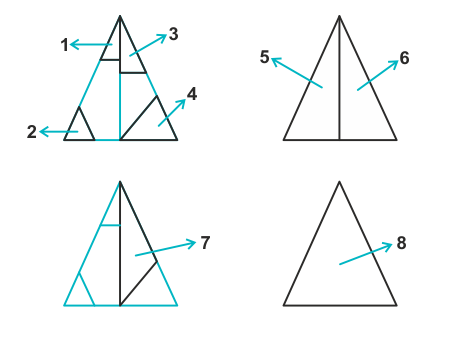 Thus, as marked there are a total of 8 triangles.
Hence, "Option 2" is the correct answer.
Q13 · Non Verbal Reasoning
The sequence of folding a paper and the manner in which the folded paper is cut is shown in the following figures. How
would this paper look when unfolded?





Answer aur solution dekho
Archived marked answer: B
The figure which will look like the paper when unfolded is shown below:
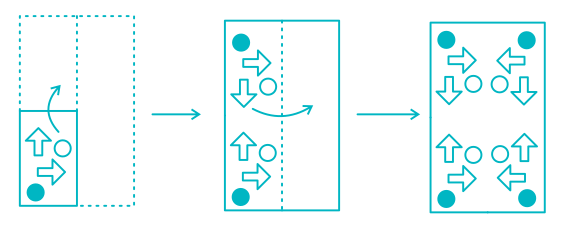 Thus, option Figure 2 will look like the paper when unfolded.
Hence, "Option 2" is the correct answer.
Q14 · Non Verbal Reasoning
A paper is folded and cut as shown below. How will it appear when unfolded?



Answer aur solution dekho
Archived marked answer: A
The figure which will look like the paper when unfolded is shown below:
 Thus, option Figure 1 will look like the paper when unfolded.
Hence, "Option 1" is the correct answer.
Q15 · Puzzle Subtypes Not To Miss
What will come in place of the question mark (?) in the following equation, if ‘+’ and ‘–’ are interchanged and ‘×’ and ‘÷’ are interchanged?
107 + 2028 × 6 – 427 ÷ 7 = ?
- 2758
- 2268
- 2785
- 2578
Answer aur solution dekho
Archived marked answer: A
BODMAS Table:
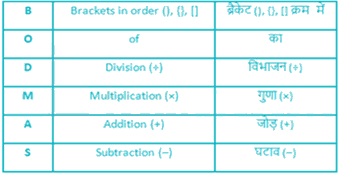 Given equation: 107 + 2028 × 6 – 427 ÷ 7 = ?
Now, if ‘+’ and ‘–’ and ‘×’ and ‘÷’ are interchanged, then:
⇒ 107 – 2028 ÷
Q16 · Puzzle Subtypes Not To Miss
What will come in place of the question mark (?) in the following equation, if ‘×’ is replaced by ‘÷’, ‘÷’ is replaced by ‘+’, ‘+’ is replaced by ‘×’ and ‘−’ remains unchanged?
42 × 3 ÷ 4 + 9 − 17 = ?
- 23
- 33
- 29
- 30
Answer aur solution dekho
Archived marked answer: B
Given: 42 × 3 ÷ 4 + 9 - 17 = ?
Decoding the given information:
Symbol
×
÷
+
Means
÷
+
×
-
Now replacing the sign from left to right using BODMAS Rule, we get:
⇒ 42 ÷ 3 + 4 × 9 - 17
= 14 + 4 × 9 - 17
⇒ 14 + 36 - 17
= 50 - 17 = 33
Hence, the correct answer is "Option 2" Q17 · Coding Decoding
In a certain code language, 'RETAINED' is written as 'ENIATERD' and 'MATURITY' is written as 'TIRUTAMY'. How will 'FIREWALL' be written in that language?
- LAWEFIFR
- LAWERIFL
- FLLAWERI
- FLIREWAL
Answer aur solution dekho
Archived marked answer: B
The logic followed here is:
'RETAINED' is written as 'ENIATERD'
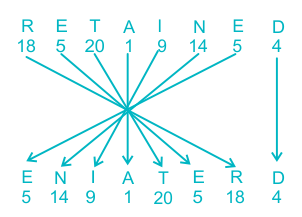 And,
'MATURITY' is written as 'TIRUTAMY'
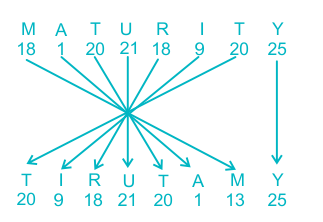 Similarly,
'FIREWALL' is written as
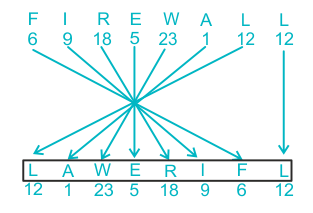 Hence, "Option 2" is the correct answer.
Q18 · Coding Decoding
Select the option that is related to the fifth term in the same way as the second term is related to the first term and the fourth term is related to the third term.
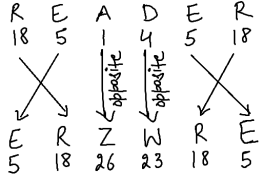
READER : ERZWRE :: SERIAL : ESIRLA :: JINGLE : ?
- IJGNEL
- JIMTEL
- JIGNEL
- IJMTEL
Answer aur solution dekho
Archived marked answer: D
The logic followed here is:
READER : ERZWRE
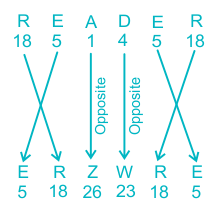
Q19 · Coding Decoding
In a certain code language, 'GLOBAL' is written as '221714272817', 'FOREST' is written as '23141124109', how will 'IMPACT' be written in that language?
- 20161327259
- 20161328269
- 18141126247
- 20161226259
Answer aur solution dekho
Archived marked answer: B
The logic followed here is:
'GLOBAL' is written as '221714272817'
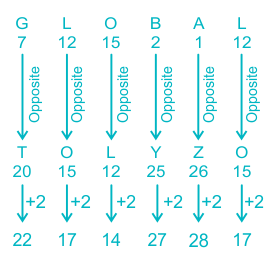 <
Q20 · Classification Odd One Out
Based on the position in the English alphabetical order, three of the following letter-clusters are alike in some manner and one is different. Select the odd letter-cluster.
Note: The odd one out is not based on the number of consonants/vowels or their position in the letter cluster.
- SVXZ
- EHJK
- YBDE
- TWYZ
Answer aur solution dekho
Archived marked answer: A
The logic followed here is:
Option 1) SVXZ
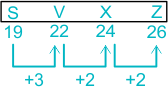 Option 2) EHJK</
Q21 · Classification Odd One Out
Three of the following four number-pairs are alike in a certain way and thus form a group. Which number-pair does NOT belong to that group?
(NOTE: The relation should be found without breaking down the numbers into its constituent digits)
- 83, 97
- 73, 79
- 61,71
- 31, 41
Answer aur solution dekho
Archived marked answer: B
The logic followed here is:
Option 1) 83, 97
The next alternate prime number after 83 is 97.
Option 2) 73, 79
The next consecutive prime number after 73 is 79.
Option 3) 61,71
The next alternate prime number after 61 is 71.
Option 4) 31, 41
The next alternate prime number after 31 is 41.
Thus, out of all the options '73, 79' is the odd one out.
Hence, "Option 2" is the correct answer.
Q22 · Logical Reasoning
Read the given statements and conclusions carefully. You have to take the given statements to be true if they seem to be at variance from commonly known facts. You have to decide which conclusion(s) logically follow(s) from the given statements.
Statements:
All fruit are sour.
Some sour are vegetables.
Some vegetables are green.
Conclusions:
(i) All vegetables are sour.
(ii) Some sour are green.
- Only conclusion (II) follows
- Neither conclusion (I) nor (II) follows
- Only conclusion (I) follows
- Both conclusions (I) and (II) follow
Answer aur solution dekho
Archived marked answer: B
The least possible Venn diagram for the given statements is as shown below :
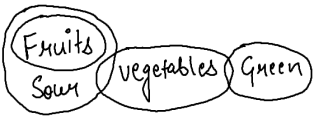
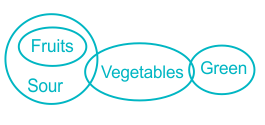 Conclusions:
I. All vegetables are sour → Does not follow (As some sour are vegetables. So it is possible but not definite.)
II. Some sour are green → Does not follow (As All fruit are sour. So it is possible but not definite.)
∴ Here, Neither conclusion (I) nor (II) follows.
Hence, the correct answer is "Option 2".
Q23 · Logical Reasoning
Read the given statements and conclusions carefully. Assuming that the information given in the statements is true, even if
it appears to be at variance with commonly known facts, decide which of the given conclusions logically follow(s) from the
statements.
Statements:
Some Toys are Plastic.
Some Plastic are Metal.
No Metal is Chemical.
Conclusions:
(I) Some Chemicals are Plastic.
(II) No Toy is a Chemical.
- Both conclusions (I) and (II) follow.
- Only conclusion (II) follows.
- Neither conclusion (I) nor (II) follows.
- Only conclusion (I) follows.
Answer aur solution dekho
Archived marked answer: C
The least possible Venn diagram for the given statements is as shown below :
 Conclusions:
I. Some Chemicals are Plastic → Does not follow (As some plastic are metal and no metal is chemical. So it is possible but not definite.)
II. No Toy is a Chemical → Does not follow (As some toys are plastic, some plastic are metal and no metal is chemical. As no direct relation is given between toy and chemical, so it is possible but not definite.)
∴ Here, Neither conclusion (I) nor (II) follows.
Hence, the correct answer is "Option 3".
Q24 · Blood Relations
In a certain code language,
‘A + B’ means ‘A is the mother of B’,
‘A – B’ means ‘A is the father of B’,
‘A $ B’ means ‘A is the son of B’,
‘A % B’ means ‘A is the sister of B’,
‘A / B’ means ‘A is the wife of B’ and
‘A * B’ means ‘A is the husband of B’.
Which of the following means P is the Son's wife of T?
i. T / B – K * P + O
ii. T + K * P + B % O
iii. K * P + B % T + O
iv. P + T * K + B % O
- Only i
- Both i and ii
- iii and iv
- Only ii
Answer aur solution dekho
Archived marked answer: B
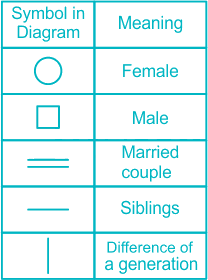 Decoding symbols:
A is
Symbol
+
–
$
%
/
*
Meaning
Mother
Father
Son
Sister
Wife
Husband
to B
So, by checking each statement one by one:
i. T / B – K * P + O → T is the wife of B who is the father of K who is the husband of P who is the mother of O.
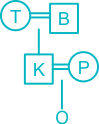 Here, P is the T's son's wife or daughter-in-law.
ii. T + K * P + B % O → T is the mother of K who is the husband of P who is the mother of B who is the sister of O.
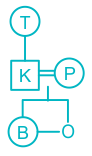 Here, P is the T's son's wife or daughter-in-law.
iii. K * P + B % T + O → K is the husband of P who is the mother of B who is the sister of T who is the mother of O.
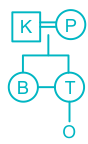 Here, P is T's mother.
iv. P + T * K + B % O → P is the mother of T who is the husband of K who is the mother of B who is the sister of O.
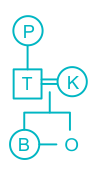 Here, P is T's mother.
Thus, statements (i) and (ii) means P is the Son's wife of T.
Hence, the correct answer is "Option 2"
Q25 · Alphabet Test
The position of how many letters will remain unchanged if each of the letters in the word ‘SIGHTED’ is arranged in the English alphabetical order?
- None
- One
- Three
- Two
Answer aur solution dekho
Archived marked answer: D
Given word: 'SIGHTED'
After arranged in alphabetical order:
Alphabets
S
I
G
H
T
E
D
Alphabetical order
D
E
G
H
I
S
T
Now,
there are Two alphabets "G" and "H" will remain unchanged if each of the letters in the word 'SIGHTED' is arranged in English alphabetical order.
Hence, the correct answer is "Option 4".
General Awareness
Q1 · Art and Culture
Which of the following is India's national academy of dance?
- Lalit Kala Akademi
- Centre for Cultural Resources and Training
- Centre for Indian Classical Dances
- Sangeet Natak Akademi
Answer aur solution dekho
Archived marked answer: D
The correct answer is Sangeet Natak Akademi.
Key Points
- Sangeet Natak Akademi is the national level academy for performing arts in India, including dance, music, and drama.
- It was established by the Indian Education Ministry in 1952 and is an autonomous organization under the Ministry of Culture.
- The Akademi's primary goal is to promote and preserve the rich and diverse cultural heritage of India in the field of performing arts.
- It recognizes and honors outstanding artists through its annual awards and fellowships, which are considered the highest national recognition given to artists.
Additional Information
- Lalit Kala Akademi
- Also known as the National Academy of Art, it is India's national academy of fine arts.
- It was established in New Delhi in 1954 by the Government of India to promote and propagate understanding of Indian art, both within and outside the country.
- The Akademi organizes exhibitions, workshops, and seminars to foster a deeper appreciation of various forms of visual arts.
- Centre for Cultural Resources and Training (CCRT)
- CCRT is an autonomous organization under the Ministry of Culture, Government of India.
- Established in 1979, the CCRT's primary objective is to link education with culture and to promote the integration of cultural knowledge in the school education system.
- CCRT conducts training programs, workshops, and provides resources for teachers and students to promote cultural education.
- Centre for Indian Classical Dances
- Founded by the renowned classical dancer Dr. Sonal Mansingh in 1977, it is dedicated to the preservation and promotion of Indian classical dance forms.
- The center offers training and educational programs in various classical dance styles such as Bharatanatyam, Odissi, and others.
- It aims to maintain the traditional standards of Indian classical dances while encouraging innovation and creativity.
Q2 · Art and Culture
Padma Bhushan awardee, Ustad Sabri Khan played which of the following musical instruments?
- Sarod
- Santoor
- Tabla
- Sarangi
Answer aur solution dekho
Archived marked answer: D
The correct answer is Sarangi.
Key Points
- Ustad Sabri Khan was a renowned Sarangi player, known for his contributions to Indian classical music.
- He received the Padma Bhushan award in 2006, one of India's highest civilian honors, for his exceptional service in the field of arts.
- Ustad Sabri Khan played a significant role in popularizing the Sarangi on an international level.
- He belonged to the Sainia Gharana, which traces its roots back to Mian Tansen, one of the greatest musicians in Indian history.
Additional Information
- Sarangi
- The Sarangi is a bowed, short-necked string instrument from India, which is used in Hindustani classical music.
- It is known for its emotive and vocal quality, often compared to the human voice.
- The Sarangi has three main playing strings made of gut and a number of sympathetic strings that resonate with the played notes, providing a rich, echoing sound.
- It is traditionally played using a bow and is held vertically, resting on the knee of the musician.
- Sarod
- The Sarod is another stringed instrument used in Indian classical music, known for its deep, weighty, and introspective sound.
- It is played with a plectrum and has a fretless metal fingerboard, allowing for smooth sliding movements.
- The Sarod has a wooden body with a resonating membrane made of goat skin, and it usually has four to six main strings and numerous sympathetic strings.
- Santoor
- The Santoor is a hammered dulcimer from the Kashmir region, played with lightweight wooden mallets called mezrab.
- It has a trapezoid shape and is usually made of walnut or maple wood, with a total of 72 strings arranged in sets of three, producing a bright, shimmering sound.
- The instrument is placed on the lap and played while sitting cross-legged, and it is used in both classical and folk music.
- Tabla
- The Tabla is a pair of twin hand drums used in Indian classical, popular, and devotional music.
- Consisting of a smaller drum called 'dayan' (right) and a larger drum called 'bayan' (left), the Tabla is known for its complex rhythms and tonal versatility.
- It is played with the fingers and palms, allowing for a wide range of dynamic and expressive sounds.
Q3 · Indian Polity and Constitution
Which of the following Articles deals with the composition of the Rajya Sabha?
- Article 76
- Article 80
- Article 84
- Article 92
Answer aur solution dekho
Archived marked answer: B
The correct answer is Article 80.
Key Points
- Article 80 of the Indian Constitution deals with the composition of the Council of States, which is commonly known as the Rajya Sabha.
- The Rajya Sabha is the upper house of the Parliament of India.
- As per Article 80, the Rajya Sabha consists of not more than 250 members.
- Out of these, 12 members are nominated by the President of India from among persons having special knowledge or practical experience in fields such as literature, science, art, and social service, and the remaining members are representatives of the States and Union territories.
Additional Information
- Article 76
- Article 76 of the Indian Constitution deals with the office of the Attorney General of India.
- The Attorney General is the chief legal advisor to the Government of India and has the right to participate in the proceedings of both Houses of Parliament, but without a right to vote.
- Article 84
- Article 84 of the Indian Constitution specifies the qualifications required to be a member of Parliament.
- These qualifications include being a citizen of India, being not less than 30 years of age in the case of the Rajya Sabha and 25 years in the case of the Lok Sabha, and possessing such other qualifications as may be prescribed by law by the Parliament.
- Article 92
- Article 92 of the Indian Constitution deals with the provisions for the Chairman or Deputy Chairman of the Council of States (Rajya Sabha).
- It states that while the office of Chairman or Deputy Chairman is vacant, or in the absence of the Chairman from any sitting of the Council, the duties of the office shall be performed by the Deputy Chairman, or if the Deputy Chairman is also absent, by such member of the Council as may be determined by the rules of procedure of the Council.
Q4 · Indian Polity and Constitution
Which Article in the fundamental duty applies, when a construction worker takes his 8-year son to the site rather than sending him to school?
- Article 51A (b)
- Article 51A (k)
- Article 51A (j)
- Article 51A (i)
Answer aur solution dekho
Archived marked answer: B
The correct answer is Article 51A (k).
Key Points
- Article 51A (k) of the Constitution of India specifies that it is a fundamental duty of a parent or guardian to provide opportunities for education to their child or ward between the ages of 6 and 14 years.
- This duty is in line with the objective of the Right to Education Act, which mandates free and compulsory education for children in this age group.
- Ensuring that children go to school instead of being involved in child labor is essential for their overall development and future prospects.
- Violation of this duty, such as taking a child to a construction site instead of school, can lead to legal consequences and hinder the child's right to education.
Additional Information
- Fundamental Duties
- Fundamental Duties are a set of moral obligations specified in Part IVA (Article 51A) of the Indian Constitution.
- They were added by the 42nd Amendment Act in 1976, based on the recommendations of the Swaran Singh Committee.
- These duties emphasize the importance of citizen participation in national development and the upholding of constitutional values.
- Right to Education Act (RTE)
- The Right to Education Act was enacted in 2009 to provide free and compulsory education to children aged 6 to 14 years.
- It is a fundamental right under Article 21A of the Indian Constitution.
- The Act ensures that children have access to quality education without discrimination and establishes norms for school infrastructure, teacher-student ratio, and curriculum.
- Child Labor
- Child labor refers to the employment of children in a manner that deprives them of their childhood, education, or is harmful to their health and development.
- The Child Labor (Prohibition and Regulation) Act, 1986, and its amendments prohibit the employment of children below 14 years in hazardous occupations and processes.
- Efforts to eliminate child labor involve providing education and support to families to ensure children attend school instead of engaging in work.
This source code provides a detailed solution to the question regarding the fundamental duty applicable when a construction worker takes his 8-year-old son to the site instead of sending him to school. The key points highlight the importance and implications of Article 51A (k), while the additional information section provides context on related topics such as Fundamental Duties, the Right to Education Act, and child labor
Q5 · Indian Polity and Constitution
Match the following neighbouring countries with their official languages correctly.
Country Name
Official Language
1. Afghanistan
a. Dari
2. Bhutan
b. Dzongkha
3. Pakistan
c. Urdu
4. Myanmar
d. Burmese
- 1.c, 2.a, 3.b, 4.d
- 1.a, 2.b, 3.c, 4.d
- 1.c, 2.d, 3.b, 4.a
- 1.a, 2.c, 3.d, 4.b
Answer aur solution dekho
Archived marked answer: B
The correct answer is Option 2.
Key Points
- Afghanistan's official language is Dari, which is a variety of Persian spoken in Afghanistan.
- Bhutan's official language is Dzongkha, which is the native language of the Bhutanese people and the national language of Bhutan.
- Pakistan's official language is Urdu, which is a lingua franca and a symbol of national unity in Pakistan.
- Myanmar's official language is Burmese, which is the primary language spoken by the Burmese people and the official language of Myanmar.
Additional Information
- Afghanistan:
- Along with Dari, Pashto is also an official language of Afghanistan.
- Dari is used as a lingua franca and is the primary language used in the capital, Kabul.
- Bhutan:
- Dzongkha is the language of the Bhutanese people and is used in government and administration.
- The language follows the Tibetan script.
- Pakistan:
- Urdu is the national language and one of the two official languages of Pakistan (the other being English).
- Urdu is widely spoken and understood throughout Pakistan and serves as a symbol of national unity.
- Myanmar:
- Burmese is the native language of the Bamar people, who are the dominant ethnic group in Myanmar.
- Burmese script is derived from the Mon script, which in turn was adapted from the Indian Brahmi script.
Q6 · Indian Polity and Constitution
Which of following is NOT a device of parliamentary proceedings?
- Half-an-hour discussion
- Zero-hour discussion
- Two-hour (short) discussion
- Full-day discussion
Answer aur solution dekho
Archived marked answer: D
The correct answer is Full-day discussion.
Key Points
- Full-day discussion is not a recognized device of parliamentary proceedings in India.
- Indian Parliament has specific mechanisms for discussions such as Half-an-hour discussion, Zero-hour discussion, and Two-hour (short) discussion.
- These mechanisms are structured to ensure organized and efficient proceedings within the Parliament.
- The concept of a "Full-day discussion" does not exist as a formal parliamentary procedure in India.
Additional Information
- Half-an-hour discussion
- It is a device in the Indian Parliament where members can raise a matter of public importance, which requires an oral answer from the concerned minister.
- This discussion takes place for half an hour, typically at the end of the day's session.
- It allows members to seek clarification on specific issues from the ministers.
- Zero-hour discussion
- It is an informal device available to the members of the Indian Parliament to raise matters without any prior notice.
- It starts immediately after the Question Hour and lasts until the agenda for the day is taken up.
- Members can raise urgent matters of public importance during this time.
- Two-hour (short) discussion
- This device allows for a discussion on a matter of urgent public importance for a duration of two hours.
- No formal motion is moved and no voting takes place at the end of the discussion.
- The aim is to allow members to express their views and enable the government to clarify its position on the issue.
Q7 · Indian Economy
Which of the following is a public sector industry?
- BHEL
- Reliance
- Tata
- Adani
Answer aur solution dekho
Archived marked answer: A
The correct answer is BHEL.
Key Points
- Bharat Heavy Electricals Limited (BHEL) is an Indian public sector engineering and manufacturing company.
- It is owned by the Government of India and was established in 1964.
- BHEL is one of the largest engineering and manufacturing companies of its kind in India.
- The company is engaged in the design, engineering, construction, testing, commissioning, and servicing of a wide range of products and services for the core sectors of the economy, viz. Power, Transmission, Industry, Transportation (Railways), Renewable Energy, Oil & Gas, and Defence.
Additional Information
- Reliance Industries Limited
- It is a private sector company and one of the largest conglomerates in India.
- Founded by Dhirubhai Ambani in 1966, it is involved in various sectors including petrochemicals, refining, oil, telecommunications, and retail.
- Tata Group
- It is an Indian multinational conglomerate founded in 1868 by Jamsetji Tata.
- While it operates in many sectors including steel, automobiles, IT, and hotels, it is a private sector entity.
- Adani Group
- Founded by Gautam Adani in 1988, it is an Indian multinational conglomerate.
- It operates in sectors such as energy, resources, logistics, agribusiness, real estate, financial services, and defense.
- It is a private sector company.
This code provides a detailed explanation for the question, including key points about the correct option (BHEL) and additional information about the other options
Q8 · Indian Economy
What is the empirically fitted relationship between the rate of change of money, wage, and rate of unemployment known as?
- Friedman’s model
- Keynesian model
- Baumol hypothesis
- Philips curve
Answer aur solution dekho
Archived marked answer: D
The correct answer is Philips curve.
Key Points
- The Philips curve represents the inverse relationship between the rate of unemployment and the rate of inflation in an economy.
- The concept was first introduced by economist A.W. Phillips in 1958.
- According to the Phillips curve, lower unemployment in an economy leads to higher wages, which in turn leads to higher inflation.
- This relationship suggests that policymakers face a trade-off between reducing unemployment and controlling inflation.
Additional Information
- Friedman's Model
- Also known as the Monetarist Theory, it was proposed by Milton Friedman.
- Friedman argued that there is no long-run trade-off between inflation and unemployment, as suggested by the Phillips curve.
- He introduced the concept of the Natural Rate of Unemployment, which posits that the economy will always revert to this natural rate despite short-term fluctuations.
- Friedman emphasized the role of monetary policy in controlling inflation.
- Keynesian Model
- Developed by John Maynard Keynes, this model emphasizes total spending in the economy (aggregate demand) and its effects on output and inflation.
- Keynesians advocate for active government intervention to manage economic cycles.
- They believe that insufficient demand can lead to prolonged periods of high unemployment.
- In contrast to the Phillips curve, Keynesians may support policies that increase aggregate demand to reduce unemployment without necessarily causing high inflation.
- Baumol Hypothesis
- Proposed by economist William J. Baumol, it addresses the cost disease in service sectors.
- Baumol's hypothesis suggests that wages in labor-intensive sectors (like services) rise due to wage increases in other sectors that experience higher productivity growth.
- This leads to higher costs in the service sector without corresponding increases in productivity.
- The hypothesis is often used to explain rising costs in sectors such as healthcare and education.
Q9 · Sports Static GK
Which of the following nations won the ICC World Test Championship, defeating India, in 2023?
- New Zealand
- Australia
- South Africa
- England
Answer aur solution dekho
Archived marked answer: B
The correct answer is Australia.
Key Points
- Australia won the ICC World Test Championship in 2023, defeating India in the final match.
- The final match was held at The Oval in London from June 7 to June 11, 2023.
- This victory marked Australia's first ICC World Test Championship title since the tournament's inception.
- Australia's team displayed remarkable performance throughout the tournament, leading to their well-deserved win.
Additional Information
- ICC World Test Championship
- The ICC World Test Championship (WTC) is a league competition for Test cricket run by the International Cricket Council (ICC).
- The championship was introduced to bring more context and excitement to Test cricket, which is the longest format of the sport.
- The WTC started in 2019, with the final match determining the world champion in Test cricket.
- The competition involves the top Test-playing nations, with each series contributing points towards the championship table.
- Final Match Details
- The final match of the 2023 ICC World Test Championship was held at The Oval, a historic cricket ground in London, England.
- Australia faced India in the final, showcasing top-notch cricketing skills from both sides.
- Australia emerged victorious, securing their first WTC title and adding another prestigious trophy to their cricketing achievements.
- Australia's Cricket Achievements
- Australia has a rich history in cricket, being one of the most successful teams in the sport.
- They have won multiple ICC Cricket World Cups, ICC Champions Trophies, and now the ICC World Test Championship.
- Australia is known for producing legendary cricketers and maintaining a high standard of performance in international cricket.
Q10 · Sports Static GK
Indian Olympic Association was established in which of the following years?
- 1927
- 1931
- 1933
- 1929
Answer aur solution dekho
Archived marked answer: A
The correct answer is 1927.
Key Points
- The Indian Olympic Association (IOA) was established in 1927.
- The IOA is the body responsible for selecting athletes to represent India at the Olympic Games, Asian Games, and other international athletic meets.
- Sir Dorabji Tata and Dr. A.G. Noehren were the founding members of the IOA.
- The IOA is affiliated with the International Olympic Committee (IOC) and the Olympic Council of Asia.
Additional Information
- Olympic Games
- The Olympic Games are leading international sporting events featuring summer and winter sports competitions.
- The games are held every four years, with the Summer and Winter Games alternating every two years.
- The modern Olympic Games were first held in 1896 in Athens, Greece.
- The International Olympic Committee (IOC), established in 1894, is the governing body of the Olympic Movement.
- Asian Games
- The Asian Games, also known as Asiad, is a continental multi-sport event held every four years among athletes from all over Asia.
- The Games are regulated by the Olympic Council of Asia (OCA) under the supervision of the International Olympic Committee (IOC).
- The first Asian Games were held in New Delhi, India, in 1951.
- International Olympic Committee (IOC)
- The International Olympic Committee is a non-governmental sports organization based in Lausanne, Switzerland.
- The IOC is the authority responsible for organizing the modern Olympic Games.
- It was founded by Pierre de Coubertin and Demetrios Vikelas in 1894.
Q11 · Indian Geography
Which of the following rivers marks the eastern-most boundary of the Himalayas?
- Kali
- Teesta
- Satluj
- Brahmaputra
Answer aur solution dekho
Archived marked answer: D
The correct answer is Brahmaputra.
Key Points
- The Brahmaputra river originates from the Angsi Glacier in the Himalayas in Tibet, where it is known as the Yarlung Tsangpo River.
- It flows eastwards for about 1,700 km through the Tibet Autonomous Region of China, making a U-turn at the Namcha Barwa mountain to enter India in Arunachal Pradesh.
- The river marks the eastern-most boundary of the Himalayas, after which it turns southward into the Assam Valley as the Brahmaputra and further into Bangladesh.
- The Brahmaputra is one of the major rivers of the Indian subcontinent, with a total length of 2,900 km, making it one of the longest rivers in the world.
Additional Information
- Kali River
- The Kali River, also known as the Sharda River or Mahakali River, flows along the border of India and Nepal.
- It originates from the Kalapani springs in the Himalayas at an altitude of 3,600 meters in the Pithoragarh district of Uttarakhand, India.
- The river is significant for both nations, serving as a vital water resource and playing a role in the bilateral treaties between India and Nepal.
- Teesta River
- Teesta River originates from the Tso Lhamo Lake in North Sikkim, India, and flows southward through West Bengal before entering Bangladesh.
- It is a major river in the Indian states of Sikkim and West Bengal, providing water for irrigation and hydroelectric power generation.
- Satluj River
- The Satluj River, also known as the Sutlej, is the longest of the five rivers that flow through the Punjab region in northern India and Pakistan.
- It originates in Tibet near Lake Rakshastal and flows through the Indian states of Himachal Pradesh and Punjab before entering Pakistan.
Q12 · Modern Indian History
Who asked James Rennel to prepare the map of Hindustan?
- Lord Ripon
- Warren Hastings
- Lord Dalhousie
- Robert Clive
Answer aur solution dekho
Archived marked answer: D
The correct answer is Robert Clive.
Key Points
- Robert Clive was a British officer and privateer who established the military and political supremacy of the East India Company in Bengal.
- He is credited with helping to establish British control over India, which lasted until Indian independence in 1947.
- James Rennel, a geographer and historian, was asked by Robert Clive to prepare a map of Hindustan.
- Rennel's map was one of the earliest detailed maps of India, and it played a significant role in the British administration and strategic planning in the region.
Additional Information
- James Rennel
- James Rennel (1742-1830) was an English geographer, historian, and pioneer of oceanography.
- He is often referred to as the Father of Indian Geography for his extensive surveys and maps of the Indian subcontinent.
- His work provided critical geographical information that was used for military and administrative purposes by the British Empire.
- Rennel's most notable work, "A Bengal Atlas," was published in 1779 and included detailed maps of Bengal and parts of Northern India.
- Robert Clive
- Robert Clive (1725-1774) was a British military officer and a key figure in establishing British control in India.
- He played a crucial role in the Battle of Plassey (1757), which marked the beginning of British rule in India.
- Clive served as the Governor of Bengal and implemented significant administrative reforms to strengthen British power.
- Despite his achievements, Clive's career was marred by controversies, including allegations of corruption and his role in the exploitation of Indian resources.
- East India Company
- The East India Company was an English company formed for the exploitation of trade with East and Southeast Asia and India, incorporated by royal charter in 1600.
- The company eventually came to rule large areas of India, exercising military power and assuming administrative functions.
- It played a key role in the British colonization of India and its economy was heavily reliant on the trade of cotton, silk, indigo, salt, tea, and opium.
- The company's rule in India ended after the Indian Rebellion of 1857, leading to the establishment of direct British rule, known as the British Raj.
Q13 · Modern Indian History
The birth anniversary of Mahatma Gandhi is celebrated as the national festival of India. In which of the following years was Gandhi Ji born?
- 1885
- 1869
- 1890
- 1877
Answer aur solution dekho
Archived marked answer: B
The correct answer is 1869.
Key Points
- Mahatma Gandhi was born on 2nd October 1869.
- His full name was Mohandas Karamchand Gandhi.
- Gandhi is widely recognized as the Father of the Nation in India.
- He played a key role in India's independence movement against British rule through his philosophy of non-violence (Ahimsa).
Additional Information
- National Festivals of India
- India celebrates three national festivals: Republic Day (26th January), Independence Day (15th August), and Gandhi Jayanti (2nd October).
- Gandhi Jayanti is observed to commemorate the birth anniversary of Mahatma Gandhi.
- On this day, various events and activities are organized across the country to honor his contributions and teachings.
- It is also celebrated as the International Day of Non-Violence by the United Nations.
- Philosophy of Mahatma Gandhi
- Ahimsa: Non-violence, the principle of not causing harm to any living being.
- Satyagraha: The policy of passive political resistance, especially that advocated by Mahatma Gandhi against British rule in India.
- Swadeshi: The focus on self-sufficiency and the use of domestic goods.
- Sarvodaya: The welfare of all, a concept aiming for the progress and upliftment of all sections of society.
- Important Events in Gandhi's Life
- Salt March (1930): A nonviolent protest against the British salt monopoly.
- Quit India Movement (1942): A movement demanding an end to British rule in India.
- Non-Cooperation Movement (1920-22): A mass protest demanding self-governance and full independence.
- Assassination: Mahatma Gandhi was assassinated on 30th January 1948 by Nathuram Godse.
Q14 · Modern Indian History
Indian National Army was formed in which of the following countries?
- Singapore
- Germany
- London
- Japan
Answer aur solution dekho
Archived marked answer: A
The correct answer is Singapore.
Key Points
- The Indian National Army (INA) was formed during World War II in Singapore.
- The INA was initially formed under the leadership of Mohan Singh in 1942 with the aim of securing Indian independence from British rule.
- It was later reorganized and led by Subhas Chandra Bose, who took command in 1943.
- Singapore served as a strategic location for the INA due to its significant Indian population and its occupation by the Japanese forces at the time.
Additional Information
- Indian National Army (INA)
- The Indian National Army (INA) was an armed force formed by Indian nationalists in 1942 in Southeast Asia during World War II.
- The aim of the INA was to secure Indian independence from British rule, a cause that garnered significant support among Indian expatriates and prisoners of war.
- Mohan Singh initially formed the INA with Indian prisoners of war captured by the Japanese during the Malayan Campaign and the Battle of Singapore.
- Subhas Chandra Bose, a prominent leader in the Indian independence movement, took charge of the INA in 1943 and restructured it significantly.
- Subhas Chandra Bose
- Subhas Chandra Bose, also known as Netaji, was a prominent Indian freedom fighter who played a crucial role in the Indian independence movement.
- Bose was a charismatic leader who advocated for radical action against British rule and sought foreign alliances to achieve Indian independence.
- Under his leadership, the INA sought to liberate India from British control with the assistance of the Axis powers during World War II.
- Bose's efforts and his call for complete independence inspired many Indians and left a lasting legacy in India's history.
- World War II and Southeast Asia
- World War II, which lasted from 1939 to 1945, involved major global powers and was marked by significant military campaigns in various regions, including Southeast Asia.
- Southeast Asia was strategically important during the war, with countries like Singapore, Malaya, and Burma witnessing major battles.
- The Japanese occupation of Southeast Asia during the war provided an opportunity for Indian nationalists to seek support for their cause against British colonial rule.
- The INA's formation and activities in Southeast Asia were part of the broader context of anti-colonial struggles and the global impact of World War II.
Q15 · Current Affairs
Which Bill was passed by the Parliament, in July 2021, to help in the availability of working capital for the micro, small and medium enterprises sector?
- The Essential Commodities (Amendment) Bill, 2020
- The Minerals Laws (Amendment) Bill, 2020
- The Factoring Regulation (Amendment) Bill, 2021
- The Insolvency and Bankruptcy Code (Amendment) Bill, 2021
Answer aur solution dekho
Archived marked answer: C
The correct answer is The Factoring Regulation (Amendment) Bill, 2021.
Key Points
- The Factoring Regulation (Amendment) Bill, 2021 was introduced to address the challenges faced by the micro, small, and medium enterprises (MSMEs) in accessing working capital.
- Factoring is a financial transaction where a business sells its accounts receivable (invoices) to a third party (called a factor) at a discount in exchange for immediate money.
- This amendment widens the scope of entities that can undertake factoring business, thereby increasing the availability of funds to the MSME sector.
- The Bill aims to simplify the operational constraints in the factoring business and make it more accessible and affordable for MSMEs.
Additional Information
- The Essential Commodities (Amendment) Bill, 2020
- This bill aims to deregulate the production, supply, distribution, and trade of certain food items to increase the competitiveness of the market.
- It seeks to remove commodities like cereals, pulses, oilseeds, edible oils, onions, and potatoes from the list of essential commodities.
- This deregulation is expected to attract private sector/foreign direct investment into the agriculture sector.
- The Minerals Laws (Amendment) Bill, 2020
- This bill aims to promote ease of doing business in the coal and mining sector by amending the Mines and Minerals (Development and Regulation) Act, 1957, and the Coal Mines (Special Provisions) Act, 2015.
- It allows companies to participate in auctions of coal and lignite blocks even without prior experience in coal mining.
- The bill also removes the restriction on end-use of minerals produced from coal and lignite blocks.
- The Insolvency and Bankruptcy Code (Amendment) Bill, 2021
- This bill introduces a pre-packaged insolvency resolution process (PIRP) for micro, small and medium enterprises (MSMEs).
- PIRP is a quicker and cost-effective alternative to the normal Corporate Insolvency Resolution Process (CIRP) under the Insolvency and Bankruptcy Code (IBC).
- This process allows MSMEs to restructure their liabilities and continue their business operations without undergoing a full insolvency process.
Q16 · Current Affairs
Who among the following is appointed as the new Chairman of Pension Fund Regulatory and Development Authority (PFRDA) in March 2023?
- Supratim Bandyopadhyay
- Shashanka Das
- Namita Shankar
- Deepak Mohanty
Answer aur solution dekho
Archived marked answer: D
The correct answer is Deepak Mohanty.
Key Points
- Deepak Mohanty was appointed as the new Chairman of the Pension Fund Regulatory and Development Authority (PFRDA) in March 2023.
- He succeeded Supratim Bandyopadhyay, who served as the previous chairman of PFRDA.
- Deepak Mohanty has previously held the position of Executive Director at the Reserve Bank of India (RBI).
- PFRDA is the regulatory body for overseeing and promoting the pension sector in India, including the National Pension System (NPS).
Additional Information
- Pension Fund Regulatory and Development Authority (PFRDA)
- The PFRDA was established by the Government of India to promote, regulate, and develop the pension sector in India.
- It was set up on 23 August 2003 and became a statutory body with the enactment of the PFRDA Act in 2013.
- The PFRDA oversees and regulates the National Pension System (NPS) and other pension schemes to ensure that the retirement needs of individuals are met effectively.
- The NPS is a voluntary, defined contribution retirement savings scheme designed to enable subscribers to make decisions regarding their future through systematic savings during their working life.
- National Pension System (NPS)
- The NPS is a government-sponsored pension scheme launched in January 2004 for government employees and later extended to all citizens of India.
- It is a voluntary and long-term retirement savings scheme aimed at ensuring that subscribers receive a stable income post-retirement.
- Under NPS, individual savings are pooled into a pension fund which is invested by PFRDA-regulated professional fund managers as per approved investment guidelines into diversified portfolios comprising government bonds, bills, corporate debentures, and shares.
- The NPS offers tax benefits under Section 80CCD of the Income Tax Act, making it an attractive investment option for retirement planning.
- Reserve Bank of India (RBI)
- The RBI is India's central banking institution, which controls the issuance and supply of the Indian rupee and manages the country's main payment systems.
- It was established on April 1, 1935, in accordance with the provisions of the Reserve Bank of India Act, 1934.
- The RBI plays a crucial role in the development strategy of the Indian government, focusing on economic growth and stability.
- In addition to its primary functions, the RBI manages foreign exchange and gold reserves, regulates the financial system, and provides key financial services to the government and the banking sector.
Q17 · General Science Biology
What kind of phyllotaxy was examined in the Guava plant?
- Superimposed
- Whorled
- Alternate
- Opposite
Answer aur solution dekho
Archived marked answer: D
The correct answer is Opposite.
Key Points
- In an opposite phyllotaxy, two leaves arise at the same level from opposite sides of the stem.
- Each pair of leaves is typically perpendicular to the next pair above or below, providing a crisscross pattern.
- Opposite phyllotaxy ensures maximum light exposure for each leaf, which is beneficial for photosynthesis.
- This type of leaf arrangement is common in plants such as guava (Psidium guajava), calotropis, and jamun.
Additional Information
- Phyllotaxy
- Phyllotaxy refers to the arrangement of leaves on a plant stem.
- The primary types of phyllotaxy are alternate, opposite, and whorled.
- This arrangement plays a significant role in maximizing light capture and minimizing shading of lower leaves.
- Alternate Phyllotaxy
- In alternate phyllotaxy, each leaf arises at a different level on the stem, and the leaves are not directly opposite each other.
- Examples include sunflower and mustard.
- Whorled Phyllotaxy
- In whorled phyllotaxy, three or more leaves grow at the same level around the stem.
- This arrangement is less common and can be seen in plants like Nerium (oleander).
Q18 · General Science Chemistry
Transition elements are the elements that are found in Groups 3-12 of the modern periodic table, that constitute the ______.
- d-block
- s-block
- p-block
- f-block
Answer aur solution dekho
Archived marked answer: A
The correct answer is d-block.
Key Points
- Transition elements are the elements that are found in the d-block of the periodic table.
- The d-block elements are located in Groups 3 to 12 of the periodic table.
- These elements are characterized by the filling of d-orbitals in their electron configuration.
- Transition elements exhibit unique properties such as variable oxidation states, colored compounds, and catalytic properties.
Additional Information
- Periodic Table:
- The periodic table is an arrangement of chemical elements organized based on their atomic number, electron configuration, and recurring chemical properties.
- Elements are presented in order of increasing atomic number.
- The table is divided into several blocks: s-block, p-block, d-block, and f-block, based on the subshell in which the last electron resides.
- d-block Elements:
- d-block elements are also known as transition metals.
- These elements have partially filled d-orbitals in their ground state or in any of their oxidation states.
- Common properties of d-block elements include high melting and boiling points, formation of colored compounds, and the ability to form complex ions.
- Examples of d-block elements include iron (Fe), copper (Cu), and nickel (Ni).
- s-block Elements:
- s-block elements include groups 1 and 2 of the periodic table, which comprise alkali metals and alkaline earth metals.
- These elements have their outermost electron in an s-orbital.
- Examples include lithium (Li), sodium (Na), and calcium (Ca).
- p-block Elements:
- p-block elements are found in groups 13-18 of the periodic table.
- These elements have their outermost electrons in p-orbitals.
- Examples include carbon (C), nitrogen (N), and oxygen (O).
- f-block Elements:
- f-block elements include the lanthanides and actinides.
- These elements have their outermost electrons in f-orbitals.
- Examples include cerium (Ce), thorium (Th), and uranium (U).
Q19 · General Science Chemistry
Identify the structural formula for magnesium hydroxide.
- MgOH
- MgO2
- Mg2H2
- Mg(OH)2
Answer aur solution dekho
Archived marked answer: D
The correct answer is Mg(OH)₂.
Key Points
- Magnesium hydroxide has the chemical formula Mg(OH)2.
- It consists of one magnesium (Mg) atom and two hydroxide (OH) groups.
- It is commonly found in nature as the mineral brucite.
- Magnesium hydroxide is used as an antacid and a laxative in medicine.
Additional Information
- Magnesium (Mg)
- Magnesium is a chemical element with the symbol Mg and atomic number 12.
- It is a shiny gray solid, and it is the eighth most abundant element in the Earth's crust.
- Magnesium is essential for all living cells, playing a key role in various biological processes.
- Hydroxide (OH-)
- The hydroxide ion (OH-) is a diatomic anion consisting of oxygen and hydrogen.
- It is commonly found in bases and is responsible for the basic (alkaline) nature of compounds.
- Hydroxide ions can neutralize acids, forming water and salts.
- Magnesium Hydroxide (Mg(OH)2)
- Magnesium hydroxide is a white solid with low solubility in water.
- It is used in medicine as an antacid to neutralize stomach acid and relieve indigestion and heartburn.
- It is also used as a laxative to alleviate constipation.
- In industrial applications, magnesium hydroxide is used as a fire retardant and in wastewater treatment.
Q20 · Awards Static
The Nandi Award for Best Male Playback Singer was instituted by which state in the year 1977?
- Gujarat
- Andhra Pradesh
- Tripura
- Maharashtra
Answer aur solution dekho
Archived marked answer: B
The correct answer is Andhra Pradesh.
Key Points
- The Nandi Awards are the highest awards given for excellence in Telugu cinema, theatre, and television, presented annually by the Government of Andhra Pradesh.
- The awards were instituted in 1964 and have been presented annually ever since.
- The Nandi Award for Best Male Playback Singer was instituted in the year 1977.
- The awards are named after the big granite bull at Lepakshi, a cultural and historical symbol of the Telugu people.
Additional Information
- Telugu Cinema
- Telugu cinema, also known as Tollywood, is a part of Indian cinema producing films in the Telugu language.
- It is based in Film Nagar, a neighborhood of Hyderabad, Telangana.
- Telugu cinema is one of the largest film industries in India and produces a significant number of films annually.
- Andhra Pradesh
- Andhra Pradesh is a state in the southeastern coastal region of India.
- It is the seventh-largest state by area and the tenth-most populous state in India.
- The state has a rich cultural heritage and is known for its classical dance Kuchipudi and numerous historical monuments and temples.
- Other Notable Film Awards
- National Film Awards: Established in 1954, these are the most prominent film awards in India that honor the best of Indian cinema on a national level.
- Filmfare Awards: These are one of the oldest and most prestigious film awards in India, presented annually by The Times Group to honor artistic and technical excellence in the Hindi language film industry.
- IIFA Awards: The International Indian Film Academy Awards are presented annually by the International Indian Film Academy to honor artistic and technical excellence in Bollywood.
Q21 · Medieval Indian History
One of the greatest of Chola ruler Rajaraja I ruled from 985 AD to ______.
- 1015 AD
- 1017 AD
- 1014 AD
- 1018 AD
Answer aur solution dekho
Archived marked answer: C
The correct answer is 1014 AD.
Key Points
- Rajaraja I was one of the most significant and powerful rulers of the Chola dynasty, which ruled Southern India.
- He ruled from 985 AD to 1014 AD, marking a period of great expansion and consolidation of the Chola Empire.
- During his reign, the Chola Empire expanded its territories to include parts of present-day Tamil Nadu, Kerala, Karnataka, and Sri Lanka.
- Rajaraja I is known for his administrative prowess, military conquests, and contributions to art and architecture, including the construction of the famous Brihadeeswarar Temple at Thanjavur.
Additional Information
- Chola Dynasty
- The Chola dynasty was one of the longest-ruling dynasties in the history of southern India, with its roots tracing back to the early centuries CE.
- It reached its zenith under the rule of Rajaraja I and his successors, who expanded the empire significantly.
- The Cholas were known for their naval prowess and had a strong maritime influence, establishing trade links with Southeast Asia and the Indian Ocean.
- The Chola period is often regarded as a golden age of Tamil culture and literature, with significant contributions to art, architecture, and temple building.
- Brihadeeswarar Temple
- The Brihadeeswarar Temple, also known as the Big Temple, is a Hindu temple dedicated to Lord Shiva, located in Thanjavur, Tamil Nadu.
- It was built by Rajaraja I between 1003 and 1010 AD and is considered a masterpiece of Dravidian architecture.
- The temple is a UNESCO World Heritage Site and is renowned for its grandeur, intricate carvings, and massive proportions.
- The temple's Vimana (tower) is one of the tallest in the world, standing at around 66 meters (216 feet).
- Rajaraja I
- Rajaraja I was born as Arulmozhivarman, and he ascended the throne as Rajaraja Chola I in 985 AD.
- He is known for his military conquests, which included the annexation of the Pandya and Chera territories and the northern part of Sri Lanka.
- Rajaraja I reformed the administrative system of the Chola Empire, improving revenue collection and enhancing the efficiency of governance.
- He is also credited with initiating the construction of the Brihadeeswarar Temple, which stands as a testament to his patronage of art and architecture.
This source code provides a detailed explanation of the correct answer along with key points and additional information related to the Chola dynasty, Rajaraja I, and the Brihadeeswarar Temple
Q22 · Ancient Indian History
After the fall of the Guptas, different kingdoms emerged in various parts of India. Among them, the Maukharis emerged in which of the following areas?
- Thanesar
- Kunnur
- Valabhi
- Kannauj
Answer aur solution dekho
Archived marked answer: D
The correct answer is Kannauj.
Key Points
- The Maukharis were an ancient Indian dynasty that ruled over parts of northern India after the decline of the Gupta Empire.
- They initially served as vassals of the Guptas before establishing their independent rule.
- The Maukharis made Kannauj their capital, which later became a prominent center of power and culture in northern India.
- Kannauj, under the Maukharis, became an important political, economic, and cultural hub during their reign.
Additional Information
- Maukharis Dynasty:
- The Maukharis were initially feudatories of the Guptas but later established their own independent rule in northern India.
- They ruled over the region that includes parts of present-day Uttar Pradesh and Bihar.
- Key rulers of the Maukhari dynasty include Hari-varman and Aditya-varman.
- Kannauj:
- Kannauj is an ancient city in Uttar Pradesh, known for its historical and cultural significance.
- It became a major center of power during the rule of various dynasties, including the Maukharis, Harshavardhanas, and the Gurjara-Pratiharas.
- During the medieval period, Kannauj was a key battleground for dominance over northern India.
- Gupta Empire:
- The Gupta Empire was one of the largest and most powerful empires in ancient India, known for its advancements in arts, science, and political administration.
- It existed approximately from the 4th to the 6th century CE and is often referred to as the Golden Age of India.
- Key rulers include Chandragupta I, Samudragupta, and Chandragupta II.
Q23 · World Geography
Exfoliation is a form of ______.
- physical weathering
- chemical weathering
- mass wasting
- biochemical weathering
Answer aur solution dekho
Archived marked answer: A
The correct answer is physical weathering.
Key Points
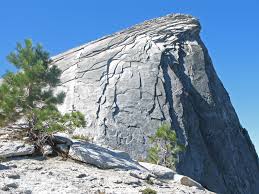
- Exfoliation is a type of physical weathering that involves the peeling away of layers of rock.
- This process often occurs in areas with significant temperature fluctuations, causing the rock to expand and contract.
- Over time, the stress from temperature changes leads to the separation of the outer layers of the rock.
- Exfoliation can be observed in large rock formations, especially in mountainous regions and granite domes.
 Additional Information
- Physical Weathering:
- It is the process of breaking down rocks into smaller pieces without changing their chemical composition.
- Common agents of physical weathering include temperature changes, frost action, and the activity of living organisms.
- Examples of physical weathering processes include freeze-thaw cycles, exfoliation, and abrasion.
- Chemical Weathering:
- It involves the chemical alteration of minerals within the rock, leading to its breakdown.
- Common agents include water, oxygen, carbon dioxide, and various acids.
- Examples include oxidation, hydrolysis, and carbonation.
- Mass Wasting:
- It refers to the downslope movement of soil and rock under the influence of gravity.
- Examples include landslides, rockfalls, and soil creep.
- Biochemical Weathering:
- It is the breakdown of rocks through the chemical and physical actions of organisms.
- Examples include the production of organic acids by plant roots and the burrowing activities of animals.
Q24 · General Science Physics
A small object is placed on the focus on the left side of a convex lens. Where will the image be formed?
- At the centre on the right side of the lens.
- At infinity on the left side of the lens.
- At infinity on the right side of the lens.
- At the focus on the right side of the lens.
Answer aur solution dekho
Archived marked answer: C
The correct answer is At infinity on the right side of the lens.
Key Points
- When an object is placed at the focus of a convex lens, the rays after refraction through the lens become parallel to each other.
- Parallel rays are considered to meet at infinity on the other side of the lens.
- Thus, the image formed will be at infinity on the right side of the lens.
- This image will be highly enlarged and real.
Additional Information
- Convex Lens:
- A convex lens is thicker at the center than at the edges and is also known as a converging lens because it converges light rays that are initially parallel.
- It is used in various optical devices such as magnifying glasses, cameras, and corrective lenses for farsightedness.
- Focus:
- The focus (or focal point) of a lens is the point where parallel light rays converge (for a convex lens) or appear to diverge from (for a concave lens).
- The distance from the lens to the focus is called the focal length.
- Image Formation by Convex Lens:
- When an object is placed at the focus of a convex lens, the refracted rays become parallel, indicating that the image is formed at infinity.
- When the object is placed between the lens and the focus, the image formed is virtual, erect, and enlarged.
Q25 · Static GK
Presently, which of the following countries is NOT a beneficiary of India's Duty-Free Tariff Preference (DFTP) Scheme?
- Rwanda
- Burundi
- Myanmar
- Angola
Answer aur solution dekho
Archived marked answer: D
The correct answer is Angola.
Key Points
- The Duty-Free Tariff Preference (DFTP) Scheme was introduced by the Government of India in 2008.
- The scheme aims to provide market access at zero duty to products originating from Least Developed Countries (LDCs).
- Rwanda, Burundi, and Myanmar are some of the beneficiaries of the DFTP Scheme.
- Angola is currently not a beneficiary of India's Duty-Free Tariff Preference (DFTP) Scheme.
Additional Information
- Duty-Free Tariff Preference (DFTP) Scheme
- The DFTP Scheme was launched by India to provide preferential market access for goods originating from Least Developed Countries (LDCs).
- The main objective is to enhance South-South cooperation and contribute to the development of LDCs.
- The scheme covers around 98% of tariff lines, making a wide range of products from LDCs eligible for zero-duty benefits.
- It has the potential to significantly boost exports from LDCs to India, thereby supporting their economic growth and development.
- Least Developed Countries (LDCs)
- LDCs are a group of countries that are recognized by the United Nations as being the most disadvantaged in terms of their low gross national income, weak human assets, and economic vulnerability.
- As of October 2023, there are 46 countries classified as LDCs.
- LDCs benefit from various international support measures, including preferential market access and development assistance.
- The aim is to help these countries overcome structural challenges, eradicate poverty, and achieve sustainable development.
Mathematics
Q1 · Geometry
The radius of the circle is 8 cm. The distance of a point lying outside the circle from the centre is 17 cm. The length of the tangent drawn from the outside point to the circle is:
- 18 cm
- 15 cm
- 16 cm
- 19 cm
Answer aur solution dekho
Archived marked answer: B
Shortcut Trick
A tangent to a circle makes a 90° angle with the radius at the point of contact, forming a right-angled triangle.
Given the hypotenuse (distance from centre) is 17 cm and one side (radius) is 8 cm.
Using the standard Pythagorean triplet (8, 15, 17), the length of the tangent must be 15 cm.
∴ The correct answer is 15 cm.
Alternate Method
Given:
Radius of the circle (r) = 8 cm
Distance of the external poin
Q2 · Trigonometry
If Sin B = 15/17, what is the value of cos B (sec B - tan B)? Given that 0π/2
- 1/16
- 2/15
- 8/15
- 2/17
Answer aur solution dekho
Archived marked answer: D
Shortcut Trick
Expression = cos B (sec B − tan B)
⇒ (cos B × 1/cos B) − (cos B × sin B/cos B)
⇒ 1 − sin B
Substitute the given value sin B = 15/17:
⇒ 1 − 15/17 = 2/17
∴ The correct answer is 2/17.
Alternate Method
Given:
sin B = 15/17
Since 0
Additional Information
Pythagorean Triplets
A set of positive integers (a, b, c) that fits the rule a² + b² = c² is called a Pythagorean triplet. Common sets are (3, 4, 5), (5, 12, 13), and (8, 15, 17).
Basic Trigonometric Identities
The core identities used to simplify expressions are sin²θ + cos²θ = 1, 1 + tan²θ = sec²θ, and 1 + cot²θ = cosec²θ.
Trigonometric Ratios in Right Triangle
The side ratios are: sin θ = Perpendicular ÷ Hypotenuse, cos θ = Base ÷ Hypotenuse, and tan θ = Perpendicular ÷ Base.
</p
Q3 · Trigonometry
If (tan(x))/(sec(x)) = 1/2 then the value of (sin x + cos x)² is ___.
- d(2 + √3)/3
- d(2 + √3)/2
- d(2 - √3)/2
- d(2 - √3)/3
Answer aur solution dekho
Archived marked answer: B
Shortcut Trick
Simplify the expression: tan(x) ÷ sec(x) = [sin(x) / cos(x)] × cos(x) = sin(x).
Given sin(x) = 1/2, we directly find the angle x = 30°.
Substitute x = 30° into the given equation (sin x + cos x)².
⇒ (sin 30° + cos 30°)² = (1/2 + √3 / 2)² = (1 + √3)² / 4.
⇒ (1 + 3 + 2√3) / 4 = (4 + 2√3) / 4 = (2 + √3) / 2.
∴ The correct answer is (2 + √3) / 2.
Alternate Method
Given:
tan(x) / sec(x) = 1/2
 Calculations:
⇒ [sin(x) / cos(x)] ÷ [1 / cos(x)] = 1/2
⇒ sin(x) = 1/2
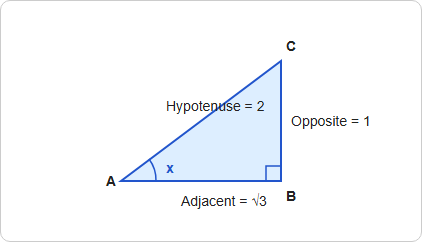
From the right-angled triangle, sin(x) = Opposite / Hypotenuse = 1 / 2.
⇒ By Pythagoras Theorem, Adjacent = √(2² − 1²) = √(4 − 1) = √3
⇒ cos(x) = Adjacent / Hypotenuse = √3 / 2
Now evaluate the given expression: (sin x + cos x)²
⇒ (1/2 + √3 / 2)²
⇒ [(1 + √3) / 2]²
⇒ (1² + (√3)² + 2 × 1 × √3) / 4
⇒ (1 + 3 + 2√3) / 4
⇒ (4 + 2√3) / 4
⇒ 2(2 + √3) / 4 = (2 + √3) / 2
∴ The correct answer is (2 + √3) / 2.
Additional Information
Trigonometric Identities
The three core Pythagorean identities are: sin²(x) + cos²(x) = 1, sec²(x) − tan²(x) = 1, and cosec²(x) − cot²(x) = 1.
Standard Angles
Key basic angle values: sin(30°) = 1/2, cos(30°) = √3 / 2, and tan(30°) = 1 / √3. For 60°, the sine and cosine values are swapped.
Reciprocal Ratios
The fundamental reciprocal ratios are: sec(x) = 1 / cos(x), cosec(x) = 1 / sin(x), and cot(x) = 1 / tan(x).
</p
Q4 · Trigonometry
If tanA = 5/7, then find the value of 7SinA - 3CosA7SinA + 3CosA + 4.
- 4 d1/4
- 3 d5/7
- 3 d1/5
- 7 d1/3
Answer aur solution dekho
Archived marked answer: A
Shortcut Trick
Divide the numerator and denominator of the fractional part by cosA.
⇒ Expression = (7tanA − 3) / (7tanA + 3) + 4
⇒ Substitute tanA = 5/7 directly into the expression.
⇒ [7 × (5/7) − 3] / [7 × (5/7) + 3] + 4
⇒ (5 − 3) / (5 + 3) + 4 = 2/8 + 4 = 1/4 + 4 = 4 1/4
∴ The correct answer is 4 1/4.
Alternate Method
Given:
tanA = 5/7
Formula Used:
tanA = sinA / cosA
Calculations:
⇒ We can assume sinA = 5k and cosA = 7k, where k is a proportional constant.
⇒ Substitute these values into the given expression: (7sinA − 3cosA) / (7sinA + 3cosA) + 4
⇒ [7 × (5k) − 3 × (7k)] / [7 × (5k) + 3 × (7k)] + 4
⇒ (35k − 21k) / (35k + 21k) + 4
⇒ 14k / 56k + 4
⇒ 1/4 + 4 = 17/4 = 4 1/4
∴ The correct answer is 4 1/4.
Additional Information
Trigonometric Ratios
For a right-angled triangle: tanA = Perpendicular ÷ Base, sinA = Perpendicular ÷ Hypotenuse, cosA = Base ÷ Hypotenuse.
Quotient Identities
tanA = sinA ÷ cosA and cotA = cosA ÷ sinA.
Pythagorean Identities
sin²A + cos²A = 1 | sec²A − tan²A = 1 | cosec²A − cot²A = 1.
</p
Q5 · Mensuration 2D
A circle's centre is connected to its 50 cm long chord by a perpendicular that is 21 cm long. Find the circle's radius.
- √1065 {cm}
- √1068 {cm}
- √1064 {cm}
- √1066 {cm}
Answer aur solution dekho
Archived marked answer: D
Shortcut Trick
A perpendicular drawn from the centre of a circle bisects the chord into two equal halves.
Half of the chord = 50 ÷ 2 = 25 cm.
The radius, perpendicular, and half-chord form a right-angled triangle.
Radius = √(perpendicular² + half-chord²)
Radius = √(21² + 25²) = √(441 + 625) = √1066 cm.
∴ The correct answer is √1066 cm.
Alternate Method
Given:
Length of the chord (AB) = 50 cm
Perpendicular distance from the centre to the chord (OM) = 21 cm
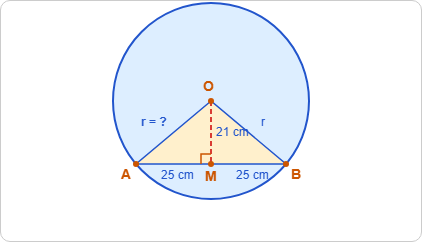 Formula Used:
A perpendicular drawn from the centre to a chord bisects it.
Pythagoras Theorem: Hypotenuse² = Base² + Perpendicular²
Calculations:
⇒ Let the centre of the circle be O and the chord be AB.
⇒ Perpendicular OM bisects the chord AB at point M.
⇒ AM = MB = AB ÷ 2
⇒ AM = 50 ÷ 2 = 25 cm
⇒ In the right-angled ΔOMA, side OA represents the radius (r) of the circle.
⇒ Applying Pythagoras theorem in ΔOMA:
⇒ OA² = OM² + AM²
⇒ r² = 21² + 25²
⇒ r² = 441 + 625
⇒ r² = 1066
⇒ r = √1066 cm
∴ The correct answer is √1066 cm.
Additional Information
Perpendicular to a Chord Property
A perpendicular drawn from the centre of a circle to any chord always bisects the chord into two equal segments. Conversely, a line joining the centre and the midpoint of a chord is perpendicular to the chord.
Equal Chords and Centre Distance
Chords of equal length in a circle are always equidistant from the centre. Similarly, chords that are equidistant from the centre will always be equal in length.
Pythagoras Theorem in Circles
The radius (hypotenuse), the perpendicular distance from the centre (perpendicular), and half of the chord (base) consistently form a right-angled triangle, following the equation: Radius² = Distance² + (Chord ÷ 2)².
</p
Q6 · Mensuration 2D
A chord of the larger among two concentric circles is of length 20 cm and it is tangent to the smaller circle. What is the area (in cm²) of the annular portion between the two circles?
- 100π
- 164π
- 122π
- 175π
Answer aur solution dekho
Archived marked answer: A
Shortcut Trick
For two concentric circles, if a chord of length L of the larger circle touches the smaller circle, the area of the annular region is directly π × (L ÷ 2)².
Given, L = 20 cm.
Area = π × (20 ÷ 2)²
Area = π × 10² = 100π cm².
∴ The correct answer is 100π cm².
Alternate Method
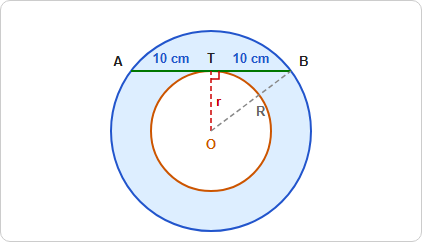 Given:
Length of the chord of the larger circle tangent to the smaller circle = 20 cm.
Let the radius of the larger circle be R and the smaller circle be r.
Formula Used:
Area of an annular ring = π(R² − r²)
In a circle, the radius drawn to the point of tangency is perpendicular to the tangent line.
A perpendicular drawn from the center to a chord bisects the chord.
Calculations:
⇒ Half of the chord length = 20 ÷ 2 = 10 cm.
⇒ By applying Pythagoras theorem in the right-angled triangle formed:
⇒ R² = r² + 10²
⇒ R² − r² = 100
⇒ Area of the annular portion = πR² − πr²
⇒ Area = π(R² − r²)
⇒ Area = 100π cm²
∴ The correct answer is 100π cm².
Additional Information
Tangent to a Circle
The radius of a circle is always perpendicular to the tangent line at the point of tangency. This creates a right angle, which is essential for applying Pythagoras theorem.
Chord Bisection Property
A perpendicular drawn from the center of a circle to a chord bisects the chord into two equal halves. Hence, length = 2 × √(R² − d²).
Concentric Circles
Two or more circles sharing the same center are called concentric circles. The enclosed region between two concentric circles is called an annulus, with Area = π(R² − r²).
</p
Q7 · Mensuration 2D
ABC is an equilateral triangle. P, Q, and R are the mid-points of sides AB, BC and CA, respectively. If the length of the side of the triangle ABC is 11 cm, then the area (in cm²) of trianglePQR is:
- (21 √3)/16
- (11 √3)/16
- (121 √3)/16
- (111 √3)/16
Answer aur solution dekho
Archived marked answer: C
Shortcut Trick
The triangle formed by joining the mid-points of the sides of any triangle has exactly 1/4th the area of the original triangle.
Area of original equilateral ΔABC = (√3 ÷ 4) × side²
Area of ΔABC = (√3 ÷ 4) × 11² = 121√3 ÷ 4 cm²
Area of ΔPQR = (1 ÷ 4) × Area of ΔABC = (1 ÷ 4) × (121√3 ÷ 4)
Area of ΔPQR = 121√3 / 16 cm²
∴ The correct answer is 121√3 / 16 cm².
Alternate Method
A
B
C
P
Q
R
11 cm
11/2 cm
Given:
Side of equilateral ΔABC = 11 cm.
P, Q, and R are the mid-points of sides AB, BC, and CA respectively.
Formula Used:
Area of equilateral triangle = (√3 ÷ 4) × a² (where a is the side length).
Calculations:
⇒ By the Mid-point Theorem, the line segment joining the mid-points of two sides of a triangle is half the length of the third side.
⇒ Side of equilateral ΔPQR = 11 ÷ 2 cm.
⇒ Area of ΔPQR = (√3 ÷ 4) × (11 ÷ 2)²
⇒ Area of ΔPQR = (√3 ÷ 4) × (121 ÷ 4)
⇒ Area of ΔPQR = 121√3 / 16 cm²
∴ The correct answer is 121√3 / 16 cm².
Additional Information
Midpoint Theorem
The line segment connecting the midpoints of two sides of a triangle is parallel to the third side and is half as long as that third side.
Area Division by Midpoints
The triangle formed by joining the midpoints of the sides of any triangle divides the original triangle into four smaller congruent triangles of exactly equal area.
Equilateral Triangle Properties
In an equilateral triangle, all sides are equal and all internal angles are 60°. Its height (altitude) is given by (√3 ÷ 2) × side.
</p
Q8 · Mensuration 2D
What is the volume in cubic units of a cylinder with a height equal to the diameter and a radius is 4 units?
- 128π
- d64π/3
- 32π
- d32π/3
Answer aur solution dekho
Archived marked answer: A
Shortcut Trick
Volume of a cylinder is given by V = π × r² × h.
Given that the height equals the diameter, we have h = 2r.
Substituting this relation into the volume formula gives V = π × r² × (2r) = 2πr³.
Given r = 4 units, substitute the value directly: V = 2 × π × 4³ = 2 × π × 64 = 128π.
∴ The correct answer is 128π cubic units.
Alternate Method
Given:
Radius (r) = 4 units
Height (h) = Diameter (d) = 2 × r = 2 × 4 = 8 units
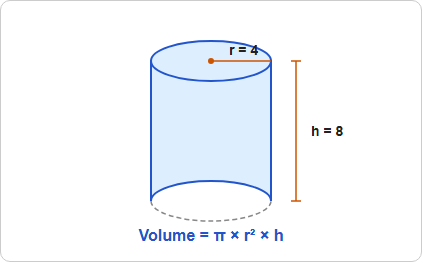 Formula Used:
Volume of a cylinder (V) = π × r² × h
Calculations:
⇒ V = π × (4)² × 8
⇒ V = π × 16 × 8
⇒ V = 128π cubic units
∴ The correct answer is 128π cubic units.
Additional Information
Curved Surface Area of Cylinder
The area of the curved surface is given by CSA = 2 × π × r × h.
Total Surface Area of Cylinder
The total area including the two circular bases is TSA = 2 × π × r × (r + h).
Volume of a Cone
For a cone with same base radius and height, Volume = (1/3) × π × r² × h.
Volume of a Sphere
The volume of a sphere is given by V = (4/3) × π × r³.
</p
Q9 · Algebra
Let a + b = 1, then the value of (1/a² + 1/b² + 2/ab) is:
- d1/(a² b²)
- d1/ab
- d1/(a² b)
- d1/ab²
Answer aur solution dekho
Archived marked answer: A
Shortcut Trick
Put a = 2 and b = −1, which satisfies a + b = 1.
Given expression: 1/a² + 1/b² + 2/ab
⇒ 1/4 + 1/1 + 2/(−2) = 1/4 + 1 − 1 = 1/4
Check the given options with a = 2 and b = −1:
Option 1: 1 / (a²b²) = 1 / (4 × 1) = 1/4 (Matches)
∴ The correct answer is 1 / (a²b²).
Q10 · Algebra
Simplify:
25a² - 10ab - 48b²5a + 6b times (5a + 8b)
- 25a² - 64b²
- (5a - 8b)²
- (5a + 8b)²
- 25a² - 36b²
Answer aur solution dekho
Archived marked answer: A
Shortcut Trick
Factorize the numerator using substitution: 25a² − 10ab − 48b² = (5a − 8b)(5a + 6b).
Divide by the denominator (5a + 6b) to get (5a − 8b).
Multiply the result by (5a + 8b).
Apply algebraic identity (x − y)(x + y) = x² − y² ⇒ (5a − 8b)(5a + 8b) = 25a² − 64b².
∴ The correct answer is 25a² − 64b².
Alternate Method
Given:
Expression: [(25a² − 10ab − 48b²) ÷ (5a + 6b)] × (5a + 8b)
Formula Used:
Splitting the middle term for quadratic factorization.
Difference of squares: (x − y)(x + y) = x² − y²
Calculations:
⇒ Split the middle term of the numerator 25a² − 10ab − 48b².
⇒ Find two numbers that multiply to (25 × −48) = −1200 and add to −10.
⇒ The numbers are −40 and +30.
⇒ 25a² − 40ab + 30ab − 48b²
⇒ 5a(5a − 8b) + 6b(5a − 8b)
⇒ (5a − 8b)(5a + 6b)
⇒ Substitute the factors back into the given expression:
⇒ [(5a − 8b)(5a + 6b) ÷ (5a + 6b)] × (5a + 8b)
⇒ The term (5a + 6b) cancels out from the numerator and denominator.
⇒ Remaining expression: (5a − 8b) × (5a + 8b)
⇒ Apply the difference of squares formula:
⇒ (5a)² − (8b)² = 25a² − 64b²
∴ The correct answer is 25a² − 64b².
Additional Information
Algebraic Identities
Standard identities like (a + b)² = a² + 2ab + b² and (a − b)² = a² − 2ab + b² are frequently used to simplify expressions efficiently.
Difference of Squares
The formula x² − y² = (x − y)(x + y) is one of the most common factoring techniques used in algebra simplification problems.
Splitting the Middle Term
To factor ax² + bx + c, find two numbers whose product is ac and whose sum is b. Replace the middle term with these two numbers and factor by grouping.
</p
Q11 · Algebra
For which of the following values of a and b do the given equations, have NO solution?
x - ay = 2 - a
(1 - a)x + 6y = a + b
- a = -3,b ≠ 1
- a = 3,b ≠ -1
- a = -3,b ≠ -1
- a = 3,b ≠ 1
Answer aur solution dekho
Archived marked answer: B
Shortcut Trick
For linear equations to have no solution, the condition is: a₁ / a₂ = b₁ / b₂ ≠ c₁ / c₂.
Equating coefficients of x and y: 1 ÷ (1 − a) = −a ÷ 6 ⇒ a² − a − 6 = 0 ⇒ a = 3 or −2.
Based on the given options, taking a = 3, the ratio becomes −3 ÷ 6 = −1/2.
Applying the inequality to constant terms: (2 − a) ÷ (a + b) ≠ −1/2.
Substituting a = 3 gives: −1 ÷ (3 + b) ≠ −1/2 ⇒ 3 + b ≠ 2 ⇒ b ≠ −1.
∴ The correct answer is a = 3, b ≠ -1.
Q12 · Profit and Loss
Ramesh sells rice at ₹36 per kg, which he purchased for ₹30 per kg. Moreover, he gives only 800 g of rice instead of 1 kg
while selling. Find the actual profit percentage of Ramesh.
- 46%
- 50%
- 48%
- 52%
Answer aur solution dekho
Archived marked answer: B
Shortcut Trick
Price ratio (CP : SP) = 30 : 36 = 5 : 6
Weight ratio (CP : SP) = 800 : 1000 = 4 : 5
Overall CP : SP = (5 × 4) : (6 × 5) = 20 : 30 = 2 : 3
Profit % = [(3 − 2) ÷ 2] × 100 = 50%
∴ The correct answer is 50%.
Alternate Method
Given:
Cost price (CP) of 1 kg (1000 g) rice = ₹30
Selling price (SP) of rice = ₹36
Weight given to customer = 800 g
Formula Used:
Profit = SP − Actual CP
Profit % = (Profit ÷ Actual CP) × 100
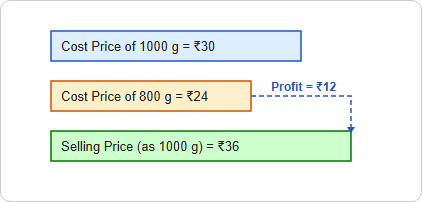 Calculation:
⇒ Actual cost price (CP) of 800 g of rice = (30 ÷ 1000) × 800 = ₹24
⇒ Selling price (SP) of 800 g of rice (sold as 1 kg) = ₹36
⇒ Profit earned = SP − CP = 36 − 24 = ₹12
⇒ Actual Profit % = (12 ÷ 24) × 100 = 50%
∴ The correct answer is 50%.
Additional Information
Dishonest Dealer Concept
When a shopkeeper uses a false weight, the actual Cost Price (CP) is calculated based on the weight physically given to the customer, while the Selling Price (SP) is charged for the claimed weight.
Successive Percentage Method
Overall profit or loss can be calculated by combining the ratio of CP to SP for the price and the ratio of true weight given to the false weight claimed.
Profit and Loss Formula
Selling Price (SP) = CP × (100 + Profit%) ÷ 100. Always consider the actual investment of the dealer as the base (100%) for profit or loss calculations.
</p
Q13 · Profit and Loss
A discount series of 10% and 16% on an invoice is the same as a single discount of:
- 24.4%
- 22.4%
- 21.4%
- 23.4%
Answer aur solution dekho
Archived marked answer: A
Shortcut Trick
The equivalent single discount for two successive discounts a% and b% is:
⇒ Equivalent Discount = a + b − (a × b) / 100
Here, a = 10 and b = 16
⇒ Equivalent Discount = 10 + 16 − (10 × 16) / 100
⇒ Equivalent Discount = 26 − 1.6 = 24.4%
∴ The correct answer is 24.4%.
Alternate Method
Given:
First discount = 10%
Second discount = 16%
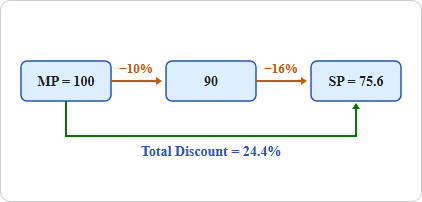 Calculations:
⇒ Let Marked Price (MP) = 100
⇒ Price after 1st discount (10%) = 100 − 10 = 90
⇒ Price after 2nd discount (16%) = 90 − (16 / 100) × 90 = 90 − 14.4 = 75.6
⇒ Total Discount = MP − Selling Price (SP) = 100 − 75.6 = 24.4
⇒ Equivalent single discount percentage = 24.4%
∴ The correct answer is 24.4%.
Additional Information
Ratio Method for Successive Discounts
Convert each discount into a fraction (e.g., 10% = 1/10 ⇒ MP : SP = 10 : 9). Multiply the MP parts and SP parts separately to find the overall ratio, then calculate the total net discount percentage.
Three Successive Discounts
To find the equivalent discount for a%, b%, and c%, first apply the formula a + b − (ab / 100) to find an intermediate discount d%, then apply it again with d% and c%.
Customer vs Dealer Perspective
For a customer, a higher successive discount is better. Among different combinations with the same sum (e.g., 20% + 10% vs 25% + 5%), the one with the larger difference between the individual discounts gives a greater net discount.
</p
Q14 · Time and Work
A pipe can fill an empty tank in 5 minutes and another pipe can empty it in 6 minutes. If both pipes are opened simultaneously, in how much time will the empty tank be filled?
- 33 min
- 30 min
- 35 min
- 25 min
Answer aur solution dekho
Archived marked answer: B
Shortcut Trick
For one pipe filling the tank in x minutes and another emptying it in y minutes (where y > x), the total time to fill the empty tank is calculated directly.
Total Time = (x × y) ÷ (y − x)
Here, x = 5 min and y = 6 min.
Total Time = (5 × 6) ÷ (6 − 5) = 30 ÷ 1 = 30 min
∴ The correct answer is 30 min.
Alternate Method
Given:
Time taken by Pipe A to fill the tank = 5 minutes
Time taken by Pipe B to empty the tank = 6 minutes
Method Used:
We use the LCM method to find the total capacity of the tank and the individual efficiencies of the pipes.
Pipe
Time (min)
Total Work (LCM)
Efficiency
Pipe A (Fill)
5
30
+6
Pipe B (Empty)
6
−5
Calculations:
⇒ Let the total capacity of the tank be the LCM of 5 and 6, which is 30 units.
⇒ Efficiency of Pipe A = 30 ÷ 5 = +6 units/min (positive work)
⇒ Efficiency of Pipe B = 30 ÷ 6 = −5 units/min (negative work)
⇒ Combined efficiency of Pipe A and Pipe B when opened together = 6 − 5 = 1 unit/min
⇒ Total time required to fill the tank = Total Work ÷ Combined Efficiency
⇒ Total time = 30 ÷ 1 = 30 minutes
∴ The correct answer is 30 min.
Additional Information
Pipes and Cisterns Basics
This topic is an extension of Time and Work. A filling pipe does positive work (+), while an emptying pipe or a leak does negative work (−).
Two Filling Pipes
If two pipes A and B fill a tank in x and y hours respectively, the combined time taken to fill the tank is (x × y) ÷ (x + y).
Leakage Effect
If a tank fills in x hours, but due to a leak it takes y hours to fill (y > x), then the leak alone can empty the completely full tank in (x × y) ÷ (y − x) hours.
</p
Q15 · Number System
Which digits should come in the place of x and y, respectively, if the number 62684xy is divisible by both 8 and 5?
- 5 and 0
- 4 and 0
- 2 and 0
- 0 and 5
Answer aur solution dekho
Archived marked answer: B
Shortcut Trick
For a number to be divisible by 5, its last digit (y) must be 0 or 5.
For a number to be divisible by 8, it must be an even number, so y = 0.
The last 3 digits of the number are 4x0, which must be completely divisible by 8.
Checking the given options, if x = 4, then 440 is completely divisible by 8.
∴ The correct answer is 4 and 0.
Alternate Method
Given:
Number = 62684xy
The number is completely divisible by both 8 and 5.
Concept Used:
A number is divisible by 5 if its unit digit is 0 or 5.
A number is divisible by 8 if the number formed by its last three digits is divisible by 8.
Calculations:
⇒ Divisibility by 5 implies that the unit digit y = 0 or 5.
⇒ Since any number divisible by 8 must be an even number, y cannot be 5.
⇒ Therefore, y = 0.
⇒ Now, checking the last three digits (4x0) for divisibility by 8 using the given options.
⇒ For x = 5 → 450 ÷ 8 = 56.25 (Not divisible)
⇒ For x = 4 → 440 ÷ 8 = 55 (Divisible)
⇒ For x = 2 → 420 ÷ 8 = 52.5 (Not divisible)
⇒ Thus, x = 4 and y = 0 successfully satisfies both the divisibility rules.
∴ The correct answer is 4 and 0.
Additional Information
Divisibility by 8
A number is completely divisible by 8 if the number formed by its last three digits is divisible by 8.
Divisibility by 4
A number is completely divisible by 4 if the number formed by its last two digits is divisible by 4.
Divisibility by 11
A number is divisible by 11 if the difference between the sum of its digits at odd places and the sum of its digits at even places is either 0 or a multiple of 11.
Divisibility by 9
A number is completely divisible by 9 if the sum of all its digits is a multiple of 9.
</p
Q16 · Time and Distance
P and Q start running in opposite directions on a circular track from the same point. If their speeds are 10 m/s and 8 m/s, respectively, then after what time will they meet if the length of the track is 1620 m?
- 110 seconds
- 70 seconds
- 120 seconds
- 90 seconds
Answer aur solution dekho
Archived marked answer: D
Shortcut Trick
When two persons run in opposite directions, their relative speed is the sum of their individual speeds.
Relative speed = 10 + 8 = 18 m/s
Time taken to meet = Total track distance ÷ Relative speed
Time = 1620 ÷ 18 = 90 seconds
∴ The correct answer is 90 seconds.
Alternate Method
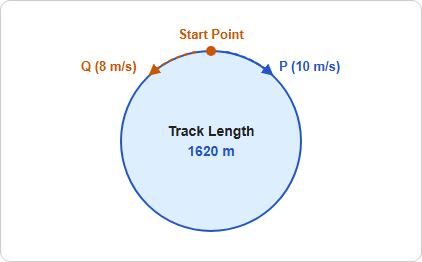 Given:
Speed of P = 10 m/s
Speed of Q = 8 m/s
Length of the track (Total Distance) = 1620 m
Formula Used:
Relative Speed (Opposite Directions) = S₁ + S₂
Time = Distance ÷ Relative Speed
Calculations:
⇒ Relative Speed = 10 + 8
⇒ Relative Speed = 18 m/s
⇒ Time taken to meet = 1620 ÷ 18
⇒ Time taken to meet = 90 seconds
∴ The correct answer is 90 seconds.
Additional Information
Relative Speed in Opposite Directions
When two objects move in opposite directions, their relative speed is the sum of their individual speeds (v₁ + v₂).
Relative Speed in Same Direction
When two objects move in the same direction, their relative speed is the absolute difference of their individual speeds (|v₁ − v₂|).
Time to Meet at the Starting Point
The time taken for two persons to meet exactly at the starting point is the LCM of the individual times taken by them to complete one full round.
Distinct Meeting Points
If two persons run at speeds 'a' and 'b' (where a and b are co-prime integers), they meet at (a + b) distinct points if moving in opposite directions, and |a − b| distinct points if moving in the same direction.
</p
Q17 · Data Interpretation
The following table indicates the number of students studying in three subjects in four colleges.
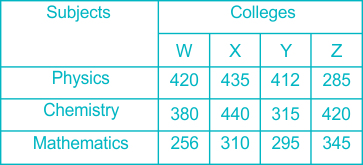 What is the ratio of the total number of students studying in the Physics to that of studying in Mathematics in all four colleges taken together?
- 781 : 585
- 775 : 601
- 578 : 731
- 776 : 603
Answer aur solution dekho
Archived marked answer: D
Given:
The number of students studying in different subjects across four colleges are:
Subject
College W
College X
College Y
College Z
Physics
420
435
412
285
Chemistry
380
340
315
420
Mathematics
256
310
295
345
Calculations:
To find the ratio of the total number of students studying Physics to that studying Mathematics across all colleges:
Total number of students in Physics = 420 + 435 + 412 + 285 = 1552
Total number of students in Mathematics = 256 + 310 + 295 + 345 = 1206
Ratio of Physics to Mathematics:
Ratio = 1552 / 1206
⇒ Ratio = 1552 : 1206
Now simplify the ratio by dividing both numbers by their greatest common divisor (GCD), which is 2:
⇒ Ratio = (1552 ÷ 2) : (1206 ÷ 2) = 776 : 603
The ratio of the total number of students studying Physics to that studying Mathematics is 776 : 603.
Q18 · Data Interpretation
The given pie-chart shows the percentage distribution of runs scored by a batsman in a test innings. Study the chart and
answer the question that follows.
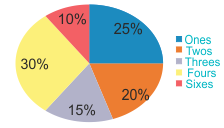 If the batsman has scored a total of 440 runs, how many runs did he score by hitting fours?
- 88
- 172
- 224
- 132
Answer aur solution dekho
Archived marked answer: D
Given:
Total runs scored by the batsman = 440
Percentage distribution of runs:
Ones = 25%
Twos = 20%
Threes = 15%
Fours = 30%
Sixes = 10%
Formula used:
To calculate the runs scored by hitting fours, we can use the formula:
Runs from fours = (Percentage of fours / 100) × Total runs scored
Calculations:
Runs from fours = (30 / 100) × 440
⇒ Runs from fours = 0.30 × 440
⇒ Runs from fours = 132
The batsman scored 132 runs by hitting fours.
Q19 · Simplification
Simplify: 1 1/3 + 1 3/4 times 1 2/3 ÷ 3 1/2
- 2 1/3
- 2 1/6
- 2 1/5
- 3 1/4
Answer aur solution dekho
Archived marked answer: B
Calculation:
1 1/3 + 1 3/4 times 1 2/3 ÷ 3 1/2
⇒ 4/3 + 7/4 times 5/3 ÷ 7/2
⇒
Q20 · Percentage
P and Q are two fixed points 10 cm apart, and R is a point on PQ such that PR = 6 cm. By what percentage is the length of QR decreased when the length of PR is increased by 5%?
- 8.5%
- 7.5%
- 7%
- 8%
Answer aur solution dekho
Archived marked answer: B
Shortcut Trick
Since the total length PQ is fixed at 10 cm, the absolute increase in PR will exactly equal the absolute decrease in QR.
Increase in PR = 5% of 6 cm = 0.3 cm, so QR decreases by exactly 0.3 cm.
Initial length of QR = 10 − 6 = 4 cm.
Percentage decrease in QR = (0.3 ÷ 4) × 100 = 7.5%.
∴ The correct answer is 7.5%.
Alternate Method
Given:
Total length PQ = 10 cm
Initial length PR = 6 cm
Percentage increase in PR = 5%
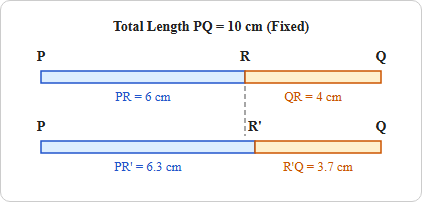 Formula Used:
Percentage Decrease = (Decrease in Value ÷ Initial Value) × 100
Calculations:
⇒ Initial length of QR = PQ − PR = 10 − 6 = 4 cm.
⇒ PR is increased by 5%, so New PR = 6 + (5% of 6) = 6 + 0.3 = 6.3 cm.
⇒ Since PQ is fixed at 10 cm, New QR = PQ − New PR = 10 − 6.3 = 3.7 cm.
⇒ Decrease in QR = Initial QR − New QR = 4 − 3.7 = 0.3 cm.
⇒ Percentage decrease in QR = (0.3 ÷ 4) × 100 = 7.5%.
∴ The correct answer is 7.5%.
Additional Information
Percentage Change
Always calculate the percentage increase or decrease using the original (initial) base value: % Change = (Change ÷ Initial Value) × 100.
Constant Sum Property
When the sum of two components is strictly constant (such as segments of a fixed line), any absolute positive variation in one component precisely matches the absolute negative variation in the other.
Base Value Importance
Although the absolute change (0.3 cm) is identical for both segments PR and QR, their percentage changes differ (5% vs 7.5%) due to their different starting base values (6 cm and 4 cm).
</p
Q21 · Simple Interest
A trader owes a merchant Rs.9,810 due in 1 year, but the trader wants to settle the account after 6 months. If the rate of simple interest is 9% per annum, how much cash (in Rs.) should he pay?
- 9,550
- 9,450
- 9,540
- 9,405
Answer aur solution dekho
Archived marked answer: D
Shortcut Trick
Let the initial borrowed principal be 100%.
Amount due after 1 year = 100% + 9% = 109%
⇒ 109% of Principal = 9810 ⇒ 1% = 90
Amount to settle after 6 months = 100% + (9% ÷ 2) = 104.5%
⇒ Settlement Amount = 104.5% × 90 = 9405
∴ The correct answer is ₹9405.
Alternate Method
Given:
Amount due in 1 year = 9810
Rate of simple interest (R) = 9% p.a.
Formula Used:
Amount (A) = P + (P × R × T ÷ 100)
- 6 Months
6 Months
t = 0
P = ₹9000
t = 6 months
Pay = ₹9405
t = 12 months
A = ₹9810
Settlement Timeline (Rate = 9% p.a.)
Calculations:
⇒ Let the initial principal amount be P.
⇒ Amount after 1 year = P + (P × 9 × 1 ÷ 100) = 9810
⇒ P × (1 + 0.09) = 9810
⇒ P × 1.09 = 9810
⇒ P = 9810 ÷ 1.09 = 9000
⇒ The trader settles the account after 6 months (0.5 years).
⇒ Settlement Amount = P + (P × 9 × 0.5 ÷ 100)
⇒ Settlement Amount = 9000 + (9000 × 4.5 ÷ 100)
⇒ Settlement Amount = 9000 + 405 = 9405
∴ The correct answer is ₹9405.
Additional Information
Present Worth (PW)
It is the principal amount which, when placed at simple interest for a given time, amounts to the given debt. PW = (Amount × 100) ÷ (100 + R × T).
True Discount (TD)
It is the difference between the amount due and its present worth. True Discount = Amount − Present Worth.
Banker's Discount (BD)
It is the simple interest calculated on the face value (total amount) for the unexpired time. BD = (Amount × R × T) ÷ 100.
Q22 · Mixture and Alligation
2 varieties of tea powders worth ₹250/kg and ₹300/kg are mixed with a third variety of tea powder in the ratio 1 : 1 : 2. If the mixture is worth ₹350/kg, find the price of the third variety tea powder.
- ₹450/kg
- ₹400/kg
- ₹425/kg
- ₹500/kg
Answer aur solution dekho
Archived marked answer: C
Shortcut Trick
Total ratio parts = 1 + 1 + 2 = 4 units.
Total value of the mixture = 4 × 350 = 1400.
Value of the first two varieties combined = (1 × 250) + (1 × 300) = 550.
Value of the third variety = 1400 − 550 = 850 (for 2 units).
Price of the third variety = 850 ÷ 2 = 425.
∴ The correct answer is ₹425/kg.
Alternate Method
Given:
Prices of first two varieties = ₹250/kg and ₹300/kg
Ratio of the three varieties = 1 : 1 : 2
Mean price of the final mixture = ₹350/kg
Formula Used:
Weighted Average = (w₁x₁ + w₂x₂ + w₃x₃) ÷ (w₁ + w₂ + w₃)
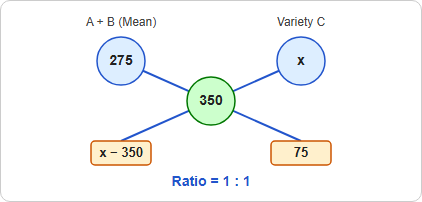 Calculations:
⇒ The first two varieties are mixed in a 1 : 1 ratio.
⇒ Mean price of A and B = (250 + 300) ÷ 2 = ₹275/kg
⇒ Quantity of combined (A + B) = 1 + 1 = 2 units
⇒ Ratio of combined mixture (A + B) to variety C = 2 : 2 = 1 : 1
⇒ Applying the rule of alligation for the two groups:
⇒ (x − 350) / (350 − 275) = 1 / 1
⇒ (x − 350) / 75 = 1
⇒ x − 350 = 75
⇒ x = 350 + 75 = 425
∴ The correct answer is ₹425/kg.
Additional Information
Rule of Alligation
It allows us to find the ratio in which two ingredients at given prices must be mixed to produce a mixture at a desired price: (Quantity of Cheaper) ÷ (Quantity of Dearer) = (Price of Dearer − Mean Price) ÷ (Mean Price − Price of Cheaper).
Weighted Average
When combining multiple groups, the average is calculated using their respective weights: A = (w₁x₁ + w₂x₂ + ... ) ÷ (w₁ + w₂ + ... ).
Multiple Mixtures
For problems with three or more ingredients, you can find the weighted average of any two ingredients first, and then apply simple alligation between that combined mixture and the remaining ingredients.
Q23 · Mixture and Alligation
Two different quantities of the same solution having ingredients A and B are stored in two different containers. In the first container, there are 252 litre of A and 441 litre of B. In the second container, the total quantity of the solution was 1188 litre. How much of the solution in the second container was made up of ingredient B?
- 765 litre
- 756 litre
- 752 litre
- 760 litre
Answer aur solution dekho
Archived marked answer: B
Shortcut Trick
Ratio of ingredients A and B in the solution = 252 : 441 = 4 : 7
Total parts of the solution = 4 + 7 = 11 parts
Quantity of B in the second container = (7 ÷ 11) × 1188 litre
Quantity of B = 7 × 108 = 756 litre
∴ The correct answer is 756 litre.
Alternate Method
Given:
First container quantity of A = 252 litre
First container quantity of B = 441 litre
Second container total solution = 1188 litre
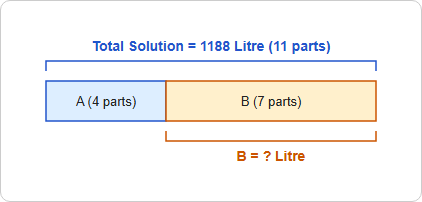 Calculation:
⇒ Since the solution type is the same, the ratio of A to B is constant in both containers.
⇒ Ratio of A : B = 252 : 441
⇒ Dividing both values by their HCF (63), Ratio of A : B = 4 : 7
⇒ Total proportion parts = 4 + 7 = 11 parts
⇒ In the second container, 11 parts = 1188 litre
⇒ 1 part = 1188 ÷ 11 = 108 litre
⇒ Quantity of ingredient B = 7 parts = 7 × 10⁸
⇒ Quantity of ingredient B = 756 litre
∴ The correct answer is 756 litre.
Additional Information
Ratio of Mixtures
When two different quantities of the exact same solution are evaluated, the ratio of their constituent ingredients remains perfectly constant across all volumes.
Unitary Method
To find the value of a specific ratio component, determine the value of one unit by dividing the total quantity by the sum of all ratio parts, then multiply by the required component's ratio value.
Simplifying Ratios
Always simplify large ratios to their lowest terms by finding the Highest Common Factor (HCF) to make further mixture calculations faster and less prone to error.
</p
Q24 · Elementary Statistics
The given graph represents the data on the ages of various children.
Study the given graph and answer the question that follows.
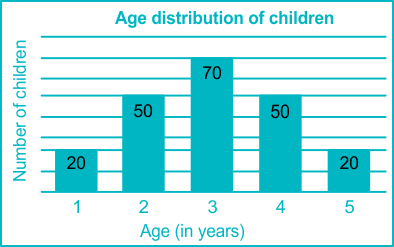 What is the difference between the mean and mode of the ages?
- 2
- 0.5
- 1
- 0
Answer aur solution dekho
Archived marked answer: D
Shortcut Trick
By observing the given bar graph, the data distribution is perfectly symmetrical around the central bar.
For any perfectly symmetrical distribution, the Mean, Median, and Mode are exactly equal.
∴ Mean = Mode
Difference between mean and mode = 0.
∴ The correct answer is 0.
Alternate Method
Given:
From the symmetrical bar graph, we can extract the representative frequencies for the ages:
Ages (x): 8, 9, 10, 11, 12
Number of children (f): 2, 4, 5, 4, 2
Formula Used:
Mean = Σ(fx) ÷ Σf
Mode = Observation with the maximum frequency
Calculations:
⇒ Total sum of ages Σ(fx) = (8 × 2) + (9 × 4) + (10 × 5) + (11 × 4) + (12 × 2)
⇒ Σ(fx) = 16 + 36 + 50 + 44 + 24 = 170
⇒ Total number of children Σf = 2 + 4 + 5 + 4 + 2 = 17
⇒ Mean = 170 ÷ 17 = 10
⇒ The maximum frequency is 5, which corresponds to the age of 10.
⇒ Mode = 10
⇒ Difference = Mean − Mode = 10 − 10 = 0
∴ The correct answer is 0.
Additional Information
Mean
The mean is the average of a dataset, calculated by dividing the sum of all observations by the total number of observations.
Mode
The mode is the value that appears most frequently in a data set. A set of data may have multiple modes or no mode at all.
Symmetrical Distribution
In a perfectly symmetrical distribution, the Mean, Median, and Mode are all equal and perfectly aligned at the center.
Empirical Relationship
For moderately skewed distributions, the empirical formula is: Mode ≈ 3 × Median − 2 × Mean.
</p
English
Q1 · Vocabulary
Select the most appropriate ANTONYM of the word in brackets to fill in the blank.
Sheila ______ (failed) all her classes.
- passed
- flunked
- resized
- flopped
Answer aur solution dekho
Archived marked answer: A
The correct answer is: Option 1 i.e. passed.
Key Points
- The word "failed" means to be unsuccessful in achieving one's goal, especially in the context of examinations or assignments.
- Example: She failed to meet the deadline for the project submission.
- "Passed" means to be successful in an examination or course.
- Example: Sheila passed all her classes with flying colors.
- Hence, we can infer that the opposite of 'failed' is 'passed'.
Therefore, the correct answer is: Option 1 i.e. passed.
Additional Information
Here are the other options explained along with their Hindi meanings and example sentences:
- Flunked: To fail in a course or examination.
- Example: He flunked the math test last semester.
- Resized: To change the size of something.
- Example: She resized the image to fit the new layout.
- Flopped: To fail completely, especially in a performance or business.
- Example: The movie flopped at the box office.
The correct answer is
Q2 · Vocabulary
Select the most appropriate ANTONYM of the word in the brackets to fill in the blank.
She _______ the target by an inch and lost the gold medal. [hit]
- touched
- bashed
- missed
- cleaned
Answer aur solution dekho
Archived marked answer: C
The correct answer is: Option 3.
Key Points
- The word "hit" means to reach or achieve a target or goal.
- Example: She hit the bullseye with her first arrow.
- "Missed" refers to failing to reach or achieve a target or goal.
- Example: He missed the deadline for submitting his assignment.
- Hence, we can infer that the opposite of 'hit' is 'missed'.
Therefore, the correct answer is: Option 3.
Additional Information
Here are the other options explained along with their Hindi meanings and example sentences:
- Touched : To come into contact with something.
- Example: She touched the surface to feel its texture.
- Bashed : To strike something with force.
- Example: He bashed the πñata until it broke open.
- Cleaned: To remove dirt or unwanted substances from something.
- Example: She cleaned the kitchen thoroughly after dinner.
Q3 · Vocabulary
Select the most appropriate ANTONYM of the underlined word.
I was happy to know that Sheila passed her final exams.
- Sad
- Joyful
- Upbeat
- Excited
Answer aur solution dekho
Archived marked answer: A
The correct answer is: Sad.
Key Points
- The word "happy" means feeling or showing pleasure or contentment.
- Example: She was happy to see her family after a long time.
- "Sad" refers to feeling or showing sorrow; unhappy.
- Example: He felt sad when he heard the bad news.
- Hence, we can infer that the opposite of 'happy' is 'sad'.
Therefore, the correct answer is: Sad.
Additional Information
Here are the other options explained along with their Hindi meanings and example sentences:
- Joyful : Feeling, expressing, or causing great pleasure and happiness.
- Example: The joyful children played in the park.
- Upbeat : Cheerful, optimistic.
- Example: She was feeling upbeat about her job interview.
- Excited: Very enthusiastic and eager.
- Example: The kids were excited about the upcoming vacation.
Q4 · Vocabulary
Select the most appropriate homophone to fill in the blank.
The __________ was decorated with candles and chocolates everywhere.
- hour
- flower
- floor
- flor
Answer aur solution dekho
Archived marked answer: C
The correct answer is 'Option (3)' i.e. *'floor'.*
Key Points
- Floor: Refers to the base surface of a room, which matches the context of decoration.
- Example: The floor was covered with beautiful rugs.
Therefore, the correct answer is- 'Option 3'.
Additional Information
- Hour: Refers to a unit of time, which does not fit in the given context.
- Example: The meeting lasted for an hour.
- Flower: Refers to a plant bloom, which also does not suit the blank here.
- Example: The garden was full of flowers.
- Flor: This is not a standard English word and is incorrect.
Q5 · Vocabulary
Select the most appropriate meaning of the underlined idiom.
All his friends admired him because he was a straight shooter.
- Excellent shooter
- Complicated and confusing person
- Moody and pessimistic individual
- A thoroughly upright straightforward person
Answer aur solution dekho
Archived marked answer: D
The correct answer is: Option 4 i.e. A thoroughly upright straightforward person.
Key Points
- The idiom "straight shooter" means a person who is honest, direct, and forthright in their dealings.
- Example: John is known as a straight shooter who always tells the truth.
- "Straight shooter" refers to someone who is straightforward and trustworthy in their communication and actions.
- Example: In business, it's important to be a straight shooter to build long-term relationships.
Therefore, the correct answer is: Option 4 i.e. A thoroughly upright straightforward person.
Additional Information
Here are the other options explained along with their Hindi meanings and example sentences:
- Excellent shooter: Someone who is very skilled at shooting.
- Example: He is an excellent shooter and won the gold medal in the shooting competition.
- Complicated and confusing person: A person who is difficult to understand or deal with.
- Example: She can be a complicated and confusing person, making it hard to predict her reactions.
- Moody and pessimistic individual: A person who often changes moods and tends to expect the worst.
- Example: Being a moody and pessimistic individual, he often finds it hard to stay positive in challenging situations.
Q6 · Vocabulary
Select the most appropriate meaning of the underlined idiom.
My uncle lives in New York, so I only see him once in a blue moon.
- Not very often
- Monthly
- Weekly
- Very often
Answer aur solution dekho
Archived marked answer: A
The correct answer is: Option 1 i.e. Not very often.
Key Points
- The word "once in a blue moon" means something that happens very rarely or infrequently.
- Example: I eat fast food only once in a blue moon.
- "Not very often" refers to something that does not happen frequently.
- Example: I do not visit the cinema not very often, perhaps once a year.
Therefore, the correct answer is: Option 1 i.e. Not very often.
Additional Information
Here are the other options explained along with their Hindi meanings and example sentences:
- Monthly: Something that happens every month.
- Example: We have a monthly meeting to discuss the project's progress.
- Weekly: Something that happens every week.
- Example: She goes to the grocery store on a weekly basis.
- Very often: Something that happens frequently.
- Example: He visits his grandparents very often, almost every weekend.
Q7 · Vocabulary
Select the option that can be used as a one-word substitute for the given group of words.
A large, flat area surrounded by seats used for sports or entertainment
- Senate
- Arena
- Department
- Garden
Answer aur solution dekho
Archived marked answer: B
The correct answer is 'Option 2'.
Q8 · Vocabulary
Select the option that can be used as a one-word substitute for the given group of words.
A period of ten years
- Century
- Decade
- Biennium
- Lustrum
Answer aur solution dekho
Archived marked answer: B
The correct answer is 'Option 2'.
Key Points
- The word "Decade" refers to a period of ten years, which is the correct one-word substitute in the given context.
Q9 · Vocabulary
Select the option that can be used as a one-word substitute for the given group of words.
One who eats a lot
- Chauffeur
- Steward
- Glutton
- Chef
Answer aur solution dekho
Archived marked answer: C
The correct answer is 'Option 3'.
Key Points
- The word "Glutton" refers to a person who eats excessively or greedily, making it the correct one-word substitute for the given group of words.
Hence, the correct answer is &
Q10 · Vocabulary
Select the INCORRECTLY spelt word
- Tangible
- Terracotta
- Totsl
- Limerick
Answer aur solution dekho
Archived marked answer: C
The correct answer is option 3.
Key Points
The misspelled word is 'Totsl'.
- The correct spelling would be 'Total'.
- The word 'Total' is a noun which means 'the whole number or amount of something'.
- For Example -
- The total number of participants in the event was 150.
- Therefore, the correct answer would be 'Totsl'.
Additional Information
Let's understand the meanings of the other marked words -
- Tangible - perceptible by touch; clear and definite; real.
- Terracotta - a type of earthenware, a clay-based unglazed or glazed ceramic.
- Limerick - a form of verse, usually humorous and often nonsensical, in five-line, predominantly anapestic meter.
The correct an
Q11 · Vocabulary
Select the INCORRECTLY spelt word.
- Occurence
- Harassment
- Supersede
- Exaggerate
Answer aur solution dekho
Archived marked answer: A
The correct answer is option 1.
Key Points
The misspelled word is 'Occurence'.
- The correct spelling would be 'Occurrence'.
- The word 'Occurrence' is a noun which means 'an incident or event'.
- For Example -
- The occurrence of the event took everyone by surprise.
- Therefore, the correct answer would be 'Occurence'.
Additional Information
Let's understand the meanings of the other marked words -
- Harassment - Aggressive behaviour or repeated unwanted actions intended to disturb or upset someone.
- Supersede - To take the place of something previously in use, often because it is more modern or effective.
- Exaggerate - To represent something as larger, better, or worse than it actually is.
The correct answer is: Sad.
Q12 · Vocabulary
Select the most appropriate synonym of the given word.
Celebrate
- Daunt
- Rejoice
- Birch
- Assure
Answer aur solution dekho
Archived marked answer: B
The correct answer is: Option 2 i.e. Rejoice.
Key Points
- The word "Celebrate" means to acknowledge a significant or happy day or event with a social gathering or enjoyable activity.
- Example: We will celebrate her birthday with a big party.
- "Rejoice" means to feel or show great joy or delight.
- Example: The whole community rejoiced when the team won the championship.
- Hence, we can infer that the synonym of 'Celebrate' is 'Rejoice'.
Therefore, the correct answer is: Rejoice.
Additional Information
Here are the other options explained along with their Hindi meanings and example sentences:
- Daunt : To make someone feel intimidated or apprehensive.
- Example: The difficulty of the task did not daunt him.
- Birch : A type of tree with smooth, white bark.
- Example: The birch trees in the forest were very tall and beautiful.
- Assure: To tell someone something positively or confidently to dispel any doubts they may have.
- Example: I assure you that everything will be fine.
Given:
The number of students st
Q13 · Vocabulary
Select the most appropriate synonym for the underlined word in the given sentence.
One of Ram's leisure activities is tennis.
- Main
- Lead
- Languish
- Recreation
Answer aur solution dekho
Archived marked answer: D
The correct answer is: Option 4 i.e. Recreation.
Key Points
- The word "leisure" means free time when one is not working and can engage in activities for enjoyment.
- Example: In his leisure time, he enjoys reading books and painting.
- "Recreation" refers to activities done for enjoyment when one is not working.
- Example: One of her favorite recreations is playing the piano.
- Hence, we can infer that a synonym for 'leisure' is 'recreation'.
Therefore, the correct answer is: Option 4 i.e. Recreation.
Additional Information
Here are the other options explained along with their Hindi meanings and example sentences:
- Main: Most important or principal.
- Example: The main reason for his success is his hard work.
- Lead: To be in charge or command of.
- Example: She will lead the new project starting next month.
- Languish: To become weak or feeble; to suffer neglect.
- Example: Plants will languish without enough sunlight and water.
The correct answer is &
Q14 · Grammar
Parts of the following sentence have been given as options. Select the option that contains an error.
I have the hundred reasons to not attend the meeting tomorrow.
- I have the hundred reasons
- the meeting
- tomorrow
- to not attend
Answer aur solution dekho
Archived marked answer: A
The correct answer is Option 1.
Key Points
- The primary issue in the sentence is the unnecessary use of the article "the" before the term "hundred reasons."
Q15 · Grammar
The following sentence has been split into four segments. Identify the segment that contains a grammatical error.
After I retire, I started a second career as a writer and published several books which allowed me to share my stories and insights with a wider audience.
- and insights with a wider audience
- After I retire, I started a second career
- as a writer and published several books
- which allowed me to share my stories
Answer aur solution dekho
Archived marked answer: B
The correct answer is Option 2.
Key Points
- The primary issue in the sentence is the incorrect use of tenses.
-
Q16 · Grammar
Select the most appropriate option to substitute the underlined word segment in the given sentence.
The wedding was put on until January.
- put in
- put off
- put down
- put up
Answer aur solution dekho
Archived marked answer: B
The correct answer is 'Option 2'.
Key Points
- The phrase "put off" is the correct substitute as it means to postpone or delay something.
Q17 · Voice Change
Select the option that expresses the given sentence in passive voice.
They are organizing a concert for charity.
- A concert is being organized by them for charity.
- They are organizing a charity concert.
- They are being organized a concert for charity.
- A concert for charity is organizing by them.
Answer aur solution dekho
Archived marked answer: A
The correct answer is Option 1.
Key Points
- Passive voice structure: The object of the active voice sentence becomes the subject of the passive voice sentence.
- In the active voice, the sentence is: "They are organizing a concert for charity."
- To convert to passive voice: Place the object "a concert" at the beginning.
- Change the active verb form "are organizing" to "is being organized" (present continuous passive).
- Add the preposition "by" followed by the original subject "them."
- Ensure the purpose phrase "for charity" remains at the end of the sentence for clarity.
Therefore, the correct answer is Option 1.
Correct Sentence: *"A concert is being organized by them for charity."*
Additional Information
- Option 2: "They are organizing a charity concert." – This is still in active voice.
- Option 3: "They are being organized a concert for charity." – Incorrect structure.
- Option 4: "A concert for charity is organizing by them." – Incorrect verb form.
Q18 · Voice Change
Select the option that expresses the given sentence in passive voice.
The children have made the box.
- The box is being made by the children.
- Children had made the box.
- The box had been made by the children.
- The box has been made by the children.
Answer aur solution dekho
Archived marked answer: D
The correct answer is Option 4.
Key Points
- Passive voice structure: The object of the active voice sentence becomes the subject of the passive voice sentence.
- In the active voice, the sentence is: "The children have made the box."
- To convert to passive voice: Place the object "the box" at the beginning.
- Change the active verb form "have made" to "has been made" (present perfect passive).
- Add the preposition "by" followed by the original subject "the children."
- Ensure that the new sentence makes sense and retains the original meaning.
Therefore, the correct answer is Option 4.
Correct Sentence: *"The box has been made by the children."*
Additional Information
- Option 1: "The box is being made by the children." – This is present continuous passive, not present perfect passive.
- Option 2: "Children had made the box." – This is not in passive voice; it's past perfect active.
- Option 3: "The box had been made by the children." – This is past perfect passive, not present perfect passive.
Q19 · Para Jumble
Given below are four jumbled sentences. Select the option that gives their correct logical sequence.
A. When we connect this design with a wire, electricity flows.
B. These metal strips were put in a sulphuric acid solution.
C. He made two strips of different metals.
D. Alessandro Volta discovered electric battery.
- CBDA
- DCBA
- BCDA
- ACDB
Answer aur solution dekho
Archived marked answer: B
The correct answer is Option 2.
Key Points
- The paragraph begins by introducing the discovery of the electric battery by Alessandro Volta.
- Sentence D is the first sentence as it introduces the main subject:
- "Alessandro Volta discovered electric battery."
- Sentence C follows as it describes the initial steps Volta took in his experiment:
- "He made two strips of different metals."
- Sentence B is the third sentence because it explains what was done with the metal strips:
- "These metal strips were put in a sulphuric acid solution."
- Sentence A is the fourth as it describes the outcome of the experiment:
- "When we connect this design with a wire, electricity flows."
- The correct sequence is DCBA.
Coherent paragraph after rearrangement:
"Alessandro Volta discovered electric battery. He made two strips of different metals. These metal strips were put in a sulphuric acid solution. When we connect this design with a wire, electricity flows."
Q20 · Para Jumble
Parts of a sentence are given below in jumbled order. Arrange the parts in the correct order to form a meaningful sentence.
A. The upper part of the river
B. Continuous rain on
C. Week, there had been
D. During the previous
- DBAC
- DCBA
- ADCB
- ABCD
Answer aur solution dekho
Archived marked answer: B
The correct answer is Option (2) i.e. DCBA
Key Points
- The sentence begins with the time reference "During the previous," which is correctly indicated by part (D).
- Following the time reference, "week, there had been" (DC) continues the logical sequence, establishing the timeframe.
- The next part, "Continuous rain on," starts explaining the situation, indicated by (B).
- Ending with "The upper part of the river" (A) completes the sentence by stating the affected area.
Therefore, the correct answer is DCBA.
Additional Information
- Option 1 (DBAC): This option starts with "During the previous continuous rain on," which disrupts the logical sequence and makes the sentence awkward.
- Option 3 (ADCB): This option starts with "The upper part of the river during the previous," which places the subject before the timeframe, leading to confusion.
- Option 4 (ABCD): This option starts with "The upper part of the river continuous rain on," which makes the sentence grammatically incorrect and illogical.