92 questions available to read. Bina signup padho; timed practice ke liye free sign in karo.
Archive coverageThis saved paper contains 94 of 100 expected questions. 2 stored records are excluded from this study page while their source or wording is checked. Missing original questions: 6. Local question numbers follow the saved archive; match the wording and choices when comparing another response sheet.
Archived marked answers and available solution notes are preserved. These are not claimed to be fully checked final SSC keys. How questions are checked.
Reasoning
Q1 · Series
Which of the following terms will replace the question mark (?) in the given series?
KES, MIQ, PMN, TQJ, YUE, ?
- EXY
- FYX
- EYY
- EXZ
Answer aur solution dekho
Archived marked answer: C
The logic followed here is:
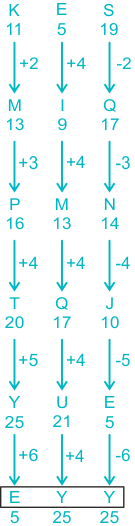 Hence, "Option 3" is the correct answer.
Q2 · Series
Select the option that represents the letters that when sequentially placed from left to right in the blanks below will complete
the letter series.
_ X _ F _ _ _ X T _ X _
- FXXTFXT
- FTXTFFT
- XFTTXFX
- XTTFXFX
Answer aur solution dekho
Archived marked answer: B
Given series: _ X _ F _ _ _ X T _ X _
Option 1) FXXTFXT → F X X F X T F X T X X T → (It doesn't follow any pattern)
Option 2) &l
Q3 · Series
Select the option that represents the letters that, when placed from left to right in the blanks below, will complete the letter
series.
D _ F D _ F _ F _ D _ F
- D F F D D
- F D D F F
- D F D D F
- F F D F F
Answer aur solution dekho
Archived marked answer: D
Given series: D _ F D _ F _ F _ D _ F
Option 1) D F F D D → D D F D F F F F D D D F → (It doesn't follow any patter
Q4 · Series
Which figure should replace the question mark (?) if the following series were to be continued?



Answer aur solution dekho
Archived marked answer: A
The logic followed here is:
1) First box series →
The 1st and 2nd column elements shift anticlockwise.
The 3rd and 4th column elements shift anticlockwise.
 2) Second box series →
The 2nd row elements shift anticlockwise.
The left diagonal elements interchange positions.
The 3rd element from the left of the 2nd row is replaced by new element subsequently.
 Thus, the final series is:
 Hence, "Option 1 is the correct answer.
Q5 · Series
Identify the figure given in the options which when put in place of ? will logically complete the series.





Answer aur solution dekho
Archived marked answer: A
The logic followed here is:
1) The number of squares are increasing subsequently.
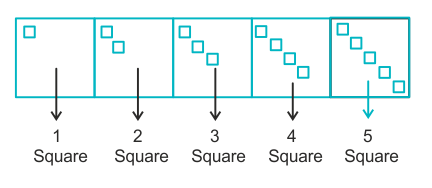 Thus, the final series is:
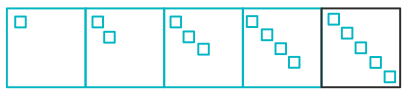 Hence, "Option 1 is the correct answer.
Q6 · Series
Select the number from among the given options that can replace the question mark (?) in the following series.
30, 20, ?, 60, 140
- 30
- 35
- 40
- 25
Answer aur solution dekho
Archived marked answer: A
The logic followed here is:
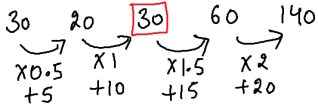
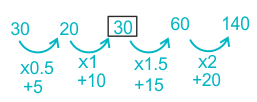 Hence, "Option 1" is the correct answer.
Q7 · Series
Select the option that can replace the question mark (?) in the following series.
AH21, CJ18, EL15, GN12, ?
- J8
- IP9
- HR11
- HQ10
Answer aur solution dekho
Archived marked answer: B
The logic followed here is:
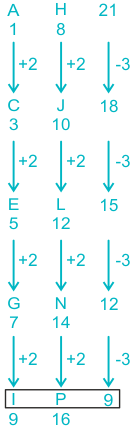 Hence, "Option 2" is the correct answer.
Q8 · Analogy
Select the pair in which the numbers are related to each other in the same way as are the numbers in the given pairs.
(NOTE: Operations should be performed on the whole numbers, without breaking down the numbers into its constituent digits. E.g. 13 – Operations on 13 such as adding/deleting/multiplying etc. to 13 can be performed. Breaking down 13 into 1 and 3 and then performing mathematical operations on 1 and 3 is not allowed.)
3 : 25
4 : 62
- 9 : 731
- 5 : 123
- 7 : 345
- 6 : 218
Answer aur solution dekho
Archived marked answer: B
The logic followed here is:
3 : 25
3³ - 2 = 25
27 - 2 = 25
25 = 25 (LHS = RHS)
And,
4 : 62
43 - 2 = 62
64 - 2 = 62
62 = 62 (LHS = RHS)
So, checking each option one by one:
Option 1) 9 : 731
93 - 2 = 731
729 - 2 = 731
727 ≠ 731 (LHS ≠ RHS)
Option 2) 5 : 123
53 - 2 = 123
125 - 2 = 123
123 = 123 (LHS = RHS)
Option 3) 7 : 345
73 - 2 = 345
343 - 2 = 345
341 ≠ 345 (LHS ≠ RHS)
Option 4) 6 : 218
63 - 2 = 218
216 - 2 = 218
214 ≠ 218 (LHS ≠ RHS)
Thus, out of all the options '5 : 123' follows the same logic as given.
Hence, "Option 2" is the correct answer.
Q9 · Analogy
Select the set in which the numbers are related in the same way as are the numbers of the following sets.
(NOTE: Operations should be performed on the whole numbers, without breaking down the numbers into its constituent
digits. E.g. 13 – Operations on 13 such as adding /deleting /multiplying etc. to 13 can be performed. Breaking down 13 into 1
and 3 and then performing mathematical operations on 1 and 3 is not allowed.)
(27, 405, 3)
(23, 690, 6)
- (14, 364, 7)
- (22, 616, 7)
- (16, 448, 7)
- (24, 600, 5)
Answer aur solution dekho
Archived marked answer: D
The logic followed here is:
Logic: (1st number × 3rd number) × 5 = 2nd number.
Now,
For, (27, 405, 3)
⇒ (27 × 3) × 5
⇒ 81 × 5 = 405.
(23, 690, 6)
⇒ (23 × 6) × 5
⇒ 138 × 5 = 690.
Similarly, for (24, 600, 5)
⇒ (24 × 5) × 5
⇒ 120 × 5 = 600.
Hence, the correct answer is "Option 4".
body {
font-family: Arial, sans-serif;
color: (33, 37, 41);
}
Q10 · Analogy
Select the set in which the numbers are related in the same way as are the numbers of the following set.
7 — 14 — 23
4 — 11 — 20
NOTE: Operations should be performed on the whole numbers, without breaking down the numbers into its constituent digits. E.g., 13 — Operations on 13 such as adding/subtracting/multiplying etc. to 13 can be performed. Breaking down 13 into 1 and 3 and then performing mathematical operations on 1 and 3 is not allowed.
- 7 — 15 — 22
- 15 — 30 — 20
- 5 — 12 — 21
- 9 — 12 — 22
Answer aur solution dekho
Archived marked answer: C
The logic followed here is:
Logic: 1st number + 7 = 2nd number; 2nd number + 9 = 3rd number.
Now,
For, 7 — 14 — 23
⇒ 7 + 7 = 14 and 14 + 9 = 23.
For, 4 — 11 — 20
⇒ 4 + 7 = 11 and 11 + 9 = 20.
Similarly, for 5 — 12 — 21
⇒ 5 + 7 = 12 and 12 + 9 = 21.
Hence, the correct answer is "Option 3".
Q11 · Analogy
‘Ample’ is related to ‘Abundant’ in the same way as ‘Substantial’ is related to ‘________’.
(The words must be considered as meaningful English words and must not be related to each other based on the number of letters/number of consonants/vowels in the word.)
- Considerable
- Meager
- Scarce
- Venerable
Answer aur solution dekho
Archived marked answer: A
The logic followed here is:
Logic: Synonyms
‘Ample’ is related to ‘Abundant’
‘Ample’ and ‘Abundant’ are synonyms, as they both refer to something being sufficient or plentiful.
Similarly,
‘Substantial’ is related to ‘Considerable’
‘Substantial’ and ‘Considerable’ are also synonyms, as they both imply something being significant or large in amount, degree, or size.
Hence, the correct answer is "Considerable".
Q12 · Analogy
Select the option that is related to the third word in the same way as the second word is related to the first word. (The words must be considered as meaningful English words and must not be related to each other based on the number of letters/number of consonants/vowels in the word)
Frivolous : Big : Deride : ?
- Jeer
- Detest
- Taunt
- Encourage
Answer aur solution dekho
Archived marked answer: D
The logic followed here is:
Logic: Antonyms
Here,
Frivolous : Big → Frivolous and Big are a
Q13 · Non Verbal Reasoning
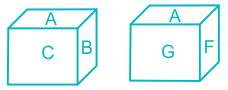
Six letters A, B, C, E, F and G are written on different faces of a dice. Two positions of this dice are shown in the figure
below. Find the letter on the face opposite to A.
- F
- E
- C
- G
Answer aur solution dekho
Archived marked answer: B
The logic followed here is :-
From the given two different dices the adjacent sides are as shown below :
As A is common on both the dices, it is clear that B, C, G, and F are adjacent to it, and the remaining i.e. E will be opposite to it.
Q14 · Non Verbal Reasoning
Figure X is followed by four figures numbered (1), (2), (3), (4). Identify the figure among the four in which figure X is embedded (i.e. contains figure X in the same form).

- 1
- 3
- 2
- 4
Answer aur solution dekho
Archived marked answer: A
The image embedded in the given figure is as shown below :
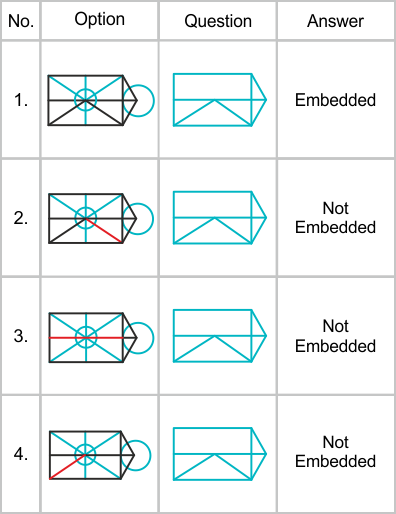 ∴ Here, given figure is embedded in the figure (1).
Hence, the correct answer is "Option 1".
Q15 · Non Verbal Reasoning
How many triangles are there in the given figure?

- 7
- 6
- 9
- 8
Answer aur solution dekho
Archived marked answer: A
The number of triangles in the given figure is shown below:
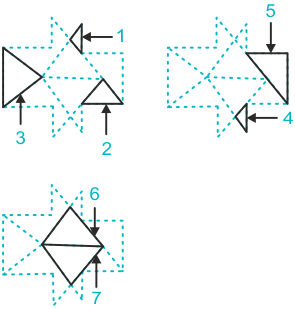 Thus, as marked there are a total of 7 triangles.
Hence, "Option 1" is the correct answer.
Q16 · Non Verbal Reasoning
Select the correct mirror image of the given figure when the mirror is placed at MN as shown.



Answer aur solution dekho
Archived marked answer: B
The correct mirror image of the given figure is:
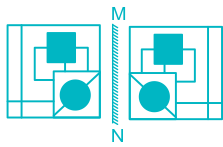 Hence, the correct answer is "Option 2".
Q17 · Non Verbal Reasoning
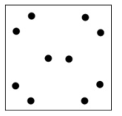
A square sheet of paper is folded along the dotted line successively along the directions shown and is then punched in the last as shown. How would the paper look when unfolded?
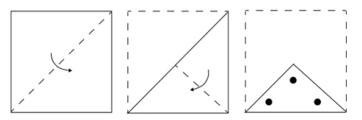


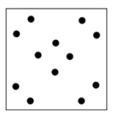

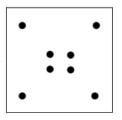

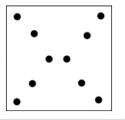

Answer aur solution dekho
Archived marked answer: B
The figure which will look like the paper when unfolded is shown below:

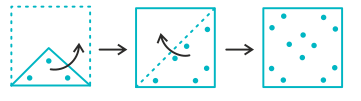 Thus, option Figure 2 will look like the paper when unfolded.
Hence, "Option 2" is the correct answer.
Q18 · Puzzle Subtypes Not To Miss
What will come in the place of the question mark (?) in the following equation, if '+' and '-' are interchanged and '×' and '÷' are interchanged?
315 × 15 - 93 + 16 ÷ 7 = ?
- 4
- 8
- 2
- 12
Answer aur solution dekho
Archived marked answer: C
Given: 315 × 15 - 93 + 16 ÷ 7 = ?
According to the question, after '+' and '-' are interchanged and '×' and '÷' are interchanged:
315 × 15 - 93 + 16 ÷ 7 = ? ⇒ 315 ÷ 15 + 93 - 16 × 7 = ?
⇒ 315 ÷ 15 + 93 - 16 × 7 = ?
⇒ 21 + 93 - 16 × 7 = ?
⇒ 21 + 93 - 112 = ?
⇒ 114 - 112 = ?
⇒ 2 = ?
Hence, "Option 3" is the correct answer.
Q20 · Coding Decoding
In a certain code language, ‘mountain stand tall’ is coded as ‘33 66 44’; ‘rocky is tall’ is coded as ‘44 55 11’ and ‘rocky is mountain’ is coded as ‘33 55 11’. How is ‘stand’ coded in that language?
- 33
- 66
- 44
- 11
Answer aur solution dekho
Archived marked answer: B
According to the given information,
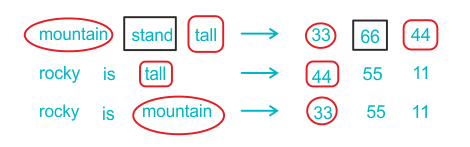 Thus, according to the given codes the code '66' is for the word 'stand'.
Hence, the correct answer is "Option 2".
Q21 · Coding Decoding
In a certain code language, 'HUSBAND' is written as 'JVUDBPF' and 'SISTER' is written as ‘UJUVFT'. How will 'BROTHER' be written in that language?
- DJTFPTV
- DTPVJFT
- TFVJPTD
- FJPVDTT
Answer aur solution dekho
Archived marked answer: B
The logic followed here is:
'HUSBAND' is written as 'JVUDBPF'
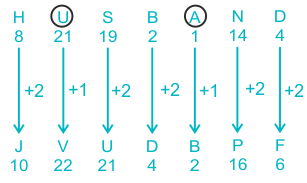 And,
'SISTER' is written as ‘UJUVFT’
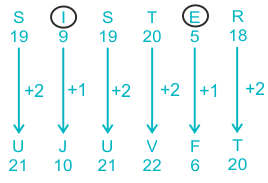 Similarly,
'BROTHER' is written as
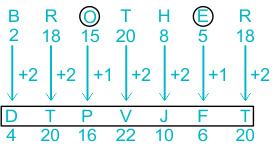 Hence, "Option 2" is the correct answer.
Q22 · Classification Odd One Out
Four letter-clusters have been given, out of which three are alike in some manner and one is different. Select the letter-cluster that is different.
Note: The odd one out is not based on the number of consonants/vowels or their position in the letter cluster.
- LKF
- YXT
- NMI
- SRN
Answer aur solution dekho
Archived marked answer: A
The logic followed here is:
Option 1) LKF
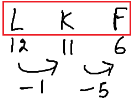
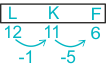 Option 2) YXT
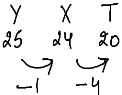
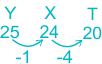 Option 3) NMI
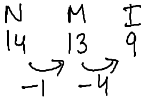
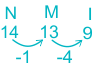 Option 4) SRN
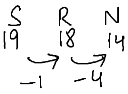
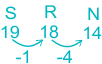 Thus, out of all the options 'LKF' is the odd one out.
Hence, "Option 1" is the correct answer.
Q23 · Classification Odd One Out
Three of the following numbers are alike in a certain way and one is different. Pick the odd one out.
(NOTE : Operations should be performed on the whole numbers, without breaking down the numbers into its constituent
digits. E.g. 13 – Operations on 13 such as adding /deleting /multiplying etc., to 13 can be performed. Breaking down 13 into 1
and 3 and then performing mathematical operations on 1 and 3 is not allowed.)
- 31 – 5 – 160
- 27 – 9 – 243
- 21 – 4 – 89
- 13 – 8 – 109
Answer aur solution dekho
Archived marked answer: B
The logic followed here is:
Option 1) 31 – 5 – 160
(31 × 5) + 5 = 160
155 + 5 = 160
160 = 160 (LHS = RHS)
Option 2) 27 – 9 – 243
(27 × 9) + 5 = 243
243 + 5 = 243
248 ≠ 243 (LHS ≠ RHS)
Option 3) 21 – 4 – 89
(21 × 4) + 5 = 89
84 + 5 = 89
89 = 89 (LHS = RHS)
Option 4) 13 – 8 – 109
(13 × 8) + 5 = 109
104 + 5 = 109
109 = 109 (LHS = RHS)
Thus, out of all the options '27 – 9 – 243' is the odd one out.
Hence, "Option 2" is the correct answer.
Q24 · Blood Relations
In a certain code language,
X + Y means ‘X is the father of Y’,
X − Y means ‘X is the brother of Y’,
X × Y means ‘X is the sister of Y’,
X ÷ Y means ‘X is the wife of Y’.
Based on the above, how is D related to H if ‘D × E ÷ F + G − H’?
- Sister
- Father’s sister
- Mother’s sister
- Mother’s mother
Answer aur solution dekho
Archived marked answer: C
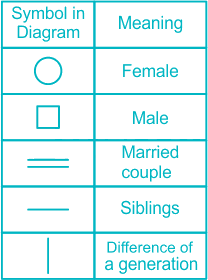 Decoding symbols:
X is
Symbol
+
–
Q25 · Alphabet Test
The position(s) of how many letters will remain unchanged if all the letters in the word ‘GRIMACE’ are arranged in English alphabetical order?
- Two
- Zero
- One
- Three
Answer aur solution dekho
Archived marked answer: B
Given word: GRIMACE
According to the question,
Given word
G
R
I
M
A
C
E
Arranged in alphabetical order
A
C
E
G
I
R
M
Here, zero number of letters remain unchanged.
Hence, "Option 2" is the correct answer.
General Awareness
Q1 · Art and Culture
Chhath Puja is the main festival of which state?
- Bihar
- Tamil Nadu
- Karnataka
- Assam
Answer aur solution dekho
Archived marked answer: A
The correct answer is Bihar.
Key Points
- Chhath Puja is a significant festival dedicated to the Sun God (Surya) and Chhathi Maiya.
- It is predominantly celebrated in the Indian state of Bihar, along with Jharkhand, Eastern Uttar Pradesh, and the Madhesh region of Nepal.
- The festival involves rigorous rituals including holy bathing, fasting, and abstaining from drinking water (vrata), standing in water for long periods, and offering
Q2 · Indian Polity and Constitution
Which of the following features of the Indian Constitution was borrowed from Irish Constitution?
- Directive Principles of State Policy
- Concurrent List
- Fundamental Rights
- Rule of Law
Answer aur solution dekho
Archived marked answer: A
The correct answer is Directive Principles of State Policy.
Key Points
- The Directive Principles of State Policy (DPSP) are guidelines for the framing of laws by the government.
- These principles are considered fundamental in the governance of the country, aiming to create social and economic conditions under which the citizens can lead a good life.
- DPSPs are non-justiciable, meaning they are not enforceable by any court but the principles laid down therein are considered fundamental in the governance of the country.
- The concept of DPSP was borrowed from the Irish Constitution, which in turn had taken the idea from the Spanish Constitution.
Additional Information
- Concurrent List
- The Concurrent List or List-III is a list of 52 items given in the Seventh Schedule to the Constitution of India.
- This list includes subjects of common interest to both the Union and the State Governments, such as education, forest, trade unions, marriage, adoption, and succession.
- Both the Parliament and State Legislatures can make laws on the subjects mentioned in the Concurrent List.
- Fundamental Rights
- Fundamental Rights are the basic human rights enshrined in the Constitution of India which are guaranteed to all citizens.
- These rights are essential for the all-around development of individuals and to maintain human dignity.
- They are enforceable by the courts, subject to specific restrictions.
- Rule of Law
- The concept of Rule of Law is a fundamental principle that underpins the functioning of any democratic society.
- It means that every citizen is subject to the law, including lawmakers themselves.
- It ensures that laws are applied equally and fairly, and protects individuals from arbitrary governance.
Q3 · Indian Polity and Constitution
The Supreme Court of India comprises the Chief Justice and not more than _______ other Judges appointed by the President of India.
- 37
- 35
- 38
- 33
Answer aur solution dekho
Archived marked answer: D
The correct answer is 33.
Key Points
- The Supreme Court of India consists of the Chief Justice of India and not more than 33 other Judges.
- These Judges are appointed by the President of India.
- The maximum number of Judges in the Supreme Court is defined under Article 124 of the Indian Constitution.
- This number can be increased by Parliament through legislation.
Additional Information
- Chief Justice of India (CJI)
- The Chief Justice of India is the head of the judiciary system in India.
- The CJI is appointed by the President of India based on seniority and other considerations.
- The CJI plays a crucial role in the administration of justice and is responsible for the allocation of cases and appointment of constitutional benches.
- Appointment of Judges
- Judges of the Supreme Court are appointed by the President of India under Article 124(2) of the Constitution of India.
- The appointment process involves consultation with the Chief Justice of India and other senior judges.
- Once appointed, judges can serve until the age of 65.
- Article 124 of the Indian Constitution
- Article 124 of the Indian Constitution deals with the establishment and constitution of the Supreme Court.
- It outlines the appointment, tenure, and removal of Supreme Court judges.
- It also provides for the Parliament's power to increase the number of judges through legislation.
- Parliament's Power
- The Parliament of India has the authority to change the number of judges in the Supreme Court through legislation.
- This ensures that the judiciary can be expanded to meet the needs of a growing nation.
- The number of judges has been increased several times since the establishment of the Supreme Court to handle the increasing workload.
Q4 · Indian Economy
Which of the following statements is correct about the composition of the agriculture sector and employment in GDP post-independence?
- The proportion of employment has declined significantly but not the share of the agriculture sector in GDP.
- The proportion of both the agriculture sector and employment in GDP has increased significantly.
- The proportion of both the agriculture sector and employment in GDP has declined significantly.
- The proportion of GDP contributed by the agricultural sector declined significantly but not the employment depending on the agriculture sector.
Answer aur solution dekho
Archived marked answer: D
The correct answer is The proportion of GDP contributed by the agricultural sector declined significantly but not the employment depending on the agriculture sector..
Key Points
- Post-independence, the share of agriculture in India's GDP has seen a significant decline. This is due to the growth of the industrial and service sectors.
- Despite the decline in the GDP contribution, a large proportion of the Indian workforce is still dependent on agriculture for their livelihood.
- Structural transformation in the economy is observed where the labor force shifts from agriculture to other sectors, but this transition has been slow in India.
- Employment in agriculture remains high due to slow industrialization and the inability of other sectors to absorb the growing workforce.
Additional Information
- Gross Domestic Product (GDP):
- GDP is the total monetary or market value of all the finished goods and services produced within a country's borders in a specific time period.
- It serves as a comprehensive scorecard of a given country’s economic health.
- Agriculture Sector:
- This sector includes farming, fishing, and forestry, and it is a primary sector of the economy.
- It provides food, raw materials, and employment to a large section of the population.
- Employment in Agriculture:
- A large proportion of the workforce in developing countries like India is employed in agriculture.
- It includes jobs in crop production, animal husbandry, fisheries, and forestry.
- Structural Transformation:
- This refers to the shift of economic activities and labor force from agriculture to the industrial and service sectors.
- It is a key feature of economic development and involves changes in the structure of the economy.
Q5 · Sports Static GK
Who among the following famous Indian women cricketers announced retirement in June 2022?
- Smriti Mandhana
- Jhulan Goswami
- Anjum Chopra
- Mithali Raj
Answer aur solution dekho
Archived marked answer: D
The correct answer is Mithali Raj.
Key Points
- Mithali Raj is an Indian cricketer and a former captain of the Indian women's national cricket team.
- She is considered one of the greatest female cricketers of all time and has numerous records to her name.
- Mithali Raj announced her retirement from all forms of international cricket in June 2022.
- During her career, she scored the most runs in Women's One Day International (ODI) cricket and is the only female cricketer to surpass the 7,000 run mark in Women's ODIs.
Additional Information
- Smriti Mandhana
- Smriti Mandhana is an Indian cricketer and currently one of the leading players in the Indian women's cricket team.
- She is known for her aggressive batting style and has been a key player in many of India's victories.
- She has won several awards, including the ICC Women's Cricketer of the Year.
- As of June 2022, she has not announced her retirement.
- Jhulan Goswami
- Jhulan Goswami is an Indian cricketer and former captain of the Indian women's national cricket team.
- She is one of the fastest bowlers in women's cricket and holds the record for the most wickets taken in Women's One Day International cricket.
- She has been a crucial part of the Indian bowling attack for many years.
- As of June 2022, she has not announced her retirement.
- Anjum Chopra
- Anjum Chopra is a former Indian cricketer and captain of the Indian women's national cricket team.
- She has been a significant contributor to women's cricket in India both as a player and as a commentator.
- She retired from international cricket in 2012.
- Post-retirement, she has been actively involved in cricket commentary and analysis.
Q6 · Sports Static GK
Which team won the T20 cricket event, Syed Mushtaq Ali Trophy 2022-2023?
- Mumbai
- Punjab
- Vidarbha
- Himachal Pradesh
Answer aur solution dekho
Archived marked answer: A
The correct answer is Mumbai.
Key Points
- Mumbai won the Syed Mushtaq Ali Trophy for the first time in the 2022-2023 season.
- The Syed Mushtaq Ali Trophy is a domestic T20 cricket competition in India, organized by the Board of Control for Cricket in India (BCCI).
- It is named after the famous Indian cricketer Syed Mushtaq Ali who was known for his aggressive batting style.
- Mumbai defeated Himachal Pradesh in the final to clinch the title.
Additional Information
- Syed Mushtaq Ali Trophy
- The Syed Mushtaq Ali Trophy is an Indian domestic T20 cricket championship.
- It was first introduced in the 2006-07 season.
- Named after Syed Mushtaq Ali, a former Indian cricketer known for his aggressive batting and contributions to Indian cricket.
- It is organized by the Board of Control for Cricket in India (BCCI) and is a crucial platform for players to showcase their talents and make a case for national selection.
Domestic Cricket Formats in India
- First-Class Cricket:
- Format similar to Test cricket.
- Played over 4 days (some tournaments like Ranji Trophy have 5-day finals).
- Key Tournaments:
- Ranji Trophy: Prestigious inter-state competition.
- Duleep Trophy: Zonal competition.
- List A Cricket:
- Format similar to ODIs.
- Played at the domestic level.
- Key Tournaments:
- Vijay Hazare Trophy.
- T20 Domestic Cricket:
- Played at the state level.
- Key Tournaments:
- Syed Mushtaq Ali Trophy.
Q7 · Sports Static GK
Who won the paralympic bronze medal in archery for India at Tokyo in 2020?
- Atanu Das
- Pravin Jadhav
- Deepika Kumari
- Harvinder Singh
Answer aur solution dekho
Archived marked answer: D
The correct answer is Harvinder Singh.
Key Points
- Harvinder Singh is the first Indian archer to win a medal at the Paralympics.
- He won the bronze medal in the men's individual recurve event at the Tokyo 2020 Paralympics.
- Harvinder Singh defeated Kim Min Su of South Korea in a thrilling shoot-off to secure the bronze medal.
- His victory marked a significant achievement for India in the field of para-archery.
Additional Information
- Paralympics
- The Paralympics are a major international multi-sport event involving athletes with a range of disabilities, including impaired muscle power, impaired passive range of movement, limb deficiency, and visual impairment.
- The Paralympic Games are held immediately after the Olympic Games in the same host city.
- They are organized by the International Paralympic Committee (IPC).
- The Paralympics aim to highlight the achievements of athletes with disabilities and promote the values of courage, determination, inspiration, and equality.
- Tokyo 2020 Paralympics
- The Tokyo 2020 Paralympic Games were held from August 24 to September 5, 2021, after being postponed for a year due to the COVID-19 pandemic.
- The Games featured 539 events across 22 sports, including athletics, swimming, wheelchair basketball, and para-archery.
- It was the second time Japan hosted the Paralympics, with the first being in 1964.
- The motto of the Tokyo 2020 Paralympics was "United by Emotion."
- Para-Archery
- Para-archery is an adaptation of archery for athletes with a range of disabilities.
- It has been part of the Paralympic program since the first Paralympic Games in Rome in 1960.
- Competitors shoot arrows at a target from a set distance, and the aim is to score as many points as possible.
- Para-archery events are divided into different categories based on the type and level of disability.
Q8 · Sports Static GK
Match the sports in List I with the sportsperson in List II who were in the news for their sports achievement in 2022:
LIST I - Sportsman
LIST II - Sports
A. Lakshya Sen
i. Boxing
B. Rameshbabu Pragnanandhaa
ii. Badminton
C. Nikhat Zareen
iii. Shooting
D. Rudrankksh Patil
iv. Chess
- A-iv, B-ii, C-i, D-iii
- A-iii, B-iv, C-i, D-ii
- A-i, B-iv, C-ii, D-iii
- A-ii, B-iv, C-i, D-iii
Answer aur solution dekho
Archived marked answer: D
The correct answer is Option 4.
Key Points
- Lakshya Sen is a prominent Indian badminton player who gained significant attention in 2022 for his performances in international badminton tournaments.
- Rameshbabu Pragnanandhaa is a young Indian chess prodigy who made headlines in 2022 by defeating world champion Magnus Carlsen in an online chess tournament.
- Nikhat Zareen is an Indian boxer who achieved a major milestone in 2022 by winning a gold medal at the Women's World Boxing Championships.
- Rudrankksh Patil is an Indian shooter who gained recognition in 2022 for his achievements in shooting sports, particularly in events like the ISSF Junior World Cup.
Additional Information
- Badminton
- Badminton is a racquet sport played using racquets to hit a shuttlecock across a net.
- It may be played with larger teams, the most common forms of the game are "singles" (with one player per side) and "doubles" (with two players per side).
- Since 1992, it has been a Summer Olympic sport with five events: men's singles, women's singles, men's doubles, women's doubles, and mixed doubles.
- Chess
- Chess is a two-player strategy board game played on a chessboard, a checkered gameboard with 64 squares arranged in an 8×8 grid.
- Chess is believed to have originated in India and spread to Persia and then to the Islamic world, Europe, and the rest of the world.
- Chess is one of the world's most popular games, played by millions of people worldwide.
- Boxing
- Boxing is a combat sport in which two people, usually wearing protective gloves, throw punches at each other for a predetermined amount of time in a boxing ring.
- Amateur boxing is both an Olympic and Commonwealth Games sport and is a common fixture in most international games.
- Boxing is overseen by a referee over a series of one- to three-minute intervals called rounds.
- Shooting
- Shooting is the act or process of discharging firearms or other projectile weapons such as bows or crossbows.
- It is a competitive sport involving tests of accuracy and speed using various types of guns such as firearms and airguns.
- The shooting sports are categorized by the type of firearm, targets, and distances at which the targets are shot.
Q9 · Indian Geography
Sundari trees are found in which type of forests in India?
- Mangrove forests
- Tropical deciduous forests
- The thorn forests and scrubs
- Tropical evergreen forests
Answer aur solution dekho
Archived marked answer: A
The correct answer is Mangrove forests.
Key Points
- Sundari trees are the dominant species in the mangrove forests, especially in the Sundarbans.
- The Sundarbans is the largest mangrove forest in the world and is located in the delta region of Padma, Meghna, and Brahmaputra river basins.
- Mangrove forests are located in coastal intertidal zones, where they thrive in saline or brackish water.
- Mangroves play a crucial role in coastal protection, preventing soil erosion, and supporting a diverse range of marine life.
Additional Information
- Mangrove Forests:
- Mangrove forests are unique ecosystems found at the interface between land and sea in tropical and subtropical regions.
- The trees in these forests have specialized root systems that help them to survive in salty and oxygen-poor soils.
- Mangroves provide habitat for a variety of wildlife, including fish, crabs, and birds.
- They act as natural barriers against storm surges and coastal erosion, thus protecting inland areas.
- Tropical Deciduous Forests:
- Tropical deciduous forests are characterized by trees that shed their leaves during the dry season to conserve water.
- These forests receive moderate rainfall and have a rich biodiversity, including species like teak, sal, and bamboo.
- They are found in regions with distinct wet and dry seasons.
- Such forests are crucial for timber production and support a variety of wildlife.
- The Thorn Forests and Scrubs:
- Thorn forests and scrublands are found in arid and semi-arid regions where the climate is hot and dry.
- Vegetation is typically sparse, consisting of hardy plants like cacti, acacia, and thorny bushes.
- These ecosystems are adapted to conserve water and withstand prolonged drought conditions.
- They are important for preventing desertification and providing habitat for drought-resistant species.
- Tropical Evergreen Forests:
- Tropical evergreen forests are found in regions with high rainfall and no significant dry season.
- These forests are characterized by dense canopies, high biodiversity, and evergreen trees that do not shed their leaves.
- They are vital for carbon sequestration and maintaining global ecological balance.
- Some of the world's most diverse and complex ecosystems are tropical evergreen forests.
Q10 · Indian Geography
According to the Census of India 2011, which group of Union Territories recorded the highest sex ratio?
- Puducherry, Delhi, Andaman and Nicobar Islands
- Puducherry, Lakshadweep, Andaman and Nicobar Islands
- Chandigarh, Puducherry, Lakshadweep
- Chandigarh, Puducherry, Delhi
Answer aur solution dekho
Archived marked answer: B
The correct answer is Puducherry, Lakshadweep, Andaman and Nicobar Islands.
Key Points
- Puducherry recorded the highest sex ratio among Union Territories in the Census of India 2011.
- The sex ratio in Puducherry was 1037 females per 1000 males.
- Lakshadweep and Andaman and Nicobar Islands also had relatively high sex ratios.
- The sex ratio is an important indicator of gender balance in a region, reflecting the number of females per 1000 males.
Additional Information
- Sex Ratio
- The sex ratio is defined as the number of females per 1000 males in a given population.
- It is an important demographic indicator that helps understand the gender composition of a population.
- A balanced sex ratio is crucial for the overall socio-economic development of a region.
- Factors such as sex-selective abortions, female infanticide, and differential mortality rates between genders can influence the sex ratio.
- Census of India
- The Census of India is a decennial (every ten years) exercise conducted by the Office of the Registrar General and Census Commissioner, India.
- The census provides comprehensive data on the population, including age, sex, literacy, religion, and other demographic parameters.
- The Census 2011 was the 15th National Census of India since 1871.
- Accurate census data is vital for planning and implementing various government policies and programs.
- Union Territories
- Union Territories (UTs) are regions in India that are governed directly by the Central Government.
- Unlike states, UTs do not have their own governments and legislatures.
- Examples of Union Territories include Puducherry, Lakshadweep, Andaman and Nicobar Islands, among others.
- The governance and administrative mechanisms in UTs are overseen by the President of India through an appointed administrator.
Q11 · Indian Geography
Which port is developed as a satellite port?
- Mormugao
- Jawaharlal Nehru
- Haldia
- New Mangalore
Answer aur solution dekho
Archived marked answer: B
The correct answer is Jawaharlal Nehru.
Key Points
- Jawaharlal Nehru Port, also known as Nhava Sheva, is the largest container port in India.
- Located east of Mumbai in Maharashtra, this port was developed to relieve pressure on the Mumbai Port.
- It was inaugurated on 26 May 1989 and named after the first Prime Minister of India, Jawaharlal Nehru.
- The port is crucial for the country's shipping and logistics sector, handling a significant portion of India's containerized cargo.
Additional Information
- Ports in India
- India has a long coastline of about 7,517 km, which is serviced by 12 major ports and over 200 non-major ports.
- Major ports are managed by the central government, while non-major ports are managed by state governments.
- Major ports handle about 60% of the country's total cargo traffic.
- Importance of Satellite Ports
- Satellite ports are developed to alleviate congestion in major ports and to enhance port capacity.
- They play a vital role in regional economic development and help in improving logistics efficiency.
- Satellite ports can be specialized for certain types of cargo, thereby streamlining operations and reducing turnaround times.
- Jawaharlal Nehru Port Trust (JNPT)
- JNPT is an autonomous corporation under the Ministry of Ports, Shipping and Waterways, Government of India.
- It has state-of-the-art facilities including container terminals, liquid cargo terminals, and dry bulk cargo terminals.
- The port is equipped with modern technology to ensure efficient and seamless operations.
- JNPT has been instrumental in boosting India's trade and commerce by providing a robust infrastructure for maritime logistics.
Q12 · Indian Geography
Which region in India receives less rainfall in summer, but heavy rainfall in winter season due to the retreating north easterly winds?
- Southern coastal region
- Western coastal region
- Northern coastal region
- Eastern coastal region
Answer aur solution dekho
Archived marked answer: D
The correct answer is Eastern coastal region.
Key Points
- The Eastern coastal region of India, particularly the Tamil Nadu coast, receives substantial rainfall during the winter months.
- This rainfall is primarily due to the retreating North-Easterly monsoon winds, which pick up moisture from the Bay of Bengal and bring it to the eastern coast.
- Unlike the summer monsoon, which affects the western coastal region more, the retreating monsoon impacts the eastern coast significantly.
- This pattern results in a unique climatic condition where the Eastern coastal region experiences less rainfall during the summer but heavy rainfall during the winter.
Additional Information
- Monsoon Winds
- Monsoon winds are seasonal winds that bring significant rainfall to parts of the world, including India.
- They are characterized by a reversal in wind direction and are typically divided into two main phases: the South-West Monsoon and the North-East Monsoon.
- The South-West Monsoon occurs from June to September and brings heavy rainfall to most parts of India.
- The North-East Monsoon, also known as the retreating monsoon, occurs from October to December and brings rainfall to the eastern coast of India.
- Retreating Monsoon
- The retreating monsoon refers to the period when the South-West monsoon winds start withdrawing from the Indian subcontinent.
- During this period, the North-East Monsoon winds take over, bringing rainfall to the eastern coast of India.
- This period is crucial for regions like Tamil Nadu, which receive the bulk of their annual rainfall during this time.
- Bay of Bengal
- The Bay of Bengal is the northeastern part of the Indian Ocean, bounded by India, Bangladesh, and Myanmar.
- It plays a crucial role in the monsoon system, particularly for the North-East Monsoon.
- The retreating monsoon winds pick up moisture from the Bay of Bengal, leading to significant rainfall along the eastern coast of India.
Q13 · Modern Indian History
The Doctrine of Lapse was an annexation policy devised by which of the following Governor-Generals of India?
- Lord Wellesley
- Lord Dalhousie
- Lord Mayo
- Lord Canning
Answer aur solution dekho
Archived marked answer: B
The correct answer is Lord Dalhousie.
Key Points
- Lord Dalhousie served as the Governor-General of India from 1848 to 1856.
- He is known for his aggressive expansionist policies, including the Doctrine of Lapse.
- The Doctrine of Lapse was used to annex several Indian states into British India if the ruler died without a direct heir.
- Key states annexed under this policy include Satara, Jhansi, and Nagpur.
Additional Information
- Doctrine of Lapse:
- It was an annexation policy applied by Lord Dalhousie when an Indian ruler died without a male heir.
- According to this doctrine, the princely state would be annexed into British India if there was no legitimate male heir.
- This policy led to the annexation of several states such as Satara (1848), Sambalpur (1850), Jhansi (1854), and Nagpur (1854).
- This policy was one of the factors leading to the Indian Rebellion of 1857 as it caused widespread resentment among Indian rulers and their subjects.
- Lord Wellesley:
- Lord Wellesley was the Governor-General of India from 1798 to 1805.
- He is known for the Subsidiary Alliance system, which was a treaty between the British East India Company and Indian princely states.
- Under this system, Indian rulers were not allowed to have their own armed forces and were protected by the Company in return for a subsidy.
- Lord Mayo:
- Lord Mayo served as the Viceroy of India from 1869 to 1872.
- He is known for his efforts in financial and administrative reforms.
- He was assassinated in 1872 by a convict in the Andaman Islands.
- Lord Canning:
- Lord Canning was the Governor-General of India during the Indian Rebellion of 1857.
- He became the first Viceroy of India after the British Crown took over the administration from the East India Company in 1858.
- He is known for his efforts to calm the situation post-rebellion and implementing the Queen's Proclamation of 1858, which promised to respect the rights and dignity of Indian princes.
Q14 · Modern Indian History
In which of the following areas did the Uprising of Khurda in 1817 take place?
- United Province
- Odisha
- Madras
- Bengal
Answer aur solution dekho
Archived marked answer: B
The correct answer is Odisha.
Key Points
- The Uprising of Khurda, also known as the Paika Rebellion, took place in the Khurda region of Odisha.
- It was led by Bakshi Jagabandhu Bidyadhar, the commander of the forces of the Raja of Khurda.
- The rebellion was a response to the British East India Company's oppressive policies and land revenue systems.
- The Paikas, the traditional warrior class of Odisha, played a significant role in the uprising, showcasing their valor and resistance against British colonial rule.
Additional Information
- Uprising of Khurda:
- The Uprising of Khurda in 1817 is also known as the Paika Rebellion.
- The Paikas were the landed militia of Odisha, who were rendered landless by the policies of the British East India Company.
- The rebellion was one of the earliest organized armed rebellions against British rule in India.
- It was led by Bakshi Jagabandhu Bidyadhar, who mobilized the Paikas and other sections of society against the British.
- The revolt was primarily a reaction to the British land revenue policies, which were exploitative and led to widespread discontent among the peasants and landed gentry.
- The Paikas attacked British establishments, looted the treasury, and set fire to government buildings as a mark of their protest.
- Though the rebellion was eventually suppressed by the British, it is remembered for its significant impact on the resistance movements against colonial rule in India.
- Odisha:
- Odisha is an eastern state of India known for its rich history, culture, and heritage.
- The state was known as Kalinga in ancient times and has a long history of resistance against external invasions, including that of the Maurya Empire.
- Odisha is famous for its temples, such as the Jagannath Temple in Puri, which is a major pilgrimage site for Hindus.
- The state has a diverse cultural heritage, with various traditional dance forms like Odissi, folk music, and art.
- Economically, Odisha is known for its mineral resources and industries, including steel, aluminum, and power generation.
Q15 · Current Affairs
For which of the following states was the Constitution (Scheduled Castes and Scheduled Tribes) Orders (Second Amendment) Bill, 2022, introduced in the Parliament?
- Odisha
- Bihar
- Uttar Pradesh
- Madhya Pradesh
Answer aur solution dekho
Archived marked answer: C
The correct answer is Uttar Pradesh.
Key Points
- The Constitution (Scheduled Castes and Scheduled Tribes) Orders (Second Amendment) Bill, 2022 was introduced specifically for the state of Uttar Pradesh.
- This bill aims at including or excluding certain communities from the list of Scheduled Castes and Scheduled Tribes in the state.
- The amendment is part of the government's ongoing effort to ensure that the benefits of reservation and other affirmative action policies reach the intended communities.
- Such amendments are periodically made based on recommendations from the state governments and after thorough evaluation.
Additional Information
- Scheduled Castes (SCs)
- Scheduled Castes are those communities that are specified in the Constitution of India under Article 341.
- They are often marginalized communities that have historically faced social and economic disadvantages.
- The constitution provides for affirmative action in the form of reservations in education, employment, and politics to uplift these communities.
- Scheduled Tribes (STs)
- Scheduled Tribes are specified under Article 342 of the Constitution of India.
- These communities are often indigenous people who have historically been isolated from mainstream society.
- Affirmative action policies also apply to these communities, including reservations in various sectors.
- Reservation Policies in India
- Reservation policies are designed to improve the socio-economic status of marginalized communities by ensuring their representation in education, employment, and politics.
- These policies are based on the principles of social justice and affirmative action as enshrined in the Indian Constitution.
- Periodic revisions and amendments are made to the lists of SCs and STs to ensure that the benefits reach the deserving communities.
- Legislative Process for Amendments
- Amendments to the lists of Scheduled Castes and Scheduled Tribes are made through legislation passed by Parliament.
- State governments often recommend changes based on socio-economic studies and consultations with community leaders.
- Once a bill is introduced, it is discussed and passed by both houses of Parliament and then receives the President's assent to become law.
Q16 · General Science Chemistry
Which polyatomic ionic compound is a white, crystalline powder used in fire extinguishers and to neutralise acids and bases?
- Sodium Bisulphite
- Sodium Thiosulphate
- Sodium Chromate
- Sodium Bicarbonate
Answer aur solution dekho
Archived marked answer: D
The correct answer is Sodium Bicarbonate.
Key Points
- Sodium bicarbonate, commonly known as baking soda, is a white crystalline powder that is often used as a leavening agent in baking.
- It is widely used in fire extinguishers due to its ability to produce carbon dioxide when heated, which helps to suffocate fires.
- Sodium bicarbonate can neutralize acids and bases, making it a useful compound in various chemical reactions and for pH control.
- It is also used in medical applications, for instance, to treat acid indigestion and heartburn by neutralizing stomach acid.
Additional Information
- Sodium Bisulphite:
- Sodium bisulphite (NaHSO3) is a chemical compound commonly used as a food preservative and in the treatment of wastewater.
- It has reducing properties and is used in various industrial applications to prevent oxidation.
- Sodium Thiosulphate:
- Sodium thiosulphate (Na2S2O3) is an inorganic compound used in photographic processing, gold extraction, and medical treatment of cyanide poisoning.
- It is also used in water treatment to dechlorinate water before disposal or reuse.
- Sodium Chromate:
- Sodium chromate (Na2CrO4) is a chemical compound used in the manufacture of pigments, coatings, and other industrial applications.
- It is highly toxic and carcinogenic, and its use is regulated due to environmental and health concerns.
- Sodium Bicarbonate:
- Sodium bicarbonate (NaHCO3) is a versatile compound with applications in baking, cleaning, fire extinguishing, and medical treatments.
- It is a mild base that can neutralize acids and is used in various household and industrial applications.
Q17 · Awards Static
Which state government honoured Vani Jairam with the MS Subbulakshmi Award for 2019?
- Maharashtra
- Karnataka
- Odissa
- Tamil Nadu
Answer aur solution dekho
Archived marked answer: D
The correct answer is Tamil Nadu.
Key Points
- The Tamil Nadu government honored Vani Jairam with the MS Subbulakshmi Award in 2019.
- Vani Jairam is a renowned playback singer in India, celebrated for her work in multiple Indian languages.
- The MS Subbulakshmi Award is named after the legendary Carnatic vocalist MS Subbulakshmi.
- This award recognizes contributions to the field of music, celebrating the legacy and promoting the values upheld by MS Subbulakshmi.
Additional Information
- Vani Jairam
- Vani Jairam is a celebrated Indian playback singer known for her work in various Indian languages including Tamil, Telugu, Hindi, Malayalam, and Kannada.
- She has received several awards and accolades for her contributions to Indian music, including the National Film Award for Best Female Playback Singer.
- Her versatile singing style and ability to adapt to various genres have made her a prominent figure in Indian music.
- MS Subbulakshmi
- Madurai Shanmukhavadivu Subbulakshmi, popularly known as MS Subbulakshmi, was an Indian Carnatic singer from Tamil Nadu.
- She was the first musician to be awarded the Bharat Ratna, India's highest civilian honor.
- MS Subbulakshmi was known for her divine voice and her deep dedication to Carnatic music.
- Her performances have left a lasting legacy in the world of Indian classical music.
- MS Subbulakshmi Award
- The MS Subbulakshmi Award is a prestigious recognition given to musicians who have made significant contributions to the field of music.
- This award honors the legacy of MS Subbulakshmi and aims to promote the values of excellence and dedication in music.
- Recipients of this award are chosen based on their contributions to preserving and promoting Indian classical music.
Q18 · Awards Static
Ranjana Gauhar was awarded the Padma Shri Award (2003) for her contribution to which of the following Indian dance forms?
- Kuchipudi
- Sattriya
- Odissi
- Manipuri
Answer aur solution dekho
Archived marked answer: C
The correct answer is Odissi.
Key Points
- Ranjana Gauhar is an acclaimed Indian classical dancer, renowned for her expertise in the Odissi dance form.
- She was awarded the Padma Shri Award in 2003 for her significant contribution to Indian classical dance.
- Odissi is one of the oldest classical dance forms of India, originating from the state of Odisha.
- It is known for its intricate movements, graceful gestures, and expressive emotions, making it a distinguished art form in Indian culture.
Additional Information
- Odissi Dance
- Odissi is a classical dance form that originated in the temples of Odisha in eastern India.
- It is characterized by its fluid movements, elaborate costumes, and expressive gestures.
- Odissi performances often depict stories from Hindu mythology, particularly the tales of Lord Krishna.
- The dance form emphasizes the concept of Tribhangi, the independent movement of head, chest, and pelvis.
- Kuchipudi
- Kuchipudi is a classical Indian dance form from the state of Andhra Pradesh.
- It combines fast rhythms with fluid movements and is known for its dramatic characterization.
- Kuchipudi dancers are known for their dynamic footwork and impressive stage presence.
- Sattriya
- Sattriya is a classical dance form from Assam, introduced by the Vaishnavite saint Srimanta Sankardev in the 15th century.
- It is traditionally performed in monasteries and is known for its devotional themes.
- Sattriya dance is rich in mythological content and is performed with intricate hand gestures and expressions.
- Manipuri
- Manipuri is a classical dance form from the northeastern state of Manipur.
- It is characterized by its graceful, gentle, and flowing movements.
- The dance often portrays themes related to the life of Lord Krishna and Radha.
- Manipuri dance is known for its unique style, costumes, and serene expressions.
Q19 · Medieval Indian History
Who among the following is the hero of the Sanskrit historical poem, the 'Ramacharita' written by Sandhyakar Nandi?
- Gopala
- Devapala
- Ramapala
- Dharmapala
Answer aur solution dekho
Archived marked answer: C
The correct answer is Ramapala.
Key Points
- Ramapala was the ruler of the Pala dynasty in Bengal.
- The 'Ramacharita' is a historical poem written by Sandhyakar Nandi, which praises the deeds of Ramapala.
- The poem highlights the achievements and valor of Ramapala, portraying him as a heroic figure.
- Ramapala's reign marked a significant period in the history of the Pala dynasty, often considered its last great ruler.
Additional Information
- Pala Dynasty
- The Pala dynasty was an Indian imperial power during the Late Classical period, primarily ruling over the Bengal and Bihar regions.
- Founded by Gopala in the 8th century, the dynasty is known for its contributions to Buddhism and the establishment of numerous monasteries.
- Notable rulers include Gopala, Dharmapala, Devapala, and Ramapala, who expanded the kingdom and promoted art, culture, and learning.
- The Pala rulers were patrons of the famous universities of Nalanda and Vikramashila, which became renowned centers of Buddhist learning.
- Sandhyakar Nandi
- Sandhyakar Nandi was a renowned poet and scholar of the Pala court.
- He authored the 'Ramacharita', a historical poem that serves as a significant literary work, providing insights into the history and culture of the Pala period.
- The 'Ramacharita' is written in Sanskrit and is considered an important source for understanding the political and social conditions of the time.
- Sandhyakar Nandi's work is appreciated for its literary merit and historical value, offering a detailed account of Ramapala's reign and achievements.
Q20 · Ancient Indian History
Vindhyashakti was the founder of which of the following dynasties?
- Pallava
- Maukhar
- Vakataka
- Chalukya
Answer aur solution dekho
Archived marked answer: C
The correct answer is Vakataka.
Key Points
- Vindhyashakti was the founder of the Vakataka dynasty, which ruled parts of central and southern India during the 3rd to 5th centuries CE.
- The Vakataka dynasty was contemporaneous with the Gupta Empire and played a crucial role in the politics of ancient India.
- They were known for their patronage of arts and culture, significantly contributing to the Ajanta Caves' development.
- The Vakatakas established a powerful kingdom that included regions of present-day Maharashtra, Madhya Pradesh, and Chhattisgarh.
Additional Information
- Pallava Dynasty
- The Pallavas were a significant dynasty in South India, ruling from the 3rd century to the 9th century CE.
- They were known for their architectural achievements, especially the rock-cut temples at Mahabalipuram.
- The Pallava capital was Kanchipuram, which became a major center of learning and culture.
- The dynasty played a crucial role in the spread of Dravidian architecture and culture.
- Maukhar Dynasty
- The Maukharis were a prominent dynasty in northern India during the 6th century CE.
- They initially served as vassals of the Guptas before establishing their independent rule.
- Their kingdom included parts of present-day Uttar Pradesh and Bihar.
- The Maukhari dynasty is known for its conflicts with the later Guptas and the rise of the Pushyabhuti dynasty.
- Chalukya Dynasty
- The Chalukyas were an influential dynasty in southern and central India, with three distinct but related branches: the Badami Chalukyas, the Eastern Chalukyas, and the Western Chalukyas.
- The Badami Chalukyas ruled from the 6th to the 8th centuries CE and were known for their contributions to temple architecture.
- The Western Chalukyas, also known as the Kalyani Chalukyas, ruled from the 10th to the 12th centuries CE.
- The Eastern Chalukyas ruled in the eastern Deccan region and were known for their role in the development of Telugu culture.
Q21 · General Science Physics
Which of the following two quantities have the same dimensions?
- Work and torque
- Power and moment of inertia
- Work and angular displacement
- Power and radius of circular motion
Answer aur solution dekho
Archived marked answer: A
The correct answer is Work and torque.
Key Points
- Work and torque have the same dimensions, which is energy or force times distance.
- The dimension of work is given by M¹L²T⁻².
- The dimension of torque is also M¹L²T⁻².
- Both quantities are measured in Joules (in SI units) or New
Q22 · Books and Authors Static
Which Indian singer wrote ‘Raag Sarita’?
- Kesarbai Kerkar
- Balasaheb Poonchwale
- Kumar Gandharva
- Chintaman Raghunath Vyas
Answer aur solution dekho
Archived marked answer: D
The correct answer is Chintaman Raghunath Vyas.
Key Points
- Chintaman Raghunath Vyas was a renowned classical vocalist of the Gwalior Gharana.
- He was born in 1924 and was popularly known as C.R. Vyas.
- He made significant contributions to Hindustani classical music and wrote several books, including 'Raag Sarita'.
- C.R. Vyas was honored with prestigious awards like the Padma Bhushan for his contributions to Indian classical music.
Additional Information
- Gwalior Gharana
- The Gwalior Gharana is one of the oldest and most prominent schools of Hindustani classical music.
- It was founded in the 19th century by Naththan Khan and Ustad Haddu Khan.
- The Gharana is known for its emphasis on precision in swara (notes) and laya (tempo).
- Many great maestros, including C.R. Vyas, have been associated with this Gharana.
- Hindustani Classical Music
- Hindustani classical music is the traditional music of northern regions of the Indian subcontinent.
- It has a rich history and has evolved over centuries, incorporating various elements from different cultures and eras.
- The music is based on ragas (melodic frameworks) and talas (rhythmic cycles).
- It includes both vocal and instrumental traditions, with prominent instruments like the sitar, tabla, and harmonium.
- Padma Bhushan
- The Padma Bhushan is the third-highest civilian award in India, established in 1954.
- It is awarded to individuals for distinguished service of a high order in any field, including arts, education, industry, literature, science, sports, medicine, social service, and public affairs.
- Recipients of the award are announced annually on Republic Day (26th January).
- C.R. Vyas received this honor for his significant contributions to Indian classical music.
Q23 · Environment and Ecology
Which of the following are the two basic categories of an ecosystem?
- Forest and Aquatic
- Terrestrial and Aquatic
- Lakes and Ponds
- Forest and Rivers
Answer aur solution dekho
Archived marked answer: B
The correct answer is Terrestrial and Aquatic.
Key Points
- Terrestrial ecosystems are based on land and include forests, grasslands, deserts, and tundra.
- Aquatic ecosystems are water-based and are categorized into freshwater ecosystems (like rivers, lakes, and ponds) and marine ecosystems (like oceans, coral reefs, and estuaries).
- Both terrestrial and aquatic ecosystems have distinct flora and fauna adapted to their specific environments.
- These ecosystems play crucial roles in maintaining the balance of the Earth's environment through processes like the water cycle, nutrient cycling, and providing habitats for various species.
Additional Information
- Terrestrial Ecosystems
- These ecosystems are found on land and encompass a variety of biomes including forests, grasslands, deserts, and tundra.
- Each biome within the terrestrial ecosystem has distinct climate conditions, soil types, and plant and animal life.
- Forests, for instance, are dominated by trees and support a wide range of biodiversity, while deserts are characterized by low rainfall and specialized plants and animals adapted to arid conditions.
- Grasslands have vast open spaces dominated by grasses and are often used for agriculture and livestock grazing.
- Aquatic Ecosystems
- These ecosystems are located in bodies of water and are classified into freshwater and marine ecosystems.
- Freshwater ecosystems include rivers, lakes, ponds, and streams. They are home to a variety of fish, amphibians, plants, and microorganisms.
- Marine ecosystems include oceans, coral reefs, and estuaries and are the largest of Earth's aquatic ecosystems, covering over 70% of the Earth's surface.
- Marine ecosystems are incredibly diverse and are vital for global processes like carbon cycling and climate regulation.
Q24 · Environment and Ecology
Which of the following is a man-made ecosystem?
- Aquarium
- Desert
- Forest
- Grassland
Answer aur solution dekho
Archived marked answer: A
The correct answer is Aquarium.
Key Points
- An aquarium is a human-made environment designed to house water-dwelling organisms such as fish, plants, and other aquatic animals.
- It is a controlled environment where the conditions such as temperature, light, and food supply are regulated by humans.
- Aquariums can vary in size from small glass bowls to large public aquariums that house thousands of marine species.
- Aquariums serve various purposes including entertainment, education, research, and conservation.
Additional Information
- Natural Ecosystem
- A natural ecosystem is an environment that occurs naturally without human intervention.
- Examples of natural ecosystems include forests, deserts, grasslands, rivers, and oceans.
- In natural ecosystems, the interaction between living organisms (plants, animals, and microorganisms) and non-living components (soil, water, air) occurs naturally.
- Natural ecosystems are self-sustaining and maintain a balance of energy and nutrient cycles.
- Man-made Ecosystem
- A man-made or artificial ecosystem is created and maintained by humans.
- Examples include aquariums, gardens, farms, urban parks, and reservoirs.
- In these ecosystems, humans control various factors such as the species present, their population, and the physical conditions.
- Man-made ecosystems are important for research, recreation, food production, and conservation efforts.
- Differences between Natural and Man-made Ecosystems
- Natural ecosystems develop through natural processes without human intervention, while man-made ecosystems are created and maintained by humans.
- Natural ecosystems are typically more complex and diverse compared to man-made ecosystems.
- Man-made ecosystems often require continuous human management and input to sustain them.
- Both types of ecosystems play crucial roles in supporting life and maintaining ecological balance.
Q25 · Other Edge Cases Possible SSC GK GS Questions
The central bank of India or Reserve Bank of India was created before Independence, in the year 1934. The recommendation to create a central bank was made by a commission called:
- Dr. Raja Chelliah Committee
- Kothari Commission
- Narasimham Committee
- Hilton Young Commission
Answer aur solution dekho
Archived marked answer: D
The correct answer is Hilton Young Commission.
Key Points
- The Reserve Bank of India (RBI) was established on the basis of the recommendations of the Hilton Young Commission.
- The Hilton Young Commission was set up in 1926 to review the working of the Indian currency and to suggest changes for its stabilization and better management.
- The Commission's report led to the enactment of the Reserve Bank of India Act, 1934.
- The Reserve Bank of India commenced operations on April 1, 1935, as the central bank of the country.
Additional Information
- Reserve Bank of India (RBI)
- The Reserve Bank of India is the central bank of the country, responsible for regulating the issue of banknotes, maintaining reserves to ensure monetary stability, and operating the currency and credit system of India.
- It was established on April 1, 1935, in accordance with the provisions of the Reserve Bank of India Act, 1934.
- The RBI plays a crucial role in the development strategy of the Government of India.
- The institution is headquartered in Mumbai, Maharashtra, India.
- Hilton Young Commission
- The Hilton Young Commission, also known as the Royal Commission on Indian Currency and Finance, was established in 1926.
- The Commission was chaired by Sir Edward Hilton Young.
- Its primary purpose was to examine the Indian currency system and to recommend measures for its stabilization and management.
- The Commission's recommendations were instrumental in the establishment of the Reserve Bank of India.
- Reserve Bank of India Act, 1934
- The Reserve Bank of India Act, 1934, is the legislative framework that led to the creation of the Reserve Bank of India.
- The Act was passed to constitute the Reserve Bank of India to regulate the issue of banknotes and the keeping of reserves to ensure monetary stability in India.
- It also aims to operate the currency and credit system of the country to its advantage.
- The Act came into force on April 1, 1935, which is when the RBI began its operations.
Mathematics
Q1 · Geometry
A and B are centres of two circles with radii 2 cm and 1 cm respectively, where AB = 5 cm. C is the centre of another circle of radius r cm, which touches each of the above two circles externally. Iftriangle ACB = 90circ, then the value of r is:
- 5 cm
- 2 cm
- 3 cm
- 4 cm
Answer aur solution dekho
Archived marked answer: B
Shortcut Trick
If angle ACB = 90°, ΔACB forms a right-angled triangle with hypotenuse AB = 5 cm.
The standard Pythagorean triplet with hypotenuse 5 is (3, 4, 5), so the perpendicular legs must be 3 cm and 4 cm.
The distance between externally touching circles is the sum of their radii, giving AC = r + 2 and BC = r + 1.
By comparing the lengths, setting r = 2 cm directly gives AC = 4 cm and BC = 3 cm.
This perfectly satisfies the right-angled triangle condition without needing to solve quadratic equations.
∴ The correct answer is 2 cm.
Alternate Method
Given:
Radius of circle with centre A = 2 cm
Radius of circle with centre B = 1 cm
Distance between centres A and B (AB) = 5 cm
Circle with centre C touches both circles externally with radius r.
- - - C
A
B
r
2
r
1
5 cm
Formula Used:
When two circles touch externally, distance between their centres = r₁ + r₂
Pythagoras Theorem: (Hypotenuse)² = (Base)² + (Perpendicular)²
Calculations:
⇒ Distance AC = r + 2 cm
⇒ Distance BC = r + 1 cm
Since angle ACB = 90°, ΔACB is a right-angled triangle with AB as the hypotenuse.
⇒ AC² + BC² = AB²
⇒ (r + 2)² + (r + 1)² = 5²
⇒ r² + 4r + 4 + r² + 2r + 1 = 25
⇒ 2r² + 6r + 5 = 25
⇒ 2r² + 6r − 20 = 0
Dividing the entire equation by 2:
⇒ r² + 3r − 10 = 0
⇒ r² + 5r − 2r − 10 = 0
⇒ r(r + 5) − 2(r + 5) = 0
⇒ (r + 5)(r − 2) = 0
⇒ r = −5 or r = 2
Since the radius of a circle cannot be negative, r = 2 cm.
∴ The correct answer is 2 cm.
Additional Information
Circles Touching Externally
When two circles touch each other externally, the distance between their centres is equal to the sum of their radii: d = r₁ + r₂.
Circles Touching Internally
When two circles touch each other internally, the distance between their centres is equal to the absolute difference of their radii: d = |r₁ − r₂|.
Pythagorean Triplets
A set of three positive integers that fit the rule a² + b² = c². Common triplets like (3, 4, 5), (5, 12, 13) and (8, 15, 17) help solve right-angled triangle problems quickly.
</p
Q2 · Trigonometry
If sin 31º = α, then the value of cot 59º is:
- (√(1 - alpha²))/2alpha
- (alpha)/(√(1 - alpha²))
- (√(1 + alpha²))/alpha
- (alpha)/(√(1 + alpha²))
Answer aur solution dekho
Archived marked answer: B
Shortcut Trick
We know the complementary angle property: cot(90° − θ) = tan θ
⇒ cot 59° = cot(90° − 31°) = tan 31°
Given sin 31° = α, we can find cos 31° = √(1 − sin² 31°) = √(1 − α²)
⇒ tan 31° = sin 31° ÷ cos 31° = α / √(1 − α²)
∴ The correct answer is α / √(1 − α²).
Alternate Method
Given:
sin 31° = α
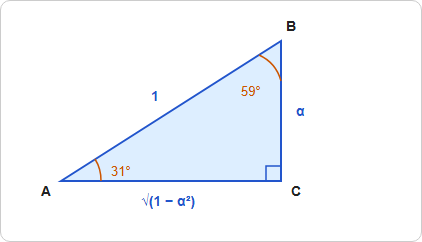 Formula Used:
⇒ sin θ = Perpendicular / Hypotenuse
⇒ cot θ = Base / Perpendicular
Calculations:
⇒ We can express sin 31° = α / 1
⇒ Let Perpendicular for angle A (side BC) = α and Hypotenuse (side AB) = 1
⇒ By Pythagoras theorem: Base (AC) = √(AB² − BC²)
⇒ AC = √(1² − α²) = √(1 − α²)
⇒ The third angle of the right-angled triangle = 180° − (90° + 31°) = 59°
⇒ For angle B (59°), the Base (adjacent side) is BC = α
⇒ For angle B (59°), the Perpendicular (opposite side) is AC = √(1 − α²)
⇒ cot 59° = Base / Perpendicular
⇒ cot 59° = α / √(1 − α²)
∴ The correct answer is α / √(1 − α²).
Additional Information
Complementary Angles in Trigonometry
Two angles are complementary if their sum is 90°. Key relations: sin(90°−θ) = cos θ, tan(90°−θ) = cot θ, and sec(90°−θ) = cosec θ.
Pythagorean Identities
The fundamental identities are: sin²θ + cos²θ = 1, 1 + tan²θ = sec²θ, and 1 + cot²θ = cosec²θ.
Trigonometric Ratios
For any acute angle θ in a right triangle: tan θ = Perpendicular / Base, and cot θ = Base / Perpendicular. Therefore, cot θ = 1 / tan θ.
</p
Q3 · Trigonometry
If 1 / (1 - sin θ) + 1 / (1 + sin θ) = 4 sec θ, (0 < θ < 90°), then the value of (cot θ + cosec θ) is:
- √3
- √6
- √2
- √5
Answer aur solution dekho
Archived marked answer: A
Shortcut Trick
Using the value-putting method, let us check for θ = 60°:
LHS = 1 / (1 − √3/2) + 1 / (1 + √3/2) = (1 + √3/2 + 1 − √3/2) / (1 − 3/4) = 2 / (1/4) = 8
RHS = 4 sec 60° = 4 × 2 = 8
Since LHS = RHS, θ = 60° is the correct angle.
Required expression = cot 60° + cosec 60° = 1/√3 + 2/√3 = 3/√3 = √3
∴ The correct answer is √3.
Alternate Method
Given:
1 / (1 − sin θ) + 1 / (1 + sin θ) = 4 sec θ
Formula Used:
(a − b)(a + b) = a² − b²
sin² θ + cos² θ = 1
sec θ = 1 / cos θ
Calculation:
⇒ (1 + sin θ + 1 − sin θ) / [(1 − sin θ)(1 + sin θ)] = 4 sec θ
⇒ 2 / (1 − sin² θ) = 4 sec θ
⇒ 2 / cos² θ = 4 sec θ
⇒ 2 sec² θ = 4 sec θ
Since 0
Additional Information
Important Trigonometric Identities
sin² θ + cos² θ = 1 | 1 + tan² θ = sec² θ | 1 + cot² θ = cosec² θ
Values at 60°
sin 60° = √3/2, cos 60° = 1/2, tan 60° = √3, cot 60° = 1/√3, sec 60° = 2, cosec 60° = 2/√3
Reciprocal Relations
cosec θ = 1 / sin θ | sec θ = 1 / cos θ | cot θ = cos θ / sin θ
</p
Q4 · Trigonometry
If p(√3 + cot 30°) = tan³60° - 2sin60°, then the value of p is:
- -1
- 2√3
- 1
- √3
Answer aur solution dekho
Archived marked answer: C
Shortcut Trick
Substitute the standard trigonometric values directly into the given equation:
⇒ p(√3 + √3) = (√3)³ − 2 × (√3 / 2)
⇒ p(2√3) = 3√3 − √3
⇒ p(2√3) = 2√3
⇒ p = 1
∴ The correct answer is 1.
Alternate Method
Given:
p(√3 + cot 30°) = tan³ 60° − 2sin 60°
Formula Used:
cot 30° = √3
tan 60° = √3
sin 60° = √3 / 2
Calculations:
⇒ p(√3 + √3) = (√3)³ − 2 × (√3 / 2)
⇒ p(2√3) = 3√3 − √3
⇒ p(2√3) = 2√3
⇒ p = 2√3 ÷ 2√3
⇒ p = 1
∴ The correct answer is 1.
Additional Information
Standard Trigonometric Values
- sin 30° = 1/2 | sin 45° = 1/√2 | sin 60° = √3/2
- cos 30° = √3/2 | cos 45° = 1/√2 | cos 60° = 1/2
- tan 30° = 1/√3 | tan 45° = 1 | tan 60° = √3
Key Trigonometric Identities
- sin²θ + cos²θ = 1
- 1 + tan²θ = sec²θ
- 1 + cot²θ = cosec²θ
Reciprocal Relations
- cosec θ = 1 ÷ sin θ
- sec θ = 1 ÷ cos θ
- cot θ = 1 ÷ tan θ = cos θ ÷ sin θ
</p
Q5 · Mensuration 2D
One-quarter of a circular pizza of radius 21 cm was removed from the whole pizza. What is the perimeter (in cm) of the remaining pizza? (Use π = 22/7)
- 99
- 141
- 128
- 131
Answer aur solution dekho
Archived marked answer: B
Shortcut Trick
When 1/4 of a circular pizza is removed, the remaining shape consists of 3/4 of the original circumference plus two straight edges equal to the radius.
Perimeter = (3/4) × 2πr + 2r
Perimeter = (3/4) × 2 × (22/7) × 21 + (2 × 21)
Perimeter = 99 + 42 = 141 cm
∴ The correct answer is 141 cm.
Alternate Method
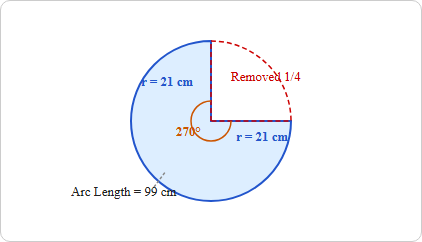 Given:
Radius of the circular pizza (r) = 21 cm
Part removed = 1/4 of the pizza
Formula Used:
Perimeter of remaining shape = Length of remaining arc + 2 × Radius
Length of arc = (θ ÷ 360°) × 2πr
Calculations:
⇒ Angle of the remaining pizza (θ) = 360° − (1/4 × 360°) = 270°
⇒ Length of remaining arc = (270° ÷ 360°) × 2 × (22/7) × 21
⇒ Length of remaining arc = (3/4) × 2 × 22 × 3
⇒ Length of remaining arc = (3/4) × 132 = 99 cm
⇒ Total straight edges = 2 × Radius = 2 × 21 = 42 cm
⇒ Perimeter of remaining pizza = 99 + 42 = 141 cm
∴ The correct answer is 141 cm.
Additional Information
Perimeter of a Semicircle
A semicircle's perimeter includes half the circumference and the full straight diameter: P = πr + 2r = r(π + 2).
Length of an Arc
The length of an arc is proportional to its central angle θ: Arc Length = (θ ÷ 360°) × 2πr.
Area of a Sector
The area of a sector with central angle θ is a fraction of the total area: Area = (θ ÷ 360°) × πr².
</p
Q6 · Mensuration 2D
If ∆PQR ≅ ∆ABC, AB = 6 cm, ∠B = 50º and ∠A = 70º, then which of the following is true?
- QR = 6 cm, ∠Q = 60º
- QR = 6 cm, ∠R = 60º
- QP = 6 cm, ∠P = 60º
- QP = 6 cm, ∠R = 60º
Answer aur solution dekho
Archived marked answer: D
Shortcut Trick
For congruent triangles ΔPQR ≅ ΔABC, the order of vertices directly dictates the corresponding parts.
Side PQ corresponds directly to side AB, so PQ = AB = 6 cm (thus QP = 6 cm).
Using the angle sum property in ΔABC, ∠C = 180º − (70º + 50º) = 60º.
Angle R corresponds directly to Angle C, so ∠R = 60º.
Matching our findings with the given options, we find that QP = 6 cm and ∠R = 60º is the only true statement.
∴ The correct answer is QP = 6 cm, ∠R = 60º.
Alternate Method
A
B
C
P
Q
R
6 cm
70º
50º
60º
6 cm
70º
50º
60º
ΔABC
ΔPQR
Given:
⇒ ΔPQR ≅ ΔABC
⇒ AB = 6 cm, ∠B = 50º and ∠A = 70º
In ΔABC:
⇒ The sum of interior angles in a triangle is exactly 180º
⇒ ∠A + ∠B + ∠C = 180º
⇒ 70º + 50º + ∠C = 180º
⇒ 120º + ∠C = 180º
⇒ ∠C = 60º
Using CPCTC (Corresponding Parts of Congruent Triangles are Congruent):
⇒ Since ΔPQR ≅ ΔABC, their corresponding sides and angles must be perfectly identical.
Corresponding Sides:
⇒ PQ = AB, QR = BC, and PR = AC
⇒ Since AB = 6 cm, we have PQ = 6 cm (or QP = 6 cm)
Corresponding Angles:
⇒ ∠P = ∠A = 70º
⇒ ∠Q = ∠B = 50º
⇒ ∠R = ∠C = 60º
Checking the given options sequentially:
⇒ Option 1: QR = 6 cm, ∠Q = 60º (Incorrect, QP = 6 cm and ∠Q = 50º)
⇒ Option 2: QR = 6 cm, ∠R = 60º (Incorrect, QP = 6 cm)
⇒ Option 3: QP = 6 cm, ∠P = 60º (Incorrect, ∠P = 70º)
⇒ Option 4: QP = 6 cm, ∠R = 60º (Correct)
∴ The correct answer is QP = 6 cm, ∠R = 60º.
Additional Information
Congruence of Triangles
Two triangles are strictly congruent if they share the exact same shape and size. The primary criteria for congruence are SSS (Side-Side-Side), SAS (Side-Angle-Side), ASA (Angle-Side-Angle), AAS (Angle-Angle-Side), and RHS (Right angle-Hypotenuse-Side).
CPCTC Rule
CPCTC stands for "Corresponding Parts of Congruent Triangles are Congruent." It indicates that if two triangles are proven congruent, all of their corresponding interior angles and boundary sides are perfectly equal.
Angle Sum Property
The sum of all three interior angles in any triangle inherently adds up to exactly 180º. Using the standard formula: ∠A + ∠B + ∠C = 180º.
</p
Q7 · Mensuration 2D
What is the height (in m) of a conical water tank having radius of 70 m and volume of 46,200 m³? (Use π = 22/7)
- 27
- 9
- 18
- 54
Answer aur solution dekho
Archived marked answer: B
Shortcut Trick
Direct formula for height of a cone: h = (3 × Volume) ÷ (π × r²)
⇒ h = (3 × 46200) ÷ (22/7 × 70 × 70)
⇒ h = 138600 ÷ 15400
⇒ h = 9
∴ The correct answer is 9 m.
Alternate Method
Given:
Radius of the conical tank (r) = 70 m
Volume of the conical tank (V) = 46,200 m³
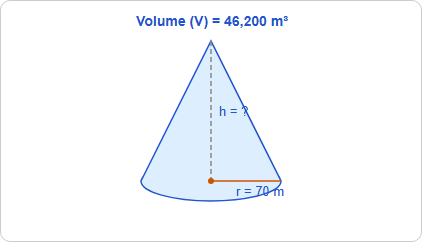 Formula Used:
Volume of a cone = 1/3 × π × r² × h
Calculations:
⇒ 46200 = 1/3 × 22/7 × 70 × 70 × h
⇒ 46200 = 1/3 × 22 × 10 × 70 × h
⇒ 46200 = 15400/3 × h
⇒ h = (46200 × 3) ÷ 15400
⇒ h = 3 × 3 = 9
∴ The correct answer is 9 m.
Additional Information
Slant Height of a Cone
It is the distance from the apex to any point on the circumference of the base: l = √(r² + h²)
Curved Surface Area (CSA)
The area of the curved surface (excluding the base) is given by: CSA = π × r × l
Total Surface Area (TSA)
The sum of the curved surface area and the base area: TSA = π × r × (r + l)
</p
Q8 · Mensuration 2D
From a circle of radius 7 units, an arc length is cut by a chord of length 7 units. What is the arc length of the smaller portion (in units)?
- 8π/3
- 7π/6
- 7π/3
- 7π/4
Answer aur solution dekho
Archived marked answer: C
Shortcut Trick
When the length of a chord is equal to the radius of the circle, the triangle formed by the chord and the two radii is equilateral.
Thus, the central angle subtended by the chord is 60° or π/3 radians.
Arc length = Radius × Central angle (in radians)
Arc length = 7 × π/3 = 7π/3 units.
∴ The correct answer is 7π/3 units.
Alternate Method
Given:
Radius of the circle (r) = 7 units
Length of the chord = 7 units
Formula Used:
Arc length = 2 × π × r × (θ ÷ 360°)
Where θ is the central angle in degrees.
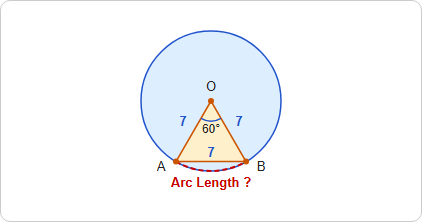 Calculation:
⇒ Let the chord be AB and the center of the circle be O.
⇒ In ΔOAB, side OA = OB = Radius = 7 units.
⇒ The given length of the chord AB = 7 units.
⇒ Since all three sides OA, OB, and AB are equal, ΔOAB is an equilateral triangle.
⇒ In an equilateral triangle, all internal angles are exactly 60°.
⇒ Therefore, the central angle subtended by the chord, θ = 60°.
⇒ Arc length of the minor portion = 2 × π × 7 × (60° ÷ 360°)
⇒ Arc length = 14π × (1 ÷ 6)
⇒ Arc length = 7π/3 units
∴ The correct answer is 7π/3 units.
Additional Information
Major Arc Length
The major arc can be calculated by subtracting the minor arc from the full circumference: Major Arc = 2πr − Minor Arc, or by using the reflex angle (360° − θ).
Area of a Sector
The area of the sector formed by the central angle θ is given by (θ ÷ 360°) × πr².
Area of a Segment
The area of the minor segment enclosed by the chord and the minor arc is found by subtracting the area of the central triangle from the overall area of the sector.
</p
Q9 · Algebra
Simplify the following expression.
((x - y)³ + (y - z)³ + (z - x)³)/((x - y)(y - z)(z - x))
- 3
- 1
- 0
- 2
Answer aur solution dekho
Archived marked answer: A
Shortcut Trick
If a + b + c = 0, then a³ + b³ + c³ = 3abc.
Here, let the terms be (x − y), (y − z), and (z − x).
Since (x − y) + (y − z) + (z − x) = 0, their cube sum is 3(x − y)(y − z)(z − x).
Dividing this by the denominator (x − y)(y − z)(z − x) leaves only 3.
∴ The correct answer is 3.
Alternate Method
Given:
Expression: [(x − y)³ + (y − z)³ + (z − x)³] ÷ [(x − y)(y − z)(z − x)]
Formula Used:
If a + b + c = 0, then a³ + b³ + c³ = 3abc
Calculation:
⇒ Let a = x − y, b = y − z, and c = z − x
⇒ Summing the terms: a + b + c = (x − y) + (y − z) + (z − x)
⇒ a + b + c = x − y + y − z + z − x = 0
⇒ According to the identity, a³ + b³ + c³ = 3abc
⇒ Substituting the assumed variables back:
⇒ (x − y)³ + (y − z)³ + (z − x)³ = 3(x − y)(y − z)(z − x)
⇒ Now substitute the numerator in the given expression:
⇒ Expression = [3(x − y)(y − z)(z − x)] ÷ [(x − y)(y − z)(z − x)]
⇒ The common terms cancel out, leaving the final value as 3
∴ The correct answer is 3.
Additional Information
Standard Identity for Cubes
a³ + b³ + c³ − 3abc = (a + b + c)(a² + b² + c² − ab − bc − ca)
Cubes of Binomials
(a + b)³ = a³ + b³ + 3ab(a + b)
(a − b)³ = a³ − b³ − 3ab(a − b)
Sum and Difference of Cubes
a³ + b³ = (a + b)(a² − ab + b²)
a³ − b³ = (a − b)(a² + ab + b²)
</p
Q10 · Algebra
The solution of the following equations is:
5x + 4y - 8z = 1
7x - 9y + z = -1
2x + 3y - 4z = 1
- x = - 1,y = 1,z = 1
- x = 1,y = 1,z = 1
- x = 1,y = - 1,z = 1
- x = 1,y = 1,z = - 1
Answer aur solution dekho
Archived marked answer: B
Shortcut Trick
For systems of linear equations, substituting the options is the fastest method.
Let's check Option 2: x = 1, y = 1, z = 1
Eq 1: 5(1) + 4(1) − 8(1) = 5 + 4 − 8 = 1 (Satisfied)
Eq 2: 7(1) − 9(1) + 1 = 7 − 9 + 1 = −1 (Satisfied)
Eq 3: 2(1) + 3(1) − 4(1) = 2 + 3 − 4 = 1 (Satisfied)
∴ The correct answer is x = 1, y = 1, z = 1.
Alternate Method
Given:
5x + 4y − 8z = 1 ---- (i)
7x − 9y + z = −1 ---- (ii)
2x + 3y − 4z = 1 ---- (iii)
Method Used:
Elimination method to solve the linear equations systematically.
Calculation:
⇒ Multiply equation (ii) by 8 and add to equation (i):
⇒ (5x + 4y − 8z) + 8 × (7x − 9y + z) = 1 + 8 × (−1)
⇒ 5x + 4y − 8z + 56x − 72y + 8z = 1 − 8
⇒ 61x − 68y = −7 ---- (iv)
⇒ Multiply equation (ii) by 4 and add to equation (iii):
⇒ (2x + 3y − 4z) + 4 × (7x − 9y + z) = 1 + 4 × (−1)
⇒ 2x + 3y − 4z + 28x − 36y + 4z = 1 − 4
⇒ 30x − 33y = −3
⇒ Divide by 3: 10x − 11y = −1 ---- (v)
⇒ Multiply equation (v) by 61 and equation (iv) by 10 to equate x coefficients:
⇒ 610x − 671y = −61
⇒ 610x − 680y = −70
⇒ Subtracting the two equations gives: 9y = 9 ⇒ y = 1
⇒ Substitute y = 1 in (v): 10x − 11(1) = −1 ⇒ 10x = 10 ⇒ x = 1
⇒ Substitute x = 1, y = 1 in (ii): 7(1) − 9(1) + z = −1 ⇒ −2 + z = −1 ⇒ z = 1
∴ The correct answer is x = 1, y = 1, z = 1.
Additional Information
Cramer's Rule
A method to solve systems of linear equations using determinants where x = Dₓ ÷ D, y = Dy ÷ D, and z = Dz ÷ D.
Consistency of Equations
If determinant D ≠ 0, the system has a unique solution. If D = 0 and at least one numerator determinant is non-zero, the system has no solution.
Elimination Method
A step-by-step algebraic process of multiplying and adding/subtracting equations to eliminate one variable at a time until a single variable value is found.
</p
Q11 · Algebra
At a cafe, Rama bought drinks for her 7 friends at ₹240. Some of them wanted coffee, while others wanted black tea. A regular cup of coffee cost ₹40 and a regular cup of black tea cost ₹30. How many cups of tea did she purchase?
- 5
- 4
- 3
- 6
Answer aur solution dekho
Archived marked answer: B
Shortcut Trick
By using the Assumption Method:
Assume all 7 cups bought were black tea, then total expected cost = 7 × 30 = ₹210.
Difference from the actual total cost = 240 − 210 = ₹30.
Cost difference between one coffee and one tea = 40 − 30 = ₹10.
Number of coffee cups = Total difference ÷ Unit difference = 30 ÷ 10 = 3 cups.
Number of tea cups = Total cups − coffee cups = 7 − 3 = 4 cups.
∴ The correct answer is 4 cups.
Alternate Method
- - If All Coffee
If All Tea
Actual Total
280
210
240
30
40
Ratio = 30 : 40 = 3 : 4
Coffee : Tea
Total = 3 + 4 = 7 cups
Given:
Total cups of drinks = 7
Total amount spent = ₹240
Cost of 1 cup of coffee = ₹40
Cost of 1 cup of tea = ₹30
Calculations:
Let the number of cups of coffee be c and cups of tea be t.
⇒ c + t = 7
⇒ 40c + 30t = 240
From the first equation, substituting c = 7 − t into the second equation:
⇒ 40(7 − t) + 30t = 240
⇒ 280 − 40t + 30t = 240
⇒ 280 − 10t = 240
⇒ 10t = 40
⇒ t = 4
∴ The correct answer is 4 cups.
Additional Information
Assumption Method (Shift Method)
A rapid mental calculation technique for distribution and mixture problems. If items belong to two groups A and B, assume all items belong to group A, find the total deviation from actual, and divide by the per-unit difference between A and B to quickly find the quantity of group B.
Alligation Method
Used to find the exact ratio in which two distinct components are mixed to produce a mixture of a target overall value. Formula: Ratio = (Higher Value − Mean Value) : (Mean Value − Lower Value).
Linear Equations in Two Variables
A system of algebraic equations like ax + by = c and px + qy = r. They can be solved reliably using substitution, elimination, or cross-multiplication methods to find the exact separate quantities of two unknown variables.
Q12 · Profit and Loss
An article is sold at a profit of 250%. What is the ratio of its cost price to selling price?
- 2 : 5
- 5 : 2
- 2 : 7
- 7 : 2
Answer aur solution dekho
Archived marked answer: C
Shortcut Trick
Let the Cost Price (CP) = 100 units.
Profit is given as 250%, so Profit = 250 units.
Selling Price (SP) = CP + Profit = 100 + 250 = 350 units.
Required Ratio (CP : SP) = 100 : 350 = 2 : 7.
∴ The correct answer is 2 : 7.
Alternate Method
Given:
Profit percentage = 250%
Formula Used:
Selling Price (SP) = Cost Price (CP) + Profit
Profit = (Profit% ÷ 100) × CP
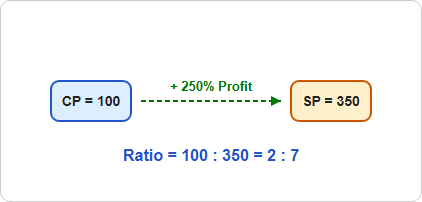 Calculations:
⇒ Let the Cost Price (CP) be x.
⇒ Profit = 250% of x = 2.5x
⇒ Selling Price (SP) = CP + Profit
⇒ SP = x + 2.5x = 3.5x
⇒ Ratio of CP to SP = CP ÷ SP
⇒ Ratio = x ÷ 3.5x
⇒ Ratio = 1 ÷ 3.5
⇒ Multiply by 10 to remove the decimal: Ratio = 10 ÷ 35
⇒ Dividing both sides by 5: Ratio = 2 ÷ 7
∴ The correct answer is 2 : 7.
Additional Information
Cost Price (CP)
The actual amount paid to purchase an article or the price at which it is manufactured.
Selling Price (SP)
The final price at which an article is sold to a customer. A transaction results in profit when SP > CP.
Important Profit Formulas
Profit % = (Profit ÷ CP) × 100
SP = CP × [(100 + Profit %) ÷ 100]
</p
Q13 · Profit and Loss
If the successive discount by 10%,15%, then the single equivalent rate of discount is:
- 32.3%
- 24.2%
- 43.4%
- 23.5%
Answer aur solution dekho
Archived marked answer: D
Shortcut Trick
For two successive discounts of a% and b%, the equivalent single discount is given by (a + b − ab/100)%
⇒ Here, a = 10 and b = 15
⇒ Equivalent Discount = 10 + 15 − (10 × 15) ÷ 100
⇒ 25 − 1.5 = 23.5%
∴ The correct answer is 23.5%.
Alternate Method
Given:
First discount = 10%
Second discount = 15%
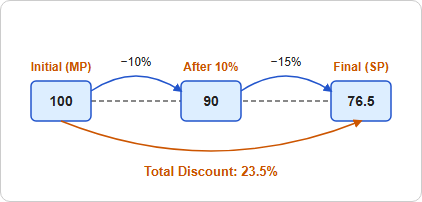 Calculations:
⇒ Let the Marked Price (MP) = 100 units
⇒ Selling price after 1st discount = 100 − (10 ÷ 100 × 100) = 90
⇒ Selling price after 2ⁿd discount = 90 − (15 ÷ 100 × 90) = 90 − 13.5 = 76.5
⇒ Single equivalent discount = Initial MP − Final SP
⇒ Single equivalent discount = 100 − 76.5 = 23.5
⇒ Equivalent discount percentage = (23.5 ÷ 100) × 100 = 23.5%
∴ The correct answer is 23.5%.
Additional Information
Three Successive Discounts
If there are three successive discounts of a%, b% and c%, the effective selling price can be calculated directly by: SP = MP × (100 − a)/100 × (100 − b)/100 × (100 − c)/100.
Ratio of CP and MP
The relationship between Cost Price, Marked Price, Profit% and Discount% is given by the formula: CP ÷ MP = (100 − Discount%) ÷ (100 + Profit%).
</p
Q14 · Time and Work
There are two pipes used to fill a tank and when operated together, they can fill the tank in 20 minutes. If one pipe can fill the tank two and a half times as quickly as the other, then the faster pipe alone can fill the tank in:
- 30 min
- 32 min
- 34 min
- 28 min
Answer aur solution dekho
Archived marked answer: D
Shortcut Trick
Efficiency ratio of Slower to Faster pipe = 1 : 2.5 = 2 : 5
Combined efficiency = 2 + 5 = 7 units/min
Total tank capacity = Combined efficiency × Time together = 7 × 20 = 140 units
Time taken by Faster pipe alone = Total capacity ÷ Faster pipe efficiency = 140 ÷ 5
∴ The correct answer is 28 min.
Alternate Method
Given:
Time taken by both pipes operated together = 20 minutes
The faster pipe fills the tank 2.5 times as quickly as the slower pipe.
Formula Used:
Total Work = Efficiency × Time
Calculations:
⇒ Let the efficiency of the slower pipe be 2 units/min.
⇒ Efficiency of the faster pipe = 2 × 2.5 = 5 units/min.
⇒ Total efficiency when both operate together = 2 + 5 = 7 units/min.
⇒ Total Work (Tank Capacity) = Total Efficiency × Time taken = 7 × 20 = 140 units.
Pipe
Time (min)
Total Work
Efficiency
Faster Pipe
140 ÷ 5 = 28
140
5
Slower Pipe
140 ÷ 2 = 70
2
Together
20
7
⇒ Time taken by the faster pipe alone = Total Work ÷ Efficiency of faster pipe
⇒ Time = 140 ÷ 5 = 28 minutes.
∴ The correct answer is 28 min.
Additional Information
Pipes and Cisterns Rule
If two pipes can independently fill a tank in x and y hours, their combined time to fill the tank is given by the formula: (x × y) ÷ (x + y) hours.
Efficiency vs Time
Efficiency is inversely proportional to time. A pipe that is n times faster will take 1/n of the time compared to the slower pipe to complete the same amount of work.
Total Work Concept
Total Work or Tank Capacity is always constant and can be easily calculated as the product of total combined efficiency and the time taken working together.
</p
Q15 · Number System
If 321y72 is a multiple of 6, where y is a digit, what is the least value of y?
- 3
- 0
- 7
- 2
Answer aur solution dekho
Archived marked answer: B
Shortcut Trick
Divisibility rule of 6 → The number must be divisible by both 2 and 3.
The number 321y72 ends in 2, so it is already divisible by 2.
For divisibility by 3, the sum of digits (3 + 2 + 1 + y + 7 + 2 = 15 + y) must be a multiple of 3.
Since 15 is already a multiple of 3, the least digit value y can take is 0.
∴ The correct answer is 0.
Alternate Method
Given:
The number 321y72 is a multiple of 6.
Concept Used:
A number is a multiple of 6 if it is completely divisible by both 2 and 3.
Divisibility by 3 requires the sum of all digits to be a multiple of 3.
Calculation:
⇒ The last digit of 321y72 is 2, which is an even number. Thus, it satisfies the divisibility rule of 2.
⇒ To satisfy the divisibility rule of 3, we calculate the sum of its digits.
⇒ Sum of digits = 3 + 2 + 1 + y + 7 + 2 = 15 + y
⇒ For (15 + y) to be a multiple of 3, the possible sums are 15, 18, 21, 24, etc.
⇒ If 15 + y = 15 ⇒ y = 0
⇒ If 15 + y = 18 ⇒ y = 3
⇒ If 15 + y = 21 ⇒ y = 6
⇒ If 15 + y = 24 ⇒ y = 9
⇒ The possible single-digit values for y are 0, 3, 6, and 9.
⇒ The least value among these possibilities is 0.
∴ The correct answer is 0.
Additional Information
Divisibility by 4
A number is divisible by 4 if the number formed by its last two digits is divisible by 4.
Divisibility by 8
A number is divisible by 8 if the number formed by its last three digits is divisible by 8.
Divisibility by 9
A number is divisible by 9 if the sum of all its digits is a multiple of 9.
Divisibility by 11
A number is divisible by 11 if the difference between the sum of the digits at odd positions and the sum of the digits at even positions is 0 or a multiple of 11.
</p
Q16 · Time and Distance
A boat can travel 78 km upstream and back in a total of 32 hours. It can travel 15 km upstream and 52 km downstream in a total of 9 hours. How much distance will the boat cover in 12 hours in still water?
- 92 km
- 96 km
- 104 km
- 100 km
Answer aur solution dekho
Archived marked answer: B
Shortcut Trick
By observing the downstream distances (78 km and 52 km), we can intuitively check their common factor 13 as the downstream speed (D).
If D = 13 km/h, time taken for 78 km downstream = 78 ÷ 13 = 6 hours.
Upstream time for 78 km = Total time 32 − 6 = 26 hours, giving upstream speed (U) = 78 ÷ 26 = 3 km/h.
Checking Case 2: (15 ÷ 3) + (52 ÷ 13) = 5 + 4 = 9 hours (Condition perfectly satisfied).
Speed in still water = (13 + 3) ÷ 2 = 8 km/h → Distance in 12 hours = 8 × 12 = 96 km.
∴ The correct answer is 96 km.
Alternate Method
Given:
Total time for 78 km upstream and downstream = 32 hours
Total time for 15 km upstream and 52 km downstream = 9 hours
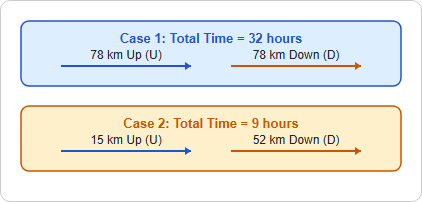 Formula Used:
Time = Distance ÷ Speed
Speed in still water = (Downstream Speed + Upstream Speed) ÷ 2
Calculation:
Let upstream speed be U and downstream speed be D.
According to Case 1:
⇒ 78/U + 78/D = 32
⇒ 1/U + 1/D = 32/78 = 16/39 --- (1)
According to Case 2:
⇒ 15/U + 52/D = 9
Splitting 52/D into 15/D + 37/D to substitute equation (1) efficiently:
⇒ 15(1/U + 1/D) + 37/D = 9
Substituting the value of (1/U + 1/D) from equation (1):
⇒ 15 × (16/39) + 37/D = 9
⇒ (5 × 16)/13 + 37/D = 9
⇒ 80/13 + 37/D = 9
⇒ 37/D = 9 − 80/13
⇒ 37/D = (117 − 80) / 13 = 37/13
⇒ D = 13 km/h
Substitute D = 13 in equation (1):
⇒ 1/U + 1/13 = 16/39
⇒ 1/U = 16/39 − 3/39 = 13/39
⇒ 1/U = 1/3
⇒ U = 3 km/h
Now, finding the speed in still water:
⇒ Speed in still water = (13 + 3) ÷ 2 = 16 ÷ 2 = 8 km/h
Distance covered in 12 hours in still water:
⇒ Distance = 8 × 12 = 96 km
∴ The correct answer is 96 km.
Additional Information
Speed of Boat in Still Water
Calculated by the formula v = (D + U) ÷ 2, where D is downstream speed and U is upstream speed.
Speed of Stream (Current)
Calculated by the formula s = (D − U) ÷ 2, representing the velocity of the flowing water.
Upstream & Downstream Rules
Downstream speed (D) = v + s (moving in the direction of the stream) and Upstream speed (U) = v − s (moving against the stream).
</p
Q17 · Data Interpretation
The pie chart below shows the per cent sale of different fruits in a day for a shop.
If the total number of fruits sold by a fruit seller in a day is 1200, what is the combined central angle in the pie chart for oranges and apples?
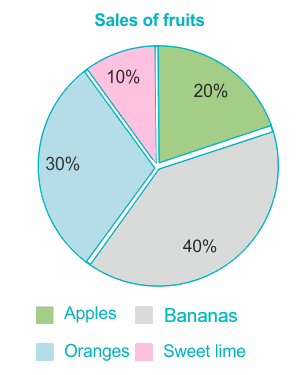
- 220°
- 90°
- 180°
- 160°
Answer aur solution dekho
Archived marked answer: C
Given:
Total fruits sold = 1200
Formula Used:
The total central angle for a pie chart is 360°.
The central angle for any section is calculated by:
{Central Angle} = ((Percentage of fruit)/100) times 360^circ
Calculations:
Assume the percentage of oranges = X% and the percentage of apples = Y% (from the pie chart).
The central angle for oranges = (X/100) times 360
The central angle for apples = (Y/100) times 360
Combined central angle = (X/100 times 360) + (Y/100 times 360)
⇒ Combined central angle = 360 × (X + Y) / 100
If the percentage of oranges = 30% and apples = 20%,
The combined central angle = 360 × (30 + 20) / 100
⇒ Combined central angle = 360 × 50 / 100
⇒ Combined central angle = 180°
Therefore, the combined central angle for oranges and apples is 180°.
Q18 · Data Interpretation
The following table shows the sale (in lakh rupees) of six commodities in a provision store from August 2012 to October 2012.
The total combined sale of dry fruits, sugar and rice for the period from August 2012 to October 2012 is what percentage (rounded off to the nearest whole number) of the total combined sale of tea, pulses and flour?
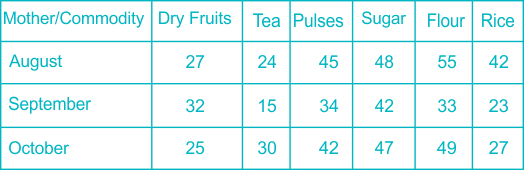
- 94%
- 98%
- 95%
- 96%
Answer aur solution dekho
Archived marked answer: D
Given:
We need to calculate the percentage of the total combined sale of Dry Fruits, Sugar, and Rice compared to the total combined sale of Tea, Pulses, and Flour for the months of August, September, and October.
Calculation:
Step 1: Total combined sale of Dry Fruits, Sugar, and Rice (Dry Fruits, Sugar, Rice)
Dry Fruits: 27 + 32 + 25 = 84
Sugar: 48 + 42 + 47 = 137
Rice: 42 + 23 + 27 = 92
Total combined Dry Fruits, Sugar, Rice = 84 + 137 + 92 = 313
Step 2: Total combined sale of Tea, Pulses, and Flour (Tea, Pulse, Flour)
Tea: 24 + 15 + 30 = 69
Pulses: 45 + 34 + 42 = 121
Flour: 55 + 33 + 49 = 137
Total combined Tea, Pulses, and Flour = 69 + 121 + 137 = 327
Step 3: Percentage Calculation
Percentage = (Total DSR / Total TPF) × 100
Percentage = (313 / 327) × 100 ≈ 95.7%
Rounded to the nearest whole number: 96%
∴ The total combined sale of Dry Fruits, Sugar, and Rice is 96% of the total combined sale of Tea, Pulses, and Flour.
Q19 · Data Interpretation
The given bar graph shows the turnover of five companies (in crores).
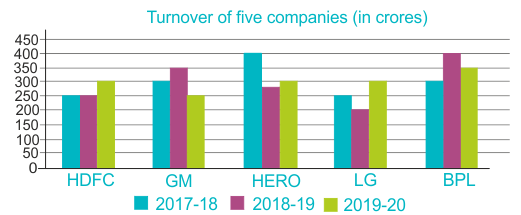 What is the difference between the average sales turnover of all the companies put together between the years 2018-2019 and 2019-2020?
- ₹5 crore
- ₹2 crore
- ₹6.5 crore
- ₹3.5 crore
Answer aur solution dekho
Archived marked answer: A
Given:
Sales turnover data for the companies for the years 2018-2019 and 2019-2020 (in crores):
HDFC: 2018-19 = 250, 2019-20 = 300
GM: 2018-19 = 350, 2019-20 = 250
HERO: 2018-19 = 275, 2019-20 = 300
LG: 2018-19 = 200, 2019-20 = 300
BPL: 2018-19 = 400, 2019-20 = 350
Formula used:
Average sales turnover = (Sum of sales turnover for al
Q20 · Simplification
Simplify the following expression. [(70 - 60 ÷ 2 of 6) + (20 - 10) ÷ 10] + 600 ÷ 25 of (2 ×3) x (2 of 3) + 2 of 5.
- 90
- 100
- 99
- 110
Answer aur solution dekho
Archived marked answer: B
Given:
Simplify the following expression:
[(70 - 60 ÷ 2 of 6) + (20 - 10) ÷ 10] + 600 ÷ 25 of (2 ×3) x (2 of 3) + 2 of 5.
Formula Used:
Order of operations (BODMAS/BIDMAS): Brackets, Orders (i.e. powers and square roots, etc.), Division and Multiplication, Addition and Subtraction.
Calculation:
First, solve inside the brackets and 'of' operations:
60 ÷ 2 of 6 ⇒ 60 ÷ (2 × 6) ⇒ 60 ÷ 12 ⇒ 5
Now, the expression becomes:
[(70 - 5) + (20 - 10) ÷ 10] + [600 ÷ 25 of (2 × 3) × (2 of 3) + 2 of 5]
Simplify the brackets:
(70 - 5) ⇒ 65
(20 - 10) ⇒ 10
Now, the expression becomes:
[65 + 10 ÷ 10] + [600 ÷ 25 of (2 × 3) × (2 of 3) + 2 of 5]
Simplify the division and 'of' operations:
25 of (2 × 3) ⇒ 25 of 6 ⇒ 25 × 6 ⇒ 150
600 ÷ 150 ⇒ 4
2 of 3 ⇒ 2 × 3 ⇒ 6
Now the expression becomes:
66 + 4 × 6 + 2 of 5
Simplify the remaining 'of' operation:
2 of 5 ⇒ 2 × 5 ⇒ 10
Now the expression becomes:
66 + 4 × 6 + 10
Simplify the multiplication:
4 × 6 ⇒ 24
Now the expression becomes:
66 + 24 + 10 = 100
The simplified value of the expression is 100.
Q21 · Proportion
If A:B = 6:8 and B:C = 5:10, then A:B:C is:
- 3:4:8
- 1:3:4
- 4:3:2
- 1:2:4
Answer aur solution dekho
Archived marked answer: A
Shortcut Trick
Simplify the ratios first: A : B = 3 : 4 and B : C = 1 : 2
Write them aligned by the common term B:
A : B = 3 : 4
B : C = 1 : 2
Use the inverted 'N' multiplication pattern to combine:
A : B : C = (3 × 1) : (4 × 1) : (4 × 2) = 3 : 4 : 8
∴ The correct answer is 3:4:8.
Alternate Method
Given:
A : B = 6 : 8
B : C = 5 : 10
Concept Used:
To combine two overlapping ratios A:B and B:C, simplify them and multiply by suitable integers to make the common term (B) equal in both.
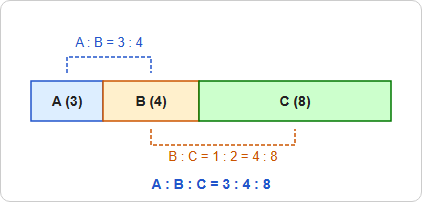 Calculations:
⇒ Simplifying the first ratio: A : B = 6 : 8 = 3 : 4
⇒ Simplifying the second ratio: B : C = 5 : 10 = 1 : 2
⇒ The value of B in the first ratio is 4, and in the second ratio is 1.
⇒ To make B equal in both, multiply the entire second ratio by 4.
⇒ B : C = (1 × 4) : (2 × 4) = 4 : 8
⇒ Now the value of B is 4 in both simplified ratios.
⇒ Combining the equivalent ratios directly gives A : B : C = 3 : 4 : 8
∴ The correct answer is 3:4:8.
Additional Information
Compound Ratio
When two or more ratios are multiplied term by term, the resulting ratio is called a compound ratio. For ratios a:b and c:d, the compound ratio is ac:bd.
Duplicate Ratio
The duplicate ratio of a given ratio a:b is the ratio of their squares, represented as a²:b². Similarly, the sub-duplicate ratio is √a:√b.
Proportion
An equation stating that two given ratios are equal is called a proportion. If a:b = c:d, they are in proportion, and the product of extremes equals the product of means (ad = bc).
</p
Q22 · Percentage
In an election between R and S, R gets 110% of the votes of S and beats S by 770 votes. If there were no invalid votes, then the total number of votes polled is:
- 17610
- 17160
- 16170
- 16710
Answer aur solution dekho
Archived marked answer: C
Shortcut Trick
Ratio of votes of R to S = 110 : 100 = 11 : 10.
Difference in ratio units = 11 − 10 = 1 unit.
Given winning margin = 1 unit = 770.
Total votes in ratio units = 11 + 10 = 21 units.
Total votes = 21 × 770 = 16170.
∴ The correct answer is 16170.
Alternate Method
Given:
Votes of R = 110% of votes of S.
R beats S by 770 votes.
There were no invalid votes.
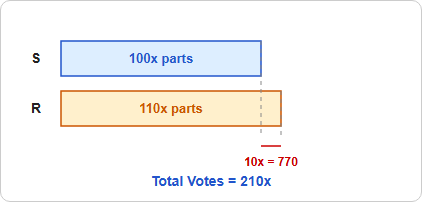 Let the number of votes received by S be 100x.
⇒ Votes received by R = 110% of 100x = 110x
⇒ Winning margin = Votes of R − Votes of S
⇒ 110x − 100x = 770
⇒ 10x = 770
⇒ x = 77
⇒ Total votes polled = Votes of R + Votes of S
⇒ Total votes polled = 110x + 100x = 210x
⇒ Total votes polled = 210 × 77 = 16170
∴ The correct answer is 16170.
Additional Information
Percentage Base Change
It is essential to identify the base value properly. The phrase "110% of the votes of S" means S's votes act as the 100% base for this comparison.
Election Concepts
In a valid two-candidate election, total valid votes = votes of winner + votes of loser. The winning margin is always the difference between their respective vote counts or percentage values on the same base.
</p
Q23 · Simple Interest
Pranav borrows a sum of ₹6,23,305 at the rate of 10% per annum simple interest. At the end of the first year, he repays ₹16,390 towards return of principal amount borrowed. If Pranav clears all pending dues at the end of the second year, including interest payment that accrued during the first year, how much does he pay (in ₹) at the end of the second year?
- 7,25,903
- 7,29,025
- 7,38,700
- 7,29,937
Answer aur solution dekho
Archived marked answer: D
Shortcut Trick
If no repayment was made, the total amount payable after 2 years = Principal + 2 years SI = 6,23,305 + (20% of 6,23,305) = 6,23,305 + 1,24,661 = ₹7,47,966.
Since ₹16,390 is repaid towards the principal after 1 year, this amount is deducted from the final dues.
Additionally, the 10% interest saved on this repaid amount for the 2nd year is also deducted = 10% of 16,390 = ₹1,639.
Total deduction from final amount = 16,390 + 1,639 = ₹18,029.
Final payment = 7,47,966 − 18,029 = ₹7,29,937.
∴ The correct answer is ₹7,29,937.
Alternate Method
Given:
Principal (P) = ₹6,23,305
Rate (R) = 10% p.a. simple interest
Repayment at the end of Year 1 = ₹16,390 (towards principal)
Formula Used:
Simple Interest = (P × R × T) ÷ 100
Start (Year 0)
Q24 · Mixture and Alligation
A shopkeeper mixes two types of rice costing ₹250/5 kg and ₹280/5 kg in the ratio 7 : 8. Find the net cost of the resultant mixture (per kg).
- ₹32.50
- ₹53.20
- ₹52.30
- ₹25.30
Answer aur solution dekho
Archived marked answer: B
Shortcut Trick
Cost of type 1 rice = 250 ÷ 5 = ₹50/kg
Cost of type 2 rice = 280 ÷ 5 = ₹56/kg
Difference in cost = ₹6, and total ratio parts = 7 + 8 = 15
Using deviation method: Average shifts towards type 2 by = 6 × (8 ÷ 15) = 3.2
Net cost of mixture = 50 + 3.2 = ₹53.20 per kg
∴ The correct answer is ₹53.20.
Alternate Method
Given:
Cost of type 1 rice = ₹250 per 5 kg
Cost of type 2 rice = ₹280 per 5 kg
Mixing ratio = 7 : 8
Formula Used:
Weighted Average Cost = (C₁ × Q₁ + C₂ × Q₂) ÷ (Q₁ + Q₂)
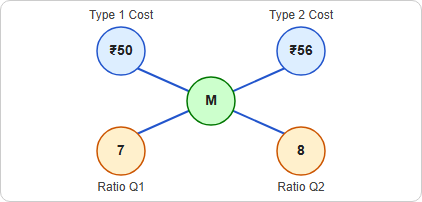 Calculations:
⇒ Cost of 1 kg of type 1 rice = 250 ÷ 5 = ₹50
⇒ Cost of 1 kg of type 2 rice = 280 ÷ 5 = ₹56
⇒ Let the quantities of the two types of rice be 7x and 8x.
⇒ Total Cost = (50 × 7x) + (56 × 8x)
⇒ Total Cost = 350x + 448x = 798x
⇒ Total Quantity = 7x + 8x = 15x
⇒ Net average cost = 798x ÷ 15x = 53.20
∴ The correct answer is ₹53.20.
Additional Information
Rule of Alligation
If two ingredients with prices C₁ and C₂ are mixed to get a mixture of average price M, the ratio of their quantities is (C₂ − M) : (M − C₁).
Weighted Average
When multiple components have quantities Q₁, Q₂ and values V₁, V₂, the net average is (Q₁V₁ + Q₂V₂) ÷ (Q₁ + Q₂).
Replacement Formula
If from a mixture of volume V, x volume is replaced with another substance n times, the final quantity of original substance left is V × (1 − x/V)ⁿ.
English
Q1 · Vocabulary
Select the most appropriate ANTONYM of the given word.
Barbarity
- Callous
- Compromise
- Compassion
- Rivalry
Answer aur solution dekho
Archived marked answer: C
The correct answer is: Option 3 i.e. Compassion.
Key Points
- The word "barbarity" means extreme cruelty or brutality.
- Example: The barbarity of the attack shocked everyone.
- "Compassion" refers to sympathetic pity and concern for the sufferings or misfortunes of others.
- Example: She was filled with compassion for the homeless children.
- Hence, we can infer that the opposite of 'barbarity' is 'compassion'.
Therefore, the correct answer is: Option 3 i.e. Compassion.
Additional Information
Here are the other options explained along with their Hindi meanings and example sentences:
- Callous : Showing or having an insensitive and cruel disregard for others.
- Example: His callous comments about the accident were upsetting.
- Compromise : An agreement or settlement of a dispute that is reached by each side making concessions.
- Example: They finally reached a compromise after hours of negotiation.
- Rivalry: Competition for the same objective or for superiority in the same field.
- Example: There is a fierce rivalry between the two football teams.
Q2 · Vocabulary
Select the most appropriate ANTONYM of the word in bracket to fill in the blank.
The modern work is deliberately _______ (ambiguous).
- puzzling
- certain
- dubious
- vague
Answer aur solution dekho
Archived marked answer: B
The correct answer is: Option 2 i.e. certain.
Key Points
- The word "ambiguous" means something that is unclear or open to more than one interpretation.
- Example: The instructions he gave were so ambiguous that no one knew what to do.
- "Certain" refers to something that is definite, clear, and not open to doubt.
- Example: She is certain about her decision to pursue a career in medicine.
- Hence, we can infer that the opposite of 'ambiguous' is 'certain'.
Therefore, the correct answer is: Option 2 i.e. certain.
Additional Information
Here are the other options explained along with their Hindi meanings and example sentences:
- Puzzling: Something that is confusing or difficult to understand.
- Example: The disappearance of the keys was puzzling to everyone in the house.
- Dubious: Something that is doubtful or not to be relied upon.
- Example: He made some dubious claims about his past achievements.
- Vague: Not clear or specific.
- Example: Her directions were so vague that we got lost on the way.
The correct answer is: Option 2.
<
Q3 · Vocabulary
Select the most appropriate ANTONYM of the underlined word in the given sentence.
An elephant is a large mammal.
- Bumper
- Gigantic
- Tiny
- Heroic
Answer aur solution dekho
Archived marked answer: C
The correct answer is: Option 3 i.e. Tiny.
Key Points
- The word "large" means something that is big in size, extent, or amount.
- Example: An elephant is a large mammal that can weigh up to 6000 kilograms.
- "Tiny" refers to something that is very small in size.
- Example: The kitten was so tiny that it could fit in the palm of my hand.
- Hence, we can infer that the opposite of 'large' is 'tiny'.
Therefore, the correct answer is: Tiny.
Additional Information
Here are the other options explained along with their Hindi meanings and example sentences:
- Bumper : Exceptionally large or abundant.
- Example: We had a bumper crop this year, yielding more produce than ever before.
- Gigantic : Extremely large in size.
- Example: The gigantic statue towered over the visitors in the park.
- Heroic: Exhibiting or marked by courage and daring.
- Example: The firefighter's heroic actions saved many lives during the blaze.
Q4 · Vocabulary
Select the most appropriate ANTONYM of the given word.
Epitome
- Exhort
- Expansion
- Lucid
- Precise
Answer aur solution dekho
Archived marked answer: B
The correct answer is: Option 2 i.e. Expansion.
Key Points
- The word "epitome" means a perfect example of a particular quality or type.
- Example: She is the epitome of elegance and grace.
- "Expansion" refers to the action of becoming larger or more extensive.
- Example: The rapid expansion of the company led to increased job opportunities.
- Hence, we can infer that the opposite of 'epitome' is 'expansion'.
Therefore, the correct answer is: Option 2.
Note: Expansion has been marked as the correct answer in the official answer key.
Additional Information
Here are the other options explained along with their Hindi meanings and example sentences:
- Exhort: Strongly encourage or urge someone to do something.
- Example: The coach exhorted the team to give their best performance.
- Lucid: Expressed clearly; easy to understand.
- Example: His explanation of the complex theory was remarkably lucid.
- Precise: Marked by exactness and accuracy of expression or detail.
- Example: The instructions need to be precise so that there is no confusion.
Q6 · Vocabulary
Select the most appropriate option to fill in the blank.
The homophone for the word 'there' is _______.
- that
- their
- those
- clear
Answer aur solution dekho
Archived marked answer: B
The correct answer is 'Option (2)' i.e.* 'their'.*
Key Points
-
Q7 · Vocabulary
Select the most appropriate meaning of the given idiom.
A bad patch
- A path that is unravelled
- A period of time when a person faces lots of troubles
- A person who takes a difficult path
- A dangerous road to walk on
Answer aur solution dekho
Archived marked answer: B
The correct answer is: Option 2.
Key Points
- The idiom "A bad patch" means a period of time when a person faces lots of troubles.
- Example: After losing his job, John went through a bad patch where nothing seemed to go right.
- Therefore, the correct answer is: Option 2.
Additional Information
Here are the other options explained along with their Hindi meanings and example sentences:
- Option 1: A path that is unravelled
- Example: The hiker found himself on an unravelled path in the dense forest.
- Option 3: A person who takes a difficult path
- Example: She is known as someone who always takes the difficult path to achieve her goals.
- Option 4: A dangerous road to walk on
- Example: The old bridge has become a dangerous road to walk on due to years of neglect.
Q8 · Vocabulary
Select the most appropriate meaning of the given idiom.
Turned a deaf ear to
- Disregarded
- At intervals
- By any means
- Rebuked
Answer aur solution dekho
Archived marked answer: A
The correct answer is: Option 1 i.e. Disregarded.
Key Points
- The idiom "Turned a deaf ear to" means to ignore or refuse to listen to someone or something.
- Example: Despite numerous complaints, the manager turned a deaf ear to the employees' concerns.
- "Disregarded" means to pay no attention to; ignore.
- Example: He disregarded the warnings and went ahead with his plan.
Therefore, the correct answer is: Option 1 i.e. Disregarded.
Additional Information
Here are the other options explained along with their Hindi meanings and example sentences:
- At intervals: Occurring at certain periods of time.
- Example: The bells rang at intervals throughout the day.
- By any means: In any way possible.
- Example: We need to finish this project by any means necessary.
- Rebuked: Express sharp disapproval or criticism of someone because of their behavior or actions.
- Example: The teacher rebuked the student for his rudeness.
Q9 · Vocabulary
Select the option that can be used as a one-word substitute for the given group of words.
Cannot be corrected
- Illegible
- Incorrigible
- Incredible
- Ineligible
Answer aur solution dekho
Archived marked answer: B
The correct answer is 'Option 2'.
Key Points
- The word "incorrigible" means "cannot be corrected," which fits the context of the question perfectly.
Hence, the correct answer is 'Option 2'.
Example sentence: An incorrigible behavior cannot be corrected despite multiple efforts.
Additional Information
- Option 1: Illegible means unreadable, which is unrelated to being corrected.
- Option 3: Incredible denotes something unbelievable and does not align with the context of correction.
- Option 4: Ineligible refers to disqualification or not meeting criteria, which is irrelevant here.
Q10 · Vocabulary
Select the word which means the same as the group of words given.
A written statement made under oath
- Testimony
- Affirmation
- Affidavit
- Statement
Answer aur solution dekho
Archived marked answer: C
The correct answer is 'Option 3'.
Key Points
Q11 · Vocabulary
Select the INCORRECTLY spelt word.
- Reinforcement
- Opportunity
- Atributes
- Motivational
Answer aur solution dekho
Archived marked answer: C
The correct answer is option 3.
Key Points
The misspelled word is 'Atributes'.
- The correct spelling would be 'Attributes'.
- The word 'Attributes' is a noun which means 'a quality or feature regarded as a characteristic or inherent part of someone or something'.
- For Example: One of the key attributes of a successful leader is effective communication.
- Therefore, the correct answer would be 'Atributes'.
Additional Information
Let's understand the meanings of the other marked words -
- Reinforcement - the action or process of reinforcing or strengthening
- Opportunity - a set of circumstances that makes it possible to do something
- Motivational - providing reasons or incentives to do something
Given:</st
Q12 · Vocabulary
In the following sentence, four words have been underlined, out of which one word is MISSPELT. Select the option with the MISSPELT word.
In spite of the dilemma that preveiled during the discussion sessions, the committee remained committed to finding an amicable solution to the issue.
- amicable
- committee
- preveiled
- dilemma
Answer aur solution dekho
Archived marked answer: C
The correct answer is option 3.
Key Points
The misspelled word is 'preveiled'.
- The correct spelling would be 'prevailed'.
- The word 'prevailed' is a verb which means 'to be widespread or current; to exist generally'.
- For Example: Despite the challenges, order finally prevailed in the meeting.
- Therefore, the correct answer would be 'preveiled'.
Additional Information
Let's understand the meanings of the other marked words -
- Amicable - having a spirit of friendliness; without serious disagreement or rancor
- Committee - a group of people appointed for a specific function by a larger group
- Dilemma - a situation in which a difficult choice has to be made between two or more alternatives, especially ones that are equally undesirable
The correct
Q13 · Vocabulary
Select the most appropriate option to fill in the blank.
Kamal is not willing to purchase a house on the 12th floor of a sea-side apartment, as she is fearful of heights. She is suffering from ________.
- heliophobia
- claustrophobia
- sociophobia
- acrophobia
Answer aur solution dekho
Archived marked answer: D
The correct answer is 'acrophobia'.
Key Points
- The word "acrophobia" means an extreme or irrational fear of heights.
- Kamal is not willing to purchase a house on the 12th floor because she is fearful of heights.
Therefore, the correct answer is 'Option 4'.
Complete Sentence: *Kamal is not willing to purchase a house on the 12th floor of a sea-side apartment, as she is fearful of heights. She is suffering from acrophobia.*
Additional Information
- Heliophobia: means an extreme or irrational fear of sunlight.
- Claustrophobia: means an extreme or irrational fear of confined places.
- Sociophobia: means an extreme or irrational fear of social situations or interactions.
Q14 · Grammar
The following sentence has been split into four segments. Identify the segment that contains a grammatical error.
By the end of / this month, he / will been working / for five years.
- for five years
- will been working
- By the end of
- this month, he
Answer aur solution dekho
Archived marked answer: B
The correct answer is Option 2.
Q15 · Grammar
The following sentence has been divided into four segments. Identify the segment that contains an error.
Mr. Surya / have no interior / motive in offering / you support.
- Mr. Surya
- you support.
- motive in offering
- have no interior
Answer aur solution dekho
Archived marked answer: D
The correct answer is Option 4.
Key Points
- The primary issue in the sentence is the incorrect use of "have" instead of "has" to match the singular subject "Mr. Surya."
- The correct verb form for the singular subject should be "has".
- The correct phrase should be "has no interior," ensuring grammatical correctness and subject-verb agreement.
- Thus, the error is located in part 4 of the sentence.
Therefore, the correct answer is Option 4.
Correct Sentence: *"Mr. Surya has no interior motive in offering you support."*
Additional Information
- 1: "Mr. Surya" – This part of the sentence is grammatically correct and does not require any changes.
- 3: "you support." – This part of the sentence is grammatically correct and does not require any changes.
- 2: "motive in offering" – This part of the sentence is grammatically correct and does not require any changes.
Q16 · Grammar
Select the most appropriate option that can substitute the underlined segment in the given sentence. If no substitution is required, select 'No substitution'.
Satya is always great to his friends who helped him when he was in trouble.
- greatful
- thanked
- no substitution
- grateful
Answer aur solution dekho
Archived marked answer: D
The correct answer is Option 4.
Key Points
- The word "great" is incorrect in this context.
- The correct word should be "grateful," which means showing appreciation.
- Thus, the sentence should use "grateful" to convey the correct meaning.
Therefore, the correct answer is Option 4.
Correct Sentence: *Satya is always grateful to his friends who helped him when he was in trouble.*
Additional Information
- Option 1: "greatful" – This is a misspelling of the correct word "grateful."
- Option 2: "thanked" – This word is incorrect as it does not fit the context of the sentence.
- Option 3: "no substitution" – This would be incorrect as the original sentence contains an error that needs to be corrected.
Q17 · Grammar
Select the most appropriate option that can substitute the underlined segment in the given sentence.
The team always anticipate a bowling friendly pitch on their easy victory in the T20 matches.
- pitch over their easy victory
- pitch for their easy victory
- pitch to their easy victory
- pitch of their easy victory
Answer aur solution dekho
Archived marked answer: B
The correct answer is Option 2.
Key Points
- The preposition "for" is the most appropriate to indicate purpose or intended outcome.
- The sentence suggests that the team anticipates a bowling-friendly pitch as beneficial for their easy victory, making "pitch for their easy victory" the correct substitution.
Therefore, the correct answer is Option 2.
Correct Sentence: The team always anticipate a bowling-friendly pitch for their easy victory in the T20 matches.
Additional Information
- pitch over: Incorrect because "over" does not fit the context of purpose or expectation.
- pitch to: Incorrect because "to" suggests direction rather than purpose.
- pitch of: Incorrect because "of" implies possession or a feature, which is not suitable here.
Q18 · Voice Change
Select the option that expresses the given sentence in passive voice.
Don’t let Dylan fool you!
- Do not be fooled by Dylan.
- Do not ever be fooled by Dylan.
- Do not be fool by Dylan.
- Do not have been fooled by Dylan.
Answer aur solution dekho
Archived marked answer: A
The correct answer is Option 1.
Key Points
- Passive voice structure: The object of the active voice sentence becomes the subject of the passive voice sentence.
- In the active voice, the sentence is: "Don’t let Dylan fool you!"
- To convert to passive voice: Start with "Do not be fooled."
- Add the preposition "by" followed by the original subject "Dylan."
- Ensure the command form is retained in the passive voice structure.
Therefore, the correct answer is Option 1.
Correct Sentence: *"Do not be fooled by Dylan."*
Additional Information
- Option 2: "Do not ever be fooled by Dylan." – Though grammatically correct, it unnecessarily adds emphasis that is not in the original sentence.
- Option 3: "Do not be fool by Dylan." – Incorrect verb form; "fool" should be "fooled."
- Option 4: "Do not have been fooled by Dylan." – Incorrect construction for a command sentence.
Q19 · Voice Change
Select the option that expresses the given sentence in passive voice.
The team will announce the winner tomorrow.
- The team will announce tomorrow the winner.
- The winner will announce tomorrow by the team.
- The winner will be announced by the team tomorrow.
- Tomorrow will be announced the winner by the team.
Answer aur solution dekho
Archived marked answer: C
The correct answer is Option 3.
Key Points
- Passive voice structure: The object of the active voice sentence becomes the subject of the passive voice sentence.
- In the active voice, the sentence is: "The team will announce the winner tomorrow."
- To convert to passive voice: Place the object "the winner" at the beginning.
- Change the active verb form "will announce" to "will be announced" (future simple passive).
- Add the preposition "by" followed by the original subject "the team."
- Ensure the time phrase "tomorrow" remains at the end of the sentence for clarity.
Therefore, the correct answer is Option 3.
Correct Sentence: *"The winner will be announced by the team tomorrow."*
Additional Information
- Option 1: "The team will announce tomorrow the winner." – This is not in passive voice.
- Option 2: "The winner will announce tomorrow by the team." – Incorrect structure.
- Option 4: "Tomorrow will be announced the winner by the team." – Incorrect structure.
Q20 · Para Jumble
Parts of a sentence are given below in jumbled order. Arrange the parts in the correct order to form a meaningful sentence.
A. Smoking in
B. Your youth stunts
C. The body and
D. Clouds the brain
- ABCD
- CABD
- DCBA
- DBCA
Answer aur solution dekho
Archived marked answer: A
The correct answer is Option (1) i.e. ABCD
Key Points
- The sentence begins with the subject "Smoking in," which is correctly indicated by part (A).
- Following the subject, "your youth stunts" (AB) continues the logical sequence, making it clear what the subject is affecting.
- The next part, "the body and," starts the explanation about the effects of smoking, indicated by (C).
- Ending with "clouds the brain" (D) completes the sentence by stating the final effect.
Therefore, the correct answer is ABCD.
Additional Information
- Option 2 (CABD): This option starts with "the body and your youth stunts clouds the brain," which is grammatically incorrect and does not make sense.
- Option 3 (DCBA): This option starts with "clouds the brain the body and your youth stunts smoking in," which is a jumbled and incoherent sentence.
- Option 4 (DBCA): This option starts with "clouds the brain smoking in the body and your youth stunts," which is also a jumbled and incoherent sentence structure.