94 questions available to read. Bina signup padho; timed practice ke liye free sign in karo.
Archive coverageThis saved paper contains 94 of 100 expected questions. 0 stored records are excluded from this study page while their source or wording is checked. Missing original questions: 6. Local question numbers follow the saved archive; match the wording and choices when comparing another response sheet.
Archived marked answers and available solution notes are preserved. These are not claimed to be fully checked final SSC keys. How questions are checked.
Reasoning
Q1 · Series
Select the option that represents the letters which, when sequentially placed from left to right in the blanks below, will
complete the letter series.
f d _ e _ e f _ d d _ d _ f f _ d _ d _ f
- d d f e e d e d
- d d f e f d e e
- d d f d e d e f
- d d f e e d e e
Answer aur solution dekho
Archived marked answer: D
Given series: f d _ e _ e f _ d d _ d _ f f _ d _ d _ f
Option 1) d d f e e d e d → f d d e d e f f d d e d e f f d d e d d f → (It doesn't follow any pattern)
Option 2) d d f e f d e e → f d d e d e f f d d e d f f f d d e d e f → (It doesn't follow any pattern)
Option 3) d d f d e d e f → f d d e d e f f d d d d e f f d d e d f f → (It doesn't follow any pattern)
Option 4) d d f e e d e e → f d d e d e f f d d e d e f f d d e d e f → (It follows the pattern of: fddedef - fddedef - fddedef)
Hence, "Option 4" is the correct answer.
Q2 · Series
Which of the following numbers will replace the question mark (?) in the given series?
7, 13, ?, 145, 721, 4321
- 23
- 36
- 25
- 37
Answer aur solution dekho
Archived marked answer: D
The logic followed here is:
 Hence, "Option 4" is the correct answer.
Q3 · Series
Select the figure from among the given options that can replace the question mark (?) in the following series.



Answer aur solution dekho
Archived marked answer: B
The logic followed here is:
1) The number of slant lines are increasing subsequently.
2) The numeric element shifts anticlockwise.
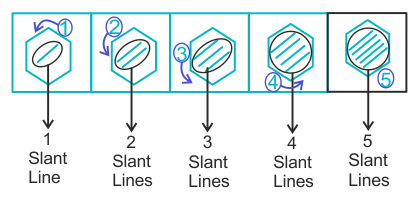 Thus, the final series is:
 Hence, "Option 2" is the correct answer.
Q4 · Series
Identify the figure from among the given options which when put in place of the question mark (?) will logically complete the series.



Answer aur solution dekho
Archived marked answer: C
The logic followed here is:
1) One shaded circle is eliminated from the bottom from each box subsequently.
2) One shaded circle is replaced alternately by letters X and P subsequently.
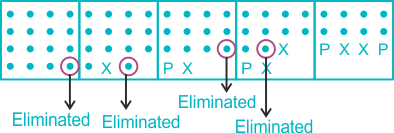
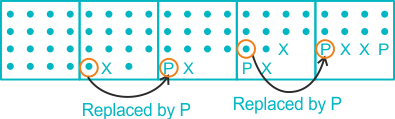
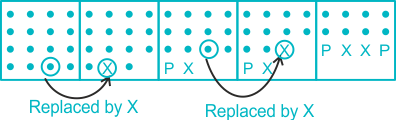 Thus, the final series is:
 Hence, "Option 3" is the correct answer.
Q5 · Series
Which letter cluster can replace the question mark (?) to complete the given series?
AZFX, EWHW, ?, MQLU, QNNT
- IJTV
- JITV
- ITJV
- JTIV
Answer aur solution dekho
Archived marked answer: C
The logic followed here is:
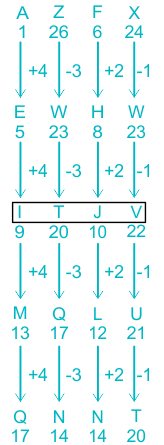 Hence, "Option 3" is the correct answer.
Q6 · Analogy
Select the option that is related to the fifth letter-cluster in the same way as the second letter-cluster is related to the first
letter-cluster and the fourth letter-cluster is related to the third letter-cluster.
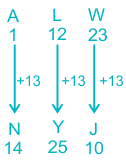
ALW: NYJ :: CNY :PAL :: DEP:?
- QRD
- QRC
- SRC
- SRD
Answer aur solution dekho
Archived marked answer: B
The logic followed here is:
ALW: NYJ
Q7 · Analogy
Select the option that is related to the fifth letter-cluster in the same way as the second letter-cluster is related to the first letter-cluster and the fourth letter-cluster is related to the third letter-cluster.
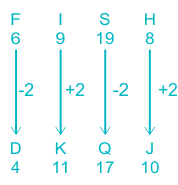
FISH : DKQJ :: POND : NQLF :: SIZE : ?
- QGXG
- UGXC
- UKXC
- QKXG
Answer aur solution dekho
Archived marked answer: D
The logic followed here is:
FISH : DKQJ
Q8 · Analogy
Select the set in which the numbers are related in the same way as are the numbers of the following set.
(34, 17, 27)
(42, 21, 31)
(NOTE: Operations should be performed on the whole numbers, without breaking down the numbers into its constituent
digits. E.g. 13 – Operations on 13 such as adding/deleting/multiplying etc. to 13 can be performed. Breaking down 13 into 1
and 3 and then performing mathematical operations on 1 and 3 is not allowed.)
- (38, 16, 36)
- (54, 27, 37)
- (46, 23, 35)
- (64, 34, 54)
Answer aur solution dekho
Archived marked answer: B
The logic followed here is:
Logic: (1st number - 2nd number) + 10 = 3rd number.
Now,
For, (34, 17, 27)
→ (34 - 17) + 10
→ 17 + 10 = 27.
For, (42, 21, 31)
→ (42 - 21) + 10
→ 21 + 10 = 31.
Similarly, for (54, 27, 37)
→ (54 - 27) + 10
→ 27 + 10 = 37
Hence, the correct answer is "Option 2".
Q9 · Analogy
Select the set in which the numbers are related in the same way as are the numbers of the following set.
3 — 5 — 30
2 — 4 — 16
NOTE: Operations should be performed on the whole numbers, without breaking down the numbers into its constituent
digits. E.g. 13 – Operations on 13 such as adding/subtracting/multiplying etc. to 13 can be performed. Breaking down 13 into
1 and 3 and then performing mathematical operations on 1 and 3 is not allowed)
- 5 — 5 — 45
- 6 — 6 — 72
- 9 — 5 — 27
- 9 — 4 — 7
Answer aur solution dekho
Archived marked answer: B
The logic followed here is:
Logic: (1st number × 2nd number) × 2 = 3rd number.
Now,
For, 3 — 5 — 30
→ (3 × 5) × 2 = 15 × 2 = 30.
For, 2 — 4 — 16
→ (2 × 4) × 2 = 8 × 2 = 16.
Similarly, for 6 — 6 — 72
→ (6 × 6) × 2 = 36 × 2 = 72
Hence, the correct answer is "Option 2".
Q10 · Analogy
44 is related to 1936 by certain logic. Following the same logic, 59 is related to 3481. To which of the following is 77 related,
following the same logic?
(NOTE : Operations should be performed on the whole numbers, without breaking down the
numbers into its constituent digits. E.g. 13 – Operations on 13 such as adding /deleting /multiplying etc., to 13 can be
performed. Breaking down 13 into 1 and 3 and then performing mathematical operations on 1 and 3 is not allowed.)
- 5824
- 5929
- 7642
- 4469
Answer aur solution dekho
Archived marked answer: B
The logic followed here is:
Logic: (1st number)² = 2nd number.
Now,
For, 44 : 1936
⇒ 44² = 1936.
For, 59 : 3481
⇒ 59² = 3481.
Similarly, for 77 : ?
⇒ 77² = 5929.
Hence, the correct answer is "Option 2".
Q11 · Non Verbal Reasoning
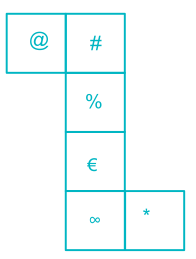
A cube is constructed by folding the given sheet along the lines shown. In the cube so formed, what would be the symbol
on the opposite side of ‘#’?
- @
- ∞
- €
- %
Answer aur solution dekho
Archived marked answer: C
The faces opposite to each other are shown below:
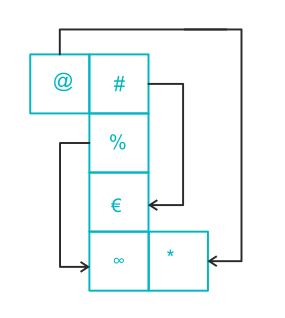 ⇒ As the alternate positions become opposite to each other, the remaining two faces become opposite to each other.
So, opposite pairs are:
# →
Q12 · Non Verbal Reasoning
Two different positions of the same dice are given below. Which is the number on the face opposite to the face containing 5?
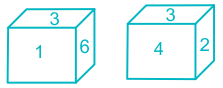
- 6
- 3
- 1
- 2
Answer aur solution dekho
Archived marked answer: B
The logic followed here is :-
From the given two different dices the adjacent sides are as shown below :
As 3 is common on both the dices, it is clear that 1, 6, 4, and 2 are adjacent to it, and the remaining i.e. 5 will be opposite to it.
Q13 · Non Verbal Reasoning
How many triangles are there in the given figure?

- 13
- 12
- 15
- 16
Answer aur solution dekho
Archived marked answer: D
The number of triangles in the given figure is shown below:
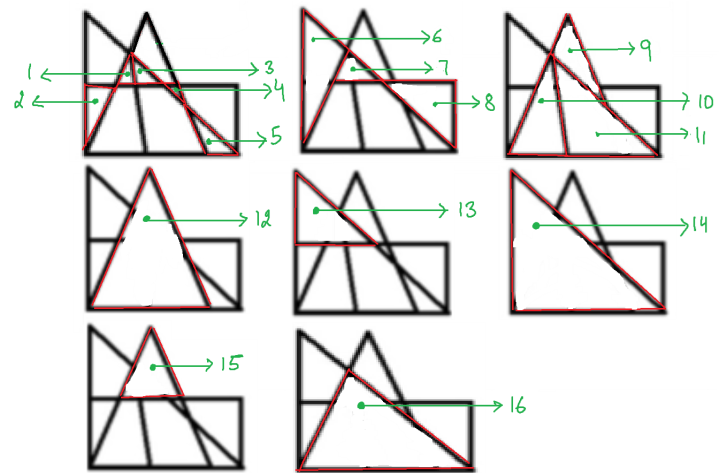
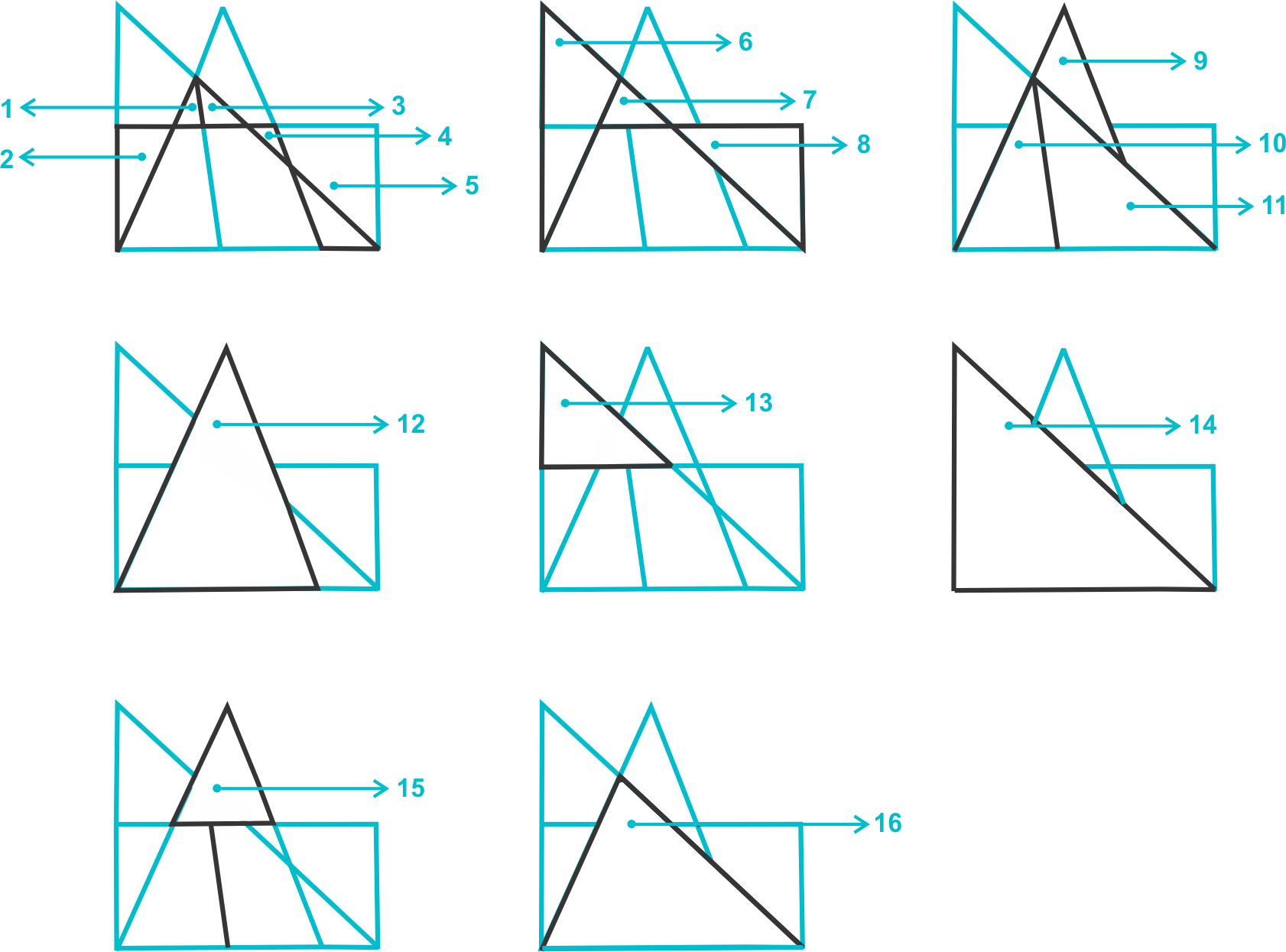 Thus, as marked there are a total of 16 triangles.
Hence, "Option 4" is the correct answer.
Q14 · Non Verbal Reasoning
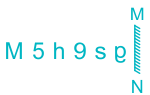
Select the correct mirror image of the given figure when the mirror is placed at MN as shown below.
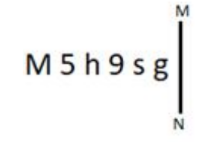








Answer aur solution dekho
Archived marked answer: C
The correct mirror image of the given figure is:
Q15 · Non Verbal Reasoning
A paper is folded and cut as shown below. How will it appear when unfolded?



Answer aur solution dekho
Archived marked answer: B
The figure which will look like the paper when unfolded is shown below:
 Thus, option Figure 2 will look like the paper when unfolded.
Hence, "Option 2" is the correct answer.
Q16 · Puzzle Subtypes Not To Miss
Which of the following interchanges of numbers (not digits) would make the given equation correct?
2⁽⁵⁷ ⁻ ³³ ÷ ¹¹ times ¹³ ⁻ ²⁾ + 3⁽⁶⁴ ⁻ ⁵⁶ ÷ ⁸ times ⁴ ⁻ ⁴⁴⁾ = 35
- 2 and 4
- 56 and 57
- 57 and 64
- 33 and 44
Answer aur solution dekho
Archived marked answer: D
Given: 2⁵⁷ ⁻ ³³ ÷ ¹¹ × ¹³ ⁻ ² + 3⁶⁴ ⁻ ⁵⁶ ÷ ⁸ × ⁴ ⁻ ⁴⁴ = 35
According to the question, after interchanging the numbers:
Option 1): 2 and 4
257 - 33 ÷ 11 × 13 - 2 + 364 - 56 ÷ 8 × 4 - 44 = 35 ⇒ 457 - 33 ÷ 11 × 13 - 4 + 364 - 56 ÷ 8 × 2 - 44 = 35
⇒ 457 - 33 ÷ 11 × 13 - 4 + 364 - 56 ÷ 8 × 2 - 44 = 35
⇒ 457 - 3 × 13 - 4 + 364 - 7 × 2 - 44 = 35
⇒ 457 - 39 - 4 + 364 - 14 - 44 = 35
⇒ 414 + 36 = 35
⇒ 268436185 ≠ 35 (LHS ≠ RHS)
Option 2): 56 and 57
257 - 33 ÷ 11 × 13 - 2 + 364 - 56 ÷ 8 × 4 - 44 = 35 ⇒ 256 - 33 ÷ 11 × 13 - 2 + 364 - 57 ÷ 8 × 4 - 44 = 35
⇒ 256 - 33 ÷ 11 × 13 - 2 + 364 - 57 ÷ 8 × 4 - 44 = 35
⇒ 256 - 3 × 13 - 2 + 364 - 7.125 × 4 - 44 = 35
⇒ 256 - 39 - 2 + 364 - 28.5 - 44 = 35
⇒ 215 + 3-8.5 = 35
⇒ 32768 ≠ 35 (LHS ≠ RHS)
Option 3): 57 and 64
257 - 33 ÷ 11 × 13 - 2 + 364 - 56 ÷ 8 × 4 - 44 = 35 ⇒ 264 - 33 ÷ 11 × 13 - 2 + 357 - 56 ÷ 8 × 4 - 44 = 35
⇒ 264 - 33 ÷ 11 × 13 - 2 + 357 - 56 ÷ 8 × 4 - 44 = 35
⇒ 264 - 3 × 13 - 2 + 357 - 7 × 4 - 44 = 35
⇒ 264 - 39 - 2 + 357 - 28 - 44 = 35
⇒ 223 + 3-15 = 35
⇒ 8388608 ≠ 35 (LHS ≠ RHS)
Option 4): 33 and 44
257 - 33 ÷ 11 × 13 - 2 + 364 - 56 ÷ 8 × 4 - 44 = 35 ⇒ 257 - 44 ÷ 11 × 13 - 2 + 364 - 56 ÷ 8 × 4 - 33 = 35
⇒ 257 - 44 ÷ 11 × 13 - 2 + 364 - 56 ÷ 8 × 4 - 33 = 35
⇒ 257 - 4 × 13 - 2 + 364 - 7 × 4 - 33 = 35
⇒ 257 - 52 - 2 + 364 - 28 - 33 = 35
⇒ 23 + 3____3 = 35
⇒ 8____ + 27 = 35
⇒ 35 = 35 (LHS = RHS)
Hence, "Option 4" is the correct answer.
Q17 · Puzzle Subtypes Not To Miss
Which number will come in the place of the question mark (?) in the following equation if '×' and '÷' are interchanged and '+' and '−' are interchanged?
49 × 7 − 6 ÷ 2 + 15 = ?
- 2
- 5
- 8
- 4
Answer aur solution dekho
Archived marked answer: D
BODMAS Table:
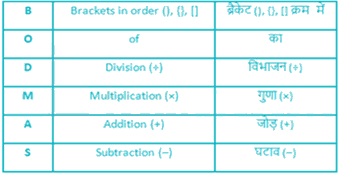 Given equation: 49 × 7 − 6 ÷ 2 + 15 = ?
Now, if ‘+’ and ‘−‘ and ‘×’ and ‘÷’ are interchanged, then:
⇒ 49 ÷ 7 + 6 × 2 − 15 = ?
⇒ 49 ÷ 7 + 6 × 2 − 15 = ?
⇒ 7 + 12 − 15 = ?
⇒ 19 − 15 = ?
⇒ 4.
Hence, the correct answer is "Option 4".
Q18 · Coding Decoding
In a certain code language, 'MUTUAL' is written as '12121202113', 'MARKET' is written as '2051118113', how will 'MODULE' be written in that language?
- 1315421125
- 5122141513
- 5122141613
- 14122361522
Answer aur solution dekho
Archived marked answer: B
The logic followed here is:
'MUTUAL' is written as '12121202113'
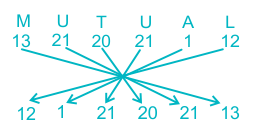 And,
'MARKET' is written as '2051118113'
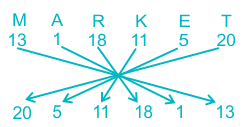 Similarly,
'MODULE' is written as
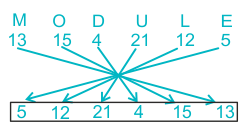 Hence, "Option 2" is the correct answer.
Q19 · Coding Decoding
In a certain code language, ‘RIVAL’ is coded as ‘PKTCJ’ and ‘TEXTS’ is coded as ‘RGVVQ’. How will ‘POINT’ be coded in the
given language?
- NRGOR
- OQGPO
- NQGPR
- OQGOQ
Answer aur solution dekho
Archived marked answer: C
The logic followed here is:
‘RIVAL’ is coded as ‘PKTCJ’
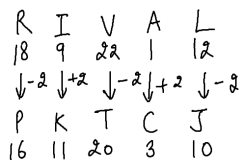
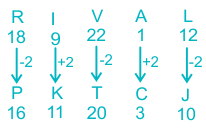 And,
‘TEXTS’ is coded as ‘RGVVQ’
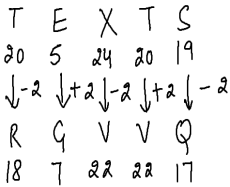
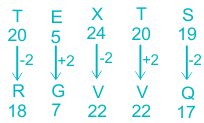 Similarly,
‘POINT’ is coded as
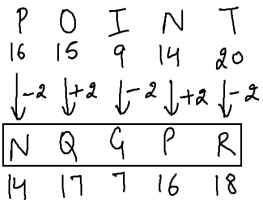
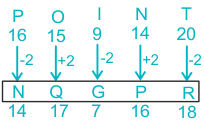 Hence, "Option 3" is the correct answer.
Q20 · Classification Odd One Out
Three of the following four are alike in a certain way and thus form a group. Which is the one that does NOT belong to that group? The odd one out is not based on the number of consonants/vowels or their position in the letter cluster
- JOR
- AFI
- MRU
- LQS
Answer aur solution dekho
Archived marked answer: D
The logic followed here is:
Option 1) JOR
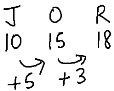
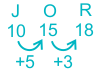 Option 2) AFI
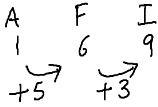
 Option 3) MRU
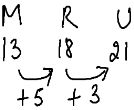
 Option 4) LQS
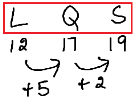
 Thus, out of all the options 'LQS' is the odd one out.
Hence, "Option 4" is the correct answer.
Q21 · Classification Odd One Out
Three of the following number-pairs are alike in some manner and hence form a group. Which number-pair does not belong to that group?
NOTE: Operations should be performed on the whole numbers, without breaking down the numbers into its constituent digits. E.g. 13 – Operations on 13 such as adding/subtracting/multiplying etc. to 13 can be performed. Breaking down 13 into 1 and 3 and then performing mathematical operations on 1 and 3 is not allowed.
- 14 – 121
- 21 – 361
- 18 – 256
- 11 – 81
Answer aur solution dekho
Archived marked answer: A
The logic followed here is:
Option 1) 14 – 121
(14 - 2)² = 121
12² = 121
144 ≠ 121 (LHS ≠ RHS)
Option 2) 21 – 361
(21 - 2)2 = 361
192 = 361
144 = 361 (LHS = RHS)
Option 3) 18 – 256
(18 - 2)2 = 256
162 = 256
256 = 256 (LHS = RHS)
Option 4) 11 – 81
(11 - 2)2 = 81
92 = 81
81 = 81 (LHS = RHS)
Thus, out of all the options '14 – 121' is the odd one out.
Hence, "Option 1" is the correct answer.
Q22 · Logical Reasoning
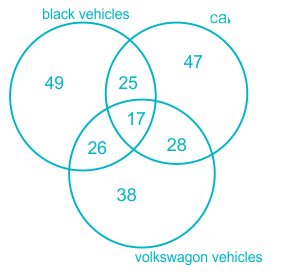
How many people like either only cars or only Volkswagen vehicles as per the given Venn diagram?
- 85
- 66
- 28
- 75
Answer aur solution dekho
Archived marked answer: A
According to the given Venn diagram:
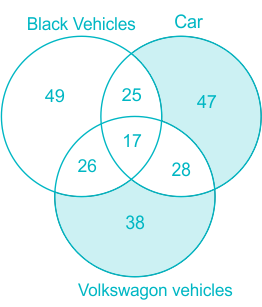 The shaded region repre
Q23 · Logical Reasoning
Three statements are given, followed by three conclusions numbered I, II and III. Assuming the statements to be true, even if they seem to be at variance with commonly known facts, decide which of the conclusions logically follow(s) from the statements.
Statements:
No lotus is a daisy.
All lotuses are tulips.
All tulips are sunflowers.
Conclusions:
I. All daisies are tulips.
II. Some sunflowers are daisies.
III. No sunflower is a daisy.
- Only conclusion III follows
- Either conclusion II or III follows
- Only conclusion I follows
- Only conclusion II follows
Answer aur solution dekho
Archived marked answer: B
The least possible Venn diagram for the given statements is as shown below :
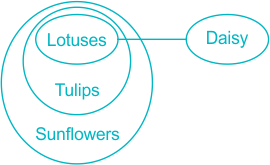 Conclusions:
I. All daisies are tulips → Does not follow (As no lotus is a daisy and all lotuses are tulips. So it is possible but not definite.)
II. Some sunflowers are daisies → Does not
Q24 · Blood Relations
In a certain code language,
‘A + B’ means ‘A is the mother of B’;
‘A – B’ means ‘A is the husband of B’;
‘A × B’ means ‘A is the father of B’ and
‘A ÷ B’ means ‘A is the daughter of B’.
Based on the above, how is K related to O if ‘K ÷ L − M + N × O’?
- Sister’s daughter
- Father’s sister
- Mother’s sister
- Father’s mother
Answer aur solution dekho
Archived marked answer: B
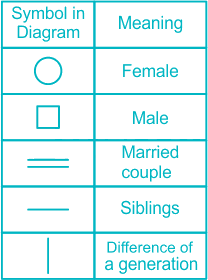 Decoding symbols:
A is
Symbol
+
–
×
÷
Meaning
Mother
Husband
Father
Daughter
to B
Given: K ÷ L − M + N × O
K ÷ L → K is the daughter of L.
 L − M → L is the husband of M.
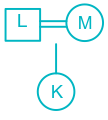 M + N → M is the mother of N.
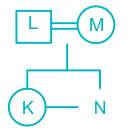 N × O → N is the father of O.
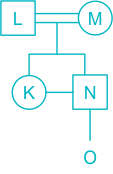 Thus, K is O's father’s sister or paternal aunt.
Hence, the correct answer is "Option 2"
Q25 · Alphabet Test
All of the letters in the word ‘FROWNED’ are arranged in alphabetical order. How many letters are there in the English
alphabetical series between the letter which is fourth from the left end and the one which is second from the right end in the
new letter-cluster thus formed?
- Five
- Two
- Three
- Four
Answer aur solution dekho
Archived marked answer: C
Given word: FROWNED
According to the question,
Given word
F
R
O
W
N
E
D
Arranged in alphabetical order
D
E
F
N
O
R
W
Thus, the new formed letter cluster → D E F N O R W
Now, the number of letters are there in the English alphabetical order between the letter which is the fourth from the left end and the one which is second from the right end in the new letter-cluster thus formed:
(Left end) D E F N O R W (Right end)
Here, three letters i.e. O, P, and Q are between N and R.
Hence, "Option 3" is the correct answer.
General Awareness
Q1 · Art and Culture
Ustad Zia Mohiuddin Dagar was a ________ player of profound depth, favouring sparse and slow realisations of ragas.
- Sitar
- Violin
- Flute
- Rudra veena
Answer aur solution dekho
Archived marked answer: D
The correct answer is Rudra veena.
Key Points
- Ustad Zia Mohiuddin Dagar was a renowned player of the Rudra veena, an ancient Indian string instrument.
- He was known for his profound depth in playing, often favoring sparse and slow realizations of ragas, which is a distinctive feature of Rudra veena performances.
- The Rudra veena, also known as Been, is one of the oldest classical instruments in India, used primarily in the Dhrupad genre of Indian classical music.
- Ustad Zia Mohiuddin Dagar's contributions to the music world include reviving and popularizing the Rudra veena, which was at risk of becoming obsolete.
Additional Information
- Rudra veena
- The Rudra veena is a large plucked string instrument used in Hindustani classical music, particularly in the Dhrupad genre.
- It consists of a long tubular body with two large resonating gourds attached at both ends. The strings are plucked using a plectrum.
- The instrument is known for its deep, rich tones and is considered one of the most difficult to master due to its size and playing technique.
- The Rudra veena is associated with the ancient music traditions of India and is believed to have divine origins, often linked to the god Shiva.
- Dhrupad
- Dhrupad is the oldest form of Hindustani classical music still in practice today. It is a vocal genre, but also performed on instruments like the Rudra veena.
- This genre emphasizes a strict adherence to the raga (melodic structure) and tala (rhythmic cycle) and is known for its meditative and spiritual qualities.
- Dhrupad performances are characterized by their slow and deliberate pace, with a focus on precise intonation and deep emotional expression.
- It was traditionally performed in temples and courts, and today it continues to be a revered form of classical music in India.
- Raga
- A raga is a framework for improvisation akin to a melodic mode in Indian classical music. It provides a set of rules for building a melody.
- Each raga is associated with specific moods, times of the day, and seasons, and it is believed to evoke certain emotions in the listener.
- Ragas are composed of specific sequences of notes and characteristic musical phrases that define their unique identities.
- Musicians use these frameworks to improvise and create music that is both structured and expressive.
Q2 · Art and Culture
Khualam is a famous dance of:
- Bihar
- Arunachal Pradesh
- Mizoram
- Uttar Pradesh
Answer aur solution dekho
Archived marked answer: C
The correct answer is Mizoram.
Key Points
- Khualam is a traditional dance of the Mizo community, native to Mizoram.
- It is typically performed during festive and cultural occasions in the state.
- The dance is characterized by graceful and rhythmic movements which are accompanied by traditional Mizo songs and music.
- Khualam reflects the rich cultural heritage and traditions of the Mizo people, showcasing their artistic talents and social customs.
Additional Information
- Mizoram:
- Mizoram is a state in Northeast India, with Aizawl as its capital city.
- The state is known for its diverse culture, with several indigenous tribes, including the Mizo, Kuki, and Pawi.
- Traditional dances like Cheraw (Bamboo Dance), Khualam, and Chheihlam are integral parts of Mizoram's cultural identity.
- Agriculture is the mainstay of the state's economy, with rice being the principal crop.
- Traditional Dances of Other States:
- Bihar: Jat-Jatin, Bidesia, and Chhau.
- Arunachal Pradesh: Bardo Chham, Ponung, and Wancho Dance.
- Uttar Pradesh: Kathak, Charkula, and Raslila.
Q3 · Art and Culture
Thrissur Pooram is one of the famous temple festivals celebrated in ______.
- Andhra Pradesh
- Kerala
- Karnataka
- Tamil Nadu
Answer aur solution dekho
Archived marked answer: B
The correct answer is Kerala.
Key Points
- Thrissur Pooram is celebrated in the city of Thrissur in Kerala.
- It is considered as one of the most colorful temple festivals of Kerala.
- This festival was started by Sakthan Thampuran, the Maharaja of Cochin.
- The festival is famous for its grand display of caparisoned elephants, fireworks, and traditional music and dance.
Additional Information
- Thrissur Pooram
- Thrissur Pooram is an annual Hindu temple festival held in Kerala. It is held at the Vadakkunnathan Temple in Thrissur every year.
- The festival involves a grand assembly of gods and goddesses from neighboring temples, who come to pay obeisance to Lord Shiva, the presiding deity of the Vadakkunnathan Temple.
- One of the highlights of Thrissur Pooram is the "Kudamattom" ceremony, which is a competitive display of colorful and intricately decorated parasols atop elephants.
- Another major attraction is the grand fireworks display that marks the conclusion of the festival. These fireworks are renowned for their scale and grandeur.
- Vadakkunnathan Temple
- The Vadakkunnathan Temple is an ancient Hindu temple dedicated to Lord Shiva, located in the city of Thrissur.
- It is one of the oldest temples in Kerala and is a classic example of the architectural style of Kerala.
- The temple is surrounded by a massive stone wall enclosing an area of nearly 9 acres, with multiple shrines and lofty gopurams.
- Vadakkunnathan Temple is a protected monument under the Archaeological Survey of India.
- Sakthan Thampuran
- Sakthan Thampuran, also known as Rama Varma Kunhjipilla Thampuran, was the Maharaja of Cochin from 1790 to 1805.
- He is credited with organizing Thrissur Pooram in its present form and for making significant contributions to the cultural heritage of Kerala.
- His reign is known for administrative reforms, the consolidation of the Cochin kingdom, and the enhancement of the region's trade and commerce.
- The Sakthan Thampuran Palace in Thrissur is named in his honor and serves as a museum showcasing the history of the region.
Q4 · Indian Polity and Constitution
Which Article of the Indian Constitution provides that the State must secure a social order to promote the welfare of people?
- Article 37
- Article 38
- Article 39
- Article 36
Answer aur solution dekho
Archived marked answer: B
The correct answer is Article 38.
Key Points
- Article 38 of the Indian Constitution is part of the Directive Principles of State Policy (DPSP).
- This article directs the State to secure a social order for the promotion of the welfare of the people.
- It emphasizes minimizing inequalities in income and endeavoring to eliminate inequalities in status, facilities, and opportunities.
- Article 38 has two clauses: Clause (1) and Clause (2), which specifically mention the State's responsibility in social and economic spheres.
Additional Information
- Directive Principles of State Policy (DPSP)
- The DPSP are guidelines or principles given to the federal institutes governing the state of India, to be kept in citation while framing laws and policies.
- These are non-justiciable, meaning they are not legally enforceable by the courts for their violation.
- They are mentioned in Part IV (Articles 36-51) of the Indian Constitution.
- Article 37
- It states that the provisions contained in the DPSP shall not be enforceable by any court.
- It emphasizes that the principles laid down are fundamental in the governance of the country.
- Article 39
- It directs the State to ensure that the citizens, men and women equally, have the right to an adequate means of livelihood.
- It also covers principles for resource distribution, operation of the economic system, health and strength of workers, children, and youth, and equal pay for equal work for both men and women.
- Article 36
- This article defines the term "State" in the context of DPSP.
- It includes the Government and Parliament of India, the Government and Legislature of each of the States, and all other local or other authorities within the territory of India or under the control of the Government of India.
Q5 · Indian Polity and Constitution
The concept of Public Interest Litigation originated in __________.
- Switzerland
- Iceland
- USA
- New Zealand
Answer aur solution dekho
Archived marked answer: C
The correct answer is USA.
Key Points
- The concept of Public Interest Litigation (PIL) originated in the United States of America (USA).
- PIL allows individuals or groups to file lawsuits to protect the public interest.
- It enables the courts to consider matters that affect the public at large, not just the interests of the individuals directly involved in the case.
- The concept was introduced to address issues such as environmental protection, consumer welfare, and human rights.
Q6 · Indian Economy
The headquarters of the second Green Revolution cell was in ______.
- Raipur
- Patna
- Kolkata
- Bhubaneswar
Answer aur solution dekho
Archived marked answer: B
The correct answer is Patna.
Key Points
- The second Green Revolution cell was established to boost agricultural productivity, especially in the eastern states of India.
- The headquarters of this initiative is located in Patna, the capital city of Bihar.
- The focus of the second Green Revolution is to enhance rice and wheat production, leveraging modern agricultural practices and technologies.
- Patna was chosen for its strategic location and significance in the agricultural landscape of Eastern India.
Additional Information
- Green Revolution:
- The Green Revolution refers to a period during the 1960s to 1980s when agriculture in India was transformed through the adoption of high-yielding variety (HYV) seeds, increased use of fertilizers and irrigation.
- This movement led to a significant increase in food grain production, particularly in states like Punjab, Haryana, and Uttar Pradesh.
- Second Green Revolution:
- The objective of the second Green Revolution is to replicate the success of the first Green Revolution in the eastern part of India.
- It focuses on sustainable agricultural practices, including the use of hybrid seeds, improved irrigation systems, and better management of natural resources.
- The initiative aims to address the challenges of food security and economic stability for farmers in the region.
- Patna:
- Patna is the largest city in the state of Bihar and serves as an administrative and educational center.
- It has a rich historical heritage and is one of the oldest continuously inhabited places in the world.
- The city's strategic location on the southern bank of the Ganges River makes it an important hub for trade and agriculture.
- Agricultural Productivity:
- Agricultural productivity refers to the output of agricultural products per unit of input, such as land, labor, and capital.
- Enhancing agricultural productivity is crucial for ensuring food security, reducing poverty, and promoting sustainable development.
- Key factors influencing agricultural productivity include technological advancements, education, infrastructure, and government policies.
Q7 · Indian Economy
Match the concepts in column A with their respective descriptions in column B.
Column A
Column B
a. Gross national product
1. Annual income received by the individual’s production in a given period
b. Net national product
2. After the tax of personal income
c. Personal income
3. Money value of the national output
d. Disposable personal income
4. Net production of goods and services during the year
- 1. a-2, b-1, c-3, d-4
- 2. a-3, b-1, c-2, d-4
- 3. a-3, b-4, c-1, d-2
- 4. a-4, b-3, c-2, d-1
Answer aur solution dekho
Archived marked answer: C
The correct answer is a-3, b-4, c-1, d-2.
Key Points
- The Gross National Product (GNP) is the money value of the national output.
- The Net National Product (NNP) refers to the net production of goods and services during the year after accounting for depreciation.
- Personal Income is defined as the annual income received by individuals from all sources.
- Disposable Personal Income is the income left after the deduction of personal taxes.
Additional Information
- Gross National Product (GNP)
- GNP measures the total economic output of a country, including earnings from foreign investments.
- It is an important indicator of a country's economic strength and performance.
- GNP includes the value of all goods and services produced by a country's residents, whether within the country or abroad.
- Net National Product (NNP)
- NNP is derived from GNP by subtracting depreciation of capital goods.
- It reflects the net output of the economy, accounting for the wear and tear on machinery and infrastructure.
- NNP is a key measure for understanding the sustainable economic growth of a country.
- Personal Income
- Personal Income includes wages, salaries, dividends, interest, rent, and any other income received by individuals.
- It is a broad measure of the income earned by residents of a country.
- Personal Income is used to assess the overall economic well-being of individuals in an economy.
- Disposable Personal Income
- Disposable Personal Income is the amount of money individuals have available to spend or save after taxes.
- It is a key indicator of consumer spending power and economic activity.
- This measure is important for understanding the financial health and consumption capacity of households.
Q8 · Indian Economy
Which of the following options is the most appropriate cause for unemployment in India?
- Over population
- Environment conditions
- High educational systems
- Lack of labour force
Answer aur solution dekho
Archived marked answer: A
The correct answer is Over population.
Key Points
- Overpopulation leads to a larger number of individuals competing for the same number of jobs, which increases the unemployment rate.
- With a high population growth rate, the number of job seekers increases faster than the number of available jobs.
- Overpopulation also puts a strain on resources and infrastructure, which can limit job creation and economic growth.
- In many cases, the education system and skill development programs cannot keep up with the growing population, leading to a mismatch of skills and available jobs.
Additional Information
- Unemployment
- Unemployment occurs when individuals who are capable of working and are actively seeking work remain un-hired. It is often used as a measure of the health of the economy.
- Types of unemployment include:
- Structural Unemployment: Caused by changes in the industrial makeup (structure) of the economy.
- Frictional Unemployment: Short-term unemployment that arises from the process of matching workers with jobs.
- Cyclical Unemployment: Resulting from economic downturns (recessions).
- Seasonal Unemployment: Occurs when industries slow or shut down for a season or make seasonal shifts in their production schedules.
- Overpopulation
- Overpopulation refers to a situation where the population exceeds the carrying capacity of the environment or the available resources.
- It results in environmental degradation, depletion of natural resources, and a higher level of competition for jobs, housing, and other services.
- Overpopulation can lead to higher levels of poverty and a lower quality of life for the population.
- Efforts to control overpopulation include family planning, education, and policies aimed at reducing birth rates.
- Economic Growth
- Economic growth refers to an increase in the production of goods and services in an economy over a period of time.
- It is often measured by the increase in Gross Domestic Product (GDP).
- Economic growth can lead to higher employment levels, improved living standards, and an increase in the overall wealth of a country.
- Sustainable economic growth is essential for reducing unemployment and alleviating poverty.
Q9 · Sports Static GK
Which of the following nations won the seven times women's Asia Cup cricket Championship?
- Pakistan
- Bangladesh
- India
- Sri Lanka
Answer aur solution dekho
Archived marked answer: C
The correct answer is India.
Key Points
- India has a very strong women's cricket team that has consistently performed well in the Women's Asia Cup.
- India has won the Women's Asia Cup Cricket Championship seven times, making it the most successful team in the history of the tournament.
- The team has shown remarkable skill, teamwork, and determination in all the editions of the Women's Asia Cup.
- India's women's cricket team has contributed significantly to the growth and popularity of women's cricket in the region.
Additional Information
- Women's Asia Cup Cricket Championship
- The Women's Asia Cup is an important cricket tournament in which teams from Asian countries compete against each other.
- The tournament is organized by the Asian Cricket Council (ACC) and has been played in various formats over the years, including One Day Internationals (ODIs) and Twenty20 Internationals (T20Is).
- It was first held in 2004, and since then, it has become a prestigious event in women's cricket.
- The tournament provides a platform for women cricketers in Asia to showcase their talent and compete at a high level.
- India Women's Cricket Team
- The India women's national cricket team, also known as the Women in Blue, represents India in international women's cricket.
- The team is governed by the Board of Control for Cricket in India (BCCI).
- Over the years, the team has made significant strides and has become one of the dominant forces in women's cricket globally.
- Some notable players from the Indian women's cricket team include Mithali Raj, Jhulan Goswami, Harmanpreet Kaur, and Smriti Mandhana, who have made significant contributions to the team's success.
- Asian Cricket Council (ACC)
- The Asian Cricket Council (ACC) is a cricket organization that aims to promote and develop the game of cricket in Asia.
- It was established in 1983, and it organizes various tournaments and development programs to enhance the standard of cricket in the region.
- The ACC is responsible for organizing the Men's and Women's Asia Cup tournaments.
- The council works closely with member nations to improve the infrastructure, training, and competitive opportunities for cricketers in Asia.
Q10 · Indian Geography
According to the Census of India 2011, the percentage of adolescent population (10-19 years) from the total population is how much?
- 22.9%
- 21.9%
- 20.9%
- 19.9%
Answer aur solution dekho
Archived marked answer: C
The correct answer is 20.9%
Key Points
- According to the Census of India 2011, the percentage of the adolescent population (10-19 years) from the total population is 20.9%.
- The total population of India as per the Census 2011 is approximately 1.21 billion.
- The adolescent population plays a significant role in the demographic dividend of the country.
- Planning and policy-making for health, education, and employment are often based on this demographic data.
Additional Information
- Census of India:
- The Census of India is a decennial exercise conducted by the Office of the Registrar General and Census Commissioner, India under the Ministry of Home Affairs, Government of India.
- The census aims to collect comprehensive data about the population, including demographic, social, and economic information.
- The first census in India was conducted in 1872, and since 1881, it has been conducted every 10 years without a break.
- The data collected during the census is crucial for policymaking, planning, and administration at various levels of government.
- Adolescent Population:
- Adolescence is the transitional phase of growth and development between childhood and adulthood.
- The age range for adolescents is generally considered to be from 10 to 19 years.
- Adolescence is characterized by significant physical, emotional, and psychological changes.
- Understanding the adolescent population is important for addressing issues related to health, education, and social development.
- Demographic Dividend:
- The demographic dividend refers to the economic growth potential that can result from shifts in a population’s age structure, mainly when the working-age population is larger than the non-working-age population.
- Countries with a higher proportion of working-age individuals are believed to have a potential advantage for economic growth.
- Effective policies in health, education, and employment are essential to harness the benefits of the demographic dividend.
Q11 · Indian Geography
Identify the group of districts that are NOT an example of industrial districts of India.
- Cuttack and Kolar
- Kanpur and Agra
- Alwar and Bhawani
- Jabalpur and Bhopal
Answer aur solution dekho
Archived marked answer: C
The correct answer is Alwar and Bhawani.
Key Points
- Alwar and Bhawani are not recognized as major industrial districts in India.
- These districts do not have the same level of industrial development compared to other options listed.
- Industrial districts in India are typically characterized by significant manufacturing and production activities.
- Examples of well-known industrial districts include Kanpur, Agra, and Bhopal, which have substantial industrial bases.
Additional Information
- Industrial Districts in India
- Industrial districts are regions that have a high concentration of manufacturing and production industries.
- Non-Industrial Districts
- Non-industrial districts may not have a high concentration of manufacturing activities.
- These districts may focus more on agriculture, services, or other economic activities.
- Alwar: Primarily known for its tourism and agriculture.
- Bhawani: Does not have significant industrial infrastructure compared to other districts listed.
- Importance of Industrial Districts
- Industrial districts play a crucial role in regional development and economic growth.
- They provide employment opportunities and contribute to the overall industrial output of the country.
- Infrastructure development in these districts often leads to improved transportation, logistics, and urbanization.
Q12 · Modern Indian History
Who among the following is primarily connected to the World’s Parliament of Religions convened in Chicago, 1893?
- Dayanand Saraswati
- Swami Vivekananda
- Raja Ram Mohan Roy
- Ramakrishna Paramhansa
Answer aur solution dekho
Archived marked answer: B
The correct answer is Swami Vivekananda.
Key Points
- Swami Vivekananda represented India and Hinduism at the World's Parliament of Religions held in Chicago in 1893.
- He delivered his famous speech beginning with "Sisters and Brothers of America," which received a standing ovation from the audience.
- Vivekananda's speech introduced Hinduism to the Western world and highlighted the importance of religious tolerance and universal acceptance.
- His participation in the Parliament of Religions is considered a landmark event in the history of Hinduism and Indian nationalism.
Additional Information
- World's Parliament of Religions
- The World's Parliament of Religions was an event held in Chicago in 1893 as part of the World's Columbian Exposition.
- It aimed to create a global dialogue among various religious traditions and promote understanding and harmony.
- The event brought together representatives from a wide range of religious backgrounds, including Christianity, Judaism, Islam, Hinduism, Buddhism, and others.
- It was the first formal gathering of its kind, providing a platform for religious leaders to share their beliefs and practices with a global audience.
- Swami Vivekananda
- Born as Narendranath Datta in 1863, Swami Vivekananda was a prominent Indian monk and disciple of Ramakrishna Paramhansa.
- He played a key role in the introduction of Indian philosophies of Vedanta and Yoga to the Western world.
- Vivekananda's teachings emphasized the importance of self-realization, social service, and universal brotherhood.
- He founded the Ramakrishna Mission in 1897, which continues to promote religious and social welfare activities.
- Ramakrishna Paramhansa
- Ramakrishna Paramhansa was a 19th-century Indian mystic and spiritual leader who inspired Swami Vivekananda.
- He is known for his deep spiritual experiences and teachings on the unity of all religions.
- Ramakrishna's life and teachings have had a profound impact on modern Hinduism and the global perception of Indian spirituality.
- Dayanand Saraswati
- Dayanand Saraswati was an Indian social reformer and the founder of the Arya Samaj, a Hindu reform movement.
- He advocated for the return to the teachings of the Vedas and emphasized the importance of education and social equality.
- Dayanand's efforts contributed to the revival of Hinduism and the fight against social injustices such as caste discrimination and child marriage.
- Raja Ram Mohan Roy
- Raja Ram Mohan Roy was a prominent Indian social and educational reformer in the early 19th century.
- He is known as the "Father of the Indian Renaissance" for his efforts to modernize Indian society and combat social evils like sati and child marriage.
- Roy founded the Brahmo Samaj, a reformist movement that sought to promote monotheism and rational thinking in Hinduism.
Q13 · Modern Indian History
Who was the Viceroy of India when Mahatma Gandhi started Dandi March on 12 March 1930?
- Lord Chelmsford
- Lord Minto II
- Lord Irwin
- Lord Willingdon
Answer aur solution dekho
Archived marked answer: C
The correct answer is Lord Irwin.
Key Points
- Lord Irwin served as the Viceroy of India from 1926 to 1931.
- During his tenure, Mahatma Gandhi launched the Salt March, also known as the Dandi March, on 12 March 1930.
- The Dandi March was a pivotal event in the Indian independence movement, protesting against the British salt monopoly.
- Lord Irwin was known for his efforts to engage with Indian leaders, leading to the historic Gandhi-Irwin Pact of 1931.
Additional Information
- Dandi March:
- The Dandi March, also known as the Salt March, was a 24-day, 240-mile (390 km) march led by Mahatma Gandhi.
- It began on 12 March 1930 and ended on 5 April 1930.
- It was a direct action campaign of tax resistance and nonviolent protest against the British salt monopoly.
- The march was a significant event in the Indian independence movement, garnering worldwide attention and inspiring numerous Indians to join the struggle for independence.
- Gandhi-Irwin Pact:
- Signed on 5 March 1931 between Mahatma Gandhi and Lord Irwin, the then Viceroy of India.
- The pact marked the end of the civil disobedience movement in India.
- As part of the agreement, the British agreed to release all political prisoners, and Gandhi agreed to discontinue the Salt Satyagraha.
- The pact paved the way for Gandhi to attend the Round Table Conference in London to discuss India's future constitutional status.
- Lord Irwin:
- Lord Irwin, later known as Lord Halifax, was the Viceroy of India from 1926 to 1931.
- His tenure was marked by significant events like the Simon Commission, the Nehru Report, and the Salt March.
- He played a crucial role in negotiations with Indian leaders and was instrumental in the signing of the Gandhi-Irwin Pact.
- Lord Irwin's tenure is often remembered for his attempts to reconcile British interests with Indian aspirations for self-governance.
Q14 · Current Affairs
Who is the world's most popular leader as per Global Leader Approval Ratings released by US-based Morning Consult in February 2023?
- Xi Jinping
- Vladimir Putin
- Joe Biden
- Narendra Modi
Answer aur solution dekho
Archived marked answer: D
The correct answer is Narendra Modi.
Key Points
- Narendra Modi, the Prime Minister of India, was ranked as the world's most popular leader in February 2023 according to the Global Leader Approval Ratings released by US-based Morning Consult.
- The Global Leader Approval Ratings is a survey that tracks the approval ratings of various world leaders.
- Narendra Modi consistently maintains high approval ratings among the Indian public and has a significant following on social media.
- His leadership during the COVID-19 pandemic, economic reforms, and foreign policy initiatives have contributed to his high approval ratings.
Additional Information
- Global Leader Approval Ratings:
- This is a survey conducted by Morning Consult, a US-based data intelligence company, which tracks the approval ratings of various leaders from countries around the world.
- The survey gathers data from thousands of respondents across different countries to gauge the popularity and approval of their respective leaders.
- The approval rating is a percentage that represents the proportion of respondents who approve of the leader's performance.
- These ratings are updated regularly to reflect changes in public opinion.
- Narendra Modi:
- Narendra Modi is the 14th and current Prime Minister of India, having assumed office on May 26, 2014.
- He is a member of the Bharatiya Janata Party (BJP) and the Rashtriya Swayamsevak Sangh (RSS).
- Before becoming Prime Minister, he served as the Chief Minister of Gujarat from 2001 to 2014.
- Modi's government has focused on various initiatives such as "Make in India", "Digital India", and the Swachh Bharat Abhiyan (Clean India Mission).
Q15 · General Science Biology
The growth form of a plant, comprising its size, shape and orientation is known as:
- habit
- environment
- habitat
- growth pattern
Answer aur solution dekho
Archived marked answer: A
The correct answer is habit.
Key Points
- The term "habit" in botany refers to the general growth form of a plant, including its size, shape, and orientation.
- It describes whether the plant is a tree, shrub, herb, or vine.
- Habit is an important characteristic used to identify and classify plants.
- Understanding the habit of a plant helps in determining its ecological role and adaptability to specific environments.
Additional Information
- Environment:
- The environment is the surrounding conditions in which an organism lives, including air, water, land, and other living beings.
- It influences the growth, development, and survival of organisms but is not specific to the growth form of a plant.
- Habitat:
- The habitat is the natural environment in which a particular species lives.
- It includes all the living and non-living factors that affect the species.
- It is more about the location and environment where a species is found rather than its growth form.
- Growth Pattern:
- Growth pattern refers to the developmental process of an organism, including stages of growth and changes in form over time.
- It is a broader term that can include habit but also encompasses other aspects of growth dynamics.
Q16 · General Science Chemistry
What was Antoine-Laurent Lavoisier's most important contribution to chemistry in 1789?
- Law of Conservation of Mass
- Law of Multiple Proportions
- Law of Definite Proportions
- Law of Conservation of Energy
Answer aur solution dekho
Archived marked answer: A
The correct answer is Law of Conservation of Mass.
Key Points
- The Law of Conservation of Mass was formulated by Antoine-Laurent Lavoisier in 1789.
- This law states that mass is neither created nor destroyed in a chemical reaction.
- Lavoisier's work helped to transform chemistry from a qualitative to a quantitative science.
- He demonstrated that the total mass of reactants in a chemical reaction is equal to the total mass of products.
Additional Information
- Law of Conservation of Mass:
- This law is fundamental to the study of chemistry and physics.
- It implies that in a closed system, the mass of the system remains constant over time.
- Lavoisier's experiments involved careful measurements and the use of a balance to weigh reactants and products.
- He showed that combustion and respiration are processes that involve the combination of substances with oxygen.
- Law of Multiple Proportions:
- Formulated by John Dalton in the early 19th century.
- This law states that when two elements combine to form more than one compound, the masses of one element that combine with a fixed mass of the other are in ratios of small whole numbers.
- Law of Definite Proportions:
- Also known as Proust's Law, formulated by Joseph Proust.
- This law states that a given chemical compound always contains its component elements in fixed ratio by mass, and does not depend on its source or method of preparation.
- Law of Conservation of Energy:
- States that the total energy of an isolated system remains constant over time.
- Energy can neither be created nor destroyed, but can only be transformed from one form to another.
Q17 · Awards Static
Tabla maestro, Bickram Ghosh, was awarded with which of the following awards in 2021 in the Contemporary Category?
- Padma Shri
- Padma Bhushan
- Sangeet Natak Akademi
- Sangeet Kalanidhi
Answer aur solution dekho
Archived marked answer: C
The correct answer is Sangeet Natak Akademi.
Key Points
- The Sangeet Natak Akademi Award is the highest Indian recognition given to practicing artists.
- It is awarded by the Sangeet Natak Akademi, India's National Academy for Music, Dance, and Drama.
- The award was established in 1952 and is given annually.
- Bickram Ghosh, a renowned tabla maestro, received this prestigious award in the Contemporary Category in 2021.
Additional Information
- Padma Shri
- Padma Shri is India's fourth-highest civilian award, established in 1954.
- It is awarded to citizens of India in recognition of their distinguished contribution in various spheres of activity including the arts, education, industry, literature, science, sports, medicine, social service, and public affairs.
- Padma Bhushan
- Padma Bhushan is the third-highest civilian award in India, established in 1954.
- It is awarded to recognize distinguished service of a high order to the nation, in any field.
- Sangeet Natak Akademi
- Sangeet Natak Akademi is India's national academy for music, dance, and drama.
- It was established by the Indian Education Ministry in 1952 and became functional the same year.
- The Akademi has been conferring awards to artists since 1952 to honor their contributions to these fields.
- Sangeet Kalanidhi
- Sangeet Kalanidhi is an award for Carnatic musicians, awarded by the Madras Music Academy.
- It was first awarded in 1942 and is one of the most prestigious awards in the field of Carnatic music.
Q18 · Awards Static
When and where did India win its first World Championships medal in Athletics?
- 2003, Germany
- 2005, Finland
- 2007, Japan
- 2003, France
Answer aur solution dekho
Archived marked answer: D
The correct answer is 2003, France.
Key Points
- India won its first World Championships medal in Athletics in 2003.
- The event was held in Paris, France.
- Anju Bobby George secured the historic medal for India.
- She won the bronze medal in the women's long jump event.
Additional Information
- World Championships in Athletics
- The World Championships in Athletics is organized by the International Association of Athletics Federations (IAAF).
- It is one of the most prestigious events in the sport of athletics.
- The competition is held biennially, bringing together top athletes from all over the world to compete in various track and field events.
- Medals are awarded in multiple categories, including sprints, middle and long-distance running, hurdles, relays, jumping, and throwing events.
- Anju Bobby George
- Anju Bobby George is an Indian athlete who specializes in the long jump.
- She made history by becoming the first Indian athlete to win a medal at the World Championships in Athletics.
- Her bronze medal win in 2003 brought significant recognition to Indian athletics on the global stage.
- She has been a prominent figure in Indian sports and has received several accolades for her contributions.
Q19 · Medieval Indian History
In which of the following battles did Muhammad of Ghor defeat Jayachandra of Gahadavala dynasty in 1194 AD?
- First battle of Tarain
- Battle of Chandawar
- Battle of Anhilwara
- Second battle of Tarain
Answer aur solution dekho
Archived marked answer: B
The correct answer is Battle of Chandawar.
Key Points
- The Battle of Chandawar took place in 1194 AD between Muhammad of Ghor and Jayachandra of the Gahadavala dynasty.
- This battle marked the defeat of Jayachandra, leading to the expansion of Muhammad of Ghor’s empire in Northern India.
- Jayachandra was a prominent ruler of the Gahadavala dynasty, which ruled parts of present-day Uttar Pradesh and Bihar.
- The defeat of Jayachandra significantly weakened the Gahadavala dynasty and paved the way for further Muslim conquests in India.
Additional Information
- First Battle of Tarain (1191)
- The First Battle of Tarain was fought in 1191 between Prithviraj Chauhan and Muhammad of Ghor.
- Prithviraj Chauhan defeated Muhammad of Ghor in this battle.
- This battle took place near the town of Tarain (modern Taraori) in Haryana, India.
- Battle of Anhilwara (1178)
- The Battle of Anhilwara was fought in 1178 between the Solanki king Mularaja II and Muhammad of Ghor.
- Mularaja II defeated Muhammad of Ghor in this battle.
- This battle took place at Anhilwara (modern Patan) in Gujarat, India.
- Second Battle of Tarain (1192)
- The Second Battle of Tarain was fought in 1192 between Prithviraj Chauhan and Muhammad of Ghor.
- Muhammad of Ghor defeated Prithviraj Chauhan in this decisive battle.
- This victory paved the way for the establishment of Muslim rule in Northern India.
- Gahadavala Dynasty
- The Gahadavala dynasty ruled parts of North India, primarily in the regions of present-day Uttar Pradesh and Bihar.
- They are known for their resistance against the Muslim invasions during the 12th century.
- Jayachandra, also known as Jaichand, was one of the most famous rulers of this dynasty.
Q20 · Ancient Indian History
The __________ were tributary chiefs of the Gupta dynasty. They established an independent kingdom in western India. Dhruvasena I was the most important ruler of this kingdom.
- Maitrakas
- Kushanas
- Pushyabhutis
- Gurjara Pratiharas
Answer aur solution dekho
Archived marked answer: A
The correct answer is Maitrakas.
Key Points
- The Maitrakas were tributary chiefs under the Gupta dynasty before establishing their own independent kingdom.
- They ruled over the region of western India, which is present-day Gujarat.
- Dhruvasena I was one of the most notable rulers of the Maitraka dynasty, recognized for his administrative and military achievements.
- The Maitrakas played a significant role in the regional politics and culture of western India during their rule.
Additional Information
- Gupta Dynasty:
- The Gupta Empire was an ancient Indian empire existing from approximately 320 to 550 CE.
- It covered much of the Indian subcontinent and is known as the "Golden Age of India" due to significant achievements in science, technology, engineering, art, dialectic, literature, logic, mathematics, astronomy, religion, and philosophy.
- Chandragupta I, Samudragupta, and Chandragupta II were some of the most prominent rulers of the Gupta dynasty.
- Maitrakas:
- The Maitraka dynasty was founded by Senapati Bhatarka, a former Gupta commander, around the middle of the 6th century CE.
- They established their capital at Vallabhi, in the Saurashtra region of Gujarat.
- The dynasty is known for its patronage of Buddhism and Jainism and the establishment of educational institutions.
- Dhruvasena I:
- Dhruvasena I was a notable ruler of the Maitraka dynasty, who reigned during the 6th century CE.
- He is known for his military campaigns and the consolidation of the Maitraka kingdom.
- Dhruvasena I also maintained diplomatic relations with other contemporary Indian kingdoms and the Byzantine Empire.
Q21 · Government Schemes and Welfare Static Semi Static
In which year was Smart Cities Mission launched?
- 2015
- 2013
- 2019
- 2018
Answer aur solution dekho
Archived marked answer: A
The correct answer is 2015.
Key Points
- The Smart Cities Mission was launched by the Government of India in 2015.
- The initiative aims to promote sustainable and inclusive cities that provide core infrastructure and give a decent quality of life to their citizens.
- It focuses on sustainable and inclusive development by creating replicable models which act like lighthouses to other aspiring cities.
- The mission targets the development of smart solutions that leverage digital and information technologies, urban planning best practices, public-private partnerships, and policy changes.
Additional Information
- Smart Cities Mission
- It is an urban renewal and retrofitting program by the Government of India with the mission to develop smart cities across the country, making them citizen-friendly and sustainable.
- The Smart Cities Mission was launched by Prime Minister Narendra Modi on June 25, 2015.
- The goal is to promote sustainable and inclusive cities that provide core infrastructure, a clean and sustainable environment, and give a decent quality of life to their citizens.
- The mission focuses on sustainable and inclusive development by creating replicable models which act like lighthouses to other aspiring cities.
- The mission is operated as a centrally sponsored scheme and the central government has allocated Rs. 48,000 crore for the development of 100 smart cities.
- Key Features of Smart Cities
- Smart Mobility: Efficient and sustainable transport system, smart traffic management, and public transportation.
- Smart Environment: Sustainable waste management, pollution control, and green spaces.
- Smart Governance: E-governance, citizen participation, and digital services.
- Smart Economy: Digital economy, innovation hubs, and entrepreneurship support.
- Smart Living: High quality of life, health, education, and safety services.
- Implementation Strategy
- The strategy involves area-based development and city-wide smart solutions.
- Area-based development includes retrofitting, redevelopment, and greenfield development.
- City-wide smart solutions involve the application of smart solutions to existing city-wide infrastructure.
- The implementation of the mission is through Special Purpose Vehicles (SPVs) created for each city.
Q22 · Government Schemes and Welfare Static Semi Static
As of 31 May 2021, only 47% of total routes and 39% of airports (unserved and underserved) have been operationalised under UDAN, according to ICRA. What is the full form of UDAN?
- Udtha Desh Ka Aam Nayak
- Ude Desh Ka Aam Naagrik
- Unnath Desh Ka Aam Naagrik
- Ujwal Desh Ka Aam Naagrik
Answer aur solution dekho
Archived marked answer: B
The correct answer is Ude Desh Ka Aam Naagrik.
Key Points
- Ude Desh Ka Aam Naagrik (UDAN) is a regional connectivity scheme launched by the Government of India.
- The scheme aims to make air travel affordable and widespread, creating inclusive national economic development, job growth, and air transport infrastructure development.
- UDAN is a part of the National Civil Aviation Policy (NCAP) and was launched on April 27, 2017.
- The scheme focuses on providing connectivity to unserved and underserved airports of the country through the revival of existing airstrips and airports.
Additional Information
- ICRA
- ICRA Limited is an Indian independent and professional investment information and credit rating agency.
- It was established in 1991, and its main objective is to provide reliable and objective credit opinions.
- ICRA assigns ratings to various types of debt instruments, such as bank loans, commercial papers, non-convertible debentures, and others.
- It plays a crucial role in helping investors make informed decisions by assessing the creditworthiness of various entities.
- Regional Connectivity Scheme (RCS)
- The Regional Connectivity Scheme (RCS) is aimed at making air travel affordable and widespread.
- It focuses on providing connectivity to unserved and underserved airports of the country through the revival of existing airstrips and airports.
- The scheme is a part of the National Civil Aviation Policy (NCAP) and aligns with the government's vision of 'Sab Uden, Sab Juden'.
- Under the scheme, financial incentives are provided to airlines to encourage them to operate flights in remote areas, thereby making air travel accessible to the common man.
- National Civil Aviation Policy (NCAP)
- The National Civil Aviation Policy (NCAP) was released in 2016 by the Ministry of Civil Aviation, Government of India.
- The policy aims to create an ecosystem that ensures the growth of civil aviation in the country.
- It focuses on creating affordable and convenient air travel for all sections of society.
- The policy includes measures to enhance regional connectivity, develop airports, and promote the growth of the aviation sector.
- It also emphasizes the importance of safety, security, and sustainable development in the aviation industry.
Q23 · General Science Physics
An electric iron requires a _______ fuse to prevent short circuiting.
- 4 A
- 3 A
- 2 A
- 5 A
Answer aur solution dekho
Archived marked answer: D
The correct answer is 5 A
Key Points
- An electric iron typically requires a fuse to prevent short-circuiting and ensure safety.
- A 5 A fuse is suitable for most household appliances like electric irons, ensuring that the current does not exceed dangerous levels.
- The fuse acts as a safety device, disconnecting the power in case the current exceeds the safe limit.
- Using the correct fuse rating is crucial for the safe and efficient operation of the electric iron.
Additional Information
- Fuse:
- The fuse is a protective device used to prevent electrical overload damage due to excessive current.
- It consists of a metal wire or strip that melts when too much current flows through it, thereby interrupting the circuit.
- A typical fuse is rated by the maximum current it can safely carry without melting.
- The correct fuse rating ensures that the device is protected from potential damage due to overcurrent.
- Short Circuit
- A short circuit occurs when there is a low resistance connection between two conductors supplying electrical power to a circuit.
- A short circuit can result in excessive current flow, which can cause overheating, fires, or damage to electrical components.
- Fuses and circuit breakers are designed to protect circuits from the dangers of short circuits.
- Electric Iron
- An electric iron is a household appliance used to press clothes to remove wrinkles and creases.
- A typical electric iron has a heating element that gets hot when electric current flows through it.
- The temperature of the iron is controlled by a thermostat, which turns the heating element on and off to maintain the desired temperature.
- Using the correct fuse ensures that the electric iron operates safely and efficiently.
c9:T
Q24 · Environment and Ecology
As of the June 2021, how many biosphere reserves are established in India?
- 18
- 20
- 26
- 15
Answer aur solution dekho
Archived marked answer: A
The correct answer is 18.
Key Points
- As of June 2021, India has established a total of 18 biosphere reserves.
- Biosphere reserves are areas comprising terrestrial, marine, and coastal ecosystems.
- They promote the conservation of biodiversity with its sustainable use.
- These reserves are recognized under UNESCO's Man and the Biosphere (MAB) Program.
Additional Information
- Biosphere Reserves
- Biosphere reserves are areas of terrestrial and coastal/marine ecosystems that are internationally recognized within the framework of UNESCO's Man and the Biosphere (MAB) Program.
- The main aim is to promote the conservation of biodiversity and its sustainable use.
- Each biosphere reserve aims to fulfill three basic functions: conservation, development, and logistic support.
- Conservation of landscapes, ecosystems, species, and genetic variation is a key objective.
- UNESCO's Man and the Biosphere (MAB) Program
- Launched in 1971, it is an intergovernmental scientific program that aims to establish a scientific basis for enhancing the relationship between people and their environments.
- The program combines natural and social sciences, economics, and education to improve human livelihoods and the equitable sharing of benefits, and to safeguard natural and managed ecosystems.
- It promotes innovative approaches to economic development that are socially and culturally appropriate and environmentally sustainable.
- Examples of Biosphere Reserves in India
- The Nilgiri Biosphere Reserve, established in 1986, is the first biosphere reserve in India.
- The Sundarbans Biosphere Reserve, known for its unique mangrove ecosystem, was established in 1989.
- The Gulf of Mannar Biosphere Reserve, known for its rich marine biodiversity, was established in 1989.
- The Nanda Devi Biosphere Reserve, home to several rare and endangered species, was established in 1988.
Q25 · Environment and Ecology
Identify a water-harvesting system found in Jaisalmer.
- Guls
- Johads
- Khadians
- Kuls
Answer aur solution dekho
Archived marked answer: C
The correct answer is Khadians.
Key Points
- Khadians are traditional water-harvesting systems found in the arid regions of Jaisalmer, Rajasthan.
- These structures are designed to harvest and store rainwater for use during dry periods.
- Khadians are typically shallow wells or ponds that collect surface runoff from nearby catchment areas.
- This system helps in recharging groundwater levels and ensures the availability of water for drinking and irrigation.
Additional Information
- Guls
- Guls are traditional irrigation channels used in the hilly regions of northern India.
- They are designed to divert water from streams and rivers to agricultural fields.
- These channels help in the efficient distribution of water across terraced fields.
- Johads
- Johads are small earthen check dams found in the state of Rajasthan.
- They are constructed to capture and store rainwater for recharging groundwater and providing water for agriculture and drinking.
- Johads play a vital role in improving the water table in arid and semi-arid regions.
- Kuls
- Kuls are water channels found in the mountainous regions of Himachal Pradesh and Uttarakhand.
- These channels are used to divert water from glacial melts and springs to villages and fields.
- Kuls are essential for irrigation and drinking water supply in these areas.
Mathematics
Q1 · Geometry
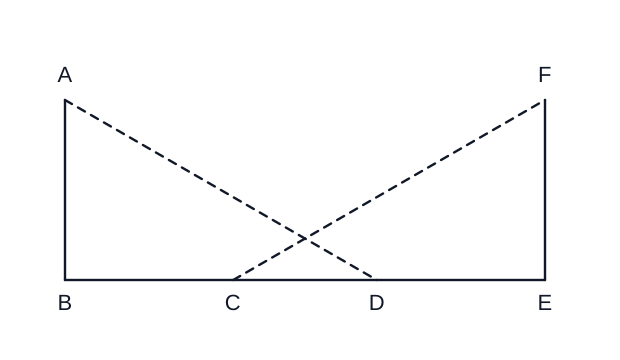
In triangles ABD and FEC, ∠BAD = 60°, l(BD) = l(EC), ∠ABD = ∠FEC = 90°, and l(AB) = l(FE). Find the ratio of ∠BAD∠FCE.
- 2:3
- 1:2
- 2:5
- 2:1
Answer aur solution dekho
Archived marked answer: D
In right triangle ABD, ∠ADB = 180° − 90° − 60° = 30°. Triangles ABD and FEC are congruent by SAS because AB = FE, BD = EC and ∠ABD = ∠FEC = 90°. Their corresponding angles ∠ADB and ∠FCE are therefore equal, so ∠FCE = 30°. The required ratio is ∠BAD : ∠FCE = 60° : 30° = 2:1.
Q2 · Geometry
A pair of straight lines from an external point F intersects a circle at A and B (FA < FB), and touches the circle at C. O is the centre of the circle. Given that ∠ACF = 50º and ∠AFC = 30º, find ∠AOB.
- 80º
- 90º
- 100º
- 60º
Answer aur solution dekho
Archived marked answer: C
Shortcut Trick
By the Alternate Segment Theorem, ∠ABC = ∠ACF = 50º.
In ΔFBC, ∠FCB = 180º − (∠F + ∠B) = 180º − (30º + 50º) = 100º.
∠ACB = ∠FCB − ∠ACF = 100º − 50º = 50º.
The angle at the centre is twice the angle at the circumference, so ∠AOB = 2 × 50º = 100º.
∴ The correct answer is 100º.
Alternate Method
- - - -
Q3 · Trigonometry
If tan 4θ × tan 6θ = 1, where 6θ is an acute angle, then find the value of cot 5θ.
- √3
- -√3
- -1
- 1
Answer aur solution dekho
Archived marked answer: D
Shortcut Trick
If tan A × tan B = 1, it implies that angles A and B are complementary, so A + B = 90°.
Given, tan 4θ × tan 6θ = 1
⇒ 4θ + 6θ = 90°
⇒ 10θ = 90° ⇒ θ = 9°
We need to find cot 5θ = cot(5 × 9°) = cot 45° = 1.
∴ The correct answer is 1.
Alternate Method
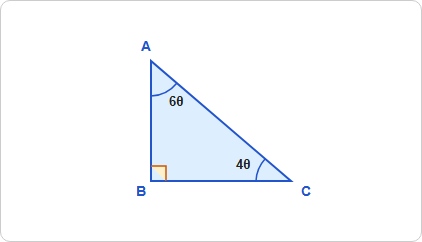 Given:
tan 4θ × tan 6θ = 1, where 6θ is an acute angle.
Formula Used:
In a right-angled ΔABC with ∠B = 90°, tan A = Perpendicular ÷ Base
Sum of acute angles ∠A + ∠C = 90°
Calculations:
From the right-angled triangle shown above, let ∠A = 6θ and ∠C = 4θ.
⇒ tan A = BC ÷ AB
⇒ tan C = AB ÷ BC
⇒ tan A × tan C = (BC ÷ AB) × (AB ÷ BC) = 1
This geometrically satisfies our given equation tan 6θ × tan 4θ = 1.
In a right-angled triangle, the two acute angles must add up to 90°.
⇒ ∠A + ∠C = 90°
⇒ 6θ + 4θ = 90°
⇒ 10θ = 90°
⇒ θ = 9°
Now, substitute the value of θ to find cot 5θ:
⇒ cot 5θ = cot(5 × 9°)
⇒ cot 5θ = cot 45°
⇒ cot 45° = 1
∴ The correct answer is 1.
Additional Information
Complementary Angles in Trigonometry
When the sum of two angles A and B is 90°, they are complementary. Important properties include sin A = cos B, tan A = cot B, and tan A × tan B = 1.
Standard Trigonometric Values
It is useful to remember common standard values such as tan 45° = 1, cot 45° = 1, sin 30° = 1/2, and cos 60° = 1/2 for quick calculations.
Reciprocal Identities
The product of a trigonometric ratio and its reciprocal is always 1. Key identities are sin θ × cosec θ = 1, cos θ × sec θ = 1, and tan θ × cot θ = 1.
</p
Q4 · Trigonometry
If 7 cosA = 6, then the numerical value of (cosecA + cotA) / (cosecA - cotA) is:
- 1
- 0
- 13
- -13
Answer aur solution dekho
Archived marked answer: C
Shortcut Trick
Given expression: (cosecA + cotA) / (cosecA − cotA)
Convert cosecA and cotA into terms of sinA and cosA:
⇒ [(1 + cosA) / sinA] ÷ [(1 − cosA) / sinA] = (1 + cosA) / (1 − cosA)
Substitute cosA = 6/7 directly into the simplified expression:
⇒ (1 + 6/7) / (1 − 6/7) = (13/7) / (1/7) = 13
∴ The correct answer is 13.
Alternate Method
Given:
7 cosA = 6 ⇒ cosA = 6/7
We know that cosA = Base / Hypotenuse.
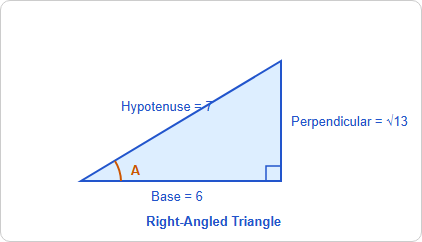 Formula Used:
According to Pythagoras theorem: Hypotenuse² = Base² + Perpendicular²
cosecA = Hypotenuse / Perpendicular
cotA = Base / Perpendicular
Calculations:
⇒ 7² = 6² + Perpendicular²
⇒ 49 = 36 + Perpendicular²
⇒ Perpendicular = √(49 − 36) = √13
⇒ cosecA = 7 / √13
⇒ cotA = 6 / √13
Now, substitute these values into the expression (cosecA + cotA) / (cosecA − cotA):
⇒ [(7 / √13) + (6 / √13)] / [(7 / √13) − (6 / √13)]
⇒ [13 / √13] / [1 / √13]
⇒ 13 / 1 = 13
∴ The correct answer is 13.
Additional Information
Trigonometric Reciprocal Identities
The primary trigonometric ratios have reciprocal counterparts: cosecθ = 1 / sinθ, secθ = 1 / cosθ, and cotθ = 1 / tanθ = cosθ / sinθ.
Pythagorean Identities
The three fundamental trigonometric identities are: sin²θ + cos²θ = 1, 1 + tan²θ = sec²θ, and 1 + cot²θ = cosec²θ.
Right-Angled Triangle Rules
For any right-angled triangle, the relation between its sides is given by Hypotenuse² = Perpendicular² + Base². The longest side is always the hypotenuse, which is directly opposite the 90° angle.
</p
Q5 · Trigonometry
Find the exact value of sin 150º
- 1.5
- 0.5
- 0.75
- -0.5
Answer aur solution dekho
Archived marked answer: B
Shortcut Trick
The angle 150° lies in the second quadrant, where the sine function is positive.
Using the reference angle relative to the X-axis: 180° − 150° = 30°.
⇒ sin 150° = sin 30°
⇒ sin 150° = 0.5
∴ The correct answer is 0.5.
Alternate Method
Given:
Angle = 150°
Formula Used:
sin(180° − θ) = sin θ
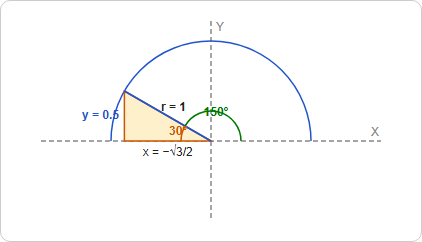 Calculation:
⇒ sin 150° = sin(180° − 30°)
⇒ sin 150° = sin 30°
⇒ sin 150° = 1/2
⇒ sin 150° = 0.5
∴ The correct answer is 0.5.
Additional Information
ASTC Rule (All Sin Tan Cos)
In the Cartesian coordinate system, the signs of trigonometric functions follow the quadrants: 1st (All positive), 2nd (Sine & Cosecant positive), 3rd (Tangent & Cotangent positive), and 4th (Cosine & Secant positive).
Reference Angles
For an angle θ in the second quadrant, its reference angle is 180° − θ. The sine function remains positive here, producing the relationship sin(180° − θ) = sin θ.
Key Trigonometric Values
Common standard sine values are: sin 0° = 0, sin 30° = 0.5, sin 45° = 1/√2, sin 60° = √3/2, and sin 90° = 1.
</p
Q6 · Mensuration 2D
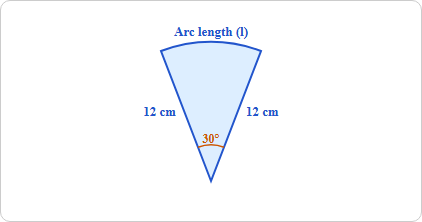
A circular arc whose radius is 12 cm makes an angle of 30º at the centre. Find the perimeter (in cm) of the sector formed. (Use π = 3.14)
- 32.38
- 30.28
- 28.64
- 26.24
Answer aur solution dekho
Archived marked answer: B
Shortcut Trick
Perimeter of sector = Arc length + (2 × Radius)
Arc length = (θ ÷ 360°) × 2πr
Arc length = (30 ÷ 360) × 2 × 3.14 × 12 = 6.28 cm
Perimeter = 6.28 + (2 × 12) = 6.28 + 24 = 30.28 cm
∴ The correct answer is 30.28 cm.
Alternate Method
Given:
Radius of the circular arc (r) = 12 cm
Angle subtended at the centre (θ) = 30°
Value of π ≈ 3.14
Formula Used:
Arc length of a sector (l) = (θ ÷ 360°) × 2πr
Perimeter of the sector = l + 2r
 Calculations:
⇒ Arc length (l) = (30° ÷ 360°) × 2 × 3.14 × 12
⇒ l = (1 ÷ 12) × 24 × 3.14
⇒ l = 2 × 3.14
⇒ l = 6.28 cm
⇒ Perimeter of the sector = Arc length + 2 × Radius
⇒ Perimeter = 6.28 + (2 × 12)
⇒ Perimeter = 6.28 + 24
⇒ Perimeter = 30.28 cm
∴ The correct answer is 30.28 cm.
Additional Information
Area of a Sector
The area of a sector of a circle with angle θ is given by Area = (θ ÷ 360°) × πr² or Area = 0.5 × l × r, where l is the arc length.
Length of a Chord
The straight-line length of the chord forming the base of the sector is calculated using 2r × sin(θ ÷ 2).
Area of a Segment
The area of a circular segment = Area of the Sector − Area of the Triangle formed by the two radii and the chord.
</p
Q7 · Mensuration 2D
If the sectorial angle with radius 9.6 units is 75º, what is the length of the arc?
- 2π
- 4π
- π
- 3π
Answer aur solution dekho
Archived marked answer: B
Shortcut Trick
Arc Length = (θ° ÷ 360°) × 2πr
⇒ Arc Length = (75° ÷ 360°) × 2 × π × 9.6
⇒ Arc Length = (5 ÷ 24) × 19.2π
⇒ Arc Length = 4π
∴ The correct answer is 4π units.
Alternate Method
Given:
Radius (r) = 9.6 units
Sectorial angle (θ) = 75°
Formula Used:
Length of arc = (θ° ÷ 360°) × 2πr
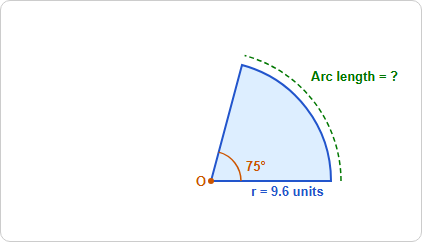 Calculations:
⇒ Length of arc = (75° ÷ 360°) × 2 × π × 9.6
⇒ Length of arc = (5 ÷ 24) × 19.2π
⇒ Length of arc = 5 × (19.2 ÷ 24) × π
⇒ Length of arc = 5 × 0.8π
⇒ Length of arc = 4π units
∴ The correct answer is 4π units.
Additional Information
Area of a Sector
The area of a sector with central angle θ and radius r is given by: Area = (θ° ÷ 360°) × πr²
Perimeter of a Sector
The perimeter of a sector includes the arc length and the two straight radii: Perimeter = 2r + Arc Length
Arc Length in Radians
If the central angle θ is measured in radians, the arc length formula simplifies directly to: l = r × θ
</p
Q8 · Mensuration 2D
The circumference of the base of a conical tent of height 8 m is 32π m. Find its curved surface area.
- 164√5 π {m}²
- 162√3 π {m}²
- 132√3 π {m}²
- 128√5 π {m}²
Answer aur solution dekho
Archived marked answer: D
Shortcut Trick
Radius (r) = Circumference ÷ 2π = 32π ÷ 2π = 16 m.
Slant height (l) = √(r² + h²) = √(16² + 8²) = √320 = 8√5 m.
Curved Surface Area = πrl = π × 16 × 8√5 = 128√5 π m².
∴ The correct answer is 128√5 π m².
Alternate Method
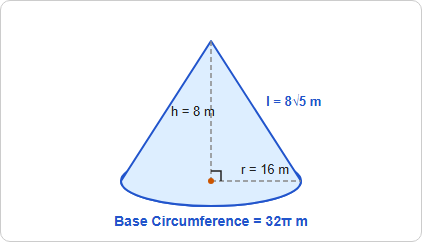 Given:
⇒ Circumference of base (C) = 32π m
⇒ Height of cone (h) = 8 m
Formula Used:
⇒ C = 2πr
⇒ l = √(r² + h²)
⇒ Curved Surface Area (CSA) = πrl
Calculation:
⇒ 2πr = 32π
⇒ r = 16 m
⇒ l = √(16² + 8²)
⇒ l = √(256 + 64) = √320
⇒ l = √(64 × 5) = 8√5 m
⇒ CSA = π × 16 × 8√5
⇒ CSA = 128√5 π m²
∴ The correct answer is 128√5 π m².
Additional Information
Total Surface Area of a Cone
The total surface area includes the curved surface and the circular base: TSA = πr(l + r).
Volume of a Cone
The volume of a cone is one-third the volume of a cylinder with the same base and height: V = (1/3)πr²h.
Frustum of a Cone
When a cone is cut parallel to its base, the lower part is the frustum. Its curved surface area is πl(r₁ + r₂).
</p
Q9 · Algebra
If a² + b² + c² = 2(a + c - 1), then the value of a³ + b³ + c³ = ?
- 0
- 2
- 4
- 1
Answer aur solution dekho
Archived marked answer: B
Shortcut Trick
Bring all terms to one side and complete the perfect squares.
a² − 2a + 1 + b² + c² − 2c + 1 = 0
(a − 1)² + b² + (c − 1)² = 0
Since the sum of squares is zero, each base must be zero: a = 1, b = 0, c = 1.
Value of a³ + b³ + c³ = 1³ + 0³ + 1³ = 2.
∴ The correct answer is 2.
Alternate Method
Given:
a² + b² + c² = 2(a + c − 1)
Concept Used:
If the sum of squares of real numbers is zero, i.e., x² + y² + z² = 0, then x = 0, y = 0, and z = 0.
Calculations:
⇒ a² + b² + c² = 2a + 2c − 2
⇒ a² − 2a + b² + c² − 2c + 2 = 0
Splitting the constant 2 into 1 + 1:
⇒ (a² − 2a + 1) + b² + (c² − 2c + 1) = 0
⇒ (a − 1)² + b² + (c − 1)² = 0
Equating each square to zero:
⇒ a − 1 = 0 ⇒ a = 1
⇒ b = 0
⇒ c − 1 = 0 ⇒ c = 1
Now, substitute the values of a, b, and c into the required expression:
⇒ a³ + b³ + c³ = (1)³ + (0)³ + (1)³
⇒ a³ + b³ + c³ = 1 + 0 + 1 = 2
∴ The correct answer is 2.
Additional Information
Sum of Squares Property
For any real numbers x, y, and z, if x² + y² + z² = 0, then it implies that x = 0, y = 0, and z = 0 independently, as squares of real numbers cannot be negative.
Important Algebraic Identities
(a ± b)² = a² ± 2ab + b²
Sum of Cubes Formula
a³ + b³ + c³ − 3abc = (a + b + c)(a² + b² + c² − ab − bc − ca). If a + b + c = 0, then a³ + b³ + c³ = 3abc.
</p
Q10 · Algebra
Which of the following is the sum of the values of a and b if the equations 2x + y = a, 8x + by = 12 have infinite solutions?
- 16
- 9
- 7
- 18
Answer aur solution dekho
Archived marked answer: C
Shortcut Trick
For two linear equations to have infinite solutions, one equation must be an exact multiple of the other.
Comparing the x-coefficients: the multiplier is 8 ÷ 2 = 4.
Multiply the entire first equation (2x + y = a) by 4 ⇒ 8x + 4y = 4a.
Compare this directly with the second equation 8x + by = 12.
We get b = 4 and 4a = 12 ⇒ a = 3.
Sum = a + b = 3 + 4 = 7.
∴ The correct answer is 7.
Alternate Method
Given:
Equation 1: 2x + y = a
Equation 2: 8x + by = 12
Formula Used:
For infinite solutions of two linear equations a₁x + b₁y = c₁ and a₂x + b₂y = c₂:
a₁/a₂ = b₁/b₂ = c₁/c₂
Calculations:
⇒ a₁ = 2, b₁ = 1, c₁ = a
⇒ a₂ = 8, b₂ = b, c₂ = 12
⇒ 2/8 = 1/b = a/12
⇒ 1/4 = 1/b = a/12
Equating the first two parts to find b:
⇒ 1/4 = 1/b
⇒ b = 4
Equating the first and third parts to find a:
⇒ 1/4 = a/12
⇒ a = 12 / 4
⇒ a = 3
Now, calculate the sum of the values of a and b:
⇒ a + b = 3 + 4 = 7
∴ The correct answer is 7.
Additional Information
Unique Solution (Intersecting Lines)
The system of equations has exactly one unique solution if the lines intersect at one point: a₁/a₂ ≠ b₁/b₂.
No Solution (Parallel Lines)
The system has zero solutions if the lines are parallel and never intersect: a₁/a₂ = b₁/b₂ ≠ c₁/c₂.
Infinite Solutions (Coincident Lines)
The system has infinitely many solutions if the lines completely overlap each other: a₁/a₂ = b₁/b₂ = c₁/c₂.
</p
Q11 · Algebra
Find the values of x, y and z, so as to satisfy the equations given below: 5x – 3y + 7z = 22; 3x – 5y – 2z = – 46; 2x – 2y + 5z = 24
- x = – 5, y = 3, z = – 8
- x = 5, y = – 8, z = 3
- x = – 5, y = 3, z = 8
- x = – 5, y = – 3, z = 8
Answer aur solution dekho
Archived marked answer: C
Substitute x = −5, y = 3, z = 8. The left sides are 5(−5) − 3(3) + 7(8) = 22; 3(−5) − 5(3) − 2(8) = −46; and 2(−5) − 2(3) + 5(8) = 24. Hence this triple satisfies all three equations.
Q12 · Profit and Loss
The profit gained on selling a certain product is 320% of the cost. If the cost increases by 10% but the selling price remains constant, then what percentage of the selling price is the profit (correct to one decimal place)?
- 70.2%
- 73.8%
- 75.7%
- 63.8%
Answer aur solution dekho
Archived marked answer: B
Shortcut Trick
Let the Cost Price (CP) be 100.
Profit = 320% of 100 = 320 ⇒ Selling Price (SP) = 100 + 320 = 420.
New Cost Price (after 10% increase) = 100 + 10 = 110.
New Profit = SP − New CP = 420 − 110 = 310.
Profit % on SP = (310 ÷ 420) × 100 ≈ 73.8%.
∴ The correct answer is 73.8%.
Alternate Method
Given:
Profit = 320% of the Cost Price (CP)
New Cost Price = CP + 10% of CP
Selling Price (SP) remains constant.
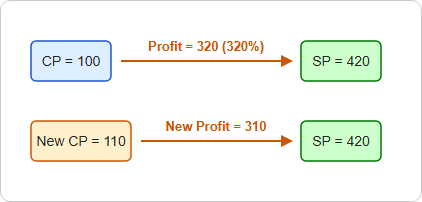 Calculations:
⇒ Let the initial CP = 100
⇒ Profit = 320% of 100 = 320
⇒ SP = CP + Profit = 100 + 320 = 420
⇒ New CP = 100 + (10% of 100) = 100 + 10 = 110
⇒ Since SP remains constant, New SP = 420
⇒ New Profit = New SP − New CP
⇒ New Profit = 420 − 110 = 310
⇒ Required Percentage = (New Profit ÷ SP) × 100
⇒ Required Percentage = (310 ÷ 420) × 100 = (31 ÷ 42) × 100
⇒ Required Percentage = 3100 ÷ 42 ≈ 73.809%
⇒ Rounding off to one decimal place, we get 73.8%.
∴ The correct answer is 73.8%.
Additional Information
Profit/Loss on Selling Price
While standard profit or loss is calculated on the Cost Price (CP), it can sometimes be calculated specifically based on the Selling Price (SP). The formula is: Profit % on SP = (Profit ÷ SP) × 100.
Marked Price & Discount
Marked Price (MP) is the price tagged by the seller before any discounts are applied. Selling Price (SP) = MP − Discount. If no discount is given, SP = MP.
Successive Percentage Change
When a value is sequentially changed by a% and then by b%, the net percentage change is calculated using the formula: Net % Change = (a + b + (a × b) ÷ 100)%.
</p
Q13 · Profit and Loss
The difference between a discount of 25% and two successive discounts of 15% and 20% on a certain bill was ₹28. Find the amount of the bill.
- ₹500
- ₹400
- ₹450
- ₹550
Answer aur solution dekho
Archived marked answer: B
Shortcut Trick
Effective percentage of two successive discounts (15% and 20%) = 15 + 20 − (15 × 20) ÷ 100 = 32%.
Difference between the two discount schemes = 32% − 25% = 7%.
Given that this difference is ₹28, we have 7% ≡ ₹28.
Total amount of the bill (100%) = (28 ÷ 7) × 100 = ₹400.
∴ The correct answer is ₹400.
Alternate Method
Given:
Single discount = 25%
Successive discounts = 15% and 20%
Difference in discount amount = ₹28
Formula Used:
Effective discount = a + b − (a × b) ÷ 100
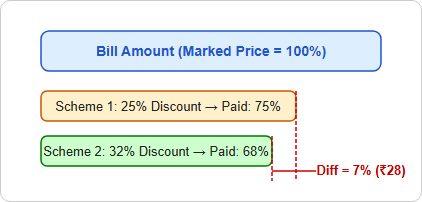 Calculations:
⇒ Let the total amount of the bill be x.
⇒ First case: Discount is 25% of x.
⇒ Second case: Successive discounts of 15% and 20%.
⇒ Effective discount % = 15 + 20 − (15 × 20) ÷ 100 = 35 − 3 = 32%.
⇒ Difference in discount percentages = 32% − 25% = 7%.
⇒ According to the question, 7% of x = ₹28.
⇒ (7 ÷ 100) × x = 28
⇒ x = (28 × 100) ÷ 7 = 400.
∴ The correct answer is ₹400.
Additional Information
Successive Discounts
When two discounts a% and b% are given successively, the equivalent single discount is given by: [a + b − (a × b) ÷ 100]%.
Marked Price (MP) vs Selling Price (SP)
Selling Price is calculated after applying the discount on the Marked Price: SP = MP − Discount. The discount is always calculated on the MP.
More than Two Successive Discounts
For three successive discounts a%, b% and c%, first find the equivalent of a% and b%, say d%. Then find the equivalent of d% and c%.
Q14 · Time and Work
Two pipes, A and B, can fill a tank in 1 1/3 hours and 2 hours, respectively. If both the pipes are opened simultaneously, then in how many hours will the tank be full?
- 1 1/4 hours
- 55 minutes
- 48 minutes
- 1 2/3 hours
Answer aur solution dekho
Archived marked answer: C
Shortcut Trick
Convert times into minutes: Pipe A = 1 1/3 hours = 80 min, Pipe B = 2 hours = 120 min
When two pipes fill a tank in x and y minutes respectively, combined time = (x × y) ÷ (x + y)
Required time = (80 × 120) ÷ (80 + 120)
Required time = 9600 ÷ 200 = 48 minutes
∴ The correct answer is 48 minutes.
Alternate Method
Given:
Time taken by Pipe A = 1 1/3 hours = 80 minutes
Time taken by Pipe B = 2 hours = 120 minutes
Formula Used:
Efficiency = Total Work ÷ Time Taken
Pipe
Time (min)
Total Work
Efficiency
A
80
240
3
B
120
2
Calculations:
⇒ Total Work = LCM of 80 and 120 = 240 units
⇒ Combined Efficiency = 3 + 2 = 5 units/min
⇒ Time taken together = Total Work ÷ Combined Efficiency
⇒ Time taken = 240 ÷ 5 = 48 minutes
∴ The correct answer is 48 minutes.
Additional Information
Emptying Pipe (Leakage)
If a pipe empties the tank, its efficiency is taken as negative. Combined efficiency = E₁ − E₂.
Work Equivalency
Pipes and cisterns problems follow the exact same logic as Time and Work, where Total Work represents the overall volume of the tank.
Part of Tank Filled
The portion of the tank filled in 1 minute or hour is exactly the reciprocal of the total time taken to fill the tank (1 ÷ T).
</p
Q15 · Number System
Which of the following numbers is divisible by 2, 5, 10 and 11?
- 203467
- 830942
- 589270
- 1234560
Answer aur solution dekho
Archived marked answer: C
Shortcut Trick
For a number to be divisible by 2, 5, and 10, its last digit must be 0.
Only the numbers 589270 and 1234560 end in 0.
Now check divisibility by 11 (difference between the sum of alternate digits must be 0 or a multiple of 11):
For 589270: (5 + 9 + 7) − (8 + 2 + 0) = 21 − 10 = 11 (Divisible by 11).
∴ The correct answer is 589270.
Alternate Method
Given:
Numbers: 203467, 830942, 589270, 1234560
Divisors: 2, 5, 10, and 11
Method Used:
Divisibility by 10: The unit digit must be 0.
Divisibility by 11: The difference between the sum of digits at odd positions and even positions must be 0 or a multiple of 11.
Calculations:
⇒ Step 1: Check divisibility by 10.
⇒ 203467 ends in 7 → Not divisible.
⇒ 830942 ends in 2 → Not divisible.
⇒ 589270 and 1234560 end in 0 → Divisible by 2, 5, and 10.
⇒ Step 2: Check divisibility by 11.
⇒ For 589270: Sum of odd place digits = 5 + 9 + 7 = 21.
⇒ Sum of even place digits = 8 + 2 + 0 = 10.
⇒ Difference = 21 − 10 = 11 (which is a multiple of 11).
⇒ For 1234560: Sum of odd place digits = 1 + 3 + 5 + 0 = 9.
⇒ Sum of even place digits = 2 + 4 + 6 = 12.
⇒ Difference = 12 − 9 = 3 (not a multiple of 11).
⇒ Therefore, 589270 is divisible by all the given numbers.
∴ The correct answer is 589270.
Additional Information
Divisibility Rule of 3 and 9
A number is divisible by 3 or 9 if the sum of all its digits is divisible by 3 or 9 respectively.
Divisibility Rule of 4 and 8
A number is divisible by 4 if its last two digits form a number divisible by 4. It is divisible by 8 if its last three digits form a number divisible by 8.
Divisibility Rule of 7 and 13
Group the digits in blocks of 3 from right to left. If the difference of the alternating sum of these blocks is divisible by 7 or 13, the entire number is respectively divisible.
LCM of Divisors
If a number is divisible by a set of co-prime numbers, it must be divisible by their LCM. For example, LCM(2, 5, 10, 11) = 110, so any number divisible by all must be a multiple of 110.
</p
Q16 · Number System
Find the smallest value that must be assigned to number 'a' in order for 91876a2 to be divisible by 8.
- 3
- 0
- 1
- 2
Answer aur solution dekho
Archived marked answer: A
Shortcut Trick
For a number to be divisible by 8, if its hundred's digit is even, the last two digits must form a number divisible by 8.
In the number 91876a2, the hundred's digit is 6 (which is even).
So, the number formed by the last two digits, 'a2', must be divisible by 8.
Checking digits from 0 upwards: 02, 12, and 22 are not divisible by 8.
For a = 3, 32 is exactly divisible by 8 (32 ÷ 8 = 4).
∴ The correct answer is 3.
Alternate Method
Given:
The number 91876a2 is perfectly divisible by 8.
Formula Used:
A number is perfectly divisible by 8 if the number formed by its last three digits is divisible by 8.
Calculations:
⇒ The last three digits of the given number form the number '6a2'.
⇒ We need to find the smallest single-digit value for 'a' (from 0 to 9).
⇒ Let us test the possible smallest values for 'a':
⇒ If a = 0, the number is 602 → 602 ÷ 8 = 75.25 (Not divisible)
⇒ If a = 1, the number is 612 → 612 ÷ 8 = 76.5 (Not divisible)
⇒ If a = 2, the number is 622 → 622 ÷ 8 = 77.75 (Not divisible)
⇒ If a = 3, the number is 632 → 632 ÷ 8 = 79 (Exactly divisible)
⇒ Thus, the smallest value that satisfies the divisibility rule is 3.
∴ The correct answer is 3.
Additional Information
Divisibility by 4
A number is divisible by 4 if the last two digits form a number that is perfectly divisible by 4.
Divisibility by 8
A number is divisible by 8 if the last three digits form a number that is perfectly divisible by 8.
Divisibility by 8 (Shortcut Rule)
If the hundred's digit of a number is even, simply check if its last 2 digits are divisible by 8. If the hundred's digit is odd, check if the last 2 digits plus 4 is divisible by 8.
</p
Q17 · Time and Distance
A boatman goes 2 km against the current of the stream in 1 hour and goes 1 km along with the current in 10 minutes. How long will it take to go 6 km in stationary water?
- 1 hr 30 min
- 1 hr 15 min
- 2 hr 30 min
- 1 hr 45 min
Answer aur solution dekho
Archived marked answer: A
Shortcut Trick
Upstream speed = 2 km/h
Downstream speed = 1 km × (60 ÷ 10) = 6 km/h
Boat speed in still water = (Downstream speed + Upstream speed) ÷ 2 = (6 + 2) ÷ 2 = 4 km/h
Time to cover 6 km = Distance ÷ Speed = 6 ÷ 4 = 1.5 hr = 1 hr 30 min
∴ The correct answer is 1 hr 30 min.
Alternate Method
Given:
Distance upstream = 2 km
Time upstream = 1 hour
Distance downstream = 1 km
Time downstream = 10 minutes = 10 ÷ 60 hour = 1/6 hour
Formula Used:
Upstream Speed (U) = Distance ÷ Time
Downstream Speed (D) = Distance ÷ Time
Speed of Boat in Still Water (V) = (D + U) ÷ 2
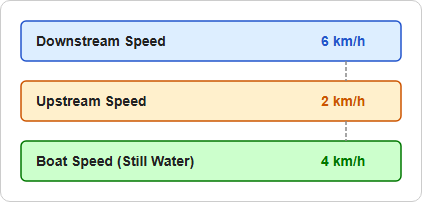 Calculations:
⇒ Upstream Speed (U) = 2 ÷ 1 = 2 km/h
⇒ Downstream Speed (D) = 1 ÷ (1/6) = 6 km/h
⇒ Speed of Boat in Still Water (V) = (6 + 2) ÷ 2
⇒ V = 8 ÷ 2 = 4 km/h
⇒ Time required to travel 6 km in still water = Distance ÷ Speed
⇒ Time = 6 ÷ 4 = 1.5 hours
⇒ 1.5 hours = 1 hour + 0.5 hour = 1 hr 30 min
∴ The correct answer is 1 hr 30 min.
Additional Information
Speed of Stream
The speed of the current can be found by taking half the difference of the downstream and upstream speeds: Speed of Stream = (Downstream Speed − Upstream Speed) ÷ 2.
Effective Speed
When moving downstream, the flow of the river assists the boat, hence speeds are added (Boat + Stream). When moving upstream, the flow resists the boat, hence speeds are subtracted (Boat − Stream).
</p
Q18 · Data Interpretation
Study the given chart and answer the question that follows.
The following chart shows the production of textbooks in thousands in the years 2018, 2020 and 2022 from the print houses A, B and C, respectively.
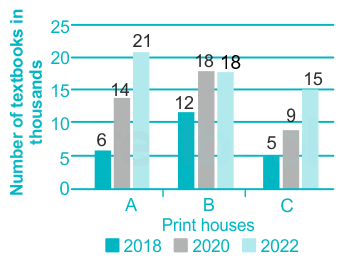 The ratio of textbooks produced by Print house B in the year 2018 to the textbooks produced by Print house C in the year 2020 is ______.
- 4 : 5
- 3 : 4
- 4 : 3
- 2 : 3
Answer aur solution dekho
Archived marked answer: C
Given:
The bar graph shows the production of textbooks (in thousands) by print houses A, B, and C in the years 2018, 2020, and 2022.
Calculations:
Textbooks produced by Print house B in the year 2018 = 12,000
Textbooks produced by Print house C in the year 2020 = 9000
Required ratio = 12000 : 9000 = 12 : 9 = 4 : 3
∴ The correct answer is option (3).
Q19 · Data Interpretation
The following pie chart shows the percentage distribution of a total of 1600 employees in different departments of a company. The table shows the ratio of male to female employees in different departments. Study the information and answer the question that follows.
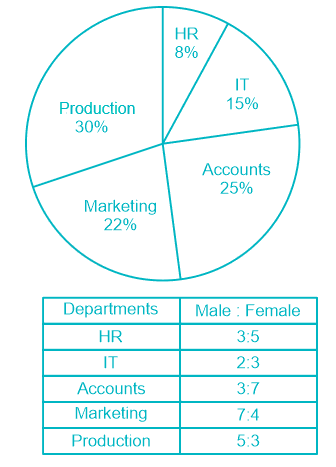 What is the percentage of the number of employees in production department to the number of female employees of all the departments taken together? (correct to one decimal place)
- 64.3%
- 50.7%
- 44.9%
- 59.1%
Answer aur solution dekho
Archived marked answer: D
Given:
Total employees in the company = 1600
Percentage distribution of employees in different departments:
Production = 30%
Marketing = 22%
Accounts = 25%
IT = 15%
HR = 8%
Ratio of male to female employees in each department:
Production = 5:3
Marketing = 7:4
Accounts = 3:7
IT = 2:3
HR = 3:5
Calculations:
Calculate the number of employees in the Production department:
Number of employees in Production = (30/100) × 1600 = 480
Calculate the number of female employees in each department:
Production: Total employees = 480, Ratio = 5:3 (male:female)
Female employees in Production = (3/8) × 480 = 180
Marketing: Total employees = (22/100) × 1600 = 352, Ratio = 7:4 (male:female)
Female employees in Marketing = (4/11) × 352 = 128
Accounts: Total employees = (25/100) × 1600 = 400, Ratio = 3:7 (male:female)
Female employees in Accounts = (7/10) × 400 = 280
IT: Total employees = (15/100) × 1600 = 240, Ratio = 2:3 (male:female)
Female employees in IT = (3/5) × 240 = 144
HR: Total employees = (8/100) × 1600 = 128, Ratio = 3:5 (male:female)
Female employees in HR = (5/8) × 128 = 80
Calculate the total number of female employees:
Total female employees = 180 + 128 + 280 + 144 + 80 = 812
Calculate the percentage of Production department employees to total female employees:
Percentage = (Number of employees in Production / Total female employees) × 100
Percentage = (480 / 812) × 100 ≈ 59.1%
Therefore, the percentage of the number of employees in the Production department to the number of female employees of all departments taken together is approximately 59.1%.
Q20 · Data Interpretation
In 2010, a company’s total expenditure was categorised under different expense heads, and their percentage distribution is illustrated in the bar graph given below:
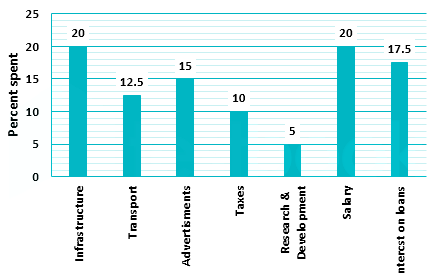 The total amount of expenditure of the company is ______ times that of expenditure on R & D.
- 20
- 38
- 32
- 28
Answer aur solution dekho
Archived marked answer: A
Given:
Percentage distribution of the company's total expenditure on different expense heads as shown in the bar graph.
Expenditure on R&D = 5%
Calculations:
Total expenditure of the company = 100%
Ratio of total expenditure to expenditure on R&D = 100/5 = 20
Therefore, the total amount of expenditure of the company is 20 times that of expenditure on R&D.
Q21 · Proportion
The mean proportional of 2 and 32 is _____.
- 16
- 8
- 12
- 6
Answer aur solution dekho
Archived marked answer: B
Shortcut Trick
The mean proportional of two numbers a and b is directly given by √(a × b).
Given numbers are 2 and 32.
Mean proportional = √(2 × 32) = √64 = 8.
∴ The correct answer is 8.
Alternate Method
Given:
Two numbers: 2 and 32.
Formula Used:
If x is the mean proportional between a and b, then a : x :: x : b.
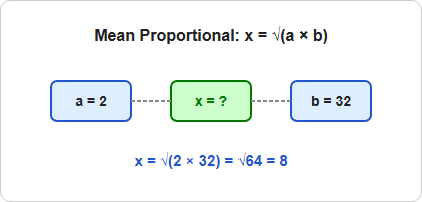 Calculations:
Let the mean proportional be x.
⇒ 2 : x :: x : 32
⇒ x ÷ 2 = 32 ÷ x
⇒ x² = 2 × 32
⇒ x² = 64
⇒ x = √64
⇒ x = 8
∴ The correct answer is 8.
Additional Information
Third Proportional
If c is the third proportional to a and b, then a : b :: b : c, which gives the relation c = b² ÷ a.
Fourth Proportional
If d is the fourth proportional to a, b, and c, then a : b :: c : d, which gives the relation d = (b × c) ÷ a.
Compounded Ratio
For two given ratios a : b and c : d, the compounded ratio is the ratio of the product of their antecedents to the product of their consequents, denoted as (a × c) : (b × d).
</p
Q22 · Percentage
The proportion of Suresh's spending to saving is 3 : 1. His salary rises by 25%. What percentage of his expenditure will increase if his saving grows by 10%?
- 40%
- 20%
- 10%
- 30%
Answer aur solution dekho
Archived marked answer: D
Shortcut Trick
Ratio of Expenditure to Savings = 3 : 1 → Total Income parts = 3 + 1 = 4.
Net percentage change in Income = 25% × 4 parts = +100%.
Percentage change in Savings = 10% × 1 part = +10%.
Percentage change in Expenditure = Total change − Savings change = +100% − 10% = +90%.
Overall % increase in Expenditure = 90% ÷ 3 parts = 30%.
∴ The correct answer is 30%.
Alternate Method
Given:
Ratio of Expenditure to Saving = 3 : 1
Salary (Income) rise = 25%
Saving increase = 10%
Formula Used:
Income = Expenditure + Savings
Percentage Change = (Change in Value ÷ Original Value) × 100
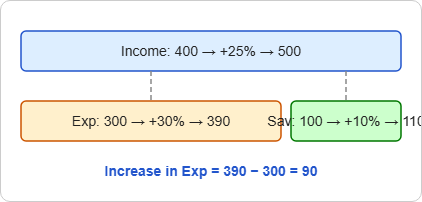 Calculations:
⇒ Let original Expenditure = 300 and original Savings = 100.
⇒ Original Income = 300 + 100 = 400.
⇒ New Income = 400 + (25 ÷ 100) × 400 = 400 + 100 = 500.
⇒ New Savings = 100 + (10 ÷ 100) × 100 = 100 + 10 = 110.
⇒ New Expenditure = New Income − New Savings = 500 − 110 = 390.
⇒ Increase in Expenditure = 390 − 300 = 90.
⇒ Percentage increase in Expenditure = (90 ÷ 300) × 100 = 30%.
∴ The correct answer is 30%.
Additional Information
Income, Expenditure & Savings
The foundational relation is always Income = Expenditure + Savings. If two values are known, the third can be directly derived at any stage of percentage change.
Rule of Alligation
We can apply the mixture method to percentage changes: (Expenditure % change − Income % change) ÷ (Income % change − Savings % change) = Savings Ratio ÷ Expenditure Ratio.
Net Deviation Method
By treating the ratios as weights, the overall percentage change is the weighted average of individual changes: Net Change = (w₁x₁ + w₂x₂) ÷ (w₁ + w₂).
</p
Q23 · Simple Interest
How much simple interest will ₹6,700 earn in 13 months at a 12% interest rate per annum?
- ₹871
- ₹889
- ₹821
- ₹813
Answer aur solution dekho
Archived marked answer: A
Shortcut Trick
The rate of interest is 12% per annum, which is exactly 1% per month.
For a period of 13 months, the total effective interest rate = 13 × 1% = 13%.
Simple Interest = 13% of Principal
⇒ SI = 13% of 6700 = 13 × 67 = 871
∴ The correct answer is ₹871.
Alternate Method
Q24 · Mixture and Alligation
A merchant mixes two varieties of sugar of 5 kg and 3 kg, which costs him ₹4 and ₹6 per kg, respectively. What is the cost price (in ₹) of the mixture per kg?
- 4.35
- 4.45
- 4.75
- 4.21
Answer aur solution dekho
Archived marked answer: C
Shortcut Trick
By Alligation Method, Ratio of Quantities = (c₂ − x) : (x − c₁)
5 : 3 = (6 − x) : (x − 4)
5 × (x − 4) = 3 × (6 − x)
5x − 20 = 18 − 3x ⇒ 8x = 38
x = 38 ÷ 8 = 4.75
∴ The correct answer is ₹4.75.
Alternate Method
Given:
Quantity of variety 1 (w₁) = 5 kg at cost (c₁) = ₹4 per kg
Quantity of variety 2 (w₂) = 3 kg at cost (c₂) = ₹6 per kg
Formula Used:
Mixture Price = (w₁ × c₁ + w₂ × c₂) ÷ (w₁ + w₂)
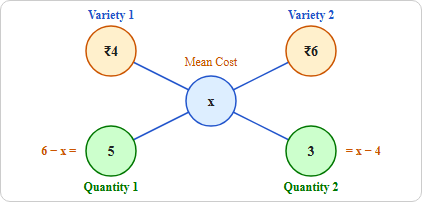 Calculations:
⇒ Total Cost = (5 × 4) + (3 × 6)
⇒ Total Cost = 20 + 18 = 38
⇒ Total Quantity = 5 + 3 = 8 kg
⇒ Mixture Price = 38 ÷ 8
⇒ Mixture Price = 4.75
∴ The correct answer is ₹4.75.
Additional Information
Alligation Rule
It is a rule used to find the proportion in which two ingredients must be mixed to achieve a desired average price. Ratio = (Cost of Dearer − Mean Price) : (Mean Price − Cost of Cheaper).
Weighted Average
When components have different weights or quantities, their total combined average is calculated directly using the formula: Average = (w₁x₁ + w₂x₂ + ... ) ÷ (w₁ + w₂ + ... ).
Replacement in Mixtures
If a container holds a total volume V of pure liquid, and x volume is drawn out and replaced with water n times, the amount of pure liquid remaining is determined by: Final = Initial × (1 − x/V)ⁿ.
120:Td
English
Q1 · Vocabulary
Select the most appropriate ANTONYM of the given word.
Monotonous
- Tiresome
- Tedious
- Engrossing
- Rational
Answer aur solution dekho
Archived marked answer: C
The correct answer is: Engrossing.
Key Points
- The word "Monotonous" means something that is dull, tedious, and repetitious; lacking in variety and interest.
- Example: The monotonous routine of his job made him feel unmotivated.
- "Engrossing" refers to something that is absorbing all the attention or interest of someone; very interesting.
- Example: The novel was so engrossing that she couldn't put it down until she finished it.
- Hence, we can infer that the opposite of 'Monotonous' is 'Engrossing'.
Therefore, the correct answer is: Engrossing.
Additional Information
Here are the other options explained along with their Hindi meanings and example sentences:
- Tiresome : Causing one to feel bored or annoyed.
- Example: The long, tiresome journey left everyone exhausted.
- Tedious : Too long, slow, or dull; tiresome or monotonous.
- Example: The tedious process of filling out forms made everyone impatient.
- Rational: Based on or in accordance with reason or logic.
- Example: His rational explanation convinced everyone in the meeting.
Q2 · Vocabulary
Select the most appropriate ANTONYM of the given word.
Catastrophe
- Success
- Nurture
- Immaculate
- Disaster
Answer aur solution dekho
Archived marked answer: A
The correct answer is: Option 1 i.e. Success.
Key Points
- The word "Catastrophe" means a sudden and widespread disaster or a momentous tragic event.
- Example: The earthquake was a catastrophe that destroyed many homes and lives.
- "Success" refers to the accomplishment of an aim or purpose, or the attainment of fame, wealth, or social status.
- Example: After years of hard work, she finally achieved great success in her career.
Therefore, the correct answer is: Option 1 i.e. Success.
Additional Information
Here are the other options explained along with their Hindi meanings and example sentences:
- Nurture : To look after and protect somebody/something while he/she/it are growing and developing.
- Example: The beauty of nature is unparalleled.
- Immaculate : Perfectly clean, neat, or tidy.
- Example: She always kept her room in immaculate condition.
- Disaster: A sudden event, such as an accident or a natural catastrophe, that causes great damage or loss of life.
- Example: The flood was a major disaster that affected the entire region.
Q3 · Vocabulary
Select the most appropriate ANTONYM of the underlined word in the given sentence.
One must be very strong to lift this box of glass jars.
- Mighty
- Weak
- Complicated
- Rugged
Answer aur solution dekho
Archived marked answer: B
The correct answer is: Option 2 i.e. Weak.
Key Points
- The word "strong" means having the power to move heavy weights or perform other physically demanding tasks.
- Example: He is strong enough to carry the heavy furniture by himself.
- "Weak" refers to lacking physical strength and energy.
- Example: After the illness, he felt too weak to get out of bed.
- Hence, we can infer that the opposite of 'strong' is 'weak'.
Therefore, the correct answer is: Option 2 i.e. Weak.
Additional Information
Here are the other options explained along with their Hindi meanings and example sentences:
- Mighty: Possessing great and impressive power or strength.
- Example: The mighty warrior defended the kingdom bravely.
- Complicated: Involving many different and confusing aspects or elements.
- Example: The instructions for the new software were very complicated.
- Rugged: Having a rough, uneven surface; not smooth or level.
- Example: The rugged terrain made the hike more challenging.
The correct answer is <
Q4 · Vocabulary
Select the most appropriate meaning of the underlined idiom.
Anand personally believes in the motto, "When life gives you lemons, make lemonade."
- Earn the maximum out of business
- Nourish health
- Enjoy the most when the season is favourable
- Make the best out of difficult situations
Answer aur solution dekho
Archived marked answer: D
The correct answer is: Option 4 i.e. Make the best out of difficult situations.
Key Points
- The idiom "When life gives you lemons, make lemonade" means making the best out of difficult situations.
- Example: Despite the setbacks, she always manages to turn things around. Truly, when life gives her lemons, she makes lemonade.
Therefore, the correct answer is: Option 4 i.e. Make the best out of difficult situations.
Additional Information
Here are the other options explained along with their Hindi meanings and example sentences:
- Earn the maximum out of business: To make the highest possible profit from business.
- Example: His goal was to earn the maximum out of business, always looking for new opportunities.
- Nourish health: To take care of and improve one's health.
- Example: Regular exercise and a balanced diet help to nourish health.
- Enjoy the most when the season is favourable: To take full advantage of good times.
- Example: They decided to enjoy the most when the season is favourable, planning picnics and outdoor activities.
The correct answer is habit.
Q5 · Vocabulary
Select the option that can be used as a one-word substitute for the given group of words.
A place where birds are kept
- Zoo
- Aviary
- Sanctuary
- Hive
Answer aur solution dekho
Archived marked answer: B
The correct answer is 'Option 2'.
Key Points
- Aviary refers to a place where birds are kept. It is often a large cage, building, or enclosure for keeping birds confined, especially for scientific study or display.
Hence, the correct answer is 'Option 2'.
Additional Information
- Zoo is a place where animals, not specifically birds, are kept for public viewing.
- Sanctuary refers to a protected area for wildlife but does not specifically mean a place for keeping birds.
- Hive is related to bees, not birds.
Q6 · Vocabulary
Select the option that can be used as a one-word substitute for the given phrase.
Incapable of being defeated
- Invisible
- Unavoidable
- Invincible
- Ineluctable
Answer aur solution dekho
Archived marked answer: C
The correct answer is Option 3.
Key Points
- The phrase "Incapable of being defeated" refers to someone or something that cannot be overcome or conquered.
- Invincible</strong
Q7 · Vocabulary
Select the INCORRECTLY spelt word.
- Centenary
- Consumerist
- Capitalist
- Countemptible
Answer aur solution dekho
Archived marked answer: D
The correct answer is option 4.
Key Points
The misspelled word is 'Countemptible'.
- The correct spelling would be 'Contemptible'.
- The word 'Contemptible' is an adjective which means 'deserving contempt; despicable'.
- For Example: His actions were so selfish that they were considered contemptible by everyone.
- Therefore, the correct answer would be 'Countemptible'.
Additional Information
Let's understand the meanings of the other marked words -
- Centenary - relating to a hundredth anniversary
- Consumerist - a person who is preoccupied with the acquisition of consumer goods
- Capitalist - a person who uses their wealth to invest in trade and industry for profit
Q8 · Vocabulary
Identify the INCORRECTLY spelt word in the following sentence.
You need to be concious enough to listen to the question.
- concious
- enough
- question
- listen
Answer aur solution dekho
Archived marked answer: A
The correct answer is option 1.
Key Points
The misspelled word is 'concious'.
- The correct spelling would be 'conscious'.
- The word 'conscious' is an adjective which means 'aware of and responding to one's surroundings'.
- For Example -
- He was fully conscious during the operation.
- Therefore, the correct answer would be 'conscious'.
Additional Information
Let's understand the meanings of the other marked words -
- Enough - as much or as many as required
- Question - a sentence worded or expressed so as to elicit information
- Listen - give one's attention to a sound
The co
Q9 · Vocabulary
Select the most appropriate synonym to replace the underlined word in the given sentence.
How did we end up in this rapturous situation?
- ecstatic
- terrifying
- misleading
- disastrous
Answer aur solution dekho
Archived marked answer: A
The correct answer is: Option 1 i.e. ecstatic.
Key Points
- The word "rapturous" means feeling or expressing great pleasure or enthusiasm.
- Example: The audience gave a rapturous applause after the performance.
- "Ecstatic" refers to feeling or expressing overwhelming happiness or joyful excitement.
- Example: She was ecstatic when she heard the news of her promotion.
- Hence, we can infer that "ecstatic" is a suitable synonym for "rapturous".
Therefore, the correct answer is: Option 1 i.e. ecstatic.
Additional Information
Here are the other options explained along with their Hindi meanings and example sentences:
- Terrifying : Causing extreme fear.
- Example: The movie was so terrifying that I couldn't sleep all night.
- Misleading : Giving the wrong idea or impression.
- Example: The advertisement was misleading and did not reflect the actual product.
- Disastrous: Causing great damage or distress.
- Example: The earthquake had a disastrous effect on the small town.
Q10 · Vocabulary
Select the most appropriate synonym of the given word.
Rectify
- mar
- amend
- corrupt
- upset
Answer aur solution dekho
Archived marked answer: B
The correct answer is: Option 2 i.e. amend.
Key Points
- The word "rectify" means to correct something or make it right.
- Example: She tried to rectify her mistake by apologizing to everyone involved.
- "Amend" refers to making changes to something in order to improve it or correct it.
- Example: The government decided to amend the existing law to better protect the environment.
- Hence, we can infer that the synonym of 'rectify' is 'amend'.
Therefore, the correct answer is: Option 2 i.e. amend.
Additional Information
Here are the other options explained along with their Hindi meanings and example sentences:
- Mar: To spoil, impair, or damage something.
- Example: The graffiti marred the beauty of the historic building.
- Corrupt: Having or showing a willingness to act dishonestly in return for money or personal gain.
- Example: The corrupt official was eventually caught and prosecuted.
- Upset: To make someone unhappy, disappointed, or worried.
- Example: The news of her friend's accident upset her greatly.
The correct answer is: Option 2 i.e.
Q11 · Vocabulary
Select the most appropriate option to fill in the blank.
To _______ the ticket, Amith had to visit the travel agency many times.
- contract
- confirm
- conform
- convention
Answer aur solution dekho
Archived marked answer: B
The correct answer is 'confirm'.
Key Points
- The word "confirm" means to establish the truth or correctness of something.
- In the context of the sentence, Amit had to visit the travel agency many times to verify or establish the validity of the ticket.
Therefore, the correct answer is 'Option 2'.
Complete Sentence: *To confirm the ticket, Amith had to visit the travel agency many times.*
Additional Information
- Contract : means a written or spoken agreement, especially one concerning employment, sales, or tenancy, that is intended to be enforceable by law.
- Conform : means to comply with rules, standards, or laws.
- Convention : means a large meeting or conference, especially of members of a political party or a particular profession.
Q12 · Vocabulary
Select the most appropriate option to fill in the blank.
After years of fights with his neighbour Ram, Shekhar decided to hold out the ______ and invited Ram for tea.
- poker face
- comparing apples to oranges
- chip on shoulder
- olive branch
Answer aur solution dekho
Archived marked answer: D
The correct answer is: Option 4.
Key Points
- The word "olive branch" means an offer of peace or reconciliation.
- Example: After their argument, she extended an olive branch by apologizing first.
- "olive branch" is an appropriate term in the context of resolving conflicts and making peace.
- Example: The company offered the workers an olive branch to end the strike.
Therefore, the correct answer is: Option 4.
Additional Information
Here are the other options explained along with their Hindi meanings and example sentences:
- Poker face: An expressionless face that reveals no emotions.
- Example: She maintained a poker face throughout the meeting, giving away nothing.
- Comparing apples to oranges: Comparing two things that are fundamentally different.
- Example: Comparing the two projects is like comparing apples to oranges; they have very different objectives.
- Chip on shoulder: Holding a grudge or feeling of being treated unfairly.
- Example: He has a chip on his shoulder about not being promoted last year.
Q13 · Grammar
The following sentence has been divided into parts. One of them may contain an error. Select the part that contains the error from the given options. If you don’t find any error, mark ‘No error’ as your answer.
My brother received / his MBA degree into / the university last year.
- the university last year
- his MBA degree into
- No error
- My brother received
Answer aur solution dekho
Archived marked answer: B
The correct answer is Option 2.
Q14 · Grammar
The following sentence has been divided into four segments. Identify the segment that contains an error in the usage of the interjection.
He replied / in a dry tone, / “Ouch! I will not work / for you anymore.”
- In a dry tone,
- He replied
- for you anymore.
- "Ouch! I will not work
Answer aur solution dekho
Archived marked answer: D
The correct answer is Option 4.
Key Points
- The primary issue in the sente
Q15 · Grammar
Select the most appropriate option that can substitute the underlined word/phrase in the given sentence.
Beyond skills, experience, and training, companies search for applicants who display excitement — those they believe shall carry out allocated responsibilities cheerfully and cooperatively.
- shall take up any designated obligations
- will execute assigned duties
- will demonstrate non-biased work
- should pick up all tasks and works
Answer aur solution dekho
Archived marked answer: B
The correct answer is 'Option 2'.
Key Points
In Option 2 "Will execute assigned duties" is the most appropriate substitute as it conveys the idea of performing tasks that have been allocated, aligning well with the context of the sentence.
Hence, the correct answer is 'Option 2'.
Additional Information
- Option 1: "Shall take up any designated obligations" is less concise and not commonly used in this context.
- Option 3: "Will demonstrate non-biased work" does not fit as it shifts the focus to fairness rather than the excitement and cooperation mentioned in the sentence.
- Option 4: "Should pick up all tasks and works" is vague and grammatically awkward in this context.
Q16 · Grammar
Select the most appropriate option that can substitute the underlined segment in the given sentence.
The mother asked the child, "Will you tell me who did accompany you to the airport?"
- who accompanies you
- who does accompany you
- who accompanied you
- who must be accompanied you
Answer aur solution dekho
Archived marked answer: C
The correct answer is: Option 3 i.e. who accompanied you.
Key Points
- The phrase "who accompanied you" is in the correct tense and form for the question being asked.
- Example: Can you tell me who accompanied you to the party?
- "Will you tell me who did accompany you" is incorrect because "did" is redundant here and makes the sentence grammatically incorrect.
- Example:
Incorrect: Will you tell me who did accompany you?
Correct: Will you tell me who accompanied you?
Therefore, the correct answer is: Option 3.
Additional Information
Here are the other options explained along with their Hindi meanings and example sentences:
- Option 1: who accompanies you: Present tense, not suitable for past events.
- Example: She always accompanies you to the market.
- Option 2: who does accompany you: Incorrect tense and redundant use of "does".
- Example: Incorrect: Who does accompany you to school? Correct: Who accompanies you to school?
- Option 4: who must be accompanied you: Grammatically incorrect structure.
- Example: Incorrect: Who must be accompanied you? Correct: Who must have accompanied you?
Q17 · Voice Change
Select the option that correctly expresses the following sentence in passive voice.
Who invited you to this party?
- By whom you are invited to this party?
- By whom are you invited to this party?
- By whom you were invited to this party?
- By whom were you invited to this party?
Answer aur solution dekho
Archived marked answer: D
The correct answer is Option 4.
Key Points
- Passive voice structure: The object of the active voice sentence becomes the subject of the passive voice sentence.
- In the active voice, the sentence is: "Who invited you to this party?"
- To convert to passive voice: Place the object "you" at the beginning.
- Change the active verb form "invited" to "were invited" (past simple passive).
- Add the preposition "by" followed by the original subject "who".
- Ensure the question structure remains intact by placing "By whom" at the beginning.
Therefore, the correct answer is Option 4.
Correct Sentence: *"By whom were you invited to this party?"*
Additional Information
- Option 1: "By whom you are invited to this party?" – Incorrect word order in the question.
- Option 2: "By whom are you invited to this party?" – Incorrect tense (present simple passive instead of past simple passive).
- Option 3: "By whom you were invited to this party?" – Incorrect word order in the question.
Q18 · Voice Change
Select the option that correctly expresses the given sentence in passive voice.
I will never overlook this creativity.
- This creativity will never be overlooked by me.
- This creativity will be overlooked by me.
- This creativity will being overlooked by me.
- This creativity will not never be overlooked by me.
Answer aur solution dekho
Archived marked answer: A
The correct answer is Option 1.
Key Points
- Passive voice structure: The object of the active voice sentence becomes the subject of the passive voice sentence.
- In the active voice, the sentence is: "I will never overlook this creativity."
- To convert to passive voice: Place the object "this creativity" at the beginning.
- Change the active verb form "will never overlook" to "will never be overlooked" (future simple passive).
- Add the preposition "by" followed by the original subject "me."
Therefore, the correct answer is Option 1.
Correct Sentence: *"This creativity will never be overlooked by me."*
Additional Information
- Option 2: "This creativity will be overlooked by me." – Incorrect because it omits the word "never", changing the meaning.
- Option 3: "This creativity will being overlooked by me." – Incorrect grammar (incorrect verb form).
- Option 4: "This creativity will not never be overlooked by me." – Incorrect due to the double negative.
Q19 · Para Jumble
Sentences of a paragraph are given below in jumbled order. Arrange the sentences in the correct order to form a meaningful and coherent paragraph.
A. Mobile phones or smartphones are becoming popular all over the world.
B. But at the same time, it also harms us in many ways.
C. It is the most widely used means of communication today.
D. Today, it is very affordable and available to everyone.
- ABCD
- DACB
- CABD
- ACDB
Answer aur solution dekho
Archived marked answer: D
The correct answer is Option 4.
Key Points
- The paragraph discusses the popularity and impact of mobile phones or smartphones.
- Sentence A is the first sentence as it introduces the main topic:
- "Mobile phones or smartphones are becoming popular all over the world."
- Sentence C follows as it explains why they are so popular:
- "It is the most widely used means of communication today."
- Sentence D is the third sentence because it highlights their affordability and accessibility:
- "Today, it is very affordable and available to everyone."
- Sentence B is the fourth as it addresses the negative aspects:
- "But at the same time, it also harms us in many ways."
- The correct sequence is ACDB.
Q20 · Para Jumble
Sentences of a paragraph are given below in jumbled order. Select the option that arranges the sentences in the correct sequence to form a meaningful and coherent paragraph.
A) This past summer, my dream finally came true.
B) Strange lands, exciting places, and new cultures have always fascinated me.
C) Ever since I was a little girl, I dreamed about travelling overseas.
D) I got to travel to England, France, Switzerland, and Germany.
- DCBA
- CBAD
- ABDC
- BADC
Answer aur solution dekho
Archived marked answer: B
The correct answer is Option 2.
Key Points
- The paragraph begins by introducing the fascination with travel and dreams from a young age.
- Sentence C is the first sentence as it sets the context of the lifelong dream:
- "Ever since I was a little girl, I dreamed about travelling overseas."
- Sentence B follows as it elaborates on the fascination with travel:
- "Strange lands, exciting places, and new cultures have always fascinated me."
- Sentence A is the third sentence because it describes the realization of the dream:
- "This past summer, my dream finally came true."
- Sentence D is the fourth as it provides specifics about the travel experience:
- "I got to travel to England, France, Switzerland, and Germany."
The correct sequence is CBAD.