91 questions available to read. Bina signup padho; timed practice ke liye free sign in karo.
Archive coverageThis saved paper contains 92 of 100 expected questions. 1 stored records are excluded from this study page while their source or wording is checked. Missing original questions: 8. Local question numbers follow the saved archive; match the wording and choices when comparing another response sheet.
Archived marked answers and available solution notes are preserved. These are not claimed to be fully checked final SSC keys. How questions are checked.
Reasoning
Q1 · Series
Select the number from the given options to complete the series.
25, 30, 40, 55, 75, ___
- 105
- 85
- 80
- 100
Answer aur solution dekho
Archived marked answer: D
The logic followed here is:
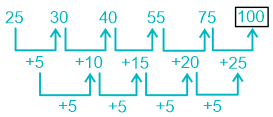 Hence, "Option 4" is the correct answer.
Q2 · Series
Identify the figure given in the options which when put in place of '?' will logically complete the series.



Answer aur solution dekho
Archived marked answer: C
The logic followed here is:
1) The bottom shifts diagonally and is flipped vertically.
2) The bottom element is replaced by a new element subsequently.
Q3 · Series
Select the figure from among the given options that can replace the question mark (?) in the following series:





Answer aur solution dekho
Archived marked answer: A
The logic followed here is:
1) For '
 ' elements → Both the elements are flipped vertically.
2) For '
 ' elements → Both the elements rotates clockwise.
3) For '
 ' elements → The element rotates anticlockwise.
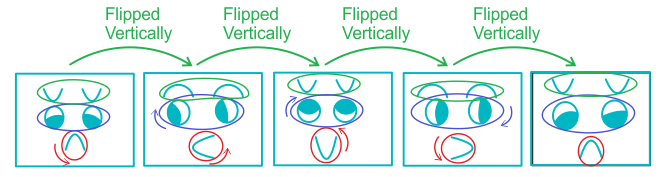 Thus, the final series is:
 Hence, "Option 1" is the correct answer.
Q4 · Series
Which of the following terms will replace the question mark (?) in the given series?
IMHP, MPJQ, QSLR, UVNS, ?
- YYPT
- YYOT
- YXPT
- XYPT
Answer aur solution dekho
Archived marked answer: A
The logic followed here is:
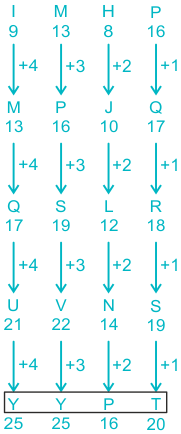 Hence, "Option 1" is the correct answer.
Q5 · Analogy
'WISK' is related to 'DRHP' in a certain way based on the English alphabetical order. In the same way, 'LENT' is related to 'OVMG'. To which of the following is 'BANG' related, following the same logic?
- ZYLU
- ZYNS
- Y2NU
- YZMT
Answer aur solution dekho
Archived marked answer: D
The logic followed here is:
'WISK' is related to 'DRHP'
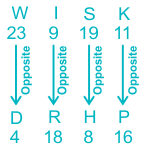 And,
'LENT' is related to 'OVMG'
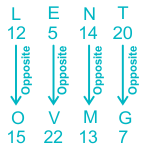 Similarly,
'BANG' is related to
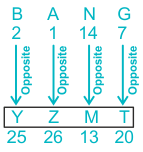 Hence, "Option 4" is the correct answer.
Q6 · Analogy
Two sets of numbers are given below. In each set of numbers, certain mathematical operation(s) on the first number result(s) in the second number. Similarly, certain mathematical operation(s) on the second number result(s) in the third number and so on. Which of the given options follows the same set of operations as in the given sets?
(NOTE: Operations should be performed on the whole numbers, without breaking down the numbers into their constituent digits. E.g. 13 – Operations on 13 such as adding/subtracting/multiplying to 13 can be performed. Breaking down 13 into 1 and 3 and then performing mathematical operations on 1 and 3 is not allowed.)
18 – 36 – 72 – 107; 15 – 30 – 60 – 95
- 22 – 44 – 88 – 123
- 25 – 50 – 100 – 125
- 11 – 22 – 66 – 101
- 30 – 60 – 90 – 115
Answer aur solution dekho
Archived marked answer: A
The logic followed here is:
18 – 36 – 72 – 107
18 × 2 = 36
36 × 2 = 72
72 + 35 = 107
And,
15 – 30 – 60 – 95
15 × 2 = 30
30 × 2 = 60
60 + 35 = 95
So, checking each option one by one:
Option 1) 22 – 44 – 88 – 123
22 × 2 = 44
44 × 2 = 88
88 + 35 = 123
Option 2) 25 – 50 – 100 – 125
25 × 2 = 50
50 × 2 = 100
100 + 35 = 135 ≠ 125
Option 3) 11 – 22 – 66 – 101
11 × 2 = 22
22 × 2 = 44 ≠ 66
66 + 35 = 101
Option 4) 30 – 60 – 90 – 115
30 × 2 = 60
60 × 2 = 120 ≠ 90
90 + 35 = 125 ≠ 115
Thus, out of all the options, '22 – 44 – 88 – 123' follows the same logic as given.
Hence, "Option 1" is the correct answer.
Q7 · Analogy
Select the set in which the numbers are related in the same way as are the numbers of the given sets.
(213, 157), (185, 129)
(NOTE: Operations should be performed on the whole numbers, without breaking down the numbers into its constituent digits. E.g., 13 – Operations on 13 such as adding/deleting/multiplying etc. to 13 can be performed. Breaking down 13 into 1 and 3 and then performing mathematical operations on 1 and 3 is not allowed)
- (171, 123)
- (198, 141)
- (164, 108)
- (192, 152)
Answer aur solution dekho
Archived marked answer: C
The logic followed here is:
Logic: 2nd number + 56 = 1st number.
Now,
For (213, 157):
⇒ 157 + 56 = 213 = 1st number
For (185, 129)
⇒ 129 + 56 = 185 = 1st number
Similarly, for Option 3: (164, 108)
⇒ 108 + 56 = 164 = 1st number
Hence, the correct answer is Option 3.
Q8 · Analogy
24/7 is related to 12/7 following a certain logic. Following the same logic, 11/15 is related to 11/30. To which of the following is 9/13 related to, following the same logic?
(NOTE: Operations should be performed on the whole numbers, without breaking down the numbers into its constituent digits. E.g. 13 – Operations on 13 such as adding /deleting /multiplying etc., to 13 can be performed. Breaking down 13 into 1 and 3 and then performing mathematical operations on 1 and 3 is not allowed.)
- 15/26
- 9/39
- 9/26
- 10/27
Answer aur solution dekho
Archived marked answer: C
The logic followed here is:
24/7 is related to 12/7
24/7 ÷ 2 = 12/7
12/7 = 12/7 (LHS = RHS)
And,
11/15 is related to 11/30
11/15 ÷ 2 = 11/30
11/30 = 11/30
Similarly,
9/13 is related to ?
9/13 ÷ 2 = ?
9/26 = ?
Hence, "Option 3" is the correct answer.
Q9 · Analogy
Select the word-pair that best represents a similar relationship to the one expressed in the pair of words given below.
(The words must be considered as meaningful English words and must NOT be related to each other based on the number
of letters/number of consonants/vowels in the word)
Virus : Parasite
- Fungus : Jasmine
- Amaltas : Tree
- Fenugreek : Micro organism
- Algae : Flower
Answer aur solution dekho
Archived marked answer: B
The logic followed here is:
Logic: The first word is an organism that lives in or on another organism (the second word) and benefits by deriving nutrients at the host's expense.
Here,
Virus : Parasite → A parasite is an organism that lives in or on another organism (the host) and benefits by deriving nutrients at the host's expense.
Similarly,
Amaltas : Tree → Amaltas (a type of flowering plant) lives on a tree (the host) and benefits from it.
Hence, the correct answer is "Amaltas : Tree".
Q10 · Non Verbal Reasoning
Two different positions of the same dice with faces T, O, B, L, Y and V are shown below. Select the letter that will be on the face opposite to the one having L.

- Y
- B
- V
- O
Answer aur solution dekho
Archived marked answer: D
The logic followed here is :-
From the given two different dices the adjacent sides are as shown below :
As Y is common on both the dices, it is clear that T, O, B, and L are adjacent to it, and the remaining i.e. V will be opposite to it.
Q11 · Non Verbal Reasoning
Six words Eat, Cry, Play, Sleep, Run and Bath are written on different faces of a dice. Three positions of this dice are shown in the figure. Find the word on the face opposite to Eat.
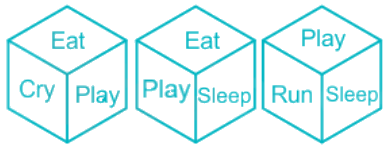
- Play
- Cry
- Sleep
- Run
Answer aur solution dekho
Archived marked answer: D
The logic followed here is :-
From the given three different dices the adjacent sides are as shown below :
As Play is common on both the dices I and III, it is clear that Eat, Cry, Run, and Sleep are adjacent to it, and the remaining i.e. Bath will be opposite to it.
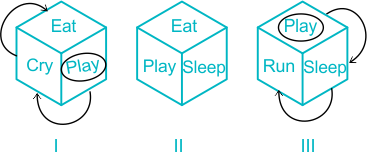 Opposite pairs:
Cry → Sleep
Eat → Run
Play → Bath
So, the opposite side of "Eat" will be side "Run".
Hence, the correct answer is "Option 4".
Q12 · Non Verbal Reasoning
How many triangles are there in the given figure?

- 18
- 16
- 21
- 20
Answer aur solution dekho
Archived marked answer: C
The number of triangles in the given figure is shown below:
1) Total triangles = [Number of parts × (1 + Number of parts)] ÷ 2
= [2 × (1 + 2)] ÷ 2
= [2 × 3] ÷ 2
= 6 ÷ 2
= 3
Q13 · Non Verbal Reasoning
Select the correct mirror image of the given figure when the mirror is placed at MN as shown below.





Answer aur solution dekho
Archived marked answer: A
A vertical mirror at MN reverses the left-to-right order and reflects each character horizontally. Starting beside the mirror, the reflection must show the reflected @,4,7,w,R,h in that order. The first displayed option has the correct reflected shapes; the others leave or alter a character incorrectly.
Q14 · Non Verbal Reasoning
Select the correct mirror image of the given figure when the mirror is placed at MN.
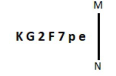
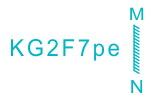








Answer aur solution dekho
Archived marked answer: A
Reflect across the vertical line MN. Character order becomes e,p,7,F,2,G,K from the mirror outward, with each character itself reflected horizontally. The first option shows the correct shapes in both provided versions.
Q15 · Puzzle Subtypes Not To Miss
Which two signs should be interchanged to make the following equation correct?
247 ÷ 13 + 16 × 3 − 148 = 119
- + and ×
- − and +
- − and ×
- ÷ and ×
Answer aur solution dekho
Archived marked answer: B
Given: 247 ÷ 13 + 16 × 3 − 148 = 119
According to the question, after interchanging the signs:
Option 1): + and ×
247 ÷ 13 + 16 × 3 − 148 = 119 ⇒ 247 ÷ 13 × 16 + 3 − 148 = 119
⇒ 247 ÷ 13 × 16 + 3 − 148 = 119
⇒ 19 × 16 + 3 − 148 = 119
⇒ 304 + 3 − 148 = 119
⇒ 307____ − 148 = 119
⇒ 159 ≠ 119 (LHS ≠ RHS)
Option 2): − and +
247 ÷ 13 + 16 × 3 − 148 = 119 ⇒ 247 ÷ 13 - 16 × 3 + 148 = 119
⇒ 247 ÷ 13 - 16 × 3 + 148 = 119
⇒ 19 - 16 × 3 + 148 = 119
⇒ 19 + 148 - 48 = 119
⇒ 167 - 48 = 119
⇒ 119 = 119 (LHS = RHS)
Option 3): − and ×
247 ÷ 13 + 16 × 3 − 148 = 119 ⇒ 247 ÷ 13 + 16 - 3 × 148 = 119
⇒ 247 ÷ 13 + 16 - 3 × 148 = 119
⇒ 19 + 16 - 3 __×__ 148 = 119
⇒ 19 + 16 - 444 = 119
⇒ 35 - 444 = 119
⇒ -409 ≠ 119 (LHS ≠ RHS)
Option 4): ÷ and ×
247 ÷ 13 + 16 × 3 − 148 = 119 ⇒ 247 × 13 + 16 ÷ 3 − 148 = 119
⇒ 247 × 13 + 16 __÷__ 3 − 148 = 119
⇒ 247 ×____ 13 + 5.33 − 148 = 119
⇒ 3211__ + 5.3__3 − 148 = 119
⇒ 3216__.3__3 − 148 = 119
⇒ 3068.33 ≠ 119 (LHS ≠ RHS)
Hence, "Option 2" is the correct answer.
Q16 · Puzzle Subtypes Not To Miss
What will come in the place of the question mark (?) in the following equation, if ‘+’ and ‘−’ are interchanged and ‘×’ and ‘÷’
are interchanged?
342 × 18 + 79 − 45 ÷ 3 = ?
- 65
- 75
- 85
- 55
Answer aur solution dekho
Archived marked answer: B
BODMAS Table:
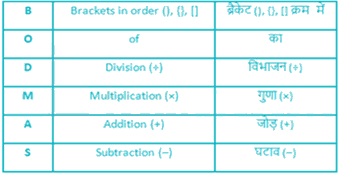 Given equation: 342 × 18 + 79 − 45 ÷ 3 = ?
Now, if ‘+’ and ‘−’ are interchanged and ‘×’ and ‘÷’ are interchanged, then:
⇒ 342 ÷ 18</strong
Q17 · Coding Decoding
In a certain code language, 'FIVE' is written as '12184410' and FOUR is written as '12304236'. How will 'THREE' be written in that language?
- 4016361110
- 4016361310
- 4016361212
- 4016361010
Answer aur solution dekho
Archived marked answer: D
The logic followed here is:
'FIVE' is written as '12184410'
Q18 · Coding Decoding
In a certain code language, ‘FACED’ is written as ‘GZDDE’ and ‘VACAY’ is written as ‘WZDZZ’. How will ‘LABOR’ be written in that language?
- MZCNS
- MBCPS
- MBDPS
- MADMS
Answer aur solution dekho
Archived marked answer: A
The logic followed here is:
‘FACED’ is written as ‘GZDDE’
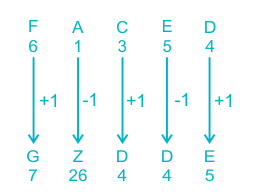 <
Q19 · Classification Odd One Out
In the following series, only one letter-cluster is incorrect. Select the incorrect letter-cluster.
YCG IMQ SVZ CGK MQU
- SVZ
- MQU
- CGK
- IMQ
Answer aur solution dekho
Archived marked answer: A
The logic followed here is:
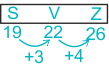
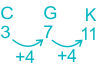
YCG
 IMQ
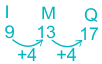 SVZ
 CGK
 MQU
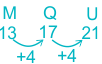 Thus, out of all 'SVZ' is the odd one out.
Hence, "Option 1" is the correct answer.
Q20 · Classification Odd One Out
Based on the English alphabetical order, three of the following four letter-clusters are alike in a certain way and thus form a group. Which is the one that DOES NOT belong to that group?
(Note: The odd man out is not based on the number of consonants/vowels or their position in the letter-cluster.)
- KJE
- JHD
- FDZ
- AYU
Answer aur solution dekho
Archived marked answer: A
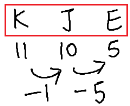
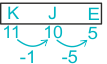
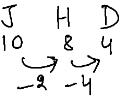
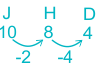
The logic followed here is:
Option 1) KJE
 Option 2) JHD
 Option 3) FDZ
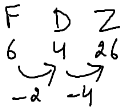
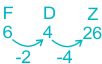 Option 4) AYU
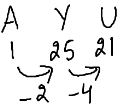
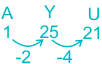 Thus, out of all 'KJE' is the odd one out.
Hence, "Option 1" is the correct answer.
Q21 · Classification Odd One Out
Three of the following four options are alike in a certain way and thus form a group. Which is the one that does NOT belong
to that group?
(NOTE: Operations should be performed on the whole numbers, without breaking down the numbers into its constituent
digits. E.g. 13 – Operations on 13 such as adding/subtracting/multiplying etc. to 13 can be performed. Breaking down 13 into
1 and 3 and then performing mathematical operations on 1 and 3 is not allowed.)
- 540 – 188 – 128
- 72 – 284 – 266
- 81– 101– 92
- 90 – 22– 12
Answer aur solution dekho
Archived marked answer: B
Logic:
(2nd number - 3rd number) × 9 = 1st number
Checking options one by one;
1) 540 – 188 – 128 →
(188 - 128) × 9 = 60 × 9 = 540 = 1st number
2) 72 – 284 – 266 →
(284 - 266) × 9 = 18 × 9 = 162 ≠ 1st number
3) 81– 101– 92 →
(101 - 92) × 9 = 9 × 9 = 81 = 1st number
4) 90 – 22– 12 →
(22 - 12) × 9 = 10 × 9 = 90 = 1st number
Hence, "Option (2)" is the correct answer.
Q22 · Logical Reasoning
Three statements are given, followed by three conclusions numbered I, II and III. Assuming the statements to be true, even if
they seem to be at variance with commonly known facts, decide which of the conclusions logically follow(s) from the
Statements:</÷
- Both conclusion I and II follow
- Only conclusions I and III follow
- Only conclusion III follows
- Only conclusion II follows
Answer aur solution dekho
Archived marked answer: C
The least possible Venn diagram for the given statements is as shown below :
 Conclusions:
I. No page is a notebook → Does not follow (As all pages are diaries, some diaries are books and all books are notebooks. As no direct relation is given between pages and notebooks, therefore it is false.)
II. All pages are notebooks → Does not follow (As all pages are diaries, some diaries are books and all books are notebooks. So it is possible but not definite.)
III. All diaries being notebooks is a possibility → Follow (As some diaries are books and all books are notebooks. As statement restricts whole diaries from being books therefore it is possible and thus is true.)
∴ Here, Only conclusion III follows.
Hence, the correct answer is "Option 3".
Q23 · Blood Relations
In a certain code language,
‘A + B’ means ‘A is the mother of B’;
‘A − B’ means ‘A is the brother of B’;
‘A × B’ means ‘A is the wife of B’ and
‘A ÷ B’ means ‘A is the father of B’.
Based on the above, how is 4 related to 2 if ‘4 + 3 ÷ 2 ÷ 1 − 5’?
- Father’s father
- Father’s mother
- Mother’s father
- Mother’s mother
Answer aur solution dekho
Archived marked answer: B
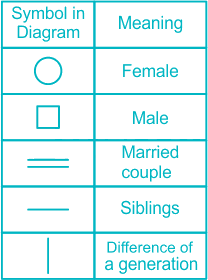 Decoding symbols:
A is
Symbol
+
–
×
Q24 · Alphabet Test
The position of how many letters will remain unchanged if all the letters in the word BINDER are arranged in English alphabetical order?
- None
- One
- Two
- Three
Answer aur solution dekho
Archived marked answer: C
Given word: BINDER
According to the question,
Given word
B
I
N
D
E
R
Arranged in English alphabetical order
B
D
E
I
N
R
Thus, according to the final arrangement, two letter's i.e. B and R positions remains unchanged.
Hence, "Option 3" is the correct answer.
Q25 · Alphabet Test
The position(s) of how many letters will remain unchanged if all the letters in the word ‘ENTOMB’ are arranged in English alphabetical order?
- None
- Two
- One
- Three
Answer aur solution dekho
Archived marked answer: A
Given word: 'ENTOMB'
After arranged in alphabetical order:
Alphabets
E
N
T
O
M
B
Alphabetical order
B
E
M
N
O
T
Now,
There is 'None' alphabet will remain unchanged if each of the letters in the word 'VIRTUAL' is arranged in English alphabetical order.
Hence, the correct answer is "Option 1".
General Awareness
Q1 · Art and Culture
Kathakali, one of the classical dances of India, is predominantly performed in which of the following states of India?
- Assam
- Manipur
- Uttar Pradesh
- Kerala
Answer aur solution dekho
Archived marked answer: D
The correct answer is Kerala.
Key Points
- Kathakali is a classical dance form that originates from&n
Q2 · Art and Culture
The magnificent Kailasa temple at Ellora was built during the reign of which Rashtrakuta king?
- Krishna I
- Indra III
- Govinda III
- Amoghavarsha
Answer aur solution dekho
Archived marked answer: A
The correct answer is Krishna I.
Key Points
- Kailasa temple:
- The Kailasha temple is also known as *Kailashanatha.*
- It is located at Ellora Caves in the Aurangabad District of Maharashtra.
- It was built by the 8th century Rashtrakuta King Krishna I.
- The time frame was nearly 756 to 773 AD.
- The temple is the largest of the rock-cut Hindu temples at the Ellora Caves.
- It is a megalith carved from a rock cliff face.
- It is considered one of the most remarkable cave temples in the world because of its size, architecture and sculptural treatment.
- The top of the superstructure over the sanctuary is 32.6 metres (107 ft) above the level of the court below.
- Archaeologists believe it is made from a single rock.
Additional Information
- The Rashtrakuta Empire of Manyakheta was founded by Dantidurga (reigned 735-756 CE), also known as Dantivarman II.
- Gulbarga was the capital of his state.
- He was succeeded by his uncle Krishna I, who extended his kingdom throughout Karnataka.
- According to the Ellora record of Dantidurga, he conquered the Chalukyas in 753 and assumed the titles Rajadhiraja and Parameshvara.
- As per the Samangad inscription (modern Kolhapur district, Maharashtra), his mother was a Chalukyan princess from Gujarat named Bhavanaga.
- According to the same inscription, he defeated the invincible Karnata-Bala of the Badami Chalukyas.
- In addition, he defeated the kings of Lata (Gujarat), Malwa, Tanka, Kalinga and Sheshas (Nagas) in central India.
Q3 · Art and Culture
Who among the following is the world renowned exponent of the bamboo flute?
- MS Subbulakshmi
- Ravi Shankar
- Hariprasad Chaurasia
- Bismillah Khan
Answer aur solution dekho
Archived marked answer: C
The correct answer is Hariprasad Chaurasia.
Key Points
- Hariprasad Chaurasia was born on 1 July 1938. He is an Indian music director and classical flautist, who plays the Bansuri in the Hindustani classical tradition.
- He was born in Pryagraj, Uttar Pradesh.
- The 2013 documentary film Bansuri Guru features the life and legacy of Chaurasia.
- He won Gansamradni Lata Mangeshkar Award - 2021-22, Padma Bhushan</s
Q4 · Art and Culture
In which state/UT is the Hemis festival celebrated?
- Punjab
- Sikkim
- Lakshadweep
- Ladakh
Answer aur solution dekho
Archived marked answer: D
The correct answer is Ladakh.
Key Points
- Marking the birth of Guru Padmasambhava, Hemis Festival is not only one of the most important Buddhist celebrations in Ladakh but is also the most popular festival amongst tourists.
- This festival held in one of the most-visited monasteries in Ladakh, Hemis Gompa.
- A festival is a two-day event that is celebrated on the 10th day of the fifth month of the Tibetan Calendar, which is the month of June/July in the Gregorian Calendar.
- At this popular festival in Ladakh, Cham Dance and other traditional dances are performed in Hemis Monastery.
Additional Information
- Some Important festival-
- Spituk Gustor Zanskar-
- Spituk Gustor Zanskar is a traditional festival of Jammu and Kashmir.
- This is a Tibetan festival celebrated in the Ladakhi monasteries of Thiksey, Spituk, and Karsha Nanzkar.
- Hemis Festival-
- This is one of the most elusive Jammu and Kashmir festivals.
- Celebrated every 12 years at the Hemis Monastery at Hemis.
- the festival honours Lord Padmasambhava, known as Guru Rinpoche in the region.
- Tulip Festival-
- This is a modern-day celebration of tulips at the Indira Gandhi Memorial Tulip Garden in Srinagar.
- Losar Festival-
- Losar is traditionally celebrated for 15 days and is one of the famous festivals celebrated in Jammu and Kashmir.
Q5 · Indian Polity and Constitution
Which Article of the Constitution of India provides that 'there shall be a Vice President of India'?
- Article 61
- Article 63
- Article 65
- Article 62
Answer aur solution dekho
Archived marked answer: B
The correct answer is Article 63.
Key Points
- Article 63
- Article 63 of the Indian Constitution states that "There shall be a vice president of India."
- The vice president acts as president in the absence of the president due to death, resignation, impeachment, or other situations.
- The vice president of India is also ex officio chairperson of the Rajya Sabha. When a bill is introduced in Rajya Sabha, the vice president decides whether it is a financial bill or not.
- If he is of the opinion, a bill introduced in the Rajya Sabha is a money bill, he would refer the case to the Speaker of the Lok Sabha for deciding it.
Additional Information
- Article 61
- The process for the impeachment of the President is outlined in Article 61 of the Indian Constitution.
- Either House of Parliament may file the impeachment accusations.
- The President must be notified 14 days in advance, and these allegations must be signed by one-fourth of the House members who framed them.
- The other House, which is tasked with conducting an investigation into the allegations, receives the impeachment resolution when it has been approved by a two-thirds majority of the entire membership of that House.
- The President has the right to show up and be represented during such an investigation.
- The President is removed from office as of the date the resolution is passed if the other House concurs with the accusations and approves the impeachment resolution with a two-thirds majority of its members.
- Impeachment is a quasi-judicial process in Parliament as a result.
- In this context, it is important to keep in mind two things:
- nominated members of either House of Parliament may take part in the impeachment of the President even though they did not cast a ballot in his election;
- and elected members of state legislative assemblies and the union territories of Delhi and Puducherry may not, even though they cast a ballot in the President's election.
- Article 65
- Article 65 deals with the Vice-President acting as President or discharging the functions of the President in the event of a vacancy.
- Article 62
- Article 62 of the Indian Constitution deals with the time frame for holding an election to fill a vacancy in the office of the President.
Q6 · Indian Economy
What is net investment?
- Sum of all the investments in a country
- Gross investment + depreciation
- Gross capital investment - indirect taxes
- Gross investment - depreciation
Answer aur solution dekho
Archived marked answer: D
The correct answer is Gross investment - depreciation.
Key Points
- A company's net investment is the sum of its expenditures on capital assets less the cost of depreciating those assets.
- This gives an idea of the actual spending on durable products utilized by the company in its operations, such as buildings, machinery, and software.
Additional Information
- Depreciation: It means a fall in the value of an asset because of usage or with efflux of time or due to obsolescence or accident.
- Appreciation: It means an increase in the value of an asset over time. This the opposite of depreciation. It is an upward adjustment of the value of an asset held on a company's accounting book.
- Deceleration: It is the rate at which an asset's value in the market goes down.
- Gross investment: It is the total amount spent on goods in order to produce other goods and services.
- Net investment: It is the amount of increase in productive stock.
- Capital investment is the money used by a business to purchase fixed assets, such as land, machinery, or buildings. The money may be in the form of cash, assets, or loans. Without capital investment, businesses may have a hard time getting off the ground.
Q7 · Indian Economy
The green revolution technology resulted in an increase in production of cereal production from 72.4 million tons in 1965-66 to _______ million tons in 1978-79.
- 150.8
- 165.9
- 131.9
- 141.2
Answer aur solution dekho
Archived marked answer: C
The correct answer is 131.9.
Key Points
- The green revolution is the rise in agricultural productivity, particularly in developing nations, made possible by the use of novel crops and farming techniques.
- Given that he started the Green Revolution in India, M. S. Swaminathan is regarded as its father. He was motivated by Norman Borlaug's effort.
- Norman Borlaug started the Green Revolution movement in the 1960s. He is referred to as the "Father of the Green Revolution" globally. For his efforts in creating High Yielding Varieties (HYVs) of wheat, it resulted in him being awarded the Nobel Peace Prize in 1970.
- In order to enhance food production and reduce hunger and poverty, high-yielding cultivars of rice and wheat were first introduced in India in the 1960s.
- In Punjab, the Green Revolution in India was first implemented in late 1966 or early 1967 as a part of a development initiative launched by international donor organisations and the Indian government.
- One of the innovative techniques created during the Green Revolution was drip irrigation. This technology allowed water to drop slowly and steadily to the roots of plants, saving water and promoting more sustainable agriculture.
- India has achieved significant progress thanks to the Green Revolution, which has brought about a previously unheard-of level of food security. It has helped many non-poor people avoid the poverty and hunger they would have otherwise faced while lifting a significant number of poor people out of poverty
Q8 · Sports Static GK
India won the ICC Men Cricket World Cup for the first time in which of the following years?
- 1996
- 1992
- 1987
- 1983
Answer aur solution dekho
Archived marked answer: D
The correct answer is 1983.
Key Points
- India became the winner of the Cricket World Cup for the first time in 1983.
- The Indian cricket team, led by Kapil Dev, defeated the West Indies in the final match.
- The final match was held at the Lords Cricket Ground in London on 25th June 1983.
- This victory marked a significant milestone in Indian cricket history and inspired future generations of cricketers.
- The win was unexpected as the West Indies team was considered the strongest, having won the previous two World Cups.
Additional Information
- The 1983 Cricket World Cup was the third edition of the tournament.
- It was organized by the International Cricket Council (ICC) and was held from 9th June to 25th June 1983.
- A total of eight teams participated in the tournament, including India, West Indies, Australia, England, Pakistan, Sri Lanka, New Zealand, and Zimbabwe.
- The Indian team’s victory in 1983 played a pivotal role in popularizing cricket in India, leading to the sport's massive following in the country today.
Q9 · Sports Static GK
In which year did India make its Olympic debut in hockey?
- 1936
- 1932
- 1924
- 1928
Answer aur solution dekho
Archived marked answer: D
The correct answer is 1928.
Key Points
- India made its Olympic debut in hockey at the 1928 Amsterdam Olympics.
- In its debut, the Indian hockey team won the gold medal, defeating the Netherlands in the final match.
- The victory in 1928 marked the beginning of India’s illustrious history in Olympic hockey.
- India went on to dominate the sport, winning six consecutive Olympic gold medals from 1928 to 1956.
- Significance of 1928
- Established India as a formidable force in international hockey.
- Helped promote the sport within the country and inspired future generations of players.
Additional Information
- History of Indian Hockey
- Indian hockey gained international recognition during the British colonial era.
- Field hockey is considered a national sport in India, with a rich legacy of success in various tournaments.
- Olympic Games
- The Olympics are held every four years, featuring a wide array of sports and countries participating.
- Hockey has been a prominent sport in the Olympics since its inclusion in 1908.
Q10 · Indian Geography
Which of the following is the largest artificial lake of Asia?
- Naini Lake
- Bhopal Lake
- Dal Lake
- Chilika Lake
Answer aur solution dekho
Archived marked answer: B
The correct answer is Bhopal Lake.
Key Points
- Bhopal, known as the "City of Lakes," boasts two prominent water bodies: the Upper Lake (Bhojtal) and the Lower Lake (Chhota Talab).
- The Upper Lake, built in the 11th century by King Bhoj, is a significant source of drinking water for the city. It's also a popular recreational spot, offering boating and scenic views.
- The Lower Lake, though smaller, contributes to the city's beauty. However, it faces pollution challenges due to urban and industrial activities.
- Together, these lakes form the Bhoj Wetland, a Ramsar site recognized for its ecological importance. Efforts are underway to preserve and restore the Lower Lake's ecosystem.
Additional Information
- Naini Lake
- Uttarakhand CM Trivendra Singh Rawat has inaugurated the Naini lake water quality assessment system.
- It has been built at a cost of Rs 1 crore with UNDP assistance.
- The water quality system will aid in water conservation and in keeping it clean.
- The State has successfully initiated a public movement to revive its rivers, lakes, ponds and water sources.
- Dal lake
- It is an urban lake, which is the second largest in the union territory of Jammu and Kashmir.
- It is integral to tourism and recreation in Kashmir and is named the "Lake of Flowers", "Jewel in the crown of Kashmir" or "Srinagar's Jewel".
- Chilika Lake
- Chilika Lake is a brackish water lagoon located in the state of Odisha, India.
- It is the largest coastal lagoon in India and the second largest lagoon in the world.
- Chilika Lake is an important habitat for a variety of wildlife, including many species of birds, fish, and other aquatic animals.
- The lake is also a major tourist attraction and supports the livelihoods of local fishermen.
Q11 · Indian Geography
Identify the oldest iron and steel company of India from the following options.
- Tata Iron & Steel Company (TISCO)
- Visvesvaraya Iron & Steel Works
- Indian Iron & Steel Company (IISCO)
- Mysore Iron & Steel Works
Answer aur solution dekho
Archived marked answer: A
The correct answer is Tata Iron & Steel Company (TISCO).
Key Points
- Tata Iron & Steel Company (TISCO)
- The Tata Iron and Steel company (TISCO) was established by Dorabji Tata in 1907.
- He was committed to fulfill the the dream of his father, Jamsetji Nusserwanji Tata, an Indian Pioneer industrialist who founded the Tata Group.
- Dorabji Tata was knighted by Edward VII, becoming Sir Dorabji Tata in January 1910.
Additional Information
- Visvesvaraya Iron & Steel Works
- Visvesvaraya Iron and Steel Works is a plant that is located in Bhadravathi, Karnataka, and is involved in the production of pig iron and steel.
- It was founded on 18 January 1923 as the "Mysore Iron Works" by Sir M Visvesvaraya who was the 19th Diwan of Mysore and a civil engineer.
- Since 1989, it works under the jurisdiction of the Steel Authority of India Limited.
- Steel Authority of India Limited (SAIL) is the largest steel-making company in India and one of the seven Maharatna’s of the country’s Central Public Sector Enterprises. It was incorporated in the year 1973.
- Indian Iron and Steel Company (IISCO)
- IISCO is an integrated steel plant located at Burnpur (now).
- It is a steel plant that is a part of the Steel Authority of India Limited (SAIL).
- It was established in 1918 as an Indian Iron and Steel Company under the flagship of the Martin Burn group.
- It was amalgamated with SAIL in 2006 and renamed IISCO Steel Plant.
- It has a crude steel production capacity of 2.5 million tonnes per year.
- SAIL is India's 3rd and the world's 20th largest steel-producing company with an annual production of 16.30 million metric tons respectively.
Q12 · Indian Geography
Purvanchal Himalayas does NOT comprise of:
- Naga hills
- Pir Panjal range
- Manipur hills
- Mizo hills
Answer aur solution dekho
Archived marked answer: B
The correct answer is Pir Panjal range.
Key Points
- Pir Panjal range
- The Pir Panjal Range is situated in the Kashmir region.
- It is named after the Pir Panjal Pass.
- Indrasan is the highest peak of Pir Panjal Range.
- Mount Indrasan is located at an altitude of 6221 meters above sea level.
- It is one of the most difficult mountains to climb.
- Deo Tibba and Indrasan are the major peaks of Pir Panjal range.
- The Kashmir valley lies between the Himadri and Pir Panchal range.
Additional Information
- The Purvanchal Range, or Eastern Mountains, is a sub-mountain range of the Himalayas in North-East India.
- The Purvanchal comprises :
- The Patkai Hills
- The Naga Hills
- Manipur Hills
- The Mizo Hills
- The Patkai Hills:
- The Patkai Hills are the hills on India's north-eastern border with Burma or Myanmar.
- The Naga Hills:
- The Naga Hills lie on the border of India and Burma.
- The Mizo Hills:
- Mizo Hills is a mountain range in southeastern Mizoram state.
- Mizo Hills form part of the north Arakan Yoma system.
- The range is an eastern extension of the Himalayan Range System, in northeastern India.
- It bends sharply to the south beyond the Dihang River gorge and spreads along the eastern boundary of India with Myanmar.
- The Purvanchal includes the hill of the Patkai hills, Naga Hills, Mizo Hills, and Manipur hills.
Q13 · Modern Indian History
Match the following institutes with their respective founders of British India.
Institutes
Their respective founders
a. Asiatic Society of Bengal
i. Sir William Jones
b. Sanskrit College of Benaras
ii. Jonathan Duncan
c. Fort William College
iii. Lord Wellesley
d. Calcutta Madrasa
iv. Warren Hastings
- a-ii, b-i, c-iv, d-iii
- a-iii, b-iv, c-i, d-ii
- a-iv, b-iii, c-ii, d-i
- a-i, b-ii, c-iii, d-iv
Answer aur solution dekho
Archived marked answer: D
The correct answer is a-i, b-ii, c-iii, d-iv.
Key Points
- Asiatic Society of Bengal
- Sir William Jones was a British Orientalist and jurist.
- He established the Asiatic Society of Bengal in 1784.
- It was formed to encourage Oriental studies in India.
- The formation of the Asiatic Society was supported by the then governor-general of British India Warren Hastings.
- The headquarters of the Asiatic Society of Bengal was in Kolkata.
- Indians were first admitted as members of the Asiatic Society of Bengal in 1829.
- Sanskrit College of Benaras
- Jonathan Duncan founded the Sanskrit College of Benaras in 1791.
- It was initially established as a Sanskrit college to promote the study of ancient Indian texts and languages.
- Fort William College
- Fort William College was established in 1800 by Lord Wellesley.
- It was initially intended to train British civil servants in Asian languages and cultures.
- The college fostered a scholarly interest in regional languages and literatures.
- It contributed significantly to the development and standardization of Bengali literature and language.
- The works and translations produced under its auspices had a lasting impact on Bengali culture.
- Calcutta Madrasa
- The Calcutta Madrasah was established by Warren Hastings in 1781 for the study of Muslim law and related subjects.
Q14 · Modern Indian History
With reference to Sepoy Mutiny of 1857, on which of the following dates did the soldiers at Meerut start their journey to Delhi?
- 10 May
- 19 April
- 2 June
- 29 March
Answer aur solution dekho
Archived marked answer: A
The correct answer is 10 May.
Key Points
- The Sepoy Mutiny of the 1857 War of Independence started in Meerut city.
- Indian Mutiny, also called Sepoy Mutiny or First War of Independence, widespread but unsuccessful rebellion against British rule in India in 1857–59.
- Begun in Meerut by Indian troops (sepoys) in the service of the British East India Company, it spread to Delhi, Agra, Kanpur, and Lucknow.
- In India, it is often called the First War of Independence and other similar names.
- On 6th May 1857 A.D., 85 out of 90 Indian soldiers at Meerut refused to bite the greased cartridges with their teeth.
- These 85 soldiers were court-martialled and imprisoned for 10 years.
- They were stripped of their uniforms in the presence of the entire Indian crowd.
- The revolt spread over the entire area from the neighbourhood of Patna to the borders of Rajasthan.
- The Revolt of 1857 lasted for more than a year.
- It was suppressed by the middle of 1858.
- On July 8, 1858, fourteen months after the outbreak at Meerut, peace was finally proclaimed by Lord Canning.
Q15 · Current Affairs
Which is the National Mission for Financial Inclusion to ensure access to financial services, namely, a basic savings and deposits accounts, remittance, credit, insurance, pension in an affordable manner?
- Deendayal Antyodaya Yojana
- Deen Dayal Upadhyaya Grameen Kaushalya Yojana
- Swaranjayanti Gram Swarozgar Yojana
- Pradhan Mantri Jan Dhan Yojana
Answer aur solution dekho
Archived marked answer: D
The correct answer is Pradhan Mantri Jan Dhan Yojana.
Key Points
- Pradhan Mantri Jan Dhan Yojana
- Pradhan Mantri Jan-Dhan Yojana (PMJDY) is a financial inclusion scheme launched by the Government of India.
- Its objective is to provide access to banking services to all households in the country.
- The scheme was launched by Prime Minister Narendra Modi on August 15, 2014.
- Under the scheme, any individual can open a savings or current account with zero balance.
- Account holders are also provided with a free debit card and an accident insurance cover of Rs 1 lakh.
- Pradhan Mantri Jan-Dhan Yojana has played an important role in promoting financial inclusion in India.
Additional Information
- Deendayal Antyodaya Yojana
- It was launched by the Ministry of Rural Development (MoRD), Government of India in June 2011.
- It aims at creating efficient and effective institutional platforms of the rural poor, enabling them to increase household income through sustainable livelihood enhancements and improved access to financial services.
- It is aided in part through investment support from the World Bank.
- In addition, the poor would be facilitated to achieve increased access to rights, entitlements, and public services, diversified risk, and better social indicators of empowerment.
- The blocks and districts in which all components of N.R.L.M are implemented are treated as ‘intensive’ blocks and districts, whereas the remaining as ‘non-intensive’ blocks and districts.
- In a typical intensive block, the first 3 years are spent building the organizations of the poor by mobilizing them into SHGs, Federations at Village, Cluster level, and Block levels.
- Deen Dayal Upadhyaya Grameen Kaushalya Yojana
- Deen Dayal Upadhyaya Grameen Kaushalya Yojana relates to the skill development of rural youth.
- Union government on 25 September 2014 launched Deen Dayal Upadhyaya Grameen Kaushalya Yojana to train 1 million rural youths by 2017.
- It targets youth, in the age group of 15–35 years.
- It aims to provide them with jobs having regular monthly wages or above the minimum wages.
- It is a part of the National Rural Livelihood Mission (NRLM).
- National Rural Livelihood Mission (NRLM) is the Mission for poverty reduction called Aajeevika.
- The Yojana was launched during the 98th birth anniversary of Pandit Deendayal Upadhyay.
- Earlier the Yojana was known as Aajeevika Skills Development Programme (ASDP).
- Swaranjayanti Gram Swarozgar Yojana
- The Swarnajayanti Gram Swarozgar Yojana (SGSY) was implemented at the beginning of the 1999–2000 fiscal year to replace six other related programmes.
- The initiative was created as a comprehensive plan to support rural impoverished people who work for themselves.
- It is funded by the Centre and the State in a 75:25 ratio and is implemented by commercial banks, regional banks and cooperative banks.
Q16 · Current Affairs
Which of the following is NOT an amendment made to the Airport Economic Regulatory Authority (AERA) Amendment Act, 2021?
- The government can call any airport a major airport just by notification.
- The government will club together profit-making and loss-making airports.
- The government can offer airports as a package in PPP mode to the prospective bidders.
- A major airport is one which has an annual traffic of minimum 35 lakh passengers.
Answer aur solution dekho
Archived marked answer: D
The correct answer is A major airport is one which has an annual traffic of minimum 35 lakh passengers.
Key Points
- On March 24, 2021, the Lok Sabha received the Airports Economic Regulatory Authority of India (Amendment) Bill, 2021.
- The 2008 Airports Economic Regulatory Authority of India Act is being modified.
- The Airport Economic Regulatory Authority was founded under the 2008 Act.
- AERA regulates tariffs and other charges (such as airport development fees) for aeronautical services rendered at major airports in India.
Additional Information
- A major airport is one that receives at least 35 lakh passengers annually, according to the 2008 Act.
- Any airport may be designated as a major airport by notification from the federal government.
- According to the Bill, the federal government may group airports and declare the group to be a major airport.
Q17 · Current Affairs
Who among the following was selected as the Sherpa for India’s G20 hosted in 2022-23?
- Piyush Goyal
- Ashwini Vaishnav
- Shaktikanta Das
- Amitabh Kant
Answer aur solution dekho
Archived marked answer: D
The correct answer is Amitabh Kant.
Key Points
- India's Sherpa for the G20 presidency in 2022-2023 was Amitabh Kant.
- As Sherpa, he played a crucial role in shaping India's G20 agenda, which focused on themes like "One Earth, One Family, One Future".
- He led negotiations, coordinated with G20 member countries, and ensured a smooth conduct of the presidency.
- Amitabh Kant's experience and diplomatic skills were instrumental in elevating India's global standing during its G20 presidency.
Q18 · General Science Biology
The organisms that do not have a defined nucleus or organelles are classified in to ______ Kingdom.
- Fungi
- Protista
- Monera
- Plantae
Answer aur solution dekho
Archived marked answer: C
The correct answer is Monera.
Key Points
- Monera kingdom:
- These organisms lack a defined nucleus or organelles and none of them has multicellular bodies.
- Some of them have cell walls while some do not.
- This group of species may either synthesize their own food (autotrophic) or obtain it from the environment (heterotrophic).
- Bacteria, blue-green algae (cyanobacteria), and mycoplasma are examples.
Additional Information
- Fungi kingdom:
- These are heterotrophic eukaryotic organisms.
- Some of them are known as saprotrophs, which feed on decaying organic matter.
- Others feed on the living protoplasm of a host organism. They are called parasites.
- Many of them have the capacity to become multicellular organisms at certain stages in their lives.
- Their cell walls are made of chitin, a tough complex sugar.
- Examples are yeasts, moulds, and mushrooms.
- Protista kingdom
- Protista kingdom single-celled eukaryotes.
- Characteristics of Protista are given bellow:
- Unicellular organism.
- Normally aquatic.
- Reproduction: Asexual & sexual.
- Well defined nucleus & membrane-bounded organelles.
- Group of Protista are given bellow:
- Prokaryotic: Dinoflagellate, Diatoms, Euglenoids.
- Consumer: Slime moulds, Myxomycetes.
- Protozoans: Slime moulds, Myxomycetes.
- Plantae
- Kingdom plantae includes all eukaryotic, chlorophyll-containing organisms called plants.
- Some of these members are primarily heterotrophic, such as insectivorous plants or parasites.
- Kingdom plantae is divided into 5 major divisions:
- Algae (Thallophyta)
- Bryophytes
- Pteridophytes
- Gymnosperms and
- Angiosperms
- Algae (Thallophyta)
- Algae are chlorophyll-containing, simple, thalloid, autotrophic and largely aquatic (both freshwater and marine) organisms.
- Algae are self-feeders.
- Bryophytes
- The bryophytes are generally classified into two main groups
- Liverworts
- Liverworts usually grow in moist, shady places such as banks of streams, marshy ground, damp soil, the bark of trees, and deep in the woods.
- Mosses
- Mosses grow in dense mats over moist shady places, especially during rainy seasons.
- Pteridophytes
- Pteridophytes are primitive seedless vascular plants also called cryptogams.
- The pteridophytes are found in cool, damp shady places though some may flourish well in sandy-soil conditions.
- Gymnosperms
- Gymnosperms are vascular plants having naked seeds.
- The gymnosperms are plants in which the ovules are not enclosed by any ovary wall and remain exposed, both before and after fertilisation.
- Angiosperms
- Angiosperms are seed bearing plants or flowering plants.
- Unlike gymnosperms where the ovules are naked, in angiosperms the sporophylls are organized into flowers and seeds are produced inside fruits,
Q19 · General Science Biology
Microbes like Rhizobium, Nitrosomonas and Nitrobacter are used for:
- nitrogen cycling
- carbon cycling
- water cycling
- sulphur cycling
Answer aur solution dekho
Archived marked answer: A
The correct answer is nitrogen cycling.
Key Points
- Nitrogen Cycle-
- Nitrogen is an essential constituent of protein and is a basic building block of all living tissue. It constitutes nearly 16% by weight of all the proteins that is, converted to ammonia, nitrites or nitrates before it can be taken up by plants.
- Nitrogen fixation on earth is accomplished in three different ways:
a) By microorganisms (bacteria and blue-green algae)
b) By man using industrial processes (fertilizer factories) and
c) To a limited extent by atmospheric phenomena such as thunder and lighting
- Certain microorganisms are capable of fixing atmospheric nitrogen into ammonium ions. These include free-living nitrifying bacteria (e.g. aerobic Azotobacter and anaerobic Clostridium) and symbiotic nitrifying bacteria living in association with leguminous plants and symbiotic bacteria living in non-leguminous root nodule plants (e.g. Rhizobium) as well as blue-green algae (e.g. Anabaena, Spirulina).
- Ammonium ions can be directly taken up as a source of nitrogen by some plants, or are oxidized to nitrites or nitrates by two groups of specialised bacteria: Nitrosomonas bacteria promote the transformation of ammonia into nitrite. Nitrite is then further transformed into nitrate by the bacteria Nitrobacter.
- The nitrates synthesised by bacteria in the soil are taken up by plants and converted into amino acids, which are the building blocks of proteins. These then go through higher trophic levels of the ecosystem. During excretion and upon the death of all organisms nitrogen is returned to the soil in the form of ammonia.
- Certain quantities of soil nitrates, being highly soluble in water, are lost to the system by being transported away by surface run-off or groundwater. In the soil as well as oceans there are special denitrifying bacteria (e.g. Pseudomonas), which convert the nitrates/nitrites to elemental nitrogen. This nitrogen escapes into the atmosphere, thus completing the cycle.
- The periodic thunderstorms convert the gaseous nitrogen in the atmosphere to ammonia and nitrates which eventually reach the earth’s surface through precipitation and then into the soil to be utilized by plants.
Additional Information
- Carbon Cycle
- The carbon cycle involves several processes, including photosynthesis, respiration, decomposition, and combustion. Plants absorb carbon dioxide (CO₂) during photosynthesis, while animals release CO₂ through respiration.
- Carbon is stored in various reservoirs, including the atmosphere (as CO₂), oceans (as dissolved CO₂ and organic carbon), soil (as organic matter), and living organisms. These reservoirs play a crucial role in regulating global climate.
- Human activities, such as fossil fuel combustion and deforestation, significantly alter the carbon cycle by increasing atmospheric CO₂ levels, contributing to global warming and climate change.
- Water Cycle-
- The hydrologic cycle is the continuous circulation of water in the Earth-atmosphere system which is driven by solar energy. Water on our planet is stored in major reservoirs like atmosphere, oceans, lakes, rivers, soils, glaciers, snowfields, and groundwater. Water moves from one reservoir to another by the processes of evaporation, transpiration, condensation, precipitation, deposition, runoff, infiltration, and groundwater flow.
- Water as an important ecological factor determines the structure and function of the ecosystem. Cycling of all other nutrients is also dependent upon water as it provides their transportation during the various steps. It acts as a solvent medium for their uptake of nutrients by organisms.
- Sulphur Cycle-
- The sulphur reservoir is in the soil and sediments where it is locked in organic (coal, oil and peat) and inorganic deposits (pyrite rock and sulphur rock) in the form of sulphates, sulphides and organic sulphur.
- It is released by weathering of rocks, erosional runoff and decomposition of organic matter and is carried to terrestrial and aquatic ecosystems in a salt solution.
- The sulphur cycle is mostly sedimentary except two of its compounds hydrogen sulphide (H2S) and sulphur dioxide (SO2) add a gaseous component to its normal sedimentary cycle.
- Sulphur enters the atmosphere from several sources like volcanic eruptions, combustion of fossil fuels, from the surface of the ocean and from gases released by decomposition. Atmospheric hydrogen sulphide also gets oxidised into sulphur dioxide.
- Atmospheric sulphur dioxide is carried back to the earth after being dissolved in rainwater as weak sulphuric acid.
Q20 · General Science Chemistry
Calculate the oxidation number of 'S' in H₂S₂O₇.
- 3
- 7
- 6
- 2
Answer aur solution dekho
Archived marked answer: C
The correct answer is 6.
Key Points
- Let's denote the oxidation number of sulfur as 'x'.
- In H₂S₂O₇:
- Hydrogen (H) has an oxidation number of +1.
- Oxygen (O) has an oxidation number of -2.
- The overall charge of the molecule is 0.
- So, we can set up the equation:
- 2(+1) + 2(x) + 7(-2) = 0
- Simplifying:
- 2 + 2x - 14 = 0
- 2x = 12
- x = +6
- Therefore, the oxidation number of sulfur (S) in H₂S₂O₇ is +6.
Q21 · Awards Static
In 2002, Zakir Hussain became the youngest percussionist to be honoured with which award?
- Sangeet Natak Akademi Award
- Grammy Award
- Padma Bhushan
- National Heritage Fellowship
Answer aur solution dekho
Archived marked answer: C
The correct answer is Padma Bhushan.
Key Points
- Ustad Zakir Hussain is associated with the musical instrument, Tabla.
- He collaborated with the famous American band 'The Beatles' which deserves special mention.
- He was designated with awards:
- Padma Shri in 1988
- Padma Bhushan in 2002
- Sangeet Natak Akademi Award in 1990
- United States National Endowment for the Arts National Heritage Fellowship, the highest award given to traditional artists and musicians by the USA.
Additional Information
- Albums of Ustad Zakir Hussain:
- ‘Saturday Night in Bombay’
- ‘The Believer’.
Q22 · Ancient Indian History
Which of the following plays was NOT written by Harshavardhana?
- Vikramorvasiyam
- Ratnavali
- Nagananda
- Priyadarshika
Answer aur solution dekho
Archived marked answer: A
The correct answer is Vikramorvasiyam.
Key Points
- Harshavardhana ruled from 606 - 647 AD.
- His earliest capital was Thaneswar.
- Harshavardhana (606-647 A.D.) ascended the throne of Thaneshwar and Kannauj on the death of his brother, Rajyavardhana.
Additional Information
- Harshavardhana belonged to the Pushyabhuti dynasty.
- It was founded by Naravardhana close to the 5th or beginning of the 6th century A.D.
- The dynasty flourished under Prabhakarvardhana (father of Harshavardhana).
- He assumed the title of Maharajadhiraja.
- Harshavardhana succeeded the throne in 606 A.D.
- Harsha was also known as Sakalottarapathanatha.
- He conquered Magadha.
- He established his capital at Kannauj.
- His empire extended from Punjab to northern Orissa and from the Himalayas to the bank of Narmada.
- The period of Harsha is well documented in Harshacharitra written by Banabhatta.
- Chinese scholar Hiuen-Tsang visited Harsha's court in 631 A.D.
- The empire came to an end along with the death of Harshavardhana in 647 A.D.
- Harshavardhan wrote three Sanskrit plays viz. Nagananda, Ratnavali and Priyadarshika.
- Hiuen-Tsang mentioned the grand assembly held at Kannauj in 643 A.D. which was attended by twenty kings, four thousand Buddhist monks and about three thousand Jains and Brahmans.
- He also organised Mahamoksha Harishad, a religious festival, at Prayaga (Allahabad).
Q23 · Government Schemes and Welfare Static Semi Static
In August 2022, the Ministry of Social Justice and Empowerment launched the ________ scheme, with an aim to provide comprehensive rehabilitation services to people engaged in begging in 75 municipalities.
- TWINKLE-75
- BEAM-75
- SMILE-75
- RISE-75
Answer aur solution dekho
Archived marked answer: C
The correct answer is SMILE-75.
Key Points
SMILE-75 Initiative:
- Under the “SMILE-75” Initiative, 75 Municipal Corporations will undertake comprehensive rehabilitation of persons engaged in the act of begging in the spirit of Azadi ka Amrit Mahotsav.
- Municipal Corporations, in collaboration with NGOs and other stakeholders, will cover several comprehensive welfare measures for persons who are engaged in the act of begging, with a focus extensively on rehabilitation, provision of medical facilities, counselling, awareness, education, skill development, economic linkages and convergence with other Government welfare programmes etc.
- The Ministry of Social Justice & Empowerment has also allocated a total budget of Rs.100 crore for the SMILE project for the coming years till 2025-26.
- It seeks to develop a support mechanism for the holistic rehabilitation of those engaged in the act of begging.
- Implementing Ministry: The Ministry of Social Justice and Empowerment.
- It includes the sub-scheme of Comprehensive Rehabilitation of persons engaged in the act of Begging.
Additional Information
- About Project "SMILE":
- SMILE: Support for Marginalised Individuals for Livelihood and Enterprise.
- It is a new umbrella scheme that aims to provide welfare measures to the Transgender community and the people engaged in the act of begging.
- It was launched by the Ministry of Social Justice & Empowerment on 12 August 2022.
- The Ministry has allocated Rs. 365 Crore for the scheme from 2021-22 to 2025-26.
- The Housing facility in the form of ‘Garima Greh’ ensures food, clothing, recreational facilities, skill development opportunities, recreational activities medical support, etc. to the Transgender community and the people engaged in the act of begging.
- The focus of the scheme is extensively on rehabilitation, provision of medical facilities, counseling, basic documentation, education, skill development, economic linkages, and so on.
- It is estimated that approximately 60,000 poorest persons would be benefited under this scheme for leading a life of dignity.
Q24 · General Science Physics
A javelin thrown by an athlete is in _______ motion.
- oscillatory
- periodic
- rectilinear
- curvilinear
Answer aur solution dekho
Archived marked answer: D
The correct answer is curvilinear.
Q25 · Environment and Ecology
A student, on his school assignment, is taking a session on how to make compost at home for using it at a park. Which fundamental duty is he performing?
- To strive towards excellence in all spheres of individual and collective activity
- To safeguard public property and to abjure violence
- To develop the scientific temper, humanism and the spirit of inquiry
- To protect and improve the natural environment
Answer aur solution dekho
Archived marked answer: D
The correct answer is To protect and improve the natural environment.
Key Points
- The Fundamental Duties were incorporated in Part IV-A of the Constitution by the 42nd Constitutional Amendment Act, 1976 on the recommendations of Swaran Singh Committee.
- The idea of Fundamental Duties is inspired from the Constitution of Russia.
- The Fundamental duties are non-justiciable in nature.
- There are total 11 Fundamental Duties listed in Article 51-A of the Constitution
Fundamental Duties:
- To abide by the Constitution and respect its ideals and institutions, the National Flag and the National Anthem;
- To cherish and follow the noble ideals that inspired the national struggle for freedom;
- To uphold and protect the sovereignty, unity and integrity of India;
- To defend the country and render national service when called upon to do so;
- To promote harmony and the spirit of common brotherhood amongst all the people of India transcending religious, linguistic and regional or sectional diversities and to renounce practices derogatory to the dignity of women;
- To value and preserve the rich heritage of the country’s composite culture;
- To protect and improve the natural environment including forests, lakes, rivers and wildlife and to have compassion for living creatures;
- To develop scientific temper, humanism and the spirit of inquiry and reform;
- To safeguard public property and to abjure violence;
- To strive towards excellence in all spheres of individual and collective activity so that the nation constantly rises to higher levels of endeavour and achievement; and
- To provide opportunities for education to his child or ward between the age of six and fourteen years (added by the 86th Constitutional Amendment Act, 2002).
Mathematics
Q1 · Geometry
The measures of the three angles of a triangle are in the ratio 17 : 13 : 15. Find the positive difference between the greatest and the smallest of these three angles.
- 16°
- 24°
- 20°
- 12°
Answer aur solution dekho
Archived marked answer: A
Shortcut Trick
Total parts of the angles = 17 + 13 + 15 = 45 parts.
We know the sum of the interior angles of a triangle is always 180°.
45 parts = 180° ⇒ 1 part = 4°.
Difference between greatest (17) and smallest (13) angle parts = 17 − 13 = 4 parts.
Difference in degrees = 4 parts × 4° = 16°.
∴ The correct answer is 16°.
Alternate Method
Given:
The measures of the three angles of a triangle are in the ratio 17 : 13 : 15.
Formula Used:
Sum of the interior angles of a triangle = 180°.
13x
15x
17x
A
B
C
17x + 13x + 15x = 180°
Calculations:
Let the exact values of the three angles be 17x, 13x, and 15x respectively.
⇒ 17x + 13x + 15x = 180°
⇒ 45x = 180°
⇒ x = 180° ÷ 45
⇒ x = 4°
Now, calculate the values of the greatest and smallest angles:
The greatest angle = 17x = 17 × 4° = 68°.
The smallest angle = 13x = 13 × 4° = 52°.
⇒ Positive difference = Greatest angle − Smallest angle
⇒ 68° − 52° = 16°
∴ The correct answer is 16°.
Additional Information
Angle Sum Property
The sum of all three interior angles of any planar triangle is always exactly 180°.
Exterior Angle Theorem
The measure of an exterior angle of a triangle is equal to the sum of the measures of its two remote and non-adjacent interior angles.
Triangle Property related to Sides and Angles
In any triangle, the longest side is always positioned opposite the greatest interior angle, and the shortest side is opposite the smallest angle.
</p
Q2 · Geometry
In triangles ABC and DEF, AB = FD and ∠A = ∠D. The two triangles are congruent by SAS criterion if:
- BC = DE
- AC = EF
- BC = EF
- AC = DE
Answer aur solution dekho
Archived marked answer: D
Shortcut Trick
The SAS (Side-Angle-Side) criterion requires two sides and the included angle of one triangle to be equal to the corresponding parts of the other.
We are given Side AB = FD and Included Angle ∠A = ∠D.
The second side forming ∠A in ΔABC is AC, and the second side forming ∠D in ΔDEF is DE.
Thus, for the triangles to be congruent by SAS, these second sides must necessarily be equal.
∴ The correct answer is AC = DE.
Alternate Method
Given:
⇒ In ΔABC and ΔDEF:
⇒ AB = FD (Side)
⇒ ∠A = ∠D (Included Angle)
Concept Used:
⇒ According to the SAS (Side-Angle-Side) congruence rule, two triangles are congruent if two sides and the included angle of one triangle are equal to the corresponding two sides and the included angle of the other triangle.
A
B
C
- - - D
F
E
- - - Required: AC = DE for SAS Congruence
Calculations:
⇒ In ΔABC, the angle ∠A is strictly formed by the intersection of sides AB and AC.
⇒ In ΔDEF, the corresponding angle ∠D is strictly formed by the intersection of sides FD and DE.
⇒ Since we already have AB = FD and the included angle ∠A = ∠D, the other pair of sides forming these equal angles must also be equivalent to satisfy the SAS criteria.
⇒ Therefore, the side AC of ΔABC must be exactly equal to the side DE of ΔDEF.
⇒ AC = DE
∴ The correct answer is AC = DE.
Additional Information
SSS (Side-Side-Side) Congruence
If all three sides of one triangle are structurally equal to the corresponding three sides of another triangle, then the triangles are fully congruent.
ASA (Angle-Side-Angle) Congruence
If two angles and the included side between them in one triangle are equal to the corresponding parts of another triangle, then the triangles are congruent.
AAS (Angle-Angle-Side) Congruence
If two adjacent angles and a non-included side of one triangle are equal to the corresponding consecutive angles and side of another triangle, they are congruent.
RHS (Right angle-Hypotenuse-Side) Congruence
If in two right-angled triangles, the hypotenuse and one standard side of one triangle are identical to the hypotenuse and corresponding side of the other, they are congruent.
</p
Q3 · Geometry
Two circles C₁ and C₂ touch each other externally. The radius of C₁ = 16 cm and the radius of C₂ = 8 cm. Find the length (in cm) of their common tangent.
- 8 √3
- 16 √3
- 8 √2
- 16 √2
Answer aur solution dekho
Archived marked answer: D
Shortcut Trick
When two circles touch each other externally, the distance between their centers is (R + r).
The formula for the length of the Direct Common Tangent (DCT) simplifies directly to: DCT = 2√(R × r)
Given the radii R = 16 cm and r = 8 cm:
⇒ DCT = 2√(16 × 8)
⇒ DCT = 2√(128) = 2 × 8√2 = 16√2 cm
∴ The correct answer is 16√2 cm.
Alternate Method
Given:
Radius of first circle (R) = 16 cm
Radius of second circle (r) = 8 cm
Since the circles touch externally, the distance between their centers (d) is the sum of their radii.
⇒ d = R + r = 16 + 8 = 24 cm
Formula Used:
Length of Direct Common Tangent (DCT) = √[d² − (R − r)²]
- - - - - C₁
C₂
R=16
r=8
A
B
d = 24
R − r
DCT = ?
Calculation:
⇒ R − r = 16 − 8 = 8 cm
⇒ DCT = √[24² − 8²]
⇒ DCT = √[576 − 64]
⇒ DCT = √[512]
⇒ DCT = √[256 × 2]
⇒ DCT = 16√2 cm
∴ The correct answer is 16√2 cm.
Additional Information
Direct Common Tangent (DCT)
The general formula for the length of a direct common tangent is √[d² − (r₁ − r₂)²], where d is the distance between the centers. They do not cross the line segment connecting the centers.
Transverse Common Tangent (TCT)
The formula for the length of a transverse common tangent is √[d² − (r₁ + r₂)²]. A TCT always crosses the line segment joining the centers of the two circles.
Number of Common Tangents
Two completely separate circles have 4 common tangents (2 DCT, 2 TCT). If they touch externally, they have 3. Intersecting circles have 2. Circles touching internally have 1, and one inside the other has 0.
16
Q4 · Geometry
In a triangle PQR, S is a point on the side QR such that PS⊥QR, then which of the following options is true?
- PS² + PR² = PQ² + QR²
- $31
- PQ² + PR² = QS² + SR²
- PS² + QS² = PQ² + PR²
Answer aur solution dekho
Archived marked answer: B
Shortcut Trick
In ΔPQR, the perpendicular PS divides the triangle into two right-angled triangles sharing the same altitude PS.
Using the property of shared altitude: PS² = PQ² − QS² and PS² = PR² − SR².
Equating both expressions gives: PQ² − QS² = PR² − SR²
Rearranging the equation yields: PR² + QS² = PQ² + SR²
∴ The correct answer is PR² + QS² = PQ² + SR².
Alternate Method
- P
Q
R
S
Given:
In ΔPQR, PS is perpendicular to QR (∠PSQ = ∠PSR = 90°).
Formula Used:
Pythagoras Theorem: (Hypotenuse)² = (Perpendicular)² + (Base)²
Calculations:
⇒ In right-angled ΔPQS, applying Pythagoras theorem:
⇒ PQ² = PS² + QS²
⇒ PS² = PQ² − QS² --- (Equation 1)
⇒ In right-angled ΔPRS, applying Pythagoras theorem:
⇒ PR² = PS² + SR²
⇒ PS² = PR² − SR² --- (Equation 2)
⇒ From Equation 1 and Equation 2, equate the values of PS²:
⇒ PQ² − QS² = PR² − SR²
⇒ Rearranging the terms to keep positive values on both sides:
⇒ PR² + QS² = PQ² + SR²
∴ The correct answer is PR² + QS² = PQ² + SR².
Additional Information
Pythagoras Theorem
In a right-angled triangle, the square of the hypotenuse is equal to the sum of the squares of the other two sides. Formula: H² = P² + B².
Apollonius's Theorem
It relates the length of a median of a triangle to the lengths of its sides. For a median AD on side BC: AB² + AC² = 2 × (AD² + BD²).
Stewart's Theorem
If a point D lies on the side BC of triangle ABC, the length of the cevian AD is given by: b²m + c²n = a × (d² + mn), where BD = m and CD = n.
</p
Q5 · Trigonometry
( sin θ - 2 sin³ θ2 cos³ θ - cos θ )³ 1/(tan θ) - sec² θ = ?
- 2
- 1
- 0
- -1
Answer aur solution dekho
Archived marked answer: D
Shortcut Trick
Put θ = 30° in the given expression to solve quickly.
⇒ [(1/2 − 2 × 1/8) / (2 × 3√3/8 − √3/2)]³ × (1 / tan 30°) − sec² 30°
⇒ [(1/4) / (√3/4)]³ × √3 − (2/√3)²
⇒ (1/√3)³ × √3 − 4/3
⇒ (1 / 3√3) × √3 − 4/3 = 1/3 − 4/3 = −1
∴ The correct answer is -1.
Alternate Method
Given:
Expression: [(sin θ − 2 sin³ θ) / (2 cos³ θ − cos θ)]³ × (1 / tan θ) − sec² θ
Formula Used:
cos 2θ = 1 − 2 sin² θ = 2 cos² θ − 1
sec² θ − tan² θ = 1
Calculations:
⇒ Take out sin θ common from the numerator and cos θ common from the denominator.
⇒ [{sin θ (1 − 2 sin² θ)} / {cos θ (2 cos² θ − 1)}]³ × (1 / tan θ) − sec² θ
⇒ [{sin θ × cos 2θ} / {cos θ × cos 2θ}]³ × (1 / tan θ) − sec² θ
⇒ (sin θ / cos θ)³ × (1 / tan θ) − sec² θ
⇒ (tan θ)³ × (1 / tan θ) − sec² θ
⇒ tan² θ − sec² θ
⇒ −(sec² θ − tan² θ)
⇒ −1
∴ The correct answer is -1.
Additional Information
Double Angle Formulas
sin 2θ = 2 sin θ cos θ
cos 2θ = cos² θ − sin² θ = 2 cos² θ − 1 = 1 − 2 sin² θ
Pythagorean Identities
sin² θ + cos² θ = 1
1 + tan² θ = sec² θ ⇒ sec² θ − tan² θ = 1
1 + cot² θ = cosec² θ ⇒ cosec² θ − cot² θ = 1
Reciprocal Identities
sec θ = 1 / cos θ
cosec θ = 1 / sin θ
cot θ = 1 / tan θ
</p
Q6 · Trigonometry
Find the value of the following expression.
√(1 + sin θ1 - sin θ)
- sec θ + tan θ
- cosec θ + tan θ
- cosec θ + cot θ
- sec θ + cot θ
Answer aur solution dekho
Archived marked answer: A
Shortcut Trick
Multiply inside the root by the conjugate of the denominator: (1 + sin θ).
The denominator becomes 1 − sin² θ = cos² θ.
The numerator becomes (1 + sin θ)².
Taking the square root gives (1 + sin θ) ÷ cos θ.
Splitting the terms gives (1 ÷ cos θ) + (sin θ ÷ cos θ) = sec θ + tan θ.
∴ The correct answer is sec θ + tan θ.
Alternate Method
Given:
Expression: √[ (1 + sin θ) ÷ (1 − sin θ) ]
Formulas Used:
1 − sin² θ = cos² θ
sec θ = 1 ÷ cos θ
tan θ = sin θ ÷ cos θ
Calculations:
⇒ √[ (1 + sin θ) ÷ (1 − sin θ) ]
Rationalise the denominator by multiplying the numerator and the denominator by (1 + sin θ):
⇒ √[ { (1 + sin θ) × (1 + sin θ) } ÷ { (1 − sin θ) × (1 + sin θ) } ]
⇒ √[ (1 + sin θ)² ÷ (1 − sin² θ) ]
⇒ √[ (1 + sin θ)² ÷ cos² θ ]
Removing the square root:
⇒ (1 + sin θ) ÷ cos θ
Distributing the denominator:
⇒ (1 ÷ cos θ) + (sin θ ÷ cos θ)
⇒ sec θ + tan θ
∴ The correct answer is sec θ + tan θ.
Additional Information
Standard Trigonometric Results
√[(1 − sin θ) ÷ (1 + sin θ)] = sec θ − tan θ
Cosine Equivalent Results
√[(1 + cos θ) ÷ (1 − cos θ)] = cosec θ + cot θ
Pythagorean Identities
sin² θ + cos² θ = 1 | sec² θ − tan² θ = 1 | cosec² θ − cot² θ = 1
Rationalisation Strategy
For square roots of trigonometric fractions (like 1 ± sin θ), multiplying by the conjugate of the denominator easily converts the expression into a perfect square, allowing direct simplification.
</p
Q7 · Trigonometry
If 2cosec²θ + 3cot²θ = 17, then the value of 'θ' when 0° ≤ θ ≤ 90° is:
- 45°
- 90°
- 30°
- 75°
Answer aur solution dekho
Archived marked answer: C
Shortcut Trick
Put the values from the options into the equation to find the correct answer.
Check for θ = 30°:
⇒ 2cosec²30° + 3cot²30° = 2(2)² + 3(√3)²
⇒ 2 × 4 + 3 × 3 = 8 + 9 = 17.
LHS = RHS, thus 30° is the correct value.
∴ The correct answer is 30°.
Alternate Method
Given:
2cosec²θ + 3cot²θ = 17
Formula Used:
cosec²θ = 1 + cot²θ
Calculations:
⇒ 2(1 + cot²θ) + 3cot²θ = 17
⇒ 2 + 2cot²θ + 3cot²θ = 17
⇒ 5cot²θ = 17 − 2
⇒ 5cot²θ = 15
⇒ cot²θ = 3
⇒ cotθ = √3 (since 0° ≤ θ ≤ 90°)
⇒ θ = 30°
∴ The correct answer is 30°.
Additional Information
Trigonometric Identities
1) sin²θ + cos²θ = 1
2) sec²θ − tan²θ = 1
3) cosec²θ − cot²θ = 1
Values at 30°
sin 30° = 1/2, cos 30° = √3/2, tan 30° = 1/√3, cosec 30° = 2, sec 30° = 2/√3, cot 30° = √3
</p
Q8 · Algebra
If x + 1/x = 15, then the value of (7x² - 9x + 7) / (x² - x + 1) is:
- -487
- -227
- 48/7
- 22/7
Answer aur solution dekho
Archived marked answer: C
Shortcut Trick
Divide the numerator and the denominator by x to simplify.
Expression = [7(x + 1/x) − 9] / [(x + 1/x) − 1]
Substitute x + 1/x = 15 directly into the simplified expression.
⇒ [7 × 15 − 9] / [15 − 1] = [105 − 9] / 14
⇒ 96 / 14 = 48 / 7
∴ The correct answer is 48/7.
Alternate Method
Given:
x + 1/x = 15
Expression = (7x² − 9x + 7) / (x² − x + 1)
Calculation:
Take x common from both the numerator and the denominator.
⇒ Numerator = x[7x − 9 + 7/x] = x[7(x + 1/x) − 9]
⇒ Denominator = x[x − 1 + 1/x] = x[(x + 1/x) − 1]
Cancel out x from both the numerator and the denominator.
⇒ Value = [7(x + 1/x) − 9] / [(x + 1/x) − 1]
Now, substitute x + 1/x = 15 into the equation.
⇒ Value = (7 × 15 − 9) / (15 − 1)
⇒ Value = (105 − 9) / 14
⇒ Value = 96 / 14
⇒ Value = 48 / 7
∴ The correct answer is 48/7.
Additional Information
Algebraic Identity for Squares
If x + 1/x = k, then x² + 1/x² = k² − 2.
Algebraic Identity for Cubes
If x + 1/x = k, then x³ + 1/x³ = k³ − 3k.
Algebraic Identity for Difference
If x + 1/x = k, then x − 1/x = √(k² − 4).
</p
Q9 · Algebra
{Let } t = 2/5, { then the value of the expression } t³ + ( 3/5 )³ + 9/5 t { is:}
- 1/5
- 1
- 2
- 1/2
Answer aur solution dekho
Archived marked answer: B
Shortcut Trick
Substitute t = 2/5 directly into the given expression and apply BODMAS.
⇒ (2/5)³ + (3/5)³ + (9/5) × (2/5)
⇒ 8/125 + 27/125 + 18/25
⇒ (8 + 27 + 90) / 125
⇒ 125 / 125 = 1
∴ The correct answer is 1.
Alternate Method
Given:
t = 2/5
Expression: t³ + (3/5)³ + (9/5)t
Formula Used:
(a + b)³ = a³ + b³ + 3ab(a + b)
Calculations:
⇒ We can rewrite the term (9/5)t as 3 × t × (3/5) × 1
⇒ Since t = 2/5, we know that t + 3/5 = 2/5 + 3/5 = 1
⇒ Replace the 1 in our rewritten term with (t + 3/5).
⇒ The expression becomes: t³ + (3/5)³ + 3 × t × (3/5) × (t + 3/5)
⇒ This perfectly matches the right side of the formula (a + b)³ where a = t and b = 3/5.
⇒ So, the expression simplifies directly to (t + 3/5)³
⇒ Substitute t = 2/5 to get (2/5 + 3/5)³
⇒ (1)³ = 1
∴ The correct answer is 1.
Additional Information
Sum of Cubes Identity
The standard algebraic factorization for the sum of two separate cubes is a³ + b³ = (a + b)(a² − ab + b²).
Difference of Cubes Identity
The standard algebraic factorization for the difference of two separate cubes is a³ − b³ = (a − b)(a² + ab + b²).
Cube of a Difference
The complete algebraic expansion for the cube of a difference is (a − b)³ = a³ − b³ − 3ab(a − b).
</p
Q10 · Profit and Loss
A shopkeeper marked an article at ₹5,000. The shopkeeper allows successive discounts of 20%, 15% and 10%. The selling price of the article is:
- ₹2,750
- ₹3,000
- ₹2,800
- ₹3,060
Answer aur solution dekho
Archived marked answer: D
Shortcut Trick
Convert the given percentage discounts into multiplying fractions: 20% = 4/5, 15% = 17/20, 10% = 9/10.
Selling Price (SP) = Marked Price × (Fraction 1) × (Fraction 2) × (Fraction 3)
SP = 5000 × 4/5 × 17/20 × 9/10
SP = 5000 × 612/1000 = 3060
∴ The correct answer is ₹3,060.
Alternate Method
Given:
Marked Price (MP) = ₹5,000
Successive discounts = 20%, 15% and 10%
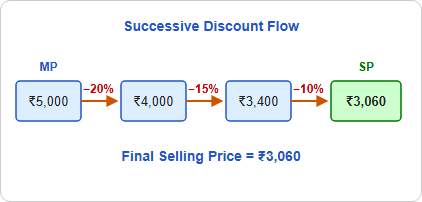 Formula Used:
SP = MP × (1 − D₁/100) × (1 − D₂/100) × (1 − D₃/100)
Calculations:
⇒ SP = 5000 × (1 − 20/100) × (1 − 15/100) × (1 − 10/100)
⇒ SP = 5000 × (80/100) × (85/100) × (90/100)
⇒ SP = 5000 × (4/5) × (17/20) × (9/10)
⇒ SP = 5000 × (612/1000)
⇒ SP = 5 × 612
⇒ SP = 3060
∴ The correct answer is ₹3,060.
Additional Information
Effective Single Discount
For two successive discounts of a% and b%, the equivalent single discount is given by (a + b − a×b/100)%.
Marked Price and Cost Price Relationship
The ratio of Marked Price to Cost Price can be directly calculated using: MP/CP = (100 + Profit%) ÷ (100 − Discount%).
Dishonest Dealer
When a dealer pretends to sell goods at cost price but uses a false weight, the actual profit percentage is found using: Profit% = [Error ÷ (True Weight − Error)] × 100%.
143:
Q11 · Time and Work
Two pipes, A and B, can fill a tank in 10 minutes and 20 minutes, respectively. The pipe C can empty the tank in 30 minutes. All the three pipes are opened at a time in the beginning. However, pipe C is closed 2 minutes before the tank is filled. In what time, will the tank be full (in minutes)?
- 12
- 10
- 8
- 6
Answer aur solution dekho
Archived marked answer: C
Shortcut Trick
Total work capacity = LCM(10, 20, 30) = 60 units.
Efficiencies of pipes A, B, and C are +6, +3, and −2 units/min respectively.
If outlet pipe C remained open for the last 2 minutes, it would empty 2 × 2 = 4 units.
Effective total work if all three pipes worked for the entire time = 60 − 4 = 56 units.
Total time = Effective total work ÷ Net efficiency = 56 ÷ (6 + 3 − 2) = 8 minutes.
∴ The correct answer is 8 minutes.
Alternate Method
Given:
Time taken by pipe A to fill the tank = 10 minutes
Time taken by pipe B to fill the tank = 20 minutes
Time taken by pipe C to empty the tank = 30 minutes
Pipe
Time (mins)
Total Work
Efficiency
A
10
60
+6
B
20
+3
C
30
−2
Calculations:
⇒ Let the total time taken to fill the tank be x minutes.
⇒ Pipes A and B are open for the entire duration, so they work for x minutes.
⇒ Pipe C is closed 2 minutes before the tank is filled, so it works for (x − 2) minutes.
⇒ Work done by A + Work done by B + Work done by C = Total Work
⇒ 6x + 3x − 2(x − 2) = 60
⇒ 9x − 2x + 4 = 60
⇒ 7x = 56
⇒ x = 8
∴ The correct answer is 8 minutes.
Additional Information
Inlet and Outlet Pipes
Pipes that fill the tank are assigned positive efficiency, while pipes that empty the tank are assigned negative efficiency. Net Efficiency = Sum of all active efficiencies.
Leaving Before Completion
If a worker (or pipe) stops working 'n' units of time before completion, add their potential work for those 'n' units to the total work, and assume everyone worked until the end. For outlet pipes, this means subtracting the work since they possess negative efficiency.
LCM Method for Time & Work
Assuming the total work as the Least Common Multiple (LCM) of the given individual times avoids fractional calculations and significantly increases speed in competitive exams.
</p
Q12 · Number System
Which digits should come in place * and $,respectively, if the number 72864*$ is divisible by both 8 and 5?
- 4 and 0
- 2 and 0
- 2 and 5
- 4 and 5
Answer aur solution dekho
Archived marked answer: A
Shortcut Trick
For a number to be divisible by 5, its last digit ($) must be 0 or 5.
For a number to be divisible by 8, it must be an even number, so $ must be 0.
The last three digits (4*0) must be divisible by 8.
Checking the given options, if * = 4, the number 440 is divisible by 8 (440 ÷ 8 = 55).
∴ The correct answer is 4 and 0.
Alternate Method
Given:
Number = 72864*$
The number is perfectly divisible by both 8 and 5.
Concept Used:
Divisibility by 5: The unit digit must be 0 or 5.
Divisibility by 8: The number formed by the last three digits must be divisible by 8.
Calculation:
⇒ For the number to be divisible by 5, the unit digit $ can be 0 or 5.
⇒ For the number to be divisible by 8, it must be an even number. Hence, $ cannot be 5.
⇒ ∴ $ = 0
⇒ The last three digits form the number 4*0.
⇒ Now, we check the given options for *.
⇒ If * = 4, the number formed is 440. Since 440 ÷ 8 = 55, it is completely divisible by 8.
⇒ If * = 2, the number formed is 420. Since 420 ÷ 8 = 52.5, it is not completely divisible by 8.
⇒ ∴ The missing digits are * = 4 and $ = 0.
∴ The correct answer is 4 and 0.
Additional Information
Divisibility Rule of 3 & 9
A number is divisible by 3 or 9 if the sum of all its digits is completely divisible by 3 or 9, respectively.
Divisibility Rule of 4 & 8
A number is divisible by 4 if its last two digits are divisible by 4. It is divisible by 8 if its last three digits are divisible by 8.
Divisibility Rule of 11
A number is divisible by 11 if the difference between the sum of its digits at odd places and the sum of its digits at even places is either 0 or a multiple of 11.
</p
Q13 · Time and Distance
M and N walk along a circular track. They start at 5:00 a.m. from the same point in the opposite directions. M and N walk at a speed of 5 rounds per hour and 2 rounds per hour, respectively. How many times will they cross each other before 6.30 a.m. on the same day?
- 10
- 3
- 5
- 7
Answer aur solution dekho
Archived marked answer: A
Shortcut Trick
When bodies move in opposite directions on a circular track, they cross each other at a frequency equal to the sum of their speeds in rounds per unit time.
Relative speed = 5 + 2 = 7 rounds per hour.
This means they cross each other 7 times every hour.
Total time from 5:00 a.m. to 6:30 a.m. = 1.5 hours.
Total crossings = 7 × 1.5 = 10.5 crossings.
∴ The correct answer is 10 times.
Alternate Method
Given:
Speed of M = 5 rounds/hr
Speed of N = 2 rounds/hr
Time interval = 5:00 a.m. to 6:30 a.m. = 1.5 hours
Formula Used:
Relative speed (Opposite direction) = Speed₁ + Speed₂
Total Crossings = Relative Speed × Total Time
Calculation:
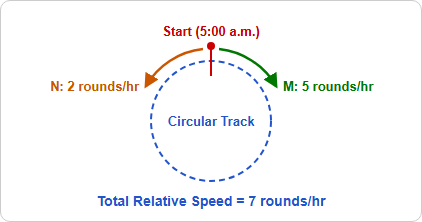 ⇒ Relative speed = 5 + 2 = 7 rounds/hr
⇒ This means M and N jointly cover 7 complete laps of the track in 1 hour.
⇒ Hence, they cross each other 7 times in 1 hour.
⇒ In 1.5 hours, relative laps completed = 7 × 1.5 = 10.5 laps.
⇒ Since a crossing occurs for every fully completed relative lap, we take the integer value.
⇒ Number of times they completely cross each other = 10
∴ The correct answer is 10 times.
Additional Information
Meetings in Opposite Directions
When moving in opposite directions, the frequency of meetings per unit time is the sum of their individual speeds (rounds per unit time): S₁ + S₂.
Meetings in Same Direction
When moving in the same direction, the frequency of meetings per unit time is the difference of their individual speeds: |S₁ − S₂|.
Meeting at the Starting Point
Regardless of the direction, the time taken to meet for the first time at the starting point is the LCM of the individual times taken by each person to complete one full round.
</p
Q14 · Data Interpretation
Study the given pie chart carefully and answer the question that follows.
The given pie chart shows the number of successful start-ups in different sectors in a particular year.
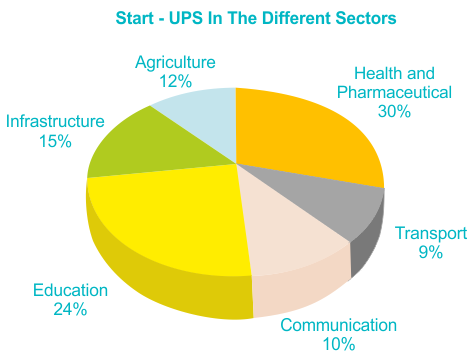 If the total number of successful start-ups is 2910, then find the number of start-ups in the education and agriculture sectors. (Neglect the decimal part.)
- 698
- 1048
- 1074
- 1047
Answer aur solution dekho
Archived marked answer: D
Given:
Total number of successful start-ups = 2910
The pie chart shows the number of successful start-ups in different sectors. We are required to find the number of start-ups in the education and agriculture sectors.
Formula Used:
The fraction of start-ups in a sector can be found using the angle of the sector in the pie chart. The formula is:
Number of start-ups in a sector = (Total % in education and agriculture / 100 ) × Total number of start-ups
Calculations:
From the pie chart, the % for the education sector is 24%&n
Q15 · Simplification
Simplify
15.5 − [3 − {7 − (5 − (14.5 − 13.5))}].
- 15.5
- 13.5
- 12.5
- 14.5
Answer aur solution dekho
Archived marked answer: A
Given:
Expression: 15.5 - [3 - {7 - (5 - (14.5 - 13.5))}]
Formula Used:
Basic arithmetic operations (Addition and Subtraction)
Calculation:
Step-by-step simplification:
⇒ 15.5 - [3 - {7 - (5 - (14.5 - 13.5))}]
First, simplify the innermost parentheses:
⇒ 15.5 - [3 - {7 - (5 - 1)}]
Next, simplify within the curly braces:
⇒ 15.5 - [3 - {7 - 4}]
Continue simplifying within the square brackets:
⇒ 15.5 - [3 - 3]
Finally, simplify the expression:
⇒ 15.5 - 0
⇒ 15.5
The correct answer is option 1: 15.5
Q16 · Proportion
A payment of ₹120 is made with ₹10, ₹5 and ₹2 coins. A total of 25 coins are used. Which of the following is the number of ₹10 coins used in the payment?
- 6
- 4
- 10
- 8
Answer aur solution dekho
Archived marked answer: D
Shortcut Trick
Assume all 25 coins are of the lowest denomination (₹2). Base value = 25 × 2 = ₹50.
Extra amount to be matched to reach ₹120 = 120 − 50 = ₹70.
Each ₹10 coin adds ₹8 extra, and each ₹5 coin adds ₹3 extra compared to a ₹2 coin. Let their numbers be x and y.
This forms the equation: 8x + 3y = 70.
Checking the options for x: If x = 8, then 8(8) + 3y = 70 ⇒ 64 + 3y = 70 ⇒ 3y = 6 ⇒ y = 2 (Valid integer).
∴ The correct answer is 8 coins.
Alternate Method
Given:
Total number of coins used = 25
Total payment made = ₹120
Let the number of ₹10 coins be x, ₹5 coins be y, and ₹2 coins be z.
Equations:
⇒ x + y + z = 25 ... (i)
⇒ 10x + 5y + 2z = 120 ... (ii)
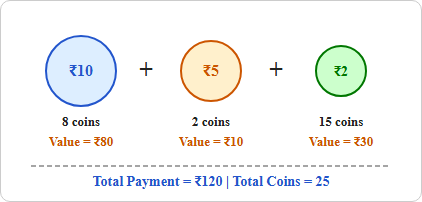 Calculations:
⇒ Multiply equation (i) by 2:
⇒ 2x + 2y + 2z = 50 ... (iii)
⇒ Subtract equation (iii) from equation (ii) to eliminate z:
⇒ (10x + 5y + 2z) − (2x + 2y + 2z) = 120 − 50
⇒ 8x + 3y = 70
⇒ Since x and y must be positive integers, let's test the given options for the value of x:
⇒ Option 1: x = 6 ⇒ 48 + 3y = 70 ⇒ 3y = 22 (Not an integer)
⇒ Option 2: x = 4 ⇒ 32 + 3y = 70 ⇒ 3y = 38 (Not an integer)
⇒ Option 3: x = 10 ⇒ 80 + 3y = 70 ⇒ 3y = −10 (Not possible as count cannot be negative)
⇒ Option 4: x = 8 ⇒ 64 + 3y = 70 ⇒ 3y = 6 ⇒ y = 2 (Valid integer)
⇒ Substitute x = 8 and y = 2 in equation (i) to find z:
⇒ 8 + 2 + z = 25 ⇒ z = 15.
⇒ Cross-verifying the total value: (8 × 10) + (2 × 5) + (15 × 2) = 80 + 10 + 30 = ₹120.
∴ The correct answer is 8 coins.
Additional Information
Diophantine Equations
A linear equation of the form ax + by = c where only integer solutions are expected. When counting physical objects like coins, the variables must strictly be non-negative integers.
Elimination Method
A structured algebraic technique to solve simultaneous equations by multiplying with constants to equalize the coefficients of one variable, and then subtracting equations to eliminate it.
Average Denomination Rule
The overall average value of each coin provides a good estimation point. Here, Average = Total Amount ÷ Total Coins = 120 ÷ 25 = ₹4.8, which helps logic check your final ratio.
Q17 · Proportion
The incomes of P, Q and R are in the ratio 10 : 12 : 9 and their expenditures are in the ratio 12 : 15 : 8. If Q saves 25% of his income, then what is the ratio of the savings of P, Q and R?
- 15 : 14 : 21
- 14 : 15 : 21
- 21 : 15 : 14
- 21 : 14 : 15
Answer aur solution dekho
Archived marked answer: B
Shortcut Trick
Q saves 25% of his income, which means Q's expenditure is 75% of his income.
Ratio of Q's Expenditure to Income = 75% = 3 / 4 ⇒ 15y / 12x = 3 / 4.
This gives y / x = (3 / 4) × (12 / 15) = 3 / 5 ⇒ x / y = 5 / 3. Let x = 5 and y = 3.
Savings = Income − Expenditure ⇒ P = (10×5 − 12×3), Q = (12×5 − 15×3), R = (9×5 − 8×3).
Savings Ratio = (50 − 36) : (60 − 45) : (45 − 24) = 14 : 15 : 21.
∴ The correct answer is 14 : 15 : 21.
Alternate Method
Given:
Income ratio of P, Q, R = 10 : 12 : 9
Expenditure ratio of P, Q, R = 12 : 15 : 8
Savings of Q = 25% of Q's income
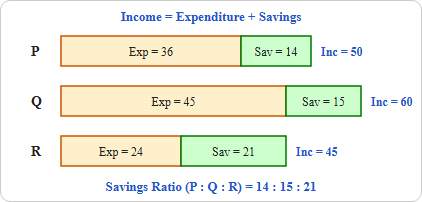 Formula Used:
Savings = Income − Expenditure
Calculations:
⇒ Let the incomes of P, Q, and R be 10x, 12x, and 9x respectively.
⇒ Let the expenditures of P, Q, and R be 12y, 15y, and 8y respectively.
⇒ Q's saving = Q's income − Q's expenditure
⇒ Q's saving = 12x − 15y
⇒ It is given that Q saves 25% of his income:
⇒ 12x − 15y = 25% of 12x
⇒ 12x − 15y = (25 / 100) × 12x
⇒ 12x − 15y = 3x
⇒ 9x = 15y ⇒ y = (9 / 15)x = (3 / 5)x
⇒ Now substituting y = 3x / 5 to find savings of all three:
⇒ Saving of P = 10x − 12y = 10x − 12 × (3x / 5) = 10x − 36x / 5 = 14x / 5
⇒ Saving of Q = 12x − 15y = 12x − 15 × (3x / 5) = 12x − 9x = 3x = 15x / 5
⇒ Saving of R = 9x − 8y = 9x − 8 × (3x / 5) = 9x − 24x / 5 = 21x / 5
⇒ Ratio of savings = 14x / 5 : 15x / 5 : 21x / 5
⇒ Ratio = 14 : 15 : 21
∴ The correct answer is 14 : 15 : 21.
Additional Information
Income, Expenditure & Savings
The fundamental relation is Income = Expenditure + Savings. If income and expenditure are given in separate ratios, using independent variables for each helps to find the relationship between them via any given connecting condition.
Ratio Multipliers
A ratio a : b implies actual values are ax and bx where x is a common multiplier. When two different groups of quantities are in ratios, they require two different variables (e.g., x and y).
Percentage to Fraction Conversion
Converting percentages to fractions (like 25% = 1/4) simplifies calculation involving equations. Thus, 25% savings implies 75% (or 3/4) of income is expenditure.
</p
Q18 · Proportion
If 28.9 : x :: x : 36.1, and x > 0, then find the value of x.
- 38.3
- 32.3
- 30.4
- 35
Answer aur solution dekho
Archived marked answer: B
Shortcut Trick
For a continuous proportion a : x :: x : b, the mean proportional x = √(a × b).
⇒ x = √(28.9 × 36.1)
⇒ x = √(289/10 × 361/10)
⇒ x = (17 × 19) ÷ 10
⇒ x = 323 ÷ 10 = 32.3
∴ The correct answer is 32.3.
Alternate Method
Given:
Proportion: 28.9 : x :: x : 36.1
Condition: x > 0
Formula Used:
In a proportion a : b :: c : d, the product of the means equals the product of the extremes (a × d = b × c).
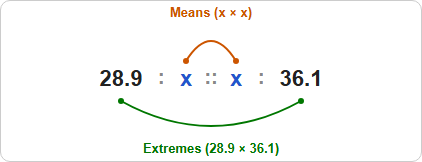 Calculations:
⇒ x × x = 28.9 × 36.1
⇒ x² = (289 ÷ 10) × (361 ÷ 10)
⇒ x = √((289 × 361) ÷ 100)
Since x > 0, we take the positive square root:
⇒ x = (√289 × √361) ÷ √100
⇒ x = (17 × 19) ÷ 10
⇒ x = 323 ÷ 10 = 32.3
∴ The correct answer is 32.3.
Additional Information
Mean Proportional
If three quantities a, b, and c are in continued proportion (a : b = b : c), then the middle term b is called the mean proportional between a and c, given by the formula b = √(a × c).
Third Proportional
If a : b = b : c, then c is the third proportional to a and b, calculated by the rule c = b² ÷ a.
Fourth Proportional
If four quantities a, b, c, and d are in proportion (a : b = c : d), then d is the fourth proportional to a, b, and c, defined by d = (b × c) ÷ a.
</p
Q19 · Proportion
Raj divides ₹1,200 in the ratio 2 : 1 : 3 among three of his friends. The amount equal to the sum of three times the largest share and two times the smallest share is:
Ans
- ₹2,400
- ₹1,800
- ₹2,200
- ₹2,000
Answer aur solution dekho
Archived marked answer: C
Shortcut Trick
Total ratio parts = 2 + 1 + 3 = 6 parts.
Value of 1 part = 1200 ÷ 6 = ₹200.
Required expression = 3 × (Largest Ratio Part) + 2 × (Smallest Ratio Part).
Required parts = 3 × 3 + 2 × 1 = 9 + 2 = 11 parts.
Required amount = 11 × 200 = ₹2,200.
∴ The correct answer is ₹2,200.
Alternate Method
Given:
Total amount to be divided = ₹1,200
Ratio of shares among three friends = 2 : 1 : 3
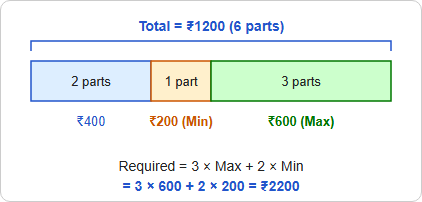 Calculations:
⇒ Sum of all ratio parts = 2 + 1 + 3 = 6 parts
⇒ Value of 6 parts = ₹1,200
⇒ Value of 1 part = 1200 ÷ 6 = ₹200
⇒ Smallest share (1 part) = ₹200
⇒ Largest share (3 parts) = 3 × 200 = ₹600
⇒ Amount to find = 3 × Largest share + 2 × Smallest share
⇒ Required amount = 3 × 600 + 2 × 200
⇒ Required amount = 1800 + 400 = ₹2,200
∴ The correct answer is ₹2,200.
Additional Information
Proportions
If a : b = c : d, then a, b, c, and d are in proportion. The fundamental rule states that the product of extremes equals the product of means (a × d = b × c).
Mean Proportion
The mean proportion between any two numbers a and b is given by the formula √(a × b).
Compound Ratio
For two given ratios a : b and c : d, their corresponding compound ratio is derived by multiplying the antecedents and consequents respectively, resulting in (a × c) : (b × d).
Q20 · Average
The average of 12 numbers is 48. The average of the first 5 numbers is 45 and the average of next 4 numbers is 52. If the 10th number is 10 less than the 11th number and is 5 more than the 12th number, then the average of the 11th and 12th numbers is:
- 50.5
- 46.5
- 47.5
- 48.5
Answer aur solution dekho
Archived marked answer: D
Shortcut Trick
Net deviation of the first 9 numbers from the average (48) = 5 × (45 − 48) + 4 × (52 − 48) = −15 + 16 = +1
Sum of 10th, 11th, and 12th numbers = (3 × 48) − 1 = 143
Let the 12th number = x, then 10th = x + 5, and 11th = x + 15
Sum = x + 5 + x + 15 + x = 3x + 20 = 143 ⇒ x = 41
11th number = 41 + 15 = 56, and 12th number = 41. Average = (56 + 41) ÷ 2 = 48.5
∴ The correct answer is 48.5.
Alternate Method
Given:
⇒ Average of 12 numbers = 48
⇒ Average of the first 5 numbers = 45
⇒ Average of the next 4 numbers = 52
Formula Used:
⇒ Sum of observations = Average × Number of observations
- - 5 nums (Avg: 45)
4 nums (Avg: 52)
Last 3 nums
Sum = 225
Sum = 208
Sum = 143
Total 12 nums, Avg = 48, Sum = 576
Last 3 nums: 10th = x+5 | 11th = x+15 | 12th = x
Calculations:
⇒ Total sum of 12 numbers = 12 × 48 = 576
⇒ Sum of the first 5 numbers = 5 × 45 = 225
⇒ Sum of the next 4 numbers = 4 × 52 = 208
⇒ Sum of 10th, 11th, and 12th numbers = 576 − (225 + 208) = 143
⇒ Let the 12th number be x.
⇒ The 10th number is 5 more than the 12th number ⇒ 10th number = x + 5
⇒ The 10th number is 10 less than the 11th number ⇒ 11th number = (x + 5) + 10 = x + 15
⇒ Sum of the last 3 numbers = (x + 5) + (x + 15) + x = 143
⇒ 3x + 20 = 143
⇒ 3x = 123 ⇒ x = 41
⇒ 11th number = 41 + 15 = 56
⇒ 12th number = 41
⇒ Average of the 11th and 12th numbers = (56 + 41) ÷ 2 = 97 ÷ 2 = 48.5
∴ The correct answer is 48.5.
Additional Information
Combined Average
When a group is divided into multiple subgroups, the overall average is computed using the formula: Total Average = (n₁A₁ + n₂A₂ + ... ) ÷ (n₁ + n₂ + ...).
Net Deviation Method
The sum of the deviations of all items in a dataset from their true average is mathematically zero. This principle is extremely useful for finding the value of a missing subset by simply calculating the net deviation of the remaining terms.
Framing Linear Equations
Whenever quantities are expressed relative to one another (e.g., the 10th number is 5 more than the 12th number), choose the most independent variable as x (the 12th number) to avoid complex subtractions or fractions while forming equations.
</p
Q21 · Simple Interest
A certain sum of money becomes seven times itself when invested at a certain rate of simple interest, in 14 years. How much time (in years, rounded off to 2 decimal places) will it take to become 18 times itself at the same rate?
- 27.33
- 39.67
- 42.78
- 35.5
Answer aur solution dekho
Archived marked answer: B
Shortcut Trick
Direct formula for Simple Interest multiples: T₂ = [(n₂ − 1) ÷ (n₁ − 1)] × T₁
Given n₁ = 7, T₁ = 14 years, and n₂ = 18.
T₂ = [(18 − 1) ÷ (7 − 1)] × 14 = (17 ÷ 6) × 14
T₂ = (17 × 7) ÷ 3 = 119 ÷ 3 = 39.666... ≈ 39.67
∴ The correct answer is 39.67 years.
Alternate Method
Given:
Initial sum = P
Amount after 14 years (A₁) = 7P
Target Amount (A₂) = 18P
Formula Used:
Simple Interest (I) = Amount − Principal
Simple Interest (I) = (P × R × T) ÷ 100
P
7P
14 Years
Interest = 6P
P
18P
T = ? Years
Interest = 17P
Rate (R) is constant in both cases
Calculations:
Case 1:
⇒ Interest (I₁) = 7P − P = 6P
⇒ 6P = (P × R × 14) ÷ 100
⇒ R = (6P × 100) ÷ (14 × P) = 600 ÷ 14 = 300 ÷ 7 %
Case 2:
⇒ Interest (I₂) = 18P − P = 17P
⇒ 17P = (P × R × T₂) ÷ 100
⇒ 17P = [P × (300 ÷ 7) × T₂] ÷ 100
⇒ 17 = (3 × T₂) ÷ 7
⇒ T₂ = (17 × 7) ÷ 3 = 119 ÷ 3
⇒ T₂ = 39.666... years
⇒ T₂ ≈ 39.67 years
∴ The correct answer is 39.67 years.
Additional Information
Direct Relation for Simple Interest Multiples
If a sum becomes 'n' times itself in 'T' years at simple interest, the rate of interest is given by R = [(n − 1) × 100] ÷ T.
Simple vs Compound Interest Concept
In Simple Interest, the interest remains constant for each year. In Compound Interest, the interest gets added to the principal and acts as the new principal for the next period.
Rule of 72
A general estimation trick used in finance: to find the approximate number of years it takes to double your money at a given compound interest rate 'R', divide 72 by R.
</p
Q22 · Mensuration 3D
The height of a cylinder is 20 cm. The lateral surface area is 1760 cm². Its volume is:
- 12032 cm³
- 12302 cm³
- 12203 cm³
- 12320 cm³
Answer aur solution dekho
Archived marked answer: D
Shortcut Trick
The volume formula includes π (22/7), meaning the final volume must perfectly be divisible by 11.
Check the given options for the divisibility rule of 11 (difference between the sum of alternating digits must be 0 or a multiple of 11).
Among the given options, only 12320 satisfies this condition: (1 + 3 + 0) − (2 + 2) = 4 − 4 = 0.
∴ The correct answer is 12320 cm³.
Alternate Method
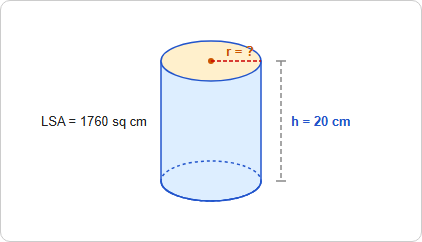 Given:
Height of cylinder (h) = 20 cm
Lateral Surface Area (LSA) = 1760 cm²
Formula Used:
LSA = 2πrh
Volume = πr²h
Calculations:
⇒ 2 × (22/7) × r × 20 = 1760
⇒ 880/7 × r = 1760
⇒ r = (1760 × 7) ÷ 880
⇒ r = 14 cm
Now, finding the volume using the radius:
⇒ Volume = (22/7) × 14 × 14 × 20
⇒ Volume = 22 × 2 × 14 × 20
⇒ Volume = 44 × 280
⇒ Volume = 12320 cm³
⇒ Alternatively, Volume = (LSA ÷ 2) × r = (1760 ÷ 2) × 14 = 880 × 14 = 12320 cm³
∴ The correct answer is 12320 cm³.
Additional Information
Total Surface Area of Cylinder
The total surface area includes the lateral area plus the two circular bases. Formula: TSA = 2πrh + 2πr² = 2πr(h + r).
Volume of a Cone
A cone with the same base radius and height as a cylinder has exactly one-third of the cylinder's volume. Formula: Volume = (1/3)πr²h.
Volume of a Hollow Cylinder
For a hollow cylindrical pipe with outer radius R and inner radius r, the material volume is given by V = π(R² − r²)h.
</p
English
Q1 · Vocabulary
Identify the most appropriate ANTONYM of the given word.
Secure
- Succeed
- Save
- Attack
- Trundle
Answer aur solution dekho
Archived marked answer: C
The correct answer is: Option 3 i.e. Attack.
Key Points
- The word "Secure" means to make safe, protect, or guard something against danger or harm.
- Example: The bank has installed new security systems to secure its vaults.
- "Attack" refers to an aggressive action against someone or something, typically with the intent to harm or damage.
- Example: The soldiers were prepared to attack the enemy at dawn.
- Hence, we can infer that the opposite of 'Secure' is 'Attack'.
Therefore, the correct answer is: Attack.
Additional Information
Here are the other options explained along with their Hindi meanings and example sentences:
- Succeed: To achieve a desired aim or result.
- Example: He worked hard to succeed in his final exams.
- Save: To keep someone or something safe from harm or danger.
- Example: The lifeguard saved the child from drowning.
- Trundle: To move or roll slowly and heavily.
- Example: The old cart trundled down the bumpy road.
Q2 · Vocabulary
Select the most appropriate ANTONYM of the given word.
Receive
- Admit
- Exile
- Reward
- Fund
Answer aur solution dekho
Archived marked answer: B
The correct answer is: Option 2 i.e. Exile.
Key Points
- Receive means to accept or take something that is given, offered, or sent.
- Example: She was delighted to receive a letter from her friend after many years.
- Exile means Exile” is to send someone away, to banish, or to drive out.
- Example: The king was forced into exile after the revolution.
- Hence, we can infer that the opposite of ‘Receive’ is ‘Exile’.
Therefore, the correct answer is: Exile.
Additional Information
Here are the other options explained along with their Hindi meanings and example sentences:
- Admit: To acknowledge or confess something as true.
- Example: He had to admit that he made a mistake.
- Reward: Something given in recognition of service, effort, or achievement.
- Example: The student received a reward for her academic excellence.
- Fund: A sum of money saved or made available for a particular purpose.
- Example: The project was completed using funds from various sponsors.
Q3 · Vocabulary
Read the sentence carefully and select the most suitable idiom to fill in the blank.
The renowned publisher decided to withdraw a book from the market. No one was interested in the book as the arguments presented were __________.
- high and mighty
- out of the woods
- beside the mark
- under the rose
Answer aur solution dekho
Archived marked answer: C
The correct answer is Option 3.
Key Points
- The idiom "beside the mark" means irrelevant or inaccurate, which fits the context of the sentence.
- The arguments presented in the book were not relevant or accurate, leading to a lack of interest.
Therefore, the correct answer is Option 3.
Correct Sentence: *"The renowned publisher decided to withdraw a book from the market. No one was interested in the book as the arguments presented were beside the mark."*
Additional Information
- High and mighty: This means arrogant or self-important and does not fit the context.
- Out of the woods: This means out of danger or difficulty, which is not relevant to the sentence.
- Under the rose: This means in secret or confidential, which also does not fit the context.
Q4 · Vocabulary
Select the most appropriate meaning of the underlined idiom in the following sentence.
In my new office, all employees were different, so I felt like a fish out of water.
- Uncomfortable
- Homeless
- Frustrated
- Disappointed
Answer aur solution dekho
Archived marked answer: A
The correct answer is Option 1.
Key Points
- The idiom "like a fish out of water" means feeling uncomfortable or out of place in a particular situation.
- In the sentence, the speaker feels out of place in their new office because all the employees were different.
- This indicates that the speaker was uncomfortable in their new environment.
Therefore, the correct answer is Option 1.
Additional Information
- Homeless: This option is incorrect because the idiom does not imply being without a home.
- Frustrated: While one might feel frustrated in an uncomfortable situation, the primary meaning of the idiom is feeling out of place.
- Disappointed: This option is incorrect because the idiom does not imply disappointment.
Q5 · Vocabulary
Select the option that can be used as a one-word-substitute for the given group of words.
A false idea or belief
- Reticence
- Atrophy
- Fallacy
- Entropy
Answer aur solution dekho
Archived marked answer: C
The correct answer is 'Option 3'.
Key Points
- Fallacy is the correct answer, as it refers to a false idea or belief.
Hence, the correct answer is 'Option 3'.
Example Sentence: Believing money buys happiness is a fallacy.
Additional Information
- Reticence refers to being reserved or restrained, especially in speech, and is unrelated to a false idea.
- Atrophy means the wasting away or decline of body tissue or skills, not relevant to the given context.
- Entropy is a measure of disorder or randomness, primarily in thermodynamics, not applicable here.
Q6 · Vocabulary
Select the option that can be used as a one-word substitute for the given group of words.
That which cannot be conquered
- Invisible
- Indelible
- Ineffable
- Invincible
Answer aur solution dekho
Archived marked answer: D
The correct answer is 'Option 4'.
Key Points
- The word "Invincible" refers to something that cannot be conquered, defeated, or overcome.
- Example: The champion's winning streak made him seem invincible in the eyes of his opponents.
Hence, the correct answer is 'Invincible'.
Additional Information
- Option 1: Invisible – Refers to something that cannot be seen.
- Example: The invisible ink revealed the secret message under UV light.
- Option 2: Indelible – Refers to something that cannot be erased or removed.
- Example: The experience left an indelible mark on her memory.
- Option 3: Ineffable – Refers to something too great or extreme to be expressed in words.
- Example: The beauty of the sunset over the mountains was ineffable.
The
Q7 · Vocabulary
Select the option that can be used as a one-word substitute for the underlined group of words.
In Indian mythology, most of the Asuras wish to be never able to die.
- Invincible
- Impervious
- Invisible
- Immortal
Answer aur solution dekho
Archived marked answer: D
The correct answer is 'Option 4'.
Key Points
- The word "immortal" means "never able to die," which accurately fits the context of the sentence.
- Options like "invincible," "impervious," and "invisible" do not relate directly to the idea of not dying, so they are incorrect choices.
Hence, the correct answer is 'Option 4'.
Correct Sentence*: In Indian mythology, most of the Asuras wish to be immortal.*
Additional Information
- Option 1: "Invincible" means "unable to be defeated" rather than "unable to die," which is not correct in this context.
- Option 2: "Impervious" means "not affected by something" and does not fit the context of death or immortality.
- Option 3: "Invisible" means "unable to be seen" and is unrelated to the concept of not dying.
Q8 · Vocabulary
Select the INCORRECTLY spelt word.
- Embarrass
- Occurrence
- Exhilerate
- Accommodate
Answer aur solution dekho
Archived marked answer: C
The correct answer is Option 3.
Key Points
- The word "Exhilerate" is incorrectly spelt.
- The correct spelling is "Exhilarate".
Therefore, the correct answer is Option 3.
Additional Information
- Embarrass is correctly spelt.
- Occurrence is correctly spelt.
- Accommodate is correctly spelt.
Q9 · Vocabulary
Select the INCORRECTLY spelt word.
- Exceed
- Proceed
- Succeed
- Preceed
Answer aur solution dekho
Archived marked answer: D
The correct answer is option 4.
Key Points
The misspelled word is 'Preceed'.
- The correct spelling would be 'Precede'.
- The word 'precede' is a verb that means 'to come before something in time or position'. </stro
Q10 · Vocabulary
Select the most appropriate synonym of the given word.
Acquiesce
- Desist
- Cease
- Thwart
- Concur
Answer aur solution dekho
Archived marked answer: D
The correct answer is: Option 4 i.e. Concur.
Key Points
- The word "Acquiesce" means to accept something reluctantly but without protest, often due to pressure or inevitability.
- Example: She acquiesced to her parents' decision to move to another city.
- "Concur" means to agree or have the same opinion as someone else.
- Example: The board members concurred with the chairman's proposal.
Therefore, the correct answer is: Concur.
Additional Information
Here are the other options explained along with their Hindi meanings and example sentences:
- Desist: To stop doing something, especially something that someone else wants you to stop.
- Example: The protesters were ordered to desist from blocking the entrance.
- Cease: To bring something to an end or come to an end.
- Example: The company decided to cease operations in that region.
- Thwart: To prevent someone from accomplishing something.
- Example: His plans to become a pilot were thwarted by poor eyesight.
Q11 · Vocabulary
Select the most appropriate synonym of the bracketed word in the following sentence to fill in the blank.
During Covid times, many organisations made _______ (sentimental) appeals to raise funds for migrant workers.
- mawkish
- sincere
- cynical
- practical
Answer aur solution dekho
Archived marked answer: A
The correct answer is: Option 1.
Key Points
- The word "sentimental" refers to feelings of nostalgia, tenderness, or excessive emotion often tied to memories.
- Example: His sentimental attachment to his childhood home made it hard for him to sell it.
- "Mawkish" means excessively sentimental in a way that is insincere or overly emotional, often to the point of being cloying or unpleasant.
- Example: The mawkish love story in the movie made some viewers uncomfortable due to its melodrama.
Therefore, the correct answer is: Option 1.
Additional Information
Here are the other options explained along with their Hindi meanings and example sentences:
- Option 2: "Sincere": This refers to being genuine and free from pretense, which is not the same as being overly emotional or sentimental.
- Example: Her sincere apology was well received by everyone in the room.
- Option 3: "Cynical": This refers to a belief that people are primarily motivated by self-interest and is not related to sentimentality.
- Example: His cynical view of politics led him to believe that no one was genuinely interested in making a difference.
- Option 4: "Practical": Refers to something based on real-world applications or logic, which contrasts with emotional or sentimental appeals.
- Example: His practical approach to problem-solving helped streamline the project and deliver results on time.
Q12 · Vocabulary
Select the most appropriate meaning of the underlined word in the given sentence.
He is an atheist, although he respects everyone’s belief.
- One who believes in God
- One who believes in nature
- One who is extremist
- One who does not believe in God
Answer aur solution dekho
Archived marked answer: D
The correct answer is 'Option 4'.
Key Points
- The word "atheist&
Q13 · Vocabulary
Select the most appropriate synonym for the underlined word in the given sentence.
His ambition in life is to become a happy and satisfied man.
- Apathy
- Satisfaction
- Eagerness
- Amend
Answer aur solution dekho
Archived marked answer: C
The correct answer is: Option 3 i.e. Eagerness.
Key Points
- The word "Ambition" means a strong desire to achieve something, typically requiring determination and hard work.
- Example: Her ambition to become a successful doctor kept her motivated through tough times.
- Eagerness refers to an intense desire or enthusiasm to do or achieve something.
- Example: The students showed great eagerness to participate in the science fair.
Therefore, the correct answer is: Eagerness.
Additional Information
Here are the other options explained along with their Hindi meanings and example sentences:
- Apathy: Lack of interest, enthusiasm, or concern.
- Example: His apathy towards the project was evident in his lack of effort.
- Satisfaction: A feeling of contentment or fulfillment.
- Example: Completing the marathon gave her immense satisfaction.
- Amend: To make changes or improvements to something.
- Example: The teacher advised him to amend his essay for better clarity.
The correct answer is Op
Q14 · Grammar
Select the option that corrects the error in the given sentence.
He ran quick to catch the bus.
- quiet
- rapid
- insipid
- quickly
Answer aur solution dekho
Archived marked answer: D
The correct answer is Option 4.
Key Points
- The primary issue in the sentence is the use of the adjective "quick" instead of the adverb "quickly."
- Adverbs modify verbs and usually end in "-ly."
- The correct phrase should be "He ran quickly to catch the bus," ensuring grammatical correctness and clarity.
Therefore, the correct answer is Option 4.
Correct Sentence: *"He ran quickly to catch the bus."*
Additional Information
- Quick is an adjective that modifies nouns.
- Quickly is an adverb that modifies verbs, adjectives, or other adverbs.
- Using the correct form of the word ensures that the sentence is grammatically correct.
Q15 · Grammar
The following sentence has been divided into four segments. Identify the segment that contains an error.
Mrs. Sreelakshmi's / musical intelligence / is superior than / Mrs. Suma's.
- Mrs. Suma's.
- musical intelligence
- is superior than
- Mrs. Sreelakshmi's
Answer aur solution dekho
Archived marked answer: C
The correct answer is Option 3.
Key Points
- The primary issue in the sentence is the use of "than" instead of "to" after the word "superior".
- The correct phrase should be "is superior to", ensuring grammatical correctness and clarity.
- Thus, the error is located in part 3 of the sentence.
Therefore, the correct answer is Option 3.
Correct Sentence: *"Mrs. Sreelakshmi's musical intelligence is superior to Mrs. Suma's."*
Additional Information
- 1: "Mrs. Sreelakshmi's" – This part of the sentence is grammatically correct and does not require any changes.
- 2: "musical intelligence" – This part of the sentence is grammatically correct and does not require any changes.
- 4: "Mrs. Suma's." – This part of the sentence is grammatically correct and does not require any changes.
Q16 · Grammar
Select the most appropriate option to substitute the underlined segment in the given sentence.
Gourav was no good than a foolish person.
- no better
- not good
- no best
- not best
Answer aur solution dekho
Archived marked answer: A
The correct answer is Option 1.
Key Points
- The primary issue in the sentence is the use of the word "good" in the comparison.
- In comparative sentences, "better" is the correct form to use.
- The correct phrase should be "no better," ensuring grammatical correctness and clarity.
Therefore, the correct answer is Option 1.
Correct Sentence: *"Gourav was no better than a foolish person."*
Additional Information
- Option 2: "not good" – This phrase is not correct as it does not provide a proper comparative structure.
- Option 3: "no best" – This phrase is incorrect as "best" is the superlative form and does not fit in this context.
- Option 4: "not best" – This phrase is also incorrect because it lacks proper comparative structure and "best" should be used in superlative form.
Q17 · Grammar
Select the option that will improve the underlined part of the given sentence.
If I was the queen, I would give a handsome sum towards education.
- will be the queen
- were the queen
- have been the queen
- would be the queen
Answer aur solution dekho
Archived marked answer: B
The correct answer is Option 2.
Key Points
- The sentence involves a hypothetical situation, which is expressed using the second conditional. This form requires "were" instead of "was" after "if" for correct usage in formal English.
- In second conditional sentences, we use "if + subject + were" to describe unreal situations or hypothetical scenarios.
- Thus, the correct form in the sentence is "were the queen".
Therefore, the correct answer is Option 2.
Correct Sentence: *"If I were the queen, I would give a handsome sum towards education."*
Additional Information
- Option 1: "If I will be the queen" – Incorrect, as the future tense ("will") is not used in second conditional sentences.
- Option 3: "If I have been the queen" – Incorrect, as this form is in the present perfect tense, which does not fit the context of a hypothetical scenario.
- Option 4: "If I would be the queen" – Incorrect, as "would" is used in the result clause of conditional sentences, not in the "if" clause.
Q18 · Voice Change
Select the option that expresses the given sentence in passive voice
Someone has taken my secret diary.
- My secret diary had been taken by someone.
- My secret diary has to be taken by someone.
- My secret diary has been taken by someone.
- My secret diary will have been taken by someone.
Answer aur solution dekho
Archived marked answer: C
The correct answer is Option 3.
Key Points
- In passive voice, the object of the active sentence becomes the subject of the passive sentence.
- In the active voice, the sentence is: "Someone has taken my secret diary."
- To convert it to passive: the object "my secret diary" is placed at the beginning.
- The verb "has taken" is converted to "has been taken" (present perfect passive).
- The subject "someone" remains optional, but the sentence still makes sense without it.
Therefore, the correct answer is Option 3.
Correct Sentence: *"My secret diary has been taken by someone."*
Additional Information
- Option 1: "My secret diary had been taken by someone." – Incorrect tense (past perfect passive).
- Option 2: "My secret diary has to be taken by someone." – Incorrect structure and meaning (necessity is implied, which is not the original intent).
- Option 4: "My secret diary will have been taken by someone." – Incorrect tense (future perfect passive).
Q19 · Voice Change
Select the option that expresses the following sentence in passive voice.
Sonam does not like bananas.
- Banana is not liked by Sonam.
- Bananas have not been liked by Sonam.
- Bananas are not liked by Sonam.
- Bananas had not been liked by Sonam.
Answer aur solution dekho
Archived marked answer: C
The correct answer is Option 3.
Key Points
- Passive voice structure: The object of the active voice sentence becomes the subject of the passive voice sentence.
- In the active voice, the sentence is: "Sonam does not like bananas."
- To convert to passive voice: Place the object "bananas" at the beginning.
- Change the active verb form "does not like" to "are not liked" (present simple passive).
- Ensure the subject "Sonam" remains, but the focus is on the object "bananas."
Therefore, the correct answer is Option 3.
Correct Sentence: *"Bananas are not liked by Sonam."*
Additional Information
- Option 1: "Banana is not liked by Sonam." – Incorrect, as "banana" is singular instead of the plural "bananas."
- Option 2: "Bananas have not been liked by Sonam." – Incorrect tense (present perfect passive).
- Option 4: "Bananas had not been liked by Sonam." – Incorrect tense (past perfect passive).