92 questions available to read. Bina signup padho; timed practice ke liye free sign in karo.
Archive coverageThis saved paper contains 92 of 100 expected questions. 0 stored records are excluded from this study page while their source or wording is checked. Missing original questions: 8. Local question numbers follow the saved archive; match the wording and choices when comparing another response sheet.
Archived marked answers and available solution notes are preserved. These are not claimed to be fully checked final SSC keys. How questions are checked.
Reasoning
Q1 · Series
Select the option that represents the letters that when placed from left to right in the blanks below will complete the given letter series.
L M B A _ H O L M B A C _ O L M _ A C H O L _ B A C H O L _
- CHMBM
- CMHBM
- CHBMM
- CHMMB
Answer aur solution dekho
Archived marked answer: C
Given series: L M B A _ H O L M B A C _ O L M _ A C H O L _ B A C H O L _
Option 1) CHMBM→ L M B A C H O L M B A C H O L M M A C H O L B B A C H O L M → (It doesn't follow any pattern)
Option 2) CMHBM → L M B A C H O L M B A C M O L M H A C H O L B B A C H O L M → (It doesn't follow any pattern)
Option 3) CHBMM → L M B A C H O L M B A C H O L M B A C H O L M B A C H O L M → (It follows the pattern of: LMBACHO - LMBACHO - LMBACHO - LMBACHO - LM)
Option 4) CHMMB → L M B A C H O L M B A C H O L M M A C H O L M B A C H O L B → (It doesn't follow any pattern)
Hence, "Option 3" is the correct answer.
Q2 · Series
Which letter-cluster will replace the question mark (?) to complete the given series?
ZVRN, VSPM, RPNL, ?, JJJJ
- RMLN
- RNLL
- RNLK
- NMLK
Answer aur solution dekho
Archived marked answer: D
The logic followed here is:
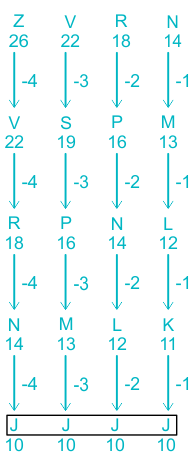 Hence, "Option 4" is the correct answer.
Q3 · Series
Which figure should replace the question mark (?) if the following series were to be continued?
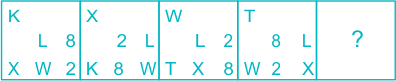


Answer aur solution dekho
Archived marked answer: B
The logic followed here is:
1) First box series →
1st column elements interchange positions.
2nd column elements shift to the 3rd column.
3rd column elements shift to the 3rd column diagonally.
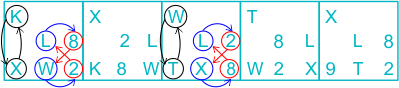 2) Second box series →
Left bottom corner elements is replaced by new element.
2nd column elements shift to the 3rd column.
First element of the 3rd column shift to the 2nd column.
1st row element shift to the bottom center position.
Second element of 3rd column shift to the opposite side diagonally.
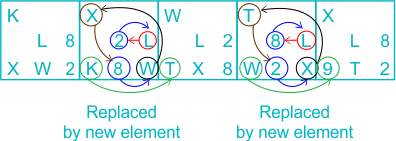 Thus, the final series is:
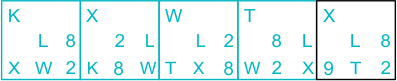 Hence, "Option 2" is the correct answer.
Q4 · Series
Select the option that can replace the question mark (?) in the following series.
FM61, EK58, DI55, CG52, ?
- BE49
- CE46
- CD44
- BF48
Answer aur solution dekho
Archived marked answer: A
The logic followed here is:
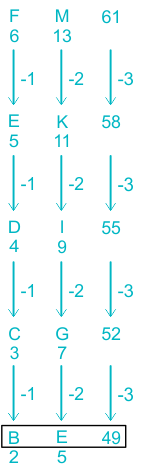 Hence, "Option 1" is the correct answer.
Q5 · Series
Select the number from among the given options that can replace the question mark (?) in the following series.
23, 27, 43, 79, 143, ?
- 240
- 243
- 250
- 200
Answer aur solution dekho
Archived marked answer: B
The logic followed here is:
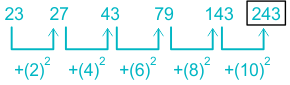 Hence, "Option 2" is the correct answer.
Q6 · Series
Identify the figure given in the options which when put in place of the question mark (?) will logically complete the series?



Answer aur solution dekho
Archived marked answer: A
The logic followed here is:
1) All the elements shift clockwise including the center element.
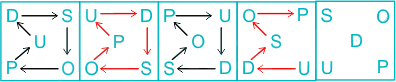 Thus, the final series is:
 Hence, "Option 1" is the correct answer.
Q7 · Analogy
Select the set in which the numbers are related in the same way as are the numbers of the following set.
(79, 58, 62)
(54, 33, 37)
(NOTE: Operations should be performed on the whole numbers, without breaking down the numbers into its constituent
digits. E.g. 13 – Operations on 13 such as adding/deleting/multiplying etc. to 13 can be performed. Breaking down 13 into 1
and 3 and then performing mathematical operations on 1 and 3 is not allowed.)
- (59, 33, 43)
- (47, 36, 41)
- (66, 45, 49)
- (43, 25, 30)
Answer aur solution dekho
Archived marked answer: C
The logic followed here is:
(79, 58, 62)
(58 + 62) ÷ 2 + 19 = 79
120 ÷____ 2 + 19 = 79
60 + 19 = 79
79 = 79 (LHS = RHS)
And,
(54, 33, 37)
(33 + 37) ÷ 2 + 19 = 54
70 ÷____ 2 + 19 = 54
35 + 19 = 54
54 = 54 (LHS = RHS)
So, checking each option one by one:
Option 1) (59, 33, 43)
(33 + 43) ÷ 2 + 19 = 59
76 ÷____ 2 + 19 = 59
38 + 19 = 59
57 ≠ 59 (LHS ≠ RHS)
Option 2) (47, 36, 41)
(36 + 41) ÷ 2 + 19 = 47
77 ÷____ 2 + 19 = 47
38.5 + 19 = 47
57.5 ≠ 47 (LHS ≠ RHS)
Option 3) (66, 45, 49)
(45 + 49) ÷ 2 + 19 = 66
94 ÷____ 2 + 19 = 66
47 + 19 = 66
66 = 66 (LHS = RHS)
Option 4) (43, 25, 30)
(25 + 30) ÷ 2 + 19 = 43
55 ÷____ 2 + 19 = 43
47.5 + 19 = 43
66.5 ≠ 43 (LHS ≠ RHS)
Thus, out of all the options, '(66, 45, 49)' follows the same logic as given.
Hence, "Option 3" is the correct answer.
Q8 · Analogy
Select the set in which the numbers are related in the same way as are the numbers of the following set.
(7, 9, 48)
(6, 8, 42)
(NOTE: Operations should be performed on the whole numbers, without breaking down the numbers into its constituent
digits. E.g. 13 – Operations on 13 such as adding/deleting/multiplying etc. to 13 can be performed. Breaking down 13 into 1
and 3 and then performing mathematical operations on 1 and 3 is not allowed.)
- (8, 10, 47)
- (9, 11, 56)
- (11, 13, 72)
- (10, 12, 54)
Answer aur solution dekho
Archived marked answer: C
The logic followed here is:
(7, 9, 48)
(7 + 9) × 3 = 48
16 × 3 = 48
48 = 48 (LHS = RHS)
And,
(6, 8, 42)
(6 + 8) × 3 = 42
14 ____× 3 = 42
42 = 42 (LHS = RHS)
So, checking each option one by one:
Option 1) (8, 10, 47)
(8 + 10) × 3 = 47
18 ____× 3 = 47
54 ≠ 47 (LHS ≠ RHS)
Option 2) (9, 11, 56)
(9 + 11) × 3 = 56
20 ____× 3 = 56
60 ≠ 56 (LHS ≠ RHS)
Option 3) (11, 13, 72)
(11 + 13) × 3 = 72
24 ____× 3 = 72
72 = 72 (LHS = RHS)
Option 4) (10, 12, 54)
(10 + 12) × 3 = 54
22 ____× 3 = 54
66 ≠ 54 (LHS ≠ RHS)
Thus, out of all the options, '(11, 13, 72)' follows the same logic as given.
Hence, "Option 3" is the correct answer.
Q9 · Analogy
Select the option that is related to the third word in the same way as the second word is related to the first word. (The words must be considered as meaningful English words and must not be related to each other based on the number of letters/number of consonants/vowels in the word)
Temerity : Shyness :: Pique : ?
- Resentment
- Anger
- Delight
- Offence
Answer aur solution dekho
Archived marked answer: C
The logic followed here is:
Logic: Opposites
Here,
Temerity : Shyness → Temerity is the opposite of Shyness.
Similarly,
Pique : Delight → Pique is the opposite of Delight.
Hence, the correct answer is "Option 3".
Q10 · Analogy
‘Blossom’ is related to ‘Wither’ in the same way as ‘Stagnate’ is related to ‘________’.
(The words must be considered as meaningful English words and must not be related to each other based on the number of
letters/number of consonants/vowels in the word.)
- Stand
- Rest
- Languish
- Flow
Answer aur solution dekho
Archived marked answer: D
The logic followed here is:
Logic: Opposites.
Here,
Blossom : Wither → Blossom is the opposite of Wither.
Similarly,
Stagnate : Flow → Stagnate is the opposite of Flow.
Hence, the correct answer is "Option 4".
Q11 · Non Verbal Reasoning
Six letters S, T, M, P, R and C are written on different faces of a dice. Two positions of this dice are shown in the figures below. Find the letter on the face opposite to M.

- R
- P
- C
- S
Answer aur solution dekho
Archived marked answer: A
The logic followed here is :-
From the given two different cubes the adjacent sides are as shown below :
As T is common on both the dices, it is clear that S, M, P, and R are adjacent to it, and the remaining i.e. C will be opposite to it.
 Opposite pairs:
M → R
S → P
T → C
So, the opposite side of "M" will be side "R".
Hence, the correct answer is "Option 1".
Q12 · Non Verbal Reasoning
How many squares are there in the given figure?

- 14
- 12
- 15
- 13
Answer aur solution dekho
Archived marked answer: A
The number of squares in the given figure is shown below:
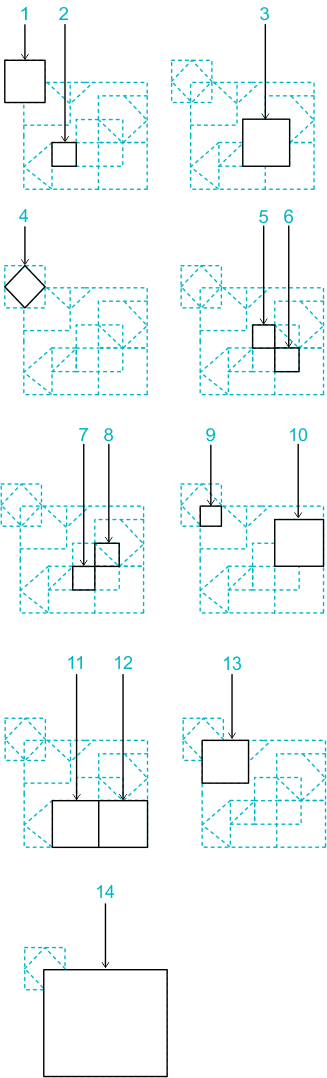 Thus, there are total 14 squares.
Hence, "Option 3" is the correct answer.
Q13 · Non Verbal Reasoning
Select the correct mirror image of the given figure when the mirror is placed at MN as shown below.
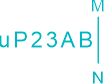




Answer aur solution dekho
Archived marked answer: D
The correct mirror image of the given figure is:
 Hence, the correct answer is "Option 4".
Q14 · Non Verbal Reasoning
Select the correct mirror image of the given figure when the mirror is placed at MN as shown below.
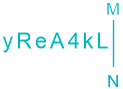




Answer aur solution dekho
Archived marked answer: B
The correct mirror image of the given figure is:
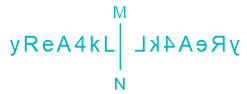 Hence, the correct answer is "Option 2".
Q15 · Non Verbal Reasoning
A paper is folded and cut as shown below. How will it appear when unfolded?



Answer aur solution dekho
Archived marked answer: C
The figure which will look like the paper when unfolded is shown below:
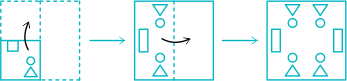 Thus, option Figure 3 will look like the paper when unfolded.
Hence, "Option 3" is the correct answer.
Q16 · Puzzle Subtypes Not To Miss
10 is related to 15 following certain logic. Following the same logic, 42 is related to 63. To which of the following numbers is 22 related, following the same logic? (NOTE : Operations should be performed on the whole numbers, without breaking down the numbers into its constituent digits. E.g. 13 – Operations on 13 such as adding /deleting /multiplying etc., to 13 can be performed. Breaking down 13 into 1 and 3 and then performing mathematical operations on 1 and 3 is not allowed.)
- 28
- 30
- 33
- 31
Answer aur solution dekho
Archived marked answer: C
The logic followed here is:
10 is related to 15
10 + 10 ÷ 2 = 15
10 + 5 = 15
15 = 15 (LHS = RHS)
And,
42 is related to 63
42 +
Q17 · Puzzle Subtypes Not To Miss
Which two signs should be interchanged to make the following equation correct?
18 - 23 × 455 ÷ 7 + 28 = 377
- + and ×
- − and ×
- − and +
- ÷ and −
Answer aur solution dekho
Archived marked answer: B
Given: 18 - 23 × 455 ÷ 7 + 28 = 377
According to the question, after interchanging the signs:
Option 1) + and ×
18 - 23 × 455 ÷ 7 + 28 = 377 ⇒ 18 - 23 + 455 ÷ 7 × 28 = 377
⇒ 18 - 23 + 455 ÷ 7 × 28 = 377
⇒ 18 - 23 + 65 __×__ 28 = 377
⇒ 18 + 1820 - 23 = 377
⇒ 1838 - 23 = 377
⇒ 1815 ≠ 377 (LHS ≠ RHS)
Option 2) − and ×
18 - 23 × 455 ÷ 7 + 28 = 377 ⇒ 18 × 23 - 455 ÷ 7 + 28 = 377
⇒ 18 × 23 - 455 ÷ 7 + 28 = 377
⇒ 18 __×__ 23 - 65 + 28 = 377
⇒ 414 + 28 - 65 = 377
⇒ 442 - 65 = 377
⇒ 377 = 377 (LHS = RHS)
Option 3) − and +
18 - 23 × 455 ÷ 7 + 28 = 377 ⇒ 18 + 23 × 455 ÷ 7 - 28 = 377
⇒ 18 + 23 × 455 ÷ 7 - 28 = 377
⇒ 18 + 23 × 65 - 28 = 377
⇒ 18 + 1495 - 28 = 377
⇒ 1513 - 28 = 377
⇒ 1485 ≠ 377 (LHS ≠ RHS)
Option 4) ÷ and −
18 - 23 × 455 ÷ 7 + 28 = 377 ⇒ 18 ÷ 23 × 455 - 7 + 28 = 377
⇒ 18 ÷____ 23 × 455 - 7 + 28 = 377
⇒ 0.78____ × 455 - 7 + 28 = 377
⇒ 354.9 + 28 - 7 = 377
⇒ 382.9 - 7 = 377
⇒ 375.9 ≠ 377 (LHS ≠ RHS)
Hence, "Option 2" is the correct answer.
Q18 · Puzzle Subtypes Not To Miss
What will come in place of the question mark (?) in the following equation if ‘+’ and ‘÷’ are interchanged and ‘×’ and ‘–’ are
interchanged?
4 − 12 + 3 ÷ 12 × 6 = ?
- 13
- 46
- 11
- 22
Answer aur solution dekho
Archived marked answer: D
Given: 4 − 12 + 3 ÷ 12 × 6 = ?
According to the question, after ‘+’ and ‘÷’ are interchanged and ‘×’ and ‘–’ are interchanged:
4 − 12 + 3 ÷ 12 × 6 = ? ⇒ 4 × 12 ÷ 3 + 12 - 6 = ?
⇒ 4 × 12 __÷__ 3 + 12 - 6 = ?
⇒ 4 × 4 + 12 - 6 = ?
⇒ 16 + 12 – 6 = ?
⇒ 28__ – __6 = ?
⇒ 22 = ?
Hence, "Option 4" is the correct answer.
Q19 · Coding Decoding
In a certain code language, ‘sit on chair’ is coded as 'sk mi cn' and ‘the chair broke’ is coded as ‘gm fr mi’. How is ‘chair’
coded in the given language?
- sk
- cn
- mi
- gm
Answer aur solution dekho
Archived marked answer: C
According to the given information,
Q20 · Classification Odd One Out
Four letter-clusters have been given, out of which three are alike in some manner and one is different. Select the one that is different. The odd one out is not based on the number of consonants/vowels or their position in the letter cluster
- LQV
- DIN
- PTX
- AFK
Answer aur solution dekho
Archived marked answer: C
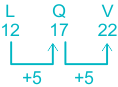
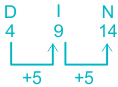
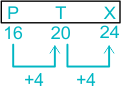
The logic followed here is:
Option 1) LQV
 Option 2) DIN
 Option 3) PTX
 Option 4) AFK
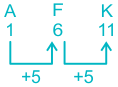 Thus, out of all the options, 'PTX' is the odd one out.
Hence, "Option 3" is the correct answer.
Q21 · Classification Odd One Out
Three of the following four options are alike in a certain way and thus form a group. Which is the option that does NOT belong to that group?
(NOTE : Operations should be performed on the whole numbers, without breaking down the numbers into its constituent digits. E.g. 13 – Operations on 13 such as adding /deleting /multiplying etc., to 13 can be performed. Breaking down 13 into 1 and 3 and then performing mathematical operations on 1 and 3 is not allowed).
- 2 – 4 – 8
- 2 – 2 – 4
- 3 – 2 – 5
- 1 – 3 – 3
Answer aur solution dekho
Archived marked answer: C
The logic followed here is:
Option 1) 2 – 4 – 8
2 × 4 = 8
8 = 8 (LHS = RHS)
Option 2) 2 – 2 – 4
Q22 · Classification Odd One Out
In a certain code language, 'BELL' is written as 'MKFA' and 'BOND' is written as 'EMPA'. How will 'BLEW’ be written in that
language?
- XMDA
- XMAD
- XDAM
- XDMA
Answer aur solution dekho
Archived marked answer: D
The logic followed here is:
'BELL' is written as 'MKFA'
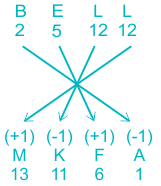 And,
'BOND' is written as 'EMPA'
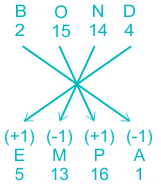 Similarly,
'BLEW’ will be written as
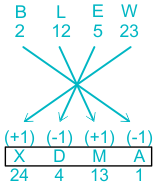 Hence, "Option 4" is the correct answer.
Q23 · Logical Reasoning
Read the given statements and conclusions carefully. Assuming that the information given in the statements is true, even if it appears to be at variance with commonly known facts, decide which of the given conclusions logically follow(s) from the statements.
Statements: Some boxes are cartons. All cartons are papers. Some cartons are utensils.
Conclusion (I): No box is a utensil.
Conclusion (II): Some papers are utensils.
- Both conclusions (I) and (II) follow
- Neither conclusion (I) nor (II) follows
- Only conclusion (II) follows
- Only conclusion (I) follows
Answer aur solution dekho
Archived marked answer: C
The least possible Venn diagram for the given statements is as shown below :
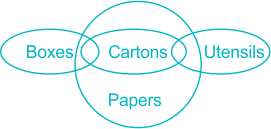 Conclusions:
I. No box is a utensil → Does not follow (As some boxes are cartons, all cartons are papers and some cartons are utensils. As no direct relation is given between boxes and utensils, therefore it is false.)
II. Some papers are utensils → Follow (As all cartons are papers and some cartons are utensils. As whole cartons comes in papers and has some part common with utensils, therefore it is true.)
∴ Here, Only conclusion (II) follows.
Hence, "Option 3" is the correct answer.
Q24 · Blood Relations
In a certain code language,
A # B means A is the sister of B.
A @ B means A is the son of B.
A & B means A is the wife of B.
A % B means A is the father of B.
How is Q related to R if P & Q % L # R & K?
- Sister
- Wife
- Father
- Mother
Answer aur solution dekho
Archived marked answer: C
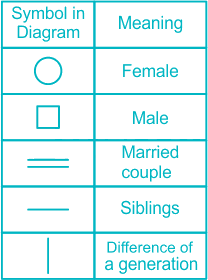 Decoding symbols:
A is
Symbol
#
Q25 · Alphabet Test
The position of how many letters will remain unchanged if each of the letters in the word ‘PRANKED’ is arranged in the
English alphabetical order?
- One
- Three
- None
- Two
Answer aur solution dekho
Archived marked answer: C
Given word: 'PRANKED'
After arranged in alphabetical order:
Alphabets
P
R
A
N
K
E
D
Alphabetical order
A
D
E
K
N
P
R
Now,
there are None of the alphabets will remain unchanged if each of the letters in the word 'PRANKED' is arranged in English alphabetical order.
Hence, the correct answer is "Option 3".
General Awareness
Q1 · Art and Culture
By which of the following state governments is the Tansen Music Festival organised?
- Maharashtra Government
- Madhya Pradesh Government
- Rajasthan Government
- Uttar Pradesh Government
Answer aur solution dekho
Archived marked answer: B
The correct answer is Madhya Pradesh Government.
Key Points
Tansen Music Festival:
- It began with a traditional style in Gwalior (Madhya Pradesh).
- It is a five-day festival that is celebrated every year.
- It is celebrated in the memory of ‘Mian Tansen’.
- It is the oldest and esteemed classical music festival in India is organized by Ustad Alauddin Khan Kala Evam Sangeet Academy.
Q2 · Art and Culture
Which of the following festivals is celebrated as the birth anniversary of Guru Nanak Dev?
- Hola Mohalla
- Baisakhi
- Gurpurab
- Chappar Mela
Answer aur solution dekho
Archived marked answer: C
The correct answer is Gurpurab.
Key Points
- Guru Nanak Dev
- Guru Nanak Dev was born on 15 April 1469 at Talwaṇḍi village in the Lahore province of the Delhi Sultanate (present-day Nankana Sahib, Punjab, Pakistan).
- He was the founder of Sikhism and the first of the ten Sikh Gurus.
- Around the
Q3 · Indian Polity and Constitution
Which of the following statements is INCORRECT about the Directive Principles of State Policy?
- They promote welfare of individuals. Hence, they are personal and individualistic.
- These have moral and political sanctions.
- They aim at establishing social and economic democracy in the country.
- They are positive, as they require the State to do certain things.
Answer aur solution dekho
Archived marked answer: A
The correct answer is They promote welfare of individuals. Hence, they are personal and individualistic.
Key Points
- The Directive Principles of State Policy of India are the guidelines or principles given to the institutes for governing India and are provided in Part IV of the Constitution of India.
- Directive Principles of State Policy aim to create social and economic conditions under which the citizens can lead a good life.
- They also aim to establish social and economic democracy through a welfare state. Directive principles are classified under the following categories; economic, socialistic, political, executive, justice and legal, administrative, environmental, protection of monuments, peace, and security.
Hence, it can be said that the Directive Principles of State Policy are fundamental for the Governance of the state.
Additional Information
- Features of DPSPs
- The phrase ‘Directive Principles of State Policy’ denotes the ideals that the State should keep in mind while formulating policies and enacting laws.
- These are the constitutional instructions or recommendations to the State in legislative, executive, and administrative matters. According to Article 36, the term ‘State’ in Part IV has the same meaning as in Part III dealing with Fundamental Rights.
- Therefore, it includes the legislative and executive organs of the central and state governments, all local authorities, and all other public authorities in the country.
- The Directive Principles resemble the ‘Instrument of Instructions’ enumerated in the Government of India Act of 1935.
- In the words of Dr. B.R. Ambedkar, ‘the Directive Principles are like the instrument of instructions, which were issued to the Governor-General and to the Governors of the colonies of India by the British Government under the Government of India Act of 1935. What is called Directive Principles is merely another name for the instrument of instruction. The only difference is that they are instructions to the legislature and the executive’.
- The Directive Principles constitute a very comprehensive economic, social and political program for a modern democratic State.
- They aim at realizing the high ideals of justice, liberty, equality, and fraternity as outlined in the Preamble to the Constitution.
- They embody the concept of a ‘welfare state’ and not that of a ‘police state’, which existed during the colonial era3. In brief, they seek to establish economic and social democracy in the country.
- The Directive Principles are non-justiciable in nature, that is, they are not legally enforceable by the courts for their violation.
- Therefore, the government (Central, state, and local) cannot be compelled to implement them.
- Nevertheless, the Constitution (Article 37) itself says that these principles are fundamental in the governance of the country and it shall be the duty of the State to apply these principles in making laws.
- The Directive Principles, though nonjusticiable in nature, help the courts in examining and determining the constitutional validity of a law.
- The Supreme Court has ruled many times that in determining the constitutionality of any law if a court finds that the law in question seeks to give effect to a Directive Principle, it may consider such law to be ‘reasonable’ in relation to Article 14 (equality before law) or Article 19 (six freedoms) and thus save such law from unconstitutionality.
Q4 · Indian Polity and Constitution
The Parliament passed the Marine Aids to Navigation Bill, 2021 to repeal and replace which of the following Acts?
- The Dangerous Machines (Regulation) Act, 1983
- The Personal Injuries (Emergency Provisions) Act, 1962
- The Lighthouse Act, 1927
- The Dourine Act, 1910
Answer aur solution dekho
Archived marked answer: C
The correct answer is The Lighthouse Act,1927
Key Points
- The Marine Aids to Navigation Bill, 2021 repealed and replaced the Lighthouse Act of 1927.
- Lighthouse Act of 1927
- This act regulated lighthouses and navigational techniques in India for almost nine decades.
- Marine Aids to Navigation Bill, 2021
- This bill was introduced in Lok Sabha on March 15, 2021.
- It aims to:
- Provide a framework for the development, maintenance, and management of aids to navigation in India
- Improve the legal framework for matters related to aids to navigation and vessel traffic services
- Manage vessel traffic services to enhance the safety and efficiency of shipping
- Develop lighthouses for education, culture, and tourism
- The Ministry of Ports, Shipping and Waterways adopted this initiative to repeal colonial laws and replace them with legislation that caters to the modern needs of the maritime industry.
Additional Information
- The Dangerous Machines (Regulation) Act, 1983
- This act was enacted to regulate the manufacture, import, and use of dangerous machines and to ensure safety measures to protect workers from injuries while operating such machinery.
- It mandates the registration of dangerous machines, along with guidelines for their operation, maintenance, and safety protocols to prevent accidents and injuries.
- The Personal Injuries (Emergency Provisions) Act, 1962
- This act was introduced to provide immediate relief and compensation to individuals who suffer personal injuries during emergencies, such as natural disasters or accidents.
- It establishes a framework for assessing and compensating victims, ensuring timely financial support for medical expenses and rehabilitation.
- The Dourine Act, 1910
- This act was enacted to control and prevent the spread of dourine, a venereal disease affecting horses, which could have significant implications for equine health and the livestock industry.
- It includes provisions for the examination, isolation, and treatment of infected animals, as well as guidelines for the disposal of affected livestock to prevent the disease's transmission.
Q5 · Indian Polity and Constitution
In which of the following cities of Manipur is the Jawaharlal Nehru Manipur Dance Academy located?
- Imphal
- Ukhrul
- Chandel
- Thoubal
Answer aur solution dekho
Archived marked answer: A
The correct answer is Imphal.
Key Points
- Jawaharlal Nehru Manipur Dance Academy:
- It is a constituent unit of the Sangeet Natak Akademi, New Delhi.
- The institute is a premier institution for teaching Manipuri Dance and Music and allied subjects like Thang-Ta.
- It was established in 1954.
Additional Information
- Sangeet Natak Akademi:
- The Sangeet Natak Akademi was founded on 31 May 1952.
- It is also known as the National Academy for Music, Dance, and Drama.
- In India, it functions as the headquarters of performing arts.
- It presents the Sangeet Natak Akademi Awards which is the highest Indian recognition given to performing/practising artists.
Q6 · Indian Polity and Constitution
The Indian Constitution has established ________.
- partial judicial system
- dual judicial system
- independent judicial system
- plural judicial system
Answer aur solution dekho
Archived marked answer: C
The correct answer is independent judicial system.
Key Points
- The Government of India Act, 1935 was a British law that established a federal system of government in India.
- It was the most important source of inspiration for the framers of the Indian Constitution.
- The Act provided for a bicameral legislature, a federal court, and a system of provincial autonomy.
- It also guaranteed fundamental rights to the people of India.
- The other options are incorrect.
- The Constitution of Britain is a unitary system of government, while the Constitution of Ireland is a republic.
- The Indian Council Act, 1919 was a less comprehensive document than the Government of India Act, 1935.
- The Government of India Act, 1935 was not without its flaws.
- However, it was a significant step forward in the development of self-government in India.
- It provided the basis for the Indian Constitution, which is one of the most progressive constitutions in the world.
Additional Information
Here are some of the specific provisions of the Government of India Act, 1935 that were incorporated into the Indian Constitution:
- The federal system of government
- The bicameral legislature
- The federal court
- The system of provincial autonomy
- The guarantee of fundamental rights
The Indian Constitution also incorporated some provisions from other sources, such as the American Constitution, the Irish Constitution, and the British Magna Carta. However, the Government of India Act, 1935 was the most important source of inspiration for the framers of the Indian Constitution.
Q7 · Indian Economy
Which Five-Year Plan primarily focused on the 'Garibi Hatao' initiative?
- Sixth Five-Year Plan
- Fourth Five-Year Plan
- Fifth Five-Year Plan
- Third Five-Year Plan
Answer aur solution dekho
Archived marked answer: C
The correct answer is Fifth Five-Year Plan.
Key Points
- Fifth Five Year Plan: Its duration was 1974 to 1978. This plan focussed on Garibi Hatao, employment, justice, agricultural production, and defense.
- The Electricity Supply Act was amended in 1975, a Twenty-point program was launched in 1975, the Minimum Needs Programme (MNP), and the Indian National Highway System was introduced.
Additional Information
- First Five Year Plan: It was launched for the duration of 1951 to 1956, under the leadership of Jawaharlal Nehru. It was based on the Harrod-Domar model with a few modifications. Its main focus was on the agricultural development of the country.
- Second Five Year Plan: It was made for the duration of 1956 to 1961, under the leadership of Jawaharlal Nehru. It was based on the P.C. Mahalanobis Model made in the year 1953. Its main focus was on the industrial development of the country.
- Third Five-Year Plan: It was made for the duration of 1961 to 1966, under the leadership of Jawaharlal Nehru. This plan is also called ‘Gadgil Yojna’, after the Deputy Chairman of Planning Commission D.R. Gadgil. The main target of this plan was to make the economy independent. The stress was laid on agriculture and the improvement in the production of wheat.
- Plan Holidays: Due to the failure of the previous plan, the government announced three annual plans called Plan Holidays from 1966 to 1969. The main reason behind the plan holidays was the Indo-Pakistani war and the Sino-India war, leading to the failure of the third Five Year Plan.
- Fourth Five-Year Plan: Its duration was from 1969 to 1974, under the leadership of Indira Gandhi. There were two main objectives of this plan i.e. growth with stability and progressive achievement of self-reliance.
- Rolling Plan: After the termination of the fifth Five Year Plan, the Rolling Plan came into effect from 1978 to 1980. In 1980, Congress rejected the Rolling Plan, and a new sixth Five Year Plan was introduced.
- Sixth Five Year Plan: Its duration was from 1980 to 1985, under the leadership of Indira Gandhi. The basic objective of this plan was economic liberalization by eradicating poverty and achieving technological self-reliance.
- Seventh Five Year Plan: Its duration was from 1985 to 1990, under the leadership of Rajiv Gandhi. The objectives of this plan include the establishment of a self-sufficient economy, opportunities for productive employment, and up-gradation of technology.
- Eighth Five Year Plan: Its duration was from 1992 to 1997, under the leadership of P.V. Narasimha Rao. In this plan, the top priority was given to the development of human resources i.e. employment, education, and public health.
- Ninth Five Year Plan: Its duration was from 1997 to 2002, under the leadership of Atal Bihari Vajpayee. The main focus of this plan was “Growth with Social Justice and Equality”.
- Tenth Five Year Plan: Its duration was from 2002 to 2007, under the leadership of Atal Bihari Vajpayee and Manmohan Singh. II. This plan aimed to double the Per Capita Income of India in the next 10 years.
- Eleventh Five Year Plan: Its duration was from 2007 to 2012, under the leadership of Manmohan Singh. It was prepared by C. Rangarajan.Its main theme was “rapid and more inclusive growth”. Twelfth Five Year Plan: Its duration is from 2012 to 2017, under the leadership of Manmohan Singh. Its main theme is “Faster, More Inclusive and Sustainable Growth”.
Q8 · Indian Economy
Which of the following is NOT correct with regards to the history of calculating National Income (NI) in India?
- First attempt to compute NI was made by Dadabhai Naoroji.
- First official attempt to compute NI was made by PC Mahalanobis.
- Dadabhai Naoroji divided the Indian economy into two parts: primary sector and secondary sector.
- First scientific method to compute NI was used by Dr VKRV Rao.
Answer aur solution dekho
Archived marked answer: C
The correct answer is Dadabhai Naoroji divided the Indian economy into two parts: primary sector and secondary sector.
Key Points
- National income is the total income of all the residents of the country.
- Thus, it is the total income of the country.
- It is considered to be one of the most important attributes for comparing the development of countries.
- The National Income formula equals GDP + Foreign Production by National Residents – Domestic Production by Non-National Residents.
Additional Information
- Dadabhai Naoroji
- Dadabhai Naoroji, known as the Grand Old Man of India, was a leading figure in the early Indian independence movement and a founder of the Indian National Congress.
- His activities were mainly in the late 19th and early 20th centuries.
- The Indian Independence League, however, was primarily active during the 1940s, significantly after Naoroji's most impactful years and following his death in 1917.
- This organization sought to obtain independence for India from British rule during World War II, with notable connections to Subhas Chandra Bose and the Indian National Army (INA).
- Naoroji founded or was associated with several organizations, like the Bombay Association (the oldest political organization in Bombay), the East India Association (established in London to discuss Indian affairs), and Gyan Prasarak Mandali (for the education of adult men in Bombay).
- These affiliations reflected his focus on political advocacy, economic theories (notably the Drain Theory), and social reform both in India and the UK.
- The Indian Independence League's context and methods, focused on leveraging the geopolitical situations during World War II for India's independence through more direct action, were distinct and not within Naoroji's lifetime or direct activities.
- PC Mahalanobis
- The Second five-year plan was based on the Mahalanobis model, an economic development model developed by the Indian statistician Prasanta Chandra Mahalanobis in 1953.
- PC Mahalanobis established the Indian Statistical Institute (ISI) in Calcutta in 1931 and for the same reason, he is known as the father of Indian Statistics. He was a member of the first Planning Commission of free India.
- The second five-year plan was for the year 1956-1961.
- The second five-year plan focused on the development of the public sector and rapid Industrialisation. The plan attempted to determine a balanced allocation of investment between productive sectors in order to maximize long-run economic growth.
- As a result, hydroelectric power projects across the country and five steel plants at Bhilai, Durgapur, and Rourkela were established with the help of Russia, Britain (the U.K), and West Germany respectively. Coal production was increased. More railway lines were added all over the country.
- The Tata Institute of Fundamental Research and Atomic Energy Commission of India was established to promote research in India.
Q9 · Sports Static GK
When was the 1st Asian Kabaddi Championship held?
- 1970
- 1985
- 1980
- 1975
Answer aur solution dekho
Archived marked answer: C
The correct answer is 1980.
Key Points
- Kabaddi:
- Kabaddi is a popular contact sport in Southern Asia that first originated in Ancient India.
- It is played across the country and is the official game in the states of Punjab, Tamil Nadu, Bihar, Telangana, and Maharashtra.
- In the kabaddi game, each side has 7 players when the game starts.
- There will be 5 substitutes for each side as well.
- The games in Kabaddi are 40 minutes long.
Q10 · Sports Static GK
Which of the following was the mascot of the FIH men’s Hockey World Cup – 2023?
- Jitu
- Bheema
- Olly
- Asha
Answer aur solution dekho
Archived marked answer: C
The correct answer is Olly.
Key Points
- Men’s Hockey World Cup 2023 (15th edition) is hosted by India.
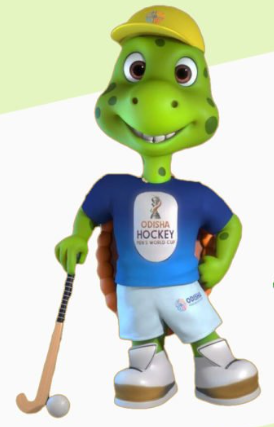
- It was held in Bhubaneswar and Rourkela, Odisha, and Olly (Turtle) was its mascot.
- Belgium won the 14th edition of FIH by defeating the Nwetherlands and India was at 6th place.
- The Men’s Hockey World Cup 2023 (15th edition) was won by Germany.
- Pakistan is the most successful team with the four-time winner of this tournament.
- India had won only once in 1975.
 Additional Information
- Hockey:
- The Hockey World cup is organised by the International Hockey Federation (FIH) once in four years.
- The headquarters of FIH is located in Lausanne, Switzerland.
- ‘Blackheath Rugby and Hockey Club’ was the first hockey club in the world that was set up in the year 1861 in England.
- The first Hockey World Cup was organised in Barcelona (Spain) in 1971 and the winner was Pakistan.
- India took part in Olympics for the first time in the year 1928 (in Amsterdam Olympics).
- In Olympics, India has won the hockey title a maximum of eight times.
Q11 · Indian Geography
According to the Indian Railways (2019-2020), which state has the largest railway track in India?
- Punjab
- Haryana
- Madhya Pradesh
- Uttar Pradesh
Answer aur solution dekho
Archived marked answer: D
The correct answer is Uttar Pradesh.
Key Points
- According to the Indian Railways (2019-2020), Uttar Pradesh has the largest railway track in India.
- As of 31.03.2020, the route length of Indian Railways covered 67,956 km with a running track length of 99,235 km.
- The total trackage including yards, sidings etc. stood at 1,26,366 km.
- In India, the largest route kilometers are in Uttar Pradesh with 8726 kilometres. This comes out to be 13.6% of India’s total Route Kilometers. The Five states with the largest route kilometres are as follows:
- Uttar Pradesh: 8,808.
- Rajasthan: 5,894
- Maharashtra: 5,784
- Karnataka: 3,542
- Jharkhand: With 2,596
Additional Information
- The first railway line in India was opened for public traffic on 16 April 1853 between Mumbai and Thane over a distance of 34 km.
- Meanwhile, the construction of the railway lines was going on in the eastern part of the country, and the first section of the East Indian Railway, from Howrah to Hugli, a distance of 37 km was inaugurated on 15 August 1854.
Q12 · Indian Geography
Which of the following is in geographical proximity to Sri Lanka?
- Only Karaikal
- Karaikal and Yanam
- Mahe
- Only Yanam
Answer aur solution dekho
Archived marked answer: A
The correct answer is Only Karaikal
Key Points
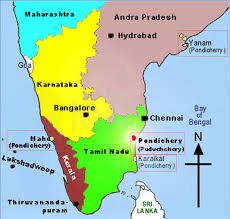
- Karaikal is the Union Territory in India that is closest to Sri Lanka.
- It is located on the southeastern coast of India, just across the Palk Strait from Sri Lanka.
- Yanam, Mahe, and Puducherry (which is not listed in the options) are the other Union Territories of India,
- but they are located on the eastern and southern coasts of India, respectively, and are not in close proximity to Sri Lanka.
 Additional Information
- Karaikal and Yanam
- While Karaikal is indeed the closest Union Territory to Sri Lanka, Yanam is located on the eastern coast of India, near the Bay of Bengal.
- It is not geographically close to Sri Lanka.
- Mahe
- It is another Union Territory located on the western coast of India, near the Arabian Sea.
- It is also not geographically close to Sri Lanka.
Q13 · Modern Indian History
Which Governor-General of British India helped Raja Ram Mohan Roy legally abolish the sati practice?
- Lord Ripon
- Lord Curzon
- Lord Cornwallis
- Lord William Bentinck
Answer aur solution dekho
Archived marked answer: D
The correct answer is Lord William Bentinck.
Key Points
- William Bentinck was the first Governor-General of India.
- Macaulay’s Minute is a historical document in Indian Education.
- It was prepared under the guidance of Thomas Babington Macaulay in 1835.
- Macaulay promotes English literature in India through his Minute on Indian Education.
Q14 · Modern Indian History
Which of the following places is related to Gandhi's Satyagraha of the year 1917?
- Kheda
- Ahmedabad
- Champaran
- Bardoli
Answer aur solution dekho
Archived marked answer: C
The correct answer is Champaran.
Key Points
- Champaran Satyagraha of 1917
- It was the first civil disobedience movement in India.
- Champaran district is a historic region in Bihar, India, that is now divided into the East Champaran district and the West Champaran district.
- Farmers in this region revolted against the British in 1914 and 1916 over the conditions imposed on indigo cultivation.
- Earlier, similar conditions existed in Bengal, but as a result of a major uprising in 1859-61, the peasants there won their freedom from the indigo planters.
- Champaran is a district in the state of Bihar where tens of thousands of landless serfs, indentured labourers, and poor farmers were forced to grow indigo and other cash crops instead of food crops.
- The European planters had forced the peasants to grow indigo on 3/20 of the total land area (called the
Q15 · Current Affairs
Who was appointed as India’s 28th Controller General of Accounts (CGA) in March 2023?
- Arun Goel
- Praveen Sharma
- Vikram Devdutt
- SS Dubey
Answer aur solution dekho
Archived marked answer: D
The correct answer is SS Dubey.
Key Points
- Controller General of Accounts (CGA):
- Bharati Das, a 1988-batch Indian Civil Accounts Service Officer, took charge as the new Controller General of Accounts in New Delhi on 18 October 2022.
- She is the 27th Controller General of Accounts, Ministry of Finance.
- CGA is responsible for establishing and maintaining a technically sound Management Accounting System.
- The CGA is not a constitutional body.
- The CGA is the Principal Accounting Adviser to the Government of India.
- It is also in charge of the exchequer control and internal audits.
Q16 · General Science Biology
Which of the following is a non-perishable food?
- Pulses
- Meat
- Curds
- Milk
Answer aur solution dekho
Archived marked answer: A
The correct answer is Pulses.
Key Points
- Perishable foods are foods that spoil quickly within one or two days e.g., milk, curds, fish and meat.
- Semi perishable foods can last for 1–2 weeks. Examples are fruits and vegetables. Root crops like onions and potatoes last for 2–4 weeks.
- Non-perishable foods are those foods that generally last for one year e.g., grains like rice, wheat, pulses and dals, oilseeds.
Q17 · General Science Biology
Which organisms are classified as Aves?
- Fishes
- Frogs
- Snakes
- Birds
Answer aur solution dekho
Archived marked answer: D
The correct answer is Birds.
Key Points
- Aves is a class of vertebrates that comprises the birds' species.
- Birds are egg-laying animals, have fur, two legs, and are endothermic.
- They are found worldwide, and their size ranges from 5 cm (bee hummingbird) to 2.75 m (ostrich).
- Ostrich is the organism that belongs to the Aves as they have those characteristics that are found in the members of the class Aves.
- The ostrich is typical of a group of flightless birds called ratites.
- There are two living species of ostrich: the common ostrich (*Struthio camelus*) and the Somali ostrich (*Struthio molybdophanes*).
Additional Information
- Aves:
- The class Aves includes birds or flying vertebrates.
- A characteristic feature of Aves is the presence of feathers.
- The birds are unique in having a coat of feathers and in resting on the hindlimbs alone.
- Respiration takes place only by the lungs.
- Lungs are respiratory organs, which are spongy, inelastic, and are connected to large air sacs.
- Endoskeleton is bony, but delicate and light.
- Bones are pneumatic i.e., contain air cavities to reduce weight.
- These are warm-blooded animals.
- Example - *Covus* (Crow), *Neophron *(Vulture)
Q18 · General Science Chemistry
The decomposition of gaseous Ammonia on a hot platinum surface is a _______________ order reaction at high pressure.
- two
- zero
- three
- one
Answer aur solution dekho
Archived marked answer: B
The correct answer is zero.
Key Points
- Ammonia (NH3):
- Ammonia is produced in large quantities worldwide for use as a fertilizer and as a primary source of nitrogen in the production of many chemicals. Liquid ammonia can be sprayed directly into the soil as a fertilizer, or it can be converted to ammonium salts (nitrate, sulfate or phosphate) for solid fe
Q19 · General Science Chemistry
In which musical note did Newland put the metals Co and Ni with halogens?
- Fa
- Do
- Re
- Mi
Answer aur solution dekho
Archived marked answer: B
The correct answer is Do.
Key Points
- John Newlands, a British chemist, proposed the Law of Octaves in 1864.
- This law stated that when elements are arranged in order of increasing atomic mass, every eighth element has properties similar to the first.
- He compared this pattern to the octaves of music, where every eighth note is similar to the first.
- However, Newlands' Law of Octaves had limitations.
- It didn't work for all elements, especially those with higher atomic masses.
- To accommodate all the known elements, he had to place two elements in the same slot in some cases.
- One such instance was with cobalt (Co) and nickel (Ni), which he placed in the same slot as the halogens.
- This placement highlights the limitations of Newland's classification system.
- While it was a significant step towards understanding the periodic relationships between elements, it was not entirely accurate and was eventually superseded by more comprehensive periodic tables, such as Mendeleev's Periodic Table.
Q20 · Awards Static
Which government honoured a distinguished percussionist named Pandit Anindo Chatterjee with the Banga Vibhushan Award in 2022?
- Assam
- Tripura
- West Bengal
- Jharkhand
Answer aur solution dekho
Archived marked answer: C
The correct answer is West Bengal.
Key Points
- Pandit Anindo Chatterjee:-
- Anindo Chatterjee is known for his mastery of tabla, excelling in various styles including khayal and thumri.
- He has performed with many renowned classical musicians and has participated in international music festivals.
- His awards:
- Sangeet Natak Akademi Award (2012).
- Acknowledged as a leading tabla player in various music festivals and competitions.
Additional Information
- Sangeet Natak Akademi Award
- The Sangeet Natak Akademi is India's national academy for music, dance, and drama. It was established in 1952 by the Indian government.
- The Akademi Awards are the highest national recognition given to practicing artists.
- Bharatanatyam has its roots in the Natya Shastra, an ancient treatise on performing arts written by Bharata Muni.
- This dance form is traditionally performed by women, but in contemporary times, it is also performed by men.
- The themes of Bharatanatyam performances are usually derived from Hindu mythology and epics.
Q21 · Awards Static
How many awards were presented at the National Sports and Adventure Awards-2022 ceremony held at Rashtrapati Bhavan on 30 November 2022?
- 32
- 44
- 52
- 28
Answer aur solution dekho
Archived marked answer: B
The correct answer is 44
Key Points
- The National Sports and Adventure Awards-2022 ceremony held on 30 November 2022 at Rashtrapati Bhavan recognized the achievements of outstanding individuals in the fields of sports and adventure.
- A total of 44 awards were presented across various categories.
- The awards were presented by President Droupadi Murmu at the Rashtrapati Bhavan.
- The event celebrated a wide range of sports and adventure activities, highlighting India's growing stature in both areas on the global stage.
- Athletes from different disciplines, including cricket, boxing, wrestling, and athletics, were honored.
Additional Information
- Types of Awards in Event
- Major Dhyan Chand Khel Ratna Award:
- India’s highest sporting honor, awarded for the most outstanding performance in sports over the past four years.
- 1 recipient in 2022.
- Arjuna Award:
- Given to athletes for consistently excellent performances over the past four years.
- 25 recipients in 2022.
- Dronacharya Award (Lifetime and Regular categories):
- Presented to coaches for producing exceptional sportspersons.
- 7 recipients in total (both lifetime and regular categories).
- Dhyan Chand Award for Lifetime Achievement:
- Honors sportspersons for their lifetime contribution to sports.
- 4 recipients in 2022.
- Rashtriya Khel Protsahan Puruskar:
- Recognizes corporate entities, sports promotion boards, or individuals who have contributed to the promotion and development of sports.
- 2 recipients in 2022.
- Maulana Abul Kalam Azad (MAKA) Trophy:
- Awarded to the best performing university in sports.
- 1 recipient in 2022.
- Tenzing Norgay National Adventure Award:
- Given for excellence in adventure activities on land, water, and air, as well as lifetime achievements in adventure sports.
- 4 recipients in 2022.
Q22 · Medieval Indian History
After the death of Humayun, the 13 year-old Akbar was coronated in 1556 at Kalanaur in ______.
- Rajasthan
- Gujarat
- Bengal
- Punjab
Answer aur solution dekho
Archived marked answer: D
The correct answer is Punjab.
Key Points
- Humayun (1530–1540, 1555–1556):
- Humayun was the son of Babur.
- Humayun means "fortune" but he remained the most unfortunate ruler of the Mughal Empire.
- Sher shah suri became powerful in the east.
- Humayun marched against him and in the Battle of Chausa in 1539, Sher Khan destroyed the Mughal army and Humayun fled.
- In 1540, at the Battle of Bilgram o
Q23 · Ancient Indian History
Mahabalipuram emerged as an important centre of temple architecture under which of the following kingdoms of south India?
- Pallava
- Chola
- Chera
- Chalukya
Answer aur solution dekho
Archived marked answer: A
The correct answer is Pallava.
Key Points
- Pallava
- Simhavishnu was the founder of the Pallava dynasty.
- The Pallava dynasty was a Tamil dynasty that ruled parts of South India from the 3rd century to the 9th century.
- Simhavishnu's reign marked the rise of the Pallavas to prominence in the region.
- The Pallavas are known for their patronage of architecture, particularly the rock-cut temples of Mahabalipuram.
- The dynasty played a crucial role in the cultural and political history of South India.
Additional Information
- Chola
- Vijayalaya Chola (reigned 848–871 CE) is widely regarded as the founder of the Chola dynasty that ruled over a significant portion of the Indian subcontinent from the 9th to the 13th centuries.
- Before Vijayalaya, the Cholas were a minor dynasty ruling from Uraiyur (modern-day Tiruchirappalli).
- Vijayalaya established the Chola capital at Thanjavur (modern-day Tanjore) after defeating the Muttaraiyar chieftain and establishing Chola supremacy in the region.
- He is credited with reviving the Chola power and laying the foundation for the future expansion of the Chola empire under his successors.
- Chera
- The Chera kingdom of Mahodayapuram was established in the ninth century in the south-western part of the peninsula, part of the present-day Kerala.
- The Chera kingdom played a pivotal role in the history of South India.
- The region's significant historical and cultural contributions include the introduction of Malayalam, which became prominent in inscriptions during this period.
- The association of the Chera kingdom with the South-Western part of the Indian peninsula highlights the geocultural significance of Kerala in Indian history, especially in relation to the development of regional languages and script.
- Moreover, the geographical location of the Chera kingdom contributed to its maritime commerce and cultural exchanges with distant lands, enhancing the spread of its cultural and linguistic influence.
- Chalukya dynasty
- They ruled in southern India from the 6th century.
- There were three types of Chalukyas,
- Badami Chalukyas
- Eastern Chalukyas
- Western Chalukyas
- Their capital was Badami.
- They followed Hinduism, Buddhism, and Jainism as well.
- They had a monarchial structure with King as its head.
- The chief queen was known as Tattamahish.
- King had all the judicial as well as administrative powers
Q24 · World Geography
The climate of a place is NOT affected by which of the following?
- Relief
- Type of soil
- Location
- Distance from the sea
Answer aur solution dekho
Archived marked answer: B
The correct answer is Type of soil.
Key Points
- The first scientific classification of soil was done by Vasily Dokuchaev.
- In India, the Indian Council of Agricultural Research (ICAR) has classified soils into 8 categories.
- They are:
- Alluvial Soil
- Black Cotton Soil
- Red & Yellow Soil
- Laterite Soil
- Mountainous or Forest Soil
- Arid or Desert Soil
- Saline and Alkaline Soil
- Peaty and Marshy Soil
Additional Information
- Alluvial Soil:
- Alluvial soils are widespread in the northern plains and river valleys.
- It covers about 40% of the total land area of the country.
- These soils are mainly derived from the debris brought down from the Himalayas.
- In the Peninsular region, they are found in deltas of the east coast and in the river valleys.
-
Q25 · Environment and Ecology
Hubbardia heptaneuron, which has become endangered, is a species of which of the following?
- Grass
- Bamboo
- Tiger
- Crane
Answer aur solution dekho
Archived marked answer: A
The correct answer is Grass.
Key Points
- A species of grass named Hubbardia heptaneuron is on the verge of extinction due to its insensitivity towards the environment.
- At least 10 per cent of India’s recorded wild flora and 20 per cent of its mammals are on the threatened list.
- Many of the flora and fauna on the threatened list would now be categorised as ‘critical’, like:
- the cheetah,
- pink-headed duck,
- mountain quail,
- forest spotted owlet, and
- plants like madhuca insignis (a wild variety of mahua) and
- hubbardia heptaneuron,(a species of grass).
Mathematics
Q1 · Geometry
X, Y, and Z are three points on a plane with XY = 11 cm, YZ = 13 cm, and XZ = 24 cm. The number of circles that travel through points X, Y, and Z is:
- 0
- 2
- 1
- 3
Answer aur solution dekho
Archived marked answer: A
Shortcut Trick
Check the sum of the two smaller distances: XY + YZ = 11 + 13 = 24 cm.
The largest distance is XZ = 24 cm.
Since XY + YZ = XZ, the three points X, Y, and Z lie on a straight line (they are collinear).
A circle can only pass through three non-collinear points.
∴ The correct answer is 0.
Alternate Method
Given:
Distance XY = 11 cm
Distance YZ = 13 cm
Distance XZ = 24 cm
- X
Y
Z
- - - 11 cm
- - 13 cm
- - - 24 cm
Concept Used:
For any three points to form a triangle (non-collinear), the sum of the distances between any two pairs of points must be strictly greater than the third distance.
A circle can uniquely pass through three non-collinear points, but zero circles can pass through three collinear points.
Calculations:
⇒ Sum of two smaller distances = XY + YZ
⇒ Sum = 11 cm + 13 cm = 24 cm
⇒ The given largest distance XZ = 24 cm
⇒ Since XY + YZ = XZ, the point Y perfectly lies on the straight line segment connecting X and Z.
⇒ Therefore, points X, Y, and Z are collinear.
⇒ Because no circle can pass through three points lying on a single straight line, the number of such circles is zero.
∴ The correct answer is 0.
Additional Information
Triangle Inequality Theorem
For any three points to form a valid triangle, the sum of the lengths of any two sides must be strictly greater than the length of the third side (a + b > c).
Circumcircle
A circumcircle is a unique circle that passes through all three non-collinear vertices of a triangle. The intersection of the perpendicular bisectors of the sides acts as its center.
Collinear Points
When three or more points lie entirely on the same straight line, they are known as collinear points. They cannot form a closed geometrical 2D figure like a circle or a triangle.
</p
Q2 · Geometry
By applying which of the following criteria can two triangles NOT be proved congruent?
- angle-side-angle
- angle-angle-angle
- side-side-side
- side-angle-side
Answer aur solution dekho
Archived marked answer: B
Shortcut Trick
For two triangles to be exactly identical (congruent), at least one corresponding side length must be equal.
Standard criteria like SSS, SAS, ASA, and AAS all evaluate at least one side length.
The AAA (Angle-Angle-Angle) criterion only compares angles and completely lacks a side measurement.
Thus, AAA only proves that triangles have the same shape (similarity), but not necessarily the same size.
∴ The correct answer is angle-angle-angle.
Alternate Method
Given:
Criteria for proving triangle congruency.
Concept Used:
Congruent triangles must have exactly the same size and shape. All corresponding angles and sides must be equal.
A
B
C
D
E
F
60°
60°
60°
60°
60°
60°
AAA guarantees Similarity, NOT Congruence
Calculations:
⇒ ASA (Angle-Side-Angle): Valid criterion. If two angles and the included side of one triangle equal the corresponding parts of another, they are congruent.
⇒ SSS (Side-Side-Side): Valid criterion. If all three sides of one triangle are equal to the corresponding sides of another, they are congruent.
⇒ SAS (Side-Angle-Side): Valid criterion. If two sides and the included angle of one triangle are equal to the corresponding parts of another, they are congruent.
⇒ AAA (Angle-Angle-Angle): Invalid criterion for congruence. Having all three corresponding angles equal only ensures the triangles are proportional (similar). For instance, an equilateral triangle with side lengths of 2 cm has angles 60°, 60°, 60°, and an equilateral triangle with side lengths of 4 cm also has angles 60°, 60°, 60°. They have identical angles but different sizes.
⇒ Therefore, AAA cannot be used to prove that two triangles are congruent.
∴ The correct answer is angle-angle-angle.
Additional Information
Congruence vs Similarity
Congruent figures have exactly the same shape and size (ratio of corresponding sides is 1). Similar figures have the same shape but may differ in size (ratio of corresponding sides is constant).
RHS Congruence Criterion
RHS (Right Angle-Hypotenuse-Side) applies only to right-angled triangles. If the hypotenuse and one side of a right triangle are equal to the hypotenuse and corresponding side of another right triangle, they are congruent.
AAS Congruence Criterion
If any two angles and a non-included side of one triangle are exactly equal to the corresponding angles and side of another triangle, the two triangles are geometrically congruent.
</p
Q3 · Geometry
Two circles of radii 18 cm and 12 cm touch each other externally. Find the length (in cm) of their direct common tangent.
- 15√(6)
- 10√(6)
- 12√(6)
- 18√(6)
Answer aur solution dekho
Archived marked answer: C
Shortcut Trick
For two circles touching externally, the length of the Direct Common Tangent (DCT) is given directly by the property:
DCT = 2√(r₁ × r₂)
⇒ DCT = 2 × √(18 × 12)
⇒ DCT = 2 × √216 = 2 × 6√6
⇒ DCT = 12√6 cm
∴ The correct answer is 12√6 cm.
Alternate Method
Given:
Radius of the larger circle (R) = 18 cm
Radius of the smaller circle (r) = 12 cm
Since the circles touch each other externally, the distance between their centres (D) = R + r = 18 + 12 = 30 cm.
- - - - - 18 cm
12 cm
C₁
C₂
A
B
DCT = ?
P
6 cm
30 cm
Formula Used:
Length of Direct Common Tangent = √[D² − (R − r)²]
Calculations:
⇒ D = 30 cm
⇒ R − r = 18 − 12 = 6 cm
⇒ Length of DCT = √[30² − 6²]
⇒ Length of DCT = √[900 − 36]
⇒ Length of DCT = √864
⇒ Length of DCT = √(144 × 6) = 12√6 cm
∴ The correct answer is 12√6 cm.
Additional Information
Direct Common Tangent (DCT)
The general formula for the length of a direct common tangent is DCT = √[D² − (R − r)²], where D is the distance between the centres.
Transverse Common Tangent (TCT)
When two circles are separated, the length of the Transverse Common Tangent is given by TCT = √[D² − (R + r)²].
Number of Common Tangents
Circles touching externally have exactly 3 common tangents. Circles touching internally have exactly 1 common tangent. Separated disjoint circles have 4 common tangents.
</p
Q4 · Trigonometry
A pole 10 m long rests slantly against a vertical wall AB making an angle 30º with the horizontal (ground). Find how far the foot of the pole is from the wall (in metres).
- 15
- 5 / √3
- 10
- 5√3
Answer aur solution dekho
Archived marked answer: D
Shortcut Trick
Using basic trigonometry, the distance from the wall (Base) can be calculated directly as:
Base = Hypotenuse × cos(θ)
Base = 10 × cos(30°)
Base = 10 × (√3 / 2) = 5√3 m
∴ The correct answer is 5√3 m.
Alternate Method
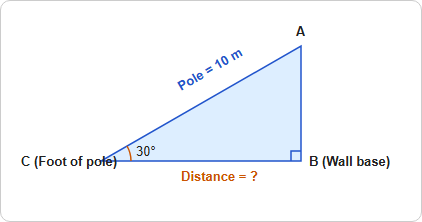 Given:
Length of the pole (Hypotenuse AC) = 10 m
Angle made by the pole with the ground (∠ACB) = 30°
Formula Used:
In a right-angled triangle, cos(θ) = Base / Hypotenuse
Calculations:
Let the vertical wall be AB and the pole be AC.
The distance of the foot of the pole from the wall is represented by BC.
⇒ In ΔABC, cos(30°) = BC / AC
⇒ √3 / 2 = BC / 10
⇒ BC = 10 × (√3 / 2)
⇒ BC = 5√3 m
∴ The correct answer is 5√3 m.
Additional Information
Trigonometric Ratios
In a right-angled triangle, sin(θ) = Perpendicular / Hypotenuse, cos(θ) = Base / Hypotenuse, and tan(θ) = Perpendicular / Base.
Common Values
For standard angles: sin(30°) = 1/2, cos(30°) = √3/2, and tan(30°) = 1/√3.
Pythagoras Theorem
In any right-angled triangle, the square of the hypotenuse is equal to the sum of the squares of the other two sides: Hypotenuse² = Base² + Perpendicular².
</p
Q5 · Trigonometry
2+tan²2A+cot²2Asec 2A . cosec 2A is equal to ___________.
- sec 2A + tan 2A
- sec 2A + cosec 2A
- cot 2A - cosec 2A
- sec 2A × cosec 2A
Answer aur solution dekho
Archived marked answer: D
Shortcut Trick
Put 2A = 45° for quick evaluation.
Numerator = 2 + tan² 45° + cot² 45° = 2 + 1² + 1² = 4
Denominator = sec 45° × cosec 45° = √2 × √2 = 2
Expression value = 4 ÷ 2 = 2
Check Option 4: sec 45° × cosec 45° = √2 × √2 = 2 (Matches perfectly)
∴ The correct answer is sec 2A × cosec 2A.
Alternate Method
Given:
Expression = (2 + tan² 2A + cot² 2A) ÷ (sec 2A × cosec 2A)
Formula Used:
1 + tan² θ = sec² θ
1 + cot² θ = cosec² θ
sec² θ + cosec² θ = sec² θ × cosec² θ
Calculation:
⇒ Split 2 into 1 + 1 to use standard trigonometric identities.
⇒ Numerator = (1 + tan² 2A) + (1 + cot² 2A)
⇒ Numerator = sec² 2A + cosec² 2A
⇒ Using the standard identity: sec² 2A + cosec² 2A = sec² 2A × cosec² 2A
⇒ Substitute this back into the given expression.
⇒ Expression = (sec² 2A × cosec² 2A) ÷ (sec 2A × cosec 2A)
⇒ Cancel out the common terms from numerator and denominator.
⇒ Expression = sec 2A × cosec 2A
∴ The correct answer is sec 2A × cosec 2A.
Additional Information
Pythagorean Identities
The three fundamental identities are: sin²θ + cos²θ = 1, 1 + tan²θ = sec²θ, and 1 + cot²θ = cosec²θ.
Sum to Product Conversion Identity
A very useful direct result in trigonometry is sec²θ + cosec²θ = sec²θ × cosec²θ.
Double Angle Formulas
Important double angle relations: sin 2θ = 2sinθcosθ and cos 2θ = cos²θ − sin²θ = 1 − 2sin²θ.
</p
Q6 · Trigonometry
Let 0º < t < 90º. Then which of the followings is true?
- sin(t) ≠ cos(t) when t = 45º
- sin(t) > cos(t) when t < 45º
- sin(t) < cos(t) when t < 45º
- sin(t) 45º
Answer aur solution dekho
Archived marked answer: C
Shortcut Trick
For any angle t
Alternate Method
Given:
⇒ The angle t lies in the first quadrant where 0º cos(t).
⇒ Checking all given statements against these intervals, only the condition for t
Additional Information
Behavior of Tangent Function
For 0º < t < 90º, tan(t) is strictly increasing from 0 to infinity. At the midpoint t = 45º, tan(45º) = 1.
Complementary Angle Properties
Trigonometric functions of complementary angles are directly related by: sin(90º − t) = cos(t) and cos(90º − t) = sin(t).
Trigonometric Identities
The foundational Pythagorean identity holds true for all possible values of t: sin²(t) + cos²(t) = 1.
</p
Q7 · Mensuration 2D
The side of an equilateral triangle is 28 cm. Taking each vertex as the centre, a circle is described with a radius equal to half the length of the side of the triangle. Find the area of that part of the triangle which is not included in the circles (use π = 22/7).
- 30.89 cm²
- 38.08 cm²
- 31.08 cm²
- 39.08 cm²
Answer aur solution dekho
Archived marked answer: C
Shortcut Trick
The sum of the three 60° sectors at the vertices of an equilateral triangle forms exactly one semicircle.
Required Area = Area of Equilateral Triangle − Area of Semicircle
Required Area = [(√3 ÷ 4) × side²] − [(1 ÷ 2) × π × radius²]
Required Area = [(√3 ÷ 4) × 28²] − [(1 ÷ 2) × (22 ÷ 7) × 14²]
Required Area = (196 × 1.73) − 308 = 339.08 − 308 = 31.08 cm²
∴ The correct answer is 31.08 cm².
Alternate Method
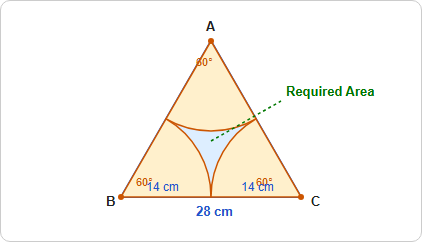 Given:
Side of the equilateral triangle, a = 28 cm
Radius of the circle, r = a ÷ 2 = 14 cm
Formula Used:
Area of an equilateral triangle = (√3 ÷ 4) × a²
Area of a sector of angle θ = (θ ÷ 360°) × πr²
Calculation:
⇒ Area of the equilateral triangle = (√3 ÷ 4) × 28²
⇒ Area of triangle = (√3 ÷ 4) × 784 = 196√3 cm²
⇒ Taking √3 ≈ 1.73, Area = 196 × 1.73 = 339.08 cm²
⇒ The triangle has three identical sectors, each with a central angle of 60°.
⇒ Total area of 3 sectors = 3 × (60° ÷ 360°) × π × 14²
⇒ Total sector area = 3 × (1 ÷ 6) × (22 ÷ 7) × 196
⇒ Total sector area = (1 ÷ 2) × 22 × 28 = 11 × 28 = 308 cm²
⇒ Area of the remaining part = Area of triangle − Area of 3 sectors
⇒ Area of the remaining part = 339.08 − 308 = 31.08 cm²
∴ The correct answer is 31.08 cm².
Additional Information
Properties of Equilateral Triangle
All three sides are equal, and all internal angles are 60°. The height is given by (√3 ÷ 2) × a.
Area of a Circular Sector
The area of a sector with central angle θ and radius r is given by the formula: A = (θ ÷ 360°) × πr².
Incircle and Circumcircle
For an equilateral triangle of side a, the inradius r = a ÷ (2√3) and circumradius R = a ÷ √3. Their area ratio is always 1 : 4.
</p
Q8 · Algebra
If a + 1/a = 12, then find the value of a² + 1/a².
- 144
- 146
- 142
- 140
Answer aur solution dekho
Archived marked answer: C
Shortcut Trick
If a + 1/a = k, then a² + 1/a² = k² − 2.
Here, the given value of k = 12.
⇒ a² + 1/a² = 12² − 2
⇒ a² + 1/a² = 144 − 2 = 142
∴ The correct answer is 142.
Alternate Method
Given:
a + 1/a = 12
Formula Used:
(x + y)² = x² + y² + 2xy
Calculations:
Squaring both sides of the given equation:
⇒ (a + 1/a)² = 12²
⇒ a² + 1/a² + 2 × a × (1/a) = 144
⇒ a² + 1/a² + 2 = 144
⇒ a² + 1/a² = 144 − 2
⇒ a² + 1/a² = 142
∴ The correct answer is 142.
Additional Information
Sum of Cubes Formula
If x + 1/x = k, then x³ + 1/x³ = k³ − 3k.
Negative Counterpart Formula
If x − 1/x = k, then x² + 1/x² = k² + 2.
Difference of Squares
For finding the difference, use the identity: x² − 1/x² = (x + 1/x)(x − 1/x).
</p
Q9 · Algebra
If the sum of three numbers is 18 and the sum of their squares is 36, then find the difference between the sum of their cubes and three times of their product.
- 1449
- -1944
- -1494
- 4149
Answer aur solution dekho
Archived marked answer: B
Shortcut Trick
Using the direct formula: a³ + b³ + c³ − 3abc = [(a + b + c) ÷ 2] × [3(a² + b² + c²) − (a + b + c)²]
Substitute the given values: Sum = 18, Sum of squares = 36
⇒ Required value = (18 ÷ 2) × [3 × 36 − 18²]
⇒ Required value = 9 × [108 − 324] = 9 × (−216) = −1944
∴ The correct answer is −1944.
Alternate Method
Given:
Sum of three numbers, a + b + c = 18
Sum of their squares, a² + b² + c² = 36
Formula Used:
(a + b + c)² = a² + b² + c² + 2(ab + bc + ca)
a³ + b³ + c³ − 3abc = (a + b + c) × [a² + b² + c² − (ab + bc + ca)]
Calculation:
⇒ (18)² = 36 + 2(ab + bc + ca)
⇒ 324 − 36 = 2(ab + bc + ca)
⇒ 288 = 2(ab + bc + ca)
⇒ ab + bc + ca = 144
Now, substitute the values into the second formula:
⇒ a³ + b³ + c³ − 3abc = 18 × [36 − 144]
⇒ a³ + b³ + c³ − 3abc = 18 × (−108)
⇒ a³ + b³ + c³ − 3abc = −1944
∴ The correct answer is −1944.
Additional Information
Alternative Algebraic Identity
a³ + b³ + c³ − 3abc = [(a + b + c) ÷ 2] × [(a − b)² + (b − c)² + (c − a)²].
Special Conditional Case
If the sum of the variables a + b + c = 0, then the identity reduces to a³ + b³ + c³ = 3abc. This property is frequently tested in competitive exams.
Square of a Trinomial
(a + b + c)² = a² + b² + c² + 2(ab + bc + ca). It helps in finding the sum of the product of variables taken two at a time.
</p
Q10 · Profit and Loss
Ramesh purchased some items from a dealer on 19 November 2019. The bill generated was for ₹5,480. He had also purchased some items on 10 November 2019 having the bill value of ₹9,800. He cleared both the bills this time and paid the total amount in cash. If the dealer gives a scheme of 2% discount on the payments done within 10 days and 5% for the payments made in cash at the time of purchase, then find the amount paid by Ramesh on 19 November 2019.
- 14,850
- 14,810
- 14,890
- 14,950
Answer aur solution dekho
Archived marked answer: B
Shortcut Trick
Bill 1 (10 Nov to 19 Nov = 9 days gap) is eligible for a 2% prompt payment discount.
Bill 2 (purchased and paid on 19 Nov) is eligible for a 5% instant cash discount.
Total Amount = (9800 × 0.98) + (5480 × 0.95)
Total Amount = 9604 + 5206 = 14810
∴ The correct answer is ₹14,810.
Alternate Method
Given:
Bill 1 value = ₹9,800 (Purchased on 10 November 2019)
Bill 2 value = ₹5,480 (Purchased on 19 November 2019)
Payment date for both the bills = 19 November 2019
Discount scheme 1 = 2% for payments cleared within 10 days.
Discount scheme 2 = 5% for payments made in cash at the time of purchase.
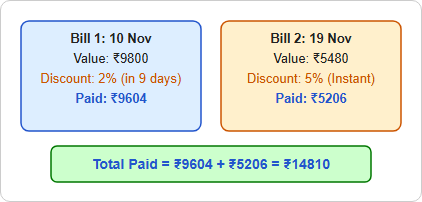 Calculations:
⇒ Time gap for clearing Bill 1 = 19 November − 10 November = 9 days.
⇒ Since Bill 1 is cleared within 10 days, a 2% discount is applicable on it.
⇒ Payable amount for Bill 1 = 9800 × (100 − 2) / 100 = 9800 × 98 / 100 = ₹9,604
⇒ Bill 2 is purchased and paid on the same day in cash, making it eligible for the 5% discount.
⇒ Payable amount for Bill 2 = 5480 × (100 − 5) / 100 = 5480 × 95 / 100 = ₹5,206
⇒ Total amount paid by Ramesh = Payable for Bill 1 + Payable for Bill 2
⇒ Total amount paid = 9604 + 5206 = ₹14,810
∴ The correct answer is ₹14,810.
Additional Information
Cash Discount vs Trade Discount
A trade discount is offered directly on the catalog price to encourage bulk buying, whereas a cash discount is offered on the invoice price to encourage early or prompt payments by the customer.
Effective Successive Discount
When two successive discounts of a% and b% are applied sequentially on a product, the effective overall discount is calculated using the formula: Effective Discount = a + b − (a × b) / 100 %.
Selling Price after Discount
The final selling price of an item after offering a discount of d% on the marked price (MP) is determined by the relation: SP = MP × (100 − d) / 100.
Q11 · Profit and Loss
Find the gain percentage, given that Priya sold her scooter for ₹42564 gaining 1/6th of the selling price.
- 30%
- 20%
- 15%
- 40%
Answer aur solution dekho
Archived marked answer: B
Shortcut Trick
Since Gain is 1/6th of the Selling Price (SP), let us assume SP = 6 units.
This means Gain = 1 unit.
Cost Price (CP) = SP − Gain = 6 − 1 = 5 units.
Gain % = (Gain ÷ CP) × 100 = (1 ÷ 5) × 100 = 20%.
∴ The correct answer is 20%.
Alternate Method
Given:
Selling Price (SP) = ₹42564
Gain = 1/6 of Selling Price
Formula Used:
Cost Price (CP) = SP − Gain
Gain % = (Gain ÷ CP) × 100
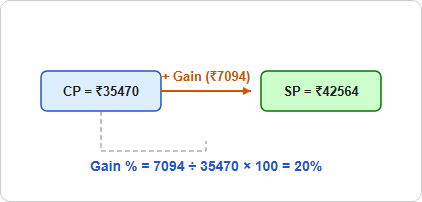 Calculations:
⇒ Gain = (1 ÷ 6) × 42564 = ₹7094
⇒ Cost Price (CP) = 42564 − 7094 = ₹35470
⇒ Gain % = (7094 ÷ 35470) × 100
⇒ Gain % = (1 ÷ 5) × 100 = 20%
∴ The correct answer is 20%.
Additional Information
Profit & Loss Base Rule
Profit and Loss percentages are always calculated on the Cost Price (CP) unless specifically stated otherwise in the question.
Marked Price & Discount
Discount is always calculated on the Marked Price (MP). The Selling Price is obtained as: SP = MP − (Discount % × MP ÷ 100).
Dishonest Dealer Concept
If a trader sells goods at Cost Price but uses false weights, the profit percentage is given by: [Error ÷ (True Value − Error)] × 100.
Successive Discounts
A single equivalent discount for two successive discounts of a% and b% is given by the formula: (a + b − a × b ÷ 100)%.
d7:T
Q12 · Profit and Loss
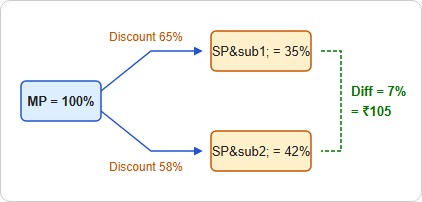
If, on a marked price, the difference between selling prices with a discount of 65% and with two successive discounts of 30% and 40% is ₹105, then the marked price (in ₹) is:
- 1,650
- 1,050
- 1,500
- 1,320
Answer aur solution dekho
Archived marked answer: C
Shortcut Trick
Effective successive discount of 30% and 40% = 30 + 40 − (30 × 40) ÷ 100 = 58%
Difference in discount percentages = 65% − 58% = 7%
Given difference in Selling Prices = ₹105
⇒ 7% of Marked Price = 105
⇒ Marked Price = 105 × (100 ÷ 7) = 1500
∴ The correct answer is ₹1,500.
Alternate Method
Given:
First discount (D₁) = 65%
Second discount series = Two successive discounts of 30% and 40%
Difference in Selling Prices = ₹105
 Formula Used:
Effective discount for two successive discounts A% and B% = A + B − (A × B) ÷ 100
Calculations:
⇒ Effective second discount (D₂) = 30 + 40 − (30 × 40) ÷ 100
⇒ D₂ = 70 − 12 = 58%
⇒ Let the Marked Price (MP) be 100%.
⇒ Selling Price 1 (SP₁) = 100% − 65% = 35% of MP
⇒ Selling Price 2 (SP₂) = 100% − 58% = 42% of MP
⇒ Difference in Selling Prices = SP₂ − SP₁
⇒ Difference in SP = 42% − 35% = 7% of MP
⇒ We are given that the difference is ₹105.
⇒ 7% of MP = ₹105
⇒ 1% of MP = 105 ÷ 7 = ₹15
⇒ 100% of MP (Marked Price) = 15 × 100 = ₹1,500
∴ The correct answer is ₹1,500.
Additional Information
Successive Discounts
When two discounts D₁% and D₂% are given successively, the effective single discount is calculated as [D₁ + D₂ − (D₁ × D₂) ÷ 100]%.
Marked Price & Discount Relation
Discount is always computed on the Marked Price (MP). The final Selling Price (SP) is calculated as MP − Discount Amount. Therefore, Discount % = (Discount ÷ MP) × 100.
Effective Equivalent Pricing
A single larger discount percentage generally offers more savings to the buyer compared to two successive discounts that add up to the same numerical sum (e.g., 65% is a bigger discount than 30% and 35% successively).
Q13 · Time and Work
Three pipes P, Q and R can fill a cistern in 40 minutes, 80 minutes and 120 minutes, respectively. Initially, all the pipes are opened. After how much time (in minutes) should the pipes Q and R be turned off so that the cistern will be completely filled in just half an hour?
- 14
- 10
- 16
- 12
Answer aur solution dekho
Archived marked answer: D
Shortcut Trick
Total capacity of the cistern = LCM(40, 80, 120) = 240 units.
Efficiency of P = 6, Q = 3, and R = 2 units/min.
Since P works for the entire 30 minutes, work done by P = 30 × 6 = 180 units.
Remaining work to be done by Q and R together = 240 − 180 = 60 units.
Time pipes Q and R were open = 60 ÷ (3 + 2) = 12 minutes.
∴ The correct answer is 12 minutes.
Alternate Method
Given:
Time taken by P = 40 minutes
Time taken by Q = 80 minutes
Time taken by R = 120 minutes
Total time to fill the cistern = 30 minutes (half an hour)
Pipe
Minutes
Total Work
Efficiency
P
40
240
6
Q
80
3
R
120
2
Calculations:
⇒ The cistern is filled in exactly 30 minutes, which means pipe P was kept open for the entire duration of 30 minutes.
⇒ Work done by pipe P alone in 30 minutes = Efficiency × Time = 6 × 30 = 180 units.
⇒ Total work remaining = Total capacity − Work done by P
⇒ Remaining work = 240 − 180 = 60 units.
⇒ This remaining work must have been completed by pipes Q and R before they were turned off.
⇒ Combined efficiency of pipes Q and R = 3 + 2 = 5 units/min.
⇒ Time for which Q and R were kept open = Remaining work ÷ Combined efficiency
⇒ Time = 60 ÷ 5 = 12 minutes.
∴ The correct answer is 12 minutes.
Additional Information
Emptying Pipes (Negative Work)
If a pipe or a leak empties a tank, its efficiency is considered negative. The net filling efficiency becomes (Sum of inlet efficiencies) − (Sum of outlet efficiencies).
Time and Efficiency Relation
Time taken is always inversely proportional to efficiency. The ratio of time taken by two pipes A and B to fill a tank is the exact inverse of their efficiency ratio.
Pipes Working on Alternate Minutes
When pipes operate alternately, calculate the net work done in a complete cycle (e.g., 2 minutes or 3 minutes). Find out how many such cycles fit into the total work and manually add the remaining efforts for the last fractions.
</p
Q14 · Number System
Which of the following is the largest 5-digit number divisible by 47?
- 99999
- 98888
- 99969
- 10000
Answer aur solution dekho
Archived marked answer: C
Shortcut Trick
The largest 5-digit number is 99999.
Divide 99999 by 47 to find the remainder.
99999 ÷ 47 gives a quotient of 2127 and a remainder of 30.
Subtract the remainder from 99999 to find the exact largest multiple.
Required number = 99999 − 30 = 99969.
∴ The correct answer is 99969.
Alternate Method
Given:
We need to find the largest 5-digit number divisible by 47.
Concept Used:
According to the division algorithm: Dividend = (Divisor × Quotient) + Remainder. To make a number perfectly divisible by a divisor without exceeding it, we must subtract the remainder from the dividend.
Calculations:
⇒ The largest 5-digit number is 99999.
⇒ Let us divide 99999 by 47.
⇒ First, 99 ÷ 47 = 2 with a remainder of 5.
⇒ Bringing down 9, we get 59. 59 ÷ 47 = 1 with a remainder of 12.
⇒ Bringing down 9, we get 129. 129 ÷ 47 = 2 with a remainder of 35.
⇒ Bringing down the final 9, we get 359. 359 ÷ 47 = 7 with a remainder of 30.
⇒ The final remainder is 30.
⇒ To make it exactly divisible by 47, we subtract the remainder from 99999.
⇒ Required Number = 99999 − 30
⇒ Required Number = 99969
∴ The correct answer is 99969.
Additional Information
Division Algorithm
Dividend = (Divisor × Quotient) + Remainder. Subtracting the remainder from the dividend makes the result perfectly divisible by the divisor.
Smallest n-digit number divisible by 'd'
Divide the smallest n-digit number (e.g., 10000 for 5 digits) by the divisor 'd' to find the remainder 'r'. The required smallest divisible number is (Smallest n-digit number) + (d − r).
Nearest number to 'N' divisible by 'd'
Find the remainder 'r' when N is divided by d. If r d/2, add (d − r) to N.
</p
Q15 · Time and Distance
A bus travels 1/3 of the distance initially at a speed of 40 km/h, the next 1/3 of the distance 50 km/h, and the final 1/3 of the distance at 60 km/h. Find the average speed of the bus for the entire journey. (Rounded off to two decimal places)
- 48.65 km/h
- 51.43 km/h
- 54.13 km/h
- 46.85 km/h
Answer aur solution dekho
Archived marked answer: A
Shortcut Trick
Let each 1/3 segment of the journey be the LCM of the given speeds (40, 50, and 60) = 600 km.
Total distance of the journey = 3 × 600 = 1800 km.
Total time taken = (600 ÷ 40) + (600 ÷ 50) + (600 ÷ 60) = 15 + 12 + 10 = 37 hours.
Average Speed = Total Distance ÷ Total Time = 1800 ÷ 37 ≈ 48.65 km/h.
∴ The correct answer is 48.65 km/h.
Alternate Method
Given:
The speeds for three equal segments of the journey are 40 km/h, 50 km/h, and 60 km/h.
Formula Used:
When a journey is divided into three equal parts with speeds x, y, and z, the formula for average speed is:
Average Speed = 3xyz ÷ (xy + yz + zx)
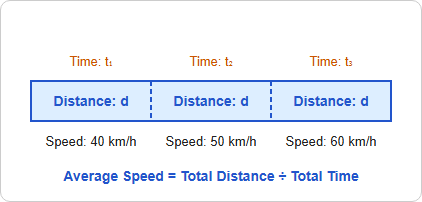 Calculations:
⇒ Let x = 40, y = 50, and z = 60
⇒ Average Speed = (3 × 40 × 50 × 60) ÷ (40 × 50 + 50 × 60 + 60 × 40)
⇒ Average Speed = 360000 ÷ (2000 + 3000 + 2400)
⇒ Average Speed = 360000 ÷ 7400
⇒ Average Speed = 1800 ÷ 37
⇒ Average Speed ≈ 48.648 km/h
⇒ Rounding off to two decimal places, we get 48.65 km/h.
∴ The correct answer is 48.65 km/h.
Additional Information
Average Speed for 2 Equal Distances
When a body travels two equal distances at speeds x and y, the average speed over the entire journey is given by 2xy ÷ (x + y).
General Average Speed Concept
When distances are unequal, the average speed is strictly calculated by dividing the Total Distance Travelled by the Total Time Taken.
Relative Speed
If two objects move in the same direction at speeds x and y, their relative speed is |x − y|. If they move in opposite directions, their relative speed is (x + y).
</p
Q16 · Time and Distance
In a circular race of 750 m, X and Y start from the same point and at the same time with speeds of 9 km/h and 13.5 km/h, respectively. If they are running in the same direction then, when will they meet again for the first time on the track?
- 750 seconds
- 900 seconds
- 500 seconds
- 600 seconds
Answer aur solution dekho
Archived marked answer: D
Shortcut Trick
When running in the same direction, relative speed is the difference between the two speeds.
Relative Speed = 13.5 − 9 = 4.5 km/h
Convert to m/s: 4.5 × (5/18) = 1.25 m/s
Time to meet = Track Length ÷ Relative Speed = 750 ÷ 1.25 = 600 seconds.
∴ The correct answer is 600 seconds.
Alternate Method
Given:
Distance of the circular track = 750 m
Speed of runner X = 9 km/h
Speed of runner Y = 13.5 km/h
Formula Used:
Time to meet for the first time = Distance ÷ Relative Speed
Speed in m/s = Speed in km/h × (5/18)
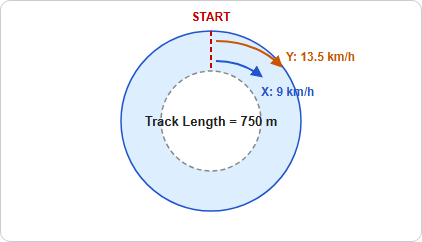 Calculations:
⇒ Speed of X in m/s = 9 × (5/18) = 2.5 m/s
⇒ Speed of Y in m/s = 13.5 × (5/18) = 3.75 m/s
⇒ Relative speed (same direction) = Speed of Y − Speed of X
⇒ Relative speed = 3.75 − 2.5 = 1.25 m/s
⇒ Time to meet = 750 ÷ 1.25
⇒ Time to meet = 75000 ÷ 125 = 600 seconds
∴ The correct answer is 600 seconds.
Additional Information
Meeting Anywhere on the Track (Same Direction)
Time to meet for the first time anywhere on the track = Track Length ÷ (S₁ − S₂).
Meeting Anywhere on the Track (Opposite Direction)
Time to meet for the first time anywhere on the track = Track Length ÷ (S₁ + S₂).
Meeting at the Starting Point
To find when runners will meet exactly at the starting point, calculate the time taken by each to complete one round, then take their LCM: LCM(T₁, T₂).
Number of Distinct Meeting Points
If the ratio of speeds is a:b (in lowest terms), the number of distinct meeting points is |a − b| for same direction, and a + b for opposite direction.
</p
Q17 · Data Interpretation
The bar graph given below shows the sales of books from six schools during two consecutive years, 2013 and 2014.
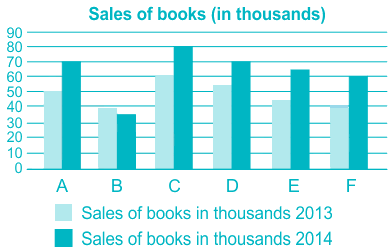 What percentage of the average sales of the schools A, B, and C in 2014 is the average sales of schools A, C, and F in 2013?
- 81.08%
- 81%
- 80%
- 80.08%
Answer aur solution dekho
Archived marked answer: A
Calculation:
The average sales of the schools A, B and C in 2014
= (70 + 35 + 80)/3
⇒ 61.66
The average sales of schools A, C, and F in 2013
⇒ (50 + 60 + 40)/3
⇒ 50
According to the question,
⇒ (50/61.66)× 100
⇒ 81.08%
∴ The correct answer is 81.08%.
Q18 · Simplification
The value of 15 ÷ 3 of 2 × 2 + 9 ÷ 18 of 2 × 4 – 4 ÷ 8 × 2 is:
- 8
- 5
- 2 3/4
- 7 3/4
Answer aur solution dekho
Archived marked answer: B
Given:
Expression: 15 ÷ 3 of 2 × 2 + 9 ÷ 18 of 2 × 4 − 4 ÷ 8 × 2
Formula Used:
Order of operations (PEMDAS/BODMAS): Parentheses, Exponents (i.e. powers and roots, etc.), Multiplication and Division (left-to-right), Addition and Subtraction (left-to-right)
Calculation:
First, we solve the expression step-by-step according to the order of operations:
15 ÷ 3 of 2 × 2 + 9 ÷ 18 of 2 × 4 − 4 ÷ 8 × 2
⇒ 15 ÷ (3 × 2) × 2 + 9 ÷ (18 × 2) × 4 − 4 ÷ 8 × 2
⇒ 15 ÷ 6 × 2 + 9 ÷ 36 × 4 − 4 ÷ 8 × 2
⇒ (15 ÷ 6) × 2 + (9 ÷ 36) × 4 − (4 ÷ 8) × 2
⇒ 2.5 × 2 + 0.25 × 4 − 0.5 × 2
⇒ 5 + 1 − 1
⇒ 5
∴ The correct answer is option (2).
Q19 · Proportion
A money bag contains one rupee, 5 rupee and 10 rupee coins in the ratio of 3 : 5 : 7 respectively. If the total amount in the bag is ₹980, then find the number of coins of ₹10.
- 69
- 70
- 71
- 68
Answer aur solution dekho
Archived marked answer: B
Shortcut Trick
Value ratio of ₹1, ₹5, and ₹10 coins = (1 × 3): (5 × 5): (10 × 7) = 3: 25: 70
Total value units = 3 + 25 + 70 = 98 units
Since 98 units = ₹980, 1 unit = ₹10
Total value of ₹10 coins = 70 units = ₹700
Number of ₹10 coins = 700 ÷ 10 = 70
∴ The correct answer is 70 coins.
Alternate Method
Given:
Ratio of number of ₹1, ₹5, and ₹10 coins = 3: 5: 7
Total amount in the bag = ₹980
Formula Used:
Total Value = Denomination × Number of coins
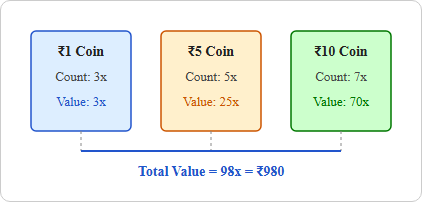 Calculations:
⇒ Let the number of ₹1, ₹5, and ₹10 coins be 3x, 5x, and 7x respectively.
⇒ Value of ₹1 coins = 1 × 3x = 3x
⇒ Value of ₹5 coins = 5 × 5x = 25x
⇒ Value of ₹10 coins = 10 × 7x = 70x
⇒ Total value = 3x + 25x + 70x = 98x
⇒ 98x = 980
⇒ x = 980 ÷ 98 = 10
⇒ Number of ₹10 coins = 7x = 7 × 10 = 70
∴ The correct answer is 70 coins.
Additional Information
Coins based on Value Ratio
When the total number of coins is given but their value ratio is provided, divide the value ratio by the respective denomination to find the ratio of the number of coins.
Coins based on Number Ratio
When the total value is given and the ratio of the number of coins is provided, multiply the number ratio by the respective denomination to find the value ratio.
Proportional Division
If a total quantity T is to be divided in the ratio a: b: c, the individual parts are given by T × a / (a+b+c), T × b / (a+b+c), and T × c / (a+b+c).
Q20 · Simple Interest
Kiran lent ₹4,000 to two persons such that one part of it at the rate of 8% per annum and the remaining part at the rate of 10% per annum. He got an annual simple interest of ₹352. Then the sum lent at 10% is:
- ₹1,800
- ₹2,200
- ₹2,400
- ₹1,600
Answer aur solution dekho
Archived marked answer: D
Shortcut Trick
Overall rate of interest = (352 ÷ 4000) × 100 = 8.8%
By applying the rule of alligation on the interest rates:
Ratio of principal (8% part : 10% part) = (10 − 8.8) : (8.8 − 8) = 1.2 : 0.8 = 3 : 2
Sum lent at 10% corresponds to 2 parts out of (3 + 2) = 5 total parts.
Sum lent at 10% = (2 ÷ 5) × 4000 = ₹1,600
∴ The correct answer is ₹1,600.
Alternate Method
Given:
Total Principal (P) = ₹4000
Total Simple Interest (SI) = ₹352
Time (T) = 1 year
Formula Used:
Simple Interest = (P × R × T) ÷ 100
- - - - Part 1
Part 2
Overall Rate
8%
10%
8.8%
1.2
0.8
Ratio of Amounts = 1.2 : 0.8 = 3 : 2
Calculations:
Let the amount lent at 10% be x.
Then, the amount lent at 8% will be (4000 − x).
⇒ SI from 10% part + SI from 8% part = 352
⇒ [(x × 10 × 1) ÷ 100] + [((4000 − x) × 8 × 1) ÷ 100] = 352
⇒ 10x + 32000 − 8x = 35200
⇒ 2x + 32000 = 35200
⇒ 2x = 35200 − 32000
⇒ 2x = 3200
⇒ x = 1600
∴ The correct answer is ₹1,600.
Additional Information
Rule of Alligation
It is a quick method to find the ratio in which two components of different rates or concentrations are mixed to obtain a mixture of a desired average rate.
Simple Interest (SI)
SI = (P × R × T) ÷ 100, where P is the Principal, R is Rate per annum, and T is Time in years.
Average / Effective Rate of Interest
When a single total interest is given for parts lent at different rates, the effective rate is calculated as: R = (Total SI × 100) ÷ (Total Principal × Time).
Q21 · Mensuration 3D
If a right circular cone of height 24 cm has a volume of 1232 cm³, then the total surface area of the cone is:
- 806 cm2
- 704 cm2
- 904 cm2
- 608 cm2
Answer aur solution dekho
Archived marked answer: B
Shortcut Trick
Volume = (1/3)πr²h = 1232 ⇒ (1/3) × (22/7) × r² × 24 = 1232
⇒ r² = (1232 × 7) ÷ 176 = 49 ⇒ r = 7 cm.
Using the standard Pythagorean triplet (7, 24, 25), the slant height l = 25 cm.
TSA = πr(r + l) = (22/7) × 7 × (7 + 25) = 22 × 32 = 704 cm².
∴ The correct answer is 704 cm².
Alternate Method
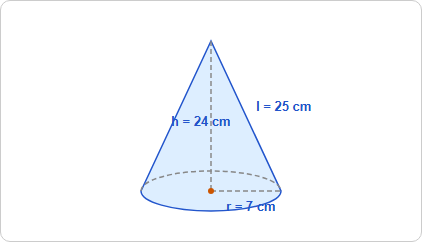 Given:
Height of the cone (h) = 24 cm
Volume of the cone (V) = 1232 cm³
Formula Used:
Volume of a cone = (1/3)πr²h
Slant height (l) = √(r² + h²)
Total Surface Area (TSA) = πr(r + l)
Calculations:
⇒ 1232 = (1/3) × (22/7) × r² × 24
⇒ 1232 = (176/7) × r²
⇒ r² = (1232 × 7) ÷ 176
⇒ r² = 49
⇒ Radius (r) = 7 cm
⇒ Slant height (l) = √(7² + 24²)
⇒ l = √(49 + 576)
⇒ l = √625 = 25 cm
⇒ TSA = (22/7) × 7 × (7 + 25)
⇒ TSA = 22 × 32 = 704 cm²
∴ The correct answer is 704 cm².
Additional Information
Curved Surface Area of a Cone
The curved surface area (CSA) covers only the lateral curved side of the cone. Formula: CSA = πrl.
Volume of a Cone
The internal capacity of a cone is exactly one-third of the volume of a cylinder with the same base and height. Formula: V = (1/3)πr²h.
Pythagorean Triplets
Standard sets of integers that satisfy a² + b² = c² speed up geometry computations considerably. Common examples: (3, 4, 5), (5, 12, 13), (7, 24, 25), and (8, 15, 17).
</p
Q22 · Age
The ages of two friends, Ram and Ravi, differ by 7 years. Ram's mother Mayadevi is three times as old as Ram, and Ravi is four times as old as his brother Soham. The ages of Mayadevi and Soham differ by 65 years. Find the age of Mayadevi (in years).
- 69
- 36
- 85
- 45
Answer aur solution dekho
Archived marked answer: A
Shortcut Trick
Let Ram's age be x. So, Mayadevi's age = 3x.
Assuming Ravi's age is x − 7 to obtain an integer value.
Soham's age = (x − 7) ÷ 4.
Given difference: 3x − (x − 7) ÷ 4 = 65 ⇒ 11x + 7 = 260 ⇒ 11x = 253 ⇒ x = 23.
Mayadevi's age = 3 × 23 = 69 years.
∴ The correct answer is 69 years.
Alternate Method
Given:
⇒ Difference between the ages of Ram and Ravi = 7 years
⇒ Mayadevi's age = 3 × Ram's age
⇒ Ravi's age = 4 × Soham's age
⇒ Difference between the ages of Mayadevi and Soham = 65 years
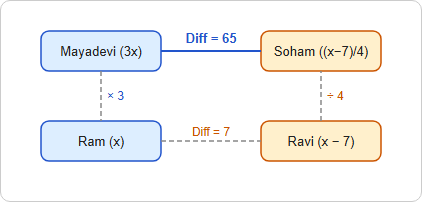 Calculations:
⇒ Let the age of Ram be x years.
⇒ Age of his mother, Mayadevi = 3x years.
⇒ Since Ram and Ravi differ by 7 years, let's assume Ravi's age is x − 7. (Assuming x + 7 will result in a fractional age).
⇒ Age of Ravi's brother, Soham = (x − 7) ÷ 4.
⇒ The difference between the ages of Mayadevi and Soham is 65 years:
⇒ 3x − [(x − 7) ÷ 4] = 65
⇒ (12x − x + 7) ÷ 4 = 65
⇒ 11x + 7 = 260
⇒ 11x = 253
⇒ x = 23
⇒ Therefore, Ram's age = 23 years.
⇒ Mayadevi's age = 3 × 23 = 69 years.
⇒ (Note: If we take Ravi's age as x + 7, we get 11x − 7 = 260 ⇒ x = 267 ÷ 11, which does not yield an integer value for age.)
∴ The correct answer is 69 years.
Additional Information
Linear Equations in Age Problems
Most age problems can be modeled using single-variable linear equations by expressing all ages in terms of one common person's age. Choosing the right central character minimizes complex fractional calculations.
Extraneous or Fractional Values
In quantitative aptitude, if solving an age equation yields a non-integer value where a whole number is expected, try alternating the assumed condition (e.g., swapping which person is older in an absolute difference relationship).
Constant Age Difference
The age difference between any two individuals remains constant regardless of the time elapsed, whereas the ratio of their ages changes continuously over the years.
</p
English
Q1 · Vocabulary
Select the most appropriate ANTONYM of the underlined word.
She was elated about her promotion, but her colleague felt quite disheartened.
- cheerful
- proud
- discouraged
- delighted
Answer aur solution dekho
Archived marked answer: C
The correct answer is: Option 3.
Key Points
- The word "elated" means very happy and excited.
- Example: She was elated when she received the news of her promotion.
- "Discouraged" means having lost determination or confidence; discouraged.
- Example: He was discouraged after failing the exam for the third time.
- Hence, we can infer that the opposite of 'elated' is 'discouraged.'
Therefore, the correct answer is: Option 3.
Additional Information
Here are the other options explained along with their Hindi meanings and example sentences:
- Cheerful : Noticeably happy and optimistic.
- Example: She has a cheerful personality that brightens up the room.
- Proud : Feeling deep pleasure or satisfaction as a result of one's own achievements.
- Example: He felt proud after winning the championship.
- Delighted: Feeling or showing great pleasure.
- Example: He was delighted to hear about the good news.
Q2 · Vocabulary
Identify the most appropriate antonym of the given word.
Timid
- Meek
- Anxious
- Daring
- Spooky
Answer aur solution dekho
Archived marked answer: C
The correct answer is: Option 3.
Key Points
- The word "Timid" means showing a lack of courage or confidence; easily frightened.
- Example: She was too timid to ask for what she wanted.
- "Daring" refers to being adventurous or bold; showing courage.
- Example: His daring rescue of the child from the burning building was commendable.
- Hence, we can infer that the opposite of 'timid' is 'daring'.
Additional Information
Here are the other options explained along with their Hindi meanings and example sentences:
- Meek: Quiet, gentle, and easily imposed on; submissive.
- Example: He was always meek and never stood up for himself.
- Anxious: Experiencing worry, unease, or nervousness.
- Example: She felt anxious before the big presentation.
- Spooky: Sinister or ghostly in a way that causes fear and unease.
- Example: The abandoned house looked spooky at night.
The correct answer is:
Q3 · Vocabulary
Select the most appropriate meaning of the given idiom.
On the ball
- Unaware of any changes or developments and lazy to react to them
- Aware of any changes or developments but slow to react to them
- Aware of any changes or developments and quick to react to them
- Aware of any changes or developments but doing nothing
Answer aur solution dekho
Archived marked answer: C
The correct answer is: Option 3.
Key Points
- The idiom "on the ball" means being aware of any changes or developments and quick to react to them.
- Example: She is always on the ball and never misses a deadline.
- Explanation: The idiom indicates someone who is quick to understand and react in a situation, showing alertness and efficiency.
- Example: Our new manager is really on the ball when it comes to handling customer complaints.
Therefore, the correct answer is: Option 3.
Additional Information
Here are the other options explained along with their Hindi meanings and example sentences:
- Option 1: Unaware of any changes or developments and lazy to react to them
- Example: He missed the opportunity because he was unaware of any changes or developments and lazy to react to them.
- Option 2: Aware of any changes or developments but slow to react to them
- Example: Though he knew about the changes, he was aware of any changes or developments but slow to react to them.
- Option 4: Aware of any changes or developments but doing nothing
- Example: She was aware of any changes or developments but doing nothing, leading to missed opportunities.
Q4 · Vocabulary
Select the most appropriate idiom to fill in the blank.
I'm ___________ about whether to accept the job offer or continue freelancing. Both options have their advantages.
- on the fence
- cutting corners
- left out in cold
- up in arms
Answer aur solution dekho
Archived marked answer: A
The correct answer is: Option 1.
Key Points
- The phrase "on the fence" means to be undecided or unsure about something.
- Example: She is on the fence about whether to move to a new city or stay in her hometown.
Therefore, the correct answer is: Option 1.
Additional Information
Here are the other options explained along with their Hindi meanings and example sentences:
- Cutting corners: Doing something in the easiest, cheapest, or fastest way.
- Example: The contractor was fired for cutting corners on the building project.
- Left out in the cold: Being ignored or excluded.
- Example: She felt left out in the cold when she wasn't invited to the meeting.
- Up in arms: Being very angry or upset.
- Example: The residents were up in arms about the new parking regulations.
Q5 · Vocabulary
Select the option that can be used as a one-word substitute for the given group of words.
A person who sells and arranges cut flowers.
- Horticulturist
- Botanist
- Gardener
- Florist
Answer aur solution dekho
Archived marked answer: D
The correct answer is: Option 4.
Key Points
- The word "Florist" refers to a person who sells and arranges cut flowers.
- Example: The florist arranged a beautiful bouquet for the wedding.
Therefore, the correct answer is: Option 4 i.e. Florist.
Additional Information
Here are the other options explained along with their Hindi meanings and example sentences:
- Horticulturist : Someone involved in the science or art of cultivating gardens.
- Example: The horticulturist explained the best methods for growing roses.
- Botanist : A scientist who studies plants.
- Example: The botanist discovered a new species of plant in the rainforest.
- Gardener: A person who tends and cultivates a garden as a pastime or for a living.
- Example: The gardener spends hours every day taking care of the plants.
Q6 · Vocabulary
Select the option that can be used as a one-word substitute for the given group of words.
A government by the officials
- Autocracy
- Bureaucracy
- Monarchy
- Plutocracy
Answer aur solution dekho
Archived marked answer: B
The correct answer is: Option 2.
Key Points
- The word "Bureaucracy" refers to a system of government in which most of the important decisions are made by state officials rather than by elected representatives.
- Example: The country's bureaucracy is known for its complex rules and lack of transparency.
Therefore, the correct answer is: Bureaucracy.
Additional Information
Here are the other options explained along with their Hindi meanings and example sentences:
- Autocracy : A system of government by one person with absolute power.
- Example: The nation was under autocracy for decades before transitioning to a democracy.
- Monarchy : A form of government with a monarch at the head.
- Example: Britain is a constitutional monarchy, where the monarch's powers are regulated by a constitution.
- Plutocracy: A society that is ruled or controlled by people of great wealth or income.
- Example: Critics argue that the country is moving towards plutocracy, where the wealthy have undue influence over the government.
Q7 · Vocabulary
Select the option that can be used as a one-word substitute for the given group of words.
A place where fruit trees are grown
- Orchard
- Garden
- Quay
- Museum
Answer aur solution dekho
Archived marked answer: A
The correct answer is: Option 1.
Key Points
- The word "Orchard" refers to a piece of land on which fruit trees are grown.
- Example: The apple orchard was in full bloom during the spring season.
Therefore, the correct answer is: Option 1.
Additional Information
Here are the other options explained along with their Hindi meanings and example sentences:
- Garden: A plot of ground where flowers, shrubs, vegetables, fruits, or herbs are cultivated.
- Example: She loves spending time in her garden, growing various flowers and herbs.
- Quay: A structure built parallel to the bank of a waterway for use as a landing place.
- Example: The ship docked at the quay to unload its cargo.
- Museum: A building where objects of historical, scientific, artistic, or cultural interest are stored and exhibited.
- Example: We visited the museum to see the ancient artifacts.
The correct answer is:
Q8 · Vocabulary
Select the option that can be used as a one-word substitute for the given group of words.
A small group of people who spend their time together and do not welcome other people into that group
- Squad
- Clique
- Employees
- Lobby
Answer aur solution dekho
Archived marked answer: B
The correct answer is: Option 2.
Key Points
- The word "clique" means a small group of people who spend their time together and do not welcome other people into that group.
- Example: The school was divided into several cliques, each with its own interests and activities.
Therefore, the correct answer is: Option 2.
Additional Information
Here are the other options explained along with their Hindi meanings and example sentences:
- Squad: A small group of people having a particular task.
- Example: The rescue squad arrived promptly at the scene of the accident.
- Employees: People who work for someone.
- Example: The company has over 200 employees working in various departments.
- Lobby: A group of people seeking to influence politicians or public officials on a particular issue.
- Example: The environmental lobby is pushing for new legislation to protect wildlife.
Calcul
Q9 · Vocabulary
The following sentence contains a word with a spelling error. Rectify the sentence by selecting the correct spelling of the identified word from the given options.
He has to be conscious of his public manners as he is a decendent of a reputed family in this region.
- Dicsendent
- Descendant
- Discendent
- Decendant
Answer aur solution dekho
Archived marked answer: B
The correct answer is: Option 2.
Key Points
- The word "descendent" is the incorrectly spelled word that should be corrected to "descendant".
- English meaning: A person, plant, or animal that is descended from a particular ancestor.
- Example: Many people believe they are descendants of famous historical figures.
- "Descendant" is the correct spelling.
- Hindi meaning:
- Example: She is a descendant of a long line of artists.
Therefore, the correct answer is: Option 2.
Additional Information
Here are the other options explained along with their Hindi meanings and example sentences:
- Dicsendent: This is an incorrect spelling and does not have a meaning.
- Discendent: This is also an incorrect spelling and does not have a meaning.
- Decendant: This is an incorrect spelling and does not have a meaning.
The correct answ
Q10 · Vocabulary
Select the correctly spelt word.
- Consencus
- Entrepreneurship
- Collaegue
- Bizzaire
Answer aur solution dekho
Archived marked answer: B
The correct answer is: Option 2.
Key Points
- The word "Entrepreneurship" means the activity of setting up a business or businesses, taking on financial risks in the hope of profit.
- Example: Many universities now offer courses in entrepreneurship to encourage students to start their own businesses.
- "Colleague" refers to a person with whom one works, especially in a profession or business.
- Example: She discussed the project with her colleague during the meeting.
Therefore, the correct answer is: Option 2.
Additional Information
Here are the other options explained along with their Hindi meanings and example sentences:
- Consencus: This is an incorrect spelling. The correct spelling is "Consensus," which means a general agreement.
- Example: The group reached a consensus on the new policy after several hours of discussion.
- Colleague: A person with whom one works in a profession or business.
- Example: She often has lunch with her colleagues from the marketing department.
- Bizzaire: This is an incorrect spelling. The correct spelling is "Bizarre," which means very strange or unusual.
- Example: He had a bizarre dream where he was flying over the city.
Q11 · Vocabulary
Select the most appropriate synonym of the bold word in the following sentence.
He tried to alleviate the sufferings of his neighbours.
- Swell
- Add
- Intensify
- Relieve
Answer aur solution dekho
Archived marked answer: D
The correct answer is: Option 4.
Key Points
- The word "alleviate" means to make (suffering, deficiency, or a problem) less severe.
- Example: He took painkillers to alleviate his headache.
- "Relieve" means to cause (pain, distress, or difficulty) to become less severe or serious.
- Example: She applied a cold compress to relieve the swelling.
- Hence, we can infer that the synonym of 'alleviate' is 'relieve'.
Therefore, the correct answer is: Option 4.
Additional Information
Here are the other options explained along with their Hindi meanings and example sentences:
- Swell: To increase in size, typically as a result of an accumulation of fluid.
- Example: Her ankle began to swell after she twisted it.
- Add: To put something together with something else to increase the number or amount.
- Example: You can add sugar to your coffee if you like it sweet.
- Intensify: To become or make something stronger or more extreme.
- Example: The conflict began to intensify as both sides refused to compromise.
Q12 · Vocabulary
Select the most appropriate synonym of the underlined word.
He was trembling with fear.
- Shivering
- Weeping
- Running
- Intrepid
Answer aur solution dekho
Archived marked answer: A
The correct answer is: Shivering.
Key Points
- The word "trembling" means to shake involuntarily, typically as a result of anxiety, excitement, or frailty.
- Example: She was trembling with cold as she stood outside in the snow.
- "Shivering" refers to the act of shaking or trembling uncontrollably as a result of cold, fear, or excitement.
- Example: He was shivering with fear as he heard the strange noises from the dark alley.
Hence, we can infer that the synonym of 'trembling' is 'shivering'.
Additional Information
Here are the other options explained along with their Hindi meanings and example sentences:
- Weeping: Shedding tears; crying.
- Example: She was weeping after hearing the sad news.
- Running: Moving at a speed faster than a walk.
- Example: He was running to catch the bus.
- Intrepid: Fearless; adventurous.
- Example: The intrepid explorer ventured into unknown territories.
Q13 · Vocabulary
Identify from the given options the word which is similar in meaning to the following word.
Equivocal
- Clear
- Ambiguous
- Representative
- Balanced
Answer aur solution dekho
Archived marked answer: B
The correct answer is: Option 2.
Key Points
- The word "equivocal" means open to more than one interpretation; ambiguous.
- Example: His reply to my question was equivocal, leaving me unsure of what he actually meant.
- "Ambiguous" refers to something that is unclear or can be understood in more than one way.
- Example: The contract's language was ambiguous, causing confusion among the parties involved.
- Hence, we can infer that the word 'equivocal' is similar in meaning to 'ambiguous'.
Therefore, the correct answer is: Option 2 i.e. Ambiguous.
Additional Information
Here are the other options explained along with their Hindi meanings and example sentences:
- Clear: Easily understood and without ambiguity.
- Example: The instructions were clear, making the process simple to follow.
- Representative: Serving as a typical example of something.
- Example: The paintings are representative of the artist's early work.
- Balanced: Keeping or showing a balance; even distribution.
- Example: She has a balanced approach to work and personal life.
Q14 · Vocabulary
Select the most appropriate synonym of the underlined word in the given sentence.
The Morbi bridge mishap has left Gujarat in a deplorable state.
- Jubilation
- Despicable
- Complaining
- Rejoicing
Answer aur solution dekho
Archived marked answer: B
The correct answer is: Option 2.
Key Points
- The word "deplorable" means deserving strong condemnation or shockingly bad in quality.
- Example: The living conditions in the slum were deplorable.
- "Despicable" refers to something that is deserving hatred and contempt.
- Example: Stealing from the poor is a despicable act.
Hence, we can infer that the synonym of 'deplorable' is 'despicable'.
Additional Information
Here are the other options explained along with their Hindi meanings and example sentences:
- Jubilation: A feeling of great happiness and triumph.
- Example: The team was in jubilation after winning the championship.
- Complaining: Expressing dissatisfaction or annoyance about something.
- Example: She kept complaining about the cold weather.
- Rejoicing: Feeling or showing great joy or delight.
- Example: There was much rejoicing at the news of the victory.
Q15 · Grammar
The following sentence has been split into four segments. Identify the segment that contains a grammatical error.
After the concert was over, / they go to a restaurant, / had dinner together / and talked until midnight.
- had dinner together
- they go to a restaurant,
- After the concert was over,
- and talked until midnight
Answer aur solution dekho
Archived marked answer: B
The correct answer is Option 2.
Key Points
- The primary issue in the sentence is the incorrect verb form "go" instead of "went".
- The sentence is in the past tense, so the verb should also be in the past tense.
- The correct phrase should be "they went to a restaurant".
- Thus, the error is located in Option 2 of the sentence.
Therefore, the correct answer is Option 2.
Correct Sentence: *"After the concert was over, they went to a restaurant, had dinner together, and talked until midnight."*
Additional Information
- Option 1: "had dinner together" – This part of the sentence is grammatically correct and does not require any changes.
- Option 3: "After the concert was over" – This part of the sentence is grammatically correct and does not require any changes.
- Option 4: "and talked until midnight" – This part of the sentence is grammatically correct and does not require any changes.
Q16 · Grammar
The following sentence has been split into four segments. Identify the segment that contains a grammatical error.
Renewable energy / sources like solar and wind power / will replaced traditional fossil fuels / and help reduce carbon emissions.
- and help reduce carbon emissions
- Renewable energy
- will replaced traditional fossil fuels
- sources like solar and wind power
Answer aur solution dekho
Archived marked answer: C
The correct answer is Option 3.
Key Points
- The primary issue in the sentence is the incorrect verb form "replaced" used in place of "replace".
- The correct future tense form should be "will replace" instead of "will replaced".
- This ensures grammatical correctness and clarity.
- Thus, the error is located in Option 3 of the sentence.
Therefore, the correct answer is Option 3.
Correct Sentence: *"Renewable energy sources like solar and wind power will replace traditional fossil fuels and help reduce carbon emissions."*
Additional Information
- Option 1: "and help reduce carbon emissions," – This part of the sentence is grammatically correct and does not require any changes.
- Option 2: "Renewable energy" – This part of the sentence is grammatically correct and does not require any changes.
- Option 4: "sources like solar and wind power" – This part of the sentence is grammatically correct and does not require any changes.
Q17 · Grammar
Select the most appropriate option to substitute the underlined segment in the given sentence.
I have been living in Hyderabad since I am born.
- since I have born
- since I will be born
- since I born
- since I was born
Answer aur solution dekho
Archived marked answer: D
The correct answer is Option 4.
Key Points
- The primary issue in the sentence is the incorrect use of the present tense "am" after "since." The correct past tense form should be used.
- The correct phrase should be "since I was born," ensuring grammatical correctness and clarity.
- The use of "since" indicates a point in time from the past until now, requiring the past tense "was" to be grammatically correct.
Therefore, the correct answer is Option 4.
Correct Sentence: *"I have been living in Hyderabad since I was born."*
Additional Information
- Option 1: "since I have born," – Incorrect because "have born" is not a correct tense form.
- Option 2: "since I will be born," – Incorrect because "will be born" indicates future tense, which is not applicable here.
- Option 3: "since I born," – Incorrect because "born" without "was" is grammatically incorrect.
Q18 · Voice Change
Select the option that expresses the given sentence in active voice.
By whom was grammar taught to you?
- Did he teach you grammar?
- Who had taught you grammar?
- You were taught grammar by whom?
- Who taught you grammar?
Answer aur solution dekho
Archived marked answer: D
The correct answer is Option 4.
Key Points
- The given sentence "By whom was grammar taught to you?" is in the passive voice.
- To express it in the active voice, we need to identify the subject performing the action (who) and place it at the beginning of the sentence.
- The structure in active voice would be "Who taught you grammar?"
- In this construction, "who" is the subject, "taught" is the verb, and "you" is the object.
Therefore, the correct answer is Option 4.
Correct Sentence: *"Who taught you grammar?"*
Additional Information
- Option 1: "Did he teach you grammar?" - This is a yes/no question but does not use the correct subject "who" or the correct structure.
- Option 2: "Who had taught you grammar?" - Incorrect tense (past perfect instead of simple past).
- Option 3: "You were taught grammar by whom?" - This is in the passive voice and merely rephrases the original question without changing the voice.
Q19 · Voice Change
Select the option that expresses the given sentence in active voice.
The contract was grabbed by the biggest telecom company in India.
- The biggest telecom company in India grabbed the contract.
- The biggest telecom company in India grabs the contract.
- The biggest telecom company in India will grab the contract.
- The biggest telecom company in India has grabbed the contract.
Answer aur solution dekho
Archived marked answer: A
The correct answer is Option 1.
Key Points
- The given sentence is in the passive voice and needs to be converted to the active voice.
- In the passive voice, the subject receives the action, whereas, in the active voice, the subject performs the action.
- The correct active voice sentence should identify the doer of the action first, followed by the action itself.
- Thus, the correct active voice sentence is: "The biggest telecom company in India grabbed the contract."
Therefore, the correct answer is Option 1.
Correct Sentence: *"The biggest telecom company in India grabbed the contract."*
Additional Information
- Option 2: "The biggest telecom company in India grabs the contract." – This is in the present tense, while the original sentence is in the past tense.
- Option 3: "The biggest telecom company in India will grab the contract." – This is in the future tense, which does not match the original sentence's past tense.
- Option 4: "The biggest telecom company in India has grabbed the contract." – This is in the present perfect tense, which does not match the original sentence's past tense.
Q20 · Para Jumble
Sentences of a paragraph are given below in jumbled order. Arrange the sentences in the correct order to form a meaningful and coherent paragraph.
A. More children go to school than at any time in the past. But more children today are out of school than any time in the past.
B. But it is not enough to blame the high birth rate for this state of affairs.
C. Indeed, it can be reasonably argued that continued mass illiteracy is not the result but the cause of the high birth rate.
D. There are more literate people in India today than ever before. But there are also more illiterates than ever before.
- ABCD
- CBAD
- DABC
- BADC
Answer aur solution dekho
Archived marked answer: C
The correct answer is Option 3.
Key Points
- The paragraph begins by introducing the central concept of literacy and illiteracy in India, setting a contrasting tone regarding the existence of both more literate and illiterate people today: Sentence D.
- Sentence A follows, providing a specific example of the paradoxical situation in today's context, more children attending school yet also more children out of school: "More children go to school than at any time in the past. But more children today are out of school than any time in the past."
- Sentence B continues by stating that it is not sufficient to blame only the high birth rate for this situation: "But it is not enough to blame the high birth rate for this state of affairs."
- Sentence C concludes the argument by presenting the idea that illiteracy may actually be the cause of the high birth rate rather than the effect: "Indeed, it can be reasonably argued that continued mass illiteracy is not the result but the cause of the high birth rate."
Therefore, the correct answer is Option 3.
Rearranged Paragraph: *"There are more literate people in India today than ever before. But there are also more illiterates than ever before. More children go to school than at any time in the past. But more children today are out of school than any time in the past. But it is not enough to blame the high birth rate for this state of affairs. Indeed, it can be reasonably argued that continued mass illiteracy is not the result but the cause of the high birth rate."*