92 questions available to read. Bina signup padho; timed practice ke liye free sign in karo.
Archive coverageThis saved paper contains 92 of 100 expected questions. 0 stored records are excluded from this study page while their source or wording is checked. Missing original questions: 8. Local question numbers follow the saved archive; match the wording and choices when comparing another response sheet.
Archived marked answers and available solution notes are preserved. These are not claimed to be fully checked final SSC keys. How questions are checked.
Reasoning
Q1 · Series
Which of the following terms will replace the question mark (?) in the given series?
MFT, NIS, PLQ, SON, WRJ, ?
- RUE
- BUE
- BVD
- BUP
Answer aur solution dekho
Archived marked answer: B
The logic followed here is:
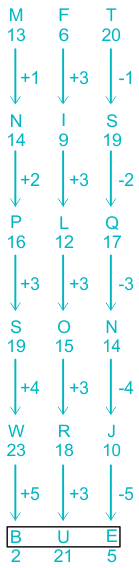 Hence, "Option 2" is the correct answer.
Q2 · Series
Select the combination of letters that when sequentially placed in the blanks of the given series will complete the series.
P _ A A _ _ Z A _V _ _ A _ _
- VPZZPVAP
- ZPVVAPVZ
- ZVPAPZAV
- VZAAPVPZ
Answer aur solution dekho
Archived marked answer: C
Given series: P _ A A _ _ Z A _V _ _ A _ _
Option 1) VPZZPVAP→ P V A A P Z Z A Z V P V A A P → (It doesn't follow any pattern)
Option 2) ZPVVAPVZ → P Z A A P V Z A V V A P A V Z → (It doesn't follow any pattern)
Option 3) ZVPAPZAV → P Z A A V P Z A A V P Z A A V → (It follows the pattern of: PZAAV - PZAAV - PZAAV)
Option 4) VZAAPVPZ → P V A A Z A Z A A V P V A P Z → (It doesn't follow any pattern)
Hence, "Option 3" is the correct answer.
Q3 · Series
Which of the four options will replace the question mark (?) in the following series?
XF 11, YI 15, ZL 19, AO 23, ?
- CQ 25
- BP 26
- CR 25
- BR 27
Answer aur solution dekho
Archived marked answer: D
The logic followed here is:
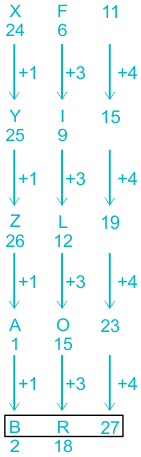 Hence, "Option 4" is the correct answer.
Q4 · Series
Select the number from the given options to complete the series.
35, 38, 43, 50, 59, ___
- 62
- 68
- 78
- 70
Answer aur solution dekho
Archived marked answer: D
The logic followed here is:
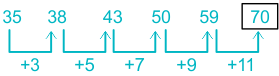 Hence, "Option 4" is the correct answer.
Q5 · Series
Which figure should replace the question mark (?) if the following series were to be continued?



Answer aur solution dekho
Archived marked answer: C
The logic followed here is:
1) First box series →
All the elements shift clockwise.
Center element is replaced by new element subsequently.
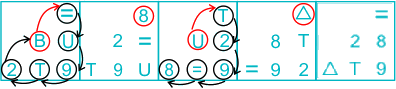 2) Second box series →
2nd column elements shift to the 3rd column.
2nd and 3rd element of third column shift to the 2nd column diagonally.
Rest of the elements interchange positions.
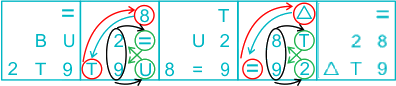 Thus, the final series is:
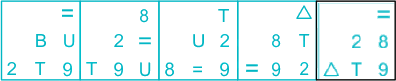 Hence, "Option 3" is the correct answer.
Q6 · Series
Identify the figure given in the options which when put in place of the question mark (?) will logically complete the series?



Answer aur solution dekho
Archived marked answer: C
The logic followed here is:
1) Top left corner circle is alternately shift clockwise.
2) Top right corner circle is alternately shift clockwise.
 Thus, the final series is:
 Hence, "Option 3" is the correct answer.
Q7 · Analogy
Select the option that is related to the fifth letter-cluster in the same way as the second letter-cluster is related to the first letter-cluster and the fourth letter-cluster is related to the third letter-cluster.
CWE : ZFX :: PYT : MDI :: KIL : ?
- PRO
- RTQ
- STQ
- PQO
Answer aur solution dekho
Archived marked answer: B
The logic followed here is:
CWE : ZFX
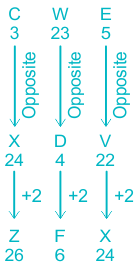 And,
PYT : MDI
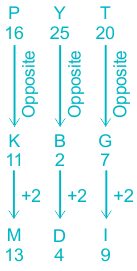 Similarly,
KIL : ?
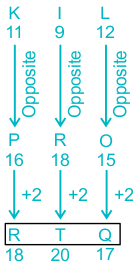 Hence, "Option 2" is the correct answer.
Q8 · Analogy
In the following number-pairs, the second number is obtained by applying certain mathematical operations to the first number. Select the set in which the numbers are related in the same way as are the numbers of the following sets.
(NOTE : Operations should be performed on the whole numbers without breaking down the numbers into its constituent digits. E.g. 13 – Operations on 13 such as adding /deleting /multiplying etc., to 13 can be performed. Breaking down 13 into 1 and 3 and then performing mathematical operations on 1 and 3 is not allowed.)
(12, 145)
(9, 82)
- (16, 256)
- (14, 197)
- (22, 483)
- (8, 69)
Answer aur solution dekho
Archived marked answer: B
The logic followed here is:
(12, 145)
12² + 1 = 145
144 + 1 = 145
145 = 145 (LHS = RHS)
And,
(9, 82)
92 + 1 = 82
81 + 1 = 82
82 = 82 (LHS = RHS)
So, checking each option one by one:
Option 1) (16, 256)
162 + 1 = 256
256 + 1 = 256
257 ≠ 256 (LHS ≠ RHS)
Option 2) (14, 197)
142 + 1 = 197
196 + 1 = 197
197 = 197 (LHS = RHS)
Option 3) (22, 483)
222 + 1 = 483
484 + 1 = 483
485 ≠ 483 (LHS ≠ RHS)
Option 4) (8, 69)
82 + 1 = 69
64 + 1 = 69
65 ≠ 69 (LHS ≠ RHS)
Thus, out of all the options, '(14, 197)' follows the same logic as given.
Hence, "Option 2" is the correct answer.
Q9 · Analogy
Select the set in which the numbers are related in the same way as are the numbers of the following sets.
(NOTE: Operations should be performed on the whole numbers, without breaking down the numbers into its constituent digits. E.g. 13 – Operations on 13 such as adding/deleting/multiplying etc. to 13 can be performed. Breaking down 13 into 1 and 3 and then performing mathematical operations on 1 and 3 is not allowed.)
(19, 456, 6)
(16, 320, 5)
- (18, 378, 7)
- (14, 210, 5)
- (21, 504, 8)
- (18, 648, 9)
Answer aur solution dekho
Archived marked answer: D
The logic followed here is:
(19, 456, 6)
19 × 6____ × 4 = 456
456 = 456 (LHS = RHS)
And,
(16, 320, 5)
16 × 5____ × 4 = 320
320 = 320 (LHS = RHS)
So, checking each option one by one:
Option 1) (18, 378, 7)
18 × 7____ × 4 = 378
504 ≠ 378 (LHS ≠ RHS)
Option 2) (14, 210, 5)
14 × 5____ × 4 = 210
280 ≠ 210 (LHS ≠ RHS)
Option 3) (21, 504, 8)
21 × 8____ × 4 = 504
672 ≠ 504 (LHS ≠ RHS)
Option 4) (18, 648, 9)
18 × 9____ × 4 = 648
648 = 648 (LHS = RHS)
Thus, out of all the options, '(18, 648, 9)' follows the same logic as given.
Hence, "Option 4" is the correct answer.
Q10 · Analogy
Select the set in which the numbers are related in the same way as are the numbers of the following sets.
(34, 47, 62)
(119, 142, 167)
(NOTE: Operations should be performed on the whole numbers, without breaking down the numbers into its constituent digits. E.g. 13 – Operations on 13 such as adding/deleting/multiplying etc. to 13 can be performed. Breaking down 13 into 1 and 3 and performing mathematical operations on 1 and 3 is not allowed)
- (27, 37, 51)
- (48, 65, 82)
- (64, 78, 99)
- (79, 98, 119)
Answer aur solution dekho
Archived marked answer: D
The logic followed here is:
(34, 47, 62)
34 + 2 = 36 ⇒ Perfect square of 6
47 + 2 = 49 ⇒ Perfect square of 7
62 + 2 = 64 ⇒ Perfect square of 8
And,
(119, 142, 167)
119 + 2 = 121 ⇒ Perfect square of 11
142 + 2 = 144 ⇒ Perfect square of 12
167 + 2 = 169 ⇒ Perfect square of 13
So, checking each option one by one:
Option 1) (27, 38, 51)
27 + 2 = 29 ⇒ Not a perfect square
38 + 2 = 40 ⇒ Not a perfect square
51 + 2 = 53 ⇒ Not a perfect square
Option 2) (48, 65, 82)
48 + 2 = 50 ⇒ Not a perfect square
65 + 2 = 67 ⇒ Not a perfect square
82 + 2 = 84 ⇒ Not a perfect square
Option 3) (64, 78, 99)
64 + 2 = 66 ⇒ Not a perfect square
78 + 2 = 80 ⇒ Not a perfect square
99 + 2 = 111 ⇒ Not a perfect square
Option 4) (79, 98, 119)
79 + 2 = 81 ⇒ Perfect square of 9
98 + 2 = 100 ⇒ Perfect square of 10
119 + 2 = 121 ⇒ Perfect square of 11
Thus, out of all the options, '(79, 98, 119)' follows the same logic as given.
Hence, "Option 4" is the correct answer.
Q11 · Non Verbal Reasoning
Six letters P, Q, R, S, T and U are written on different faces of a dice. Two positions of this dice are shown in the figure below. Find the letter on the face opposite to R.

- T
- Q
- U
- S
Answer aur solution dekho
Archived marked answer: D
The logic followed here is :-
From the given two different cubes the adjacent sides are as shown below :
As R is common on both the dices, it is clear that P, T, Q, and U are adjacent to it, and the remaining i.e. S will be opposite to it.
=
 Opposite pairs:
P → Q
T → U
R → S
So, the opposite side of "R" will be side "S".
Hence, the correct answer is "Option 4".
Q12 · Non Verbal Reasoning
Six letters A, M, R, S, Y and Q are written on different faces of a dice. Two positions of this dice are shown in the figures below. Find the letter on the face opposite to S.

- Q
- M
- Y
- A
Answer aur solution dekho
Archived marked answer: D
The logic followed here is :-
From the given two different cubes the adjacent sides are as shown below :
As R is common on both the dices, it is clear that M, A, Y, and S are adjacent to it, and the remaining i.e. Q will be opposite to it.
Q13 · Non Verbal Reasoning
Select the option figure in which the given figure (X) is embedded (rotation is NOT allowed).



Answer aur solution dekho
Archived marked answer: C
The image embedded in the given figure is as shown below :
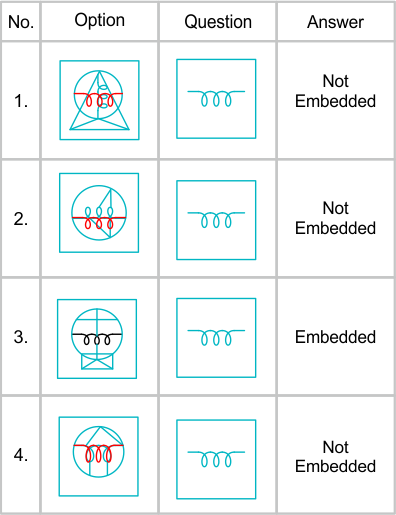 ∴ Here, the given figure is embedded in option Figure - 3.
Hence, the correct answer is "Option 3".
Q14 · Non Verbal Reasoning
Select the option that will replace the question mark (?) in the figure given below to complete the pattern.



Answer aur solution dekho
Archived marked answer: C
The figure which will complete the pattern is:
 Hence, option 3 is the correct answer.
Q15 · Non Verbal Reasoning
How many triangles are there in the given figure?

- 6
- 8
- 4
- 5
Answer aur solution dekho
Archived marked answer: B
The number of triangles in the given figure is shown below:
1) Total triangles = Number of parts × Number of diagonals
= 2 × 1 ⇒ 2
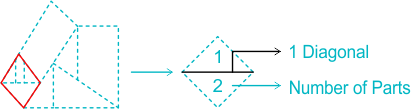 2) Total triangles = [Number of parts × (1 + Number of parts)] ÷ 2
= [2&
Q16 · Puzzle Subtypes Not To Miss
What will come in place of the question mark (?) in the following equation, if '+' and '−' are interchanged and '×' and '÷' are interchanged?
321 – 371 ÷ 22 + 216 × 6 = ?
- 7848
- 7884
- 8747
- 8447
Answer aur solution dekho
Archived marked answer: D
Given: 321 – 371 ÷ 22 + 216 × 6 = ?
According to the question, after '+' and '−' are interchanged and '×' and '÷' are interchanged:
321 – 371 ÷ 22 + 216 × 6 = ? ⇒ 321 + 371 × 22 – 216 ÷ 6 = ?
⇒ 321 + 371 × 22 – 216 __÷__ 6 = ?
⇒ 321 + 371 __×__ 22 – 36 = ?
⇒ 321 + 8162 – 36 = ?
⇒ 8483__ – 3__6 = ?
⇒ 8447 = ?
Hence, "Option 4" is the correct answer.
Q17 · Puzzle Subtypes Not To Miss
Which two numbers (not digits) should be interchanged to make the given equation correct?
24 ÷ 3 – 4 × 2 + 6 × 5 +12 = 50
- 5 and 4
- 4 and 3
- 24 and 12
- 3 and 2
Answer aur solution dekho
Archived marked answer: C
Given: 24 ÷ 3 – 4 × 2 + 6 × 5 +12 = 50
According to the question, after interchanging the numbers:
Option 1) 5 and 4
24 ÷ 3 – 4 × 2 + 6 × 5 +12 = 50 ⇒ 24 ÷ 3 – 5 × 2 + 6 × 4 +12 = 50
⇒ 24 ÷ 3 – 5 × 2 + 6 × 4 +12 = 50
⇒ 8 – 5 × 2 + 6 × 4 +12 = 50
⇒ 8 + 24 +12 – 10 = 50
⇒ 44____ – 10 = 50
⇒ 34 ≠ 50 (LHS ≠ RHS)
Option 2) 4 and 3
24 ÷ 3 – 4 × 2 + 6 × 5 +12 = 50 ⇒ 24 ÷ 4 – 3 × 2 + 6 × 5 +12 = 50
⇒ 24 ÷ 4 – 3 × 2 + 6 × 5 +12 = 50
⇒ 6 – 3 × 2 + 6 × 5 +12 = 50
⇒ 6 + 30 +12 – 6 = 50
⇒ 48____ – 6 = 50
⇒ 42 ≠ 50 (LHS ≠ RHS)
Option 3) 24 and 12
24 ÷ 3 – 4 × 2 + 6 × 5 +12 = 50 ⇒ 12 ÷ 3 – 4 × 2 + 6 × 5 +24 = 50
⇒ 12 ÷ 3 – 4 × 2 + 6 × 5 +24 = 50
⇒ 4 – 4 × 2 + 6 × 5 +24 = 50
⇒ 4 + 30 +24 – 8 = 50
⇒ 58____ – 8 = 50
⇒ 50 = 50 (LHS = RHS)
Option 4) 3 and 2
24 ÷ 3 – 4 × 2 + 6 × 5 +12 = 50 ⇒ 24 ÷ 2 – 4 × 3 + 6 × 5 +12 = 50
⇒ 24 ÷ 2 – 4 × 3 + 6 × 5 +12 = 50
⇒ 12 – 4 × 3 + 6 × 5 +12 = 50
⇒ 12 + 30 +12 – 12 = 50
⇒ 54____ – 12 = 50
⇒ 42 ≠ 50 (LHS ≠ RHS)
Hence, "Option 3" is the correct answer.
Q18 · Coding Decoding
In a certain code language, 'SILK' is written as 'TIML' and 'INSECT' is written as 'IOTEDU'. How will 'CHANGE' be written in that language?
- DOIHAE
- DEIOHA
- DEIHAO
- DIAOHE
Answer aur solution dekho
Archived marked answer: D
The logic followed here is:
'SILK' is written as 'TIML'
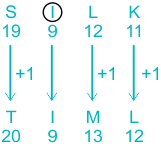 And,
'INSECT' is written as 'IOTEDU'
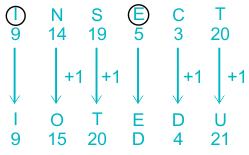 Similarly,
'CHANGE' will be written as
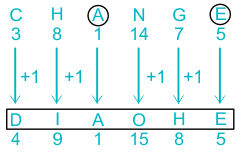 Hence, "Option 4" is the correct answer.
Q19 · Coding Decoding
In a certain code language, 'SET' is coded as '37' and 'MIX' is coded as '35'. How will 'WAR' be coded in that language?
- 39
- 21
- 32
- 29
Answer aur solution dekho
Archived marked answer: A
The logic followed here is:
'SET' is coded as '37'
Q20 · Classification Odd One Out
Four letter-clusters have been given, out of which three are alike in some manner and one is different. Select the letter-cluster that is different.
Note: The odd one out is not based on the number of consonants/vowels or their position in the letter cluster.
- BEHI
- TWYZ
- PSUV
- FIKL
Answer aur solution dekho
Archived marked answer: A
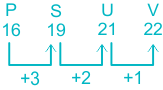
The logic followed here is:
Option 1) BEHI
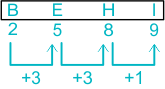 Option 2) TWYZ
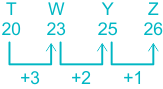 Option 3) PSUV
 Option 4) FIKL
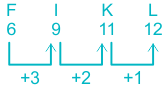 Thus, out of all the options, 'BEHI' is the correct answer.
Hence, "Option 1" is the correct answer.
Q21 · Classification Odd One Out
Three of the following numbers are alike in a certain way and one is different. Pick the odd one out.
(NOTE: Operations should be performed on the whole numbers, without breaking down the numbers into its constituent digits.
E.g. 13 – Operations on 13 such as adding/deleting/multiplying etc., to 13 can be performed. Breaking down 13 into 1 and 3 and then performing mathematical operations on 1 and 3 is not allowed.)
- 36 – 84
- 72 – 168
- 66 – 154
- 33 – 72
Answer aur solution dekho
Archived marked answer: D
The logic followed here is:
Option 1) 36 – 84
36 × 7 ÷ 3 = 84
252 ÷ 3 = 84
84 = 84 (LHS = RHS)
Option 2) 72 – 168
72 × 7 ÷ 3 = 168
504 ÷ 3 = 168
168 = 168 (LHS = RHS)
Option 3) 66 – 154
66 × 7 ÷ 3 = 154
462 ÷ 3 = 154
154 = 154 (LHS = RHS)
Option 4) 33 – 72
33 × 7 ÷ 3 = 72
231 ÷ 3 = 72
77 ≠ 72 (LHS ≠ RHS)
Thus, out of all the options, '33 – 72' is the odd one out.
Hence, "Option 4" is the correct answer.
Q22 · Logical Reasoning
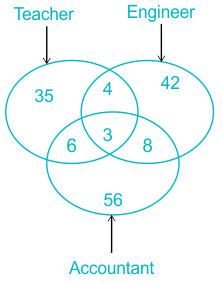
Study the given diagram carefully and answer the question that follows. The numbers in different sections indicate the number of persons who have applied for different posts.
Teacher Engineer Accountant
What is the total number of persons who have applied for more than one post?
- 21
- 113
- 15
- 18
Answer aur solution dekho
Archived marked answer: A
According to the given Venn diagram:
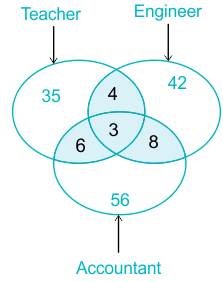 The shaded region represents the total number of persons who have applied for more than one post.
So, the total number of persons who have applied for more than one post = (4 + 6 + 8 + 3) = 21
Hence, the correct answer is "Option 1".
Q23 · Logical Reasoning
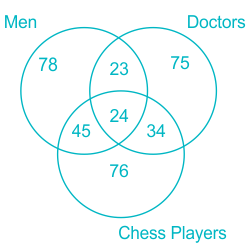
The following Venn diagram shows Men’s profession as Doctors and Chess Players.
How many men are doctors?
- 47
- 34
- 24
- 23
Answer aur solution dekho
Archived marked answer: A
According to the given Venn diagram:
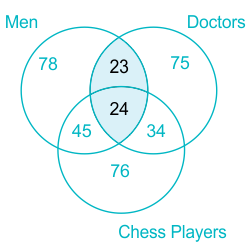 The shaded region represents the total number of men who are doctors.
So, the total number of men who are doctors = (23 + 24) = 47
Hence, the correct answer is "Option 1".
Q24 · Blood Relations
In a certain code language,
A + B means ‘A is the son of B’,
A − B means ‘A is the sister of B’,
A × B means ‘A is the brother of B’ and
A ÷ B means ‘A is the mother of B’.
Based on the above, how is T related to P if ‘P ÷ Q × R − M + T’?
- Son
- Brother
- Father
- Husband
Answer aur solution dekho
Archived marked answer: D
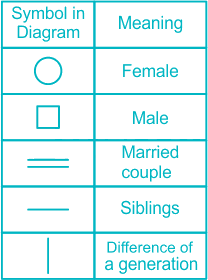 Decoding symbols:
A is
Symbol
+
−
×
÷
Meaning
Son
Sister
Brother
Mother
to B
Given: P ÷ Q × R − M + T
P ÷ Q → P is the mother of Q.
 Q × R → Q is the brother of R.
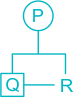 R − M → R is the sister of M.
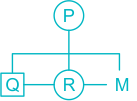 M + T → M is the son of T.
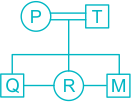 Thus, T is P's husband.
Hence, the correct answer is "Option 4"
Q25 · Alphabet Test
The position of how many letters will remain unchanged if each of the letter in the word 'JANITOR' is arranged in English alphabetical order?
- Three
- Two
- One
- Zero
Answer aur solution dekho
Archived marked answer: D
Given word: 'JANITOR'
After arranged in alphabetical order:
Alphabets
J
A
N
I
T
O
R
Alphabetical order
A
I
J
N
O
R
T
Now,
there are Zero alphabets that will remain unchanged if each of the letters in the word 'JANITOR' is arranged in English alphabetical order.
Hence, the correct answer is "Option 4".
General Awareness
Q1 · Art and Culture
In which of the following states is the Nrityagram, an Odissi dance institution, located?
- Kerala
- Karnataka
- Tamil Nadu
- Maharashtra
Answer aur solution dekho
Archived marked answer: B
The correct answer is Karnataka.
Key Points
- Nrityagram is an Odissi dance institution located near Hesaraghatta Lake in Karnataka.
- It was established by Odissi dancer Protima Gauri in 1990.
- It offers training in 7 Indian classical dance forms.
- These are- Odissi, Mohiniattam, Kathak, Bharatnatyam, Kuchipudi, Kathakali, and Manipuri.
- It is made by architect Gerard da Cunha.
- It is located near Hesaraghatta lake 30km from Bengaluru.
- Nrityagram Dance Ensemble has performed across India and in many countries abroad.
- Training is offered for a period of 6-7 years to become professional dancers and teachers.
Q2 · Art and Culture
'Nuakhai' is the state festival of:
- Meghalaya
- Odisha
- Tamil Nadu
- Bihar
Answer aur solution dekho
Archived marked answer: B
The correct answer is Odisha.
Key Points
- Nuakhai or Navakhai is an agricultural festival mainly observed by people of Western Odisha and Southern Chhattisgarh in India.
- Nuakhai is observed to welcome the new rice of the season.
- It will be celebrated on Thursday, 1 September 2022.
- The new harvest crops are worshipped and people celebrate it by eating the first rice of the harvest together with their families.
- Nuakhai Juhar is sharing gifts with your dear ones, wishing them on the occasion, and coming together as a family to symbolize unity.
Additional Information
- some state festivals in India:
- Meghalaya
- The Wangala Festival, also known as the 100 Drums Festival, is a harvest festival that celebrates the end of a period of hard work and the good output of the fields.
- The festival honors Saljong, the Sun-god of fertility.
- Other festivals in Meghalaya include the Ahaia festival, Nongkrem Dance Festival, and Bob Dylan Festival.
- Odisha
- The Ratha Yatra, or Chariot Festival, is a well-known religious festival that takes place in June-July.
- During the festival, Lord Jagannath and his siblings ride in a chariot to their aunt's home and return after a seven-day holiday.
- Other festivals in Odisha include Durga Puja, Saraswati Puja, Ganesh Puja, Shiva Ratri, Janmashtami, Kali Puja, and Kartik Puja.
- Tamil Nadu
- Pongal is a major festival in Tamil Nadu, celebrated as a harvest festival in the Tamil month of Thai (mid-January to mid-February).
- Margazhi (Margali) is the Tamil month before Thai, spanning from mid-December to mid-January.
- Bihar
- Bihula is a prominent festival in eastern Bihar, especially in the district of Bhagalpur.
- It takes place in August, and devotees pray to Goddess Mansa for the welfare of their families
Q3 · Indian Polity and Constitution
Article 77 of the Indian Constitution deals with the ________.
- term of office of the Vice-President
- Vice-President of India
- oath of office by the Vice-President
- conduct of business of the Government of India
Answer aur solution dekho
Archived marked answer: D
The correct answer is the conduct of business of the Government of India
Key Points
- Article 77 of the Indian Constitution deals with the conduct of business of the Government of India.
- It includes the following provisions:
- The President makes rules to facilitate the transaction of government business.
- These rules also allocate the business among Ministers.
- All executive actions of the Government of India are to be taken in the name of the President.
- The President authenticates orders and other instruments made in their name.
- The validity of an authenticated order or instrument cannot be questioned.
Q4 · Indian Polity and Constitution
Which Article of the Indian Constitution prohibits providing of any religious instruction in the educational institutions maintained by the State?
- Article 29
- Article 28
- Article 30
- Article 31
Answer aur solution dekho
Archived marked answer: B
The correct answer is Article 28
Key Points
- Article 28 of the Indian Constitution prohibits religious instruction in state-funded educational institutions.
- However, it does allow religious instruction in special circumstances.
- Article 28 states, "No religious instruction shall be provided in any educational institution wholly maintained out of State funds".
Additional Information
- Other articles of the Indian Constitution related to education include:
- Article 29
- Prohibits discrimination in admission to state-aided or maintained educational institutions based on religion, race, caste, or language
- Article 30
- Gives minorities the right to establish and administer educational institutions of their choice
- Article 31
- It was part of the original fundamental rights in the Constitution of India, guaranteeing the right to property.
- It protected individuals against the arbitrary acquisition of their property by the State.
Q5 · Indian Polity and Constitution
The Muslim Women (Protection of Rights on Marriage) Act, 2019 deals with subsistence allowance in which of the following Sections?
- Section 5
- Section 6
- Section 7
- Section 4
Answer aur solution dekho
Archived marked answer: A
The Correct answer is Section 5.
Key Points
- The Muslim Women (Protection of Rights on Marriage) Act, 2019 was enacted to protect the rights of married Muslim women.
- Under this act, Section 5 specifically deals with the provision for subsistence allowance.
- It mandates that a Muslim woman against whom talaq has been pronounced is entitled to receive a subsistence allowance from her husband for her and her children.
- The allowance amount and terms are determined by the First Class Magistrate upon the woman’s application.
- This provision aims to ensure the financial stability of Muslim women who are divorced through the practice of instant triple talaq.
Additional Information
- Section 4
- This section of the act makes the pronouncement of triple talaq (talaq-e-biddat) a criminal offence.
- A husband who pronounces triple talaq can be punished with imprisonment for up to three years and a fine.
- Section 6
- This section pertains to the custody of minor children.
- It states that the determination of custody will be made by the First Class Magistrate as deemed just and proper for the welfare of the minor.
- Section 7
- This section states that an offence under this act is cognizable, compoundable, and non-bailable.
- The offence can be compounded only at the instance of the married Muslim woman upon whom talaq is pronounced.
Q6 · Indian Economy
Which of the following goods needs further transformation in the economic process?
- Consumer durable goods
- Finished goods
- Intermediate goods
- Capital goods
Answer aur solution dekho
Archived marked answer: C
The correct answer is Intermediate goods
Key Points
- Intermediate goods need further transformation in the economic process:
- Intermediate goods:
- These are partially finished goods that are used to make other goods.
- They are also known as producer goods.
- Intermediate goods undergo further processing and transformation to become final goods.
- For example, a car component can be an intermediate good if it is incorporated into a vehicle, or a final good if it is sold to the consumer as a spare part.
Additional Information
- Consumer durable goods
- A type of consumer good that lasts for more than three years and is purchased infrequently.
- Examples include appliances, cars, and furniture.
- Finished goods
- A finished product that is purchased by consumers for personal or household use.
- Examples include food, clothing, vehicles, electronics, and appliances.
- Capital goods
- A tangible product that is used to produce goods and services, and is not typically sold to consumers.
- Examples include buildings, machinery, vehicles, large tools, and equipment
Q7 · Indian Economy
Which of the following statements is correct?
- The five-year plan focuses mostly on private intervention in the economy.
- The five-year plan always focused on the growth of the tertiary sector.
- The five-year plan permits long-term intervention by the government in the economy.
- A five-year plan always stresses market-oriented activities.
Answer aur solution dekho
Archived marked answer: C
The correct answer is Option 3
Key Points
- Five-Year Plans are strategic frameworks used by the government to guide the economy's development over a fixed period (typically five years).
- In India, these plans were implemented by the Planning Commission (replaced by NITI Aayog in 2015).
- Focus on Developmental Goals:
- Poverty Alleviation: Plans aimed at reducing poverty through employment generation schemes, rural development, and welfare programs.
- For instance, the Sixth Five-Year Plan (1980–1985) emphasized poverty reduction.
- Industrialization: Plans like the Second Five-Year Plan (1956–1961), which focused on heavy industries, laid the foundation for India's industrial base.
- Agriculture: Plans like the First Five-Year Plan (1951–1956) concentrated on increasing agricultural productivity.
- Infrastructure Development: Several plans prioritized building physical and social infrastructure, including power, transportation, education, and healthcare.
- Hence statement 3 is correct
Q8 · Sports Static GK
Which of the following countries won the first men's Asian Hockey Championship trophy?
- Japan
- China
- India
- Pakistan
Answer aur solution dekho
Archived marked answer: C
The correct answer is India
Key Points
- India won the first men's Asian Hockey Champions Trophy in 2011, defeating Pakistan in the final via a penalty shootout.
- The Asian Champions Trophy is a prestigious field hockey tournament held in Asia, showcasing the talent and competitiveness of top Asian hockey nations.
- It was held in 2011
- Host: Ordos, China
- Participating Teams: India, Pakistan, Malaysia, Japan, South Korea, China
- Winner: India
- India defeated Pakistan in a thrilling penalty shootout
Additional Information
- The Asian Champions Trophy is organized by the Asian Hockey Federation (AHF).
- It was first introduced in 2011, and since then, it has become a key event in the Asian hockey calendar.
- Teams like India, Pakistan, Malaysia, and South Korea are regular participants in the tournament.
- The event helps in improving the competitive standards of Asian teams on the global stage.
- Chennai last hosted a major international hockey event in 2007, making the 2023 tournament a significant occasion for the city.
Q9 · Sports Static GK
At which Olympics was Kho-Kho featured in an exhibition in the main stadium?
- 1936
- 1932
- 2008
- 2016
Answer aur solution dekho
Archived marked answer: A
The correct answer is 1936
Key Points
- Kho-Kho was featured in an exhibition at the main stadium during the 1936 Olympics.
- The 1936 Summer Olympics, officially known as the Games of the XI Olympiad, were held in Berlin, Germany.
- This exhibition aimed to showcase traditional sports from different countries, and Kho-Kho represented India.
- Although it was not an official Olympic sport, the exhibition provided international exposure to Kho-Kho.
Additional Information
- The 1936 Olympics are often remembered for the political context and the propaganda efforts of the Nazi regime.
- Jesse Owens, an African-American athlete, won four gold medals at these games, challenging the Nazi ideology of racial superiority.
- Kho-Kho is a traditional Indian sport that involves running and chasing and is popular in schools and colleges across the country.
- The sport is governed by the Kho-Kho Federation of India, which organizes national-level competitions and promotes the game internationally.
Q10 · Indian Geography
As per the definition of Census of India, a 'marginal worker' is a person who works for:
- less than 183 days (or six months) in a year
- more than 183 days (or six months) in a year
- eight months in a year
- 83 days in a year
Answer aur solution dekho
Archived marked answer: A
The Correct Answer is less than 183 days (or six months) in a year.
Key Points
- A person who works for less than 183 days (or six months) in a year.
- Marginal workers are typically engaged in seasonal, irregular, or part-time work.
- They may be involved in agriculture, labor, or other informal sectors where employment is not continuous throughout the year.
- The contrast to marginal workers are 'main workers', who work for 183 days or more during the year.
Q11 · Indian Geography
What is the length of Indian Railways network, according to Railway Yearbook 2019-20?
- 67,956 km
- 1,604 km
- 63,950 km
- 2,402 km
Answer aur solution dekho
Archived marked answer: A
The correct answer is 67,956 km.
Key Points
- Indian Railways is the largest government undertaking in the country.
- The length of the Indian Railways network was 67,956 km (Railwayyearbook 2019-20).
- Its very large size puts a lot of pressure on a centralised railway management system.
- Based on the width of the track of the Indian Railways, three categories have been made:
- Broad gauge:
- The distance between rails in broad gauge is 1.676 metres.
- The total length of broad gauge lines was 63950 km (2019-20).
- Metre gauge:
- The distance between rails is one metre.
- Its total length was 2402 km(2019-20).
- Narrow gauge:
- The distance between the rails in this case is 0.762 metres or 0.610 metres.
- The total length of the narrow gauge was 1604 km (2019-20).
- It is generally confined to hilly areas.
Q12 · Indian Geography
Hot local wind that flows over north India in summer is known as:
- Loo
- Chinook
- Mango showers
- Purga
Answer aur solution dekho
Archived marked answer: A
The correct answer is Loo
Key Points
- The hot, dry, and dusty wind that blows over north India in the summer is called the Loo:
- The Loo originates from the Iranian, Baloch, and Thar deserts.
- It's especially strong in May and June.
- The Loo can reach temperatures of 45–50 °C (115–120 °F).
- Exposure to the Loo can cause heatstroke, and its low humidity and high temperature can dry out vegetation.
- The Loo blows over the western Indo-Gangetic Plain region of North India and Pakistan, with higher intensity between Delhi and Patna.
- Other local winds include:
- Blossom Shower: A local storm that occurs mainly in Kerala, where coffee flowers bloom
- Mango Shower: A local storm that occurs mainly in Kerala and the coastal areas of Karnataka, where mangoes ripen early
- Kalbaisakhi: A local storm that occurs mainly in Bengal and Assam, where evening thunderstorms are common
- Local winds can be caused by a number of factors, including pressure difference, topography, thermal differences, and diurnal and seasonal changes
Additional Information
- Chinook
- A warm, dry wind that blows down the eastern slopes of the Rocky Mountains in North America.
- Features:
- Causes a rapid increase in temperature, often referred to as a "snow-eater" as it can quickly melt snow.
- Occurs due to the adiabatic heating of air as it descends on the leeward side of mountains.
- Beneficial for livestock grazing in winter but can lead to sudden weather changes.
- Mango Showers
- Pre-monsoon showers experienced in parts of South India, especially in Kerala, Karnataka, and Tamil Nadu.
- Features:
- These light rains occur in April and May, aiding in the ripening of mangoes (hence the name).
- Caused by the convective activity over land due to the heating of the surface.
- They also benefit crops like coffee and spices.
- Purga
- A violent snowstorm or blizzard common in the Siberian regions of Russia.
- Features:
- Accompanied by strong winds, blowing snow, and low visibility.
- Temperatures can drop drastically, making it hazardous for life and travel.
- Associated with cold Arctic air masses
Q13 · Modern Indian History
Who among the following devised the system of ‘Subsidiary Alliance’?
- Lord Wellesley
- Lord Canning
- Lord William Bentinck
- Lord Dalhousie
Answer aur solution dekho
Archived marked answer: A
The correct answer is Lord Wellesley
Key Points
- The system of 'Subsidiary Alliance' was devised by Lord Wellesley.
- Lord Wellesley was the British Governor-General of India from 1798 to 1805, and he introduced this diplomatic policy to secure British control over Indian states and ensure that they remained under British influence.
- The system required Indian rulers to:
- Maintain a British subsidiary force at their own expense.
Q14 · Modern Indian History
Under which of the following Acts was the power to rule India, transferred from the English East India Company to the British Crown?
- Charter Act of 1833
- Regulating Act 1773
- Pitt's India Act 1784
- Government of India Act 1858
Answer aur solution dekho
Archived marked answer: D
The correct answer is Government of India Act 1858
Key Points
- The GoI Act of 1858 marked the beginning of Crown Rule in the Indian subcontinent, as power was transferred from the Company to the British Crown.
- From then on, the Secretary of Indian Affairs took over the colony's administration.
- The British Parliament passed the Government of India Act on August 2, 1858.
- The act transferred the East India Company's administrative powers, territories, revenues, armed forces, and Indian possessions to the British Crown.
- It also changed the title of the Governor General of India to Viceroy of India.
- The act was passed after the British blamed the East India Company's ineptitude for the mutiny
Additional Information
- Charter Act of 1833
- Purpose: To renew the charter of the East India Company for 20 years and reform its administration in India.
- Regulating Act of 1773
- Purpose: To address the mismanagement of the East India Company in India and establish British government control over its operation
- Pitt’s India Act of 1784
- Purpose: To address the shortcomings of the Regulating Act and establish a more efficient system of dual control between the British government and the East India Company.
Q15 · Current Affairs
In which year was the 'Naye Bharat Ke Sapne' campaign launched by Meta and the Ministry of Women?
- 2022
- 2023
- 2020
- 2021
Answer aur solution dekho
Archived marked answer: B
The correct answer is 2023
Key Points
- The "Naye Bharat Ke Sapne" campaign, also known as the Amrit Generation Movement, was launched by Meta and the Ministry of Women and Child Development on June 8, 2023.
- The campaign's goals are to:
- Empower and engage young people in India
- Encourage young people to express their dreams and aspirations
- Provide support to help young people achieve their dreams
- The campaign invites young people to create Reels on Instagram and Facebook to showcase their creativity and share their aspirations.
- The campaign will select 50 entries and invite them to New Delhi to interact with industry leaders and policymakers.
- The selected young people will also get to visit the Meta office in Gurugram to learn from industry leaders and creators.
- The Ministry of Women and Child Development is responsible for the overall development of women and children in India.
Additional Information
Organization:
- The Ministry of Women and Child Development is headed by Hon'ble Minister Smt. Annpurna Devi.
- Minister of State Sushri Debasree Chaudhuri
- Shri Rabindra Panwar is the Secretary of the Ministry of Women and Child Development
The Ministry has 6 autonomous organizations:
- National Institute of Public Cooperation and Child Development (NIPCCD)
- National Commission for women (NCW)
- National Commission for Protection of Child Rights (NCPCR)
- Central Adoption Resource Agency (CARA)
- Central Social Welfare Board (CSWB)
- Rashtriya Mahila Kosh (RMK)
Q16 · General Science Biology
Which of the following is an inactivated (killed) polio vaccine developed in 1952?
- Salk vaccine
- Imvanex vaccine
- HDCV vaccine
- TAB vaccine
Answer aur solution dekho
Archived marked answer: A
The correct answer is the Salk Vaccine
Key Points
- The inactivated poliovirus vaccine (IPV), or Salk vaccine, was developed in the 1950s by Ameri
Q17 · General Science Biology
Which of the following statements is INCORRECT?
- Fats and oils get reduced over time and smell bad.
- Fats and oils are oxidised, they become rancid.
- Antioxidants are added to foods containing fats and oil to prevent oxidation.
- Chips manufacturers usually flush bags of chips with Nitrogen to prevent the chips from getting rancid.
Answer aur solution dekho
Archived marked answer: A
The correct answer is option 1
Key Points
- The statement that is incorrect is "Fats and oils get reduced over time and smell bad".
Q18 · General Science Biology
Which of the following Illustrations shows the mitochondrion's structural details?

- d
- b
- c
- a
Answer aur solution dekho
Archived marked answer: B
The correct answer is b
Key Points
- The illustration that shows the structural details of the mitochondrion is option (b).
- This is because mitochondria are typically depicted as oval or bean-shaped organelles with an inner membrane folded into cristae, which helps in energy production within the cell.
- The mitochondrion is an essential organelle found in eukaryotic cells, often referred to as the "powerhouse of the cell" because it produces energy in the form of ATP (adenosine triphosphate).
- The structure of the mitochondrion includes the following key features:
- Outer Membrane: The outer membrane surrounds the mitochondrion and acts as a barrier, controlling the movement of ions and molecules into and out of the organelle.
- Inner Membrane: The inner membrane is highly folded into structures called cristae, which significantly increase the surface area for the chemical reactions that occur within the mitochondrion. These reactions are vital for ATP production, particularly in the electron transport chain.
- Matrix: The space inside the inner membrane is filled with a gel-like substance called the matrix. It contains enzymes that are essential for the Krebs cycle (part of cellular respiration).
Q19 · General Science Chemistry
Which of the following is a straight-chain alkyl carboxylic acid with the chemical formula CH₃CH₂CH₂CO₂H?
- Methanoic acid
- Propionic acid
- Ethanoic acid
- Butyric acid
Answer aur solution dekho
Archived marked answer: D
The correct answer is Butyric acid
Key Points
- Butyric acid is a straight-chain alkyl carboxylic acid with the chemical formula CH3CH2CH2CO2H.
- It is also known as butanoic acid.
- Butyric acid is a colorless, oily liquid with an unpleasant odor.
- It is a saturated fatty acid that is generally neutral, hydrophobic, and nearly insoluble. Butyric acid is responsible for the rancid smell of spoiled fatty products.
- In the International Union of Pure and Applied Chemistry (IUPAC) nomenclature system, the parent hydrocarbon is the longest continuous chain (LCC) that contains the carboxyl group.
- The suffix "-oic" and the word "acid" replace the "-e" ending of the parent alkane
Additional Information
- Methanoic acid
- Also known as formic acid, its chemical formula is HCOOH.
- It's the simplest carboxylic acid and is found in nature, such as in bee and ant stings.
- It's also used as a preservative and antibacterial agent in livestock feed.
- Ethanoic acid
- Also known as acetic acid, its chemical formula is CH₃COOH.
- It's a colorless liquid with a strong vinegar-like odor.
- Propanoic acid
- Its chemical formula is CH₃CH₂COOH.
- It's used as an intermediate in the production of other chemicals, such as polymers, pesticides, and pharmaceuticals.
- It's a colorless, oily liquid with a slightly pungent, rancid odor and a sour, mildly cheese-like taste.
101:
Q20 · Awards Static
Which of the following personalities is a Padma Shri awardee folk singer from the state of Uttar Pradesh?
- Ila Arun
- Ajita Srivastava
- Gurmeet Bawa
- Teejan Bai
Answer aur solution dekho
Archived marked answer: B
The correct answer is Ajta Srivastava
Key Points
- Ajita Srivastava is a renowned folk singer from Uttar Pradesh who has been awarded the Padma Shri, India's fourth-highest civilian award, for her contributions to preserving and promoting folk music.
- She has significantly contributed to the rich folk traditions of Uttar Pradesh.
- Folk music in Uttar Pradesh encompasses a variety of genres, including Kajri, Thumri, Dadra, Sohar, Chaiti, and Birha, all of which reflect the region's cultural heritage. Ajita Srivastava's contributions have been pivotal in keeping these art forms alive in the face of modernization and changing entertainment preferences.
Additional Information
- Ila Arun
- Ila Arun is a well-known Indian playback singer, actress, and television personality.
- She is particularly famous for her folk-inspired Bollywood songs and distinctive husky voice.
- Association with Folk Music:
- She has drawn from Rajasthan's rich folk traditions in her songs, often infusing them with contemporary styles.
- Some of her famous songs include Choli Ke Peeche Kya Hai and Ringa Ringa.
- Gurmeet Bawa
- Gurmeet Bawa (1944–2021) was a legendary Punjabi folk singer, known for her long breath-holding technique while singing.
- She was famous for her songs in Punjabi folk genres like Jugni and Heer.
- Association with Folk Music:
- Gurmeet Bawa played a significant role in promoting Punjabi folk music and is particularly celebrated for introducing it to international audiences.
- Teejan Bai
- Teejan Bai is a renowned exponent of Pandavani, a traditional performing art form from Chhattisgarh that narrates tales from the Mahabharata through music and storytelling.
- Association with Folk Music:
- She has been instrumental in bringing Pandavani to global audiences and was honored with multiple awards, including the Padma Shri, Padma Bhushan, and Padma Vibhushan.
Q21 · Awards Static
Who among the following was the youngest instrumentalist to be awarded the Padma Bhushan, the third highest civilian award of India in 2002?
- Pandit Ravi Shankar
- Ustad Zakir Hussain
- Pandit Bhimsen Joshi
- Ustad Bismillah Khan
Answer aur solution dekho
Archived marked answer: B
The correct answer is Ustad Zakir Hussain.
Key Points
- Zakir Hussain is the youngest percussionist to be awarded Padma Shri and Padma Bhushan awards by the Government of India.
- Zakir Hussain (born 9 March 1951) is an Indian tabla player, composer, percussionist, music producer, and film actor.
- He is the eldest son of tabla player Alla Rakha.
- He was awarded the Padma Shri in 1988, and the Padma Bhushan in 2002, by the Government of India presented by President Abdul Kalam.
- He also won the Sangeet Natak Akademi award in 1990, making him one of the youngest musicians to receive this recognition given by the Sangeet Natak Academy, India's National Academy of Music, Dance & Drama.
Additional Information
- Pandit Ravi Shankar (1920-2012):
- He was an Indian sitar virtuoso and a composer.
- He became the world's best-known exponent of North Indian classical music, in the second half of the 20th century and influenced many other musicians throughout the world.
- Ravi Shankar was awarded India's highest civilian honour, the Bharat Ratna in 1999 and received three Grammy Awards for his outstanding work.
- Pandit Bhimsen Joshi
- Pt Bhimsen Joshi is known for the khayal form of singing, as well as for his popular renditions of devotional music (bhajans and abhangs).
- Joshi belongs to the Kirana gharana tradition of Hindustani Classical Music.
- He received his training in singing and harmonium from Shamacharya Joshi.
- Joshi heard Ustad Abdul Kareem Khan and decided to sing like him.
- Ustad Bismillah Khan
- Ustad Bismillah Khan used to play Shehnai.
- Ustad Bismillah Khan (1916 – 2006) (Real name is Qamaruddin Khan), was an Indian musician credited with popularizing the Shehnai.
- Shehnai is a musical instrument that is similar to the oboe (common in India, Pakistan, and Bangladesh.)
- He was felicitated with several awards including:
- Padma Shri in 1961
- Padma Bhushan in 1968
- Padma Vibhushan in 1980
- Bharat Ratna in 2001
- He also played the Shehnai at the 1st Republic Day celebration in 1950.
131:T2
Q22 · Medieval Indian History
Who was the revenue minister during the reign of Akbar?
- Todar Mal
- Abdul Rahim
- Mulla Do-Piyaza
- Tansen
Answer aur solution dekho
Archived marked answer: A
The correct answer is Todar Mal
Key Points
- Raja Todar Mal was the revenue minister during the reign of Mughal emperor Akbar:
- Introduced the Dahsala system
- In 1580, Todar Mal introduced the Dahsala system of taxation, which was based on the average crop production over the previous 10 years.
- The state's share was one-third of the average produce.
- Introduced the Zabt tax
- Todar Mal also introduced the Zabt tax, a land tax system based on the productive capacity of the land.
- The tax was adjusted periodically to reflect changes in the land's value.
- Other contributions
- Todar Mal also introduced standard weights and measures, a land survey and settlement system, revenue districts, and officers.
- A member of Akbar's court
- Todar Mal was one of the Navaratnas in Akbar's court.
Additional Information
- Abdul Rahim, Mulla Do-Piyaza, and Tansen were all part of the "Navaratnas" or "Nine Jewels" of Mughal emperor Akbar's court:
- Abdul Rahim Khan-I-Khana
- A poet and statesman who was one of the nine important ministers in Akbar's court.
- He was also known as Rahim and Khan-i-Khanan.
- Mulla Do-Piyaza
- An advisor and vizier to Akbar who was portrayed as witty and a rival to Birbal. However, most scholars believe he was fictional.
- Tansen
- A musician whose full name was Ramtanu.
- He died in Agra on April 26, 1589 and is buried at the Memorial of Tansen in Gwalior.
Important Points
- The other members of the Navaratnas were:
- Abu'l-Fazl
- Raja Todar Mal
- Birbal
- Faizi
- Fakir Aziao-Din
- Man Singh
- The Navaratnas were experts in different art fields and helped Akbar make important decisions.
Q23 · Ancient Indian History
Silappathikaram (the Jewelled Anklet), the earliest epic poem in Tamil was written in the 5th - 6th Century CE by _______.
- Tolkappiyar
- Ilango Adigal
- Sittalai Sattanar
- Tirumalisai Alvar
Answer aur solution dekho
Archived marked answer: B
The correct answer is Ilango Adigal
Key Points
- Some of the best–known epics were written during the Sangam period.
- Epics are grand, long compositions, about heroic men and women, and include stories about gods.
- A famous Tamil epic, the Silappadikaram, was composed by a poet named Ilango, around 1800 years ago.
- It is the story of a merchant named Kovalan, who lived in Puhar and fell in love with a courtesan named Madhavi, neglecting his wife
Q24 · Government Schemes and Welfare Static Semi Static
In Pradhan Mantri Gramin Awaas yojana, the cost of unit assistance is shared between Central and State Governments in the ratio __________ in plain areas.
- 60 : 40
- 40 : 60
- 90 : 10
- 30 : 70
Answer aur solution dekho
Archived marked answer: A
The correct answer is 60:40
Key Points
- The cost of unit assistance is shared between Central and State Governments in the ratio 60:40 in plain areas and 90:10 for North Eastern and hilly states.
- The Pradhan Mantri Gramin Awaas Yojana (PMGAY), previously known as Indira Awaas Yojana, is a flagship scheme by the Government of India aimed at providing housing for all in rural areas.
- Objective: To provide a pucca house with basic amenities to all rural households living in kuccha (non-permanent) houses by 2024.Beneficiary Selection:
- Beneficiaries are identified based on the Socio-Economic and Caste Census (SECC) data.
- Priority is given to households with vulnerable members like widows, senior citizens, or persons with disabilities.
- Beneficiaries are eligible for free LPG connections under the Ujjwala Yojana and electrification under the Saubhagya scheme.
Q25 · World Geography
Which of the following is the largest crustal plate on Earth with an area of over 103,000,000 km²?
- South American plate
- African plate
- Eurasian plate
- Pacific plate
Answer aur solution dekho
Archived marked answer: D
The correct answer is the Pacific plate
Key Points
- Pacific- The Pacific Plate is an oceanic tectonic plate that lies in the Pacific Ocean. The size of the plate is 102,900,000 km².
- Most of the Pacific Plate is made up of oceanic crust, except for areas around New Zealand and parts of California.
- Antarctic- Antarctica, the southernmost continent and site of the South Pole. The size of the Antarctic is approx 14 million km².
- Eurasian- Most of the continents of Europe and Asia are in the Eurasian Plate. The size of the Eurasian plate is 67,800,000 km².
- Indian Plate- The Indian tectonic plate is located in the northeast hemisphere. The size of the Plate is approx 11,900,000 km².
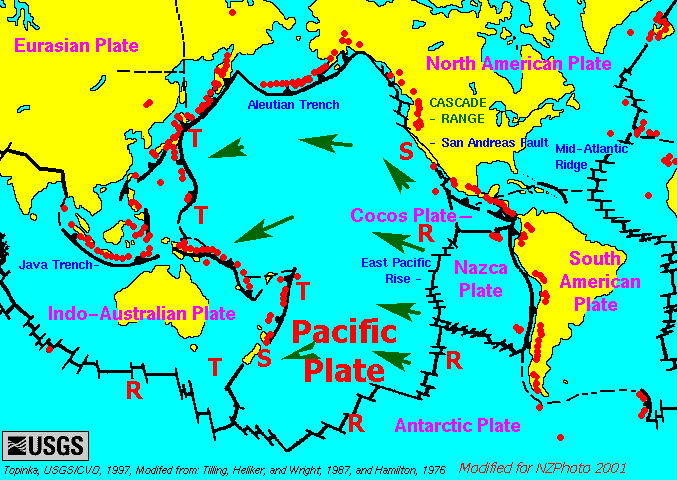 Additional Information
- South American plate- The South American Plate is a major tectonic plate which includes the continent of South America as well as a sizable region of the Atlantic Ocean seabed extending eastward to the African Plate, with which it forms the southern part of the Mid-Atlantic Ridge.
- African plate- The African Plate, also known as the Nubian Plate, is a major tectonic plate that includes much of the continent of Africa and the adjacent oceanic crust to the west and south.
- Eurasian plate - The Eurasian Plate is a tectonic plate that makes up most of the continent of Eurasia, including Europe and northern Asia. It's the third-largest tectonic plate on Earth, covering an area of 67.8 million square kilometers
Mathematics
Q1 · Geometry
In a ΔPQR, the bisectors of∠Q and∠R meet at point O, inside the triangle. If∠QOR = 107º, then the measure of∠P is:
- 40º
- 23º
- 17º
- 34º
Answer aur solution dekho
Archived marked answer: D
Shortcut Trick
Direct property for internal angle bisectors meeting at the incentre O:
∠QOR = 90º + ∠P / 2
107º = 90º + ∠P / 2
∠P / 2 = 107º − 90º = 17º
∠P = 34º
∴ The correct answer is 34º.
Alternate Method
Given:
In ΔPQR, the bisectors of ∠Q and ∠R meet at point O inside the triangle.
∠QOR = 107º
Formula Used:
When the internal bisectors of two base angles of a triangle meet at the incentre, the angle formed is equal to 90º + (opposite angle) / 2.
∠QOR = 90º + ∠P / 2
- - 107º
P = ?
P
Q
R
O
Calculations:
⇒ 107º = 90º + ∠P / 2
⇒ 107º − 90º = ∠P / 2
⇒ 17º = ∠P / 2
⇒ ∠P = 17º × 2
⇒ ∠P = 34º
∴ The correct answer is 34º.
Additional Information
Incentre (Internal Bisectors)
When the internal bisectors of angles B and C of a triangle ABC meet at point I, the angle formed at the incentre is given by: ∠BIC = 90º + ∠A/2.
Excentre (External Bisectors)
When the external bisectors of angles B and C of a triangle ABC meet at point E outside the triangle, the angle formed is: ∠BEC = 90º − ∠A/2.
Circumcentre (Perpendicular Bisectors)
The angle formed at the circumcentre O by the vertices B and C is always double the opposite angle: ∠BOC = 2 × ∠A.
Orthocentre (Altitudes)
The angle formed at the orthocentre H and the opposite angle A are supplementary to each other: ∠BHC = 180º − ∠A.
</p
Q2 · Geometry
Two triangles EFG and HIJ are congruent. If the area of ΔEFG is 124 cm², then the area of ΔHIJ will be
- 124 cm²
- 248 cm²
- 62 cm²
- 31 cm²
Answer aur solution dekho
Archived marked answer: A
Shortcut Trick
Congruent triangles have exactly the same size, shape, and enclosed area.
If ΔEFG ≅ ΔHIJ, then Area of ΔHIJ = Area of ΔEFG.
Since the Area of ΔEFG is given as 124 cm².
Therefore, the Area of ΔHIJ is also 124 cm².
∴ The correct answer is 124 cm².
Alternate Method
Given:
ΔEFG and ΔHIJ are congruent triangles (ΔEFG ≅ ΔHIJ).
Area of ΔEFG = 124 cm²
Concept Used:
When two triangles are congruent, their corresponding sides and angles are perfectly equal, which means they cover the exact same region and possess equal area.
E
F
G
124 cm²
≅
H
I
J
? cm²
Calculations:
⇒ Area of ΔHIJ = Area of ΔEFG
⇒ Area of ΔHIJ = 124 cm²
∴ The correct answer is 124 cm².
Additional Information
Congruence vs Similarity
Congruent triangles have exactly the same area. In contrast, similar triangles only have the same shape, and the ratio of their areas is equal to the square of the ratio of their corresponding sides.
Conditions for Congruence
Two triangles are strictly congruent if they satisfy any of the five standard criteria: SSS (Side-Side-Side), SAS (Side-Angle-Side), ASA (Angle-Side-Angle), AAS (Angle-Angle-Side), or RHS (Right angle-Hypotenuse-Side).
Area of a Triangle
The general formula for the area of a triangle is Area = 1/2 × base × height. Since congruent triangles possess equal corresponding bases and equal corresponding altitudes, their areas are naturally identical.
Q3 · Trigonometry
If sec α + tan αsec α - tan α = 7/4, then find the value of cosec α.
- 1/3
- 1/11
- 11/3
- 3/11
Answer aur solution dekho
Archived marked answer: C
Shortcut Trick
Apply the Componendo and Dividendo rule directly to the given ratio.
⇒ sec α / tan α = (7 + 4) / (7 − 4)
⇒ (1 / cos α) / (sin α / cos α) = 11 / 3
⇒ 1 / sin α = 11 / 3
⇒ cosec α = 11 / 3
∴ The correct answer is 11/3.
Alternate Method
Given:
(sec α + tan α) / (sec α − tan α) = 7/4
Formula Used:
sec α = 1 / cos α
tan α = sin α / cos α
cosec α = 1 / sin α
Calculations:
⇒ (sec α + tan α) / (sec α − tan α) = 7/4
By cross-multiplying the terms:
⇒ 4 × (sec α + tan α) = 7 × (sec α − tan α)
⇒ 4 sec α + 4 tan α = 7 sec α − 7 tan α
Rearranging the terms to group sec α and tan α:
⇒ 4 tan α + 7 tan α = 7 sec α − 4 sec α
⇒ 11 tan α = 3 sec α
Converting sec α and tan α into sin α and cos α:
⇒ 11 × (sin α / cos α) = 3 × (1 / cos α)
⇒ 11 sin α = 3
⇒ sin α = 3 / 11
Since cosec α = 1 / sin α:
⇒ cosec α = 11 / 3
∴ The correct answer is 11/3.
Additional Information
Componendo and Dividendo Rule
If a fraction a/b = c/d, then (a + b) / (a − b) = (c + d) / (c − d). This rule is highly useful for simplifying rational algebraic and trigonometric equations quickly.
Basic Trigonometric Ratios
sec α is the reciprocal of cos α (sec α = 1/cos α), and cosec α is the reciprocal of sin α (cosec α = 1/sin α).
Pythagorean Identities
The three fundamental identities are: sin²α + cos²α = 1, sec²α − tan²α = 1, and cosec²α − cot²α = 1.
</p
Q4 · Trigonometry
If A is an acute angle, which of the following is equal to sinA1 + cosA?
- 1 - cos Asin A
- 1 + cos Asin A
- 1 - sin Acos A
- 1 + sin Acos A
Answer aur solution dekho
Archived marked answer: A
Shortcut Trick
Put A = 60° in the given expression.
⇒ sin 60° ÷ (1 + cos 60°) = (√3/2) ÷ (1 + 1/2) = (√3/2) ÷ (3/2) = 1/√3
Now, check the given options for A = 60°:
⇒ Option 1: (1 − cos 60°) ÷ sin 60° = (1 − 1/2) ÷ (√3/2) = (1/2) ÷ (√3/2) = 1/√3
Option 1 matches the exact value of the given expression.
∴ The correct answer is 1 − cos Asin A.
Alternate Method
Given:
Expression = (sin A) / (1 + cos A)
Formula Used:
sin² A + cos² A = 1 ⇒ 1 − cos² A = sin² A
Calculations:
⇒ Multiply the numerator and denominator by (1 − cos A)
⇒ [sin A × (1 − cos A)] / [(1 + cos A) × (1 − cos A)]
⇒ Using (a + b)(a − b) = a² − b² in the denominator:
⇒ [sin A × (1 − cos A)] / (1 − cos² A)
⇒ [sin A × (1 − cos A)] / sin² A
⇒ (1 − cos A) / sin A
∴ The correct answer is 1 − cos Asin A.
Additional Information
Pythagorean Identities
Fundamental identities relating squared trigonometric functions: sin²θ + cos²θ = 1, 1 + tan²θ = sec²θ, and 1 + cot²θ = cosec²θ.
Double Angle Formulas
Used to express trigonometric functions of double angles: sin 2θ = 2 sinθ cosθ and cos 2θ = cos²θ − sin²θ = 2 cos²θ − 1 = 1 − 2 sin²θ.
Half Angle Formulas
Used to find trigonometric values of half angles: sin(θ/2) = √[(1 − cosθ)/2] and cos(θ/2) = √[(1 + cosθ)/2] for acute angles.
</p
Q5 · Trigonometry
If 7sintheta + 4costheta9sintheta - 2costheta = 5/4, then the value of tan²θ + 5tan²θ - 5 is:
- 2121/769
- -2121/769
- 769/2121
- -769/2121
Answer aur solution dekho
Archived marked answer: B
Shortcut Trick
Divide the given equation by cosθ to quickly find tanθ:
(7tanθ + 4) / (9tanθ − 2) = 5 / 4
Cross-multiplying gives: 28tanθ + 16 = 45tanθ − 10 ⇒ 17tanθ = 26 ⇒ tanθ = 26/17
Substitute tan²θ = (26/17)² = 676/289 in the required expression:
(676/289 + 5) / (676/289 − 5) = (676 + 1445) / (676 − 1445) = 2121 / −769 = −2121/769
∴ The correct answer is −2121/769.
Alternate Method
Given:
(7sinθ + 4cosθ) / (9sinθ − 2cosθ) = 5/4
Dividing numerator and denominator on the LHS by cosθ:
⇒ (7(sinθ/cosθ) + 4(cosθ/cosθ)) / (9(sinθ/cosθ) − 2(cosθ/cosθ)) = 5/4
⇒ (7tanθ + 4) / (9tanθ − 2) = 5/4
Cross-multiplying the equation:
⇒ 4 × (7tanθ + 4) = 5 × (9tanθ − 2)
⇒ 28tanθ + 16 = 45tanθ − 10
⇒ 45tanθ − 28tanθ = 16 + 10
⇒ 17tanθ = 26
⇒ tanθ = 26/17
Now, we need to find the value of (tan²θ + 5) / (tan²θ − 5)
Substitute tanθ = 26/17:
⇒ [(26/17)² + 5] / [(26/17)² − 5]
⇒ (676/289 + 5) / (676/289 − 5)
⇒ [(676 + 5 × 289) / 289] / [(676 − 5 × 289) / 289]
⇒ (676 + 1445) / (676 − 1445)
⇒ 2121 / −769
⇒ −2121/769
∴ The correct answer is −2121/769.
Additional Information
Trigonometric Ratios
tanθ = sinθ / cosθ and cotθ = cosθ / sinθ
Componendo and Dividendo
If a/b = c/d, then a+ba−b = c+dc−d. This property often simplifies ratio-based equations.
Pythagorean Identities
sin²θ + cos²θ = 1, sec²θ − tan²θ = 1, and cosec²θ − cot²θ = 1.
</p
Q6 · Mensuration 2D
What is the perimeter (in cm, rounded off to one decimal place) of the sector of a circle with a radius of 10 cm and of angle 30º? (Use π = 3.14)
- 20.4
- 35.7
- 82.8
- 25.2
Answer aur solution dekho
Archived marked answer: D
Shortcut Trick
Perimeter of a sector = Radius × [θ × (π / 180) + 2]
⇒ Perimeter = 10 × [30 × (3.14 / 180) + 2]
⇒ Perimeter = 10 × [3.14 / 6 + 2]
⇒ Perimeter = 10 × [0.5233 + 2] = 10 × 2.5233
⇒ Perimeter = 25.233 cm ≈ 25.2 cm
∴ The correct answer is 25.2 cm.
Alternate Method
Given:
Radius of the sector (r) = 10 cm
Angle of the sector (θ) = 30°
π = 3.14
Formula Used:
Length of Arc (l) = (θ / 360°) × 2πr
Perimeter of Sector = Length of Arc + 2 × Radius
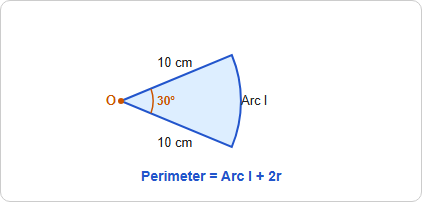 Calculations:
⇒ Length of Arc (l) = (30° / 360°) × 2 × 3.14 × 10
⇒ l = (1 / 12) × 62.8
⇒ l = 5.233 cm
⇒ Perimeter of the sector = l + 2r
⇒ Perimeter = 5.233 + 2 × 10
⇒ Perimeter = 5.233 + 20
⇒ Perimeter = 25.233 cm
⇒ Rounding off to one decimal place, we get 25.2 cm.
∴ The correct answer is 25.2 cm.
Additional Information
Area of a Sector
The area of a sector of a circle is calculated using the formula: Area = (θ / 360°) × πr².
Length of an Arc
The length of the curved arc boundary of a sector can be found using: Arc Length = (θ / 360°) × 2πr.
Area of a Segment
The area of a segment is obtained by subtracting the area of the triangle formed by the radii and the chord from the area of the corresponding sector.
</p
Q7 · Mensuration 2D
Find the area (in cm²) of the sector whose perimeter is 64/3 cm and central angle is 60º. (Use π = 22/7)
- 47/3
- 77/3
- 68/3
- 85/3
Answer aur solution dekho
Archived marked answer: B
Shortcut Trick
Perimeter of a sector = r(2 + πθ/180°)
Given Perimeter = 64/3 cm and central angle θ = 60°.
⇒ r(2 + (22/7) × 60/180) = 64/3 ⇒ r(2 + 22/21) = 64/3 ⇒ r(64/21) = 64/3 ⇒ r = 7 cm.
Area of sector = (θ/360°) × πr² = (60/360) × 22/7 × 7²
Area = 1/6 × 154 = 77/3 cm².
∴ The correct answer is 77/3 cm².
Alternate Method
Given:
Perimeter of the sector = 64/3 cm
Central angle (θ) = 60°
Value of π = 22/7
Formula Used:
Arc length (l) = (θ/360°) × 2πr
Perimeter of sector = 2r + l
Area of sector = (θ/360°) × πr²
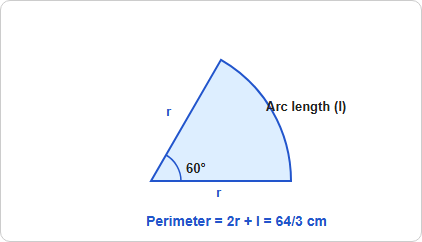 Calculation:
⇒ Arc length (l) = (60/360) × 2 × (22/7) × r
⇒ l = (1/6) × (44/7) × r
⇒ l = 22r/21
⇒ Perimeter = 2r + 22r/21 = (42r + 22r)/21
⇒ Perimeter = 64r/21
Equating the formula with the given value:
⇒ 64r/21 = 64/3
⇒ r/21 = 1/3
⇒ r = 21/3 = 7 cm
Now, substitute the radius to find the area of the sector:
⇒ Area = (60/360) × (22/7) × (7)²
⇒ Area = (1/6) × (22/7) × 49
⇒ Area = (1/6) × 22 × 7
⇒ Area = 154/6
⇒ Area = 77/3 cm²
∴ The correct answer is 77/3 cm².
Additional Information
Area of a Sector
The region enclosed by two radii and the corresponding arc. The formula is A = (θ/360°) × πr² or alternatively A = 1/2 × l × r, where l is the arc length.
Length of an Arc
The continuous portion of the circumference of a circle. The length is determined by the central angle using the formula l = (θ/360°) × 2πr.
Perimeter of a Sector
The total boundary length of the sector, which is the sum of the two radii and the arc length. Formula: Perimeter = 2r + l.
</p
Q8 · Mensuration 2D
If the length, breadth, and height of a cuboid is 8 cm, 4 cm, and 6 cm, respectively, then the volume (in cm³) of the cuboid is:
- 218
- 192
- 96
- 172
Answer aur solution dekho
Archived marked answer: B
Shortcut Trick
The volume of a cuboid is calculated directly by multiplying its three dimensions together.
Volume = Length × Breadth × Height
Volume = 8 × 4 × 6
Volume = 192 cm³
∴ The correct answer is 192 cm³.
Alternate Method
Given:
Length of the cuboid (l) = 8 cm
Breadth of the cuboid (b) = 4 cm
Height of the cuboid (h) = 6 cm
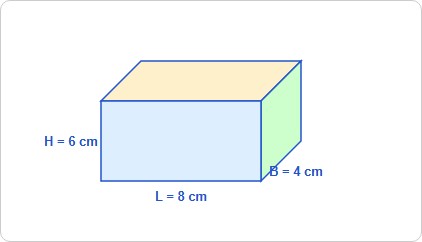 Formula Used:
Volume of Cuboid = l × b × h
Calculations:
⇒ Volume = 8 × 4 × 6
⇒ Volume = 32 × 6
⇒ Volume = 192 cm³
∴ The correct answer is 192 cm³.
Additional Information
Total Surface Area of a Cuboid
The sum of the area of all 6 rectangular faces is calculated using the formula: TSA = 2(lb + bh + hl).
Length of the Longest Diagonal
The maximum length of a rod that can be placed entirely inside a cuboid is determined by its body diagonal: D = √(l² + b² + h²).
Lateral Surface Area
The area of the 4 standing walls (excluding the top ceiling and bottom floor) is calculated as: LSA = 2h(l + b).
Cube Properties
When the length, breadth, and height are exactly equal (l = b = h = a), the solid becomes a cube. For a cube, Volume = a³ and Total Surface Area = 6a².
</p
Q9 · Algebra
Let a + b = 2c, then which of the following expressions is true?
- a² + 2ac = b² + 2bc
- a² - 2bc = b² - 2ac
- a² + 2bc = b² + 2ac
- a² - ac = b² - bc
Answer aur solution dekho
Archived marked answer: C
Shortcut Trick
Let distinct values a = 1 and b = 3. Since a + b = 2c, we get 1 + 3 = 2c ⇒ c = 2.
Substitute a = 1, b = 3, and c = 2 into the given expressions to find the correct one.
Check the expression: a² + 2bc = b² + 2ac
LHS = 1² + 2 × 3 × 2 = 1 + 12 = 13
RHS = 3² + 2 × 1 × 2 = 9 + 4 = 13 (LHS = RHS)
∴ The correct answer is a² + 2bc = b² + 2ac.
Alternate Method
Given:
a + b = 2c
Formula Used:
a² − b² = (a − b)(a + b)
Calculations:
⇒ a + b = 2c
Multiplying both sides by (a − b), we get:
⇒ (a + b)(a − b) = 2c(a − b)
⇒ a² − b² = 2ac − 2bc
Rearranging the terms from both sides:
⇒ a² + 2bc = b² + 2ac
∴ The correct answer is a² + 2bc = b² + 2ac.
Additional Information
Difference of Squares Formula
The identity a² − b² = (a − b)(a + b) is commonly used to simplify algebraic equations by generating symmetrical terms on both sides of the equation.
Value Substitution Trick
For algebraic equations with unknown variables, substituting simple distinct numbers (like 1, 2, 3) into the options often reveals the correct expression rapidly without complex derivations.
Linear Equations & Averages
The relation a + b = 2c can also be interpreted as c being the arithmetic mean (average) of a and b, which mathematically means c = (a + b) ÷ 2.
</p
Q10 · Algebra
If the equations 4x + (k - 2)y + 3 = 0 and (k - 2)x + 9y - 5 = 0 (k > 0) are parallel, then find the value of k² + 6.
- 68
- 70
- 72
- 64
Answer aur solution dekho
Archived marked answer: B
Shortcut Trick
For two lines to be parallel, the ratio of their x and y coefficients must be equal: a₁/a₂ = b₁/b₂.
⇒ 4 / (k − 2) = (k − 2) / 9
⇒ (k − 2)² = 36
⇒ k − 2 = 6 (taking positive root since k > 0)
⇒ k = 8
∴ The correct answer is 70.
Alternate Method
Given:
Equation 1: 4x + (k − 2)y + 3 = 0
Equation 2: (k − 2)x + 9y − 5 = 0
- - x
y
- 4x + (k - 2)y + 3 = 0
- (k - 2)x + 9y - 5 = 0
Parallel: a1/a2 = b1/b2
Formula Used:
For the lines a₁x + b₁y + c₁ = 0 and a₂x + b₂y + c₂ = 0 to be parallel, the required algebraic condition is:
⇒ a₁/a₂ = b₁/b₂ ≠ c₁/c₂
Calculations:
Substitute the given coefficients into the condition:
⇒ 4 / (k − 2) = (k − 2) / 9
Cross-multiply to solve for k:
⇒ (k − 2) × (k − 2) = 4 × 9
⇒ (k − 2)² = 36
Taking the square root on both sides:
⇒ k − 2 = ±6
Because it is given that k > 0, we take the positive value for k − 2:
⇒ k − 2 = 6
⇒ k = 8
Now, substitute the value of k into the target expression k² + 6:
⇒ k² + 6 = 8² + 6
⇒ 64 + 6 = 70
∴ The correct answer is 70.
Additional Information
Condition for Intersecting Lines
Two lines a₁x + b₁y + c₁ = 0 and a₂x + b₂y + c₂ = 0 intersect at a unique point if a₁/a₂ ≠ b₁/b₂.
Condition for Coincident Lines
Two lines are identical (coincident) and have infinitely many solutions if all ratios are equal: a₁/a₂ = b₁/b₂ = c₁/c₂.
Slope of a Line
For a linear equation ax + by + c = 0, the slope (m) is given by −a/b. Parallel lines always possess strictly equal slopes.
</p
Q11 · Algebra
If x, y and z are positive numbers and x + y + z = 1, then the least value of 1/x + 1/y + 1/z is:
- 7
- 5
- 9
- 11
Answer aur solution dekho
Archived marked answer: C
Shortcut Trick
For symmetric minimum value problems, the extreme value occurs when all variables are equal.
Given x + y + z = 1, we set x = y = z.
⇒ 3x = 1 ⇒ x = 1/3, y = 1/3, z = 1/3.
Substitute these values to find the least value:
⇒ 1/x + 1/y + 1/z = 1/(1/3) + 1/(1/3) + 1/(1/3) = 3 + 3 + 3 = 9
∴ The correct answer is 9.
Q12 · Profit and Loss
In a clearance sale, a sari whose marked price was ₹10,490 is now sold for ₹9,441. What is the discount percentage on the sari?
- 10%
- 15%
- 18%
- 12%
Answer aur solution dekho
Archived marked answer: A
Shortcut Trick
Discount = Marked Price − Selling Price
Discount = 10490 − 9441 = 1049
Since 1049 is exactly 1/10th of the Marked Price 10490, the discount is 10%.
∴ The correct answer is 10%.
Alternate Method
Given:
⇒ Marked Price (MP) = ₹10,490
⇒ Selling Price (SP) = ₹9,441
Formula Used:
⇒ Discount = MP − SP
⇒ Discount % = (Discount ÷ MP) × 100
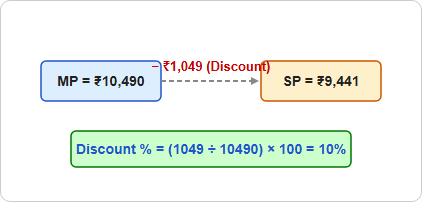 Calculations:
⇒ Discount = 10,490 − 9,441 = 1,049
⇒ Discount % = (1049 ÷ 10490) × 100
⇒ Discount % = (1 ÷ 10) × 100 = 10%
∴ The correct answer is 10%.
Additional Information
Successive Discount
When two consecutive discounts of a% and b% are given, the net equivalent discount is (a + b − ab ÷ 100)%.
Selling Price Formula
Selling Price (SP) = Marked Price × (100 − Discount%) ÷ 100
Markup Percentage
Markup is always calculated over the Cost Price (CP). Markup % = ((MP − CP) ÷ CP) × 100.
ff
Q13 · Profit and Loss
A dishonest shopkeeper claims to sell salt at a rate of ₹25/kg. The cost price of the salt is ₹25/kg. Not satisfied with this, he tries to make profit by removing 200 gm from each kg. What is the shopkeeper's gain percentage?
- 15%
- 25%
- 30%
- 20%
Answer aur solution dekho
Archived marked answer: B
Shortcut Trick
When goods are sold at cost price but false weights are used, the actual price is irrelevant.
Gain % = [Error ÷ (True Weight − Error)] × 100
⇒ True Weight = 1000 gm, Error = 200 gm
⇒ False Weight = 1000 gm − 200 gm = 800 gm
⇒ Gain % = (200 ÷ 800) × 100 = 25%
∴ The correct answer is 25%.
Alternate Method
Given:
Claimed Selling Price (SP) of 1 kg (1000 gm) = ₹25
Actual Cost Price (CP) of 1 kg (1000 gm) = ₹25
Quantity removed from each kg = 200 gm
Formula Used:
Profit % = (Profit ÷ CP) × 100
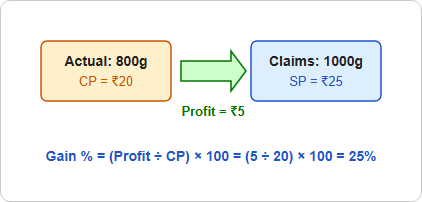 Calculations:
⇒ Actual weight given by shopkeeper = 1000 gm − 200 gm = 800 gm
⇒ Cost of 1000 gm = ₹25
⇒ Actual Cost Price (CP) of 800 gm = (25 ÷ 1000) × 800 = ₹20
⇒ Selling Price (SP) charged to customer for 1 kg = ₹25
⇒ Profit = SP − CP = 25 − 20 = ₹5
⇒ Profit % = (5 ÷ 20) × 100 = 25%
∴ The correct answer is 25%.
Additional Information
Dishonest Dealer Selling at CP
When a dealer claims to sell goods at cost price but uses a false weight, Gain % = (Error ÷ False Weight) × 100.
Dishonest Dealer Selling at Profit/Loss
If goods are sold at a profit of P% but weighed incorrectly, actual Gain % = [((100 + P) × True Weight ÷ False Weight) − 100]%.
Successive Cheating
If a dealer cheats by x% while buying and y% while selling, the overall profit % can be calculated successively as x + y + (xy ÷ 100).
Q14 · Time and Work
A pipe can fill an overhead tank in 12 hours. But due to a leak at the bottom, it is filled in 18 hours. If the tank is full, how much time will the leak take to empty it?
- 3.6 hours
- 63 hours
- 7.2 hours
- 36 hours
Answer aur solution dekho
Archived marked answer: D
Shortcut Trick
Time taken by the leak to empty the tank = (T₁ × T₂) ÷ (T₂ − T₁)
Here, T₁ = 12 hours (without leak) and T₂ = 18 hours (with leak).
Required time = (12 × 18) ÷ (18 − 12)
⇒ 216 ÷ 6 = 36 hours.
∴ The correct answer is 36 hours.
Alternate Method
Given:
Time taken by the pipe to fill the tank = 12 hours
Time taken to fill the tank with the leak = 18 hours
Method Used:
Total Work = LCM of times taken
Efficiency = Total Work ÷ Time
Source
Time (Hours)
Total Work
Efficiency
Pipe
12
36
36 ÷ 12 = 3
Pipe + Leak
18
36 ÷ 18 = 2
Calculations:
⇒ Let the efficiency of the leak be L.
⇒ Efficiency of Pipe + Efficiency of Leak = Overall Efficiency
⇒ 3 + L = 2
⇒ L = 2 − 3 = −1 unit/hour
⇒ The negative sign signifies that the leak empties the tank at 1 unit/hour.
⇒ Time taken by the leak to empty the full tank = Total Work ÷ Emptying Efficiency
⇒ Time = 36 ÷ 1 = 36 hours.
∴ The correct answer is 36 hours.
Additional Information
Pipes & Cisterns - Leakage Concept
If a pipe fills a tank in *x* hours and a leak empties it in *y* hours, the net part filled in 1 hour = (1/*x*) − (1/*y*).
Total Work Strategy
The total capacity of the tank is generally assumed to be the LCM of all individual times given. This helps in avoiding complex fractional calculations.
Positive and Negative Work
Filling pipes do positive work and have a positive (+) efficiency. Emptying pipes or leaks do negative work and have a negative (−) efficiency.
</p
Q15 · Number System
If 7845K854 is divisible by 11, then what is the value of K?
- 6
- 9
- 7
- 8
Answer aur solution dekho
Archived marked answer: B
Shortcut Trick
By the divisibility rule of 11, the difference between the sums of alternating digits must be 0 or a multiple of 11.
Sum of odd-placed digits = 7 + 4 + K + 5 = 16 + K
Sum of even-placed digits = 8 + 5 + 8 + 4 = 25
Equating the difference to 0: 25 − (16 + K) = 0 ⇒ 9 − K = 0 ⇒ K = 9
∴ The correct answer is 9.
Alternate Method
Given:
The number 7845K854 is perfectly divisible by 11.
Formula Used:
A number is divisible by 11 if the difference between the sum of its digits in odd positions and the sum of its digits in even positions is either 0 or a multiple of 11.
Calculations:
⇒ Let's find the sum of the digits at the odd positions (1st, 3rd, 5th, and 7th from left):
⇒ S₁ = 7 + 4 + K + 5 = 16 + K
⇒ Let's find the sum of the digits at the even positions (2nd, 4th, 6th, and 8th from left):
⇒ S₂ = 8 + 5 + 8 + 4 = 25
⇒ Find the difference between the two alternating sums:
⇒ Difference = S₂ − S₁ = 25 − (16 + K) = 9 − K
⇒ For the whole number to be divisible by 11, the difference must be 0, 11, 22, etc.
⇒ Since K is a single-digit positive integer (from 0 to 9), the only possible valid difference is 0:
⇒ 9 − K = 0
⇒ K = 9
∴ The correct answer is 9.
Additional Information
Divisibility Rule of 3 & 9
A number is divisible by 3 or 9 if the sum of all its digits is completely divisible by 3 or 9, respectively.
Divisibility Rule of 4 & 8
A number is divisible by 4 if the last two digits form a number divisible by 4. It is divisible by 8 if the last three digits form a number divisible by 8.
Divisibility Rule of 7, 11 & 13 (Combined Block Trick)
Group the number into blocks of 3 digits moving from right to left. If the alternating difference of these blocks is divisible by 7, 11, or 13, the original number is divisible by the respective divisor.
</p
Q16 · Time and Distance
A thief noticed a policeman at a distance of 600 metres. The thief started running and the policeman chased him. The thief and policeman are running at speeds of 12 km/h and 15 km/h, respectively. Find the time (in minutes) required for the policeman to catch the thief.
- 8
- 10
- 12
- 15
Answer aur solution dekho
Archived marked answer: C
Shortcut Trick
Relative speed (same direction) = 15 − 12 = 3 km/h.
Initial Distance = 600 m = 0.6 km.
Time = Distance ÷ Relative speed = 0.6 ÷ 3 = 0.2 hours.
Time in minutes = 0.2 × 60 = 12 minutes.
∴ The correct answer is 12 minutes.
Alternate Method
Given:
Distance between Policeman and Thief (D) = 600 m = 0.6 km
Speed of Policeman (Sₚ) = 15 km/h
Speed of Thief (Sₜ) = 12 km/h
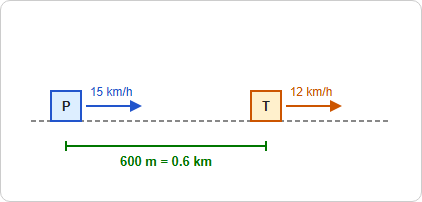 Formula Used:
Relative Speed (when moving in the same direction) = Sₚ − Sₜ
Time = Distance ÷ Relative Speed
Calculations:
⇒ Relative Speed = 15 km/h − 12 km/h = 3 km/h
⇒ Time required to catch the thief = 0.6 km ÷ 3 km/h
⇒ Time = 0.2 hours
⇒ Time in minutes = 0.2 × 60 = 12 minutes
∴ The correct answer is 12 minutes.
Additional Information
Relative Speed (Opposite Direction)
When two objects move towards each other, their relative speed is the sum of their individual speeds: Relative Speed = S₁ + S₂.
Average Speed
Average speed is the total distance traveled divided by the total time taken. For two equal distances covered at speeds x and y, Average Speed = 2xy ÷ (x + y).
Unit Conversion
To convert speed from km/h to m/s, multiply the value by 5/18. To convert m/s to km/h, multiply by 18/5.
</p
Q17 · Data Interpretation
Study the given graph and answer the question that follows.
The graph shows the production of refrigerators by three companies in 2018.
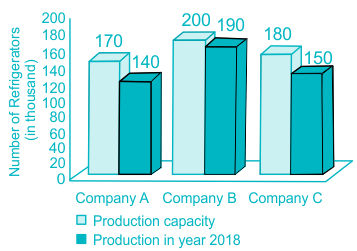 The refrigerators produced by company C form what percentage of the total production?
- 34.35%
- 32.56%
- 30.25%
- 31.25%
Answer aur solution dekho
Archived marked answer: D
Given:
Production by Company A in 2018 = 140 (in thousand)
Production by Company B in 2018 = 190 (in thousand)
Production by Company C in 2018 = 150 (in thousand)
Formula used:
Percentage = (Part / Total) × 100
Calculation:
Total production = 140 + 190 + 150
⇒ Total production = 480 (in thousand)
Percentage of Company C = (150 / 480) × 100
⇒ Percentage of Company C = 0.3125 × 100
⇒ Percentage of Company C = 31.25%
∴ The refrigerators produced by Company C form 31.25% of the total production.
Q18 · Simplification
Simplify 13 - [7- (4 + 7) - {7 - (7 - 4 + 7)} + 14]
- 13
- 9
- 0
- 26
Answer aur solution dekho
Archived marked answer: C
Given:
Expression: 13 - [7 - (4 + 7) - {7 - (7 - 4 + 7)} + 14]
Formula used:
Use the BODMAS rule (Bracket, Order, Division, Multiplication, Addition, Subtraction).
Calculations:
Step 1: Simplify the innermost brackets.
13 - [7 - (4 + 7) - {7 - (7 - 4 + 7)} + 14]
⇒ 13 - [7 - 11 - {7 - 10} + 14]
Step 2: Simplify the curly brackets.
⇒ 13 - [7 - 11 - {7 - 10} + 14]
⇒ 13 - [7 - 11 +3 + 14]
Step 3: Simplify the square brackets.
⇒ 13 - [7 - 11 + 3 + 14]
⇒ 13 - [13]
Step 4: Perform the subtraction.
⇒ 13 - 13 = 0
∴ The value of the expression is 0.
Q19 · Proportion
The mean proportional of 8a² and 18/(a⁴), where a is a positive number, is _____.
- 12/a²
- 12a
- 12a²
- 12/a
Answer aur solution dekho
Archived marked answer: D
Shortcut Trick
The mean proportional between two terms x and y is calculated directly as √(x × y).
Here, the given terms are x = 8a² and y = 18/a⁴.
Mean proportional = √(8a² × 18/a⁴)
Mean proportional = √(144/a²) = 12/a.
∴ The correct answer is 12/a.
Alternate Method
Given:
First number (A) = 8a²
Second number (B) = 18/a⁴
Formula Used:
If M is the mean proportional between A and B, then M² = A × B ⇒ M = √(A × B)
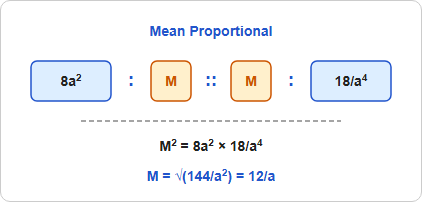 Calculations:
⇒ M² = (8a²) × (18/a⁴)
⇒ M² = (8 × 18) × (a² / a⁴)
⇒ M² = 144 / a²
⇒ M = √(144 / a²)
⇒ M = 12/a
⇒ Since a is given as a positive number, its square root yields a perfectly positive 12/a.
∴ The correct answer is 12/a.
Additional Information
Mean Proportional
The mean proportional between two distinct terms A and B is defined as the geometric mean or the square root of their product. Direct Rule: √(A × B).
Third Proportional
If three numbers A, B, and C strictly exist in continued proportion (such that A:B = B:C), then C acts as the third proportional. Formula derived: C = B² / A.
Fourth Proportional
When four independent terms A, B, C, and D conform to a standard ratio format (A:B = C:D), D evaluates to the fourth proportional. Formula applied: D = (B × C) / A.
</p
Q20 · Percentage
A number is first increased by 12% and then increased by 23%. The number, so obtained, is now decreased by 34%. What is the net increase or decrease percent in the original number (nearest to an integer)?
- 10% increase
- 9% decrease
- 10% decrease
- 9% increase
Answer aur solution dekho
Archived marked answer: B
Shortcut Trick
The net change for two successive percentage changes is: x + y + (x × y) / 100
First two increases (+12% and +23%): Net = 12 + 23 + (12 × 23) / 100 = 35 + 2.76 = +37.76%
Now, combine the new net (+37.76%) with the final decrease (−34%):
Net Change = 37.76 − 34 − (37.76 × 34) / 100 = 3.76 − 12.8384 = −9.0784%
The negative sign indicates an overall decrease, which is approximately 9%.
∴ The correct answer is 9% decrease.
Alternate Method
Given: Initial increase = 12%, Second increase = 23%, Final decrease = 34%
Formula Used:
Final Value = Initial Value × (1 + r₁/100) × (1 + r₂/100) × (1 − r₃/100)
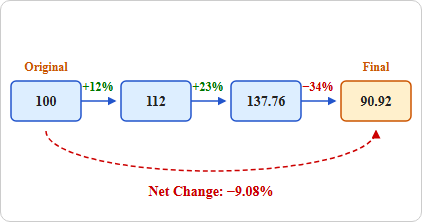 Calculations:
⇒ Let the original number be 100.
⇒ Value after 12% increase = 100 × 1.12 = 112
⇒ Value after 23% increase = 112 × 1.23 = 137.76
⇒ Value after 34% decrease = 137.76 × 0.66 = 90.9216
⇒ Net Change = Final Value − Initial Value
⇒ Net Change = 90.9216 − 100 = −9.0784
⇒ A negative value indicates a decrease in the original number.
⇒ Decrease percentage ≈ 9% (nearest to an integer).
∴ The correct answer is 9% decrease.
Additional Information
Successive Percentage Change Formula
When a quantity undergoes two successive changes of a% and b%, the equivalent overall percentage change is given by (a + b + ab/100)%. Use a positive value for an increase and a negative value for a decrease.
Multiplying Factor Method
For multiple successive percentage variations, using decimal multipliers is highly efficient. An increase of r% uses a multiplying factor of (1 + r/100), while a decrease of r% uses (1 − r/100). The final value is found by multiplying the initial base value by all successive factors.
</p
Q21 · Average
A stock portfolio consists of four stocks. Stock A represents 20% of the portfolio and has a return of 6%. Stock B represents 30% of the portfolio and has a return of 8%. Stock C represents 20% of the portfolio and has a return of 4%. Stock D represents the remaining 30% of the portfolio and has a negative return of 5%. What is the average return of the portfolio?
- 2.9%
- 2.6%
- 3.2%
- 3.4%
Answer aur solution dekho
Archived marked answer: A
Shortcut Trick
Weighted average return = Sum of (Weight × Return) ÷ Total weight
⇒ [(20 × 6) + (30 × 8) + (20 × 4) + (30 × −5)] ÷ 100
⇒ (120 + 240 + 80 − 150) ÷ 100
⇒ 290 ÷ 100 = 2.9%
∴ The correct answer is 2.9%.
Alternate Method
Given:
Weight of Stock A (WA) = 20% = 0.20 , Return (RA) = 6%
Weight of Stock B (WB) = 30% = 0.30 , Return (RB) = 8%
Weight of Stock C (WC) = 20% = 0.20 , Return (RC) = 4%
Weight of Stock D (WD) = 30% = 0.30 , Return (RD) = −5%
Q22 · Simple Interest
Ramesh has ₹18,000. He deposited ₹7,000 in a bank at the rate of 5% per annum and ₹6,000 in other bank at the rate of 6% per annum simple interest. If he received ₹1,160 as simple interest at the end of one year, then the rate of interest per annum on rest of the capital is equal to:
- 10%
- 11%
- 9%
- 8%
Answer aur solution dekho
Archived marked answer: C
Shortcut Trick
Interest from given parts = (5% of 7000) + (6% of 6000) = 350 + 360 = ₹710
Remaining interest for the 3rd part = 1160 − 710 = ₹450
Remaining principal = 18000 − (7000 + 6000) = ₹5000
Required rate = (Remaining interest ÷ Remaining principal) × 100
Required rate = (450 ÷ 5000) × 100 = 9%
∴ The correct answer is 9%.
Alternate Method
Given:
Total Capital = ₹18,000
Capital 1 (P₁) = ₹7,000 at Rate (R₁) = 5% per annum
Capital 2 (P₂) = ₹6,000 at Rate (R₂) = 6% per annum
Total Simple Interest (SI) = ₹1,160 for Time (T) = 1 year
Formula Used:
Simple Interest (SI) = (P × R × T) ÷ 100
Total: ₹18,000
P = ₹7000
R = 5%
I = ₹350
P = ₹6000
R = 6%
I = ₹360
P = ₹5000
R =?
I = ₹450
Total Interest = ₹1160
Calculations:
⇒ Remaining Capital (P₃) = 18000 − (7000 + 6000) = ₹5,000
⇒ Interest on P₁ = (7000 × 5 × 1) ÷ 100 = ₹350
⇒ Interest on P₂ = (6000 × 6 × 1) ÷ 100 = ₹360
⇒ Let the rate of interest on P₃ be R%
⇒ Interest on P₃ = (5000 × R × 1) ÷ 100 = 50R
⇒ Total Interest = 350 + 360 + 50R
⇒ 1160 = 710 + 50R
⇒ 50R = 1160 − 710
⇒ 50R = 450
⇒ R = 450 ÷ 50 = 9%
∴ The correct answer is 9%.
Additional Information
Simple Interest (SI)
It is the interest calculated only on the principal amount for the entire period. Formula: SI = (P × R × T) ÷ 100.
Compound Interest (CI)
It is the interest calculated on both the principal and the accumulated interest. Formula: A = P(1 + R/100)T and CI = A − P.
SI vs CI Difference
For 2 years, Difference = P × (R/100)². For 3 years, Difference = P × (R/100)² × (3 + R/100).
English
Q1 · Vocabulary
Select the most appropriate ANTONYM of the given word.
Miserable
- Melodious
- Settled
- Restrained
- Cheerful
Answer aur solution dekho
Archived marked answer: D
The correct answer is: Option 4.
Key Points
- The word "miserable" means extremely unhappy or uncomfortable.
- Example: She felt miserable after hearing the bad news.
- "Cheerful" refers to being noticeably happy and optimistic.
- Example: His cheerful demeanor lifted everyone's spirits.
- Hence, we can infer that the opposite of 'miserable' is 'cheerful'.
Therefore, the correct answer is: Cheerful.
Additional Information
Here are the other options explained along with their Hindi meanings and example sentences:
- Melodious : Having a pleasant tune or melody.
- Example: She has a melodious voice that captivates the audience.
- Settled : Comfortable and established in a situation.
- Example: They have settled into their new home nicely.
- Restrained: Characterized by reserve or moderation.
- Example: His restrained behavior was noted during the heated discussion.
The correct answer is: Opt
Q2 · Vocabulary
Select the most appropriate homophone to fill in the blank.
He has the _______ to express his thoughts.
- right
- ride
- write
- rite
Answer aur solution dekho
Archived marked answer: A
The correct answer is: Option 1.
Key Points
- The word "right" refers to something that is morally good, justified, or acceptable.
- Example: Everyone has the right to express their opinions freely.
- "right" refers to having the freedom or authority to do something.
- Example: He has the right to express his thoughts.
Therefore, the correct answer is: Option 1.
Additional Information
Here are the other options explained along with their Hindi meanings and example sentences:
- Ride : To sit on and control the movement of an animal, typically a horse, or a vehicle.
- Example: I love to ride my bicycle through the park.
- Write : To mark letters, words, or other symbols on a surface, typically paper, with a pen, pencil, or similar instrument.
- Example: She likes to write stories in her free time.
- Rite : A religious or other solemn ceremony or act.
- Example: The wedding rite was performed with great devotion.
The correct answer is: O
Q3 · Vocabulary
Which of the following idioms means ‘to steal from a shop’?
- Golden opportunity
- Green thumb
- Five-finger discount
- Black sheep
Answer aur solution dekho
Archived marked answer: C
The correct answer is: Option 3.
Key Points
- The idiom "to steal from a shop" means to take something from a store without paying for it.
- Example: He was caught trying to steal from a shop, which is a criminal offense.
- Five-finger discount is a slang term for shoplifting or stealing items from a store.
- Example: She was caught taking a five-finger discount at the local supermarket.
- Hence, we can infer that the idiom 'to steal from a shop' is 'Five-finger discount'.
Therefore, the correct answer is: Five-finger discount.
Additional Information
Here are the other options explained along with their Hindi meanings and example sentences:
- Golden opportunity: A very good chance to achieve something.
- Example: Getting a scholarship to study abroad is a golden opportunity for many students.
- Green thumb: Natural talent for growing plants.
- Example: My grandmother has a green thumb; her garden is always full of beautiful flowers.
- Black sheep: A person who is considered a disgrace to a particular group, usually a family.
- Example: He was considered the black sheep of the family due to his rebellious behavior.
Q4 · Vocabulary
Select the most appropriate meaning of the underlined idiom.
Fatima was at her wits’ end trying to decide on a serene place for spending the holidays in.
- So worried, confused or annoyed that she does not know what to do next
- So worried, confused or annoyed that she became unconscious
- So calm and composed that she knows what to do next
- So worried, confused or annoyed that she insulted others for no reason
Answer aur solution dekho
Archived marked answer: A
The correct answer is: Option 1.
Key Points
- The idiom "at her wits' end" means being so worried, confused, or annoyed that one does not know what to do next.
- Example: She was at her wits' end trying to manage the unruly children.
- Worried refers to feeling anxious or concerned about something.
- Example: He was worried about his upcoming exams.
- Hence, we can infer that the idiom 'at her wits' end' means being in a state of extreme worry or confusion.
Therefore, the correct answer is: Option 1.
Additional Information
Here are the other options explained along with their Hindi meanings and example sentences:
- Option 2: So worried, confused or annoyed that she became unconscious
- Example: She was so stressed that she almost fainted.
- Option 3: So calm and composed that she knows what to do next
- Example: Despite the chaos, she remained calm and composed.
- Option 4: So worried, confused or annoyed that she insulted others for no reason
- Example: His frustration led him to snap at his colleagues.
Q5 · Vocabulary
Select the option that can be used as a one-word substitute for the given group of words.
An order of law requiring people to remain indoors
- Restriction
- Curfew
- Limit
- Check in
Answer aur solution dekho
Archived marked answer: B
The correct answer is: Option 2.
Key Points
- The phrase "An order of law requiring people to remain indoors" refers to a legal restriction that mandates individuals to stay inside their homes during specified hours.
- Example: During the riots, the government imposed a curfew to maintain order.
- "Curfew" is a regulation requiring people to remain indoors between specified hours, typically at night.
- Example: The city declared a curfew starting at 9 PM to prevent any further disturbances.
- Hence, the correct word for "An order of law requiring people to remain indoors" is "Curfew".
Therefore, the correct answer is: Curfew.
Additional Information
Here are the other options explained along with their Hindi meanings and example sentences:
- Restriction: A limiting condition or measure, especially a legal one.
- Example: The government has placed restrictions on large gatherings to prevent the spread of the virus.
- Limit: A point or level beyond which something does not or may not extend or pass.
- Example: There is a limit to how much weight this bridge can hold.
- Check in: The act of reporting one's presence, typically at a hotel or airport.
- Example: We need to check in at the hotel by 3 PM.
Q6 · Vocabulary
Select the option that can be used as a one-word substitute for the underlined group of words.
The question papers are placed in the lockers of the school in a way that they can’t be reached.
- are irrepressible
- are inaccessible
- are affordable
- are affable
Answer aur solution dekho
Archived marked answer: B
The correct answer is: Option 2.
Key Points
- The word "inaccessible" means something that cannot be reached or accessed.
- Example: The remote village was inaccessible due to heavy snowfall.
- "Inaccessible" refers to something that is not approachable or cannot be entered, just like the question papers in the lockers.
- Example: The treasure was buried in an inaccessible cave.
- Hence, we can infer that the word suitable for the given statement is 'inaccessible'.
Therefore, the correct answer is: are inaccessible.
Additional Information
Here are the other options explained along with their Hindi meanings and example sentences:
- Irrepressible: Something that cannot be controlled or restrained.
- Example: Her irrepressible laughter filled the room.
- Affordable: Something that is reasonably priced and within one's budget.
- Example: The new housing project offers affordable homes for low-income families.
- Affable: Someone who is friendly and good-natured.
- Example: He is known for his affable personality and gets along with everyone.
Q7 · Vocabulary
Select the option that can be used as a one-word substitute for the given group of words.
Morbid compulsion to consume alcohol continuously
- Satyromania
- Maniac
- Kleptomania
- Dipsomania
Answer aur solution dekho
Archived marked answer: D
The correct answer is: Option 4.
Key Points
- The term "Morbid compulsion to consume alcohol continuously" refers to an uncontrollable and pathological urge to drink alcohol frequently.
- Example: Despite numerous attempts to quit, his dipsomania led him to relapse repeatedly.
- "Dipsomania" is the medical term for this condition, characterized by an insatiable craving for alcohol.
- Example: The patient was diagnosed with dipsomania and was advised to seek immediate treatment.
Therefore, the correct answer is: Option 4.
Additional Information
Here are the other options explained along with their Hindi meanings and example sentences:
- Satyromania: An excessive, uncontrollable sexual desire in men.
- Example: His satyromania caused numerous problems in his personal relationships.
- Maniac: A person exhibiting extreme symptoms of wild behavior, especially when violent and dangerous.
- Example: The maniac was apprehended by the police after causing chaos in the neighborhood.
- Kleptomania: A recurrent urge to steal, typically without regard for need or profit.
- Example: Her kleptomania led her to shoplift items she didn't even need.
Q8 · Vocabulary
Select the most appropriate option to substitute the underlined segment in the given sentence.
There are many factories in the operative area of the city.
- industrial
- serviceable
- industrious
- mechanical
Answer aur solution dekho
Archived marked answer: A
The correct answer is: Option 1.
Key Points
- The word "operative" means functioning or having effect.
- Example: The machinery is fully operative and ready for use.
- "Industrial" refers to anything related to industry or manufacturing.
- Example: The industrial area of the city is filled with factories and warehouses.
- Hence, we can infer that the correct word for describing an area filled with factories is 'industrial'.
Therefore, the correct answer is: industrial.
Additional Information
Here are the other options explained along with their Hindi meanings and example sentences:
- Serviceable : Capable of being used or of being useful.
- Example: The old car is still serviceable despite its age.
- Industrious : Diligent and hard-working.
- Example: She is known to be an industrious student, always completing her assignments on time.
- Mechanical: Operated by a machine or machinery.
- Example: The factory uses mechanical processes to manufacture goods.
Given:
The
Q9 · Vocabulary
Identify the INCORRECTLY spelt word in the following sentence and select its correct spelling from the given options.
I receieved a parcel in the mail today.
- received
- recieved
- recived
- receaved
Answer aur solution dekho
Archived marked answer: A
The correct answer is: Option 1.
Key Points
- The word "recieved" is incorrectly spelt.
- Example: She mistakenly wrote 'recieved' instead of 'received'.
- "Received" means to be given, presented with, or paid something.
- Example: I received a parcel in the mail today.
Therefore, the correct answer is: Option 1.
Additional Information
Here are the other options explained along with their Hindi meanings and example sentences:
- Recieved: Incorrect spelling of 'received'.
- Example: She wrote 'recieved' by mistake.
- Recived: Incorrect spelling of 'received'.
- Example: The word 'recived' is a misspelling.
- Receaved: Incorrect spelling of 'received'.
- Example: 'Receaved' is not a correct spelling.
The correct answer is: Option 1.
Q10 · Vocabulary
Select the INCORRECTLY spelt word.
- Accommodate
- Mischeivious
- Millennium
- Privilege
Answer aur solution dekho
Archived marked answer: B
The correct answer is: Option 2.
Key Points
- The word "Mischeivious" is incorrectly spelt. The correct spelling is "Mischievous".
- English Meaning: Causing or showing a fondness for causing trouble in a playful way.
- Example: The mischievous child hid his sister's shoes as a prank.
- "Mischievous" refers to causing or showing a fondness for causing trouble in a playful way.
- Example: The mischievous kitten knocked over the vase while playing.
Therefore, the correct answer is: Option 2.
Additional Information
Here are the other options explained along with their Hindi meanings and example sentences:
- Accommodate: The correct spelling is "Accommodate", which means to provide lodging or sufficient space for.
- Example: The hotel can accommodate up to 500 guests.
- Millennium: The correct spelling is "Millennium", which refers to a period of a thousand years.
- Example: The year 2000 was celebrated as the beginning of a new millennium.
- Privilege: A special right, advantage, or immunity granted or available only to a particular person or group.
- Example: It is a privilege to have access to quality education.
The correct answer is
Q11 · Vocabulary
Select the most appropriate meaning of the given word.
Edible
- noisome
- mortal
- noxious
- nutritive
Answer aur solution dekho
Archived marked answer: D
The correct answer is: Option 4.
Key Points
- The word "edible" means something that is fit to be eaten.
- Example: These berries are edible and can be used in a variety of recipes.
- "Nutritive" refers to something that provides nourishment or is nutritious.
- Example: Fruits and vegetables are highly nutritive and essential for a balanced diet.
- Hence, we can infer that something which is edible is often nutritive.
Therefore, the correct answer is: nutritive.
Additional Information
Here are the other options explained along with their Hindi meanings and example sentences:
- Noisome : Something that has an extremely offensive smell or is harmful.
- Example: The noisome stench from the garbage dump was unbearable.
- Mortal : Subject to death; not eternal.
- Example: Every living being on this planet is mortal.
- Noxious: Harmful, poisonous, or very unpleasant.
- Example: The factory was emitting noxious fumes into the atmosphere.
Q12 · Vocabulary
Select the most appropriate synonym of the given word.
Confiscate
- Restock
- Destroy
- Seize
- Titivate
Answer aur solution dekho
Archived marked answer: C
The correct answer is: Option 3.
Key Points
- The word "confiscate" means to take or seize someone's property with authority.
- Example: The police confiscated the illegal drugs found in the suspect's house.
- "Seize" refers to taking hold of something suddenly and forcibly.
- Example: The customs officers seized the contraband at the airport.
- Hence, we can infer that the synonym of 'confiscate' is 'seize'.
Therefore, the correct answer is: Seize.
Additional Information
Here are the other options explained along with their Hindi meanings and example sentences:
- Restock : To refill or replenish supplies.
- Example: We need to restock the pantry with groceries.
- Destroy : To cause something to end or no longer exist.
- Example: The hurricane destroyed many homes along the coast.
- Titivate: To make small enhancing adjustments to something.
- Example: She decided to titivate her appearance before the big event.
The correct answer is &l
Q13 · Vocabulary
Select the most appropriate synonym of the bracketed word in the following sentence to fill in the blank.
The elaborate syllabi had to be ________(summarised) to make a presentation in the UGC assessment meeting.
- expanded
- recapitulated
- prolonged
- lengthened
Answer aur solution dekho
Archived marked answer: B
The correct answer is: Option 2.
Key Points
- The word "summarised" means to give a brief statement of the main points of something.
- Example: She summarised the long report in just a few sentences.
- "Recapitulated" means to restate or briefly repeat the main points of something.
- Example: At the end of the lecture, the professor recapitulated the key concepts.
- Hence, we can infer that the synonym of 'summarised' is 'recapitulated'.
Therefore, the correct answer is: Option 2.
Additional Information
Here are the other options explained along with their Hindi meanings and example sentences:
- Expanded : To increase in size, range, or amount.
- Example: The company expanded its operations to new markets.
- Prolonged : To extend the duration of something.
- Example: The meeting was prolonged due to extensive discussions.
- Lengthened: To make something longer.
- Example: The tailor lengthened the hem of the dress.
The correct answer is: Tight.
Q14 · Vocabulary
Select the most appropriate synonym of the given word.
Taut
- Slack
- Tight
- Torn
- Flaccid
Answer aur solution dekho
Archived marked answer: B
The correct answer is: Tight.
Key Points
- The word "taut" means something that is stretched or pulled tight; not slack.
- Example: The rope was taut, ready to bear the weight of the climber.
- "Tight" refers to something that is firmly or closely fixed in place; not loose or slack.
- Example: She pulled the knot tight to ensure it wouldn't come undone.
- Hence, we can infer that the synonym of 'taut' is 'tight'.
Therefore, the correct answer is: Tight.
Additional Information
Here are the other options explained along with their Hindi meanings and example sentences:
- Slack : Not tight; loose.
- Example: The rope went slack after the load was removed.
- Torn : Damaged by having been pulled apart or ripped.
- Example: He wore a torn shirt to the party, which looked quite out of place.
- Flaccid: Soft and hanging loosely or limply.
- Example: The patient's muscles became flaccid after the surgery.
Q15 · Grammar
Parts of the following sentence have been given as options. Select the option that contains an error.
I are dancing with my husband at my sister’s wedding.
- husband at my
- sister's wedding
- with my
- I are dancing
Answer aur solution dekho
Archived marked answer: D
The correct answer is Option 4.
Key Points
- The primary issue in the sentence is the incorrect use of the verb "are" with the subject "I."
- The correct verb to use with the subject "I" is "am."
- The correct phrase should be "I am dancing," ensuring grammatical correctness and clarity.
- Thus, the error is located in Option 4 of the sentence.
Therefore, the correct answer is Option 4.
Correct Sentence: *"I am dancing with my husband at my sister's wedding."*
Additional Information
- 1: "husband at my" – This part of the sentence is grammatically correct and does not require any changes.
- 2: "sister's wedding" – This part of the sentence is grammatically correct and does not require any changes.
- 3: "with my" – This part of the sentence is grammatically correct and does not require any changes.
Q16 · Grammar
Parts of the following sentence have been given as options. Select the option that contains an error.
The tea at this café is best than at the Costa Café in our office.
- at the Costa Café
- The tea at this café
- is best than
- in our office
Answer aur solution dekho
Archived marked answer: C
The correct answer is Option 3.
Key Points
- The primary issue in the sentence is the use of the comparative adjective "best" instead of the correct comparative form "better".
- Comparative adjectives are used to compare differences between the two objects they modify.
- The correct phrase should be "is better than", ensuring grammatical correctness and clarity.
- Thus, the error is located in option 3 of the sentence.
Therefore, the correct answer is Option 3.
Correct Sentence: *"The tea at this café is better than at the Costa Café in our office."*
Additional Information
- Option 1: "at the Costa Café" – This part of the sentence is grammatically correct and does not require any changes.
- Option 2: "The tea at this café" – This part of the sentence is grammatically correct and does not require any changes.
- Option 4: "in our office" – This part of the sentence is grammatically correct and does not require any changes.
Q17 · Grammar
Select the word segment that can substitute the bracketed word segment correctly and complete the sentence meaningfully.
(Each participant have) performed well.
- Each participant was
- Each participant has
- Each participant have been
- Each participant were
Answer aur solution dekho
Archived marked answer: B
The correct answer is: Option 2.
Key Points
- The phrase "Each participant have" is grammatically incorrect. The correct auxiliary verb should be singular to match the singular noun "participant".
- "Each participant has" means that every individual participant has performed well.
- Example: Each participant has submitted their project on time.
Therefore, the correct answer is: Option 2.
Additional Information
Here are the other options explained along with their Hindi meanings and example sentences:
- Option 1: Each participant was: This phrase is incorrect in the given context as it does not correctly complete the sentence.
- Example: Each participant was eager to win.
- Option 3: Each participant have been: This phrase is grammatically incorrect as "have" does not agree with the singular noun "participant".
- Example: Each participant have been preparing for months. (Incorrect)
- Option 4: Each participant were: This phrase is incorrect because "were" does not agree with the singular noun "participant".
- Example: Each participant were given a certificate. (Incorrect)
Q18 · Voice Change
Select the option that expresses the given sentence in active voice.
He will be made President by the people.
- People will be making him the President.
- The people will make him President.
- By the people, he shall be made the President.
- He will be made President by the people.
Answer aur solution dekho
Archived marked answer: B
The correct answer is Option 2.
Key Points
- Passive voice structure: The object of the active voice sentence becomes the subject of the passive voice sentence.
- In the passive voice, the sentence is: "He will be made President by the people."
- To convert to active voice: Place the subject "the people" at the beginning.
- Change the passive verb form "will be made" to the active verb form "will make."
- Place the object "him" after the verb.
Therefore, the correct answer is Option 2.
Correct Sentence: *"The people will make him President."*
Additional Information
- Option 1: "People will be making him the President." – Incorrect tense; uses future continuous which is not needed for this sentence.
- Option 3: "By the people, he shall be made the President." – Incorrect word order; remains passive.
- Option 4: "He will be made President by the people." – This is the original passive voice sentence.
Q19 · Voice Change
Select the option that expresses the given sentence in active voice.
The painting was admired by art enthusiasts from around the world.
- The painting was being admired by art enthusiasts from around the world.
- Art enthusiasts from around the world admired the painting.
- Art enthusiasts from around the world have admired the painting.
- The painting has been admired by art enthusiasts from around the world.
Answer aur solution dekho
Archived marked answer: B
The correct answer is Option 2.
Key Points
- Passive voice structure: The object of the active voice sentence becomes the subject of the passive voice sentence.
- In the passive voice, the sentence is: "The painting was admired by art enthusiasts from around the world."
- To convert to active voice: Place the subject "art enthusiasts from around the world" at the beginning.
- Change the passive verb form "was admired" to the active verb form "admired."
- Place the object "the painting" after the verb.
Therefore, the correct answer is Option 2.
Correct Sentence: *"Art enthusiasts from around the world admired the painting."*
Additional Information
- Option 1: "The painting was being admired by art enthusiasts from around the world." – Incorrect as it is still in passive voice and uses the past continuous tense.
- Option 3: "Art enthusiasts from around the world have admired the painting." – Incorrect tense; uses present perfect which is not needed for this sentence.
- Option 4: "The painting has been admired by art enthusiasts from around the world." – Incorrect as it is still in passive voice and uses present perfect tense.
Q20 · Para Jumble
Parts of a sentence are given below in jumbled order. Arrange the parts in the correct order to form a meaningful sentence.
P. having the opportunity of observing people's
Q. we respect and appreciate their point of views
R. the advantage of travelling different places and
S. culture, custom and lifestyle, is that
- RQPS
- PSQR
- RPSQ
- SQPR
Answer aur solution dekho
Archived marked answer: C
The correct answer is Option 3.
Key Points
- The sentence logically begins with the subject: "R: the advantage of travelling different places and".
- Following this, "P: having the opportunity of observing people's" continues the thought, specifying what the advantage includes.
- "S: culture, custom and lifestyle, is that" completes the specifics of what can be observed.
- Finally, "Q: we respect and appreciate their point of views" wraps up the sentence by explaining the outcome of these observations.
Therefore, the correct answer is RPSQ.
Additional Information
- Option 1 (RQPS): This option starts with "we respect and appreciate their point of views," which does not start the sentence logically.
- Option 2 (PSQR): This option starts with "having the opportunity of observing people's," which lacks the initial subject.
- Option 4 (SQPR): This option starts with "culture, custom and lifestyle, is that," which does not introduce the advantage of travelling.