95 questions available to read. Bina signup padho; timed practice ke liye free sign in karo.
Archive coverageThis saved paper contains 95 of 100 expected questions. 0 stored records are excluded from this study page while their source or wording is checked. Missing original questions: 5. Local question numbers follow the saved archive; match the wording and choices when comparing another response sheet.
Archived marked answers and available solution notes are preserved. These are not claimed to be fully checked final SSC keys. How questions are checked.
Reasoning
Q1 · Series
Which of the following terms will replace the question mark (?) in the given series?
XLO, VOM, TRK, RUI, ?
- PXH
- SXH
- PXG
- QXG
Answer aur solution dekho
Archived marked answer: C
The logic followed here is:
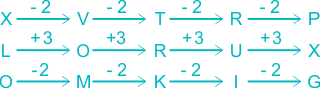 Hence, 'PXG' is the correct answer.
Q2 · Series
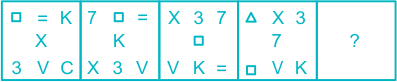
Select the figure that will replace the question mark (?) in the following figure series.


Answer aur solution dekho
Archived marked answer: C
The logic followed in the given figure series is:
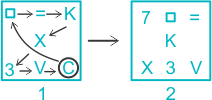
From Figure (1) to (2):
The symbols are moved as shown below and the symbol C changes into 7.
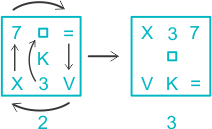
 From Figure (2) to (3):
The symbols are moved as shown below.
 From Figure (3) to (4):
The symbols are moved as shown below and the symbol (=) changes into a triangle.
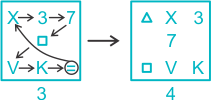 From Figure (4) to Answer Figure (5):
The symbols are moved as shown below.
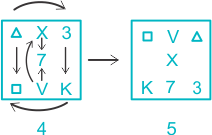 Hence, the correct answer is "Option (3)".
Q3 · Series
Which of the given figures when placed in the 5th position would continue the series that is established by the first four figures?



Answer aur solution dekho
Archived marked answer: B
The logic followed in the given figure series is:
From Figure (1) to (2):
The symbols (+) and (-) interchange their positions and one shape is added to the existing shape.
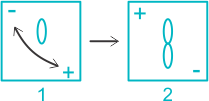 From Figure (2) to (3):
The symbols (+) and (-) interchange their positions and one shape is added to the existing shape.
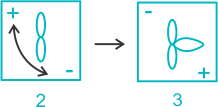 From Figure (3) to (4):
The symbols (+) and (-) interchange their positions and one shape is added to the existing shape.
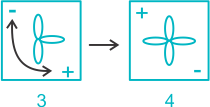 From Figure (4) to Answer Figure (5):
The symbols (+) and (-) interchange their positions and one shape is added to the existing shape.
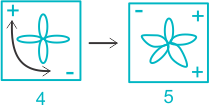 Hence, the correct answer is "Option (2)".
Q4 · Series
Select the option that represents the letters that, when sequentially placed from left to right in the blanks below, will complete the letter series.
YO_LECT_OPL_C_YOP_ _CTYOPLE_T
- PEYTELC
- PYETLEC
- PYECTLE
- PEYTLCE
Answer aur solution dekho
Archived marked answer: B
Given:
YO_LECT_OPL_C_YOP_ _CTYOPLE_T
Checking all the options:
1. PEYTELC
YOPLECT / EOPLYCT / YOPELCT / YOPLECT
2. PYETLEC
YOPLECT / YOPL&
Q5 · Series
Which number should replace the question mark (?) in the following number series?
32, 54, 98, 186, ?, 714
- 452
- 450
- 362
- 354
Answer aur solution dekho
Archived marked answer: C
The logic followed here is:
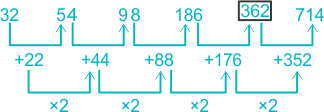 Hence, '362' is the correct answer.
Q6 · Analogy
Select the option that is related to the fifth letter-cluster in the same way as the second letter-cluster is related to the first letter-cluster and the fourth letter-cluster is related to the third letter-cluster.
XPF : DLV :: VAN : FAN :: ERY : ?
- VIC
- WJC
- VJC
- WIC
Answer aur solution dekho
Archived marked answer: B
The logic followed here is:
Q7 · Analogy
Select the option that is related to the fifth letter-cluster in the same way as the second letter-cluster is related to the first letter-cluster and the fourth letter-cluster is related to the third letter-cluster.
GOOD : IMQB :: CARE : EYTC :: SAVE : ?
- QCTG
- UXXC
- UYXC
- UYTG
Answer aur solution dekho
Archived marked answer: C
The logic followed here is:
- 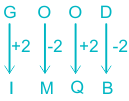 -
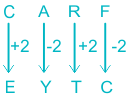 Similarly,
-
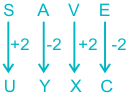 Hence, 'UYXC' is the correct answer.
Q8 · Analogy
Select the option that is related to the fifth letter-cluster in the same way as the second letter-cluster is related to the first letter-cluster and the fourth letter-cluster is related to the third letter-cluster.
PLATE : FVDPU :: SPOON : OQRTX :: KNIFE : ?
- FGJOL
- EFINK
- GHKPM
- FHLRP
Answer aur solution dekho
Archived marked answer: D
The logic followed here is:
- 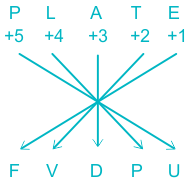 -
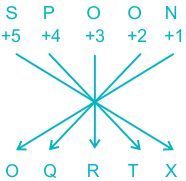 Similarly,
-
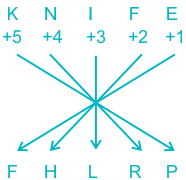 Hence, 'FHLRP' is the correct answer.
Q9 · Analogy
Select the set in which the numbers are related in the same way as are the numbers of the following sets.
(NOTE: Operations should be performed on the whole numbers, without breaking down the numbers into its constituent digits. E.g., 13 - Operations on 13 such as adding/subtracting/multiplying etc. to 13 can be performed. Breaking down 13 into 1 and 3 and then performing mathematical operations on 1 and 3 is NOT allowed)
(34, 12, 10)
(56, 17, 22)
- (56, 19, 8)
- (46, 19, 8)
- (46, 19, 18)
- (46, 49, 8)
Answer aur solution dekho
Archived marked answer: B
Given:
(34, 12, 10)
(56, 17, 22)
Logic: First no. = [(Second no. × 2) + Third no.]
(34, 12, 10) →
⇒ [(12 × 2) + 10]
⇒ (24 + 10) = 34
(56, 17, 22) →
⇒ [(17 × 2) + 22]
⇒ (34 + 22) = 56
Checking all the given options:
1. (56, 19, 8)
⇒ [(19 × 2) + 8]
⇒ (38 + 8) = 46
2. (46, 19, 8)
⇒ [(19 × 2) + 8]
⇒ (38 + 8) = 46
3. (46, 19, 18)
⇒ [(19 × 2) + 18]
⇒ (38 + 18) = 56
4. (46, 49, 8)
⇒ [(49 × 2) + 8]
⇒ (98 + 8) = 106
Here, (46, 19, 8) shows a similar relation to the given set of numbers.
Hence, the correct answer is "Option (2)".
Q10 · Analogy
Select the set in which the numbers are related in the same way as are the numbers of the following sets.
(NOTE: Operations should be performed on the whole numbers, without breaking down the numbers into its constituent digits. E.g. 13 - Operations on 13 such as adding /Subtracting/multiplying etc. to 13 can be performed. Breaking down 13 into 1 and 3 and then performing mathematical operations on 1 and 3 is not allowed)
(36, 24, 65)
(40, 54, 19)
- (10, 21, 321)
- (20, 18, 16)
- (13, 8, 98)
- (30, 14, 56)
Answer aur solution dekho
Archived marked answer: B
Given:
(36, 24, 65)
(40, 54, 19)
Logic: Third no. = [(First no. ÷ 4)² - (Second no. ÷ 6)²]
(36, 24, 65) →
⇒ [(36 ÷ 4)2 - (24 ÷ 6)2]
⇒ [(9)² - (4)²]
⇒ (81 - 16) = 65
(40, 54, 19) →
⇒ [(40 ÷ 4)2 - (54 ÷ 6)2]
⇒ [(10)2 - (9)2]
⇒ (100 - 81) = 19
Checking all the given options:
1. (10, 21, 321)
⇒ [(10 ÷ 4)2 - (21 ÷ 6)2]
⇒ [(2.5)2 - (3.5)2]
⇒ (6.25 - 12.25) = (-6)
2. (20, 18, 16)
⇒ [(20 ÷ 4)2 - (18 ÷ 6)2]
⇒ [(5)2 - (3)2]
⇒ (25 - 9) = 16
3. (13, 8, 98)
⇒ [(13 ÷ 4)2 - (8 ÷ 6)2]
⇒ [(3.25)2 - (1.33)2]
⇒ (10.56 - 1.77) = 8.78
4. (30, 14, 56)
⇒ [(30 ÷ 4)2 - (14 ÷ 6)2]
⇒ [(7.5)2 - (2.33)2]
⇒ (56.25 - 5.44) = 50.81
Here, (20, 18, 16) shows a similar relation to the given set of numbers.
Hence, the correct answer is "Option (2)".
Q11 · Analogy
Select the set in which the numbers are related in the same way as are the numbers of the given sets.
(NOTE: Operations should be performed on the whole numbers, without breaking down the numbers into its constituent digits. E.g. 13 Operations on 13 such as adding /subtracting /multiplying etc. to 13 can be performed. Breaking down 13 into 1 and 3 and then performing mathematical operations on 1 and 3 is NOT allowed)
(4, 1024, 64)
(225, 81, 135)
- (30, 676, 78)
- (27, 125, 15)
- (49, 841, 203)
- (64, 256, 512)
Answer aur solution dekho
Archived marked answer: C
Given:
(4, 1024, 64)
(225, 81, 135)
Logic: [ (a)², (b)², (a × b)]
(4, 1024, 64) →
⇒ [(2)², (32)², (32 × 2)]
⇒ [(4), (1024), (64)]
(225, 81, 135) →
⇒ [(15)2, (9)2, (15 × 9)]
⇒ [(225), (81), (135)]
Checking all the given options:
1. (30, 676, 78)
⇒ [(5 × 6), (26)², (26 × 3)]
2. (27, 125, 15)
⇒ [(3)³, (5)³, (3 × 5)]
⇒ [ (27), (125), (15)]
3. (49, 841, 203)
⇒ [(7)2, (29)2, (7 × 29)]
⇒ [(49), (841), (203)]
4. (64, 256, 512)
⇒ [(8)2, (16)2, (8 × 16)]
⇒ [(64), (256), (128)]
Here, (49, 841, 203) shows a similar relation to the given set of numbers.
Hence, the correct answer is "Option (3)".
Q12 · Analogy
Select the set in which the numbers are related in the same way as are the numbers of the following set.
(189, 148, 107)
(206, 165, 124)
(NOTE: Operations should be performed on the whole numbers, without breaking down the numbers into its constituent digits. E.g. 13 - Operations on 13 such as adding /subtracting /multiplying etc. to 13 can be performed. Breaking down 13 into 1 and 3 and then performing mathematical operations on 1 and 3 is NOT allowed)
- (84, 67, 39)
- (121, 85, 45)
- (76, 46, 26)
- (108, 67, 26)
Answer aur solution dekho
Archived marked answer: D
Given:
(189, 148, 107)
(206, 165, 124)
Logic: [(First no. - Second no.) = (Second no. - Third no.)]
(189, 148, 107) →
⇒ [(189 - 148) = (148 - 107)]
⇒ [41 = 41]
(206, 165, 124) →
⇒ [(206 - 165) = (165 - 124)]
⇒ [41 = 41]
Checking all the given options:
1. (84, 67, 39)
⇒ [(84 - 67) = (67 - 39)]
⇒ [17 = 28]
2. (121, 85, 45)
⇒ [(121 - 85) = (85 - 45)]
⇒ [36 = 40]
3. (76, 46, 26)
⇒ [(76 - 46) = (46 - 26)]
⇒ [30 = 20]
4. (108, 67, 26)
⇒ [(108 - 67) = (67 - 26)]
⇒ [41 = 41]
Here, (108, 67, 26) shows a similar relation to the given set of numbers.
Hence, the correct answer is "Option (4)".
Q13 · Non Verbal Reasoning
Six letters M, N, O, P, Q and R are written on different faces of a dice. Two positions of this dice are shown in the figure. Find the letter on the face opposite to a vowel.

- M
- N
- P
- R
Answer aur solution dekho
Archived marked answer: D
As Q is the common face on both the dice, keeping it constant and then rotating in clockwise direction, we get the faces opposite to each other:
Q
R
M
Q
O
N
Clearly, R is the letter on the face opposite to the vowel O.
Hence, 'R' is the correct answer. Q14 · Non Verbal Reasoning
Select the option figure which is embedded in the given figure (rotation is NOT allowed).


Answer aur solution dekho
Archived marked answer: C
The image embedded in given figure is as shown below:
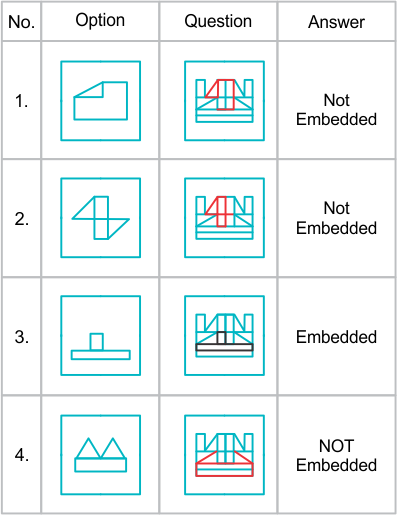 Hence, 'option 3' is the correct answer.
Q15 · Non Verbal Reasoning
Select the correct mirror image of the given figure when the mirror is placed at AB.



Answer aur solution dekho
Archived marked answer: D
The correct mirror image of the given figure when the mirror is placed at AB is shown below:
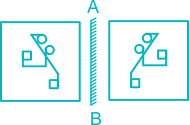 Hence, 'option 4' is the correct answer.
Q16 · Non Verbal Reasoning
A paper is folded and cut as shown below. How will it appear when unfolded?



Answer aur solution dekho
Archived marked answer: C
The paper when unfolded will appear as shown below:
 Hence, 'option 3' is the correct answer.
Q17 · Puzzle Subtypes Not To Miss
Select the correct combination of mathematical signs to sequentially replace the * signs and to balance the given equation.
25 * 82 * 12 * 6 * 8 * 91
- -, ×, +, ÷, =
- ÷, +, -, ×, =
- +, -, ÷, ×, =
- ×, +, ÷, -, =
Answer aur solution dekho
Archived marked answer: C
Here, we use the BODMAS table given below:
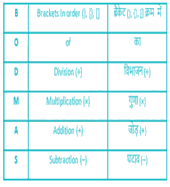 Given:
⇒ 25 * 82 * 12 * 6 * 8 * 91
(1) -, ×, +, ÷, =
⇒ 25 * 82 * 12 * 6 * 8 * 91
After putting the signs:
⇒ 25 - 82 × 12 + 6 ÷ 8 = 91
Apply BODMAS rule:
⇒ 25 - 82 × 12 + 0.75
⇒ 25 - 984 + 0.75
⇒ 25.75 - 984 = (-958.25)
Here, the equation is not satisfied.
(2
Q18 · Puzzle Subtypes Not To Miss
Select the correct combination of mathematical signs to sequentially fill in the diamond-shapes and to balance the given equation.

- ÷, ×, +, =, -
- ÷, ×, =, +, -
- ÷, ×, -, =, +
- +, =, ÷, ×, +
Answer aur solution dekho
Archived marked answer: A
Here, we use the BODMAS table given below:
Given:
⇒
(1) ÷, ×, +, =, -
After Putting the signs:
⇒ 42 ÷ 7 × 5 + 5 = 40 - 5
Apply BODMAS rule:
⇒ 6 × 5 + 5 = 40 - 5
⇒ 30 + 5 = 35</p Q19 · Coding Decoding
In a certain code language, "FABRIC" is written as "GZCQJB" and " BITTER" is written as "CHUSFQ". How will "ANIMAL" be written in that language?
- CNJMCL
- CMIMBJ
- ANINCL
- BMJLBK
Answer aur solution dekho
Archived marked answer: D
The logic followed here is:
- 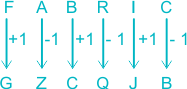 - &l
Q20 · Coding Decoding
In a certain code language,
'travel for fun' is coded as 'dv pa vi';
'fun will begin' is coded as 'cr dv em'
and 'will travel today' is coded as 'vi cr hz'.
(All the codes are two-letter codes only.)
How will 'for today' be coded in that language?
- dv hz
- hz pa
- pa em
- cr dv
Answer aur solution dekho
Archived marked answer: B
Mistake Points: In Chinese Coding- Decoding questions the codes for the given words don't need to be placed sequentially, they may be given in jumbled form also.
So, in these types of questions check the options whether they are in jumbled form or sequence. If the options are jumbled then it is also correct.
The code for each word is shown below:
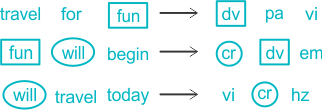 Code for words are:
- for - pa
- today - hz
Clearly, 'for today' will be coded as 'hz pa' in that language.
Hence, 'hz pa' is the correct answer.
Q21 · Classification Odd One Out
The second number in the given number pairs is obtained by performing certain mathematical operation(s) on the first number. The same operation(s) are followed in all the number pairs, EXCEPT one. Find that odd number pair.
- (2, 24)
- (4, 320)
- (5, 430)
- (3, 108)
Answer aur solution dekho
Archived marked answer: C
Logic: Second no. = [(First no.)³ × (First no. + 1)]
Checking all the given options:
1. (2, 24)
⇒ [(2)³ × (2 + 1)]
⇒ (8 × 3) = 24
2. (4, 320)
⇒ [(4)3 × (4 + 1)]
⇒ (64 × 5) = 32
Q22 · Logical Reasoning
Select the Venn diagram that best represents the relationship between the following classes.
Woman, Humans, Lions


Answer aur solution dekho
Archived marked answer: D
The Venn diagram that best represents the relationship between Woman, Humans, Lions is shown below:
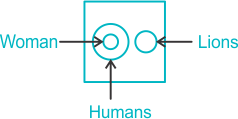 All women are human.
Lion is an animal.
Hence, 'option 4' is the correct answer.
Q23 · Logical Reasoning
Select the Venn diagram that best illustrates the relationship between the following classes.
Laptops, Electronics, Microwave ovens




Answer aur solution dekho
Archived marked answer: D
The Venn diagram that best illustrates the relationship between Laptops, Electronics, Microwave ovens is shown below:
Both Laptop and Microwave ovens are electronic device.
Hence, 'option 4' is the correct answer. Q24 · Blood Relations
Looking at the family picture, Amit said, "He is my wife's father's son's only sister's father-in-law.' How is the person in the photo related to Amit?
- Father-in-law
- Wife's brother
- Father
- Son
Answer aur solution dekho
Archived marked answer: C
By using the symbols in the table given below, we can draw the following family tree:
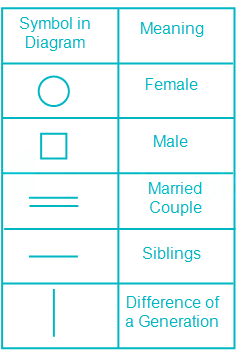
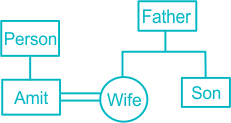 He is my wife's father's son's only sister's is Amit's wife itself.
And father-in-law of Amit's wife is Father of Amit.
Clearly, the person in the photo is father of Amit.
Hence, 'Father' is the correct answer.
Q25 · Alphabet Test
Select the option that represents the correct order of the given words as they would appear in an English dictionary.
1. Deficient
2. Derived
3. Designed
4. Destined
5. Destination
- 1,2,3,5,4
- 1,2,4,3,5
- 1,2,5,3,4
- 1,3,2,5,4
Answer aur solution dekho
Archived marked answer: A
The option that represents the correct order of the given words as they would appear in an English dictionary is:
1. Deficient
2. Derived
3. Designed
5. Destination
4. Destined
Here, the correct order is '1,2,3,5,4'.
Hence, the correct answer is "Option (1)".
General Awareness
Q1 · Art and Culture
U Srinivas is a famous player of which of the following instruments?
- Mandolin
- Violin
- Sitar
- Guitar
Answer aur solution dekho
Archived marked answer: A
The correct answer is Mandolin.
Key Points
- U Srinivas is a famous player of Mandolin, a stringed musical instrument that belongs to the lute family.
- He is known for his unique style of playing the Mandolin, which is a blend of Indian classical music and Western music.
- U Srinivas has won several awards for his contribution to music, including the Padma Shri and the Sangeet Natak Akademi Award.
- He has collaborated with many renowned musicians from around the world, such as John McLaughlin, Michael Brook, and Zakir Hussain.
Additional Information
- Violin is a bowed stringed musical instrument that is widely used in classical music.
- It has a similar shape to the Mandolin, but it has four strings instead of eight.
- Sitar is a plucked stringed musical instrument that is commonly used in Indian classical music.
- It has a long neck and a gourd-shaped body.
- Guitar is a plucked stringed musical instrument that is used in various genres of music, such as rock, pop, and folk.
- It has six strings and a flat body.
Q2 · Art and Culture
Nati is a folk dance from which of the following states of India?
- Nagaland
- Kerala
- Andhra Pradesh
- Himachal Pradesh
Answer aur solution dekho
Archived marked answer: D
The correct answer is Himachal Pradesh.
Key Points
- Nati is a folk dance from the state of Himachal Pradesh in India.
- It is a traditional dance form that is performed during various festivals and celebrations in the state.
- The dance is performed in a circle
Q3 · Art and Culture
The Sirpur National Dance and Music Festival is organised every year in which Indian state?
- Jharkhand
- Chhattisgarh
- Uttar Pradesh
- Madhya Pradesh
Answer aur solution dekho
Archived marked answer: B
The correct answer is Chhattisgarh.
Key Points
- The Sirpur National Dance and Music Festival is an annual cultural event held in the town of Sirpur in Chhattisgarh.
- The festival celebrates the rich cultural heritage of India and showcases various traditional dance and music forms.
- It is organized by the Chhattisgarh Tourism Board and attracts artists and performers from all over the country.
- The festival also includes workshops, seminars, and exhibitions on various art forms.
Additional Information
- Jharkhand has a rich cultural heritage and is known for its tribal art and music.
- Famous festivals are Sarhul, Karam, Jawa, Tusu Parab or Makar, Hal Punhya, and Bhagta Parab.
- Uttar Pradesh is known for its classical music and dance forms such as Kathak and Hindustani classical music.
- Famous festivals are Buddha Purnima, Ganga Dussehra, Makar Sankranti, Ayudha Pooja, and Janmashtami.
- Madhya Pradesh is known for its folk music and dance forms such as Gond and Bhil.
- Famous festivals are Lokrang Festival, Akhil Bhartiya Kalidas Samaroh, Khajuraho Festival, Bhagoria Haat Festival and Holi.
Q4 · Indian Polity and Constitution
Who was the Chairman of the Fifteenth Finance Commission of India?
- Vijay Kelkar
- NK Singh
- YV Reddy
- AK Chanda
Answer aur solution dekho
Archived marked answer: B
The correct answer is NK Singh.
Key Points
- NK Singh was appointed as the Chairman of the Fifteenth Finance Commission of India in November 2017.
- The Fifteenth Finance Commission of India was constituted in November 2017.
- Its main task was to recommend the sharing of taxes between the central government and the state governments for a five-year period starting from April 2020.
Additional Information
- Vijay Kelkar was the Chairman of the Thirteenth Finance Commission of India.
- He is a renowned economist and policy advisor who has also served as the Finance Secretary of India.
- YV Reddy was the Chairman of the Fourteenth Finance Commission of India.
- He is a former Governor of the Reserve Bank of India and is known for his contributions to the Indian financial sector.
Q5 · Indian Polity and Constitution
Which of the following pairs is correctly matched?
- Article 15 - Right against exploitation
- Article 17 - Abolition of titles
- Article 19 - Protection of certain rights regarding freedom of speech
- Article 14 - Abolition of untouchability
Answer aur solution dekho
Archived marked answer: C
The correct answer is Article 19 - Protection of certain rights regarding freedom of speech.
Key Points
- Article 19 of the Indian Constitution guarantees the right to freedom of speech and expression to all citizens.&
Q6 · Indian Economy
____ expenditure and ____ receipts are shown by the government budget.
- Estimated; actual
- Actual; estimated
- Actual; actual
- Estimated; estimated
Answer aur solution dekho
Archived marked answer: D
The correct answer is Estimated; estimated.
Key Points
- The government budget shows estimated expenditures and estimated receipts.
- Estimated expenditure and actual receipts would mean that the government has budgeted a certain amount of spending but has actually received a different amount of revenue.
- Actual expenditure and estimated receipts would mean that the government has spent a certain amount but expects to receive a different amount of revenue.
- Actual expenditure and actual receipts would mean that the government has spent a certain amount and has received the exact amount of revenue that was expected.
- It is important for the government to accurately estimate its expenditures and receipts in order to create a realistic budget and avoid overspending or underspending.
Additional Information
- Expenditure refers to the amount of money spent by the government on various expenses such as salaries, infrastructure development, subsidies, etc.
- Receipts refer to the amount of money collected by the government through various sources such as taxes, fines, fees, etc.
- Estimated; actual would indicate that the government's revenue collection strategy may be flawed or inefficient.
- Actual; estimates would indicate that the government's expenditure planning may be flawed or inefficient.
- Actual; actual would indicate that the government's budget planning and execution is accurate.
Q7 · Indian Economy
Which of the Five-Year Plans was prepared and launched by DP Dhar?
- Sixth Five-Year Plan
- Seventh Five-Year Plan
- Fourth Five-Year Plan
- Fifth Five-Year Plan
Answer aur solution dekho
Archived marked answer: D
The correct answer is the Fifth Five-Year Plan.
Key Points
- DP Dhar prepared and launched the Fifth Five-Year Plan.
- The Fifth Five-Year Plan was launched in 1974 and continued till 1979.
- The main objective of the Fifth Five-Year Plan was to achieve self-sufficiency in food grains, increase agricultural productivity, and promote employment opportunities.
- The Fifth Five-Year Plan also focused on the development of small-scale industries, rural electrification, and the establishment of agricultural universities.
- DP Dhar was an Indian economist and politician who served as the Deputy Chairman of the Planning Commission of India from 1970 to 1977.
Additional Information
- The Fourth Five-Year Plan was launched in 1969.
- The Fourth Five-Year Plan focused on the development of agriculture, industry, and infrastructure.
- It aimed to achieve a growth rate of 5.7%.
- The Sixth Five-Year Plan was launched in 1980.
- The Sixth Five-Year Plan aimed to achieve a growth rate of 5.2% and focused on the development of infrastructure, industry, and energy.
- The Seventh Five-Year Plan was launched in 1985.
- The Seventh Five-Year Plan aimed to achieve a growth rate of 5% and focused on poverty alleviation, employment generation, and human resource development.
Q8 · Indian Economy
Which sector has the highest percentage share of goods exports in the annual GDP (at current prices) for the year 2020-21?
- Electronic Goods
- Drugs and Pharmaceuticals
- Organic and Inorganic Chemicals
- Engineering Goods
Answer aur solution dekho
Archived marked answer: D
The correct answer is Engineering Goods.
Key Points
- According to the data provided, the sector that has the highest percentage share of goods exports in the annual GDP (at current prices) for the year 2020-21 is Engineering Goods.
- Engineering Goods include various products such as machinery, electrical equipment, vehicles, and parts thereof.
- These goods are in high demand globally and are exported to various countries.
- The percentage share of Engineering Goods in the annual GDP (at current prices) for the year 2020-21 could be higher due to the impact of the COVID-19 pandemic on other sectors.
Additional Information
- Electronic Goods, Drugs and Pharmaceuticals, and Organic and Inorganic Chemicals are also major export sectors in India.
- The services sector accounted for about half of India's GDP in 2022, indicating a gradual but consistent growth over the previous ten years.
- Of India's 179.15 lakh crore Indian rupees, or 53.89% of the total, are accounted for by the services sector.
- At Rs. 46.44 lakh crore in GVA, the industry sector makes up 25.92% of the total.
- However, 20.19% goes to the agricultural and related sectors.
Q9 · Sports Static GK
The length of the pitch in cricket is ______
- 20 yards
- 24 yards
- 22 yards
- 18 yards
Answer aur solution dekho
Archived marked answer: C
The correct answer is 22 yards.
Key Points
- The correct length of the pitch in cricket is 22 yards or 20.12 meters.
- This measurement is taken from the bowling crease to the batting crease.
- The length of the pitch has remained the same since the 19th century.
- The size of the pitch is important in cricket as it affects the gameplay and scoring opportunities.
Additional Information
- The pitch is a rectangular area of the ground that is 22 yards long and 10 feet wide.
- The pitch is made up of different areas including the batting crease, bowling crease, and the popping crease.
- Two teams of eleven players compete in the bat-and-ball game of cricket on a field in the middle of the pitch.
- Either team has a wicket at either end, which is made up of two bails balanced on three stumps.
- While the bowling and fielding side tries to stop this and dismiss every batter, the batting side earns runs by hitting the ball bowled at one of the wickets with the bat and then sprinting between the wickets.
Q10 · Sports Static GK
Which of the following lines is NOT related to kabaddi?
- Baulk line
- Attack line
- Bonus line
- End line
Answer aur solution dekho
Archived marked answer: B
.The correct answer is Attack line
- The attack line is not a designated line or marking on the kabaddi court.
Key Points
- Baulk line: The baulk line is at a distance of 3.75m from the midline.
- Attack line: The attack line is an imaginary line that is approximately 3 meters away from the baulk line, on the opponent's side of the court.
- When a raider crosses the attack line, they enter the bonus area and can earn extra points by touching or tagging opponents.
- Bonus line: The bonus line is a small semicircular area located at the end of the opponent's half of the court.
- When a raider enters the bonus area, they can earn extra points by touching or tagging opponents.
- End line: The end line is a line drawn across the width of the court, marking the end of the playing area.
- Players cannot cross the end line during the game.
Therefore, the attack line is not a physical line on the court, unlike the other options. It is a conceptual line that is used to define the bonus area and determine when a raider has entered or exited that area.
Q11 · Indian Geography
What is the percentage share of agricultural workers in India as per Census 2011?
- 54.6%
- 64.6%
- 44.6%
- 55.6%
Answer aur solution dekho
Archived marked answer: A
The correct answer is 54.6%.
Key Points
- The percentage share of agricultural workers in India as per Census 2011 is 54.6%.
- This means that out of the total workforce in India, only 54.6% were engaged in agricultural activities as per the 2011 Census.
- This is a significant drop from the previous Census in 2001, which recorded 60% of the total workforce as agricultural workers.
- The decline in the percentage share of agricultural workers in India can be attributed to various factors such as industrialization, urbanization, and the shift towards the service sector.
Additional Information
- Agricultural workers form a significant portion of the workforce in India, and the sector contributes to around 17% of India's GDP.
- The decline in the percentage share of agricultural workers in India has led to concerns about the sustainability of the agricultural sector and the livelihoods of farmers.
- Agriculture accounted for 43.96 percent of India's workforce in 2021.
- The remaining half was split nearly evenly between the two other sectors, industries and services.
- Even if the percentage of Indian workers in agriculture is decreasing, it remains the primary industry for employment.
Q12 · Indian Geography
Which of the following rivers is INCORRECTLY matched with its respective place of origin?
- Mahanadi - Sihawa Mountain
- Sutlej - Dal Lake
- Ganga - Gangotri glacier
- Godavari - Trimbakeshwar
Answer aur solution dekho
Archived marked answer: B
The correct answer is Sutlej - Dal Lake.
Key Points
- Sutlej River is incorrectly matched with its respective place of origin, which is mentioned as Dal Lake.
- Sutlej river actually originates from the Rakshastal in Tibet.
- Mahanadi River is correctly matched with its respective place of origin, which is mentioned as Sihawa Mountain.
- Ganga River is correctly matched with its respective place of origin, which is mentioned as Gangotri Glacier.
- Godavari River's. The Godavari River originates in the Western Ghats, near Trimbakeshwar in the Nashik district of Maharashtra.
- Godavari River actually originates from the Brahmagiri Mountain in Maharashtra.
Additional Information
- The key word mentioned in the question is "place of origin", which refers to the exact location where a river originates.
- Mahanadi River originates from the Chhattisgarh region and flows through Odisha, before draining into the Bay of Bengal.
- Sutlej river flows through India and Pakistan, before joining the Chenab river in Pakistan and eventually draining into the Arabian Sea.
- Godavari River is the second longest river in India, after the Ganga, and flows through the states of Maharashtra, Telangana, Andhra Pradesh, and Odisha, before draining into the Bay of Bengal.
Q13 · Indian Geography
The principal ______ reserves are in Neyveli in Tamil Nadu.
- bauxite
- iron ore
- copper
- lignite
Answer aur solution dekho
Archived marked answer: D
The correct answer is lignite.
Key Points
- Neyveli in Tamil Nadu is known for its lignite mines, which are the largest in the country.
- Lignite is a type of coal that is considered to be of lower quality than other types of coal such as bituminous or anthracite coal.
- Lignite is mainly used for power generation and is found in abundance in the Neyveli region.
Additional Information
- The world's largest metal statue of Lord Shiva, the first of its sort in Asia, is located in Neyveli.
- The Nataraja Temple is home to this statue of the Lord, known by the name Panchaloha, which means "created with five metals."
- Bauxite is a type of rock that is the primary source of aluminum.
- India's top producer of bauxite is Odisha.
- Iron ore is a mineral used in the production of steel.
- The five biggest iron ore mines are Joda East Mine, Balda Block Iron Mine, Jajang Rungta Mine, Bailadila Iron Ore Mines (Kirandul Complex), and Bailadila Iron Ore Mines (Bacheli Complex).
- Copper is a metal that is used in various applications such as electrical wiring and plumbing.
- The Khetri copper belt in Rajasthan, the Singhbhum copper belt in Jharkhand, and the Malanjkhand copper belt in Madhya Pradesh are the three main copper mining regions.
Q14 · Modern Indian History
Where was the first All-India Kisan Sabha formed?
- Lucknow
- Lahore
- Amritsar
- Delhi
Answer aur solution dekho
Archived marked answer: A
The correct answer is Lucknow.
Key Points
- The first All-India Kisan Sabha was formed in Lucknow in 1936.
- It was formed under the leadership of N.G. Ranga and Swami Sahajanand Saraswati.
- The main objective of the Sabha was to unite farmers and agricultural workers against the oppressive policies of the British government.
- The Sabha played an important role in the Indian independence movement and continued to work for the welfare of farmers even after India gained independence.
- The All India Kisan Sabha is now known as the All India Kisan Sabha (AIKS) and is one of the largest organizations representing farmers in India.
Additional Information
- Lahore was the venue for the 1940 session of the All India Muslim League, where the historic Pakistan Resolution was passed.
- Amritsar is famous for the Jallianwala Bagh massacre.
- It took place on 13 April 1919, when British Indian Army soldiers under the command of Colonel Reginald Dyer fired rifles into a crowd of unarmed Indian civilians who were protesting peacefully against the British rule.
- Delhi is the capital city of India and has played a significant role in the country's history and politics.
- It was the site of many important events during the Indian independence movement, including the Quit India Movement launched by Mahatma Gandhi in 1942.
Q15 · Current Affairs
The ______ National Voters' Day was celebrated across the country on 25th January 2023, with President of India Droupadi Murmu gracing the national level event held at New Delhi.
- 13th
- 12th
- 10th
- 11th
Answer aur solution dekho
Archived marked answer: A
The correct answer is 13th.
Key Points
- The 13th National Voters' Day was celebrated on 25th January 2023.
- National Voters' Day is celebrated to encourage more people to participate in the electoral process and create awareness about the importance of voting.
- President of India Droupadi Murmu graced the national-level event held at New Delhi to mark the occasion.
- The theme for the 13th National Voters' Day was "Nothing Like Voting, I Vote for Sure".
Additional Information
- The 12th National Voters' Day was celebrated on 25th January 2022.
- The theme is "Making Elections Inclusive, Accessible and Participative".
- The 10th National Voters' Day was celebrated on 25th January 2020.
- The theme is "Electoral Literacy for Stronger Democracy".
- The 11th National Voters' Day was celebrated on 25th January 2021.
- The theme is "Making Our Voters Empowered, Vigilant, Safe, and Informed".
Q16 · Current Affairs
In 2021, which State Government was in the news for planning to set up a Vedic Education and Sanskar Board to revive the knowledge of Sanskrit scriptures and Vedas?
- Punjab
- Meghalaya
- Kerala
- Rajasthan
Answer aur solution dekho
Archived marked answer: D
The correct answer is Rajasthan.
Key Points
- In February 2021, the Rajasthan government announced its plan to set up a Vedic Education and Sanskar Board to revive the knowledge of Sanskrit scriptures and Vedas.
- The board aims to promote and preserve ancient Indian knowledge and culture.
- The board will work towards providing education on ancient Indian scriptures, including Vedas, Puranas, and Upanishads.
- The board will also provide training for priests and ensure the quality of Vedic education in the state.
Additional Information
- Minister of State (MoS) for Sanskrit Education Subhash Garg stated that modules will be put before the board based on the report of a committee that was constituted to describe the goals, objectives, and operation of the board.
- The committee submitted its report to the state government.
- He said that the Chief Minister Ashok Gehlot's approval will be required for the Vedic board to begin operations.
Q17 · General Science Biology
Identify the animal that does NOT have bilateral symmetry.
- Annelida
- Molluscs
- Arthropoda
- Cnidarian
Answer aur solution dekho
Archived marked answer: D
The correct answer is Cnidarian.
Key Points
- Cnidarians are the only animal group that lacks bilateral symmetry.
- They are radially symmetrical, meaning their body parts are arranged around a central axis like the spokes of a wheel.
- The absence of bilateral symmetry in cnidarians is due to their simple body plan
Q18 · General Science Biology
Which of the following pairs is INCORRECTLY matched?
- Cushing's syndrome - Cortisol
- Diabetes - Insulin
- Goitre - Thyroxin
- Acromegaly - Adrenaline
Answer aur solution dekho
Archived marked answer: D
The correct answer is Acromegaly - Adrenaline.
Key Points
- Acromegaly is a hormonal disorder that results in the excessive production of growth hormone, which is produced by the pituitary gland.
- Adrenaline is not associated with acromegaly.
- Instead, it is a hormone that is produced by the adrenal glands and is involved in the body's "fight or flight" response.
- Cushing's syndrome is a condition that is caused by the overproduction of cortisol, a steroid hormone that is produced by the adrenal glands.
- Diabetes is a condition that is characterized by high levels of glucose (sugar) in the blood.
- It is caused by a lack of insulin, a hormone that is produced by the pancreas.
- Thyroxin, which is associated with goitre, is involved in regulating metabolism and growth.
- It helps to regulate the body's energy production and influences the development of the brain, bones, and muscles.
Additional Information
- Cortisol, which is associated with Cushing's syndrome, is involved in regulating a variety of bodily functions, including metabolism, immune response, and stress response.
- Insulin, which is associated with diabetes, regulates the levels of glucose (sugar) in the blood.
- It allows cells to use glucose for energy and helps to store excess glucose in the liver and muscles.
- Goitre is a condition that is characterized by an enlarged thyroid gland.
- It is often caused by a deficiency of iodine, which is necessary for the production of thyroid hormones.
Q19 · General Science Chemistry
What is the name of a metallic radioactive transuranic element with atomic number 101 in the actinide series, discovered in 1955?
- Seaborgium
- Nobelium
- Mendelevium
- Rutherfordium
Answer aur solution dekho
Archived marked answer: C
The correct answer is Mendelevium.
Key Points
- The metallic radioactive transuranic element with atomic number 101 in the actinide series is called Mendelevium.
- It was discovered in 1955 by a team of American scientists led by Albert Ghiorso.
- Mendelevium is named after the Russian chemist Dmitri Mendeleev, who is known for creating the periodic table of elements.
- It is a synthetic element, which means that it is not found naturally on Earth and can only be produced in a laboratory.
Additional Information
- Seaborgium is a synthetic element with atomic number 106.
- It is named after the American chemist Glenn T. Seaborg.
- Nobelium is a synthetic element with atomic number 102.
- It is named after Alfred Nobel, the inventor of dynamite.
- Rutherfordium is a synthetic element with atomic number 104.
- It is named after the British physicist Ernest Rutherford.
Q20 · Awards Static
Noted dancer Birju Maharaj bagged the Filmfare award for best Choreographer for which film in 2016?
- Befikre
- Dangal
- Mohenjo Daro
- Bajirao Mastani
Answer aur solution dekho
Archived marked answer: D
The correct answer is Bajirao Mastani.
Key Points
- Birju Maharaj won the Filmfare award for best Choreographer for the film "Bajirao Mastani" in 2016.
- "Bajirao Mastani" is a period drama film directed by Sanjay Leela Bhansali and features Ranveer S
Q21 · Medieval Indian History
Who introduced the system of Dagh and Huliyah and cash payment to soldiers in the Delhi sultanate?
- Alauddin Khalji
- Firuz Shah Tughluq
- Jalaluddin Khalji
- Ghiyasuddin Tughluq
Answer aur solution dekho
Archived marked answer: A
The correct answer is Alauddin Khalji.
Key Points
- Alauddin Khalji introduced the system of Dagh and Huliyah, which was a branding system for horses and soldiers, respectively.
- This helped in maintaining a strong army.
- He also introduced the system of cash payment to soldiers, which was a departure from the earlier practice of granting land as payment.
- This helped in boosting the morale of the soldiers and ensuring their loyalty.
- Alauddin Khalji was a powerful ruler of the Delhi Sultanate who ruled from 1296 to 1316.
- He was known for his military conquests and administrative reforms.
Additional Information
- Firuz Shah Tughluq was another ruler of the Delhi Sultanate who ruled from 1351 to 1388.
- He was known for his patronage of art and architecture, and for his construction of public works such as canals and hospitals.
- Jalaluddin Khalji was the first ruler of the Khalji dynasty who ruled from 1290 to 1296.
- He was known for his military campaigns and for his attempts to establish a stable administration.
- Ghiyasuddin Tughluq was the founder of the Tughluq dynasty who ruled from 1320 to 1325.
- He was known for his administrative reforms and for his attempts to centralize power in the Delhi Sultanate.
Q22 · Medieval Indian History
Who founded the independent State of Bengal?
- Alivardi khan
- Murshid Quli Khan
- Sarafraz Khan
- Shuja-ud-Din
Answer aur solution dekho
Archived marked answer: B
The correct answer is Murshid Quli Khan.
Key Points
- The founder of the Independent State of Bengal was Murshid Quli Khan, who served as the governor of Bengal under the Mughal Empire from 1717 to 1727.
- He managed to consolidate his power in the region and established an independent state with its capital at Murshidabad.
- Murshid Quli Khan was known for his administrative and economic reforms, which included introducing a new revenue system and promoting trade and commerce.
- His successors, including Alivardi Khan and Siraj-ud-Daulah, continued to rule the independent State of Bengal until it was annexed by the British East India Company in the mid-18th century.
Additional Information
- Alivardi Khan was the Nawab of Bengal from 1740 to 1756.
- He was known for his military campaigns against the Marathas and the British.
- Sarafraz Khan was a governor of Bengal under the Mughal Empire in the early 18th century.
- Sarfaraz Khan was Murshid Khan's nominee to succeed him as there was no direct successor.
- Shuja-ud-Din was a governor of Bengal under the Mughal Empire in the mid-18th century.
- He was deposed by the British before he could establish an independent state.
Q23 · Ancient Indian History
In which of the following Vedas was Dasarajna war (the war of ten kings) mentioned?
- Yajurveda
- Samaveda
- Rigveda
- Atharvaveda
Answer aur solution dekho
Archived marked answer: C
The correct answer is Rigveda.
Key Points
- Dasarajna war (the war of ten kings) was mentioned in the Rigveda.
- This war was fought between the Puru and Bharata tribes and was one of the earliest recorded conflicts in ancient India.
- The Rigveda describes the battle in detail, including the names of the ten kings and the strategies they used.
- The outcome of the war was in favor of the Bharata tribe, and their leader Sudas emerged victorious.
Additional Information
- The Rigveda is the oldest and most important of the four Vedas in ancient Indian literature.
- It offers a wealth of information about the beginnings of the world, the significance of the Gods, and practical tips for leading a happy and prosperous life.
- The Yajurveda contains hymns and rituals related to sacrificial ceremonies.
- This text offers details about the Aryan people's social and religious lives.
- The Samaveda focuses on melodies and chants used in religious ceremonies.
- The Samaveda is divided into two sections: Part I consists of songs named Gana and Part II consists of a book of three poems called Archika.
- The Atharvaveda contains spells and incantations for various purposes, including healing and protection.
- The twenty Kandas that make up the Atharva Veda are further divided into thirty-six Prapathakas.
7b
Q24 · Government Schemes and Welfare Static Semi Static
Which state government launched 'Kaushalya Matritva Yojana' in March 2022?
- Madhya Pradesh
- Chhattisgarh
- Haryana
- Uttar Pradesh
Answer aur solution dekho
Archived marked answer: B
The correct answer is Chhattisgarh.
Key Points
- The Kaushalya Matritva Yojana was launched by the Chhattisgarh government in March 2022.
- The scheme aims to provide skill training to pregnant and lactating women in order to enhance their employability and income.
- The scheme also provides financial assistance to women during their pregnancy and childbirth.
- The scheme will benefit about 50,000 women in the state.
Additional Information
- The state government of Madhya Pradesh launched the 'Mukhya Mantri Kisan Kalyan Yojana' in March 2022.
- The scheme aims to provide financial assistance to farmers for crop loss due to natural calamities.
- The Haryana government launched the 'Parivar Pehchan Patra' scheme in February 2022.
- The scheme aims to provide a unique identity to each family in the state and enable them to avail of various government schemes and services.
- The Uttar Pradesh government launched the 'Kisan Mitra Yojana' in February 2022.
- The scheme aims to provide financial assistance to farmers for the purchase of agricultural machinery and equipment.
Q25 · General Science Physics
Who found an empirical relationship between the half-life of alpha decay and the energy of the emitted alpha particles in 1911?
- Chadwick and Lawrence
- Fermi and Meitner
- Geiger and Nuttall
- Soddy and Aston
Answer aur solution dekho
Archived marked answer: C
The correct answer is Geiger and Nuttall.
Key Points
- Geiger and Nuttall found the empirical relationship between the half-life of alpha decay and the energy of the emitted alpha particles in 1911.
- This relationship is known as the Geiger-Nuttall law, which states that the logarithm of the half-life of an alpha decay is proportional to the reciprocal of the square root of the energy of the alpha particle.
- Chadwick and Lawrence discovered the neutron in 1932, which was a significant breakthrough in nuclear physics.
- Fermi and Meitner were instrumental in the discovery of nuclear fission in 1938.
- Soddy and Aston made important contributions to the development of the theory of isotopes.
Additional Information
- Chadwick and Lawrence's discovery of the neutron was crucial for understanding the structure of the atomic nucleus and paved the way for the development of nuclear weapons.
- A subatomic particle with a neutral charge and a mass somewhat larger than a proton is called a neutron.
- Fermi and Meitner's discovery of nuclear fission was a major breakthrough that led to the development of nuclear energy and nuclear weapons.
- Nuclear fission is the process by which an atom's nucleus breaks into lighter nuclei via a .nuclear reaction
- Soddy and Aston's work on isotopes helped to establish the concept of atomic number and laid the foundation for modern nuclear physics.
- Isotopes are atoms that have the same number of protons but differ in the number of neutrons.
Mathematics
Q1 · Geometry
Which of the following statements is FALSE?
- Two triangles are congruent if the size and shape of the triangles may or may not be equal.
- SAS and SSS are both conditions of congruency of triangles.
- If two angles and the included side of one triangle is equal to two angles and the included side of other triangle, then the triangles are congruent.
- If two triangles are congruent, then one of them can be superimposed on the other triangle.
Answer aur solution dekho
Archived marked answer: A
Explanation:
Two triangles are congruent if the size and shape of the triangles may or may not be equal.
This option is incorrect because if two triangles are congruent the size and shape of the triangles will be equal.
Option 1 is incorrect .
Q2 · Geometry
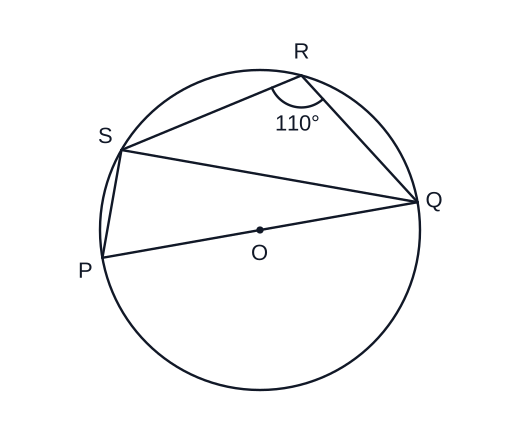
In the given figure, PQ is a chord passing through the centre 'O' of the circle. Calculate ∠PQS.
- 40°
- 60°
- 20°
- 80°
Answer aur solution dekho
Archived marked answer: C
Concept used:
The sum of the opposite angles of the cyclic quadrilateral is 180°.
∠PSQ = 90° because the angle is in a semi-circle.
Calculation:
∠SPQ = 180° - 110° = 70° (The sum of the opposite angles of the cyclic quadrilateral is 180°)
Now, In triangle PQS.
∠PSQ = 90° (Angle in semi-circle)
∠PQS = 180° - ( ∠PSQ +∠QPS)
⇒ 180° - (90° + 70°) = 20°
∴ The correct option is 3
Q3 · Trigonometry
If 8 cot A = 7, find sin A.
- 7/15
- 8/(√(113))
- 7/8
- 8/7
Answer aur solution dekho
Archived marked answer: B
Calculation:
8 cot A = 7
CotA = 7/8
Cot A = B/P = 7/8
Base = 7 and Perpendicular = 8
Sin A = P/H
H = √(72 + 82)
Sin A = 8 /√(7² + 8²)
⇒ 8/√113
∴ The correct option is 2
Q4 · Trigonometry
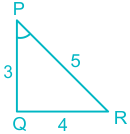
PQR is a triangle right angled at Q and PQ ∶ QR = 3 ∶ 4. What is the value of sin P + sin Q + sin R?
- 4/5
- 3/5
- 12/5
- 2/5
Answer aur solution dekho
Archived marked answer: C
 Calculation:
As per the question,
sin P + sin Q + sin R = QR/PR + 1 + PQ/PR
The sine of a 90-degree angle is always 1, because for a right angle, the opposite side and the hypotenuse are equal.
= 4/5 + 1 + 3/5
= 12/5
Q5 · Trigonometry
Simplify 1+sint4-4sint-1-sint4+4sint
- 4tan t . sin t
- tan t . sec t
- tan t - sin t
- tan t + sin t
Answer aur solution dekho
Archived marked answer: B
Calculation:
We have
1+sint4-4sint-1-sint4+4sint
By putting the value t = 30° we get,
(1 + 1/2)over4-4× 1/2 - (1 - 1/2)over4+4× 1/2
3/4 - 1/12 = 2/3
⇒ 1+sint4-4sint-1-sint4+4sint = 2/3 &
Q6 · Mensuration 2D
An arc on a circle, whose length is 19.25 cm, subtends an 18° angle at the centre. What is the area of the circle? [Usе π = 22/7]
- 11796.625 cm²
- 11786.625 cm²
- 11780.625 cm²
- 11790.625 cm²
Answer aur solution dekho
Archived marked answer: D
Given:
An arc on a circle, whose length is 19.25 cm, subtends an 18° angle at the centre
Concept used:
Arc Length = θ × r, Where
r = Radius, θ is in radian
Calculation:
18° = π/10 rad
So,
r = (19.25 × 10)/π
r = 192.5/π
Area of the circle is
⇒ π × (192.5 /π) × (192.5 /π)
⇒ 11790.625 cm2
∴ The correct option is 4
Q7 · Mensuration 2D
If the inner radius of a hemispherical bowl is 5 cm and its thickness is 0.25 cm, then find the volume of the material required in making the bowl. (use π = 22/7) (Rounded up to two places of decimals).
- 34 cm³
- 44 cm³
- 45.34 cm³
- 41.28 cm³
Answer aur solution dekho
Archived marked answer: D
Given:
If the inner radius of a hemispherical bowl is 5 cm and its thickness is 0.25 cm, then find the volume of the material required in making the bowl.
Concept used:
Volume fo hemisphere = 2/3 π(R³ - r³)
Calculation:
The volume will be,
2/3 π(R3 - r3)
⇒ 2/3 × 22/7 (5.253 - 53)
⇒ 44/21 × (144.7 - 125)
⇒ 44/21 × 19.7
⇒ 866.8 / 21
⇒ 41.276 ≈ 41.28 cm3
∴ The correct option is 4
Q8 · Algebra
If (a - b) = 1, then what is the value of (a³ - b³)?
- a² + ab + b²
- (a + b)² + 3ab
- a² - ab + b²
- a² + 2ab + b²
Answer aur solution dekho
Archived marked answer: A
Given:
(a - b) = 1
Formula used:
a3 - b3 = (a - b)(a2 + b2 + ab)
Calculation:
We know,
a3 - b3 = (a - b)(a2 + b2 + ab)
Putting the value of (a - b) = 1 in the formula
⇒ a3 - b3 = (1)(a2 + b2 + ab)
⇒ a3 - b3 = (a2 + b2 + ab)
∴ The correct answer is option (1).
Q9 · Algebra
What is the value of 64x³ + 36x²y + 24xy² + 2y³, when x = 3 and y = -4?
- 304
- 1456
- 1584
- 432
Answer aur solution dekho
Archived marked answer: B
Formula used:
(A + B)3 = A3 + 3A2B + 3 AB2 + B3
Calculation:
64x3 + 36x2y + 24xy2 + 2y3
⇒ 64x³ + 48 x²y + 12xy² + y³ - 12x²y + 12xy² + y³
⇒(4x + y)3 + y3 - 12xy(x - y)
⇒ (4 × 3 - 4)³ + (-4)³ - 12(3)(-4)[3 - (-4)]
⇒ 512 - 64 + 1008 = 1456
∴ The correct option is 2
Q10 · Algebra
If (x² + 1/x²) = 18, and x > 0, what is the value of (x³ + 1/x³)?
- 36√5
- 40√5
- 46√5
- 34√5
Answer aur solution dekho
Archived marked answer: D
Calculation:
x² + 1 / x² = 18
(X + 1 / X)² = 18 +2
= 20
x+1/x = 2√5
(x
Q11 · Profit and Loss
A shopkeeper bought 20 chairs for ₹18,000. On selling them he had a gain equal to the selling price of four chairs. What is the selling price of each chair?
- ₹1,125
- ₹1,200
- ₹1,250
- ₹1,175
Answer aur solution dekho
Archived marked answer: A
Given:
A shopkeeper bought 20 chairs for ₹18,000
On selling them he had a gain equal to the selling price of four chairs
Calculation:
Profit = (S.P. of 20 chairs) − (C.P. of 20 chairs)
⇒ S.P. of 4 chairs = S.P. of 20 chairs − C.P. of 20 chairs
⇒ S.P. of 16 chairs = C.P. of 20 chairs
⇒ S.P. of 16 chairs = 18000
⇒ S.P. of 1 chair = Rs. 18000/16
⇒ Rs 1125
∴ The selling price of each chair is Rs. 1125.
12
Q12 · Profit and Loss
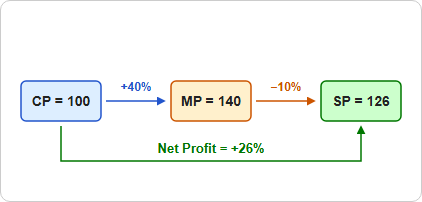
Ramlal marks up his goods by 40% and gives a discount of 10%. What is his net profit percentage?
- 24%
- 26%
- 28%
- 32%
Answer aur solution dekho
Archived marked answer: B
Shortcut Trick
For successive percentage changes, use the net effect formula: Net % = a + b + (a × b) ÷ 100
Here, Markup (a) = +40% and Discount (b) = −10%
Net Profit % = 40 − 10 + [40 × (−10)] ÷ 100
Net Profit % = 30 − 4 = 26%
∴ The correct answer is 26%.
Alternate Method
Given:
Markup Percentage = 40%
Discount Percentage = 10%
Formula Used:
SP = MP × (100 − Discount%) ÷ 100
Profit % = [(SP − CP) ÷ CP] × 100
 Calculations:
Let the Cost Price (CP) of the goods be 100.
⇒ Marked Price (MP) = 100 + (40% of 100) = 140
⇒ Discount given = 10% on MP = (10 ÷ 100) × 140 = 14
⇒ Selling Price (SP) = MP − Discount
⇒ SP = 140 − 14 = 126
⇒ Profit = SP − CP = 126 − 100 = 26
⇒ Net Profit Percentage = (Profit ÷ CP) × 100
⇒ Net Profit Percentage = (26 ÷ 100) × 100 = 26%
∴ The correct answer is 26%.
Additional Information
Marked Price vs Cost Price
Marked Price (MP) is always calculated by applying the markup percentage on the Cost Price (CP). Formula: MP = CP × (100 + Markup%) ÷ 100.
Successive Percentage Change
When a value undergoes two successive percentage changes of a% and b%, the net effective change is given by the formula: a + b + (a × b) ÷ 100.
Discount Calculation
Discount is always applied on the Marked Price (MP), never on the Cost Price. Formula: SP = MP × (100 − Discount%) ÷ 100.
Direct CP to MP Ratio
The direct relationship between Cost Price and Marked Price is given by the ratio: CP ÷ MP = (100 − Discount%) ÷ (100 + Profit%).
</p
Q13 · Profit and Loss
A shop provides flat 50% discount on one shirt, while another shop provides two successive discounts of 30% and 30%. If the difference in the bill is ₹43, then find the cost of the shirt.
- ₹3,580
- ₹3,850
- ₹3,260
- ₹4,300
Answer aur solution dekho
Archived marked answer: D
Shortcut Trick
Effective discount of successive 30% and 30% = 30 + 30 − (30 × 30) / 100 = 51%.
Difference in effective discounts = 51% − 50% = 1%.
The difference in the bill amount is directly equal to the 1% difference in discount.
1% of Cost = ₹43 ⇒ 100% of Cost = ₹43 × 100 = ₹4,300.
∴ The correct answer is ₹4,300.
Alternate Method
Given:
First shop offers a flat discount = 50%
Second shop offers successive discounts = 30% and 30%
Difference in the final bill amount = ₹43
Formula Used:
Effective discount for two successive discounts a% and b% = (a + b − ab / 100)%
Cost = 100%
Flat 50% Off
Bill 1 = 50%
30% and 30% Off
Bill 2 = 49%
Diff = 1%
1% = ₹43 → 100% = ₹4300
Calculations:
⇒ Let the cost (marked price) of the shirt be ₹x.
⇒ Bill amount from the first shop (after 50% off) = x − 0.50x = 0.50x
⇒ Effective discount by the second shop = 30 + 30 − (30 × 30) / 100 = 60 − 9 = 51%
⇒ Bill amount from the second shop = x − 0.51x = 0.49x
⇒ Difference in the bills = 0.50x − 0.49x = 0.01x
⇒ We are given that the difference is ₹43.
⇒ 0.01x = 43
⇒ x = 43 / 0.01 = 4300
∴ The correct answer is ₹4,300.
Additional Information
Successive Discount Formula
When two discounts of a% and b% are given successively, the equivalent single discount is derived directly using the formula (a + b − ab/100)%.
Marked Price and Selling Price
Selling Price (Bill Amount) = Marked Price − Discount. The absolute difference between the two bill amounts equates strictly to the difference in the applied discount percentages calculated on the Marked Price.
Three Successive Discounts
For three successive discounts a%, b% and c%, apply the formula first to find the equivalent of a% and b%, say d%. Then apply the formula again for d% and c% to find the final effective percentage.
Q14 · Time and Work
A is 40% more efficient than B. How much time will they take to work together to complete a job, which A alone could have done in 31 days?
- 217/12 days
- 515/32 days
- 215/12 days
- 517/32 days
Answer aur solution dekho
Archived marked answer: A
Calculation:
The efficiency ratio of A : B = 7 : 5
Total work will be 31 × 7 = 217 units
The number of days required by together will be,
⇒ 217 / (7+5) = 217 /12 days
∴ The correct option is 1
Q15 · Time and Work
Ajeet works 4 times as fast as Sohan. If Sohan can complete a work in 20 days independently, the number of days in which Ajeet and Sohan can together finish the work is:
- 2
- 3
- 4
- 5
Answer aur solution dekho
Archived marked answer: C
Given:
Ajeet works 4 times as fast as Sohan. If Sohan can complete a work in 20 days independently
Concept used:
Efficiency = (Total work / Total time taken)&l
Q16 · Time and Work
A can do a piece of work in 8 days, while B can do it in 18 days. In how many days will the work be completed if they both work on alternate days starting with B?
- 11 1/3
- 12 1/3
- 10
- 10 1/3
Answer aur solution dekho
Archived marked answer: A
Given:
A can do a piece of work in 8 days, while B can do it in 18 days.
Concept used:
Efficiency = (Total work / Total time taken)
Efficiency = work done in a single day
Calculation:
Let the total work is the 72 units (LCM of 8 and 18)
The efficiency of A is 72 / 8 = 9 units
The efficiency of Bi is 72 / 18 = 4 units
In 2 days they do 9 + 4 = 13 units
They do 65 units of work in 5× 2 = 10 days
Then B does 4 units in 1 day
Then A does 3 units in 1/3 day
Total number of days will be 10 + 1 + 1/3 = 11 1/334" id="MathJax-Element-31-Frame" role="presentation" style="display: inline; position: relative;" tabindex="0">3434Unknown node type: span" id="MathJax-Element-14-Frame" role="presentation" style="position: relative;" tabindex="0">34Unknown node type: span34Unknown node type: span" id="MathJax-Element-4-Frame" role="presentation" style="position: relative;" tabindex="0">34Unknown node type: span 34Unknown node type: span 34Unknown node type: span 34 days
Q17 · Number System
Find the value of "a" to make 6234a6 divisible by 9.
- 8
- 7
- 10
- 6
Answer aur solution dekho
Archived marked answer: D
Concept used:
The sum of the digits should be divisible by 9
Calculation:
The number is 6234a6
As per the question,
6 + 2 + 3 + 4 + a + 6 = 21 + a
Then value of a should be 6
Q18 · Number System
What is the smallest number that can be added to 9454351626 so that it becomes divisible by 11?
- 1
- 6
- 5
- 4
Answer aur solution dekho
Archived marked answer: B
Calculation:
Sum of the numbers of odd place is 9 + 5 + 3 + 1 + 2 = 20
Sum of the digits of even place is, 4 + 4 + 5 + 6 + 6 = 25
Thus, the difference becomes 25 - 20 = 5
So, we will add 6 as 6 + 5 = 11.
∴ The number 6 should be added to 9454351626 to make it divisible by 11.
Q19 · Time and Distance
A car travels the first 160 km at a speed of 64 km/h and the next 160 km at a speed of 80 km/hr What is the average speed for the first 320 km of the tour?
- 70km/h
- 71.11 km/h
- 66 km/h
- 75.32 km/h
Answer aur solution dekho
Archived marked answer: B
Given:
Speed for the first 160 km = 64 km/h
Speed for the second 160 km = 80 km/h
Formula used:
Average speed = total distance/total time taken
Time taken to cover a certain distance = distance/speed
Calculation:
Total distance = 160 + 160 = 320 km
Time taken to cover the 160 km distance at 64 km/h = 160/64
⇒ 10/4 hours = 2.5 hours
Time taken to cover the 160 km distance at 80 km/h = 160/80
⇒ 2 hours
Total time taken to cover the distance of 320 km = 2 + 2.5 = 4.5 hours
Average speed = 320/4.5
⇒ 640/9 = 71.11 km/h
∴ The correct answer is 71.11 km/h.
Shortcut TrickCalculation:
Time
Speed
Distance
5
64
320
4
80
Now,
Average speed = 320 × 25 + 4
⇒ 640/9 = 71.11 km/h
∴ The correct answer is 71.11 km/h.
Q20 · Time and Distance
Anil and Tirath drove between two points A and B 192 km apart. Anil started the journey from point A at 8:20 a.m.; drove at a speed of 64 km/h; reached point B and immediately returned to A at the same speed. Tirath started the journey from point A at 9:50 a.m.; drove at a speed of 96 km/h; reached point B and immediately returned to A at the same speed. At what time did Anil and Tirath first meet each other?
- 11:38 a.m.
- 11:28 a.m.
- 11:43 a.m.
- 11:33 a.m.
Answer aur solution dekho
Archived marked answer: A
Given:
Anil and Tirath drove between two points A and B 192 km apart.
Anil started the journey from point A at 8:20 a.m.; drove at a speed of 64 km/h; reached point B and immediately returned to A at the same speed.
Tirath started the journey from point A at 9:50 a.m.; drove at a speed of 96 km/h; reached point B and immediately returned to A at the same speed.
Calculation:</stro
Q21 · Data Interpretation
Study the given graph carefully and answer the question that follows.
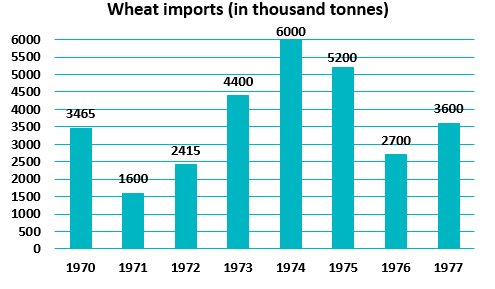 The decrease in imports in 1971 was what percentage of the imports in 1970 (rounded off to the nearest integer)?
- 54%
- 56%
- 52%
- 53%
Answer aur solution dekho
Archived marked answer: A
Calculation:
The decreased amount is 3465 - 1600 = 1865
The percentage will be,
⇒(1865/ 3465) × 100 = 54%
∴ The correct option is 1
Q22 · Data Interpretation
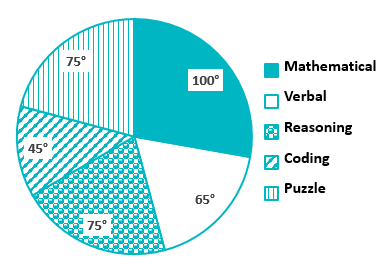
The given pie-chart shows the marks scored by a student in different skills in an examination: mathematical ability. verbal ability, reasoning, coding and puzzle solving. The values are given in degrees.
Answer the following question. If total marks were 3000, then what would be the marks in reasoning?
- 375
- 833
- 625
- 541
Answer aur solution dekho
Archived marked answer: C
Calculation:
Value of 360° = 3000
So value of 75° is (3000/360)× 75 = 625
∴ The correct option is 3
Q23 · Proportion
If 28 ∶ 98 ∶∶ 98 ∶ y, find the value of y.
- 333
- 338
- 348
- 343
Answer aur solution dekho
Archived marked answer: D
Concept used:
If four number a,b,c,d are in proportion
Then we can say that
a / b = c / d
⇒ a × d = b × c
Calculation:
So the value of y is
⇒ 98 × 98 / 28 = 343
Q24 · Average
College P has 180 students scoring average marks of 88 and college Q has 320 students scoring average marks of 72. Find the average marks of both the colleges together.
- 82.00
- 75.25
- 77.76
- 80.00
Answer aur solution dekho
Archived marked answer: C
Use a weighted average,because the colleges have different student counts. Total marks=180×88+320×72=15840+23040=38880. Total students=180+320=500. Combined average=38880/500=77.76.
हिन्दी: दोनों कॉलेजों के कुल अंक38880 और विद्यार्थी500 हैं। संयुक्त औसत77.76 है।
Q25 · Simple Interest
R wants to deposit ₹80,000 in the bank for a year. In his account, the bank gives 12% simple annual interest but charges ₹3,000 as a processing fee for the account. What would be his percentage earnings in the account?
- 8.75%
- 9%
- 8.5%
- 8.25%
Answer aur solution dekho
Archived marked answer: D
Given:
R wants to deposit ₹80,000 in the bank for a year. In his account, the bank gives 12% simple annual interest but charges ₹3,000 as a processing fee for the account.
Formula used:
Simple interest = P × R × T / 100 [ P = principal, R = rate of interest, T = time]
Calculation:
Simple interest is 80000 × 12 × 1/100 = Rs 9600
After charging the processing fee the profit amount
9600 - 3000 = 6600
As per the question,
The percentage of earning in this account is (6600 / 80000) × 100 = 8.25%
∴ The correct option is 4
12
English
Q1 · Vocabulary
Fill in the blank with the most appropriate ANTONYM of the word given in the brackets.
She was wearing a ______ new outfit. (expensive)
- cheap
- costly
- premium
- precious
Answer aur solution dekho
Archived marked answer: A
The correct answer is 'cheap'.
Key Points
- The most appropriate antonym of the given word 'expensive' is 'cheap'.
- Expensive: costing a lot of money.
- *Example: Keeping a horse is expensive.*
- Cheap: low in price, costing little money.
- *Example: Oranges are cheap at the moment.*
Correct Answer: *cheap.*
Additional Information
- Let's look at the meaning of other words:
- costly: costing a lot of money; expensive.;
- premium: an amount of money that you pay regularly to a company for insurance against accidents, damage, etc.; )
- precious: of great value (usually because it is rare or difficult to find). ]
The correct answer is *'The decision to change the hospital saved the life of the daughter of the doctor.'*
Q2 · Vocabulary
Select the most appropriate ANTONYM of the given word.
Lament
- Deplore
- Decry
- Celebrate
- Regret
Answer aur solution dekho
Archived marked answer: C
The correct answer is 'Celebrate'.
Key Points
- The most appropriate antonym of "lament" among the given options is 'celebrate'.
- "Lament" refers to expressing grief, sorrow, or regret for something.
- "Celebrate (Jashn Manana)]," on the other hand, means to observe or mark an event or occasion with joy, festivity, or positive emotions. In contrast to lamenting, celebrating involves expressing happiness, pleasure, or delight over an event or achievement.
- *Example: The team gathered to celebrate their victory with cheers and laughter.*
Correct Answer: *Celebrate.*
Additional Information
- Let's look at the meaning of other words:
- Deplore - To feel or express strong disapproval of something; in Hindi: (Dukhi Hona)
- Decry - To publicly condemn or express strong disapproval of something; in Hindi: (Ninda Karna)
- Regret - To feel sad, repentant, or disappointed about something that has happened or that one has done; in Hindi: (Pachtaana)
The correct answer is 'Whis
Q3 · Vocabulary
Select the most appropriate ANTONYM of the underlined word.
One should not yell at children.
- Notify
- Indemnify
- Whisper
- Terrorise
Answer aur solution dekho
Archived marked answer: C
The correct answer is 'Whisper'.
Key Points
- The most appropriate antonym of "yell" among the given options is 'Whisper'.
- "Yell" means to shout loudly or raise one's voice in a forceful manner. Its antonym, "whisper (Phusphusana)]," signifies speaking in a soft, low voice, often to maintain privacy or secrecy, and is the direct opposite in terms of volume and intensity.
- *Example: She chose to whisper her secrets to her friend instead of yelling them across the room.*
Correct Answer: *Whisper.*
Additional Information
- Let's look at the meaning of other words:
- Notify - To inform or give notice to someone about something; in Hindi: (Suchit Karna)
- Indemnify - To compensate for harm or loss; in Hindi: (Muavza Karna)
- Terrorize - To intimidate or coerce through fear or violence; in Hindi: (Aatankit Karna)
The correct answer is 'Antisocial&l
Q4 · Vocabulary
Select the sentence that uses the given idiom correctly.
Cut corners
- He cut corners on his homework and got a bad grade.
- The artist cut corners on the painting, and it ended up looking unfinished.
- I always make sure to cut corners when I'm driving to save time.
- I cut corners to finish my project on time, and my boss praised me for my hard work.
Answer aur solution dekho
Archived marked answer: A
The correct answer is 'He cut corners on his homework and got a bad grade.'
Key Points
- The sentence that uses the idiom "cut corners" correctly is:* He cut corners on his homework and got a bad grade.*
- The idiom "cut corners" refers to doing something hastily or in a way that compromises quality by neglecting necessary steps or standards. In this sentence, it implies that the person didn't put in the required effort or complete the homework properly, leading to a bad grade.
- *Example sentence: "She cut corners while preparing the report, so it lacked crucial information."*
- It's possible that in the context of the idiom's meaning, the first sentence illustrates the concept of "cutting corners" more accurately by implying that the poor quality or outcome (the bad grade) resulted from not properly completing the homework.
Correct Answer: *He cut corners on his homework and got a bad grade.*
Additional Information
- Origin:
- The origin of the idiom "cut corners" possibly comes from the idea of literally cutting the corners of a shape or object to save time or resources.
- In various tasks or activities, skipping corners, which represent essential steps or details, leads to an incomplete or inadequate result.
- This phrase has been figuratively extended to denote doing something hastily or with less attention to quality.
Q5 · Vocabulary
Select the most appropriate meaning of the given idiom.
Hit the jackpot
- Found a piece of gold
- Harm the opportunity
- Receiving a reward
- Gaining a big success
Answer aur solution dekho
Archived marked answer: D
The correct answer is 'Gaining a big success'.
Key Points
- The most appropriate meaning of the idiom "hit the jackpot" is 'Gaining a big success'.
- "Hit the jackpot" is an idiom that originated from gambling, specifically from slot machines or lottery games where hitting the jackpot means winning a large sum of money or a significant prize.
- Metaphorically, it has expanded to refer to any situation where someone achieves a significant or highly desirable success or outcome, not just in terms of money but also in broader aspects of life, such as career, opportunities, or achievements.
- The expression is commonly used to indicate someone achieving a remarkable or highly favorable outcome, similar to winning a big prize, gaining unexpected success, or accomplishing something significant beyond expectations.
Correct Answer: *Gaining a big success.*
Q6 · Vocabulary
Select the option that can be used as a one-word substitute for the given group of words.
Place where grains are stored.
- Tannery
- Pantry
- Mint
- Granary
Answer aur solution dekho
Archived marked answer: D
The correct answer is 'Granary'.
Key Points
- The most appropriate word for the given group of words is 'granary'.
- A granary specifically refers to a place or building designed for storing grains after harvesting. It's meant to safeguard the grains from moisture, pests, and other damaging elements. The other options, like tannery (where leather is processed), pantry (a storage space in a house for food), and mint (where coins are produced), don't specifically denote a place meant for storing grains.
Correct Answer: *Granary.*
Additional Information
- Let's look at the meaning of other words:
- Tannery - A place where animal hides are converted into leather; in Hindi: (Chamda Sanleshanshala)
- Pantry - A room or area in a house used for storing food, dishes, and utensils; in Hindi: (Rasoi)
- Mint - A place where coins are produced or where money is coined; in Hindi: (Moharkaan)
The correct answer is 'Oaf&
Q7 · Vocabulary
Select the option that can be used as a one-word substitute for the given group of words.
A big clumsy often slow-witted person
- Slouch
- Chump
- Oaf
- Ape
Answer aur solution dekho
Archived marked answer: C
The correct answer is 'Oaf'.
Key Points
- The most appropriate word for the given group of words is 'Oaf'.
- An "oaf (Bhola-Bhala)]" specifically refers to a person who is not only big or clumsy but also often lacks finesse or quick understanding, making them appear slow-witted or awkward in social situations. It encompasses the idea of both physical clumsiness and slower mental processing.
- *Example: The new student, with his awkward movements and slow understanding, was often referred to as an oaf.*
Correct Answer: *Oaf.*
Additional Information
- Let's look at the meaning of other words:
- Slouch - To stand, move, or sit in a lazy, drooping way; in Hindi: (Dheela-Dhala Khada Hona)
- Chump - Informally, it refers to a foolish or gullible person; in Hindi: (Moorakh)
- Ape - Refers to a primate; informally, it can refer to someone considered uncivilized or brutish; in Hindi: (Vanar)
The correct answer is '
Q8 · Vocabulary
Select the option that can be used as a one-word substitute for the given group of words.
One who cannot hear.
- Illegible
- Inaudible
- Dumb
- Deaf
Answer aur solution dekho
Archived marked answer: D
The correct answer is 'Deaf'.
Key Points
- The most appropriate word for the given group of words is 'Deaf'.
- "Deaf (Bahra)]" specifically refers to someone who has a partial or complete inability to hear. It's a medically recognized term to describe the inability to perceive sound.
- *Example: The concert had sign language interpreters to cater to the needs of the deaf attendees.*
Correct Answer: *Deaf.*
Additional Information
- Let's look at the meaning of other words:
- Illegible - Unable to be read or deciphered; in Hindi: (Apathit)
- Inaudible - Unable to be heard; in Hindi: (Anasuna)
- Dumb - Lacking the power of speech; in the context of this question, it might be considered offensive; in Hindi: (Goonga)
The correct answer
Q9 · Vocabulary
Select the INCORRECTLY spelt word.
- Refusal
- Wajes
- Stretch
- Wearily
Answer aur solution dekho
Archived marked answer: B
The correct answer 'wajes'.
Key Points
- Among the given options the incorrectly spelt word is 'wajes'. Its correct spelling is 'wages'.
- Wages: the regular amount of money that you earn for a week’s work. ]
- *Example: minimum wage [the lowest wage that an employer is allowed to pay by law]...*
Correct Answer: *wajes.*
Additional Information
- Let's look at the meaning of other words:
- Refusal: saying or showing that you will not do, give or accept something. [;
- Stretch: to pull something so that it becomes longer or wider; to become longer or wider in this way. ;
- Wearily: with extreme tiredness. 13f:T7bc,
The correct answer is 'it will rain'.
Q10 · Vocabulary
Select the most appropriate synonym to substitute the underlined word.
The crowd cheered the cricketer.
- Encouraged
- Distracted
- Dropped
- Attracted
Answer aur solution dekho
Archived marked answer: A
The correct answer is 'Encouraged'.
Key Points
- The most appropriate synonym of the underlined word 'cheered' is 'encouraged'.
- Cheered: to shout to show that you like something or to encourage somebody who is taking part in competition, sport, etc.
- *Example: Everyone cheered the winner as he crossed the finishing line.*
- Encouraged: to give hope, support or confidence to somebody. [ ;
- *Example: The teacher encouraged her students to ask questions.*
Correct Answer: *encouraged.*
Additional Information
- Let's look at the meaning of other words:
- Distracted: unable to give your full attention to something because you are worried or thinking about something else.
- Dropped: to let something fall.
- Attracted: to cause somebody/something to go to something or give attention to something.; ; 145:T96a,
The correct answer is 'Granary'.
Q11 · Vocabulary
Select the most appropriate synonym to substitute the underlined word.
My mother said to me that she had gone through a very strict and traditional education.
- analogy
- demagogy
- pedagogy
- mythology
Answer aur solution dekho
Archived marked answer: C
The correct answer is 'pedagogy'.
Key Points
- The most appropriate synonym of the given word 'education' is 'pedagogy'.
- "Pedagogy (Shikshan Vidhi)]" specifically refers to the method and practice of teaching or education. In the context provided, the phrase "a very strict and traditional education" aligns well with the concept of teaching methods and practices, which "pedagogy" signifies.
- *Example: The new curriculum emphasizes modern pedagogy, aiming to engage students more effectively.*
Correct Answer: *pedagogy.*
Additional Information
- Let's look at the meaning of other options:
- Analogy - A comparison between two things for the purpose of explanation or clarification; in Hindi: (Sandardh)
- Demagogy - Manipulation of people's emotions or prejudices for political gain; in Hindi: (Janhitkari)
- Mythology - A collection of myths or stories belonging to a particular cultural or religious tradition; in Hindi: (Pauranik Kathayein)
The correct answer is 'crossing
Q12 · Vocabulary
Select the most appropriate meaning of the given word.
Termagant
- One who speaks many languages
- Overscrupulous about minute details
- A magnet with strong polarity
- A violent, overbearing, turbulent, brawling, quarrelsome woman
Answer aur solution dekho
Archived marked answer: D
The correct answer is: Option 4.
Key Points
- The word "Termagant" means a violent, overbearing, turbulent, brawling, quarrelsome woman.
- Example: The character in the play was portrayed as a termagant, always causing trouble and picking fights.
- "Termagant" refers to a woman who is violent, overbearing, and quarrelsome.
- Example: She acted like a termagant, yelling at everyone in the office for the smallest mistakes.
Therefore, the correct answer is:
Q13 · Vocabulary
Select the most appropriate synonym of the given word.
Misanthropic
- Humanitarian
- Sociable
- Antisocial
- Philanthropic
Answer aur solution dekho
Archived marked answer: C
The correct answer is 'Antisocial'.
Key Points
- The most appropriate synonym of "misanthropic" among the given options is 'Antisocial'.
- "Misanthropic" describes a person who dislikes humankind and avoids human society.
- Among the options provided, "antisocial (Asamajik)]" closely aligns with this meaning, denoting a reluctance or unwillingness to engage or associate with others in a friendly or normal manner. Both terms imply a certain level of aversion or lack of interest in social interactions or human society.
- *Example: His reclusive behavior and disdain for social gatherings led others to label him as somewhat antisocial.*
Correct Answer: *Antisocial.*
Additional Information
- Let's look at the meaning of other words:
- Humanitarian - Concerned with promoting human welfare and happiness; in Hindi: (Manaviya)
- Sociable - Fond of company; friendly and enjoys being with others; in Hindi: (Milansar)
- Philanthropic - Showing a desire to help others, especially by giving money to good causes; in Hindi: (Paropkari)
The correct answer is 'emerg
Q14 · Grammar
Select the grammatically correct sentence.
- The decision to change a hospital saved an life of the daughter of the doctor.
- The decision to change the hospital saved the life of the daughter of the doctor.
- The decision to change an hospital saved the life of the daughter of the doctor.
- A decision to change a hospital saved the life of the daughter of the doctor.
Answer aur solution dekho
Archived marked answer: B
The correct answer is *'The decision to change the hospital saved the life of the daughter of the doctor.'*
Key Points
- The grammatically correct sentence among the options is: *The decision to change the hospital saved the life of the daughter of the doctor.*
- This sentence correctly uses the definite article "the" before "hospital," indicating a specific hospital that was changed.
- Additionally, it uses the correct word order and article ("the") before "life" and does not use the article "an" before "hospital."
- This structure creates a grammatically accurate and clear sentence conveying that a particular decision, which involves changing a specific hospital, had a significant impact on saving the doctor's daughter's life.
Correct Answer: *The decision to change the hospital saved the life of the daughter of the doctor.*
Q15 · Grammar
The following sentence has been split into four segments. Identify the segment that contains a grammatical error.
If / it will rain, / we will have / a tough time.
- if
- a tough time
- we will have
- it will rain
Answer aur solution dekho
Archived marked answer: D
The correct answer is 'it will rain'.
Key Points
- The given sentence is grammatically incorrect.
- Here, 'it rains' should be used instead of 'it will rain'.
- The sentence is a conditional statement. In conditional sentences of this structure (first conditional), the correct order is: *"If + present simple, will + base verb." *The original sentence, *"If it will rain, we will have a tough time," *creates a redundancy by using "will" after "if."
- In English, it's incorrect to use "will" in both parts of a conditional sentence. Instead, the structure should have* "if + present simple"* in the conditional clause. So, the correct arrangement should be: *"If it rains, we will have a tough time." *
Correct Sentence: *If it rains, we will have a tough time.*
Q16 · Grammar
Select the most appropriate option that can substitute the underlined segment in the given sentence. If there is no need to substitute it, select 'No substitution'.
The moon is Earth's only natural satellite and the nearby large celestial body.
- the near largest
- the nearest large
- No substitution
- the nearly large
Answer aur solution dekho
Archived marked answer: B
The correct answer is 'the nearest large'.
Key Points
- The sentence aims to describe the moon in terms of its proximity to Earth and its significant size compared to other celestial bodies.
- The original phrase "nearby large" doesn't effectively convey both the sense of proximity and the notion of significant size.
- The corrected phrase "the nearest large" effectively combines two elements:
- "Nearest" indicates the proximity of the moon to Earth, portraying it as the closest celestial body.
- "Large" denotes the substantial size of the moon among other celestial bodies, indicating its importance or significant dimensions.
- Grammatically, "nearest" functions as a superlative form of "near," signifying the closest in distance. It modifies "large," emphasizing that among the celestial bodies in proximity to Earth, the moon is not only close but also substantial in size compared to others.
- So, the chosen option,* "the nearest large," *effectively communicates both the idea of proximity and the significance of size in a grammatically correct manner, making it the most suitable substitution.
Correct Sentence: *The moon is Earth's only natural satellite and the nearest large celestial body.*
Q17 · Grammar
Correct the sentence with the appropriate form of the underline verb.
Parents should tell their children to exercise great care when crossed busy roads.
- has crossed
- crossing
- cross
- has been crossing
Answer aur solution dekho
Archived marked answer: B
The correct answer is 'crossing'.
Key Points
- The correct form of the underlined verb in the sentence is 'crossing'.
- A gerund is a verb form ending in "-ing" that functions as &l
Q18 · Grammar
Select the most appropriate option that can substitute the underlined segment in the given sentence.
This compartment is reserved for military person.
- military personal
- military personality
- military members
- military personnel
Answer aur solution dekho
Archived marked answer: D
The correct answer is 'military personnel'.
Key Points
- The most appropriate option to substitute the underlined segment in the given sentence is 'military personnel'.
- The term "military personnel" refers to individuals who are actively serving in the military or armed forces.
- It encompasses all members, including officers and enlisted personnel. In the context of the sentence, "personnel" accurately denotes the collective body of individuals within the military, making it the most suitable choice.
- The other options, like *"military personal," "military personality," or "military members," *don't effectively convey the intended meaning of individuals within the armed forces as comprehensively as "military personnel" does.
Correct Sentence: *This compartment is reserved for military personnel.*
Q19 · Voice Change
Select the option that expresses the given sentence in passive voice.
Does Sneha not lick the butter?
- Is the butter being licked by Sneha?
- Is the butter not licked by Sneha?
- Sneha does not lick the butter?
- Was Sneha not licking the butter?
Answer aur solution dekho
Archived marked answer: B
The correct answer is 'Is the butter not licked by Sneha?'
Key Points
- The given sentence is written in an interrogative form as the question tag is there, and we need to convert it into the passive form.
- Active Voice describes a sentence where the subject performs the action stated by the verb. While in the Passive Voice subject is acted upon by the verb.
- We follow the following structure in case of an interrogative sentence:
- Active voice: Do/Does/Did + Doer + Verb 1 + Noun/Pronoun + Rest of the sentence
- Example - *Do they beat you every day? (Active)*
- Passive voice: Am/is/are/was/were + Noun/Pronoun + Verb 3 + By + Doer + Rest of the sentence
- Example - *Are you beaten by them every day? (Passive)*
- While converting Interrogative Active into Interrogative Passive Voice.
- The helping verb comes before the object in the passive voice, (as the passive voice starts with the object of the active voice)
- Convert the verb into past participle or 3rd form of the verb.
- Use the preposition ‘by’.
- Complete the sentence with the subject and sign of Interrogation (?).
- Thus, the correct answer is Option 2.
Correct Passive form: *Is the butter not licked by Sneha?*
Q20 · Voice Change
Select the option that expresses the given sentence in passive voice.
Rover would not swallow the pill.
- The pill would not be swallowing by Rover.
- The pill would not swallowed by Rover.
- The pill would not be swallowed by Rover.
- The pill would not be swallow by Rover.
Answer aur solution dekho
Archived marked answer: C
The correct answer is 'The pill would not be swallowed by Rover.'
Key Points
- The given sentence is an example of Active Voice. As per the given question, we have to change it to Passive Voice.
- The process of transformation is as follows:
- The subject of the given sentence is 'Rover'.
- The object of the given sentence is 'the pill'.
- Since a modal verb has been used in the active voice, therefore, the passive voice will follow the given structure:-
- Active Voice - Subject + modal verb*(would) *+ V1 + Object.
- Passive Voice - Object(Subjective form) modal verb*(would)* + be + V3 Subject (Objective form).
- Here, 'would not swallow' is changed into 'would not be swallowed' because in the 'active to passive' transformation third form of the verb is used.
- Therefore, as per the above-mentioned points, we find that the correct answer is Option 3.
Correct Sentence: *The pill would not be swallowed by Rover.*