Skip to content

SSC CGL · Tier 1 · Previous-year archive

CGL Tier 1 · 12 December 2022 · Shift 3

92 questions available to read. Bina signup padho; timed practice ke liye free sign in karo.

Archive coverage

This saved paper contains 92 of 100 expected questions. 0 stored records are excluded from this study page while their source or wording is checked. Missing original questions: 8. Local question numbers follow the saved archive; match the wording and choices when comparing another response sheet.

Archived marked answers and available solution notes are preserved. These are not claimed to be fully checked final SSC keys. How questions are checked.

Printable archive and coverage notes · Prepare this shift as a timed test

Reasoning

Q1 · Series

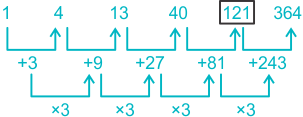
Which number will replace the question mark (?) in the following series? 1, 4, 13, 40, ?, 364
  1. 132
  2. 121
  3. 120
  4. 124
Answer aur solution dekho

Archived marked answer: B

The pattern followed here is: Given: 1, 4, 13, 40, ?, 364 Question 1 solution figure Hence, the correct answer is "121".

Q2 · Series

Which figure should replace the question mark (?) if the series were to be continued? Question 2 figure
  1. Question 2, option A
  2. Question 2, option B
  3. Question 2, option C
  4. Question 2, option D
Answer aur solution dekho

Archived marked answer: D

The pattern followed here is: 1) Elements of 1st column and 3rd column are moving clockwise direction. Elements of 2nd column and 4th column are moving in anti-clockwise direction. - Question 2 solution figure 2) 1st, 2nd and 3rd rows follows different pattern. -

Q3 · Series

Select the figure from among the given options that can replace the question mark (?) in the following series. Question 3 figure
  1. Question 3, option A
  2. Question 3, option B
  3. Question 3, option C
  4. Question 3, option D
Answer aur solution dekho

Archived marked answer: A

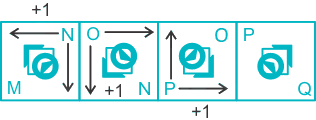
The pattern followed here is: 1) Middle figure is rotated in a 90º anti-clockwise direction. Question 3 solution figure 2) Addition of + 1 and shifted right-hand side and same letter shifted toward the left-hand side. Question 3 solution figure Hence, the correct answer is "Option 1".

Q4 · Series

What should come in place of the question mark (?) to complete the following letter cluster series? RD, JF, DJ, ZP, ?
  1. XY
  2. YY
  3. XX
  4. WX
Answer aur solution dekho

Archived marked answer: C

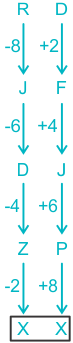
The position of the English alphabet letters is given below: Given: RD, JF, DJ, ZP, ? Question 4 solution figure Hence, the correct answer is "XX".

Q5 · Series

A series is given with one term missing. Select the correct alternative from the given ones that will complete the series. COMB, GIUR, KCCH, OWKX, ?
  1. SRQM
  2. MNQR
  3. SQSN
  4. SMRQ
Answer aur solution dekho

Archived marked answer: C

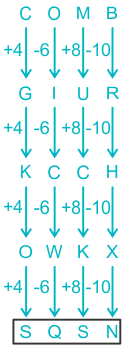
The position of the English alphabet series is given below: Given: COMB, GIUR, KCCH, OWKX, ? Question 5 solution figure Hence, the correct answer is "SQSN".

Q6 · Analogy

Select the set in which the numbers are related in the same way as are the numbers of the following set. (NOTE: Operations should be performed on the whole numbers, without breaking down the numbers into its constituent digits.) (12, 313, 13) (11, 185, 8)
  1. (12, 158, 12)
  2. (4, 125, 11)
  3. (9, 90, 3)
  4. (15, 150, 10)
Answer aur solution dekho

Archived marked answer: C

The pattern followed here is: Logic: (First number)² + (Third number)² = Second number. 1) (12, 313, 13) ⇒ (12)² + (13)² ⇒ 144 + 169 = 313 2) (11, 185, 8) ⇒ (11)2 + (8)2 ⇒ 121 + 64 = 185 Let's check each option one by one: Option 1) (12, 158, 12) ⇒ (12)2 + (12)2 ⇒ 144 + 144 = 288 ≠ 158. (Incorrect) Option 2) (4, 125, 11) ⇒ (4)2 + (11)2 ⇒ 16 + 121 = 137 ≠ 125. (Incorrect) Option 3) (9, 90, 3) ⇒ (9)2 + (3)2 ⇒ 81 + 9 = 90. (Correct) Option 4) (15, 150, 10) ⇒ (15)2 + (10)2 ⇒ 225 + 100 = 325 ≠ 150. (Incorrect) Hence, the correct answer is "(9, 90, 3)".

Q7 · Analogy

Select the set in which the numbers are related in the same way as are the numbers of the given set. (NOTE: Operations should be performed on the whole numbers, without breaking down the numbers into its constituent digits. E.g. 13 - Operations on 13 such as adding / subtracting / multiplying etc. to 13 can be performed. Breaking down 13 into 1 and 3 and then performing mathematical operations on 1 and 3 is not allowed.) (6, 17, 408) (13, 27, 1404)
  1. (9, 27, 245)
  2. (17, 28, 952)
  3. (5, 82, 1200)
  4. (4, 26, 416)
Answer aur solution dekho

Archived marked answer: D

The pattern followed here is: Logic: (First number × Second number) × 4 = Third number. 1) (6, 17, 408) ⇒ (6 × 17) × 4 ⇒ 102 × 4 = 408 2) (13, 27, 1404) ⇒ (13 × 27) × 4 ⇒ 351 × 4 = 1404 Let's check each option one by one: Option 1) (9, 27, 245) ⇒ (9 × 27) × 4 ⇒ 243 × 4 = 972 ≠ 245. (Incorrect) Option 2) (17, 28, 952) ⇒ (17 × 28) × 4 ⇒ 476 × 4 = 1904 ≠ 952. (Incorrect) Option 3) (5, 82, 1200) ⇒ (5 × 82) × 4 ⇒ 410 × 4 = 1640 ≠ 1200. (Incorrect) Option 4) (4, 26, 416) ⇒ (4 × 26) × 4 ⇒ 104 × 4 = 416 = 416 (Correct) Hence, the correct answer is "(4, 26, 416)".

Q8 · Analogy

Select the option that is related to the fourth term in the same way as the first term is related to the second term and the fifth term is related to the sixth term. 8 : 96 :: ? : 54 :: 12 : 216
  1. 8
  2. 6
  3. 10
  4. 4
Answer aur solution dekho

Archived marked answer: B

The pattern followed here is: Logic: [(First number × (First number ÷ 2)] × 3 = Second number. 1) 8 : 96 ⇒ [(8 × (8 ÷ 2)] × 3 ⇒ [(8 × 4)] × 3 ⇒ 32 × 3 = 96 And, 2) 12 : 216 ⇒ [(12 ×

Q9 · Analogy

Select the option that is related to the third word in the same way as the second word is related to the first word. (The words must be considered as meaningful English words and must not be related to each other based on the number of letters/number of consonants/vowels in the word.) Panel : Jurors :: Portfolio : ?
  1. Trustees
  2. Securities
  3. Administration
  4. Companies
Answer aur solution dekho

Archived marked answer: B

The pattern followed here is: Panel : Jurors → A panel is a whole group of Jurors. The meaning of these words is a group of people who have chosen to listen to the facts in a court action and decide whether a person is guilty or not. Similarly, Portfolio : Securities → A portfolio is the entire group of securities a person holds for the investment. Hence, the correct answer is "Securities".

Q10 · Non Verbal Reasoning

Three different positions of the same dice are shown. Find the number on the face opposite the face showing '2'. Question 10 figure
  1. 6
  2. 5
  3. 4
  4. 3
Answer aur solution dekho

Archived marked answer: B

The pattern followed here is: Logic: No two opposite faces are adjacent to each other. Let's find which number is faced opposite to face having '2'. We are taking both dice figures (1) & (2) together. Question 10 solution figure Here, 6 and 3 are common in both dice and 5 is opposite to 2. Now, we are taking dice figures (2) & (3) together. Question 10 solution figure Here, 2 is common in both the dice and the rotated clockwise direction. Opposite pairs: ⇒ 5 ⇔ 2 ⇒ 6 ⇔ 1 ⇒ 3 ⇔ 4 Clearly, 5 is the opposite of 2. Hence, the correct answer is "5".

Q11 · Non Verbal Reasoning

Select the option figure which is embedded in the given figure (rotation is NOT allowed). Question 11 figure
  1. Question 11, option A
  2. Question 11, option B
  3. Question 11, option C
  4. Question 11, option D
Answer aur solution dekho

Archived marked answer: D

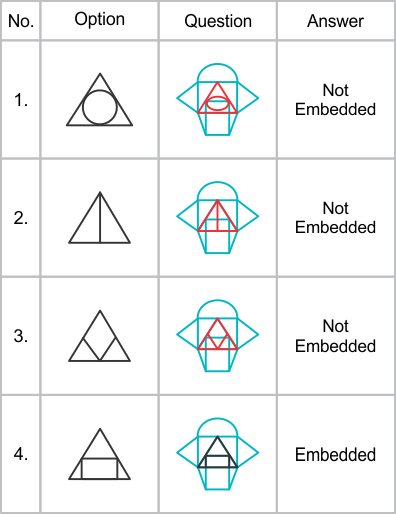
The pattern followed here is: Question 11 solution figure Question 11 solution figure Hence, the correct answer is "Option 4".

Q12 · Non Verbal Reasoning

Select the correct mirror image of the given combination when the mirror is placed at 'PQ' as shown below. Question 12 figure
  1. Question 12, option A
  2. Question 12, option B
  3. Question 12, option C
  4. Question 12, option D
Answer aur solution dekho

Archived marked answer: B

The correct mirror image of the given figure when the mirror is held on the PQ side. Question 12 solution figure Detailed Explanation: - The correct mirror image of the given figure is " Question 12 solution figure " the seventh letter of the given image is 'I' and the correct mirror image is "I" but it is wrongly given in options 1 & 4 so option 1 & 4 is eliminated. - The correct mirror image of the given figure is " Question 12 solution figure " the fifth letter of the given image is 'O' and the correct mirror image is "O" but it is wrongly given in option 3 so option 3 is eliminated. Hence, the correct answer is "Option 2". Additional Information 1) In the mirror image left side and right side changed vice-versa where the top and bottom remain the same. 2) In a real given mirror image the farthest number or alphabet appears closest in the mirror image.

Q13 · Puzzle Subtypes Not To Miss

Select the correct combination of mathematical signs to sequentially replace the * signs and to balance the given equation. 50 * 25 * 10 * 2 * 175
  1. +, ÷, ×, =
  2. −, ×, ÷, =
  3. −, ×, +, =
  4. +, ×, ÷, =
Answer aur solution dekho

Archived marked answer: D

The pattern followed here is: We have to replace the mathematical signs to sequentially replace the * signs to balance the given equation. Let's check each option one by one. Option 1) +, ÷, ×, = Given: 50 * 25 * 10 * 2 * 175 After putting the mathematical sign we get the; ⇒ 50 + 25 ÷ 10 × 2 = 175 ⇒ 50 + 2.5 × 2 = 175 ⇒ 50 + 5 = 175 ⇒ 55 ≠ 175 ⇒ LHS ≠ RHS Option 2) −, ×, ÷, = Given: 50 * 25 * 10 * 2 * 175 After putting the mathematical sign we get the; ⇒ 50 - 25 × 10 ÷ 2 = 175 ⇒ 50 - 25 × 5 = 175 ⇒ 50 - 125 = 175 ⇒ - 75 ≠ 175 ⇒ LHS ≠ RHS Option 3) −, ×, +, = Given: 50 * 25 * 10 * 2 * 175 After putting the mathematical sign we get the; ⇒ 50 - 25 × 10 + 2 = 175 ⇒ 50 - 250 + 2 = 175 ⇒ 52 - 250 = 175 ⇒ - 198 ≠ 175 ⇒ LHS ≠ RHS Option 4) +, ×, ÷, = Given: 50 * 25 * 10 * 2 * 175 After putting the mathematical sign we get the; ⇒ 50 + 25 × 10 ÷ 2 = 175 ⇒ 50 + 25 × 5 = 175 ⇒ 50 + 125 = 175 ⇒ 175 = 175 ⇒ LHS = RHS Hence, the correct answer is "Option 4".

Q14 · Puzzle Subtypes Not To Miss

Which two signs and two numbers should be interchanged in the following equation to make it correct? 10 × 11 + 19 - 323 ÷ 3 = 50
  1. 10 and 19, - and +
  2. 3 and 19, - and ×
  3. 10 and 11, - and ÷
  4. 10 and 323, + and ÷
Answer aur solution dekho

Archived marked answer: B

The pattern followed here is: We have to interchange the signs and two numbers in the following equations to make it correct. Let's check each option one by one. Option 1) 10 and 19, - and + Given: 10 × 11 + 19 - 323 ÷ 3 = 50 After interchanging the sign and two numbers we get the; ⇒ 19 × 11 - 10 + 323 ÷ 3 = 50 ⇒ 19 × 11 - 10 + 107.66 = 50 ⇒ 209 - 10 + 107.66 = 50 ⇒ 316.6 - 10 = 50 ⇒ 306.6 ≠ 50 ⇒ LHS ≠ RHS Option 2) 3 and 19, - and × Given: 10 × 11 + 19 - 323 ÷ 3 = 50 After interchanging the sign and two numbers we get the; ⇒ 10 - 11 + 3 × 323 ÷ 19 = 50 ⇒ 10 - 11 + 3 × 17 = 50 ⇒ 10 - 11 + 51 = 50 ⇒ 61 - 11 = 50 ⇒ 50 = 50 ⇒ LHS = RHS Option 3) 10 and 11, - and ÷ Given: 10 × 11 + 19 - 323 ÷ 3 = 50 After interchanging the sign and two numbers we get the; ⇒ 11 × 10 + 19 ÷ 323 - 3 = 50 ⇒ 11 × 10 + 0.0588 - 3 = 50 ⇒ 110 + 0.0588 - 3 = 50 ⇒ 110.0588 - 3 = 50 ⇒107.0588 ≠ 50 ⇒ LHS ≠ RHS Option 4) 10 and 323, + and ÷ Given: 10 × 11 + 19 - 323 ÷ 3 = 50 After interchanging the sign and two numbers we get the; ⇒ 323 × 11 ÷ 19 - 10 + 3 = 50 ⇒ 323 × 0.578 - 10 + 3 = 50 ⇒ 187 - 10 + 3 = 50 ⇒ 190 - 10 = 50 ⇒ 180 ≠ 50 ⇒ LHS ≠ RHS Hence, the correct answer is "Option 2".

Q15 · Puzzle Subtypes Not To Miss

By interchanging the given two signs and numbers which of the following equation will be not correct? × and +, 7 and 4 I. 7 × 8 + 4 – 6 ÷ 3 = 57 II. 4 × 8 – 9 ÷ 3 + 7 = 3
  1. Only II
  2. Only I
  3. Neither I nor II
  4. Both I and II
Answer aur solution dekho

Archived marked answer: B

The pattern followed here is: Given: × and +, 7 and 4 I. 7 × 8 + 4 – 6 ÷ 3 = 57 Given: × and +, 7 and 4 ⇒ 4 + 8 × 7 – 6 ÷ 3 = 57 ⇒ 4 + 8 × 7 - 2 = 57 ⇒ 4 + 56 - 2 = 57 ⇒ 60 - 2 = 57 ⇒ 58 ≠ 57 (Not Correct) II. 4 × 8 – 9 ÷ 3 + 7 = 3 Given: × and +, 7 and 4 ⇒ 7 + 8 – 9 ÷ 3 × 4 = 3 ⇒ 7 + 8 - 3 × 4 = 3 ⇒ 7 + 8 - 12 = 3 ⇒ 15 - 12 = 3 ⇒ 3 = 3 (Correct) So, Only I is not correct. Hence, the correct answer is "Option 2".

Q16 · Puzzle Subtypes Not To Miss

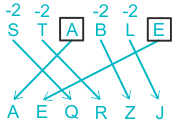
Select the option that is related to the fifth letter-cluster in the same way as the second letter-cluster is related to the first letter-cluster and the fourth letter-cluster is related to the third letter-cluster. STABLE : AEQRZJ :: TARGET : AERPER :: VISUAL : ?
  1. IUATQJ
  2. UATWJQ
  3. HATQUI
  4. TAUIQJ
Answer aur solution dekho

Archived marked answer: A

The logic is followed here is: 1) Vowels are shifted at first 2) Consonants are shifted -2 and arranged after vowel. STABLE : AEQRZJ ⇒ Question 16 solution figure And, <

Q17 · Coding Decoding

In a certain code language, 'CAKES’ is written as 'FXNBV' and 'ABUSE' is written as 'DYXPH'. How will 'BARKS' be written in that language?
  1. EXVHU
  2. EXUIU
  3. EXUIV
  4. EXUHV
Answer aur solution dekho

Archived marked answer: D

The position of the English alphabet series is given below: 'CAKES’ is written as 'FXNBV'

Q18 · Coding Decoding

In a certain code language, 'ENGINE' is written as ‘ENIGNE’ and 'TRAIN’ is written as 'NIART'. How will 'LEVEL' be written in that language?
  1. LEELV
  2. LEVEL
  3. LEEVL
  4. LELEV
Answer aur solution dekho

Archived marked answer: B

The position of the English alphabet is given below: 'ENGINE' is written as ‘ENIGNE’ Question 18 solution figure And, 'TRAIN’ is written as 'NIART Question 18 solution figure Similarly, 'LEVEL' be written as '?' Question 18 solution figure Hence, the correct answer is "LEVEL".

Q19 · Classification Odd One Out

Four letter-clusters have been given out of which three are alike in some manner and one is different. Select the one that is different.
  1. LJI
  2. GDA
  3. NLK
  4. TRQ
Answer aur solution dekho

Archived marked answer: B

The position of the English alphabet letters is given below: Let's check each option one by one: Option 1) LJI

Q20 · Classification Odd One Out

Select the odd group of numbers. (NOTE: Operations should be performed on the whole numbers, without breaking down the numbers into its constituent digits. E.g.13 - Operations on 13 such as adding /subtracting /multiplying etc. to 13 can be performed. Breaking down 13 into 1 and 3 and then performing mathematical operations on 1 and 3 is not allowed)
  1. (600 - 120 - 24)
  2. (400 - 80 - 14)
  3. (300 - 60 - 12)
  4. (500 - 100 - 20)
Answer aur solution dekho

Archived marked answer: B

The pattern followed here is: Logic: (First number ÷ 5) = Second number & (Second number ÷ 5) = Third number. Let's check each option one by one: Option 1) (600 - 120 - 24) ⇒ (600 ÷ 5) = 120 ⇒ (120 ÷ 5) = 24 (Correct) Option 2) (400 - 80 - 14) ⇒ (400 ÷ 5) = 80 ⇒ (80 ÷ 5) = 16 ≠ 14 (Incorrect) Option 3) (300 - 60 - 12) ⇒ (300 ÷ 5) = 60 ⇒ (60 ÷ 5) = 12. (Correct) Option 4) (500 - 100 - 20) ⇒ (500 ÷ 5) = 100 ⇒ (100 ÷ 5) = 20. (Correct) Hence, the correct answer is "(400 - 80 - 14)".

Q21 · Logical Reasoning

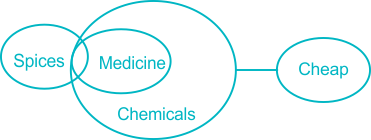
Three statements are given followed by three conclusions numbered I, II and III. Assuming the statements to be true, even if they seem to be at variance with commonly known facts, decide which of the conclusions logically follow(s) from the statements. Statements: Some spices are medicines. All medicines are chemicals. No chemical is cheap. Conclusions: I. Some medicines are cheap. II. Some chemicals are spices. III. No medicine is cheap.
  1. Only conclusions I and III follow.
  2. Only conclusions II and III follow.
  3. Only conclusions I and II follow.
  4. All conclusions follow.
Answer aur solution dekho

Archived marked answer: B

Statements: Some spices are medicines. All medicines are chemicals. No chemical is cheap. Question 21 solution figure Conclusions: I. Some medicines are cheap → Does not follow → As all medicines are chemicals and no chemical is cheap. So some medicines are cheap is not definitely followed. II. Some chemicals are spices → Follow → As some spices are medicines and all medicines are chemicals. So some chemicals are spices is definitely followed. III. No medicine is cheap → Follow → As all medicines are chemicals and no chemical is cheap. So no medicine is cheap is definitely followed. So, Only conclusions II and III follow. Hence, the correct answer is "Option 2".

Q22 · Logical Reasoning

In the following question below are given some statements followed by some conclusions based on those statements. Taking the given statements to be true even if they seem to be at variance from commonly known facts. Read all the conclusions and then decide which of the given conclusion logically follows the given statements. Statements: I. All W are L. II. All L are M. Conclusions: I. No L is W. II. No M is L. III. No M is W.
  1. Only conclusion II follows
  2. Only conclusion I follows
  3. All conclusion follows
  4. Neither conclusion follows
Answer aur solution dekho

Archived marked answer: D

The pattern followed here is: The least possible Venn diagram is shown below according to the given statements. Statements: I. All W are L. II. All L are M. Question 22 solution figure

Q23 · Blood Relations

If R ÷ S means that R is the mother of S, R × S means that R is the father of S, R - S means that R is the sister of S, then which of the following expression shows that P is the father of R?
  1. P × Q ÷ R
  2. Q × P - R
  3. R × Q - P
  4. P × Q - R
Answer aur solution dekho

Archived marked answer: D

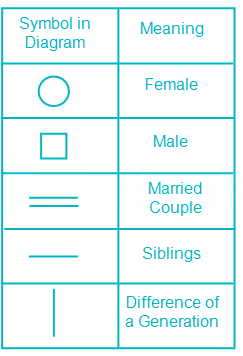
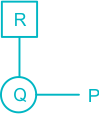
By using the symbols in the table given below, we can draw the following family tree: Question 23 solution figure R ÷ S means that R is the mother of S. R × S means that R is the father of S. R - S means that R is the sister of S. Given relation code: Code Relation ÷ Mother × Father Sister Find: Which expression shows that P is the Father of R? Let's check each option one by one. Option 1) P × Q ÷ R P is the father of Q, and Q is the mother of R. Question 23 solution figure Here, P is the maternal grandfather of R. (Incorrect) Option 2) Q × P - R Q is the father of P, and P is the sister of R. Question 23 solution figure Here, P is the sister of R. (Incorrect) Option 3) R × Q - P R is the father of Q, and Q is the sister of P. Question 23 solution figure Here, the gender of P is not clear. So we can't find How P is related to R. (Incorrect) Option 4) P × Q - R P is the father of Q, and Q is the sister of R. Question 23 solution figure Here, P is the father of R. (Correct) Hence, the correct answer is "Option 4".

Q24 · Blood Relations

A & B means ‘A is the son of B’ A # B means ‘A is the sister of B’ A @ B means ‘A is the brother of B’ A % B means ‘A is the father of B’ A - B means ‘A is the daughter of B’ A * B means ‘A is the wife of B’ If C # D @ E % Z & L # M - N * P, then how is L related to P?
  1. Wife
  2. Daughter
  3. Daughter-in-law
  4. Sister
Answer aur solution dekho

Archived marked answer: B

By using the symbols in the table given below, we can draw the following family tree: Question 24 solution figure Given: A & B means ‘A is the son of B’ A # B means ‘A is the sister of B’ A @ B means ‘A is the brother of B’ A % B means ‘A is the father of B’ A - B means ‘A is the daughter of B’ A * B means ‘A is the wife of B’ Symbol Relation Son # Sister @ Brother % Father Daughter * Wife Given: C # D @ E % Z & L # M - N * P Question 24 solution figure Clearly, L is the daughter of P. Hence, the correct answer is "Daughter".

Q25 · Clock and Calendar

What was the day of the week on 26th November 1994?
  1. Friday
  2. Wednesday
  3. Saturday
  4. Thursday
Answer aur solution dekho

Archived marked answer: C

The pattern followed here is: The number of odd days: Simple year: 365 ÷ 7 = 52 weeks and 1 odd day. Leap year: 366 ÷ 7 = 52 weeks and 2 odd days. Years No. of odd days 100 years 5 200years 3 300 years 1 400 years 0 Calculating the number of odd days in 1994 = 1600 + 300 + 94 years 1600 years have 0 odd days. 300 years have 1 odd day. 93 years has 23 leap years and 70 normal years which is 23 × 2 + 70 × 1 = 116 Odd days or simply 4 odd days. in 1994, the number of days up to 26th November. ⇒ Jan (31) + Feb (28) + March (31) + April (30) + May (31) + June (30) + July (31) + Aug (31) + Sep (30) + October (31) + Nov (26) = 330 days ⇒ 330 ÷ 7 = 1 Odd day. Total odd days is = 1 + 4 + 1 = 6 Odd days Code for weekdays. No. of odd days Day 0 Sunday 1 Monday 2 Tuesday 3 Wednesday 4 Thursday 5 Friday 6 Saturday Cleary, 6 is the code for Saturday. Hence, the correct answer is "Saturday".

General Awareness

Q1 · Art and Culture

Bade Ghulam Ali Khan was a prominent singer of the ______ gharana.
  1. Rampur Sahaswan
  2. Patiala
  3. Benaras
  4. Bhendi Bazaar
Answer aur solution dekho

Archived marked answer: B

The correct answer is Patiala Key Points:Ustad Bade Ghulam Ali Khan - Indian Hindustani classical vocalist, from the Patiala Gharana. - Patiala Gharana was founded in the mid to late 19th century by his great-grandfather Mian Kallu. - His pen name: Sabrang - He was awarded by - Sangeet Natak Akademi Award (1962) - Sangeet Natak Akademi fellow (1967) - Padma Bhushan Award (1962) Additional Information : Rampur Sahaswan: - Ustad Rashid Khan is an Indian classical musician in the Hindustani music tradition. - He belongs to the Rampur-Sahaswan Gharana. - Ustad Ghulam Mustafa Khan was an Indian classical musician in the Hindustani classical music tradition, belonging to the Rampur-Sahaswan Gharana. - Ustad Inayat Hussain Khan (1849–1919) was an Indian classical vocalist and the founder of Rampur-Sahaswan Gharana. The Bhendi Bazaar Gharana was founded around 1890 by brothers Chhajju Khan, Nazir Khan, and Khadim Hussain Khan in the Bhendi bazaar area of Mumbai

Q2 · Indian Polity and Constitution

Which of the following Articles states that a State shall not discriminate against any citizen on grounds only of religion, race, caste, sex, place of birth or any of them?
  1. Article 15
  2. Article 59
  3. Article 25
  4. Article 40
Answer aur solution dekho

Archived marked answer: A

The correct answer is Article 15. Key Points - Article 15 (1) prohibits discrimination by the state against any citizen on grounds 'only' of caste, religion, sex, race, and place of birth. - Fundamental rights are provided to every citizen of the country without any discrimination. - The word "discrimination" refers to making adverse distinctions with regard to or to distinguish unfavorable from others. - The term 'only' means that discrimination can be done on the basis of other grounds. Additional Information :There are six fundamental rights of the Indian Constitution along with the constitutional articles: - Rights to equality (Article 14-18) - Rights to freedom (Article 19-22) - Right against exploitation (Article 23-24) - Right to freedom of religion (Article 25-28) - Cultural and educational rights (Article 29-30) - Rights to constitutional remedies (Article 32). Article 59: - Article 59 of the Constitution of India deals with of the conditions of the president’s office. - Article 52 to 78 in Part V of the Constitution deals with the Union Executive. - The union executive consists of the president, the vice president, the prime minister, the council of ministers, and the Attorney General of India. Article 25: - Article 25 guarantees all citizens the freedom of conscience, as well as the freedom to profess, practice, and propagate religion. - Article 25 (1) - Subject to public order, morality, and health, as well as the other provisions of this Part, all persons have an equal right to conscience and the freedom to profess, practice, and propagate religion. - Article 25 (2) - Nothing in this article shall interfere with the operation of any existing law or prevent the State from enacting new legislation. - This regulates and limits any financial, economic, political, or other secular activity associated with any religious practice. - This provides for social welfare as well as the reform or opening up of Hindu religious institutions of a public nature to all sections and classes of Hindus. - This provision defines Hindus as people who practice the Sikh, Jain, or Buddhist religions, and Hindu institutions are also defined accordingly. - People of the Sikh faith who wear and carry the kirpan are considered to be practicing the Sikh religion. Article 40: - Article 40 of the Indian constitution deals with the organization of the village panchayat. - It states that - The State shall take steps to organize village panchayats. - It also endows them with such powers and authority that will enable them to function as units of self-government.

Q3 · Indian Polity and Constitution

If the State government dissolves the Panchayati Raj Institutions before the end of their five-year term, fresh elections should ordinarily be held within _____.
  1. one month
  2. six months
  3. one year
  4. three months
Answer aur solution dekho

Archived marked answer: B

The correct answer is Six months Key Points : - If a Panchayat is dissolved, elections are to be held within six months from the date of dissolution. - The term Panchayati Raj in India signifies the system of rural local self-government. - It had been established after the advice of the Balwant Rai Mehta committee, which is established by the Govt. of India in 1957. - This committee has three-tier panchayat governance such as Gram Panchayat, Panchayat Samiti, and Zila Parishad. - As a result of this scheme the first Panchayat system was introduced in Rajasthan in 1959. - This system observed a lack of people participation. - To overcome this failure a new committee named Ashok Mehta Committee gives a two-tier governance plan in 1977. - The two-tier plan was Zila Parishad and Mandal Panchayat. - This Panchayati Raj faced a major constitutional amendment in 1992 that brings back the three-tier system again. - This amendment added a new part to the Constitution, namely, added Part IX titled The Panchayats. - This amendment adds a Three-tier system of panchayats at the village, intermediate Mandal, and district levels except in States with a population is below 20 lakhs (Article 243B) - The Panchayat is constituted under Article 243 to 243 (O) Additional Information :Duration of Panchayati Raj - The Act provides for a five-year term of office to all the levels of the panchayat. - However, the panchayat can be dissolved before the completion of its term. - But fresh elections to constitute the new panchayat should be completed before the expiry of its five-year duration. - In case of dissolution, the election should be within a period of six months from the date of its dissolution.

Q4 · Indian Polity and Constitution

______ is the centre for the Indian Institution of Soil Science.
  1. Porbandar
  2. Bhopal
  3. Vishakhapatnam
  4. Bhubaneswar
Answer aur solution dekho

Archived marked answer: B

The correct answer is Bhopal. Key Points : - The Indian Institute of Soil Science is an autonomous institute for higher learning for advanced research in the field of soil sciences. - It was established under the umbrella of the Indian Council of Agricultural Research (ICAR) by the Ministry of Agriculture, Government of India. - The Indian Institute of Soil Science (IISS) was established in 1988 in Bhopal (Madhya Pradesh) with an aim to promote scientific research on soil sciences. Mistake Points: The Indian Council of Agricultural Research (ICAR) - The Indian Council of Agricultural Research (ICAR) is an autonomous organization under the Department of Agricultural Research and Education (DARE), Ministry of Agriculture and Farmers Welfare, Government of India. - It was established on 16 July 1929 as a registered society under the Societies Registration Act, 1860 in pursuance of the report of the Royal Commission on Agriculture. - The ICAR has its headquarters in New Delhi. - The Council is the apex body for co-ordinating, guiding, and managing research and education in agriculture including horticulture, fisheries, and animal sciences in the entire country.

Q5 · Indian Economy

_______ are those where a monthly instalment is deposited in the accounts every month.
  1. savings bank deposits
  2. reinvestment deposits
  3. fixed deposits
  4. recurring deposits
Answer aur solution dekho

Archived marked answer: D

Correct Answer recurring deposits Key Points: - A Recurring Deposit or RD as it is commonly called is a unique term deposit offered by banks. It is an investment tool that permits those with the ability to make regular deposits to earn decent returns on their investment. - Consisting of regular deposits and an interest component, Recurring Deposits provide flexibility and ease of use to individuals. - The account holders can choose to invest a particular amount each month, ensuring that they have sufficient income for an emergency, with the RD earning decent interest on the amount. - The minimum

Q6 · Indian Economy

What was the duration of Rolling Plan in India?
  1. 1975 to 1977
  2. 1977 to 1979
  3. 1976 to 1978
  4. 1978 to 1980
Answer aur solution dekho

Archived marked answer: D

Correct answer 1978 to 1980 Key Points: - Rolling Plan in India was started in 1978. - The rolling plan concept was coined by Gunnar Myrdal. - This plan was rejected again by the Indian National Congress government when it came to power in 1980 and a new sixth plan was made. - The main advantage of the rolling plans is that they are flexible. - The Rolling Plan is a plan in which every year the performance of the plan is assessed and a new plan is made next year based on this assessment. - Thus, both the allocation and targets are revised during this plan. - In India, the Janta Government terminated the fifth five-year plan in 1977-78 and launched its own sixth five-year plan for the period 1978-83 and called it a Rolling Plan. Additional Information : A brief summary of the 5-year plans are: Five-year plan Time Period Comment First Plan 1951-56 During the initial years of independence, the economy was facing the problem of large-scale foodgrains import (1951) and there was the pressure of price rise. In the plan, the highest priority was given to agriculture including irrigation and power projects. Second Plan 1956-61 The plan period was 1956–61. The plan laid emphasis on rapid industrialization with a focus on heavy industries and capital goods. The architect of this plan was Professor Mahalanobis. Third Plan 1961-65 This plan incorporated the development of agriculture as one of the objectives of planning in India. It also for the first time, considered the aim of balanced, regional development. Significant events like the war with China in 1961– 62 and with Pakistan in 1965–66 affected the performance of this plan. Also, severe drought-led famine in 1965–66 led to a heavy drain and diversion of funds, so this plan utterly failed to meet its targets. Three annual plans 1966-69 The fourth plan was ready for implementation in 1966- still the government opted for three annual plans due to weak financial situation and low morale after the defeat by China. Experts, as well as the opposition, called this period as a discontinuity in the planning process. So they named it a period of “Plan Holiday”, i.e., a period when no planning was carried out. Fourth Plan 1969-74 The Plan was based on the Gadgil strategy (named after Dhananjay Ramchandra Gadgil, who was a social scientist who had helped in determining the allocation of central assistance for state plans in India.). There was a focus on the ideas of growth with stability and progress towards self-reliance. This plan led to the beginning of the politicisation of planning in India. This led to frequent double-digit inflations, unchecked increase in the fiscal deficits etc. Also, there was a first move in the direction of ‘nationalisation’. Greater control and regulation of the economy were some of the salient features of this plan Fifth Plan 1974-79 This plan had its focus on poverty alleviation and self-reliance. The popular rhetoric of poverty alleviation was sensationalised a lot to the extent that the then Indira Gandhi government came out with a fresh plan, i.e., the Twenty-point Programme (1975). Twenty point programme gave little importance to the objective of ‘growth with stability’ (one of the major objectives of the Fourth Plan). Twenty Point programme 1975 Sixth Plan 1980-85 Due to the draconian emergency, there was a change in the government at the centre. The new government cut-short the fifth plan by a year to the fiscal 1977–78 and came up with the sixth Plan for the period 1978–83 it was called the ‘Rolling Plan’ In 1980, again government changed at the Centre, Indira led congress came back and it abandoned the rolling plan and came up with a fresh sixth plan (1980-85). This Plan was launched with the slogan of ‘Garibi Hatao’ (alleviate poverty). Seventh Plan 1985-90 This plan greatly emphasized on rapid foodgrain production, increased employment creation and productivity in general. The basis of planning, i.e., growth, self-reliance and social justice and modernization in this plan too were the guiding principles. In 1989 the government launched the Jawahar Rojgar Yojana (JRY) to create wage-employment for the rural poor. Two annual Plans 1990-92 Due to the fast-changing political situation at the central level also due to the pathbreaking and restructuring-oriented suggestions which were there in the eighth plan, the eighth plan could not take off. The new government, which came in the power in 1991 decided to commence the Eighth Plan for the period 1992–97 and that the fiscals 1990–91 and 1991–92 were then decided as two separate annual plans. Eighth Plan 1992-97 This was the first plan in the new economic environment after the opening of the economy. The economic reforms which began in 1991 led to structural adjustment and macro-stabilization policies. As the economy moved towards liberalization, there was also severe criticism directed at the move. The opinion was that as the country was now entering into the market economy zone and the state is ‘rolling back’, planning makes no sense. Ninth Plan 1997-2002 This plan was launched when due to the South East Asian Financial Crisis in 1996-97, there was an all-round ‘slowdown’ in the economy. But by now the economy was almost out of the fiscal imbroglio of the early 1990s. The plan targeted an ambitious high growth rate of per cent and also aimed towards time-bound ‘social’ objectives. There was an emphasis on the seven identified Basic Minimum Services (BMS). Tenth Plan 2002-07 The Plan mandated greater participation of the NDC in the formulation of planning. Some highly important steps like doubling of per capita income in 10 years; improving quality of life should also come with higher growth rates. Also, ‘Governance’ was considered a factor of development. Eleventh Plan 2007-12 This plan targeted a growth rate of 10 per cent and also voiced the idea of ‘inclusive growth’. Twelfth Plan 2012-17 This plan was prepared by the Planning Commission after the widest and most comprehensive consultation to date as the government believed that citizens are now better informed and literate and are also keen to engage. The plan aimed at a growth rate of 9 per cent. It also emphasized the need to intensify efforts to have a 4 per cent average growth in the agriculture sector.

Q7 · Sports Static GK

Which of the following is NOT a way in which a batsman can get out in a game of cricket?
  1. Bowled
  2. Leg bye
  3. Stumped
  4. Leg before wicket
Answer aur solution dekho

Archived marked answer: B

Correct answer Leg bye Key Points: - The Silly Point in cricket is the position where the fielder stands in close vicinity of the batsman and is in danger of being hit. Cricket: - The first official cricket test match was played in the year 1877 between Australia and England in Melbourne. - When some other countries started playing cricket, Imperial Cricket Conference was formed in 1909, which gave birth to International Cricket Conference in 1956. - The First One Day International cricket match was played in the year 1971 between England and Australia in Melbourne. - The first World Cup of one-day matches was played in 1975 in London. - The apex institution of world cricket is the ‘International Cricket Council’ (ICC) and its headquarters are in Dubai. - The ICC was founded in 1909. - The Board of Control for Cricket in India (BCCI) was formed in 1928. - Terms used in Cricket are Maiden Over, Follow-on, Rubber, Ashes, Catch, Bowled, Stump Out, Run Out, L.B.W. Hit Wicket, Not out, No ball, Wide ball, Dead ball, Overthrow, Bye, Leg bye, Cover drive, Late cut, Hook, Glance, Stroke, Spot, Pull, Sixer, Followthrough, Turn, Googley, Spin, Yorker, Bouncer, Hat trick, Round the wicket, Over the wicket, Seamer, Boundry line, Slip, Square leg, Runner. Cover, Gully, Long on, Silly point, Midwicket, Mid on, Forward short leg, Deep/mid-wicket, etc. Trophies associated with cricket: - Moinuddaula Gold Cup - C.K. Naidu Trophy - Deodhar Trophy - Duleep Trophy - Rani Jhansi Trophy - Ranjit Trophy - Bowled: This dismissal occurs when the bowler's delivery knocks down the batsman's wicket (the three stumps with two bails on top). - Leg Before Wicket (LBW): This is when the umpire judges the ball would have hit the wicket if the batsman hadn't obstructed it with their body or pad. - Stumped: This dismissal happens when the batsman is out of their crease (the ground behind the wicket) and the wicket-keeper removes the bails with the ball in their hand while the batsman's foot is not grounded.

Q8 · Sports Static GK

What is the duration of the lunch interval in a cricket test match?
  1. 25 minutes
  2. 35 minutes
  3. 30 minutes
  4. 40 minutes
Answer aur solution dekho

Archived marked answer: D

Correct Answer 40 minutes Key Points - In a cricket Test match, the duration of the lunch interval is usually 40 minutes. - The lunch break is taken after the first session of play, which typically lasts for two hours. - During the lunch interval, the players leave the field and have a break to eat and rest before returning to continue the game. - The duration of the lunch interval can be extended by the umpires in case of rain or other interruptions to play. Additional InformationCricket: - The first official cricket test match was played in the year 1877 between Australia and England in Melbourne. - When some other countries started playing cricket, Imperial Cricket Conference was formed in 1909, which gave birth to International Cricket Conference in 1956. - The First One Day International cricket match was played in the year 1971 between England and Australia in Melbourne. - The first World Cup of one-day matches was played in 1975 in London. - The apex institution of world cricket is the ‘International Cricket Council’ (ICC) and its headquarters are in Dubai. - The ICC was founded in 1909. - The Board of Control for Cricket in India (BCCI) was formed in 1928. - Terms used in Cricket are Maiden Over, Follow-on, Rubber, Ashes, Catch, Bowled, Stump Out, Run Out, L.B.W. Hit Wicket, Not out, No ball, Wide ball, Dead ball, Overthrow, Bye, Leg bye, Cover drive, Late cut, Hook, Glance, Stroke, Spot, Pull, Sixer, Followthrough, Turn, Googley, Spin, Yorker, Bouncer, Hat trick, Round the wicket, Over the wicket, Seamer, Boundry line, Slip, Square leg, Runner. Cover, Gully, Long on, Silly point, Midwicket, Mid on, Forward short leg, Deep/mid-wicket, etc. Trophies associated with cricket: - Moinuddaula Gold Cup - C.K. Naidu Trophy - Deodhar Trophy - Duleep Trophy - Rani Jhansi Trophy - Ranji Trophy
Q9 · Indian Geography

Which of the following statement is correct? I. The biggest state of India in terms of area is Uttar Pradesh. II. Rajasthan is the state of India which have highest population among all other states of India.
  1. Only I
  2. Neither I nor II
  3. Only II
  4. Both I and II
Answer aur solution dekho

Archived marked answer: B

Correct answer Neither I nor II Key Points: - India is the 7th largest country in the world in terms of land area and also the largest country in terms of population. - India has a total of 8 Union Territories and 28 states. - As per the Census 2011, Uttar Pradesh ranks fourth in terms of area but ranks first in terms of population,</stro

Q10 · Modern Indian History

In 1873, the Satyashodhak Samaj was established in ______.
  1. Bihar Province
  2. Madras Presidency
  3. Bombay Presidency
  4. Punjab Province
Answer aur solution dekho

Archived marked answer: C

The correct answer is Bombay Presidency Key Points:Satyashodhak Samaj: - Jyotiba Phule founded Satyashodhak Samaj in Pune, Maharashtra, on 24th September 1873. - It was a reformational society that promoted education and increased social rights, justice, and political access in the deprived sections. - Moreover, its primary focus was on uplifting and supporting Dalits, Shudras, and women in Maharashtra. - Jyotiba Phule’s wife, Savitribai, used to administer the social activities for the women’s section. - Jyotirao established it to stand against the unfair caste system and orthodox, illogical Brahminical status in this society. - He challenged the Brahmins who claimed themselves to be God’s messenger and a connecting medium to the almighty. - The Samaj rejected the approach of Vedic culture, Upanishad, and the predominance of Aryan society. Instead, according to him, Aryan society tries to suppress and deprive the non-Aryans, which he protested. - Shahu Maharaj, a Maratha ruler of the princely state Kolhapur, continued the movement after the death of Phule. - Later, Bhaurao Patil and other Maratha leaders like Nana Patil, Keshavrao Jedhe, Madhavrao Bagal, and Khanderao Bagal kept this movement alive. - However, the Samaj gradually dissolved during the 1930s as these leaders started to join the Indian National Congress.

Q11 · Modern Indian History

The Paramhans Mandali was established to work for the abolition of caste in ______.
  1. 1830
  2. 1840
  3. 1820
  4. 1850
Answer aur solution dekho

Archived marked answer: B

The correct answer is 1840. Key Points :Paramhans Mandali - - It was a highly influential and important Hindu socio-religious organization. - This organization was founded by 'Dadoba Pandrung'. - Paramhans Mandali was established to work for the abolition of caste in 1840(1849). Question 11 solution figure Confusion Points - We have to choose the decade in which it is formed which is 1840(1849) Additional Information : - In the beginning, it functioned as a secret social-radical society. - The basic philosophy of the Samaj was that only God should be worshipped, true religion is based on love and ethical conduct. - This congregation urged all its members to give up caste restrictions. - The congregation met at fixed times in the homes of various members and sympathizers. - The members used to sing devotional hymns from the Marathi collection, Ratnamala, at the opening and conclusion of these meetings. - Members also recited prayers written by Dadoba as part of the worship service. 14

Q12 · Current Affairs

Union Government has launched the Eighth Edition of Swachh Survekshan SS-2023 under Swachh Bharat Mission Urban 2.0. It is curated towards achieving circularity in ________.
  1. industrial management
  2. waste management
  3. roads management
  4. rainwater management
Answer aur solution dekho

Archived marked answer: B

Correct answer waste management Key Points: - The Secretary, the Ministry of Housing and Urban Affairs (MoHUA), Manoj Joshi launched the 8th edition of Swachh Survekshan (SS) – SS 2023 under Swachh Bharat Mission Urban 2.0, on 24 May 2022. - Swachh Survekshan was introduced by MoHUA in 2016. - PM Modi launched the Swachh Bharat Mission Urban 2.0 on 1 October 2021, with a vision of garbage-free cities. - The theme of SS 2023 is ‘Waste to Wealth". Important Points : - The survey would give priority to the principle of the 3Rs – Reduce, Recycle, and Reuse. - Over the years, Swachh Survekshan has emerged as the largest Urban sanitation survey in the world. - The seventh edition of Swachh Survekshan - ‘Azadi @ 75 Swachh Survekshan 2022’ was a landmark Survekshan as it coincided with the Azadi Ka Amrit Mahotsav. - The SS 2022 survey covered 4,355 cities, 85,860 wards, 2.12 lakhs locations visited, 5.5 lakhs documents assessed, 1.14 Crores citizen feedback recorded, 4.77 lakhs citizen validation undertaken, 23.38 lakhs photos and videos collected as evidence and 17.24 lakhs data points collected.


Q13 · Current Affairs

Who has been named as the new chief minister of Tripura in May 2022?
  1. Rajiv Rajan
  2. Sangeeta Singh
  3. Mahesh Verma
  4. Manik Saha
Answer aur solution dekho

Archived marked answer: D

The correct answer is Manik Saha. Key Points - Manik Saha took oath as Tripura's new Chief Minister on 15th May 2022. - Saha has replaced Biplab Kumar Deb, who resigned as chief minister on 14th May. - Dr. Saha, a professor of Dental Surgery, joined the BJP in 2016. - Rajya Sabha MP and BJP State President Manik Saha is all set to take charge as the new Chief Minister of Tripura. - Manik Saha, BJP's state unit president, and the lone Rajya Sabha MP from Tripura were elected as the leader of the legislature party at a meeting held at the official residence of the chief minister. Additional Information : - Tripura is a hilly state in northeast India, bordered on 3 sides by Bangladesh, and home to a diverse mix of tribal cultures and religious groups. Tripura: - Union territory: 1 November 1956 - Upgraded as a state: 21 January 1972 - Tripura Governor: Satyadev Narayan Arya - Tripura capital: Agartala - Legislature: Unicameral (60 seats) - According to Article 164 of the Indian Constitution, the Chief Minister is appointed by the Governor. - Art. 164 of the Constitution provides that there shall be a Council of Ministers with the Chief Minister to aid and advise the Governor. 18

Q14 · General Science Biology

Identify a marine alga that is used as food.
  1. Ulothrix
  2. Sargassum
  3. Spirogyra
  4. Volvox
Answer aur solution dekho

Archived marked answer: B

The correct answer is Sargassum. Key Points: The sea sargasso located within the Atlantic ocean is the only sea that does not have a land boundary is named after the sargassum algae which is a type of brown algae. Blue-green algae are also called as cyanobacteria or cyanophytes. - They obtain energy through photosynthesis. - They originate in the freshwater or terrestrial environment. - They produce toxins known as cyanotoxins which are dangerous to humans and animals. - They are used as colours in food items, biotechnology for the production of bioethanol, human and animal food sources, dietary supplements, and raw materials. Image of blu

Q15 · General Science Chemistry

Which of the following is known as ‘Plaster of Paris’?
  1. 2CaSO₄⋅2H₂O
  2. 2MgSO₄⋅H₂O
  3. 2MgSO₄⋅7H₂O
  4. CaSO₄⋅1/2H₂O
Answer aur solution dekho

Archived marked answer: D

Correct Answer CaSO₄⋅1/2H₂O Key Points Explanation____: - Plaster of Paris (POP) is a quick-setting gypsum plaster consisting of a fine white powder (calcium sulfate hemihydrate), which hardens when moistened and allowed to dry. - It is also known as the Plaster of Paris because for the preparation of POP, the abundant gypsum was first found near the capital city of France i.e. Paris.

Q16 · General Science Chemistry

What is the suffix for -OH group according to IUPAC?
  1. -ols
  2. -ene
  3. -one
  4. -anes
Answer aur solution dekho

Archived marked answer: A

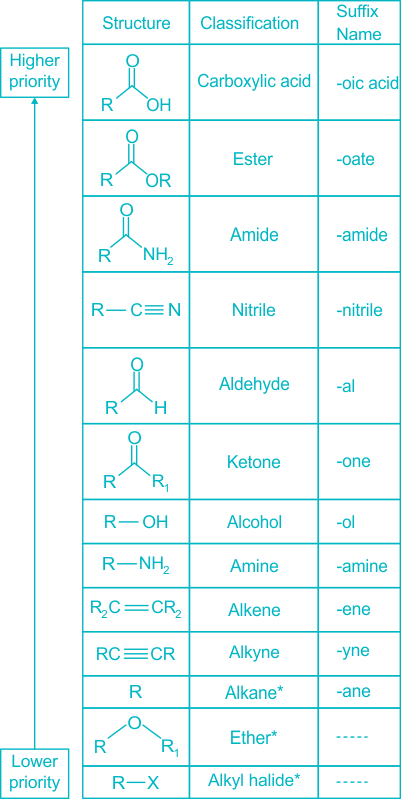
Correct Answer -ols Key Points Explanation: - The presence of the -OH group in an inorganic compound may lead to the formation of a BASE. - Say, for example, sodium, which is an inorganic element. When the hydroxy group is combined with sodium, it forms sodium hydroxide which is basic in nature. - The confirmation is obtained through the Arrhenius concept, which states that the compounds that contain hydroxyl (OH-)ions and emit OH- ions by ionization is called a base and on dissociation, NaOH releases a significant amount of OH- ions. As a result, it is called a base. - Other examples are Calcium and zinc. - Both are inorganic compounds and when a hydroxy group, that is, -OH is attached with them, they form a base. Hence the correct answer is that the presence of the -OH group in an inorganic compound leads to the formation of a base. Additional Information Concept: IUPAC nomenclature: - A systematic method of naming organic compounds. - Naming is based on their structures. - It is devised by the International Union of Pure and Applied chemistry. - Many rules are followed while naming the compounds and it is different for different functional groups. - The rules are known as IUPAC rules. Explanation: - The priority of the functional groups is decided first. - The sequence is given as follows: Question 16 solution figure

Q17 · General Science Chemistry

When a magnesium ribbon is burnt in oxygen, it gets converted to ______.
  1. magnesium peroxide
  2. magnesium hydroxide
  3. magnesium carbonate
  4. magnesium oxide
Answer aur solution dekho

Archived marked answer: D

Correct Answer magnesium oxide Key Points Concept: - This is a redox type of reaction. - Redox is a reaction in which oxidation and reduction occur simultaneously. - Reduction is a reaction in which the addition of hydrogen takes place. - The reduction can also be defined in terms of the gain of electrons. - The reaction in which the addition of oxygen or removal of hydrogen takes place is known as an oxidation reaction. - Oxidation can also be defined in terms of loss of electrons. - Magnesium is designated as Mg. - Magnesium oxide is MgO. Explanation: - Magnesium belongs to group 2 and is also a part of s block elements. - Atomic no. of Mg is 12 - It has 2 valence electrons as seen from its electronic configuration, Mg =12 = 2,8,2. - Thus oxidation of Mg occurs by losing 2 electrons, and Mg forms Mg+2 ions. - These 2 electrons are gained by oxygen atoms forming O-2 ions thereby undergoing Reduction. - When Mg ribbon is burnt in presence of oxygen it reacts with the elemental oxygen forming Magnesium oxide. - Magnesium oxide thus form is a white colour, odourless powder. Reaction: 2Mg → 2Mg+2 + 4e- ----------oxidation half reaction. O2 + 4e- → 2O-2 -------------Reduction half-reaction 2Mg + O2 → 2MgO Additional Information : - Magnesium oxide also may be used as a laxative for short-term, rapid emptying of the bowel (before surgery) however should not be used repeatedly. - When magnesium oxide is mixed with water, it is called magnesium hydroxide—this mixture helps in neutralizing stomach acid ( Acidity ). - MgO is a solid that is physically and chemically stable at high temperatures. ff

Q18 · Awards Static

Who among the following is Telangana’s first Sangeet Natak Akademi Award winner?
  1. Padmaja Reddy
  2. Yamini Reddy
  3. Deepa Sashindran
  4. Shantala Shivalingappa
Answer aur solution dekho

Archived marked answer: A

The correct answer is Padmaja Reddy. Key Points Padmaja Reddy: - Kuchipudi dancer, Padmaja Reddy received the Padma Shri Award in 2022. - Padmaja Reddy is from Hyderabad - She has received Sangeeta Nataka Akademi Award, the highest award given by the Indian government to practicing artists. - she was the first person from Telangana to ever receive this honor. - She also runs a dance academy called Pranav Institute of Kuchipudi Dance. - She was invited to give a performance at the official residence of India’s Prime Minister: Additional Information : Dances Origin Main Reviving Personals Famous Proponents Bharatnatyam Tamil Nadu E. Krishna Iyer, Rukmini devi Arindel Yamini Krishnamurthy, Lakshmi Vishwanathan, Padma Subramaniam, Mrinalini Sarabhai, Mallika Sarabhai Kuchipudi Andhra Pradesh Balasaraswati, Ragini devi Radha Reddy And Raja Reddy, Yamini Krishnamurthy, Indrani Rehman Kathakali Kerala V. N. Menon Guru Kunchu Kurup, Gopinath, Kottakal Sivaraman, Rita Ganguly Odissi Odisha Indrani Rehman, Charles Fabri Guru Pankaj Charan Das, Kelu Charan Mohapatra, Sonal Mansingh, Sharon Lowen, MYrla Barvie Manipuri Manipur Raja bhag Chandra, Rabindranath Tagore Nayana, Suverna, Ranjana and Darshna, Guru Bipin Singha Kathak Uttar Pradesh Lady Leela Sokhey Birju Maharaj, Lacchu Maharaj, Sitara Devi, Damyanti Joshi Sattriya Assam Shankaradeva Mohiniattam Kerala V. N. Menon, kalayani Amma Sunanda Nair, Kalamandalam kshmavathy, Madhuri Amma, Jayaprabha Menon

Q19 · Awards Static

Who among the following became the first Asian to win the award for best sound for the documentary 'India’s Daughter' at the coveted Motion Picture Sound Editors’ 63rd annual Golden Reel Awards?
  1. Justin Jose
  2. Resul Pookutty
  3. P.M.Satheesh
  4. Boby John
Answer aur solution dekho

Archived marked answer: B

Correct Answer Resul Pookutty Key Points - 'India's Daughter' is a documentary film directed by Leslee Udwin about the 2012 Delhi gang rape and murder of a 23-year-old woman. - The film's sound designer and re-recording mixer, Resul Pookutty, became the first Asian to win the award for best sound for the documentary at the Motion Picture Sound Editors’ 63rd annual Golden Reel Awards. - Resul Pookutty-Resul Pookutty is an Indian film sound designer, sound editor, and audio mixer. - He won the Academy Award for Best Sound Mixing, along with Richard Pryke and Ian Tapp, for Slumdog Millionaire.

Q20 · Awards Static

Which of the following categories did Ram Sahay Panday receive the Padma Shri 2022 in?
  1. Carnatic Music
  2. Distinguished service in the field of art
  3. Instrumentalist
  4. Singing
Answer aur solution dekho

Archived marked answer: B

The correct answer is Distinguished service in the field of art. Question 20 solution figure In News - Five personalities from Madhya Pradesh were awarded the Padma Shri Dr. N P Mishra (posthumous), veteran Baiga artist Arjun Singh Dhurve, Rai dancer Ram Sahay Panday, Gond painter Durgabai Vyam and Bundeli poet Awadh Kishore Jadia. - Dr. Narendra Prasa

Q21 · Medieval Indian History

Ziyauddin Barani wrote his chronicle first in 1356 and another version _____ years later.
  1. three
  2. eight
  3. two
  4. five
Answer aur solution dekho

Archived marked answer: C

The correct answer is two. Key Points - Ziyauddin Barani wrote the first version of his chronicle in the year 1356. - He then rewrote the work two years later. - The second version was found in the 1960s. - Ziauddin Barani was a political thinker during the period of Muhammad bin Tughlaq and Firuz Shah of the Delhi Sultanate. - The two most well-known works of Barani are Tarikh-i-Firozshahi and Fatwa-i-Jahandari. - The Tarikh-i-Firozshahi was an interpretation of the history of the Delhi Sultanate up to the present Firuz-Shah-Tughlaq. -

Q22 · Ancient Indian History

Who among the following was the founder of the Kanva dynasty?
  1. Narayana
  2. Susharman
  3. Vasudeva
  4. Devabhuti
Answer aur solution dekho

Archived marked answer: C

The correct answer is Vasudeva. Key Points : - The Kanva dynasty had a Brahmanic origin. - The dynasty was named after the gotra of the ruler Kanva. - Vasudeva Kanva founded the Kanva dynasty. - It is believed that Vasudeva Kanva killed the Shunga ruler Devabhuti and established his own empire in 72 BCE. - He ruled for a short period and was succeeded by Bhumimitra. - The empire was extended into parts of eastern India and central India. - The Kanva dynasty had claimed Vidisa as their capital. The major rulers during that phase were: - Vasudeva Kanva - Bhumimitra - Narayana - Susarman - Bhumimitra ruled for a period of 14 years and his son Narayana ruled for 12 years. - The Satvahana dynasty defeated the Kanva dynasty and established their empire. - The last Kanva king Susarman was killed by the Satavahana (Andhra) king. Additional Information : Bimbisara - Bimbisara, (born c. 543—died 491 BCE), was one of the early kings of the Indian kingdom of Magadha. - His expansion of the kingdom, especially his annexation of the kingdom of Anga to the east, is considered to have laid the foundations for the later expansion of the Mauryan empire. - He is also known for his cultural achievements and was a great friend and protector of the Buddha. - Bimbisara built the city of Rajagriha, famous in Buddhist writings. - He was succeeded on the throne by his son Ajatashatru, who murdered his father to obtain power. Kalashoka - Kalashoka or Kakavarna was the son and successor of Shishunaga. - He divided his kingdom between his ten sons and crowned his ninth son, Nandivardhana as the king of Magadha. - Shishunaga had transferred the capital of Magadha to Vaishali. - Kalashoka succeeded his father Shishunaga. - Kalashoka again transferred the capital to Pataliputra. - According to Buddhist literature, the Second Buddhist Council was held 100 years after the Maha Parinirvana of Lord Buddha, in Vaishali, was patronized by King Kalashoka. Ajatashatru - Ajatasattu in the Buddhist tradition, or Kunika (Kūṇika) and Kuniya (Kūṇiya) in the Jain histories, (c. 492 to 460 BCE or early 5th century BCE) was one of the most important kings of the Haryanka dynasty of Magadha in East India. - He was the son of King Bimbisara and was a contemporary of both Mahavira and Gautama Buddha. - He forcefully took over the kingdom of Magadha from his father and imprisoned him. - He fought a war against the Vajjika League, led by the Licchavis, and conquered the republic of Vaishali. 17b:

Q23 · Government Schemes and Welfare Static Semi Static

Himachal Pradesh Chief Minister has launched a 'Naari Ko Naman' scheme that will allow women passengers in the state to pay only ______ of the fare for their travel within the state.
  1. 40%
  2. 20%
  3. 30%
  4. 50%
Answer aur solution dekho

Archived marked answer: D

The correct answer is 50% Key Points: - Previous Himachal Pradesh CM Jai Ram Thakur on 30 June 2022 launched the 'Naari Ko Naman' scheme in Dharamshala. - Under this scheme, the Himachal Road Transport Corporation (HRTC) will charge women travelers only half(50%) the fare for their travel within the state. - Seema Thakur, the first woman bus driver in the state, drove the CM in a state transport bus to the event venue. Additional Information : - Himachal Pradesh is a northern Indian state in the Himalayas. - It's home to scenic mountain towns and resorts such as Dalhousie. - The region is also well known for its trekking, climbing and skiing areas. - Himachal Pradesh: - Chief Minister (Current) : Sukhvinder Singh Sukhu - Capitals: Shimla (Summer), Dharamshala (Winter) - Governor: Shiv Pratap Shukla - State bird: Western tragopan - National Park: Great Himalayan National Park, Pin Valley National Park - State Animal: Snow Leopard - State Tree: Deodar Cadar

Q24 · World Geography

Which of the following rocks may contain fossils of plants, animals and other microorganisms that once lived on them?
  1. Metamorphic rocks
  2. Intrusive igneous rocks
  3. Sedimentary rocks
  4. Extrusive igneous rocks
Answer aur solution dekho

Archived marked answer: C

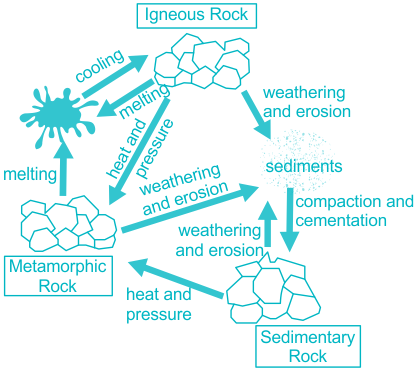
The correct answer is Sedimentary rocks. Key Points : Sedimentary rocks are formed by the deposition of fragments of rocks by exogenous processes. - It is formed from pre-existing rocks or pieces of once-living organisms. - It is formed from sediments. - Sedimentary rocks are rocks that contain fossils. - The word ‘sedimentary’ is derived from the Latin word sedimentum, which means settling. - Sandstone, shale, and Chalk are some examples of Sedimentary Rocks. - Based on the mode of formation, sedimentary rocks are categorized into three groups: - Mechanically formed. - Chemically formed. - Organically formed. Additional Information Rock cycle: - Rocks do not remain in their original form for a long period. - They undergo a transformation. - This cycle is an uninterrupted process through which old rocks are converted into new ones. - Igneous rocks are primary rocks. - These rocks can be changed into metamorphic rocks. - Sedimentary and metamorphic rocks are formed from these primary rocks. - The fragments evolved out of metamorphic rocks and igneous again form into sedimentary rocks. - Sedimentary rocks themselves can develop into fragments. - The crustal rocks -igneous, metamorphic, and sedimentary-once formed may be carried down into the interior of the Earth through subduction. - In this process, parts or entire crustal plates subduct under another plate and the same melt at high temperatures in the interior. - This results in the formation of molten magma, the unique source for igneous rocks. - The process of transformation follows the steps, 'Igneous rocks - sediment - sedimentary rocks - metamorphic rocks - magma' - The image below clearly explains the rock cycle. Question 24 solution figure Thus, the rock cycle consists of igneous rocks, sediments, sedimentary rocks, metamorphic rocks and magma. - Weathering: it is a process of disintegration and breakdown of rocks due to the active functioning of weathering agent - Decomposition: It is the process by which dead organic substances are broken down into simpler organic or inorganic matter such as carbon dioxide, water, simple sugars, and mineral salts. - Compaction: In this process, the layers are squeezed together and any water mixed in with the sediments is forced out. 108:

Q25 · General Science

In 1653, which French scientist observed that if some pressure is applied to any point of an incompressible fluid, the same pressure is transmitted to all points of the fluid and to the walls of the vessel?
  1. Daniel Bernoulli
  2. Evangelista Torricelli
  3. Blaise Pascal
  4. Eugene Bourdon
Answer aur solution dekho

Archived marked answer: C

Correct Answer Blaise Pascal Key Points - In 1653 French scientist who observed the principle you described is Blaise Pascal. - This principle is known as Pascal's law or the principle of transmission of fluid pressure. - States that pressure applied to an enclosed fluid is transmitted uniformly in all directions throughout the fluid and to the walls of the container. - This principle has many practical applications, such as in hydraulic systems and hydraulic lifts. - Pascal's law is one of the foundations of modern fluid mechanics and has had a significant impact on the fields of engineering and physics. Additional Information Daniel Bernoulli: - One of Bernoulli's most important contributions to fluid dynamics was his principle of conservation of energy, which he formulated in 1738. - This principle states that as a fluid flows through a pipe, its total energy, consisting of its potential energy (due to its position in a gravitational field) and its kinetic energy (due to its motion), remains constant. Evangelista Torricelli: - Evangelista Torricelli (1608-1647) was an Italian physicist and mathematician who is best known for his invention of the barometer and his work on the vacuum

Mathematics

Q1 · Geometry

If two circles of radii 18 cm and 8 cm touch externally, then the length of a direct common tangent is:
  1. 24 cm
  2. 14 cm
  3. 16 cm
  4. 12 cm
Answer aur solution dekho

Archived marked answer: A

Given: Two circles of radii 18 cm and 8 cm touch externally Concept used: If two circles of radius R1 and R2 are touched externally then their direct common tangent = 2√(R1 and R2) Calculation: R1 = 18 cm R2 = 8 cm So, Direct common tangent = 2√(18 × 8) ⇒ 2√144 ⇒ 2 × 12 ⇒ 24 cm ∴ The length of the direct common tangent is 24 cm.

Q2 · Geometry

The diameters of two circles are 12 cm and 20 cm, respectively and the distance between their centres is 16 cm. Find the number of common tangents to the circles.
  1. 2
  2. 3
  3. 1
  4. 4
Answer aur solution dekho

Archived marked answer: B

Given: The diameters of the two circles are 12 cm and 20 cm The distance between their centres is 16 cm Calculation:

Q3 · Trigonometry

If tan3θ⋅tan7θ = 1, where 7θ is an acute angle, then find the value of cot15θ.
  1. 1
  2. -1
  3. -√3
  4. √3
Answer aur solution dekho

Archived marked answer: B

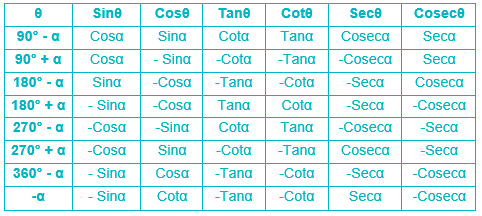
Given: tan3θ⋅tan7θ = 1 Concept used: Question 3 solution figure Calculation: tan3θ⋅tan7θ = 1 ⇒ tan3θ = 1/tan7θ

Q4 · Trigonometry

Find the value of secθ - tanθ, if secθ + tanθ = √5.
  1. 5
  2. 5 1/5
  3. √5/5
  4. √5
Answer aur solution dekho

Archived marked answer: C

Given: secθ + tanθ = √5 Concept used: sec2θ - tan2θ = 1 Calculation: sec²θ - tan²θ = 1 ⇒ (secθ + tanθ)(secθ - tanθ) = 1 ⇒ √5.(secθ - tanθ) = 1 ⇒ secθ - tanθ = 1/√5 ⇒ secθ - tanθ = √5/√5times√5 ⇒ secθ - tanθ = √5/5 ∴ The required answer is √5/5.

Q5 · Trigonometry

If 2 sinθ + 2 sin²θ = 2, then the value of 2 cos⁴θ + 2 cos²θ is:
  1. 4
  2. 2
  3. 1
  4. 0
Answer aur solution dekho

Archived marked answer: B

Given: 2 sinθ + 2 sin2θ = 2 Concept used: sin2 θ + cos2 θ = 1 Calculation: 2 sinθ + 2 sin2θ = 2 ⇒ sinθ + sin2θ = 1 ⇒ sin θ + 1 - cos2 θ = 1 ⇒ sin θ = cos2 θ ⇒ cos4 θ = sin2 θ So, 2 cos4θ + 2 cos2θ = 2 sin2 θ + 2 sin θ ⇒ 2 ∴ The required answer is 2.

Q6 · Mensuration 2D

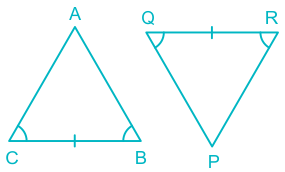
What is the ASA congruence rule of triangles, where A and S represents angle and side of triangle respectively?
  1. Two triangles are said to be congruent if all three sides of both the triangles are equal.
  2. Two triangles are said to be congruent if 2 angles and the included side of one triangle are equal to 2 angles and the included side of the other triangle.
  3. Two triangles are said to be congruent if 2 sides and the included angle of one triangle are equal to 2 sides and the included angle of the other triangle.
  4. Two triangles are said to be congruent if any pair of 2 angles and any 1 pair of sides of both the triangles are equal.
Answer aur solution dekho

Archived marked answer: B

Two triangles are said to be congruent if two angles and the included side of one triangle are equal to two angles and the included side of another triangle. Question 6 solution figure In the above-given figure, ∠ B = ∠ Q, ∠ C = ∠ R, and sides between ∠B and ∠C , ∠Q and ∠ R are equal to each other i.e. BC= QR. Hence, Δ ABC ≅ Δ PQR. ∴ The correct answer is Option 2.

Q7 · Mensuration 2D

If the side of an equilateral triangle is 16 cm, then what is its area?
  1. 81√3 cm²
  2. 48√3 cm2
  3. 32√3 cm2
  4. 64√3 cm2
Answer aur solution dekho

Archived marked answer: D

Given: The side of the equilateral triangle is 16 cm. Concept used: Area of equilateral triangle = √3/4 × a² Here, a = side of the triangle Calculation: √3/4 × 16² ⇒ √3/4 × 256 ⇒ 64√3 cm² ∴ The area of the equilateral triangle is 64√3 cm².

Q8 · Mensuration 2D

Area of the floor of a cubical room is 64 m². The length of the longest rod that can be kept in the room is:
  1. 16√3 m
  2. 4√3 m
  3. 12√3 m
  4. 8√3 m
Answer aur solution dekho

Archived marked answer: D

Given: Area of the floor of a cubical room is 64 m². Formula used: Area of a floor = a² The diagonal of a floor = a√3 Calculation: a² = 64 ⇒ a = 8 m The length of the longest rod = Diagonal of the cubical room = a√3 The length of the longest rod = 8 × √3 ⇒ 8√3 m. ∴ The correct answer is 8√3 m.

Q9 · Algebra

The value of 1.6×1.6×1.6-0.6×0.6×0.61.6×1.6+1.6×0.6+0.6×0.6 is:
  1. 0
  2. 1
  3. -1
  4. 2
Answer aur solution dekho

Archived marked answer: B

Given: 1.6×1.6×1.6-0.6×0.6×0.61.6×1.6+1.6×0.6+0.6×0.6 Concept used: a3 - b3 = (a - b)(a2 + b2 + ab) Calculation: 1.6×1.6×1.6-0.6×0.6×0.61.6×1.6+1.6×0.6+0.6×0.6 ⇒ 1.6³-0.6³1.6²+1.6×0.6+0.6² ⇒ ((1.6-0.6)(1.6²+1.6×0.6+0.6²))/(1.6²+1.6×0.6+0.6²) ⇒ 1.6 - 0.6 ⇒ 1 ∴ The required answer is 1.

Q10 · Algebra

If x⁴ + 16/(x⁴) = 15617, x > 0, then find the value of x + 2/x.
  1. √121
  2. √129
  3. √123
  4. √127
Answer aur solution dekho

Archived marked answer: B

Given: x4 + 16/(x⁴) = 15617 Concept used: (a + b)² = a² + b² + 2ab Calculation: x4 + 16/(x⁴) = 15617 ⇒ (x²)2 + (4/x²)² = 15617 ⇒ (x2)2 + (4/x²)² + 2 × x2 × (4/x²) = 15617 + 2 × x2 × (4/x²) ⇒ (x2)2 + (4/x²)² + 8 = 15617 + 8 ⇒ (x2 + 4/x²)² = 15625 ⇒ x2 + 4/x² = 125 ⇒ (x)2 + (2/x)² + 2 × x × (2/x) = 125 + 2 × x × (2/x) ⇒ (x)2 + (2/x)² + 4 = 125 + 4 ⇒ (x + 2/x)² = 129 ⇒ x + 2/x = √129 ∴ The required answer is √129.

Q11 · Algebra

If p = 8.15, q = 9.06 and r = -17.21, then the value of p³ + q³ + r³ - 3pqr is:
  1. -3.81
  2. -5.62
  3. 4.75
  4. 0
Answer aur solution dekho

Archived marked answer: D

Given: p = 8.15, q = 9.06 and r = -17.21 Concept used: If a + b + c = 0 Then, a3 + b3 + c

Q12 · Profit and Loss

A watch is sold at a profit of 25%. Had it been sold for Rs. 120 less then, there would have been a loss of 15%. What is the cost price in rupees?
  1. Rs. 400
  2. Rs. 350
  3. Rs. 200
  4. Rs. 300
Answer aur solution dekho

Archived marked answer: D

Given: A watch is sold at a profit of 25%. Had it been sold for Rs. 120 less then, there would have been a loss of 15%. Calculation: Let the cost price be 100a According to the question, 100a × 125% - 120 = 100a × 85% ⇒ 125a - 120 = 85a ⇒ 40a = 120 ⇒ a = 3 So, cost price = 100 × 3 = Rs. 300 ⇒ Rs. 300 ∴ The cost price in rupees is 300.

Q13 · Profit and Loss

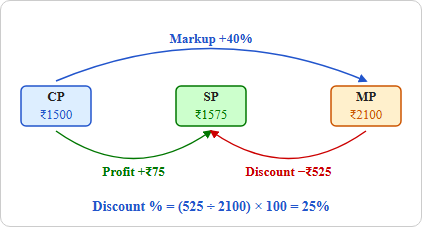
Raghav purchased a shirt at Rs. 1,500 and marked up the price of the shirt by 40%. What is the discount percentage he has to offer in order to get a profit of Rs. 75?
  1. 25%
  2. 15%
  3. 75%
  4. 50%
Answer aur solution dekho

Archived marked answer: A

Shortcut Trick Assume Cost Price (CP) = 100%, then Marked Price (MP) = 100% + 40% = 140%. Profit % on CP = (75 ÷ 1500) × 100 = 5% ⇒ Selling Price (SP) = 105%. Discount is given on MP, so Discount = MP − SP = 140% − 105% = 35%. Discount % = (Discount ÷ MP) × 100 = (35 ÷ 140) × 100 = 25%. ∴ The correct answer is 25%. Alternate Method Given: Cost Price (CP) = ₹1500 Markup = 40% Profit = ₹75 Formula Used: Marked Price (MP) = CP × (1 + Markup% ÷ 100) Selling Price (SP) = CP + Profit Discount % = ((MP − SP) ÷ MP) × 100 Question 13 solution figure Calculations: ⇒ MP = 1500 × (1 + 40 ÷ 100) = 1500 × 1.4 = ₹2100 ⇒ SP = 1500 + 75 = ₹1575 ⇒ Discount = MP − SP = 2100 − 1575 = ₹525 ⇒ Discount % = (525 ÷ 2100) × 100 = 25% ∴ The correct answer is 25%. Additional Information Marked Price (MP) & Discount MP is the price printed or tagged on an article. Discounts are always calculated on the MP unless stated otherwise. The formula is: SP = MP − Discount. Successive Discounts If two successive discounts of d₁% and d₂% are given on an article, the equivalent single discount given is (d₁ + d₂ − (d₁ × d₂) ÷ 100)%. Direct CP to MP Ratio The direct ratio between Cost Price and Marked Price can be quickly written as CP ÷ MP = (100 − Discount%) ÷ (100 + Profit%). 189:T637

Q14 · Time and Work

A is 40% more efficient than B. How much time will both, working together, take to finish the work, which B alone can finish in 36 days?
  1. 18 days
  2. 9 1/3 days
  3. 15 days
  4. 11 2/3 days
Answer aur solution dekho

Archived marked answer: C

Given: A is 40% more efficient than B B can complete the task in 36 days. Concept used: Total work = Efficiency of the worker × time taken by the worker Calculation: Let the efficiency of B be 10a So, efficiency of A = 10a × 140% ⇒ 14a So, total work = 10a × 36 ⇒ 360a Now, If they both work then time = 360a/(14a + 10a) ⇒ 360a/24a ⇒ 360/24 ⇒ 15 ∴ The required answer is 15 days. Shortcut Trick A is 40% more efficient than B, then the efficiency of A : B = 140 : 100 = 7 : 5 B alone can finish in 36 days, then total work = (5 × 36) = 180 unit If A & B both working together, time taken = 180/(7 + 5) = 180/12 = 15 days

Q15 · Number System

If the seven-digit number 52A6B7C is divisible by 33, and A, B, C are primes, then the maximum value of 2A + 3B + C is:
  1. 32
  2. 23
  3. 27
  4. 34
Answer aur solution dekho

Archived marked answer: B

Given: The seven-digit number 52A6B7C is divisible by 33 Concept used: If the difference of the sum of alternative digits of a number is divisible by 11, then that number is divisible by 11 completely. If the sum of digits of a number is a multiple of 3, the number will be completely divisible by 3. Calculation: 5 + 2 + A + 6 + B + 7 + C = 20 + A + B + C Possible values of (A + B + C) = 1, 4, 7, 10, 13, 16, 19, 22, 25 Again, 5 + A + B + C - 2 - 6 - 7 = 0 or Multiple of 11 ⇒ 5 + A + B + C - 15 = 0 or Multiple of 11 From the above possible values, for (A + B + C) = 10 we get 0 So, A + B + C = 10 Now, If A = 5, B = 3, C = 2 2A + 3B + C = 10 + 9 + 2 ⇒ 21 If A = 3, B = 5, C = 2 2A + 3B + C = 6 + 15 + 2 ⇒ 23 If A = 3, B = 2, C = 5 2A + 3B + C = 6 + 6 + 2 ⇒ 17 If A = 2, B = 5, C = 3 2A + 3B + C = 4 + 15 + 3 ⇒ 22 So, The maximum value of 2A + 3B + C is 23. ∴ The required answer is 23.

Q16 · Number System

The HCF of three numbers 98, 175 and 210 will be:
  1. 6
  2. 3
  3. 5
  4. 7
Answer aur solution dekho

Archived marked answer: D

Given: The numbers are 98, 175, and 210. Concept: HCF: Product of the smallest power of each common prime factor in the numbers. Calculation: 98 = 2 × 7² 175 = 52 × 7 210 = 2 × 3 × 5 × 7 So, HCF = 7 ∴ The required answer is 7.

Q17 · Time and Distance

Some students went on a field trip. At a speed of 6 km/h, they travelled by bikes for 2 hours; then at a speed of 2 km/h, they walked for another hour; then they took rest for an hour and had lunch for half an hour; then at a speed of 1 m/s, they walked for an hour to visit a garden; and finally at a speed 4 km/h, they returned home in 3 hours. Their average speed, in km/h, (rounded off to two places of decimal) is:
  1. 3.48
  2. 129.23
  3. 0.28
  4. 251.62
Answer aur solution dekho

Archived marked answer: A

Given: Some students went on a field trip. At a speed of 6 km/h, they travel led by bikes for 2 hours; then at a speed of 2 km/h, they walked for another hour; then they took rest for an hour and had lunch for half an hour; then at a speed of 1 m/s, they walked for an hour to visit a garden; and finally at a speed 4 km/h, they returned home in 3 hours.

Q18 · Time and Distance

Ram starts from point A at 8 a.m. and reaches point B at 2 p.m. on the same day. On the same day, Raju starts from point B at 8 a.m. and reaches point A at 6 p.m. on the same day. Both points A and B are separated by only a straight line track. At what time they both meet?
  1. 11:45 a.m.
  2. 9:42 a.m
  3. 10:42 a m.
  4. 12:42 p.m.
Answer aur solution dekho

Archived marked answer: A

English: Let the route length be D. Ram takes 6 hours and Raju 10 hours, so their combined approach speed isD/6+D/10=4 D/15 per hour. Meeting time=D÷(4 D/15)=15/4 hours=3 hours 45 minutes after 8:00 a.m., namely 11:45 a.m. हिन्दी: मार्ग की दूरी D मानें। राम 6 घंटेऔरराजू 10 घंटेलेते हैं। पास आने की संयुक्त चाल D/6+D/10=4D/15 प्रति घंटा है। मिलने का समय D÷(4D/15)=15/4 घंटे=3 घंटे 45 मिनटहै। सुबह 8 बजेसे गिनने पर वे 11:45 बजेमिलेंगे।

Q19 · Data Interpretation

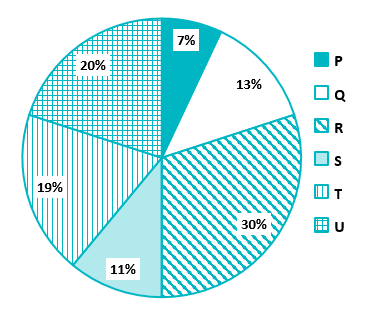
The pie chart given below shows the marks obtained by student Q in 6 different subjects. The total marks obtained by the student in these subjects is 700. Marks obtained in a particular subject is shown as a percent of total marks obtained in all these 6 subjects. Question 19 figure What is total marks obtained in Q, S and U?
  1. 312
  2. 306
  3. 294
  4. 308
Answer aur solution dekho

Archived marked answer: D

Calculation: Marks obtained in Q = 700 × 13% ⇒ 91 Marks obtained in S = 700 × 11% ⇒ 77 Marks obtained in U = 700 × 20% ⇒ 140 Total marks obtained in Q, S and U = 91 + 77 + 140 ⇒ 308 ∴ The required answer is 308.

Q20 · Proportion

In a proportion, the 1st, 2ⁿd and 4th terms are 51, 68 and 108, respectively. What is the 3rd term?
  1. 84
  2. 83
  3. 82
  4. 81
Answer aur solution dekho

Archived marked answer: D

Shortcut Trick The given terms are in proportion, meaning the ratio of the first two terms equals the ratio of the last two terms. Ratio of 1st to 2ⁿd term = 51 / 68 = 3 / 4 Therefore, the ratio of the 3rd term to the 4th term must also be 3 / 4. 3rd term = 108 × 3 / 4 = 81 ∴ The correct answer is 81. Alternate Method Given: 1st term = 51 2ⁿd term = 68 4th term = 108 Formula Used: If a, b, c, d are in proportion, then a : b :: c : d ⇒ a × d = b × c (Product of extremes = Product of means) Proportion: a : b :: c : d 51 : 68 :: x : 108 Product of Means (68 × x) Product of Extremes (51 × 108) 68 × x = 51 × 108 Calculations: Let the 3rd term be x. ⇒ 51 : 68 :: x : 108 ⇒ 51 ÷ 68 = x ÷ 108 ⇒ 68 × x = 51 × 108 ⇒ x = (51 × 108) ÷ 68 ⇒ x = (3 × 10⁸) ÷ 4 ⇒ x = 3 × 27 ⇒ x = 81 ∴ The correct answer is 81. Additional Information Proportion When two ratios are strictly equal, they form a proportion. It is represented as a : b :: c : d, where the Product of Means (b × c) equals the Product of Extremes (a × d). Fourth Proportional If a : b :: c : d, then 'd' is known as the fourth proportional to a, b, and c. It is easily found using the formula d = (b × c) ÷ a. Mean Proportional If three specific quantities are in continued proportion (a : b :: b : c), then 'b' is the mean proportional between 'a' and 'c'. Its value is calculated as b = √(a × c). </p

Q21 · Percentage

Out of an earning of Rs. 720, Pankaj spends 65%. How much does he save?
  1. Rs. 250
  2. Rs. 252
  3. Rs. 253
  4. Rs. 251
Answer aur solution dekho

Archived marked answer: B

Given: Out of an earning of Rs. 720, Pankaj spends 65%. Calculation: Savings of Pankaj = 720 × (100 - 65)% ⇒ 720 × 35% ⇒ 252 ∴ He saves Rs. 252.

Q22 · Simple Interest

A person deposited ₹15,600 in a fixed deposit at 10% per annum simple interest. After every second year he adds his interest earned to the principal. The interest at the end of 4 years is:
  1. ₹6,655
  2. ₹6,864
  3. ₹3,975
  4. ₹3,744
Answer aur solution dekho

Archived marked answer: B

Given: A person deposited ₹15,600 in a fixed deposit at 10% per annum simple interest. Concept used: S.I = (P × T × R)/100 Here, P = Principal T = Time R = Rate Calculation: Interest after 2 years = (15600 × 10 × 2)/100 ⇒ 3120 New principal after 2 years = 15600 + 3120 ⇒ 18720 Now, Interest after next 2 years = (18720 × 10 × 2)/100 ⇒ 3744 Now, Total interest after 4 years = 3120 + 3744 ⇒ 6864 ∴ The required answer is 6864. 1a

English

Q1 · Vocabulary

Select the most appropriate ANTONYM of the given word. Feud
  1. Harmony
  2. Distrust
  3. Unfriendliness
  4. Destruct
Answer aur solution dekho

Archived marked answer: A

The correct answer is 'Harmony'. Key Points - The most appropriate antonym of the given word 'Feud' is 'Harmony'. - Feud: - a prolonged and bitter quarrel or dispute between two parties. - *Example: The two families have been in a feud for generations over a piece of land.* - Harmony: - a pleasing combination or arrangement of different elements, leading to a peaceful and friendly relationship. - *Example: The choir's performance was marked by a beautiful harmony of voices.* Correct Answer: *Harmony.* Additional Information - Let's look at the meaning of other words: - Distrust: - a feeling of doubt or suspicion towards someone or something. - Unfriendliness: - a lack of friendliness or warmth, often resulting in hostility or unpleasantness. - Destruct: - the act or process of destroying something completely. The correct answer is 'I don&am

Q2 · Vocabulary

Select the most appropriate ANTONYM of the given word. Abominable
  1. Worthy
  2. Delectable
  3. Admirable
  4. Detestable
Answer aur solution dekho

Archived marked answer: C

The correct answer is 'Admirable'. Key Points - The most appropriate antonym of the given word 'Abominable' is 'Admirable'. - Abominable: - causing moral revulsion or hatred. - *Example: The abominable act of animal cruelty is a serious offense that should be punished by law.* - Admirable: (Prashansaniya) - deserving of respect and approval. - *Example: Her admirable work towards the betterment of society earned her many accolades.* Correct Answer: *Admirable.* Additional Information - Let's look at the meaning of other words: - Worthy: - deserving of respect and attention. - Delectable: - delicious and pleasing to taste. - Detestable: - deserving of hatred and disgust. The correct answer is 'I saw the

Q3 · Vocabulary

Select the most appropriate meaning of the given idiom. Eat humble pie
  1. To apologise humbly
  2. To live in penury
  3. To live a life of humility
  4. To enjoy life to the fullest
Answer aur solution dekho

Archived marked answer: A

The correct answer is 'To apologise humbly'. Key Points - The most appropriate meaning of the given idiom 'Eat humble pie' is 'To apologise humbly'. - The idiom "eat humble pie" means to admit one's fault, mistake, or inferiority in a humble and contrite manner. - *Example: After boasting about his abilities, he had to eat a humble pie when he failed to complete the task.* Correct Answer: *To apologise humbly.* Additional Information - Let's look at the meaning of other words: - The phrase "eat humble pie" is believed to have originated from the Medieval English dish "umble pie", which was a pie made from the offal (internal organs) of an animal, such as deer or boar. - The word "umble" comes from the Latin word "umbilicus" meaning "entrails". This pie was considered a lowly and inferior food, and it was often served to lower-class people, such as servants, instead of the higher-quality meat pies that were reserved for the wealthy. - Over time, the phrase "eat humble pie" evolved to mean admitting to one's lowly or inferior position or behavior in a humble and contrite way, much like the act of eating a humble pie.

Q4 · Vocabulary

Select the most appropriate meaning of the underlined idiom in the given sentence. After the government interventions, the enrolment and retention of female students have increased by leaps and bounds.
  1. Systematically
  2. Swiftly
  3. Intermittently
  4. Gradually
Answer aur solution dekho

Archived marked answer: B

The correct answer is 'Swiftly'. Key Points - The most appropriate meaning of the given idiom 'By leaps and bounds' is 'Swiftly'. - By leaps and bounds: making rapid progress or growing quickly, in a sudden and remarkable way. - *Example: Since the new CEO joined the company, their profits have increased by leaps and bounds.* Correct Answer: *Swiftly.* Additional Information - Let's see the origin of this idiom: - The origin of this idiom is unclear, but it's believed to have come from the sport of the long jump, where athletes make a running start and jump as far as they can in a single leap. - The term was first used in the 16th century to describe this physical activity and later came to be used metaphorically to describe any kind of rapid progress. The correct a

Q5 · Vocabulary

Select the option that can be used as a one-word substitute for the underlined group of words. While I was travelling in Europe, I met a man who drew maps.
  1. Cartographer
  2. Geographer
  3. Arbitrator
  4. Anthropologist
Answer aur solution dekho

Archived marked answer: A

The correct answer is 'Cartographer'. Key Points - The most appropriate word for the given group of words is 'Cartographer'. - Cartographer: (Manchitrakar) - a person who draws or produces maps. - Example sentence: The cartographer was responsible for c

Q6 · Vocabulary

Select the option that can be used as a one-word substitute for the given group of words. One who runs away from law
  1. Fatalist
  2. Convict
  3. Fugitive
  4. Lunatic
Answer aur solution dekho

Archived marked answer: C

The correct answer is 'Fugitive'. Key Points - The most appropriate word for the given group of words is 'Fugitive'. - Fugitive - (bhagoda) - Meaning in English: A person who has escaped from captivity or is in hiding to avoid arrest, prosecution, or punishment. - *Example: The police are searching for the fugitive who escaped from prison last week.* Correct Answer: Option 3* Additional Information - Let's look at the meaning of other words: - Fatalist - (niyati-vaadi). Meaning in English: A person who believes that all events are predetermined and therefore inevitable. - Convict - (apraadhi). Meaning in English: A person found guilty of a crime and sentenced by a court. - Lunatic - (paagal). Meaning in English: A person who is mentally ill, especially one who is insane. The correct answer is

Q7 · Vocabulary

Select the option that can be used as a one-word substitute for the given group of words. Words that begin with the same letter, syllable or sound
  1. Metaphor
  2. Pun
  3. Hyperbole
  4. Alliteration
Answer aur solution dekho

Archived marked answer: D

The correct answer is 'Alliteration'. Key Points - The most appropriate word for the given group of words is 'Alliteration'. - Alliteration - (samaanaadhikaari) - Meaning in English: The occurrence of the same letter or sound at the beginning of adjacent or closely connected words. - *Example: Peter Piper picked a peck of pickled peppers. This sentence uses alliteration by repeating the "p" sound at the beginning of several words.* Correct Answer: *Alliteration.* Additional Information - Let's look at the meaning of other words: - Metaphor - (roopak). Meaning in English: A figure of speech in which a word or phrase is applied to an object or action to which it is not literally applicable. - Pun - (mazaakiya uljhan). Meaning in English: A play on words that uses multiple meanings of a word or words that. - Hyperbole - (atishayokti). Meaning in English: An exaggeration used for emphasis or effect. The correct answer is 'hotel<

Q8 · Vocabulary

Select the INCORRECTLY spelt word in the following sentence. It is a deeply regrettable fact that deforestation has had a substantial consequenses on the environment.
  1. deforestation
  2. substantial
  3. regrettable
  4. consequenses
Answer aur solution dekho

Archived marked answer: D

The correct answer is 'consequenses'. Key Points - Among the given Options the incorrectly spelt word is 'Consequenses'. - Its correct spelling is 'Consequences'. - Consequences: - the effect or outcome of an action or decision. - *Example: The consequences of his reckless driving were severe and resulted in multiple injuries.* Correct Answer: *consequenses.* Additional Information - Let's look at the meaning of other words: - Deforestation: - the clearing or removal of forests or trees from a large area. - Substantial: - of considerable importance, size, or worth. - Regrettable: - causing or deserving regret or sorrow. The correct answer is

Q9 · Vocabulary

Select the sentences that contains no spelling errors.
  1. I saw the dress catalouge pieces of Asha’s corchiture collection.
  2. I saw the dress catalougue pieces of Asha’s couture collection.
  3. I saw the dress catalougue pieces of Asha’s corchiture collection.
  4. I saw the dress catalogue pieces of Asha’s couture collection.
Answer aur solution dekho

Archived marked answer: D

The correct answer is 'I saw the dress catalogue pieces of Asha’s couture collection.' Key Points - The sentence that has all the correct spellings is* 'I saw the dress catalogue pieces of Asha’s couture collection'.* - The correct spelling of the word is "catalogue" not "catalouge", and the correct spelling of the word "couture" is not "corchiture". Therefore, sentences 2 and 3 both have spelling errors. - The correct spelling of the words in sentence 1 and sentence 4 is different. - Therefore, the only sentence that contains no spelling errors is sentence 4. Correct Sentence: *I saw the dress catalogue pieces of Asha’s couture collection.* Additional Information - catalogue- A complete list of things, usually arranged systematically - couture- the designing and making of expensive fashionable clothes, or the clothes themselves

Q10 · Vocabulary

Select the most appropriate meaning of the underlined word in a sentence. The good weather has been a boon for many businesses located near the beach.
  1. luck
  2. Signal
  3. fortune
  4. beneficial
Answer aur solution dekho

Archived marked answer: D

The correct answer is 'beneficial'. Key Points - The most appropriate synonym of the given word 'boon' is 'beneficial'. - Boon - - Something that is helpful or advantageous, a blessing. - *Example: The new vaccine is a boon for the health of the population.* - Beneficial - - Producing good or helpful results or effects; advantageous. - *Example: The new exercise routine has proven to be highly beneficial for her health.* Correct Answer: *Beneficial.* Additional Information - Let's look at the meaning of other words: - Signal - - A gesture, action, or sound that is used to convey information or instructions, typically by prearrangement between the parties concerned. - Fortune - - A large amount of money or assets that someone has accumulated or inherited. - Luck - - Success or failure apparently brought by chance rather than through one's own actions The correct answer is

Q11 · Vocabulary

Select the most appropriate synonym of the underlined word. Although Edward had noble blood, his ignoble qualities made him incapable of taking over the kingdom.
  1. Salient
  2. Strange
  3. Ostentatious
  4. Unworthy
Answer aur solution dekho

Archived marked answer: D

The correct answer is 'Unworthy'. Key Points - The most appropriate synonym of the underlined word 'Ignoble' is 'Unworthy'. - Ignoble: Dishonorable; not noble in character or purpose. Hindi Translation: - *Example sentence: It would be an ignoble act to cheat on the exam. * - Unworthy: Not deserving respect or attention; not fit or suitable. Hindi Translation: - *Example sentence: It would be unworthy to pass off someone else's work as your own.* Correct Answer: *Unworthy.* Additional Information - Let's look at the meaning of other words: - Salient: Most noticeable or important; prominent. Hindi Translation: - Strange: Unusual, surprising, or difficult to understand or explain. Hindi Translation: - Ostentatious: Characterized by vulgar or pretentious display; designed to impress or attract notice. Hindi Translation: 1e4:Tda8, The correct answer is '

Q12 · Vocabulary

Select the most appropriate option to fill in the blank and complete the collocation. I had a nice ______ on my birthday with all my friends and relatives.
  1. opportunity
  2. day
  3. experience
  4. time
Answer aur solution dekho

Archived marked answer: D

The correct answer is 'time'. Key Points - The most appropriate word to fill in the given blank is 'time'. - The collocation here is "nice time", which is a common phrase used to refer to an enjoyable and pleasant experience. - Although "opportunity", "day", and "experience" are all words that could potentially fit in the sentence, they don't collocate as well with "nice" as the word "time" does. - "Nice opportunity" and "nice experience" are both grammatically correct, but they sound slightly awkward in this context. - "Nice day" is more commonly used to describe the weather, rather than an event or gathering. - Therefore, the most appropriate word to complete the collocation is "time". Correct Sentence: *I had a nice time on my birthday with all my friends and relatives.*

Q13 · Vocabulary

Fill in the blank with the correct collocation. A gaggle of journalists sit in a/an _______ foyer waiting impatiently.
  1. attic
  2. hotel
  3. ranch
  4. croft
Answer aur solution dekho

Archived marked answer: B

The correct answer is 'hotel'. Key Points - The most appropriate word for the given blank is 'hotel'. - The sentence implies that the journalists are waiting in an entrance hall or open area of a public building, where they are likely to be waiting for someone or something. - Therefore, the most appropriate option is "hotel", as hotels often have large, spacious lobbies or foyers where guests can wait for check-in or other activities. - *Example: She walked into the hotel foyer to find a gaggle of tourists waiting for their tour bus.* Correct Sentence: *A gaggle of journalists sit in a hotel foyer waiting impatiently.* Additional Information - Let's look at the meaning of other options: - Attic: A space or room just below the roof of a house or building, typically used for storage. Hindi Translation: - Ranch: A large farm, typically used for raising cattle or other livestock. Hindi Translation: - Croft: A small farm, especially in Scotland, Ireland, or northern England. Hindi Translation: 1e3:Ta67, The correct answe

Q14 · Grammar

Select the sentence with the appropriate use of preposition.
  1. Are you interested along with modern art?
  2. Are you interested into modern art?
  3. Are you interested with modern art?
  4. Are you interested in modern art?
Answer aur solution dekho

Archived marked answer: D

The correct answer is 'Are you interested in modern art?' Key Points - Among the given options only option four is correct. In this sentence, all the prepositions are correctly used. - The reason why this sentence is correct is that the preposition "in" is commonly used to show interest or involvement in a particular field or subject. In this case, "in" is used to express an interest in the subject of modern art. &

Q15 · Grammar

Select the correct indirect form of the given sentence. He says to Gayatri, “You are writing an apology to the warden.”
  1. He told Gayatri that she is writing an apology to the warden.
  2. He tells Gayatri that she is writing an apology to the warden.
  3. He says to Gayatri that she was writing an apology to the warden.
  4. He tells Gayatri that she was writing an apology to the warden.
Answer aur solution dekho

Archived marked answer: B

The correct answer is 'He tells Gayatri that she is writing an apology to the warden.' Key Points - The given sentence is in Direct Speech. As per the question we have to c

Q16 · Grammar

Select the most appropriate option that can substitute the underlined segment in the given sentence. If there is no need to substitute it, select ‘No substitution’. Scores given by the members are to be consolidated and sent in the head office immediately.
  1. No substitution
  2. after the head office
  3. at the head office
  4. to the head office
Answer aur solution dekho

Archived marked answer: D

The correct answer is 'to the head office'. Key Points - The given sentence is grammatically incorrect. - Here, 'to the head office' should be used instead of 'in the head office'. - The reason why "to the head office" is the correct answer is that the phrase

Q17 · Grammar

Select the most appropriate option that can substitute the underlined segment in the given sentence. You must aware of friends who speak against you.
  1. caution of
  2. beware of
  3. scarce of
  4. careful of
Answer aur solution dekho

Archived marked answer: B

The correct answer is 'beware of'. Key Points - The underlined part in the given sentence is grammatically incorrect. - Here, 'beware of' should be used instead of 'aware of'. - By using "beware of" instead of "you must aware of," the warning becomes more direct and urgent, as "beware" implies a sense of imminent danger or harm. Additionally, "beware of" is a common and idiomatic expression, while "you must aware of" is not typically used in English. - The phrase "beware of" is a better fit in this sentence because it conveys a sense of caution or wariness towards someone or something that may pose a danger or threat. It is often used as a warning to others to be on the lookout for potential harm or trouble. - *For example, if someone tells you to "beware of pickpockets" when you're traveling in a crowded city, it means you should be careful and watchful of your belongings so that you don't become a victim of theft.* - So in the context of the given sentence, the correct phrase is *"beware of friends who speak against you,"* which means that you should be cautious and watchful of any friends who might be speaking negatively about you behind your back. Correct Sentence: *You must beware of friends who speak against you.*

Q18 · Voice Change

Select the option that expresses the given sentence in active voice. I don’t like being seen in tears by people.
  1. I don’t like people had been seeing me in tears.
  2. I don’t like people seeing me in tears.
  3. I don’t like people to see me in tears.
  4. I don’t like myself to be seen in tears.
Answer aur solution dekho

Archived marked answer: B

The correct answer is 'I don’t like people seeing me in tears.' Key Points - The given sentence is in Passive Voice. As per the given question, we have to change it to Active Voice. - Here, Option 2 is the correct answer. - In the given sentence, the subject 'I' is not performing the action of the verb directly. Instead, the action of the verb is being done to the subject. This is known as the passive voice. - In the active voice, the subject performs the action of the verb directly. The sentence *"people seeing me in tears"* can be rephrased as* "people see me in tears"* to put it in the active voice. - Let's see why other options are incorrect: - Option 1 is not grammatically correct as it uses the past perfect tense ("had been seeing") which is not appropriate for the sentence. - Option 3 is also grammatically correct and expresses the same meaning as option 2, but it is more verbose and less concise. - Option 4 changes the meaning of the sentence slightly by making it more focused on the subject's own preference rather than the action of others. Correct Answer:* I don’t like people seeing me in tears.*

Q19 · Voice Change

Select the correct passive voice form for the given sentence. My brother likes cricket.
  1. Cricket was like by my brother.
  2. Cricket is like by my brother.
  3. Cricket is liked by my brother.
  4. Cricket was liked by my brother.
Answer aur solution dekho

Archived marked answer: C

The correct answer is 'Cricket is liked by my brother'. Key Points - The given sentence is in Active Voice. As per the question we have to change it to Passive Voice. - The structure of the given sentence is as follows: - Subject + V1 + Object. (Active Voice) - Subject (Objective Case) + is/am/are + V3 + Object (Subjective Case). (Passive Voice) - *Example:* - *Aastha teaches English. (Active Voice) * - *English is taught by Aastha. (Passive Voice)* - The subject of the given sentence is 'My brother'. - The object of the given sentence is 'Cricket'. - The subject will be put in place of the object and the object will be put in place of the subject. - 'likes' will be changed into 'is liked'. Correct Sentence:* Cricket is liked by my brother.*

Q20 · Para Jumble

Sentences of a paragraph are given below in jumbled order. Arrange the sentences in the correct order to form a meaningful and coherent paragraph. A. While India is home to 75 per cent of tigers in the world, the Global Tiger Day - as it is also known - sees awareness events organised in the country, as well as neighbouring Bangladesh and Nepal. B. Its primary objective is to preserve the natural habitat of the tiger. C. International Tiger Day was initiated in 2010, at the Saint Petersburg Tiger Summit. D. This annual event, observed on 29 July, aims to create awareness on tiger conservation.
  1. DCAB
  2. BADC
  3. CDBA
  4. CDAB
Answer aur solution dekho

Archived marked answer: C

The correct answer is 'CDBA'. Key Points - The given question is an example of a Para Jumble. - We know that the first statement of a para jumbled question is usually an independent general statement, a noun, a universal fact, starting of an incident, or it starts with 'most' or 'once'. - Sentence C begins by introducing the topic of International Tiger Day, which was initiated in 2010 at the Saint Petersburg Tiger Summit. This sentence provides the context for the remaining sentences and explains what the paragraph will be about. - Sentence D then explains that International Tiger Day is observed annually on 29 July and aims to create awareness about tiger conservation. This sentence expands on the topic introduced in sentence C and adds another important detail about the day. - Sentence B follows and states the primary objective of preserving the natural habitat of the tiger. This sentence is important because it highlights the main purpose of tiger conservation efforts, which is to ensure that tigers have a safe and secure natural environment to live in. - Finally, sentence A provides additional detail by mentioning that while India is home to 75% of tigers in the world, neighboring countries like Bangladesh and Nepal also organize awareness events on this day. This sentence provides a geographical context for the day and emphasizes that tiger conservation is a global issue. - Overall, the correct sequence of the sentences (CDBA) forms a coherent paragraph that introduces the topic of International Tiger Day, explains its objectives and importance, and provides additional details about tiger conservation efforts around the world. Correct Sequence: *International Tiger Day was initiated in 2010, at the Saint Petersburg Tiger Summit. This annual event, observed on 29 July, aims to create awareness on tiger conservation. Its primary objective is to preserve the natural habitat of the tiger. While India is home to 75 per cent of tigers in the world, the Global Tiger Day - as it is also known - sees awareness events organised in the country, as well as neighbouring Bangladesh and Nepal.*

All archived papers · 2026 answer explanations