91 questions available to read. Bina signup padho; timed practice ke liye free sign in karo.
Archive coverageThis saved paper contains 92 of 100 expected questions. 1 stored records are excluded from this study page while their source or wording is checked. Missing original questions: 8. Local question numbers follow the saved archive; match the wording and choices when comparing another response sheet.
Archived marked answers and available solution notes are preserved. These are not claimed to be fully checked final SSC keys. How questions are checked.
Reasoning
Q1 · Series
Select the figure from among the given options that can replace the question mark (?) in the following series.



Answer aur solution dekho
Archived marked answer: A
The pattern followed here is:
1) In the every next figures are getting rotated 90º in anti-clockwise direction.
2) One leaf is added in each figure starting from Left then right alternatively.
 Hence, the correct answer is "Option 1".
Q2 · Series
Which of the following terms will replace the question mark (?) in the given series?
AVTE CTRG ERPI GPNK ?
- INLM
- MINL
- ILNM
- INJM
Answer aur solution dekho
Archived marked answer: A
The position of the English alphabet letters is given below:
Given: AVTE CTRG ERPI GPNK ?
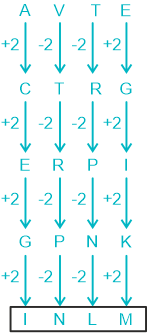 Hence, the correct answer is "INLM".
Q3 · Series
Which of the following letter-clusters will replace the question mark (?) and complete the following letter-cluster series?
LE, OJ, UO, DT, ?
- PZ
- QY
- PX
- PY
Answer aur solution dekho
Archived marked answer: D
The pattern followed here is:
Given: LE, OJ, UO, DT, ?
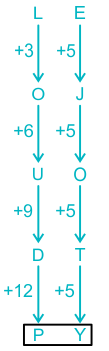 Hence, the correct answer is "PY".
Q4 · Series
Select the figure that will come next in the following figure series.



Answer aur solution dekho
Archived marked answer: B
The pattern followed here is:
1) The middle figure is newly formed in every next figure and the number of sides are decrease in every next figure, in first arrow is given, in the second figure in the middle hexagon is given, then the pentagon is given in the third figure, then the square is given in the fourth figure, and the triangle is given in the last figure.
 2) Square is shifted towards the left side in middle in the second figure, then shifted right upper corner in the third figure, then shifted left upper in the fourth figure, then shifted right bottom of the corner in the last figure.
 3) The phi sign shifted left upper corner in the second figure, then shifted right bottom of the corner in the third figure., then shifted right side in the middle in the fourth figure, then shifted right upper corner in the last figure.
 4) Question mark (?) shited the right bottom of the corner in the second figure, then shifted to the left side in the middle in the third figure, then shifted to the right upper corner in the fourth figure, then shifted to left upper corner in the last figure.
 5) Star figure shifted right upper corner in the second figure, then shifted left upper corner in the third figure, then shifted right bottom of the corner in the fourth figure, then shifted left side in the middle of the last figure.
 Hence, the correct answer is "Option 2".
Q5 · Series
In the following question, select the missing number from the given series.
41, 54, 67, 80, 93, ?
- 106
- 108
- 105
- 110
Answer aur solution dekho
Archived marked answer: A
The pattern followed here is:
Given: 41, 54, 67, 80, 93, ?
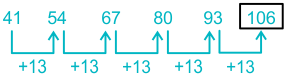 Hence, the correct answer is "106".
Q6 · Analogy
Select the set in which the numbers are related in the same way as are the numbers of the following sets.
(NOTE : Operations should be performed on the whole numbers, without breaking down the numbers into its constituent digits. E.g. 13 – Operations on 13 such as adding /subtracting /multiplying etc. to 13 can be performed. Breaking down 13 into 1 and 3 and then performing mathematical operations on 1 and 3 is not allowed)
(70, 14, 56)
(88, 30, 58)
- (44, 24, 23)
- (59, 36, 25)
- (52, 19, 33)
- (38, 16, 24)
Answer aur solution dekho
Archived marked answer: C
The pattern followed here is:
Logic: (First number - Third number) = Second number.
1) (70, 14, 56)
⇒ (70 - 56) = 14
2) (88, 30, 58)
⇒ (88 - 58) = 30
Let's check each option one by one.
Option 1)
Q7 · Analogy
Select the option that is related to the third number in the same way as the second number is related to the first number and the sixth number is related to the fifth number.
8 : 128 :: 6 : ? :: 11 : 242
- 64
- 72
- 68
- 70
Answer aur solution dekho
Archived marked answer: B
The pattern followed here is:
Logic: (First number)² × 2 = Second number.
1) 8: 128
⇒ 8² × 2
⇒ 64 × 2 = 128
And,
2) 11: 242
⇒ 11² × 2
⇒ 121 × 2 = 242
Similarly,
3) 6: ?
⇒ 6² × 2
⇒ 36 × 2 = 72
Hence, the correct answer is "72".
Q8 · Analogy
Select the option that is related to the fifth number in the same way as the second number is related to the first number and the fourth number is related to the third number.
7 : 25 :: 4 : 4 :: 3 : ?
- 5
- 4
- 1
- 7
Answer aur solution dekho
Archived marked answer: C
The pattern followed here is:
Logic: (First number - 2)² : Second number.
1) 7 : 25
⇒ (7 - 2)² ⇒ (5)² ⇒ 25
And,
2) 4 : 4
⇒ (4 - 2)² ⇒ (2)2 ⇒ 4
Similarly,
3) 3 : ?
⇒ (3 - 2)2 ⇒ (1)2 ⇒ 1
Hence, the correct answer is "1".
Q9 · Analogy
Select the option that is related to the third word in the same way as the second word is related to the first word.
(The words must be considered as meaningful English words and must not be related to each other based on the number of letters/number of consonants/vowels in the word.)
Movie : Director :: Orchestra : ?
- Choreographer
- Conductor
- Dancer
- Audience
Answer aur solution dekho
Archived marked answer: B
The pattern followed here is:
Movie: Director → A movie director is a person who controls a film's artistic and dramatic aspects and visualizes the screenplay while guiding the film crew.
Similarly,
Orchestra: Conductor → A conductor conducting is the art of directing a musical performance, such as an orchestral or choral concert.
Hence, the correct answer is "Conductor".
Q10 · Non Verbal Reasoning
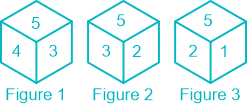
Three different positions of the same dice are shown. Find the number on the face opposite the face showing '5'.
- 2
- 1
- 6
- 3
Answer aur solution dekho
Archived marked answer: C
The pattern followed here is:
Here, we have to find the face opposite the face showing '5'.
1) We are taking dice figures (1) & (2) together.
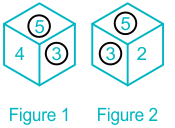 Here, 5 and 3 are common in both figure and 2 is opposite to 4.
2) We are taking dice figure (2) & (3) together.
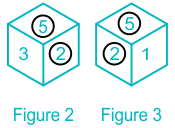 Here, 5 and 2 are common in both figure and 3 is opposite to 1.
Opposite pairs are:
3 → 1
2 → 4
6 → 5
Clearly, 5 is opposite to 6.
Hence, the correct answer is "6".
Q11 · Non Verbal Reasoning
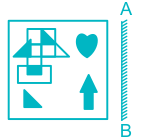
Select the correct mirror image of the given figure when the mirror is placed at AB as shown.




Answer aur solution dekho
Archived marked answer: D
The correct mirror image of the given figure when the mirror is held on the AB side.
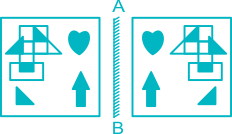 Hence, the correct answer is "Option 4".
Additional Information 1) In the mirror image left side and right side changed vice-versa where the top and bottom remain the same.
2) In a real given mirror image the farthest number or alphabet appears closest in the mirror image.
Q12 · Non Verbal Reasoning
Select the correct mirror image of the given combination when the mirror is placed at 'PQ' as shown below.





Answer aur solution dekho
Archived marked answer: A
The correct mirror image of the given figure when the mirror is held on the PQ side.
 Detailed Explanation:
- The correct mirror image of the given figure is "
 " the second word of the given image is 'O' and the correct mirror image is "
 " but it is wrongly given in option 2 and option 4 so option 2 and 4 is eliminated.
- The correct mirror image of the given figure is "
" the sixth number of the given image is '8' and the correct mirror image is "
 " but it is wrongly given in option 3 so option 3 is eliminated.
Hence, the correct answer is "Option 1".
Additional Information
1) In the mirror image left side and right side changed vice-versa where the top and bottom remain the same.
2) In a real given mirror image the farthest number or alphabet appears closest in the mirror image.
Q13 · Puzzle Subtypes Not To Miss
By interchanging the given two signs and numbers which of the following equation will be not correct?
× and ÷, 2 and 6
I. 7 – 4 × 3 ÷ 6 + 2 = 8
II. 6 – 8 × 2 + 9 ÷ 3 = 5
- Only II
- Neither I nor II
- Only I
- Both I and II
Answer aur solution dekho
Archived marked answer: D
The pattern followed here is:
Interchanging × and ÷, 2 and 6 in the given equation and find which is not correct.
I. 7 – 4 × 3 ÷ 6 + 2 = 8
After interchanging the sign and numbers we get the:
⇒ 7 – 4 ÷ 3 × 2 + 6 = 8
⇒ 7 - 1.333 × 2 + 6 = 8
⇒ 7 - 2.666 + 6 = 8
⇒ 13 - 2.666 = 8
⇒ 10.334 ≠ 8 (Not correct)
II. 6 – 8 × 2 + 9 ÷ 3 = 5
After interchanging the sign and numbers we get the:
⇒ 2 – 8 ÷ 6 + 9 × 3 = 5
⇒ 2 - 1.333 + 9 × 3 = 5
⇒ 2 - 1.333 + 27 = 5
⇒ 29 - 1.333 = 5
⇒ 27.667 ≠ 5 (Not correct)
So, Both I and II are not correct.
Hence, the correct answer is "Option 4".
Q14 · Puzzle Subtypes Not To Miss
After interchanging the given two numbers and two signs what will be the values of equations (I) and (II) respectively?
– and ×, 6 and 4
I. 7 × 6 + 8 ÷ 2 – 4
II. 4 – 7 × 6 + 8 ÷ 2
- 27, 42
- 27, 47
- 27, 49
- 25, 40
Answer aur solution dekho
Archived marked answer: A
The pattern followed here is:
Here in this question interchanging the given two numbers and two signs in the given equation.
Given: – and ×, 6 and 4
I. 7 × 6 + 8 ÷ 2 – 4
After interchanging the two numbers and two signs we get the;
⇒ 7 - 4 + 8 ÷ 2 × 6
⇒ 7 - 4 + 4 × 6
⇒ 7 - 4 + 24
⇒ 31 - 4 = 27
II. 4 – 7 × 6 + 8 ÷ 2
After interchanging the two numbers and two signs we get the;
⇒ 6 × 7 - 4 + 8 ÷ 2
⇒ 6 × 7 - 4 + 4
⇒ 42 - 4 + 4
⇒ 46 - 4 = 42
Hence, the correct answer is "27, 42".
Q15 · Puzzle Subtypes Not To Miss
Which two numbers, from amongst the given options, should be interchanged to make the given equation correct?
(6)² – 20 + (28 ÷ 7) – [ {( {√4 } ) times 8} ] + (2)² = 40
- 6 and 8
- 7 and 2
- 2 and 8
- 20 and 8
Answer aur solution dekho
Archived marked answer: A
The pattern followed here is:
We have to interchange the two numbers to make the given equation correct.
Let's check the option one by one.
Option 1) 6 and 8
Given : (6)2 – 20 + (28 ÷ 7) – [ {( {√4 } ) times 8} ] + (2)2 = 40
After interchanging the numbers we get the:
⇒ (8)__2 – 20 + (28 ÷ 7) – [ {( {√4 } ) × 6} ] + (2)__2 = 40
⇒ 64 - 20 + 4 - 2 × 6 + 4 = 40
⇒ 64 - 20 + 4 - 12 + 4 = 40
⇒ 72 - 20 - 12 = 40
⇒ 40 = 40
⇒ LHS = RHS
Option 2) 7 and 2
Given : (6)2 – 20 + (28 ÷ 7) – [ {( {√4 } ) times 8} ] + (2)2 = 40
After interchanging the numbers we get the:
⇒ (6)__2 – 20 + (28 ÷ 2) – [ {( {√4 } ) × 8} ] + (7)__2 = 40
⇒ 36 - 20 + 14 - 2 × 8 + 49 = 40
⇒ 36 - 20 + 14 - 16 + 49 = 40
⇒ 99 - 20 - 16 = 40
⇒ 63 ≠ 40
⇒ LHS ≠ RHS
Option 3) 2 and 8
Given : (6)2 – 20 + (28 ÷ 7) – [ {( {√4 } ) times 8} ] + (2)2 = 40
After interchanging the numbers we get the:
⇒ (6)__2 – 20 + (28 ÷ 7) – [ {( {√4 } ) × 2} ] + (8)2__ = 40
⇒ 36 - 20 + 4 - 2 × 2 + 64 = 40
⇒ 36 - 20 + 4 - 4 + 64 = 40
⇒ 104 - 20 - 4 = 40
⇒ 80 ≠ 40
⇒ LHS ≠ RHS
Option 4) 20 and 8
Given : (6)2 – 20 + (28 ÷ 7) – [ {( {√4 } ) times 8} ] + (2)2 = 40
After interchanging the numbers we get the:
⇒ (6)__2 – 8 + (28 ÷ 7) – [ {( {√4 } ) × 20} ] + (2)__2 = 40
⇒ 36 - 8 + 4 - 2 × 20 + 4 = 40
⇒ 36 - 8 + 4 - 40 + 4 = 40
⇒ 44 - 8 - 40 = 40
⇒ - 4 ≠ 40
⇒ LHS ≠ RHS
Hence, the correct answer is "6 and 8".
70
Q16 · Puzzle Subtypes Not To Miss
Select the option that is related to the fifth letter-cluster in the same way as the second letter-cluster is related to the first letter-cluster and the fourth letter-cluster is related to the third letter-cluster.
GAIN : HBKP :: ACHE : BDJG :: CAKE : ?
- DBNH
- DBMH
- DBNG
- DBMG
Answer aur solution dekho
Archived marked answer: D
The pattern followed here is:
1) GAIN : HBKP
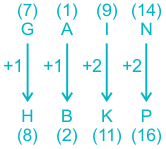 And,
2) ACHE : BDJG
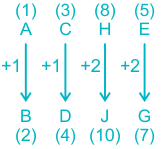 Similarly,
3) CAKE : ?
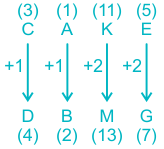 Hence, the correct answer is "DBMG".
Q17 · Coding Decoding
In a certain code language, 'CHILDREN' is written as ‘FKLOGUHQ’ and ‘SCHOOL’ is written as ‘VFKRRO’, how will 'CLASSROOM' be written in that language?
- EMCTTTQQO
- EMCTTURRP
- FOEWWURRP
- FODVVURRP
Answer aur solution dekho
Archived marked answer: D
The pattern followed here is:
'CHILDREN' is written as ‘FKLOGUHQ’
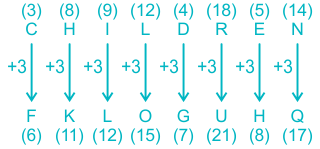 And,
‘SCHOOL’ is written as ‘VFKRRO’
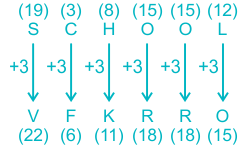 Similarly,
'CLASSROOM' be written as '?'
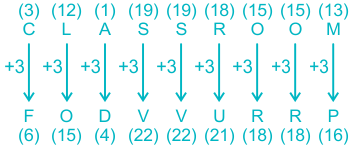 Hence, the correct answer is "FODVVURRP".
Q18 · Coding Decoding
In a certain code language, 'INBOX’ is written as 'MRYCL' and 'EMAIL' is written as 'NVZOR'. How will 'DRAFT' be written in that language?
- UGZWI
- WIZGU
- IWZGU
- IWGZU
Answer aur solution dekho
Archived marked answer: C
The pattern followed here is:
1) 'INBOX’ is written as 'MRYCL'
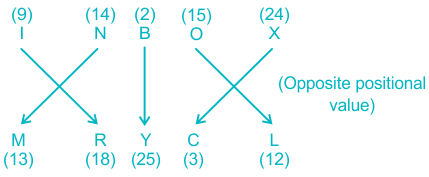 And,
2) 'EMAIL' is written as 'NVZOR'
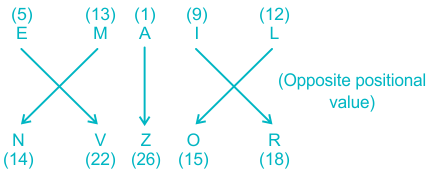 Similarly,
3) 'DRAFT' is written as '?'
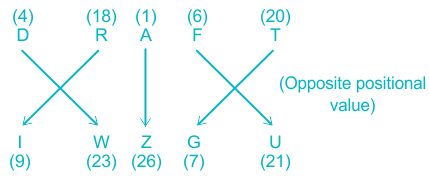 Hence, the correct answer is "IWZGU".
Q19 · Classification Odd One Out
Three of the following four letter-clusters are alike in a certain way and one is different.
Pick the odd one out.
- TQR
- MJK
- IFG
- NKI
Answer aur solution dekho
Archived marked answer: D
The pattern followed here is:
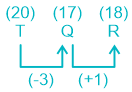
Logic: First alphabet - 3 = Second alphabet + 1 = Third alphabet.
Option 1) TQR
Q20 · Classification Odd One Out
In the following question, four number pairs are given. In each pair the number on left side of (–) is related to the number of the right side of (–) with some Logic/Rule/Relation. Three pairs are similar on basis of same Logic/Rule/Relation. Select the odd one out from the given alternatives. (NOTE: Operations should be performed on the whole numbers, without breaking down the numbers into its constituent digits. E.g.13 – Operations on 13 such as adding /subtracting /multiplying etc. to 13 can be performed. Breaking down 13 into 1 and 3 and then performing mathematical operations on 1 and 3 is not allowed)
- 17 – 31
- 13 – 25
- 15 – 27
- 9 – 15
Answer aur solution dekho
Archived marked answer: B
The pattern followed here is:
Logic: (First number × 2) - 3 = Second number.
Let's check each option one by one.
Option 1) 17 - 31
⇒ (17 × 2) - 3
⇒ 34 - 3 = 31 = 31 (Correct)
Option 2) 13 - 25
⇒ (13 &am
Q21 · Logical Reasoning
In the following question below are given some statements followed by some conclusions based on those statements. Taking the given statements to be true even if they seem to be at variance from commonly known facts. Read all the conclusions and then decide which of the given conclusion logically follows the given statements.
Statements:
I. Some F are D.
II. No A is D.
Conclusion:
I. Some F are A.
II. No D is A.
III. Some F are not A.
- Neither conclusion follows
- Both conclusions II and III follows
- Only conclusion I follows
- Only conclusion III follows
Answer aur solution dekho
Archived marked answer: B
The pattern followed here is:
The least possible Venn diagram is shown below according to the given information.
Statements:
I. Some F are D.
II. No A is D.
 Conclusions:
Q22 · Logical Reasoning
Read the given statement(s) and conclusions carefully. Assuming that the information given in the statements is true, even if it appears to be at variance with commonly known facts, decide which of the given conclusions logically follow(s) from the statement(s).
Statements:
Some ships are cups.
No cup is a stool.
All windows are cups.
Conclusions:
I. Some ships being windows is a possibility.
II. No window is a stool.
III. All cups are windows.
IV. No ship is a stool.
- Only Conclusions I, II and IV follow
- Only Conclusions II and III follow
- Only Conclusions I and II follow
- Only Conclusion I follows
Answer aur solution dekho
Archived marked answer: C
The pattern followed here is:
The least possible Venn diagram is shown below according to the given information.
Statements:
Some ships are cups.
No cup is a stool.
All windows are cups.
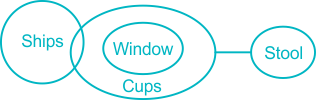 Conclusions:
I. Some ships being windows is a possibility → Follow → As some ships are cups and No cup is a stool and all windows are cups. So some ships being windows is a possibility is definitely followed.
II. No window is a stool → Follow → As No cup is a stool and All windows are cups. So No window is a stool is definitely followed.
III. All cups are windows → Does not follow → As all windows are cups. So all cups are windows is not definitely followed.
IV. No ship is a stool → Does not follow → As some ships are cups and No cup is a stool and all windows are cups. So No ship is a stool is not followed because it is a possibility that some ships are stool. So it is definitely not followed.
So, the only conclusions I and II follow.
Hence, the correct answer is "Option 3".
Q23 · Blood Relations
If A ÷ B means that A is the brother of B, A × B means that A is the sister of B, and A – B means that A is the father of B then which of the following expression shows that P is the paternal uncle of R?
- P - R ÷ Q
- P ÷ R × Q
- P × R - Q
- P ÷ Q - R
Answer aur solution dekho
Archived marked answer: D
Preparing the family tree using the following symbol:
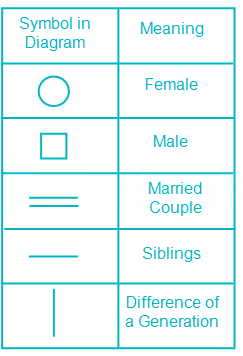 Given:
A ÷ B means that A is the brother of B
A × B means that A is the sister of B
A – B means that A is the father of B
Symbol
Symbol Denoted Relation
÷
Brother
×
Sister
Father
Find:- Which expression shows that P is the paternal uncle of R.
Let's check each option one by one.
Option 1) P - R ÷ Q
P is the father of R, and R is the brother of Q.
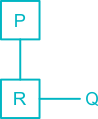 Here, P is the Father of R. (Incorrect)
Option 2) P ÷ R × Q
P is the brother of R, and R is the sister of Q.
 Here, P is the Brother of R. (Incorrect)
Option 3) P × R - Q
P is the sister R, R is the father of Q.
 Here, P is the Sister of R. (Incorrect)
Option 4) P ÷ Q - R
P is the brother of Q, Q is the father of R.
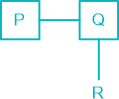 Here, P is the Paternal uncle of R. (Correct)
Hence, the correct answer is "Option 4".
Q24 · Blood Relations
A + B means ‘A is the father of B’
A – B means ‘A is the mother of B’
A % B means ‘A is the brother of B’
A # B means ‘A is the daughter of B’
If P + Q % R % S # T – U, then how is Q related to U?
- Brother
- Brother-in-law
- Father
- Son
Answer aur solution dekho
Archived marked answer: A
By using the symbols in the table given below, we can draw the following family tree:
Given:
A + B means ‘A is the father of B’
A – B means ‘A is the mother of B’
A % B means ‘A is the brother of B’
A # B means ‘A is the daughter of B’
Symbol
Relation
+
Father
Mother
%
Brother
#
Daughter
Given: P + Q % R % S # T – U
P is the father of Q, Q is the brother of R, R is the brother of S, S is the daughter of T, T is the mother of U.
Find: How is Q related to U?
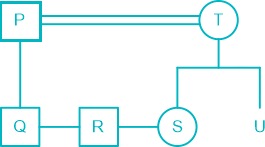 Clearly, Q is the Brother of U.
Hence, the correct answer is "Brother".
Q25 · Alphabet Test
Select the option that represents the correct order of the given words as they would appear in an English dictionary.
1- Sennet
2- Sennight
3- Sennit
4- Seniority
5- Senna
- 4, 5, 1, 2, 3
- 5, 4, 2, 1, 3
- 4, 5, 2, 1, 3
- 4, 5, 1, 3, 2
Answer aur solution dekho
Archived marked answer: A
The pattern followed here is:
The given words are arranged as per the English dictionary order.
4. Seniority
5. Senna
1. Sennet
2. Sennight
3. Sennit
Hence, the correct answer is "4, 5, 1, 2, 3".
General Awareness
Q1 · Art and Culture
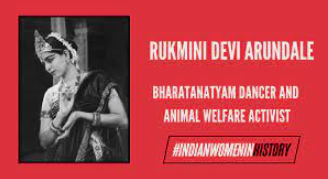
Rukmini Devi Arundale is the exponent of which of the following Indian classical dance forms?
- Bharatanatyam
- Manipuri
- Sattriya
- Odissi
Answer aur solution dekho
Archived marked answer: A
The correct answer is Bharatanatyam.
Key Points
- Rukmini Devi Arundale was a reputed dancer and choreographer of Bharatnatyam
- In 1956, Rukmini Devi was awarded the Padma Bhushan.
- in 1967 she received the "Sangeet Natak Akademi Fellowship".
- Rukmini Devi was the first woman to be nominated as a member of the Rajya Sabha.
- She was featured in India Today's list of 100 people who shaped India.
 Additional Information
- Some famous personalities related to Dance
- Bharatanatyam - Sonal Mansingh, Bala Saraswati, Narthaki Natraj, CV Chandrasekhar, Leela Samson, Mrinalini Sarabhai, Padma Subramanyam, Rukmini Devi, Yamini Krishnamurti.
- Kathak - Shobhna Narayan, Bharti Gupta, Birju Maharaj, Durga Das, Gopi Krishna, Sambhu Maharaj, Sitara Devi.
- Kuchipudi - Raja, Kaushalaya Reddy, Siddhendra Yogi, Josyula Seetharamaiah, Vempathi Chinna Sathyam, Yamini Krishnamurthy, Ragini Devi.
- Manipuri - Guru Bipin Singh, Indira Devi, Darshana Jhaveri, Rajkumar Singhajit Singh, Nirmala Mehta, Savita Mehta.
- Odissi - Debaprasad Das, Dhirendra Nath Patnaik, Indrani Rahman, Kelucharan Mahapatra, Priyambada Mohanty, Sanjukta Panigrahi, Mayadhar Raut, Ileana Citaristi, Gangadhar Pradhan, Madhavi Mudgal, Sonal mansingh.
- Kathakali - Mrinalini Sarabhai, Thottam Shankaran, Kutti Nayyar, Shankar Kurup, KC (Kavungal Chathunni) Panicker, TT Ram Kulti, Chemancheri Kunhiraman Nair.
Q2 · Art and Culture
The Durga temple at Aihole, built about ______ years ago.
- 1700
- 2000
- 1100
- 1400
Answer aur solution dekho
Archived marked answer: D
The correct answer is 1400.
Key Points
- Aihole, Karnataka, India is home to the early eighth-century Hindu temple known as the Durga temple.
- It was originally dedicated to Surya.
- Its relief panels, which feature the artwork of Shaivism, Vaishnavism, Shaktism, and Vedic deities, are the largest and most elaborate in Aihole.
- It is renowned for its apsidal layout, a unique example of early Chalukyan Hindu temple construction.
- It is part of a pending UNESCO World Heritage Site application.
Additional Information
- Aihole
- It was built in 634.
- It was the headquarters of the famous medieval Ayyavole merchants’ guild and was an important commercial centre.
- The earliest stone-built temple is Lad Khan temple.
- A temple dedicated to the goddess Durga was built on the model of Buddha, Chaitya.
- It stands on a raised platform in the form of a semi-circle.
- Badami
- There are four caves in Badami.
- The largest cave temple built by Mangalesa is dedicated to Vishnu.
- The reclining posture of Vishnu on the snake bed and Narasimha are exquisite examples of Chalukya art.
- Pattadakal
- It is a village in the Bagalkot district of Karnataka.
- It is famous for its exquisite temples.
- Pattadakal was a centre for performing royal rituals.
- The Virupaksha temple was built at the order of queen Lohamahadevi to commemorate the conquest of Kanchipuram by her husband Vikramaditya II.
Q3 · Art and Culture
In honour of an Indian musician, the US state of Massachusetts proclaimed 20 April as __________ in 1984.
- Sakhawat Hussain Day
- Sharan Rani Backliwal Day
- Amjad Ali Khan Day
- Allauddin Khan Day
Answer aur solution dekho
Archived marked answer: C
The correct answer is Amjad Ali Khan Day.
Key Points
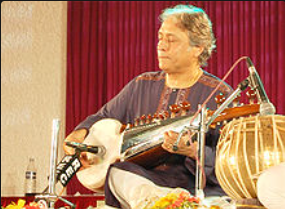
- Ustad Amjad Ali Khan (born 9 October 1945) is an Indian classical sarod player, best known for his clear and fast ekhara taans.
- Khan first performed in the United States in 1963 and continued till 2000
- The U.S. state of Massachusetts proclaimed 20 April as Amjad Ali Khan Day in 1984.
- Khan was awarded the 21st Rajiv Gandhi National Sadbhavna Award.
- Khan received Padma Shri in 1975, Padma Bhushan in 1991, and Padma Vibhushan in 2001, and was awarded the Sangeet Natak Akademi Award in 1989 and the Sangeet Natak Akademi Fellowship in 2011.
 Additional Information
- Some Musical Instrument & related Personalities
- Been - Asad Ali Khan, Zia Moin-ud-din Khan
- Santoor - Shiv Kumar Sharma, Rahul Sharma, Satish Vyas.
- Sarod - Amjad Ali Khan, Hafiz Ali Khan, All Akbar Khan, Tejendar Majumdar, Buddhadev Das Gupta, Bahadur Khan.
- Sarangi - Ustad Binda Khan, Sultan Khan, Sabri Khan, Dhruba Ghosh.
- Sitar - Ravi Shankar, Vilayat Khan, Imran Khan, Hara Shankar Bhattacharya, Nikhil Banerjee, Shahid Parvez
- Veena - Asad Ali khan, Jyoti Hedge, S Bala Chandran, KR Kumaraswamy, Jayanathi Kumaresh.
- Violin - Lalgudi Jayaraman, MS Gopal Krishnan, Ragini Shankar, L. Subramaniam, L. Shankar.
Q4 · Indian Polity and Constitution
To safeguard public property and to abjure violence is a ________ in the Indian Constitution.
- fundamental duty
- social ethic
- fundamental right
- directive principle of state policy
Answer aur solution dekho
Archived marked answer: A
The correct answer is fundamental duty.
Key Points
- List of fundamental duties -
- Abide by the Constitution and respect the national flag & National Anthem
- Follow the ideals of the freedom struggle
- Protect the sovereignty & integrity of India
- Defend the country and render national services when called upon
- Spirit of common brotherhood
- Preserve composite culture
- Preserve natural environment
- Develop scientific temper
- Safeguard public property and abjure violence
- Strive for excellence
- Duty for all parents/guardians to send their children in the age group of 6-14 years to school.
Important Points
- Fundamental Duties:
- Article 51-A, Part IV-A of the Indian Constitution deals with Fundamental Duties.
- This article was added to the Indian Constitution by the 42nd Constitutional Amendment Act, 1976 on the recommendation of the Swaran Singh Committee.
- Fundamental Duties are Non-justiciable in nature.
- Fundamental Duties in the Indian constitution are inspired by the Constitution of the erstwhile USSR.
- These are confined to Indian citizens only and do not extend to foreigners.
- These are enforceable, which means the parliament is free to enforce them by suitable legislation.
- As of today, there are 11 fundamental duties included in Article 51-A.
Q5 · Indian Polity and Constitution
The Central Universities (Amendment) Bill, 2022 was passed in Lok Sabha in ________.
- August
- July
- November
- September
Answer aur solution dekho
Archived marked answer: A
The correct answer is August.
Key Points
- The Central Universities (Amendment) Bill, 2022 was passed in Lok Sabha in August.
- The Central Universities (Amendment) Bill, 2022 was introduced in Lok Sabha on August 1, 2022.
- The Bill amends the Central Universities Act, 2009, which provides for establishing central universities in various states.
Additional Information
- Key features of the Bill include:
- Gati Shakti Vishwavidyalaya:
- The Bill seeks to convert the National Rail and Transportation Institute, Vadodara (a deemed university) to the Gati Shakti Vishwavidyalaya, which will be a central university.
- Scope of education:
- The Bill provides that Gati Shakti Vishwavidyalaya will take measures to provide quality teaching, research, and skill development in disciplines related to transportation, technology, and management.
- Appointment of a new Vice-Chancellor (VC):
- The existing VC of the National Rail and Transportation Institute will hold office for: (i) six months from when the Act is notified, or (ii) until a new VC for the Gati Shakti Vishwavidyalaya is appointed, whichever is earlier.
Q6 · Indian Polity and Constitution
Which Article of the Constitution of India authorises the President to seek the opinion of the Supreme Court in specific categories of matters?
- Article 144
- Article 145
- Article 142
- Article 143
Answer aur solution dekho
Archived marked answer: D
The correct answer is Article 143.
Key Points
- Article 143: Power of President to consult Supreme Court.
- If at any time it appears to the President that a question of law or fact has arisen, or is likely to arise, which is of such a nature and such public importance that it is expedient to obtain the opinion of the Supreme Court upon it, he may refer the question to that Court for consideration and the Court may, after such hearing as it thinks fit, report to the President its opinion thereon.
- The President may, notwithstanding anything in the proviso to article 131, refer a dispute of the kind mentioned in the said proviso to the Supreme Court for opinion and the Supreme Court shall, after such hearing as it thinks fit, report to the President its opinion thereon.
Additional Information
- Article 142 of the Constitution:
- Title: Enforcement of decrees, orders of Supreme Court and orders as to discovery, etc.
- Provisions: This article has 2 provisions –
- 142(1): The Supreme Court may pass an order for doing complete justice. *Hence, option 2 is correct.*
- 142(2): It confers three different powers on the Supreme Court.
- Article 144
- The Indian Constitution's Article 144 instructs civil and judicial agencies to support the Supreme Court in its work. It states that the Supreme Court shall get assistance from all civil and judicial bodies within the boundaries of India. Additional Reading: Indian Supreme Court.
- Article 145
- Rules of Court
- Subject to the provisions of any law made by Parliament the Supreme Court may from time to time, with the approval of the President, make rules for regulating generally the practise and procedure of the Court.
Q7 · Indian Economy
The subject of the Study of Macro Economics is based on which principle?
- The principle of National Income
- The principle of Consumer
- The principle of Producer
- The principle of Investment
Answer aur solution dekho
Archived marked answer: A
The correct answer is The principle of National Income.
Key Points
- Principle of National Income:
- The value of the commodities and services a nation produces in a fiscal year is referred to as national income.
- As a result, it represents the sum of all economic activity carried out in a nation over the course of a year.
- It is valued in monetary terms.
- The terms "national income" and "national dividend," as well as "national output" and "national spending," are ambiguous.
- Macro Economics:
- It is the study of how economies function, including changes in the balance of payments, inflation, interest and foreign exchange rates, and economic production.
- Only with solid monetary and fiscal policy are poverty alleviation, social equality, and sustainable growth conceivable.
Additional Information
- Consumer theory:
- Microeconomics includes the field of consumer theory.
- It investigates how people choose what to buy with their money based on their tastes and financial restrictions.
- Producer theory:
- The producers theory looks at how businesses recruit and combine productive inputs to produce goods at reasonable rates.
Q8 · Indian Economy
_________ measures the aggregate production of final goods and services taking place within the domestic economy during a year.
- Gross National income
- Gross domestic product
- Net national product
- National income at factor price
Answer aur solution dekho
Archived marked answer: B
The correct answer is Gross domestic product.
Key Points
Gross domestic product (GDP)
- It is the standard monetary measure of the value-added created through the production of goods and services in a country during a certain period
- As such, it also measures the income earned from that production or the total amount spent on final goods and services (fewer imports)
- As a broad measure of overall domestic production, its functions as a comprehensive scorecard of a given country's economic performance.
- In India, the GDP is released by the National Statistical Office (NSO). Ministry of Statistics and Programme Implementation on a quarterly and yearly basis.
- The formula to calculate GDP is of three types: Expenditure Approach, Income Approach, and Production Approach.
- Expenditure Approach
- GDP = Consumption + Investment + Government Spending + Net Export
- Income Approach
- GDP = Total National Income + Sales Taxes + Depreciation + Net Foreign Factor Income
- Production or Value-Added Approach
- Gross Value Added = Gross Value of Output – Value of Intermediate Consumption
Additional Information
- Gross national product (GNP) is an estimate of the total value of all the final products and services turned out in a given period by the means of production owned by a country's residents. GNP is commonly calculated by taking the sum of personal consumption expenditures, private domestic investment, government expenditure, net exports, and any income earned by residents from overseas investments, then subtracting income earned by foreign residents.
- Net national product (NNP) is the monetary value of finished goods and services produced by a country's citizens, overseas and domestically, in a given period. It is the equivalent of the gross national product (GNP), the total value of a nation's annual output, minus the amount of GNP required to purchase new goods to maintain existing stock.
- The gross national product at factor cost is the difference between the gross national product and net indirect taxes. It is also called gross national income. Gross national income is the total compensation of employees, operating surplus, mixed income, depreciation and net factor income from abroad.
Q9 · Sports Static GK
Pivoting is related to which of the following sports?
- Hockey
- Volleyball
- Badminton
- Basketball
Answer aur solution dekho
Archived marked answer: D
The correct answer is Basketball.
Key Points
- Pivoting is related to Basketball.
- Pivoting is when a player stands still and steps with one foot.
- The foot that stays on the ground is called the pivot foot.
Additional InformationList of Sports Terms:
Sports Terms
Sports Terminology
Sports Term of Basketball</th
Q10 · Sports Static GK
In all AIBA Boxing competitions, the rest time between each round is ________ minutes.
- 1
- 2
- 3
- 5
Answer aur solution dekho
Archived marked answer: A
The correct answer is 1.
- In all AIBA Boxing competitions, the rest time between each round is 1 minutes.
- A professional boxing match generally consists of 4 to 12 rounds.
- 1 minute is scheduled in between each round for rest.
- This estimate includes fights that ended early, due to knockout or injury.
- The average length of a boxing match is about 5.9 rounds, with each round being 3 minutes long.
- This means the average match would be 17.7 minutes in length, not counting breaks between rounds, which are one minute each.
- This estimate includes fights that ended early, due to knockout or injury. If we don’t consider fights that end early, then the average boxing match is 9.7 rounds, or 29.1 minutes in length.
- Amateur International Boxing Association (AIBA):
- It is also known as the International Boxing Association.
- It was formed in the year 1946.
- Its headquarters is located in Lausanne, Switzerland.
Q11 · Indian Geography
According to census 2001, sex ratio is ______ females per 1000 males.
- 943
- 923
- 933
- 913
Answer aur solution dekho
Archived marked answer: C
The correct answer is 933.
Key Points
- According to census 2001, sex ratio is 933 females per 1000 males.
- The sex ratio is used to describe the number of females per 1000 males.
- Sex ratio is a valuable source for finding the population of women in India and what is the ratio of women to that men in India.
- In the Population Census of 2011, it was revealed that the population ratio in India in 2011 is 943, little higher than 2001.
- The Sex Ratio 2011 shows an upward trend from the census 2001 data.
- Census 2001 revealed that there were 933 females to that 1000 males.
- For decades India has seen a decrease in the sex ratio in 2011, but in the last two decades, there has been a slight increase in the sex ratio.
Additional Information
- Census 2011
- The Indian Census is the most credible source of information on Demography (Population characteristics), Economic Activity, Literacy and Education, Housing Household Amenities, Urbanization, Fertility and Mortality, etc.
- Census 2011 was the 15th National Census of the Country.
- Census was introduced in India during the era of Lord Mayo in the year 1872.
- It came into force in 1881.
- This census was conducted under the guidance of Mr. C. Chandramouli.
- The slogan of census 2011 was ‘Our Census, Our future’.
Q12 · Indian Geography
Which city is called the ‘Manchester of India’?
- Ludhiana
- Visakhapatnam
- Hyderabad
- Ahmedabad
Answer aur solution dekho
Archived marked answer: D
The correct answer is Ahmedabad.
Key Points
- Ahmedabad is often referred to as the 'Manchester of India'.
- Favorable locational factors were responsible for the development of the textile industry in Ahmedabad.
- Ahmedabad is situated in the heart of a cotton-growing area. This ensures the easy availability of raw materials.
- Ahmedabad is known as the “Manchester of India” because of its similarity with the well-known cotton textile center of Manchester, Great Britain, and the following reasons. Ahmedabad is situated on the bank of Sabarmati River (like Manchester is located on the banks of River Irwell). Its water is good for dying thread.
Additional Information
Hyderabad
It is also known as the City of Pearls
Visakhapatnam
“A gem of South India”
Ludhiana
The town of Lodhi
10
Q13 · Modern Indian History
The British Parliament transferred the powers of the East India company to the British crown in ______.
- 1856
- 1858
- 1854
- 1860
Answer aur solution dekho
Archived marked answer: B
The correct answer is 1858.
Key Points
- On August 2, 1858, a measure to transfer control of India from the East Indian Company to the British Crown was approved by Parliament.
- For the highest-ranking representative of the British Government in India, the title of viceroy was established.
- This bill's clause asked for the British East India Company, which ruled India with the support of the Parliament, to be dissolved and its authority to be transferred to the British Crown.
- This law was introduced by Lord Palmerston, the UK's prime minister at the time.
- To quell the repercussions of the revolt, this legislation was passed in 1858, the year after India's first war of independence.
- Right till the nineteenth century nothing threatened the rule of the British in the Indian sub-continent, until the first Indian war of Independence in 1857.
Additional Information
- East india company was incorporated in England in 1600 and eventually becoming British.
- East India Company was disbanded in 1874.
- It was established to engage in trade with the East Indies and later, East Asia, in the Indian Ocean region.
- The British East India Company first arrived in India as a spice dealer.
- Other from that, their main commodities were opium, silk, cotton, indigo dye, and tea.
- On August 24, 1608, they arrived in the Indian subcontinent at the port of Surat.
Q14 · Modern Indian History
In which of the following years was the Indian National Congress split into two groups named as Moderates and Extremists?
- 1895
- 1899
- 1907
- 1904
Answer aur solution dekho
Archived marked answer: C
The correct answer is 1907.
Key Points
- In 1907, the session of the Indian National Congress was held in Surat, in which the Congress was divided into two parties called the Extremist Party and the Moderate Dal.
- This is called the Surat division.
- The session of 1907 was presided over by Rash Behari Ghosh.
Q15 · Current Affairs
Who has been appointed as new National e-Governance Division CEO in March 2022?
- Nitin Chugh
- Rajiv Kumar
- Abhishek Singh
- TS Ramakrishnan
Answer aur solution dekho
Archived marked answer: C
The correct answer is Abhishek Singh.
Key Points
- Abhishek Singh is a senior IAS official.
- He has been promoted to CEO of the National e-Governance Division (NeGD) in march 2022.
- The IAS officer from the Nagaland cadre would hold the position with the rank and salary of Additional Secretary.
Additional Information
- Nitin Chugh:
- To oversee its digital banking activities, State Bank of India (SBI) has recruited Nitin Chugh as Deputy Managing Director (DMD).
- He has been appointed for a three-year first term.
- He served as the CEO of the Ujjivan Small Finance Bank.
- Rajiv Kumar:
- Rajiv Kumar is an economist from India.
- He previously held the position of second vice chairman of the NITI Aayog.
- TS Ramakrishnan:
- On March 1, 2022, LIC Mutual Fund announced the hiring of TS Ramakrishnan as its managing director and CEO.
Q16 · Current Affairs
Who has been appointed as the country’s second Chief of Defence Staff (CDS)?
- Anil Chauhan
- Manoj Kumar
- R Dinesh
- Sanjay Agarwal
Answer aur solution dekho
Archived marked answer: A
The correct answer is Anil Chauhan.
Key Points
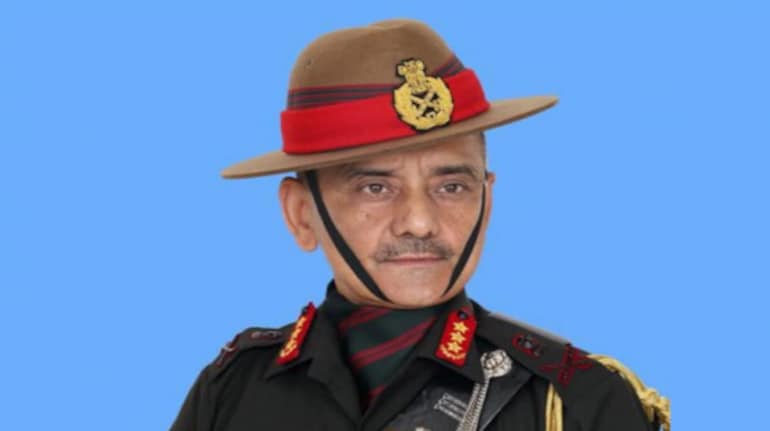
- The Government announced Lt General Anil Chauhan (retired) as the new CDS.
- He is the second CDS of India.
- General Anil Chauhan, PVSM, UYSM, AVSM, SM, and VSM assumed office as the Chief of Defence Staff (CDS) on September 30, 2022.
 Additional Information
- The Chief of Defence Staff (CDS) is the military head and acts as the single-point advisor to the Government of India in matters of India’s military.
- He is also the permanent Chairman of the Chiefs of Staff Committee (CoSC) of the Indian Armed Forces.
- The Chief also heads the Department of Military Affairs.
- The first Chief of Defence Staff, General Bipin Rawat took office on 1 January 2020.
- The creation of the post of CDS was first recommended after the 1999 Kargil War.
12
Q17 · General Science Biology
Nuts, vegetable oil, and fish are good source of which of the following?
- Carbohydrates
- Minerals
- Healthy fats
- Proteins
Answer aur solution dekho
Archived marked answer: C
The correct answer is Healthy fats.
Key Points
- Monounsaturated fats and polyunsaturated fats are known as the “good fats” because they are good for your heart, your cholesterol, and your overall health.
- These fats can help to lower the risk of heart disease and stroke, cholesterol levels, and Prevent abnormal heart rhythms.
- Monounsaturated fat good sources include olive, canola, peanut, and sesame oils, Nuts (almonds, peanuts, macadamia, hazelnuts, pecans, cashews), avocados etc.
- Polyunsaturated fat good sources include Sunflower, sesame, and pumpkin seeds, Walnuts, Fatty fish (salmon, tuna, mackerel, herring, trout, sardines) fish oil, Soybean and safflower oil, etc.
Additional Information
- Unhealthy fats
- Trans fat. Small amounts of naturally occurring trans fats can be found in meat and dairy products but it's artificial trans fats that are considered dangerous.
- This is the worst type of fat since it not only raises bad LDL cholesterol but also lowers good HDL levels.
- Carbohydrates
- They're the body's primary source of energy and the brain's preferred energy source. Carbs are broken down by the body into glucose.
- Minerals
- Minerals are those elements in foods that our bodies need to develop and function normally.
- Those essential for health include calcium, phosphorus, potassium, sodium, chloride, magnesium, iron, zinc, iodine, etc.
- Protein
- Protein is considered the building block of life and is found in every cell of the body.
- Protein is made up of amino acids that are attached to one another in long chains.
Q18 · General Science Chemistry
Which organic compound has the structure R−COOH, with R referring to the alkyl, alkenyl, aryl, or other group?
- Carboxylic acid
- Ester
- Ketone
- Aldehydes
Answer aur solution dekho
Archived marked answer: A
The correct answer is Carboxylic acid.
Key Points
- A carboxyl group (C(=O)OH) coupled to an R-group makes up a carboxylic acid, an organic acid.
- The general formula of a carboxylic acid is R−COOH or R−CO2H, with R referring to the alkyl, alkenyl, aryl, or other group.
- Carboxylic acids are very common.
- The amino acids and fatty acids are two prime examples.
- A carboxylate anion is produced when a carboxylic acid is deprotonated.
- They produce carboxylate ions when they interact with metals and alkalis.
- The reactions of carboxylic acids show how acidic they are.
Additional Information
- Ester:
- An ester is a substance that is formed from an acid in which an organyl group has been substituted for at least one of the acid's acidic hydrogen atoms.
- Different esters are used in the creation of pheromones, essential oils, and fragrances.
- Ketone:
- A ketone is a functional group that has the formula R-C-R', where R and R' can be any number of substituents that include carbon.
- Ketones have a carbonyl group, or C, in them.
- Acetone is the most basic ketone.
- Aldehydes:
- An organic molecule with the functional group RCH=O is known as an aldehyde.
- Natural aldehydes can be found in nuts, spices, fruits, and vegetables.
d2
Q19 · General Science Chemistry
Which of the following is used in photography?
- Sodium bicarbonate
- Sodium thiosulphate
- Sodium hydroxide
- Sodium sulphate
Answer aur solution dekho
Archived marked answer: B
The correct answer is Sodium thiosulphate.
Key Points
- Sodium thiosulfate
- Sodium thiosulfate (sodium hyposulfite), Na2S2O3, is used by photographers to fix developed negatives and prints.
- It acts by dissolving the part of the silver salts coated onto film which remains unchanged by exposure to light.
Additional Information
- Sodium bicarbonate
- Baking Soda is the common name for Sodium Bicarbonate.
- Its chemical formula is NaHCO3.
- It is a crystalline white solid that is salty and alkaline.
- It is used for cooking purpose, pest control, and as a fire extinguisher.
- Sodium hydroxide
- Sodium hydroxide (NaOH) is known as 'caustic soda' and it is a 'high-base' alkali.
- It is used in the manufacture of pulp and paper cloth, drinking water, soap, and detergent.
- In the field of medicine, sodium hydroxide is used for the treatment, control, prevention, and improvement of diseases.
- Sodium benzoate is used as a preservative for carbonated drinks, jams and fruit juices, and pickles.
- Sodium sulfate
- The formula for sodium is – Na+, and Sulphate is – SO42-. So, the formula for Sodium Sulphate is – Na2SO4.
- Sodium sulfate is used to dry organic liquids.
- As a filler in powdered home laundry detergents.
- Na2SO4 is used in manufactured paper, glass, dyes, and pharmaceuticals.
- It is often used in its decahydrate form, which is also known as Glauber's salt.
- It is also called salt cake.
Q20 · General Science Chemistry
In which group are the non-metal elements placed in a vertical column on the right side of the periodic table?
- Group 1
- Group 2
- Group 17
- Group 3
Answer aur solution dekho
Archived marked answer: C
The correct answer is Group 17.
Key Points
- Halogens are a group of six elements of Group 17 in the periodic table.
- Fluorine (F)
- Chlorine (Cl)
- Bromine (Br)
- Iodine (I)
- Astat
Q21 · Medieval Indian History
Who among the following rulers appointed Ladha and Pira, two gardeners to high administrative post?
- Khizr Khan
- Muhammad Tughluq
- Bahlul Lodi
- Iltutmish
Answer aur solution dekho
Archived marked answer: B
The correct answer is Muhammad Tughluq.
Key Points
- Muhammad Tughluq appointed Ladha and Pira, two gardeners to high administrative posts.
- Sultan Muhammad Tughluq appointed:
- Aziz Khummar, a wine distiller,
- Firuz Hajjam, a barber,
- Manka Tabbakh, a cook, and
- Two gardeners, Ladha and Pira, to high administrative posts.
- Ziyauddin Barani, a mid-fourteenth-century chronicler, reported their appointments as a sign of Sultan’s loss of political judgment and his incapacity to rule.
- Barani had criticized Muhammad Tughluq for that appointment.
- Tughluq's appointment reflected the socio-economic stereotypes that may have been prevalent in those times.
- The authors of Persian tawarikh criticized the Delhi Sultans for appointing the “low and base-born” to high offices.
Additional Information
- Khizr Khan was the founder of the Sayyid dynasty of the Delhi Sultanate.
- In 1414 AD, Khizr Khan occupied the power of Delhi.
- He did not hold the title of Sultan and declared himself as ‘Rayat-e-Ala’.
- He was the founder of the Sayyid Dynasty in India and ruled as a deputy of Timur’s son and successor, Shah Rukh.
- His reign was marked by utter chaos and disorder.
- The Lodi dynasty was founded by Bahlul Khan Lodi.
- The Lodi dynasty was an Afghan dynasty.
- The Lodi dynasty was the last dynasty in Delhi Sultanate, ruled from 1451 to 1526.
- Iltutmish was a king of the Slave dynasty.
- He became a ruler of the Slave dynasty from 1211 to 1236.
- He made Delhi the capital of his kingdom by replacing Lahore.
- He introduced the silver coin(Tanka) and the copper coin(Jital).
- He completed the construction of the Qutb Minar.
Q22 · Ancient Indian History
According to the Brihat Samhita, what do you call the process of making scents, mouth perfumes and bath powders?
- Jatuka
- Gandhayukli
- Kamplcica
- Pattanga
Answer aur solution dekho
Archived marked answer: B
The correct answer is Gandhayukli.
Key Points
- An encyclopaedia written in Sanskrit and published in the sixth century in Ujjain was called Brhat-Samhita.
- In addition to divination, the book covers a wide range of topics, such as astronomy, planetary motion, eclipses, rainfall, architecture, crop development, perfume production, matrimony, household relationships, gems, and ceremonies.
- Varahmihir’s Brihat Samhita gives references to perfumes and cosmetics.
- Recipes for hair dying were made from plants, like indigo and minerals like iron power, black iron or steel and acidic extracts of sour rice gruel.
- Gandhayukli describes recipes for making scents, mouth perfumes, bath powders, incense and talcum powder.
Additional Information
- Kamplcica, Pattanga and Jatuka:
- A number of classical texts, like Atharvaveda (1000 BCE) mention some dye stuff, the material used were turmeric, madder, sunflower, orpiment, cochineal and lac.
- Some other substances having tinting properties were Kamplcica, Pattaya and Jatuka.
Q23 · World Geography
Earth’s core is mainly made up of ______.
- nickel and copper
- nickel and alumina
- nickel and iron
- nickel and magnesium
Answer aur solution dekho
Archived marked answer: C
The correct answer is nickel and iron.
Key Points
Core:
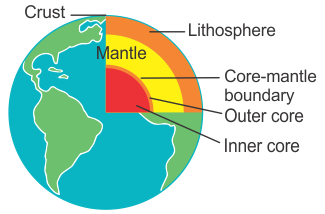
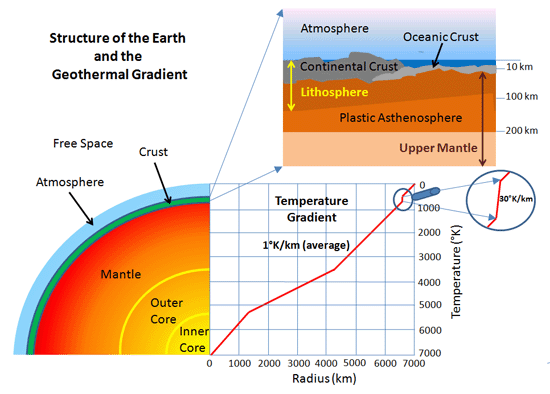
- The innermost layer is the core with a radius of about 3500 km.
- The central core has a very high temperature and pressure.
- The inner core (1200 km) is in the solid state whereas the outer core (2300 km) is in the liquid state.
- The innermost layer is the core with a radius of about 3500 km and divided into Inner and Outer core.
- The inner core is with a radius of 350 km mainly made up of- nickel and iron. The innermost layer is also called ‘nife’ (ni - nickel and fe - ferrous- iron).
Additional Information
The Earth is divided into four main layers: the solid crust on the outside, the mantle, the outer core, and the inner core.
- All those layers are separated from each other through a transition zone.
- These transition zones are called discontinuities.
- Conrad Discontinuity: It lies between the Upper crust and Lower crust.
- Mohorovicic Discontinuity: It lies between crust and mantle.
- Repiti Discontinuity: It lies between the Upper mantle and Lower mantle.
- Gutenberg Discontinuity: It lies between core and mantle.
- Lehman Discontinuity: It lies between the upper core and lower core.
Interior of the Earth:
Crust:
- The uppermost layer over the earth’s surface is called the crust.
- It is the thinnest of all the layers.
- on the continental masses, It is about 35 km and on the ocean floors, only 5 km.
- The crust is the thinnest layer of the Earth and it amounts to less than 1% of our planet's volume.
- The earth is made up of several concentric layers with one inside another, just like an onion.
- The crust is the outermost layer of Earth and is made up of igneous, metamorphic, and sedimentary rocks.
- The Earth's crust is unstable because of the exogenic forces.
Mantle:
- The Mantle extends up to a depth of 2900 km below the crust.
- It is the widest section of the Earth.
Q24 · Static GK
The ‘flag-raising’ ceremony by the Prime Minister of India on Independence Day is held at which of the following places in Delhi?
- Old Fort
- Parliament House
- Rashtrapati Bhavan
- Red Fort
Answer aur solution dekho
Archived marked answer: D
The correct answer is Red Fort.
Key Points
- On 15 August 1947, the first Prime Minister of India, Jawaharlal Nehru raised the Indian national flag above the Lahori Gate of the Red Fort in Delhi.
- From August 15, 1947, to 1964, he unfurled the Indian flag at Red Fort for continuous 17 years.
- Every year, the Prime Minister of India unfurls the flag at the Red Fort, but there are some who got a chance to become PM of India but were not able to hoist the flag at the iconic monument.
Additional Information
- List of Prime Ministers who hoisted the flag at Red Fort more than five times:
- Indira Gandhi - From 1966 to 1977, she got the opportunity for nothing less than 11 times.
- Manmohan Singh - Ex-Prime Minister of India unfurled the flag 10 times.
- Narendra Modi - Current Prime Minister of India, Narendra Modi has been hoisting the Indian flag at the Red fort since 2014 till date.
- Atal Bihari Vajpayee - He is the only non-Congress Prime Minister who has unfurled the Indian Flag at Red Fort six times.
- Rajiv Gandhi and Narasimha Rao unfurled the Indian flag five times each.
Q25 · Static GK
Who among the following contemporary-style dancers was the first Indian dancer to receive the dance WEB Europe Scholarship? He/She also won the 2002 American Choreography Award for his/her work in the movie ‘Lagaan’?
- Terence Lewis
- Ashley Lobo
- Padmini Chettur
- Shakti Mohan
Answer aur solution dekho
Archived marked answer: A
The correct answer is Terence Lewis.
Key Points
- Terence Lewis is an Indian dancer and choreographer.
- Lewis won the 2002 American Choreography Award for choreographing the songs of the movie Lagaan along with Saroj Khan, Raju Khan, Ganesh Hegde and Vaib
Mathematics
Q1 · Geometry
Find the number of common tangents, if r₁ + r₂ = C₁C₂. (With usual notations, r₁ & r₂ and C₁ & C₂ are the radii and centres of the two circles.)
- 1
- 0
- 3
- 4
Answer aur solution dekho
Archived marked answer: C
Calculation:
As the expression given is C₁C₂ = r₁ + r₂
C1C2 represents the distance between the centers of the circles.
r₁ represents the radius of the first circle
r₂ represents the radius of the second circle.
C
Q2 · Geometry
In triangle ABC, AD is the angle bisector of angle A. If AB = 8.4 cm and AC = 5.6 cm and DC = 2.8 cm, then the length of side BC will be:
- 4.2 cm
- 5.6 cm
- 7 cm
- 2.8 cm
Answer aur solution dekho
Archived marked answer: C
Given:
AB = 8.4 cm, and AC = 5.6 cm, DC = 2.8 cm
Concept used:
The angle bisector of a triangle divides the opposite side into two parts proportional to the other two sides of the triangle.
Calculation:
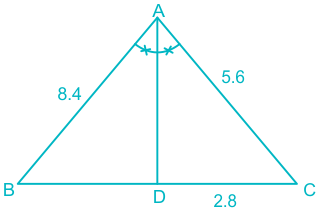 According to the concept,
AB/AC = BD/DC
⇒ 8.4/5.6 = BD/2.8
⇒ 8.4/2 = BD
⇒ 4.2 = BD
So, BD + DC = BC
BC = 4.2 + 2.8
⇒ 7 cm
∴ The length of side BC will be 7 cm.
Q3 · Geometry
In triangle ABC, the bisector of angle BAC cuts the side BC at D. If AB = 10 cm, and AC = 14 cm then what is BD : BC ?
- 5 : 3
- 7 : 5
- 5 : 2
- 5 : 12
Answer aur solution dekho
Archived marked answer: D
Shortcut Trick
By the Internal Angle Bisector Theorem, the ratio of the base segments equals the ratio of the adjacent sides.
BD / DC = AB / AC = 10 / 14 = 5 / 7
Let BD = 5 parts and DC = 7 parts, which means the total length BC = 5 + 7 = 12 parts.
Therefore, the required ratio of BD to BC is 5 : 12.
∴ The correct answer is 5 : 12.
Alternate Method
Given:
⇒ Length of side AB = 10 cm
⇒ Length of side AC = 14 cm
⇒ AD is the angle bisector of angle BAC
Formula Used:
⇒ Internal Angle Bisector Theorem: BD / DC = AB / AC
Q4 · Trigonometry
If sin θ = 8/({17)}, then find the value of tan θ.
- 15/17
- 8/({15)}
- 15/8
- 17/15
Answer aur solution dekho
Archived marked answer: B
Given:
sin θ = 8/({17)}
Concept used:
(H)Hypotenuse² = (P)Perpendicular² + (B)Base²
Calculation:
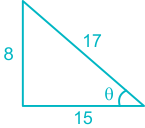 sinθ = P/H
So, H² = P² + B²
⇒ 17² = 8² + B²
⇒ 289 = 64 + B2
⇒ 225 = B2
⇒ 15 = B
Now,
tanθ = P/B
So, tanθ = 8/({15)}
∴ The required answer is 8/({15)}.
Shortcut Trick
sinθ = 8/17 = P/H, we know the triplet P = 8, B = 15, H = 17
Now, tanθ = P/B So, tanθ = 8/15
Q5 · Trigonometry
If sec 2θ = cosec (θ – 36°), where 2θ is an acute angle, find the value of θ.
- 32°
- 46°
- 20°
- 42°
Answer aur solution dekho
Archived marked answer: D
Given:
sec 2θ = cosec (θ – 36°)
Concept used:
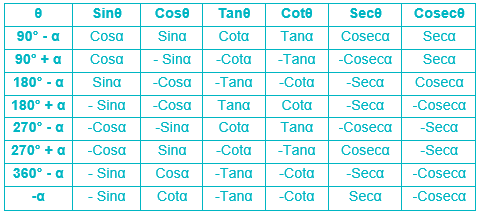 Calculation:
sec 2θ = cosec (θ – 36°)
⇒ sec 2θ = sec (90° – θ + 36°)
⇒ sec 2θ = sec (126° – θ)
⇒ 2θ = 126° – θ
⇒ 3θ = 126°
⇒ θ = 42°
∴ The required answer is 42°.
Q7 · Mensuration 2D
The length of the side of a cube is 5.6 cm. What is the volume of the largest sphere that can be taken out of the cube?
- 91.98 cm³
- 99.96 cm³
- 96.98 cm³
- 90.69 cm³
Answer aur solution dekho
Archived marked answer: A
Given:
Edge of the cube = 5.6 cm
Formula used:
The volume of the sphere = (4/3) × π × r³
Calculation:
Diameter of the sphere = Edge of the
cube
<
Q8 · Algebra
If { x} + 1/({ x)} = - 14 , and x {{ x}²} - 1/({{{ x)²}}} ?
- - 112√3
- 112√3
- -140√2
- 140√2
Answer aur solution dekho
Archived marked answer: B
Given:
{ x} + 1/({ x)} = - 14
Concept used:
(a² - b²) = (a + b)(a - b)
Calculation:
{ x} + 1/({ x)} = - 14
⇒ { x²} + 1/({ x²)} +2= 196
⇒ { x²} + 1/({ x²)} +2-4= 196-4
Q9 · Algebra
If {k⁴} + 1/({{k⁴)}} = 47, then what is the value of {k³} + 1/({{k³)}}?
- 4.5
- 54
- 18
- 9
Answer aur solution dekho
Archived marked answer: C
Given:
{k⁴} + 1/({{k⁴)}} = 47
Concept used:
If {a} + 1/({{a)}} = b
The,
{a³} + 1/({{a³)}} = b³-3b
({a} + 1/({{a)}})² = a² + 1/a²+2
Calculation:
{k⁴} + 1/({{k⁴)}} = 47
⇒ {k⁴} + 1/({{k⁴)}} +2= 47+2
⇒ ({k²} + 1/({{k²)}})²= 49
⇒ {k²} + 1/({{k²)}}= 7
⇒ {k²} + 1/({{k²)}}+2= 7+2
⇒ ({k} + 1/({{k)}})²= 9
⇒ {k} + 1/({{k)}}= 3
Now,
{k³} + 1/({{k³)}} = 3³ - 3 × 3
⇒ {k³} + 1/({{k³)}} = 27 - 9
⇒ {k³} + 1/({{k³)}} = 18
∴ The required answer is 18.
Q10 · Algebra
The simplified form of (x + 2y)³ + (x - 2y)³ is:
- 2x³ + 24 xy²
- 2x³ - 24 xy²
- x³ - 8y³
- x³ + 8y³
Answer aur solution dekho
Archived marked answer: A
Given:
(x + 2y)3 + (x - 2y)3
Concept used:
a³ + b³ = (a + b)(a² + b² - ab)
Calculation:
(x + 2y)3
Q11 · Profit and Loss
Ram sold a plot for Rs. 4,00,000 at a 20% loss. For what price should he sell the plot to gain a 5% profit?
- Rs. 5,25,000
- Rs. 5,20,000
- Rs. 5,00,000
- Rs. 5,05,000
Answer aur solution dekho
Archived marked answer: A
Given:
SP = Rs. 4,00,000
Loss% = 20%
New Profit = 5%
Calculation:
Let CP be 100x
Now, SP after 20% loss = Rs. 100x × (100 – 20)%
⇒ Rs. 80x
And, SP after 5% profit = Rs. 100x × (100 + 5)%
⇒ Rs. 105x
According to the question, ⇒
80x = Rs. 4,00,000
⇒ 105x = Rs. (4,00,000/80) × 105
⇒ Rs. 5,25,000
∴ The required selling price is Rs. 5,25,000.
Q12 · Profit and Loss
A hotel is giving a discount of 12% on the booking of 2 or more rooms. Additionally, the hotel is offering a 5% discount only on payment using any card of SBI. Rakesh booked 2 rooms in the hotel for a day at the rate of Rs. 1,500 per room per day. While checking out, he paid the bill using SBI Silver Card. How much amount did he have to pay?
- Rs. 2,498
- Rs. 1,254
- Rs. 2,508
- Rs. 2,618
Answer aur solution dekho
Archived marked answer: C
Given:
A hotel is giving a discount of 12% on the booking of 2 or more rooms
Additionally, the hotel is offering a 5% discount only on payment using any card of SBI.
Actual cost of each room = Rs. 1500
Calculation:
Price after 1st discount = (1500 × 2) × 88%
⇒ 3000 × 88%
⇒ 2640
Price after 2nd discount = 2640 × 95%
⇒ 2508
∴ He had to pay Rs. 2508.
Q13 · Time and Work
Numan does half the work as Gagan in 4/5 of the time. If together they take 16 days to complete a piece of work, then how long will it take Gagan to complete the work?
- 23 day
- 24 days
- 25 day
- 26 days
Answer aur solution dekho
Archived marked answer: D
Given:
Numan does half the work as Gagan in 4/5 of the time.
Together they take 16 days to complete a piece of work
Calculation:
According to the question,
Numan × 4/5 = Gagan × 1/2
⇒ Numan = Gagan × 5/8<
Q14 · Number System
The HCF of two numbers 110 and 1980 is:
- 140
- 110
- 120
- 180
Answer aur solution dekho
Archived marked answer: B
Given:
Two numbers are 110 and 1980
Calculation:
110 = 2 × 5 × 11
1980 = 2² × 3² × 5 × 11
So, HCF = 2 × 5 × 11
⇒ 110
∴ The required answer is 110.
Q15 · Number System
Which of the following pairs of non-zero values of p and q make the 6-digit number 674pq0 divisible by both 3 and 11?
- p = 2 and q = 2
- p = 5 and q = 4
- p = 4 and q = 2
- p = 5 and q = 2
Answer aur solution dekho
Archived marked answer: D
Given:
674pq0 is divisible by both 3 and 11
Concept used:
If the sum of digits of a number is a multiple of 3, the number will be completely divisible by 3
If the difference of the sum of alternative digits of a number is 0 or divisible by 11, then that number is divisible by 11 completely.
Calculation:
As 674pq0 divisible by 3
Q16 · Time and Distance
R jogs at twice the speed of walking and runs at twice the speed of jogging. From his home to office, he covers half of the distance by walking and the rest by jogging. From his office to home, he covers half the distance jogging and the rest by running. What is his average speed (in km/h) in a complete round from his home to office and back home if the distance between his office and home is 10 km and he walks at the speed of 5 km/h?
- 90/8
- 60/8
- 60/9
- 80/9
Answer aur solution dekho
Archived marked answer: D
Given:
R jogs at twice the speed of walking and runs at twice the speed of jogging.
The distance between his office and home is 10 km
He walks at the speed of 5 km/h
Concept used:
Average speed = Total distance/Total time taken
Calculation:
R's jogging speed = 5 × 2
⇒ 10 km/h
R's running speed = 10 × 2
Q17 · Time and Distance
A policeman saw a thief from a distance of 450 m. When the policeman started chasing him, the thief also started running. The ratio of speeds of the thief to the policeman is 7 : 8. After running how much distance (in km) can the policeman catch the thief?
- 3.75
- 3.4
- 3.6
- 3.15
Answer aur solution dekho
Archived marked answer: C
Given:
A policeman saw a thief from a distance of 450 m.
The ratio of speeds of the thief to the policeman is 7 : 8.
Concept used:
Distance = Time × Speed
The relative speed of A and B running in the same direction = SpeedA – SpeedB
Calculation:
Let the speed of the police and the thief be 8a m/sec and 7a m/sec
So, relative speed = 8a - 7a
⇒ a m/sec
Now,
Time taken to catch the thief = 450/a sec
So, distance travelled by the policeman = (450/a) × 8a
⇒ 3600 m or 3.6 km
∴ The policeman can catch the thief after 3.6 (in km).
Q18 · Data Interpretation
The given pie-chart shows the total number of children who opted different courses in a summer camp in May 2019.
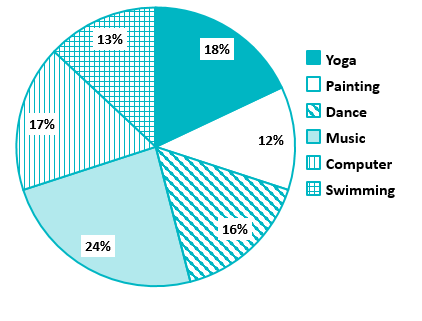 300 students attended the summer camp, and every child was allowed to opt only one activity for the camp. The total number of students who opted for Yoga and Painting taken together is how much less than the total number of children who opted for Music and Dance taken together?
- 45
- 35
- 30
- 40
Answer aur solution dekho
Archived marked answer: C
Calculation:
The total number of students who opted for Yoga and Painting taken together = 300 × (18 + 12)%
⇒ 300 × 30%
⇒ 90
The total number of students who opted for Music and Dance taken together = 300 × (24 + 16)%
⇒ 300 × 40%
⇒ 120
Difference = 120 - 90
⇒ 30
∴ The required answer is 30.
Q19 · Simplification
0.5 is what percentage of 20?
- 25%
- 0.25%
- 2.5%
- 0.025%
Answer aur solution dekho
Archived marked answer: C
Calculation:
x% of 20 = 0.5
⇒ x = (0.5/20) × 100
⇒ 5/2
⇒ 2.5
∴ The required answer is 2.5%.
Q20 · Simple Interest
In how much time will a sum of Rs. 5250 amounts to Rs. 9870 at the rate of 11 percent per annum at simple interest?
- 8 years
- 14 years
- 12 years
- 15 years
Answer aur solution dekho
Archived marked answer: A
Given:
Sum = Rs. 5250
Amount = Rs. 9870
Rate = 11%
Concept used:
S.I = (P × T × R)/100
Here,
P = Sum
T = Time
R = Rate
Amount = Sum + S. I
Calculation:
Interest = 9870 - 5250
⇒ 4620
Now,
Let the time be T years
4620 = (5250 × T × 11)/100
⇒ 420 = 210T/4
⇒ T = 4 × 2 = 8
So, time is 8 years
∴ The required time is 8 years.
Q21 · Mensuration 3D
The curved surface area of the sphere is 154 cm². Find the volume of the sphere (rounded off to one digit after decimal).
- 156.9 cm³
- 179.7 cm³
- 161.1 cm³
- 147.8 cm³
Answer aur solution dekho
Archived marked answer: B
Given:
The curved surface area of the sphere is 154 cm2
Concept used:
Surface area of a sphere = 4πr²
Volume of a sphere = 4/3πr³
Here,
r = radius
Calculation:
4πr² = 154
⇒ 4 × 22/7 × r2 = 154
⇒ r2 = 49/4
⇒ r = 7/2
So, volume = 4/3 × 22/7 × (7/2)³
⇒ 4/3 × 22 × 49/8
⇒ 11 × 49/3
⇒ 539/3
⇒ 179.66 ≈ 179.7
∴ The volume of the sphere is 179.7 cm³.
Q22 · Age
The ratio of the present ages of Ram and Ramesh is 3 : 5. After 7 years the ratio of their ages will be 4 : 5. Find the present age of Ramesh.
- 5 years
- 15 years
- 7 years
- 12 years
Answer aur solution dekho
Archived marked answer: C
Given:
Ratio between the present ages of Ram and Ramesh is 3 : 5
After 7 years the ratio of their ages will be 4 : 5.
Calculation:
Let the present age of Ram and Ramesh be 3x and 5x
According to the question,
<
English
Q1 · Vocabulary
Select the most appropriate ANTONYM of the given word.
Native
- Vicinity
- Realm
- Foreign
- Aboriginal
Answer aur solution dekho
Archived marked answer: C
The correct answer is: Foreign.
Key Points
- Native: Relating to or describing someone's country or place of birth or someone who was born in a particular country or place.
- Let us look at the meaning of the given words in the options section.
- Vicinity: The area or region near or about a place; surrounding district; neighbourhood.;;
- Realm: A particular area of knowledge, interest, etc, or a country ruled by a king or queen.
- Foreign: Relating to, or derived from another country or nation; not native.;
- Aboriginal: A member of a race of people who were the first people to live in a country, before any colonists arrived.
- From the meaning of the given words, it is clear that the most appropriate antonym of 'Native' is 'Foreign'.
- Therefore, the correct answer is option 3.
The correct answer is: Striphe
Q2 · Vocabulary
Identify the most appropriate ANTONYM of the underlined word in the given sentence.
The patient was happy that he was given ancient methods of treatment to cure her health condition.
- Multiple
- Modern
- Slow
- Primitive
Answer aur solution dekho
Archived marked answer: B
The correct answer is: Modern.
Key Points
- Ancient: Belonging to the very distant past and no longer in existence.
- Let us look at the meaning of the given words in the options section.
- Multiple: Having or involving several parts, elements, or members.
- Modern: Relating to the present or recent times as opposed to the remote past.
- Slow: Moving or operating, or designed to do so, only at a low speed; not quick or fast.
- Primitive: Relating to, denoting, or preserving the character of an early stage in the evolutionary or historical development of something.
- From the meaning of the given words, it is clear that the most appropriate antonym of 'Ancient' is 'Modern'.
- Therefore, the correct answer is option 2.
The correct answer i
Q3 · Vocabulary
Select the most appropriate ANTONYM of the given word.
Consent
- Dissent
- Variety
- Integrity
- Sanction
Answer aur solution dekho
Archived marked answer: A
The correct answer is: Dissent
Key Points
- Consent: Permission for something to happen or agreement to do something.
- Let us look at the meaning of the words given in the options section.
- Dissent: A strong disagreement or dissatisfaction with a decision or opinion.
- Variety: The quality or state of having different forms or types.
- Integrity: The quality of being honest and having strong moral principles.;
- Sanction: Official permission or approval for an action.
- From the meaning of the given words, it is clear that the most appropriate antonym of 'Consent' is 'Dissent'.
- Therefore, the correct answer is option 1.
The erroneous part of the sentence is: get on the train by Mumbai
Q4 · Vocabulary
Direction: In the following sentence, an idiom is highlighted. Select the alternative which best describes its use in the sentence.
“Just add a bit of cheese to your pasta and Bob’s your uncle!” Reena suggested it to me over dinner last night.
- It becomes easily and quickly achievable
- It changes the appearance
- It ruins everything
- It changes nothing
Answer aur solution dekho
Archived marked answer: A
The correct answer is: It becomes easily and quickly achievable
Key Points
- The idiom "Bob’s your uncle!" is used enviously for someone who achieved something in a simple manner without having to work hard for it.
- Example - *You add two cups of water to the mix, heat it for five minutes and Bob’s your uncle, the soup is ready.*
- So, it is clear that the most appropriate meaning of the given idiom "Bob’s your uncle!" is "It becomes easily and quickly achievable"
- Hence, the correct answer is option 1.
The correct answer is:&n
Q5 · Vocabulary
Select the most appropriate meaning of the underlined idiom in the given sentence.
When the District Attorney asked the convict about details of the day of the crime, he started beating around the bush.
- Being excessively aggressive
- Accusing others of the crime
- Speaking in a confusing manner without giving a correct answer
- Trying to invoke sympathy
Answer aur solution dekho
Archived marked answer: C
The correct answer is: Speaking in a confusing manner without giving a correct answer
Key Points
- The idiom "Beating around the bush" means to treat a topic, but omit its main points, often intentionally; discuss a matter without coming to the point.
- Example - *Don't beat around the bush, come straight to the point!*
- So, it is clear that the most appropriate meaning of the given idiom "Beating around the bush" is "Speaking in a confusing manner without giving a correct answer"
- Hence, the correct answer is option 3.
Q6 · Vocabulary
Select the option that can be used as a one-word substitute for the given group of words.
A person having significant experience in an occupation
- Agnostic
- Fastidious
- Veteran
- Novice
Answer aur solution dekho
Archived marked answer: C
The correct answer is: Veteran
Key Points
- Veteran: A person who has had long experience in a particular field.
- So, it is clear that 'Veteran' can be used as a one-word substitute for 'A person having significant experience in an occupation'
- Therefore, the correct answer is option 3.
Additional Information
- Agnostic: A person who believes that nothing is known or can be known of the existence or nature of God.;
- Fastidious: Very attentive to and concerned about accuracy and detail.
- Novice: A person new to and inexperienced in a job or situation. 19f:T958,
The correct answer is: SRQP
Q7 · Vocabulary
Select the INCORRECTLY spelt word.
- Delight
- Striphe
- Fright
- Knight
Answer aur solution dekho
Archived marked answer: B
The correct answer is: Striphe
Key Points
- The correct spelling should be "Strife"
- Strife: Angry or bitter disagreement over fundamental issues; conflict.;
- Therefore, the correct answer is option 2, which is incorrectly spelled.
Additional Information
- Delight: A high degree of gratification or pleasure; joy.;
- Fright: Fear excited by the sudden danger.
- Knight: A man who serves his sovereign or lord as a mounted soldier in armor. 19e:T13d1,
The correct answer is: Veteran
Q8 · Vocabulary
Choose the incorrectly spelt word.
- Innocense
- Governance
- Enforcement
- Insufficient
Answer aur solution dekho
Archived marked answer: A
The correct answer is: Innocense.
Key Points
- The correct spelling should be "Innocence"
- Innocence: The quality or state of being innocent; freedom from sin or moral wrong.
- Therefore, the correct answer is option 1, which is incorrectly spelled.
Additional Information
- Governance: The act or process of governing or overseeing the control and direction of something such as a country or a state.
- Enforcement: The act of compelling observance of or compliance with a law, rule, or obligation.
- Insufficient: Not enough in amount, strength, or quality; less than is needed.; 1a5:Tdc9,
The correct answer is: The movie fascinated me.
Q9 · Vocabulary
Select the most appropriate synonym of the given word.
Perseverance
- Discipline
- Tolerance
- Steadfastness
- Humbleness
Answer aur solution dekho
Archived marked answer: C
The correct answer is: Steadfastness
Key Points
- Perseverance means persistence in doing something despite difficulty or delay in achieving success.;;
- Marked option Steadfastness means the quality of being resolutely or dutifully firm and unwavering.
- It is clear that 'Perseverance' and 'Steadfastness' are similar in meaning.
- Therefore the correct answer is option 3.
Additional Information
- Discipline: The practice of making people obey rules or standards of behavior, and punishing them when they do not.
- Tolerance: The ability to bear something unpleasant or annoying.
- Humbleness: The quality or state of being modest and lacking in pride or arrogance. 19c:Tfd1,
The correct answer is: Foreign.
Q10 · Vocabulary
Select the most appropriate option to complete the given sentence.
He booked the tickets for the show _____.
- in demand
- in common
- in depth
- in advance
Answer aur solution dekho
Archived marked answer: D
The correct answer is: in advance
Key Points
- 'In advance' is a phrase that means ahead in time.
- Example: You need to book weeks in advance.
- As per the meaning of the given words, "in advance" is the best fit for the given sentence.
- The implied meaning of the sentence is: *He reserved the show's tickets ahead of time.*
- Therefore, the correct answer is option 4.
The complete sentence will be: *He booked the tickets for the show in advance.*
*
Additional Information
*
- Let us look at the meaning of the other words.
- Demand: To ask for something forcefully, in a way that shows that you do not expect to be refused.
- Common: Belonging equally to, or shared alike by two or more subjects.
- Depth: The state of having serious qualities or the ability to think seriously about something. 1a2:Tc70,
The correct answer is: It becomes easily and quickly achievable
Q11 · Vocabulary
Select the most appropriate option to fill in the blank and complete the collocation.
Although she didn't reveal her plans clearly, I had a ________ idea.
- clear
- concise
- complete
- rough
Answer aur solution dekho
Archived marked answer: D
The correct answer is: rough
Key Points
- 'Rough idea' is a basic collocation meaning a vague or approximate idea, concept, memory, etc.
- Example: I can't remember exactly when we left, but I've got a rough idea.
- The implied meaning of the sentence is: Despite the fact that she did not share her ideas in detail, I had a basic notion.
- So, as per the context of the sentence "rough" is the most appropriate option to fill in the blank and complete the collocation.
- Therefore, the correct answer is option 4.
Complete sentence: *Although she didn't reveal her plans clearly, I had a rough idea.*
*
Additional Information
*
- Let us look at the meaning of the given words.
- Clear: Easy to perceive, understand, or interpret.
- Concise: Giving a lot of information clearly and in a few words; brief but comprehensive.;
- Complete: Having all the necessary or appropriate parts. 1ab:Te20,
The correct answer is: Farewell is being bid to their seniors by the first-year students.
Q12 · Grammar
The following sentence has been split into four segments. Identify the segment that contains a grammatical error.
I had walked / for most of the day / to Kanpur and then / get on the train by Mumbai.
- I had walked
- to Kanpur and then
- get on the train by Mumbai
- for most of the day
Answer aur solution dekho
Archived marked answer: C
The erroneous part of the sentence is: get on the train by Mumbai
Key Points
- Replace "get" with "got" and "by" with "to" to correct the sentence.
- "Had + v3" is used in the past perfect tense to make it clear that one event happened before another in the past.
- In such sentences, the first action is written in the past perfect and second action in the simple past tense.
- So, "got" should be used here in the given sentence.
- The preposition 'to' will be used instead of 'by' as it means in the direction of.
- Example: We went to Prague last year.
- We use "by + noun" to describe how someone travels or communicates, or how things are processed. (by car, by train etc.)
- Hence, the correct answer is option 3 which contains an error in it.
- The implied meaning of the sentence is: I had travelled to Kanpur on foot for the majority of the day before boarding the train to Mumbai.
Corrected sentence: *I had walked for most of the day to Kanpur and then got on the train to Mumbai.*
Q13 · Grammar
Parts of the following sentence have been given as options. Select the option that contains a grammatical error.
The jury was not happy with the performance / and was quite harsh. / The singer took / their criticism in heart.
- The jury was not happy with the performance
- The singer took
- their criticism in heart.
- and was quite harsh.
Answer aur solution dekho
Archived marked answer: C
The correct answer is Option 3.
Key Points
- The phrase "in heart" is not idiomatically correct.
- The correct phrase is "to heart."
- Collective nouns like "jury" are usually considered singular entities.
- Therefore, the correct pronoun to use is "its" instead of "their."
- In this context, "its criticism" is the proper usage.
- The correct sentence should be "The singer took its criticism to heart."
Therefore, the correct answer is Option 3.
Correct Sentence: *"The jury was not happy with the performance and was quite harsh. The singer took its criticism to heart."*
Additional Information
- A: "The jury was not happy with the performance" – This part of the sentence is grammatically correct and does not require any changes.
- B: "The singer took" – This part of the sentence is grammatically correct and does not require any changes.
- D: "and was quite harsh." – This part of the sentence is grammatically correct and does not require any changes.
Q14 · Grammar
Select the correct indirect form of the given sentence.
Priya assured me, “I can stay in tonight.”
- Priya told me that she could stay in this night.
- Priya told me that she could stay in that night.
- Priya told me that she could stay in tonight.
- Priya told me that she can stay in that night.
Answer aur solution dekho
Archived marked answer: B
The correct answer is: Priya told me that she could stay in that night.
Key Points
- The given sentence is in direct speech and we need to convert it to indirect speech.
- When we change a direct speech to an indirect speech, we must follow these rules:
- The reporting verb "assured" is changed to "told" in the indirect speech.
- The inverted commas ("...") are replaced with the conjunction 'that' to show the indirect speech part.
- The comma (,) is removed in the indirect speech.
- The first word of the indirect speech should be in capital letters.
- The modal verb 'can' in direct speech changes to 'could' in indirect speech.
- "Tonight" in the direct speech changes to 'that night' in the indirect speech.
- Thus, option 2 is the correct answer.
Hence, indirect speech is - *Priya told me that she could stay in that night.*
Q15 · Grammar
Select the most appropriate option that can substitute the underlined segment in the given sentence.
Don’t disturb the boy, he prepares for his examination.
- prepared
- is preparing
- was preparing
- will be preparing
Answer aur solution dekho
Archived marked answer: B
The correct answer is: is preparing
Key Points
- Replace "prepares" with "is preparing" to correct the sentence.
- The sentence says, "Don’t disturb the boy" which means the action is happening.
- The present continuous or the present progressive tense is used to tell about whatever action is happening at the time of speaking.
- The structure should be: Subject + is/am/are+ v1+ ing + object
- So, we have to change the tense of the sentence to make it correct.
- Thus, option 2 is the correct answer.
Corrected sentence: *Don’t disturb the boy, he is preparing for his examination.*
Additional Information
- Prepares: In English, the -s is only added to regular verbs in the present tense when the subject of the verb is a third-person singular subject.
- Prepared: Past tense of "prepare" and only used in the past tenses.
- Was preparing: "was+verb-ing" is only used in the past continuous tense to represent an action or event that was going on in the past.
- Will be preparing: "will +be+verb-ing" is only used in the future continuous tense to express action at a particular moment in the future.
Q16 · Grammar
Select the most appropriate option that can substitute the underlined segment in the given sentence. If there is no need to substitute it, select ‘No substitution required’.
Have you want me to come with you to the dentist?
- Has you wanted me
- No substitution required
- Had you want me
- Do you want me
Answer aur solution dekho
Archived marked answer: D
The correct answer is: Do you want me
Key Points
- Replace the verb form "have" with "do" correct the sentence.
Q17 · Voice Change
Select the option that expresses the given sentence in passive voice.
The first-year students are bidding farewell to their seniors.
- Farewell is to be bid to their seniors by the first-year students.
- Farewell was being bid to their seniors by the first-year students.
- Farewell is being bid to their seniors by the first-year students.
- Their seniors is being bid farewell by the first-year students.
Answer aur solution dekho
Archived marked answer: C
The correct answer is: Farewell is being bid to their seniors by the first-year students.
Key Points
- The given sentence is in the active form and we need to change it to the passive form.
- The given sentence is written in the present continuous tense.
- The present continuous tense in the active voice has the following structure: Subject + is/am/are+ v1+ ing + object
- The present continuous tense in the passive voice has the following structure: Object+ is/am/are+ being+ V3+ by + subject
- Example -
- Active voice - *Emma is singing a song.*
- Passive voice - *A song is being sung by Emma.*
- Rules of Conversion from Active to Passive Voice:
- Identify the subject, the verb, and the object.
- Change the subject into an object.
- Change the verb into the past participle form.
- Change the object into the subject.
Therefore, the correct answer is option 3.
Correct Passive Voice: *Farewell is being bid to their seniors by the first-year students.*
Q18 · Voice Change
Select the option that expresses the given sentence in active voice.
I was fascinated by the movie.
- The movie fascinated me.
- The movie was fascinated to me.
- The movie fascinate me.
- The movie fascinates me.
Answer aur solution dekho
Archived marked answer: A
The correct answer is: The movie fascinated me.
Key Points
- The given sentence is in the passive form and we need to change it into the active form.
- The given sentence is written in the passive form of the Simple Past Tense.
- The Simple Past Tense in the passive voice has the following structure: Object+ was/were V3+ by + subject
- The Simple Past Tense in the active voice has the following structure: Subject + V2+ object
- Example -
- Passive voice - *He was saved by me.*
- Active voice - *I saved him.*
- Rules of Conversion from Passive to Active Voice:
- Identify the subject, the verb, and the object.
- Change the object into the subject.
- Change the verb into the past participle form of the verb.
- Change the subject into an object.
- Therefore, the correct answer is option 1.
Correct Active Voice: *The movie fascinated me.*
Q19 · Para Jumble
Rearrange the parts of the sentence in the correct order.
Jobseekers are not
P. being unemployed are a test of faith
Q. self-purification, where the difficulties of
R. relentlessly to a pilgrimage of
S. fatalistic but reapply themselves
- SPQR
- PQSR
- SRQP
- RPSQ
Answer aur solution dekho
Archived marked answer: C
The correct answer is: SRQP
Key Points
- Here, the first part of the whole sentence is already given.
- After that 'S' should be the best fit to keep the sentence meaningful. The first word of the 'S' part is "fatalistic". So, if we connect it with the first one, the sentence will be like "Jobseekers are not fatalistic" which means "Job
Q20 · Verbal Ability
The question below consists of a set of labeled sentences. Out of the four options given, select the most logical order of the sentences to form a coherent paragraph.
P. He is well aware of the role he and his people play in keeping Shivsagar Lake beautiful and ecologically thriving.
Q. However, he is also deeply aware of the fact that the urban idea of conservation often seeks to keep traditional dwellers out.
R. Jason, 45, has a quiet, confident presence.
S. He takes a long time to open up and even after that, he speaks little.
- RQPS
- RSPQ
- PSQR
- PRSQ
Answer aur solution dekho
Archived marked answer: B
The correct answer is "RSPQ"
Key Points
- Let's look at the correct sequence of the passage.
- Statement R is the opening sentence of the passage as it gives a brief introduction of the person named 'Jason'.
- Statement S is the second sentence of the passage which explains that he takes a while to open up, and even then, he doesn't say too much.
- Statement P is the third sentence of the passage which explains his awareness of the contribution he and his people make to maintaining Shivsagar Lake's aesthetic appeal and ecological health.
- Statement Q is the last sentence of the passage which shows that he is very conscious, however, that the modern notion of conservation frequently aims to exclude traditional residents.
- Hence, the correct sequence is R, S, P, Q
- The correct answer is option 2.
The correct passage is: *R. Jason, 45, has a quiet, confident presence. S. He takes a long time to open up and even after that, he speaks little. P. He is well aware of the role he and his people play in keeping Shivsagar Lake beautiful and ecologically thriving. Q. However, he is also deeply aware of the fact that the urban idea of conservation often seeks to keep traditional dwellers out.*