SSC CGL · Tier 1 · Previous-year archive
CGL Tier 1 · 18 April 2022 · Shift 2
94 questions available to read. Bina signup padho; timed practice ke liye free sign in karo.

This saved paper contains 94 of 100 expected questions. 0 stored records are excluded from this study page while their source or wording is checked. Missing original questions: 6. Local question numbers follow the saved archive; match the wording and choices when comparing another response sheet.
Archived marked answers and available solution notes are preserved. These are not claimed to be fully checked final SSC keys. How questions are checked.
Printable archive and coverage notes · Prepare this shift as a timed test
Reasoning
Q2 · Series
Answer aur solution dekho
Archived marked answer: A
Q3 · Series
Answer aur solution dekho
Archived marked answer: D
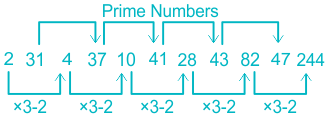
- 2 × 3 - 2 = 6 - 2 = 4
- 4 × 3 - 2 = 12 - 2 = 10
- 10 × 3 - 2 = 30 - 2 = 28
- 28 × 3 - 2 = 84 - 2 = 82
- 82 × 3 - 2 = 246 - 2 = 244
Numbers at even position: 31, 37, 41, 43, 47 → Prime number series
Hence, '244' is the correct answer.Q4 · Series
Q5 · Series

Answer aur solution dekho
Archived marked answer: C
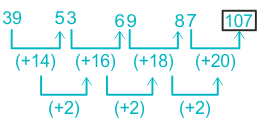
Hence, 'option 3' is the correct answer.
Confusion Points
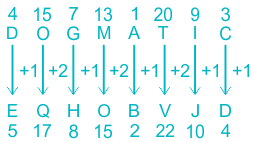
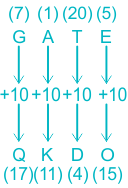
Q6 · Analogy
Answer aur solution dekho
Archived marked answer: A
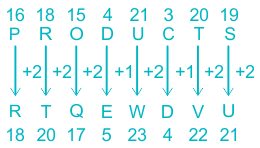
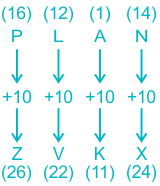
Similarly,
PRODUCTS : ?
-
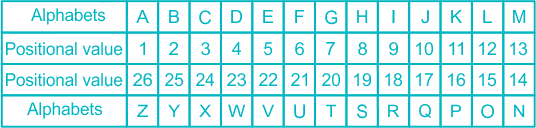
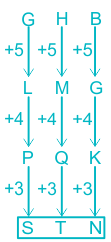
Hence, the correct answer is "RTQEWDVU".Q7 · Analogy
Answer aur solution dekho
Archived marked answer: A
Q8 · Non Verbal Reasoning

Answer aur solution dekho
Archived marked answer: C
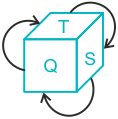
Logic: If two dice have the same face value in the given image then their clockwise or anticlockwise number are the opposite numbers in the dice.
When moving in a clockwise direction from the common face (T) in dice (1) and (2):
From both dice:
Dice 1
T
S
Q
Dice 2
T
R
U
Now, Q is opposite to U, thus Q will be on the face opposite to the face having the letter U.
Hence, the correct answer is "U"Q9 · Non Verbal Reasoning

Answer aur solution dekho
Archived marked answer: D
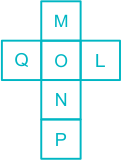
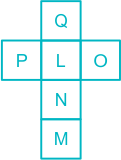
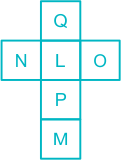
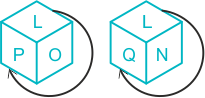
Position 1 of Dice
L
O
P
Position 2 of Dice
L
N
Q
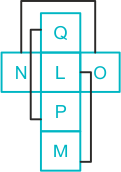
The faces that will be opposite to each other when the paper is folded to form a cube is shown below:
Hence, 'option 4' is the correct answer.Q10 · Non Verbal Reasoning
Q11 · Non Verbal Reasoning
Q12 · Non Verbal Reasoning
Q13 · Puzzle Subtypes Not To Miss
Answer aur solution dekho
Archived marked answer: D
Q14 · Puzzle Subtypes Not To Miss
Answer aur solution dekho
Archived marked answer: A
Option 1) ×, ÷, =, +, −
Interchange the mathematical signs with *,
After placed the sign we get,
⇒ 15 × 1411 ÷ 83 = 137 + 218 - 100
⇒ 15 × 17 = 355 - 100
⇒ 255 = 255
⇒ LHS = RHS
Option 2) ×, =, −, ÷, +
Interchange the mathematical signs with *,
After placed the sign we get,
⇒ 15 × 1411 = 83 - 137 ÷ 218 + 100
⇒ 21165 = 83 - 0.62844 + 100
⇒ 21165 = 183 - 0.62844
⇒ 21165 ≠ 182.37456
⇒ LHS ≠ RHS
Option 3) +, −, ×, =, ÷
Interchange the mathematical signs with *,
After placed the sign we get,
⇒ 15 + 1411 - 83 × 137 = 218 ÷ 100
⇒ 15 + 1411 - 11371 = 2.18
⇒ 1426 - 11371 = 2.18
⇒ -9945 ≠ 2.18
⇒ LHS ≠ RHS
Option 4) ×, +, ÷, −, =
Interchange the mathematical signs with *,
After placed the sign we get,
⇒ 15 × 1411 + 83 ÷ 137 - 218 = 10
⇒ 15 × 1411 + 0.60583941 - 218 = 10
⇒ 21165 + 0.60583941 - 218 = 10
⇒ 21165.60583941 - 218 = 10
⇒ 20947.60583941 ≠ 10
⇒ LHS ≠ RHS
Hence, the correct answer is "Option 1".Q15 · Puzzle Subtypes Not To Miss
Answer aur solution dekho
Archived marked answer: B
Q16 · Puzzle Subtypes Not To Miss
Answer aur solution dekho
Archived marked answer: A
Q17 · Coding Decoding
Answer aur solution dekho
Archived marked answer: D
Q18 · Coding Decoding
Q19 · Coding Decoding
Q20 · Classification Odd One Out
Q21 · Logical Reasoning
Q22 · Logical Reasoning
Q23 · Blood Relations
Q24 · Alphabet Test
Answer aur solution dekho
Archived marked answer: D
General Awareness
Q1 · Art and Culture
Answer aur solution dekho
Archived marked answer: D
Q2 · Art and Culture
Answer aur solution dekho
Archived marked answer: B
Q3 · Indian Polity and Constitution
Answer aur solution dekho
Archived marked answer: A
Q4 · Indian Polity and Constitution
Answer aur solution dekho
Archived marked answer: A
Q5 · Indian Polity and Constitution
Answer aur solution dekho
Archived marked answer: A
Q6 · Indian Economy
Answer aur solution dekho
Archived marked answer: D
Q7 · Indian Economy
Answer aur solution dekho
Archived marked answer: C
Q8 · Sports Static GK
Answer aur solution dekho
Archived marked answer: A
Q9 · Sports Static GK
Answer aur solution dekho
Archived marked answer: A
Q10 · Indian Geography
Answer aur solution dekho
Archived marked answer: B
Q11 · Indian Geography
Answer aur solution dekho
Archived marked answer: B
Q12 · Modern Indian History
Answer aur solution dekho
Archived marked answer: C
Q13 · Modern Indian History
Answer aur solution dekho
Archived marked answer: A
Q14 · Current Affairs
Answer aur solution dekho
Archived marked answer: A
Q15 · General Science Biology
Answer aur solution dekho
Archived marked answer: D
Fig: Bilateral Symmetry
- Animals can be categorized into three types on the basis of their symmetry - Asymmetrical, Radial symmetry & Bilateral symmetry.
- Radial symmetry
- When any plane passing through the central axis of the body divides the organism into two identical halves, it is called radial symmetry.
- Radial symmetry is exhibited by Coelenterates, ctenophores, and echinoderms.
Fig: Radial Symmetry
- Asymmetrical
- If any plane that passes through the centre does not divide them into equal halves, this type of body plan is called asymmetrical. Example - Porifera (Sponges).
Additional Information
- Arthropods are invertebrate animals having an exoskeleton, a segmented body, and paired jointed appendages.
- Arthropods form the phylum Arthropoda.
- They are distinguished by their jointed limbs and cuticle made of chitin, often mineralized with calcium carbonate.
- The largest phylum in the animal kingdom, includes lobsters, crabs, spiders, mites, insects, centipedes, and millipedes.
- About 84 percent of all known species of animals are members of this phylum.Q16 · General Science Chemistry
Answer aur solution dekho
Archived marked answer: C
Q17 · General Science Chemistry
Answer aur solution dekho
Archived marked answer: D
Q18 · General Science Chemistry
Answer aur solution dekho
Archived marked answer: D
Q19 · General Science Chemistry
Answer aur solution dekho
Archived marked answer: A
Q20 · Awards Static
Answer aur solution dekho
Archived marked answer: A
Q21 · Awards Static
Answer aur solution dekho
Archived marked answer: D
Q22 · Ancient Indian History
Answer aur solution dekho
Archived marked answer: C
Q23 · Government Schemes and Welfare Static Semi Static
Answer aur solution dekho
Archived marked answer: C
Q24 · Books and Authors Static
Answer aur solution dekho
Archived marked answer: B
Q25 · Agriculture
Answer aur solution dekho
Archived marked answer: B
Mathematics
Q1 · Geometry
Answer aur solution dekho
Archived marked answer: A
Q2 · Geometry
Answer aur solution dekho
Archived marked answer: A
Calculations:
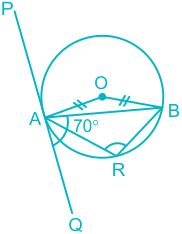
PAQ is tangent at point A i.e., ∠OAQ = 90º
From the figure, ∠OAB = ∠OAQ – ∠BAQ
⇒ ∠OAB = 90º – 70º = 20º
∠OBA = ∠OAB = 20º (since angle subtended by radius are equal)
In Δ OBA, ∠BOA = 180º – (∠OBA + ∠OAB)
⇒ ∠BOA = 180º – (20º + 20º) = 180º - 40º = 140º
∠BOA (exterior angle) = 360º – 140º = 220º
∠ARB = 1over 2∠BOA (exterior angle)
∠ARB = 1over 2 × (220º) = 110º
The value of ∠ARB is 110º.Q3 · Trigonometry
Answer aur solution dekho
Archived marked answer: D
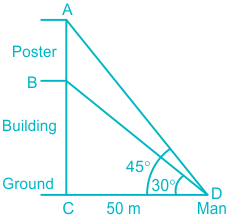
In ∆ BCD, tan 30º = BC over CD
We know that tan 30º = 1over √3 and CD = 50 m
⇒ BC over 50 = 1over √3
⇒ BC = 50over √3 or 50√3over 3
Similarly, in ∆ ACD, tan 45º = ACover CD
We know that AC = AB + BC, tan 45º = 1 and CD = 50 m
⇒ AC = CD or AB + BC = CD
Substituting the values, we get -
⇒ AB + 50√3over 3 = 50
⇒ AB = 50 - 50√3over 3
⇒ AB = 50over 3 (3 - √3)
200% of the Poster height (AB) = 100over 3(3 - √3)
137:Q4 · Trigonometry
Answer aur solution dekho
Archived marked answer: B
Q5 · Trigonometry
Answer aur solution dekho
Archived marked answer: C
Q6 · Mensuration 2D
Answer aur solution dekho
Archived marked answer: B
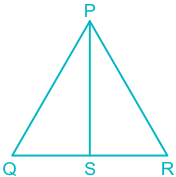
⇒ QSover SR = PQover PR (By angular bisector theorem)
Calculation:
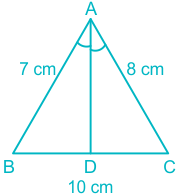
In ΔABC, if AD bisects ∠BAC, then
⇒ ABover AC = BDover DC
Substituting the values of AB, AC, and BD as 10-DC
⇒ 7over8 = 10-DCover DC
Solving, we get-
⇒ 7 DC = 80 - 8 DC
⇒ 15 DC = 80
⇒ DC = 80over 15 or 16over 3
⇒ DCover 4 = 16over 3*4 = 4over 3
Hence, DCover 4 equals 4over 3 cm.Q7 · Mensuration 2D
Answer aur solution dekho
Archived marked answer: B
Q8 · Algebra
Answer aur solution dekho
Archived marked answer: C
Q9 · Algebra
Answer aur solution dekho
Archived marked answer: A
Q10 · Profit and Loss
Answer aur solution dekho
Archived marked answer: D
Q11 · Profit and Loss
Answer aur solution dekho
Archived marked answer: B
Q12 · Time and Work
Answer aur solution dekho
Archived marked answer: B
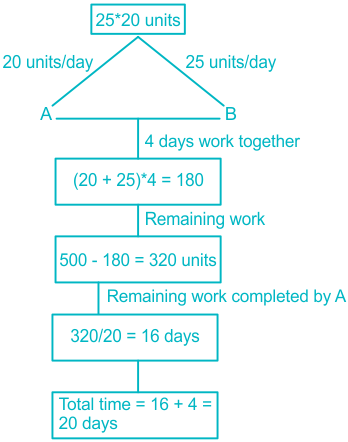
Let us assume that the total work is 25 × 20 units i.e., 500 units
Portion of work done by A in 1 day = 20 units
Portion of work done by B in 1 day = 25 units
Total work done by A and B in 4 days = (20 + 25) × 4 = 180 units
Total work remaining = 500 – 180 = 320 units
Time taken by A to complete the remaining units = 320 ÷ 20 = 16 days
Total time taken to complete the entire work = 16 + 4 = 20 days
The entire work was completed in 20 days.Q13 · Number System
Answer aur solution dekho
Archived marked answer: A
Q14 · Number System
Answer aur solution dekho
Archived marked answer: D
Q15 · Number System
Answer aur solution dekho
Archived marked answer: D
Q16 · Number System
Answer aur solution dekho
Archived marked answer: A
Q17 · Time and Distance
Answer aur solution dekho
Archived marked answer: D
Q18 · Time and Distance
Answer aur solution dekho
Archived marked answer: B
Q19 · Data Interpretation
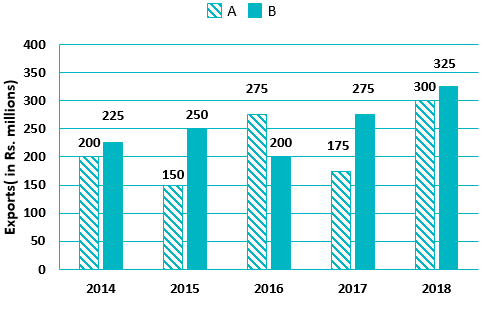
In which year are the exports of cars A ₹20 million more that the average exports( per year) of cars of type B?Answer aur solution dekho
Archived marked answer: C
Q20 · Data Interpretation
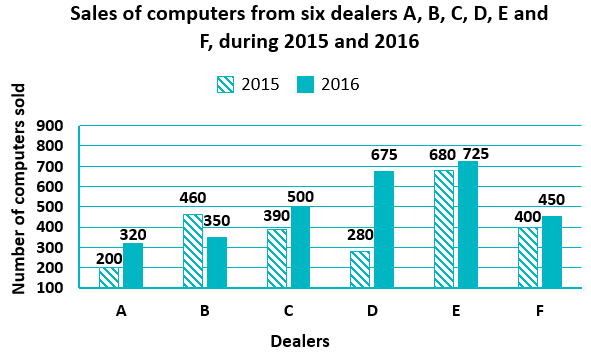
What is the ratio of the total sales from dealers A, B and C taken together for the year 2015 to the sales from dealers D, E and F taken together for the year 2016 ?Answer aur solution dekho
Archived marked answer: C
Q21 · Data Interpretation
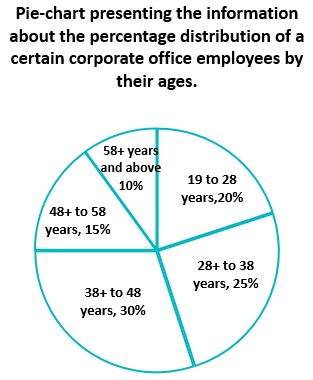
What is the central angle (in degrees) corresponding to the age groups 38+ to 48 years and 58+ years and above ,taken together?Answer aur solution dekho
Archived marked answer: B
Q22 · Simplification
Q23 · Compound Interest
Answer aur solution dekho
Archived marked answer: C
Q24 · Compound Interest
Answer aur solution dekho
Archived marked answer: D
Q25 · Elementary Statistics

Answer aur solution dekho
Archived marked answer: D
English
Q1 · Vocabulary
Answer aur solution dekho
Archived marked answer: D
Q2 · Vocabulary
Answer aur solution dekho
Archived marked answer: B
Q3 · Vocabulary
Answer aur solution dekho
Archived marked answer: D
Q4 · Vocabulary
Answer aur solution dekho
Archived marked answer: B
Q5 · Vocabulary
Answer aur solution dekho
Archived marked answer: A
Q6 · Vocabulary
Answer aur solution dekho
Archived marked answer: B
Q7 · Vocabulary
Answer aur solution dekho
Archived marked answer: B
Q8 · Vocabulary
Answer aur solution dekho
Archived marked answer: D
Q9 · Vocabulary
Answer aur solution dekho
Archived marked answer: D
Q10 · Vocabulary
Answer aur solution dekho
Archived marked answer: B
Q11 · Grammar
Answer aur solution dekho
Archived marked answer: A
Q12 · Grammar
Answer aur solution dekho
Archived marked answer: C
Q13 · Grammar
Answer aur solution dekho
Archived marked answer: A
Q14 · Grammar
Answer aur solution dekho
Archived marked answer: D
Q15 · Grammar
Answer aur solution dekho
Archived marked answer: B
Q16 · Grammar
Answer aur solution dekho
Archived marked answer: B
Q17 · Grammar
Answer aur solution dekho
Archived marked answer: A
Q18 · Voice Change
Answer aur solution dekho
Archived marked answer: C
Q19 · Voice Change
Answer aur solution dekho
Archived marked answer: B
Q20 · Para Jumble
Answer aur solution dekho
Archived marked answer: B