SSC CGL · Tier 1 · Previous-year archive
CGL Tier 1 · 16 August 2021 · Shift 1
90 questions available to read. Bina signup padho; timed practice ke liye free sign in karo.
This saved paper contains 90 of 100 expected questions. 0 stored records are excluded from this study page while their source or wording is checked. Missing original questions: 10. Local question numbers follow the saved archive; match the wording and choices when comparing another response sheet.
Archived marked answers and available solution notes are preserved. These are not claimed to be fully checked final SSC keys. How questions are checked.
Printable archive and coverage notes · Prepare this shift as a timed test
Reasoning
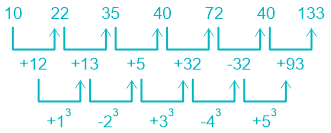
Q2 · Series
Answer aur solution dekho
Archived marked answer: C
Q3 · Series
Q4 · Series

Answer aur solution dekho
Archived marked answer: C
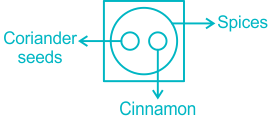
The logic follows here is:
(1) All the signs are rotating in the anticlockwise direction within the square.
(2) In every step, alternate signs are changing.
Therefore, by checking options only option (3) follows above conditions. In all the other options one sign that should be changed is the repeated sign from the previous steps, it should not be repeated.
The complete series is:
Hence, option (3) is the correct answer.Q5 · Analogy
Answer aur solution dekho
Archived marked answer: A
Q6 · Analogy
Answer aur solution dekho
Archived marked answer: C
Q7 · Analogy
Answer aur solution dekho
Archived marked answer: D
Q8 · Analogy
Answer aur solution dekho
Archived marked answer: B
Q9 · Non Verbal Reasoning
Answer aur solution dekho
Archived marked answer: A
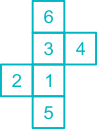
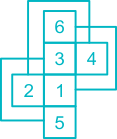
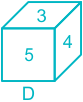
The Opposite of 2 is 4.
The Opposite of 6 is 1.
The Opposite of 3 is 5.
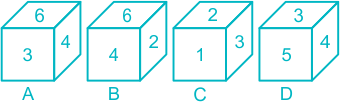
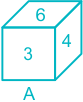
→ Can be formed.
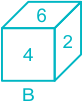
→ Cannot be formed as 4 and 2 are faces opposite to each other and no two opposite faces can appear together in a dice.
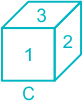
→ Can be formed.
→ Cannot be formed as 5 and 3 are faces opposite to each other and no two opposite faces can appear together in a dice.
The dice A and C can be formed when the given sheet is folded because the opposite faces is not appear together in these dice.
Hence, ‘Only A and C’ is the correct answer.
Additional Information
- Dices are of two types :
- Standard Dice
- Non-Standard Dice.
- Dice has:-
- faces = 6
- sides = 12
- corners = 8
- Two opposite faces are never seen together.
- Adjacent faces are never the opposite of each other.Q10 · Non Verbal Reasoning
Answer aur solution dekho
Archived marked answer: C
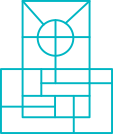
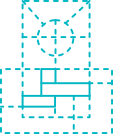
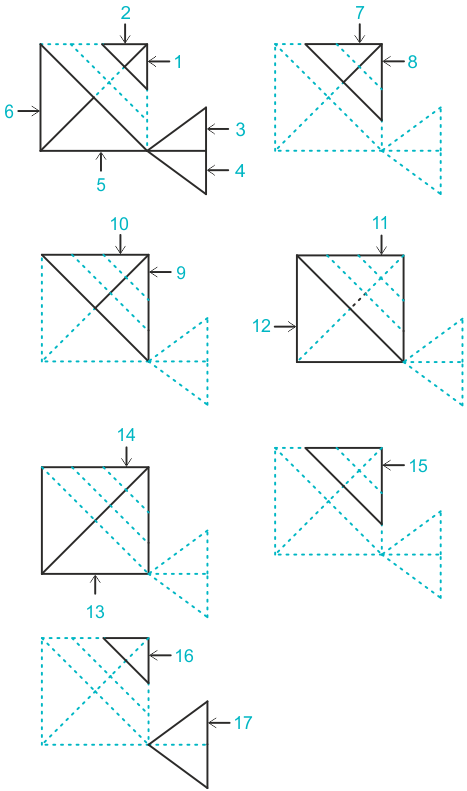
Hence, ‘option 3’ is the correct answer.Q11 · Non Verbal Reasoning
Q12 · Non Verbal Reasoning
Q13 · Non Verbal Reasoning
Q14 · Puzzle Subtypes Not To Miss
Answer aur solution dekho
Archived marked answer: C
1. 14 and 22
Given equation: 36 × 81 ÷ 9 – (88 ÷ 4) + 14 + (22 + 7) = 169
After replacing the numbers, we get:
L.H.S = 36 × 81 ÷ 9 – (88 ÷ 4) + 22 + (14 + 7)
= 36 × 9 – 22 + 22 + 21
= 324 + 21
= 345 ≠ R.H.S
2. 9 and 36
Given equation: 36 × 81 ÷ 9 – (88 ÷ 4) + 14 + (22 + 7) = 169
After replacing the numbers, we get:
L.H.S = 9 × 81 ÷ 36 – (88 ÷ 4) + 14 + (22 + 7)
= 9 × 2.25 – 22 + 14 + 29
= 20.25 – 22 + 43
= 63.25 – 22
= 41.25 ≠ R.H.S
3. 36 and 14
Given equation: 36 × 81 ÷ 9 – (88 ÷ 4) + 14 + (22 + 7) = 169
After replacing the numbers, we get:
L.H.S = 14 × 81 ÷ 9 – (88 ÷ 4) + 36 + (22 + 7)
= 14 × 9 – 22 + 36 + 29
= 126 – 22 + 65
= 191 – 22
= 169 = R.H.S
4. 81 and 36
Given equation: 36 × 81 ÷ 9 – (88 ÷ 4) + 14 + (22 + 7) = 169
After replacing the numbers, we get:
L.H.S = 81 × 36 ÷ 9 – (88 ÷ 4) + 14 + (22 + 7)
= 81 × 4 – 22 + 14 + 29
= 324 – 22 + 43
= 367 – 22
= 345 ≠ R.H.S
Hence, ‘36 and 14’ is the correct answer.Q15 · Coding Decoding
Answer aur solution dekho
Archived marked answer: A
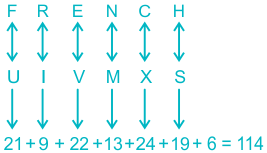
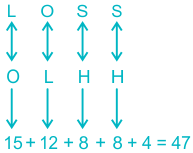
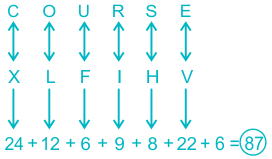
The logic follows here is:
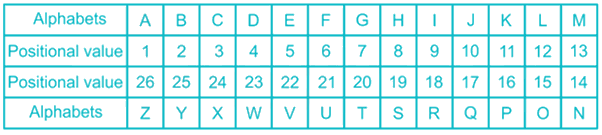
At first, letters of the word are coded according to the equivalent opposite letter of a particular letter of the word.
Then, the letters obtained are coded according to their positional values in English alphabetical series.
Code = Sum of positional values of opposite letter + Number of letters in each word
Similarly,
Hence, ‘87’ is the correct answer.Q16 · Coding Decoding
Answer aur solution dekho
Archived marked answer: C
According to the alphabetical positions of the letters,
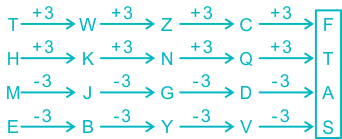
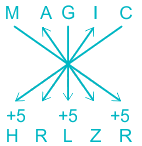
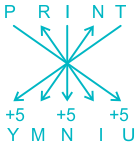
1) 1st, 3rd and 5th letters are reversed their position with addition of 5.
2) 2nd and 4th letters are coded as their equivalent opposite letter.
First, Third and Fifth letters are moved 5 steps forward and Second and Fourth letters are coded according to the equivalent opposite letter of a particular letter of the word.
Similarly,
Hence, ‘HRLZR’ is the correct answer.Q17 · Classification Odd One Out
Q18 · Classification Odd One Out
Answer aur solution dekho
Archived marked answer: C
Q19 · Classification Odd One Out
Answer aur solution dekho
Archived marked answer: C
Q20 · Logical Reasoning
Q21 · Logical Reasoning
Answer aur solution dekho
Archived marked answer: D
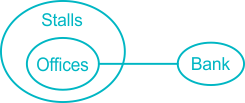
The least possible Venn diagram is:
Conclusions:
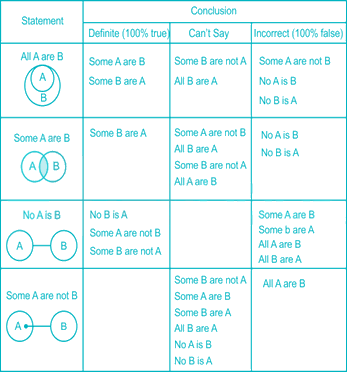
I. No bank is a stall. → False (As, No bank is an office and All offices are stalls → Some bank are not stalls)
II. No stall is a bank. → False (As, No bank is an office and All offices are stalls → Some stalls are not bank)
III. Some stalls are offices. → True (As, All offices are stalls → Some stalls are offices)
IV. All the stalls are offices → False (As, All offices are stalls → Some stalls are offices)
Hence, Only conclusion III follows.Q22 · Blood Relations
Answer aur solution dekho
Archived marked answer: A
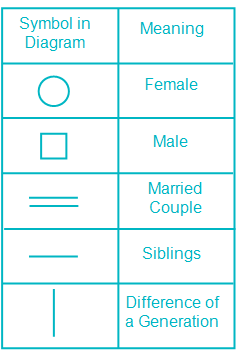
A is
Symbol
#
@
%
Meaning
son
mother
wife
sister
to B
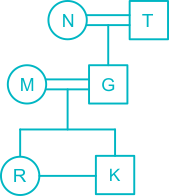
M @ R % K # G # N & T → M is mother of R, R is sister of K, K is son of G, G is son of N, N is wife of T.
1. T is the paternal grandfather of M. → False (T is father-in-law of M)
2. N is the paternal grandmother of K. → True
3. M is the mother of K. → True
4. R is the daughter of G. → True
Hence, ‘T is the paternal grandfather of M’ is the correct answer.Q23 · Alphabet Test
Answer aur solution dekho
Archived marked answer: D
Q24 · Clock and Calendar
Answer aur solution dekho
Archived marked answer: D
General Awareness
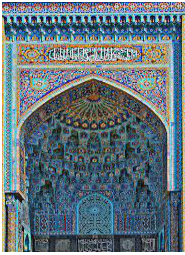
Q1 · Art and Culture
Answer aur solution dekho
Archived marked answer: D
Q2 · Indian Polity and Constitution
Answer aur solution dekho
Archived marked answer: B
Additional Information
- In India, GST Bill was first introduced in 2014 as The Constitution (122nd Amendment) Bill).
- This got approval in 2016 and was renumbered in the statute by Rajya Sabha as The Constitution (101st Amendment) Act, 2016.
- Its provisions:
- Central GST to cover Excise duty, Service tax, etc, State GST to cover VAT, luxury tax, etc.
- Integrated GST to cover inter-state trade. IGST per se is not a tax but a system to coordinate state and union taxes.
- Article 246A – states have the power to tax goods and services.
- Excise Duty :
- Excise duty is a form of tax imposed on goods for their production, licensing, and sale.
- Today, excise duty applies only to petroleum and liquor.
- Excise duty was levied on manufactured goods and levied at the time of removal of goods, while GST is levied on the supply of goods and services.
- Value Added Tax :
- Value-added tax (VAT) is a type of indirect tax levied on goods and services for value-added at every point of production or distribution cycle, starting from raw materials and going all the way to the final retail purchase.
- Because the consumer bears the entire tax, VAT is also a consumption tax.
- Service Tax :
- Service tax is a tax levied by the government on service providers on certain service transactions but is actually borne by the customers.
- It is categorized under Indirect Tax and came into existence under the Finance Act, 1994.
- This tax is not applicable in the state of Jammu & Kashmir.Q3 · Indian Polity and Constitution
Answer aur solution dekho
Archived marked answer: A
Q4 · Indian Economy
Answer aur solution dekho
Archived marked answer: A
Q5 · Indian Economy
Answer aur solution dekho
Archived marked answer: B
Additional Information
- The National Development Council (NDC) in its 53rd meeting held on 29th May 2007 adopted a resolution to launch a Food Security Mission comprising rice, wheat, and pulses to increase the annual production of rice by 10 million tonnes, wheat by 8 million tonnes, and pulses by 2 million tonnes by the end of the Eleventh Plan (2011-12).
- Accordingly, a Centrally Sponsored Scheme, 'National Food Security Mission (NFSM)', was launched in October 2007.
- The approximate percentage of funds allocated for pulses under the National Food Security Mission for 2017-18 is 60%.Q6 · Sports Static GK
Answer aur solution dekho
Archived marked answer: D
Q7 · Sports Static GK
Answer aur solution dekho
Archived marked answer: C
Q8 · Indian Geography
Answer aur solution dekho
Archived marked answer: C
Q9 · Indian Geography
Answer aur solution dekho
Archived marked answer: D
Q10 · Modern Indian History
Answer aur solution dekho
Archived marked answer: C
Q11 · Modern Indian History
Answer aur solution dekho
Archived marked answer: B
Q12 · Current Affairs
Answer aur solution dekho
Archived marked answer: A
Q13 · Current Affairs
Answer aur solution dekho
Archived marked answer: A
Q14 · Current Affairs
Answer aur solution dekho
Archived marked answer: C
Q15 · General Science Biology
Answer aur solution dekho
Archived marked answer: B
Q16 · General Science Biology
Answer aur solution dekho
Archived marked answer: C
Q17 · General Science Biology
Answer aur solution dekho
Archived marked answer: A
Q18 · General Science Chemistry
Answer aur solution dekho
Archived marked answer: D
Q19 · Medieval Indian History
Answer aur solution dekho
Archived marked answer: D
Additional Information
- Mughal Architecture:
- About:
- This is a building style that flourished in northern and central India under the patronage of the Mughal emperors from the mid-16th to the late 17th century.
- The Mughal period marked a striking revival of Islamic architecture in northern India. Under the patronage of the Mughal emperors, Persian, Indian, and various provincial styles were fused to produce works of unusual quality and refinement.
- It became so widespread especially in north India that these can be seen further in the colonial architecture of Indo-Saracenic style.
- Important Features:
- Mixed Architecture: It was a blend of Indian, Persian, and Turkish architectural styles.
- Diversity: Different types of buildings, such as majestic gates (entrances), forts, mausoleums, palaces, mosques, sarais, etc.
- Building material: Mostly, red sandstone and white marble were used.
- Speciality: Specific features such as the Charbagh style of the mausoleums, pronounced bulbous domes, slender turrets at the corners, broad gateways, beautiful calligraphy, arabesque, and geometric patterns on pillars and walls, and palace halls supported on pillars.
- The arches, chhatri, and various styles of domes became hugely popular in Indo-Islamic architecture and were further developed under the Mughals.
- Some Examples:
- Taj Mahal:
- Built by Shah Jahan between 1632 and 1653, in memory of his wife Mumtaz Mahal.
- UNESCO recognized the Taj Mahal as a World Heritage Site in 1983. It is located in Agra.
- Red Fort:
- Built by Shah Jahan in 1618 when he decided to move the capital from Agra to Delhi. It was the residence of Mughal rulers.
- UNESCO designated it as the World Heritage Site in 2007.
- Jama Masjid:
- Built by Shah Jahan in Delhi. The construction was completed in 1656.
- Badshahi Mosque:
- Built during the reign of Aurangazeb. At the time of completion in 1673, it was the largest mosque in the world.
- It is located in Lahore, the capital of the Pakistani province of Punjab.Q20 · Medieval Indian History
Answer aur solution dekho
Archived marked answer: A
Q21 · Ancient Indian History
Answer aur solution dekho
Archived marked answer: A
Q22 · World Geography
Answer aur solution dekho
Archived marked answer: B
Q23 · General Science Physics
Answer aur solution dekho
Archived marked answer: D
Q24 · Books and Authors Static
Answer aur solution dekho
Archived marked answer: B
Q25 · Static GK
Answer aur solution dekho
Archived marked answer: C
Mathematics
Q1 · Geometry
Q2 · Geometry
Answer aur solution dekho
Archived marked answer: B
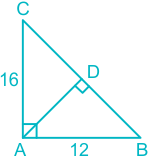
AB² + AC² = BC²
⇒ 12² + 16² = BC²
⇒ 144 + 256 = BC²
⇒ 400 = BC²
⇒ 20 = BC
Now, using similarity of triangle ABC and DBA.
BCover AB = ABover BD = ACover AD
Length of BD = (AB × AB) / BC
⇒ (12 × 12)/20 = 7.2
So, the Length of BD is 7.2 cm.Q3 · Geometry
Answer aur solution dekho
Archived marked answer: D
Q4 · Geometry
Answer aur solution dekho
Archived marked answer: B
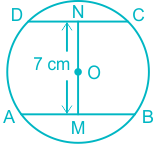
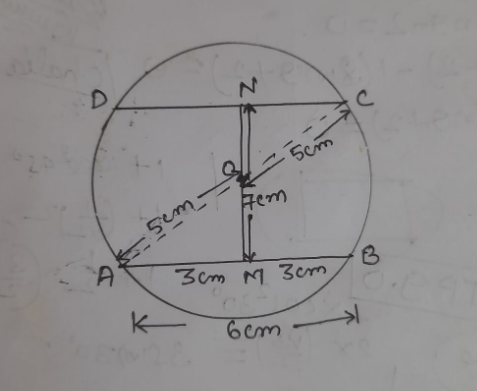
Using Pythagoras Theorem,
OM = √((OA)²-(MA)²)
⇒ √((5)²-(3)²) = √16 = 4 cm
⇒ OM = 4 cm
ON = MN - OM
⇒ ON = 7 - 4 = 3 cm
Again, Using Pythagoras Theorem,
NC = √((OC)²-(ON)²)
⇒ √((5)²-(3)²) = √16 = 4cm
⇒ NC = DN = 4 cm
DC = NC + DN
⇒ DC = 4 + 4 = 8cm
∴ The required answer is 8 cm.Q5 · Trigonometry
Answer aur solution dekho
Archived marked answer: C
Q6 · Trigonometry
Answer aur solution dekho
Archived marked answer: D
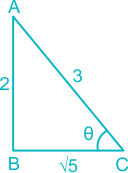
In Δ ABC
⇒ AC² = AB² + BC²
⇒ BC² = AC² – AB²
⇒ BC = √(AC² – AB²)
⇒ √(3² – 2²)
⇒ √(9 – 4)
⇒ √5
tanθ = P/B = 2/√5
secθ = H/B = 3/√5
⇒ tanθ + secθ = 2/√5 + 3/√5
⇒ 5/√5
⇒ √5
∴ The required value is √5Q7 · Trigonometry
Answer aur solution dekho
Archived marked answer: B
Q8 · Mensuration 2D
Answer aur solution dekho
Archived marked answer: A
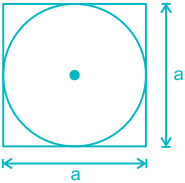
Area of square = 784 cm²
⇒ a² = 784 cm²
⇒ a = 28 cm
Side = Diameter of circle = 28 cm
Radius of circle = 28/2 cm = 14 cm
Area of the circle = πr²
⇒ 22/7 × 14 × 14 cm²
⇒ 616 cm²
∴ Area of circle inscribed in a square is 616Q9 · Algebra
Answer aur solution dekho
Archived marked answer: C
Q10 · Algebra
Answer aur solution dekho
Archived marked answer: C
Q11 · Algebra
Answer aur solution dekho
Archived marked answer: B
Q12 · Profit and Loss
Answer aur solution dekho
Archived marked answer: B
Q13 · Profit and Loss
Answer aur solution dekho
Archived marked answer: A
Q14 · Time and Work
Answer aur solution dekho
Archived marked answer: A
Q15 · Number System
Answer aur solution dekho
Archived marked answer: D
Q16 · Time and Distance
Answer aur solution dekho
Archived marked answer: C
Q17 · Simplification
Answer aur solution dekho
Archived marked answer: B
Q18 · Percentage
Answer aur solution dekho
Archived marked answer: A
Q19 · Average
Answer aur solution dekho
Archived marked answer: D
Q20 · Compound Interest
Answer aur solution dekho
Archived marked answer: A
Q21 · Age
Answer aur solution dekho
Archived marked answer: A
English
Q1 · Vocabulary
Answer aur solution dekho
Archived marked answer: A
Q2 · Vocabulary
Answer aur solution dekho
Archived marked answer: A
Q3 · Vocabulary
Answer aur solution dekho
Archived marked answer: B
Q4 · Vocabulary
Answer aur solution dekho
Archived marked answer: B
Q5 · Vocabulary
Answer aur solution dekho
Archived marked answer: C
Q6 · Vocabulary
Answer aur solution dekho
Archived marked answer: C
Q7 · Vocabulary
Answer aur solution dekho
Archived marked answer: D
Q8 · Vocabulary
Answer aur solution dekho
Archived marked answer: B
Q9 · Vocabulary
Answer aur solution dekho
Archived marked answer: C
Q10 · Vocabulary
Answer aur solution dekho
Archived marked answer: A
Q11 · Vocabulary
Answer aur solution dekho
Archived marked answer: B
Q12 · Grammar
Answer aur solution dekho
Archived marked answer: A
Q13 · Grammar
Answer aur solution dekho
Archived marked answer: C
Q14 · Grammar
Answer aur solution dekho
Archived marked answer: D
Q15 · Grammar
Answer aur solution dekho
Archived marked answer: D
Q16 · Grammar
Answer aur solution dekho
Archived marked answer: D
Q17 · Grammar
Answer aur solution dekho
Archived marked answer: C
Q18 · Voice Change
Answer aur solution dekho
Archived marked answer: C
Q19 · Para Jumble
Answer aur solution dekho
Archived marked answer: D
Q20 · Para Jumble
Answer aur solution dekho
Archived marked answer: B