SSC CGL 2026 · Tier 1 · Archived tentative key

6 October 2026 · Shift 3
Answer key & worked solutions

100 archived answers: 25 each in Reasoning, General Awareness, Mathematics and English. 95 worked answers agree with the archive; 5 have review notes.

Source and checking status

These public archive copies have not been authenticated against individual SSC response sheets. The release is tentative. Question and option order can differ from your response sheet; match the actual question and choices in the reference paper. Archived answers and worked answers are shown separately. This page contains original explanations. Read the licensed question PDF on this site for the original wording, options, diagrams and passages. Branding-only overlays have been removed from the clean reading copy; question content and archived answer markings remain unchanged. Read solution cautions before relying on them.

SSC release notice ↗ · Read or save the clean question PDF ↗ · Original archive source ↗ · How questions are checked

Published by Crack SSC With Farha. Content updated .

Use the interactive paper filters →

Worked-answer index

Letters refer to our worked answers in the linked reference paper’s option order. Yellow entries require reading the caution; * means a qualified answer and ? means no unique answer was confirmed. Original archive markings remain visible in each solution.

Reasoning · 25 worked solutions

Q1. Address comparison

Reference PDF question 1

Open Q1 in the study reader →

Our worked answer: C · Archive marking: C

Cross and main streets differ

One address is on 5 th Cross and 10 th Main; the other is on 10 th Cross and 5 th Main. The cross and main street numbers are different even though the locality and PIN agree.

Q2. Letter coding

Reference PDF question 2

Open Q2 in the study reader →

Our worked answer: C · Archive marking: C

BGZHQ

Each letter moves back one place. CHAIR therefore becomes BGZHQ.

Q3. Letter coding

Reference PDF question 3

Open Q3 in the study reader →

Our worked answer: A · Archive marking: A

FDVCBTJOOAMLZ

Odd-position letters advance one place and even-position letters remain unchanged. Applying the rule to EDUCATIONALLY produces FDVCBTJOOAMLZ.

Q4. Ranking

Reference PDF question 4

Open Q4 in the study reader →

Our worked answer: C · Archive marking: C

37

After swapping, Mohan occupies Sohan’s old position: 18 th from the left and 20 th from the right. The total is 18 + 20 − 1 = 37.

Q5. Workplace judgement

Reference PDF question 5

Open Q5 in the study reader →

Our worked answer: D · Archive marking: D

Private discussion with structured updates

A private meeting with reliable, structured audit updates addresses the anxiety driving the micromanagement. It can provide reassurance and clearer oversight without spreading the anxiety through the team.

Q6. Triangle counting

Reference PDF question 6

Open Q6 in the study reader →

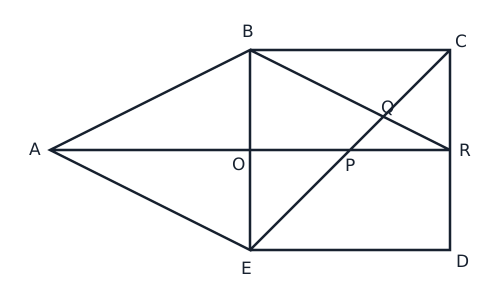
Answer unconfirmed. Archived-copy mismatch: nine visible segments produce 15 triangles, whereas the option s are 9, 11, 12 and 13 and the archive marks 13.

Our worked answer: No unique option confirmed · Archive marking: D

15 (not listed)

A direct segment count gives 15, not a listed option. In the accompanying labelled tracing the triangles are ABO, BOR, BCQ, BCR, BCE, BEQ, ABR, ABE, EOP, CPR, PQR, AEP, AEO, CQR and CDE. Five include the left tip A and ten lie in the rectangle.
Labelled solution diagram for question 6: Triangle counting
Select the original solution diagram to open it full size.

Q7. Workplace judgement

Reference PDF question 7

Open Q7 in the study reader →

Our worked answer: D · Archive marking: D

Reframe and revisit the proposal

Restating the promising idea clearly and suggesting reconsideration helps the team evaluate its substance. It also supports the junior colleague without turning the discussion into a personal confrontation.

Q8. Professional ethics

Reference PDF question 8

Open Q8 in the study reader →

Our worked answer: B · Archive marking: B

Support honest disclosure and remediation

Recognising the colleague’s concern while insisting on honesty supports accountability. Reviewing the facts together and preparing a transparent recovery plan helps repair the mistake without endorsing a false explanation.

Q9. Figure completion

Reference PDF question 9

Open Q9 in the study reader →

Our worked answer: C · Archive marking: C

Option 3

The alternating black and white square bands must continue across both cut edges. Option 3 preserves the central white square and the small white ends at the outside diagonal, unlike the altered fills in the other pieces.

Q10. Symbolic expression

Reference PDF question 10

Open Q10 in the study reader →

Our worked answer: A · Archive marking: A

(A % B) Π C

The sum must be formed first, then multiplied by C. Parentheses around A % B give (A % B) Π C.

Q11. Coded operations

Reference PDF question 11

Open Q11 in the study reader →

Our worked answer: B · Archive marking: B

42

The examples define × as division, − as multiplication and + as addition. The expression becomes 20 × 10 ÷ 5 + 2 = 42.

Q12. Logical inference

Reference PDF question 12

Open Q12 in the study reader →

Our worked answer: A · Archive marking: A

Only I

The statement explicitly links improper crossing with accident risk, supporting I. It does not identify pedestrians as the only cause of every accident, so II does not follow.

Q13. Mirror image

Reference PDF question 13

Open Q13 in the study reader →

Our worked answer: C · Archive marking: C

Option 3

A vertical mirror reverses the order to h, 4, 7, r, y, 5 and reverses every character horizontally. Option 3 preserves both requirements.

Q14. Client management

Reference PDF question 14

Open Q14 in the study reader →

Our worked answer: C · Archive marking: C

Consult manager and provide a timely update

Acknowledge the change request, check scope and authority with the manager, and give a clear update time. This keeps communication responsive without making an unsupported deadline commitment.

Q15. Figure analogy

Reference PDF question 15

Open Q15 in the study reader →

Our worked answer: C · Archive marking: C

Labelled figure 3

Rotate the figure through 180°, then duplicate the main crossbar and the small circle. The third figure consequently needs a double bottom horizontal bar, an upward stem and two circles to its left, matching labelled figure 3.

Q16. Figure analogy

Reference PDF question 16

Open Q16 in the study reader →

Our worked answer: B · Archive marking: B

Figure 2

The example is a 180° rotation of the internal figure. Turning the inverted third figure through the same half-turn gives the upright shape with an open bottom notch and central upper divider shown in figure 2.

Q17. Embedded figure

Reference PDF question 17

Open Q17 in the study reader →

Our worked answer: D · Archive marking: D

Option 4

Option 4 supplies the circular boundary, the vertical radius to its top and the sloping radius toward the upper right. Following the longer circular arc between those radius endpoints traces the target exactly.

Q18. Venn classification

Reference PDF question 18

Open Q18 in the study reader →

Our worked answer: C · Archive marking: C

Option 3

Education, employment and urban residence are independent attributes that may overlap in every combination. Three mutually overlapping circles, option 3, express that relationship.

Q19. Odd figure

Reference PDF question 19

Open Q19 in the study reader →

Our worked answer: C · Archive marking: C

d

In a, b, c and e the dot is at a square’s corner. In d it lies along the left side rather than at a corner, so d is different.

Q20. Statement and assumption

Reference PDF question 20

Open Q20 in the study reader →

Our worked answer: C · Archive marking: C

Only II

The environmental purpose requires an expected environmental benefit from eliminating the bags, supporting II. Retail outlets need not be the largest source for a reduction in their waste to help, so I is unnecessary.

Q21. Dice

Reference PDF question 21

Open Q21 in the study reader →

Our worked answer: A · Archive marking: A

6

Across the views, face 3 touches 1, 2, 4 and 5. A cube face has exactly four adjacent faces, so the remaining number 6 must be opposite 3.

Q22. Odd figure

Reference PDF question 22

Open Q22 in the study reader →

Our worked answer: B · Archive marking: B

d

In a, b, c and e the two black wedges have one white wedge between them around the shorter arc. In d their separation is different, so it is not a rotation of the others.

Q23. Number columns

Reference PDF question 23

Open Q23 in the study reader →

Our worked answer: A · Archive marking: A

Columns I, II and IV

In every row column II equals column I + 3, and column IV equals column I + 5. These fixed offsets relate I, II and IV; the other column s fail a consistent corresponding offset.

Q24. Letter sequence

Reference PDF question 24

Open Q24 in the study reader →

Our worked answer: C · Archive marking: C

abdc

Inserting a, b, d, c completes cabd repeated across the sequence. The missing group is abdc.

Q25. Figure sequence

Reference PDF question 25

Open Q25 in the study reader →

Our worked answer: D · Archive marking: D

Option 4

Each frame rotates the entire pair of bent lines 90° clockwise, including the arrow and circle. Rotating the third frame gives the arrow pointing right at the upper right and the circle at lower left, as in option 4.

General Awareness · 25 worked solutions

Q28. Indian geography

Reference PDF question 28

Open Q28 in the study reader →

Read before using this answer. The question should specify local solar time; there is no official clock-time difference between the two locations.

Our worked answer: B · Archive marking: B

About 2 hours of local solar time

India spans roughly 29 degrees of longitude. At 4 minutes per degree, this gives nearly 116 minutes, or about 2 hours, of local solar-time difference. Both places nevertheless use the same Indian Standard Time.

Q29. Constitution

Reference PDF question 29

Open Q29 in the study reader →

Our worked answer: C · Archive marking: C

Appointment of an Acting Chief Justice

Article 126 permits the President to appoint another Supreme Court judge to perform the Chief Justice’s duties when the office is vacant or its holder cannot act.

Evidence: www.indiacode.nic.in · source 1 ↗

Q31. SI units

Reference PDF question 31

Open Q31 in the study reader →

Our worked answer: D · Archive marking: D

Luminous intensity

Candela is the SI base unit of luminous intensity. It is not the unit of total luminous flux, which is the lumen.

Q32. Earthquakes

Reference PDF question 32

Open Q32 in the study reader →

Our worked answer: B · Archive marking: B

Epicentre

The focus or hypocentre is the origin inside Earth. The epicentre is the point on the surface directly above it.

Q33. Indian minerals

Reference PDF question 33

Open Q33 in the study reader →

Our worked answer: C · Archive marking: C

Manganese

The Indian Bureau of Mines identifies the Gangpur manganese belt in Odisha. Gangpur and Sundargarh are associated with manganese deposits.

Evidence: ibm.gov.in · source 1 ↗

Q34. Folk traditions

Reference PDF question 34

Open Q34 in the study reader →

Our worked answer: C · Archive marking: C

Both pairs

Malushahi is a Kumaoni ballad tradition of Uttarakhand. Manganiyars are hereditary musicians associated with western Rajasthan.

Q35. Education schemes

Reference PDF question 35

Open Q35 in the study reader →

Our worked answer: B · Archive marking: B

Exemplar schools showcasing NEP 2020

PM SHRI upgrades selected schools to demonstrate the practices and goals of NEP 2020, including improved learning environments and infrastructure.

Evidence: pmshri.education.gov.in · source 1 ↗

Q36. International organisations

Reference PDF question 36

Open Q36 in the study reader →

Our worked answer: B · Archive marking: B

Economic cooperation among emerging economies

BRICS centres on cooperation among major emerging economies. NAM originated principally as a political movement resisting alignment with rival power blocs.

Q37. Regional connectivity

Reference PDF question 37

Open Q37 in the study reader →

Our worked answer: A · Archive marking: A

Arabian Sea–Iran–Afghanistan route

Chabahar is on Iran’s southeastern coast with access from the Arabian Sea through the Gulf of Oman. Its land connections offer an onward route to Afghanistan.

Q38. Criminal procedure

Reference PDF question 38

Open Q38 in the study reader →

Our worked answer: C · Archive marking: C

Regular magistrate lacks the assigned trial jurisdiction

BNSS Section 9 provides that once such a Special Court is established, no other magistrate’s court in the local area has jurisdiction to try the case or class assigned to it.

Evidence: www.indiacode.nic.in · source 1 ↗

Q40. Olympic wrestling

Reference PDF question 40

Open Q40 in the study reader →

Read before using this answer. The usual record comparison excludes Norman Pritchard’s colonial-era 1900 medals; “youngest-ever from India” needs that historical qualification.

Our worked answer: C · Archive marking: C

Aman Sehrawat

Aman Sehrawat won men’s 57 kg freestyle bronze at Paris 2024, becoming independent India’s youngest individual Olympic medallist.

Q41. Wetlands

Reference PDF question 41

Open Q41 in the study reader →

Read before using this answer. The primary record supports the site for 2025, not the archived stem’s 2026. No primary 2026 event record was located to validate that precise year.

Our worked answer: B · Archive marking: B

Parvati Arga; event year is 2025

The ministry’s official account records the national World Wetlands Day celebration at Parvati Arga Ramsar Site in Gonda on 2February 2025.

Evidence: www.pib.gov.in · source 1 ↗

Q42. National income

Reference PDF question 42

Open Q42 in the study reader →

Our worked answer: C · Archive marking: C

Real GDP removes price-change effects

Real GDP values output at constant prices, so comparisons show changes in production rather than simply higher prices. Nominal GDP uses current prices.

Q43. Public enterprises

Reference PDF question 43

Open Q43 in the study reader →

Our worked answer: C · Archive marking: C

Indian Oil Corporation

IndianOil holds Maharatna status, conferred in 2010. Its official corporate history confirms the classification.

Evidence: iocl.com · source 1 ↗

Q44. Population change

Reference PDF question 44

Open Q44 in the study reader →

Our worked answer: C · Archive marking: C

Rapid population growth

When births stay high while deaths fall quickly, births substantially exceed deaths. This produces rapid natural increase, often called a population explosion.

Q45. Economic planning

Reference PDF question 45

Open Q45 in the study reader →

Our worked answer: B · Archive marking: B

Wars and droughts

The Third Plan faced the 1962 war with China, the 1965 war with Pakistan and severe droughts. These shocks diverted resources and depressed agricultural output.

Evidence: www.mospi.gov.in · source 1 ↗

Q47. Population calculation

Reference PDF question 47

Open Q47 in the study reader →

Our worked answer: D · Archive marking: D

50%

The increase is 600 −400 =200 individuals. Percentage growth =200/400 ×100 =50%.

Q48. Antibody measurement

Reference PDF question 48

Open Q48 in the study reader →

Our worked answer: A · Archive marking: A

16-fold

A titre uses the reciprocal dilution for comparison. The increase is 320/20 =16-fold.

Q49. Partition history

Reference PDF question 49

Open Q49 in the study reader →

Our worked answer: D · Archive marking: D

Sir Cyril Radcliffe

Radcliffe chaired both the Punjab and Bengal Boundary Commissions that drew the Partition boundary in 1947.

Q50. Independence history

Reference PDF question 50

Open Q50 in the study reader →

Our worked answer: C · Archive marking: C

Mountbatten Plan

The 3June 1947 Mountbatten Plan set out Partition and transfer of power, forming the immediate political basis for the Indian Independence Act 1947.

Mathematics · 25 worked solutions

Q51. Radical equation

Reference PDF question 51

Open Q51 in the study reader →

Our worked answer: D · Archive marking: D

33

Squaring gives 1+x/256=289/256. Hence x=289−256=33; substitution retains the positive square root.

Q52. Difference of squares

Reference PDF question 52

Open Q52 in the study reader →

Our worked answer: B · Archive marking: B

0.11

Factor the fourth-power difference as (0.6²−0.5²)(0.6²+0.5²). Cancelling the second factor leaves 0.36−0.25=0.11.

Q53. Combining ratios

Reference PDF question 53

Open Q53 in the study reader →

Our worked answer: A · Archive marking: A

25:30:27

Make the B terms equal: A: B=25:30 and B: C=30:27. Thus A: B: C=25:30:27.

Q54. Work-based wages

Reference PDF question 54

Open Q54 in the study reader →

Our worked answer: D · Archive marking: D

₹200

The assistant’s rate is 1/8−1/12=1/24. A and the assistant have rates 2:1, so the assistant receives one-third of ₹600, or ₹200.

Q55. Reciprocal identities

Reference PDF question 55

Open Q55 in the study reader →

Our worked answer: C · Archive marking: C

898

First x²+x⁻²=(4√2)²−2=30. Squaring again gives x⁴+x⁻⁴=30²−2=898.

Q56. Split simple-interest investment

Reference PDF question 56

Open Q56 in the study reader →

Our worked answer: B · Archive marking: B

₹4,400

If all ₹17200 earned 8% for 2 years, interest would be₹2752. The extra₹256 comes from the 2-percentage-point premium for 2 years, so the 10% part is 256/0.04=₹6400. The other part is₹10800, a difference of₹4400.

Q57. Linear equation graph

Reference PDF question 57

Open Q57 in the study reader →

Our worked answer: B · Archive marking: B

Vertical line x=5

The equation reduces to 2 x=10, or x=5, with no restriction on y. This is a vertical line.

Q58. Compound interest and withdrawal

Reference PDF question 58

Open Q58 in the study reader →

Our worked answer: C · Archive marking: C

₹2,33,200

First-year interest is₹20000. Withdrawing 40% of it removes₹8000, leaving₹212000. One further year at 10% gives 212000×1.1=₹233200.

Q59. Cuboid packing

Reference PDF question 59

Open Q59 in the study reader →

Our worked answer: A · Archive marking: A

480

The number of 8 cm cubes along the three dimensions is 10, 8 and 6. Their product is 10×8×6=480.

Q60. Chord and radius

Reference PDF question 60

Open Q60 in the study reader →

Our worked answer: A · Archive marking: A

r ≥12.7 cm

A chord cannot exceed the diameter. Thus 2 r≥25.4 and r≥12.7 cm. Equality occurs when the chord is a diameter.

Q61. Rhombus diagonals

Reference PDF question 61

Open Q61 in the study reader →

Our worked answer: B · Archive marking: B

50 cm

Write the diagonals as 3 k and 4 k. Area=½×3 k×4 k=150 gives k=5. Half-diagonals are 7.5 and 10, so each side is√(7.5²+10²)=12.5 cm. The perimeter is 50 cm.

Q62. Complementary-angle identities

Reference PDF question 62

Open Q62 in the study reader →

Our worked answer: C · Archive marking: C

−7/3

Since C=90°−A, cos C=sin A and sin C=cos A. Cancelling sin A reduces the ratio tosin A+cos Acos A−sin A=tan A+11−tan A. With tan A=5/2, this is−7/3.

Q63. Triangular prism

Reference PDF question 63

Open Q63 in the study reader →

Our worked answer: A · Archive marking: A

120 cm³

An isosceles right triangle with hypotenuse 4√2 cm has legs 4 cm. Its area is 8 cm², so the prism volume is 8×15=120 cm³.

Q64. Conjugate surds

Reference PDF question 64

Open Q64 in the study reader →

Our worked answer: D · Archive marking: D

142

Here x²=6+√356−√35. Adding its reciprocal gives[(6+√35)²+(6−√35)²]/(36−35)=2(36+35)=142.

Q65. Congruent right triangles

Reference PDF question 65

Open Q65 in the study reader →

Our worked answer: C · Archive marking: C

12 cm

Congruence in the stated vertex order makes AC=PR=5 cm. Using hypotenuse BC=13 gives AB=√(13²−5²)=12 cm.

Q66. Chord lengths

Reference PDF question 66

Open Q66 in the study reader →

Our worked answer: B · Archive marking: B

30 cm

The first chord gives radius²=20²+15²=625. At distance 20 cm, the second half-chord is√(625−400)=15 cm, hence the chord is 30 cm.

Q67. Alloy mixture

Reference PDF question 67

Open Q67 in the study reader →

Our worked answer: B · Archive marking: B

6 kg

The original copper is 0.35×20=7 kg. If x kg is added, 7+x20+x=1/2. Thus 14+2 x=20+x, so x=6 kg.

Q68. Frequency-polygon comparison

Reference PDF question 68

Open Q68 in the study reader →

Our worked answer: C · Archive marking: C

90–110 to110–130

The successive declines after the peak are 110−72=38, 72−30=42, 30−15=15 and 15−0=15. The largest is 42, between 90–110 and 110–130.

Q69. Cylinder volume change

Reference PDF question 69

Open Q69 in the study reader →

Our worked answer: B · Archive marking: B

25% increase

Volume scales as radius squared times height. The factor is 1.25²×0.8=1.25, an increase of 25%.

Q70. Markup and discount

Reference PDF question 70

Open Q70 in the study reader →

Our worked answer: C · Archive marking: C

14.75%

Take cost as 100. The marked price is 135 and the selling price is 135×0.85=114.75. Profit is 14.75%.

Q71. Median class

Reference PDF question 71

Open Q71 in the study reader →

Our worked answer: D · Archive marking: D

180–190

Total frequency is 685, so locate the 342.5 th observation. The cumulative frequency through 170–180 is 243 and through 180–190 is 360. The median class is 180–190.

Q72. Pie-chart percentage points

Reference PDF question 72

Open Q72 in the study reader →

Our worked answer: C · Archive marking: C

45 percentage points

The high-growth share is 30+35=65%. The sparse share is 10+10=20%. Their difference is 65−20=45 percentage points.

Q73. Height from eye level

Reference PDF question 73

Open Q73 in the study reader →

Our worked answer: D · Archive marking: D

30 m

At 45°, the height above eye level equals the horizontal distance 28.5 m. Add the observer’s 1.5 m eye height: 30 m.

Q74. Average and missing term

Reference PDF question 74

Open Q74 in the study reader →

Our worked answer: C · Archive marking: C

78

The total is 15×72=1080. The first 8 total 552 and the last 6 total 450. The uncovered ninth number is 1080−552−450=78.

Q75. Mode and median

Reference PDF question 75

Open Q75 in the study reader →

Our worked answer: A · Archive marking: A

0

The highest frequency 35 occurs at 3 attempts, so the mode is 3. There are 100 cases; the 50 th and 51 st both lie in the 3-attempt group, whose cumulative position s are 41–75. The median is also 3, giving difference 0.

English · 25 worked solutions

Q76. Spelling

Reference PDF question 76

Open Q76 in the study reader →

Our worked answer: A · Archive marking: A

Comprehention → comprehension

The correct noun is ‘comprehension’, with -sion rather than -tion.

Q77. Spelling

Reference PDF question 77

Open Q77 in the study reader →

Our worked answer: A · Archive marking: A

Superstisious → superstitious

The correct form is ‘superstitious’, with the sequence -stitious; the listed ‘Superstisious’ is misspelt.

Q78. Antonyms

Reference PDF question 78

Open Q78 in the study reader →

Our worked answer: B · Archive marking: B

Truthful

‘Mendacious’ means untruthful, so ‘truthful’ gives its opposite.

Q79. Antonyms

Reference PDF question 79

Open Q79 in the study reader →

Our worked answer: D · Archive marking: D

Clear

A ‘murky’ account is unclear or difficult to follow, making ‘clear’ the opposite in this context.

Q80. Spelling

Reference PDF question 80

Open Q80 in the study reader →

Our worked answer: B · Archive marking: B

Scintillating

‘Scintillating’ has a double l and describes something brilliantly lively or witty.

Q81. Spelling

Reference PDF question 81

Open Q81 in the study reader →

Our worked answer: A · Archive marking: A

Propensity

‘Propensity’, with s rather than c, is the standard spelling for a tendency or inclination.

Q82. Sentence ordering

Reference PDF question 82

Open Q82 in the study reader →

Our worked answer: A · Archive marking: A

QRSP

Q supplies the definition, R introduces production, S names what is produced and links to its effect, and P completes that effect.

Q83. Sentence ordering

Reference PDF question 83

Open Q83 in the study reader →

Our worked answer: B · Archive marking: B

RPSQ

R supplies the aim, P–S states its economic and social objectives, and Q introduces the environmental qualification leading into the fixed ending.

Q84. Verb tenses

Reference PDF question 84

Open Q84 in the study reader →

Our worked answer: A · Archive marking: A

had finished, had been building

The model’s completion precedes a past endpoint, requiring ‘had finished’, while the earlier three-hour activity takes ‘had been building’.

Q85. Conditionals

Reference PDF question 85

Open Q85 in the study reader →

Read before using this answer. The sentence does not say whether today’s walk has occurred. Options 2 and 4 are both defensible under different reporting times.

Our worked answer: D · Archive marking: B

had charged, would take

If today’s walk is still ahead, the mixed conditional uses ‘had charged’ for last night and ‘would take’ for the present consequence. If the walk has already ended, the archived ‘would have taken’ is also valid.

Q86. Multiple meanings

Reference PDF question 86

Open Q86 in the study reader →

Our worked answer: B · Archive marking: B

Accommodate

‘Accommodate’ can mean adjust to another person’s needs or provide someone with lodging, covering both definitions.

Q87. Idioms

Reference PDF question 87

Open Q87 in the study reader →

Our worked answer: A · Archive marking: A

Option 1: did not mince words used inconsistently

To ‘not mince words’ is to speak bluntly and directly, contradicting the first option’s description of vague and evasive replies.

Q88. Articles

Reference PDF question 88

Open Q88 in the study reader →

Our worked answer: D · Archive marking: D

from the Netherlands

The country name conventionally requires the definite article, so it should be ‘from the Netherlands’.

Q89. Comparative structures

Reference PDF question 89

Open Q89 in the study reader →

Our worked answer: A · Archive marking: A

Only P

P mixes ‘as many … as’ with ‘more … than’; it should use one complete comparison pattern. Q correctly uses the correlative ‘the more … the fewer’.

Q90. Active and passive voice

Reference PDF question 90

Open Q90 in the study reader →

Our worked answer: D · Archive marking: D

brings about; efforts fail; deeply cynical

Singular ‘savagery’ needs ‘brings’, plural ‘efforts’ needs ‘fail’, and the adverb ‘deeply’ modifies ‘cynical’; only the fourth option preserves all three correctly.

Q91. Reported speech

Reference PDF question 91

Open Q91 in the study reader →

Our worked answer: B · Archive marking: B

Option 2: its; gathered; had formed

The second option correctly backshifts the verbs, changes personal references, and keeps possessive ‘its’ without an apostrophe; ‘listen and observe’ remains parallel.

Q92. Sentence improvement

Reference PDF question 92

Open Q92 in the study reader →

Our worked answer: B · Archive marking: B

a desire that continuously sabotaged …

The repeated noun must remain singular to refer back to one desire, and option 2 supplies a complete main clause with ‘concluded’.

Q93. Sentence improvement

Reference PDF question 93

Open Q93 in the study reader →

Our worked answer: A · Archive marking: A

altering … would render it null and void

Removing ‘by’ lets the -ing clause ‘altering …’ function as the subject of ‘would render’, and the first option avoids the original redundant phrasing.
Q94. Active and passive voice

Reference PDF question 94

Open Q94 in the study reader →

Our worked answer: B · Archive marking: B

will be delivered

The simple-future passive is ‘will be’ plus past participle, preserving the future action without adding perfect or conditional meaning.

Q95. Reported speech

Reference PDF question 95

Open Q95 in the study reader →

Our worked answer: A · Archive marking: A

Why did I allow … my …?

The direct question needs ‘Why did I allow’, with the base verb after ‘did’; reported ‘his’ also returns to the speaker’s ‘my’.

Q96. Cloze participles

Reference PDF question 96

Open Q96 in the study reader →

Our worked answer: A · Archive marking: A

Encouraged by growing environmental awareness

The past-participle phrase correctly describes the city dwellers as receiving encouragement from greater environmental awareness.

Q97. Cloze connectors

Reference PDF question 97

Open Q97 in the study reader →

Our worked answer: C · Archive marking: C

Although

‘Although’ introduces the concession that urban farming cannot replace conventional farming before the sentence states its complementary value.

Q98. Cloze phrasal verbs

Reference PDF question 98

Open Q98 in the study reader →

Our worked answer: B · Archive marking: B

break down

To ‘break down’ social barriers is to reduce the divisions that prevent people from interacting, matching the diverse groups working together.

Q99. Cloze vocabulary

Reference PDF question 99

Open Q99 in the study reader →

Our worked answer: A · Archive marking: A

resilience

‘Resilience’ is the ability to withstand and adapt to difficulties, fitting the benefits of stronger local food systems and greener cities.

Q100. Cloze prepositions

Reference PDF question 100

Open Q100 in the study reader →

Our worked answer: A · Archive marking: A

on

The verb ‘depend’ takes ‘on’; the second ‘on’ maintains the parallel list of the things success depends on.